Shared posts

22 Apr 18:19

The New One-Call Close

by Anthony Iannarino

I am unaware of any sales organization or salesperson who believes they can execute a “one-call close” in a complex sale, though I do believe there must be a few. I don’t believe that I have ever witnessed a salesperson try to close a complex sale in a single call, although I would be keenly interested in observing someone give it a go.

What has replaced the “one-call close” is the “one-call and emailed pricing close,” something so close to the “one-call close” to be a distinction without a difference. Instead of asking for the business at the end of the first call with the prospective client, they email pricing and proposal, something acceptable in a genuinely transactional sale, but would surely not increase a preference to buy from you, what one might consider the principal outcome of a sales calls.

With all the metrics we use to understand and improve sales, we never look at something so simple as how much time it takes to win a complex deal. We look at the days it takes to get through our linear representation of the sales process, and when we are sophisticated, we look at days in stage, the amount of time in each phase. This is all well and good, but I wonder what it might look like to tally up the actual minutes spent with the prospective client and the many stakeholders involved in complex sales.

In my experience, it takes hours to win a client. I have won huge deals in 4 hours with the prospect, and I have won others in something closer to 8 hours spent with the primary contact and/or their team. The process may have taken a couple of months, but the time spent with the contacts can be measured in hours.

If you look at your calendar and add up all the time you spent with the prospect and their team face-to-face, on video meetings, or the phone in a deal you won, you can measure the time it takes, which might give you some idea about how much conversation needs to occur for you to win a complex sale. I would be surprised if you found you win deals in a single hour with your prospective client and even more astonished if emailing a proposal and pricing after that hour resulted in winning their business.

How many hours of conversation does it take for you to win a prospect’s business?

Essential Reading!

Get my 3rd book: Eat Their Lunch

"The first ever playbook for B2B salespeople on how to win clients and customers who are already being serviced by your competition."

Buy Now

The post The New One-Call Close appeared first on The Sales Blog.

22 Apr 18:17

Changing your pricing metric can change willingness to pay (WTP)

by Steven Forth

Willingness to pay (WTP) is one of the most frequently abused concepts in pricing. Many people try to use it as a proxy for value. It is not. Other companies claim they can estimate willingness to pay through surveys. This is too simplistic. Why?

Willingness to pay is determined by framing and by the value delivered to the customer relative to the alternative. To measure willingness to pay without taking these into account is wasting an opportunity to really understand your customers and position the value you are providing.

This is one of those metrics that obscure more than it reveals. For it to be actionable one has to dig under the surface to understand the different value drivers that determine the emotional and economic value a specific customer (or customer segment) gets from an offer relative to an alternative. Rather than starting with some sort of high level estimate of willingness to pay and then trying to decompose this is to approach the problem from the wrong end, one needs to begin with value and then build up to willingness to pay for specific customer segments.

Willingness to pay is determined by framing, the context in which it is presented. The most important framing is the pricing model. Pricing models are the design of packaging, pricing metrics and fencing. Getting the right pricing metric can change willingness to pay by orders of magnitude.

Let’s define some terms.

Willingness to Pay is the maximum price at or below which a consumer will definitely buy one unit of a product. It is frequently presented as a range.

Framing is the way a person or organization frames a transaction to determine the utility they receive or expect. This concept is used in prospect theory, and many mental accounting theorists adopt that theory as the value function in their analysis. It is important to note that the value function is concave for gains (implying an aversion to risk) and convex for losses (implying a risk-seeking attitude). This can influence the way people evaluate transactions.

Value Driver: Value drivers come in two flavours, economic and emotional. Both are important, even in B2B. Value drivers are also relative to the customer’s ( or the segment’s) alternatives. Gathering, validating and managing a database of value drivers, and understanding how they apply to different segments is the foundation of pricing.

Value Metric: The value metric is the unit of consumption by which a buyer gets value. Value metrics track value drivers.

Pricing Metric: The pricing metric is the unit of consumption that determines how much the customer pays. One can have more than one pricing metric and combine them using some sort of pricing formula. One can also have different pricing metrics for different market segments. Willingness to pay measures how much a set of customers are willing to pay for a specific pricing metric.

Good pricing metrics track value metrics.

Fences: Fences are what guide a potential customer to the offer that best suits them. Value drivers not used as pricing metrics are often very effective fences. Offer to the segments value they care about, and do not spend money delivering value to a segment when the segment does not care deeply about it.

Two other important questions, that cannot be separated from pricing, are packaging and bundling.

Packaging is the functions that one includes in an offer. Packages are designed (or should be designed) for specific segments. You do not need to provide all functions to all segments. In fact, you should not. Give each segment the offer that maximizes the differentiated value you provide while minimizing your customer acquisition costs and cost to serve.

Bundling is the combination of different products and services into a comprehensive offer. Packaging generally covers only things under your direct control. Bundles can also combine offers from different lines of business or even from different partners. Back in the old days, it was also referred to as the whole product solution.

Putting all this together, it is clear that willingness to pay is too general a metric to inform the critical pricing choices, and if your pricing strategy is built around this metric you are almost certainly being led down the wrong path. Top down, generalizing metrics like willingness to pay, obscure how value is created for, communicated to, and then collected from specific customers. Instead of starting with a broad metric like willingness to pay, build your pricing strategy from the bottom up using value drivers and value metrics. Start your pricing research by going deep into value and figure out who cares most about each of your economic and emotional value drivers.

The best examples of pricing innovation are not about measuring or tweaking willingness to pay. They are about finding a new pricing metric that ties a value metric to a pricing metric. Here are three classic stories.

Power by the hour: as jet engine manufacturers like General Electric and Rolls Royce invested in improving engines and reducing the maintenance burden they wanted to capture the value of these innovations into price. But airlines were sceptical. They were not convinced that the maintenance claims were real and did not want to take the risk (in the form of higher prices) that they were not. The jet engine manufacturers responded by offering a new pricing metric and new business model. Instead of selling engines, they would lease them to the airlines, who would only have to pay for the time the engine was powering a plane. This change in the pricing metric transformed the airlines willingness to pay. Today, as energy costs and climate change are becoming a bigger and bigger issue, the engine manufacturers are evolving into providers of end-to-end propulsion services, that include the cost of the energy and its climate costs.

The Tonne-Kilometre (TK) model: Famed tire maker Michelin responded to competitive pressure from lower priced suppliers by shifting the terms of competition. Rather than selling tires, it began providing tires for trucks and other heavy equipment by charging tonnes per kilometre. This shifted risk from the trucking companies (for whom tires are a significant operating cost) to Michelin. This worked because Michelin could collect and analyze data on millions of tires and understood the performance parameters. It was able to realize a roughly 20% increase in revenue per tire. You can explore how this approach has evolved and get a better understand of the economic value drivers by using one of Michelin’s fuel and mileage calculators. You don’t need to be operating a fleet of trucks to learn from this, as Michelin provides saved scenarios for you to explore.

Pay per click: One of the most successful pricing innovations of this century is pay per click. One of the inventors of this pricing model Bill Gross of Goto.com (later Overture) realized that traditional pricing models based on ‘impressions’ failed to discriminate between people who were interested in an ad or search term and those who were not (read a good summary of this fascinating story on Slate). By switching the pricing metric to pay per click they brought the pricing metric and the value metric into closer alignment. Google later adopted this model and used it to create one of the world’s most valuable companies.

These examples have three things in common.

  1. Their inventors (new pricing models are invented) began by getting a deep understanding of the value drivers in specific market segments.

  2. One reason they are so successful is that they transferred risk from the buyer to the seller. They could do this because they have a deeper understanding of the real risks than the customer. Accepting risk based on a deeper understanding of the data and value drivers is a winning proposition.

  3. Willingness to pay was the outcome and not the cause. You cannot understand a causal chain by beginning at the bottom. You have to work to understand all of the factors that shape willingness to pay. By doing this, you will be the one shaping the customer experience that determines willingness to pay.

Pricing does not depend on willingness to pay. It depends on your differentiated value. Value includes economic and emotional value drivers. These can be used to understand the value metrics. The most successful pricing models are designed to connect price to value, to gather the data needed to manage and align risk, and to frame offers in a way that communicates value to target segments.

Start from the bottom with value, and build up to pricing.

Permalink

22 Apr 18:06

Douglas Todd: Why we need to stop subsidizing foreign ownership of Metro Vancouver housing

by Douglas Todd

It took me a while to twig to how middle-class workers are subsidizing many of the wealthy owners that they are competing against to buy a home in urban B.C.’s stratospherically expensive housing market.

When Vancouver Sun editors asked me six years ago to expand my diversity and religion beat to include more coverage of migration, I had no idea I would be compelled to peel back the layers of the loopholes some of the global rich exploit to buy houses and engage in tax avoidance in Canada.

But that’s what started happening in the summer of 2015 when I wrote a series on Richmond, where a Canadian record six out of 10 residents are born outside the country. The frustrated former mayor Greg Halsey-Brandt alerted me to one neighbourhood full of elegant homes where owners were declaring income levels lower on average than those barely surviving in Vancouver’s Downtown Eastside.

I followed up with more pieces about tens of thousands of mansion owners in Metro Vancouver’s tony neighbourhoods who were reporting earning almost no income in Canada. Richmond’s Albert Lo, then-head of the Canadian Race Relations Foundation, was among those concerned that people with expensive houses were earning most of their money outside the country and not reporting it to the B.C. and Canadian governments.

It turned out Lo was dead on. The short version of what became of my reporting on this housing and tax avoidance saga, which led some developer-friendly social commentators to accuse me of xenophobia, is that things finally changed a few years ago — after the affordability crisis grew even more drastic.

Why do upscale neighbourhoods in Metro have so many poor? “Those of us who live here know that this is nonsense. Since many of the families live in over $1-million homes. It is simply under-reporting of income that causes the problem,” says former Richmond mayor Greg Halsey-Brandt.

For some time now a small batch of informed housing scholars, immigration lawyers, journalists and politicians have been pointing to the problem of what the B.C. government now refers to as “satellite families.”

Such families migrate to Canada and buy expensive properties in Metro Vancouver, the Fraser Valley or Victoria, while the breadwinners (often referred to as “astronauts”) make virtually all their money in another country. That means their wealth is not taxed in Canada.

The B.C. NDP government is trying to address satellite families with the speculation component of its “speculation and vacancy tax,” which four out of five British Columbians supported in 2018, according to Angus Reid pollsters. Nevertheless the much-misunderstood speculation tax has been under concerted attack by the B.C. Liberals and some commentators.

Related

To understand the housing disadvantage that tax avoidance puts on local wage earners, the definition of foreign ownership needs first to be clarified.

It is not determined by the national citizenship of the owner, by whether they have a Canadian, Spanish or Chinese passport. As SFU public policy specialist Josh Gordon says, foreign ownership is best understood as “housing owned primarily on the basis of foreign income or wealth.”

Foreign ownership is a key factor placing upward pressure on prices in Metro Vancouver, where there is no longer a meaningful connection between local wage levels and housing costs. The city has become a legendarily attractive gateway city for migrants, a quasi-resort destination for rich people, especially those from unstable regions of the Asia-Pacific.

As Gordon puts it succinctly, “foreign ownership makes it harder for local working people to buy attractive property in a market, since they are competing with people from around the world.”

That competitive pressure is compounded when satellite families — especially the estimated 200,000 spouses, children and relatives that UBC geographer David Ley says have arrived in Metro Vancouver through investor immigrant programs — don’t pay much, or any, tax in Canada.

Chart shows how B.C. housing prices changed in response to announcement of the foreign buyers and speculation taxes. (Source: SFU social policy specialist Josh Gordon)

“Our current tax system subsidizes foreign ownership,” Gordon says in a recent paper, which explains the little-understood aspect of satellite families. It’s why the speculation tax form requires property owners to declare if they make more than half of their income outside Canada.

The unfair subsidy to foreign ownership arises because local wage earners must direct a substantial portion of their pay cheques to finance roads, education, health care, transit, firefighters, police. It’s “part of the social contract in Canadian society,” Gordon says, which makes the country a place of opportunity for all.

“(But) now imagine that a wealthy person could access or enjoy all of the same social services and public amenities as the high-earning local individual, but not pay income taxes. That would be a huge advantage in the housing market, and a great bargain. Unfortunately, it’s not hypothetical,” Gordon says.

“If you earn your income abroad and spend most of your time out of the country, you can file with the Canadian Revenue Agency as a non-tax resident in certain cases, even if your family resides here. … In the meantime your family enjoys the public amenities and social services year-round. This is the so-called ‘satellite family’ situation.”

Largely because of the satellite phenomenon, the Conservative government closed the long-standing immigrant-investor program in 2014. It had recognized the millionaire migrants who had essentially bought their Canadian passport were on average only paying $1,400 a year in Canadian income taxes.

The continuing problem, however, is that provincial versions of the investor program, especially the one in Quebec, to this day funnel thousands more wealthy new arrivals into Metro Vancouver, where Statistics Canada researchers recently found the average price of their homes is more than $3.2 million.

In addition to the speculation tax, B.C. Finance Minister Carole James last week began creating another tool to respond to what renowned Vancouver real-estate analyst Richard Wozny described as the “freeloader” phenomenon associated with low-tax paying families who buy stylish B.C. houses and condominiums.

B.C. Finance Minister Carole James’ “beneficial ownership registry” should also help shine light on heretofore unnamed satellite B.C. property owners who pay little or no taxes in Canada.

James’ “beneficial ownership registry” aims to publish the names of the people who actually own B.C. property, even though their true identities are disguised through corporations, trusts and numbered companies. The registry is primarily an attempt to combat money laundering, but it should also help shine light on previously unnamed satellite B.C. homeowners who pay little or no taxes in Canada.

Even an outright ban on foreign nationals buying B.C. property would not be as effective as the speculation tax, Gordon believes. That’s because such a ban “would not address the more influential phenomenon of wealth migration, where wealthy people arrive through various immigration streams and yet remain disconnected from the local economy, since they continue to earn abroad.”

Despite its many bashers, the reality is the speculation tax appears to be working. The frenzied bidding wars are dying off. Prices of houses and condos in B.C. cities have moderated. They’re still high, but prudent people are hoping for a “soft landing” rather than a crash.

While other factors are always at work in real estate, making sure satellite families play the game on a level playing field with local Canadian wage earners is crucial to bringing stability, and sanity, to housing.

MORE RELATED: Canada’s public guardians have failed Metro Vancouverites

The Speculation and Vacancy Tax: An Explainer, by Josh Gordon

dtodd@postmedia.com

@douglastodd


LISTEN: Development manager at Aragon Properties Ltd. Luke Ramsay, Vice President of the B.C. chapter of the Canadian Mortgage Broker’s Association Rob Regan-Pollock, CEO and president of Sotheby’s Canada Brad Henderson, and UBC Sauder School of Business professor Tom Davidoff join host Stuart McNish to discuss the impact of federal interventions in the real estate market for first-time homebuyers.

22 Apr 18:06

The Risks, Benefits, and Point of a Loss Leader Pricing Strategy

by Meg Prater

Ever wonder why milk is so inexpensive? It's a staple in most American homes, so why isn't it conveniently up front?

Without even knowing it, you've encountered a loss leader pricing tactic.

Loss leader pricing is a practice businesses use to price certain items — like bread or milk — below the cost it takes to produce them in order to bring buyers into the store and entice them to purchase other items — like, say, cereal, a candy bar, and some laundry detergent.

It's a smart strategy, especially since recent surveys have found the average consumer spent $182.98 on impulse buys per month. That's over $2,000 per year!

Let’s take a look at the types of loss leader pricing, some advantages and disadvantages of the practice, and finally, a few examples of businesses that employ this strategy.

Download Now: Free Sales Pricing Strategy Calculator

This strategy is commonly used by retailers but can be used by professional and software services as well.

Types of Loss Leader Pricing Strategies

Pricing strategies are rarely a one-size-fits all approach in the world of retail sales. (That is unless you’re Dollar Tree — more on them in a moment). Most stores need a variety of pricing strategies to compete in the market, appeal to a wide target audience, and increase sales. While the loss leader strategy is a straight-forward concept, there are several ways businesses execute this play.

Introductory Pricing

Introductory pricing is a type of loss leader pricing where a company entices buyers to purchase an item by offering a discount upfront, then charging the regular price later. Think of this as the “Why not? Let’s try it” approach. This benefits the company because they’re more likely to get new business by marketing a few items at a lower price. It’s not a bait and switch, though. Customers benefit from this, too. They get to try out the product at a lower rate before deciding to commit to the purchase for a longer period of time.

Store Placement

Why is it that on the day before Thanksgiving, the walk to the dairy aisle to get that gallon of milk for the mac and cheese seems so much further away than usual? That’s because it is, kind of. Grocery stores place milk in the back of the store for a few reasons, one of them being loss leader pricing. Milk and eggs are some examples of loss leader items, and they’re good choices for this strategy. These items expire quickly, and a lot of customers purchase them regularly, so pricing them at a loss isn’t going to break the bank for a grocery store. If customers walk past items that are priced at a profit on their way to the milk, they’re more likely to see something else they want to buy. Store placement works for loss leaders because it makes up for the loss of profit on milk with the profit from, say, the Oreos on the endcap of aisle two.

Inventory Management

In some industries, inventory management is just as important as proper pricing. A loss leader strategy ties both of these goals together to turn a profit. Many industries have inventory that simply won’t sell if it’s out of season, expired, or less valued by the market the older it gets. By pricing these older items at a price close to or lower than cost, businesses can attract more customers who are motivated to buy at the lower price. This influx of purchases quickly clears out older inventory items to make way for fresher products that can be sold at within a profitable margin.

Free Samples

Who doesn’t love free stuff? Free samples are the quintessential loss leader. Stores offer customers free samples to build an affinity for the brand and the product. This tactic applies a phenomenon called the reciprocity principle. This is a principle of social psychology that suggests when people are offered a favor, they’re more likely to reciprocate it. Therefore, taking a free sample might make customers feel obligated to buy the product. We’re social creatures who thrive on cooperation, and free samples are just one way that cooperation works to turn a profit for businesses (and gets that new flavor of watermelon Oreos in your pantry).

Advantages to Loss Leader Pricing

Now that we know what loss leader pricing is and why businesses use it, let’s dig into some advantages of the strategy.

Breaking Into a New Market

Barriers to entry in a market can be tough to overcome, but loss leader pricing can make tackling that obstacle a bit easier. In monopolistic companies that have similar, but not identical products, pricing your product below the competitors’ price can be an effective way to break into the market and acquire customers.

Increasing Sales

Advertising loss leader items brings more traffic to businesses. Ideally, people will buy additional items or forgo the purchase of a loss leader entirely to purchase another item that is priced at a profit. Increasing foot traffic with enticing loss leaders can create more visibility for products that are regularly priced, thus increasing sales.

Brand Loyalty

Depending on a business’s brand positioning, offering value at a low cost could contribute to brand loyalty from customers. If customers know that the prices at a particular store will be the lowest of the competition, and if that’s important to them, they’ll be repeat customers.

Problems with Loss Leader Pricing

Too much of a free thing can be costly. From customers adjusting their shopping habits to predict the next sale to running out of stock, loss leader pricing comes with obstacles. Here are some challenges to loss leader pricing.

Cherry Picking

When buyers purchase a loss leader product without buying other goods, this is called cherry picking. It’s one of the downsides of loss leader pricing. These buyers might visit several online or physical stores purchasing loss leaders at each but never buying another item.

The danger for these businesses is that they experience a loss that is not offset by the purchase of other merchandise. If buyers continue to cherry pick, businesses may lose too much money and face financial hardship.

To guard against this, purveyors of loss leader pricing often set quantity limits for loss leader items. For example, a retailer might limit one loss leader television per person or cap a loss leader discount to the first 100 people in line.

Waiting

If a business doesn’t plan loss leader pricing well, customers might begin to predict when they’ll drop prices and wait for that time to arrive before making a purchase. Not only is this bad for sales, it can decrease the value of a brand. Customers will view a company as a place to go only during a sale rather than a place to go anytime they need a product.

To avoid this pitfall, businesses keep a tight lid on promotions until they’re ready to market loss leader items.

Stocking Issues

Poorly forecasted loss leader sales can quickly deplete a store's stock of products. Think of this from two perspectives. First, the stock of the loss leader items could be depleted quickly if the demand outpaces supply for the product. Second, the stock of other popular items might deplete quickly as a secondary effect of the loss leader pricing working to increase sales of profit-priced items.

To maintain adequate stock levels of products, this type of pricing strategy should be planned in conjunction with merchandising, marketing, and supply chain teams before being promoted to the market.

Brand Perception

On the opposite end of the brand perspective, loss leader pricing can tarnish a company’s reputation if the target audience doesn’t want or expect steep discounts from a particular business. Luxury goods and real estate might see adverse effects from loss leader pricing. Buyers may wonder why a normally expensive item is suddenly discounted and assume a lack of quality might be the culprit.

Impact on Manufacturers

If a retailer prices a product as a loss leader, they’ll likely draw quite a bit of business away from competitors who sell the same product at a higher price. This negatively affects the manufacturer/supplier who sees the volume of orders from non-discounting retailers drop and an increase in volume from the loss leader retailer rise. This places stress on manufacturer/retailer relations and can lead manufacturers to lower prices when they otherwise wouldn’t have.

Impact on Small Businesses

Loss leader pricing often benefits large corporations that can afford to take a loss on some products or services to enjoy gains on other items. Small or local businesses most often get the short end of the stick in this scenario, as they can’t afford to cut prices so steeply.

Legal Issues

Loss leader pricing has been banned in some U.S. states including Oklahoma, California, and Colorado. However, in some states, it's only partially banned, and in Oregon, Texas, and New Mexico, it's legal. Australia and Europe have also banned the practice.

Loss Leader Pricing Examples

The brands we know and love have used the loss leader pricing strategy to lure us in to make impulse purchases. It’s worked like a charm for Netflix, but not so much for Subway. Read on to find out why.

Gillette

Gillette has practiced loss leader pricing by selling its mechanical razors below cost. These blades didn’t have a long life and needed to be replaced soon after buyers received their low-cost razors. They purchased replacement blades and other Gillette products, thus completing the loss leader sales cycle.

Subway

Subway’s $5 footlong is an example of loss leader pricing that overstayed its welcome in the market. The infamous $5 footlong transformed the brand from just-another-sub-shop into an affordable any-time meal. What worked for Subway was the variety of sandwiches that customers could choose from. The variety was so large, however, that it cannibalized the profits of subs that were more expensive. The key to a loss leader pricing strategy is this: items priced at a profit have to make up for the items priced at a loss. In Subway’s case, that didn’t happen. While the fresh sub shops are still around today, their sales have drastically declined in the years since the $5 footlong era ended.

Costco

Megastore Costco is beloved by families across the United States for their bulk options and low prices for house-hold favorites. Because these stores are placed sparsely, families make the most of their time by setting aside an hour or more for the trip. Costco knows this and instituted a loss leader-priced offering $1.50 hotdog combos complete with a large soda. That’s a price that can’t be beat in any fast food chain. This loss leader works as you’d expect it would — it gives families an incentive to shop there for a longer time if they know they can have an inexpensive bite to eat while shopping. An underlying factor to this loss leader is the perceived value of items at Costco. If they can afford to sell you a $1.50 hotdog combo, they must be saving you a lot more money on that 48-count pack of Tic Tacs.

Rita’s Italian Ice

Rita’s Italian Ice is a seasonal frozen dessert franchise in east coast cities. Because the stores are only open for about eight of the twelve months each year, they rely heavily on brand awareness to increase their foot traffic in stores throughout the months they are open. One way they do this on a corporate-wide level is by offering free Italian ice to celebrate the first day of spring — the day most franchises open for the year. Positioning this loss leader promotion around a day that is familiar to everyone, Rita’s aligns its product to its audience at the perfect time. They’ll remember the kindness of the free sample and likely return to purchase one at regular price throughout the year.

IKEA

Known for being a maze, IKEA has strategically executed loss leader pricing through smart store placement. The items in this store range from less than $5 to well over $2,000, but by placing them close to each other in the showroom, customers are likely to make more purchases. For example, a bedroom showroom in IKEA might feature a $200 bed frame, a $500 mattress, and a unique-looking $25 lamp. You came in for a bed, but the lamp draws your attention and the price is relatively cheap compared to the $700 mattress and frame. If you were already planning to buy the mattress and bed frame, what’s another $25 for the lamp?

Toyota

The best time to buy a car is at the end of the year, specifically in December. The reason why is due to — you guessed it — loss leader pricing. Toyota’s goal is to clear out old inventory at the end of the year to make room for new inventory. Attracting an influx of customers to the dealerships to buy that old inventory at a steep discount is sure to do the trick. Toyota isn’t the only automotive brand to use loss leader pricing though; Subaru, Honda, and even luxury brands like BMW execute this strategy to manage their inventory.

Netflix

Netflix is popular in its own right, but did you know that they use the loss leader strategy to bring in thousands of customers each year? By offering a 30-day trial, the company is giving away a free month of movies and shows (shows they still pay royalties to stream) in hopes that customers will keep the recurring subscription. This is a form of introductory pricing to give customers a trial-run of the product before they commit to it.

Dollar Tree

An obvious, but exceptional example of a company using the loss leader strategy is Dollar Tree. The strategy is obvious in their tagline — “everything is $1.” With a price like this, how does Dollar Tree make money? It’s not in the traditional way that most loss leaders do. Dollar Tree doesn’t have more expensive products to make up the loss. In fact, Dollar Tree doesn’t lose money at all. The secret lies in the size of their products they sell and their buying strategy. Instead of regulating how many items it can sell at a loss, it buys smaller versions of popular items in bulk and expects that customers will buy more of each item. This unique execution of loss leader pricing has awarded the company much success over the years, including their ability to acquire Family Dollar stores.

Black Friday

Many of the deals offered on Black Friday also employ loss leader pricing. Stores offer appliances, televisions, and toys at cost and open their doors early to attract buyers. Some retailers even offer free gifts to the first hundred customers in line to drive up demand and push more people into their stores.

The hope, of course, is that these buyers don’t simply take the free offer and run but that they stick around and buy other goods that are not as steeply discounted.

Is Loss Leader Pricing Right for Your Business?

Pricing items at or below cost is an effective way to attract customers, increase sales, and even manage inventory. However, this practice should be used with caution as some businesses might realize great profit loss, negative brand perception, and legal issues if they use it. Before you take your red marker and slash prices, talk with your marketing, merchandising, and legal team to carefully consider if this strategy is right for your business.

pricing strategy

22 Apr 18:05

A Simple 7-Step Guide to Creating Better B2B Content

by Michael Thomas

A Simple 7-Step Guide to Creating A Simple 7-Step Guide to Creating Better B2B Content Better B2B Content

When I worked on the marketing team at Highfive there was one meeting every week that I dreaded. The story meeting. It should have been the most exciting meeting of the week, a chance to explore ideas and think about exciting new stories that we could publish on our blog. But that was never the case.

Each story meeting felt like an exercise in guessing and then trying to meet our customers’ expectations. In hindsight it was absurd. Three B2B marketers sitting in a conference room guessing at what the CIO or VP of IT at a company 100 times our size would want to read. Our goal was to hit the bullseye, to write the story that thousands of IT leaders would share with their network, but our strategy was to put on a blindfold, spin around a few times, and then throw some darts at the wall.

We were far from alone in taking this approach. This is the status quo for most B2B marketers.

When our Head of Demand Generation, Michael Freeman, joined the company, he suggested a new way to come up with story ideas: “Why don’t we call them up and ask them what they want to read?”

Embarrassingly, we had never thought to do this. Sure, we had developed personas based on customer interviews about the pain points our product solved, but we had never asked customers about the problems our content could solve.

Shortly after that, we called the CIO of Hubspot, Jim O’Neill. Michael led the call and asked smart questions like, “It’s Sunday afternoon and you’re watching the Patriots game — what are you stressed about?”

Over the course of the next few months, we called another dozen customers to ask them similar questions. In doing so we uncovered the cause of our customers’ stress and anxiety and asked questions that revealed their hopes and aspirations. It was a perfect formula for writing content that engaged them emotionally and added real value.

Psychologizing your audience

In her AMA on GrowthHackers, Camille Ricketts—the founding editor of First Round Review—explained how simple “Psychologizing your audience” can be:

“Psychologizing your audience doesn’t have to be some big ordeal…I would definitely ask them what kind of information they need. I think that’s the key, it’s not the content they WANT to see… it’s information they feel they NEED to succeed. Where are the gaps they see in front of them, standing between them and their definition of success, or the metrics they want to maximize? How can you help them fill this gap? Really, you’re looking to provide utility, utility, utility. I think where a lot of content strategies misstep is providing customer stories, or trying to demonstrate value without considering what their customers’ goals are and how they can help with that first.”

After we interviewed our customers, we learned that everyone wanted to figure out how to build the best culture on their IT team. With this in mind, we launched a new series where we interviewed IT leaders at companies like LinkedIn, Pinterest, and Spotify. In order to write the stories, we relayed the questions our customers mentioned in the calls. For example, “We recently talked to Mike at Hubspot and he said he wants to build a culture that can retain the best talent. How have you tried to solve that problem?”

Immediately our website traffic started growing. Whereas our blindfolded strategy netted a couple hundred views per post, our ask-the-customer approach netted as much as 20,000 views on some posts.

A few years after I left Highfive one of my friends, Matt Sornson, called me and asked for help writing a book. As Head of Marketing at Clearbit, he wanted to write about how high growth companies use data to inform their sales strategy. Before ever writing a single word we “psychologized” our audience. In the process, we avoided costly mistakes and generated new story ideas.

Customers told us that some of the ideas we had originally brainstormed—like using data to inform email templates—would turn them off the book altogether. We had planned to lead the book with that topic. They also gave us five chapter ideas that we hadn’t considered like using data to coach sales reps or refine a compensation model.

Data-Driven Sales ended up being one of the most popular books in the industry the year that we published it. Hiten Shah, the Founder of Kissmetrics, wrote, “Every chapter shows exactly how a company overcame their challenges and tactical ways you can do the same. Most sales advice in SaaS is generic. This isn’t.” The book generated $30,000 per month in recurring revenue in the first six months.

After seeing the impact of this strategy we started offering to do this research for our customers at Campfire Labs. In every case, it has led to important insights and successful stories. In my opinion, it’s the best service that we offer our customers. But we realize that we can’t work with every company, so in the interests of transparency and helping people as much as possible, I want to share a simple step-by-step process to run your own audience research interviews.

A 7 Step Process For Creating Better B2B Content

Step 1 — Define your audience

The first step is figuring out what kind of readers you want to attract. If you have an already defined Ideal Customer Profile use that. If not, run a report on your best customers (most revenue, highest margin, fastest sales cycle, etc), then look at the buyers’ LinkedIn profile and write down demographic characteristics like their job title, industry, and company size.

Your goal is to interview 10-20 “Look-alike” customers or prospects. Imagine these people as nodes on a graph. You want to interview the nodes closest to your best customers, and this may not necessarily be the highest revenue-generating ones. It is worth considering attributes like sales cycle length, product engagement, NPS score, and margin if you have this information readily available.

Step 2 — Send 10-20 customers an email asking for help

Here’s a template you can use:

Hi {{first_name}},

(insert your version of the standard “Hope you’re doing well” stuff we all write in emails)

We’re working on a new series of stories on our blog that aim to solve our customers’ most pressing problems. In order to figure out how to offer the most value and write something that you actually want to read, we’re asking a couple of our favorite customers for help.

Do you have 20 minutes in the next week or two to jump on a quick call and tell us a bit about what you’d like to read?

If you’ve built good relationships with your customers this should be relatively easy. If you’re having trouble or worry about burdening them too much, offer a $100 Amazon gift card.

Step 3 — Interview your customers

When you hop on the call give your customer context on the project.

“Thanks so much for taking the time to talk with me, {name}. As I mentioned in my email, we’re working on a new series of stories on our blog that aim to solve our customer’s most pressing problems. To pick our topics, we are asking some of our favorite customers what they want to read.

In this call, I’d love to learn what problems keep you up at night, what type of content you’re currently reading, and what you’re trying to learn this quarter. The goal of this interview isn’t to figure out what you want to read; I want to know what you NEED to read.”

Sample interview questions

  • It’s Sunday night and you’re watching Netflix — what are you stressed about? What are you worried about in the upcoming week?
  • What are you trying to learn at the moment?
  • What metrics are you and your team measured on that you’re currently thinking about the most?
  • What do you read in order to solve these problems / learn these things?
  • What are your favorite publications (both for pleasure and business)?
  • Are there articles or ebooks you reference often, or frequently send to friends and peers?
  • What is it about those pieces?
  • Can you send me the links to those pieces?
  • Who are some writers whose work you enjoy reading?
  • What do you read or watch for inspiration?
  • Are there common themes among the writing/content you find compelling? (For example, I like Malcolm Gladwell for his ability to make any topic compelling with a story, but I realize some people prefer a writer like Paul Graham who gets straight to the point).
  • What types of topics would you like covered in content created by our company?
  • What types of topics do you not want to be covered?

It’s important to note that interviewing someone is not the same as having a conversation with them. In a 20-30 minute call, it’s important to get as much as possible and sometimes that requires breaking the natural flow of the conversation. A couple of things to note:

  1. If someone isn’t answering your question, try to politely interrupt (oxymoron?) them and rephrase the question. It’s always helpful to give an example of what you’re looking for.
  2. If you have everything from a question you need, move on to the next topic. Don’t follow their comment up with something like “Oh that makes me think of X.” Just ask the next question.
  3. Ask people to be specific. Passing comments like “I definitely don’t like this X type of content, but that’s obvious so anyway blah blah blah…” can be illuminating if you press for more detail. Say, “Sorry to interrupt, but can you elaborate on that point.” Or if someone mentions a writer by their first name and you haven’t heard of them ask for their last name so you can research them later. Then ask why they like that writer.

Step 4 — Document your findings

Make sure to record and transcribe your calls. Zoom is good for recording calls and Rev is good for outsourcing the transcription. Then create a folder in Google Drive, Dropbox, or whatever cloud storage service you use with the call notes.

Go through the transcripts and try to distill the insights. Look for common pain points, publications, and topics they want to read about.

Pay close attention to the language they use to describe things. You want to write blog headlines, social copy, and content in their words, not yours.

Create a separate document or spreadsheet and add all the pain points, topics, writers, publications, etc.

Step 5 — Turn your insights into story ideas

By this point, your mind should be buzzing with story ideas. But if not, here’s a simple way to turn the insights into blog posts. Take every frequently mentioned problem and fill in these blanks:

How {customer} solved {problem}

Now take every metric your customer mentioned and fill in these blanks:

How {customer} measures {KPI}

or

How {customer} doubled {KPI} in {time period}

Step 6 — Create a style guide and updated persona

In addition to story ideas, these interviews will give you more insight into how you should be writing stories. In the publishing world, this is referred to as a “style guide.” As you hire more writers and work with people outside your company it becomes more important to document this with examples.

Look at the answers customers gave you to questions like “What type of publications do you like, and why?” or “What do you not want to read?”

I’ve interviewed people who say they want to read engaging narrative stories and people who say they hate Malcolm Gladwell’s storytelling style and prefer writers get to the point. Some readers like lots of data whereas others are overwhelmed by it.

Document these subtleties in a style guide and give examples for writers to reference (ideally stories that your customer gave you in the interview). Make a list of their favorite publications, writers, and stories they’ve bookmarked and aspire to write like that. Writing, like all art forms, is subjective, so figure out what your customer’s idea of a good story is and produce it.

Step 7 — Write stories and ask for feedback

Now that you’ve taken off the blindfold, go and write stories with confidence. Consider using some of the quotes from your customer interviews in stories. Then once you’ve published your stories, send each customer you interviewed an email and ask for two things: feedback and a social share. This follow-up will close the loop and ensure that each story actually solves a real problem.

The above process has helped me and my team write some of our best stories. In aggregate they have been viewed more than a million times and generated hundreds of thousands of dollars in recurring revenue for us and our customers. I believe using the process above anyone with a good product can achieve the same results.

22 Apr 18:04

Douglas Todd: The first journalist to really capture Vancouver’s housing crisis

by Douglas Todd

Jim Sutherland nailed the key causes of Metro Vancouver’s housing crunch almost a decade ago. But few noticed. And many denied it.

As a result, the city descended into an ugly affordability crisis, which probably could have been avoided. It’s only in the past couple of years that politicians have mounted a serious response to the tremendous power foreign capital has had in shaping B.C.’s housing market. But Sutherland’s article had explained much of it nine, long, painful years earlier.

The lengthy 2010 essay by the former editor of The Vancouver Sun’s Mix section, who has also served as chief editor to Canadian housing and lifestyle magazines, captured how the world’s wealthy, especially from China, were seeking a safe haven in Metro’s high-end housing, were arriving largely through Canada’s dubious investor-immigrant program and were making most of their riches outside the country.

“If ‘buyers from China’ answers the ‘who’ question about Vancouver’s unique real estate market, the followup question — ‘Where is this leading?” — is harder to answer,” Sutherland wrote in a Report on Business Magazine article headlined: “The Price of Paradise: Wealthy immigrants from China are happy to pay stratospherically for homes in Vancouver.”

As Sutherland probed a housing affordability ratio that even in 2010 was “the steepest on the continent,” he detailed the “torrid affair between eastern Asia and Vancouver real estate … When Chinese immigrants buy property in Vancouver — and they utterly dominate the top end of the market — they’re actually buying a form of insurance. And what Vancouver gets is an economy that boasts a lot of froth, and not much substance.”

Given his experience with housing, Sutherland was astute to track down a prepublication copy of University of B.C. geographer David Ley’s groundbreaking book, Millionaire Migrants, which showed the most expensive neighbourhoods in Metro were those with high immigrant populations. And he quoted Ley explaining it’s often accurate to describe rich Asian satellite families in B.C. as “migrants” rather than “immigrants,” because many spend most of their time in Asia.

Related

Some of Sutherland’s early insights have become widely accepted in the past couple of years in Metro, though, as Ley points out, not in other North American gateway cities for Asian migrants, such as San Francisco or even Toronto.

But I can’t count how many Canadian news stories have appeared since Sutherland’s piece appeared that faithfully quoted a host of politicians, developers, academics or so-called experts who obfuscated or utterly denied the transnational realities he pointed to. Many of those denials came laced with accusations of xenophobia.

Asked this week why he wrote about Metro becoming “the Geneva of the Pacific” for dynamic plutocrats, Sutherland said he began in the early 2000s to research how housing prices were rocketing up at the same time immigration was growing from China. And, in his six years editing Western Living magazine, he had “noticed that a large proportion of the houses we featured were built for newcomers from Asia.”

Sutherland also happens to live in Dunbar, on Vancouver’s pricey west side.

“I was aware many people disputed the Chinese influx and its effect on real estate, decrying racist motives and citing lack of data. But I could see with my own eyes the houses coming down and the Chinese people moving in to the new mini-mansions.” Friends in real estate, including from Hong Kong, also unanimously assured him “virtually all were from the (Chinese) mainland.”

“I was aware many people disputed the Chinese influx and its effect on real estate, decrying racist motives and citing lack of data,” says Sutherland.

The veteran editor/freelance writer, who is mostly retired, believes his piece of almost a decade ago makes clear he’s “an enthusiastic supporter of immigration” and “doesn’t share the longing that many people seem to have for a less-cosmopolitan Vancouver.” He also wasn’t convinced that the city’s housing prices at the time were ridiculously out of whack; until, that is, the last “crazy upward spiral” that began in 2014.

Sutherland, however, had become discouraged years ago by Canada’s immigrant investor programs and “not just because letting people buy their way in smells bad.” He learned how little benefit Canadians received from the widely abused programs, which the Conservatives cancelled in 2014, but which continue today in provincial forms.

“It has now been almost a decade since I wrote that article, and I wish I could say everything has turned out well,” Sutherland says. “True, real estate values are edging back to where I think they should be, and the worst excesses of the immigrant investor program have perhaps been dulled.

“But, while it’s clear to me that Vancouver is drawing lots of the smart and ambitious immigrants that we need in order to thrive, it’s not clear that another type, the ones who were already well-established upon their arrival, are working very hard to help Vancouver fulfil the entrepot role I envisioned back in 2010.”

Regardless of whether he’s technically the first journalist to have twigged to the housing crisis a decade ago or longer, Sutherland is not alone in wishing things had evolved more auspiciously for more people of this city.

dtodd@postmedia.com

twitter.com/@douglastodd

CLICK HERE to report a typo.

Is there more to this story? We’d like to hear from you about this or any other stories you think we should know about. Email vantips@postmedia.com.


LISTEN: Executive Director of SAFERhome Society Stan Leyenhorst, The Right Fit’s Paul Gauthier, and Murray Hamilton, who represents the Vancouver Resource Society join host Stuart McNish to discuss the need for accessible units in new housing developments.

22 Apr 18:04

Beating your Stress Quota

by Tibor Shanto

By Tibor Shanto

We live in stressful times, no matter what we do, stress will be a factor, especially in sales.  What we stress over will vary. Expectations we set, those set by others and ones life chooses to serve at random, all make for a daily dose of stress. While most people choose to deal with stress, a better alternative is to eliminate or avoid know sources of stress. Here are some specific steps you can implement to limit the pressure and the effect on your pipeline and success.

While there are distinct sources of stress for a sales rep, their manager, customers and the ever-present quota.  There is a reason why successful salespeople seem less wound up: they do not have the quota stress.  Unlike the masses, they have eliminated it. Remember when we about cell phone overages, now we don’t.  The advent unlimited calling eliminated that, no need to waste energy time thinking about as you talk all day long. That is precisely how high performing sellers see quota stress, they don’t, because they don’t see or feel that.

There are many actions you can take to reduce or eliminate stress encountered by selling, some work.  Some just add to the issue, I’ll detail at two steps that not only work but that you are totally in control of every step to reduce sales stress.

Practice

When you listen to professionals in other disciplines of vocations, you find that they practice. Look at athletes, actors, musicians, or professors. Look at real estate, accounting, law, financial, they all have to develop to stay in business.  Continuing professional education is a requirement for almost all ‘professions,’ except sales. I have many VP’s say with pride; they only think about training every other year.  I am always afraid to ask them if they ever take it beyond thinking.

When you practice, rehearse and internalize what it takes to be a complete salesperson successfully, you are much better prepared to not only listen to what your prospects are sharing with you, but have the bandwidth to process it correctly. Without serious practice, salespeople are less able to drive the conversation, responding to things in the moment rather than one of the practiced scenarios they used to prepare.

Even when we can persuade a rep to practice, their manager points out the time required, or as they say ‘could have been used in front of buyers.” However, being in front of a buyer is different from selling, and practice is what makes the difference. Rather than spending their time trying to shoehorn the “pitch”, they were given by management.  People who practice for calls and between calls are not only able to lead the flow of the conversation but are comfortable enough to go with the buyer’s current or flow.  Practice is the source of confidence for these high performers.

Prospecting

One area of sales that is easy to practice, needs to be drilled and is usually not, is prospecting. Do it in the car, in the shower, anywhere; and do it out loud. Everything sounds good in our head, say it out loud and quickly discover how it really sounds, then adjust.

However, the big opportunity is to eliminate the silent stress that creeps when you know that your pipeline is layered with dead deals and empty promises. You know you need to prospect. You know that calling that prospect for the 15th time, to hear that they are still “mulling it over” is just a way to pretend you “had some activity in the pipeline.”

So as you rationalize things by saying that you did something, inside the stress dial ticks up.  Each day we move one day close to month end, with no more prospects than yesterday. Sure, you’ll send out some e-mails in the morning, check out some LinkedIn profiles, and move some rocks around in the garden.

A fat pipeline gives you options; an anorexic pipeline just brings stress and fragility. Scarcity is a big emotion for humans, a significant cause of stress in the third world; you want to avoid it in sales and prospecting. Put yourself in a state of plenty, and you’ll be amazed how much easier everything in the sales cycle becomes.

The post Beating your Stress Quota appeared first on TiborShanto.com.

22 Apr 18:02

Compressing Our Customer’s Buying Process

by David Brock

I read a post about influencing and accelerating our customers’ buying decisions. The author thought trying to acclerate or “move in” the buying decision was wrong.

I don’t disagree–usually, our motives for trying to do this is getting an order and making out numbers. Toward the end of a month or quarter, managers seem to always focus on, “What can we move in?”

Often, we provide “incentives,” to accelerate a customers decision, usually those are some form of discount (Ironically, we are training our customers on behaviors that get the discounts. If I were a customer, out of principle, I would wait until the end of quarters and possibly “slip” the decision only to get the discount.”

Inevitably, our push to accelerate the customer decision making process, bringing in the order is self serving and creates no value for the customer.

Having said that, I think there is a powerful argument for compressing the customer buying process and helping accelerate their buying decision. A side benefit of this is getting the PO sooner.

But the real reason is to accelerate the value the customer gets from the implementation of the solution.

The only reason a customer is buying is to solve a problem or address an opportunity. The longer it takes, the more they defer making a decision, the longer it takes for them to realize the results they hope to achieve. This results in lost opportunity. It could be lost revenues, deferred cost savings, lost growth opportunity, loss of share/customers.

Whatever it is, there is a “cost” to not making a decision and implementing a solution as aggressively as possible.

Too often, our customers may get lost in their buying process, not realizing these costs or losses resulting from not making a decision. They may get caught up in “buying,” becoming distracted by the buying process, forgetting why they are buying in the first place.

Or we know our customers struggle to buy, they wander through the buying process, bouncing back and forth, changing their minds, getting lost. They simply don’t know how to buy, as a result their buying process becomes longer and longer. Or the ultimate tragedy for the customer–over 50% of these buying journeys end in no decision made.

Our obligation is to help the customers achieve their goals. We need to help them navigate their buying journey, we need to help them recognize why they are buying and the implications of slowing that buying decision–or not making a buying decision.

When we make consequences of slips in buying decisions about the customer, we are creating value for them. When we make it about ourselves, we are acting selfishly.

22 Apr 17:31

7 Infographic Trends Every Business Should Know in 2019

by Christopher Jan Benitez

Marketing is one-half data and one-half storytelling.

Entrepreneurs need to strike a careful balance between these two elements to promote their brand, generate leads, and increase sales revenues. While there are now so many different ways to do this, infographics have continuously remained one of the pillar content marketing materials used by marketers for brand awareness and lead generation.

So, what exactly is an infographic?

In case you do not know, an infographic is a type of visual content that presents data using a graph, chart or image. Marketers use infographics to simplify what’s otherwise a complex subject or topic so that they’re easily understood by their target audience.

The power of using infographics in business

90% of marketers today use infographics as part of their content marketing strategy. Nearly all of them found these to be successful.

One reason for this is that infographics can capture a person’s attention quickly and more efficiently. According to Adam Steele, Founder of Loganix Citation Building, people’s attention spans is shorter now because of the volume of information available on the Internet. It got even shorter now with the arrival of smartphones. In fact, the average attention span of a person online is far shorter than that of a goldfish.

In a study performed by the Nielsen Norman Group, internet users slow down and pay closer attention to the information presented as images. The more relevant the images and illustrations are to the data, the longer they spend reading through the text included.

Another reason why infographics are powerful marketing content materials is that people naturally remember images more efficiently than text. Studies show that people are 65% more able to retain information when an image is paired with text three days after.

Despite all the different content marketing trends, infographics will continue to play an essential tool. Below are the seven infographic trends every entrepreneur should be in the know.

1. Use of original graphics

As mentioned earlier, marketers rely heavily on visual content like infographics for their content marketing strategies. Having that many businesses mean that it is now more challenging to create an infographic that looks unique.

The challenge of using infographics is that they end up looking very similar to one another. Using custom illustrations instead of stock photos is one trend that we can expect to happen in 2018. For example, checkout Hired 2018 Global Brand Health Report.

You will notice their infographic is interactive and helps set them apart from the others who covered the same topic because the content is presented in an engaging way. Infographics also help establish your brand. When your target audience sees your infographics shared on another site, they automatically remember you.

2. Quote roundups

Roundup posts are among the common types of content marketers publish when they suffer from writer’s block. That’s because they’re easier to create, but don’t skimp on the value they provide to their readers. So it should not be quite surprising that marketers are now beginning to do the same with infographics.

Using quotes is an easy and efficient way to come up with a stunning infographic that delivers. All you have to do is to choose a quote aligned to your topic, add the picture of the person who said that quote, and you are done.

However, for this to work, it is not enough that the quote provides valuable information to your readers. According to Aaron Haynes, Founder of Fenix Pro, the one who said the quote is just as important—if not more important—than the information on the quote you include on your infographic.

“Quotes from celebrities, key influencers in your niche, and other famous people are the ones that work best because these are among those that are frequently shared by people on social media,” he explains.

Social Marketing Tips from the Experts

Source: Venngage

“Including these personalities on your infographic can significantly help it rank higher on search results pages, helping you drive more traffic to your content.”

3. Dynamic infographics

Another infographics trend in 2018 is the emergence of dynamic infographics. This type of infographic incorporates GIFs and other moving elements.

This kind of infographic is more challenging to create than a static infographic. However, it is going to be worth the effort. Since dynamic content can capture the interest of readers more quickly. At the same time, it can help guide your readers to the rest of the information on your infographic by moving towards that direction.

This infographic below shows exactly what I mean.

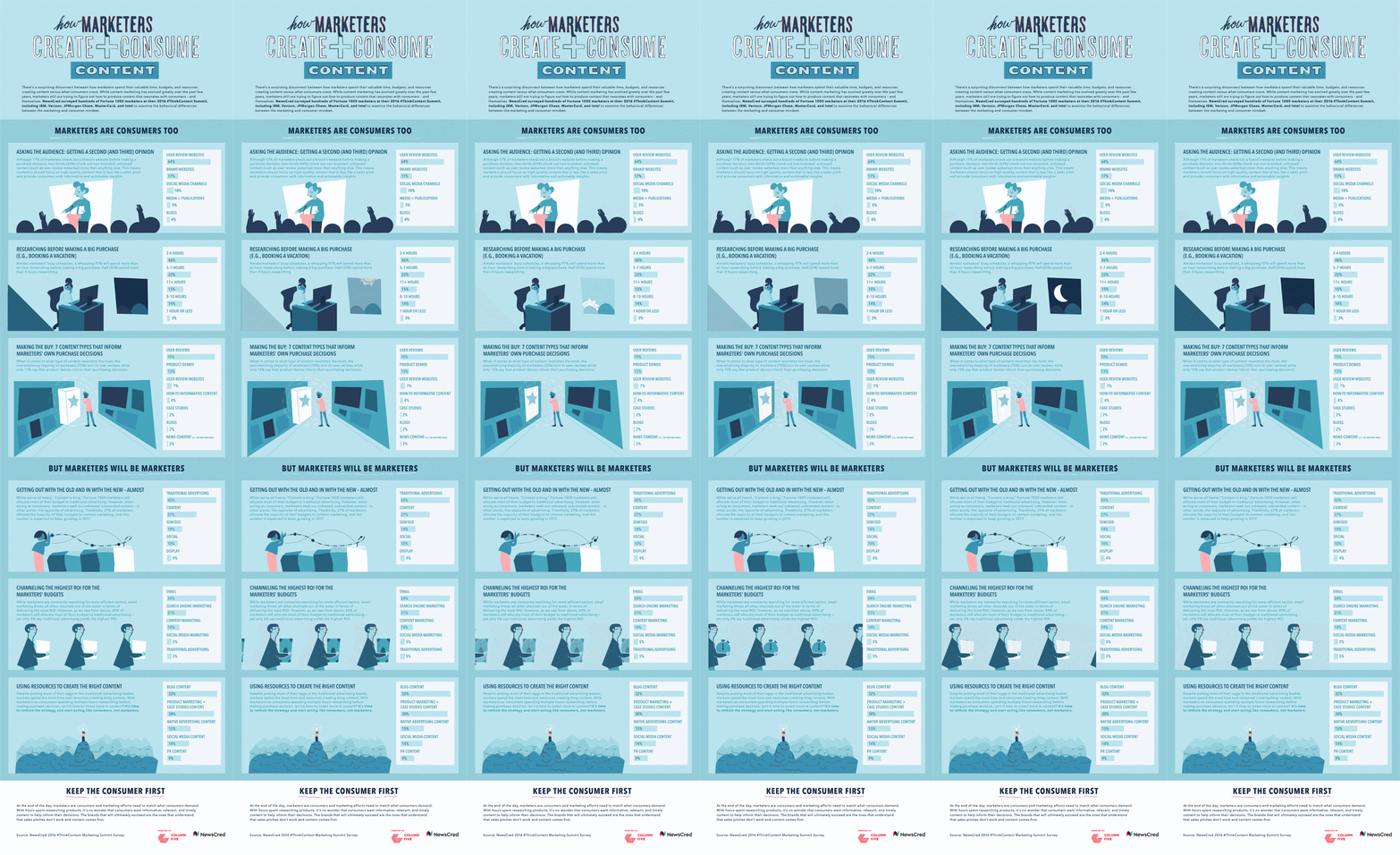
How Marketers Create + Consume Content

Source: Graphic Mama

By doing this, you can stop your readers from passively scrolling, and get them to read the details in your infographic more carefully.

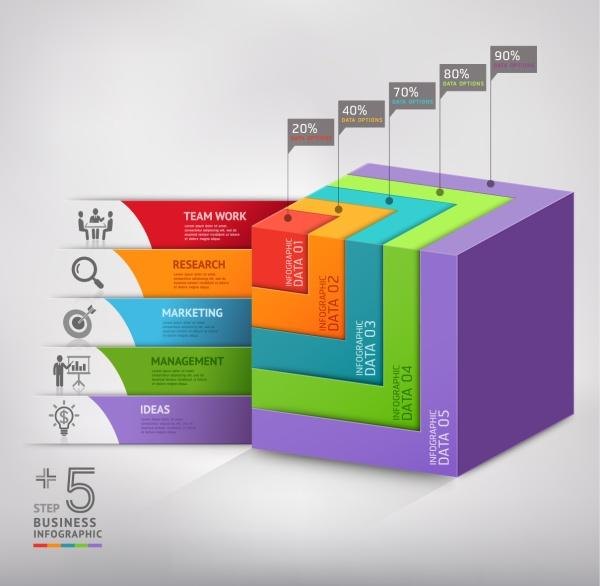
4. 3D illustrations

The use of 3D designs is making its way back into the spotlight. Because of this, you can expect a growing number of infographics featuring 3D illustrations to increase.

Step Five Business Infographic

Source: Easel.ly

As you can see, 3D illustrations stand out more than the conventional 2D design elements you see in most infographics. The added depth also makes the illustrations look more realistic, making it even more appealing and engaging.

5. Bright and bold fonts and colors

More and more brands are shifting towards using bright—even unconventional—colors in designing their infographics. Not only do they quickly grab your audience’s attention, but they also make the infographic look fun and engaging.

Alongside this is the use of fancy fonts, particularly on the title and subheadings. These fancy fonts double up as an additional design element to complete the look and feel of your brand’s image.

When using bright colors and bold fonts in your infographic, it is essential to make sure that you do not go overboard because this can cause your infographic to look amateurish rather than trendy.

As with any type of visual content, it is important to make sure that you strike that balance between function and design. Using a bold and colorful font against a bright background can make it overwhelming—even painful—to read, which defeats the purpose of your infographic. If you want to use a colorful background, stick to either black or white for the text elements of your infographic. That way, you can capture your audience’s attention without compromising its readability.

8 Tips for Eye-Catching Social Media Graphic Design

Source: Venngage

6. Color gradients

Color gradients are another design element that is making a comeback as an infographic trend in 2018. That is because they help give a touch of eye-catching color to your entire infographic. It also offers creatives a little bit more freedom when it comes to the infographic’s overall design while still staying within the overall look and feel of your brand.

On top of this, color gradients give a subtle 3D effect to your infographic. It is a great hack to use if you want your illustrations to pop and stand out.

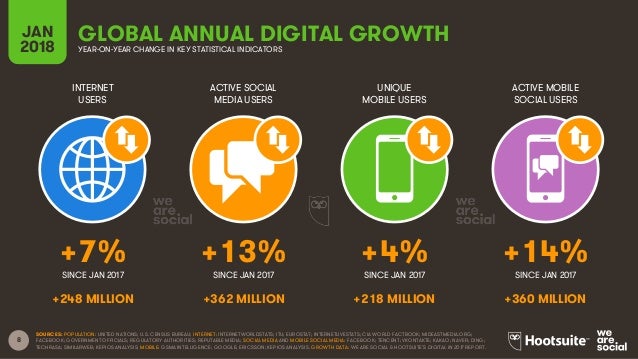
7. Mobile-friendly infographics

Right now, most infographics are designed for viewing using desktops and laptops. However, with more and more people now using smartphones to go online, 2018 will be the year when content marketers will start creating infographics optimized for mobile devices.

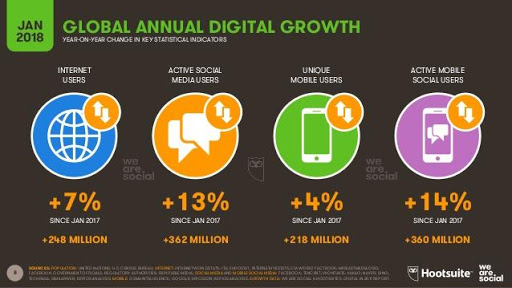
Global Annual Digital Growth

Source: We Are Social

One way this can be accomplished is by shortening the length of the infographic. That way, your audience will not have to swipe up the infographic more times than they would like to do so.

Another way to make your infographic is to create it vertically. Infographic with a horizontal layout will more likely not fit the screen of a smartphone or tablet unless your reader flips the device horizontally. Keeping to the vertical design eliminates this additional step for your reader, increasing the likelihood of them going through the content of your infographic.

Infographics today are more than just a fancy piece of content. When designed carefully, an infographic is a powerful tool to help you build your brand and establish your authority in your niche.

Each of the trends mentioned here can significantly increase the impact of your infographics to your target reader. Combining two or more of these trends will increase its effectiveness exponentially.

Of course, that will only happen if you have the right quality of data and information you share. After all, the primary purpose of creating an infographic is to give valuable information to your readers in an easy-to-digest format. Without this, your infographic will just be another beautifully designed image.

Which of these infographics trends are you planning to adopt for your company’s next infographic? Are there any other infographic trends worth mentioning? Share it in the comments below.

Related posts:

Visme Review: Create Infographics and Presentations with Ease

The Ultimate Guide to Vertical Videos in Social Media Marketing [Infographic]

22 Apr 17:31

7 Reasons Why People Leave Startups

by Maranda Dziekonski

mohamed_hassan / Pixabay

It’s not you; it’s me. Well sometimes it’s you, and other times it’s me. But wait, if I say it’s me, and it’s really you just to spare your feelings, does that cause any harm? It’s all so confusing, and these days happens more than it used to. What am I talking about again? Oh yeah, leaving your job.

I grew up in a rural community where if you are lucky enough to have a job, you hold onto it. Practically forever. Or at least until retirement, whichever came first.

So, you can imagine my confusion when I moved to San Francisco and joined the startup world to see individuals leave companies after only a few years to take on a new opportunity. This was a foreign concept to me, and still is to many outside of the startup or tech world. Why would you leave a perfectly good and stable job after you’ve only been there for such a short time? While the answer isn’t simple and most of the times the reasons cross many chasms, most departures are for a few core reasons.

Drumroll, please…

Reason 1: Inspiring Mission

We are now in an age where the “why” is becoming more important than the how. What is your “why”? What problem are you trying to solve with your product and is it inspiring? This is very subjective. What is very inspirational to some, may not inspire others.

Moreover, what inspired some at the beginning of their journey in the company may not be true in the future, as your product and company evolve. There is no shortage of people that have left because they no longer believed in a mission. I am sure if you think hard enough you may know a few. Maybe you are even one of them.

Reason 2: Money

Many say that money isn’t everything. Almost every person I interview, when I ask them the range of salary that they are seeking, they become sheepish and tell me it’s more about the opportunity. While I am sure that is true in some cases, the reality is you need money to survive. Also, if you live in an area like San Francisco, where money doesn’t go very far, every little bit can mean the difference between you and living off from a Hot-N-Ready pizza all week long (you know you’ve been there).

Startups do not generally have deep pockets. Most of them do try to make up for the lower wages with equity, and other perks. However, until the company has some sort of exit, those options that you have are generally not worth anything and are not going to pay the bills.

It’s a risk-reward situation. Are you willing to live on Hot-N-Ready pizzas until those shares are worth something? If you are, the reward could potentially be substantial. However, some are not and leave the minute they receive an offer for more money.

Reason 3: Professional and Personal Growth

While startups are a breeding ground for both professional and personal growth, you can at times find yourself lost if you are not someone that works well without structure. On the other hand, if you are someone thrives in a startup environment (little structure, lots to do), you will have the opportunity to wear many hats and try many things. Early on, you will be able to get involved in building out the core of the business. You will be challenged professionally and personally. You will learn how to see things from multiple perspectives and see that there is more than one way to solve problems. Most importantly, you will come to see the value that diversity in thought can bring.

Some folks love it when things become more structured, and they can specialize and focus on a few things rather than many. However, others don’t. Others feel as if this is when their growth becomes stagnant, which isn’t always 100% true. However, once things become more specialized, it does mean that you will need to navigate your growth differently and be more vocal about your desires.

Reason 4: Company Phase

So this leads us to the company phase. Every company, startup or not, has stages. However, startup stages feel more pronounced and can happen in a relatively quick manner when growth is on fire. I have rarely met a person that loves or thrives in all phases. As the company grows, expands, takes in more money, the roles tend to specialize for scale and consistency. You can talk about stages in regards to funding series, company size, product maturity, or many other ways. For this article, I am going to talk about team size. I generally break the phases down like this but have seen it spelled out many ways:

  • 1-10 employees = Ground zero team. They do everything from put chairs together (yay we have chairs), set up utilities, answer support tickets, pay the bills. Everyone is pretty much playing on equal ground here. It’s all hands on deck for everything. It feels like a family.
  • 11 – 25 employees = Still the ground zero team, but a structure is starting to form. Yes, you still do everything, but now you are beginning to see groups form. It soon becomes apparent that if everyone owns everything, at times things slip through the cracks. So you slowly start divvying stuff up. Engineering is answering less customer support tickets (they deeply exhale a collective sigh of relief) and someone is becoming more and more focused on how certain situations should be handled. The first semblance of structure is forming.
  • 26 – 50 employees = Teams have formed. Yep. It’s happening. You are now hiring folks that specialize in certain things. Like Sales, Support, Recruiting, so on and so forth. You may still clean out the refrigerator, or put a chair together, but it’s happening less and less.
  • 51 – 100 employees = Teams start forming into departments. And wait, who is that sitting there? I do not recognize that face. Also, wow… so much process. What do you mean I can’t just do it like that. I have always done it like that. Yep, things are changing.
  • 100 + = There are now layers upon layers forming. The CEO, you know the one you used to compete against in tip cup and late night ping pong games while noodling over ideas, is now in meetings… all day long! As a matter of fact, many people are in meetings all day long. What’s cool is there are a lot more resources, but damn, even though we are still building and iterating, you are noticing it does take a bit longer to move that needle.

Of course, this is not 100% accurate for every organization, but some version of this does tend to happen at every startup. Some folks love it and thrive, but most know their sweet spot and join at a certain size and as well leave at a certain size.

Me cleaning out the refrigerator at work.

Reason 5: Culture

Every person you add changes your culture little by little. Until one day, you wake up and realize that things have changed so much you don’t recognize the company that you joined. This is not necessarily a bad thing. It just is what it is. Even companies that are very deliberate about their culture early on will experience shifts and changes. It is up to everyone in the company to be guardians of what they collectively hold dear, but also evolve as change happens. Some folks love this, while others find themselves staring out the window reminiscing of the way things used to be. In the same vein as the mission, if the culture evolves to something that no longer resonates or feels like home, people will leave.

Yes, one time I wore this amazing outfit (roller skates too) to work (it may have been Halloween)!

Reason 6: Product Fit

Startups move quickly out of necessity. What is true today may not be true tomorrow. Many products have started out going one direction only to pivot. At times the pivot is due to a change in the market conditions or something learned along the journey.

Whatever the reason for the pivot, team members may wake up one day and realize that their skill sets do not entirely match where the product is headed or currently at and leave. More companies have pivoted than we most likely are aware of and have come out to be very successful, but that doesn’t mean the same team members took them to that success. Before Nintendo became known for electronic games, they tried everything from taxi services to making vacuum cleaners. There is no right or wrong here, it’s just knowing who you are and who you aren’t. What value you bring and the ROI you can offer the company that you are with.

Reason 7: Burnout

Some of us in startups work 60, 70, 80 hours a week. Yep. Not kidding at all. And some work more than that. Most of us that join startups make the team and company part of our lives (at least I know I do). We eat, breath and sleep thinking about how we can build and improve whatever it is we are working on. While at the moment we don’t realize it, all of those extra hours do take a toll. Many folks leave citing that they are seeking a better work/life balance. While chasing this mythical creature from company to company, you will soon realize that the power of a work/life balance lies within your control. This change must start with you.

Yes, there are companies out there that do provide the subtle guilt trip if you are heading out the door at 5 pm, but it is up to you to push through the guilt and head home. As long as you are adding value, getting your work done, and kicking ass overall, don’t let optics of you burning the midnight oil actually burn you out. And if it’s more than optics and you have too much to do, seek help from your manager (I know, easier said than done).

People may come and go, but one thing will always remain constant in startup life and that is change. If you are with a company for a year or for 20 years, a little part of you will always remain. Always give your all and leave a great legacy behind for those that are to come.

22 Apr 17:31

Want Better Leads? Get Sales and Marketing on the Same Page

by Autumn Sullivan

Are your Sales and Marketing teams still operating in silos? The stereotype of Sales and Marketing behaving like rival siblings fighting over your sales pipeline is still as relevant today as it was a decade ago, but it doesn’t have to be that way.

And if you want your business to reach its full potential, it’s time for these two departments to sit down, shake hands, and start working together.

There is no funnel, but there is a sales pipeline

When HubSpot CEO Brian Halligan shared HubSpot’s new flywheel growth model, it effectively killed the traditional marketing funnel analogy forever. RIP funnel, good riddance to closed-marketing systems. What does still exist, however, is the Sales Pipeline.

At the beginning of the sales pipeline are the leads your business receives, and at the end is the number of won deals or new customers you converted. What happens in the middle is usually thought of as the work of Sales alone and involves a lot of phone calls, emails, meetings — and if we’re thinking movie stereotypes — a lot of expensive lunches.

The truth, though, is that Marketing plays two important roles in your pipeline. The first happens at the beginning: Marketing’s prime directive is to bring high-quality leads into your Sales pipeline. How do they do it? Well, if they have an effective inbound strategy, chances are they do a lot of it by producing helpful content that drives organic traffic to your site. Organic traffic consists of folks who Google a question or problem, then click on your site.

We find that new leads from your site’s organic traffic tend to be higher-quality. They’re actively searching for keywords you’re targeting and they’re showing interest by submitting their information on a form on your site. Not getting the numbers you need from organic traffic? Before you ditch content strategy and inbound altogether, try advertising your content. Putting a small budget behind your best content exposes it to more audiences, increasing your website traffic and helping to fill that Sales pipeline.

Not every lead is born ready.

downloaded an ebook a few weeks ago. Confession: I download a lot of premium content pieces. Before the PDF was finished rendering, I had an email from a sales contact at the company. The email was asking for a phone call and demo of the product. I ignored it, because what I wanted to do — what I had expressed a desire to do — was read the guide.

I got two more emails that week from the company, and both were again from the sales department and asked me to schedule a demo. Here’s the problem: I wasn’t ready to convert, and the company didn’t offer me any stepping stones to get from “I just want this ebook” to “Man, I think I should schedule that demo!”

When Sales treats all leads as equals, it does a disservice to both your business and your prospective customers.

Marketing and Sales need to work together to create a hierarchy of leads. The first step is to define them. Here’s a cheat sheet:

Subscribers. These are the folks who subscribe to your blog, newsletter, or podcast. They are not leads at this time, and a percentage of them may never become leads. Your competition may be on this list, as well as admirers of your content who have no need of your product or service. If they take an action, such as downloading a content offer, engaging with your website’s chat function or filling out a form on a landing page, they will become a lead.

Marketing Qualified Leads (MQLs). As a lead moves through their journey, Marketing will be vetting their actions and responses, adding or subtracting value to the lead’s total score. When a lead reaches a threshold score, it is said to have been qualified by Marketing. It is now ready for a Sales handoff.

Sales Qualified Leads (SQLs). Once Sales has a lead, the vetting process begins again. Sales will engage in conversations with the lead in order to determine if the lead needs more nurturing (handed back to Marketing) or is ready to open up a deal and become an Opportunity.

There are other systems of lead scoring that vary from the one I’ve shared here. This is the model I have learned and that works for my clients. Your Sales and Marketing leadership team should decide on the definitions for your company.

Let’s explore the process in a real-world example. If you publish an ebook and it generates 1,000 downloads, only a percentage of those will fit the bill for Sales and be ready to close a deal. These are Marketing Qualified Leads (MQLs) – leads that have been vetted by Marketing and are ready for a handoff to Sales. Many of your leads may have some of the Sales criteria but not all. Some may never convert at all. What is more important is that while all of these new contacts have shown interest in your content, they have not yet expressed enough interest in your product or service to move to a Sales conversation.

Once the two departments agree on which leads need to go to Sales, Marketing can step in to nurture the rest. Instead of the cold ask to schedule a demo, Marketing can send a thank you email that shares a follow-up piece of content. A second email might ask the lead to complete a short survey sharing their feedback on the content so far.

Lead nurturing needs to be a collaborative effort

Each new email should offer a new engagement or ask for feedback. Marketing can “warm up” the lead, delivering value and asking for small commitments along the way. When the lead is finally ready, Sales picks up where Marketing left off.

You can also nurture through paid advertising. If you’re promoting a piece of ungated, high-performing content, like a YouTube video or blog, you can remarket to this audience with follow-up content. Repeat the process as many times as needed to qualify a lead for the handoff, then advertise a landing page for them to submit their information.

Sales knows the message that convinces the waffling client to sign, what feature is a dealmaker and what pain point is a deal breaker.

In order to nurture and qualify leads, Marketing needs a robust library of content that matches the pain points of a lead throughout the buyer’s journey. What does that mean? Glad you asked.

A prospective customer goes through three stages on their path to purchase: Awareness, Consideration, and Decision. Marketing can create content and messaging that helps a buyer move through these stages by mapping out the buyer’s journey and matching content types to the stage. This is called a personal content matrix.

But, for the Consideration and Decision stage content to be truly effective, Sales ought to be in the brainstorming meeting. Sales knows the message that convinces the waffling client to sign, what feature is a dealmaker and what pain point is a deal breaker. They also have a treasure trove of client anecdotes ripe for case studies.

With a packed persona-oriented content matrix and a strategy to qualify leads from their first marketing touchpoint to their eventual handoff to Sales, your business is already seeing an improvement in the Sales pipeline. The next step is improving efficiency.

Automate the handoff

Still sending each nurturing email manually? Scrambling to assess and rank MQLs so Sales can get on the phone? You need a marketing automation platform and CRM.

We use HubSpot, because it’s user-friendly and built for inbound marketing. As long as your CRM allows you to build workflows — automated actions based on contact criteria or triggered by specific activities — and to automatically “score” a lead based on those criteria and activities, you’re in good shape.

a hubspot nurturing workflow

Workflows should include conditionals for more targeted messaging. If a new lead doesn’t open your nurturing emails, send them a final “stay in touch.” If the lead is opening and clicking on every email, they should proceed through the workflow until they get the invite to talk to Sales.

All of this opening, clicking, responding and engaging is important for qualifying leads. Each action either adds or subtracts points from the lead’s total score. Other criteria can include:

  • Job title
  • Type of company
  • Deal size
  • Email domain
  • And even which pages they’ve visited on your site and which form they filled out

Lead scoring keeps the non-leads, like marketers who are only downloading your guide for inspiration or research, out of the hands of Sales and makes it easier to prioritize the hottest opportunities in the pipeline.

When a prospect reaches a threshold score on the CRM, they are automatically changed from a Lead to an MQL and Sales is notified. Check out the contact’s history and see every page they’ve visited, every blog they’ve liked, and every email they’ve opened. The relationship is already started, now it’s time to close the deal.

Lead scoring is also great for Marketing. If a majority of MQLs are coming back from Sales as lost deals, the trouble may not be with the leads Marketing is bringing in. It may be an issue with the Sales messaging or a gap in service. Dig in and see why those leads didn’t work.

If a lead is kicked back from Sales as “not ready yet,” don’t look at it as a failure. Move that lead to a new nurturing drip campaign. Stay in touch. Invite them to follow you on social media and subscribe to your newsletter. It may take a few months or even a year, but if and when they’re ready, they’ll remember you.

It’s not a handoff; it’s a handshake

Rather than fighting like jealous siblings, Sales and Marketing should be BFFs. The best way to tear down those walls is to start collaborating. That means sitting down regularly to discuss your goals, challenges, and successes.

Review leads together, in a non-judgemental process that seeks to improve the buyer’s journey content and the hand-off:

  • Did this lead come too late?
  • How can we flag deals like this in the future as high priority?
  • Why did this lead fail to close?
  • What can we do differently in the future?

Collaboration starts with shared goals. A shared goal unites your two departments into one powerful team. If Sales has a revenue goal of $2 million dollars for the calendar year, so does Marketing. This insight allows them to work backward toward their own goal: Marketing must produce X leads at a lead-to-deal close ratio of Y% to result in a gross revenue of $2 million.

Aligning Marketing goals to Sales has one other major benefit for Marketing: It is much easier to prove ROI. When your Marketing and Sales team are working together and reporting their efforts effectively, it is easy to see how many leads read a particular blog, or opened an email, or engaged with your social media as they moved through their buyer’s journey.

Marketing can deepen this relationship by sharing which key performance indicators (KPIs) they use to track success for each channel, and then share that indicator data with Sales regularly. Both teams can see how Marketing is moving the needle, and how Sales is bringing home the gold.

22 Apr 17:31

9 Steps to an Awesome Lead Nurturing Workflow

by Molly Rigatti

Inbound marketing doesn’t stop when a visitor clicks a call to action and fills out a form. In fact, that’s just the beginning. If you haven’t been implementing lead nurturing into your inbound plan, you may be missing out on engaging the 96 percent of your website visitors who aren’t ready to buy.

Let’s aim for higher conversion rates and increased engagement by rolling up our sleeves, adding some awesome lead nurturing workflows, and really making a connection via email.

Step 1: Have a Solid Understanding of Your Sales Cycle

It can be easy to make one workflow of lead nurturing messages apply to all of your conversions. However, for your lead nurturing to be effective, you need to understand where your leads are in your sales cycle, or their Buyer’s Journey, and what paint points they have expressed. This sets the stage for determining what your communication workflow will offer. Remember, your leads will typically fall into the following groups:

  • Attract
  • Convert
  • Close
  • Delight

Each part of the cycle offers an opportunity to provide helpful content that continues to engage and move your leads toward becoming customers. To best understand your company’s sales cycle, you need to know how your leads think so you can offer the right content at the right time in the buying process.

Step 2: Determine Which Persona You’re Targeting

Ah, buyer personas. The foundation of inbound marketing. Before you can create a single email or your next content offer, you must know what specific audience you are targeting. Mother Mary shouldn’t receive Brother Brad’s emails. It just doesn’t work that way in inbound marketing. Your website visitors and leads expect more. Truly understanding your personas will help you better craft your lead nurturing from email subject lines, landing page copy, e-book titles, and more, so your content genuinely resonates with the right people. Remember: that you shouldn’t make assumptions about your personas. Your lead nurturing content—and all content for that matter—should be made based on research and known facts.

Step 3: Set Goals for the Campaign

If your goal for setting up a lead nurturing campaign is more leads, try to get a bit more specific. If you’ve taken a leadership course, you may have heard of SMART goals: specific, measurable, attainable, realistic, and timely. These apply to inbound marketing, too. Having specific goals that are tied to your sales process and targeted personas will help you create content that aligns with these goals and improves your reporting on how the lead nurturing campaign is performing.

Try this formula for creating more targeted goals for your lead nurturing campaign:

“Increase number of ____ converted to ____ by ___ percent over ___ months.”

Here are some ideas you can use to build your own SMART goals for your lead nurturing:

  • Increase number of leads moved from the awareness stage to the consideration stage by 10 percent month over month
  • Increase number of MQLs converted to SQLs by 20 percent over the next three months
  • Re-engage 50 percent of leads that fell to the wayside or were unqualified this year

Step 4: Map Your Content

Mapping your content involves:

  • Finding logical pathways your leads take through the Buyer’s Journey from first touch to purchase
  • Determining which content pieces will move the lead through the sales process by answering common questions and objections
  • Taking inventory of what content you need to create in order to fill the gaps
  • Adjusting your content for a specific buyer persona

Step 5: Write Lead Nurturing Messages Using the Best Practices

While you map content for the persona you are targeting, make sure you take note of how your personas like to communicate. Do they prefer emails, phone calls, or text messages?

Most commonly, marketers use email campaigns to drive their lead nurturing workflows. An email campaign is not intended to bombard your lead with tons and tons of emails so she has to remember you. Instead, be intentional. Consider your message and goals and decide from there how many messages you need to deliver to get all of the relevant information to your lead. We recommend that you don’t use more than eight emails.

Step 6: Build Your Lead Nurturing Workflow

Determine what action will trigger your lead nurturing automation to start. Maybe you want to enroll all Mother Mary MQLs from a list. Maybe you want to enroll all people who download a specific piece of content. Maybe you want to enroll leads who have visited your pricing page multiple times in the past month.

Once you’ve defined this trigger event, you’re ready to build out the actual automation part of your communication flow. If you’re using a tool like HubSpot or Marketo, this is pretty easy. Once you’ve created your list or form to trigger the workflow, write your emails and save them for automation. From there, you can go to your automation tool to set up the rules. You can add logic for delays between messages, update contact properties based on engagement, skip emails based on your contacts’ behavior, and more.

Step 7: Test the Campaign Before Launching

It never hurts to have a second, third, or fourth set of eyes when sending out a campaign to your customers. Double-check all links and CTAs, personalization tokens, spelling, and grammar. Follow the flow of your communication to make sure your message is clear from one step to the next. Depending on the system you use to build your lead nurturing campaigns, you can enroll a test contact to see how your logic performs or send test emails to see how they appear in different email platforms.

Step 8: Make the Workflow Live and Start Collecting Data

It’s live! And now it’s collecting data, which we really, really like.

Step 9: Analyze the Results and Tweak Emails Accordingly

How is your campaign doing? Is it reaching those goals we set in Step 3? Let’s analyze the data:

  • Click-through rate (at least 5 percent)
  • Conversion rate for each landing page
  • Unsubscribe rate (less than 1 percent)
  • Goal completions

From here, you can tweak your campaign, if needed. Common adjustments are:

  • Subject line
  • Copy/body of email
  • Offer
  • Frequency
  • Value proposition

Remember: It’s important to view lead nurturing as more than just what your website provides. The first download is an invitation to a conversation about how you can be the solution to the lead’s challenge. It’s up to you to make some awesome workflows to prove it.

22 Apr 17:30

Why Sales Leaders Should Insist on Having a Say in Their Company’s Website

by Amanda Bulat
Why Sales Leaders Should Insist on Having a Say in Their Company’s Website

Closed circuit to researchers in our industry: If you plan to survey sales leaders anytime soon, feel free to include a question about their involvement in the company website. You’d be breaking ground.

Sales leaders should have a bigger say in the company’s website. Sure, we have little way of telling how involved you currently are. But given that today’s debate about website ownership mostly revolves around how various marketing factions should work with one another and IT, with almost no mention of sales, one can’t help but get the feeling that sales leaders generally have minimal say in what B2B buyers see when they enter their brand’s online domain.

“With more information, options and people involved in the sales process, buyers are paralyzed when trying to move forward,” says Gartner’s Brent Adamson. B2B companies need to make the purchasing process easier, maintains Adamson, who says the onus is on sales leaders to make it happen.

But how can sales leaders make the B2B buying process easier if they’re not actively involved (or involved at all) in their company’s primary digital presence? While it may be possible for sales leaders to simplify certain aspects of the buying process, it’s hard to imagine how they can help to ensure buyers get the simplest, most cohesive experience if a pivotal part of that experience, the website, is wholly outside their realm of responsibility or focus.

The suggestion isn’t that sales leaders need to become experts at branding or web development. The suggestion is that those who work on the website should be taking cues from sales leadership. Nobody understands the needs of the company website’s most important visitors better than sales. At the very least, sales leaders should be included in a continuous feedback loop.

While many B2B companies are wise to consider wholesale process changes pertaining to website development, sales leaders can infuse themselves into the process by making sure that the current website stakeholders can satisfactorily answer the following questions.

Is Our SEO Strategy Bringing in the Right Kinds of Visitors?

As you read this, people are visiting your company’s website. How did they get there? Were they referred from other pages or review sites? Were they searching for a specific answer or more information on a particular topic? Can these visitors buy from you or influence the purchasing decision?

Website analytics can answer the first three questions, but it’s hard to know whether we’re attracting the right visitors without input from sales. As of 2017, the company website ranked as the top marketing expenditure behind analytics. Without sales and marketing orchestration, it’s entirely possible that thousands of hours could be dedicated to driving unqualified traffic. Analytics might show that the company’s website is attracting visitors and converting them like crazy. And that may very well be, but if it’s later determined that very few marketing-qualified leads (from any or all sources) are turning into actual customers, we’re talking about a big miss that’ll take a while to correct.

It’s not uncommon for marketers to care deeply about total traffic and form fills because that’s how they’re measured. But success in these areas doesn’t necessarily mean that similar success will follow for the sales team. In fact, misplaced marketing success is often counterproductive for sellers who now must invest their time trying to engage the wrong people. This is why B2B sales and marketing alignment is so critical, especially as it relates to defining and attributing success.  

Sales leaders aren’t responsible for marketing attribution, but they have every right to request deeper insight into this area. By understanding which referral sources, keywords, and web pages are helping their cause and which aren’t, sales leaders can use hard evidence to suggest changes to the website and the content that resides on it.

Is Our Site’s Messaging Consistent with How We Talk with Prospects Directly?

According to research from SiriusDecisions, the inability to communicate a value message is the number one reason sales teams fail to meet quota. It’s easy to pin this on the shortcomings of individual sales reps, but how can sales reps bear the brunt of the responsibility when their company’s website fails to communicate a clear value message?

According to Google, 90% of B2B buyers use search as part of their research. And given that more and more of the buying process is performed online, we can only assume that most B2B buyers will check out our website when considering whether it makes sense to either engage with our company or respond to a sales rep. If our website doesn’t uniquely differentiate our offering in the minds of potential buyers, it stands to reason that these buyers can easily make the decision not to engage with our company, without us ever knowing about it. Our analytics may show a single visitor who didn’t convert. Our CRM may show a single lead who didn’t respond. In reality though, our website may be responsible for our failure to make the buyer’s shortlist. Whether that’s due to a lack of positioning, lack of established trust, or both, it can’t continue.

Of course, change is constant. What buyers care most about today might be different than what they cared about a few years ago. And competitive pressures can quickly make our unique selling proposition less than unique. Our website needs to constantly convey the unique value we provide to the right buyer in today’s market. Who better than sales leaders to help make that happen?

Are We Taking Full Advantage of Conversion-Focused Pages?

By and large, B2B buyers want a more B2C-like buying experience. The growing expectation for B2B buyers is that when they want answers, they should be able to instantly connect with someone who can provide them. This has led to more chatbots and instant messaging functionality on B2B websites. But is all this new functionality as sales-functional as it could be?

Here again, sales leaders know the terms of engagement better than anyone else. They can help web developers understand where this messaging might feel intrusive and where it might be implemented or modified to better meet the needs of a specific webpage’s visitors. Further, sales leaders will look at these pages differently than a web developer or even a marketer would. Where a web developer might simply see a well-built chat function, a sales leader might notice a lack of trust-building elements on the page and suggest a strategically placed testimonial that ultimately leads to a boost in real-time website engagement.

The Company Website: A Key Opportunity for B2B Sales and Marketing Alignment

We’re just scratching the surface of how B2B sales leaders can help their companies create a more effective website. If you currently have no say in your company’s website, proactively involving yourself might be among the most important actions you can take this year. And keep in mind that most of the considerations mentioned above also apply to your company’s LinkedIn Page, which can be another key brand touchpoint for prospects.
 

For more ideas and tactics for meeting today’s B2B buyers where they are, subscribe to the LinkedIn Sales Blog.


19 Apr 18:03

The Ultimate Guide to Mutual Action Plans (How to Use MAPs to Transform Your Sales Process)

by Tom Williams

Imagine knowing the actual close date of a deal months in advance…

Better still, imagine getting your prospects to tell you both who their key players are and all the gory details of their organization’s buying process –– and having it verified by the buyer before you even submit a proposal.

Think of the hundreds of hours you’d save chasing bad deals… the good deals you could stop from slipping into next quarter… and the trust you’d build by making your prospects feel they’re in safe hands.

You’d easily make your forecast the envy of the western world.

Think it’s a dream? Think again. Over the past 12 months, I’ve talked with hundreds of sales reps, sales leaders, and ops people about sales process, and a few patterns emerged.

One of the most consistent practices across top performers is collaborating with their prospects on a mutual action plan to get a deal from “Sure, that might work” to signed, implemented, and realizing value for both sides.

In this guide, you’ll learn everything you need to know about mutual action plans, from what they are to how you can use them in your sales process to save time and create more wins.

Let’s get started, shall we.

Everything You Need to Know About Mutual Action Plans (MAPs)

What Is a Mutual Action Plan?

The acronym for mutual action plan tells you exactly what it is –– a MAP. It’s a document that helps the sales team and a prospective customer work together to find a mutually beneficial solution.

The mutual action plan is known by a lot of different names, including mutual success plan, mutually agreed action plan, go-live plan, joint execution plan, and close plan. But regardless of what you call it, it always answers two important questions:

  • Who needs to do what?
  • When do they need to do it to make this deal happen?

This isn’t something that’s driven solely by the customer or the sales team. In fact, the reason it works so well is that it’s a collaborative effort.

You see, a well-written MAP has input from both the seller and the buyer. It identifies all the milestones that must be met to successfully implement the product or service inside the buyer’s organization.

Once created, it keeps both the selling team and buying team on track –– working together to punch through the list until the product/ service is up and running and delivering on the seller’s promise of value.

As you might guess, it’s an incredibly valuable tool. It serves both the buyer and the seller, protecting you both from guesswork and wasted time. Best of all, it helps you quickly identify a deal that could end up going nowhere.

But before we talk about how to create it, let’s get on the same page about what is a mutual action plan

Why should I Use a MAP?

“It’s more about how detailed do you get rather than not doing one at all.” – Sarah Fricke, Global Sales Enablement Manager, RingCentral

Why should you use a Mutual Action Plan? The short answer is…

  • At the highest level, mutual action plans help sales teams close more deals faster.
  • They provide a better buying experience that differentiates them from the competition.
  • They also give management significantly higher confidence in forecasts.

One caveat: While any deal is more likely to close if you have a mutually agreed plan for how it’s going to happen, most of the leaders we spoke with said it makes sense to make it formal when the deal reaches somewhere between $50K and $75K ACV.

That said, there are degrees. So on a $10K deal, perhaps you just share a checklist. And as the ACV increases, you put in more effort to make sure everything goes smoothly.

Now, let’s look at 4 top benefits of using a MAP.

1. Higher Close Rate

A MAP helps you win more details because it identifies the buyer’s process and stakeholders well in advance, so you can work through roadblocks before they become deal killers. A MAP also shows you far in advance when a deal isn’t viable, so you can disqualify faster and spend your time on deals that do have a path to success.

Sales rep Brittney Bartolini, of employee-recognition company Blueboard, pointed out that in addition to higher close rate, she sees average higher ACV (all-commodity volume) because the trust she builds up during the MAP process lets her skip over a pilot and go straight to a full-on implementation.

MAPs are valuable from an operations perspective as well. Sarah Fricke, of RingCentral, shared they recently moved to requiring MAPs to ensure their sales process was being followed properly, because deals that follow process are more likely to close successfully.

2. Faster Sales Cycle & Fewer Deals Slipping into the Next Quarter

“Reviewing the timeline line by line with their VP immediately kicked the sales cycle into a different gear as he realized how much there was to get done to hit his dates.” – Adam Heher, Director of Sales, Cloudability

We’ve all experienced the agony of watching a quota-critical deal slip inexorably past end of quarter. MAPs speed up sales cycles because there’s less time lost in “Oh, I was waiting on you,” or “I’m not sure who needs to sign that, let me get back to you.”

If you’ve anchored the deal close-date to a buyer initiative (see below for more on this) and put both dates on the mutual action plan, then you can show how the potential slippage puts their own initiative at risk, attracting executive attention, and getting things back on track.

RELATED: Stop “Closing” Your Prospects! Instead, Ask Them For The Next Step (Checklist)

3. Deliver Better Buying Experience

“No buyer will argue with clear expectations” – Tana McDermott, Vice President, Inside Sales at Workiva

With 7 people on a typical buying committee today, minimizing risk is one of the biggest factors in B2B decision making. More transparency makes it easier for buyers to trust their counterparts on the selling side, which reduces the risk of wasting time or, worse, being held responsible for a deal gone bad.

Buyers also report they appreciate the guidance a MAP provides: While you sell software everyday, the buyer has a day job. They may have no idea how their organization approves purchases, so the rep who can say, “This isn’t our first rodeo,” is much closer to being the trusted advisor every buyer seeks.

Plus, a good MAP means less actual work, since it’s clear who needs to do what at every stage of the deal.

4. Better Forecasts & Deal Coaching

The fastest way to get fired as a sales leader is bad forecasting. The entire org depends on knowing what they have to work with, so if you’re not going to hit your number, it’s better to know sooner and avoid blindsiding the management team on the last day of the quarter.

If you know the status of mutually agreed milestones leading up to an externally-driven, mutually agreed compelling event, the forecast is going to be more accurate, answering both “will this deal close” and “when will this deal close”.

Finally, measuring buyer progress against milestones is a great construct for deal reviews, allowing you to spend less time fact gathering and more time coaching through the potential roadblocks uncovered by the MAP.

Who knows, you may even be able to dump that secret Excel spreadsheet where you handicap each reps’ forecast ability.

Breaking Down a Mutual Action Plan

Now, let’s break down the elements of a mutual action plan. In this section, we’ll outline the core elements of an effective mutual action plan and share tips for developing a winning MAP.

Keep in mind, no single template fits every use case, so please feel free to mix and match these elements to be whatever is most helpful for your buyers.

  1. Value summary
  2. Buyer-centric finish
  3. Milestone ownership
  4. Buyer and seller teams (not shown in the image above)
  5. Outcomes
  6. Duration
  7. Key dates

1. Value Summary: Why are we working on this again?

value summary MAP

This letter-format MAP is easy to digest and share with executives.

Notice it leads with a narrative value summary. This is especially helpful to senior decision makers who only get involved in the latter stages of a deal. Since they don’t always have the benefit of the early discovery meetings, a summary gets them up to speed quickly.

On a side note, these “non-believers” are the ones most likely to kill your deal, so you need to leverage every chance you can to remind them of the immense value this solution is bringing to their organization.

2. Buyer-Centric Finish: Contract is just a means to an end

Too many Close Plans conclude with “Contracts Signed.” This is seller-centric behavior at its worst.

The best MAPs, like this one from Outreach, continue beyond contracts and focus on the buyer’s outcome –– ideally ending at your buyer-driven compelling event or, at the very least, onboarding and implementation.

This accomplishes three things:

  1. Keeps the focus on the benefits to the customer and makes the contract just a means to an end
  2. Maintains urgency as you push up against external deadlines
  3. Allows a silky smooth hand-over between Sales and Customer Success

One nice variation that Emma Weir, of Cornerstone OnDemand, includes is to add “Time to Revenue” as the final milestone in the process. This simple addition draws a direct line between the milestone you’re working on now and the glorious potential future you’re selling.

It also makes date slippage more painful, because every day missed now pushes that revenue out further.

3. Milestone Ownership: Accountability goes both ways

Nearly all MAPs have a place to assign the people responsible for each milestone, either embedded in the milestone description or in a separate column.

Some MAPs go a step further, with one column for the Buying Team and one for the Selling team: Having two names on a milestone highlights that each side is accountable and both sides have to contribute to make things happen.

Be aware, sometimes, you don’t know the names of the responsible people. When that happens, include the role of a milestone’s owner.

Side Tip: Don’t leave out the work you’re performing as the sales rep. When buyers see that you’re investing time to make this deal happen, they become more committed. They’re less likely to go dark.

4. Buyer and Seller Teams: A killer discovery aid
As we just mentioned, the MAP is the perfect place to call out and identify the deal’s stakeholders. But it can also be a powerful discovery aid.

Note how this MAP from Cloudability lists the anticipated roles even before a name has been identified. This drives the conversation with your champion to help fill in the rest of the decision makers –– and if they can’t or won’t help you, then that’s a major red flag.

Note also how Cloudability includes details about the selling team. This accomplishes three goals

  1. Builds trust by sharing your boss’s contact info
  2. Demonstrates the selling team’s deep bench to minimize risk in the eyes of the buyer
  3. Assures smooth handover by introducing account managers (or Customer Success) early, so buyers don’t feel like they’re thrown over the wall once the contract is signed.

5. Outcomes: The devil in the details

Very few things in life are black and white, so it makes sense to capture the outcomes of each stage rather than simply marking them DONE or NOT DONE.

You might be recording this detail already in your CRM, but sharing a summary with buyers via the MAP ensures that you’re both on the same page and that the buyer endorses your characterization of everyone’s progress.

Cloudability (see example above) captures Prospect Feedback right in the timeline. By using a Google Sheet, the buyers can input and update this info themselves, so the details come straight from the horse’s mouth.

6. Duration: Are we there yet?

Tracking expected duration of each milestone shows you know your business and makes it less likely that you or the buyer have arbitrary or unrealistic deadlines for specific milestones.

If you’re using a spreadsheet, duration can drive estimated dates with a pretty simple cell calculation.

7. Key dates: Keep their eyes on the prize

MAP key dates

You never want the customer to lose sight of the life-changing transformations they’re going to experience when the deal is done. A simple way to do that is to give them a concrete date for when their new solution will be up and running.

You can keep the blood pumping and drive mutual accountability by including a summary of key dates along with the value prop. If you’re using a spreadsheet and you really want to induce urgency (or panic), include a real-time countdown to the compelling event.

8. Signatures: Maybe Too Much Too Soon

A couple of people shared that they included a signature block for buyers to sign off on a mutual action plan.

In my opinion, this is going too far and may scare off a prospect. After all, there’s plenty of time for binding signatures when you’re negotiating the actual contract.

In fact, I like subtleties like this example from Outreach. Notice how they explicitly state that the MAP is non-binding.

9. How many steps: Goldilocks zone

Most MAPs have between 8 and 12 line items.

While you want to set clear mutual expectations as early as possible, there is a risk if you present everything to a buyer too early –– specifically, before they’re fully onboard with the value proposal.

Don’t overload them with unnecessary details, or you’ll scare them away.

One approach that can help you avoid this is to wrap smaller “outcomes” into larger “milestones” and present only the high level milestones at first, with the ability to drill deeper as you get closer. That requires more sophistication in the template, but it can help you deliver a MAP that’s “just right” for the buyer’s stage of commitment.

10. Format Wars: Spreadsheet or doc? Or both?

This is the great divide. Do you present your MAP as a spreadsheet or narrative doc with a table… as a PDF or online share?

The obvious benefit of sharing an online doc is it’s always up-to-date. But a one-page PDF can be much more visually attractive and ready for senior executive consumption.

Ultimately, the best solution is something that Sarah Fricke from RingCentral and Brittney Bartolini of Blueboard recommend: Different buyers have different needs, so support different formats and give each buyer the format that best fits their needs.

Don’t know which one is best? Ask them.

Leveraging your Mutual Action Plan For Day-to-Day Best Results

Now that you have the perfect template, it’s time to put it to good use. Here are 4 tips to do just that.

1. Make It Mutual

“Buyers buy into that which they help create.” – Chad Rawlings, Director of Sales, Outreach

Mutual involvement is the single biggest indicator of a MAP’s chance of success.

Look for the buying team to engage with their milestones and put time into understanding and customizing your template for their organization’s buying process.

They have to sign off on your value prop and share enough internal information for you to establish a compelling event, and they need to be willing and able to bring the right people to the table.

Once the timeline is set, buyers must continue to commit to the next step, and if they don’t, look for the disqualify.

2. Create Urgency with a Workback Exercise

The workback is most effective if you’ve successfully identified an externally driven buyer initiative as your compelling event. But even if you can’t find that perfect buyer initiative, you can still work back to create a sense of urgency.

The goal is to take their target launch date, then start working back with the steps needed to get the deal signed and the solution up and running.

If you’ve got your milestone duration numbers right, chances are the first milestone is due pretty soon. That helps you get the ball rolling now, so the buyer can launch in time to meet that compelling event. (Tell them if they don’t, your org’s going to fail at that initiative and everyone’s gonna die.)

“I’m not calling to follow up”…

After you use the workback to kickoff now rather than later, you can maintain urgency by referring back to the timeline.

So instead of calling “just to follow up” you can say, “You told me this compelling event was important to your success, and we agreed the steps and timeline to make it happen with the help of our solution. We’re at risk of failure because we’re falling behind on X milestone. How can we get back on track so you don’t die?”

3. Introduce the MAP Early and Share It Wide

Opinions vary here. Sales strategist Alice Heiman recommends waiting until the buyer agrees there’s a fit and you’ve identified budget. She does add, though, “You’re having a conversation, so introduce the MAP when it fits.”

Tana McDermott introduces informal next-steps early on, then gets more formal at the proposal stage. Other experts recommend introducing the MAP as early as possible.

For most deals, the “right time” is going to be some point after you’ve got buy-in from your champ, but before you’ve invested your own valuable resources (and definitely before you go down the procurement rabbit hole).

Keep in mind, too, that your buying team extends beyond your champion. It may not be politically wise to email the entire buying team every time there’s an update, but you should do your best to make sure every stakeholder is aware that this document exists.

4. Don’t Fear the Disqualify (DQ)

If your champion continually fails to meet the commitments they agreed to as part of the MAP, give them the opportunity to adjust the timeline, or go over their head to see if their boss is willing to let it fail as well.

If no one is willing or able to revise the timeline, kick these time-killers to the curb and prospect yourself a new opportunity.

RELATED: 3 Ways to Prevent Zombies in the Middle of the Funnel

Enough Talk. Time to Mutually Act.

I hope this overview has given you some ideas on how mutual action plans will help improve the lives of both your buyers and your sales team:

  1. Improve your buyers’ buying experience by enabling easier process and reducing risk
  2. Improve your team’s forecast & win rate by capturing buyer engagement and opening up stakeholder awareness

Just remember…

  1. You have to actually make it mutual. Otherwise it’s just a wish list.
  2. Keep everyone’s eyes on the prize by having the final step focus on buyer value, not closing the contract.

If we had a mutual action plan governing this conversation here today, I’d make your next step be: Talk with your top producers and see if there aren’t already some unofficial MAPs floating around your organization.

Then in my column of responsibility, I’d be asking for feedback on whether this article was helpful to you.

So let me know by leaving a comment below. Did you learn something new? Have you had good success using mutual action plans in your sales process?

One more thing…

You’re welcome to adapt this template for your own org.

The post The Ultimate Guide to Mutual Action Plans (How to Use MAPs to Transform Your Sales Process) appeared first on Sales Hacker.


19 Apr 18:02

5 Shortcomings of the Classic Marketing Sales Funnel (And How to Evolve Your Strategy)

by Josh Slone

The sales funnel has been a well-entrenched image in sales folk’s minds, ever since it was first developed in the late 19th Century by Elias St Elmo Lewis (great name, huh?).

The wide, catch-all top of the funnel – usually known as the “awareness stage” gives way to the narrower “consideration”, “engagement” phases, through to the bottom of the funnel where the customer makes a conversion.

In practice, this means an initial top-of-funnel broadcast would be sent far and wide in the hope of gaining the attention of a few consumers. Those would filter through the tunnel, becoming fewer and fewer until a handful make a purchase.

For decades, this funnel has been a useful tool to reflect the interaction between company and customer, and the way buying and selling takes place.

However, in today’s society, where information is abundant, attention scarce, and the consumer, frankly, more sophisticated, the simplistic and linear funnel format simply doesn’t hold up.

5 Shortcomings of the Classic Sales Funnel

I’ll discuss 5 of the classic sales funnel’s shortcomings, and help you to identify changes you can make in your sales strategy right away.

1 It’s too linear

When was the last time you responded to a direct mail from an unknown company with a bit of basic research, and soon after, made a purchase?

More likely, your purchasing journeys look more like like this:

You scroll through your Facebook feed and see an ad that piques your interest for a few seconds. You then forget all about it until you see a friend mention this brand on Instagram. You decide to check out their Instagram account (and online store), like what you see, and follow them on Instagram.

A few Insta Stories later and you decide you quite like their brand values and so check out their products in more detail. Whilst you’re on their website, you sign up to their newsletter.

It’s not until a year later, when you receive a marketing email with a 10% discount and free P&P, that you decide to make a purchase.

You receive your product, love it, and rave about it on your social accounts. A while later, you decide to make another purchase – a different product this time – and so check back in on their website.

This journey is not only a lot more protracted (particularly in the engagement and discovery phases), but it’s also cyclical. In the initial stages of awareness and decision-making, you have gone around in circles between Facebook, Instagram, website, and email, until you eventually move through to deciding to make a purchase, and then go on to repeat purchase.

So, where a traditional sales funnel might look like this:

image3

The journey you’ve taken might look more like this:Evolve your strategy: Develop a cyclical sales journey

Check out some of the more cyclical formats such as HubSpot’s “flywheel” sales journey.

The circle represents the usual HubSpot “Attract – Engage – Delight” stages. This time, the customers are at the centre of a continuous circle, which demonstrates that they are the driving force of the process.

It also discusses “friction” – the elements of tension that slow a flywheel down. These could be communication problems between you and your customers, kinks in the journey, gaps in resources, or many other things.

image4 image2

Source: HubSpot

2 It implies a finite end

The sales funnel, by definition, assumes that the journey ends. And rather unceremoniously, if you ask me.

Customer are groomed into the fold, carefully nurtured through their journey, only to be spat out the other end once they’ve made their purchase.

And while the sales and marketing world has acknowledged this by tacking on a “loyalty” or “delight” phase at the end of the funnel, there is still an assumption that the customer disappears after they’ve converted.

Given that the cost of customer acquisition far outstrips that of retaining existing ones, sales people are tending to focus more on customer retention.

Evolve your strategy: Focus on after-sales service

Take a look at what happens to your customers once they’ve made a conversion (a purchase, booking, order). Do they disappear into thin air? Do you even know what happens to them?

If you don’t know, then the chances are they’re probably not coming back for more, unless your product was extra special. Either way, you need to implement customer tracking via a CRM or email marketing integration.

Identify ways of continuing your relationship with your customers after a conversion is made. Focus on your immediate after-sales service, ongoing help and support, and your longer-term sales and marketing content.

Tasks to implement:

  • Sales reps to be proactive about keeping in touch immediately after sale, and on-hand to help with any issues.
  • Email marketing automations to keep in touch with news, promotions, personalized recommendations.
  • Social media content and live stories to stay connected with your customers.
  • Video or text resources on your website to help people get the most out of the product or service they’ve purchased.
  • Chat-based support to help with customer queries and problems.

3 It focuses on conversion

The traditional sales funnel wants to pull as many people as possible down the funnel to make a purchase.

The modern consumer is more sophisticated than this. It’s estimated that 71% of customers shop with a scenario in mind, rather than a specific product. And they don’t like being sold to, with 80% of consumers preferring a salesperson who doesn’t try to sell them products they don’t need.

What really matters to customers – almost above product and price – is the buyer experience.

And this translates into revenue too. According to the Gartner Group, companies that focus on customer experience see 60% higher profits than their competitors, and 80% of revenue comes from just 20% of existing customers.

On the flip side, research done by Adobe showed that 74% of customers get frustrated with websites that offer content that fails to respond to their needs and interests.

These needs and interests aren’t necessarily making a purchase. They could be finding a piece of information, learning more about a product they’ve already purchased, or just enjoying engaging with your brand.

image7

Evolve your strategy: Prioritize quality experience and enduring relationships

Look at your buyer personas (if you haven’t developed your buyer personas then HubSpot have some great resources to get you started).

Identify what your personas are looking for asides from your product or service. Does trust mean a lot to them? Do they need to know that your brand has a social or environmental conscience?

Relationship-building tactics:

  • Designate a sales rep to each customer, so that continuity of care is guaranteed.
  • Sales reps need to focus on nurturing the customer, helping them through their journey, providing them the right information at the right time.
  • Make sales support channels – including live chat- available on your website. Where 24/7 support isn’t available, direct customers to helpful resources.
  • Go live on your social media to discuss your brand values or causes you work with.
  • Build trust by signing up to 3rd party review sites. Ask your customers to give you a review, and respond to your reviews (good and bad) where possible.
  • Personalize all correspondence, using your email marketing software (Mailchimp provides “merge tags” to make this easy for you).
  • Encourage “refer a friend” schemes, offering incentives to do so.

4 It’s singular

The classic sales funnel oversimplifies the process by which a consumer moves from stage to stage, in one direction. It implies that there is one single journey that all customers make when they come into contact with your brand.

But, in reality, the modern buyer journey isn’t this simple.

When you consider the many and varied ways in which consumers interact with brands today – digital and offline advertising, social media, email, organic search, in-store – it’s impossible to see how it would fit into the classic sales funnel at all.

According to Marketing Week, as recently as 2001, the average consumer typically used 2 touch points when buying an item, with only 7% using more than 4. Today, they’re using an average of around 6 touchpoints, with 50% regularly using more than 4.

Consumers also prefer a personalized experience, with 77% expecting brands to cater for their particular tastes.

Brands who both acknowledge the variety of interactions from their customers as well as the opportunities for personalization, can start to provide richer customer experience.

Evolve your strategy: Carry out multi-layered customer journey mapping

Some detailed customer journey mapping will help you to map out all the touch points between you and your customers.

  • Start with some persona research, identifying your customers’ goals and expectations from a brand and in general.
  • List all their touch points with your brand, both on- and offline and on all media.
  • Make a List of their emotions and expectations at each touchpoint.
  • List all the obstacles that stop them achieving their goal(s).
  • Put together a roadmap in a format that suits you (perhaps an Excel spreadsheet, or a tailor-made chart).
  • Pay particular attention to the areas of your customer mapping where a transition is made (for example, make the transition between online to in-store consistent and seamless).
  • Identify all the opportunities to provide a personalized customer journey.

For more on building a customer journey map, check out this guide from HubSpot.

image5

5 It relies on abundant attention

When the classic sales funnel was developed in the 1890s, information was scare, and so attention was abundant. As a result, the salesman could wield a lot of power over consumers.

The sales funnel neatly summed up the way a product was broadcast far and wide, in the hope that at least some attention would be grabbed.The buyer prospects weren’t necessarily quality leads; they didn’t need to be. Irrelevant prospects were screened out, and the promising ones nurtured further through to purchase.

By comparison, today’s consumer holds all the cards. Information is everywhere and product competition is high. According to Marketo, 96% of prospects who come to your website, aren’t even ready to purchase, they just want to check you out.

Sales teams need to keep those prospects informed and engaged until they’re ready. And those who focus on lead nurturing are most likely both to increase sales, and encourage recommendations to friends and family.

In fact, a prospect whose attention is held by a brand, doesn’t even need to buy. They just need to rave about you on their media channels and their friends and family might check you out.

image1

Evolve your strategy: Give more weight to lead nurturing

Your sales strategy needs to focus on ways of gently coaxing your prospects along their buyer journey. This means makes customer service a top priority.

  • Sales reps should provide key information at the right time, and be on hand to answer questions.
  • Create dedicated landing pages for lead nurturing, and ensure that all product pages have clear product descriptions, pricing, and up-to-date availability.
  • Consider implementing comparison functionality on your website to help prospects with their research.
  • Pay attention to social proof to demonstrate the quality and trustworthiness of your product/service (72% of consumers say that positive reviews gain their trust in a company).

Key takeaways:

  • Develop a cyclical funnel to keep you strategy evolving.
  • Focus on after-sales support and content to encourage loyalty and recommendation.
  • Prioritize quality and enduring relationships with your customers.
  • Develop multi-layered customer journey mapping.
  • Pay more attention to lead nurturing.

The bottom line

The classic sales funnel reflects neither modern sales strategies or consumer decision-making. It’s linear, rigid and focuses heavily on driving conversions.

Today’s consumers put more trust in ever than brands that have either been recommended to them, or with whom they’ve developed a relationship over time.

As such, their journey might be very quick, or take a considerably long time, looping back and forth between engaging and and evaluation. Either way, the consumer is very much in the driving seat.

The key is to develop your own customer journey that most describes the interactions between you and your customers’ journey, in all its multi-faceted, twisting and turning uniqueness.

And, although it’s likely you’ll still come across sales funnels – they’re not going anywhere just yet – it doesn’t mean you have to use them. My advice, scrap the word “funnel” from your strategy today, and turn your attention to developing your own unique model.

Image sources: Neil Patel, Buffer, HubSpot, Sticky Marketing

19 Apr 17:54

The LinkedIn State of Sales Infographic: Some Numbers to Help You Hit Yours

by Sean Callahan
LinkedIn State of Sales

LinkedIn’s third annual State of Sales report surveyed thousands of decision makers and salespeople to pinpoint how sales is changing. The following infographic, “The State of Sales: Some Numbers to Help You Hit Yours,” summarizes some of the key trends impacting the sales profession in the United States.

Check out the infographic for the statistics that reveal just how much sales in changing in the areas of technology, personalization, sales and marketing alignment, millennial influence, and trust.

It’s no secret that a strong sales team is crucial to the success of most companies. In the aggregate, companies spend billions to ensure their sales teams are the best they can be. Businesses spend $800 billion annually on incentives to retain their best salespeople. Additionally, companies spend $15 billion on training their sales staff.

But the way sales works is changing with the aging of the Baby Boom generation. By next year, almost 50 percent of the workforce will be Millennials, and those Millennials are changing the procurement process from both sides, as salespeople and as decision makers or as members of the buying committee (which, by the way, now comprises an average of 6.8 people).

Here are five crucial ways that sales is changing, according to LinkedIn’s State of Sales report.  

Technology gives salespeople an advantage.

  • 73% of salespeople use technology to close more deals.
  • Adoption of CRM technology has grown by 113%, more than doubling since 2016.
  • 89% of top sales performers say networking platforms are “very important” or “important.”
  • 70% of sales professionals say they’re most active on LinkedIn for business purposes.

Deploy the capability to personalize interactions with prospects.

  • 93% of buyers are more likely to engage if a salesperson provides personalized communications.
  • 79% of buyers won’t engage with sales professionals who lack knowledge of their company.

Marketing and sales orchestration helps close deals.

  • Top sales pros are 13% more likely to engage closely with marketing.
  • 64% of sales pros say leads from marketing are “excellent” or “good.”
  • 89% of decision makers say consistent messages from sales and marketing is important.

Millennial sales pros are different: They engage more closely with marketing.

  • Millennials salespeople are 23% more likely than GenXers to say they work “very closely” with the marketing epartment. They are 73% more likely than Baby Boomers to work “very closely” with marketing.
  • 19% of Millennials exceeded their sales targets by more than 50%. Just 13% of GenXers and Baby Boomers did.

Trust is essential (well, maybe that hasn’t changed).

  • 51% of decision makers rank trust as the No. 1 attribute they want in a salesperson.
  • Virtually 100% of sales professional say trust if “very important” or “important” to winning new business.
  • 88% of decision makers say sales pros are a “trusted partner.”

Learn more. Download the full 2018 State of Sales Report.

19 Apr 17:54

Leverage the Need for Immediacy to Grow Your Inbound Lead Revenue

by Laura Hall

Inbound lead response time is critical to generating revenue.  Picture a world in which you locate the coffee you like on Amazon, only to have to fill out a request form and wait for a reply.  Then, imagine what would happen if they didn’t respond to your order request for 2 hours… 12 hours… and full day.

I would lose my mind. 

The root problem – having to wait for something you want – is frustrating in any scenario. Buyers have a need for immediacy – regardless of whether it’s a B2B or B2C interaction.

Inbound B2B Lead Response in Sales

What happens if your sales team pushes off responding to an inquiry for a few days – or even hours? You are already behind.

The lead may have already visited a competitor’s website and be further into the sales process with a more responsive salesperson. In the most extreme scenario, they might have already made a purchase decision. Failing at responding to inbound sales leads is costly.

SalesLoft’s SVP of Sales Strategy, Jeremey Donovan, got curious about inbound sales lead response time and turned it into a white paper.  A newly-submitted lead is already making headway through your sales funnel. How can a sales organization capitalize on that interest? We submitted lead generation forms on the websites of 97 B2B organizations to learn more.

There’s a lot of meat in this study about how businesses are (and are not) making lead response a priority.  In this post, we’ll cover lead capture options, response time, and the number of follow-ups to submissions.

Lead Capture Options

The ways companies can capture leads on their websites are increasing at the speed of technology. The figure below adds up to more than 100% because companies very rarely only offer one way to connect.

Percent of company homepages using various lead capture approaches

A ‘Contact Us’ option is standard practice. More than 50% of companies entice prospects with demos. Organizations with more complex offerings requiring managed setup and implementation are especially likely to do this. Companies with more self-explanatory offerings – typically those targeting individual corporate users to create a groundswell – offer free trials.

Lead Response Time

A study published wayyyyy back in the March 2011 issue of Harvard Business Review (HBR) found the median online lead response time was between 1 and 2 hours.  Hours, y’all.

Our research efforts revealed that the bar has been set higher in the last 8 years.

  • The percentage of companies responding in less than 5 minutes increased from 26% to 40%.
  • The median response time decreased from 1 to 2 hours to just 18 minutes.
2019 inbound lead response time
Today’s inbound lead response time

Responding to Inbound Leads

If we could offer you one piece of advice for responding to inbound leads, it is to be (pleasantly) persistent. When we looked at the number of times companies reached out to us over a period of one week, the results were surprising. True, one week is on the short side since some may have a longer cadence for follow-up. You certainly don’t want to annoy a lead. The fact still remains, as the chart below shows, that far too many companies give up after just a single touch.

% of companies by number of emails and calls with voicemail over a 1 week period

We also looked at multi-channel engagement. A whopping 82% of companies asked for a phone number on their lead generation forms. However, just 31% ever called and left a voicemail.

Make no mistake – phone calls are critical to securing meetings with prospects. Companies are clearly leaving money on the table by taking the email-only road. This aversion to using the phone seems to be a growing issue in the sales community. It may be easier to use email, but it isn’t more effective.

The Good News

Inbound lead response is an area of your business that can be quickly optimized to outperform competitors.  Be encouraged by the opportunity that exists for responsive sales teams willing to engage leads before the competition does.

This was just a small preview of the whole study.  Download the full study to learn about techniques for capturing leads, how to personalize responses, and dig deeper into a few real-world examples.


Learn more about responding inbound B2B sales leads, including specific inbound techniques, in this white paper: Best Practices for Inbound B2B Sales Lead Responses.

Inbound lead response time study

19 Apr 17:54

How to Take a Sabbatical and Still Have a Business to Come Back To

by Choncé Maddox

A sabbatical usually refers to full-time employees taking an extended leave of absence for the purpose of traveling, resting, or simply having more leisure time. However, the first time I heard of the phrase was when I was among business owners at a networking event.

One of the women said she was getting ready to head to Africa in the next few weeks for a sabbatical. Then she went on to explain how she took a sabbatical every few years. I became fascinated with the concept but wondered how it would be possible for business owners in general.

It’s no secret that most entrepreneurs have trouble taking time off or even not working weekends for that matter. So how can you take a sabbatical and still have a business to come back to?

Determine a Realistic Sabbatical Length

When you’re self-employed or running a small to mid-sized business, you have to be realistic about how much time you can take off. If you are the brains behind the operation and have a team of people depending on you, you probably can’t just unplug take 12 months off to travel around the world.

Determine a realistic sabbatical length that would allow you to get the rest you need but still avoid taking too much time away from your business so it doesn’t prevent growth from happening. Even taking a month completely off can probably do wonders.

Automate As Much As Possible

Think about what you can automate in your business so things still run smoothly while you’re gone. Can you schedule marketing promotions, emails, and follow-ups? If you’re running a Facebook ad campaign to bring in leads and sales, you can put it on autopilot so you can still get results while you’re gone.

Also, be sure to put a thorough auto-responder up so people know what’s going on and how they can reach someone on your team and still do business with you (or start the process) while you’re gone.

Communicate With Clients and Team Members

Be sure to let team members and clients know you’re going on a sabbatical and how long it will be. Your customers don’t have to know, but anyone who you work with directly should be told so expectations are set.

Clients will know you’re not around should they have extra assignments to send or request. Your team can help fill in some of the gaps by checking your email and solving any issues that may pop up while you’re gone.

Of course, you’ll want to allow a way for team members to reach you on your sabbatical, but this can be on your own terms. Decide which issues they should contact you about while you’re away. If you’re going to take an extended sabbatical, be sure to schedule monthly check-ins with your team so you can track progress.

Work Ahead and Schedule

If you have client work you can do, start working ahead now so you can still maintain a relationship with your clients after you return from your sabbatical. It may be challenging to get one month ahead with work but it’s not impossible.

You can also talk to clients if you must stop working for them temporarily and see if they would consider you again for assignments when you get back. This isn’t a guarantee, but it’s worth a try seeing as how I had a friend who took several months off and was still able to come back and work with some of her freelance clients.

Avoid any major product or service launches and put your business in maintenance mode while you’re gone.

Summary

If you’re wondering how to take a sabbatical when you run a business, realize it can be done and you don’t have to feel guilty. There is a time and season for everything and the key lies in your ability to plan, prepare and maintain the systems you already have in place.

19 Apr 17:53

A Modern Approach to an Old Sales Methodology

by Nick Jones

Old vs Modern

In the early 90’s Microsoft was facing fierce competition in the operating system (OS) market. Included among the gathering storm of competition was a company called Digital Research, which released a product called DR-DOS 6.0 into the operating system space. This system came with some fantastic built in features and allowed users to do interesting things which were considered ahead of the curve at that time.

Microsoft sensed a threat. Customers now had other viable options in the OS space.

As Microsoft weighed all of their options, one thing they acted on quickly was an organized effort to make the public nervous about using competitor products. Management employed tactics based on a well-worn sales style called F.U.D. – an approach centered around stoking a sales prospects’ Fear, Uncertainty, and Doubt.

They implemented F.U.D. by coding their operating software to show a “non-fatal error” message to anyone who used DR-DOS on Windows 3.0. The idea was that users would think that something was wrong with their system and that doubt would give the Microsoft sales team an edge they could exploit.

Their fear-mongering worked and, based on court documents, we can see that it came from the very top of the organization. In an internal memo Bill Gates wrote “You never sent me a response on the question of what things an app would do that would make it run with MSDOS and not run with DR-DOS. Is there a feature they have that might get in our way?” SVP Brad Silverberg replied, “What the [user] is supposed to do is feel uncomfortable, and when he has bugs, suspect that the problem is DR-DOS and then go out to buy MS-DOS.”

Ultimately, Microsoft’s less-than-honest approach was exposed and they had to pay just under $300 million in settlement fees to Digital Research.

More modern examples of F.U.D. normally go like this: “Buy our software so you don’t end up like Target and have 70 million of your users’ data hacked.” Or, “You can go with them because their price is lower, but their customers have experienced significant data loss.” It may be effective in the cyber world, but outside of the computer and data security industries, examples of F.U.D. are often plagued with horror stories like the one above from Microsoft.

This has given F.U.D. an unnecessarily soiled name. The sales principles espoused within F.U.D. have merit, and they don’t have to be associated with underhanded selling or dishonest claims.

All that is really needed is a renewed approach to F.U.D. in a way that aligns with the unique sales challenges of 2019 and dispenses with things that erode prospect trust.

Fear is Inherent (You Don’t Have to Create It)

When sales pros think of using fear to their advantage in their outreach efforts, one of the first thoughts to pop up is something akin to smear campaigns in politics. This is misguided. You don’t have to create fear in a prospects’ minds by bashing a competitor, making a fake error message, or using a slippery slope argument. Fear is already present in every single prospect.

Commonly, fear shows up in more traditional ways, such as concerns over losing market share or being last to adopt a new technology. If you’re sales prospects work for cloud-based storage firms, for example, referencing ways in which you can help them compete against Amazon Web Services (AWS) — probably one of their top priorities — is going to resonate.

As an example, one email in your sales outreach cadence might read something like this:

“Hi (Prospect), I noticed you’re fighting off a near monopoly in your space from AWS, and LinkedIn shows that your finance team has grown over 12% so far his year alone. I’d love to introduce you to how we are helping finance departments like yours automate and consolidate the approvals process. The time saved could be used to fight back against the evil empire.” (pop culture reference not needed).

The prospects’ fear of competing with the market leader are not played on here, they are simply acknowledged. Crafting messages in this way avoids the unethical and nefarious parts of F.U.D., while offering an approach made for prospects in 2019.

Another point worth emphasizing right here – you’re going to have to work to personalize prospect pain. The cloud-storage company in the example above could be going after different verticals than AWS and their real top competitor is HP’s Nimble or PureStorage.

A recent study that analyzed data from over 100,000 sales prospecting cold calls showed that referencing companies who you work with that are not similar in size to the prospects’ company leads to a 22% lower close rate. Referencing Microsoft as a customer may make startups feel like you target a different type of company. Imagine what referencing the wrong pain points or misguided (assumed) concerns to a sales prospect will do to your close rates.

Uncertainty and Doubt Should be Resolved vs Manufactured

Sales is essentially the transference of certainty. In sales development efforts, it’s wise to assume that every prospect you speak with on the phone is uncertain of whether they want to meet with you. In fact, they’re often uncertain as to whether they want to even give you 30 seconds to speak before… CLICK.

Your opening on a cold sales call is crucial.

Within the first 10-20 seconds, sales development pros must establish rapport and quickly move to show value. One effective way to do this is by first asking if a prospect has a moment to talk. By asking this in a certain way, using a consultative tone, you’re showing you respect their time and acknowledge that you’re calling them out of the blue. When they give you the “OK”, you’re now clear to initiate a discussion with them without getting immediately shut down.

At this stage, your best move is to establish credibility. This can also be seen as the dissolution of doubt. Your prospect may not have heard of your company and they’re uncertain as to whether or not you can help them in the least. Mentioning some well-known names you’re working with right away, before going into a discussion of your products and services, can go a long way towards building credibility.

Remember, you just called this person out of the blue, so chances are they aren’t investing 100% of their attention in you initially. You need to catch them with key words and give some sort of assurance that this discussion is worth a little time.

Get Really Personal

Tailor your sales approach

Finally, instead of giving a generic elevator pitch for every sales prospect, tailor your messaging. This article from Salesfolk details just how much of a disaster sloppy copy or poorly targeted email messaging can be to your sales outreach efforts.

As a sales professional, you must engage prospects by detailing what problem of theirs your product or service explicitly solves. If you can’t do that, you don’t know enough about your target prospects and the things that keep them up at night. Use small research tricks such as scanning their LinkedIn profiles to gather keywords which align with your solution and use them in your conversation. You’ll be capturing their attention and making them more certain that you are worth their time (remember: remove uncertainty and doubt, don’t manufacture it).

If they believe that you respect their time, that you’re working with some well-known businesses, and they can tell you’ve done your research, your chances of sales success go way up.

Lead with Integrity

When you’re thinking about sales development strategies, consider this renewed approach to implementing F.U.D. principles. Sales can, and should, be about helping prospects get what they want and need, not tricking them into a sale by creating false pretenses. Nobody wins when that’s the approach – and success will be extremely fleeting.

Choose a higher path as a competent, confident sales professional. You’ll experience longer-lasting success and your company will be better off for it in the long run.

19 Apr 17:53

How to Motivate a Sales Team to Improve Each Rep’s Performance (3 “Types” and 12 Tips)

by Mary Grothe
motivate a sales team

Do all the research you want…

Implement all the bright-shiny strategies you can think of to get sales reps excited about their roles and success…

And more than likely, they’ll still fall short of reaching their goals. Clearly, new strategies alone aren’t enough to motivate a sales team.

So what’s the missing link?

According to behavioral intelligence (BQ), it’s all about how you motivate your team. You see, BQ has found that motivation is a trigger for thoughts… which cause feelings… which yield action.

In other words, sales reps turn their thoughts and feelings into actions –– and that’s what determines their performance.

Motivation, as it turns out, is the #1 key to helping your salespeople reach their goals.

Now, before you invest in a dozen inspirational posters or dash off an encouraging message from management, understand: Motivation comes from something deeper.

Is it money? Praise? Recognition? Rewards? Awards? Self-competition? Helping others? Sure, these are all key motivators for your sales reps. But it’s important to understand that each sales rep will respond differently to each of them –– depending on their personal motivational “style.”

What Are Motivational Styles?

People are motivated in one of three ways:

Your challenge, then, is to determine how each rep is motivated, so you can tap into the language and drivers that get them excited and energized.

With this approach, you won’t need to develop creative ways to get them to want to sell more. They just will. And when that happens, you’ll easily see profitable results.

Keep reading, and I’ll lay out the three distinct ways your salespeople are motivated, then list strategic ways you can motivate each “type.”

Intrinsically Motivated Salespeople

Intrinsic motivation stems from feeling accomplished through personal reward rather than rewarded through external means, like money. Intrinsics are motivated by their internal desire for purpose, growth, learning, self-competition, and are fed through acknowledgement and praise.

How to Recognize Intrinsically Motivated Sales Reps

The behaviors of intrinsically motivated sales reps stem from their emotions and how they feel. They are more successful when they feel appreciated and valued and become more motivated to succeed after a positive and reinforcing meeting.

That said, giving them higher comp plans and other monetary rewards won’t make a positive difference in their performance. In fact, it might hinder performance if they don’t also feel heard, respected, or valued.

The intrinsically motivated sales rep wants (and needs) feedback, and because of that, they’ll seek it out. When you praise them, you’ll see them smile and “light up.”

Wins are addictive for this group. After a win––whether it’s big or small––they’ll double down on the tasks that will give them another win. As a result, they’ll hit the phones willingly and excitedly.

This type of person is naturally self-competitive and seeks to win. They want to be #1 and aren’t afraid to put in the work to achieve that status.

For example:

One of our sales reps thrives off recognition and feeling valued. She loves winning new clients for the pure enjoyment and self-satisfaction of winning. Her close rate and average revenue per sale are high, but she doesn’t prospect enough.

To stay motivated, she needs positive feedback on the small wins and big wins. She admitted she didn’t enjoy prospecting and had a hard time sitting down to do it.

To solve this problem, we removed prospecting from her role and gave it to someone who loves it. This let her focus on her sales meetings and her productivity increased and close rates skyrocketed.

Bottom line, she felt heard and appreciated, and as a result, the entire team increased profitability.

RELATED: How to Motivate Sales Reps So They Won’t Quit

How to Motivate an Intrinsically Motivated Person

  • Recognize their accomplishments and efforts through a public announcement or callout during a team meeting.
  • Let them compete.
  • Post rankings and sales numbers in visible sight of everyone.
  • Get excited with them and celebrate all wins.

Extrinsically Motivated Salespeople

Extrinsically motivated sales reps are driven by external rewards, such as money. They are motivated to do things by what they will get out of it, rather than doing it for self-satisfaction. They want to know that their efforts are going to show through monetary value.

How to Recognize Extrinsically Motivated Sales Reps

Extrinsically motivated sales reps work for the money. In fact, they mentally correlate every ounce of effort to the potential dollars earned.

This sales rep talks about money, commissions, bonuses, comp plans, incentives, and their numbers start to drop when they feel like something may affect their compensation negatively.

This sales rep may get nervous and frustrated when management talks about cutting territories, making changes to alliances, strategic partners, the inbound lead system, or anything that affects their current opportunity to make money.

They compare themselves to friends, family, and colleagues by status markers –– things like cars, houses, and annual earnings.

They work hard for their earnings and enjoy spending their hard-earned money. They like “having something to show for their hard work.” Extrinsics love the external reward.

When interviewing extrinsics, they may ask about compensation early and negotiate heavily to ensure the compensation matches their expensive lifestyle.

Be aware, the majority of top sales performers are not extrinsically motivated, contrary to popular belief.

For example:

One of our client’s sales reps is extrinsically motivated. For her, it is all about the numbers. She watches how the company spends money on the sales team (i.e., technology, travel, marketing, enablement, award money, etc.) and always shares her opinion on how the money would be better spent in direct compensation to the reps.

To increase motivation, we sat down and renegotiated her comp plan. We created a compensation plan that is exciting to her, drives high work ethic, productivity, and allows her to clearly understand how her hard work translates into higher income.

We created an external reward system for the team that included options for each team member like monetary bonuses (straight cash), a PTO day, a gift card to a spa, and an overnight stay at a resort.

How to Motivate Extrinsically Motivated Person

  • Develop compensation plans that appeal to extrinsics and reward higher work performance by increasing their income based on performance.
  • Don’t change anything mid-year that will lead them to believe their compensation may be affected negatively, such as a territory or role change.
  • Verbally encourage them during 1:1s and coaching sessions by translating deals sold into commission earned and have them tell you what they’ll spend the money on, like a new boat, house, or college tuition for their children.
  • Create a personal annual budget worksheet with them at the beginning of the sales year and have them self-report their financial goals and future desired purchases. Use this data as an indicator of how much they need to sell to reach their financial goals. Typically, the revenue goal will be much higher than their quota, which works in your favor to build a profitable sales team.

Altruistically Motivated Salespeople

Altruistic sales reps find motivation through supporting and serving others. They want to know their efforts are going to help and benefit the people around them. They are not in it for themselves, or for the money. They go to sleep at night feeling accomplished when someone else’s day was better because they were in it.

How to Recognize Altruistically Motivated Sales Reps

You will find very few altruistic people in sales roles as they’re a better fit for customer success teams. If you do end up with a successful altruistic sales rep, they’re probably in account management and not a true sales role.

These reps want what is best for the people around them and will stop their selling activities to help a needy customer.

As a sales manager, you consistently tell this person to get back on the phones, stop getting caught up in operations or customer service problems, and remind them they have a quota.

An altruistic sales rep may fight you on their priorities and argue they can’t let service issues fall to the wayside, that they must fix them because that client could mention them to other clients.

They may argue their efforts in rescuing clients leads to referrals; therefore, it is revenue-generating, and you should let them spend time putting out fires.

RELATED: 12 Expert Tips For Managing a Successful Sales Team

For example:

One of our clients has an altruistic account manager. We set clear boundaries on time management and created a weekly scorecard to ensure his desire to serve did not affect his sales outcomes. Creating this mindset with the rep allowed him to serve without compromising his sales numbers.

His need to help others has a tendency to creep in and overshadow other responsibilities, but his manager watches the metrics and coaches him to success.

This altruistic sales rep can be draining on his manager, but because both are aware of his priorities, they have a baseline understanding of agreed-upon expectations.

How to Motivate Altruistically Motivated Person

  • Move them into an account management role with clearly defined metrics.
  • Allow them to care for their clients and go above and beyond (within boundaries).
  • Ask them to share success stories of saving/retaining clients and solving problems in a team meeting or team communication environment like Slack.
  • Listen to them. Give them space to share how they solved client problems in your 1:1 or coaching before you start with your agenda of pipeline management and revenue reporting.

It’s All About Personalization

Have personal conversations with your sales reps and learn what makes them wake up in the morning excited and ready to win!

Motivation is what fuels people to get anything done. To motivate a sales team, then, you need to create an environment that fuels each motivational type.

And remember, it is possible to create an environment including all three motivators. You simply need to recognize the intrinsic with compliments, reward the extrinsic with the right comp plan, and allow service opportunities for the altruistic.

Experience, knowledge, and skills are all important factors in your sales rep’s performance, but feeding their BQ motivators will drive higher productivity and sales.

The post How to Motivate a Sales Team to Improve Each Rep’s Performance (3 “Types” and 12 Tips) appeared first on Sales Hacker.

19 Apr 17:52

Sales Leadership Starts With a Coaching Mentality

by Mark Hunter

Leaders create leaders. It’s amazing what happens when you become in sync with your customers. Often I get to witness this amazement when I ride along with another salesperson and make sales calls. It’s cool to have a front row seat when things suddenly click!

After each sales call, I always ask myself why things seemed to come together and fit perfectly. I’ve come to the realization that the reason is because of just one thing: the mental outlook and preparedness of the salesperson. You know the feeling when things are just happening. I know you know what I’m talking about, because you’ve been there before. You come out of the call, hang up the phone and just want to pinch yourself because of how well it went. Situations like this don’t happen independently. No, they happen because you are prepared and wired to make it happen.

Watch any great athlete and you will see a coach (or probably multiple) helping, encouraging and supporting him/her. In your job, you have a manager that is supposed to be your coach. Are they really coaching you, though? No. I would imagine that they are managing the numbers far more than they are coaching you or any other employee.

If an athlete has a coach, you should have one too. Looking back on my sales calls, the ones that went very well were because of the pre-call coaching. Everyone needs a coach that will guide and train them in achieving their specific goals. It all comes down to coaching if you want to be serious about your sales career.

There are a lot of coaches out there. The key is that you find someone who understands you, your goals and will challenge you to grow to the next level. Having the right coach for you matters. The right coach will make a huge impact. I have seen this with others and even with myself. You can call it the willingness to be held accountable or whatever you want, but when you put yourself in a position to be coached, good things will happen. I promise!

Make the move and start the process. Get a coach! I would be happy to assist you with this. Now, I am not going to say that I am the solution since we may not know each other, but feel free to reach out. Let’s talk! We share a common goal of wanting to be successful.

Copyright 2019, Mark Hunter “The Sales Hunter.” Sales Motivation Blog. Mark Hunter is the author of High-Profit Prospecting: Powerful Strategies to Find the Best Leads and Drive Breakthrough Sales Results

19 Apr 17:52

Measuring with the New B2B Funnel

by Torrey Dye

Free-Photos / Pixabay

Relationships are one of the underlying principles and key differentiators of account-based marketing (ABM), where the goal is making meaningful connections and progressing opportunities with the right accounts rather than driving lead volume. As such, ABM programs can’t be held up against the traditional lead funnel, otherwise even the best-performing programs can, on the surface, appear ineffective.

Because ABM emphasizes quality over quantity and touches every stage of the account lifecycle, it requires a new funnel –– one that prioritizes engagement, acceleration and expansion rather than MQLs and SQLs. What does this look like in action?

Why the old funnel doesn’t measure up

Before we dig into how, let’s look at why the traditional funnel isn’t an effective measure for ABM and even today’s B2B buying process for that matter. First, where most other marketing strategies require you cast a wide net to generate as many leads at the top of the funnel as possible, ABM is based on initiating or increasing meaningful engagement with a list of strategic target accounts. Thus, the top of the funnel will remain static rather than continually expand.

Additionally, the demand-centric measurement model focuses more on the individual lead rather than looking holistically at the entire account. And finally, the traditional funnel is primarily built to measure the progression of an MQL to an SQL rather than track how marketing and sales are working as one team to deepen engagement with target accounts across the entire lifecycle.

New funnel, new metrics

The ABM funnel starts with your target accounts. This is the total number of accounts marketing and sales have agreed to target with account-based programs for a specified duration of time –– typically a quarter. This will include prospects and existing accounts, and is typically built and segmented based on fit, intent and other ranking attributes defined by your team. (Side note: If you’re targeting new and current accounts, you’ll want to run two funnels as you’ll likely be implementing different programs across each.)

The number of accounts should also remain static throughout the duration of the program. This is because the primary goal is to identify how many from the target account list have progressed through meaningful engagement to opportunity and eventually to success –– and how many haven’t. This level of insight can alert you to what’s working and what’s not, and which accounts to prioritize throughout each stage.

Metric to track at this stage: Account Engagement Rate % = Engaged Accounts / Total Target Accounts

The next stage is engaged accounts, which includes the accounts from your target account list that have engaged with your company. This stage can also be called marketing qualified accounts (MQAs), and can essentially take the place of the MQL stage of the lead-based funnel. Engagement can include website visits, interactions at trade shows, information requests, ad click-throughs, or sharing or commenting on your social content.

In more advanced stages, you may break this out into multiple levels to better track superficial interactions versus deeper, more meaningful engagement. To measure this engagement, you will need an account-based analytics tool that is able to track known and anonymous contact activity on your site back to individual accounts.

Metric to track at this stage: Account Opportunity Rate % = Opportunity Accounts / Total Target Accounts

Ideally, at this point, engaged accounts will progress to the opportunity stage to become opportunity accounts. These are accounts from your target account list that are in an active sales cycle and should have a forecasted deal value associated with them. These numbers will be used to determine your total ABM pipeline.

Metric to track at this stage: Total Pipeline $ and Win Rate % = Won Deals / Total Target Accounts

The next stage needs little explanation. These are target accounts with closed-won deals. In other words…success! The won account stage is used to track not just win rate, but also the dollar value of each deal and the velocity with which they closed, on average. Deal velocity is important to ABM planning as it can help you understand your sales cycle as well as how changes in activities, channels or verticals can affect deal velocity.

Metric to track at this stage: Total Revenue and Average Deal Velocity

Keep in mind, with these new stages there will also be new conversion metrics to better understand how your programs are performing to determine where to focus your efforts and which accounts to prioritize. With the ABM funnel, you won’t be reporting on cost per lead or lead conversion rates –– you’ll be looking at engagement metrics and how those correlate to velocity and won deals.

What this looks like in action

To put these into context with an example, let’s assume you’re targeting 100 accounts, and you have 60 accounts engage with you. Of these, 25 turns into opportunities and seven close.

  • Total Accounts=100
  • Engagement Rate=60%
  • Opportunity Rate=25%
  • Win Rate=7%

With these new metrics, you’ll get a better understanding of how effective your programs are and where you may need to adjust your efforts. Unlike the traditional funnel, you will no longer be reporting on cost per lead or lead conversion rates, since the focus is on the outcome. This isn’t to say that traditional lead-gen metrics are irrelevant, especially if you are simultaneously running inbound or demand-gen strategies.

What the ABM funnel does is help you focus on business outcomes rather lead conversions. When you shift your organizational thinking to focus on, measure and report on business outcomes, you instantly align your organization to act and think like one team.

19 Apr 17:52

Making the Case for Referral Incentives

by Josh Swenson

Referral Incentives

Over the past few years, referral incentives have become more researched and understood. More people are understanding their value, learning how to properly implement them into their channel. But in spite of this growth, there are still some people who consider incentives to be suspect at best — or at worst, unethical.

People who are against referrals generally consider them to be bribes, and worry about the ethical implications of “buying” referrals from partners and customers. They believe that partners and customers should be giving referrals because they genuinely believe in their product or service, not because they are expecting to get something out of it.

And that much, at least, is perfectly true! Great referrals come from people who are genuinely happy with your product or service and want to pass on that knowledge to other people, and an incentive should not be the sole motivator for a referral.

But does that mean that incentives are bad?

The dictionary definition of incentive is “something that incites or has a tendency to incite to determination or action.” It’s easy to see how some people might look at this and come away thinking of incentives as simply “bribes.” But for referral partners and customers, this definition is far too limiting.

Because the incentive rarely “incites” the referral. Instead, incentives are a way to say “thank you” to a partner or customer for giving it.

After all, our partners and customers are busy. And they’re taking the time they could be devoting to something else to make a referral for you. When looking at it that way, it is easy to see why incentives matter. Incentives show that their referral is appreciated, and that you don’t take their work for granted.

They also make referrals fun. Trying to get that next incentive or reward is like a game for some partners and customers. And who doesn’t like games?

But what about . . .?

Even with this major misconception out of the way, some reservations about referral incentives linger.

For example, some might worry that incentive programs aren’t sustainable. But with automation software, this is no longer a concern. Automation also helps combat the worry of fraud or abuse of the system.

Still others are put off by the cost that referral incentives have inherently attached to them. But when you consider the fact that referral partner leads convert at a much higher rate than standard leads, and when you consider how incentives can encourage repeat referrals from partners, then the investment quickly becomes worth it.

But what incentives should I use?

Even if you’re considering an incentive program, it can be difficult to know what kind of incentive you should be giving your partners and customers. Turning to research can help you figure out where to start.

For partners, The trend is moving towards ACH rewards. The most popular amount is between $101-1000, with the average reward amount being $182.

For customers, gift cards are king, taking up 52% of referral incentives. The most popular incentive amount ranges between $41-100, with the overall average being $110.

These statistics offer a good baseline, whether you’re looking to start an incentive program or if your current program isn’t delivering the results you want for the investment that you’re putting into it.

How do you build a incentive strategy?

Building an incentive strategy is simple, but not easy. You need to find the correct mix of appropriate amount, structure, and motivation.

There are, as we’ve touched on before, 7 factors that go into a good referral strategy. When planning, you should consider the following:

  1. Calculation
  2. Timing and Multi-stage
  3. Multilevel
  4. Accrual
  5. Prospect reward
  6. Campaign Bonus
  7. Sales

While this can seem overwhelming, it doesn’t have to be. Exercise 11 in our Referral Guidebook is all about calculating incentives, and it comes with interactive worksheets that make this step — and every other part of building a referral channel — much less stressful.

19 Apr 17:52

Leverage Social Selling with These Top Tools and Platforms

by Ronald Dod

Social media now plays a vital role in the eCommerce industry, attracting potential customers to your storefront and even offering a new avenue for direct sales. BigCommerce reports that shops utilizing social media have 32 percent more conversions. To maximize your company’s potential, you should give attention to both customer retention and acquisition. But how do you go about finding and attracting new potential shoppers?

Social media has helped to answer this question, providing companies with an outlet that both builds brand identity and expands its target audience. Plus, new built-in social selling features, like sponsored Instagram campaigns and Facebook carousel ads – as well as third-party tools –allow brands to reach specifically selected users based on their interests.

What Is Social Selling and Why Is it Effective?

Social selling allows users to promote and sell products to customers directly through social media platforms. Instead of merely guiding consumers to the eCommerce storefront or prompting users to open the shop’s website in a separate browser, social media platforms support in-app purchasing, requiring less navigation and encouraging impulse buys.

Mobile traffic has quickly surpassed that of desktop and laptop searches, making up 52.2 percent of all web traffic in 2018. Although consumers seem to use their smartphones to search the web, mCommerce conversion rates fall short of those on more traditional devices.

According to Monetate’s Q2 2018 issue of Ecommerce Quarterly, mobile conversions hover around 1.6 percent while desktop and laptop average 3.91 percent. Taking advantage of social selling may be one way to boost your mobile conversions, thus bringing in additional revenue and potential return customers.

Top Social Media Selling Platforms

These days, the internet is saturated with social media networks, each serving a different purpose and audience. When selecting which platforms will be most beneficial to your business, carefully consider your target demographic, keeping in mind the average age, location, gender and income of your buyers.

Though most businesses at least have a presence on multiple platforms, your business should select a network with a user base that closely matches your target audience. For example, Instagram tends to attract younger users, though their base is growing rapidly. So, if your brand is geared toward millennials, this may be a better avenue to focus your marketing efforts.

Instagram

Boasting an extensive network of more than one billion monthly users, Instagram provides companies with access to a versatile range of potential consumers. Though America has the highest number of users with 120 million active accounts, 88 percent of users are based out of other countries, the next three countries with the most users being India, Brazil, and Indonesia. If your company has a large customer base in any of these areas, Instagram may be a good choice for social selling.

Instagram’s sponsored ads feature is another extremely useful aspect for business accounts. Designed to seamlessly blend in with a user’s feed, sponsored ads often utilize information to tailor ads specifically to users who are interested in similar products and items. This hyper-targeting is beneficial because it puts your company in front of an audience already interested in similar items.

Facebook

The company that purchased Instagram in 2012, Facebook has also integrated an array of features created for businesses to put their brand in front of a targeted audience. Through this platform, shop owners can display advertisements in a variety of ways including carousel ads, which allow users to flip through multiple product pictures and videos, and dynamic ads, a form of retargeting to attract customers who have previously visited your website, amongst other types.

Twitter

Twitter is not as geared towards eCommerce marketing efforts as Instagram and Facebook but still provides valuable methods for reaching potential customers. Many eCommerce companies actually use Twitter as an alternative means of customer support.

Customers find this avenue of communication to have a quicker response time and is more convenient than reaching out through a website’s contact form or customer support phone number. In terms of actual selling, Twitter is a great platform to engage with consumers, identify potential leads and analyze insights to better understand your target market and their interests.

YouTube

The most widely used video platform, YouTube has gained much attention as of late when it comes to social selling. YouTube influencers carry the power to market to mass audiences through product reviews, but eCommerce businesses can also build their own YouTube channels to feature informative videos on product demonstrations and in-depth how-to tutorials. Now the second largest search website after Google, YouTube attracts people of all ages and is easily accessible on both mobile and desktop devices.

Pinterest

Much like Instagram, Pinterest is a visually-based social media platform, relying on enticing photos to engage potential consumers. A variety of different businesses can flourish on this platform, but companies with a demographic that skews females under the age of 40 may find particular success here.

Social Selling Tools

While many of these social media platforms have their own built-in marketing features, there are tons of third-party apps and tools that can enhance your advertising efforts and improve ad campaigns. These are some of the most well-received tools you can integrate into your social selling strategy.

StoreYa and Beetailer

StoreYa offers a range of applications that can drive traffic to your site, generate leads and increase sales through features like social media coupon advertisements and Facebook Shop, which pulls products through from your site and populates into target users’ feeds.

Beetailer is a similar tool that displays your collection of items on your business Facebook page, allowing interested users to browse your products directly from the social media site.

Hootsuite

A popular plugin for eCommerce sites using multiple social media platforms, Hootsuite is a user-friendly management system that provides valuable insights, tracks ROI, schedules posts and suggests interesting re-postable content amongst other useful features. This social selling app is one of the most essential tools to help manage your platforms and reflect on campaign results.

Buyable Pins on Pinterest

The visual appeal of Pinterest can attract many potential customers, but you may lose sales if you rely on these users to click your pin and then visit your website in a separate browser. Most Pinterest users are virtually window shopping on the site, particularly if they’re using a mobile device, so the added friction of navigating to another tab or window is often an obstacle eCommerce companies must overcome.

With the Buyable Pins option, you can create a better experience for users by offering a blue “Buy It” button right next to the traditional “Pin It” option. Internet shoppers are all about convenience, especially when it comes to social shopping, so you can make the process easier for them by delivering the product directly to them.

BigCommerce and Shopify Built-in Features

If you’re using BigCommerce as the designated platform for your eCommerce store, there are several built-in social selling features you can take advantage of including tagged products in Instagram posts, buyable Pinterest pins, and a Facebook store. Some of these features can be added from independent programs, but many store owners find it useful to keep all of their data and insights in one place.

Shopify offers its users a similar array of social selling options. Through the eCommerce platform, business owners can sell products via Instagram, a Facebook store and even take advantage of promoting sales and products through Facebook messenger. Much like BigCommerce’s all-in-one dashboard, Shopify’s multiple channel sales help to keep information organized in one place.

Grow Your Business with an Effective Marketing Plan

Social media marketing and selling is an important element of a successful business, but to reach your company’s maximum potential, you should also implement a combination of strong SEO marketing strategies and PPC campaigns.

19 Apr 17:43

Don’t Make Excuses for Not Calling on Your Dream Clients

by Anthony Iannarino

Most of us work in businesses that require us to win clients who are already working with our competitors, something we euphemistically refer to as a “competitive displacement.” It can be difficult to win your dream clients, and you can easily be discouraged by the time and effort it requires of you, especially if you don’t have a strategy for doing so (See my third book, Eat Their Lunch: Winning Customers Away from Your Competition for proven strategies and tactics).

Win customers away from your competition. Check out Eat Their LunchEat Their Lunch

The following four excuses prevent salespeople from putting in the work necessary to displace their competitor and win their dream clients, along with a better, healthier way to think about winning your dream clients.

  • They will never leave their current provider. Never is a very long time. So long, you can’t even imagine it, eternity being incomprehensible. Given a long enough timeline, every one of your dream clients is going to leave their current partner. Over that same timeline, you will lose all of your best clients for one reason or another, many lost through no fault of your own. If you aren’t nurturing relationships, when your dream client is willing to explore change, you won’t know it, now will they know you.
  • They aren’t worth the time or trouble. Some clients are more challenging to win than others. They are more demanding, and they need more time and attention. Some of their demands would stretch you and your company, requiring you to grow. There may be easier prospects to target, and there may be fresh leads you believe are more valuable than your targets. Winning these clients can not only grow your capabilities, but it can also help you differentiate your offering, helping you win other clients.
  • They are only interested in the lowest price and won’t invest. Some prospects in your territory only perceive “lowest price” as value. These prospects give you zero credit for your compelling differentiation, even when your higher price results in lower overall costs, something a lot of clients say they want until you hand them the pricing and a contract. Over time, as circumstances change, some of the price-sensitive prospects will decide they can no longer suffer the failures that inevitably come from the concessions they’ve made by accepting the lowest price, and conclude they need to spend more on their solution.
  • We failed them once, and they’ll never use us again. In the course of my career, I have had several grouchy clients tell me they would never use my company again. So far, that has never proven to be true. Over time, the clients you fail will forgive you (and maybe you will forgive them). The stakeholders who were unhappy with you will move on, leaving their company for another opportunity, replaced by a new decision-maker. Another company will purchase that company and look at all of their partners to ensure they’re getting what they need.

You are always going to be prospecting, and the time is going to pass whether you do this work or not. If you want to win your dream client, you will have to put forth the effort, believing that, over time, their circumstances will change, and you will be there to capitalize on the opportunity.

Essential Reading!

Get my 3rd book: Eat Their Lunch

"The first ever playbook for B2B salespeople on how to win clients and customers who are already being serviced by your competition."

Buy Now

The post Don’t Make Excuses for Not Calling on Your Dream Clients appeared first on The Sales Blog.

19 Apr 17:43

The Sales Script Is (Mostly) Dead: 2 Tricks for Better Interactions

by Tom Paton

You heard that right -- sales scripts as we’ve known them are dead in the water. The truth is, your prospects can sniff out a super-scripted pitch a mile away.

The realization you’re hearing a prepared spiel will trigger one of the following responses:

  • "Not another spam call! I thought I had my number on the do not call registry…"
  • "I’ve never bought anything from a telemarketer before and I’m not about to start now."
  • "This person doesn’t have a clue who I am. Why should I give them my attention?"

If you’re paying real people to make sales calls -- then giving them a strict step-by-step script to follow -- you’re missing out on a massive opportunity to make personalized interactions which actually provide value for your prospect.

You want to have an exchange of information. That’s the only way your team will get to the bottom of your prospect’s needs and explain how your product/service is the solution.

Static pitches are the work of robocallers. 48 million of these automated calls were made in the United States in 2018, and Americans are becoming increasingly fed up with them. You’re here to develop a genuine connection with your prospect, not just dictate to them. Do this and you’ll easily stand out from the crowd.

Remember, it’s still important to provide your team with the support they need to relay the right message to different prospects or leads. The last thing you want is the conversation getting off-track.

However, it’s even more important to ensure that your agents have the flexibility to effectively handle objections, answer questions, and demonstrate how your product will provide value to the person on the end of the line.

Free Download: 101 Sales Qualification Questions

Don’t believe me?

I work for contactSPACE, cloud-based call centre software that helps inside sales teams conduct better outreach.

One of our clients noticed a massive 50% increase in contacts per hour after moving away from static scripts. In the same 12-month period, their team grew from fewer than 10 sales reps to more than 50.

Another of our clients saw a 30% reduction in call-handling time after ditching a clunky dedicated scripting program. Their team was able to make calls more efficiently with an integrated, all-in-one solution, while still maintaining their conversion rates.

So, how should sales teams use scripts to their full potential?

When to Use Scripts

There are exceptions to every rule. Let’s look at a few situations where static scripts could prove useful.

1. Your data is limited

If you’ve just got a list of numbers, there’s very little you can do other than make a pitch and hope it sticks.

One reason scripts are ineffective is that they leave little room for personalization. You want to make a genuine connection with the person you’re calling by using whatever data you have on hand.

This could include very basic facts about your prospect, such as their name. But better results can be achieved with more complex data points that would be almost impossible to integrate into a static script. For example:

  • Your prospect’s previous purchase history from your organization.
  • Your prospect’s previous interaction history. Are they likely to know/remember who you are? When did you speak last, who did they speak with, and what did they say?
  • Your prospect’s job, role tenure, and the solution their team is currently using.

Using this information correctly is the easiest way of demonstrating empathy -- a crucial part of showing that you understand your prospect’s needs.

Only around 20% of the population has an innate ability to see things from another person’s point of view, which is why providing support in this area is so crucial.

Without quality data, it’s almost impossible to develop genuine connections with your prospects, even if you’re a naturally empathic person.

However, if you’re limited in the quality of the data you can get a hold of, you can develop scripts based on customer personas.

Create a profile for each of the different types of prospects you’re targeting, and then create a script for each of these personas.

Or assign a script to every stage of your sales pipeline, to progress your prospects towards your ideal outcome. For example, a referral will require a different pitch than someone who’s never heard of your organization before.

As you learn more about your prospect, you’ll want to move towards more personalized interactions. The easiest way of doing this (for low-volume operations. at least) is to assign a dedicated contact owner once your team has qualified the lead.

2. Your team is still developing

New team members require more support than those who have been with your organization for a while.

As a part of the learning process, it can be worth providing some basic scripts which new reps can use to make it past gatekeepers or introduce what you’re selling.

It’s also important that new hires have the right support as they learn to articulate the benefits of your product and think on their feet. They should be able to develop individualized responses to objections, and craft original value statements based on who they’re calling.

Let new team members learn from their mistakes. Studies reveal the human brain is wired to warn us of impending mistakes. So, if your rep is allowed to make an error, chances are, they won’t repeat it.

On the other hand, if your reps rely entirely on scripts, their performance will be tied to the quality of the messaging you provide.

If things go wrong, this may be the mistake of the scriptwriter -- and since your rep will be unable to deviate too much from the provided content, improving performance will be much tougher.

In effect, there will be a cap on how well your team can perform until you go through your scripts and update them. You must give your agent the power to define their own results or their upside potential is limited.

Excessive scripting is the worst form of micromanagement in an inside sales team. While it may help underachievers improve their performance, scripting restricts the abilities of your top salespeople. Allow your team to spread their wings and some reps will thrive.

3. You must maintain call quality

Are you required to say certain things during every call?

  • The FTC requires you identify who you are and why you’re calling at the beginning of every cold call.
  • In the United Kingdom, you’re required to inform the prospect the call might be recorded.
  • You might also want to use a standardized greeting to maintain a set level of formality.
  • When selling certain products -- especially in financial services -- you might read standardized terms and conditions the customer must accept before making a payment.

In these situations, scripting is essential to ensure call quality and regulatory compliance. But this doesn’t mean you must script the rest of the call as well.

Scripting Alternative One: Data-Driven Pitches

As we touched on above, you need quality data to deliver effective, ultra-personalized pitches to your prospects.

69% of buyers say that to improve the sales experience, sales reps should pay more attention to their needs. The first step in this process is profiling your prospect and understanding who they are and how your offer may be perceived. From here, you can craft lead-specific questions that cut to their deepest desires.

sales-scriptSource: HubSpot

Assuming you have quality data on hand, there are a number of outbound strategies you should consider to make the most of this information:

  • When should I call this person in order to maximize my chances of connecting? What time zone are they in and are they likely to be at work?
  • If a prospect doesn’t pick up, when should I try them again? Should I try them at a different time of day or day of the week?
  • How many times should I dial the number before shelving it?

Once your team has connected with a prospect, your challenge becomes how to display the right data in exactly the right place.

For example, it would be useful to know the contact’s name, their previous interaction and purchase history, and what lifecycle stage they’re in.

Having a comprehensive CRM solution, like HubSpot, can keep this data collated in a way that’s easily accessible, while also enabling you to report on your sales funnel outcomes.

Scripting Alternative Two: Guiding Your Agents Through the Call

Instead of providing a single script for agents to follow, it’s possible to develop smarter strategies enabling your team to have truly engaging conversations, rather than just making wooden sales pitches.

Consider including some rough guides to keep your team on track, instead of a word-by-word script for your team to follow.

After introducing yourself and explaining what you do, you might give reps this script:

"Here at Acme Bananas, we have a pretty simple philosophy: the freshest, ripest bananas, delivered straight to your door! For as little as $15 a month, we’ll ship out a massive box of the best 100% organic bananas you’ve ever seen, every single week. No commitment required -- just continue your plan when you’re feeling like having a bananaful month."

Approach new prospects by asking them about their banana-eating habits. This ensures the call sounds conversational, and it allows the rep to develop a much more personalized pitch.

Instead of using this script, you could provide the following guidance:

  • Ask: "Do you regularly buy bananas at the grocery store?"
      • If yes, ask: "Great. How many bananas do you and your family typically consume per month?"
        • Based on their answer, tailor the pitch. Present higher-tier plans to families or the cheaper option to individuals who consumer fewer bananas.
      • If no, ask: "Does anyone else in your household ever buy bananas?"
        • If yes, ask to speak to the decision-maker.
        • If no, pitch: "Were you aware of the amazing health benefits of bananas? They’re an excellent source of nutrients and can even help promote weight loss."

You do need to use caution here. Endless If/Then rules can get very confusing, very quickly.

Having a roadmap of how to proceed during your call can be helpful. Consider displaying this information on the rep interface, with buttons matching the different stages. "Introduction," "qualification," "payment," and "signoff" are great ways to organize the information you’re providing your team.

The Future of Scripting

So, I guess I misled you a little with my title. Scripting isn’t dead. It’s just dead as we know it.

Keeping your agents on-message -- especially if they’re new to your team -- is critical. To achieve this, preparing words and phrases is still a great idea.

However, pure scripts cannot take into account the intricacies inherent in a conversation.

If a pre-written spiel is all you’re giving reps, they’ll find themselves under-equipped to win the battle to convert your lead. Scripts fail to account for the nuances of the prospect’s situation, and they lead to dead-ends when the conversation heads in an unforeseen direction.

You need a solution with the best of both worlds: guidance for agents, with included record-specific data, but also the freedom to try out different communication strategies.

Only then will your team be able to get to the bottom of what each specific prospect really wants. This will enable them to achieve incredible results.

sales qualification

19 Apr 17:39

This Week’s Big Deal: Keys to an Engaged Sales Team

by Alex Rynne

We’re doing better, but we still have work to do.

This is the conclusion reached in Gartner’s latest research around employee engagement, which found last year that 34% of U.S. employees are engaged. That’s tied for the highest number Gartner has surfaced in its many years of tracking, but clearly there remains room for improvement.

It’s a critical consideration. Gallup reports that, “Compared with business units in the bottom quartile, those in the top quartile of engagement realize substantially better customer engagement, higher productivity, better retention, fewer accidents, and 21% higher profitability.”

Employee engagement should be top-of-mind for sales managers, especially those running a modern selling program. This strategy thrives when reps are collaborating, sharing knowledge, and continually focused on learning. Oh, and it also helps when they stick around. Reducing churn is one of the clearest benefits of an engaged team.

Drawing some insight from trending sales content around the web, let’s examine ways to pursue this vital objective.

How Sales Leaders Can Improve Employee Engagement

“Want to keep your employees engaged?” asked a headline on Forbes last week. “Start viewing them as people.”

That bit of advice seems obvious, but the human element can get lost in the modern sales world. There’s a disconnect between the new paradigm of digitization and social interaction, and the old paradigm of a numbers game and the focus on the bottom line. As the industry evolves, it’s crucial to keep the human connection strong.

With that in mind, here are four areas of focus:

1: Build strong bonds between reps and managers

“Make time for a monthly meeting that only focuses on your employees' personal needs,” writes Jill Douka Mba in the Forbes piece. “Don't consider it a waste of time; if your intention to help them evolve and develop new tactics that will settle up some of their anxiety is sincere, you'll see that your people will also be sincere toward working tasks.”

For managers, the value of regular meetings with reps – customized to their specific circumstances – can hardly be overstated. When discussing methods for reducing churn on the sales team, we called out the example of CollegeWise, a company that enjoys near-100 percent retention and credits it largely to one-on-one meetings designed with empathy in mind.

A rushed meeting where the manager ticks through a list of goals, and areas to improve, is more likely to produce a stressed or irritated employee than an engaged one. Ensure that these sessions are open-ended and welcoming. Remember that people aren’t always forthcoming with issues that might be bothering them or preventing them from being fully tuned into their work.   

2: Build strong bonds between reps and other reps

In an ostensibly individualistic profession, it can be hard to sell the concept of integrated teamwork. But doing away with the stubborn stereotype of cutthroat competition should be a priority for sales leaders that want to get the most out of their people.

When sales reps enjoy working together, and better yet rely on one another to succeed, they became more engaged and ingrained in your organization.

Arianna Miskel offers three examples of sales teamwork to inspire your crew: success stories, accountability groups, and knowledge collaboration.

3: Promote the personal benefits of modern selling

Successful digital selling programs require all employees to be involved,” writes SAP’s Arif Johari at Digitalist Magazine. “When every person is engaged and actively communicating on behalf of the organization, they are helping increase personal and corporate branding. They’re increasing the visibility of the organization and demonstrating personal expertise.”

Playing up those personally advantageous aspects of a strategic social presence – you’re building your own brand, you’re growing your network, and you’re establishing your expertise – leads to reps that are more deeply invested.

Continues Johari: “It takes a long time for organizations to realize that helping their people figure out what makes them great and how to publicly display their expertise not only makes them feel engaged and more likely to stay with the company, but they deliver better work in the process.”

4: Trust is a must

Sales leaders talk often about the essential directive of building trust with prospects and customers. (Or at least, we should!) But are we talking often enough about building trust internally? The latter has a major impact on the former, as Philip Hesketh wrote at Digital Leadership Associates last week.

“With disengaged employees, how can an organisation be deluded to think that this will not affect customer loyalty and ultimately the bottom line?” he asks. “To develop high-trust relationships with your clients, you must address trust within your organisation first. Allowing employees the freedom and trust to express themselves on social platforms is a great way to engender greater trust.”

Each of the three undertakings listed above is conducive to this outcome. When reps have strong relationships with their superiors, and with one another, it strengthens trust. When they feel empowered to represent the brand on social channels and create their own opportunities, it strengthens trust. And when trust is strengthened, the benefits are wide-reaching.

For Modern Selling, Employee Engagement is a Big Deal

Today’s buyers expect brands and vendors to work around their schedules and needs. Meeting this expectation requires highly engaged reps. As such, savvy sales leaders are making it a continual priority to foster employee engagement through team cohesion, seller empowerment, and trust-building.

We have work to do, but we can get there.

Subscribe to the LinkedIn Sales Blog and never miss out on the latest big deal in B2B sales.

19 Apr 17:39

Partner Enablement 101: Top 3 Must-Haves For Your SaaS Partner Program

by Jen Spencer

As your SaaS company matures, the development of a partner program is one enhancement you’ll likely want to make to your go-to-market strategy. You’ve proven product-market fit, you have a predictable direct sales pipeline, and your customer success team is growing your existing customers while keeping churn at a minimum. Adding a partner channel is a very natural next step as you scale.

If starting a company is like being a new parent, preparing for your newborn to arrive and having absolutely no idea of what to really expect, preparing for your partner program might feel the way I do right now as my teenagers are clamoring for their drivers’ licenses. I know them quite well at this point, so I can make some educated guesses as to what will likely go well and what will probably prove to be a challenge. In short, I know enough to be downright frightened, but I also have many tools I can leverage from my experience with them that will help me (please, oh please) support them as they enter this new stage of maturity.

You and your company have made it this far, and there are only a few—OK, four— must-haves that will help ensure your SaaS partner program is set on the right course.

1. Partner personas

If you haven’t researched and documented personas for your partner program, how will you know who will make the most ideal partner for your company? This foundational step is one of the most important in your entire partner strategy, and yet it is often skipped.

At a very basic level, your ideal partner persona should be someone who will provide you with access to your ideal customer or buyer persona. Conducting thorough partner persona research will provide you with the acquisition and enablement tools you’ll need to bring those ideal partners on board.

You love your product, and your entire day revolves around promoting and selling that product, so it can be easy to forget that your partners (whether current or future) aren’t keeping it as top of mind as you are. Your partner persona research will tell you:

  • Why they might care about your product.
  • How it solves a pain their customers are experiencing.
  • How your product fits into their broader go-to-market strategy.
  • What resources they will need to effectively fold your product into their strategy.
  • How to best communicate with them.

If you haven’t yet created partner personas, there’s a wealth of information on the internet about marketing personas in general, and you can use any marketing or buyer persona tool or worksheet and apply it to your partners. My favorite is, of course, SmartBug’s own resource, The Ultimate Guide to Inbound Marketing Personas. If you need persona help stat, check it out in all its ungated glory.

2. Team resources

Partner or channel management can’t be someone’s side job. If you want to grow your partner program, you need to be prepared to dedicate resources—and I mean human resources—to this initiative. Your partner program requires a minimum of one person to recruit, vet, and onboard new partners.

Depending on the complexity of your product, you may also need technical resources either fully or at least partially dedicated to the partner program. It’s not uncommon for a customer success team to dedicate one customer success manager to the partner channel. This can also be a great way for your delivery team to get to know each partner, build rapport with them, and help the partner program leader better recruit and vet new partners.

In addition to these very focused human capital resources, you should also be prepared to dedicate marketing resources to building your partner program. What did it take to acquire your first 10 customers? Go ahead, think on that a while. It wasn’t easy, was it? It’s not enough to give one person a job title and a quota and expect partners to not only sign up, but actually start driving channel revenue for you.

Every company is different, and there’s not one be-all, end-all ramp period for a SaaS partner program. How long does it take you to hire? To train that new hire? For that new hire to ramp up? For that new hire to close business? These are the types of questions you should be asking yourself when you’re building KPIs for your partner program because they’re not unlike the questions you’ll be asking when you’re evaluating the effectiveness of your program.

3. Critical content

No one starts out their partner program with a library chock-full of training and sales enablement material, so cut yourself some slack. There are, however, a few really critical pieces of content that you need to have at the ready for your partners. Some of the most common resources include the following:

    • Accurate pricing sheets. Trust your partners with the same level of access that you provide your sales team. Your partners need to know exactly how much your product will cost the customer, so avoid any “starting at” language that might set the wrong expectation early on in the sales process for everyone involved.
    • Onboarding expectations. Whether you or your partner will be executing the new customer onboarding, these expectations need to be documented. If you are doing the onboarding and your partner is simply referring and perhaps co-selling with your team, it’s important that the co-selling partner understands your customer success process so they can adequately prepare your new customer. If the partner is delivering additional services that are related to your product, understanding the onboarding process will help them build their service timeline, which will help them realize new revenue faster, which will encourage them to refer more business to you.
    • Technical information. Does your product integrate with other products? Does it REALLY integrate with other products? Are there any integrations you have listed on your website that (let’s be honest) aren’t fully baked as of yet? Don’t over-glamorize your capabilities when you are asking your partners to dedicate their own resources to you.
    • Who’s who. A who’s who directory is especially helpful if you will have multiple direct reps collaborating with your partners. It’s a lot to expect your partners to remember every rep on your team, especially when they have their own companies and other SaaS companies as partners. Keeping this list updated will also help ensure your partners aren’t kept out of the loop when one of your team members leaves your company. There’s nothing worse than being in the middle of a co-selling deal and receiving a bounce-back email from the rep you’ve been collaborating with for weeks.

4. Processes

Although you may not have every single process fully mapped out, there are a few key processes you’ll need in place to ensure your partners feel comfortable collaborating with you. That being said, if you are a process junkie, make sure you provide yourself some wiggle room to finesse those processes, especially in your partner program’s infancy.

A process may make sense to you and look great on paper, but once you operationalize it with a partner, it might need to be adjusted. It’s better to make those adjustments and communicate them to your partner than to stay the course simply because you’ve decided it’s your process.

There’s one process that will matter most to your partners: lead and/or deal registration. Your partners need to have a clear mechanism for keeping track of the business they bring to you. Lead and deal registration technology is typically present in a PRM solution that you can purchase, and the benefit of this is that both you and your partner can keep tabs on the leads and deals you have in flight. This collaborative solution is most ideal, but it does come at a cost, so a simple shared spreadsheet might have to suffice while you prove out your partner program’s ROI.

You Can Do It

Building a partner program is an exciting time in your SaaS company’s growth. It’s not unusual to feel overwhelmed as you’re getting started, but having these four pieces in place will help ensure you are set up for success.

19 Apr 17:37

3 Trends Transforming Sales and Marketing

by Elena Edington

It’s a whole new world for sellers and marketers. With the dawn of the digital era and the evolution of buyers, forward-thinking companies are transforming their approach to engaging customers — a transformation that begins with analysis and anticipation.

Reflecting back on a successful past first requires looking forward. Agile companies pivot their approaches based on current trends and educated predictions that will shape the business landscape. Many of these trends will be shared at TOPO Summit 2019, where 2,000 leaders (Highspot included!) will come together to discuss critical topics in revenue.

With the conference around the corner, we dove into three of today’s — and tomorrow’s — hottest topics that are impacting the modern market.

Human Empathy in the AI Revolution

Artificial intelligence (AI) is finally beginning to deliver on its potential for sales and marketing — thanks to human intelligence. Contradicting earlier industry hype that AI would supersede the human factor in sales and marketing, the reality is that human intelligence is playing an irreplaceable role in combining data and intuition to make smart business decisions. It is the combination of human empathy informed by AI that will progressively disrupt the sales and marketing industries in 2019, accelerating organizations’ ability to learn from, interact with, and delight their customers.

The digital age’s wealth of data created two extremes. At one end of the spectrum, many teams overanalyzed the minutiae, letting predictive analytics alone guide their direction and losing their way in the process. On the other end, teams shied away from the data deluge and continued to make choices based entirely on instinct and gut feelings, ignoring market signals.

Today, the lessons of these extremes are driving a convergence to humans intelligently applying AI to advance sales and marketing strategies and approaches. For example, a seller examines AI-driven content recommendations within her sales enablement tool. The seller chooses the asset that will resonate most based on a personal conversation with the buyer that provided insight into specific pain points and needs.

From semantic search to intelligent content recommendations to analytics, AI and machine learning are boosting sellers’ productivity and effectiveness and show no sign of slowing down. But while the artificial intelligence capabilities of today are more powerful than ever before, they prove most impactful when applied with human empathy.

The War for Sales Talent

A product or service may be top-notch, but it’s unlikely to fly off the shelf without top talent to sell it into the hands of buyers. Selling to the modern buyer is increasingly difficult, making top sales talent more valuable — and more challenging to attract and retain.

An important mantra for businesses looking to succeed in 2019 is, “Recruit, hire, train, and retain top talent.” Consequently, the war for sales talent is at an all-time high. CSO Insights reports that talent is a universal challenge for sales organizations with only 16% of sales leaders feeling confident that they have the talent they need to succeed. This problem is exacerbated by the demand for tech sales professionals currently exceeding the supply.

Given the fierce competition for talent, companies are investing more time and resources into developing winning teams. This has led to a shift from leaders hiring based on experience and abiding by a “sink or swim” training mentality to hiring and developing buyer-focused professionals capable of delivering the high value that today’s customer demands. Hiring profiles have been slow to change, but leaders are beginning to weigh expertise and backgrounds less heavily, instead relying more on emotional intelligence, grit, and a propensity to learn and connect with buyers.

Teams are also investing more in onboarding, training and development. Nurturing talent leads to significant wins that make an impact throughout the business, including lower churn and attrition rates and more cohesive alignment across functions driven by internal promotions. In addition, leaders are becoming increasingly mindful of sales reps’ daily routines and frustrations, investing more in technology that alleviates manual and tedious tasks and ensuring that reps can effortlessly access the information and materials they need to be their best.

Sales Enablement as a Competitive Necessity

In the race for securing new customers, there is only one winner. Strategic companies know that when competition for buyer attention is fierce and a silver medal doesn’t cut it, they need to gain a competitive edge through delivering a standout buyer experience. One of the first steps to this is leveraging the power of sales enablement — what modern sales and marketing leaders now regard as the new standard of doing business. SiriusDecisions Senior Research Director Peter Ostrow stated, “Sales enablement is a competitive necessity, providing companies with an effective way to align marketing and sales teams and provide buyers with exceptional value. Go-to-market leaders in companies of all sizes want to know what good enablement looks like so they can keep up with their competition.”

TOPO reports that 90% of sales leaders plan to invest in technologies and methodologies to help their sellers engage effectively with prospects and customers. By 2021, 15% of all sales technology investments will be applied to sales enablement technology, up from the 2017 level of 7.2%, according to Gartner’s 2018 Digital Content Management for Sales Market Guide — a growth rate of more than 208%. Organizations are also investing more heavily in growing and refining their sales enablement functions. CSO Insights reports that salespeople at companies with a formal sales enablement charter achieve 1.3 times higher quota attainment than those approaching sales enablement informally.

Sales enablement technology will create significant distance between sales innovators and laggards in the year to come. Like customer relationship management and marketing automation before it, sales enablement is primed to define the next evolution of buyer engagement. As organizations in every industry prioritize the customer experience to satiate increasingly demanding buyers, sales enablement is simply becoming the way to modern selling.

What’s Next for Sales and Marketing in 2019?

The above three trends are just the beginning of the forces that will continue to influence modern sales and marketing. Additional emerging themes include the importance of alignment, customer engagement, and the role that data plays in driving scale.

19 Apr 17:36

Trust Factors: How Best Answer Content Fuels Brand Credibility

by Nick Nelson

How Best Answer Content Builds Trust

How Best Answer Content Builds Trust Page one. Answer box. The top result. In the minds of marketers, these prime destinations have largely been associated with SEO success. From the days of keyword-stuffing and algorithmic alignment to more nuanced modern approaches accounting for semantic voice commands, influencer integration, and search intent, edging competitors on that SERP has been a key source of aspiration. As it should be: heightened visibility on Google makes a big difference in terms of driving traffic. But it’s a little short-sighted to think only about that first, fleeting interaction — the search, the discovery, the click. What about the deeper impact? As customer experience becomes a central focus for brands everywhere, we should be more considerate of what happens after a user clicks through that search result, and how it affects your brand. We talked recently about how best answer content helps fuel strong SEO results. But as part of our new “Trust Factors” series, which examines practical ways for marketers to strengthen trust with their audiences, we’ll shift our perspective and break down the critical benefits of effective best answer content when it comes to building credibility and authority in your niche. [bctt tweet="As #CX becomes a central focus for brands everywhere, we should be more considerate of what happens after a user clicks through that search result, and how it affects your brand. @NickNelsonMN #ContentMarketing #SearchMarketing" username="toprank"]

Beyond the Click: The Lasting Impact of Best Answer Content

Brian Dean of Backlinko is a masterful creator of best answer content. He preaches, and practices, a quality-over-quantity approach. At the recent Social Media Marketing World 2019 conference in San Diego, Andrew Pickering and Pete Gartland (the hilarious speaker duo @AndrewAndPete) shared the story of how Dean decided on a plan of publishing one blog post every 4-6 weeks, investing huge amounts of time into making sure each of those pieces was as robust, useful, and comprehensive as possible. To get an idea of what this output looks like, you can check out his SEO in 2019 or Link-Building for SEO, either by clicking those links or simply typing the basic terms into Google; his posts will show up near the top. Using this approach, Dean reported his blog was receiving more than 200,000 unique monthly visitors with just 51 total blog posts, which is a pretty amazing feat. Obviously, the premium SERP placements have helped him achieve those gaudy numbers. But it’s the substance beyond the headlines and meta descriptions that really makes his content powerful. Perusing one of his in-depth resources, you’re going to learn a ton. The posts are extensive but navigable; technical but understandable; fun but serious. They include videos and images to illustrate concepts and break up the copy. Most importantly, they answer pretty much every ancillary question a searcher could ask about their respective topics — accurately and actionably. Backlinko's Definitive Guide to SEO And that’s how Dean turned his SEO training company from a humble startup to a seven-figure business in five years. His credibility speaks for itself. People trust him and want to learn from him because of the content he creates — not because it ranks so well, but because of how it ranks so well.

How Best Answers Build Trust

He’s a great example, but Dean is hardly the one out there building trust through best answer content. At TopRank Marketing, this methodology is fundamental to our integrated strategy mix, and we’ve seen plenty of awesome results with our clients. As two examples, there was this content and strategic PPC campaign for DivvyHQ, and this SEO-driven content program for Antea Group. While both of those efforts drove excellent results in terms of traffic and reach, what’s really heartening in both cases is the deeper business impacts.
“Lead quality has definitely improved,” said DivvyHQ Co-Founder Brody Dorland. “The prospects coming through our website front door are much closer to our ideal customer than they have been in the past.” “We’ve been able to marry our field and digital marketing efforts together, resulting in numerous digital leads, real revenue opportunities to the tune of millions of dollars, and credibility with our clients, partners, and media as a go-to source for EHS&S information,” said Antea Group USA Solutions Marketing Manager Margaret Uttke.
As any sales team can tell you, prospects who are both well qualified and predisposed to respect your brand are vastly more likely to convert and become happy customers. Here’s how effective best answer content achieves these outcomes:

Demonstrable Authority

This more or less speaks for itself. When someone finds content on a topic they’re looking for and it gives them everything they need, expertly articulated, it paints your company as a trusted source: These people know what they’re talking about. They know how to present the info. They’ve done it well enough that Google’s algorithm — which now heavily weighs dwell time and quality inbound links — has elevated it above most or all others.

Value First

Sometimes, content marketing can get away from its essential purpose: providing value. Pressured to show results — even if just vanity results — some practitioners blur the line between pull and push with strictly gated content or thinly veiled promotion. Best answer content gets back to the basics. When done right, it’s all about delivering value and earning trust before you ask for anything. Dean spends weeks researching and composing his hefty Power Pages, which are freely available to anyone who visits. He even makes them downloadable in PDF form if you can’t consume all of that content in one sitting, and while the assets are technically gated, in that you must enter an email address to receive them, you aren’t required to fill out a long contact form. [bctt tweet="Best answer content gets back to the basics. When done right, it’s all about delivering value and earning trust before you ask for anything. - @NickNelsonMN #ContentMarketing" username="toprank"]

Competitive Positioning

Yes, it’s helpful to outrank competitors for key terms because you are more likely to bring in that search traffic. But there is also an important reputation element. When you outrank a direct competitor, the optics are compelling. And even if you’re not at the top, simply ranking in the vicinity of a giant company or reputed publication enables you to soak up some of that “second-hand trust.”   It’s a simple psychological phenomenon, as Neil Patel explains on his blog: “This is not just a convenience issue for users. It’s a trust issue, too. When a result appears first, second, or third, users tend to trust it, believing that it is somehow more reliable, popular, or more legitimate than anything lower in the SERPs.” Given that Google is increasingly structuring these SERPs based on indicators of query fulfillment, that’s a valid shorthand conclusion for searchers. And when your page delivers a definitive best answer to back up the ranking, you’ve made the right impression.

Organic and Inbound

It’s getting harder to build trust through ads. That doesn’t mean you should ditch the paid side by any means, but it does raise the stakes for organic content. As digitally native millennials grow to account for more and more of the buying population, we must be cognizant of their ingrained instincts. They are more likely to trust information they find themselves, as opposed to sponsored results or content that is (in truth or perception) pushed on them.

Gaining the Top Rank Is About More than Search Placement

Yes, it’s great to rank at the top of a SERP, for a variety of reasons. But it’s also vitally important to rank at the top of your audience’s mind for strategic topics, through content that satisfies their curiosities and provides legitimate value. As Google’s algorithm continues to evolve and prioritize the most satisfying results rather than the most technically optimized results, you can trust that best answer content — which, when done right, covers both of those bases — is increasingly a no-brainer. Want to learn more about TopRank Marketing’s best answer framework in action? Check out our CEO Lee Odden’s post on How A Best Answer Content Strategy Drives B2B Marketing Results.

The post Trust Factors: How Best Answer Content Fuels Brand Credibility appeared first on Online Marketing Blog - TopRank®.