Shared posts

03 May 15:11

3 Hacks to Never Stress About Your Business’s Social Media Content Ever Again

by Shaina Weisinger

Not only are businesses told that their brand has to be everywhere their potential customer is, but businesses are also taught to educate and speak to their audience differently based on various social media platforms.

What’s posted on a business’ Instagram account is usually very different than what’s posted on their LinkedIn. It can feel like a headache. Figuring out what to post on each platform is time-consuming and – let’s face it – confusing (we all know how quickly social media algorithms change).

But there are 3 simple ways to make sure you always have something engaging and optimized to post on each social platform, without hours of design or research. Let’s stress less about what to share on social media, and focus more on our business.

1 – Repurpose What You Already Have

It’s easy to get lost in day-to-day tasks and forget about all of the awesome, value-packed content you’ve already created. Even blog articles from 6 months ago (as long as they’re evergreen) have tons of great information that your audience still benefits from.

Do an intake of your existing content including podcast episodes, blog articles, PDFs, videos, recorded webinars, speaker sessions, etc. Then queue those up to be shared on social media.

There are several ways to share your existing content in creative ways. You can:

  • Directly share the link to where the content lives. BUT … If it’s a video, don’t post the link to YouTube. Upload it as native video so that it auto plays in people’s feeds. TIP: For Facebook and LinkedIn, once you paste the link in your status draft, remove the URL after it loads and and write engaging copy in its place. This way, it looks cleaner, like this:
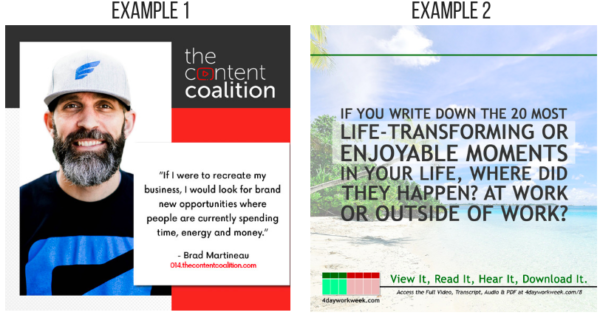
  • Scroll through impactful sections of your content and turn them into a simple image quote cards. Post that quote as a picture on your social media. This way, you don’t have to think of new things to say – you’re pulling from something you’ve already said or written. Here are a couple of image quote examples:

  • Ask your partners or others featured in the content piece to share it as well on their social media. If it’s a podcast episode with a guest you interviewed, encourage them to share the interview on their profiles. Then once they post it, be sure to share it on your profiles (share, retweet, repost, etc.).
  • Turn your existing content – whether it’s audio only, written, or video – into optimized video memes designed for social media. This Business 2 Community article teaches you exactly how to do that, step by step. It also explains the best sizes to post on social media, how to get more engagement from these videos, and more.

2 – Choose 4 – 5 Brands to Associate Yourself With

Who are other authorities in your industry that don’t compete with your product or service? Who serves your same audience, but in a bit of a different way? It might be an online magazine, blog, etc. Choose 4 – 5 brands who create lots of great educational content (that your team wouldn’t create) and share their knowledge.

If you’re a personal trainer who focuses specifically on building workout routines for clients, for example, find a brand that specializes in nutritional education and share some of their blog articles or videos on your social media to educate your audience full circle. Always make sure you tag that business to give them credit.

You can share their content one of 2 ways:

  1. Grab their content from their site or wherever it lives, and post it organically yourself.
  2. Share/ retweet/ repost something they’ve already posted.

We recommend doing both. If you are going to share something they’ve already posted, on Instagram you can use a tool called “Repost” that allows you to share their image or video. This option takes less time as the content already exists for you to share.

However, if you find a piece of content from one of these brands that you can’t find on their social media, download it and post it yourself and give them credit. Here’s an example of this with a Neil Patel video. Click “See More” to understand how the copy was done:


This also makes your social media less promotional and “salesy”; it’s clear you’re here to educate your audience and give them the best resources possible (even if it’s from other experts!). Also, not to mention, it builds great rapport with those brands.

Do this about once a week on all of your social profiles.

TIP: Use a Google Chrome extension like Save to Pocket to make this even easier. When you visit these few brands’ pages, you can bookmark awesome articles or videos of theirs that you’d like to share later. Batch them up so that the next time to go to post something, you already have links stored. This saves you even more time.

3 – Implement the Selfie-Style 1 Minute Videos

Dennis Yu, author of “Facebook Nation” which is taught in over 700 colleges and universities, has a ton of knowledge on social media engagement and posting.

In a recent interview, he stressed the importance and ease of posting short, one minute videos that are value packed that you simply record with your phone. Don’t edit these. Don’t script them. Film them and post them raw.

It’s great to film these while you’re doing something, like walking, cooking, etc. The point is to make them look natural and organic. This way, your audience relates to them. They’re also super short and to the point, your viewers don’t have to dedicate a lot of time to understand your message, and they connect more with your personal brand.

These 1-minute selfie videos in combination with the polished image quotes and memes from Hack #1 will add a ton of awesome variety to your feeds.

At the end of this article is an example of a selfie-style 1 minute video from Dennis himself (notice at the end he gives a shout out to the 1 minute video strategy!).

But overall, you don’t need to spend hours creating or researching things to post on your social media platforms in order to give your audience valuable, high-performing content. It’s about strategy, implementing what works, connecting with other authorities in your community to leverage audiences, and being as efficient as possible. These three hacks allow you to do all of that.

For those who want handfuls of social media assets created for them (those image quotes and video memes), that’s exactly what our team at Repurpose House specializes in, and we’d love to help.

Now, for that Dennis Yu example!

Life is a balancing act! If we focus on more than one aspect of our lives, another aspect suffers!

Posted by Dennis Yu on Saturday, April 13, 2019

03 May 15:08

Can Your Sales Funnel Pass These 4 Powerful Questions?

by Zak Mustapha

Just buy from me already!

Yeah that’s how every business owner secretly feels. If only it was that easy and simple…

Unfortunately, not everyone is going to buy what you have to offer right from the get-go. Most people need nurturing through what is known as a sales funnel.

A process that takes a prospect through the buying journey.

Whether you already have one or not – here are 5 tests every sales funnel must follow in order for it to be a success…

1. Do you have a reliable source of traffic?

To succeed online you need traffic and conversions.

It’s pretty straightforward yet entrepreneurs like to complicate it. They’re always looking for the latest gimmick or growth hack.

Are you even getting enough traffic in the first place? And how do you define “enough” traffic?

Only then can you move onto the next question.

2. Do you have a free product?

Before anyone buys from you, how do they get a taste of what you offer or a feel of your style? That’s where offering a free product comes in handy – you give people a taste of the value you could potentially offer.

You may need to create a few free products and send some traffic to each one to find out which one converts best.

When they choose to get access to your free product, usually you want to get their email address in return so you can offer them more value in the future.

3. Do you have a low-cost product you can upsell them after they subscribe to get the free product?

Right after people subscribe to get the free product, because they’re already in that “buying zone” it’s best to upsell them on a low-cost product that’s almost like a no brainer and doesn’t require much commitment from their side.

Not everyone will buy it, but hey… some people will.

Besides those who don’t buy… you’ve already got them on the email list where you can warm them up a bit.

4. Do you have an email sequence to educate your subscribers?

Here is where you get to show your magic by adding value to your subscribers.

Educate them and warm them up. Build trust with your expertise that will help them out.

Don’t stop emailing them. Email your list frequently but not too frequently.

Don’t go too long too quiet otherwise they may forget you. Your goal is to stay on top of their mind – so when they do need that extra help, you’ll be the first person they’ll come to.

Consistency is the important part here.

If you can consistently add value to someone’s life… sooner or later they’ll buy from you.

03 May 15:07

We Give Waaaay Too Much in Sales

by John Barrows

We are givers in Sales.

We give and give and give in the hopes that at the end of the sales process, we get what we want – which is the signed contract and commission.  The problem is we tend to give a bunch of stuff away without really getting much in return.  When this happens, we’re actually conditioning the prospect to treat us like a doormat.

We’re conditioning them to think they can get whatever they want without having to do anything for it.  This is why at the end of the sales process they sometimes don’t even give us the courtesy of a callback!

This conditioning and resulting actions by the prospects are, to a certain degree, based on respect and what one of my mentors (Jeff Hoffman) calls your Social Value. Think about the relationships you have in your personal lives. The ones that are more equal are the ones you’re closer to and you have more respect for, which usually dictates how to interact with them.  It’s the same way with clients.  If there is a significant inequality to the relationship, they don’t respect us and they will treat us accordingly.

There is a human condition that helps us understand and address this and is described by some as the “Rule of Reciprocity.”

This rule effectively states that as humans we are all bound, even driven, to repay debts. Most of us don’t like owing anyone anything, regardless of how small. However, the longer we wait to repay that debt the less likely it is to happen. On the other hand, the longer we wait to ask for something in return for what we’re giving away, the harder it is to get.

There is a direct relationship to the length of time it takes to get something in return for what you’re giving away and the likelihood of us getting it.  This is why when we give a bunch of stuff away throughout the sales process and wait until the end to get something in return, the client doesn’t remember all the stuff we did or what they “owe” us.

How do we fix this and create more of an equal relationship with our prospects throughout the sales process?

Just make sure you never give something away without getting something in return for it, no matter how small it might seem.  Get a scheduled meeting, direct dial or cell phone number for giving away information.  Get an NDA for giving a demo. Get a testimonial in return for a discount.

There are tons of things we can and should be asking for throughout the sales process. List them out and ask for them early and often to build up your Social Value.

Make it happen!

Want to learn more about how you can use the Rule of Reciprocity during the sales cycle? Check out my Driving to Close program and use code CLOSEMORE20 to save 20% in May 2019.

The post We Give Waaaay Too Much in Sales appeared first on JBarrows.

03 May 15:06

Product Differentiation and What It Means for Your Brand, According to Experts

by mhart@hubspot.com (Meredith Hart)

When I think about product differentiation, I think about my trips to the grocery store. If I’m looking for hot chocolate, how do I make the choice? Everything is very similar, so I reach for Ibarra. This Mexican chocolate brand is rich, warm, and has a pinch of spice. It’s different and stands out, so I put it in my cart.

Whether you’re selling sweet beverage mixes or software, your product needs to be distinct from your competitors. Product differentiation is key to communicating a company's value to consumers. That’s a full-blown strategy that may affect your product offering, pricing, service, and more.

So, how can a differentiation strategy work for your business? Let's demystify the process.

→ Download Now: Free Product Marketing Kit [Free Templates]

Table of Contents

Product differentiation is a method for companies to make their products stand out and grab consumers' attention. It’s also known as a product differentiation strategy.

Your strategy should tap into what your brand does best and then communicate those advantages to potential customers. A business's differentiation strategy depends on its industry, competitive market, and products or services.

Now that you know what product differentiation is, why does having a strategy in place matter? Well…

The Importance of Having a Differentiation Strategy

A product differentiation strategy helps a brand to develop a competitive advantage. And, that can be tough. According to Gila Shapiro, a product marketing manager at Riverside.fm, “the most challenging part of developing a truly distinctive product in my industry is noise.”

There are so many options to choose from that sometimes, consumers face choice overload and decision fatigue.

“Most competitors all claim to be “the best” at everything. Cutting through that requires more than innovation — it demands precision,” Gila says.

That’s why your differentiation strategy matters. You can’t just make new offerings and expect people to come over. You have to communicate your advantage in a way that builds goodwill with customers. Your strategy gives buyers a reason to come back to you again and again.

Businesses that make product differentiation work for them have the following qualities:

  • They’re innovative and inventive. New offerings can help products stand out. These brands have a strong research and development team.
  • The company has the resources to create high-quality products or services. For example, a company may have a distinctly responsive support team.
  • The brand’s marketing and sales strategies communicate the competitive advantage of the product.

If your brand is distinct, your company becomes recognizable. Customers are also more likely to pick your product over a generic or undifferentiated product or service. Think about how Heinz Ketchup. I love the brand’s blend of sweetness and vinegar. Generic brands can’t compare, so I always reach for Heinz.

Apple is another example — and I’m a huge fan! I find Mac computers easy to navigate. Plus, software like Pages and iMovie still come with the computer, something PCs don’t offer. It’s often more money, but I’m too loyal to change.

Types of Product Differentiation

Like every strategy, there’s no one-size-fits-all approach. However, there are a few buckets that product differentiation falls into. Keep reading to see where you fit.

types of product differentiation

Price

If your product is cheaper than competitors, you can attract business. In the best-case scenario, the cheaper option is just as good as the more expensive option (a dupe, if you will). However, sometimes a cheaper product is what you need, even if the quality isn’t top of the line.

A great example? Swinging by a Dunkin’ for coffee. A Dunkin’ iced coffee is usually cheaper than its competitors. It’s not as fancy as Blue Bottle, but when I need a quick caffeine boost, it gets the job done.

Quality and Reliability

Sometimes, price is less important than the quality. You may want something top-of-the-line that will last a life time, pulling you away from lower-caliber offerings. As my dad always says, “But once, cry once.”

When I think about quality, food always presents a great example. Rao’s tomato sauce is expensive. However, the quality of the ingredients and the flavor can’t be beat. Meanwhile, when it comes to reliability, I think about cars. Toyotas and Hondas have a reputation for lasting decades before they break down. When I ask about reliable cars, these two brands always come up.

Features

This category is very straightforward. Offering features that other brands don’t can set your product apart. That can be especially helpful if you have a genuine helpful feature in your bundle that other companies lack.

For example, in the world of CRMs, not every offering complies with HIPPA. So, a health insurance company would be limited to CRMs that allow for this compliance.

Design

Great design — whether that be for a physical or a digital user interface — can attract customers. If your product is easier to use than other options, customers in search of a no-fuss fix will flock your way.

I bought a Breville Bambino, a simple espresso machine that I can have at home. I picked this specific model because it’s easy to use. I can choose between a double and a single shot of espresso. Then I press a button to foam milk. I chose this simple design so I can make great lattes at home easily.

Location

If your business is brick-and-mortar, location is an important differentiating factor. Your customers want to go to the closest option for, say, groceries or a cup of coffee. That’s why I go to the 99 Ranch by my house instead of the Asian grocery store across town.

Brand Image

There’s a little bit of storytelling that goes into differentiation. You can see this in brand image. If your customers love what you stand for or how you run your business, you can earn their loyalty. For example, Patagonia uses sustainable materials and Fair Trade Certified factories. Because I care about the planet, I’m more likely to shop from the clothing brand.

Customization

While customization can mean adding a name to a product, the concept goes so much further. If people can pick exactly what’s in their plan and choose from a buffet of options, they get a customized experience. Both approaches can help you gain market share.

Think about Spotify’s suggestions and end-of-year Wrapped recap. That’s an offering customized to the listener.

Distribution Channels

Distribution channels are where products are available for customers to purchase. For example, a denim jacket can be sold online, at the brand’s store, and at third-party retailers. Where your product is available can be a differentiating factor. For example, I may be more likely to try a new snack I find at the store than one I gave to buy online.

Post-Sale Support

For certain purchases, customers want guidance even after they’ve swiped their credit card. In these instances, post-sales support is an essential differentiating factor. For example, when I shopped for a web hosting platform, I wanted an option with human customer support to help me get set up.

Vertical Product Differentiation vs. Horizontal Product Differentiation

Product differentiation typically falls within two categories: vertical and horizontal. However, customers may use a mix of the two to determine whether or not to make a purchase.

Vertical Product Differentiation

Vertical product differentiation is based on a measurable attribute like price or quality. For example, a customer may choose a product that ranks highest for quality over other brands. For other customers, price point may be the most important factor, so they choose the least expensive item.

For example, generic vs. branded products at the grocery store. Swanson chicken broth tastes better than the generic brand at Safeway — I can tell when I take a taste of both. But, if I’m making a bigger dish with a little bit of broth, I may opt for the cheaper, generic option.

Horizontal Product Differentiation

Horizontal product differentiation refers to factors that aren’t measurable, such as personal preference. This typically occurs when products or services have roughly the same price point. For example, a customer may choose the chicken sandwich from Shake Shack over Chick-fil-A based on personal preference rather than quality or cost concerns.

Customers may use mixed differentiation when making more involved purchases that combine vertical and horizontal differentiation attributes.

For example, if you want to buy health insurance, you’ll consider vertical differentiation attributes like cost, in-network physicians, and coverage. You may also consider brand recognition and perceived image, which would fall under the horizontal differentiation category.

This decision is a mix of vertical and horizontal product differentiation.

Product Differentiation Strategies That Work

There’s a lot of talk about differentiating a product in a market. But how exactly can businesses make it work? Here are some tried-and-true strategies, including insights from expert product marketing managers.

Use the MAYA principle.

The MAYA principle stands for “Most Advanced, Yet Acceptable.” It is a design principle that guides brands in creating products that balance innovation and user ease of use.

Concerning the MAYA principle, Mia Čomić, a product marketing manager at Learnworlds, says, “If you’re too novel, the customers will tune you out. If you’re too familiar, you won’t captivate their attention. It’s sort of like a Goldilocks’ issue of product development.”

Instead of innovating or adding new features just because everyone else is doing so, you should focus on what those features can do for your users. Ask yourself: Do my users need these features? Does this feature assist them in my product's typical use case?

Čomić adds, “Innovation can be easily communicated if you center your narrative around what specific features can do for your users. It’s so simple, yet very few companies do it right. But you won't get far if you innovate just for bragging rights and PR.”

For example, Čomić notes that LearnWorlds made a decision to carefully think through how they would implement AI functionality within the platform. “It was never about having AI just for the sake of it. If innovation is in the service of the users, then my job as a PMM gets a lot easier,” Čomić says.

Focus on your customers.

There will always be noise, and chasing the next new shiny thing might seem exciting. But, instead of doing that, focus on your customers.

This was what Shapiro did with her team.

Shapiro notes, “Instead of joining the noise, we focused entirely on our customers. What inspired our audience? What did they secretly wish for but hadn’t been offered yet? Differentiation, we realized, wasn’t about us — it was about showing them how they could achieve more.”

So, what can you do to focus on your audience or customers? Here are Shapiro’s top three recommendations.

  • Dig into their emotional needs. Beyond features, explore what would make your audience feel confident and capable. How could you help them create something extraordinary? Frame every message around what your audience would gain and not what you’re selling.
  • Be simple and clear. Focus on the one promise you can deliver better than anyone else. Then, communicate it in a way that cuts through the clutter. Instead of a laundry list of features, answer their most pressing question: “How will this help the customer succeed?”
  • Continuously refine your message. Your messaging shouldn’t be static. Instead, treat it as a live conversation, testing what resonates, listening to feedback, and adjusting quickly. When something clicks, lean in harder. When it doesn’t, pivot.

Sure enough, this strategy helps Riverside.fm differentiate its products in the market. But it does way more than that. The strategy has helped them build connections with their audience. Now, users feel Riverside.fm is a product made just for them.

A resource like the HubSpot Product Marketing Kit provides critical support for teams executing these customer-focused strategies. This resource offers templates, guides, and frameworks that enable product marketing teams to research customer needs across channels.

Consolidate services.

While it’s vital to focus on a particular feature that makes you stand out, sometimes what you’re known for is that your product is a one-in-all solution. All of the strategies work together. Listening to or focusing on your customers often reveals that they don’t want to deal with software bloat. They want a tool that provides all they need in one place.

Bolaji Anifowose used this strategy as a PMM at Simpu.

He says, “During my time at Simpu, we operated in a crowded market for customer communication tools. To differentiate, we focused on creating a product that combined marketing (email and SMS) and support (chat, text, email, and social media) into one seamless platform.”

According to Anifowose, many competitors offered marketing and support tools as standalone solutions. However, Simpu identified the frustration early-stage companies and SMBs faced when juggling multiple disconnected platforms.

He continues, “Our solution was tailored specifically for these businesses, which often couldn't afford enterprise-level tools or the inefficiencies of managing separate systems.”

You can tell whether you need to consolidate services and products by adopting a customer-centric approach. This approach involves conducting extensive customer interviews to understand their pain points. You can then prioritize features that alleviate these challenges.

Challenge the status quo.

Challenging the status quo as a product differentiation strategy is one of my favorite approaches because it’s bold. It’s about addressing inefficiencies and unmet needs in an existing market. Often, it feels like rooting for the underdog who sees things differently and takes on established giants.

It’s a strategy Dollar Shave Club used to stand out in a market dominated by overly complicated products. It was how Apple disrupted the tech industry and how Tesla did the same in the electric vehicle market.

Of course, you cannot challenge the status quo with an inferior product. Your product needs to be on par and, in many cases, better than what is already available to customers.

What I find especially powerful about this strategy is the storytelling. It’s not just about saying, “We’re different.” It’s about showing why the old way isn’t working and how the new way makes life better for people like me. That authenticity and sense of purpose make me more loyal to those brands.

Challenging the status quo is a high-risk, high-reward move. When executed correctly, it can result in strong customer loyalty and even a cult-like following.

Use design and style.

Sounds pretty simple, right? Well, it’s not. Most companies create outstanding products that hide behind boring designs. You can differentiate your product by making it beautiful and memorable. Great design can elevate even the most mundane items and turn them into something exciting.

Consider Happy Socks’ example. They make socks — products don’t get much more boring than that. However, by using bold colors and quirky patterns, they turned a simple, everyday product into a fun statement piece.

product differentiation example, happy socks

Source

These designs communicate without words and spark a connection between products and the market. Whenever I buy something because of its design, it feels more like a personal experience than a transaction.

Advantages and Disadvantages of Product Differentiation

Before pursuing a product differentiation strategy, it's best to review its advantages and disadvantages. This knowledge can help you know where to lean in and which pitfalls to avoid.

Advantages of Product Differentiation

  • Product differentiation will give your prospective customers added value. This value can come directly from the product, service, or brand perception.
  • Every time people see your products on store shelves or in an online ad, they‘ll know exactly what your brand represents. Plus, they’ll be more likely to choose your product over the competition.
  • With product differentiation, companies can compete in areas other than price. They can innovate in style, quality, features, etc. It's up to the business to decide which area of differentiation will work best for their target markets.

Disadvantages of Product Differentiation

  • A differentiation strategy doesn‘t necessarily guarantee that consumers will see the value that distinguishes your product from other standard options. For example, if your product is more expensive because of its quality and the consumer doesn’t see the added value, they’ll choose the cheaper option.
  • As consumers become savvier and technology and products advance, your product's differentiation might no longer provide value to customers. You should consider how long your differentiation strategy will last and whether it will need to be modified at a later date.
  • Pursuing a differentiation strategy means investing resources in developing a product that sets itself apart. This can burden R&D teams, product manufacturers, and your profit margins. These effects are felt more by smaller businesses that have few employees and limited resources.

Product Differentiation Examples

1. Trader Joe's

Main Competitors: Whole Foods, Kroger, Sprouts

Source

[alt text] example of product differentiation: Trader Joe's

Trader Joe‘s has earned a dedicated following among shoppers thanks to the brand’s friendliness and unique items. I mean, who can resist those Hawaiian shirts, free samples, and friendly banter?

Trader Joe‘s sets itself above the competition by leveraging its friendly service and combining it with unique, often seasonal, items. Its stores’ compact footprint and handwritten signs advertising the day‘s deals make shoppers feel like they’re in a local establishment rather than a national chain.

Most of all, Trader Joe‘s delivers high-quality items shoppers can’t get anywhere else, all at a budget-friendly cost.

2. Airstream

Main competitors: Fleetwood, Jayco, Winnebago

Source

[alt text] Product Differentiation Example: Airstream

Airstream RVs have a retro mystique. They're silver, streamlined, and highly recognizable on the road. The company sets its RVs apart from the competition by focusing on quality — which increases the product’s value over time. Higher quality means lower maintenance costs and higher resale value.

Plus, they're known to last for generations. According to the company’s site, “Since the 1930s, Airstreams have been handed down from generation to generation, passed on to family members, friends, or new adventurers.”

Airstream's brand is further developed through its heritage, which builds trust with potential customers and highlights its success over the years. With the tagline “Live Riveted,” Airstream inspires people to travel with an RV.

3. Billie

Main Competitors: Flamingo, Harry’s, Dollar Shave Club

product differentiation example: billie razors

Source

Billie differentiates itself from typical direct-to-consumer body care brands by focusing on women first. The brand combats the pink tax, provides premium products, and makes the future brighter for all women. This strategy has helped the company realize monumental success and develop a recognizable brand with a positive reputation.

Billie's co-founder, Georgina Gooley, said in an interview with Columbia Women’s Business Society, “We knew right away that we wanted to create a brand that put women first in a category that had always considered them an afterthought. Our goal is to create a little bit of magic in the mundane and make an everyday routine more enjoyable (and a lot more affordable!).”

By positioning itself as a champion of women of all sizes, shades, and grooming habits, Billie has carved out a niche in direct-to-consumer personal care.

4. Fabletics

Main Competitors: Lululemon, Athleta (by Gap)

example of product differentiation: fabletics

Source

Like Billie, Fabletics positioned its brand toward women of all sizes and backgrounds for its direct-to-consumer activewear brand. With Kate Hudson at the helm, Fabletics offers quality, stylish clothes on par with competitors like Lululemon, minus the elitism.

The company often partners with celebrities and athletes for each of its campaigns, including Kevin Hart, to launch its new menswear line. Additionally, they've partnered with Lizzo to launch her new size-inclusive shapewear line, YITTY.

Each month, Fabletics rolls out a new collection of styles, separating it from the competition and ensuring that consumers always have fresh looks to try.

5. Nike

Main competitors: Under Armour, Adidas, Reebok International

product differentiation example: nike

Source

What separates Nike from the competition is its branding. The company positions itself as innovative and creates high-quality sports apparel and shoes.

The company partners with high-profile athletes, including Serena Williams, Michael Jordan, Cristiano Ronaldo, and others, to wear and promote Nike apparel. Such partnerships attract new (and returning) customers because many aspire to be like their favorite athletes.

Nike also creates new and innovative product lines. These offerings create buzz and excitement. Promotions pique the interest of new customers and keep existing customers returning for more.

6. Lush

Main competitors: The Body Shop, Origins, Sephora

product differentiation example: lush

Source

Lush stands out from other cosmetic brands because it focuses on fresh, handmade cosmetics — something most generic cosmetic brands don't often do.

Messaging is another area where Lush stands out from the crowd. Their target customer values social responsibility, and the company takes it to heart. All the products are made using natural, vegetarian ingredients, reusable and recyclable packaging, and without animal testing.

Each visit to a Lush store offers a unique experience. You can test out products and have your questions answered by friendly store associates. Each aspect of Lush's differentiation strategy makes it a recognizable and well-loved brand.

For even more product differentiation examples, check out these companies that brilliantly differentiated themselves from the competition.

A Product Differentiation Strategy is Key to Success

A well-planned product differentiation strategy can set your business and brand apart from competitors and make it memorable. It’s about giving your customers a reason to choose you in a sea of competitors.

Whether through bold design, innovative features, or challenging the norms of your industry, differentiation creates value that resonates on a deeper level. For me, the best strategies are the ones that feel personal and authentic. I want something that solves real problems and sparks joy.

03 May 15:06

The 25 most influential books ever written about business

by Mara Leighton

Insider Picks writes about products and services to help you navigate when shopping online. Insider Inc. receives a commission from our affiliate partners when you buy through our links, but our reporting and recommendations are always independent and objective.

25 most influential books 4x3

Warren Buffett — arguably the most skilled investor of our time — said reading 500 pages a day was the key to success, because, "That's how knowledge works. It builds up, like compound interest."

This is likely why so many important businessmen and women make reading a daily part of their lives. It's why Bill Gates reads 50 books every year (roughly one a week) and Mark Zuckerberg kicked off 2015 with the goal of reading one every other week.

If you want exposure to new ideas, modes of thinking, and a compounded aggregate of diverse knowledge, then reading is important. And it's going to help you in business, be it by a mixture of accounts on other corporate successes or failures and lessons on lean startups, or a 2,500-year-old military tome that works just as well in boardrooms as war.

Below are the 25 most influential business books of all time, if you're looking to start with those most worth your time:

Descriptions provided by Amazon and edited for length.

READ THIS: Here are 15 books that will help you succeed in the tech world

"Business Adventures" by John Brooks

What do the $350 million Ford Motor Company disaster known as the Edsel, the fast and incredible rise of Xerox, and the unbelievable scandals at General Electric and Texas Gulf Sulphur have in common? Each is an example of how an iconic company was defined by a particular moment of fame or notoriety; these notable and fascinating accounts are as relevant today to understanding the intricacies of corporate life as they were when the events happened.

Note: Bill Gates wrote in his blog, gatesnotes, that Warren Buffett not only recommended this as his favorite book about business, but actually sent Gates his own personal copy to read. Gates writes that more than four decades after it was first published, "Business Adventures" remains the best business book he's ever read. 

Buy it here >>


"The Intelligent Investor" by Benjamin Graham

The greatest investment advisor of the twentieth century, Benjamin Graham, taught and inspired people worldwide. Graham's philosophy of "value investing" — which shields investors from substantial error and teaches them to develop long-term strategies — has made "The Intelligent Investor" the stock market bible ever since its original publication in 1949.

Note: Warren Buffett refers to "The Intelligent Investor" as the "best book on investing ever written."

Buy it here >>


"The Innovator's Dilemma: The Revolutionary Book That Will Change the Way You Do Business" by Clayton M. Christensen

Offering both successes and failures from leading companies as a guide, "The Innovator’s Dilemma" gives you a set of rules for capitalizing on the phenomenon of disruptive innovation.

Note: Steve Jobs used this book as an explanation for one reason Apple needed to embrace cloud computing and is frequently associated with both Jobs and Jeff Bezos.

Buy it here >>


See the rest of the story at Business Insider
03 May 15:01

Bringing science discipline to pricing - an interview with Joseph Schneider of Becton Dickinson

by Steven Forth
190501.png

Ibbaka with its partner Leverage Learning has been working with Becton Dickinson for the past three years on a series of marketing capability projects. One of the most innovative is on Pricing Excellence. Our internal thought leader was Joe Schneider, who brings wide experience from different fields to pricing leadership. Joe has his finger on some of the most important challenges facing pricing today: how to make the transition from products and services to solutions, how to manage pricing in large complex sales that can combine highly differentiated offers with others under commoditization pressure, how to manage changes in the value chain and pressure from stakeholders to reduce overall costs in the healthcare system.

Ibbaka: How did you come to a pricing leadership role at Becton Dickinson?

Joe: I came into pricing almost by accident. Working with business leaders, we found that people did not really know why they were using the pricing models or levels they were. They had just accepted what had been done before and were working within that framework. I wanted us to take a step back. We needed to put pricing more in the context of customers and not just let prices be driven by habit, our internal needs and our competitors.

We needed to develop a better price setting process. One that was rooted in our customers’ need. One way we tried to get people to change their thinking was with a simple question. We asked people to take a look at their offers and pricing and ask “If someone tried to sell us that would we be willing to buy at that price? Why?”  Asking that question to ourselves, made us think about how we were creating and capturing value with customers in the marketplace.

The way of thinking we are working to drive into the company is based on customer driven strategies. We have to look at a few things in detail.

  1. How are we creating value?  (i.e. What really is our strategy to create preference with customers in a market?)

  2. What is the business model for Becton Dickinson and for our customers and business partners? Does that business model enable or hinder our strategy?

  3. How should we price? (Capture value !)

  4. At what price should we simply walk away? (One cannot afford to win all deals, especially not to win them on price.)

Ibbaka: You have done a lot of things over the years, and currently play a key role in areas like customer insights for Becton Dickinson. How do you bring these different skills to bear on your pricing work?

Joe: I started my career as a research scientist in biochemistry. This gave me two key traits that have shaped my career, curiosity and the need for a rigorous process for generating and testing hypotheses.

I am genuinely curious about how we create value and about what we know and what we just think we know. We have to ask …

What do we know?

Why do we think we know this?

What are our hypotheses?

How can we test them?

Pricing requires people to be very inquisitive and data driven at the same time

After my research career I had the opportunity to work in sales. Sales is really a great way to understand needs, problems and solutions with a degree of granularity that is hard to attain from other sources.  It also a very nerve wracking and humbling experience. Your customers tell you a lot. I was fortunate to have a great mentor in Steve Goodstein (nurse who moved into sales executive roles) who taught me a key lesson when I was starting, which i still recall to this day:

“I don’t want to know more about my solutions than the customer. I want to know more about the customer’s problems than the customer. If you know that, then people are glad to see you.”

This is hard and the exact opposite of the “leadership” role that many companies want to play with their customers. At Becton Dickinson we are getting better at this. We used to see our business in terms of products and manufacturing plants. This is going to be harder to be successful with going forward, as our customers change and as our competitors change.  Our competitors can have very different profitability requirements depending on how they are financed (public vs. private companies). The capacity game is over. We have moved from pushing our products to our customers to having our customers pull solutions from us. We want our solutions to impact our customers’ key performance indicators.

Products are a much easier thing to manage than are customers. You can see the direct contribution of a product to the P/L. Can we get to a point where we understand the contribution of each customer to the P/L?

We want to become a customer driven business, one that is built on a deep understanding of our customers and how we are creating value for them. This requires a change in mindset on how we engage.

Pricing plays a critical role in this transformation. I was able to bring a new perspective to pricing at Becton Dickinson as I did not live in a part of the business with P/L accountability. That let me be more agnostic and introduce a more rigorous approach.

The combination of research discipline with sales experience is critical to my success. Both of these teach one to deal with contentious topics. To succeed in pricing one has to be able to understand and integrate different points of view.

Ibbaka: How have pricing challenges and opportunities changed as Becton Dickinson has moved towards solutions?

Joe: Becton Dickinson has a strong position in several markets. We enjoy a combination of high margins, high market share and are able to charge significantly more than our competitors. We try to better understand why our customers are making these choices. As we move to solutions there is the potential that may earn lower margins, but have a more “competition proof” customer base.  It is critical that we understand the tradeoffs between price, gross margin and perceived value, even as we are moving from managing products to managing portfolios that can provide value across the whole path of a disease or for an entire provider system. The basics never go away.

As part of this transformation, we need to get better at designing and managing risk-based contracts where we share risks and rewards with our customers, and performance-based contracts where we are paid for impacting key performance indicators. The organizations that develop these as core competencies are going to be among the winners going forward.

This will require a good understanding of game theory. One has to be able to understand one’s own risk, the risks the customer is taking on, and even the risks facing competitors. We have to think about pricing and our business as a whole as being involved in risk transformation for our customers. How do we change their risks?

As we start to price based on outcomes, we have to start asking ‘How can I align my business model with that of my customer?’

Ibbaka: What is changing in your markets and how will this impact pricing?

Joe: There is going to be a lot more pressure all along the value chain to demonstrate value and show that pricing is justified by the value being delivered. This challenge will be felt across entire disease states and for all healthcare providers, and is coming from customers, regulatory agencies, and political systems.

The government will be putting more and more pressure on the healthcare system. The percentage of the gross domestic product (GDP) spent on healthcare cannot continue to grow. This is going to put pressure on the whole value chain beginning with the pharma companies, but pressure on companies like Becton Dickinson to demonstrate value will also be intense. The value models of many parts of the sector will have to change and become much better defined. Intermediaries like pharma benefits providers will also come under a lot more pressure.

This means there will be a need for a lot more pricing transparency right out of the gate. As I guide our businesses through their pricing strategy and pricing decisions I want to make sure that what we are doing is fair, transparent and will stand up to external scrutiny.

Digitization is going to have a big impact here. Digital business models mean that a lot more data is collected and available for analysis. Digitizing the healthcare system should lead to a lot more transparency for all participants, and this will then feed back into strategy setting.

Becton Dickinson will have to get better at managing prices in the context of the value being created across the entire value chain. We will need the skills to deliver profit management through the solution, customer and portfolio lenses.

If I boil this down to three things, we are going to see a lot more value chain integration, a demand for transparency and an expectation of fairness.

Ibbaka: What are your passions beyond work?

Joe: I have young and very active children and we do a lot of things together as a family. We ski, play soccer get out of the house together, but we also sit down and play board games and work on puzzles. We also love food. Food of all kinds, especially ethnic foods. I have to travel a lot for work and one thing I enjoy is trying out all sorts of different ways food can be prepared and served.  I think every culture has some form of a dumpling...food wrapped in dough. It makes me think there is some basic need for humankind to put food in a dough wrapper for easy consumption. I also know I have yet to try a dumpling that I have not enjoyed :).

Ibbaka: What is the lasting impact you hope to have with your work?

Joe: When you get down to it, it is about the brand we are building at Becton Dickinson.

“Advancing the world of health.”

To really deliver on this, we have to have processes that support it, a way of thinking that embodies it, and we have to be able to create and communicate value. The way to do this is by thinking differently about our customers.

Permalink

03 May 14:59

Overcoming objections in sales: 40+ examples, tactics, and rebuttals

by steli@close.io (Steli Efti)
sales-objection-handling

Nothing defeats an inexperienced salesperson faster than an unexpected objection. Most salespeople invest hours perfecting their pitch without a second though to what comes afterwards. But even a perfect pitch can be ruined by poor objection handling.

If you’re tired of losing deals to responses like, “Your price is too high,” “Now isn’t a good time,” or, “We’ll buy if you add these features,” it’s time to get serious about overcoming objections. Instead of hoping your prospects won’t have objections (they always will), spend some time preparing for them in advance.

Use our list below to start overcoming sales objections and closing more deals, or jump down to any section that deals with the types of rebuttals you see most often.

Let’s get started with some of the basics about sales objections, and what the most common types are.

What are sales objections and how can you overcome them?

A sales objection is a rebuttal from your current lead during the sales process that explicitly states a reason why they will not be buying from you at the moment. These can include problems with price, usefulness of the product, or a lack of time to engage with you currently, among other things.

Here’s one important thing every seasoned salesperson understands:

Getting an objection from a client is a good thing! It means the prospect has enough interest to at least engage with you, rather than flat out dismissing you. For you, the salesperson, a sales objection is an opportunity to learn more about your prospect’s needs, and find better ways to communicate the value your solution has to offer to them.

sales-objection-techniques-close-deal

How to handle sales objections:

To handle sales objections, you must be prepared for what is coming at you, listen attentively to your potential buyer, and demonstrate that you truly understand their concerns. To master handling objections, you need to prepare responses to common rebuttals from your leads to regain the upper-hand.

Salespeople often struggle with objections because of the surprise factor that accompanies them - you weren’t expecting it! If you need to know how to manage any sales objection, these strategies can help take the shock value out of the conversation, and get you back on track to close.

10 proven strategies for overcoming objections in sales

  1. Really listen to the objection - You might think jumping in with a quick response is the best tactic, but it’s much better to listen carefully to what they are saying so you don’t make assumptions about what they want/what they mean.
  2. Take the time to understand the objection - Ask further questions about what they mean, as it’s common that your potential buyer isn’t revealing their real objections. Explore with them to get to the real root of the issue that’s holding them back.
  3. Craft a response addressing their biggest objection - Once you understand it, provide a rebuttal to their concerns. If you can overcome this barrier, the call can likely continue with less resistance.
  4. Try to resolve their objection in real time - The better you can satisfy their concerns right away, the more likely they are to proceed further in the sales process.
  5. Keep responses clear and to the point - A long response where you go on and on isn’t likely to be well-received, but instead, seen as more ‘selling’ and less like addressing their concerns.
  6. Don’t wing it - Making up things on the spot is likely to get you in trouble; buyers can sense this and it will create a level of distrust that - in all likelihood - will end the sales call. If you need more information, ask for it, or look it up.
  7. Confirm you’ve satisfied the objection - Don’t assume you have just because they accept what you say. Ask your potential buyer how they feel about what you’ve said, or if you’ve alleviated their concerns. This can help you move in for the close, or if necessary, move on to addressing further concerns they have.
  8. Create an objection management document- This document should list the top 25 objections you face, along with a 1-3 sentence response for each. If you work with a team, collaborate on this project together.
  9. Practice the objection responses and commit them to memory - You don’t have to recite them word-for-word, but you should at least have them in the back of your mind so you have a strong foundation and can deliver confident, compelling responses every time.
  10. PRO TIP: Customize your objection list to market - Each market has its own objections, and if you aren’t prepared for those, you’re going to lose deals to someone that is. Sort your objections into groups by market, and add objections you get from only certain areas.

The best way to become a master of these strategies is to practice them while selling. But you want to be prepared for these objections so you aren’t losing sales while mastering your objection handling. Here are the objections you’ll see in sales on a regular basis.

Most common sales objections

Different sales people face completely different objections, right? Wrong. What you’re selling will clearly affect the minor details of the objections that come your way, but the truth is, most salespeople face the same objections from their leads.

These are the types of objections in sales that most people see on a regular basis. Jump down to the one that you deal with most, or start working your way through the list.

We’re going to jump into one of the biggest objections salespeople deal with: a price that doesn’t seem to work.

Overcoming price objections: Sales rebuttals for no budget/too expensive

These objections will range anywhere from “We simply think your product is too expense” to “I need a discount to buy” to “We already allocated all of our budget for this type of things.” To overcome these, you need to assure the potential customer that the value they’re getting from your product is worth the price.

Often, people use price as a defense mechanism to hide what their real concerns are - or they’re just feeling you out to see if you’ll offer a discount. Make sure you get to the root of what’s really going on with a price objection.

1. "Your product/service is too expensive."

sales-objection-too-expensive

When a prospect says your product is too expensive, it isn’t always about price. In many cases, they have the budget for your product, but you haven’t demonstrated enough value to justify your price.

But sometimes it isn’t about price or value. Sometimes your prospects will use the pricing objection to hide their real concerns. The first thing you need to do when you hear the pricing objection is find out what’s really going on.

Master the too expensive objection: How do you manage the pricing objection in sales?

2. “We have no money.”

When your lead throws this one out there, it’s hard to press further because it’s likely true that they simply can’t afford you - right now. The best way to counter this is with strategically-placed follow-ups based on their growth.

Track what’s going on over there, and pounce again when you see some growth that might allow for you to sneak into the budget.

Master the no money objection: Dealing with a “no money” objection

3. “We’ve already spent our budget.”

This is very similar to the no money objection listed above, yet it differs in one key way you can utilize to change your prospect’s mind: funding will return eventually.

You can counter this problem in 2 ways:

  1. Ask your lead when the cash flow will return to them, and follow-up then
  2. Work with your prospect to brainstorm ways you can allocate some of the budget to your product or service - especially if your service is something that will help them save money

Master the no budget objection: 5 ways to tackle the “no budget” objection

4. “I need to allocate this budget elsewhere.”

This objection means that the potential is there to spend money on what you’re offering, but your prospect just doesn’t see it as a priority compared to other things, so they’re putting the money elsewhere.

The best way to counter this is with specific examples or case studies on how other companies like theirs benefited from implementing your solution, and bonus points if you can show them how they’ll actually save money using you. That will make it awfully hard for your lead to object to when it comes to budgeting and resource allocation.

Master the budget elsewhere objection: How to handle “no budget” telesales objections

5. "Your product looks great, but the price is too high."

product-too-expensive-objection

Whenever a prospect throws out the idea of getting a discount before they even try your product, don't give in. Instead, refocus the conversation on what matters most: your product, and even more importantly, the value it will create for your prospect.

Instead of engaging in cumbersome discount negotiations, use this technique to weed out bad fits, and demonstrate value to prospective customers.

Master the not worth the price objection: SaaS sales negotiations 101: How to respond to discount inquiries

6. “I don’t want to be stuck in a contract.”

Many people don’t want to get tied into a contract, especially if it’s for up to a year. This puts their cash flow availability at risk, and makes the commitment they make to you today a lot more serious than signing up for one month, or one quarter.

Another thing they might be saying is “I need to think this over” - because they need to make sure it will be worth the commitment. To counter a “I need to think it over” that becomes a “No,” see if you can offer shorter terms, or allow an option for them to leave the contract after 6 months. That safety net might mean the world to them, but if your product is good enough, they probably won’t exercise that right down the road.

Master the don’t want to be stuck in a contract objection: How to confidently handle sales objections: A field-tested action plan

7. “The ROI potential just isn’t there.”

If your prospect is telling you that what you’re offering won’t give them the Return on Investment they’re looking for, you need to show them exactly how it will. A case study of a similar business seeing ROI from your solution is the best way to counter this.

Don’t make the mistake of just repeating key features - they heard you the first time, and saying it again won’t convince them the ROI is there. You need to figure out how your prospect’s company is making money, and give them a concrete example of how your service, product, or solution will make them more - or save them more money than what they’ll spend on you in the process.

Master the no ROI objection: Addressing the ROI objection and measuring ROI

8. “Another option is cheaper.”

Well, it’s difficult to argue with that logic - if your service is completely identical to another but costs more. But is that usually the case? No! If it was, you wouldn’t be in business for very long. With this objection, you need to convince your lead that cheaper isn’t always better.

Show they exactly why your service costs more - and show them why that actually means it’s better. Demonstrate how some of your advanced features that they would be paying for will help them increase their own sales and make more money, or how it will streamline processes, saving time for employees. The better of a job you do at showing how this small investment now will pay off in the long run, the better position you’ll be in to counter this objection.

Master the cheaper option objection: Another agency can do it cheaper: Sales objections part 5 of 5 [+video]

The ‘not a good fit’ objections: When your product isn’t right for them

When someone tells you you’re just “not a good fit” - it hurts! But what are people actually saying when they say this to you? “It’s not you, it’s me” is a little cliché, but these objections are often the polite way of saying “I’m not engaged with what you’re selling right now.”

To get to the bottom of these objections, use critical questions to gain a better understanding of what’s holding your prospect back, and have your responses prepped when you feel them trying to push you off the sales call.

9. “We don’t have the ability to implement this solution.”

This one can be a deal-breaker in some cases. If your prospect looks at your product and realizes it would require them hiring another person or would take their current employees away from their regular duties, they may write you off altogether.

Try to find some ways that your product could make things more efficient for your prospect’s employees to help them see a long-term benefit of adding your product to their workplace.

Master the can’t implement now objection: 4 objections you need to overcome to increase sales

10. “This product doesn’t work with our [X].”

If your prospect is committed to their existing system/tools and your product isn’t compatible, you’ll have a hard time getting them to switch. However, if you know a workaround, or if your product would eliminate the need for whatever their current setup is, explain the benefits of making the switch.

Master the “this doesn’t work” objection: What to do when your prospect doesn’t want to switch software

11. “I’ve never heard of you and your company is too small.”

Though this may sound quite negative at first, what they’re indirectly asking for is more information about your company. Give them some key points about your company, what you do, and how you can help them.

Master the never heard of you objection: How to overcome the “your startup is too small” objection

12. “I don’t understand this product/service.”

When you get one of these responses, you should consider whether you want to keep pursuing this prospect, as you don’t want to waste your time trying to explain your product to someone who ultimately isn’t likely to move forward with a sale.

If you want to keep trying to land the sale, ask them to clarify what part of your product’s description is unclear to them, then phrase your explanation in a different way to see if it makes more sense to them.

Master the don’t understand function objection: The simple reason products fail: Consumers don’t understand what they do

13. “I’ve heard negative feedback about your company.”

It’s nice to know that people are talking about your company/products with their peers, but when the information or opinions shared about you are negative, it can be hard to come back from.

Instead of scrambling to defend your company against whatever claims are presented to you, let the prospect know that you’ll pass the feedback on to the appropriate person or department. Then, offer them information on how you can improve or add value to their company with your product/service.

Your goal is to change how they view your company without directly combating the negative claims they’ve heard. You also want to steer away from saying negative things about the competitor/customer, as bad mouthing them isn’t what’s going to keep your sales call on track.

Master the bad reputation objection: Bad mouthing the competition - does it help or hinder sales?

14. “Your product is too complicated for me.”

In these cases, the first thing you should determine is whether the prospect is confused about what your product is/does, if they’re struggling to understand some of the features, or if the product itself is just too complex for them. If they see your product as something that would potentially create complications for them, they’ll have no interest in purchasing it.

If the issue is just that they need further explanation of your product’s functions and features, try phrasing it in a different way than you did previously. Also make sure they know that they can get in touch with you and your company’s support team if they need any help with using the product or setting it up.

Master the too complicated objection: Are you making things too complicated for customers?

Sales rebuttals for not interested: When they don’t see why your product is valuable

These objections are similar to the “not a good fit” above, but differ in one key way: these objectors aren’t hiding behind a polite excuse. When someone tells you outright that they aren’t interested, it means they’ve thought of at least one good reason why they know they don’t need to buy what you’re selling.

To counter these objections from the apathetic or uninterested, you have to have some real, concrete reasons why they reason they think they don’t need your product or service is flat out wrong. Convince them to change their perspective on that one thing they’re fixating on, so the call flows back in your favor.

15. “We’ll buy if you add these features.”

add-features-objection

Feature demands are common when selling to enterprise customers. They’re used to getting what they want, and what they want is for you to customize your software to their needs.

When prospects demand features that aren’t aligned with your vision, the best thing you can do is walk away. You may lose some accounts over this, but that’s better than compromising the integrity of your product. Besides, you’ll be surprised how often taking the deal away is all it takes to close on your terms.

Master the add features objection: 2 common B2B SaaS sales objections (and how to handle them)

16. “Your product/service is a fad and won’t last.”

If your company is selling a product that’s the first of its kind, you’ll need to prove that your product is setting a lasting trend, and not just a fad that will fade away as quickly as it came (so long, fidget spinners).

To change their mind, tell them about some of the positive feedback you’ve received from other customers, and give any stats you have about how your product can improve their metrics; convince them that you’re worth a shot.

17. “I’m happy with the way things are.”

You’ll find that many people are hesitant to change anything when things seem to be going well. However, if you can get them to spill the beans about any issues they’re experiencing that you may be able to solve, then you have an in. If they really think everything is perfect as is, you might want to give up on that prospect and move on.

18. “[X] problem isn’t important to me currently.”

Find out why this problem that your product would solve isn’t a priority for them right now. Are there real reasons for it not to be a priority, or are they just making excuses? Try to create a sense of urgency so they treat the problem more seriously and are more likely to consider moving forward.

Master the not important right now objection: How to create urgency to close sales now

19. “I don’t see how your product will help me.”

This is another time where the prospect is indirectly asking for more information. The simple strategy here is to explain how your product can solve problems they may be experiencing in their line of business. Use your knowledge of the problems experienced by other similar prospects to guess what their main issues might be.

20. “You don’t understand my needs: I need [X] not [Y].”

This typically happens when you didn’t qualify a prospect properly, and instead made assumptions about them. Let them know what your understanding of their situation was, apologize for any misunderstanding, and ask them to explain their needs to you again.

After you are sure you understand, paraphrase their needs so they feel heard, understood, and validated. Move forward from there by explaining how your product can fulfill their needs now that you’re on the same page.

Too busy to deal with you: Objections with investing time in you

Yes, we’re all busy, so why are your leads always telling you they don’t have time to talk right now? Many of these objections are also polite excuses veiling the real reason your prospect isn’t interested in sitting down and having a real conversation.

To deal with these, you once again need to ask more detailed questions to get them to express the real concerns they’re having. You also need to be open to following up, and learn not to leave things open-ended for too long.

21. “Your solution isn’t a priority right now.”

sales-solution-not-a-priority

When a prospect says your product isn’t a priority, one of three things is true:

  1. You’re selling to the wrong customer
  2. You aren’t pitching to your prospect’s priorities
  3. Your prospect is masking their real concerns

First things first: uncover what’s really going on. Then you can customize your approach based on their situation. In most cases, you just misunderstood what was really important to them.

Master the not a priority objection: Sales objection: "It's not a priority right now"

22. “Just email me more information and I’ll get back to you.”

email-back-sales-information

Your prospect may have good intentions when they promise to get back to you, but you’ll probably never hear from them again. When you leave the responsibility of follow-up to your prospects, you’re basically surrendering the deal.

Agree to send them more information, but don’t hang up yet. Ask them an open-ended follow-up question like, “Just so I know what to include in my email, can you tell me…” Usually that will lower their guard enough to start a conversation, and you won’t end up needing that email after all.

Master the email me information objection: 3 outbound sales objections any inside sales team needs to learn to overcome

23. “I don’t have time to talk right now.”

no-time-to-talk-objection

If you hear this objection early in the sales cycle, your prospect is just trying to get you off the phone. Your response needs to convey that you only need a few moments of their time to provide a ton of value.

If you hear it later in the sales cycle, it means you’ve dropped the ball; they were interested, and now they aren’t. Your price has exceeded your perceived value and, until you tip the scales, you won’t close the deal.

Master the I don't have time objection: Cold calling: How to respond to "I don't have time"

24. “We’ll buy soon.”

we-will-buy-soon-sales-rebuttal

This objection is another example of good intentions. The prospect may want to buy from you next week, but something’s going to come up. Next week turns into next month, and next month into next year.

When a prospect says they’ll buy sometime soon, find out if there’s anything that could happen to derail the deal. If there is, create an action plan. If there isn’t, walk them through the virtual close so you both understand exactly what needs to happen next.

Master the buy soon objection: Prospect says they'll buy soon? Ask this question...

25. “There’s too much going on right now - call me back next quarter.”

We’d recommend addressing this objection directly: ask what’s going to be different next quarter. Don’t be too aggressive, but don’t let them just brush you off or make excuses. If there are legitimate reasons why they need to hold off, prepare yourself for a follow-up with them.

Master the call me back objection: Master the sales follow-up with this proven formula

Passing the buck objections: When you’re not talking to the right decision-maker

How do you get past the gatekeeper when time and time again, they won’t pass you on to the person who is really making the decisions? Many of these objections involve “passing the buck” - where your lead will act like the next move is completely out of their control - but we know that just isn’t true.

Get your prospect to reconsider blocking your access to key decision-makers by pointing out illogical aspects of their excuses, and reminding them of the value of what your product has to offer to their team.

26. The gatekeeper

gatekeeper-sales-calls

Gatekeepers are living, breathing objections and, in many cases, they’re the first roadblock you’ll face. How you interact with them determines the direction of the entire deal. The gatekeeper is a unique objection because they can become one of your most valuable assets. If you can convince them to buy into your vision, they’ll become your internal champion and most vocal advocate.

Your best strategy is first, to stop thinking of them as gatekeepers. Develop trust with them over time, and demonstrate the value you have to offer them, or any other members at their company.

Master the gatekeeper objection: 3 strategies for getting past gatekeepers

27. “I can’t sell this to my team.”

Arm your prospect with the information they need to counter any objections they might receive from their team. Rather than giving in to their assessment that they can’t sell you or your product, help them prepare to pitch your product to their team the same way you pitched it to them in the beginning.

Master the internal struggle objection: How to pitch your ideas internally

28. “We’re downsizing right now.”

This is another situation where it’s better to just let it go - pushing here isn’t the right move. Leave things on a positive note with your contact so that when the coast is clear, they might reach out to you to pick things back up.

29. “I can’t make a commitment until I meet with [other decision-makers].”

meeting-with-other-decision-makers

The larger the businesses you sell to, the more common stakeholder meetings will be. They slow down the sales process, but can also be powerful sales tools. The trick is getting an invite.

Next time your prospect says they need to meet with other decision-makers, find out if you can be present (even just over the phone). If this meeting is between all relevant stakeholders, you may be able to close the deal on the spot.

Master the other decision-makers objection: B2B sales tips: Internal champions are great, but you sell to decision-makers

30. “I’m not authorized to sign off on this commitment.”

Easy! Just ask them who would be the right person to speak to and get their contact information so you can get in touch.

Master the lack of authority objection: Finding the right name to call

31. [Economic buyer] “I’m not convinced.”

Know when to walk away. Unfortunately, not every prospect is going to lead to a successful sale. If the contact you’ve been communicating with isn’t able to convince their superiors that your product is worth it, don’t waste your time.

Master the not convinced objection: The 1 thing you need to win every negotiation

32. “I’m part of a buying group.”

If you’re not able to offer the same discounted prices that your prospect is getting when buying in bulk with a group of other companies, this will be a challenge. See what the requirements are for their buying group. Are they allowed to make separate purchases on their own or are they bound by a contract of some sort? Look into becoming one of their approved vendors, or if you don’t think there’s any real opportunity, move on.

Master the buying group objection: 8 advantages of purchase groups

Competitor objections: When you’re not stacking up to comparisons

These objections are some of the hardest to combat, because it’s entirely possible that your competitor is offering a more advanced feature package, or a cheaper price - and there’s nothing you can do to change that. What you can change, however, is your lead’s perspective on value.

Maintaining a confident stance that your product is actually superior, and not letting yourself fall victim to bullying tactics is step one to countering these objections. Step two is finding a concrete example or area in which your product is superior, and proving it to your leads.

33. “You've got a great product, but we're going to go with [the industry standard].”

competing-with-the-industry-standard

With a failure rate of 90%, it’s no wonder prospects hesitate to commit to startups when they could keep using the proven incumbent. Your product may be better, but the industry standard is safer.

The trick to winning over these prospects is presenting an option they haven’t thought of: using both solutions. Turn an “either-or” situation into an “and” situation, and you can close even the most stubborn prospects.

Master the industry standard objection: Startup sales objections: Selling against the incumbent

34. “We’re already working with [X competitor].”

If your prospect is already using a similar product/service from one of your competitors, then they already know they need something that serves that purpose. Your goal here should be to gather information about their experience with your competitor.

Ask them what works well with their current supplier, what doesn’t, why they chose it, and so on. Use that information to your advantage to present your product as the superior option.

Master the already spoken for objection: How to outcompete your competition (by pitching their product)

35. “I’m already locked into a contract.”

This objection implies that while the prospect is interested in your product, they don’t want to take the financial hit to get out of a contract with your competitor. In this case, see if you can offer them a discount to sign with you instead, or find some long-term financial benefit of making the switch that would make up for the loss they’ll have to deal with in the beginning.

Master the stuck in a contract objection: How to convince your prospects to switch software [video]

36. "Your offer/product/company is not good enough!"

not-good-enough-objection

Don't fall into the trap of the bully prospect. Their entire mission is to break your confidence and get what they want from you. You already know they're interested in what you're selling (no matter what objections they may bring to the table), but they don't think you know that.

Stand firm and go into the conversation strong, and you're guaranteed to flip things around and get what you want. You just need to keep one question in the back of your mind the entire time: What are they still talking to us?

Master the not good enough objection: How to turn a bully prospect into a paying customer

37. “I’m happy with [X competitor].”

Similar to #34, even if your prospect is happy using one of your competitors, you can identify areas where your competitor falls short, and in turn, promote your own product as something that would meet the mark.

Master the happy together objection: Stand out and sell more: How reps can crush the competition (Q&A webinar)

38. “[X competitor] told me [false statement] about your product/company.”

Ensure them that those claims are untrue. If they have any further questions about it, offer to provide information/proof that those claims are false. This presents you with an opportunity to follow up with the prospect with further information.

Dealing with a hard no: When you just can’t get them on board

If your sales call has gotten to this point, it’s hard to keep pressing on, especially if you’re dealing with rude behavior. However, the call isn’t over until it’s over, and even then - it might not be over!

Dealing with hard “No” objections means being persistent, and pushing through the hard questions and concerns your prospects have. It means following up with something convincing that changes their mind. And, it means not letting yourself get discouraged when it seems like all is lost.

39. “No,” “No…” and “No!”

hard-no-sales-rejection

There are three different kinds of “no's” in sales. Early in the sales cycle, it means, “You haven’t provided enough value,” later in the sales cycle, it means, “Not yet,” and at the end of the sales cycle, it means, “I'm not interested.”

Each “no” requires a different response, so the trick is learning to differentiate between your prospects’ rejections and responding accordingly.

Master the firm "NO" objection: Learn to love the "no" (and win in sales)

40. “I’m busy right now.”

Make it clear that you won’t take up much of their time and just want to have a quick chat with them about your product. If they still won’t take a few minutes to talk to you, arrange a follow up.

Master the “I’m busy” objection: Five new ways to handle “I’m too busy”

41. “I’m not interested.”

If they’re quick to dismiss you during your first call, arrange to have a follow up call or send them an email with more information so they can consider your offer more thoroughly later.

Master the firm not interested objection: Six ways to handle the “I’m not interested” blow off

42. “How did you get my information?”

Be honest about where you got their contact info. Whether they filled out a form on your website a long time ago and had forgotten about it, or you met at a networking event, just give them a gentle reminder that they provided you with their information. If you took their information from a list you found online, respect their wishes if they don’t want you to contact them.

Master the “how did you find me?” objection: 4 reasons why prospects fear cold calls

43. “I hate you.”

If your prospect just doesn’t seem to be getting along with you for whatever reason, consider passing them off to another sales rep. This isn’t necessarily your fault at all, so if you think one of your teammates would be better suited to deal with the prospect’s personality, try to save the sale by passing the prospect to them.

Master the “I hate you” objection: 7 steps for dealing with angry customers

44. *click*

When a prospect hangs up on you, try calling them back a few minutes later and act confused about your call being disconnected. If they hang up on you again, try reaching out to another person at the same company that might be more willing to chat with you.

Master the hang up objection: When a prospect hangs up on you, this is what you need to do

More great resources for mastering sales skills

No deal worth closing will come easily, but that doesn’t mean you should make it harder than it needs to be. Remember these key tips to turn objections into sales:

  • Next time you practice your pitch, practice your objection handling skills
  • Every time you successfully overcome an objection, make a note of what you did
  • Talk with other salespeople about the responses that work for them

The next time you get frustrated by your prospect’s sales objections, remember: anyone can sell to eager prospects. Salespeople exist for the difficult customers, the ones who say, “No,” “Maybe next month,” and, “Yes, but …”

So start overcoming objections, and stop letting them overcome you. Create your objection management document, practice your responses, then get out there and crush it.

DOWNLOAD YOUR OBJECTION MANAGEMENT TEMPLATE

03 May 14:59

The B2B Content Marketing Derby: When & Where to Place Strategic Bets

by Anne Leuman

When & Where to Place Smart B2B Content Marketing Bets

When & Where to Place Smart B2B Content Marketing Bets The Kentucky Derby has long been referred to as the fastest and most exciting two minutes in sports. And when it comes to your B2B content marketing efforts, getting your audience to sit on the edge of their seats, glued to your content for two whole minutes can be a major feat. To generate Kentucky-Derby-like attention for your B2B brand, your content marketing strategy needs to leverage the right tactical mix for your audience, industry, product mix, and objectives. However, over the last decade, the content marketing field has become crowded and even convoluted with hopeful tactical and strategic champions. The field has evolved from traditional winners like blogging and eBooks to include a new breed of favorites like influencer marketing, interactive content, and more. So, when and where should you place your B2B content marketing bets? Read on to learn about the latest content marketing tactics and their odds of putting your brand in the winner’s circle.

The B2B Content Marketing Derby Contenders

1. Old Reliable

What: Blogging Racing record: Blogging is the trusty content marketing steed: It’s Old Reliable, with origins dating back some 25 years. With the right audience focus and SEO insight, blogging allows B2B marketers to consistently create relevant, quality, best-answer content for every stage of the buyer’s journey. But having been the reliable favorite for so many years, the blogging field has become crowded and fiercely competitive. Anyone and everyone can have a blog—and topical and target keyword overlap with your direct (and indirect) competitors is inevitable. In fact, the number of bloggers in the United States alone is expected to reach 31.7 million by 2020. via GIPHY Odds: Old Reliable is a smart bet for your content strategy if you have dreams of creating a consistent content drumbeat to educate your audience at multiple stages of the funnel. For the best odds, SEO—another favorite content marketing stud—needs to be part of your blog ideation, creation, and ongoing optimization. This helps ensure you’re creating data-informed blog content around keywords and topic clusters that can boost search visibility and capitalize on white space. Read: Nearly 3 Years Later, Antea Group USA Still Seeing Triple-Digit Growth Thanks to SEO-Driven B2B Content Marketing Strategy

2. Hollywood Heartthrob

What: Video Marketing Racing record: Over the last few years, video has become a top consumption channel for audiences. Now that bingeing TV shows and movies on streaming services like YouTube, Netflix, Hulu, and Amazon Prime have become the norm, so too has bingeing video content on social media networks, Vimeo, TikTok, and others. Research supports this trend with 57% of consumers saying they want to see video content from brands. Plus: However, professionally produced video can be time, budget, and resource intensive. In addition, live video featuring more unscripted commentary and scenarios in the B2B space can be hard to get buy-in on. Odds: If you’re looking to bring your brand to life and infotain your audience, strategic use of video content, who we like to call Hollywood Heartthrob, is a horse to add to your betting roster. The key of course is choosing the right video content type and style to engage and nurture your audience, and align with and support your marketing goals. Generally speaking there are four video content marketing types:
  • Teasers
  • Trailers and Previews
  • Explainers
  • Video Essays and Companion Videos
As far as keeping production costs down, there are plenty of free apps that can turn your phone into a studio any director would love. Vidyard is tool that can help you produce, publish, and track high quality videos without expensive equipment. As a more general rule for creating great video, you need to be able to tell a story—a story that doesn’t focus on hitting all your product talking points, according to seasoned B2B marketer and comedian, Tim Washer. “For example, we did a mini documentary for Cisco that showed how smaller service providers are serving third-world countries,” he mentioned in an interview. “It focused on how our customers are making a difference, and of course inferred that our technologies are helping them make that difference.” [bctt tweet="As a general rule for creating great video, you need to be able to tell a story—a story that doesn’t focus on hitting all your product talking points. @timwasher #B2BContentMarketing" username="toprank"]

3. Fact Not Fiction

What: Infographics Racing record: Infographics are loaded with information. But so is an encyclopedia. One of the best benefits of infographics is that they provide valuable information in an easy to read, easy to understand way. It pairs text-based information with data visualization, graphs, and pictures to help educate audiences. And it is for this reason that 40% of marketers listed infographics as their top performer for driving engagement. Odds: When it comes to educating your audience in a simple, easy to understand way, infographics are second to none. Plus, they’re extremely shareable, extending your reach to a larger audience. Fact Not Fiction is a smart bet for your content strategy when awareness and education are top of mind, or if you’re attempting to simplify a complex topic.

4. The Proof Is in the Pudding

What: Case Studies Racing record: Evidence is some of the most compelling content you can create. Testimonials, case studies, and reviews show audiences that your products and services actually work. It also allows them to envision themselves as a customer and see how they could benefit from similar services. According to the 2018 Demand Generation Benchmark Survey Report, 73% of marketers found case studies to be the most successful tactic for converting and accelerating leads in the middle and late stages of the funnel. Image credit: 2018 Demand Generation Benchmark Survey Report Odds: When prospects are in the consideration or conversion stage of the buyer journey, proof and evidence can help guide them towards a purchasing decision. If moving more buyers through the funnel means winning for your brand, relevant and insightful case studies are a great bet.

5. One for the Record Books

What: eBooks Racing record: According to the 2017 Demand Generation Content Preferences Survey Report, 63% of buyers are willing to share information about themselves (e.g. email addresses) in exchange for eBooks. By creating longer, more visual content through eBooks, studies show that eBooks are a great lead generation tactic. In addition, eBooks rank in the top five most effective content marketing tactics for both the top and middle of the funnel. Odds: One for the Record Books is able to last for miles, diving deep into a niche topic to further educate audiences and provide valuable information in great detail. This is helpful for both the top and middle of the funnel when education is key. When gated, eBooks are also great lead generation tools that open up new paths for audience nurturing—as long as the content delivers the kind of robust insight and value that warrants an exchange of information. Read: To Gate, or Not to Gate? Answers to an Age-Old Digital Marketing Question

6. Social Butterfly

What: Social Media Marketing Racing record: The number of active social media users is expected to reach 3.02 billion by 2021, according to Statista. And the average person spends nearly 2.5 hours on social media each day. If you want to meet your audience on their turf, social media marketing needs to be a part of your content marketing betting strategy. Because social media allows you to share content on a channel where your audience spends a great deal of time each day, there are opportunities for growing a following, building a community, delivering customer service, and boosting engagement. However, the social media ticket is evolving thanks to a few scandals, abuse concerns, and platform changes to aimed at enhancing the user experience. So, if you’re getting ready to double-down on your bet, go in with eyes wide open. Odds: Savvy B2B marketers said goodbye to organic-only social strategies built on “post it and they will come” a long time ago. But still, Social Butterfly can be a great community building tool for B2B brands if you’re providing relevant, thoughtful, and valuable content and insights. via GIPHY Take the time to research your audience’s content consumption preferences (e.g. leverage your website and social analytics, survey your existing customer base, etc.) to uncover patterns and top content types, as well as gauge which platforms deserve your care and attention.

7. Dapper Don Draper

What: Digital Advertising Racing record: Organic visibility and reach are anything but guaranteed on today’s content marketing track. But digital advertising can give you a competitive edge, supplementing your organic efforts at every stage of the buyer’s journey. Studies have shown digital ads to be an effective method of top of funnel lead generation and awareness with findings like: However, it’s important to note that a quarter of U.S. internet users blocking ads. The good news is that the real beauty of Dapper Don Draper is it’s versatility, with options including native text and video advertising, paid social, search, and display. Odds: With clearly defined objectives and the right content, Dapper Don Draper is a well-placed wager. Whether you’re breaking into a new market and need some quick brand awareness wins or you’re promoting a new interactive influencer asset, Triple D can help your other efforts win, place, and show. For the highest probability of generating results with your digital advertising, it’s important to use all of the audience targeting features available to you. In addition, native advertising units are very effective as they appear similar to the other content on the page.

8. Black, White & Gray All Over

What: SEO Racing record: SEO, which we’ve affectionately named Black, White & Gray All Over, has one of the longest and wide-ranging B2B content marketing records. She’s won some and certainly lost some, but her place in the B2B Content Strategy Derby Hall of Fame is confirmed. Why? Because as TopRank Marketing CEO Lee Odden has often said: “Content is the reason search began in the first place.” And according to Internet Live Stats, there’s currently an average of 40,000 Google searches every second. That’s the equivalent of 3.5 billion searches per day on Google alone. But search is growing more crowded by the second, with trillions of website pages already indexed and counting, and algorithms growing more sophisticated. [bctt tweet="Content is the reason search began in the first place. - @leeodden #B2BContentMarketing #SEO" username="toprank"] Odds: SEO is a fickle filly, with her training regime and environment evolving at the speed of machine learning. But she’s built for the long haul if the content jockey builds good rapport at all stages of the funnel. Increase your odds by regularly reviewing results and identifying opportunities to attention to optimize existing and future content to better match search intent, volume, competition, and more. In addition, look for white space that you can fill with relevant, best answer, SEO-informed content.

9. On Good Authority

What: Influencer Marketing Racing record: Influencer marketing, aka On Good Authority, burst on the content marketing scene a few years ago and has proven to be a rising star. In fact, Instagram influencer marketing is expected to hit $8 billion in spend by 2020. But that growth trajectory is not limited to consumer brands. B2B companies are also realizing the value of collaborating with influential thought leaders for marketing purposes and count the practice as one of the top 4 tactics planned for 2019. On Good Authority’s efficacy and worth have been questioned, but the results speak for themselves. (Checkout our cheat sheet of inspiring B2B influencer marketing examples.) Odds: Fast out of the gate with a strong finish, On Good Authority has great odds when it comes to increasing brand awareness, thought leadership, and even lead gen. But place your bets wisely. Topical relevance, for one thing, is absolutely critical. So, for the best chance of success with your influencer marketing programs, make sure you’re working with the right influencers that have the appropriate levels of expertise, relevance, and reach.

10. All That and a Bag of Chips

What: Interactive content Racing record: All That and a Bag of Chips is perhaps the prettiest horse in the race. It grabs attention. It encourages interaction. It improves the user experience. And it’s been known to work well with all of the other horses listed above. But just because this horse is a team player, doesn’t mean it’s not here to win. In fact, 87% of marketers agree that interactive content is more effective at grabbing attention than static content. Plus, one of our interactive campaigns drove three times the average share rate and a 500% increase in pageviews. Prophix Crush It Interactive Quiz Odds: If you’re looking to go bold at every stage of the funnel, All That and a Bag of Chips is as good as gold. To ensure that this horse is crossing the finish line first, consider pairing it with another horse in the race to slingshot it to victory. For example, create an interactive infographic, eBook, or influencer-driven landing page. You might just see your results compounded.


Place Your B2B Content Marketing Bets

To win big at the B2B Content Marketing Derby, the “watch and win” approach isn’t advised. You need to place smart bets on multiple horses, pairing them together and investing in different heats to hit your marketing goals. Depending on variables like budget, objectives, or time, any combination of the above contenders could win their way into your content strategy—there’s a time and a place for each of them. So, step on up and place your bets … wisely to win. via GIPHY Need a little help selecting your strategic bets? Follow this three-point checklist for documenting your B2B content strategy.

The post The B2B Content Marketing Derby: When & Where to Place Strategic Bets appeared first on Online Marketing Blog - TopRank®.

03 May 14:58

3 Challenges Facing Sales Enablement Professionals

by Carson Conant

When you Google “selecting a sales enablement solution” you’ll come across multiple articles that discuss what factors sales enablement professionals should look for in a sales enablement solution to ensure they’re providing their sellers with the best tools to impact revenue and increase quotas.

Recently, Mediafly Chief Evangelist Tom Pisello connected with Tad Travis, Research Director at Gartner responsible for the CRM sales research agenda, to discuss what the biggest challenges are for sales enablement professionals when selecting a solution. Based on his conversation with Tom, I listed what Tad considers as the top three challenges.

Warrant the need for a growing technology stack

With the advancement of technology, sellers have more solutions available to them than ever before. It’s easy to argue that solutions like CRM, interactive tools, sales enablement, etc. are necessary to help increase sales productivity and effectiveness, however, the cost can quickly add up. Today’s solution providers need to better justify the cost of a solution up-front to help economic-focused buyers overcome executive and procurement resistance. Once deployed, the purchased solution must show a return on investment to prove value and drive continued expansion.

Justify mobile device capability

Before making the final decision on sales enablement technology, ensure that you understand how the technology works across every channel that your sellers need. Often, companies select a technology that looks great on paper but does not run consistently from desktop to tablet to mobile device. This is extremely important as many of today’s sales conversations aren’t occurring in offices or boardrooms. Rather, many sellers are out in the field selling on location and need a reliable platform to ensure a quality sales conversation.

Sales enablement professionals must research products to guarantee that the application they deploy provides a consistent and unified experience across every channel. This is especially true for B2B sales organizations that rely on channel partners to sell their products or solutions. If a sales application provides a poor experience, you will see a dip in adoption and engagement from your sellers.

Content and resource recommendations

Do you know the quality of your sales application’s search results? Are sellers receiving the right content recommendations? Is it difficult to tag content for improved search effectiveness? Why is this important? Think about companies that you interact with on a daily basis like Amazon and Netflix. Each day, these companies share personalized options for you based on your viewing or purchasing habits. This saves users time and provides relevant options. Similarly, B2B buyers expect a personalized buying experience with relevant content at every stage of their journey.

With the need for personalized sales interactions, sellers must have access to the right content at the right time. When selecting a sales enablement technology, keep in mind that automatic tagging, natural language processing, and machine learning all contribute to the effectiveness of search and your ability to optimize content recommendations.

As you complete your evaluation of sales enablement technologies, take into consideration the three points above. Additionally, be able to ensure the following:

  • Find a vendor that is capable of quantifying the value their solution will bring to your business on the context of your business goals or challenges to drive the best possible sales outcomes.
  • Select a multichannel platform so your sellers can access materials and personalize sales interactions, anywhere, anytime, and on any device.
  • Confirm the sales enablement platform can help sellers curate the knowledge and content buyers need to motivate purchase decisions.

By incorporating these considerations into your sales enablement evaluation, you can feel confident that sellers will adopt the platform, maximizing the return on investment of your sales enablement solution.

03 May 14:57

5 Tips to Speed up Sales Onboarding without Sacrificing Quality

by Kent Holland

A pipeline full of high-quality leads is great, but you can’t close them without skilled sales reps who know what they’re doing. So, when you do find a skilled rep, you want to make sure your sales onboarding process is efficient — and that they’re fully trained, ramped up, and ready to begin as quickly as possible.

According to a recent study by CSO Insights, ramping up new hires as soon as possible is one of the top concerns for 45% of sales leaders. And the average ramp-up time for new sales reps is over 10 months. To cut down on training time, here are five tips you can apply to your sales onboarding process to make sure it’s as efficient as it can be — without sacrificing training quality along the way.

  1. Start sales onboarding immediately after the new rep has accepted your job offer.

Entering a new sales environment is nerve-wracking for a lot of new hires. One of the biggest questions many people have is: what’s the first day going to be like? Don’t leave them guessing.

Start your sales onboarding on the right foot by creating a sense of belonging and familiarity for the rep before they’ve even stepped into the office. Overcoming that uneasiness before they start will enable them to get into their “zone” sooner.

There are a few ways to do this:

  • Have a pre-boarding session. Before the employee’s first shift, schedule a call with them to provide a walkthrough of what they can expect on the first day.
  • Send them an email covering common first-day questions. Address common questions like where to park, what to wear, and typical hours.
  • Have their tech ready to go. A lot of companies save this for the first day or two of sales onboarding. This can be a waste of a day (or week). New hires shouldn’t have to sit around waiting for IT to come by their desk and set up their laptop for them. Their technology tools should be ready before they come in, including their phone, email, and system logins.

Don’t waste valuable sales onboarding time on admin work or setting up technology, and make it easy for your rep to get started on the team by answering standard new-hire questions early.

  1. Sales onboarding should be role-based.

Most sales teams are divided into segments of reps with different specialties. So, it’s a good idea to take a role-based approach to your sales onboarding process to ensure each of your reps receives specialized training that best fits their role.

Two common examples of sales roles include Sales Development Reps (SDRs) and Account Executives (AEs). The SDRs will likely focus on researching, identifying, and reaching out to potential customers. Their training should have a heavy focus on prospecting, learning your company’s ideal customer profile and user personas, using your CRM and email automation software and mastering phone etiquette to make outreach as efficient as possible.

Meanwhile, AEs should focus more on running demos and giving presentations, as well as identifying customer pain points that may be blocking them from buying and finding solutions to these blocks. Their training should consist of product knowledge, the tools your company uses to give demos and presentations to clients, how to report buying obstacles, and negotiation tactics.

  1. Provide new sales reps with a sales onboarding itinerary.

In any job, setting clear expectations is important. In sales, where there are defined quotas to hit, these expectations should be especially clear. That’s why giving your new hires a structured training curriculum to refer to can be hugely helpful.

The curriculum should include an outline of everything the sales rep can expect to learn throughout their onboarding and what their goals should be for each stage. This will give them a clear path and get them in the right headspace. They’ll also know whether they’re meeting expectations (or exceeding them) and which areas need work since they’ll have it all in writing.

A good way to design this curriculum is in a 30-60-90-day format: what will employees know after one month? Two months? Three months? With this format, new hires know precisely what to focus on during each 30-day period. This will speed up sales onboarding because it reassures sales reps on their performance and instills confidence when they meet and surpass their goals.

  1. Recognize that a lot of your new hires are going to be youngin’s.

A lot of businesses ignore the fact that the vast majority of their newer sales reps are millennials and Gen Z-ers that have grown up with the internet. This means older sales onboarding methods (like the 30-page information packet printed on *gasp* paper) don’t work anymore.

When designing your sales onboarding process, keep age demographics in mind. Sure, older generations of sales reps were quite happy with the textbook-based learning approach. But, as new generations join the workforce, this is no longer the case, as they’ve grown up interacting with digital media and other modern means of communications — and this is what they expect.

  1. Practice makes perfect.

Ah, the classic cliché. It hasn’t stopped being true though. Like any other aspect of life, the sales process can be mastered with repeated practice. This is true for sales reps especially as they learn at an increasingly faster rate with repeated practice. So, make sure that your curriculum also includes a healthy amount of real-world practice scenarios.

Anything that gets your new hires practicing what they’re learning (as they’re learning it — not months later after they’ve already forgotten it) will increase sales training stickiness and rep confidence.

Speeding up your sales onboarding process shouldn’t mean sacrificing the quality of training for your sales reps.

Having an efficient sales onboarding process is crucial for not only your new sales reps but the entire organization too. It may seem like a long process and a lot of effort — and it is. But it’s an investment that will pay for itself many times over when done correctly. Put in the work now, and enjoy all the time you’ll save and accounts your reps will close later. Having a robust onboarding process in place will get them ramped up and ready to go in no time.


03 May 14:57

How 2 Sales Experts Leverage LinkedIn Sales Navigator

by Erica Cornell
LinkedIn Sales Navigator

LinkedIn has added a number of features that can be game changers for users of Sales Navigator. But there’s something salespeople need to do first before they can see that value: They need to Save Leads & Accounts in LinkedIn Sales Navigator. 

That may sound complicated. But it's not. Read on to hear how two experts — Alejandro Cabral, Global Digital Sales Transformation Leader at Kimberly-Clark Professional, and Gabe Villamizar, Global Sales Evangelist at Lucidchart — get the most out of LinkedIn Sales Navigator by Saving Leads and Accounts.  

Alejandro Cabral, Global Digital Sales Transformation Leader, Kimberly-Clark Professional

Alejandro on Why You Should Save Leads & Accounts

  • “The minute you start saving Leads, you tell Sales Navigator that you are interested in those people and…then it can provide you with talking points so when you engage with them you know what you’re taking about.” 
  • “What that’s doing for me is it’s making it faster and easier to just find the right people, save them, and start getting some insights.”

Alejandro on the Value of Custom Lists

  • “Saving is also a practical way for you to find them [Saved Leads] again. Before the new feature Lists came out there were a couple of ways you could do that but…you couldn’t group them. With the Lead List feature, regardless of which Account you save them to or any tags you add to them, you can create a list and add all those Leads there.”

Alejandro on the New Functionality of Alerts

  • "[A tip on getting started]: If you don’t have enough leads  you’re not going to get Alerts to work. If have you saved a lot of Leads you may need to clean up your Leads first to make sure you have the right amount and relevant Leads.”

Alejandro on what Sales Navigator Delivers for Salespeople 

  • “What I expect out of these features is that: 1.) it shortens the time that it takes reps to find the proper context 2.) it accelerates the time that we spend creating a building pipeline – that’s important 3.) it impacts the revenue that our reps can bring in and source themselves [on Sales Navigator]."

Gabe Villamizar, Global Sales Evangelist at Lucidchart

Gabe on Why You Should Save Leads & Accounts

  • “Now I can sort and filter them to see things like in the past 90 days, 10 of [my prospects] have changed jobs.”

Gabe on the Value of Custom Lists

  • “Let’s say I’m an AE and I have a BDR that’s setting me appointments and I also have a sales engineer working on the account… now you can share with them and they can add comments… Selling is a team sport within LinkedIn Sales Navigator and everyone can be on the same page with next steps, roadblocks and how you can move forward.”

Gabe on the New Functionality of Alerts

  • “It gives you relevant insights on the companies and people that you’ve saved that you should be aware of."

Gabe on what Sales Navigator Delivers for Salespeople

  • “LinkedIn Sales Navigator is now giving you relevant, fresh new information on the people and accounts that you care about.” 

Learn more about how Sales Navigator can help you close deals. 

03 May 14:57

17 Best Sales Management Software to Help Your Team Close More Deals

by mhart@hubspot.com (Meredith Hart)

The role of a sales rep entails much more than just selling. Reps also need to be masters of management and collaboration.

In this post, you’ll see 17 sales management software that can empower your sales teams to close more deals and optimize their sales process more efficiently.

Table of Contents

What is sales management software?

Sales management software is used by salespeople to manage and record their day-to-day activities, keep track of their pipelines and quotas, manage relationships with prospects and customers, and much more.

These solutions can also be used by sales managers and leaders to identify trends and growth opportunities. You can also monitor team performance, manage rep onboarding, and organize coaching.

Benefits of Sales Management Software

Every robust sales operation needs a software solution to streamline communication. Without a central source of information, your reps will waste valuable time looking for data.

Sales management software is designed to minimize the amount of time your team spends organizing information. Instead, your salesforce can focus on closing deals. Other benefits include:

  • Streamlined team communication and collaboration. If accurate information can be easily shared, your sales team can work in greater harmony.
  • An accurate view of your customers. You’ll know who’s in your pipeline, what their needs are, and the best way to get in touch.
  • Sales rep performance reports. You can see who is a top performer and who on your team may need more coaching.
  • Automated sales rep workflows. Automation can save your team time and minimizes administrative tasks.

Best Software for Sales Management

Ready to find out which sales management software is right for you? Let's explore the best options.

Note: Many of the free sales management tools also offer paid plans for scaling SMBs and enterprise companies.

Free Sales Management Software

1. HubSpot CRM Suite

Sales management software: Hubspot CRM dashboard

Get started with the free CRM

HubSpot's all-in-one platform is designed to help businesses of all sizes grow better.

The CRM combines powerful tools including the Sales Hub, Marketing Hub, Service Hub, CMS Hub, and Operations Hub to serve as a single source of truth for customer relationship management.

By providing platform-wide automation, reporting, integrations, and easy-to-use user experience (UX), this solution gives sales teams everything they need to manage customer interactions and provide a remarkable experience.

Pro tip: Use HubSpot's all-in-one CRM platform to increase leads, accelerate sales, streamline customer service, or build a powerful website.

Best for: Sales teams that need an advanced, comprehensive CRM solution

Price: A free version is available. Starter plans begin at $45 per month; professional plans clost $1600 per month. Enterprise plans cost $5,000 a month.

2. HubSpot Sales Hub

Sales management software: Hubspot sales hub dashboard

Get started with the free CRM

Although HubSpot’s CRM software is an all-in-one tool, the Sales Hub can be used as a standalone sales management solution.

The free plan offers access to live chat functionality, chatbots, team email, sales database, quotes, calling, and sales reports. While the paid plan offers access to an additional suite of productivity and automation tools.

That said, both plans are incredibly powerful and enable sales leaders to improve the sales process.

Pro tip: Get the all-in-one HubSpot Sales Hub platform to help your sales team deepen relationships with your leads, close more deals, and manage the sales pipeline more effectively.

Best for: Sales teams that need an advanced deal and pipeline management solution

Price: Sales Hub is available for free. Paid plans start at $45 per month. Professional costs $450 a month, and Enterprise plans cost $1,200 a month.

3. Bitrix24

Sales management software: Bitrix24 dashboard

Bitrix24 is a customer relationship management solution (CRM) that offers comprehensive sales management in a kanban view.

This solution allows users to manage the entire sales process from omnichannel marketing (email marketing, online ads, etc.) to client servicing (via social media, live chat, and telephone).

Bitrix24 also offers powerful pipeline management solutions such as lead generation web forms, custom sales pipelines, rules/triggers to move prospects along the pipeline, and so much more.

Best for: Sales teams that need a solution to streamline the entire sales process

Price: Bitrix24 is available for free. Basic plans start at $49 a month. Standard plans cost $99 a month, while professional plans cost $199 monthly.

4. Kiite

Sales management software: Kiite.ai dashboard

Kiite is a personalized sales resource hub that uses artificial intelligence (AI) to help sales teams create playbooks from their favorite resources, hacks, and company content.

You can gather knowledge into a single repository and sort this knowledge by the criteria you choose. That includes vertical, company size, or task.

Best for: Sales teams that need a “smart” knowledge collation and management system

Price: Kiite is available for free.

5. Heeros (formerly Taimer)

Sales management software: Heeros dashboard

Heeros is a business management and professional services automation (PSA) solution that offers sales management as one feature in a robust product suite.

Some of its sales management features include accounts and contacts CRM, pipeline management, sales quotes, and sales insights. Additionally, users can also access features such as invoicing, time tracking, and project management.

Best for: Sales teams looking for a budget Enterprise Resource Planning (ERP) solution

Price: Heeros offers a free plan. A sales CRM can be purchased for €13 a month. Project management software costs €16/ month. A full ERP costs €26 a month.

6. Flowlu

Sales management software: Flowlu dashboard

Flowlu is a business management software that offers contact management across the sales process. With full-funnel breakdowns, users get a clear idea of performance and efficiency at each stage of the sales system.

Flowlu also offers project, finance, payment, and records management tools to improve team productivity.

Best for: Sales teams that want a comprehensive CRM that also offers powerful project management functionality

Price: Flowlu is available for free. A paid, team plan costs $29 monthly. Business plans cost $59 a month, while professional plans cost $119 a month.

7. Gamifier

Sales management software: Gamifier dashboard

Gamifier is a sales gamification software that helps sales leaders build a more “productive sales culture” amongst their reps.

The tool seamlessly integrates with the user’s CRM, such as HubSpot, and allows sales leaders to gamify more than 300+ sales metrics. That includes lead size, lead quality, sales cycle length, etc.

This gamification aims to boost individual and team morale, increase rep productivity and encourage healthy competition amongst sales reps.

Best for: Businesses that want to improve sales rep performance

Price: Gamifier is available for free. Starter plans begin at $5 a month. An essential plan costs $11 a month. Advanced plans cost $21 monthly.

Paid Sales Management Software

8. Freshsales by Freshworks

Sales management software: Freshworks CRM dashboard

Freshsales is a sales CRM that allows users to view and manage customer data in one place. This audience data can then be segmented based on demographics, unique traits/characteristics, past conversations, and much more.

Other notable features are AI-based lead scoring, phone, email, and activity capture. The CRM also stores relevant notes, reminds users of tasks, and manages follow-ups.

Best for: Sales teams that need an advanced contact management solution

Price: Growth plans cost $15 monthly. Pro plans cost $39 monthly, while enterprise plans cost $69 monthly.

9. Salesflare

Sales management software: Salesflare dashboard

Salesflare is a sales CRM platform that makes it easy for salespeople to automate and keep track of their customers. The CRM enriches contact data by pulling information from multiple sources including email signatures, social media profiles, calendar meetings, past conversations, etc.

It also allows users to view where opportunities get stuck, how they convert from stage to stage, what was last discussed, and how to improve close rates.

Salesflare can be integrated with Google Workspace, Microsoft Office 365, and LinkedIn.

Best for: Sales teams looking for automated contact data enrichment

Price: Growth plans start at $29 a month. Pro plans cost $49 a month, and enterprise plans cost $99 monthly.

10. Workbooks Sales CRM

Sales management software: Workbooks CRM dashboard

Workbooks is a sales CRM platform that also includes solutions for marketing, order processing, and customer service.

The sales management functionality include:

  • The ability to track activity.
  • Automated workflows.
  • Accurate forecasting.
  • Recording all customer interactions.
  • And integrate with Outlook, Office 365, Google apps, and more.

Best for: Sales teams looking for a collaborative CRM that can be used across all customer-facing departments.

Price: CRM plans cost £25 a user per month. Business plans cost£55 per user a month. Professional plans cost £93.50 monthly. Paid add-ons are also available.

11. VanillaSoft

Sales management software: VanillaSoft dashboard

VanillaSoft simplifies sales engagement for inside sales teams. The platform offers tools like lead management, auto-dialing for calls, call recording, logical branch scripting, lead routing, and more.

Reps can also leverage automation and use queue-based lead workflows to identify their most-qualified leads.

Best for: Sales teams that need a queue-based sales engagement solution

Price: Base platform plans cost $80 a month. Specific feature add-ons are available at an additional cost.

12. MindTickle

Sales management software: MindTickle dashboard

MindTickle is a sales enablement platform that offers solutions for sales onboarding, coaching, and skill development.

Using this tool, sales leaders can analyze their team's capabilities, identify any skill gaps, and keep the team engaged using gamification.

Best for: Teams looking for a sales readiness solution

Price: Pricing is available upon request.

13. Ambition

Sales management software: Ambition dashboard

Ambition is an enterprise sales management solution that offers sales gamification, sales coaching, and performance intelligence.

Sales coaching features allow leaders to manage metric-based coaching programs, evaluate performance, provide actionable feedback to reps, and share relevant insights.

Ambition also syncs with the user’s CRM and other sales tools for easy record-keeping and access to sales data.

Best for: Sales teams that need to monitor the effectiveness of sales coaching

Price: Pricing is available upon request.

14. Gryphon

Sales management software: Gryphon dashboard

Gryphon is an AI-powered sales intelligence platform that offers conversation intelligence, guided coaching, revenue intelligence, workflow automation, and risk management.

Using this solution, sales leaders can leverage artificial intelligence to improve sales processes. Users can leverage intelligent day planners which provide “next-best-action” recommendations. You’ll also have access to live guided coaching, automated prospecting, automated pipeline alerts, and much more.

Best for: Sales teams looking for an AI-assisted sales engagement

Price: Pricing is available upon request.

15. LevelEleven

Sales management software: LevelEleven dashboar

This software allows sales leaders to create contests for their teams and reward positive sales behavior to encourage repetition. The sales coaching solution also tracks key performance indicators (KPIs) for each salesperson. This allows managers to offer relevant coaching and actionable tips.

Best for: Sales teams that need a performance monitoring and optimization solution

Price: Pricing is available upon request.

16. Spinify

Spinify is a sales gamification solution.

Users can easily set up competitions that can be viewed by the entire team via TV, desktop, mobile app, and even Microsoft Teams. The team can then work together towards set goals and monitor their progress in real-time.

This solution also offers coaching tools to help sales leaders gain insights into their team's performance, understand their strengths and weaknesses, and optimize where necessary.

Spinify can also be integrated with the user’s CRM, sales, coaching, and communication tools.

Best for: Sales teams looking for a sales gamification solution

Price: Pricing is available upon request.

17. QuotaPath

Sales management software: QuotaPath dashboard

QuotaPath is a sales compensation and commission tracking software that helps sales teams automate performance tracking. This tool also offers CRM and sales software integrations to enable users to pull relevant data that can be used to calculate compensation.

Best for: Sales leaders that need to automate sales compensations or commissions

Price: QuotaPath is free for individuals. Team plans start at $324 a year per seat.

Find the Right Sales Management Software for Your Team

With the right sales management software, you can drastically improve productivity, optimize elements of your sales process, and ultimately, improve overall performance.

To get started, identify the benefits that you need from a sales management solution. Then, review the recommendations above to identify the right choice for your sales team.

01 May 17:09

The Leadership Blind Spot That Keeps You from Building a Bulletproof Business

by Dave Mattson
The Leadership Blind Spot That Keeps You From Building a Bulletproof Business

I’m often asked to identify a single “blind spot” that keeps leaders from growing their businesses aggressively. There are actually a number of these … but one that’s particularly common is the failure to collect best practices and assemble them in a regularly updated “playbook.”

Read Time: 6 Minutes

01 May 17:03

Promoted! Effective Sales Management Begins with Letting Go

by deb.calvert@peoplefirstps.com (Deb Calvert)

Why is there so much confusion about what effective sales management looks like?

01 May 16:54

How automation can boost your partnerships strategy — and your revenue

by Sponsor Post

Impact

  • Many companies face a quagmire of complexity in managing partnerships.
  • Some are turning to automation to transform how partnerships are managed and how to scale them profitably.
  • Impact works with several clients across verticals to make their partnerships run smoother and increase revenue.

The automatic telephone switchboard was introduced in 1892 along with dial telephones. By 1929, 32% of the Bell system was automatic. It's safe to say that having to manually connect two people together on a switchboard to have a conversation would never have scaled to support today's telephone loads without automation. And in fact, the logic performed by telephone-switching relays was the inspiration for the digital computer.

Of course modern software types of automation vary — from enterprise resource planning (ERP) to salesforce automation to marketing automation. And now automation is expanding and making its way to partnerships as well.

Managing partnerships is complex for both agencies and enterprises. Marketers and business development and partnership professionals are burdened with overseeing multiple portfolios and myriad types of technology. Whenever an apparel company partners with an influencer, or a credit card issuer rewards its members by offering points that can be redeemed for airline miles, that relationship needs to be managed. This includes things like contracting, attributing credit, and payment processing, for example.

Not only is it difficult to track outcomes and ensure every partnership is delivering on its promise, but enterprises inevitably also find themselves responsible for discovering and screening new kinds of partnerships, ensuring their brand is safe from fraud, and understanding what incremental value each partnership delivers.

Partnership automation is the solution to these challenges, especially globally. By leveraging the productivity, convenience, and precision of automated technology, enterprises can capitalize on all that automation has to offer.

The Partnership Economy

Why does automation make sense in the context of business development, branding, and marketing? Chalk it up to the Partnership Economy. We're living in an age when businesses are empowered to pursue new partnerships, and scale existing ones. And a big driver for this new strategy is the fact that it is getting harder for both sales and marketing to cut through the noise today.  This new mandate requires businesses to form alliances with others who already have a trusted relationship with the customer they are trying to acquire. But scaling this opportunity requires a strong foundation in partnership automation.

"Just like the automation tools that power sales and marketing channels, such as Salesforce and Marketo, partnership automation seeks to turn partnership development from an art form into science," says David A. Yovanno, CEO at Impact, an enterprise partnership automation platform. "Enterprises can move away from ad hoc tools and patchwork processes and into the modern era, managing the partner lifecycle more seamlessly through a set of tightly integrated software solutions that can activate rapid enterprise growth."

At the same time, Yovanno says, partnerships represent the "third channel of growth, right next to sales and marketing." But most businesses still manage their partnerships in a fragmented way, combining manual processes with spreadsheets and other siloed solutions. Enterprise leaders should challenge the way they lead partnerships relative to their sales and marketing departments. Most companies have a head of sales and a sales team, assign quotas, manage pipelines, and use software like Salesforce. Most companies also have a head of marketing and marketing teams, run account-based marketing campaigns, produce events, and use software like Marketo, Hubspot, and Engagio. The opportunity in partnerships is large enough to warrant this same level of investment by most enterprises.  And by embracing automation and focusing on the people, processes, and technology needed to ensure a partnership program matures the way it should, enterprises can fully recognize the opportunity for growth that partnerships provide.

Turning marketing and partnership teams into agents of growth

With recent studies showing that 82% of people no longer trust sales reps and 84% of millennials distrust advertising, it's easy to see why a new source of enterprise revenue growth is so desperately needed. And partnerships, including influencers, app-to-app, premium publishers, native software integrations, and B2B partners, are already driving this growth for businesses who invest in partnerships similar to how they invest in sales and marketing.

Consider Barkbox, a monthly subscription service comprising dog products. Barkbox teamed up with Impact to manage its program with a non-traditional partnership approach that involved pet shelters across North America, as well as a fundraising component.

In addition to generating actionable insights across its sales and marketing channels, Barkbox was able to manage communication and logistics for its thousands of unique partners, such as pet shelters and dog walkers. Using Impact, Barkbox was able to onboard more than 400 shelters, increase YoY revenue on National Dog Day by 32%, and generate donations to rescue organizations in the amount of $96,000.

Automating partnerships can make your enterprise money. When customer experience optimization agency House of Kaizen (HoK) wanted to attract more customers and boost sales for cybersecurity client McAfee, it used Impact's platform for partner insights reporting. HoK was able to identify the partners driving a higher share of new customers, and grow McAfee's YoY Cyber Sale revenue by 11%. McAfee ultimately achieved a whopping 143% of its new customer acquisition goal.

With partnership automation, enterprises can improve the performance of a critical business channel while tapping into the unlimited potential of the Partnership Economy. And just like the old switchboard, fragmented, siloed and manual discovery, recruitment, and management of partnerships will be viewed as it should be: old fashioned and not scalable. The next chapter of automation has already begun — and it tells a story of remarkable growth.

Learn more about how you can drive growth through partnerships.

This post is sponsored by Impact. 

Join the conversation about this story »

01 May 16:52

What Problem Is Your Customer Really Trying To Solve?

by David Brock

The majority of sales people, unfortunately are just peddlers—walking, talking brochures. Needless to say, customers are finding digital sources of information much more useful than talking to those sales people. The data consistently shows customers limit contact with these types of sales people to the very end of the buying process.

Some few sales people try to engage customers in a more impactful manner, trying to understand the customer problem presenting solutions to those problems. Inevitably, these sales people create more value and more differentiation for the customer.

But there’s a problem with that, too often, we view the problem to be solved in the context of our solutions. For example, if we sell CRM systems, we view the problem the customer needs to solve as “selecting the right CRM system.”

Before, I go further, this is not an issue just of our creation. Our customers, often, present their problem in that context, for example, “We need a new CRM system that enables us to do this……”

Since that’s what we are expert about, and around which we can create the greatest value, we get sucked in to being “helpful,” and “creating value with the customer.”

Often, this challenge is a result of the people we are dealing with at the customer. If their focus is on CRM, we respond to that focus, but they may be dealing with just a subset of the problem. Inevitably the need for a CRM system is a subset of potential problems the customer may be looking at around sales performance/productivity.

Any time, we (and the customer) define a problem in the context of what our solution do, we probably haven’t identified the right problems. Problems don’t get defined in terms of neatly packaged solutions, they are usually much more complex.

Why is this important?

One might argue, “We can only solve our part of the problem, we can’t solve the rest of the problem!”

Well, yes—-and—-no.

Often our context limits us and the customer we are working with. Think of the story of the 5 blind people trying to discover what an elephant is. Because each of them are focused on just one part, they have completely different perspectives of what an elephant is.

Using the CRM example, if we and the customer view the issue as a CRM issue, we limit how we look at, and how we justify the solution. As a result, several things may happen: 1. We position our solution for only a small part of the problem, but not how it might address larger parts of the problem. 2. We limit our view of the business case/business justification, failing to leverage additional areas of impact or justification.

For example, right now I’m working with a client on this very issue. They bought and implemented a CRM system. In buying the system, they focused their goals on 3 specific areas/problems they wanted to address.

The sales person (from a very large CRM supplier) did an adequate job in responding to their requirements and helping them “solve their problem.”

But he didn’t try to understand the larger context of their sales, marketing, customer experience problems. And the customer didn’t realize they should be looking at the solution in a much broader context.

As a result, the customer wasn’t getting all they could out of the CRM system, and they could have easily justified a much larger implementation (marketing, customer service, and other modules).

Often, we may lose a sale and the customer loses an opportunity to improve because we are looking at the problem incorrectly. Perhaps our shared perspectives are too narrow, as a result we and the customer can’t justify the right solution, instead choosing the solution they can afford. But it may not be the right solution for their broader problem.

Looking at the broader problem (sets of problems) can enable us to dramatically enhance our value and importance to the customer, even if we can only solve a part of their problem.

Not long ago, I wrote, Meet Bob.

It focused on how a client, a semiconductor supplier repositioned itself and how it helped the customer solve their problems.

Rather than focusing on helping the customer select their devices to embed in their new products, my client realized the real customer problem had little to do with semiconductor device selection.

Instead the real problems were optimizing their product design and development, reducing design/development costs and time. Their problems were maximizing the impact and success of the launch, scaling to production as rapidly as possible. Their problems included developing a quality product, both to reduce warranty claims and returns, but also to develop a strong reputation on the market. Finally, they recognized the customer was focused on reducing launch risk and accelerating time to revenue and profitability.

As my client started working with the customer in helping them understand and address these issues, their position with the customer changed dramatically. Rather than being just a supplier of semiconductors, their customers started engaging them in broader issues, buying not just semiconductors but additional capability in improving their design, manufacturing, supply chain issues.

If they had only focused on solving the customer device selection problems, they would not have created the differentiated value possible, they would not have helped the customer identify and solve their real problems. Instead, they would have been in a commodity battle, where many different suppliers could meet the requirement, and the decision would have ultimately been made on price.

As we work with our customers, we need to understand and help them understand their real problems. It is seldom just what we do, but usually much bigger. We create the greatest value, differentiation, impact by positioning what we do in the context of the customer real problems, not just what they think they may be.

Afterword: Tamara Schenk wrote a brilliant article on the same theme: Enabling Problem Solvers, Identifying The Impact Of The Problem.

01 May 16:52

How to Write a Promotional Email

by Aastha Sirohi

How to Write a Promotional Email

When it comes to writing promotional emails, there’s a fine line between being pushy and annoying, and being convincing and valuable.

No one likes pushy, annoying emails.

Email marketing allows you to send out promotional emails regularly to boost your sales, drive more traffic to your website, and increase brand awareness. Promotional emails refer to emails that are sent out to promote a time-based offer. This could be a discount, coupon code, free download, event, or any other limited time offer.

These emails can be irritating for the recipient, especially if they’re not tailored to the right audience. Imagine receiving numerous emails about a sale on dog food, when you don’t even own a dog. Similarly, think how would you feel if you got an email from a brand, every single day, promoting an event that is absolutely irrelevant or inaccessible for other reasons.

When you write promotional emails you need to know exactly who you’re writing for. Are your products for women, young working professionals, students, parents, sports enthusiasts, travel enthusiasts, people living in a specific location or of a particular age group? Writing valuable and relevant promotional emails becomes easier when you can picture your customers, and speak to them directly in a way that most appeals to them.


Think before you write

Think about your target customer and then ask the following three questions. The answers will guide you through the email creation process.

What are you offering?

Even before you start outlining your promotional email, think about what you’re offering to your readers. Is it a coupon code that needs to be redeemed, free downloadable content, an event invite, or a gift card? Understanding your offer will help you know what you want your email to say.

How will it benefit your reader?

Once you know who will benefit from your offer, think about how they’ll benefit. Will it help them save money, get rewards or valuable information, or simply get a chance to grab a good deal? For example, if you are offering a free downloadable guide on social media marketing, think about how this guide will help marketers, or small business owners get better at it. Or how would the guide improve their skills and knowledge on social media? You need to figure out the core value of your offer that’ll benefit the readers.

How to grab your offer?

Think about how someone can read your promotional email, and grab your offer. Do they need to click on a link, fill up a form, go to a physical store location, or sign-up for something? For example, if it’s an event you’re promoting you may have an RSVP form that needs to be filled out, but for a sale on your ecommerce website, a customer could just click on a link and reach the right products.

Start writing strong promotional emails

Have you answered all three questions above? Great. Keep those answers top of mind as you write your email copy as they correspond to the different elements of the email: subject line, preheader text, message body, and call-to-action.

Strong subject lines

The subject line of your promotional email is the first thing your customers will see in their inbox. This is your first opportunity to tell the reader what you have to offer. In just about four to seven words you must able to convince them to go ahead and open the email. You could be direct, create a fear of missing out, or tease the reader to heighten curiosity.

Let’s assume you have an online store that offers cycling gear and accessories. You’re running a 30% limited time sale on all your products and creating promotional emails to send to all your contacts. Here are some subject lines you could use:

Direct subject lines

  • Enjoy 30% off on all products
  • Shop now to get 30% off on everything

Subject lines to create a fear of missing out

  • Hurry! 30% off ending soon
  • Last chance to grab 30% off

Subject lines that tease the reader

  • We know you love a great deal- here’s one!
  • Who doesn’t love a discount?

Subject lines that are direct or create a fear of missing out work well with everyone, however, subject lines that tease the reader work best when a customer recognizes the brand in their inbox and understands the brand’s style of communication. You can A/B test different styles of subject lines to know what works best with your customers.

Informative preheader text

The preheader text is an extension to your subject line. In 6-12 words, you can give more information about what you’re offering, and further increase the chances of a customer opening your email. Think of this as a second, and a longer subject line. The writing style for a pre-header text must always be direct, and informative.

For our cycling sports gears and accessories example, you can pair the preheader text with the subject lines as follows:

  • Subject line: Enjoy 30% off on all products
    • Preheader: Make the most of our limited time offer
  • Subject line: Last chance to grab 30% off
    • Preheader: Shop now before the sale ends
  • Subject line: Who doesn’t love a discount?
    • Preheader: Take home 30% off on everything. Limited time offer.

Powerful Headline

The headline is the first text a reader will see once they open the email. It’s like a ‘topic title’ to your email and is usually a different color or a bigger font than the rest of the email. For a promotional email, the headline must clearly call-out the promotion itself.

The headline, like the subject line and preheader text, should answer the question — What are you offering to the reader?

Continuing with our cycling gear and accessories example, the headline could read:

  • Enjoy 30% on all products
  • 30% off everything
  • Grab 30% off on all our products
  • Limited time offer: 30% off

Crisp message body

The message body is the biggest piece of text you will write for your promotional email. Try to keep it concise, a paragraph with 4-5 sentences, or add bullet points if there is more information you need to share. This section of your email must convince the reader that the value you’re offering is worth it.

The message body should always answer the question — How will your offer help the reader?

A compelling message body for cycling gear and accessories example could be:

  • We’re offering 30% off on all our products. Choose from a wide range of cycling gear and accessories to make your next adventure bigger and better. This is a limited time offer, so make the most of it and start shopping now. You know you don’t want to miss out on this!
  • Buy our range of cycling gear and accessories. Shop now to get 30% off on all our products. This limited time offer lets you buy high-quality products at unbelievably low prices. Save big, Buy more!
  • Hurry! Our limited time offer ends soon. Get 30% off on all our products. Our sale is on all our cycling gear and accessories. Enjoy low prices, wide variety, and big savings.

Compelling call-to-action

A call-to-action or CTA tells the reader what they need to do next. Do you want them to “Shop now,” “Register Today,”? Tell them exactly what you want them to do to get what your promotional email is offering. You can link to an external source, like a website or a landing page by making your CTA a clickable button that makes the process easier. The call-to-action text must be simple and direct.

The call-to-action should always answer the question — What should the reader do next?

Taking the sports gear and accessories example, possible call-to-action texts could be:

  • Shop Now
  • Buy Now
  • Get 30% off

Now, all you need to do is put the final copy into a template for your business. Here’s the finished example for the cycling business:

You can see how all of the elements of the email work together to deliver a compelling message that will drive the reader toward action.

Create promotional emails that drive action

You can create promotional emails that are valuable for your subscribers when you follow some simple guidelines.

Think about who your audience is, what is most important to them and then answer three important questions. Consider what is it that you’re offering, how will it help the reader, and what you want them to do next. If you have all this information thought-out in advance, it is easy to move forward and write different sections of your email.

The subject line, preheader text, headline all tell the reader what you have to offer. The message body tells them how they will benefit and the call-to-action spells out what to do next.

Your promotional emails will be both relevant and valuable when you keep them crisp and strong, driving focus towards the offer, and making it easy for a reader to instantly know what the offer is, why they need it and how they can get it.

01 May 16:49

5 Steps for Building a Business Case for Sales Enablement in Telecom

by Christina Wood

Over the last decade, competition, margin pressures, and the way IT buyers research and invest in new services has fundamentally changed. In order to stay on top, telecom providers need to prioritize the following:

  • Insight and value-oriented sales engagement
  • Agile and collaborative sales and marketing alignment
  • Engagement across the entire buying committee

How can brands achieve all three? We believe the answer lies in sales enablement. So when it comes time for your organization to evaluate sales enablement solutions, it’s imperative to build a strong business case that outlines everything a decision-maker will want to know.

Building a Sales Enablement Business Case

Here are the 5 key steps to building an air-tight business case and gain buy-in for sales enablement:

Step #1: Survey Your Sellers and Marketers

Sales enablement aims to improve the lives of both Marketing and Sales, but in the end everything and everyone is focused on one goal: better selling. It’s important to gain a baseline understanding of how both Sales and Marketing operate. By knowing the intricacies of their operations, you can build a better business case that speaks directly to the areas that need improvement.

Step #2: Interview the People that Feel the Pain

It’s imperative to learn where pain points lie. You can do this by conducting interviews. Asking pointed questions of people in various positions across both Sales and Marketing will give you the big picture of the gaps in content creation, content management, engagement analytics, or usage statistics. By asking the right kind of questions, these interviews should produce data that can directly prove the need for a sales enablement solution and the ROI that can be expected.

Step #3: Survey the Market and Choose Your Vendor

When it comes time to actually put together your case, it’s necessary to perform a deep-dive on the platforms available, and then decide which one will perfectly fit the needs of your organization. To begin you can turn to trusted sources like The Forrester Wave: Sales Enablement Automation Platforms Q3 2018 for honest assessments of the platforms in the space. Leaning on independent research will provide an unbiased review of each solution and the confidence that you are making a well-informed decision.

Step #4: Building Your Business Case Presentation

Using the results of steps 1-3, your presentation should tell an engaging story around why your organization needs a sales enablement solution. Your audience of the presentation may not even be aware that Sales and Marketing are facing the problems they are. Once this has been made apparent, back up these claims with the data you collected. Instead of presenting the sales enablement platform as a cost incurred, it can be positioned as something that will quickly pay for itself.

Step #5: The Evaluation Process:

After presenting the human and financial stakes of the project, lay out the evaluation process you went through with the vendors. Detail how you went about the selection process (industry-defining reports, referrals, etc.), the stakeholders involved in the vetting of the solutions, and the methods used to narrow down your choices. Showcasing the thoroughness of your vetting process with the relevant details will help you to prove how serious this business need is.

Sales Enablement Impact:

Building a business case may seem daunting, but the eventual impact to your bottom line will outweigh the initial time investment.

Transform your brand and stay on top:

  1. Increase retention
  2. Grow revenue
  3. Differentiate your solution
  4. Build trusted sales advisors

For more detail on the 5 steps above, including additional assets like sample survey questions and more, download the complete guide How to Build a Business Case for Sales Enablement Software today.

01 May 16:49

How SMBs Can Think Big on CRM

by Jenna Dobkin

CIO. IPO. CRM. These are three acronyms that, to those sitting in the big chairs at digital marketing agencies, can seem just beyond the business priority horizon. Sure, a CRM system belongs somewhere on the business growth roadmap, but many people running SMBs assume these terms don’t need to be addressed until that magical critical mass is finally achieved.

There’s an argument here for the first two. In many cases, CIOs can be pre-emptive hires for SMBs (although this is changing in the age of data), and IPOs can usually wait (unless you’re blessed to be running a unicorn). CRM (customer resource management), however, isn’t something that should be looked at as just beyond the horizon—it’s something executives at digital marketing agencies should establish early to influence the data-driven, modern buyer more effectively and even increase cash flow.

Understanding it is important, however, it doesn’t get agency executives out of the woods. Smart managers may intuitively perceive the importance of treating every prospect like a VIP, and realize it requires the same diligence that supply chain management or HR/payroll requires in order to maximize cost-effectiveness and minimize hiccups.

But, and a bit ironically, having a step up on those who don’t even think about CRM can create problems down the line.

Those who appreciate the importance of CRM might mistakenly conflate the action of acknowledgement with the action of application; they might spend time thinking about it before it’s really needed and come to the conclusion that it won’t be a big problem because there are so many SaaS services that can be retained. This approach, however, does not effectively establish a good CRM practice because it’s missing a core tenet. CRM isn’t a piece of software, it’s a core philosophy that needs to be treated with the rigor of any serious business discipline.

CRM the concept.

A Google search of ‘CRM’ nicely encapsulates this problem: most of the results are websites that provide access to third party CRM software. For the most part, software will play into the CRM equation as it will be necessary for your agency to use some kind of software or service (particularly at scale) to ensure continuity of customer management across account and sales teams.

This, however, minimizes the essence of what CRM really is: a business conceptone that should be created on the blackboard before being introduced to the boardroom. Furthermore, the first step of applying CRM should not be comparing software costs or signing up for free trials. It should be whiteboarding the customer journey, the representative touchpoints, and the points of information capture, etc. A representative from every division of your company—marketing, ops, sales, even finance—should be included in the meeting to define all of the interactions your customers and potential customers will have and what data they will exchange with your company.

The goal here is to define what kind of relationship is most appropriate for you and your customers. Hence, it’s extremely important to not only to glean how they will treat you as a brand but who you will attract and how you will retain them. It might seem elementary, but it’s not. Are you a full-service company such as a digital marketing agency, information technology consultancy, or real estate or financial services firm that retains customers because of the service and interaction? Are you a company that biases towards convenience and minimal interaction (e.g., a subscription service where there’s little interaction outside of the app)? Does your product afford for the capability of customization or otherwise bespoke products?

After these questions are answered, the avenue for what constitutes an appropriate CRM process for your company will be clear.

The Goldilocks CRM

There’s no ‘right’ software for your agency, and relying upon a colleague or friend’s input to determine software can create problems because of the degree of customization required. But starting simple and building up rather than trying to customize an enterprise CRM platform can be much easier and cost much less.

As Eric Brown, CEO of third party order fulfillment and distribution company Fulfilltopia, explained: “Early on, we went looking for some kind of contact relationship management solution, and naturally we found Salesforce online. We later purchased Pardot, Salesforce’s marketing automation product, but despite working with three different development teams, could never get it off the ground.”

“Over the last three years, we spent at least $40,000 on Salesforce development costs alone, plus $600-$700 a month in licensing fees for service,” he explained. “Yet, the easiest thing for me to do at that point was to abandon Salesforce.”

With a clearly defined philosophy behind your business’ CRM approach, even the most elementary of products can be applied to create a good practice. When searching for a sales CRM system to understand pipeline and for forecasting, Brooke B Sellas, Founder and CEO of B Squared Media, tried a number of small business CRMs but several were too small and didn’t meet her needs. “When trying a free CRM, I quickly discovered I would need to upgrade to a costly marketing automation system to access some of the CRM basics we needed, such as visibility into the pipeline, robust reporting, forecasting, and messaging.”

Your system should do everything from organize communications channels to turbo-charge lead nurturing by automating research on prospects, keying in data entry, and enrichment.

Working with an experienced partner can also solve many issues. The right partner will have the specific technology expertise and experience needed to implement a new solution, train your staff, or integrate a legacy system or database into a cloud-based solution.

In practice, less than 1% of the world actually uses any CRM; most use email to track communications and spreadsheets to track contacts. But the best way to ensure you’ve worked out your philosophy is by how seamlessly you can migrate from a multitude of email and social media accounts as well as spreadsheets to a modern CRM platform. You’ll quickly find whether or not you have arrived at the definition of proper customer relationship; most of the time CRM software fails aren’t because of some kink in the machine or improper use, but lack of use. If you find your sales team opting out of the software, even if it’s not optimal, you’ll know it’s time to go back to the drawing board.

01 May 16:49

Three Steps to Gain a Competitive Edge in Sales

by Gerhard Gschwandtner
Here are the ways salespeople must interact with buyers to achieve the right solution and gain a competitive edge.
01 May 16:49

PointDrive Presentation Templates for Each Stage of the Sales Funnel

by Steve Kearns
PointDrive and LinkedIn Sales Navigator

Editor's Note: As 2020 approaches, we're looking back at some of 2019's most popular posts on the LinkedIn Sales Blog. This one ranked No. 8.

Sales success, more often than not, comes to us when we create win-win scenarios. Our ideas always make sense to us, but traction only occurs when our proposed changes start to make sense from the prospect’s point of view.

Sales technology works the same way. To assist the selling process, technology must hold clear advantages for both buyer and seller, and that’s what makes LinkedIn PointDrive so effective.

If this is your first time hearing about PointDrive and you’re not familiar with how it works, I recommend checking out the two-minute overview video below:

For sellers, the benefits of using PointDrive are abundant. LinkedIn’s own sales team relies heavily on this feature – a few team members drew from their experience to help us highlight the many advantages PointDrive provides to sales pros. It’s also never been more vital to meet buyers “where they are” because they expect us to engage them in the right context. To this end, PointDrive brings otherwise hidden insights into plain view.

As for what makes this feature a win-win, here are a few reasons why PointDrive makes sense from your buyer’s perspective as well:

  • Nearly three out of four buyers want vendors to make it easier to access their content. PointDrive provides your prospects and customers with a convenient, streamlined experience that email simply can’t match.

  • Buyers can easily and safely share your PointDrive presentations with other stakeholders (and you’ll be alerted when they do).

  • It’s all too common for a content experience to look terrific on one device and horrific on another. Your PointDrive presentations will look great no matter which device your buyer accesses them from. This is important as more B2B executives are using their mobile devices to make purchasing decisions.

  • Buyers can easily view several content formats without needing to open attachments or navigate to different URLs. For example, an event-based PointDrive presentation might include a video, a map, a PDF brochure, and a PowerPoint presentation.

Now that we’ve established why PointDrive makes sense on both sides of the sales equation, let’s dive into when and how to best use this LinkedIn Sales Navigator feature. You can leverage PointDrive for almost any scenario. And of course there are certain sales situations that are tailor-made for PointDrive.

The challenge for many B2B sellers is that the exact “situation” isn’t always apparent. We simply know that our prospect is in beginning, middle, or later stages of a deal, and to meet our goals, we need to expertly guide these potential buyers to and through the next stage of the sales funnel.  

PointDrive Presentation Templates for the Top, Middle, and Bottom of the Sales Funnel

This is where PointDrive comes in handy for both buyers and sellers. Buyers need access to the right information to aid decision-making and advance an agenda for change. Sellers need insight so that they can engage the account’s various stakeholders in the right context. Specifically, sellers need to know who those stakeholders are and the interests of each. A single PointDrive presentation can give both sides what they need.

Top-of-Funnel PointDrive Template

The goal here is to build trust and establish expertise. Sellers can accomplish this by packaging up non-salesy third-party content around the prospect’s areas of interest.

Think about your success stories: your sold-and-satisfied customers. What sparked their initial interest? Did they gain a fresh perspective from a particular influencer in your industry? Are they seeing industry research that’s driving their motivation for change? Are they seeing a particular piece of your company’s content before they express an interest?

Also, why did your customers trust you enough to include you in their buying process? How did your customers’ perceptions of you or your company differ from those who didn’t end up buying from you? How or where did your customers form these perceptions?

You likely won’t have exact answers. That’s quite alright because PointDrive will ultimately help you substantiate your findings over time.

For now though, asking yourself these questions can help you come up with three to five content assets to share in a PointDrive presentation for early-stage prospects.

Here’s what a top-of-funnel PointDrive presentation might look like:

  • A “big idea” article that tends to get prospects excited about the possibilities of change

  • A thought leadership article that conveys you or your company’s expertise in this area

  • A video that demonstrates your company’s unique approach to solving problems (Ideally, viewers of this video will come away feeling like they know and trust your company more for having watched it.)

  • An infographic that makes a point in a visually compelling, highly shareable way

Middle-of-Funnel PointDrive Template

Now that you’ve established that the prospect is in the market for a solution like yours, you’ll want to share content that helps them with their research, but doesn’t come off as extremely biased. Objective review sites, factual data sheets, and “how to” videos that demonstrate your solution but don’t shove it on people can be particularly effective in this stage.

Here’s what a middle-of-funnel PointDrive presentation might look like:

  • An article from (or link to) an objective review site

  • A data sheet that empowers prospects to more easily compare solutions

  • A video that showcases how your “power users” take full advantage of your solution and how they accomplish key objectives because of it

  • An article that overviews all the criteria a company might consider when deciding upon a solution such as yours

Bottom-of-Funnel PointDrive Template

Here you can start to rely more on your own persuasive first-party content as you try to push a prospect across the finish line. Customer testimonials and success stories, peer recommendations, feature lists, and cost-justification tools can be especially effective at this stage.

Here’s what a bottom-of-funnel PointDrive presentation might look like:

  • A PDF packed with customer testimonials

  • An article that demonstrates how your company is committed to meeting customers’ future needs

  • An Excel ROI calculator

  • A video that prompts the prospect to imagine a better life with your solution

Don’t get hung up on creating the perfect PointDrive presentation. Just get started because the sooner you do, the sooner you’ll have access to engagement insights that will help you optimize future PointDrive presentations. For instance, after sharing your top-of-funnel template with two prospects, you might notice that both prospects viewed and shared the same two articles but didn’t touch the other content. Using this info, you might test replacing the unused content with something else.

Also, “perfect” is highly relative when it comes to sales presentations. Whenever possible, tweak your PointDrive templates so that they meet the specific needs of the prospect or account you’re sharing it with.

For more ways to achieve win-win scenarios alongside your sales prospects, subscribe to the LinkedIn Sales blog.

01 May 16:47

3 Outbound Sales Strategies for Better Response Rates

by Matt Shealy

It is given that getting new leads and growing sales takes time. These are completely understandable, especially for new businesses just starting out. However, when you follow a few simple steps, you’ll find it leads to significant growth for your business.

To help your business grow, here are 3 of the most successful outbound strategies to grow your sales!

1. Build the Best Outbound Sales System.

Market segmentation can help you find the best leads. With insights and customer data, you can analyze that data and evaluate your market. From there, you can separate leads into micro-segments.

Use the following steps:

Break your market segmentation into customer groups

While simple in concept, it requires creating subsets of a broad target audience. But, it’s easier to evaluate when you set up target strategies and campaigns. Separate your market segments into value-based, needs-based and firm demographics. Many CRMs, like Insightly, will allow you to label customers based on industry, sales funnel location, position or even type of customer.

Use a value-based hypothesis for each segment

Create a hypothesis for customer characteristics. You want to separate your current customers into clear value-based segments. A business might use your software to increase conversion rates, like Leadpages. Another market segment might use your technology to improve marketing team communication, like Wrike.

Gather insight and necessary customer data

Assemble your customer account lists from your CRM system. Remove any outliers or accounts that are outdated or too small. Your lists should represent your customer group for your analysis.

Break up your data into segments

Your customer group has specific characteristics you can separate it into. This will be your ideal customer profiles. Your customer group might include high online traffic, marketing agencies, more than 50 employees, etc.

Evaluate the specific segments

Create a formula for your micro-segments. You might use segment size, sales cycle length or future growth opportunity. Keep in mind your micro-segments will be obvious. As such, it is easy to make these your final segments. But your market might change over time as will your segments. Feel free to refine them accordingly.

Review each segment for leads

After outlining your ideal customer profiles, generate lead lists. However, it can be hard to create high-quality leads that convert. Don’t focus strictly on volume alone. Qualify your leads as you increase volume. That way you won’t decrease the quality of your leads.

2. Use effective lead generation.

Your outbound sales will improve if you start with a more effective list of leads. There are several different ways to develop an effective list of leads. For example, you can create an original list of leads by prospecting industry events or industry blogs. But, be careful with adding leads to CRM to avoid duplicates.

Alternatively a contractor can help or you can hire a company that does lead generation by searching for companies on the web or on sites like LinkedIn. Ensure they are highly recommended and leads are verified and relevant to your business. Finally, while tempting, we recommend to stay away from bulk lead lists. These might be too broad. You want targeted lists based on company size, location, or industry.

3. Create outbound emails.

Once you’ve created your micro-segments, your outbound emails are next. These are personal messages and you might have several for each campaign. But, don’t send them all at once. Wait a few days in between messages.

Here are some tips:

  • Start with an introduction and make your messages personal. Don’t cut-and-paste from other messages. Keep your messages short and relevant.
  • Find a pain point or a positive area. With pain points, stress where a business or person might be losing money and how you can help. With positive areas, explain how you can add value.
  • Request a time to talk. You can recommend a 15-minute call to address their needs with no obligation. Use an email technology, like Mixmax, with instant scheduling to block a window of time. Instant schedule will avoid back-and-forth emails and scheduling conflicts which in turn will increase your meeting acceptance rate.
  • Add credibility with sample customers you work. Then close with a strong call-to-action. Your CTA can be something like, “Your competitors are doing it this way. Can you afford to wait?”
  • Lastly, monitor your campaigns and use A/B testing.

For effective sales strategies, create micro-segments and target emails around them. Don’t be afraid to hire someone for lead generation but avoid bulk lists and remove duplicates. Review your campaigns and use A/B testing. You can convert leads into clients. It’s just a matter of breaking them up into the right customer groups and removing any outliers.

01 May 16:47

5 Email Mistakes You Can’t Make

by Mark Hunter

Email isn’t always the perfect solution that many people hope for when it comes to prospecting. When you use email in the wrong way, it will do nothing for you and actually even hurt your ability to create sales. Below are 5 mistakes you can’t afford to make:

1. Never allow yourself to believe that email is the only prospecting tool you need. Email alone, without any other form of communication, will generate a very low response rate. Email along with voicemail will have a higher response rate.

2. Never send the same email repeatedly to the same person. Just because they didn’t respond the first time doesn’t give you permission to send it to them again and again until they respond.

3. Never include so much information in your email that the prospect is finds out everything they need to know without talking to you. The objective of a prospecting email is to create interest to get them to reach out to you.

4. Never introduce yourself in the first sentence of your email. Let’s not kid ourselves, your name is not going to draw them in, unless you happen to be somebody famous! Use the first sentence to engage the prospect in something of interest to them. Trust me, they’re not interested in you!

5. Never state in the email that you will call them. Saying this may make the person who was just about to respond to you decide to wait. Don’t give them any reason to not respond immediately. This does not mean you don’t call them. You certainly do want to follow up with a call, you just don’t want to tell them that that is your plan.

So, I have a new ebook out focused on email prospecting. Go download it! It has everything from sample email scripts to practical tips and ideas. When you download it, you’ll see an offer for a free 14-day trial for Salesgenie. I highly recommend that you take advantage of the free trial as it will give you access to leads that you can use right now.

Copyright 2019, Mark Hunter “The Sales Hunter.” Sales Motivation Blog. Mark Hunter is the author of High-Profit Prospecting: Powerful Strategies to Find the Best Leads and Drive Breakthrough Sales Results

01 May 16:47

Why Time Counts in the Sales Process [Research-Backed]

by Beth Hurst

In fact, wait any longer than 5 minutes and you will see an average decrease of 80% in lead qualification. When it comes to sales, time counts.

This is what happens when you wait…

Someone fills their details into an online form, showing a great interest in your service. They’re at the golden consideration stage – ready to invest and purchase while they are thinking about it.

At that moment they are totally invested and willing to be called.

A minute after this point they might be reading an email, still thinking about your service…

An hour later they’re in a meeting, and the idea might be at the back of their mind…

Four hours later they’re sat at home watching tv and have completely forgotten…

The closer you can make the first contact to that fresh thought process, the better. Start the conversation when their intent is at the highest point possible, and you’re onto a winner. Leave it a while, and your chance of success decreases.

The question that marketers are always asking themselves is – when is the optimum time to follow up on leads?

Some might consider acquiring the leads in the first place to be the hard part, but it’s actually what you do with them that counts. You’ve got all the information at your fingertips, and need to use it in a helpful way.

The facts around timing

image2 3

  • According to a study of 1.25 million leads, those contacted within one hour of making a query were seven times more likely to be qualified (as in the conversation was meaningful with someone able to make decisions).
  • InsideSales.com found that every minute counts when following up on leads. The odds of calling and successfully being able to contact a lead decrease by over 10 times in the first hour.
  • The odds of qualifying a lead when you call after 5 minutes versus 30 minutes drop 21 times.
  • Waiting 10 minutes instead of 5 means you are 4 times less likely to have a meaningful, positive call.
  • After 20 hours, every additional call made seems to hurt the sales person’s chance at qualifying a lead.

Ok so when should I call?

So we’ve established that the quicker you call the better. But there are other factors to consider.

image1 4

A survey looked at whether the day of the week or the exact time of the call had any major effect. They found that Wednesday and Thursday were the best days to call, with Thursday being 49.7% better day to call than Tuesday.

When it comes to qualifying leads, Friday was the least successful day, at 24.9% worse than Wednesday.

Not only does day make an impact, but so does the time of day that contact is attempted. The end of the day (from 4pm-6pm) is a huge 114% better than calling to make contact in the 11am-12pm window before lunchtime.

Almost oppositely, 8am-9am is 164% better when qualifying a lead than calling just after lunch (1pm-2pm).

So what does all of this mean for the sales process?

In a perfect world, a lead comes through to you at 8:01 am on a Wednesday, and by 8:06 am they have been contacted, qualified, and conversion is looking likely.

Sadly we do not live in that perfect world, but there are a few lessons we can learn from these studies.

image3 2

1. The need for speed

According to Zogby Analytics “60% of buyers said they would begin to question a company’s attentiveness if they did not hear back from the company within 24 hours after submitting an online form.”

The quicker you contact the lead the better chance you have, so put in place an action plan to get there as fast as possible. There are two different ways to ensure speed:

  1. The first is undoubtedly organisation (see point 2 ‘Be organized’ below) which will allow you to be as efficient as possible.
  2. The other thing to consider is the tech you’re using to contact your leads – if there is any way to improve your speed to lead, invest in it.

At the heart of your efforts is always going to be your sales team. Getting them on the same page with the importance of speed is a great first step. You might even consider…


60% of buyers said they’d begin to question a company’s attentiveness if they didn’t hear back from it within 24 hours after submitting an online form.


2. Be organised

Without organisation, you don’t have a sales process. Having a predefined way of managing inbound leads is key to your success. It’s important to think about every little segment and check for inefficiencies.

First things first – how do you find out about the new leads?

  • Notifications should pop up on your phone, your laptop, and your email inbox.
  • Your booking systems should be open ready to go.

Being organised will translate into confidence when speaking on the phone to your potential customers. Preparation for calls could include:

  • Writing any questions you must ask to qualify the call down on a post-it note on your desktop.
  • Learning the product or service inside out.
  • Being able to anticipate common questions.

Organisation doesn’t stop when you put down the phone. It’s good practice to record every interaction you have with a lead on your CRM. Knowing exactly when you left a voicemail and if you sent an email can prevent embarrassing and unprofessional overlaps, especially if you have multiple people working on the system.

3. Have a plan when you can’t get in touch

Take a tip from the Scouts on this one, and be prepared.

While it’s true that 92% of customer interactions happen over the phone, you need to know what to do when no-one is picking up. Write your own templates for emails when they miss your call that you can easily adapt and quickly send. There are many methods other than calling – such as texting, voicemail, or live chat.

Many salespeople give up extremely quickly – after a few call attempts and an email for example. However, it is recommended to try at least 6 points of contact across a few channels before you should even think about letting go. It’s important to work out the most effective amount of times for your business. You may also spot patterns of the most effective techniques and realign your goals accordingly.

4. Know when to stop

Good salespeople know when to stop selling.

Statistically, it’s simply not worth investing the time in pursuing a dead lead after a certain point. It’s all about figuring out exactly when that point of no return is, and moving on to being productive with the next potential customer.

You should know when to say enough is enough, and ditch an unprofitable, time-consuming contact in favour of chasing fresh customers.

It isn’t realistic to expect a conversion every time – only to hope that you are committed to doing everything possible to ensure the percentage is high as it could possibly be.

It’s important to not get disheartened when a customer says no or doesn’t respond to your contact attempts. Dust yourself off, look over your process and try again.

5. Sense of urgency

Every time you speak to someone, they are only one step away from investing their money.

As they’ve willingly inputted their details and are waiting to be called, half of the job is already done! This isn’t a forceful cold call — all you need to do is reassure their already existing intent to buy.


There’s no need for the hard sell — instead, you can build a relationship gently based on trust from being honest and informative.


You need to explain, reassure and elaborate that it’s worth their time and investment. There’s no need for the hard sell — instead, you can build a relationship gently based on trust from being honest and informative.

The flip side to this is that you still need to give that final push of motivation to get the customer to convert.

One way to do this is to imply a sense of urgency to the situation.

This could be simply mentioning that appointments book up early in advance, or using temporary promotions to persuade them to snap up a deal. Use their existing desire for your service, nurture it, and encourage them to stop dithering in a friendly, easy way.

6. Keep an eye on your assets

When you’re trying to attract new customers, it’s important to put your best foot forward on all accounts.

  • Your website should be clean and up to date
  • Any reviews online should be positive
  • Your social media should be relevant and well maintained.
  • All of your salespeople should be aware of the information on your web page and elsewhere.
  • Aim to portray an image of having your customer’s interests at heart in all areas.
  • In short, make sure everything that isn’t you on the phone still reflects your business in the best possible way.

If everything is on brand and matches up, then your other resources will only reiterate what you are saying on the phone and increase the chance of a sale.

If you’re part of the 55% of companies who take 5 days or more to respond to leads the time to act is now.

01 May 16:45

The 9 Most Important Types of Sales Objectives [+Examples]

by mhart@hubspot.com (Meredith Hart)

A sales team without sales objectives is like a ship without a sail — the boat is at the whim of the wind and sea with no direction or clear guidance.

That's why you need to set your sales team up for success by developing sales objectives. They provide the necessary direction for your sales department to reach goals like closing more deals, increasing revenue, retaining customers, and cross-selling.

So, what are sales objectives? I'm glad you asked. You don't want to miss out on the benefits they provide.

Download the Sales Metrics & KPI Calculator

What are sales objectives?

Sales objectives are used by management to supplement the vision and goals they have set for the company and sales department. The sales objectives outline the specific, measurable actions each employee must take to achieve the overall goal.

For example, let's say the sales team has a goal of increasing revenue over the next six months. To reach this goal, each salesperson's objective is to increase the amount of revenue they bring each month by 2%.

Both sales goals and objectives are discussed and set by the leadership team and communicated to the entire sales team, often with a sales plan. For sales objectives to be effective, SMART goals are often used to provide. These sales goals are:

  • Specific
  • Measurable
  • Attainable
  • Relevant
  • Time-bound

Sales metrics are used to monitor the progress and evaluate the success of the sales organization as they carry out the sales objectives.

Inside Sales Objectives

As you can imagine, inside sales objectives help guide inside sales efforts — meaning they pertain primarily to metrics and KPIs that cover sales activities that are conducted remotely. But now that the line between inside and outside sales is becoming blurrier, most inside sales objectives apply to outside sales as well. 

Let's take a look at what some of those objectives might look like.

Sales Objective Examples

Types of Sales Objectives

A business' sale objectives often fall within one of the following categories, but objectives can vary from company to company.

  1. Cycle time
  2. Leads
  3. Win rate
  4. Revenue
  5. Profit margins
  6. Customer acquisition costs
  7. Customer retention
  8. Churn rate
  9. Cross-sell and upsell

sales objectives

Let's check out what sales objectives might look like in practice. 

When setting sales objectives for your team, remember to keep the long-term goal in mind. Now, we'll take a look at some sales objective examples and the goals that are driving them.

Let's dive in.

1. Reduce cycle time by automating email prospecting.

Sales Objective Type: Cycle Time

Reducing cycle time helps the sales team reach its goal of closing deals quicker. Sales orgs often run into hitches by wasting their SDRs' time with menial, time-consuming tasks — including writing repetitive prospecting emails.

If you were interested in making good on this sales objective, you would probably look into email automation resources that can streamline these responsibilities without having reps come as too robotic or impersonal in their outreach.

2. Spend one hour each day prospecting to find good-fit leads.

Sales Objective Type: Leads

The goal is to increase the number of high-quality leads generated by the sales team. With more leads, there's a higher likelihood of closing more deals and achieving more revenue.

This particular objective is relatively self-explanatory. If you wanted to have members or your org spend one hour each day prospecting to find good-fit leads, you would encourage them to do exactly that. Allocate time on your team's schedule specifically dedicated to this objective.

This example is more process-oriented than it is results-oriented. So when you pursue objectives like this, you simply adjust your process and see where those changes take you.

3. Increase win rates by 5% in Q1.

Sales Objective Type: Win Rate

Win rate is a key indicator in the success of a sales team or individual contributor: the more deals won, the more revenue generated for the company.

Improving win rate is a bit more complicated than the two objectives listed above. Pursuing this sales objective will take a fair amount of tinkering and trial-and-error. There's no definitive, "adjust this, and see that" solution here.

You'd likely need to conduct a thorough analysis of individual reps' performances to expose the potential cracks in your operations that might be dragging win-rate down. Once you've identified those weaker points, you'd want to try offering more specialized, attentive training for salespeople that might be having trouble.

You would also try pressing your reps to involve decision-makers in sales as early as possible. That way, you can weed out deals that don't have real potential earlier on in the sales process.

Again, there's no guarantee that the cursory overview of solutions I just laid out will automatically improve win-rate. But if you're interested in pursuing a sales objective, it's going to start with thorough analysis, involve actionable training and advice, and take some strides to optimize your sales process's efficiency.

4. Bring in 9% more revenue each month.

Sales Objective Type: Revenue

This objective can be set for either an individual salesperson or a sales team to reach the goal of increasing the amount of revenue they bring in. More revenue can be often achieved by increasing the transaction size of each customer or the number of customers.

But improving revenue is similar to improving win-rate in that there's no clear-cut path to achieving this objective. It's going to involve taking an involved look at how individual reps are performing as well as a holistic overview of how your sales process is functioning.

Ideally, you'll be able to pin down performance gaps that might be undermining your ability to generate the revenue figures you'd like to see. Bridging those gaps might mean conducting more extensive sales training, investing in new sales technology, incorporating a new sales methodology, or doing anything else that might inspire your reps and meaningfully impact your sales process.

5. Limit the number of discounts given to prospects.

Sales Objective Type: Profit Margins

If the leadership team's goal is to increase profit margins, there are a few objectives they can pursue — including limiting the number of discounts prospects are offered.

Pursuing this objective is pretty straightforward. As I said, leadership can cap the number of discounts their reps are allowed to offer prospects each month — or they can flat-out stop allowing salespeople to offer discounts at all.

Beyond limiting discounts, sales leadership can take other strides to increase profit margins. In some cases, it might help to either increase prices or adjust pricing structures by offering bundles at varying price points.

6. Reduce customer acquisition costs by 15% this month.

Sales Objective Type: Customer Acquisition Costs

The broader goal is to reduce the amount it costs a company to acquire new customers. Customer acquisition cost is one of the telltale metrics behind your company's efficiency — involving contributions from both sales and marketing.

One way your sales department can help achieve this objective is by identifying where the most money is spent throughout your sales process. If you can tell where your sales efforts are the least cost-effective, you can try some quick fixes that might reduce costs at those points.

But as I mentioned, this objective isn't specific to your sales org. Customer acquisition costs lean heavily on how your marketing department is functioning.

If you were to pursue a goal like this, you'd likely need to thoroughly communicate across departments, better align your sales and marketing efforts, and go from there.

7. Improve customer retention by 30% by the end of the year.

Sales Objective Type: Customer Retention

Once you've sold to prospects and they converted to customers, the ultimate goal is to retain them. After all, retaining customers is more cost-effective than acquiring them.

Successfully executing this objective hinges on your ability to create and sustain an exceptional customer experience. That means taking actions like staying in touch with customers after they've purchased, letting them know you're still keeping them top of mind, and working to resolve their issues with your product or service as they raise them.

Incentives like loyalty programs can also be a big help. And like the previous point, nailing this objective extends beyond your sales org. Your customer service and customer success departments need to be active, attentive, and enthusiastic to help you maximize your customer retention potential.

8. Reduce customer churn rate by 3% within Q3 and Q4.

Sales Objective Type: Churn Rate

Churn rate — the rate at which your customers terminate their relationships with your company — is a key metric that can shape practical, meaningful sales objectives.

In a lot of ways, reducing customer churn is an extension of improving customer retention, so you'd want to take similar actions to the ones specified above. Keep in touch with customers. Position yourself as a trustworthy advisor that can address their concerns with your product or service, and let them know you care.

High customer churn can also be the byproduct of selling to poor-fit prospects. If your research and analysis indicate that that's the case, it might be time to reevaluate your lead qualification tactics.

9. Monitor customers in the CRM on a weekly basis to identify cross-sell and upsell opportunities.

Sales Objective Type: Cross-Sell and Upsell

If your goal is to increase the amount of cross-sells and upsells, a CRM database can help you identify the customers who have checked out a product page or requested a demo for a new feature. Setting the objective for salespeople to regularly check the CRM will identify these opportunities.

Like the second one on this list, this objective is much more process-oriented than it is results-oriented. Your ability to achieve it rests on you guiding your sales team to take the actions this objective lays out.

With well-crafted sales objectives, your sales team will have a clear direction for achieving their goals.

New call-to-action

01 May 16:45

3 Strategies to Create Customer Intimacy at Scale

by kniemisto

As nice as new leads are, customers are the most important resource your brand has. Customer loyalty is one of the best goals a company can aim for since it not only shows you’re doing your job well but is also a big driver of profits. 61% of customers go out of their way to buy from brands they feel loyal to, and 75% recommend them to others. Not to mention, customers that feel an emotional connection to a brand have a 306% higher lifetime value.

In a crowded marketplace, where all your competitors are vying for attention from your target audience, earning customer loyalty is a challenge. You need to find a way to build a unique and personal connection with each of your customers. For smaller businesses, giving each customer individualized attention can create intimacy. But the more your business grows, the harder it becomes to create that individualized connection with every customer you have.

You can still create customer intimacy as a large business, you just have to get creative. Here’s how:

1. Personalize your product offerings

Most of the conversation around personalization is all about marketing. But you can bring personalization to your products as well.

One of the features the messaging platform Intercom offers is custom bots that customers can tailor to the exact needs of their business. Instead of offering a one-size-fits-all solution, they allow clients to input the categories and answers their customers care about to automate personalized conversations with website visitors. This makes for both a customized solution for Intercom customers and a personalized experience for their website visitors.

Intercom chat bot example


2. Send creative, personalized direct mail 

A couple of years ago, direct mail may have seemed on its way out, but as online marketing grows more competitive, physical mail has become a way to be noticed. Valassis research shows that including a direct mail component in your marketing leads to an average 6% lift in sales.

However, there’s still a challenge to overcome. People receive so much junk mail, it’s tough to find a way to make anything stand out and become memorable.

Here are three effective strategies for nailing the unique factor:

Personalize your direct mail

Direct mail services now let you personalize mail with variable data printing. Maps4Mail does a clever version of this—you already have the recipient’s address, why not use that to send them a custom map of how to get from their place to your office or event?

Maps4Mail Personalized Mail Example

Send objects rather than paper

We all get a stack of junk mail almost every time they check the mail, but we always notice the 3D objects. Commercial sound production house GGRP memorably sent a cardboard phonograph that actually played the sample record they included as a way to promote their services to ad agencies. You can bet recipients took notice!

Combine the two with a personalized gift

The phonograph was smart, but could it have been made more personal? You can go a step further by sending an object personalized to your customer’s taste. If you have hundreds of customers to reach, that may sound unrealistic, but it’s not anymore!

Paper Magazine turned to Prazely to instantly send over 100 personalized gifts to partners, based on the interests that Prazely’s AI identified from their social media profiles. For instance, clients who shared their love of cocktails online received a glass shaker and bourbon bears.

Prazely personalied gift example

3. Host customer events

Tech tools have done a lot to enable greater personalization, but the most direct path to intimacy is still meeting someone in person. That’s hard for a company with an international audience, but you can still coordinate ways for people from your company to meet with customers directly.

Set up events like lunch and learns or customer appreciation dinners in each city where you have a location, or when your representatives visit a new city for a conference or business trip. Or go big and host a conference that brings hundreds of your customers together.

In-person events provide opportunities to get to know some of the faces and personalities behind the different accounts your company depends on. And just as importantly, lets them get to know the human beings behind your brand.

Most of us can think of brands we have a real, emotional connection with. Even if another brand can offer a lower price or greater convenience, we’re likely to stick with the one we have positive associations with. Creating customer intimacy is how you become that brand for your customers and earn that kind of loyalty.

The post 3 Strategies to Create Customer Intimacy at Scale appeared first on Marketo Marketing Blog - Best Practices and Thought Leadership.

01 May 16:43

The New Age of Referral: Leveraging LinkedIn for Business Development

by Elizabeth Harr

Professional services firms have historically relied heavily on referrals to generate new business. On average, nearly 70% of buyers made a referral for their service provider. Interestingly enough, this number has decreased nearly 5% since 2013.

So what gives?

Even though recent research shows that clients are more willing to be referral sources for their service providers, they’re actually making fewer referrals. The key takeaway is the increase in alternative sources for information.

Source: Inside the Buyer’s Brain — Second Edition (2018)

Prospects are using other methods to find service providers rather than asking a friend or a colleague for a referral. A recent study into the habits of professional services buyers showed that more than 70% leveraged digital techniques when evaluating their service providers.

The importance of a good old fashioned referral has not gone away. It’s just that digital marketing has outgrown traditional marketing in many important ways.

What does this have to do with LinkedIn?

Social media platforms, like LinkedIn, have revolutionized networking by providing online venues for building relationships and demonstrating relevant experience.

It just so happens to be that the number one criteria when a buyer is evaluating a professional service provider is understanding expertise through past performance (>35%). For a firm, and those representing the business, this experience can take the form of project examples, client testimonials, references and case studies, to name a few. Among a variety of features, LinkedIn provides a forum for all of these elements on a standard profile page and they need to be considered when developing yours.

If you aren’t yet maximizing social media, or are just taking your first steps into it, these types of data points may bring on a sense of nausea. After all, they reveal an inconvenient truth—if you want to grow your business, it’s time to get serious about social media marketing.

Make Your Move

So, how should you get started? Long-term you’ll discover that layering several social media platforms together as part of a complete digital strategy will give you the best results.

However, it’s best to begin with a solid foundation on the number one social media network for professional service firms—LinkedIn. With more than 575 million members world-wide, LinkedIn provides a platform for today’s workforce to provide thought provoking conversation on the latest ideas and trends, networking among a targeted list of peers and prospects, and best yet, a source for the new age of referral marketing.

After building a strong LinkedIn profile for each of your key business development team members, use the following three steps as a guide to take your game to the next level:

1) Win The Participation Trophy

You will meet people who have shared professional interests by joining in on the conversation. As a best practice, we recommend taking just 15 minutes out of your day to engage and participate in relevant LinkedIn News Feed and Groups discussions. Before choosing groups, decide who in your target audience you want to reach. Remember, in B2B sales there are usually multiple people who influence the buying decision.

You’ll want to find groups that appeal to each of the people who play a role in the decision-making process, broadening your reach. For example, if your firm helps both sales and marketing professionals, you may need to join both the ‘Sales Best Practices’ group and the ‘Content Strategy’ group.

To discover the groups in which your decision-makers and influencers participate, look at the profiles of clients and prospects, the types that you want more of. By scrolling down to the bottom and expanding on their Interests, you’ll find a list of groups to which they belong.

Check out these groups to determine which ones are the most active. Ask yourself, Is there actual conversation going on?

Or is this group just a receptacle for someone posting an offer to provide outsourced SEO for $199/month… every 15 minutes?

The more engagement that is present, the more likely it is that you’ll be able to find ones to which you can add value and show your thought leadership and meet new prospects.

You can get your feet wet in a group by answering questions or commenting on topics other group members have raised. Alternatively, to gain even greater visibility, you can initiate a discussion.

As noted, just like with live networking, leading a discussion with a sales pitch will put a quick end to conversations (and might even get you banned from a group). So, if you link to content to start a conversation, don’t be self-promotional. Instead, mix other blog posts, articles, and content in with content your firm produces. A good guideline is four pieces of content curated from other sources to one of your own.

By bringing up relevant topics and discussing the key issues your prospects and clients are grappling with, you can establish your expertise as a thought leader and best demonstrate that all important expertise.

2) Make The Next Steps Easy

There are several ways that LinkedIn can also drive traffic to your site without spending a dime. And we have seen that more traffic leads to more conversions, such as prospects downloading gated content and completing contact forms, which results in more new business opportunities. How does it work:

  • First, visitors may be directed to your website from the group discussions. At Hinge, we’ve found that posts that stimulate conversations will drive a noticeable amount of traffic to our website, especially to the source of the content.
  • Second, when a prospect completes a search for a provider who can help them to solve a problem, one of your company’s leaders may rise to the top of the search results. If his or her profile includes a link to your website in the ‘Contact Info’ section, as it should, the searcher is just one click away from your site.
  • You can post your content in LinkedIn’s news feed and it will be shared with all of your connections who may read and click through to your website. Bonus points if you can get your colleagues to throw you a like or even help start the conversation! Remember- you’re all in this together.
  • Lastly, if you’re willing to make an investment, you can take advantage of LinkedIn’s sponsored updates and pay-per-click ads that allow you to precisely target your audience. This works best when that target audience is known, particularly through research.

People who come to your website from LinkedIn do so with some familiarity with your firm and its leaders. Thus, when they arrive, they’re more likely to convert into a qualified lead.

3) Make New Friends (But Keep the Old)

If you’ve done your research and marketing legwork, you have outlined the qualities of your ideal client. Most likely, you’ll find these potential prospects on LinkedIn.

However, you’ll need to connect with them to start a direct conversation. The best way to do this is to find a connection that you have in common and ask him or her to introduce you virtually. Make this process as easy as possible for your contact by explaining the value you offer their connection and including brief email language for the introduction.

If you’re all in and want to take it to the next level, consider investing in LinkedIn’s Sales Navigator. This tool allows you to search more efficiently and zero in on the right prospects and decision-makers. Users can save lists of target accounts and leads as well as get notifications of potential new matches.

The service also comes with a hefty amount of InMails, direct messages that LinkedIn guarantees they’ll deliver. And if you send easy-to-read InMails that promise a benefit to the reader, they may start a conversation that leads to a sale.

Using LinkedIn for business development is a powerful ally in the fight for business development. You can build relationships that are not limited by geography, become known as a visible expert or thought leader, and increase web traffic and conversions.

LinkedIn is the primary social network for professional services firms – it’s where your future clients are sharing relevant information and discussing industry trends. By participating in the conversation, sharing relevant content, and connecting directly with those who match your client profile, you can reach your target audience easily and efficiently.

A Closing Thought

We can all recognize the importance of referrals to bringing in new business. But it’s important to recognize that referrals don’t only come from clients and those who have experience of working with us. Non-client referrals are just as significant and come to us through venues such as speaking and networking events, and, through social media.

The research shows that 17% of non-client referrals happen through firms’ activity and subsequent visibility in social media channels. As a viable marketing strategy and pathway to new business, social media, and LinkedIn in particular, is well past being “something to consider.”

It’s a must for business development in professional services.

01 May 16:41

Verizon's marketing for mobile 5G appears virtually nonexistent, and analysts predict big strategy changes could be coming

by Abby Jackson

Former Ericsson CEO Hans Vestberg

  • The mobile 5G service that Verizon launched in April is reportedly spotty and accessible only within 350 feet of cell towers.
  • Verizon seems to be working out its strategy around 5G, and isn't widely marketing its service yet, according to a telecom analyst.
  • Being first to 5G means Verizon is working through the inevitable challenges of troubleshooting service on a new network.

Verizon may have been first to 5G, but the telecom giant is still sorting through hurdles around service and strategy. 

After launching its mobile 5G service in Chicago and Minneapolis in April, analysts who tested out the service reported limited ability to access the faster network.

More surprisingly, marketing and sales for mobile 5G appears virtually nonexistent, Wave7 telecom analyst Jeff Moore told Business Insider. On a visit to Chicago to test the new service, he said he saw no storefront signage about the mobile 5G offering, it wasn't advertised in national retailers like Best Buy and Walmart, and there were no promo spots on TV or over the radio.

At this stage, 5G is mostly a PR effort at Verizon, Moore said.

Verizon's current network is not a commercial deployment of 5G, and instead offers as a real-world environment to test the feasibilty of the network architecture, CFRA analyst Keith Snyder told Business Insider. Verizon's lack of 5G advtertising reflects the limited ability for consumers to access the network at this point.

A spokesman for Verizon said the company is marketing 5G service in Chicago and Minneapolis, including signage in stores, but that it is mainly focused on digital and social advertising. 

Verizon so far has been first to 5G. But being first means working through the inevitable challenges of troubleshooting service on a new network.

It launched its 5G Home service in October, offering an alternative to in-home, fixed-line broadband service provided by cable companies and other telecom operators. In the fall, Verizon said it excepted to get to 30 million households in the US over the next few years. But an investor event in February, Verizon hedged that prediction, saying that the 30 million figure could be possible in five to eight years, but other factors like new technologies and speeds marketed to consumers need to be considered.

Read more: One part of Verizon's wireless business appears to be struggling, as rivals AT&T and T-Mobile continue to build on their leads

In April, Verizon launched 5G mobile in parts of Chicago and Minneapolis. That means that customers with a specific smartphone who buy an added piece of technology — the Motorola Moto Z3 plus the Moto 5G Mod — can access 5G on their phones. But the areas where consumers can access 5G are sparse, and it is mostly a line of sight technology at this point, as walking into buildings, even behind a pane of glass, drops service speeds, analyst Jeff Moore said.

BTIG analyst Walter Piecyk tested Verizon's mobile 5G service and found that the 5G small cells provided coverage of just about 350 feet. 5G performance suffered from reduced reliability beyond 200 feet when faced with street obstructions, which is not even close to the 800-2,000 feet radius that Verizon and its vendors have promised, Piecyk wrote in a research note in April.

Verizon hasn't formally acknowledged these complaints. "5G launch is exactly what we expected and the network speeds our customers are getting are fantastic (north of 450 Mbps)," a Verizon spokesman wrote in an email to Business Insider. "It's important to remember it's early days, we're not even using the full spectrum capabilities. Everything continues to improve from here." 

But some actions imply the company realizes the service doesn't yet provide a compelling enough offer to warrant customers to pay for. Last week, Verizon postponed indefinitely the $10-a-month pricing it had announced for mobile 5G service, The Wall Street Journal reported.

All of the major carriers have been jockeying for dominance in the race to roll out 5G. They seem to be working out their strategies to get there in real time. AT&T has come under fire for marketing its LTE Advanced network by displaying "5GE" logos on its devices. 5GE stands for 5G Evolution and is not true 5G. 

Verizon has said its 5G service is superior to others, pointing to its "Ultra Wideband" service which combines high frequency spectrum, small cell transmitters, and a fiber network. But high-frequency spectrum can only travel short distances. 

Jeff Moore expects an about-face from Verizon on the frequency used for 5G.

"I suspect at some point they'll deploy 5G using lower frequencies that has better signal propagation. That's going to happen sooner or later because there's really no alternative," he said. 

The company could run into problems, though, as it doesn't have much mid-band spectrum and it could have difficulty getting more, analysts at MoffettNathanson wrote in a research note.

SEE ALSO: Telecom and media M&A deals have sputtered to a 2-year low, but one area could heat up soon

Join the conversation about this story »

NOW WATCH: There are 7.7 billion humans on Earth today. Here's what would actually happen if Thanos destroyed 50% of all life on the planet.

01 May 16:40

The Art of Qualified Leads: Years of Training Not Required

by J. Christine Feeley

If done correctly, lead qualification is a bit like a well-choreographed dance. It requires two willing partners – sales and marketing – and an interactive plan that maps out each step. It’s an art that can be acquired by any company, of any size, any industry. The only criteria – a willingness to stop talking about better solutions, and a little initiative to take the first steps to create a better solution. We’ve outlined your first 3 steps:

1. Where are the inbound leads coming from?

The answer to this question may shed light on why leads are or are not meeting qualifying criteria. There are many tactics used to help drive inbound leads. The best approach should be based on the goal – is the objective focused on volume and the need to grow a sales database? Or is the objective focused on growing a sales pipeline with leads that meet specific criteria used to define “qualified”? Many of our clients will respond with “we need both”. Fair enough, providing the sales team is set-up to truly handle the qualified volume. In these situations, you’ll want to cast the widest possible net over a pre-qualified audiencemeaning, any activity you engage with has already been quantified and qualified to meet your pre-qualified criteria of what an ideal lead looks like. Below are a few of the inbound lead gen drivers we use to support this type of effort:

  • Digital Referral Engines
  • Digital News, Information, Research resources
  • Tradeshows and Conferences
  • Webinars/Podcasts

This is a highly effective approach – we’ve never had a failure. However, there is critical due diligence that needs to occur pre and post-launch.

Pre-launch

  • Ferret out all of the Referral and Digital publication options and run some performance impact estimates. This will shed critical visibility on fair pricing, ROI, and estimated volume. Now ask, “Can the sales team handle the volume if the estimates are within +/- 10%?”
  • This approach requires an automation system – make sure that marketing and sales have agreed to scoring rules. The leads may all be qualified, but there are leads that will be closer to “sales ready” – those are the highest priorities, and the contacts most likely to pick up the phone.

Post-Launch

  • Don’t wait the customary 30 days to determine if the plan is working – armed with the performance impact estimates from your pre-launch, you will know within one to two weeks. Be sure to reach out to any resource that’s under-performing – they’ll quickly make adjustments, or in rare cases, you’ll want to stop the campaign and re-allocate toward other resources.
  • Check your scoring rules! As leads stream into the sales database/funnel, there are typically adjustments that need to be made – add more filters or loosen filters based on what sales can handle.
  • Sales – don’t touch any leads until they’re ready! It’s tempting and exciting to see the pipelines fill up – but keep in mind why we wrote this article, you’re looking for qualified, sales-ready leads.

2. What criteria is being used to determine qualification/value?

Despite the buzz you’ve heard – when it comes to lead gen, tons of content isn’t necessary. Thinking back to the original objective – is the goal to increase the size of a sales database or a sales pipeline – if the sales pipeline is the highest priority, a company doesn’t need content “volume”, but you do need content with a purpose. We’ve documented the following solutions that are most commonly missing from a lead generation plan – but also add a significant amount of horsepower:

  • Create Content to Auto-Prioritize Sales Ready Interest vs. Creating Volumes of Content with No Meaning

Before making the investment in developing content – articles, white papers, webinars, etc – determine what types of topics and information will help identify a lead’s interest in your products/services. We use the following system to identify which lead is actively researching a solution, and which leads are actively seeking a company to implement the solution:

  • Configure the automation system to organize leads based on where a lead resides in the pre-purchasing process and seize a 74% advantage.

According to Gartner and other like resources, when your business is the first to reach out to a company considering a new solution/product – by the wide margin of nearly 75%, you’ll have the competitive advantage to close that deal. Step one is only successful if the automation is configured and organized to capture both the leads and the type of content consumed. This is where an automation platform will pay for itself, by automating a stream of communication/content that encourages leads to access the information your sharing – helping them gather what they need to solve their business problem. With each step, the system is prioritizing and qualifying the leads– sending out notifications to sales only when the lead has met pre-determined criteria.

3. Is the timing, right? Is the sales script, right?

Using a typical inbound lead process and best practices sales scenarios, the following might be a close reflection of your process/scripting:

When new leads appear in the database, sales’ instincts and years of training kick into high gear. A call is quickly placed, a voice mail is left or perhaps the good fortune to connect directly with the lead contact. Typically, one of two scenarios occurs:

If you’re going to deploy this new strategy, you’re going to want to modify your timing and your script. The following are a couple of quick do’s and don’ts:

  • Marketing DO work with sales to determine what defines a “sales qualified” lead
  • Sales DON’T call a lead until you receive a notification that the lead opportunity has met pre-determined “sales qualified” criteria
  • Sales DO follow-up with the lead contact(s) within 24-48 hours (tops) following a notification
  • Sales modify your scripts –You’ll want to pursue this lead wearing your “consultative” hat – “Is there additional information I can send?” “Is there a specific issue that you’re working on?”
  • Marketing and Sales DO sit down at least twice a month and review sales qualified scoring criteria and gather feedback on the content.

There is an art to qualified lead generation. But fortunately, the “art” doesn’t require years of training, but rather a willingness to step back and re-look at new and better solutions. When the plan comes together, and the sales pipeline begins to build – the appreciation for the “art” will be companywide, and typically encores are expected.

01 May 16:40

What is Call Tracking and Why Should You Use It?

by David Gasparyan

Are you tracking results from all the marketing campaigns you have initiated? Like most people, you are probably tracking some but not all your campaigns. You might be tracking things such as page views, social media followers, email subscribers, and so on. However, sales do not only result from online marketing activities.

If you advertise your business on a newspaper, how can you track the ROI from your ad spend?

The answer lies in call tracking.

What Is Call Tracking?

Call tracking is a way of tracking the number of leads generated through phone calls from an online or offline campaign. For example, you can track calls coming from ads placed on a newspaper or flier to determine the success of the marketing campaigns.

How Does Call Tracking Work?

Google Ads Call TrackingCall tracking can help to determine ROI from offline or online marketing campaigns. For example, when you run an AdWords PPC campaign, your website may show up on the first page of Google for a specific keyword (call tracking tools) you are targeting.

When customers see the phone number on the ad, they’ll call your business. But how will you know that they called because they saw the particular AdWords ad you set up?

The solution is call tracking.

To get started with call tracking, you’ll need a call tracking software to record details about the calls made. By monitoring the calls made to specific numbers, you will know which campaigns are generating the most leads and which ones are draining your dollars without a great ROI.

What Are the Benefits of Call Tracking?

Call tracking and analytics help you monitor which areas of marketing are performing and which areas need some improvement. Call tracking works well in the following areas:

  • Organic Search Engine Traffic – You can determine the landing pages which are generating calls to your business.
  • Pay-Per-Click Campaigns – You can check which keywords are performing well.
  • Digital Adverting Campaigns – You can see which campaigns are performing by using a different phone number on each ad campaign.

Through call tracking, you can uncover the following:

  • The time when a call was made
  • The marketing channels that are generating the most calls
  • The customer service team’s response to the calls, etc.

This information helps you to identify the best performing campaigns. For instance, let’s imagine you place ads on:

  • Sunday newspaper
  • Weekday papers

If you find that most calls are coming from ads placed on the Sunday newspaper than those placed on weekday papers, then you can scale back on weekday advertising and increase the ad spend for the Sunday paper.

Call tracking helps you know the performance of every marketing channel you are using. For example, if you were to run three marketing campaigns:

  • Online pay-per-click campaign
  • Ads on a local newspaper
  • Printing fliers

By using call tracking software, you can compare results from all these marketing channels.

Campaign Cost Number of Calls
Online pay-per-click campaign $1000 10
Ads on a local newspaper $500 3
Printing fliers $1500 0

This table shows that the fliers that you’ve been printing are not generating any calls. In that case, reduce or stop spending on flier marketing and redirect your spending into the pay-per-click campaign where you can get more inquiries.

Why You Should Use Call Tracking

Many businesses are still not monitoring all their marketing channels and so are missing out on leads. Call tracking service is something you should not ignore. Call tracking provides accurate data about your marketing efforts. In the above instance, it was clear that there was wasted budget upon printing fliers which were not generating any inquiries. Pay-per-click was generating more leads, so more of the budget should be allocated to it. Tracking calls across all marketing channels can save you time and money.

How Does Call Tracking Help in Maximizing ROI?

Call analytics and tracking provide a lot of data, which you can interpret and use to optimize your campaigns for the best ROI while keeping costs low. For example, if you see that most AdWords campaigns calls are coming in the afternoon, you can tweak the ads campaigns to be shown from noon. This means your budget will not be wasted during the morning hours.

Call tracking is a critical marketing aspect for all types of businesses. Through call tracking software, you can identify metrics that will help you get the best ROI for your ad spend.