Shared posts

31 Oct 16:18

Is Social Selling Missing The Digital Revolution?

by Dave Brock

mohamed1982eg / Pixabay

Step back a little more than a century as electricity was being commercialized. I’m sure in bars and meeting rooms, sales people and marketers were talking about how wonderful electricity was and what it could do to improve sales and marketing. I can imagine conversations like:

Sales person: “We can now light up our displays at shows, so people can really see our products and how cool they are. We could never do that with kerosene lamps or candlelight….”

Marketing person: “We no longer have to work in the dark, we can work longer hours, producing more content for you to hand out to customers. Imagine all the brochures, flyers, data sheets we can produce…..”

Customers were independently thinking: “Now we can inspect these products more carefully, we can shine a bright light to make sure they are great quality….”

Roughly the same time, the telephone was coming into popularity. Conversations probably were:

Sales person: “Wow, now I don’t have to actually see the customer, if they have phones, I can just call them up……We can start a movement called telephone selling….”

Marketing people were probably equally excited: “We need to get all their telephone numbers and start calling them every day about our products……”

And customers were independently thinking: “Imagine if they invented something like Caller ID, I could avoid all these annoying calls…..” (OK, I’m getting carried away.)

Those sales and marketing people learned these tools, electricity and the telephone, augmented and helped everything they did in selling and marketing. It shifted a lot of investments into leveraging these technologies. For example, the concept of the “traveling sales person,” was changed somewhat, but still a very important element of sales execution. After all, our ability to connect and communicate is still far more impactful face to face.

But electricity and the telephone weren’t just about sales and marketing. They revolutionized the way we live, the way businesses work, and created literally millions of new opportunities for business, societies, and people.

Fast forward to today, sales and marketing people are engaged in the same conversations–not surprisingly on social media–LinkedIn, Twitter, SnapChat, Facebook, and thousands of other sites and blogs. Our customers are embracing their digital buying journeys as well. They leverage digital sources throughout their buying process–both out of convenience, because of the abundance of information, and out of avoidance–the desire to put distance between themselves and sales people.

Our conversations are similar to those imagined conversations decades ago, they focus on how we leverage social channels to sell and market, and how our customers leverage these channels to buy.

Ironically, these discussions rarely capture the bigger implications of the digital revolution in which these social tools actually play a very small part.

Digital Business Transformation impacts every one in the world, it impacts and is reshaping our businesses, societies, and cultures. Just like the previous industrial revolutions, virtually everything will change. Business models, that were once very successful, are being shattered. Everything we thought worked in the past is being challenged.

Our own organizations and our customers’ are challenged with making sense of the opportunity digital business transformation presents.

Focusing only on our customers’ digital buying journeys or our own social selling efforts limits our abilities to understand and address the opportunities and challenges of digital business transformation. It restricts our thinking for our own businesses–both how we leverage these tools and the solutions we offer. It restricts the value we create in helping our customers make sense of their own digital business transformation.

Yes, we absolutely have to engage our customers in their digital buying journeys, we have to leverage these tools in our own selling and marketing. But we can’t stop there, we have to re-imagine whole new businesses, completely new solutions, and completely new ways of serving and engaging our customers.

31 Oct 16:17

Ensuring the Success of Your Channel Incentive Program

by Ingrid Catlin

3dman_eu / Pixabay

Organizations that go to market via indirect channels tend to understand the value in having a channel incentive program to motivate sales representatives, partners, or dealers. If your organization does not yet have such a program in place but is looking to implement one, here are ten key things to consider during the planning and launch phases.

Identify clear objectives that can be tracked and measured.

The objectives you set for your incentive program should focus on both quantitative and qualitative measures. Quantitative elements include enrollment rates, year-over-year or month-over-month sales growth, product sales, market share increase, and overall ROI. Qualitative measures can include participant satisfaction and increases in brand awareness or mindshare. Regardless of the objective, each should be identified upfront and reported on a frequent basis so that corrective action can be taken if required.

Research competitor programs and offerings.

It’s never a good idea to just take the “me too!” approach. Many companies rush to develop an incentive program because their competitors have one in place. However, it helps to fully examine what is working on the competitor side. Have they outpaced you in sales because they have a tiered SPIFF in place for a certain product? Are they running campaigns in a region where you are a leader? This research ensures that your program stands apart from the competition and cuts through the clutter.

Gain insight from program participants through research.

Disconnects often occur when companies think they know what their prospective participants want. Have you ever stood in line at Starbucks and watched everyone order the same coffee? It just doesn’t happen! Informal research or small focus groups can provide valuable insight when designing an incentive. This effort can also build support and generate buy-in after the program launches.

Start simple and stay focused on enrollment and initial engagement.

Add complexity after you have them hooked. Keeping things simple will ensure that participants easily engage and quickly understand what they need to do to be successful. This is especially important for companies who have never had a channel incentive program in place, as the introduction of an overly complicated program can prove daunting to the end users.

Make it easy for users to participate.

Make the user experience positive and easy; it should never take an extreme amount of effort to participate in your incentive program. Many participants disengage if the process is too difficult or time consuming. Make sure the buzz is “this is so easy and engaging to use!” vs. “I don’t have time to do one more thing.”

Don’t be afraid of creating a little competition among users.

Nobody enjoys competition more than salespeople. An easy way to increase engagement is to incorporate leaderboards and competitive challenges. Make sure top performers are recognized. Concerned your dealers may not want to publicly highlight their top performers? Allow participants to create aliases that don’t disclose their name and location.

Incorporate training as a qualifier to participate or as a bonus.

Data shows that training increases sales effectiveness and success. Incorporating training as a qualifier into an incentive program ensures compliance and maximizes the investment in a learning management system (LMS). The more your indirect sales reps learn about your products, the more likely it is for your brand to be top of mind during the last three feet of the sale.

Communicate often with both key stakeholders and the end users.

A channel incentive program cannot be a success without buy-in from key internal stakeholders. Keep them apprised of what’s going on, what trends you’re seeing, and impact on the bottom line. For end users, leverage your incentives platform to communicate new promotions, send targeted emails to individual users, and overall maintain consistent messaging to those who are participating.

Engage your internal salesforce as program ambassadors.

Use your internal salesforce as brand ambassadors to promote the incentive program and engage participants. Many companies create an incentive within an incentive and reward their internal sales force based on participant enrollment, sales performance, and other metrics that ensure they continue to build relationships with their customers (the indirect sales reps or dealers).

Be flexible and willing to course correct as necessary.

It’s imperative to be able to apply learnings on an ongoing and near-real-time basis. Be open to listening to feedback from participants and other key stakeholders, and review the data regularly. Making changes on an ongoing basis will keep the program fresh and ensure continued success.

31 Oct 16:15

Research Reveals Why Salespeople Lose Deals

by Steve Martin


I recently had the privilege to spend some time reviewing my latest B2B buyer persona sales research with Tiffani Bova, Global, Customer Growth and Innovation Evangelist  for Salesforce.  Here’s some key excerpts from her Huffington Post article below titled, “The Truth About Why Salespeople Win and Lose Deals.”


TB: Tell me about this research project - how did you go about analyzing buyer behavior?

SM: The goal of this study was to determine and define the different types of buyer personas. What are buyers’ perceptions of the salespeople they meet and how do they ultimately choose between them? To accomplish these goals, over 230 business professionals who evaluate the products and services their companies use participated in this research project. Study participants completed an extensive 76-part survey on a variety of subjects to understand their personality tendencies and were asked to provide opinions on real-world sales scenarios. The questions were intended to discover what they like and dislike about salespeople.


TB: What can we learn from this study for more effective selling?

SM: The most important lesson is to understand How B2B Buyers Perceive Salespeople. Put yourself in the position of the experienced buyer who has met with hundreds of salespeople. What percentage of salespeople would you say are excellent, good, average or poor? The study participants were asked to categorize all of the salespeople they have met into four different categories. Overall, they rated 12% excellent, 23% good, 38% average, and 27% poor.


B2B Buyers Report A - Steve W Martin

Customers can think of a salesperson as someone who is trying to sell something, a supplier with whom they do business, a strategic partner who is of significant importance to their business, or a trusted advisor whose opinions on business and personal matters are sought out - and listened to. Obviously, a trusted advisor enjoys significant advantages over the competing salespeople. However, just 18% of the salespeople they met over the past year would be classified as trusted advisors whom they respect.

Salespeople frequently meet with lower-level and midlevel employees at companies whose business you’re trying to secure, but it’s the rare conversations salespeople have with C-level decision makers that directly determine whether they win or lose the deal. Therefore, it is critical to understand how C-level executives think and communicate - and that you adapt your use of language to match theirs. Unfortunately, buyers report that fewer than one out of three salespeople can hold an effective conversation with senior executives.

Buyers don’t just seek information to aid a strategic decision; they amass information that helps them justify their preconceived ideas of strategic value (gaining a competitive edge, increasing productivity, decreasing costs and risk). In other words, your product’s strategic value comprises the reasons and arguments buyers give to senior management and others in the company as to why the product should be purchased. Buyers say just over half of salespeople they meet with can clearly explain how their solution impacts the business.


Salespeople Study Steve W Martin

TB? What are the Key Takeaways from the Study?

SM: Nearly Every Evaluation Committee has a Single Dominant Decisionmaker

After analyzing hundreds of sales cycles while conducting win-loss analysis for my clients, one finding is that one member of the selection team is able to exert their will and determine the vendor selected. I have coined the term “bully with the juice” for this person. This is not necessarily a negative term, nor does it mean that the person is physically intimidating. It is simply a description of a person who will tenaciously fight for their cause in order to get their way. This person isn’t afraid to be politically incorrect or ruffle some feathers to ensure their personal desire is met.

Simply put, this person has charisma and is a natural leader. These buyers are not always the highest-ranking people involved in an evaluation, but they are usually on the winning side. Typically, only one member of the customer’s evaluation team fits this description. Single-handedly, they impart their own will on the selection process by choosing the vendor and pushing the purchase through the procurement process.

In order to quantify the frequency of when there is a singularly dominant individual, from the buyers’ perspective, study participants were asked about their selection committee experiences. Overall, 90% of respondents confirmed that there is always or usually one member of the committee who tries to influence the decision their way.

Buyer Persona E - Steve W Martin


READ THE ENTIRE THE ENTIRE "HOW BUYERS SELECT BETWEEN VENDORS AND SALESPEOPLE RESEARCH REPORT


About Steve W. Martin:

Steve W. Martin is the foremost expert on “Sales Linguistics,” the study of how customers use language during the complex decision-making process. His “Heavy Hitter” series of books on the human nature of complex sales has helped over 100,000 salespeople become top revenue producers. His latest book is titled Heavy Hitter I.T. Sales Strategy: Competitive Insights from Interviews with 1,000+ Key Information Technology Decision Makers and Top Technology Salespeople. Steve is a regular contributor to the Harvard Business Review and teaches at the University of Southern California Marshall School of Business MBA Program. You can learn more about Steve at www.stevewmartin.com.


31 Oct 16:15

Creating the best marketing mix for a product launch

by jonathan gabay

How the 4Ps still work for product marketing

This article focuses in on the 4Ps, which are the core of the Marketing mix, applied to the product launch. Read our article on the 7Ps of the Marketing mix, if you want to explore the full 7Ps, which also includes customer service.

Download Premium Resource – Product launch Playbook

Launch a product using RACE planning to structure your marketing activities. A marketing playbook defines the key messages, types of communications, best practices and optimisation techniques that should be used to maximise return-on-investment for different marketing objectives.

Access the Product launch playbook

Some have said that ‘the Internet and digital marketing change everything’, but the marketing mix – widely referred to as the 4Ps of Product, Price, Place and Promotion – was originally proposed by Jerome McCarthy in 1960 as explained in the Smart Insights free guide to Marketing models and frameworks and is still used as an essential part of formulating and implementing marketing strategy by many practitioners.

I’ll cover them in the order of Product, Price, Place, and Promotion since that’s how I remember it and it’s a logical order to cover creating a plan.

Product

We start with product since that’s what we’re launching. The product variable of the marketing mix refers to characteristics of a product, service or brand. Product decisions should be informed by market research where customers’ needs are assessed and the feedback is used to modify existing products or develop new products. There are many alternatives for varying the product in the online context when a company is developing its online strategy.

So, to keep our product launch customer-centered we have to consider audience too.

Understanding your audience:

  • Your audience should have been considered as part of the new product development process. As part of the launch campaign, it’s worth revisiting this and considering the factors that will affect the buying decision. If you don’t have personas summarising your audience, you should create buyer personas to help tailor your message to the audience.

This should happen at an early stage in new product development. It’s fundamental to understand who your product is for and how it will appeal to them. The earlier you define this the better, since your launch communications plan needs to define key persuasive messages for your audiences to encourage them to buy the product.

Here are five factors to consider about new online product buyers:

  1. Digital product buyers REALLY understand how the web works. They demand product content that delivers PERSONAL value – quickly.
  2. When it comes to online, buyers rule. Your new product marketing should be highly tailored, featuring esteem-driven messages.
  3. Branding is king but ‘comparison’ governs. Today’s consumer instantly compares competing brands – irrespective of size of company or heritage. Therefore, ensure your brand are values are clear and reflected throughout your content.
  4. Buyers talk. From blogs to Tweets, forums to ranking sites, users love the power of the web. It lets them vent anger or bestow praise on products. Harvest the positive comments –and you have a powerful community supporting your marketing. Address valid negative comments, and you demonstrate authenticity and care plus you can adjust the product or message accordingly. The key is to success is to continuously manage expectations and hone your message.
  5. Users become buyers in stages. Before writing emails or building product sites, think about the entire customer journey:

How do people typically make purchase decisions in your space? Over what length of time?

What assurances can you offer before expecting them to buy? These should be delivered at different points in the buying process.

Specifically, what do they need to know before they reach that point?

Understand your personas by building conversations which match your target audience’s journey towards eventually buying your product.

Will it sell? 

From a marketing perspective, the most pressing product question is simply will your new product sell?  Success calls for the right choice of online channels providing the appropriate platform to explain your product’s points of differences (as opposed to unique selling points).

These points of differences include: what kind of add-ons or downloadable services are available to keep a product fresh and relevant (until an entirely new iteration of a product needs to be introduced.  Or how a product (such as a new kind of photo manipulation software) is saved and the storage implications to customers.  For example, how much space each photo-project takes up on mobile devices, whether the projects are displayed pictorially or otherwise?  Can projects be easily curated according to genre, date… and so on… Each variant holds the promise of being another point of difference that sets your new product apart.

The importance of brand identity and development

Without a strong brand presence, your product can feel indistinctive.  An online brand is imbued with character and personality – both of which need to be reflected throughout your digital strategy.

Whilst features and benefits explain WHAT a product is and does, a brand offers a sense of ‘WHO’ it is.  Such humanizing of product enforces emotional connections which in turn gives even a simple product a discernible personality, or makes a complicated product more accessible, pertinent and understandable.

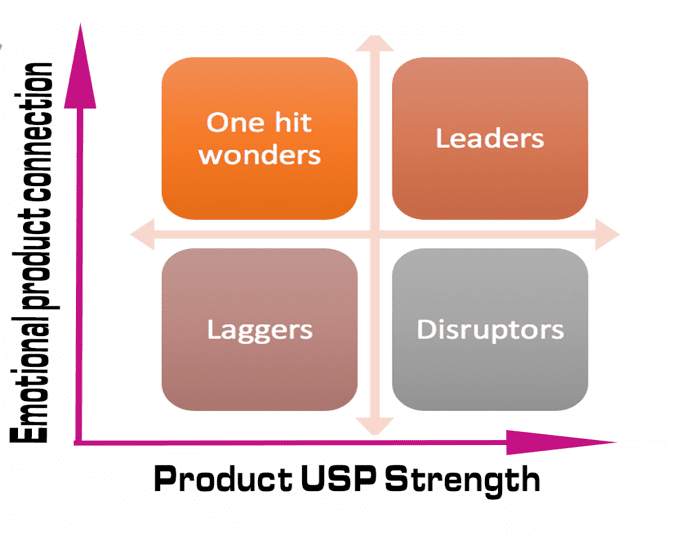
The frailer your emotional product connection, the greater the need to promote its points of differences (traditionally – USPs) and conversely, the stronger the emotional connection, the less the urgency to highlight product points of differences or USPs.

product USP strength

Having established the ‘WHO’ behind the product, keep checking that your personality remains consistent.  (Nobody trusts unstable personalities).  Brand solidity can be expressed via colours, shapes, tone of voice, styling, corporate philosophy, and so on.   When considering the brand personality for your launch, think beyond simply describing your product.  For example, GoPro camera could easily describe themselves as a compact mobile video recorders.  Instead, the brand describes itself as “an experience sharing company.”

Pricing

Thanks to the web, the biggest shop window in history fits as comfortably in a pocket it does on a large screen.  Increasingly, in many categories, before every other consideration such as online reviews, product quality and brand value has been taken fully into account - buying often boils down to price.  Depending on pricing levels, it may be worth testing whether you show a pricing matrix or not.

Whether it is via official price comparison sites, or casual ‘live’ price checking of different product suppliers, digital opens opportunities for a myriad of marketing pricing tools.  For example, product introduction email campaigns can feature voucher codes or cashback offers.

In exchange for paying a commission fee, affiliate marketing partnerships open opportunities to market products via third-party websites.  Commissions needn’t just be conditional on sales.  Arrangements can be agreed for payments triggered by click-throughs or other actions.

It is often argued that selling online is cheaper for suppliers than via traditional high-street retailing.  However, once a product has been added to site’s shopping cart, distribution can be expensive – especially when consumers expect delivery to be included in the price.  Buyers also expect that your product can be bought via all major credit cards, PayPal as well as Android or Apple payments.

Online or offline, it is still cheaper to retain an existing customer than recruit a new one. Yet, unless behaviours are ingrained (such as buying books on Amazon) online customers tend to be particularly capricious.  Consequently, any strategy regarding a product launch needs to consider issues such as future customer relationship management and lifelong value. 

Place

In the bricks and mortar world, ‘location, location, location’ is everything. Typically, for offline channels, the aim of Place is to maximise the reach of distribution to achieve widespread availability of products while minimising the costs of inventory, transport, and storage. In an online context, thanks to the ease of navigating from one site to another, the scope of Place is less clear since Place also relates to Promotion and Partnerships. Online, for a retail page, it’s about page, picture, and parcel. You need to have the right stock levels.  Customers are online – but is your product in-stock?

  • Page:  Is your website accessible?  Has it been optimised? Is the content coherent and helpful? For example, do you offer Live Chat to handle customer questions?
  • Picture: Is your product fully discoverable using tools like 306° pictures or video?
  • Parcel:  Can your product be dispatched quickly and efficiently (either direct from you or via a partner?) More broadly it links to promotion techniques like affiliate marketing or co-marketing.

Promotion

Many startups launching new products may be short on funds for paid promotion, so choosing when and how to invest is a difficult decision. Let’s quickly review the options as I see them:

  • Organic search (SEO) – offers free/low-cost traffic, but takes time to get traction unless your product launch is part of an existing site with domain authority
  • Paid search (Google AdWords) – while this will be too expensive for many startups due to competition and bid inflation, it’s worth looking at the cost of AdWords Remarketing. This is usually more cost-effective and you can use reminder ads to encourage people to return to your site ton boost conversion.
  • Organic social – this will be a core technique for many startups as they will be keen to build a community and gain advocacy
  • Paid social – a similar argument applies to AdWords. Re-targeting through social ads has relatively high ROI.
  • Public Relations – This can be a low-cost approach, but only if you have the media contacts and know how to run an outreach programme.
  • Affiliate marketing – Affiliate marketing is mainly relevant to retail or subscription products. It’s value in product launches is limited since affiliates are interested in the number of clicks out from their sites and earnings per click, so they are likely to want to keep with trusted, established brands that drive volume.

For search, I recommend creating a search demand analysis. Decide how you will target audiences needs by using Google Keyword Planner to calculate the number of visits based on search volumes for different keywords. A spreadsheet for gap or demand analysis which also helps compare actual visits post-launch against numbers of searches.

Download Premium Resource – Product launch Playbook

Launch a product using RACE planning to structure your marketing activities. A marketing playbook defines the key messages, types of communications, best practices and optimisation techniques that should be used to maximise return-on-investment for different marketing objectives.

Access the Product launch playbook

31 Oct 16:12

What's LinkedIn Sales Navigator Team?

by afrost@hubspot.com (Aja Frost)

Sales Navigator Team features

Sales Navigator Team comes with all the features from Professional, as well as:

  1. 10 additional InMail messages per month (30 total)
  2. 10 PointDrive presentations per month
  3. Team network warm introductions with TeamLink
  4. CRM integrations
  5. 25 out-of-network unlocks per month
  6. Basic seat management
  7. Usage reporting

For sales teams, LinkedIn Sales Navigator Team can be a huge asset. Each user can send 30 InMail messages a month, dramatically improving their ability to talk to prospects outside of their network.

Every seat can also save up to 5,000 leads. That should be more than enough for the typical sales rep.

If you use Salesforce, you can sync accounts that you own. There's also a CRM widget for Salesforce and Microsoft Dynamics. That's a handy feature for reps who lean heavily on LinkedIn to add color and details to their outreach emails -- within your CRm, you can browse profiles, statuses, and company information; send InMails; use TeamLink connections; and get recommended leads.

Sales Navigator also integrates with HubSpot, Infer CRM, and Zoho. 

Mobile Briefings -- available with both Sales Navigator Professional and Team -- integrates with your calendar and gives you briefings for every meeting you've got scheduled for the day. The briefing includes profiles, icebreakers, and relevant company information, so you can go into every meeting prepared and armed with some conversation starters.

HubSpot CRM

31 Oct 16:12

Jobs To Be Done: The Secret Weapon for Boosting Cold Email Response Rates

by Liston Witherill

Have you ever been misunderstood? Even in a time when you were 1,000% sure you explained yourself clearly?

Of course you have, and it can feel maddening. But still, it happens.

Unfortunately, the same thing is happening to your customers.

You think you know exactly what they’re thinking and feeling…

Have you asked them?

If not, you don’t fully understand the reasons why they’re buying. If you don’t understand why they buy, then you need help. 

That’s where Jobs to Be Done comes in.

So, What Is Jobs to Be Done?

Jobs to Be Done (JTBD) is a process that’ll help you find the exact messages you need to make your communications with leads and prospects relevant. It’s not enough to take your best guess at what matters to your customers – you have to find out what actually matters.

Unlike other ways of selling, JTBD says that people buy things – software, gym memberships – to do specific jobs for themselves.

So if someone buys Roundup for their lawn, they’re not buying “dead weeds,” they’re buying a greener lawn and more social status.  

Getting started with JTBD is really easy, and I’ll tell you exactly what to do. 

For now, just know that JTBD will help you understand:

  • The triggers that cause people to buy from you
  • How they make a decision to buy (or not buy) from you
  • Doubts they have along the way
  • And more…

Your cold emails should focus on triggers; they’re going to be the gold you need to power your cold outreach. So if your cold outreach is a little too chilly, JTBD can thaw it out for you.

How Does Jobs To Be Done Impact Cold Email Response Rates?

Today’s SDRs range between 5 – 8, as the average number of contact attempts per lead (over the last 5 years).

High-performing sales organizations are targeting 12+ touches per lead. And in my recent interview with Mark Kosoglow at Outreach, he revealed what it took to land a 7-figure account: 72 contacts, 624 phone calls, and 125 emails.

You may be experiencing a few symptoms of this spreading sickness:

  • Basement-level open rates
  • Plummeting replies
  • Dwindling monthly meetings per SDR

The answer to the problem has historically been to pile on more and more touches per lead. I call B.S.

The obvious question is the most important one: does this go on indefinitely? Of course not, because it’s getting less effective and will hit a point where it’s not economically viable. This is where JTBD comes in – increase quality, and get out of the quantity rat race.

In other words, it’s all about relevance

Once you come up with a compelling answer to that question: voila!

You’ll have higher reply rates, fame, and fortune. Okay, you’ll have higher reply rates at the least.

And the best way to find out how your product or service makes your customers more awesome is to simply ask your customers why they bought. Once you have this info, you’ll be set up to increase the strength of your cold email messages.

Real Life Example: JTBD Used to Sell More Milkshakes

In a truly wonky-but-useful study done for a fast food restaurant, marketers attempted to figure out how to sell more milkshakes. But they didn’t take the standard approach.

Here’s how that would typically work.

Smart, high-paid people sit around a conference table with catered lunch, spitballing ideas.

No one in the meeting is a frequent milkshake consumer.

They come up with ideas to improve the features of the milkshake (better flavor, thicker consistency, larger cups, chocolate chips). The HiPPO wins.

But instead of doing conference-room-quarterbacking, the team theorized that every customer hires a product to do a job. This meant they had to go out and actually talk to people.

So they spent time with customers and watched them consume their milkshakes, asking questions along the way. And they learned some really valuable things about milkshake buyers:

  • A lot of milkshakes were sold in the morning (who knew?)
  • Consumers wanted a meal to last throughout their entire commute and kept them full until lunch
  • Parents bought milkshakes to keep their kids occupied for long periods

Not one person talked about the features of the milkshake-like flavor or consistency.

And they could only gain this insight by interacting directly with customers.

Sidenote: this process yielded not only why customers buy, but also who buys. The circumstances drove the job for parents wanting to keep their kids occupied longer, and morning commuters wanting a long-lasting meal.

Check out this video for more detail about the milkshake story:

And in case you’re thinking “I don’t sell milkshakes,” check out how JTBD has been a driving force for Des Traynor and Intercom. They even wrote a book about it.  

Getting Started With Jobs to Be Done

Starting anything new can be daunting, but I assure you this is not. All you need to do is talk to 5-10 people in two different camps: customers who signed up in the last 60 days, and customers who canceled in the last 60 days.

Keep in mind the Three Unbreakable Rules of JTBD:

  • Always ask open-ended questions
  • Never ask leading questions
  • Listen a lot more than you talk.

If you follow these three absolutes, you’ll be in good shape. Let’s take a look at how you might conduct your JTBD research.

Interview Recent Customers

Start with your recent customers because they’re in the best position to remember the driving forces behind their purchases. When you conduct a JTBD interview, your goal is to understand your customer’s thought process and the internal and external drivers of their purchase.

Here are a few questions to get you started:

  • What was going on in your life when you first realized _____ was a problem? How did you know?
  • Once you realized you had a problem, what did you do next?
  • What kind of solutions did you try? Or not try? Why or why not?
  • Before you purchased, did you imagine what life would be like with the product? And what were you expecting?

Get the full list of interview questions here – no email required.

Interview Past Customers

Now that you’ve interviewed your current customers and found out why people are buying your product, it’s good to also understand why they leave. Churn is the bane of all SaaS businesses, so understanding why people are leaving can help you sell and develop your product more effectively.

Your main interest in speaking with past customers is not to bring them back as customers. Don’t mix contexts here: resist the urge to talk them back into buying your thing. Instead, focus on why they left and what they’re doing now.

Here are a few questions to get you started:

  • Why did you initially sign up for _______? Did you evaluate any other options?
  • When was the first time you thought that ______ might not work for you? Why?
  • Why did you cancel the day that you canceled? Why that day, and not the day before or after?
  • What are you using now? Why?
  • Even though you switched away from _________, would you recommend it to anyone? To whom, and why?

Do This Next

  • Follow the Three Unbreakable Rules of JTBD
  • Interview your current customers to determine why people buy to improve your messaging, sales, and marketing
  • Interview your past customers to determine why people leave to take corrective action on your messaging or product

Record, Document & Analyze All Your JTBD Interviews

Let’s do some back-of-the-napkin math for a second. You’re talking to 10 current and 10 past customers for about 30 minutes each. That’s about 10 hours of conversation, and humans speak about 125 words per minute. If you’re only speaking about 20% of the time, then you’ll be gathering about 60,000 words during your JTBD research!

Now, you’ll hear a lot of the same themes repeating, so it’s not as if you’re writing a book, Hemmingway. But there is a decent amount of information to manage here, so you’ll need a plan.

Whenever I do JTBD research for a sales team, I record the interviews using Skype and Ecam Recorder, I take notes during the call, and then I review the interview and my notes afterward. I repeat this process for every interview.

As you go along, you’ll categorize your notes into the biggest themes you’re hearing. These themes should include verbatim quotes you’ve gathered from your customers (or past customers).

Here’s a creative way of using a negative review that could’ve just as easily surfaced from a JTBD interview:

Source

Having an approach and tech stack for your documentation ensures that you won’t miss gems like the one above.

Bonus: feel free to read your customer reviews, survey data, or reviews on competitor’s sites too. There are probably some good insights lurking around there.

Do This Next

  • Have a strategy for documenting your interviews. I recommend recordings and copious notes.
  • Get a tech stack in place that’ll enable you to execute. I recommend Skype and Ecam Recorder, Google Drive, and Google Docs.
  • Review your notes a few times and themes will emerge. Your brain is a pattern recognition machine, dearest Human.

Get the summary tables to help organize your research here – no email required.

Rewrite Your Cold Email Templates Based On What You Learned During Your JTBD Research

You’re a superstar! Look at all the good, productive stuff you’ve done.

You made a list of current and past customers. You contacted them. You set up meetings and interviewed them. You recorded your interviews and took good notes. Then you organized everything you learned into themes that you can use to improve your messaging and boost those email reply rates.

Now there’s nothing left to do but start rewriting!

On a cautionary note, you’ll probably notice that your previous emails were not focused on your prospects and most of them will go in the circular file. Great! You’re on track.

Rather than throwing away all of your previous work, take a cut at incorporating the top two or three themes you found in your JTBD research. Test it against your previous email campaigns, and you’ll almost certainly notice a lift.

Key Takeaways

Do This Next

  • Line up 5 current and 5 past customers for interviews.
  • Follow the 3 Unbreakable Rules of JTBD.
  • Use the provided questions to double what you know about your customers in a day.
  • Document and organize your notes to find the gems that you can use in your outreach.
  • Update your email and cold calling outreach to reflect what you learned (and make it 10x more relevant to your prospects).

Don’t Ever Do This

  • Interviews aren’t about you. Be an active listener and ask follow-up questions – there’s no need for you to prove anything on the calls.
  • Don’t get stuck aiming for “statistically significant” data. That’s not what you’re doing here. You only need enough calls to hear recurring themes, which is usually 5-8 calls.
  • Favor speed over perfection in launching your new cold emails, so don’t spend weeks trying to make them “perfect.”

The post Jobs To Be Done: The Secret Weapon for Boosting Cold Email Response Rates appeared first on Sales Hacker.

31 Oct 16:12

A Quick Guide to LinkedIn Sales Navigator Professional Features

by afrost@hubspot.com (Aja Frost)

LinkedIn Sales Navigator Professional features

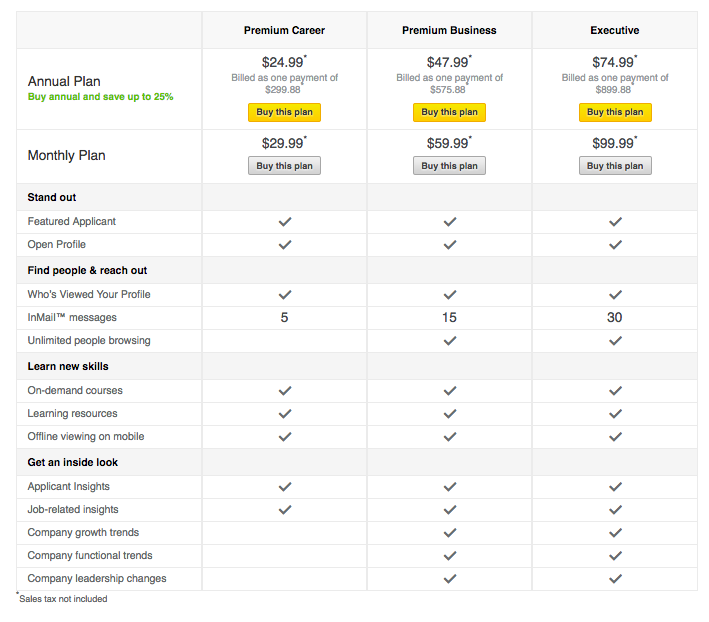
  1. Send 20 InMail messages a month
  2. See who’s viewed your profile over the last 90 days
  3. Get sales insights
  4. Run advanced searches
  5. Browse unlimited profiles
  6. Get lead recommendations
  7. Save leads

Here's why each feature is valuable:

  1. InMail messages: Reach out to prospects who aren’t first-degree or second-degree connections.
  2. Users who have viewed your profile in the past three months: It’s a good indicator of interest when a buyer has checked out your page.
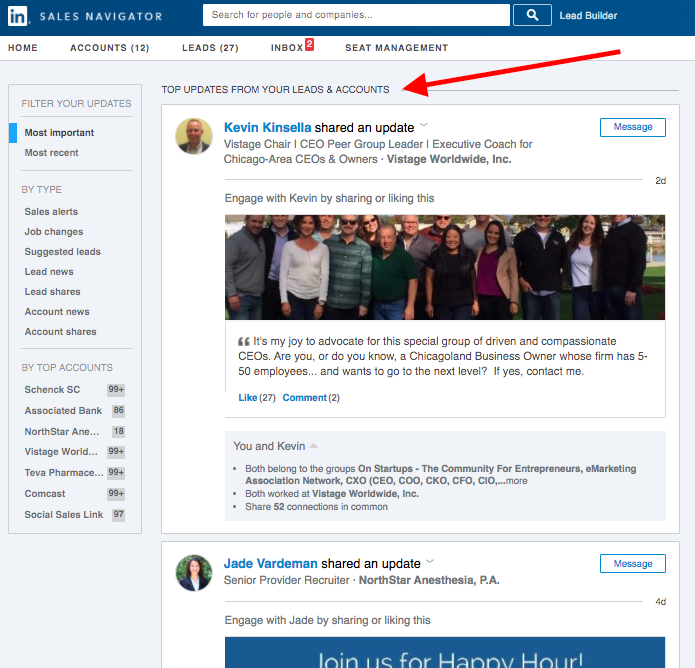
  3. Sales insights: In your dashboard, you’ll see when accounts and leads have changed jobs, received funding, released a press release, and more.
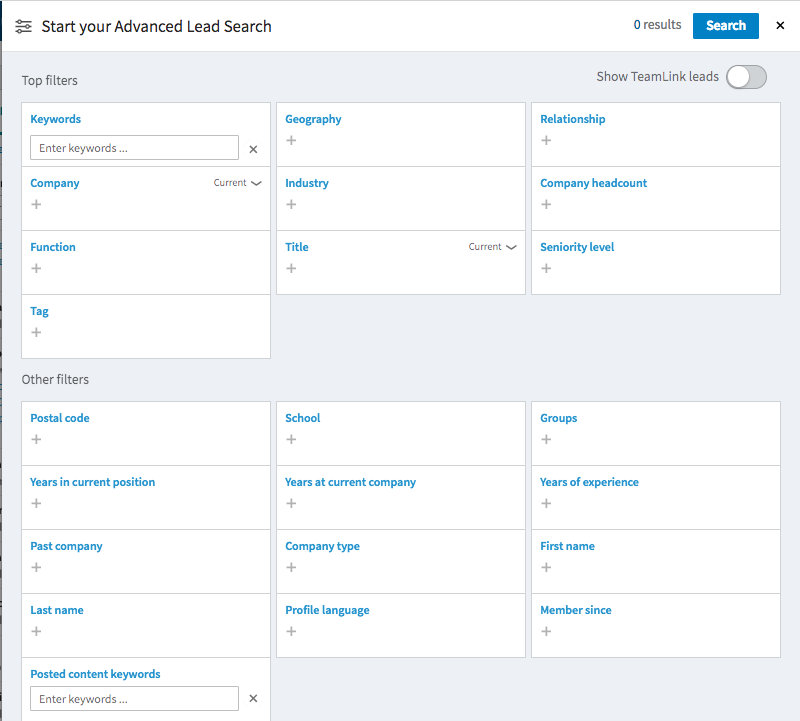
  4. Advanced search: Thanks to LinkedIn’s many search filters, you can zero in on the most qualified accounts -- and from there, find the best people to talk to.
  5. Unlimited profile views: You can look at as many third-degree and search results profiles as you’d like with no limits.
  6. Lead recommendations: LinkedIn will suggest potential buyers based on your criteria.
  7. Ability to save leads: Keep track of leads and your communication with them so opportunities never fall out of your funnel.

Who should buy Sales Navigator?

If you’re constantly bumping up against the limits of LinkedIn Basic, it’s a no-brainer to upgrade. Many salespeople exceed LinkedIn’s commercial use limit -- I’d recommend getting Sales Navigator when this happens two months in a row.

Or maybe you’re using Basic and have to log in every day to see who’s viewed your profile. It would be more efficient to log in once per week, see if anyone interesting has checked you out, and message them.

Perhaps you wish you could filter your news feed by current prospects versus existing contacts. The Sales Navigator dashboard would be a huge efficiency boost.

Sales Navigator can be an incredible tool if you're in the right position to use it. Next, check out advanced Sales Navigator secrets.

Free Sales Training from HubSpot Academy

31 Oct 16:11

3 Reasons to Check Your Junk Mail Folder

by Jeremy Durant

From time to time on our blog, we share business development and sales tips that help with nurturing or converting B2B marketing leads. In this post, the message is simple: you should check your email junk folder at least once a day. Why? Because there could be exciting opportunities or responses lurking in there.

Let’s take a look at 3 reasons why you should check your junk mail folder at least once a day.

Website Lead Gen Forms Can End Up There

This first is one of the most important reasons to check your junk mail folder once, if not twice, a day. Ideally, a B2B marketing strategy includes lead generation forms on a company website. The form submissions are typically set up to distribute to at least 2 people within a company. Many times, the set up is a smooth process and the leads end up highly visible in the desired recipient’s email inbox, giving the recipient warning and allowing them to follow up with the lead.

However, for reasons known and unknown, they may end up in the spam or junk folder. If a form submission contains any number of “trigger” terms that an email client like Microsoft Outlook or Gmail labels as “spammy,” the form submission will bypass the inbox and go directly to spam. When it’s spam, it’s great. When it’s a genuine lead looking for pricing or wanting a demo, it’s bad. Additionally, if an email address is set up to be both the sender and receiver of a form submission (as can happen with website administrators), email clients will label these emails as spam. These are the known reasons and may or may not be fixable.

The unknown reasons why a company’s website form submission goes to spam? They are…unknown. For both reasons known and unknown, your company’s website form submission may be ending up in your junk or spam folder. It’s essential that you check your junk or spam folder at least once a day to see if any genuine B2B marketing leads landed there.

Email Nurturing Campaign Responses Might Be Hiding

There are several other great reasons to check your junk or spam email folder each day. The second reason is that responses to email newsletters or email nurturing campaigns might be hiding in there. For example, if using MailChimp for marketing newsletters or nurturing campaigns, it’s a best practice for B2B companies to have those emails come from a real email address. That way, if a user on the email list replies or responds, a live person gets the email in real time. However, if the user’s email client strips out the images or videos in the response, it may be categorized as spam and sent to junk by the recipient’s email client.

For this very reason, it’s important to check your junk folder several times after sending an email newsletter or launching an email nurturing campaign. If an individual requests to be taken off the list by responding to an email, it’s essential that is handled. You don’t want to get a bad reputation or alienate a client or prospect by continuing to email them when they have expressly asked to be removed. Conversely, if the end user enjoyed the content of the newsletter or is responding to get more information about the nurturing campaign, you must be as responsive as possible and get back to them quickly. Otherwise, it will look like automation runs your company and you aren’t real people (which will, in turn, tank your company’s credibility and trustworthiness).

Great Vendor Opportunities Trigger Spam Warnings

Last, but not least, is the potential for vendor opportunities. As email security gets tighter and tighter, more and more first-time emails will go to junk or spam folders. A great partnership or tool might be available that will enable your firm to grow, but the initial outreach email may end up in your junk folder. Since your email client doesn’t recognize the email address as a trusted email address and the email likely contains a link or two, it’s automatically considered junk. Additionally, if the vendor is using any type of email automation software, it might appear spammy since it wasn’t sent from the same server that the email address sends from.

While we all understand that not every vendor is the right match or can offer the value that you need to grow your business, there are great vendor opportunities out there that can support your B2B marketing efforts and help you do your job better. You don’t want to miss them when they come along, particularly if they reach out right when you are in the process of locating a vendor that offers the product or services you need the most.

Just Do It: Check Your Junk Mail Folder

Honestly, we understand that your day is hyper-busy and you have a tough enough time managing your inbox, let alone all the other email folders. However, a quick peek every day at your junk mail folder might just be key to closing a new lead, keeping an existing client happy, or find the right vendor at the right time.

31 Oct 16:10

Here’s how to write a professional LinkedIn headline to 10x your presence [+ examples]

by afrost@hubspot.com (Aja Frost)

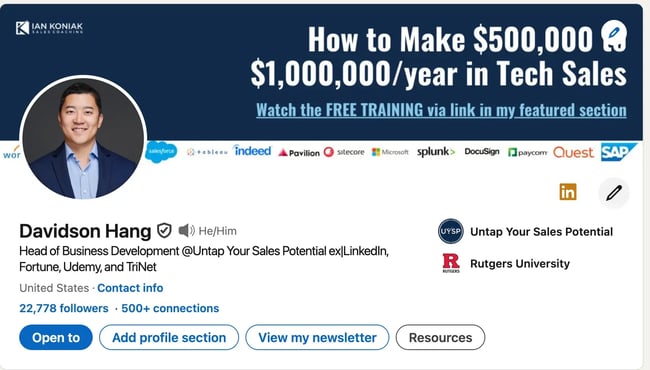
I have been actively growing my LinkedIn presence for the past ten years and now have over 23,000 followers. It took time, consistency, and real commitment.

I used to go to countless networking events and conferences — I’ve always loved meeting new people. It was wild to me, as a young Rutgers University graduate, that there was a platform where you could reach out directly to professionals and potentially find mentorship.

Since then, I’ve leveraged LinkedIn to the fullest, aiming to be a super-connector and add value to my community. I truly believe karma is real: If you put good out into the world, it will come back to you tenfold.

Download Now: The Complete LinkedIn Playbook [Free Guide]

The power of leveraging LinkedIn cannot be underestimated.

From job opportunities to guesting on podcasts, meeting people from all over the world, and having headhunters reach out with roles that take you to Chicago, Vegas, Berlin — it opens the door to a lifetime of adventures.

Valenta, Fortune, LinkedIn, CoachHub, and Experian were all jobs I landed through recruiter messages on LinkedIn.

Ready to learn how I did it? Let's dive in.

Table of Contents

Your headline is important for several reasons:

  • It’s the first line LinkedIn users see on your profile.
  • It gives an opportunity to show the world what you’re capable of and what you do.
  • It influences someone’s first impression of you as they scroll through LinkedIn.

Letting LinkedIn choose your headline for you is a mistake. With a customized headline, you'll instantly distinguish yourself, give prospects and recruiters a reason to view your profile, and start building the case for your product.

Remember: A LinkedIn headline explains the value you’ll deliver as a future employee. You'd say that pay-off is worth the effort, right?

What should my LinkedIn headline say?

Having worked at LinkedIn and personally seen how powerful it can be for your career, I find it pretty incredible when you really sit with it and think about it. A simple website can make the difference between earning minimum wage — as I once did — and then, five years later, making the kind of money I never thought possible for someone who grew up poor, living on government assistance.

Here’s what I learned: At the end of the day, it's all about who people know, like, and trust. And your LinkedIn presence and profile can impact that.

A LinkedIn headline should:

  • Describe what you do.
  • Show why someone should connect with you.
  • Imply how you can help them.

For example, when I started coaching SDRs and AEs, I changed my headline to “Sales Coach | Helping SDRs get promoted to Account Executive.” That shift alone sparked dozens of inbound leads.

The more specific you are, the more you will attract your ideal avatar. People think they might be turning away business with specificity, but the reality is that you want it to be clear so people know the audience you serve.

That being said:

A good headline captures someone’s attention, but what’s more important is your reputation. And that takes a lot of energy, effort, and cultivation.

The truth is that building a personal brand takes a lot of time and good will after decades of adding value to your community.

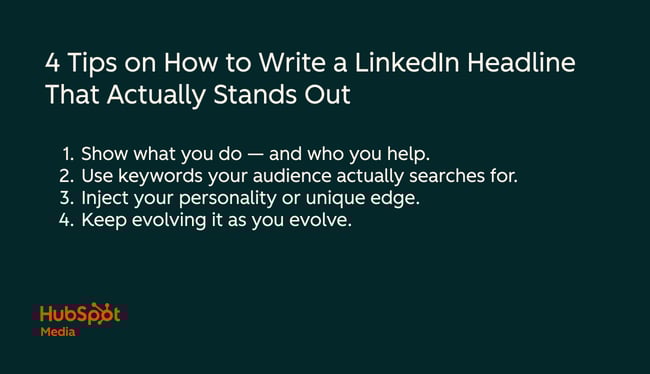
4 Tips on How to Write a LinkedIn Headline That Actually Stands Out

If you think about how much time professionals spend on LinkedIn, especially as a sales rep, it’s pretty mind-boggling. I spend more time on LinkedIn than I do sending emails or using any other apps. That is just the reality of the job.

After ten years of growing my own LinkedIn presence — and working at LinkedIn itself — I’ve learned that your headline is more than just a job title. It’s your first impression and your mini elevator pitch, all in one line.

Here’s what I’ve found works best.

4 tips on how to write a linkedin headline


1. Show what you do — and who you help.

Your headline should be clear, not clever. Don’t just write “Account Executive at Databricks” — add who you help and how. For example: “Trusted Advisor to CDO & CIOs to leverage their data to create business breakthroughs.”

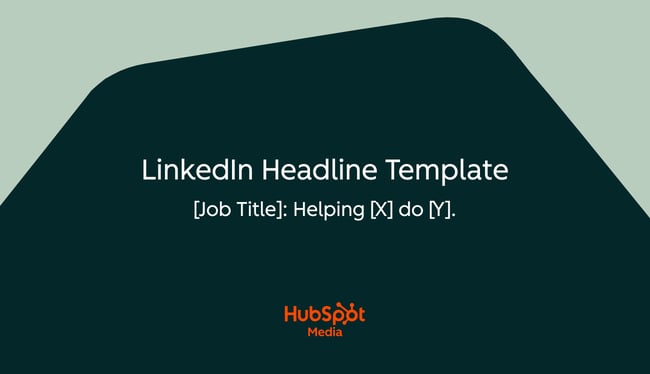
Use the format in the template below, where X represents your ideal prospect, and Y is their ideal outcome or state of mind after connecting with you.

linkedin headline format template


2. Use keywords your audience actually searches for.

Think like your ideal client, recruiter, or partner. What words would they type in? Sprinkle those keywords in naturally. This helps you show up in searches and makes the value you bring obvious.

There is always language that shows you are part of a tribe. For instance, you can’t go anywhere nowadays in tech sales without hearing pclub, SMB/MM/Ent, SaaS, AI, ML, Analytics, ARR, GTM. These help others show that you get it and you’re in that special tribe together.

3. Inject your personality or unique edge.

I also recommend you include interesting things in your headline that help connect with others — things like MBTI, CliftonStrengths Top 5, or anything that just humanizes you and gives others a reason to connect with you as an ice breaker.

4. Keep evolving it as you evolve.

Your headline isn’t set in stone. Update it as you grow, shift roles, or refine your niche. The version you wrote three years ago probably doesn’t reflect who you are today — and that’s okay. Changing it often will keep things interesting, as people will come and go from your life. It might give them a reason to catch up with you.

LinkedIn Keywords List

Using the right keywords in your LinkedIn profile is the key to getting more visitors who want to hire you or work with you. Similar to a resume, you want to draw eyes to the important aspects of your experience. While a resume uses keywords tailored to a specific job posting, a LinkedIn profile uses keywords tailored to your career expertise.

Recruiters, prospects, and the like will search for keywords related to the position they want to fill. Depending on what a searcher is looking for, one profile can appear on page one while another can appear on page eight. As someone who wants to be found, the keywords you use will directly impact whether you get in front of the right prospects. Here are some specific keyword areas to focus on:

  • Job position and experience.
  • Location.
  • Skills and certificates.
  • Services or products you offer.
  • Name of your degree and field of study.
  • General keywords related to your industry, field, or expertise.

It’s important to strike a balance between being concise but also broad enough to be found. For instance, instead of writing “Tech Leader” you might say, “Mobile Application Developer.” It’s specific enough to a job title yet broad enough for multiple recruiters in varying companies to find your profile.

LinkedIn Keywords for a Headline

Your headline for LinkedIn is no different than your profile in terms of using the right keywords to be discovered. However, the headline is arguably the most important part of your profile — it stops prospects from scrolling past your name to clicking on it.

A LinkedIn headline needs to use specific keywords to explain in a few words what you do and what you provide. This is why I think a customized headline is always better than the default LinkedIn headline.

Here are a few formulas you can use to write a great LinkedIn headline :

  • (Title) at (Company) – Helping USP (Unique Selling Proposition)
  • (Title) | (Company) | (USP)
  • Title + Company + benefits of working with you | keywords related to your niche | personal touch |

Using one of the formulas above will elevate your LinkedIn headline and show prospects how you can add value to them. Now that you know how to choose keywords for your LinkedIn headline, let’s discuss how to change your LinkedIn headline to get your interview and job ready.

How to Change Your LinkedIn Headline

Updating your LinkedIn headline is incredibly simple. To better show how it’s done, I’ll update my own.

Step 1: Navigate to your profile.

If you’re new to LinkedIn, your profile is a blank canvas to be filled with everything that makes you great. Ensure your profile picture, experience, educational background, and skills are filled in before you optimize your headline.

Step 2: Click the edit icon.

At the top of your profile, beneath your banner, you’ll find a gray pencil symbol — the edit icon. Click on it, and it’ll open a window titled “Edit intro.”

my linkedin profile page and headline

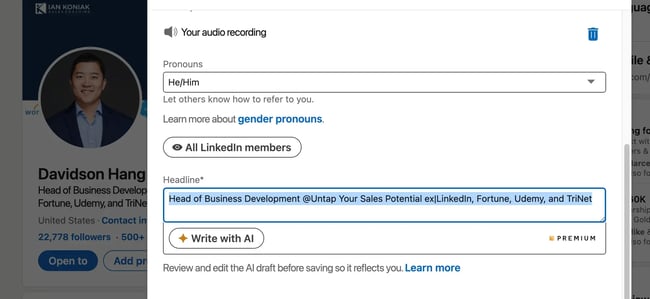
Step 3: Select Heading and type in a new headline.

In the “Edit intro” window, after you have your name and pronouns added, you’ll find the “Headline” text box. Here, you’ll type in the attention-grabbing headline that accurately describes your title and goals.

editing my linkedin headline

Step 4: Click “Save,” and you’re done.

You’ll now be able to refresh your profile and see your new LinkedIn headline. When recruiters look at profiles in your industry and occupation, they’ll see a headline that catches their eye immediately.

Before you begin to work on your own headline, look at these examples for some extra inspiration.

20 LinkedIn Headline Examples

1. Highlight your job title and professional value.

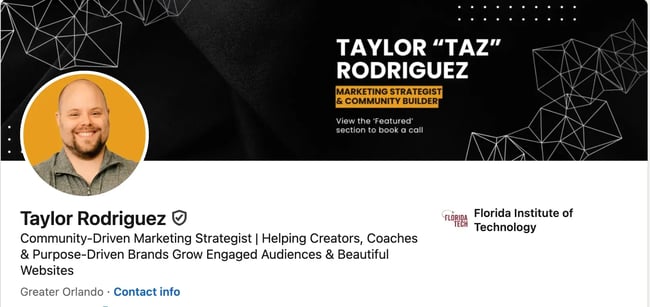
linkedin headline example: taylor rodriguez

I like how Taylor Rodriguez begins his headline by stating his position, “Marketing Strategist,” but indicates what his values are by including the descriptor “Community-Driven.” But he doesn't stop there. He goes on to explain exactly what he does as a marketing strategist.

He says he helps creators, coaches, and purpose-driven brands grow engaged audiences and beautiful websites. His mission and his value to viewers are clearly communicated.

Simply by reading his headline, I immediately understand the type of clients Rodriguez works with and the results he delivers. There’s no questioning his expertise or value in my mind.

Takeaway: Lead with your job title or role. Follow that up by naming your target market or client type. Then, drive it home by calling out the specific benefits and outcomes you help your clients achieve.

2. Highlight your niche and client experience.

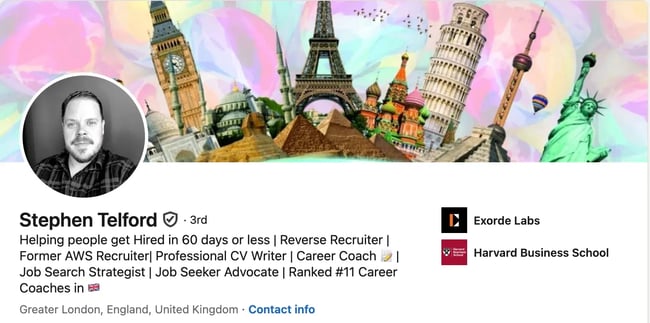
linkedin headline example: stephen telford

Stephen Telford begins his headline with his value prop and an impressive stat. But where I think his headline really stands out is listing the specific services he offers to help people land jobs.

By naming particular services, Telford carves out his niche as a job coach and shows the concrete ways he helps his clients. It builds trust and clarifies how he can help potential clients.

Takeaway: Detail your services and who they’re tailored for to attract more qualified leads.

3. Make your headline digestible with separators.

linkedin headline example: rana bano

Rana Bano’s headline is easy to digest. She’s packed a lot of information in there, but the vertical line separators make it simple for me to parse out the key elements.

Moreover, the words she has chosen are the keywords she wants to be found for. So her headline serves the dual purpose of easy readability plus findability for her keywords.

I also like how she includes her value proposition in her last point: “I make words work harder for your brand.”

Takeaway: When using separators, start with your current role and include keywords. Then you can add in notable past experiences, causes you advocate for, your value prop, or personal passions that relate to your work.

4. Be specific about who you help and how.

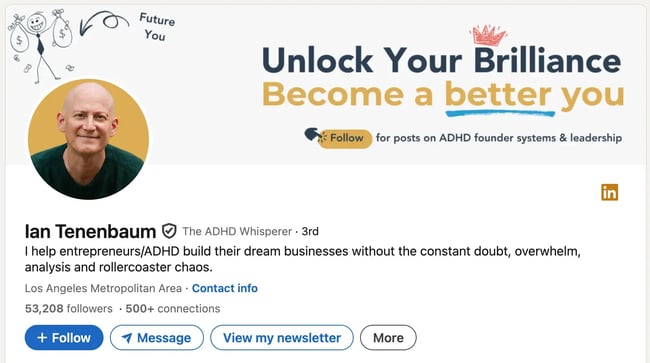
linkedin headline example: ian tenenbaum

In his headline, Ian Tenenbaum speaks directly to entrepreneurs who struggle with ADHD who want to get organized, make a plan, and follow through.

I appreciate that Ian doesn’t try to be everything to everyone. By narrowing his focus to a specific group and a particular pain point, his headline packs a punch.

Takeaway: In just a few words, summarize who you help and the tangible results you deliver. Use specificity to inspire trust in your abilities.

5. Showcase your credibility with past experiences.

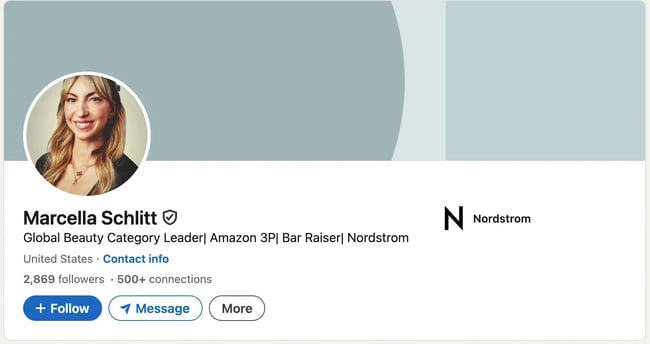
linkedin headline example from marcella schlitt

What catches my eye on Marcella Schlitt’s profile is the companies she has worked for. By mentioning her past experiences, Schlitt is letting me know that she’s honed her skills at some top businesses.

I’ve seen a lot of sales reps put things like “ex-Google,” “ex-Microsoft,” or “ex-Amazon” on their profiles, positions they eventually leave to work at a lesser-known brand. It might feel like a flex, but the reality is when you work at a top-tier company, you are more likely to be taken seriously. It’s the same as if you wear YSL, Christian Dior, people will automatically judge you, whether you like it or not. That’s just the reality of the world we live in.

The companies you work for give you street cred, so to speak. So don’t be afraid to share them up front like Schlitt does here. The brand names speak for themselves; no additions needed to her headline.

Takeaway: Weave in your past roles with top companies and use your background to showcase your credibility.

6. Convey your passion and purpose.

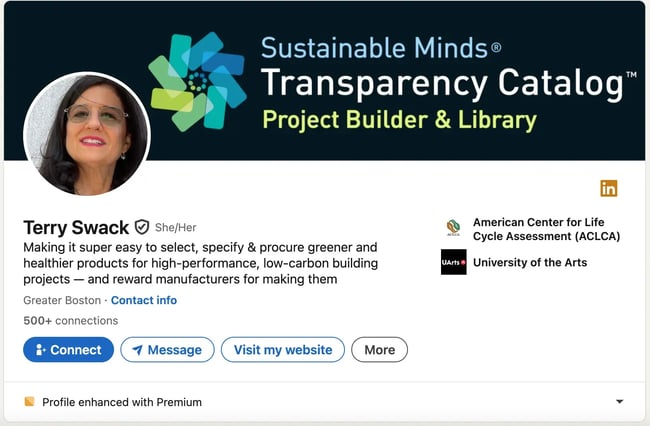
linkedin headline example: terry swack

Terry Swack doesn’t just say she works on building projects. She specifies that she’s all about making it “super easy” to choose “greener and healthier products” for “high-performance, low-carbon” buildings. I can feel her commitment to sustainability and her drive to make a positive impact.

But what I love most is how she takes it a step further. Terry’s not just focused on the end result but also on rewarding the manufacturers who make these eco-friendly products possible. She recognizes that creating change takes a village, and she’s dedicated to supporting those who share her vision.

Takeaway: Like Terry, paint a vivid picture of your values and the change you’re working towards.

7. Clearly state your value proposition.

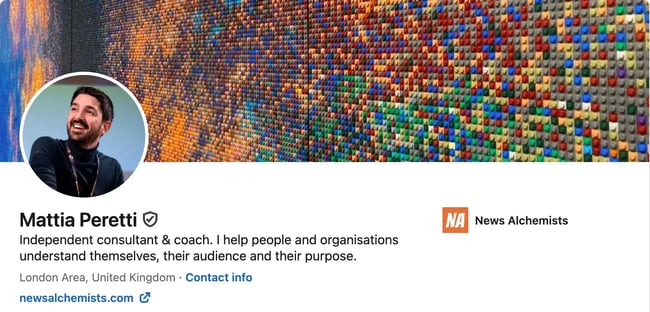
linkedin headline example: mattia peretti

I like how Mattia Peretti’s headline tells prospects exactly how he can help them: understanding themselves, their audience, and their purpose. He puts his value prop front and center.

Instead of focusing on his achievements, past experience, or the details of his offerings, he puts the spotlight on his clients and the benefits he can provide for prospects.

Takeaway: Identify your niche, and then articulate the tangible value you offer in a way that’s clear, concise, and compelling.

8. Share a glimpse of your personal life.

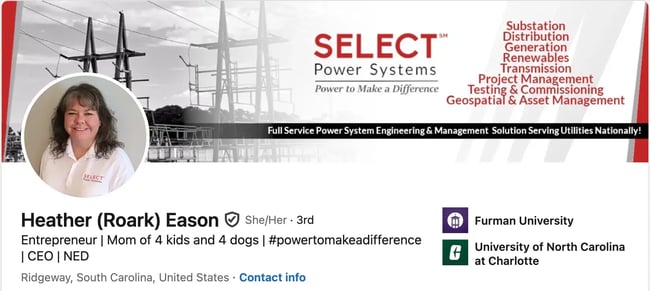
linkedin headline example: heather eason

I love how Heather Eason has created a well-rounded headline. She combines her professional roles with a touch of the personal, adding “Mom of 4 kids and 4 dogs.” These few words humanize her and also instantly create a relationship with other parents (and fur parents) on LinkedIn.

She surrounds her parental identity with her impressive professional experience, making each accomplishment stand out even more. This mix of professional and personal details makes her profile memorable and relatable.

Takeaway: Add a personal element to your headline to build a stronger connection with your network.

9. Keep it simple and straightforward.

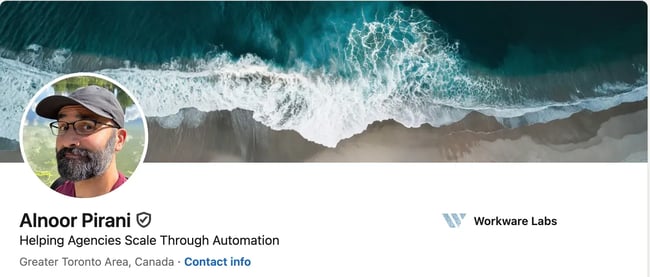
linkedin headline example alnoor pirani

Alnoor Pirani’s headline has a no-nonsense approach. In just a handful of words, Alnoor conveys his role and his company. I don’t need a lengthy description to understand what he does. “Scale through automation” tells me he’s in charge of working with agencies to automate their workflows.

Takeaway: Sometimes, less is more. Keep your headline concise and focused.

10. Include a CTA.

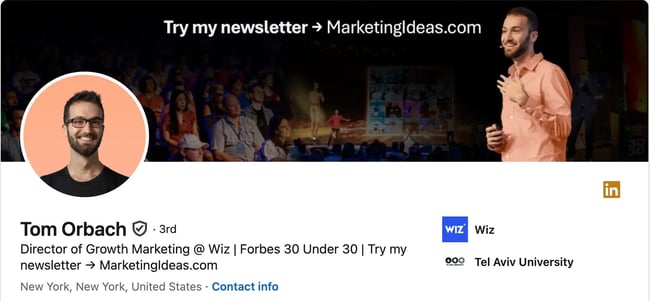
linkedin headline example tom orbach

In his LinkedIn headline, Tom Orbach ends with a call-to-action, inviting viewers to try his newsletter along with his web address.

By placing his newsletter front and center, Orbach must be very confident that it will provide value to his prospects. He’s offering something to them before asking anything from them.

Takeaway: Use your LinkedIn real estate to point customers to your owned content (i.e., your website).

11. Make your words visual.

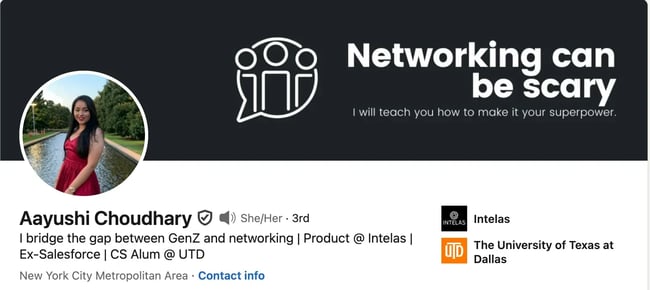
linkedin headline example aayushi choudhary

In just a few words, Aayushi Choudhary paints a picture of herself as a connector. The imagery of bridging a gap is compelling because it suggests a challenge that needs to be overcome. It positions Choudhary as someone who not only recognizes this challenge but is actively working to solve it.

But Aayushi doesn’t stop there. She goes on to list her current role, “Product @ Intelas,” and impressive past experiences, “Ex-Salesforce” and “CS Alum @ UTD.” By using the “@” symbol, she creates visual breaks that make her headline easy to scan and parse.

Takeaway: Combine a strong, evocative image with concrete details about your professional background.

12. Use emojis as meaningful separators.

linkedin headline example ellie middleton

Ellie Middleton uses emojis tastefully in her headline. She uses a relevant emoji before each phrase which I think grabs attention and enhances her headline while keeping it professional.

I appreciate that Middleton doesn’t rely solely on emojis to tell her story. Each section of her headline adds to a meaningful introduction that paints a picture of who she is.

Takeaway: Use emojis as separators and enhancers, but let the words do the heavy lifting.

13. Be friendly.

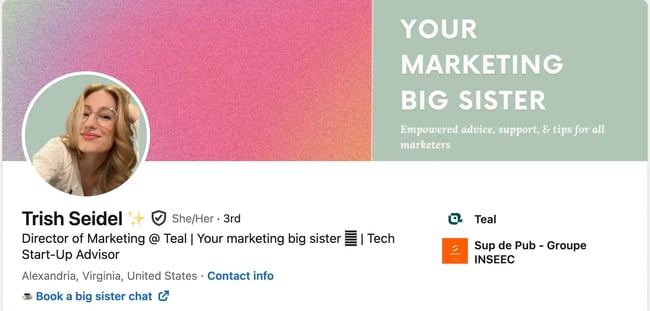
linkedin headline example trish seidel

Trish Seidel’s headline really sets a friendly tone. The fact that she calls herself “Your marketing big sister” makes her seem friendly and helpful. This kind of headline invites people to connect and learn from her in a casual, supportive way.

I think the tone in her LinkedIn profile fits her brand voice, which is warm and friendly. If you go this route, make sure your voice fits you.

Takeaway: Add a personal touch like this to make yourself more accessible and welcoming.

14. Quantify your results.

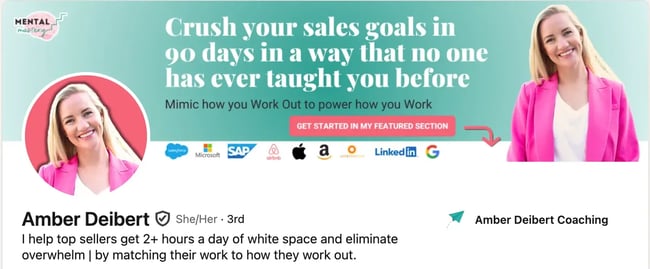
linkedin headline example amber deibert

When I see Amber Deibert’s headline, I immediately understand the unique value she brings to overwhelmed sellers. It’s a straightforward and quantifiable statement of how she can help her target audience.

What I appreciate most is the clarity and confidence of this headline. It doesn’t try to be everything to everyone but instead hones in on a specific value proposition for a defined audience.

Takeaway: Numbers build trust. Incorporate quantifiable achievements to build trust and credibility with potential clients.

15. Emphasize a unique leadership identity.

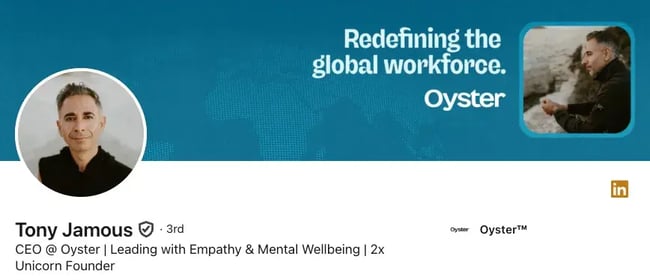
linkedin headline example tony jamous

Tony Jamous identifies himself as a CEO who’s “Leading with Empathy & Mental Wellbeing,” which immediately sets him apart in business leadership.

His title highlights not only his successes but his leadership approach. This focus is especially appealing to stakeholders who prioritize ethical practices — and for anyone looking at Oyster as a company. Jamous’ work aligns with broader global impacts, so this positions him as a forward-thinking leader.

Takeaway: Create your headline to reflect the unique values and missions that define your leadership style.

16. Focus on the customer experience.

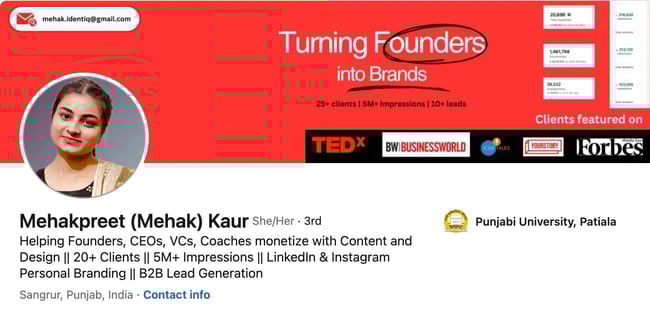
linkedin headline example mehakpreet kaur

Mehakpreet Kaur highlights her services’ tangible benefits to a specific audience. Her target clients are founders, CEOs, VCs, and coaches — and she will help them monetize through her content and design skills.

I like how she defines her roles clearly and demonstrates broad yet specific skills, like lead generation and personal branding. Kaur’s headline makes it clear what she does and how it helps her clients.

Takeaway: Articulate the direct benefits your skills provide to your audience.

17. Use humor.

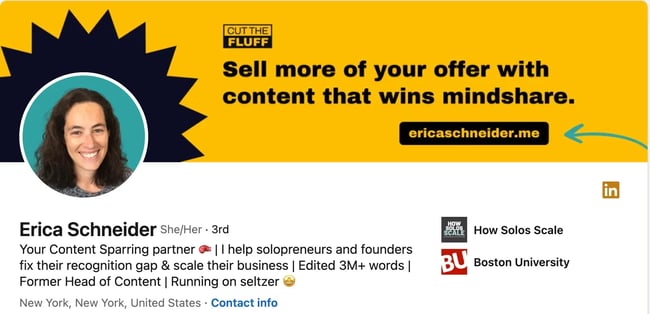
linkedin headline example erica schneider

Erica Schneider’s headline is a great example of using humor to engage and connect with her audience.

“Running on seltzer 🤩” adds a personal and playful touch that makes her profile stand out. It humanizes her and makes her more relatable to potential clients.

Erica’s use of humor in her headline, alongside credentials like “Edited 3M+ words” and “Former Head of Content,” balances professionalism with personality.

Takeaway: Incorporate a bit of your personality or humor in your headline to engage your audience.

18. Mention your personal achievements.

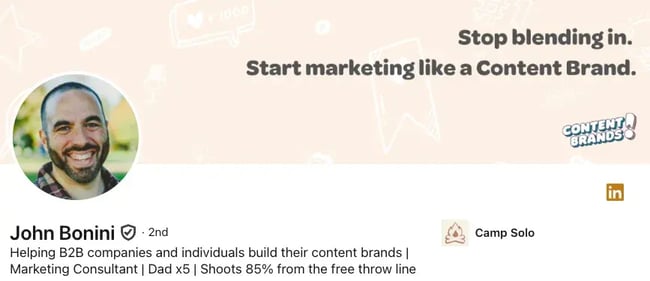
linkedin headline example john bonini

John Bonini's LinkedIn headline does a great job of mixing professional details with a fun personal fact: “Shoots 85% from the free throw line.”

This bit of basketball trivia isn‘t just cool — it shows he’s got focus and precision, qualities you'd want in a consultant. Also, it makes him stand out and gives people an easy way to talk to him.

Takeaway: Throw in a personal achievement or hobby. It makes your profile more human and can be a great icebreaker.

19. Don’t be afraid to be silly.

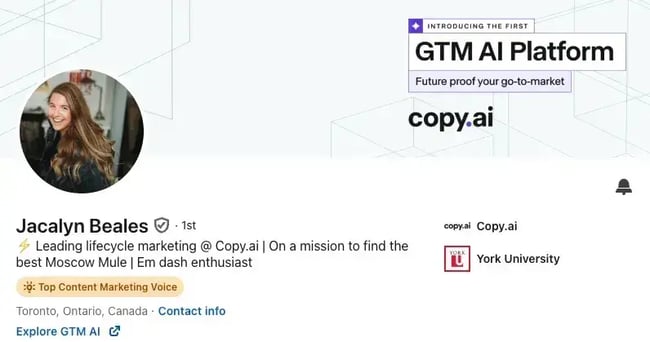
linkedin headline example jacalyn beales

Jacalyn Beales’s LinkedIn headline is a fun mix of her professional role and personal interests. She leads with “⚡️Leading lifecycle marketing @ Copy.ai,” which shows her expertise.

I love how she adds a twist with “On a mission to find the best Moscow Mule,” sharing her passion for a good drink. I also smiled at “Em dash enthusiast,” which shows Beales’s love for punctuation quirks. It‘s a headline that’s professional yet personal, making her profile stand out.

Takeaway: Think about any quirky goals you can add to make your profile more memorable.

20. Integrate brand messaging for impact.

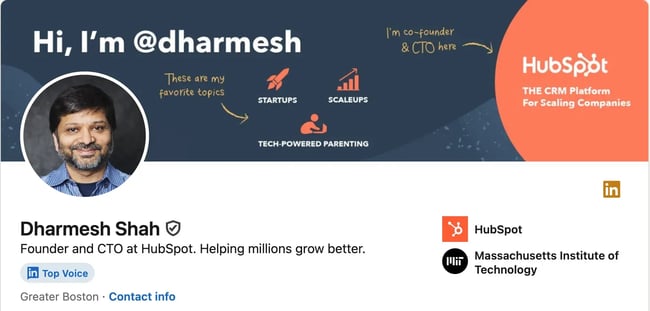
linkedin headline example dharmesh shah

Dharmesh Shah’s headline, “Helping millions grow better,” incorporates HubSpot’s own branding into his personal profile. He aligns herself with HubSpot’s values and emphasizes the direct benefits he has brought through co-founding HubSpot.

By using the phrase “Grow Better,” which is part of HubSpot’s customer code, he communicates a promise of value and commitment to potential clients and partners.

Takeaway: Consider how you can weave your organization’s brand messages into your headline to reinforce your role and value.

A powerful LinkedIn headline is a game-changer.

At the end of the day, your LinkedIn headline is one of the most powerful lines you’ll ever write about yourself — and I say that as someone who’s spent over a decade growing my presence there.

Whether you’re looking for a new job, new clients, or just building meaningful connections, your LinkedIn headline is the first signal to the world about who you are, who you help, and why they should care.

Experiment and try different things. It might feel like a small tweak, but those small tweaks lead to opportunities you could have never imagined ten years ago. I’ve landed life-changing career opportunities, received podcast guest invites, and cultivated friendships and mentorships just because people knew exactly what I stood for and who I served.

So take the time to make your headline clear, keyword-rich, specific, and true to you.

And remember — LinkedIn is a living, breathing network. Keep showing up, keep adding value, and keep evolving.

The right people will find you. I promise.

31 Oct 16:10

Scary B2B Marketing Mistakes & How to Avoid Them

by Kara Jensen

Mistakes happen. We live in a busy, noisy world where things are bound to slip through the cracks and mistakes are made. We are only human, right?

However, rather than simply accepting that mistakes happen, we are going to share the scariest B2B marketing mistakes along with tips on how to avoid them. In many cases, a little planning and a disciplined approach eliminate the majority of the following mistakes.

Trying to Be Everything to Everyone

This is a common mistake that we see B2B marketing professionals making. In their marketing efforts, they try to be everything to everyone. Let’s be real. While your firm may have a fantastic product or a comprehensive service, you can’t service everyone. In fact, you likely have a sweet spot in terms of the most profitable services or the ideal client.

The best way to avoid the mistake of trying to be everything to everyone is to know your target market. For example, at Bop Design, we design and build custom B2B websites, but we focus on service-based B2B firms. We do not take on e-commerce B2B clients. Why? Because we do not excel in that area. An essential component of successful B2B marketing is knowing what you can’t or shouldn’t do.

Start by building a buyer persona that is specific and detailed. Who is your ideal customer, what is their title, what are their needs, what is their experience, what challenges do they face on a daily basis, and what questions do they have for your firm? Once you build this buyer persona, you can create clear messaging that speaks directly to that target market.

Don’t worry about alienating other folks, because they aren’t the right fit for your company anyway.

Living in the Past

What worked five years ago may still work, but it may not be the most effective method for meeting your firm’s marketing objectives. We’ve heard a slew of clients say they like to rely on the tried and true methods. Sure, there isn’t any risk, but there also isn’t any chance for a larger reward.

The best B2B marketing strategy takes into account new technologies, channels, and approaches. We aren’t saying to jump on the bandwagon for every new shiny approach. Rather, simply being open to learning new technologies or exploring upcoming channels enable marketers to keep their brand relevant and reach clients where they want to be reached.

Don’t get caught ignoring new channels and strategies.

Overworking Your Audience List

We refer to this as fatigue. The reason this is a scary mistake is that the intentions are good, but driven from a selfish place. A brand or company may have tons of great things to share and product launches to promote, but they need to be sufficiently spaced out. Sending too many emails in a short amount of time that are focused on promoting your products or services absolutely will annoy your audience, whether it’s an email list, social media audience, or blog followers. Remember that these folks have shown a certain level of interest in your company and have taken the steps necessary to ensure they see your future messaging, but don’t burn them out.

Don’t abuse or overwork your audience by continually sharing content they don’t care about. While your latest special or promotion may be great, if they aren’t in a position to start the sales process, it’s a waste of their time. Before hitting send, share, or post, look at your B2B marketing content as part of a broader picture. Was your last email similar? Did your last blog post talk about your products and services too? Have you shared an educational blog post lately or just propaganda for your company?

Don’t just push out the lasted promotion or special. Think about your content from the audience’s perspective and ask yourself what value this has to them.

Focusing Only on Lead Generation

Lead generation is super important. It keeps the sales team happy and ensures a continuous stream of revenue for your B2B firm. There is a big “BUT” though. It should not be the only focus of your B2B marketing strategy. In order to maintain a positive brand experience, you need a comprehensive approach that includes brand awareness and brand recognition as well. Why? Because not all prospects are ready to convert.

Particularly in the B2B world, the sales cycle can take a long time, anywhere from one month to one year or more. For this very reason, it’s important to have a marketing approach that has multiple objectives, including lead generation, lead nurturing, brand awareness, and reputation management. And don’t forget about the low-hanging fruit, client retention. For many firms, it only takes a little bit of extra effort and a minimal cost to maintain existing client relationships (it’s recurring revenue!).

Only focusing on lead generation can have very scary results. Imagine focusing 100% of efforts on generating leads. What happens to those leads once they are in the door? Marketing also needs to take an active role in nurturing leads. Producing 20 leads is useless if they aren’t properly nurtured or handled once they come in. Marketing is a marathon, not a 100-yard dash.

Don’t get pressured into only focusing on lead generation. Take a holistic approach that considers what happens before the lead is generated, in addition to what happens after.

Scary B2B Marketing Mistakes Will Cost You

The scariest thing about these four marketing mistakes is what they will cost your B2B firm. They end up costing money, time, resources, and your brand reputation. Mishandling a lead can lead to a poor reputation. Overworking your audience list can lead to audience attrition and a diminished prospect pool. Ignoring new marketing technologies or approaches can cause your firm to miss out on potential opportunities and new audiences. Trying to be everything to everyone ensures that your firm won’t be able to properly deliver on anything. Take heed and avoid these scary B2B marketing mistakes.

31 Oct 16:09

How the Customer Acquisition Process Is Changing in SaaS: Don’t Tell Prospects About Your Product, Let Them Try It!  

by Nick Bonfiglio

It’s getting harder for enterprise software companies to justify the need for a complex buying process in a world where frictionless customer experiences are on the rise. As we experience brands and buy and consume great products and services in our personal lives, we question why enterprise software products and services do not match our expectations.

If you can purchase a consumer product or service without interacting with a representative, then why must you go through a complicated purchase process? Why should you need to submit a lead form to try a software product? You shouldn’t need to. And the most forward-thinking SaaS companies are capitalizing on that fact.

The Traditional Customer Acquisition Process Misses the Mark

To understand why so many SaaS companies are embracing a new approach to customer acquisition, you need to understand why the traditional approach falls short.

In the traditional process, prospects are forced to fill out lead forms in exchange for content or must submit a request for a demo and talk to a sales rep before accessing a free trial. In the consumer industry, the buying process rarely involves interaction with a company representative and often just includes a self-service option.

Enterprise buyers want the same frictionless experience in their professional lives. In fact, research shows that buyers want an easier way to evaluate and buy software products. According to Forrester Research, 59 percent of B2B buyers prefer not to interact with a sales rep1 and 74 percent find buying from a website more convenient.2

Can you blame them? Who wants to receive emails about an upcoming webinar or from a sales development rep asking for a quick call to determine whether the solution is a good fit?

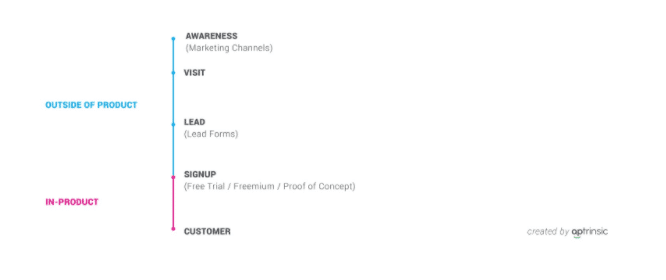
That’s not the only way the traditional customer acquisition process is proving increasingly ineffective. Another key shortcoming is that it focuses more on the behavior of prospective customers outside of the product rather than on in-product behavior.

Figure 1. Traditional Customer Acquisition Process (simplified)

Think about the correlation between downloading a whitepaper, opening an email or visiting a website and the buyer’s intention to purchase a product. Can you truly say with much certainty that these buyer activities strongly indicate an intent to purchase? No, you can’t, yet this is the criteria marketing uses to determine when it’s time to pass a lead to sales.

To bring this to life, consider this process through your own eyes, as you walk into a shoe store. Imagine that you have to talk to a sales clerk in front of the store and share your email and other contact information just to walk in. Then picture that sales clerk asking you to sign up to watch a video about the latest shoe before you can see and touch it. Would you consider this a good customer experience? Additionally, who do you think shows a higher buying intent: you who just walks around the store or someone who stops to feel an Asics shoe and asks to try a pair on?

Empowered Buyers Expect New Experiences

Thanks to digital transformation, business buyers can access more information and content than ever before through a variety of channels, including the web, mobile, social media, and online customer reviews. This leads to more self-directed buying journeys – as much as two-thirds to 90 percent, according to Forrester Research.3 By the time your sales team interacts with a buyer, you can expect the prospect to have formed a perception of what your product does and available alternatives.

As a result, your prospects are no longer willing to wait and jump through lead forms to try your software. Simply put, they now expect to try a product early in a buying cycle. In other words, SaaS prospects are saying, “Don’t tell me how great your product is; let me try your product and judge for myself.” And if you don’t make that possible, prospects will turn around and sign up to try your competitor’s product instead.

Organizations that make it hard to evaluate and try their product irritate prospective customers with a subpar experience – and limit their growth potential.

Get Prospects In-Product As Early as Possible

As we argued in our book “Mastering Product Experience (in SaaS) with Product-led Go-to-Market Strategy”, some of the most successful SaaS companies, including Slack, Invision, Asana, and Zoom.us, recognize this critical shift as an opportunity to differentiate. In turn, they are focused on driving prospects to their product earlier in the buying cycle. Slack, Asana, Dropbox, InVision, and Zoom.us do not ask prospects to submit lead forms. Instead, they invite them to try and experience the product themselves. They are engaging customers by leading with their products.

The good news is that this gives companies a way to measure customer activity and fine-tune how they market and sell their products. There is no better data for organizations to build a personalized customer experience than data that uncovers how prospects interact with their product. Getting prospects to try software early via free trials or free versions of the product (i.e., freemium) creates more and better opportunities to engage prospective customers with a personalized experience. And that ultimately yields more conversions, a higher number of loyal customer and higher lifetime value.

That’s why more SaaS companies are moving toward free trials or a freemium model as starting points for engaging prospects. Figure 2 shows how companies are changing the customer acquisition process by providing early access to their products. While this is not a complete view, it illustrates how this new process flips the order of how companies interact with prospective customers.

Figure 2. New Customer Acquisition Process (simplified)

Using the store analogy, a sales rep in the shoe store can notice who exhibits more interest in what style of shoe and can then offer help when he sees a customer pick up a shoe in the basketball section.

Embracing a Product-Led Approach

The success of this strategy requires companies to design customer experiences that make product adoption quick and inexpensive. This is what we mean by consumerization in SaaS: companies focus on showing value to individual users first, instead of selling to managers or decision makers who won’t be using the software on a daily basis. By doing so, they reduce the time it takes, as well as the friction involved, for a buyer to try their product.

SaaS companies encapsulate this in a product-led go-to-market (GTM) strategy, a clear and evolutionary shift from the traditional GTM strategy. Essentially, a product-led GTM strategy leverages the product as a leading channel through which the company acquires, retains, and grows its customers. It’s based on in-product customer behavior, feedback, product usage, and analytics.

Figure 3. Traditional vs. New Customer Acquisition Process (simplified)

Many SaaS companies that have embraced a product-led GTM strategy have abandoned Marketing Qualified Leads (MQLs) in favor of Product Qualified Leads (PQLs). In other words, they’ve aligned their method for gauging sales readiness with their new product-led approach. Since a product-led GTM strategy drives prospects to sign up for a product or free trial instead of to fill out a lead form, PQLs make much more sense. These indicate prospects that signed up and demonstrated buying intent based on product interest, usage, and behavioral data.

Delivering a Modern Customer Experience

Ask yourself this question: Why would a prospective customer jump through hoops to get a glimpse of your product? Simply put, fewer people will, once they are exposed to free trials and freemiums.

Successful SaaS companies put in place strategies that reduce the time from when a prospective customer lands on the website to the time the prospect signs up to use the product. These businesses invite prospects into a proverbial store, limiting the barrier to entry by making the front door larger, always open, and welcoming. They do so by replacing their outdated customer acquisition process with a new, product-led one that informs their go-to-market strategy. In the process, they are better positioned to satisfy new customer expectations, and engage and convert buyers into customers.

The post How the Customer Acquisition Process Is Changing in SaaS: Don’t Tell Prospects About Your Product, Let Them Try It!   appeared first on OpenView Labs.

31 Oct 16:09

15 Hilarious and All-Too-Accurate Sales Memes

by afrost@hubspot.com (Aja Frost)

The greatest antidote to pain? Humor. That must be why nearly every salesperson I know loves sales memes. 

And there's plenty of material, because selling is a crazy profession. Check out the top 15 funniest sales memes.

1) When my prospect tells me they're checking out my competitors

tumblr_mbhbbhobnc1r0gbpho1_r1_500.gif

Source: Cold Call Me Maybe

2) When it's been a long month quarter

yVSYYzQ.jpg

Source: Sales Humor

3) Sweet, sweet victory

01b33a_39bf677da102441495af04a0e512f53f-mv2.jpg

Source: The Daily Sales

4) Guess not

sales-meme-5.jpg

Source: ThinkAdvisor

5) They finally answered

ext.jpg

Source: Unknown

6) Dat payday tho

commission-checks-300x199.jpg

Source: NextGen Leads

7) Ruh-roh, this isn't good

7-1.png

Source: Sales Humor

8) Things will get better ... right?

9e2ec5d5fa83f4ec7bdf8331dcef4a10.jpg

Source: Unknown

9) When my new LinkedIn contact opens up a major source of leads

emma-stone-excited.gif

Source: Cold Call Me Maybe

10) I'd really prefer it if you bought now

57bf8dcc93c711df3b8a9e10f7f7c6f3.jpg

Source: LeadFuze

11) Looking at my dashboard like ...

AAEAAQAAAAAAAAhaAAAAJDQyNzQ2MDg0LTM1MjQtNGIzZC1iY2MzLTdjYzY3OTIxZGY2Ng.png

Source: The Daily Sales

12) When you and your team member close a deal at the same time

tumblr_inline_nfb1raekhf1r79k32.gif

Source: Cold Call Me Maybe

13) Gotta give 'em props

9-1.png

Source: Sales Humor

14) I'm just going to close my eyes and think of the commission check

ee7c6509799a74faa871308115f0fbd6--part-time-jobs-work-week.jpg

Source: Unknown

15) This relationship just went to the next level

guy-step-brothers-300x225.jpg

Source: Unknown

HubSpot CRM

31 Oct 16:06

3 Simple Ways to Increase Client Referrals

by Mike Montague
3 Simple Ways to Increase Client Referrals

Getting started in sales, or increasing your success once you’ve established yourself, can be a very challenging task. One of the hardest parts of this process is securing leads. What’s even harder is ensuring those leads are qualified.

To grow as a salesperson, mastering this aspect of your career is key. Below I have identified three ways to get qualified referrals. Incorporating these simple tips will help you step up your referral game and uncover a path to new levels of success.

30 Oct 16:16

New Book on Practical Geometry for Designers, Builders and History Lovers: "From Truths to Tools"

Jim Tolpin could be described as a guy who can do math without having to do math--by using history. His deep grasp of geometry and pre-industrial design and layout techniques have provided us with lots of useful information, from how folks designed furniture without math and measuring tools and how to determine the proper dimensions for your own workbench.

Now Tolpin and co-author George Walker have a new book coming out, From Truth to Tools, that explains how geometry gives birth to tools, which in turn allow us to create furniture and structures. As an example, here's an excerpt from the book that illustrates "how the carpenter/geometers of antiquity used the simplest of tools…to solve for an unknown distance:"

It's pretty cool stuff! The $25, 208-page book is mostly illustrated like you see here, as it's easier to grasp things visually. And if you want to take a longer look, publisher Lost Art Press has made a 27-page sample available as a free PDF download.

30 Oct 16:13

How to Measure the Results of B2B Influencer Marketing

by Wendy Marx

How to Measure the Results of B2B Influencer Marketing.png

Still on the fence about influencer marketing?

Consider this stat: 49% of people say they rely on third party recommendations before making purchase decisions. This illustrates why B2B influencer marketing is growing in power and popularity among many marketers.

But how does this power and popularity translate to ROI? Can you measure the results of your influencer marketing program? Does lack of effective measurement hold you back from embracing influencer marketing as a tool in your campaigns? We’re here to help.

First, let’s discuss…

How Does Influencer Marketing Help Your Brand?

Influencer marketing is still in its infancy stages. While many who use it see favorable results, it still has a long way to go. The Future of Influencer Marketing Report of 2017 reported that only 11% of B2B businesses have adopted an ongoing influencer marketing program. Contrast that with B2C businesses where up to 48% have an influencer program.

So why should you begin your own influencer marketing program?

When asked what goals brands had for their influencer marketing programs one report revealed these top benefits:

  • Brand advocacy
  • Brand awareness
  • Reach new target audiences
  • Increase share of voice
  • Improve sales conversion

Influencer marketing has the power to help brands at every stage of the buying cycle — from awareness to purchase.

There’s doubt that influencer marketing is an effective tool that will only grow in signficiance.

But once you’ve decided to adopt an influencer marketing program, how can you measure your results and prove ROI? Let’s look at 6 steps toward doing just that.

6 Steps to Effective Measurement of Your B2B Influencer Marketing Program

1. Create a Plan that Focuses on ROI

Influencer marketing programs have many moving parts. Key in on the parts that create visible ROI for your brand.

Co-created content

Create content, such as a blog post or eBook, in partnership with a notable influencer within your industry. For instance, you could create a post that asks questions about popular industry issues, and use your influencer’s answers as the main attraction. Promote it as Hot Q & A with Top Industry Expert [influencer’s name].

Repurposed Content

Have you already created a piece of content with an influencer? Get more life (and results) out of it by repurposing it. For instance, if you created a blog post that got great results, transform it into a video or infographic that may reach a wider audience.

Make sure that your whole team is on the same page about how you’re going to approach influencer marketing. And no matter your approach, don’t expect over-night results — it takes time to build credibility and awareness!

2. Count the Cost

Whatever your plan is, start measuring what the cost will be — both for implementation and nurturing influencer relationships going forward.

Another key factor you should consider during this process is the cost of not using influencer marketing. What will it cost you if your competitor instead embraces influencer marketing? Could you lose out on a key influencer? Could you miss out on potential customers? Might your current audience turn to your competitor instead of you?

Once you know how much money you plan to invest into your influencer program, you can measure it against the results you receive later.

3. Create a Mixed Approach

As in many other areas of life, you don’t want to put all of your eggs in one influencer basket, so to speak. Vary your approach to influencer marketing.

Influencers come in all shapes and sizes. For instance, many businesses have found success with micro-influencers (those with audiences fewer than 20,000 followers). Oftentimes, micro-influencers have a more loyal and attentive following than their larger counterparts.

Other kinds of influencers you might try include:

  • Journalists
  • Bloggers
  • Affiliates
  • Customers

4. Determine the Metrics You Will Use

When it comes to influencer marketing, be creative in terms of measurement. Think beyond the common metrics, such as views, click-throughs, and time on page. Nail down the metrics that are important to your brand early on in the game to avoid confusion later.

Focus on metrics that will show you the progress of your influencer marketing program. This could be referral traffic, downloads of gated content, or subscribers. Set up specific calls to action and landing pages that are associated with the influencer so you can tie these metrics to specific activities.

You can also use metrics that show an effect on brand awareness or credibility. For this, you can monitor those within your influencer’s community.

For example, during a campaign, you might set up alerts (such as through Google Alerts) for your brand or industry terms that will show the effect of your campaign on the influencer’s audience. A positive comment or conversation is a definite boon to your company and may later lead to a purchase decision.

5. Invest in the Right Tools

Tools are a big part of PR measurement — and the more accurate and easy to use, the better. Once you know what metrics you will track, finding the right tools will be easy.

Here are a few of the major tools that we have found helpful for measurement:

TraackrThis is a great tool if you are new to influencer marketing. This tool does everything. Find influencers who fit your brand, industry and goals. Create a team to collaborate and nurture your influencer relationships for best results. Monitor mentions and analyze results related to your specific influencer campaigns.

Google AlertsThis handy and free tool helps you to keep up with what people are saying about your brand across the internet. Choose what words you want to monitor — such as your personal name or brand name — and sit back and wait as Google Alerts brings the results straight to your inbox.

AirPRThis tool is specifically designed to analyze your content marketing and PR efforts, and give you helpful insight into what those metrics mean. Set it up specifically to monitor the progress of your influencer marketing program, and adjust from there.

Also consider these smaller tools and tricks that will help you to measure your results:

Pixels — Embed a tracking pixel on your influencer’s page to see what portion of your traffic comes from your influencer.

Coupon Codes — This may be a little bit of a throwback, but they are still around for good reason. Set up a special coupon code for your influencer’s audience to use — it gives them an incentive to try your product, and allows you to track the effectiveness of your influencer program.

Links — Create unique links that you can use to measure results. Bit.ly is a great way to create short, unique links that you can track. If your influencer is on YouTube, then create a link for them to use in their description that allows you to monitor how many visitors you get from their video.

6. Amplify What Works, Ditch What Doesn’t

As with many things in life, the best formula for your influencer marketing program is not going to happen overnight. It will take time and a good deal of trial and error to get the right balance for your brand and industry. Just don’t give up too quickly.

Start small. You might also begin within your own company. Provide incentives for your employees and community to spread the word and build your brand’s credibility.

You can also start out by co-creating a piece of content with an influencer. Choose a hot topic within your industry, and get an influencer to provide his or her unique point of view or advice. Promote the content — you could even gate it if it’s really unique and valuable — and see what results you get.

When you find something that works, amplify it. If co-created content works with your target audience, include more influencers in your content creation. If employee advocacy is your golden ticket, make it more widespread.

Exceptional Examples of Influencer Marketing at Work for B2B Companies

SAP

SAP is a wonderful example of keeping it fresh in terms of influencer marketing — and the software company uses video marketing to highlight their influencer relationships. For instance, the company uses its employees as brand advocates in a program called Business Beyond Bias. The following is one of its customers speaking out about the enjoyable experience of working for the company. It is a genuine and touching way of humanizing SAP and elevating it in the minds of their audience.

LinkedIn

LinkedIn is a great example of co-created content with its Sophisticated Marketer’s Guide to LinkedIn. Within this guide LinkedIn leverages the advice and views of influencers within the industry. Those who download this co-created content aren’t only attracted by the LinkedIn brand, but also by the various influencers that they’ve come to admire.

LinkedIn Influencer Marketing Example

A Few Points to Remember…

  • Create content that is easy to measure, such as a co-created blog post
  • Determine what metrics are important to your brand, such as brand mentions, downloads, or referral traffic
  • Choose the right tools for your measurement, such as Traackr, tracking pixels, and special links.

B2B influencer marketing is an important tool that you want in your marketing toolbox along with the tools to meaure its ROI.

What metrics do you use to measure your influencer marketing program? Let us know in the comments below.

30 Oct 16:13

Grammar Rules You Should Break in Business

by Steve Yastrow

Ditch the PitchIf you’ve studied linguistics, you’ve learned that the study is not about prescribing how people speak but describing what actually happens when people use a language. At any point in time, a language works according to a shared set of understood rules, which change over time as a language evolves. Linguists seek to understand this, recognizing that “correct” is a temporary state, which can change quickly any time the community of speakers starts using the language differently.

Since language is fluid, does it follow that all new usages, since they are not incorrect, can be used in business settings? Well, not really.

Let’s say you belong to a social circle outside of work that accepts a usage such as “Me and her went to the concert.” Now imagine what could happen if you said something like this in a meeting. You might catch a questioning look from the CEO, after which you can’t really respond to her by saying, “Don’t judge me. Linguists say language evolves, and using ‘me and her’ as subjects of a sentence is now accepted.”

No, the CEO is going to think you don’t know how to speak English. She may be “wrong,” but this is what she is going to think.

However, many “incorrect” usages have become accepted in business settings because they enhance communication. So here is a list of rules I recommend you can and cannot break in business conversations.

Go Ahead, Break These Rules

Split that infinitive

In the Hitchiker’s Guide to the Galaxy, Douglas Adams spoofs a line from the opening of Star Trek by writing “to boldly split infinitives that no man had split them before.”

Start Trek’s “to boldly go” is a split infinitive, considered incorrect English since “boldly” splits “to” and “go,” which are really one unit, the infinitive form of the verb.

I say the time has come to boldly split our infinitives.

The community of English speakers, at least in the U.S., has accepted that it’s ok to say, “I want to quickly find the answer to your question and get back to you,” instead of ““I want to find the answer to your question quickly and get back to you,” because the first version, with the split infinitive, does a better job of communicating the urgency with which the speaker wants to act.

My recommendation: Split an infinitive if it helps you “to emphatically make your point.”

Dangle that preposition

Our supercilious CEO probably won’t lift an eye if you ask her “Who are you going to the airport with?” Yet my junior high composition teacher would have corrected me back in 1972 if I had made this “mistake.”

Fortunately ,we now can ask not only “Who are you going with?” but also “Where are you going to?” “Where are you coming from?” “What are you thinking about?” and many other usages that put prepositions on the ends of phrases.

The rule to stop dangling prepositions has been eroding for a while. Winston Churchill supposedly made a joke about this rule by saying “ending a sentence with a preposition is something up with which I will not put.”

Unite! They and them are one!

When I wrote my first book, Brand Harmony, in 2003, I tortured myself trying to balance my use of gender pronouns in the book’s examples, making sure every he was balanced by a she and every her was balanced by a him. And I ended up struggling with usages such as “if your customer expresses a need it is important to show that you know what he or she wants.”

Ugh. That wasn’t fun.

Fortunately, we have (finally) begun to accept the use of our plural pronouns, they and them, as singular, gender-neutral pronouns. Yes, you can now ask a singular customer what they want. Phew.

Please, Don’t Do It

Now, back to our judgmental CEO. Here are some things I suggest you avoid in business conversation, so you don’t appear to be someone who doesn’t know how to use the English language.

Just between you and I, me and him can’t go to the movie.

Although the interchanging of subject and object pronouns, as in the title of this section, has become commonplace, I recommend you avoid these usages in business. Leave your indignation aside, and save them for social situations.

Don’t Capitalize words that you don’t need to Capitalize

“Our company has a strong focus on our Customers, and we back this up with dedicated Customer Service team members. This is a key focus of our Marketing department.”

Yes, it’s nice to know that this company respects its customers, the concept of customer service and the exalted discipline of marketing, but capitalizing words needlessly is a sure sign that you’re trying extra hard to look impressive … and it’s backfiring.

Don’t make up words, unless your name is Shakespeare

William Shakespeare coined about 1500 new words in his works. He gets to do this, because he’s Shakespeare. I’m sorry to inform you, but it won’t work for you.

Here are some “words” I have heard in business recently:

  • “Resitive”
  • “Agreeance”
  • “Disingenuine”
  • “Distinguishment”

Resistant, agreement, disingenuous, and distinction work just fine, and these accidental neologisms won’t make you sound like Shakespeare.

Don’t add syllables if you don’t need to

Don’t utilize something if you can use it.

Don’t look for an alternative plan if you can look for an alternate plan.

So, readers, what do you think? Are you ready to break these grammar rules in business? What other rules do you think deserve an early retirement?

30 Oct 16:03

Why You Absolutely Must Read Books

by Anthony Iannarino

Every human being that is born starts at exactly the same place. They are a blank slate, knowing nothing that they need to know to survive and thrive in the world in which they find themselves. There is no knowledge that is transferred biologically from parents to child. Regardless of the capacity to learn and the different forms of intelligence human beings possess in greater or lesser quantities, you have none of it.

Even though you know nothing at birth, much is already known by others. The people that have come before you have had experiences that resulted in a certain knowledge in that area. Other people have studied some area to make discoveries and develop a deeper understanding of this thing or that. When you are born, you are way behind in the acquisition of human knowledge, some gained through experiences and some through research and study.

If you embrace the idea that books are not helpful to learning you are deciding that there is nothing worth knowing if it is not gained through your own experience. This is to suggest that the way one should learn about the dangers of fire is to burn themselves, even when others who have already had that experience might strongly suggest that you don’t burn yourself, and even if they can explain to you very clearly and easily how not to do so.

Let’s use K. Anders Ericcson’s 10,000 hours rule, popularized by Malcolm Gladwell. Through a lifetime of experience, someone has learned something useful to other people. While doing so, they have also developed the concepts and ideas that help other people make sense of this thing they know. They have also developed some advice, some strategies, and some tactics that might help other people produce results in this area both faster and more effectively, and they’ve codified these ideas in a common form that allows the transfer of this knowledge from one person to another.

The suggestion that one would be better off avoiding any knowledge that wasn’t gained through own their experience is to believe that there is nothing that can be known that would shorten the learning curve. Following this thinking, you would have to learn that multiplication and division are concepts on your own. It would mean that the only history of any value is your own and that your analysis of your experience is the only experience with any real value. The collective whole of human knowledge and experience would be of no value to you at all, being full of ideas, concepts, strategies, tactics, and instructions that, despite being useful to thousands or millions of people before you, are worthless.

It is true that you cannot learn to swim by reading a book. But you can shorten the learning curve and accelerate your mastery by learning from those who already swim at a level far beyond the level of competency you’ve achieved. Part of that learning can and will be codified in the form of a book. Reading helps you understand your experience and provides context.

For around $25 and 6 hours of your time, you can learn what took someone else a lifetime to learn.

Any suggestion that you should not read books should be rejected with extreme prejudice, and you should think carefully about taking any advice from people who believe there is nothing to learn from others if it has been published as a book. There is no reason to remain ignorant when help gaining knowledge and understanding is available to you, and for a song at that.

The post Why You Absolutely Must Read Books appeared first on The Sales Blog.

30 Oct 16:02

The 3 Things Every VC Wants to See in Your Pitch Deck 

by Jenny Stilwell

janjf93 / Pixabay

VCs, love them or loathe them, can be the turning point for your business. So whether you are debating a spot on Planet of the Apps or your local VC’s version of Shark Tank you need to tick these 3 boxes!

Being ‘investment’ ready is being able to demonstrate the value drivers in your business to potential investors using common business practice. The better-presented your business assets, value and operations are, the easier it will be to discuss opportunities with potential investors.

1. Management Team

You need to be able to identify your management team, their core competencies and experience they bring to the business.

What specific, relevant experience they have and how they capable of managing both day-to-day as well as implementing the strategic business plan.

2. Products & Services
You need to document and be able to talk clearly about your business, products, services, and how they are monetized.

I can’t tell you how many times I’ve heard people describe their businesses, particularly in tech, in jargon that only they could understand! So if you are in a technical business, you have to explain the business application of your products and services, not necessarily the intricacies of how it actually works!

Remember, what is it that your customers buy (which may be a different perceived thing from what you think you are selling them)?

3. Business Model
A clear and well-documented explanation of your Business Model and how it actually makes money!

This is not a description of your end product or service alone. An investor wants to see all the points in your end to end business that could or currently do produce additional revenue. Are you leaving money on the table? Are you missing untapped opportunities to increase sales?

Raising Capital can be the gateway to taking your business to the next level so make sure you and your business are ready. Even if you aren’t there yet, preparing these three components can give you some interesting insights.

30 Oct 16:02

5 Tips for Collecting Data for Your Email Marketing (Without Being Creepy)

by Kristen Dunleavy

708065 / Pixabay

Customer data is the lifeblood of successful email marketing.

It’s “the key to sending relevant and timely emails, through segmentation, personalization, and automation,” writes Andrew King, at Campaign Monitor.

But customer data can be challenging to come by – and for good reason. Information — including email addresses, income, and demographic data – is a valuable commodity that most people don’t part with easily, and for good reason.

“When your customers disclose their personal and financial information to you, they’re taking a leap of faith that you won’t lose, abuse or otherwise mess with it — accidentally or not,” writes Kim Lachance Shandrow, at Entrepreneur.

So, what’s an email marketer to do? How do you obtain data about your customers without being seen as a virtual stalker? Here are five tips:

1. First, help them learn to trust you

According to Justin Schorah, of Zer0 to 5ive, trust is the most important factor when it comes to obtaining data about your customers. And to gain trust, email marketers must “be authentic and serve their audience with relevant content.”

Building trust requires patience, Schorah writes.

“Warm up your audience with relevant content to the point where they start to feel connected to your company. Then you can ask for more details about them, and use that data to drive deeper segmentation and customization.”

Here are six types of emails that can help create and sustain trust.

2. Ask them to complete a sign-up form

A simple sign-up form that invites customers to share information about themselves can yield invaluable data, and it’s a transparent, decidedly un-creepy, way of learning more about them.

“Asking my customers for the right data in a friendly way unlocks potential segmentation data I would otherwise never have access to,” writes Kevin Lamenzo at Klaviyo. “A customized signup lets me ask my customers a question that I otherwise cannot answer with the available tracking data, and it gives my customers the chance to label themselves according to their own interests.”

Lamenzo says it’s important to keep the sign-up form simple and unintimidating and to ask only for data you need. “Asking for too much information can prevent a potential subscriber from signing up for your list,” he writes. “So, don’t collect data just for the sake of it, because this can act as a barrier when someone’s first signing up.”

Want tips for creating sign-up forms that convert? Here you go.

3. Make them an offer

People love free stuff, and they will often share their email address and other data to get something valuable without opening their wallets.

“Individuals are usually prepared to share their data with businesses if they feel they are getting good value in return,” writes Frédéric-Charles Petit at B2B Marketing. “This may mean supplying exclusive reports, whitepapers, or research results in exchange for e-mail addresses and contact details, or offering access to a limited or trial version of a product or service.”

Or how about inviting customers to “attend” a free email course? A key to success with this approach is to allow them to select courses on topics that interest them, writes Jason Dent at Campaign Monitor.

“A growing number of brands are finding success by creating email courses that offer subscribers a relevant and educational experience. The email course not only gives subscribers something of value, but it also gives brands new insight as subscribers interact with specific content with further opportunities to personalize the customer experience as they go.”

Not sure what to give away? Here are 11 ideas.

4. Survey them

Surveys are a great way to solicit customer views about your company – and at the same time obtain additional data to put to work in future marketing campaigns.

“Surveys are powerful ways of gaining great insight into your customers,” writes Neil Mason at ClickZ. “Well-managed surveys can help you discover who your customers are, how they behave (to some extent), and, most importantly, what they think and why they do the things they do.”

Mason’s tips for success include keeping surveys simple, making them engaging, conducting rigorous testing and being prepared to respond to issues they might raise.

Here are 34 ways to get a great response to your surveys.

5. Invite them to compete for prizes

Contests are fun. And because many people will gladly share their email address and other information for a shot at a prize, contests are also a useful way of collecting data.

Contests also have other benefits. They can help grow newsletter subscription lists, increase brand awareness, help drive customers to websites or stores, increase social media followers and even help retailers get rid of excess inventory, according to Lauren Ufford, on the Shopify blog.

Need contest ideas? Here are 50 of them.

30 Oct 16:01

The Innovation Health Care Really Needs: Help People Manage Their Own Health

by Clayton M. Christensen
oct17-30-hbr-jennifer-maravillas-time-management-02
jennifer maravillas for hbr

Finally, health care, which has been largely immune to the forces of disruptive innovation, is beginning to change. Seeing the potential to improve health with simple primary-care strategies, some of the biggest incumbent players are inviting new entrants focused on empowering consumers into their highly regulated ecosystems, bringing down costs.

This shift is long overdue. Whereas new technologies, competitors, and business models have made products and services more affordable and accessible in media, finance, retail, and other sectors, U.S. health care keeps getting costlier. It is now by far the world’s most expensive system per capita, about twice that of the UK, Canada, and Australia, with chronic conditions such as diabetes and heart disease now accounting for more than 80% of total spending.

These astronomical costs are largely due to the way competition works in American health care. Employers and insurance companies — not end consumers — call the shots on what kind of care they will pay for. Large hospitals and physician practices, in turn, compete as if they’re in an arms race to attract payers, adding advanced diagnostic gear or new surgical wings to differentiate, driving up costs.

In most industries, disruption comes from startups. Yet almost all health care innovation funded since 2000 has been for sustaining the industry’s business model rather than disrupting it. Our analysis of Pitchbook Data shows that more than $200 billion has been poured into health care venture capital, mostly in biotech, pharma, and devices where advances typically make health care more sophisticated — and expensive. Less than 1% of those investments have focused on helping consumers to play a more active role in managing their own health, an area ripe for disruptive approaches.

The Whole-Person Approach

One big incumbent that has become more receptive to disruptive innovation is the insurance giant Humana. It has partnered with Boston-based startup Iora Health. Created by physician-entrepreneur Rushika Fernandopulle, Iora has advanced a disruptive primary-care model that uses relatively inexpensive, nonphysician health coaches to identify patients’ unhealthy habits and life styles and guide them toward better choices, before health problems arise or become serious. Since its founding in 2010, Iora has attracted more than $123 million in funding and now operates 37 practices serving 40,000 patients in 11 states. Iora trains health coaches to become the consumer’s advocate, acting as the quarterback of an extended care team that includes a physician. When visiting an Iora clinic, the patient meets with the coach to establish a health agenda before seeing the doctor. After the patient sees the physician, the health coach and patient debrief to ensure the patient can confidently pursue the agreed-upon health goals — for example, by adopting new health habits. The coach then serves as the patient’s connection with the Iora team, and creates accountability.

Insight Center

Another feature of the Iora model is the morning huddle, when the entire care team invests an hour discussing the health status of the clinic’s population. Because Iora assumes full financial risk for its patients — it is paid a set fee per patient for a given period — the huddle prioritizes those who require the most attention and directs care around their needs.

To that end, Iora has developed a “worry score” methodology, which rates each patient on a 1-to-4 scale according to their health status and needs. Patients scoring a 4 require a specific action, such as immediate outreach from a health coach. If the patient’s outlook turns for the better, their worry score is lowered, a development celebrated by the team.

The Iora model has produced dramatic results in the management of chronic conditions. For example, an unpublished Iora study found that inpatient hospital admissions among a cohort of 1,176 Iora Medicare enrollees over an 18-month period decreased by 50%, emergency department visits decreased by 20%, and the total medical spend declined by 12% — this despite the cohort being sicker than average Medicare patients.

Other new entrants (Oak Street, Omada, Docent, ChenMed, WellMed, Mosaic, and Aledade, among them) are also successfully implementing Iora’s care-team and fee-for-value reimbursement model. What make the model disruptive — and able to get a foothold among mammoth incumbent provider organizations — is the combination of delivery and payment schemes (capitation is the predominant model); either alone would be unlikely to succeed.

Encouraging Disruption

Payers are getting onboard. A range of recent pilot programs modeled on Iora’s — by Aetna, CareMore, Dignity Health, Humana, Kaiser Permanente, and the Medicare Advantage program — are using coaches and home visits to substantially improve health and lower costs. One study found that providers participating in Medicare’s Independence at Home Demonstration saved $1,010 per beneficiary on average in the second year of the program, primarily by reducing hospital use.

Another care-team-based pilot, the Diabetes Prevention Program, reduced patients’ risk of developing the disease and saved Medicare an estimated $2,650 per beneficiary over a 15-month period by helping patients lose an average 5% of their body weight through changes in diet and exercise. The program is delivered through primary care groups, hospitals, YMCAs, and telehealth networks, and patients are supported by weekly, hourlong “maintenance sessions” with coaches.

While this care model has proved powerful at a small scale, to have significant impact on costs and outcomes nationally it must serve millions more consumers. To achieve that scale, we recommend the following strategies:

For care providers: Embrace the business model of extended care teams that include health coaches. We recommend starting with pilot programs under which hospitals and clinics take on financial risk for patients’ health. This way, care teams are incentivized to help patients stay healthy.

For payers and insurers: Private-public partnerships like Medicare Advantage (under which for-profit insurers administer plans paid for by the government) have become successful marketplaces that allow disruptive models. We recommend extending programs modeled on pilots like Independence at Home and the Diabetes Prevention Program across privately-funded insurance markets.

For legislators: Work to enable new models of care that lower costs by incenting individuals, payers, and providers to improve wellness, rather than treat disease after it manifests. This requires fostering a robust individual insurance market in which payers reward providers for helping patients stay healthy.

30 Oct 15:57

Sales Budgets Simplified – Turnover and Ramp Time

by Hanna Dodd

stevepb / Pixabay

Don’t Be Surprised by Your Sales Budgets

Some people like surprises, some people don’t. Sales budgets, on the other hand, never like them. Annual planning leaves you wide open to unexpected changes in your sales team throughout the year. As discussed in previous articles, the issues with annual planning drain company resources and prevent growth. Hiring in January of 2018 to meet a 2018 revenue goal is inefficient and ineffective. Instead, hiring a constantly evolving sales team ensures sustained company growth. Multi-year planning helps bridge the gap between budgets and unforeseen changes in your team. It maintains a continuous sales cycle that accounts for changes such as sales turnover and the subsequent ramp time that comes along with it.

Double or Nothing: Sales Turnover

Everyone thinks their company is great to work for. It may be. That doesn’t change the fact that employee turnover is at an all-time high. Thus, it shouldn’t be a surprise to you when your experienced and highly trained salespeople move on; however, it is a surprise to your sales budget. Annual planning only accounts for current resources, and allocations are made based upon annual revenue goals. When a sales resource leaves in the middle of the year, an annual plan doesn’t account for it. You then must hire more untrained salespeople to meet the original quota of one trained salesperson. The unforeseen expenses associated with hiring and training new hires drain revenue from your budget. Instead of getting two for the price of one, you’re paying double for the original goal.

The Time is Right: Ramps

Turnover is one part of budget costs, but ramp is another. Time is everything, and that holds true for training. It takes time to train all those new salespeople you hired. They don’t come onto the job day one with the perfect sales pitch.

New sales hires may need anywhere from 12 to 18 months to reach optimal effectiveness.

During this time, they are depleting your budget without reaching sales goals of the original quotas. Ramp time accounts for approximately five percent in annual revenue losses. For a revenue goal of ten million, that’s half a million in losses. Time is money, and you’re losing it when you rely on annual planning to create the ideal sales team.

No Surprises Here: Multi-Year Planning

Avoid the surprise of sales turnover and ramp time. Multi-year planning removes the risk from your sales budget. Strategically positioning your sales team for future success is never a bad thing. By planning a bit ahead, you lessen the chance of losing revenue to turnover and ramp time. Don’t go at it alone. Here at ORM Technologies, we provide optimized sales metrics that provide all the tools necessary create your multi-year strategy. If you have any questions or would like to know how we can enhance your sales planning process, please let us know in the comments.

30 Oct 15:57

How to Analyze an Article: Don’t get Fooled by Terrible Advice

by Adam Henshall

how to analyze and article dont get fooled by terrible advice header

There’s a lot of advice on the internet. Some of it is good, some of it is terrible, and some sits in the gray area between.

Within the fields of tech and startups, a lot of what people do day to day is influenced by what they’ve learned online; I doubt many people reading this article learned in school how to effectively market a product over Instagram!

Sorting the good from the bad is a challenge we all face, and one we have to become better at as individuals and as a society.

Improving our ability to analyze information doesn’t just mean identifying fake news, though we will look briefly at it. It also means being able to take a second look at informative journalism and the reporting of research; the kind of information which you might use to inform big business decisions. We’ll look at:

  • The importance of recognizing the gray area in complex issues and reviewing the source text.
  • How media reporting of studies can often obscure the real points
  • Why certain models of investigation can have inherent flaws, and why you should be wary of that.

At the end I’ll follow up with the 10 step process you can use to improve your analysis. This process is pulled from the recommendations of Carl Sagan, Richard Feynman, and Michael Shermer, and repurposed for your professional needs.

But first, let me tell you a little story…

How poor research almost killed my first startup

how to analyze an article idyoma

A good number of years ago, a friend and I were working hard on bringing out our first app. It wasn’t my first project, but it was certainly my first real startup.

We had a cursory knowledge of business and strategy but we knew less than we thought we knew. We were naive.

The app was Idyoma, and we were working on the MVP while gathering research and testing as many of our hypotheses as possible. So far, so good.

The app served to help language learners find others nearby to meet with to practice speaking and listening in another language. A kind of Tinder for languages.

To gather research, I would hold group language exchange meetings once, then twice, a week where people of all nationalities would come to meet each other and practice chatting in different languages. At these meetings we would aim to pull people aside through the evening to do quick face to face surveys with them and attempt to understand:

  • The demographics they fit into
  • Their experience of the problem they face
  • What kind of added value services they would like to see
  • Where the optimal price point would be for different added, complementary services

Many of the things we learned from this research were great and built on solid foundations. But not all of it.

how to analyze an article language exchange

From the research we found that ~30% of all respondents (+150) were willing to pay for a premium service. The primary desire for the premium came from security – wanting to know the person they are meeting with is who they say they are. The research revealed that the optimal price point for this service was $3.

This was fantastic news!

It wasn’t necessarily the long term monetization strategy we were looking for, but if we gain a user we essentially gain a dollar. And we knew we could gain users. Duolingo has 200 million of them. The math worked. Our first revenue stream to drive forward our business was in place!

I won’t bore you with the details of the number of investors we met with or the hours we spent making projections off this kind of data. We assumed that with an MVP app we might not reach the 30%, but could very reasonably be hitting 10/15%.

We didn’t.

Not even close.

About 1% of active users paid for the premium. Active users made up roughly 30% of the userbase. We made $111 in that first year after Apple and Google took their cut.

Our poor research practices and methodologies completely led us astray and wasted a huge amount of our time. We had to regroup, refocus, and pivot.

But it wasn’t only our naivety in regards to research which pulled us in the wrong direction. We were far too quick to trust the research other people had done or the broad sweeping statements they made in their articles. They had done it all before, hadn’t they? They must know what they’re talking about.

how to analyze an article inc

A good example of this can be found in this Inc article about outdated marketing strategies:

2. Content-rich websites: The silliest myth of the information age is that information is so valuable that a company is doing customers a favor by providing as much of it as possible. That’s why so many business websites are chock-a-block with content.The hope behind such sites is that customers will use that information to become more educated and thereby become convinced that they must buy what’s offered. In fact, customers are overloaded with information and resent being asked to dig through more.Smart companies only provide information when it’s clear a customer wants it, and then limit that information to the minimum useful amount. Today’s most effective websites show a single screen and request one action, like signing up for a newsletter.

This is written in an authoritative tone in Inc magazine – it must be true!

But where’s the data? How does this rule apply to different businesses with different products and different target audiences? Marcus Sheridan provides a follow up:

I don’t like disagreeing with another person “just because.” But in this case, I was so fundamentally bothered by an article I recently read in Inc. about marketing trends that I simply could not allow awful, inaccurate advice to be presented as fact (news/trends) without at least giving my thoughts.

And you can read his thoughts here on Sales Lion. In short:

And if people are “too busy,” why does my average customer at River Pools read over 100 pages of the website before they buy? (And please don’t say, “They’re different.”)

Sheridan’s customers are buying an expensive product for which they feel the need to do a good amount of research. As anyone who has worked in high touch sales will tell you, landing a big sale requires time, effort, and information.

And there’s the key point: you have to be able to evaluate the material you read online before accepting it as fact. Whether that be off the cuff statements about landing pages or detailed reporting of real in-the-world research.

To fix this, the next three sections will look at elements to be wary of:

  • The social phenomena of fake news and the mechanisms which drive it
  • The difficulties of relying on media reporting of complex topics
  • The challenges of both reporting and undertaking research at every level

So you don’t have to waste a year of your startup’s development like I did.

Before we go into the analysis, here’s a quick summary of the analysis process we’ve detailed at the end of the article!

  1. Is it a reliable source?
  2. What audience is it for?
  3. Are the claims universal?
  4. Can you test the claims?
  5. Is it logically sound?
  6. Is the argument dependent on rhetoric?
  7. Can you analyze the data?
  8. Are there existing critiques?
  9. Can you evaluate the methodology?
  10. Are YOU biased?

You are Fake News

how to analyze an article you are fake news

Recent discourse has become centered around Fake News.

The media talks about it, the President talks about it, we all talk about it.

Fake news is talked about as a political thing, but there is an argument to say that the underlying system which perpetuates it affects media of all forms. The political aspect of fake news is just the most obvious; the tip of the iceberg.

The political media is a useful microcosm from which to understand some of the systemic issues within modern digital media…

The Washington Post spoke to 38 year old Paul Horner, who has been making a living from writing fake news articles and hoaxes for the past few years. Some of his stories have been tweeted out by influential figures, not least Eric Trump during the presidential campaign.

There are a lot of layers to the interview, but one quote sticks out. Horner was asked why he thought his articles were successful and why he was able to keep going:

Honestly, people are definitely dumber. They just keep passing stuff around. Nobody fact-checks anything anymore

It isn’t just that people don’t fact check. It’s that people might produce content for an audience which they know will not fact check. So people could be easily led and money could be easily made. This has the potential to accelerate the cycle of false reportage.

Buzzfeed News decided to gather the data to try to test these assumptions and see how widespread fake news reporting was. According to their study:

A BuzzFeed News analysis found that three big right-wing Facebook pages published false or misleading information 38% of the time during the period analyzed, and three large left-wing pages did so in nearly 20% of posts.

These figures claim to show how prevalent the dissemination of inaccurate reporting was. The graphic below aims to show how prevalent the creation of inaccurate reporting was.

how to analyze an article buzzfeed study

I don’t want to make this a partisan issue, so let’s focus on the fact that fake news was being produced on both sides even if there are disparities. The question that leaves us with: what motivates people to create fake news?

The simple answer would be to say propaganda. People want to present their ideas as right and fabricate evidence where there is none to support their original claims. This may be true for many instances of fake news. However, it wasn’t true for Paul Horner above. He was motivated largely, it seems, by financial incentive.

One person who has written on this, from personal experience, is Ryan Holiday. He manipulated the media to push his business which sent glitter bombs to people. When he kicked off the media furore, the business didn’t really exist. Once he had garnered media attention he was able to then kick the little project into gear.

His book Trust Me I’m Lying: Confessions of a Media Manipulator provides a good insight into how stories propagate. He presents his views in this 5 minute video below which provides an overview of his critique of the media industry. Some of his points in summary:

  • Media has moved from scarcity (in print) to abundance (online) which has lowered the need for high standards, and even incentivized low standards.
  • Once a story appears in a small media outlet it is much more likely to be picked up by a larger outlet with less questioning.
  • There is so much competition for your attention which means outlets need to be more extreme.
  • Lots of reporters get paid based on traffic, which further incentivizes the creation of overly sensationalized content.
  • It’s easier than ever before for marketers to manipulate the media because of these above factors, which further reduces standards.

Examples of real fake news

how to analyze an article extra extra

Let’s quickly look at two clear cut examples of fake news just to give ourselves some context.

First we have the Trump quote which allegedly appeared in People magazine. In this quote Trump said that Republicans are stupid and he would run as a Republican candidate because you could tell their base anything and they would believe it. The only thing is, there is no evidence that this quote ever appeared in People magazine.

Snopes found that People magazine didn’t interview Trump that year, while CNN backed them up.

In a similar vein, a number of outlets claimed that Hillary Clinton said millennials are losers. Some of us are. But is there any evidence that Clinton said these things?

The story was reported by Infowars and Gateway Pundit, but originated on Real True News. The original version can be found here, while the current live version has been updated to gloat about how it tricked other sites. Real True News has since rebranded to promote itself as satire. Legally, this rebranding was probably a wise move.

It doesn’t need to be made up to be fake

Not every story needs to be entirely based on lies and events which didn’t happen. Fake news can also come from decontextualizing a person’s statements to suggest different meaning.

Hillary Clinton was misrepresented by a number of sites, including Gateway Pundit, Infowars, and WND claiming that she “hates everyday Americans”. This phrase was used in emails leaked by Wikileaks and fitted the image of Clinton which her opponents wanted to see.

However, as Business Insider demonstrate, the quote was grossly misrepresented. The discussion was about messaging, and Clinton hated using the phrase and concept of Everyday Americans. When the emails are viewed in context, it is very clear what is being meant.

how to analyze an article jeremy corbyn the absolute boy

But it isn’t just tiny outlets which report like this. The BBC Trust were critical of a BBC report which took a comment by Jeremy Corbyn and edited the video to present his answer as a response to a different question. If the high journalistic standards of the BBC can come into question, then we must be prepared to be critical.

Other times, no one is in the media is necessarily lying but the story is false and fantastical. Sometimes we believe things we otherwise wouldn’t believe because it supports our position. Like the story of the child who lied about dying and going to heaven. Is anyone really surprised to learn that wasn’t true?

Sometimes reality is simply very complex

Unfortunately, it isn’t always as simple as whether or not a 9 year old is factually accurate when describing their stroll through the pearly gates.

Different media outlets can report different angles on the same issue without anyone necessarily being wrong or even willfully misrepresentative of the facts.

how to analyze an article imf fiscal monitor

Recently, we had the International Monetary Fund fiscal policy report drama where the IMF changed tack and advocated for an increase in progressive taxation to fund growth through investment; a step away from the austerity policy which has broadly defined the West’s post-crash approach.

This is a complex set of issues with a massive report behind it to sift through and analyze.

As such, we had a slightly selective choice of variables on each side. The left leaning Guardian and the right leaning Telegraph both claimed this was a win for Britain’s left wing opposition leader, Jeremy Corbyn. They’re right in that the report is far closer ideologically to Corbyn than the IMF ever has been before, but Corbyn still wants tax rates above the IMF recommendations.

The right wing blog Order Order hit back, claiming that the IMF report suggested taxes 1pp lower than England’s current taxes, so it’s really a win for the Conservative party – further claiming that Britain’s effective tax rate is even higher, so the IMF report justifies further tax cuts! The Economist didn’t touch on that second point, but did reiterate Order Order’s first claim.

Richard Murphy, who has advised both Corbyn and the IMF, sees it as a victory for advocates of tax nonetheless, but chooses not to place it in the context of a win for any particular political party.

What is interesting to note is this one paragraph from the IMF’s blog announcement of their report – the blog post from which all these articles have drawn quotes.

There is no one-size-fits-all strategy. Redistribution should reflect a country’s specific circumstances, including underlying fiscal pressures, social preferences, and the government’s administrative and tax capacity. Also, taxes and transfers cannot be considered in isolation. Countries need to finance transfers, and the combination of alternative tax and transfer instruments that countries chose can have very different implications for equity.

For some reason, the linked articles chose not to run with that paragraph as their key point. Each article pulled what they wanted to show from the IMF blog post to create a narrative suited to them. In reality, the argument of whether the report favors lower or higher taxes than the UK currently has is moot. The report specifically states that tax is just one lever of many and the rates you set it at have to be appreciated in a broader context.

No one was really wrong, but I wouldn’t give anyone a gold star either.

how to analyze an article imf figures

The problem with incidents like this is that it is hard to self-investigate the issue. A normal person doesn’t have the time nor expertise to rifle through the IMF’s gargantuan Fiscal Monitor to run the numbers and figure it all out.

I can’t say much more than try to read the source material and recognize the narratives where they’re being pushed, even if they’re “not wrong”.

Reporting evidence and stats can be very difficult

We’ve looked at the obviously fake news; whether reported with malice or with disregard for facts. We’ve also looked at the difficulties of reporting complex information with too many variables for one journalist working to a schedule to cover in its entirety. But what about everyday issues with reporting stats and other people’s research?

One phenomenon which Ryan Holiday covered in his video is known as the Woozle effect. The Woozle is a fictional Winnie the Pooh character which is imaginary in the story. Pooh and Christopher Robin find tracks which they believe belong to a Woozle. Every time they find more tracks, they attribute them to more Woozles; reinforcing their initial inaccurate interpretation of the data.

This phenomenon describes how poor data can become accepted fact simply through being reported and re-reported without reassessing the evidence upon which it is based. It is, in short, problems of people reporting on what people had reported.

how to analyze an article fivethirtyeight

Nate Silver, in his election coverage recap, finds similar issues. He describes how FiveThirtyEight had given Clinton an 70% chance of victory in the election, which he regarded as a very close affair. Other publications had then picked that figure up and used it as solid evidence that Clinton had a guaranteed victory.

The New York Times own Upshot model had predicted an 85% chance, and one of their own columnists was furious at how inaccurate they thought that figure ended up being. Silver, on the other hand, viewed that Upshot model 85% figure very differently:

After the election, for instance, The New York Times’ media columnist bashed the newspaper’s Upshot model (which had estimated Clinton’s chances at 85 percent) and others like it for projecting “a relatively easy victory for Hillary Clinton with all the certainty of a calculus solution.” That’s pretty much exactly the wrong way to describe such a forecast, since a probabilistic forecast is an expression of uncertainty. If a model gives a candidate a 15 percent chance, you’d expect that candidate to win about one election in every six or seven tries.

He goes on to say:

I don’t think we should be forgiving of innumeracy like this when it comes from prominent, experienced journalists.

The presentation of research to the public had created a narrative which was not necessarily tied to the results of the research. This shows us the problems of people reporting what researchers had reported.

Jerry Bowyer, writing for Forbes, goes even further. He claims that lots of research, both academic and commercial, often interpret their own data incorrectly by not fully understanding their analysis methods or leaving out key variables:

When a researcher does a study, he or she is usually dealing with two theories. One is their real theory (for example, momentum drives stock returns or this diet pill helps with weight loss) and the other is ‘the null hypothesis’ (momentum has nothing to do with stock returns or this diet pill has no effect on weight loss).

His main criticism is about a failure to properly understand and interpret P-values. In short, the p-value (probability value) helps you recognize whether something is statistically significant against the null hypothesis. If the null hypothesis is true, would your set of results still be showing greater levels of the real theory? – as presented in the quote above.

how to analyze an article p-values

P-values are complex and Bowyer claims researchers often get them wrong, leading to false conclusions:

Most of these criticisms of studies are non-controversial among professional statisticians. They know that statistical significance and P values are routinely abused. People who write these studies are not usually statisticians, though. They are medical researchers or economists or financial analysts who are using (or quite often misusing) statistical theory.

I recommend reading Bowyer’s article and assessing his criticisms for yourself. Ultimately, Bowyer is describing not just the problems of how the media are reporting research, but the problems of what researchers themselves are reporting.

To go even more extreme, we can go a level deeper to find issues within research.

We’ve described problems in second hand reporting, first hand reporting, and researchers’ self reporting, but for some forms of research – where people’s answers form the data – we can find a problem with what the subjects of the research are even reporting.

This is what Roger Dooley describes as The Interpreter, a term first coined in neuroscience by Michael Gazzaniga. He says that this factor often renders traditional market research useless.

Most market researchers earn their living by asking questions – what people did, why they did it, what they might do in the future, and so on. The methodology varies – focus groups, Web surveys, interviews, etc. – but in most cases the fundamentals are similar. What would happen if these methods were applied to a person who had a diabolical module in his brain called “The Interpreter” that was constantly making up explanations for that person’s actions? These explanations would usually be logical and plausible, but in almost every case completely false. Unfortunately for market researchers, that person is all of us.

The problem is that we don’t always know why we made the decision we made. In this instance, we don’t really know why we made a purchasing decision, so a researcher who asks us what would make us make that purchasing decision again, is asking us a question to which we don’t know the answer. We’ve only rationalized the answer, so can only really guess our future behavior.

Dooley touches on some further methodological problems within market research specifically and I recommend reading his article to assess for yourself the arguments he’s posing.

The 10 step process for analyzing any article

how to analyze an article sagan feynman shermer

To help give you an actionable way to quickly analyze an article, report, or study we’ve drawn from Carl Sagan, Richard Feynman, and Michael Shermer‘s lists of analytic considerations to create a ten step process suitable for our audience.

  1. Is it a reliable source? Where is the information coming from? Is this a source you should be wary of, or one which normally produces reliable information?
  2. What audience is it for? Is it looking to cater to a particular group, or is it sales copy designed to overstate the significance of a finding to promote a product or service?
  3. Are the claims universal? A grand claim doesn’t have to be true or false to be informative. Is the author presenting specific niche information or personal experience as being universal? Can you gain value from the article without believing all the conclusions?
  4. Can you test the claims? What kind of information can you take from the content that you could turn into a hypothesis to test yourself? Would you be able to research further to evaluate the information?
  5. Is it logically sound? Is the body of the work logically consistent? Are they ignoring obvious leaps from one conclusion to the next?
  6. Is the argument dependent on rhetoric? Does something sound clever because it is using long winded prose (ahem) and technical jargon? How do the claims and arguments stand up if you convert them into plain English?
  7. Can you analyze the data? Can the data or interpretations be independently verified? Whenever we post our research at Process Street we include a link to our raw data. For our last email marketing study, we even created a microsite to display the data interactively: Inside SaaS Sales. Can you evaluate the data yourself?
  8. Are there existing critiques? Can you find alternative perspectives on the same topic or research? What conversations or disagreements are people already having about this topic? Can you learn more from these discussions? Hashtag trust the dialectic.
  9. Can you evaluate the methodology? Does the methodology appear well structured? How statistically significant are the findings and could they reflect false positives? Are the findings more easily explained by a separate unmentioned variable? Are the findings drawn from people’s responses or people’s behavior?
  10. Are YOU biased? Don’t just believe something because you like it. If anything that’s greater reason to be more critical.

This Michael Shermer video leans more toward science than to evaluating marketing claims, but it’s all the same game.

Wake up sheeple!

In conclusion, it appears my Masters in Philosophy was not a colossal waste of money.

I’m just kidding, I’m still paying it off now.

You don’t need a Masters or any other kind of formal training or study to be critical of the information in front of you. All you need is a process.

When it comes to political articles in your timeline, you can believe them if you want to. That’s no business of mine.

But when it comes to making business decisions or formulating strategy direction for your professional work, you need to be sure you’re making those decisions on the most solid ground available to you.

Have you had bad experiences with poor readings of data? Have you been mislead by dodgy advice? Let me know in the comments below!

30 Oct 15:47

22 Must-Have Sales Operations Metrics

by Pete Furseth

Role of Sales Operations

Every sales operations professional knows that data matters. The problem is, you’re not sure which data matter or who they matter to. We share 22 sales operations metrics for your to track. You will find them broken out into 4 easy categories: Sales Pipeline, Sales Process, Sales Resource, and Finacial.

Most of the time, your sales ops team is running around with their hair on fire. It is one ad-hoc report after another. Some are for sales leadership, some are for finance, but few are directly supporting your sales reps. The fundamental role of sales operations, however, is to improve the sales process, which is in direct support of your sales reps.

Kramers Hair on Fire

To improve the sales process you need to:

  1. Measure existing sales process
  2. Identify inefficiencies
  3. Eliminate friction
  4. Measure the result
  5. Repeat

It is time for sales ops professionals to take ownership of the sales process. Your job is to improve sales efficiency and effectiveness. Let the fires burn and shift your focus instead to preventing future fires.

Measure Metrics Through Time

Once you determine which metrics are most important to your organization (suggestions below), you need to start measuring. More importantly, you have to start record these metrics through time. By comparing through time, you can measure improvement and identify areas that need more attention. You will have a performance benchmark and will quickly pick up business changes through trend analysis.

To measure through time requires you to create a repeatable measurement process. If your metrics take a week (or a day) to pull together you’ll have to get the hose back out and start putting out fires again. You need to automate the measurement process. It should take minutes, not days, to update and record your sales metrics. By automating these measurements, you can spend your time identifying inefficiencies and eliminating the frictions in your sales process.

Be Able to Filter Metrics

All the metrics you track should be filterable. This means you should be able to look at these metrics for any subset of the data. If win rate is one of the metrics you track, you should be able to look at win rate by region, sales position, product, month, or down to the individual sales rep. Do you currently have a way to look at data this way?

While many of us use Excel spreadsheets, they are not easily repeatable and are prone to error. To do this right you need to use a database or a third-party analytics platform. This creates an easy and repeatable process to answer ad-hoc requests. Which, again, frees up your time to improve sales efficiency and effectiveness.

Sales Operations Metrics

metrics_for_sales_ops

Sales Pipeline Metrics

  1. Pipeline Forecast – Do you know the expected value of your sales pipeline this quarter? This forecast should be made each quarter and updated at least once per week.
  2. Open Opportunities – Your open opportunities represent all of your sales team’s swings.
  3. Win Rate – While we hope all swings are hits, your win rate is like your batting average. You need to track it by both count and dollar value.
  4. Average Won Amount – This is the average dollar value of all won opportunities. When combined with the open opportunities and win rate you can do some back of the envelope math to determine gross pipeline value.

Sales Process Metrics

  1. Days to Won vs Days to Lost – It seems to me that Days to Won should be more than Days to Lost, but that is rarely the case. There is little incentive for a sales rep to update an opportunity as Closed Lost. Days to won are usually defined as Closed Won Date minus Qualified Date.
  2. Sales Stages Used – How complex is your sales process? If you have 10 stages, that might be too many. This metric is used to understand which stages are being used, and which are not. Reducing your stages is a great way to reduce friction in your sales process.
  3. Sales Time vs Overhead Time – Do you know what proportion of your sales rep’s time is actually selling? You should compare that amount of time to the time they spend on admin tasks and in internal meetings.
  4. Marketing Leads vs Sales Originated Leads – What proportion of all leads come from marketing and what portion are sales originated? Sales ops can play a critical role here by ensuring a good handoff from marketing to sales.
  5. Lead Response Time – How long does it take your sales team to respond to leads that marketing passes to them? The shorter the better. Make sure you have the process and technology in place to support a fast handoff, especially if there is an inbound SDR team.
  6. Close Date Accuracy – You should measure how good your sales reps are at predicting an accurate close date. Usually, reps put the last day of the quarter as the expected close date. Is this true in your organization?
  7. Amount Accuracy – Similar to Close Date Accuracy, do your sales reps do a good job estimating an opportunity’s amount? Typically, this value is overestimated, or it is $0.

Sales Resource Metrics

  1. Resource Forecast – This forecast is based on your assigned quotas, the tenure of your sales team, and their sales efficiencies. It represents how much value you expect to be delivered from your sales team independent from the pipeline forecast. While this is independent, it should be always be compared to the pipeline forecast.
  2. Sales Efficiency – What proportion of quota do you expect your sales team to attain? You should know this by sales position and territory.
  3. New Hire Ramp Rate – When you hire a new sales rep they will take a little while to get up to speed. In technology companies, this could be as long as 18 months. The tenure of your sales reps plays a critical role in understanding their Sales Efficiency.
  4. Quota Assigned – The amount of assigned quota can be used in conjunction with Sales Efficiency to determine your resource forecast.
  5. Sales Rep Turnover – Sales rep turnover is one of the most costly impacts to your business. Typically, turnover is 10% – 20%. You should plan for this and have a strategy in place to hire for these positions before they become vacant.
  6. Addressable Market – You should know how much addressable market exists for your sales team. Is it a nascent market, or are you trying to displace competitors? You should know whether to be up-selling your customer base or hunting more net-new opportunities.
  7. Territory Assignments – For a sales guy there is nothing better than having a sweet patch. As the sales ops leader, you should weary of this. As you go through territory planning you should you understand the addressable marketing in each territory and make sure there are equitable territory assignments.

Financial Metrics

  1. Customer Acquisition Cost (CAC) – Do you know the all-in cost of acquiring a new customer? This includes all sales and marketing cost plus any additional overhead.
  2. Lifetime Value (LTV) – As its name implies, this metric is the total value of a customer over all time. This should be compared to CAC.
  3. Customer Churn Rate – This will tell you the proportion of customers who renew with you. Another way to look at it is by value. You will lose some customers, but upsell others. If you consider churn rate by value, you might find you have positive churn.
  4. Average Term Length – When you sell things “as-a-service” it is important to know how long they initially agree to that service. There is no right answer for ideal Term Length, it is highly dependent on your business. For all businesses, however, it is important to understand how this metric changes through time.

Conclusion

It is time to get your sales metrics in check. Automate the calculation and track them through time. You will not have to do as many ad-hoc reports because the data will already be ready for consumption. This will free up your teams time to focus on improving the sales process. At ORM Technologies we are experts in sales and marketing analytics.

30 Oct 15:47

The Role of Thought Leadership Content in the B2B Buyer’s Journey

by Tim Asimos

asmuSe / Pixabay

While many firms are already investing in content marketing, the latest research continues to underscore the importance of strong thought leadership content as a B2B marketing and sales tool.

A recent study by Edelman and LinkedIn revealed that thought leadership content containing valuable insights plays an important role throughout the entire B2B buyer’s journey—from firm awareness to consideration and selection. More than 1,300 C-level executives and decision makers across a wide range of industries were surveyed for the study titled “How Thought Leadership Impacts B2B Demand Generation.” The findings contain many valuable nuggets of insights into how B2B executives value and use content throughout the buyer’s journey.

Here are some of the key takeaways:

Decision makers value thought leadership AND spend considerable time on it

An overwhelming majority (90%) of C-suite executives and decision makers surveyed find thought leadership content important. In fact, half of executives surveyed reported that they spend more than an hour per week on thought leadership, and 20% spend more than 4 hours per week on thought leadership, emphasizing the importance of educational content to business decision makers.

Strong thought leadership content is also great for a brand’s reputation

Not only do executives spend considerable time on thought leadership, they also use it to evaluate firms that are publishing content. 90% of C-Suite executives surveyed agreed that their respect and admiration for an organization increased after engaging with strong thought leadership. And more than 80% said that thought leadership has increased their trust in a vendor organization. As author and keynote speaker Andrew Davis has said, “Content builds relationships. Relationships are built on trust. Trust drives revenue.”

Thought leadership content drives the middle of the marketing funnel

Despite the fact that only 33% of thought leaders surveyed thought that their content was generating contact from potential clients, the study found that in reality, 55% of C-suite executives had given an organization their contact information in exchange for content. And interestingly, 42% said that they’d actually reached out to an organization as a follow up to strong content.

Thought leadership content provides a window into a firm’s thinking

64% of executives agreed that reading thought leadership is one of the best ways to get a sense of the type and caliber of thinking an organization is likely to deliver. And in the process, 49% agreed that reading thought leadership is also an important way that they vet organizations.

Insightful content can earn new RFP opportunities

Content marketing can also help a firm earn new requests for proposal (RFP) opportunities. 41% of decision makers said that impressive thought leadership content led them to include a firm in an RFP opportunity, with 40% saying that good content directly contributed to their decision to trust a firm they were not previously familiar with.

It can also directly lead to new business and higher fees

When executives were surveyed about the impact of thought leadership on their buying decisions, 48% of C-level executives said that good content directly led them to award business to certain firms over others. And nearly half of decision makers reported that they are more willing to pay a premium to work with an organization that has publicly articulated a clear vision for the future, underscoring the importance of strong, public content for B2B firms.

Content is incredibly undervalued in its ability to draw in new business

Despite the overwhelming evidence above that content plays a major role in business development, when asked if their content was driving business, only 17% of thought leaders believed that their content was generating RFP proposals. And only 20% attributed new business directly to their thought leadership efforts, indicative of a massive gap in attribution of content’s ability to generate business. Simply put, firms that aren’t offering valuable and insightful content are missing out on opportunities to generate new business.

Thought leadership is a double-edged sword

Strong thought leadership content impacts the entire marketing funnel, from firm awareness, to firm trust, and, eventually to revenue generation. However weak content—content that lacks value, relevancy, insight and differentiation—can be equally impactful for a firm’s reputation. The study found that more than 50% of C-level executives had lost respect for an organization because of poor thought leadership, and more than 30% had removed firms from their consideration set as a direct result of weak thought leadership.

The current content landscape is lacking

In spite of all the content marketing hype and all the content being created by B2B firms everywhere, executives reported that they do not gain valuable insights from more than 50% of the thought leadership they consume. And only 14% of executives believed that the majority of content they’ve consumed has been very good or excellent in quality.

Valuable, insightful content is what’s needed

While at first this may seem discouraging, the silver lining is that there is an enormous opportunity for firms to better showcase their knowledge and establish themselves as trusted resources in their fields. B2B buyers are looking for helpful content, that is relevant to their situation and will ultimately help to inform their selection process. The study provided some insights into what that looks like:

  • Succinctly conveyed insights — 70% of decision makers cited short-form 3-4 pages as important when considering thought leadership
  • Visualized data– More than 60% find charts or infographics useful
  • Trends and “next” practices — 80% cited identification of new and relevant trends as important
  • Industry issues and current events — More than 60% said that content that delivers underlying important current events and issues was useful to them

Great content is a win-win

Great content not only generates firm awareness, it also showcases a firm’s expertise and fosters trust, which in turn leads decision makers to invite companies to invite them to the table. These opportunities not only lead to new business, it also allows firms to demand a premium for their demonstrated and authoritative expertise. It’s a win-win for B2B service providers and the companies in need of their services.

More about the Edelman study—including a presentation, executive summary, infographics, and additional analysis—can be found here .

30 Oct 15:47

Is LinkedIn Sales Navigator Worth the Money?

by Wayne Breitbarth

Because LinkedIn is putting more limits on the better features of their free accounts, business professionals who use those features to grow their network and get results are asking me, Is LinkedIn Sales Navigator really worth the $79.99/month?

I've been using Sales Navigator for about three years, and it is a fairly expensive upgrade. Therefore, I've put together some facts, figures, and personal thoughts to help you figure out if it's right for you.

Note: These comments do not address all of the Sales Navigator features but merely the ones I feel might justify the significant monthly investment.
.

What is Sales Navigator?

It is LinkedIn's stand-alone business development platform that works in conjunction with your regular LinkedIn account. LinkedIn says that Sales Navigator will help you "target the right buyers, understand key insights, and engage with personalized outreach."

Users don't have a separate profile or separate login. You access Sales Navigator by simply clicking the Sales Nav icon, which will appear at the far right of your top toolbar after you upgrade your account.

There are three levels of Sales Navigator, with increased features and capabilities, beginning at $79.99/month. A free, 30-day trial is typically available. Click here to check out the differences among the three options.  I pay $79.99 per month, and my comments here relate to that version.
.

You should consider upgrading to LinkedIn Sales Navigator if:

You're tired of LinkedIn limiting your people searches each month. If you're taking advantage of LinkedIn's wonderful database and doing lots of searches, you've probably reached the commercial use limit. No one outside of LinkedIn seems to know how many searches you can do before reaching the monthly limit, but it sure seems to have been reduced since the Microsoft acquisition.

This is the number one complaint I get from people who are hanging onto the free account but should probably consider upgrading to Sales Navigator. You can avoid the commercial use limit by upgrading to Premium Business ($47.99/mo) or Executive ($74.99/mo), but I'm not convinced these upgrades are valuable enough to justify the investment. You cannot avoid the commercial use limit by upgrading to Premium Career. (Note these prices are discounted for a prepayment of 12 months.)

You want more helpful filters when searching for people. As part of Sales Navigator's Lead Builder function, there are currently 27 very specific filters available—and they're adding new ones all the time. This is one of the main reasons you might want to upgrade.

In my opinion, the best filters to help you find just the right people are: Company headcount, Postal code, Years in current position, Years at current company, Posted content keywords, Changed jobs in last 90 days, Posted content in last 30 days.

Searching for people with the free account, where you need to use Boolean search rules, can be quite challenging, but it's very easy with Sales Navigator.

You'd like to save more than three people searches. Once you've done a good job of figuring out the right filters for a people search, it's usually helpful to save those search criteria for future searches. With Sales Navigator, I can save 15 searches, and LinkedIn notifies me daily, weekly or monthly when new people meet my preselected search criteria.

This is, hands down, one of the most useful Sales Navigator features. It's like having a virtual assistant who's looking for the right people for you 24/7.

You want to send messages (InMails) to people who aren't first-degree connections. Sometimes you just don't want to connect with someone in order to send him/her a message. A Sales Navigator subscription includes an allotment of InMails. I get 15 InMails per month, and they carry forward if I don't use them all before month end.

You'd like to track people (leads) or companies (accounts) without them being connected to you. On your Sales Navigator home page, there is a feed that looks similar to the feed on your regular LinkedIn account but with one big exception—the only information in that feed relates to people (leads) or companies (accounts) you've highlighted. In other words, there's no advertising and a lot fewer posts that really don't interest you because you handpicked the people or companies that shared, and you get everything they share because there's no feed algorithm where LinkedIn decides what you want to see.

This is great because you can monitor an individual or company's activity without their prior consent—in other words, they don't have to agree to connect with you.

So, as you can see, the answer to the question of whether Sales Navigator is worth the $79.99 or more per month is yes, no or maybe. For me, it's definitely worth it, because I do a lot of searches for prospecting purposes.

If you'd like a personal tour and evaluation of Sales Navigator, sign up here for one of my specially priced $175 one-on-one, one-hour LinkedIn consultations (50% off my usual fee).

I will share my computer screen with you during the call and send you a marked up copy of your profile prior to the call.

There are limited spots available, so don't delay. Book your session today by clicking here.

The post Is LinkedIn Sales Navigator Worth the Money? appeared first on Wayne Breitbarth.

30 Oct 15:47

The 34 Best Sales Training Videos on YouTube

by pcaputa@hubspot.com (Pete Caputa)

Sales Videos

  1. Jeffrey Gitomer: "Stop Closing and Start Providing Value"
  2. Jill Konrath: "Stunningly Unused Sales Technique"
  3. Robert Cialdini: "Science of Persuasion"
  4. Art Sobczak: "How to Quit Cold Calling and Smart Call Instead"
  5. Brian Tracy: "Applying the 80/20 Principle to Goal Setting"
  6. Dave Kurlan: "Stop Making Excuses"
  7. Mike Weinberg: "Having the Right Sales DNA"
  8. Gerhard Gschwandtner: "How to Teach Business Acumen to Salespeople"
  9. Mark Hunter: "3 Fatal Mistakes When Giving Your Price"
  10. Jim Pancero: "Your Price is Too High! 7 Steps to Defending Price"
  11. Trish Bertuzzi: "The Biggest Problems in Sales Development"
  12. Will Barron: "Persistence and Harassment in Prospecting"
  13. Marc Wayshak: "5 Easy Phone Sales Tips"
  14. Sales for Life: "4 Simple Reasons Why Salespeople Should Be Chief Listening Officers"
  15. Jennifer Gluckow: "The Secret to Smart Networking"
  16. Annette Lackovic: "How to Set Up a Sales Follow-Up Call"
  17. Vanessa Van Edwards: "5 Killer Science-Based Sales Techniques"
  18. Sales Benchmark Index: "How to Beat the Competition and Increase Revenue Growth"
  19. Sandler Training: "Answer Every Question with a Question"
  20. Alexander Group: "How to Support the Rise of Subscription-Based Sales"
  21. Richardson: "The Four-Step Model for Handling Any Sales Objection"
  22. Sales Scripter: "Building a Value Proposition that Generates Leads"
  23. LinkedIn Sales Solutions: "Connect with the Right Prospects"
  24. Aja Frost: "How to Get a Job in Sales"
  25. Kyle Jepson: "Create a Sales Hiring Strategy"
  26. Kyle Jepson: "Build a Sales Playbook"
  27. McDaniel Real Estate Systems: "How to Prospect Like a Rockstar"
  28. Steve Richards: "If You Can't Justify the Price, You Don't Belong in Sales"
  29. Sean T. Bradley: "Handling Price Objections in a Very Different Way"
  30. Cesar L. Rodriguez: "How to Eliminate the Pain & Fear of Rejection"
  31. Matt Morris: "How to Define Your Purpose"
  32. Tony Robbins: "Change Your Life -- Be a Leader"
  33. Gary Vaynerchuk: "6 Minutes for the Next 60 Years of Your Life"
  34. Tai Lopez: "Audit Who You Are and Stop Hoping"

Training magazine's 2016-2017 study showed the average annual training budget for companies under 1,000 employees was $290,000. For companies between 1,000 and 9,999 employees, that budget grew to $3.7 million. And for companies with 10,000+ employees, the budget balloons to $13 million.

Clearly, if your team needs sales training, there are a lot of options available. But before your company forks over any more of your hard-earned revenue on sales training, check out the hours of free training on YouTube.

Free Download: Sales Training & Onboarding Template

To help you find the right ones, I invested a few hundred hours sifting through dozens of these channels to create a guide to sales training video channels on YouTube.

Warning: If you’re supposed to be productive today, bookmark this post and come back to it. Otherwise, you might spend all day on YouTube.

Best Sales Videos

Sales Videos by Well-Known Selling Experts

1. Jeffrey Gitomer

Jeffrey Gitomer, known to many as the King of Sales, is the author of 13 sales books and a National Speakers Association Hall of Fame member. You might know him from The Little Red Book of Selling, the best-selling sales book of all time (and one of our picks for 10 must-read sales books for rookie reps).

With his books translated into 14 languages, he is literally known the world over for his simple, insightful, and direct sales advice. After watching a few of his videos, go re-read one of his books. I guarantee you’ll hear his voice in your head.

I recently featured a few of Gitomer’s videos on writing sales emails on this blog. But my favorite video is "Stop Closing and Start Providing Value, or Lose to Price."

Watch "Fear of Rejection is Bogus!" too: It thoroughly explains the attitude salespeople need to have to be successful.

2. Jill Konrath

An award-winning author and highly sought-after keynote speaker, Konrath provides practical and modern strategies in her videos to help sales teams generate and close more leads.

She is an expert at advanced prospecting strategies including positioning value to prospects through messaging and a big advocate of the mantra "Always Be Learning."

To drive home the importance of silence in sales (especially when it's uncomfortable), I often recommend the video “Stunningly Unused Sales Technique." And my favorite is "3 Components Every Value Proposition Must Have."

3. Influence at Work

Robert Cialdini, Ph.D., is the founder of Influence at Work. He's dedicated the majority of his career to researching the psychology of influence, and I keep a copy of his book “Influence: The Science of Persuasion” in my car’s CD changer.

Admitting to listening to a CD might seem really dated, but the fact that I haven't purchased any CD in more than a decade just shows how amazing his stuff is.

The video you should watch first is “Science of Persuasion," where he explains the six principles that guide human behavior. Don’t just listen -- the video boasts really slick animation that accompanies the audio. (I can’t wait for autonomous cars so I can watch these on the road. I wonder if they’ll have disc changers or YouTube in them -- Elon?)

Another must-watch video introduces the core concept of a book Cialdini co-authored with Steve Martin and Dr. Noah Goldstein called “The Small Big” -- the secret to finding the smallest change that will have the biggest impact.

4. Art Sobczak

Sobczak is known for his hands-on, practical advice for telephone and inside sales professionals. He pioneered the concept of “Smart Calling,” an approach to proactive prospecting that starts with researching prospects in order to break through the barrage of cold calls buyers now tune out. He published a best-selling book of the same name.

Most of his videos share how to to do smart calling, including “How to Quit Cold Calling and Smart Call Instead."

But my favorite are his more creative videos, including "Make Sales Great Again" and this mock commencement address video, “The Commencement Address Graduates Need to Hear, But Won't.” It rings true, and if you're a new graduate or ever have ‘experience issues’ in the workplace, watch it.

5. Brian Tracy

Tracy’s company, Brian Tracy International, offers training on a variety of subjects. They provide sales training as well as other topics applicable to advancing your sales career, such as personal development, time management and leadership training.

Over the last 30 years, Tracy has consulted more than 1,000 companies, and has spoken to more than 5 million people at over 5,000 talks in more than 70 countries. At 72, he’s not slowing down, addressing more than 250,000 people at keynotes per year.

If his stamina alone isn't enough to inspire you, his YouTube channel -- "Success Channel" -- will. It features his renowned seminars on leadership, sales, and management effectiveness.

In one of his most recent videos, “Applying the 80/20 Principle to Goal Setting," he teaches salespeople how to apply the Pareto principle to goal-setting in order to speed up your success.

For a more thorough look at maximizing your sales productivity, watch “Tips to Structure Your Day."

6. Dave Kurlan

Dave Kurlan, world-renowned expert on sales hiring, sales development, and sales management (and a personal mentor of mine), is the bestselling author of "Baseline Selling," as well as owner of training firm Kurlan & Associates and salesperson assessment firm Objective Management Group (OMG).

OMG’s assessments are used by hundreds of sales training organization around the world to assess salespeople, giving Kurlan access to more data about more salespeople than anyone else.

Despite Kurlan’s access to a ridiculous amount of data and insights, he manages to keep his YouTube videos for salespeople simple and actionable. He and his associates from Kurlan & Associates discuss sales and management tactics on YouTube.

A must-watch, and his most-watched video is about getting salespeople to stop making excuses. And if you’re in sales management, watch "Use of Assessments When Hiring."

7. Mike Weinberg

After I tell new salespeople to read "Baseline Selling," I follow it up with Weinberg’s "New Sales: Simplified."

If you’re wondering why your new sales aren’t soaring, watch Weinberg talk about the importance of having the right sales DNA.

8. Gerhard Gschwandtner

As CEO of Selling Power Magazine, Gschwandtner is no stranger to telling great sales stories. On his channel, he interviews the world’s sales experts, including many of the ones I’ve listed above.

Listen to his interview with Cialdini, titled “How to Persuade without Pressure."

Watch “How to Teach Business Acumen to Salespeople” to learn about the importance of being able to talk numbers and finance with business leaders, with guest Julie Thomas, CEO of ValueSelling Associates.

With more than a million views on his channel, Gschwandtner is delivering lots of value to lots of salespeople.

9. Mark Hunter

Mark Hunter, also known as The Sales Hunter, is the author of "High Profit Selling" and an in-demand speaker and workshop facilitator. As an 18-year sales veteran of multiple Fortune 500 companies before starting his consultancy, he knows what he’s talking about.

In most of his videos, Hunter offers tips on how best to improve your close rate by fine-tuning your negotiation skills.

For a taste of his videos and his expertise, watch "3 Fatal Mistakes When Giving Your Price."

Learn about Hunter’s three T’s of negotiating (time, trust, and tactics) in “Negotiation Skills that Rock.”

Videos by Accomplished Sales Consultants

10. Jim Pancero

For over 40 years, Jim Pancero has been delivering sales training, keynotes, and consulting. He’s a feet-on-the-street sales consultant who has helped over 600 sales teams across 80 different industries.

An expert in both sales, sales management, and proactive customer service, Pancero focuses exclusively on B2B selling where products are relatively high-priced and complicated to sell.

For an introduction to his expertise, watch “Your Price is Too High! 7 Steps to Defending Price."

11. Trish Bertuzzi

You might recognize Bertuzzi from her must-read book, "The Sales Development Playbook." She also makes regular appearances around various YouTube channels.

Learn about the biggest problems in sales development, get her thoughts on the account-based model, and learn inside sales mistakes.

Whichever video you choose, Bertuzzi will leave you with solid lessons and actionable steps for becoming a stronger salesperson.

Videos by Up-and-Comers

12. Will Barron

Will Barron is as much a blogger and podcaster as he is a salesperson. His Salesman.Red blog and podcast reaches more than a half a million people each week.

More than any other, he seems to be connecting with millennial salespeople -- not just because he's speaking to them on their medium of choice, but because young hustlers love his tone and in-your-face, somewhat irreverent style.

He has frequent guests on his video podcast who are sales heavyweights, and intermixes them with short, informative video rants where he’s the star. He also shares sales lessons from famous people like David Bowie and Barack Obama and creates videos featuring them and their advice.

To get a taste of what the kids are watching these days, watch Barron’s play-by-play of an argument about persistence and harassment in prospecting between two sales video heavyweights, Grant Cardone and Gary Vaynerchuk.

If you’re really ready for some of Barron’s blunt advice, watch "Shit Salespeople Say on The Phone."

See why I love Salesman.Red? Brothers from another mother, maybe?

13. Marc Wayshak

Wayshak sold his first business at 23, the one he started to put himself through college. His bestselling book "GamePlan Selling" is a favorite here at HubSpot.

What I love most about Wayshak’s videos are their simplicity. He’s one of the few tried-and-true sales experts who has also mastered the craft of producing high-quality videos for YouTube.

To see what I’m talking about, watch "5 Easy Phone Sales Tips."

In a rut? Watch (and complete) Wayshak’s "5-Day Sales Challenge" to get back to the basics and put new prospects into your funnel.

14. Sales for Life

Helmed by Jamie Shanks, one of the world's leading experts on social selling, Sales for Life provides training, a community and coaching for social selling. Featuring Shanks’ partner, Amar Sheth, Sales for Life's Social Selling in 60 Seconds videos are a quick and easy way for you to learn why you should integrate social into your sales process.

As an Active Listening advocate, one of my favorite videos of Sheth’s is "4 Simple Reasons Why Salespeople Should be Chief Listening Officers," in which he discusses the importance of listening to what your prospects say on social sites.

Sales for Life also has a series of videos featuring social selling tools, including HubSpot Sales.

15. Jennifer Gluckow

Just as the title of Jennifer Gluckow's channel -- Sales in a New York Minute -- suggests, her videos teach you successful strategies that will have you closing sales in less than a minute.

As a local, face-to-face salesperson herself, her videos effectively cover the importance of networking, prospecting and in-person selling.

If you’re a member of a Business Networking International (BNI) group, you’ll recognize the advice in “The Secret to Smart Networking.”

And just when you thought you might be too old to take a selfie, watch how Gluckow uses selfies to personalize her follow-ups.

16. Annette Lackovic

Annette Lackovic, also known as Netty ‘D, puts a very fun spin on her sales videos and aims to encourage female entrepreneurship. Watch Lackovic’s intro video to get a full appreciation for how rapping can make sales training more fun.

If Fergie (of the Black Eyed Peas) did sales training, this is what it might sound like. Personally, I’m hoping she teams up with Jill Konrath and Brian Tracy to create a full music sales training group. Who knows, Maybe they can open for BEP's reunion tour?

Also check out “How to Set Up a Sales Follow-Up Call" and "Top 10 Expo Stand Tips."

17. Vanessa Van Edwards

As a body language and behavior expert, Vanessa is more of a researcher than a salesperson herself. In a way, she’s a younger, female version of Robert Cialdini.

Backed by years of research and study, her videos and workshops can help you sell yourself, your business and your product -- whether you’re trying to land a date or close a deal.

Check out her dance moves on "5 Killer Science Based Sales Techniques" (the techniques are smooth too).

Or need a reminder of how to work a room at a networking event or make a great first impression in your first face-to-face meeting with a new prospect? Watch "8 Steps for Approaching Someone New."

Videos by Top Sales Consulting Firms

18. Sales Benchmark Index (SBI)

SBI is a “management consulting firm specializing in sales and marketing that is dedicated to helping you Make Your Number.”

Focused on helping larger companies improve their sales results, SBI's YouTube channel covers sales strategy at a leadership, and management level as opposed to most other channels that emphasize helping individual reps.

Their videos follow an interview format and are filmed in their own studio, featuring SBI's own marketing and sales consultants.

For a sample, watch "How to Beat the Competition and Increase Revenue Growth."

Unlike most sales experts on this list, SBI is also an expert at leveraging marketing to predictably generate revenue.

Especially in big companies, it’s critical to align marketing and sales. If you fit this ticket, watch “Aligning Your Content Marketing Strategy with Your Company’s Overall Objectives."

19. Sandler Training

With franchise-owned training centers around the world, Sandler Training is a leader in sales, management, and corporate training, as well as business consulting and coaching.

First created by David Sandler in 1967, The Sandler Selling System, was one of the first consultative selling systems that’s still very applicable today. Now led by Dave Mattson, Sandler has grown to be one of the largest and probably the most recognized sales training company in the world.

Today, their training has expanded beyond sales training to include courses on enterprise selling, sales leadership, and customer service to name a few.

To get a feel for the importance of some of their time-tested lessons, watch: "You Have to Learn to Fail to Win, Sandler’s Rule #1." Another one of my favorites is "Answer Every Question with a Question."

20. Alexander Group

The Alexander Group is a sales management consulting service provider. They help companies drive ROI and improve revenue -- and they share data-driven insights that steer the sales industry as a whole.

They have a great library of quick five-minute-or-less videos perfect for fitting in between phone calls and meetings.

I'd start with a few of their most recent offerings covering how to support the rise of subscription-based sales, handle the post-acute seller, and drive high revenue growth.

21. Richardson

Founded by sales and sales coaching expert and 10-time author Linda Richardson, the Richardson Group is a 130-person strong global sales training and development organization.

Like Sandler, they have developed their own selling methodologies, but focus on building a customized sales training strategy and performance improvement plan for each client.

In many of their videos, the Richardson Group provides a sneak peek into their training services with actionable sales tips.

Watch this video to learn a simple four-step model for handling any sales objection.

Videos by Sales Technology Companies

22. Sales Scripter

Sales Scripter helps sales teams create consultative sales processes through materials such as question sheets, email and voicemail templates. Their channel previews the sales process creation process embedded into their software.

Want something immediately actionable? Watch this recorded webinar, “Building a Value Proposition that Generates Leads.”

23. LinkedIn Sales Solutions

Linkedin’s Sales Solutions channel features videos explaining how to use Sales Navigator, testimonials from customers, as well as instructional social selling videos from social selling experts, Joanne Black and Neal Schaffer.

See how Linkedin Sales Navigator helps salespeople more easily connect with the right prospects. And learn how to leverage Linkedin to begin conversations from Joanne Black.

Videos by HubSpot Academy

HubSpot’s YouTube channel covers both sales and marketing topics. Always experimenting with new platforms for our own marketing and sales, we started using YouTube to get our message out in 2008.

Visit HubSpot Academy for countless sales training videos that are actionable, full of real-life lessons, and broken into "snackable" chunks. You can also get Inbound Sales Certified online. And our YouTube channel even has a sales training video playlist.

24. Aja Frost

If you're searching for the right career in sales or are mentoring a salesperson just starting off in their career, this video is a helpful primer on the most common jobs in sales -- and how to land them.

25. Kyle Jepson

Hiring is one of the most difficult challenges sales leaders face. When is it time to hire new salespeople to grow the company, and when is it just time for the salespeople you have to put their heads down and grind? This video shares how to create a foolproof hiring strategy for your sales organisation.

26. Kyle Jepson

Need help creating your sales playbook? This quick video shares expert opinions from sales pros who have grown companies successfully. Find the sales methodology that will work best for your business today.

Videos by Niche Sales Training Channels

27. McDaniel Real Estate Systems

McDaniel Real Estate Systems is a live video podcast featuring two real estate practitioners, Greg McDaniel and Matt Johnson.

They cover real estate sales best practices including marketing, lead generation, prospecting, securing listings and farming neighborhoods.

From watching a bunch of their videos, it’s clear that McDaniel helps real estate professionals project confidence in their words and actions.

To get a taste, watch "How to Prospect Like a Rockstar." They also post interviews with top producers like Misty Soldwisch, who sold 359 homes last year.

28. Steve Richards

Automotive sales easily gets one of the worst reputations in sales. Steve Richards provides car sales tips and shows auto salespeople how to overcome their biggest challenges.

I particularly love Richards’ video titled, “If you can’t justify the price, you don’t belong in sales,” where he shares three ways to deflect price objections.

While his tactics are a bit too slick for my taste, his approaches are solid. And who am I to judge? I’ve never sold a commodity that can be instantly price-shopped via the internet.

29. Sean T. Bradley

Another channel aimed at automotive salespeople is Sean T. Bradley TV. Bradley’s channel has a bit higher production value than Richard's.

But so that you can compare these two channels’ advice head to head, here’s a video on handling price objections in a very different way.

Many of Bradley’s videos focus on motivation, organization and inspiration, like this one from his Make Money Mondays Series.

Videos by Modern, Multi-Level Marketing (MLM) Magic Makers

30. Cesar L. Rodriguez

As a speaker, sales trainer, and success coach, Rodriguez focuses exclusively on direct sales and network marketing programs.

He’s an executive director of LegalShield, an MLM opportunity that provides human resources to small businesses. He has thousands of people in his organization, but spends most of his time training and coaching now.

Watch "How to Eliminate the Pain & Fear of Rejection." And learn how to use Judo-like sales moves to close analytical and skeptical prospects.

31. Matt Morris

If you’re in sales or a business owner yourself, Matt Morris of The Unemployed Millionaire should be your idol. (After watching his stuff, he’s definitely my newest one.)

The author of eight bestselling books, Morris achieved millionaire status at 29 years old after being in debt just a few years earlier.

He’s built massive multi-level sales teams for multiple direct selling organizations, as well as one of the largest personal development organizations in the world. He’s also visited 70 countries.

Feel like a slacker yet?

If so, watch some of his videos for inspiration. He’ll urge you to chase after bigger dreams, while showing you the incredible life that network marketing can enable you to have.

Here's "How to Define Your Purpose." Also check out "Lifestyle Freedom."

Videos by Inspirational, Entrepreneurial Motivators

32. Tony Robbins

Robbins is an amazing person. After being chased from his home by his mother at knifepoint when he was 17 years old, he is now the most well recognized motivational speaker in the world.

In between speeches, though, he’s also a ridiculously successful entrepreneur (chairman of a $5 billion holding company), best-selling author and a philanthropist who helps millions of people around the world.

He is driven by his mission to help people in all of his pursuits. Check out his video "Change Your Life -- Be a Leader" to get inspired. And learn about the importance of coaching from the master himself.

33. Gary Vaynerchuk

With over 240,000 subscribers, Gary Vaynerchuk's channel is a must-watch. The brash social media star has built two successful companies into the tens of millions of dollars revenue range and written several best-selling books.

If you’re looking for inspiration to get started doing something you can love, watch this video -- "6 Minutes For the Next 60 Years of Your Life."

And you have to watch “The Most Important Word Ever," because you need to know the most important word ever, right?

34. Tai Lopez

Lopez lives the good life and works smarter (and harder) than your average bear.

At a young age, Lopez discovered what many people go years without knowing when he asked his grandfather for the answer to “life’s hard questions."

His grandfather responded by sending him books to read, suggesting that no one knows all of the answers. That started his love affair with learning and lead to him reading literally thousands of books and seeking out some seriously successful mentors.

Lopez is now an “investor, partner, or advisor to over 20 multi-million dollar businesses.” His videos cover way more than just sales, helping his followers achieve “the four pillars of life: health, wealth, love and happiness” too.

A constant learner, many of Lopez's videos feature videos with lessons from other entrepreneurs. Here’s an interview with someone you might recognize.

The volume and quality of sales training content on YouTube is high. It’ll take you a while to get through this list, let alone the rest of the sales training content on the site.

But this is just the start. These videos should lead you to better sales results, but they'll also direct you to more training and more insight from these and other sales experts.
sales training

30 Oct 15:46

How to structure an effective digital transformation plan

by Expert commentator

What are the essential parts of a digital transformation plan? A digital transformation plan is a strategic, long-term plan focusing on integrated digital media channels, implementation of new technologies, and smart, digital ways of working. The purpose of a digital …..

The post How to structure an effective digital transformation plan appeared first on Smart Insights.

30 Oct 15:46

Be the Best Answer: 5 Steps to Grow Influence for Your Brand

by Lee Odden

Be the Best Answer Grow Influence
“Be the Best Answer” is an expression my team and I have used many times in client strategy planning, training, presentations, webinars, blogging, and in my book Optimize about the intersection of search with owned, earned, paid and shared media.

Being present in a relevant, credible and useful way on all the channels where buyers are looking is a powerful (but often difficult to execute) way to provide the kinds of customer experiences that greatly differentiate one brand from another.


Influence plays an important role in a “Best Answer” marketing strategy.
Click To Tweet


Influence plays an important role in a “Best Answer” marketing strategy as buyers pay less attention to ads and brand content, and more time listening to peers and industry subject matter experts.

While many companies are experiencing increased competition and waning interest in their marketing, brands that infuse influencers into their marketing initiatives do not suffer this decline of attention.

For example, Adidas maintains command of customer attention by boosting credibility with advocates via dark social. Our client SAP grows their influence and reach in specific areas of interest by co-creating content with industry experts in a variety of formats including video, blog posts, ebooks and interactive experiences.

Both of these brands build their own influence with audiences they’re trying to reach and engage by partnering on content with influencers that already have customer attention.


Brands can build influence by co-creating content within influencers that customers already trust.
Click To Tweet


So how can your company take advantage of growing brand influence by working with industry influencers?  Here are 5 guidelines for building brand influence you can follow:

1. Audit your brand’s influence, advocates and influencers

Establishing a benchmark for your brand’s current level of influence is essential. But you must first ask, what are you trying to be influential about? Whatever idea pops into your mind needs to be reconciled with what customers actually care about.

Assess your brand’s share of voice for the topics you want to be influential about on social channels, in search and anywhere else customers discover, consume and engage with solutions content. These are the places where you’ll be co-creating content with experts to be the best answer and build your brand’s influence, as well as grow leads and sales.

Identify the gap between the quantity, quality and sentiment of conversations happening around your brand and the topic currently and where you want to be. Closing that gap will be a key driver for your brand influence program.

Determine who is already advocating for your brand in relation to the topics you have in mind. Whether those fans are customers, partners or users, they can be activated to be advocates. They can also help define an advocate persona for recruiting more advocates.

Who are the best influencers for your topics? For your industry? For your brand? Identifying potential influencers to collaborate with takes time, technology and expertise. Leaving it to anyone with an opinion about who is an influencer could create some major mis-steps. Influential experts are not the same thing as influencers, for example.

It can seem overwhelming, but there’s good news: there are specialty influencer marketing tools and platforms you can use for auditing your share of voice, identifying advocates and finding influencers – just like there are experts (like TopRank Marketing) who can be your guide.

2. Identify internal influencer candidates

Growing brand influence from the inside is often forgotten with campaign driven influencer marketing. Besides industry influencers, customers and community members, one of the most significant and powerful sources of growing brand influence can come from within. Everyone has some degree of influence from the CEO to front line employees interacting with customers on a daily basis. Especially front line employees.


Someone with expertise is not automatically an influencer. Influence is the ability to affect action.
Click To Tweet


Influence is the ability to affect action. Many internal subject matter experts can have credibility and respect but not have any idea or interest in “behaving like an influencer”. Developing SMEs into influencers takes time, but it can be well worth it.

Some companies already have internal influencers to work with. Being an influencer means creating and sharing content amongst an interested network that engages and takes action. Brands that can effectively connect to relevant internal influencers can create a symbiotic relationship and value exchange of exposure.

Internal subject matter experts and established influencers are valuable. Both need to be approached differently. Together, they can amplify brand influence in meaningful ways at scale.

3. Map topics of influence to content marketing and communications plans

Content is what closes the influence gap using the right topics, resources and industry/internal influencers. Once the influence topics are identified, they can be incorporated into content marketing plans.

A best answer strategy maps a connection between influence topics and content for PR and media relations as well as marketing tactics like content, social, SEO, advertising and influencers. Information hungry customers interact with numerous touch-points, ignoring overly salesy content and advertising, so including credible voices in marketing and PR communications increases reach and engagement.

By mapping the internal and external voices to collaborate with in marketing and PR content, you can facilitate the credibility of your brand as the best answer for the topics of focus.

4. Build executive influence with content and influencers

Executives are not automatically influential – at least not in a useful way. It is often assumed that company executives are influential by the nature of their position. To some degree that is true, but those senior business executives that create content and engage with industry influencers become far more influential. That influence can be leveraged for more significant media coverage, more credible engagement with customers and employees.

Operationalizing influence best practices amongst brand executives can be very rewarding for all. Recently I’ve observed companies make organized efforts towards building their executives’ profiles through content, social and events as well as by interacting with industry influencers. The boost in credibility and top of mind consideration as a result is impressive.

5. Build influence of internet subject matter experts through brand channels

Investing in influence can be more powerful than renting it through association. Besides identifying external influencers and advocates for content collaboration and building executive influence, there is an opportunity for brands to grow influence in a way that is almost counterintuitive.

Brands associating with known industry influencers gain influence themselves. It is also very powerful for the brand to help up and coming influencers grow. When brands can help their niche subject matter experts transition from simply possessing influence to learning how to behave as an influencer, the resulting content, reach and engagement can outperform the effect of external celebrity influencers, or “brandividiuals”.

Our client LinkedIn Marketing Solutions does a great job of showcasing their employees in marketing materials as well as co-creating content with their internal subject matter experts. By doing so, LinkedIn provides more credible content and builds the credibility of their team members at the same time. More credibility can translate to more reach, engagement and sales.

By incorporating these 5 steps your brand can begin to benefit from being a source of content that customers actually want to consume and from the people they trust and want to hear from. In the process, your brand will earn credibility and trust points that can extend influence to the brand, but only if the brand learns from why customers favor creators and adapts those practices itself. At the same time building internal influencers while helping external micro-influencers build their influence will result in even more influence for the brand.

Are you ready to get started?

Be sure to check out the influencer marketing services we provide at TopRank Marketing. Hey, that’s what makes this blog possible and if we can help your brand become more influential, everybody wins!

Of course we’re also hiring talented influencer marketing professionals with community management, content marketing and social media experience. So, be sure to check out our careers page as well.

Upcoming Influencer Marketing Speaking Events:

Nov 7: Dreamforce, San Francisco
The Confluence Equation: How Content & Influencers Drive B2B Marketing Success

Nov 9: Pubcon, Las Vegas
Participation Marketing: The New World of Content Co-Creation, Influencers and Integration for PR

Nov 15: SMXL, Milan
Content Marketing & Influence Integration


Email Newsletter Gain a competitive advantage by subscribing to the
TopRank® Online Marketing Newsletter.

© Online Marketing Blog - TopRank®, 2017. | Be the Best Answer: 5 Steps to Grow Influence for Your Brand | http://www.toprankblog.com

The post Be the Best Answer: 5 Steps to Grow Influence for Your Brand appeared first on Online Marketing Blog - TopRank®.

30 Oct 15:46

How to Create and Scale an Employee-Centric Company Culture to Increase Profitability

by Ben Gross

The Pandemic of Engagement

Employee engagement is a powerful predictor of business growth, productivity, and efficiency. In a study carried out by Canada’s Queens School of Business, data shows that organizations with the most engaged employees accomplish “65% greater share-price increase, 26% less employee turnover, 20% less absenteeism, 15% greater employee productivity, and up to 30% greater customer satisfaction levels.”

In a world where three out of four employees are disengaged, there’s a growing responsibility on HR departments to develop and implement policies that improve company culture and increase engagement. But could this problem be solved by taking a new perspective on a business principle which is rarely questioned?

employee_centric_chart_1Creating a Human-Centric Company Culture

While many “thought-leaders” now postulate the strengths of a customer-centric approach to business, it is actually an approach which neglects the audience which is arguably more important – the employees.

To increase employee engagement and motivation in all levels and across all departments, HR professionals must strive to create an employee-centric company culture where all employees are encouraged to connect with their work and their coworkers in deeper and more meaningful ways. One of the most important ways of achieving this is by engaging digital transformation and giving employees a voice and allowing them to submit and develop ideas together as a community on an online social platform.

There are many options for engaging employees in this way, but the most powerful and beneficial of these is undoubtedly idea and innovation management software. Many leading companies across the globe are now doing this to generate astounding results.

Holistic Centricity

An internal crowdsourcing and idea management platform can offer many ways to digitally engage employees and build bridges. It can help them get to know new people from different departments, branches and even countries, and deepen their existing connections. By creating collective goals, it can foster a new and better “modus-operandi”.

Here are just a handful of ways HR departments can achieve increased engagement via a great crowdsourcing platform.

  • Creating a participative democracy where employees from all departments (or from relevant departments, depending on the complexity and applicability of the project) get to vote on different ideas, and democratically elect the best ones.
  • Rewards and incentives that recognize the people who come up with most valuable ideas
  • Open communication that keeps employees in the loop. They can choose to automatically get notified, at a frequency they choose, via emails alerts, newsletters or notifications.
  • Gamification – why not make engagement even more fun? Different gamification techniques and tools can further encourage participation and improve results.
  • Easy access – engagement numbers will go up if employees don’t have to jump through hoops to get to the crowdsourcing platform. Web and mobile access, as well as seamless integration with platforms such as SharePoint, Jive, Yammer, and Sales force would come in handy.

In an exponentially connected world where digital communication and collaboration is becoming ubiquitous, it is becoming increasingly crucial for businesses to adapt. When we take a look at how disruption is causing so many huge companies to disappear, it becomes clear how important it is for organizations to fight back on every front. The only way to achieve this is by transforming into a company which serves not only its customers but also its employees.

Another consideration is that an employee-centric company inevitably leads to a customer-centric company – when employees find themselves in a positive, connected, encouraging setting, they pass it on. A Gallup study found that engaged employees are more likely to improve their customer relationships, leading to a 20% increase in sales, and as aforementioned, 30% increase in customer satisfaction levels.

The Benefits of Employees “In Full Voice”

Not only does an internal idea management platform minimize the time it takes to get the knowledge to reach different groups, but it also meets the social and work-environment needs of digital-natives. Already a few years ago, a study found that digital natives entering the workforce need a platform for “internal knowledge management to support collaboration.” As this generation will soon be fulfilling jobs at all levels of companies, their contribution can help increase the company bottom-line substantially.

Qmarkets’ Idea & Innovation management software can generate amazing results for organizations, not just for employee engagement at all levels and human resource initiatives, but also for process improvement, new product development, mergers & acquisitions, and much more! To see a demo, please click here.

30 Oct 15:46

Want to close more deals? Just show a little vulnerability

by steli@close.io (Steli Efti)
sales-vulnerability.jpg

If you want to build a prospect’s trust, stop acting like a sales hero.

Prospects don’t care about superhuman confidence. And they don’t expect you to have all the answers. They just want to see some vulnerability.

Why is this so important?

Because prospects already feel pretty vulnerable. They’re talking to you because they need help. They have a problem only you can solve. But prospects aren’t looking for saviors—they’re looking for partners. They want vendors who are empathetic and understanding. They want to work with people who can be vulnerable, too.

Want tons of tactical sales advice? Download our free sales resource bundle!

At some point, prospects are going to ask questions you can’t answer. And they’ll have demands you can’t meet. It’s important to be honest and authentic, even if it leaves you open to criticism or disappointment.

Most salespeople are so afraid to let down prospects that they overcompensate. They promise things they shouldn’t promise. They talk in absolutes. They bullshit and bullshit and bullshit.

But prospects know when you’re not being honest. They know when you’re scared to look vulnerable. They know when you’re pretending to be sales hero.

So how can you show your vulnerable side and still close deals?

Ask for help

What four words unlock any difficult sales conversation?

Help me out here.”

When prospects aren’t making sense, or you’re missing a critical piece of information, don’t start making educated guesses—just ask the prospect to provide some clarification.

Here’s how it looks in action:

“Okay, you said earlier that your #1 priority is high-volume sales, but you also said you don’t have many leads to call right now. So what am I missing? Help me out here.”

Some salespeople might think asking for help is a sign of weakness, but that couldn’t be farther from the truth. You’re not a mindreader. When something’s confusing, get unconfused. By asking for help, you actually empower the customer to give you the information you need to close them.

Say “I don’t know”

If you don’t have an answer, just say so.

We all want to be the smartest person in the room, but nothing says idiot quite like getting caught in a lie.

And I get it. It’s difficult to say, “I don’t know,” when you feel like it’s an answer you should know. But ad-libbing or freestyling isn’t going to get you anywhere. You see this a lot with new sales reps—they’re asked a question they haven’t prepared for and they just. keep. talking. It’s like watching a crash in slow motion.

So let me be clear: there is absolutely nothing wrong with saying: “You know, that’s a great question. I don’t know the answer, and I don’t want to give you the wrong information, so let me talk to one of our experts after this call and get an answer for you.”

If you’re new, say, “That’s a great question, but I don’t know the answer. This is my first week, so I’m still learning the ropes. But I’ll talk to one of our experts and get you an answer right away.”

It’s an awkward and vulnerable thing to say to a prospect, but nobody's going to be mad that you're new. We’ve all been there. We’ve all had first weeks. As long as you’re honest—and you show that you’re eager to find the right answer—they’ll be encouraged to continue the conversation.

Admit you were wrong

At some point, you’ll provide a prospect with incorrect information. It happens to all of us. You’ll misquote a launch date or overquote a discount.

In these situations, most reps try to ignore the problem and hope prospects don’t notice or care—which is the dumbest thing you can do.

Instead, call them right away and correct that false information. It sucks, but it’s the right thing to do. Just say:

“I wanted to check back with you about the call we had a couple hours ago. I told you we’d build this feature within the next eight weeks, but I talked to our product team and it turns out I had the timeline wrong. This was pushed back on the roadmap, so it’s probably going to be more like three or four months before we have this completed. I apologize for getting the dates wrong.”

Or, if you’re dealing with a price negotiation, say:

“I know you really wanted a 20% discount, and you had a very good reason for why that’s the only price you can pay. I told you I could make that happen, but I went back to the team and, even though I fought tooth-and-nail, our finance department won’t approve it. No customer has ever received a 20% discount. The best I can do is a 15% discount, which is still an amazing deal. I think this can work, and I hope you agree with me.”

What’s the takeaway? Call the prospect immediately and tell the truth. You’re going to feel completely naked, but it’s the only way to move forward and re-establish their trust.

Learn to say no

When you’re qualifying leads, don’t be afraid to tell people, “I don’t think our solution is right for you.”

It’s never easy to turn away money, and this kind of honesty occasionally leads to disappointment and anger—especially from enthusiastic prospects—but selling to the wrong customers can kill your startup.

Saying no to feature requests is equally worrisome for sales reps. No one wants to say, “Look, I understand you want this feature, but it’s not on our roadmap and we’re probably not going to build it any time soon. So if this is an absolute must, you shouldn’t buy our product.”

It’s scary when you don’t know whether that’s the last straw for a prospect. You may feel vulnerable in the moment, but you’re actually taking a position of strength. For one, you avoid bringing on a bad customer—who will undoubtedly hound you about the feature for the next six months—and, when you ask if this feature is a really deal-breaker, you usually find out it’s not a deal-breaker at all. The prospect isn’t going anywhere.

Roll with the punches

Product demos are nerve-wracking enough. But when something breaks, most salespeople start looking for the nearest exit.

Don’t hide from these moments. Don’t overcompensate. Don’t pretend like you’ve never seen an error message before.

Welcome the unexpected. Say something like:

“Okay, great. Here's an error message. Let me show you what happens when you run into a bug. This is how you get in touch with support. See this support link? When I click it, I’ll be connected with an engineer. Hi Thomas, can you help me? I’m giving a live demo and we’ve received the following message.”

Confront the problem and coach them through the support process. When you don’t hide from an issue, and you treat the situation as an opportunity to learn, you show prospects that they have an entire team working to make their lives better, not just one sales hero.

Embrace the chaos

During a crisis, you’re going to feel incredibly vulnerable. Customers will be pissed, solutions will be delayed, and you won’t have anything to say other than, “Sorry.”

You may feel like ignoring phone calls and emails, but you have to show up. You have to call the customer and apologize. You have to listen as they scream and shout about taking their business elsewhere. Even if you’re not in a position to help them, it’s on you to be present.

This shit sucks, but it’s possible to turn these vulnerable moments into opportunities for growth.

A while back, we had a technical problem with our telephony provider, so we called our customers to apologize. After talking about how committed we were to solving the problem—and how committed we were to our customers—we asked if they were happy with our product overall. Many said yes. So we recommited to the relationship long-term. In order to do that, we pitched pre-paid, annual contracts at a discounted price.

And quite a few customers took us up on our offer.

We communicated transparently and admitted we’d let them down. We let them say what they needed to say, then we pushed the conversation forward. We weren’t afraid to look vulnerable. In the end, we turned an outage into a real opportunity.

So what’s the lesson?

The coffee’s for closers way of selling is over. Well, it’s almost over. If you really want to connect with prospects—if you want to establish trust and close more deals—you don’t need to be the smartest, fastest, and strongest sales rep in the world. You just need to understand that we all feel vulnerable from time to time. Even salespeople.

For more tactical sales advice, download our free Startup Sales Resource Bundle. Get email templates, sales scripts, e-books, and more!

Download your free sales resource bundle