Shared posts

02 Apr 16:44

4 of These 5 Failed Startups Had This in Common

by Frank Bocchino

As a business writer, journalist, graphic designer, and digital marketer, I’m often courted by clients looking to get the “most bang for the buck” as the saying goes. Consequently, during the Dot Com days of the late 1990s and early 2000s, I was often hired by startups wanting to become the next Yahoo! I performed work for five startups in five years. The first four went belly up so quickly the ink on the business cards were barely dry.

Looking back on those days now, I’ve tried to isolate if there was something they had in common to help new clients to possibly sidestep the same mistakes and thrive. In fact, management at the first four did have one thing in common: the quest for perfection.

The perfect person, the perfect mate, the perfect home, the perfect job – none of it exists. So why would you strive to create the perfect company? I remember founders agonizing over logo fonts, the order of items on the nav bar, or comma placement in the mission statement, more than carrying out the mission statement itself. I soon learned the other department heads – Sales, Operations, Customer Service, Technology, Finance, HR – were dealing with the same micromanagement. At some point, you need to make the leap of faith.

I’m not saying proper punctuation and grammar isn’t important in portraying a positive marketing image. It is, but errors happen when marketing is rushed so if you want a consistent image, allow the proper time for it. But do not confuse consistency with perfection. In today’s digital world, things change rapidly – and often. Just look at Google’s logo changes over the years. Pretty evident that it focused on perfecting search technology over typography, huh?

That fifth company, by the way – the one that survived? It was more important for its management to achieve first-mover advantage than it was to win first place in website design awards. It put up its rudimentary site – warts and all – concentrating more on feature accuracy than on AP style versus the Oxford comma. Visitors would call and point out typos on the website to which clever salespeople would thank them for, then turn around and sell them a product. They’d tweak the logo, the tagline, the language on the website, even the pricing almost daily. They offered a better product in lieu of white-glove service, valuing honesty over perfection. The typos disappeared as the sales and staff grew. The website went from rudimentary to sophisticated. The sales grew. And yes, that company’s still thriving today.

An elusive quest for perfection isn’t just the bane of startups of course. I see it all the time in blogs and social media. So many companies continue to get bogged down by the details, debating on which image to use in a Facebook post or Tweet that they don’t get around wishing you Happy Thanksgiving until the fifth of July.

So then what – excuse the typos?! Ignore the inconsistency?! Settle for mediocracy?! No. Take time to avoid errors and ensure consistency. Focus on communicating what’s legal, accurate, responsible, ethical, while remaining engaging, relevant, useful, valuable and striking. Then move on. Strategize before deploying tactics. Correct errors when they happen and accept that they will. Most will likely never see them anyway. Those who do will likely forget them – just like those previous Google logos.

02 Apr 16:40

Playing Sales Enablement “Catch-Up”

by Dave Brock

This week, I had meetings with a number of sales enablement professionals. Each came from very large companies with strong commitments to sales enablement. Each had long experience and sales enablement programs that would be considered “best in class.”

In each conversation, they were struggling with similar issues, “How to keep up with the demand for help/support.” They had long list of things they needed to put in place. Different training, new content, new tools. They faced issues of which to prioritize, how to get the work done, how to implement without overwhelming the sales teams, how to manage the change, how to assure results were being produced.

As they struggled with these issues, the demand for “more” kept increasing. In some ways, it’s a mixed blessing–really great sales enablement organizations always face this demand for more.

In a conversation with John and Josh, John made expressed his frustration with a striking statement, “How do I get ahead of this?”

We realized the challenge with many mature sales enablement organizations, is they are always behind, they are always playing a game of catch up. As things change–both with customers, markets, and within our own companies, sales enablement is faced with responding to those changes.

But just the nature of being in response mode means you are in a game of catch up where you can never catch up, let alone get ahead of things.

The cycle is amazingly consistent:

  1. Sales people start facing a a new issue. At first it’s limited to a few, then it starts manifesting itself on a wider organizational level.
  2. It takes time for management and sales enablement to identify and recognize the issue.
  3. Then we have to decide what we are going to do about it.
  4. Then we have to implement the new programs. In large organizations, this sometimes can take a very long time.
  5. Then we have to watch to see what results are produced, making sure we have addressed the issues we were trying to solve.
  6. Then we have to monitor progress, refine and improve.
  7. Then we have to keep the programs updated and current, assuring they still are relevant and truly “enable.” the sales organization.

Quickly, you can see there is a tremendous lag time between understanding there is an issue to be addressed, actually addressing it, and seeing the results of the changes. All that time represents lost opportunity and performance challenges.

In the mean time, the world isn’t standing still, new problems/challenges/opportunities are arising faster than those we are currently addressing.

Too often, well intended sales enablement professionals are on a track of continually trying to catch up–while wanting to get ahead.

The issue is, at least for high performing organizations, is that we will never be able to catch up, we will always be behind in what we are trying to do and achieve.

But how do we break this conundrum?

I think a large part of it is changing the problem we are trying to solve.

Instead of continually trying to supply all the things our sales people need to be successful–training, content, tools, scripts, etc.; perhaps we are better off equipping our sales people with the capability to figure things out for themselves.

There will always be a gap between what we can provide and what our sales people face. Overlay this with the fact that every situation is different, so we can never address everything people need.

Equipping our people with the capability to figure things out for themselves enables us to do several things. It helps us “get ahead” of the issues–rather than responding, we can be proactive/anticipatory in enabling sales people to address the situations they face. It also reduces the number of “reactive” programs we have to develop in response to sales needs. If they’ve already figured out how to address situations, we may not have to develop programs that are intended to enable them to do this.

This requires a new strategy for sales enablement–and sales management. Critical thinking, creativity, curiosity, problem solving become critical skills/capabilities.

The more we help our people to learn how to think, how to figure things out, the less we have to do in giving them the answers and having them execute blindly.

We have to recruit people that have those capabilities.

But we can’t stop there, we have to train people in these skills–growing and extending their capability to figure things out.

A handful of organizations are teaching things like critical thinking, creativity, curiosity, problem solving (Yes, I do believe these things can be taught/developed).

Equipping our sales people with these skills enables us to get ahead of things, they have the capability of coming up with their own solutions/answers to deal with issues they are facing.

But sales management has a role in this as well–beyond just recruiting people with these skills. We enhance our people’s capabilities in how we coach them.

Too often, we are in “in tell mode,” in our coaching. Our people learn nothing when we are in tell mode. Instead, we need to ask the questions, help them analyze situations, help them figure things out, help them diagnose, understand, and take action on the things they face in doing there jobs.

Yes, we still have to develop sales enablement programs to develop the skills of people, to enhance their productivity, but now it becomes simpler and we can focus on the few most critical areas, rather than trying to play an impossible catch up game.

Developing the critical thinking/problem solving skills of our people not only simplifies our jobs as sales enablement professionals, but it has another huge benefit.

It completely changes how we engage and create value with our customers. Our customers are facing exactly the same issues–they are trying to figure things out and solve their own problems. Sales people that have these skills, bring greater value in engaging customers.

Every sales enablement organizations/professional would do themselves and their organizations a huge favor by stepping back from playing the catch up game they are currently playing, and thinking of, “what can we do to develop sales’ capabilities to figure things out?”

02 Apr 16:39

Why Outbound is Back in Fashion

by Anthony Iannarino

Over the past few months, many of the social-only, inbound-only, the-only-school-is-new-school chattering class have revised their talk tracks. As it turns out, outbound is back in fashion (even though many of us refused to buy the hype, instead speaking what we knew to be true, namely that outbound is still necessary and faster). Much of what the social-chattering class has written lately has pertained to cold calling still being necessary.

Outbound prospecting efforts are back in fashion because inbound itself could never live up to the promise at scale. What an individual can do is different from what an enterprise can do. The promise was “never cold call again,” and “stop selling and just be helpful,” even though this brave new sales world made salespeople even more conflict averse, afraid to interrupt their dream client, and be “helpful” meaning providing more information (this, from the same people who suggested that the internet provides all the information necessary and that clients know as much as the salespeople who call on them). Empty and shallow pipelines moved things back towards outbound.

Speed to results matter. Inbound, like all the other ways one might prospect for new business, is a nice addition to the existing methods, if it isn’t nearly as fast. Because it is passive, it doesn’t produce meetings and the new opportunities that come from them nearly as quickly as more traditional methods. Opportunities now are better than opportunities a year from now. Helping client with the results they need now is better than helping them twenty-two months from now. Inbound provides tremendous support for outbound efforts by helping capture mind-share and nurturing relationships, both of which are critical. But the math on what it takes to produce results makes an inbound-only, social-only a poor choice.

Sales enablement, sales training, and sales improvement are fashion businesses. When something catches fire, regardless of the real value, people who work in the sales training space work to capitalize on the trend by creating an offering which, at the time of this writing, is Account Based Sales and Marketing. But a better view is to be aware of what is new, and the potential value but always with an eye towards what has endured. As the future arrives at an ever faster clip, the things that have been true for hundreds of thousands of years are going to produce outsized results. The longer something has been useful, the longer it is likely to be so.

The post Why Outbound is Back in Fashion appeared first on The Sales Blog.

02 Apr 16:35

5 Ways to Upgrade Your Email Signature to Increase Sales

by Hana LaRock

Finding the best strategies that companies should embrace in order to increase their sales seems to be a neverending conversation. Within any company, there is no wrong or right when it comes to an idea. Any idea in an opportunity to increase sales. And, sometimes, strategies that may seem to play an insignificant role in the increase or decrease of sales may actually have a very important impact. One of these strategies is the email signature that companies use.

Believe it or not, a good email signature can really make a difference in your sales. So, is yours good enough?

1. If You Don’t Have One, Get One

Most people haven’t given thought to their email signature. While many companies probably have a professional “stamp” that goes at the bottom of each email, it’s likely very standard. But, if someone told you that there was such thing as email signature marketing, then you’d likely give those signatures a lot more attention. For those that don’t already have an email signature, it’s time to get one, and for those that do, it’s time to take it to the next level.

Email signatures can be created in a number of ways. Most email platforms have a place where you can create this. For instance, in Gmail, just click on the top right corner under “Settings” and scroll down to “Signature.” But, that signature may not be the one you need to grow your sales.

2. Link to Your Website, Youtube, Whatever

An email signature should give a quick visual run-down of who you are. Just as you wouldn’t leave out any important information on a website or resume, the same goes for an email signature. Any social media platform or page that’s a key outlet for your business should be included in your email signature, too. So, don’t leave it out.

3. Include a Picture

Sometimes an email signature includes a logo, and other times, it’s more fitting to put a photo of yourself. Really, there’s no right answer with this one, as it all depends what people can relate to more. For some companies, a logo that’s been around a while lets people directly identify with the company. For others, a photo is all that it takes to show a genuineness that will lead to strong customer relationships and ultimately increase sales.

4. Build Brand Consistency

Speaking of logos and photos, an upgraded email signature helps build brand consistency. Email marketing is an excellent way to bring in leads and sell more products or services. Customers are more likely to connect with your company via email than anything else, and therefore, the email signature is important. For larger companies, it’s recommended that each department has its own signatures to build that brand awareness and consistency across the board, which helps foster a rapport with customers while still keeping everything organized.

5. Include a Call-To-Action

Finally, all email signatures should have some kind of call-to-action. And, this can change from one email signature to another, or be updated as new marketing campaigns come about. Incorporating call-to-actions into your email signature may seem a bit pointless at first, but it’s a subtle way of bringing customers to the next step in the sales cycle. Of course, with marketing automation, you can easily analyze if this tactic is working. Chances are, it is.

30 Mar 17:14

How to Work Offline From Any Device: The Essential Tools You’ll Need

by Akshata Shanbhag

Do you need an effective way to help keep your focus on your work? Unplug from the internet. You know it works.

But first, you’ll need to set up your computer with a few essential tools that will help you get a big chunk of your work done offline. Let’s round up 10 potential ones for you.

1. The App Where You Get Most of Your Work Done

sublime-text-code-editor

In which app do you get most of your work done? It might be a code editor if you’re a developer, a graphics editor if you’re a designer, or a photo editing suite if you’re a photographer.

The primary app your work relies on is probably a desktop program and doesn’t need an internet connection anyway. That’s one thing sorted.

If you’re using an online app, enable any offline features it has. Ask yourself if there are any tasks you can finish offline or if you can switch to a desktop app that provides similar features.

2. A Read-It-Later Tool

safari-reading-list

You’ll need a way to collect and organize information so you can look it up even when you’re offline. You have a few ways to make this happen.

Pocket is the most obvious choice you have here. It’s a robust, cross-platform app for saving content and works with many apps. Find a Pocket client for your desktop and your browser.

You can also use Evernote’s Web Clipper to highlight as well as save bits of web pages. Mac users, give Safari’s Reading List feature a shot.

In some cases, you might want to save complete web pages to your computer. If you can’t do without the full content of a particular website, you can also download the entire website for offline reading.

How about turning useful web pages into PDFs with the Print Friendly bookmarklet? It cleans up the page for you and also allows you to zap unwanted elements in the preview before printing.

3. An Email Client

gmail-offline

If handling emails is part of your job description, you can do it offline with a desktop app. Pick from these five desktop email clients that don’t cost a dime. Deal with the actual sending and receiving email tasks when you’re back online. Gmail users on Chrome, read our guide to set up Gmail for offline use.

4. A Note-Taking Tool

It’s important that you have a catch-all app for recording ideas, storing useful information, copy-pasting text snippets, and so on. Whether you prefer a simple text editor, a versatile note-taking application or a word processor is secondary.

Find a tool that comes with offline support or as a desktop client. Begin your search here: five auto-saving notepad apps for every platform. For capturing ideas, you can also choose an offline mind mapping tool.

5. A Task List

letterspace-to-do-list

Having your to-do list front and center gives you a clear picture of what you need to do for the day. It also helps you rearrange your tasks on the fly when you need to.

While you have an endless supply of to-do list apps to pick from, we recommend that you keep your task list super simple. Pen and paper make for the best offline tools for writing to-do lists. Even your note-taking app or a text file will do.

6. A Timer

Time blocking is the secret weapon for better focus. It reduces stress by limiting specific tasks to specific blocks of time during the day. If you use this method or if you prefer to work with a countdown going on in the background, you’ll need a timer app.

Pomodoro fans seem to have the most choices when it comes to timer apps. Even if you don’t use the Pomodoro technique, you can install an app for it and tweak the timer intervals to suit your needs.

7. An Office Suite

numbers-templates

Whether you need an office suite and whether you need a high-powered one at that depends on the nature of your work.

Is a full-fledged office suite like Microsoft Office or LibreOffice right for your needs? Mac users, iWork might be perfect for some of you.

But if you don’t need a complete suite, you can install a basic word processor, spreadsheet program, and a presentation tool as standalone apps only if you need them. For example, if you need only a word processor, get AbiWord (Windows, Linux) or Bean (macOS).

8. A Screen Capture and Annotation Tool

monosnap-screenshot-tool

Your operating system already comes with a screen capture tool and it works offline. Learn how to use it and memorize its keyboard shortcuts.

If you want an app that’s more versatile, install an app from a third-party developer. We recommend Monosnap and Jing, which work on Windows and Mac. Linux users, Flameshot may be just the tool you’re looking for.

Won’t settle for anything less than one of the best and most powerful? Spend $50 and get Snagit, which is also from the developers of Jing. You can try the app before you buy.

9. A Project Management Tool

trello-word-board

What projects do you have in the pipeline? Which activities need to go on your task list? What comes next in your current project? To track the answers to such questions at a glance, you need a project management app. Get creative here.

Check whether your current app has an official or an unofficial desktop client. Or repurpose a desktop app to also manage projects. You can also install a browser extension that works offline.

If you use a popular tool like Evernote, Trello, or Google Keep, with a little research you can find a way to get it on your desktop. For example, you can install Evernote’s official desktop app. Likewise, you can install Google Keep’s Chrome extension, which works offline.

10. A Playlist for Working

focusli

If you like to work to music, you might have a “productivity playlist” already. Ensure that it works offline or find a way to make it so. Of course, the music doesn’t have to be on your desktop. You can let it run on your cell phone in the background instead.

Do you prefer ambient sounds over tracks?

You have apps to generate those sounds sans an internet connection. Noizio ($2.99) does the trick on Mac. Focusli and Anoise are good options if you’re a Linux user. Try Sleep Bug or White Noise if you use Windows. You can also download ambient sounds as MP3 files from websites like SimplyNoise.

Ready to Unplug and Get Some Work Done?

Going internet-free when you’re working may not be a hundred percent possible if you’re a digital worker. Your work relies on getting information from the web in some form after all. You might also need online services for various tasks. The point is that if you’re determined to work offline, it’s not as difficult as you think. Give it a try!

If you’re a Chrome user, you have a definite advantage here, because you have the best and most varied extensions and apps for working offline.

30 Mar 16:51

Trending This Week: Tidy Up Your Sales Meetings

by Sean Callahan
Sales Meetings

If change is on your agenda this spring, internal sales meetings are a good place to start. Bad meetings don’t just drain resources, they drain morale. A productive meeting, on the other hand, has attendees exiting with enthusiasm, clear on vision, expectations, and next actions.

In our roundup of trending sales content, we point you to a post that aims to make your sales meetings more profound and less mundane. You’ll also discover tips for replying to those goose bump-inducing responses from sales prospects, plus a primer on incrementally earning the type of trust that leads to closed deals.

What Sales Pros Were Reading and Sharing This Week:

1) 4 Keys to Successful Sales Management Meetings

Do you have days that feel like one giant meeting? One recent study found executives spend an average of 23 hours a week in meetings, up from 10 hours in the 60’s. On the Sales Benchmark Index blog, Bob McKenzie explains how sales leaders can transform the culture surrounding sales meetings so that value is the expectation, not an aberration.

2) How to Handle an Email Response (hint: Don’t Panic)

It’s your lucky day. One of your targeted sales prospects just replied to your message, and they’re interested. While your first instinct may be to shoot off a reply for the sake of striking while the iron is hot, it’s even more important that your reply is logical. Josh Sloane at LeadFuze helps you stay cool so that you can prepare a thoughtful response for each lead type.

3) Five Essential Facts You Need to Know About Sales Prospecting

When it comes to sales prospecting, opinions are easy to come by. And while it’s generally a good idea to learn from others’ experience, doing so blindly can lead to subpar results for your situation. On the Selling Power blog, guest contributor Mike Schultz from the RAIN Group Center for Sales Research debunks five common myths sellers hear about prospecting.

4) Trust is Critical to the Sale

“Creating trust is your responsibility,” advises sales consultant Grant Cardone. Customers are naturally skeptic, and in many cases, the seeds of distrust have already been sewn. You, yourself, may have done nothing to deserve this distrust, yet to move your sale forward, you still need to overcome pre-conceived notions. Cardone addresses three ways sellers can incrementally earn their prospect’s trust and warm them to discussion.

5) 5 Ways AI Can Help Sales and Marketing Alignment

We know artificial intelligence (AI) plays a part in our everyday lives, from Siri to Pandora. Did you know AI helps sales and marketing work more collaboratively, leading to happier B2B customers who buy more? Marketo demand generation manager Deanna Graves explains how AI can drive sales and marketing alignment to increase sales and customer satisfaction simultaneously.

It’s always a good time to improve processes when it leads to sales growth. Subscribe to the LinkedIn Sales Solutions blog to learn more tips you can use each day.

30 Mar 16:51

15 major companies that are investing their tax savings in employees, jobs, and communities

by Richard Feloni

fedex employee

  • Billionaire investor Paul Tudor Jones cofounded the nonprofit JUST Capital in 2013 to measure what Americans want from corporations, and which of these companies are contributing to a "more just" society.
  • President Donald Trump's tax plan is set to save the 1,000 largest American companies $150 billion.
  • JUST has analyzed 120 of these companies, whose savings account for about one third of that $150 billion, and found that only about 6% of the windfall is going toward wages that aren't one-time bonuses.
  • JUST has, however, highlighted 15 companies that are using the opportunity to invest in their employees and communities, including Boeing, FedExJPMorgan Chase, and Apple.
  • This post is part of Business Insider's ongoing series on Better Capitalism.


After Congress passed the Republican tax plan in December, President Donald Trump said it was "above all else a jobs bill" that would create new American jobs and raise wages across the country.

As part of the bill, the corporate tax rate was drastically reduced from 35% to 21%, for an estimated $1 trillion in corporate savings over the next decade.

And while the cut has created jobs and boosted wages at some American companies, investor Paul Tudor Jones' nonprofit JUST Capital found that only about 20% of the windfall is going toward job creation, and 6% is going toward workers. A a full 57% is going to shareholders in the form of stock buybacks, dividends, or retained earnings.

JUST told Business Insider that while the overall picture can look disheartening, there are companies like Boeing and JPMorgan Chase that are using their tax savings to create long-term value rather than only boost their stock price.

Throughout the year, JUST has been tracking how companies in the Russell 1000 spend their tax savings. It measures that spending across seven categories. Using a 2017 survey of 4,100 Americans, JUST found that Americans rank, in order from highest to least importance, a company's behavior regarding: workers, customers, products, environment, communities, jobs, and management and shareholders.

JUST has created a ranking of the companies that have reported their spending, where each of the seven categories is weighted for its perceived importance (e.g. savings spent on workers is weighed more heavily than the same percentage of savings spent on communities).

JUST's research director Rob Du Boff explained to us: "The percentages are based on our estimate of potential tax savings (based largely on what they were paying in the prior three years) and our estimate of the incremental spending programs (for this reason, accelerated pension plan contributions don't count because that is just a payment toward a pre-existing liability). There is certainly some guesswork, but we already have a rich set of data from our prior wage and tax work to make educated guesses."

The ranking is ordered by quartile, and we've highlighted the 15 companies that are in the top half of the top quartile. Because of the many variables at play, these 15 companies are not rated 1-15, but "should be considered equals," according to Du Boff.

As of this writing, JUST has analyzed 121 of the Russell 1000 companies, but they also account for about one-third of the index's total value. You can find the full rankings, updated weekly, as well as the full methodology, at JUST's website.

SEE ALSO: 15 major companies that treat employees well, value their customers, and put their communities first

Boeing — Aircraft company based in Chicago, Illinois

• $220.7 million in tax savings

• 67% to workers, 52% to jobs

Boeing CEO Dennis Muilenburg said in a press release that his company would be using the savings to invest in "training, education, and other capabilities development to meet the scale needed for rapidly evolving technologies and expanding markets," as well as "'workplace of the future' facilities and infrastructure enhancements."


FedEx — Courier company based in Memphis, Tennessee

• $385.7 million in tax savings

• 48% to workers, 52% to jobs

FedEx is putting all of its savings toward an investment in workers and jobs, including $200 in increased compensation and a contribution to the $1.5 billion seven-year plan for building out its Indianapolis hub.


JPMorgan Chase — Financial services company based in New York City, New York

• $2.9 billion in savings

• 3% to workers, 88% to products, 3% to communities, 6% to jobs

JPMorgan Chase has an ambitious $20 billion five-year plan that was sparked by the tax cut. This includes increasing wages for 22,000 employees working at Chase branches and hiring 4,000 Americans. And of that $20 billion, $1.75 billion will be invested in philanthropic causes in communities like the South Bronx and Detroit.


See the rest of the story at Business Insider
30 Mar 16:51

When Time Management Hacks Just Don’t Work

by Rick Goodman

If you’re like most leaders, you sometimes feel overwhelmed by all of your obligations and responsibilities. You worry that there simply aren’t enough hours in the day. And, to help you make the most of those precious hours, you’ve read up on all the time management hacks you can get your hands on.

I’m a proponent of time management hacks, and find that they can sometimes be truly beneficial. There are times, however, when they just don’t work—and that can be frustrating, to say the least.

So what do you do? Here are a few recommended work-arounds.

Forget Time. Manage Energy, Instead.

Time management methods can really break down on those busy, stressful days—the ones where you literally don’t have enough hours to do what you need to do. On days like that, focusing on your time can simply be maddening.

So my recommendation is, don’t. Instead of watching the clock, try monitoring your own energy levels. Consider what you have the capacity to do today, and do it—and when your energy reserves are depleted, devote some time to rest. This is a simple paradigm shift that can help you feel much less intimidated by a burdensome to-do list.

Speaking of which…

Look Beyond the To-Do List

I find value in to-do lists, but I also understand how they might sometimes do more harm than good—causing you to feel anxious about everything that’s on your plate.

That’s why, for years, I’ve also recommended the not-to-do-list. It’s a simple concept: Each day, make a list of the tasks that are neither urgent nor important… the things you frankly don’t have to worry about today. It can be liberating to “let go” of these items, and it can also help you clarify what really needs to get done on your to-do list.

Schedule Your Procrastination

Many time management hacks aim to help you minimize procrastination. That’s very noble, but it doesn’t account for human nature. Simply put, we all procrastinate sometimes. There’s no way to stop it.

What you can do is be methodical about it. Organize your procrastination; schedule it, in little blocks throughout your day. Give yourself permission to goof off a little, but also have structure in place to make sure you get right back on track.

Make the Most of Your Time

My main point in all of this is that flexibility is key—and while time management hacks are great, it’s important to recognize when their usefulness runs out.

30 Mar 16:50

Putting the 80-20 Rule to Work

by Personal Branding Blog

If you have ever painted a room or a house you know it’s all about the preparation.

You’ll know a majority of the work is in the preparation.

The actual “work” takes only a fraction of the time.

This is the same for taking tests or doing projects at work.

This is The Pareto Principle in action. Which is also known at the 80-20 rule. Where 80% of the effects come from 20% of the causes.

In the painting a room scenario the efforts before you ever pick up a paint brush are much more time consuming and significant to the end results.

In a painting a house scenario multiply all of this by 20 or 30 to get to all the masking, sanding, and patching on a much larger scale.

The best case scenario in each of these is… YOU DON’T do it halfway. You finish.

Which is another tenet and valuable lesson of the Pareto principle.

Pareto and Preparation

There can be a bit of disconnect with the literal interpretation of The Pareto Principle when it comes to preparation.

Where it might seem like the preparation can be discounted or skipped all together. That’s not how it works.

The simple way to combat this is to realize that the actual task is often the result of a lot of work to be able to do the task. Meaning, the 80% (aka the prep) is actually the work and the 20% is the doing the task.

When it comes to painting a room, taking a test, or doing a project for work… preparation is required. Whether the preparation comes in the form of watching a YouTube video, a few hours of research or years of study.

Preparation is critical.

Don’t discount the need for preparation. Don’t discount the need to spend 80% of your time on preparation.

When you do this consistently you’ll find your results are better. You’ll find that you stand out in your career. Other people will notice too. They’ll know that they can count on you because they know you do the thinking up front to insure the long term objectives are met.

How do can you think about getting better at the processes of preparation.

The Five P’s

One way to think about preparation is to consider the 5P’s. In case you’ve never heard of the 5P’s… it is a simple mnemonic. And, in a sense it might be initially thought of as a bit of a downer in the way it might come across the first time you read it. But, I take it as an optimistic mantra on the value of preparation and why it’s important to consider the 5P’s before you say yes to anything.

The 5 P’s – Proper Preparation Prevents Poor Performance

Plan ahead. Which means think ahead. Try and see around corners. Use what you know. Ask questions.

Finish Strong

As noted earlier in this post… plan your time wisely.

Plan to finish and to finish strong.

Caveat: Consider the whole project
If you use all the time allocated for prep and only leave a small amount of time to complete your project you are setting yourself up for failure.

Plan for the 80% and plan for the 20%.

Every situation is different and as you get better at certain tasks you will find that your time management gets better too.

Three Tips to Pareto principle success

  1. Start early
  2. Plan accordingly
  3. Finish strong

When you master these three steps you will be well on your way to mastering The Pareto Principle. Next time you are considering something… take the time to think through the whole project and to provide enough time to get started and to finish strong.

I’ll leave it as an exercise to the reader for those times when you are asked to do something big without enough time. Hint: Ask a lot of questions up front and get started early.

30 Mar 16:47

26 Inexpensive Customer Delight Ideas Worth Trying to Fuel Business Growth

by William Harris

A base of one-time buyers is a recipe for a sinking business. Your company can only live off of short-term customers for so long — to thrive, it needs lifelong buyers who deliver consistent sales.

Winning customers’ loyalty takes persistence, though. It’s more than covering the basics — fulfilling orders, offering customer support, delivering on-time. To gain a lifelong customer, a business has to embrace customer delight.

This concept is more than a fluffy catchphrase — when taken seriously, customer delight is the force behind lifelong customers.

Going above and beyond to create impeccable shopping experiences leaves a powerful impression on your buyers. Feeling appreciated, customers are driven to return to your business and continue making purchases.

To help you build long-lasting customer relationships, we’ll break down what customer delight is all about and offer 26 examples of how you can start wowing your buyers.

Let’s dive in.

What Is Customer Delight All About?

Customer delight simply means to create outstanding experiences for people in an effort to create and nurture lasting relationships. It’s a way of thinking that goes beyond customer service. Delighting customers usually happens through the use of gifts, rewards, communication, and with the help of your team.

Customer delight is all about going above and beyond to:

  1. Remind customers why they buy from you and not the other guy.
  2. Show prospects why they should buy from you and not the other guy.

“You have to be no less than a customer concierge, doing everything you can to make every one of your customers feel acknowledged, appreciated, and heard. You have to make them feel special, just like when your great-grandmother walked into Butcher Bob’s shop or bought her new hat, and you need to make people who aren’t your customers wish they were.’ — Gary Vaynerchuk, “The Thank You Economy”

When you invest in customer delight, you invest in your business. To put things into perspective, consider the following statistics from Help Scout:

  • Loyal customers are worth up to 10 times as much as their first purchase.
  • 70% of buying experiences are based on how the customer feels they are being treated.
  • Americans tell an average of nine people about good experiences, and tell 16 (nearly two times more) people about poor experiences.

So now that you have the facts, the big question is: Where do you start?

How to Start Investing in Customer Delight at Your Ecommerce Business

I know what you’re thinking right now: “This all sounds great, but what’s it going to cost me?” The good news is you don’t actually need to spend that much money in order to create amazing experiences for your customers. There are a lot of inexpensive and easy customer delight ideas you can try in an effort to boost repeat business and customer loyalty.

I’ve compiled 26 of our favorite customer delight ideas that you can try this month for your online store.

1. The Handwritten Thank You Card

In this age of automation and instant gratification, a little personalization goes a long way. This customer delight idea is pretty simple: every time a first-time customer buys a product from you, send them a handwritten card thanking them for their business. It’s a powerful way to express your appreciation for their business and it’s a great way to make a great first impression on your newest customers.

Screen Shot 2016-03-23 at 6.24.40 PM

An example of a handwritten thank you card from When I Work

No time to handwrite cards all day long? Don’t sweat it—there are a lot of tools out there that can help you streamline the task—like MailLift, Gemnote, and Thankbot.

2. The Twitter Customer Shout-out

This customer delight tactic can be implemented in a matter of seconds and won’t cost you a dime. Here’s how it works: every week, manually go through your order list and pick one customer to thank on Twitter. Pick a customer that is actively using Twitter and make sure to mention their Twitter handle in your tweet.

Alternatively, you could use a social media monitoring tool like Hootsuite or Sprout Social to find and respond to new customers who are already talking about you. Implementing this tactic on a regular basis is a great way to show current and future customers that there are actually real, caring human beings behind your ecommerce store.

3. The Referral Program

As consumers, there’s nothing better than being rewarded for telling a friend about a company or product we love. By establishing a referral or ambassador program for your ecommerce business that offers discounts, points, or freebies to people who help drive new customers your way, you’re really hitting two birds with one stone.

On one hand, you’re connecting with new customers and driving more sales, and on the other hand, you’re delighting your most loyal customers and brand advocates by rewarding them for telling their friends about you.

Screen Shot 2016-03-23 at 7.04.01 PM

An example of a referral program from True & Co

Not sure how to get something like this off the ground? Look into tools like ReferralCandy or FriendBuy—they make it incredibly easy to get programs off the ground.

4. The Free Swag Offer

Everyone loves free stuff—that’s a simple truth that you can easily use to your advantage when it comes to delighting customers. Implementing this idea is simple: all you have to do is commit to regularly sending surprise gifts with branded swag to random customers on a regular basis. You can either choose to send swag to new customers, to customers who hit a specific milestone (like number of purchases), or to customers who mention your business on social media.

It’s another win-win situation—you get to show a little extra appreciation to your customers, and in return, they tell more friends about you.

Screen Shot 2016-03-23 at 7.20.49 PM

An example from Hometown Comfort

Never made shirts or branded swag before? Use CoedMonkey, CustomInk or Startup Threads.

5. The “How’d They Know?!” Surprise

This idea might seem a bit creepy to some, but if you’re willing to give it a try, you’re almost guaranteed to get some positive brand exposure and social engagement out of it. Here’s the gist of the idea: use one of the social media monitoring tools mentioned above to follow what your customers are tweeting about on a daily basis. If you see an opportunity to send a special gift to a customer based on something you see in a tweet, go for it!

Here’s an example: say you’re scrolling through Hootsuite and you see a customer mention that they’re really excited to see a movie that just came out in theaters. You can go above and beyond to delight them by gifting them a Fandango gift card for dinner and a movie. In the message they receive with their gift card, let them know you saw their tweet about going to the movies and wanted to do something nice as a thank you for supporting your business. It’s a great way to go the extra mile and impress people!

Some might call this idea a bit “stalker-ish,” but I think of it as an opportunity to differentiate and WOW 🙂

6. The Honest Email

As mentioned in my introduction, customer delight doesn’t always have to be about gifts or rewards. Sometimes, it’s just about being open and honest with people. One of the best and most effective ways to invest in customer delight is by committing to honesty when it comes to communicating with customers.

For example, if something went wrong and an order didn’t process or ship in time, or if the wrong products were sent, go the extra mile by being genuinely sorry and honest about it in an email to your customer. If you can avoid it, try not to make this email seem automated (even if it is). When it comes to boosting customer loyalty and repeat business, just having the guts to say, “We’re sorry” can go a long way.

7. The Social Savvy Brand Advocate Follow-Up

This customer delight idea is also pretty simple: here’s how it works. If a customer reaches out to you on social media with nice things to say, don’t miss the opportunity to respond and engage with them! It’s important to remember that when it comes to communicating publicly on social media, you’re not just talking to one person, you’re talking to many.

Screen Shot 2016-03-23 at 7.51.37 PM

An example of an authentic conversation that Everlane had with a customer

Having authentic conversations with customers on Twitter is not only a great way to boost loyalty and repeat business, it’s also a great way to make a good first impression on potential customers who are reading your social media updates and trying to decide if yours is a business they want to support.

8. The Random Free Shipping Day

Want to make your customers smile? Delight them with free shipping! Let’s be honest—everyone hates paying shipping costs. Go out of your way every so often to show loyal customers that you appreciate their business by sending them an email campaign offering a free shipping promo code.

Screen Shot 2016-03-23 at 8.01.47 PM

A free shipping campaign example from West Elm

As with most of the ideas mentioned in this post, it’s not only a great way to thank customers, it’s also a fantastic way to connect with new customers and drive more first-time sales.

9. The VIP Product Tester Program

People love feeling like they’re part of something exclusive. As an ecommerce business owner, you can take advantage of this truth in a number of creative ways. One of my favorites is by inviting customers to become what I call VIP Product Testers. Here’s how it works: each month, send out new products or product samples to a select group of loyal customers and ask for their feedback. You can invite more people to the closed program based on a milestone, such as number of purchases or total amount of sales as a customer.

When it comes time to send your products out to your team of VIP Product Testers, make sure to document the process and share on social media with your followers. It’ll help spark interest and make your select group of customers feel even more special.

10. The Availability / Transparency Promise

This idea is pretty simple, and it goes back to what was mentioned in the introduction and in tip #6—delighting customers doesn’t always have to be about sending them gifts. Sometimes it’s as easy as simply being transparent about when your customer service team is available to help. You can delight customers by sending them a welcome email that includes a promise statement about your availability.

Consumers want to feel like they can reach out to you or someone on your team when they need help or have a question about one of your products—delight them by setting expectations about customer service from the moment they become a customer or subscribe to your list.

11. The Personalized CEO/Owner Email

On a similar note, you can also delight customers by sending them important, personalized messages from the CEO/Owner of your ecommerce business. For example, you could send a plain-text, personalized thank you email that comes from the CEO as soon as someone becomes a customer. You could also send a personalized email from the CEO when you want to announce the launch of new products or special campaigns.

For many ecommerce businesses, writing manual emails in this way is out of the question—and that’s OK. There are plenty of email tools like MailChimp, dotMailer or Campaign Monitor that allow you to create automated emails that appear to be delivered manually from an individual.

12. The #DayMade Random Gift

Another great ecommerce customer delight idea worth testing involves sending special gifts to a select group of random customers who have bought from you in the past. It’s a great way to surprise people who have supported your business in the past, and it can also be an effective way to spark renewed interest in your products.

Here’s how to test this one: compile a small list of repeat customers who haven’t purchased lately. Once you have your list compiled, send them a free product with a note thanking them for being your customer in the past. To really go the extra mile, offer them 50% off their next order if they snap a photo, share it on social media, and tag your business.

13. The Commitment to a Cause

A lot of startups and ecommerce companies in recent history have been building business models centered around social entrepreneurship—the idea that in addition to making and selling products, you also are committing to using part of the profits you make to support a specific cause. The best and most well-known example of a company investing in this type of business model is TOMS. As an ecommerce business owner, you can piggyback off of this idea, but start on a much smaller scale.

Screen Shot 2016-03-23 at 8.34.40 PM

Steamm provides polio immunizations for every bottle of espresso purchased.

Today’s consumers want to support companies that are willing and interested in helping make the world a better place. Delight your customers by supporting a cause that you care about, or one that aligns closely with the type of product you sell.

14. The Free Samples Campaign

Another trend that has been becoming more prevalent in the ecommerce world involves sending free samples to customers before they buy. This obviously takes more planning, coordination, and available inventory, but when done right it can be a fantastic way to delight customers, build loyalty, and boost sales.

The most well-known company that implements this idea is Warby Parker—they ship 5 frames to prospective customers for free in order to help them make the right decision before they buy a new pair of glasses.

Screen Shot 2016-03-23 at 8.28.41 PM

Warby Parker sends customers 5 samples to try before they buy

If you can afford to do it, sending samples to potential customers is a great way to show them you’re not just in it for the money—but that you actually care about providing people with the right products and solutions for their needs.

15. The Employee Appreciation Event

You might be a little confused at the title of this customer delight idea, but stay with me. If your business is like most businesses, your employees are a huge part of your ability to succeed and grow. If that’s true for your business, then one of the best ways to delight your customers is by keeping your employees happy. If you want your employees to possess the same level of commitment to serving your employees that you possess, then it’s important to take time to appreciate and reward them for their hard work.

An employee appreciation event doesn’t have to cost a lot of money—it just needs to be intentional and genuine.

16. The #TreatYoSelfLocal Campaign

If you know where your customers live, try surprising your best customers by sending them a $5 gift card to a local coffee shop or restaurant in their area. What this tactic does is show that you actually care to get to know your customer. Here’s how to do it: find a customer who has mentioned your company recently on social media, or left you a positive review somewhere online.

Reach out to them and ask them for the name of their favorite coffee shop or restaurant in the city where they live. Tell them you’d like to send them a free gift for spreading the word about your business. Use Postmates to deliver your local gifts to customers. It’s a relatively inexpensive and simple campaign, but it has the potential to result in more word-of-mouth testimonials from someone you know is already willing to tell their friends about your business and products.

17. The Branded Box

As mentioned in the introduction, customer delight is all about creating outstanding experiences for your customers. If you don’t already use branded packaging or boxes for your products, it’s worth a try. Unboxing experiences have the potential to go viral in the right situations, especially as photo-sharing sites like Instagram and Snapchat continue to grow in popularity among savvy consumers of all ages.

Screen Shot 2016-03-23 at 8.26.21 PM

An example of a branded box from Trunk Club

More and more companies have been investing resources into creating branded packaging in recent years as a way to excite customers and differentiate from competitors. If you can afford it, it’s a worthwhile test to run for your ecommerce business! If you can’t afford a printed box, consider slapping a branded sticker or stamp on your box. A little extra effort and attention can go a long way in the minds of your customers.

18. The Loyalty Program

The final customer delight idea might be the most obvious—but it’s still worth mentioning. If you haven’t done so already, consider creating a loyalty program that rewards customers based on the number of times they purchase products from you. It’s a great tactic for driving repeat business and boosting customer loyalty. Tools you can use to set your program up: Sweet Tooth, Collect Loyalty For Shopify, Signpost, and Loyalis.

19. The Little Something Extra

Similar to our thank you note example from earlier when someone makes a purchase it is delightful to receive something unexpected. It could be as simple as a sticker or a pin, but unlike regular swag, this doesn’t need to be branded material. For example, when you make an order from Harney & Sons online, they’ll include free samples of one of their new or popular teas. It’s just one cup, but when the customer goes to make that cup it reminds them that it was included on top of their existing purchase.

You can combine this with your handwritten thank you notes as well, like karmic, who sent over a handwritten thank you note, stickers, and a T-shirt.

[Source]

20. The Customer Testimonial/Highlight

Offering to feature someone on your blog is another way to delight your customers. Find a customer who is getting the most out of what you offer and seeing positive results. You can reach out with a quick email that asks them about being featured on your blog or your company’s social media channels. This is a great way to show customers how well your product performs when being used to its fullest potential, and the customer providing the testimonial will be able to plug their business as well.

You’ll make the customer happy, give them an opportunity to talk about your product, and help them promote their own by linking back to the customer’s site in the testimonial.

21. The Way to Listen to Your Customers

When a customer makes a purchase of your product they’re buying into an idea about what your company has to offer. Whether that idea meshes perfectly with their purchase or not, they will always let you know. And that’s a good thing! Direct customer feedback is one of the most powerful tools in product development. But how do you make that process delightful?

Be honest. Providing clarity and advanced notice of any upcoming releases is a good practice. When your customers request a new product, or give feedback on an existing one, it’s important to acknowledge and understand their position. If they provide feedback on something that you’re working to change, let the customer know that and provide a timeline. Always thank them for bringing this to your attention and make sure that you collect their email address. That way, you can get in touch with any customers who reached out once changes have been made to your product or new features are released. You can make a customer feel more valuable when they provide you with feedback and it is addressed in an open and honest way.

22. The Anniversary Gift

It’s easy to write off one-time buyers, or short-term customers, if that’s the only way you think about them. When you change that thought process from making a sales to building relationships being delightful is simple. Celebrating the anniversary of a sale shows your customers that their purchase truly matters. That purchase marked the beginning of a new stage in your relationship. They’ve gone through the process of seeking out your company, researching the competition, and decided that your offer was the best fit. When you acknowledge this fact it reminds the customer why they made that choice in the first place.

23. The Product Roundup

You know how your product works better than anyone. It’s easy to delight your customers by providing the best solution for their problem, but you can do more. By curating a list of similar products or services that can help your customers grow, you’ll be positioning yourself as a subject matter expert in the field. Try including some product recommendations in your monthly newsletter, or show how you used a particular product successfully. Online retailer Huckberry does a weekly email they call “The Rundown” featuring previous customers, their own staff, and influencer recommendations on products, books to read, travel tips, and more.

You can also use this as a way to feature any new integrations with your service and get feedback on how to improve them. Each customer has their own ecosystem of products, platforms, and services to use every day, and your suggestions might be exactly what they need to make things run a bit more smoothly.

24. The Personal Touch

We’ve said it several times, but being delightful doesn’t always mean that you need to offer something free to your customers. Sometimes, it’s as easy as making a personal connection. Check out these email signature videos from Wistia. By adding a quick video to their Customer Success Coach emails, they were able to introduce themselves, make a connection, and add a little personality in less than a minute.

These videos helped Wista increase initial engagement with this email and keep their email subscribers engaged longer.

If you don’t have the ability to create a quick video, including GIFs is another great way to add personality and have a little fun with your interactions. Try Boomerang or the GIPHY app to create a gif of your team waving, or giving the thumbs up, and include it in the customer’s receipt. Just make sure it looks like you’re having fun!

25. The Welcome to the Family Invitation

Another great way to delight your customers is connecting them with other people who share their passion. You can create a space for your customers to interact with you as well as each other using a number of different platforms. This can be as simple as a private Facebook group or a forum on your website dedicated to customers. If you’re Glossier, you can create exclusive Slack channels to connect with your best resellers. Not only will this foster a sense of community around your product, you’ll be building brand advocates too.

You can use this platform to offer a special sale for existing members, or submit new product ideas to your previous customers for feedback. Including them in the conversation helps build better, long-lasting relationships. Those relationships will only grow as you continue connecting directly with an audience.

26. The Milestone Celebrations

Earlier we suggested celebrating the anniversary of your customer’s first purchase, but that’s not the only cause for celebration is it? If you’re offering a service to customers, you can congratulate them once they’ve reached important milestones. These can be big wins like getting 1000 opens on your first email newsletter, or small steps to being successful, like making a payment on your first invoice.

You can also use the milestones to help remind customers how they can move forward, like Evernote in this example from the Appcues blog. It’s a great tactic for connecting with your customers as well as reinforcing the impact that your product has on their lives.

What other customer delight ideas have you tried or heard about? What’s worked well for you and what has fallen flat? Tell me in the comments below. I’d love to hear from you.

30 Mar 16:46

What is “fair” pricing and a “reasonable” consumer surplus?

by Rashaqa Rahman
fairpricing_blog.png

In my previous blog, I discussed how to maximize returns through fair, value-based pricing. Value-based pricing is a pricing strategy that is based on creating differentiated value for the right, target customer segment(s) and capturing a fair share of the value created.  This begs the question, what is a fair share?

Even if you have a highly differentiated, value-added offer and are able to charge a premium without much customer pushback, your pricing should not aim to recoup the full value you create for your customers. Your price should leave a consumer surplus - that is, the customer should feel they are getting more value than the amount spent. Value perception is key to the sustainability of any good pricing.

Though the concepts of consumer surplus and value capture may seem arbitrary, that is not the case. How much of the consumer surplus you are able to and should capture is specific to the context within which your organization operates. In this blog I will discuss the best practices to determine what is “fair” pricing and “reasonable” consumer surplus.

How much value you can capture through your pricing depends on a combination of the following:

  • Pricing strategy - whether you want to optimize for revenue, profit or category share, market growth
     
  • Pricing power - how differentiated your offer is, and how easy it is for you to raise prices without facing customer pushback
     
  • Market dynamics - the competitive landscape, as well as the market forces of demand and supply that determine the price elasticity of demand and cross-price elasticity of demand.

Your pricing power and the market dynamics determine how much value you can capture. In other words, how much  consumer surplus you have to provide to your customers, based on the differentiation of your product/service and the competitive landscape. Your pricing strategy determines how much value you want to capture or how much consumer surplus you provide to your customers, given your pricing power and the market dynamics.

Pricing Strategy

Your organization’s immediate and long-term goals inform your pricing strategy - that is, whether you want to maximize revenues, profits or market share through your pricing.  So, for the same differentiated offer:

  • If you are optimizing for profit, then the focus is on capturing a higher margin, and therefore keeping a larger share of the consumer surplus for yourself

  • If you are optimizing for revenues, then the focus is on maximizing unit sales, so you would want to capture less value and offer a larger consumer surplus than if you were maximizing profits

  • If you want to increase category share, then the focus is on capturing and holding onto a bigger share of the market ahead of your competitors by offering a lower price, or more consumer surplus

Pricing Power

Pricing power is the ability of an organization to raise prices without facing customer pushback. Your pricing power is determined by:

  • how differentiated or value-added your offer is compared to your customers’ next best competitive alternative
  • how well your customers understand and value your differentiation

  • the degree of risk associated with adopting your solution (the more risk the lower your pricing power)

Value perception is the key to pricing power. Customers will always judge the fairness of your pricing by connecting the value of an offer to their perception of the price. So if you have a differentiated offer, it is imperative that  you effectively communicate the value of your offer to your customers. This is the only way to maintain your pricing power. Informed buyers have a higher willingness to pay, and you will be able to keep a larger share of the consumer surplus for yourself, should you choose to do so.

Having an undifferentiated offer means you have little pricing power, so you have to offer a larger consumer surplus. If you want to lower the consumer surplus, you need to create differentiation by addressing previously unmet customer needs, or by targeting a different customer segment where you may have more competitive advantage.

Market dynamics

Market dynamics also play a key role in how much of the consumer surplus you are able to keep for yourself. Market dynamics determine the price elasticity of demand and the cross-price elasticity of demand.

Price elasticity of demand measures the responsiveness of demand for your product or service to changes in price. Inelastic demand means that demand is not very responsive to changes in price. In such an instance, tweaking your pricing to offer more or less consumer surplus would be largely ineffective. Elastic demand means demand is very responsive to changes in price, in which case you may choose to tweak your pricing to offer more or less consumer surplus in alignment with your overall pricing strategy.    

Cross-price elasticity of demand measures the responsiveness of demand for a product or service to changes in price of another product or service. Substitutes have a positive cross-price elasticity, which means that increasing the price of one will result in a decrease in demand for the other. Within this context, if your strategy is to maximize market share, trying to capture more value and lower consumer surplus is not viable as it risks losing considerable market share. However, if your strategy is to maximize immediate profits, then you could choose a less conservative approach and raise prices.

 Figure: Consumer surplus for a differentiated offer in different contexts.

Figure: Consumer surplus for a differentiated offer in different contexts.

Putting it all together

Pricing is both science and art. You have to balance your pricing strategy and pricing power in the context of the market dynamics, to ensure you capture enough value to a) generate reasonable returns to your stakeholders and b) allow for investment into continuing innovation to maintain or grow your competitive advantage. All the while, you must provide your customers with the feeling they are getting their money’s worth. Prices are not static and neither are market dynamics. So even if you can get the balance  right today, make sure you regularly evaluate your pricing to ensure the consumer surplus continues to be “fair.”


Subscribe

Sign up with your email address to receive news and updates.

Email Address Sign Up

We respect your privacy.

Thank you!
30 Mar 16:46

Why Sales Pros Should Stop Sending Email Attachments

by Steve Kearns
Email Attachment

Savvy sales pros are increasingly abandoning cold calls in favor of warm outreach via different channels, including email. While this is good to see, many reps still cling to the practice of sending content and collateral as email attachments.

Here are four reasons why that’s a bad idea – and one better way to share materials electronically.

1. Email is Losing Ground

If your email never gets opened or read, your attachments will never get seen. Increasingly, sales reps are experiencing this reality. A growing number of professionals simply ignore or delete email messages, making your delivery vehicle less effective as an engagement tool.

They can hardly be blamed. Put yourself in your prospect’s shoes – how often do you open the attachment in an email from someone you don’t know?

The average businessperson receives 95 emails per day. With so many messages competing for their scarce attention, prospects are rightfully choosy about which emails to open. It’s no wonder the average open rate for email marketing campaigns in 2016 was 24 percent. In other words, 76 percent of emails went unread! Another study found that only 22 percent of business emails were opened in 2016, while the remainder were deleted, ignored, or simply never reached the intended recipients.

If enough of your emails are deleted without being opened, you could be flagged by email service providers as a suspect sender. Once that happens, your emails will automatically be routed to the spam folder.

2. No Insight into Engagement

When you send attachments via email, you can’t track or monitor how people are engaging with those content assets. How can you optimize your approach unless you know which content pieces are resonating?

Think of it this way: When you reach out to prospective buyers, one of your top goals is to earn their trust. Only with trust do you receive permission to further engage. Knowing whether or not a prospect found value in your email and the content you shared is essential to understanding how you can establish yourself as a trusted advisor. Simply sending a follow-up email to get that feedback is not a reliable option.

3. Attachments Can Be Heavy

Email attachments – including videos, presentations, and even PDFs – can be huge. If your email size exceeds the threshold set by the recipient’s email server, your message will never get through. Plus, you increase the likelihood of getting sent to the spam folder. Because email attachments are an effective way to hide viruses and malware, some email service providers may automatically treat messages with attachments as spam. Even if your email does reach the intended recipient, you risk annoying that person with the need to download a massive file.

4. Lack of an Orchestrated Approach

You’re likely not the only one in your organization reaching out to your prospects. While you are sending emails with attachments, others in marketing, sales development, product marketing, and customer success might be doing the same. Unless you and your colleagues have a view into all the emails being sent, it’s quite possible that prospects are receiving more than one copy of those attachments. This lack of coordination reflects poorly on you and your organization. If you can’t even get it together to handle the most basic of activities, why should any prospect feel comfortable entrusting your company with any part of their business?

How About Avoiding Attachments Altogether?

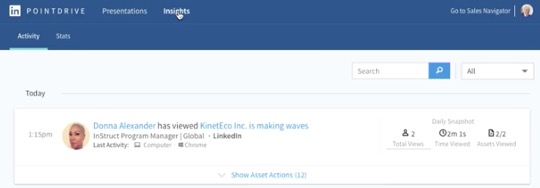
Rather than sending a busy, complex email full of attachments that might never get seen, use PointDrive, a relatively new tool within LinkedIn Sales Navigator that enables you to easily deliver personalized content to sales prospects. It’s simple to bundle up materials in PointDrive and share links to that bundle through any electronic communication channel: real-time chat, InMail, and more.

You and others on your team can view PointDrive to see what you’re sharing, and you can even track how the content is consumed and by whom. Plus, since recipients log in via LinkedIn or provide their name and email, you’ll see when someone has shared your content with others on the buying committee. Once you identify which content is gaining traction, you can share successful PointDrives with others in your organization so everyone is using the most effective packages.

To learn more about this tool and how it works, check out this PointDrive customer case study.

For more steps you can take each day to optimize your sales approach, check out our LinkedIn Selling Tactical Plan.

30 Mar 16:46

Insight Selling: The 8-Slide Framework for a Better Pitch

by Bsignorelli@hubspot.com (Brian Signorelli)

I recently interviewed global sales expert Matt Dixon, co-author of “The Challenger Sale” and “The Challenger Customer,” and he shared his predictions on what’s next in sales. His thoughts? There’s an evolution happening on the front line of sales today, and it starts with insight selling.

The Three “Ghosts” of Sales

Let’s look at where sales has been and where it’s headed.

The Ghost of Sales Past: Alligator Selling

Before buyers were empowered with instant access to information on the internet, most sales reps could get away with simply pitching product features and benefits and having the prospect believe them. It was hard for buyers to compare alternatives or even know if what the rep was saying was right.

All salespeople had to do was “show up and throw up” their pitch to meet quota. This approach was also known as “alligator selling,” because the salesperson had a big mouth and little ears (i.e., all talking and no listening).

The Ghost of Sales Present: Solution Selling

It took a while for the broader market -- at least, in the world of complex B2B sales -- to adopt this framework, but solution-selling rose in popularity during the 1980’s and still enjoys widespread adoption today.

At its core lies the concept of asking big, open-ended questions to understand customer needs before crafting a potential solution.

For example, if you ask questions like, “What keeps you up at night?” “What are your top three priorities for the year?” or “What are the biggest challenges you’re facing right now, and how did those arise?” you’re a solution-seller.

This is how 60-70% of sales reps sell, today. It’s a solid sales method, but it’s becoming less effective due to oversaturation and information overload.

Oversaturation comes from too many reps using solution-based selling. And information overload is a side effect of the internet and the buyer’s access to much of what the seller traditionally pitched.

The bottom 10-20% of salespeople still take the show-up-and-throw-up approach to selling. You’ll find this in commodity-based industries or in situations requiring low-complexity sales (i.e., reps selling insurance or home-security systems).

But there’s a new group emerging: the top 10% of today’s salespeople taking a different approach -- insight selling.

The Ghost of Sales Future: Insight Selling

“Insight selling,” as Dixon refers to it, is rarely seen by today’s buyers. So, what does it mean, and why is it important? I’m glad you asked.

What is Insight Selling?

Insights are accurate understandings of a person or thing. In sales, they’re gathered through research, experience, and data and used to forge a deeper relationship with a prospective client. Insight selling is the act of using insights to move the deal forward by speaking directly to prospect needs in a way that traditional sales techniques cannot.

Insight selling begins with two ideas. First, that buyers don’t just want sales reps to ask them big, open-ended questions. And second, that content marketing has officially overwhelmed modern buyers.

If you believe these two points, or have experienced that reality yourself, here’s what you should understand. Today’s buyer needs you to add value beyond the research they can conduct on their own.

When to Switch to Insight Selling

If you’re reading this and nodding your head, here are a few ways to assess if it’s time for a change.

1. Your buyers are telling you they’re frustrated with your sales process.

This is an obvious one, but if your buyers are frustrated with open-ended questions, it’s time for a change. That doesn’t mean asking open-ended questions is never appropriate. They’re the backbone of well-run sales discovery process; But, open-ended questions without insight will lead you nowhere and, ultimately, frustrate prospective customers.

2. You run a reactive, solution-oriented sales process.

Again, I’m not suggesting asking open-ended questions is wrong. I’m simply stating they’re insufficient for the modern buyer and don’t create unique value.

So, instead of waiting to tie your solution to something your prospect says, lead with, “Most business leaders like you that I speak with are worried about -- [Thing 1, thing 2, thing 3]. And the best companies I speak with are doing [X, Y, and Z] about it. How are you approaching this challenge?

3. Your company presentations sound like this ...

  • Slide 1: “Here are all of the great stats about our company. We have X,000 customers, we generate $Y million revenue, this is our ticker symbol on [NASDAQ, NYSE, etc.], and here are our investors …
  • Slide 2: “Here’s our global reach. We have X,000 customers represented across Y # of countries, and have offices in Z # regions in the world.
  • Slide 3: “Here are all the flagship companies we work with. Isn’t it great we work with these giant businesses? Why aren’t you one of them?
  • Slide 4: “You might not have heard of our company, but you’ll recognize our products.
  • Slide 5: “We’re the leading global solutions provider of [Whatever you sell].

While these statements might be important to your company, they're missing a big part of what makes insight selling effective: why your solution matters form the buyer's perspective. 

Real empathy and real perception drive success in sales conversations, and they're two sides of the same coin when it comes to insight selling plays. 

Types of Insight Selling

We live in the age of information and the empowered buyer. Everything your prospect wants to know about you, your company, and your products and services is available with just a few keystrokes. If you can’t bring information or insight to your buyer they can’t find on their own, they have no reason to speak with you.

To get the most out of insight selling, understand that it manifests in two ways: 

  • Interaction Insight - Insight selling can manifest in the interactions you have as you connect with prospects, have meaningful conversations about their pains and problems, and encourage a solution by inspiring change.
  • Opportunity Insight - Insight selling also goes beyond conversations with prospects who have a demonstrated interest. In fact, some of your prospects may not even realize they have a need, so the opportunity arises to create that awareness.

Expert sales reps will be able to discern when a prospect is warm, needing an interaction insight approach, but also when a prospect is not a good fit vs. needing a deeper opportunity insight approach.

You might be thinking, “Obviously, I know that. We do that already.” But, ask yourself, “How?” The sales world talks about adding value, but no one explains exactly how to do it. 

Insight Selling Resources and Tips

Here are a few ideas from my conversation with Dixon that will help you as you implement the insight selling methodology in your strategy.

1. Recognize that your insights make you a valuable salesperson.

First, recognize the most valuable thing you bring to the table is your unique position. For example, if you sell to 100 chief information officers (CIOs) every year, you sit in the center of the CIO ecosystem.

Through speaking with so many CIOs, you’ve likely developed a unique perspective and understanding of the challenges they face and how the very best CIOs are solving their problems today.

That’s the unique value you bring to the table for all your buyers. What you learn through speaking to so many CIOs is the very thing none of those CIOs has done.

2. Take action by communicating your insights clearly.

You have proprietary information that’s highly valuable to your buyers. And, you can explain not just what other CIOs are doing to solve their problems, but where they’re falling short and how they’re moving forward.

That’s the “insight” in insight selling. But, just realizing you have this insight isn’t enough. Reps must be able to communicate these insights clearly, through stories to their buyers. Here’s how I told “stories,” when I worked as a research analyst.

3. Use the Insight Selling Slide Framework.

I used a framework called “The Lift,” to communicate management challenges CEOs, heads of sales, heads of marketing, and more were facing. At the highest level, The Lift was a series of slides that flowed like this:

  • Slide 1:The current state of the world is [Mega-trend 1, 2, 3, etc. ...]
  • Slide 2:[Mega-trend] makes life challenging for business leaders like you because … [Implication 1, 2, 3]
  • Slide 3:... and this is only going to get harder in the future, because …
  • Slide 4:Today, the way most companies try to solve [Challenge/mega-trend] is… [‘Hire more people,’ ‘Spend more money, etc. …’].
  • Slide 5:... and here are the results most companies get [Mediocre results].
  • Slide 6:... but, there’s a small group of [Companies/business leaders] doing things differently ...
  • Slide 7:... and these are the results they’re getting [... should be far better than what the middle of the road company is getting in slide number five] ...
  • Slide 8:Here’s how it works … [this is where discuss your company’s solution/service/product].

Want to see the eight-slide framework in action? Here’s an example from Zuora.

4. Underscore their road blocks to success. 

As you learned, insight selling doesn't stop at your interactions; you also have to cultivate opportunities. This requires a deep understanding of their goals and strategies... as well as the strategic initiatives they must take. 

It also means you must encourage prospects to think in a way that's outcome-oriented. If you can demonstrate where they are vs. where they should be, you can then begin to build the bridge between those points with your solution.

They may be known road blocks or blind spots, but as soon as the prospect is on the same page as you, the conversation gets much easier.

Remember, the simple fact you sit at the center of hundreds of conversations with your buyers’ peers gives you unparalleled information and insight.

That’s your unique value. The only question is whether you’re listening to what buyers are saying and what you’re going to do with that information.

Editor's note: This post was originally published in March 2018 and has been updated for comprehensiveness.

30 Mar 16:45

The Stages of Purchasing and Implementing a Sales Enablement Solution

by Matt Ellis

The decision to purchase a sales enablement platform is not one that should be made lightly. It’s not like you’re buying gum here, you can’t just waltz in and select whatever catches your fancy at that particular moment. Unless you’re the kind of person with very exacting gum standards, then that analogy kind of falls apart for you, but you get the point.

It’s no secret that a sales enablement solution has the power to radically transform an organization. Organizations that have implemented a sales enablement solution have seen a 350% increase in content usage, 275% boost in conversions, and 65% more revenue generated by new reps. Additionally, Aberdeen has found that organizations with a sales enablement platform experience a 13.7% annual increase in deal size.

Because of the way a sales enablement solution radically alters organizations’ sales and marketing teams, the buying and implementing process is a very thorough one. You can think of the process as having two distinct halves. First, the buying process. Then, the implementation process. Each of those processes has its own unique requirement and challenges.

You’re probably thinking to yourself, Wow that sounds like a lot of work! Sure is, bucko. But you don’t go around reading sales enablement blogs because you’re someone who doesn’t care about their job or improving their organization. And lucky for you, because you’re the type of person who reads sales enablement blogs, you’ve come to the exact right place to learn the steps for purchasing and implementing a sales enablement solution.

Well, not the exact right place because this is just a blog and you don’t go around giving everything away for free on a blog. You’re going to have to download our full Buyer’s Guide and Implementation Guide to get all the real secrets. But we’re generous folk here so below we’re going to outline the main steps you will be going through during both purchasing and implementation.

Buying a Sales Enablement Solution

The stages of purchasing a sales enablement platform are broken down into phases and they are as follows:

  • Determine Your Readiness for a Sales Enablement Platform
  • Build Your Team and Set Your Goals
  • Research the Vendor Landscape
  • Create a Shortlist of Vendors
  • Issue a Formal RFP
  • Build Your Business Case

Contained within those stages are additional steps that will be necessary to take before you purchase. Make sure you read the full guide to get a clear understanding of each phase.

Implementing a Sales Enablement Solution

There are three core pillars of implementing a sales enablement platform and they are:

  • Discovery
  • Strategy
  • Deployment

Does all of that feel like a tantalizing tease? Do you wish there was more information to consume? Well golly, how about that, we just happen to have a couple of whole guides dedicated to these very subjects. So if you’re interested in learning more about buying and implementing a sales enablement solution go ahead and click the shiny picture below to have all of your wildest dreams come true. (Please note that only if your wildest dreams contain sales enablement solutions will they come true.)

30 Mar 16:38

Tummy Tech Tracks Electrical Activity for Signs of Indigestion

by Elie Dolgin
Wearable stomach monitor could help salvage a technology largely abandoned by gastroenterologists
Photo: University of California San Diego

A new wearable device that non-invasively monitors electrical activity in the stomach could help people with digestive problems determine with greater precision whether treatments or diets are working.

If clinically validated, the stomach sensor could also help revive a medical technology called electrogastrography (EGG) that once piqued gastroenterologists’ interest, but has largely fallen out of favor owing to controversy surrounding its diagnostic relevance.

“It’s promising technology,” says Thomas Abell, a gastroenterologist who routinely uses EGG at the University of Louisville but was not involved in the new study. “This might prove to be a clinically useful tool that people accept.”

EGG works much like an electrocardiogram, except instead of recording electrical activity of the heart it picks up electrical signals that travel through stomach muscles to control gastric contractions.

The method is designed to test whether so-called slow waves originating from pacemaker cells of the stomach are oscillating at a healthy 3 cycles per minute. But the signals detected by adhesive electrodes on the skin are often weak and muddied by artifacts of stomach movement.

The technique had a brief clinical heyday in the 1990s, but the world ’s  gastroenterologists have since largely abandoned it. “I view it as the Rodney Dangerfield of GI motility,” says Abell. “It gets no respect.” 3CPM, one of the only companies with an EGG system still on the market today, sold fewer than 10 units per year in the late-2000s, according to company CEO Mark Noar (although he notes that sales have picked up again, with 45 of the $25,000 machines purchased by customers around the world in 2017).

Todd Coleman and Armen Gharibans, bioengineers from the University of California, San Diego, set out to fix what they saw as pitfalls in the gastric gauging technology. First, they upped the number of channel recordings from the single waveform found in conventional EGGs like those sold by 3CPM to a whopping 25 data-collecting channels. They also created a smaller version with just eight channels to enable mobile recordings on the go.

The researchers next optimized the electrode placement, arranging the dime-sized cups in a grid below the sternum and over the bellybutton. And most importantly perhaps, they developed an algorithm that removes electrical noise (originating from external motion) from the true slow-wave signal associated with internal stomach muscle movements. The algorithm also weights the cleaned-up signals from each electrode to emphasize those relaying the most physiologically relevant readouts.

Coleman and Gharibans teamed up with their UCSD colleague Hayat Mousa, a pediatric gastroenterologist at Rady Children's Hospital-San Diego, to test the device on 11 kids, aged 7 to 17, each of whom had chronic stomach problems. They affixed their “high-resolution” EGG set-up to each child, while simultaneously administering a more invasive diagnostic procedure called manometry, in which a catheter containing pressure transducers is passed through the nose or mouth to measure contractions at the base of the stomach.

As reported last week in the journal Scientific Reports , the results of the two tests were significantly correlated for each and every youngster evaluated. By comparison, conventional one-channel EGG recordings without the signal-to-noise filtering matched the manometry readings in only three of the 11 study subjects.

“That’s a notable finding,” says David Levinthal, director of the Neurogastroenterology and Motility Center at the University of Pittsburgh. “This is clearly better than what we had before.”

Still, that doesn’t necessarily make the test clinically meaningful.

For one thing, the results indicate that high-res EGG can capture about one-third of the variation in stomach contractions, as measured by manometry—which still leaves the bulk of what’s causing those contractions unexplained.

Plus, the many channels that feed into the EGG setup are  mainly  used to find the best signal of electrical activity, not the spatial arrangement. That may be valuable for knowing if the frequency of slow wave rhythms is faster or slower  than the normal 3 cycles per minute, says  Aydin Farajidavar, a biomedical engineer at New York Institute of Technology, “but it doesn’t tell us anything about the pattern distribution of slow wave propagation.”

Moreover, “the stomach is not just a tube that has this wave of contraction going from the esophagus down to the duodenum,” notes Levinthal. “It is a regionally specialized capacitance organ and a mixer and a grinder”—all activities that could be independently disrupted in various stomach diseases.

That leads some critics to dismiss the idea that EGG—even newer and improved EGG methods—will ever have diagnostic value. “Spontaneous EGG by itself has objective physiological limitations that render it unreliable, no matter what,” says Martin Mintchev, a biomedical engineer at the University of Calgary.

Levinthal, however, is keeping an open mind: “It’s worth entertaining the idea that there could be electrical signatures of different disorders,” he says.

Coleman and Gharibans hope to win over skeptics with further experimental data. Already, in collaboration with UCSD gastroenterologist David Kunkel, they’ve tested their prototype on around 25 adults with digestive disorders at the university’s Jacobs Medical Center, and found in as-yet unpublished work that the electrical signals sync with problems such as abdominal pain, heartburn, and bloating. “It actually does correlate with symptom severity,” Coleman says.

Coleman stomach wearable system with app
Photo: University of California San Diego
The stomach sensor syncs with an app to pair internal electrical signals with meals, bowel movements, and other gastrointestinal events.

Meanwhile, as the hospital-based tests were going on, Gharibans was also hard at work developing an app for keeping tabs on meals, snacks, bowel movements, nausea, vomiting, or any other events of gastrointestinal interest. He also filled a drab-gray, 3D-printed plastic box with an accelerometer, lithium polymer battery, microSD card, and circuit board to record movement patterns and gastric electrical signals from the comfort of his home.

On eight non-consecutive days over the span of about six months, Gharibans strapped the minidisc player–sized device to his own belly for 24-hour-long recording sessions. “You don’t even really notice it too much,” he says. “As long as you don’t sleep on your stomach, it’s fine.”

Gharibans’ measurements revealed how daily activities like sleep, meals, and exercise all impacted the electrical signals in his stomach. He and Coleman now hope to get the portable device into the hands—or onto the bellies—of more patients for at-home monitoring of stomach ailments. Their vision is for people with perpetual stomach issues to wear the high-res EGG and then track in real-time, in a quantitative and objective way, whether any changes in diet or medications are bringing about gastrointestinal relief. “That’s the potential,” Coleman says.

One of the first people (other than Gharibans) to have given the device a try is Dana Lewis, founder of the Open Artificial Pancreas System project, an effort among DIYers with type 1 diabetes to create their own open-source technologies for automating blood-sugar management.

Most evenings, for the past few weeks, Lewis has taken a shower and then stuck a dozen pieces of medical adhesive to her abdomen. One is for her insulin pump, another for her glucose monitor—the two devices needed for Lewis to control her diabetes. The other 10 hold the electrodes for the UCSD team’s high-res EGG.

Lewis hopes the data she gathers about her own stomach movements following different types of meals, when matched to her blood-sugar levels, will help her improve the algorithm behind her closed-loop insulin dosing system.

“Having this picture of stomach activity and digestion will help clear away some of the noise,” she says. “Hopefully we can adapt what we’re doing to match what’s actually happening inside the body.”

30 Mar 16:38

Top 5 CRM Platforms for Growing Businesses

by Tyler Keenan

We recently took a look at CRM platforms and how they can give businesses actionable insights based on their customer data. In this post, we break down five of the best CRM tools out there for growing businesses.

Features to look for

There’s a lot of variety in the CRM industry. What started out as a set of tools to help sales teams manage their deal pipelines has grown into a robust suite of tools that many marketing and customer support teams consider indispensable.

Also be aware that, as with many industries, machine learning and artificial intelligence have begun to transform the CRM industry. The most advanced options (like Zoho and Salesforce) have invested heavily in AI assistants who can use the data gathered by their respective CRM systems to automate certain processes and generate recommendations for users.

Before you spring for a platform, make sure you’ve gone over their features carefully and matched them against your business needs. Also, be sure to take advantage of free trial periods — if your team is small enough or your needs basic enough, you might even be able to get away without paying for anything.

Below, we round up five of our favorite CRM platforms, taking a brief look at their feature sets and price points.

Zoho CRM

Part of Zoho’s big suite of office solutions, Zoho CRM is one of the best budget options around, no matter what kind of team you’ve got. It’s free for up to three users, which can make it especially appealing to smaller sales teams that are just starting out.

At the free level, you’ll get basic sales lead, contact, and account management, but to access any of the cool features — forecasting, marketing automation, etc. — you’ll need to upgrade to one of the paid tiers. Fortunately, the Standard and Professional tiers are only $15 and $20/user per month when billed annually, and both these tiers give you access to some pretty advanced features at a lower price point than many competitors.

At the Enterprise level and above, you’ll get access to Zoho’s Zia AI. Zia helps salespeople identify anomalies and predict which deals are likely to close in the next 30 days so salespeople can target their efforts more efficiently.

Salesforce Sales Cloud

Salesforce’s CRM platform is the big gun in the CRM world. As one of the oldest and most mature platforms, it comes with a slew of advanced features, including AI via Salesforce’s Einstein Analytics, report history tracking, and territory management, though these are only available at the higher tiers.

In addition to its robust feature set, Salesforce brings a level of customizability that other CRM platforms don’t generally offer. This makes it easy to tailor your dashboard to your role, whether you’re a sales rep, manager, or business owner. You can even create and maintain different dashboards for different use cases and data sets. Salesforce’s market standing also means that it can integrate with pretty much any other business system out there, including the rest of Salesforce’s suite of SaaS products.

All this functionality and customizability comes at a price, however. The Lightning Enterprise plan, which goes for $150/user per month gives you the AI forecasting and workflow automation features that are lacking at the lower tiers.

Apptivo CRM

Nearly as customizable as Salesforce, but priced more like Zoho, Apptivo is a good, feature-rich CRM platform for growing businesses. At $8/user per month when billed annually, Apptivo also offers some of the best bang for your buck.

Apptivo takes a modular approach to set up, prompting users to add or integrate apps depending on their role and needs. It integrates with G Suite, Office 365, Slack, and a host of other services. The result is that, with a little upfront effort, you get a platform that feels tailored to your team’s needs.

Apptivo’s lowest paid tier you also get access to several features that are generally only available at the professional and enterprise levels of other platforms, including marketing automation, campaigns, custom reports, and APIs. Higher tiers also give you access to greater storage and email sending limits, as well as win/loss/lead analysis and territory management.

Hubspot CRM

The first thing you’ll notice about Hubspot CRM is that, like Zoho CRM, it’s free at the most basic level. The difference is that Hubspot CRM doesn’t limit the number of users you can add at the free tier. This can make it appealing to teams on a tight budget.

With the free version, you still get unlimited accounts and up to one million contacts, deals, and tasks. You’ll also get a clean, basic dashboard, automatic contact logging, and a limited amount of calling, Snippets (basically boilerplate email or chat responses), and notifications. Paid versions lift some of those caps and also add workflow management, lead scoring, email automation, and more, starting at $50/user per month. Be warned, though, beyond the Starter tier plans can get rather pricey.

Hubspot CRM integrates with the rest of Hubspot’s suite, as you would expect, but it also integrates with Twilio, Gmail, Outlook, and Office 365.

Insightly

In contrast to some of the other platforms named here, Insightly offers a somewhat more limited feature set geared toward sales contact management. Where it distinguishes itself is with its ease of use, which can make it appealing for teams who are new to CRM.

Insightly is built around pipelines and Activities, which help automate some of the more tedious tasks associated with managing leads and projects. At the Plus tier ($29/user per month, billed annually) you get access to all the workflows and reporting tools available, as well as Oauth Single Sign-On, a feature not generally available at this price level for other platforms.

Looking for more tips on building long-term, profitable relationships with your customers and users? Check out our explainer “Understanding the Customer Lifecycle.”

30 Mar 16:38

Lessons from IFA: How Call Tracking Helps Franchises Drive Growth

by Christie Huber

We recently had the opportunity to attend the IFA (International Franchise Association) national conference in sunny Phoenix, AZ. If you’re a franchisee or franchisor, this is a can’t miss event that covers the latest news and best practices in the world of franchising. At the conference, we learned a great deal about the challenges franchisees and franchisors face everyday in terms of marketing. One of the biggest obstacles we heard mentioned frequently was the ability to prove marketing ROI. There are several ways franchisees and franchisors can measure and improve their marketing success, but for franchises that want inbound phone calls, one key way that shouldn’t be ignored is call tracking.

Franchising and call tracking should go hand in hand since it is one of the best ways to understand which marketing efforts are driving the most business to each location. Thanks to the rise in smartphone adoption and mobile search, franchise locations across the US are getting billions of calls each month. And those calls convert to revenue 10 times more than web leads. If you can’t track phone leads back to their source to see what’s working, your marketing and sales will suffer.

That’s where call tracking comes in. Call tracking — also know as call analytics or call attribution — is a marketing analytics technology that enables businesses to see exactly how their digital advertising, offline marketing, and website drive inbound calls, what happens on those calls, and if they convert to appointments or customers. Armed with this data and understanding of the call channel, you can leverage insights from conversations to measure and optimize your marketing strategies, as well as monitor and improve the way franchisees handle inbound calls.

Below are three call tracking strategies franchisors and franchisees can use to measure and drive more calls and customers and improve the ROI of your national marketing funds.

1. Understand How Every Marketing Channel Drives Calls

Considering approximately one out of every 12 businesses in the US is a franchise business, it is clear that franchise businesses play a significant role in the US economy. Given the large number of locations most franchises have, it is imperative to be able to track calls to each one. With call tracking technology, franchises can gain insight into which marketing source or campaign is driving the most calls and customers. Using powerful user- and keyword-level tracking for calls, you can attribute calls from individual search, social, display, email, direct mail, TV, or radio marketing campaigns. Having this data allows franchisors to prove and improve how online and offline marketing drives quality phone leads to each franchisee. You can also use it to monitor how each franchisee handles the calls your marketing generates.

2. Create Franchisee-Based Reporting to Prove Marketing ROI

Having numerous regional or even national locations, it’s important for franchisors and franchisees to see how many inbound calls each location is receiving. Furthermore, it’s valuable to understand how these calls are converting to sales leads and how this varies from location to location. With a customized reporting dashboard, you can view real-time call data alongside all other marketing data and sort based on franchisee location, franchise group, geography, and more. Streamlined reporting allows marketers to easily visualize metrics that can be used to make better marketing decisions moving forward.

Dashboard Insights

3. Leverage AI to Efficiently Score Calls and Optimize Marketing

Using call tracking and analytics data we covered in the first strategy, you can gain crucial marketing insights into what is driving the most calls, but understanding what happens on those calls and if they are quality leads is important to proving and improve ROI. Many franchises receive thousands (or even hundreds of thousands) of inbound calls each week across their locations. Insights from these voice interactions can be used to improve marketing and sales performance. For example, if you know that key purchasing indicators — such as “appointment discussed,” “quote made,” or “repeat caller” were identified on a call, you can see the marketing tactics that drove these calls and optimize accordingly. Manually analyzing inbound calls for this data would require listening to hours of call recordings, and that is simply not realistic. However, there are solutions that use AI to analyze calls to score caller intent, lead quality, and sales performance for insights to improve marketing and sales. The below example shows how one national franchise, Comfort Keepers, uses AI to examine calls to their franchise locations and prove marketing ROI to franchisees.

Comfort Keepers Uses DialogTechs AI to Analyze Call Conversations

With call tracking technology that includes conversation analytics and AI, franchises gain insight into exactly how their marketing is driving calls and customers. Franchisors can show franchisees how many quality calls they’ve driven to them, and they can better optimize their national marketing to drive more good calls. If you’re a marketer at a national franchise looking to better prioritize your marketing spend and deliver better leads to each franchisee, adopting a call tracking and analytics solution is the answer.

30 Mar 16:37

The Cost and Cures for Inside Sales Turnover

by Sabrina Ferraioli

The Cost and Cures for Inside Sales Turnover

In my last post, The Causes and Ramifications of Your Inside Sales Turnover Problem, I outlined why so many companies are facing constant churn among their phone agents. The issue is driven by the challenging nature of the job, the rush to hire and fill positions quickly and the intense competition for qualified personnel. Given the lengthy time to hire a new rep and bring them up to speed (from nine months to well over a year), it’s a costly problem.

But have you ever considered how this issue impacts your bottom line? Have you had the time to slow down and think about new ways to solve it?

If not, read on.

First, let’s look at the two types of costs related to inside sales turnover. One is the direct cost of filling vacancies, and the other is the cost of having vacancies.

  • The Cost of Filling Vacancies

    If you need a phone rep you have to get the word out, sort through resumes, spend time prequalifying candidates on the phone and schedule and conduct interviews with hiring managers. Once you whittle down the list of potential hires, you have to do reference checks and make offers. At any time during the process, you run the risk of losing a top applicant to another company and all the energy you put into getting that far. All this activity consumes many hours of time for both human resources staff and the sales and marketing team.

    Once you finally hire someone, they may be skilled and experienced, but they do not know your product line or the inner workings of your company. It will take more time for your associates to help move them along the learning curve so they can successfully sell your solution, using your unique processes and systems.

  • The Cost of Having Vacancies

    When you have vacant inside sales positions, your sales engine works inefficiently. In some regions, it may come to a complete halt as there could be no one to follow up on leads. Since speed is of the essence when it comes to lead response time, it’s likely that affected leads will go stale. Thus, all the time, effort and money you have plowed into lead generation goes to waste. Even once you fill positions, reps will initially be inexperienced, and your conversion rate will likely slip.

    New marketing campaigns may also be in jeopardy. Your marketers cannot initiate them if they do not have salespeople to follow up.

    Finally, if your phone agents support field salespeople, your road warriors are likely to have difficulty reaching their sales goals.

    The result of all these issues is that inside sales vacancies make it almost impossible to reach revenue targets.

While it may be difficult for you to quantify all the costs above, experts estimate sales turnover costs companies between 150 and 200 percent of an employee’s annual salary.

Given that inside sales people average less than one and a half years in a position, turnover costs essentially double your outlay for each rep on your staff.

What’s the Answer?

The definition of insanity is doing the same thing again and again and expecting different results. So some businesses are trying a different approach.

Let’s consider your goals. You want to make sure your sales engine keeps humming along, minimize hiring and training costs as well as the time to get reps up to speed. You can accomplish all of these by contracting part or all of your call center needs to a B2B telemarketing company.

  • Shore Up Some Language Skills

    If you only have one or two reps who speak a given language, losing them can be extremely disruptive to your business. So you have a lot to gain by outsourcing the need for reps with unique language skills. That’s because an established international telemarketing firm will have a larger pool of reps able to converse in each language.
  • Co-Source a Variety of Reps

    You may want to diversify risk by handling some of your inside sales needs in-house and the remainder at a B2B telemarketing firm. The beauty of this solution is while you wouldn’t have all your eggs in one basket, you also retain the ability to work with reps on-site. When a vacancy occurs, you can ensure your sales operations continue to run smoothly by requesting that your partner assigns another rep to your business.
  • Obtain Inside Sales Insurance

    3D2B’s inside sales insurance program ensures you always have a pool of reps on standby who are trained and ready to handle your campaigns and projects within a couple of days’ notice.

    How does it work? You sign a contract and pay a monthly fee. 3D2B allocates management and agents to your business; they will spend time every month in training and sales meetings related to your business. This enables them to learn about your solutions, campaigns, organization and more, so they can step in for you rapidly if you ever lose a rep.

30 Mar 16:37

How to Use Marketing Automation to Engage Past Clients Effectively

by Jaime Nacach

How to Use Marketing Automation to Engage Past Clients Effectively

Make Your Customer Fall Back in Love with Your Brand

When it comes to engaging past clients, there are all sorts of metrics to measure, whether it be page views, time on site, or email open rates. But if we take away all the marketing mumbo-jumbo, what is customer engagement and why does it matter?

Customer engagement is the strongest indicator of a customer’s feelings about your brand. That’s right, we’re investing all this time and money into trying to improve something so that the client can be happy, and as a result, choose to do business with your company.

If you’ve tried your possible best to win past clients over, I’ll show you the power of marketing technology and how to use it to drive an effective email follow-up campaign.

Encourage them to join the community

When a customer stops using your service, thank them for their time as your customer. But you don’t have to lose this customer forever. You still need to keep in touch with them because they could still need your product in the future.

Apologize to a customer who is hurt and has chosen to go elsewhere. Offer them a feedback form and kindly ask them to tell you why they are unhappy and what you can do to improve your service.

According to a research, 77% of consumers want brands to demonstrate their appreciation. One other thing you need to do is invite them to join your community.

build a strong brand community

For someone who has decided to stop using your product, it can be a bit tricky to invite them to your community. However, they will join your community if you can convince them of the enormous benefits you have in store for them.

If you offer benefits like discounts, educational content, free shipping, loyalty programs, etc., your past customer will be more open to joining your community as they can see the benefit in it. Having a past customer join your community is a great way to build up engagement with them.

According to Rosetta Consulting Study, highly-engaged customers buy 90% more often and spend 60% more per transaction.

DeviantArt is a good example of a social media community. It’s held steady as the largest online art community for 15 years. The forum alone boasts of at least 34 million engaged members who have submitted not less than 300 million original artworks. User comment on original artworks, share it, and make suggestions.

deviant art social media community

Segment readers to reduce low open rates

How do you show a past customer that you really care about them? By showing how much you care about them. Essentially, you have to send the right message that’s personalized to them.

According to Campaign Monitor, emails with personalized subject lines are 26% more likely to be opened. A study by Aberdeen shows that personalized email messages improve click-through rates by an average of 14% and conversions by 10%.

When you use automated marketing software, you can tell how a past customer interacted with your products. But have you used this information to follow up with your customer? It is easier to send a blast email to your past customers but it is better to send targeted emails to each former buyer.

You can achieve this by segmenting your past customers based on their interactions with your campaigns. Personalized emails have an 18.1% open rate compared to 13.1% for non-personalized emails.

And the beauty of a personalized email is that your client may decide to do business with you again because you’re sending them emails based on what they care about — their interests.

With a growing customer audience, Diamond Candles decided to send personalized emails based on user behavior. As a result, Diamond Candles increased their revenue by 160%.

personalized emails grow customer data base

For instance, if you have a past customer who has been buying mostly suspense novels from your ecommerce store, you need to send them emails based on this.

Because such a customer is more likely to buy again from you if you send them offers of new and popular suspense novels or even better, novels from their favorite authors.

This is a no-brainer. You’re sending an email that is personalized to the customer and relevant based on their past interactions with your business. They are more likely to open these emails and you’re more likely to establish good communication with them. Which could be the gateway to making more sales.

Pair requests with rewards to build a positive feedback loop

Who doesn’t like rewards? Especially from a company you’ve been doing business with? Customers are the foundation of a business. Loyal and happy customers are the foundation of a great and profitable business.

According to Yotpo, 18.5% more customers will review your product when you pair it with reward.

For customers who are loyal, rewarding them will make them happier and even more likely to buy from you in the future. But you can even get more when you give rewards to your loyal customers.

customer loyalty reward program

Rewards and incentives like coupon and special offers can be paired with a request for reviews, or survey, or other user-generated content. For instance, you can send a birthday coupon to a customer and ask them to fill a survey on how satisfied they are with your products. This has many advantages. First of all, the rewards lead to more sales.

More so, user-generated content has a lot of benefits for your business. Most customers trust user reviews more than your company’s beautifully-crafted sales copy. A positive review is social proof for your business and can convince more buyers to purchase your product.

But even when a past customer leaves a negative review, it is not all bad. You can learn a lot about what to improve your product.

Campus Protein created a loyalty program that includes rewards for more than just purchase. It gives 30 points to a customer who leaves a review. This is an encouragement to get more of your past customers engaged with your product.

rewards program past customer engagement

Use previous activity and purchase history to drive interactions

To have the best chance of following up with a past customer, you need to call on the insight you have from the data you have gathered about them. Data related to their previous transactions and behaviors.

Below is an example of Amazon driving interactions through the past purchase history and behavior.

amazon key success to generate sales

After all, the best way to predict the future is through the trajectory of past events. If you will stand a chance to have a better interaction with a past customer, then you have to review their past activities.

According to Bia Kelsey, 61% of SMBs report that more than half of their revenue comes from repeat customers, rather than new business.

Through marketing technology, it’s easy to achieve this without stress. Let’s say a customer bought some Sports Boots from you a month ago, this is an opportunity to ask them how good they feel about using their boots and if they have been achieving their fitness targets.

The best rule to having a great interaction with your customer, or anyone, is to get them involved! You can now have great conversations with your past customers built on their past transactions and their behavior to your business.

Identify an appropriate period for lapsed interaction

As much as you may want to follow up with your past customers, it is also important that you avoid being a pest as this can also have a negative effect on your interaction with your customers. 17% of sales people think they’re pushy whereas 50% of prospects think they are.

One of the ways to achieve a balance is being able to determine the right time to label an interaction “lapsed.” The purchasing cycle in your market is different from other markets.

For instance, if you run a service whereby clients have to renew their subscription to your service, their purchasing cycle will determine the regularity of your email interaction with them. The purchasing cycle of a car is different from a newspaper subscription.

CarDelMar, a German online car hire broker, decided to re-engage inactive subscribers. Subscribers were invited to choose one of three continents they’ll like to travel to. After they choose a continent, they’re shown a tourist attraction in the continent and asked to guess which city.

inactive subscribers email marketing

Through this series of emails, CarDelMar was able to reactivate 7% of all initially inactive subscribers. Their emails also got an open rate of up to 62%.

Conclusion

It takes anywhere from 5 to 25 times more to acquire a new customer than to keep a current customer. And being able to retain a customer is profitable for your business. According to Bain and Co, increasing customer retention by just 5% boosts profits by 25 to 95%.

If you have been busy spending a lot of money chasing new customers, then you have to look into your strategy again.

The real gold is in the customers who have already bought from you. When you use the right follow up emails, these customers will continue to buy from you because they are aware of your product and already have a level of trust in you from their previous purchases.

Marketing technology gives you a lot of useful information about your customers. Use the data wisely and you will have loyal customers who will continue to buy from in years to come — and will recommend your product to more people.

30 Mar 16:37

Five Things I Learned as an Early-stage Entrepreneur

by Götz Thümecke

Editor’s Note: This article first appeared on the Eventerprise blog here.

I was recently inspired by this post from Shuly Galili about her experiences as an early-stage investor and how she views early-stage businesses from the perspective of an investor.

I am currently in the trenches with an executive team that has over 80 years of combined experience in various fields, and whose members have been responsible for deals and budgets totalling hundreds of millions of US dollars. So I thought this would be a good time to share the insights of a company that was digitally born and has grown rapidly from the ground up.

Building an early-stage company is as demanding as it is exciting. There are many unexpected outcomes that require ongoing, agile problem-solving. When I co-founded Eventerprise with my partner Charlie Wright, who is a veteran of the events industry, we decided to take our combined knowledge and create something new, or in our words, to break something properly. This has been a challenging journey and a real test of character.

Here, are our five truths about things we got wrong, how we fixed them, and our journey over the past four years.

1. It’s all about the people

We learned that the only way to move this ship is through a combination of relevant skills, positive attitudes, and extreme resilience. The learning curve is so steep that it’s more rewarding than anything else I have previously done.

The selection of the right people is the result of tough but fair vetting. Vetting is only the first step though. Our entire team works at a manic pace, and we need new hires to be able to get up to speed as quickly as possible to ensure that they can match our pace. In order to get them up to speed, we team junior staff members with our senior team to ensure that they develop as fast as possible. The startup environment is not for everyone, and we realize that it’s unrealistic to expect everyone to love our baby like we do. Despite this, there are a few stand-out people in our team who have the Weltmeister gene, and will always have our back and support us.

What is the Weltmeister gene you ask? Weltmeister is German for “world champion”, and in short, it’s the built-in drive to become the best of the best, even if it takes years to get there. Take the German football (or soccer) team for example. Germany decided that they wanted to grow their team, and figured out that the best way to do this would be a long approach. So they filled the team with young talent and then spent the next ten years growing that team into world champions. It’s all about finding the right player, who still believes in Santa Claus, and can back up this belief with hard and honest work. We approach our team-building with the same long-term focus on becoming the best in the world.

It’s important to build relationships, manage and lead people to something better, and to absorb stress. All this must be balanced with the right amount of humility and assertiveness. We call this the Kind & Assertive leadership approach, and it’s all about action instead of talk.

2. Tech is eating up the world

While building our subscription-based digital platform we learned that tech is everywhere. From programmatic advertising to various productivity tools, we cannot do what we do without tech. We have been in this field for many years and one of the biggest challenges we face is that we regularly have to make quick decisions regarding the best configuration and assembly of our ecosystem. In order to do this, we needed to have deep digital insight and the ability to learn fast. We have made some mistakes along the way, but we have also made some great decisions which have kept us running.

We have chosen an advanced business environment comprised of eight different programming languages. This allows us to make the platform (we call it the car) scalable, mobile first, and as Google-friendly as possible. In addition, we have had to be very selective about who is allowed to drive the car.

3. Do the right thing at the right time

We learned the hard way that having to deal with limited resources means that we have had to say “No” far more often than we say “Yes”. At all times we focus on the “why”, and if the why is important then we can start to focus on the “how”.

To put these two in the right sequence is about making sure that we make the right calls at the right time. For us, early stage means that we are like a teenager: our confidence is growing, we’re getting a grip on our business model, and we’re developing a deeper problem-solving mentality. The trick here is to find the right balance between decision making and taking risks. We apply a 100% data-driven traction approach to understand which activity is driving impact, and then accelerate from there to build a solid, scalable operation that can service users across the globe.

4. Young Guns rule our world

Silicon Valley-based companies all have one huge downside – very competitive environment when it comes to talent acquisition. Because of this high demand for talent, salaries are ballooning in all areas of the startup ecosystem, there is a growing lack of loyalty, and job hopping is rife. This all leads to a dog-eat-dog culture. We realized early on that if we were going to build an internationally focused operation, we would need to avoid the Silicon Valley war for talent.

Our strategy is to work with talented, digitally-born students from all over the world. This system has worked so well for us that we have extended it to include a postgraduate program. Our recruitment vision at Eventerprise is to build a team with at least 50% Young Gun and PostGrad interns. What sets our internship program apart is that our Young Guns and Postgrads get fully involved in the actual running of the business, including the development, marketing, and sales of go-to-market products, giving them a real world experience not easily found elsewhere.

The great feedback we get from previous interns demonstrates the quality and power of our Young Gun and Postgrad programs:

“Lillie Gabreski, a fellow at the Cornell Institute for Public Affairs (CIPA), recently completed her PostGrad internship at Eventerprise as part of her Master of Public Administration degree programme. During her internship she helped conceptualise, develop, and execute Enterprise’s corporate social responsibility initiative, Africa’s Got Digital Talent, which focuses on international outreach to garner corporate, public, and non-profit sponsorships for talented African students who lack the resources to join unpaid internship programmes.

5. Hub & Spoke is the way to go

To ensure that we are cost-effective and scalable as a company, we thought long and hard about where we should execute specific elements of the company, to ensure that we would not encounter issues when growing. As a startup, funds are limited, so we cannot afford to enter into Silicon Valley style bidding wars for talent. However, technology is making the world a smaller and more accessible place. The net result is that we have sourced some of the best talent from around the world for a fraction of the cost. We currently have teams in Cape Town, London, Zurich, Berlin, San Francisco, Vadodara and Amsterdam. Of course, finding the right people was only the start. We had to think about the best way to manage these teams.

This is again where technology is allowing us to build our model and to come into the market with a global production blueprint. By using tools like Basecamp, we are able to monitor the work of everyone in the company from one central location, no matter where in the world they are based.

The post Five Things I Learned as an Early-stage Entrepreneur appeared first on OpenView Labs.

29 Mar 17:35

8 Marketing Tips For Aspiring B2B Marketers

by Maren Hogan

Engage With Your Readers

What does your audience want? Engagement, engagement, engagement. We’re seeing this more and more, especially in social media. In fact, 64% of marketers said that increasing audience engagement was crucial for their social media marketing strategy. And, how you engage matters. Don’t just throw content out – do your research and see what works. For example, Tweets with 1-2 hashtags get 21% higher engagement than those with none. Hashtags work. Use them.

–Stevie Howard, Content Strategist at Red Branch Media

Answer Questions Proactively and Use Long-Tail Search

To reach B2B leads, you have to start on Google, because 71% of B2B researchers will begin their research with a generic search, according to HubSpot. Unless you’ve invested in paid ads and third-party directory sites (Capterra, Software Advice, etc), it’s going to be difficult to break onto the first page of the SERP (search engine results page). It’s important to know when ranking for high-volume, primary keywords is realistic and when it’s a pipe dream.

However, just because you can’t rank for the primary keyword doesn’t mean you can’t rank for its long-tail variant. These long-tail variations of your primary keyword may not generate as much search volume, but they usually carry more qualified searchers looking to convert.

–Kylie Ora Lobell, Directive

Make Email Ethical Again

This might seem obvious, but if you’ve ever been the victim of an email barrage you can’t opt out of, you know there are still some shady marketers out there. The CAN-SPAM Act, passed in 2003, has some pretty clear guidelines on what you can and cannot send in your email marketing campaigns. Essentially, the guidelines say:

  • Don’t lie to recipients
  • Tell them who you are
  • Let them opt out of receiving your messages
  • You’re responsible for following the law even if you hire an email marketing agency

Seems pretty straightforward, right?

–Kendra Tallman, Email Marketing Strategist, Red Branch Media

Find Out the Channels That Work… And Those That Don’t

While, as a B2B marketer, your focus is likely on driving bottom-of-the funnel ”qualified” leads that are worthy of sales team follow-up, it’s also important for you to know what channels and content are driving prospects higher in the funnel. With a complex sales cycle, it can take six to eight touch points to generate a viable sales-ready lead.

Multi-Channel Funnel reports in Google Analytics are a great place to start to understand user behavior across various touch points in the funnel.

–Jessica Cameron, columnist at SearchEngineLand

Put a Little Fear in Their Hearts

Scarcity and urgency signify a limitation in the amount of some good or service. This limited availability can make people believe the product is valuable, which often triggers us to take action.

A study completed by Mailjet concluded that Britons are 39% more likely to engage with a brand if they push a message that aims to alleviate FOMO.

This happens frequently with travel booking companies. For instance, if you visit booking.com, you’ll notice there is typically a notification claiming there are only a few rooms left. You’ll also see a notification displaying how many people have booked in the last 24 hours. This creates a sense of urgency to book now before someone else beats you to it.

—Kaleb Vik, Email Marketing Strategist at Red Branch Media

Reuse Content And Promote It

While content and social media work really well together, if your content is on landing pages or a blog, most of your web traffic is likely to be coming via search (paid or organic), so integrating your strategies should be a key consideration.

For one of our B2B clients, 80% of their web traffic now comes from blog posts that are older than 3 months and, in a given month, 10-18% of the visitors to their landing pages via the blog sign up for more information (via a download or webinar). Of course, paid search marketing can be expensive, but even so, 58% of B2B marketers say they use SEM, in spite of the costs.

–Luke Brynley-Jones, Founder of Our Social Times

Speed Things Up With Templates

Imagine a world where well designed printable documents could be created by each of your content creators and your design department could focus on big picture projects like infographics, videos and, ya know, BIG PICTURES. If it’s copy heavy, there’s a good chance that designers are doing a lot of dragging and dropping anyways.

The Red Branch design team, decided to make this a reality by creating Google templates so our fellow departments can just plug-n-play. Google Drive is a young program and the templates are even younger, but it can still be quite the timesaver.

We have a bunch of templates for you to look through to offer a few examples to get started with. Not to mention that Google itself offers a fair amount templates of their own.

–Bach Mai, Design Associate at Red Branch Media

Be A Useful Resource

Note that you’re not just addressing the intersection of your company’s solution and customers’ needs. If your only helpful advice is, “Buy our product, here’s how it solves your problem,” you’re not really serving the audience.

B2B marketers frequently hear, “This content doesn’t address our product’s features, so it’s not relevant.” But anything that helps your potential buyer do his or her job better is acutely relevant. Helpful content builds brand recognition, establishes trust, and leads to loyalty when it’s time to make a purchase.

Joshua Nite, Top Rank Marketing Blog

29 Mar 17:35

How to Foolproof Your Demand Generation Plan: Dodge These 5 Common Pitfalls

by Hannah Swanson

Crafting a successful demand generation plan is never simple.

If it were easy, every B2B marketer would be driving remarkable full-funnel results.

The top game changers in B2B marketing are orchestrating complex demand generation strategies that span many different lead sources, marketing channels and targets. Not only are marketing programs challenged to scale their efforts, but they need to achieve balance as well.

If one aspect of your demand generation plan is off, you won’t see the results you want, even if the rest is pretty darn good.

Could you drive enough marketing-attributed deals without great content?

Can you hit your metrics if you’re using the wrong lead sources?

Unlikely.

At Integrate, we interact with a lot of B2B marketers, including well-known demand marketing pros like Maria Pergolino, CMO at Anaplan and Scott Fingerhut, WW VP Marketing Demand Generation at Elastic. We also engage with B2B marketers who are, by their own admission, struggling to transition to a full-funnel mindset and drive results.

These interactions have taught us that there are common pitfalls that plague virtually every B2B marketer who’s wielding a demand generation plan. If you think your peers are immune to any of these pitfalls, they aren’t. Avoiding these common pitfalls is a great first step in fool-proofing your demand generation campaigns.

5 Demand Generation Plan Pitfalls to Avoid

Pitfall #1: Insufficient Messaging Map

So, your content doesn’t attract the right leads or effectively nurture marketing-qualified leads (MQLs) into pipeline opportunities?

Chances are, you’ve run into the common pitfall of a nonexistent or insufficient messaging map:

  1. Maybe you have a content strategy, program objectives and buyer persona profiles but nothing to link these all together.
  2. It’s possible your content assets are abundant at the top of the marketing funnel, but weak in the middle or bottom.
  3. Perhaps you’ve never taken the time to connect your resources and key messages with each stage of your buyer’s journey.

If this is the case, you need a messaging map: a document that connects your key messages and content to relevant accounts, personas and buy stages. At minimum, it should address your awareness, consideration and decision phases, as well as the buyer’s pain points and priorities at each stage of the journey.

With a solid messaging map, B2B marketers can:

  • Create the right content to fill in missing assets and gaps
  • Repurpose and fine-tune existing assets to meet the needs of prospects and customers
  • Identify weaknesses and strengths in campaigns and content

Pitfall #2: Limited Marketing Channels

Are you using the right marketing channels to reach your target personas?

Most demand generation marketers in 2018 are using a combination of owned and paid efforts across both digital and non-digital channels to generate and nurture their leads. It’s pretty rare that we encounter a program not using a combination of social media, inbound marketing, digital, third-party lead gen and live events and more.

Here’s where most demand generation plans go wrong: B2B marketers lack oversight at the top of the marketing funnel.

There’s no shortage of sources for leads, but marketers can’t effectively see where their results are coming from or effectively compare channels, at least not without heavy, time-consuming data crunching.

If your business is anything like the average B2B marketing program in 2018, you can’t get away with just one channel. Even organizations in narrow verticals can’t typically fill their pipeline with only inbound marketing leads. Chances are, you need to rely on co-sponsored webinars, live events, email, third-party partnerships, paid search and probably even more.

However, to maximize performance, you also need a solution that provides visibility and automation at the top of the funnel, allowing you to manage a growing number of channels for lead generation and multi-channel, full-funnel campaigns. Only then can you avoid this all-too-common pitfall.

Pitfall #3: Top-Funnel Strategy Neglect

It’s hard to scale your demand generation plan when you’re weighed down by inefficiencies at the top of the funnel.

Demand generation marketers aren’t just marketing at the top of the funnel anymore. They’re responsible for marketing throughout the sales and customer lifecycle. All too often, B2B marketing programs recognize the need to spend more time on middle- and bottom-of-funnel strategies, but are weighed down by the time-consuming, complex nature of their top-of-funnel efforts.

What gives?

Best-of-class demand marketers use technology to create top of funnel automation. The right software automates campaign management, centralizes your data sources and integrates your top-of-funnel efforts with your middle- and bottom-of-funnel activities.

Pitfall #4: Ignoring Lead Quality

Do you know the true cost of a bad lead?

Integrate’s own big data analysis of 3.64 million B2B lead records revealed the cost is pretty significant:

  • 33%, or over 1.2 million records, contained duplicate data.
  • 10% contained some kind of invalid data, such as a non-working email address or incorrect values or ranges – that’s more than 376,000.
  • 45% qualified as non-actionable for a variety of reasons.

Looking beyond the obvious “ouch” factor of paying third-party sources for leads that won’t, or can’t, convert, imagine how many hours each month is wasted trying to manually standardize, deduplicate, validate, complete and upload these bad leads.

You can’t just dismiss third-party lead sources that provide you with occasional bad leads. Chances are, you also can’t afford to spend 20 more hours each month trying to manually populate missing leads before you upload leads to your marketing automation platform.

Demand marketers who manage to swerve safely around this pitfall typically turn to technology to solve this very common problem. Best-of-class organizations adopt software solutions to automate lead quality review and route new leads to the right sales reps or nurture tracks in real-time.

Pitfall #5: Lacking Adequate Performance Measurement

You can’t improve what you can’t measure.

Demand generation is an inherently data-informed approach to B2B marketing. Metrics are the grease for improvement, as well as effective alignment between marketing, sales and customer success teams. Marketers know the value of key performance indicators (KPIs) for demand generation such as funnel conversion rates, average deal size and cost per lead.

Demand generation marketers need tools for in-flight performance measurement and optimization. Your campaign budget goes a lot further toward boosting your marketing performance if you’re able to adjust campaign targets or content to meet the changing needs of your personas. Marketers also need technology that unifies the complex moving pieces in their demand generation strategy, enabling critical visibility into improving the failing pieces of diverse B2B marketing efforts.

Removing All Demand Generation Plan Success Barriers

The most effective B2B marketers aren’t necessarily superhuman, no matter what they may want you to think. In most cases, they’re simply smart about how and where they spend their time. Creating automation in your most time-consuming and error-prone processes enables you to spend more time on your demand generation plan. By spending less time coordinating spreadsheets and trying to wrangle poor-quality lead data, you can spend more time exceeding your B2B marketing metrics.

For a comprehensive, data-driven look at how your plan compares to the strategy at best-of-class B2B organizations, check out the free Integrate resource: B2B Demand Marketing Assessment Guide & Orchestration Workbook. It includes everything you need for objective insight into your program, including 12 customizable worksheets.

29 Mar 17:34

How to Handle an Email Response (Hint: Don’t Panic)

by Josh Slone

We always talk about needing to send follow-ups in your cold outreach. Sending 4-6 messages in a sequence maximizes your email response.

We spend a lot of time writing about sales emails that get responses.

That said, we’ve not covered how to react when someone actually responds to your email.

This post will remedy the problem. Here’s what we’ll cover.

  • Poor reactions you should avoid (using real life examples)
  • Proper reactions, including email response time etiquette
  • Professional response examples (and templates)

We’ll have a bit of fun along the way using the cult classic “Hitchhiker’s Guide to the Galaxy”.

Getting the Email Response is Exciting

You work hard, personalize the email to meet your lead and then hit send. All in hopes of 5 people in 100 hitting respond and emailing you back.

When your inbox has a fresh hot prospect — it’s exciting.

Here’s the thing.

Excitement can either fuel your enthusiasm, turn you into a nervous wreck or give you too much bravado. I hope to direct your thrill from getting a response properly. And to do this, we have to understand that sales is still tough — even when people seem interested.

You can call too quick, say the wrong thing or send some ugly canned email response.

“If you want to survive out here, you’ve got to know where your towel is.” — Ford Prefect

Poor Reactions You Should Avoid

Number One: Panicking

email response

(Image Source)

One of the easiest reactions for new reps and small business owners is to freak out when they see a lead respond.

There are a certain number of indicators of this behavior. They include:

  • Following up too frequently: Responding quickly is good. Responding multiple times in a day (or even a couple days) is bad.
  • Trying the same approach repeatedly: I know you want them on the phone, but if they don’t show interest after asking once or twice —know how to keep the ball rolling.
  • Troubling taboos: There are some things that you should not do. It’s hard to list all of them, but we have an example.

Here’s the (true) story.

Recently, we were sent a really good coldish email. It actually got a response from us. Things went south from there. I’m going to remove any identifying factors from the person or company and do a broad overview.

Here’s our initial response:

email response examples

Granted, I left it open to ask for the call. That’s ok, the rep should have (and did) ask to get on the phone with me. I then said that I’d rather see some content resources.

The rep didn’t seem to have any content (more on this further down), but did ask to get on the phone…again.

I did not respond to that email.

A few days later, the rep emailed again. This time, looping in the LeadFuze CEO. Eventually, the rep would email others here at LeadFuze, too.

Emailing and calling multiple contacts in a brand is a great idea — when trying to get a response.

Once you get a response, you have to be more tactful and tactical.

After I was getting emails and Slack messages about this rep’s emails to others in the “office”, I sent a candid email — stopping all conversation.

All in all, it was about two weeks with over a dozen emails and a handful of Slack messages.

Number Two: Being Too Aggressive

Let’s say you sent out a resource, like a checklist, and the lead responded, thanking you. The lead was able to implement some of your tips and it did whatever the checklist was supposed to do for them.

You respond with something like this:

Great, [First name]!

Glad you liked it. Do you have any time this week to jump on a call so I can show you how [product name] can help you get even better results?

There is a time to ask for the sale. And depending on the type of response you get from your email — a call may be better than a response email. We’ll cover that in a bit.

Sending a cold pre-pitch after receiving a compliment is a great way to lose a possible prospect. They’ll assume that you’re just going to try and sell, without explaining anything (e.g. figuring out if they’re a fit).

And…if that’s how you respond…they’re probably not wrong. You’re revealing your intentions to try and close without caring.

email response

How about something like this instead:

Great, [First name]!

Glad you liked it. I’d love to hear exactly how it helped you. Have time for a quick call about how you used the checklist?

If not today, you can also set up a time with me using Calendly, right here. (Obviously link to your Calendly.)

“If there’s anything around here more important than my ego, I want it caught and shot now!” — Zaphod Beeblebrox

Number Three: Not Being Prepared (for Every Lead Type)

email response

I get it. If you’re on the sales side of the conversation, it’s easy to think two-dimensionally.

But the more prepared you are, the more deals you’ll close. I don’t mean every lead type as in your buyer profiles. We’re talking about the different stage your buyer is at when they email you back.

Let’s describe a few briefly:

  • Curious, Not Ready: We all know that very few brands are ready to switch solutions. Some of the people who respond will be genuinely curious as to what benefit you offer, but aren’t ready for a pitch.
  • Interested, Might Be Ready: If they sound a bit more urgent in their tone, they could be ready for a pitch— but it’s hard to tell.
  • Probably Ready: If they mention being on the lookout for a solution like yours, they don’t even need an email back. Call them.

Proper Reactions (Time Etiquette, Techniques & Templates)

Know How to Respond (in Different Ways)

Let’s reuse the same three levels of interest in responders to gauge the type of reaction you should use. In general, ask for a call.

Important Note: In general, ask for a call. Just make sure it’s pertinent to your first email. If you send a checklist to improve a website’s bounce rate, and then ask for a call to show them your search engine marketing expertise —something’s wrong.

Now, here’s what to send to who.

  • Curious, Not Ready: They will likely shoot down the call. If so, send them resources to keep them on the hook. “Further reading” type things like webinar recordings and white papers are golden.
  • Interested, Might Be Ready: Demo vids and free trials
  • Probably Ready: Don’t respond via email. Pick up the phone and say, “Just wanted to call and thank you for responding and to see if there’s…”

Here are a couple of sample templates for you to snag and use in sequence. Keep in mind, you don’t want to send a canned email response to your lead’s email response.

First Response Email:

Hey [First name],

I’m glad you liked [resource name]. Did you use/like [specific tactic/topic from your email]?

We’re actually trying to make it a bit more helpful. Have a few minutes for a quick call?

I’d love your feedback.

Best,

[Your Name]

P.s. If you don’t have time today, here’s a link to my Calendly to find the best time for you.

Hypothetically, they shut down the call.

Second Email Response:

No worries on the call. I’ll try you again in a week or two.

In the meantime, here’s an in-depth white paper that gives more insight than the [resource you sent in the outreach email]. If you liked it, I’m sure you’ll love this one.

Let me know your feedback on it, too!

Best,

[Your Name]

Wait a week and try again. If they’re still a no go, put them in an automatic cadence and try again in 3-6 months.

Handling a Rejection Email Response

Rejection is a good thing. Seriously.

You aren’t going to waste time on leads that respond with a firm “no”. That’s a great benefit. Another plus is having your email address validated. Sending out hundreds (even thousands) of emails every week doesn’t always look the best.

Every response shows email service providers (ESPs) that you are a legit address and operation.

Responses, both good and bad — are good for business.

That said, here’s a template to help you when someone says they don’t want you to email them anymore. (Preferably as soon as possible).

Hey [First name],

You got it. No more emails from [insert business name].

I appreciate you taking the time to answer back.

Best,

[Your Name]

Isn’t that a bit simple?

You bet it is. If you try and get fancy and the lead takes it as another solicitation, you could find yourself on the email blacklist.

When to Send a Follow up Email Response After No Response

We’ll quickly reference what to send when you get no response. Keep in my, we’ve covered this in detail, right here.

But, we’ll give another example that we are currently using.

We typically wait about 48 hours to send a follow up, but you should always be testing. Then, we hit them up with a specific resource that’s different, yet related to the first.

Here’s a screenshot.

email response examples

Professionals Don’t Panic

email response

Being prepared for an email response isn’t so much about being a good sales rep. It’s more about mapping out what leads will likely say and knowing how you’ll react to them. The more resources, templates and scripts you have in your pocket — the more likely you are to close.

28 Mar 20:17

Salesforce introduces Integration Cloud on heels of MuleSoft acquisition

by Ron Miller

Salesforce hasn’t wasted any time turning the MuleSoft acquisition into a product of its own, announcing the Salesforce Integration Cloud this morning.

While in reality it’s too soon to really take advantage of the MuleSoft product set, the company is laying the groundwork for the eventual integration into the Salesforce family with this announcement, which really showcases why Salesforce was so interested in them that they were willing to fork over $6.5 billion.

The company has decided to put their shiny new bauble front and center in the Integration Cloud announcement, so that when they are in the fold, they will have a place for them to hit the ground running

The Integration Cloud itself consists of three broad pieces: The Integration Platform, which will eventually be based on MuleSoft; Integration Builder, a tool that lets you bring together a complete picture of a customer from Salesforce tools, as well as across other enterprise data repositories and finally Integration Experiences, which is designed to help brands build customized experiences based on all the information you’ve learned from the other tools.

For now, it involves a few pieces that are independent of MuleSoft including a workflow tool called Lightning Flow, a new service that is designed to let Salesforce customers build workflows using the customer data in Salesforce CRM.

It also includes a dash of Einstein, Salesforce’s catch-all brand for the intelligence layer that underlies the platform, to build Einstein intelligence into any app.

Salesforce also threw in some Trailhead education components to help customers understand how to best make use of these tools.

But make no mistake, this is a typical Salesforce launch. It is probably earlier than it should be, but it puts the idea of integration out there in the minds of its customers and lays a foundation for a much deeper set of products and services down the road when MuleSoft is more fully integrated into the Salesforce toolset.

For now, it’s important to understand that this deal is about using data to fuel the various pieces of the Salesforce platform and provide the Einstein intelligence layer with information from across the enterprise wherever it happens to live, whether that’s in Salesforce, another cloud application or some on-prem legacy systems.

This should sound familiar to folks attending the Adobe Summit this week in Las Vegas, since it’s eerily similar to what Adobe announced on stage yesterday at the Summit keynote. Adobe is calling it a customer experience system of record, but the end game is pretty much the same: bringing together data about a customer from a variety of sources, building a single view of that customer, and then turning that insight into a customized experience.

That they chose to make this announcement during the Adobe Summit, where Adobe has announced some data integration components of its own could be a coincidence, but probably not.

28 Mar 20:16

5 major differences between Japanese and American workplaces

by Yasmin Sara Merchant

japan work

  • The culture in a Japanese work environment differs greatly from that of an American workplace. 
  • While Americans generally have to be self-motivated, Japanese employees embrace a group mentality and look to their superiors for approval before making big decisions.
  • However, both cultures work extremely long hours and take little vacation time during the year.

Many major companies, such as Amazon, Alphabet, and Facebook, now have tens of thousands of employees around the world, and there are some lucrative opportunities overseas. Japan, for instance, is accepting more foreign workers.

But before you hop on a plane, know that office culture still varies greatly among countries. How many hours you are expected to work, how you dress, your relationship with your boss and coworkers, and more can vastly change depending on where you are.

I grew up in the U.S. and lived in Tokyo for half a year. These are the biggest differences I noticed between American and Japanese work culture:

SEE ALSO: A Chinese mother raising her son in the US reveals the biggest differences between American and Chinese parenting

Japanese workplaces are more formal

Americans are more casual in the office than in Japan, Noriyuki Matsuda, founder of consumer-facing software publisher SOURCENEXT, previously told Business Insider.

He said Japanese workers would be surprised that everyone calls each other by their first names at work. "This would be considered rude in Japan," he said.

When I was living in Tokyo, I lived just off Kasai Station in Edogawa, an area with a large population of professionals. I noticed that, as far as dress codes go, the idea of "business casual" does not appear to exist in Japan, and seeing commuters in bright colors is rare.

Most businessmen, called "salarymen" in Japan, wear gray, navy, or black suits and are almost always wearing ties, even in the summer. I saw several career women wearing the exact same outfit: a white button-down shirt with a navy or black blazer and a matching skirt, pantyhose, and black kitten heels with their hair tied back in a ponytail.


In Japanese companies, employees must get their superiors' approval whenever they make a decision

Many Japanese companies adhere to a mantra called ho-ren-so, according to a paper from Doshisha University in Kyoto, Japan. Ho-ren-so is a mnemonic device that combines the first syllables of three verbs: Houkoku (report), renraku (contact), soudan (consult).

This means that an employee in Japan must always keep their superiors informed about what they are doing. Every decision, no matter how small it may seem, should go through the chain of command and get the stamp of approval from the boss. Employees should immediately report any problems to their bosses before trying to take care of anything on their own.


American workplaces focus on the individual; Japanese workplaces focus on the group

In his book "When Cultures Collide," British linguist Richard Lewis charted the differences among leadership styles around the world. He found that American workplaces generally follow a system of "structured individualism."

"American managers … are capable of teamwork and corporate spirit, but they value individual freedom and their first interest is furthering their own career," he said.

East Asian countries, on the other hand, are more focused on the group. "[They] tend to have a Confucian hierarchy, where the group is sacred and leaders are seen as benevolent," Lewis said.


See the rest of the story at Business Insider
28 Mar 20:14

ABM and Relationship Intelligence – Like Peanut Butter and Jelly

by Jaxson Khan

Two major trends are dominating the B2B marketing and sales landscape in 2018 – Account Based Marketing and Relationship Intelligence. In many ways they are like peanut butter and jam, yin and yang, or chocolate and peanut butter – whatever metaphor you’d like to choose. Each complements the other, and together they allow organizations to drive substantially more revenue and have much more predictability in their pipeline.

Long-Term Relationships, not Churn & Burn

The core motivation of both ABM and relationship intelligence is simple: to create and grow the right long-term relationships with the right companies that will ultimately lead to sales. Organizations who embrace the philosophies behind ABM and relationship intelligence don’t see the buyer universe as an unlimited universe of potential buyers who can be aggressively spammed with automated outreach in the hopes that one or two might be interested. Rather, they see each potential customer as a unique set of relationships to be developed in the hopes of presenting a new way of thinking about the problem that they solve.

As such, access to new relationships are crucial. Account-based marketers will craft highly personalized (and costly) campaigns with the hope of starting a new relationship for their sales teams. At the same time, sales professionals, enabled by relationship intelligence, will look to understand the relationship graph and how they can access each organization through their executives, advocates, influencers, or internal team.

Each reach-out in an ABM strategy is focused on starting a relationship, so it carries strong evidence of the investment in that relationship. Marketing might use dimensional mailers or other costly campaign strategies to show their investment in the relationship. Sales teams will do deep research on a company and the individuals who might purchase to position their offering in context of that business’s specific needs an situation. Upfront investment in the hopes of creating a relationship is the norm in both philosophies.

Replicate Great Customers

The “flip the funnel” philosophy that is talked about frequently in ABM conversations is based on the idea that it is most effective to find a small number of amazingly successful customers, understand what brought them that success, and then replicate that with the most similar customers you can find.

Sales teams focused on relationship intelligence have a very similar philosophy. When looking at companies to approach, they look at companies who were driven to make a change to their offering in the past. Often, those transition points were triggered by events in the company, such as executive changes, new product releases, periods of growth, or even scandals and decline. By understanding those trigger events, seeking out other companies with similar trigger events taking place, and then carefully crafting a point of view that reflects how they can help, those sales professionals are able to create new relationships and begin the right discussions.

Results Not Activity as a Core Measurement

Measurement is another area where ABM and Relationship Intelligence find a lot of common ground. The level of effort and investment in each relationship is significant, so outdated measurements like raw outbound sales activity or email open rates are poor proxies for success, and generally tend to reward behaviour that is the the opposite of what is desired.

Measurements must hone in on the key proxy for success; strong relationships with the right buyers in the organization. Both marketing and sales leaders prefer to focus on indicators that show new relationships being created, stronger relationships being developed on active accounts, broad and deep relationship networks growing in any active opportunity, and robust multi-threaded relationship coverage on any deals in pipeline. Those measurements, rather than raw activity, give an accurate assessment of upcoming success.

ABM and Relationship Intelligence

Today’s leading B2B marketing and sales organizations are embracing a new approach to their customers. It’s an approach that respects the unique situation of each customer, maps that to existing success stories, and works hard to build deep, trusting relationships across the organization. Whether it’s looked at through the lens of Account Based Marketing or relationship intelligence, the customer approach is similar and the journey involves many of the same steps.

28 Mar 20:12

Misconceptions of Social Media Marketing: 6 Myths Busted

by Laura Donovan

Social Media may have started out as a free site “where kids goof off,” but it has now become an important and powerful marketing tool for all businesses.

Social Media helps businesses reach their target market, engage with their audience, promote products and services, and ultimately to drive leads and make sales.

However, there are still a few misconceptions about Social Media Marketing that may cake it seem like Social Media is not a viable tool for your business.

Myth #1: Social Media Marketing is Free

It doesn’t cost anything to sign up for an account on the big Social Media Platforms and you aren’t charged to post content. However, this does not mean that it is truly free. It may not seem like it, but there is more to it than just slapping up a photo, meme, or link to your website.

If you truly want your marketing efforts on Social Media to work it demands time, attention, research, and hard work. What is your time worth? You have your own business to run, time spent learning and implementing strategies, following up on questions, and monitoring the accounts for comments is time-consuming. Additionally, researching content, designing graphics, and examining results takes even more time.

Thus, whether you are spending your own time to run a marketing campaign, or you hire a professional, it costs something to successfully use Social Media to market.

Myth #2: Friends and Followers are Most Important

It may seem like the most important goal to achieve with your Social Media account is to garner as many friends and followers as possible, bigger is better. But, with Social Marketing this is not the case.

It’s more important to look at the engagement metrics for your updates and ads when gauging your success on Social Media.

It’s easy to get hundreds or thousands of followers on your accounts, but the hard part is engaging and interacting with them. Followers liking, commenting, sharing, viewing videos, linking to your website, etc. are more invested in what you have to say, which translates to more interested in what it is that you do and sell.

Users’ taking the time to stop and see what you are saying are typically more interested in you and value your opinion. Which means they trust you, which means they are more likely to buy from you in the future or share your information with someone they know who may be interested in what you are selling.

Quality Not Quantity.

Myth #3: Customers in the “_____” Industry Don’t Use Social Media

Over three-quarters of this country use Social Media, it is very likely that customers in most industries are using Social Media. In fact, even adults over the age of 65 are using Social Media, over one-third of them to be specific.

Social Site use by U.S. adults is as follows:

  • 73% use YouTube.
  • 68% use Facebook.
  • 35% use Instagram.
  • 29% use Pinterest.
  • 27% use Snapchat.
  • 25% use LinkedIn.
  • 24% use Twitter.

Chances are your customers are using a Social Media platform.

Myth #4: My College Intern/Son/Daughter Can Do It, They Grew Up on Facebook

Too many business owners think that the youngest person they know is the most qualified to manage their Social Media strategy. Youngsters have been using Social Media “their whole lives” so they MUST get it best.

Social Media Marketing isn’t like performing brain surgery, but to be done effectively it should be managed by someone who is skilled, educated, and informed in all things Social Marketing.

Most Social Media Marketing professionals have experience and keep up to date with trends and changes in the industry. They may also specialize in specific business industries and know the most effective way to use Social Media to market very specific businesses.

Social Media strategies and trends change frequently, someone who stays on top of the changes is who you want to manage your marketing efforts.

It’s not rocket science, but it is a science.

Myth #5: You Should be on All the Social Networks

There are a lot of Social Media networks and not all of them are built the same. Posting certain things on one site may not translate to another site. Not to mention the demographics on some platforms may not be the demographics of your target market.

There are several factors to look at when figuring out the Social sites to use for marketing purposes. Determining your target audience and figuring out which site they are most active on is the best way to determine the Social sites to focus your efforts is one way.

Once you figure out where your customers and potential customers are and learn the best practices for marketing on those platforms, you can be effective on the sites they use.

Additionally, it is not necessary to be everywhere and may dilute your efforts. Selecting the top sites that work best for your business and focusing on those strategies will be most effective.

Myth# 6: Social Media Doesn’t Work

Some business owners think that because they aren’t receiving direct results that their efforts are wasted.

Sure, it may seem like that daily update does nothing, no one liked it or shared it, but the fact that your updates are seen, and your ads are showing to thousands means you are in front of people. There is no other advertising source that will put your business in front of so many people every day for a low cost.

Every update is improving search rank and SEO, enhancing online visibility and brand reputation, putting your business in front of people who may have never heard of you, driving traffic to your website, and generating leads, and increasing the probability of sales.

The Bottom-Line

Social Media is a crucial tool for marketing any business. It is a cost-effective way to have your business out in front of people daily, making positive connections with an audience, building awareness, and creating interest and loyalty all to drive sales, generate revenue, and grow your business.

However, for it to work you need to do it right and avoid the myths.

28 Mar 20:11

How To Track Dark Social Sales Prospecting Opportunities

by Tom Martin

dark social sharing buzzsumo stats social selling

How do you track social selling and content marketing success in a world where 65% of all content sharing is invisible to your data analytics software? What does sales prospecting success look like? What social selling KPIs do you track and report? Here is a simple solution.

Dark Social Is Growing

The chart from GetSocial clearly shows that since 2017 more and more content is being shared privately via messenger apps and email than on social media platforms. That’s not a huge surprise if you think about it. If I find something that is truly helpful to a friend or coworker, I’m far more likely to email it to them than share it via social media.

But, this creates a real challenge for those of you using social engagement as a primary lead generation content marketing success scorecard. You need to find additional KPI’s you can use to track the success of your social selling and sales prospecting programs.

Click or Conversion

The simple fact here, and this is nothing new, you need to stop chasing the click and start focusing on the conversion. Digital Natives have always loved pushing the trackable nature of digital sales & marketing tools vs traditional sales and advertising outreach.

What they don’t realize is that those traditional approaches always had trackable metrics. We old-timers called them sales. And now, just as it was back then, sales are truly the only metric that matters.

Sure it’s great to know exactly how you got that sale… but in an increasingly invisible world, you can’t let the tracking tail wag the sales dog. That’s the biggest achilles heel of inbound marketing. In the inbound marketing world it’s all about driving sales prospects to your website so you can get them to download something and begin tracking their every move on your website.

Don’t get me wrong… I LOVE that world. And I do my level best to get as many sales prospects to reach my website as possible. BUT, I don’t obsess over it. And I don’t let the inability to track sales prospects reading my content on someone else’s website, keep me from publishing as much as humanly possible on those sites.

Propinquity is the Solution

Sales & Marketing executives today have to stop thinking like restaurants and start thinking like taco trucks. Let me explain.

Restaurants build or rent a building, set up shop, then spend lots of time, money and effort creating awareness of their restaurant and enticing you to come eat there.

Taco trucks take a completely different approach. They simply figure out where the prospective customers are hanging out (Propinquity Points). Then they go park their taco truck on the curb in front of the customers and sell them food.

In a world where you can’t necessarily track the content consumption and sharing activity, Propinquity based marketing helps you at least stack the deck in your favor by ensuring your content is in front of the RIGHT people. And if you consistently put your content in front of the sales prospects, the right people that should want to do business with you, then you can rest assured the content is getting consumed and shared with qualified sales prospects, even if you can’t track it.

Leverage 2nd Click Content

But for those of you who simply cannot accept the invisible sales prospect… here’s a simple solution – Second Click Content.

2nd Click Content is the key to bringing some level of trackability to dark content sharing. By strategically inserting anchor links in the content you publish at your Propinquity Points, you create trackable data that will help you understand where your leads are coming from and which Propinquity Points are doing the best job for you.

To do this effectively, you need to make sure the anchor text points to a concept that is central to understanding your post’s message. That will ensure an editor doesn’t strip out the link, because they’ll understand that a reader that truly wants to understand the entire concept of your post will need that extra layer of information, the information contained in your 2nd Click content.

Then be sure to use URL attribution tags to help you see where folks visiting your 2nd Click Content page are coming from originally. This won’t necessarily tell you how the person initially found the content (did they see it published on a Propinquity Point, find it via a socially shared link or maybe someone emailed the article to them) but it will tell you which Propinquity Point content is converting to trackable website visits.

28 Mar 20:11

This is Why You Don’t Get Referrals

by Joanne Black

Why? Why? Why don’t account based selling teams ask for referrals? Why is asking for referrals ad hoc and not a discipline? It makes no sense at all because every sales leader and account based sales rep knows that referrals are their hottest leads and best business.

Are you wondering? I was. So, I asked around on LinkedIn and got lots of answers, many of which I shared in a recent blog post. Now, here’s my point of view and advice for sales leaders about how to overcome the five organizational barriers that stand in the way of your team asking for referrals.

Sales leaders, here’s what you’re up against:

1. Your Account Based Sales Reps Fear Rejection

Let’s set the record straight: Most everyone on your sales team has call reluctance, whether they’re cold calling or asking for referrals.

Many account-based sales reps find it harder to ask their referral networks for introductions than to cold call strangers. Ironic, yet it makes complete sense. Cold callers are just “dialing for dollars” and have no connection to the people they’re calling. When someone hangs up on them or is rude, they just move to the next name on the list. No harm, no foul.


Referral selling is the most personal kind of selling on the planet @ReferralSales
Click To Tweet


Referral selling is the most personal kind of selling on the planet. Our reputations are on the line. We’re not talking to faceless strangers. We’re talking to clients, business associates, colleagues, or friends. We worry:

– What if they say “no”? (Crushing.)

– Will asking for help imply weakness or suggest my business is struggling? (Not cool!)

– Isn’t it intrusive or even arrogant to ask a busy person to do something for us? (No one wants to be known as a pushy salesperson.)

Reps are often so apprehensive about having the referral conversation that they don’t make the call. And that’s a total waste. Referrals aren’t an imposition, and asking for them isn’t pushy. In fact, most people enjoy connecting people who could help each other. When we make referrals, we help out everyone involved—including ourselves. We introduce a credible resource, save the other person valuable time, and endear ourselves to both connections.

2. You Haven’t Made Referral Selling the Priority

Notice that the word “priority” is singular. You can only do one thing first. You commit to referral selling as your #1 outbound prospecting strategy.

Referral selling is not just one more initiative to introduce to your organization. To successfully shift your account based sales team to referral selling takes accountability, reinforcement, and coaching. It means integrating referral selling into your sales process and making it your #1 priority. And it all starts with you—the sales leader.

You must commit to the transition, let everyone know you are becoming a referral selling organization, and get your entire sales team on board. Align all systems in your organization (including recruiting, training, and compensation) to support the referral selling process. Help your team understand why referrals are the key to surpassing their quotas. If getting referrals isn’t your priority, it won’t be theirs.

3. Your KPIs Are Messed Up

Account based sales organizations haven’t established metrics for referrals or performance indicators for success. If account-based sales teams are measured by the number of dials they make, emails they send, and their social media activity, that’s what they’ll do. However, if they’re measured on referral activities and have accountability for results, guess what happens?

Setting the right KPIs is your biggest competitive differentiator. Measure the right sales activities, manage to those activities, and coach your account based sales reps on the behaviors that turn those activities into revenue.

Measuring referral activities is simple. Weekly metrics for each rep roll up into monthly and quarterly metrics. Measure the number of:

– People asked each week

– Referrals received

– Meetings scheduled

– Meetings conducted

– Deals closed through referrals

More importantly, coach reps based on these activities. Keep your reps accountable and on track by asking specific questions, such as:

– Who will you ask for referrals? Get names

– What are the outcomes you expect? Get metrics

– What are your discussion topics? Get these in writing

4. Referral Selling Is a Behavior Change

It’s a skill that must be learned, practiced, reinforced, and coached. Want predictable revenue? Don’t just tell your account based sales reps to ask for referrals. Pointing and telling never works. If you’re just telling your reps to ask for referrals, you might get a live one now and again. But that’s not a prudent method to grow revenue.


Referral selling is a skill that must be learned, practiced, reinforced, and coached @ReferralSales
Click To Tweet


If that’s all you do, answer this question: How’s that working for you?

Even if your account based selling team rarely asks for referrals, when you do a good job for your clients, people will occasionally send referrals your way. But what if referrals weren’t just random, lucky breaks? Imagine the impact on your sales, revenue, and profits if your team asked every single customer, colleague, and friend for referrals.

Better yet, referred customers aren’t just “any” customers. Because salespeople tell their referral sources exactly who they want to meet, they get introduced to your ideal clients. The ones with the big bucks. The ones who value what you offer, treat you well, tell the truth, and pay you on time (maybe even a little early). Not only does your sales process shorten, but you’ve built new and stronger relationships with your network. You haven’t added to your payroll, and your competition is non-existent.

5. Your Salespeople Are Lazy

It’s true. I know it and you know it, so let’s stop tip-toeing around it. Technology has made everyone a little lazy, including salespeople. Too many account based selling teams over-rely on technology to reach their prospects. They believe the fastest ways into the C-suite are digital: targeted emails, cold calls, social media outreach, and inbound marketing automation.

This digital dependence actually decreases productivity and extends the time it takes to reach a decision-maker. The goal of account based sales development is to land and expand within named accounts. The best way to do that doesn’t require an internet connection. It requires personal connections—referral introductions from current clients.

Despite what you’ll often hear from technology gurus about lead generation tools, sales success isn’t determined by who has the best technology; it’s determined by who has the best relationships.


Sales success is determined by who has the best relationships @ReferralSales
Click To Tweet


Customers buy because they like and trust your account based selling team—or because someone they like and trust has referred your team. Selling is (and has always been) a person-to-person business. We will never replace real human engagement with tweets and status updates, or with automated lead generation tools. That’s why smart account-based sales reps never stop nurturing their networks, and why asking for referrals is the most effective of all account-based sales development tools.

But for your team to make referrals happen, you have to show them how. You need a systematic, disciplined referral selling strategy that includes goals, metrics, and accountability for results.

Referral selling transforms everything it touches. When you commit to referral selling and integrate it into your sales process, your team will bring in more qualified leads, foster better long-term relationships with customers, land and expand within client organizations, decrease your cost of sales, and generate more revenue than ever before. And best of all, your reps will never have to cold call again. Why would you have them waste time doing anything else?

This article was originally published on NoMoreColdCalling.com


Do you want your team to get more referrals, shorten their sales cycle and close more deals? Then schedule a time to chat and we’ll help! 

The post This is Why You Don’t Get Referrals appeared first on Alice Heiman, LLC.

28 Mar 20:11

B2B Lead Generation: Letting Go To Gain More

by Waseem Khan

Although it can be easy to get caught up in the excitement of converting a fresh sales prospect; if it turns out that you’re dealing with a client that doesn’t have the budget or desire to work with your company, then you’ve just wasted a good chunk of your budget on a losing proposition.

According to research firm Altify, unqualified leads can cost the average B2B salesperson up to $218,000 per year in misdirected expenditure. Consistent losses at this scale can sink even the most robust inbound marketing campaign.

Bad Leads Cost Your Organization More than Money

The impacts of a poor lead hand-off system aren’t just quantitative. If your marketing team continues to pass on unqualified leads to your sales team, then it will quickly lose credibility in the eyes of key decision makers. A disconnect between the two functions can leave sales team members skeptical of even the most well-qualified leads.

Ultimately, unless lead nurturing processes are improved investments in the marketing function will be reduced, lowering the quality of your leads even further.

Selling to the Wrong Clients Hurts Your Business

Even if your sales team manages to negotiate an unqualified lead into a sale, the benefits generated may be lost in the long run:

  • Selling to the wrong audience often leads to negative feedback. At the launch stage, unwarranted criticisms from these buyers can lead your product development in the wrong direction.
  • Your customer service team will likely have to dedicate additional resources towards answering the various queries and complaints generated by these clients.
  • Because these clients don’t need your product or service, the salesperson may have to secure the sale at a below market value rate.
  • Your customer retention rate will drop, as clients tire of dealing with a product or service that doesn’t provide them with any additional value.

Learn When to Let Go

Cutting bad leads at an early stage allows you to redirect your sales team towards the prospects that can actually add value to your business in the long-term.

Bad Data Means Bad Leads

Last year researchers from the Irish Management Institute asked 75 CEOs to review the quality of data in their businesses, based on 10-15 critical data attributes. Out of 75 executives, only 2 indicated that their data was of acceptable quality.

For B2B marketers poor quality data inevitably leads to bad leads. Contact lists populated by invalid emails, blank fields, spelling errors, and duplication. On average, sales and marketing functions waste up to 59 hours a year cleaning up this dirty data. In terms of lead generation, duplicated data is especially cost-intensive, as salespeople are often led to contact the same prospect over and over again.

Tips for Optimizing Lead Generation

  • Develop buyer personas based on the demographic information, spending patterns, and preferences identified through your existing customer data.
  • Employ user-tracking tools to help identify the behaviors which precede a decision to buy.
  • Develop a tailored content marketing strategy that’s focused on attracting the right business decision-makers to your products and services.
  • Use marketing automation to help shepherd leads along the marketing funnel.