Shared posts

24 Jan 17:44

Content, Buyer Personas and the Sales Funnel [Infographic]

by Shannon Belew

Content Fuels Sales Funnel InfographicAre you using content as part of your lead generation strategy to help pull prospective customers through the buying cycle? Recent research indicates 50% of marketing professionals don’t even think about the role content plays in influencing purchasing decisions. Given all the attention content has garnered lately for its role in everything from SEO (search engine optimization) to fueling engagement on social media, it seems strange to think a marketer might not understand the connection to sales.

Mapping the right content to the correct buyer persona and then matching it to the correct stage of the sales cycle is part of the new reality of content marketing. Yet, recent data suggests that only one-fourth of marketers have developed buyer personas as part of their content strategy; and only 35% of those using content marketing are carrying the strategy through and mapping it to buying stages. These are some of the interesting data points gathered by Qvidian and included in this infographic: “Measuring the Impact of Content Across the Buying Cycle.” 

Take a look at the rest of the findings, below. How do your content marketing efforts stack up against the results from other online marketing folks?

About the Author
Shannon Belew specializes in online marketing and social media strategy; and is the author of the best selling book, “Starting an Online Business For Dummies All-in-One” and the soon to be released, “The Art of Social Selling.” She is founder of OnlineMarketingToGo.com.

22 Jan 00:47

Content Marketing To and Through Salespeople

by Dan Zamudio

imagesMost of the comments we have seen around content marketing are neglecting a key (if not the key) ingredient – the salesperson. Many marketers act as if though all they need to do is publish volumes of carefully-crafted and gorgeously-charted whitepapers, articles or e-books and the buyer will come knocking at the door, check in hand. Here’s a definition of “content marketing” from the Content Marketing Institute:

Content marketing is a marketing technique of creating and distributing relevant and valuable content to attract, acquire, and engage a clearly defined and understood target audience – with the objective of driving profitable customer action.

What this definition misses and I’m afraid many marketers do as well is take into consideration that salespeople are both an audience for and messenger of the content. What inevitably happens is that marketing creates a vast library of content that salespeople ignore because the collateral doesn’t help them in their day-to-day selling activities – some studies claim up to 80% of sales content is not used. Fortunately, there are some marketing leaders that think more holistically about content marketing.

We recently met with a VP of Marketing at a very large technology company with whom we’re discussing a strategic sales enablement initiative to include development of sales tools, both rep and client-facing. He shared a very innovative approach to how he thought about serving the sales enablement needs of his close to 2000-person sales organization. His perspective was that in order for sales tools to be highly useful to and widely adopted by the salesforce, you essentially need to think about the introduction of a new tool in much the same way you would bring a new product to market.

Specifically, he advocated using a method akin to the “Crossing the Chasm” strategy. In other words, initially identify and target one group of salespeople that are most likely to need, use and advocate the tool (the “early adopters”), and then use this group as the base for prototyping, building and eventually “marketing” the tool to the rest of the sales organization.

He pointed out that in order to increase the likelihood of enabling the sales tool to “cross the chasm”, these “early adopters” need to be both social and influential. If there were such a thing as a Net Promoter Score for salespeople, the initial target group would have a tendency to score as being “extremely likely” to recommend, based on their endorsement of previous initiatives. But in addition to being strong advocates, they also need to have clout, so that their recommendations are meaningful and catalyze adoption.

He uses four criteria to define the “ideal customer” for the “early adopter” target group: a) high degree of influence, b) high degree of responsiveness, 3) high degree of advocacy, and 4) size of regional sales employee base in which the rep is located. It’s a scientific approach in its logic but not application. He has no data to mine to analyze and find the potential early adopters. Instead, he relies on field sales management, industry marketing, and product marketing leaders to recommend and recruit 10-25 candidates. These “early buyers” also become part of the solution because they help build, test and iterate the sales tool, thereby significantly increasing their buy-in and advocacy. Once the tool is created and “certified” by this core group, they become part of the roadshow to teach and promote the tool.

The lesson: If you want your content marketing efforts to have maximum reach and impact, start with your salespeople. Follow this approach and your content will be hand-delivered to the customer and used to spur and structure discussion and, ultimately, to help advance and close the sale.

17 Jul 22:33

Sunday Beast Bites #1

by Drew Williams

Sunday Beast Bites #1

The post Sunday Beast Bites #1 appeared first on Feed The Beast.

17 Jul 22:33

Sunday Beast Bites #2

by Drew Williams

How to pivot a startup

The post Sunday Beast Bites #2 appeared first on Feed The Beast.

17 Jul 22:33

Peak Content?

by Drew Williams
When does content marketing hit its breaking point?


Peak ContentSo here’s a story…

My wife runs a design company. She has a fax. Years ago, she would walk into the office every morning and there would be a pile of junk faxes waiting for her. One morning she grabbed the pile of faxes off the machine and started running around the office, screaming about the morons who have nothing better to do than to send all this useless material to people like her who don’t want it.

Then she stopped dead in her tracks.

The top fax in her hands was a service offering training in QuickBooks. “Oh,” she said, “we really need this.” She actually engaged the company behind the “junk ” fax.

It’s all junk unless it addresses a burning pain that we have — then it’s not.

The same is true of the huge volume of digital content that we are being buried under today. Have we reached the point where there’s too much content, so all content becomes bad content? Again, I’d say, it’s all junk until it’s not.

As long as prospects have burning needs that they want solved, they will welcome content that helps to ease the decision process they’re going through.

The trick to avoid becoming a purveyor of junk is to:

create original, added-value material that very specifically addresses a pain which your prospects experience, and which matches the decision cycle stage they’re in;
develop a following of prospects and influencers who trust you and who appreciate your content — then enlist their help to endorse and share it, and;
continually think about ways to break through the clutter — using intrigue, mystery, and/or humor as a means of standing out.

Relevant, high-quality content will always find an audience.


The post Peak Content? appeared first on Feed The Beast.

17 Jul 22:33

The End of Sales? (or Revenge of the Marketing Nerds)

by Drew Williams

Have you heard this one?

Sales asks for support material.
Marketing supplies support material.
Sales doesn’t use support material.

I have. Many times. The reason for this could be that Marketing just keeps missing the mark, or it could be that Sales wants what can’t be delivered: a sure-fire short-cut to closing sales.

Here’s the irony. It appears that today the sales material being produced by marketing is threatening to put sales people out of a job.

According to a recent article on Quartz.com, the internet is making us poorer by hollowing-out the middle class. Jobs that used to be performed by real people (e.g. secretaries, phone operators, travel agents, bookkeepers) are now being done by interconnected technologies.

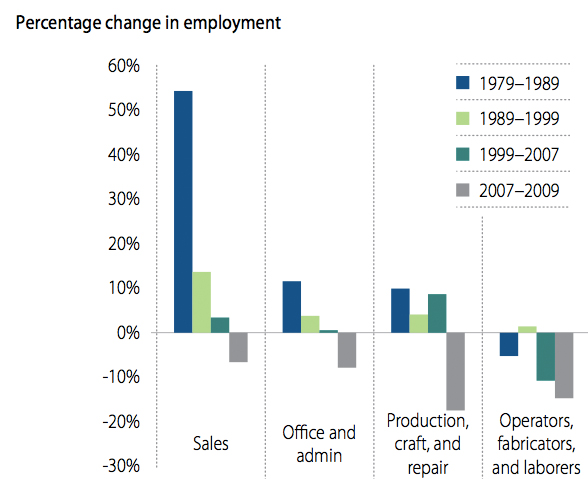
An unfortunate situation, but not that surprising, I guess. That was until I saw this chart:

The end of sales?

The article didn’t dwell on it, but the biggest change in employment over the last 30 years has been among sales reps! And that’s when I realized that I, and every other marketer, is contributing to the untimely demise of the sales rep.

Sales isn’t really going away, of course. Before a buyer makes a big purchase, they’re going to want to see the whites of someone’s eyes. But the role of the sales rep as first line of information is diminishing as most B2B buyers now prefer to be three-quarters of the way through their decision cycle before they speak to a rep. And the information/content that buyers are mining when they’re early in their decision cycle is being found on the web and is being supplied by marketing.

Content marketing is more important than ever (see an earlier post on The One-Minute Marketing Plan), and the role of marketing has moved downstream, closer to the actual sale. Marketing’s role has become one of knowledge facilitator for the buyer, rather than that of brochure-ware producer for the sales team, as may have been true in the past.

Revenge of the Marketing Nerds?  :)

The post The End of Sales? (or Revenge of the Marketing Nerds) appeared first on Feed The Beast.

17 Jul 17:05

ROI analytics for digital marketing

by Roxane Divol
An article in the Journal of Advertising Research showed that systematically optimizing marketing investment decisions can enable telecoms players to boost their average marketing return on investment by up to a third. Since, according to Nielsen, digital media can account for 18 to 20 percent of a telecoms player’s marketing budget, understanding digital’s impact on [...]
17 Jul 17:05

Sales: More science and less art

by John-Michael Maas
What was your presentation about? “I spoke about how companies can use data and analytics to improve sales results. There’s a lot of activity in the area of sales technology—all across the consumer decision journey, there are sales tech start-ups to help with marketing automation, enterprise feedback management, social CRM, Salesforce operations optimization, etc. Of [...]
10 Jul 23:15

Emerging Markets: Are You Fishing In The Right Place?

by Bruce Burton

emerging marketsOver the last two months there has been a significant movement of capital from emerging market funds back to the US. As CNN Money’s Ben Rooney suggests, the sell off is not necessarily a reflection of the economic health of those markets, but rather an indication of the higher yields available on ‘risk free’ US treasuries. However, Barron’s Reshma Kapadia suggests there is still concern that falling commodity prices and inexperienced leadership may result in much slower growth than anticipated.

But, I am reminded of Ram Charan, a great author on growth, who claims that regardless of economic conditions and market maturity, all businesses are growth businesses. Or in our case of emerging markets, every market is a growth market; you just need to know how to cope with changing conditions. Charan’s simple but profound insight suggests growth opportunities abound in any market and that one way to find them is to “look beyond the pond you fish in.”

There are many companies fishing in emerging markets, and why not? Booming exports, a massive middle class and growth in government spending has resulted in trillions of dollars pouring into these economies. Yet so many organizations are fixated on staking claims in a few cities with the highest GDP and population – ignoring the majority of the population outside Tier 1 cities in China, outside the Southeast states in Brazil and outside capitals in the CIS. In so doing, they often lock themselves into mature markets that are price competitive and in which it is difficult to differentiate their offering.

In Strategyn’s experience, by looking beyond these metropolitan ‘ponds,’ companies will find huge untapped opportunities in markets that are still in their infancy or early growth stages. Being less mature means consumers are not as concerned with high quality products and service. As GE’s Jeffrey Immelt suggests, they want a “50% solution at 15% of the price”.

Charan’s other nugget in this emerging market gold rush is to “look from the outside in.” Our experience suggests that many Western organizations sell the products and services they use at home in emerging markets rather than starting with what these customers want. They say it is a relatively fast and cheap way to enter the market. However, without starting with the customer, understanding their needs and jobs they are trying to get done and the context in which they occur, companies run the risk of offering products that are irrelevant. Take for instance, the imaging company, trying to sell equipment that wouldn’t fit in small hospitals, or the agricultural implements manufacturer trying to sell seeders in a market with few tractors.

Emerging markets can indeed continue to be goldmines by looking from the outside in, and fishing outside the traditional ponds that every other company is crowding around. For more information, download our white paper on emerging markets.

The post Emerging Markets: Are You Fishing In The Right Place? appeared first on Strategyn.

08 Jul 15:34

The Length of a Tee

by Golf Web Design

wooden-golf-teesThere are many different kinds of tees available for golfers to choose from. They all help you do the same thing – elevate the ball from the teeing ground. Before the days of wooden tees, golfers used to use sand – forming a little pyramid to place the ball atop of.

The type of tee used is irrelevant when compared to the proper height. For long irons, hybrids and fairway woods, it is best to tee them as close as possible to the ground. You want to think of it as a “perfect lie”. For drivers, teeing the ball high enough so that the equator of the ball matches with the top of the driver is a great starting point.

That is for “standard” shots. You will need to adjust the tee up or down if you’re a better player and trying to flight the ball either lower or higher. The all too common mistake that most amateurs make is that they are inconsistent with their tee hieghts.

I want you to try this next time you’re practicing: Start with your 9 iron and adjust your tee height from flush with the ground to a few inches above. Make a mark on the tee where you hit the ball the best. Now do the same for the rest of your clubs (perhaps alternating as you go through your bag). You’ll now have a really good idea of the height that works best for you with each club.

Before you know it, it will become second nature on the course and you won’t even have to think about it. Understanding what works best for your game will better help you lower your scores.

05 Jul 16:48

The b2b buyer is sad and lonely and the Gracey Temperature Scale: Madlibs w/ @Peter_Gracey

by Craig Rosenberg

I love the AGSalesworks team. Good guys who crank great content and a sense of humor. They really get inside sales, sales, and marketing – I was pumped for Pete’s Madlibs and I was not disappointed – This Madlibs with Pete Gracey is really funny with fresh perspectives. You know the kind of person you feel like you really want to drink a beer with? Well, Pete, I offer the immortal words of Bill Murray as John Winger in Stripes: “I want to party with you cowboy”. Madlibs with Pete Gracey:

  1. The B2B buyer is sad and lonely because they have been digesting content that your marketing team hit them with all day long. Call them…have a sales conversation.
  2. The biggest innovation in sales is social data generation from companies like Social123. By far the most accurate source for contact information we find out there today.
  3. The coolest thing happening in B2B sales is a grassroots movement, started by me, right now to eliminate the use of the phrase “net net” in B2B selling. If you use it, it makes you sound pompous. I’m not even sure what it means.
  4. My favorite Sales 2.0 technology is our click to call from Insidesales.com. Overnight productivity and accountability increases just for signing up!
  5. My favorite sales book is Leadership and Self Deception by the Arbinger Group. Not a true “sales” book, but learning emotional intelligence and how to get out of your own way are critical skills to have in sales.
  6. My favorite social media channel is Google+. Doubles as news feed and communication platform for me. It’s also not widely adopted yet so I still sound like an expert when asked about it.
  7. Social selling confuses me. I think Trish Bertuzzi said it best on these pages when she called it a “misnomer”.
  8. I use Linkedin like I use Facebook but for my business life. Facebook allows me to keep tabs on the people from high school who have gotten fat, bald, divorced, or generally just strange. LinkedIn gives me the same level of deep visibility into what is going on in the professional lives of my network. Great intel for my prospecting efforts.
  9. Cold calling is dead. It ended the with the advent of corporate email. If you are dying to label the type of calling you are doing why not adopt the Gracey Temperature Scale to describe our calling efforts from here on out. Mildly Warm Calling, Luke Warm Calling, Warm Calling, Hot Tub Temp Calling, Scalding Hot Calling. Given the amount of senseless debate I see surrounding this term I think it makes sense to become painfully descriptive when describing what type of calling you are doing.
  10. In B2B, the idea of a funnel gets brought up too much. We all know it and get it. We agree that it’s important. You put lots in up top…smaller amount comes out of the bottom. Got it!
  11. The first thing every sales person should do is embrace your CRM. Great way to immediately differentiate yourself from every other sales person at your company by actually using the expensive tool they bought for you. I know I would like you more than the rest.
  12. Voicemail is the single most misused and undervalued tool at your disposal. Teleprospectors and sales people do more to torpedo themselves via voicemail than you think. When part of an integrated call planning strategy, voicemail can be the thing that puts your connect rate over the top.
  13. The biggest mistake sales people make is avoiding and\or battling marketing. They are there to help you. Do them a favor and make a point of thanking them for that. Then take it a step farther and ask them to collaborate on a small net fishing campaign for your territory. They’ll appreciate the effort.
  14. The biggest myth in sales is the 80/20 rule that 80% of productivity comes from 20% of your reps. It’s not accurate. There a ton of good salespeople out there. I believe companies that feel they are living the 80/20 rule should look in the mirror first. Organizational issues or lack thereof drive sales performance more than the level of talent.
  15. My most forgettable sales experience was falling into a hot tub while giving a young engaged couple a tour of the hotel I was working at. They were looking at it for their wedding and I walked right into the hot tub while explaining some nonsense about the ventilated roof of the pool area. They made me wear a polyester suit for that job and the chlorine from the hot tub caused it to disintegrate later. Low point for me.
  16. The hardest part of selling is generating the proposal. It’s boring and involves typing. I wish you could just record the prospects “yes”, then say “do we both agree not to sue one another”…”yes”. Done!
  17. The next “hot-thing” in sales will be the continued emergence of Enterprise level inside sales reps. Big deals being closed over the phone in the cubicle right next to you. Or even from home.
  18. In 2015, sales will be Salestastic!!!
  19. My favorite sales saying is…..none….anyone who knows me knows I hate “sayings’.
  20. Over the next couple years in sales, I can’t wait to see the continued growth of reps requiring deep qualification in the leads that they receive from Teleprospecting. I’m wildly biased, but its the right way to go.
  21. Madlibs with the Funnelholic is WAAAY more fun than blogging.

Pete started AG Salesworks in 2002 with his business AG Salesworkspartner, Paul Alves, with a goal of providing technology companies with high quality and fully qualified sales leads. As Chief Operating Officer, Pete oversees the daily operations of AG Salesworks, which includes client engagement, personnel management, business strategy, across-the-board data analysis and long-term strategic planning. He is also Adjunct Professor of Sales and Marketing for the University of Massachusetts Amherst.

05 Jul 16:47

How Classic Psychology Can Help You Understand Your Buyer

by Megan Ziman
phrenology

Author: Megan Ziman

As a freshly graduated Psychology major, now is the time to compile all the knowledge I have gained over the past four years and apply it to a relevant career. One thing I did learn after acquiring my Psychology credentials is that I don’t want to be a Psychologist. Nor do I want to spend another four to five years advancing the field with my brilliant ideas on the future of the discipline, or at least not yet.

Instead I opted for a different and at first, a seemingly unexpected route. It began with an opportunity to try my hand at Marketing during an internship one summer, which then provided me with a valuable set of skills and network to land my current position at Marketo. Wonderfully enough, I have realized that marketing is the perfect landscape to apply my degree.

Psychology threads weave throughout the field of Marketing. From it I have noticed many lessons that relate to trends and practices common in Marketing. Let me show you what I mean.

The Link

First of all, articles linking Psych and Marketing are not a new idea, but many of the existing articles are outdated because they only relate to basic advertising and do not go deep into the buyer’s journey. Long gone are the days that companies can blindly throw information out into the world and expect their buyer to sit back and receive it.

Now the buyer is engaged and has an active role in interacting with a potential company. This lends itself perfectly to Psychology because we can use these theories to help us better understand the social interaction between buyer and company.  By better tailoring our marketing strategy to the educated buyer, both the customer and company’s goals can be met.

I see five classic theories in Psychology that translate to marketing strategy and shed some light on the relationship between a buyer and company.

Maslow’s Hierarchy of Needs

The first one is Maslow’s Hierarchy of Needs which outlines varying levels of human motivators. Every marketer should understand their customers’ motivation hierarchy to better provide services and products that satisfy those needs. A previous post, which can be found here, delves deeper into the intricacies of this theory and how it can assist with your social marketing strategy. Essentially, “Needs” are like a customer’s pain points.

Human Potential Movement

We can gain insight through revolutions like the Human Potential Movement in Psychology which took Humanistic Principles and applied them to useable tools to help people improve their functionality. In psychology these tools range from various types of therapies, encounter groups, and books. This is much like a company providing webinars, roadshows, and downloadable eBooks. Marketers are here to assist in development and functionality by sharing thought leadership and best practices. Be a part of the Marketing Potential Movement by being content creators and providing tools for thought leadership!

B.F. Skinner and Behaviorism

B.F Skinner and behaviorism sometimes gets a bad rep for synthesizing human behavior down to that of machines and animals, but there is still knowledge we can gain from him as marketers. The infamous “Skinner Box” was about manipulating a pigeon to press a lever in which caused the release of a food reward. It may sound harsh, but in a way we as marketers are figuring out a lever and interesting content that will drive people to press their mouse to receive more “clicks” on websites.

If a customer is clicking on a Facebook link, or re-tweeting a post, they should be gaining a reward–positive and useful information, which in Skinnerian logic should bring them back again. It is well known that buyers have the power in researching a company long before the sales guy gets to them. Therefore, as customers are doing research and looking into a company like yours- reward them! And they’ll be sure to remember.

Mary Ainsworth and Attachment Styles

In the 90’s, an influential study was done by the developmental psychologist Mary Ainsworth, which shed light on various attachment styles of babies. Her research suggested that secure attachment is the most balanced style and in the future it has found to produce a more psychologically “healthy” adult. A secure attachment has the qualities of trust, and a level of free exploration. A marketer’s job is to create a secure attachment between company and customer so when it comes time to buy, the customer feels secure, comfortable, and happy with the relationship. Marketing is about establishing that base of trust, and quickly meeting the needs of their potential customers (which can bring us back up to the discussion of Maslow).

Freud and the Talking Cure

We can’t mention theories of psychology without bringing up Freud. He was one of the initial leaders in the development of the entire discipline of psychology and is widely known for his psychoanalytic theory. I’ll leave out the discussion of the Oedipal Complex as it seems inappropriate to talk about that controversial theory here, yet his ideas were prompted from his innovative technique of “the talking cure”. It may seem obvious to us now, but in his age, talking about your problems to a therapist was unheard of, but by doing so it helped to foster a new way of understanding human behavior.

In Marketing, talking is central and valuable to gain new insights. Our goal is to either start the conversation, or continue the conversation through various channels of social media and email marketing. To be a good marketer- use the talking cure! Talk about what’s going on with your company, talk about new developments in the field, talk about the problems and issues and that will help everyone move forward and fix what needs working on. Psychoanalytic theory is the essence of what goes on in this blog and others- having a dialogue about marketing and engaging with customers.

What other psychology theories do you think might be relevant to marketing?


How Classic Psychology Can Help You Understand Your Buyer was posted at Marketo Marketing Blog - Best Practices and Thought Leadership. | http://blog.marketo.com

05 Jul 16:47

Study: Price, convenience trump buyer loyalty

Chicago—Lower prices and greater purchasing convenience are stronger influencers of corporate buying decisions than loyalty, according to a study by digital agency Acquity Group.
05 Jul 16:47

Four Ways To Improve The Buyer Experience Starting Today

by Lisa Arthur

Day 18  - Late night shopping

Poor customer experiences result in an estimated $83 billion loss by US enterprises each year because of defections and abandoned purchases. Unfortunately, though, most marketers remain unsure about how to improve relationships with today’s empowered consumers. What “exactly” should you be doing? How can you start creating a better customer experience?

For insights, I sat down with Bob Thompson, CEO of CustomerThink Corp., an independent research and publishing firm focused on customer-centric business management, and Founder/Editor-in-Chief of CustomerThink.com, the world’s largest community dedicated to customer-centric business. Bob is a popular keynote speaker, blogger and author of numerous reports, articles and papers. His book The Five Habits of Customer-Centric Leaders will be published in Q3, 2013. He made it very clear:

The first step towards creating a better customer experience is to put the customer at the center of all you do. Here are four ways you can begin doing that today:

Start thinking in terms of Buyer Experience Management.

As Bob explained, Buyer Experience Management (BXM) means understanding how buyers perceive their interactions with a brand, and then delivering value during those interactions so buyers (and non-buyers) become brand advocates.

Thinking in terms of BXM helps tear down silos, especially the ones between sales and marketing.

“Keep in mind that one of the big problems in B2B marketing/sales is the silo mentality,” Bob told me. “Marketing generates leads, sales closes deals. Each has their own set of goals and processes. Left out is an appreciation for what buyers are going through as they navigate from marketing to inside sales to field sales.”

A derivative of Customer Experience Management (CEM), BXM focuses on the marketing/sales function. It’s a way of looking at the buyers’ complete journey as they perceive it.

“The core issue is that marketing is still viewed by most as pushing a message and/or generating leads. It’s part of the ‘CRM’ mentality which is really company-centric – designed to extract value, not add value,” Bob said. “BXM is about taking a customer-centric view of the buyer’s journey, and asking how the buying experience is adding value and creating loyalty, even with prospects that don’t end up buying.”

Take a walk in your customers’ shoes. 

Bob estimates that less than 10% of B2B firms truly understand what experience buyers receive, even though virtually all agree that experience is important to revenue performance. Granted, B2C firms may not be quite as infected, with ‘silo-itis,’ but Bob suspects similar problems exist for B2C marketers, as well.

“These are gaps that must be closed,” he stressed. “Leaders must be ‘fired up’ about CEM / BXM or progress will be slow and limited. Good customer/buyer research is essential to figuring out what the target market really values, and what they are experiencing on their journey. You can’t be ‘value adding’ unless you know what customers think is valuable!” 

I wholeheartedly agree. It’s time to stop walking the talk. For instance, as one of your first priorities you need to  . . . 

Eliminate touchpoint amnesia. 

A truly satisfying omnichannel experience requires an integrated approach. According to Bob, a lack of channel integration clashes with consumer expectations –and it negatively impacts sales.

“Companies have automated channels bit by bit, so they can claim to be multi-channel. Yet customers find (about 80% of the time, in my research) that a multi-touch experience is not remembered. I call this “touchpoint amnesia and found that it has significantly reduced customer loyalty and propensity to buy,” he told me. “Omni-channel experiences should make it easy to customers to navigate channels as they wish, and not lose information the customer has already provided.”

Keep learning. 

Regular readers here are familiar with my mantra: Execute. Evaluate. Evolve. Our industry is exciting and dynamic, and marketers must keep learning as they continue to drive change throughout their organizations. What can you do to stay up-to-date?

For starters, the CustomerThink website offers a wealth of content from many of the world’s leading authorities on Customer Experience Management. Bob also recommends joining the CXPA, a non-profit organization for CX professionals, where he is on the Board.

How well do you know the customer experience you’re offering buyers? What steps can you take today to improve it?  What are you doing already that is working well and could benefit other readers?

02 Jul 22:43

The rule is: don’t cut price for market

by Holden Advisors

The rule is: don’t cut price for market share in mature markets. Why? http://ow.ly/mtmNs #pricing #marketing


02 Jul 22:41

Dysfunctional Sales Buyers

by Greg Klingshirn

Dysfunctionalheader-01

Buyers are frequently rude to sellers.

They don’t treat us with the most respect. Maybe it’s because so many of us perform the sins of selling and have trained them think of us a “stereotypical sellers.” The best sales folks have tough skin. But that’s not enough. We must learn to overcome the common dysfunctions of sellers if we’re to close more business.

Here’s a walk through some of the most common dysfunctional sales buyer behaviors and how to overcome them:

1. They Just Want to Check Out Prices

Buyers hate having their time wasted yet are all too willing to waste sellers’ time.

These buyers are only interested in determining what their options are in terms of price. They have no real need to invest, at least at the time. While they dip their toes in to test the waters, they’re wasting the time and energy of salespeople who think they are actively interested in purchasing their product. In this case, be direct. Ask the buyer for their needs and timeframe before divulging all you have to offer.

2. They Need More Bids

Occasionally, a buyer will have already chosen who they plan to hire, but may need a few more proposals. They won’t feel bad wasting your time, energy and resources on a dead end, as long as they meet their quota. Don’t agree to do a large amount of work without any compensation. It’s your time, and you have a right to use it productively.

3. They Hide Vital Information

When buyers don’t trust sellers, they protect information the sales rep needs to find a solution. This leaves the salesman grasping at straws, left to deliver a solution that lacks specifics tailored to the buyer. In turn, the buyer is dissatisfied and their lack of trust towards the sales rep is reinforced. To combat this, ensure the buyer contributes all pertinent information. If they refuse to answer questions, it’s in your best interest to drop the deal and move on to other prospects.

4. They Make You Fill Out RFP’s

Particularly, generic proposals that have little or nothing to do with the task at hand. They take a huge input of time and resources to complete, with the possibility of not earning a single penny. Again, don’t be afraid to ask questions. You don’t get paid to fill out paperwork, you get paid to deliver solutions.

In other cases, your buyer will take you (or your competitor’s) best ideas and implement them internally. It’s free consulting for them, but it’s a huge waste for you. Be confident in asking for compensation for your time and effort.

5. They Refuse to Let You Talk to the Decision Makers

Sometimes they’ll even refuse to talk until the proposal is complete. The seller is hung out to dry by unreal expectations, and left to guesswork. Be up front with your buyer regarding your expectations, rather than just meeting demands. Keeping a level playing field will develop respect on both sides, allowing a better flow of information.

-
It’s your job to promote a work ethic in which your buyer is open and provides you with honest, necessary information.

Don’t stand for BS. Work hard to place your buyer on the same team working towards a common goal.

02 Jul 22:41

How to Make Price a Non-issue with Buyers—An Interview with Kurt Mortensen

02 Jul 22:41

5 Steps to Collaborate with Buyers in the Selling Process

path

When buyers buy something, one of two things must be true:

1. They are required to buy.

2. They want to buy.

In the former, they have no choice. Get sued, hire a lawyer. Buying = required. The lawyer doesn’t need to convince the buyer why to buy legal services in general, only why to buy them from them.

In the latter, the buyer has a choice. Buying = desired. They don’t need to buy, but if they want it badly enough, and have the money and authority to buy, they buy.

Since the buyer isn’t required to buy when sellers drive demand, sellers must be able to take their priority of making a sale happen, and make it the buyer’s priority to make a purchase happen.

It’s not that easy, though, because you’re nowhere near the buyer’s priority list when you start.

02 Jul 22:41

Are B2B Buyers More Rational?

by CEB Sales & Service

BusinessmanThis year, our sister program, CEB Marketing Leadership Council, is exploring the rationality (or lack thereof) of customer decision-making with respect to B2B purchases. When they initially tested this topic on the membership, they received pretty consistent feedback: “Of course, we are selling to people, after all.  Feelings like ‘fear’ and ‘trust’ are hugely important.” They also heard a common caveat: “The larger the deal, the less emotion involved because more is at stake, and customers pull together larger buying committees to make a rationally defensible purchase decision.”

Now, intuitively, that makes sense. After all, conventional wisdom says that groups do a better job at decision-making than individuals. However, our review of academic research shows that it would be a grave mistake to hinge your efforts on that assumption. To demonstrate why, here’s how three widely-believed aspects of that assumption stack up against the (repeatedly confirmed) academic research.

Myth #1: Groups make better decisions because they process information more rationally.

Researchers have found repeatedly over the decades that group members don’t pool critical information, and as a consequence, the quality of their decisions is low.  For one, confirmation bias plays a huge role.  According to this study on group decision-making, information conforming to the group’s preference is more likely to enter the discussion than opposing information.  And this phenomenon has been observed in both groups as well as individuals, for both preliminary (reversible) and final (irreversible) decisions. 

Myth #2: Groups make better decisions because they can deal with more information than individuals can.

This would be true if every piece of knowledge that each member of the group knew were actually discussed…but that rarely happens. Research shows that groups mainly discuss and make use of “shared information” (available to all members before discussion) rather than “unshared information” (only originally accessible to one or a few members). And in experiments involving such asymmetrical information, groups have less than 30% success rates in picking the rationally correct choice. Researchers even found that groups given instructions designed to improve information use performed no better than those who were not.

Myth #3: Groups make better decisions because of the ability of group members to point out errors in others’ information processing.

The truth is, group decisions are often driven disproportionally by one individual (a phenomenon known as “cognitive centrality”).  This was observed both in laboratory experiments as well as in corporate executives’ decision-making processes.  That effect is exacerbated because more a person feels committed to a particular position, the greater the desire to uphold it, even when confronted with conflicting opinions and evidence. There’s also an aspect of the group’s objective to consider here: consensus-driven groups (goal = agreement) make poorer decisions than critical groups (goal = right answer).

In light of all this, it’s pretty safe to say that buying groups are no more rational than individuals in their purchase choices. This means that we need to reconsider our approach towards communicating to various customer stakeholders. Though the rational, function information is necessary, it’s the non-rational dynamics (whether emotional or cognitive) that will actually get customers to internalize that information to drive action.

CEB Sales Members, learn more about Mobilizers – customer stakeholders that can mobilize an organization around a purchase. Also, visit the Commercial Coaching topic center to learn how reps can actively guide customer stakeholders through the consensus-building process.

This is a guest post by Jing Zhang and Anna Bird of the CEB Marketing Leadership Council, our sister program for marketing professionals. We’ve modified it a bit for a sales audience. Visit the original here!

02 Jul 22:40

iPads: Changing the Sales Game

by Jonathan Kilroy

Mobile Technology in the WorkplaceB2B marketers and sales enablement teams are constantly looking for new and compelling ways to equip their sales force to better service customers. Many sales organizations are experimenting with mobile solutions—like smartphones and tablets—useful in reaching reps on-the-go. Reps use their tablets for a number of tasks such as presenting sales collateral, reviewing account and pipeline information, communicating with customers and internal stakeholders, and preparing for sales calls.

The iPad in particular has garnered much attention in the tablet technology space. The tablet’s popularity is reflected in the fact that 75% of surveyed organizations using tablet technology use the iPad.

In our recent brief, “Deploying iPads to the Sales Force,” we profiled four members with an iPad-enabled sales force to hear their story of deployment, challenges, and successes. As companies approach the deployment decision, and subsequent planning process, there are a number of factors to keep in mind. We asked our profiled members the following questions about their iPad deployment experience:

  1. How and when did you deploy iPads to the sales force?
  2. What type of iPad training and IT support do you provide to salespeople?
  3. What apps and accessories do you recommend or require for sales force iPad use?
  4. What is the primary use of the iPad?
  5. Do you have any advice to offer on iPad deployment based on your experience?

Some of the most important elements of the profiled members’ programs were: initiating a pilot program to uncover potential stumbling blocks, developing training (formal or informal) for iPad users, and enabling reps access to the organization’s internal programs, services, and tools. Profiled members also identified ensuring security, while simultaneously allowing access to CRM, email, document storage, and secure network services as a key challenge in the successful deployment of tablet devices.

CEB Marketing Members, review the full report, Deploying iPads to the Sales Force, and use the company profiles to validate or compare your organizations’ iPad deployment plans.

02 Jul 22:38

Sales Training Article: How to Engage Customers

by Customer Centric Selling

Sales Training Article: How to Engage Customers

By Geoffrey James, INC - Sales Source

sales training companyTo get customers interested in what you're selling, make your sales message about your customers.

You're excited about your company, right? You're proud of your products, right? Therefore, your best strategy, when talking to a customer, is to tell the story of your company and its products with excitement and enthusiasm, right?

Wrong.

Customers don't care about your company. They don't care about its products. And they certainly don't care about your personal feelings towards your company and its products.

What customers care about is... themselves.

The failure to realize this simple fact about human nature is why most companies have sales and marketing messages that make customers shrug.

Over the past few years, I have reviewed hundreds of sales messages. In almost every case, these messages are all about the seller and the products being sold. They leave it up the customer's imagination to figure out "what does all of this mean to ME?"

Which leads us to the two sentences that are the most important to your customers and prospective customers:

  • "Our clients hire us to provide [benefit(s) to the client.]"
  • "They hire us, rather than somebody else, because [something unique that the competition doesn't have but the customer values.]"

Notice that both of these sentences position you, the seller, as a catalyst that helps the customer achieve the customer's goals, and then positions your firm as only catalyst that can do the job right. Here are some examples:

Example 1:

Wrong:

"Acme specializes in consumer-validated 360 degree product development via our patented sequential market research process, which has been successfully applied to the fast moving consumer goods industry. In the past 24 months we have created $2.9 billion in innovative business opportunities for our clients.

Right:

"Consumer goods companies hire Acme to create new products for them, and market both those new products and their existing products. Because we base our efforts on meticulous research into target markets, we've generated over $2.9 billion in new revenue for our clients over the past two years."

Example 2:

Wrong:

"Several years ago, Acme saw a problem in the transportation industry: that the process of valuing and transferring ownership of transportation businesses is a very unstable and unpredictable process. And as a result, many hardworking owners were unable to cash out of their businesses when they wanted to. Basically they shut the doors. Acme is built to specifically address this industry problem--we help buyers and sellers alike start a new chapter in life.

Right:

"Entrepreneurs hire Acme to sell or acquire transportation businesses like limousines, buses, and ambulances. We can help them negotiate the best and most reasonable price because we have 20 years of experience with this type of business."

Can you see the difference? The original messages force the customer to figure out what it all means to the customer. The rewritten messages express what's being provided from the customer's viewpoint.

In other words, to engage customers in a conversation about the possibility of hiring you or firm, make the message about the CUSTOMER rather than about YOU.


sales training companyNeed some help with your sales performance? Take a look at the sales training workshops available to you and improve sales performance.

Read more sales training articles from CustomerCentric Selling® - The Sales Training Company.

02 Jul 22:37

How a Marketing Leader Saved the Year for Sales

by John Koehler

CMO Saved Year For Sales AwardEvery Marketing Leader wants to avoid getting labeled that they deliver poor leads.  CMO’s strive to run best-in-class programs. They love successful programs.  They love industry recognition and awards.  That’s why it stings when you feel like the sales team is your downfall. This reminds me of a story from a client this time last year.  She uncovered the root problem for sales and helped them make the company number.

Meet Kathy, a VP of Marketing whose team supports a 25+ sales rep company.  She had believed her sales & marketing organization was perfectly aligned until a problem occurred.  Q3 was approaching and the sales team was demanding more quality leads. Kathy’s team had rocked Q1 and didn’t suspect any future shortfall.  In fact, they had doubled down on what was working well in Q1.  They were also investing more in social media.  What could go wrong with that?  In Kathy’s eyes, she was setting the company up for a great year.

Q2 is now at its end

Sam, the VP of Sales is knocking at Kathy’s door.  He was getting beat up by the CEO.  The Q2 review did not go well.  He said, “My sales managers pointed to the lack of leads as their downfall.”  Sam, who is usually very friendly to Kathy, is upset with her.  He was banking on a quarterly bonus to take his family to Disney World.  Now he’s worried about his job and thinks Kathy’s team is to blame.  Marketing proves to be an effective scapegoat.

Kathy thinks to herself, it is Sam’s fault.  We are running a world-class marketing department. Her staff is full of ‘A’ players and trusted disciples of her direction.  This must be a problem with the Sam’s team.  Kathy’s now worried that Sam’s team’s inability to close leads will ruin her reputation.

The next day

After Kathy had time to reflect, she rolled up her sleeves. She was determined to find a solution to help Sam fix the problem.  Not knowing where to start, she started googling.  This led her to become overwhelmed with information and noise.  She forwarded a few articles to her team to research but nothing earth shaking.  Next, she decided to reach out to her peers on LinkedIn.  She asked her personal network of CMO friends for advice.

That week, she got a reply from what she now calls, “the best recommendation ever”.  This was a reply from Mark, a CMO of a software company with 125+ reps.  His message to her was to “Read SBI’s blog like it’s the Gospel”.  He said, “Some days the blog posts are written to marketing leaders.  Some days it’s written to others in the sales organization.  However, I read almost all of them.  It gives me a well-rounded sense of how sales & marketing work together. It gives me a glimpse into other world-class organizations.  It’s like knowing how a fine tuned engine should look and sound.  The best part is every post provides a tool or guide. I think I have more downloads from SBI content than I have from iTunes.”  Kathy was intrigued enough to subscribe.

A month later

Kathy’s turnaround started taking shape after she read a post on lead generation alignment.  The tool provided in the post only took her 7 minutes to discover the root problem.  Her team and the sales team were in fact not aligned.  The 10 Point Checklist for Lead Gen Alignment surprised her of the result.  The guidance included deep definitions of world-class attributes of sales and marketing alignment.  She realized the specific feedback her team was receiving was just mud.  There were no specific details on why the leads were no good.  In addition, this root problem uncovered they needed a Return to Nurture program.

With this discovery, things only got better. When Q4 arrived, Sam’s team had more sales ready leads than they could handle.  Enough momentum had built up that the year-end number was met with the close of a deal just before New Year’s Eve.

Key takeaway:

Even if you think your marketing team is delivering flawlessly.  Invest ongoing time in reading and benchmarking against other world-class organizations.  Kathy thought her team was perfect and it was all Sales fault.  The fault was that both Marketing and Sales were not aligned like she believed.  This resulted in poor practices that hurt the sales reps that Marketing was supporting.  Just like the routine maintenance on a car, check your alignment often.  Download the 10 Point Checklist for Lead Gen Alignment.

Author: John Koehler

sbi on linkedin

Follow @SearchMaster

Follow @MakingTheNumber

If you enjoyed this post, never miss one again by subscribing your Email Here and/or subscribing to the RSS Here.

02 Jul 22:37

Summer B2B Sales Challenge Revisited

by Lori Richardson

keep focus to close deals stay inspiredNow that warmer days, visits to and with relatives, plus more social events start happening, it’s clear that Summer in North America is upon us. Last year I wrote about it because annually, it seems, I have long conversations with coaching clients as well as sales leaders on how to stay inspired through the nicer months of the year.

I saw some people passing last year’s post around so thought I’d review my SPICE formula for success this time of year. Here is the original post for more background.

We have a seasonal acronym, SPICE,  to help those who are committed to growing their sales over the summer – just like the organic, no-salt spice we grill with throughout this warm and wonderful season. See if this might work for you:

Sales focus – every day, have a sales / revenue focus. Think about how your pipeline is building out, and where it is light. Pick up a new sales book, like ones we have reviewed here on the blog. [New suggestions: Conversations that Sell, by Nancy Bleeke, Influence, by Robert Cialdini, and the continually recommended SNAP Selling, by Jill Konrath. ]

Plan weekly – On Monday, declare your revenue and sales activity goals. Review at the end of EVERY week. How did you do? What can you tweak to improve your success next week? Carry things forward, and drop activities that are not leading you to more revenues.

Invite conversations with clients and partners – If it is slower now for you, set up meetings by phone or in person, talking with existing clients, past customers, and strategic / referral partners. Have an agenda, and be focused on what THEY need before you even talk about what you are working on. You’ll be blown away by the results if you do this consistently. Send a hand-written note afterward to thank them for their time. Wow – big impact.

Create 3 awesome goals to accomplish by the end of Labor Day weekend. One could be an activity goal, such as identifying and contacting 25 potential referral partners, or to hit a revenue number based on a “stretch goal” using the data in your sales pipeline. Put those goals on the wall, and think every day as to how you can reach them. Ask for help, support, and introductions.

Explore new strategies – Ever looked at the Twitter stream to see what people are talking about in your sector or have you looked up actual customers / prospects to see what they are talking about? There are still a lot of B2B companies who turn away from social tools.   Some of our clients don’t have a great LinkedIn strategy, yet it could bring them numerous new deals in a few months’ time. Some of you are so into technology that you don’t pick up the phone enough. Can ONE new weekly effort result in new prospects, and ultimately one new deal by the end of the summer?

Additionally, find several blogs or sales sites that resonate for you. We welcome anyone serious about growing B2B sales here at Score More Sales, and we know of many colleagues where you can get amazing inspiration to keep your head in the game this season. More on that to follow. For now take a look at Top Sales World’s Sales Academy and the virtual classes on selling you can sign up for. They are no cost yet great value. Any one of the presenters can give you real ideas that work.

Post your favorite strategies for success when it’s easy to get distracted – we may award you an Amazon card for your submission. How do you keep focus to be productive? Your spin on this may be the one thing that someone else can use to also be successful.

Lori Richardson - Score More SalesLori Richardson is recognized as one of the “Top 25 Sales Influencers for 2013″ and one of “20 Women to Watch in Sales Lead Management for 2013″. Lori speaks, writes, trains, and consults with inside and outbound sellers in technology and services companies. Subscribe to the award-winning blog and the “Sales Ideas In A Minute” newsletter for sales strategies, tactics, and tips in selling. Increase Opportunities. Expand Your Pipeline. Close More Deals.

The post Summer B2B Sales Challenge Revisited appeared first on Score More Sales.

02 Jul 22:37

VIDEO SALES TIP: Prepare NOW for those Summer Sales Call Cancellations

by TheSalesHunter

It’s summer for many of you reading this, and that means it’s a prime time when some of your customers and prospects are canceling on you.

When people cancel on you, be prepared!  You must have ready the names of people you can call to try to fill those slots. Sales call cancelations are not a time to relax and goof off.

Your time is better spent going after business.

Check out the below video to see what I mean:

Copyright 2013, Mark Hunter “The Sales Hunter.” Sales Motivation Blog. 

button receive a free9 300x51 VIDEO SALES TIP: Prepare NOW for those Summer Sales Call Cancellations photo

02 Jul 22:37

Four Reasons Your Sales Force Is Unprepared to Create Value

by S. Anthony Iannarino

Four Reasons Your Sales Force Is Unprepared to Create Value is a post from: The Sales Blog | S. Anthony Iannarino

Value is the killer app in sales. Without it, you are relegated to competing on price. Here’s why your sales force is unprepared to create value and what to do about it.

No Business Acumen: Your sales force doesn’t have the business acumen, the experience, or the situational knowledge. To succeed in sales today you have to be a bigger salesperson. Being a bigger sales person means being a better business person. It means thinking about your client’s problems through the eyes of the business owner. We use words like “trusted advisor” and ”consultative,” but we don’t prepare the salesforce to be those things. If you want real sales enablement, this is where it starts and ends.

No Differentiation: Your sales force can’t present your defining differentiators in a way that creates value in the minds of your clients. Ask a salesperson to differentiate their offering from their competitors in a way that is compelling. Most of them will tell you that they’re not very different from their competitors. They don’t believe that you’re very different from your competitors. Without defining differentiators, those differences that make a difference, it’s very difficult to demonstrate the real value in your value propositions. As a sales leader, you have to sell this differentiation all the time.

Transactional Disease: Your salespeople behave transactionally because that’s what they believe they’re supposed to do. As a leader you have to build and protect a culture. You have to share your worldview and you have to enforce it. The world outside is telling your sales people that they are only going to win on price, that you’re supposed to be Walmart. They’re being led to believe that the only value customers really perceive is lowest price. It doesn’t matter that none of this is true, and it doesn’t matter that the sales people working in your organization don’t understand the ideological inconsistency of believing this while carrying an iPhone and a new MacBook. What matters is you continually reinforce the perception of value and that you enforce the mindset that you will accept nothing less than value creation and reject all transactional beliefs and behaviors.

You Allow Discounting: Leadership and management sometimes doesn’t protect own business model by enforcing the creation of value when winning an opportunity. If you allow discounting in order to win new opportunities then you are contributing to the problem of sales people not being prepared to create value. If you do so for short term revenue at the expense of your business model, you’re breaking the business. You challenge every deal to see what value you are creating that makes you worth paying more to obtain. Or you end up not creating value, and you step onto the slippery slope to a declining profit margins.

Ultimately, the sales leaders is responsible for the results of their team. If your sales team is unprepared to create value, improve their business acumen, their ability to differentiate, enforce a value-creation mindset, and don’t contribute to the problem by discounting.

Questions

How do you learn to create more value? What experiences contribute to that outcome?

Can each person on your team easily differentiate your offering from your competitor’s? Is each member of your team part of the differentiation?

How much does the worldview that price is the only real value permeate your team’s mindset?

What do leaders do that contributes to the sales force’s lack of ability to create value for their clients?

02 Jul 22:36

The One Key Person That Will Help You Improve Sales

by Mark Suster

This is part of a series that describes a sales methodology for technology companies or frankly many other types of companies, too.

This post is about finding your “champion.”

Little ChampionWe developed this at our first company and called it PUCCKA – the overall methodology is described here.

The “P” stands for Pain or the reason your customer needs to implement a new product.

The “U” or Unique Selling Proposition (USP) or the unique attributes of your solution to solve their problems better than anybody else they could use..

The first “C” stands for Compelling Event.

This post is about the second “C” or Champion.

No product sells itself no matter what startup companies like to think.

In order for an organization to buy product it takes an individual who has a budget and is willing spent it on you or they have access to a group budget and are willing to fight for the resources to implement your solution.

This is especially true for products that involve more than an individual user.

Every company is inundated with products and technology so inertia takes over. It’s far easier to do nothing than to do something new.

Not everybody who is nice or helpful to you is your “champion.”

In order for somebody to be a champion they need to have both influence (in order to persuade others to take action) and “authority” to either make the decision or to get somebody who holds budget to make the decision.

I shorthand these two things – Influence and Authority – as IA.

I do this to contrast the opposite, which is NINA – no influence, no authority. Otherwise known as a time wasters.

In order for somebody with IA to be your champion he has to be actively helping you through the sales process. If he’s not then he may simply be an IA but he may not be a champion. Or worse – he may be somebody else’s champion.

Of course you have to develop and nurture champions. Obviously they need to be bought into your solution and feel compelled that it will solve a problem in their organization (the PUC).

He or she also need to trust you, personally. In order to spend money or access budgets and especially if other people need to use this product she is going to have to stick her neck out to implement you.

Understanding why an individual would buy something or why she should champion you deserves reflection. Is she managing a P&L and wants to reduce costs or improve sales? Is she a mid-level in an exec and wants to be seen as an innovator by embracing new, exciting technologies?

Most people never try to understand the psychology of the buyer but I think it’s tremendously important.

You need to find your champion and nurture the relationship.

Big deals that involve multiple people deciding seldom go your way without a champion so you need to be in search of yours to win the account and you need to constantly test whether somebody is your champion or not. But I’ll get to that in a moment.

The best kind of champions are what I call “egg breakers” and this again forms part of our sales teams shorthand nomenclature to figure out whether our process is going well as in, “OK, you said Susan is your champion, but is she an egg breaker?”

Egg breakers don’t mind making tough decisions. They’re willing to stick their necks out when others keep silent.

Imagine a room full of people who have convened a meeting to discuss whether to go ahead with your project (or maybe to select a vendor amongst many).

There might be somebody in the room who is most knowledgeable and/or most passionate about which solution to pick. But that person is irrelevant if he’s not willing to defend his position strongly when others advocate harder for a different answer.

Other people are “consensus driven” even if they’re willing to assert their point-of-view in a meeting. They want to wait until everybody is bought in and until every bit of information is considered.

With this kind of person advocating on your behalf you run the risk of your decisions being over-turned and or the decision process to be elongated.

You want IA Egg Breakers as champions.

A champion is somebody rooting for you. They typically are willing to be transparent about the most important factors you need to know in a sales campaign

  • Who else is involved in the decision?
  • Who makes the ultimate decision or is it made by group vote?
  • Who is for you and who is against?
  • Who are you competing against?
  • Who holds the budget for this project?
  • When is a decision likely?

You can often test whether somebody is a champion or not by asking some of these questions and finding out whether they’re willing to be open with you about the process.

Not open = not a champion. Period.

If a person is holding back on you need to go in search of a champion in order to win the campaign. Just because this person isn’t your champion doesn’t mean he’s against you, just that you can’t count on him to push hard for you at the moment of truth.

You need that champion in the decision-making process and in the room when the topic is debated.

And remember that just because a person is friendly with you and shares the information above doesn’t make him a champion. It makes him really useful (for sure!) but not necessarily a champion.

Because a champion has influence and authority.

Even if you’ve identified your champion your work isn’t done.

There are often many players involved in a decision for or against you and you need to meet or speak with all of them to understand the purchasing landscape.

And that is the subject of my next post, “Key Players.”

*****

(no, this is not my kid. just a really cute picture I found on 500px ;-) )

02 Jul 22:36

Key Sales Lessons from Oracle’s 4th Quarter Miss

by Greg Alexander
Oracle Key Sales Lessons

Oracle just missed its 4th quarter number for the first time in a decade.  They missed because they did not ramp 500 new reps fast enough.  Their words not mine. Here is the announcement.

If you do not want to miss your 4th quarter, read on.

Allow me to explain.

In B2B sales, activity leads to results.  The correct time to add sales people is when business is soft.  More sales people means more sales calls.  This means your sales force will be in more deals.  This is how your pipeline gets built.  In a soft economy, close rates will drop due to cautious customers.  To offset this, your company needs to be in more deals.  However, you probably do just the opposite.  You reduce the number of sales reps to cut costs. 

You will have a problem surface when the economy recovers.  Your short-sightedness means you will have to hire quickly and play catch up.  In contrast, forward-looking, courageous companies, like Oracle, hire into the soft economy.  When demand returns, you can capitalize on it, usually catching the competition flat footed.  This results in market share gains.

Why is it taking Oracle too long to ramp the new reps?

Oracle’s onboarding program is based on the waterfall method.  It is slow, sequential, and activity focused.  It should be based on the Agile method.  Agile would make it fast, iterative, and results focused. How do we know this?  We have spoken to several recently hired reps.  We have also spoken to reps who hired on, and left inside of 12 months.  Let’s not beat up Oracle.  Most sales teams are still using yesterday’s onboarding program. Ironically, Oracle’s development team is considered best-in-class using the Agile Development Method to build products.

You don’t want this to happen to you.  If you adopt the Agile method of onboarding, you will get these benefits:

  • New rep ramp time will be cut in half
  • New rep tenure will double
  • The cost to ramp a rep will be reduced a 1/3rd

Are you skeptical you will realize these benefits?

Consider this:  Buyers are buying differently today.  You know this.  You are hiring a new breed of rep and implementing a new sales methodology in response.  This dictates the need for a new onboarding approach.  The approach you need is called Agile OnBoarding.

If you agree, you are asking “what are the deliverables?” of this new process.  There are 12 major deliverables.  Do you have them built?  Use this tool to rank yourself on the Agile vs. Waterfall scorecard.  This tool will save you a ton of time.

12 Agile Onboarding Deliverables

  1. Layered content.  No standalone modules.
  2. 3 levels of content- beginner, intermediate, and advanced.  No topic is covered to completion.
  3. Pre-work issued 4 week before start date.  No waiting for the “next available class”.
  4. Metrics based on capabilities demonstrated.  Learning activities completed is useless.
  5. Training organized in “sprints”.
  6. Start to finish in 13 weeks.
  7. Content is video based.  No printed material.
  8. Frequent quizzes lead to certifications.
  9. The sales manager owns the process and is paid on average ramp time. L&D is a support function, not the owner.
  10. Reps engage with customers day 1.  No incubation period.
  11. Training happens in the field, not in the class room.
  12. The program is gamified.

Building these is a lot of work.  This is a blog post which means I had to summarize.  If you want more information on this go here and here.

Special Notice: Gamifying the onboarding process is producing outstanding results.  My colleague, John Kenney, published a post yesterday dedicated to this subject.  Be sure to check it out here.

Call to Action:

Prospects are taking meetings again. Projects are getting funded.  Your 2014 quota is going up.  You are going to need to hire new sales reps.

Don’t miss your number because of poor onboarding.  Convert your process from waterfall to Agile.  Download the Agile Onboarding Scorecard.

Author: Greg Alexander

sbi on linkedin

Follow @GregAlexander

Follow @MakingTheNumber

If you enjoyed this post, get free updates by subscribing by Email or RSS.

02 Jul 22:36

3 Lessons Learned from Lost Inside Sales Clients

by Samantha Goldman

3 Lessons Learned from Lost Inside Sales Clients image 1 M lostclients resized 600It’s never fun to lose clients, but there’s always something inside sales reps can learn from their client’s decision to leave which they can apply and improve upon when dealing with new clients. When clients end an engagement, it can be for many different reasons: budget, end of a campaign, decision to try a new inside sales team, restructuring within the company, etc. Whatever the reason is, it is sad to watch a client leave, but you can use what you learned from working with one company and apply it to another company when they sign a contract.

In my year at AG Salesworks, I have worked with four different clients for an extended period of time. After working on two projects that simultaneously ended their engagement, I knew I had to look at my new projects with an open mind and see what I could bring from my old clients to my new ones. Here are some lessons I learned:

  1. Keep an open mind. It is important to keep an open mind when beginning a commitment, because you do not know how everyone likes to work. I have adapted to several kinds of communication with marketing contacts and sales reps, from instant messaging to calling office lines to texting cell phone numbers. It is up to you as a BDR to be open to new forms of contact and communication with your clients. Make sure they know where they can always reach you and you can get in touch with them when you have questions as well.
  2. Know your clients’ schedules. Sometimes you will work with people who are hard to connect with. While this can be frustrating, it also gives you more time, allowing you to become more organized so that when you do get to speak to them, you have everything ready to run through in case you cannot connect for another few days. Knowing when reps and clients are away from the office is important as well, so being able to keep track of calendars is key. Setting appointments or getting quick pieces of information can make or break some prospects, so you want to be sure your reps are available and able to connect. I have learned to recap the week and set up the next week with my clients and sales reps in case anything has changed that I was previously unaware of, in order to create a smoother transition from prospecting discussion to qualified lead conversation.
  3. End on a high note. If you know that a client is going to be ending a contract, it is important to end on a strong note, keeping up activity and conversations until the last day. You want to make them know they can come back if they have another campaign or decide to reevaluate the budget for next quarter. Slowing down does not make a client feel as though you are giving them what they are paying for and can make them rethink your work ethic when they are looking for help with their prospecting in the future.

While it can be disheartening when a client ends an engagement, it’s important to remember that you’ve learned important skills from them and are armed to approach your next project. What other lessons have you learned from working with multiple clients?

3 Lessons Learned from Lost Inside Sales Clients image b0ddad19 d31c 4f64 9abf 2b5bca6bd32d5

3 Lessons Learned from Lost Inside Sales Clients image 07f0bf66 1dcb 40ea acd9 7c4ff5605ab013

02 Jul 22:36

7 Sales Tips for the New Fiscal Year

by Geoffrey James

These nine steps to make certain the next quarter bring increased revenue and profit.

Here's a list of must-do activities that every company (and salesperson) should take at the beginning of every year (and every quarter) adapted from Bill Stinnett's top-notch book, Selling Results!

1. Requalify each opportunity.

Determine what you know and don't know about each account to prompt you to consider your customer's current state, desired future state, and vision of the ideal solution.

2. Resize each opportunity.

Determine your client's appetite for investment from the people who are responsible for earning a return on whatever capital they decide to invest.

3. Reforecast each opportunity.

Determine when they need to arrive at their desired future state and what will happen if they don't arrive. Then estimate when this customer will buy based on their urgency.

4. Revise your revenue projection.

Revise your sales forecasts based upon the information above so that your ability to influence next quarter's revenue results lies in the actions you take today!

5. Reevaluate what it will take to achieve your goals.

Plan what you need to do in terms of monthly and weekly business development activity goals that will ensure you achieve your revenue objective.

6. Prepare to broaden your relationship footprint.

Identify who you currently know within each account and then decide who else you need to meet as the opportunity changes and grows.

7. Develop a plan to move each opportunity forward.

Create brief project plans (with dates) for each event that identifies the people who to be involved from your company and each client's company.

8. Resolve to better plan your customer meetings.

Each interaction with your customer should move the sales opportunity forward. Commit yourself to doing pre-call planning and research.

9. Retune your marketing message.

Better align your marketing with your sales by revising sales tools and marketing collateral so that they speak from the customer's viewpoint.

Like this post? If so, sign up for the free Sales Source newsletter.


25 Jun 16:24

Why Teamwork Should Be Your No. 1 Sales Tool

Having your sales team and customers work together is important to your selling strategy. Here's how one company did this successfully.