Shared posts

13 Jul 21:50

Champion Vs. NINA: How to Find the Right Sales Buyer {Infographic}

by Greg Klingshirn

ChampVsNinaHeader-01

Buyers are busy and don’t want you to waste their time. It’s much easier for them to do nothing than to do something new that adds complexity. Mark Suster explores finding the right buyer in his post, “One Key Person That Will Help You Improve Your Sales.”

We were inspired to explore his insights in our latest graphic.

To make a successful sale, you need a champion- a buyer with influence and authority- on your team. Finding this person within the business you’re selling to may not be easy, but it will facilitate smooth interactions and move you towards closing a deal.

On the flip side, you have to beware of buyers that have no influence and no authority, or more simply- NINAs. They can prolong your sales process by making it difficult to move forward.

In our latest graphic, we explore the saving grace of sales and her nemesis. It’s the Champion vs. the NINA in this heavyweight bout.

ChampVsNina-01

13 Jul 21:50

Buyer Persona Thought Leadership Series: Q&A with Mike Bosworth

by Stephanie Kapera

Buyer Persona Thought Leadership Series: Q&A with Mike Bosworth image mikebosworthpic resized 600Mike Bosworth is the founder of Mike Bosworth Leadership, a firm that teaches sales teams how to establish trust using the power of story. We asked Mike for his take on how sales people interact with the buyer’s journey. Here’s what he had to say.

Kuno: What’s important about the buyer’s journey?

Mike: The way people enter a buy cycle is the real key for both marketing and sales to understand.  As human beings, we can only process about seven pressing issues at a time. So, if the problem your product solves isn’t in one of those seven slots in the buyer’s brain, he isn’t in the buy cycle. In order to trigger a buy cycle proactively, we have to take what we call a “latent need” and move it around into one of those slots.

Kuno: How would you initiate that buy cycle?

Mike: The example we used to use in our workshops for consumer products would be Michelin tires. They used to have a magazine ad where there was a tire with a baby in it. Let’s say I’m a young father with a wife at home and two or three kids, but I’m working 50 hours a week, and I’m busy. I decide to grab a sandwich at my desk for lunch and open up a magazine to see that picture of the baby in the tire. I go “Oh my God, I forgot. I’m supposed to get new tires for my wife’s Volvo.” I only have seven slots in my brain! That ad took a latent need from the back of my brain and brought it to my attention. It’s not humanly possible for me to think about all my needs at once. So as soon as I see that, I automatically know the solution: Pick up the phone and call the Michelin store.

Kuno: How would you initiate a buy cycle for a more complicated product that a lot of people may not understand?

Mike: When you’re selling something that’s disruptive and no one really understands, you have to create hope. Hope that now there’s a solution for a very complex problem we never realized there was a solution for. If the solution is simple and easy like the tires, you take control of one of the foreground slots and buyers know the solution. But if they don’t know the solution, you have to say “For the first time, there is now a solution.” Create hope. The initial step is curiosity.

Kuno: What’s the biggest hurdle to helping buyers advance through the buy cycle?

Mike: The big conflict between marketing and sales in most of the companies I’ve worked with is “What’s the definition of a lead?” Marketing tells me they create these great leads that go to sales and fall into a black hole. Then I talk to the people in sales, and they tell me the leads from marketing are valueless. We’ve found the initiation of a curious buyer is the touch point between marketing and sales. So, if marketing can deliver a lead that’s a certain person with a certain job title in a certain vertical market that’s been predetermined – a buyer persona, if you will – the sales people should be all over that.

Kuno: It’s almost like you’re using buyer personas as a way to smooth over the hand-off between marketing and sales.

Mike: Yes! Exactly. For instance, when I was selling first generation MRP systems back in the 70s, the buyer persona I’d have in mind would be a 40-year-old engineering-trained materials manager who’s tearing his hair out because he has piles of obsolete inventory all over his plant floor, and his production keeps grinding to a halt because he has shortages. That’s his life, so that’s a persona.

Kuno: How would you approach that particular persona?

Mike: We would go in and tell these people that now, for the first time, Xerox can give materials managers a way to handle these last minute cancellations from vendors. As soon as we put hope out there that we could solve those big problems, that would initiate a buy cycle.

Kuno: Can sales pick it up at that point? Or should marketing keep it longer?

Mike: It depends on the complexity. To me, the longer marketing can keep it, the better. Sales people are expensive.

Kuno: It seems sales is getting into the buy cycle later nowadays. Why do you think that is?

Mike: Well, back when I was selling in the 70s, the only way a materials manager working in a manufacturing plant could learn about new information technology was to see sales people. Today, he can just go online and research all the venders and all the potential solutions. He meets sales people much later in the buy cycle.

Kuno: What’s the biggest problem sales people still have?

Mike: It’s almost like the smarter they get, the worse their selling skills become. When you first go in to sales, you’re learning, too. You’re learning about the world of the personas you’re selling to. After you’ve been out there selling to those personas after a certain period of time, you meet someone and, before they can get four words out of their mouth about their problem, what happens? The sales person tells them what they need. People don’t like being told what they need. Even though the sales person is an expert, and it only took him four seconds to recognize he has the perfect solution for the buyer, it doesn’t work with the buying process.

Kuno: So how would you handle that scenario differently?

Mike: You have to reprogram their behavior at that point in time. Instead of telling buyers what they need, you offer them a story about a similar persona. People rarely turn down a relevant story.

We’re glad we got the chance to chat with Mike and encourage you to visit his website for information about his work. Don’t forget to check back for future interviews in this series, including Q&As with Adele Revella and Mark Gibson!

Photo credit: Mike Bosworth

12 Jul 17:05

Meet the Investors of the Collaborative Economy

by jeremiah_owyang

100 Dollar BillsUpdate: The sample for the 200 startups was collected in Feb 2013, and does not include a few startups that have since launched, nor their funders. Additionally, I’ve added a fourth graph at bottom, showing some additional Angel investors that have invested in startups not in the sample size.

As part of my ongoing research as an Industry Analyst on the Collaborative Economy (read all the posts), we’ve looked at market drivers, the market challenges, corporations who have jumped in, provided a list of startups, and published a definitive report called The Collaborative Economy, we will now delve together into understanding the funding aspect of this growing movement. Initially, we obtained a list of 200 startups (appropriately using a Taskrabbit, I might add) in order to get a sample, I recently published an infographic helping to tease out the patterns in this of sample, and now want to expose some additional data around the force that funds this space.

Key Findings from the Collaborative Economy Funding:

  • Heavy funding has spurred this market forward. Across the 200 startups, we’ve found that 37% had been funded, with an average receiving $29m of funding. In total, this 200 had received over $2 billion in funding, which is a very high amount for an early market.  Having interviewed several of the VCs in this space, they favor two sided marketplaces which scale, and have low inventory costs, they’re basically transactions machines akin to eBay or Netflix.
  • A few startups received large funding amounts, throwing curve. Not all startups are treated equal, some have received far more funding than the most. These giants include players like AirBnb who’s received about $120m, Lyft recently raised a round around $60, and Uber obtaining over $57m. Most startups hadn’t received as large funding amounts, although this market will have additional funding as it heats up.
  • SV Angel, Benchmark Funded most Frequently. San Francisco and Silicon based firms funded the most frequency of these firms, which matches the high concentration of collaborative economy startups in the SOMA district of SF. In particular, SV Angel, Benchmark, were the highest frequency funders, followed by incubator/accelerator 500 Startups, Andressen, and Floodgate, all which are located in Silicon Valley and SF area.
  • Market has received early stage funding. Of the total funding of the nearly 80 startups, most are early stage funding, with the most dominant being Seed round, then A round. The other category includes non-disclosed, personal loans, bootstrapped self loans, and the amorphous termed ‘Venture Round’ which can mean a variety of things. This early market, which started to emerge about 3 years ago, matches the funding levels being shown.
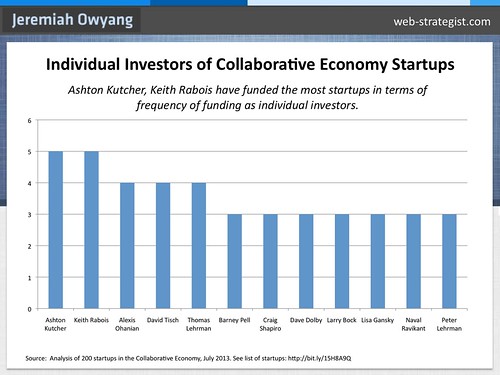
  • Individual investors include Hollywood stars and internet veterans. Early stage funding often includes celebrity investors who want to get in on the action, angel investors, and friends and family round of other successful entrepreneurs. Ashton had invested in 5 startups in this market, and seasoned internet execKeith Rabois is reported to have individual investments in many startups in this market. Assume there are other personal loans and investments made, but were not apparent in our public searches.

Graphics: Key Investors in the Collaborative Economy:
After segmenting the data, we comprised these graphs, based off frequency patterns per startup.


Screen Shot 2013-07-11 at 1.26.16 PM

Screen Shot 2013-07-11 at 1.33.54 PM

Screen Shot 2013-07-11 at 1.33.07 PM
Above: Individual investors are based off an updated sample size in Feb 2013, while data is accurate, it did not include new startups that were added to this market.

Screen Shot 2013-07-14 at 8.13.39 PM
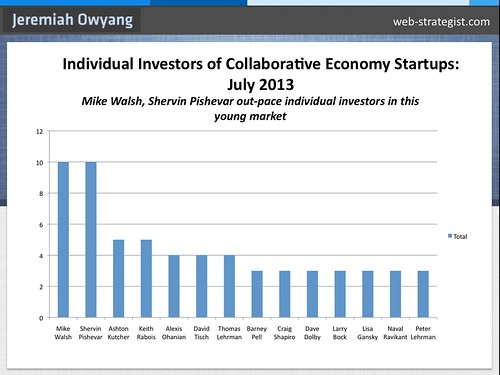
Above, On July 14th, I’ve added the following graph, which includes new investors not in the original sample size, collected in Feb. In all cases these graphs are correct, but they represent different sample sizes. New investors include Mike Walsh and Shervin Pishevar, who take the lead, in terms of frequency.

Methodology and Data Notations
See the full data sample was from 200 startups in the Collaborative Economy read the infographic to obtain summary. Special thanks to Collaborative Consumption crew, as many of the names were obtained from their site. Of the 37% who’d been funded, we mined public records ranging from Crunchbase, startup website, investor website, wikipedia, news sources, press releases and beyond to obtain data. We don’t believe this list is complete, but a representative sample of funding from easily obtained public sources.

The term “venture round” is an amorphous term which can be used in a variety of ways, which we included in the ‘other’ category, as it’s used in early stage and later stage funding rounds. Obtaining exact amount of how much each firm or individual invested is next to impossible, so obtaining frequency, and estimating via round helps to determine. Compounding this complexity, multiple investors are often involved in each round, making specific dollar amounts difficult to determine. This information should not be used for official financial advice or guidance, but only for entertainment purposes only.

If you liked this post, see all my coverage and data on the VC market. Photos used under Creative Commons, by Philip Taylor.

12 Jul 17:03

BANT is Bunk, BS and Irrelevant - per Ardath Albee

by Dan McDade

BANT is BunkI really liked Ardath Albee’s blog on July 9, 2013—Why BANT is Bunk for Today’s B2B Buyer and not just because I agree with most of what she says. The blog is painfully honest, insightful and substantiated by facts. Here is a quick recap if you don’t have time to read the whole article:

  1. Salespeople need to think differently. BANT is among the reasons leads passed by marketing are considered low quality. Buyers have changed. BANT hasn’t. "...SOME OF THE BANT CRITERIA FOR YOUR HOTTEST LEADS WILL LIKELY BE MISSING."
     
  2. Here are some reasons “why BANT needs a bit of renovation”:
    1. Budget: According to DemandGen Report, “48% of buyers surveyed say their purchase of complex B2B product/solution was initially unbudgeted.”
    2. Authority (this one makes Ardath want to grit her teeth): In most cases the C-level contact is not the person “building a relationship with your company, or reading your content, attending your webinars or sharing your infographics.”
    3. Need: “This one is probably the most valid of the BANT criteria for without it there’s no possibility of making a sale. But think carefully about how you define this; is it a need or really a want? How important is the problem that’s being solved in the scheme of things? For the buyer? In relation to the company objectives?” 
    4. Timing: “Rather than relying on the prospect for urgency, perhaps that’s something we should be bringing to the table. No—not with desperate attempts to close a prospect that’s not ready, but by showing them the value of the impact they’re unable to have today—without our solution.”
       
  3. Ardath wraps up with her top three criteria which she refers to as “Dynamic Criteria”:
    1. Need: But with the caveat that work needs to take place to define the types of need that are sweet spots for your customer. I teach that there are three conditions of need. Fear of loss in your current situation, perceived risk of deterioration in your current situation and opportunity to improve your current situation. The third condition is what I call selling into the rainbow. Sure you will find an audience (what used to be called Seymour’s) but you can’t (usually) sell into an opportunity to improve condition. You hope for a fear of loss situation and sell to that condition differently than you would a perceived risk condition.
    2. Connections: Power or access to power—which person has the perspective that will allow for the most urgency to be recognized based on value add?
    3. Company: “Even if your contact is interactive, interested and highly engaged, if the company isn’t a good fit and won’t likely buy from you then you’re wasting your time, no matter how great the lead score is.”

I’ll close as Ardath did in her blog: What do you think? What would you add to this list?

By Dan McDade

12 Jul 17:00

4 Start-ups Gunning for Google

by Issie Lapowsky

A little competition is always a good thing. But what if your competitor is Google? Check out four daring companies aiming directly at the Web giant.

Google is the most visited website and the second most recognizable brand in the world. To launch a company that goes head-to-head with those guys, you'd have to be crazy, right? Not necessarily. After all, if Larry Page and Sergey Brin had been scared off by existing search engines like Yahoo and AltaVista back in 1998, they might never have founded Google in the first place.

That's why it's been inspiring to see several smaller players make big headlines lately with products that seem to take aim directly at the tech juggernaut. Here's a look at a few audacious companies daring to challenge Google at its own game.

Mobileye Targets Google's Driverless Cars

The biggest news this week came from Mobileye, a Dutch company that announced it had raised $400 million at a $1.5 billion valuation to commercialize semiautonomous vehicles. Founded by Amnon Shashua and Ziv Aviram, the company has been working on collision avoidance systems since it was founded in 1999. Now, it's developing driverless cars that will sell for a fraction of what Google's vehicles will cost. According to The New York Times, Mobileye hasn't set its sights quite as high as Google has, since Mobileye's cars won't operate completely on their own. Instead, Mobileye's technology allows cars to drive in a single lane at a steady speed and identify and respond to traffic lights. Making the cars semiautonomous, the founders hope, will keep costs low, relative to Google's driverless car, and may help the company get its cars on the road as early as 2016. As Aviram told the Times, "It's a camera and a chip, with no exotic technology. It's the most cost-efficient system that's out there."

OneGigabit Takes on Google Fiber

Last week, a new Vancouver-based start-up called OneGigaBit revealed its plans to bring high-speed Internet to Canada with its own fiber network. Similar to Google Fiber, OneGigaBit will offer Internet at one gigabit per second, which is 60 percent faster than the average in Canada, according to CBC News. Founder Eric Fuhnke recently told CBC he plans on working with real estate owners and developers to install fiber connections in entire apartment complexes at once and plans on selling the service for $45 to $65 a month, slightly lower than Google Fiber's $70 a month price tag. Because fiber optic networks are local by nature, it seems unlikely that OneGigaBit will face much direct competition from Google any time soon. So far, Google has only managed to launch Fiber in Kansas City, Kansas, with plans for Austin, Texas, and Provo, Utah, in the works.

Leap2 Tackles Search

Perhaps the most peculiar Google challenger is Leap2, which is taking on search, of all things. Of course, the team behind the Kansas City, Kansas-based start-up is quick to point out they're not trying to replace Google as a search engine. "Google is really, really good at what Google does," product director Tyler VanWinkle told VentureBeat Monday. "We feel like we're doing something completely different from what Google is doing." The start-up, which raised $1.6 million in April, aims to build a search engine that's more relevant to younger users by incorporating search results from public Tweets and relies more heavily on images. "The younger generations don’t have the same kind of loyalty we have. They haven’t been using Google for 15 years. They’re not loyal, frankly. They want something different. They expect it to be dressed, sassy, sexy, bundled up, and highly consumable." Now the challenge will be convincing advertisers of that fact.

Feedly Outlasts Google Reader

Google Reader took its last breath July 1. While Google's decision to shut down the service may have dismayed loyal Reader users, it was great news for Edwin Khodabakchian, who built his own competing news aggregating app Feedly in 2008. When the Palo Alto-based start-up launched, a full three years after Google Reader, the market for copycats was already saturated. But Feedly, with its slick interface, persisted and slowly amassed a loyal user base of 4 million. Now that Reader is out of the picture, Feedly is reaping the benefits. On the day Google announced the shutdown, Feedly's blog reported the start-up had gained 500,000 new users in 48 hours, and that number has only continued to grow. Feedly, which has been struggling to keep up with capacity, has since seen its user base triple to 12 million.


12 Jul 16:59

When Not to Promote a Great Worker

by Drew Greenblatt

We learned the hard way: Not everyone is cut out for management.

It’s great when an employee does a superior job, isn’t it? The person does good work, shows up on time and is pleasant to work with. Over time, it’s natural that we would want to promote the person. The progression seems logical, obvious, a way to reward good work.

But more often that you might think, it doesn’t work out. Many workers do not have the right stuff to be a supervisor.

The sad scenario plays out like this: We promote a person from the ranks to supervise people who just days earlier were that person’s peers. At first, the employee is a bit uncomfortable in the new role. The new supervisor wants to stay friends with co-workers as if nothing has changed, but in a work sense, it undeniably has. The new supervisor seems tentative, uneasy about being a coach. Performance begins to slip. Relationships falter. Attempts are made to "course correct." Sooner or later, it becomes clear that the person does not fit the new job.

Tom Maze of Polaris Profiles, a workplace consultant we’ve relied on here in Baltimore, says if we had checked the performance profile that we conduct when hiring, we might have hesitated before making that promotion. Our normative assessment evaluates thinking style, occupational interests, and behavioral characteristics. Employers often use such assessments during hiring, but they are informative in the promotion process, too, and can prevent mistakes.

When not handled carefully, the saga worsens. Management moves the person back to the line. He has difficulty re-integrating. He decides he doesn’t like working at the place anymore. He quits. It’s a double whammy for the employer, who still needs a supervisor, and also just lost a valuable, productive, proven employee. (In one case for us, it didn’t end too badly: The person who didn’t take to being a supervisor was willing to return to being an operator with no adverse effects.)

A successful supervisor must be an effective communicator, independent and decisive, skilled in prioritizing and monitoring, and engaging. The noted management theorist William Edwards Deming said that if an employee-turned-supervisor doesn’t work out, the person was miscast by management for the role in the first place.

The skills that make someone a good worker and that make someone a good supervisor aren’t the same. Line workers produce products; supervisors produce products through people. Big difference.


12 Jul 16:59

Note to Tech Companies: Get Over Yourselves

by Francesca Louise Fenzi

At least two industry leaders agree: Your customers are not "yours". Here's what all start-ups should know.

Tech founders like Larry Page, Bill Gates and Steve Jobs are widely recognized as industry visionaries--defining the markets their companies now lead. However, as two prominent industry figures pointed out this week: Even visionaries can afford to cash the occasional reality check.

"One of the things you're supposed to work out some time in your adolescence is that though you're the star of your own life, you're not the star of anyone else's. Some companies never work this out," wrote Benedict Evans, web analyst for the London-based firm Enders Analysis, on his blog Tuesday.

He wrote:

Your customers' relationships with you are the only relationships you have as a business and you think a lot about them. But you're one of a thousand things your customer thinks about in a week, and one of dozens of businesses. And they probably have their own ideas about how they want to engage with you (though they wouldn't put it in those words)--assuming they think about you at all.

This applies even to Google or Facebook. There's lots of data showing the high proportion of online time that people spend using Facebook, and the high volume of web searches that they do using Google. Facebook and Google are important. But that doesn't mean they're everything.

In other words, Evans explained, you need to think more like your customer--and realize that your actions influence but hardly dominate their lives.

His post was echoed by venture capitalist and entrepreneur Fred Wilson, who stated that the analyst had "nailed it."

"You can think of people as users or customers," Evans wrote. "But they're not yours. They don't belong to you, and they may barely even care that you exist."

Ouch. Sounds like reality bites.

    
12 Jul 16:59

Big Presentation Coming Up? 5 Rookie Mistakes to Avoid

by Eric V. Holtzclaw

Every entrepreneur needs to present at some point. From apologies to information overload, a primer on what not to do.

As you grow your company, you will find yourself standing in front of an audience more often. After all, you are the best person to take your message to the masses: You feel the most passion for what you do and you understand the strategic vision to move your company forward.

While it's important to think about what you should do when presenting, it's just as important to consider what you should not do. In fact, perfecting your presentation skills is very much about what you consciously choose not to do. Here are five common mistakes new presenters make that you should avoid.

Filler Words

By far, the new presenter's most distracting habit is the use of filler words. Many people automatically think of "um," but there are many, many more. A filler word is any word that is unnecessary to the point you are trying to get across or is repeated throughout your presentation to the point of distraction. The use of filler words can be so distracting that your audience may completely miss the point.

Almost everyone has a go-to filler word. The filler word I used the most when I first started presenting was "right," and I recognized it pretty easily. Recently, my filler word of choice is "so," which is more easily overlooked. I have to concentrate much harder to self-edit "so."

The best way to find out yours? Record yourself. If you can't do that, ask audience members to tell you if you have any words that clutter your speech.

Reliance on Slides

You should never compete with your slides for the spotlight. Your audience's attention should be on you or on your presentation. Resist the temptation to point at your slides, and if you do, then give your audience ample time to read what's there--don't read the slides to your audience.

Your slides should contain simple imagery and include only the key points or statistics you need to provide back up for what you are saying. I completely avoid animation, but if you choose to use it, use it sparingly.

Information Overload

The human brain can only keep up with five things, give or take two. That's why I am happy if my audience walks away from my presentation with just one or two key messages.

I focus on making sure my audience gets the "big ideas." The best way to do that is to encapsulate those ideas in a story. It's true that turning your points into a catchy phrase might help aid memory, but I have found it's a few points, delivered in a carefully crafted story, anecdote, or joke that will stay with your audience long after you step off the stage.

Apologies

Never, ever apologize for missing something in your presentation. The secret is that your audience probably doesn't know that you missed something and apologizing doesn't help.

This rule also applies to your slides. If you notice a misspelling or other issue with your slide, don't point it out. Those in the audience who have caught the mistake have already caught it--pointing it out doesn't fix the problem and will only highlight it for others in the audience who haven't noticed. Your audience is rooting for you, they want you to be successful. Use that momentum to move forward and don't sabotage yourself.

Too Much Talking

The most impactful thing you can do while presenting is to simply stop talking. Take the time to pause--it gives your words space and the time to sink in. The best speakers use space and cadence to connect with their audience. What feels like an eternity to you on the stage is merely a moment to your audience and they need this time to absorb what you are saying. The quiet gives their brains time to catch-up before you move on to your next point.


12 Jul 16:51

Top Tips on What NOT to Do on Twitter

by Deborah Bates

As with all social media sites, Twitter is a fickle beast. Treat it well and you’ll reap
great success from the investment. Treat it and your followers badly… Well, let’s just say it’ll be worse that if you hadn’t joined at all.Top Tips on What NOT to Do on Twitter image Old school Twitter

There’s a certain etiquette to follow on Twitter, not to mention many things you can do to achieve good levels of engagement, followers and shares. However what’s perhaps more important to recognise is what not to do on the network. With that in mind, here are our five top tips for what NOT to do on Twitter…

1) Brag

Hey, you! Have you seen what my company did yesterday? Better yet, did you see what we did today? Wanna know what we’re up to tomorrow? How about next week? Anybody? No?

NO! Don’t do it. Don’t use Twitter as a tool just to push your company and its products or services. Don’t use all of your tweets to brag. Sure, if you’ve had a big success, then shout about it – once. Surround this tweet by those that add value to your followers’ lives; sharing useful, relevant content. Otherwise, you’ll risk losing followers and all hope of engaging with those you do keep hold of.

2) Auto-respond to new followers

Got a new follower? Don’t send them an automated tweet or direct message. It just isn’t cool. Treat them as an individual. If you really value their follow, then treat them with the respect they deserve and respond to them personally. Why not take a look at what they tweet about and use this information to personalise your message? Starting the relationship off right will only prove beneficial to your brand later down the line, so it’s really worth that extra time and effort.

3) Over-tweet

Don’t bombard your followers’ timelines with tens of tweets every day. Stats show that over 400 million tweets are posted on Twitter every day. Don’t become part of the white noise. Updating your page around five – seven times each day will be sufficient and remember, don’t tweet for the sake of it. Regular updating is necessary, admittedly, but you should only speak up when you have something valuable to say. Make each tweet count.

4) Force-feed

Top Tips on What NOT to Do on Twitter image forcefeed 300x300Made a new acquaintance on Twitter? Don’t force-feed them your content. Take a look at the type of things they share (which will give you an insight into what’s important to them) and take the time to find a piece of content you’ve made that truly matches their interests. Do read some of their own work and make reference to it when sharing your own; don’t just rock up with a piece of content and throw it at them, otherwise your engagement levels will suffer.

5) Automatically follow back

Don’t just follow someone because they follow you. Although some consider it the decent thing to do, when representing a brand on Twitter, it’ll simply make you look spammy and like you’re just after more followers. Gaining more followers is great, of course, but you should only follow people that will add value to your account – industry influencers/leaders, for example and the specialists working for your company. Take a moment to think about what that follow will really do for your account before hitting the button.

Thanks to favin.com & mashable.com for the images

12 Jul 16:51

25 Interesting Email Marketing Statistics for 2013

by Andrew Paul

25 Interesting Email Marketing Statistics for 2013 image Statistics

In the Beginning – A Little History

1. The first email was sent in 1971 by Ray Tomlinson on the ARPAnet, which was the progenitor of what was to become the Internet. At first, his email messaging system wasn’t thought to be a big deal. When Tomlinson showed it to his colleague Jerry Burchfiel, he said “Don’t tell anyone! This isn’t what we’re supposed to be working on.”

2. The first spam email was sent on May 3, 1978. Gary Thuerk, a marketer for DEC, (Digital Equipment Corporation), sent out his message to 400 of the 2600 people on ARPAnet.  Naturally, he was selling something. Computers, or more specifically, information about open houses where people could check out the computers. He annoyed a lot of people, as spam still does to this day. He also had some success, with a few recipients interested in what he was pushing. And thus, spam was born.

Current Day

3. 64% of people say they open an email because of the subject line.

4. More people are reading email on their phones than on the desktop.

5. 40% of surveyed individuals said they enjoy getting emails sent to them by their favorite brands.

6. The average person checks their smartphone 34 times a day.

7. 75% of North Americans read email on their phones everyday (that’s 112.8 million people).

8. Half of respondents to a 2013 email marketing census identified that the quality of their email database caused problems with their email campaigns, making it the most common barrier for three years running. This is the best reason there is to clean and validate your email list.

9. Emails that include social sharing buttons have a click-through rate 115% higher than those do not.

10. Email open rates are the highest they’ve been since 2007. Consumer product emails scored the highest open rates with a median 25.4 percent.

11. 17% of email marketers don’t track, report or analyze their email marketing metrics for their campaign deployments.

12. The highest CTRs (click through rates) were generated from education, healthcare, retail and consumer products/services.

13. 12% of people use separate work and personal email addresses.

14. 65% prefer emails that contain mostly images vs. 35% who prefer mostly text.

15. Saturday has the highest CTR at over 9% (Sunday is second just under 9%) for consumer email campaigns.

16. Average return on email marketing investment: $44.25 for every dollar spent.

17. Commercial emails account for 70% of spam complaints.

18. In a recent survey, 35% of respondents said they acted on an email promotion within the last week, and 33% said they did so in the last month.

19. Subject lines with 30 or fewer characters performed above average in opens and clicks.

20. 69% of email recipients report email as spam based solely on the subject line.

 The Future

21. 78% Of U.S. email users will also access their emails via mobile by 2017.

22. By 2015, 44% of people in the US will be using a smartphones.

23. By 2015, 53 million people will own and use a tablet computer or eReader.

24. Email marketing spending will reach $2.5 Billion by 2016.

25. The total number of email accounts is expected to reach 5 Billion by 2017.

12 Jul 16:51

A Seamless Content Marketing Process for a Highly Regulated Industry

by Manya Chylinski

A Seamless Content Marketing Process for a Highly Regulated Industry image content marketing process financial industryThe number one challenge Patti Ernst has when it comes to creating content is time.

“The sales team is trained very well, but we don’t always have the luxury of time. The team wants it next Tuesday, and I know it takes three days in compliance and five days in design. I have to ask favors of everyone,” says Ernst, Channel Marketing Director at financial management company Invesco. “But everyone understands that we are working toward the same goal, doing great work for our clients.”

Time is one of the universal challenges for all content marketers. Invesco has a very efficient process that helps its marketing team deal with, and sometimes circumvent, that particular challenge. Their content marketing process is designed to maximize the input of various team members — sales, marketing, and compliance.

As a channel marketer, Ernst sits at the very important intersection of these three teams. She focuses on three channels — broker-dealer, defined contributions, and annuities — and works with the sales teams for each channel to align content creation with customers’ messaging strategies. For example, one of her customers has a global focus. To create marketing content for this client, she uses materials developed by the international product marketing team, then tweaks the content to fit that specific client’s marketing language.

When it comes to understanding the language the client wants to use, Ernst gets a lot of feedback. In her role, she works directly with clients, client engagement teams, sales teams, and the marketing teams, so she is involved at all levels of the relationship. And many of her clients are not at all shy about sharing what they need. Sometimes they send her a list of words they want to use, or instructions on how they prefer to say certain things — using the word “strategy” instead of “planning,” for example.

Creating shareable content in a strictly regulated industry

No matter the format of the content (white paper, case study, presentation, etc.), the content creation process is well defined: The product marketing team creates content for a specific Invesco fund. Once the content is finalized, it is sent to the compliance team for review. After compliance gives approval, that piece of content is made available via an online repository, which can be accessed by both the sales and marketing teams to be used, as needed. At this stage, Ernst or a member of her team can view or retrieve (but not edit) the content.

When she needs to customize this existing content to meet the needs of a particular client, Ernst works with the product marketing team and the product manager to make necessary edits. If any changes are made after the content has been approved, it must be sent back to the compliance team for review.

Invesco’s content marketing process for creating brand new materials is similar — Ernst works directly with the product marketing team and product manager to develop customized content. However, in these cases, she takes the lead in the process, since she knows the client better than anyone.

“It is great that we do it this way. Then the product marketing team will learn about this client’s focus and find out things they weren’t aware of.”

Compliance

Financial services is a highly regulated industry, so the marketing and sales teams are always aware of the role the compliance team plays in the content marketing process. And, in turn, the compliance team knows the importance of its role in creating this content; thus, the team has worked together to reduce the average turnaround time for reviews to three days. (This doesn’t include social media, whose team has a dedicated compliance team member to take care of their real-time needs.)

When Ernst works on content that includes disclaimers (which most content does), she is equipped with a plan: From her experience, she has learned most of the disclaimers that will be needed, and how much space to allot for them in the final piece.

“If I’m working on a brochure, and I know the content will be two pages, I have to make the brochure four pages because of the disclosures. I do the best job I can adding the disclaimers, then I send it to compliance, and they make sure I used the correct disclosures, specific to that fund.”

But of course, all of this takes time, which Ernst has factored in to her content marketing process.

“When I get a project, I’m always aware of deadlines,” says Ernst. “Half the time, the content is the easiest part. If I get a project due in two weeks, I back out printing and compliance so I know how much time I will have to work on the content. Sometimes, the client requires approval as well, so I also have to factor that in.”

This content marketing process works well because Invesco provides its sales, marketing, and compliance teams with the tools and resources they need to do their jobs. And they are always on the lookout for new resources to improve the process. Their mission is to do everything for the benefit of the client. And creating and using excellent content is part of that.

“I really like how this is all put together at Invesco. We are partners here,” says Ernst. “Everyone is working toward the benefit of the client; how we can make it work for Invesco and our clients’ success.”

Need more guidance on best content marketing practices for the financial services industry? Don’t miss the Content Marketing World Financial Summit on September 12, 2013.

Cover image via Bigstock

A Seamless Content Marketing Process for a Highly Regulated Industry image A Seamless Content Marketing Process for a Highly Regulated Industry image A Seamless Content Marketing Process for a Highly Regulated Industry image

12 Jul 16:50

The Secret to Irresistible Marketing Without the Hype

by Daniel Chioco

The Secret to Irresistible Marketing Without the Hype image hype ads 300x220We’ve all seen them – those marketing ads that are definitely too good to be true. But despite the obvious marketing efforts, we can’t help but get wrapped up in the hype, only to be disappointed when we finally get our hands on the products. While sensationalized marketing is a great way to gain attention, too much hype (and failing to live up to it) can actually hurt your brand.

While hyping your products and services is a natural part of your business’s lead cycle, going over the top can actually spoil the consumer’s experience. For marketers, the balance remains in creating a content strategy that is thrilling yet realistic about the services being marketed.

Cut the Hype: Substance Over Sizzle

When customers fall for the sizzle once, they’ll opt to never be burned again. This is why it’s crucial to avoid over-hyping products and creating unsubstantiated buzz. Fortunately, there are still techniques to create compelling content marketing strategies while staying grounded in your efforts.

  • Limited Time Offers. Creating a limited time offer utilizes the principle of supply and demand. By creating the sense of urgency among consumers, you can create a compelling marketing campaign without over-hyping a specific product. Consumers are more likely to act when faced with a special deal such as a limited time offer, limited quantity offer, or a variation of both.
  • Eliminate cliché vocabulary. Biggest, fastest, and best are some of the most used words in hype-based marketing. Of course, in many instances it’s completely natural to incorporate these words into your content strategy. However, eliminating hype-y words not only eliminates exaggerations, but also offers you the opportunity to get creative with the way that you piece content together.
  • Timing is everything. Riding on tent pole events or other cultural bandwagons is a great way to gain exposure without having to over-hype your products and services. Taking advantage of popular trends and buzz-worthy content is a prime way to position your brand in front of a larger audience.

Ultimately, avoiding hyperboles and offering truly useful content is the magic key to making your offers seriously irresistible!

What offers have you experimented with? What results did you get?

12 Jul 16:50

Hardcore Advice for Software Marketing

by Joseph DiPaula

Marketing: Bring your product to the market

Hardcore Advice for Software Marketing image software marketingNo matter what type of software your business has come up with, whether it is the latest up and coming video game, multimedia editing program or any other computer program for that matter, you have to be able to market it if you want it to survive.

One of the most difficult aspects of the software marketing process is that a lot gets lost in translation. If your product helps reduce people’s usage of data and makes their lives easier by helping to run their computers faster, say that and only that. You don’t have to wow people with huge statistics right off the bat.

The use of small graphics, illustrations and charts help customers visualize the changes your software program can bring. A side by side comparison of how your video game’s graphics look compared to similar games easily allows people to distinguish your products strengths without them having to read about how you were able to do it using words he or she might not understand.

Don’t get caught up using what some people call “geek speak” when discussing your new software. You want to use the simplest language possible in your marketing strategy and let your product speak for itself. If the proper marketing strategy is applied, this will happen automatically.

When it Doubt, Blow it Out

Hardcore Advice for Software Marketing image software marketing 300x208As exited as you are for your new software program, not everyone is going to feel the same way, and that’s fine. You won’t necessarily win everyone over with your marketing strategy, but getting him or her to know your name is half the battle.

Small giveaways and free trials are excellent techniques companies can use in order to help boost awareness about their program. Video game companies often allow downloadable demos of their games before they come out. These demos allow potential customers to get a feel for the game in comparison to others and really allow them to form a good opinion of the game before they decide to buy it or not.

It is possible for gaming companies to simply put ads for their game coming out in video game magazines and on certain websites where gamers will see it, but allowing people to see your product in action for themselves allows them to answer their own questions without having to sift through your sea of specs about your game listed in reviews or articles.

This same tactic can be applied to other business as well. Coupons and other incentives are great ways to spark people’s interest about a product; it decreases the amount of risk that the customer has to take by choosing your program. Any chance where the customer has more to gain than to lose is a win is most people’s book.

It may not seem like the best marketing strategy to give your product away to people, but holding small events where people can see your software in action says a lot about your company as well as your product.

Intrepidity versus Stupidity

Hardcore Advice for Software Marketing image software marketing1The act of allowing people to experience something they never have before while insisting that it is going to make their lives better is a bold strategy. But in order to make a splash in an industry as competitive as software development, it’s necessary to avoid washing out as a company.

Being willing to give your product away through free trials, demos or other coupon style giveaways makes a statement to clients that you are confident that your product has the ability to stick in the competitive and ever changing software industry. It lets everyone know that you are confident in what you are bringing to the table and certain that once people have a taste, they will be coming back to get the real meal.

The key to any good marketing strategy, especially when it comes to trying to market new software, is that you cannot be afraid to get creative. Despite how much discipline it took and how meticulous it was to come up with your new piece of software, the fun part should be coming up with ways to seemingly give it away to people. Think about how fun it can be to tease those younger than you who don’t know any better. The same concept holds true when it comes to your new software marketing strategy. You have something new and awesome and as long as you display it in a way that shows how awesome it is, people are going to want it.

People always want the latest and greatest. If you exult the confidence that your new software is the latest and greatest and allow people to see it for themselves first, your latest invention will be the next big thing.

Photos by: @heyamberrae, Nemo and rstrawser

12 Jul 16:49

Honesty is the Secret to Success

by Erin Osterhaus

Honesty is the Secret to Success image honesty definition 428 395

The success of an organization is closely related to an honest company culture. And here’s the proof:

A 2010 Corporate Executive Board study found that companies encouraging open and honest feedback among its employees experienced superior shareholder returns over a ten year period, outperforming others by 270 percent. In the study, from 1998 – 2008, companies with honest feedback among their staff. Impressive numbers, but do they hold up?

To find out, Fierce, Inc., a leadership consulting firm, conducted its own research. The firm surveyed over 1,400 executives and employees, finding that the vast majority – 99 percent – preferred a workplace where staff members were able to discuss issues truthfully.

Honesty may make a company a “happier” place to work, but the Fierce survey uncovered an even more important finding: 70 percent of respondents believed that a lack of candor impacted their organization’s ability to perform at its best. There were various reasons for this belief, among them the argument that small problems could be identified early on, arming managers with the information needed to make decisions.

But, unfortunately, a culture of open and honest feedback doesn’t occur organically. In a recent article on the Software Advice website, the CEO and President of Fierce, Halley Bock, provided four key tactics to improve your company’s communication and encourage open and honest feedback.

  1. Be Current and Brief. Resolve problems faster by addressing issues as soon as they arise.
  2. Don’t Sugarcoat the Issue. Don’t cushion confrontational situations with compliments or small talk; tell colleagues or employees what’s at stake, and review the steps required to address the issue together.
  3. Keep Positives and Negatives Separate. Focus only on the positive or negative when it is warranted, and don’t muddle the issues in a “compliment sandwich.”
  4. Use a Social Networking Approach. Enjoy higher employee morale, improved productivity, better retention, and increased bottom-line success through candid dialogues between managers, employees and coworkers.

These tips might not be easy to implement, but they’re well worth it. In the end, nurturing a workplace culture of honesty and open communication will not only increase the level of happiness your employees experience in the workplace but it may also increase your revenue. And what business wouldn’t want that?

12 Jul 16:49

How to Boost your Blog by Using Real Personalities that Connect with Your Customers

by The Wishpond Blog

How to Boost your Blog by Using Real Personalities that Connect with Your Customers image tumblr inline mpfbirpuKA1qz4rgp

Social media is about creating a friendly connection with your market. It’s about listening to your consumer, responding to their wants and creating an emotional bond.

This is nothing new in marketing (ok, I just spent my weekend DVR binging Mad Men and listening to Don Draper’s marketing wisdoms from the 60’s). A few differences these days is that understanding your consumer now really means immediate engagement and interaction.

Have you ever read a blog post that just clicks with you? Like, a post that’s written in your language, and gives you the information or emotional boost that you were searching for just at that moment?

Have you ever wanted to learn how to do that for your business blogging?

I wanted to learn a little more about this too, so I did a lot of research into it. And now I’ve written this blog post for you. It’s all about creating a marketing personality on your blog that connects with your market.

This isn’t about branding or your company’s image. It’s about having a blog written by real people that your customers can connect with personally, in ways that you can’t with a brand’s logo.

In this article I’ll show you how four companies are doing this successfully and how you can do it to.

Geico

When you think of insurance, you probably think of a lot of bureaucracy and a lot of long, legally worded forms. When insurance is sold, however, a good company makes you feel like you are their number one priority, and that they will take care of you in the case of an emergency.

Can a national insurance company really be marketed to make you feel warm, fuzzy and secure?

Geico does. Not only do they have a cute gecko with an attitude as their mascot, they take their online personalities further.

Venture to their blog, and you’ll see an active, engaged community.

Bloggers are Geico employees, who work in all aspects of their insurance company – from adjustors, policyholder service to marketers. The tone of their blog is more like a personal journal than a multi-million dollar insurance company.

Every month, for example, they host a “Memory of the Month” photo caption contest on their blog. They upload an image from the history vaults of Geico, write a friendly blog article, and encourage their readers to engage with them. Readers are able to connect with the company by captioning the nostalgic photos.

How to Boost your Blog by Using Real Personalities that Connect with Your Customers image cguv8zPryLkAqX5jG0hU3K2UsZ6iWtcUtUrwyFquSTMdqMs6Mp1qgyKBB6tr16w YTztJOIoHda27MED hsZG33lddSmNHzzZJSYjWBfbsBydqc 8WEOfaaK

Geico makes it easy to post comments, share or like the articles.

Blog topics also include safety tips and how to prepare for emergencies, Q & A’s with company executives, and interactive contests about being safe in numerous situations.

Another great way the Geico blog makes a personal connection is by including friendly, simple bios about each of their main blog authors. The bios include who they are at Geico, a favourite line from a Geico commercial, and something a little quirky about each blogger.

How to Boost your Blog by Using Real Personalities that Connect with Your Customers image ozWnh1gmfXmacRiTnL XEJc7aRdEWc2jUD2rSfIp7Nu1kqwUEi3kLEOmHcLakhxY cHxYxjymsMG52kejcsx4QXa5AA8w4pO8Vz4IEPHv2zCg7j9BpCjDb6O

Other insurance companies have blogs too. All State, for example has a very active blog. But the All State blog is more much corporate in design. Although there are lots of good safety tips, and, frankly, more blog posts than Geico, the Geico blog is written like they’re your friend. This is keeping with their national marketing efforts to be the good-humoured, gecko-lead, neighbourhood insurance company. And the Geico blog gets a lot more shares on Facebook.

PennyChic by Shauna Miller for Walmart

The Shauna Miller story is quite a remarkable one. In 2010, Shauna was a 25 year old fashion designer and blogger. Her passion was making women feel good about wearing accessible high fashion.

Shauna developed a blog called Penny Chic, showcasing her outfits from discount designer lines. She wrote her blog in a sociable, approachable and informative manner. She included lots of visuals, diary-like video cam videos, and sprinkled in a lot of her own charming personality.

It quickly caught on.

Within two years, Shauna now has her own Penny Chic designer line at Walmart. She maintains her Penny Chic blog, and still writes about inexpensive, authentic fashion, including her own Walmart fashions.

For Walmart, this is a great marketing technique. The story is real, the author is very personable, and the blog connects with their target market. Many young women with a passion for fashion have their own styling blogs. The PennyChic blog is a bit of a cultural trend – and it shows Walmart leading that trend in its fashion.

The PennyChic blog, for example, includes a personable bio about Shauna. It’s written in a letter-like manner, and it really reads like she is writing it for you:

How to Boost your Blog by Using Real Personalities that Connect with Your Customers image 45T SmI 8 xhi1NewUdKMoldh5Y1yLAk4GjoDIM5sW12wEt45pk RF6hFOj28oT8OOAL69jPgFQlPv8Baft1CmYjZCd1EE iMVkC5yUrooPCt5Q0ucPZwHl9

In the “About” section, Shauna also includes a very “reality show” like video. It’s mostly shot in her own bedroom (which super relates to the niche market of fellow fashion bloggers), but also includes footage of Shauna shopping glamorously, and has cool footage of her being interviewed on national TV talk shows.

How to Boost your Blog by Using Real Personalities that Connect with Your Customers image JYTuK671Mzz9tFVb2tOuVeJO9zT3m10VNj5M5bPr4D0kTMIW302IgzPSJixPbUgqmloewcKUEbNszs3hs4erq0sISF7PTbWsw4gmAaIyTdER58bOKWwhQhsF

All of her models on the site are regular people – including Shauna. Unlike more corporate fashion blogs, each of the models are profiled, with Polaroid like images, and a hand written quirky short bio about who they are and a little known thing about what they love. Her mom is the photographer.

How to Boost your Blog by Using Real Personalities that Connect with Your Customers image 5OFjUV g q7cqc7cDnNpq6z4aOkudCgiqei5Mt7WUB9r8wtZGbnqFiqOrT5OgOZsQXlMRJQfn mug7yU8d0a4COTmf0zBOs2hzTUjmMLRJ02fklJpnblQ7b

Shauna excels in all of her amazing talents. She is a fashion guru with tech know-how, and has a wonderful ability to market her passions in a very personable, related, connected manner.

The marketing team at Walmart will do well to keep her line, and to keep her blog in the authentic, socially adept style it has.

Neil Patel

B2B bloggers can create a very personal persona too. An amazingly globally recognized leader in the B2B (and any commerce) space is Neil Patel.

How to Boost your Blog by Using Real Personalities that Connect with Your Customers image iS5uOkUfeekcd7S0ZuCOmnnMwRdyw4Z09mX0or1NK DZDNk5xjdL8p5B8ftbr2gjXEg1YgDjVpJ6U8rB0mikhlTjilxburbd5vsgZp3IDws0uJLMD3MiNNL

Neil is an entrepreneur who co-founded QuickSprout, KISSmetrics, and Crazy Egg. He’s not only kind of a big deal, he’s also kind of a marketing genius.

He’s been called a top influencer on the web by the Wall Street Journal, and named a top entrepreneur in the world by Entrepreneur Magazine.

So, how does a world renowned marketing millionaire blog to business customers?

Not like you’d expect.

Neil Patel has got to be the most well-known, personal, smart and consistently down-to-earth blogger in the world.

Neil has worked with companies like General Motors, TechCrunch, buffer, Microsoft, and inuit. His blogging style, however, remains as if he is writing directly to you, and that he’s that guy at the party that everyone knows.

If you are in the social media marketing space, and don’t know who this guy is, I suggest you at least go check out his KISSmetrics blog (but do it after you’ve read this article, of course).

He’s not shy about his blogging methods, either. He’s written many articles on how to write blogs that create a personal connection with your market. They’re all very accessible, super easy to read, and frankly, make a lot of marketing sense.

Here’s a screenshot of a post he wrote nearly two years ago, Neil Patel’s Guide to Blogging. His style still connects with the people (like you and me) who work at businesses today:

How to Boost your Blog by Using Real Personalities that Connect with Your Customers image SmFnpBYaLLjoA60GkZs86IhoapQQiBrWSZyzW qYhzaY0Vv4Q58W3MlQWASfK6ygUZF550pk5b4SIz5ykPuQheIR609bM qHQiKBLSyrmT1n1bEmET5gBuah

As a B2B entrepreneur, he uses lots of infographics, networks a lot with fellow bloggers and business types, and always follows up with his contacts (whether that’s via email, blog comments, social platform interactions, in person or any other way to keep in contact these days).

The thing that makes his blog so unique is that he gives real examples of how he has done the things he’s preaching in his own companies. Almost every post gives you a detailed break down of the revenue and website traffic he has garnered by using the tactics he writes about. More than anyone else I’ve seen, he practices what he preaches (and he’s damn good at it).

Okay, go ahead and read Neil Patel’s Guide to Blogging, but do come back to finish reading my article too! There’s still more tips I’ve got for making a more personable blog for your business!

Whole Foods

In the vast array of grocery store chains, there is one that stands out for its personal connections to its customers.

Whole Foods has created a brand that is tied to its consumers’ lifestyle and personal choices. So, it’s no wonder that they are a great example of blogging on a personal level with your patrons.

Whole Foods does not have just one blog on its website, but three. Each blog site is personalized and written to connect both the reader, and the products that Whole Foods offers.

Their main blog is called the Whole Story Blog. On it, you will find lots of seasonal foods with tips and recipes on how to use them. Being Whole Foods, the blog also has sprinklings of causes and tips to be healthy.

The blog posts are written in a friendly, informative tone. They’re written in the first person, with lots of “I’s” and “You’s”, and some even read more like a excerpt from a Joanne Harris novel than a corporate communication piece.

Here’s an example of the Whole Foods blog, and how they relate their food products to their consumers’ lifestyle. They wrote a blog about what to snack on during road trips. The post also has tips on family games to play in the car – all related to food and groceries.

How to Boost your Blog by Using Real Personalities that Connect with Your Customers image OKL8e1VNmrgAC77Q6Cbposgw 8SwP0JOE7YHFKKb6Z3aKnUo5vGViOaqmJQmDb3SRTW4YKTLaa5zSLpjJs49xdYUqFClNA4cWhURkbOlyaartlcJrNpKSxDt

Most bloggers on the site has a brief bio about themselves, with a photo, so the readers are able to feel a stronger personal bond with the blogs and authors. Most bloggers have professional experience in health or nutrition.

How to Boost your Blog by Using Real Personalities that Connect with Your Customers image 8 Idq dx 30JlT9U9igT elb iBJxZ0nASjs6lTNKlPmk10KAkAsLv XhNLElDqooUCkZ7JOoOOJHLtjMobli5rBTyRBKizWfmvBQe3KI1TG04 6Rv01iecJ

The two other blogs on the site are from Whole Foods’ co-CEO’s.

Walter Robb’s blog has a lot of company updates, with lots of videos showing the actual announcements in the various locations they were made. The intros to the videos are written in a personal manner, without a lot of the traditional multinational corporation type dialogue.

John MacKey’s blog also has lots of videos, with John being interviewed about lifestyle choices.

Not every company would be so bold as to have their CEO’s express themselves personally on their public website. But, if you want to really connect with your customer, speaking to them in whatever medium they are on does bring a closer (and more loyal) connection.

Conclusion

So how can you write more personally for your blog?

Regardless if your client is a business, a niche market, or the general public, there are common elements to relating to your audience through your blog:

  • Keep true to the core of your brand;
  • Write in real terms, like you are writing to a friend or a customer you are talking face to face with;
  • Create content topics that are of interest to your business, and to your consumer;
  • Write about the topics in a way that’s relatable;
  • If you have multiple bloggers, put faces to the names and have a friendly ‘about’ section for each voice;
  • Listen to your customer by responding to comments, and asking questions on your blog.

What do you think? Have you used any of these methods? Do you have additional tips on how to blog to connect personally with your market?

Written by Krista Bunskoek @ Wishpond

How to Boost your Blog by Using Real Personalities that Connect with Your Customers image vAvaRoVvuvFicE1ijdLS8FcrIpkqroMtFQbMVNPWgC348PTEQFsgkRVntY 5stCP4mPaBCxdxQjoeXDPudgzqfe0LzVjIPYwXnTEHmyPk3bv4uOt0w8z7KhN

12 Jul 16:48

4 Nonprofit Emails that Look Awesome on Mobile

by Ryan Pinkham

4 Nonprofit Emails that Look Awesome on Mobile image Apacmobile1 150x150

With 43 percent of all emails now being opened on a mobile device, nonprofits need to start thinking differently about the way they approach their email marketing.

The inbox has changed, along with the way potential donors, supporters, and volunteers read and interact with your emails. Failing to make the change to a more “mobile-friendly” email experience could result in missed opportunities to grow your organization in the not-so-distant future.

As complicated as it might sound, making the switch to a mobile-friendly email is actually pretty simple. In fact, we’ve talked to a number of nonprofits who have already started using mobile-friendly emails and have seen some impressive results.

Here are 4 examples of nonprofits with emails that look awesome on mobile:

1. Pajama Program

4 Nonprofit Emails that Look Awesome on Mobile image PJ 600x450

Tip for your next email: Use a single-column template

In the past, a multiple-column template used to be a popular design choice for nonprofits. It’s understandable. With so much going on in and around your organization, many feel that they need as much real estate as possible to keep people informed and up-to-date.

But here’s the thing…the multiple-column templates that make your emails look organized on a desktop or laptop, really have the opposite effect on a mobile device. While you may have been able to get away with squeezing schedules, links, and other pieces of content into an email sidebar in the past, on mobile, that content will be difficult to read and act on.

A single-column template saves your readers from having to pinch to zoom in order to read an update or click a link and, overall, gives them a much more enjoyable experience on a mobile device.

2. Alex’s Lemonade Stand

4 Nonprofit Emails that Look Awesome on Mobile image AlexsMobile2 600x450

Tip for your next email: Provide a clear call-to-action

When it comes to generating donations or encouraging volunteers and supporters to get involved, it’s crucial that you’re making it easy for your readers to take action.

This is true when someone is reading your emails on a desktop and it’s certainly true when someone is accessing their inbox via a mobile device. One of the best ways to ensure that you’re making it easy for people to take action is by providing a single, clear call-to-action.

What is the number one action you want your reader to take? Do you want them to donate to your cause? Register for an event? Volunteer to help out?

Take this example from Alex’s Lemonade Stand. From start to finish, the goal of their email is clear. Every piece of content — whether its text, video, or a link to find out more — maps to a single, clear call- to-action. That’s how you inspire action on mobile and how you’ll be able to achieve your email marketing goals down the road.

3. Strong Women, Strong Girls

4 Nonprofit Emails that Look Awesome on Mobile image Strongwomen 600x399

Tip for your next email: Be clear and concise in content and design

Designing emails that are clear, concise, and easy-to-read is by no means a new or revolutionary idea for nonprofit organizations. If you’ve been using email marketing for your nonprofit, you know that you only have a short window of time to engage someone after they open your email.

People are also likely to scan through your emails on a mobile device. That’s why it’s increasingly important to make your emails clear, concise, and easy to navigate.

Here are a few tips to keep in mind from Strong Women, Strong Girls:

  • Use plenty of white space: Don’t blind people with huge blocks of text. Instead, use bullets and shorter paragraphs to break up text.
  • Avoid tiny fonts: Make sure your text is easy to read. Use a minimum 11pt font for body text and 22pt font for headlines.
  • Take it easy on images: Avoid the temptation to jam-pack your email with tons of images from your fundraisers or volunteer events. Apple’s iOS automatically enables images to display by default but,many other mobile device platforms like Android, turn images off by default. If your email has a bunch of images in it, they might display as chunks of white space.

4. Astoria Performing Arts Center (APAC)

4 Nonprofit Emails that Look Awesome on Mobile image Apacmobile 600x399

Tip for your next email: Use mobile-friendly links

Links are hugely important for nonprofit email marketing. Whether you’re looking to drive donations, generate registrations, or encourage feedback, you need to make sure all of your readers can click to take the next step.

When it comes to mobile, your finger is the new mouse. A link that may be easy to click on a desktop can seem nearly impossible to click with the tip of your finger. If your readers can’t click your links, they’ll be far less likely to take action.

Here are a few ways you can make links more mobile-friendly from APAC:

  • Make images clickable: By uploading a photo of their staff and including a call-to-action that asked readers to click the photo, APAC was able to not only make their emails more visually appealing to their audience but, was able to offer a more convenient experience to their entire audience.
  • Put your most important link front-and-center: Remember, people will be scanning your emails on a phone or tablet. Make sure your link can be found right away.
  • Use buttons: Instead of making readers pinch to zoom in on a text link, use a button to make your links easier to click on.

Making the case for mobile

4 Nonprofit Emails that Look Awesome on Mobile image Making the Case for Mobile title slide v3 7.2.13 600x3372

Whether you know it or not, mobile is already having an influence on the way people interact with your organization.

In a recent survey from Pew Internet & American Life Project, 50 percent of participants said they were already using mobile to access nonprofit websites and emails. Another 40 percent reported having used a mobile device to make a donation.

Later this month, we are hosting a free live webinar called, “Making the Case for Mobile.”

In this 1-hour online event, we will cover:

  • Why you can’t ignore mobile even if you think your customers aren’t using it
  • How mobile is the new reality for small businesses and nonprofit organizations
  • What you can do today to become more mobile friendly

Register today!

12 Jul 16:48

Using Pinterest Analytics to Curate Your Content Marketing

by Melissa Megginson

Pinterest can be an incredibly valuable asset to your companies content marketing campaign. But how can you predict what resonates with your audience? By using PinLeague’s Pinterest Analytics suite to track the pins users are connecting with, you can curate the content your audience wants.

While there might not be a way to look into a crystal ball and see the secrets of creating effective content marketing, understanding your PinLeague Analytics Suite is the next best thing. By learning what categories your audience is interested in, the boards they are engaging with, the pins that drive repins and the images from your domain that catch a users eye, you can gain a better understanding of what works – and what doesn’t work – for your brand.

Find Your Most Viral Categories & Boards

By starting with a broad view of what topics and categories generate virality among your users, it becomes easier for your brand to curate the content that drive repins and traffic. To understand the virality of the categories you pin to, just take a look at your category heatmap:

Using Pinterest Analytics to Curate Your Content Marketing image Screen Shot 2013 07 10 at 2.12.46 PM

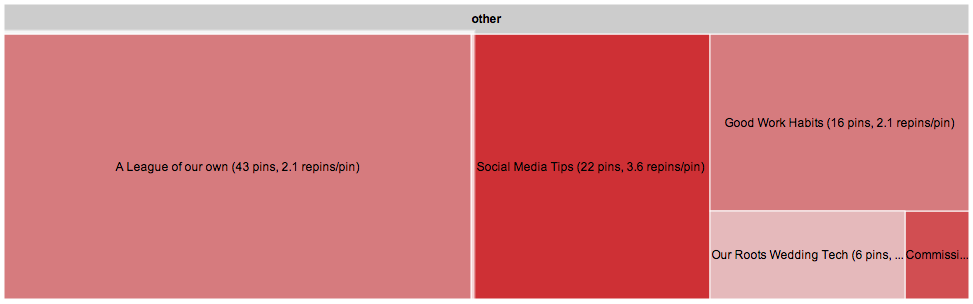
The bigger boxes indicate category boards that have been pinned to the most. The darker the boxes indicate the boards with a higher repin to pin ratio. As you can see, we pin a lot to the “technology” category, but our most viral boards are in the “other”, “geek” and “design” categories. So what boards are making the “other” category so viral?

Using Pinterest Analytics to Curate Your Content Marketing image Screen Shot 2013 07 10 at 3.14.26 PM

Dig into the viral boards within the “other” category by clicking on the box. From there, we are able to see that the board “Social Media Tips” drives the virality of this category with 3.6 repins per pin. Knowing that, it’s now time to check out what pins are resonating with users within that board.

Using Pinterest Analytics to Curate Your Content Marketing image Screen Shot 2013 07 10 at 3.24.34 PM

By looking into your board report, you can easily see which boards are doing the best for your brand. As we found with the heatmaps, the “Social Media Tips” board maintains the highest engagement score, though its virality is actually lower than the “Becoming a Pinfluencer”. This means that the content from the “Social Media Tips” board is resonating more with the brands followers (calculated as repins/pin/followers) while the “Becoming a Pinfluencer” board is resonating with all Pinterest users (calculated by repins/pin). Clicking on the box with an arrow coming out of it will take you directly to the board on Pinterest where you can explore which pins are leading engagement.

Want to see how a certain campaign board performs? Tracking the effectiveness of a board’s content during Pinterest campaigns is as simple as upgrading your account to receive date filters for your boards.

Pinning the Right Pins

After understanding what categories and boards lead your Pinterest virality, it’s time to take a look at how your pins are fairing.

Using Pinterest Analytics to Curate Your Content Marketing image Screen Shot 2013 07 10 at 3.45.33 PM

Inspect your pinned pins to see which ones are receiving the most repins, likes and comments to see if you can find a pattern. For example, from PinLeague’s 50 most recently pinned pins found on the free analytics plan, the top two repinned pins happen to be long vertical ones (including one claiming vertical pins stand out more) from the same community board. Using this information, we might want to start pinning more vertical images and join more community boards to help our Pinterest virality grow.

After understanding your Pinterest profile, it’s time to look at the content being pinned from your domain.

Using Pinterest Analytics to Curate Your Content Marketing image Screen Shot 2013 07 10 at 5.42.24 PM

Seeing what’s recently trending from your profile can give you a sense of what visuals make the biggest impact from your site. For example, trending from PinLeague’s domain are two images that are heavy on text with interesting backgrounds.

Using Pinterest Analytics to Curate Your Content Marketing image Screen Shot 2013 07 10 at 6.21.19 PM

Also found with your trending pins, is the world-cloud of words commonly used by pinners in pin captions from your site. This lovely – and useful! – graphic gives you insight into the conversation surrounding your brand. For PinLeague, the conversation is dominated by Pinterest, with an emphasis on “how”, “analytics”, “contest”, among other phrases.

So, by using the information we’ve gathered from our dashboard, we have a great chance of striking gold by creating long vertical images for the website, with lots of text and interesting backgrounds, pinned to community boards within our “other” category, especially if it’s about how to use Pinterest analytics for contests. The best part? All that information came from PinLeague’s free analytics account. Just imagine the content marketing powers having access to all your profile and trending pins, unlimited historical data, access to your peak pinning times, and competitive information could provide you!

Start curating the right content with your PinLeague analytics dashboard today!

12 Jul 16:48

LEGOs Are The Building Blocks Of Future Leaders

by Lindsey Nelson

Maturation is a natural process for many, however something that few never fully achieve if you know what I man. Regardless of the age you act, as adults we have spent years unknowingly working on our development.

Half of the most essential years to our biological, psychological and emotional development occur between the ages of 1 week and 13 years old. It’s during these years we grow, we learn what to eat and what not to eat, we make friends and build social skills, and above all we begin to shape who we will become in the future.

LEGOs Are The Building Blocks Of Future Leaders image 275076 l srgb s gl 300x199This is also the time when our parents, and the government, require us to go to school to
learn and develop our brains. As important as this is, it’s equally important for kids to learn outside of the classroom, and toys are the number one way.

Take for example the popular and colorful building blocks, LEGOs. Sure they’re entertaining, especially when your 4 year old is bored in the waiting room, but they actually are much more.

In Zach Evans Blog, he identifies 5 Lessons From Playing With LEGOs, they are as follows:

  • Creativity
  • Planning
  • Patience
  • Trial-and-Error
  • Cleaning Up

What’s most interesting to that list is that in a Fast Company article by Bill McBean where he identifies 5 Characteristics of Great Leaders:

  • Being flexible
  • Communication
  • Patience
  • Humility
  • Being Responsible

What’s more flexible than being creative? Innovative thinking requires a flexible perspective. Planning and communication go hand in hand, you need to talk, even to yourself, about the way you’re going to design a LEGO creation. Patience is a virtue and trial-and-error usually means you failed, but tried again. This requires humility, but perseverance. Cleaning up usually means you’re taking responsibility for your mess.

Toys are more than building blocks, they teach essential leadership skills. Without them, children might miss essential developmental steps which help create the future leaders of tomorrow. Hasbro, responsible for over 1,500 brands of toys and games for children all over, needs an efficient way to continue delivering a product that helps develop our youth. Check out how SAP helps them do this.

12 Jul 16:47

Get Competitive! How to Use Your Competitor’s Conversation Map to Your Advantage

by Kate Dunham

uberVU’s conversation maps give you an inside look into what people are talking about in the social web in real time. By showing the most-talked about topics in relation to your brand or products, your conversation map can be an extremely helpful tool in your marketing plan. But sometimes it’s not your conversation map that’s most important—it’s your competitor’s.

Here are 4 Ways to Use Your Competitor’s Conversation Map:

1. Find Real-Time Marketing Opportunities

After announcing plans for its new Xbox One, Microsoft faced a huge backlash for its new controversial policies on connectivity and game sharing. The gaming community took to the social web to express its displeasure—evident on the conversation map for Xbox. Phrases like “games,” “console,” “live” all came from mentions related to the policies. Not great news for Microsoft, but excellent news for its main competitor, Sony.

The news gets even better for Sony with several mentions of its brand also appearing on the Xbox map—”PS4,” “PS3,” “Sony,” and “PlayStation.” As outraged Xbox fans considered switching over to the Sony PlayStation, the brand saw a great opportunity for some real-time marketing, and released a video demonstrating its game sharing policy. The video addressed the gamers’ concerns and it was a huge success—it has over 13 million views to dateGet Competitive! How to Use Your Competitor’s Conversation Map to Your Advantage image xbox

Game on. The Xbox map highlights a real-time marketing opportunity for Sony.

2. Find Out What Consumers are Excited About

One of the most powerful insights your competitor’s conversation map can provide is what topics are popular with their (and your target) audience. Don’t assume that since you provide similar services or products your maps will align. There can be drastic differences that can help shape your marketing strategy.

Track both your map and your competitor’s conversation map over time. Are you noticing any consistent differences? Are they stirring conversations around a certain topic that you’re not? If W Hotel looked at its competitor Westin Hotel’s map, they’d see a big missed opportunity. Both hotels are known for their comfortable beds and bedding—so much so that both brands sell them online. But only one hotel’s map reflects this. On the Westin map you’ll see “you can buy Westin.” The topic consistently trends for the brand since it makes an effort to highlight it in its social efforts. We’ve yet to see the topic trend for the W Hotel. We wonder who’s selling more bedding?
Get Competitive! How to Use Your Competitor’s Conversation Map to Your Advantage image westin2 Both hotels sell bedding, but only one is making it known in social.

3. Shape up Your Social

Fact: People in social media love to talk about what they like in social media. Use your competitor’s conversation map to find out what’s working for them in social. In the Lowe’s map, one of the most-talked about topics is “Vine.” Lowe’s has been utilizing the video-sharing app for awhile now and its efforts continue to resonate with its audience. This is extremely beneficial to a competitor like The Home Depot. What is working for your competitor in social? Why is the audience responding? Could you provide something similar, but better? Let your competitor’s conversation map serve some social inspiration. The Home Depot did—it posted its first Vine video four days ago.
Get Competitive! How to Use Your Competitor’s Conversation Map to Your Advantage image Lowes

Get inspired. The Lowe’s map shows success that can be replicated.

4. Measure Effectiveness of Brand Positioning

Brand positioning is about creating an image or identity about your brand in the minds of your target audience. You present your brand one way, but does the social web see it differently? Dunkin’ Donuts has recently re-positioned itself as a beverage company, in an attempt to challenge its main competitor, Starbucks. If Dunkin’ Donuts wanted to see if the new positioning was resonating, all it would have to do is compare conversation maps. Most of the terms on the Dunkin’ Donuts map are food-related with only two beverage-related phrases—”coffee” and “iced coffee”—appearing. In contrast, Starbucks map is loaded with these phrases. By comparing its map with its competitor’s, Dunkin’ Donuts can see the new brand messages might need to be tweaked if it wants to be known for more than food.
Get Competitive! How to Use Your Competitor’s Conversation Map to Your Advantage image dunkin2

Dunkin’ Donuts: top-of-mind when it comes to breakfast foods.

Get Competitive! How to Use Your Competitor’s Conversation Map to Your Advantage image starbucks1Starbucks still winning the beverage battle.

Find Your Competitive Edge

Curious to see what’s on your top competitors’ maps? We’d be happy to show you what’s being discussed about your competition in social.

12 Jul 16:24

Pricing is the Domain of Successful CEOs - By Kevin Mitchell

by PPS
Most companies underprice their products and services, and in doing so lose out on large chunks of potential profitability. Pricing decisions are often emotional and subjective. Many sales bonuses are tied to revenue, not profit, and more often than not sales executives push back on price increases that usually reduce volume. Marketing executives also occasionally express concern on price increases because it can reduce market share.  And operating executives are concerned with excessive inventory in the event that a price increase goes badly.

More often than not, risk-averse companies play it safe when it comes to pushing through price increases, which is why the CEO needs to get involved in pricing decisions. Specifically, the CEO needs to mitigate the risk to specific departments and careers if the decision turns out poorly.

A major study last year of some 2700 executives and managers from 50 countries by Simon-Kucher & Partners shows profits increase when C-level executives take an active leadership role in pricing. If a C-level executive is involved in pricing, the company is much more likely to have a pricing organization. This high-level commitment significantly boosts a company’s pricing power.

“Staying in a pricing ‘comfort zone’ is no longer an option for C-level executives in the current economic climate,” said Georg Tacke, CEO of Simon-Kucher & Partners. “It's a leadership obligation for the executives, not a day-to-day operational one.”

The Simon-Kucher study showed that companies whose C-level executives took an active role in pricing are 35% more likely to have high pricing power, and 30% more likely to expect strong EBITDA growth over the next three years. Pricing power is the ability of a company to get the prices it deserves for the value it delivers to customers.


 “Pricing power begins at the top of the organization,” said Tacke. “When C-level executives turn their attention to pricing, their companies are more likely to have a stronger profit outlook, more likely to raise prices, and more likely to make those price increases stick.”

While it is crucial for a company’s profit to have this kind of C-suite involvement, pricing is not the only job of the CEO.  But, by putting pricing on top management’s agenda, organizations are more likely to have a dedicated pricing role or function that ensures strategic pricing decisions are implemented C-level involvement in pricing means setting the right objectives and incentives, driving the organizational and cultural changes to support better pricing, and taking more responsibility for pricing strategy as a whole. It also means the company allocates additional resources to pricing decisions, and that pricers or executives tasked with pricing are able to obtain the tools and expertise needed to assess pricing changes and ultimately boost the company’s pricing power.

The payout for a higher price point is undisputable, as even a 1% increase in pricing can mean a 25% or higher impact on the bottom line. This commitment also gives companies their greatest chance to survive and thrive in today’s low-growth climate. And, with more than 80% of companies facing increased pricing pressure from customers or competitors, this pricing power advantage is more important than ever.

Companies with active C-level involvement in pricing are 18% more likely to put through a successful price increase, according to the study. But more importantly, they are 26% more likely to get higher margins from their price increases than companies without C-level involvement in pricing. That means creating a dedicated pricing organization that can provide end-to-end coordination, from strategy to analytics, to interpretation and implementation.

With the evolution of big data and predictive analysis, the science of pricing has come a long way in a few short years. Companies have become more sophisticated in their ability to optimize pricing across a wide assortment of regional and functional silos.

However, as the Simon-Kucher study shows, unless a CEO gets involved to provide top-down pricing leadership, drive the decision making, accept responsibility for risk and arbitrate intra-department rivalries, optimizing prices and profits will be left up to chance in an ill-defined game of outcomes.
. . .

Kevin Mitchell is the president of the Professional Pricing Society. The Pricing Society is the world's largest professional society dedicated solely to pricing training and education. The organization provides pricing professionals with current strategies, market trends, analysis, research and resources from today's leading pricing experts and technology. For more information on membership or events visit the organization’s website at www.pricingsociety.com
12 Jul 16:23

Would You Stake Your Career On Your Sales Analytics?

by Frank Donny

Would You Stake Your Career On Your Sales Analytics? image stake career 200x300

Well, would you?  It’s an honest and very frank question.  One that I ask my customers all the time.  It really gets them to think about the trust that they have in their data.  If your answer is no, take a few minutes and ponder the following advice.

Let’s say you have a meeting in two days with your executive team and your board.  In your hand is a manual roll up of your sales data.  It’s something you do every month and quarter.  It’s tedious.  It’s always a challenge.

To get the data, you had sales operations extract your pipeline data from your CRM system and place it into an Excel model.  You distribute it to each manager and they distribute it to each sales rep.  Your managers asked each rep to update the data, then send the spreadsheet back to the manager who then compiled all the data into one spreadsheet.  This file then gets sent to you or your sales operations manager to compile all spreadsheets into the master.  If this is you, I would not even stake a free slice of pizza on this data.

That might be a bit harsh, but look at the facts, or lack thereof.  With so many people involved and such a manual process, data variations from one period to the next are bound to happen.  Many times, these variations are manual errors, unexpected changes in opportunity-related data and many data points are based on opinion, not fact.

So what can you do about it?  First, stop taking the data out of your CRM system.  Invest in a reporting tool that is native to your CRM system and develop a process for updating and reporting data.  Hold your team accountable for data accuracy by keying in on those data points that are critical to your ability to properly forecast.  A list of these items could include:

  • Following your sales process in your CRM system and ensure that key data elements are always up to date – like the close date
  • Ensuring opportunities are in the right stages
  • Score the validity of opportunities based on sales reps historical management of the opportunity (number of times pushed, sales stage progression, age per stage)
  • Use actual conversions by sales reps as your probability and not arbitrary percentages
  • Improve your reps ability to select close dates or even better, allow your system to select the close date based on the reps past behavior
  • Expose all of this data to your sales reps so they know the impact of their behaviors

Track these results over time and coach your sales people based off of how they run their book of business in your CRM system.  You are now managing based on fact and as you work with each sales rep, the integrity of your data will improve.  You can run your full reports in your CRM and present it to your executive and board right inside of your CRM.  That’s one of the reasons why you invested in one.

Detailed historical analysis of sales behavior and using that analysis to predict future behavior and impact is the key to improving the quality of your data.  So, instead of all of the manual role ups, the hair cutting of the data and the hours spent on trying to explain variations in data, spend your time getting your act together inside of your CRM system and hold your reps accountable for data quality.  You career will thank you for it.

12 Jul 16:23

In B2B, who should you hire first – sales or marketers?

by Ian Dainty

In the business to business marketing series, this is the 74th B2B lead generation video.

In the B2B business world, there is much discussion recently about what skills are needed to grow your business.

Most B2B companies usually hire a “sales” person and ask that person to get business. The first thing that person has to do is “prospect” for leads. But prospecting is really lead generation, which is a marketing function.

So that get backs to, who should you hire first. Please watch the video for the answer, and how you should build your B2B business.

To become excellent at business to business marketing and B2B lead generation, there are many questions you need to answer about your business, and how you will develop those leads. I have set up 101 questions to help you and your company become excellent at B2B lead generation. Watch daily for a new video.

All of these questions and answers, in this video series, will help you in your B2B lead generation and overall B2B marketing processes. As we go through each video, you will better understand how marketing has become even more important than sales.

Obviously selling your products and services is the ultimate goal. However, if you do not have an online B2B marketing strategy, along with a strong social media strategy, then the sales, of your products and services, will be few and far between.

This has happened because of the Internet and how people find you first in their search. So an Internet B2B marketing strategy is imperative to your company’s sales success.

To ensure you get all 101 videos in the Q&A series, sign up for either the RSS Feed, or the email notification in the right hand column.

Be sure to “like” this video so your friends and colleagues can see it and follow the videos. Also, send me your questions, to my email below, so I can answer them for you, and include them in the 101 questions.

Please leave your comments about this video, and all of the videos, below.

Kind regards,

Ian Dainty
416.277.4537
ian@b2bbusinesscoach.com

Related posts:

  1. Why do B2B marketing and sales people fail? In the business to business marketing series, this is the...
  2. Does Outbound B2B Marketing Work? Does Outbound B2B Marketing Work? In business to business marketing,...
  3. In business to business marketing how do you attract B2B prospects? In the business to business marketing series, this is the...

Related posts brought to you by Yet Another Related Posts Plugin.

12 Jul 16:22

Sales Tip: Work An Event Floor with Conversation Strategy

by Craig Wortmann

You go to an event. There are prospects there. You look through the crack in the door and you see 80 people in a big room sipping wine and eating cheese. The event lasts for 90 minutes. Your mission, should you choose to accept it, is to find the five prospects in that room that can do business with you.

How do you do it?

The first thing you do, before you even open the door, is you ask yourself a very important question:

Am I drinking, or am I working?

If you’re drinking, drink! That’s fine, but make a conscious decision.

If you’re working, work! It’s hard work to find those needles in the haystack, so you better have a strategy.

The key to working a room is finding the right people.

Here are the three critical elements to finding your prospects:

1. Give yourself an out.

The first natural thing that will happen with any and every person you talk with will be the age-old process of making small talk. You are establishing rapport. This is critical, of course, because it would be awkward and jarring to jump right into business. But there’s a very important thing you need to say during that “small talk.” You need to say; “It’s nice to meet you. I’m glad to be here at this event and, like you, I’ve got a bunch of folks that I need to meet while I’m here. So, tell me about yourself. What are you working on (or some other straight-forward question)?”

This simple statement gives you a very important “out” in case that conversation goes sideways.

Chances are, that person you are talking to is not a prospect. And that means that sooner rather than later, you’ll need to be moving on. It’s hard to do gracefully if you haven’t given yourself an out. You say; “Hey, it’s good to meet you and thanks for connecting with me. As I mentioned, there are a bunch of folks I need to connect with here, so I’ve got to do that. I hope this event is productive for you, and I enjoyed meeting you.” And you move along. It takes discipline to realize which conversations are worthwhile and to physically move on.

2. Use the conversation progression

As rapport is established and the small talk winds down, you will inevitably be asked; “So, what do you do?” Be ready. Have your Sales Trailer℠ and use it.

Then, give the person your “second bubble of conversation.”

The second bubble contains either:

  • the three clear points of your business,
  • a statement of what makes you different in the market,
  • or the value you bring to the table.

The second bubble is usually two or three very short sentences. When people ask us what we do, we respond with our sales trailer: “We help companies build and tune their sales engine.” We find the discipline to pause here and wait for the individual to say something like, “Ok, that sounds interesting. What exactly does that mean?”

Here’s our Sales Engine second bubble: “We look at the sales process companies use, the tools they use to support the sales team, and the knowledge, skill and discipline of the team itself.”

Simple. Easy to understand. No big words. Then shut up and let the person into the conversation.

The conversation progression should be like an on ramp to a highway.

3. Qualify right now.

As the person asks you a couple of follow up questions to your second bubble, respond withqualifying questions. In reaction to our second bubble above, people often say; “Okay…people, process, tools. I see. How do you do that?” And we respond with; “How do you think about these things now?”

That’s not just any question, it’s a qualifying question. We need to know if the person thinks or cares about any of these things. If not, that’s fine, but the person is probably not a prospect and we will soon be moving along. If so, then we pursue that conversation with deeper questions to determine whether this person is indeed a lead.

How Most People Work A Room

If you observe people closely at your next event, here’s what you will find: most people engage someone in a conversation and they stay there for 20 minutes. Why? Because it’s comfortable. Working a room is uncomfortable for most people.

But better to be uncomfortable with a full pipeline than full of wine and cheese and empty of prospects.

12 Jul 16:22

If I Had only Known That: Qualifying – The Key to Sales Success

by Suzanne Franks

If I Had only Known That: Qualifying – The Key to Sales Success image science of qualifyingToday’s buyer empowered, uber competitive selling environment, requires sellers to be much better at qualifying opportunities than they have ever been in the past. Why? Because buyers have ready access to the product information they believe they need to make a buying decision. When sellers arrive they, the buyers, are ready to close the sale by negotiating the best price. Sound familiar?

So if qualifying is so critical, doesn’t it make sense that sales organizations clearly and precisely define a standard set of client information objectives that determine when an opportunity is well qualified? Without this information, sellers resemble Alice in Wonderland – if you don’t know where you’re going, any road will get you there. How can you get “there” when you don’t know where “it” is? How can an opportunity be well qualified when well qualified hasn’t been defined?

Shouldn’t sellers know:

  • What truly motivates buyers to buy?
  • What is the amount of business impact products and services can have in helping them reach specific objectives, not the products features and benefits. Understanding what motivates the buyer helps sellers to protect their selling margins and increase their average value order.
  • The relationships that exist inside and outside of the buyers organization that will influence the buying the decision?
  • If the buyer has made this type of buying decision before, and if so, what criteria did they use to make the decision?
  • The criteria the buyer will use to determine which solution is best amongst the available options?
  • What the buyer has in place today, their perception of performance, and the company that is providing it?
  • If the buyer is favoring one solution over another and why?
  • What the buyer will need to see to make the final decision and when they will need to see it allowing the buyer and the seller to use their time most efficiently?

You get the idea. Information defines opportunity. The better the information, the better chance sellers have to demonstrate how their products and services provide the business impact buyers desire and are the ones that buyers want to buy. Sellers will know precisely why they won, or lost each deal.

But wait! There’s more!

If winning more business with higher average order values while protecting margins isn’t enough to motivate sales leaders to define information objectives, there’s more. Once information objectives are clearly defined, managers can assess not only the quantity, but also more importantly the quality of the information gathered. This will help them to calibrate the sales forecast and make it more accurate. No longer will sales forecasts be based on each seller’s perception of sale probability based on their experience in similar selling situations. Sales forecasts can now be objectively and systemically based on the quantity and quality of the information gathered compared to a standard requirement.

This is a huge benefit. According to the CSO Sales Management Optimization Study, sales organizations that measure and pay their sales managers on forecasting accuracy win considerably more deals and have more sellers making plan than those that don’t. Consider the following results from the study:

Importance of Forecasting Accuracy   Measured & Paid On         Only Measured        Not Considered     % of Forecast Deals Won 50.5% 46.1% 41.2% % of Sellers Making Plan 69.7% 56.1% 50.2%

Does your organization have a standard set of information objectives?

Contact AXIOM Sales Force Development at Call 800-933-8503 or Call +1-972-497-2450 to learn more about the nine information objectives developed to help sellers around the world close significantly more deals at higher margins.

If I Had only Known That: Qualifying – The Key to Sales Success image 5754bce7 2c4b 4447 b2b6 9af7d41ec1d23

1-800-933-8503 Outside US call +1-972-497-2450to learn more about the nine information objectives we have developed that are helping sellers around the world close significantly more deals at higher margins.

12 Jul 16:22

Andy Paul Most products don't require C-Suite approval or involvement. Discover the right level at which to sell your product #sales

Andy Paul Most products don't require C-Suite approval or involvement. Discover the right level at which to sell your product #sales
11 Jul 15:26

Google to Discontinue Adwords Tool for Websites

Popular tool for researching keywords and traffic volume to be rolled into a new program called 'Keyword Planner.'
11 Jul 15:26

Instagram vs. Vine: The Smackdown

by Dayna Rothman
instagram-vs-vine

Author: Dayna Rothman

Instagram is almost uncannily popular. Taking and sharing visual images is such an important part of social media, that Facebook recently bought the service and now operates it. When it first launched, it was simply an iPhone app. But now users can access Instagram from their computer and most smartphone devices. Although, those who own a smartphone running Blackberry 10 or a Windows Phone are still out of luck as Instagram is only available for iOS and Android. The popularity of Instagram cannot be denied.

However, Twitter recently experienced similar success with video sharing due to a program called Vine. Seeing that video sharing was on fire, the powers that be from Instagram and Facebook have decided it is time to throw their hat into the video-sharing ring. So what does this mean for you and how do you decide if you want to use Instagram vs. Vine for your business goals? Or maybe you want to use both?

Vine

When Instagram decided to step it up into the video recording market, Vine got busy developing new features to try and stay competitive with Instagram. They debuted these new features on July 3rd and stated that they plan to continue rolling them out over time. Here are some of the new announced features:

  • Channels: Vine introduced 15 new channels with themes so that users can sort and post videos based on theme. Each channel also has a “Popular” feed so that the top posts get highlighted each day.
  • On The Rise: In an attempt to create a Vine community and engage with their users, Vine is now featuring top posts from new community members.
  • Revining: This feature enables you to share other people’s posts with all of your followers.
  • Protected Posts: Now when you create a Vine video you can determine if you want to share your video or keep it private.

Vine1

Instagram

Some of the features that helped Instagram gain popularity were the editing and filter options. This allows users to make simple edits to their pictures right in the app. Similarly, video editing is also included in the app. Editing options are applied after the video has been shot. They are then applied in real time, so you can see them as the video plays back. Editing options include:

  • Deleting frames from video sections
  • Image stabilization
  • Adding forced focus in post-production
  • Adding filters to change the look of your footage
  • Choosing a cover image from any frame in your video
  • Full video preview before public release.

instagram1

Instagram vs. Vine

While they are similar in concept, Instagram video is not just a repackaged version of Vine. So what are the biggest differences?

  • Length: Instagram videos can be as long as 15 seconds, while Vine videos have a max length of 6 seconds.
  • To Loop, or Not to Loop: Some videos are funnier played on a loop. Others may be best viewed once. When you play a video on Vine, it automatically loops infinitely, while on Instagram there is not a loop.
  • Post-Production: Instagram has several editing options that can be applied to videos after they’ve been shot. Vine does not offer filters or image stabilization.

Because of differences in the two programs, it may be that using both is the perfect solution for you.

The Future

While Instagram videos are brand new, it is hard to tell exactly what the future will hold. One feature that many people are requesting is the ability to import videos. Unlike the photo version of Instagram, the only videos that work are ones shot directly within the app. Perhaps this will be something that changes in the future. Another aspect of Instagram video that many users wonder about is the use of these videos as an advertising medium. While regular users may see advertising as a bother, business users will see it as an easy way to put video advertising in front of a captive audience. Only time will tell whether Instagram Video manages to take a slice of business from Vine, or whether it builds a whole new group of users.


Instagram vs. Vine: The Smackdown was posted at Marketo Marketing Blog - Best Practices and Thought Leadership. | http://blog.marketo.com

11 Jul 15:22

The Next Question You Ask is the Most Important One

by TheSalesHunter

voice 200x300 The Next Question You Ask is the Most Important One photoI’m a firm believer in having questions to ask a customer or prospect.  There is no better way to engage someone than to ask them questions that get them talking about their needs.

Challenge is not just having good questions you can ask the other person to engage them, but also to have great next questions to ask.  What I mean by this is to be asking follow-up questions on what the customer shares with you.

View the customer as if you were peeling an onion.  The initial questions you ask are similar to the first few layers of an onion.  Your objective in peeling an onion is to get to the good part. Same thing with your conversation.

Your objective is to get to the good part of understanding the customer’s needs and wants, and that means asking follow-up questions regarding what they just shared with you.

If you strengthen your skills in using follow-up questions, in time you get to the information you want.  For the conversation, this means getting the customer to share with you what their real needs or concerns are.

As easy as this sounds, what I find amazing is how few salespeople actually do it.  Also, keep in mind that some customers and prospects are not even aware of their true needs and wants until a skilled salesperson has helped them discover and reveal that information.

On your next sales call, focus your questions on what they’ve already told you.  When you do this, you will accomplish two things.  First, you’ll get the customer talking more about an issue they deem to be important.  Secondly, it shows the customer you’re listening to what they say and you view what they’re saying as important.

The outcome of this second point is the customer will typically start sharing with you information that is even more important, all because you’re genuinely listening and valuing what they say.

Our goal is to match their needs to what we’re offering, and there is no better way to do that than by asking follow-up questions.

Copyright 2013, Mark Hunter “The Sales Hunter.” Sales Motivation Blog.

button receive a free9 300x51 The Next Question You Ask is the Most Important One photo

11 Jul 15:13

FBI Counterintelligence Instructor Explains The Secrets Of Mastering Communication

by Farnam Street

I’m not quite sure how I came across Robin Dreeke’s It’s Not All About Me, but I’m glad I did.

Robin is the lead instructor at the FBI’s Counterintelligence Training Center in all behavioral and interpersonal skills training.

And he wrote an awesome book on how to master the skills of communication.

His process not only includes research into social and evolutionary psychology, but it’s been honed from years of field experience.

I’ve been trying these out over the last few days and I’ve already noticed an improvement. Most importantly, I’ve put away my phone and focused on the person with whom I’m talking. This simple act of giving people my undivided attention has made a world of difference.

There are not many places that teach these techniques and I couldn’t have asked for a better guide than Robin.

1. Establishing Artificial Time Constraints

I suspect you’ve sat in a bar at one point or another and been approached by a stranger who tried to start a conversation. My guess is you felt awkward or possibly even uncomfortable. This is because you didn’t know when or if the conversation would end.

The first step in the process of developing great rapport and having great conversations is letting the other person know that there is an end in sight, and it is really close.

When you approach someone to start a conversation most people assess the situation for threat before anything else.

Humans have genetically survived because of this. This is a strong reason why these techniques work; they are specifically designed to lower the perceived risk to a stranger.

2. Accommodating Nonverbals

This is a pretty simple one. You want to look non threatening. The number one nonverbal technique to use to look more accommodating is to smile.

This isn’t new. It’s the second of six principles in Dale Carnegie’s book, How to Win Friends and Influence People.

You can however accentuate your smile in a subtle way.

Adding a slight head tilt shows the other person that you have comfort with them and trust them. Another nonverbal to try and maintain is a slightly lower chin angle.

High chin angles make someone feel like you’re looking down at them.

Another key nonverbal is body angle. Standing toe to toe with someone else can be intimidating.

A slight body angle or blade away from the individual you are engaging will present a much more accommodating nonverbal.

How you shake hands matters too.

An accommodating handshake is one that matches the strength of the other, and also takes more of a palm up angle.

3. Slower Rate of Speech

Speaking fast may mean you’re excited. It may even mean that you know what you’re talking about. However speaking slowly gives you more credibility.

Whenever I have a conversation that I believe is important for me to be credible in my content, I purposely slow down the delivery and take pauses for people to absorb the content of what I have just said.

4. Sympathy or Assistance Theme

If you’re like most people, you’ve felt a bit of regret for turning down someone seeking help.

Think for a moment about the times in your life when you have either sought assistance or been asked to provide it. When the request is simple, of limited duration, and non-threatening, we are more inclined to accommodate the request. As human beings, we are biologically conditioned to accommodate requests for assistance. The compulsion is based upon the fact that our ancient ancestors knew that if they did not provide assistance when asked, the assistance would not be granted to them if requested at a later date.

5. Ego Suspension

This may be the most rewarding and most difficult of all of Robin’s techniques.

Suspending your ego is nothing more complex than putting other individuals’ wants, needs, and perceptions of reality ahead of your own. Most times, when two individuals engage in a conversation, each patiently waits for the other person to be done with whatever story he or she is telling. Then, the other person tells his or her own story, usually on a related topic and often times in an attempt to have a better and more interesting story. Individuals practicing good ego suspension would continue to encourage the other individual to talk about his or her story, neglecting their own need to share what they think is a great story.

6. Validate Others

There are many types of validation. Robin identifies three of them.

Listening
This is the simplest and one of the most effective. Just listen to someone can produce amazing results. Where we run into problems is keeping our own thoughts, ideas, and stories out of the conversation.

True validation coupled with ego suspension means that you have no story to offer, that you are there simply to hear theirs.

And there is another benefit. When the focus is on the other person and we’re not anxious to tell our own story, we also tend to remember the details. We’re mindful.

Thoughtfulness

… few people naturally use this to its fullest potential, and, most of the time, we don’t realize when it is being used; all we know is we really like the person who gives it.

Demonstrating thoughtfulness in words and actions with everyone in our lives is a simple and effective way to improve our relationships.

Validate Thoughts and Opinions
This technique is quite difficult because of “our innate need to correct others and the difficulty we have suppressing our own egos.”

But if you remember that we like people who are like us, you’ll immediately grasp the power of validating thoughts and opinions of others.

The best way to get someone to do what you want them to do is to have them come up with the idea. The best way to have them come up with your idea is, no surprise, to honestly understand the other person’s point of view and then build upon that base with your ideas.

7. Ask … How? When? Why?

It’s hard to answer these questions with a simple yes or no.

Once the individual being targeted in the conversation supplies more words and thoughts, a great conversationalist will utilize the content given and continue to ask open ended questions about the same content. The entire time, the individual being targeted is the one supplying the content of the conversation.

This means suppressing your ego and listening to what people are saying. You’re not thinking about what you’re going to say next. You’re not thinking about how the person is wrong. If you’re really listening then asking open ended questions based on the content of what they are saying should be pretty easy.

8. Connect with Quid Pro Quo

In the context of a conversation this means giving up a little information about yourself in order to further the conversation and get a little from others.

In my experiences, there are really only two types of situations where I have utilized quid pro quo. The first and more common of the instances is when you attempt to converse with someone who is either very introverted, guarded, or both. The second instance is when the person you are conversing with suddenly becomes very aware about how much they have been speaking, and they suddenly feel awkward. In both instances, giving a little information about you will help alleviate some of the issues.

9. Gift Giving

This is conversational reciprocation in action.

Great rapport builders and conversationalists use this desire proactively during every conversation. This technique, coupled with ego suspension, are the cornerstones for building great relationships. This is also the easiest technique to utilize, because gifts come in many forms, from non-material compliments, to tangible material gifts. Gift giving, or reciprocal altruism, is hardwired in our genetics.

The key is to do this without an agenda. If you have an agenda you’ll come across as insincere.

10. Manage Expectations

Regardless of the situation, whether it is an altruistic intention or not, there is an agenda. The individuals in life that are able to either mask their agenda or shift the agenda to something altruistic will have great success at building rapport.

The surest way to avoid disappointment is to lower expectations.

If you’re looking to improve the connections you have with others, give it a read.

Join the conversation about this story »


11 Jul 15:12

Doug Mack: The Management Secrets I Learned From Jack Welch

by Daniel Goodman

Few business leaders are as revered and renown as Jack Welch. As CEO and Chairman of General Electric, he led and mentored many young managers, many of whom would go on to lead their own companies. 

Among them was Doug Mack, CEO of One Kings Lane. 

Jack Welch taught him that "empowered organizations are the most successful and scalable."

Watch below Mack reveal the key strategy lessons he learned from Welsh.

 
<div>Please enable Javascript to watch this video</div>

Produced by Daniel Goodman and Alana Kakoyiannis

Join the conversation about this story »