Shared posts

16 Jul 15:38

Secret to Hiring the Best and Brightest

by Jeff Haden

Hearsay Social CEO Clara Shih explains why unconventional backgrounds matter--a lot.

Everyone talks about the need to create a diverse workforce. But when you're a start-up, how do you actually pull that off?

Here's another in my series where I pick a topic and connect with someone a lot smarter than me. (There's a list of some previous installments at the end of this article.)

This time I talked to Clara Shih, the founder of and CEO of Hearsay Social, a company that helps global sales forces use social media to attract prospects and retain customers.

Many entrepreneurs can't afford to hire the best and the brightest.
In my experience, the best and brightest are drawn to high-risk, high-reward opportunities, so I would argue that start-ups actually have it easier when it comes to attracting talent. Giving employees equity and allowing them to share in the upside creates a sense of ownership--and nothing is more motivating.

What else do you do to make sure you're hiring the best?
We constantly make non-obvious hires and have invented positions for people who didn't fit a traditional career trajectory but who struck us as smart and creative. We've hired former insurance agents, a person who worked on an Egyptian cruise ship, a medical doctor, people from government, etc. The key for hiring managers is to constantly think creatively about transferrable skills and experience.

Give me a specific example of an employee with a diverse background you've hired.
One of our data scientists, Emi, was a neuroscience post-doc conducting neural network research at UC Berkeley. We convinced her to join our data science team and she's applied her academic background in machine learning and graph theory to social media analysis. She's discovered amazing similarities between the neural networks in brains and social networks.

Can't unusual backgrounds sometimes create cultural fit issues?
We have always sought to be highly intentional about the culture at Hearsay Social. Long before we hired any employees we developed a set of core values: 1) customers come first, 2) company before self, and 3) execution speed.

We believe in transparency and meritocracy, which means everyone at Hearsay Social is accountable for decisions and results. We hire and reward people based on these values, which makes them self-reinforcing.

How has social media changed the way you build teams ?
Social networks have completely changed the way companies hire by expanding referral networks; referrals from existing employees have always been a great source for new hires, and social networks make it easier than ever for recruiters to source candidates and proactively ask existing employees for referrals. Visibility into mutual connections also makes it much easier to do reference checks and generally learn more about candidates upfront.

Any tips for how other small business owners can build a diverse team?

1. Be creative. Smart, hardworking people can always contribute to a team. Read between the lines of resumes and seek out nontraditional backgrounds to find hidden gems.

2. Make sure values are aligned. We focus on building strong company values and, as we expand our team, it's vital that all new hires embrace the same values.

3. Tap into your network. The people you once worked with and the people you meet at events around town could be your future star employees.

4. Look for curiosity and passion. People who drive themselves will prove their value many times over. Many of our top-performing employees have a strong passion outside of work.

5. Feed them. Our employees work incredibly hard and we want to take care of them. From catered meals to health benefits, we believe there's no better investment than investing in your employees.

Check out other articles in this series:


16 Jul 00:08

Corporate Social Media: Social Media in the C-Suite

by Joellyn Sargent

Social Branding Lessons for B2B Leaders B2B CEOs and their senior leadership teams may still be a little reluctant to embrace social media for themselves, but that’s no reason to shy away from it altogether. In fact, comments by Google exec Mike Miller, Director of Business and Industrial Markets, affirm what I’ve been saying for … Continue Reading

Corporate Social Media: Social Media in the C-Suite by Joellyn Sargent - Maximize Social Business - Maximize Social Business - Your Social Media for Business Resource ... Featuring Contributions from Global Thinkers . This copyrighted content was originally published on Maximize Social Business and may not be republished on any other website or in any other format without explicit permission from the publisher.

15 Jul 15:39

Is it Ever The Right Time? – Sales eXchange 208

by Tibor Shanto

By Tibor Shantotibor.shanto@sellbetter.ca

Clocks head

If you prospect regularly, a common push back you get from potential buyers is “it’s not a good time”, or “the timing is wrong”, or any variations on that theme.  In some instances it makes sense, calling an accounting firm in the March April timeframe, or a school supply company in August; these are times those companies are busy executing, having made purchase decisions much earlier in the cycle.

With only 15% or so of your market being in play, that is actively out there “buying”, and 70% being in what is commonly called Status Quo, ostensibly not looking, it is a safe bet that 70% of the “time” the timing is not right.  I say ostensibly, because there is a lot of opportunity and buyers to be found in that large group called Status Quo, the fact that they are satisfied with their current state, does not mean they won’t buy, no matter what some pundits tell you.  Satisfied is a long way away from ecstatic; there is a lot of room for improvement and your offering between those two points, don’t settle for satisfied.  The problem is that too many sales people allow the statement about timing to throw them off or give up on an opportunity, not just for themselves, but for the buyer, and by extension the buyer’s company and objectives.

“75% of customers who leave or switch vendors for a competitor, when asked, say they were ‘satisfied or completely satisfied’ with the vendor they left, at the time they switched.”  ‘Customer Loyalty Guaranteed’ Bell & Patterson

What the Status Quo prospect is saying is that they don’t have time to waste on another value proposition, or you history of accomplishments.  They want to know how to move past satisfied, which you could do if you could surface their objectives, and what they feel is in the way.

For those 70% of the time where by definition your timing is “not good”, you need to counter it in a way that acknowledges your understanding of their statement, but allows you to put the onus on them not to prevent that from them taking action.  Left to their own devices, it will never be the right time until it is too late, they go to market, and you are part of a crowd willing to drop their pants and sell at a discount.  Not for you, the time is now.

The simplest and most effective way to do that is to move the discussion off time and on to their objectives.  Understanding why people buy, why they have bought from you and/or your company is key, and one of the great benefits of reviewing all deals, wins, losses, and draws.

You can start and create a gateway by asking “is it ever a good time?  With all the things we have on the go, it is difficult to have time for everything.” Pause, and using the above, and specifics tied to your market and offering, “if you had to create time, and complete the number one item on your list, what would that be?  At the same time, what’s something that you could drop from that list without much impact on your business?”

By listening with an open mind and a blank canvas, you can begin to understand and discuss what their priorities and objectives are, and how you can impact those.  As with most prospecting calls, the goal is to secure an appointment, not to sell, this will put you in a position to assess the opportunity and secure an appointment.  You’ll have a sense as to objectives and current barriers, and how you may add value.

As with most things in sales it is not 100% full proof and is usually done hand in hand with other steps that need to be executed, but it will allow you take a common objection and turn it into a sales call.

What’s in Your Pipeline?
Tibor Shanto

Win Tickets to see Tony Robbins in Toronto – July 24!

15 Jul 15:39

How to Build Valuable Allies Within Your Account

by Dan Bernoske

You are managing a current account or a new opportunity. Your main point of contact is your biggest ally, but has limited influence. Ask yourself a question: “Who do I need to involve to close the deal?”

The modern Buyer continues to educate themselves even after you’ve made contact. It's likely everyone involved in the purchase decision has pre-conceived notions of your product. Good or bad. But identifying the key players is only the beginning of your sales strategy.

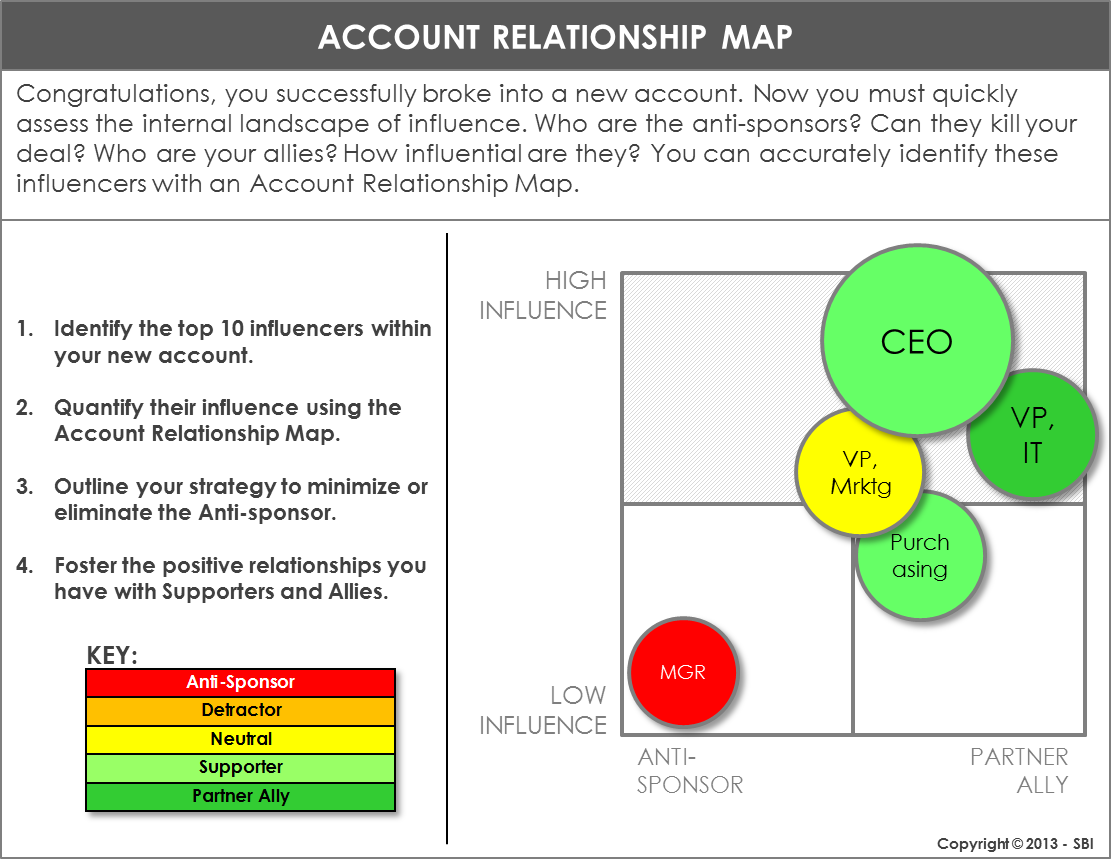
Top Sales Reps quantify the level and quality of the influencers within the account. They outline and execute a plan to turn each influencer into a trusted partner. Download the Account Relationship Map to start building your valuable allies.


The 5 Types of Influencers

In every new or existing account you encounter 5 types of influencers. They range from “anti-sponsor” to “partner/ally.”

  • Anti-Sponsor. They typically work against you. They don’t like you, your solution, or both. Why? There are too many reasons to list. But if approached correctly, an Anti-Sponsor can become your best Partner/Ally. They can’t be ignored. Every account has at least one.
  • Detractor. They are highly skeptical, though not completely against you. They are closely aligned with Anti-Sponsor thinking. While they disagree with you, they won’t necessarily veto your solution. But frequently they follow the decisions of the Anti-sponsor.
  • Neutral. They don’t care one way or the other. They are the swing vote you may need to close the deal. Don’t ignore them.
  • Supporter. They tend to agree with the Partner/Ally. They agree with you, but may not provide you the strongest support.
  • Partner/Ally. This is your biggest champion. They are absolutely necessary to win the business, especially if they are highly influential. An entry-level position is a cheerleader. A chief executive-level Ally is the silver bullet. Good Reps foster partnerships with the top influencers.
account relationship map

4 Steps to Build Valuable Allies Within Your Account

With every account or prospect, follow these 4 steps to be successful:

1. Identify the top 10 individuals that can affect your sale. You may have one or two initial contacts at the company. Have your contacts list all the individuals involved in the decision. Any level in any group is preferred.

2. Quantify the influence of each individual. What scope of influence does this person have? Are they positive or negative about your product? Are they active or passive in the purchasing process? The Account Relationship Map has a series of questions you should ask. You will score the influencer on each question. Then the tool automatically calculates the levels of influence.

3. Deploy a strategy to create more Partner/Allies within the account. These Social Selling tactics are critical to your success:

- Connect with each influencer LinkedIn with a personal message.
- Share insights to your LinkedIn network on a regular basis.
- Provide social debt by endorsing them or introducing them to new/valuable contacts.
- Add value during every interaction with thought leadership. Your emails and phone conversations should demonstrate your value.

Carefully consider your tactics when managing your account relationships. For instance, marginalize or convert the anti-sponsor in several ways:

- Address objections if possible. Sometimes they favor a competitor which is good to know
- Enable your Partner/Ally with tools to coach detractors and anti-sponsors
- Neutralize or isolate the anti-sponsor if necessary
- Expose hidden agendas


4. Work with Sales Operations to incorporate this tool into your Customer Relationship Manager (CRM). Download the Account Relationship Map to capture critical information about the modern, informed buyer. These fields should be part of every CRM database.

Author: Dan Bernoske

sbi on linkedin

Follow @DanBernoske

Follow @MakingTheNumber

If you enjoyed this post, never miss one again by subscribing your Email Here and/or subscribing to the RSS Here.

15 Jul 15:39

Content Marketing Strategies Based on Customer Context: 3 Examples

by John Lane

Content Marketing Strategies Based on Customer Context: 3 Examples image content marketing strategies need based contextRecently, I’ve been thinking that airports serve as an interesting parallel to content marketing. All airports serve one main purpose, they all have similar amenities, and the flow from entry to exit is more or less standard. Yet, modern airports have also been designed to give off a particular vibe. Visiting Las Vegas’ McCarran International Airport — with its spartan décor (which is contrasted by plenty of slot machines) — is a far different experience than traveling through Austin-Bergstrom — where live music and the smell of Salt Lick Bar-B-Que entices. Like content, airports attempt to create a unique experience for audiences for a period of time, knowing they will only stay there as long as they have to.

But airports have one primary focus that content marketers can take a lesson from. They all put two goals front and center: Providing information on where customers are coming from, and providing information on where they are headed. It’s this concept of arrivals and departures that many content marketing strategies often overlook.

It relates perfectly to two phrases I believe we will all hear a lot in the near future: “The Moment of Need” and “The Next-Most-Likely Action.” These phrases are about establishing context. In essence, they are the arrivals and departures of a content marketing strategy.

Arrivals: The moment of need

Most marketers are using buyer personas these days; they allow us to craft content to be positioned correctly with the right message in the preferred media of our audience. But I find personas are often lacking information about the myriad points in time that people may be looking for your content. Or rather, the point at which they’re asking the question (searching) that your content may answer (results). It’s as much about understanding the best device and channel as it is the best message. It’s why experience maps are just as important as the persona.

Departures: The next-most-likely action

By the same accord, particular personas may still pass by the perfect content for their needs if it isn’t primed for their place in the buyer’s journey. It’s only by understanding this critical usage factor that we can provide the right call-to-action to accompany each piece of content we create. Interestingly, that could mean multiple versions of the same content that uses different CTAs, all primed to be found, not just by the right person, but also at the ideal moment.

To illustrate these points, take a look at three types of content that was created to meet Lowe’s Home Improvement’s content goals (full disclosure: Lowe’s is a client of my agency, Centerline Digital):

1. The how-to video series

The moment of need: A customer is exploring the idea of starting a tiling project.

The potential media and message: The Shop Class series — a video series that goes through the detailed steps of tiling. It starts with a short video that gives an overview of the entire project and then includes several step-by-step videos. These are hosted on YouTube and embedded on a dedicated project page on the Lowe’s site. They can be found by Google search (i.e., “how to tile a backsplash”), and were featured on the Lowe’s online tile page.

The next-most-likely action: The tiling customer would make a list of needed supplies and start shopping… perhaps online?

The ideal call-to-action or offer: A link, a coupon, or both.

But, what if the customer already bought her materials and has run into problems during the project? How does that change her moment of need? The content? The next-most-likely action? That content strategy path would probably be something like this:

The moment of need: A customer is in the middle of “step one” of a tiling project and has hit a snag.

The potential media and message: Customer service content, such as a providing a link (or QR Code) on the packaging, or instructions that lead to a landing page with the same videos as mentioned above.

The next-most-likely action: The customer looks for more detailed information, or a specific tool she needs to complete the project.

The ideal call-to-action or offer: A landing page that features a “chat with an expert” button; or a direct link to a website page where that tool can be found.

In other words, brand awareness and enforcement and customer service goals can both be achieved through a singular content effort, simply by switching the targeted CTA and distribution medium to one that is most appropriate for each goal.

2. The product demo interactive kiosk

The moment of need: The customer visits the hardware store, searching for new faucets for that bathroom she’s tiling.

The potential media and message: An interactive end-cap display — featuring videos, images, etc. — is placed in the aisle near your products. The information there allows shoppers to compare types of tile, view best-use applications, and receive installation tips.

The next-most-likely action: The customer can make a quick decision based on the look, price, and ease of use of your product.

The ideal call-to-action or offer: Provide directions to guide selection of the right tile, and/or an offer on select styles or brands. You could also offer the ability for the customer to get a printout of her chosen model, its cost, and where it can be found in the store.

Content Marketing Strategies Based on Customer Context: 3 Examples image content marketing strategies context in store

3. Self-serve tips

The moment of need: In a pinch, the customer is trying to get a stripped screw removed from old backer board so that her tiling job can keep moving forward.

The potential media and message: A short video (or infographic, or image), like the Lowe’s Vine videos, that offers instruction on how to remove a stripped screw. It should be created in a way that’s easy to absorb, and ideally, it should be optimized for mobile (as that’s what the weekend craftsman will have in her pocket).

The next-most-likely action: The customer can get back to work without wasting any more time.

The ideal call-to-action or offer: Nothing. Well, close to nothing. Just the simple option to “like,” follow, or share the video with others, and the ability to bookmark the content for future reference, if needed.

So as you’re thinking through your content marketing strategy, don’t just think about how people will perceive or engage with each different piece of content in a silo. Be aware of where they are coming from — their moment of need — and where they are going — their next-most-likely-action. If you do, you will deliver more appropriate content more often. And the efficacy of your content will skyrocket.

Want to learn and share info about content strategy? Join Content Marketing World speaker Michael Brenner for a Twitter Chat about content strategy on July 2 at 12 PM EST. Follow the conversation @CMIContent and #cmworld.

15 Jul 15:38

6 Prescient Maxims on Advertising from 1918

by David Berkowitz

  Scientific advertising

In 1918, Claude Hopkins published Scientific Advertising. It's written with so much certainty, and yet 95 years later, we're still just realizing or grappling with some of what Hopkins knew to be the absolute truth back then. 

Now, much of it was dated. This is a book that, tactically, is about mail orders and door to door salesmen. But enough of it needs to be read by marketers today.

Here are a few excerpts that are particularly timely:

On the consumer-centric approach:

The advertising man studies the consumer. He tries to place himself in the position of the buyer. His success largely depends on doing that to the exclusion of everything else.

On job safety:

The correct methods of procedure have been proved and established. We know what is most effective, and we act on basic law. Advertising, once a gamble, has thus become, under able direction, one of the safest business ventures.

On who to hire:

Many of the ablest men in advertising are graduate salesmen. The best we know have been house-to-house canvassers. They may know little of grammar, nothing of rhetoric, but they know how to use words that convince.

On American consumers:

We learn that cheapness is not a strong appeal. Americans are extravagant. They want bargains but not cheapness. They want to feel that they can afford to eat and have and wear the best. Treat them as if they could not and they resent your attitude.

On data-driven marketing:

...An advertising campaign is usually preceded by a very large volume of data. Even an experimental campaign, for effective experiments cost a great deal of work and time.

And then there's one of the greater understatements ever said about the profession:

...This is no lazy mans field.


15 Jul 15:31

Jaguar Marketing: How the Car Company Got Me Hooked

by Eugene Farber

Jaguar Marketing: How the Car Company Got Me Hooked image f type

This past weekend I experienced one hell of marketing campaign. It was probably the best I’ve ever experienced personally…because the company got me hooked.

In this post I’ll tell you about the campaign/event and why it worked so well. If I seem a bit enthused it’s because I am – both about the marketing and the product.

A friend of mine invited me out to the Jaguar ALIVE Driving event.

During the event we got the chance to drive through the Jaguar car lineup (including the ridiculous new F-Type) on three different courses accompanied by professional drivers.

Let me tell you something…every one should have a friend that takes them Jaguar driving.

The Play-by-Play

The entire experience was meticulously thought out.

When we first arrived at Citi Field a golf cart picked us up to take us to the main tent. Nice touch considering it was smoldering hot outside.

An even nicer touch was the air-conditioning. But after registering, signing in and walking through they topped it off with some ice cold water, lemonade and snacks.

An expert was there to tell us all about the engineering that goes into the car parts – which happened to be prominently on display along with with the XKR-S GT. That’s this bad boy right here:

A quick orientation about the cars we would be driving followed. This included information about the engineering, the design, and some history.

Did you know that Jaguar only makes 62,000 cars per year? I didn’t.

Then the fun part started…the driving. I could keep going about all the details and how great the cars were, but you probably get the picture at this point.

So what does this have to do with you?

The Takeaways

Impressions matter. The design of the entire event was spot on from the very beginning. Getting picked up in the cart certainly didn’t hurt in setting the mood for the rest of the event.

Now, you may not be in a position where you’ll be picking up customers in a gold cart. But you can still set impressions no matter what business you’re in…

How do you answer the phone? What does your website? Does it still look like a 90′s GeoCities site? Or is it modern and clean? Design goes a long way in setting impressions and building trust.

They weren’t selling. There wasn’t a single sales person on site. They weren’t trying to sell Jaguars, they were trying to educate us about them and demonstrate what they can do.

Mission accomplished. I’m educated and I want one.

Can you say content marketing? :)

Nothing beats a demonstration…almost. Robyn Crump over at Firepole Marketing recently wrote about how demonstrations are the king of proof. She states” no copywriter could ever really be as persuasive as a good demonstration.”

And that’s certainly true. Except there’s one thing that can beat a demonstration: a test-drive.

Sure, I can see how great your thingamajig is at wiping up spills. But if you let me test it out and let me wipe up the spill myself I’ll be more convinced.

Now this obviously doesn’t pertain to every single business out there. Not everyone can give a test drive. It’s not always possible for some businesses, and in some cases it’s just not economically viable.

But the closer you can get to letting someone “test drive” your product or service, the more convincing your sales pitch will be.

The End Result

Prior to the event I certainly knew about Jaguar and some of their history. I thought of the car as “nice.” But they never really stood out to me.

This event changed all that. I was thoroughly impressed with the cars. Yes, the marketing angle was great, but if the product didn’t live up to the hype I likely wouldn’t be writing this.

Or maybe I would be writing it from a very different point of view, with a very different lesson.

Jaguar’s marketing campaign got me hooked. Kudos.

15 Jul 15:31

Manage Your Marketing: Your Brand Versus Your Brand

by Margie Clayman

Manage Your Marketing: Your Brand Versus Your Brand image 2267888653 44cba21479 mA few years ago, a client approached us and said, “We want to put together an ad that is pretty aggressive. We have been making these really reliable products out of very durable materials for years and years, and the products our competitors are making just simply are not of the same caliber. We want an ad that really emphasizes the differences between our products and the other products on the market.” We obliged, of course, and the ad started to run in key industry publications. A few months later, the same client approached us. They wanted us to create a new ad. This time the message was quite different. Now our client was promoting a new product, and it was much more similar to other products that had been on the market. In other words, the message of this new ad needed to be diametrically opposed to the ad we had just developed, and this needed to be accomplished without making our client look bad.

The fact is, companies run into these kinds of complexities all of the time. We perpetually are asked by clients to establish a marketing plan that promotes a product that for the most part would compete with other products of theirs. Sometimes the company has decided that they want to provide a lower (or higher) cost product to better compete with the competition. Sometimes the company has received feedback from customers that an alternative product is desired, or sometimes the sales team pressures the company to increase the available portfolio of products to make a more powerful sales pitch. Whatever the reason, the onus falls on the marketing team to make the whole campaign make sense.

What questions do the company as a whole need to understand before approaching this tricky landscape? Here are some suggestions.

1. If the new product is not entirely replacing the existing product, how will the two be positioned in relation to each other? This is a question that needs to be answered the same way from the sales team to the marketing team to the C-Suite. This is especially true if the new product is going to be promoted as the better option. If it is better, how will the original product be promoted?

2. How has the existing product been promoted in the past? Ideally, you will be able to promote the new product in ways that will not appear contradictory to what you have said in the past. If, for example, you touted the material your first product was made of perpetually, you may not want to make a case that the material your new product is made of is far better and more beneficial.

3. How will this new offering impact your customers? In effect, this question can also be expanded to ask, “How will this new offering impact your sales team and your customer service team?” Make sure that your promotion of the new product accentuates the positive as seen by your customers. One common way to deal with apparently contradictory products is to tell customers that they now can purchase either kind of product from just one source.

4. Are your products going to be priced differently? If your company’s new product is going to be priced substantially higher than what your customers have been used to with your existing product, you need to make a strong case for why they should be willing to invest those additional dollars. Moreover, you need to make sure all departments and personnel avoid words like “cheaper” when discussing both product options at the same time. Find words with more positive interpretations to outline the differences.

The single most important thing to remember when promoting diametrically opposed products is that everyone in your company needs to have the same message. If your ads are promoting the new product as a higher quality than your first product, your sales team also needs to hold true to that message. If your customer service department receives a complaint about the pricing of the new product, they need to know how the rest of the company is responding to such complaints. Organization and communication are key.

Has your company ever launched a product that seemed to contradict what your company had stood for in the past? How did you handle that challenge? We’d love to hear from you!

Image Credit: http://www.flickr.com/photos/17548912@N00/2267888653/ via Creative Commons

15 Jul 15:31

A Former IT Guy Is Building A Supercar To Rival The Bugatti Veryon

by Viknesh Vijayenthiran

hal twin engine supercar

A new supercar is brewing, one with the performance and looks to rival a Bugatti Veyron. The project is taking place in Australia, of all places, and right now is in its very early stages.

The new supercar, which hasn’t even received a name yet, is the brainchild of Australian entrepreneur Paul Halstead.

The 67-year-old, who made his fortune in the IT business, has long dreamed of building his own car and came close to accomplishing it during the 1980s.

Back then, Halstead was running a performance car dealership and attempted to build and sell Alfa Romeo Sprint coupes modified to fit a mid-mounted V-8. The car was called the Giocattolo and was extremely advanced for its day, coming complete with Kevlar body panels, Brembo brakes and suspension developed by former McLaren F1 engineer Barry Lock.

Unfortunately, Halstead only managed to build 15 examples before he had to fold operations due to poor sales. Now, 30 years on since the Giocattolo, Halstead is working on a new mid-engined supercar.

Halstead is also in charge of an automotive design and engineering firm, HAL, which among its numerous duties supplied De Tomaso with Ford V-8 engines and built a Pantera race car. More recently HAL built a Holden Monaro concept powered by a 7.0-liter V-8 sourced from the Chevrolet Corvette Z06.

It is this engine, the race-bred LS7, that will serve as the basis of Halstead’s new supercar, albeit it with a twist: two of the engines, rolled over at 45 degrees, will be bolted together and used to power the wheels. Instead of merging their internals to form a single crankshaft, like in the aforementioned Veyron, which essentially features two W-8s on a common crank, Halstead explains that a “trick” transfer case will allow the two separate crankshafts of the LS7s to match up with a single six-speed sequential gearbox.

An estimated peak output of 1,200 horsepower will be derived from the 14.0 liters of swept capacity, which will then be channeled to the rear wheels via the sequential ‘box and a limited-slip differential. The mighty powerplant will be mounted to a lightweight carbon fiber tub and housed in a svelte body composed of more carbon fiber and Kevlar.

Looking at the official drawings, it’s clear Halstead and his design team were influenced by the McLaren F1 as well as some modern Maseratis. The front, in particular, is reminiscent of a Maserati GranTurismo, while inside there is a central driver’s seat with a passenger seat to either side, just like in the iconic F1 supercar. Instead of doors, Halstead’s design calls for a jet fighter-style sliding canopy.

As for production, Halstead says the project is simply a bit of fun and not a serious business venture. He plans to show the completed version, due in 2016, at the Detroit Autorama hot rod event where he hopes to win the prestigious Ridler Award. The final performance of the car and the level of interest, particularly from potential investors, will dictate whether a small run will enter production.

Halstead is a great admirer of men like Horacio Pagani and Christian von Koenigsegg, who have achieved their dream of building world-class supercars, but concedes it’s a very difficult business.

“I have been there with the 15 Giocattolos I built in the ‘80s and I really do understand just how difficult it is to become a Pagani,” Halstead explains. “That man is a true legend for what he has achieved.”

Follow Motor Authority on Facebook, Twitter, and Google+.

SEE ALSO: The 50 Sexiest Cars Of The Past 100 Years

Join the conversation about this story »

15 Jul 15:31

4 Website Video Metrics Every Marketer Should Measure

by Neil Wood-Mitchell

4 Website Video Metrics Every Marketer Should Measure image video stats 2013 300x199Most marketers are aware that it’s essential to measure their marketing activities. It enables them to understand performance, return on investment and improves future marketing activity.

As arguably the most powerful marketing tool today, online video is no exception. It’s critical that marketers not only measure video marketing activity, but that they also choose the appropriate types of measurement.

The most commonly used measurement for video success by marketers is views. Whilst views are important, it’s important not to get too carried away by this metric. Views do not necessarily mean more sales, so it’s vital that marketers look beyond the idea that video views is the all important video metric.

In this article we will look at website video measurement only and save measurement metrics for YouTube, social video and video ads for future articles.

Website video metrics to measure:

  • Bounce & Exit rate

Bounce rate is the percentage of single page visits (i.e. visits in which the person left a site from the entrance page without interacting with the page). Exit rate is the percentage of site exits that occur from a specified page.

It goes without saying that businesses want to reduce bounce rates and exit rates as much as possible and it’s also an important factor in Google’s ranking algorithm, so helps boost search ranking.

Video is proven to reduce the bounce rate and exit rate of pages. To measure whether a video successfully does this measure before and after using video on a page through Google Analytics.

  • Average time on page

When successfully deployed, video should improve the average time visitors spend on a page. The longer visitors are on the site, the better understanding they gain for that business, the more chance there is of converting them and it also sends positive signals to Google, which helps boost search engine optimisation.

To measure this use Google Analytics to record time spent on a page and site before video and then record it after video.

  • Social shares

Social shares, whether it be on Twitter, Facebook or any other social network, are important to help increase an organisation’s exposure and it’s also become an important ranking factor for search engines.

Using a video hosting platform will help mean these get recorded automatically allowing for this data to be constantly measured.

  • Conversions

Arguably one of the most important video metrics, especially for e-commerce websites, is measuring how videos impact on website conversion rate. Measuring this metric allows organisations to understand the real value and ROI that their videos have.

Video has been proven in study after study to improve website conversion rates. For example, Pegasus Lighting increased conversions by using video and Living Direct found that video increased conversions by over 9%.

Again, Google Analytics and the use of its Conversions tab will allow you to measure this and see what impact video has.

15 Jul 15:31

Three Content Marketing Bad Habits Caused By SEO Obsession

by Matthew Brennan

Ranking high in Google and the other search engines is an inherently good thing. The problem is when business owners become fixated on the results, forcing bad habits:

Keyword Obsession – This is the number one sin of those over-reliant on SEO. It’s like a light bulb goes off in every business owner’s head at some point or another. The thought goes something like this: “You mean, I can rank number one on Google, and all I have to do is use the same keyword 50 times in a 400 word document?” Well, maybe. If you do, you probably won’t get many sales from copy that looks so trashy. If you don’t you’ll have that same trashy copy, and won’t have even met your goals. Trying to outsmart Google is usually a bad idea that will make you look silly.

Short siting your goals – The SEO Gods have taught us that the all important search is “Your Industry, Town, State.” For example “marketing writer, Chicago, IL” or “Plumber, Green Bay, Wisconsin.” This is an important search, but if it’s where you’re stocking all your marbles, you’re not looking at the whole picture. The same guy who’s looking for a plumber in Green Bay may also be Googling how to unclog a sink. If you give him the practical information he’s looking for via a blog, you’re on your way to establishing trust and creating a real relationship. It can seem counter-intuitive to give information away at times. Do it anyway. The reader may get frustrated with the process and who do you think they’ll call? If they don’t call for this, they may call for the next thing.

Really crappy writing – We’ve heard that content is king, and that search engines are after quality content, right? That doesn’t mean giving us choppy, repetitive copy that’s void of all pronouns. No. You need to remember your audience, and keep in mind that it’s people who will always be buying your stuff. So tell a good story and provide valuable information. When you write things that people will care about, you’ll attract more business.

What other bad habits do you see? Let me know in the comments below.

15 Jul 15:28

Pharma Sales – It’s a Different World

by Janet Spirer
Pharma Sales – It’s a Different World image pharmaceutical lab 720 150x150

Pharma sales

Pharma sales reps in the U.S. nearly doubled to 100,000 between 1996 and 2005 even though the number of practicing physicians rose by just 26%. If you observed the world of Pharma sales in a rear view mirror, growth was the name of the game.

Today, Pharma sales forces are being downsized. The Wall St. Journal, for example, reports that Eli Lilly has cut its US sales force by 30% so far this year as it prepare for two of its biggest drugs – Cymbalta and Evista – to face generic competition. AstraZeneca announced it would cut 1,600 jobs over the next three years.

There are a number of reasons why these companies are reducing the size of their sales forces. An important one is the mindset of Physicians. Some have had to increase the number of patients they see so they no longer have time to talk with sales reps. Others will refuse to see pharma reps even if they have the time. And a growing number of physicians prefer to receive their information online.

On the other side of the table with fewer sales reps seeing physicians face-to-face, physicians have come to accept the new normal – fewer free office lunches, reduction in paid speaker programs, and cuts in dollars paid for pharmaceutical and marketing research.

If you were to fast-forward to a picture of tomorrow these images are likely to be even more dramatically different. PWC identified seven major socio-economic trends that will have huge implications for the industry as a whole:

  1. The burden of chronic disease is soaring.
  2. Healthcare policy-makers and payers are increasingly mandating or influencing what doctors can prescribe.
  3. Pay-for-performance is on the rise.
  4. The boundaries between different forms of healthcare are blurring.
  5. The demand for medicines in the developing world is likely to grow rapidly.
  6. Many governments are beginning to focus on prevention rather than treatment although they’re not yet invested very much in pre-emptive measures.
  7. Regulators are becoming more risk-averse.

Added to these trends is the observation that many physicians have no history of the past. According to Dr. Robert Steinbrook at the Yale School of Medicine, “There are many more doctors-in-training over the last five to ten years who have trained in environments with less drug-industry involvement than comparable students might have had a decade earlier.”

This all means how Pharma sale reps are selected and trained will need to look strikingly different as the future unfolds. Companies that crack the code on exactly how tomorrow’s sales force will provide value to physicians will have a distinct competitor advantage.

If you found this post helpful, you might want to join the conversation and subscribe to the Sales Training Connection.

15 Jul 15:28

Evaluating Sales Candidates: See Her Walk the Walk, Not Just Talk the Talk

by lbsalz
If you accept the premise that an interview is the ultimate sales call, then you would expect the candidate to be conducting her own needs analysis of the role – determining what you are looking for in the right candidate.
15 Jul 15:28

Lead Generation: Content among the most difficult tactics, but also quite effective

by info@meclabs.com

To determine the most used lead gen tactics, and map that to their effectiveness and difficulty, we asked the following questions in the MarketingSherpa 2012 Lead Generation Benchmark Report

Q. Which of the following lead generation tactics does your organization currently use?

Q. Please indicate the LEVEL OF EFFECTIVENESS (in terms of achieving objectives) for each of the lead generation tactics your organization is using.

Q. Please indicate the DEGREE OF DIFFICULTY (time, effort and expense required) for each of the lead generation tactics your organization is using.

And then we asked your peers for their feedback on this data…

Be the resource

I don’t agree that content marketing is one of the most difficult tactics, although I will agree that it is one of the most effective for lead generation. Marketing these days is about educating your target market, engaging with them, and only selling when they’re ready to buy. Until that time comes, be the resource that they go to while researching solutions to their problems.

– Jen Picard, Digital Marketing Manager, Meltwater Group

Difficulty and effectiveness is impacted by how you execute

I find email is less difficult and more effective with the right content.

– Jim Naro, President, The Naro Group

Content is really difficult to do right

The reason why content was labeled as most difficult is because business owners simply don’t have the resources or time to run a proper content marketing campaign. Counting in:

  • Solid keyword research
  • Separating texts to target different stages of lead interest (just looking, comparing services, emotional purchasing triggers)
  • Proper writing for the Web (scanability, active language, short sentences, bullet lists etc)

The list is pretty long, and not everybody has the time to learn all that and then apply it. Compared to say, PPC, content is really difficult.

As Jen said, it’s all about feeling the pulse of your Web visitors. The power of content is that you can use different content pieces to speed up their pulse and get them to a purchasing decision by moving them deeper into the conversion funnel. Aside of email, hardly any other tactic is as effective of a convincer as content.

– Igor Mateski, Owner, WebMaxFormance

Mobile is bigger than social media

My attention was drawn to mobile marketing designated in the social media circle. While this is certainly true, increasingly people are accessing their email from their smart devices. I believe mobile is bigger than just social media and could have a significant impact on the performance of campaigns in the future.

Increasingly tracking multi-channel behavior will also play a role in assessing marketing performance.

– Joseph Ruiz, Owner, Strategic Marketing Solutions

Very true, Joseph. To be clear, social media and mobile marketing were treated as separate tactics in the benchmark report. For this specific chart, they both had similar levels of effectiveness and difficulty, so they occupy a similar place on the chart.

However, I can see that the way we displayed the chart, with mobile marketing almost looking like a little moon orbiting social media, one could easily deduce that we implied for mobile marketing to be seen as a subset of social media. That was not our intention.

Related Resources:

MarketingSherpa Lead Gen Summit 2013 – September 30 – October 3, San Francisco

SEO and Email: The Best Marketing Efforts You Can Undertake (via WebMaxFormance)

Content Marketing: Your questions on B2B online lead gen, metrics, content from SMEs and more

Lead Generation: B2B content generates $700,000 in leads via email

15 Jul 15:27

Sales Motivation: What Are You Thinking? Is Your Mind Blocking Your Sales Success?

by TheSalesHunter

sales motivation thinking 199x300 Sales Motivation: What Are You Thinking? Is Your Mind Blocking Your Sales Success? photoIt’s time to get over it and quit worrying about stuff that doesn’t matter.

I recently heard someone complaining about how they only got 4 hours of sleep and they couldn’t function. Problem was the person kept talking about their lack of sleep.

Gee, it’s amazing how if you keep thinking about something, you’re going to get freaked out by it.

The more the conversation went on, the more I wanted to jump in and tell the person to forget about it and move on. The more they talked, the more their own talk was blocking out everything else.

Let’s put this in perspective of selling.

How many times do we allow something to enter into our mind and it begins to crowd out everything else?  Before we know it, we become convinced we can’t do something.

Sales is all about momentum and it starts with what you’re thinking.

Back to the person who was complaining about the lack of sleep and what they should have been doing.  Simply put, they should have forgotten about the lack of sleep, just moved on and focused on making something happen.

Life is too short to be making up dumb excuses for our lack of doing something.

Life is too short to allow us to wind up thinking about and worrying about stuff that is not worth our concern.  Move on and attack each day with the mindset of not making excuses.

Attack each day with the mindset of making a positive difference, not dwelling on stuff that will do nothing but slow you down!

Sales is about momentum and it starts with what you’re thinkingWith that being the case, doesn’t it make more sense to spend your time thinking about success and the reasons you’re going to be successful?

Sure makes sense to me.

Copyright 2013, Mark Hunter “The Sales Hunter.” Sales Motivation Blog.

button receive a free9 300x51 Sales Motivation: What Are You Thinking? Is Your Mind Blocking Your Sales Success? photo

15 Jul 15:27

3 fundamentals of a successful social selling strategy

by Mark

social selling

One of the most pervasive mantras on the social web is “don’t sell.” And it is certainly true that anybody out there shilling every day on Facebook and Twitter is going to lose a lot of friends.

But sometimes, you have to sell … especially if your job is in sales! In fact, in some way, every single employee can be a beacon for your brand and contribute to a holistic selling effort if they have an active presence on the social web. So today I wanted to step back and look at how social media can be aligned with a pure selling effort.

1) Tear down the digital divide

The first thing we need to do is re-frame the social sales strategy to adapt to this new channel.

Here is precisely how social media fits into the big picture: It provides the opportunity to listen, learn, and create consistent, small content provocations that can lead to awareness, engagement, and eventually trust. Now if somebody came to you offering this service to you wouldn’t you sign up right away?

Here’s the good news. It’s free, it’s tested, and it is the most powerful personal networking opportunity ever created — social media. The problem is, when many sales people enter the digital space they forget what made them successful in the first place. They turn into broadcasters and mindless tweet machines.

Step one. Take a deep breath and approach digital relationships the same way you approach human relationships because those are still humans behind those little Twitter and LinkedIn photos. Connect to people in the same way you would in a live networking meeting or industry conference. Tear down the digital divide.

2) Adopt the social media mindset

When most people first start working on the social web, they see this as another channel to place their ads and press releases.

WRONG. People spend time on the social web to GET AWAY from your ads and press releases. So we need a new approach based on the core concept of The Tao of Twitter called The Social Media Mindset:

social media mindset

This is too big of a concept to flesh out in a short blog post but let me summarize it this way:

Meaningful Content is the catalyst that drives awareness and connection on the web.

We must actively seek a network of Engaged Connections who will ignite our content.

People will shun advertising but seek out people, companies and brands who are Authentically Helpful.

What would happen if you tried to differentiate yourself and embraced social helping instead of social selling?

3) Aligning with sales success factors

Now let’s look at how social media can align with the very factors that are making you successful in your human business relationships today. In addition to being an ambassador for the company and and advocate for the customer, there are also some personal characteristics that I admire in the best sales people.

  • Intensely tuned to customer needs
  • Responsive and helpful
  • Proactive — Anticipating issues before they happen
  • Dedicated to building a personal relationship based on integrity and trust.

How does social media align with each of these traits?

Tuning in to customer needs

If a customer is active on social media, it’s likely they are reaching out to colleagues — maybe on a LinkedIn Group, maybe in a professional chat board, maybe even on Twitter — for help on business issues. Most CRM systems today provide some sort of summary of your customer social media activity so you can get a sense of what’s going on before you make a sales call.

Responsiveness

You probably don’t have the time and money to visit your customer every week or every month. But through social media, we can provide a drip, drip, drip of helpful communications to let customers know we’re there, we’re listening, we care.

Proactive

The other day I noticed a customer LinkedIn update stating that they were looking forward to attending a professional conference in Boston. Since I had just returned from Boston, I was able to provide a recommendation on great restaurant. I also knew of a friend who was attending the same conference who would be an important new business connection for my customer. I never could have provided this proactive service without paying attention to the social media stream.

Even if customers are not active in this space, the social web is an unbelievable opportunity to tune in to industry leaders, competitors, and authorities to stay on top every development, opportunity and crisis as it is happening.

Integrity and trust

Last year I had the honor of having a lengthy discussion with Dr. Robert Cialdini, the acclaimed author of Influence: The Psychology of Persuasion. I asked him, in a cluttered, information-dense marketplace, how do we stand out? His answer was wise and disarmingly simple. “Be more human.”

We buy from those we know and trust. We always have. The social web is a historic opportunity to connect with people far beyond your normal network and show what you’re made of.

I’ve had a lot of interest in social selling and tomorrow I’m going to publish a post that answers the question — What is the social sales strategy when our customers don’t use social media? I think the answer may surprise you!

Well, I’ve floated a few ideas to think about as you approach “social selling” in your company. How are you using social media in your sales strategy?

Book link is affiliate link. Top illustration courtesy BigStock.com

The post 3 fundamentals of a successful social selling strategy appeared first on Schaefer Marketing Solutions: We Help Businesses {grow}.

15 Jul 15:27

Why Your Business May Need a New Content Map to Find Success

by Robert Rose

content mapIn the consulting and advisory side of our business, we’re honored to work relatively frequently with businesses both large and small. These days, because of the rapid growth of content marketing, the businesses we work with are, in many cases, actually reinventing an existing content marketing strategy. And sometimes in these instances, the business case for reinvention starts from a point of disadvantage because there is usually some level of skepticism that has been built up.

The result is a bit of a catch-22: It’s hard to throw out the existing approach, because, well… we worked so hard on it. And what’s to say that a reinvented one will actually work better? So, the business just tries to incrementally chase improvement to make the most out of what they have to work with. 

Seth Godin wrote a wonderful post on reinvention a couple of years ago, which I happened to have re-read over the holiday weekend. In that post, Seth says:

“If you define success as getting closer and closer to a mythical perfection, an agreed upon standard, it’s extremely difficult to become remarkable, particularly if the field is competitive. Can’t get rounder than round.”

This really struck me, because it’s where I see so many digital marketing strategies falling short these days: They are stuck working off an old content map, trying to make more out of the “less” that they have.

As we drive ourselves to raise content marketing to the next level, we’ve got to start creating new content maps to improve the efforts we’ve made in the past.

New experiences require new strategies

I was at a mobile conference recently, and a self-proclaimed digital marketing “guru” (that’s always your first clue) began extolling his process of creating “new content marketing experiences” for a client. He and his agency had “created” a mobile and social content marketing strategy that solely entailed publishing the most popular content and comments on the client’s current blog to a new mobile-optimized channel. He called it the new “SOMO content marketing hub.” (I’m not even making that up.) He then blamed the client when the mobile/social program fell flat on its face. He basically re-drew an existing map into a new interface.

Why is it that we so want to believe that new, remarkable customer experiences can be created by automatically transferring old ones into a shiny new wrapper? Is it that we feel like it’s safer to guide our strategy by the conventional wisdom and existing processes that the organization has institutionalized than to try original, untested ideas? One marketer at a Fortune 500 technology company recently admitted to me that they weren’t allowed to use paid search marketing for anything other than direct calls-to-action to “buy now,” because their CEO believed it was the only way to measure ROI on PPC advertising. That’s not marketing, that’s insanity.

We do all these things based on what we think we know today. But, what if that knowledge is wrong? Or, to put it another way, how much better could our efforts be if we took the time to completely change our perspective?

Only new content maps can create new experiences 

Sometimes the idea of creating new, remarkable content marketing strategies can seem esoteric — and it can often seem like even raising the discussion will just go the way of the “whooey wah wah” brand value conversations that have done little to move the needle, but can cause frustration with the past. In one very large B2B company, the marketing team is tasked solely with sending the emails an agency creates, creating internal sell sheets and making sure that the logo is in the right Pantone colors. They have, quite literally, become the brand police cliché.

But guess what? Not everybody gets to have the “what story are we going to tell?” conversation. Sometimes we do work for “gi-hugic” global mega-conglomerates, and aren’t given the opportunity to influence their brand stories. Rather, our mission is to just work with the ones we’ve been given.

But that doesn’t mean we can’t turn our content maps upside down and start to adopt completely new perspectives on what it takes to differentiate our businesses and create remarkable content and marketing strategies. This means looking at our existing marketing tactics and seeing how we might infuse them with content marketing techniques. It means looking at our measurement practices and searching for ways to abandon the myopic drive for only “more transactions” in favor of efforts that give us insight into how to engage more valuable customers, more retained customers, and more passionate brand subscribers. It means asking “why” — a lot!

With web content, social, mobile, call centers, and globalization, we are adding more and more interfaces to our business every day. Sales, marketing, product design, customer service, the ad agency, and our partners all engage directly with consumers. As we exercise the new “business muscles” of content marketing, social engagement, and enabling more customer touch points, we need to understand that all of these goals are dependent upon our ability to create new customer experiences.

Independent of where you sit in the organization, YOU have the power to develop these new maps. It’s your choice — start building them now, or start learning to deal with the frustration of inevitable failure.

To help get your ideas flowing, we’ve taken a few tidbits from a presentation I gave at Content Marketing World, Sydney this year and have compiled them into the eBook below (you can also view it on SlideShare). I hope it’s just the thing that will help put you on a reinvented path to better content marketing.

Cover image via Bigstock

15 Jul 15:27

Inside Sales Power Tip 123 – Snail Mail

by Lori Richardson

Grow business through hand written lettersIt is always exciting to hear about new sales tools to help shorten the sales cycle, qualify better, grow social connections, and sell more. Sometimes, though, an old school tool can get the job done as a companion strategy to all the cutting edge technology you are employing.

This tool has been around in America (or at least the original colonies) since 1639. You guessed it – I’m talking about mailing a letter through the Postal Service. Snail Mail is slang for mail delivered by the P.O.

It amazes me that so many sellers do not consider regular mailed notes to SOME prospects as one part of a multifaceted strategy to win business.

I have one main reason you should consider writing 3-4 sentence, hand written notes to prospects and clients. Ready? Here’s why:

When you call and email there is no visual representation of you unless your emails are all saved by the prospects and unless you left voice mails that were not deleted. Those are still not as visual (sure your name may be on the prospect’s phone) – but consider the visual that your business card in a simple, short handwritten note can make. It is truly one of the best visuals there is.

Example: I mailed a note to a client I had not done any work with for a while. A month later I re-designed my logo and stopped by this client to give him and updated business card (my phone number was different too). When I went in to see him – he pulled my business card – from next to the small note card I sent him right off of his desk. He grabbed my new card and put that on his desk. I can’t get in front of a prospective customer or current customer any more than that unless I’m there on video or in person.

I’m Too Busy – How Many of These Should I Send?

Start with one a day, or even just 3 per week. If you did only that, you’d have over 150 notes in the hands of prospects and clients. Do you think that this personal touch might impact any one of 150+ prospects? Think about if just 10% were either impressed enough or you became memorable enough for them to reach out to you when they are ready to buy – you’d grow business.

You can hire an admin or use Fiverr or find some other way to inexpensively send meaningful, low-cost cards. I go to Target and get 8 or 10 cards in a pack for less than $5. Add postage, and for less than $.75 a person you can do what most sellers won’t do – take time to send a personal note.

Differentiate Yourself in This Way

Have a good conversation with a potential buyer. Instead of the same old email follow-up, choose more probable prospective customers during the course of your week and send a quick note, thanking them for a good conversation. Add value by mentioning something you heard or read about their role, about them, or about their company.

It doesn’t have to be fancy, but it does need to be methodical and in a system you develop. Once you identify who you are sending to, make a note in your CRM system that the note was mailed and set a next action to follow-up.

By adding this one habit to your sales repertoire, you will grow visibility, trust, and ultimately, new business.

Image credit: dogfella / 123RF Stock Photo

Lori Richardson - Score More SalesLori Richardson is recognized as one of the “Top 25 Sales Influencers for 2013″ and one of “20 Women to Watch in Sales Lead Management for 2013″. Lori speaks, writes, trains, and consults with inside and outbound sellers in technology and services companies. Subscribe to the award-winning blog and the “Sales Ideas In A Minute” newsletter for sales strategies, tactics, and tips in selling. Increase Opportunities. Expand Your Pipeline. Close More Deals.

The post Inside Sales Power Tip 123 – Snail Mail appeared first on Score More Sales.

15 Jul 15:25

Brewing Creativity: Beer Brands & Social Media Campaigns

by ZOG Digital

What if we could bottle up the intangibly optimistic feeling that life is good? Instead of doubt or hesitation, self-assurance and unfiltered opportunities would be coursing through your veins. Ah, that’s right – liquid courage.

A recent study, as reported in Fast Company, discovered that this mental relaxation of inhibiting, self-critical parts of the brain leads to an increase in the flow of performance. In other words, beer can help “creative insights arrive in your brain in nonlinear ways.” Yes, you read that correctly: drink beer and you might have better ideas.

And who would know better about the creative effects of beer than the brands themselves? After researching the plethora of unique campaigns on social media, we can’t help but wonder if they’re “drinking the juice.” After all, successfully marketing a product requires a comprehensive understanding of it – as well as a unique concept that will stand out among the digital masses.

Of course, even if beer brands aren’t taking advantage of the boozy benefits, they are certainly cultivating creativity somehow. Budweiser, Dos Equis and Pabst Blue Ribbon are three beer brands that have intriguing social media campaigns. We examine how they increase visibility and garner engagement with the diverse concepts below:

Budweiser. This beer brand is one of the top rated in the digital sphere, and they are constantly striving for social innovation. In fact, just excelling on Facebook wasn’t enough – their “buddy cup” brings a whole new meaning to the idea of networking on social media. By way of a computer chip with a bump sensor on the bottom, the cup allows two people at a bar to become Facebook friends when they click glasses. This genius social concept just screams happy hour brainstorming.

Brewing Creativity: Beer Brands & Social Media Campaigns image bud

Dos Equis. Utilizing consumer attraction to influencers, Dos Equis created a campaign around The Most Interesting Man in the World. This character is the ultimate man – drinking the ultimate beer. They’ve integrated this concept into advertising, their website and all social profiles. An example from their Facebook is shown below, and you can take a look at their recent campaign app urging consumers to create their own legend (in the footsteps of the Most Interesting Man) here.

Brewing Creativity: Beer Brands & Social Media Campaigns image dos equis

Pabst Blue Ribbon. Otherwise referred to as “PBR,” this beer brand is genius in its social simplicity. They know their consumer and creatively engage them. They often post content focused on random items that were made out of or inspired by PBR cans – such as a helmet or doghouse. Their boozy humor is best explained by the disclaimer on their Facebook page: “This page is far more entertaining after a pounder. Or two.”

Brewing Creativity: Beer Brands & Social Media Campaigns image pbr

As it turns out, it might be possible to bottle – or can – creativity. Budweiser, Dos Equis and Pabst Blue Ribbon all demonstrate interesting ways to change up social content. Why not mix happy hour and Facebook friend requests? Or make your ideal beer consumer come to life?

Let us know which other beer brands inspire your creativity in the comments below.

Contact ZOG Digital today for a social media marketing audit.

15 Jul 15:24

Email and Search Deliver More Customers Than Social Media

Organic search still leads as the largest channel for online e-commerce customer acquisition, and email as a channel has explode in growth over the past four years, according to a recent report. Read the full article at MarketingProfs
15 Jul 15:24

15 Tips for Creating Great Blog Landing Pages that Convert

by Tatiana Liubarets

15 Tips for Creating Great Blog Landing Pages that Convert image tips for great landing pagesDo your landing pages successfully convert visitors into subscribers, buyers, or leads?

If they convert fairly well, implementing a few tips can help you squeeze even more benefits from them. But if they don’t do a good job of guiding visitors into your sales funnel, it’s time for some serious conversion rate optimization.

To help you get started creating landing pages that work, we’ve collected the top 15 tips from conversion experts around the web. The more of them you can use in a single landing page, the better your conversion rate will be.

1. Align your offer with your audience.

The most important element of conversion rate optimization is alignment. Your product or offer must match your prospects’ needs as closely as possible. If your audience doesn’t want or need your offer, or if it doesn’t truly solve their problems, then the conversion rate of that offer’s landing page will always be dismally low.

2. Align your ad copy with your headline.

If the ad and the landing page headline don’t match, visitors get confused and bounce immediately. The ad copy and the headline should be exactly the same or at least very similar to avoid confusion. This creates a smoother transition for the visitor, lowers your bounce rate, and improves your AdWords Quality Score

3. Write a compelling headline.

The headline of your blog landing page is the first thing visitors see, so making it as powerful and compelling as possible usually makes the biggest difference in your conversion rate. And when your headline and ad copy are exactly the same, a compelling headline helps you get more traffic in the first place, too.

4. Give prospects enough information.

Too much copy can scare visitors away, while not enough won’t convince them to act. How much information to include on a blog landing page depends on the complexity of your offer and what you want visitors to do. Complex products and large purchases generally require more information to reassure prospects and overcome anxiety. Small purchases, simple products, and anything free need much less information because there’s much less consumer anxiety to overcome.

5. Appeal to emotions.

Emotions spice up your landing page copy and improve conversion rate by capturing visitors’ interest and helping them relate to you, your offer, and other customers. And copy that uses emotions is much more interesting to read than a bland, boring sales page.

6. Craft a persuasive call to action.

Your call-to-action is generally considered the second biggest opportunity to improve conversion rate, after the headline. Keep it short; 5-7 words is highly effective in most cases. When possible, use verbs that indicate value, such as “Get my free report” or “Create my account,” instead of verbs that indicate what the prospect has to do, such as “Submit.”

7. Address specific customer anxieties.

Answering questions and calming concerns before a prospect has time to worry about them is one thing that makes a good landing page great. Reassuring visitors alleviates worry and builds trust, making them more likely to convert.

8. Communicate value.

If your offer is well aligned with your audience, it will inherently have a lot of value for them. The landing page copy must convey that value so visitors see how it helps them. Value creates desire, which leads to more conversions. A good example of communicating value is HubSpot’s blog landing page for their ebook, An Introductory Guide to Building Landing Pages. The copy is short, but the bullet points effectively show the value of downloading the ebook.

9. Ask for the minimum amount of information.

The longer the registration form is, the lower your conversion rate will be. While it’s nice to collect extra information, if all you really need is an email address, that’s all you should ask for to keep your conversions high.

10. Start with a blank page.

A good landing page has no navigation, extraneous links, or other distractions because the goal is for a visitor to convert or leave. If you give visitors other options besides fulfilling the call-to-action, your conversion rate for that page will drop.

15 Tips for Creating Great Blog Landing Pages that Convert image mobile responsive design e137327478195211. Use responsive design to appeal to customers on any device.

If visitors can’t easily see or use your blog landing page on their phone or tablet, they won’t convert. A landing page that doesn’t respond to the device of the visitor costs you leads and sales. When you invest in good design, make sure you use responsive design that looks good on any device.

12. Invest in good design.

Creating landing pages is equal parts copywriting and design. Colors, font type and size, whitespace, and other design elements play a huge role in capturing interest and guiding visitors’ eyes to the call-to-action. The proximity of anxiety stressors and their solutions (such as security badges near the payment section of the form) also boost conversions.

13. Use images that direct the visitor’s eye to the CTA.

It is well-documented that images of people looking toward the call-to-action boost conversion rates. Images and photos that point out or draw attention to the CTA send a subliminal message and help guide the visitor’s eye to the most important thing on the whole page.

14. Add trust elements.

Before visitors will click on your landing page’s call-to-action, they have to trust you. That’s why good landing pages include a variety of trust-builders and social proof elements, including:

  • testimonials and reviews
  • customer success stories
  • number of social shares
  • number of subscribers
  • client logos
  • third-party certifications
  • security badges

15 Tips for Creating Great Blog Landing Pages that Convert image trust elements on a landing page

15. Test, test, test!

The best trick to creating landing pages that convert is to test them over and over. A/B tests, or split tests, show you how one change (such as a different headline) affects your conversion rate. Multivariate tests let you make several changes so you can see how well one combination performs over another. Testing your blog landing pages gives you hard proof of what works and what doesn’t, so you refine and polish until your landing pages work as hard for you as they possibly can.

What tips and tricks have helped you improve your conversion rate? We’d love to hear your thoughts in the comments!

15 Jul 15:24

What Content Marketers Really Need to Know About SEO – A Twitter Chat With @JoePulizzi #CMWorld

by Lee Odden

Content SEOCompanies large and small are investing in content creation now, more than ever. Whether the investment in content marketing supports branding, sales, customer service, PR or recruiting, there are specific audiences and brand messages involved.

Kudos to companies making the effort to create more useful content to help answer customer questions. But what good is investing in all that content if it’s not easy to find and share?

Search is a direct expression of intent and what better time for your useful content to be available than at your customers’ moment of need? It’s the perfect time of course, so companies pumping out content without amplification are literally throwing money away.

To help content marketers get a better handle on how SEO fits with content marketing, Joe Pulizzi and the folks at Content Marketing World hosted a Twitter Chat with me on the topic. In case you missed it, here are my self-curated tips:

Q1: Let’s get started! In the ever-changing world of search, what are basics content marketers should keep in mind? 

A1: Search is instrumental for discovery so content marketers need to know how their customers search, what & why

A1: Search insights inspire content topics customers are actively looking for. What better way to connect?

A1: Google Keyword Tool will soon require an AdWords acct, but ubersuggest.org & wordpot.com are handy (free)

A1: Distill customer interest along buy cycle into keywords/topics that inspire content & optimization. Refine, repeat.

A1: Continuous optimization of search performance enables content to keep pace with changes in the search world.

Q2: How does #contentmarketing create synergy between search and social?

A2: Social is jelly, SEO is peanut butter, & content marketing is the bread that holds it all together :)

A2: Content that is easy to find in search & easy to share on social networks is a good customer experience.

A2: Useful content shared on social networks helps people & provides a signal for search engines. Win Win Win

Q3: How do you balance #SEO keywords (search) & keywords consumers use (social)? 

A3: Search phrases express specific intent to find. Social topics expect interaction or reaction

A3: Keyword tool for search:  Topic tool for social: social monitoring tools Sysomos Heartbeat

A3: Tools like the new FB Graph Search show that searching is an essential function for consumers

A3: Search keywords & social topics can inspire a content plan that is optimized & socialized for visibility

Q4: What tools should content marketers use when it comes to #SEO? 

A4: Keyword research tools: Google Keyword Planner, Wordstream, Wordtracker, Keyword Discovery

A4: Competitive research tools: SEMRush, SpyFu

A4: Onpage Optimization Tech Audits: Screaming Frog, Xenu LinkSleuth

A4: Link tracking tools: AHrefs, MajesticSEO, Moz

A4: Content optimization guides like Inbound Writer, ScribeContent

A4: SEO management tools like RavenTools, Optify, BrightEdge

Q5: Is there one kind of content – video, text, images, mobile – that is prime for search? What’s the hot trend? 

A5: It’s possible to say images & video are “hot” but not necessarily relevant for all experiences

A5: Create the content mix most meaningful for your customers, then optimize for fundability

A5: Picking the most popular content solely by the format prime for search, can create a disconnect

Q6: What process does your organization use to optimize its content? 

A6: That’s the question everyone wants to know :) It’s outlined in detail within OptimizeBook.com

A6: Buyer Goals > Keywords > Content Plan > Optimize > Socialize > Publicize > Convert

Q7: How do you change your search strategy based on how Google changes its algorithm? 

A7: A search strategy that has to change significantly due to an algorithm update is a failed strategy to start with

A7: The focus should be on customers, conversions and optimizing against that. Defensible content that adds value

Q8: Do you optimize your content for both your audience and search? Which is more important?

A8: Optimizing for customers is first & foremost important. What does that mean? Be meaningful to customers.

A8: Content easily found but confusing is of no value. Neither is excellent content no one can find.

A8: Meaningful content for customers that is also optimized for discovery – search or social is the WIN

Q9: Last question: What do you think is the future of SEO/search? Will it become more or less important? 

A9: A10: As long as content can be found through the act of searching, there will be an opportunity for optimization.

A9: When marketers are focused on the customer journey, the most important content discovery channels are always clear.

To connect with some of the smartest and possibly, good looking, content marketers in the world, be sure to check out the Content Marketing World conference coming up in September. I’ll be there with three of my team connecting, networking, speaking and definitely learning. We hope to see you there.

Update! Here’s a SlideShare deck from Content Marketing Institute of the #CMWorld Tweet Chat:


Email Newsletter Gain a competitive advantage by subscribing to the
TopRank® Online Marketing Newsletter.

© Online Marketing Blog, 2013. | What Content Marketers Really Need to Know About SEO – A Twitter Chat With @JoePulizzi #CMWorld | http://www.toprankblog.com

15 Jul 15:24

Sushi Chef Creates Edible QR Codes To End 'Fish Fraud' In California Restaurants

by Nate Hindman and Joe Epstein

Harney Sushi 1.JPGBeneath the deep purple cuts of healthy tuna and the smell of fresh wasabi, there lies a sushi underbelly in America that will make your stomach turn.

Fish gassed with carbon monoxide to keep it pulsing bright red long after expiration. A dysentery-causing mackerel species—long banned in Japan—criminally plated as “white tuna.” Cauldrons of fish scraps plucked off processing plant floors, boiled into unholy stews of aquatic sinew, and served as upscale maki. Trash, at $15 a roll.

Rob Ruiz, executive chef at San Diego’s Harney Sushi, has seen it all. Before helming the hottest sushi spot in the city, Ruiz was exposed to “atrocious” practices while working his way up the ranks at beachside parlors and conveyor-belt hole in the walls. But this week he’s unveiling an invention that could change it all: edible QR codes.

The codes are printed on rice paper with water-based ink and stuck to Harney’s sushi. Diners who use their smartphones to scan them will soon be able to see the state of a species’ global stock, where their fish was hooked, and even the actual faces of the fishermen behind the catch.

Harney is launching its QR codes in an area of the country that’s particularly plagued by fish fraud. A recent report found that 52% of seafood in Southern California was mislabeled, the highest rate of mislabeling in the U.S. Nationally, the study showed that one-third of sushi was not what restaurants said it was. “Some of the fish substitutions we found are just disturbing,” one of the report’s authors wrote.

As word of seafood mislabeling has spread through the sushi industry, and consumers have caught on, Harney and its brand of sustainable fish has taken off. In April, the restaurant released its first edible QR code, which sent users to the National Oceanic and Atmospheric Administration (NOAA) FishWatch website. Since then, sales of sashimi have nearly doubled.

Harney Sushi 2.JPG

“People are ordering more straight fish because we’ve given them more confidence,” says Ruiz, holding a sashimi tray, his hands covered in tattoos of sushi knives. “If they were scared about trying some of the specialty fish, now they can scan the code and know everything we have is traceable.”

The restaurant is now selling more than 1,000 pounds of sashimi-grade fish each week, all prepared by Ruiz and his team of chefs who spend their off-days surfing.

Harney’s new code -- it’s first species-specific scan -- sits atop slices of the restaurant’s albacore tuna, a sustainable substitute for the overfished ahi. It redirects customers to aYoutube video on the Washington-based fishermen who hook the tuna. Next month, the restaurant will introduce scans for its urchins. “By the end of next year, each fish on Harney’s menu will come with its own species-specific QR code,” says Ruiz, adding that several local restaurant owners have inquired about creating codes of their own.

Harney Sushi 3.JPG

Such a sustainability effort begins with picking the right fish. Just up the road in La Jolla is a NOAA facility where Ruiz spends a good chunk of his time picking the brains of the world’s top marine scientists to figure out which fish populations are healthy enough to throw on next month’s menu. Soon, he’ll have even more experts to tap as the NOAA branch moves into a new $76 million dollar home next month.

“I walk around in there,” he explains excitedly, “and I’ve got Susan, who’s been studying only albacore for fifty years. Then just down the hall I can find Martha, who’s done just eels for half a century.”

If Ruiz sounds like a chef trying to play scientist, remember that he’s working with a food firmly rooted in the strictest of traditions, where simplicity and painstaking attention to detail are valued over innovation. A culinary art so decidedly old-school that during his apprenticeship under a Japanese master, Ruiz was frequently hit and publicly humiliated.

This culinary curiosity in oceanographic data, and this model of the Chef Scientist, may very well be key to sustainable sushi’s future. Better that sushi chefs pick at scraps of academic research than sushi eaters pick at actual scraps.

Whip out your phone and scan one of Harney Sushi's QR codes:Inline image 2

Nate Hindman and Joe Epstein are "On the Road With Free Enterprise" this summer, visiting small businesses and entrepreneurs, checking out the local flavor, and telling the stories of free enterprise in more than 20 communities across the U.S. Follow their travels on FacebookTwitter and Instagram.

Join the conversation about this story »


15 Jul 15:24

Better Sales Through Better Talk: Secrets of Effective Sales People

by Belinda Summers

Better Sales Through Better Talk: Secrets of Effective Sales People image Better Sales Through Better Talk Secret Of Effective Sales People1

Generating new sales leads is good, that is the truth of it. When it comes to meeting business prospects or nurturing your relationship with them, you want to be sure that you are getting their attention. That is pretty much the goal of a lead generation campaign. You have to create an impression with them. Your aim is to come up front in their minds when they are looking for a business solution. Now this is where the challenge is. How could you do that? It is actually very easy, you see, it all rests in the way you talk.

Yes, the secret of many sales people in their appointment setting and marketing efforts actually lies in their ability to talk to their prospects right. They know what to say, they know who their audience is, and they know things about the market, too. All these play an important role in effective sales talk (without the blatant selling) and B2B leads nurturing (with faster conversion rates). They can assume different roles, depending on what their prospects need. The process is actually easy to do, and if you follow these tips below, then you can certainly talk your way to success and be what your audience wants:

  • The industry ranker – a lot of business owner have a fairly good idea where they are in terms of business rankings, but they always appreciate outside opinion regard their real stand in the market. And if that industry ranker could also help them improve, the better.
  • The future-teller – a business manager or entrepreneur needs to know what the future could be like, since they have to plan and prepare ahead to meet market demands. If you could provide these people a very accurate picture of what things look like tomorrow, then they will come back to you. This is something that your telemarketing team could present themselves to be.
  • The management consultant – all right, this is one that we have all heard about, but you have to agree that this should be included. Remember, different companies require different management strategies. You could take advantage of this by presenting yourself as an expert over this and that you can help them improve their management and business operations.
  • The market analyst – big data means big for businesses, but a lot of them will have problems digesting the information and use it to improve their sales and marketing efforts. If you could present yourself as an analyst, one who could decipher market trends and can guide businesses, then you would place yourself in a better position to gain them as clients.
  • The solutions provider – the classic set-up, one that you would probably be most familiar with. A company has a specific problem. You have an answer to that. You offer your services, and they strike a deal with you. All the better if you could provide customized solutions, since a lot of companies have very specific concerns that may need variation of your normal answers.

See? It is not that difficult at all, right? You just have to learn to adapt, and your lead generation campaign would be more successful.

This content originally appeared on my Sales and Marketing Solutions Blog

15 Jul 15:23

Plan Your Content Production in Advance!

by Karen Frasca

Plan Your Content Production in Advance! image planning 01 300x227

When starting out with content marketing, and blogging in particular, many people struggle with when and how often to post. And on top of that, there is always the question of what to write about.

If you wait until the last minute to write a blog post, you’ll most likely spend far too long staring at a blank screen, waiting for inspiration to strike. And, if you’re like most people, you’ll be putting so much pressure on yourself to come up with something brilliant that you might as well pull up a chair for your writer’s block, because it’s guaranteed to show up.

Thankfully, you can avoid this scenario altogether by doing a little something called advance planning. In this article, we’ll show you three ways planning can help make content production easier.

1. Tie your blogging efforts into your current marketing campaigns.

Why make things more difficult than they need to be? If your overall marketing goal this month is to promote a new product, why not create a series of blog posts related to that product? Depending on how often you post (see #2 below) your new product could generate a whole month’s worth of material, with very little effort or brain-wracking on your part.

Keep in mind that your posts don’t have to (and shouldn’t) be specifically about your product. In fact, it’s considered bad form to focus on promoting your products or services in your blog posts. What you want to do is post useful, quality content that is related to what you do or sell. For example, say I have a kitchenware company, and we’ve just released a new gadget that makes chopping vegetables a lot faster and easier. In conjunction with the product’s release, I could do a series of blog posts that include recipes requiring a lot of vegetable chopping. Of course, one wouldn’t necessarily need my company’s gadget to prepare any of these recipes, but it sure would make things a lot easier. That said, at the end of each post, I could include a call to action that directs the reader to the “chop-o-matic” page on our website. Using this strategy, I’d be providing my readers with practical, high value content they can use when they make their dinner tonight – all while reinforcing my brand as a resource for cooking and kitchen related info, and subtly promoting my product.

2. Create a blogging schedule and stick to it.

Decide how often you’re going to post, and on which days. For example, you could decide to post twice a week, on Tuesdays and Thursdays. Don’t deviate from this schedule for a month. Choose the metrics that are most important to measure for your business (blog visits, website hits from the blog, sales, etc.) and track your results. If you feel you could do better, try a different schedule for the following month (for example, three times a week on Mondays, Wednesdays and Fridays). Constantly measuring and adjusting your strategy and schedule will ensure that you’re optimizing your time and effort – and of course, your results. A word of caution here: Once you’ve found a schedule that works, stay consistent with it. Your readers and subscribers will come to expect your posts on particular days. If you miss a day now and then, it’s not the end of the world, but if your posting schedule remains erratic or inconsistent, or if there are long gaps between posts, your readers will likely lose interest and/or forget about you.

3. Write posts whenever the mood strikes.

No need to wait for the day a blog post is due to create your content. That’s a surefire way to stress yourself out, not to mention create sub-par work. Better to write posts when you’re feeling inspired, or when you are moved to talk about a particular subject or topic. There’s no law that says you have to publish your posts right away. Instead, build up a library of drafts that you can save and publish whenever you choose. You’ll have a nice stock of posts waiting in the wings, which is especially great for those times when you need to publish but can’t come up with an idea or find anything to say (and this happens to everyone who regularly creates content!). Just imagine the sense of relief that comes from knowing that you have a whole backlog of posts to choose from at any given time.

We hope you’ve found these tips useful and would love to hear your thoughts on content planning and strategy. Let us know in the comments below! And, if you’re looking for more ways to get the most out of your email and content marketing efforts, be sure to subscribe to the blog, where you’ll find loads of practical information you can start using right now!

15 Jul 15:23

Sales Training Article: 8 Words to Avoid When Selling

by Customer Centric Selling

Sales Training Article: Words to Avoid When Selling

By Geoffrey James, INC - Sales Source

sales trainingThese words really raise your customer's hackles.

Over the two years, I've read hundreds of sales messages and heard dozens of sales presentations.

Probably 90 percent of them are full of words that are both trite and ineffective.

Here are the worst offenders:

1. "Exciting"

There is no word more boring than the word "exciting." Claiming that something is "exciting" tells everybody that it's not. Instead, find something about your offering that actually excites the customer's interest.

2. "Innovative"

Same here. I can't remember ever hearing Apple claim to be innovative; they just are. That's true of every company that actually innovates. For them, it's just normal everyday behavior. They don't have to point it out.

3. "Discount"

Let's leave this tired old term back in the world where "But, wait! There's more!" is state-of-the-art sales patter. Look, your stuff has a price and maybe you've got some flexibility. But offering a "discount"? How cheesy.

4. "Guarantee"

Everyone in the world who has an ounce of sense knows that a "guarantee" means absolutely nothing. "Guarantee" is just the word that people use when they're too chicken to use a word that has some real legal muscle, i.e. "warrantee."

5. "Honestly"

When this word comes out of your mouth, it makes everything else you've said so far seem like you were probably lying. Same thing goes for starting a sentence with "To tell the truth,..." Say whut? You've been BSing up until now?

6. "Collaborate"

How did this dreadful word get into the business vocabulary, anyway? Yes, you've got to work together with people to get stuff done, but "collaborate"? Hey, that's what the Vichy France did with the Nazis.

7. "Opportunity"

This is the classic case of a word that sounds positive but carries a huge load of "it's all about me." Calling any sales situation an "opportunity" is telling the customer that you're all about closing the deal. Just like any other opportunist.

8. "Quota"

On what planet does a customer care whether you make your numbers? Selling is all about helping the customer make the best decision...for the customer. When you're selling, your quota should be the farthest thing from your mind.


sales training companyNeed some help with your sales performance? Take a look at the sales training workshops available to you and improve sales performance.

Read more sales training articles from CustomerCentric Selling® - The Sales Training Company.

15 Jul 15:23

Free Shipping and Returns: Cost, Value, and ROI

by Ernan Roman Direct Marketing
The Challenge: It’s no secret that online shoppers don’t like to pay for shipping. With carrier rates on the rise, ecommerce businesses are fully aware that there is no such thing as “free shipping”, it is an expense that has to be factored into pricing one way or another.
Free Shipping
Many successful ecommerce marketers offer free shipping, and even free return shipping, as part of a “no hassle returns” policy. Zappos is famous for offering free shipping and free 365 day returns as part of their efforts to deliver a “wow” experience. The reward and ROI Zappos receives in exchange for this policy; 75% repeat buyers, even though their products are priced higher than competitors in order to cover the costs associated with delivering that excellent customer experience.
Studies on the Benefits of Offering Free Shipping
Compete.com shows a comparison between two similar retailers and the difference between Patagonia, offering everyday low shipping and The North Face, offering free shipping for holidays.
GraphThe numbers also indicate that offering free shipping increases search traffic as well as conversions for The North Face.
The Find is an online shopping comparison site where retailers can list products and offers, including free shipping. Their Quick Promotion tool showed 23% traffic increase for retailers running Free Shipping promotions.
ShopRunner/Harris Interactive study of over 2,800 online consumers provides the following results from offering free return shipping:
81% of shoppers are less likely to make additional purchases on websites that charge for return shipping
Consumers who paid for return shipping at a given retailer decreased their purchases 75% to 100% within a two-year period.
Takeaways:
Evaluate Costs Involved in Offering Free Shipping: The question for your business is whether or not shipping costs can be factored into your margins, or if it means raising the price. Free shipping does not always have to mean a reduction in your bottom line. Consider these 10 Ways to Offer Free Shipping.
• Test Different Offers: A/B testing of different offers will provide insight into how your customers react to different models. Also compare sales and returns over time to see how the conversion rate and the bottom line are affected. A ProImpact7.com survey shows that 72% of website shoppers abandon the checkout process because shipping rate was higher than expected. The word expected is key. In many cases offering a flat rate or lower shipping might achieve the increased conversion rate you are looking for without decreasing your profit margin.
Consider the Increased Lifetime Value of Satisfied Customers: Increased customer satisfaction often leads to repeat customers, so the lifetime value of your customer can be another factor in the equation for free shipping and returns. BusinessNewsDaily reports that companies who offer free shipping on returns can see between a 58% to 357% increase in sales in the next two years.
15 Jul 15:23

4 Steps to Calculating Marketing ROI – Return On Investment

by Andrew France

Do you calculate the Return On Investment (ROI) of your marketing campaigns?4 Steps to Calculating Marketing ROI – Return On Investment  image marketing ROI web 300x200

If you can’t measure it: Don’t do it.

There is no end of literature talking about the need for marketing to be able to speak the language of the CEO and CFO and start to clearly measure the result that they are looking to get from their activities in the form of a contribution to bottom line revenue.

The start of being able to do this is to calculate the return on investment being generated. That is – given the investment (costs) you are committing what revenue (return) are you expecting back.

We have built a calculator to help you: Click Here.

Step 1. Define your ‘Return’.

Be clear on what the ‘return’ is you are after. In most cases the bottom line should be additional revenue. However, there may be additional measures that also make sense. You may be running a campaign to speed up progression through a certain part of the funnel. In this case you will want to be able to measure the increased speed achieved, however, you should still also be able to relate this through to increased revenue over a period of time.

Step 2. Identify Your Costs (Investment)

The costs of a campaign will have a number of elements. There will be the actual campaign costs themselves, however there will also be additional costs that can sometimes be left out: Marketing time – number of hours spent time average hourly rate. There will also be a sales element – how much time will sales be spending following up the leads and taking them through to closed customers?

Another cost that needs to be taken into consideration is the cost of producing the goods – COGS.

Step 3. Calculate the revenue you expect to generate (Return)

There are three pieces of information you need:

  • How many leads do you anticipate this campaign will generate?
  • How many of those leads will convert to new customers?
  • What will the average spend of these customers be?

From here you can calculate the expected revenue.

You can also choose to add a further level of complexity to your calculation if the customers you have tend to be repeat customers. While you will have gained short term revenue from this transaction, there is also the life time value of the customer to be considered. What is the discounted NPV of the cash flow that you would expect from this customer over their lifetime with you?

Step 4. Calculate the ROI

The calculation in its simplest form is:

Return (Revenue) – Investment (Cost) / Investment (Cost)

The result (%) generated will help you understand if the campaign is worth engaging in or not. Theoretically, any number greater than 0 is producing a return. However, there is risk in anything, and you may decide that there is a threshold for campaigns that you are willing to invest in.

Make sure you track your predicted ROI and then compare it to the actual returns generated. These results over time will enable you to refine your campaigns and tactics employed selecting more wisely where to invest your marketing $’s.

15 Jul 15:23

Telemarketing 101: Helpful Tips To Save Time

by Belinda Summers
How does it feel to exhaust your time and energy to someone that is actually not the person you are looking for? Perhaps, it is depressing, frustrating and boiling your temper. What if you are a telemarketer and you didn’t reach your quota because of that? Somehow, the hurt doubles. It is therefore necessary to know some practical tips for an effective telemarketing, be it appointment setting or outbound telemarketing. The following list does not only save time but it also make your efforts fruitful.
Telemarketing 101: Helpful Tips To Save Time  image Telemarketing 101 Helpful Tips To Save Time2

Here are the ways:

1. Reach the decision maker.
Sometimes, businesses employ gatekeepers to receive phone calls. It is then a primary duty to reach for the decision maker. Take only a brief chat with a receptionist or an attendant and ask directly to transfer the call to who is the boss of the company.

Upon talking with your target sales lead, hand out information that is relevant to the decision-maker. Moreover, keep in touch with him/her to keep the interest level high.

2. Be straightforward and ask only relevant queries.
It will do no good to keep on blabbering about things that do not have any bearing to your company and to the sales prospect. You will not only waste your time but also the prospect’s time. Be direct but do not push for the sale. Do not tell half-truth and half-lie nor things that are too personal. Ask only questions relative to the products and/or services you are selling. While having a conversation, build a healthy relationship with the customer.

3. Ask for an appointment. 
If the prospect is showing interest, it is ripe to set up an appointment. Give your customers options to choose from. After which, inform the company’s sales representatives.

This content originally appeared on my Telemarketing Blog

15 Jul 15:23

Choose Your Marketing Adventure: Rohit Bhargava on Learning About Consumer Marketing and Breaking Through a Creative Block

by Veronica Maria Jarski

Here at MarketingProfs, we’re hard at work pulling together the final agenda for our B2B Forum 2013 this fall. We couldn’t do it without the insight of a select group of trailblazers in the B2B marketing space. Some of those advisers we are highlighting here, in a series of interviews centered around this year’s B2B Forum theme, “Marketing is full of choices.”

Now through the event kickoff in October, we’ll occasionally feature those Q&As on the Daily Fix, so you’ll get plenty of tips and insights about the adventure known as B2B marketing.

Our Q&A guest today from the B2B Forum 2013 is Rohit Bhargava. He leads the Influential Marketing Group and is an independent marketing expert focused on helping to bring more humanity back to business. For the past decade before starting his own “concierge marketing” consultancy to work with brands on a more exclusive one-to-one basis, Rohit led branding, digital and social media strategy for dozens of the biggest brands in the world through leadership roles at Ogilvy and Leo Burnett marketing agencies in the US and Australia.  He is the best-selling author of two books (including the recent global marketing best-seller Likenomics, a non-boring keynote speaker and Professor of Global Marketing at Georgetown University.

1. What surprised you about B2B marketing in 2013?

I am continually surprised at how often B2B marketers dismiss anything that is “consumer marketing” as not applicable to what they do. B2B is certainly different, but there is a lot to learn from looking at the examples of how all sorts of brands are influencing customers, driving word of mouth and selling products… even if the product happens to be something as insignificant as a $4 cup of coffee. Powerful ideas come from intersections—and as B2B marketers, we need to get better about keeping our minds open to seeing them all around us.

2. If you could only choose one marketing tactic, what would it be? And why?

Thought leadership—and more broadly content marketing. There is absolutely no better way to sell in the B2B world than to position yourself and your organization as being the experts in something.  People don’t just buy products, they buy the expertise that comes with them , regardless of whether you’re selling an actual product, or services.

3. How do you break through a creative block?

This will seem odd… but I take a shower. This year for my birthday, my wife got me a waterproof notepad, and it is amazing how often I will be frustrated by a strategy or design problem only to solve it in the shower and write or sketch that solution on my notepad.  Your solution may come from having a workout, or taking a drive, or just getting up and walking around.  Sometimes, the only way to solve a problem is to walk away from it for a while.

4. What book have you read more than once?

Einstein’s Dreams. I have probably read it about 10 times so far.  It’s not really a marketing or even a business book per se, but it is one of those rare books that crosses the line between explaining physics and time while telling a poetic story in many parts. Written by a renowned physicist, it tells the story of how Einstein might have thought about the passage of time and how our perception of time shifts from situation to situation.  I think it should be required reading for anyone who cares how they spend their own time… and a reminder that we all have an obligation to spend ours well, because we’ll never have as much as we would like.