Shared posts

12 Aug 16:47

The death of a salesman happens twice in his life

by The Leads Explorer

Most young salesmen start out with success as else they don’t keep on working as a salesman. More deals closed and more sales resulting in more or higher commissions. The sky is the limit for many.

The Death of a Salesman #1

If he can’t make it to sales manager or VP Sales he will stay as salesman. In most cases the same goods or services as he will stay within the same industry or solution type. During his career as salesman will become older and becomes less successful due to the younger generation kicking in and becoming his competition. Moreover the buyers will also become of a younger generation who prefer to buy from people of their own generation. This is when the salesman dies for the first time. His days of glory are over.
He might keep his current job and maybe his status, but normally he will need to have less commission as he closes less deals. It is likely he will have to take a less important sales job or with a less leading company.

The Death of a Salesman #2

He starts to become too old and he has become ‘outdated’. Traveling becomes hard to do. Being much older than his colleagues, less competitive and ‘has seen it all’ and has no excitement anymore in closing deals. It is likely he will get fired which means he dies for the second time in his life.

How many times have you died as salesman already ?

Share

12 Aug 16:47

Email Open Rates Are Down? Blame Gmail.

by Uri Bar-Joseph

Gmail new tabs

A few weeks ago Google released an update to one of its most popular products – Gmail. The update is simple; Gmail will now automatically tag your incoming emails and assign them to one of five tabs:

  • Primary: person-to-person conversations and messages that don’t appear in other tabs
  • Social: messages from social networks, media-sharing sites, online dating services and other social websites
  • Promotions: deals, offers and other marketing emails
  • Updates: personal, auto-generated updates including confirmations, bills, receipts, bills and statements. This will include your “transactional” product emails like Optify Daily Lead Report.
  • Forums: messages from online groups, discussion boards and mailing lists

Beyond your personal preference (as always with such a popular product, the reviews are mixed), if you’re a marketer, you should keep notice. Last year Gmail surpassed Hotmail as the world’s largest email service with more than 425 million active users. This means that, like it or not, some of the leads in your marketing database use Gmail.

gmail tabs causing drop in email open rates

Since Gmail now automatically tags marketing emails into the Promotions tab, you will find your emails in the same group as emails from services like LivingSocial, Groupon, Xfinity and all the other services you’re used to ignoring. If you’re like me, you never took the initiative to unsubscribe from them and clean out your inbox, but simply systematically ignore them time after time. Well, now your marketing emails joined that club.

So if you’ve noticed a drop in open rates in the last few weeks, don’t be surprised, Gmail’s new tabs have something to do with it. Actually, MailChimp did a quick analysis of their database (emails to Gmail only) and came up with the following results:

gmail tabs causing drop in email open rates

While these are only early indicators of a trend, there’s an alarming consistency in the results that indicate that open rates on Gmail are going down.

Now what?

There’s no magic solution to this and Gmail will continue to do its best to tag marketing emails as promotions (they use the unsubscribe links in the emails to identify them, as well as other indicators). But there are a few ways to mitigate the impact. Here are 5 ways to deal with the effects of Gmail’s new inbox on your email marketing:

1. Ask your subscribers to move your messages to Primary

There are several ways to do that (read this great post from Lincoln Murphy). The easiest way is to ask them to move one of your emails to the Primary tab and then tell Gmail to do this for all future conversations from that email.

Gmail_new-inbox_drag_drop

Another way to do it is to ask them to “Star” your messages or even create a rule that Stars all your incoming emails. Starred emails will automatically show up in your Primary tab but these requests include a little more work and aren’t as simple as dragging and dropping emails.

2. Alert your subscribers about the change

On a Thank You page, in a blog post or in a personal email (not mass), let your subscribers know that they should look for your emails in the Promotions tab and explain why (feel free to send them this post).

3. Request business emails only

On your forms, request for business email addresses only. If you’re a B2B marketer, you’re only interested in business emails anyway, so require it on your forms. You can ask for it or even require it (using form validation). Just remember that this will have an impact on your conversion rates that might be bigger than the impact Gmail will have on your open rates.

4. Keep sending from the same email address (and domain)

Changing your From line can have an impact on your deliverability and email performance, but can now also have an impact on how your subscribers receive your emails. If you asked them to tag your emails as Primary (drag, Star, etc.), changing your From line will essentially deem that tactic as irrelevant since those methods are connected to a specific email address. So stay consistent with your From line (name and email).

5. Keep sending great emails to opt-in leads

At the end of the day, there’s not much you can do about it but keep doing the best marketing you can possibly do. If your content is good, if your emails have high open rates, if you have a loyal subscriber list, they will find your emails. Keep track of your performance stats and keep powering through.

[Update] Example of user communication – Alaska Airlines

It seems like the big brands, the ones that rely on email communication the most, are already taking note of this new change to Google’s inbox. Check out this email from Alaska Airlines instructing users to move their Milage Plan Dining emails to their Primary tab.
Alaska Airlines Gmail Email

The post Email Open Rates Are Down? Blame Gmail. appeared first on Optify.

01 Aug 16:00

What Makes An Effective Brochure For A Service Business?

by Ian Brodie

Most brochures and leaflets are awful. A waste of the paper they’re printed on. You’d be better off just burning the money you would have spent on them and cutting out the middle man.

But it is possible to create brochures that your potential clients will want to read, want to keep, and take action on.

Today’s Q&A episode of More Clients TV shows how…

 
The Ogilvy “house ads” I mention in the video can be seen here (along with perhaps the world’s first infographic!)

Ogilvy Classic Ads >>

And if you can do me a favour it’d be much appreciated…subscribe to the More Clients TV channel on youtube:

subscribetomctv

The post What Makes An Effective Brochure For A Service Business? appeared first on Get More Clients: Proven Strategies to Attract and Win Clients.

31 Jul 15:55

7 Fun Uses For Twitter You Haven’t Figured Out Yet

by Saikat Basu
7 Fun Uses for Twitter That You Haven't Figured Out Yet

It isn’t difficult to get addicted to Twitter. After all, it hardly takes an effort to type in 140 characters. In those itsy-bitsy lines lies a great power, to either change the world with a tweet, or change your own world with a bit of Twitter-aided personal development. There are the obvious uses of Twitter we keep harping on, but isn’t it always the uncommon and unnoticed uses of social media that piques our interest? The list of creative uses of Twitter is a mile-long. With half a billion users, you would expect a percentage of the tweeples to find...

Read the full article: 7 Fun Uses For Twitter You Haven’t Figured Out Yet

30 Jul 15:12

All About e-Learning Platforms for Small- to Mid-Size Sales Training Firms

by Dave Stein

Virtually every week I have a discussion with a principal at a small- or medium-size training firm about e-Learning platforms for their content. What do they want to know? How fast the training industry is moving toward virtual, whether virtual will ever represent 100% of sales training, and what virtual platforms they should consider.

It occurred to me to interview an expert in the field, Adam Rin, who is CEO at Training JumpStart. As you’ll see when you read Adam’s responses to my questions, he really has a grasp of the issues smaller training firms are facing as well as the solutions they require. He gets pretty detailed here, so if any of you have any questions, please don’t hesitate to post them as comments and Adam will be happy to respond.

Here is the interview:


Dave Stein: What do sales trainers and small- to mid-sized training companies without an e-learning platform need to know to be successful the next five years?

Adam Rin: Most of the top-tier sales training providers already have an online, self-paced training offering, delivered and managed either through a home-grown platform or through technology licensed from third parties. A sales trainer relying solely on face-to-face training will find a shrinking market with reduced price points as online training becomes ubiquitous. Sales organizations may want to keep the instructional, motivational speeches offered at retreats as well as perhaps some role-playing workshops, but to reduce costs and allow salespeople to take training at their convenience and at their pace, the majority of sales training will be purchased and taken online within the next couple of years.  The good news for the small sales training firm who has not yet made the shift is that they can catapult their way to an online offering by partnering with specialty online training system providers who deliver hosted, private-branded web-based training portals.

DS: Some sales people feel that sales training involves aspects such as role-playing, motivational look-in-the-eye dialog, and question-and-answer sessions not possible to duplicate in e-learning.  Do they have a point? 

AR: There may indeed be some aspects of sales training, such as the ones you mention, that lend themselves best to live interaction, though even some of those are moving online. While it may not be 100% of sales training that can be recorded, packaged and interleaved with self-service exercises and quizzes, this is where “blended” training comes into play. Sales trainers from individuals to large providers should consider shortening their instructor-led training that might have been, for example, a two-day event to a half-day workshop containing only the interactive and role-playing elements.  Prior to attendance,  trainees could obtain handouts online, take self-assessments, watch narrated presentations, view video clip scenarios and otherwise prepare at a time and pace suitable to them.  Following the workshop, attendees may return to the online system to review material covered, take a final exam that leads to certification and/or provide a course evaluation.   Regardless of whether you move 30% of your sales training to the online medium or 95%, make sure that an online training system you adopt can effectively support blended training modes.

DS: Most sales trainers have years of classroom-based PowerPoint presentations and text-based handouts. What is entailed in adapting such materials for effective e-learning?

AR: Creating effective e-learning is an adaptation of your traditional material, much like a book to a movie. Some guidelines are as follows:

  • Depart from the traditional bullet-points PowerPoint look:  Move away from displaying a sequence of full, complex sentences on a page. Place text on the page judiciously. Better yet, if possible make the background a relevant image or diagram over which you overlay text or merely highlight the portion of the illustration being narrated.  Show key phrases on filled rectangular shapes, for example, while the learner hears full sentences narrated about those phrases.
  • Add consistent branding:   Avoid overused standard templates available within PowerPoint and take advantage of templates available on the Web at least as your starting point.  Invest effort in a branded template with your distinctive, color scheme, logo, pagination, title, style etc.
  • Prepare a script for narration.  If you find it difficult to write a script in a spoken rather than a written language style, which is what’s needed, consider audio-recording one of your live classes, then transcribing and editing the content.
  • Consider engaging a professional narrator. If you do not engage a professional, have the audio reviewed by friendly, honest others.
  • Intersperse exercises with feedback. Insert exercises or quizzes after many of the 5-15 minute chunks.  Keep your learners engaged by including activity.
  • Utilize multiple media rather than rely solely on narrated slides.  Some of the content in the original PowerPoint presentation may be most effective if written as printable handouts. Short video clips illustrating a scenario can be especially effective for sales training. I would not consider a video-recording of your live presentations or webcasts as your self-paced e-learning product, though many firms do this.  Exceptional presentations (well delivered or inspiring) break my rule, of course.  Otherwise, a video of a spontaneous live session will rarely be effective “as is.” It will need re-working with   a mixture of media, polishing the script, shortening the components , and interleaving with exercises or quizzes.
  • Also consider a self-assessment, a final exam and/or a course evaluation

Those are a handful of guidelines.  Sure, it takes time to adapt your training material. But once you have it recorded, you can sell it and deliver it globally to many learners concurrently while you sleep.

DS: There are so many e-learning platforms, how should sales trainers evaluate them?

AR: First, you can eliminate platforms intended for academia or for corporate employee training. Look for a system that was designed for commercializing training for outside customers, such as your sales trainees. You can also narrow the search to hosted systems requiring only a browser for learners, authors and the site owners. Second make a checklist of capabilities you feel are important vs. nice-to-have in your training portal.  To give you a head-start, let me suggest 6 very standard capabilities below, and then 8 more advanced capabilities particularly important for a sales trainer marketing and delivering online training to their client companies.

Basic Capabilities

  • Diverse Training Formats: Can the system import narrated slide shows, videos, audio clips, and PDF files?
  • Accessibility: Is the system accessible from diverse devices, browsers and operating systems?
  • Usability: Is the system easy to learn and use?
  • Scalability: Is the system scalable as your business grows in content, videos, number of users and number of courses?
  • Reporting: Does the system have flexible reports to track usage, progress and performance, both for portal owner and for the customer sales management?
  • Training Modalities: Does the system support on-demand, live/instructor-led and blended training modalities

Essential Capabilities for Sales Training Firms

  • Private branding: Can you customize the user interface to reflect your brand’s look and feel? Your customers need to believe that the training portal is yours.
  • E-Commerce support: Can trainees buy sales training offerings online with a credit card right on your training portal?
  • Business rule customization: Can you deploy courses for online payment and also manage enrollments for client companies that purchase in bulk for their salespeople?  Can the system send  your trainees automated messages that you have customized?  Is it easy to specify which courses are freely available to any site visitor and which are available only through purchase?
  • Testing and Assessment: Does the system offer multi-format exam and quiz capabilities with automated scoring and reporting? Can questions be randomly selected from  one or more question pools.
  • Multi-lingual support:  Can the user interface as well as the course content for the learner be offered in any language or in multiple languages?
  • On-boarding support: Does your provider help you deploy and launch your training program and offer ongoing responsive support?  Ask them how much time they’ll spend and the nature of the support they’ll give you to get your system up and running smoothly.
  • Integration: Will the system integrate smoothly with your other online systems, such as by providing a “single sign-on” capability.
  • Marketing support: Will the e-learning system have capabilities to drive traffic to your portal and convert them to course purchase?  Consider whether you can create catalogs, package training tracks, and set multi-tiered pricing with discount codes and multiple currencies.

DS: Any final words of wisdom for sales trainers and small sales training organizations?

AR: The sales training industry is undergoing a major shift from live training to an effective blend of online, self-paced training and live workshops. If you do not already have an online training offering well underway, consider partnering with an e-learning portal provider to launch and run your new e-learning business.


About Adam

Adam Rin, Ph.D. is co-founder and CEO of Training JumpStart, a firm that delivers private-branded, online training portals. His business experience ranges from innovator of successful software products to research division president of a billion dollar company Gartner, Inc [NYSE:IT], the world’s leading IT Research & Advisory firm, to venture capitalist, and back to entrepreneur. 

About Training JumpStart
Founded by software and training industry veterans, Training JumpStart is a leader in global e-learning portals, extending the reach of its clients to their diverse audiences in worldwide markets. It breaks new ground in supporting multiple business models for conducting e-commerce, comprehensive online exam software, multilingual support and extensive personalization in technology and services. Training JumpStart delivers a private-branded customized e-learning software training portal, mirroring the design of each client’s corporate web site. Reports and alerts track usage, progress, compliance and performance. Visit www.TrainingJumpStart.com to explore this innovative e-learning software product, or watch a product demo of their e-learning system.

Disclaimer: Adam is co-founder of, and an investor in, ES Research Group, Inc. In addition, I have a small financial investment in TrainingJumpstart.

30 Jul 15:12

Sales VP: Here’s How To Grow Sales in the Next 6 Months

by Zorian Rotenberg

The first half of 2013 is done. If your sales have not grown in the first half of the year, here is what you can do in the 2nd half.

Use the framework of focusing on the 5 key elements of sales management or the 5 P’s – People, Planning, Process, Pipeline and Performance - to help identify ways to grow sales

People

To grow sales, you need enough quota-carrying reps. Do you have enough reps to work your sales pipeline and hit your quota for the next 6 months? Are these sales reps full-time equivalents (FTE), or are they new and need to be trained? Remember, it usually takes about 4 months for new hires to get fully productive. Do you have an efficient training and on-boarding program for new hires in place? If you don’t have enough reps, you need to hire quickly or you won’t make your sales number in 2013.

Make sure your reps are sufficiently trained on your correct sales processes that matches the buying process of your target market. Also, ensure that they’re receiving regular sales coaching which should be individually tailored to each rep and rely on sales analytics to measure improvements.

Planning

Quite simply, do you have a sales strategy that works and are your goals achievable?

Sales strategy defines a) WHO are your customers, b) WHAT is the value of your product to these customers and c) HOW are you going to sell to these customers. You need a sales strategy that works, meaning that WHAT you are selling is properly aligned to your Ideal Customer Profile (ICP) and that HOW you are selling to these (the go-to-market) is aligned to this ICP and to the type of product that you are offering.

Additionally, are your goals achievable and have you planned effectively to ensure your sales team size and skillsets are aligned well to hit these goals?  Are you sure you have enough FTEs and are your reps trained well to sell your product?  Do you have enough quota-carrying reps to hit your number in Q3 and Q4?  Have you shared your plan with your marketing VP to ensure that marketing contributes to the pipeline and to help you hit your goals?

Process

A recent survey published by CSO Insights revealed that companies with a formal sales process – which is defined and regularly reviewed to ensure sales effectiveness – have substantially better performance than those with ad hoc or informal sales processes. While this might seem like a no-brainer, the CSO Insights report suggests that a vast majority of companies are still working by the seat of their pants when it comes to formalizing, reviewing and measuring their sales processes.

Don’t make this mistake at your company.

Implement a formal and defined sales process that is matched up to buying stages, rather than your reps’ selling stages. Ensure that the process is written down and is well-known by every member of your team. Finally, don’t forget to review this process regularly, using your sales analytics to make sure that the process is working effectively. An improved and more effective sales process will help you grow sales in the 2nd half of 2013.

Pipeline

For starters, you need to review your historical pipeline by month through the first half of 2013. Is the opportunity count trending up or down? Did you have more opportunities in Q2 than you did in Q1 and what was the Win rate on those? And are there enough opportunities in your sales pipeline now to hit Q3 and ultimately Q4 goals? Also, looking at your historical closed-won conversion rates from your pipeline for the trailing 12 months will let you know if you have the proper sales coverage ratio (i.e. pipeline-to-quota ratio) that you’ve experienced. Instead of simply adhering to the industry standard of 3x coverage ratio, examine your sales team’s historical performance to discern what your true pipeline-to-quota ratio should be. One key consideration here is to analyze larger deals separately, as they typically have longer sales cycles, more internal buyers, etc. If most of your pipeline for Q3 consists primarily of larger deals (2x of your average deal size or greater) and if you typically have a transactional business composed of smaller $ASP deals then you will have to do some dc lead generation to rectify this problem and balance out your pipeline.

Sales VP: Here’s How To Grow Sales in the Next 6 Months image 145

From there, you should study reports showing the Inflow/Outflow of opportunities in and out of your sales pipeline. This report displays the opportunities created each month (the inflow into the sales pipeline) compared to the deals that were Won or Lost (the outflow from the sales pipeline). What’s your net inflow here? How many of these opportunities are still open and carrying over into the next quarter? If you did not have growth in Inflow over the past few months then this should inform you of where you stand with regard to Q3 and that you should urgently execute lead generation campaigns to quickly remedy the situation you’re in.

Sales VP: Here’s How To Grow Sales in the Next 6 Months image 2113

Also, break down your Win Rate % by small deals vs. large deals to see if your Win Rate % on larger deals is good.  If your Win Rate % for larger deals is small then you should remove the larger opportunities from your pipeline count to have a better and clearer picture of what your pipeline looks like only with your core business opportunities.

Finally, a big aspect of the sales pipeline is your marketing team whose responsibility is to contribute to the pipeline. Analyze your pipeline Inflow/Outflow to discern how much marketing is contributing to new business opportunities. Are you getting enough high-quality opportunities that originated from Marketing Qualified Leads (MQLs)? Also, have you enabled and activated your channel partners to contribute to the pipeline?

Performance

If the performance of the sales team is not up to par then everything else won’t matter. Look back at the first half of 2013 and look at whether the team hit their goals or if these goals were set unrealistically high? To answer that, you must do a top-down and bottom-up analysis and build an operating model for your business (as well as a sales capacity model) that will help you evaluate if your goals for the 2nd half are unattainable. If the goals for the 2nd half are unattainable based on the operating buildup then it’s your job as a Sales VP or a sales manager to talk to your CEO about adjusting expectations.

If you cannot get goals expectations reset then you should look into a couple options.  Firstly, you should work proactively with marketing to immediately launch new lead generation programs and focus on campaigns that have the best conversions.  Additionally, work with your most active channel partners more since referred leads have better conversions and lead velocity. Finally, go after larger deals with high average sale prices that can help you hit your sales quota goals.

Also, analyze your Win Rate %. How does your Win Rate % compare between Q1 and Q2? Are things ticking upward? What are your sales funnel conversion rates like in each quarter? Where are the specific areas of weaknesses? Are there particular stages where your reps are struggling to convert?

Sales VP: Here’s How To Grow Sales in the Next 6 Months image 36

Instead of just zeroing in on your overall Win Rate %, break it down to Win Rate % by small deals vs. large deals to see if your Win Rate % on larger deals is good.  Then your marketing team should be focused on these more valuable opportunities but if your Win Rate % for larger deals is very small then you need to train your sales team on consultative sales or bring more seasoned reps to handle these deals.  Of course, if your product is not built for larger clients then it’s a different story altogether and you should avoid these deals. Similarly, look at your Win Rate % cohorted by both Created Date (a lagging indicator) and Close Date (a leading indicator). Both are equally important to consider in your sales analysis.

Finally, did your sales cycle shorten between Q1 and Q2? If the sales cycle is somehow growing, you should understand why this is happening. Longer sales cycle can make it more difficult for you to hit your sales goals over the next 6 months. Is this a marketing problem (handing over unqualified leads to the sales team) or a sales problem (underperforming reps)?

Sales VP: Here’s How To Grow Sales in the Next 6 Months image 45

Growing your sales over the next 6 months is no easy feat. There will be many challenges, both internally and externally, that threaten to hold your company back. However, looking at the first two quarters of 2013 through the prism of the 5 P’s – People, Planning, Process, Pipeline and Performance – can provide incredibly meaningful insights that, if properly implemented and acted upon, can substantially grow your sales and improve your performance over the rest of the year. Those that don’t learn from history are doomed to repeat it, so take stock of the past six months and grow over the next six.

29 Jul 16:32

Sales Training Article: How to Build Valuable Allies in Your Accounts

by Customer Centric Selling

Sales Training Article: Building Allies within Your Accounts

By Dan Bernoske, Sales Benchmark Index (SBI)

You are managing a current account or a new opportunity. Your main point of contact is your biggest ally, but has limited influence. Ask yourself a question: "Who do I need to involve to close the deal?"

The modern Buyer continues to educate themselves even after you've made contact. It's likely everyone involved in the purchase decision has pre-conceived notions of your product. Good or bad. But identifying the key players is only the beginning of your sales strategy.

Top Sales Reps quantify the level and quality of the influencers within the account. They outline and execute a plan to turn each influencer into a trusted partner. Download the Account Relationship Map to start building your valuable allies.

The 5 Types of Influencers:

sales training companiesIn every new or existing account you encounter 5 types of influencers. They range from "anti-sponsor" to "partner/ally."

Anti-Sponsor. They typically work against you. They don't like you, your solution, or both. Why? There are too many reasons to list. But if approached correctly, an Anti-Sponsor can become your best Partner/Ally. They can't be ignored. Every account has at least one.

Detractor. They are highly skeptical, though not completely against you. They are closely aligned with Anti-Sponsor thinking. While they disagree with you, they won't necessarily veto your solution. But frequently they follow the decisions of the Anti-sponsor.

Neutral. They don't care one way or the other. They are the swing vote you may need to close the deal. Don't ignore them.

Supporter. They tend to agree with the Partner/Ally. They agree with you, but may not provide you the strongest support.

Partner/Ally. This is your biggest champion. They are absolutely necessary to win the business, especially if they are highly influential. An entry-level position is a cheerleader. A chief executive-level Ally is the silver bullet. Good Reps foster partnerships with the top influencers.

Read the rest of this article from Sales Benchmark Index here.


sales training companyNeed some help with your sales performance? Take a look at the sales training workshops available to you and improve sales performance.

Read more sales training articles from CustomerCentric Selling® - The Sales Training Company.

29 Jul 16:32

You Can’t Hire Enough Stars (And What To Do About It)

by S. Anthony Iannarino

You Can’t Hire Enough Stars (And What To Do About It) is a post from: The Sales Blog | S. Anthony Iannarino

You can’t hire enough star performers. What is required to succeed in sales has changed too much.

Not only do salespeople need to the old sales acumen skills like prospecting, storytelling, closing, diagnosing, differentiating, and negotiation, they also require newer sales skills like business acumen, change management, and leadership skills. Your clients are going to hold you accountable for results, and these newer skill are necessary to producing them.

There are enough salespeople who can create Level Four Value. So what to do?

Build Them

If you can’t hire enough star performers, then you have to build them yourself.

You have to ensure that they have the old school skills; they’re still completely necessary. But you also need to give them training, coaching, and development necessary to give them the new skills they need. You also need to give salespeople a series of significant experiences that allow them to learn and develop these skills.

You hire for attributes and train for these skills.

Give Them Time

You need to give new salespeople the time to develop those skills. You can’t expect them to have all of the skills they need. And you can’t expect them to develop quickly. The experiences that make salespeople valuable to their clients take time to acquire.

You can’t expect too much from new salespeople too soon. You can only expect progress along that path.

Just because someone isn’t a star performer when you hire them doesn’t mean that they won’t ever be. But not giving them the time and development opportunities does ensure that they won’t ever be star performers.

Questions

What skills are necessary to succeed in sales now?

Why do so few salespeople have all of these skills?

How much time does it take to really develop the skills necessary to really create value for your clients?

What responsibility do you have for developing these skills in yourself?

What responsibility do you have for developing these skills in your salesforce?

29 Jul 16:32

Overcoming the Single Biggest Reason for Failure

by Keenan

There is no more powerful player on the stage of life than failure.  Real or imaginary, failure wields powerful influence. It falsely commands respect and it this unearned respect that tear at our dreams, goals, and hopes of accomplishment.

Kelly does a great job of breaking down life’s archenemy.

You’re gonna like this post.

—————————-

Despite the claims and their best intentions, many people fail to succeed simply because they lack the necessary desire to succeed. For these individuals, the barriers and resistance that always accompany a worthwhile endeavor are just not worth the effort.

There are many, however, that stand frozen in life’s starting gate, unable to take even the first step on the path to success. Sadly, it is not the desire to succeed that is an issue; there is a much more insidious nemesis to contend with – fear. Indeed, much has been written about the negative impact fear can have on performance. Brian Tracy, renowned author of Psychology of Achievement, claims that the fear of failure is the primary source of individual failure:

“The fear of failure is the biggest single reason for failure in adult life. It is not failure itself, but the fear of failure, the prospect of failure, the anticipation of failure, that causes you to freeze up and perform at a lower level.”

Which is somewhat incredible. Of all the things that might viewed as the most significant barrier to one’s success – socioeconomic circumstances, inadequate resources, excessive regulation, connections you don’t have and can’t make – each is apparently less a factor in derailing success than one single emotion. The fear of failure – something intangible and unseen, something imagined, something that is sometimes completely irrational – is, most likely, your most powerful enemy.

But what is the ‘fear of failure’ exactly? Surely we don’t fear failure; rather it is the imagined consequences of our failure. It is what others will think. It is what might be lost (status or respect). It is the fear that our failure will create a perception of who we are that is inconsistent with the perception we desire people to have.

Which, though true, is somewhat irrational, isn’t it? How many times have we heard the story of Thomas Edison or Michael Jordan or Reggie Jackson? Edison failed thousands of times before he discovered the light bulb. Jordan was cut from his high school basketball team, but led the Chicago Bulls to six NBA titles. Jackson, “Mr. October,” struck out 2,597 times, more than any hitter in the history of Major League Baseball.

Failure after failure that preceded, or even coincided with, success. Indeed, upon careful reflection, it would appear that failure is a necessary requisite to success.

But that’s not the point; the point is the powerful feelings that accompany what one believes others will think of them.

And that fear is crippling.

Battling Fear

It is probably self-evident that the ability to overcome fear requires courage. What might not be as apparent is what it means to have courage. Quite literally, to have courage is to have heart. The word “courage” is derived from the Latin word cor, which is translated as “heart” (think Richard “The Lion-Hearted”).

Courage, then, is not, the absence of fear; rather, it is the condition that exists when the desire of the heart far outweighs any resident fear. To ‘have heart’ implies that an individual is so invested in his/her thoughts or ideals that he/she is not influenced by the opinion of others. To have heart suggests that a person believes in something so much that the consequences of a potential failure are insignificant by comparison.

In sports, an athlete is said to “have heart” when he or she refuses to quit, despite the obstacles. For the competitor, the potential reward far outweighs what others might possibly think about failure. And that is one of the critical keys to negotiating this formidable barrier to your success.

Courage cannot be faked, but it can most certainly be constructed. Armed with a clear vision of exactly what you want to accomplish – a future state that you believe in completely – you will have created the conviction to move forward, despite the opinions of others. In other words, when you care more about the potential reward than you care about the risk associated with failure, you will find the courage to push ahead.

Still, success is often a very long journey, and it can be difficult to internalize the reward associated with something so far away. To overcome this obstacle, the key is to create momentum.

Momentum is nothing more than a series of small victories. When you can win one game, you believe you can win again. When you can win in small arenas, you believe you can win in larger arenas. Eventually, your confidence can take you all the way to your final destination.

As Mark Twain once said, “The secret of getting ahead is getting started. The secret of getting started is breaking your complex overwhelming tasks into small manageable tasks, and then starting on the first one.”

Conclusion: When you can visualize and wholeheartedly believe in the value of success in your particular endeavor, a series of smaller, manageable tasks make it easier to see how success can be accomplished.

And, really, what is there to fear in a “small manageable task?”

—————————————-


Kelly Riggs is an author, speaker, and business performance coach for executives and companies throughout the United States. He is widely recognized as a powerful speaker and dynamic trainer in the fields of leadership, sales development, and strategic planning.

He is a former two-time national Salesperson-of-the-Year with over two decades of sales management and sales training experience, including the development of two comprehensive corporate sales training programs in two different industries.

Kelly is also the founder and president of Vmax Performance Group, a business performance improvement company located in Broken Arrow, OK. He has written extensively for numerous industry publications, and his first book, “1-on-1 ManagementTM: What Every Great Manager Knows That You Don’t,” was released in 2008. His second book, “Quit Whining and Start SELLING: A Step-by-Step Guide to a Hall of Fame Career in Sales” was released in May 2013.

29 Jul 16:32

A Better Way to Plan Your Sales Year

by Ryan Tognazzini

There are likely dozens of sales initiatives you can focus on to prepare for next year. Your team is already in your ear about new projects they want to pursue. Set up comp plans. Redesign territories. Increase headcount. All these things are important for you and your team to figure out.

You have the benefit of hindsight from last year. Some things worked and the time was worth it. Others bombed and you don’t want to waste the time on them this year. Maybe they failed because your team wasn’t ready. You ended up spending a lot of time and getting few results.

You’d like to avoid this in the future. Here’s a way to help you save time when picking sales projects.

This post helps CEO’s answer the question: Are we ready for this?

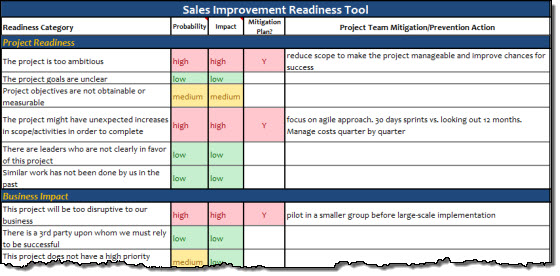
SBI’s 7th annual research tour is under way.  Sign up for the onsite session for your leadership team: How to Make Your Number in 2014:  A Sales Strategy You Can Execute. By participating, you will get the Sales Improvement Readiness Tool. It will help you determine which initiatives your team is ready to tackle. It will save you from spending precious time on projects with low probability for success. Both the session and the tool focus on:

  1. Making good decisions quickly
  2. Removing the risk of investing time in a failed project
  3. Picking projects that can get executed
 sales improvement readiness cta1

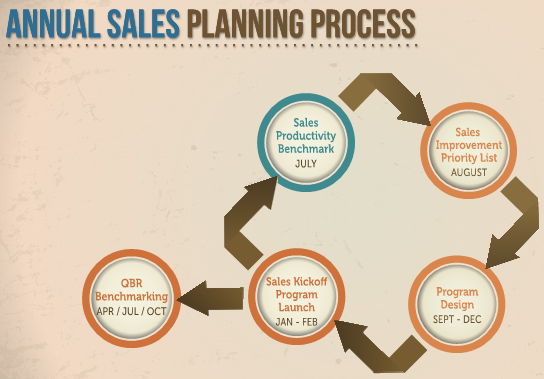
The image below highlights the annual sales planning process best-in-class companies use. During the research tour, we will cover this in more detail. For the purposes of this post, focus on the “Sales Improvement Priority List.” These are all the sales initiatives you can focus on next year. Before investing the time, you want to determine if your team is ready to execute.

describe the image

Prioritizing Your Initiatives

The way to do this is through the Sales Improvement Readiness Test. This tool helps you evaluate your decision across four areas. It will prevent you from wasting time on projects your team can’t execute.

  1. Project Readiness
  2. Business Impact
  3. People
  4. Cost

Project Readiness

Project readiness is focused on the project itself. The scope of the undertaking. Ability to meet timelines. Buy-in from the team. Prior experience completing similar projects.

If you’re concerned the project is too ambitious, this is where you’ll vet it.

Business Impact

Operation focuses on the impact to the business. Disruption. Third party reliances. Leadership turnover.

If you’re wondering if this is going to upset the apple cart, this will help.

People

This is about your team’s ability to pull the project off. Skill sets. Resources. Resistance. Ability to communicate effectively.

If you don’t think you have the horses in the barn, this will tell you.

Cost

Here, you’re focusing on the expense of the project. There’s the proposal, then there’s everything else. Unbudgeted expenses. Time to results. Forecasted benefits.

If your CFO or board are questioning the spend, here’s your solution.

Using the Sales Improvement Readiness Tool

Start by reviewing the readniess items for each of the 4 categories. Then, determine the probability of this issue arising (low, medium, high). Assess the impact it will have on you if it does arise (low, medium, high). In the tool, there are specific instructions how to do both of these.

When complete, focus on areas with “high” responses for both probability and impact. These are your biggest reasons for concern.  

Your final step is to develop mitigation plans with your team. If these issues arise, you’ll recognize them and know what to do.

Tip: You might be concerned the team won’t speak up if done as a group. Bravado and peer pressure can corrupt the process. A solution is to have your leaders complete on their own before you meet. 

What Now?

  • If you have a large amount of “high” ratings, you should consider cancelling the project. You aren’t ready. You’re unlikely to get a positive result. Save yourself the time.
  • If you’re in the middle, determine if you can mitigate the damage before proceeding. The cost to pursue is 50/50. You have to determine if the calculated risk is worth the time.
  • If the assessment returns “low” ratings, the project is not at risk. You are ready and can proceed with confidence. You are likely to get a return on your time investment.

This is a tool you can use with regularity. It helps you think through big decisions quickly. You will invest time and resources in the right projects.

If you’d like to learn more about getting your team ready for next year, we can help.  Sign up for SBI’s 7th annual research tour: How to Make Your Number in 2014:  A Sales Strategy You Can Execute.

Author: Ryan Tognazzini

sbi on linkedin

Follow @RyanTognazzini

Follow Sales Benchmark Index @MakingTheNumber

If you enjoyed this post, never miss one again by subscribing your Email Here and/or subscribing to the RSS.

29 Jul 16:32

Social Selling Resources to Maximize LinkedIn and More

by Lori Richardson

LSS_Channel-Logo-1_vertical_LinkedInNo doubt you are busy in your sales career working to identify prospective customers, connect with them, nurture that relationship and ultimately help them to a buying decision potentially with your products and services.

Have you made time to learn how to leverage LinkedIn and other social selling strategies to help you grow your visibility?

Do you know that you can create a “virtual mall” for yourself – promoting what you do 24/7 by giving your resume-focused LinkedIn profile a fresh update?

If you have put it off, as some other reps I run into have, decide now to fix that. Make a pact with yourself to invest 10-20 hours over the next 30 or so days – and I assure you, if you do it right, you’ll be able to do some things you can’t do now on LinkedIn. For example:

If you don’t have a professional photo (or a photo at all) – buyers and strategic partners won’t take you seriously.

If your summary shows what an amazing seller you are, rather than a customer collaborator, you may impress a recruiter, but since you’re now looking for relationships with buyer, you won’t attract them.

If you don’t maximize all the capabilities of LinkedIn now – you’ll fall short.

Below are some of my fantastic and amazing social selling colleagues – all of us, like Score More Sales, are LinkedIn Sales Solutions Channel Partners.

What is a LinkedIn Sales Solutions Channel Partner? We are organizations who help you sell more by leveraging the amazing powers of LinkedIn. I can vouch for the following individuals and organizations to help you gain specific ideas that help you better position yourself to attract and connect with the right buyers you serve.  I included Score More Sales at the end of the list – we are thrilled to show you tips and ideas to immediately gain better traction in social selling.

In no particular order – take them up on their classes, offers, e-books, and ideas:

Miles Austin - the Web Tools Guy

Trish Bertuzzi – the Bridge Group Inc – B2B inside sales experts

Steve Richard - Co-founder, Vorsight – B2B top of the funnel

Jamie Shanks – Partner, Sales for Life

Barb Giamanco –  Social Centered Selling

Jill Konrath – Author, Speaker, Strategist

Matt Heinz - Founder, Heinz Marketing

Kurt Shaver - Founder, The Sales Foundry

And, heck yea, contact me – Lori Richardson - founder, Score More Sales – 9 years of experience using LinkedIn to grow sales.  We can help you shorten your sales cycle, identify one or two strategies that fit your industry and will help you grow leads with your targeted buyers.

Lori Richardson - Score More SalesLori Richardson is recognized as one of the “Top 25 Sales Influencers for 2013″ and one of “20 Women to Watch in Sales Lead Management for 2013″. Lori speaks, writes, trains, and consults with inside and outbound sellers in technology and services companies. Subscribe to the award-winning blog and the “Sales Ideas In A Minute” newsletter for sales strategies, tactics, and tips in selling. Increase Opportunities. Expand Your Pipeline. Close More Deals.

The post Social Selling Resources to Maximize LinkedIn and More appeared first on Score More Sales.

29 Jul 16:31

The Three Reasons You’re Floundering

by Keenan

I love Matts post choice. In a series of personal development he shares what he’s learned from someone else.  That’s wicked frickin’ smaaat!

Great insight on floundering and improving our productivity.


I’m a huge David Allen fan, using many of his productivity tenets as the foundation of my personal productivity system. I highly recommend reading Getting Things Done at minimum, and subscribing to his great newsletter.

In a recent newsletter, Allen shared three common reasons why people flounder and, generally, fail to get work done. It was a great write-up, and I wanted to share it here as well. Thank you David for your ongoing, consistently excellent advice to keep us on track and moving forward.

There are three common reasons why most people seem to flounder with their personal workflow. At least part of their systems lack one or more of three essential variables: consistent, current, and contextually available. This was reaffirmed for me in a coaching session I did with a senior executive. Here’s what showed up:

Consistency: She had some phone call reminders on pieces of paper, some in her head, some on sticky notes stuck to the phone. Keeping the same kind of reminders about the same kinds of to-do’s in different media in different places is hugely inefficient and confusing. Information or reminder triggers of a specific type must be kept in the same place, the same way, all the time. Otherwise we have to make the “what do I do with this?” decision with every such particle, and that throws up a quick barrier to engagement. She decided to go with simple file folders labeled “Calls – Work” and “Calls – Personal”, as the best way to manage those, and sanity began to prevail.

Currency: No matter how consistent the system is, if it is not current (i.e. completely up to date with all items in a category) it still can’t be trusted in a way that relieves the psyche of the job of remembering and sorting. You’ll look at a list and some part of you knows it’s not the whole list, so (a) you won’t totally trust your choices and (b) you’ll still try to use your head to keep track. And if your brain still has that job, instead of trusting your lists, you won’t be motivated to keep your external system going (it will be too much work for the value received.) You’ll feel like it’s hard work to keep the list and will resist looking at it anyway because you’ll know it’s only partial and it will remind you that you’re “behind.”

Contextually available: She had been trying to organize action reminders by project or by topic, instead of by where the reminder needs to be seen in order to get it done. Project thinking and planning need to be seen by the title or topic, because that’s when we need to see that information (when we’re meeting or thinking about it). But reminders of the next actions required need to be seen where those actions can occur–phone calls when we’re at a phone; errands to do when we’re about to go out in our car; emails to send when we’re at our computer; etc. Information and action reminders should always be stored in such a way that we are likely to see them when we need to see them, and can use or move on the data. If you store your Next Action reminders by what or who they’re about, every time you’re in a place where you can do work (at a phone, at your desk, in your car, at home) you’d have to look through dozens of folders or files to find reminders of all your options. And when you’re running fast and only have a short window of time, you won’t really check the whole inventory and you’re likely to make choices from latest-and-loudest instead of objective overview.

————–

Matt Heinz brings more than 15 years of marketing, business development and sales experience from a variety of organizations, vertical industries and company sizes. His career has focused on delivering measurable results for his employers and clients in the way of greater sales, revenue growth, product success and customer loyalty. Matt has held various positions at companies such as Microsoft, Weber Shandwick, Boeing, The Seattle Mariners, Market Leader and Verdiem. In 2007, Matt began Heinz Marketing to help clients focus their business on market and customer opportunities, then execute a plan to scale revenue and customer growth. Matt lives in Kirkland, Washington with his wife, Beth, two children and a menagerie of animals (a dog, cat, and six chickens). You can read more from Matt on his blog, Matt on Marketingfollow him on Twitter, or check out his books (listed below) on Amazon.com.

29 Jul 16:30

“When is This Deal Going to Close?”

by Scott Gruher

Micro Manager“When is this deal going to close?”

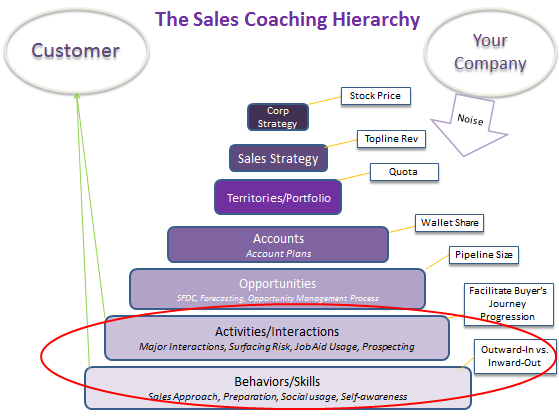
The worst question a sales leader can ask a rep.  This question adds no value.  It is a selfish question.  You are thinking solely of your own quota.  Yet, you need the answer because your boss will ask you the same question.  In this post we will discuss best practices around coaching to behaviors.

Great coaches give suggestions that improve daily selling behaviors.  Poor coaches ask high level questions about accounts and deals.  These questions don’t provide the rep with
any guidance around what to do next. 

Great coaches are masters of behavior change.  They diagnose the problem, hone in on it, and change it.  The problem is that most sales leaders aren’t doing this.  They are managing at the forecasting and pipeline level.  Forecasting is an output of day-to-day performance.  You need to focus on the activities and behaviors that determine the performance.


Sign up for SBI’s 7th annual research tour:  "How to Make Your Number in 2014:  A Sales Strategy You Can Execute."   It is an onsite session with you and your leaders.  By participating, you will get the Coaching to Improve Behaviors ToolIn the guide you will learn:

  • Get better results by coaching to the right behaviors
  • Add more value during coaching discussions
  • How to use coaching to drive incremental improvement


Let’s dig a little deeper.  The tendency is for sales leaders to inject themselves into large late stage deals.  This is a mistake.  You don’t get a good understanding of your sales team’s skills this way.  Great sales leaders are involved in large opportunities earlier on.   

Blog Hierarchy Visual

Here are 5 best practice coaching techniques you should consider:


  1. Get involved in deals early - buyers are more informed and therefore feel more independent in the early stages.  Differentiating in the early stages is important.  Bring insights and value early on or you will be a product (or service) and a price. 
  2. Teach selflessness – nothing changes the tone and differentiates your rep more than this.  What do I mean?  Bring the buyer value that isn’t related to your solution.  I am not kidding.  Introduce them to a potential dream customer.  Connect them with a peer they
    can learn from.  Go out of your way to give before you ask for something.
  3. Be involved in call preparation – ask tough questions to ensure your people are truly prepared for important sales calls. 
    Typically they are not. 
  4. Reduce the internal noise – sales organizations create a lot of work.  As a leader you need to filter how much of this reaches your team.  Keep them focused on selling and improving their skills. All activities and behaviors should be focused on the buyer.
  5. Have your team surface risks early – why do this early? Change the conversation by understanding what will stop the customer from buying. Average sales people avoid risk and difficult conversations. Top performing sales people start these conversations.  They challenge buyers and differentiate themselves.  Are your sales people brave
    enough to proactively surface buyer risk? (i.e.- Mr. Buyer you have so many conflicting priorities.  If I were you I wouldn’t do this now.  Why do it now?)

As a Sales Leader, are you focused on improving behavior in these areas?  Or are you so focused on the number you don’t have time?  Make time.  You can’t move the number without effective execution of daily activities and behaviors. Consider participating in the research tour to get the Coaching to Improve Behaviors Tool.


Author: Scott Gruher


sbi on linkedin

Follow @ScottGruher

Follow @MakingTheNumber

If you enjoyed this post, never miss one again by subscribing your Email Here and/or subscribing to the RSS.

29 Jul 16:30

Inside Sales Power Tip 125 – Grit

by Lori Richardson

You know that guy or woman on your sales team who is relentless?  That person who possesses something that is driving them to succeed. Would you like just a little bit of that to help get you where you want to be?

That seller who regularly runs into obstacles and they always seem to bounce back?

How is it that they always seem upbeat and ready for another day of sales calls, e-mailing and researching seemingly impossible to reach prospects?

They have grit.

Grit is a trait– a distinguishing feature.  Grit enables you to persevere

It is passion and perseverance to attain very long-term goals.

If you are gritty, you consciously set long-term goals that might be difficult to attain and then you keep at  these challenging goals, regardless of feedback.

I’d like more grit, wouldn’t you?

The funny thing about it is that we really don’t know a lot on how you get or build grit.

Three things you can do to learn about your level of grit and how to be more successful: 

You can take the Grit Survey created by the University of Pennsylvania  to get your Grit Score.

https://sasupenn.qualtrics.com/SE/?SID=SV_06f6QSOS2pZW9qR

Read the book, How Children Succeed: Grit, Curiosity, and the Hidden Power of Character.  Link to author Paul Tough’s page.

Watch Dr. Angela Lee Duckworth’s TED talk on Grit to learn more.

Now set a big, audacious goal, and get at it.  Post your thoughts – we’d love to hear what you think about grit.

Lori Richardson - Score More SalesLori Richardson is recognized as one of the “Top 25 Sales Influencers for 2013″ and one of “20 Women to Watch in Sales Lead Management for 2013″. Lori speaks, writes, trains, and consults with inside and outbound sellers in technology and services companies. Subscribe to the award-winning blog and the “Sales Ideas In A Minute” newsletter for sales strategies, tactics, and tips in selling. Increase Opportunities. Expand Your Pipeline. Close More Deals.

The post Inside Sales Power Tip 125 – Grit appeared first on Score More Sales.

29 Jul 16:30

Thinking About Prospecting Will Never Fill Your Pipeline

by TheSalesHunter

boss 300x199 Thinking About Prospecting Will Never Fill Your Pipeline photoThinking about a prospect is not the same as contacting a prospect, so it’s about time we quite confusing the two.

Far too many salespeople spend all of their prospecting time working on their prospecting list, gathering information, and thinking about how they’ll prospect and what they want to say.

Nothing wrong with that on the surface, but the problem is they never get around to actually contacting the customer.

The issue is the amount of time that is spent thinking about sales prospecting in relationship to the amount of time actually spent prospecting.

I’ve heard from far too many sales managers and salespeople who say their prospecting pipeline is empty.  When I probe them as to why, the number one issue is because they haven’t spent enough time engaging with prospects.  The sad part is it’s because what little time they devote to prospecting is spent thinking about prospecting.

Why should anyone expect results if all they do is think about reaching out to customers?   It’s as if we believe technology has reached such an advanced state that all we have to do is think about something and it happens.  

Just as we can’t expect results from just thinking about a prospect, neither should we expect results from a customer thinking about us.

It’s just not going to happen.

The way around this problem is simple.

Pick up the phone and call.  Quit making excuses and start making it happen.

Not having a full prospecting pipeline is simply an excuse.  Fact is for many salespeople they spend all of their time planning to prospect as a way of getting themselves to believe they are prospecting.  In reality, they’re doing nothing more than making excuses to compensate for their fear.

Do you see yourself in that scenario?  Be humble and admit it.

There are a lot more of you out there than will ever admit. The cure? Stop thinking about your prospects and pick up the phone and start calling.

Copyright 2013, Mark Hunter “The Sales Hunter.” Sales Motivation Blog.

button receive a free9 300x51 Thinking About Prospecting Will Never Fill Your Pipeline photo

29 Jul 16:28

62 Tips For Your Social Media Marketing Tool Box

by Jeff Bullas

Social media marketing is moving from its exciting adolescent phase to a more mature grownup status.62 Tips For Your Social Media Marketing Tool Box image Social Media Marketing Tool Box 62 Tips and Tactics

Online social media obsession driven by social web hormones and testosterone that drove social networks to hyperactivity are being replaced by tried and now proven activities and mature business processes. Digital marketing responsibility is now in the driving seat.

The dreaded phrase “what is the return on investment” is now seen as a conversation that needs to happen.

The dinner party conversations are no longer about Facebook or Twitter. An announcement about Instagram providing 15 second videos barely makes a ripple in the blogosphere. Social media is now part of the woodwork and is embedded in the web.

The after work and cocktail bar chats are now about when you are commencing a start up, designing your online store or launching an app.

Sexy to staid

Despite its move from sexy to staid and impending “ho hum” status, social media is embedded and integrated into almost all digital and even traditional marketing activities.

Learning to use social media effectively is now essential and required if you aren’t going to be “disrupted” by your competitors and fast growing start-ups.

So let’s look at it in context in the digital marketing ecosystem, consider core essentials and tips and tactics. These will help you get started and also optimize your current social media marketing activities.

Earned and paid

The initial attraction of social media beyond connection and engagement was that is was “free”. Social networks allowed anyone to publish and market for free with ease.

Search engines also provide this advantage and being found on Google can be done two ways.

Earned search

Earn the right to appear on page one of a search engine with optimized content and search engine optimization and it can make a large difference to your sales and inquiries. The clicks from earned search sits at around 75% of all search engine result page clicks.

This is called organic SEO (Search Engine Optimization)

Paid Search

Now let’s quickly cover how to pay for appearing on the first page of Google

Google AdWords allows you to accelerate your brand discovery and click-throughs by paying to appear on page one for selected keywords and phrases. Stop the campaign and the traffic no longer turns up to your website or landing page.

It all comes down to measuring whether paying produces a positive return on investment. Spend a dollar and get a profit of two dollars means that it is an activity worth pursuing despite the cost.

Social media marketing is following the same route.

Earned social

On Facebook you can update frequently and create content that drives organic engagement without paying a cent. That challenge is becoming a mountain of effort as Facebook pushes you to pay for attention. Obtain 100,000 likes and you have earned some attention that drives traffic to your digital properties.

Paid social

The other marketing route is to log into Facebook’s self-service advertising portal and start paying for some Facebook advertisements. Twitter’s self serve advertising is also available to help you gain that important online visibility. Paid social media advertising is becoming an important part of the marketing budget.

Effective social media marketing is requiring your organisation to learn how to do both earned and paid well to ensure success.

Social media marketing essentials

There are some key essentials that should be part of your social media marketing foundations.

1. Securitisation of your social media network assets

I still am surprised that many companies still don’t have the top social networks secured with their brand name in their digital assets portfolio.

You don’t need to be on every social network but ensuring you have the major ten (as listed in this article) registered by your organisation is vital.

2. Branding

Make sure that the branding is consistent across your social media channels. An important core goal of social media marketing is to create brand awareness. So making sure your memorable brand is recognised wherever your customer’s hangout is vital. Logo, colors and brand consistency should be embedded across all social networks.

3. Strategy

A planned social media marketing strategy that is consistent with your overall marketing activities ensures that you are not chasing quick fix tactical responses to urgent marketing goals. Like lack of sales.

4. Resources

Having a well resourced and adequate team and tools is needed for long term success.

This includes

  • Budget
  • People
  • Tools

Social media despite being free to join, does take time and resources to implement. It costs.

Allocate and buy the right people, software and even external expert advice to ensure that you aren’t spinning your wheels and expecting the intern to perform marketing miracles.

5. Integration

Social media networks seem separate but in essence they are interlinked paths to your brand and need to be integrated. Everyone has a social media preference. It could be Blogs, Facebook or even Twitter.

Make it easy for people to listen and view your updates on their platform of choice by ensuring that you have cross-linking to other social media networks. This needs to be woven into all your platforms.

Examples include having links on your blog to Facebook, Twitter, Google+ and LinkedIn.

On Facebook have a link to your Blog or website. If you have a Twitter account also link to your primary online presence.

Core social media marketing activities

These are the types of activities that should be woven into every social media marketing plan.

1. Content creation

Don’t underestimate the time and expertise needed to create content that will flow across the web. It needs a good headline, a compelling introduction and a well structured layout with sub-titles, bullet points and short sentences that make content consumption compelling.

Multi-media that is compelling to share on social networks is a creative process that is part art and part science.

2. Engagement

Publishing updates to Facebook, Twitter and Google+ means that people will leave comments and feedback that needs a response from the organisation. This creates deeper trust and, credibility and engagement. This is what you call the quality component of social media marketing

3. Building your networks

To add to the quality you need quantity to get more visibility online. Bigger is better. Continue to grow your Facebook likes, Twitter followers and other social networks.

62 tips for your social media marketing toolbox

What are the some of the basics the top social media marketing professionals implement that are essential to long term success?

I have broken them down social network by social network.

1. Blog

A blog or website should be the center of your digital asset portfolio. You own it and it needs to be a constant publishing platform for your brand and business.

Don’t let Facebook have all your images, videos and contagious multimedia content. A blog with optimized articles and media will build and boost your search engine rankings.

So what are some essentials?

  1. Design and launch your blog on your own domain (not on Tumblr’s, Blogger’s or any easy to use but hard to escape network)
  2. Self hosted
  3. Use a search engine optimized software platform like WordPress
  4. Persistent publishing
  5. Well structured writing
  6. Easy to read
  7. Includes highly visible sharing buttons for the important social networks. These include Twitter, Facebook, LinkedIn and Google+
  8. Add subscribing icons which allows people to subscribe to your social media networks including “Liking” you on Facebook and follow you on Twitter without leaving your site.

More reading:

2. Facebook

Facebook cannot be ignored as it is the defacto social network with nearly one in two people that use the internet as members.

Here are some tips for those who don’t know where to start.

  1. Design and apply custom tab Facebook apps to your (such as ShortStack) for increasing likes, engagement and calls to action
  2. Listen to your audience
  3. Update often
  4. Use strong visuals and multimedia
  5. Link to your core website asset
  6. Your “About you” is clear and part of your Facebook profile
  7. Use non photo shopped images from mobiles rather than glossy glamour shots

More resources:

3. Twitter

Twitter is the unfiltered “Wild West” of the social media “in” group and is often underestimated as a media for connecting with focused target groups and distributing your content at velocity.

It is just as essential as Facebook in your tactical social media toolbox. It is maybe the easiest to automate and achieve some scale.

So what are some key tactics?

  1. Use compelling headlines
  2. Tweet often
  3. Automate where appropriate (Socialoomph, Twitterfeed, etc)
  4. Share industry influencer’s content often
  5. Link back to your website/blog
  6. Engage with your followers

More resources:

4. LinkedIn

LinkedIn is the white collar professionals playground and if you work in any knowledge industry you need to be participating here.

More formal than Facebook but LinkedIn has become increasingly important as a place to share your content and engage with industry groups on a global scale.

  1. Link to your three top online properties in your profile
  2. Update your profile regularly
  3. Participate in groups
  4. Upload links to content to LinkedIn from your core online assets (Website/Blog/Slideshare/Media)
  5. Publish your new content consistently on LinkedIn (such as blog posts, videos and Slideshare presentations)
  6. Include video in your LinkedIn profile

More resources:

5. Google+

Google+ is now the second largest social network behind Facebook and is considered by Google as core to its platforms such as Gmail, YouTube, Blogger, Picassa and even its search engine algorithms. It weaves social signals such as Tweets, +1’s and other social media interactions into rankings results on its search engine.

It is a major social media player that is too big to ignore.

  1. Use the strong branding capabilities and real estate that Google+ provides
  2. Participate in “Hangouts”
  3. Use large high definition images (It is a very visual platform)
  4. Use Google+ Ripples to monitor the effectiveness of your content updates
  5. Share your best content on Google+
  6. Add Google+ share and follow buttons on your blog/website
  7. Segment followers with the “Circle” feature

More resources:

6. YouTube

YouTube can be effective for businesses that sell to other businesses (with “How to” instructional videos) as well as for consumer related brands. (eg. Old Spice’s funny and viral videos).

Often the golden grail for a business or marketer is the “viral video”.

What many people don’t realise is that YouTube is the second largest search engine behind Google and is vital for visibility on the social web.

Here are some tips to essential YouTube social media marketing.

  1. If you are an online store create short YouTube videos to display your product (Research shows that this can increase conversions by 10-30% )
  2. Create “How To” videos that explain insights into using your product whether that is about how to use software or even riding a horse.
  3. Optimise for search when creating your YouTube videos. This includes writing a headline for YouTube that includes keywords that are important for your industry. Also add a description, categories and tags that allow Google to find and know what your video is about. Even include a link to your website/blog that enables people to find out who your business and brand are all about.
  4. Embed them in your blog posts and website to give them more exposure
  5. Tweet your YouTube videos on a regular basis.

More resources:

7. Pinterest

So why should you be interested in Pinterest. Recent new data is showing that it has now become the 4th largest referral network after passing Yahoo and now only sits behind Google, Facebook and Twitter.

It is a visual niche social network that is proving to be a driver of significant traffic driver for image rich eCommerce sites. Walmart is considering plans to include trending pins (Pinterest posts) as one of the signals it listens to in its own eCommerce search engine as signalling buyer intent.

  1. Align: Position your brand to align with popular, timely and topical conversations; i.e. if you are a shoe company, pin trendy shoes. “News Year’s Eve” shoes (timely), or “prom shoes” (topical).
  2. Optimize: Google LOVES Pinterest! Focus on the keywords that matter most for your brand, align this with what you know about how your audience searches (and what they are searching for) and incorporate them into your board titles and pin descriptions.
  3. Engage: Pinterest is a social community that requires two-way engagement. “Repin,” “Like” or comment on pins and boards of others. Interact with your followers and take the time to participate.
  4. Organize: Sort your boards well. Also, while keywords are important, have a little fun with how you name your boards. Finally, be sure to set the board “cover image” to a pin that best conveys the topic of that board.
  5. Diversify: Pinterest is a great opportunity to reach all the segments of your audience. Create boards and pin items that appeal to every segment of your consumer base!
  6. Integrate: Be sure that the content on your website is easy to share. Incorporate the “Pin It” button into your social sharing lineup.
  7. Evaluate: Measure your success. What boards and pins are seeing the most “Likes,”

More resources:

8. Instagram

Instagram received fame when it was bought by Facebook in 2012 for $1 billion despite the fact is was making a loss and only had 16 employees. This social media app that started life as a mobile app without even a website makes sharing images to Facebook and Twitter from your smart phone simple and fun.

It is even used by large business to business brands such as General Electric.

  1. Arrange a feed for your Instagram photos into your interactive website, ecommerce site or blog.
  2. Share your instagram photos across your key social media networks of Twitter and Facebook. It also supports Flickr, Tumblr and even Foursquare.
  3. Make it fun. Want to see how Jamie Oliver does it so well.
  4. Use Instagram to increase engagement on Facebook by asking open ended questions when posting a photo. This can be as simple as “What do you think about this Instagram Photo of the Day?”
  5. Reveal “behind the scenes” photos that humanise your brand.

More resources:

9. Vine

Viddy and the video feature on Instagram thinks that 15 seconds is the right length for a video short message while Vine has chosen 6 seconds. Maybe there is some science behind both but let’s look at some possible ideas for marketing with a short video.

Here are 6 ideas to get you started.

  1. The brand elevator pitch: Want people to understand what your brand is all about. The elevator pitch is where you wrap it up in one sentence or two. 6 seconds is maybe enough. How could you make it visual and viral.
  2. Product demonstration: One to two minute video reviews of products in your online store are now maybe too long. Why not experiment with six seconds?
  3. Launching a new product or service: Explain your new product in six seconds if you can. (If you don’t then use YouTube). Maybe your messaging will get better as you learn to communicate the key features and not the unnecessary.
  4. Give your brand a personality: Social media allows and wants you to give your brand a personality. Use Vine to make it real and authentic. Make it quirky or innovative. Many brands want an image that goes beyond bland.
  5. Marketing a promotion: Use a 6 second Vine video to market a new promotion. This could be a new book, song or a movie or even an event. How long do you need to communicate something new. Remember the power of simple.
  6. Announcing a special offer or discount: 50% off. How long does it take to announce that special offer for your clothing store? Make it visual, aural and shareable

More resources:

10. Slideshare

Slideshare is the YouTube of PowerPoint presentations. It is visual and underestimated by many marketers. If you are an author, a business to business marketer or work in a knowledge industry then it should be in your social media toolbox.

So how can you use Slideshare to market your business.

  1. Upload your PowerPoint presentations onto Slideshare
  2. Share them on other social networks such as Twitter and Facebook. Don’t expect people to stumble across them.
  3. Turn your blog posts into a visual presentation and load them up to Slideshare
  4. Re-purpose your PowerPoint’s into a blog article and embed your presentations in that post.
  5. Use Slideshare to capture inquiries as the paid “Pro” version allows you to create a lead form that is embedded in your PowerPoint.

What about you?

What tools, tips and tactics have worked for you? What has been most effective? Are you on all of these 10 social media channels?

Which ones are your favourites? What social media marketing do you want to learn more about?

Look forward to your feedback, insights and stories in the comments below.

Learn how to market your blog with social media marketing

My book – “Blogging the Smart Way – How to Create and Market a Killer Blog with Social Media” shows you how.

It is now available to download. I show you how to create and build a blog that rocks and grow tribes, fans and followers on social networks such as Twitter and Facebook. It also includes dozens of tips to create contagious content that begs to be shared and tempts people to link to your website and blog.

I also reveal the tactics I used to grow my Twitter followers to over 170,000.

Read more about it here where you can download and read it .

29 Jul 16:28

5 Must to Have Cloud Storage Apps for Your Android Phone

by Sabih Ahmed

Do you want to carry around your favorite movie collection, your humongous music playlist or your life’s history in photos, all at the same time on your Android phone? Yes! You can do that and more, without even having your phone’s memory all swallowed up.

This is what the truest form of portable technology, Cloud storage lets us to do. A Cloud storage solution is one of the most acclaimed segments of the charismatic Cloud computing technology; in fact it has become an omnipresent feature of the Cloud that promises users limitless resources and computation.

What’s the Hype Around Cloud Storage?

Cloud Storage involves the storage capacities of some of the most gigantic computing machines, virtualizes them and puts them at the disposal of user. A Cloud storage solution is like an additional repository for all the devices you use, whether at work or at home.

Furthermore, with synchronization that is the main differentiator of Cloud Storage, you get to access your files from everywhere, without having any file transition hindrances.

Cloud Storage for Android – How Good is it?

Other than desktop devices, Smart phones are considered second most commonly used devices through which majority of the people interact with data, internet and varied other IT resources. Moreover, through a study it has been learned that by 2014 Smartphones will replace the desktop web usage. Hence it’s quite an ability of Cloud Storage solutions that allow users to consume data, share it, store it and synchronize it all through their Smartphones.

Android powered phones being the forerunners in the smart phone industry get to attain the most out of this trend as more and more Cloud storage providers are inaugurating their service support for Android. Cloud computing is literally bridging the gap that users previously endeavored while handling data through multiple devices. Now they can access their Cloud storage for saving gigantic files or retrieving their favorite music, movies, pictures, or other sensitive files on the go from their Android phones.

5 Must to Have Cloud Storage Apps for Your Android Phone image Untitled 1 300x164

Benefits of Using An Android Supportive Cloud Storage Solution

The thought of having your entire storage of the most cherished files on your phone without having its memory at stake, is enough to attract some of the most ardent Android fans. However, there are other things as well that you can do all from your phone once it gets your Cloud storage Client installed.

The anytime/ anywhere accessibility slogan of Cloud, is denoted well with Android Cloud Storage solution. If you are away and you want to share pictures with your loved ones, Android powered Cloud storage solution lets you do the job more efficiently. Moreover, if you use the same Cloud storage solution at work, you can tally your documents or make amends directly from your phone- this feature is great for users who have their Cloud Storage spaces shared among other users.

Besides, synchronization, robust security, support and more, Android Cloud storage solution never lets you worry again about your phones internal memory. If you want to save something that is big, just select it or download it directly to your Cloud storage on the fly.

Top 5 Android Compatible Cloud Storage Solutions

Providing plethora of features and ease, fortunately for use there are like various Android Cloud storage providers present today. However, some are highly significant in terms of their offerings and pricing. Read on below, the Top 5 Cloud storage services that are a must-have for every Android phone users.

Dropbox: Being the first Cloud storage app, Dropbox is the most widely used solution. It takes the lead for providing users some of the very functional and efficient features that nowadays other Cloud storage solutions are also adopting.

It lets Android users upload anything and everything and access them without any issues. Dropbox grants great amount of storage even on its free subscription, but of course specifies nominal charges if you want more.

Box: Just like Dropbox, Box also provides users a complete control of their ‘stuff’ which they can access through their android phones. With box uses have the ability to share their data with their contacts; however, on the downside this app doesn’t sync your data with your other devices automatically.

Google Drive: It was previously termed as Google Docs; however Google remodeled it so that it would accommodate Cloud storage services, however, coupled with Android, this Cloud storage app works flawlessly. Users can upload their documents, make changes and access it from anywhere.

SkyDrive: Similar to Google, Microsoft too has its own version of the Cloud storage service which is known as SkyDrive. Skydrive lets you store all of your data on to the primly maintained Microsoft Cloud servers. This is also a very cool android Cloud storage app which features a metro style user interface and lets users create or delete folders and share files and photos.

Verizon Cloud Storage: Verizon just recently launched its android supportive Cloud storage app and since then it has been generating waves of popularity. With Verizon Cloud customers can do everything they are likely to be doing with Dropbox. You can safe keep your data into the Verizon cloud ensuring it remains intact if your phone gets lost or needs to be wiped.

Conclusion

The aforementioned Cloud storage solutions are all but the best storage options that are out there. However, the choice on whom to pick is yours. If you feel like being on the free account suits your needs the best, then I guess you need to pick the one that provides that biggest storage capacity for free.

On the other hand and especially in terms of functionality I believe that Dropbox Clearly holds the distinction for being the most popular and proficient Cloud storage solution there is out there.

29 Jul 16:27

Why Your Business May Need a New Content Map to Find Success

by Robert Rose

Why Your Business May Need a New Content Map to Find Success image new content mapIn the consulting and advisory side of our business, we’re honored to work relatively frequently with businesses both large and small. These days, because of the rapid growth of content marketing, the businesses we work with are, in many cases, actually reinventing an existing content marketing strategy. And sometimes in these instances, the business case for reinvention starts from a point of disadvantage because there is usually some level of skepticism that has been built up.

The result is a bit of a catch-22: It’s hard to throw out the existing approach, because, well… we worked so hard on it. And what’s to say that a reinvented one will actually work better? So, the business just tries to incrementally chase improvement to make the most out of what they have to work with.

Seth Godin wrote a wonderful post on reinvention a couple of years ago, which I happened to have re-read over the holiday weekend. In that post, Seth says:

“If you define success as getting closer and closer to a mythical perfection, an agreed upon standard, it’s extremely difficult to become remarkable, particularly if the field is competitive. Can’t get rounder than round.”

This really struck me, because it’s where I see so many digital marketing strategies falling short these days: They are stuck working off an old content map, trying to make more out of the “less” that they have.

As we drive ourselves to raise content marketing to the next level, we’ve got to start creating new content maps to improve the efforts we’ve made in the past.

New experiences require new strategies

I was at a mobile conference recently, and a self-proclaimed digital marketing “guru” (that’s always your first clue) began extolling his process of creating “new content marketing experiences” for a client. He and his agency had “created” a mobile and social content marketing strategy that solely entailed publishing the most popular content and comments on the client’s current blog to a new mobile-optimized channel. He called it the new “SOMO content marketing hub.” (I’m not even making that up.) He then blamed the client when the mobile/social program fell flat on its face. He basically re-drew an existing map into a new interface.

Why is it that we so want to believe that new, remarkable customer experiences can be created by automatically transferring old ones into a shiny new wrapper? Is it that we feel like it’s safer to guide our strategy by the conventional wisdom and existing processes that the organization has institutionalized than to try original, untested ideas? One marketer at a Fortune 500 technology company recently admitted to me that they weren’t allowed to use paid search marketing for anything other than direct calls-to-action to “buy now,” because their CEO believed it was the only way to measure ROI on PPC advertising. That’s not marketing, that’s insanity.

We do all these things based on what we think we know today. But, what if that knowledge is wrong? Or, to put it another way, how much better could our efforts be if we took the time to completely change our perspective?

Only new content maps can create new experiences

Sometimes the idea of creating new, remarkable content marketing strategies can seem esoteric — and it can often seem like even raising the discussion will just go the way of the “whooey wah wah” brand value conversations that have done little to move the needle, but can cause frustration with the past. In one very large B2B company, the marketing team is tasked solely with sending the emails an agency creates, creating internal sell sheets and making sure that the logo is in the right Pantone colors. They have, quite literally, become the brand police cliché.

But guess what? Not everybody gets to have the “what story are we going to tell?” conversation. Sometimes we do work for “gi-hugic” global mega-conglomerates, and aren’t given the opportunity to influence their brand stories. Rather, our mission is to just work with the ones we’ve been given.

But that doesn’t mean we can’t turn our content maps upside down and start to adopt completely new perspectives on what it takes to differentiate our businesses and create remarkable content and marketing strategies. This means looking at our existing marketing tactics and seeing how we might infuse them with content marketing techniques. It means looking at our measurement practices and searching for ways to abandon the myopic drive for only “more transactions” in favor of efforts that give us insight into how to engage more valuable customers, more retained customers, and more passionate brand subscribers. It means asking “why” — a lot!

With web content, social, mobile, call centers, and globalization, we are adding more and more interfaces to our business every day. Sales, marketing, product design, customer service, the ad agency, and our partners all engage directly with consumers. As we exercise the new “business muscles” of content marketing, social engagement, and enabling more customer touch points, we need to understand that all of these goals are dependent upon our ability to create new customer experiences.

Independent of where you sit in the organization, YOU have the power to develop these new maps. It’s your choice — start building them now, or start learning to deal with the frustration of inevitable failure.

To help get your ideas flowing, we’ve taken a few tidbits from a presentation I gave at Content Marketing World, Sydney this year and have compiled them into the eBook below (you can also view it on SlideShare). I hope it’s just the thing that will help put you on a reinvented path to better content marketing.

Content Marketing that Breeds Better Customers from Content Marketing Institute

Cover image via Bigstock

29 Jul 16:27

55 Lead Nurturing Statistics That Should Be In Every Marketer’s Arsenal

by Lindsey Weintraub

55 Lead Nurturing Statistics That Should Be In Every Marketer’s Arsenal image buyersthenvsnow 1024x603Lead nurturing is one of the most important functions of sales and marketing, and yet it somehow often gets overlooked. It’s a good idea to always be checking to make sure that your lead nurturing programs are in place and that they are working, so that no leads get lost. Sometimes, even when you are able to identify a problem in your lead management process or realize an opportunity to increase sales, the higher ups aren’t too keen on the idea of spending more money to make money. That’s why we’re arming you with the biggest list of statistics about lead nurturing. With this list, you can convince anyone (even the CEO!) of the absolute necessity of a strong lead nurturing program.

For more information about how a lead nurturing program with marketing automation can have a profound effect on sales, read this case study.

LEAD GENERATION

  1. Companies with 30 or more landing pages generate 7x more leads than those with fewer than 10. (HubSpot)
  1. 47% of B2B marketers say they either close fewer than 4% of all marketing-generated leads, or they don’t even know this metric. (Forrester Research)
  2. Event-triggered marketing can potentially save 80% of your direct mail budget. (Gartner Research)
    1. 12% of leads from large companies are from SEO, but they are only allocating 9% of their budget towards this source. 11% of their leads are from traditional advertising, but they are allocating 15% of their budget to this lead source. (Hubspot)
  1. 48% of marketers build a new landing page for each marketing campaign. (MarketingSherpa)
  2. 48% of offers have multiple offers on them. (MarketingSherpa)
  3. Businesses with 31 to 40 landing pages got 7 times more leads than those with only 1 to 5 landing pages. (HubSpot)
  4. Those with over 40 landing pages got 12 times more leads than those with only 1 to 5 landing pages. (HubSpot)

LEAD NURTURING

Time to woo your leads into buying. Hint: no shouting, yelling, broken-record repeating, or nagging cold calls. Want to know how to make your leads fall in love with your company? Read “How to Get Your Leads to Say I Do”. The best part is, there’s tons of love-is-in the air inspiring pictures to complement the marketing concepts.

  1. 50% of leads are qualified but not ready to buy. (Gleanster Research)
  2. Only 25% of leads are legitimate and should advance to sales. (Gleanster Research)
  3. 65% of B2B marketers have not established lead nurturing. (MarketingSherpa)
  4. 56% of B2B organizations verify valid business leads before they are passed to sales. (MarketingSherpa)
  5. Nurtured leads produce, on average, a 20% increase in sales opportunities versus non-nurtured leads. (Source: DemandGen Report)

SALES

Who doesn’t want to make a sale? It’s hard to be in trouble with your boss when you’re increasing sales.

  1. Companies that excel at lead nurturing generate 50% more sales at 33% lower cost. (Forrester Research)
  2. Nurtured leads make 47% larger purchases than non-nurtured leads. (The Annuitas Group)
  3. Companies with mature lead generation and management practices have a 9.3% higher sales quota achievement. (CSO Insights)
  4. 35-50% of sales go to the vendor that responds first. (InsideSales)
  5. 79% of market leads never convert to sales. (MarketingSherpa)
  6. 61% of B2B marketers send all leads directly to sales; however, only 27% of those leads will be qualified. (MarketingSherpa)
  7. The average sales cycle has increased 22% over the past 5 years due to more decision makers involved in the buying process. That means more intricate lead nurturing towards more stakeholders. (Sirius Decisions)

LEAD SCORING

Stop wasting your time on useless leads that will never go anywhere!

  1. 65% of B2B marketers have not established lead nurturing. (MarketingSherpa)
  2. 79% of B2B marketers have not established lead scoring. (MarketingSherpa)
  3. 68% of B2B organizations have not identified their funnel. (MarketingSherpa)
  4. 57% of B2B organizations identify converting qualified leads into paying customers as a top funnel priority. (MarketingSherpa)

MARKETING AUTOMATION

Because you’re never going to be up at all hours of the night to be shooting out emails!

  1. Companies that automate lead management see a 10% or greater increase in revenue in 6-9 months. (Gartner Research)
  2. Marketing automation users report 3x more leads passed to sales after one month. (Marketo)
  3. Jeff Ernst of Forrester Research, Inc., estimates that only about 5% of marketers use a full-featured marketing automation solution (Forrester Research)
  4. 59% of CMOs expect to increase effectiveness and efficiency of marketing by implementing automated marketing solutions. (Bulldog Solutions)
  5. The B2B marketing automation industry will reach $325 million in revenue by the end of 2011. This is a more than 50% increase over 2010, which had also doubled in revenue from the year before. (Raab Associates)
  6. Marketing automation has seen the fastest growth of any CRM-related segment in the last 5 years. (Focus Research)
  7. Lead nurturing reduces the % of marketing generated leads ignored by sales (from as high as 80% to as low as 25%). (Bulldog Solutions)
  8. By 2020, customers will manage 85% of their relationships without talking to a human. (Gartner Research)
  9. 81% of best-in-class companies list “wanting to close sales faster” as their number one reason for implementing marketing automation. (Focus Research)
  10. Companies that invest in marketing automation solutions see 70% faster sales cycle times, and 54% improvement in quota achievement. (Bulldog Solutions)
  11. Businesses that use marketing automation to nurture prospects experience a 451% increase in qualified leads. (The Annuitas Group)
  12. Marketing automation provides a 225% increase in volume of prospects that convert to sales opportunities. (SHIPSERV)

LEAD MANAGEMENT

You worked so hard for them. You can’t drop the ball now.

  1. 25% of marketers who adopt mature lead management processes report that sales teams contact prospects within one day. Only 10% of marketers report that same follow-up time w/o lead management processes. (Forrester Research)
  2. 34% of B2B organizations touch leads with leads nurturing on a monthly basis. (MarketingSherpa)
  3. 15% of B2B organizations touch leads with leads nurturing on a quarterly basis. (MarketingSherpa)
  4. 9% of B2B organizations touch leads with leads nurturing on a daily basis. (MarketingSherpa)
  5. 2% of B2B organizations touch leads with leads nurturing on an annual basis. (MarketingSherpa)
  6. 46% of marketers with mature lead management processes have sales teams that follow up on more than 75% of marketing-generated leads. (Forrester Research)

EMAIL

Email is a where many marketers make conversions.

  1. Lead nurturing emails have a slightly higher unsubscribe rate (1%) than individual email sends (0.5%) indicating their effectiveness in removing unqualified leads from the sales funnel. (Hubspot)
  2. Personalized emails improve click-through rates by 14% and conversion rates by 10%. (Aberdeen Group)
  3. Relevant emails drive 18 times more revenue than broadcast emails. (Jupiter Research)
  4. Lead nurturing emails get 4-10 times the response rate compared to standalone email blasts. (SilverPop/DemandGen Report)
  5. Lead nurturing emails generate an 8% CTR compared to general email sends, which generate a 3% CTR. (Hubspot)
  6. 80.8% of users report reading email on mobile devices. (Hubspot)
  7. Your most recent subscribers are the most likely to click through. (Hubspot)
  8. Saturday has the highest CTR at over 9%, while Sunday is second with just under 9%. (Hubspot)
  9. 6 am has the highest CTR of any hour. (Hubspot)

SOCIAL MEDIA

Social channels are a great place to build relationships that lead to lifetime customer value.

  1. 84% of B2B marketers use social media in some form. (Aberdeen Group)
  2. 51% of the top 20% of B2B marketers generating leads through social media use social sharing tools, compared to the industry average of 39% (Aberdeen Group)
  3. Marketers allocate 7.6% of their budgets to social media. (CSO Insights)
  4. The best three lead sources for B2B companies are SEO (14%), email marketing, (13%), and social media (12%). (Hubspot)
29 Jul 16:27

7 Creative Ideas for How to Use Facebook Photo Comments

by Matthew Peneycad

7 Creative Ideas for How to Use Facebook Photo Comments  image facebook photo comments2

Facebook recently introduced photo commenting functionality on business and brand Pages.

So, how can you use this feature on your Page?

Well, I’m sure that you, and others will devise amazingly creative ways to use this functionality in the future, but I wanted to get you started with a few creative ideas of my own.

Bear in mind that these ideas won’t be universally applicable to all business Pages, so remember to take into account how they might work given the context of your business, your goals and objectives, and how your audience uses social media and technology.

Here are 7 creative ideas for how you can use Facebook’s new photo commenting feature to drive engagement with your audience:

Photo scavenger hunts

A nice thing about the Facebook photo commenting feature is that it is retroactively functional for all of your past posts. Engage your audience by creating a photo update that asks your audience to find that photo in a previous update further down your timeline. ‘Hide’ the photo in the comments of a previous update by using the photo comment feature on an old post.

Fill in the blank… with a photo

As you know, fill in the blank updates on Facebook are really common. Take your next brand-relevant fill in the blank update to the next level by asking your audience to fill in the blank with a photo. You could ask them to show an emotion, demonstrate an expression, strike a pose, show something common around their house, showcase the results of your service, or anything else that may be relevant to your business or brand.

Your audience and your product

Ask your audience to photograph themselves using your product in unique and innovative ways, and post those photos as comments. Not only will this give your audience an opportunity to demonstrate their creativity, but it will be educational to other audience members who may not have thought about a certain application of your product.

Bring your audiences’ comments to life

You’ll need to be selective with how you do this, and not every comment will warrant a photo response, but there are cases when you could surprise and delight your audience by responding to a comment with a photo. Think of instances where a commenter asks a question about how to use something, suggests a new feature or offering, contributes ideas for how to further communicate your brand story; all of these are great opportunities for creating a photo comment in response to your audience.

Recipe customization

This is getting pretty specific, but if your business is at all food related, posting recipes might be in your wheelhouse. Ask your audience to customize a recipe you’ve posted and leave a photo comment with their result.

Weekend road-trip update

If your business is an automotive brand, car dealership, car parts manufacturer, manufacturer of GPS devices, GPS software developer, or really anything to do with cars and transport, ask your audience to post a picture of their weekend excursions or road-trips as comments to your update. What’s nice about this is that they’ll likely already have a picture to share; it’s just a matter of posting it as a comment, which is pretty simple.

Commenting milestones

There may be instances where you want to encourage your audience to hit certain milestones of sociability (i.e. when this post reaches 1,000 shares, we’ll release the next installment of our video series). Consider using photo comments on your own posts to mark various milestones and encourage increased sociability.

_

As mentioned above, these are just a few thought-starters, but I hope you find them to be helpful and to get your creative juices flowing.

Also, remember not to use features like this just for the sake of using them. Ensure that what you’re asking your audience to do is going to feel natural to them, and that you are always working toward pre-established goals and objectives.

How have you been using Facebook’s new photo comment feature?

How do you plan to use this feature?

Have you seen any businesses or brands encouraging the use of photo commenting?

Do you think this maybe useful at some point, or do you think it’s going to be a flop?

It would be awesome to chat with you about your ideas and thoughts in the comments, or on Twitter @RGBSocial

Original Post

29 Jul 16:26

Competitive Marketing Analysis: 14 Ways to Monitor and Beat Your Competitors

by Tatiana Liubarets

Competitive Marketing Analysis: 14 Ways to Monitor and Beat Your Competitors image keeping an eye on your competitionThe small business landscape is arguably tougher than ever before. A recent Constant Contact survey found that 59% of SMB CEOs feel it’s harder to run a business than it was 5 years ago, a factor which can primarily be attributed to quickly-changing technology and marketing best practices. The difficulty of success means that competitive marketing analysis is more crucial than ever. As Expert Stacy Poehler points out, “nothing happens in a vacuum.” Without well-defined points of comparison, and continual analysis, you’ll never know whether your marketing strategy is really working, or allowing you to capture a greater share of your market. However, best practices have changed significantly, and the tactics you learned in business school aren’t necessarily effective today.

What About SWOT Analysis?

Historically, companies of all sizes have relied heavily on SWOT for competitive marketing analysis, an acronym which stands for strengths, weaknesses, opportunities, and threats. These four areas are placed in a quadrant, illustrated below, and used to “bulletproof your business by resolving weaknesses [and] eliminating threats.”

Competitive Marketing Analysis: 14 Ways to Monitor and Beat Your Competitors image SWAT analysis

Image credit: Dave Lavinsky

The big problem with SWOT analysis? According to Forbes Contributor Dave Lavinsky, it’s a surefire way to end up paralyzed. It makes sense to any strategist to focus on completely eliminating weaknesses and threats before capitalizing on opportunities, which is brilliant aside from one inconvenient truth. You’ll never escape threats, unless you achieve total monopoly of your niche, and you simply can’t afford to ignore opportunities for the sake of playing defense. While SWOT analysis is certainly better than nothing, Lavinsky recommends a broader approach to competitive marketing analysis, as well as the following system for applying competitive intelligence:

1. Focus on Metrics: Do you know which social media platform your customers are coming from? If your marketing strategy isn’t driven by metrics, make the shift towards systemic review of your actions.

2. Repeat What Works: Did emailing an eBook result in hundreds of new leads? Translate your highest-profit actions into a system you repeat on a biweekly, monthly, or quarterly basis.

3. Attack Opportunities: Have you tried emailing at different times, or a presence on Pinterest? Never wait until the climate is just right to actively experiment.

What to Include in Competitive Marketing Analysis

1. Business Strategy

While you’ll likely never know the exact contents of your competitor’s business plan, you can compile as much intelligence possible about how they do business through competitive marketing analysis. The most effective way to do this is through competitor profiling, a process not unlike creating a buyer persona. Factors which should be included in competitor profiling include the following:

  • Segments Served: How does their customer base compare to yours?
  • Market Share: Are they capturing the majority of customers in your industry? Is their customer base growing?
  • Advertising and Campaign Themes: What topics, trends, and concepts are they actively targeting in content marketing?
  • Channels of Distribution: Do they have a blog? Are they on social media?
  • Pricings, Discounts, and Annual Specials: Is this intelligence listed on their website?

2. Website Comparisons

A website is the backbone of your digital presence, and it’s critical to out-optimize your competition, particularly in an era where mobile optimization is so important. Competitive marketing analysis of key websites should include a look at the following factors:

  • Number of Pages: Do your competitors offer a wide array of landing pages, detailed information on pricing, and an about-us page?
  • Navigation: Is the website easy-to-use? Was your competition able to match the user-experience to your buyer persona’s level of savvy?
  • Social Integration: Are social media follow buttons included on site pages? Are there opportunities to share content or landing pages?
  • Load Times: Does the website load quickly in all browsers, and on mobile-enabled devices?

3. Targeting

Relevant content is serious business. Your prospects surely don’t have the time to engage with generalized information. In the strictest sense of the word, your competitors are striving towards the same goal as you. However, that doesn’t mean they’re targeting the exact same buyer persona as you are. While fast food chains Chipotle and Qdoba offer a similar product, Chipotle has effectively positioned themselves as an eco-friendly company. Figure out who your competitors are trying to acquire, and pay especially close attention if it’s the same prospect you’re aiming for.

Competitive Marketing Analysis: 14 Ways to Monitor and Beat Your Competitors image targeting

4. Social Media

A company’s ability to monitor, track, and engage in conversations on social media platforms can determine their success among a new type of consumer. Use both quantitative and qualitative competitive marketing analysis to glean actionable intelligence about the following key areas:

  • Platforms: Does your competition stick to Facebook and Twitter, or are they using all social media networks equally? Do they experience better engagement on any given platform?
  • Timing and Frequency: How often does your competition post to their social profiles, and what times of day?
  • Following: While total social followers offer little value on their own, monitoring the growth of your competitors’ social following can give insight into the efficacy of their strategy. On Facebook, pay attention to how many people are “talking about this.”
  • Content: Is your competition heavily promoting their own content offers and articles, or giving equal share to other content creators in the industry? Are they effectively targeting content to buyer personas, or sharing items which don’t seem to fit?
  • Share of Voice: Are you dominating conversations about your product or services, or does your competitor tend to take control? Share of voice is best calculated manually, by automating “streams” of industry keywords in HootSuite, and determining the percentage mentions of brandss in your niche are scoring.
  • Response Times: How effectively are the companies your examining responding to customer service complaints, questions, and compliments? Quick responses matter, and a company that stops monitoring at 5pm can find themselves in a vulnerable position.

5. Content Marketing

Providing value through content marketing is a key differentiating factor. As Agency Principle Monica Bussolati points out, “if you are not the purveyor of free quality content for your niche, someone else will be.” While it’s difficult to objectively measure the quality and effectiveness of someone else’s content marketing from the outside, the following factors can yield rich insights:

  • Types of Content: Is your competitor blogging, or have they mastered a presence with an astoundingly broad mix of content, like webinars, eBooks, whitepapers, and Tumblr?
  • Frequency of Publication: Do they blog twice a week? How often are they adding free resources and landing pages? Subscribe to their blog to determine whether they have a schedule, and how rigorous it is.
  • Quality: Are their blogs hastily published, or a thoughtful piece that’s worth sharing? It can be challenging to objectively determine the quality of your competitors’ content, but look towards how well-edited, researched, and original their efforts are.
  • Relevance: Are you the only one in your niche newsjacking? Do your competitors work to create content about trending news items and stories that relate to your industry?
  • Audience: Not every website reveals the depth of their blog subscriber base, but if this insight is freely shared, it can be competitive marketing analysis gold.

6. Email Marketing

Email still has the highest form of ROI of any kind of marketing. Convert on your competitor’s websites to begin receiving communications, and examine their emails in light of the following factors:

  • Frequency of Emails: Are they nurturing their leads on a monthly, or weekly basis? What times of day do they email?
  • Content: Do the notes include an attractive promotional offer or special, or are they simply using the platform to self-promote?
  • Mobile-Optimization: Do their emails display correctly on both your PC and tablet or smartphone?
  • Sender Score: Are their emails landing in your inbox, or being caught by your spam filter?

7. SEO

In many ways, SEO is the easiest area of competitive marketing analysis, because there is an abundance of tools available to quantitatively examine how your website stacks up against others. Further, SEO is an inherently competitive craft. Ensure each of the tools you utilize adheres with Google’s terms of use before you examine the following factors:

  • Keyword Ranking: How do your competitors rank for key terms in your industry?
  • Site Traffic: How many website visits do your competitors receive each month?
  • Website Authority: What is the website’s pagerank and Mozrank, as a limited measure of how established and trustworthy they are in the eyes of Google?

Competitive Marketing Analysis Tools

8. Compete

It’s not free, but Compete is one of the most comprehensive tools for competitive marketing analysis available to businesses of all sizes. The software specializes in competitive marketing analysis, including automated searches of how your company website stacks up against 1500 competitors, and insights on the behavior of the customers you’re trying to attract:

Competitive Marketing Analysis: 14 Ways to Monitor and Beat Your Competitors image compete

9. Marketing Grader

HubSpot’s Marketing Grader draws from a comprehensive overlook of web presence, which includes blogging, social media, SEO, lead generation and mobile optimization, to provide a score of how you and your competitors are doing online. Receiving your own marketing grade is free, but being able to see how you stack up against others in your industry requires a subscription to their software.

Competitive Marketing Analysis: 14 Ways to Monitor and Beat Your Competitors image marketing grader

10. Moz

While the product is still in Beta, Moz (the software formerly known as SEOMoz) promises to blend all of the SEO brilliance of the company with a new, comprehensive look at competitive marketing analysis. Not only will you be able to determine the strength and authority of your website, your analytics are displayed in conjunction with other websites in your niche, so you can ultimately determine how their content is performing, and the modes of content promotion that are bringing the best results.

Competitive Marketing Analysis: 14 Ways to Monitor and Beat Your Competitors image moz

11. Raven

One of the most popular all-in-one SEO tools available, Raven uses 30 different factors to determine key opportunities for gaining SEO share in your industry. You can examine their backlinks reports, gain insight on any site performance issues, and quickly access a comprehensive view of keyword ranking and on-page strategy, including anchor text. It’s simple to shift your own strategy and gain insight into how your competitors are guest posting and optimizing their blog articles with this competitive marketing analysis tool.

Competitive Marketing Analysis: 14 Ways to Monitor and Beat Your Competitors image raven

12. Simply Measured

Social media competitive marketing analysis can be a seriously big job, and if you’re willing to commit, Simply Measured will automatically perform all the analysis you need. Reports automatically-generated by the software can include social traffic reports, objective measures of all major social platforms, as well as up-to-date insights on follower demographics and geography. If you’re not able to pay for the service, the company offers a number of free reports which can be incredibly helpful in competitive marketing analysis, although sending a Tweet is required to unlock the intelligence.

Competitive Marketing Analysis: 14 Ways to Monitor and Beat Your Competitors image simply measured

13. Market Samurai

This tool does one thing extraordinarily well, which is SEO analysis with a strong look toward keyword ranking. Market Samurai’s automatic analysis can help you determine which keywords to incorporate in your own marketing strategy, with a look towards relevance, as well as terms which offer little opportunity for ROI. The competitive marketing analysis comes in the form of advice on the steps needed, which could be 3 blog articles or 1 new page, to score other companies top keyword rankings.

Competitive Marketing Analysis: 14 Ways to Monitor and Beat Your Competitors image market samuari

14. BuzzStream

Buzzstream software is built to achieve one key result: helping you gain the attention of digital influencers before your competition does. A SMB’s success can depend on their ability to connect with and leverage digital influencers for content promotion. Not just any individual with a social following has the potential to explode their business, however. Finding and building relationships with the right people can yield remarkable results. The program identifies who you need to connect with, and allows you to monitor their conversations with other brands for the sake of competitive marketing analysis.

Competitive Marketing Analysis: 14 Ways to Monitor and Beat Your Competitors image buzzstream

The internet has changed competitive marketing analysis as we know it. While analyzing other organizations previously required some sneaking around akin to espionage, the growing importance of a web presence means that virtually everything you need to know about other companies in your industry can be found online. Moving past a SWOT analysis and leveraging the right platforms to gain intelligence can allow you to quickly obliterate opportunities and improve in real time.

Are you using competitive marketing analysis? What are your favorite tools and tactics for gaining the right insights?

29 Jul 16:21

Using Trigger Words To Connect With Buyers

by Jeff Korhan

Using Trigger Words To Connect With Buyers image 2013.6.24 Sell

One of the secrets of successful selling is making emotional connections.

One specific technique for accomplishing this is tuning into the specific words and phrases that your buyer uses. These keywords are a powerful means for literally speaking the same language.

This is one of those situations where the buyer is indeed right. Whatever words your buyer uses are the right ones for them, and that is why you want to be alert to the use of these trigger words

When I am doing my initial discovery work with clients, I’ll notice they will invariably use words that seem to jump out of the conversation. How about you?

When the same words are repeated more than once, you know you have found the trigger words. These words indicate what is most to essential to that buyer.

My practice over the last 30 years is to write these comments in quotations to indicate that they are the exact words or phrases the buyer is using. Then inventory them for future use.

These are more than words, they are keywords that are not only relevant to this potential customer, but most likely many others just like them.

This, of course, is what makes them key words.

Trigger Words Make Personal Connections

In a world where the web is now central, the awareness of keywords for SEO and online discoverability is now quite common. Consider even 5-10 years ago this was not the case at all.

Yet even before the Internet, sales professionals were trained to use the words that resonated with their ideal customer. The idea was quite simply to speak their language.

Just as we all try to dress according to the expectations of our audience, we need to do the same with language. One reason for this is that you are creating the right energy.

When the spoken word resonates, it literally vibrates within our minds. This is true whether it is spoken aloud or used as a thought. In fact, this is the basis of a mantra in meditation.

A mantra is a focusing sound whose repetition focuses or directs the attention of the user to disengage from the repetitive thoughts that are otherwise controlling their minds.

Just as a mantra makes a personal connection, so too will your key words when used in conversation and proposals. It’s critical to use the exact words or phrases. That is essential for making the desired vibrational connection with your buyer.

Keyword Hashtags are Searchable Triggers

If you are going to make the effort to understand the right words for your ideal buyer, you may as well embed them into your digital conversations with hashtags to make those conversations searchable by buyers with similar needs.

Hashtags are invaluable for discovering potential buyers. Yet, this is only possible when those hashtags use the exact words and phrases that resonate with that target audience.

Using hashtags on Twitter, Google+, and now Facebook is often considered to be an eccentric habit of the technologically inclined. On the contrary, hashtags are proving to be viable ways for businesses to connect with new business opportunities.

Consider the following best practices for using trigger words in your sales and marketing communications.

  1. Trigger words are often repeated several times in the same conversation. They are words that trigger emotional responses, such as pain or desire.
  2. Develop the practice of writing down these trigger words exactly as they are given to you.
  3. Ask your buyer to elaborate more on the key words they tend to use. For example, landscape designers often discover that a meditation garden, a tranquility garden, and a healing garden are descriptions different customers will use to describe exactly the same garden. You have to ask questions to know for sure.
  4. Work these same words back into the conversation to acknowledge your understanding of the words that trigger emotional responses with your audience.
  5. Make a list of the most common trigger words; and use them in both selling and marketing situations. This includes within your web copy to optimize it for search.

Now it’s your turn.

How are you using key words to trigger responses to your sales and marketing?

29 Jul 16:20

Should You Put a Cap Sales on Commissions and Earnings?

by peaksales

Several studies have shown that high achieving sales people are motivated by financial reward (Harvard Business Review, PsyMetrics, SalesDrive, and others). That’s not to say that all sales people are primarily motivated by money or that money is the only thing that motivates them, but achieving high income is a big factor in motivating behaviour for most sales people and this is particularly true when we are talking about top performing sales people.

So when it comes to the sales compensation and the notion of capping commissions, there are some very real implications. As we have written about before, the comp plan influences the day-to-day behaviour and activities of sales reps (see Sales Compensation Plans that Lead to Results ).

As a sales manager, I have used all sorts of carrots to entice reps to work a certain way. I put commissions on new sales and the reps  brought in new accounts. I added accelerators and the reps pushed to hit new levels of sales. I added a reward for calls or meetings and reps blitzed to achieve those goals and earn more.

Besides being money motivated top sales reps are very goal oriented so the carrot works well in sales.

Conversely if you cap commissions, you remove the incentive to behave a certain way once the cap is reached and a sales rep that is no longer motivated by a comp plan represents a loss of control for the employer. I don’t know too many sales leaders who are comfortable with not being in control so I don’t know too many sales managers that are fans of a cap on commissions.

Perhaps if your company had limited growth plans or barriers to delivering more business, then a cap might make sense to discourage growth, keeping in mind that this may frustrate your best sales reps and potentially cause them to consider other employers where they can achieve uncapped earnings.

If, on the other hand, your company goal is to grow and maximize profits and your compensation plan is profitable at any level, then every new sale represents profit so there is no economic downside for encouraging additional sales and paying additional commissions.

29 Jul 16:19

Sales Training Article: How BMW Could Have Benefited from Social Selling

by Customer Centric Selling

Sales Training Article: How BMW Would Have Benefited from Social Selling

By John Kearney, Sales Benchmark Index (SBI)

Sales Operations leaders have seen the power of Social Selling. The top of the funnel is filling with highly qualified prospects. Leads are being nurtured daily by reps through their LinkedIn updates and Twitter Feeds. Sales cycles that begin with an online referral are closing more rapidly. Your message is resonating with buyers earlier in their buying process. You can avoid commoditization and grow your margins. Most importantly, it's been easy to implement and adoption is high.

sales training workshopsImage courtesy of FreeDigitalPhotos.net and KROMKRATHOG

The problem is the rest of the company doesn't get it. Finance has told you there's no budget. Corporate Communications sees inherent risk in mobilizing a social sales force. Marketing worries about the brand's consistency. You need to know how Social Selling effects each division. You can then show how Social Selling adds value around the organization.

SBI's 7th annual research tour has begun. Sign up for the onsite session for your leadership team: "How to Make Your Number in 2014: A Sales Strategy You Can Execute." By participating, you will get our Social Selling Cheat Sheet to handle 2013's Top Misconceptions of Social Selling. Both the session and the tool focus on driving revenue through:

  • Persuading the entire leadership team to take action
  • Implementing a successful sales transformation
  • Understanding the drivers of Sales Force Effectiveness in 2014

Social Selling is not simply a tool for driving increased revenue, though. It is a risk mitigator, branding engine and market research mechanism. As the following BMW case study illustrates, Social Selling impacts the entire organization.

BMW Electric Uproar
At BMW, Social Selling would have helped retain a loyal customer base. On April 18th 2011, BMW CEO Jim O'Donnell told a group of reporters: "Electric Vehicles won't work for most people. For at least 90% and maybe more of the population, an electric vehicle won't work (at the current battery range)." This set off a firestorm in the electric car community. Within hours the Detroit Free Press had picked up the story and posted it online. Electric car blogs, like AllCarsElectric.com, took off with the story.

BMW Corporate Communications found out about the story on April 21st. For three days this story grew like wildfire and BMW did not realize it. They had to play catch up. They had to salvage their reputation among the electric car community. On April 28th, O'Donnell put out a statement explaining what he meant by his comments. For 10 days the image that BMW works so hard to protect was at risk.

A social sales organization could have prevented this. Within minutes, the reps of their electric car fleet would have seen the article spread. They could have asked Corporate Communications for an official statement. The message boards holding the conversations could be identified. Angry customers and prospects identify themselves as in the market. PR handles the messaging and reinsures the market. Now, though, you've got a list of potential buyers to target. Reps can use event to get an appointment with prospects. Find out what they thought of BMWs response. Discover the problems that still remain. Provide follow up content to drive home the message.

Read the rest of this article from Sales Benchmark Index here.


sales training companyNeed some help with your sales performance? Take a look at the sales training workshops available to you and improve sales performance.

Read more sales training articles from CustomerCentric Selling® - The Sales Training Company.

29 Jul 16:18

Execution Gives Meaning To Your Words – Sales eXchange 210

by Tibor Shanto

By Tibor Shantotibor.shanto@sellbetter.ca

Puzzle man

People are swamped with promises and expectations all day, in their private lives, professional lives, on the bus, on their phone, there is no getting away from an almost steady barrage of promises and unfulfilled expectations.  Often, hey lets be real here, more often than not, the deliverable is shy of the expectations set, but worse, not delivered at all.  One can fix or address things not meeting expectations, but it is hard to overcome not delivering at all.  And while we continue to build calluses to shield us from the crap, each time we have a negative experience or unfulfilled promises, our level of cynicism grows by an equal or greater degree.

In the world of buyers and sellers, these occurrences and experiences lead to more effort and complexity in getting future deals done as buyers become more hardened and sceptical of new vendors, and stick with what they know.  It leads to an unfair but understandable tainting of buyers’ view of sellers; it also increases the effort required by honest sellers to get buyers engaged and willing to open up about their situation.

One of the biggest obstacles sellers have to overcome are the expectations of buyers shaped by their experiences with other sales people and companies they have encountered before you.  In light of the 80/20 rule, this is a big hurdle to clear.  No matter how different you may be, having a sterling record for meeting and exceeding client expectations, the fact is that on the surface, at first glance, and initial encounter, we look very much the same as the sellers that have let that buyer down in the past.  Which means we have to break that link right away and get the buyer to start with a fresh slate.

The best way to counter this demonstrate to the buyer your ability to execute, and thereby deliver against expectations.  This is straight forward with an existing client, but harder when you first try to sell to a new buyer.  This is why demonstrating results you have been able to deliver for others early is key.  By early, I mean early, right at the top of the call or e-mail, text message or whatever other means of communication you use to approach a new potential buyer.  In addition, these should be directly tied to the buyer’s objectives.  How do I know what their objectives are?  Again, leverage history, i.e. those instances where you have executed successfully (from the buyer’s view).  If the last six people you sold to in the same role, but different companies, had a specific objective in mind, it is a safe bet that the seventh will be closer to those objectives than not.

Focus on how you helped them meet those objectives and the result, and you will be in a position to not only engage, but engage around your ability to deliver, not just talk.  You will still need to work, and this is not a short cut, just an entry point.  To do this well and consistently, you need to first and foremost have delivered, but then you also need to start collecting testimonials and case studies.  One bonus to doing deal reviews is the ability to collect these positive validations of your ability and track record to deliver what you say, and differentiae yourself from the crowd.  This can be especially powerful while prospecting for new business.

Simply stated, execution gives life and meaning to your words.  Which is why I say, Execution is the last word in sales – Everything else is just talk!

What’s in Your Pipeline?
Tibor Shanto

29 Jul 16:18

The Growing Power of Inside Sales

by Andris A. Zoltners, PK Sinha, and Sally E. Lorimer

The number of inside sales jobs has increased dramatically in recent years, far outpacing the growth in jobs for field salespeople. We spoke with Mike Moorman, a senior leader in ZS Associates' B2B sales and marketing practice and a leading authority on sales management, about how inside sales (which refers to sales positions done remotely from headquarters, without face-to-face meetings with clients) is transforming the way that B2B companies interact with their customers.

Mike, can you give us some examples of companies that are shifting resources into inside sales?

Yes absolutely, over the last several years B2B companies have been ramping up their inside sales investment.

  • Astra Zeneca has replaced virtually all of its field sales force support for its mature brand Nexium with a 300-person inside sales team. The team provides for most doctors' basic needs for samples and information at a substantially reduced cost.
  • IBM has invested in social media training, toolkits and personalized digital pages to help its inside salespeople generate leads and manage account relationships. Early results include a 55% increase in Twitter followers and a significant increase in the number of high-quality inbound leads.
  • SAP has refocused its large and growing inside sales team towards working with channel partners, rather than directly with customers, as part of a strategic initiative aimed at increasing channel sales to 40% of the company's total sales by 2015.

Many B2B companies are making inside sales a priority. I've seen companies investing to create new inside sales teams, adopt advanced analytics to measure and improve productivity of those teams, realign inside and field sales to optimize market coverage, provide value-based selling tools tailored to inside sales, and upgrade their inside sales customer engagement processes and skills.

Why do you think so many companies are turning to inside sales?

Three primary factors give momentum to inside sales. First, B2B sellers feel competitive pressure to cut costs, and they're seeking more efficient ways to sell. Second, B2B buyers are becoming more comfortable purchasing and collaborating remotely; they use the web to research product information, are comfortable communicating and collaborating with sellers using methods such as email, social media, and conference calls, and in fact prefer these methods over face-to-face communication for some sales tasks. Third, new easy-to-use online webinar and videoconferencing technologies make it possible for inside salespeople to create customer intimacy without field interaction.

What types of selling situations or tasks are most compatible with inside sales?

Most B2B selling models include both inside and field sales, and the challenge and the opportunity come in determining the sweet spot for inside sales within an overall selling model. Effective use of inside sales requires partitioning the sales job and dividing it among inside and field salespeople according to some or all of the following dimensions. Different companies divide it in different ways:

  • By market segment. Use inside sales for the entire sales process in small-to-medium-sized businesses that have straightforward needs and moderate-to-low potential. Use field sales to manage large accounts with complex needs and buying processes, and more opportunity.
  • By stages of the customer engagement process. Use inside sales to supplement field sales activities in large accounts, especially early in the sales process (e.g. lead generation) or late in the sales process (e.g. repeat purchases). Use field sales for tasks that benefit from a "high touch" approach.
  • By products/services. Use inside sales to sell transactional offerings and solutions with lower buyer risk that don't require on-site assessments or collaboration. Use field sales to sell more complex products and services that require a consultative approach and customization.
  • By geography. Use inside sales to reach non-strategic accounts in remote areas and field sales to cover accounts in metropolitan areas.

How does increased use of inside sales impact the job of field salespeople?

I see two main implications for field salespeople. First, many companies are experiencing a bifurcation of sales jobs. Inside salespeople are taking over more sales tasks to drive cost effectiveness. In conjunction, the bar is rising for field salespeople. Buyers are no longer interested in meeting live with "information providers"; they expect field salespeople to bring new ideas and to create and prove substantial value.

Likewise, executives are increasingly reluctant to invest in expensive field sales resources unless those resources clearly provide greater customer and company value. The role and profile of a field salesperson is becoming similar to the role and profile of a key account manager — someone who brings business acumen and problem solving skills, and that can help buyers define opportunities and tailor solutions. Field salespeople need to develop new competencies as consultative sellers, and often companies find that some field salespeople who were successful in the old world lack the characteristics required for success in the new one.

Second, although field salespeople still have a clearly defined role as face-to-face sellers, technology enables them to accomplish more sales activities remotely to optimize efficiency (smart use of time) and effectiveness (impact with customers). Increasingly, field salespeople are selectively leveraging email, social media, webinars and video conferencing to maximize their own productivity and enhance the customers' experience. In this regard, the line between field sales and inside sales is blurring. For field salespeople, this means developing new technology and communication competencies.

What kind of results can companies expect?

When appropriately utilized, inside sales reduces cost-of-sales by 40-90% relative to field sales, while revenues may be maintained or even grow. Benefits include:

  • Reduced sales force cost-per-contact and increased number of contacts per day
  • Increased revenues in accounts that were lowest priority for field sales, but are high priority for inside sales
  • Greater access and faster response times for customers
  • Increased effectiveness by specializing inside salespeople by industry, product or activity, without the increased territory size penalty that specialization creates for field sales teams
  • Flexibility to scale up the size of inside sales teams without relocation of salespeople
  • Better coaching and development for inside salespeople who share a working location with their manager, resulting in shorter ramp-up and more apprenticeship.

When focused on the right market segments, stages of the customer engagement process, and product/services, inside sales drives huge sales force efficiency improvements with little or no effectiveness loss. As customers get more comfortable buying in this way, I expect the impact will become even greater.

29 Jul 16:17

Push it Good! Tips to Move Leads Through the Funnel

by Shonal Narayan
push it

Author: Shonal Narayan

What marketing tactic is best described by the following statements?

  • Builds brand awareness and preference
  • Improves sales efficiency
  • Increases the velocity at which leads flow through the funnel

If you answered “cold calling” you are wrong, and sadly may also be stuck in the 1990s. But, if you answered “automated lead nurturing” you are spot on! It is an understatement that lead nurturing is a key driver moving leads through the funnel, but how do you know if your efforts are impactful?

Recently at Marketo, we have placed more emphasis on the rate at which leads flow through the funnel and developed ways to accelerate the rate aka shorten the buying cycle. With this aggressive push strategy, we have to be extra careful not to overdo the outbound flow while finding a good balance of informative and promotional content.

I have listed 3 things to consider when pushing your leads through the funnel.

Be Immediate

If you are too sales heavy in your content, leads will put their blinders up. But, if you are too conservative and completely refrain from hard promotions of your product/service, you may miss out on your end goal. At Marketo, we combined our early and mid-stage nurturing tracks in order to infuse more promotional content earlier in the decision making cycle. We leveraged the 4-1-1 approach from Twitter, familiarized by Joe Pulizzi and Tippingpoint Labs, in order to have a good balance of value and promotion. For every 4 educational or entertaining emails, we send one soft promotion (i.e. 3rd party report) and one hard promotion (i.e. demo request).

Another approach is leveraging accelerator campaigns to move leads along the buying cycle faster. If you give leads a reason to act, you can identify the fast movers from the tire kickers. These campaigns are sales-y in nature so be cautious to not overuse them.

Be Relevant

When building content there is a fine line between saying what YOU want to say and saying what THEY want to hear. A fatal flaw is to forget what your audience cares about. Remember you need to engage them in a relevant conversation. An example of what we do to target our messaging to our audience is to tag behavioral attributes in what we call “topic of interest”. If you attend one of our webinars around the topic of email marketing, our immediate post-event follow-ups will be on the topic of email marketing. We will then drop you into an email marketing drip campaign, and for the next few communications we send out, you will receive information and assets on your topic of interest. We have seen great email performance success with this approach since the messaging is timely and relevant.

Another approach we’ve taken to be relevant is to leverage dynamic content in our nurturing emails. For example, we segment our nurturing tracks based on two variables: role (marketing, sales and exec) and buying stage (early/mid and late). If we wanted to add a third variable (let’s say size of company), we would have to create more tracks, meaning we would have to create more emails to put in those tracks. The more variables you add, the more tracks you would have to account for. With dynamic content, we can use the same email in the same track, but create multiple versions based on the size of the company. This has been super helpful when sending case studies and video testimonials.

To learn more about how to create engaging, relevant lead nurture campaigns be sure to download our new ebook.

Have More Coverage

Lastly, with all that the marketing team has done to push leads to the sales team, be sure to beef up the sales outbound efforts. Sales reps are expensive, which means that their time needs be spent focused on closing deals. But they won’t be able to close deals if they can’t connect with the leads. We provide our reps with marketing email templates that they can send out to their leads. They can track the email using our software, and automatically log an activity in the CRM system. The marketing team controls the message and branding, and the sales reps are able to cover more leads and not waste time crafting individualized emails.

We also created an automated drip campaign for our sales development representatives to use. If a rep is having trouble connecting with a lead or has an influx of leads and can’t contact each one within the SLA period (good problem to have by the way), they can drop their leads into an automated email campaign. This initiates a series of three emails across a three week span, which look like personal reach outs from the rep, asking for a few times to schedule a meeting. The key here is to put some dates and times to make it look authentic. The reps love this campaign – they focus on hot leads, while the automated campaign helps them get meetings on their calendars.

How are you pushing leads through the middle of the funnel? I’d love to hear about your strategy and tactics.


Push it Good! Tips to Move Leads Through the Funnel was posted at Marketo Marketing Blog - Best Practices and Thought Leadership. | http://blog.marketo.com

29 Jul 16:17

Winning the Changing Sales Game

Recently, I was a keynote speaker at the Inside Sales Virtual Sales Summit. Over 12,000 salespeople and leaders attended the event! If you'd like to listen in to my 30-minute session on Winning the Changing Sales Game, here it is: sales game


sales gameLeo Dirr from InsideSales.com recapped my session in this blog article, 4 Simple Quesitons That Will Transform Your Sales Process. It's a good, concise interpretation of the key take-away's.

Read the full article here: http://www.insidesales.com/insider/sales-process/4-questions-to-transform-your-sales-process

29 Jul 16:10

Enable Sales Teams to Spend More Time Selling

by Gerhard Gschwandtner
Today's blog post is by Javier Aldrete, Senior Director of Product Management at Zilliant. Given years of investment in sales effectiveness technologies, today’s B2B sales teams should be more efficient and productive than ever before; however, recent studies have revealed that sales teams spend just 41 percent of their time selling by phone or face-to-face, versus 46 percent in 2006. The remainder of their time is increasingly being spent on administrative tasks, research, service calls, and training. In order for companies to make their numbers each quarter, many sales leaders agree that companies should enable their sales teams to maximize...
26 Jul 15:35

10 Jobs That Employers Find Hardest To Fill

by Debra Auerbach
Rnordman

Sales is no 1.

car truck delivery ups

If you’re a job seeker, you know how competitive it can be when you’re trying to land a job. So it might be surprising to you that some employers are having a tough time finding the right people to fill open positions.

In fact, 35 percent of hiring managers currently have positions that have remained unfilled for 12 weeks or longer, according to new research by CareerBuilder.

That’s because certain occupations often require workers with specialized skills, and there aren’t enough workers with those skills to fill the gaps in employment.

“Although the recession created an abundant pool of readily-available, unemployed talent that still exists today, employers are struggling to find new employees for technology-related occupations, sales, health care and a variety of other areas,” says Brent Rasmussen, president of CareerBuilder North America. “Two in five employers (41 percent) reported that they continuously recruit throughout the year so that they have candidates in their pipeline in case a position opens up down the road.”

In order to help narrow the skills gap that exists for these high-growth, specialized occupations, Rasmussen says that employers need to place a greater emphasis on reskilling workers through formal education and on-the-job training.

CareerBuilder asked employers to identify the hardest-to-fill positions within their organizations that stay open 12 weeks or longer and paired that information with job growth data provided by Economic Modeling Specialists to create a list of jobs that are experiencing strong job growth. These jobs present good opportunities for job seekers or those who are open to a career change.

Here’s the list, in order of jobs added from 2010 to 2013:

1. Sales representative
Number of jobs added from 2010 to 2013: 584,792*
Percent job growth from 2010 to 2013: 3.8*

2. Machine operator/assembler/production worker
Number of jobs added: 135,363
Percent job growth: 9.9

3. Nurse
Number of jobs added: 135,325
Percent job growth: 5

4. Truck driver
Number of jobs added: 113,517
Percent job growth: 6.7

5. Software developer
Number of jobs added: 103,708
Percent job growth: 11.2

6. Engineer
Number of jobs added: 73,995
Percent job growth: 4.9

7. Marketing professional
Number of jobs added: 57,045
Percent job growth: 11.3

8. Accountant
Number of jobs added: 55,670
Percent job growth: 4.5

9. Mechanic
Number of jobs added: 53,002
Percent job growth: 4.1

10. IT manager/network administrator
Number of jobs added: 48,709
Percent job growth: 7.5

*Data on the number of new jobs added since 2010 and corresponding growth percentages were provided by EMSI, a CareerBuilder company. EMSI data is collected from more than 90 federal and state sources, such as the U.S. Bureau of Labor Statistics, the U.S. Census Bureau and state labor departments. EMSI removes suppressions often found in publically available data and includes proprietors, creating a complete picture of the workforce.

Join the conversation about this story »