Shared posts

05 Sep 14:37

3 Smart Things: Products That Help “Save Face”

by admin

1. People who are feeling embarrassed are more likely to choose items that hide or ‘repair’ the face, according to research published in Psychological Science.

2. After recounting embarrassing incidents, people tend to prefer products that literally cover their face—like large, dark sunglasses and face cream.

3. Wearing sunglasses does not make people feel less embarrassed, but, amazingly, using “restorative” face cream does make people feel less embarrassed.

22 Aug 15:17

Data collecting helps brands target buyers

by Dimitri Maex

Dimitri Maex, author of “Sexy Little Numbers” and managing director of OgilvyOne New York was interviewed recently by CCTV. Here is an excerpt of his interview as well as the full news segment from CCTV:

“We have evolved our disciplines and our talents as well within Ogilvy. I mean we have 250 data analytics people within the company today, you know. That was a skill that was probably not there a couple of years ago or a decade ago,” said Dimitri.

And Big Data, it seems, has less to do with volume, than with value.

“I’ve never been a really big fan of the term “Big Data.” The problem I have with it is that it turns it into a technology-driven conversation, and I think the application is much more important than the technology. It suggests that size is really important, that it’s all about the volume of the data and that’s really not what is important. What is important is how you use data,” Dimitri Maex said.

If the video player is not appearing below, please refresh your browser. 

This is an excerpt. Read the full transcript on CNTV.CN

21 Aug 15:33

Good Reads for B2B Sales - Buyer's Need Early-Stage Sales Involvement

by Guest Blogger

PointClear Sales Sphere - Good Reads in B2B Sales


Keeping up to date on the latest innovations and opinions in sales can be time-consuming, especially in the the digital space. Sales Sphere features relevant blog articles from PointClear's online B2B sales circles.

The Death of Salesmen is Overstated

Are salespeople relegated to the last one-third of the buying process? Popular opinion would have you believe that, however, recent research shows that buyer’s want sales involvement in early stage conversations—in fact they prefer it. Via Sales & Marketing Management

Great Sales Managers Inspire and Motivate … Just Like Great Teachers

It’s that time of year again, “back to school.” As great teachers know each student has different strengths. A great teacher focuses on those strengths and helps the student to build on them. Like great teachers, sales leaders should do the same. Look at your team and identify the natural talents each salesperson possesses, then focus on those innate abilities. Via The Center for Sales Strategy

The Rise of Social Selling

Keeping pace with today’s buyer has demanded change in the sales process. Social selling is quickly becoming a term we are familiar with and with over 300M subscribers to LinkedIn, the number one platform for B2B social selling, it’s something that your sales team should be familiar with also. Via Sales Benchmark Index

Four Extreme Leadership Principles of a Navy SEAL

These four principles applied in Navy SEAL training can be applied to business leaders. A term often used in SEAL training is “Make it happen.” When it comes to your sales team are you giving them the opportunity to “make it happen” and then leading by example? These principles can empower your team to become an unstoppable force. Via Forbes

Do you have a resource from your sphere to share? Let us know in the comment section.

21 Aug 15:20

How to Get Buyers to Trust You

Never Let Them See You Sweat, Dry Idea ad"Never let them see you sweat."

Remember that tagline from commercials for antiperspirant Dry Idea? It's a great idea if you want to prevent underarm sweat marks or, as Charles H. Green points out, if you are playing pool. But not showing your personal side—that you're a real person who cares about his clients—can hurt client relationships.

"If you believe ‘never let them see you sweat’ is a great [sales] strategy, then you have adopted duplicity as a core value. That can be a treacherous decision," writes Green in his article Sales Strategy: Never Let Them See You Sweat?

20 Aug 16:58

How effective is your sales pipeline?

by admin

OK, it’s not exactly original as a question I know, but given the people I meet it certainly needs some consideration.

  • Are you happy with your pipeline?  The answer is usually mixed, the reality usually isn’t.  People aren’t generally happy with the state of their sales pipelines, whatever they may say initially.  It is often a smoke and mirrors exercise so they can report a large value pipeline (but with little chance of much of it ever becoming real business)
  • Are you happy with the number of opportunities in your pipeline? Not too dissimilar.  If I’m going to be measured on the basis of the number of opportunities in my pipeline, guess what?  I’ll make sure I have that number of opportunities in my pipeline.  I use the word opportunities advisedly.  Most of them will just be making up the numbers.
  • The value of those opportunities?  Same idea.  My Sales Manager wants to see £$50k of opportunities in the pipeline, that’s what he’ll get.
  • How many of your pipeline opportunities have a clearly defined – and agreed – next step against them? This is where things begin to come apart at the seams.  The truthful answer is usually not very many of them.

So, we have pipelines with the right number of “opportunities” in them, all adding up to the “right value”, but very few of them actually going anywhere.

Are you a frustrated Sales Manager?

I have met many frustrated Sales Managers who just don’t understand why this should be the case, especially since their performance, and bonus, might well be hanging on the effectiveness of their sales team’s pipelines.

Are you one of those managers who looks into your CRM system and wonders what on earth is going on?

You are not alone. There are many answers to the problem, but the biggest driver seems to come down to one word.  Proactivity.

If, as a manager, you sit back and let your sales team carry on feeding you pipeline fairyinformation that has as much similarity to reality as a Hans Christian Anderson fairy story you have only yourself to blame!  Every single opportunity that is in your salespeople’s pipeline now with no next action against it should be reviewed and, usually, removed. It’s not going anywhere.  All it is doing is bunging the pipeline up and kidding you that you have an opportunity where one doesn’t really exist, at least, not right now.  I am not saying ignore these potential clients, but get them out of the pipeline and back where they belong, at the prospect stage.

Set up a meeting – RIGHT NOW! – with each of your sales people and go through their sales pipeline and review each opportunity.  You are looking for quality, not quantity.  Stop kidding each other that there are opportunities where there are not.  Your company forecasts are likely to be based on these fairy story opportunities.  Be Proactive!

If as a seller your view of a successful sales meeting is the customer telling you “We’ll get back to you” you might just as well believe in little green men in flying saucers.saucer   The absolutely last thing you want to hear is “We’ll get back to you!”  At the end of any client meeting you want a clearly defined next step in place and agreed – ideally your name in their diary.  Take responsibility to move the process forward, mindful of their buying process. If they say “we’ll call you”, at the very least agree a date and time when you will follow up if you haven’t heard from them. Be proactive!

At the heart of effective pipeline management is proactivity – Proactive Sales Management and Proactive Selling.  They should complement each other – one area where synergy should be alive and well!

20 Aug 16:58

25 Helpful Sales Blogs You Don't Want to Miss Out On

by Sam Mallikarjunan

sales-blogsI don't know if you know this, but we here at HubSpot kind of like blogging. So naturally, we've written about some of the best inbound marketing blogs on the internet (on our blog), but we hadn't taken the time to find some of the best sales blogs out there.

So, we scoured the internet looking for the best writers and thought leaders in sales. Some are fairly well known authors that I've been reading since high school (does that make you feel old Geoffrey?) while some may be fresh new voices for you. All are marketing themselves well, though, by creating valuable, educational content.

So without further ado, and in no particular order, here's our list of our favorite sales bloggers!

Predictable Revenue, by Aaron Ross

tweet

Congratulate them on Twitter!

Some awesome recent posts:

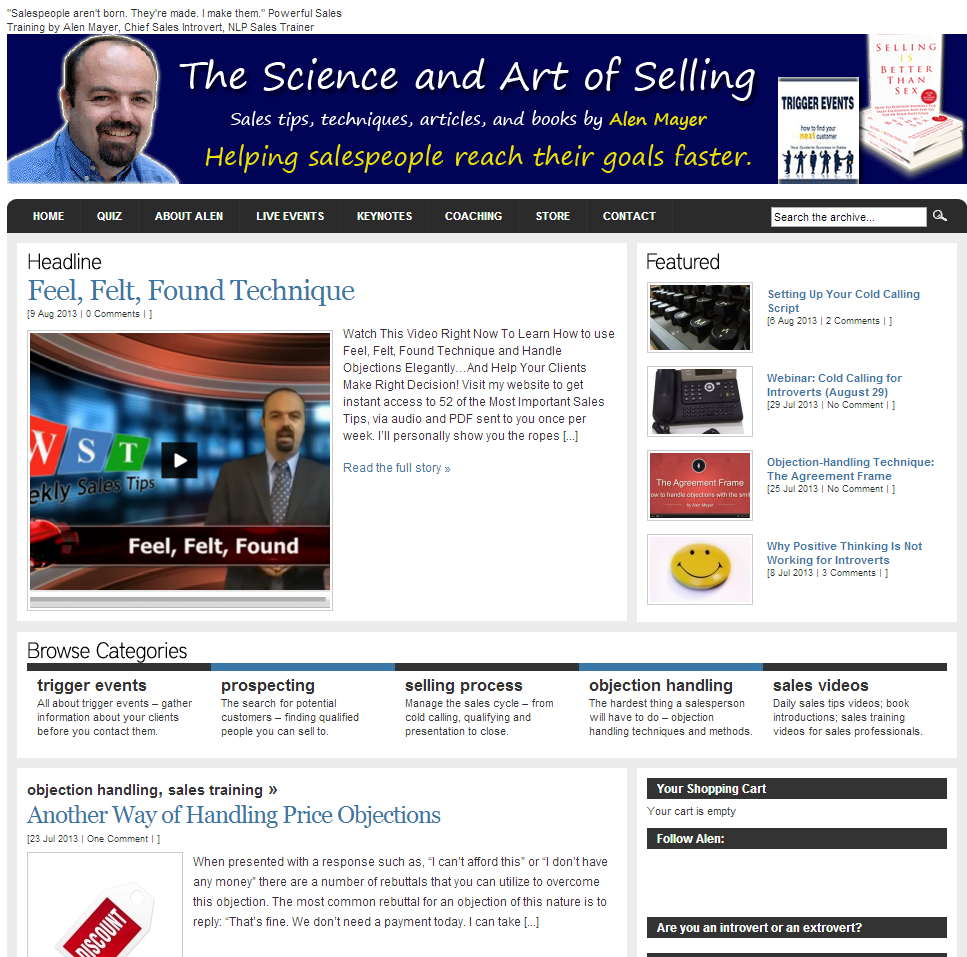
The Science and Art of Selling, by Alen Majer

tweet

Congratulate them on Twitter!

Some awesome recent posts:

Smart Calling Blog, by Art Sobczak

tweet

Congratulate them on Twitter!

Some awesome recent posts:

The Retail Doc, by Bob Phibbs

tweet

Congratulate them on Twitter!

Some awesome recent posts:

Inside Sales Experts, by The Bridge Group

tweet

Congratulate them on Twitter!

Some awesome recent posts:

The Center For Sales Strategy

tweet

Congratulate them on Twitter!

Some awesome recent posts:

The Funnelholic, by Craig Rosenberg

tweet

Congratulate them on Twitter!

Some awesome recent posts:

Point Clear, by Dan McDade

tweet

Congratulate them on Twitter!

Some awesome recent posts:

Dan Pink

tweet

Congratulate them on Twitter!

Some awesome recent posts:

OMGhub

tweet

Congratulate them on Twitter!

Some awesome recent posts:

Partners in Excellence by Dave Brock

tweet

Congratulate them on Twitter!

Some awesome recent posts:

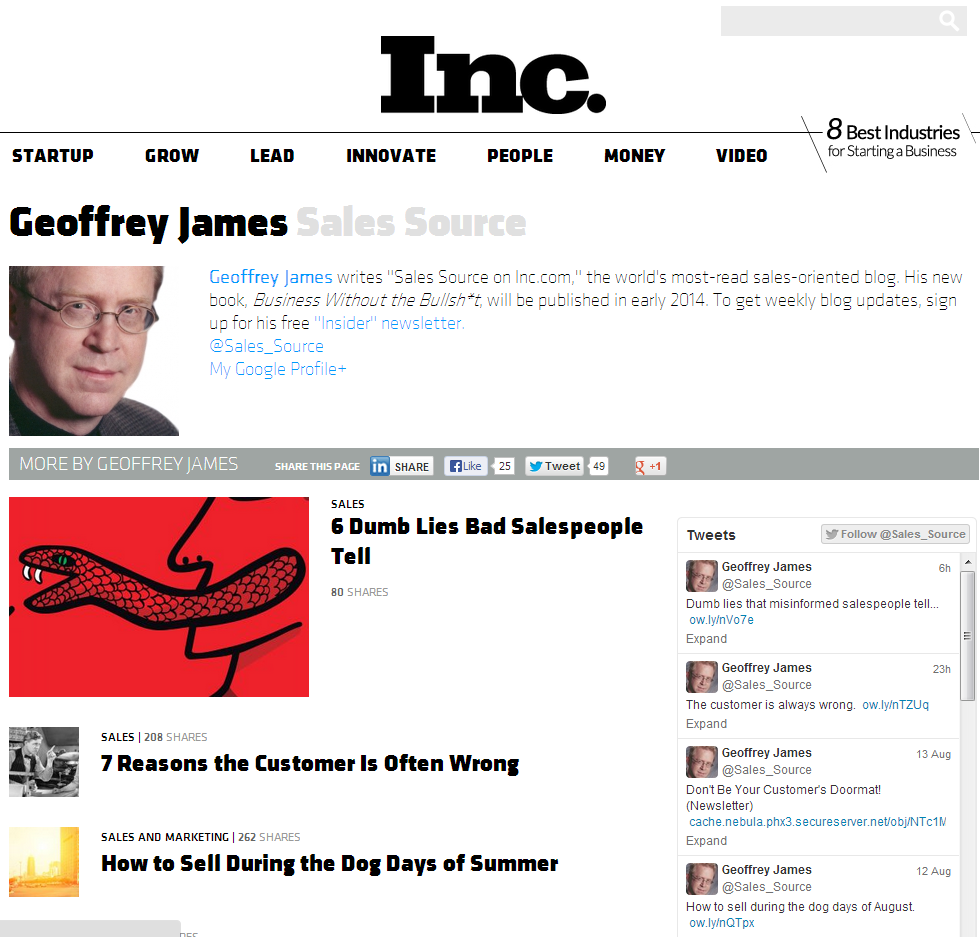
Geoffrey James

tweet

Congratulate them on Twitter!

Some awesome recent posts:

Jill Konrath

tweet

Congratulate them on Twitter!

Some awesome recent posts:

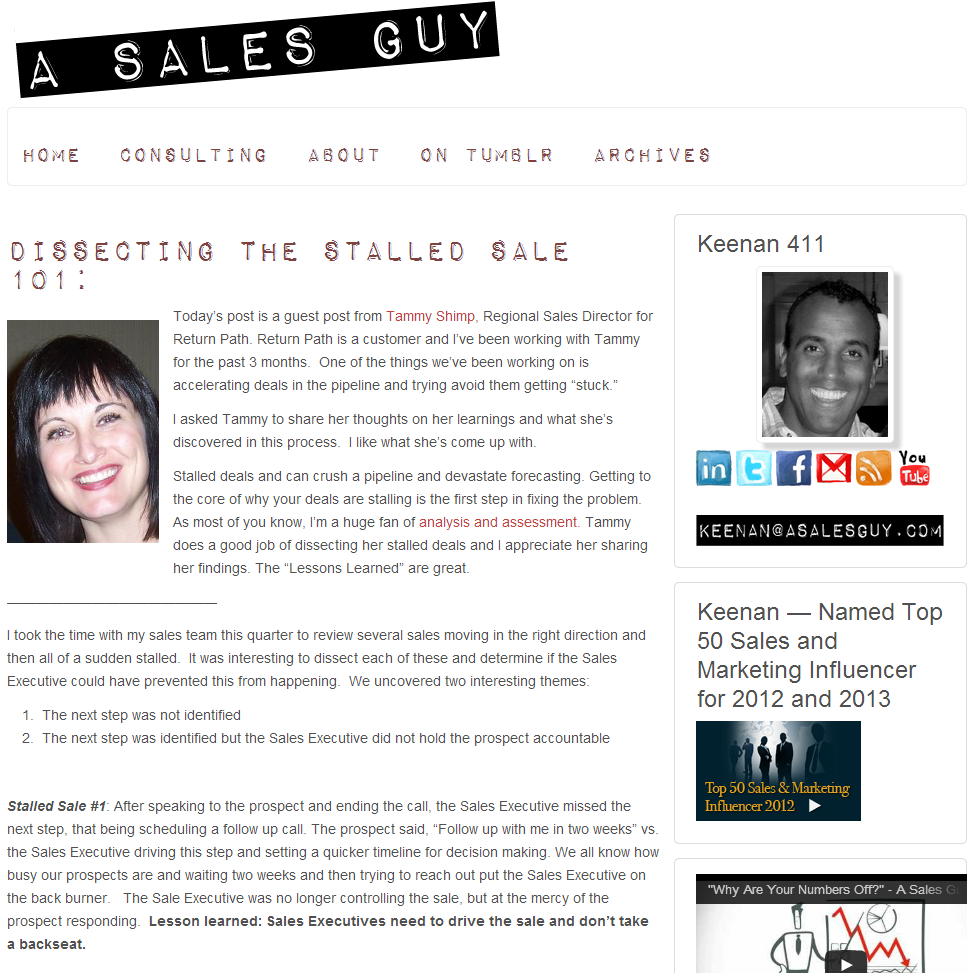
A Sales Guy, by Jim Keenan

tweet

Congratulate them on Twitter!

Some awesome recent posts:

BlogIt, by Jonathan Farrington

tweet

Congratulate them on Twitter!

Some awesome recent posts:

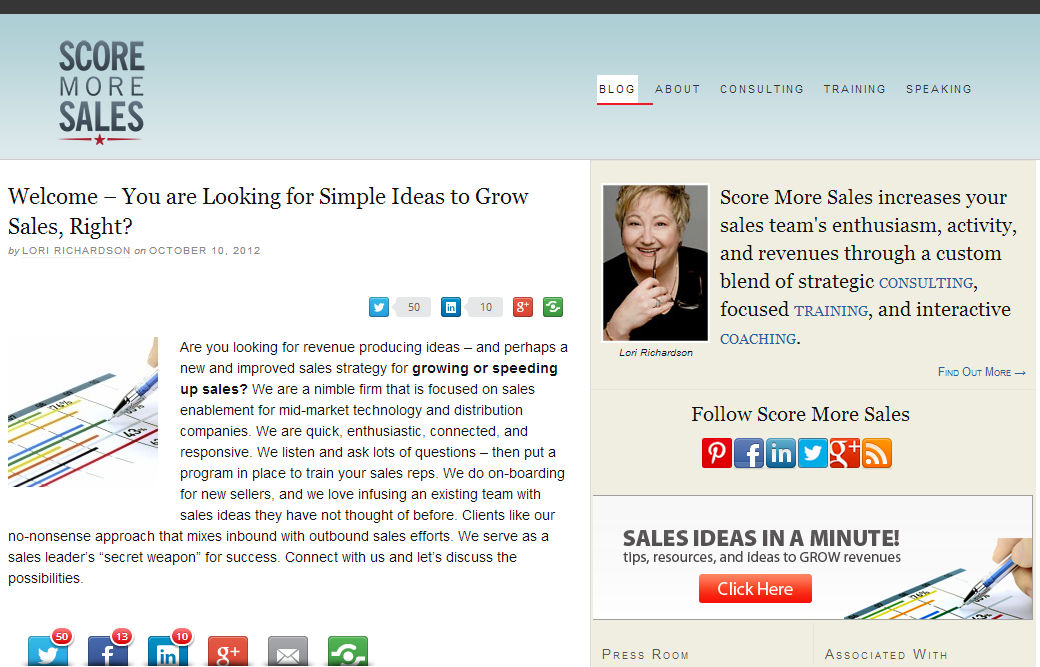
Score More Sales, by Lori Richardson

tweet

Congratulate them on Twitter!

Some awesome recent posts:

The Sales Hunter, by Mark Hunter

tweet

Congratulate them on Twitter!

Some awesome recent posts:

Fill The Funnel, by Miles Austin

tweet

Congratulate them on Twitter!

Some awesome recent posts:

Sales Pro Insider, by Nancy Bleeke

tweet

Congratulate them on Twitter!

Some awesome recent posts:

Smart Selling Tools, by Nancy Nardin

tweet

Congratulate them on Twitter!

Some awesome recent posts:

Sales Journal, by Naviga

tweet

Congratulate them on Twitter!

Some awesome recent posts:

Propulsion Blog, by Ignition Consulting Group

tweet

Congratulate them on Twitter!

Some awesome recent posts:

Neuromarketing, by Roger Dooley

tweet

Congratulate them on Twitter!

Some awesome recent posts:

The Sales Blog, by S. Anthony Iannarino

tweet

Congratulate them on Twitter!

Some awesome recent posts:

Tony Cole

tweet

Congratulate them on Twitter!

Some awesome recent posts:

There are undoubtedly many other amazing sales bloggers out there -- share them with us in the comments, please! Then, we can do a part two to this list in the future!

Image credit: jeff_golden

social media sales ebook

subscribe to the hubspot marketing blog

15 Aug 15:44

Innovation Requires Structure

by Kevin Eikenberry
structure for innovation
This is the third Wednesday in a row I’ve written about innovation. Why? Because it is important to us, personally and professionally. Today’s title might have you scratching your head, which is fine with me. Read on.  . . Ask most people what they think about when they consider creativity and innovation, and most likely […]
15 Aug 15:43

This Is An Awesome And Inspiring Quote From Jeff Bezos On What It Takes To Make Invention Happen (AMZN)

by Jay Yarow

I've never thought of Jeff Bezos as a great, inspirational speaker.

He's obviously super smart, and his investor letters are generally good reads, but I don't remember seeing any great clips of him talking about running Amazon. 

Yesterday, I saw this clip of Bezos via Twitter. I've watched it a half dozen times since. There's something inspiring and infectious to the way he speaks here. 

He starts off by by facetiously joking that Amazon was half luck, half good timing, and the rest is "brains". (In other words, no brains need.)

Then he gets more serious and says that Amazon developed a thick skin early on because it wasn't profitable and people were skeptical about its success. He continues, saying...

"Invention requires a long-term willingness to be misunderstood," says Bezos. "You do something that you genuinely believe in, that you have conviction about, but for a long period of time well-meaning people may criticize that effort, and when you receive criticism from well-meaning people it pays to say -- first of all, search yourself -- are they right? And if they are you need to adapt what you're doing. If they're not right, if you really have conviction that they're not right then you need to have that long term willingness to be misunderstood." 

The clip is from 2009, but looks like it was just posted recently.

Here's the clip:

Join the conversation about this story »


15 Aug 15:41

Four long term benefits of creating awesome content: case study

by Danny Ashton

As a supplier of infographics, I’m regularly asked by potential clients how a certain piece of content is worth thousands of pounds. 

Great content allows you to use a small amount of outreach time to get a relatively large number of placements, links and exposure. But it is also a great long term asset (over the year), as it has the ability to provide long term audience support for your site.

I want to use the example of a client’s infographic which we ended up hosting on our site, so I can show with examples, how much of a long term benefit great content has.

1. Links (obviously)

Example: http://neomam.com/infographics/50-insane-facts-about-australia-infographic/

domains

The infographic went live around October and we can see the initial push of links at this time. However, as the months progressed, more domains linked to the content as more eyes viewed the content.

At this point, it’s worth mentioning that the infographic goal was not links. It was produced primarily for traffic driving, building brand awareness and driving traffic back to the Facebook competition page.

This is one of the reasons the client was happy to host it on our site.

2. Traffic

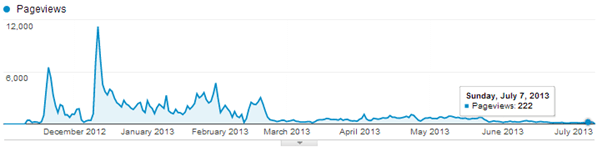
page views

You can see the initial outreach period kicking in mid-November, but since then the infographic has attracted a large amount of traffic throughout the year. In total it has had just over 200,000 unique visitors since it went live.

Each spike in traffic leads to more eye balls viewing the content and improving the chances of getting even more links.

Even 10 months since the infographic went live it was still receiving 200+ visitors.

3. Social

social

Source

One of the simplest things that anyone starting off in content marketing needs to do, is provide simple and easy to use share buttons for the top social media sites.

We use AA’s Digg Digg Alternative as its runs fast and is relatively simple. But if you want something really awesome then it’s probably worth getting a developer to create something custom.

The infographic went 'viral' on Stumbleupon and we were then able to recycle this traffic to provide a push through to Facebook, as Stumbleupon users clicked 'like' and 'share'.

4. Ranking

ranking

When you build links to relevant pages you also benefit from the long term Google ranking. Now, this might not be your money keywords but if you pick the right content idea then this could be a great long term provider of relevant traffic.

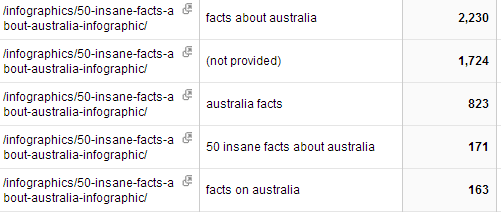
Our Australia infographic now ranks in position five on Google.com for “Facts about Australia” which has driven 2,230 visitors over the last few months.

rank

Source

I want this case study to hopefully show you that great content is not just about the links you get in the first month, but is an asset that can support your website in the long term.

15 Aug 15:41

60+ amazing email marketing best practice tips, stats, blog posts and more

by Ben Davis

We've already produced some handy round-up posts on ecommerce, content marketing and social media: now here's the email flavour.

Here you'll find lots of best practice tips, email campaign reviews, reports and more, taken from the last 12 months of Econsultancy output. Do favourite it, won't you? And if there are any other resources or tools you like, feel free to add them to the comments below.

Happy bookmarking!

Best practice tips

Below you'll find tips from practitioners, from Econsultancy analysts looking at case studies, and from technology suppliers in this sector. I've tried to split them up nicely, but they are all fairly meaty posts, ranging from creative to deliverability

General

Email best practice: Evans Cycles shows value of collecting customer data in-store

Aftersales email best practice from ASOS

Six best practice tips for email unsubscribe pages

Five tips for building stronger B2B email relationships

Five ways to reinforce your ecommerce activities with email marketing

10 things I love about your emails (and related arts)

10 things you can do to make me love your emails

Email marketing: getting it right and read

Five reasons you should stop using no-reply email addresses right now

Three secrets of experienced email marketers

Deliverability

15 best practice tips for improving email deliverability

Six email deliverability lessons that you can learn from SEO

Five tips for reducing email spam complaints

How to get your emails into the Hotmail inbox. Step one: welcome new subscribers

Opt-ins

Email reputation: what is the expiration date of your opt-ins? 

How to raise your email opt-in rate: three CRO case studies on overlays

10 useful tips and examples to boost your email signups

Design

Seven tools to optimize your email marketing for mobile

Best practices for mobile email design

Seven top tips for designing welcome emails

Subject lines

152 killer keywords for email subject lines (and 137 crappy ones)

Six case studies and an infographic on how to write effective email subject lines

Personalisation/Segmentation/Automation

Personalized jewelry, personalized email: How Limoges raised revenue per email by 300%

Send more email, make more money?

20 automated emails your customers won't delete

How RS Components uses automated email FTW

Abandoned basket emails: creative vs. best practice?

Five uncommon ways for ecommerce retailers to segment their email list

Five email tips to consider across different stages of a customer lifecycle

Reviews

There's a good cross section of UK and US retailers here, with particular focus on the welcome email.

Unsubscribing from email: how top fashion retailers try to persuade you to stay

Email sign up forms: a look at how 16 fashion retailers collect customer data

How welcome emails vary among 16 fashion retailers, and who didn't send one

How do 15 top US fashion retailers handle email sign ups?

EasyJet email marketing flying high as Ryanair crash lands

How Reiss used email to lure me into browsing its summer sale

Abandoned basket emails: the good, the bad and the ugly

Statistics

Plenty of Econsultancy's own research and external studies have unearthed some salient points about the changing market. Email still occupies an integral position in customer engagement, and here you can see just how many of your customers are accessing email in different ways, and how many competitors are exercising best practice.

22% of marketing emails fail to reach the subscriber's inbox: report

More than half of businesses achieve 10% of sales through email marketing

Six case studies and infographics on the optimal time to send emails

Poor quality data is the biggest barrier to effective email marketing: report 

Education companies achieve highest average CTR in email marketing: report

73% of businesses carry out basic email segmentation: report

Marketers still need to work on mobile email: stats

41% of email is now opened on mobile devices

68% of people use their smartphone for email, 26% for shopping

34% of businesses can't calculate email marketing ROI: report

Smartphone owners more likely to read emails than make calls: stats

Opinion

Some of the finest minds flex their brain biceps here, and ask a few broader questions about email, and its evolution.

Where are your emails opened and why does it matter?

Are you doing the dad dance with your social and mobile emails?

Permission email marketing, it’s what we do isn’t it?

The future of email marketing and three ways it must evolve

Email: the forgotten social network

Why more marketers need to think about responsive email design

Does your company overestimate the value of an email address?

Infographics

Just a couple here; throwing the graphic fans a small bone.

61% of marketers rate their email campaigns as poor or average: infographic

Email is most important channel for driving Christmas sales: infographic

Interviews

Q&A: XYDO CEO Eric Roach on email automation 

Q&A: Nick Carter of ValuePetSupplies.com on infinite email ROI

Reports

Here's the real meat and potatoes. From our Best Practice Guide to our Platform Buyer's Guide, if you need to know where to start (and what to do in the middle), take a look at these.

Email Marketing Best Practice Guide

Email marketing: A Beginner's Guide

Email and Ecrm Statistics

Email Marketing Industry Census 2013 

Building, Monitoring and Improving Your Email Marketing Campaigns

Email Marketing Platforms Buyer's Guide 2012

Small Business Online Resource Manager - Digital Marketing Template Files

Content Marketing in South-East Asia Best Practice Guide

15 Aug 15:41

11 useful tips for designing welcome emails

by David Moth

When a customer signs up to an email newsletter they probably expect to receive a message from the brand welcoming them to the mailing list.

So it’s no surprise that welcome emails can achieve open rates of above 50%, as subscribers are less likely to see them as spam.

Therefore brands need to take steps to ensure they’re making the most of this opportunity by optimising the subject line and content to maximise opens and conversions.

There are a number of different goals that marketers can set out to achieve with their welcome email, whether it be simply thanking the user, attempting to collect more personal information, or nudging them towards a purchase.

This post will look at different ways brands can optimise their welcome emails for maximum impact.

It follows on from posts looking at how 16 different fashion retailers deal with the sign up process and which ones actually sent welcome emails...

1. Make your greeting specific to the customer

There are a variety of ways to collect customer email addresses, including events, a signup box on the homepage, or during the online checkout process.

By using this information to tailor the email greeting you can make the welcome email more personal to the consumer.

So for example, if you collected the email address at an event, reference the event. Or if it’s to follow up on a purchase, then make sure to mention the transaction and say you hope they like the product.

Similarly, if you’ve collected the subscribers name as part of the sign up process then why not use it in the email?

Of the 11 retailers that sent me welcome emails only Reiss, New Look and Hugo Boss included my name in the greeting, however they pretty much all referenced the fact that I’d signed up to receive their email newsletter.

2. Send welcome emails immediately

In my recent test a majority of the retailers sent out welcome emails immediately, but ASOS, Schuh, Miss Selfridge, Boohoo and Office all failed to get in touch within the first 24 hours.

After a customer has made the effort to sign up for an email newsletter it’s a good idea to send a welcome email as soon as possible to acknowledge their interest.

In fact there must have been an error in signing up with ASOS, Schuh, Miss Selfridge and Boohoo, as I still haven’t had any emails from those brands.

This is extremely sloppy on their behalf and reflects quite poorly on their brand, but worse still it means that they’ve missed the opportunity to sell me products in future.

3. Use an alluring subject line

A boring email subject line can have a disastrous impact on your open rates, so you need to make it grab the user’s attention and compel them to find out more. 

To give you some inspiration, I recently blogged six case studies that reveal different insights on how to write the perfect subject line.

The retailers I looked at generally opted for the standard “Welcome to (brand name),” however some put in a bit more effort.

For example, Topshop assured me that I’m “in for some serious style” while Threadless called me “pal” and “special BFF.” This is slightly quirkier and in line with the brand image, so it makes a good change from the standard subject line.

The least attractive example is probably River Island’s rather bland “River Island – Email Sign up...”

4. Mind your manners

As well as personalising the email to the user brands should take the opportunity to say welcome and thank you to the user for signing up to email alerts.

I’m pleased to report that all the retailers said thanks or welcome, either in the subject line or the copy of the email itself.

5. Set expectations

In order to avoid coming across as a spammer, brands need to set out exactly what subscribers can expect to receive and how often.

Nearly all of the retailers just use a fairly generic spiel that tells the recipient they’ll now be kept up-to-date with the latest fashion news and exclusive offers, without any specific mention of the email frequency.

In fact only Mr Porter laid out the exact terms of service...

6. Ask the recipient to whitelist your address

All of the retailers I signed up to managed to swerve my Hotmail spam folder, however Topshop and Reiss were both flagged as up as having failed to pass Microsoft’s fraud detection checks.

To ensure that marketing emails continue to arrive in the inbox rather than the junk folder brands should ask recipients to add them to their contact list or address book.

While most of the retailers do make this request, in general it’s tucked away in a header or footer and is nearly impossible to notice.

Only Reiss and House of Fraser ask users to whitelist their emails within the body of the email, but neither explains how to actually complete this process.

A separate marketing email I received from ASOS explained three different methods of whitelisting the company's new email address. Which is helpful, as I have no idea how to work my Gmail account...

7. Collect additional information

The sign up procedures varied substantially between each retailer, with some asking to know your life story while others are content with your email address.

This means that when it comes to the welcome email it can be necessary to probe the recipient for additional personal information in order to personalise future messages.

For example, Selfridges asked me to personalise my email preferences “so we can keep you in the know about the things you love.” It then includes an excellent, bold call-to-action.

8. Consider offering a voucher

Occasionally brands will offer incentives to subscribe to an email newsletter, however that’s more of a sign up tactic rather than a feature of welcome emails.

Even so, it’s worth looking at H&M’s incentive which offers consumers 25% off one item online.

The email doesn’t draw much attention to the offer, uses a very discreet “Happy shopping” CTA and only gives you one week to redeem the code.

This is either a badly designed email or H&M is deliberately trying to encourage people to forget about the code.

9. Don’t overdo the content

Welcome emails achieve a far higher open rate than standard marketing messages, so the obvious temptation is to include a number of different promotions and calls-to-action to maximise the chances of achieving some sort of conversion.

However it’s likely that if you include too much content then readers will simply ignore it.

Most of the retailers I signed up to had opted for a very simple design, with a concise message welcoming me to the mailing list and giving a brief description of what I could expect to receive going forward.

I felt that only Topshop had gone slightly overboard, with four separate sections trying to encourage me to shop different sections of the site.

Threadless also had four different CTAs in its email, but the information was presented in a far more concise manner so it wasn’t a long, daunting email.

10. Test your emails

As with most aspects of ecommerce, it’s important to test your welcome emails and keep them updated so that you’re maximising the opportunity.

Running A/B tests will help refine the subject line and identify the most effective CTA, while content should also be reviewed and updated to ensure it fits within brand guidelines.

Also, monitor key metrics such as the open rates, CTRs and conversion rates on a monthly basis to make you are achieving your goals.

11. Go mobile

As I mentioned in my previous article, only Next’s welcome email was readable on my smartphone, and that was because it used a plain text layout.

This is despite the fact that stats show that up to 41% of email is now opened on a mobile device and that figure is growing.


However we know that businesses have been quite slow to react, as 32% of respondents in the Econsultancy/Adestra Email Marketing Census 2013 said their strategy for optimising email for mobile is ‘non-existent.’ A further 39% described their strategy as ‘basic’.

Even so, one would expect that these retailers would have made more of an effort to cater for mobile shoppers.

15 Aug 15:25

6 Ways to Communicate Impact in Sales

impact

You’ve worked on building rapport with your prospect and you’ve uncovered their aspirations and afflictions. The question then becomes, "So what?"

If your afflictions don’t get solved, so what? What won’t happen? Will they get worse? How will they affect the bottom line of your company, division, or department? How will they affect your life?

If your aspirations don’t become reality, so what? Will your competition get ahead of you if you don’t innovate? Will you lose market share if you aren’t aggressive in your strategy? Will you never be able to grow your business to a point where you can sell it and reach your personal financial goals? Will the promotion you desire continue to elude you?

Your ability to quantify the impact and paint the ‘‘so what’’ picture is the foundation for how important it is for the decision maker to buy from you. If you don’t answer the “so what” question, the initiative will fall to the bottom of the priority list...

15 Aug 15:25

3 Tips For Ethically Controlling The Sales Process

by Michael Trow

3 Tips For Ethically Controlling The Sales Process image everyone has a choice

Life presents us with the opportunities to make choices.

Some are ‘world saving’. (Like having the choice of taking a blue or red pill a la The Matrix.)

Most are fairly innocuous.

Or are seemingly innocuous.

Some have more of an impact than we could have imagined on us and our surroundings. Something that falls in this category is the choice you have for how you/your business controls the sales process.

Three Perceptions of Sales

Last week I was conducting a sales training session with a team of tech engineers. This scenario is always interesting to me as I like to understand their perception of sales based on their experience(s). Three of the team offered:

  • Service
  • Exchange of goods/service for money
  • Sleazy

I was hoping at least these three descriptions would have been offered and in particular the last one.

The Manipulative Salesperson

Generally, in my training, I include a section about the make-up of a sales professional. Why? because most of the time buyers anticipate the sales person has their own agenda and isn’t interested in what they (the buyer) really want/need.

My ‘favorite’ sales rep calls me every couple of months and has done for at least a year. He is special. (If special means that he is the perfect example of what not to do!)

Here’s the scenario; I bought something from this company 18 months ago and they exert their right to call on me periodically to introduce offers and new products/services.

Just to let you know, if I had recorded those oh so special calls we have had together I would have enough material for a days training program.

We don’t have the time for that now. Unfortunately.

However, the last call we had together (cue music a la Je T’aime Moi Non Plus) that was particularly relevant.

After the usual 5 minutes of being spoken to (I’m being polite here) I was asked if I would be interested in taking a free trial for the product he was pushing. Long story short, I said yes.

The next thing he said was ‘Excellent, what card would you like to pay with? Visa…Mastercard…?’

How do you think that made me feel?

Tips For Controlling The Sales Process

When the engineer in the sales training I was conducting responded with ‘Sleazy’ as his perception of sales, I couldn’t fault him. The manipulative approach taken by a number of representatives today is on the decline, but it IS still prevalent.

The fact of the matter is that in a sales conversation, or series of, the seller needs to retain control of the sales process.

Why? To help guide the prospective buyer through the sales process in a collaborative manner.

If you are not in control of the sales process it is likely to derail and is less likely to end in a positive outcome.

Control DOES NOT = manipulation.

Control DOES = adding value and helping.

Here are three tips for controlling the sales process:

  1. Outline what you would like to happen, when you want it happen and why. (The phrase “At this stage…” is a great asset to you.)
  2. Share related value (Every touch point counts. However, it is not ideal to have every touch point being related to the sale. If the sales process stalls or has a long period of time in between stages share a whitepaper or something that can help you keep front of mind.)
  3. Ask what you can do to help. (There is nothing wrong in outlining your ideal outcome. Ask what you can do to help that possibility become a reality. For example, is there anyone you can talk to on their behalf?)

Sales IS a tactical game.

People ARE people. They like to pose objections and they have their own agenda.

Always be helping the buyer evaluate their options on the investable opportunity that you are presenting.

Comments?

What are your experiences with controlling the sales process?

15 Aug 15:25

Writing a Killer Sales Playbook

by Laura Patterson

Writing a Killer Sales Playbook image boxing glove

The Sales Playbook, Defined

A sales playbook is a collection of tactics or methods that characterizes the roles and responsibilities for you (and your sales team), lays out clear objectives, identifies metrics for measurement, and provides a common framework and approach for closing sales.

The playbook helps you implement a common sales methodology that leverages the processes used by high performers. The outcome? You can sell more effectively and handle different selling situations, position against a particular competitor, or communicate the value proposition to each person in the buying process.

The 30,000 Foot View…

In the big picture, a good playbook needs to do several things:

  • Define your sales process and methodology — not only what you need to do but how to make it happen

  • Identify how your process maps to your customer’s buying process

  • Tell you how to engage with a prospective customer

  • Diagram the engagement experience

  • Accelerate sales effectiveness and accuracy.

The Components of the Sales Playbook, Explained

In the sports world, a “play” is an action designed to achieve a specific purpose in specific conditions. When you design a playbook you need to define the conditions. Therefore, at a minimum, the following knowledge needs to be integrated into the playbook:

1. Customer analysis – Identifies the market, key trends, key buyers and influencers, a profile of the ideal customer, the customers’ pain points and preferences and the critical business issues customers are trying to solve.

2. Buying process - Identifies conditions or events that trigger consideration, evaluation, and purchase. What are the behaviors of a qualified lead?

3. Company offer and value proposition – Describes and clarifies what your company offers and the ways in which your products and services address the customer’s pain points and business issues.

This is the place to explain why your company exists and how your company makes a difference to the customer and in the market. This section of the playbook is not complete until it clearly answers two questions. First, “Why should people buy this product from you?” Second, “What is the value they receive buying this product from you?” Part of this section should be dedicated to giving examples of questions that draw out the customer’s business needs and pain points. This section is also a good place to include use case scenarios.

For great information about how to write value propositions, check out Jill Konrath’s blog.

4. Competitive analysis – Details how competitors position themselves in the market, their selling process, typical moves by each competitor, and recommendations on how to counter these moves.

For more about competitive analysis: Think Like the Competition

5. Sales methodology - Maps the customer buying process, and outlines your sales process, that is, the standard set of critical steps that moves the customer to buy.

While this section should outline the sales cycle stages and responsibilities, it should go beyond just describing the steps in the sales cycle. It should provide instructions on what information needs to be collected at each stage in the process, identify the players in each step, and how to assess the opportunity.

The opportunity assessment information should recommend standard methods and tools that help determine where customers are in the buying process, enable them to analyze the situation, and anticipate what they might do next. This section of the playbook should also provide the guidelines for entering and exiting opportunities and a list of the resources, skills, knowledge, and tools needed for each stage in the process.

6. Countering objections – Gives specific instruction on how to address each common objection sales might encounter. Tom Reilly takes a look at this topic in his book, Value-Added Selling : How to Sell More Profitably, Confidently, and Professionally by Competing on Value, Not Price.

7. Best practices - Lists proven tips, techniques — and under what circumstances to use them. This section should also capture what hasn’t worked in the past and associated lessons learned.

8. Your Buyer Personae — A section (perhaps an appendix) that answers the question, “Who is my ideal prospect?”

For more on creating personae, we have created a slideshare.

A Worthwhile Investment

While developing a sales playbook is an extensive investment of your time, it has a big payoff in that it surfaces customer pains and preferences, improves sales effectiveness and productivity, and exposes and corrects weaknesses in the way you currently operate.

When completed, your playbook becomes a living document of your sales methodology and provides tactical guidelines and instructions that enable you to discover important ways to address the vulnerabilities of both your company and competitors. With a practical sales playbook, you can leverage strengths, differentiate offers, prove business value, and ultimately improve your win/loss ratio.

For more specific guidance and help in crafting your playbook, check out Using the Customer Buying Process to Align Sales and Marketing & Create 3 Key Enablement Tools

15 Aug 15:24

Guest Post: I’m Done With Sales Teams

by Jonathan Farrington

 shutterstock_78951343

I expect to take some heat for this post. Perhaps I’m way off base with my opinion. Maybe I’m not, after all. I hope you’ll let me know your thoughts in the comment section.

Background

During my formative years I played the trumpet. I practiced hours a day—so much so that I missed most of the “normal” interest and experiences boys had with sports. Sure, I could hit a ball and throw a football, but the whole sports team experience was absent from my life.

I know much of that developmental need was fulfilled through all the many musical groups I’ve played with, from jazz combos to orchestras, from concert bands to big bands. Talk about teamwork!

Fast forward to now. I’ll watch a baseball, basketball, or football game. Occasionally some tennis and some golf. Maybe one each of those sports per year. Certainly the Olympics. I appreciate the athletes, the strategy, the competition. I really do. And I understand people’s passion for their favorite sports, favorite teams, and favorite athletes. I feel that way about music and musicians.

My Assertion

If you’ve read my blog or heard me speak, you know that I believe that sales is in the unfortunate state that it is because it is not treated like the business that it should be.  When I say unfortunate state, I mean conditions that have been validated year-after-year by well-known and well-respected researchers: around 50% of salespeople hit their targets, 25% attrition rate among sales people per year, 19-month tenure for sales VPs, etc., etc. We’ve got a big problem in the world of professional selling.

One significant contributing factor is the deliberate and conscious effort by many companies and sales leaders to equate their “sales teams” to sports teams and to treat them that way. Sales teams are not sports teams. Sales is not a sport. It’s a business.

I’ve delivered enough keynote speeches at kickoff meetings to have met a lot of sports figures. I’ve worked with enough sales managers and VPs of sales to have heard every story there is about Vince Lombardi, and a host of other great sports heroes. Motivational? Sure. Entertaining? Sure. Productive with respect to delivering the numbers? I haven’t ever seen the connection.

The Solution

Selling is not a sport. It’s a business. It needs to be run like the business that it is.

Are there important things we can learn about teamwork, strategy, and execution from sports? Sure. But wouldn’t it be better to learn by examining successful sales experiences, sales case studies, and research about selling, or effective teamwork, strategy, and execution from other functions and departments within our own companies?

There is more than a bit of irony here. Sports teams today are money making machines. Big bucks. Big, big bucks. Big business. Even at the college level.

Sports teams are run like the businesses they are. Why should sales departments be run like the sports teams that they are not?

I think the sooner more of us start saying “sales organization” rather than “sales team” and begin thinking in those terms, the better off everyone will be.

I’m going to do that, starting right now.


Stein_D


Dave Stein is the founder and CEO of ES Research, an organization that provides on-line, membership-based analyses of, and recommendations about, the sales training and sales performance and consulting marketplace and the companies that serve it. Visit www.esresearch.com/


Stop Press:  Looking forward to seeing you all today on the final Top Sales Academy module – “The Characteristics of Top Inside Sales Pros – and All Other Pros” – we are now over-subscribed, but if you wish to receive a recording of the session, please register HERE – JF

15 Aug 15:24

B2B lead generation: Why Sales and Marketing alignment produces better leads

by Hugh Macfarlane
The sales department wants the marketing department to provide more leads. But they want them to be “better qualified”. The real question is, “qualified according to whom?”

read more

15 Aug 15:24

How Many of Your Reps Don’t Belong in Sales?

by peaksales

One in every four people in the general population has better potential for sales work than 50% of the people already in the sales profession. And in reviewing the performance of employees for thousands of large mid-sized and small companies, we found that nearly 80 percent of the workers are not filling the jobs best suited to their talents, abilities and potential” – Herbert Greenberg and Harold Weinstein, Principals of Caliper, quoted in the Wall Street Journal

When sales organizations engage Peak to add reps to their sales team, one of the first things we do is an audit of the existing team to determine the traits of the best performers. This analysis provides valuable insight into the type of people that are strong sales people for our customers and contributes to the plan for finding new high achieving sales reps.

During the course of these audits, we look at behavioral and psychometric traits of the existing sales team members as well as the backgrounds and skills. What we learn tells us a lot about why the top achievers on the team are successful, but it also leads to some interesting data on the reps that are less successful. Often times there are reps that are under performing on a consistent basis and not only do they not seem to belong on the team, but don’t seem to have the profile to be successful in sales at all, which begs the question, how did they arrive on the team in the first place?


See 3 Reasons To Start Selecting Sales Hires Randomly


There are a variety of reasons why misfits might exist on a sales team. Here are the reasons we see most often:

1. Old Habits are hard to break – someone has been on the team for a while and although they are not really driving great numbers, they are not at the top of your list of priorities either, so they are effectively ignored.

2. Hard to find better reps – a sales rep may be failing, but the company doesn’t feel confident they can attract better talent or has a poor track record of picking winners so simply sticks with what they have.

3. People change – Some reps perform in spurts. There may be an external pressure or factor that caused them to perform beyond their capability for a time before they revert to their baseline. The ever optimistic sales manager retains the rep hoping they will produce at the higher rate of sales production.

Have you taken a close look at your sales team to see who belongs and who doesn’t? How many people on your team not only doesn’t belong on your team, but probably should be out of the sales profession altogether? Chances are there are one or more that need a career change and your sales results will benefit if you help them make that change.

To your success.

15 Aug 15:23

B2B Sales: Forecasting Must be a Blend of Fact and Judgement

by Bob Apollo

Virtually every company I speak to wishes they could do a more accurate job of forecasting sales revenues. The issue is often particularly challenging for B2B-focused companies with lengthy, complex sales process.

B2B Sales: Forecasting Must be a Blend of Fact and Judgement image forecasting 225There’s no doubt that there is significant room for improvement. CSO Insights research suggests that less than 50% of forecasted deals close at the projected time and for the projected amount.

Given the variables involved, it’s hard to imagine that vendors with highly-complex, lengthy sales processes could regularly achieve 100% sales forecast accuracy – but many sales organisations are consistently doing far better than the CSO Insights figures would suggest.

How are they achieving this? There are a handful of common principles that serve to support a robust and accurate forecasting process:

  • Consistent application of pipeline stage definitions and milestones
  • Basing forecasting on a combination of fact and judgement
  • Forecasting at both the opportunity and territory level
  • Measuring sales people on sales forecast accuracy

Consistent pipeline stage definitions and milestones

You’ve got to start by publishing consistent pipeline stage definitions and milestones – and insisting that sales people conform to them. If this essential foundation isn’t properly laid, you have absolutely no chance of achieving acceptable sales forecast accuracy.

Your chosen pipeline stages must be carefully chosen, clearly defined, simple to understand and they must reflect key steps in your prospect’s buying decision process and not just your sales people’s activity – and they must be embedded into your CRM system.

In particular, the milestones that separate one stage from the next must reflect observable evidence of progress in the prospect’s decision-making process – for example, agreeing an evaluation plan. Each milestone must be an issue of provable fact, and this evidence must be captured in the relevant opportunity record.

Base forecasting on a combination of fact and judgement

Placing individual opportunities at the appropriate stage of the prospect’s buying decision process provides the factual foundation for the forecast. This is why it’s so critical that you insist that your sales people keep the CRM system up to date.

In fact, I strongly recommend that you reject any forecast that does not accurately reflect the current status of the opportunity as recorded in your CRM system. Once the facts have been clearly established and proven, it’s time for judgement to be applied, and it’s equally dependent on a clear and consistently implemented understanding of definitions.

Forecast at both the opportunity and territory level

The likelihood of any individual opportunity closing in the current forecast period is an issue of judgement. I’ve found the following categories to be useful and effective:

  • CERTAIN: It is expected that almost all of the opportunities in the “certain” category will close in the current forecast period, the exceptions being associated with some completely unpredictable change in circumstances. Over time, at least 90% of such opportunities should end up closing at the predicted value in the predicted period
  • PROBABLE: It is expected that most of the opportunities in the “probable” category will close in the current forecast period. Over time, at least 75% of such opportunities should end up closing at the predicted value in the predicted period
  • POSSIBLE: It is expected that some of the opportunities in the “possible” category will close in the current forecast period. Over time, at least 25% of such opportunities should end up closing at the predicted value in the predicted period

These judgements must be backed by what I’ve referred to as a “common sense interlock”. Unless opportunities have provably reached the appropriate advanced stage in the pipeline, they cannot be flagged as “CERTAIN”. Similar principles must apply to the PROBABLE and POSSIBLE categories. The idea here is to eliminate wishful thinking that is unsupported by either the facts or the past outcomes of similar opportunities.

In addition to accurately assigning probabilities at the individual opportunity level, sales people should also be expected to come up with accurate territory-level forecasts for the current forecast period. These aggregated forecasts must take into account all the individual opportunity-level forecast categories, but additionally require that the sales person apply an additional level of personal judgement and commitment.

I’ve found the following territory-level forecast definitions to be useful and effective:

  • The COMMIT number is the minimum revenue value the sales person commits to deliver from their territory in the given forecast period. Sales people should be expected to rarely if ever deliver below their commit number
  • The FORECAST number is the number the sales person actually expects to achieve. This number should be achieved at least 75% of the time, and over time the long -term achievement is expected to be at least 100%

Measure sales people on sales forecast accuracy

Last, but by no means least, sales people must be measured on their sales forecast accuracy – and a growing number of sales organisations have seen benefit from tying some element of the sales person’s compensation to their forecast accuracy.

They key thing when comparing forecast to actual is to ensure that you investigate the underlying causes of deviation, extract the lessons learned, and take targeted action to eliminate the sources of variation.

Sometimes, this will be connected to individual sales behaviour that is consistently either optimistic or conservative. But you’ll often find that the root cause lies in the sales process itself, and that a targeted programme or initiative can help to systematically improve performance.

In conclusion

How do these recommendations relate to your own experiences? Have you got other proven strategies you could share?

14 Aug 17:50

Want to Supersize Your LinkedIn Page? Focus on the 3 C's

PR expert Rebekah Epstein gives us the skinny on how to attract more people to your company's LinkedIn page.
14 Aug 17:44

What Your LinkedIn Photo Says About You

by Rene Shimada Siegel

People do business with people they trust. So what are you trying to hide in that photo?

Ever meet someone in person and think, “Whoa. You look nothing like I thought!”

Prospects, customers and colleagues enjoy doing business with people they can relate to and feel like they know. A smiling realtor’s face on business cards and fliers is one way they try to build trust and likeability -- and pave the way for Very Large Purchases, like a house.

I see hundreds of LinkedIn profiles every week and 50 percent fail when it comes to their photo. As a business owner or executive, it’s crucial that people trust you and connect with you. You are the brand. Opinions are formed in a nanosecond. And that means the photo at the very top may be the most important part of your LinkedIn profile.

What does that tiny little thumbnail say about you?

What Are You Hiding?

Don’t have a photo because you’re freaked about privacy? Or extremely shy? People look at photos and ask themselves, “Is this person qualified?” or “Is this someone I want to work with?” If you don’t have a photo as part of your social profile, people will assume the worst. That’s exactly what you don’t need. And if you’re concerned about privacy, you should be more concerned about your personal brand in the age of social media.

Awkward!

Do you look unhappy, bored or just plain fuzzy? Your photo should convey genuine warmth and positive energy. You can still come across as a serious businessperson without forcing a stoic face or vacant stare. It’s not a mug shot.

How Old Are You?

No cartoons or avatars unless you’re a teen or work in the comic book business. Authenticity is key and you’re not going to build trust and transparency with people who don’t recognize you in person. Save “cute” for Facebook or Twitter. And not that I have any first-hand experience at this, but I’ve heard people on dating sites will post pictures of themselves taken long ago. This leads to awkwardness and mistrust when a face-to-face meeting happens. Sell, but don’t lie.

This Isn’t Facebook

Opting for a pic of your dog, kids, boat, or favorite alcoholic beverage? Or prefer a casual look with sunglasses or baseball cap? No. Just no. Your profile is a modern day resume and portfolio so focus on a career-worthy photo, not a look-how-much-fun-I’m-having Facebook-style shot. There’s time enough for someone to get to know about your personal life, foibles and flaws later.

You’re Trying Too Hard

Holy baloney! I’ve seen people go all out with crazy studio lighting or Glamour Shots makeup and hair. It’s just a headshot, not the cover of Sports Illustrated. Trust me, looking natural yet polished is far better. Wear a nice shirt or blouse in a solid color, try 20 headshots with and without flash on your digital or cell phone camera, and let a respected colleague choose the best one.

Make a strong first impression with a profile photo that represents the Big Picture of your career. Choosing the right photo enhances your brand, and provides a face and voice for the words on the page.


14 Aug 17:44

6 Dumb Lies Bad Salespeople Tell

by Geoffrey James

Never try to begin a business relationship by telling a lie-- especially these hoary but common examples.

Over the past few months, I've been noting down the lies that salespeople tell in their sales email. These lies really stick in my craw because it's insane to try to begin a business relationship with a lie. Here are the most egregious examples:

1. "I hope you are well."

This lie usually appears as the first line of the sales email. Look, if you don't know me personally, it's absurd to claim that you care two cents whether I'm skipping in the breeze or at death's door.

2. "This is not a sales pitch."

This is like a politician at a podium starting a speech with: "I'm not going to give a speech." Of course it's a sales pitch, and it's absurd to insist otherwise. What's more it's an insult to my intelligence. Pitch if you must, but don't pretend you're not pitching.

3. "I will not try to sell you anything."

Yeah, right. However, let's take this statement at face value. If you're not selling to me, why are you wasting my time? Why would anybody in a business context want to speak with a salesperson who isn't selling something?

4. "I am certain you will be [excited|pleased|interested]..."

Really? You're certain that I will have a pre-defined emotional reaction to whatever you're selling?!? Okay, whatever. One question: since you have the power to read people's minds, why are you working in a sales job?

5. "There is no obligation to buy."

While there may be no legal obligation for me to buy, you and I both know that you're going to set up the situation so that it's very hard for me not to buy. And the fact that you're providing something for free obligates me socially to buy, right?

6. "I was just checking through my contacts..."

What you really mean, of course, is that my email address has crept onto a list of prospects and you're calling me out of a clear blue sky. However, you want to make it seem like we're colleagues, hence the BS.

For pity's sake, let's retire these tired old lies and leave them back where they belong... in the glad-handing sales days of yore. If you want your customers to trust you, start by telling the truth!

Like this post? If so, sign up for the free Sales Source newsletter.


14 Aug 17:42

Marketing Is Not A Bad Word In Social Business

by Michael Brito
Marketing Is Not A Bad Word In Social Business image 2873988514 6b1a5533c0 z 620x413

Image of Michael Brito by Ted Murphy on Flickr.

Regardless of how you define social business; it’s hard to argue that organizations today must change if they want to stay relevant and competitive. I have seen business change and lived through many of its ups, downs, trials and tribulations during my career. I even wrote a book about it in 2010. It was my eyewitness account of living through the chaos while working for large brands like Hewlett Packard, Yahoo! and Intel as we tried to navigate social media. In the book, I plead the case that all business, large and small, must evolve into a social business just for the sake of being a social business.

That’s where I got it wrong. I didn’t continue the story.

Companies that want to become a social business for the sake of “becoming a social business” doesn’t make sense. Deploying enterprise collaboration tools just because it sounds cool is silly. Launching internal communities using software platforms like IBM or Jive just because your competitors are doing so is a complete waste a time, money and resources.

There has to be a strategic initiative as to why you want to change your business – one that makes sense.

Even before my first book, I talked about the need for companies to start thinking about socializing their business. But the question I often get is “why?” Why is it important for my business to deploy internal communities, tear down silos, coordinate go-to-market plans or get my butt out of my cubicle and have a conversation with my colleagues down the hall? These are all great questions. Becoming a social business with no vision for where it’s going to take you is like investing thousands of dollars building your first dream home and never moving in to enjoy it. It’s a waste of time otherwise.

I look at social business strategy as an enabler. Let me explain.

Marketing Is Not A Bad Word In Social Business image enabler 620x307

Now, I am a marketing guy by trade so many of the business challenges I help my clients with are the ones that help them improve the way they communicate externally (yes, marketing) and internally. Sometimes it’s about operationalizing their content marketing strategy. Other times, it’s about building processes and workflows that can help scale social media globally. And many times, it’s fixing disjointed content and community management practices. I also make technology recommendations for internal collaboration, internal community building, social analytics and content publishing; again, with the end goal of improving brand communications.

In other words, in order to fix many of these challenges, you need a social business strategy that can stand the test of time and one that enables a better content strategy, smarter marketing, integrated communities and more effective customer relationships. My next book, Your Brand: The Next Media Company is a framework on how to use a social business strategies and methodologies for brand and business enablement. It’s about tackling a real-world marketing problem (or better yet, an opportunity) and using a social business strategy to solve it.

So what is this real-world business problem?

It’s actually pretty simple. Brands today need to start thinking, acting and operating like a media company. And the reason why is right in plain sight.

  1. There is a content surplus in the market today

  2. Consumers have an attention deficit

  3. Consumers daily habits of content consumption are dynamic and unpredictable

  4. All consumers are influential, regardless of how big their communities are or what their Klout score is

The key takeaway here is that the external marketplace isn’t going to change, slow down and let you catch up just because you aren’t ready for it. Your business is the one that has to change. In order for you to reach consumers with your value message, you need to manufacture a content organization where you are creating, curating and aggregating relevant content – at the right time, in the right channel and to the right customer. And your brand story must be consistent everywhere.

Unfortunately, it’s not like we can turn on the “media company” button and change operations and behaviour overnight. It requires a change in attitude, behaviour and leadership coupled with processes and governance models; as well as technology platforms that can help facilitate the transformation, also know as a social business strategy.

Want to learn more about becoming a social business? Read our HootSuite white paper “Putting Social to Work for Your Business.”

14 Aug 17:42

The Smart Device Revolution Is Just Beginning

by Paul Gillin

I spotted a promotion this morning for a smart tag you can now attach to items that you never want to lose. It emits a Bluetooth signal that a smart phone app can pick up so you can always track them down. It’s a terrific idea and another example of how the Internet of things is going to transform so many markets.

The Smart Device Revolution Is Just Beginning image Smart Revolution Cover 231x300Coincidentally, Christina Kerley just sent a copy of her new e-book, “The SMART Revolution.” It’s a 17-page compendium of products that are rewriting the rules of entire businesses by embedding intelligence into everyday things.

For example, hospital workers can now wear a wristband that reminds them to wash their hands and monitors their diligence in doing so (if this sounds Big Brother-ish to you, ask yourself if you wouldn’t prefer to be a patient in a hospital that used it). There’s a device you can attach to a golf glove that gives you feedback on your swing and several examples of devices that monitor your health to help you or your doctor make more informed decisions.

There are several other wonderful examples in the 17-page e-book, which is free on Christina’s site.

I think we’re only in the first innings of understanding the revolutionary potential of smart mobile devices and how they will enable us to crack big problems that are too expensive to solve by other means.

The Smart Device Revolution Is Just Beginning image Waze screenshot 210x300I’m using the popular Waze app on my phone to make me a smarter driver. Waze tracks data coming from nearby users and alerts me to problems ahead. It has become an essential utility for me when driving more than a few miles, particularly at rush hour. On several occasions, Waze has redirected me to routes I never knew existed to get me around traffic jams. It taps into the experience of each driver on the road to the mutual benefit of all.

While most of us use our smart phones primarily to read, text and perhaps play games, their potential is so much greater. When tied to a network, they become utilities that tap into information all around us to make us healthier, more informed and more efficient.

Back in the 1980s several states experimented with traffic monitoring systems that involved embedding sensors in roads. The systems proved to be too expensive and fragile to be practical. Today we’re solving these kinds problems not by changing our infrastructure but by tapping into the devices that people carry with them. This is a vastly cheaper, more reliable and more flexible approach than the ones envisioned just a couple of decades ago.

I think you’ll find Christina’s e-book fun and thought-provoking. Get it here.

14 Aug 17:41

Top 10 Craziest PR & Social Media Requests

by Ryan Greives
Top 10 Craziest PR & Social Media Requests image

Photo Credit: instapop.com

As PR professionals we’ve all been there—a client or colleague enthusiastically asks, “Can you get us on Ellen?” or “How can we make this go viral?” While we’d rather explain that the company makes construction equipment lug nuts and that getting on that show doesn’t even hit the target audience, for some reason we always reply “We’ll definitely work on that!” It’s another classic PR or social media shake my head moment.

With this in mind and through the assistance of Help A Reporter Out (HARO), I wanted to document some of the craziest, most absurd requests or assignments PR and social media professionals have received. Here are some of the more interesting responses from our colleagues in the field:

1) My kid does karate…get us a reality show
“A client in the healthcare industry said to me ‘My kid does karate, my wife does arts and crafts and I am a doctor. I don’t understand why you can’t get us a reality show.’ There was almost nothing I could do to keep a straight face. – Emily Taffel, owner, Mugsy PR

2) Get us on Oprah…even though her show ended over two years ago
“In mid-June, I was asked if I can get a product on the cover of the July issue of Vogue. It is a small, organic face scrub that is not yet approved for sale in the United States and whose website is a disaster. He said he would settle for SkyMall, as long as it was printed before his vacation which was the following week. This same client also wanted to be on The Oprah Show by the end of the summer…not realizing the Oprah show went off the air over two years ago.” – Amanda Grosgebauer, principal, Spot Strategies

3) No NYT waste container feature? You’re fired!
“A client who sold industrial waste bins insisted I get him in The New York Times. And not as an expert in green technology, waste disposal law or any other subject on which he might have a long shot at snaring a quote, but an article devoted exclusively to his plastic waste containers. I laughed. Then was fired. Which is OK because the story helped me land and educate new clients about reasonable and ridiculous expectations.” – Katherine Kotaw, CEO, Kotaw Content Marketing

4) Please have Matt Lauer read this exact script
“A prospective client contacted me about getting her boss on The Today Show to talk about an upcoming auction of rare coins. In her initial email she sent a near complete script for the interview segment including specific questions she wanted Matt Lauer to ask.” – Donn Pearlman, president, Donn Pearlman & Associates

5) Mine is better than yours
“While visiting our gallery, a hopeful [artist] exhibitor showed me some of his photos on his iPhone, then made it clear his photos were better than any we had on our walls. He suggested we immediately replace our current exhibition with his photos. The man strongly believed his collection would gain him an audience with vice president Joe Biden if I pitched it correctly. Safe to say he is not on our artist shortlist…or long-list.” – Bennett Rea, marketing director, The G2 Gallery

6) Man the phones – the press release is about to hit!
“I co-own and operate a press release distribution site and had a client who was soon announcing the launch of his new website. He asked we keep him posted on when the press release would be published so that he could ‘man the phones.’ Man the phones! I had to break the news to him that the act of submitting a press release would probably not make him a star. It’s about the substance of the message and not the application of delivering a message that makes waves.” – Christine O’Kelly, co-founder, Online PR Media

7)  Forbes? Thanks, but no thanks

“A former client in the food industry received a feature profile in Forbes (online) and was interviewed by the reporter via phone. It’s important to share I landed this within 30 days of the client contract beginning. When presented with the placement, the client was ecstatic and shared the piece with the brand’s energetic online followers via Facebook and Twitter. At our next meeting, the client said to me (I’m paraphrasing), ‘Being inside the magazine was good, but what about the cover? Why aren’t I on the damn cover of Forbes?’ Needless to say, the room went quiet. – John Forberger, communications group account manager, Oxford Communication

8) Get King Abdullah & NASA on the phone
“I once had a non-profit client ask me to get him a call with Queen Noor because ‘she and I are similar.’ You know, because it’s just so easy to get King Abdullah on the phone. The client also wanted me to convince NASA to help him build a time machine to travel back in time and also produce his music career about rockets and flying into space.” – Sasha Muradali, director of consumer media and technology, #OpenCommunications

9) If Salvador Dali wants an anteater, make it happen
“Salvador Dali once insisted that he appear on the Dick Cavett Show with an anteater. It was no easy task getting an anteater from the Bronx Zoo. There was more paperwork than contracting an A-list celebrity. The segment was a sensation, though, and he got to promote his new art series, Memories of Surrealism.” – Diane Terman, president, Diane Terman Public Relations (hat tip Karen Brooks)

10) Can you help my tortoise get famous?
“One of my client contacts sends me a note about his pet tortoise named Rambo. Apparently he ties bandanas around Rambo, straps a knife to his back and takes him for walks on the beach in L.A. (sometimes he even lets Rambo wander on his own!). People who meet Rambo always want to stay connected with him, so he wondered if I could make a website and social media for the tortoise. I reluctantly agreed. I loved the idea of Rambo the Tortoise roaming the internet as well as the beach, but I had never had a pet client before and wanted to make sure I could provide a good value.

After creating rambothetortoise.com, a Twitter and Facebook account, someone spotted Rambo on the beach, posted a picture to Reddit and it ended up on the front page! The problem was the post was about a “mystery tortoise” – no one knew his name or connected him to his online accounts. So I made a BuzzFeed post about Rambo, which also ended up on the front page. Now he was officially famous. Around this time, Facebook offered us a coupon for $50 worth of advertising. The ads were extremely successful – the most popular Facebook ad I’ve ever seen, actually. We took it as a sign: the world is hungry for Rambo. We’re now planning a charity event around him.” – Jason Simms, owner, Simms PR

While I’m sure many folks can relate to some of the stories, I’d love to hear your craziest requests from clients or executives at your company. Feel free to share in the comments section. Who knows, maybe we’ll have a follow-up list or even a series?!

14 Aug 17:36

12 things Google Glass will destroy (with 13 apps)

by Ben Davis

Google Glass for the majority is a long way off. In fact, if you go to the ‘MyGlass’ app page on Google Play, you’ll see, for those without Glass:

..there's a picture of a puppy in pyjamas. So not a total waste of time after all.

Puppies aside, Google professes Glass (like all G products) was built to break down barriers. The idea is to make things easier and more seamless; to free up hands and time.

Here at Econsultancy, the high-falutin’ Editorial team has some philosophical concerns. Our Head of Social, Matt, was quick to point out that Glass will essentially create a simulacrum of the world, a sort of 1:1 map that is neither real nor artifice (I direct you to Borges’ On Exactitude in Science).

Whilst we’re fans of Google, we’re sceptical about just what third party developers will come up with for Glass

There’s arguably never been such a product; a piece of hardware that fundamentally alters perception and interaction with the world. Even smartphones are a false precedent for Glass, but perhaps do offer a dirty window on our increased device reliance (dare I smush these words together and create ‘deviance’?).

Even with well-intentioned developers, might third party apps add unwanted lustre to our already homogenous cityscapes?

In this post I make some philosophical predictions, as seen through some nascent apps. Of course, it’s a lot more fun to cast concerns with a negative spin; forgive the hack approach!

Here’s what Google Glass will destroy…..

1. Faith

JewGlass

Surely we don’t need to be prompted to have faith? Yep, some of the prayer reminders do seem to be for the absent-minded devotee, but JewGlass also directs to synagogues and kosher restaurants. 


2. Microwave meals

NavCook and KitchMe

A prime example of Glass apps that can solve an old problem. With recipes displayed in front of your eyes, there’s no need to ruin the phone or buy that hefty cookery book (at least without access to app content). Will I face more stigma for the Fray Bentos pie?

3. Rebellion

Google Now

Constantly reminded when you're breaking from routine? It could get worse with Google Now and Google Calendar serving right into your eye, with suggestions built on months of habits, and meetings you are ever-more beholden to. Remember, you've got to opt-in with Google Now, it's all or nothing. :-)

4. Those scenes in movies where a guy walks into a bar and sees breaking news on a television

NY Times & CNN

‘No news is good news’? ‘No news’ no longer an option.

This is something we are already familiar with, on our iPhones and such. If every app pushes you notifications, no news becomes virtually impossible. News can bring change, and change can bring anxiety.

The NY Times and CNN give you a new card once an hour with a roundup of new stories.

Remember those old scenes? Never again, just a bar stool and Glass.

5. Trust

Winky allows you take a photograph with a wink. There has already been much discussion of this capacity of Glass, to observe virtually unnoticed. We’ve already seen a YouTube generation born, knowing that anything they do can be recorded and uploaded. Hopefully Glass' inherent undermining of privacy will help to push society towards a greater culture of seeking consent. But it could get messy first...

6. Cocking your thumb and looking down the barrel of your forefinger (or, simply, pretending)

This isn’t quite Glass (new VR game, Oculus Rift, from creator of Doom), but we’ve long been talking about the moment Doom comes to Glass. A skin over the world and the ability to splat everything without anyone noticing. No more will children learn to simply pretend.

7. Getting away from it all

Through-Glass allows other people’s photographs to pop up in your eye as they are taken. An end to the cloistered view - everyone in your face just like they're now on your phone.

8. Thinking on your feet

YourShow allows you to check your presentation notes as you talk and strut about the stage like Tom Cruise in Vanilla Sky. Will ad-libbers become few and far between?

9. Meeting people at a party

This is the other much-spoken about use for Glass – displaying relationship status. Icebreaker allows you to gamify good conversation by ‘hunting’ other users and snapping them with Glass (whilst trying to get them to like you, I guess). Those happy accidents, meeting someone at an impromptu soiree and then spending thirty years with them, will be eroded further than dating sites have already eroded them.

10. Self-doubt

If Icebreaker doesn’t get rid of this, Glass Praiser will, by sending you one ego-boosting message every day. No need for that mantra. Shiny, happy people.

11. Dude, where's my car?

Tesla links Glass to your Tesla Model S, giving you plenty of info about your vehicle, from charge in the car (it’s electric) to routes and whether it’s locked or unlocked. No more losing your car and mounting a circuitous, drug-heavy plan to get it back.

12. The hilarious social faux pas

People+ is a bit sketchy about what it will provide, but it seems to be some sort of contact directory which will almost certainly involve imagery (and possibly sound?), so you’ll never forget who you’ve met. And we'll no longer be able to laugh when our friends shout 'Jeff' in Sally's direction.

If you've any thoughts about the future of mankind, or the future of Glass, leave them below.

14 Aug 17:33

Is this you? (video)

by Drew Williams
Rnordman

Sales growth

A short story of a beleaguered entrepreneur and a hungry beast… and a shortcut to startup sales growth (of the big, hairy, outrageous variety).

(find out more here… Feed The Startup Beast: A 7-Step Guide to Big, Hairy, Outrageous Sales Growth)

The post Is this you? (video) appeared first on Feed The Beast.

14 Aug 17:32

Facebook Usage Is Changing – So Which Online Social Activities Are Growing?

by Chris Hoffman
new online social services

Facebook isn’t cool anymore. It’s the website where your older relatives hang out. It’s the place where people post political screeds, religious diatribes, and personal drama you don’t want to read. It’s seen as a service that doesn’t care about privacy, one that constantly wants more and more of your data to sell and profit from. So what are the kids using these days? Interestingly enough, teens are moving away from social networks like Facebook that are linked to their real identity and toward other networks where they use pseudonyms that aren’t their real names and avatars that aren’t their...

Read the full article: Facebook Usage Is Changing – So Which Online Social Activities Are Growing?

14 Aug 17:27

Ushering Sales from the Old World into the Social World

by SterlingKlor
Rnordman

Content marketing rocks


Social selling appears to be outperforming traditional selling by over 78%.
14 Aug 17:26

Global smartphone sales eclipse feature phone sales for the first time ever

by Alex Colon

Smartphones sales are on the rise and show no signs of stopping. In fact, according to data from Gartner, more smartphones were sold than feature phones for the first time ever last quarter around the world.

“Smartphones accounted for 51.8 percent of mobile phone sales in the second quarter of 2013, resulting in smartphone sales surpassing feature phone sales for the first time,” Anshul Gupta, principal research analyst at Gartner, said in a statement.

Gartner Smartphone Data

The smartphone industry mainly has Samsung to thank. Samsung maintained its first-place position in the global smartphone markets, and saw its share of smartphone sales rise to 31.7 percent, up from 29.7 percent one year ago.

Also of note is the Android market share. Android phones accounted for 79 percent of the smartphones shipped last quarter. And Microsoft has finally overtaken BlackBerry to become the third highest-selling operating system on the list.

Apple, the second highest-selling OEM on the list, saw its sales rise to 32 million units, up 10.2 percent from last year. But while sales continued to grow, Apple’s ASP (average selling price) dropped to its lowest level since the original iPhone. This is largely due to the popularity of older iPhone models among first-time smartphone buyers, like the iPhone 4, which can often be had for free with a contract.

“While Apple’s ASP demonstrates the need for a new flagship model, it is risky for Apple to introduce a new lower-priced model too,” said Gupta. But Apple is expected to do just that, with rumors swirling of a new budget-priced iPhone 5C to be released alongside its flagship iPhone 5S next month. “Although the possible new lower-priced device may be priced similarly to the iPhone 4 at $300 to $400, the potential for cannibalization will be much greater than what is seen today with the iPhone 4,” Gupta added.

Whether or not that happens remains to be seen, but it’s a pretty safe bet that smartphone sales will only continue to rise.


Related research and analysis from GigaOM Pro:
Subscriber content. Sign up for a free trial.

14 Aug 17:14

Sales Training Article: Establish Value

by Customer Centric Selling

Sales Training Article: Establish Value

By John Holland, Chief Content Officer, CustomerCentric Selling® - The Sales Training Company

improve sales performanceWhen I started my selling career, my manager insisted that each proposal contained a cost vs. benefit analysis. There were times when I couldn't understand why decision makers didn't move forward with my recommendations. In retrospect the problem was that the numbers were projections I made about how certain business variables would improve but I never got agreement from buyers as to what results could be achieved. In retrospect, buyers expect sellers to overstate opinions. It's likely they weren't basing their decisions upon my projections.

A cornerstone of CCS® is asking questions so that seller assessments of opportunities are based upon buyer opinions. In establishing value the following steps are suggested:

1. Be sure you have uncovered goals - business outcomes buyers are willing to pay money to achieve (if you have questions, review my previous article).

2. During your diagnosis, be sure to dig down by asking questions to help the buyer understand the cost of not having your capabilities in their current environment.

3. Whenever possible, see if the buyer can provide you a "base line" of where their organization is today. For example if a VP of Operations wants to reduce unscheduled downtime, find out what percentage of the time they experience downtime.

4. Once you've completed your diagnosis and uncovered the capabilities the buyer wants, pose the question: If you had (list the capabilities) could you reduce downtime? If the buyer agrees, leverage the baseline to quantify potential value by asking: You currently are experiencing downtime of 4.7%. With these capabilities, how much improvement do you feel is possible? If the buyer can provide a figure, then you've been able to quantify the potential value.

5. If a buyer can't or won't project improvement:

a. Buyers may first require proof (references; success stories; etc.).

b. After seeing proof, buyers may need to be guided as to what other Operations executives have been able to achieve and then asked for a range. For example: When you spoke with Jim Harris of the XYZ Company, he indicated that downtime was reduced by 63% after 6 months. What do you feel is possible within your organization?

6. If buyers are reluctant to provide figures, another way to help them evaluate the financial impact of buying is to calculate the improvement needed to break even and ask if they feel that level of improvement was reasonably within their grasp.

With multiple buyers/multiple goals you would go through this process with each one and then the cost vs. benefit would be a roll up for all committee members to see. A common reason for no decision is that value has not been established nor documented. The more thorough you are in establishing value, the less likely you will have buyers make no decision. It can help you avoid a worst-case scenario of going through a full sales cycle and losing.


sales training companyNeed some help with your sales performance? Take a look at the sales training workshops available to you and improve sales performance.

Read more sales training articles from CustomerCentric Selling® - The Sales Training Company.