Shared posts

28 Aug 15:58

9 Steps that Influence a Buying Decision

by info@sharondrewmorgen.com (Sharon Drew Morgen)

Stress at the length of your sales cycle

The steps of a buying decision differ from the steps of a sale. The sales model has no way to influence the private decisions and buy-in issues that buyers must address before they can buy.

Buyers live in a ‘system’ that maintains their Identified Problem (or ‘pain’) over time, creating work-arounds that become part of the system and, well, comfortable. Indeed, if the buyer really needed to make a change, they would have done so already. It’s only when a group of dedicated, internal change agents are willing to push the river, that a purchase is even considered.

Before buyers can buy, there must be buy-in to the proposed change, a plan that minimizes disruption, and a way to foster agreement between the people, policies and relationships that touch a new solution. A buying decision is far more complex than just fixing a problem.

I’ve developed Buying Facilitation® – a decision navigation model that is an add-on to sales and helps buyers bring together the right people and issues – to enable agreement and ensure change procedures are in place to make a purchase. Here are a few Buying Facilitation® skills to use with sales:

9 STEPS

Help the gatekeeper discover who your best point of contact would be.

Don’t try to ‘get through’ the gatekeeper. She knows the best person to connect you with. And don’t attempt to ‘go to the top.’ The top person usually delegates to the appropriate people. Ask for the CEO’s assistant, and she’ll get you to the right people. Question: who is in control of the conversation – you? or the Gatekeeper?

Use Facilitative Questions to get into rapport and have buyers begin to examine how/if/why they would consider changing their status quo.

Until or unless prospects determine to make a change and get all appropriate folks on board to buy-in to change and ensure there is minimal disruption, it doesn’t matter whether

  • you can see their need,
  • your solution is perfect,
  • they think they need you/your solution,
  • they love your solution, price, personality, etc.

IT’S NOT ABOUT YOU. Do you need to be working out more? It’s not about the gym.

Here is a Facilitative Question I use to start conversations: How would you know if it were time to add new sales skills to the ones you’re already offering your sales folks? This question helps them think about necessary steps and new choices they must consider.

Remember: discussing solutions and needs assessment are irrelevant at this early stage. Facilitative Questions help the BUYER see the whole picture of what is going on strategically and tactically. Until or unless they know how to manage their system first, they will take no action. This is where buyers go when you’re sitting and waiting.

Lead prospects/buyers through the systems issues they must consider in order to determine how any proposed change will disrupt their status quo.

Facilitative Questions and Presumptive Summaries are used to help buyers look at their status quo with an unbiased eye. No matter what their ‘need’ or ‘problem’ if they don’t think they can change in a way that maintains systems congruence, they will do nothing. Remember: the buyer’s environment/culture/system has lived with the Identified Problem until now, and can continue to do so. If they had known how to resolve it differently, they would have.

Facilitate prospect’s discovery of what sorts of strategic issues they must manage to get folks on board with potential change.

There are 3 levels of decisions necessary: systems, strategic, and tactical. Addressing them in this order is optimal although it’s usually an iterative process.

Lead prospects/buyers through tactical issues they must manage before they can choose a solution.

Once they determine that

  1. their system would be willing to shift to add something/change/resolve something,
  2. their rules, relationships, people, are willing to change,
  3. they know how to shift congruently to minimize disruption,

they will then be willing to bring in a new solution. Until or unless their status quo is reconfigured in a way that the insiders are willing to support, they will do nothing: the risk to their functioning is too high. Hence the longer-than-necessary sales cycle.

Buyers must do this with you or without you – so it might as well be with you.

Help the prospect choose the members of the Buying Decision Team.

Help buyers recognize the right people to include. Usually they don’t know who it will be until way down the road, much like you don’t know all the trials you’ll face before you start a move.

Discuss how your solution fits with the internal issues that they must manage.

This step is about melding your solution with the entire range of issues they have to manage internally, including the people, policies, and relationships.

Discuss/present your solution and show the prospect/buyer how it would fit with their need/problem.

Once they do all of the above and get appropriate buy-in to manage change, they will know how and when to buy, and you can discuss needs/solutions according to their buy-in issues.

Follow up to see if there is anything you can do to help the prospect/buyer decide to purchase.

This is part of a good sales job, of course.

SALES TACTICS THAT ARE NO LONGER NECESSARY

Make an appointment to get in front of the prospect

This is a hold-over from another era. Until buyers put together their decision team and figure out how to change without disruption, your bright shiny face and the efficacy of your solution is irrelevant. You can do all of the above without meeting a client. And then, when you get there, the entire Buying Decision Team will be there and you wouldn’t have wasted any time/visits.

Manage objections and differentiate yourself from the competition.

The sales model creates objections because it pushes data/solution info against a ‘closed system.’ When you hear an objection, it’s merely the system defending itself against change and nothing whatsoever about your solution. Once you teach the system how to manage buy-in without disruption, there are no objections.

80% of your prospects will buy within 2 years – but not from you. The time it takes them to manage the buying decision to ensure there will be no disruption is the length of the sales cycle. You can either sit and wait for them to do it, or you can learn Buying Facilitation® and become the GPS system to help them navigate. Would you rather sell? or help someone buy?

sd

Wanting to learn more? Dirty Little Secrets: why buyers can’t buy and sellers can’t sell and what to do about it. Check out the site for more details.

Or consider purchasing the bundle: Dirty Little Secrets plus my last book Buying Facilitation®: the new way to sell that influences and expands decisions. In addition, you will also receive a bonus illustrated booklet.

Sharon Drew Morgen is the visionary and thought leader behind Buying Facilitation®, the new sales paradigm that focuses on helping buyers manage their buying decision. She is the author of the NYTimes Business Bestseller Selling with Integrity and the recent Dirty Little Secrets. She is a keynote speaker, trainer and consultant focusing on buy-in and decision making.

9 Steps that Influence a Buying Decision is a post from: SharonDrewMorgen.com

27 Aug 17:58

Key LinkedIn analytics to gain your page insights

by Ipshita Jain

LinkedIn recently launched a new analytics tab for the company pages that can be quite helpful if you want to understand your page’s performance better and use it to drive prospects to your business. Even before LinkedIn launched analytics tab, it provided page insights for the company pages. However, the insights were not as detailed as the analytics and page insights are now. In fact, there are a few elements such as clicks, likes, engagement %, that are common to both analytics and page insights. It might be that eventually LinkedIn would combine these two and make one page, but for now, I thought it would be helpful for our readers to make a note of few metrics that can help them understand the useful metrics for their pages.

Updates -

The analytics for your company’s updates are now more detailed – the metrics such as impressions, clicks and interactions were present even earlier in the “page insights”. But now, you can also see how many followers did a post acquire specifically. This is useful, if you decided to sponsor an update, a LinkedIn feature especially designed to help companies acquire followers. It is good to have the above analytics be provided for your updates, but in my experience, I have realized that it is important to view these numbers in the right perspective.

For example, engagement is a key factor that can give you a sense of how engaging your update was for your followers. Engagement is the number of interactions, clicks and followers acquired divided by the number of impressions. This is a good number to check, especially for the organic reach. However, if you sponsored an update, most likely your impressions for an update will increase significantly. Thus, if your clicks, interactions and followers acquired didn’t grow by same factor, the engagement for that post will go down considerably. So even though the engagement was quite high for your organic reach, it might now be quite low in the order. Therefore, it is important that when you compare engagement of one update to another, you compare organic reach in one pool and the paid impressions in another.

Follower Demographics -

This is a very useful insight that is provided by LinkedIn, specially for companies that want to use LinkedIn to generate leads.

You can segment your followers as per seniority, industry, function, region and company size. This is a great insight to have and keep in mind when creating content for your company page updates. Say for example, you find that the maximum number of followers are employed in sales function and work with companies of size 50-200 that are operating in computer software industry. Then, you might want to post interesting facts that software marketers would find interesting.

It is also important that you visit these statistics frequently, as it is not uncommon to have the followers demographics change with the growing follower base for your company page.

Reach and Engagement - 

In the new analytics tab, LinkedIn has made it easier to differentiate the organic reach and engagement from the paid ones, something that I had warned about in the “update”section above.

 As you can see, the sponsored and organic traffic is very well differentiated in the above graphs, making it easier to compare apples to apples. Reach is also an important indicator of whether your followers saw your updates at all. Both reach and engagement are important factors that can help you construct your company updates better and engaging, which in turn will help you acquire more followers.

While these tools have come a long way from the time when the page insights started, but I feel these analytics have still a long way to go in order to help the business pages have a bigger impact. For example, it might be useful to see what time of the day does your updates get maximum impressions, something that has been introduced in Facebook insights recently. We will keep you updated as we move further in this journey and get better analytics built around LinkedIn pages.

27 Aug 17:53

Students Learn Less in States with Stronger Teachers' Unions

by Andrew O’Connell

A 1-standard-deviation rise in teachers' union dues per teacher is associated with a 4% fall in student proficiency rates, according to a study of 721 U.S. school districts in 42 states by Johnathan Lott of the University of Chicago Law School and Lawrence W. Kenny of the University of Florida. Dues support union lobbying, which typically pushes for policies such as blocking merit pay and limiting the Teach for America program. Consequently, student proficiency is lower in states with stronger teacher unions, the researchers say.

27 Aug 17:50

Women Don't Need to Lead Better Than Men. They Need to Lead Differently.

by Debora Spar

In the summer of 2008, I experienced a massive hormonal shift, moving from the largely-male, testosterone-charged environment of Harvard Business School, where I had spent the first 18 years of my career, to the nearly all-female realm of Barnard College, the all-women's liberal arts college where I now serve as president. Suddenly, after a life spent mostly around men, I was thrust into a totally new environment — an alien, intriguing place where women outnumber men in every classroom and meeting.

Nearly from the start, I started to notice subtle differences that marked an organization run by women from those run by men. The quiet assumption, for example, that everyone would, or at least should, agree. A drive to achieve consensus and prevent outright conflict. It wasn't necessarily better. Or worse. But it was markedly different.

Later, as the financial crisis reverberated across the world and on to my small campus, I was struck by another gender difference. Nearly all of the perpetrators of the greatest economic mess in eight decades were, well, men. What would have happened if more women had been around conference tables and in board rooms, weighing in on crucial financial decisions? Might things have unfolded differently? Could more women in positions of influence have better insulated the global economy from its near implosion?

Across the public and private sectors, women are still underrepresented at the highest levels of power. Women today account for only 15.2% of the board members of Fortune 500 corporations, 16% of partners at the largest law firms, and 19% of surgeons. (I explored much of this research for my upcoming book.) Indeed, there seems to be some sort of odd demographic guillotine hovering between 15% and 20%; some force of nature or discrimination that plows women down once they threaten to multiply beyond a token few.

Even before the C-suite level, women's careers stall out for complicated, heavily ingrained reasons. Women often face difficult decisions about their personal and professional aspirations, decisions that can hold them back at key career junctures and which fall more lightly, if at all, upon their male counterparts. Without even realizing it, many once-equally aggressive women start backing away from their potential: they defer to their more assertive male counterparts to keep the peace, they modestly deflect praise when it is due, they fail to advocate for the raise or promotion they deserve.

To be sure, a handful of extraordinary women have broken through in recent years to the very top tiers of power. Sheryl Sandberg of Facebook and Marissa Mayer of Yahoo, for example, are among a small but meaningful population of women who have broken through the male-dominated ranks of their profession, forcefully changing the game for the next generation of women. There are PepsiCo's Indra Nooyi, Kraft's Ann Fudge, and the indomitable Martha Stewart.

Yet, impressive as these women are, it is not entirely clear why they remain so relatively rare. One possibility, explored in a fascinating study by John Coates and Joe Herbert of Cambridge University, is that women simply don't have the testosterone for it. The researchers deduced that on the trading floor, higher profits literally correlate with higher levels of the male hormone. Another study, examined in laboratory experiments conducted by Muriel Niederle and Lise Verterlund at the University of Pittsburgh, found that women are far less inclined than men to bet their pay on performance, even if they have evidence to suggest that they are superior performers.

For decades, corporations and other large institutions have sponsored expensive training programs to promote more women into their ranks. They have launched much-needed maternity policies and flexible work arrangements. Most of these initiatives, however, have been pursued to make life easier for the women involved — or, more cynically, to remove the threat of lawsuits or adverse publicity for the firms. But they have not successfully leveled the playing field or created the kind of true diversity that any great organization needs to thrive. To get there, companies need to bring men fully into the quest for diversity, and women need to bring men into their often too-private conversations.

We need women in leadership positions not only because they can manage as well as men but because they manage differently than men. We need them because they tend — over time and in the aggregate — to make different kinds of decisions and bring different ideas to the table. We need women who will approach risk from a different perspective, who take an altered view of time and conflict, and who understand diversity as something more than an abstract theory. We need women who operate as managers, not just as employees or critics; who are as competitive for themselves as they are for their children. And we need more men to recognize that having women around the table isn't just a nice thing to do. It makes for a better table.

27 Aug 17:41

3 Brilliant Buyer Persona Profile Insights From Big Data

by Jasmine Henry

Analytics-Driven Profiling

3 Brilliant Buyer Persona Profile Insights From Big Data image inboundmarketinganalytics resized 600Mining and applying consumer insights in mass quantities is easier than ever before. Thanks to the rise of big data, the brands which succeed in the years to come will be those who truly embrace analytics. If you’re wondering whether taking a dive into metrics-driven marketing is truly necessary, consider the fact that many visible brands are already using consumer insights to improve the customer experience. Take Amazon’s recommendations engine – consumers shopping with the eCommerce giant online have come to expect personalized recommendations, which are created from their browsing and purchase history. While you don’t need to invest in a similarly advanced content system, you should take full advantage of the insights available to you through Google analytics, HubSpot, Marketo, or an alternative metrics platform.

As Ann Marie Kerwin of Adage points out, the explosion of big data is closely tied to customer happiness, which has never mattered more. Our age of high customer satisfaction is a phenomenon “fueled by mobile apps and the customer-first attitude born of the recession.” Your company needs to leverage analytics as a tool for learning more about your market, and apply these insights in real-time in order to better fulfill their content marketing needs.

Why Data Matters to Buyer Personas

3 Brilliant Buyer Persona Profile Insights From Big Data image buyerpersonaprofiles resized 600

Image credit: Vlado/freedigitalphotos.net

Successful marketing is usually much closer to science than you might think. Adopting many of the principles of the scientific method, which include designing experiments to remove bias and human error, and carefully testing your theories, can be the difference between content targeting gone horribly awry, and a truly personalized prospect experience. Even if you interview 20 customers for your buyer persona profiles, this might not yield enough data to provide a sufficiently accurate final product. Perhaps while your interviewees were SMB CEOs, your prospects are more often CFOs at mid-sized companies. Marketers only know what they know, and the limited data set yielded by even extensive customer interviewing might not be enough information to correctly target your content. Targeting the wrong buyer persona may even be less effective than failing to target in the first place.

In a recent, controversial piece for Content Marketing Institute, search expert Jey Pandian postulated that interviewing was an inherently flawed method. Why? Because data interpretation and interviewing often yield a portrait which contains holes, and these gaps of insight are typically filled with guess work. While Pandian support more precise buyer persona profiling based on analytics, there’s no need to scrap the work you’ve done to date. Instead, your buyer persona profiles should be viewed as a living document, and you should continually update your knowledge of your ideal customer using information gleaned from analytics.  Regularly analyzing the following areas can allow you to optimize your content and SEO strategy for your real-life website visitors:

1. Organic Search Data

The vast majority of SEO-minded content creators examine the keywords driving search to their website often, but few take the time to really look at the larger picture. Most major platforms allow you to export up to five years of keyword data. Pandian recommends looking past each individual keyword to determine the larger patterns, which emerge from the intent of the phrase. Apply these insights to your buyer personas in the following manner:

  • Determine how your content marketing fills a need: While a spreadsheet filled with key phrases like “Norfolk drywall buyer’s guide” or “best drywall in Norfolk” could initially seem disparate, you’ll eventually begin to see the types of content which are driving search. Do your visitors from Google tend to be looking for tip sheets, or tutorials on how to find the best vendor? Are there a pattern of requests for specific types of content (i.e. drywall eBook or drywall video)?
  • Learn how these insights fit into your sales cycle: A crucial component of effective buyer persona profiling is knowing how long it takes your ideal customers to research before purchasing, and the types of content required for them to ultimately choose your brand. You may think that your average customer has a low level of savviness, and takes 3 months of research, but the organic search results could surprise you. If requests trend towards traditionally bottom-of-the-sales funnel content, like tip sheets and case studies, or technical questions are driving a high volume of search, you may need to adjust your perception of your customers and raise the difficulty level of your content marketing.
  • Gauge pain points and priorities: Unless your company has few competitors, the majority of organic search traffic to your website is probably driven by long tail keywords, like “best cupcake shop in Detroit,” which consist of at least three words. Searching for patterns among the adjectives used in key phrases can reveal fascinating insights on the factors which matter to your buyer personas. Does the term “cheap” or “affordable” appear often? Are your visitors searching for “fast” results? Discovering the factors which are driving search traffic can allow you to adjust your buyer persona profiles’ pain points and priorities.

2. Visitor Geography

For geo-targeted brands, visitor geography is something of a litmus test to determine how effectively you’ve targeted to date. For international brands, this measure is less important to your bottom line, but can still reveal insights on where your readers are coming from.

If you’re a local or semi-local brand struggling to attract the right prospects, we recommend Moz’s tutorial on geo-targeted SEO. The practice of local SEO can be incredibly challenging, but optimizing to capture the right segment of your market is infinitely more valuable than driving traffic from unqualified visitors.

3. Closed-Loop Analytics

Several decades ago, one of the biggest challenges facing marketers was the need to compile enough consumer insights, which was often achieved through a combination of focus groups, research firms, and customer service. The tables have shifted, and today’s marketers are faced with the need to effectively comb through an abundance of data to find the insights which actually matter.

Closed loop analytics is the process of sifting through search and social insights to separate out the contacts which actually become customers. While 45% of your traffic may come from LinkedIn, you could find that 90% of visitors who go on to make a purchase find your site through search. HubSpot can integrate with your CRM, so you can easily access a database of insights on client behavior. If you are integrating closed-loop analytics, examine the following factors to determine whether your buyer personas are accurate:

  • Product Research: While customer interviews may indicate that your ideal customer performs research on search, you could discover that social media networks are more often the platform where you are discovered by future customers. Alternatively, you could discover that Twitter leads rarely convert into customers, while LinkedIn contacts tend to be the most qualified. Every insight you can gain about the platforms tied to customers can be utilized to enrich your buyer personas.
  • Campaigns: While your Twitter marketing eBook may have been a goldmine for lead generation, was it actually a source of qualified leads? By determining the content topics and formats that drove the most customers, you can pivot your content marketing strategy to create more material that emulates these power players.
  • Points of Touch: Traditional marketing and sales thought dictates that a company needs to “touch” a prospect 7 times before they’re ready to make a purchase. While studies support this theory, the number of contacts required can vary significantly according to industry. By determining how many times you typically interacted with prospects who became customers, you can adjust your newsletter content and lead nurturing campaigns accordingly.
  • Demographics or Firmographics: Facts and figures about your customers’ age, geographic location can be a powerful tool for targeting your content marketing. While these factors may not reveal as much insight as pain points and priorities, demographics can assist in gaining a deeper understanding of your ideal customer. By utilizing your information on customers through closed loop analytics, you can continually refine your buyer persona profiles to become a more accurate depiction of your market.

Great marketers invest in vibrant buyer persona profiles which are based on insights from their company’s real-life customers. The marketers who are poised to dominate their competition in the next decade are those who understand the critical relationship between big data and customer satisfaction. By tracking the behavior of website visitors, and sifting through your metrics to take a closer look at the closed-loop analytics of your customer base, you can gain far more insight than with customer interviews.

To build a truly outstanding buyer persona profile, understand that it’s a living document that could change significantly month-to-month. Rely on customer interviews to gain subjective insights on factors like brand perception and perceived barriers to purchase, but embrace the fact that metrics have the power to show the bigger picture.

Have you taken the time to revise your buyer persona profiles with marketing analytics? How do you continually improve your portraits of ideal customers?

3 Brilliant Buyer Persona Profile Insights From Big Data image c0d7ab37 61ed 4f53 9471 7e1133ec50c9

header image credit: photoraidz/freedigitalphotos.net

27 Aug 17:40

B2B Marketing: Why Marketing shouldn’t promise BANT qualified leads for Sales

by info@meclabs.com

Many marketers use a model for lead qualification based on these four key characteristics:

  • B = Budget
  • A = Authority
  • N = Need
  • T= Timing

The approach is dubbed BANT. In a recent article, Ardath Albee said, “Salespeople are adamant about these criteria.” She believes the criteria are not customer-centric, and she’s right.

Before we start another unproductive war between Sales and Marketing, maybe we should focus on building bridges of understanding between these two departments. They need each other. They can help each other.

Let’s start by creating a common language for lead qualification that makes more sense than BANT.

With all due respect to Ardath, I have interviewed hundreds of elite salespeople and have rarely heard any of them demand BANT criteria. Their critiques of marketing leads are much more fundamental.

Yet far too often, marketers send every lead to Sales and very few of those leads ever convert. In fact, Sales can rarely have a single conversation with these prospects because they’re just not ready to make a purchase.

So, let’s get real.

Unless Marketing owns an inside sales operation (and few marketing teams do), delivering BANT leads is completely impossible. Even with an inside sales operation doing lead qualification, delivering BANT qualified leads is unwise. There are two key reasons:

  1. The best salespeople want to start the conversation before the buyer defines the criteria too deeply.
  2. Prospects need to speak to salespeople in order to develop budgets.

Yet, we have all seen timeline questions and budget questions on lead forms.

Customer-centric lead qualification

Put yourself in your customers’ shoes.

For example, if you were a customer just starting to consider buying a marketing automation solution, what would you enter into a lead form about your timeline to buy or your budget?

Early on, you probably aren’t sure you will buy a marketing automation system.

Of course, “not sure” isn’t one of the answers in the drop-down menu. Even if it was, you might be reluctant to tell the truth because you’re afraid you wouldn’t be able to get the information you need.

You also don’t know what kind of budget you need. You’re not clear yet on who will need to weigh in on a solution. In fact, you aren’t even sure the problems you have lined up with the category of marketing automation.

Now, let’s assume you are a little further along.

You’ve got a short list. You’ve talked to a couple of marketing automation vendors and are starting to get clarity on the solution. How do you answer a timeline question?

The answer is usually, “It depends.” It depends on what fires come up or how much internal pushback you get.

It can also depend on what timeline you’re asking about:

  • Budget approval?
  • Signing a contract?
  • Starting implementation?

No matter what timeline you want or what you predict will happen, a complex sale will probably take longer than you expect.

Then there’s the budget question …

As a customer, even if I have a budget, I wouldn’t tell you because you haven’t earned the right to ask that question. Plus, even if I do respect you, I still might be afraid you will overcharge me if I tell you how much I have to spend.

Also, what budget are you asking about?

  • Budget for the software?
  • The content budget for lead nurturing?
  • The budget for resources I need to create campaigns in the software?

Furthermore, do any of the answers to these questions really mean these prospects are not worth having a conversation with?

Many prospects aren’t ready to talk to Sales early in their consideration. Sales might not want to talk to them. And that’s OK, that’s why we have lead nurturing.

The limits of lead qualification machinery

Instead of promising sales leadership the moon and the stars, maybe we marketers need to be a little more realistic. Marketing can’t deliver BANT leads without an inside sales operation. Instead, Marketing can deliver leads that are most likely in the target market and more likely to have a desire to speak to Sales. Yes, most of those leads will not convert any time soon into revenue. But, neither will cold calling.  That is the point of reference for marketing leads.

Lead scoring can make marketing leads even more productive by helping salespeople:

  1. Avoid calling some leads that are very unlikely to convert
  2. Prioritize the remaining leads so that salespeople make more dials to the most likely buyers.

One of the challenges with lead scoring is Marketing often has very little information on a given lead.   There are very promising developments on the horizon. For example, big data allows us to leverage oceans of unstructured information on the Web and will greatly improve our ability to score leads by providing far more information for a lead scoring system to consider.

For example, let’s say you are selling marketing automation software.

Wouldn’t you like to know which accounts are using the search phrase “lead nurturing” or have a job posting for a marketing database manager or belong to certain lead management groups on LinkedIn?

Wouldn’t it be great for the lead scoring system to consider who is reading about lead nurturing in blogs or attending webinars about lead nurturing or lead scoring?

Even with all of these improvements on the horizon, machines are still no substitute for a highly trained sales professional interacting with a would-be customer.

Moving beyond BANT

Ultimately, the big idea here is marketers need to start thinking in terms of moving beyond BANT scoring. In next week’s B2B Lead Roundtable Blog post, I’ll share with you my recommendation for a model that is a little more realistic than BANT.

Also, I’d love to hear more about your experiences with BANT and lead scoring in the comments section below.

Related Resources:

Lead Gen Summit 2013 in San Francisco (September 30 – October 3, 2013)

The Lament of the Inside Sales Team: Data, Data Everywhere, but Who’s Ready to Buy?

Lead Qualification: Stop generating leads and start generating revenue

Universal Lead Definition: Why 61% of B2B marketers are wasting resources and how they can stop

27 Aug 17:40

The “M” Word – Sales eXchange 214

by Tibor Shanto

By Tibor Shanto - tibor.shanto@sellbetter.ca

M

I’ve spoken before about how sales people seem to have a better grasp on the stats of their favourite athlete than their own numbers, just sit back watch them pick their football pool. When you speak to them in the context of coaching or training, they all recite the familiar quotes: “What gets measured gets done”, or “if it’s not measured it’s not managed”. Yet as soon as you introduce any form of metrics, and a means to manage the data/outcome, many sales people resort to the M word. Micromanagement!

One tool that our clients like is our Activity Calculator, not tracker, calculator (e-mail me if you would like the tool). It allows reps and managers to plan their activities based on their individual key conversion rates. It helps them use their time more effectively, and create an improvement plan based on the individual reps capabilities and specific metrics tied to sales cycle, their goals and process. It has helped managers coach better, and sales people improve specific attribute of their selling. But as with any calculator, you need data, or more specifically accurate data, without that it is just an empty tool, and no change or improvement.

While I am not for adding to reps’ work load, it is them that have to provide the data for the calculator. Just for clarity, we are talking a few data points a day, the tool calculates everything else, and the only other time commitment is to review (and benefit), in the first month this may be 10 minutes a week, after that once a month. Not a lot of time, certainly no more than that required for the pool, not a big investment to change the way you sell and the outcome, hey if nothing else, more commissions.

Some reps see the tool and embrace the opportunity, the ability to diagnose their performance, decide on what to change and how, they not only run with it, but take complete ownership of the process and outcome.

Others default to the M word, right away whinging not only about “all the extra work” they’re going to have to, it’s “gonna slow me down”, and “you know, I don’t need to be micromanaged.”  Please, being provided with a tool, any tool, or process that helps you sell better and make more money is not micromanaging. Especially given the fact that many of the very people complaining are the ones that should focus on changing most.
Micromanagement is having everything you do be managed and controlled by your manager with every thing you do, not being provided with a tool, and be expected to use it. Nothing less than the expectations one would have of the football players they are betting on in the pool.

At the same time, many of the reps who complain about micromanagement, are the same reps who complain that their companies don’t invest enough in their development, their managers are not invested in their success, and refuse to be accountable for their actions and outcomes.

Next time these reps feel like leaning on the “M” word, they should replace Micromanagement with Mindset.

What’s in Your Pipeline?
Tibor Shanto

27 Aug 17:40

Jedi Mind Tricks: The Psychology of Sales Persuasion

by Belinda Summers

Jedi Mind Tricks: The Psychology of Sales Persuasion image Jedi Mind Tricks The Psychology of Sales Persuasion DONE1

Telemarketing is basically a ping-pong of words, and whoever has the strongest “spin” usually wins the conversation. Successful sales people would tell you that this battle is not so much about what the content of your dialogues are, but more on how you deliver them.

Naturally, people would start using methods of persuasion in their sales tactics. While others view them as “manipulative”, people who stand by it claim that it’s just a matter of understanding human instincts and using them to achieve your goals.

There are quite many different persuasion techniques being used in sales, and here are some of them:

Framing

Framing is the approach where the persuader uses certain strategic words and sentence structures to give a new positive meaning to an idea. For instance, instead of pushing a prospect to agree to a meeting, a telemarketer can instead “re-frame” his arguments by focusing on other positive notions, such as the coffee shop where they would meet, the things that would be presented, or other benefits he may gain by agreeing. Politicians execute great examples of framing in their open speeches. They’re usually skillful in restructuring their sentences to turn unpleasant news into something that’s publicly acceptable.

Scarcity

The concept of scarcity is used to conjure an idea that the product or service being pitched is in high demand, thus triggering a sense of “need” on the part of the prospect. Although this may be construed as deceptive, it can be done without actually violating any ethical principle. Instead of saying “Our brand is in high demand these days”, you can say “More people are getting interested in products like these because….”

Reciprocation

Reciprocation is one of the most basic of human instincts, and it’s no wonder why it is being used to persuade people. People usually agree to deals when they see something to be gained in exchange. Though sometimes the deal may not be equal for both sides, one of the parties may have to learn to compromise and take the risk based on potential.

Fluid speech

At least once in your life, you’ve probably talked to a terrific salesperson at your local mall or over the phone and found yourself surprisingly swayed by his words and tone of voice. You suddenly became interested in a product that you would otherwise normally ignore. But what if the salesperson stuttered with a lot of “umm”s and would occasionally scratch his head whenever you asked a question? Your chances of being persuaded would probably range from almost impossible to impossible.

This content originally appeared at Marketing Appointment Setting Blog.

27 Aug 17:40

The Biggest Shift in the History of Sales {A Personal Manifesto}

by Kyle Porter

manifesto-01When I was 13, I sold beanie babies and baseball cards at the flea market. When I was 22, I picked up a copy of SPIN Selling and sold my way to 6 figures. My entire life has been deeply embedded in the world of sales.

And in the last two years, I’ve doubled tripled down.

I started a software company that serves over 7,000 salespeople. I’ve written hundreds of blog posts and read thousands of articles and books on sales. I’ve made it my ultimate mission to deliver the best advice and products that empower top revenue generators around the world.

I’ve been fortunate to learn the single most important theme that exists when it comes to sales. I also believe it to be the biggest shift in the history of our profession.

I’m going to share it right here.

Just 20 years ago we were a different people. The internet didn’t exist. When it came to purchasing stuff we were uninformed and out of touch. The companies we did business with held the keys to the information we sought.

The power was in the hands of legacy salespeople who:
  • Held pricing lists, so we had to ask them cost questions.
  • Held spec sheets, so we had to ask them whether it did what we wanted.
  • Interrupted our work and enjoyment to tell us about their product.
  • Held the gate & keys to our purchase delight.

If legacy salespeople lied, cheated us, or treated us with disrespect, there were no pedestals high enough for us to stand upon and tell the world. Legacy salespeople were not compelled to change. They created the reputation of how most of the world looks at salespeople.

Legacy salespeople invented the saying “Caveat Emptor”, or “buyer beware”.

They did it by thinking of themselves first and only us second.

Now, the way people live, work, play, educate and share has changed. The way we shop and buy has changed. Today, we’re more educated thanks to the internet. We’re in touch with the global world through the power of social media.

Today as buyers, we’re in charge of our own destiny. We have unlimited choices for almost anything we could want.

Take a journey through your average day and focus on the changes you experience to prove it:

  • We used to pickup newspapers, now we subscribe to the type of stories we care about.
  • We used to listen to what radio and the music industry wanted us to hear, now Pandora and Spotify learn about us and show us what we love.
  • We used to turn on the TV and watch whatever was programmed, now Netflix and on-demand services understand our needs and provide them to us.

These consumer products (and many more) understand us and put us at the center of focus. But many B2B companies are still too far behind.

Only the winning businesses of the future understand this. They’re being led by a group of revolutionary sales professionals.

I’ve spoken with 100′s of them.

I’ve interviewed them for hours and continually come back to the same answer:

Salespeople who put the buyer at the center of their universe are winning.

We call them sincere salespeople.

  • Sincere salespeople lead first with empathy, honesty and care.
  • Sincere salespeople listen to customers and uncover their pains so they can provide a fitting solution.
  • Sincere salespeople make commitments and follow through so they can earn buyers’ trust.
  • Sincere salespeople research and understand their buyers at the highest level so they can make their lives better and stop wasting their time.

But selling with sincerity is hard. It’s hard to be sincere when you have to hit your numbers. It’s hard to be sincere with outbound sales and email campaigns. It’s hard. But it can be done.

Companies like LinkedIn and Twitter give us opportunities to connect and learn from our buyers like never before. Marketing automation companies help us understand the right time to reach a potential buyer based on their engagement with our sites and emails.

And we’re dedicated to helping as well.
  • We help our customers build detailed lists lightning fast so they can better understand their prospects and spend more time connecting with them.
  • We alert reps when their people get promotions and change jobs so they can understand their interests and timelines.
  • We help them learn the news, events, and major milestones so they can stay in tune with their prospect’s needs.

And we create content daily to help legacy salespeople become sincere salespeople.

There will be a time when businesses who don’t lead with love and respect will not exist.

Legacy salespeople of the old way obsessed over their own sales process. Sincere salespeople obsess over delivering an exceptional buying experience. They’re about loving and delighting customers.

Transparency, honesty, and sincerity therefore make up the biggest shift in the history of sales. I know it in my bones.

Please be a remarkable seller. Absorb yourself in the world of your buyer and leave your customer feeling like champion. Make them the hero of their world. It’s the secret ingredient to better your career, as well as the sales profession in its entirety.

(Inspired by a life of selling, a ton of reading, and last week’s mind-blowing trip to INBOUND 2013.)

27 Aug 17:40

Why Sales Leaders Hate Your Advertising Agency

by Vince Koehler

b2b marketing agency dead to salesSales leaders perceive advertising agencies with the trifecta of doom; Expensive, Eccentric, and Frivolous. They see agencies as a complete waste. Sales leaders can think of other ways to spend money more productively. 
Why is it that most B2B sales leaders hate advertising agencies?  It’s simple.  Sales leaders see their sales organization as the muscle that drives growth.  They are irked when advertising agencies take too much credit for growth. 

Sales leaders recognize that marketing has a role.  They just don’t see the tangible connection between ad agency contribution and won deals. The purpose of this article is for Marketing leaders to; 1. Recognize when their advertising agency is ‘dead’ to sales, and 2. Understand why it matters in today’s evolving buying process.


Are Advertising Agencies Dead to B2B Sales Leaders?

There are three primary reasons why sales leaders became disenfranchised with agencies. 

1. Cost vs. Value

To a sales leader the value received is not equal to the investment. While B2B sales leaders have a large total budget, most of that budget is staff salaries and benefits.  The typical sales leader has a relatively small discretionary budget.  Marketing dollars spent with agencies are multitudes greater than what a sales leader typically spends with 3rd parties.  There is sticker shock involved. 

The sales leader has difficulty seeing the marketing spend as prudent. Spend is seldom tied to the achievement of tangible revenue objectives. The building blocks of Marketing ROI have to be put in place with an understanding that perception of spend it half the battle.

2. Disconnected Language

Members of agencies can be eccentric in their interactions, dress and demeanor.  They readily mix amusement with business.  The CMO realizes that creative brilliance doesn't come from a suit and tie crowd.  The sales leader perceives agency dialogue as disconnected from tangible business results.  Agency staff introductions go into depth about their stints at the biggest agencies without a mention of what they accompilshed for their clients. 

Agency strategists may ask deep strategic questions that the sales leader isn’t prepared to answer (i.e.; what is your total available market? what is your 5 year plan?, etc.).  Yet the agency can be tone deaf to understanding the simplest basics of how the sales field wins deals. The agency push to perform exhaustive customer focus group testing, yet not ask to ride with a sales rep.

The agency rarely connects with the sales leader.  In a B2B organization, this lack of connectively with the sales leader is harmful to the business.

The reality is that your average agency professional works a heavy workload.  Sales leaders may perceive agency behavior as a lack of maturity or discipline.  What sales leaders don’t see is the same graphic designer in Converse high-top tennis shoes who clowns around in a meeting, is also staying up all night grinding out quality campaigns.  The campaigns drive net new interest into the top of the funnel.  The sales leader frowns at the perceived shortcoming. The CMO knows creative talent and understands the contribution. 

Sales leaders lose confidence in agency creative staff they perceive as unprofessional.  This lack of confidence bubbles through to when they see campaigns released.  Sales leaders often take pot shots at the work of the agency.  They take swings at the campaign in conversations with the CEO, CFO, but don't say anything to the CMO.

Advertising agency pride gets in the way.  They ignore Sales Leader feedback as useless 'don’t get it’ noise.  Marketing avoids showing the work to sales resulting in disconnected realities. 

3. Experience with a Dinosaur Agency

Marketers are increasingly frustrated with ad agencies.  A survey among 1,900 business leaders in marketing by Avidan Strategies reveals a grim view of agency performance;

71% of marketing leaders surveyed point to the lack of agency Accountability as their main area of frustration.

This response by marketers is driven by growing demands for CMO accountability.  This is due to the increased scrutiny of results by the CEO, the board, and now the sales leader.

If marketing leaders who see value in agency partners are frustrated, imagine sales leader impressions.  That’s where sales leader Scud Missile-like comments originate.  For example, sweeping generalizations such as; “We waste millions with the ad agency and get nothing for it.”  It can be maddening for CMO’s to hear their peer in sales take shots at them.

Should the CMO and Agency care what the Sales Leader thinks?

Yes, it's time to care.  There is too much at stake in today's evolved buying process. 

Most agencies have a no relationship with the sales leader.  CMO’s have designed it this way because it’s cleaner.  However this void of conversation has worsened misconceptions. 

The CMO (not the sales leader) hires the agency.  Agencies ignored the sales leader because they could. 

As the buying process evolves there is greater need for marketing and sales collaboration.  The use of marketing firms and advertising agencies is essential to success.  Cooperation is required between Marketing, Sales and the Agency partners. 

B2B marketers should begin the transformation by engaging the sales leader.  The engagement with sales is not to gain 'approval' of marketing efforts.  The purpose is to re-establish a real working relationship.  The following are benefits to a greater level of collaboration between sales and marketing;

Buyer Process Maps

    • Sales needs consulting expertise to develop the maps
    • Marketing needs input from sales to understand the micro-decisions involved

Content Marketing

    • Sales benefits from quality content for sales directed nurture campaigns
    • Marketing needs access to sales subject matter experts to position content

Social Selling

    • Sales requires social templates, nurture posts and quality content
    • Marketing benefits from sales collaboration in building a consistent brand message (vs. disjointed messaging/branding)

Demand Generation

    • Sales needs quality leads driven into the top of the funnel
    • Marketing improves performance with sales input through feedback and win/loss conversions

Assessing Your Advertising Agency

CMO’s have a decision to make.  Do you stick with your existing advertising agency and rebuild sales dialogue?  Or do you turn to a proven results-oriented agency like an Ogilvy, VML or Rockfish?   

Starting a new agency relationship can be two steps back and one step forward.  However, far too many agencies are still evolving.  The switch to a results-oriented agency will drive short-term and long-term results. 

Evaluate your existing advertising agency by leveraging the Advertising Assessment Guide.  Simply register for the Q3 Tour to gain access this tool and many more. 

Once you register, Direct Message my Twitter account @vinkoe to quickly receive the guide by email. 


Author: Vince Koehler

Vince Koehler

Google+Vince Koehler on Google+

If you enjoyed this post, never miss one again by subscribing your Email Here and/or subscribing to the RSS Here.

27 Aug 17:40

Marketing Lies, Lead Generation, Sales and PR Frenzy

by Tom Lowery
Marketing Lies, Lead Generation, Sales and PR Frenzy image Marketing

Courtesy of Starbright Business

Intelligent marketing is part of branding 101. Many still think that good content on its own is enough. Anyone who says so—no matter how famous—is, to be polite, incorrect. Likewise those who claim that PR and article placement is a sale home-run. Marketing includes many things, but no one thing equals a sale.

Let’s clear up a few whoppers that people tell:

  1. Articles are links to immediate sales, and those sales can be traced directly back to them.
  2. Article placements or basic SEO optimization is the same thing as lead generation or closing a sale.
  3. Social media is the best way to generate effective leads.
  4. SEO optimization starts and stops with an article that includes a self-serving anchor text.

Those whoppers (aka lies) are marketing and PR “fast good.” Stay away from it; it’s unhealthy.

An article on a blog or even on Forbes, doesn’t lead directly to sales. That’s a misconception that many an ill-trained marketer/manager will argue with you about (not to mention some very bad PR people).

Lead generation is a marketing tactic that can and often does involve PR, content writing and level 1 or level 2 articles. But unless your message is distinct, perceivable and directly targeted, and you have a solid lead generation and sales strategy, you won’t get the results you seek.

Let’s get a few things straight.

What’s Marketing?

The usual question goes like this: “What do I need to decide which to focus on – PR, Sales or Marketing?” Fact is you need all three:

  1. Public Relations are activities that build awareness and credibility for your company, product or service. Or, the process of developing a positive image for an organization in the minds of the general public. This is done through influencers such as the media and bloggers.
  2. Marketing communicates what you’re offering to clients, customers, leads and investors. As well as what sort of value you bring to the table.
  3. Sales is closing the deal on leads developed by the efforts of those who led your marketing and PR. Or, the exchange of goods or services for monetary compensation.

Marketing Lies, Lead Generation, Sales and PR Frenzy image snapp2

It’s not always easy to get people on track or to be reasonable. But if you want success from these efforts, you need to listen to those who know better. Cheryl Snapp Conner of Snapp Conner PR explains:

“People want PR, they love PR, they know it’s valuable. But during the course of my 27 years in PR, when it comes to actually paying for it, people always want to boil it down to ‘unless it earned itself in sales receipts, you didn’t really accomplish anything’. They never seem to want to face the fact the PR is a part of the process that can lead to sales, but not the process itself.”

What Kind of Support Should You Expect From a PR Agency ?

Conner explains again:

“The level of support you can expect depends on client’s needs and program goals, but here are some basics you should expect from your PR counsel:

  • Recommendations – No, that doesn’t mean they say “yes” to every “bright idea” you come up with. When you’re wrong, your rep should strongly disagree; when you’re right, they should just as strongly agree. Otherwise what value do they bring to your organization except to feed your ego?
  • Action – Your public relations rep should always be on the prowl for ways to promote you. You shouldn’t have to ask.
  • Objectives and Accountable Benchmarks – Press releases and telephone calls aren’t objectives. Objectives are detailed and measurable goals.
  • Other Things a PR Rep Can Do –
    • Writing and placing an agreed upon number of major industry trend, technical, technology or op-ed articles.
    • Schedule one-on-one editorial or market research interviews.

“Each of these must contain realistic goals and objectives, not pipe dreams.”

PR can’t do it all. Nor can social media. Here’s why…

Lead Generation and Sales

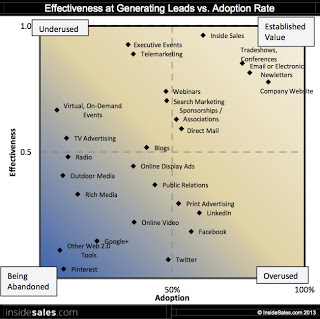
Marketing Lies, Lead Generation, Sales and PR Frenzy image most common lead methods inside sales 20131 271x300

Marketing Lies, Lead Generation, Sales and PR Frenzy image Ken K

What’s startling about the report is that those B2B sales and marketing professionals surveyed “stated social media as the least effective lead generation strategy. LinkedIn was rated the most effective tool, barely reaching above the bottom of the list when it comes to…effectiveness.”

While they all love social media, “it hasn’t really gotten the traction yet of some of the other medias.” Social media guru Guy Kawasaki readily admits that it’s “not the most effective medium.” Kawasaki recently took part in Krogue’s Inside Sales Virtual Summit. Kawasaki has 4.5 million followers on Google+ and 1.5 million on Twitter. Nevertheless, Kawasaki felt email would fill more seats than social media. He was right (70% versus 30%).

 In order of effectiveness, Krogue rates the top five, most effective to least effective (you can see the full list of 17 methods here):

  1. Outbound Marketing (inside sales and telemarketing)
  2. Event Marketing (virtual tradeshows, webinars, seminars and physical tradeshows)
  3. Online marketing (websites, search and blogs)
  4. Traditional marketing (radio, TV, advertising and outdoor marketing)
  5. Social media

Marketing Lies, Lead Generation, Sales and PR Frenzy image lead generation effectiveness inside sales 20131 300x300

Krogue has offered some sage pointers when it comes to lead generation:

  • Look at the methodologies that are highly effective and maybe underutilized in your own environment.
  • Put them to work because it’s really all about the leads.
  • Always move from less assertive methodologies to  more assertive and more effective ones. That’s where the results are.

These seasoned vets know their stuff. I’d take note if I were you. Have you?

Originally published on Thinking Out Loud.

27 Aug 17:40

Prospects Don’t Care About Your Sales Process. Maybe You Shouldn’t Either…

by Jaisundar Venkat

One of my friends thinks ‘Sales’ is about talking. Another friend I follow on Twitter thinks it is about ‘convincing’ the customer. I wince every time I hear someone characterize an engaging, fluent, fast talking, bloke as ‘sales material’.

Sales, as you might agree(especially if you are in sales yourself), is really not any of that.Prospects Don’t Care About Your Sales Process. Maybe You Shouldn’t Either… image Sale 300x199

Definitely not.

Unless you sell snake oil or some hair cream that promises magical appearance of hair overnight on sprawling bald patches on the head (but of course, you’d have flown out of town overnight before they find out that wasn’t going to happen).

Glib talk, ‘convincing’, pushiness…none of that is really sales. Not if you are selling technology solutions. Not if you are in consultative selling. These require a different skill altogether.

But then, is there really something like Consultative Selling at all?

I would argue that there is no such thing. If you really look at the big picture, there ought to be no active selling in consultative selling. If you look back at all the times you have really been successful in closing a deal, you’d realize that more often than not, you have thought less about closing the deal and more about helping your prospect buy. You will realize that each of those times, you really weren’t wearing the old sales hat.

What is likely to have made you successful each time was that you helped those prospects decide what was right for them. You put aside your hard-sell compulsions and your quarterly target pressures and the lure of sales incentives and truly enabled the prospect along his journey of his buying process. Of course, you also got them to see how your product or service was a right fit, but essentially all you did was only align their need with what you had to offer.

You did not force-fit your product or service to their need.

A good sales guy wouldn’t hesitate, when he has all the required facts, to tell the customer that his product or service doesn’t quite meet the need of the customer – he may even advise the customer not to buy his product or service.

And yet, how come the good sales guy seems to think of his sales process as being a series of milestones along his engagement with Mr.Prospect? Geofferry James makes a great point of this in a recent article “The Real Truth About Sales Process” where he says

Sales process is not about how you sell but how the customer buys.

That really is spot on.

The customer really doesn’t care about your sales process at all. Or your targets and all the reasons that motivate you to engage with them.

Sales is really about enabling the customer to buy. A good sales guy puts his effort in making sure the customer is able to address their need, he puts his effort behind establishing credibility as a decision enabler – not around a sale achieved at the end of a rigid sales process. A process, which really is very internal to you and your sales team.

If your sales process is too rigid to align to the customers buying process, you have a big problem. As Geoffery says,

…here’s the real truth about sales process: it must be adaptive rather than manipulative.

Make that crucial distinction and your sales process will help, rather than hinder, your sales efforts.

Well said.

It is a private motivation only another sales guy would know, but when it comes to consultative selling, the real joy is not as much in closing a deal as much as seeing the customer look back and feel good about his buying decision. And be thankful that he trusted you.

27 Aug 17:39

Inside Sales Power Tip 129 – Get More Leads

by Lori Richardson

Do you want more and better leads when reaching out to potential buyers? This is definitely one of the top requests I hear when meeting with those prospecting for net-new business. It seems that no matter what data services your company subscribes to, it is still difficult to find those leads you know could become more probable prospective customers.

Last week at Inbound 2013 I had the pleasure to meet up with Kyle Porter, CEO and Founder of SalesLoft. We talked about a number of things which you’ll see in future posts – but the idea of better leads is top of mind for Kyle, whose company was created to help sellers gain more and better data.

I’m always looking for that one tip or strategy that can help you right away – now, today. What I love about SalesLoft is that they are solely focused on helping those of us on the front line of sales prospecting. I think you’ll like what Kyle says in the video.

One-two Punch – LinkedIn plus SalesLoft = Easy Leads System

Both LinkedIn and SalesLoft have free versions, that’s why I am mentioning this strategy.  The Email Discovery feature is additional. As I have mentioned in previous posts, I have always had an upgraded LinkedIn account – as a seller, it always has made sense to. SalesLoft is also free with an upgrade path. Try these out and see what you think. Feedback on tools (as a comment on the blog) is extremely helpful to others.

Transcript of the Video

As a sales professional, we are huge fans of LinkedIn. I’d go ahead and say LinkedIn is the #1 source of leads and information in the entire world for salespeople. But there are some restrictions on Linkedin. One of the biggest ones is if you’re building lists from contacts, if you are going through and making a lot of calls – you have to do a lot of copying and pasting.

We (at SalesLoft) have solved that effort with one of our tools called the Prospecting plug-in – it is a Chrome extension – you can download and get started for free. The point is that it lets you build lists of leads using Linkedin but it gives you a simple way to do it.

Then, on top of that, we have just released our Email Discovery feature. What this does is that it takes any public profiles on LinkedIn and automatically tries to find their email address. it is finding a large percentage of these emails and making it super simple for any sales or prospecting teams in the world to build lists of targeted, segmented people they want to go after – get their contact information, and then launch their campaigns.

There you have it – have you used this combination, and what do you think?

What other ways to you find good leads?

Lori Richardson - Score More SalesLori Richardson is recognized as one of the “Top 25 Sales Influencers for 2013″ and one of “20 Women to Watch in Sales Lead Management for 2013″. Lori speaks, writes, trains, and consults with inside and outbound sellers in technology and services companies. Subscribe to the award-winning blog and the “Sales Ideas In A Minute” newsletter for sales strategies, tactics, and tips in selling. Increase Opportunities. Expand Your Pipeline. Close More Deals.

The post Inside Sales Power Tip 129 – Get More Leads appeared first on Score More Sales.

27 Aug 17:39

How Viral Emails Can Drive More Sales than Promotional Emails

by Ernan Roman Direct Marketing
The Challenge: Viral emails can often generate greater response and revenue than sales-focused emails. Following are examples and tips for sending engaging/interactive emails that do not contain sales pitches or feature products.
HP Social MediaAirbnb Case Study
The holidays are an important time for the travel company Airbnb. They recognized that holiday greeting emails are very common and devised a unique campaign. They developed a way not just to send a holiday message, but an interactive campaign that encouraged customers to send a thank you note to travel hosts that assisted Airbnb’s travelers during the year. The email was sent with the purpose of getting the audience to engage with one another, not to drive revenue.
Response and engagement rates were very strong:
• 52.3% open rate — up from the previous average of 27% to 30% on regular marketing emails.
• 26.5% click through rate — increase over the 8% to 12% on regular marketing emails.
The subscribers who used the tool sent an average of 7.5 emails.
Airbnb increased sales with 600 bookings as a result of this non-promotional email.
Career Builder Case Study
Career Builder tied in a very successful viral email campaign to their widely acclaimed Super Bowl ad featuring chimpanzees performing common office duties. The campaign was named Monk-E-Mail and uses personalization to engage email subscribers and ease of use to ensure follow through of customizing and forwarding emails.
The engagement and increase in the site’s popularity as a result of the campaign was staggering:
• CareerBuilder was rated the #1 career site.
• 29 million unique users visited the site within the first four months (25% increase in traffic); more than 55 million total visitors.
• More than 150 million Monk-e-Mails have been sent and played.
• 22% of message recipients went on to send their own messages.
5 TAKEAWAYS:
1. Timing is important. Airbnb is in an industry where travel is not an everyday event; the holiday email campaign was good timing because December is a time for travel or planning future travel.
2. Personalization is key. Airbnb pre-populated the emails with each customer’s bookings from the previous year and included images of each user’s profile, making it easy to send the message.
3. Be Humorous. As CareerBuilder showed, a viral email is your chance to lose the serious sales attitude.
4. Ease of Use is essential to enable a high volume of viral actions.
5. Do Not Muddy the Message. Once you decide to go non-promotional, do not include any promotional content. Concentrate on the focus of engagement.
27 Aug 17:39

Sales Motivation: Who Will You Impact Today? This Week?

by TheSalesHunter

calendar 3 300x298 Sales Motivation: Who Will You Impact Today? This Week? photoSales is a great profession!

Each year I’m in sales, I come to appreciate and respect it that much more.  One of the reasons I respect the profession so much is the ability to make a positive impact on people.

Every day, those of us in sales get to connect with numerous people.  Some of these people we know well and some we may only have a one-time encounter with.  Regardless of the number of times we may see the person, we still get to make an impact.

Is the impact you’re making a positive one or a negative one?  Is the impact you’re making centered around what it is you sell or is it centered around helping the other person?

I hope it’s around the latter, because this is really the heart of sales — helping people.  The ability to help people means we get to make an impact, and to me that is significant.

The ability to positively impact others should make you feel great, not in an egotistical way but in a respectful way.   A goal I have is to be able to positively impact each and every person with whom I come in contact. I do this first by demonstrating respect for them and second by taking an interest in them.

Will this result in closing more sales?

I can’t say I know for sure, but what I will say is I don’t care if I close more sales because of it.  When we impact others positively, we in turn are showing them how they can impact others they meet.  That right there is a huge success.

While I’ve never seen statistics that confirm this kind of approach impacts sales positively, I think common sense would tell us it does.   People want to do business with positive people.

Who will you impact today?  Who will you impact this week?

The success you have will show up in the positive difference you make for the people you meet. And don’t be surprised if it also shows up in the increased number of sales you close.

Copyright 2013, Mark Hunter “The Sales Hunter.” Sales Motivation Blog.

button receive a free9 300x51 Sales Motivation: Who Will You Impact Today? This Week? photo

24 Aug 16:59

Leveraging Email Analytics To Amplify Your Marketing Efforts

by Josh Brown

Email marketing has rapidly become one of the most widely used communication tactics of the digital era. With minimal costs and content requirements presenting a low barrier to entry, it can be an easy and effective means of reaching a target market with a brand’s message. As email marketing platforms such as Mailchimp and iContact have evolved over time, even the HTML design elements of these campaigns have become a simple “point and click” exercise.

The problem is that the bulk of those utilizing email marketing are failing to leverage the most valuable component of their campaigns: the results.

If your organization is using email marketing to advance their brand, chances are you’re using an email platform to do a great deal of the heavy lifting for you. Built into these platforms are analytic reporting tools which can tell you how your target audience interacted with your message. This data is utterly important, and can help improve your marketing and sales processes in several ways. If you can understand the value of these specific areas of analysis, you may find yourself with far better marketing results.

Metric: Open Rate
Meaning: What percentage of your recipients opened your email
Lesson Learned: Subject Line Efficacy

With each email marketing campaign you send out, you include a subject line. In traditional correspondence, these subjects have been largely informational, but in marketing, it’s about flash. This is literally the first attempt you have at capturing a recipient’s attention. If the subject line is too dull or spam-like, your open rate will suffer. If your subject line is relevant and catchy, your open rate will improve.

Why does this matter? You can design the most beautiful email marketing campaign content in the history of the world, but if your audience isn’t seeing it because they never opened your email, it doesn’t matter. In this sense, your subject lines and corresponding open rates may be the most important indicator of whether or not your attempts at message distribution are effective.

Metric: Campaign Click-Through Rate
Meaning: What percentage of your recipients clicked through to linked content in your email
Lesson Learned: Content Efficacy

Once you’ve gotten people to open your email, you have a very limited amount of time to catch and keep your attention. There are a variety of factors which go into achieving this goal, ranging from design to copy to substance. The right combination can get you in the door, while the wrong combination can wreak havoc on your branding efforts.

In the aggregate, click-through rates can help you experiment with tone, spatial design, and subject matter in an informed manner. By monitoring your click-through rate over time, you will be able to get a feel for what types of messages are resonating best with your audience.

In many ways, this is a matter of efficient resource allocation. For instance, imagine that your organization sells a variety of clothing. If your email campaigns about sales are performing with a click-through rate twice the rate of your campaigns which focus on trends in fashion, it would make much more sense to focus on developing marketing initiatives revolving around sales than it would to continue to allocate resources to developing fashion trend initiatives.

Metric: Link performance by lead
Meaning: Which recipients clicked on which links
Lesson Learned: Lead Interests

While it’s important to monitor the performance of email marketing campaigns in a broad sense, this information is largely important to marketing departments. For those in sales, a much more valuable measure is based on link performance by campaign. Here, instead of a big picture view of a message’s performance, you’re able to gain an understanding of how your leads are interacting with the content you create on an individual basis.

Why does this matter? The cornerstone of effective communication is an understanding of the intended audience. For those involved in sales, this means understanding the psyche of the lead they’ve chosen to target. Some of this information is provided by basic demographics, such as age, gender, and geography. Other pieces of more nuanced information may be volunteered by the lead on registration forms, such as expressed proficiencies, experiences, or preferences. However, as the saying goes, actions speak louder than words, and that’s why looking at link clicks by lead can be particularly revealing. If a lead is demonstrating through their click behavior that they are attracted to content about a specific topic, a sales person can use this information to create a targeted message for individual outreach, increasing the likelihood of that message being well-received.

Are your emails working? Are they worth the expense? By using analytic reporting tools and analyzing the data, you can fix a campaign that’s falling apart, or boost a good campaign into a great one.

24 Aug 16:59

The PROPER Way to Make an Email Introduction

by Personal Branding Blog

There is one absolutely right way and one absolutely wrong way to introduce two people via email.

The wrong way: “You should talk to my friend Meghan. Here’s her email. Tell her I sent you.”

The right way: Read on, MacDuff.

The PROPER Way to Make an Email Introduction image shutterstock 95372056 300x217Have you ever had someone call or email you out of the blue, and tell you a friend sent them? Did you completely believe them or were you a little wary? What if you were on the other end of that referral? Did you feel comfortable making that call?

I’ve known people who have been the caller and the callee, the emailer and the emailee, and it’s not comfortable for either of them to be involved in that kind of introduction.

Here’s the proper way to make that introduction.

1. Introduce both people and explain who they are

Steve, meet Nadine Wassername. She owns Wassername Communications, a public relations agency here in town. We met at a PR Flaks & Hacks Convention in 2008, and have worked together regularly. Nadine, meet Steve Newguy. Steve is a freelance writer and former investigative reporter with the Fort Tecumseh Herald Star. We met when he was working on a story on the unpasteurized cheese epidemic.

This is the kind of introduction you would make at a networking event. It helps them establish credibility with each other, and sets the stage for. . .

2. Explain how the introduction occurred to you

I was having coffee with Nadine this morning, and she mentioned she was looking for a new writer for an upcoming client project. I thought this sounded like a perfect opportunity for Steve, because he has been a journalist for 16 years, and has won several awards for his work.

I like a little back story to these introductions. Explaining the situation this way is certainly a lot better than “you two need to meet. Nadine has a project she wants to tell you about.” And yes, I’ve seen these kinds of introductions. The two people will then spend their first (and possibly only) meeting playing 20 Questions, trying to figure out what you meant.

3. Brag both people up, make the connection

Given his work as an investigative reporter, Steven was considered one of the best writers at his newspaper. Nadine told me she needed a top-notch writer who didn’t need any hand-holding or having anyone watch over their shoulder, because this was an important client. This is why I think the two of you need to meet — Nadine has an exciting project, Steve has the skills and experience to do it right.

I like the direct approach here. Don’t beat around the bush, don’t be humble on their behalf. Talk them up and speak to their strengths (but don’t overinflate; it makes you look like a bad judge of character). Some people are able to connect the dots on their own, and others need a little help. If you tell each other why they need to connect, they’re more likely to do it.

4. Tell them to take the next step

I think the two of you should meet for coffee in the next week or two to see if you can find a way to help each other. I’ll leave it to you to take the next step and find a way to connect.

This part of the intro puts the ball back in their court(s) and should persuade one of them to take the next step. Please note that I did not say Nadine needs to hire Steve. No need to put that kind of pressure on either of them. I suggested only that they meet, and find a way to “help each other.” That help may end up being Nadine saying Steve isn’t a good fit, but she knows of a better opportunity. Or it may be that Steve doesn’t think he’s right for the project, but knows someone who is. Or, she may hire him on the spot.

5. Expect nothing in return

One of the important things to remember is that when you do this, do not expect a quid pro quo exchange of favors. Steve or Nadine don’t owe you an introduction to someone. You need to get on with your life and believe you’ll never get the favor returned. That way, you won’t be disappointed.

If you fret over and count the introductions you make, you’ll make yourself unhappy keeping track of them all. Make as many of these introductions as you can, and wait for benefits to come your way. Whether you call them blessings, karma points, or the universe smiling on you, these little favors have a way of being visited back upon you. Don’t ruin it by expecting repayment.

Sending introductory emails are one of the most fun and valuable things I get to do for other people. I’ve connected people for freelance gigs, job possibilities, and even just connecting really smart people with big ideas who I think could create something awesome. It’s enjoyable to see something come about because of connections I’ve made, and to know that lives were changed because I took five minutes to make a valuable connection between two people who could make a difference to each other.

If you’re going to send email introductions, please do not just mutter “oh, just call Nadine.” That’s laziness on your part, and will end up hurting both you and your friends more than it will ever help.

Author:

Erik Deckers is the owner of Professional Blog Service, a newspaper humor columnist, and the co-author of Branding Yourself: How to Use Social Media to Invent or Reinvent Yourself and No Bullshit Social Media: The All-Business, No-Hype Guide to Social Media Marketing. His third book, The Owned Media Doctrine, will be available this summer.

24 Aug 16:58

Are you considering your prospect’s unconsidered needs?

by Corporate Visions

If you’re feeling like price pressure has increased in the past few years and you’re struggling to differentiate your solutions from those of your competitors, you’re not alone. These challenges could be a result of poor product positioning and maybe even poor salesmanship.

89-68-price-pressure-differentiationThe good news is they can be addressed when you message to your prospect’s unconsidered needs, instead of just the ones they tell you about.

Watch Discounting is a Differentiation Problem: How to Message to Your Prospect’s Unconsidered Needs to learn how you can improve your product positioning and selling conversations.

23 Aug 16:58

Use this exact checklist on your first week at a new job to build connections and make a strong impression

by Jenna Goudreau

first day of work

  • If you want to set yourself up for success in a new job, make sure you're on top of your game from day one.
  • Amanda Augustine is a career expert and spokesperson at Talent Inc., a career services platform. She has over a decade of experience coaching professionals. 
  • She details the steps that she's seen successful people take in the first week of a new job. 
  • Click here for more BI Prime stories.

Starting a new job can be nerve-racking. The stakes are high: You have to prove yourself, become acclimated to the culture, and make a good impression. 

So how important is that first impression? 

It's actually critical — and there are certain action items you can consider from the start to position yourself for accelerated success.

"The first three months of any new job are an extension of the interview process," said Amanda Augustine, now a career expert and spokesperson at Talent Inc., a career services platform. "From the first day, you need to be on your game."

With more than a decade of experience advising high-level professionals, Augustine details what the most successful people do that first week in a new job.

Be a geek about introducing yourself.

Take the initiative to meet people. Say hello in the elevator, kitchen, or bathroom. 

"It could be a fast-paced culture, and they don't have time to come to you," Augustine said. "Start with the group that's closest to you, the people you're directly working with." 

It will be in their best interest to get you started on the right foot, since your work will directly affect theirs.

Befriend a veteran who can help you navigate politics (and find the pencils).

Learn who the players are, and who's been at your company awhile, Augustine advised. Find the battered veteran who has a good handle on what works and doesn't and can show you around. 

"Companies have their own language and inside jokes," she said. "Look for the one person to help you decode the acronyms and office politics." 

Plus, you'll need someone to go to for the silly things. Asking your boss where to find the pencils is a bit below their pay grade.

Set expectations with your boss and employees.

"Get on your boss's calendar," Augustine said. 

Use that initial meeting to establish what they believe success will look like in the first week, month, and three months. 

At the same time, if you're in a managerial position, it's important to begin setting expectations with your direct reports. From communication style to office hours, that first week sets the tone. 

Figure out the coffee situation.

coffee cup machine pour

Learning where the coffee is will always be a good strategy for success. It's also important to figure out the unwritten rules of the office that, if violated, make people go ballistic. Who washes the dishes? Which shelves are communal? 

"In our office, there are several refrigerators, and people get upset if you use the wrong one," Augustine said. "Be a sponge, and watch how people are doing things. There's nothing wrong with asking how to use the coffee maker." 

Start demonstrating and documenting what you sold the company on. 

"Whatever you sold them on in the interview, make it your mission to demonstrate that you're going to do it," Augustine said. 

If you said you were a social media whiz or good with numbers, immediately start revamping the social accounts or making sense of the company's analytics. 

Start a brag sheet. Keep track of all your accomplishments, major contributions, and when you get positive feedback. You want to get in the habit early and have the information at the ready for future performance reviews and salary negotiations.

Get organized to set good habits.

Especially since a lot of new information is coming your way, setting good habits and getting organized from the start will make your life easier down the line. It's also a good time to improve your bad habits. 

"It's a great opportunity to overcome any challenges or weaknesses from your past,"Augustine said. 

If you've struggled with time management, for example, use that first week to map out how you'll spend each day and begin putting it into practice.

Reinforce your new connections on social media. 

Once you're officially on the job, it's important to update your title across your own social media platforms and also start following your new company and colleagues. 

As you meet new people, cement the relationships by finding them on Twitter or LinkedIn. Augustine advised identifying the platform that makes the most sense. Facebook, for instance, is viewed by many as personal, so use discretion. 

Reconnect with former colleagues.

Perhaps counterintuitively, Augustine said the first week of a new job is the perfect time to reach out to colleagues from your previous jobs. 

"Go back and reconnect with people at your old company, and ask for LinkedIn recommendations," she said. 

The best time to get referrals is when you're not looking for a new job, she said.

Find your go-to pharmacy and take-out lunch spot. 

Learn your new neighborhood. Do you know where the nearest CVS is? What about where to get a sandwich, take people for coffee, or have a nice business lunch? 

"Logistically, you need to know where to go get a Band-Aid when you need one," Augustine said.

Jenna Goudreau contributed to an earlier version of this post. 

SEE ALSO: A survey of the world's top managers found 8 leadership traits all best bosses have in common. Use this checklist to see how you measure up.

Join the conversation about this story »

23 Aug 16:56

The Anatomy of a Well-Executed Mobile Facebook Contest

by Zsuzsa Szabo

I am a contest-junkie. I enter 4-5 sweepstakes and contests a day. I know it’s a lot, and forgive me, but this is because of my job (and okay, I like entering contests). I subscribe to these contests during the day both from my computer and mobile. And I realize it very often that these … Continue Reading

The Anatomy of a Well-Executed Mobile Facebook Contest by Zsuzsa Szabo - Maximize Social Business - Maximize Social Business - Your Social Media for Business Resource ... Featuring Contributions from Global Thinkers . This copyrighted content was originally published on Maximize Social Business and may not be republished on any other website or in any other format without explicit permission from the publisher.

23 Aug 16:27

Five Must Have Revenue Analytics for Marketing and Sales Teams

by Frank Donny

Is your company’s sales performance up to your expectations?  If your answer is no, you are not alone by a long shot.  In CSO Insights’ 2013 Sales Performance Optimization Study, 49.4% of participants had either definite or significant concerns in reaching their 2013 revenue targets.  Further, CSO Insights states that enhancing lead generation, aligning sales and marketing and improving a sales process are three of the top five current sales effectiveness initiatives for 2013.

Having a “system” in place just makes sense no matter what type of business you’re in.  How can you expect to increase sales performance, if your company lacks the ability plan, manage and forecast your revenue performance in a sustainable and trustworthy fashion?

Often, there is a breakdown in communications between many of the teams working to generate revenue.  Sales, marketing, inside sales, partners, SME teams and executives all play a part in revenue development.  Ultimately, the customer experience must be properly managed in order for you to generate new leads, acquire new customers, and maintain customer trust and loyalty.  When you implement an effective process for generating revenue, every team involved can develop and communicate the appropriate strategies for finding, retaining and growing those clients that are most important to your company’s success.

If you don’t have a game plan, what good are your goals?

Markets constantly evolve.  This is not new news.  However, sales efficiency and effectiveness often hinges on how your company responds when your potential customers and competitors are on the move.  When developing a revenue generation system, make sure yours is:

  • Customized to your organization and your buyer’s journey
  • Developed in a way that offers an advantage over the competition, and sustainable
  • Designed to focus on your unique competitive advantage
  • Responsive to changing opportunities, challenges, and conditions
  • Relevant across various products, services, and segments

To begin your journey of analyzing your current performance, begin by creating a list of “must-have” key performance indicators.  Keep this list to 5-6.  Too many and you will not stay focused.  These KPI should be spread out across your system – one or two for marketing, one or two for inside sales and two or three for your sales process.  Several “must have” ones that come to mind include:

  • Marketing contribution to pipeline by campaign and tactic
  • Marketing waterfall from inquiry to qualified opportunity by campaign and tactic
  • Inside sales acceptance and conversion rates
  • Marketing and sales lead volume and velocity in your sales process
  • Forecasting accuracy and sales process breakage points

Find and uncover your main data black holes and to improve the integrity of your data as fast and efficient as you can. Today, there are sales management software solutions that are simple, affordable, and user-friendly, making it easier than ever before to implement an effective and results-driven revenue generation process.  Companies and their sales/marketing teams demand simplicity; after all, when a program isn’t easy to use, it tends not to be used – which defeats the entire purpose.  Now there are affordable solutions that are within any budget, so you can enhance sales performance without busting your budget.

Having strong analytics is now a must have for every owner and board.  Getting those analytics starts with a strong system based on fundamental processes, people and technologies.  Get your system implemented and train and hold your users accountable to using it.  With a solid base in place, your analytics will be easier to compile and report – making your owners and board a happier bunch of people.

23 Aug 16:26

Nurtured Leads

by ClarityQuestMarketing

Nurturing leads is an important part of the sales cycle. Companies using marketing automation to nurture leads can generate more sales-ready leads at a lower cost and can expect an increase in qualified leads. Call our marketing automation experts to learn how lead nurturing can grow your healthcare or technology company. (877) 887-7611.
23 Aug 16:26

The Key To Enhancing Online Sales

by nikkidavis

It seems that online users increasingly desire online sales outlets that mirror the tactile and visual feeling that they get from a land based retailer. There is a large degree of congruence between the experience created by high quality image tools and the feeling that a potential customer achieves when browsing an aisle for a product that catches their attention, and then removes it from the display in order to examine it on a closer basis. The importance of displaying a product on a site in the right manner cannot be overestimated, as this is now an integral part of any online product transaction.
23 Aug 16:26

The Myth of The Self Managing Sales Rep

by peaksales

I was talking to one of our business partners a few days back and they told the story of an employer that wanted a sales rep who would join the company and know what to do. We both chuckled because we have both been in sales enough decades to know that there is no such thing as a self managing sales rep.

While there is a notion that there are many lone wolves in sales, the reality is that great sales people need plenty of guidance. I certainly wish sales people could just be wound up, sent on their way, and voila sales magically appear, and to be fair great sales people do have a higher level of independence than people who suit other careers, but I can say from many years of personal experience that a sales person that is not provided plenty of direction and held accountable will run awry fairly fast.

To be successful a sales rep, even one with great sales DNA, requires – clear guidance on goals, a structured work environment, regular account and pipeline reviews and communication, training and development, support, sales tools and infrastructure, and most importantly, accountability.

If you think these aren’t important or aren’t in a position to provide these things, you will likely be disappointed with the results.

To your success!

23 Aug 16:25

Tips On Using Social Media As Your Secret Sales Weapon

by Ryan Holmes

Tips On Using Social Media As Your Secret Sales Weapon image Secret Sales Weapon

Have you ever worked in sales? How many calls did you have to make before you actually connected with someone? How many emails did you send out that never got replies? Not many people will spare the time to talk to a stranger who is trying to sell them something.

But forward-thinking salespeople are embracing a new approach to break down these old communication barriers: social media.

Tech-savvy sales staff are now using social media on the job to monitor potential clients and competitors, gather intelligence, network and more—and it’s giving them an edge over the competition. A recent study found that salespeople using social media on the job outperformed peers not using it by a whopping 73 percent. They also exceeded their quotas 23 percent more often than their counterparts who were not using social media.

I know social media can boost sales success because I’ve seen it work at my own company. At HootSuite, all of our sales people tap into social networks daily to engage clients. (It’s not the only part of their process of course; phones and email are still invaluable tools.)

Here are three tips for making the most of social media as a sales tool:

1. Use Social Media to Break the Ice

Social media can be a great resource for gaining unique insights into leads that can help you make more impactful first contact. Last year, for example, we landed a new corporate client thanks in large part to Twitter. After following one of the client’s decision makers on the social network for months, one of my sales reps noticed that the executive always tweeted passionately about his love of McDonald’s seasonal McRib burger. So when the rep eventually decided it was time to reach out and make contact, he used their mutual passion for the menu item as an icebreaker in an email (writing in the intro something along the lines of “It’s McRib season again. . . .”). Talk of his favorite sandwich really grabbed the exec’s attention. He responded, leading to more exchanges and eventually a major sale.

And social media isn’t just for icebreakers. This kind of investigating can also be used to uncover crucial information on businesses, enabling salespeople to optimally time their outreach.

2. Tap Into Social Networks For Warmer Referrals

Social media can be a major asset in getting people to be more receptive to you. For instance, another rep at HootSuite recently fused old and new techniques to land a meeting with a huge potential client. He first came across an article in the Boston Globe about a new initiative being launched by a major communications company. The article happened to mention the C-level executive who was leading the initiative. After a quick search on LinkedIn, the rep discovered that he had a first-level connection in common with the executive. He referenced the mutual connection as he reached out, and amazingly, heard back in 30 minutes.

Had our rep tried the traditional route of calling or emailing, it’s unlikely he would have received such an immediate response—or any response at all, for that matter. None of this, of course, is rocket science. A warm referral is known to increase the odds of sales success by 200 to 400 percent. What’s new and powerful here is leveraging social media to transform a cold referral into a warm one.

3. Catch New Opportunities With Social Media

There is nothing more tragic than a lost opportunity in sales. Our sales reps have found one easy way to avoid them—working with departments (other than just marketing) to gain valuable intel.

For example, one of our customer support reps recently spotted somebody on Twitter complaining about a unsatisfactory sales demo they’d just had with one of our major competitors. She immediately blasted the message over to a sales manager, using our internal tasking tool. The manager took it from there, looking up the tweeter’s professional information on LinkedIn and then tracking down his contact information. This all ended up becoming a promising new opportunity worth tens of thousands dollars. Oftentimes clients are pleased to hear from us in this way, and to be offered a potential solution to their business problem.

Social media-assisted selling isn’t just happening at my company. More and more salespeople in both large and small businesses are adopting social media. Last year for example, IBM reported that they saw a stunning 400% surge in their sales after implementing their social selling pilot program.

Tapped into networks like LinkedIn, Facebook company pages, and Twitter, salespeople can empower themselves with useful information and data that gives them a truly competitive edge.

Social media won’t necessarily replace the phone or email, but it’s a new and revolutionary tool that sales departments can add to their arsenal.

For more social media insight and to learn more about my company, follow HootSuite on LinkedIn.

23 Aug 16:25

Social Media Marketing Proof: Twitter Increases Sales (And Ratings)

by Tim Robertson

Social Media Marketing Proof: Twitter Increases Sales (And Ratings) image Screen Shot 2013 08 20 at 5.22.21 PM

Twitter commissioned research firm Datalogix to discover how effective Twitter was for business. After all, the social media marketing giant is making a big play to capture more ad spend. According to the report, companies that pay for tweets have more sales than those that don’t pay. People who saw a brand’s tweets spent 8% more than those that didn’t. The report also says that people who responded to sponsored tweets helped increase sales by 12%.

As a rule, less than one percent of users click on banner ads. But promoted tweets made followers of the brand 29% more likely to follow through with a purchase than those who did not see a promoted tweet.

Meanwhile NLSN (Nielsen) has reported that when Twitter is very active around a particular program the television ratings increase 29% of the time.

At present, over half of Twitter’s advertising revenue comes from mobile (total of $1 billion in revenues in 2012). So there is speculation that the company’s planned IPO will go a little better than Facebook’s botched share launch.

23 Aug 16:25

Google and Amazon Race to the Bottom for Tablet Sales

by George Achillias
Google and Amazon Race to the Bottom for Tablet Sales image 417XQ0XwQuL. SL300

Cover via Amazon

The pricing war initiated by Google and Amazon, regarding the low price at which tablets are sold, does not reflect their full costs. The fact that two of the biggest players have decided to start selling tablets at no profit, might seem like a good thing in the short term. However, long term, it might prove detrimental for the entire industry as it could easily steer the industry’s’ focus away from providing quality devices and direct it into producing and selling cheap, minimum capabilities ones.

It is generally accepted that competitive markets fail due to four basic reasons: market power, incomplete information, externalities and public goods. Inefficiency arises when a producer or a supplier of a factor input has market power–both Google and Amazon undoubtedly have that power. Currently, they are the two biggest market players behind leading Apple, with Amazon also being the biggest online retail and content provider. Both competitors have decided on the quantities of devices to be produced and at which marginal revenue to sell. Both have conceded that the marginal revenue is going to be equal to the marginal cost, thereby voluntarily squeezing their profit margin for these devices to near zero, while projecting that the high profit margins will come from selling content and services to their consumers.

This marketing strategy succeeds in making competitive products/brands appear overpriced to the lay consumer, regardless of the fact they are costly to produce. As a result, they force other producers to lower their selling price and subsequently their profit margins. Further, they corner producers into the forced dilemma of choosing between quantity and quality when designing and producing new devices. All this, while Google is aiming to both make a profit and broaden the reach of its Android operating system, and Amazon is looking for ways to restore the profit gap when customers buy movies, books and magazines from its store.

Andrew Rassweiler, an IHS senior director, said Google’s tablet is also clearly aimed at Amazon.com, which shook up the tablet market last year by offering its own version at $199. “Google’s Nexus 7 represents less of an attempt to compete with Apple Inc.’s market-leading iPad, and more of a bid to battle with Amazon’s Kindle Fire,” he said in a statement. While the two are “similar in many regards,” he added that the Nexus 7 “has superior specifications to the Kindle Fire, giving it a more attractive feature set that may make it more desirable to consumers.” Amazon and Google don’t care to monopolize the market, but they do care to achieve a monopsony.

Amazon and Google appear to be simultaneously trying to establish a wholesale monopsony and a retail monopoly in the ebook and content/advertising sector. At the same time, it is important to note that Google and Amazon are in effect trying to apply a predatory pricing practice into the market of tablets and content. By selling a Nexus or a Kindle at rock bottom prices, they intend to drive competitors out of the market and/or create entry barriers to potential new competitors. What is even more important to realize is their attempt to establish in buyers’ mind the conviction that well-known products such as the iPad mini are by default overpriced. If competitors, such as Asus, Nook. Samsung or RIM cannot sustain equal or lower prices without losing money, they are eventually driven out of business. Beyond that, potential competitors are discouraged from even attempting to enter the market.

In essence, Amazon and Google have chosen to undergo short-term pain for long-term gain. Therefore, for both to succeed, they must have sufficient strength (financial reserves, guaranteed financial backing or other sources of offsetting revenue) to endure the initial self-imposed lean period. In this case, it is really interesting to follow Amazon’s steps, since Google seems to have all the strength required to endure the initial period. Since Amazon had some rough quarters regarding revenues and profitability, this strategy may fail if competitors (like Apple or Samsung) are stronger than expected, or are driven out (like RIM, HTC or Acer) only to be replaced by others. In either case, this will force the Amazon and Google groups to either prolong or even abandon the price reduction policy.

Their strategy may fail, if both Amazon and Google prove unable to sustain the short-term losses, either because they last longer than expected or simply because they underestimated the loss. In the long term, it is questionable whether Amazon can endure while practicing the predatory pricing. And how will this would affect Apple and its ecosystem? Tablet makers selling a complete range at that break-even level could ultimately whittle down the market to those who either produced a winning formula at the right time (Apple) or have deep enough content stores and bank accounts to willingly give up large parts of their potential hardware profit (Amazon and Google).

It is a well documented fact that consumers do not have accurate information about market prices or product quality. As most consumers are price-driven, they tend to ignore or be indifferent to the fact, that it is difficult for companies who lack the proper profit margins, to access the funds required to develop new technologies and provide the market with innovative products. One tends to easily forget that devices sold by Google and Amazon gain their value from content, which has to be purchased at an extra price. So it is quite possible that consumers who are lured into buying a device because of it’s significantly cheaper price tag, to later discover to their dismay that either the app ecosystem is either not very safe nor well developed–or worse still, that in order to have the proper experience using the inexpensive device that they must spend a serious amount of money on different kinds of content purchases.

In our case, market prices do not reflect the activities of either producers or consumers. Prices are kept artificially low, as producers try to gain market share and revenues from content sales. This has an indirect effect on other consumption or production activities that is not reflected directly in market prices. There is an externality, because the price of tablets, which are sold by Amazon and Google, do not bear the true cost of their production nor leave reasonable profit margin. A viable profit margin would allow producers to spend the necessary funds on research and product development, enabling them to provide consumers with well-designed, well-made devices, able to improve and optimize the experience of consuming content or services through them. This causes an input inefficiency driving other competitors to push their profit margins lower, in order to match the low prices of Amazon and Google and forces on them the dilemma between money, potential market share and quality.

In essence, they are basically trying to equate profit margin in the table market segment with sin. As Google and Amazon are the two biggest players in the market of tablets after Apple, it is possible that the externality will prevail throughout the industry and the price of tablets will be lower than it would be if the cost of production reflected the effluent cost. As a result, competitors who struggle to remain in the market are bound to produce too many low quality tablets, which in turn will affect the experience of users. In short there will be output inefficiency.

Obviously in the short term, lower prices for tablets are only beneficial to consumers. By setting the price around $200 for a decent and well-made tablet branded by Amazon or Google, consumers have access to more content via a much cheaper tablet. The downside is that people come to expect or demand products to be sold at such low prices, forcing producers to focus in providing inexpensive products rather than quality ones. Amazon and Google might be at an advantage in the short term, by applying predatory pricing practice.

However, they are opening a Pandora’s box. Selling with no margin, or at a loss, as Amazon did with the first Kindle Fire, might be good business practice if you are a wealthy company, yet is a practice which can easily derail even the strongest plan if unexpected factors come into play, or markets start to ask for something more advanced or pricy than what producers are able to offer. Creating such a business environment is something which can easily turn against you, with buyers expecting to buy more or all of your products at cost. Amazon and Google might lean on content sales where they can still retain margins, but consumers can just as easily leave them for someone who will come up with an even more disruptive idea on how content is sold or distributed. (Similar to when Apple almost pushed mobile providers out of the content industry with the app store).

From the consumers ’ corner, there is an important question that needs to be answered: what is the right price for a tablet? Or what is a fair profit margin for producers to sell at? In both cases the answer is conceptually straightforward: the right price or the right profit margin will drive tablets’ price where all negative externalities, such as R&D costs, design, market development, are fully reflected on the tablet’s price. This point is not pegged where Apple sells its own tablets but for sure it is neither where Google and Amazon priced theirs. It is evident that in the long term, even the strongest producers, will face major difficulties in keeping the pace of innovation and technology development, when they will struggle to find the necessary money to fund research and development.

22 Aug 15:14

Insight: At Apple, Tim Cook leads a quiet cultural revolution (Reuters)

Reuters:
Insight: At Apple, Tim Cook leads a quiet cultural revolution  —  (Reuters) - Shortly after signing on as chief operating officer at Facebook, Sheryl Sandberg was looking to connect with people in a similar role - No. 2 to a brilliant and passionate young founder.  She called Tim Cook.

22 Aug 15:13

What Do Buyers Want from Sales and Marketing?

What buyers want quoteWe know what buyers don't want from sales and marketing. They don't want hard sales pitches. They don't want long presentations that have no value. They don't want to talk to a salesperson unless it's on their terms. They don't want impersonal marketing emails.

What do buyers want? Here's a look at a few things at the top of their list:

22 Aug 15:13

Is [Lean process excellence] relevant to a Sales and Marketing Environment?

by Michael Webb

A question from one of our readers…

“Is it relevant to a Sales and Marketing Environment?”

Lean process excellence originated in manufacturing. It is a means of getting more productivity from fewer resources; by understanding and improving the way work is done. 

  • The means of understanding and improving how work is done definitely applies to sales and marketing.
  • The specific improvements appropriate for manufacturing environments may not work so well for sales and marketing. (I’m referring to jargon like “5S,” kanban, set-up reduction, single-piece flow, etc.) 

For example: Both sellers and manufacturers strive to eliminate waste (at least they should). Examples of waste in sales and marketing include brochures no one reads, or proposals no one buys. 

However, manufacturers have a fundamentally different problem than sellers: Manufacturers secure raw materials, and convert them to meet a specification. Sellers must get the attention of people they do not know (and may never meet), and get these individuals to spend their time and money.

 The “raw material” of sales and marketing is people in the market place who have needs you can fill. Those individuals go through a series of predictable stages from the time they never heard of you before, until the time they are spending time and money with you. These stages are called the Customer’s Journey, and everything you do in sales and marketing needs to align with them. 

Here is where it gets interesting, because finding the RIGHT prospects, and helping them realize, and prioritize their problems is something B2B companies have often been left up to the ad-hoc efforts of their salespeople and sales managers. And it is on this issue that process excellence has the most to offer.

 Applying the rational approaches of Lean process excellence means starting from first principles to design, implement and improve how your company helps customers buy. Below are some of the methods that come into play: 

  • Operating definitions – gaining respectful agreement around the observable characteristics of qualified prospects, stages of the Customer’s Journey, etc.
  • Identifying and eliminating waste – in sales and marketing anything that does not result in the customer taking an action along their Customer Journey is waste.
  • Identifying and maximizing value – the methods for maximizing the customer’s perceptions and actions.
  • Continuously improving – getting the team to define their terms, identify waste, to agree on the best methods, and use their own observations (data and evidence) to drive improvements. 

A good article for you to read at this point is “How is Lean Different From Other Sales Process Methodologies?”

So, I’ve taken a stab at answering your question. How did I do? 

Please let me know if this was helpful, or if you have additional questions you’d like to ask.