
Infographic for the LinkedIn department in Munich, Germany. Celebration of 4 Million registrered members from Germany, Austria and Switzerland. Some fun facts, interesting stats about groth, etc.
 A few months ago Josiane Feigon asked if I would read through the manuscript for her upcoming new book and lend an endorsement. I had high expectations for Smart Sales Manager and Josiane certainly didn’t disappoint me. I strongly recommend the book.
One of the subjects she covers in the book is very important to me as followers of this blog already know. That subject is hiring.
At ESR we know that no sales performance improvement initiative will achieve its full potential unless the right people are in each and every sales and sales management role.
With that in mind, I asked Josiane if she would be willing to have me interview her for this blog on the subject of hiring. Here it is:
Dave Stein: Hiring is often ranked as one of the top sales initiatives for many executives, yet many sales organizations’ hiring and retention efforts are struggling. Why is that?
Josian Feigon: The talent pool is shrinking today as companies continue to grow and improve their sales organizations. Everybody wants to find and keep good inside sales talent, but it’s tough for three good reasons—the role has changed, the talent has changed, and the traditional recruitment practices don’t work anymore:
DS: You write about establishing an “always be- recruiting” ecosystem. What does this mean in practice?
JF: Inside sales organizations often invest in building the structure but they don’t have a consistent recruiting and hiring strategy for bringing in new talent. The costs of a mis-hire can be catastrophic. According to one report, every $10,000 you pay a salesperson who doesn’t work out can cost your business $30K to $40K in loss that doesn’t even show up on the P&L.
Managers are under the gun to produce, and they usually approach hiring more reactively, based on immediate need. Unfortunately, as everyone knows, once these managers get approval on open headcount, they are already feeling the pressure: they don’t take time to determine the role requirements for the job functions. Instead, they end of writing empty ads and posting them on sites with thousands of other ads, where they immediately get lost. They screen out too many candidates, they interview too few, and they end up deciding on the wrong ones, who soon leave an empty seat that needs to be filled again.
Smart managers figure out where to source good talent, and they establish a referral network to always get the word out that they have a great, fun workplace where talent can shine. They build relationships with pre-qualified candidates before they are ready to hire. They establish a “multicareer” workplace that entices talent who are ambitious, which automatically attracts the sales superheroes. They don’t just post an ad; they create strong messaging that supports the roles they want to hire. Their sales staff gets used to this “always-be-recruiting” environment as normal behavior, so it becomes self-perpetuating.
DS: When managers are hiring salespeople, they usually go through multiple rounds of interviews. Yet after all that, the salesperson who gets hired doesn’t work out. What happened?
JF:Their interview process and questions need updating. Many managers bring in a panel for this interview, including reps and other managers or peers from other departments. Usually, everyone asks the candidates the same questions and there isn’t any depth or breadth in the responses. Salespeople become masters at answering the basic or generic questions—like learning how to pass a test without knowing the material.
The way to find the real stars is to ask behavioral questions that take a deep dive into the candidate’s character.
Here is a link to download the 25 behavioral questions that are aligned to the inside sales superhero qualities.
Josiane Feigon is President of TeleSmart Communications and author of the business bestseller, Smart Selling on the Phone and Online. To read an excerpt from her latest book, Smart Sales Manager, click here.
In our 2013 Sales & LinkedIn Survey, we found out lots of great info on how top sellers are leveraging LinkedIn. (Download Cracking the LinkedIn Sales Code here.) One statistic that really stood out was the difference in LinkedIn connections with customers.
 As you can see, top sellers were connected to almost 3x as many customers as everyone else who took the survey. But here's an even starker contrast. If you look at the 55% of sellers who'd never generated an opportunity via LinkedIn, they're only connected to 9.8% of their customers.
Does it matter? I sure think so. And, to help you get some perspective on the value of doing this, I'm going to share some comments by survey respondents. You'll definitely get a fresh perspective when you read them.
Having more contacts within an account increases your likelihood of getting in and getting to the right person. It gives you a chance to gather even more invaluable information necessary to drive the sale. It protects you from losing your relationship if you only have one contact. And, it leads to more business.
By all means, connect with your customers! It makes all the sense in the world. And, it's easy.

| Effectiveness of process to evaluate additional areas of value we can bring to strategic accounts. |
 |
In our Benchmark Report on High Performance in Strategic Account Management research study, we learned that high performers—those companies that had much greater revenue and profit growth in their strategic accounts than the rest—were 2.8 times more likely to have an effective process for planning ways to add value to accounts.
If you want to increase revenue in your accounts, the first thing you need to do is—you guessed it!—make it a standard, formal part of your process. Once you get the right members of the team together, you can explore ways to have the greatest impact on your client through additional product and service offerings.
But simply having these meetings isn't enough. Four common problems crop up, all of which can be aided with the help of the right sales planning tool...
Effectively managing and making the most of the sales pipeline is something that often gets neglected by too many sales managers. Bottom-line result of this ongoing practice is that top-line revenues decline.
An article, "How Small Changes in Pipeline Management Make Big Changes in Top Line Revenues", By Chuck Schaeffer, provides some valuable ways to optimize and manage your sales pipeline that will increase your top-line revenue.
Some highlights follow:
Pipeline Design
Rather than design the pipeline as a silo storage container for sale opportunities, it's a good idea to architect the sales pipeline within the bigger context of a revenue funnel. Designing an integrated lead-to-revenue funnel permits sales and marketing leaders to measure conversions and work backwards from slated revenue targets by knowing exactly what must go into the Top of the Funnel to come out of the bottom.
Pipeline Operation
The single biggest lost opportunity in pipeline development is lead leakage. The second biggest problem is pursuing unqualified leads that can't be won. According to Sirius Decisions, 80% of leads generated by marketing get ignored by sales. The stats from Gartner, Forrester, and CSO Insights are nearly the same. Far too many marketers continue to throw unqualified leads over the fence to sales.
Hygiene & Maintenance
Let's face it, a lot of sales people have happy ears and wear rose-colored glasses. This optimistic view has the result of overstating the volume and the quality of sales opportunities. I've also found that sales opportunity probabilities linked to sales stage activities tend to overstate pipeline values. The biggest problem here is that the typical sales activities (qualification, discovery, demo, etc.) are entirely focused on what the sales person does, and not linked to buyer advancement.
For more information, read InfoGrow's article, "Lead to Sales". This will walk you through everything you should know about the sales pipeline and lead generation/management.
pur-pose: noun, 1. The object toward which one strives or for which something exists an aim or a goal…… 2. A result of effect that is intended or desired, an intention. 3. Determination, resolution. 4. The matter at hand; the point at issue.
Being purpose driven is not an accident. It’s a choice, a conscious strategy to achieve. It’s a choice about creating meaning in everything we do. It is why we choose to sell, less how or what we sell.
Being purpose driven is doing things by design. It’s about having a strategy, it’s about having a plan and executing the plan.
Purpose driven sales people do not waste time, there is no “randomness” to what they do. There are no excuses from purpose driven sales people. They don’t blame outcomes on someone else–the customer, product problems, lack of leads, whatever excuses others come up with. They take total control and accountability. They execute in spite of the problems or challenges they face. They are not deterred, but seek to overcome them.
Being purpose driven is what sets high performers apart from everyone else. Sure, we all have tactical goals or purpose—we want the next deal, we want to make quota. But there’s something different about consistent high performers. Their purpose seems to be more than the next deal or even making the number. Those seem to be milestones they pass to achieve their ultimate goals. They know deals and quotas are transitory. While they are important milestones, there has to be something beyond them.
There is something more that drives them. It may be professional esteem, it may be having an impact, or making a difference. Somehow, high performers are different. I’m not sure I can describe it other then a sense of purpose and purposefulness in everything they do.
They tend to have a greater plan or vision–for themselves, for their customers, for their companies. It’s never just about the deal, but it’s something more. They believe there is something better for the customers or their own organizations. Their passion for helping others see and share in their vision for what things can be is infectious.
They have a plan for themselves–not just jobs and promotions, but what they want to achieve. Their outlook spans years. Everything they do is a step forward in executing the plan–even setbacks, because they learn from them, refine what they do, and continue to move forward.
They are sharply focused and driven. They know there are no shortcuts, but they are ruthlessly efficient and effective.
Being purpose driven is a choice each of us can make. Think about it:
Three Must Have Reports from Your Sales Force Automation is a post from: The Sales Blog | S. Anthony Iannarino

This post was written as part of the IBM for Midsize Business program, which provides midsize businesses with the tools, expertise and solutions they need to become engines of a smarter planet.
There are three reports a sales manager must be able to obtain from their sales force automation or customer relationship software. Without these reports, the sales manager is flying blind. Let’s look at each of them.
First, a sales manager must have a view of the new opportunities their team is generating. I call this report a New Opportunity Acquisition report.
Any sales manager who is honest about where they place their focus and attention will admit that is often given to sales opportunities at the end of the sales process. There is so much pressure to make the number, they want to know which opportunities their team can close and by what date.
But no opportunity is closed that is not first opened. One of the primary challenges sales organizations and sales people now face is opportunity acquisition. By putting opportunity acquisition first, you are telling your salespeople what you value most. More opportunities equals more opportunities to win. It also means that the sales manager has fewer “must win” opportunities.
Second, the sales manager needs a view of their pipeline that includes the days each opportunity has lived in that particular stage.
I once worked with a client who believed they had a very large pipeline, one that was more than enough to cover the number they needed to make. I asked them to run two reports for me. The first report showed the days each opportunity had lived in that particular stage. The second report removed any opportunity that had lived in a stage twice as long as the average time of this company’s won opportunities. This cut their pipeline by 80%. It was a massive reality check.
By monitoring the time it takes an opportunity to flow through the process, you uncover stuck deals. As an opportunity starts to age past the time an opportunity normally lives in that stage, you can test the opportunity to see if it is stalled. If it is, you can help the salesperson troubleshoot the opportunity and get it back on track.
But that isn’t the only troubleshooting you can do. Days in Stage can also help you uncover problems with the sales process. Every good sales process should have an expiration date, a date when you review it to make sure it’s still valid. If opportunities sit on stage too long, maybe something has changed. Maybe your prospective clients need something different from you. If you see a pattern, it’s worth investing to decide if you need to make changes.
Finally, Days in Stage can also uncover the sales force’s development needs. If the sales force struggles getting past a certain point in the sales process, they may have an underlying developmental need. As an example, if an opportunity sits in the acquisition stage too long, it may indicate that salesperson didn’t acquire the of the stakeholders early enough in the process.
Days in stage is a crucial report for diagnosing sales process problems and moving stuck deals.
The final report is client commitments. Opportunities don’t walk themselves from target to close. That path is really a number of commitments that the prospective client agrees to take with the salesperson. It’s a linking together of these commitments.
Whether the report you review is the salesperson’s calendared commitments the client has agreed to take or activities, it’s critical to capture and review these commitments.
All activity isn’t created equal. The highest value activity for a salesperson is most often the time they spend face-to-face with their clients. Reviewing their calendared commitments provides the sales manager with the opportunity to review the salesperson’s plan and their deal strategy. It allows the sales manager to ensure that the salesperson has everything they need to create value for the client during these interactions. Effective activity beats activity alone every time. This is how you ensure effective activity.
There are hundreds of reports you might pull from your customer relationship or sales force automation software. These three are critical management tools that can help you and your team sell better—and faster.

Business owners are more confused, perplexed, and frustrated then ever when it comes to their digital marketing.
They worry that they are not keeping up with the latest advances and fear they’ll look foolish if they ask for help. But there are many, very important questions to ask, such as:
After 20 years of academic research and experience in the private sector at Predictive ROI, we have developed proven and reliable ways to increase sales. And the best part is that you can do them on your own.
We call them the 8 money making opportunities.
The first opportunity is adapted from what SUCCESS Magazine publisher Darren Hardy calls “the white knight strategy.” Essentially, you take your X-Y-Z statement (see my post about 8 Money Draining Mistakes), blend it with what you know about your client avatar (again, see post for details), and create a statement that shows prospects you have the solution to all their pain points.
Be sure to blend your new “white knight” statement into presentations, articles, proposals, books, training videos, or wherever you introduce yourself and your business.
The most valuable asset in your business is your client list. And to build your list, you need to develop a cool offer — something that will provide your prospects with massive value all while remaining focused on your X-Y-Z statement and white knight.
Your cool offer could be a free PDF, video series, or an exclusive audio insights podcast. Don’t hold back.
After you’ve established your offer, feature it throughout your site for maximum distribution. When you do, and if your value exchange is truly valuable enough, 6 to 13 percent of your site visitors will “opt-in” and give you their email addresses.
The iCapture app is a tool that makes the process of building your list a little bit easier.
Once you have someone’s email address, you can guide them into what John Jantsch, in his book “Duct Tape Marketing,” calls “the know, like, and trust funnel.”
In my opinion, email marketing is one of the most effective ways to build relationships because by offering valuable content to your list, you prepare prospects. What this means is that when you offer something really awesome, like a discounted product or program for a limited time, you get immediate conversions and your sales increase. Here’s the same practical and tactical blueprint our team uses when implementing #2 and #3.
The form you use to capture email addresses (i.e. leads) needs to be placed in such a way that the “friction” (or the resistance to filling out the form) is reduced.
What is your form located next to on your Home Page? Ads? Your blog?
Instead, place your form next to your cool offer or place visual credibility indicators adjacent to the form. These could include the logos of the professional associations where you are a member or media logos where you have been published.
Credibility indicators instill a sense of security in your qualifications as prospects offer their contact information.
Continuously seed and open loops to your sales message within your emails, blog posts, webinars, and presentations.
Within your “Know-Like-Trust” emails, be sure you are not trying to sell anything. Just offer a tip. For example, include 1 of the 47 tips you have for increasing the value of your home. Deliver awesomeness one small piece at a time and create anticipation.
When visitors come to your website from Facebook, Twitter and other social networks your conversion rate increases dramatically.
More specifically, social media visitors are 780 percent more likely to buy from you because they are already social followers. They are further along in the “Know-Like-Trust funnel” than someone who finds you through a Google search.
We have found that if you post 2 times a day (once in the morning and once in the afternoon), you will attract and retain the most followers.
Use our 6 to 1 ratio for posts: 6 professional or life posts for every 1 product or sales post. For example, create 6 posts related to events you have attended, awards you have received, blogs you have written etc. Then write 1 post that invites followers to buy now, download an offer, or attend a webinar. This strategy will increase site traffic by 23 percent.
We encourage our clients to use Adroll.com, the leaders in retargeting or remarketing. Retargeting means that after someone has visited your site, but not converted, they will see your ads as they click around the web to other sites.
These retargeted ads increase your conversion rate by 600 to 800 percent because they build on the familiarity prospects already have with your website and offering.
Before you make any major changes to your site content, conduct A/B testing to see which changes produce positive results in your conversion rate. Tools like Visual Website Optimizer (VWO) can help you create a test in a few minutes. We have increased conversion rate by 200 percent through one A/B test.
Remember to make one improvement at a time and see how your results change. You can also conduct more sophisticated multivariate tests using VWO.
Take advantage of these opportunities and you will increase your return on investment by 200 to 500 percent or more in the form of more visitors, more leads, and more revenue.
Grow your business with Email Marketing
You’ll get:Free, award-winning coaching that’s just a call, email, or online chat away.
Templates that ensure your emails are beautiful, professional, and sync with your organization’s colors and logo.
Real business results with a tool that reaches your customers where they are every day: their inbox.

When it comes to crafting effective advertising campaigns, broad emotional appeal will win out every time, according to Orlando Wood, managing director of BrainJuicer Labs, which does research and development for clients in marketing and advertising.
"Fame and emotional advertising is the best predictor of effective marketing and sales just about every time," Wood said while serving on a panel titled, "New Measurement Techniques -- Eye Tracking and Emotional Response," at a recent Wharton Customer Analytics Initiative and Wharton Future of Advertising Program conference on innovative approaches to measuring advertising effectiveness.
Wood and co-discussant Herb Sorensen, whose book, Inside the Mind of the Shopper, was a seminal work in the field of measuring shopping attitudes and behaviors, commented on recent research focusing on whether customers can be influenced by marketing and advertising, and whether such stimuli really spur significant sales gains.
Anne Rivers of BrandAsset Consulting and Baylor University professor Kirk Wakefield studied a three-day NASCAR race in Florida to see if official and secondary sponsorships at a large event would influence buying decisions. Their paper is titled, "The Effect of Activating Sponsorships in a Stadium on Key Brand Affinity Metrics and Sponsorship ROI."
"Clearly an important pillar of marketing is ... differentiation," said Rivers. "A Ferrari is different, but most of us cannot afford it. But differentiation may be the first thing to go. AOL, for instance, was a big brand once, but [when] its differentiation ... started to go, that was a real indication of problems in the future.
"So one of the ways to build that differentiation is sponsorship of big events and constituencies like NASCAR," Rivers added, noting that sponsored events offer advertisers long durations and a diversity of opportunities to sway attendees on their products. The question then becomes how the advertiser can make its approach effective and whether the campaign can be definitively tied to sales.
Daniel McDuff, a PhD candidate at the Massachusetts Institute of Technology, took on a more pointed survey, trying to measure consumer reaction to advertisements by looking at people's facial expressions during the ads using the cameras on their personal communications devices. For his paper, "Affective Advertising: Automatic Measurement of Advertising Effectiveness from Emotional Responses Collected Using the Cloud," McDuff and several partners at M.I.T. asked respondents to record their faces while looking at ads. The researchers then evaluated the level of smiles, frowns and other facial reactions consumers made and compared them with verbal and written responses in which the subjects recalled their emotional reactions to the ads after the fact.
"The status quo is that we can use interviews and emails [to research people's reactions to advertising]. But [those methods] are limited, because they involve post-watching evaluations, which may not be as accurate as what is happening during the viewing of the ad," McDuff said. "People might feel under pressure to report experiences that they really did not have. If we can find a way to evaluate the responses that people have while watching ads, it could be a more effective way to do things."
The Power of Prolonged Exposure
While the research by McDuff's group was not a one-for-one evaluation of the facial responses to the ads and the sales effectiveness of the promotions -- because the researchers could only incorporate general sales figures for the items being marketed -- McDuff noted that the preliminary study did have some encouraging results.
For instance, he said, there was a negative correlation when respondents had few smiles as well as more downcast facial responses to an advertisement. In other words, the less effective ads had the most negative and fewest positive responses. The other three permutations, however, had about equal effectiveness. According to McDuff, such results indicate that it is good to produce smiles, but not as bad as the researchers had originally thought to present an ad that elicits some frowns, or even a non-reaction.
Still, Wood stated, the point should be to infuse some sort of emotion, hopefully positive, into every ad pitch. "Surely advertising cuts through the system to the brain," said Wood, noting that studying facial expressions in reaction to various promotions may well have a future as a marketing technique. "It has got to make you feel something for the brand. That has been a controversial finding, but it is what these preliminary papers show."
Wakefield said the NASCAR study was, in part, meant to show how people who are passionate about an event may differ in their reaction to sponsorship ads from those who were less interested in the event (in this case, NASCAR). The major sponsors of the Florida event covered in the study included Ford, the U.S. Army, Coca-Cola and Sprint. All of the companies displayed banners throughout the venue and set up booths and giveaway promotions around the track. In addition, five additional sponsors had a smaller presence at the event. The researchers also asked study participants about Apple and Rolex -- two firms that were not represented at the event -- as a test to see if people were faking their answers.
NASCAR fans spent up to 17 hours at the event over three days, Wakefield noted. Many drove to the venue in recreational vehicles, which they parked in a nearby parking lot, meaning they were exposed to some of the marketing displays even during their down time.
According to the researchers, the attendees with the greatest passion for NASCAR were more likely to be affected by the advertising that sponsors displayed at the event. While Wakefield and Rivers did not further conclude that NASCAR fans felt passion for those advertisers as well, the authors say their preliminary research shows that either prolonged exposure to those advertisers' marketing at the event, or the chance, say, to obtain a free Coke or some other giveaway from Ford, made the fans at least more brand-aware of the NASCAR sponsors.
Falling in 'Brand Love'
But Wood stressed that even if, for example, Ford's marketing push was meant to emphasize that its cars have better engines than other brands, an emotional response is still needed to trigger awareness and sales. "[It] is one thing to be engaged with an event and another to appeal to the emotions," said Wood. One requires thinking and evaluating, he added, while the other is an immediate reaction which, while using some information acquired over time, is often more convincing.
"If I ask you what two plus two is, I suspect everyone will quickly come up with four," Wood noted. "But if I say, 'What is 17 times 24?' I suspect everyone would eventually get it. But the first [response] is emotional, based on experience, while the second is rule-based....
"If we have to always be guided by that kind of decision making, we would never get out of the house in the morning," he added. "That is why we say advertising is most effective with an emotional base. I don't know that long, involved exposure to complicated marketing is the most effective way to advertise."
Sorensen agreed, but for a different reason. He pointed out that a person's eyes change focus about 100,000 times a day. At that NASCAR track, Sorensen said, a fan could have thousands of views of a piece of advertising, which might not be any more effective than just one -- or even one memory.
Rivers acknowledged that what she called "brand love" is important, but felt the incidental exposures, whether at the NASCAR track or elsewhere, were more than fleeting. Citibank, she noted, has strengthened its positive exposure in New York since getting the naming rights at the New York Mets home field. Another brand that has touched the "brand love" standard, she noted, is sporting goods firm Under Armour.
"They first started with pro sports, but then went to the Little League realm," Rivers stated. Under Armour, she added, has gone out of its way to capture the fascination of customers, and then used advertising in ways to continue that connection.
"Whether it is pensions or pet food, decisions are made emotionally," said Wood. "If you can give people reasons afterward [for why] they made the right decision, so much the better. If you can give them post-rationalization, then you may have won them for good."


In early August, Mashable set up Meg Faure, founder of The Baby Sense Company, with Jeremy Pepper, a Los Angeles-based social media and public relations consultant, to see if Faure could up engagement and sales conversions among her (already sizable) Facebook and Twitter communities.
Faure is the international bestselling author of Baby Sense, which over the past decade has expanded into a franchise that includes several more books, a seminar series and an ecommerce business that spans three continents. Faure and her company are a natural fit for social media: In her home country of South Africa especially, she is a well-recognized expert on child care, and the company's Facebook page and Twitter account are peppered with questions from concerned parents. With a modest marketing budget (less than $500 a month), Baby Sense had amassed more than 31,000 fans on Facebook and 2,400 followers on Twitter as of early August. Read more...
More about Facebook, Small Business, Business, Marketing, and Small Business Panel Reading the title of this blog you might think, “Why would I not want to be comfortable with my client?” Or, “I have a great relationship with my client.” These are great responses, as you should want to have a good relationship and be comfortable in terms of communicating. But I am talking about getting to that point in your relationship where you might be getting lazy. For example, you could relate this to the point in a relationship with your significant other where you start to leave your clothes on the floor, or wear sweatpants to the movies. YIKES. This should never be the case with your client.
On a recent weekly call, I was speaking to a client who I have been working with for about seven months now. I have run these calls by myself a few times, received text messages from one rep when a chat feature we use to communicate was not working, and called his cell phone when he did not answer his office line. We are definitely at the point in our professional relationship where we are able to correspond quickly and get things done that need to be done. The business is happy with our work at AG and I like working with the client, but that does not stop the inevitable fact that on occasion I have to catch myself before I get too comfortable. Uh-oh! But don’t worry; there are ways to avoid this phase.
1. Continue passing quality leads. The most important thing to remember is to keep up the quality of work and leads passed over. You do not want to lose a client who you have a great relationship with because of poor lead quality. Campaigns might change and your targets might shift, but this is not an excuse to slack on lead quantity or quality.
2. Check your messaging. Taking a step back from day-to-day dials and looking at your script, email messaging, voicemails, and collateral you arm yourself with once in awhile can be helpful in making sure you are up-to-date with your product or service. Partnerships form, products are added and subtracted, and talking points can change. Every once in awhile it is worth your time to connect with the marketing and sales contacts and discuss ways to improve your calling efforts. They should be willing to speak with you as they are paying you to create conversations and initiate potential deals.
3. Call at different times during the day. I’ve mentioned this in past blogs, but changing the time of day that you call into your target lists can help with lead quality. For example, you might have more luck catching C-level employees at the beginning or end of each day, while directors are usually available around lunchtime. It all depends on the industry and size of these companies. Try to connect with as many people as possible to get the whole picture of their organization’s pains and needs.
On my recent client call, one of the reps asked that I continue to dig deeper into pain points to not only discover what solutions the prospects would be interested in, but what pains we would be addressing with those specific solutions. This made me realize that I might be getting too comfortable with my project and started to make me rethink the lead quality. It is a good time for me to step back and revisit some things that I have not looked at in a few months in order to stay fresh and make sure I am getting all of the information I need from my conversations. Another item that was brought up on the call with my client was the way information was passed over from myself to our client before an introductory call. I had changed the format recently, but had forgotten to include one section regarding certain pain points. I had not realized how critical this was for them to review, and so we spoke about it and now I have added that back into the write-ups.
It is extremely important to develop a relationship with a client so that you are both getting what you require for a great working relationship: we receive information and knowledge in order to have the best quality conversations for our clients and they receive introductory calls that lead to deals. If you have other ways to stay fresh that have worked in the past, feel free to share with us!


 Since January, we’ve gotten about 8500 leads from free sources. This doesn’t include inbound phone calls, paid campaigns, PPC, tradeshows, or even new accounts.
These are just leads generated from free sources.
So how did we do it? How did we get 8500 leads for free in just over 4 months? I’ll give you the formula:
1) Webinars
We host 1-2 marketing expert webinars each week. These started very small. We initially started with our own executives presenting content. That grew into inviting guest presenters. And has now grown into some very well-known guest presenters. These are true joint webinars. They drive a lot of leads.
They also take a ton of work. Just coordinating 2 webinars a week, creating registration pages, email campaigns, and managing the lead volume from those webinars is a nearly full-time job.
We record each webinar and make the recording available within our webinar library. We also transcribe each webinar (7000-9000 words each). This content is being crawled by Google and is helping us in the constant and never ending SEO battle.
Cost: A GoToWebinar account.
2) Free Trials
A lot of people sign up for a free trial of LogMyCalls each month. This is strictly through long-term SEO efforts and constant tweaking of our landing pages. Our conversion rate is high.
We get A LOT of traction from our free trials
Cost: Nothing
3) Content
Our blog generates nearly 40% of our total website traffic. A lot of people read our blog. AND a lot of people download White Papers about call tracking after they read our blog. It generates alot of leads for us.
But it is also very, very hard work.
We write 3 times a day on our blog. We’ve done that for 20 weeks now. That’s almost 6 months. Content marketing takes time and it takes consistent effort.
Cost: Nothing
That’s it. Webinars, free trials, and content represent nearly 8500 leads in just a few months.
Good luck.
 Although it has a growing number of rivals, Macau, the world’s casino capital, is set for a new boom.
"THE Las Vegas of the Far East" is how Sheldon Adelson, an American gambling magnate and boss of the Las Vegas Sands Corporation, has long described Macau. A decade ago, when Sin City was king and the tiny Chinese territory was still a backwater, such a claim would have been laughably implausible. Today, it is an insult to Macau. Its casinos’ turnover last year, of $38 billion, was more than six times the Las Vegas strip’s takings. With vast numbers of Chinese consumers now finding they have the money to indulge their passion for gambling, Macau’s baccarat tables are busier than ever.
Though gambling has been legal for a century and a half in this former Portuguese territory, its casinos were typically small and seedy. Many moons ago our correspondent remarked to Stanley Ho, a tycoon who held a monopoly on gambling in Macau till 2002, on the large number of prostitutes in his casino. He replied dryly that he was shocked, shocked to hear of their presence.
The times are changing, and Macau is starting to clean up its act. The arrival in force of American casino operators, who must answer for their behaviour overseas to regulators back home, helps. The liberalisation of local licensing laws has brought a number of mega-casinos to Macau, including a supersized clone of Mr Adelson’s Venetian casino in Las Vegas.
The opening of glitzy new venues has fuelled explosive growth. Between 2008 and 2012 Macau’s gambling revenues grew by 29% a year on average. Now, no other casino venue comes close (see chart 1).
Macau’s rise to the top of the gambling league is part of a broader shift in this $160 billion a year global industry. As recently as 2010 the United States made up nearly half of the global gambling market by revenue, while the Asia-Pacific region made up only about 30%. PwC, a consultancy, reckons that by 2015 the latter will be the biggest market.
Macau’s rise owes much to a collision of geography, history and Communist dogma. Chinese love to gamble, but the government has long forbidden casinos on the mainland. It did, however, let them continue to operate in Macau after the Portuguese handed over sovereignty in 1999. Macau, like its close neighbour Hong Kong, has a degree of legal autonomy and is also just a few hours’ flying time or less from a billion potential punters.
Even so, Macau’s spectacular growth was due not to mass tourism, as in Las Vegas, but to its success in attracting "high-rollers". Mainland businessmen and Communist Party officials, organised by intrepid junket operators, have poured in. This is in large part because, unlike heavily regulated casinos in America, casino firms here do not ask too many questions about who these big spenders are or where they get their money.
They outsource such tasks to the junketeers, who typically find the fat cats and fly them to Macau, extend them credit to get around China’s tight currency controls and manage the VIP gambling rooms. In effect, they run autonomous casinos within casinos, shielding the licence-holder from the seedier aspects of the trade. For example, the collection of gambling debt is not permitted through the court system in China, so the junket operators quietly use whatever other means are necessary back home to collect.
Macau may have bested faraway Vegas, but its dominance is now being challenged by rivals in its own backyard. Singapore’s two newish casinos have, in just a few years, become among the most successful in the world, in part by poaching some of Macau’s best customers. More troubling for the Macanese operators, as the next article explains, ambitious new casino projects are now popping up everywhere in the region, from Japan to the Philippines and Australia to the Russian far east.
The billionaire developers and politicians behind these ventures all believe they can lure Chinese high-rollers away from the territory. A Chinese businessman who has often entertained wealthy clients in Macau’s casinos adds that the new Chinese leadership’s crackdown on official corruption and flaunting of wealth are leading clients to consider new venues far from its reach: "Beijing has too many cameras watching us in Macau."
Michael French, chief operating officer of the Solaire, the first of four casinos to open in Manila’s new Entertainment City, recently claimed that "If we can get 7% of Macau business to come here, then we all achieve our goals for the market." Frigid Vladivostok may seem an unlikely threat, but its aspiring casino-builders (a group that includes Mr Ho’s son) point out that it requires less time for a high-roller in Beijing to fly there than to steamy Macau.
Big betters from the mainland have clearly played an important role in fuelling Macau’s past growth. Even today they make up 60-65% of the revenues of its large casinos. So could the poaching of high-rollers take the wind out of Macau’s sails?
In fact there are several reasons to think that Macau’s brightest days may still lie ahead. The most important is that unlike rival destinations, which must typically be reached by air from China, Macau’s physical attachment to the mainland (it is composed of a peninsula and islands) means it can easily and cheaply be reached by land. So it has an alternative to the high-flyers: the mass market.
Low-rollers from neighbouring Guangdong province have long come to Macau, usually on day trips. Indeed, the average visitor to the territory still stays less than two days, whereas in Las Vegas the norm is closer to a week. The great unwashed may seem an unattractive market compared with the monied elite, but here is the surprise: low-rollers bring in more profits.
That is because enticing high-rollers involves enormous subsidies, ranging from fancy suites and champagne to less savoury perks, whereas ordinary punters get none. So even though VIPs still make up most of the revenue of Macau’s big casinos, it is the mass market that delivers the majority of the profits (see chart 2).
What is more, the number of ordinary visitors is about to take off, as links to the mainland improve. Chinese officials are expanding capacity at the border-control post between the mainland and Macau, which is typically clogged with thousands of impatient gamblers. They will experiment with an electronic visa scheme and dedicated entry lanes later this year, hoping to reduce waiting times to a few minutes.
China recently completed several high-speed rail links in the south of the country. In the past, perhaps 100m people could get to Macau in a few hours by rail; now several times as many will be able to. Another hindrance to mass tourism has been the territory’s small airport, which has little capacity to expand and few cheap flights. An ambitious series of bridges is being built that will connect Macau with Hong Kong’s huge international airport.
The airport link in particular will help Macau realise a grander mass-market dream: going beyond gambling to family tourism. Hong Kong has non-stop flights, including low-cost ones, from many places. In a few years gamblers, conventioneers and all sorts of tourist will be able to take a taxi or bus from Hong Kong airport straight to Macau. It is possible to make that journey by hour-long ferry today, but that nuisance puts off many.
One big obstacle remains, however: at under 30 square kilometres, Macau seems too minuscule to support mass tourism. Because land is so scarce, property prices are sky-high, hotel rooms are costly and family-friendly amusements are hard to find. A casino executive puts it bluntly: "There’s just not much to do here." Ah, but Macau has an ace in the hole.
Floating not far off Macau’s Cotai casino strip, and connected by the Lotus bridge, is Hengqin. This thinly populated island, three times the size of Macau, belongs to Guangdong. But mainland officials have designated it a special economic zone, complete with tax breaks and subsidies. They are keen to develop it in ways that support Macau’s aspirations for mass-market tourism.
Cheap land and labour are already luring developers to build facilities on Hengqin, such as cheap hotel rooms, that will boost Macau’s gambling business. Galaxy Entertainment, a local casino firm, is looking into buying a tract there. Chimelong Group, a Chinese firm that runs the country’s largest amusement park, is spending $2 billion on an ocean theme park, to open later this year. This is the first of ten such parks planned in an effort to turn the isle into "the Orlando of China".
"Hengqin is the game changer for Macau," insists Edward Tracy, the head of Sands China. His group’s casinos in the territory have long focused on the mass market, and been rewarded for their prescience. In its latest quarter, profits more than trebled compared with a year earlier, to $488m. Mr Tracy says the margins on his mass-market business top 40%.
Non-gambling activities such as entertainment and conferences are a big, and growing, share of Sands’s business. The shops inside its Macau casinos will have takings of $2 billion this year, for example, of which $250m-300m will be profit. Mr Tracy is bringing in shows ranging from boxing matches to Bollywood awards ceremonies. He recently agreed on a collaboration with DreamWorks, the Hollywood studio behind the "Shrek" and "Transformers" films. "Mass entertainment is the key to the mass market," he says.
The heavy investment in attractions for mass-market tourists is one of the main reasons why Macau is likely to thrive despite the growing competition from new gambling venues across the Asia-Pacific region. Another is that Macau’s casinos are not resting on their laurels but spending heavily on becoming ever bigger and more glamorous. Galaxy claims that when its $7.7 billion expansion is finished its already huge Galaxy Macau casino will be bigger even than the Pentagon. One of the Ho family’s companies, SJM, said in August that its huge new resort on the Cotai strip would include a hotel designed by Versace, an Italian luxury fashion house.
Another lingering edge that Macau can rely on is a friendly government--and policy matters more in gambling than in most other industries. Praveen Choudhary of Morgan Stanley, an investment bank, says Macau’s new casinos gained an edge because operators were allowed to build at world-beating scale; in contrast, Singapore limits the size of its casinos and discourages locals from visiting them. A regional money-laundering expert says the requirements to "know your customer" and report suspicious transactions are far less burdensome in Macau than in America.
If, as some hope, Macau’s government lifts its arbitrary limit on the number of gambling tables, investors will pour in even more money. Robert Goldstein, president of global gambling operations at the Las Vegas Sands Corporation, makes this bold prediction about Macau: "It’s going to be the world’s first $100 billion market."
If China were to suffer a significant economic slowdown, that would only postpone the day that this level of turnover is reached. Macau is in prime position to reel in the surging numbers of new consumers from China and across the region. All its new rivals can hope is that there will be enough business left over for them. There probably will.
Click here to subscribe to The Economist


The big story in economic news overnight is that China came out with a fresh round of data that handily beat expectations.
This is part of a longer pattern over the past couple months where Chinese data hasn't been that bad.
This is funny for two reasons:
Not only is the hard landing not materializing, China is the best of the bunch. Ironic.
Meanwhile, here's BofAML on the strong data from China and what it means for growth targets:
With today’s higher-than-expected IP growth reading, we see clear upside risk to our 7.6% yoy growth forecast for 3Q13 and 7.6% annual GDP growth forecast for 2013. As we expected, Street economists have already revised up their growth forecasts in the past month, but we now expect another round of upward growth revisions on the Street in the next couple of weeks. On quarterly growth patterns, we expect an impressive recovery in 3Q13 (our official forecast at 7.6%, but we see upside risk) from 7.5% yoy in 2Q13, a bit moderation in 4Q13 due to slowdown in restocking and base effect, a rebound again in 1H13 on a low base, and slowdown again 2H on falling trend growth and base effect.
SEE ALSO: 22 stunning images of China's wealthg ap
 In 2003, entrepreneur Marcus Lemonis started buying up RV dealerships with his company, FreedomRoads. Three years later, he merged it with parts and accessories dealer Camping World. Now, the combined company is a $3 billion business that controls 25% of the entire RV market.
Going into that business wasn't an accident. Lemonis deliberately chose an industry he thought he could dominate, a decision sparked by what he calls the best piece of advice he's ever gotten.
Many entrepreneurs can trace their careers back to a powerful lesson learned on the way or a wise mentor. Not all of them get the help of Lee Iaccoca, the man who helped create the first Mustang, turned around a nearly bankrupt Chrysler, and remains one of the most legendary figures in American business.
"The best advice I ever got was from Lee Iaccoca, who was very influential in my career," Lemonis told Business Insider. "It was very simple. It was get into a business where you can be a big fish, not the little fish. Get into a business where you can be a change agent, where you can make a difference. It's worked well for me."
Indeed, Lemonis has become a very big fish. And he's taking that advice, and everything he's learned over 13 years leading businesses, and using it to help others. In addition to his "day job" as CEO of Camping World and its parent company Good S, Lemonis is the host of CNBC's "The Profit," a primetime reality show in which Lemonis tries to save struggling businesses. But rather than just giving advice, he puts his own money and reputation on the line.
"I wanted people to know that this wasn't just a fresh coat of paint on the wall, that these were real stakes," Lemonis says. "If you want to get somebody interested, you put money on the table. You don't go in there and tell them how smart you are or impress them by telling them what your credentials are. You go in there and stand side by side and put your money up."
The experience has had a real impact on the businesses Lemonis has invested in. It's taught him a lot as well.
"What I know now is that running a small business is as hard as running a big business," Lemonis says. "It also reaffirmed my belief that people are the ones that make the difference. My greatest takeaway is how important or unimportant people can be — how effective or how destructive they can be if they're not the right people."
Lemonis judges every business by what he calls the people-process-product principle: Great people, an excellent and relevant product, and the best possible process for creating, delivering, and selling that product.
Beyond people, Lemonis noticed one common mistake among business owners that he finds particularly irksome. "People don't know their numbers," he says, referring to everything from inventory and price points to the company's balance sheet. "Nothing infuriates me more."
Everything in business boils down to knowing how cash is flowing through the business, Lemonis says. He's remained in touch with all of the participants in the show, and he hears frequently how much knowing their numbers has positively impacted their businesses.
Lemonis was in his 20s when he first got into the RV business. Before starting FreedomRoads, he worked his way up to managing 67 stores for AutoNation by the time he was 27. And he readily admits he made his share of errors.
"When I was young, I said things I shouldn't have; I did things I shouldn't have," Lemonis says. "I don't know that I could have necessarily re-charted that course. The benefit is that I learned lessons, and it helped me mature over time."
Doing the show and putting his own money on the line is about more than making good investments or even good TV, he says. It's about getting some of those lessons out there, so people don't have to make the same mistakes he did.

Mobile devices are edging closer to fulfilling their long-delayed promise as digital wallets.
Consumers are beginning to see the advantage of channeling offline payments through their mobile devices, rather than carrying around clunky coins and cash — even debit and credit cards. Consumers are primed to go wallet-free and begin paying for goods and services via their mobile devices, and as a result, mobile payments are set to explode.
In a new report from BI Intelligence, we explain the main reasons why mobile payments are poised for takeoff, provide proprietary estimates for the growth and size of the mobile payments market in the years to come, and analyze the specific trends that will help shape the growth in mobile payments, including user concerns around security. We track the demographic and geographic nature of the consumers who will drive the growth, merchant side adoption, and the mobile payments solutions that will lead the charge.
Access the Full Report By Signing Up For A Free Trial Today >>>
Here's a brief overview of the current state of the mobile payments race:
For full access to the report on Mobile Payments sign up for a free trial subscription today.
You’ll be all to familiar with infographics, so I won’t bore you with an explanation. Some argue that infographics can only be about data visualised (charts, comparisons, Venn diagrams, graphs, flow-charts etc). Suffice to say that we believe the term covers more than just that and includes any graphics that explain something, a concept for example. For us, if it’s visual, useful or entertaining and sharable, it’s an infographic!
We used that approach for our Content Marketing Matrix infographic and the inbound marketing process which aren’t classic data infographics, but we got good feedback that they were useful and they were shared.
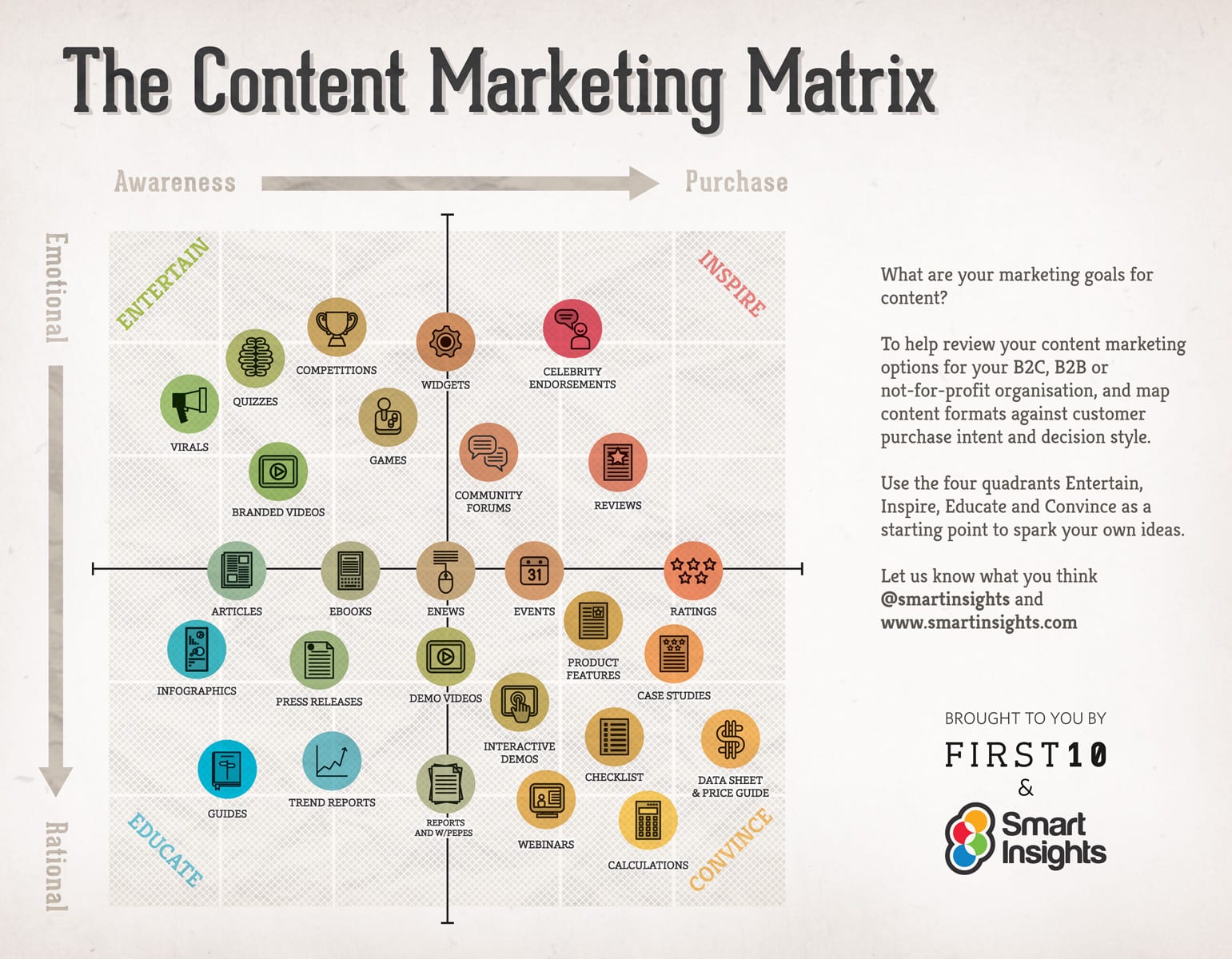
So this is how Dave Chaffey and I see it, here is our checklist for creating the perfect marketing infographic. I’ve also written a follow-up on promoting infographics.
We will illustrate it with extracts from our B2B Marketing infographic.


 Earn the next click – Infographics are (we hope!) quickly digested because they explain and address the valuable ideas, facts and statistics that your audience really want to know. By the nature, it’s of course true that you can’t relay as much information in an infographic as you can in other marketing materials. So consider infographics as a teaser to more detail for those that want it, what is by definition a call to action; encouraging users to take the next step and read or download the guide, blog post, e-book, video or whitepaper.

We hope this checklist is helpful for when you’re creating infographics. Is there anything obvious that we’ve missed and you would add to the list?
For many new graduates encountering the job market for the first time, they’re discovering a very harsh and competitive environment. In the UK, unemployment has been falling recently, but the number of long-term jobless has hit a 17-year high illustrating that competition for jobs has never be tougher for both young and experienced professionals.
However, with the explosion of social media and other digital communication channels, it’s sometimes difficult to understand why prospective employees still rely primarily on the trusty 2-page CV to promote themselves. Whilst still a very important tool, the CV often paints a very one-dimensional picture of one’s professional history, skills and achievements.
In contrast, digital channels such as websites, blogs, podcasts and social networks can be used to build up a much deeper, more fluid representation of one’s interests, passions and professional experience. When we look at what these channels can do, it’s hard to imagine how this could be effectively captured within a standard CV.
These are my personal suggestions on developing your profile to help with your online profile and career using the range of options available today.
Following on from Smart Insights’ manifesto for today’s marketing in 2011, in May this year Econsultancy introduced their Modern Marketing Manifesto. Like the Smart Insights’ success factors, Econsultancy’s manifesto aims to outline why they believe marketing is increasingly valuable and to define what it is to be a modern marketer. The manifesto doesn’t look at digital and traditional marketing in isolation. Instead, it considers how the two can be fused to reconstitute what modern marketing is today.
The two manifestos successfully sum up skills companies need to manage today’s marketing and they offer clues as to where marketers should be focusing their efforts.
Using this as a backdrop, it’s possible to begin looking at the tools, tactics and channels modern marketers should be using to demonstrate who they are, what they believe in and the top skills many recruiters are looking for.
From the outset, it’s important to be clear about what type of marketer you are and the role you’re looking for. Knowing what you believe in and where your passions lie will allow you to shape and refine the messages you want to communicate and identify the channels that will work best for you.
Although it’s often easier and less costly to own a free profile on a social network or blogging site, I believe it’s important to create a self-hosted website that allows you to own your very own piece of digital real-estate.
You’ll have more control over visibility and user experience as well as design and the way content is presented.
Based on the previous section (‘what do you want to do’), decide how you want to position yourself, your site and what it will be about. It could be a blog or simply a professional landing page/ nameplate site.
Blogging is one of the most effective ways of building authority and thought-leadership and gives anyone the opportunity to publish their work, ideas and designs in a multitude of formats.
Blogging also offers you the opportunity of getting noticed within both search and social. Great blog content can help you rank in search engines for what you specialise in (e.g. ‘digital marketing specialist Manchester’) and original, helpful, unique content is more likely to get shared across social channels, especially Twitter, LinkedIn and Google+.
If you decide to blog, you may also want to consider blogging for others people’s sites, too. Guest blogging can give enthusiastic bloggers an extra way of getting their message out to often a wider and more diverse audience.
Writing for sites other than your own can add credibility and shows employers or potential clients that you have the skill and flexibility to adapt your writing and thinking to different situations.
Social media has been a real game-changer for job-seekers and potential employers alike. Never before have people had the opportunity to craft and shape their message with so much freedom and reach such a wide audience at the push of a button.
There are hundreds of social networking platforms to choose from but only so many can be effectively managed at one time. Some social networks are likely to be more useful than others to showcase your professional skills although each will also be dependent on where your interests lie.
Although any social network can be used to build authority and thought-leadership, the following sites may be the most helpful for building your online profile:
One of the first things many recruiters will do is to check out prospective employees’ profiles on LinkedIn, so at the very least it’s worth making sure you have a detailed, up-to-date record of your work history, skills and achievements.
However, LinkedIn is so much more than a place to store one’s online CV. As a professional social network, LinkedIn gives users the opportunity to update their newsfeed with original and curated stories as well as join and participate in groups around the subjects they’re interested in.
Twitter is a brilliant way of connecting with like-minded individuals and Thought Leaders in any field anywhere in the world.
The real value of Twitter lies in its brevity and the ability it gives users to easily share other people’s content (e.g. through retweets) and start conversations around tweets and hashtags. It’s also another way of demonstrating what you’re interested in by curating content from others you’re following.
For example, if your interests lie in social media, regularly sharing and commenting on tweets from Experts like Brian Solis, Jeremiah Owyang or Mitch Joel is a great way of demonstrating how you’re keeping up-to-date.
Although it may not have the appeal of Twitter, the professional reputation of LinkedIn or the sheer popularity of Facebook, Google+ is brilliant ‘information network’, allowing you to keep on top of the top trends in marketing.
Many of the influencers on Google+ are passionate advocates of their areas of marketing and building a profile and engaging with followers on Google+ is brilliant for not only developing your own knowledge by discovering new and interesting content but also for syndicating your own ideas and interests.
SlideShare is super platform for demonstrating your skills and experience in a much more visual format through slides and presentations.
The increase in popularity of photo-sharing sites and apps like Pinterest and Instagram prove that great imagery and photography is an effective way of connecting with others.
Whilst it’s not quite as obvious how photo-sharing can build an online Curriculum Vitae, I’d argue that the huge popularity of Instagram and Pinterest, as well as the dependable Flickr, are great platforms for showing off your personality, sharing pictures from professional events and if you’re a creative, a brilliant way of demonstrating your ideas and concepts.
Despite the many benefits of developing and showcasing your skills online, there is still a huge amount of value in networking and meeting people in real life.
Attending conferences and summits is an excellent way of fine-tuning your knowledge whilst meeting fellow professionals in between seminars and keynotes. Getting to know others in your field of interest at conferences and networking events will allow you to make a more personal connection and guide them towards your website and digital profiles where they can discover more about you online.
Although digital channels offer job-seekers a big opportunity to demonstrate their knowledge and reach a wide audience, the humble CV should still not be forgotten. Most recruiters and employers will use CVs as the first stage in the vetting process for new employees so it’s important that your CV is professionally written alongside a compelling cover letter tailored for every role you apply for.
James Obermayer, Executive Director and CEO of the Sales Lead Management Association and President of Sales Leakage Consulting is a regular guest blogger with ViewPoint.
 Some have heard me say in interviews and on SLMA Radio that, pound for pound, marketers produce more revenue than anyone in their company. If this is true, and no one has refuted me yet, why isn’t marketing management (and everyone in the marketing department) compensated in some manner on revenue the same way sales people and sales management are paid?
Recently (Aug 29th) on SLMA radio I interviewed Eric Lundbohm about the different ways to compensate marketers (other than salary) for their efforts in creating wealth for their company.
Eric and I talked about paying Marketing on:
We kept coming back to total revenue. The key to making revenue programs work is to pay them on something they have the most control over; something directly connected to their efforts. The issue I brought up is that it’s a weakness to pay marketers on just total revenue. Generally, revenue for Marketing doesn’t meet those criteria. Marketers create tremendous interest and nearly 45% of those who are interested in some manner buy someone’s product. In my opinion, it’s for this “generated interest” that they should be compensated. Is this good or bad?
Granted, compensating marketers on revenue may attract a different type of risk taker than the type now working in Marketing. Is this good or bad?

Eric brought up MBOs (management by objectives) as a common tactic in use to compensate marketers for their efforts. This is used, he said, as a method to create qualified or sales-ready leads (as well as other marketing strategies or tactics). It is also a growing trend to use incentives for inside sales lead qualification people who work in Marketing. Is this good or bad?
Eric and I didn’t agree on everything, and that’s ok. But what do you think? Should marketing management, marketing specialists, and exhibits management, be paid on revenue, on lead generation, or on both? Should they be paid only on MBOs?
Is the idea good or bad?

The most commonly used are the commission or bonus but these are very individual and can set envy amongst your employees.
Another often used method is the ‘Salesman of the Year Award’ but this has the drawback of even more envy and also requires a full year which is not exactly motivating everyday.
The easiest solution to get all salesmen and even employees motivated is by defining a common enemy. An enemy similar to your company size. Don’t aim too high and only target the market leader if you are the second largest in the market.
The entire year, day in day out, the common enemy has to be challenged and will be challenged by your sales force and employees. It doesn’t need to be a war, but kicking their ass everyday will be very stimulating as motivation.
Once you have the ‘head on a stick’ you can aim for a bigger competitor as your enemy for your sales force.
Have you ever motivated your sales force with a common enemy ?
 B2B sales professionals are taught at an early stage in their careers that qualification is the key to success. Without fully qualifying your leads, you will have difficulty throughout the sales process, and, even worse, you may be setting up your company for failure. What’s commonly overlooked is the buyer’s perspective. Are we a good fit for them? Most sales reps think about whether or not a lead can become a customer, but they fail to address the future of the relationship. In other words, sales qualification is really a two-way street, and it’s our responsibility to make sure the road is clear in both directions.
I won’t dwell on all of the established (and recently updated) thinking on qualifying sales leads. Basically, you have the old-school thinking (BANT) and the new-school thinking (GPCTBA/C&I). Pete Caputa from HubSpot recently wrote an excellent post explaining the differences between these versions of sales qualification doctrine.
BANT (Budget, Authority, Need, Timing)
This is the old standard we’ve all used for many years in which we evaluate the “fit” and “readiness” of a prospect for an imminent sale. We are trying to find out if the prospect is a decision maker, has enough money and is serious about a purchase in the near future. This is a classic one-way street. It’s all about us selling to them, and the heck with whether or not we are actually the right solution for their needs.
GPCTBA/C&I (Goals, Plans, Challenges, Timeline, Budget, Authority, Consequences and Implications)
The new school doctrine turns the equation around and asks the question, “What do you actually want and need, and what if you don’t succeed?” Now we’re interviewing the buyer and assessing his current status, desires and the roadblocks to success. The decision for us boils down to whether or not we can help him get to the goal line in a manner that best fits his parameters (and ours) including budget, resources, timing and a whole host of possible complications. The decision for him boils down to how well we’ve framed the challenges and addressed them, as well as how comfortable he feels working with us.
This new-school approach goes a lot further toward aligning the interests of both buyer and seller, but from whose point of view?
The other side of the street is what’s missing. The buyer’s perspective. It’s true that with GPCTBA/C&I we have (hopefully) asked the right questions that establish, from our point of view, whether or not there’s a good fit between our solutions and their problems. Unfortunately that approach alone does not guarantee customer happiness once the deal is done. Of course, we still need to deliver the goods and provide great customer service, but have we really captured the interests of the buyer in the sales process? If I put my customer hat on, I’m concerned with:
I can think of a dozen more questions a savvy buyer should ask before she embarks on the journey with a seller. But does she do so during the sales process? Not very often in my experience. Buyers are usually sizing you up with more tangible criteria, like budget, deliverables, timing and manpower. They usually do address value when they compare you to your competitors, but do they evaluate the right criteria? Not so much. Price is usually No. 1, and that’s not often a good indicator of the probablity of success.
I say we are, the Sales Community. It’s in our interest to make sure the customer is going to be happy BEFORE we sell them anything, and that includes two-way qualification. The key questions to ask ourselves and our buyers are:
If both parties are comfortable with the answers to these questions, as well as the traditional GPCTBA/C&I questions, then we both stand to win.
Photo credit: quinn.anya

If you’ve read the news over the last several weeks you couldn’t have escaped the increasingly frequent (and often dire) references to emerging markets currencies and their plummeting valuations. Many pundits have even gone as far as to predict that export growth from the US will cease (as lower foreign currency increases the local cost of goods denominated in USD) and project possible repeat of the near global economic disasters of the LTCM crisis in ’98 triggered by a Russian default, and the Asian (mostly ASEAN) currency crisis of the same period.
Those are big, scary implications for a global economy that is likely less resilient today than it was in the late 90s.
But remember as well, the incredible growth and strengthened economies that emerged in Thailand, S. Korea, Indonesia and other neighboring countries. There can be great value created from such turmoil.
Emerging markets are growing. That’s incontrovertible and essentially irreversible. Whether you should bet your 401K on 5.5% vs. 8.2% annual economic growth is between you and your financial advisors. But that’s not the appropriate gauge for your export market involvement as a US manufacturer.
 In Sarah Max’s (@SarahvonMax) interview with Lewis Kaufman of @ThornbugFunds (Barrons 2 Sept 13) he presents both a compelling investment case, and also a critically important perspective for US manufacturers. ”While many emerging market nations will undoubtedly need to ‘take their medicine’ he says, domestic consumption in these countries is still growing much faster than in the developed world…’Domestic demand is the essence of the emerging market story.’”
That’s the important bottom line for US manufacturers to remember. Amidst the kerfuffle of record low rupee and potential inflation in Brazil, the fact remains that enormous new communities of consumers clambor for products. These aren’t folks debating whether to upgrade their 50″ LCD to a 70″ plasma, but rather ready to buy a 3rd set of clothing, a couple more candy bards and maybe an AC unit.
In other words, this local consumption, in an economic environment of rapid growth – often north of 5% even amidst challenges – can drive substantial export growth for American manufacturers with the vision and determination to enter emerging and frontier markets. (Want more daily info? follow @Shuli_Ren - Barron’s daily emerging markets blog author)
Intellectually it’s easy to acknowledge that currency cycles happen just like business cycles. But emotionally it’s tougher to watch your market development efforts punished by circumstances you can’t control. So periodic review of strategic objectives is important to help maintain perspective.
As long as the imperative for growth remains intact, and diversification across growing global emerging markets remains an element of the growth strategy, then local slowing can also represent an enticing opportunity.
Turmoil in the market could be the perfect time to accelerate your market entry with a bold strategy of acquisition or JV (joint venture.)
SMBs often default to an organic export growth model, typically through distribution sales channel. That’s often appropriate; carries low risk; works consistently if properly and expertly executed; and retains flexibility to respond to shifting market priorities.
But….that predisposition often precludes companies exploring other viable options for market entry and rapid growth. Acquisitions (where local majority ownership by US entities is allowed) and JVs are both appropriate vehicles for not only entering local markets but also achieving rapid growth – perhaps with accretive earnings contributing immediately to corporate profitability.
These offer a number of other potential benefits too, including relief from trade barrier tariffs and existing strong, local relationships so important in many markets. Strategically selected, the target will also open up an immediate body of prospective customers with an opportunity for a shortened sales cycle.
Not quite – as though the rest of your business life is, right? Due diligence for any such transaction is complicated and can be expensive. Add gray areas inherent in international transactions of privately owned businesses (e.g. black/cash vs. white/tax reporting accounting common to many markets and exposure to inherited FCPA exposure) and it’s even more complicated in this scenario.
But it’s also increasingly common, and the skills and experience necessary to make an informed decision, quickly, is increasingly available to SMBs for reasonable fees.
The bottom line is that economies follow cycles. But down cycles in rapidly growing economies still offer compelling growth to US manufacturers willing to pursue it, and may open up more exciting strategic opportunities for rapid and meaningful local growth through an M&A strategy. But none of it happens sipping on a latte or answering email. It takes vision and proactive action.
Can you? Will you deliver for your business?


Tried-and-true marketing wisdom says you must support your product or service campaign with ads. Buy more advertising, get more customers. Make sure to allocate plenty of dollars for online banners and maybe some print ads. And, if you have a great year, possibly reserve some budget for a TV or radio campaign next.
Then, you read about innovative companies winning new business by using "content selling" and tacticaly distributed collateral, rather than a general ad-based strategy, and you rethink everything. Which is the best way to go?
If you’re confused, you’re not alone. A report from the Content Marketing Institute and Marketing Profs, co-authored by Joe Pulizzi and Ann Handley, notes, “B2B marketers are more uncertain whether they are using various content marketing tactics effectively.” The study found that while more than 90% of marketers are at least dabbling in content marketing, only about a third have faith in its effectiveness.

We all know that training is an important part of business. We all know the value of working for an organization that invests in their people and looks to further develop their skillset. Reports show that in the US alone, businesses spend $15 billion per year on sales training. Yet, many sales people find the training they receive either ineffective or less than useful. We can do better.
Sales 2.0 as many call it; is en route for another revolution. Traditional sales methods are still engrained in many organizations and old school sales techniques are still rewarded and expected. Customers are no longer responding to these tactics and a new skillset is required.
Here are a few of the skills that are differentiating the best from the rest:
Professionals in sales roles need to understand the value of those around them. Furthermore, they need to have the ability to manage multi-level relationships and understand how to inspire their team to do great work. These skills don’t happen overnight as they’re established through experience and constant learning.
In B2B sales, it’s more often than ever to find that the selling process is done in teams and has multiple functions. As such, it’s important to have a deep understanding of people management skills along with the ability to keep those around you motivated and inspired.
Competition is fierce and buyers are more informed than ever before. As such, it’s important for sales teams to embrace any opportunity that could give them a competitive advantage within their industry. Technology continues to change sales for the better and give early adopters an opportunity to excel.
Sales professionals who have an openness to change and adaptability are more likely to succeed as they embrace the benefits of technology. These professional recognize that technology can arm them with insights and information to make more educated and strategic decisions. It allows their team to be more effective and efficient while ultimately driving their business forward.
Through our research, sales professionals across North America repeatedly cite relationships as the most important piece of sales success. Relationships with suppliers, customers, partners, colleagues and employers are at the foundation of successful businesses and sales careers.
In a world where 64% of B2B sales professionals express that cold calling hasn’t improved in 3 years, relationships matter more than ever. Relationships can be the difference between winning and losing a potential business deal. The best sales professionals recognize this and use their relationships to unlock new opportunities through referrals and introductions.
The buying process is becoming more and more fragmented. You need to understand how your buyers make decisions along with why they make decisions. From this knowledge, it’s important to be able to facilitate the buyer down the buying process as you provide different value at different times. Understanding the process makes it easier for sales professionals to build a compelling business case that considers everything from cost-benefits to strategic fit.
These skills and traits are at the core of what is needed to succeed in today’s landscape. People in a sales role need a broad skillset to not only compete but also excel. Sales leaders, HR Directors and CEOs need to ask whether their own organizations are hiring for these traits or creating a culture in which these skills are rewarded.
What other skills are needed to succeed in today’s landscape?

Here’s a sample of one I created recently
It doesn’t matter how awesome your product is, without proper marketing materials no one will ever know. Part of your marketing materials is killer sales pages. If you want to make many sales on any given product, create spectacular sales pages that make it easy for your target audience to choose to buy.
Sales Pages Should Be Scanable
Most people do not read the entire sales page. Therefore,it’s imperative that you make the sales page easily scannable with appropriate bullets, headlines, and plenty of white space. It should be clear at a glance what your offer is, what the price is, and how your guarantee works. Even if you have a long sales page, they should be able to look without scanning and see the complete offer.
You Must Have a Compelling Offer
If your readers cannot read the sales page and figure out what your compelling offer is, they’re not going to buy. You need to tell them exactly why your product is better, different, and a must buy. There should be no ambivalence about why they need to buy this product. You need to explain to your readers the benefits of your product in a way that speaks to them while also addressing their fears, concerns, and needs.
You Must Price Your Product Right
If you price it too cheap your audience may believe your product isn’t worth it. If you price it too high, they’ll realize you don’t know them. Knowing the right price to charge for your product takes insight into the demographics of your target audience as well as an honest assessment of your product’s worth. What is this product going to do for your target audience and what is that solution worth?
Your Product Guarantee Should Be Clear
Don’t try to be tricky about the product guarantee, just state it right out what it is and exactly how to take advantage of it. People like to know exactly how to get their money back if they’re not satisfied, and they don’t want to feel tricked. So, make it simple. Then follow through with providing refunds exactly as you stated you would. It might help to hire a customer service Virtual Assistant who will handle this aspect so that you can remove all the emotion from it.
Your Sales Page Should Elicit Trust
Give your readers reasons to trust you by providing some background information about you, and why you’re the right person to trust with the creation of this product. What is your background, and why are you an expert? Show pictures of users of your products along with their testimonials. Include a detailed FAQ about your product and how you provide customer service to your buyers.
By creating a sales page that incorporates all these features into it, you’ll be sure to hit home with your audience. It takes insight into your niche market to create a sales page that converts. You may need to create more than one sales page in order to test which one work best. That’s what’s so awesome about online sales and product launches. If something isn’t working, you can adjust on the fly without enormous costs.
RnordmanVery important point here.
The Big Data hype worries me. A lot. Particularly as it pertains to sales analytics. When it comes to understanding the inflection points that should be the determinants of behavior change to improve sales performance, we don’t suffer from an information deficit, we suffer from an insight deficit. Big data is perceived by some as the answer to the question. The problem however is that we often don’t know the question.
It is true that where we are today is a direct consequence of our past actions. You might therefore assume that a singular focus on finding correlations between historical data and results is the panacea to predicting future sales performance or performance hurdles. The difficulty however is that without applying context and experience there is a grave danger of mistaking correlation for causality, being blinded by a seemingly strong linkage between data and results without understanding the true causal factor.
Here’s an example. In some of our customers we have seen a direct correlation between the early identification of budget (allocated to a related project) as the most important indicator of sales success. But when we look at the data for others, budget seems to be less of a factor. When we looked beneath the data to understand the reason for this we uncovered an interesting fact. Early identification of budget is an important factor more often in a situation where the solution being offered could be classified as a ‘nice to have’ as opposed to a ‘must have’. This applies most frequently when the solution makes something better instead of fixing something that’s broken. Context and an experiential compass are important heuristics to apply to divine the meaningful from the obvious. Don’t let the data fool you.
Every day sales managers are struggling to find the answers to make their sales team more effective. Often remote from their sellers, and relying on weekly calls and reports from their CRM systems, these managers find it difficult to identify, interpret and influence the important factors that predict sales success or failure. Sales managers are battling to discover whether their sales teams are doing the right things at the right time to positively impact their sales performance. The volume of data is overwhelming and the insight is missing.
Sales managers can’t manage what they can’t see, and sometimes, even if they can see the data, they don’t know how to find and interpret the most relevant metrics that influence future performance. They grapple to extract pertinent insights that tell them the absolute truth about their sales business – today, and into the future. It’s just to hard interpret the data. And it gets worse. Even if they can find and analyze the data to derive the pertinent insights, the resource required to prescribe effective coaching or curative actions for each sales person, in a consistent and informed way, is overwhelming. But Big Data, as currently being prescribed, is not the answer.
According to a recent Infochimps survey most big data projects fail. According to this recent study, even though 81% of companies have Analytics projects as one of their top priorities, 55% of these projects do not finish. And while we all know that IT projects are not always successful, Big Data / Analytics projects will fail 30% more often.
The most common reason for failure is inaccurate scope. People try to boil the ocean, and assume that more data is better. Unfortunately, that is not necessarily the case. Now that technological advances have made it possible to accumulate colossal amounts of data at an ever-increasing rate, it has become almost axiomatic that the answer to everything in in the data. But in fact it is not. Companies are making BIG bets on BIG data alone without any qualitative assessment that applies deep domain expertise. That has the potential to lead to BIG decisions being made with BIG confidence that is sadly misplaced. BIG Mistake.
The second issue is lack of business context. Without the right business context it is hard to know what questions to ask – so in that case any answer should do – but of course that doesn’t work. It is understandable though that if there is a separation between the people with the business knowledge and the people with the analytics tools – then success is unlikely. Sales people need to be at the center of any sales analytics project. It cannot be a disconnected project owned by the business analysts or the operations team.
The third point is really an extension of the second. If you don’t have business expertise, domain knowledge, experience and a ‘nose’ for what’s right then you can’t apply any human qualitative input – and that makes it hard to connect the dots.
The most common challenges according to the study are Time and Tools. Now if the tools are hard, and the scope is wrong, then you will of course need a lot of time. We don’t believe it needs to be that way.
The leading sales organizations we have seen are not just using reports, or big-data centric analytics. They are combining targeted smart sales analytics, strengthened with embedded sales methodology knowledge and experience. In the best of cases they are using intelligent automated systems to help expose the relevant sales metrics, gain actionable insights from the data, and provide automated coaching advice to accelerate sales cycles, increase the health of their pipeline and align and motivate their sales teams.
And they are realizing significant business benefits:
I will follow-up this post with a set of recommendations on how you might approach sales analytics or big data projects – but I’d welcome your thoughts on this. Right now, there is a lot of time and money being spent in this area and most of it is wasted. It doesn’t have to be this way. The life of the sales manager is hard enough.

By Steve Loftness, Sales Benchmark Index
How do you know if your sales force is a high-performing one? This post lists some attributes of high-performance sales cultures. Also, it discusses one symptom of a non-high performing culture - high turnover. A Culture Creation tool is available by signing up for the SBI Making the 2014 Number tour. It lists 11 traits of high performance sales cultures. A bonus tool is included to help create a common vision.
Sales Turnover - A Symptom of a Low Performing Sales Culture
Sales Rep turnover at AdzaTran (a B2B transportation equipment supplier) has been increasing lately. Dani, the VP of North America Sales, is frustrated. Working with Hank, her HR Business Partner, she has tried various ideas. She's tweaked the hiring profile. Modified the sales compensation and quotas. Revised sales territories. Shifted around Sales Managers. Implemented standardization of tools and processes. She thought these changes were helping. However, Hank's analysis showed bad news. The turnover rate was still stubbornly high.
High-Performance Sales Culture Traits
Hank learned from Dani that he couldn't show up with just the problem. So, he did some research and was prepared for his talk with Dani. He learned that sales force success was 50% talent and 50% performance conditions. He also learned of the attributes of high-performance sales teams. Here is a list of some of them. There are more in the Culture Creation tool which you can get through the Making the 2014 Number tour.
Agile - Agile cultures look to get results quickly through fast changes - changes that may not be perfect, but cause tangible, positive effects in alignment with the organization's appetite for change.
Accountable - The culture is built on accountability to meet targets and expectations from the top on down. A continuous message permeates about getting it done and making efforts, not excuses. The culture also allows for individuals to raise their hands when obstacles are in the way, but doesn't let anyone bring just the problem without a solution.
Common vision - A set of "marching orders" is created, enabled and lived by the members of the team. As part of the common vision, expectations are clear.
Celebrates success and failure - A high-performing culture celebrates successes AND failures, but especially regards excellence with higher rewards. Success, failure and excellence are all defined so everyone knows what to shoot for. The culture does not hide or shy away from failures, but takes the time to understand them and learn from them.
Creating a Common Vision - One Trait of High Performance
Now, Dani and Hank had done a lot to improve the talent side. However, Hank saw they were missing a high-performance trait. That was a common vision for the sales team. Hank had analyzed exit interviews and the performance management data. He found that Reps felt isolated and unsure of expectations. Hank proposed that Dani work on a common vision for the sales force. He shared these four steps to follow in doing so.
1. Start with the company's vision and values. The Sales vision has to be aligned to the company's vision and values. Vision is a shared creation of a team's future and success. Values drive personal decision making and are foundational to making choices. Values need to be actionable and measurable, not just some platitude like "excellence".
2. Gather input from your sales force. Use the Culture Creation Tool questions to ask your team of Reps questions. You can get this tool along with many others by registering for the SBI Making the 2013 Number tour. This tool helps get an idea from your team on potential vision challenges.
3. Hold a vision creation workshop over 2 half days. During this workshop, work through defining these four areas, using results from step 2:
a. Purpose - Define the purpose - your team's reason for existence. It answers "why" you do rather than "what" you do.
b. Picture - Define an end goal - the aim of the team. What is the picture of where you want your team to be and by when?
c. Values - Define clear values of what you stand for. What each AE holds important; what each person wants to live and work by; how personal values are in line with CCOA values; what can be personally acted on; what are reachable and observable.
d. Vision - Define how your team will live the vision. This includes how it will be communicated (openly, consistently, repeatedly). How team members will commit to it. How the vision will be made a regular focus. How vision will be the judge of behaviors.
4. Live the vision to make it real, not just a plaque on a wall. Refer to it often, in meetings, emails, conversations. Use it to direct personal and team member development actions. Share it with everyone. Update it if necessary.
Read more from SBI for Next Steps to Creating Your Own High Performance Sales Culture.
 Need some help with your sales performance? Take a look at the sales training workshops available to you and improve sales performance.
Read more sales training articles from CustomerCentric Selling® - The Sales Training Company.