Shared posts

02 Oct 17:09

A Conversation with Adobe on the Future of Marketing and Disruption

by Brian Solis

Special_Edition__Extended_Marketing_Minutes_with_Brian_Solis_-_YouTube

Earlier this year, I had the opportunity to present in London at a special Adobe event to celebrate the launch of What’s the Future of Business: Changing the way businesses create experiences. Immediately following the presentation, I joined Adobe’s Jeremy Waite to shoot an episode of Marketing Minute.

As the title suggests, each episode is supposed to last 60 seconds. However, this conversation wrapped just shy of 10 minutes. And, I think you’ll see way. As Adobe explains, “In this special extended version of Marketing Minutes, Brian explores the Conversation Prism, YouthQuake and growth hacking.” There’s just no way to cover that many exciting topics in one minute.

In addition, Jeremy asked some tough but important questions:

- How can marketers equip themselves to act on disruptions on the marketplace?

- What are some of the more recent disruptions in the marketplace we’ve seen and based on those disruptions how do you think we as marketers can act on the shift that we’re seeing how people are behaving online and how they’re acting with one another.

- Tell us about the Conversation Prism. What you’ve added to it and what you have changes over the previous three iterations?

- On your blog you talk #Youthquake and Generation C. Give us an overview of what’s happening with the current youth generation, what marketers can learn from youth and what the future might look like.

I do my best to answer them in this extended version of Adobe’s Marketing Minute

My new book…#WTF

Connect with me: Twitter | LinkedIn | Facebook | Google+ |Youtube | Instagram

02 Oct 17:07

10 Tips for Leaving a Good Prospecting Voicemail

by TheSalesHunter

3458374 medium 300x199 10 Tips for Leaving a Good Prospecting Voicemail photoVoicemail is a tool you can use in prospecting.

Key is to leave a voicemail that reflects you in a positive manner.

This does not mean you leave a message about how great you are. Instead, you leave a message that offers the other person something of value.

Here are 10 Tips for Leaving a Good Prospecting Voicemail:

1. If your goal is to get the phone call returned, don’t leave enough information to allow the person to make up their mind. Leave them with only enough information to return the call. (You must create a reason.)

2. Repeat your phone number twice. If the person can’t write your number down easily, you’ve given them a perfect reason to not call back.

3. Messages left on a Friday afternoon are the least likely to be returned. For most people, Monday mornings are very busy and, as a result, only high-priority activities will get their immediate attention.

4. Do not leave voicemail messages at odd hours of the night.

5. The best hours to leave voicemail messages are from 6:45 AM to 8:00 AM and from 4:30 PM to 6:30 PM.

6. Voicemail messages are an excellent way to introduce yourself to a person. Be personable, yet professional, and link your message to something of interest to the person you are calling (such as another person or event).

7. When leaving your phone number, do not leave your website or email address as well. This will only give the person an opportunity to make a decision about you without calling you back.

8. Use the person’s first name at least twice in the message.

9. Avoid leaving messages that are longer than 20 seconds. The optimal voicemail message is between 8 and 14 seconds.

10. Do not leave the same voicemail message more than once for the same person. Always provide them with a new urgent reason to call you back.

Here’s a sample of a message I might leave someone:  Hi Ron, this is Mark Hunter, The Sales Hunter. I have some new information about what customers like to see in salespeople.  Ron, I’d be happy to share it with you. Give me a buzz at 402-445-2110. Thanks again! This is Mark Hunter, 402-445-2110.

Copyright 2013, Mark Hunter “The Sales Hunter.” Sales Motivation Blog.

button receive a free9 300x51 10 Tips for Leaving a Good Prospecting Voicemail photo

02 Oct 17:07

2014 Planning Metrics for B2B Marketing Leaders

by Vince Koehler

The Holy Grail of 2014 Planning: Marketing Contribution as a % of Total Revenue. 

2013 is the last year executives accepted activity-level results from marketing.  CEO's don’t accept activity reports from Sales leaders without revenue results.  Expectations of marketing accountability have increased to the level expected of sales performance.   

It’s easy to get caught up in reporting activity and miss the big picture.  There is so much interesting click data available.  Executive marketing leaders need to push the debris aside.  Focus on the core business drivers that B2B Marketing is fully capable of providing.   Help your team focus by giving them the big picture of the business. 

The top three success metrics for B2B marketing include:

  1. Lead Generation team % of Contribution to Sales Revenue (Wins)
  2. Lead Generation team % of Contribution to Sales Funnel (Opportunities)
  3. Quantity of Sales Qualified Leads delivered to Sales (Leads)

By far the most difficult to arrive are the first two metrics.  CMO’s are transitioning away from soft success metrics.  The metric of choice in 2014 is centered on Marketing Contribution to revenue.  Specifically the marketing contribution as a % of Total Revenue and pipeline Opportunities. 

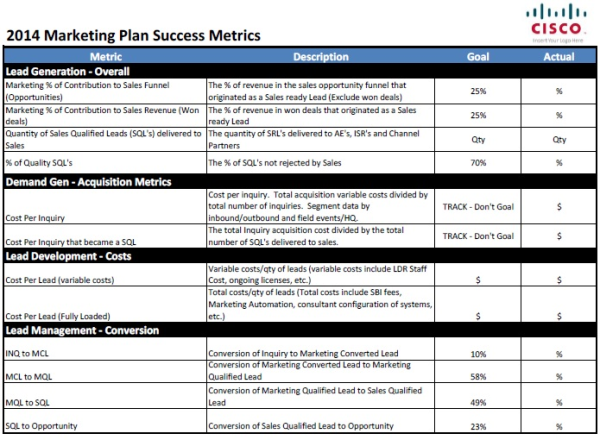
 Success Metrics resized 600

Sounds great doesn’t it?  Calculating Marketing Contribution produces a hard metric that is highly relevant to the CEO.  However this elusive metric is difficult to quantify.  The following two-step framework will help you define contribution. 

Find out how your 2014 plan stacks up against world-class plan outcomes.  Download our 2014 Marketing Plan Success Metrics to help you maximize planning efforts.  Get your copy by signing up for SBI’s 7th annual research tour here:  "How to Make Your Number in 2014:  A Strategy You Can Execute".

2014 Marketing Plan Success Metrics

Step 1. Marketing Contribution Agreement

The senior leadership of marketing and sales must sit down and agree on how to define ‘marketing contribution’ for your business. 

Net New Customers are easy to define.  It’s common for sales leaders to ask marketing to focus in this area.  This makes sense for marketing to direct significant resources on new logos. 

Marketing should be engaged in existing customer upsell & cross-sell.  This can be difficult to calculate the true marketing contribution.  Sales and marketing leadership need to approach this with a partnering mindset. 

Sales resources can’t cover every account.  Marketing should drive awareness and cultivate early stage interest. By leveraging marketing, sales can increase selling time and funnel opportunities. 

Marketing efforts that activate an existing contact to engage should be credited as a contribution by marketing.  The percentage of revenue derived from these activations should be tracked and celebrated.  This requires defining an ‘Inactivity’ period where a sales rep is not engaged in an active dialogue. As a rule of thumb this is 90-days for a complex sale.

Sales leaders can get sideways when they see ‘activations’ that would have likely happened sooner or later regardless of marketing involvement.  Yes, that can be true. The advantage is that marketing efforts drive engagement early in the process.  This early engagement is combined with lead nurturing with sales brought in at the right time. Early entry increases close rates and keeps competitors at bay. 

Document the agreed definition and maintain a dialogue as marketing and sales review the bottom line results of lead generation. 

Run through scenarios to validate that the definition plays out right for common occurrences in the field.  Don’t focus on rare exceptions.

Agree on a prototype definition to pilot in the first 90-days.  Expect to need to tweak and fine-tune the definition as you begin to track actual results with real-life examples. 

Step 2. Determine the % of Marketing Contribution

Begin by separating the revenue into three buckets:

  1. Net New Customers – New logos
  2. Existing Customer – Upsell and cross-sell
  3. Re-occurring Revenue – Maintenance fees, service agreements, license upgrades, etc. that are considered carryover sales from past efforts. 

It’s important to split Net New from Existing Customers since they are vastly different in the difficulty of acquisition and the expected percentage of contribution.

Once you have segmented the revenue, think through the expected marketing contribution based on the agreed upon definition.

  • Net New Customers – Marketing typically will have a contribution rate of 15-30%.  The range varies based on the level of maturity of lead generation capabilities.  A world-class marketing team will trend toward 30%. 
  • Existing Customers – Marketing contribution will range between 10-20%.  The % of contribution is lower, but usually greater than Net New revenue.


Leading Indicators of 2014 Planning Success

The third metric is the quantity of Sales Qualified Leads delivered to Sales.  This represents a crucial leading indicator that will drive the % contribution metrics. 

Making sure you are on track for 2014 requires you to be buttoned up.  The conversion rates between stages of the Lead Management Process are tracked to capture trending against B2B averages and historical team performance.  Underperformance of the beginning stages can be assessed quickly.  Proactive measures and campaign adjustments can be performed in time to recover. 

The following are examples of leading indicators through the entire revenue lifecycle. You can find a full breakout in the tool download

In Summary

Shift your team’s focus from activity to results.  Leverage the success metrics tool to align your planning efforts to drive tangible business results.  The download tool will validate and bridge gaps in planning.  

Download our 2014 Planning Success Metrics for Marketing Leaders to help you maximize planning efforts.  Get your copy by signing up for SBI’s 7th annual research tour:  "How to Make Your Number in 2014:  A Strategy You Can Execute".   After signing up, Direct Message me on Twitter @vinkoe or connect with me through LinkedIn to receive your tool quickly.  

Author: Vince Koehler

Vince Koehler

Google+ Vince Koehler on Google+

If you enjoyed this post, never miss one again by subscribing your Email Here and/or subscribing to the RSS Here.

02 Oct 17:06

3 Tips to Get The Best Response From LinkedIn Inmail

Since publishing my two free ebooks Cracking the LinkedIn Sales Code and LinkedIn Sales Secrets Revealed, I get asked tons of question about how to use LinkedIn best. One of the most contentious issues relates to the use of InMail. 

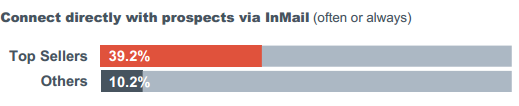
Numerous people have written to tell me it's a total waste of time -- that they never get responses from it. Yet, our 2013 survey results showed that top sellers used it nearly 4 times more than all other respondents. 

LinkedIn Inmail

And, InsideSales.com reports a 700% increase in response rates when they use InMail -- over sending the exact same message via email. According to them, it's especially effective with senior executives. 

Here are three tips to help you get the best response from LinkedIn Inmail:

1. Message quality is crucial. "Pitch" InMails that hype your products, services or company never work. Period. So if you're not getting responses, the first thing to do is to re-evaluate what you're writing. 

Make it relevant. Tie in your research on them or their company; show you've done your homework. Keep it short and easily scannable (For fresh ideas, check out my free Email Sales Kit.) 

2. Drive-by InMailing is insufficient. If you made one call to a prospect and they didn't answer, would you give up on the phone? Of course not, but that's exactly what many sellers are doing with InMail. Plan a campaign. Think of 2-3 follow-ups before you even send the first one.

3. Your profile influences their response. If you've written a good InMail, the recipient is going to check you out. Make sure you look like someone who's worth meeting. 

For more insight, check out what these salespeople had to say about their InMail success: 

Balazs Nagy says, "Once the prospects receive our InMails and read it, 50% of them respond back to us. We typically can arrange a meeting with 10%." That's pretty good odds compared to normal emailing.  

Terrence Bro adds, "InMail allows me to contact a perspective prospect in a softer approach. They also can view my profile to see what my credentials are and view my company information to determine if there is a potential fit and interest. Without LinkedIn, identifying and contacting new customer prospects would be a huge challenge with a lot of wasted effort chasing down unqualified leads." 

Let me just sum it up by saying, LinkedIn InMail is not the silver bullet. You can't expect to get magical results just because it's not competing with the 100s of other messages the person is getting each day. 

InMail, when it's effective, is part of a well-thought out prospecting strategy -- which includes a rock-solid message. And, that's what you need to do to make it work for you. 

02 Oct 17:05

Think You Know Mobile Millennials? Think Again.

Gen Y, the most socially networked generation, lags on social sharing, as over 74 percent don’t share great email deals on social networks
LOS ANGELES, Calif., October 1, 2013 – Results of a national survey of consumers commissioned by Campaigner®, the email marketing and CRM brand of j2 Global, Inc. (NASDAQGS: JCOM), revealed that more millennials make purchases directly from mobile marketing emails than any other generation.  eMarketer recently projected that m-commerce will account for nearly 16 percent, or $41.68 billion, of this year’s e-commerce holiday shopping spend; more than half of these transactions (62.5 percent) will take place on tablet devices.  Considering these factors, retailers have a huge opportunity this holiday season to tap into this highly mobile generation – 73 percent of which are already making transactions on mobile devices, reportedly spending more than they earn.  
According to Campaigner’s survey, the millennial generation (age 18 – 34) is emerging as the hot demographic for retailers to win over for mobile purchases this holiday season.  Of the millennials that own mobile devices, nearly nine in 10 (85.7 percent) use email on their mobile phone and, to date, more have made purchases directly from a mobile marketing email than any other generation.  
This mobile, tech-savvy group needs to be wooed - and in the right way.  Retailers face several mobile marketing email challenges when it comes to turning millennial targets into buyers and loyal customers.  The top three challenges mobile marketers face in this regard include motivating millennials to open the emails, engage with the email and then share the deals or offers through social channels.  According to the Campaigner® survey, only 19.8 percent are motivated to open emails because of the subject line, and 25.5 percent identify irrelevant or non-personalized content as the biggest irritation regarding the email marketing messages they receive on their mobile devices.  
The biggest opportunity retailers are missing is the benefits they would reap from adding social share buttons to their mobile marketing emails.  At this time, millennials depend on social networks to keep up with brands and deals.  However, the Campaigner survey suggests that when it comes to mobile marketing emails, a whopping 74.2 percent are not at all likely to share appealing email offers through their social media channels. 
While the holiday shopping season is undoubtedly a boon for retailers, the Campaigner survey reveals that that it might actually be the toughest time for them to break through to millennials.  Nearly 70 percent are indifferent to, or unengaged with, the mobile marketing content they are receiving during the holiday shopping season.  In breaking it down, nearly 50 percent (48.6) are undecided as to how holiday marketing emails impact their holiday purchases, and 21.1 percent feel overwhelmed by them, ignoring them outright. 
“Members of the Millennial generation are hands-down the most active mobile users and consumers in the world, and they will soon become the heart-and-soul of the mobile commerce economy,” said E.J. McGowan, General Manager of Campaigner.  “This generation is a game-changer for retailers and they will need to approach targeting this valuable demographic from all angles – mobile design, personalization, social, and content that engages.  It will be an exercise utilizing the best mobile email marketing practices, and Campaigner is here to help lead them to success.” 
Campaigner’s “Top Three Tips for Breaking Through with the Mysterious Mobile Millennial”:
• Up Your Social Game: To capture the attention of the most socially-networked generation to date, give them an easy way to share great sales or promotions.  Dedicating a small amount of space in a mobile marketing email for potential customers to share information on their social networks is an easy effort to make as a means to increase your millennial customer base.  If you really want to get them hooked – set up a rewards program for sharing.
• Go Mobile-friendly, or Go Home: Since millennials are exceptionally mobile-savvy, they lose patience with clunky, non-mobile optimized emails in an instant.  Make sure the size and style of the fonts used is readable, use big call-to-action buttons for easy tapping and mobile devices, and ALWAYS ensure that mobile marketing emails link back to a mobile-optimized site or landing page.  To cover your bases with responsive mobile design, more tips can be found here. 
• Know Your Millennials (better than they know themselves): The last thing you want a millennial to do is not to open your email – or worse – read your email headline, and delete it because it doesn’t relate to them.  Millennials have grown up in the age of on-demand, personalized everything, so it’s critical to go the extra mile with personalization in an effort to impress and/or reassure them that you know what they want, when they want it, before they even do.  
An infographic of the survey results can be found at: http://www.campaigner.com/solutions/infographics/pdf/Millennials-Infographic.pdf.

Gen Y, the most socially networked generation, lags on social sharing, as over 74 percent don’t share great email deals on social networks

Results of a national survey of consumers commissioned by Campaigner®, revealed that more millennials make purchases directly from mobile marketing emails than any other generation.  eMarketer recently projected that m-commerce will account for nearly 16 percent, or $41.68 billion, of this year’s e-commerce holiday shopping spend; more than half of these transactions (62.5 percent) will take place on tablet devices.  Considering these factors, retailers have a huge opportunity this holiday season to tap into this highly mobile generation – 73 percent of which are already making transactions on mobile devices, reportedly spending more than they earn.  

According to Campaigner’s survey, the millennial generation (age 18 – 34) is emerging as the hot demographic for retailers to win over for mobile purchases this holiday season.  Of the millennials that own mobile devices, nearly nine in 10 (85.7 percent) use email on their mobile phone and, to date, more have made purchases directly from a mobile marketing email than any other generation.  

This mobile, tech-savvy group needs to be wooed - and in the right way.  Retailers face several mobile marketing email challenges when it comes to turning millennial targets into buyers and loyal customers. The top three challenges mobile marketers face in this regard include motivating millennials to open the emails, engage with the email and then share the deals or offers through social channels.  According to the Campaigner® survey, only 19.8 percent are motivated to open emails because of the subject line, and 25.5 percent identify irrelevant or non-personalized content as the biggest irritation regarding the email marketing messages they receive on their mobile devices.  

The biggest opportunity retailers are missing is the benefits they would reap from adding social share buttons to their mobile marketing emails.  At this time, millennials depend on social networks to keep up with brands and deals.  However, the Campaigner survey suggests that when it comes to mobile marketing emails, a whopping 74.2 percent are not at all likely to share appealing email offers through their social media channels. 

While the holiday shopping season is undoubtedly a boon for retailers, the Campaigner survey reveals that that it might actually be the toughest time for them to break through to millennials.  Nearly 70 percent are indifferent to, or unengaged with, the mobile marketing content they are receiving during the holiday shopping season.  In breaking it down, nearly 50 percent (48.6) are undecided as to how holiday marketing emails impact their holiday purchases, and 21.1 percent feel overwhelmed by them, ignoring them outright. 

“Members of the Millennial generation are hands-down the most active mobile users and consumers in the world, and they will soon become the heart-and-soul of the mobile commerce economy,” said E.J. McGowan, General Manager of Campaigner.  “This generation is a game-changer for retailers and they will need to approach targeting this valuable demographic from all angles – mobile design, personalization, social, and content that engages.  It will be an exercise utilizing the best mobile email marketing practices, and Campaigner is here to help lead them to success.” 

Campaigner’s “Top Three Tips for Breaking Through with the Mysterious Mobile Millennial”:

  • Up Your Social Game: To capture the attention of the most socially-networked generation to date, give them an easy way to share great sales or promotions.  Dedicating a small amount of space in a mobile marketing email for potential customers to share information on their social networks is an easy effort to make as a means to increase your millennial customer base.  If you really want to get them hooked – set up a rewards program for sharing.
  • Go Mobile-friendly, or Go Home: Since millennials are exceptionally mobile-savvy, they lose patience with clunky, non-mobile optimized emails in an instant.  Make sure the size and style of the fonts used is readable, use big call-to-action buttons for easy tapping and mobile devices, and ALWAYS ensure that mobile marketing emails link back to a mobile-optimized site or landing page.  To cover your bases with responsive mobile design, more tips can be found here. 
  • Know Your Millennials (better than they know themselves): The last thing you want a millennial to do is not to open your email – or worse – read your email headline, and delete it because it doesn’t relate to them.  Millennials have grown up in the age of on-demand, personalized everything, so it’s critical to go the extra mile with personalization in an effort to impress and/or reassure them that you know what they want, when they want it, before they even do.  

Take a look at an infographic of the survey results here.

02 Oct 17:03

Report: 30% of b-to-b marketing budgets spent on content marketing

Cleveland—The average percentage of total b-to-b marketing budgets allocated to content marketing slipped slightly over the past year, to 30% from 33%, according to the newly released “2014 B2B Content Marketing Benchmarks, Budgets and...
02 Oct 17:03

Who Are the Brightest B2B Marketers of 2013?

by Michaela Delong

And the winners are… OK, so we can’t announce the winners quite yet, but we are thrilled to announce the finalists for the MarketingProfs First-Annual Bright Bulb B2B Awards.

The Bright Bulb awards were started because we thought it was about time we celebrate the excellence, innovation, and brilliance of you—today’s B2B marketers, agencies, brands, and marketing campaigns.

Our group of Bright Bulb finalists definitely fit this bill. They all deserve a rousing round of applause and high fives for the totally amazing, luminary things they are doing to prove B2B marketing is smart and, if we may, even sexy.

Here’s a look at the categories and finalists.

B2B Luminary (B2B Marketer of the Year)
Christine Crandell—President, New Business Strategies
Sean Shoffstall—Chief Operating Officer, Ozone Online
Karen Thomas-Smith—Vice President Marketing, Accountable Care Solutions, Optum

B2B Luminary Agency (B2B Agency of the Year)
CatapultWorks
Ozone Online
Quarry Integrated Communications

B2B Small Agency Luminary of the Year (B2B Small Agency of the Year)
Velocity Partners
Version 2.0 Communications
Wilde Agency

B2B Innovator Brand (B2B Brand of the Year)
Follett Challenge
Pixe Social
WIKA Instrument, LP

B2B Innovator Campaign (B2B Campaign of the Year)
AdobeAdobe’s Metrics Not Myths Campaign
Archdiocese of Philadelphia Office of CatholicChoose My Future Campaign
Microsoft (Office 365)—Office 365 Integrated Campaign
ReachForceMarketo Summit: Free Beer and Gold for Everyone Campaign
Rimini Street—Rimini Street Dares ERP Licensees to Compare Maintenance Value Campaign
Tripwire—Security Matters Campaign

Best B2B Creative
Korn/Ferry International
SunGard Infographics
Tripwire

Best B2B Marketing Project
Live Marketing
NetProspex Workbench
Wilde Agency

Best Newcomer Agency Award (the “Spark Award”—New, Small, Powerful Wattage)
Content Marketing Cardiology
Go Grow Strategies
Yesler

Best Newcomer Business Award (the “Spark Award”—New, Small, Powerful Wattage)
Email Monks
RedViking Engineering
Sovee

Who Judged the Entries?

MarketingProfs’ in-house team judged the entries, along with an external judging committee of marketing practitioners. A big thank you to:
Alan Belniak—Director of Marketing Content, LogMeIn
Rohit Bhargava—Founder, Influential Marketing Group
Carissa Caramanis O’Brien—Social Media Community and Content Director, Aetna
Susan Emerick—Social Business Program Manager, IBM
Carlos Hidalgo—CEO, ANNUITAS
Erika Napoletano—RedHead Writing
Tim Washer—Social Media Manager, Cisco Systems
Nick Westergaard—Founder, Brand Driven Digital

Get more details at the awards website.

And if you’re curious who will take home the big prize, the winners will be announced and honored at a ceremony on October 10, 2013, in Boston, during the MarketingProfs Annual B2B Forum. The event will be presided over by Ann Handley with Tim Washer as Master of Ceremonies. It’s going to be a rocking’ celebration. Hope to see you there!

02 Oct 17:02

Social Media Managers Must Work Around Lousy Business Models

by ahussain@hubspot.com (Anum Hussain)

angry-birds-planeRaise your hand if you've ever been screwed over by an airline. Yeah, me too -- multiple times.

Most recently, United Airlines canceled my flight out of Cleveland an hour before my coworker and I were to depart. When we asked what to do about having nowhere to stay for 10 hours, the airline said it couldn't help. When we requested a hotel, we got the same response.

In the midst of this mess, I took to Twitter and began venting my frustrations to @United. During the conversation, this magical little tweet came in from @AmericanAir:

@anum Let us know if we can assist you today, Anum.

— American Airlines (@AmericanAir) September 12, 2013

My initial reaction? "Wow -- what a great social media team. They instantly jumped in to help!"

After the airline's tweet, a series of folks responded, complimenting American for listening to a customer (and one who wasn't even theirs), responding quickly, and wanting to help.

Yes, my friends, this is an example of customer delight. But it also lends itself to a tale of a great social media team that, despite its heroic efforts, cannot save a poor business.

A History of Poor Customer Service

Earlier this year, I was flying American on a trip to California. I needed to change my reservation so that I could fly from Los Angeles to San Francisco before returning to Boston. I was providing American with more business with the caveat of changing my return flight to Boston in a few days. A simple request, right?

Not entirely. American asked me to pay $200 just to change my flight. This was more than the ticket price I was paying to get from L.A. to San Fran. "I'm sorry, you want me to pay more than the extra flight ticket I'm buying from you just to give you more business?"

I talked to four customer service agents, including two supervisors -- all who tried their best to help me -- but ultimately it seemed their hands were tied. No one was willing or able to override the $200 charge for the sake of retaining me as a customer (and actually getting more money out of me!).

So, I took to Twitter then, too. Within minutes, American responded. The company requested my ticketing information and went to work trying to help me. With every angry tweet I sent, they replied kindly and with an intention of helping. Unfortunately, though, despite the airline's desire to assist me, it couldn't get far without needing to have its own customer service team to step in. Nothing came of this move, either.

When American tweeted at me when I was stranded in Cleveland, I was hopeful. I requested a seat to Boston, and the airline responded with a chance to help:

@anum Anum, we have some limited seats available. Please call Reservations at 800-433-7300 for help in booking a new reservation.

— American Airlines (@AmericanAir) September 12, 2013

In excitement, I called the number. I waited for 15 minutes. I spoke with a rep for another 15 minutes. And then that rep, just like before, was unable to assist. Angry that American led me on, I began tweeting -- again.

And again, the company tweeted back, requesting I keep checking back in case something opened up. I eventually tweeted out admiration for its social media efforts, but disapproval for its unhelpful business model.

Meanwhile, by the way, United had only tweeted at me once -- asking for flight info. And after I sent it over? Pure crickets. No response. No apology. No desire to help.

Kudos to the airline's social media team for doing its best to respond and interact with customers. At the end of the day, though, no matter how important social media becomes for a business strategy, no matter how many brands begin to utilize it efficiently, if you're not backed up by a solid business strategy, your social can only take you so far.

Use Social Media to Help, Not Hype

I was actually in Cleveland for Content Marketing World. On the first day of the conference, Jay Baer spoke about marketing that is there to help, not hype.

As the social media manager or a member of the social media team at your business, you can't change a business's model or its core beliefs. You can't make a company care about its customers. But what you can do is make the most of your social media efforts by helping as best you can. Here's a few top ways you can assist customers.

1) Maintain Transparent Communication

When customers are upset, it's likely your team attempted to help. But unless you can 100% confidently provide a service, don't provide that service. American explicitly told me it had seats available when it didn't. The airline should've made that point transparent so I wasn't wasting time on the phone with a customer rep when I could be searching for other solutions.

It's worth having a discussion with your social media team about potential solutions for when you can't assist customers. In American's case, the social media team could speak with decision-makers about having some free or discounted tickets available -- or perhaps vouchers for a future flight -- for when they run into frustrated customers.

2) Build a Relationship With Customer Support

Work to build a direct line of communication with the customer support team. In our ebook on How Twitter Can Solve Challenges for Marketing, Support, and Sales, one of our customer service reps, Nick Salvatoriello, says: "Ideally, as customer service reps, we’d like to know about customer concerns before they get upset. By monitoring customer interactions on Twitter, you can spot people trying to figure out how to use your product or service."

And that's the way it should be. Perhaps your social media team can star or flag tweets from customers in your marketing database. That way, when that customer calls into the support line, the support rep knows this individual has already been communicating with the brand on Twitter. In my example, when I called American and said that the company tweeted this number to me to help, the airline knew nothing about the exchange.

(Tip for HubSpot users: Using HubSpot's Social Inbox, your social media team can easily email forward tweets that need customer support attention to customer support reps. Learn more in this blog post.)

3) Create a Hashtag for Specific Problems

Start a program in which customers can use a hashtag on Twitter to relay their issues to the company. By having one consistent hashtag, customers know that a brand’s entire community of customers has a place to communicate. The result is a hashtag that the customer service team can monitor on Twitter in order to respond to important tweets.

At HubSpot, we use #hubspotting for this purpose. We make that hashtag loud and clear to our customers in our phone consulting, in our messaging on webinars, and so on. That helps Nick stay in touch with his customers.

Imagine if United had a specific hashtag I could have used. Even if the company didn't respond right away, perhaps another customer was facing the same issue as me and could've helped. But I had no way to tap into United's community or properly get its attention.

Not All Airlines Getting It Wrong

After reading my story, you may be wondering, "Well, maybe it's just the airline industry as a whole that's terrible."

Not true.

My domestic airline of choice is typically JetBlue. Last year, I had an early flight to Chicago and accidentally slept through my flight departure. Crap, I thought. If airlines are typically unwilling to help, there's no hope when this is 100% my fault.

To my pleasant surprise, JetBlue customer service reps were charming and cheerful and told me I could either pay $50 for a new flight (which is reasonable -- especially compared to $200), or I could go to the airport and wait on standby to get on a flight for free. Arriving early, I easily got a seat for free on the next flight. This customer-focused business model delighted me. The airline truly cared about me reaching my destination, and made it easy for me to do so.

This business model transcends into the airline's social media efforts. Earlier in September, one Twitter user complained about his flight being canceled. Unlike my flight cancellation from United that resulted in no response, JetBlue let the passenger know he was entitled to a refund. That little dose of delight sure would have eased my stress in Cleveland!

@pzerbo So sorry your flight was cancelled. Safety is our top priority.http://t.co/f7bJBZa4XV You're entitled to refund if Thurs not option.

— JetBlue Airways (@JetBlue) September 2, 2013

So, to sum up the lesson for today: A great business model + a great social media team = customer happiness. If the model is something you can't control, though, then just work your butt off to resolve issues for -- and ultimately satisfy -- customers who have legitimate issues that they share on social media.

Image Credit: Gamerboy

crush competitors social media

subscribe to the hubspot marketing blog

02 Oct 17:02

10 Ways to Make Your Content More Fun to Read

by pvaughan@hubspot.com (Pamela Vaughan)

kid-having-computer-fun"But I write about mortgages (or some other similarly 'boring' topic) -- there's no way I can possibly make my content fun to read." For many of you in the B2B boat, this is probably an excuse you can easily relate to.

But I'm going to fight you on this one because, hey, I'm a B2B content creator, too. And we sell marketing software over here -- not exactly the sexiest product to peddle, if you ask me. But we've heard time and time again from our readers that they love coming back to our content because we make it fun and interesting to read about marketing.

Even companies in "boring" industries need to create content. But the thing is, people who read about mortgages aren't waking up one day thinking, "I think I'm going to read about mortgages today!" They read that content because they need information about mortgages -- maybe because they're considering buying a house. So why not make the otherwise boring, tedious process of reading about mortgages (or insert your industry here) a little bit more interesting -- maybe even fun -- for them? After all, everyone loves being entertained, right? And injecting a little bit more fun into your content might even set it apart from some of your competitors' truly boring content.

So without further ado, here are 10 smart ways to make your content more fun to read.

10 Ways to Make Your Content More Fun to Read

1) Tell a Story

You may be writing about some boring industry concept, but that doesn't mean you can't weave in a little storytelling. Telling stories or anecdotes is a great way to engage your readers and make your content relatable. It also makes your reader realize that behind that stuffy industry concept is a real person who's writing it.

Don't be afraid to draw from personal experiences -- just be sure they relate back and transition well to the topic of your content. Here's an example of how a colleague of mine, Ginny Soskey, incorporated a personal anecdote to set the stage for the 10 free design tools she highlighted in this post:

storytelling

2) Crack a Joke

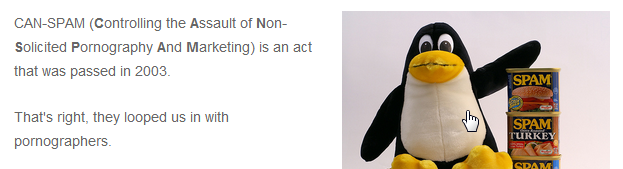
This one is a little tougher, as it requires a sense of humor ;-) That being said, you don't have to be the funniest person in the world to make readers smile here and there. Sometimes, your choice of words or a little parenthetical quip will do the trick. Just loosen up, be yourself, and if you're not sure whether something is actually humorous, run it by an honest co-worker. Take a look at how my colleague Corey Eridon cracks a joke in a post about a pretty dry topic (CAN-SPAM).

can-spam-joke

3) Use Your Introduction Wisely

The intro of your content is one of your best (and easiest) opportunities to be creative and fun. What's more, this is the perfect place to do it, since you want your introduction to be compelling and interesting enough to get your readers' attention (no easy feat, believe me).

And, hey -- whaddya know? Intros also happen to be great places for cracking jokes and telling stories! You can also consider being empathetic or coming up with another creative way to introduce the reader to what lies in the content ahead of them. The goal is to get the reader to emotionally connect with or relate to the content so they want to keep reading. For more tips about writing great introductions -- and an example of a great introduction in and of itself -- check out our post, "How to Write an Introduction."

inro-example

4) Watch Your Tone

Boring topics will sound even more boring if you write with a bland tone. In most cases, you can get away with a conversational, informal tone in your writing -- especially if the writing is going on a blog, not in an academic paper. Think about how you would communicate with someone verbally, and adopt that tone in your writing. Your readers will thank you for content that, albeit educational, is also easy to read and get through. Isn't the following so much more enjoyable to read than it would've been had we stopped after that first little paragraph?

tone-example

5) Use Fun, Hypothetical Examples 

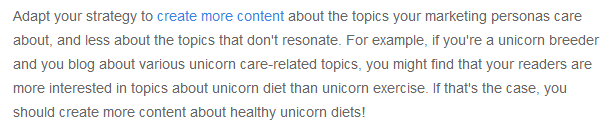
On the content team, we like to call these "unicorn examples." Here's why: For a while here at HubSpot, we had kind of a unicorn thing going on. The unicorn even turned into somewhat of a mascot for us (we called him Hu). In any event, every time we were looking to enhance our blog content with a hypothetical example to explain a concept more clearly, the example went something like this:

unicorn-example-example

Off the wall and totally fun, but still very relevant and helpful in getting our readers to understand how to use analytics to identify the topics they should be blogging about -- the topic of the post it appeared in.

This approach works particularly well when you're writing for a variety of personas, because it levels the playing field (since you're using an example that doesn't just apply to one particular persona and not the rest).

6) Hijack a Meme

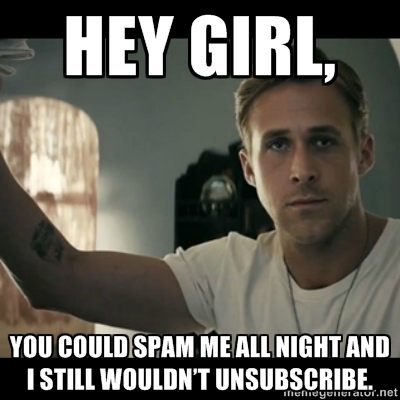
I'm not gonna lie -- I loooove memejacking. Meme-what, you ask? If you're not familiar, a meme is quite simply a concept, behavior, or idea that spreads, usually via the internet. Memes most commonly manifest themselves in visuals such as images, pictures, or videos, but they can also take the form of a link, hashtag, a simple word or phrase (e.g. an intentional misspelling), or even an entire website. If you're still having some trouble grasping the concept, check out some of these popular memes. I bet you'll recognize a few.

What's great about doing some memejacking in your content is the fact that memes are inherently fun, engaging, and wildly popular. But how exactly does one "hijack" a meme? Luckily, we've written a detailed blog post on the subject that provides some great memejacking tips and tricks. The great thing is, you can either go big like Moz, which announced its Series B funding through an entirely meme-themed news release ...

semoz-memenouncement

... or like we did with our post about marketing pick-up lines, as told through popular memes.

pickupline12

Perhaps you can be a little bit more subtle, sprinkling in a meme reference here and there to add a little fun to your content, like we did in our recent post about what the best bloggers do

haters-gonna-hate-meme.jpg

7) Incorporate Pop Culture References

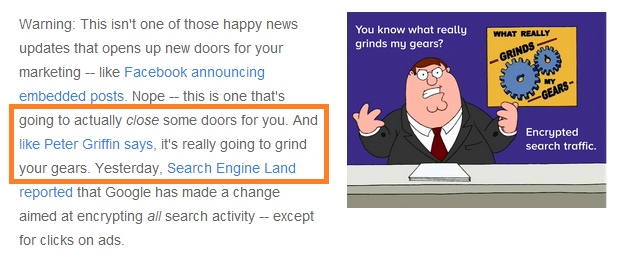
Speaking of popular memes, how about a little pop culture reference to liven up your content? Here's an example of how we did this recently in a post about Google's move to encrypt all keyword search data -- not exactly the most uplifting article for marketers, but there was no sense in us being total Debbie Downers about it. A little humor, it turns out, is a great way to help cope with bad news :-)

grinds-gears-example-1

Just be mindful of your target audience with this one (and come to think of it, with memejacking, too). If the majority of your audience won't have any idea who or what you're referencing, it'll be a total flop. Now, you won't be able to appeal to everyone, but use your best judgment and keep your personas in mind when making pop culture references like these.

8) Get Creative With Images 

You know what they say: "A picture is worth a thousand words." Imagery is not only a great way to improve the social shareability of your content, but it can also add a little fun to it, too. Take some extra care in choosing images for your content. Can you use them to enhance a joke you made or crack a new one? Can you simply select a relevant image that's already funny in and of itself? Can you overlay a caption or add a clever thought/talk bubble like we did in the example below (which can be found in this blog post)? Don't be afraid to get creative! 

donkeys-who-assume-1

(Image Credit: horslips5)

Just be sure you have the right permissions to use, adapt, or modify the images you're using. Use photos appropriately licensed under Creative Commons (but be careful), or purchase stock photos. (Bonus: We have 235 stock photos available to download for free here and here that you can adapt however you'd like!)

9) Add a GIF

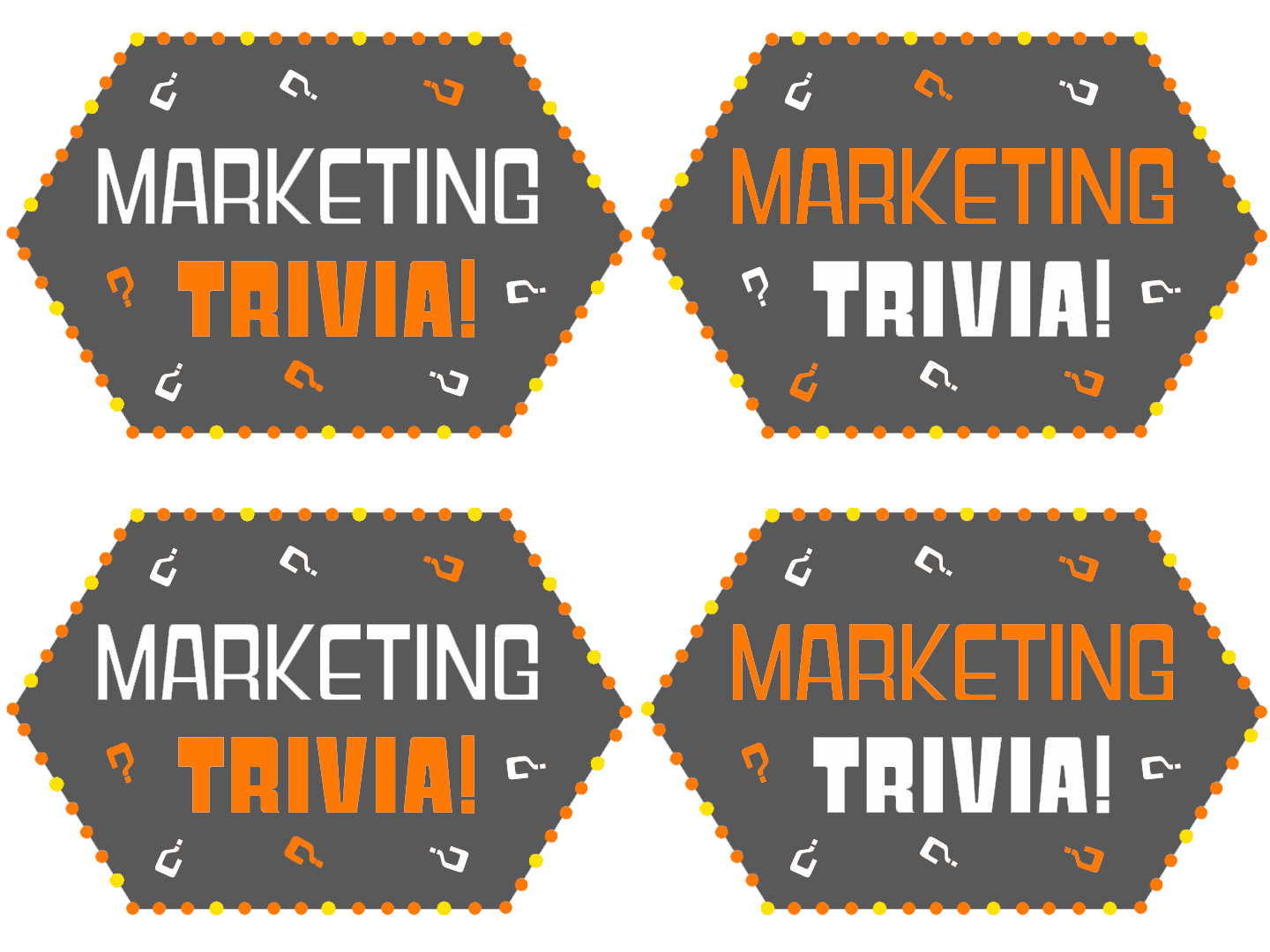
How fun is the GIF pictured below?

Marketing-Trivia-Image---1-1

We added it to the blog post and landing page for our marketing trivia game offer to give it a little oomph and emphasize its game show-esque look and feel. Animated GIFs are great for catching readers' attention and making your content just a little bit more interesting. To learn how to create an animated GIF, check out this simple how-to blog post. And to learn more about how to use them in your marketing, this post will do the trick.

10) Hide Easter Eggs 

No, I'm not talking about colorful, hard-boiled eggs here. In the internet world, an Easter egg refers to "an intentional inside joke, hidden message, or feature." And from the reader's perspective, there's nothing more fun than a well-hidden Easter egg. You know why? Because there's a sense of exclusivity associated with them. It also makes you feel wicked smart when you actually discover one! Hiding Easter eggs adds a fabulous level of interactivity to your content, and it's also a great way to engage your readers and get them to come back.

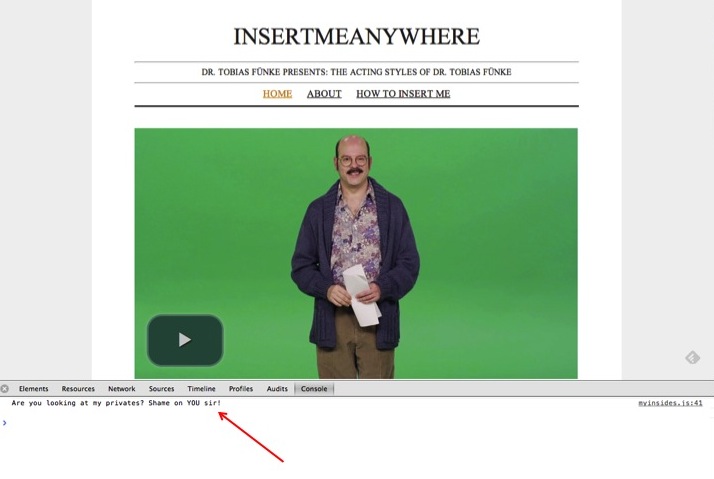
One of my favorite Easter egg examples was hidden in the launch campaign for the return season of Arrested Development. In these examples, the brilliant marketers of the show hid messages to fans -- quotes from character Tobias Fünke -- in the code of the microsites that were created for the campaign:

tobias-easter-egg

(The above message reads, "Are you looking at my privates? Shame on YOU sir!")

You don't have to get as fancy as hiding messages in your website's source code either -- even just hidden messages that certain personas or long-time readers of your content would "get" can be a fun, yet simple, approach. Just be sure that any Easter eggs you hide not only appeal to your target audience, but also enhance (not take away from) your content.

What other suggestions do you have for injecting more "fun" into your content?

get 160 free business stock photos

subscribe to the hubspot marketing blog

02 Oct 17:02

What the Heck Is Blogging? A Sneak Peek Into Marketing's Newest Pastime [Infographic]

by gsoskey@hubspot.com (Ginny Soskey)

blogging_FAQs_infographicI'm still not entirely convinced people know what I do. I get questions all the time like, "Wait ... so you just write all day?" Or, "Is that a full-time job?" Or, my personal favorite, "Is that even a real job?"

I get lots of questions because the reality is most people really aren't sure what the heck a blogger does in this wide world of professions. And I'm just one type of blogger -- a business blogger -- but there's way more questions about the world of blogging than those that revolve around day-to-day responsibilities. How many people read blogs? If you write for a business' blog, what kind of business metrics can you drive? If you're a full-time blogger, how much money can you make? These are just a few of the questions that most people wonder about.

Lucky for us, Ignite Social will answer your most burning questions about blogging in the infographic below and even give you eight quick tips to help you up your blogging game. So go on, read it! And if you love it, don't forget to "Pin It" to your favorite marketing-related board.

The-blogconomy-infographic-640x5604

Image credit: Mike Licht, NotionsCapital.com 

introduction to business blogging ebook

subscribe to the hubspot marketing blog

02 Oct 17:01

Get That Darn Email Opened

by Tom MacKendrick, VP, Digital & Data

So you’ve created the story you want to tell, have a powerful offer and have determined that the best medium is email. Your creative team has worked long and hard, using best practices and all their skills to create an effective and powerful representation of that story. You now have a great email that should drive engagement! Your development team has put in all the bells and whistles to track behavior. You have a great communications plan that is based on the customer’s engagement. You blast the thing.

And no one opens it.

This is a painful occurrence that too many marketers live through. To get past it, there is one surefire way to improve your open and engagement rates: subject-line testing.

According to Marketing Sherpa, most marketers (over 70%) say they use subject-line testing regularly. But are they doing it right? Are the culture and process in place to ensure proper subject line testing every time?

Great subject-line copy starts with a culture that makes subject lines a priority, not an afterthought.

The goal of your subject line is to first grab the recipient’s attention and then convert that attention into interest. A hefty goal for a sentence, but it can be done. I’m not going to show you best practices around subject-line composition (I will cover that topic in another article). I’m going to discuss how you need to set up your digital processing culturally and operationally to ensure that subject lines are written well and tested.

Creative: Putting Subject Lines First

Subject lines can be the most important part of an email. Yet, they are often hastily thrown together after the email is completed. At KERN, we understand the importance of subject lines and have built a process in which the writer takes the creative brief and writes up to 10 subject lines. This may seem excessive, but forcing the writer to develop a host of good email subject lines does create better outcomes. Additionally, we have a set of best practices for writing subject lines. Yes, an entire 10-page document just on the pros and cons of short versus long, active versus passive, mobile versus tablet versus desktop, etc. We take it that seriously.

Process: No Email Goes out Without a Subject Line

Our dictate is that A/B testing of subject lines is just the bare minimum. We like to have at least four good alternatives in every blast. If you have a contract with an Email Service Provider, you must set up agreements and processes to make this happen. If your ESP tells you they don’t have a process for subject-line testing or the ability to give you results from the test within hours, then work with them to come up with a process. Or get a new ESP.

Take small, but statistically significant samples and blast to them no more than one per day prior to your main deployment. Results should be turned around the same day, and analysis on engagement metrics should be evaluated to determine the winning subject line. Remember to use both open rate and click-to-open rate to not only find out which subject line gets the most opens, but also which is most aligned with the message of the email so that consumers click through. Review opt-out rates to ensure the subject line is not so misleading as to encourage opt-outs.

When working with partners, such as acquisition emails sent directly from list/site owners, the process can become more difficult, only in the sense that they may not be used to doing this level of testing and reporting. Often they consider each combination of creative and subject line as a unique version. But work with your partners to try to put together a process. Even if you are limited to A/B testing, it’s a start.

We have seen increases in open rates of up to 40%–50% based on these tests. Usually, however, it is closer to 7%–9%. Still, this can mean significant increases for you in sales and revenue. Once the process is in place and it is second nature, never again will you wonder if it was your subject line that lowered engagement. And you will get that darn email opened!

The post Get That Darn Email Opened appeared first on KERN.

02 Oct 17:01

Lead Nurture: A Cautionary Tale

by David Jones, Account Director

In most organizations, sales and marketing departments are as compatible as oil and water. Sure, you can mix them together with some vigorous shaking, but they’ll likely separate the moment you stop. Who knows where this animus started? Maybe it tracks back to some medieval peddler who simply wanted to trade chickens without noting his lead source, which no doubt ruffled the feathers (pun intended) of his marketing counterpart. “How can we optimize without accurate attribution?” I can almost hear him muttering to no one in particular.

I’m going to discuss the mechanics of best practices for lead nurture. However, the more interesting takeaway is tied to a cautionary tale about the competing agendas of sales and marketing and how a lot of good work can go for naught when both sides can’t find a middle ground. Ultimately, in organizational struggles like these, whoever has the high card wins.

It all started many months ago when KERN was engaged to develop a best-in-class lead-nurture program for an exciting new client. Since this particular organization was reestablishing itself, its slate was blank. We recommended a methodical and rigorous approach to building their program, which we’ve done numerous times before. For us, it was familiar ground. For them, not so much.

First, we clearly explained the challenging and painstaking road ahead, and the mandatory need for cross-organizational participation.
Then we hosted a two-day off-site meeting to do the demanding, but necessary, work that would ultimately define their new lead-nurture strategy and rollout.

Buoyed by a roomful of eager client faces, sharp pencils and walls papered with jumbo-sized sticky notes, we jumped in, leading what would eventually be 16 hours of open discussion and spirited debate among the assembled sales and marketing leaders. In the end, here’s the groundwork that was agreed upon:

  • An agreement on common lexicon, such as the definitions of an inquiry, a marketing qualified lead and a sales-accepted lead. This was not a simple task. It can be argued that this is the most crucial step in the entire process. Without a common language, failure and process breakdown are inevitable.
  • Alignment on lead quality, routing, triage and reporting.
  • Collaborative consensus on lead scoring, including strict definitions and value assignments for explicit and implicit criteria. Explicit scoring would be tied to traditional BANT (Budget, Authority, Need and Timing) measures, while implicit scoring would be centered on a lead’s engagement with content and other behavior via a gated online sales portal. All scoring would be aggregated throughout the nurture process, allowing leads to compile “points” on their way to eventually being passed to sales for conversion.
  • Specific, excruciatingly detailed mapping of leads flow from marketing’s automation platform to sales’ contact management system.

About three weeks later, after a series of email exchanges, we all met via a final conference call to review agreements and cement next steps. As expected, we had to cover some old ground, and that’s when the oil started to separate from the water. It became clear that sales held the high card—and they were going to play it. It was also apparent that they preferred a looser and more fluid approach to this collaborative engagement, and they weren’t yielding. Some of the cracks, to be honest, began to appear soon after the original meeting adjourned, but it’s also fair to say everyone felt good about where we were. Wrong.

To this day, despite a long, strong and impassioned plea from marketing (and us), I’ll never forget the words uttered by the senior sales leader. They dropped to the floor like an anvil.

“A lead is a lead. Why don’t we just pass them all to sales and see what happens?”

Somewhere a medieval marketing executive rolled over in his grave. We knew that time and the likelihood of unsatisfactory conversion rates would ensure future dialogue with sales. Within two months, sales ultimately adopted a bulk of the original lead-scoring strategy, which continues to pay dividends today.

The post Lead Nurture: A Cautionary Tale appeared first on KERN.

02 Oct 16:29

Linkedin – The Place to Connect in 2013

by Brent Pohlman

Linkedin – The Place to Connect in 2013 image medium 8909648547Most of you are intrigued with what social media can bring to the table. You have spent time on Twitter, Facebook, GooglePlus (Maybe- See yesterday’s post) and other sites.

In the past month I have revisited Linkedin and found a whole new appreciation for connecting with some of the best people in the business. Plain and simple, this is where I want to spend my time with social media. It’s about the people.

On Twitter, it is all about real time information. People are important, but Twitter really is a news and information site. The best people provide the best information, but it takes a whole lot of effort to connect with people in real time. Linkedin is real-time but you do get a breather from time to time with people posting on Linkedin Groups and if you check out updates, you can get a feel for what people post on a regular basis.

On Facebook, for me it’s about family, friends, retail and organization announcements. It’s that nice, family friendly site where people learn a little more about their family and friends outside of work. Great site, but for my business it is more of a family, friendly newsletter type of atmosphere. I used to follow a lot of people on Facebook, but have since cut back because this type of information is a bit personal and I believe you need to know more about the people you are connecting with, (or maybe you might want to know less – if you get my point)

GooglePlus is still the wildcard. I think it is great to connect here. I think it takes a lot of work and it is not everyone’s first place to go to for connecting and engaging with people. For those of you, who’ve been able to make this platform their number one place for connections. Congratulations – You must really be doing something great and I am jealous. Keep up the great work and the rest of us will hopefully get there someday.

Linkedin has made a number of changes in the past year and I really think the quality of people on this site is what makes this platform stand out from the rest. Where else can you go and connect with CEO’s, Executives, Managers and Support Personnel. Everyone has a story and you can learn a lot by looking at profiles.

(A Major Benefit ) In addition, I like the fact that you can also see who is viewing your profile information or updates.

(Another Benefit) If you update your profile, a message is sent to your connections regarding this update

(Another Benefit) You can connect with people in your industry, profession and potential markets.

(Another Benefit) You can follow your competitors. You can follow individuals or companies. A great way to stay connected in your industry.

(Groups) You have the ability to dialogue with others in a group setting. In addition, you can connect with these same people.

(Updates) (Most Benefit) You can post valuable information for others to read and comment on in a controlled, “NO SPAM” environment.

I know there are other benefits, but if you are about marketing and business, you really need to get on Linkedin and start using the functionality available to you.

By the way, thank you to all of you who’ve connected with me over the past few years. I enjoy learning about the various companies and job duties that each of you perform. Hopefully, we can learn from each other and continue to grow professionally.

photo credit: Lynn Friedman via photopin cc

02 Oct 16:28

Your Audience Knows Best: Content Format

by Sarah Skerik

A conversation I had yesterday with a PR textbook author got me thinking about our habits and the tactics we employ to communicate with our audiences. We were talking about digital storytelling, and the conversation turned to multimedia.

What format should a multimedia press release take, he asked. I think my answer may have surprised him — and wrecked his chapter outline, to boot.

The format of the content shouldn’t dictate the message.

My answer veered off the path of what I think he expected, because I said that the answer to that question depends upon the audience, and is informed by the assets you have at hand.

You won’t go wrong if you start with your audience. Where do they look for information? Do they gravitate toward a particular social network or digital community? If so, what sort of content does that audience prefer? Asking these questions and allowing the answers to inform your content strategy will ensure more effective communications.

Some networks, like Instagram and Pinterest, are built on visuals. However, visuals are also make messages more effective on networks like Twitter and Facebook. And they carry extra weight with search engines — and speaking of search engines, YouTube is the second largest. Point is, incorporating visual elements – video, images, downloadable content such as presentation decks or white papers — will ensure your message is available to the denizens of those networks. Making visual communications a habit will improve communications results.

I don’t like thinking in terms of formats, simply because they discourage people from incorporating multimedia elements if they perceive they don’t have all of the right content lined up. Instead, allow your audience’s needs to guide development of your content.

02 Oct 16:28

3 Types of Really Bad Dates with Marketing

by Jesse Noyes

You know what a bad date is like.

Start with cautious optimism and end with reaffirmed skepticism. Most of us have lived through at least one.

But even if you’ve never been on a bad date in your personal life, you’ve probably gone on one with marketing. The sad truth isn’t that marketing is a terrible date, it’s that we marketers still emulate this unfortunate behavior.

Too often, marketers treat buyers to an agonizing courtship. If you want to be different, you have to recognize the signs. In this post, we introduce the three most common types of marketing bad dates. In upcoming posts, we’ll explore these in more detail and suggest ways marketers can improve their “dating” style.

3 Types of Really Bad Dates with Marketing image all about me

1. The All About Me Type

No need to worry about gaps in the conversation, the All About Me Type will tell you everything: where they went to college, how successful they are at work, even drop the names of fabulous people they’ve dated before. Just don’t expect them to ask about you.

Marketing does the same thing. We brag about our shiny new features, point to the glowing write-up in the big trade publication, name top tier investors backing our company, and cite the sexy logos we’ve closed. We forget the goal is not simply to sell a product, but to learn about the buyer’s needs, wants and history. If your marketing relies on extolling your virtues rather than asking the right questions, you fall into the All About Me Type.

3 Types of Really Bad Dates with Marketing image silent

2. The Silent Type

The phrase “pulling teeth” was probably coined to describe this kind of date. Unlike the chatty All About Me Type, the Silent Type barely speaks, forcing you to do all the talking. By the end of the date you’ve learned nearly nothing about them and need a nap after racking your brain for more topics to bring up.

Marketers can easily fall into the Silent Type dilemma. Instead of offering too much information about our brand or product, we offer too little. We make the initial contact then drop off for weeks – maybe even months – at a time. All the while, the buyer wonders why we don’t speak up, especially with competitors expressing interest.

3 Types of Really Bad Dates with Marketing image over eager

3. The Over-Eager Type

By far the creepiest of bad dates, the Over-Eager Type might propose on the first date. It doesn’t take this type long before announcing you make the perfect pair. Favorite color? You have your whole lives to talk about that! Needless to say, you’re probably not returning that phone call.

Marketers act like the Over-Eager Type when they focus too hard and too early on the end goal: the sale. Instead of working on getting the buyer to take the next step, and in the process learn more about them, we push hard towards the product. These kinds of marketers emit a scent of desperation so strong, just one sniff sends leads running the other direction.

Want to avoid becoming a bad marketing date? Stay tuned to the blog as we dive deeper and offer practical solutions.

02 Oct 16:27

10 Facebook Strategies for Businesses

by Kris Spisak

Half of all social media users under age 35 follow their online friends’ product and service recommendations (TECHi). What does this mean for your business? It means that Facebook is more than a place to share grumpy cat memes and photos of your kids. Mark Zuckerberg’s social network is rapidly gaining momentum as a business marketing tool. While traditional marketers immediately might jump to ads, we recommend a different tactic.

10 Facebook Strategies for Businesses image FB f Logo  blue 100

Does your company have a Facebook strategy?

Facebook accounts for 54% of B2B social media visits, but just 9% of leads (eMarketer). What does this mean? Businesses don’t just need to be present on Facebook; they need to be smart.

Yes, you want potential customers discovering how spectacular your business may be, but the way to accomplish this goal isn’t by just talking about yourself. That tactic doesn’t work in dating, and it doesn’t work in business.

Facebook Business Page Strategies

  1. Create custom tabs. Every Business Page has standard tabs (“About,” “Photos,” and “Likes”), but did you know you can build your own unique tabs to personalize your business. Create events; show off your free white papers, ebooks, or blogs; highlight your promotions. Customizing your page creates maximum impact.
  2. Post sharable content. This seems obvious, but it harks back to the “it’s not all about you” note. Be a resource; be inspirational; be funny; be thought provoking. If you’re a regular Facebook user, think about what you find interesting. Post with your audience in mind, not your sales goals.
  3. Share your own content. You know what’s a great way to show your business is an industry leader? Share your expertise. Quick posts with tips are great, but sharing your business blog, your published articles, your how-to guides, and other content marketing pieces can show off your business and your know-how all while boosting your SEO.
  4. Create conversations (and continue them). Dialogues – whether between friends or strangers – are social media at its finest. Pose questions and conversation starters. Read and consider the responses. Continue the exchange. People see personality when they visit your physical store or office. Allow that character to shine through online as well.
  5. Find your fans. Talking to an empty room isn’t any fun. Invite your friends to “like” your business page. “Like” other community businesses and organizations so that they know you’re online as well. Hold a contest where fans decide the winner or are entered to win something special you can offer. Finding your fans isn’t always easy, but when you put out the effort, your new “likes” will multiply.
  6. Utilize hashtags. Hashtags are admittedly new to Facebook users, and they haven’t quite caught on like they have on Twitter, Instagram, Pinterest, and other networks; however, we believe this is only a matter of time. (For hashtag details, see our recent blog on Twitter Strategies for Businesses.) #socialmedia #hashtagsforall
  7. Upload images & videos. Dangle something shiny. It’s a simple fact of human nature: stories with pictures get more attention. It’s true for kids’ books; it’s true in the newspaper; it’s true when people are scanning their Facebook newsfeeds.
  8. Send out “Fan Only” promotions (but sparingly). When you’re a member of the club you get benefits. Make your fans feel special by sharing exclusive offers, promotions, and fan-only event invites. Just remember that this is a tactic that should be exciting and rare. Flooding fans’ inboxes with specials too often just creates spam. That’s a fast way to lose everything you’re working for.
  9. Analyze “Facebook Insights.” With Facebook’s Insights, you’re able to see exactly how many people saw and shared each post you produce. You can track which posts gained the most momentum, and with that knowledge in hand, repeat what’s working.
  10. Promoted Posts. Yes, this is the one paid service we’re putting on the list. Our recommendation is to promote posts that are already having a positive reaction. That way you know you’re promoting something of clear interest, allowing a larger number of your fans to see it. Furthermore, you can use promoted posts to expand your fan base by targeting specific geographical regions. Pretty nifty if you want to put some of your marketing budget to work in a new way.

10 Facebook Strategies for Businesses image FB ThumbsUp 72

All this being said, businesses cannot look at Facebook – or any social media outlet – for an immediate ROI. Social media is more subtle. You build interest. You create customer loyalty. Think “If you build it, they will come.”

As of January 2013, Facebook had 1 billion users, and recent studies show that 80% of these users prefer to connect with brands on Facebook (WordPress Hosting SEO). It all starts with that connection, right? Don’t let your company be left behind.

02 Oct 16:27

How to Correctly Estimate & Communicate Your Product’s True Value

by Denyse Drummond-Dunn

How to Correctly Estimate & Communicate Your Products True Value image dreamstime xs 25917969 300x225Have you noticed how extra “freebies” are always suggested to have an extremely high value, sometimes close to the level of the product you’re thinking of buying? Last week I spoke about the Best 10-Step Process for following and developing your brand or corporate image. This week I want to speak primarily about value, an important area of any image.

I have just returned from another trip to the US; the Americans are, amongst many other things, the champions of exaggeration (apologies to all my American friends, but it’s true!) Here are a few examples I saw during my recent trip – thanks to my jetlag and my late night TV binges – of valuations of extras offered for free with the sale of various products:

    • Three additional CD’s are valued at $59.99, when the proposed product’s asking price is 3X $39.99 or almost $120
    • A set of plastic measuring cups valued at $39.99 and a recipe book valued at $79.99 are offered free when you purchase a $129.99 express cooker
    • Mini samples of other products when you buy a “starter kit” of cosmetics, valued at twice (!) the price of the product you are buying – which is incidentally already grossly overpriced.

Do the companies making these offers really believe that people will purchase the product they are advertising because of the value of the “free” extras? Or is it me that doesn’t understand their motivations? We have all become used to the exaggerated claims of the products offered on TV in these infomercials, but have you noticed how they are now creeping into online offers too?

This post was in fact prompted by a recent email I received from what until then I had judged to be a serious resource for tips on social media best practices. If I signed up for a bi-weekly newsletter service, I was offered two “free” eBooks totalling 130 pages between them and valued at $157! Come on, be serious! How many books do you know that are worth almost $80 each? Even those filled with lots of glossy colour photos are usually on sale for less than that. And to make matters worse, with the explosion of self-publishing, many excellent books are being offered at below the Kindle royalty threshold of $9.99 these days.

My reaction was to immediately cancel my subscription to the person’s newsletters; if he can claim such prices for his eBooks, perhaps his tips were just hot air claims too. I do get upset by companies which are stupid enough to think they can fool their potential or even current customers into buying something because of an over-valued freebie. So let’s talk value and look a little more closely at what customers think about the value of your own products / services.

Setting the Price

Whilst you can put a price on your offer – in fact you will certainly do this before launch, with or without the help of your customers – it is only once it is on the market that customers will confirm its true value. If you over-price your offer, your product will either fail or will have to be sold at a constant discount. I wrote about the danger of continual discounts in my post “Are you on the way to brand heaven or hell?” which concluded with the thought that the slippery slope of price-cutting ends in turning your brand into a commodity bought on price alone.

 Understanding your Value

How to Correctly Estimate & Communicate Your Products True Value image Kozzi vector image of a business woman climbing ladder by dollar sign 370x35012 300x282There is a big difference between price and value. Hopefully you are (no longer?) pricing your product based upon its cost and then adding your margin. If you have correctly identified your customers’ needs and have produced a product that meets or hopefully surpasses these needs, then the price your customer is willing to pay can be much higher than its actual cost. This is why it is essential to start new product development by observing and listening to your customers.

Communicating your Value

How to Correctly Estimate & Communicate Your Products True Value image image04511In contrast, from C³Centricity’s recent work on luxury watch communications, Terry Villines, from our partner PhaseOne, wrote a guest post about the essentials of value which can be applied to any category. It is called “Is your brand worth paying more for?”.

In it Terry speaks about the six specific types of benefits found among brand messages wanting to imply premiumness. These were:

    1. Product innovation – your brand brings a new or enhanced benefit to the category.
    2. Human Worth – by tapping into the target’s self-esteem, a brand communicates how they are worthy of the more costly brand
    3. Unique Production Process – the way in which the product is made results in the delivery of a more significant benefit
    4. Premium imagery – associating the brand with other things that are premium in nature
    5. Higher performance than competing brands
    6. Endorsement by a credible authority

These six elements will indeed suggest added value or premiumness, but if your product does not live up to your customers’ expectations they won’t be happy – and in today’s world your sales will be immediately impacted, thanks to social media. Therefore it makes sense to make a good estimation of the value of your product and then if necessary see how you can substantiate it with additional communication elements as detailed above.

Is your product correctly priced or are you forced into a price war to maintain sales? If so then you are already on the “stairway to hell”. If you aren’t (yet?) then you should ensure that your communications and product quality are always in line with your customers’ ever increasing demands. Keeping your finger on the pulse of the market will maintain your brand at the forefront of changing market conditions and demands, and will enable you to defend your pricing without the need for price cuts. That way you can use discounts to attract new customers rather than just to keep your current ones.

What do you do to guarantee your brand is priced correctly? I’d love to hear your own ideas. Need help in knowing more about pricing and value identification? Let us help you catalyse your customer centricity; contact us here.

C³Centricity uses images from Dreamstime.com and Kozzi.com

02 Oct 16:27

When It Comes to Changing the World, Millennials Mean Business

by Richard Howells

A few months ago I wrote, “A 360-Degree Perspective on Customer Engagement,” where I touched upon the 21st century consumer who is always on, always connected, and doesn’t make a move without consulting the Internet.

When It Comes to Changing the World, Millennials Mean Business image when it comes to changing the world millennials mean business

When I think about it, that means my three sons are the typical consumer – a scary thought indeed. They don’t, and never will, read newspapers. They fast forward through ads on TV. They spend hours huddled over the font of all knowledge – the smart phone – even when in the same room as their friends! They would rather communicate using text messages, Instagram, or Twitter than (God forbid) pick up the phone and talk in person. And when they do talk face-to-face, it is usually via Skype or Facetime.

And they are the norm in the Millennial generation, which will become the largest generation with the greatest combined purchasing power in history ($2.45 trillion worldwide by 2015). My children, and their (virtual) “friends,” are driving demand and changing the game for businesses today, literally “changing the world.”

To this end, Nielsen recently launched a mobile app for consumers to provide information about ‘what’s hot’ across categories such as books, video games, cosmetics, candy, and beer. This can be personalized based your age, location, and gender, so that you can check out what people like you are buying. As part of the launch, they are embarking on a ten-day, ten-city bus tour of universities around the U.S. to introduce the app to college students.

What does this mean for business systems?

Today’s customer may know (or think they know) more about your product than you do. It is critical for manufacturers to have the same – or better – visibility to the information that your customer has; to know what they are thinking before they do through a true 360-degree view of their world.

This involves gathering insight from within and outside of your organization, from all available structured and unstructured sources. What is trending about your products? What is the current sentiment analysis? What is selling in each store, location or region?

Gathering a true picture of actual demand and available products, all social and sentiment analysis about your customers and your products, and all relevant market dynamics enables this complete view –in real time, wherever you are, on whichever device you have near you. Only then can you focus on manufacturing, delivering, and targeting the right product, to the right customer, at the right time.

Let’s take an example. Traditionally, we have used order or shipment history, along with a sales plan, as the major inputs into the forecast process, which has forced us to drive business based on historical information, as today’s forecasting can be weeks – or months – behind the actual demand signals. This is like driving your car looking in the rear view mirror. You can see what you’ve already passed, but you often have no idea what is coming.

What is needed is the ability to sense actual demand signals and indicators across the entire network in real-time. Only then will we have access to all sales transactions as they are happening by your customers. We could see the sentiment of our products by customers and consumers as it happens. This would give us accurate demand plans (through a windshield), not just statistical forecasts (through a rearview mirror).

How do we get there?

A new set of tools is needed to capture and analyze these structured and unstructured demand streams to give a holistic picture of demand management. The tools must not just sense and capture the data but also integrate these external demand signals into the company’s demand planning, fulfillment, and promotional processes to respond appropriately to changes. Only then can the company gain the benefits, such as increased customer service levels and reduced inventory.

An accurate demand plan requires the capture of historical forecast trends. These different forecast sources can be compared and mathematically blended taking into account demand analytics that characterizes demand by analyzing historical forecast accuracy, bias, and intermittency trends.

It is equally important to understand what the perception of your competition is in your target market. By leveraging the sentiment and actual performance of your competitors, you can build a comprehensive and up to date picture of the overall market opportunity, and change plans and promotions accordingly.

At the end of the day, if I understood a tenth of what kids (and Millennials) today were thinking, I’d be a millionaire. Demand management tools may be the first step to getting there!

Photo credit: Shuttershock

02 Oct 16:26

Best Telesales Training Advice: It’s Not What You Say, It’s When

by Jodi Beuder

Best Telesales Training Advice: It’s Not What You Say, It’s When image telesales trainingTelesales training is a hard, thankless task. How can you train your employees to be “natural” salespeople if they don’t come with an innate gift or knack for selling? Is it possible to convert non-sales-type people into top-performing sellers? What is the secret that great salespeople have that the rest of us don’t?

Well, it turns out, there are tricks of the trade that can help even the most awkward salesperson improve. Here’s a hint: It’s not what the salesperson says, necessarily, that will close the deal. In sales, timing is paramount.

Be careful when using a script

One of the key points to keep in mind when selling is that you are not “selling.” You are having a conversation. While it may seem important to help keep your staff on-point by providing them with scripts, here’s a handy bit of telesales training advice: a script can hinder a conversation. A script dictates that your staff should say certain things to probe about the prospect’s current product, and a script tries to help steer the talker toward a sales closer. In theory, this should work well if the prospect responds to each question according to “the script,” but in practice, that rarely occurs. If it does occur, then your salesperson and the prospect are not truly engaging in a conversation. They’re engaging in a formal, scripted sales call, and few people enjoy the act of being roped into trying to buy a product. So the first step in helping improve your telesales training is to teach your reps that they should be mindful of certain points, but they should not read from a script. They should engage in a conversation, first and foremost.

In sales, it’s not location, location, location. It’s timing, timing, timing

The real estate maxim “location, location, location” could be re-stated for sales to be “timing, timing, timing.” In sales, it’s not so much what you say, but when the key points are addressed that can make or break a sale. A best telesales training practice tip to keep in mind is making sure your sales team understands the appropriate context for asking important questions. For example, don’t train your staff to open the conversation by asking who the competitor is buying from – this question is perfectly appropriate, but the timing of the question is what really matters. If the prospect describes a problem that has been ongoing with their current product, then it is appropriate to ask who the supplier is. Similarly, if you know your product is priced higher than the competition’s, weave this narrative in when the prospect is discussing the issues he or she is having with the competitor’s product. Don’t state this upfront. Make sure it flows into the conversation during the time when there is that “ah ha” moment of what your prospect’s problem is, sealed by the reassurance that your (more expensive product) adds value because it will alleviate this problem.

Effective sales is solving a problem

The goal of any and all sales efforts, and, consequently, of your telesales training efforts, is to solve a problem. Your prospects have a problem – even if they’re not aware of their problems. Your team’s goal is to unearth these problems, already armed with the solution that your product can provide. It requires research, thorough knowledge of why your solution is the best fit in the industry, and it requires building a relationship with the prospect. Seen in this light, sales seems a little less intimidating, right? You are not training your team to simply cold call, go for the hard sell, or reach a quota. You are re-framing sales into something more meaningful and more lasting.

The best telesales training requires a multi-pronged approach

To recap, remember that even if you don’t have the most naturally gifted sales team, you can still make winners out of your reps. Often, it’s the “non-salesy” people that have the best results because they are good at building relationships and reading the situation. So throw out the script, teach the value of context and timing, and train your team to be problem solvers and solution presenters.

02 Oct 16:26

Death of a Salesman: Why I Switched from Outbound to Inbound Marketing

by Mark Modoski

Death of a Salesman: Why I Switched from Outbound to Inbound Marketing image mark

I’ve been doing “outbound” sales for the last 3+ years. It’s exhausting.

It became increasingly more difficult to sell traditional advertising when businesses were completely changing their thinking about marketing. How could I tell someone to take a half-page ad out in the Yellow Pages when I had just thrown mine out the week before? How could I expect someone to set-up an expensive print ad campaign when I knew that so many businesses and consumers were looking for products and services online?

The answer: I couldn’t. I needed a switch.

I started getting the message a few years ago when every business figured out that they needed to be “online.” I’d say that I was slower than others in piecing that together, but the number of businesses that still lacked a website at the time was astounding. I learned a little about SEO, SEM and social media, but it still felt much easier to try to sell simple outbound marketing solutions like print advertising and online display ads. And that is exactly what I did for another two years.

Then, one day, I was pitching an expensive print campaign when I started to get the notion that customer was only concerned with his web presence.

I needed a change.

I knew I wanted to sell something, but what? Then I had a conversation with someone that brought it all together. This person had started a business based on the philosophy of “Inbound Marketing.” That is, building a great web presence and having your customers find you through the great content you publish online.

It all made sense, and lucky for me, he offered me a job.

Almost overnight, I went from feeling unsure about what I was selling to having a product that I can only describe as a “no-brainer.” I do a lot of online shopping. I research tons of companies, articles, products, services, vacations, etc. etc. etc. And, all my searches start in the same exact place.

Google.

I had mentioned that I had picked-up a few things about SEO, SEM and social media, but I now knew why more than ever, it was vitally important for every business to be findable online and to have content to draw people in. People have become “deaf” to traditional marketing such as cold-calling, radio commercials, television commercials and print ads. Furthermore, ad and marketing mediums themselves have changed. Phone calls don’t get answered because everyone has caller identification and doesn’t pick up for marketers. Satellite radio, TIVO and DVR are cutting down radio television commercial visibility and more and more people are turning to electronic reading or simply blocking out print ads. Marketing has shifted to the internet and if you want to be found, that is where you have to be.

My first sales call at my new job, I was suggesting a website redesign, an SEO package and a social media campaign.

It just felt right.

And for the first time in 3 years I asked myself not, “why would someone buy into this,” but instead, “how can they possibly afford not to?”

02 Oct 16:25

4 Things You Need To Know About Hummingbird And The Future Of Google

by Dustin Clark

The final week of September must’ve felt like the perfect storm for SEOs and marketers, with the news of a major Google algorithm update, Hummingbird, following quickly on the tail of the 100 percent “not provided” keyword reality news. But savvy marketers and SEOs need not worry—we’ve collected some thoughts from the experts’ experts. Here’s what you need to know about Hummingbird, and how to react to Google’s brave (not-so-new) future. 4 Things You Need To Know About Hummingbird And The Future Of Google image hummingbird google

1. It Was Already Here

Though it was introduced by name on Google’s 15th birthday last week, language used during its unveiling made it clear that the search engine began using Hummingbird several weeks ago. SearchEngineLand’s Danny Sullivan jumped on the news with his Hummingbird FAQs, likening the update to “a new engine,” and articles in Wired and Forbes followed.

The good news? Pundits and industry experts agree: SEO is (still) not dead, and the primary reason for the update is for Google to continue getting better at serving up relevant results to its customers. This focus on relevancy should be nothing new to anyone paying attention—but that doesn’t mean there’s nothing to pay attention to here.

2. Semantic Search, Synonyms and Substitutions

Sullivan explained that Hummingbird is “paying more attention to each word in a query, ensuring that the whole query—the whole sentence or conversation or meaning—is taken into account…,” emphasizing that the meaning behind the words matters as much as the words themselves.

This “semantic search” function has been much discussed already, and while previously present along with the Knowledge Graph—Google’s knowledge base used to enhance search results with contextual information, designed to move beyond keywords and understand the relationship between people, places and things—Hummingbird is focusing on natural language, like the way people speak, rather than just the way people search.

This is particularly important for mobile users who might speak a query to the search engine, rather than typing it in. On his blog SEO By The Sea, Bill Slawski says, “It’s being presented as a query expansion… which can better understand longer natural language queries, like the ones people might speak instead of shorter keyword matching queries which someone might type into a search box.”

In other words, the way people actually communicate matters more than ever before with the new Google update. Slawski went on to connect the dots to a recent patent published by Google, linking to previous patents that focus on synonym identification and substitutions. The patent, he explains, provides examples of how Google might understand words in a search query replace them with synonyms to deliver more relevant search results.

3. Answer. Converse. Anticipate.

This move towards understanding context and providing more relevant results—based on the Knowledge Graph and enhanced by our own searches, browsing behaviors, time on page metrics when visiting a page from the search engine, and more—should come as no surprise to those who have been following Google’s progress.

In the keynote speech at Google’s I/O 2013 conference, VP Amit Singhal summarized the company’s strategy for the future in three words: “Answer, Converse, and Anticipate.” It’s only natural then, with a stated desire to converse and anticipate what’s coming next, that Google would continue making algorithm updates to better understand real human context behind the words we use to search. Preparing for the not-so-distant future where spoken search becomes easier can only be considered natural as well.

Google further demonstrated this direction at the keynote with a development build of Chrome and “OK, Google,” a no-hands speech responsive search function, showing how we might be interacting with the searching engine with verbal communication in the future. Unlike the current iteration of Siri, Apple’s voice-activated intelligence personal assistant system, Google’s demonstration was able to pick out works like it and here and understand their context.

4. OK, Google

Now, the hard part – what’s this all mean for SEOs and marketers? We live in the new era of SEO, where gaming the system doesn’t work and trust is king. It’s not enough to optimize for a keyword anymore, and now you can’t even measure results for such tactics quickly. More than ever, the need to understand how customers talk about our products and services, and the problems those products and services exist to serve, is paramount.

Understanding why a user is searching, the problem they’re trying to solve and the language they use to solve it, should be every marketer’s primary goals. Writing your content for human beings, rather than search engines, is a no-brainer. These are all things you should’ve been already doing—and if you have, congratulations. You’re doing it right.

Hopefully, you’re extending that emphasis on the customer in other ways: engaging in conversations in social media, publishing your thought leadership on your blog, promoting your content in locations where your users are actually searching for information and offering new content that truly provides users with value.

Google is looking for that stuff. It wants to know context. It understands that “big data” and “marketing analytics” are related—so if you want to be found for one, you need to be relevant for both. Expanding your content net to include language your customers use to solve their problems will be essential to getting into Google’s conversations with users, now and in the future.

Casting that net means focusing on a bigger picture than your top five converting terms—not ignoring them by any means, but understanding the context surrounding how people actually talk about them, and adjusting your SEO and marketing efforts accordingly. In Google’s brave new future, it’s the only way to fly alongside Hummingbird.

Image credit: Mike Baird

02 Oct 16:20

To Improve African Education, Focus on Technology

by Ndubuisi Ekekwe

Africa is a hopeful continent with an exuberance driven by minerals, hydrocarbon, and commodities. These present drivers of its economy, however, are under threat from technology. Nigeria’s earning from crude oil is dropping because of America’s shale gas renaissance. The long-view trajectory of electric vehicles suggests a future where electrons will power more cars than carbon compounds. Without the ability to create knowledge through quality education, the sustainability of Africa’s new-found optimism remains questionable. Of the 400 top global universities, only three are in Africa.

Nine years ago, I enrolled in the Johns Hopkins University doctoral program. My first semester was transformative; I experienced top-rate academic quality. I used the knowledge to start a company, pioneering the embedded electronics sector in my native Nigeria, with partnerships from U.S. publicly traded companies. All through, Africa was on my mind as I benchmarked my new environment to what I left behind. I founded the nonprofit African Institution of Technology to help universities in the region develop capabilities in emerging areas like microelectronics, biotech, and nanotechnology. Over the years, I have visited more than 82 African universities and held professorships in three.

In quality and quantity, tertiary education in Africa needs to be fixed. Despite secondary-school enrollment increasing by 48% from 2000 to 2008, access to university education remains severely limited. Even at three times the U.S. population, Africa has fewer than 5 million students (PDF) (versus the U.S.’s 21 million) in its four-year tertiary education system. More than 10 million African students take the college entrance exams, but fewer than 1.5 million are admitted annually. An estimated 50 million working adults who want to improve their skills through further education have access challenges.

Africa is attracting top companies to drive the era of tech consumerism, but without good universities, no strong capability will emerge for running creative high-tech processes. Great universities will spur firms to design and manufacture products locally. Today’s model is using African diasporas where companies hire native Africans living abroad and then send them to the continent to expand their operations. While IBM can do that, I will prefer readily available local talents for cost and locally supported organic succession.

Education drives technology. Any nation that cannot create new ideas, devoid of intellectual property, will never lead; today, technology is wealth. With Facebook’s $115 billion market cap on its IPO day, Mark Zuckerberg created wealth nearly equivalent to half of Nigeria’s GDP in 2012. The value created by Facebook and a few other tech IPOs exceeds the GDP of most African regions. The continent will better accelerate development and human welfare by listing companies in NASDAQ than by finding more oil wells to lease.

Through my experience, I’ve seen how a university could improve its community. But in Africa, most universities are decoupled from the societies and markets, as they do not invest in research which drives innovative solutions. An engineering school can exist for decades in a community without drinking water, yet offer no effort to fix it. Most want to be global without a local creed. They want to build automobiles when handicapped citizens that need mobility beg for bread in their gates daily.

We need to encourage technological advancement and education in Africa to ensure the continent’s future. One way to do this is by supporting Africa’s universities internationally. The First Atlantic University, for example, a new university I am helping to establish, leans on the help of Silicon Valley, even being nicknamed “Silicon Valley’s African university.” The university will be located in Nigeria with an in-campus technology park to be managed by one of Tokyo’s best firms in the field. It will incorporate some evolving training paradigms like MOOCs and online programs. The campus will be linked via video to global innovation hubs like Boston, Tokyo, and Silicon Valley. Its graduates will position Africa competitively through entrepreneurial innovation, technical excellence, and world-class management capabilities, all in the hopes to give local talent more opportunities and Africa a fighting chance.

Africa has the potential to make a place for itself, but it doesn’t have to do it alone. With international support, African universities can seed a new economic layer, a layer that offers a redesigned continent that is driven by the brain power of its citizens. Though diasporas have become change agents in the continent, local talents are indispensable. Africa has many latent talents; quality education can unlock them.


02 Oct 16:19

You are what you have done not what you own.

by Art Markman

In the movie Batman Begins, Bruce Wayne is chastised by his friend Rachel Dawes.  He claims to be a good person deep down, even though he is acting foolishly.  She tells him that his actions define who he is.  Later, as Batman, Bruce saves Rachel an attack.  She asks who he is, and he says “It’s not who I am underneath, but what I do that defines me.” 

This line can be read in two ways.  One is that the best way for other people to measure your character is by what you have done.  The second is that people’s actions have a big influence on people’s self concept—that is who they think they are. 

This issue was explored in a paper in the June, 2012 issue of the Journal of Personality and Social Psychology by Travis Carter and Tom Gilovich.  The work jumps off from research by Gilovich and his colleagues that I have described in previous blog entries showing that people enjoy things they have purchased more when those purchases provide experiences than when they are just material goods. 

Carter and Gilovich were interested in whether people felt that people’s experiences played a larger role in their self-concepts than the material products they have purchased.

In one study, they had people think about five significant purchases of material goods they had made and five significant purchases of experiences.  A material good might be a television or a piece of furniture.  An experience might be a meal or a vacation.  After thinking about these purchases, people were asked to summarize their life story, writing out what made them who they are.  They asked people to incorporate some of the purchases in their story.  Overall, people included about twice as many experiences in their stories than material purchases.

This study suggests that people feel that their own self-concept is influenced more strongly by what they have done than by what they own.  Another series of studies in this paper explores perceptions of self by others. 

In one experiment in this series, people were asked whether someone else would have a better sense of their true self if they knew about the experiences they had purchased or about the material goods they had purchased.  People rated that others would know them best from their purchases of experiences.

In another experiment, people were asked whether they would know someone else better from their purchases of material goods or from their purchases of experiences.  Again, people rated that they would know someone else better from their experiences than from their material purchases.

It is important to note, of course, that many purchases that we make have both the character of material goods and experiences.  Someone might buy a car in order to own the physical object, but they also might buy it in order to have the experience of driving it.  The authors recognize this issue.  In another experiment, they had people think about the purchase of a 3D television.  They were asked to think either about the material characteristics of the TV or the experience of watching it.  People who thought about the experience rated that it would play a larger role in their self-concept than those who thought about the material aspects of the TV.

Putting all of this together, then, it appears that Rachel Dawes was perceptive.  We do tend to think of ourselves in terms of the experiences we have had.  We also judge other people by the things they have done.  That is an important reason why we are happier when we spend our money on experiences than on things.
02 Oct 16:14

My Best Sales Secret

The crap I hear coming out of salespeoples' mouths on a daily basis never ceases to amaze me.
Nonsense like:
"Let's meet to find out if we can be of mutual benefit."
"When can I have 15 minutes of your time?"
"I can help your business!"
"Can you help me out and buy this?"
"You're not interested? Can I call back in 6 months and check then?"
I could go on forever - in fact there isn't nearly enough room here to list them all!
Here's the problem: Each and every one of those statements - and many more that I can't even remember right now - makes you sound like a salesperson. And when you sound like a typical salesperson, you not only trigger instant sales resistance, but you also come across like you're not even a normal human being.
Several years back I heard a motivational speaker/life coach type of person - I can't remember his name right now - give this bit of sage advice on how to improve and build relationships in life:
"Don't Be A Dumbass!"
He was referring to everything from the sales puke I just listed above, to how people supplicate and display inferior body language and other sub-communication when approaching important people, all the way to the cheesy pick-up lines that unconfident men use when trying to ask for a date.
As a salesperson, whenever you repeat any of the blather I listed above, you come across sounding exactly like that: A dumbass.
You lose the respect of business owners and executives in a B2B setting, and you trigger instant and strong sales resistance in a B2C setting.
And if you approach someone like me who teaches sales for a living, forget it!
I remember sitting in my old boss's office many years ago. He was a no-BS, no-nonsense kind of guy. At one point in the appointment, he cut the sales rep off, and shouted, "Did you just try to feel-felt-found me? Get the **** out of my office!"
Yep, that's exactly what prospects think of you when you sound like a typical salesperson, or go through any of the "steps of a sale" or "sales processes" that we've all seen so many times, we can pick them out a mile away.
And always remember, if you're in B2B sales, there's almost a 100% chance that the decision maker you're meeting with came from sales, and knows all the tricks in the book - meaning you can't use ANY of them and expect to get away with it.
My Best Sales Secret for More Sales - Fast
This one is simple: Stop sounding like a dumbass, and start acting like a human being.
If you observe the very best salespeople, you'll notice that they don't act like salespeople at all. They've learned to be personable, and to talk to prospects like they would an old friend. And guess what - this puts the prospect at ease and makes him or her feel like an old friend!
I recently heard another leading sales author say, "Instead of getting up at 7am, meet a different executive or decision maker every day at 7am." That is EXCELLENT advice to build your business - and make more sales - FAST!
Of course, the first objection I can already hear everyone shouting is: "But I haven't been able to reach those people! How will I ever invite them to coffee?"
There are lots of answers to that problem....

The crap I hear coming out of salespeoples' mouths on a daily basis never ceases to amaze me.

Nonsense like:

"Let's meet to find out if we can be of mutual benefit."

"When can I have 15 minutes of your time?"

"I can help your business!"

"Can you help me out and buy this?"

"You're not interested? Can I call back in 6 months and check then?"

I could go on forever - in fact there isn't nearly enough room here to list them all!

Here's the problem: Each and every one of those statements - and many more that I can't even remember right now - makes you sound like a salesperson. And when you sound like a typical salesperson, you not only trigger instant sales resistance, but you also come across like you're not even a normal human being.

Several years back I heard a motivational speaker/life coach type of person - I can't remember his name right now - give this bit of sage advice on how to improve and build relationships in life:

"Don't Be A Dumbass!"

He was referring to everything from the sales puke I just listed above, to how people supplicate and display inferior body language and other sub-communication when approaching important people, all the way to the cheesy pick-up lines that unconfident men use when trying to ask for a date.

As a salesperson, whenever you repeat any of the blather I listed above, you come across sounding exactly like that: A dumbass.

You lose the respect of business owners and executives in a B2B setting, and you trigger instant and strong sales resistance in a B2C setting.

And if you approach someone like me who teaches sales for a living, forget it!

I remember sitting in my old boss's office many years ago. He was a no-BS, no-nonsense kind of guy. At one point in the appointment, he cut the sales rep off, and shouted, "Did you just try to feel-felt-found me? Get the **** out of my office!"

Yep, that's exactly what prospects think of you when you sound like a typical salesperson, or go through any of the "steps of a sale" or "sales processes" that we've all seen so many times, we can pick them out a mile away.

And always remember, if you're in B2B sales, there's almost a 100% chance that the decision maker you're meeting with came from sales, and knows all the tricks in the book - meaning you can't use ANY of them and expect to get away with it.

My Best Sales Secret for More Sales - Fast

This one is simple: Stop sounding like a dumbass, and start acting like a human being.

If you observe the very best salespeople, you'll notice that they don't act like salespeople at all. They've learned to be personable, and to talk to prospects like they would an old friend. And guess what - this puts the prospect at ease and makes him or her feel like an old friend!

I recently heard another leading sales author say, "Instead of getting up at 7am, meet a different executive or decision maker every day at 7am." That is EXCELLENT advice to build your business - and make more sales - FAST!

Of course, the first objection I can already hear everyone shouting is: "But I haven't been able to reach those people! How will I ever invite them to coffee?"

There are lots of answers to that problem....

02 Oct 16:13

Grow Your Sales: Why Your Business Should Use SaaS Tools

by Anthony Smith

Businesses want to focus on the main tasks at hand – for one, growing their sales – not the ins and outs of IT issues that arise from complicated technology solutions. Turning to cloud services is one way companies can do this. The cloud is a strategic asset for small businesses and startups, and more are jumping on board.

Why rely on the cloud?

Cloud solutions, or software-as-a-service (SaaS) tools, are easy to implement; often you can sign up for an account with just an email address. By using cloud-based email, project management, accounting and other services, companies can make sure their operations are running as optimally as possible. Cloud solutions are also less expensive than on-premise ones, and small businesses don’t need to worry about on-site maintenance requirements. Outsourcing to the cloud makes it easier for a business to run smoothly because employees don’t need to worry about backups, server upgrades or security. Running a business on a cloud-based model means companies can more easily share information, back it up automatically and not have to worry about administering services.

Today, the businesses where all employees work within the same four walls are few and far between. SaaS tools allow businesses to run applications and software remotely and help them spur collaboration between employees. Employees can have constant access to documents, project notes, customer and prospect updates, and more, wherever they are.

Does your team know your customers backward and forward?

More and more new businesses coming in to the market are using cloud tools to help establish their operations, from email marketing to CRM, finance and security, because these applications deliver measurable productivity and are therefore easy-to-justify investments. While SaaS tools that help ease backend operations ultimately contribute to a company’s success and growth, it’s the tools that help businesses win and retain customers that companies should evaluate first.

When it comes to dealing with customers and prospects, sales teams need a 360-degree view to keep surprises to a minimum. With a SaaS-based customer relationship management (CRM) system, sales teams can house a complete view of all information on every customer or prospect. This is especially useful if a new salesperson jumps in to help a customer with whom she hasn’t previously spoken. Time-stamped, historical notes detail all interactions with customers and prospects so sales teams can build stronger relationships and provide a better customer experience. For example, Moose Country Gear, an online retailer that sells outdoor, camping and emergency preparedness gear, increased its sales by 150 percent, primarily because it stored all of its customer information in a central location, allowing the team to reconnect with past customers.

Having all of this customer information at everyone’s fingertips is great, but it’s only possible if every employee updates every customer interaction. As businesses evaluate solutions, it’s important to find one that’s easy to use and truly helps employees be more productive. If a solution requires multiple steps to input updates or requires intensive training, employees aren’t likely to be on board and it will be a wasted investment.

Are you making the most out of your CRM?

Once businesses have a customer management system in place, they need to leverage the wealth of customer information to grow sales. Having a complete history means companies can improve internal processes and better communicate with the customer, but sales efforts are amplified when salespeople have mobile access to customer information and can help customers with their inquiries anytime, anywhere. We live in a 24x7x365 world, and customers expect near-immediate assistance. A salesperson taking a call on the road will be much better prepared if he can pull up the customer’s history on his phone and ultimately win the sale, rather than blindly answer a call.

Social media management is essential to any company, and engaging with customers and prospects across Facebook, Twitter, LinkedIn and other platforms can help companies bring in new business.  A CRM that merges social media and CRM functionality can help turn your customers into advocates. Salespeople can read Twitter feeds, import contacts from LinkedIn and manage social conversations all from one place.

Businesses also need to make sure they’re communicating and engaging with customers on a regular basis; many rely on email marketing campaigns to do so. Integrating an online newsletter solution, for example MailChimp, with a CRM system makes it easy to update customers on new products or promotions.

SaaS applications provide many benefits to businesses as they look to grow their sales, but it ultimately comes down to how companies and employees leverage each tool. Since many SaaS tools provide a free trial or account, business owners can try multiple solutions until they find one that meets their needs and the needs of their employees.

02 Oct 16:13

PowerViews with Ardath Albee: Sales Reps Need to Get ‘Content CliffsNotes’

by Dan McDade

Social selling is all about nurturing, because every time you come into contact with a prospect—via Facebook, Twitter, LinkedIn or some other social media—you have to nurture the relationship. It doesn’t develop naturally; it takes work.

Once you have established a relationship with a client, you must maintain the relationship. In recent years, many sales reps have focused on getting new business, overlooking the importance of retaining the clients you already have, says my latest guest on PowerViews, Ardath Albee, a B2B marketing strategist and chief executive officer of Marketing Interactions Inc.

Ardath, who has more than 28 years of marketing and sales experience, discussed how important writing and storytelling has been to her success.

Below are some salient takeouts from our conversation, which can be viewed in its entirety here.

A Move Toward Customer Retention

Click to start video at this point—I asked Ardath what changes she has seen in sales and marketing this year. She said she’s seeing a renewed focus on customer retention. She said this is important because retaining clients is one area where marketing can get some quick wins. Clients who renew tend to buy more long term than new clients, so focus on the quality of your clients, not the quantity.

“There has to be a strategy that helps content do its job.”

Click to start video at this point—Content marketing has been a hot topic lately, but Ardath said that many sales and marketing businesses are discovering that the content they’re creating isn’t moving the needle on new business. Part of this stems from a lack of strategy. She says it’s not just about creating content and putting it out there; it’s about creating content that helps people do business. Without a strategy, that’s not going to happen.

Salespeople Need to be Given ‘Content CliffsNotes’

Click to start video at this point—Ardath said that most salespeople think marketing is ineffective. Marketing is pushing out a ton of content, but salespeople aren’t even going to read it, she said. They need “content CliffsNotes,” which would be a way for salespeople to skim and find something that might work.

“Marketers are telling the story longer through the process.”

Click to start video at this point—Nowadays marketers remain involved in the product’s story telling for a longer period of time. But if marketing and sales aren’t working together, then the stories don’t connect, Ardath said. The story for the buyers becomes fragmented, and she doesn’t think companies are realizing what’s happening as marketing evolves and sales tries to keep up.

You can connect with Ardath and learn more about Marketing Interactions via the following resources:

PowerViews with Ardath Albee: Sales Reps Need to Get ‘Content CliffsNotes’ image Ardath Albee 140

Website: www.marketinginteractions.com

Twitter: @ardath421

LinkedIn: www.linkedin.com/in/ardathalbee

The next PowerViews will be with James Obermayer of Sales Lead Management Association.
Stay Tuned.

02 Oct 16:13

Free Virtual Sales Summit to Help You Make and Break Your Quota

Sales is Undergoing a Historic Transformation

Today’s sales leaders are re-thinking their approaches to virtually everything. Education on new strategies, techniques and tools are proving to be the competitive edge for sales teams. And we’re here to help.

On October 2, 2013 at 12pm Eastern, KnowledgeTree is co-sponsoring the Funnelholic Virtual Sales Management Summit, a free webinar where you can learn about cutting-edge sales strategies that are producing results for the highest-performing teams in the world. The webinar will teach you strategies and tactics that are proven to help make and break your numbers.

You’ll learn from some of the brightest, most forward-thinking sales thought leaders. Their goal: Teach something new that you can begin executing immediately. The lineup of experts includes:

  • Scott Albro: When you think of Scott, think of Buying Experiences. Scott is a Startup exec and veteran in building great companies. He’s currently the CEO of CEO of TOPO. Scott is passionate about building remarkable “Buying Experiences.” His company, TOPO, is a consulting firm that helps sales and marketing design and deliver great buying experiences. Companies that deliver great buying experiences grow 2X faster than those that don’t. Scott is the expert in this field.
  • S. Anthony Iannarino: A well-known thought leader on selling and sales management, you probably know S.

The post Free Virtual Sales Summit to Help You Make and Break Your Quota appeared first on KnowledgeTree.

02 Oct 16:09

Sales Training Article: Least Resistance

by Customer Centric Selling

Sales Training Article: Are You Taking the Path of Least Resistance?

By John Holland, Chief Content Officer, CustomerCentric Selling® - The Sales Training Company

Image courtesy of nokhoog_buchachon at FreeDigitalPhotos.net

sales training workshopsIn 20 years of delivering sales process consulting and sales training, I've concluded B & C sellers mirror the behavior of electricity: They follow the path of least resistance. By that I mean their entry points within prospect organizations are low, but willing to talk with them. These sellers take great comfort in having pipelines with large numbers of unqualified and therefore low probability opportunities. If you add up all the opportunities in the pipeline of a C Player, it may approach the GDP of a small country, yet the seller continues to fall short of his or her quota.

Marketing organizations by default now own the top of sales funnels. Many appear to be taking a similar path to finding new opportunities. A new approach may be needed. I suggest organizations step back and consider that buying cycles start in one of two ways:

1. Reactively when prospects contact a vendor or a seller. Pre-Internet it was likely that another vendor (Column A) had gotten traction and the buyer would leverage Columns B, C, D, etc. as leverage to negotiate with their vendor of choice. It was likely the buyer contacting vendors was not a Key Player. Today it is likely that there is no Column A as the requirements are an aggregate of what the buyer has seen by visiting several different websites.

2. Proactively when sellers (lead gen or general territory) reach out to prospects. CCS® suggests that sellers try to initiate these opportunities at or near decision maker levels by leading with business issues. It makes little sense to start lower. If prospect companies aren't looking, there's no budget. Sellers should try to gain access early to avoid wasting time talking with people that can't say yes but can say no. "Bottom-up" selling is a path to long sales cycles and low win rates.

With inbound inquiries from mid to low-level prospects (including unsolicited RFP/RFI's) we teach sellers how to gain access to Key Players by qualifying a Champion. It is important that the buyer can realistically introduce a seller to Key Players. If they can't, we suggest treating the buyer as a Coach that can provide access to that person's manager (sometimes it will require getting to the manager's manager). In those calls, it's important that the seller uncovers organizational goals, create visions and establish value so that Key Players would be interested/willing to talk with a salesperson.

I believe the major reasons that sales cycles end in no decision are:

  • No business goals are discovered
  • No vision of how offerings can be used is created
  • No Champion is qualified to provide Key Player access
  • No compelling value is established
  • No plan defining how to evaluate offerings is created

In my previous blog post, I offered my opinions about the DIY "buying" that is ongoing. I feel the vast majority of B2B inbound interest is from non-Key Players. Vendors would be well served to view people that score high enough in website visits and activities as either potential Coaches or Champions. Given the volume of activity it's too expensive to have sellers start several levels below where buying decisions can be made.

It seems some filtering is needed to reduce the amount of activity and help sellers focus on prospects where they can gain traction and make progress in qualifying opportunities by gaining access to higher levels.

sales training companyNeed some help with your sales performance? Take a look at the sales training workshops available to you and improve sales performance.

Read more sales training articles from CustomerCentric Selling® - The Sales Training Company.

02 Oct 16:09

Sales Qualifying Questions and Challenges

by peaksales

We wrote about cold call reluctance earlier this week (see My New Hire Won’t Make Cold Calls). Qualifying a prospect is one of the most critical phases in the sales cycle is another area where we see reps exhibiting reluctance. After the initial call is made, qualifying is one of the most feared phases in the sales cycle, particularly for more junior reps. Sales people hesitate to pose qualifying questions to their prospects and there are several possible reasons:

  • The rep simply doesn’t know the value of qualifying prospect or understand how it is done
  • The rep does not want to upset the prospects by asking uncomfortable questions.
  • The rep is afraid that the qualifying questions may prove a deterrent to a long-term relationship with the prospect/client.
  • The rep does not want to spoil their own image in front of prospects.

To be successful, sales people need to get over these hurdles and this is where a sales manager can really help. The first step is understanding the value of qualifying questions:

  • Separates good prospects from those that are unlikely to buy, which allows the rep to spend the most time with the best prospects
  • Increase understanding of prospects company/business needs – This will be a response to the ‘What are your needs?’ kind of questions which help a rep optimally position his or her product/service offering.
  • Better understanding of the prospect’s intentions – This will be a response to the ‘Why do you want this?’ or ‘How will it help you?’ kind of questions, which again enable better position of the reps offering.
  • Understanding the buyer’s plans – This will be in response to questions about their schedule for taking action which is critical to gauging urgency ad motivation to buy.
  • Knowing the stakeholders – This will be a response to the ‘Who in your company will make the decision?’ kind of questions, which help to identify who needs to be convinced that the purchase makes sense.

Basically, the sales qualifying questions are a sum of what, why, when, and who, which drive towards a successful sale.

Working with reps to understand how qualifying makes them successful is critical. Understanding where your rep is hung up is the first step.

To your success!

02 Oct 16:09

10 Ways Sales Can Deliver a Great Buying Experience feat @scottalbro

by Craig Rosenberg

Did you know that companies that provide great buying experiences grow 2X as fast as companies that don’t? That’s because buyers care more about the experience they have with you than anything else. It’s more important than your product, service, or price. But most sales people don’t understand how to deliver great buying experiences. In this webinar, Scott will share ten tips on how sales people can become “buyer-responsive” and provide the buyer what they want when they want it. Watch in this post!