Shared posts

08 Oct 15:49

If Salespeople Should Be Blogging, Why Aren’t You?

by Craig Jamieson

I know why. You don’t have the time, you don’t see the value or, most likely, both. When I was told 5 years ago to start writing I had another great reason not to get started. I literally had no idea of what a blog even was. Once that was explained to me … I … Continue Reading

If Salespeople Should Be Blogging, Why Aren’t You? by Craig Jamieson - Maximize Social Business - Maximize Social Business - Your Social Media for Business Resource ... Featuring Contributions from Global Thinkers . This copyrighted content was originally published on Maximize Social Business and may not be republished on any other website or in any other format without explicit permission from the publisher.

08 Oct 15:48

Get Buyers Back: Tips for Cart Abandonment Emails

by Shannon Fuldauer

AGet Buyers Back: Tips for Cart Abandonment Emails image small 464809461 close friend of mine who lives out of state recently landed a new job. Since distance prevented us from having a celebratory dinner, I opted to send her flowers. Shortly after hearing her great news, I logged onto ProFlowers.com, found the perfect arrangement and was midway through the checkout process when my phone rang. The phone call was followed by several other distractions, and, as you have probably guessed, the flowers were not ordered.

Whether it is a case of tax and shipping sticker shock, having second thoughts, security checkout concerns or, in my case, a simple distraction, shopping cart abandonment is a huge concern for online retailers. According to Baymard Institute, 67.75 percent of all online shopping carts are abandoned. One way marketers can reclaim abandoned shopping carts is through a series of “reminder” emails.

Within four hours of leaving the ProFlowers website, I received the following email.

Get Buyers Back: Tips for Cart Abandonment Emails image screen shot 2013 09 25 at 8.53.10 pm

Here are a few things I like about this email:

  • Subject line: The subject line read “A Special 10% off to Finish Your Order of Fall Sunflowers.” It was clear at a quick glance what the email was about, and I also appreciated that it was personalized with the item name.
  • Timing: As I previously mentioned, the email was sent within four hours of cart abandonment. Ordering flowers for a special occasion is usually time sensitive; therefore, the four-hour window was appropriate. When determining the “right time” to send your email, consider how far the customer is within the process or funnel. Customers who have begun the checkout process should be contacted much quicker than those who just placed items in their cart. The only way to determine the time frame most effective with your customers is through testing.
  • Imagery and copy: Including a picture of the arrangement was a nice touch. Images are much more effective than a simple text description.
  • Incentive: As an incentive to complete my order, ProFlowers offered a 10 percent discount and a free vase. I like how it showed the original price and new price with the discount included. The jury is still out on the value of incentives. Some retailers avoid discounts or freebies for the fear customers will intentionally abandon their carts in hope of some type of incentive. Others offer the incentive in in the second or third communication. And in the case of ProFlowers, it offers multiple incentives in the first communication. As with timing, incentives are another factor to test.
  • Suggested alternatives: I also appreciated that ProFlowers offered four alternative arrangements, of which three were a similar “fall theme.” These arrangements also qualified for the 10 percent discount and free vase. Including related items in your email provides the opportunity to cross-sell and upsell.
  • Ease in completing my order: Having customers jump through hoops to complete their order will not help your conversions. Minimize the amount of steps a buyer must take by providing a direct link to his or her cart or the item on your site. ProFlowers provided a direct link to the item on the site and the discount was already included, so I didn’t even need to enter a promo or discount code.

Have you seen or recevied an effective abandoned shopping cart email? We would love to hear about it in the comments section below. 

Get Buyers Back: Tips for Cart Abandonment Emails image 8c71b8f3 f4a3 44ea a792 8e08264322a12

photo credit: (matt) Get Buyers Back: Tips for Cart Abandonment Emails image

08 Oct 15:47

Social Media: For Sales Or For Show?

by Megan Totka

Social Media: For Sales Or For Show? image Sept13

Businesses seem to see the value in social media usage. The numbers for new business profiles on big-time platforms like Facebook, Google+ and Twitter continue to rise. Business owners seem to know that social media is the place to be but not many know how to set appropriate goals when it comes to these digital forums. Understanding the basic strengths of social media can help guide realistic and impactful business expectations.

Social media for businesses…

IS: an opportunity to build your brand identity. Everything you post, from reader prompts to video content, reflects on who you are as an individual or business owner.

IS NOT: a direct selling tool. Yes, people may click on a product link via Twitter and purchase it but if all you focus on when it comes to social media is immediate sales, you are missing the point.

IS: a smart way to market your business. If you have shied away from having “too many” social media accounts, or have ever described yourself as an “old fashioned” businessperson with no need for an online presence, you are just being silly. Accounts on Facebook, Twitter, LinkedIn, Google+, Pinterest, Instagram and so many other social media sites are completely free. Free! So why not take advantage of the marketing potential?

IS NOT: a platform for negativity. The only types of statuses or visuals a business should post on social media should be ones that shine a positive spotlight on your business. Leave customer or competitor feuds and any political leanings for other forums.

IS: an interactive way to engage customers. Social media is not a digital billboard but rather an online coffee house built for conversations. It is not enough to send your own messages out into cyberspace. You must follow up and see what feedback you receive. From there, a meaningful connection with customers is possible. It’s even a great way to resolve customer complaints.

IS NOT: a passing trend. If you are still holding out, waiting for everyone to finally get bored with Facebook, you could be waiting a long time (try forever). The amount of mobile interactions alone on Facebook jumped 10 percent in just one year, not to mention the people logging in from their computers. Social media sites like Facebook, Twitter and LinkedIn are evolving to meet the demands of users – meaning that they have some staying power. The social media “trend” looks more like a movement at this point so don’t get left behind.

What misguided expectations do you think business owners have when it comes to social media?

Image via Flickr on Creative Commons

08 Oct 15:47

Three Ways to Challenge in Indirect Sales

by CEB Sales & Service

1091988As discussed in an earlier post, it’s clear that selling through indirect channels is not getting any easier, especially in light of today’s empowered customers who are waiting to contact suppliers until later in the buying process than ever before, and leaving little to compete on besides price. Now, we’ve known for quite some time that the best reps are overcoming these obstacles in direct B2B sales by effectively delivering tailored commercial insights that reframe customer thinking and teach (or re-teach) today’s informed buyers into the sales funnel. But is this strategy equally as effective in indirect sales?

This is the very question that we find our members asking us on a regular basis. “Is Challenger Selling a viable option in indirect B2B sales? If so, how should we be adjusting our channel strategy to begin pursuing Challenger outcomes with customers?” While it is not the easiest endeavor, our response is always that, yes, Challenger absolutely plays in indirect selling as there are tremendous opportunities for reframing how end customers value your solution(s) and how channel partners value you as a supplier.

That said, it should not be surprising that the key to Challenging in an indirect setting (not unlike in direct sales) is a company’s ability to develop commercial insight. But with Challenger messaging in hand, companies can leverage their insights to:

  • Challenge channel partners to think differently about you as a supplier. To effectively Challenge channel partners, companies’ must first equip their channel managers with messaging that will reframe how distributors think about their business, and ultimately change how they assign value to your products and the unique ways you can support their business as a supplier (e.g., the supply chain or logistical expertise that you are uniquely able to share with channel partners). Obviously this will matter more when working with non-captive channel partners, but we have observed instances where suppliers have reframed captive partner thinking to value their relationship that much more.
  • Arm channel partners to Challenge end customers. It is imperative that suppliers arm channel partners with effective commercial insights that will lead end customers to think differently about their business and ultimately assign greater value to the supplier’s unique capabilities. While this applies more readily in captive channel partner situations (where the partner exclusively markets and sells a supplier’s products), there is often greater commercial leverage in applying this approach in non-captive settings. In these situations, arming a channel partner’s sales force with commercial insights will help boost overall rep confidence in pitching the supplier’s solution (not to mention their overall sales effectiveness), which can significantly help redirect market share amongst that partner’s customer base in the supplier’s favor. If this is the case, it is important for the supplier’s channel managers to directly challenge the channel partner’s sales team to begin using the commercial insights, and reinforce their delivery through coaching.
  • Challenge the end customer directly. While very important, delivering commercial insights to the end customer will most often be Marketing’s responsibility as they are better positioned to convey the insights via content marketing and other means that will help create pull through for your distributors’ reps.

With these applications in mind, companies should be aware that the most significant challenge suppliers face when Challenging through indirect partners is losing control over the commercial insight, more specifically, how it’s delivered. Admittedly it can be difficult, especially when selling through non-captive partners, to ensure high quality commercial teaching is occurring. To combat this, we’ve seen organizations create certification programs for their partners’ sales reps, and in some cases, companies are going as far as having their channel managers engage distributor reps on a rep-by-rep basis for coaching.

CEB Sales Members, to learn more about Challenging in indirect sales and how some of the most progressive sales organizations are aligning their strategic priorities to those of their channel partners, make sure to access our Indirect Sales Topic Center.

08 Oct 15:46

VIDEO SALES TIP: Thanking Your Customers BEYOND the Sale

by TheSalesHunter

When was the last time you thanked your customers?

And I’m not talking just about when they place the order.

Sure, it’s easy to thank them at order time, but I challenge you to look beyond the sale.

When you authentically reach out to them other times just to say thanks, it is a great way to strengthen your relationship.  Stronger relationships mean more opportunities to learn about them and their needs.

You likely will learn ways you both can benefit:

Copyright 2013, Mark Hunter “The Sales Hunter.” Sales Motivation Blog. 

button receive a free9 300x51 VIDEO SALES TIP: Thanking Your Customers BEYOND the Sale photo

08 Oct 15:45

The Lesson Poop can Teach Sales People [and Product People Too]

by Keenan

I’m gonna deviate from Success Saturdays this week, to follow up on my post Sales Can’t Save You. If you’ve ever wondered if poop, crap, shit, or by it’s less offensive term, human waste could deliver a message to sales people wonder no more. It can.

One of my favorite podcasts is RadioLab. It’s brilliant and if you’re not a subscriber, I highly suggest you become one. It’s some of the smartest content online.

The other day they did a piece on New York City’s sewage treatment.  Until 1985, NYC would dump all, YES, I said ALL of it’s raw sewage into the Hudson River. Ugh! That is nasty.  Clearly NOT a sustainable practice and by 1985 they started treating their sewage and stopped dumping it into the Hudson. That’s good news for those who live on the east side. :)

No more raw sewage in the Hudson, but there was 125 million gallons of “sludge” a day being created that had to be disposed of. That’s enough shit to fill a college football stadium.  The question then became, what to do with it?

Fertilizer, was the answer!

Every state in the country was selling their sludge as fertilizer. Milwaukee had been bagging their’s up for retail. You can go to Home Depot and buy a bag of Milorganite, or basically the treated shit of your Milwaukee citizens.

Surprisingly or not surprisingly, there is a market for human waste or shit.  Well, that was, except for New York’s shit.

New York shit had a stigma, no one wanted the shit from New York. They were concerned that it would be contaminated with toxins, disease, it will have the “city” in it. New York’s brand was making their shit stink!

No city would accept NYC sludge, until Wayne Shultz from Colorado agreed to accept it.

At first the locals didn’t want it, rumors spread. There were stories of horses and cows dying. The public was not in favor.

But, then something started to happen. The bio-solids, sludge, shit, call it what you will, actually worked and work well. Colorado farmers started to use it and after the harvest, farmers where seeing over 50% increases in yields, going from 40 bushel, to 66 bushel. No one had ever heard of a 66 bushel yield. Not only did it increase yield, it kept a problem aphid away and repelled prairie dogs. As word got out, everyone wanted it. Over-time, the demand for NYC bio-solids began to grow to the point they couldn’t meed demand. The demand for the bio-solid was for 50k acres, yet NYC could only support 10k per farmer. NYC couldn’t produce as much as farmers wanted. New York City people just couldn’t shit fast enough to meet the demand for their waste.

Like most organizations, when they have something to sell, they hire a sales person. So, in the early 90′s NYC did what most organizations do. They hired someone. They hired Mike Sharp. It was his job to sell NYC bio-solids. He had done it for other city’s. But in the beginning, he couldn’t sell NYC’s shit. The product was perceived as faulty, crappy (pun intended). In spite of having a dedicated sales person, NYC couldn’t sell their shit. After repeated rejection, they offer to give it way. They couldn’t even do that. The product was deemed so crappy, they couldn’t even give it away . . . well that’s until a farmer in Colorado said he’d give it try. After that users found out it actually worked and NCY didn’t have to even try to sell it, it sold itself.

I loved this story. It’s a great example of the importance of how a good product is critical to sales and revenue and that relying on sales to over-come a subpar product is futile and a recipe for disaster.

I’ve said it before and I’m sure I’ll say it again — sales can’t save you. Build a great product AND a great sales team.


08 Oct 15:45

The “Remora Fish” Of Sales 2.0 Tools

by David Brock

I was asked my opinion on the rapid proliferation of Sales 2.0 tools by a couple of colleagues. As I thought about it, I was reminded of the “Remora.” I hesitate using the Remora as an analogy for the rapid proliferation of Sales 2.0 apps. Technically, the Remora fish (sometimes called the suckerfish) attaches itself to larger fish and the suck parasites from the larger fish. It’s great for larger fish–it helps them keep healthy. It’s great for the Remora, they grow and thrive. The plase where the analogy breaks down tragically, is thinking of customers as “parasites.” So please wash that part of the image from your mind!

It’s both exciting and concerning to see the huge and rapid proliferation of Sales 2.0 tools. As an example, Salesforce.com’s Dreamforce is coming up in a couple of months. Half of Moscone Center, and many of the workshops will be turned over to the Salesforce.com “Remora’s.” Great applications and add-ons that expand and amplify the capabilities of Salesforce.com. We see the same thing with all the major CRM and Sales 2.0 tools. Hundreds to thousands of narrow, specialized tools are being developed to complement and expand the power of the core tool they supplement. It’s hugely exciting.

Various surveys talk about the average “spend” per sales person on the software/SaaS licensing for these tools. Each time I see a survey, the annual spend increases. Not long ago, I saw the range of the spend at $4-11K per year per sales person. I anticipate in the next survey, I’ll see this go up further. It doesn’t take a rocket science to do some quick calculations—what is the per seat price for our core CRM system? If you take the full “retail” price of the most fully loaded CRM platform, you are probably in the range of $2K per year in licensing fees. So that mean, the spend on the core platform is less than the “add-ons,” and increasingly becoming a smaller share.

But while these tools offer great advantage, new capabilities, easier use and so forth, I start getting some real concerns. First, think of the challenge to the sales person, herself. Each package has a different user interface. Packages tend to overlap in functionality. We start creating real useability problems. People struggle with knowing how to use all the tools. The overlapping function creates some confusion with “which tool do I use?” Just the mental “reset” for each tool impacts productivity and creates confusion.

Layer on that, the need to integrate these diverse systems and tools, assuring they work well–and behave well–together. Making sure data flows easily and consistently between tools, coordinating releases and upgrades, the list goes on. For example, we use one of the major CRM systems. We use a number of the “add-on tools.” Recently, there was what was apparently a minor change in our core CRM tool, and all of a sudden one of the vital “add-ons” wasn’t working quite right. It was fixed in a couple of days, but for a few days we didn’t have a vital tool. Anyone with an iPhone and who has undertaken the IOS 7 upgrade has experienced a similar phenomenon. So just the coordination and system management challenges, costs, and the resultant sales productivity impacts start becoming profound.

Overlay this complex environment with the need to extend these to support mobile environments, and it becomes ever more complex and expensive.

What will happen?

Right now, we are caught up in the excitement and proliferation of hundreds of new tools. We are finding great advantage in leveraging them–a tool that helps here, another there, and so on. One might say “Shame on the core vendors for not providing these functions in their programs.” To some degree that is fair, but to a large degree, it isn’t–they can’t possibly respond to the diversity of needs or the speed at which alternatives can be brought to market. So the add-on market is interesting for them to watch and see “what sticks.”

Pretty soon, executives will start seeing the tremendous overhead all these add on’s have (yes in addition to helping they add financial, operational, learning, and risk overheads). They’ll want to get control and simplify–as the should.

The core vendors will see (already have seen if you watch the acquisitions) all the money they are not getting, and start acquiring and integrating some offerings into their core platforms.

A huge number will fall by the wayside—hopefully not the one’s you are using.

There will be massive and ongoing consolidation–again, hopefully the one’s you are using survive–or you have to change things out. The core vendors will never be able to provide all that’s needed, so there will be an add-on market, though I suspect a little less robust as corporate executives become more thoughtful about what is added and what is not.

What do you think will happen?

08 Oct 15:45

Medical Sales – Transformational Changes Demand Sales Strategy Shifts

by Richard Ruff
Medical Sales – Transformational Changes Demand Sales Strategy Shifts image docs group11 150x150

Transformation changes affecting medical sales

Historically, once a new medical device was launched, add-on innovations were introduced over time that increased the cost. And, all that turned out okay for both the customers and the suppliers. However, due to the trends in the health care industry more providers and patients are no longer demanding the latest and “greatest” a/k/a most expensive. Everyone involved is weighting healthcare options more carefully – seeking value at a lower cost.

As a result the future will likely consist of faster, smaller, but less expensive medical devices as companies find that adding new bells and whistles will not yield the major revenue gains of yesteryear.

A second trend is new medical technologies relates to the continuum of care. Historically physicians stayed within their clinical sphere – and medical technologies were similarly focused and sold. Increasingly, new technologies are being developed to work across an integrated continuum of care – a strategy supported by the Affordable Care Act and Accountable Care Organizations (ACO’s). This means that physicians will need to communicate on test results, diagnoses, and treatments. Medical technologies such as mobile devices to monitor patient performance are being developed to support meeting this challenge

These trends as well as the fact that hospital consolidation continues, hospital-physician alignment grows, hospitals continue to look to consolidate suppliers, and patient satisfaction is increasingly a cornerstone of hospital reimbursements, mean what and how hospitals buy and what they are willing to pay for it are all changing.

How do these transformational changes impact sales? Three considerations stand out – all of which will have an effect on the sales process and how we should train medical sales people.

  • These trends will shift the purchase of medical devices away from solely relying on physician preference and clinical value. Physicians and hospitals will be looking at upgrading and buying new medical technologies through an additional prism – economic value.
  • Since hospitals are likely to face a 15-20% reduction in reimbursements, they will be looking to reduce end-to-end supply chain costs versus focusing just on purchase price. Hence they will be looking for their vendors to become partners versus suppliers – that requires an entirely different strategic approach to the sales process.
  • As a result of the first two considerations, additional players will be engaged in the buying process – for example: more involvement of senior level executives, contracting personnel, and in some cases a greater influence of technologists. This impacts the background information required for sales call planning, who will be required to participate in the sales cycle from the selling organization, and what the value discussion will look like. It can introduce selling situations where the buying process is significantly different where salespeople are calling on new call points with different concerns, objections, etc.

If you found this post helpful, you might want to join the conversation and subscribe to the Sales Training Connection.

08 Oct 15:44

11 Sales Compensation Complaints to Address Before Next Year

by Steve Loftness

This post is for Sales and HR Leaders planning 2014 Sales Compensation. It provides a number of common Sales Compensation complaints. Knowing these complaints, you can build your 2014 plan to avoid them. I also discuss some underlying causes of the complaints that may not be compensation-related.

Stop the 2014 Sales Comp Complaints Now
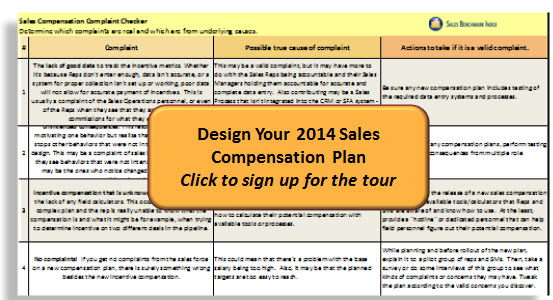
Something you’ll need to go with this post is the Sales Compensation Complaint Checker. It describes over 10 complaints Sales forces have on sales comp. Each complaint also has the potential root causes as well as planning advice. To get this tool, sign-up here. This also gets you access to SBI’s Annual Sales & Marketing Research. At no cost, an expert from SBI will present the full research findings. You will get access to more guides and tools to help sales compensation planning.


Let’s say sales weren’t spectacular in 2013. You’ve done some analysis and want to change sales compensation. Hopefully, your analysis included gathering complaints from the sales force.  Here are 3 common sales compensation complaints, their possible causes and advice to fix. The Sales Compensation Complaint Checker has 8 more.

Complaint #1: No complaints!

If you get no complaints from the sales force on a new compensation plan, take note! Surely something is wrong besides the new incentive compensation.  Especially if the number of sales reps hitting quota is usually low.  This could mean your base salary is too high.  Or there may not be enough leverage in the current On Target Earnings.  Another cause may be that the targets are too easy to reach. Naturally, Reps won’t complain about that.  On the contrary, it may be that Reps are resigned to not making quotas. This might stem from the same approach year after year – an approach that set targets too high to achieve. Reps give up and learn to live off of base salary.

While planning and before rollout of the new plan, explain it to a pilot group of reps and SMs.  Then, take a survey or do some interviews of this group to see what kinds of complaints or concerns they may have. Tweak the plan according to the valid concerns you discover.  Also look at the historical approaches used to plan sales compensation. If it’s been the same year after year, it might be time to shake things up.

Sales Compensation Complaint cta1a

Complaint #2: Compensation is based on someone else’s performance!

Incentive targets are linked in a competitive fashion, not on my own improvement. Some firms may use competitive ranking for parts of incentive compensation, or for the illustrious "President's Club".  Reps would rather compete against a standard (like 150% of a standard target) or even against their own historical performance rather than against a peer who "had a bunch of bluebirds or an easy territory."  Granted, all things being equal, using competitive rankings may work. But usually, all things will not be equal in the B2B world.

This may very well be a real complaint.  However, look out for those who just are not as talented as their peers.  Territory design and account assignments could also be a cause. That’s because a Rep may not have as competitive of a territory as peers.

When having targets for President's Club or some other high-privilege reward, consider setting the target against the own Rep's performance.  For example, use year over year growth as a yardstick or an increase in the number of deals over the past year.  Ensure that quality is also a factor that improves for the Rep.  You may even add factors for a Rep's improvement in sales competencies.

Complaint #3: The Plans Come Out Too Late!

For example, "The selling year starts on Jan 1, but I don’t know what I’m going to be paid until the plan comes out in March." Some firms act so late because they are actually waiting to get the final results from the previous year. The delays are often caused by internal debates over all the moving parts. Finally, targets are set against the performance attained. An example: Product Marketing provides funds to incent sales of their specific product. But, they are late finalizing how much they will fund.

There may not be many underlying reasons for this complaint. However there may be a ton of reasons why the plans are actually late.  Flawed territory design is one possible underlying reason.  Accounts and territories are not methodically analyzed.  This means true potential is unknown, so the simpler method is used – a flat percentage is tacked on to the previous year's number.

Work on your annual sales comp planning process. Ask a question at the end of the first half year, if not sooner.  "Do we need to change the comp plan?" If no, ask the question again at the end of the 3rd quarter. If yes, start your planning just after the 1st half ends.  You should be able research the different factors that trigger a sales comp change. Things like market shifts, new product roadmaps, acquisitions, etc. Also, start doing a true analysis of territory and account potential. Base potential on ideal company profiles and propensity to buy factors.  Mix this with market trend insights. If you need some insight on this kind of territory design, please contact us.

How to Build the 2014 Sales Comp Plan – and Prevent the Complaints

Here are 3 steps HR and Sales leaders can take to ensure the 2014 sales comp plan will succeed: 

  • Sign up for the SBI tour to get the Sales Compensation Complaint Checker
  • Review the list in the tool of sales comp complaints and possible causes
  • If not done already, gather complaints from the sales force on the compensation plan
  • Use the advice in the tool to plan 2014’s compensation while addressing the complaint causes

If you don’t want to have a big complaints file, work on this now.  It’s better to hear the complaints ahead of time. That way, you can build the plan to avoid the complaints.

Sales Compensation Complaint Checker


Photo courtesy of freedigitalphotos.net -> Stuart Miles

Author: Steve Loftness

sbi on linkedin

Follow @SteveLoftness

Follow @MakingTheNumber

If you enjoyed this post, get free updates by subscribing by Email or RSS.

08 Oct 15:44

It’s Q4: Finish the Sales Year Strong and Steady

by Samantha Goldman

Its Q4: Finish the Sales Year Strong and Steady image q4 resized 600Halloween! Thanksgiving! Christmas and Hanukkah! All of these events are great in Q4… but in sales and teleprospecting, it seems like Q4 is everyone’s least favorite time of year. Everyone is focused on closing business rather than building new business. But once the holidays are over and it’s back to work in 2014… Uh oh! Where’s the pipeline?

This time of year might be difficult to keep your connect rate up, hold quality conversations, and keep pushing leads into the pipeline. But it’s really just like any other time of year. Some people are on vacation and some people have free time to discuss new products and services, which means you still need to be building a pipeline as well as passing over qualified leads to hit personal and company goals. There are ways to stay focused and keep building a pipeline instead of getting lost in the holiday vacations.

Have a plan. Honestly, being organized can help get you through most tough situations. Make sure you have time to work on the leads you are nurturing and trying to close, but allot some time for bringing in new contacts to your pipeline every day as well. Bringing in new contacts from untouched lists, LinkedIn, and other sources will create a smooth transition into the new year and new quarter.

Call C-levels. Around the holidays, a lot of people high up in the organization will not have meeting as many people are on vacation. If they are in the office, they are more likely to answer their phone and have a few minutes to discuss their thoughts on your service or software.

Send mass emails. I have mentioned this is previous blogs as a debated topic, but I do believe mass emails can be effective if the messaging is right. If you have a lot of untouched prospects, send a referral email and try to start some conversations for the New Year.

Use calendar requests to your advantage. Due to the hectic time of vacation and family events, meeting requests can be used to figure out when prospects are away from the office and when they are going to be around. If someone declines an invite, you contact them in hopes of getting a conversation starting  to find out when they will be around.

Have a meeting with your team. If you work with other reps on a project, check in with them and see what their game plan is to create a smooth transition from Q4 to Q1. They might offer good tips and you could help with their strategy as well. Also, talk to your managers and/ or directors to discuss new lists and campaigns for the new year. Even if you are not taking extended time off, many people will be and you want to know what’s going on after everyone returns and have a good jump in January.

Daydreaming about food, gifts, and family knowing that the holidays are right around corner is fine, but there is a time and a place for that. Having a plan in place for each day of the week can be beneficial to keeping you on track in Q4, allowing you to enjoy your holidays even more, and kicking off the New Year with a bang!

Its Q4: Finish the Sales Year Strong and Steady image 6fba5642 e238 4197 ba75 fc105d58df95

Its Q4: Finish the Sales Year Strong and Steady image 07f0bf66 1dcb 40ea acd9 7c4ff5605ab017

08 Oct 15:44

Manage Your Marketing: Remember You’re in Sales

by Margie Clayman

Manage Your Marketing: Remember You’re in Sales image 251083239 2862889557 mA few weeks ago I was in Barnes & Noble and I happened to glance at the business best sellers shelf (as I am wont to do). A book sitting there caught my eye. It was Daniel Pink’s To Sell is Human. The title got my attention for a couple of reasons. First, as we have discussed many times, there are silos between marketing and sales departments in most companies. The title made me wonder if Pink would offer an argument that would help to destroy that (needless) division between sales and marketing. The title also got my attention because as a marketer, I have always known in my gut that I also need to understand what’s happening in sales. As Pink notes at the start of his book, very few people like to think of themselves as sales people. Why is that?

Pink suggests that most people equate “sales” to being shady, like the old stereotypes of the used car salesman. In fact, in a questionnaire that Pink cites in the book, many people, when asked, answered that sales made them think of primarily negative personality traits. However, Pink argues that “sales” is more than just trying to sell a product. “Sales” can mean trying to get a person to buy into your ideas or, as he says, “moving people.” If this is not marketing, what is?

But I must reiterate – being in sales is gross!

I think a lot of people have this gut reaction to the idea that they are in sales, especially people who are using social media as part of their marketing campaigns. The emphasis in the online world has long rested on relationships versus “selly” engagement. There is a sentiment that if you try to “sell” online it will be a real turn-off. For marketers, this creates a conundrum and this conundrum lies behind the entire controversy regarding whether it is possible to calculate social media ROI. If you are hesitant to sell anything online, it will of course, be extremely difficult to realize any return on your investment.

Beyond the online world, it is also important to visualize your marketing content as if it is an army of non-human sales representatives for your company. Instead of knocking on doors, your ads appear before eyes of potential customers. Instead of traveling city-to-city, your email marketing calls for attention in someone’s inbox. Your content is intended to help increase sales. It may not be a direct line like it would be for door-to-door salespeople, but the intent is the same. You are striving to convince someone to buy your company’s product or service. If you are using social media marketing, you are like the old-fashioned store owner who knows everyone’s name, who cares, but who also is still trying to sell something. One does not need to be a snake oil salesman to be in sales.

There’s no reason for silos

Marketing and Sales departments are often pitted against each other in companies. When things go wrong these departments point the fingers at each other. “Sales are down because the marketing is bad.” “Sales are down because the sales team isn’t converting leads into sales.” When things go well, the departments compete for credit. The faulty logic is that sales and marketing are diametrically opposed. This is simply not the case. If you are truly enmeshed in marketing for your company, you are in sales. If you are trying to promote ideas that will help your company grow, you are in sales. Indeed, in an ideal situation, marketing will work with the sales team to make sure all messaging emanating from the company is consistent and effective.

The next time someone says that marketers don’t really understand the world of sales, or the next time you hear a marketer talking disparagingly about the sales process, remember that marketers are also in sales. Marketers are humans. And, if you agree with Daniel Pink, to sell is human.

Do you agree?

Image Credit: http://www.flickr.com/photos/cloganese/251083239/ via Creative Commons

08 Oct 15:43

Metrics and Numbers – Sales eXchange 220

by Tibor Shanto

By Tibor Shanto - tibor.shanto@sellbetter.ca

Increased sales

I have the pleasure and opportunity to “sales” with a lot of people, some in sales themselves, some management, and some who don’t sell but have firm unfounded opinions they like to share or yell. One area they all seem to have opinions on is whether sales is a numbers game or not. The familiar and popular line is that it is not a numbers game, this is quickly followed by something along the lines that “it is about quality, not quantity”; while I get the sentiment, I am not sure that the two are that linked.

What’s interesting is that many in leadership positions, be they executives or pundits, who in an effort to be ultra-modern adopt the “sales is not a numbers game” posture, are at the same time big proponents of “Metrics” and some form of KPI’s, both of which are good when applied the right way. But the question remains, are metrics not numbers?

While there are many similar definitions of business metrics, I like this one:

A business metric is a raw measurement of a business process. It’s important to remember that metrics are a means to an end, not an end unto themselves. Measuring a metric is not always enough – you need to use that metric to guide business decisions and to ensure your business is on the right track. (Klipfolio.com)

I like it because it does root things in numbers, how else can you measure. It ties to process, and having a sales process is a clear way to bring the numbers to life in the form of action and execution, and the use of metrics in guiding performance and decisions. By extension, this drives accountability, and bundled together these elements dictate and shape you sales culture. In the end, it allows for the use of numbers as a core component of strategy and execution, but not at the exclusion of other important elements that make for a winning and evolving sales culture.

The dark side of taking the sales is a numbers game stance to far can often be found in KPI’s and how they impact sales. Many organizations will have KPI’s for key activities their reps have to execute. For example eight meeting a week, with at least three being with new prospects. Without a qualitative layer to the KPI, it will serve little in helping the company achieve it intent. What you often get is exactly what you asked for, eight meetings, three with new people, and not one worth the time it took one to secure the meetings.

KPI’s should be rounded out in ways that ties the indicator to results, not the activity alone. This will allow for coaching opportunities that are directly tied to daily activities and results. If a rep has difficulty hitting wither side of that, it is a great opportunity to coach and focus on the qualitative aspect of the KPI. And here is where both camps can converge, quality of execution, tied to the numbers and results involved.

In the end, even the qualitative aspect of things will be measured in some empirical way, and most importantly, the result, be that sales, clients acquired or most importantly profits, are all measured in numbers or tied to metrics in a direct way.

What’s in Your Pipeline?
Tibor Shanto  

08 Oct 15:43

Putting Undue Pressure on Yourself is Not Conducive to Sales Success

by Robert Terson
Let me ask you a question: When you go on a typical sales presentation, are you under such self-imposed pressure that in your own mind you “have to” make the sale or else your professional world may come to a screeching halt? Does this pressure you create (“There is nothing good or bad, but thinking […]
08 Oct 15:43

The Next Big Thing in Sales Hiring

by Ryan Tognazzini

The annual planning cycle is upon you. Your team is putting together their wish list for next year. New initiatives, processes, training and headcount are on their list. You want to go into next year confident the team will make the number.

If you’ve been following SBI’s blog lately, you’ve read a lot about the changing B2B landscape:

the super sales rep a playerChanges in the external environment should have you thinking differently about internal factors. Namely, those charged with executing on the above actions. You may be asking yourself: Do I need to hire someone?

Based on the above, your answer should be yes. Legacy sales reps have not kept up with the times. There is a shift happening in the sales world. The requirements have changed. A new ‘A’ player rep has emerged. To make the number next year, you need the ability to hire this rep.


This post teaches CEOs how to plan for ‘A’ player hires for next year.

Register for SBI’s 7th Annual Research Tour here to learn more about the New ‘A’ Player. When you do, you’ll also get the CEO’s Guide for Hiring New ‘A’ Players. The guide will give you a process to hire new 'A' players. 9 Steps to ensure your sales leaders bring in top talent.

CEO’s Guide for Hiring New ‘A’ Players

Planning for New ‘A’ Players

Your first step towards improving the sales force is defining excellence for your team. These are defined as ‘A’ player competencies. They are the attributes the best reps possess that will ensure your success. Examples of modern ‘A’ players include:

  • BPM Recognition – The ability to identify where a buyer is in their evaluation process
  • Social Reach – The ability to attract and grow the right relationships
  • Social Prospecting – The ability to act on account and persona information
  • Sales Process Execution – The ability to sell the way a buyer wants to buy

These are now non-negotiables in the modern world of hiring ‘A’ players. If your sales leaders are asking for more headcount, they must seek these qualities. Review these items with them before they start recruiting. These are covered in more detail in our research session.

Hiring New ‘A’ Players

The process of hiring ‘A’ players is critical. Interviews are not just for you to assess potential talent. ‘A’ players are assessing you too. Modern ‘A’ players are in high demand. They can take their skills just about anywhere. The cost of the wrong hire can be $1M. You can’t afford to start next year with the wrong talent. You will miss the number.

There are 3 critical steps to hire modern ‘A’ players:

  1. TopGrading for Sales Interviews – Scenario-based interviews to validate the rep possesses the competencies of the new ‘A’ player. In a controlled environment, can the candidates articulate excellence across the required competencies? Your sales managers must vet this out before offering candidates the job.
  2. Job Scenario Tryout – Real-life scenarios to test the true capabilities of your candidates. The TopGrading for Sales interviews provide a controlled environment. The Job Scenario Tryout forces the candidate to think critically in a real situation. Can they think on their feet? Will they be able to hang in the real world your reps face every day? Don’t let your sales managers skip this step.
  3. Reference Interviews – 60 minute interviews with 3 former bosses of your candidate. These are deep dives into their prior work, successes and failures. Must be done with a former direct manager. You’ve seen the rep in the interview. You’ve put them through the live-fire scenario. What does the last guy who managed this candidate have to say? Do all three data points stack up? Where are the gaps? Your sales managers need to this feedback to make great hiring choices.

Looking through these three lenses is invaluable. It takes time, which is ok. Hiring slowly is the right approach. If you haven’t already, you should start now to help plan for next year. Your chances of making the number will increase.

Building a great team is critical to your success as a CEO. Your sales leaders are focused on making the in-year revenue goal. This is important, but they often make hasty hiring decisions as a result. As the CEO, you can help your sales leaders by giving them this framework. Help increase your chances of making the number by hiring modern ‘A’ players. To learn more how to do this, register for our free session here. You’ll learn how to plan for and hire the new ‘A’ player.   

Author: Ryan Tognazzini

sbi on linkedin

Follow @RyanTognazzini

Follow Sales Benchmark Index @MakingTheNumber

If you enjoyed this post, never miss one again by subscribing your Email Here and/or subscribing to the RSS.

08 Oct 15:43

[Video] The Two Words That Matter Most in Sales

I was reading a non-sales related blog post the other day when suddenly I came to a screeching halt. Two words jumped out at me. And, I immediately thought – these words capture exactly what it takes to be successful in sales today.

Relentlessly Useful.

If we want to get our foot in the door of new companies and earn their business, we need to be relentlessly useful.

If we want to grow our existing customers, we need to be relentlessly useful.

If we want to prevent competitive inroads into our best accounts, we need to be relentlessly useful.

We have to proactively and continuously bring our customers ideas, insights and information that helps them achieve their goals. If we do, they’ll buy our products and services because of what we bring them – and because of who we are.

Think about it. What do you need to do to become relentlessly useful?

successful in sales

08 Oct 15:43

Using IP Lead Tracking to Find Hidden Leads

by Adam Fitzjohn

To grow a business in the B2B arena, nearly all companies will seek the exploit the power of the internet to generate leads for new business – utilising SEO techniques to generate organic traffic, email marketing campaigns to inform potential customers and Google adwords to target new business areas.

Most marketing techniques, both online and offline, are designed to drive traffic to your website and increase the amount of enquires for your business sales team to chase – but what about the visitors to your site that don’t take the final step and get in touch? These visitors are a untapped area of potential leads that your business could reach, and for most businesses, they are hidden.

By utilising IP Lead Traffic, this sector of previously hidden leads become approachable – letting you track and measure their interaction with your companies online presence, and more importantly, contact them as part of your sales process, without increasing your adwords or SEO budget.

IP Lead Tracking Explained

IP Lead Tracking lets you see the businesses that have been on your website, as well as the way in which they reached you (directly, Google, PPC, etc.), the search terms they used to get there, the pages they browsed through, even the length of time they spent on each page.

Tracking this way will let you view companies who have trawled through your site, downloaded white your whitepapers, read through your blogs or how-to guides, and even the ones that got to your contact form but didn’t complete the final step. This lets you prioritise and target the companies that are most interested for contact by your sales team, and discard those that are not relevant leads – e.g. those business that got to your site ‘accidently’ looking for a similar, but unrelated search term.

With the main benefit –being that many of these leads will be ‘warm’ – companies with a need or a requirement for your services, giving you an instant advantage over cold-calling businesses.

The data provided by this type of analytics also lets you increase the efficiency of your other marketing activities and budgets by analysing the effectiveness of your PPC/SEO keywords and targeting those which are provided the best return.

The limitations of IP Lead Tracking

IP lead tracking isn’t perfect, or infallible. There are limitations in place due to the nature of the way IP addresses operate.

You can only track IP addresses back to businesses, not stand alone consumers, and only to businesses that operate through a static IP addresses and that haven’t gone out of their way to mask that information (however this is only a tiny section).

The companies that offer IP lead tracking use a combination of automated techniques and manual management to maintain IP addresses and the businesses they correlate too. This means that the tracking isn’t always 100% accurate, there can be mistakes with companies names and information in small amount of cases (however they are usually very obviously when you back track them to their website).

It also means you don’t get personalised information of who was your site – you only get a company name. Leaving your sales team to do some digging to find the relevant contact person – or act on the lead in a relevant way to your business. LinkedIn integration within the IP tracking site itself makes this a quicker task that would first appear to be.

The other main downside is the obvious one – these systems cost money, and how much depends on the level of traffic to your website.

Getting Started

The two main players in IP lead tracking at the moment are WOW Analytics and Lead Forensics. Both offer similar packages with slight differences in how they manage their IP databases, and both offer free trials and demonstrations. Both offer automated alerts, live viewing of business on your site and as much contact information about the viewing businesses as is available (name, address, contact info, website).

Once you’ve signed up, you insert some tracking code onto the pages of your site (the same way Google analytics is handled) and wait for the leads to roll in.

Summary

Online B2B marketing is all about maximising quality leads and improving the efficiency of your time and budgets. IP lead tracking adds an additional tool to find those companies that were previously hidden to you and your business and fold them into your sales process. While IP Lead tracking has its limitations and isn’t complete infallible, it can still provide your business with an extra set of potential customers with a minimum of time and effort.

08 Oct 15:42

Sales Training Article: Raining Quality Leads

by Customer Centric Selling

Sales Training Article: Tips to Make It Rain Quality Leads

By John Koehler, Sales Benchmark Index (SBI)

Image courtesy of chanpipat at FreeDigitalPhotos.net

This post is written for Marketing Leaders who describe themselves as students of the craft. You are exposed to hundreds of pieces of content a day. You find yourself having no time to figure out what is relevant vs. noise. You are competitive and want to outmaneuver your competitors. Let me net it out for you. These tips represent best practices from leading Sales & Marketing organizations.

sales training workshopThe first 25 tips are listed below. To get all 50 tips and greater insight into the latest research, sign-up here.

50 Tips to Make it Rain Quality Leads

1.Convert Ideal Customer Profiles into Buyer Personas and Buying Process Maps. Tweet This Tip

2.Only the prospect can move from one buying stage to the next. A rep cannot. Tweet This Tip

3.Get out of social media denial. Social Selling has become mission critical. Tweet This Tip

4.Turn your sales and marketing teams social profiles into marketing channels. Tweet This Tip

5.LinkedIn profiles should not focus on personal accomplishments. Focus the LinkedIn profiles on how they help your buyers. Tweet This Tip

6.Buyers will search Google before doing business. What will they find? Tweet This Tip

7.Benchmark your content marketing - prospects decide if they are going to buy from you before talking to a sales rep. Tweet This Tip

8.By the time you pass the lead to the sales rep, the customer has completed more than 57% of the buying process. Tweet This Tip

9.Establish the common definition of a "qualified lead" with both Sales & Marketing. Tweet This Tip

10.When qualifying a lead, understand the difference between interest and intent. Tweet This Tip

11.Match web form submissions to 3rd party databases to validate and enrich your understanding of the prospective buyer. Tweet This Tip

12.Put together the "A" team. You can't do it all yourself. Hire a team you can depend on that complements your particular strengths and weaknesses. Tweet This Tip

13.Hiring 'A' players takes more than a 1 hour interview. Tweet This Tip

14.Prioritize recycled leads over all other leads sources. Third time is a charm. Tweet This Tip

15.Centralized lead generation outperforms decentralized lead generation. Tweet This Tip

16.Execute - knowing how to do something is more important than knowing what to do. Tweet This Tip

17.Learn your prospects preferences- over the phone, text, email, social, etc. Tweet This Tip

18.Invest in lead development reps before filling sales rep positions. Tweet This Tip

19.Mystery shop your competitors. How do they market and sell? Tweet This Tip

20.Making decisions with your gut no longer makes sense. Leverage data to provide insights. Tweet This Tip

21.Leading indicators are better than lagging indicators. Which metrics are you looking at? Tweet This Tip

22.Establish a referral program - Referral leads convert at a higher rate than non-referred leads Tweet This Tip

23.Build a campaign planning framework for effective execution. Tweet This Tip

24.Create a lead nurturing process that includes a lead return to nurture path. Tweet This Tip

25.Be certain that marketing's mission matches that of the CEO and VP of Sales. You might be surprised.


sales training companyNeed some help with your sales performance? Take a look at the sales training workshops available to you and improve sales performance.

Read more sales training articles from CustomerCentric Selling® - The Sales Training Company.

08 Oct 15:41

LinkedIn Is No Longer Just A Recruiting Tool — Here's How Top Companies Are Using It To Drive Sales

by Cooper Smith

bii linkedin salespeople 1

LinkedIn is a powerful marketing and sales platform, if you know how to use it. The social network for professionals has attracted 225 million people from more than 200 countries, and its users are increasingly engaged

LinkedIn users viewed 63% more pages on the mobile and desktop versions of the site in the first quarter of 2013 than during the same quarter in 2012. As a hub for professionals to network, LinkedIn presents tremendous potential for business-to-business (B2B) sales and marketing.

In a new report from BI Intelligence, we analyze how LinkedIn could aid in sales efforts and expand opportunities, we tell you what you need to know about InMail, we look closely at Sponsored InMail and a case study of its performance, and examine how you can use LinkedIn as a marketing platform, breaking down the various ad products on the platform and the other techniques you can use as well. 

Access The Full Report And Data By Signing Up For A Free Trial Today >>

Here's a brief overview of LinkedIn's most useful sales and marketing products:

In full, the report:

For full access to the report on LinkedIn sign up for a free trial subscription today.


Join the conversation about this story »

08 Oct 15:38

Happy B2B Sales Endings Start at the Beginning

by Bob Apollo


Do you wish that your sales people were better at closing? Or that their sales forecasts were more accurate?  Are you frustrated that apparently well-qualified opportunities end up with the prospect deciding to do nothing? If so, you’re not alone. I hear these complaints all the time.

These sound like classic “bottom of funnel” challenges. But when I take a closer look at many of these situations, more often than not the real problem lies elsewhere - not at the bottom of the funnel, but at the top. When sales people repeatedly struggle to close opportunities, the issue often lies with how they started the sale, and not with how they are trying to close it.

It’s not how well you close, it’s how well you open

open door 200wDon’t get me wrong. Sales people need to be able to close. It’s an important skill - but it’s not enough, and no amount of closing skill can compensate for the failure to qualify the opportunity accurately, or for the inability to influence the buying decision process from an early stage in the cycle.

Losing to “no decision” is particularly galling. Being defeated by the status quo is just as unproductive as being defeated by a conventional competitor. Inertia is just as powerful an enemy as the organisation you’re wrestling with for market share.

You can expect your prospects to be asking themselves “why should I change at all”, “why should I change now” and “why should I change to you”. Here are a handful of strategies that could enable you to swing the odds in your favour:

Your prospect must have a compelling reason to do something

You can engage prospects in conversation about issues that are interesting to them. You can get them to evaluate your solution if it appears to address an important issue. But unless they have a critical reason do actually do something, odds are they will stick with the status quo. Have you established a compelling case for change?

You need to engage a sponsor who is a mobiliser, and not just a talker

It’s easy to assume that you’re on the right track if you are engaged with a helpful, supportive sponsor. But unless your sponsor has the power, authority and respect necessary to successfully catalyse change within their organisation, chances are the decision will be to “do nothing”.

You need to be positioned as the least risky of all available options

It used to be said that “nobody got fired for buying IBM”. Today’s more common sentiment is that “nobody got fired for not sticking their neck out”. Buyers have become more risk averse. If you’re going to win, you need to emerge as the least risky of all their available options, including simply staying as they are.

Continuously re-qualify the opportunity

Even if the opportunity initially looks promising, you’ve got to coach and encourage your sales people to continuously re-evaluate each sales situation. Is the prospect’s need critical? What are the odds of them doing anything? What are the chances of doing it with us? And - last but not least - will the effort be worth it?

If your sales organisation embraces this discipline, you’ll probably find that a lot more deals drop out early in the sales cycle. The total value of your pipeline may even seem to go down. But your revenue potential will have risen, perhaps dramatically. Well-qualified, well-managed opportunities will close naturally, and at a predictable time.

And because your sales people will be opening up and managing opportunities in a much more effective, they (and you) will be fretting a lot less about their closing skills. You might like to start by identifying your idea customer profiles, and embedding this into a progressive approach to opportunity qualification.

Note: this blog was orginally published under the title of "4 Keys to Open the Door to More B2B Sales" on the Salesforce.com blogsite.


08 Oct 15:38

Sales Tips for Prospecting: How to Email, Attract and Call Prospects (Part 2 of 3)

by Ralph Barsi

Sales Tips for Prospecting: How to Email, Attract and Call Prospects (Part 2 of 3) image Tip2.png

How can you improve your sales prospecting results? I recently returned from an action-packed Inside Sales 2013 Frontline Conference in Boston, which featured over 20 Inside Sales experts leading general sessions and lively panel discussions. Based on key points from my presentation, I started a blog series on sales prospecting and below is Part 2 with Tips #4-6. In case you missed Part 1, check out How To Eliminate “Cold Calling” From Your Vocabulary.

TIP #4: Send Pre-emptive Emails

Rather than cold calling first, inform your prospect that you plan to call during a certain time frame. This helps you both to prepare and respond effectively through a number of beneficial action steps, as shown below:

Action Steps For Your Prospect

  • Prepare for your call, now that they know in advance
  • Reach out to executives mentioned in your email, to confirm if you’re legit
  • Visit Google and gather some intelligence on you
  • Respond with a better time for you to call
  • Indicate no interest in taking your call (hopefully explaining why)
  • Forward your message to a more appropriate person
  • Ignore your message (this happens if emails are irrelevant or too long)

Action Steps For You

  • Prepare, prepare and prepare for the call
  • Identify three talking points for your call (Learn more about 3×3 research here)
  • Craft two brief emails: Reconfirm the call or offer more value if they don’t respond
  • Schedule the call on your calendar so you don’t miss the opportunity
  • Save the email as a template for other prospects, especially if it’s successful

TIP #5: Attract Prospects

Jim Rohn, the renown inspirational speaker, once said that “success is something you attract by becoming an attractive person.” If you bring value to the marketplace, you will become valuable. Your prospects will seek you out vs. the other way around. Your reputation will precede you.

Here are specific tips on how to develop an attractive personal brand:

  • Host a webinar with industry experts and share best practices
  • Present a relevant topic at your industry association meeting
  • Start a blog and write useful articles for your target audience
  • Create an educational film with peers and share it on YouTube
  • Record a podcast and invite your best customer to join in an episode
  • Tweet (and retweet) powerful articles, videos and status updates

TIP #6: Make Rapid-Fire Calls

If your organization manages a large volume of inbound leads, you no longer need to manually dial your contacts. Technologies offered by companies such as ConnectAndSell, ConnectLeader and InsideSales.com manage the dialing for you.

In the film The Pursuit of Happyness, homeless stockbroker Chris Gardner (played by Will Smith) finds a way to get through large lists of phone numbers – and he never hangs up the phone! He also calls CEOs and gets right through the gatekeeper. Watch this film and get inspired to call prospects!

How will you implement these tactics to connect with your prospects? Feel free to share your experiences below. Thanks for reading and stay tuned for TIP #7 in Part 3 of this blog series!

08 Oct 15:37

Good Sales Teams Close Deals, Great Sales Teams Earn Trust

by Ray Carroll
trust fall

Author: Ray Carroll

I love selling. I’ve had the privilege of working with hundreds of customers in my 4+ years at Marketo, so I’ve seen my share of wins and my share of losses. There are many important best practices in sales, but the formula for winning is simple: you earn trust. As for the deals you end up on the short-end of, well, no one’s ever said: “Ray, I trust you, but I’m not going to buy from you.”

Whether you’re a seasoned Account Executive who’s been selling since before the internet, or a newly promoted whippersnapper who made the most calls on the Lead Qualification team, anyone can become a trusted adviser to their clients or prospective clients. That said, it’s not easy. Here are the 3 pillars of trust that I challenge every AE on the Marketo sales team to live and breathe when speaking with prospective customers:

 1) Get the person on the other end to LIKE you.

And don’t fake it with cheesy small talk. “How is the weather out there?” won’t cut it. Find some common ground, and actually enjoy the other person’s company. After all, you’re going to spend some time together as you explore whether there is a mutual fit. Check out their LinkedIn profile, look at their past employment history, and be genuinely interested in that person and making their project successful.

One of the best ways to make someone like you – in a genuine way – is to ask them questions about themselves. This is actually effective in two ways: if you let them steer the conversation, and listen closely, you’re more likely to discover your common ground.

To make sure you remember what you learn through LinkedIn and what the person tells you on the phone, add the details into your CRM system the second you hang up the phone. Next time when you two speak, you can easily recall the details since they will be in the lead record.

2) Understand the buyer’s needs better than anyone else – even the buyer themselves.

People don’t buy products because they have nothing better to do than spend their company’s money. People buy products because they are looking to grow the business, fix a problem, or improve on a key initiative. This is true with our product, marketing automation software, but it applies to any industry. It’s your responsibility to find out what those main drivers are.

You should start by doing research into your buyer’s company – have they recently experienced a big growth or reorganization? Received negative attention for a technical problem? Come to the conversation with your background information in place, and then ask for more. Know their key initiatives, ask how those have evolved over time, and ask them to project into the future. How can your product get them there?

Listen for their drivers and ask questions that allow you to walk in their shoes. If you focus on the needs they’ve shared, and on how your product can address those needs, your product’s price tag won’t matter as much.

3) Offer ideas that the buyer hasn’t thought of before they spoke to you.

You are the expert in your industry and in how customers get value from your solution, and prospective customers will need your help in presenting that vision to the higher-ups. Arm them with ideas that will make them look good in front of their boss. You can provide them with relevant case studies, competitor histories, and, most importantly, detailed projections. How will the partnership with your company help them six weeks, six months, or six years down the road?

Your prospective client has probably done some homework before speaking to you, and they’ll have at least some vision of how they might partner with your company — but have a couple of nuggets in your back pocket that will resonate. You’ll earn credibility, and make your customer’s life easier. Partnerships are often formed for intuitive, emotional reasons (see tip #1), but your buyer needs to back up their decision with thorough research and hard data.

Good salespeople close deals, but great salespeople earn trust. Trust breeds loyal customers, and with the “Easy-on, Easy-off” promise of SaaS, sales organizations hit in the leadoff spot. So step up to the plate.

How are you (or your team) earning trust during the sales process? Let us know in the comments below!


Good Sales Teams Close Deals, Great Sales Teams Earn Trust was posted at Marketo Marketing Blog - Best Practices and Thought Leadership. | http://blog.marketo.com

04 Oct 15:18

They Like Me, They Like Me Not: What Does a Social ‘Like’ Really Mean?

by Sherry Orel

Relationships, whether they are personal or commercial, all start the same way: by courting. People attract mates by presenting appealing versions of themselves and vetting candidates by assessing their “potential.” Brands deploy countless tactics to attract customers and rate them based on their loyalty and lifetime value.

Whether you are looking for a life partner or a life-long customer, you have to kiss a lot of frogs to find a prince.

Promotion is the speed-dating approach to enticing large numbers of new users to try something unfamiliar. The upside of promotion is temporary spikes in sales while the downside is training consumers to deal-shop, creating fair-weather fans willing to brand-switch based on who is offering the best coupon or offer this week.

So I ask, in the social marketing world, what is the value of a like or follow that’s powered by a promotion?

Last April, a marketing firm, Syncapse, released a study that said that the average value of a fan is $174.17. Six factors went into calculating that average, but the study pointed out that brand fans spend 43% more in that brand’s category on average than non-fans. But like doesn’t always lead to love, so before you whip out your calculator to tally up the ROI of your last social media campaign based on the number of incremental “likes” it drove, there are few more factors to consider.

If your true fans are worth $175, the percentage of your following that are actual fans versus fair weather fans can be influenced by how they came to “like” your brand in the first place. An authentic “like,” meaning one that came from a consumer who, unprompted, visited and liked your brand, is far more likely to come from a true fan than a “like” prompted from a consumer promotion. In a chicken/egg quandary, many brands have used promotion to drive “likes” just because it works. So not surprisingly, an IBM study found that 83% of consumers have “liked” a brand for the promise of a promotion or deal. And then there seems to be a whole lot of unliking and ignoring going on.

According to a study by ExactTarget, 26% of consumers say they have “liked” a company because they were interested in a one-time offer, and then “unliked” the brand after getting what they wanted. The same study noted, “More than half of consumers (55%) have ‘liked’ a brand, only to decide later that they no longer want to see posts from that brand. Of that group, only 57% bother to formally ‘unlike’ the company. The rest either ignore unwanted posts or delete the posts from their newsfeed.”

Two Tips for Turning a ‘Like’ Into Love

The key to success is to use promotional tactics that will engage the consumers and give them a reason to go from like to love. For example, take product sampling. You’ve already spent the money to produce and distribute the product, why not make it easy for customers to share their opinion and pay it forward with their friends? Why not incorporate a mobile campaign that lets customers give a free sample or coupon to their Facebook or Twitter network? When their friends start getting excited about your brand, they’ll be less likely to “unlike” you.

Or take the surprise and delight approach. Providing a relevant, yet unexpected treat could turn a casual fling into a long-term romance. Red Bull did this recently when it included free, full-size cans inside boxes ordered from Chegg.com, a retailer that sells text books to college kids. The clever collateral piece accompanying the sample featured the father from The Family Guy lounging seductively in a bath robe with copy that read, “Wanna pull an all-nighter?” Without prompting, new fans flocked to both brand’s FB pages to give thanks and kudos for a welcomed branded experience. With Chegg’s sleep-deprived, young user base, Red Bull nailed the optimal entry point for their category and recruited their next generation of fans.

So why chase a “like”? Because “likes” represent potential—potential to grow your circle of true fans who will share your message with others.  It is the potential to better understand what your brand means to your fans, what they love about it, what they are lukewarm about, what charities they support, what activities they love, and what inspires them to take action.

04 Oct 15:16

Aggressive Talent Wars Are Good for Cities

by Orly Lobel

California is often ranked among the world’s most inventive regions. But most observers miss one of the major reasons why: the absence of non-compete agreements.

Barring non-competes is one of California longstanding strong talent mobility safeguards. Unlike most other states in the United States, but more like innovative Western European countries like Germany, the Netherlands, and Sweden, California has rules about allowing job mobility within markets. The California Business Code voids all non-competes agreements between businesses and their employees, while the California Labor Code restricts the ability of corporations to require their employees to pre-assign all inventions, even if unrelated to the job, during the course of employment.

California courts have been so adamant about enforcing the state’s prohibition of non-competes, they’ve held that companies who do not hire or promote talented employees who refuse to sign a non-compete (which would be void anyway if taken to court) are liable in tort and should be subject to punitive damages. They’ve even refused to enforce non-competes that were signed in other states, announcing them contrary to state policy.

Conversely, Boston’s Route 128 tech beltway has not flourished the way Silicon Valley has, in part because of restrictive non-compete agreements. Non-competes have contributed to the more rigid, vertically integrated, and prone to insourcing ethos of Boston’s high tech region.

California’s lack of non-compete agreements is the reason Marissa Mayer could assume the position of CEO at Yahoo! immediately upon leaving its direct competitor, Google. And, as it turns out, it’s the reason California’s cities are some of the most innovative in the world – and provides a model for fueling innovation and economic growth elsewhere.

Job-hopping at all ranks is part of the California knowledge economy, but the policy spills over to the industrial culture too, creating a culture of openness, movement, and networking, where companies know that the talent wars are a repeat game. Even though Californian companies face a higher risk that their best talent will leave, they also recognize the long-term benefits of talent mobility. And industry leaders learn to view the departure of employees not only as a loss (because of course there is a loss) but also as potential gain, in which former employees may eventually return, bringing new skills back with them.

Although most companies are keen to reduce turnover, a stunning number of new studies demonstrate how high employee turnover actually contributes to economic growth. Research by Matt Marx (Sloan) and Lee Fleming (Berkeley) finds that after Michigan began to allow non-compete agreements, the state experienced a brain drain of its best talent. Many decamped for California, especially those inventors with the most-cited patents.  In another recent study on VC investment and non-competes, Yale SOM professors Samila and Sorenson conclude that mobility restrictions not only impede entrepreneurship and start-up ventures, they slow the overall economic growth of a region. Studying a decade’s worth of data on over 300 metropolitan areas in the United States, including patent filings, levels of VC investment, and level of entrepreneurships, the study finds that relative to states that enforce noncompetes, an increase in venture capital in states that either void or restrict non-competes has significantly stronger positive effects on regional patenting rates, start-up rates, and job growth. In response to an identical influx of local VC, states that do not enforce non-competes experience twice the increase in patents, double the birth of new companies compared to states that enforce them, and three times the employment growth of non-compete enforcing states, benefiting not only the start-up segment of a region but also incumbents.

There is also a motivational aspect in allowing people to leave and encouraging them to stay using positive, rather than negative, incentives. In recent behavioral studies, my collaborator On Amir (Rady UCSD) and I find that participants bound by non-compete agreements and other post-employment restrictions did not perform as well and were less motivated to stay on task than those unbound. Participants in our experiments were more likely to quit the task and to make errors when they were asked to sign non-competes. Garmaise (Anderson UCLA) finds that non-compete enforcement strongly reduces executive mobility and shifts compensation from bonuses and performance-based pay to a heavy reliance on a fixed salary.

In other words, performance carrots work better than restrictive sticks. Think about it: human capital is not a static resource in the way real estate or building materials serve a construction company.  Human capital is both a resource and a living subject who makes constant judgments, decisions, and choices about the quantity and quality of outputs.

If you can’t legally restrict your talent from leaving, you’d find better more motivating approaches to retain it.


04 Oct 15:07

How To Do Infographic Research

by Guest Writer

A successful infographic comes down to four things: a great idea, detailed research, excellent production and intelligent outreach.

While there are four parts to a successful infographic, the research forms the very foundation of the content piece. Without it, the whole thing can fall apart. Unfortunately, often it’s the bit that is completely neglected.

That isn’t necessarily true of the other elements; for example, we have all seen really poorly designed infographics perform well simply because the idea was strong and the research was solid. I’m not trying to argue that the other things don’t matter, but I am trying to convey just how vital getting the research right is.

In a recent guide, I identified the key tenets of good infographic research:

Secure up to date and verifiable facts from reputable sources.

Identify what makes your audience tick and aim to highlight the data and content most likely to trigger an emotion or reaction.

Think how the data could look visually — nobody wants a graphic that is too text heavy.

Let’s explore these research tenets in more detail.

Find your sources

Primary sources

Primary research can be a fantastic way of securing press coverage. You can offer completely unique facts and data. However, it is more expensive and time-consuming.

That’s why, when gathering primary data, keep these things in mind:

  • Look within your business or talk to your clients. There is often a wealth of information locked away in reports, presentations, that customer survey your sales team did and so on.
  • Consider tools or services for gathering feedback. Many services out there enable you to elicit feedback quickly and relatively cheaply, leveraging the power of the connected web to bring your target audience to your survey. As Matt Gratt wrote, “tools like Google Consumer Surveys, Ask Your Target Market and Mechanical Turk enable marketers to do academic-quality research in time periods measured in days — using only their credit cards.”

Then augment your own data (as ResearchExplainer suggests) by checking a wide range of other sources to ensure you have all the information, not just the basic facts. For example, you could explore Scientific American, Science News, EurekAlert! or Newswise.

Scientific American article
Sometimes data sources themselves cry out for graphic representation, such as this Scientific American by-the-numbers article about auditory hallucinations.

Also, bookmark this reference page now — it lists many web content sources that can offer background information on the primary source data for your infographic.

Citing sources like these in your infographic can give it considerably more credibility.

Secondary sources

Research gathered through secondary means is usually more work, but it is frequently cheaper. You can often secure excellent levels of coverage for the finished content piece simply by piecing together data into a “packaged story” that can be “sold” to publishers. Also, if you can dig deeper to pull out a good factoid, then you have just as good a chance at coverage with an infographic consisting only of secondary data as you do with one created from primary data.

Good sources of data include:

For more info on each of these sources (and others), see The Data Resources Resource by Sean Revell.

Always look for the most recent data set. Outdated data can hamper the effectiveness of an infographic and could even be damaging to your or your client’s brand if the end result is misleading. Don’t have blind faith in Google’s ability to surface the latest set of results for you. Often a quick search on Google surfaces a data set from 2011 on page 1, but if you dig to page 2 or 3 or even within the result’s website you might find the same study with data from 2012 or even 2013.

Also, be very vigilant in ensuring the validity and authenticity of the sources you are getting your information from. We all know we can’t believe everything we read on the web, but you need to be absolutely certain about the facts that you are associating with your brand or your client’s brand. (That’s particularly true if you want to take your infographic to the big publishers, and why wouldn’t you?!)

A few more suggestions about finding data:

  • Dig for data that’s hard to get. Surface the parts of a story that it is hard for others to find.
  • Feelings matter. “The more emotion the content evokes, the more viral it will become,” as this infographic points out.
  • Read very carefully. Absorb information with care. “Nothing feels worse than working hard on a project, then seeing it picked apart because you didn’t connect the dots,” wrote Josh Smith for Fast Company.
  • Don’t be afraid to switch tracks as the research develops. It may become clear that the original story you were aiming to tell isn’t relevant based on the data you have found or that it doesn’t quite tell the story you’d like to tell. Don’t be tempted to manipulate the data or omit important facts, because you risk losing credibility with publishers and their audiences.
  • Choose sources who will share. Include some sources that you know you can ego-bait for help in promoting when the infographic is ready.

Reference your sources properly

This comes down to personal preference.

To keep an infographic free from clutter, more often than not you can simply include a list of the source domains (or titles of the reports) at the end of the infographic. Then keep a list of full URLs that you can share with link prospects or members of your audience if they need to verify anything.

If someone makes a particularly juicy or controversial comment, however, consider citing where its source right next to it. This lends credibility to the infographic.

Structure your results

  1. Title. While you’ll probably have a working title for an infographic project, the best headline usually comes out of the research stage. Either pose a question or highlight one of the most exciting pieces of data.
  2. Enticing introduction. As part of the research, write up the introduction that is going to sit atop the infographic to get people excited about what they are about to enjoy. Highlighting some of the key facts from your research and including that within the introduction is a good way to encourage people to read the entire infographic rather than just give it a cursory glance.
  3. Sections. Given that you likely want the infographic to tell a story or make a particular point, then it is important that all of your research is assembled into a cohesive piece. Your designer can do this, or this can be the task of the researcher. The best case might be to have the researcher create a series of sections that the designer is then tasked with bringing to life.
  4. Determine the hook. Every infographic has a fact or statistic that really stands out and likely bonds the rest of the infographic together. That’s called the hook. At the research stage of an infographic, try to pick out that one fact and help the designer determine what needs to be important when it comes to the actual design. This example, from Smashing Magazine about the Do’s and Don’ts of Infographic Design, can help you and your designer determine the hook:Infographic Hooks from Smashing Magazine
  5. Consider the Serial Position Effect. An individual’s ability to recall an item on a list is affected by that item’s position on the list. In short, some psychologists agree that recall is far, far higher for the first and last items in a list (“primacy” and “recency”). It’s worth arranging your research so that the designer puts your killer stuff in the first and final sections.
  6. Include design directions. It may sound odd to issue advice to a designer when — if you are anything like me — you aren’t qualified to own a copy of Photoshop. But bear with me. During research, you will often find examples of closely related infographics and get ideas for how it could look. Therefore as part of the research document, include examples of infographics that you like and dislike.

Elicit feedback

Finally, you have the research document ready. Now it is time to get some feedback before you whiz it off to your designer.

Feedback sources

From whom should you get feedback?

  • Clients/managers. This is obvious, really.
  • Brand/legal teams. This is very important.
  • Colleagues. They often spot things that you haven’t or identify a different angle or further avenues to explore.
  • Prospective publishers. This is most important. You may be pleasantly surprised how receptive prospective publishers can be to you asking their opinion on a piece. This gives you a foot in the door to go back to them when the graphic is ready to go.

It is far easier to have everything in line before you get your designer involved. Then they are working with all the pieces from the start, rather than retroactivity having to add sections after they’ve already sketched out the design.

Quality control

Don’t forget to double-check your own research. After you have received client feedback on the overall direction of the research, have a second person check through the work of the initial researcher. They will be looking at:

  • Facts. Are the facts verifiable and 100% accurate?
  • Sources. Are they credible? Are there are more credible sources?
  • Copy. Is it free from spelling/grammar issues and really readable
  • Structure. Is it structured as effectively as possible?

Although you may have a much wider quality control process to assess the infographic for overall design quality and readability, this part of quality control is most important during the research phase.

Remember the research

I have said it before and I will say it again… Do you really want your brand associated with the deluge of excrement that some are predicting for content marketing?

If not, make research the foundation of your work.

Flickr photo of research books by Healing and Eating.

The post How To Do Infographic Research appeared first on Raven Internet Marketing Tools.

04 Oct 15:05

Productivity Tools and Techniques to Stop Wasting Away Your Workday

by manderson@hubspot.com (Meghan Keaney Anderson)

productive-puppyYesterday, when I started researching this post, I received a link from a colleague of mine to a research study which concluded that looking at pictures of cute dogs, kittens, baby pandas, and other bundles of happiness can actually improve your productivity.

I love you, internet.

However, these images can only help with your productivity so much. If you don't know how to utilize your time and resources well, chances are pretty high you're not getting much work done (sorry to break it to you).

Help is here, though, busy marketers. Whether you're working on email workflows or content creation, we've got a variety of tools and techniques you can take advantage of to boost productivity. 

Checking Email

For a lot of people, checking email is almost as common and frequent as breathing. It can be a hard habit to break. Having email constantly in the back of our minds, though, can erode concentration like no other factor.

There are a lot of different techniques for minimizing email's drain on your focus, but I'd like to call your attention to one of them: Don't check your email in the morning.

Seriously. Don't do it. Studies show that the most productive time of the day is the few hours after you first wake up. Your energy is at an all-day high. Your creativity is soaring. And most of us waste that precious time drudging through our inboxes.

So, if you only do one thing after reading this post, try email-free mornings for a week. If you can't pull it off, scan your email for two minutes to look for genuinely urgent notes and then close it for the remainder of the morning in favor of some more creative or productive work.

In addition to developing this new routine, these two tools can help you tame the email beast.  

Gmail Tabs

So, the marketing world isn't exactly a fan of Gmail's new tabbing system for its inbox, but if you're a Gmail user, it's not a bad way to quickly sort and move through your messages.

To set up tabs so you can separate personal emails from promotional ones, click on the settings gear in the right corner of your inbox, go to Settings, and then select the tab delineations you'd like.

Signals

Part of the wasted time in email is in checking to see if someone has gotten back to you. Signals is a free Chrome add-on by HubSpot that gives you real-time notifications when someone has opened an important email you've sent.

Signals gives you peace of mind, but it also saves you from having to write unnecessary follow-up emails. You know the sort: "Just checking to see if you got my last email!" Those follow-ups take time and, arguably, irritate the recipient.

If you use Microsoft Outlook or Gmail, you can turn on Signals to determine when contacts open and interact with your email, then tailor your timing and responses to match.

Blocking Distractions

From the Pomodoro technique to timeboxing, there are numerous strategies to help you get focused and complete tasks quickly. Most of these techniques involve short bursts of highly concentrated productivity followed by a reasonable break. And because the internet isn't entirely confident in the cute-puppy study either, it has brought forth a number of tools to help you make the most of your timeboxed periods of focus.  

White Noise Generators

White noise is a powerful thing. It puts infants to sleep. It calms nerves. And for many, it can promote focus. This soft, non-descript background noise helps to dampen other noises and keep your brain focused on the task at hand. There are several free white-noise generators out there, including White Noise Lite, which can be downloaded on iPhones and Androids.

Website Blockers

For those of you who aren't messing around with this productivity thing (and don't trust your own willpower enough), there are free browser add-ons that may assist in your quest to get stuff done.

These tools will allow you to block access to certain highly distracting websites during periods of time when you need to focus. Make no mistake about it, this is the cold-turkey method of forcing productivity -- and it's quite effective.

Here are a few well-reviewed ones by browser: StayFocusd for ChromeWasteNoTime for Safari, and LeechBlock for Firefox.

Content Declutterers

Most browsers have ad-blocker apps that will help you to reduce the number of web banners clamoring for your attention every day (yet another reason a content-rich inbound marketing strategy is a good idea). These apps are incredibly popular. For instance, more than 10 million people use AdBlock.

While AdBlock helps you declutter as you're browsing the internet, other tools, like feedly, can bring your favorite content right to you in a nice, minimally cluttered interface.

Sourcing Content

You can't speed up inspiration, but you can get better at chasing it. Whenever you sit down to write content, you should dedicate a concrete block of time for researching articles, images, and data to support and enhance your narrative. Since this is a productivity article, and the internet can be a wormhole, make sure you underscore the "concrete block of time" part of that sentence.

Decide what kind of research your content needs and block off the appropriate amount of time to complete it. Setting aside the time is not the hard part. The hard part is stopping.

You can spend all day trying to find the perfect image or sourcing a stat to support your argument. When you go to research your content, give yourself a hard stop -- after 40 minutes, for example. If you haven't found the perfect fact you need by then, move on without it.

Thankfully, though, there are a set of websites and tools to make your research more efficient. 

Finding Images

When it comes to finding images that are free to use, republish, or modify, Creative Commons is one of the most broadly known and reliable tools. What's great about Creative Commons is it is crystal clear about how each image can be used and how original credit should be attributed.

Start at Search.CreativeCommons.org and search either Flickr or Google Images. There's also an add-on for some blogs called Related Content that sources related images and links as you type up a post.

If you don't know exactly what you're looking for and just want to start off with a set of general business images, you're in luck too -- HubSpot just released 160 free stock photos you can download.  

Finding Facts and Stats

Depending on the sort of data you need, there are a few good tools to help you find what you need to support your content. Factbrowser is a search engine for finding business, marketing, and technology facts (disclaimer: I know the founders). You can find population and socio-economic trends from the U.S. Census Bureau and the UN Statistics Division globally.

Finding Quotes and Other Materials

There are a number of different sites dedicated to indexing quotes by topic: ThinkExist and BrainyQuote are two popular examples. I'll be honest, though: I've never been a big fan of inserting randomly found quotes like fortune cookie statements throughout my content. A better approach might be to track and store quotes as you read articles and blogs.

Pocket and Evernote Web Clipper are both good browser add-ons that make it easy to store and organize quotes, articles, and other fodder for blog ideas. 

Meetings, Collaboration, and Brainstorming

We've all been there: the moment at which a meeting goes off the rails and begins a slow drain of your sanity. This can certainly be avoided, though. Meetings can be more productive if we work at improving them.  

For starters, as management consultant Steve Tobak notes, "Every meeting has to have a leader, a stated purpose, a start and end time, and a valid reason for each and every person to be there." For the same reason as the email argument above, try to avoid scheduling meetings in the mornings so that time can be put toward more creative work.

Also, note that collaboration and the exchange of ideas doesn't have to take place inside a four-walled room. Many-a-tool exists that can make this kind of open collaboration easier across companies.

Here's a starter list of ones we use regularly.

Doodle

Part of the challenge in planning meetings is finding a time during which everyone can get together. If you often meet with large groups and don't have a shared internal calendar, Doodle can help you quickly find the optimal time for your gathering. 

Google's Speedy Meetings

Within Settings of your Google calendar, on the General tab, there is a checkbox you can use to make meetings "speedy." Doing so will end 30-minute meetings five minutes early and 60-minute meetings 10 minutes early by default -- a feature that can help ensure you get to your next appointment on time.

Trello

This tool is a collaboration tool for to-do lists. You can create a Trello board for a team at your company or for a particular cross-departmental project. Typically, Trello includes a backlog of work to be done, a list of projects in progress, and a column of tasks completed. You can easily move tasks across lists and reorder cards to prioritize them. 

HipChat

To say that HubSpot is a power user of the internal chat tool HipChat is an understatement. We live on the thing. In a rapidly growing office that now spans three floors, HipChat is the fastest way to find a colleague. It is also home to some of our best impromptu brainstorms and collaborations.

In HipChat, you can have 1:1 conversations, but you can also join rooms based on certain topics, departments, or challenges, and it is in those chatrooms where the really interesting conversations happen. We've brainstormed blog posts, spread breaking news, and argued (nicely) over the significance of certain channels or trends.  

Box, Dropbox, and Google Drive

When you're working collaboratively, it helps to be pulling from the same folders and documents. For companies that don't have a shared drive, these tools can be particularly useful.

Box is best if you are doing a lot of revisions and versions. It helps you ensure that you're not saving over someone else's work or accidentally reverting to a past version.

Meanwhile, Dropbox is an ideal tool due to its simplicity. Saving and sharing folders is incredibly easy and intuitive.

And Google Drive can be optimal for multiple people working on the same document at the same exact time. You can see where someone else is in the document and communicate with comments along the side. 

It's a hard battle we fight to maintain our own focus. In a world of a thousand distractions, we need to be intentional about carving out time to think and work. We need to keep sharing ideas and tools to make progress in our goal to be as productive and effective as possible.

What tools, apps, and/or productivity strategies can you not live without? Share them in the comments below!

Adorable puppy source: AMagill
get a free demo of HubSpot's new products

subscribe to the hubspot marketing blog

04 Oct 15:03

6 Amazing Social Media Productivity Tools

by Elliot Morrow

6 Amazing Social Media Productivity Tools image 6 Amazing Social Media Productivity Tools

Social media is a great place to waste time, and many of us do. However, there are also some great tools and apps that can help to actually save time and help users to be more productive and successful.

The good news is that these 6 tools are actually fun to use, and most importantly, they motivate you and your employees to keep moving forward and increasing your value.

A motivated and productive person is someone we all admire. Here are 6 social media productivity tools to help you manage your social media marketing activities.

#1. Buffer

Scheduling tools are great ways to do more than you normally ever could. This is because they allow you to post on many different sites, at all times of the day, even if you’re not connected to the internet. They do just what it sounds like, apps like Buffer will post at a specified time in the future.

There are many scheduling tools available today, but they are not all created equal. Buffer is one of the easiest to use because it is simply a scheduling tool with a few features that are very helpful:

  • Integration with browsers- extensions for Chrome, Firefox, and Safari, which allows you to access Buffer from your social media profiles
  • Scheduling- Buffer allows you to add content that you find interesting throughout the day, and it then post it at certain times to keep your posts spaced out and online during prime social media hours.
  • Variety of Sources- Buffer can take post from Facebook and Twitter easily, but it can also take posts from apps such as Pulse News, Tweetdeck and many more popular apps
  • Simplicity- Other apps require you to pick a date and time to schedule when your post will be posted, Buffer already has time slots to make posts, and so it is much simpler and saves time

6 Amazing Social Media Productivity Tools image social media productivity tools 1

Buffer is a simple, and did I mention FREE way of gathering a larger and more engaged audience online. Buffer allows you to do more work than you normally would because it is always online and knows when the peak posting hours are. Buffer is a very helpful tool to simply take whatever interesting story you find online, send it to the Buffer list, and not have to worry about it.

It is a great way to save time while adding to your social media presence and keeping you motivated by watching how much attention your posts can actually receive. Once I started feeling the success of having more popular posts, it got me thinking a lot more about how to craft the perfect post and made me start to become more creative.

It is interesting how success can start building on itself that way.

#2. Glyder

Glyder has come a long way and fills a need that seems daunting to many people without very much business knowledge. This tool and app allow small businesses, such as startups, to bump up their marketing game. When starting out online, you hear about social media marketing, the importance of a good design, and many problems and costs associated with them.

You know that it takes more than an entertaining message to succeed but may not have the resources to devote to this, this is why Glyder exists.

Glyder helps with all of these things through its many features, such as:

  • Visual Messaging- create messages for Facebook, Twitter, Pinterest but also SalesForce contacts, Mailchimps contacts and other connections
  • Templates- keep your messages entertaining with pre-set templates that can be customized for your audience
  • Weekly Updates- connect regularly with customers by using new templates, customizable content, and photos that are updated every week.
  • Automatic Formatting- Glyder formats all of your messages for you so they look great everywhere

6 Amazing Social Media Productivity Tools image social media productivity tools 2

The founders Allan Wells and Eddy Ayling worked at Zynga and Globant respectively and saw the need for small business owners to have better marketing and design, but these business owners couldn’t afford to hire services. They created Glyder to solve this problem and consistently add more to the app’s capabilities.

Soon there will be a dashboard so that users can access the metrics from social networking sites and better craft their message to their customers.

Glyder can really solve a lot of time and especially money without having to worry about bad results. I think this is the main benefit of Glyder, because with a small business there are so many headaches and reasons to worry. This option can free up a lot of time in your day for tasks that only you can do, and keeps you motivated by knowing that you are doing what is right for your business and not skimping on areas that others do.

The confidence and motivation that Glyder can bring to a business is something that adds value in ways that are often hard to calculate, but easy to recognize.

#3. LikeHack

We all have many sources of social media news coming at us from all directions. There are Facebook feeds, Twitter feeds, RSS feeds and so many others. It is easy to get overwhelmed and let important information slip through the cracks and waste hours sifting through all of the junk until you find what you need.

This app allows you to consolidate all of your news on one app, from a really diverse selection of sources.

LikeHack has a lot of features that sets it apart from similar services:

  • One central location- it gathers your news into one place
  • Importance ratings- it organizes your news into levels of importance and interest
  • Intelligent ratings-the app learns as you read news to find what is most interesting to you
  • Access to history- it saves all stories you have liked and shared with full text searching
  • Offline capability – it allows you to sync your device with your news for offline access

6 Amazing Social Media Productivity Tools image social media productivity tools 3

The app is also quick to figure out because of a nice user interface which is something we’ve come to expect from the new generation of user friendly apps. It allows you to quickly get started gathering and organizing your news, and it does this in an interface that is nice to look at.

The layout and design of an app is something that is often underestimated, but is very important because no one wants to use and look at an ugly app…like many other things in life.

The nice thing about apps like this is you don’t realize how much time you are actually saving. It is interesting to be conscious of how much time you actually waste looking for important pieces of information each day, and then you will realize why apps like LikeHack are worth it. It is akin to a Netflix binge watching your favorite new show, and seeing how much time you actually saved by not having constant commercial breaks.

You are going to read your news anyways, so you might as well make it easier and stay motivated that you read more articles and got more news than anyone else in the office. This leads to a feeling of accomplishment and also a feeling of confidence because you will know what your coworkers are talking about and also have something important to add to the conversation and your work.

#4. SocialBro

We all know that if we post something on Twitter at 3am, no one is going to read it, unless we have international friends or ones with “interesting” habits. The time of the day that you post content drastically changes how many people you will connect with through a post. Services that allow you to schedule when your posts are made help a lot, and they often have analytical tools attached to them.

However, SocialBro is an extra powerful tool, and really, who would call this an app when we can say “tool”…they kind of asked for it. This tool works on Twitter to make sure your posts are not ignored and forgotten because of bad timing or formatting. SocialBro can change how you look at tweeting and it does this quite simply because of its ability to quickly and clearly show you the data you need to see to make a good decision.

SocialBro not only tells you when the busiest times are on your specific profiles but also includes:

  • Peerindex scores- helping you to understand the individual and not just the message
  • Real Time Data- it tells you who is active, with what app they are tweeting from, and in what language
  • Integration- use it on Adobe Air and Google Chrome for free
  • Filtering- it allows you to monitor a certain search term or page

6 Amazing Social Media Productivity Tools image social media productivity tools 4

SocialBro saves so much time and helps you extend your social media reach with all of these features. The ability to monitor certain search terms and hash tags lets you know what subjects are most popular now so you know what subject to post on. The analytics show you which app people are tweeting from, which lets you know things such as if they are watching their timelines, or probably just looking at photos on Instagram.

The language function allows you to know what language is most active at the moment so you know how to get your tweet read by your audience. I was really surprised at how easy it was to get so much interaction from posts that would ordinarily be forgotten, just because I formatted it in the right way and at the right time.

This can give you an edge up on your bros and give you time to find the best content you can post.

#5. Grovo

Sometimes, things need to be done right. Services are great at saving time but to stay on the cutting edge and in front of the competition, your business needs to understand how to use many of the top sites that can be used to grow businesses. Educating yourself in a classic setting is sometimes not an option, so Grovo was born. Grovo is an interesting tool that came out in 2010 but really came into its own this year and helps to educate businesses through short but important lessons.

Grovo is different because it features:

  • 100 top sites- provides quick training bites that lead to a great understanding on over 100 of the top sites such as google and youtube
  • Flexible timing- which allows you to study at your pace
  • 1 minute video lessons- quick daily access and use
  • Mini quiz- lets you show what you actually learned
  • Discovery- shows new ways to be productive and creative on sites you are already familiar with

6 Amazing Social Media Productivity Tools image social media productivity tools 5

Grovo is not just an isolated learning experience. It is constantly growing and including more lessons. Also, it allows for sharing so that your business or community can share things they have learned and help each other to solve problems. This is a great addition I think, because it helps incorporate some of the benefits of classroom training and keeps all members engaged and on the same page.

Grovo also helps team leaders because of the ability to keep your team on the same track. Team leaders and bosses can track the progress of their employees or team members and discuss the new lessons with each other. This saves a lot of time because it is easy to take a quick lesson or two in the morning and it will keep building on other lessons until the whole group is educated on a certain site or multiple ones.

This app made the list because it solves the problem of educating businesses and teams without losing too much time or money, and eventually leading to more confident and motivated employees that feel like they are growing, which is something often underestimated in business.

#6. DropBox Business

We all have heard of DropBox (I hope), it’s the document sharing tool that allows people to connect and share files with each other seamlessly and without any integration problems.

This is a great and simple tool for people, but DropBox has now started a new version for businesses that offers a lot more options and flexibility.

DropBox business features:

  • Unlimited history- so you can track the changes and version differences since the birth of the file
  • One thousand gigabytes of storage- which will increase for free as your business grows
  • LAN and Delta sync – very reliable systems take the risk out of relying on a cloud platform
  • Security- secure your businesses information with encryption and two step verification
  • Seamless upgrade- Easy to switch from basic DropBox accounts
  • Activity Reports- allow you to track what happens to your documents and how they’re being used

6 Amazing Social Media Productivity Tools image social media productivity tools 6

DropBox is really trying to become the tool to beat, especially with all of the competition out there. They ensure your teams will get up and running fast and provide live support for all users. The emphasis is on saving time, and with the live support, one-click sharing, and reliable systems, it really is a tool worth looking into.

Security is a big thing for DropBox too, not only is it highly encrypted and uses the industry recommended two step verification process, it also lets the content of the owner have control. No one can share your information outside of your group without asking you for permission first.

DropBox is often overlooked because people think it is just a file sharing service, but with the advent of the business option, it deserves another look. Yes, file sharing is a big part of this tool but so is the management ability built in. You can see everything that is happening to your files, you can filter them and generate activity reports so there are no nasty surprises at the end of the week. DropBox allows you to share and manage files much easier and securely with your employees which gives you the confidence to create better communication.

The motivation to share more with employees and coworkers can really transform how a business conducts itself. Increased sharing makes people feel more important, and have a better understanding on where the business is heading. This motivates them to try harder and imagine new ways of doing things because they now feel more included, understand the business better, and know they will get recognition.

Motivation spurs productivity

These apps are all for different purposes in our lives as business owners or employees. However, they all have one thing in common and that is that they increase your productivity and motivation. These tools help you to grow yourself and your business. The ability to grow is a great motivator for people and keeps them interested in their work and feeling valuable. This is something that is constantly overlooked. These apps are very important because not only do they do the obvious of saving time and keeping you on the cutting edge of the tech world, they also help everyone to stay motivated and that is when real work can be accomplished.


04 Oct 15:01

How to Keep Soaring After Google’s Hummingbird Update

by VerticalResponse

In these past few months Google has been busy with updates and we’ve got the lowdown on their newest algorithm called “Hummingbird.” Hummingbird is a complete rewrite of Google’s search algorithm – Their first rewrite in over 15 years. They rolled Hummingbird out almost a month ago, so the short and quick of it is, if you haven’t seen any traffic changes, then you probably don’t have much to be concerned about from a search engine optimization stand point. Hummingbird is an entirely new algorithm, unlike Panda or Penguin, which merely changed parts of the old algorithm.

This may be a bit confusing, so Danny Sullivan, of SearchEngineLand, broke it down, ”Panda, Penguin and other updates were changes to parts of the old algorithm, but not an entire replacement of the whole. Think of it again like an engine. Those things were as if the engine received a new oil filter or had an improved pump put in. Hummingbird is a brand new engine, though it continues to use some of the same parts of the old, like Penguin and Panda.”

Hummingbird combined with Google’s new 100% (not provided) keyword update has delivered quite the beating to keywords. Google’s thinking behind the Hummingbird update is that it will make individual keywords less important, but will make the intent of the search phrase and words more important. Hummingbird will provide more answers to searches rather than results by using inquisitive words like “how,” “why,” “when,” and “where” in addition to other search terms. Searches will become much more conversational in nature indicating that long tail keywords could help drive your business in the future.

What can you do?

The Google Hummingbird update is very mobile focused, so make sure that your site is ready for the mobile world. Google did a post about the importance and increase of mobile searches. Google’s new voice search can pair together several different searches while keeping the context. Setting your site up with a responsive site template will help it perform better in mobile searches. Hopefully you’ve also been creating better content since Penguin and Panda hit, which should boost your long tail keywords, which will then fly well with Hummingbird.

What do you think about all these updates Google’s been pushing forward? Has your searching life became faster and easier? Share you thoughts in the comments.

04 Oct 15:00

How To Start A Successful LinkedIn Group (Infographic)

by Shelley Pringle

On Wednesday I wrote about 4 questions about starting a LinkedIn group every CMO should ask. While managing your own LinkedIn group has many advantages, creating a successful group of your own is difficult—and definitely not for everyone.

However, if you have decided to start a LinkedIn group, this infographic from Top Dog Social Media on the Top 10 Steps to Set Up Your Own LinkedIn Group offers some useful suggestions.How To Start A Successful LinkedIn Group (Infographic) image links to group in newsletter

The final, but one of the most important points, is promoting your group. LinkedIn offers a default invitation with the subject line, “Name invites you to join Group” and the message, “I would like you to join my group on LinkedIn.”

Is it any wonder experts agree this approach has about a 0% chance of encouraging anyone to join your group?

Instead follow these suggestions:

  • Create a branded email with both your group and company logos
  • Start your email by telling people the benefits of joining your group
  • Use a custom URL for your LinkedIn group in your email to make it easy to remember
  • Do not forget to include a call to action such as “Join the Group NOW”
  • Distribute the email to your house email list (as appropriate) and to your LinkedIn contacts using your email manager of choice

There are other ways to promote your LinkedIn group (but remember not to be too “salesy” or you will alienate prospective members):

  • Include a link to your group in every piece of B2B content you create, including your blog, e-newsletter and eBooks
  • Post information about your group on other social media platforms, including Twitter, Google+ and Facebook pages
  • Encourage group managers to mention the group in their status updates
  • Put a link to your group on the homepage of your website
  • When you make a presentation or attend a conference, spread the word about your group

If you read Wednesday’s post, you will recall I cautioned against starting your own LinkedIn group. Before you start a group of your own, ensure you are taking full advantage of LinkedIn’s features, have the resources to dedicate to the group, and understand the member benefits you will offer to those who join.

How To Start A Successful LinkedIn Group (Infographic) image 10 steps to set up a linkedin group

Sources:

Best practices for LinkedIn group management

B2B content marketing tips to boost your LinkedIn group

Image source: Content Marketing Institute

How To Start A Successful LinkedIn Group (Infographic) image 9c268b03 8aa4 4cc7 9cc0 a19916fed9e61


04 Oct 15:00

The Digital Marketing Playbook For Small Business

by Daniel Newman

Perhaps the most asked question of small businesses in the past three years is: “How do we measure return on social media, blogging, and digital marketing?”

Translation: If we spend time, money, or energy on these pseudo-marketing activities, is there a measurable return we can expect (in like five minutes)?

Since we are impatient for ROI on digital The Digital Marketing Playbook For Small Business image leadership playbook 3 ways coachmarketing, let me ask you another question: Does every ongoing conversation that you have with your customers translate to a measurable return? You know, those golf outings, happy hours, incentive trips, and other glad-handing activities. Can you truly calculate revenue to your bottom line from those relationship building activities?

Together now, let’s shake our heads from left to right and say, “No, we cannot.” Yet we do them anyhow.

When you answer the question completely honestly, the bottom line is you just don’t know. You think you know because customers may tell you they had a terrific time, but unless you are in a controlled experiment where you can hold the “relationship building” variable constant, there is no actual way of knowing.

Let me digress…and get to digital marketing.

Relationship building, done online

If I had to liken digital marketing to something that makes sense for any marketing manager on the planet, it would be this: The way your company does digital marketing should be exactly like the way it does “real-life” relationship building.

With this caveat, the assumption is your business cares about nurturing customers, suppliers and relationships. So what does this mean? You can’t golf, have dinner, or share a cocktail over Wi-Fi, so it isn’t exactly the same.

But what you can do is be consistently engaging, provide content that is high quality and useful to your prospective and current clients, while making sure to be responsive in a similar manner to traditional mediums.

It is through those recurring and valuable interactions that relationships between buyers and brands take place, making your brand more humanistic and the relationship more meaningful.

Is online engagement the new SEO?

Did you know that Google is changing its algorithm yet again to make it impossible for marketers to see what keywords are driving search traffic to their site?

Yup, it completely changes the game and simultaneously puts the onus back on companies to actually talk to their customers. I liken this to how old media advertising has lost tremendous value as people stop reading physical newspapers and how they now skip commercials with their DVRs.

Freedom of choice allows people to choose what content they engage with. Much like who we befriend, buyers now engage with brands and content they want, and the ability for marketers to short circuit this with ad words and other keyword marketing techniques is being trivialized more and more each day.

Should marketing trump sales?

Companies spend more on sales and pay their sales people more. This isn’t subjective, it is absolute truth. Companies often see sales as paramount to marketing. Some companies don’t market at all, they really just depend on sales to go find customers and it can work to an extent.

But today things are changing. According to Forrester, potential buyers are more than 70 percent through the purchasing decision before they engage sales.

If this is the case, then where are they getting their info from? Clearly not from a sales person.

They are getting it from content marketing. Moreover, they are reading the blogs and other content shared by companies and using that as the insight they need to move toward a purchase decision.

The same report indicated that the amount of content a buyer engaged with prior to a purchase was 10 pieces in 2011, up from five in 2010. Hence, people are getting more and more dependent on content for buying decisions, technology amongst the highest in dependency.

So spend away on sales, but the impact may be less than you think.

Final word on digital marketing for small businesses

If you want your organization to have a strong online community, you have to treat digital marketing with the same care you treat your real life interactions. Behind the monitor are people at every end. Aand while the correspondences may at times feel less than human, they are.

But the winds of change are blowing and like the shift we have seen from hardware to integration and then integration to service, the way we communicate with customers is forever changed.

It is your choice whether to make that for the worse or for the better, but it is manageable.

Is your company ready to take advantage of the new digital consumer?

What do you see as the future of digital marketing?

Image credit: Shutterstock

04 Oct 15:00

The Biggest Mistake In Branding

by Ron VanPeursem

Have you ever heard, “Don’t talk about yourself; it’s not polite.”? Well in marketing, we often believe that it’s our JOB to talk about ourselves, because if we don’t, who will? Conventional wisdom used to tell us to take every opportunity available to get our Brand and our list of products out there in front of everybody. Tell ‘em what you’ve got. Tell ‘em what you’ve done. Tell ‘em why you’re great. But that’s a one-dimensional approach, and it’s getting weaker by the day.The Biggest Mistake In Branding image dont talk about yourself

Branding 101 – Balance in your Content

Is there a place for explaining the unique benefits of your brand? Of course there is! It’s probably the most important feature of branding: being able to show why your product or service is EXACTLY what people need to solve their current challenge. But here’s the problem you can run into if you’re living in that “one dimension” of blowing your own horn all the time: you’ll only be playing to a very narrow band of listeners. You’ll only be talking to those that have already decided they need your product. You’ll have very little to offer those that AREN’T SURE THAT THEY NEED YOU YET. And that’s where the growth is going to come from: making friends, establishing yourself as a good source of information or an entertaining place to spend 10 minutes for people that are just poking around the edges of your industry, and just not quite ready to commit yet. This is a basic enough principle to qualify for a “Branding 101″ type of post.

But who’s gonna talk about my brand?!

So let me answer that rhetorical question: “If we don’t talk about ourselves, who will?” The answer: your followers! Show them that you have great stuff to read or view. Show them that you’ve got relevant information, easy to consume and entertaining. Show them that you know how to talk about valuable stuff WITHOUT cramming your brand down their throats. Show them that you can add value to their life, with no strings attached. What am I talking about? I’m talking about content marketing: using content to demonstrate authority, trust and usefulness. Let them be pleased with what they see, and THEN ask themselves, “Hmmmm…. Who are these guys? They seem to know what they’re talking about, and I LOVE their personality.” Don’t worry, they’ll know how to navigate to your About Us page to read your story and to find out about all the cool stuff you have to offer. It will be natural because THEY will know that THEY were in control of reading what THEY wanted to read, and were genuinely interested in finding out more. And you know what they’ll do next? Yep; you guessed it: they’ll talk about you to their friends.

Your best content won’t be about YOU

The brands that truly understand content are the ones that recognize the best content is not about them, but about something valuable to the people who see or read it.

That’s a quote from Carrie Kerpen, the CEO of Likeable Media. Perhaps you’d consider me a small-time Content Marketing Strategist, but Carrie is big-time! So if you can’t take MY word for it, take Carrie’s word for it. Don’t keep pushing your brand and your list of cool products. It’s not polite to talk so much about yourself! Balance that with lots of intriguing, entertaining, relevant-to-your-followers type of content. Let them get to know your personality, your authority, your reliability, your humor…. THEN let them decide it’s worth a look at your Products and Services page!

Can we help you get the right balance in your branding efforts? Contact us at Shift Digital Media.