Shared posts

15 Oct 16:07

Wrong Turns in Social Selling

by Lori Richardson

social debt to grow salesThere is no doubt that with many new tools to help sellers and sales leaders grow revenues, much can be misrepresented or misinterpreted. I’m amazed at all of the companies contacting us who want to learn about social selling and all of the confusion in the marketplace.

It makes social selling a goldmine topic – which we appreciate, but the confusion out there among mid-market companies and SMBs is frustrating.

We tend to offer more informational how-to’s on this blog than research or discussion, and we will continue to strive to be a good source of knowledge to help you navigate these new social selling waters.

A current pet peeve is about how some B2B sales trainers and consultants are teaching a social selling tactic – they are telling others how to gain “social debt” with people so that they will OWE YOU and, therefore, help you with sales prospects and sales opportunities.

Maybe it’s because I did a stint working with a debt collection business, or maybe it’s because somehow I was born in the land of abundance, the term “social debt” just does not resonate.

First let’s think about the definition of DEBT:

  • Something owed, such as money, goods, or services
  • An obligation or liability to pay or render something to someone else

My colleague Joanne Black, author of the new book, Pick Up the Damn Phone – How People, Not Technology Seal the Deal was animated when I talked with her about this term. I wanted to see if I was overreacting to it.  Here’s what Joanne had to say:

The term “social debt” makes my blood boil. Business is not about doing favors for other people and then calling them in like gambling chips. Social debt is not the way to sell, and it’s not the way to get referrals.

People refer you because they know and trust you. Many salespeople believe all they have to do is use technology to get an introduction. Stop. Pick up the phone, have a conversation, and let the person know why you’d like an introduction. As a sales person, it’s our job to make the connections that matter. And those connections are cemented with a phone call, not a status update.

When I think of social debt, it reminds me of an exercise you can do with any group of people – ask them to shut their eyes and shout out the first words that come to their mind to describe a salesperson. Yep, even today, very negative images are conjured up. Using tactics like intentionally getting people to owe you seems like more of the negative, and less about positives that professional sellers offer.

Instead, work to add value first in everything you do. Be an abundant thinker – in other words, help others willingly- not to gain them owing you. What you learn if you have an abundant mindset is that just by helping others, the assistance that comes back to you often isn’t even from the same people you’ve taken time with. Now that’s powerful.

I have a number of other colleagues who want to share their thoughts on social debt so we will be posting more about this topic in the days to come.

For now think about the traits we do want our buyers to conjure up when we think about professional sellers – high integrity, helpful problem solvers who improve our situation without tricking us.

What do you think?


</p> <div class=”statcounter”><a title=”godaddy analytics” href=”http://statcounter.com/godaddy_website_tonight/” target=”_blank”><img class=”statcounter” src=”http://c.statcounter.com/7488706/0/7e950e5c/1/” alt=”godaddy analytics”></a></div> <p>


IBMThis post was written as part of the IBM for Midsize Business program, which provides midsize businesses with the tools, expertise and solutions they need to become engines of a smarter planet. I’ve been compensated to contribute to this program, but the opinions expressed in this post are my own and don’t necessarily represent IBM’s positions, strategies or opinions.

Lori Richardson - Score More SalesLori Richardson is recognized as one of the “Top 25 Sales Influencers for 2013″ and one of “20 Women to Watch in Sales Lead Management for 2013″. Lori speaks, writes, trains, and consults with inside and outbound sellers in technology and services companies. Subscribe to the award-winning blog and the “Sales Ideas In A Minute” newsletter for sales strategies, tactics, and tips. Increase Opportunities. Expand Your Pipeline. Close More Deals.

The post Wrong Turns in Social Selling appeared first on Score More Sales.

15 Oct 15:18

Survey says…many organizations still working on sales methodology and better alignment between sales and marketing

by Corporate Visions

At our recent Marketing & Sales Alignment conference we polled attendees to learn what their biggest challenges were to profitable growth, where in the buying cycle their company’s story is most likely to break, and if their experiences were similar to those that we identified in our recent survey with Sales & Marketing Management magazine.

First, we asked attendees to identify one of three areas that presented the greatest challenge to profitable growth:

  1. Protecting your pricing and preventing unnecessary discounting
  2. Implementing a sales methodology that sticks and shows business impact
  3. Acquiring new logos or expanding existing customer relationships

Of the respondents, 64% identified “implementing a sales methodology” as the greatest challenge to profitable growth. The two other options, “acquiring new logos” and “protecting pricing” were a close second with 19% and 17%, respectively. We found it interesting that the majority of attendees are still working to implement a sales methodology that positively impacts the business.

In another question, respondents were asked to rank where in the buying cycle their story is “most at risk for breaking,” using a 1 to 10 scale, with 1 representing the lowest risk and 10 representing the greatest risk. Of the eight choices presented, two options stood out as the highest risk:

  1. When the conversation turns to price
  2. When a prospect compares your solution to the competition

These two areas are closely related, as we find that when prospects are not presented with a compelling difference between your offering and your competitor’s, it may be difficult for them to see your solution as different, which often leads into a negotiation based upon price, rather than value.

We also asked attendees if salespeople actually use the messaging that marketing creates. The results were mixed – many attendees indicated that sales uses some of the messaging that marketing creates, or that salespeople use specific pieces of collateral in certain situations – for example, salespeople may use collateral in RFPs, but not in other instances. Also, there were a fair number of attendees who indicated it was a mixed bag – some marketing messages are used, while others are not. This seems to indicate that there is still work to do at many organizations in aligning marketing and sales.

Thank you to our 500+ conference attendees and for all of their valuable feedback on the conference. Some our favorite comments include:

  • “Lots of insightful content which is helpful for us to see… going home with new ideas!”
  • “Great sessions/inspiring content and awesome networking.”
  • “Awesome…best lineup of speakers of any conference I’ve attended this year.”

We’re glad that you felt it was a valuable experience – we’re already hard at work planning for next year’s conference. Register for the 2014 conference now, using the discount code “STORYTELLER,” and take advantage of a super-early-bird price of $299.


15 Oct 15:18

How to Create a B2B Content Marketing Plan to Lube Your Sales Funnel

by Rick Whittington

The Content Marketing Institute recently released the results of a B2B content marketing survey that revealed more and more midsize B2B companies are jumping into the world of content marketing. But it also revealed that many of these same companies aren’t sure they are approaching content in the right way. That could very well be a product of the internet marketing landscape. Most people probably consider “content marketing” a tactic for the B2C market. But because of longer sales cycles and more consideration before purchase, savvy B2B marketers can tap into this underutilized resource to attract more customers and close more sales.

Basic Principles of B2B Content Marketing

The biggest challenge in the B2B copywriting world is sales cycle. When you’re dealing with complex, highly valuable products and services, your customers’ journey from research to vendor selection can take a while. When decisions are made by committee, it can take even longer. So your content marketing plan will have to support your sales cycle and help move your leads along the funnel toward closing.

Creating great content isn’t hard but creating content for content’s sake will get you nowhere. You have to know your customer and know your audience. Create blog posts, downloadable e-books, white papers, videos, and graphics that are interesting and valuable to your audience, and make sure you build content for each step in the purchase cycle.

Planning an Effective B2B Content Marketing Plan

In order to create an effective B2B content marketing strategy, you have to know your product, your customers, and your sales cycle inside and out. What sells your products and services? What is your unique value proposition? Is your product or service the only one that solves a particular problem? Is it your price point? Is it your commitment to customer satisfaction? Name recognition? Understanding what motivates your customers to buy will help you map out your content plan.

Other crucial questions to answer when planning an effective content marketing strategy:

  • What are the biggest problems your customers face? Why are they seeking out your product or service? To find out the answers to these questions, have your sales team and customer service team keep track of all of the problems and questions that your customers are asking. The most common problems can give you insight into what questions to answer with your content.
  • What type of content do your potential customers want to consume? Perhaps seeing your product in action causes purchasing managers to to take notice, so create awesome demo videos where pictures and words won’t suffice. If your target audience is extremely busy and reads on mobile devices, create content to consume on mobile devices.
  • Where are your customers hanging out online? Knowing where your customers are can help you choose the type of content you’ll create. If your customers love in-depth articles, you’ll want to create content as if you were running your own trade journal. If they hang out in Q&A forums, shorter bits of content, or even a Q&A section of your own might be helpful.
  • What is the sales process like for our products and services? What types of content can you develop that will help your sales team push customers through the funnel? At what point do we lost the most prospects? What are their most common objections? Create content that can help grease the wheels in these sticky points of your funnel.

Taking the time to answer tough questions can save you a lot of time in the sales process and build credibility.

Choosing Content To Suit Your Products, Services, and Goals

Once you’ve figured out what helps your customers make purchase decisions and which parts of your sales funnel need a little “grease” to speed along the sales process, it’s time to drill down the type of content you will create. Let’s look at just a few content types that B2B companies might develop.

Blogs

Blogs are the most traditional form of content marketing online. Your blog should be housed on your website in order to get the most benefit from it. Write and post new articles as often as you can – shoot for once a week at a minimum. These posts allow you to get new content up very quickly, create content around important keywords, and keeps your website fresh for search engines. Additionally, blogs help reinforce your company’s voice and brand, all while establishing authority in your industry. You don’t have to give away any proprietary information in your blog, but be as useful and valuable as you possibly can, so that prospects will remember you, return, and eventually ask for more information.

Blogs are a great way to introduce yourself to new customers, maintain relationships with existing customers, and develop content to answer objections of those still stuck in the sales funnel.

Guest Blogging

Guest blogging is an excellent way to gain exposure for your company and should be part of your content marketing plan. When your name, products, and expertise show up on blogs outside of your own, you get your company in front of more potential customers. Guest blogging is a lot like getting published in a trade journal. You want to choose blogs wisely, taking care to associate your organization with thought leaders and influencers in your industry. The great thing about guest blogs is that you can have them ghostwritten, just like trade journal articles.

Guest blogging should be about demonstrating expertise, not selling your products. Blog owners won’t like hard-sell articles, and they will turn off potential customers. In your guest posts, give readers just enough that they will seek you out for more information.

White Papers

White papers have been a staple of the B2B community for many years, but it’s important to note that you need to focus your white paper content around questions that customers are asking, and showing potential customers how you solved problems like theirs. A white paper takes a problem that your customer or potential customer is having, and works through the solution, highlighting your particular products and services. When creating white papers for your website, require prospects to enter their contact information before they can download it, so that your sales team can follow up.

White papers can be used at various stages of the sales cycle. They can be an introductory piece for new prospects, or they can be used to answer objections of prospects in the funnel. They can also be used to up-sell current customers on new products or services.

Case Studies

Many companies include testimonials on their website, but fewer take the time to develop actual in-depth case studies. A well-planned, well-written case study can overcome just about any objection a customer may have. When a purchasing manager sees you’ve helped another company of their size with the same challenges they face, they are more likely to trust your claims.

Videos

I’ll be the first to say that video isn’t for every company. Video can be tricky and time consuming, but when it’s done correctly, video can be a great way to sell in the B2B space. There are two resources I’ll recommend if you want to learn about video 101 for business. First, there’s Moz’s blog/video called The Kind of Video You Should Create for Your Business. Second is Wistia’s Learning Center where you can learn a lot about strategy and execution of video.

As your consider all these forms of content, understand that it’s ok, and even encouraged to mix and match content types. If you have a great video series that you released via email, go back in a few weeks and post them on your blog. If you’ve got a white paper on your website that’s wildly popular, summarize it and link to it from your blog.

The Opportunities are Endless

There are a million other ways to approach content marketing – emails, newsletters, podcasts, checklists, e-books, etc. But the key to unlocking success is to knowing your products, your customers, and your sales funnel. If you take the time to really understand those aspects of your business and apply a content plan to them, you’ll generate sales-ready leads.

For more information on planning a content marketing blueprint for your business, contact us today.

How to Create a B2B Content Marketing Plan to Lube Your Sales Funnel image c58c52d7 f7e3 40ca 9cc1 49a1ff3ffc571

15 Oct 15:18

VIDEO SALES TIP: Gold Mine? Customer Insights You Can Use Elsewhere

by TheSalesHunter

Every sales call is an opportunity to learn insights from one customer — that you can then apply with other customers.

I’m not talking about proprietary information.  I’m talking about broader business insights that equip you to better serve other customers.

To see what I mean, check out this video:

Copyright 2013, Mark Hunter “The Sales Hunter.” Sales Motivation Blog. 

15 Oct 15:18

Becoming a Sales Coach for all Seasons

by Kevin Davis

Effective sales managers are able to adapt their coaching approach to the needs of each salesperson on their team. And to do that effectively it’s important for coaches to understand the stages of development, or what is commonly referred to as a “learning curve.” As a salesperson progresses through this learning process your coaching approach should change accordingly. Here are four examples:Becoming a Sales Coach for all Seasons image 126034721 basket with sports balls

1) Enthusiastic beginner: They have a lot of excitement and energy for the job. But you need to realize they are in the “unconscious incompetent” phase of learning — they don’t know what they don’t know, and are likely to think they know more than they really do. They will talk a good game. Your coaching challenge is to help develop their expertise to a point where it justifies their confidence.

Keys to coaching success: Take advantage of their enthusiasm to ensure they form good daily work habits. Build their skills, and place extra emphasis in the area of new business development.

Do a lot of role-playing with these beginners so you can see how well they practice key skills. Most often you will play the customer role, but switch it around occasionally so the rep becomes better at seeing a situation through the customer’s eyes—an invaluable skill developed by expert salespeople. Also, be sure to monitor the outputs of their work throughout the entire selling process, not just at the end. You don’t want to learn they have missed key points on the day before they submit a proposal to the customer!

Review memos and emails to prospects before they go out so you can make sure the novice salesperson isn’t jumping too quickly to prescribe solutions without fully understanding the customer’s needs.

2) The disillusioned learner: This rep in the not too distant past was an enthusiastic beginner. But now they’ve realized it’s going to take a continued commitment to prospecting and business development to succeed. Positive sales results are still a ways off in the future, so they tend to get frustrated with hard work and lackluster results. Your challenge is to help the rep maintain their enthusiasm while pushing through this mentally challenging period.

Keys to coaching success: These reps are on a rollercoaster… just coming off that first huge high and headed for a motivation dip. By providing both direction and support you can ensure they ride back upwards sooner rather than later. Focus on helping them develop sound work habits that will make them successful and build a strong territory for the long haul. Inspire them by offering encouragement and examples of other salespeople who went through a similar rough patch.

3) The emerging contributor: This is the rep who is just now starting to produce. You need to walk a fine line here. On the one hand, you don’t want to be too effusive with your praise because they may plateau—misinterpreting it as complete acceptance and recognition that are already successful, which isn’t true. On the other hand, you don’t want to destroy their confidence or discourage them. How they handle this phase can determine the level of their success in the future.

Keys to coaching success: High expectations by you is the key to everything with an emerging contributor. Your attitude toward this kind of rep must be, “OK, you are improving. And I am pleased to see your progress. But I know you can be even better. Let’s see how good you can really be.” Gradually increase the height of the bar – your expectations — and congratulate the person on reaching key milestones. But then challenge them to analyze current or past situations and think about what they could have done better — then ask how they’ll apply that lesson to the next situation.

4) The disillusioned veteran: At one point in the past, this rep was motivated and successful. But now they’ve become stuck in a rut. They likely still have respectable sales numbers but their bad attitude or a sense of entitlement based on past success can harm the whole team.

Keys to coaching success: To know how to deal with a disillusioned veteran, you need figure out what has demotivated them. Probe the situation: Is it a personal problem outside work? Something about your company’s policy and procedures they find discouraging? A problem they have with your supervision –how they are being managed? The compensation plan?

If there is something you can change to make the problem go away, do it. And no matter what, get the rep to either focus on something about the situation they CAN control or shift their focus away from the issue. Try to re-engage them in helping to shape the success of your sales team, perhaps by mentoring a younger rep.

By learning to adapt your sales coaching style based on each rep’s stage of professional development, you can get better at providing the kind of help that will be most useful to them when they need it most. That’s what’s being a coach for all seasons means.

15 Oct 15:17

With A Little Work Marketing Can Actually Save Sales Time

by Josh Rosenberg

John Staples wrote a great article in the Sales Benchmark Index Blog today called CMO: You’re Killing the Sales Team’s Selling Time! and makes a very valid point that the With A Little Work Marketing Can Actually Save Sales Time image align sales and marketing 150x150Marketing department needs to think about Sales team as internal buyers for its technologies and processes. Marketing Automation solutions and other systems Marketing is implementing that are designed to drive more leads for the Sales team and help with demand generation need to be aligned with what Sales is doing. It is critical for Marketing and Sales to be on the same page and two of the best ways to do that are by having a process that is aligned across the entire demand generation cycle and have the right tools in place to optimize this process.

Marketing and Sales teams that work together to map out a complete response lifecycle and discuss things like SLAs, lead scoring, when to send response back into Nurture/Marketing, etc. will be more efficient then Marketing and Sales teams that operate more independently of each other. Taking this one step further the entire process should be organic and to maximize efficiency both departments should periodically revisit the structure that is in place to make sure it is working effectively. A great way to track this is by measuring your demand generation funnels across Sales and Marketing to understand metrics like volume, conversion rates, and velocity. Funnel analysis like this can help uncover bottlenecks in the Marketing-Sales hand-off or anywhere else along the cycle.

The second piece of making sure Marketing and Sales are aligned and Sales’ time is not being wasted is to use the right technology. I have found that the best place to align Sales and Marketing data is in a CRM system (like salesforce.com). CRM systems are the source of all Sales and Marketing responses, can provide more visibility into the complete demand generation funnel, and it is much more likely that the Sales team will trust numbers coming from the place they work out of. Plus it is often easier to take a deeper dive into campaign performance across Sales and Marketing in a CRM system.

The bottom line is this: for any company to be truly successful and maximize revenue generation Marketing and Sales need to be in complete alignment across the entire demand generation process and trust the technology and the metrics being used to measure performance.

11 Oct 16:45

What Marketers Can Learn About Storytelling From Chipotle’s Scarecrow Video

by Michele Miller

“You are what you eat.” That phrase has been around since the 19th century, and to me, it means that what you put into your body dictates your personal beliefs on health, whether you are highly aware of this position or whether it is a subliminal choice.

Now think about this: Is your brand the product of a conscious positioning or a subliminal choice? Because if it’s the latter, you could be in trouble. Because just like you are what you eat, you’re also exactly who your audience thinks you are.

With so much power in the hands of the consumer, you’d be wise to think long and hard about who you are as a company, what your value system is, and the reasons your audience should believe in you. You may have the highest-quality product at the best possible price point, but if you’re not telling the right story, you’re not winning over your audience.

One brand in particular has recently embraced the “you are what you eat” mantra. My social networks just blew up around the latest creative output from Chipotle—a three-minute animated film called “The Scarecrow.” I can’t stop watching it. I figure I’m personally responsible for the ongoing spike in YouTube views.

(Disclaimer: This is not an endorsement for Chipotle. I personally do not eat anything with four legs, so this should not spark a debate around anything other than what makes for good content.)

“The Scarecrow” film is in partnership with the release of Chipotle’s new game through iTunes. The game’s premise is simple: “A journey to bring real food back to the people.” This is not a new concept for Chipotle. The brand and its founder, Steve Ellis, have been very vocal in their mission to “change the way people think about and eat fast food.”

I love this reality-driven approach to branded content. Most of us would probably prefer not to think about where our lunch comes from. But as I gain experience and wisdom (code: get older), I am learning I care far more about what I choose to put into my body. I’m making more conscious decisions, and expect the brands I engage with to do the same.

After about 5-6 views of “The Scarecrow,” my interest piqued, and I moved on to the Chipotle channel on YouTube. I watched video after video about sustainably raised food, family vs. industrial farms, pasture-raised dairy, and the impact these farming choices have on animals, farmers, the environment, and public health. I totally went out and got educated about Chipotle’s business model and beliefs, without even knowing I wanted to know. All because I loved a three-minute animated film.

I moved on to Chipotle.com, and there was “The Scarecrow” front and center, quietly staring back at me. The continuity of this omni-channel campaign was refreshing. I appreciated that I did not need to dig through the navigation until I found a label that seemed to make sense for this type of content. I popped over to Twitter and Facebook, and there he was, waiting for me. No matter how I engaged with the brand, I was face to face with this new friend.

As I continued to pore over the content, something stood out in one of the Chipotle story videos. Ellis shared that “the vast majority of the pork in the United States is raised in confinement. And I knew I didn’t want that kind of suffering to be part of our success.”

That’s a pretty intense message from a fast food brand. And yet Chipotle has been consistent in its messaging for sustainably raised food. During the 2012 Grammy Awards, the brand aired a similar animated film called “Back to the Start.” The reaction was strong, and the film won Cannes Grand Prix in the Branded Content and Film categories.

Instead of a pithy campaign with snappy music and bright colors, Chipotle chose a very different path for “The Scarecrow.” The soundtrack of Fiona Apple singing “Pure Imagination” is slightly dark, dissonant, and perfectly complements the warped world being portrayed in the animated film. And the entire thing is appropriately just a little sad.

So while I’m not necessarily walking away all warm and fuzzy, I am walking away feeling relieved that the folks at Chipotle seem to have a genuine interest in offering their products both responsibly and sustainably. And I’m also a little more concerned about where our food system is headed. So if you ask me who founded Chipotle, I will know his name because I know what his brand stands for.

What you stand for as a brand matters.

11 Oct 16:42

How to Write Emails that Get a Response

by Jeff Korhan

How to Write Emails that Get a Response image 2013.10.10 Email 350x219

Email is invaluable for communicating with customers, with its effectiveness significantly increased when care is taken to adapt to the new expectations of this powerful form or communication.

Many of the web marketing practices you are using to get your online content read and acted upon will also work equally well to do the same with your customer emails.

This should not be surprising, as you are dealing with expectations and human behavior in both situations.

It is important to recognize that your customer has given you permission to interrupt them with email when you have something valuable to communicate, and that alone is why you should treat every single email correspondence with care.

#1 – Open with Friendly and Familiar

The inbox is sacred space and should be treated as such to avoid being ignored or even blocked. So, opening with a friendly greeting significantly increases the odds that it will be favorable.

Also, keep in mind that business is now personal.

Since business in my entrepreneurial world is informal, I prefer to simply open with “Hi” and their first name.

In addition to that, whenever possible try to include a little something familiar that reminds them of your personal relationship.

#2 – Shorter is Always Better

To send lengthy emails is to disrespect the medium. When you send a lengthy email (or social media post for that matter) you are saying your message is so important that its recipient should drop everything to give you their full attention.

That’s crazy!

People have families, bosses, and other customers to communicate with in addition to you. Respect that and take the time to send short emails that are ideally focused on only one topic.

If there are more than a few items that you must address in one email, organize them by grouping related items, and then numbering them in a list. When you make the effort to do this, you send a signal that you respect their time, and that encourages a prompt and thoughtful response.

#3 – Deliver Value Quickly

In the early days of email, we all excitedly looked forward to receiving them.

Now that email is integral to our business and personal lives, it is considered to be an interruption.

For this reason, if you expect your emails to be well received, deliver value and do it quickly. Here are 5 methods for providing value. Consider using more than one in your emails.

  1. An important update
  2. A timely alert
  3. A kind thought
  4. Useful news or practical information
  5. Step-by-step instructions for easily fulfilling your call-to-action

That last one is my favorite.

#4 – Carefully Choose Subject Keywords

Many of us will spend nearly as much time choosing the title of our blog posts as we do writing the article because we know the right keywords will get it read by our audience. That also holds true for Google and the other search engines. Take the same approach with your emails.

People are skimming through their inbox just as they are the web. So, use keywords to clearly address the topic of the email. Then be sure the body of the message delivers on that promise from the very first line.

Also, be sure to avoid any special characters within the subject line such as exclamation points. Not only can this push your email into their junk folder, it tends to look like you are trying a little too hard.

#5 – Open and Close with Your Call to Action

The challenge with emails (and especially email marketing) is having them arrive safely within inboxes as opposed to spam folders so that they get opened and read. About 1/2 of all emails accomplish those two objectives.

So, when you do beat the odds, it should be crystal clear what actions are expected of the recipient.

Suggestions are not calls-to-action. State what you want in no uncertain terms. For example, studies prove that the surest way to get your content retweeted on Twitter is to simply state: Please retweet. Simple enough, right?

Like any other form of communication, using email effectively is a skill that will improve with practice, and the application of these basic tips are sure to help.

#6 – Leave the Back Door Open

You cannot always get what you want for any number of reasons. It may happen that the recipient wants to help but the timing just isn’t right.

Don’t compromise the relationship. Always provide an easy “out”.

For example, I recently made a request that closed like this: I’ll greatly appreciate your help, and will also understand if this doesn’t feel right for you.

Actually, just as I made two calls-to-action; I also twice opened the door to leave them a means for gracefully backing out.

#7 – Follow-Up to Yes or No

Emails often get lost or forgotten, especially because we all get more of them than we can usually handle.

Too many people make the assumption that no response is a rejection. Wrong! As LinkedIn co-founder Reid Hoffman suggests: “Your goal is to persist until you get a specific yes or a no.”

This takes some guts because most people do not like rejection. If you follow the aforementioned steps when you follow-up, you will discover that persistence does indeed pay off.

Now over to you. Let’s work together on this.

Please share your practices for getting a response to your emails in a comment below.

If that’s not your thing, take a second to click one of the buttons below to share with your tribe.

11 Oct 16:42

10 Rules for Being an Exceptionally Good Email Marketer

by Rick Whittington

10 Rules for Being an Exceptionally Good Email Marketer image email button keyboardWith social media, mobile marketing, and other newer and sexier marketing alternatives, a lot of people say that email is losing its luster. The fact remains, however, that email marketing is still one of the most effective online marketing activities that your company can engage in. The Direct Marketing Association says that for every $1 a company spends on email, they get $40.56 in revenue.

Today we are going to look at some rules, that when followed, will make you an exceptional email marketer, and will help you get more ROI from the email you’re sending.

1. Follow CAN-SPAM requirements

Not only is this federal law, but it’s just the right thing to do. The CAN-SPAM Act of 2003 establishes some very basic standards for sending commercial email, and I’m sure you’re aware of this if you are already sending out email marketing campaigns. This one goes without saying, but I’m saying it anyway.

2. Don’t buy email lists and add them to your house list

There’s a reason that reputable email marketing providers won’t let you add purchased lists to your house list or simply send email to a rented email list using their service. When you send to rented email lists–even ones where people have opted in–recipients will see this as spam and mark the messages as such. When that happens, your email marketing provider’s reputation gets tarnished and risks being shut down. If you decide to send to recipients on a purchased list using your company email server, you risk tarnishing your own company’s domain, IP address, and getting penalties from Google.

3. Build your list through social media and your blog

Since I mentioned what not to do in the last point, I figured I should let you know how to build your email list the right way. There are several ways to build your list responsibly. We like to use social media messages on Twitter, LinkedIn and Facebook to tease our blog content. When people click to read it, there’s a call to action button at the very bottom to subscribe to our blog (you’ll see it below). There’s also a form on the right where you can subscribe. Each blog post should have at least a call to action somewhere on the page so a person can subscribe by email.

4. Build your list with landing pages

We discovered this little trick a while back, and it has grown our own email list more than any other technique. We’ve even had people comment on how clever it is… On your landing page forms, include a question that says something like, “Subscribe to our blog?” Rather than making this a yes or no proposition, word the choices “Yes” and “No, I don’t want free information.” There’s something about the wording of the “No” response that gets people to opt in. After all, who doesn’t want free information?

5. Segment your email list

We just covered how to build your list, and now you need to carefully consider who you will send your email to. Sophisticated email marketers know that an email targeted to a small number of highly relevant recipients will work better than blasting your message out to everyone. For example, don’t blast your most recent blog post out to all of your contacts. Send it instead to blog subscribers. If you’ve published a new tip sheet or guide on a topic, send it to just those people who have indicated that they are interested in that particular topic.

6. Don’t over-design your email

Email design is not something that we touch on a lot, but it’s darn important. Email programs like Outlook and web viewers like Gmail or Yahoo! Mail render email differently. What looks great in one may appear broken in another. You might be surprised to know that most of the email that we send and we send for clients is rather plain-looking. Other than a logo at the top, we try to reduce visual clutter. You shouldn’t design your email to look like your homepage. Here’s why:

  • People read email on large screens and small devices. Your big images might not look good on mobile devices.
  • Images take longer to load, which is important if your customers read their email on mobile devices.
  • Putting important content in images increases the risk that your content won’t be seen. Gmail, Yahoo! Mail and similar readers will hide images by default.
  • You run the risk of your message being shuffled into the junk folder if there are too many images.

For best results, keep your email simple, concise and focused.

7. Know your Sender Score

Just because you send your email to a list doesn’t mean that every email will be delivered. You need to be aware of what percentage of emails make it to their destination. Luckily, there’s a tool for that. Sender Score is a free service of Return Path, and when you put in your domain name or IP address, it gives you a score between 1-100 that denotes the reputation of the outbound mail server.

If you’re sending email campaigns from your own domain, simply put in your web address (ours is rickwhittington.com). If you’re using Mailchimp, for example, simply put in mailchimp.com and test the sender score.

This is important because many email vendors don’t have good sender scores. I’ve noticed that several of the most popular services have relatively poor sender scores. Look for consistent results above 95%.

8. Email your contacts regularly

If you leave people on your email list and never email them, they will be surprised to get your email after several months. Surprise, in the negative sense, is the last thing that you want your recipients to experience, because they will mark your messages as spam. Make sure that everyone gets a message at least every 6 months if not more often.

9. Don’t be afraid to drop people from your list

It’s no secret that companies value large lists. Email lists are like trees, though. They need to be pruned so they can stay healthy. Not only should you drop all hard bounces from your list altogether, but you need to examine your list for recipients that never open your email. If a recipient hasn’t opened your email in 6 months, consider dropping them from your list. This will save your marketing department money and reduce spam complaints.

10. Include calls to action

Every email that you send to your recipients should be for a purpose. Including a prominent call to action in every email increases the click rates of your email and gets the recipient to take action. Be careful though, to only include one or two primary actions per email. Cluttering your email with more than one or two calls to action will disrupt and confuse.

Follow these ten rules and you’re well on your way to being an exceptionally good email marketer with results to show for it.

10 Rules for Being an Exceptionally Good Email Marketer image 0eecfcb1 7af4 46f3 aedf 6c1f28961e833

11 Oct 16:42

A Free (and Awesome) Tool You’re Not Using for Visual Inbound Marketing

by Michael Dooley

Online Tool for Marketers and Businesses

A Free (and Awesome) Tool Youre Not Using for Visual Inbound Marketing image ID 1004940 resized 600Not everyone has extensive Photoshop or InDesign experience and skills, and not all projects require these complex design tools. Projects like CTA’s for websites, social media images, posters, and business cards only require simple design elements. Canva is a new online design tool, which is now in a beta version, available to those who reserve a username on their website. Inside of Canva, users can design projects using a variety of templates, or their own custom sizing. User accounts are activated based on reservation date, so if you reserve an account you may have to wait a little while, but it’s well worth it.

How it Works

A Free (and Awesome) Tool Youre Not Using for Visual Inbound Marketing image first resized 600

Canva is a very simple and intuitive tool, which anyone with basic PowerPoint experience shouldn’t have much trouble with. Users can choose any of the templates, which have set size proportions, or set their own custom proportions.  Once inside the project, users can start by using template layouts or backgrounds, and then start dragging and dropping the additional elements. There are a variety of preset elements such as text holders, icons, image frames, and other graphics. Canva currently has over one million images throughout these categories, which can be searched using the search tab. Many of these images and templates are provided for free, however, some premium images and elements will cost users $1. The upload tab allows users to add of their own images, which greatly expands the user’s ability to be creative and customize their project personally.

Your New CTA Builder

A Free (and Awesome) Tool Youre Not Using for Visual Inbound Marketing image icons resized 600

As an inbound marketer, the most helpful part of Canva to be is easily being able to create CTA’s for websites in just a few minutes. I can simply drag and drop any company logos I have uploaded to include with the templates and images provided by Canva, which I match to the logo with color coding. After a few minutes of dragging, dropping, and resizing, I have a simple and clean CTA ready to upload in Hubspot. Being able to design these CTA’s quickly is a big help because it makes it much easier for marketers to update old CTA’s and try out new designs with A-B testing. Also by being able to quickly design within Canva, I don’t have to exhaust other design resources on simple projects.

A Free (and Awesome) Tool Youre Not Using for Visual Inbound Marketing image cta1 resized 600

Social Media

Canva can also become a social media manager’s new best friend, allowing them to upgrade the aesthetic quality of their profiles. One of the project templates included is Facebook cover photo, which makes it easy to update your cover for different events, times of the year, etc. Also there is a project template for a social media post, which provides space to include one or multiple images and text, sized to fit perfectly in a social media news feed. Having this easy design tool at their fingertips, social media managers can take plain boring posts and make them remarkable.

This design tool doesn’t replace the need for Photoshop or other design programs, which have much broader capabilities and can handle more complex projects. But what Canva does is allow someone who doesn’t have much graphic design skill to create simple projects by themselves. For marketers this tool can be very helpful towards getting the simple design work done quickly, and freeing up your professional design resources for the more demanding projects.

A Free (and Awesome) Tool Youre Not Using for Visual Inbound Marketing image 5e2dd74e 376d 4554 9d23 dd7732b90b6a

image credit: simon howden/freedigitalphotos.net

A Free (and Awesome) Tool Youre Not Using for Visual Inbound Marketing image f1402c53 090f 4532 b02f 881f4c24dbde3 A Free (and Awesome) Tool Youre Not Using for Visual Inbound Marketing image

11 Oct 16:41

10 Tips for Better Social Media Status Updates [Infographic]

by Anita Loomba

We’ve all had that moment when you’re out of ideas. You’ve written about interesting topics and covered content that your fans are interested in but sometimes you just hit (what I like to call) the “Social Media Writers Block.” When that happens then it’s always useful to pick up a checklist of ideas to help inspire content ideas.

Previously I shared examples of great social media posts, but more recently, the folks at ShortStack put together a great infographic that provides 10 quick tips and examples for better updates for your social media pages:

  1. Post an interesting fact
  2. Share a tip
  3. Endorse content
  4. Don’t always ask a question
  5. Inspire action
  6. Tell users what to expect
  7. Add a P.S.
  8. Use short links
  9. Use images with text
  10. Ask users to comment

Feeling inspired yet? Check out the infographic below:

10 Tips for Better Social Media Status Updates [Infographic] image ShortStack10StatusUpdatesInfographicInfographic courtesy of ShortStack.

11 Oct 16:33

Make Your Innovative Idea Seem Less Terrifying

by Whitney Johnson

Four years ago, Craig Hatkoff, co-founder of the Tribeca Film Festival, approached me about a brainstorm: an event recognizing and celebrating breakthrough innovators.  When I suggested to Clayton Christensen that we partner with Hatkoff to create the Tribeca Disruptive Innovation Awards, Clay’s response was: I trust you Whitney.  If you say we should, let’s do it.  In 2010, the first year, the event was fledgling, but charming.  By 2013, we had honored Jack Dorsey of Twitter, Garrett Camp of Uber, famed choreographer Twyla Tharp, and Gangnam style pop artist Psy.

How I wish that all my ideas received this kind of reception!  Rarely have I had that kind of immediate trust and social currency when proposing something new.  More often, I’ve experienced the opposite reaction:  what I consider genius ideas have been greeted with blank faces, disapproving stares, and occasionally the outright smackdown.

New ideas tend to evoke fear and anger – we are programmed to prefer the comfort and safety of established norms. Much as I want to believe that a glaringly good idea will stand on its merits, I have come to realize that just like any product or service, ideas require good marketing if they’re going to reach their intended customers.

Potential customers for our ideas have a predilection for thinking more about what they are already thinking, of scaling the learning curve they are already on.   When it comes to embracing a new idea, most will demur unless you can pack a parachute that will allow them to jump safely from their S-curve to yours.  You create this parachute using convincing data, demonstrating your own competence, speaking their language, and socializing your idea to overcome the ever-present fear factor. This becomes especially important within a large organization where innovation is often perceived as a battle:  the heroic disruptive David against the oafish bureaucratic Goliath, or a spy game requiring stealth.

Celine Schillinger sought to change the leadership landscape of Sanofi, a major pharmaceutical company.  She loved her job, and with a background in public affairs in communications had been successful in both international business and management roles.  But as she began to consider her future at the company, she realized that all of the people above her were white, male engineers or accountants.  She also believed that Sanofi’s competitive edge was at risk because of this narrow approach to talent management.

So she wrote a memo to the CEO explaining why gender balance is good for business.  Initially there was no buy-in.  But when her e-mail unexpectedly went viral after she’d shared it with a few colleagues, Schillinger became the leader of what has come to be known as WoMen in Sanofi Pasteur (WiSP), now the largest network across Sanofi with 2,500 members in fifty countries.  This might have backfired with an executive team that wasn’t as competent and as open to discussion, or if Sanofi had gone about it in a different way — in either case, they could have reacted as if she were going behind their backs. But both her tactful socialization of the idea and its contagious effect were self-validating. As the idea gained grassroots traction, the risks of buying in fell for senior management even as their respect for her expert stakeholder communication skills rose. This led to the HR VP brokering a meeting with the CEO and an invitation to make a formal presentation to the Executive Committee.  By eliminating the heightened sense of risk inherent in new ideas, Schillinger offered a parachute for potential stakeholders to jump into the unknown. Today, she’s the Head of Stakeholder Engagement for their in-development Dengue Fever vaccine — one of Sanofi’s largest business initiatives.

Or consider Scott Heimendinger, who jumped from the role of program manager on the Excel team at Microsoft to the director of applied research for Modernist Cuisine, a company dedicated to advancing the state of the culinary arts through the creative application of scientific knowledge and experimental techniques.   Making the leap to a new career curve is a bold idea that also needs to be sold, and the importance of mitigating risk for the key decisionmaker — the prospective employer — holds true.   Because Modernist Cuisine founder Nathan Myhrvold was a former Microsoftee (their first CTO and the founder of Microsoft Research), Heimendinger immediately reduced the perceived risk of hiring him by speaking their shared Microsoft language.  But what really packed the parachute was Scott’s demonstrated competence at the Seattle Food Geek blog.  And like Schillinger, Scott also has the ability to socialize an idea;  he’s recently wrapped a successful Kickstarter campaign for Sansaire, a startup he co-founded to produce a $199 sous vide cooker.

According to the research on successful entrepreneurs, their single most important trait is the ability to persuade.  Whether you’re an entrepreneur or an intrapreneur, unless your boss is as comfortable with disruption as Clay Christensen is, your ability to persuade is tightly linked to your ability to assuage fear. To get buy-in for any new idea, whether your customer is your manager, your direct reports, your teenage son, the CEO, de-risking is essential.  The ability to jump to a new vision or product or job almost always requires that those around us, our fellow stakeholders, also leap to a new curve of learning. If you’re looking for a break for your breakthrough ideas, prepare to skydive:  pack a parachute for you and your colleagues.

Executing on Innovation
An HBR Insight Center

11 Oct 16:32

New Tools for Your Pricing Toolbox

by PPS
Andreas Hinterhuber, Ph.D
 Partner
Hinterhuber & Partners GmbH
Learning and innovation go hand in hand. The arrogance of success is to think that what you did yesterday will be sufficient for tomorrow.~William Pollard
 
If innovation is necessary for achieving competitive price levels, what tools do you have at your disposal?  Innovation in pricing tactics deals with tools to measure and increase customer willingness to pay and to communicate value to B2B and B2C customers.  Andreas Hinterhuber wants to help you to amp up your toolbox. 
Specifically, Andreas will look at value calculators, pricing ROI calculations and other tools leading B2B companies from around the world use to quantify and document customer value.  


In his workshop, Quantifying and Documenting Value in Business Markets, Andreas will be exploring these topics: 
  1. Methods and tools to quantify and document customer value,
  2. Best practices for aligning prices with value, not costs or competitive price levels,
  3. To justify price premiums versus competitors, withstanding price pressure from professional B2B purchasers.
Andreas Hinterhuber will be speaking about innovation in pricing and driving profits at the PPS Conference in Atlanta.
 
11 Oct 16:29

Planning Your Next Sales Meeting: 6 Tips to Fire-Up Your Sales Team

by lbsalz
Remember your audience. Salespeople hate to sit still. Their minds are on the calls and emails they are missing. Plan 15-minute breaks – two in the morning and two in the afternoon – to keep them focused on the meeting content. By doing this, you can set the ground rule of no email, texting or calls during the meeting.

read more

11 Oct 16:28

The Monsters Between You and Your B2B Leads

by Max Stinson

Monsters. At first, it sounds so easy to think up of examples. But the longer you do, the more you realize that there are just so many kinds out there. Halloween alone will only show you a fraction.

But more importantly, they have always meant to represent something (be it in symbols, metaphors etc). For B2B marketers and lead generators, there are many obstacles to success that could easily be represented by monsters.

Although, that doesn’t change the fact that they are still so many to deal with (both the monsters and the marketing problems they represent). The following is an interesting way to categorize them all and bring you closer to a better strategy.

The Monsters Between You and Your B2B Leads image 20091029 universal monsters 33Category 1: The horror monster.

Frankenstein. Dracula. The Mummy. These Universal Monsters represent the classics of horror. What they all have in common though is that they have a fairly one-sided advantage over the mortal protagonists. That’s quite similar to the feeling of powerlessness you can feel when trying to contact prospects for the first time.

Regardless, it isn’t always as one-sided as you think in marketing. As with anything in business, success starts when you really just take that first step. And besides, you can always research some basic tips on making your first cold call/email/or social media connection. The more you learn, the weaker your fears become.

The Monsters Between You and Your B2B Leads image pacifi crim poster kaiju otachiCategory 2: The giant monster.

From the Japanese kaiju to the hydras of Greek myth, these are not monsters of just terror but of power. It’s one thing to fear a shadow in the corner because, well, it could be just a shadow. It’s another to run screaming as your city is razed by a massive, mutant dinosaur.

While more often the antagonists of action flicks, giant monsters could easily represent giant businesses. Whether its competitors or prospects, the challenge they present lies mostly in their huge size. Either they have so many gatekeepers or their brand seems too popular to compete with.

But like in these movies, you can’t have giant monsters without a hero to beat them. That hero could easily be you, turning a giant’s size against them by finding niches they’re now too big and slow to fill. They could also be champions in your target companies who can put in a good word and let you in!

The Monsters Between You and Your B2B Leads image FFX bomb renderCategory 3: The mob monster

Some monsters are scary but others are just game. Literally. Whether it’s the koopas and goombas of Super Mario or the critters you often fight in typical fantasy role-playing games. Not only are they less than frightening, hunting them actually takes you another step closer to the next level!

It’s easy to see the comparison to the regular things you must do in order succeed in marketing. Never stop making calls or following-up on prospects. Keep your contact database clean and keep your skills sharp. (You don’t need to be a gamer to know that.) Success is rarely an overnight thing. More often it involves hard work and dedication to raise your marketing experience points.

These may not even cover all the other kinds of monsters the human imagination has thought of. But as far as marketing goes, it’s good to identify the ones that stand in your way. The sooner you do, the sooner you can get past them.

The Monsters Between You and Your B2B Leads image KSSF

11 Oct 16:28

Marketers Marry Traditional and Digital Marketing Strategy to Accelerate Sales

by Mary Conley Eggert

In real estate, it’s always been about “location, location, location.” For today’s marketer, it’s “digital, digital, digital.”

But where do you start your digital marketing efforts? In contrast to traditional marketing—which involves a subjective mix of advertising, events, PR, and direct marketing—digital marketing is objective. The numbers don’t lie. Today’s digital content allows you to identify where audiences are congregating and what they’re searching on and then to sprinkle content where it can work like a trail of bread crumbs to lead prospects back to you.

Atlanta, Hotbed of Digital Marketing and Technology

I had the pleasure of connecting with a number of tech savvy marketers, Marketers Marry Traditional and Digital Marketing Strategy to Accelerate Sales image Latest News on Digital Marketing 300x225including MENG members, on a recent trip to Atlanta. Atlanta has become a hotbed for the development of marketing technology, housing such firms as Pardot, LoopFuse, MailChimp, SalesFusion, BrightWhistle, the Pedowitz Group, and more. Thus, it was no surprise that marketers attending the Tech Breakfast Club at the “W” Hotel in Buckhead shared very specific and measurable digital marketing strategies being used to accelerate visibility and sales. I captured a few of their digital marketing examples here, and hope these might fuel your thinking and your revenues!

(1) Establish a Unique Point of View.

If you want to get the attention of a target audience, you need a unique point of view, says Stephen Loudermilk, Director of Media and Industry Analyst Relations, LexisNexis Risk Solutions. This is nothing new to traditional marketers, but today’s digital marketing landscape enables marketers to identify trending topics and to position their organizations as experts on those topics. Now in its 5th year, LexisNexis’s “True Cost of Fraud” Study, conducted with Javelin Strategy & Research, continues to place LexisNexis at the top of the search engines and at the center of “cost-of-fraud” conversations with digital influencers who reach LexisNexis customers.

(2) Structure and Optimize Content for Search.

With so many people searching the Web, it’s commonly suggested that content is king.

The reality is that content that doesn’t paint a complete picture of your organization can dilute your brand. For example, a digital signage company that only promotes its success with a casino client looks more like a casino software company than a digital signage company, meaning it could potentially be overlooked by universities, hospitals, and other industries it can serve. Similarly, a training or certification company focused on advancing IT professionals missed the lions’ share of its audience by optimizing its content for “IT careers” rather than “IT Jobs,” the term that is searched by five times more Internet users (9,900 for “IT Jobs” vs. 1,900 for “IT Careers”).

(3) Think in Terms of Your Customer.

“Today’s content needs to be customer focused and easily digestible,” says Michelle Hopkins, Marketing Program Director at PTC. “People love to learn about customers’ experiences and that is the type of content they will gravitate toward first. In our marketing program for Service Lifecycle Management at PTC, we are focused on creating content in an educational format that relates to our customer’s challenges and areas of improvement. Creating short video stories has been a key component of this strategy.”

Hopkins team optimizes its video content for search and arranges for it to be distributed by passionate advocates of the brand on social and traditional channels. Microsites, such as “People and Parts Linked Together to Solve Customer Issues” are used to measure the success of campaigns.

(4) Align Sales and Marketing.

While today’s digital marketing leader is able to track every customer interaction, that doesn’t guarantee a sale. The key to converting the right prospect into a customer is understanding the buying process. This necessitates that marketing be aligned with sales as both need to agree on the criteria for a lead, and they need to agree on the content essential to nurture a lead through the buying process.

When Internap’s sales and marketing teams came together, their assessment of the buying process and marketplace revealed sufficient content at the top of the funnel. Rather than flooding the market with more content, the team opted to introduce “bottom-of-the-funnel” content in the form of a buyer’s guide. This decision not only reduced costs but netted Internap more buyers at the decision stage. The success of the firm’s content marketing efforts also earned Internap a 2012 DemandGen Award.

(5) Convert.

“Every contact you make with the market should be an opportunity to convert,” says Debbie Qaqish, Chief Strategy Officer of the Pedowitz Group and Chancellor of Revenue Marketing University, whose book, Rise of the Revenue Marketer, is being released this month.

In her book and online Revenue Marketing University sessions, Qaqish profiles the journey of 22 marketers whom she has termed “revenue marketers” because of their ability to transform marketing from a cost center to a revenue center by creating predictable, repeatable, and sustainable streams of revenue. Her Revenue Marketing University is made available free of charge to all who register.

Qaqish’s team and clients have learned that the effectiveness of revenue marketing efforts has less to do with the technology than with the people. “Addressing the softer issues around change management and building advocacy for revenue marketing is where the rubber hits the road.”

What is your organization doing to grow predictable, repeatable, and sustainable streams of revenue? How are you managing the change?

11 Oct 16:28

Mental Flexibility–A Key Ingredient in Successful Sales – by Jill Johnson

by Robert Terson
Most people have no problem preparing for a sales meeting. But when you have been working for months on a complex sale or are pitching a piece of business that will elevate your client base, you must review your sales strategy before you go—and get your head fully into the game. How do you really do this? […]
11 Oct 16:28

New Sales Manager Evaluation Slide-Deck (Derived from a Trish Bertuzzi Guest Post on salesforce.com)

by Greg Klingshirn

Screen Shot 2013-10-08 at 9.51.22 AM

Over here at SalesLoft, we’re huge fans of The Bridge Group and their founder Trish Bertuzzi.

Trish and her team are dedicated to helping sales leaders make big decisions.

For over 15 years, she’s been introducing improved process, tools, and performance for sales organizations around the world. She recently examined a great way to evaluate a new sales manager, simply by asking them eight questions. It’s simple, straightforward, and provides great insights.

Let’s take a look at this approach:

-

Rather than just reposting something without our own comments, we have some thoughts on this as well. In the absence of metrics, we believe the best measurement of the sales organization is the culture and vibe.

What are the core values of the team? Who is stepping up to become a leader? What is the morale? What are plans for recruiting, coaching, and process improvement?

We recommend these questions as well as you’re evaluating a new sales manager.

What questions do you recommend?

11 Oct 16:28

4 Terrible Email Sales Tactics

by Janine Popick

There are a few sales tactics that get me annoyed time and time again. Consider what you could change to better resonate with your prospects.

We all get lots of sales calls and e-mails. Some hit the nail on the head and address a pain point you have and you think to yourself, "Wow, I need that for my business."

Other times you might just think "Really?" There are a few sales tactics that get me annoyed time and time again, so if you're in sales, see if you do any of these tactics and consider what you could change to better resonate with your prospects.

TACTIC #1: The Copy-Paste Email Blast

Hi Janine,

I'd like to tell you about a snazzy new fabu feature in our new WidgetAPP that will save VerticalResponse lots of cash but the revenue will come flying in! How about a quick chat today or tomorrow? I'm available at 333-444-5555! Call me!

Joy Smith, Sales Rep.

Don't copy and paste your sales message after your salutation. First of all, formatting can be different depending on the the e-mail client. This tells me you're lazy and unprofessional. Boo.

Do copy it into text edit, and format it so all the fonts match and tailor it to me.

TACTIC #2 The Never-Gives-Up Approach

Week 1--Recruiter: "Hi, I've got this great candidate." Me: "We're set with recruiters"

Week 2--Recruiter: "Hi, I've got this super great candidate." Me: "Really, we're set with recruiters

Week 3--Recruiter: "Hi, I've got this amazingly super great candidate." Me: "I AM NOT LYING, WE ARE SET WITH RECRUITERS"

You get the gist. The worst thing a salesperson can do is not listen. If you get a call once or twice a year after saying you're all set it's not a big deal because things can change over time. But calling every week after getting a "no" is never going to get the sale. Listening and engagement is key to any relationship especially when you are trying to sell something.

TACTIC #3 The Shame Email

"Hi Janine, I sent you an e-mail last week and didn't hear back from you."

It's annoying when salespeople start off an e-mail like this then they forward the same content from the original email they sent. I get hundreds of e-mails a week at my e-mail marketing company VerticalResponse and frankly I'm pretty good at filtering out what I'm interested in, what I want to unsubscribe from and what I just delete. If you're going to send me another e-mail, don't just send me the same e-mail and don't start off with the notion that I owe you something. #Rude

TACTIC #4 The Sell Up

"My boss is going to be in town on September 16-18 and would love to meet with you from 2-4 either day."

Ok, I get it, Mr. Bigstuff wants a meeting. So he hires someone to set up a meeting when it's convenient for him and thinks his time is more valuable than yours because he doesn't send it himself?

Mr. Bigstuff can easily send e-mails to 100 people for a few-day visit himself or have his hired hand do it in his name.

One of the best tactics I've seen from a salesperson?

"Hi Janine, I've tried and tried and it just doesn't seem to be working at this time. I'll wait a while when the time is right and try you back again."

Boy, did I feel like crap. I e-mailed back and apologized. Sometimes a little guilt goes a long way.

What are your best examples of good and bad sales tactics? Share in the comments.

Did you enjoy this post? If so, sign up for the free VR Buzz and check out the VerticalResponse Marketing Blog.


11 Oct 16:28

iPads Have Crippled the Growth of PC Sales

by Zoe Fox
Chart-thumb-oct-10
Feed-twFeed-fb

Sales of PCs were on the rise in 2010 — that is, until the iPad's release on April 3 of that year.

Since the launch of the signature Apple tablet, the quarterly growth of PC sales has fallen drastically. By 2012, PC sales have been in decline. In fact, there has not been an increase in sales in any quarter over the last year and a half.

Statista's chart, below, uses Gartner data to show the decline in quarterly PC sales growth over the last three years

131010_iPad_PC_Mashable

Have you forgone your PC in favor of sleek tablet? Let us know in the comments if these stunted stales reflect your habits Read more...

More about Tech, Pc, Ipad, Gadgets, and Chart Of The Day
11 Oct 16:27

CMO: You’re Killing the Sales Team’s Selling Time!

by John Staples

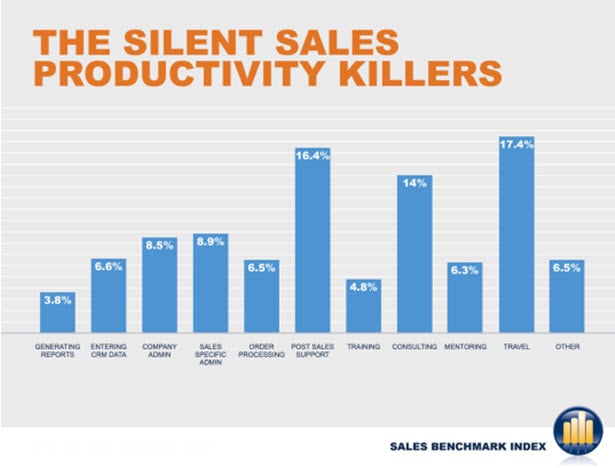
silent sales productivity killerLet’s recap the time you have sucked out of the sales rep’s day. Perhaps you implemented a new CRM, Marketing Automation or Enterprise based social network. The goal is improved efficiency and sales rep effectiveness. The statistics support the majority of automation implementations fail. You’re trying to help but you’re killing the sales teams’ selling time in the process. And you wonder why the sales team is a reluctant participant in the new initiatives.

So What’s the Solution?

Adding value to your sales team starts with understanding your buyer. Best-in-class sales organizations start with understanding where the buyer spends their time.

Sales Rep Time Study Template

You are spending millions on the solutions meant to enable the sales team. So why is the internal buyer’ treated any differently than the external buyer? Yes, the sales team is the buyer for your solutions. If they were a prospect you would know how to treat them. You would leverage; buyer personas, buyer process maps, a custom sales process, assign the right people and build a marketing campaign.

Sign up for SBI’s 7th annual research tour:  "How to Make Your Number in 2014:  A Sales Strategy You Can Execute."  Participate and learn what top companies are doing to make the number in 2014. You will get a copy of the Time Study Template plus dozens of more tools.

Four Key Areas to Impact

SBI’s annual research contains 4 key areas impacting B2B buyer trends. How do these 4 areas relate to your internal initiatives? Not understanding the environment your buyer is working in means you don’t understand your buyer. Let’s contrast external buyer changes with your internal buyer and the associated impact.

External B2B Trends:

  1. Buying Process Map (BPMs) – a BPM includes the macro and micro questions your buyer is asking during the purchasing decision timeline. Mapping your external buyer’s decision making process from “not in the market” to “implementation”.
  2. Social selling - how to sell and prospect by leveraging social networks and generate meetings with decision makers. Even in best in class marketing organizations you’re only supplying 30% of rep generated opportunities. Your sales team needs to generate the other 70%.    
  3. Custom sales process - a custom sales process or processes mapped to each buyer process map you have. Many of the old off the shelf sales methodologies have not adapted to the changes in buyer behavior.
  4. The new “A” player sales rep - the capabilities your sales team needs to compete in 2014 and beyond. Fundamental sales capabilities still apply. The new A player also requires Social; Branding, Reach, and Referrals to name a few. A sales reps ability to keep pace with the buyer has never been more important.


Internal Buyer Trends:

  1. Internal Buying Process Map (BPMs) – the sales team is time starved. The demands on them continue to increase with the number of enablement tools being provided. Just think about the change management side of it for the rep. They need to learn more tools to increase selling efficiency. We know with change management, you have a dip in productivity first. Knowing your internal buyer well will increase your adoption success. Work with your peer in sales and start with a time study.
  2. Social selling – this is a new capability requirement of the sales team. The tenure of the sales team can impact the ability for you to gain adoption. The “use cases” in this area need to increase closure rates and reduce sales cycle length. For the sales rep, how can you help provide more meetings with decision makers? Knowing where time is being wasted allows you to help.
  3. Custom sales process - assuming you have a customized external sales process. Are you still selling to the internal buyer in the same old way? If you think about your own time starved days. Do you really buy in the same way you use too? How can you adjust your internal sales process to the demands on your buyers (sales reps)?
  4. New “A” player sales rep – has any job changed as radically has the sales rep’s? Let’s use an example for your job. You need to meet with your entire marketing team. No one returns calls or emails. They dread the time with you because it’s viewed as a constant sales pitch.  Not to mention they think they already know everything. How could you possibly get anything done? Welcome to the world of a sales rep. Knowing where they struggle with time allows you to adapt the initiatives to the buyer. Adoption of the initiative by the sales rep means success for you.


When you are building a world class sales machine, understanding your internal buyer is critical. Failure to understand your internal buyer results in failing to gain adoption of new capabilities. Failing to gain adoption means failure for you.

Download the Sales Rep Time Study Template by signing up here. Walk into the CSO’s office, put it on his/her desk and say, “Let’s do this.” Knowing where the time goes will help both of you.

If you have any questions or concerns contact me at john.staples@salesbenchmarkindex.com. I’ll walk you through the template and spend 30 minutes helping you add value to the sales team in 2014.

Author: John Staples

Follow @JohnStaplesSBI

sbi on linkedin

If you enjoyed this post, never miss one again by subscribing your Email Here and/or subscribing to the RSS Here.

11 Oct 16:24

LinkedIn adopts cloud integration to drive sales

The social networking site gave its sales staff unparalleled single-screen access to corporate data by using the latest in cloud integration technology.

Author information

Nick Clunn
Nick Clunn
Contributor at Tech Page One
Nick Clunn is a journalist covering the tech beat and an adjunct professor at Montclair State University. He lives in New Jersey, where he had worked as a staff writer for several leading daily newspapers and websites.

The post LinkedIn adopts cloud integration to drive sales appeared first on Tech Page One.

11 Oct 16:24

3 Social Media Tips for Sales Teams

by workbooks
In the age of engagement, quality content, and the softly-softly social media approach, 'sales' has almost become a dirty word. But like it or not, most businesses still have to make money. Here are three key social media techniques for sales teams.

read more

11 Oct 16:24

How Social Media Makes the Sales Process Faster and More Efficient

by Michelle Hummel

 How Social Media Makes the Sales Process Faster and More Efficient image sms 150x1501The last thing most potential customers want during dinnertime is a marketing call. And while B2B cold calling can work, it’s a long process that can also cause some resentment. Because both consumers and business owners are far more empowered than they were even a decade ago, most don’t want to tolerate being interrupted by a marketing message.

Instead of wanting a salesman to call them, most people who are interested in making a purchase want to go out and research what options are available before actually pulling out their wallet. According to research compiled by sales organizations, prospects’ buying decisions are sixty percent made before they actually talk to anyone who’s in a sales role.

Although savvy sales professionals still play a very valuable role, that role is much different than it was prior to the rise of the Internet. For example, as previously mentioned, cold calling is nowhere close to as effective as it was a decade or two ago. Another reality is that hiding information from prospects is no longer a way to build leverage. Instead, that approach is generally going to result in prospects going to a competitor that’s not afraid to share basic details like pricing.

Because consumers expect to have access to information as they’re making their purchasing decision, smart companies know that they shouldn’t hesitate to make that information easy to access. Sharp companies also realize that because consumers now have platforms like blogs and social media, they need to provide customers with the best experience possible. Not only does that mean some customers will share their positive experiences through those channels, but it also means a company won’t have to worry about negative comments being broadcast across the Internet.

One thing that has remained the same is consumers still appreciate personalized service. But just because that type of service is effective doesn’t mean it’s realistic to meet every prospect in person. Instead, it means that sales professionals need to harness tools like social media and email in ways that show their personality. For example, instead of only tweeting links to content, tweet updates that talk about what you’re doing. By showing that you’re an actual person instead of just a machine that’s programmed to sell, you can make it easier for prospects to connect with you.

Now that you have a better understanding of how modern buyers think, you may be wondering how you can create a comprehensive strategy for yourself or your entire organization. The best place to start is with content. If you’re publishing valuable content on a regular basis, you’re going to be successful at bringing prospects into your inbound sales process. Once you have their attention, your process needs to revolve around building a relationship before you move into the closing process. Even though you may not be able to meet prospects in person, optimizing your approach to online sales means you will still be able to build trust.

 How Social Media Makes the Sales Process Faster and More Efficient image wsplogo 150x1504Could your company benefit from a better social media and content strategy? Web Strategy Plus offers a free consultation and 3-5 page  report to help you identify the areas of your marketing plan that need improvement. Learn More

This post was originally published at Web Strategy Plus.
11 Oct 16:24

The Traits of Top Sales Performers

by peaksales
Image via ddpavumba/ FreeDigitalPhotos.net

Image via ddpavumba/ FreeDigitalPhotos.net

Spend some time with high achieving sales people and it quickly becomes obvious that they share some key personality traits. Evidence of common attributes amongst top sales people comes from many high profile studies. Some of these are particularly notable in terms of the specific traits that top sales achievers share.

Dr. Christopher Croner, Ph.D, who himself has studied sales people for more than 25 years, cites the following about top sales people:

Over 80 years of research in the sales sector has found that the most important trait common to the DNA of nearly all successful salespeople is drive. Drive is the passion that causes great salespeople to get up early, stay up late and make whatever personal sacrifices are necessary to close business. It is the inner fire that determines not just whether a salesperson can sell, but whether they will sell.

He goes on to explain that drive consists of three elements.

1. Need for Achievement – Top performers are ambitious and goal oriented. They are not satisfied with simply working towards their goals, but are also highly self motivated to achieve their goals. Once they realize a goal, they instinctively set new, higher goals and keep progressing.

2. Competitiveness – The highest achieving sales people want to not only do well, but they also want to be best. Regardless of the pursuit they want to win and when it comes to sales, they are driven to outsell and out earn their peers. They are excited by the opportunity to influence a buyer to buy and speak as if selling is a sport, hence the expression “winning a sale.”

3. Optimism – They expect to succeed. It is what drives them to persevere through the grind and rejection that every sales person faces. Croner points out that some studies indicate that optimists outsell pessimists by 20% to 40%.

Since the mid 1980s, Target Training International has researched  human behavior and sales people worldwide. The company’s research indicated that a person’s attitude had the most impact on sales performance and more than 70% of top sales performers share a utilitarian attitude which is characterized below:

  • Utilitarian – People with a utilitarian attitude focus on investing time, energy or money, with the expectation of a return in greater time and resources. They strive to understand what is valuable, useful and, or practical and focus their energies on monetizing their value. They are attracted to financial incentives and realizing an optimal return on their resources. They are inclined to avoid pursuits that do not provide a return on their investment in time and energy, preferring instead to find the shortest path that leads them to achieving their financial goals.

All of this research is consistent with our own experiences recruiting sales people and building high performance sales teams over the last 20 years. If we were to list the predominant traits that we see across top sales people they would include the following:

  • ambition and drive
  • confidence
  • optimism
  • competitive
  • strong sense of urgency
  • high need to interact with and influence others
  • persistence 
  • resilient / impervious to rejection

A sales leader that is lucky enough to know that these traits are important, is half way to building a high performance sales force. The other half of the challenge is being able to select people with these traits. No easy task. For more on this see Sales Interview Questions and Potential vs. Proof in Sales Hiring.

To your success!


11 Oct 16:24

Why It Takes 7 to 13+ Touches to Deliver a Qualified Sales Lead (Part 1)

by Laurie Beasley
Rnordman

Absolutely true.

You might think we’re exaggerating, but we’ll show you how easy it is to reach 13 or more touches just to get to the point where a lead has provided enough information about his or her situation to be certain that the lead is really a “sales-ready lead” and not just a suspect name. Before we get to the seven to 13+ touches, let’s examine why the majority of today’s B2B “leads” never become prospects: the disconnect between marketing and sales. Nail the following to start delivering more sales qualified leads—you’ll be miles ahead of your competition.

Sales and Marketing Live in Separate Worlds

According to CSO Insights, the average number of sales reps making their quotas was 63% for 2012, and only 42% of firms met or exceeded their 2012 revenue goals. Yet 92% of firms are raising their revenue goals for 2013—and more than 40% of firms indicate the increases are 15% or more.

We can safely say there is a widening gap between management’s revenue expectations and demands and sales’ and marketing’s ability to deliver. Unfortunately, instead of teaming up, sales and marketing are also experiencing a widening gap of credibility. Marketing points to the huge number of leads entered into the marketing automation system to prove that marketing is doing its job. Sales points to the poor quality of the leads to prove that marketing is not doing its job. RELATED CLASS: How to Setup a Lead Management Process

Forrester Research says that low-quality leads create sales problems. Essentially, marketing is pouring unqualified leads into the top of the sales funnel. Sales reps aren’t following up on the leads because there is not enough opportunity background data associated with each lead to justify real sales efforts. Time really is money in the sales business, and no sales rep will waste time on a lead unless they know that the person in question has some version of budget access, authority and—most of all—need for the product and a timeframe within which they plan to purchase. As Forrester sees it, warm suspect leads are falling out of the middle of the funnel, forcing marketing to scramble to replace the leads and giving Sales very few real sales-ready opportunities with which to work. (See Figure 1.) Sales and marketing are disconnected, and few leads are actually converted. Marketing costs go up, sales go down, and needless to say, management is not pleased.

Figure 1: Low-Quality Leads from Marketing Create Problems for Sales

Why It Takes 7 to 13+ Touches to Deliver a Qualified Sales Lead (Part 1) image low quality leads forrester

Source: Forrester Research


Most Prospects Never Receive Enough Touches

Why do warm leads drop out of the lead-to-sales funnel? Because they have not received enough touches with information exchanged to convert them to a sales-ready lead. Consider the following typical sequence of developing a sales-ready lead:

1. Initial email campaign.

2. Initial direct mail campaign.

3. Call: prospect not there; leave a message.

4. Send email follow-up.

5. Call: prospect is not involved in any way and refers to correct contact in company

6. Start over. Call the referred person, leave voice message.

7. Send email follow up. First email.

8. Call, after no inbound response: prospect not able to talk then, but schedules another time.

9. Send email follow up confirming call appointment day and time.

10. Conference call held. Prospect interested, but wants more information before all the qualification questions on script (which the sales team needs) are completed.

11. Send personalized email follow up with relevant info. The email may include information on case studies, webinars, and web pages with supporting information about the product. (AKA, mid funnel content.)

12. Prospect now ready for a peer-to-peer talk about needs/pains, access to budget, purchase authority, level of urgency and timeframe. Now, the scoring data says the prospect is sales-ready qualified!

13. Email to confirm appointment scheduled with field or inside sales rep, CC rep.

You can get to 13 or more touches very quickly. The problem is that most so-called “leads” rarely receive any touches beyond receiving an email and filling out a response form. Some of those unqualified leads that marketing tosses into the sales funnel are good potential leads, but they rarely receive enough touches to become qualified. Warning: don’t expect your sales reps to do this pre-sales qualification work. As we said, sales resources are slim and they are also some of the most expensive fixed costs in a company. Need more evidence? Microsoft conducted a study that shows that by the fourth contact, a full 89% of sales people have given up. (See Figure 2.)

Figure 2: Most Prospects Never Receive Enough Touches To Become Leads

Why It Takes 7 to 13+ Touches to Deliver a Qualified Sales Lead (Part 1) image Prospect Touches

Source: Microsoft

This is because not enough pre-sales qualification work has been done before sales receives the lead. Lead-generation and qualification is hard work because it takes time to gather the qualification information and build a relationship with the prospect just to set that critical first appointment. Sales people haven’t got the time—and they won’t spend the time to build a relationship until they have the data that tells them the lead is solid. RELATED CLASS: Best Practices for Building a High-Impact Demand Generation Strategy

If Sales Won’t Work with Unqualified Leads, Who Will?

What can we, as marketers, do about this disconnect? Marketing’s efforts to generate leads, according to Microsoft, are largely being wasted. There are plenty of leads, but most never get to the point where Sales will work with them.

Our solution to this problem might seem heretical to some, but we stand by it: marketing must step up to the job of pre-qualifying leads to this higher level before they are passed on to sales.

“Wait!” you might say. “The sales department has always done the qualifying, not marketing.” But times change, and so do the rules of the game. Historically, sales and marketing have often been at odds.* Sales and marketing must learn how to be each other’s BFF if either wants to meet management’s expectations.

Because salespeople will not follow up on unqualified leads, marketing must step up to the job of pre-qualifying leads by determining the BANT data (Budget, Authority, Need and Timeframe) or your company’s version of it, for each lead that comes in. This also puts the level of qualification information to be gathered beyond what can be gleaned from marketing automation systems and digital-only methods.

“Hang on!” you might say at this point. “We don’t have the people or the budget to do that kind of thing!” Right. That means you have to get the budget from management to outsource this function with experts or hire the fixed-cost staff and systems to do it. And you know what that means? You must justify the added expense with some cold, hard facts and numbers that prove the ROI of adding pre-qualification to Marketing’s roster of duties.

In our next post, we’re going to talk more about BANT data and lead qualification. We’ll share information on how most marketing automation systems ARE NOT able to produce real sales-ready leads, why this happens to most firms, and what adjustments can be done to deliver on the sales-ready promise. In subsequent posts, we’ll show you how to justify the expense of adding pre-qualification of sales leads in the marketing department, ways to shorten the lead-generation process, and a couple of case studies that demonstrate the success of our approach.

* For an excellent discussion of the issues between sales and marketing, see this “Harvard Business Review” article, End the Way Between Sales & Marketing.

Learn how to nurture more leads to qualified with an effective marketing automation program.

Watch Marketing Automation Best Practices for Success, and get expert advice to build your case for marketing automation, select the right solution, develop the right people with the right skills, and define your implementation strategy. Get instant access to this class now.

This is a post by Laurie B. Beasley, Co-Founder and President, Beasley Direct Marketing, and Tom Judge, Vice President Strategy, Direct Marketing Partners

11 Oct 16:23

Sales Alert: Making Eye Contact May Not Be Such a Good Idea

by The Daily Stat

After gazing at the eyes of speakers who were trying to persuade them, research participants showed an average attitude shift of just 0.14 on a seven-point scale, compared with 0.6 if they had stared at the speakers’ mouths, says a team led by Frances S. Chen of the University of British Columbia in Canada. This and another experiment show that contrary to popular belief, eye contact decreases the success of attempts at persuasion, at least in the cultural context of the European university where the study was conducted. Because direct gaze has evolved in many species to signal dominance, eye contact may provoke resistance to persuasion, the researchers suggest.


11 Oct 16:23

Collaborative Sales Practices that Engage Buyers

by Jeff Korhan

Collaborative Sales Practices that Engage Buyers image 2013.10.3 Sales 350x282

Selling directly to buyers is a standard business practice that is being transformed into a more collaborative sales process.

Progressive businesses are now working together with customers to create shared experiences by co-creating solutions with buyers to give them what is often greater or more exciting than they would have imagined.

Buyers do not always know the extent of your business capabilities, just as your business may not fully understand their aspirations. Therefore, bringing the two together can often create extraordinary results.

Thus, in addition to ensuring the future relevancy of your business, learning to build collaboration into your sales, marketing, and customer service processes will easily differentiate your business, even in crowded markets.

Here are three customer collaboration practices to consider.

#1 – Take Control and Share It

Buyers want to work with a business that is control, which is one of the primary objectives of your sales process.

Your process gives them confidence that you will take them where they want to go, and if it is collaborative, they can then share that control. It’s truly a beautiful thing.

While most people will not admit it, they want to follow leaders. That’s why they hired you.

They are relying on your expertise and experience.

If at some point during the process they want you to completely take over, which is a signal you have earned their trust, they can just sit back and enjoy the ride.

#2 – Encourage Actions That Earn Trust

When anyone takes action there is risk. Therefore, when you design a process that has your buyers taking actions that reliably lead to favorable outcomes, you instantly earn their trust.

When your buyers are engaged in activities, you have their full attention. When those actions lead to desired outcomes, you progressively earn their trust.

Earned trust is the one quality that consistently leads to more sales. More importantly, trust builds relationships wit customers that become ambassadors of your business brand.

#3 – Nurture Relationships and Brand Advocates

When you help people solve problems and achieve their dreams, they feel good about their relationship with your business and tell their friends about it.

Traditional marketing sought to earn customer satisfaction and loyalty after the sale.

Collaborative marketing and selling seeks to engage the buyer at an emotional level throughout the entire process, such that they become advocates that share the entire experience with their friends and family.

Give them more than they have expected or imagined.

Get them so excited about working with you that they are telling their friends while it is all happening, and hopefully long after that.

In other words, design your sales and marketing to help your buyer feel what they want to feel.

Look for more on that in a future article.

11 Oct 16:09

Overcoming Negative Sales Stereotypes

by Will Brooks

Will Brooks
EVP & Director of Marketing, The Brooks Group

In my role as Director of Marketing, I spend a fair amount of time studying our website visitor statistics, conversions, etc.  Because of that, I stay very aware of our website traffic sources, which Google searches bring visitors to our site, who these people are, etc.

In this part of my work, something that has really piqued my interest is the fact that a blog post written by Jeb Brooks titled The World’s Most Complete List of Job Titles For Salespeople brings a TON – and I mean a TON – of traffic to BrooksGroup.com.

I’ve been giving some thought as to why that is.

I’m hypothesizing – and that admittedly means there are some assumptions here – that most of these visitors include salespeople, sales managers, etc. who are looking for job titles other thansalesperson that they can use either for themselves or for their sales team members.

If that’s true, what does that tell us?

That there are many people involved in the sales profession who want to dress up the fact that they’re a salesperson.

My position on that issue is simply to ask, “Why try to hide it?

I submit to you that far too many B2B buyers in today’s marketplace know that “Business Development Professional,” Relationship Manager” or “Sales Executive” all translate into “Salesperson.”  So, for those of you interested in downplaying the obvious, this isn’t a tactic that is going to get you very far.  Using these titles 10, 15 or 20 years ago might have helped you seem like something other than a salesperson, but today, that’s old news.

So, if the intent behind using a more job title other than “Salesperson” is really a desire to more favorably position yourself (or your team), then the best way around the cliché old-school impression that the word “salesperson” (or worse, “salesman”) isn’t through adding a different title to your business card.

Instead, it’s by doing things like:

  • Upgrading your strategic questioning skills
  • Improving the way you approach prospective buyers
  • Becoming a sought-after problem-solver, not an interruptive product-pusher
  • Identifying those buyers who you can genuinely help, asking to meet with them in a professional, respectful and valuable way, and helping them understand how your advice, products and services will be beneficial to helping them achieve their business goals
  • Recommending solutions that may (or may not) include your offerings
  • Following up with prospects and customers in the way and within the timeframe you’ve committed to do so
  • Staying on top of industry trends and sharing these with your customers and prospects

I could go on and on and on with this list, but I won’t because you probably get the idea.  It all starts with learning a solid sales process and using it in your day-to-day selling activities.  Work on yourself.  Improve your skills.  I think you’ll be pleasantly surprised at how the negative stereotypes associated with old-school selling will somehow no longer apply to you.

- @WilliamPGBrooks

The post Overcoming Negative Sales Stereotypes appeared first on Sales Evolution.

11 Oct 16:09

Soup Up Your Sales With Contextual Marketing and Targeted Experiences

by Merlin U Ward

Your business is a machine.

It has its various parts, and it runs to make profits (hopefully). When you put money in one end (marketing), money is expected to come out of the other (profits). Sounds simple?

It could be…but there’s a problem.

Many companies’ machines do not run efficiently. The marketing engine needs to be run using smart context and customer experience to stand out in the target market but for most, all the pistons aren’t firing up.

You Miss if you Aim for the Majority

Inefficiency happens because most marketers aim for the middle majority (part of the marketplace where the majority of people reside, a.k.a. the mass market). These businesses use generalized messaging and try to speak to all these people at once.

Three factors make shooting for the middle even more costly and the machine less efficient:

  1. They rely on the dollars to boost the reach of the message but leave out context and a unique customer experience.
  2. Most marketers are shouting at the middle majority, so the amount of noise there is deafening.
  3. To throw another wrench into the gears, consumers are becoming experts at ignoring marketing messages.

Soup Up Your Sales With Contextual Marketing and Targeted Experiences image Merlins1

Consider the figure above; a lever to represent the machine. The lever on the output end (right of the fulcrum) moves up and down and indicates how much money you make or lose. The input end (left of the fulcrum) is the dollars you spend marketing. As you might suspect, if you put out a product for everyone and rely on your marketing to get the word out (aiming towards the middle in this example) then you need to put in a lot of force ($$$) to move the lever.

As Seth Godin puts it, we must stop aiming for the mass market and instead aim for the edges, or “weird” as he likes to say.

Gain Leverage by Knowing Your Target’s Worldviews

The edges experience less noise, and also have people with very distinct mindsets, or as Godin says, “worldviews.” Here, contextual marketing and customer experience work hand in hand to give your machine more leverage. Research on the target market will give you the proper understanding of your target’s “worldview,” which enables you to create the right context for your message. The right context allows your messaging to cut through any noise and ensures that it will not be ignored by your target.

When you identify the edges of the mass market and determine context suited for that niche, you can create the right customer experience. Customer experience is how the product is designed, how the target will use it, how the customer service process will be unique, what the buying process is like, what the brand voice will be and how it is communicated. Combine these pieces to make give your machine leverage and aim for the edges.

Soup Up Your Sales With Contextual Marketing and Targeted Experiences image merlins2

In this updated figure, you can see with fewer marketing dollars on the input end, the enhanced machine works to your advantage. The level can stay level almost on its own. You can spend less money marketing to create profits because the customer experience drives the business. Your customers are so enthralled with your product, your company, and your brand that they help market it for you, growing sales and profits.

How to Stand out at the Edges

Let’s say you determine your unique target is a vegan mother with children whom she also wants to adopt the vegan diet. Your research finds that her worldview is that being vegan is better for mind, body, and earth. Your contextual marketing copy for the product must support her lifestyle, make her kids excited about vegan food, and also show the product is good for the environment. With research you can begin creating more leverage by building the customer experience around the contextual understanding of her. The buying and web experience, and brand voice could support your customer’s ideals and further add leverage to the input end of the marketing machine.

Without context, ignoring the mass market and an exceptional customer experience to support the target’s worldview, sales won’t grow because the quality of the product/service is overshadowed by the noise.