Shared posts

04 May 21:20

Feeling stressed? k.d. lang suggests you Stop, Breathe & Think, a new app for guided meditation

by Gillian Shaw

A recent study published by the Journal of  the American Medical Association found that meditation may be better than drugs when it comes to coping with anxiety and depression.

But for today’s 24/7 plugged-in digerati the possibility of carving out a few peaceful moments to meditate is about as likely as – well – leaving their smartphone at home.

So how do you slow down our smartphone-addicted society?

There’s an app for that.

The non-profit ...

21 Jan 15:52

Want More Sales? See 'American Hustle'

by Bill Murphy Jr.

Move over, Glengarry Glen Ross. The best film about closing is American Hustle.

When you try to explain the entrepreneurial life to people who haven't taken the plunge, it sometimes helps to refer to pop culture.

If you're talking about why it's so important to set up a business succession plan, for example, you might reference "Downton Abbey." If you're trying to describe the craziness that comes with running a small business, you might call up a scene from "Mad Men."

Now you can add the film American Hustle--which won a Golden Globe for Best Picture and picked up 10 Academy Award nominations this week--to the list, especially if you want to explain how really great salespeople find leads, draw customers, and make deals.

The film is loosely based on the ABSCAM investigation of the late 1970s and early 1980s, in which the FBI got several members of Congress on videotape agreeing to accept bribes from a man they thought was a wealthy Arab sheik.

In this heavily fictionalized version, a con man named Irving Rosenfeld (Christian Bale) and his girlfriend (Amy Adams) are manipulated into working for a rogue FBI agent (Bradley Cooper). Everybody in the film is, shall we say, morally complex.

Throughout the film, the characters played by Bale, Adams, and others have to convince, sell, trust, and entrap one mark after the next. Although they don't use the jargon you've probably heard in a sales seminar, they employ one smart technique after another to close the deals.

With that in mind, I asked a group of entrepreneurs and salespeople for their best sales advice and found almost all of it portrayed in the movie. Here are a few examples.

Make Them Think it Was Their Idea

Much to the chagrin of the FBI agent, Rosenfeld insists on reeling in the marks slowly, to the point of making it seem as if the plan was their idea. For example, Rosenfeld recruits a friend to dress up as an Arab sheik and walk around with him so targets will beg him to let them do business with his wealthy friend.

A milder version of this plays out in the real world, too. Peter Njongwe, who runs a business in Canada selling African-Canadian inspired art and accessories, gave me the example of a customer who is "just looking." Instead of turning her attention toward a specific item, he'll reply, "I like looking at nice things, too." That kind of comment can turn an encounter into a conversation, rather than a situation that puts a customer on edge.

"Customers are apprehensive of salespeople," Njongew says. "The trick here is ... to be their counselor ... and break past barriers by using humor and empathy. That way you can truly understand who they are and what they want or need."

Create a Need in Your Customer

Is the enamel wearing off your teeth? Does the car you drive say you're not the man you wish you were? Spend a few minutes watching TV and you'll find ad after ad trying to get you to buy over-priced toothpaste, high-end cars, and a million other things.

In the film, Bale's character learns this lesson at a young age. When his father's glass business struggles, Bale drums up demand by throwing rocks at window storefronts. It's not the most ethical example, I suppose, but it's a good lesson: Sometimes customers don't need your business until you prove there's a need.

Repeat Customers Are the Best Customers

The movie takes place in the late 1970s, long before the Internet and uniquely evil tactic of signing up customers for credit cards without their knowledge came into being. Much in the way the latter service is hard to cancel, Rosenfeld understands recurring revenue can work like magic.

Before dealing in fake art and other illicit hustles, he owns and operates a small chain of dry cleaners, one of the best bricks-and-mortar recurring revenue models there is. The whole point is that it's usually easier (and cheaper) to retain a customer than find a new one.

For entrepreneurs whose clients aren't on a repeating business schedule, Calvin Harris Jr., a consultant and CPA in Columbia, Maryland, says simply making an effort to reach out to clients at unusual times can lead to more business.

"For the holiday season, we sent out Happy New Year cards," Harris says, adding that he waited to send them on January 6, when the holidays ended. "That little timing adjustment lead to a flurry of meetings and catch-up requests that have already filled our calendar for January."

It's a new year and I'm in a new city. Now this column needs a new name. Want to help me choose? Vote here!


17 Jan 15:47

A Student's Guide to Using the Kindle for Research

by Thorin Klosowski

A Student's Guide to Using the Kindle for Research

The Kindle is great for reading the occasional book, but you might not know that it's also a fantastic tool for students. When used correctly, it can essentially operate as a portable tool to keep all your books, notes, and research in one place. Here's how to turn a Kindle into your new best friend for school.

Read more...

17 Jan 15:41

Dear Sales Diary

by Tibor Shanto

By Tibor Shanto - tibor.shanto@sellbetter.ca

Diary

Those of you have kept or keep diaries, know that one of the reasons it has such great value is not just because you open up about intimate secrets, but that you share everything, not just the good, not just the bad, but all that and everything in between. You were able to go back and relive the experience, and more often than not glean lesson and things you would do differently if you had to do them all again. You didn’t just look at what you did well, or things that turned out to be good, living up to and beyond your expectations. You looked at the bad things that happened and tried to understand how you might avoid similar things in the future. The more honest you were the more rewarding the experience. If you skewed or slanted things one way, you may feel better for a while, but reality comes creeping back in, forcing us to deal with the bad, and the gray.

Sales people and sales organization need to keep a diary of their experiences, all of them, the good, the bad, and the in between. Most already do deal reviews in some format, but many do not, either choosing to them selectively, or just enough to satisfy a KPI or ScoreCard requirement. Few do the real deep dive required in order to get the most out of it, in the process allowing both a learning and revenue improvement get away. To be clear, and as you will see further on, “deep dive” does not have to be a laborious time consuming exercise with minimal payoffs, it can and should be an ongoing process that helps you with deals you are currently involved in, while also allowing you to capture and repurpose things on the fly. Done right, it should resemble the old EDS add about building an airplane while it is flying, the opportunity for sales people and organizations, is to build a continuously better sales, even as they are executing current sales, and prospecting for their next one.

Specifically this involves reviewing all deals you were involved in, those you won, those you lost, and those which go to “no decision”. Note, if you are involved in ten to a dozen deal a month, I recommend you review all of them; if on the other hand you are involved in dozens of deals, you may want to review a representative sample. If you have 7 wins, 15 losses, and 6 no decisions, review 25%, or seven, and you will get good, executable output. But as you’ll see, even if you don’t formally review each one, you will produce usable output.

Now some of you reading this may be aware that I am the coauthor of an award winning book about Trigger Events. In that book the recommendation was that you focus your reviews to only those deals you win. This will allow you to continuously repeat those things that are consistently help you win deals. Sound thinking, to a point. Let me explain, coauthoring a book is a lesson in compromise, you give you, you learn, you take, and in the end you produce a book that reflects the learning of both. But as you move on, the hope is that both authors evolve, not limited by the required compromises, and we each continue down our path, shaped by or experiences.

Since the release of that book, my thinking has evolved to where I see focusing strictly on one segment of your activities and only one of many outcomes, brings an unnecessary level of risk to one’s sales success, regardless of which one of the three possible outcomes you focus on. Given that on average, wins make up less than half of potential deals, if for no other reason than to broaden you perspectives, you should review outcomes other than just wins.

This is why the 360 Deal View was developed. It allows you to capture relevant information about the sale, the outcome and specific contributors to that. As with most tools, it is less about the tool itself, and much more about the approach and behaviours it promotes, which in turn lead to the desired results in more repeatable, predictable and consistent ways. It allows you to evolve you selling along with the way your market and buyers evolve.

While there is no denying that you want to know exactly what you are doing that is helping you win, you want to know what unfolded on the buyer’s side that prompted them to engage, and what outside and inside factors accelerate your sales cycle or cause it to slow and stall. What were the buyer’s objectives that allowed you to gain traction, and how you were able to connect with those? All important things you want to leverage. But it would be dangerous if not naïve to not go through a similar exercise with the other outcomes, losses and “no decisions”. Two simple advantageous to knowing why you lose, first, it may just take a small adjustment to change some of the inputs that will move a loss to the won column. Second, you may discover that a segment that made sense on initial exploration made sense to pursue, based on practice does not. Looking at “no decisions” will often allow you to understand when would be the best time to reengage, and take the cycle to fruition. It will also help you detect tire kickers a lot earlier.

These will be fallouts if you only review wins, but there is no denying that focusing on just one area, will lead to tunnel vision, causing you to miss changing trends that are more evident in the other categories, and more importantly, leave you very open to be blindsided. If you rely on one set of data, you will continue to find others who fit the mold, but it does not speak to the size of a market, things can continue to look good in a shrinking market, and by the time you react, many opportunities will have been missed, and competitors will have made unnecessary gains at your expense.

Most CRM’s and related apps will allow you to do a complete all three, and even allow you to get more granular if need be. You can download our tool here, but the key to success is not the tool, but the philosophy, and more specifically the discipline of doing it in up, down, or sideways markets. Just as with a diary, the best ones were usually written in simple notebooks, not fancy specially diaries, what made them great was the depth and completeness of what was captured, and the consistency of execution.

What’s in Your Pipeline?
Tibor Shanto

17 Jan 15:41

8 Traits of Great Sales People

by Tom Searcy

What separates a good salesperson from a great salesperson? The best of the best tend to share the following characteristics. How does your team stack up?

I recently performed an audit for a mid-sized company in which I examinined their sales staff against a standardized assessment test as well as their performance data. The results may confirm some of the things you already know, but there were some surprises. Here is a brief recap of the analysis.

When you look at the qualities of the great sales representatives for non-transactional sales--those sales that are larger and more complex in nature--they tend to share the following traits:

  • They assume parity with their customers--There is an imaginary hierarchy that average and poor-performing sales people place between themselves and their prospects. It includes head-trash like, "The customer is always right," and "You're the customer so you're the boss." The data says that the top sales representatives see themselves as problem-solvers worthy of equal respect with their customers. Respect always, deference rarely.
  • They are comfortable talking about money--This quality often starts back in the home in which they were raised and the beliefs that were held there about money. If there was a belief that money was a rare and precious thing to be horded or feared, then it shows up with a fundamental discomfort in discussing large numbers. Individuals that look at money as a measure of value, not as a number outside of personal grasp, typically do better in sales.
  • They challenge the decision-maker--The best sales representatives have a strong confidence in their understanding of the customer's market and their own solution--enough so that they are comfortable challenging inaccurate statements made by the customer. See my blog, Best Type of Sales Pro to Hire, for the data analysis; it is irrefutable.
  • They are comfortable with silence--Confidence is demonstrated as much in silence as in what you say. Top sales people can allow for measurable periods of silence in conversations with prospects. This creates an opportunity for the prospect to give consideration to what has been said rather than having to process the next piece of data given to them by the sales rep.
  • They show up prepared--This seems so common sense and yet when I administer these types of assessments the statistical fact is that most sales people--greater than 70 percent--are not well prepared for sales calls and meetings. They lack research, pre-call planning, a complete agenda agreed upon by the contact, and a tailored presentation to the prospect. The best have all of these things.
  • They don't rush--A study was done about physical demonstrations of confidence and power some time ago. The external view of two people moving was observed by a cross-section of people and questions were asked about which one had greater confidence, was paid more, and had a position of greater authority. They both wore similar attire, and were of the same body shape and age. The only distinguishing characteristic was the speed in which they performed their actions. The one who looked rushed always scored lower. An appearance of confidence in part comes from an appearance of control.
  • They ask great questions--This has been written about by me and many others. The data confirms that the higher-performing sales representatives ask more questions--often more than twice as many--and their questions are more focused on implications than on data. Put another way, they ask questions about what something means rather than just what it is.
  • They are impeccable in following up--Just like preparedness, this quality seems so simple but is often overlooked by poor performers. The best cover the details.
  • One more note: Great sales people score over the 50 percent mark on every one of these traits. That means that they are not super-high in one area and failures in the other areas. They are above the halfway mark on everything. That's their foundation. Then they knock the ball out of the park in their areas of personal strength.


    17 Jan 15:41

    The One Question Sales Interview

    by peaksales

    Sales intevriewerIt happens all the time. Your schedule gets crunched and you have no time to prepare for the interview with a possible sales hire. You should enter every interview with an agenda which is used to objectively assess all candidates for any position. But let’s throw that out the window and assume, you don’t have the script and you don’t have time to prepare one. How should you conduct an interview with a sales person to get a reasonably accurate picture of whether it is worth investing more time with them and, or potentially hiring that person?

    The one question sales interview:

    If we could only ask one question or only had time to discuss one topic in a sales interview, it would be this: tell me about when and how you succeeded in a similar situation to the one I am considering putting you in.

    You can follow up with all sorts of questions about the challenges they faced and how they overcame them. Focussing on this topic will give you great insight into the way the sales person thinks and more importantly, since past behavior is the best predictor of future behavior, this discussion will shed light on the degree to which they have mastered an environment that is similar to the environment that they would be in if they worked for you.

    To your success!


    image via Michal Marcol | digitalphotos.net

    17 Jan 15:41

    How the Shifting World of Business Development Will Affect Sales & Marketing in 2014

    by Alexandra Burnett

    How the Shifting World of Business Development Will Affect Sales & Marketing in 2014 image ULsop3R3oCkviwvHUFR5CIQPHXjNyrVZeTBbCuiHcLCD7y3P56uuFHwgqy5dsh6StY1ODKcSXE92MLxrYXkrK5dKsGXrtNP54FU rIZ0C42WHxXrp QmyHlaNA3

    Don Draper’s out – in 2014 marketing professionals are getting more and more pressure to generate high web traffic, great social media interaction, good quality leads and so on. The question is: Can you deliver that?

    Marketing’s job used to be to just generate leads and pass them to sales, but the digital world has brought many changes. The sheer volume of data now available from campaign and online analysis means the onus has shifted to marketing to not just create leads but to sort them, score them and only pass on the hottest ones to sales. The rest get nurtured until their score moves them up to the revered state of being Marketing Qualified Leads (MQLs).

    It’s all about the nurturing

    Lead nurturing with content and using inbound marketing to keep prospects engaged until this stage is essential for marketers to deliver MQLs, especially when you consider that 66% of buyers indicate that ‘consistent and relevant communication’ is a key influence in choosing a provider. Not only that, but nurtured leads have a 23% shorter sales cycle and a 9% higher average deal size.

    Businesses are waking up to the fact that marketing can now be a direct revenue driver if given the tools to manage leads more effectively. It’s no longer a nice-to-have; it’s an essential strategic function for success in the modern world. With that mind-shift comes greater accountability, which explains why the 2012 Marketing Sherpa Lead Generation Benchmark Report revealed that the top three objectives for CMOs are:

    • Achieving or increasing measurable ROI (52%)

    • Optimising the sales/marketing funnel (51%)

    • Gaining greater audience insight (51%).

    The Marketing Mecca

    Although business development is shifting away from sales to marketing, many believe they are not up to the job. A 2011 report by the Fournaise Marketing Group (FMG) revealed that 73% of the CEOs surveyed thought that their marketers lack credibility and are not the revenue generators that they should be.

    They can’t do it alone, though. To deliver on their new revenue targets, marketers have to work more closely with the sales team to identify the content needed at each stage of the nurturing process in order to move that lead up to MQL status. In the old world, sales teams were spending hours every week creating their own collateral as the content created by marketing was either not accessible to them or didn’t do the job they needed it to.

    In the new world, sales and marketing are aligned, developing content together and sharing lead info to improve business development outcomes. This approach is delivering, too; in the businesses that get it right, marketing teams are generating up to 40% of the sales pipeline.

    To find out more about how the marketing and sales team can work together better in 2014 download the free Eguide – How marketing can enable sales with hot leads.

    17 Jan 15:40

    You Might Want to Hone Your Sales Pitch to 140 Characters

    by Laura Montini

    Twitter is said to be nailing down a deal with payments startup Stripe, which could mean Twitter could become a full-fledged e-commerce tool for businesses.

    Most social media experts will tell you that Twitter isn't a vehicle for selling; it's for the more nebulous and harder-to-measure task of "brand building." Well, that may change very soon.

    According to a Re/code story citing an unnamed source, Twitter is about to strike a deal with payments startup Stripe that will let people buy things directly from the social network.

    Since neither Twitter nor Stripe would confirm the deal to Re/Code (Inc. has reached out to both companies as well for comment), the details on how exactly a deal like this would work are scarce. But one can assume incorporating Stripe's technology into Twitter might mean your Tweets could bring your customers one step closer to actually buying something from you. That could be a big deal to e-commerce companies that up until now have mostly Tweeted coupons, clever 140-character marketing slogans, and the like.

    Twitter has experimented with e-commerce features in the past. For example, last year American Express cardholders could link their credit cards to Twitter in order to buy an Xbox, Kindle, or American Express gift card right on the Twitter app.

    Stripe is a mobile payment company backed with $40 million in investments from Sequoia Capital, General Catalyst and others. It currently serves ride-sharing startup Lyft and e-commerce store platform Shopify.

    As Re/code points out, Twitter hasn't always stuck with its previous e-commerce products. Could this be the feature that sticks? More news to come.


    17 Jan 15:40

    Is Your Website Generating Leads For You 24/7/365?

    by Adam Dukes


    Is Your Website Generating Leads For You 24/7/365? image is your website generatig leads 2471

    If not, is should be.

    In this blog post I am going to share with you why your website should be your best sales tool. I’ll also share how this website was a lead producing machine while I was opening Christmas presents in California.

    It’s 2014 and a “brochure” website is simply not enough anymore. It hasn’t been for a few years but it’s now more important than ever to have a website that work for you. Your website needs to be dynamic, producing valuable content and generating leads for your sales team.

    I have blogged about this before, but your website needs to be your main hub for all your online marketing efforts. All your other web properties should drive traffic back to your website. Of course, your social channels are to connect with your audience, but when it comes time to promote something, it should be to drive traffic back to your website.

    Why Is Driving Traffic To Your Website Important?

    You do not own your fans (Facebook), followers (Twitter) and/or subscribers (YouTube). When driving traffic to your website, your goal is to turn those visitors into leads.You do this by offering them a piece of premium content (ebook, case study, video series, e-course, white papers, etc.) in exchange for their contact information, typically their name and email address. This is considered a lead and someone you can follow up with using marketing automation. If you’re not familiar with marketing automation, it can be very powerful when set up properly. It help shorten the sales cycle, among other things.

    Online marketing can be broken down into two components:

    1. Traffic (you need traffic to your website)
    2. Conversions (you need these website visitors to convert into leads)

    That is online marketing simplified, I wrote a more detailed post about that here. Of course you need to close these leads and turn them into revenue, but that is the sales process. This post is to highlight the power of a website that generates leads 24/7/365. A well optimized website with benefit driven content (make it about your audience, not you) will work for you. Yes, traffic is needed, but a website built to generate leads is the foundation of your online marketing. You must have this in place before doing any other marketing. If not, you are wasting a lot of money.

    Is your website leaking profits and costing you money? Find out with our FREE 12-point website audit here.

    More Content = 55% Increase in Leads?

    Last month, December, is a hectic month with the holidays. I figured website traffic would be down, so I upped the content creation. Last month this website generated 31 leads. I did publish 12 blog posts which is 3x more than I normally do. Traffic in December did increase 61% from November. We generated 20 leads in November, so we also saw a 55% increase in leads from November to December.

    What is interesting though is we went to California to visit my family for Christmas. We left on the 24th and returned on the 28th. I did not promote this site in any way during those 4 days. This site generated 7 leads in those 4 days. See, this site is working 24/7/365.

    See how powerful a well optimized website with helpful content can be?

    Now, I do not use any type of paid advertising for this site, so money wasn’t invested. It did cost me a lot of time with planning the content, coming up with ideas, researching, writing, editing and promoting the content. As I have said many times before, the work I put in in December will pay off for years because the content is always working, or it should be. Google Adwords costs money every month, so does SEO, billboards, TV, radio, mailers, etc. Just about all advertising is an ongoing expense and that is why content marketing is so powerful.

    It might appear that more content = more leads. Sometimes that is certainly is the case. That is not the point I am trying to make though. Yes, we did see an increase of 55% in leads while publishing more content, but not all those leads came from last month. Huh?

    Let me explain…

    Of the 31 leads that were generated in December, only 16 of them came from blog posts that were actually published in December. So 48% of the leads generated in December, came from posts that were published prior to.

    Here is the breakdown of the leads generated in December, from content that was published in;

    • July – 7 leads
    • August – 1 lead
    • October – 2 leads
    • November – 5 leads

    Are you seeing the power of inbound marketing? A blog post I wrote 5 months ago (July) is still generating leads.

    From this data, I can tell posts from August/September have not converted well, at least not in December. Maybe that content is not resonating well? Maybe it wasn’t that good? I can now go back and review those blog posts and see how I can make improvements in the future. You always have to track, tweak and test your marketing. You cannot improve what you do not measure.

    Conclusion

    I hope you see the benefits of inbound marketing and having a well structured website can do for your business. Having a website that generates leads 24/7/365 will ensure your business’s pipeline is always full. We all know the lifeline of any business is leads, so you might want to start blogging.

    17 Jan 15:40

    Tracking These 6 Metrics Could Boost Your Sales

    If you're not tracking these numbers, you'll have a hard time growing.
    16 Jan 15:39

    How to close more deals by closing less often

    by Hugh Macfarlane
    Say this three times fast: The first foot forward for a fruitful funnel falls firmly on the focus of failure. Translation: Focusing on the number of failed or leaked deals is more beneficial to a successful funnel than relishing the successful ones. The top of your funnel can have the lowest leakage rate in the world, but what usually follows are massive leakages at the bottom - after you've spent valuable time and money getting them there. The inability to identify deals that are destined never to close is costing you thousands of dollars, and will continue to do everyday you fail to recognise this fact.  So, what is the key to closing more deals efficiently? Reducing leakage at the bottom of the funnel by identifying and leaking those funnel zombies early! In Hugh’s latest blog, he offers practical tips for reducing your bottom of funnel leakage and demonstrates why you should be focusing your energy on opening, not closing, a deal.

    read more

    16 Jan 15:10

    Inside Sales Reps: First Impressions are the Most Important

    by Megan Toohey

    Inside Sales Reps: First Impressions are the Most Important image 1587131949 1380773039 resized 600In sales, it is crucial to not only sell but to leave a good first impression, sale or no sale. I’ve had interactions with sales professionals ranging from ignoring their insistent calls when I’ve already told them I’m not interested, to becoming best friends with someone who prospected me over six years ago.  For many people, their first interaction with your company may very well be with a sales member, and as the saying goes, “You never get a second chance to make a first impression.”

    I recently attended a marketing event in which my company sponsored a booth.  While checking out all of the other booths at the event, I began chatting with a few representatives from other sponsoring companies.  I swapped business cards with a couple of people, hoping we might be able to discuss co-marketing efforts in the future.  Little did I know, one company shuffled my contact information into a pile with the rest of their “interested prospects.”

    A few days later I noticed that I had a couple missed calls and a voicemail. The voicemail was from one of the companies that I had hoped to work with in building a sales and marketing relationship.  I called the gentleman right back and this is what was said…

    “Good morning, this is Megan Toohey returning your call. You had left me a voicemail yesterday.”

    “Yes, hello Megan. I noticed you stopped by our booth last week and I want to tell you about our products.”

    Really… I know you have the interwebz and can search the plethora of sales best practices to come up with a better conversation than this.  I explained I was not interested in buying his product and I was interested in joint marketing efforts with his company so he said he’d refer my contact information to the correct person – which was very nice of him, one point for him!

    The next day my phone rang. I picked it up, and this time a different representative from the same company.  I thought it might be someone from their marketing department. However, this is how the conversation proceeded:

    “Hi Megan, I noticed you stopped by our booth the other week. I’d like to tell you about our products.  Also, what does your business do?  I’ll try to pull it up right now.”

    Second sales call, product pitching, and wanted me to tell him about my company, how frustrating.  Once I was able to finally tell him why I had inquired in the first place, we parted ways.  All he could leave me with was a general email for the marketing department because he didn’t have any connections to his company’s own marketing department.

    At this rate, I’m taking back the point that I gave to the first guy. He was not very helpful.  I had to go through the hassle of poor sales call after poor sales call, when I was just hoping to discuss co-marketing initiatives.  Now, let’s take a step back and analyze this situation.  After an unorganized and unhelpful experience with this company, do you think I remained interested in wanting to partner with them?

    It is imperative for sales professionals to have proper coaching, especially if they are the first point of contact for your company.  It is obvious that even in big companies today, organization and communication skills need to continuously be fine-tuned so that you can present your company in the best light possible.  Branding goes beyond your company letterhead and your business cards.  Your company’s employees represent your brand as well, and they can make or break it.  Make sure your sales reps have proper training to ensure that they’ll leave a great first impression.

    What is your organization doing to ensure that your sales team leaves prospects, clients, and contacts with a great first impression?

    Inside Sales Reps: First Impressions are the Most Important image 8fd4e9b0 464d 4690 a173 fe6a26d625111

    Inside Sales Reps: First Impressions are the Most Important image 07f0bf66 1dcb 40ea acd9 7c4ff5605ab05

    16 Jan 15:10

    How To Make Sales Leads Spend More On You

    by Belinda Summers

    How To Make Sales Leads Spend More On You image How To Make Sales Leads Spend More On You4

    One of the most difficult steps in the B2B appointment setting process is in convincing prospects to spend more on your company. After all, profit margins are dependent on your marketing team’s ability to get more sales leads to come your way or, barring that option, make the ones you already have to spend more.

    But here is the question, how will you do that? What tricks or strategies can you employ to make that happen? While you may have heard about numerous tips, these are the ones that had mattered most.

    Your products or services are easier to purchase – customers hate to deal with complicated business transactions. If possible, they prefer a click-and-purchase set-up with their sellers. If you can minimize the clutter in your sales process, then they will be more willing to pay more. Your products arrive faster – speed is the name of the game, so to speak. If you can deliver your products and services faster, then you will attract the attention of B2B leads that are concerned about delivery of goods. These people are the most likely to pay more if you can promise them that you can send their orders fast.You have a ‘must-have’ feature – it could be anything, from the way a computer operates to the place where one sources its cake flour, but what matters here is that this feature, this element is in demand. If you have it, and no one else, your B2B lead generation prospects would be willing to pay a premium for it.

    Your product is a ‘status symbol’ for your buyers – think of the iPhone. It could afford to price their products on a higher tier because it was marketed as a status symbol, something that bolsters the reputation and image of those that buy it. It is also the same thing in business, where companies are willing to shell out more to buy high-end ERP operating systems. It improves their image to their own customers.

    Your products have a lower ownership cost – think of it in terms of longevity and usage. You are more willing to buy an expensive computer if it has a longer life-span, durable design, less maintenance, compared to others in the market.

    You have better customer service – if you can make your customers happier with your service, then they will not mind paying more. Customer service is one aspect in sales that marketers tend to forget. Even something as simple as smiling and cheerfully helping your customer solve their problems can mean a big thing.

    Your customers like you – this is more about personal preferences. If you can establish a closer relationship with your telemarketing prospects, then they are more likely to work with you, even if you have a higher price point.

    Your price difference with your competition is not that significant– truly, if the price difference between you and your closest competition is not that high, then your prospects will not mind dealing with you.

    If you can follow these factors, then your B2B lead generation campaign will be a success.This content originally appeared at The Business Leads Blog

    16 Jan 15:09

    6 Tips For A Perfect Sales Presentation

    by Lauren Licata

    6 Tips For A Perfect Sales Presentation image 750x240x6 tips for a perfect sales presentation.png.pagespeed.ic .mMcE84Car31

    We have seen it all before. Presentations permeate the business world and we’ve sat through them enough times we have run out of patience for anything less than a professionally polished approach. Sales presentations are still the norm but the expectations are so much higher.

    That said, presentations are still essential for pitching products. You will always be pitching to a blend of visual, kinesthetic and auditory learners so you better arrive to your sales meetings capable of communicating ways that reach everyone in the room. A rock solid sales presentation goes a long way toward making that happen.

    Following the popularity of a previous post, “How To Create the Perfect Sales Presentation,” we put together six tips for crafting an effective sales presentation.

    1. Choose a Solid Foundation

    There is no reason to reinvent the wheel. Thousands of professionally designed presentation templates are waiting for you on the web. The trick to picking the right one is to dive a little deeper. Presentation programs like Keynote and PowerPoint offer stock templates straight out of the box. Do not use these. Look for a third party template that is professionally designed. Your company may provide you with a template worth using or you may have to invest towards buying your own. Either way, make sure you are using a template that is clean and doesn’t look like something you or your prospect has seen a million times before. Lifehacker suggests some good presentation templates to check out.

    Bonus tip: Don’t overload the foundation. It is tempting to slap your logo, name and contact information on every single slide. Resist. Good design will provide that common thread and you have surely shared your card and contact information in plenty of other places including on the first and last slides.

    2. Start with a pain point

    The product you are promoting was designed to solve a problem. Start there. Make it personal. You should know enough about the people you are pitching to tell the story of the problem they are facing and the pain point your product is going to solve. Tell it at the beginning of your presentation. A short paragraph or even a few lines is sufficient.

    This approach captures your prospect’s attention and demonstrates your expertise. It shows that you are aware of their current situation and causes them to sit up and take notice.

    3. Skip the corporate spiel

    You sound insecure when you continue to hit the same hammer over the head. To set the mood, many sales people spend far too much time talking about their company. They have been coached into believing this approach builds brand trust. It doesn’t. Highlight your expertise in the very narrow subject matter that is relevant to this pitch and flash a single “jewel” slide that boast familiar brand logos of companies that have invested in your product.

    Your prospects want to know how you can help them solve their particular problem. Tell the parallel story of how you’ve done something similar to for someone else they like, know and trust and move on.

    4. Be solution-oriented

    No one wants to feel like a failure. While you need to start with a pain point to remind everyone why you are there, you don’t need to harp on it.

    Highlight your prospect’s successes and tell them why your product will help them experience more of the good stuff. Be specific as you describe the wins they’ll achieve and make it personal. Name-dropping the people in the room in middle of a story about success gives them a confidence boost in themselves and by extension, you.

    5. Be specific about ROI 

    A business investment that doesn’t generate sales above and beyond its cost to procure just doesn’t pencil out. Go into your presentation crystal clear on how your potential client will see a return on their investment in the short and long term. ROI is about more than the dollar. Be prepared to talk about how the company  will increase sales, reduce costs, make more money, gain more market share, or improve productivity.

    You need to spell out exactly how these results will be achieved. And, you need to be able to do it quickly and clearly.

    6. Rehearse

    This is obvious and shouldn’t be overlooked. Unfortunately it often is. No matter how well you know your prospect and your product you simply cannot expect to wing-it. The business climate is far too competitive for that type of approach. A complete rehearsal cultivates confidence and lends you the time you’ll need finesse any rough spots. Not only that, a complete rehearsal gives you a much firmer sense of how much time you should request. You never want your prospect shifting in their seat because you’ve taken up more time than they scheduled for you.

    Bonus tip: Leave a little time for Q&A.  Even a thorough presentation will call to mind questions. Make sure you finish with sufficient time for additional discussion.

    16 Jan 15:09

    B2B Sales – Is More Better?

    by Janet Spirer
    B2B Sales – Is More Better? image pic buildingblocks

    How many reasons should you share with the customer to purchase your product?

    When selling, how many reasons should you use to produce the most positive impression of a product or service? Is there a magic number? Or, is it simply more is better? Or, is it all depends?

    According to Kurt Carlson and Suzanne Shu (of Georgetown and UCLA respectively), the answer is 3. In Carlson and Shu’s study, more claims were better – until the 4th. When you reach the fourth, customer skepticism begins to rise. [If you want to read a brief summary of the study, you can find it in the New York Times.]

    But, as is always the case, it’s wise to examine the study details. And, as usual, this yields a word of caution. The professors constructed six persuasive scenarios and had hundreds of undergraduates read the scenarios and play the buyers role. Each scenario was then followed by one to six reasons to buy in. But the study was about B2C sales.

    Because of the type of sale and the buyers, the study construct does raise some flags about its applicability to B2B selling.

    However, when we turn to our observations from hundreds of sales calls over the years, we believe there is merit to the argument. Although we would quibble with the general notion of finding an exact number, all too often, we’ve seen salespeople just throw out product features – believing they’re benefits – assuming the more reasons introduced, the stronger the argument and the more likely they are to close the sale.

    In reality that idea is a good example of a myth. A myth that is still being repeated time and time again even in B2B sales. But back to our study, we agree with the authors that at some point the value of adding more reasons (whether features or benefits) turns from positive to neutral to negative (skepticism).

    The takeaway is the strength of your proposition can be diluted. Value can be eroded unless every feature of the product being offered matters to the customer. So no, more is not necessarily better.

    If you found this post helpful, you might want to join the conversation and subscribe to the Sales Training Connection.

    16 Jan 15:09

    The Sales Airhead Award Goes To ...

    by Gerhard Gschwandtner
    Today I received an email from a sales rep of a marketing software company (the sender shall be nameless) that started out with: Hi Gerhard... Without introduction or statement of purpose, the rep launched into a 13 bullet point sales pitch. There was no call to action, the email ended with a link to a video. Here comes the Airhead part. The video was actually an interview I did last year with his VP of Sales. I don't think that the company has a poor product, but this example illustrates that we can't automate content creation in sales or marketing....
    16 Jan 15:09

    How Sales Managers Fast Track Their Promotion

    by Andrew Urteaga

    sales manager promotionYou just got passed over for a promotion. You are angry, frustrated and unsure why this happened. As a Sales Manager, you have great results and outstanding performance reviews. When you ask your boss what happened you get vague and unsatisfactory answers. His fear is rooted in the uncertainty of how he will replace you. You are left to your own devices in finding your own career goals.

    Why did you get passed over?

    There could be several reasons why you probably got left out.  Examples are lack of backfill, big company bureaucracy, poor reviews, change in leadership, etc.  This post is about how to develop your backfill.  You can download the Succession Readiness Guide.  The guide will help you eliminate the fear your boss has in replacing you.  Revenue decline.

    Your boss has this fear because of a resistance to change.   First, the fear he will lose you as a result of your leadership.  Secondly, how much will the productivity of the team drop? Develop a plan to eliminate these fears and control your own career.  Below is a clear path to that plan.

    A Structured Plan

    1. Identify the Leader- People struggle to determine the right qualifications for a new leader.  What worked for you might not work for the next person.  You have to understand core competencies of a leader and then test for it.  Ask your organization for a sales manager scorecard.  Then determine if the leader exist within your team.  If they do not, you need a hiring plan.
    2. Spend Time- Statistics show that most managers spend 80% of their time with low performers.  This is a mistake.  You will waste time for minimal gains.  Instead, spend more time with your top performers.  On average, spending time with your top performer can increase results 10%.  The additional benefit is job satisfaction and retention.  Remember, you may be coaching your replacement.
    3. Coach and Mentor- This is a good way to see your top performer in action.  You need to put them in positions to coach and mentor others.  You might have them conduct trainings or assign a new hire to mentor.  Download the guide here for other ideas.  You will quickly find out if your new leader can influence without authority.  Do not forget to circle back and get feedback from those mentored.
      Succession Readiness Guide
    4. Stretch Them- Often as sales managers you focus entirely on reps’ results.  Do not ignore their personal goals. These personal goals are the fuel that sparks personal achievement. To motivate your senior reps, get past their money goal. What do they want to do with the increase in commissions?  This is a great way to win over their hearts and minds.  Apply the SMART model even to these personal goals.
    5. Branding- Do they have the ability to articulate their brand? Moreover, does it align with the culture of the organization?  Do they possess self-awareness? Start early and build a plan.  Include senior leadership exposure.  This makes the transition easier for everyone involved in the promotion.
    6. New capabilities acquisition- Have they demonstrated the ability to adapt. Help them identify new capabilities to drive success in the role.  This will allow the both of you to develop a roadmap to promotion.  This person will be ready for the role before they are in the role. 

    As Sales Manager, you are a reflection of your company’s culture, professionalism, and career development. You play a key role in your companies’ success.  This is why it is so hard for your boss to promote you. Make the transition seamless for him.  Develop a plan that builds confidence.  Show him that the next person will get the job done.  Download the Succession Progression Guide to get started.

    Author: Andrew Urteaga

    sbi on linkedin

    Follow @UrteagaSBIi

    Follow Sales Benchmark Index @MakingTheNumber

    If you enjoyed this post, never miss one again by subscribing your Email Here and/or subscribing to the RSS.

    15 Jan 16:04

    4 Tough Conversations You Must Have to Succeed in Sales

    by S. Anthony Iannarino

    4 Tough Conversations You Must Have to Succeed in Sales is a post from: The Sales Blog | S. Anthony Iannarino

    We like selling when it’s collaborative, when we get to help our clients through their process. We don’t like it so much when we have to deal with the inherent conflict that is part of sales and selling. If you are going to succeed in sales, you are going to have to be comfortable and confident having some tough conversations. Here are four of them.

    1. Time: The very first conversation you have with your dream client is tough conversation. You have to ask them for the commitment of time so you can explore working with them. They have to deny your request because they are too busy, they’ve said no to everyone else, it wouldn’t be fair, and they’re certain you aren’t going to make it worth their while. You want to be collaborative, but the very first conversation begins with your client telling you “no” and you refusing their very first request. If you want in, you have to have this conversation.
    2. Access: Once your past that first tough conversation, you have to ask for access. You need access to information, and if you are really good, information no one else has asked for. You also need access to additional stakeholders. Your new contact struggles to give you information. What do you need it for? What are you going to do with it? No one else has asked for it? She struggles to give you access to other stakeholders. Why do we need them? What if they take control of this project? What if I lose the relationship? If you want access, you have to have this conversation.
    3. What’s Right: Your dream client thinks he knows what he wants. But he’s wrong. What he wants isn’t going to solve his problem, and it isn’t going to deliver the result he believes it will. But he believes it nonetheless. You have to tell him he can’t have what he wants, it won’t work, and why you don’t want to give it to him. If you want to really serve your client as a consultative salesperson and trusted advisor, you have to engage here.
    4. Price: Your price is higher than your competitors. It’s higher than what the client is paying now. But it is the right investment to produce the right result. But still, your client pushes back. He wants a lower price. He wants to compare you to your competitors, none of who can deliver what you deliver. If you are going to win at the price that delivers results, you have to talk about the right investment.
    15 Jan 15:58

    Building Your Digital Marketing Dream Career: An Interview with Lisa Buyer

    by Megan Leap

    Building Your Digital Marketing Dream Career: An Interview with Lisa Buyer image lisa buyer career polaroidOne of my favorite women in digital marketing is Lisa Buyer.

    Lisa is the founder of The Buyer Group, an interactive agency, and a lead instructor  at OMI (check out her course on digital PR). Like me, she also hails from sunny South Florida, but we never met until we were 3,000 miles away from home at the Search Engine Strategies Conference in San Francisco.

    She recently told me about her new book, Social PR Secrets, and even sent me a signed copy. The book dives deep into the best tactics for driving awareness, traffic, and sales through a powerful mix of social, content, and online PR.

    Lisa has done a tremendous job building a successful career in this space, so I wanted to find out how she did it, what she looks for in digital talent, and get her digital marketing career advice so you can build your dream career, too!

    Here is part 1 of my interview with Lisa:

    1. Lisa, you built a successful interactive agency focusing on digital marketing & online PR. How did you get your start?

    In the digital marketing cloud, I got this party started from the club Public Relations, danced my way through with hits like I’m just a girl who was kissed by the social media wave and It’s fun to know Y…. S-E-O. I’ve owned three PR agencies; the first two primarily focused on corporate communications including branding, PR and media buying for the technology, real estate and health/wellness industries.

    Right when things were getting a little BORING at club PR, the dot-com bass #boom happened and my agency was hit with jams like Internet business innovators from Silicon Valley. This digital beat gave us ways to do the PR Macarena, even before Google was a song sang by all, we were figuring out ways to gain online visibility via news groups, keywords and stock symbols etc.

    Building Your Digital Marketing Dream Career: An Interview with Lisa Buyer image lisa buyer ses

    Lisa being interviewed at SES

    I started attending Search Engine Strategies in 2007 to learn more on how I could A) help my public relations clients use the Internet to get more news visibility but also B) help clients navigate through the ins and outs of communicating/working/translating/finding the right SEO and SEM teams.

    I like to laugh and say: I went from being a total search marketing conference groupie geek to being part of the band.

    After attending several SES and PubCon conferences (sitting front and center), I was asked in 2008 to speak on the News Search SEO panel at SES San Jose alongside Lee Odden, Greg Jarboe and Dana Todd – a complete honor! Since then, the rest is in my Rock and Search Hall of Fame. I’ve been dancing to the techno hits and sweet musical links between PR, Search, and Social with some of the coolest and smartest people in the industry.

    My agency today, The Buyer Group, focuses on 4 hits on an mp3 mix: Social PR consulting, educating, evangelizing and special projects. We help businesses and also work with agencies behind the scenes to integrate social media and SEO into the public relations fold. There is a still a lot to learn as new technologies unfold in real-time.

    2. Our report on the State of Digital Marketing Talent found 70% of respondents believe new employees expect to advance or be hired for upper-level positions before proving themselves [read the full report here].

    What advice do you have for those looking to break into digital marketing, or advance your career?

    We need education. Continue your professional education on a consistent basis—invest in yourself! Stay ahead.

    Building Your Digital Marketing Dream Career: An Interview with Lisa Buyer image LisaBuyer success quote

    That means online training, conferences, webinars—even freelancing out of your main comfort zone and getting experience in other areas just to learn how to manage and what to look for. It used to be an education was get it, graduate and you were done.

    Today you can’t learn in school the real backbone and real-time life experience of digital marketing. There is not a text book to follow, (well maybe on Twitter:)—it is a hybrid of traditional fundamentals with modern day advances that we are still evolving in. If you are hiring, triple check qualification and don’t hire entry-level when expecting senior results. Then again, it is also possible to hire a senior executive level and get entry-level results in digital marketing, so call references.

    3. What has been the proudest moment of your career in digital & PR?

    Proudest (and scariest) is my most recent publishing of Social PR Secrets, my first book! The day it went live on Amazon I was thinking to myself, in life, you give what you get. So believe and give to yourself. Put the effort you put into your job or clients and results will happen. It’s hard work but it’s worth every sweat equity you put into you. I’ve made my dream come true of being an author and so can you too..oh and a Google Author too:)

    Building Your Digital Marketing Dream Career: An Interview with Lisa Buyer image LisaBuyerQuorte

    4. What are 3 qualities of a successful digital PR and marketing professional?

    1. Journalistic know-how that is proven—thinking like brand publishers versus old fashioned PR practitioners that wait for traditional journalists to do all the work.
    2. Analytical thinking and understanding—if a digital PR and marketing pro does not know how to use Google Analytics and access KPIs using an analytical measuring approach i measuring what matters – you are wasting precious time
    3. Visual, social and mobile storytelling—that your community cares about!

    5. What is the most common mistake you see people make when hiring digital marketing talent? How can they solve it?

    They see social media as an entry-level position. That is not to say there can’t be an entry-level social media position. But to put someone “in charge” of your social and give that person the power to make social branding decisions and social marketing decisions from the social front line is a huge business mistake.

    They can solve this by hiring a qualified digital marketing consultant or agency to receive the strategy and guidance and then hire the entry level social media person to implement but making sure that person has a higher level seasoned and proven digital marketing executive to guide them.

    In my opinion there is a huge shortage of senior marketers who have a first hand understanding of digital marketing and they rely on others to guide them, this leaves them not really knowing how to read reports and ask the right questions. Younger generation marketers get frustrated because they have to deal with the senior marketers who either A. won’t take the time to invest in learning the basics or B. think it’s too late to have to learn anything new or C. say they don’t have the time to do it.

    There is a huge disconnect between generations of marketers and public relations professionals.

    6. Are there any other marketing/PR professionals that have had an impact on your career?

    Dana Todd gave me my first break by inviting me to speak at SES San Jose back in 2008, I started following Spin Sucks Gini Dietrich early on and also Sarah Evans, they both have similar mindsets and were mavericks like me in the future of Social PR.

    7. Bonus! How often do you Google yourself?

    Probably 2x a month just to check the search results on page one, every brand should have reputation management monitoring—even if it as simple that! That’s a good search and social PR best practice.

    Stay tuned for part 2 of our interview with Lisa! And make sure to check out her new book, Social PR Secrets.

    Building Your Digital Marketing Dream Career: An Interview with Lisa Buyer image social pr secrets remy small

    @RemyTheCavalier gave “Social PR Secrets” 5 starsRe

    15 Jan 15:55

    10 Ways to Generate More Leads and Referrals on LinkedIn

    by Jeff Haden

    It's not hard--and may be the best 20 minutes you spend every day.

    Everyone seems to be on LinkedIn. So you are too. But are you actually generating leads and referrals?

    Here's a blueprint for using LinkedIn to prospect more effectively from Sandler Training, a leading sales, management, and leadership training organization.

    1. Prepare a digital version of your 30-Second Commercial and include that text in your LinkedIn profile. The main thing to remember about LinkedIn is this: It is a huge, never-ending, virtual networking event, and you have to be ready with the right response to, "What do you do?"

    Your 30-second commercial is the answer to that question, as told from the point of view of a prospect in pain that eventually turned into your happy customer.

    For instance: "We specialize in custom designed inventory management systems for manufacturing and distribution operations. We've been particularly successful with companies in the X, Y, and Z industries that are concerned about the costs associated with inaccurate inventory counts, unhappy with frequent paperwork bottlenecks that slow down the fulfillment process, or disappointed by the amount of time it takes to reconcile purchasing, invoicing, and shipping records. We've been able to create hand-in-glove inventory management systems that help our customers save time, attention, and money."

    If something like this isn't on your LinkedIn profile you're at a competitive disadvantage.

    2. Add connections to your network. If you invest a minute or so each working day clicking the "connect" button on the "People You May Know" list that LinkedIn posts in your feed you will broaden your network, and you will become known as someone who broadens the network, which is just as important.

    Remember: Everyone you talk to about business or meet during the course of the business day is a potential LinkedIn connection.

    3. Play fair. But only "connect" to people you actually know. LinkedIn will backfire on you if you pretend to know people you don't. (While we're at it, here are nine other mistakes people make on LinkedIn.)

    Always ask for introductions to people you don't know.

    4. Build out your lead list. Spend five minutes a day investigating the connections of your contacts to see whom you don't know personally but would like to meet. Make a note of those to whom you would like introductions. Start first with the "Recommendations," since those are most likely the strongest relationships of the LinkedIn user you are viewing.

    Ask for the recommendations outside of your LinkedIn account via email or phone. You'll get a quicker answer. (And you'll get the chance to quickly reconnect with your connections.)

    5. Follow your current clients and prospects. Spend another two minutes each day looking up your current clients and top prospects. Find out whether they have a company page. If they do, follow and monitor it.

    6. Post an update. Spend 60 seconds each working day posting an "Update" to your LinkedIn network. Use the daily update to share a link to an article or a video that is relevant to your prospects and customers. Or use the "Pulse" (used to be known as "LinkedIn Today") feature on your LinkedIn dashboard.

    Each time you post an update you get displayed on the feed of all the people with whom you are connected. But never sell when you post updates. Add value and share expertise instead.

    7. Join groups. LinkedIn lets you connect with people who are in groups with you. Use this as a targeted way to add value to others, share insights, and build out your network with prospects. Invest five minutes a day on this. (Here are tips to find the best groups to join.)

    8. Use LinkedIn to celebrate the accomplishments of others. When you come across a news story or post that offers good news about your client or prospect, or any key contact, share the news as a status update. Recognize the person with an "@" reply. That will ensure they receive notification of the mention. Spend a minute a day on this.

    9. Write a recommendation. It is often difficult to secure LinkedIn recommendations, if only because it takes the writer time to log in, write, and post them.

    Instead of waiting for someone to recommend you, devote five minutes a day to writing and posting (reality-based) recommendations for your customers and key contacts. Once your contact approves the text, the recommendation will show up on his/her LinkedIn account.

    This will align you with your contact, serve as a permanent top-of-mind promotional piece for you and your organization, show your network that you work together, and make it much more likely that your contact will look for a way return the favor. That could be either a referral or a recommendation.

    Often, it's both.

    10. Stop. The key to success on LinkedIn is investing a little bit of time every working day--not six hours a day for a week straight, then nothing.

    Do all of this regularly. The maximum total time investment should be 20 minutes a day, not including developing your 30-Second Commercial (which you should finish before you even log into LinkedIn.)

    Invest that twenty minutes a day, consistently, for thirty straight working days, and you will start generating more prospects and referrals from LinkedIn.

    Then... keep it up!


    15 Jan 15:54

    More Evidence That Waiting Even 5 Seconds to Contact a New Sales Lead Can Be Disastrous

    by Howard J. Sewell

    In my experience, most of the mental energy and strategic thinking around the practice of lead nurturing and lead management is usually applied to the goal of accelerating prospects through the sales process – from MQL to SQL, from SQL to Opportunity, and so on. Relatively little attention is paid to the very front end of the lead lifecycle – namely, responding to a new lead in the first place. And that lack of focus can be a big mistake.

    More Evidence That Waiting Even 5 Seconds to Contact a New Sales Lead Can Be Disastrous image Why call a lead within 5 secondsThough today’s marketing automation technology can enable some very sophisticated campaigns (think automated, personalized, dynamically tailored, multi-track nurture streams), some of the biggest ROI from marketing automation, and the shortest time to value, can be achieved simply be leveraging technology to ensure that every lead gets followed up with promptly and systematically.

    Studies have long shown that the speed at which leads are responded to has a direct and dramatic effect on the rate at which those leads are converted to opportunities or passed to sales. Now comes a new study from the researchers at Software Advice that reinforces that point even further.

    Software Advice analyzed more than 6 million unique visitors to their own Website between 2008 and 2013, and the impact that various factors (speed of response, time of day, day of week, month of year) had on the rate at which those leads were qualified based on a telephone needs analysis and BANT qualification. You can read the complete report here. To me, the most eye-opening statistic was this:

    “Calling a lead within 5 seconds increased the odds of qualifying that lead by 29 percent compared to calling the same lead within 5 minutes.”

    Think about that for a moment. What would you do or pay to increase by a whopping 30 percent the rate at which your inside sales team qualifies leads? Apparently it’s no more complicated than reaching leads almost immediately upon their expressing interest.

    Software Advice uses their study as a guide for how and when to staff an inside sales team, but I think the implications are just as important for when and how to deploy marketing automation. Face it: there’s no cost-efficient way to guarantee that every sales lead gets a phone call within 5 seconds, not when a sudden influx of leads from a new campaign, say, can quickly outpace the ability of your inside sales team to respond accordingly. But that doesn’t mean that you can’t use marketing automation, and a simple autoresponder program, to ensure that each and every lead receives an instantaneous response via email, regardless of sales bandwidth.

    Would sending an automated email to a new lead within 5 seconds have the same impact as reaching that same individual by phone? Probably not. But when this study, and the many before it, show conclusively that the speed at which companies respond to leads has a dramatic effect on the rate at which those leads convert to opportunities, why not make the investment?

    A footnote: Software Advice restricted their study to domestic (US) traffic only. The visitors were primarily buyers looking for information on business software, so the data has potentially broad application to B2B software and B2B technology vendors as a whole.

    For further discussion on a related topic, see this earlier post on “3 Keys to an Effective Autoresponder Program.”

    15 Jan 15:54

    Is Glengarry Glen Ross Still Relevant to Sales?

    by Suzanne Ash

    Valuable Sales Tools > Trite Sales Mantras

    Who can forget the epic monologue delivered by a young Alec Baldwin in the film version of Mamet’s classic “Glengarry Glen Ross,” a seminal commentary on the sales world of the mid-1980s. The arrogant sales consultant (Baldwin) spits out tag lines like “Coffee is for closers” and “Always Be Closing!” while Ed Harris and Jack Lemmon sit nearby, chastised and dejected. But these scenes really underscore what the drama is about – essentially, how to motivate people to sell. So, how can we best conceptualize these themes in today’s world of selling?

    Is Glengarry Glen Ross Still Relevant to Sales? image abc chalkboardNew

    First, we should jump back to 2013, and perhaps earlier. Using existing data to enrich customer information is now one of the biggest resources to hit the sales floor. It’s part of a data revolution that is sweeping the entire business world, not just sales.

    In the classic GGGR scenario, the harried sales veterans who blamed poor conversions on bad leads wouldn’t complain about lists of targeted prospects who have a greater chance of buying what they’re selling. It’s obvious that doing more with data gives salespeople an edge.

    Luckily, today’s sales manager has been able to give up on belittlement and fear-inspired competition. Forceful leadership may draw attention—picture an angry coach feeling helpless on the sidelines of his pro team’s important game—but motivating and empowering a sales force takes more effective inspiration.

    Traditional, harsh strategies will not accomplish what they would have in the 1980s, when sales had fewer options. Reps who are not dealing with a personal-finance dilemma (Lemmon) or a narcissistic disorder (Al Pacino) are likely to walk off the job when faced with an irate manager. Gone are the days when sales reps are treated like gladiators in a down cycle.

    Part of the solution to the “Always Be Closing” mindset lies in reversing the mantra of “Coffee is for closers.” Maybe cake is still for closers, but effective sales people need coffee (read: fuel) to keep closing deals. Ultimately, things like building more complete prospect and customer profiles can help sales teams achieve their goals. If we teach our sales teams to use the tools that are available to them, rather than merely reactively managing our teams based on a win or a loss, then we will be vastly better prepared to meet our goals with open arms instead of clinched fists.

    It’s been said that the sales leadership of our time boasts an iterative approach—it’s not sink-or-swim. In that regard, the newest mantra is “Always Be Coaching.” And it’s a win-win.

    Although the holidays are officially past, have a look at Glengarry Glen Ross, as revived on SNL’s 2005 Christmas Special.

    15 Jan 15:53

    What’s So Hard About Sales Execution?

    by Lewis Miller

    We have engaged with hundred’s of sales leaders over the past year in direct selling situations, through our sales performance surveys, and at sales leader conferences and forums. These conversations have led us to a number of compelling and consistent trends regarding the difficulty with effective sales execution.

    Selling has become a very complex art form from both the perspective of the seller and the buyer. From the seller’s viewpoint, product and solution offerings have expanded in size, scope and complexity making it very difficult to keep up with positioning and value. On the buyer side, much has been written about the impact of access to information the buyers have early in the selling cycle and that many buyers have made decisions before they engage directly with sellers.

    Given these two basic fundamentals, the ability to effectively execute your sales strategy is dependent on modernizing your selling system. The buyer, through access to information, has advanced faster than a seller’s ability to keep up. Think about your selling system:

    • Is it still a CRM system only?
    • Does it incorporate a Marketing Automation system to score leads?
    • Have you trained your sellers in a specific approach or methodology that matches your value with customer needs?
    • Have you provided sales productivity tools like content management portals to help sales people find assets?

    Even if you have done them all, this type of selling system is still not perfect: it may range from organizing data about leads and opportunities and to a fragmented, outdated set of tools that no one uses to actually impact sales. It should be no surprise the most common response we get to questions about the selling system: salespeople DO NOT use any piece of it. Do not forget, the buyer has advanced at lightening speed compared to this scenario.

    Modernizing your selling system means you need to, at a minimum, be on par with the customers’ ability to navigate the buying cycle. So while the systems mentioned above do provide lead or opportunity context, they do not effectively guide the seller through the buyer process. Remember, sales leaders: every selling situation is different. The number of variables that impact the selling strategy is growing not shrinking.

    Modernize your selling system and effectively execute your strategy – taking the context that your sales tools provide and deliver a situational framework to your sellers that provides guidance through the buyer process. To do this you need to focus on customer problems, not products. You need to incorporate buyer cycles into your selling system versus a singular focus on a selling process.

    Different buyer or stakeholder types have different priorities and require different sales conversations. A basic and simple approach is to remember that every buyer type has a NEED. They desire to deliver an OUTCOME as a result of addressing the need. They are looking for very specific SOLUTIONS to address their need. And finally, they are looking for a partner that can provide EVIDENCE or substantiation that they can deliver. We call this the NOSE approach (as outlined in Dr. Tom Sant’s best-selling Persuasive Business Proposals book).

    Simplify, modernize, and integrate your selling systems. If you do so, sellers will use it because they will see the results and value. As a result of use, management will have visibility to what is working and what is not. Then and only then will you be able to focus on Sales Execution!

    Good selling in 2014!

    15 Jan 15:53

    How to Stop Leads from Leaking Out of Your Sales Funnel

    by Laurie Beasley

    How to Stop Leads from Leaking Out of Your Sales Funnel image Leaky Sales funnel

    In our final installment on how to develop and nurture sales-ready qualified leads (here is the last post on multi-touch email & teleprospecting), we will look at a second case study where a firm successfully incorporated a multi-touch, multi-channel marketing approach to boost sales. However, this case study is quite different than the previous B2B case study featured the glove manufacturer.

    B2B Case Study: How a Software Optimization Company Stopped Warm Leads from Dropping Out of the Funnel

    The product is a complex technology sale and required more fine-tuning of the strategy and tactics as the campaign progressed, as you’ll see in this case study.

    The client, XYZ Software (not the real name), is a large wide-area network (WAN) software optimization company. The sales process for this category of product is complex—and not made any easier by the fact that XYZ sells to IT professionals at medium to large firms, who are extremely busy and difficult to reach. The pain point for these professionals is slow-running networks, but isolating the network speed issue is often difficult and easily trumped by daily fire-fighting situations that demand immediate attention. As a result, IT professionals may be so busy that they do not realize how poorly their network is performing until it goes down.

    RELATED CLASS: How to Setup a Lead Management Process

    XYZ Software had been focused on top-of-funnel marketing with email campaigns, webinars, pay-per-click (PPC), lunch-and-learn events and trade shows. As is often the case, there was no mid-funnel process in place for tele-qualifying inbound leads or generating pre-qualified sales opportunities. This resulted in a large number of unqualified “warm” suspect leads in the top of the sales funnel that either dropped out of the funnel or remained in the funnel without further attempts to qualify them. Consequently, sales was not following up on the majority of leads because they were not pre-qualified to meet the sales-ready criteria. (Figure 1 illustrates XYZ’s situation perfectly.)

    Figure 1: Low-Quality Leads from Marketing Tend To Drop Out of the Lead-to-Sales Funnel

    How to Stop Leads from Leaking Out of Your Sales Funnel image forrester leads

    Source: Forrester Research

    Step 1: Identify the Problem

    XYZ called us in to diagnose and figure out how to turn more “warm” leads into sales-ready qualified prospects and turn more of those prospects into customers. As we did with ABC Glove Corporation, we first identified the problem. Then, in this case, we recommended a multi-touch, multi-channel lead nurturing program that integrated a tele-qualifying process owned by marketing.

    How to Stop Leads from Leaking Out of Your Sales Funnel image opposing knight resizedStep 2: A/B Test Two Offers

    We tested two offers: a Gartner Magic Quadrant versus an on-demand webinar/seminar featuring a Gartner analyst. We also tested three lists: the house lead file, a rental list of the primary competitor’s customers, and a webinar/seminar attendee list. Later, as the program rolled out, we also included webinar attendees and inbound responders in the lead nurturing program.

    As it turned out, both offers performed equally well, splitting nearly 50/50. All of the lists were productive, but because we tracked the metrics, we were able to determine that the webinar list outperformed the others.

    Step 3: Track Attempts & Touches

    We tracked the number of attempts to reach IT titles for each list. The number of touches required to convert a prospect into a sales-ready lead ranged from two to nine touches, with an average of 7.51. Please note this is significantly fewer touches than the 7-13+ touch range we have been saying are required. This is directly due to the recommended messaging and creative in a combination of multi-channel outbound marketing emails integrated with tele-qualification and tele-nurturing, which raises awareness and establishes a 1:1 personal relationship with the prospect. Webinar attendance outperformed the other outbound marketing techniques with an average of 2.5 touches from us, moving prospects through the buying process more quickly than other sources.

    Step 4: Leverage Data to Improve Messaging

    Because we were tracking all metrics, we were able to determine that the initial messaging wasn’t resonating with prospects the way XYZ thought it would. When conversion rates don’t manifest at a satisfactory rate fairly early, it’s time to make a refinement. We addressed this quickly, listening to prospects and revising the messaging to suit. We also provided more training to the tele-qualifiers, improving their product knowledge and teaching them different ways to overcome objections.

    RELATED CLASS: Enterprise Sales Predictions: How to Use Big Data to Predict Sales & Increase Revenue

    We also changed the messaging about XYZ’s prime competitor. Instead of talking about the competitor as such, we repositioned XYZ’s technology as a solution to problems encountered by users of the competition’s product—a subtle yet effective way to handle the objection and move the dialog forward in the qualification process.

    Step 5: Conduct Live Follow Up With Relevant Content

    As part of the lead nurturing program, the calling team followed up with prospects by sending relevant informational material such as white papers and case studies as well as invitations to on-demand webinars designed to refine the sequential touch points, improving the quantity and quality of dialogues with prospects. This peer-to-peer approach helped to establish a sequence of nurturing by educating prospects on the viability of XYZ’s offerings. Prospects then began to open up about their network problems, which made them more inclined to set up a consultation meeting with the field representative.

    We cannot share the actual numbers that resulted from this lead development program, but we can say that the program is still in place at XYZ Software, and the competing company has experienced a loss of market share to XYZ as a result.

    Key Finding: Marketing Must Tele-Qualify Warm Leads into Qualified Leads Before Passing to Sales

    In summary, traditional outbound marketing programs are insufficient to develop and deliver sales-ready qualified leads to the sales funnel. Marketing must step up to the plate and take on the responsibility of tele-qualifying warm leads into qualified leads before passing these on tosales. This is a paradigm shift for marketing and will require marketing to justify the resources required to add multi-touch nurturing and tele-qualifying to its functions. It also means that marketing must become rigorous about tracking the metrics, because in these leaner times, nobody gets more budget until a strong case has been made for the ROI of such a step. The reward is a boost in qualified leads delivered to sales (making marketing of greater value to sales), and increased sales conversion rates (of value to everyone). Multi-touch, multi-channel programs represent a way for marketing to graduate from the position of being a necessary evil to become an essential and valued player on the corporate team.

    Learn how to nurture more leads to qualified with an effective marketing automation program.

    Watch Marketing Automation Best Practices for Success, and get expert advice to build your case for marketing automation, select the right solution, develop the right people with the right skills, and define your implementation strategy. Get instant access to this class now.

    15 Jan 15:53

    Your Own Sales Kick-Off with Dan Pink and Matt Dixon – Toronto – January 28th

    by Tibor Shanto

    By Tibor Shanto - tibor.shanto@sellbetter.ca

    Yes Small

    While experiences vary, there is no denying that sales kick-offs can be effective on a number of levels.  Beyond creating focus and setting the theme for the year, it was at times an opportunity to take in a speaker who brings a unique, or perhaps new view on sales and sales success. But the reality is that not everyone has an opportunity to participate in such an event. Whether it is because your company is too small, or other reasons.

    But if you are in Toronto on January 28, you can attend The Art Of Sales Conference, and not only have your own Sales Kick-Off, but take in six great speakers to help set your year off to a great start.

    I had the opportunity to speak to two of the presenters just before the holidays, Dan Pink and Matt Dixon. I asked both how things have evolved since they each respectively wrote their books. More to the point what you can expect if you attend the event.

    I started by asking Matt Dixon, what can people who have read “The Challenger Sale”, expect at the event. “While I will be reviewing the findings and implication of The Challenger Sale, expanding on some areas we have seen in practice. Those who have read it can expect to learn more about how people have implemented the concepts in the book. Their successes, challenges, and discoveries they made about themselves and their teams as a result.” Dixon went on to say “one thing that reinforces what we found and shared in the book is that it takes time and work to put things into practice, there is no silver bullet in sales”. I couldn’t agree more, we are hunting revenue not werewolves, we need a sound approach, not silver bullets or other superstitions. As for people who did not yet read the book, they can expect to hear the key findings directly from one of the author of the book that has caused if nothing else, great debates among sellers and pundits.

    Dan Pink, shared that he will not only be reviewing and expanding on core concepts presented in “To Sell Is Human”, but sharing new research, and how to take advantage of that when putting it into practice. “For those who have read the book, we will be discussing the reality of the perception of sales people”, with the perception running at 4:1 negative, I think we can all get some insights from Dan. For those who have yet to read the book, Dan will be sharing “how not only that we are all in sales, but sales itself is not what it used to be.” Dan went on to assure me that he will be highlighting “practical tips to effectively leverage and make use of the research presented in the book.

    These are only two of the sales leaders presenting at the conference. Now if your company had these guys in for your kick-off, maybe you have a reason not to attend, but if not, don’t you think you can kick some sales ass by attending this event?

    WIN TICKETS

    Not only will I see you there, but you also have a chance to enter to win tickets to this event, just click here to learn more and enter.

    See you there,
    Tibor Shanto


    15 Jan 15:53

    Use Social Selling to Generate Quality Sales Leads

    by JohnMBeveridge
    Social selling has replaced outbound selling as the go-to sales tactic in the modern buying process. If you use a systematic social media marketing process to educate your target audience and identify sales opportunities, you will be rewarded with business growth.

    read more

    15 Jan 15:53

    Hey Sales VP, Don’t Leave Your Sales People Hanging!

    by Keenan

    I’m looking for a new SaaS software for A Sales Guy Recruiting. After finding a leader in the industry, I searched their website and I clicked on the little red button to request a demo. It was Sunday. By Monday, I was on the phone with a sales rep. He asked a bunch of questions and suggested a demo.

    Tuesday rolls around, I’m on a demo. I’m digging how fast this is going. I don’t like to dick around. Once I’ve decided to do something, I like to go.

    Demo time arrives and my first disappointment. His opening salvo, “A little bit about our company.”

    NO!!!  I quickly jump in. I don’t care about your company, how long you’ve been in business, or how many customers you have. I don’t give a shit. I’m here for a demo.

    Hey VP of sales. Cut it out! Don’t make your sales team share that boring information with me. Do your sales team better than that. Don’t bore me, a prospect, with your company details. The fact that you have a bazillion customers and you’ve been in business since Jesus, doesn’t factor into my decision. Don’t wast my time. It just leaves your sales guys hanging.

    After my, direct unwillingness to sit through a second of self-serving blabber, we get to the good stuff. The demo.

    The demo goes OK. It’s not targeted to my unique, specific needs. Didn’t we just have a call the yesterday?  The demo should be tailored to my needs, right? Hmmm? But hey, I can live with it and will figure out whether whatever feature he’s showing me matters or not.

    We get almost two thirds through the demo and the sales person gets excited and references all the new features coming in the next release, including . . . hold your breath — multi-browser support. Yup, you guessed it. This particular SaaS recruiting software only runs on Internet Explorer. In case you’re wondering, I’m a Mac user and I told the sales guy this the day before in our prelim call. He just wasted an hour of my time.

    In spite of all of this, this is where it gets really humorous. I ask when they new version, the multi-browser version will be available. He says; it  is supposed to be available in the next month OR SO!?  Huh? Supposed to be?

    The poor kid couldn’t give me a date. Why? Because management couldn’t give him a date.

    This poor kid was scrambling to keep this deal alive. He was anticipating objections and responding to everyone he could possible think of. He was suggesting work arounds, like using VMWare and running parallel operating systems until they were ready, then we could switch. He was dancing. I give him mad kudos for the effort. Here is the problem. His company, his VP, failed him. Like a general sending a soldier to war without the right equipment, this company has sent their sales people into battle and left them hanging. This poor kid didn’t have the back end support he needed to deal with this situation.

    As sales leaders our job isn’t ONLY to manage and monitor our teams performance, it’s also to enhance it and support it and when a sales person is left hanging like this poor kid, it’s the sales leader(s) fault.

    • There needs to be a drop dead, will not miss, unquestionable availability date for the new release sales can share with customers — period!
    • There needs to be several suggested work arounds the company will support or offer for free until the release date.
    • Sales people need training on how to address the issue of lack of multi browser compatibility now
    • There needs to be a call rotation where leadership listens to the calls the sales team is having in order respond to ground level issues
    • Leadership needs to make calls themselves using only the tools the sales person has. If it’s hard to sell, there is a problem.
    • All self-serving content needs to be removed from the presentations. Don’t put us through that pain
    • Don’t leave your sales people hangin’.

    I felt bad for this kid. He gets an “A” for effort. Unfortunately, effort doesn’t win the race.

    BTW: I went back and asked to be allowed in the trial and when they went live I would roll into the live paid version. I was told no. It’s only for existing customers, they don’t want new customers first experience to be on a beta. That makes sense, but I aint waiting some undisclosed amount of time for a product that “might” be ready because you’re afraid I might have a bad experience? Hello? You’re a little late for that.

    I’m trialling another system and if works. I’m going with them.

    That companies VP may have left their sales people hangin’, but I’ll  be damned if they leave me hanging.

    Hey sales leaders, don’t leave your sale people hangin’. Give them what they need to be successful, it’s your job.

    15 Jan 15:53

    [Video] Easiest Tip Ever to Increase Sales Success

    Did you know that the maximum amount of time a person can focus intently on a task is 90 minutes? Any longer and your sales productivity starts to spiral downhill, your mind wanders and you lose your edge.

    So then you start working on things that are easy to do, but not very important in the overall scheme of things.

    It's time to get up and move. Go get some coffee. Take a walk outside. Have a chat with a colleague. Call a friend on the phone. Do some stretching. And, if you work at home, consider doing the laundry or something else that's totally mindless.

    Make sure you take 15-20 minutes off too. I know if feels like you're wasting time and being non-productive. But the truth is, your body and mind need that break time to refresh themselves. When you get back to your desk, you'll be mentally raring to go again.

    Personally, I use this process whenever I have an office day scheduled. And, to make myself even more productive, I plan out my 90 minute sessions the night before. That way, when I get to the office, I can focus on my most important To Do first. The best thing about working this way is that I'm always accomplishing what matters.

    So give yourself a break. It'll be will worth your time.tip to increase sales success

    15 Jan 15:49

    How to Align HR Priorities for Top Sales Results

    by John Kenney

    THR_Prioritieshe New Year has started. Every sales leader has a fresh list of HR projects to accomplish. Each initiative seems to be the #1 top priority. The ones that aren’t hot today will soon become urgent. This will surely overwhelm the Human Resources business partner.
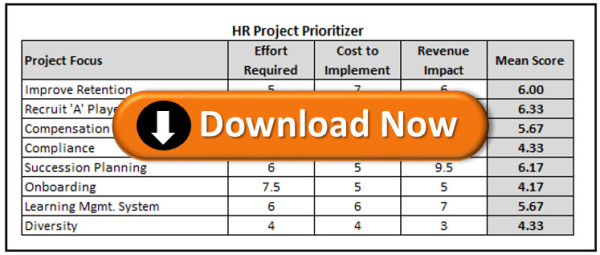
    Today’s post will help align HR projects with Sales goals. It’s the story of Tracy, the business partner for sales at a B2B technology company. Tracy constantly asks, “What are the HR project priorities that provide the outcomes we need?” I asked her if she is ever hit with a surprise request. She laughed and said that it happens all the time. The series of unpredictable events is endless. There are always issues caused by budget cuts, a competitive threat or talent changes.

    Without a crystal ball to see the future, how can HR stay ahead? Tracy’s approach was remarkably powerful. She shared her ideas for success as the business partner to Sales. This post also includes a downloadable “HR Project Prioritizer.”

    The Curse of Last Year

    A few years ago, Tracy felt whipsawed by her responsibilities. She always seemed to be working on the wrong project. Priorities shifted quickly; she was finishing up yesterday’s priority and missing today’s deadline. She realized that everything was urgent. These are typical of the projects on her list:

    • Leftover – A project that didn’t get completed last year
    • Corporate – An initiative cascaded down from headquarters
    • Favorite – A pet project of a powerful executive        
    • Compromise – An interesting idea without a champion that no one dares to kill
    • Check-off – An project easy to complete and cross off the list

    When everything is a priority, there are no priorities. There must be a better way.

    3 Common Dimensions

    Tracy took the list of projects for the year and met with sales leaders. One-on-one conversations confirmed her suspicions. There was no agreement on what was most important. She asked some second-level questions. It became clear that the linkage between sales goals and projects was poorly defined. Or completely missing.

    What emerged from the discussions were 3 common dimensions:

    Impact on Revenue – Projects are more important if they help “Make the Number.” Example: recruiting ‘A’ player talent is essential to capturing new logo revenue.

    Cost to Implement – Some excellent project ideas are just not affordable. Example: a new Learning Management System would enhance talent development. But the budget is only partially committed.

    Effort Required – Some projects require tremendous effort and coordination. Example: An onboarding curriculum requires a complete mapping of the learning path of a new hire. It’s much more than just a series of independent training modules.

    You can’t work on everything at once; where do you focus your energy right now?

    Prioritizer_Table_CTA

    The Project Prioritizer

    The 3 dimensions provide a framework for setting priorities. Tracy made an assessment through her one-on-one conversations. She stack-ranked the projects and gained agreement with sales leaders. During the remainder of the year, she could always point to the priorities that were set in January. There were changes during the year, but trade-offs were made objectively. As one project rose in importance, another was pushed down the stack.

    She used a simple matrix for scoring each project. SBI has created a template you can use to do the same. The “HR Project Prioritizer” is a convenient way to gain agreement with a group of stakeholders. It compares each project against the others. The pet projects and leftovers are exposed. Essential projects are in the spotlight.

    HR Project Prioritizer

    5 Steps to Success

    Start the year with a roadmap that has a high probability of success.

    1. Download the Project Prioritizer (click here)
    2. Gather the key stakeholders for a workshop to review the projects
    3. Define the 3 dimensions (Effort, Cost & Impact)
    4. Gain agreement on priorities
    5. Refer to the Prioritizer regularly during the year – negotiate changes in priority

    The “bubble chart” provides a useful visual reference. The stakeholders can quickly see how each project compares with the others.Project Prioritizer

    Impact – Largest bubbles have the most positive revenue impact      
    Cost – Most expensive projects rise to the top of the chart
    Effort – Easiest projects are on the left side of the chart

    HR and Sales leaders must work together towards common goals. This quick assessment sets the stage for a successful year. Your chances of Making the Number will soar once your priorities are aligned.

    Author: John Kenney

    sbi on linkedin

    Follow @jdkenney

    Follow @MakingTheNumber

    If you enjoyed this post, never miss one again by subscribing your Email Here and/or subscribing to the RSS Here.

    15 Jan 15:49

    B2B Buyer Behavior: When Web Leads Convert

    Conversion rates for B2B online leads are highest at the beginning of the year, in part because companies are renewing budgets and new funds are available, according to a recent analysis by Software Advice. Read the full article at MarketingProfs