Shared posts

31 Jan 18:05

Why Selling is a Joke

by Mike Kunkle

Why Selling is a Joke

A young executive was leaving the office late one evening when he found the CEO standing in front of a shredder with a piece of paper in his hand.

“Listen,” the CEO said, “this is a very sensitive and important document here, and my assistant has gone for the night.  Can you make this thing work for me?”

“Certainly,” said the young executive.   He turned the machine on, inserted the paper, and pressed the start button.

“Excellent, excellent!” said the CEO, as his paper disappeared inside the shredder.   “I just need one copy…”

[Cue laugh track]

Whoops!

So, what made that funny?  You thought it was going in one direction, but at the last moment, it went another way, right?  There was a surprise; often called “a left turn.”  There’s a reason they call it the “punch line”… it hits you right in the figurative funny bone.  This is one way that comedians make us laugh.

It’s also one way that sales professionals can spark an Aha Moment, using insights.

The Aha Moment

According to Wikipedia, the “eureka effect,” also known as the “aha! effect,” refers to the common human experience of suddenly understanding a previously incomprehensible problem or concept.  Scientists actually selling-ahastudy this.  We call it the Aha Moment and talk about it in our Selling with Insights® program.  In the course, we share these definitions of insight, which relate to the Aha Moment.

The Cambridge Dictionaries Online defines insight as:

“…a clear, deep, and sometimes sudden understanding of a complicated problem or situation, or the ability to have such an understanding.”  Insight can come in the form of an idea (sometimes a surprise or “flash insight”), a data point from research, or knowledge gained from experience.

In the context of selling, we define insight specifically as:

“… information or an idea that is based on credible research, authoritative content, or relevant experiences, which, when personalized to your client’s likely or known challenges and opportunities and shared appropriately, opens your client’s mind to think about their situation in a new way and shows them a path toward solving a challenge or capitalizing on opportunity through your company’s capabilities and differentiators.”

Shake, Rattle and Roll

If you’re selling, the goal is to bring value, create opportunity, solve problems, empower outcomes, influence decisions, and ultimately incite action.  We think of the “insight” as the data or information and the Aha Moment as the desired short-term outcome of sharing the insight and making some dot connection.  Whether it’s in the context of selling or not, the Aha Moment is the same… it sparks interest and results in seeing things in a new light or gaining a new understanding.  It’s not the only thing that matters, but it is one very important piece of selling with insights.

You can think of an Aha Moment like an earthquake.  They vary in intensity, right?  Some topple buildings; others just rattle your China.  But both get your attention.  Remember this, to keep expectations realistic.  Not every Aha Moment will be earth-shattering.  The goal of sharing an insight isn’t an end in itself… it’s a means to continue and deepen the ensuing dialogue and explore new possibilities together with your client.

Creating Surprise or Tension with Your Insight

To get back to the main purpose (and title) of this post, if you want to create an Aha Moment or surprise left-turn with your insights, you can learn from what comedians do.  (This is just one method that we’re exploring today, but it works.)  To do this, you must find a way to juxtapose facts to make a quick “left turn.”  In business situations, as opposed to comedy, this typically creates a “resolvable tension,” which illuminates (or further illuminates) a challenge or opportunity, or leads to a path to resolve one.

Here are two examples to consider.

EXAMPLE 1

Here’s an example using some data from CSO Insights that you’ve likely heard or seen this year:

  • If you say, “According to the 2013 research conducted by CSO Insights, 65% of top sales leaders say that new account acquisition is their primary objective for the coming year,” that’s simply a statistic.  It’s interesting and it points toward something important, but it’s just a fact.
  • If you add, in juxtaposition, “Yet, 67% of those same sales leaders, rate their sales team as ‘Needing Improvement’ in lead generation,” suddenly, you’ve created some tension.  Hmm.  They want X, but Y could get in the way of achieving that.

Presuming you offer a way to improve sales reps’ ability to generate leads and acquire customers, these facts could be helpful to share.  (Or, if you’re a learning and development or sales enablement leader, and you confirm these facts as true in your organization, you’ve certainly just found a way to link sales training initiatives to business strategy.)

EXAMPLE 2

Let’s look at another example.  (Disclaimer: this is for illustrative purposes… some of this unverified data has been sourced from various websites, and some is fabricated for the teaching example.)

Data from a 2011 federal crime report shows that, in the U.S.:

  • A burglary happens once every 15 seconds
  • We can expect one in every thirty-six homes in the United States to be burglarized this year
  • Homeowners incur an average loss of $1,675 per break in
  • In 38% of home invasion incidents where someone was home at the time, assault was reported (of injuries reported, 36% were minor and 9% were serious)

Grim statistics, but just facts.  What if we added…

  • While many home security systems adequately protect front doors, only 34% of home intrusions come through the front door, with 66% entering through windows and other less-secured points
  • Most security companies hire contractors to install systems, but according to research commissioned by Crime Prevention Journal, trained law enforcement personnel offer the best advice on avoiding home intrusions and can more accurately identify the most vulnerable and likely entrance points

Might this influence your thinking about the home security company and system that you choose?

What if you then learned that Richardson Home Security offered the following?

  • A complimentary home inspection to determine areas at greatest risk, especially windows, with inspection and installation crews comprised entirely of retired or off-duty law enforcement professionals
  • A wide variety of window protection options, from installed bars, reinforced locking devices, electronic barrier deterrents, automated sliding covers, laser barriers, lighting, and biometric scanners.

See what I did there?

The first data set exposes the seriousness of the home invasion risk.  The second layers information and takes a slight left turn to point out a specific problem and create some tension.  The capabilities offered by our fake security company address those problems.

This may be over-simplified or different compared to some of the complex B2B products you sell, but the concepts are the same and I hope the point is clear.  In both cases above, we took data that established a baseline and juxtaposed data against it to make a left-turn or create a resolvable tension.

Our Own Aha Moment

So what’s the take-away from this?

  • Well, if you begin with your capabilities and get clear about what problems you can solve and the special value you can bring, it’s a great start.
  • Then, conduct, commission, source, or buy research or codify your knowledge gained from experience to create a baseline of data about the challenge or opportunity that you can solve.
  • Next, look for ways to juxtapose the data to further exacerbate the issue, highlight the importance of addressing it, or lead to the unique ways you can address it and add value.

While this is a very simplified representation, this is exactly what we do with our Insight Blueprint™ (among other things).

Coming full circle back to our earlier definition, then you can craft relevant, compelling, personalized Insight Messages to share:

“… information or an idea that is based on credible research, authoritative content, or relevant experiences, which, when personalized to your client’s likely or known challenges and opportunities and shared appropriately, opens your client’s mind to think about their situation in a new way and shows them a path toward solving a challenge or capitalizing on opportunity through your company’s capabilities and differentiators.”

We’ll talk more about the Insight message, another day.

Oh – and about that title – no, of course I don’t think selling is a joke.  But by using those same funny, left-turn principles used by comedians, you can surprise clients, capture interest, and perhaps enlighten them, if your message is delivered well.  If you’d like to talk about that or anything else about selling more effectively with insights and thoughtful dialogue, reach out and let me know.

Good luck with those punch lines!

Man:  “Did I ever tell you that my uncle Bob was a magician?”

Woman:   “No, you didn’t!  Really?

Man:   “Yup.  Every time he walks down the street, he turns into a bar.”

selling-with-insights

The post Why Selling is a Joke appeared first on The Richardson Sales Excellence Review™.

29 Jan 16:33

B2B Sales: empowered customers require empowered sales people

by Bob Apollo


There’s abundant evidence to prove that today’s internet-savvy customers are much better informed and far more empowered than they were a generation ago. And it’s affecting B2B every bit as much as it is B2C.

straightjacketYour prospects are able to learn about issues, find out about the experiences of others, research potential solutions and establish buying criteria without ever feeling the need to speak to a salesperson.

The new B2B buying decision journey

The vast majority of today's information gathering is digital, and several studies have shown that the average B2B buying decision journey is around two-thirds complete before vendors are invited to the party.

That’s of course, unless the vendor - and their sales team - has given the prospect some compelling reasons to want to engage earlier, because they believe that they are more likely to be informed than bored by the experience.

Challenge or opportunity?

If you’re responsible for a B2B sales and marketing organisation, you can look at this situation as either a challenge or an opportunity. But one thing is certain: today’s empowered customers need and expect to deal with empowered sales people.

Simply telling the prospect what they could have - and probably already have - learned over the web adds nothing to the discussion. So it’s little wonder that Forrester found that B2B customers regarded 7 out of 8 discussions with sales people as having no useful value.

Many of the old-school sales people who regarded empowered customers as a threat have probably been flushed out of the system, and those that remain are unlikely to have rosy career prospects.

Rigid sales processes don't work in complex buying environments

Some organisations have tried to respond to the empowered customer generation by implementing tightly defined sales processes that allegedly embrace “best practice”. But many of these attempts to implement process fail to materially affect sales performance.

The top sales performers tend keep winning, and the also-rans tend to carry on breathing in their exhaust from an ever increasing distance and choking on the fumes. How can we bridge the gap between the best and the rest?

Realising your sales people's potential

First, let’s acknowledge that some of today’s current sales people are simply not equipped to participate in today’s demanding buying environment. But as long as they have the basic smarts, many of the rest harbour as-yet unrealised potential.

Complex sales are no place for rigid sales processes. What’s required is a supportive framework that encourages sales people to want to adopt proven winning behaviours that encourage rather than suppress their individual initiative or creativity.

Lessons from Helmuth

The Prussian General Helmuth von Moltke the Elder is deservedly famous for declaring that “no plan survives first contact with the enemy”, and the same is true of a rigid sales process applied to a complex and lengthy buying journey that involves multiple stakeholders.

Frameworks, on the other hand, offer clear direction (including a concise definition of what a good outcome looks like) whilst giving sufficient flexibility to encourage sales people to use their initiative, experience and creativity.

Frameworks empower

They empower sales people. They coach them on how to introduce and explore issues that are likely to be interesting to their prospects. They equip sales people to lead the conversation towards their solution, rather than with it.

They also provide tools that have been proven to improve sales flexibility. Some of the most useful include FAQs and TAQs (frequently-asked, tough to answer questions), perfect customer and key stakeholder profiles, qualification checklists and customer anecdotes.

These frameworks are supported by training and coaching programmes that encourage the sales person to really listen to what the prospect has to say and to respond in a thoughtful, relevant way that makes the prospect want to learn more.

Frameworks are the result of collaboration

Creating a flexible framework might seem more complex to implement and manage than a conventional process, but the reverse is often true. This is in part due to the fact that the best frameworks are collaborative efforts.

Rather than being driven top-down by management, they reflect the collective wisdom of the sales team. Rather than being defined once and imposed, they evolve organically in the light of experience. Rather than trying to enforce compliance, they support learning.

Random behaviour, rigid process or flexible framework?

This all may seem merely semantic, but it isn’t. You can tell the difference between a conventional sales process and a flexible sales framework. And if you’ve got a bunch of smart sales people who are personally motivated to do better, you’ll end up with much deeper engagement - and much more productive customer conversations.

So -where are you on the scale today? Random behaviour, defined process or flexible framework? How much better could you be doing if you had the latter? And - if you haven’t already done so - when are you going to involve your smartest sales people in designing your new flexible framework?


29 Jan 16:33

“SIMPLE” Framework for Sales Effectiveness – 3 Ways You Can Use “Surprise” to Engage Your Customers

by Mukesh Gupta

“SIMPLE” Framework for Sales Effectiveness – 3 Ways You Can Use “Surprise” to Engage Your Customers image Simple Framework for SellingV2

In an earlier blog post, I had introduced the “SIMPLE” framework to increase your sales effectiveness.

The first step in the process is to be able to “Surprise” your customers with an insight or point-of-view that they are not yet aware of.

This step is essential in improving the sales effectiveness as this enables the sales teams to initiate the process rather than wait for their customers to come to them with a requirement.

There are three ways that sales teams can come up with insights that can truly surprise the customer. Some of them are as below:

  1. Network: One of my mentors, who was a CEO of a 100 Million USD manufacturing business, used to spend a considerable amount of time with a specific sales executive from one of his suppliers. When I asked him the reason for this special treatment for that particular sales executive, he explained to me the reason. That specific sales executive always ensured that he met the warehouse manager to know the current stock level of his SKU’s; met the manufacturing head to check if the quality of his material was as required; met the sales head to understand the sales forecast trend and then came to meet him. My mentor would then talk to him about what his impressions were about the business and get an outside-in perspective about what is happening inside his own organization. This helped him uncover things that he could have never come to know, even if he asked his team directly, due to a variety of reasons. Most organizations suffer with complexity and silos. If sales teams are able to network across the various silos will be able to identify blind spots which the leaders themselves would not be able to identify themselves. Some of these insights can serve as a great starting point to initiate a discussion. This also provides you options about which insight do you use to initiate the discussion, based on where you could add the most value.
  2. Customer Journey Maps: Use customer journey mapping to understand their customers and key partners. Customer Journey maps enable you to understand the business of your customer from the perspective of their customers and partners. This view is also unique as not many organizations cultivate this outlook voluntarily. Even if they do, they would truly appreciate the effort that you put in to understand their business from their customers perspective. They would then want to explore if your findings are similar to theirs. In both the cases, this always results in a dialogue about what are some of the unmet challenges that could be holding your customer back from achieving the kind of success they are aspiring for. In both the cases, you have initiated a high value conversation with not just the key decision makers but the larger team.
  3. Connect & Combine: Another way to gain insights is for you to be able to connect and combine seemingly disparate things and apply them to a specific situation. Can you connect & combine ideas from different industries, which can be adapted in a way to help your customer address the challenges that they are facing in pursuit of their aspirations.

These ideas are powerful in and by themselves to help you uncover truly surprising insights that will enable you to start an interesting engagement with your customers. However, the true power of this approach comes when you apply all the three together to come up with not just an insight that you could share with you customer but also different perspectives of the same insight (their customer perspective, internal stake holder perspective & your perspective).

All said and done, this is hard work for the sales teams to engage in. However, if you are selling a product that is high value and complex to sell, this approach will get you a strategic advantage in the entire sales process, as you now not only participate in the sales process, but are leading the process. This is a BIG difference from responding to RFQ’s and RFP’s and trying to play catch-up with your competitors.

This is the first step in the SIMPLE framework to improve your sales effectiveness.

Have you ever been able to surprise your customers? If yes, how? Did that lead to an opportunity? Were you able to close the sale? How easy/difficult was that in comparision to your other deals?

Do share your feedback so that we can all learn.

You can also sign-up for the my fortnightly sales newsletter here.

28 Jan 17:07

The One Attribute Your Sales People Must Have

There are two threads in the sales world that, when woven together, form the one key attribute that your sales people have to possess.  First, let’s take a look at two factors that shape the need for this trait in sales people.

Buying is a Team Sport

When businesses buy technology, services, and other offers there is often a cross-departmental benefit.  Say, buying a Customer Relationship Management (CRM) tool.  This will affect sales, marketing, services, and other teams from a business perspective.  Not to mention that other organizations will typically be brought into the conversation.  Legal, finance, and IT may need to weigh-in on a purchase.

This collaborative approach to buying means that you often need to shepherd diverse buying groups through the buyer’s journey.  Different personalities, different agendas, and different schedules can make this a major challenge.  Sales people that approach this journey as a collaboration with their buyers will be more likely to navigate the process.

Selling is a Team Sport

The major shift toward inside sales teams in recent years has led to different team models.  Sales managers increasingly look to measure and improve performance across a team.  That means looking to discover best practices, whether they are identifying which content to share, what emails to introduce with, how to overcome objections, and more.  

The post The One Attribute Your Sales People Must Have appeared first on KnowledgeTree.

28 Jan 17:07

How to Get Existing Leads to Do Your Email Marketing for You

by dfreedman@hubspot.com (Diana Urban)

share-button-keyboardWhile the days of sending a newsletter email blast to your entire marketing database are over (or should be), email marketing isn't dead. In fact, if you do email marketing right, you can generate tons of new leads.

"But I'm only emailing my existing leads," you might say with trepidation. "How can I possibly get new leads from my email marketing?"

Simple: Get your leads to do your email marketing for you by encouraging them to share the offer they just signed up for with their friends and colleagues. This is easier to accomplish than you may think.

In this post, I'll walk you through how I've set this up for HubSpot and how we generate 500-600 new leads per month just by adding a simple button to a few of our marketing assets.

How to Encourage Leads to Share Your Content

First, you'll want to create a clear call-to-action encouraging your leads to share your content via email. Here's what we use at HubSpot -- feel free to save and use these images.

email-to-a-friend-2

email-to-a-colleague

Once you add one of these buttons to your website or email, turn it into a customized mailto link. It's basically a hyperlink that uses mailto instead of http://, so when a lead clicks on this button, a new email compose window pops up instead of a link to a website.

Setting up this mailto link is quite easy -- you can even customize the link to include your pre-populated subject line and body content. Here's what the HTML code to the link will look like:

<a href="mailto:?subject=Your Subject Line Goes Here &body=Enter the content you want to appear in the body of the email. Remember to include a link to your offer. http://yoursite.com/offer"><img src="http://yoursite.com/email-share-image-file.png"></a>

Why These Buttons Work

Email is a form of social proof -- the concept that "if other people are doing it, and I trust those people, that's validation that should also be doing it." 

While most marketers speak of social proof in the context of social media, email can be more effective at driving new lead gen than social media. In fact, in an average month, HubSpot generates 17x more leads from email sharing links than social media sharing links.

Where to Put These Buttons

There are three key places where we encourage our leads to share our content.

1) The Thank-You Page (a.k.a. Confirmation Page)

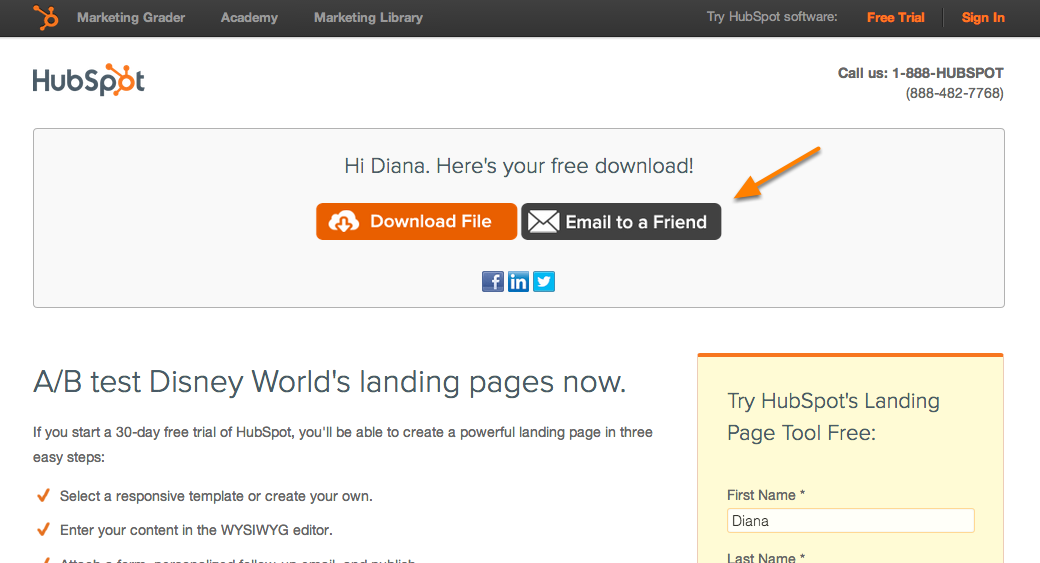
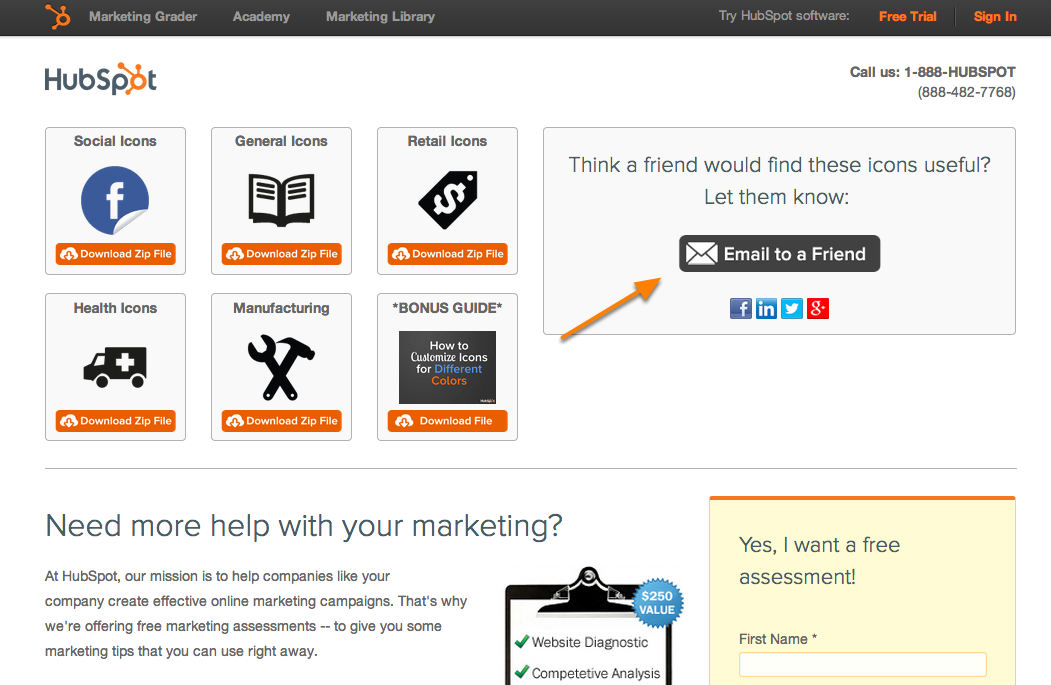
After a lead fills out your form to receive a marketing offer, that's a great place to encourage them to share the offer with their friends and colleagues. Here are a couple examples of how we've included these buttons on HubSpot's thank-you pages.

Thank You Page Example 1

Thank You Page Example 2

2) Your Follow-Up Email (a.k.a. Auto-Response Email)

Regardless of whether you provide leads with their offer on the thank-you page or not, you should think about sending them a follow-up email to refer to at any time in the future. This email should be very simple and include:

  • A link to wherever they can get the offer
  • The email share button
  • A call-to-action for whatever the next stage in your buying cycle is, if appropriate (sometimes, you'll want to save this for your lead nurturing campaigns so you're not too aggressive off the bat)

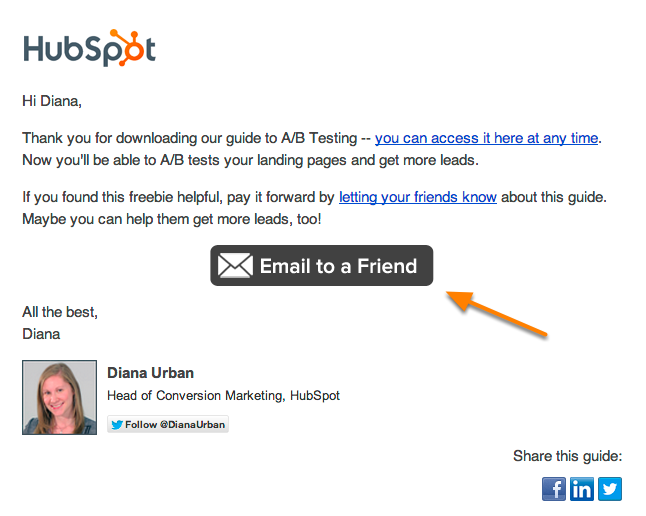
Here's an example of what this follow-up email can look like:

Follow-Up Email Example

3) Your Marketing Emails

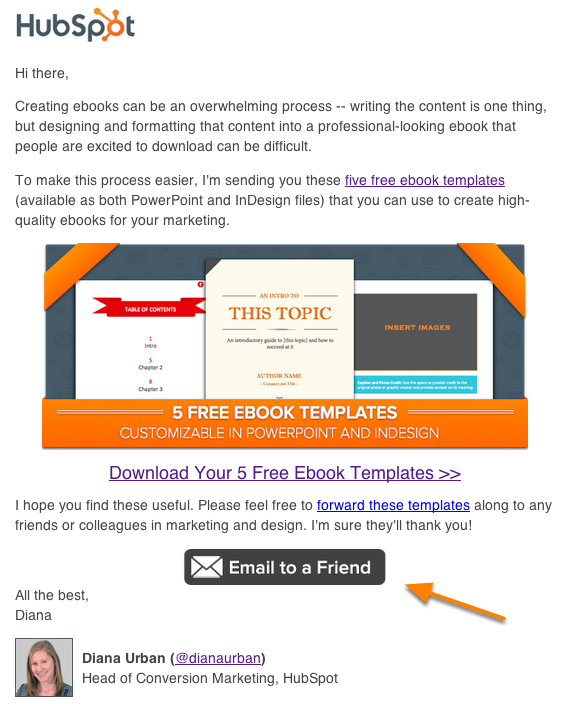
Hopefully, your email campaigns will be highly targeted to specific segments of your leads. But even if this is the case, there are some offers you may promote in which your recipients may think their friends or colleagues will enjoy the content, too. In that case, give them the opportunity to share your offer.

Email Marketing Example

How to Measure Your Results

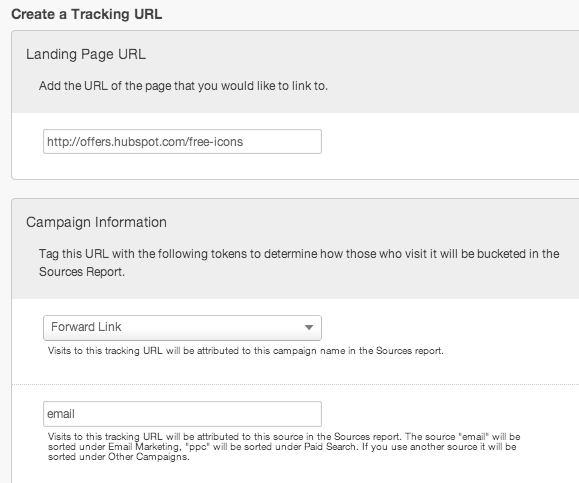
When creating the customized message in your mailto link, be sure to include a tracking URL so that you can track how much traffic and leads your "Email to a Friend" buttons generate from the leads who sent these emails. 

In HubSpot, you can easily create a tracking URL that automatically becomes a short link:

Tracking URL Builder

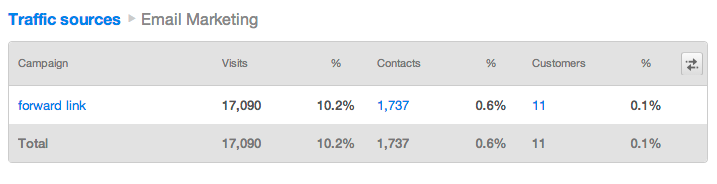
Then, you can use HubSpot's Sources report to see exactly how much traffic, how many new contacts, and even how many customers resulted from your "Email to a Friend" button.

Results

If you do not use HubSpot, you can use a URL shortening service like bit.ly to track how many times people click on the link within the email. However, you wouldn't be able to track the number of leads or customers generated.

So if you're looking to get more juice out of your lead generation machine, try out this "Email to a Friend" button. Who knows -- with this simple addition, maybe email marketing will become a top lead generation channel for you too!

Do you encourage your leads to share your content with their friends? If so, I'd love to hear about your strategy in the comments below!

anatomy of a five-star email ebook

subscribe to the hubspot marketing blog

28 Jan 17:07

50 Ways to Score More Sales

by Lori Richardson

top 50 yard lineNeed some sales inspiration? A new twist on an old sales idea you’d like to do again? A quick sales jump-start this week? We’re pulling from a post originally published in November of 2008 – the ideas still stand, and there are LOTS more. The idea is to get inspired to take action. Which one does it for you? What are you already doing that IS working for you every day to be excited about contacting potential buyers?

Remember the movie, Moonstruck, when Nicholas Cage’s character tells Cher’s character that he loves her, so she slaps him, and says, “Snap out of it!” – I love that slap – it represents to me a call to action.

What could you slap your business or even yourself for…. figuratively speaking, that is?

Here are the first 50 of a list of 101 ways to “snap out of it” and score more sales:

  1. read a recommended sales book
  2. bookmark a sales blog and read regularly
  3. sign up for RSS feeds for sales sites, blogs, or podcasts
  4. hire a prospecting coach
  5. hire a presentation skills coach
  6. subscribe to Selling Power or Sales & Marketing Management
  7. attend a sales conference
  8. attend a sales skills workshop
  9. hire a sales activity coach
  10. improve your time management
  11. learn the basic tenets of successful selling
  12. learn about your own style and traits
  13. learn about others’ character traits
  14. list out your selling “areas to work on”
  15. set aside weekly prospecting time
  16. keep track of all sales opportunities
  17. update your sales opportunities daily
  18. find a mentor you admire
  19. review your physical image and style
  20. hire an image coach
  21. review your mental mountains and valleys
  22. find 3 ways to make your more likable
  23. read, Love is the Killer App
  24. review Proficiencies for Masterful Sellers
  25. read a book on creativity
  26. go somewhere creative
  27. block time in your calendar – weekly – for proactive selling
  28. create a list of “biggest gain” to do’s
  29. mentor someone else in sales
  30. call 50 people or meet 50 people and hone your intro (or value proposition)
  31. get feedback on your listening skills
  32. make a list of 10 places to get new biz
  33. work on your value proposition – it’s about others, not about you
  34. re-invent yourself
  35. find a new audience for your product or service
  36. learn 20 new power phrases
  37. analyze what you say that is negative
  38. target 10 companies you want to work with
  39. create a plan of action for those 10 companies
  40. set an activity goal to book 20 meetings
  41. think of stories that you can use to better connect with prospects
  42. analyze what past customers or clients have bought from you
  43. offer a new service which your market wants
  44. attend a Toastmasters group or Dale Carnegie
  45. learn more about your prospective clients’ business to help solve problems
  46. say “yes, and” rather than “no, but” – in the spirit of improv
  47. create urgency with an offer
  48. become more proactive with customer service
  49. ask for referrals
  50. obtain letters of reference, on letterhead, showing measurable value, from 10 clients

What tips do YOU use? Post them as comments – top ones will win a coffee card (North American readers)

Lori Richardson - Score More Sales

Lori Richardson is recognized as one of the “Top 25 Sales Influencers for 2013″ and one of “20 Women to Watch in Sales Lead Management for 2013″. Lori speaks, writes, trains, and consults with inside and outbound sellers in technology and services companies. Subscribe to the award-winning blog and the “Sales Ideas In A Minute” newsletter for sales strategies, tactics, and tips in selling. Increase Opportunities. Expand Your Pipeline. Close More Deals.

email  lori@scoremoresales.com | View  My LinkedIn Profile

The post 50 Ways to Score More Sales appeared first on Score More Sales.

28 Jan 17:06

Get it right: Shift the sales and marketing focus to the buy side

by info@sharondrewmorgen.com (Sharon Drew Morgen)

Do you want to sell? Or have someone buy? They are two different activities. In sales and marketing, we’ve focused on the sell side. In October, Pat Spenner of CEB wrote an article in Forbes titled: You’re Doing it Wrong: Demand Generation. This is the first time I’m aware of that a mainstream publication has noticed that the problem – applicable to both sales and marketing – is on the consensus management, or ‘buy-in’ side. I’m delighted I’m no longer the lone voice discussing or resolving the problem.

Since the inception of sales and marketing we’ve believed that some sort of information utilization – getting the right information at the right time to the right people, discovering a need or a probable demographic, managing objections, getting appointments, having great ads and sites – will lead to a sale. But we’re only closing the low-hanging fruit. – approximately 7% fromfirst call (although some like to fudge a bit and count from connections and proclaim they close 20%). The rest clearly need us. Why aren’t they buying?

A BUYER’S DECISION PATH IS SYSTEMS BASED, NOT SOLUTION FOCUSED

Unfortunately, 90% of the buying decision path – a confusing journey fraught with unresolved people, management, and strategic obstacles – occurs outside our purview, withouthelp from us, and not based on our solution. Indeed, buying a solution – the final 10% of the decision path – isn’t relevant at all unless buyers get the requisite consensus and personal buy-in from all whose jobs will be involved with any resultant change.

Spenner calls the buyer’s consensus issues ‘dysfunction’. I disagree. Because a buying decision is a systems change issue, not a solution choice issue, buyers must first address their rules, roles, people, money, and management issues before they can buy. And, as sellers and marketers who exist outside the system, it may seem like dysfunction to us because we recognize a need/solutions match they seem to be ignoring.

But they may not be ignoring their needs or our solution; they just might be dealing with the steps they must take to enable efficient change (There are actually 13 steps buyers must take, from idea to purchase, and our solution orientation enters at step 10.). Remember we learned as kids that a system is homeostatic, and will resist if something from the outside attempts to get in or change it? It’s impossible to take one piece out and put something else in without garnering resistance. So we’re pushing information and solutions at the wrong time and in the wrong place and probably creating the resistance we’re getting.

Imagine announcing to your spouse you just bought a great house on the way home and you want the family to move next week. Or a CEO who decides on her own to buy new software for her 1000 person company and announces to the tech folks, users, marketing folks, and accounting group that there will be an implementation next week. It’s not about the house, the software or the need; there is no buy-in, no consensus, no reorganization, no change management.

It’s hard for us to grasp that, like all systems we are not a member of, a buyer’s system (separate from what we perceive is a need) is outside of our purview. We will never understand the fallout from past implementations or how techies and user groups must adjust personally and professionally to a new implementation. Can sales and marketing share budget without killing each other? Does the gym membership make sense to a 400 pound man who does not see himself as overweight?

Only the insiders can address these personal issues and, until they do, buyers cannot buy regardless of the efficacy of our solution. It’s a systems problem – not a sign of dysfunction but a sign of a healthy system that will not compromise the functionality of their culture. And the time it takes for all the right elements to buy-in is the length of the sales cycle; we are not respecting our buyers enough to realize they would have fixed the problem already if their system were ready, willing, and able to change.

A BUYING DECISION IS A CHANGE MANAGEMENT PROBLEM

In today’s internet information-laden environment, buyers now show up only when they’ve done the first 90% without us, causing us to focus more and more on the very last thing they need, giving us less opportunity to enter earlier and creating more competition and price issues. But we’d have a real competitive advantage if we could use both sales and marketing capability to be the neutral navigators guiding them through their behind-the-scenes issues.

I’ve developed a Buying Facilitation® model that does just that – enabling the non-solution-based decision along each step of the journey. For 26 years I’ve been teaching sellers in global corporations in B2B and B2C how to facilitate consensus, assemble the appropriate Buying Decision Team, and change without disruption. Marketing can enter at any place along the path; selling is used once they are ready for a purchase. So Buying Facilitation® + Marketing then Sales. And then the competition is vastly diminished as the seller and solution have been built into the consensus.

My clients get very different results than using sales alone. On average, over decades, industries, and price points, against control groups using just the sales model alone we’ve gotten, on average, 600% increase over sales. It seems large, but it’s not an equal comparison since the sales model alone would not close 40% of prospects fromfirst call (control groups of sellers using the same lists get a 7% close on average depending on the industry).

Let’s use our marketing and sales models to better effect in this environment. Let’s help buyers buy. Then we can sell.

Sharon Drew Morgen | 512-457-0246 | sharondrew@sharondrewmorgen.com
www.buyingfacilitation.com

Get it right: Shift the sales and marketing focus to the buy side is a post from: SharonDrewMorgen.com

28 Jan 17:06

A Sales Manager’s Guide to Deal Strategy

by George de los Reyes

Deal or No Deal resized 600As a sales manager, your team looks to you for coaching and strategic help.  They look for advice on how to diagnose an opportunity and close more business.  In this post I will show you an approach to helping your team convert more deals, faster and with better pricing.  I am referring to the art of deal strategy. At the end you can download the Deal Strategy Tool Kit which will aid you in this approach

Deal Strategy consists of three critical steps:

  1. Identifying & Understanding the BDT
  2. Account Planning
  3. Deal Strategy Sessions

THE BUYING DECISION TEAM

The first step in deal strategy is identifying the Buying Decision Team (BDT).  Rarely is there ever a single buyer. In more complex deals, be certain of a large and varying BDT.

There are four categories to mapping the Buying Decision Team:

  1. Economic Buyer
  2. User Buyer
  3. Influencer
  4. Anti-sponsor

Using the Stakeholder Wheel Job Aid (Click here to download the tool), walk your rep through the BDT.  Help him to identify anyone that influences the buying decision.  Be exhaustive.  The BDT often includes someone in IT, HR, Finance.  These stakeholders can wield tremendous political power and easily kill a deal.  Your rep needs to map the client ecosystem and identify these key influencers.

A critical step in mapping the BDT, is understanding where each stakeholder is on their buying journey.  There may be one person ready to ink the deal, while another debates if the problem needs solving.  Help your reps identify where each stakeholder is on their decision timeline.  And from here, develop a strategy to move them all along.

ACCOUNT PLANNING

Step one in the process is Account Planning.  Most reps struggle with prioritizing their accounts and prospects.  Not all deals are created equal.  Coach your reps to assess the strength of a deal by using the Opportunity Assessment Job Aid (Click here to download the tool).  Let’s face it.  Most reps see the world through rose-colored glasses.  Assessing the deal strength keeps it objective.

In the Account Planning process make sure to capture the deal potential.  Look at both current and future potential.  It could be net new business or expansion within an existing client.  Either way, establishing the account potential helps a rep prioritize their time.

The last part of Account Planning is developing a tactical execution plan.  Get granular here.  Walk through a step-by-step plan for each account.  Establish milestones and hold your reps accountable.  A tactical plan should include items such as:

  • Meeting the Decision Maker
  • Completing the stakeholder wheel
  • Establishing a decision timeline
  • Defining the customer’s evaluation criteria
  • Meeting with marketing to coordinate account-specific marketing activities

DEAL STRATEGY SESSION

The final step in the process is the Deal Strategy Session itself.  I like to call this the “Big Deal Review”.  Download the tool here. Deal strategy session are conducting most often for bigger deals.  Bigger deals have larger BDTs.  They also have more internal stakeholders to contend with.  As the sales manager, broker a meeting with the internal resources required to close the business.  If they need to buy-in, make sure lack of access doesn’t slow the deal.

In your Big Deal Review make sure you cover the following:

  • Understanding where the economic buyer is
  • Determining where the deal is in the Sales Process
  • Discussing the buying decision team and their disposition
  • Determine necessary internal resource involvement and approvals
  • Make a proceed or cut bait decision
  • Develop a tactical plan on how to win the deal

CALL TO ACTION:  In the next 30 days, have your team…

  1. Map the buying decision team for their top 20 prospects
  2. Create account plans for these prospects
  3. Schedule a Big Deal Review with their top 5 deals

Good selling!

Deal Strategy Tool Kit

Author: George de los Reyes

sbi on linkedin

Follow @GeorgedlReyes

Follow @MakingTheNumber

If you enjoyed this post, get free updates by subscribing by Email or RSS.

28 Jan 17:06

A little sales dashboard humor

by Donal Daly

dogberts-consults-dashboards

…..

You know it matters that the data is accurate if you want to understand how to improve your sales performance.

Here’s a Slideshare that shows you how to figure out how much you sell by focusing just on the Four Levers of Sales Velocity (aka Forget the Pipeline!)

It’s not all about the size of your pipeline.

Post to Twitter

28 Jan 17:04

Are You an Unintentional Sales Wuss?

Be a business peer, not a wuss.

I’m sure your answer is a resounding “no.” But in reality, it’s not what you think that counts. Only your prospect’s perceptions matter—and they can be very different from what you’d imagine.

Why? Because they’re extremely busy. Every time they talk with you, read your emails or meet with you, they’re asking, questions like:

  • “Is this person a credible resource?
  • “Does he/she bring a depth of expertise?
  • “Is this worth my time to continue the conversation?”

So let’s take a look at one scenario to see how your best intentions might be totally misinterpreted.

You’ve finally lined up a meeting with an important prospect. As you’re ushered into their office, you extend your hand and say, “Thanks so much for meeting with me today, Terry. I really appreciate your time.”

You think you’re being courteous. After all, this person is busy and it’s taken a long time to get on their calendar.

They think you’re a wuss. Important people never position themselves as a supplicant, grateful for the opportunity to meet with Mr/Ms. Big. Instead of sounding like the pro you are, you sound like a hopeful wannabe.

Nice people are the worst offenders. They don’t realize that their graciousness and gratitude come across as neediness. Or hopefulness. And ultimately, as being wussy.

What’s a better way to kick off the meeting? Extend your hand and say something like this: “Good to meet with you, Terry. As I said when we set this up, I’ve got some ideas that can help you out with [fill in the business reason].

Notice how that positions you as a peer who’s worth meeting? It’s a totally different framework to begin your conversation. Also, please note that it’s not about your product or service. That makes you seem like a self-serving salesperson. Again, that’s bad.

You have to think to be good at sales—and not just from your own perspective. Review everything through your prospect’s eyes and ask: Do I sound like a valuable resource and a business peer? Or, do I sound like a wuss? 

---

Your Turn: What other ways do salespeople sound like a wuss? And, how can they change things? 

28 Jan 17:04

Can Social Media Actually Produce Leads and Sales for B2B Businesses?

by Varuna Vaswani

Social media for B2B, a waste of time or an untapped source of sales? Is it really worth the investment? A recent study by the Content Marketing Institute (CMI) and Marketing Profs uncovered that social media is used by 87% of B2B content marketers, making it the most popular marketing tactic. However, social media also has its skeptics.

It is undeniable that social media has been successful for several businesses. A compilation of social media statistics last year highlights research by Social Media Examiner, which shows that:

  1. 58% of marketers who have been using social media for the past 3 years report it has helped them improve sales.
  2. 65% of B2B marketers have acquired a customer through LinkedIn (research by Marketing Charts)

However, many still question the effectiveness of social media and its ability to deliver a Return on Investment (ROI) for B2B businesses. Despite the popularity of social media in the industry, the CMI study showed only 49% of marketers rate social media as effective or very effective, making social media the least effective marketing tactic. The chart below shows the confidence gap in social media.

Can Social Media Actually Produce Leads and Sales for B2B Businesses? image b2b content research 2014 confidence

Now, on to the burning question: Does social media produce a ROI for B2B businesses?

Yes and no. You see, cocial media can deliver ROI, but only if it is done in the right circumstances and with the right support. There are 5 main factors to consider:

1. Your target audience’s buying behaviour

Any marketing campaign will not be successful without a thorough understanding of the buyer. Before you leverage social media, you must develop your buyer personas. Within each persona, you must identify the problems they face, the needs they have, their interests and their buying behaviour.

With this understanding of your buyers, you can determine whether social media is an appropriate medium to communicate with your target audience. Once it is deemed suitable for your market, social media will have a better chance of delivering ROI to your organisation.  However, it is important not to assume that your target audience is not using social media. Base this decision on research. You will be surprised what LinkedIn groups and Google+ communities there are out there!

2. An end-to-end marketing campaign

When leveraged without a proper strategy to support it, social media cannot be effective. Therefore, it must be incorporated within an end-to-end marketing campaign. Equipped with a thorough understanding of your buyers, you should have enough knowledge of your prospects buying cycles to develop this end-to-end campaign.

The campaign must outline all the tactics to be leveraged by the organisation from top-of-funnel (TOFU) stages ( raising awareness and generating leads) to bottom-of-funnel  (closing the sale). This understanding of your buyers’ journey will inform how social media fits within your marketing plan. When social media is leveraged as part of a full fledged plan focused on business growth goals, you will have a better understanding of how it is contributing ROI and a far more focused execution.

3. The objectives for using social media

It is crucial to develop a clear purpose statement and a set of objectives for your social media activity. Then, go deeper and identify the objectives (in numbers and $) that you plan on achieving with social media. As with the above, set an objective for every social media channel you plan on using. It is only when you have these clear objectives for social media that you have benchmark to measure against.

4. Relevant, engaging content

Social media, in itself, will not deliver leads. Arbitrary updates on LinkedIn or Twitter and promotional updates probably result in negative ROI. For social media to deliver leads and sales, it must be supported with a sound content marketing strategy. This strategy cannot be based on what you or your business wants to communicate (common fail). It should be derived from your buyers needs for information. Listen to your buyers problems and needs to determine the topics that are most relevant to them.

Your social media content will then contain topics that are of interest to your buyers, and content pieces that will truly engage them, meaning you break through the noise made by all your competitors shouting about how great they are. Engaging content will progress your buyers to the next stage in their buying journey, present you as a trusted source, raise awareness of your brand and ultimately, deliver an ROI.

5. Constant measurement

Measure everything! Measurement should be compulsory in every business, for it is the only way you will be able to determine effectiveness or ROI from any marketing campaign.

There are several social media management platforms that come with analytics features, helping you see how successful you are in engaging with your buyers. These tools show you how many people have followed you, how many people re-tweeted your update, how many readers have commented on your blog and linked through to your website to name a few. Analytics can show you the real numbers of the leads generated, progressions made and sales closed as a result of social media. With analytics, you will see how social media delivers ROI for your business.

Ensuring you have goals and a strategy for achieving those goals, social media can be your business’s main source of lead generation. Without this you can waste time and money. To learn how to better measure your marketing ROI, refer to our free eBook below:

Can Social Media Actually Produce Leads and Sales for B2B Businesses? image c7789391 cd6f 427d ba77 0ff64a63c6041

Can Social Media Actually Produce Leads and Sales for B2B Businesses? image

28 Jan 17:02

Building a Strong Foundation for Your Sales Career

by Toby Haertl

The sales world is a wonderful place — a place where hard workers are rewarded for their efforts and have complete control over their own destiny. The sales world can also be a horrifying and intimidating place, where a constant stream of competitors tries to purloin every prospect, client or product away from you in an effort to enrich themselves and leave you empty handed.

Sales is a place where go-getters thrive and the hesitant lose. In order to get ahead in one of the most competitive career fields in this economy, I’ve found that two characteristics set you apart and help you build the foundation for a promising sales career.

Work ethic

Shortly after starting my sales career, I noticed a theme: successful co-workers, friends and peers across a number of different fields, but especially in sales, all had one thing in common — a great work ethic.

Work ethic is not necessarily defined by being responsive to instructions and orders, or doing what is expected, like showing up on time or finishing certain tasks in a day. Work ethic to me is defined by the results of your work. Based on integrity, work ethic is what you are able to accomplish without anyone looking over your shoulder. It’s about being diligent and holding yourself accountable.

At the end of every day you should ask yourself, “Did I do everything within my power to produce the best results possible? Have I completed as much as I could today?” If the answer is “no” to either of these questions, you should take off your coat, fire up your computer and finish the job. The peace of mind this process provides will pay off, especially once your deadline arrives and your numbers look stellar.

Self-discipline

In an environment defined by constant competition, and where nothing is guaranteed, the only thing to keep your successes coming is self-discipline.

How many times have you had an interested prospect tell you how much they love your product and that they could not wait to find out more? How many times has that same prospect then fallen off the face of the earth when it was time to schedule a demo?

Every prospect is just a prospect until that purchase order is received. To guarantee the best results, a structured plan of calls, emails and other touches is necessary.

But more important than just having this plan is to actually follow it diligently. It’s easy to brush off a “just-checking-in” call when the prospect already seems sold on your product, or to neglect a reminder to send a follow-up email to a prospect you have been in touch with numerous times recently. But these small gaps in interactions might be all that your competitor needs to sneak in and lure that prospect away from you. So fight those urges to not pick up the phone, to go home at 5:30 when there is still work to be done, or to put off sending the last email of the workday. Self-discipline means being responsible and determined.

In a field as competitive as sales, you need many aspects of your sales game to be top notch in order to rise above the competition, none as important as self-discipline and work ethic. Get these right and everything else will fall in line.

If you have self-discipline and a great work ethic, see if an inside sales career at memoryBlue is right for you. Check out what it’s like to work here, see what some of our alumni have done, and then get in touch.

28 Jan 17:01

B2B Sales: empowered customers require empowered sales people

by Bob Apollo


There’s abundant evidence to prove that today’s internet-savvy customers are much better informed and far more empowered than they were a generation ago. And it’s affecting B2B every bit as much as it is B2C.

straightjacketYour prospects are able to learn about issues, find out about the experiences of others, research potential solutions and establish buying criteria without ever feeling the need to speak to a salesperson.

The new B2B buying decision journey

The vast majority of today's information gathering is digital, and several studies have shown that the average B2B buying decision journey is around two-thirds complete before vendors are invited to the party.

That’s of course, unless the vendor - and their sales team - has given the prospect some compelling reasons to want to engage earlier, because they believe that they are more likely to be informed than bored by the experience.

Challenge or opportunity?

If you’re responsible for a B2B sales and marketing organisation, you can look at this situation as either a challenge or an opportunity. But one thing is certain: today’s empowered customers need and expect to deal with empowered sales people.

Simply telling the prospect what they could have - and probably already have - learned over the web adds nothing to the discussion. So it’s little wonder that Forrester found that B2B customers regarded 7 out of 8 discussions with sales people as having no useful value.

Many of the old-school sales people who regarded empowered customers as a threat have probably been flushed out of the system, and those that remain are unlikely to have rosy career prospects.

Rigid sales processes don't work in complex buying environments

Some organisations have tried to respond to the empowered customer generation by implementing tightly defined sales processes that allegedly embrace “best practice”. But many of these attempts to implement process fail to materially affect sales performance.

The top sales performers tend keep winning, and the also-rans tend to carry on breathing in their exhaust from an ever increasing distance and choking on the fumes. How can we bridge the gap between the best and the rest?

Realising your sales people's potential

First, let’s acknowledge that some of today’s current sales people are simply not equipped to participate in today’s demanding buying environment. But as long as they have the basic smarts, many of the rest harbour as-yet unrealised potential.

Complex sales are no place for rigid sales processes. What’s required is a supportive framework that encourages sales people to want to adopt proven winning behaviours that encourage rather than suppress their individual initiative or creativity.

Lessons from Helmuth

The Prussian General Helmuth von Moltke the Elder is deservedly famous for declaring that “no plan survives first contact with the enemy”, and the same is true of a rigid sales process applied to a complex and lengthy buying journey that involves multiple stakeholders.

Frameworks, on the other hand, offer clear direction (including a concise definition of what a good outcome looks like) whilst giving sufficient flexibility to encourage sales people to use their initiative, experience and creativity.

Frameworks empower

They empower sales people. They coach them on how to introduce and explore issues that are likely to be interesting to their prospects. They equip sales people to lead the conversation towards their solution, rather than with it.

They also provide tools that have been proven to improve sales flexibility. Some of the most useful include FAQs and TAQs (frequently-asked, tough to answer questions), perfect customer and key stakeholder profiles, qualification checklists and customer anecdotes.

These frameworks are supported by training and coaching programmes that encourage the sales person to really listen to what the prospect has to say and to respond in a thoughtful, relevant way that makes the prospect want to learn more.

Frameworks are the result of collaboration

Creating a flexible framework might seem more complex to implement and manage than a conventional process, but the reverse is often true. This is in part due to the fact that the best frameworks are collaborative efforts.

Rather than being driven top-down by management, they reflect the collective wisdom of the sales team. Rather than being defined once and imposed, they evolve organically in the light of experience. Rather than trying to enforce compliance, they support learning.

Random behaviour, rigid process or flexible framework?

This all may seem merely semantic, but it isn’t. You can tell the difference between a conventional sales process and a flexible sales framework. And if you’ve got a bunch of smart sales people who are personally motivated to do better, you’ll end up with much deeper engagement - and much more productive customer conversations.

So -where are you on the scale today? Random behaviour, defined process or flexible framework? How much better could you be doing if you had the latter? And - if you haven’t already done so - when are you going to involve your smartest sales people in designing your new flexible framework?


27 Jan 17:45

What Business Buyers and Sellers Need to Know

by Jennifer Alsever

After fizzling out during the recession, the business-for-sale market is booming. If you're jumping in, consider this advice.

In June, Soledad Manaay listed her in-home elderly care business, Care on Call, with a broker. Within three months, she received 10 offers for the profitable Belmont, California, company, which had 50 employees and $2.5 million in annual sales. She sold the seven-year-old business in November for $1.3 million, just below her asking price of $1.5 million. "I was surprised that so many people were interested," says Manaay, who plans to launch a nutritional supplement business next. "If you can show profitability, there are a lot of buyers."

The economic recovery may not be creating jobs, but it has sparked a surge in sales of small businesses. The number of deals tracked by the marketplace BizBuySell.com rose to 1,685 in the third quarter of 2013, a 42 percent jump from the same period a year earlier. That's the third straight quarter in which sales have jumped significantly. Restaurants, retail operations, and service businesses are experiencing the most growth. "After four years of depressed selling and buying activity, the markets are coming back," says Curtis Kroeker, group general manager at BizBuySell.com.

What's Driving the Trend:

Now that sales are improving, many baby boomers who hunkered down during the recession are eager to sell their companies and retire. Meanwhile, banks are loosening up the purse strings: In the past two years, 13 of the nation's largest banks increased lending by $17 billion, according to the U.S. Small Business Administration. Last year also marked the third-highest year of lending to date by the SBA. If you're thinking about getting in on the action, keep the following tips in mind.

Tips for Sellers:

1. Think back; plan ahead. Don't expect to snag prerecession offers unless you have outperformed the market. Buyers will value your company on the basis of average sales for the past three to four years. Ideally, your company should have at least one year of sustainable growth before going on the market, says Mike Maak, president of NorthEast Business Advisors in Rochester, Massachusetts. You could sweeten the deal by helping finance the sale and agreeing to stay on as a consultant.

2. Evaluate your needs. Check your needs against your company's valuation. If you're hoping to fund your retirement with the proceeds of a business sale, keep in mind that the Bush-era tax cuts expired in late 2012, resulting in a tax increase (to 39.6 percent) on the highest earners. That means you might not take home as much money as you would have if you sold your business just two years ago. Once again, advance planning is key: Calculate how much you will need to retire, or satisfy another financial need, and compare that with your company's valuation.

Tips for Buyers:

1. Act soon. There are plenty of good deals available for buyers. But as company financials continue to improve, the gap between asking prices and sale prices is narrowing, says Kroeker of BizBuySell.com. One key metric to consider when valuing a business is cash flow, which should cover any loan payments and capital equipment purchases, in addition to your desired salary.

2. Don't get cocky. With the economy on the upswing, it might be tempting to underestimate the amount of cash you will need on reserve when buying a business, warns Roger Murphy, CEO of Murphy Business & Financial, a business brokerage in Clearwater, Florida. "Most buyers think they're going to do better than the sellers in growing the business," he says. "But things may change, and you may have setbacks."


27 Jan 17:44

Integrating Email Marketing Automation for Increased Sales

by Romita Negi

89% of business marketers across B2B as well as B2C rank email marketing as one of the top profitable marketing channels. Email marketing is clearly one of the powerful tool for lead generation. Email campaigns allow you to directly connect with the buyers in a cost effective manner, driving higher returns. For improving the results of your email marketing campaigns, you need to adopt a marketing automation platform like Marketo which enables you to achieve higher user engagement with more targeted campaigns and advanced reporting. Let’s see how you can scale your email marketing process by adopting a marketing automation solution.

Integrating Email Marketing Automation for Increased Sales image Marketing Automation6

  • Generating more Sales Ready Leads: With email marketing you generate leads in bulk quantity for your sales team. However, you get limited insights about user engagement activities after the email is delivered. For optimizing your sales funnel, you need to identify your hot leads and then quickly pass them to your sales team. With Marketo, you can closely track all the activities of the leads. For instance, you can identify which customers download your sales brochure, view demo video, download a case study and more. Since, you have more details for each activity of your prospective buyer; you can easily filter your most promising leads.
  • Sending the Right email at Right Time: Email marketing allows you to consistently engage with your prospective as well as existing buyers. The success of email campaigns is dependent on the timing of sending the right message to the right user. A traditional email marketing platform allows you to achieve this to certain extent but is time consuming and error prone for large lists. By implementing Marketo, you can create complete campaign programs which are triggered by specific activity of the buyer. For example, as soon as a user visits your Contact Sales Page, you can instantly send an email through a triggered campaign.
  • Easy List Filtering for your best leads: Email Service Provider allows you to identify limited activity of your users such as delivered emails, opens, clicks, shares, etc. Today, the buyers are highly involved in a purchase decision and you need more information to filter your sales ready leads. With Marketo, you can separate the users which are closer in a sales funnel and on the basis of their activity on the landing page can create filtered email lists.
  • Complete Reporting for each Lead: Email marketing platform provides you in-depth reporting for performance of your email campaigns like delivery rate, bounce rate, open rate, click rate, social share etc. Marketo lets you easily track real-time activity of your prospective buyers when they enagage with your campaigns. It tracks all the steps of your user from the moment an email is delivered and opened till final step in your sales funnel is performed.
  • Easy Contact Management: Most email providers allow you to store your contacts online with their complete information. But uploading complete contact details is a manual process and you need to update them regularly with latest details. By implementing Marketo, you can streamline this process as it directly integrates with your Salesforce CRM account as well as other CRM solutions. It automatically synchronizes complete details for your contacts at regular intervals and you can easily create email lists with updated information.
  • Storing multiple design assets in single account: A traditional email service provider allows you to manage only your subscription forms and email design templates in the account. Since, landing pages are critical element for your email campaigns, your team needs to manually upload them to your website and then use it in email templates. This slows down the process as well as may lead to human errors. With Marketo’s marketing automation platform, you can easily create, store and publish all your subscribe forms, landing pages and email templates from a single dashboard. Simple, easy to use and clean interface allows your marketing team to easily manage all design assets without hassles.

Key advantages of Marketing Automation Platform

  • Enhanced Performance Reporting
  • Seamless Integration with CRM.
  • Single Dashboard for Subscribe Forms, Email Templates & Landing Pages
  • Advanced List Filtering options
  • Better alignment in Sales and Marketing teams

Integrating Email Marketing Automation for Increased Sales image Email marketing Vs Marketing Automation6

Grazitti Marketo Services

Email marketing is an excellent way for your business to professionally communicate with your prospects and customers. At Grazitti Interactive, we ensure that your conversation is not hampered due to technology or rather the lack of it. We create customizable email templates with innovative designs. Moreover, we can integrate your email marketing campaigns with Marketo’s marketing automation platform to drive higher user engagement and improve your sales and ROI.
To optimize your Marketo automation, Contact us now.

This post was originally published in blog.grazitti.com.

27 Jan 17:43

Unpacking Sales Velocity

by Donal Daly

When Henry called me yesterday he asked a really interesting question. ”Why is it”, he said, “that everyone feels that the start of the year is the only time that they should look to build their pipeline?”

Henry works for a software UX design company that we partner with. His company plays a huge role in designing Dealmaker to be really, really, easy to use.  They do spectacular work. If you are a Dealmaker user you will know what I mean.

Henry’s question was prompted by the fact that over the last month (i.e. since the start of the year) his company has been inundated with requests from customers looking for his help.  They want him to design new websites, upgrade the UI of their applications, and design new marketing campaigns to attract new sales opportunities.

What’s really great about Henry is that over the time that we have been working together he has assimilated much of the sales methodology that we embed in Dealmaker and has immersed himself in the personas of the sales person and sales manager.

His follow up question was “Anyway, why is it that they are fixated on pipeline, adding more and more deals that they then don’t qualify properly or follow a proper sales process?  Shouldn’t they be thinking about each of the four Sales Velocity levers?”  I have to tell you, I just sat back and chuckled to myself.  I just love the fact that in the process of getting to understand the very best UX for Dealmaker, Henry now automatically thinks about the things that we all want our sellers to think about every day.

I have written about the Sales Velocity Equation before.  At its heart it says that there are really only four levers that you can pull to impact how much you sell in a given timeframe.  These are (i) the number of deals, (ii) the average deal value, (iii) the win rate, and (iv) the sales cycle.  When you take this to heart, you can see that it is not all about more leads, more calls, or even more opportunities.  Some times it is about increasing your average deal size by understanding the value of what you can provide in context of the customer’s business problem. When mapping your sales process to the customer’s buying process you can often take some control of the sales cycle.  Win rates generally increase when you bring insights to the customer that lead to your UBV (Unique Business Value).

Each of the levers impact how much you sell, and you should care about each of them equally.

If I get time over the next week or so I will write about how you can increase how much you sell by working with each of the four Sales Velocity levers, but for now I will just point you at this Slideshare that unpacks Sales Velocity for you a little bit.

Sales Velocity Equation

Post to Twitter

27 Jan 17:43

B2B Appointment Setting: How to Make Your Sales Meetings Bear Fruits

by Belinda Summers

B2B Appointment Setting: How to Make Your Sales Meetings Bear Fruits image B2B Appointment Setting How to Make Your Sales Meetings Bear Fruits DONE2

Okay, so you’ve been getting a lot of B2B appointments lately. That’s great.

The question is: are you able to get something out of them?

In B2B, telemarketing, the number of appointments set does not equate to success unless they are being converted to closed deals. When we send out our sales executives to meet with prospects face to face, they bear the pressure of turning that opportunity into gold.

Kevin Higgins, CEO of Fusion Learning, a training organization, shares 6 secrets in holding a successful sales meeting:

1. Start with an energizer. Begin your meetings on time and start with some fun. Reward those who are punctual to help eliminate the lateness factor.

From week to week you’ll find my team doing trivia games, telling funny stories, sharing sales highlights of the week, or discussing their focus for the month ahead.

2. Keep it simply simple (K.I.S.S.). Always ask, “Does this item need to be in the meeting or could it be done outside the meeting or as pre-work?”

Keep it simply simple with four steps: Make sure the pace of the meeting is fast, create the right atmosphere by ensuring it is fun, add value by helping the team better execute on a key sales skill that will help them close business and have shared ownership, meaning you have the members share content on a regular basis.

3. Have three rules for individual updates. When discussing personal updates make sure the topics are small and the answers timed, so they don’t take over the meeting or sap the team’s energy.

To ensure individual updates don’t take up too much of the sales meeting, follow these three rules: set time limitscreate different themes around successes, like key learnings and future focus and know when to take individual issues offline.

4. Motivate and reward. You must build motivation into every team meeting. The sales team has a tough challenge and needs to feel supported and recognized. This isn’t about big gifts or exceptional moments — the simplest “thank you” can have great meaning.

Think about sorting the rewards into different categories. You can make them fun, competitive, team-based, recognition-based or even externally focused, such as getting input or recognizing someone outside of the sales team.

5. Capability activity. Every sales meeting must stretch and challenge team members’ skills to keep them at the top of their game. Capability activities can focus on prospecting, networking, lead generation, client meetings, presenting solutions or closing. The capability activity is all about ongoing skill development and is the key to creating value at the meeting.

6. Standard agenda. If you follow our format, you’ll have a standard, consistent and easy-to-follow agenda that will keep you focused and on track. With it, you can reduce your meeting preparation time dramatically. Keeping your agendas in a folder for reference will also ensure you don’t repeat any of the fun and creative segments.

This content originally appeared at Callbox Blog.

27 Jan 17:43

VIDEO SALES TIP: How to NOT Be a Lousy Salesperson

by TheSalesHunter

You don’t want to be a lousy salesperson, do you?

Lousy customers are driven by lousy salespeople, so if you want a profitable long-term relationship with your customer, you have to be a great salesperson!

Being great has a lot to do with the questions you ask! To see what I mean, check out the video…

Copyright 2014, Mark Hunter “The Sales Hunter.” Sales Motivation Blog. Mark Hunter is the author of High-Profit Selling: Win the Sale Without Compromising on Price.
button receive a free9 300x51 VIDEO SALES TIP: How to NOT Be a Lousy Salesperson photo

Click on the below book cover for more info on boosting your profits!

HIghProfitSelling webpage VIDEO SALES TIP: How to NOT Be a Lousy Salesperson photo

27 Jan 17:42

Trouble Hiring High Performing Sales Executives?

by Andy LaCivita

Having trouble hiring high performing sales executives? You’re not alone.

In milewalk’s nine-year history, we have never simultaneously had this many requests for executive sales resources. On one hand, it’s a wonderful sign the economy is growing again. Even so, a portion of these requests is from clients who are replenishing sales executives who were underperforming.

Trouble Hiring High Performing Sales Executives? image always be closingRegardless of your situation, it’s important to understand the best recruitment and interviewing techniques to help secure the right resources. It’s critical, however, that you’re honest with yourself that companies, in general, are handicapped when hiring these particular resources. In this post, I’ll share why that’s the case and some techniques you can use to improve your success rate.

Why is it so difficult to hire high performing sales executives?

The reason is simple—it’s so difficult because it’s a shade below impossible to simulate their future performance in your organization regardless of their past performance. This is true in the most extended interviewing processes, but a virtual certainty in condensed ones. This issue is further exacerbated because many sales people are articulate (even if not strong in critical reasoning) which masks their efficacy to an untrained interviewer.

What can you do to improve your success rate in hiring high performing sales executives?

They’re smart! They’re articulate! They look good! That’s what you see above the surface. You need to examine who they truly are. Simply because they’ve been successful elsewhere and have a wonderful network of business colleagues and friends doesn’t mean they’re your answer. Perhaps they were selling a household-named product. Perhaps they scored it big with a customer that blindly kept buying. Who knows?

To effectively assess them, you need to look at their history AND project their future. Most interviewers take a look at history in this manner, “Walk me through your most (or least) successful sale? Take me through it step by step so I can get an understanding of your sales techniques.”

This is helpful in some regard, but you’re turning control of the interview over to the candidates and also allowing them to explain something they’ve likely crafted to perfection. I suggest augmenting questions such as those with what I like to call “looking under the sales iceberg.”

Look under the iceberg. Thousands of evaluations have shown me there are eight or so major areas to evaluate (as a starting point) to ensure the sales person can actually sell. That means a-c-t-u-a-l-l-y sell. It doesn’t mean “who they know” or “how they sound” or “how they look.” While understanding these eight areas alone won’t provide the entire picture, it will provide significant evidence of their historical achievements as well as insight into how they likely perform.

  • Products & Services. What do they sell—is it a product, a service, or other?
  • Target Buyer & Companies. To whom do they sell—target buyers and target companies?
  • Techniques. How do they sell it—warm calls, cold calls, consultative selling, and/or transactional selling?
  • Lead Generation & Qualification. How do they identify and gather leads? Do they do their own research? Do they leverage marketing channels, campaigns, target lists, and so on?
  • Involvement. Understand their involvement in the sales process. Where do they start and finish in the process?
  • Follow Up & Tools. What follow up tools and techniques do they use? What sales training and methodologies do they use?
  • Quota Management, Achievement, & Distribution. Do they have a quota? What are their actual achievements against their target quota (for the last few years)? How was their revenue achieved (i.e., customer distribution, new customers, old customers, percentages for new and old, and so forth)?
  • Communication & Presence. How well do they communicate? How effective is their logic? Are they presentable? Do they listen well?

Simulate the future. Now that you have a sense of their history, it’s important to take a look at how they’ll likely perform in the future. My first suggestion would be to avoid the typical Critical Behavior Interview (CBI) questions as a method to assess past behavior as a predictor of future behavior. We’re not looking for future behaviors—we are looking for future results!

The best way to evaluate future results is to simulate the future that they are most likely to encounter in your environment. You know this best. After all, it’s your company. Why not put them in real live situations that you’re recently encountered and ask them what they would do? How would they handle this particular scenario? What would they say? How would they resolve the issue? How would they develop the strategy?

This might sound obvious, but most companies completely ignore the most predictive criteria in favor of what the candidate did in the past. The most effective interviewing processes, and therefore the ones that lead to the greatest long-term results, are those that look at three major facets of time—the candidate’s past (achievements), their present (current knowledge, skill base), and future (simulations of real-life situations they’re virtually certain to encounter).

In this post, we discussed evaluating a person’s selling capabilities. To ensure overall long-term employee success, there are other critical areas such as cultural fit and corporate alignment that must be addressed. If you’d like to learn more regarding those areas, review the article I prepared for Recruiting Trends called Optimize Your Hiring Practices to Predict Success. For more information on overall interviewing techniques, see the presentation and material I delivered to the Institute for Human Resources titled The Hiring Prophecies: Psychology Behind Recruiting Successful Employees.

27 Jan 17:42

The Real Reason Your Sales Have Stalled This Quarter

by Ross Simmonds

The Real Reason Your Sales Have Stalled This Quarter image panic guy

Have you recently taken a closer look at your figures and wondered why things are slowing? It’s often that we blame the time of the year or the post holiday blues for the plateau in sales, but is that really the problem?

Over the years, I’ve worked with many brands on their strategic plans to find that the most obvious answer isn’t always the correct one. In fact, you’re more likely to uncover issues when talking to the people on the ground floor as they can share insights that really matter.

When managing a B2B sales team, it’s important to communicate effectively with your reps. Whether you hold a weekly one-on-one or a regular team meeting to discuss both opportunities and threats, communication can drive real results. Here are a few things that might be causing your sales to plateau or stall:

Goals Are Being Diluted

A great sales rep is self-motivated. It’s one of the characteristics that defines the best sales reps from the rest of the pack. A sales team that is no longer aligned on a goal or lacks self-motivation is a recipe for disaster. As such, it’s important for sales managers to discuss the goals of an organization, and the individuals on a regular basis. Take their goals seriously and provide an environment where they can achieve them.

Poor Introductions & Relationships

Sales is built on relationships. The more people you’re connected with, the more opportunities you have to make a sale. In todays world, it’s easier than ever to be connected or get connected to a potential prospect or existing lead. Yet, the challenge is ensuring that your approach to get connected is the right one.

Introductions play a significant role in the sales process. The wrong introduction could result in a warm lead becoming cold, and the right introduction could turn a cold lead into a scorcher. Our platform helps you identify people in your organization that can make the right introductions at the right time.

Era Requires New Skills

Does your sales team still spend the majority of their time cold calling potential clients? If so, that’s a problem that needs to be looked at. It’s a problem with your organizations culture and could be a sign that you’re not staying up with the times.

The cold calling era has come to an end. We live in a world where warm introductions are not just preferred but also can be considered a competitive edge. Social media and technology provides your sales reps with an opportunity to be more effective, more efficient and ultimately do their job better

Don’t allow your sales team to continue doing things as they always were. The moment you begin accepting sales results at the status quo, your organization and culture will begin to lose its edge. You must be committed to growth and building a team culture that gets excited about change and advancement.

What are you doing to ensure your team stays motivated?

27 Jan 17:41

4 Social Media Tools to Help You Generate Leads That Pay Now and in the Future

by Mitt Ray

4 Social Media Tools to Help You Generate Leads That Pay Now and in the Future image 4 Social Media Tools to Help You Generate Leads That Pay Now and in the Future

Are you using social media to generate leads? Would you like to learn about tools that can simplify generating leads through social media?

There are thousands of useful social media tools and apps on the web and they do such wonderful things, that running a business is both simpler, and inexpensive. Some of the most important of these tools are the ones that can help you generate leads. As leads are the key to earning revenue that can help your business survive. So I have shared 4 social media tools to help you generate leads below…

1. NeedTagger:

4 Social Media Tools to Help You Generate Leads That Pay Now and in the Future image Need Tagger Can Help You Generate Leads With Twitter

Would you like to generate leads with Twitter? If your answer is yes, then NeedTagger is something you should definitely use. This software can help you find tweets that have the potential to turn into leads. Here’s how it works…

First set up an account, you can do it for free. You simultaneously start your first campaign while setting up your account.

4 Social Media Tools to Help You Generate Leads That Pay Now and in the Future image How to Register on NeedTagger

In the first field, fill in your stream name.

Then connect your Twitter account. After that choose the target industry, this is the industry your business operates in. As an e.g. I am choosing ‘Marketing’.

Now choose a relevant pretested stream created by NeedTagger. I am choosing the option ‘Social: People seeking followers / need help increasing social influence’. Then choose a conversation type. I am selecting ‘Buying’ and ‘Needing’. Now add in relevant keywords. You can also add location and profile options if you would like to.

Once you have added in all the details, click next.

4 Social Media Tools to Help You Generate Leads That Pay Now and in the Future image NeedTagger Feed With Potential Tweets

You will be able to see your stream now. You will only be able to view 20% of the results as we have set up a free account. If you would like to view all results you need to upgrade your account.

Now browse through the tweets and look for potential leads. Among the many tweets, you will find some people and businesses asking questions. If you know the answers provide them and engage back. You can answer any question by clicking on ‘Outreach’ and then typing down your tweet and sending it. You can also tag interesting tweets and deal with them later.

You can click on the ‘Edit’ button at the top and change the stream settings and look for more leads. If you continuously search for tweets and answer them, you will definitely be able to generate some leads.

2. Aweber:

4 Social Media Tools to Help You Generate Leads That Pay Now and in the Future image Aweber Can be used to Generate Leads

Aweber is one of the best email marketing tools that can help you build a list full of leads. Using Aweber you can create opt-in forms people can sign up to with their personal details like email, name, phone number, address, etc. You can then connect these opt-in forms to lists so that all their details can be managed easily. You can send unlimited emails to these lists using the various templates provided. You can also schedule your emails to go out in the future. It also measures the spam score of your emails to help you optimize your emails so that they reach the inbox.

There are so many things you can do with it. This is a great tool for building relationships with your readers and generating long term leads.

3. Vcita:

4 Social Media Tools to Help You Generate Leads That Pay Now and in the Future image Vcita Is Great for Generating Leads

Have you noticed the contact form that appears at the right bottom of this website? If you have not seen it yet, then you have not been on the site for 40 seconds. You might see a tiny contact button at the beginning, but if you wait you will see the form. Anyway, if you’re in a hurry, here’s how it looks…

4 Social Media Tools to Help You Generate Leads That Pay Now and in the Future image Vcita Gets People to Contact You

This is the Vcita form. As it suddenly appears out of the bottom, it instantly grabs the visitor’s attention and gets them to contact you. Trust me when I tell you this, as the number of people who contact me has gone up tremendously ever since I installed this form. You might think it annoys people, but it’s quite the contrary. Since I have installed it, only one person has complained. Rest of the people who contact me about the form want to know what it is and how they can install it on their blog or website.

Aweber is good for building leads for a long-term goal, but what about now. How will you generate leads now? The answer is Vcita. With this tool, you can ask people to contact you by asking a question or you can get them to directly schedule an appointment. There are various settings and choices that help you modify your form to make it more effective. You can adjust the time it takes to appear too and then make it show up repeatedly. To learn more about it, just try it out. It’s both free and easy to install on your blog or website.

4. ShortStack:

4 Social Media Tools to Help You Generate Leads That Pay Now and in the Future image Generate Leads on Facebook With Shortstack

The best way to generate leads on Facebook is through your tabs. A tool that can help you create some wonderful lead generating apps for your Facebook tabs is ShortStack. Jim Belosic, the CEO of ShortStack, wrote an amazing post 5 Facebook Apps to Help Your Business Make a Lasting First Impression which you must read. Many of the apps mentioned in this post help generate leads and can be created using ShortStack.

An important point Brian Moran of Get 10,000 Fans stresses is that Facebook fans don’t buy from you, but the people who buy from you are your email subscribers. And he asks people to use their Facebook pages to build lists with tabs. You can do this easily with ShortStack and there are several options. This can be achieved with just a regular sign up form or you could run contests, offers, and various other campaigns. So if your aim is to generate leads, put your focus on generating them, instead of ‘Likes’.

These four social media tools should help you generate leads that pay now and in the future.

Sign up to have our latest blog posts emailed straight to your inbox and get the Free Video Tutorial “How to Use Pinterest for Business?”

Which social media tools help you generate leads? What other methods can businesses use to generate leads with social media? Please leave your comments below.

27 Jan 17:41

Are You Missing The Happy Exchange In Your Sales Conversations?

by Keenan

Sometimes the most obvious is ignored especially when it comes to sales and overall business growth. The focus becomes so much on the desired results the emotions, the personal connectivity is lost or becomes the means to the end.

Happy is not a word usually used within sales training.  Even though people buy on emotions justified by logic, this emotion of happy is ignored and that is a potentially fatal mistake.

When sales people are engaged in asking those open ended questions, the end result is to create an emotional gap between the desired results and the existing status quo.  When the prospect recognizes the salesperson’s solution may close that gap, internally he or she has many feelings. These emotions can all be connected to happiness.

Think not? Is not happiness the desired emotional end result for feelings of:

  • Aggravation?
  • Stress?
  • Worry?

The happy exchange happens when the salesperson recognizes these emotions and brings them back into the sales conversation.

For example, what would it mean for you if those challenges you just described could be solved and increase your overall productivity not to mention profitability?

The happy exchange is a critical part of any sales conversation and can be further leveraged when the salesperson understands with crystal clarity what the prospect truly values.  Sometimes learning this information requires additional active listening and asking unique questions never asked before.

In my initial fact finding session with mid-size to small business executives and sales professionals, I only ask five questions.  These questions bring clarity to the gaps and quickly identify the challenges the potential client is facing.  The Happy Exchange is embedded within each question.

Where would you like to be in 3 to 5 years?

  1. What is the importance to you for getting to where you want to be?
  2. What is getting in your way?
  3. Is there anything you like to share or anything I have not asked?
  4. In 3 years, you are at a local event and your name is now recognized within your community. You are introduced to someone new. What would you like that person to say upon meeting you?

Yes the Happy Exchange in the sales conversation demonstrates you are a person who cares about the person across the table and truly allows you to Be the Red Jacket in a sea of Gray Suits

——————————–


Leanne Hoagland-Smith is an author, speaker, coach and leader in business growth through talent management. She unlocks results in people, processes and strategies thereby developing ethical, results driven leaders, bottom up and top down. Leanne was recognized as one of the top Sales Influencers in 2013. She can be reached at 219.759.5601 CST or at www.increase-sales-coach.com


27 Jan 17:41

3 Mistakes in Sales Improvement

by Steve Loftness

Sales or marketing challenges exist in every organization. Sales performance may be suffering. Or Marketing isn't connecting with the market. The acute issues of 5-10 years back (sales process, CRMs, dialing or direct mail leads, etc.) aren't the same today (social prospecting, content marketing, buying process maps, etc.). Some challenges are eternal (sufficient quality talent, sales coaching, account segmentation.)

3 mistakes of sales improvement can be avoided with the Stakeholder Scheduler

Two sure things about solving the issues: 1) there are no silver bullets and 2) Lone Rangers can't solve them alone. It takes a team to overcome the challenges that exist. This post discusses which stakeholders to involve.  Also, what is expected of those stakeholders. HR, Sale and Marketing leaders alike will want to read this. Also, this downloadable, free tool (The Stakeholder Scheduler) is what you need. It outlines the stakeholders and their involvement for various sales force solutions.


The Wrong Way To Improve

Working with Russ at a B2B software firm made this painfully clear. Russ is the HR business partner to sales. Through much discovery and sales leader conversations, he knew sales talent was an issue. In his enthusiasm, he rushed into solving the issue. He made mistake that caused shelf ware (when his solution did not get adopted.) His mistake? He didn't involve the right stakeholders for the right reasons. In fact, he only worked with the head of sales and two sales managers. Had Russ used the Stakeholder Scheduler, the issue would be close to resolution. Instead, he ran into roadblock after roadblock. For example, other SMs didn't adopt the new hiring profile. It wasn't comfortable for them to use. Finance didn't allow increased base salary for the types of new hires needed. Sales ops could not get the needed behavior measurements implemented. The result: failed adoption. Worse, the sales force now had another example of a “program du jour”. They quickly went back to their old ways.

3 Key Mistakes

1. Not involving the correct stakeholders

Who should be involved depends on the issue.  You may not need the CFO involved for a buyer persona project.  However, if compensation is a problem, the CFO will definitely be an interested party. The Stakeholder Scheduler shows who should be involved for 7 different solution areas.

2. Not being clear on what is expected of each stakeholder

Each stakeholder you involve needs to know what is expected of him/her.  Is it simply input?  Some provide more than input. Here are some expected stakeholder actions listed in the tool:

• Input – Stakeholder provides input on issues, challenges, best practices, concerns, etc. This should happen throughout the project.

• Design – Stakeholder actually is doing some of the work to design the solution. This could be creating a document or designing full courseware.

• Implement – Stakeholder is involved in the roll out of the solution.

The Stakeholder Scheduler tells you what is expected of each Stakeholder.

3. Over reliance on too few stakeholders

It is important to have a main project sponsor or champion. But only relying on 1 or 2 stakeholders for the project is a mistake.  The risk is that not all angles are taken into consideration. This means that the outcome may not be fully adopted. Or, too few stakeholders doing all the work will quickly lead to burnout. The Stakeholder Scheduler helps you involve more of the correct stakeholders.

How to Avoid These Mistakes

1. Frame the issue that needs resolution

2. Identify the stakeholders that will be involved. Use the Stakeholder Scheduler to understand who needs to do what. Without this tool, you may miss a key stakeholder and his/her action(s). This will lead to failed adoption and wasted money

3. Work with the stakeholders and project team to define the problem.

4. Continue to leverage stakeholders to solve the defined problem(s).

5. Enlist stakeholder help to ensure successful adoption of the resolution.

6. Communicate public gratitude for stakeholder assistance.

Make sure your next improvement for Sales and Marketing is a hit. Involve the correct stakeholders for the correct actions. After you download the tool, let me know if you need any help.

stakeholder Scheduler

Photo courtesy of freedigitalphotos.net -> stockimages. 

Author: Steve Loftness

sbi on linkedin

Follow @SteveLoftness

Follow @MakingTheNumber

If you enjoyed this post, get free updates by subscribing by Email or RSS.

27 Jan 17:40

Jay Leno's Secrets of Sales Success

by Gerhard Gschwandtner
Jay Leno has ranked No. 1 among the broadcast networks in the 11:35 p.m. time slot since 1995. The success of the Tonight Show has helped NBC rake in over $1 billion in profits. As Jimmy Fallon takes over as the new host it is time to review what we can learn from Jay Leno's consistent success. First, success in comedy and in sales hinges on your ability to sell yourself. When Jay started out he had to deal with a ton of adversity and a lot of rejection. He once performed in a place in Atlanta where he had...
27 Jan 17:40

Sales Motivation VIDEO: Using the Urgency of Time!

by TheSalesHunter

Don’t let customers and prospects say, “Let’s wait and see how the year develops.”

No!

You need to grab business now. In all your proposals and conversations, you need to play up the urgency of time.

Why? Because if you don’t, you may be missing out on business that you may not get another opportunity to get.

To see what I mean, check out the below video.

And if you want more videos like this, go to this page:  YES!  I Want to be Motivated Every Monday Morning!


Copyright 2014, Mark Hunter “The Sales Hunter.” Sales Motivation Blog. Mark Hunter is the author of High-Profit Selling: Win the Sale Without Compromising on Price.
button receive a free9 300x51 Sales Motivation VIDEO: Using the Urgency of Time! photo

Click on the below book cover for more info on boosting your profits!

HIghProfitSelling webpage Sales Motivation VIDEO: Using the Urgency of Time! photo

27 Jan 17:40

Please, New Is So Old Now – Sales eXchange 236

by Tibor Shanto

By Tibor Shanto - tibor.shanto@sellbetter.ca

Future

I got a note from one of the pundits in my inbox telling me things I should do for sales success in the New Year. You may expect these type of things mid-way through December till maybe January 10th, but after that it is just an indicator that they don’t really understand B2B sales at all, and the customers they get as a result, they deserve.

As a sales person your really do need to live in the future, and fulfill in the present. You need to live in the future for two simple (probably more) reasons. First, if you are going to deliver real and lasting value to your customers you need to leave “ahead of them. If you are going to deliver to and drive their objectives, you have to be where those objectives will unfold, and that is almost always in the future. Especially with business leaders, be they leading small or large global companies. If you speak to these folks and you should, (as well as speaking to everyone else in the organization, it is not one über the others), you will notice that their horizon is in the future, based on who they are it could be six, twelve, eighteen months or more in the future. The have delegated the present to others in their organization, in the case of small business, they have relegated it to a different part of their thinking.

So if you are going to align and sell to them today, you need to be thinking and talking to things they thinking about, which means they have been in 2014 for some time, cranking up you preparation now, like the pundit suggest, nay, scream to the buyer, “This guy is no for you”, as my fellow Tull freaks will say he is “Living In The Past”. If you are going to step in to the roll of thought leader for these buyers, you need to recognize that you need to lead from the front.

The other reason you need to live in the future, is driven by the realities of calendars, fiscal years, invoicing and the payable cycles of your buyer. Let’s say you have a three month sales cycle (handshake to close), and you get paid when the first invoice is paid, 30 days is acceptable period for an invoice to be paid, you are going to need four months of run way for a deal to count towards your number this year. Which means anything you start after September 2, will be next year’s number. If it counts and you get paid, when the contract is signed, then that date moves to October 2nd. So if you were going to look at doing things a new way for 2014, you will have need to start that process last September or October, not January 26.

This is not to say that you should not always be adding new elements to your selling, just look at that as an ongoing part of your personal development, not an event tied to the New Year. Yes, I know the pundit needs to sell too, but you don’t have to buy if it will not help you now, or in the “now future”.

I am going to keep this mail as I am certain it is the exact same one she sent last January, with dates changed. I am not sure if I remember because it irritated me last year, or the fact that they used a stock photo used by a million other sites.

What’s in Your Pipeline?
Tibor Shanto

27 Jan 17:40

What Do Kevin Hart, Aristotle, and Jim Keenan Have in Common with your sales strategy?

by Keenan
I’m a little nervous about being a guest on A Sales Guy’s blog. I’m not a sales guy. I’m not usually an in-your-face kind of a person.  And to make it even worse, I used to be an English prof, director of the writing program, and dean of the college devoted to remediation. If Jim had been at one of my schools, I would have been setting him up with tutors so that he didn’t write “your” for “you’re” or any other of the so-called grammatical errors that he’s been called out for and which he acknowledges. I’m pretty much coming out of a different realm. So, what am I doing here? I’ll try to explain.

Right before Christmas Jim wrote a blog post “A Message to the Grammar Nazis”—about the “correctness” of language issue—incorporating a fantastic Stephen Fry video on what’s really important. And that got me to thinking, that’s where I can be edgy and in-your-face on the Keenan blog!

Did you ever notice that all these supposed errors in language usage are only an issue in print? If Keenan stops blogging in written words and just creates videos, he is not only a genius but also a grammatical wizard! There is not a single “error” in his writing that can possibly show up in speech. That’s a clue, isn’t it? (Writing things down on paper is only one part of grammar!)

Here’s an example. Kevin Hart was a guest on “Mike and Mike in the Morning” (ESPN) this week. He told a very funny story about delivering a line that included the word “façade.” Kevin knew the word but had never seen it in print. So he delivered is as “Fa-Kade.” Three times on the set before anyone had the guts to point it out to him! Kevin acknowledges that he doesn’t read well, which is one of the reasons he is so great at improv! He had created a rational explanation in his own mind for why the word “fa-kade” made sense! So are the grammar police going to descend on him, or are the real people going to take him to heart?

My personal sales journey started, uncharacteristically, with an education in the humanities focused on rhetoric. Not the typical career path for the founder of a sales company. I learned about how Aristotle introduced rhetoric 2500 years ago to establish the basis for the art of persuasion. His question was: How can you find the best available means of persuasion in a given situation? That’s what sales is all about. It’s not really a big leap, but typically the sales team is not studying Aristotle.

Far too often, the sales team is being “trained” at a low level of interaction with potential customers. Build your funnel. Find their pain. Fill in the CRM. Yada yada yada.

In contrast, Aristotle had a very high purpose. He was teaching Athenians how to argue persuasively to recapture their stolen land in a court of law. They were ordinary people whose rights had been trampled. So his advice was not merely what we would say today in a condescending manner, “rhetorical.” It was all about whether they could have a good life versus a life of poverty.

And according to Aristotle, you have three means at your disposal to be persuasive:

  • Ethos.  Your personal credibility and authority. Do they like you; do they find you believable; are they willing to learn from you?

  • Pathos.  Your empathy with their situation. Can you connect with them emotionally? Does your message meet their needs on an inner level?

  • Logos.  Your ability to present knowledge—what you know. Do they perceive you to know what you’re talking about? Will they accept you as an expert?

You need to demonstrate all three of these traits effectively to your buyers. And that’s what Keenan demonstrates to the sales community–authority, emotion, knowledge. And that’s what Kevin Hart brings to movie-making—confidence, believability, expertise! So in my view, none of the “rhetorical” power comes from expertise in how the surface details of written language operate.

Aristotle was concerned about the art of speaking—the core arts of a sales person.  In an oral presentation, there are no little nit-picking so-called “grammar” rules at work. What works is at a much higher and much more important level of language.

Likewise, Whale Hunting is based on the analogy of how the indigenous Inuit people hunted whales, centuries ago. The Inuit had an oral culture—their language was not written down. So they did not deal with commas, apostrophes, or spelling. They dealt instead with wisdom rooted in history and tradition. Their beliefs, their stories, have great explanatory power for modern businesses and sales teams.

Why do you read A Sales Guy’s blog? I think because he challenges our thinking and behavior in ways that help to make you better at the arts of selling and sales management.  Likewise, scholars read Aristotle, because he challenges our understanding of what matters and what ordinary people are capable of achieving through the power of language.

I’m still enough of an English prof to know that when you submit a written proposal, be sure you have an editor on your team. Don’t ever tempt the grammar Nazis to kick you out in round one.

But more important are these criteria:  Is your proposal authoritative? Does it capture your passion about the value proposition for your buyers? And does it demonstrate your superior knowledge of the marketplace?

Whether you’re delivering face to face or on paper, these are the true “grammar rules” that you ought to be cultivating.

What do you think?

——————————–

Barbara

Barbara Weaver Smith
thewhalehunters.com

Barbara Weaver Smith is founder and CEO of The Whale Hunters® and co-author of Whale Hunting: How to Land Big Sales and Transform Your Company.  Her business development process is based on the collaborative culture of the Inuit people and how they engaged their entire village to land whales.  Barbara works mostly with small and midsize companies about how to grow their business by making bigger sales to bigger customers. She has directly helped dozens of privately-held companies to implement The Whale Hunters Process to dramatically increase their sales, deal size, and predictability and reaches thousands of small business leaders in workshops, seminars, and keynote speeches.

Barbara also produces books, articles, podcasts, webinars, and online training programs for entrepreneurs who want fast, consistent revenue growth.

@Linkedin     @Twitter

27 Jan 17:36

5 Keys for Better Collaboration Between Sales and Marketing

We're pleased to present this guest post by Sam Narisi of Frost & Sullivan. Read on for concrete tips to close the gap between sales and marketing.


All business units are under increasing pressure to show the real value they provide to the organization, and marketing is no different. That means marketers are no longer being asked simply to deliver a bunch of leads – they’re being held accountable for making sure those contacts turn into actual revenue.

What can marketers do to meet those new demands? One of the keys is to work more closely with the sales team to ensure marketing strategies and sales goals are aligned.

Doing so will help both marketing and sales improve their operations and ultimately boost the company’s bottom line.

Break down the silos

In too many organizations, marketing and sales teams operate separately, with little collaboration beyond marketers stuffing leads into the sales pipeline. However, there are some steps marketers can take to break down the silos and open up the lines of communication.

Here are key tips outlined by Rob Butters, Principal Analyst with Frost & Sullivan, during a recent webinar (http://www.frost.com/prod/servlet/ebroadcast.pag?eventid=285952116):

  • 1.Align schedules – A lot of benefit can come from a fairly simple change: Get marketing and sales operating on the same cycle, with planning all geared toward the same goals. However, in many companies, marketing and sales do their planning and hold their big kick offs at different times of the year. Aligning those schedules will help get everyone on the same page.
  • 2.Get sales reps involved – Marketers can gain a lot by including members of the sales team in their planning sessions. And that means not only the sales director or VP of sales, but also the “voices on the street” – i.e., the sales people who are interacting directly with customers. Those people can share valuable opinions and insight that will help marketing do a better job at nurturing leads until they are “sales ready”. For instance, they can shed light on potential customers’ top concerns, what types of content attract the best prospects, and what kinds of feedback they’re hearing straight from customers.
  • 3.Share information – Likewise, marketers have access to a lot of information that can help the sales team improve its results. For example, marketing should be able to know what actions leads have taken before they’re contacted by a sales rep, for example, what white paper they downloaded, what video they watched, etc. Knowing those details will help sales reps conduct their conversations with prospects more effectively.
  • 4.Speak the same language – If marketing and sales are going to share information back and forth, it’s important that both sides keep track of the right data. The two teams should meet to decide which metrics to track as well as decide on a common terminology so that everyone can understand each other.
  • 5.Review and refine the strategy – Getting marketing and sales aligned doesn’t happen with one quick meeting. It’s a never-ending process that requires continual effort by both sides to stay on the same page and working toward the same goal. That’s why it’s critical for leadership on both the sales and marketing sides to be on board and put in the effort to keep the collaboration going.

About the Author:

Sam Narisi is the publications editor for Frost & Sullivan’s Integrated Marketing Solutions practice (http://www.marketingdemandgeneration.com). For more information on how marketing teams can improve their results and create more real value for their organizations today, download the Executive Summary of Frost & Sullivan’s eBroadcast, Marketing’s New Paradigm: Show Us the Money! (http://ceochoice.frost.com/MI/EventsReg.pag?file=CCW-288583865)

27 Jan 17:34

LinkedIn vs. Salesforce: Clash Of The Sales Technology Titans

by Bernard Lunn

I've been a LinkedIn fanboy for a long time (as this ReadWrite post from 2007 testifies), but I've since become disconnected from the mainstream as far as LinkedIn users go. I am not a headhunter, nor do I use LinkedIn to find a job.

I use LinkedIn for business development purposes, to answer the perennial hustler's question: "Who do I know who knows somebody in a company that I want to do business with?"

Reid Hoffman's founding inspiration for LinkedIn was the need for a business development tool to quickly connect with people, which was based on the hustling he had done at PayPal (where he was known as “firefighter in chief”). Along the way, Hoffman discovered the recruiting market, which has powered LinkedIn's growth to date.

LinkedIn is the first significant sales tool since Act!, the original sales contact manager that preceded Salesforce.com and Siebel (now an Oracle property). Salesforce created massive value by taking that contact manager proposition to the cloud, but the functionality was not fundamentally different from Act!, which was launched in 1987 on DOS 1.0 and is still in business (now with HTML5 for mobile and links to Facebook and LinkedIn).

LinkedIn as a contact manager must contend with the market currently dominated by Salesforce, another great company run by another incredibly smart driven entrepreneur. “Don't bet against Marc Benioff” is a message that financial traders and competitors have learned over the years. But both Salesforce and LinkedIn are public companies, closely watched by thousands of investors and HFT bots; it's a veritable clash of the titans.

Cooperating In A Competitive Environment

Of course, LinkedIn and Salesforce still make lovey-dovey noises to each other on occasion. It is the Silicon Valley way of "coopetition"—to proclaim your intense cooperation right up to the moment when you become intense competitors.

But at the end of the day, LinkedIn and Salesforce want to know the answer to one simple question: "Where do you live?" As in, "Which tools do you rely on for work?"

Here are some typical answers from salespeople:

  • "I live in the CRM system, because that is what my sales manager wants me to use."
  • "I live in my email inbox, because I have to keep on top of my to do list and that is where I am told what to do."
  • "I live on my smartphone, because that is what I always have with me when I am visiting customers and it helps me do the social media selling dance efficiently in between meetings."

Of the responses listed above, which salesperson would you want on your team? The masses are still hanging out in CRM and email systems, but the disruption is happening in mobile. No surprise there—mobile is where the early adopters (the A Team of enterprise sales) are experimenting with new ways of working and doing business.

In the mobile experience, it's the details that matter. I noticed there was a tab in LinkedIn's desktop version for its "Contact Info" section that I couldn't find in my LinkedIn iPhone app. To me, LinkedIn messaging is seriously bad—one more inbox to check is hardly progress, so I get the latest email address from LinkedIn and then I use Gmail anyway.

It is wonderful that I finally have a self-updating rolodex—that is a huge score for LinkedIn—but why put me through the hassle of firing up my laptop browser just to do that? That might be OK if I worked in a cubicle and rarely left the office, but outside sales people work outside! I chalked this up to the usual "they don't understand mobile" problem.

Then I saw LinkedIn's "Download Connections" section under the Settings icon on my LinkedIn iPhone app. At first, I thought it was the standard "social media roach motel" (i.e. it wants to suck my contacts into LinkedIn, but not give me anything back). Actually, this "Download Connections" section goes the other way, and that is a big deal. I had to change my privacy settings to allow LinkedIn access to my iPhone address book, but I think it was worth it.

Here is how LinkedIn describes "Download Connections":

We try to match each connection's email address to a contact in your address book. No match? We'll create a brand-new contact. If we do find a match, we'll fill in any blank fields with the latest info from their LinkedIn profile. We'll never touch any fields you've already filled out. Plus, if you edit your contacts at any time, we'll respect your changes and won't update any of the fields you've changed. We’ll automatically keep your iPhone address book up-to-date each time you launch the app.

Well, "Download Connections" worked. My iPhone address book is now up to date. Any change that my contacts make such as job, mobile number, address are now right there where I need it. I am sure LinkedIn has the same synchronization feature with Salesforce and all the other CRM systems, and I am sure all the CRM systems have mobile apps, but who cares? I have my self-updating rolodex right in my iPhone.

That is why the biggest threat to Salesforce in their core CRM market could be LinkedIn. Unlike Facebook, with which it is so often but inappropriately compared, LinkedIn does not rely totally on ads, they also like getting direct subscription revenue. At one level, LinkedIn is a SAAS business.

The Clashing Will Continue Until Morale Improves

In the world of Bring Your Own Everything, the best enterprise sales guys are ready for action from Day One on the job, armed with their synched-up mobile apps for LinkedIn and all the other cloud based services they use.

The vast majority of salespeople today will simply use whatever the company tells them to use and go through a month of onboarding with the enterprise-standard systems before they make a sales call, so these "rainmaker" salespeople are statistically insignificant—but that is always true with disruptive technology used by early adopters.

There is one other tab in LinkedIn's desktop app that could push the company deeper into CRM territory. It is a button marked "Relationship." It has fields that you fill in, just like you do in a CRM system; the data is private to you, like "Notes" or "Reminders" on iOS.

In CRM terms, this "Relationships" tab is very primitive. What is significant is that the motivation to fill in the information has dramatically changed because of the "Download Connections" mobile feature.

LinkedIn has even more cards to play. As ReadWrite editor-in-chief Owen Thomas describes, LinkedIn is competing with Google, Microsoft and Facebook as a “TrueYou” identity provider. If you are logged in, you can get real-time, in-context data. Linkedn already has Pulse, but honestly, who needs another news reader?

However, a "Pulse" that can be tuned by salespeople to give just the right data on people and companies just before you speak to them? That's a different story.

CRM systems have evolved for decades to have every feature you could imagine. They are classic all-in-one solutions; by comparison, the "Relationship" tab in LinkedIn is pathetically poor. The difference is that the salespeople are motivated to provide data because a) they own it (not the company), b) they get that data where they want it on their smartphone, and c) they get data that is unique to LinkedIn (the connections of their connections). That is why I think that LinkedIn has the advantage here.

Neither LinkedIn nor Salesforce are mobile-native, but LinkedIn is network-native. It is, at its core, a communication service and we only want to manage contacts in order to communicate better. The mobile sales productivity space should be plenty entertaining over the next several years as we watch this clash of the titans play out, but the possibility of an entirely new mobile-native player breaking out into the mainstream is just as exciting as well.

27 Jan 17:34

Five Ways Cloud Platforms Are Extending Sales Effectiveness

… driven by rapid advances in cloud computing platforms and applications.  Changing business …