Shared posts

10 Feb 19:02

A Simple Test to Qualify a Prospect

by Jim Lobaito

Problem: Jeremy called the other day for some coaching on a very familiar problem. He had just made a presentation to a prospect and received the same response he had heard so many times recently. You’ve probably heard the same thing, or something similar. “Thanks for the proposal. Appreciate you coming in. We’ll give it some consideration and let you know.” The prospect seems bored by the whole interaction, and deep down you know that the chances of getting some business are pretty slim. More time wasted. Do you recognize this scenario?

Analysis: Salespeople continually spend far too much time with prospects that are, to put it simply, not worth the time of day. The warning signs are there, but they are ignored. They play ball hoping they’ll get lucky and find some business. This happens primarily because salespeople typically don’t do enough prospecting and are desperate to meet with anybody. Their primary strategy is hope.

Solution: You need to be able to size up your prospect quickly. Your time is valuable; an hour or two a day wasted on a bad prospect cannot be replaced. It’s gone forever. And prospects think nothing about wasting your time. They want your information and don’t care one iota about the agony they might be putting you through with their antics.

So before you decide to invest any serious time with a prospect, ask yourself if they pass the first test – your first test. If you can honestly answer yes to the following five questions, then they most definitely have earned the right to your time. If not, move on.

  1. Are they friendly and willing to talk?
  2. Will they answer your questions?
  3. Do they know what they want?
  4. Do they want it in a reasonable time frame?
  5. Are they willing to work with just a couple of potential companies (as opposed to putting it “out to bid” with as many vendors as possible) to look for a solution to their business challenges? (By the way, working with you exclusively gets extra points.)

Seems pretty basic, doesn’t it? And if you’ve been in sales for any length of time, you’ve run into plenty of prospects who aren’t very friendly, won’t answer your questions, don’t seem to know what they want or when they want it, and will solicit bids from everyone is sight. Gotta love ‘em, don’t ya?

Any prospect needs to earn your continued involvement with them. It’s not a one-way street.

The two most valuable currencies people have are their time and money. People have to give you their time before they give you their money.  The amount of time is usually associated with the amount of money.

Since this is true, how do you engage people to invest their time with you?  For example, I send new prospects a checklist related to the topic I engaged them with and I ask them to send that to me before we talk… an investment of their time. 

If they don’t pass the five questions listed above or if you have a pre-meeting exercise for them to complete and they don’t, you might want to invest your time with someone else.  One of my beliefs that helps me follow through with this is to reject them before they reject you.

Don’t hang in there with them hoping that they will turn into a great prospect, because they probably won’t. Disengage quickly and move on to someone who can pass the test. There are plenty of good prospects out there that will value what you bring; you just need to find them.

Good Selling!!

07 Feb 15:37

Aligning Sales, Marketing, and CRM for Actionable Customer Insight

by Gerhard Gschwandtner
Today's post is by James Rogers, chief marketing officer at OneSource Information Services. Marketing teams today are faced with an increasingly dire problem: there is a fundamental lack of knowledge about who their customer is and what the customer’s needs are. A company’s inability to articulate who will benefit most from its product or service damages its corporate reputation, delays projects, and reduces profitability and productivity. What is the source of this problem? First of all, the environment in which marketing teams operate has drastically changed. More than half of respondents to a survey sponsored by OneSource in November 2013...
07 Feb 15:37

4 Factors that Affect Sales Success

Sales SuccessStop for a moment and think about companies that have strong brands.

Volvo is known for safe vehicles. PricewaterhouseCoopers is known for its auditing services so valued the Academy of Motion Picture Arts and Sciences hires the firm every year to tabulate the ballots for the Oscars. Ogilvy & Mather has earned renown for its advertising and PR campaigns.

In the sales and marketing world, Joe Pulizzi has built a reputation as the content marketing guy. Jill Konrath is known for her sales skills. While the name Michael Stelzner causes social media marketing to come to mind.

All of them are known for something specific. And that's what all firms and professionals should strive for, whether you play on the global stage or in your corner of the world. You want to be known for a particular skill or knowledge set so that when people think of that topic, they think of you, says Michael J. Katz in his article Ditch Your Elevator Statement.

07 Feb 15:36

Why “Market” Sales Compensation May Not Be Useful in Your Hiring Efforts

by peaksales

Fiscal IncentivesIt is well known that you have to pay at, or more likely a bit above market levels in order to attract the best sales talent in the business. There are numerous surveys that indicate what sales reps are getting paid and there is always anecdotal feedback that comes to an employer either via its own sales reps or through candidates in the interviewing process.

But all this needs to be taken with a grain of salt. There are several reasons why the market may be wrong and why your compensation plan may need to be different. We take a brief look at each of these reasons.

The Numbers are Inflated – Reps have a tendency and, when making a career change, a direct incentive, to overstate earnings. So often there is lot of misinformation about who is making what compensation in any sector.

Different Compensation Models – There is the concept of total target income (the amount a rep will earn in base and commissions at target), but without holding a competitor’s compensation plan in your hand, it can be tricky to reverse engineer to know how total compensation is earned. Different companies pay different ratios of base vs commission, the commission rates may be different for different types of deals and there may also be achievement accelerators and spiffs. All of which have varying levels of attainment difficulty. The skill set and effort required to earn $X in one company may be completely different in another.

Different Business Models – While the compensation plans are different across different companies, so too are the business models which ultimately dictate the selling activities and abilities and traits that reps must possess in order to be successful.  One company may sell direct while another may sell primarily through channels. Even small differences in business model can have a huge impact on the profile of the successful rep and the compensation model.

Non-Monetary Incentives Matter – Sales people value various rewards besides the cash compensation. Career growth, company culture, vacation and flexible hours, for instance can offset a lower compensation.  Even the culture or values of the company can play as significant factor as compensation in the career choices of sales people. Just as much as sales people want to optimize earnings, they want to work in jobs they like for companies they admire.

Company size – In most sectors, the largest companies are able to pay more than smaller companies (with some exceptions such as the market leaders who leverage name brand to attract talent while paying slightly less than competitors). While the best sales people in the business gravitate to successful companies that pay more, often it is a different breed of sales person that belongs in a large company versus a small company so it can be like comparing apples to oranges.

Figuring out the meaning of market compensation can be tricky in sales and in the end it often comes down to what you have to pay in order to get the candidates you want.

To your success!

Image courtesy of  jesadaphorn | freedigitalphotos.net

07 Feb 15:36

Winning Isn’t about Your Product or Sales Talent

by Gerhard Gschwandtner
Today’s post is by Kevin Purcell, WW HP Vertica Big Data Sales (Alliances & Channel) at Hewlett-Packard. Hear him speak during his panel discussion, “Using Real-Time Data to Innovate and Drive Revenue Growth,” at the Sales 2.0 Conference in Philadelphia on March 10. A lot of companies think they succeed because they have the best product or because their sales team is the most talented. While a great product and great sales team never hurt, the reality is that, today, profitable businesses are successful because they’re capturing and analyzing lots and lots of data and using that analysis to develop...
07 Feb 15:36

3 Ways to Build Relationships (and Gain Sales) Through Email

by The Wishpond Blog

3 Ways to Build Relationships (and Gain Sales) Through Email image 3e7z3UPqWEXQHpjTBXZrU3t5GinLvDnGCpT3UQuMB7d3cIIuoU6TpqyvIeOopO13IX hQu00L8PH67GOjxJi56lQ1Yhk7WV6czogkzNK62muU8RjOoVnArex0w

Ok, you’ve got your social media marketing in action. You’ve built your leads through super awesome social media contests, coupons, and free email-gated content. Your Likes are up, your email list is massive. Now what?

To get the sale, you’ve got to build relationships. Let’s face it, there’s a slim-to-none chance that just because someone Liked your Facebook Page they’re going to immediately buy your product or service.

That’s where email comes in. Email marketing gives you one of the most personal methods to keep in touch with your people. You just need to know how.

Here are 3 simple ways to nurture your leads – and increase sales.

1. Keep it Personal


Email gives you some of the coolest ways to directly connect with your customers. You’re sending your brand message to people, and making that message personal massively increases the chance of a click-through and eventual conversion.

There are three main methods to keeping your email personal:

  • Segmentation
  • Personalization
  • A personal tone

Segmentation:

If you’re not doing it already, you’ve got to start right now: segment your email lists!

Why?

I know it’s not just me, but I tend to open emails that address my interests and problems. Your customers do too. In fact, studies from Marketing Sherpa have shown that segmenting your emails can improve your click-throughs by 50%.

Segmentation gives you the opportunity to send out specific emails catered to get results from:

  • Particular demographics
  • Certain drop-offs in your sales funnel
  • People interested in the same product/ service
  • Prospects who came from the same source (ie your Facebook coupon, ebook downloads, or webinars you hosted)

By sending out multiple email campaigns to distinct segmented lists, you can send out messages that better relate to the specific needs of your consumers. That’s going to deepen your sales relationships, and that’s what goes a long way to generate your next sale.

Personalization:

Additionally, use meta tags to insert personalized info about your recipient. Send out emails that include:

  • Your recipient’s name
  • Their last purchase
  • Their interests
  • Frequency of engagement

The more you can show you understand your customer, the more likely they’re going to want to keep engaging with you. The more interactions you have, the easier it is to turn your prospect into a loyal, returning consumer.

A personal tone:

A third – and super simple – way to keep it personal is to write your emails in a personal tone. Use personal pronouns, like “you” and “me” (not “they”). And skip the formal speak (unless, of course your market caters to the more formal approach – such as if you’re a lawyer or doctor, for example). Write to your recipients like they’re walk-in-customers to your store.

People respond a whole lot better when you write to them like they’re people.

Here’s an example of a segmented, personalized and personal email from KISSmetrics:

3 Ways to Build Relationships (and Gain Sales) Through Email image TgQQBgD5m6EydvSQ4lHEge4ghGOkGzin1AnunCMnKpoTySlskPHRJUxZMT0621 IIosSQxdSdbVSDseOr9i8KgI2u4OsMKeejPXAqRrngu1SoJYNtsi84CDumw

2. Be Sure to Keep in Touch


Once someone is compelled enough to give you their email, it’s in your best interest to keep that relationship going.

I know this sounds kind of obvious, but make sure you’re actually connecting with your email leads. I can’t tell you how many times I’ve heard from businesses disappointed in their sales results. A lot of them have done all the right things, and they’ve accumulated a enviable prospect list.

But they’re not using it. Well, they’re not using it to keep in touch on a regular basis.

Now, not everyone wants to get all of your emails all the time. That’s why you segment (as above). But you do need to send out messages, to keep your brand front and center in your lead’s mind.

There are a number of ways to do this:

  • Send out regular newsletters or blog posts
  • Set up a short email automation campaign
  • Use triggered emails

Regular Newsletters:

When you want to build relationships, you stay in touch. The same is true with your email leads.

Send out scheduled, regular emails. And keep the format of your emails pretty consistent. Keeping consistency lets your prospects build familiarity with your business.

There are lots of ways you can keep your content fresh and dynamic. For example, email out:

  • Weekly blog post summaries
  • Bi-weekly newsletters
  • Interactive surveys
  • Sales and events notices

Sending out regular emails keeps your brand front and centre, too.

As with any successful email marketing campaign, test, test and test again. Monitor and optimize your results for:

  • Best times to send
  • Best days to send
  • Best content (and subject line)

Email automation campaigns:

It really surprises me that only 35% of B2B’s have an email automation program in place.

Email automation is one of the best ways to:

  • Send out pertinent messages
  • Promote a marketing campaign
  • Or just keep your business top of mind for a particular time frame

To make an email automation campaign:

  • Use email software (like Wishpond, Marketo, or Salesforce)
  • Set up a series of 3-6 emails
  • Make each email progressively directed towards your ultimate goal (i.e. a sale, a contest participant, or a walk-in customer, etc.)

By sending out a few well-timed, well-crafted, and well-segmented emails, you are creating more touchpoints with your potential consumer. Those touchpoints work to develop familiarity, trust, and ultimately result in a sale.

Triggered emails:

Employ triggered email tactics to send out a series of messages based on prospect behaviours. This method of keeping in touch works incredibly well for:

  • Shopping cart drop-offs
  • Downloaded content
  • Completed purchases or other goals

I love this example triggered email example from Boot Barn, and reported in the study done by Marketing Sherpa.

Boot Barn is a US-based outfitter, with on online ecommerce store. They set up a triggered email to send out three messages, and retarget shopping cart drop-offs.

3 Ways to Build Relationships (and Gain Sales) Through Email image 6wX4A9yozs4mYwk9PJjAj rqwXzg9 9 kMqsW5LnMy8MAoaKAb7aLrmijN5wzTM UZdXKHcnrZrsWqNFYvXWzs9loO6kC4ntWQSUv32mTs80XO8oIBqVuEqV1g

They sent out three emails as summarized:

Email 1, sent 20 minutes after the customer dropped off: They asked the customer empathetic questions, to get the ‘why’, and find out what went wrong in the sales process. Open rate: 46.04%

Email 2, sent 23 hours after the shopping cart drop-off: This email appealed to the prospect by outlining the benefits of shopping from them. Open rate: 40.04%

Email 3, sent one week after the potential customer left: This email invoked consumer fear by giving the lost prospect a final warning that they were about to lose the items in their shopping cart. They made sure to format a clear CTA to make it easy to click through to their shopping cart, and revise their products. Open rate: 27.45%

These types of triggered emails are a retailer’s dream come true. To have the ability to tap into potential buyer’s remorse, or remind a busy person to come on back and make that purchase…. it results in sales, and builds relationships for future repeat buys.

3. Show You’re Human and Gain Trust


If you’re well versed in email marketing, you already know that sales through email adhere to same principals as sales in person.

You’ve got to build relationships, show you understand, and gain your prospect’s trust.

Ok, getting to know your customer through email is a little different than getting to know them face-to-face… but there’s tons of ways you show you’re an actual person sending the email, and develop the trust needed to achieve that sale.

Here’s three:

  • Humanize your ‘from’ line
  • Use faces
  • Create message consistency

Humanize your ‘from’ line:

When you’re sending mass emails (that are well segmented, personalized and personal) take it a step further. Use your name (or your sales lead name, or your CEO name) in the ‘from’ line of your email.

It may be a small detail – but hey, small details matter in marketing.

If your names aren’t recognizable, use your company name too. The point here is to increase the trust level from your recipients. You need to get your email opened, and people trust people more than just a faceless company.

Here’s how we send out regular updates from Wishpond:

3 Ways to Build Relationships (and Gain Sales) Through Email image 5hSw6AkWfDi2yJrk1I TAWSOrEvhgZvLlFZuHaD1DgRQ6LJpf6KwJUMYgiASj GDdgMUOeeidcxbppNVVAqen4kTE0GsaaoTRWFUrUQW1F1dBvwIqOaslZohKg

It’s a lot more person-to-person than if we simply sent out our updates from “Wishpond”.

Use faces:

The power of seeing someone’s face goes a long way in marketing. Use this in your email marketing. You can gain an immediate sense of trust – without writing a thing.

Include your headshot in your email ‘from’ line. Ok, not every recipient will see your headshot – depending on their email service provider – but anyone with a gmail or yahoo mail account will (for example).

Check out how the very personable and hugely popular Mari Smith uses her happy face to instill trust in her email recipients:

3 Ways to Build Relationships (and Gain Sales) Through Email image LF7bKg6NXk5iuHpw2 Ckn8mzRtp9d5BP0NYci LF1mMlCP7kP8  76P56CaamXemtkwq 6q vBiKamUX OEjwNLpAU6ph0pR136z lSXvStnHFY19LQL2WHe5g

She uses both a headshot in her ‘from’ line, and in her banner. (I’ll also note, that as a gmail user, I see Mari’s face from Google+ too.)

Seeing someone’s face landing in your inbox on a regular basis breeds familiarity.

Don’t miss out on this connection opportunity.

(Oh, and some trendy emailers are even starting to send out faces in gif’s, and the really hip are embedding short videos…)

Create message consistency:

There’s nothing worse than promising a customer one thing, and then giving them something completely different. Has this ever happened to you? You likely didn’t stay on as loyal customer, did you?

When you’re crafting your email, pay attention to the flow of your message. You definitely want to avoid affirmative answers to these questions:

  • Is your subject line making an offer too good to be true?
  • Is your email copy lacking the offer?
  • Does your landing page show absurdly different visuals from your email?
  • How about your CTA? Is your email’s “ask” disappointedly different than your landing page request?

If your message is not consistent, you’re going to lose the trust of your lead. When you lose a customer’s trust, the reality is, they’re not going to buy from you.

Instill trust by keeping your subject line, email body, CTA and landing page a clear and cohesive path. Get the sale.

Conclusion


Building customer relationships is the key to increasing your sales. Email has proven an effective method to nurture your leads. Do email marketing well, and you’ll get results.

As with any email campaign, be sure to A/B test and track your results. It’s very simple to tweak a campaign, so keep testing, measuring and improving your sends. It’s not expensive, but it’ll likely get you a whole lot better returns on your investment.

What do you think? How do you develop sales relationships through email? Do you use email automation? What success have you had?

Written by Krista Bunskoek @ Wishpond

3 Ways to Build Relationships (and Gain Sales) Through Email image n6zgySC0BC WcfoiuTrRSNQoR424DKxfqx Q5QNBKX u8AeuSRWT 3 A4jBy bP sf7zCJTF Jd0IaunRxl5ygOyL9rO Un50unjmGIwUEizzcnWeV4Qocj8Jw

07 Feb 15:35

Do You Control Your Own Sales Destiny?

by Koka Sexton

Do You Control Your Own Sales Destiny? image

Achieve your 2014 sales goals by learning how to leverage your professional network, your time and your skillset.

Do you feel as though meeting sales goals falls squarely on your shoulders? If you do, you are not alone. On average, today’s sales reps must generate 70% of their own leads in order to achieve their goals.

If you are able to generate leads you don’t have to rely solely on the marketing department. Not only does this position you to reach monthly sales goals, it also hones your skill set and adds weight to your resume. Now more than ever, it’s possible for professional sales reps to take control of their own destiny and feel confident about meeting their sales goals in the months and years ahead.

Here are three personal sales goals that will help you take control of your destiny in 2014.


Sales Goal #1

Become a LinkedIn power user by learning to leverage your network

. TeamLink is one of the best ways to generate high-quality, warm leads on a consistent basis. This sales solution uncovers hidden connections, helping you find the shortest path to quality prospects. When you broaden your network to include the connections of everyone at your company, you exponentially increase the number of high-quality prospects you can connect with via your extended network.

Lead Builder allows you to create and save lists of prospects using a vast set of search criteria and filtering options. For sales professionals looking to hone in on their target audience by industry, company size, job title and more, Lead Builder represents the best in sales technology to connect you directly with buyers. You can also combine the best of Lead Builder and TeamLink to yield only high-quality prospects with connections to your team. Who doesn’t like low-hanging fruit?


Sales Goal #2

Get strategic

. Follow the 80/20 Rule to be sure that you’ve set a firm foundation for achieving your sales goals. Your top accounts most likely represent 80% of your revenue.

Make a commitment to spend the majority of your day on sales-related activities such as follow up, conducting industry-specific research and creating presentations tailored to your current customers and number one prospects. When you continue to educate and inform key decision makers, you are perceived as a valued partner rather than just another salesperson.

You’ll be amazed at what you can accomplish when you dedicate yourself to performing hyper-efficient sales activities day in and day out.


Sales Goal #3

Commit to one new tactic.
The sales landscape is always changing, and there are an endless amount of new tactics and strategies you can implement to become a more successful sales professional. You may be thinking of a few right now. And you may be saying to yourself, “If I only had the time.”

Make it simple. Take your list of ‘things I’d like to do eventually’ and force yourself to pick one that:

a.) Will help you meet and exceed sales goals in 2014

b.) Can be accomplished by breaking it down into smaller steps

If you can accomplish more, great, but often it’s the mountain of wishes that prevents us from acting on any single goal.

What will move the needle for you this year? What if you created killer, personalized SlideShare presentations for your prospects? What if you expanded your influence by regularly adding value to LinkedIn Group discussions? What if you were able to find the best content in your industry and curate it in a way that your prospects and customers appreciate? Pick one tactic and get really good at it.

Then, once you have implemented your new tactic and feel like you’re a better salesperson because of it, you can move on to dominating the next item on your list.

Are you ready to make 2014 your most successful year yet? We can help you transform the way you sell.

06 Feb 18:45

Walmart to spend $500 million on 35 supercentres, will create 7,500 jobs

Rnordman

This is further pressure on Loblaws and Sobeys

TORONTO — Walmart is placing its bets on the fresh food business, as it announced Tuesday it will open 35 more Canadian supercentres as part of nearly $500 million in planned investments in 2014.
06 Feb 18:39

Find Buyers When They’re Ready to Buy: Google Rolls Out Targeting

by Shelly Kramer

Find Buyers When They’re Ready to Buy: Google Rolls Out Targeting image Google Rolls Out Targeting1Is it possible to predict if someone is ready to buy? Well according to Google the answer is yes. With the low key roll out last month of their Adwords “In-market buyers” feature the search engine claims that it’s now possible to target users who are deep into the sales process and are about to make a purchase. Finding buyers when they’re ready to buy – isn’t that what we’re all hoping for?

Here’s the skinny. Interest Categories have been around in Adwords for a while; and Google says that adding them to your ad groups allows targeting based on consumers’ interests as they browse, regardless of whether your ad correlates with the particular topic of the page they’re currently on. Now though, Google has quietly added a new option in your Adwords account, (Targeting > Interests & remarketing > Interest categories > In-market buyers) which they say will identify users who are actively looking to purchase. I don’t know about you, but I think that’s pretty nifty.

The new feature is aimed at generating sales more than increasing awareness or branding and, more importantly, allows for accurate measurement of ROI for your PPC campaign. Google’s support page explains where this fits into your campaign strategy:

“In-market buyers – Select from these categories to find customers who are researching products and actively considering buying a service or product like those you offer. These categories are designed for advertisers focused on getting conversions from highly qualified customers. “In-market buyers” categories can help drive remarketing performance and reach consumers close to completing a purchase.”

Google Support also provide some helpful tips on how you can get the best out of this new feature:

  • Use in-market buyers as a standalone method of targeting. According to Google, applying other targeting methods to your ad groups if you use in-market buyers will limit your access to audiences.
  • CPA (cost per acquisition) bidding is recommended when targeting in-market buyers. If CPA isn’t possible then use CPC (cost per click) instead. CPM (cost per thousand impressions) is not recommended.
  • Conversion tracking is highly recommended for an in-market campaign.
  • Use manual optimization, such as frequency capping, with care, as an unintended consequence is that it could limit the reach of your campaign.
  • Protect yourself by excluding topics, keywords or placements that don’t align with your brand.

Category verticals for “In-market” targeting are currently limited to autos & vehicles, computers & peripherals, consumer electronics, and real estate and the feature will only be available for English-language campaigns in the United States, Canada, United Kingdom, Ireland, India, Australia, and New Zealand. If you or your clients operate in any of these product areas, this looks like something you might want to be experimenting with. Despite the limited availability at the moment, the powerful potential of this type of targeting is something we’ll all need to monitor carefully.

Have you checked your Adwords account to see if this new option is available to you yet? If you have been, or plan to run an in-market buyer campaign, I would love to hear your feedback on effectiveness thus far.

photo credit: Bogdan Suditu via photopin cc

06 Feb 18:38

From Brands to Sales Leads: Changes in Tech Marketing

by vansonbourne

Infographic on the headline changes in UK technology marketing from recent market research survey of 59 UK Technology Vendors
06 Feb 18:38

Are Your Sales Meetings Destorying Your Sales Team and Undermining Your Authority?

by Paul McCord

Are your weekly sales meetings building your team, your credibility, and your company’s sales or are they destroying morale, motivation, and undermining your authority?

Unfortunately most sales meeting do far more harm than good to the sales team, the sales leader, and the company.

They don’t have to.

In fact, regular (regular does not necessarily mean weekly) sales meetings can be the backbone of creating a thriving, high production sales team.

Most often, however, they are the ruination of the sales team.

Weekly sales meetings have killed more manager authority and respect than probably any other activity a manager engages in with the possible exception of the ride along.  They have also driven a great number of high performers to the competition, one of which may be my client Richard who is one of the top 5 sellers in his company’s 300 member sales force.

Sales people generally hate this weekly meandering through sales meeting hell and the accompanying glimpse into the hollow caverns of the sales management brain in stupefying inaction. 

Why?

I believe there are four primary reasons sales meetings are such a waste of time and effort:

1.   No purpose.  A great many sales meetings are held for no other reason other that it’s Monday (or Friday, or Thursday, or whatever day of the week they are normally held on).  Consequently, the meeting is destined to be a time waster.  One time wasting meeting is bad enough, but I know of some companies who have three or even five of these meetings every week (often these mulit meeting companies are seeking to keep control of their salespeople).

2.  No preparation.  Whomever is in charge of the meeting (generally the immediate manager of the assembled team) has invested not a single minute in preparing for the meeting.  As they’re sitting down for the meeting, they take out a pen and jot down two or three things to talk about.  Again, the perfect setting for a waste of time.

3.  Too many tangents.  Without having prepared for the meeting and knowing exactly what to deal with, it is easy for the manager to veer off onto tangents that ultimately have nothing to do with anything. Yet another factor that guarantees the meeting will be useless.

4.   A haven of negativity.  Especially during times like the present when business is tough, an unprepared manager tends to focus on trying to cajole numbers out of his or her team.  People are put up for ridicule in front of their peers because of poor numbers, they are forced to justify their performance, and the rest sit in silence, knowing their turn is next once the manager has finished “coaching” their current prey.   Now not only is the meeting a waste of time, it is a real morale killer too.

Great, so sales meetings suck.  Everyone already knows that.  What can managers do to make sales meetings valuable?

I’ve found four simple rules seem to work very, very well:

1.  No purpose, no meeting.  Only hold meetings when there is a REASON to hold a meeting.  That may be once a month, once every two weeks, once a week, or as needed.  The company no longer paying for coffee is not a reason for a meeting; that’s a memo.  Reviewing the pre-call planning steps is a reason for a meeting.

2.  No preparation, no meeting.  If for any reason the person managing the meeting has not had time to thoroughly prepare, the meeting is canceled.  There is no excuse for wasting the team member’s time because the manager didn’t get their job done.

3.   A sales meeting is not the place for individual coaching.  A sales meeting is a group activity.  Address the group’s needs and issues, not individual salespeople’s.  There is no excuse for denigrating anyone in front of the group or for wasting the group’s time for individual coaching.  Each team member should have coaching time scheduled outside the sales meeting.  The rule is, if a meeting degenerates into individual coaching, the team members are free to leave (note, however, that answering a specific issue a team member has with the subject matter being discussed is not individual coaching).

4.   Set a time limit, stick to it.  Salespeople need to be selling, not attending meetings.  Under normal circumstances, sales meetings should be kept to an hour or less.  Only under extraordinary circumstances should a meeting exceed an hour. 

Your sales meetings should concentrate on helping team members sell.  Reviewing market conditions; presenting new products or services; reviewing sales skills such as prospecting, making presentations, asking questions, pre-call planning, and the other aspects of selling and the sales process; role playing activities; and other core content should be the heart of the meeting. 

Seller recognition and reinforcement should also be an integral aspect of your meetings.  Leave the meeting on a high note, not a downer.

Housekeeping notes and announcements should be kept at a minimum—discarded completely and put into memos if at all possible.

Meetings are important, but too many meetings or too much wasted time turns what could be a valuable tool into a wrecking ball plowing through your team, leaving lifeless, dispirited bodies in its wake.  If your meetings are unorganized, are designed to do little more than keep control of your salespeople, or drag on incessantly, you’re killing your team, not building it.

Turn your sales meetings into real strengths, not team killers–both you and your team members will be glad you did—and within short order you’ll actually see some smiles and enthusiasm Monday morning instead of the deadwood that drags itself into the meeting room.


06 Feb 18:38

Interview Tactics that Make or Break Your Sales Hiring and Sales Results

by peaksales

Interview Decision ProcessInterviewing sales people is just like interviewing candidates for any other position in your company. Right? Wrong.

Sales professionals are wired to project a positive image since that is how they succeed – it is a key part of the profession that they chose. They are interviewed everyday by potential customers, and the good ones, at least, are quick on their feet. Candidates have their brain picked and grilled by customers, and are either intrinsically immune to the pressure associated with tough questions or trained to be so. As a result, they are prepared for the run-of-the-mill questions your HR department will probably ask and are ready to respond with a clever or witty responses.

Organizations that are serious about looking for top sales performers know that it is not good enough to approach interviews with a simple approach that involves:

A) taking sales interview answers at face value, and/or

B) relying on common questions in the first place.

The interviewer must elicit meaningful and insightful responses from sales candidates. It is therefore important to identify some of the best questions to ask candidates since it could save your organization .

The selection of top sales performers is largely determined by the types of interview questions asked and one of the main tactics that Peak promotes to its clients is to have the candidate interviewed by multiple people who will be overseeing and working with the candidate. That’s often the easy part – the hard part is deciding on what to ask the candidate. Many hiring departments will rely on these basic questions: Are you comfortable making cold calls? Are you comfortable presenting in front of target accounts? Do you prefer a long or short sales cycle? What are some of your strengths and weaknesses? What type of company do you want to work for? What is your Ideal work environment? All of these types of questions are easy for all candidates to answer positively. “Am I comfortable with making cold calls? Yes absolutely.” “What kind of company do I want to work for? Yours.” These questions will not separate good from bad candidates, let alone the good from great.


Peak recommends several tactics for effective interviewing and assessments:

  • Structured interview process – Well scripted set of steps that throughly and objectively assess each candidate’s ability to perform against a set of performance objectives.
  • Behavioral interviewing – Ask candidates not would they would do, but what they have done in relevant sales environments and customer situations. Ask a mix of open and closed ended questions and the same questions in different ways so it is less easy to predict the answer required to secure the role.
  • Interviews with multiple stakeholders – have the candidate meet with several members of the management and sales team that they will be working with. Collect detailed notes and make a committee decision on the candidate’s score against the criteria.
  • Reference and background checks – Conduct through, scripted, behaviorally oriented  references calls with former managers and background checks to cross-reference the claims of the candidate and the observations of your own assessment team.
  • Third Party Testing – Psychometric testing and other types of benchmarked sales competency tests can provide valuable insight to augment your own observations and assessments.

No two sales roles are identical, so the ideal set of interview questions must be tailored to the unique position you are hiring for and the specific situations the rep will be in if employed by your organization. If you decide on asking a list of static, predictable questions, they must be framed in a way that the candidate cannot provide one word answers.

For instance if you are hiring for a new business development role, you might be inclined to ask questions such as: Are you comfortable making cold calls? To get a better assessment of the candidate rephrase the interview question so that you get the information you are really looking for: Describe your most difficult type of cold calls in your last role? How did you structure your day so that you were able to make all the calls required? How did you ensure the effectiveness of each cold call? How did you deal with the high level of rejection associated with cold calling?

Posing the question as open ended where the onus is on the interviewee to demonstrate the degree to which they are familiar and comfortable with cold calling will allow you to determine if they have the ability to fulfill one of the most basic requirements of the position for which you are hiring. In order to dig even deeper, ask for specific instances where cold calling opened a door to a large deal – and ask the candidate to demonstrate how they approach a cold call. By mixing in situational and behavioural based interview questions that are tailored to your unique hiring requirements, you give your organization the best opportunity to avoid costly hiring mistakes and hire a candidate who will meet or exceed your sales targets.


Here are other examples of behavioral type questions you may want to ask:

  • Tell me about a time when you had to adapt to a complex customer strategy?
  • Have you ever had to make a sale based on analysis of data? Describe the process in detail.
  • Give an example of a situation in which you had to make a decision when you didn’t have all facts available. What process do you follow for making decisions for these different circumstances and were you satisfied with the results?
  • How do you go about opening doors in the C-suite? Is there a specific process you follow? How heavily do you rely on your ability to develop relationships?

To your success!

Image courtesy of artur84 | freedigitalphotos.net

06 Feb 18:37

Super Bowl Sales Lessons

by Lori Richardson

super bowl sales tipsSuperbowl XLVIII has come and gone. This time I had a stake in it – although I now live in greater Boston, my birthplace was Seattle  - the sports-tortured city. We lost our basketball team. We never win much of anything.

While many people found the Superbowl boring and even a blowout, those of us from the Pacific Northwest who are fans clung to every moment of the game and are still savoring it.

Since many of you felt indifferent to the particular game that just happened, I want to tie in some important sales lessons from the winning quarterback and the losing quarterback, plus some thoughts from others.

Get Inspired, Underdog

The theme among the winning team was that there was something to prove by these young victors. It is always great to prove critics wrong. How can you use that in your day-to-day sales world?

Why Not Us? 

Winning quarterback Russell Wilson said his father, who passed away almost four years ago used to say some memorable quotes, such as, “Why not you?”  He took it to heart and this year said the same to his teammates – “Why not us?”

Wilson, who at 5’11″ was considered a “risk” in the NFL because he was not a 6’5″ quarterback said,  ”I had this urge to play the game of football, because so many people said I couldn’t do it.”

The naysayers can motivate you. It works the same way in a sales career.

Persevere, Purpose, and Perspective

Wilson’s father who briefly dabbled in the NFL taught him the importance of having purpose in your life, and in persevering to succeed. Those combined with a sense of perspective were the “3 P’s” his father used to remind him of. Many can attest to Russell Wilson’s focus and work ethic on the field.

Although Major League Baseball drafted Wilson, he chose to go to college and play both baseball and football. Later he narrowed down to just football. An entire region – the Pacific Northwest, and Seahawk fans everywhere are clearly glad he did.

Peyton Manning’s Secret

The December issue of Sports Illustrated has an article penned by Lee Jenkins on Peyton Manning being named SI’s Sportsman of the Year.  Many people are not aware of the personal notes Manning hand writes to teammates, staff, and various others who may have written him, or who he is moved by. He learned the power of the hand-written note and uses it to show his sincerity. I love that.

Coach Carroll’s Leadership Lessons

Henry Schuck over at DiscoverOrg posted these leadership lessons from the winning coach.

There are dozens of other lessons from events such as the Superbowl. How about the most memorable commercials?

A fantastic 12 minute performance such as the one Bruno Mars gave at half-time shows the value of preparation and knowing your audience.  Showmanship was in full swing and Mars received rave reviews in addition to top sales on iTunes after the show.

If you did watch, what sales lessons did you notice? Post your thoughts in the comments area  - love to hear your perspective.

Lori Richardson - Score More SalesLori Richardson is recognized as one of the “Top 25 Sales Influencers for 2013″ and one of “20 Women to Watch in Sales Lead Management for 2013″. Lori speaks, writes, trains, and consults with inside and outbound sellers in technology and services companies. Subscribe to the award-winning blog and the “Sales Ideas In A Minute” newsletter for sales strategies, tactics, and tips in selling. Increase Opportunities. Expand Your Pipeline. Close More Deals.

email  lori@scoremoresales.com | View  My LinkedIn Profile | twitter | google+

The post Super Bowl Sales Lessons appeared first on Score More Sales.

06 Feb 18:37

5 Things I’ve Learned from Successful Inside Sales Managers

by Craig Ferrara

5 Things Ive Learned from Successful Inside Sales Managers image salesteam resized 600Over the years I’ve seen some common themes from my most successful mentors. Every day, they realized they had to check their ego at the door. We’re in this together and getting things done is NOT a one-man job. It’s a collective effort each and every day.

With the growth of millennials in the workplace, you often find they adopt a “work parent” to look up to. I’ve found the best organizations have a long list of work parents that the younger generation can gravitate towards and, more importantly, learn from. Whether they want work-specific or general life advice, millennials feed off of having a motivational resource. The last thing they want is to let that work parent down if they’re not measuring up to expectations.

That being said, here are some ideas for inside sales managers looking to maintain a healthy relationship with their team. Generations aside, these are 5 things I’ve learned from every successful manager that made me go the extra mile for them:

  1. Don’t be afraid to say “I don’t know:” I say this to my team all the time. You can’t have all the answers to EVERY question thrown your way. You can pretend you know, but the team will easily see through that over time. When you don’t have the answer, work as a team toward a resolution.
  2. All successful projects/decisions require collective input: You shouldn’t expect to own all decisions, nor should you want to. I always enjoy when we finish up a project and you can’t recall who came up with the idea in the first place. If we’re working together collectively, everyone owns the idea.
  3. You can never communicate enough: Bottom line: communication makes everyone’s work lives easier. Now, there is a fine line between constant communication and micromanagement. Make sure your team knows your questions are not intended critique, but to make the process more efficient.
  4. Don’t be afraid to say you screwed up: Everyone can relate to a boss who admits they’re not perfect.
  5. Your way of doing things needs constant evolution: Just because something worked for you for an extended period of time doesn’t mean it doesn’t need some periodic tweaking. The only way to further develop is to listen to your team, since they’re the ones closest to the potential problem, and most can understand what the fall-out could be if nothing is done.

I’ve found that it’s the intangibles that I’ve described above that motivate a team rally around a boss. At no point in time would these inside sales managers  be described as the “It’s not my problem guy”. We’re in this together. Let’s have some fun and get it done!

How would you describe yourself? What are the traits you see in the bosses you look up to?

5 Things Ive Learned from Successful Inside Sales Managers image 744a9650 9e53 453f a451 6111a8b797aa

5 Things Ive Learned from Successful Inside Sales Managers image 07f0bf66 1dcb 40ea acd9 7c4ff5605ab017

06 Feb 18:37

How to Get Better at Asking for Sales in 3 Not So Easy Steps

by Michelle Mazur

How to Get Better at Asking for Sales in 3 Not So Easy Steps image get better at salesDoes asking for the sale (let’s be honest you’re asking for money, cash, dollah bills) make you nervous?

My gig around these parts is to encourage you to create a presentation so good that your audience is moved to act. This means persuasion, but really I’m talking about sales and asking people to trade their dollars for your genius.

Asking for money is hard. I’ve seen enough presentations where there’s an offer at the end and you can totally tell when someone is comfortable asking for your cash and when they are not.

How do you spot the difference?

There’s a change in the energy, comfort level and presentation style.

Perhaps they stumble when they’ve been fluent the whole talk.

Fidgeting.

A nervous laugh.

It’s easy to spot. How do I know?

I’m talking about me. When it comes to asking for dollars, whether it was one-on-one or to an entire audience, I felt uncomfortable. I HATED asking for money.

The key to sales is getting comfortable asking for money

Gaining confidence around asking for money is not easy. It’s not a simple fix. You just can’t practice your discomfort away. It’s not about writing a can’t miss call to action. It’s about changing your relationship with money.

For the past several months, I’ve been working on my piss-poor relationship with money.

I grew up poor. Lived in a mobile home. Stood in line to get government cheese (which makes the BEST grilled cheese sandwiches). My mom and I were no strangers to the food bank and food stamps.

My mom pawned anything she could to make ends meet.

She felt shame. Embarrassed to ask for the help. Scared to ask my child support skipping dad to do the right thing and pay for my care. And sad that the situation was different, and she couldn’t do better for me.

The money message that I grew up with is that money is scarce. Asking for money is shameful, embarrassing and incredibly difficult.

Wow – no wonder why I feel uncomfortable!

Asking feeling full of shame is no way to run a business. I could hear it in my voice when I talked about my rates or gave a talk asking people to sign-up for my newsletter.

To be a successful business person, my relationship with money needed to change.

How do you change you change your relationship with money?

Admit you have a money problem

If you don’t acknowledge a problem, you can’t change it. Admitting that I carried money baggage from my childhood to myself was tough. Then I told a small group of friends, then I began to ask other entrepreneurs about what books they liked on money that helped them understand their relationship with money.

When I did this, I not only got great reading recommendations, but realized I was NOT alone on this money thing.

Take action to change your relationship with money

Owning up to money issues cause you to take action and DO something.

I read Get Rich, Lucky Bitch!: Release Your Money Blocks and Live a First Class Life& Money: A Love Story: Untangle Your Financial Woes and Create the Life You Really Want. What I loved about these books is that they are action oriented. You rewrite and declutter your money relationship if you do what these books suggest.

I told my business coach, Erika Lyremark, who sent me to place where a girl who lived in a trailer park and feasted on government cheese never goes. The Chanel boutique at Nordstorm. I felt nervous, out of place, and lingered in the Coach section (which is how I’ve been flying my whole life).

I put on my brave, brave girl pants and confidently strolled in. I struck up a conversation with the sales guy. He dished about Chanel. How they value small craftsmen who make their purses, and support their business when the big guys threaten to sink them. Chanel’s about creating a product.

I left the store realizing that Chanel, and I had a lot in common. We are both for the little businesses who want to see their passion and ideas into the world, we’re about quality, telling a great story and creating a crazy amount of value. Chanel is not just for the rich, but Chanel shares a vision with me.

I did EFT (Emotional Freedom Technique) with Claire Hayes to let go of my past and start a fresh relationship with money.

Finally, read this blog post by Ash Ambrige at The Middle Finger Project – how not ask for money and what to do instead.

Your money journey will differ

But the steps you need to take to get comfortable and confident asking for the sale are the same.

  1. Admit you’ve got a bad relationship with money that you need to breakup with.
  2. Tell people – friends, colleagues, business coach, life coach, therapist – own it!
  3. Take action – read books, do the work, and forgive and declutter your past.

You might be wondering about my results. Telling a potential client my rates no longer causes me anxiety. I state it as a fact (because it is a fact). January was my best month in business EVER.

I’m grateful to the universe, to the books I read, to Erika and Claire, and to me for admitting my money relationship was broken and causing me to go broke.

The bottom line is if you want to get better at sales, change your relationship with money!

If you worked on your relationship with money and have a great resource to share, tell me about it in the comment section below!

06 Feb 18:36

Cold Case: Finding the Right Contact in Inside Sales

by Mike Ricciardelli

Cold Case: Finding the Right Contact in Inside Sales image 5 reasons to use sales recruiters resized 600Having the know-how to find the right contact could be one of the most underrated functions of the prospecting process. This ability separates someone who is average and someone who excels. It sounds easy enough until you actually sit down and try calling into a company like Microsoft or IBM to see who handles some niche area of technology operations.

Here are some tips for finding the right contact in inside sales:

Craft a Referral Email. The referral email should include a short summary of who you’re looking to speak with and why. There should be one sentence at most that highlights the product/solution and also ties into the reason why you’re looking to chat. This could even replace your first introductory email as a means to quicken the identification process.

Use the Help of Administrative Assistants. If you have a person listed as the IT Director, make sure they are indeed the IT Director and not actually some Java Developer in the U.K. Before you get transferred to their extension, connect with the Admin (if applicable), to confirm if that specific person would be the best to speak with.

Follow the Trail. When you do get someone live on the phone and they turn out to be the incorrect contact, still use them as a resource to find the right person. Ask who they would recommend that you contact.

Social Media. Searching on LinkedIn is essential, since employees update their own information. There are many resources available that can allow you to be resourceful online.  Even using a simple Google search by typing in the Company Name and the ideal Job Title(s) has yielded some of the most appropriate contacts.  The results could bring you to a press release where the IT Director is quoted or a case study where the Director of Network Security has made a statement.

Connect with the ‘General’ Department. When all else fails, ask to be transferred to whatever department your decision maker tends to reside in, whether it be Marketing, IT, Human Resources, etc.

The point is, you can’t rely on data from your database or list vendor until you’ve proven first hand that it’s credible data.  The faster you can find the right contacts, the shorter your own sales cycle becomes with that account.

Are there any other methods that you’ve used to identify the best contact to call?

Cold Case: Finding the Right Contact in Inside Sales image c3ef1458 7494 4afa 91ab 1102f7ccab2c

06 Feb 18:36

Sales Training Article: Going Native with Your Clients

by Customer Centric Selling

Sales Training Article: Are you "going native" with your clients?

By John Holland, Chief Content Officer, CustomerCentric Selling® - The Sales Training Company

Image courtesy of Pakorn at FreeDigitalPhotos.net

Recently I had the pleasure of attending a presentation by Ben Shapiro, Professor Emeritus at Harvard Business School who has done Sales and Marketing consulting worldwide with many companies. He was addressing a group of consultants about growing their professional services businesses. He shared several stories and fielded many questions attendees had.

Attend one of these sales training workshops to learn how to better engage with your customers.

At one point there was a discussion about what an outside consultant with experience brings to his or her clients. There was consensus that most companies look inward rather than outward. Especially in large organizations new ideas are dismissed because: "That's not the way we do it here." Original thoughts can die of loneliness.

sales training workshopsBen agreed and shared that he is constantly concerned about "going native" with his long-term clients. By that he meant after consultants or sellers understand how things are done within their accounts, it's important to continue to challenge rather than accept the status quo. It reinforced that the best sellers are inquisitive in always asking questions.

Competent sellers representing vendors with enterprise offerings should be aware that in addition to knowledge about their offerings and their accounts, they bring an understanding about different approaches other organizations have taken. This enables them to question and offer ideas that reflect best industry practices clients otherwise would be unaware of.

If this type of relationship can be established, sellers become trusted advisors and it is extremely difficult for competitors to gain footholds in their accounts.


sales training companyNeed some help with your sales performance? Take a look at the sales training workshops available to you and improve sales performance.

Read more sales training articles from CustomerCentric Selling® - The Sales Training Company.

06 Feb 18:36

Sales Enablement: the essential bridge between B2B Marketing and Sales

by Bob Apollo


What is the primary role of B2B marketing in today’s business environment? It’s certainly no longer just about the traditional “awareness and preference”, or how many website visitors you attract or how many as-yet unqualified enquiries you generate.

In fact, many of the traditional marketing focuses, priorities and metrics are downright dysfunctional in the modern B2B landscape. There’s no point in generating even more “leads” that the sales force can’t be motivated to follow up. And there’s even less point in being rewarded or applauded for doing so.

A new primary role for marketing

Particularly in the high value, complex sales situations that characterise most of the clients I work with, the primary role of marketing must surely be to play their full part in targeting, identifying, attracting, qualifying, and persuading more of the right sort of prospects - and turning more of them into customers.

In this environment, B2B marketing must surely be measured primarily on the value it adds to the qualified sales pipeline, and the impact it has on converting that qualified pipeline into revenue. If "awareness and preference" can be shown to contribute to that, all well and good, but it's only part of the story.

Shared responsibility

Wireframe BridgeIn today's business environment, we surely can’t perpetuate the thinking that says that marketing is responsible for the top of the funnel and sales for everything after that point. And we surely can no longer tolerate the often fractured and fractious climate that still characterises so many sales and marketing relationships.


Sales enablement is the critical bridge. It encapsulates all those things that marketing can do to facilitate the buying decision and support the sales process at every point in the funnel or pipeline (choose either metaphor - they are both equally convenient yet equally flawed).

Enter sales enablement

Sales enablement is a hot topic, but it’s also something of a recent concept. I can’t find many references to it that are more than a few years old, and the definitions vary and (depending on whether a vendor is involved) are often self-serving.

But one thing is certain: it certainly does not involve the provision of a heaving pile of product datasheets that neither the sales force nor (even more important) the customer finds of any value whatsoever other than as kindling.

I rather like the definition that Scott Santucci of Forrester came up with:

"Sales enablement is a strategic, ongoing process that equips all client-facing employees with the ability to consistently and systematically have a valuable conversation with the right set of customer stakeholders at each stage of the customer's problem-solving life cycle to optimise the return of investment of the selling system."

The key elements of enablement

If you buy into this line of thinking (and it’s certainly as good as any other I have stumbled across), the definition gives us some handy clues about what we need to have in place before we can claim to have really got a handle on sales enablement:

    • It must be managed as a strategic process, not a tactical event
    • It must embrace and involve all customer facing employees
    • It must be a joint effort between sales and marketing
    • It must serve to facilitate valuable customer conversations
    • It depends on sales and marketing agreeing what a perfect customer looks like
    • It depends on sales and marketing jointly identifying the key stakeholders in the typical buying decision process
    • It depends on sales and marketing jointly understanding the key stages in typical customer buying decision process
    • It requires that all marketing messages and sales tools are targeted at a defined stage in this buying decision process
    • It requires that we measure the return on marketing and sales investments in terms of the value of the pipeline created, the efficiency with which we convert prospects into customers, and the ultimate revenue generated

The essential bridge

I see sales enablement as the essential bridge between the modern B2B marketing and sales functions. It plugs the critical gap between messaging the masses (albeit in a highly targeted way) and having productive sales conversations with the stakeholders in an individual prospect.

It supports repeatable scalable processes that serve to target, identify, attract, qualify, and persuade more of the right sort of prospects - and convert more of these qualified prospects into customers more quickly and effectively.

Shared goals and a common cause

It also requires and expects that everyone at every level across the marketing and sales functions has a positive answer to the question “is what I am doing the best way of using the resources at my disposal to build qualified pipeline value and generate revenue?”

And if the answer is “no”, or “I have no way of measuring that”, then I suggest that it’s a pretty convincing indicator that the sales enablement journey is not yet complete. Of course, in truth it never is. But with the right mind-set, more of us could be further down that path.

Enabling sales enablement

By the way, if you can get over to Reading, UK on the morning of Thursday 27th February, I’ll be taking part in an event with Direction Group on “Enabling Sales Enablement”, and I hope you can join me. You can sign up here.

Oh, and one last thing: effective sales enablement is, as I suggest above, impossible unless the sales and marketing functions can agree on what an perfect customer looks like and what motivates the typical key stakeholders. You might find this guide helpful.


06 Feb 18:31

Sales Start Before Your Salesman Calls

by The Leads Explorer

The famous McGraw-Hill ad that ran in 1958 in Business Week underscoring the need for brand and brand personality.
Sales should start before the salesman calls

At that time the channel was print advertising.
Today it is a complete different game as most people will notice your company or products through search engines or social media. In case they are interested will land on your website.

Instead of the salesman who will be asked those questions, it is the website that needs to give the answers and keep the initial interest:

“I don’t know who you are or why I should bother to listen to you”
- The visitor should understand and be able to evaluate quickly if your solution can be useful.

“I don’t know why you are contacting me as I already have an agency”
- Your website should tell why your solution stands out from the crowd.

“I don’t know if you have category experience and know my business well”
- The visitor should see the relation between his issues, problems, improvements or optimizations in his company and your solutions.

“I don’t know what other client work you have done or if it’s even relevant to me”
- In the best case the reference list on your website should contain one or more of his peers.

“I don’t know what actionable insights you may have that will help me succeed”
- Your website should explain how your solution will help him to succeed

“I don’t know what proof you have to convince me that your ideas will work”
- This is where or when the salesman should come in.

“Now, why should I take a risk and spend part of my budget with you?”
- The salesman should remove or minimize the risk of his decision to choose your solution.

In order to move the sales cycle from the website to the salesman, your salesmen need to know who is visiting your website, what they are looking for and their level of interest. This can be achieved with a web service solution that reveals the companies visiting, the reason why they are visiting, the pages they have visited or are frequently visiting and the number of employees from a company that is visiting.

How do you enable the switch from your website to the salesman ?

06 Feb 18:31

10-Point Inspection for Top Sales Performance

by John Kenney


See_The_FutureJanuary is over. The first monthly commission statements will soon be in your sales reps' hands. A strong leading indicator for a successful year is the impact of the reward system. The crystal ball is now ready for a look into the future. Take a few minutes for a peek at this year's performance.
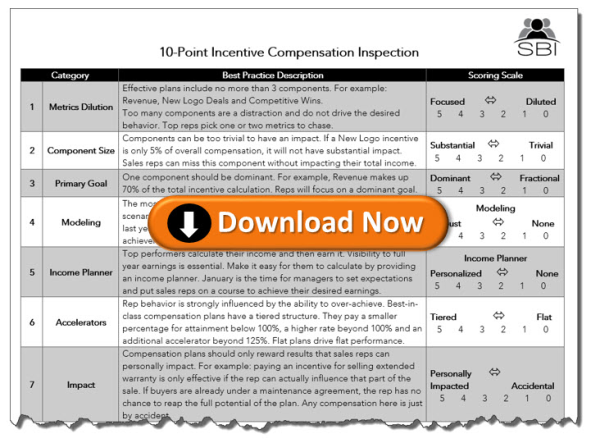
This post is for Sales leaders and HR business partners. It answers a fundamental question. "Are the compensation mechanisms driving the right behaviors?" Many ask this too late in the year to make a difference. Waiting for year-end results won’t help you Make the Number this year.  You may be surprised at how much you can learn after just one month. Investing a few minutes now may avoid big headaches later.

To make your assessment easy, SBI has created a 10-point Compensation Inspection tool. This simple, free, downloadable tool reveals the vital signs of your plan. Read on to understand the mechanics of effective sales compensation.

How Important is Compensation?

Erik Charles is the Principal Incentive Strategist at Xactly Corp. In a recent webinar, Erik noted that:

"The total outlay for Incentive Compensation in the U.S. is over $800B per year. That’s 3 times the amount invested in advertising! Most companies have regular meetings to review detailed analytics on how the advertising program is working. I don’t find the equivalent reviews and analytical checkups on the sales comp plan. Too many companies treat sales compensation as a once-a-year review. They roll out the draft plans in November, have a few meetings, adjust the territories and quotas, roll it out to the field and run off to the next challenge."

The January Two-Step

Your team spent many hours at the end of the year on the new plan. The flaws of prior plans have been fixed in this edition. Or have they? Now is the time to find out. Here’s the two step process to that Managers and Reps follow in the first month:

Step One: Complete a Territory Account Plan.  Determine where the business will come from. Figure out what resources and strategies are required. Plot activities and expectations on the calendar.

Step Two: Calculate personal income based on executing the Territory Account Plan. If the earnings are below target, can the plan be reworked? Maximize the levers of the compensation plan to deliver the desired earnings.

Top Sales reps become a retention risk when they recognize that the plan will not support achievement of their income goals. The January commission statement can be a sign that it's time to look elsewhere.

Consequences and Challenges

The consequences of an ineffective compensation plan are wide-ranging and perilous. The failure to drive the desired behaviors is just one danger. Here are two examples:

Manager on the Bubble: A manager close to achieving quota is less likely to terminate an underperforming rep. This manager only needs a small amount of revenue to make plan. The manager takes a calculated risk, hoping for a lucky break. The weak performer is allowed to stay in the territory. Contrast this behavior with a manager who is significantly below (or above) plan. Studies show that these managers are significantly more likely to pull the trigger. This result is better for the customer – a fresh, responsive sales person. And it’s a start on the road to a rejuvenated territory.

Challenge: Ask the manager, "If I gave you quota relief for the territory, would you keep the poor performing rep?" If the answer is "No" then it’s time to take action. Otherwise, the manager's compensation plan will dictate strategic decisions on hiring and retention.

Retention Holes: Research substantiates the fact that January and December are when most sales turnover occurs. Top Performers depart most frequently during the first and last months of the fiscal year. Top reps also tend to leave in the middle of the year.

Challenge: Keep top reps focused and motivated.

      1. Simplify: Make sure compensation is easy to calculate and predict
      2. Recognize: Use multiple leaderboards. Spread the fame by recognizing more than just quota performance. Prominently display achievements in pipeline growth, new logos, key products, deal size and more.
      3. Communicate: Provide real-time results. Update stack rankings daily. Use internal social media to share successes. Make it all mobile-friendly. Energize your sales team with a daily smartphone update from the coffee shop.
      4. Enlighten: Enable sales reps to calculate the value of each opportunity. Enable the CRM or pricing system to calculate potential earnings. Make it easy to calculate the impact of discounting on commissions.
      5. Inform: Don’t let rep use shadow accounting spreadsheet to calculate commissions – enable the compensation system to display real-time performance. Seeing the distance to the goal line each day is a powerful motivator.

 10_Point_Inspection

The 10-Point Inspection

If you're like most sales leaders and HR business partners, this is the start of the year. The early results of the new compensation plan are now visible. Take the time today to assess your plan. Download the 10-Point Compensation Inspection tool. Compare your plan to these best practices. If your results are less than expected, the tool will help diagnose the root cause. This easy check-box analysis will point you towards ideas for early corrections. You’ll stay on track to Make the Number.

10\u002DPoint Compensation Inspection

Author: John Kenney

sbi on linkedin

Follow @jdkenney

Follow @MakingTheNumber

If you enjoyed this post, never miss one again by subscribing your Email Here and/or subscribing to the RSS Here.

06 Feb 18:31

7 Tips to Make Killer Sales Calls (Even if You Dread Them)

by Minda Zetlin

You can--and should--conquer your fear of pitching total strangers. This process will help you do it.

"Do you have sales-call reluctance?" Connie Kadansky asks me point-blank.

"Um..." I trail off. She's a sales coach at Sales Call Reluctance with 20 years' experience. I'm supposed to be interviewing her. But somehow I've let slip that I'd rather have my teeth drilled than pitch total strangers over the phone.

If you feel the same way, you might take heart from Kadansky's tips for making effective sales calls, even if picking up the phone takes you outside your comfort zone. I plan on giving them a try. (If you do, too, let me know how it goes.)

1. Face it, you're a salesperson. Just like everyone else.

"So many people resist the fact that they are salespeople," Kadansky says. "They've had experience with salespeople who were less than professional." If you think about it, she says, a salesperson is someone who solves problems for a profit. Look at it that way, and just about everyone you know is in sales.

2. Believe in your own value.

You have value as an individual, and the product or service you're selling creates great value as well when matched with the right customer. "When people are convinced of their value, they're unstoppable," Kadansky says. "If someone on the other end is discourteous or not receptive, it doesn't faze them." (If you don't believe what you're selling has real value, you should be selling something else.)

3. Set a daily goal to contact new prospects.

"I encourage people to get a number in their head," Kadansky says. "Every day I'm going to reach out to two people I don't know. That can be over the phone, by email, or via LinkedIn, she says. "The point is to be proactive with new contacts on a daily basis, which is entirely possible if you make it a priority."

4. Use a client-focused script.

The script should focus on the client, not on you, Kadansky says. "Many companies similar to yours count on me to... fill in the blank," she says.

5. Leave irresistible messages.

Learn to leave a really effective voice-mail message, and you'll get return calls more often than you might think. "You know what your business driver is," Kadansky says. "Try to have a metric in your value proposition, such as your clients increase their Web traffic by 25 percent." And make sure to actually ask the prospect to call you back. "Often people don't get a call back because they don't ask," she says.

6. Listen to yourself.

If the voice-mail system offers you the chance to review your message, do it, Kadansky advises. That will give you the chance to hear not only what you said but how you sound. "When people are on the phone, only 27 percent of communication is in their words, and 73 percent is in their tone," Kadansky says.

7. Follow up.

No response? Keep trying. Kadansky says she'll try to contact someone about three times in a week, then leave it for two to three weeks and then try again. And she'll continue trying at intervals after that. She makes sure to leave a message intended to inspire action, she says. "Does everybody respond? No. However, many people do."

Like this post? Sign up here for Minda's weekly email, and you'll never miss her columns. Next time: The four fears that are holding you back.


06 Feb 18:30

Case Study:: Marketing Automation: IT company boosts leads 59%, generates $1.5 million with system implementation

"If you would have told me in 2011 that we would get to a point where in one month we would have over a hundred leads, I would have laughed at you," admitted Mandy Hauck, Manager of Marketing Communications, CentricsIT. But what Hauck once thought was laughable is now a rewarding reality for the IT company. This MarketingSherpa case study reveals how CentricsIT implemented marketing automation software to refine its email marketing strategy. The new technology increased leads 59% and generated $1.5 million in revenue for the company.
06 Feb 18:30

Customers, Employees and Influencers as High Performing Sales and Marketing Channels

by Tibor Shanto
Beedon Headshot

The Pipeline Guest Post – Dick Beedon

Although brand advocacy has always been important, it is critical today. The path to purchase has changed forever. Because there is so much data available, and because communication is so easy, today’s buyer almost always seeks advice from a trusted friend or consumer source before making a purchase. Brands are now starting to realize that what others say and write about them defines who they are.

Smart brands know they must build strategies and systems to generate, track and manage brand advocacy. They know they must encourage and enable the people that know and trust them – their customers, employees and 3rd party influencers – to advocate on behalf of the brand.

And it works. By encouraging and empowering these customers, employees and influencers, they will drive peer-to-peer referrals, forward content, share information about new products and promotions, and write testimonials. And they can do it at scale and more efficiently than traditional channels.

The Benefits of New Channels are Compelling (examples)

  1. They Build Brand Awareness – when a customer shares something about the brand with a friend, there is no better way of building the brand.
  2. They Generate Leads – those friends that respond and go to the brand for more information become the best leads a brand can get. There are few people on earth who will argue that leads generated from referrals are the best leads. 
  3. They Drive New Customer Acquisition – Leads from referrals close faster, they buy more and they stay longer. 

Other reasons customers, employees and influencers make good sales and marketing channels;

1.  Identify Brand Advocates and Build a Rich “Social” Data Set

Brand Advocates are identified when they register for or engage with your programs. By using technology systems, brands know who “opts-in” and advocates, how often they do it, what their sharing preferences are and how big their network is. We learn who they know and how influential they are. Brands are able to now get a deeper 360 view of their customer’s network value.

2. You’ll Know when Potential Customers are “In-Market”
Social channels provide insights and information not previously available. At the most basic level, social channels extend a brand’s sales force (with zero overhead) and they solve one of the biggest challenges brand’s face: knowing when a potential buyer is in-market. Only your current customers know when the people they know are ready to buy.
3. The cost of acquisition is lower.
This channel is always on and continually active – making referrals, amplifying products and promotions, and posting positive information about your brand. Brand advocates do this for a brand because they trust the brand and they want do it. Therefore, the time and cost invested into this channel is significantly less than other channels.
4. New customers that are referred by someone in your Social Channel are Valuable.
Research has consistently shown that consumers who convert as a result of a referral from a friend, are more loyal to a brand, spend more and stay longer.

Who are your Potential Channels and how Well can they Perform?

Customers, partners and employees are the fastest growing sales and marketing channel today. By utilizing the latest in social marketing software and technology, business leaders can mobilize these social relationships to generate new customers, and they can track and manage social behavior that is critical to the success of their company.

Customers recommend your products because they have first-hand, positive experience with them.

Today’s truly successful companies understand the importance of leveraging their customers into sales and marketing channels that drive corporate productivity. Creating and cultivating a large group of advocates can: pay huge dividends in the growth of your brand, increase subscribers, and boost profits. The financial investment to create this channel is minimal when you compare it to the long-term payoff for the brand.

About Richard Beedon

Richard Beedon is a founder and CEO of Amplifinity.  Beedon has led the acquisition of both Entyre Doc Prep (by Wolters Kluwer) and University Netcasting, who merged with Student Advantage (now collegesports.com) and was acquired by CBS. Dick’s thought leadership and early adaption of SaaS based technologies that allow brands to manage advocacy marketing has been instrumental in the success and growth of Amplifinity.

06 Feb 18:30

I Hate the Double Tap in Sales

by Trish Bertuzzi

 
Better, faster, cheaper – you can only have two.

I’ve decided to touch a third rail of the current selling spirit: the ‘double tap’ -- the process of leaving a voicemail immediately followed by an email.

I’m a little afraid of getting flamed on this one, but hey, what the heck. 

Let me give you the scenario.

A sales rep is prospecting you and actually picks up the phone to reach out. Maybe you ignore them or maybe you’re away from your desk. They leave a voicemail, referencing that they’re also sending an email.

So, what happens next? 

Scenario 1: In all likelihood, you check email before voicemail. Unless they’ve written a message that really grabs your attention, you delete it. You finally get around to checking your voicemail and delete that message without really listening to it. After all, based on their email, your impression is that you’re not interested.

Scenario 2: You get an email from your phone system notifying you of the new voicemail. You still read the (text) email first and then delete both as above.

Scenario 3: You listen to the voicemail first. Once again, unless it is compelling, you delete it. You notice the follow-up email and delete it as well. 

Your brain is wired this way.

Two things are happening here. First, deleting feels good. There is a pleasure spike when shrinking the inbox, or to-do list. Second, similar back-to-back actions don’t require active thought. If this email isn’t interesting, neither will this voicemail be – and vice versa.

In all three scenarios, you’ve been interrupted twice in a very short span of time. Two 'efficient' touches for the seller (good), two interruptions for you (bad), and too easy to ignore (ugly).

Now, Sellers may argue their messages really are compelling. OK, I believe you! But I’ll bet you dollars to doughnuts that your ‘double tap’ messages are less researched, less targeted, and less memorable than any standalone ones. This is a case of 1 + 1 = .5.

Where does this leave us?

Look, I am not saying that you should never double tap. Reaching a prospect requires increasingly more attempts. However, there is a difference between using your touches to tell a story in a meaningful way and using your touches to harass.

Give your messages some breathing room, bring content into the mix, try social outreach, use video. Get creative!

So dear reader, what say you?  If you are an Executive who receives sales calls, take the quick poll below. (Remember; answer how you would  react, not how you want your sales teams to execute.)


(Photo credit: troismarteaux)


authorTB

About Trish Bertuzzi

Trish writes about emerging inside sales trends. She is author of
Hiring an Inside Sales Manager and Inside Sales Oboarding.

Connect on Twitter and Google+.


06 Feb 18:30

The Real Truth About Your Sales Funnel: Content Marketing

by PaperShare

Content marketing is no longer a single marketing channel; it is the foundation that powers all marketing efforts.
06 Feb 18:29

How Important Is Money to Your Sales Team?

by Tom Searcy

If you use money as a performance motivator, you should know what it actually means to your employees. Sales guru Tom Searcy explains.

We recently evaluated a sales team on how they felt about money by using a standardized test. A big part of the test was to determine each individual's sense of worthiness of money and how their thinking patterns compared to the thinking patterns of people in various income brackets.

The sales people who believed themselves worthy of money had the same patterns of thinking of people in higher income brackets and were statistically kicking the heck out of their peers in sales. Combined with observations made by their direct supervisors, a picture emerged of people who discussed money, price, and value with the same natural confidence as weather, sports, and traffic.

Another group of people emerged from our study--self-saboteurs. These were people on performance plans, (HR code for "on the way out the door"), who often had a big disparity between how much they made (high), and the way they were wired to think about money (low). We noticed that if someone has the thought patterns of a $50,000/year earner and is making $100,000/year, they start to implode. Those people do not feel they deserve to be at the income level they are and so they do things that will get them back to where they believe they should be.

So, what does this mean for sales people and executives who hire sales people?

Being candid, my experience with thousands of sales people has taught me to look for certain thought patterns in sales people. Those who have them are more likely, though not guaranteed, to be more successful. Here are some of the things I look for:

  • Car, boat, cabin, or plane?--Financial ambition is often a good indicator of success. While just about every successful sales person has a desire to increase their income, most have an internal gauge for themselves of what having "made it" really means. The car/boat/cabin/plane question helps determine what each person believes signifies that they have made it. The point for me is to understand where that person sees himself or herself. And if someone does not have a clear picture of what having made it means, that tells me something as well.
  • How do they stack up?--Sales people's ambitions are often framed in reference to the standards set by other people. Who are your sales people measuring themselves against? It probably isn't Warren Buffett or Bill Gates, but whoever it is provides a good measure of your sales person's goals. If it is modest, they may not be the best fit for the position you are hiring for.
  • What would mom and dad say?--We get a lot of our wiring about money from our upbringing. I was raised by an earner, rather than a saver. My thoughts reflect a desire to figure out ways to earn more money rather than worrying about how many lights are on in the house or if the furnace is set to 68 degrees. Other people were raised to haggle for every nickel, clip coupons, and always look for a deal. I am neither endorsing nor condemning either--but I want to know people's wiring about money and understand if it is a good fit for their role.

If you are using money as a motivator for performance in your business, it is really critical to understand what it means to each person. I find that too often, leaders design programs around either the industry in which they operate or what motivates themselves. That is fine, if everyone is wired like you.


06 Feb 18:25

Why Should a B2B Sales Company Have a Facebook Page?

by Megan Toohey

Why Should a B2B Sales Company Have a Facebook Page? image agfb resized 600Let’s start off by saying that the B in “B2B” does not stand for boring. B2B companies often have a stigma of being boring and a bit drab compared to B2C businesses. Newsflash: it doesn’t have to be that way!

There are a many, many key reasons why I believe that B2B companies can greatly benefit from having a company Facebook page. I’ll highlight just a few main points.

1. To be found.

If you’d like more information on a company, nine times out of ten what do you do? You search for them online, whether through Google or Bing. And let’s hope that you find the company website above the fold of your browser. Well, what else shows up besides the company website? Information that is related to the company, such as social profiles! If there are any other nerds out there reading this, then you know that Google has made a plethora of updates over the past years, from including social media information in search results to Hummingbird, where conversational searches are returning better and more accurate results which quite possibly include social profiles. In addition to searching within a general search engine, most younger generations now search for companies on – that’s right – Facebook.  If you’re not found then let’s face it, you may be missing out, whether it be in sales or in hiring.

2. To show that you’re more than a logo and a great reputation: You’re also human!

Having a great reputation is a wonderful thing, but times have changed. It pays to show it! It has been proven that images boost interactions and engagement because of the emotion (or lack thereof) it generates from the viewer. If you state that your company is highly involved in charity work, well… Show it! Include some photos! Having a Facebook account is great to show off your company for who you really are. We at AG have a very friendly culture. You can always walk into the lunch room, find it packed with coworkers and easily sit next to any single person and have a great conversational lunch.  AG enjoys promoting a positive company culture so if someone checks us out on Facebook hopefully they’ll perceive AG in the same light. It is a great vehicle to help companies convey their culture and highlight their added value outside of the 9-5 duties.

3. It’s a great platform to engage with customers and prospects.

Does your company generate useful content? Outside of your website, where else do you share it? Can you share your content and interact with people? On Facebook, you can! Use the platform as a way to listen to customers and prospects, and when possible, jump in and help. Help them answer a question, help them find useful content on something they’re looking into, or engage with them by leaving a post or comment. Now playing devil’s advocate, let’s think about what would happen if you didn’t have a company Facebook account. Customers and prospects are enviably engaging without you, you’re missing out! What if a customer is vocal about being dissatisfied with your product or service and you’re no where to be found in order to correct and amend the situation? What if a business posted something that would infer that they’re looking into a new solution? You could have then contacted the necessary people at that company early on in their decision making process and maybe made a sale. You’d be missing out on that type of communication and interaction. Whether you’re on Facebook or not, those types of interactions are taking place. Better to be present within the conversation, good or bad, then absent all together!

Social media isn’t going anywhere anytime soon so unless you plan on hopping into your time machine, why not embrace the open communication and use it to your company’s advantage? Be found online, show the world how great your company is, and interact with people in your industry, your customers, and prospects. Granted, it does take some time, but being in the know is worth it!

Why Should a B2B Sales Company Have a Facebook Page? image c3ef1458 7494 4afa 91ab 1102f7ccab2c1

04 Feb 17:10

New CEO Satya Nadella will be lucky if he can solve just one of Microsoft’s problems: Nowak

by Peter Nowak
(Photo: Dcoetze/Wikimedia)

(Photo: Dcoetze/Wikimedia)

Microsoft is getting some positive attention for the long-awaited announcement of its new chief executive, Satya Nadella. For one, the software giant has put together a great website explaining who the new boss is, where he comes from, his values and more. It’s one of the more fulsome CEO information packages put out by a company, which is a good move given that Nadella – a 22-year Microsoft veteran who spent the last little while running its cloud and enterprises division – is a relative unknown to the world at large.

Beyond the well-done PR, Nadella is also being praised in many corners for being the right man for the job at the right time. Wired evidently had no trouble finding former colleagues to say nice things about him, with the consensus being that he’s very Bill Gates-like: a technical genius who also happens to understand the business side of things.

Moreover, he may be just the calming presence the company needs to replace the boisterous Steve Ballmer, whose loud outbursts are stuff of legend. Nadella will also have a new chairman at his side – former Symantec CEO John Thompson, who takes over for the outgoing Gates – as he tries to make Microsoft relevant again.

That’s where things get tricky. Microsoft has big mountains to climb in just about all of its businesses. The bread-and-butter of the company – PC software – is in a free fall, having its worst year in 2013 since analysts started tracking the market. Some think last year may have been a bottoming out, but with the amazing continued growth of smartphones and tablets, there’s little doubt it’s a commoditized business that is already well past its best days.

The fact that mobile is killing PC is doubly troublesome for the Redmond, Wash., giant because its efforts there have been largely futile. Although Windows has successfully taken over for BlackBerry as the number three smartphone brand in many countries, there is a really big drop-off after number two. The same goes for tablets: Microsoft is faced with the huge reality that the mobile world is an Apple and Android one.

Having a presence in phones and tablets is incredibly important for any company that wants to take part in the emergent Internet of things, or the next stage of the information revolution. As observers have pointed out, Microsoft is nowhere in this area – at last month’s Consumer Electronics Show, it was very difficult to find any of the connected home or wearable gadgets with apps for Windows devices.

The company is also facing an uphill battle in Nadella’s area of expertise, cloud services. Analysts say Amazon is crushing it in this area, racking up more business than Microsoft, IBM, SAP and Salesforce combined. The problem for all those companies can be summed up by the simple question posed by one observer: “Has anyone ever gotten rich competing with Amazon?” The answer, of course, is no.

Microsoft also appears to have lost its edge in games, with the PlayStation 4 outselling its more expensive Xbox One and many techno-aficionados pronouncing Sony’s console as the more powerful of the two. Ballmer and company did much to sour gamers on its brand last year with an ill-advised plan to kill used games, a scheme they were forced to backtrack on because of the backlash.

Nadella is riding into the top job on a wave of kudos and optimism, but he clearly has his work cut out for him. Overcoming all of those challenges will take a feat of veritable superhuman ability. Microsoft will be lucky if he can solve just one of two of them.

The post New CEO Satya Nadella will be lucky if he can solve just one of Microsoft’s problems: Nowak appeared first on Canadian Business.

04 Feb 16:49

The Secret to 20% Sales and Earnings Growth

by Srikumar Rao

If you want to increase your profits, focus your energy on your employees. Here's what will happen next.

I have been to 'socialist' countries where businesses--generally retail outlets--practically growl at customers and treat them shabbily. And they get away with it because customers have no alternative. But capitalism gave us competition and surly shopkeepers mended their ways as they discovered that they could not eat very well otherwise.

Canny entrepreneurs took the next step. How about treating employees very well so they would then take care of customers very well, and those satisfied customers would keep coming back and referring others? This is a concept that has been widely acknowledged and applauded, and there are many books such as The Customer Comes Second by Hal Rosenbluth that espouse the view.

Still, remarkably few companies actually follow this course, or even attempt it. So low morale and employee disengagement are the regrettable norm. Forbes reported in a recent study that more than two thirds of all employees are dissatisfied at work.

Where Employee Success Equals Company Success

I know a company that is doing this and prospering. Right Living in Clearwater, Florida, which is in a low tech, unglamorous industry--home care for those with dementia or disease, and unable to care for themselves--scores in the high 9's (on a ten point scale) of virtually every component of independent research company Home Pulse's survey of factors like work ethic and compassion of caregiver. And the company is growing at better than 20 percent in revenues and earnings.

Typically caregivers are on the low end of the socio-economic scale and generally treated badly by the companies that employ them. Customers are generally at the other end of the scale and pampered--at least verbally. But Right Living takes an approach that is different. The company vision is to "set team members up for success." Alex Chamberlain, the CEO, considers one of his primary duties to be thinking of new ways to make employees--I mean, team members--feel more valued and empowered in various ways.

And the ways he finds to do this are good for both client and caregiver. And these ways are decidedly not the norm in this industry. Here's how.

How to Really Treat Your Employees (and Customers) Well

All Right Living caregivers are W-2 employees with benefits in an industry that frequently tries to cut costs by labeling them 'independent contractors' and giving them 1099 income with no benefits.

Trust is important and the company delves deep into both client and caregiver backgrounds to make the match as good as possible. A devoutly religious client will not be paired with an atheist care giver or vice versa.

Caregivers are explicitly encouraged to take initiative to make patients' lives better. And this, of course, makes them feel more valued. In fact, "Mistakes are Proof that you are Trying" is emblazoned in the training room. When caregivers start using such initiative, some delight customers and some don't work out. Right Living stands behind the caregiver in the latter instance and will work behind the scenes to make things right.

For instance, a caregiver noticed that her patient always had the Animal Planet channel on the TV, surmised that she liked animals and took her to a Pet Smart store where she happily petted dogs and fed cats and had a ball. Her daughter called up later to say Thank You and what an awesome time her mother had. In another instance a caregiver took her charge to the beach. Unfortunately, her car was not air-conditioned and the parking was some distance from the sand and the patient did not like it at all. Nor did the nearby children who were vociferous in their complaints. Right Living apologized, promptly canceled the charges for the day, and trained the caregiver with a check list of items to consider before doing something similar, including: distance from parking lot to destination, wheelchair accessibility, restroom availability and so on. The caregiver continued with the same patient and the relationship was more than satisfactory.

Right Living will not send a caregiver into a situation that senior staff has not thoroughly checked out. A man called and asked for an aide to 'keep an eye' on his mother who had broken her arm in a fall. A senior care consultant investigated and discovered that the mother lived on the ground floor of a two story house and slept on the sofa. She was too scared of falling to go to her bedroom on the upper floor and there were piles of unwashed laundry in the closet because she would not go down to the basement where the washer/dryer was. The son had no knowledge of this.

"Parents hide things," says CEO Chamberlain, matter-of-factly. "They will not tell children that they need help bathing or going to the toilet." He considers it his job to find out stuff like this so that the caregiver is not sent into a situation she cannot handle.

Right Living helps caregivers find out in great detail about every client. For someone with Alzheimer's they know who the person once was and communicate that to the caregiver so she has a better sense of his history. A one time senior executive persistently lived in his corporate world and asked when his next meeting was. "Right after lunch, sir," she responded, and led him to his food.

How would your company do if you followed the same approach?


04 Feb 16:44

B2B Sales: Empowered Customers Require Empowered Sales People

by Bob Apollo

There’s abundant evidence to prove that today’s internet-savvy customers are much better informed and far more empowered than they were a generation ago. And it’s affecting B2B every bit as much as it is B2C.

B2B Sales: Empowered Customers Require Empowered Sales People image straightjacketYour prospects are able to learn about issues, find out about the experiences of others, research potential solutions and establish buying criteria without ever feeling the need to speak to a salesperson.

The new B2B buying decision journey

The vast majority of today’s information gathering is digital, and several studies have shown that the average B2B buying decision journey is around two-thirds complete before vendors are invited to the party.

That’s of course, unless the vendor – and their sales team – has given the prospect some compelling reasons to want to engage earlier, because they believe that they are more likely to be informed than bored by the experience.

Challenge or opportunity?

If you’re responsible for a B2B sales and marketing organisation, you can look at this situation as either a challenge or an opportunity. But one thing is certain: today’s empowered customers need and expect to deal with empowered sales people.

Simply telling the prospect what they could have – and probably already have – learned over the web adds nothing to the discussion. So it’s little wonder that Forrester found that B2B customers regarded 7 out of 8 discussions with sales people as having no useful value.

Many of the old-school sales people who regarded empowered customers as a threat have probably been flushed out of the system, and those that remain are unlikely to have rosy career prospects.

Rigid sales processes don’t work in complex buying environments

Some organisations have tried to respond to the empowered customer generation by implementing tightly defined sales processes that allegedly embrace “best practice”. But many of these attempts to implement process fail to materially affect sales performance.

The top sales performers tend keep winning, and the also-rans tend to carry on breathing in their exhaust from an ever increasing distance and choking on the fumes. How can we bridge the gap between the best and the rest?

Realising your sales people’s potential

First, let’s acknowledge that some of today’s current sales people are simply not equipped to participate in today’s demanding buying environment. But as long as they have the basic smarts, many of the rest harbour as-yet unrealised potential.

Complex sales are no place for rigid sales processes. What’s required is a supportive framework that encourages sales people to want to adopt proven winning behaviours that encourage rather than suppress their individual initiative or creativity.

Lessons from Helmuth

The Prussian General Helmuth von Moltke the Elder is deservedly famous for declaring that “no plan survives first contact with the enemy”, and the same is true of a rigid sales process applied to a complex and lengthy buying journey that involves multiple stakeholders.

Frameworks, on the other hand, offer clear direction (including a concise definition of what a good outcome looks like) whilst giving sufficient flexibility to encourage sales people to use their initiative, experience and creativity.

Frameworks empower

They empower sales people. They coach them on how to introduce and explore issues that are likely to be interesting to their prospects. They equip sales people to lead the conversation towards their solution, rather than with it.

They also provide tools that have been proven to improve sales flexibility. Some of the most useful include FAQs and TAQs (frequently-asked, tough to answer questions), perfect customer and key stakeholder profiles, qualification checklists and customer anecdotes.

These frameworks are supported by training and coaching programmes that encourage the sales person to really listen to what the prospect has to say and to respond in a thoughtful, relevant way that makes the prospect want to learn more.

Frameworks are the result of collaboration

Creating a flexible framework might seem more complex to implement and manage than a conventional process, but the reverse is often true. This is in part due to the fact that the best frameworks are collaborative efforts.

Rather than being driven top-down by management, they reflect the collective wisdom of the sales team. Rather than being defined once and imposed, they evolve organically in the light of experience. Rather than trying to enforce compliance, they support learning.

Random behaviour, rigid process or flexible framework?

This all may seem merely semantic, but it isn’t. You can tell the difference between a conventional sales process and a flexible sales framework. And if you’ve got a bunch of smart sales people who are personally motivated to do better, you’ll end up with much deeper engagement – and much more productive customer conversations.

So -where are you on the scale today? Random behaviour, defined process or flexible framework? How much better could you be doing if you had the latter? And – if you haven’t already done so – when are you going to involve your smartest sales people in designing your new flexible framework?