Shared posts

27 Feb 19:08

Book Recommendation: The Startup Pitch by Chris Lipp

by Jack Malcolm

startup pitchWhile I specialize in sales and executive level presentations I’ve always had a spectator’s fascination with startup pitches, because of their high stakes, no-nonsense audiences and emphasis on brevity. That’s the reason I read The Startup Pitch: A Proven Formula to Win Funding, but the reason I’m strongly recommending it is that the author is an expert who has can talk the talk very clearly but has also walked it. It also doesn’t hurt that the principles he advocates—such as understanding your audience, the value of structure and clarity, the relative unimportance of the slide deck, etc.—align with the ones  I constantly preach.

Lipp’s formula is simple. He says investors are just looking for two simple things: low risk and high return. Your pitch needs to prove you can deliver those two simple things, and that means covering four essential points, in order and without fail:

Problem: What is the problem you’re facing or the trend you’re exploiting?

Solution: What’s your unique solution and what are its benefits?

Market: What’s the potential market and how will you capture it?

Business: How will you profitably get, keep and grow customers?

While the four point formula covers the reasoning behind your pitch, you need to add what Lipp calls four major elements of influence: credibility, audience value, data and story. These elements are similar to what you will find in many presentation books, including my own, but the book is chock full of real life examples from actual pitches, both successes and failures. These examples make the book an interesting read but more importantly make it credible. In fact, Lipp consistently demonstrates his own principles by effectively using his own elements of influence throughout the book.

Especially interesting is the chapter on delivery, which shows that the word “pitch” is actually a misnomer, because the best ones are actually dialogues.  Investors want to know if you are someone they will be able to work with, so they will pepper you with questions and then assess your openness, willingness to listen, and poise under pressure. You have to be open to questions without losing your flow, and that takes preparation and tons of practice—an hour per minute of pitch.

After having absorbed Lipp’s formula, I can imagine  his pitch to sell the book idea to a publisher: Entrepreneurs go through many difficult challenges, but few obstacles are as daunting as the pitch to raise money from investors. The typical venture capitalist may hear 750 pitches a year and invest in only three. The solution, after much hard experience, analysis of successful pitches and talking to top VCs, is the formula outlined in this book. There are tens of thousands of potential buyers entering the market every year; that’s if you only count entrepreneurs, because others can also benefit. People will buy the book for its promise and recommend it to others because it will work for them.

You don’t need to be a starry-eyed entrepreneur to benefit from this book. If you make high stakes presentations to tough audiences, I strongly recommend it.

27 Feb 19:03

Why Businesses Love Facebook

by Kate Huffman

With Facebook as the leading platform in social media, it is no wonder why businesses love to use Facebook for their every social media marketing need. Having over one billion users at the tip of your tech savvy fingers can make it very easy to attract all different types of customers with the click of a mouse. Not only does Facebook make it very simple to advertise your business, but you can make a connection with your customers that would not have happened before.

The multiple aspects that Facebook offers makes it one of the most effective ways to market your business. From adding pictures of your products to creating engagement, Facebook allows your business to flourish online and carry over into the store and the growth of customer population to ultimately create a successful business.

As the popularity of Facebook grew it was only a matter of time before the business world jumped on broad as a way to make a connection with their customers; just like regular users would connect with their friends and family. This increased the users view of companies because one could see that they were willing to go the extra mile to really grasp the customers wants and needs. Making a connection with customers over an interactive web based platform is one of the most important reasons why businesses should love Facebook. Because while you are trying to meet their needs, the customer can also give you feed back to make your business the best that it can be.

By making this connection, potential buyers will turn into loyal customers. Loyal customers will then in turn market your company to reach even more people. This outreach has allowed businesses to expand their audience more than ever before. Holding a contest or offering a discount will allow customers to share the business page with numerous people; this is where word of mouth has not been as effective in the past. When a business markets on Facebook they can reach large groups of people each and everyday.

Making connections and finding new customers on Facebook will allow your business to advertise the products and services in a more convenient way. With a simple campaign strategy and good content creation, a business can effectively advertise to customers on a mainstream platform for a lot less. Because Facebook is the most versatile platform, with pictures, statuses, captions, etc., the options to advertise products and services are unlimited.

These three main reasons make Facebook one of the most loved platforms on social media because it offers the most options to impress your customers with what really matters. Facebook makes social media marketing very easy for businesses to get the word out about their company while also advertising and making real connections with their customers.

What are some reasons why you love Facebook for social media marketing?

27 Feb 19:02

Why B2B Marketers Need a New Marketing Campaign Model

by David Dodd

Marketers have long used campaigns as the basis for planning marketing efforts. For decades, the campaign paradigm provided a useful way to organize marketing activities and link those activities to marketing objectives. Today, however, effective B2B marketing requires new kinds of marketing tactics and methods that don’t fit the traditional campaign construct.

Several industry analysts and marketing thought leaders are now contending that the campaign paradigm is becoming obsolete. In October of last year, Forrester Consulting published a white paper (The Rise of Marketing Orchestration) that described one of the major problems with the campaign model:

“. . . despite a rapid growth in addressable media, pervasively connected devices, and real-time marketing technologies that enable marketers to reach and respond to individual customers, most companies are stuck in an old campaign mindset and a corporate reality where each of their touchpoints is typically the domain of separate channel silos, such as email, mobile, display, social, and web. The overall result is often messaging, execution, and delivery strategies that are fragmented across touchpoints and out of context to the consumer.”

While many of the criticisms of the campaign paradigm are valid, marketers still need a way to organize their marketing efforts. One approach is to ditch the campaign model altogether and replace it with a new concept. Another approach is to change how we think about and define marketing campaigns to make the model more suitable for today’s marketing techniques.

SiriusDecisions adopted the second approach in developing its B-to-B Marketing Campaign Framework. In the SiriusDecisions framework, a marketing campaign has three core attributes:

  • It is based on a buyer need (or a group of related buyer needs) rather than on the seller’s products or services.
  • It includes four distinct types of marketing programs – reputation, demand creation, sales enablement, and market intelligence.
  • It is designed to run for a relatively long period of time, usually about 12 months.
The diagram below shows my interpretation of the SiriusDecisions campaign framework.
Why B2B Marketers Need a New Marketing Campaign Model image Sirius Campaign Framework3
When I use the campaign framework with clients, the one significant change I make is to add a core value proposition component. In the planning process I use, core value propositions are based on buyer needs, and those core value propositions provide the foundation for the development of marketing messages and content resources.
One major benefit of this planning model is that it brings consistency to a company’s marketing efforts. Each marketing campaign has a message/content theme, and all of the marketing programs within a campaign feature some version of that theme. This approach eliminates disconnected (or even contradictory) marketing messages and content resources that can leave potential buyers confused about the company’s brand promise and the value its products or services will deliver. It also enables companies to tell a consistent story regardless of how potential buyers interact with the company or where they are in the purchasing process.
The traditional campaign model is becoming an ineffective tool for planning and executing marketing activities, but the more strategic marketing campaign concept suggested by SiriusDecisions provides an effective way to design and execute marketing efforts.
27 Feb 18:51

How to Fail at Content Marketing

by Amanda Nelson

We’re in a marketing world that’s constantly evolving, and content marketing is no different. In this ever-changing world, for every content marketing success, there’s a failure first. Learn these content marketing no-no’s and be one step closer to a content plan that works.

Blogging for the Sake of Blogging

As Jason Falls often shares, “Don’t blog to blog.” You may experience pressure to create or update your company blog, but if you don’t have a plan and goal around it, the effort is a waste. Before you even start typing, know your goals, audience and schedule so your blog is frequently updated with on-topic, relevant content. If you can’t commit to that, don’t blog at all.

Running on Your Own ScheduleHow to Fail at Content Marketing image iStock 000003464775Small

Sure, that brainchild ebook idea may be smart, but if it’s not relevant to your company message, initiatives or offerings, you’ll be the only one enjoying it. Work with your entire marketing department, sales, PR, etc. to understand the big events, product launches, campaigns and other initiatives happening for the year, the quarter and the month so your content can be directly tied in. This will also help you create a content calendar and schedule. Then, when you generate leads from your content, the leads have a natural next step.

Related Class: Strategic Blogging: The Why and The How

Forgetting to Triple-Check Your Work

No matter how great the content, if you have typos, the credibility is gone. After all, when’s the last time you shared an article riddled with errors? Don’t just double-check your work, triple-check it. Make it a top priority. Get an extra set of eyes on your content or hire a dedicated proofreader.

Always Be Closing

The traditional ABCs of sales does not apply to content marketing. Sure, you want your content and work to drive revenue (and if you do it right, it will), but pushing your audience toward a sale is not the right approach in this type of marketing. The right way is Jay Baer’s “Always Be Helping” mentality. Solve your audience’s business problems with helpful, relevant, non-product-related content, and they’ll keep coming back for more. Soon those return visitors will become return customers.

Launching and Then Moving On

Oftentimes, after a piece of content goes live we wipe our hands and move onto the next project. This is a huge mistake. This is actually where the work first begins. Once your content goes live, plan a campaign including paid and organic media. Create other types of content around it such as an infographic, SlideShare presentation, blog posts, etc. that all support the initial piece. Ensure the campaign not only has a big push at the beginning, but has support throughout the year. For instance, launch those supporting content pieces weeks or months later. The long-tail effect of that content may be greater than the initial splash.

Set It and Forget It

Let’s say you do that big launch and you automate your promotional efforts around your content. Good job, but don’t forget that your eyeballs are still crucial in the process. Oftentimes, we launch a campaign and let it ride. But the beauty of social media and big data is the ability to see your results live and in real time. Check the data and feedback around your content every morning and optimize based on your findings. A headline change or responding to a tweet can be the difference between a good campaign and a goal-crushing campaign (or the difference between a prospect and a customer).

Keep these tips in mind when working on your next content marketing campaign and you’ll be one step closer to an eventful 2014.

What other mistakes have you learned from? Please share your thoughts here.

If you need to start the process of improving your content marketing strategy today, enroll in Amanda Nelson’s Online Marketing Institute class, 10 Advanced Strategies to Mobilize Your Content Marketing, to explore 10 actionable strategies that can be implemented as soon as today to improve your content’s impact.

27 Feb 18:50

B2B Lead Nurturing: Which Works Best? Direct Mail, Email or Phone?

by Jeff Kalter

B2B Lead Nurturing: Which Works Best? Direct Mail, Email or Phone? image 8012f255a337782bffaadea968723f36 S

Whether you received a lead because someone signed up for a webinar, demo, or other offer, you need to institute a lead nurturing process to transform it into a qualified lead. What’s the best way to do this? If you want to maximize your sales conversion rates, start by picking up the phone.

Help Your Prospect Solve Their Problem

The key to lead nurturing and conversion is to focus on the prospect, their problem, and helping them to find a solution. You cannot do that without a true understanding of the issues and opportunities the person is facing. The closer you can come to interacting directly with someone, the deeper your mutual understanding will be.

Words Alone Cannot Substitute for Conversation

Of course, face-to-face communication is the most powerful way to build understanding because 55% of communication comes through body language alone. But that doesn’t mean you want to send a field sales rep out to ferret out a lead’s requirements. It’s just not cost effective because if you haven’t had a conversation, you don’t know if they’re qualified.

But after body language, the next most powerful communication tool is the tone of the voice. It accounts for 35% of communication. The actual words provide a miniscule 10% of communication.

Tone in Emails is Misinterpreted 50% of the Time

Given that words only provide 10% of the communication, how effective is email? The Journal of Personality and Social Psychology conducted a study that showed the tone in an email is misinterpreted 50 percent of the time. So you only have a 50% chance of getting it right! That’s a high risk to take with valuable leads. And, of course, direct mail has the same issue plus is hampered by the slow pace at which it reaches the lead.

Phone Provides Deeper Understanding

Following up by phone is the best way to share information and gain insights on a lead that’s not yet qualified. The phone allows you to dig into the person’s issues, see where your products and solutions might help them, and discover where they are in the buying cycle—initial research, assessing vendors, or making a final decision. Your goal is to listen to the prospect and learn enough to establish next steps in the sales process.

Talking with a prospect enables you to establish a follow-up plan which helps them to solve their problem at their own pace. Once you’ve started a relationship with the prospect, it’s okay to follow up with email. You learn enough in the initial conversation to send information that can help them, on a schedule that fits their timeline.

The Human Touch Builds Relationships

Phone calls are also powerful because they add a human touch to the lead nurturing process, helping to build a person-to-person relationship. And in the end, even in business-to-business sales, people buy from people. Thus, you need to add real, live human beings into your lead nurturing process.

For more information about 3D2B, visit www.3D2B.com or call 1 718-709-0900 or +39 06 978 446 60 (EMEA).

27 Feb 18:50

7 Ways to Engage Your Audience with Marketing Content

by Meghan Sullivan

7 Ways to Engage Your Audience with Marketing Content image medium 3145391821By now, we all know the reasons content marketing has flourished as a marketing strategy and a full-time profession. With advanced technology that puts information at consumers’ fingertips, they are in complete control of the buying process, whether in B2B or B2C setting. They search for solutions, answers to questions, fixes for problems, detailed product information and user reviews, and often consume all of that content before taking any step toward making a purchase or talking to a company representative.

This creates a huge opportunity for marketing teams to create all kinds of content their target audiences are searching for and find useful! As part of your content strategic planning, you will want to ensure you’re addressing the various things you can do with marketing content. This post will explore seven.

Before You Start Planning…

It’s critical to take the steps you need to fully understand your Buyer Personas. Talk to your salespeople about the kinds of questions they get at each stage of working with a prospect—from their first questions to the questions asked just before making the purchase, or even after. Talk to customers, too. Ask them what information they found useful—or wish they had—as they considered purchases.

Also, remember you have multiple delivery mechanisms for content of all types. Some might work better than others depending on the purpose, but a diverse library of content is going to appeal to the largest number of potential buyers. Think in terms of eBooks, quick guides, infographics, slide decks, videos, photos, blog posts and emails.

Having said that, here are seven things you can do with marketing content to engage and nurture your audience:

Inform

Content marketing is a great way to make your audience aware of goings-on. We advise clients to publish blog posts (or, when fitting, other types of content) when they are going to be at a trade show, doing public speaking or hosting a webinar. You can provide details and compelling reasons for your audience to check out whatever it is you’re bringing to their attention.

Example: A simple example, but here at Kuno we use our blog as one channel to let our followers know about webinars we’re hosting. It’s a great way to get the word out.

Educate

I’d argue this is the most valuable type of content you can publish. Teach your readers how to do something that will help them achieve whatever goals they have. Share best practices from your vantage point as a product/service provider.

Example: No surprise, but HubSpot really gets content marketing. HubSpot offers training on things that have nothing directly to do with its software, but is just helpful for its target audience of marketers. My favorite example is its Microsoft Excel training for Marketers. While not a part of its software, this is incredibly valuable content for marketers!

Advise

Every day, thousands of people will take to the Internet to search for solutions to a problem. Here is your opportunity to offer some words of wisdom or advice, especially if you or someone on your team is experienced in a particular area.

Example: HubSpot gives us a nice example with the advice it offers Millennials on building a successful career. Again, not directly related to its software, but HubSpot understands Millennials are an important target audience now and in the future, so it takes the time to give them some worthwhile reading.

Argue

Some of the most interesting debates I’ve ever followed have taken place in the blogosphere, with well-known thought leaders each taking a position on a controversial topic or one that’s hotly debated. Every point of view is unique, important and adds to the discussion.

Example: Earlier this year, Mark Shaeffer published a blog post about content saturation and the problems it could cause marketers in the near future. His post spurred quite a fascinating debate, with responses coming from all corners of the marketing world including Joe Pulizzi, Marcus Sheridan and our very own John McTigue. The best part about this debate is how much readers learned not only from each post, but from the comments. It was an industry-wide learning experience.

Explain

Use your blog or even an email to tell your audience why something has happened or why a decision has been made.

Example: Last year, the app Buffer experienced a security breach that caused user accounts to post spam. Because Buffer handled the issue quickly and calmly, users were delighted and even left messages expressing thanks and well wishes. Use your blog, social media accounts and other communication methods to swiftly address anything that creates questions or confusion in the marketplace. It’s common for misinformation to spread, creating speculation and misinformed reactions. When those situations arise, it’s best to address it directly and promptly. Follow crisis communications best practices of hopping on it quickly and saying exactly what happened, why it happened, and what the resolution is or will be.

Overcome

Your sales team can help with this one. There are usually several common objections it faces when talking to potential clients. Address these in your content to nip those objections in the bud before they even hit the sales team. They’ll appreciate it!

Example: A common objective our business development team has to overcome here at Kuno is budget-related. Our EVP John addressed those frequently asked questions in a blog post to help our potential clients get the budgetary wheels turning early on.

Train

Content creation shouldn’t only target leads or customers you don’t have yet! Don’t forget your bottom-funnel leads or user groups; offer these folks training and/or best practices content for your product.

Example: MAC Cosmetics has a series of makeup tutorial videos featuring real-life makeup artists. While it might be obvious to a professional how to best use MAC products, an amateur applying makeup at home might not know, so these tutorials are a great way to learn new techniques for using the company’s products. This type of content builds long-term relationships with clients who continue to engage with your brand even after they’ve bought your product.

There are several more ways you can use marketing content to engage with your target audiences. What are some of the ways you’ve used content marketing? Leave a comment below!


7 Ways to Engage Your Audience with Marketing Content image 4947be1b d2cc 4d92 9654 85f7d9f0f8ef9

photo credit: birgerking

25 Feb 19:56

What Bitcoin Must Do To Survive

by Rob Wile

life raft rescue

For Bitcoin to live, MtGox has to die.

That is the consensus emerging in the Bitcoin community in the wake of the apparent demise of MtGox, the once dominant Bitcoin trading site. 

It is still not entirely clear what has happened to what was once the world's largest Bitcoin exchange, which went offline over night. The company said in a statement on its site that it had halted trading "in light of recent news reports and the potential repercussions on MtGox's operations and the market."

But as we've detailed, MtGox has for nearly a year been regarded as something of a basket case in the Bitcoin community, with complaints from customers about lengthy delays in taking money and Bitcoin out of their wallets, and a general lack of responsiveness.   

As SecondMarket's Barry Silbert told us this morning, "The sooner that MtGox goes away, the better." 

Erik Voorhees, who earlier published his state of mind upon realizing his $285,000 in Bitcoin were likely gone forever, told us in a follow-up interview that while he is not thrilled about his financial losses, he looks forward to the Bitcoin community putting what he called the "cancer" of MtGox drama behind it.

"I think among those of us who are really involved in the Bitcoin community, this is unquestionably great," he said. "In the longterm for Bitcoin, Gox needed to go away. It was dying a slow death, and now it's been severed."  

There are unconfirmed reports that customer wallets run by MtGox were compromised, and that a massive amount of Bitcoin was stolen.

The focus within the Bitcoin community is thus now turning how to beef up wallet security. Recent wallet theft outside the exchange has only added to concerns.  

"The reason that many people stored coins on MtGox is not that they all were active traders, but because MtGox was a convenient 'wallet' or 'deposit box' for them," Oleg Andreev, a software designer and digital security expert, told us by email. "Unfortunately, we don't yet have very safe and easy to use wallets to store your Bitcoins on your personal computers." 

Andreev envisions a three-key back-up plan where one key would be owned by you, one by the custodian and one by a separate service that holds the key in "cold storage," or in physical form. This would avoid most of the problems Gox users suffered.  

"You will be able to withdraw your coins instantly. If the server is compromised, company does not lose even their "hot wallet" funds. And if you forget your password, technical support will take their encrypted "cold" key and help you move your coins where you want."

The moment may prove most profound for Bitcoin regulation. Jeremy Liew, a leading Bitcoin investor at Lightspeed Venture Partners, had previously gone on record at last month's New York Bitcoin hearings as opposing rigorous regulation. But in the wake of MtGox, he now thinks it's necessary for mainstream adoption. Here's what he Tweeted earlier:

Now more than ever we need a US domiciled regulatory compliant #bitcoin exchange. @BenLawsky could this be expedited?

— jeremy liew (@jeremysliew) February 25, 2014

He elaborated on this point to Bitcoin activist Ryan Selkis, who first unearthed the document alleging the massive theft at Gox. We confirmed the authenticity of the quote by email with Liew.

"I think a regulatory solution would do more to increase ordinary consumer confidence in Bitcoin and its institutions than one that is purely market driven or industry led. I am well aware of all the challenges that regulatory solutions have, but if Bitcoin is to become a mass market product, then it will require measures to lift confidence from those who will not understand a technology solution that their BTC is safe.

I advocated against new BTC specific regulation at Lawsky’s hearings last month, but I now think that some sort of regulation covering customer funds security may make sense if there is going to be a BitLicence.” 

New York Department of Financial Services Superintendent Ben Lawsky agreed regulations are needed to shephered Bitcoin into the mainstream. Earlier, he released a statement saying in part, "These developments underscore that smart, tailored regulation could play an important role in protecting consumers and the security of the money that they entrust to virtual currency firms.”

For now, Voorhees says, the market reaction is overdone, since few of the largest and most important businesses had funds stored on MtGox. While did not rule out another Gox announcement could yet complicate the Bitcoin landscape, he pointed out that few major Bitcoin businesses had their funds stored there. 

"It's more just a huge PR hit, and just a huge tragic loss for the users."

Prices were at $512 on Coindesk as of 1:30 p.m.

SEE ALSO: The Emerging Bitcoin Civil War

Join the conversation about this story »

25 Feb 19:55

15 Reasons B2B Content Marketing Fails – #9 Not Promoting Your Content

by Ian Dainty

15 Reasons B2B Content Marketing Fails – #9 Not Promoting Your Content image content promotionThree of the biggest B2B content marketing mistakes are;
1. Not producing ENOUGH content,
2. Not producing the RIGHT content,
3. Not PROMOTING your content.

Once you have finally decided how important it is to produce content for your audience, you then need to promote that content. So how do you promote it?

Well, there are a number of methods available to you.

The first method you need to use is putting links in your blog post or eBook to other post on your blog. This keeps people on your blog, and lets them read other information you have about that subject. You will notice that I have four links at the bottom of this blog pointing to related content articles.

The obvious methods for promoting your B2B content is on social media. You should be promoting your content on Twitter, LinkedIn, Google+, possibly Facebook, and if it is a Powerpoint video, you should also promote the slide presentation on Slideshare.

Of course all Powerpoint videos should be put up on Youtube, as suggested in my last post.

You can also post your articles on article directories. See the top 50 here – http://www.vretoolbar.com/articles/directories.php I have used Ezine Articles for a number of years with some good success and exposure.

One of the other important ways to promote your article is by guest blogging. Guest blogging is getting someone else, who has a popular website, to post your blog post also.

Or you can write a brand new post and get them to post it. If it is a popular post, you will get a number of comments and also retweets and reposts on other platforms like LinkedIn.

I have found that a good way to promote my blog post on LinkedIn is to put the heading of my blog in the form of a question. Then, share that question in the updates section of your LinkedIn home page.

Also, ask the question, in the discussion areas of each of the groups you belong to. That way you receive comments about your post.

You can also go to different online forums and pose your blog post question there.

The key, for promoting your bog, is to use your imagination, and all of the online platforms you can think of.

Keep in mind that over 80% of people, who want your products and services, search online before you even know they are looking. You need to find a way to reach these people. You do it through content. And then you need to promote that content.

25 Feb 19:54

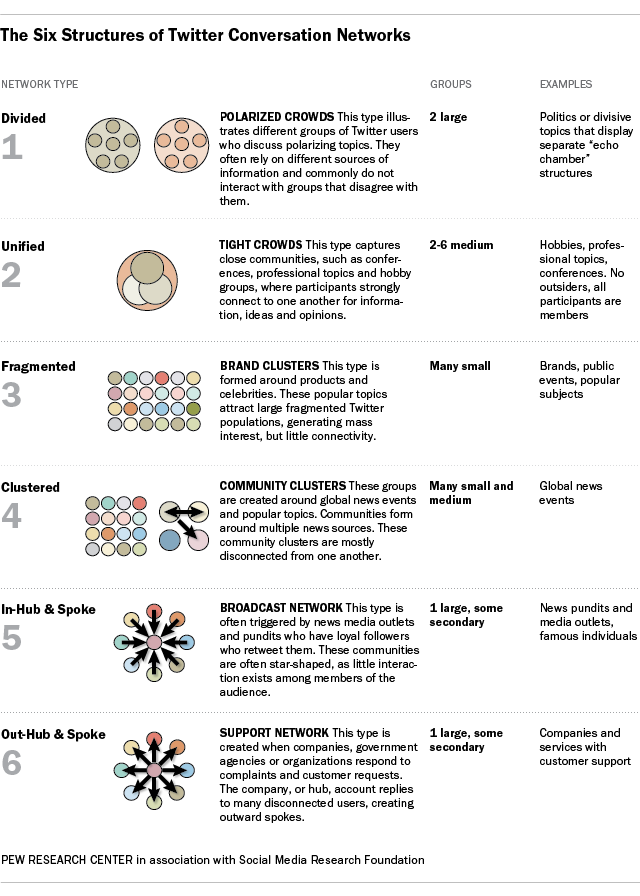
The 6 Types of Conversations Everyone Has on Twitter [Infographic]

by gsoskey@hubspot.com (Ginny Soskey)

twitter-terminologyI hate to break it to you, but most of us on Twitter aren't original. Sure, we send 500 million tweets collectively a day. We can have millions of followers. We have 140 characters to say whatever we want whenever we want.

But according to a recent study done by the Pew Research Center, we only have six different types of conversations on Twitter.

Yep, just six -- and none of them are @mentions, @replies, or DMs. So much for being special Twitter snowflakes.

But not being special has its advantages. With this data, you can better understand how your followers interact on Twitter and change up your strategy to better serve them. Feel free to read Pew Research Center's full report here or get a quick yet comprehensive overview in the graphic below.

The 6 Types of Conversations You'll Have on Twitter

twitter_conversations

What do you think of Pew Research Center's findings? Which types of conversations do you have most often on Twitter? 

how to get 1000+ twitter followers

subscribe to the hubspot marketing blog

25 Feb 19:53

New Facebook Advertising Targeting Features Revealed

by SEO Tribune

It is no secret that many digital marketers are fed up with Facebook’s advertising options, as their limited targeted tends to lead to a large percentage of fraudulent clicks and page likes, which is something that we touched on previously. It has become a growing issue and there are several case studies that show blatant click fraud is going on.

Facebook has yet to respond to the claims of advertising fraud, but the did recently introduce several new features to target the end user better. These new Facebook advertising features are designed to help the advertiser target the ad to a more specific group of Facebook users.

On paper, the new targeting options sound good, as they allow the advertiser to target specific education levels, geographical areas via zip code, and even professional title. The downside is that it requires the users to have accurate information in their profile. An advertiser could be targeting CEOs and may unknowingly be targeting kids that simply put “CEO” as their workplace title. While the new changes are a nice change, they are not an end all solution.

Savvy online marketers are jumping all over the option to target based on significant profile information being changed. A prime example would be using a relationship status change update change, and targeting a dating offer to those users that change their status from, “in a relationship” to “single.”

While we applaud Facebook for providing advertisers some more options to help deliver their advertisements to a more targeted audience, it still remains uncertain if this will indeed help quality and eliminate some of the fraudulent clicks that have become far too common.

It is no secret that Facebook has been losing some larger advertisers due to the poor quality traffic and fake traffic, but these new targeting options might help lure some of them back to give it another shot.

It still remains to be seen if Facebook will ever directly address the claims and obvious proof that Facebook still has a very serious fraud problem. How many more millions of dollars will be lost due to fake likes and clicks before something is done? Maybe advertisers will start to pull all of their money from Facebook until the problems are corrected. They sure don’t make it easy for the small business to contact them and ask questions when they see fake likes and such.

We like the change, but still feel strongly that Facebook advertising should be avoided unless you want a whole lot of fake engagement.

Image credit: Shutterstock

25 Feb 19:11

‘Translation’ Will Torpedo Your Global B2B Sales & Marketing Efforts

by Ed Marsh

Doing damage by trying to do well

When companies start to dabble in international sales they typically go through a couple standard steps.  There’s often some product localization (e.g. changing voltage, satisfying local labeling requirements and meeting regulatory guidelines.)  They often assume that much of the marketing material needs to be translated into the local language – and at this early stage they often sabotage their efforts.

(As an aside, what purpose to product spec sheets serve?  Has anyone, anywhere, ever landed a customer because of their product spec sheet?  I dare say no.  However, many great deals have been lost (some known, many unknown) due to (mis)interpretation of product data sheets.  Do you really want to have them floating around in any language??)

Translation & localization

Translation providers all sound the same (here’s an industry that really needs to use inbound marketing to differentiate themselves!)  They all:

  • have well trained staff with impressive credentials
  • use native speakers
  • translate context and idiom – not just the words

Some take it a step further and offer tips on localization.  This may include adapting the level of formality, suggesting layout formats/sizes, colors, fonts, imagery and tone that are appropriate culturally.  (By the way, there is a huge amount of localization required for your marketing to work well across commonwealth countries too – not just find and replace of “or” with “our”!)

But in the end they are working with the materials they are provided.  By definition they are applying a language mask to a design anchored in a different culture & context.

There’s absolutely a place for translation – but not as a fundamental step in your global marketing.  Here’s why.

Marketing fundamentals are culture & market agnostic

Translation Will Torpedo Your Global B2B Sales & Marketing Efforts image b2b marketing translation isnt a simple process of matching

Really effective marketing requires some common foundational steps.  First is an understanding of the project profile, environment and pains/value that a product/service can address.  From that, an ideal prospect persona can be built which will guide all marketing efforts so that they resonate effectively with the right people.

And here’s where translation and localization fail.

Marketing execution is completely culturally & market dependent

One might assume that bottom line profit is the common language of all B2B sales & marketing efforts.  And that would be mistake #1.  Not only, for example, do the “black” & “white” books of real vs. reported tax accounting in many high tax emerging/frontier markets distort that, but many other market and cultural factors impact ‘fundamental’ business perceptions.

Let’s use an industrial marketing example – a company which provides manufacturing automation solutions.

Selling domestically they target personas including process engineers & plant managers.  Typically the CAPEX process is initiated at the local facility level and then forwarded to corporate for financial approval.  (see our recent article on mediocre vs. strong value propositions for a similar scenario)  Generally the justification is built around operational efficiency and cost considerations (labor, short run efficiency, increased output, etc.)

Now that same company notes the trend of manufacturing moving from China to ASEAN and decides to target Indonesia.  All fired up to “localize” their effort, they engage a capable translator to convert their data sheets and eBook on manufacturing efficiency into Indonesian.  Let’s assume the language is perfect.  Idioms are adjusted and tone is proper.  Let’s even assume that localization was considered with hybrid units observed and imagery and layout adjusted to local standards.  Should be a great tool, right?

Wrong!!  What if no plant manager in Indonesia would be:

  • comfortable presumptively suggesting to the Managing Director that they make a large investment
  • focused on labor cost reduction as a primary decision driver
  • interested in creating labor strife

Instead, the motivating pain points considered by the MD might include:

  • assurances for Western buyers of consistent quality through automation
  • demonstration of sound manufacturing practices to avoid buyer concerns of child labor abuses
  • ability to maintain continuous production rates during Ramadan when many employees will be focused on their fast
  • more concerned with manufacturing space requirements as property prices skyrocket

It’s easy to see where even properly localized translation would result in fruitless marketing in this situation.

Translation Will Torpedo Your Global B2B Sales & Marketing Efforts image Internatinal Marketing resized 210

So what’s the solution?

To build your B2B inbound marketing properly, in a prioritized manner.

  1. Build as close to a perfect program as possible for the domestic US market (planned well, executed consistently, based on robust personas and their buying journey, continuously improved, mutli-channel awesome optimized content, great lead nurturing, complete social media & PR promotion, integrated CRM for closed loop tracking & sales enablement tools)
  2. Let it run – over the course of year you’ll begin to see some very clear traffic, engagement and lead patterns
  3. Select & prioritize markets – this must be driven by corporate strategy, NOT by marketing preference (factors such as strength of sales channel, political and currency risk, diversification & demographics should drive this)
  4. Build the infrastructure – TLDs (top level domains e.g. .uk, .de, .vn, etc), local hosting, multi-language CMS, content creation resources, trademark registrations, etc.
  5. Create the localized B2B content marketing strategy – just as you did with your initial US effort, build detailed personas, buyer’s journey and other fundamental building blocks (with particular attention to localized NOT TRANSLATED long-tail keywords based on local market pain points and conditions)
  6. Transcreate content – per the example above, don’t translate.  Build it properly and optimize it based on the target market conditions and personas
  7. Nurture and sell in a persona and culturally appropriate way – since you already selected markets based on corporate strategy and resources, and ensured that the infrastructure was in place, this won’t be a problem!

Sound like a lot?  It is.

Is there some way to get started without a full program?  Sure, but recognize that it is a 20% solution.  Don’t fool yourself into believing you’ve got properly built international content marketing.

Here’s how to shortcut the process – Create a step 4b.  Create some market specific subdomains.  Then relying heavily on your local sales channel for general guidance on personas and conditions, create some localized landing pages with a caveat that the offered content is intended primarily for US market conditions.  If you’re feeling ambitious, perhaps you can create lead nurturing work flows with local language emails.

But whatever you do – don’t fall for the translation quick fix early in the process.

Translation Will Torpedo Your Global B2B Sales & Marketing Efforts image b8eb6b31 41af 4508 a3e9 cfd92d9c21ab

image – perceptral

25 Feb 19:10

Content Marketing With Research and Surveys: Pros, Cons, Examples, Best Practices

by Nicolette Beard

content marketing surveysAll marketers need actionable insight to make important decisions. As the internet reaches a crescendo of voices all vying for their customers’ short attention span, the need for quality citations and third party industry research becomes even more important to stand out.

Therein lies an opportunity: Companies that create credible surveys, reports and playbooks on a regular basis can become known authorities and trusted resources – ahead of the competition. Such authority leads to trust and in the content marketing world those are essential characteristics to attract a target audience whether they are buyers, journalists or investors.

Ironically, it’s this exact labor-intensive exercise that provides some of the most sharable, citable content. The ability to attract substantial citations, social shares and attention is a very powerful capability for agencies and corporate marketing marketing departments to have right now.

To benefit from this opportunity, it takes the hard work of doing thoughtful research. Once you’ve invested in conducting original, topically relevant research through polls and surveys, the task of making your findings part of the content marketing mix is only a matter of breaking it down into digestible bites, customized to the people you’re trying to connect with.

Every industry has their data champions whose purpose is to explain what’s happening in your world. Industry Analyst and Research Organizations like these devote a good portion of their marketing efforts on providing industry trends and offering insights and advice to illuminate what’s in demand within a market now and in the future:

Whether you’re a non-partisan, public opinion poll, a B2B company wanting to demonstrate thought leadership within the business community or a B2C brand using research to gain a foothold in a new market, the data you collect and research you conduct represent a solid foundation for a plethora of the content marketing tactics.

For example, research was recently published by The Corporate Executive Board Company and LinkedIn (a TopRank client) that identified how marketers’ content skills, in particular, need to evolve, providing any number of content bites for practitioner’s in the field.

The Interactive Advertising Bureau (IAB) has an entire section devoted to industry research available to its members that can inspire companies to conduct their own research or repurpose the research they find that relates to their audience.

When done right, you could gorge on a content feast for the next six months with the data and analysis revealed from this type research.

Pros

  • Can become a revenue stream for your agency or business (MarketingProfs, eConsultancy)
  • Established thought leadership in a crowded market (Gartner, Pew Research, HubSpot)
  • Leverage research to drive customers and prospects to real-world events (Content Marketing World, MarketingProfs B2B Forum)
  • Tacit endorsement for industry practitioners when compiled by impartial third parties (CMI, GigaOM)
  • You can quantify meaningful engagement from your market research (Hubspot)
  • Providing strategic industry research consistently builds your reputation, trustworthiness and, ultimately, your bottom line (CEB)

Cons

  • Qualitative research takes unique skills and resources
  • Direct line of sight ROI with research is not as likely compared to other content marketing metrics
  • Initial research efforts, without history, may not be perceived as credible. It can take multiple reports to gain momentum.
  • Your research is only as good as your premise. If your premise if flawed, your research could prove useless.

What the Marketing Experts Are Saying

“The biggest opportunity corporate researchers have is to make sure our voices are heard within the organization. Not all organizations have ‘bought in’ to research and what it can do to save time, money and resources for the future growth of a company. Researchers who know how to demonstrate this value, while also selling what they do to gain buy-in from the top down, have the greatest opportunity.” Kassandra Barnes, Research & Content Manager, CareerBuilder

“RockYou® is investing in the development of the social gaming landscape and its growth as a powerful advertising medium. This study enables us to better understand social gamers and their motivations and provide advertisers, agencies, and social game developers with actionable information they can leverage in a rapidly evolving social economy.” Julie Shumaker, SVP and GM of Media

Examples: Slide Deck, eBook, White Paper

Blackbaud & Content Marketing Institute

The Content Marketing Institute (CMI) and Blackbaud have released the findings from a first-time study that shows how nonprofit professionals in North America approach content marketing.

Getting it Right

  • Piggybacking on the highly successful B2C and B2B benchmarking surveys CMI has previously conducted
  • Research on how nonprofits distribute content helps justify their content marketing efforts
  • Accompanied by a compelling Infographic created by Blackbaud, making the research eminently shareable across social platforms
  • Offered in both PDF and slide deck creative for diverse consumer consumption

Kapost

Kapost, a content marketing software platform, developed a 41-page eBook targeted at marketers. Surprise!

Kapost Report

Getting it Right

  • Examines the new buyer’s journey and marketing’s new role
  • Creative execution with its comic book theme, giving readers a unique reason to share
  • Provides a side-by-side comparison of old-school vs. content-powered marketing
  • Suveryed content marketing industry experts, such as Joe Pulizzi (Content Marketing Institute), Joe Chernov (Kinvey), Barabara Saxby (Accelent Consulting), Todd Wheatland (Kelly OCG) to derive recommended next steps

Jive

Social business solutions technology provider, Jive, partnered with GigOm, a new type of media company, to identify how HR can embrace social business despite a distributed enterprise workforce.

GigaOm - Jive Research

Getting it Right

  • White paper explores the current state of the workforce
  • Partnering with independent third party, GigaOM Research, lends credibility to the research
  • Presenting research on social technology investments for HR give a reason to share the data across social platforms.

Photo credit: GigaOM

Guidelines for Conducting Customer Surveys & Research for Content Marketing

For the purposes of our online marketing audience, the following guidelines apply to conducting electronic surveys only.

  1. Conduct preliminary research – With automated survey software you can create multiple surveys to gather information. Start with questions that will give you actionable information. Your goals will determine what those questions should be.
  2. Determine your target audience – Customize your survey for your target group. If you’ve been segmenting your email list based on the minimum customer profile of existing, potential and leads. The language and tone may vary depending on where someone is in the customer life cycle.
  3. Keep the questions simple – Use simple straightforward language and keep them as short as possible. Avoid asking two pieces of information in one question, e.g. cost and quality. Break it into two shore simple questions, leading to better data.
  4. Prioritize question order – Start with personal questions that the respondent would most likely respond to from their own experience and work your way toward least-personalized questions once the respondent has warmed up.
  5. Use ample white space – If you’re using free online survey software, pay particular attention to the layout. Ideally, you want a survey that presents each question on its own individual page, taking advantage of the white space. It helps to have a progress bar, so respondents know where they are in the process and don’t feel overwhelmed by a long list of questions.
  6. Be transparent – Be honest with exactly how long the survey will take. I’ve exited out of surveys when I saw that the progress bar didn’t match my expectation for time allotted.
  7. Test before sending – Obviously, you want to check for spelling and grammar errors, but testing different email platforms is important as well. Send a survey to a small sample of your target audience. Feedback from the testers can provide invaluable insight, such as confusing questions illogical order and so on.

For a more detailed understanding of internet methodology, please see Conducting Research on the Internet: Online Survey Design, Development and Implementation Guidelines at ResearchGate.net.

Does your organization use surveys or conduct research to create more insightful content for your audience?

If you like in-depth articles like this about content marketing, be sure to visit our index of content marketing tactics.

Photo credit: Shutterstock


Email Newsletter Gain a competitive advantage by subscribing to the
TopRank® Online Marketing Newsletter.

© Online Marketing Blog, 2014. | Content Marketing With Research and Surveys: Pros, Cons, Examples, Best Practices | http://www.toprankblog.com

25 Feb 19:10

4 Ways Businesses Can Maximize Facebook

by Mike Gingerich

4 Ways Businesses Can Maximize Facebook image likegate www facebook com cellarmasterwines app 196809310466979

Facebook offers EVERY business, whether a restaurant, service, retailer, or manufacturer a great way to stay in touch with their customers and find new ones because it’s WHERE PEOPLE SPEND TIME!

They spend on average 20 minutes each time they login! source: zephoria The key is in providing great value and timely information!

By offering regular, social information and timely updates via Facebook posts, a page has started well! By then making sure you offer easy access to information, deals, and more RIGHT ON Facebook to fans and visitors, businesses can really benefit. This 1-2 combination provides easy, fast, and immediate access which is so important and needed.

4 Things Businesses Should Do on Facebook

1. Post Inspiring Attraction Content

While it could be tempting to offer deals, specials, and more continually, please remember that social media is about building relationships, being social, and offering value. Users are on Facebook to connect and engage with things of interest. Being too salesy all the time will turn fans off. A loyal following and community can only be created if you actively seek out and share valuable content, yours and community related, that inspires, informs, educates and connects. A key is posting “attraction” type content including images, videos, inspirational quotes, and inspiring stories. These will not be related to your product! They simply invite social interaction which is key to your Page success.

Post on a regular schedule, such as 2-3 times per day at key times and in a way that invites Likes, Shares, and Comments. Use a mix of post types from status updates to photos of food and short videos of life and times at the restaurant.

NOTE: people are visual and the popularity of Facebook and Pinterest prove that people connect with images. If you want to quickly capture the attention of your fans or followers, add images that are eye-catching and pleasing to the eye.

Also, consider using simple tools like Vine and Instagram’s Video tool along with Facebook Video and YouTube as ways to easily create shareable videos that display well on Facebook.

4 Ways Businesses Can Maximize Facebook image amanda keri

2. Highlight Special Items on the Fan Page Cover Image

Now that Facebook no longer has a text limit of 20% on Cover Images, use the Cover Image regularly as a means of showcasing valuable items like this week’s special, new seasonal offerings, or pictures of the live band, whatever is relevant to your business! This can be changed out weekly or 2x a week. Consider using a Cover Image template to enable you to customize images quickly and be sure to edit the image to include a description and a link when it is posted. Here’s 12 more ideas for creating buzz with your Cover Image.

4 Ways Businesses Can Maximize Facebook image mari big free

Once a visitor clicks on the image in the news feed or via the Facebook page, they get the image detail, including a description and you can add a link in the description!

4 Ways Businesses Can Maximize Facebook image mari detail

3. Offer Web Features via a Facebook Tab

Whether you offer a ROI calculator, a reservations widget, or ability to buy or customize a product on your site, why not bring it into Facebook? Same as the services tab above, create a tab and use the Website ReSizer app to bring your web page into Facebook for use. Then post about it in the news feed with the link and get customers used to coming to your page on Facebook to find information!

This adds a great dimension of functionality to your fan page. When people are on Facebook, they often want to stay on Facebook, and this allows them to do so by giving them the information and tools right on the Facebook page tab.

How can you do this quickly? Use the TabSite Website ReSizer and simply add your existing menu from your website to a Facebook tab! Why? It saves time! Update your menu on your website and the tab is updated automatically since it’s the same page, just on Facebook! Website ReSizer allows the powerful advantage of making any website page fit perfectly in a tab.

Then share updates to your menu via a post on Facebook and link to the tab via a Smart URL (mobile friendly) to take visitors direct to the tab!

BONUS: Like the image at the top of the page, any tab can be “Like Gated” with a image so that users need to become a fan to see the content on the tab!

4. Offer a Special Deal for Email Sign-ups via a Facebook Tab

By adding a Email sign-up tab to your Facebook page and making users aware of it periodically through posts and tips, restaurants and other businesses can grow their email list and then reach potential buyers and sellers via this means as well. This is critical! Email continues to be a primary marketing success method. When it gets into the inbox, it gets attention.

Email marketing continues to provide value to those who use it by creating a routine of regular information and education that is in the inbox! With integration’s for tabs from services like MailChimp and Constant Contact among others, having a custom tab for email sign-ups is a snap! More powerful still than a basic sign-up form is to create incentive by offering some of value, a free guide, offer, or resource, that is the motivator that is shared to encourage users to opt-in.

Deal Download Offer Tab options >>

4 Ways Businesses Can Maximize Facebook image tabs

Together these tips implemented and carried out with regular news feed updates on your Facebook fan page can be a valuable method of marketing to grow more customers!

What about your business? Most of these tips can also apply to other industries as well! Do you have other ideas to add to the mix?

25 Feb 19:10

Transformation is Necessary for Marketing to Innovate

by Erika Goldwater

Many marketers today are looking to innovate.  Marketers discuss creating an innovative culture, brand innovation, creating and developing innovative products, establishing a culture of innovation.  Lots of energy has been spent in the name of innovation, but has this talk translated into action?  Has there been much innovation in B2B marketing organizations?

According to Webster’s Dictionary, the word innovate means “to introduce something new; make changes in anything established.” When we look at innovation through the lens of Demand Generation, one could certainly argue that the change made is not necessarily innovative.

innovate grassIn looking back over the last seven years of research on the top challenges for B2B marketers, the same challenges and obstacles appear consistently. The top two being generating quality leads and generating enough leads.  This is an indication that innovation is lacking. If this is the case, one must question why?

Before any kind of innovation can become part of a marketing organization, they must begin their own organizational transformation and this is where many organizations fail in their approach to Demand Generation.

The reason that this transformation is so crucial for today’s marketers is that our buyers have already transformed, and as a result are becoming more and more innovative in their approach to purchase.  According to the latest B2B Buyer Behavior Survey conducted by Demand Gen Report the buying process now looks like this:

-          58% of B2B buyers spent more time researching purchases than last year

-          41% of B2B buyers stated they waited longer to initiate contact with a vendor

-          34% of B2B buyers indicated the number of team members involved in a purchase has increased

-          61% of B2B buyers indicated that the winning vendor delivered a better mix of content appropriate for each stage of the buying process.

While many organizations discuss innovation, truth is the tactical approaches that have been used for years, still persist and thus present the greatest challenge for todays marketers.  This is by no means an easy transition, it is hard and will take time.  However,  The more complex and sophisticated the buyers become in their purchase approach, the more pressing the need for marketers to put them at the center of everything we do.This means developing a Demand Process in your organization that does the following:

-          Being buyer-centric:  Aligning demand generation messaging, programs, people and systems around the buyer

-          Adopting a revenue oriented mindset:  Taking an outcome oriented approach to identifying, qualifying and converting B2B buyer interest into predictable, repeatable, sustainable revenue and maximizing customer lifetime value

-          Operationalizing Demand Generation Activities:  Treating the sequence of Engagement, Nurturing and Conversion of B2B buyer demand into revenue as a series of steps that can be managed and optimized.

Transforming into a buyer-centric, Demand Process organization is not a quick fix or an easy approach. However change starts small and over time, enables innovation in how organizations develop content, measure and analyze their programs, connect with their buyers and impact pipeline and revenue.

Want to learn more about true marketing innovation and how to make an impact on revenue?  Attend Lead Love Denver, March 4th and learn from some of the best.

Author: Carlos Hidalgo @cahidalgo CEO and Principal, ANNUITAS

25 Feb 19:10

What a Killer Deal Strategy Looks Like

by Keenan

Getting your prospect engaged, getting them on the proverbial hook is critical to selling. Prospecting is the holy grail of sales and it get’s a lot of attention as it should. To most of us, finding and hooking the fish feels like the hardest part. The problem is, prospecting is just the beginning and too often we don’t spend as much time thinking about how we’re going to close or win the deal (land the fish)– and that’s where deal strategy comes in.

Run a search under “deal strategy” and you get 31,000 hits. Run a search under “sales prospecting” and you get 415,000 hits.  That’s 13x more hits for prospecting than deal strategy. Prospecting gets 13x more of our attention than deal strategy, yet deal strategy is arguably more valuable than prospecting.

Finding the bar where all the hot people hang out is fairly easy, actually meeting someone and then getting them to agree to go on a date? Well, that’s an entirely different story — that takes strategy.

Building a pipeline of qualified opportunities is critical, but opportunities don’t pay the bills. Those opportunities need to be closed and I can tell you, they ain’t gittin’ closed without solid deal strategies.

Deal strategy is “HOW” you’re going to move the deal from early opportunity stage to a closed deal and every deal strategy is custom for every opportunity in the pipeline. Deal strategies take into consideration the following;

  • the stakeholders
  • the objections and challenges
  • the goals and objectives
  • the competition
  • your value proposition
  • their current state and the desired future state

Each one of these elements is critical to a solid deal strategy and the ability of a sales person to move a deal from contact to contract.

The Stakeholders -

A killer deal strategy starts with understanding ALL the stakeholders, their role in the sale, their personal objectives and biases and their ability to influence the sale. At the end of the day, it’s people who make the decision, not facts or ideology, or data, but people. If you don’t or can’t influence the right people, in the right way, nothing else matters. If you want to have a killer deal strategy, you’d better know the people landscape. It’s that simple.

The Objections and Challenges

Every deal right out of the gate, even the most aligned, has a number of challenges and objections. Understanding what they are, how they affect your buyer and all the other stakeholders is imperative. Take the time to understand what the root cause of the objections are, why do they exist? What is causing them to be a concern or challenge? Understanding is the goal here. The more you can understand what is behind the the buyers/companies objections AND challenges, the better positioned you will be to develop a deal strategy that can address their specific situation.

Goals and Objectives

Like objections and challenges, this is an understanding game. It’s key to understand what the goals and objectives of the buyer and the other stakeholders are. What is it they are trying to get done and why? How will they measure success? What do they want to get accomplished. The key here is to understand the goals and objectives at multiple layers. Do they want to increase inventory velocity (layer 1), in order to save money (layer 2), in order to increase net profits (layer 3) because they are putting themselves on the market and need a good P&L and Balance Sheet (layer 4) or are they looking to become more social (layer 1), in order to create more customer engagement (layer 2), so they can reduce their traditional add spend (layer 3) so they can put that money towards direct sales (layer 4) because they want to go after 35 new logo’s in 2014 (layer 5).

What matter most here is there is a clear understanding of exactly what it is the buyer and the stakeholders are looking to accomplish and why. This way your deal strategy will align with them achieving their goals and objectives.

The Competition

Ah, the competition!  The pesky competition.  Knowing who the competition is, how they will position their product or service, and how or your product stacks up against them and their offering can make or break a deal strategy. Too often, the competition isn’t factored into the deal strategy and this can be catastrophic. Knowing if the competition will try to compete on price, on features, on relationships, etc., will drive the development of a good deal strategy. If they are going to try and compete on price, how will you battle that? If they will compete on features you don’t have, how will you counter? Knowing where the competition stands and how they will go to battle is extremely important to a solid deal strategy. Don’t ignore them, else they sneak up and bite you in the ass.

Your Value Proposition

This may seem like a simple element or like a “duh?”  But it’s not. A deal strategy is heavily dependent on a clearly articulated, substantial value proposition. Your value proposition is your secret weapon as you go into battle and like most weapons, you have to use it appropriately. If you’re secret weapon is a “long bow” engaging in close quarters battle is a suicide mission.

Clearly articulated, robust value propositions act as the foundation to winning deal strategies. Know what your value proposition(s) are, how they bolster your deal strategy, how they impact the stakeholders, and keep out the competition. Hint: no two “value propositions will be completely alike. Every customer will have their own unique value proposition based on their unique problems, goals, objectives etc.

Current State vs Future State

This is an interesting part of the deal strategy. It overlaps with goals and objectives and challenges and objections. However, it is different. Using current state and future state in your deal strategy is like the marketing wrapper. It’s what you wrap your deal strategy in. At the end of the day, your buyer/prospect is looking to change. A sale can not be made without a desire to change. Change is at the core. Therefore, creating a vision of what the change will look like and how it will positively affect your buyer/prospect can be a power element of the deal strategy. By developing a deal strategy that highlights and promotes a future state ONLY YOU can provide that is the panacea of future states your buyer/prospect is anchored in a vision that pulls them through the sales cycle.

Current state/future state is the wrapping, it’s the dressing, that makes everything look pretty. A solid deal strategy helps anchor the client in the FACT that their current environment is not good for them and isn’t aligned with their goals and objectives. It anchors the sale in a negative state, thereby increasing the desire to move. It then shifts the focus on to a new, improved future state where life is far better and the goals and objectives are being achieved.  Embedding a powerful vision of a future state only you and your company can provide should be woven into any and every deal strategy.

Winning a deal without a solid deal strategy is hard. Customers will cling to the status quot. The competition is looking to eat you alive. Outside forces, such as the economy, are ever looming, waiting to pounce and throw a wrench into all your hard work. A lot of time is spent on prospecting, trying to find opportunities, don’t waste them because the right deal strategy isn’t in place.

For every opportunity there needs to be a solid deal strategy. Every sales manager needs to ask their reps at every pipeline meeting, “what is the deal strategy?” Don’t let a deal move forward without one. Deals will get away from you if you don’t. Be deliberate in how you go after every opportunity.  Be proactive and prescriptive, it’s the best way to win. (Being prescriptive doesn’t mean being rigid. Expect to tweak your strategy constantly. Deal strategies are NOT static and will change as new information surfaces, new player emerge, the competition pivots and customer needs shift).

They don’t get much air time. They’re not seen as sexy. Few “sales guru’s” talk about them, but you can bet your ass they are one of the most important elements to winning deals and making quota.

If you want to win more deals, keep prospecting like crazy, ’cause it’s important, but shore up the other side of the equation. Have solid, killer deal strategies with EVERY deal you’re chasing, then watch your closing ratio go through the roof.

Deal strategies are legit. Like most things, you can be deliberate or reactive. I’ll let you tell me which you think works best.

25 Feb 19:09

How Marketing Gets Content to Sales

B2B buyers are increasingly disillusioned with their interactions with sales people. Buyers simply don’t get value from the interactions they have. An example of this is in this commercial from 2003 called “Salesman” by Computer Associates. Sales people need to focus on delivering value in each conversation. For many, this will be a challenge.

Content, The Answer is in Marketing

Fortunately there’s a solution. And it’s already in the control of the Marketing department. It’s the marketing materials — the videos, papers, blogs, and other materials — that your team is producing.

You already know how important great marketing content is to the top of the funnel. But it is equally vital in the middle and bottom of the funnel. When sales teams are interacting on a personal level with prospects is in fact when content is needed most.

But the Answer is Rarely Heard

However, there’s a challenge. Sales people rarely get their hands on that great content. They may know the value of using content in the sales process, but they may be unaware of where the content is. Or, the effort required to find something relevant and meaningful for prospects is just too much. Especially in situations where they work with large numbers of opportunities or prospects.

The post How Marketing Gets Content to Sales appeared first on KnowledgeTree.

25 Feb 19:05

9 Ways to Be Less Annoying on LinkedIn

by Bill Murphy Jr.

LinkedIn brings out the worst in some people. Here's how not to be one of them.

LinkedIn is a powerful tool, but it brings out the worst in some people.

As the network seems poised for change--recently, LinkedIn announced that it will soon allow anyone to publish content on its platform (much as LinkedIn Influencers do now)--I talked with David Gowel, CEO at RockTech, and author of The Power in a Link: Open Doors, Close Deals, and Change the Way You Do Business Using LinkedIn.

Here's what I learned about how to leverage LinkedIn without seeming needy, greedy, or just plain annoying:

1. First, remember you're human.

LinkedIn is a virtual network, but we humans do business in the real world. So don't leave your social cues behind. For example, if you saw someone interesting on the street, would you run up, introduce yourself, and then disappear never to talk with them again? That's sort of what you're doing if you send a generic "I'd like to add you to my network" request to someone you don't know on LinkedIn.

It's worse still if you do so and they accept--and then you never follow up with anything useful for your new connection.

2. Learn the site.

LinkedIn claims 277 million users, but it's still dwarfed by Facebook, Twitter, and even Google+. Just as important, its features are very different than those more-populous services. You need to spend time on the site to just watch and listen--and avoid importing some of the social-media habits you've picked up elsewhere.

"The best LinkedIn users know what LinkedIn features fit their job search, intelligence gathering, thought leadership sharing, biz dev, or other business goals," Gowel says. "They also know when they need to use LinkedIn data...and apply the finesse of social etiquette--online and especially offline."

3. Don't overvalue links.

LinkedIn connections aren't especially valuable in and of themselves. Instead, it's about how you can use the site's organizational capabilities to build and nurture real relationships. And yet, Gowel says, it's striking how many people put a lot of effort into making connections in a way that isn't really sustainable.

"Many people have written about sending thoughtful LinkedIn invitation requests to get people to accept them--make it concise, funny, etc. However, just being connected on LinkedIn to someone isn't success," Gowel says. "These 'relationship seeds' often die before they bear fruit. They cloud your network with "false positives".... Months or years later, you don't remember who that person is, or they don't remember you."

4. Rekindle relationships.

Instead, it's more important to nurture real connections. Granted you can and should use LinkedIn to make new introductions, but think of it as a 21st-century version of an old school Rolodex, and rekindle relationships with people you already know.

"It's much better for the long term to use LinkedIn as a way to strengthen your real world network, primarily," Gowel says. LinkedIn facilitates connections, but it doesn't do the work for you, any more than buying a $200 pair of running shoes will get you across the finish line of a marathon.

5. Pick up the phone.

As long as we're talking about strengthening relationships as much as building new ones, Gowel recommends using LinkedIn as a way to foster offline behavior. For example, don't just send email, pick up the phone. Even a brief call can make a deeper connection. It's interactive, and the person you're talking to at least knows you didn't just cut and paste the same message to hundreds of others.

"If you see [on LinkedIn] that your old boss knows a VP at a company you'd like to work in, dial him and say something to the effect of, 'Bill, it's been too long. I was using LinkedIn, and your name came up, so I thought I'd reach out,'" Gowel says.

6. Truly care--and act that way.

As long as we're talking about that sort of etiquette, you don't want to just dive into your business reason for calling once you get a connection on the phone.

If you truly have a relationship, as opposed to just a "link," you should be interested in how his or her life is going, what's new with the family, and what they've been up to. Ask about those things first, rather than asking directly for an introduction to one of his or her contacts.

7. Did we mention it's about building relationships?

How would you react to someone you don't know calling you out of the blue, and quickly rushing to ask to leverage the contacts you've made over your professional life? Probably not too well. So don't do that to others. Instead, nurture your relationship over time. Connect before you have a specific request, just to keep the relationship going. If you have a specific request, maybe even hold off on it until you send a follow-up note, especially if the timing doesn't seem right.

"Worst case, you've at least reconnected with someone you actually know and brought one of those names you always see in LinkedIn back into the real world," Gowel says.

8. Make deposits, not just withdrawals.

Take things a step further than that, even, by proactively looking for opportunities to help your connections, even when there's no direct benefit to you.

Be the one who reaches out with an opportunity or a connection. If you see that someone in your network is looking for a job and you can think of a connection that might help, let them know. If you realize that one of your connections is in the market for a service that another connection provides, be the person who makes the introduction.

9. Measure your success.

Finally, Gowel advises, don't let LinkedIn turn into a "professional version of Candy Crush," in which you waste a lot of time without being productive. One way to avoid that is to keep track of your interactions, including whether and how they bear fruit down the line.

"You can do something as simple as create a spreadsheet listing the people you've asked for introductions," he advises, tracking how long it took to get the introduction, and whether you ultimately achieved the interview, qualified sales opportunity, investor meeting, or other business goal you sought. Of course, there are other, more robust tools to track LinkedIn, as well.

Want to read more, make suggestions, or even be featured in a future column? Contact me and sign up for my weekly email.


25 Feb 19:05

Are You Bogged Down in an 'ABC' Way of Thinking?

by skusinitz@hubspot.com (Sam Kusinitz)
abcs

"Always be closing.” This famous one-liner uttered by Alec Baldwin in Glengarry Glen Ross has become, and remained, a renowned mantra for sales professionals and business executives. This famous saying suggests that you should do absolutely anything to close the deal and to close the deal quickly.

Although making the sale is important, it's not the be-all-end-all. In other words, while of course you need to sell your products/services in order to succeed as a business, high close rates will not guarantee your company’s success.

A-Always, B-Be, D-Delighting

Instead of pushing consumers through the buyer's journey at a pace you set, try to treat your visitors and leads the way they want to be treated -- letting them progress at a pace that's more comfortable for them. And then, of course, extending that service to a customer's post-sale experience.

It's for this reason that the inbound methodology doesn't end with the close phase. There's an additional stage -- the delight stage -- which requires continuous commitment, dedication, and attention to detail long after the initial sale is made.

The purpose of the delight stage is simple: you want your customers to be delighted with your product, your service, and with their purchase choice. That said, there are also tremendous financial benefits that result from delighting customers -- loyal customers are one of the greatest assets your company can have.

The Proof Is in the Metrics

Simply put, delighting your customers makes them more valuable to you by increasing your customer retention rate and, in turn, your customers’ lifetime value. In fact, according to a Loyalty360 survey, three quarters of respondents reported that 20% of new sales come from existing customers. Furthermore, it costs 5 times less to generate new business from an existing customer than to acquire a new customer.

Collectively, these statistics suggest that if you focus on delighting your customers rather than simply making the initial sale, you can decrease costs, improve your customer retention rate, and increase the lifetime value of your customers, all of which will improve your ROI and the financial return on the time and money that you invested to acquire your customers.

The Power of Referrals

Delighted customers are loyal customers and loyal customers are worth far more than what they personally spend on your products and services. The primary business value offered by delighted, loyal customers is through the power of their referrals. According to Nielsen, 92 percent of people trust recommendations from friends and family more than all other forms of marketing and 77% of consumers are more likely to buy a new product when learning about it from friends or family. This means when you go above and beyond customers’ expectations time and again, they become promoters for your company, bringing you new customers and helping to build your brand’s reputation.

Of course, the opposite is true, too. According to a 2011 Customer Experience Impact Report, 89% of consumers began doing business with/purchasing from a competitor following a poor customer experience. Not only will this result in a poor customer retention rate, but according to Harvard Business Review, 48% of people who have a negative experience tell at least 10 other people about the experience, which is actively tarnishing your brand and discouraging potential customers from using you in the future.

So, how do you delight customers?

1) Have a good product.

This should be an obvious one, but in order to delight your customers, you need to have a good product -- or service, if that's what you're selling. The product should not simply be functional, but it should be optimized for the user in order to provide the most enjoyable experience possible. At HubSpot we call this solving for the customer, and it's top of mind for every department -- but particularly for developers. (You can read about how we use customer feedback as an approach to product development in this post.) If the product you’re selling isn't good, it will be incredibly difficult to delight customers no matter how great your service and support teams are.

2) Delight your employees.

“Customers will never love a company until the employees love it first." - Simon Sinek

If you want your customers to be delighted, you must first delight your employees. Delighting your employees means more than providing them with snacks, flexible hours, tuition reimbursements, and social events. While those things are nice, to truly delight your employees you need to educate and empower them.

As Tony Hsieh, CEO of Zappos, has said, “Customer service shouldn’t just be a department, it should be the entire company.” In one way or another, all of your employees interact with your customers and can play a role in delighting them. Thus, it's vital that all of your employees are able to define your company’s buyer personas off the top of their heads and understand your products and services.

In order to empower your employees, you need to hire the right people and educate them so you can feel comfortable allowing them to make decisions and to act based on their own judgment -- and so they feel invested in the success of the company's customers.

3) Be consistent.

The goal of every interaction your employees have with customers should be to solve their problems, to do it in a timely manner, and to provide follow-up suggestions/recommendations to make them more successful.

A customer's perception of your company is influenced by every interaction -- the collection of many small interactions creates the overall experience. As a result, it's a good idea to ask for customer feedback so that you can identify areas that require improvement and you can track your company’s progress. A simple way to do this is to regularly determine your Net Promoter Score (NPS) which will give you an indication of the loyalty of your customers, as well as areas in which you can improve to increase customer loyalty.

It's important to remember that delighting your customers is not the same as simply meeting their expectations. Delighting your customers requires that you listen to their complaints, ask for their suggestions, and that you strive to always be improving and finding new ways to exceed their expectations.

marketing people love ebook

subscribe to the hubspot marketing blog

25 Feb 19:05

The Misguided Pursuit of Marketing ROI

by Brian Hansford

Marketing VP’s, Directors, and CMO’s have passionately pursued “marketing ROI” for several years now. Marketing technology innovation, shifts in strategic thinking, and the focus on measuring every activity and campaign are key drivers. CEO’s and CFO’s and the never ending drone from Sales adds emotional fuel to the mix.

Pursuing marketing ROI is misguided. Marketing is not an investment. Marketing will never produce ROI.

Revenue produces profits. Marketing helps Sales generate revenue. Marketing should grease the skids to make the entire process efficient which leads to profits. There’s a big difference between profits, profit margins, and ROI. Marketing is not a stock. Start-ups and mid-market companies struggle with this. Marketing is often viewed as the spending black hole of budgets where every single email campaign, tradeshow or webinar is scrutinized with the “ROI” within some unrealistic time frame like 30 days, or six weeks, or three months. When the floodgates of revenue don’t open, the tactics are viewed as having zero “ROI”. This is crazy thinking.

Marketers Need to Lead With the Right Ideas – And CFO’s Can Help

Marketing is part of doing business. Period. Always has been. Always will be. Organizations like Microsoft or Apple spend billions on marketing every year. And their spend is accounted for as a strategic component of doing business. Yes, downstream marketing managers have metrics to measure campaign effectiveness which help with annual performance reviews, etc. But this isn’t ROI. The CFO can be a marketing execs best friend, coach, and guide. The CFO can help shape the line of thinking from marketing ROI to profits.

Here is Where Marketing is the Strategic Powerhouse (And NOT the ROI punching bag.)

Marketing leads how profits are generated for any company. Marketing feeds the machine where Sales can close deals that generates revenue. Marketing can make this entire process incredibly productive and efficint with the entire customer lifecycle. This includes everything with demand generation, branding, advertising, events, product marketing, social media, and on and on. If the machine is running smoothly, the process leading to profits can be very efficient. If sales cycles shorten and accelerate, more of the right customers are identified, and Sales closes the loop, profit margins can increase.

Everything Marketing uses should make the strategic process to generating revenue as efficient as possible. Everything from powerful technology platforms like marketing automation, analytics, CRM, CMS, and social media should add to efficiency to helping win business and generate profits.

And not everything Marketing does cannot be measured. Sorry folks. It’s true. My favorite example is measuring the “ROI” of email, web browsers and telephones. It’s impossible. Yet without email and telephones businesses would grind to a halt.

But, but, but but……

Yeah yeah yeah. I know. You heard someone present marketing conference and they have 87,000 followers on Twitter and all they talked about was Marketing ROI. There’s a reason why those people are professional speakers and not strategic marketers. It’s up to you to lead within your organization with the right business thinking and execution. I’m sure you would rather review marketing effectiveness differently than simply reporting on marketing tactics, social media followers and email opens and web site visitors. And how about getting the CEO off your back asking about the ROI of a single webinar? Look at how the metrics tell the bigger story.

Use the Right Formulas to Build Credibility

Marketers need to use the right language to build credibility. ROI may sound neat when you read a marketing celebrity’s blog. But it’s the wrong way to look at the business. Here are two ideas to for B2B marketers to measure velocity and efficiency.

  • Pipeline Velocity = Time from lead identification using Marketing Automation x Close Rate x Average Deal Size / Length of Sales Cycle
  • Pipeline Efficiency = Number of Sales / Number of Leads Identified x 100

Velocity and Efficiency will help map to the big picture measurements with profits

  • Gross Profit = Gross Sales – Cost of goods sold
  • Net Profit = Revenue – Cost
  • Net Profit Margin= Net Profit/Revenue

Suggestions

  • Lead by using the right language. Yes, ‘semantics’ matter.
  • Establish a “Profit Partnership” with your CFO that builds a culture of the right focus in your organization.
  • Measure pipeline velocity to identify how Marketing adds efficiency (shortens buyer journey time or sales cycle, etc.)
  • Remove emotional opinions from the discussions around marketing ROI. Don’t get caught in the trap of tracking “ROI” for a tactical event. Don’t measure pure activity. Tactics are not campaigns. Campaigns are big and supported by tactics.
  • Great marketing doesn’t require a massive budget. Think Navy SEALs versus an entire Army Division. Small and focused can be incredibly effective with the right objectives.
  • Measure the right things that help Sales generate revenue, which leads to profits. Measure the full customer lifecycle that leads from pre-awareness, sales-won, and post-sales.
  • Build a demand generation strategy that measures the right outcomes.
  • Use technology to measure the right things. Without measurement, management is impossible.
25 Feb 19:05

Steal These 5 Killer Landing Page Testing Strategies

by Danielle Forget

Steal These 5 Killer Landing Page Testing Strategies image ab split testing

We all know testing is important in marketing, but sometimes trying to figure out what you should be testing can be a little overwhelming.

Most articles on split testing recommend that there is not anything too small to test.  When it comes to your landing pages, this advice is right on the money.

Your landing page plays a vital role in your sales cycle. It is the first thing your leads will see after giving you that first click.

To give it some real-life sales context, your landing page is like your first face-to-face with a prospective client after a cold call.  You have successfully peaked their interest, got the appointment, and now it is time to close the deal.

The conversion goal behind landing pages can vary depending on what you want your leads to do first.  For example, most landing pages are simply there to gather your information and get you into a sales funnel for nurturing. Some landing pages close the deal right away. What ever your conversion goal may be it is up to your landing page to get the job done.

Even though it’s crystal clear that testing your landing pages is very important, only 52% of advertisers test their landing pages for optimization.

To help cut down on the guesswork, take a look at what these 5 advertisers are split testing in their landing pages….

1.    Input Fields VS. Click (Christian Mingle)

What do you want your leads to when they arrive on your landing page? Do you want them to sign up or click though?

Asking a user to provide too much information may increase the drop-off rate but at the same times, those who take time to fill out a form are more likely to convert.

The dating network ChristianMingle.com is testing this element…

Steal These 5 Killer Landing Page Testing Strategies image chstian mingle lp 1 300x261

Steal These 5 Killer Landing Page Testing Strategies image christian mingle lp2 300x257

2.    Layout (Zappos- woman’s shoes)

Testing to find out which landing page layout performs best for your brand might take some time. There are many factors that contribute to the overall look and layout.

Check out these two landing page layouts Zappos is testing. Notice the different emphasis on products…

Steal These 5 Killer Landing Page Testing Strategies image Zappos lp 1 300x280

Steal These 5 Killer Landing Page Testing Strategies image Zappos lp 2 294x300

3.    Length (Audible)

Some landing pages are short and sweet, some include plenty of added detail.  Try testing a landing page with minimal copy and strong call to actions, against a landing page that includes more detail.

Here are two of Audible’s landing pages that vary in length…

Steal These 5 Killer Landing Page Testing Strategies image audible lp 1 252x300

Steal These 5 Killer Landing Page Testing Strategies image audible lp 2 309x600

4.    Cater Your Landing Pages for Each Ad (Ancestry.com)

A fully optimized landing page can work wonders, but that does not mean you should only optimize one landing page. Instead it may prove helpful to have a dedicated page for each and every campaign.  This can help ensure that each message in succinct with the conversion goal. 48% of marketers build a new landing page for each marketing campaign.

Look how Ancestry.com targets their message to their campaigns…

Steal These 5 Killer Landing Page Testing Strategies image ancestry lp 1 300x250

Steal These 5 Killer Landing Page Testing Strategies image ancestry lp 2 600x422

Steal These 5 Killer Landing Page Testing Strategies image ancestry lp 4 300x249

Steal These 5 Killer Landing Page Testing Strategies image ancestry lp 5 600x530

5.    Amount of Places that Can be Clicked (LifeLock)

Sometimes when you give too many options it can be confusing. That’s why on many landing pages there are only two options – a user can click to complete the conversion or exit if they are not interested in the offer.

Other times giving multiple options can increase the number of leads in other areas.  Perhaps they do not want to buy now but they are interested in browsing your site for more information and will decide to buy later.

The brand LifeLock has many separate landing pages to test this theory…

Steal These 5 Killer Landing Page Testing Strategies image Lifelock lp 11 600x564

Steal These 5 Killer Landing Page Testing Strategies image Lifelock lp 2 600x547

Having relevant landing pages is the best way to increase your conversions.  Try incorporating these tips and be sure to share if they in the comments if they work out for you. 

25 Feb 19:02

What Does Your “Ideal Customer” Look Like?

by Jonathan Farrington

All customers are good” – No they are not!

All business is good” – No it isn’t!

Think “Pareto”

Use of ‘Pareto Thinking’ is highly relevant and important when applied to salespeople. For example, 20% of salespeople’s activities will create 80% of sales achieved, which has enormous consequences on how to optimise and manage lead generation activities.

Generating leads is an important sales activity that plants the seeds of growth for sustainable business development. A lead is purely a name that you could refer to as a SUSPECT because their potential to buy is unknown. Before you can qualify leads to determine whether they have the money, authority and desire to buy your products/services you need to generate them!

When deciding upon which lead generation methods work best for you and your organisation, it helps to have clarity on the type of customers that you’d like to attract. This means creating an Ideal Customer Profile that can begin to provide direction to your lead generation activities.

The following questions will stimulate your thinking when it comes to developing an Ideal Customer Profile:

  •  What size of organisation would you prefer to deal with?
  •  Typically, how many people will they employ?
  •  What market sector(s) do these organisations operate within?
  •  Who specifically will be buying your products/services and what are their titles?
  •  Where geographically would you like these organisations to be located?
  •  What does your organisation offer that is unique?
  •  What types of organisations will be attracted by this uniqueness?
  •  What do your best customers possess that you would like to replicate in others?
  •  Which of your existing customers were the easiest and quickest to convert?
  •  What similarities do these customers possess?
  •  Are there any specific criteria that prospective organisations should have in place, so that your products/services can be optimised?

Having a well-defined profile of your ‘ideal customer’ can prove to be invaluable when determining which methods to use for lead generation, and improves the effectiveness of marketing initiatives.

You may also discover that the process for asking for referrals becomes easier and generates a better response, because you are providing the person with a tighter specification of what you are looking for – this concentrates their thinking towards the direction you have defined.

25 Feb 19:02

Oktopost Review – Sophisticated Social Media Marketing

by GetApp

Oktopost Review – Social media management tools that B2B marketers are looking for

B2B professionals have unique needs when it comes to social media marketing. Most of these marketers are looking for strategic ways to get in front of their desired audiences, and they need to be able to measure the true value and ROI of their social media campaigns. Unfortunately, many of the most popular social media management systems currently on the market don’t offer the features that B2B professionals require. That’s why Oktopost was created.

Oktopost is a social media-marketing platform aimed directly at B2B professionals. In this Oktopost review, I will explain the features that help Oktopost stand apart from competitors, including advanced scheduling message segmentation by channel, campaign creation tools, and the ability to auto-post on popular social media channels like Facebook, Twitter, Google+, and LinkedIn.

Oktopost Review – About the Product

Oktopost is a social media-marketing platform that B2B professionals can use to distribute content on a large-scale, and measure the true impact of their digital campaigns. Closing the gap between social media and lead generation, Oktopost is a useful tool for businesses that are interested in generating new sales and integrating traditional marketing programs into more modern social media campaigns.

Main Functionality of Oktopost

Using Oktopost gives marketers a straightforward way to publish content on social networks like LinkedIn, Facebook, Twitter, and Google+, and then track the performance of those posts using a series of detailed analytics tools.

B2B marketers can create future posts for any of the social networks, and use a campaign calendar to see when specific types of content are set for publication. As soon as that content goes live, Oktopost starts collecting important metrics like clicks, conversions, leads, and comments. Oktopost goes beyond showing marketers how many followers or ‘likes’ they’ve generated on social media each day. Instead, the platform’s social analytics dashboard gives users a clear sense of how their marketing efforts are going and how they could be improved in the future.

Leads from social media campaigns are easily tracked with Oktopost. For example, a marketer can find out which specific LinkedIn post prompted a lead to register for an account. And, thanks to Oktopost’s lead capture technology, marketers can continue to follow and track specific leads through the entire sales pipeline.

Benefits of Using Oktopost

Oktopost is incredibly useful for B2B marketers. The platform’s advanced message scheduling feature allows marketers to pick several dates and times for each social media post. Marketers also have the option to use the auto-scheduling feature to push messages in a specific time frame (like Tuesdays and Wednesdays, between 9 a.m. and 12 p.m., for example). Posts can also be grouped into campaigns, which is a useful way to track which types of content are generating the most interest and sales leads.

Unlike many of its competitors, Oktopost doesn’t shy away from LinkedIn, the popular professional network. The platform makes it incredibly easy to publish on multiple LinkedIn Groups at once. Users can also select which profiles to post to, and find out which posts are generating the most attention from qualified leads. The ability to auto-post on LinkedIn Groups also helps Oktopost stand apart from the pack.

The Basics: What Does the Interface Look Like?

Oktopost has an incredibly user-friendly interface. Start each morning with a quick look at your social inbox, where you can receive and respond to any comment left on one of your posts. Then, had over to the analytics dashboard, where you’ll find a complete overview of your social media marketing campaigns, including statistics that show the number of posts, clicks, and conversions your content has generated.

Oktopost Review – Sophisticated Social Media Marketing image op1

Dashboard

Once you’ve connected your social media accounts to the platform, you can go ahead and start scheduling posts to LinkedIn Groups and Pages, Facebook Profiles and Pages, Google+ Pages, and Twitter. Compose the message you’d like to send, and select a time and date at which they should go out.

Oktopost Review – Sophisticated Social Media Marketing image O2

Check out your calendar to see an overview of the content you’ll be posting over the next week or month. You can filter posts by campaign, network, or status.

Oktopost Review – Sophisticated Social Media Marketing image op2

Calendar

Support Information

Getting started with any new social media marketing platform can be challenging, which is why Oktopost has developed an extensive Knowledge Base with the answers to virtually any question a user could have. Browse through articles in the Knowledge Base by topic or search specifically by keyword. You can also give product feedback through Oktopost’s community forums, and contact an Oktopost representative directly via email.

Pricing Information

Oktopost offers pricing plans for companies of all sizes, starting with free accounts for beginners. Larger companies will want to upgrade to the Starter Plan ($49 per month), Marketing Plan ($119 per month), or the Business Plan ($249 per month). All plans come with a free 30-day trial. No credit card is required to sign up for Oktopost.

Oktopost Review – The Bottom Line

Oktopost is superior to its competitors, in part because the social media tools it provides align so closely with what B2B marketers are looking for. When marketers utilize Oktopost’s social media marketing platform, they don’t have to guess whether their campaigns are working or estimate the value of their efforts. Oktopost provides its users with quantifiable data that they can use to justify their programs. The platform’s auto-posting and advanced message scheduling features help marketers save time, while the advanced analytics and straightforward interface make it incredibly easy for new users to get started.

Ratings: ease of use 5/5, features 5/5, value 5/5

25 Feb 19:02

4th Secret to Selling at Full Price: Be Prepared to Walk Away

by TheSalesHunter

5341670 medium 300x197 4th Secret to Selling at Full Price: Be Prepared to Walk Away photoI’ve been moving through our list of 5 Secrets to Selling at Full Price.

We have come to number 4 on the list:

4. Be Prepared to Walk Away.

If you are afraid to walk away, then how will you ever face the music and not cave on price?

The only you can be certain you won’t cave on price is by being willing to walk away.

It sounds simple. If the customer isn’t willing to pay full price, then walk away.  Problem is it’s easy to think it’s how you would handle the situation, until it actually happens.

Walking away from a deal that is less than full price might be easy when the pipeline is full and you have more business than you can handle.  Usually, though, that’s not when it happens.

The customer demanding a low price is going to strike when business is slow, the leads are lousy and the competition is relentless.  It’s in times like this when walking away is the last thing you feel like doing.

Walking away is just the thing you need to do when times are tough, but you won’t do it unless you know in advance at what point you will walk away.  Before the sale begins, you must determine what the minimum is, and not only do you need to know what it is but your boss does too.

The reason your boss must be in agreement is because you must know when you walk away from the deal and contact your boss, he or she will be supportive of the decision you made.

Far too many salespeople allow themselves to accept a far less than acceptable deal for only one reason — they don’t want to tell their boss they walked away.

Walking away is not easy, but what is amazing is the feeling you will have after you do it.

The feeling will be relief because you held firm on what you had determined before the selling process got deep into price.

Once you’ve walked away from a customer, you’ll be far more comfortable to do it a 2nd time.  No, I’m not saying walking away is something you want to do frequently, but if you know you can do it, you will have far more confidence in being firm in your price negotiations.

The result will be you’ll find yourself having fewer serious discussions regarding price, because you’ll be closing more sales at full price due to your confidence and control of the process.

Copyright 2014, Mark Hunter “The Sales Hunter.” Sales Motivation Blog. Mark Hunter is the author of High-Profit Selling: Win the Sale Without Compromising on Price.
button receive a free9 300x51 4th Secret to Selling at Full Price: Be Prepared to Walk Away photo

Click on the below book cover for more info on boosting your profits!

HIghProfitSelling webpage 4th Secret to Selling at Full Price: Be Prepared to Walk Away photo

25 Feb 19:02

18 Content Marketing Myths and How to Bust Them

by Michele Linn

tablet screen-myth/reality word cloudAs much as content marketing has grown in awareness and popularity over the past several years, people still have many questions and doubts about its viability as a successful discipline.

During a recent #CMWorld chat with Michael Brenner about justifying content marketing, we asked participants to share the biggest misconceptions they hear about content marketing. The ideas came flying in, so we thought we’d share — and debunk — them, to set the record straight.  

Thanks to all of the participants who shared their ideas.

Myth 1: Content marketing is inexpensive.
(@Steph_Montreuil,  @RyMontano , @angusmacaulay, @eccushing)

Reality: While content marketing offers tremendous value (see how it compares to PPC), it does require an ongoing budget and resource commitment.

Looking at it another way, this tweet from @angusmacaulay rings true: “Lots of misperceptions on cost. Brands will spend millions on a TV spot, and balk at $$ for good content.” Want to know how much content you can get for a Super Bowl ad? Joe Pulizzi recently did the math (and it’s pretty astounding).

Myth 2: It’s best to outsource your content to the lowest bidder, as anyone can write. 
(@SFerika and @RyMontano)

Reality: Even though one writer may be less expensive than others, chances are the quality of their work will be lower, and you won’t get the results you need. Finding great writers is tough, but they are often worth their price tag (unless you like sub-par content and endless revision cycles).

Myth 3: Content marketing is the “flavor of the month, and it won’t last.”
(@mikemyers614)

Reality: While no one can predict how long people will use the term content marketing (Google Trends shows that adoption of the term continues to grow), one thing is certain: The principles behind content marketing are long-lasting. Chances are, content marketing will eventually be so entrenched that it will simply be referred to as “marketing.” Content is not going away, and smart companies will learn how to treat it as an asset, not an expense.

Myth 4: Content marketing is an independent discipline.
(@FiveMinPro, @martinjason)

Reality: Similar to the point above, content marketing makes any part of your marketing program better. As @FiveMinPro tweeted: “[Content marketing is] not an island… it’s a strong link in the chain. @martinjason adds to this, explaining why isolating your content marketing is a dangerous practice: “Major misconception about content [marketing] is that it’s a consideration that is OK to be left after all other marketing is done.” Of course, if you leave this until last, it will never get done.

Myth 5: Content marketing is the same thing as SEO.
(@tiffanifrey, @Carly_Stec)

Reality: We’ve run several posts that debate the nature of the relationship between SEO and content marketing on the Content Marketing Institute blog, and one certainty has emerged: SEO is an essential part of successful content marketing, but it should not be the overriding principle you focus on when creating content.

If pressed, look at your traffic in Google Analytics: How much of your traffic is coming from organic search? The other factors that contribute to your traffic (e.g., quality of content; relevance; the value it provides your audience, etc.) are just as critical to content marketing success as SEO is.

Myth 6: Content marketing is the same thing as social media.  
(@eccushing, @tiffanifrey)

Reality: Without content, there would be nothing to share on social media. Want more proof that there are distinct differences between these two media strategies? Read this perennially popular post from Patricia Redsicker, First Things First – Content Strategy Before Social Strategy.

Myth 7: Content marketing needs to be traced to a sale In order to be considered successful.
(@MichaelMooneyy, @Casielee)

Reality: While a sale is often the end goal for creating content, it is not the only goal you should be tracking. This is especially true in complex, B2B sales, where you need to be cognizant of which step in your purchase funnel you are in. For example, as a result of engaging with your content, do you want the audience to visit a specific page on your website? Sign up for something? Request a demo?

Also remember that content marketing is an excellent technique for increasing customer retention rates.

Myth 8: Content marketing is only blog posts.
(@SFErika and @atxcopywriter)

Reality: Blogs that are updated regularly with high-quality content can serve as a strong backbone of a content marketing strategy, but they are certainly not the only — or, necessarily the best — kind of content in all cases. Experiment! Here are 24 types of content you may want to try (with examples and pointers for each).

Myth 9: You can plan to create content that will “go viral.”
(@NHowellsFW, @Koozai)

Reality: As @NHowellsFW asserted, content can’t “just happen and be magical and go viral all on its own.” Adding to this, @Koozai made a great point that not all content needs to go viral to find the right audience.

But, if you do want to give your content the best chance of extending its reach, keep in mind that remarkable content begins at 81 percent.

Myth 10: Content marketing is about campaigns.
(@angusmacaulay)

Reality: OK, this is a particular pet peeve of mine: The word “campaign” should never follow “content marketing,” as it implies there is an end point to the effort. As Joe Pulizzi has discussed on many occasions, the ongoing nature of content marketing is just one of the characteristics that distinguish it from clever advertising spots.

Myth 11: Content marketing is a quick, easy win.
(@webber_karen, @eccushing)

Reality: It can take time (often as long as six months) to start to see results from your content marketing efforts. Unlike traditional advertising, which provides immediate proof of success (or failure), content marketing is more of a marathon than a sprint — enjoying long-tail benefits, including bringing in leads/sales from pieces that you may have published years ago. For instance, when we look at post performance on CMI, it’s common for us to find posts that were written years ago yet still generate considerable traffic.

Myth 12: More content equals higher reach.
(@Cait_Waters)

Reality: I often think about this post from Ryan Skinner in which he asserts, “Brands can actually step down content production and step up distribution to get better results.” Focus on your best content, and put a great distribution plan in place for those pieces, rather than abandoning them in favor of churning out endless streams of purposeless content.

Myth 13: Content marketing only exists in the world of print.
(@angusmacaulay)

Reality: Effective content marketing programs combine digital media, print, and in-person events. As Joe Pulizzi once said, “It’s a three-legged stool.”

Myth 14: In B2B, your target is a “business” rather than a person. 
(@Erin_E_Palmer)

Reality: Regardless of whether you are in B2B, B2C, or nonprofit marketing, you are marketing to people. These are people who have multiple priorities, people who may get distracted, but also people who genuinely want to learn and make good decisions. As @Erin_E_Palmer aptly tweeted, “A major misconception is thinking that your target is one-dimensional. Doctors like to laugh. CFOs have emotions. #NotRobots.” Remember: You will be competing, not only with other companies in your business sector, but also with anyone or anything else that might be capturing the attention of your consumer.

Myth 15: Content marketing is just filler.
(@corriescaggs)

Reality: When done well, content marketing should support your core mission and audience(s). When it does this, it’s supporting your greater purpose as an organization — and your business goals.

Myth 16: Content marketing is only about creating content.
(@Carly_Stec)

Reality: As @Carly_Stec mentioned, content marketing is about “distribution, interaction, and communicating a message.” When you document your content marketing strategy before embarking on a single content effort, you have the potential to accomplish marketing goals that are above and beyond simple content creation.

Myth 17: Content marketing is not different than any other marketing.
(@moveo)

Reality: As @moveo tweeted, “Leaders must understand it requires its own strategy, funding, sometimes its own team.” While content marketing works best when integrated with other kinds of marketing, it does require a different mindset.

Myth 18: Content marketing won’t help the sales team.
(@djksar)

Reality: Using content marketing for sales enablement can be a huge benefit as content can support the sales cycle.

OK, it’s your turn: What other misconceptions do you hear — and how would you refute them? Let us know in the comments below.

We hope you will join us on a #CMWorld Twitter chat soon! We hold chats on Tuesdays at Noon Eastern on Twitter — follow the #cmworld hashtag and find us at @cmicontent. Are you interested in being a special guest? Do you have a great topic idea or any questions? Submit ideas here and find our upcoming schedule on our Twitter chat page.

Cover image via Bigstock 

25 Feb 19:02

5 Helpful Tips for Sales and Marketing Cooperation

by Sherry Lamoreaux

As long as people will be people, and as long as sales and marketing have different goals, we will have conflicts of interest between the two. A recent study by the Corporate Executive Board revealed that 87% of the terms used by sales and marketing to describe one another are negative. (Sounds a bit like the grade school playground, yes?)

5 Helpful Tips for Sales and Marketing Cooperation image fighting topis by Stuart Barr

However: A December 2011 report by Aberdeen Research showed that companies that are best-in-class at aligning marketing and sales:

  • Find that 40% of the sales forecasted pipeline is generated by marketing, compared with 22% among Industry Average companies and 13% for Laggards, and
  • Experience a 31.6% average year-over-year growth in annual company revenue, versus 18.2% for the Industry Average and a 6.7% average decrease among Laggards

So, perhaps that stunning revenue growth could be an incentive to find ways for sales and marketing to be more cooperative? Here are five tactics to do just that:

1. Marketing should reach out to sales

Marketers are the communicators inside an organization. If the relationship between sales and marketing is adversarial, it’s appropriate for marketing to reach out to bring both sides together. Someone has to take that first action; be proactive.

2. Managers should meet regularly

Aberdeen’s study showed that meetings between sales and marketing management in the higher-performing companies occur 69% more frequently than at all other firms (average of 1.89 meetings per work week vs. 1.12 meetings per work week).

Meeting regularly outside the office is one of the most productive activities you can do. A lunch or coffee will offer a casual atmosphere to talk and understand each other’s point of view. Do something together once a month. Both sides should be committed to making it happen.

3. Marketing should sit in on sales calls

This is often called a “ride-along.” The purpose of this exercise is to observe how your qualified leads and sales interact. You might come away with some ideas on information you can provide sales during the lead hand-off, or you might have recommendations for sales on how they communicate with the leads you pass. You might learn something new about which messaging is most effective, or what real customers really want.

Whatever you call it …”walking in someone else’s moccasins” is a good idea. This is an essential activity and should occur on a regular basis.

4. Over-communicate with each other

Of all the potential challenges both sides will face as they work together, communication should be the easiest to solve. If a problem crops up, ask for a meeting and talk about it. Otherwise, the issue could fester and harm the relationship.

Another excellent type of communication is to make sure the sales team is aware of new developments in marketing. You could create a weekly email to sales with the latest information about campaigns, new marketing materials, or anything else that could affect sales.

5 Helpful Tips for Sales and Marketing Cooperation image no fighting duncan c flickr CC 2.05. Get CEO buy-in

Cooperation often happens more frequently when the CEO mandates it (no surprise there). Let the CEO know what both sides are doing to work together, and get buy-off and support.

If you’d like to dig deeper into sales and marketing alignment, get the Act-On training course “Intro to Sales and Marketing Cooperation” in the Act-On Center of Excellence, along with several white papers on the topic.

Intro to Sales and Marketing Cooperation

“Fighting Topis” photo by Stuart Barr, used under a Creative Commons 2.0 license.
“No Fighting Please” photo by duncan c, used under a Creative Commons 2.0 license.
25 Feb 19:02

Best Advice: The Wisdom that Shaped 80+ Influencers [INFOGRAPHIC]

by Isabelle Roughol

bestadvicehero

This post is part of a series in which LinkedIn Influencers share the best advice they’ve ever received. Read all the posts here.

When we asked our Influencers last year to write about the best piece of advice they had ever received, they shared some of their most touching and insightful stories and thousands of you responded with your own. Martha Stewart explained how her father’s faith in her had allowed her to grow a small pie-baking endeavor into a global lifestyle empire. Martin Varsavsky recalled the poignant words of his own father, an Argentinian exile who enjoined him to never look back. And Redfin CEO Glenn Kelman wrote the seminal essay: What I Learned from a Sex-Crazed Short-Order Cook.

Hard to top that. Yet, many more leading voices in businesses have joined us since and we thought you’d like to hear from them too. We sure do. So we asked LinkedIn Influencers – top thought leaders in every field from pharma to technology, law, recruiting or philanthropy – to mull the question over again: What’s the best advice you ever got?

For many, the question leads back to youth, when a parent or teacher shared a nugget of truth that would only make sense years later. “The important thing is that you work for yourself, not for my approval. Not for my praise,” a first-grade teacher told Judith Rodin, the president of the Rockefeller Foundation. She then never forgot to “follow her own compass”. Angela Ahrendts’ father had nothing to say – only let a bored teenager observe while he worked. The poem on the wall of his study helped the Burberry CEO and soon-to-be head of retail at Apple forge her way. As for Angie Hicks, she pondered as she was graduating college whether to go for a comfortable consulting job or partner up with a mentor on a risky startup. “What have you got to lose?” her grandfather asked. “What’s the difference between being 22 and looking for a job and being 23 and looking for a job?” And Angie’s List was born.

Others learned to question these authority figures – a bit of rebellion can’t hurt. For data scientist DJ Patil, there are no such things as rules, only guidelines. Back in graduate school, he fought his way into the computer lab (and hacked a server or two) in order to advance his research. As a young doctor, World Bank CEO Jim Kim learned too that – respectfully – breaking hierarchies can save lives.

But when you’re already a rebel, sagely heeding wise advice can be its own challenge. Richard Branson, a gutsy entrepreneur if ever there was one, learned from his father to edge his bets. ”When I was 15 and wanted to leave school to start a national Student magazine, I remember him telling me that I couldn’t do so until I had sold £4,000 worth of advertising to cover the printing and paper costs of the first edition of the magazine, so we knew the sales would be all upside.” That same philosophy was behind many of his later ventures, including the launch of Virgin Airline.

At another airline, one Influencer found that it is often from the toughest moments in life that essential wisdom surfaces. Red Hat CEO Jim Whitehurst, then COO at Delta, learned the power of telling it straight when the company declared bankruptcy and he had to demand tough sacrifices of the employees. When the New York Stock Exchange plummeted and Gurbaksh Chahal’s family’s savings disintegrated, all seemed lost too. “He had never been an overtly emotional man, but my father broke down sobbing,” Chahal wrote. “I had never seen him shed a tear before and here he was sobbing in front of the whole family. He seemed defeated and I was terrified for him.” Yet in these dark days, his father found the strength to go on and Chahal found the inspiration that would drive him to build a $300-million startup. In those moments, writes entrepreneur Christopher Schroeder, it’s important to remember that “life is not an arrow, it’s a sine wave. One hopes it arcs upward, but in reality it is a series of amazing highs and terrible lows.”

And then there’s advice you just have to sit with for a while. Ponder this one, from music biz legend Jimmy Iovine to Translation CEO Steve Stoute: “When the shit gets bigger than the cat, you’ve got to get rid of the cat.”

What has been your best advice? Share with us in comments or by writing your own story. I’ll highlight the best ones in a future post.

Photo Credit: Thomas M. Barwick INC / Getty Images

25 Feb 19:02

Key Skills You Need For Effective Inbound Marketing In 2014

by Varuna Vaswani

Does your business have the right mix of skills to ensure marketing’s success? Often businesses don’t know the skills that effective marketing entails. Or worse, they think they have marketing all figured out, believing that they can tackle marketing on their own or bring in a fresh marketing graduate to do it all for them.

Key Skills You Need For Effective Inbound Marketing In 2014 image strategy resized 600

In his book Good to Great, Jim Collins stresses the importance of the right people within a business. He refers to those who are passionate about seeing your organisation succeed, and those who possess exactly the right skills that can get your organisation to be where you want it to be.

This blog highlights the key skills your business needs for effective marketing:

1. Strategic marketing

Before we go into specific marketing-centric skills, it is crucial that your team members understand the value marketing brings to an organisation and more importantly, the role marketing plays in your business. This role could vary from building brand awareness, to social engagement to generating revenue. Aside from this they must be proficient in:

  • The buyer’s journey to understand the importance of aligning your marketing efforts with the journey taken by your potential buyers
  • Developing buyer personas to ensure you are using the right means to reach the different segments of your target market
  • Funnel maths to determine the exact number of sales, leads, and visitors you need to achieve your goals
  • Developing end-to-end campaigns and timelines
  • Building a high-level map to see how each piece fits in the overall strategy
  • Agency management
  • Priority management

2. Content marketing

With content marketing becoming one of the best lead generation tactics, these skills are in high demand.

  • Content planning including brainstorming and building content calendars for the duration of the campaign
  • Writing skills for a multitude of channels such as websites, landing pages, social networks, blogs, white papers, eBooks
  • Writing skills for each stage of the buyers journey such as establishing a presence, generating interest and converting into leads.
  • Engaging and effective call-to-action writing
  • Creative skills needed to develop engaging content such as infographics and video that cut through the online clutter

3. Search Engine Optimisation

It is complex but SEO is one of the key skills needed in your marketing team to ensure your marketing efforts get noticed in the online world.

  • Keyword research
  • Content optimisation not only for the content on the page, but for page titles, meta descriptions, tags and image alt-texts as well as optimising social media updates
  • Link analysis
  • Page analysis

4. Social media

A few weeks ago, we discussed whether social media can deliver results for B2B businesses. The conclusion was yes, but if it is executed properly, which means you need a team that understands:

  • The different social networks to be able to determine the most suitable channel for your target audience
  • Social listening to ensure you are in tune with your buyers
  • Social engagement to maintain a relationship with your buyers

5. Lead nurturing

Forrester Research uncovered that companies that excel at lead nurturing generate 50% more leads, at 33% lower cost. Therefore the following are absolutely critical to your business:

  • Capability to develop lead nurturing campaigns
  • Email series writing
  • Database management
  • Marketing automation skills
  • Lead scoring, design and implementation
  • CRM integration

6. Measurement

I’ve said it before and I’ll say it again: if there is one thing every marketer should do without hesitation, it’s measurement. Measurement is crucial for it will tell you exactly how your marketing has performed and help you identify opportunities for improvement. Your team must be equipped with the skills below:

  • A/B testing to help you determine the elements that get the best response from your buyers
  • Keyword and ranking analytics
  • Social media reach and engagement numbers
  • Blog analytics
  • Email deliveries, opens, views and clicks
  • Website analytics
  • Converstion analytics
  • ROI measurement

Ultimately, your marketing team must be skilled at all the elements above to deliver tangible results.

This list is not meant to overwhelm you, rather, it aims to give you a better understanding of what you need to enjoy the results that marketing brings. Instead of trying to recruit experienced marketers who possess these skills or training your existing marketers on the skills above, engage the experts who can deliver the results you expect without further complexities.

To dig a little deeper on the requirements of effective inbound marketing, download our free eBook below. Otherwise, to begin enjoying marketing effectiveness, get in touch with the experts.

Key Skills You Need For Effective Inbound Marketing In 2014 image 8079289a d008 4167 a0fa 36b26898181b

25 Feb 19:01

Ten reasons to use SMS in your marketing

by Susanne Colwyn

10 reasons you can’t afford to ignore SMS marketing.

As marketers, we’re constantly thinking up creative ways to get our message out to existing and potential customers; whilst also ensuring we get good results from our efforts. One of the basic practical rules in marketing is to think like your audience, to keep up-to-date with their buying habits and where they are looking.

Firetextphone

Whatever your product or service is, it’s important to ensure its visible wherever your customers go, with a ratio now of four mobile devices to every computer, it’s clear where our customers are. Mobile marketing is no longer something you can afford to put on the to-do-list for the future; you need to make sure you’re on a mobile device, now.

With smartphone users increasing daily, forward-thinking businesses are looking for ways to make their business mobile-friendly. SMS is a tried, tested and has been around for over 20 years – using it to communicate with customers will ensure your business keeps up with market trends whilst using a reliable method.

For those of you who haven’t considered the benefits of using SMS marketing yet, I’ve put together 10 reasons you why it could be part of your communications mix:

Ten benefits of SMS marketing

  • 1. Immediate

There’s no long waiting time for designs to be mocked up or campaigns to be printed, just decide what your message is, sending a bulk SMS to your customers takes no longer than sending a text on your own phone. So, not only will you free up some precious time, but with over 90% of messages read within 3 minutes of being received you could see results immediately.

  • 2. Mobile-friendly

Making your business mobile-friendly is no longer something to consider ‘later’. Mobile is here and it’s not going anywhere. SMS is compatible with pretty much every mobile phone so you won’t need to worry about alienating some users, or getting your customers on board with brand new technologies.

  • 3. Customers love it

SMS is a really simple and accessible way of engaging with each other and with an open rate of 98%, it is heads and shoulders above any other communication method in terms of read rate. Most people send and receive text messages on a daily basis so we know your customers will like, have access to and know how to use SMS

  • 4. Eco-friendly

In comparison to email, direct mail and face to face meetings; a text message has the lowest impact on our carbon footprint. In fact it’s almost a carbon free way of communicating, so if you’re looking for ways to make your business greener, SMS marketing is a big step in the right direction.

  • 5. Direct

Most of us don’t leave the house without our mobile phone, in fact it’s probably within arms-reach 24/7. Besides meeting face-to-face or calling each customer, I can’t think of a more direct way to communicate your message whilst ensuring the message is delivered straight into the right hands, at the right time.

  • 6. Simple

As we try and juggle our busy lives, it can sometimes feel like we have too much information to take in. Emails go unread, adverts ignored and leaflets discarded. SMS is small and simple and gets the message across instantly without any messing around. How many text messages do you receive that you don’t read?

  • 7. Trackable  

Most service providers will offer simple delivery reporting to check your messages have successfully been sent. If you’re looking for more intelligent tracking, the top players in SMS marketing will not only tell you when your messages have been sent successfully, but will also provide you with details on who, what and when links have been clicked ensuring you get the most from your campaigns.

  • 8. Generate leads

Keywords are easy to set-up on an SMS shortcode and can be anything from your brand name to a memorable word. Advertise your keyword on your website, printed media or in your store, allowing customers to opt-in to your mailing list. E.g. Text SMS to 82228 for exciting news and special offers!

pizzatextsmsmarketingpicture

Not only does this provide you with lots of new contacts to communicate with but it also generates an instant lead with little effort required from you or your customer.

  • 9. Personal

Most peoples email and direct mailboxes are swamped with junk mail and spam. Customers will only opt-in to SMS updates from companies they want to interact with, so you know you’re delivering the message to the right person without it getting lost or ignored. If you want to make your customers feel really special, it’s easy to personalise each message and won’t take any extra time.

  • 10. Cost-effective

Not only is an SMS campaign affordable for budgets of all shapes and sizes, but you’ll also see a healthy return on investment from SMS marketing. At just a few pence per messages, you can be really targeted with your campaigns without it breaking the bank.

If boosting sales and improving communication with customers are on your list of resolutions this year, but you don’t have a hefty budget and hours of spare time; SMS is a small, yet powerful, marketing tool not to be overlooked.

Thanks to Holly Barber for sharing her thoughts and opinions in this blog post. Holly Barber is Marketing Manager and SMS expert at FireText, a UK communications company specialising in mobile marketing and SMS. She gained a number of years’ experience in both print and digital advertising and marketing before focussing on the mobile sector. You can connect via Twitter at @firetext_uk or LinkedIn.
25 Feb 19:00

5 Rules From the Silicon Valley Sales Bible

by Matt Cooper

The bestselling author of Predictable Revenue explains how it's done.

Cold calling is dead and you can thank Aaron Ross for that. As one of the key architects of the sales organization at Salesforce, Ross wrote Predictable Revenue, a guide that has become the default model for growing startups and companies optimizing sales. Recently I sat down with Ross to discuss why his approach has been so successful. While I strongly recommend the book, here are some of his key takeaways.

Founders and CEOs own the sales.

"Sales is a life skill," says Ross. "Everyone needs to know how to sell, whether you are a teenager trying to get a job, starting a nonprofit, or building the next $100 million tech company." This is why Predictable Revenue has become a cult favorite in the Silicon Valley 'sales hacker' circle: They love the logical, paint-by-numbers approach to building a sales team. This approach, however, is only successful when you delegate sales to a VP or team leader.

Salespeople don't prospect, and prospectors don't sell.

"Most salespeople don't like to prospect," says Ross. "They're not very good at it, and it's not repeatable. If they are good at prospecting, they fill their pipeline with prospects, spend time managing those opportunities, and then get so busy that they can't prospect. The traditional sales model puts your people on a feast-or-famine rollercoaster. If your company is losing more than 10 percent of your sales team a year, don't blame the sales people. Blame your systems."

Ross recommends three distinct roles to counter this: outbound prospectors, inbound lead qualifiers, and quota-carrying salespeople. The prospector's sole purpose is to create qualified new opportunities--not set appointments--for the salespeople. The qualifiers do nothing but qualify inbound leads and pass them on to the sales team. The sales people only deal with qualified leads and manage them through the close.

Cold calling is dead.

"I believe in the referral approach, in which you email or call known contacts to generate referrals," says Ross. "By using email to generate interest and then only calling those who respond, you have a constant stream of warm and friendly leads."

Prospects come to you looking for your credibility, expertise, and differentiators. That's why your website, a big part of outbound lead generation, should be full of rich content that educates them. When they are ready to buy, you will get the call. Outbound lead generation should be focused on informing the prospects and staying in front of them by adding value while expecting nothing in return.

Shrink the pond so you're the big fish.

"Many companies are not specific enough in their customer targeting," says Ross. "You want to be a big fish in a small pond. If you are a small fish in the market you are addressing, you need to shrink the pond so you can appear bigger. You need to be very specific about the companies you are targeting and the contacts within those companies."

Take the time to hone in on the one or two things that your product or service beats the competition on, every time. By limiting your focus, you'll effectively shrink the pond, enabling you to target your sales and become a market leader.

Streamline your pitch.

"Companies make their pitches too complex," says Ross. "At conferences I ask a few attendees to pitch their company to my daughter onstage. She then picks the one she understands and they win a book. It has to be that simple."

Jargon and acronyms are the downfall of many an elevator pitch. I remember telling my wife's college-aged niece that "oDesk is a platform that allows companies ..." She heard the word 'platform,' pursed her lips and walked off. You should be able to describe your business in a sentence or two using language that normal people, including kids, can understand.

What sales advice do you swear by? Let us know in the comments.


25 Feb 19:00

Mastering the Facebook Sales Loop

by Nick Steeves

Is it possible to get sales from Facebook?

And if so, how do you do it?

These are the questions that plague every small business that uses Facebook. They know it’s a powerful tool to get new and repeat customers, but they don’t know how to utilize its potential.

Building on the work of Jon Loomer, I’ve created and refined a simple six-step method that works for any business to drive users from Facebook to buy from your business. In my webinar, I’ll show you how to execute those six steps like a pro.

What Is the Facebook Sales Funnel? What Are the Benefits? Mastering the Facebook Sales Loop image Sales funnel

A Facebook page gives you a 24/7, two-way communication channel with your past and potential customers. But unless you can actually utilize it to drive sales for your business, it’s practically useless.

The Facebook sales funnel is a proven method of moving targeted shoppers from non-fans to repeat customers. Facebook gives you a lot of power in terms of finding targeted consumers, nurturing them with content and converting them into customers. Our method shows you how to use the tools provided to you in an effective way to continuously nudge users to buy from you.

It combines Facebook Ads, content, landing pages, email automation campaigns, ad retargeting and contact list ads to create a funnel that drives repeat customers to your shop.

It won’t happen overnight, but if executed properly over a number of weeks you can drive new sales that give a return on investment far greater than the time and ad spend needed to deliver them.

The 6 Steps of the Facebook Sales Funnel

In this section, I’ll give you a brief overview of each step. I’ll go into full detail of each in the Online Marketing Institute class, Mastering the Facebook Sales Loop.

1. Attract new fans

The first step is to get targeted users to make the “soft buy,” which is to “Like” your Facebook page. This opens up a channel and will allow you to nurture them with valuable content. Acquiring new fans requires the use of two tools: Promoted Posts and Like-Gated Page Tabs.

Use the two together by creating a Promoted Post (which appears in the Newsfeed of your selected audience) that drives users to the Like-Gated Tab on your Facebook page. To entice people to click the ad and “Like” you, you need to provide an “offer” that is an exclusive, valuable piece of content, such as an e-book, video or free tool.

2. Nurture fans with valuable content

Once people have “Liked” your page, you can start nurturing them. This is a strategy of posting content that is highly valuable to your target audience. This includes content that is educational, interesting or problem-solving. To maximize the amount of your targeted fans who see your posts, you can use targeted Page Posts. This makes sure that every piece of content is seen by every person you want to see it, instead of the mediocre 16 percent of fans that a normal post reaches.

3. Convert fans into email leads

After a few weeks of receiving valuable, regular content from you, your targeted fans will be ready to make the next “soft buy,” which is to give you their email address. You can do this by combining two tools: Promoted Posts and Email-Gated Page Tabs.

Create a Promoted Post targeted to your fans that drives people to an Email-Gated Tab on your page. This will require fans to give you their email address in exchange for an offer, which can be similar to the offer you gave for becoming your fan, or something different like a Facebook Sweepstakes.

4. Nurture leads with an email drip campaign

Now that you have an email address, you have a highly personalized channel to market to your leads. Set up a series of five emails to be sent every few days that, over time, will drive these leads to buy from you.

Start off light, with the first two to three emails showcasing valuable content from your blog or social channels. In the last two to three emails, introduce coupons, promotions and “reasons to buy” for your products. This will drive a ton of sales-ready leads to your website to check out your products and services.

5. Bring back lost customers with ad retargeting

But you’re not going to convert every single person who you drive to your website.

So, how do you convert those leads who drop off?

Ad retargeting on Facebook. This allows you to show ads just to people who visited your website but didn’t buy. This is a highly effective tool for bringing lost customers back to your website to buy.

6. Drive repeat customers with ads targeted to your email list

Once it’s over and you’ve driven a ton of new sales, what’s next?

Now it’s time to drive repeat customers. You can easily do this by creating Facebook Ads that target people on your email list. This will allow you to reach your past customers with new marketing messages without constantly spamming them with emails.

Although it may seem like a lot of new tactics and tools to utilize, it’s really quite easy. In my Online Marketing Institute class, Mastering the Facebook Sales Loop, you’ll learn the simple, actionable steps, with all of the information you need to execute on it.