Shared posts

04 Mar 15:16

Why These Two China-Based Internet Stocks Are Worth a Closer Look

by George Leong

Why These Two China Based Internet Stocks Are Worth a Closer Look image 030314 DL leongWe all know how hot the social media space is with some sizzling returns shown by such stock market heavyweights as Facebook, Inc. (NASDAQ/FB), Twitter, Inc. (NYSE/TWTR), Yelp, Inc. (NYSE/YELP), and LinkedIn Corporation (NYSE/LNKD) to name a handful.

The valuation of these momentum stocks is especially high, but as long as there are buyers, these stocks will continue to attract major market surges.

Much of the easy money may be gone for now, but there are still some Internet stocks trading here that offer excellent potential for some staggering gains for aggressive traders.

Yet the stocks I’m referring to are based out of China, where the added risk is high due to the questionable reliability of the auditors and subsequent results.

If you are confident on the numbers of these Chinese stocks, it may be worth a speculative trade, but be warned that the risk is high, so don’t go and bet your 401(k) on these speculative Chinese stocks. Use only risk capital and make sure you are diversified; this will take some of the edge off the trade in case the stock goes against you.

If you like Amazon.com, Inc. (NASDAQ/AMZN) but aren’t willing to chase the high stock price and valuation, you may want to take a look at China-based E-Commerce China Dangdang Inc. (NYSE/DANG), which has been referred to as the Amazon of China. The online seller of books, home products, footwear, electronic and personal products, and related accessories has about 8.9 million active users as of its fourth quarter (ended December 31, 2013). The company also said it added about 3.1 million new users in that quarter alone.

The numbers for Dangdang are impressive. The company beat on its fourth-quarter revenues and earnings and raised its revenue outlook for the first-quarter earnings season to above the consensus estimate. Revenues grew at 22.1% to $325.7 million in the fourth quarter. In 2013, revenues expanded at 21.8% to $1.04 billion. What’s interesting about the company is that not only are the results and metrics pretty good, but the company has refocused its efforts to turn the online web site into a shopping mall that will cater to moderate to higher-end consumers in China.

My second China-based, U.S.-listed stock pick to take a look at is online dating service Jiayuan.com International Ltd. (NASDAQ/DATE), which I feel will benefit from China’s massive population. The company beat on its fourth-quarter revenues and earnings and increased its revenue outlook for the first quarter. Revenues in the fourth quarter increased 20.4% year-over-year to $22.0 million.

While the revenues are relatively small, I believe there’s above-average potential here for the aggressive trader or investor. The company’s web site had about 4.92 million average monthly active users in the fourth quarter. Of this amount, about 1.38 million paid for some service, driving up the paying user ratio to 28.1% from 24.1% a year earlier.

So if you are looking for some aggressive Internet plays, take a look at companies like these two China-based stocks.

This article Why These Two China-Based Internet Stocks Are Worth a Closer Look was originally published at Daily Gains letter

03 Mar 18:04

How App Stores Changed the Way We Buy Software, for Better and Worse

by Adam Dachis

How App Stores Changed the Way We Buy Software, for Better and Worse

We've had app stores for awhile now, and they've become the primary way to buy software for many of us. When they first became popular, however, they drew quite a bit of criticism . Now that we have the perspective of time, how have things changed? Have app stores made software better or worse? I think it's a little of both.

Read more...

03 Mar 17:46

B2B Content Marketing Doesn’t Have To Be Boring

by Liz O'Neill

B2B Content Marketing Doesn’t Have To Be Boring image screen shot 2014 02 24 at 2.07.02 pm

Source: Flickr, Diane Yuri

One of the biggest challenges B2B companies face is coming up with compelling content topics.

While these stumped marketing teams may be sold on the idea of content marketing, the practice still eludes many. And it’s hard to blame them. Coming up with exciting content about seemingly “boring” industries like shipping, printing, cloud computing, and logistics isn’t obvious. But it’s very possible.

When it comes to content marketing, there isn’t a huge difference between B2B and B2C. Everybody is human. The people researching the products are human. The people selling the products are human. The problems the products solve are human.

The job of content in the exchange between seller and buyer is to deliver a compelling story that supports that transaction.

“The job of content in the exchange…is to deliver a compelling story that supports that transaction.”

How do B2B content marketers find these stories? Sometimes they have to look no farther than their product. I know that’s not something content marketers are used to hearing. We’re often encouraged to steer away from any mention of our product for fear of being too pushy or sales-oriented. But product-centered content doesn’t always have to be self-centered content. Here are a few tactics that reveal how product stories can engage and inspire your prospects:

Become a Historian

Many B2B companies are rich with history. There are a lot of forgotten tales to tell. Dig them up, and you might be amazed at the fascinating stuff you find.

If your company has been around a while, take a peek into the archive. Look for photos of milestone moments and company events. Uncover old news articles and press releases. Find pictures of the earliest products or sketches.

Think about the historical moments and assets you find from the perspective of your buyers. How can you present this story in a compelling way? What elements will they find most interesting? What do these old milestones reveal about the time and place in which they happened?

If your company is relatively new, turn instead to your industry’s history. Publish photos of the first printer or old shipyards. Research industry news and breakthrough technologies. Feature surprising anecdotes. Putting your history hat on is one of the best, low-cost ways to finding stories that influence.

UPS features industry history and a time capsule on their homepage:

B2B Content Marketing Doesn’t Have To Be Boring image screen shot 2014 02 24 at 1.59.40 pm

Listen To Your Customers

Product teams know that your existing customers are the key to making your company better. They are the ones using your product, and they are the ones who have an intimate understanding of how it could be better.

Some of the very best stories can emerge from talking to them. Dig into feedback channels. Listen to fans and followers on social media. Respond to their questions and address their concerns. Then document how you did it. Potential consumers are going to be extremely interested in notable stories of customer service. Why not share them.

To get inspired about what kinds of stories to feature, check out HelpScout’s “10 Stories of Unforgettable Customer Service

B2B Content Marketing Doesn’t Have To Be Boring image screen shot 2014 02 24 at 1.49.17 pm

Document Your Product

A lot of B2B products are pretty impressive. But do potential buyers really understand what your company does? The more complex your product or industry, the more valuable simplification and clarity can be.

“The more complex your product or industry, the more valuable simplification and clarity can be.”

Shipping companies, for example, could track a package they were responsible for delivering or produce a slideshow of captivating pictures along their delivery route. Technology companies could host a product demo webinar or develop an infographic that reveals what how their service works in laymen’s terms. Brainstorm ideas with your product team to figure out what kinds of things you can feature that will address customer pain points and give prospects a behind-the-scenes look at how you get it done.

Maersk Line, a B2B leader in social media, exploited the fact that their brand is so widely recognizable by starting a #maersk shipping trend on Instagram. When people around the world see a Maersk container in the street or see one of their ships at sea, the brand encouraged spotters to shoot a photo with their phone and share it. This kind of collaborative initiative engaged thousands of followers on the platform, and allowed Maersk to create beautiful mosaics of these snapshots:

B2B Content Marketing Doesn’t Have To Be Boring image maersk

There are a lot of B2B companies out there putting these tactics and others into practice. Reading through their funny and engaging stories is a great way to get inspired. Resolving yourself to the idea that B2B content has to be a snooze-fest is just lazy marketing. At relatively no cost, you can find engaging stories to tell. It’s just a matter of shifting your perspective and sifting through the stories right under your nose.

03 Mar 17:45

Your Content Marketing Education: 57 Remarkable Content Facts

by Meg Sutton

Your Content Marketing Education: 57 Remarkable Content Facts image contentmarketingeducation

We hear all the time that content marketing has come a long way in the past few years and that this strategy will continue to be a growing trend in the future.

But where’s the proof?

I’ve pulled together 51 of some of the most compelling content insights on the web to help marketers plan and adjust for this $44 billion dollar industry. The information compiled below consists of content marketing tactics, use cases across various channels and actionable information to better prepare your organization for content management and production.

Here’s a curated list of a few of the most interesting statistics out there from some of the most knowledgeable content marketing information sources. I highly encourage you to dig deeper into the reports provided below for more detailed information on topic-specific studies.

Content Marketing

93% of B2B marketers use content marketing (Content Marketing Institute)

Content marketing generates 3 times as many leads, per dollar spent, as traditional marketing tactics (Demand Metric)

$135 billion will be spent on creating new digital marketing collateral in 2014 (WebDAM Solutions)

Proving bottom-line results of inbound strategies is a concern for 25% of marketers (HubSpot)

43% of organizations have a dedicated content marketing executive (Curata)

1.2 billion users access the Internet from their mobile devices (Epik Consulting)

7 out of 10 readers would prefer to learn about a company through their content, rather than an ad (Custom Content Council)

61% of B2B organizations believe webinars are an effective content marketing tactic (CMI & Marketing Profs)

47% of users ignore mobile ads in apps and 43% think ads disrupt UX (Forrester)

33% of marketers don’t know which channel generates the most revenue for them (MediaBistro)

Content marketing makes 70% of consumers feel closer to a company (Demand Metric)

56% of marketers use a form of content-specific technology (Curata)

67% of B2B content marketers believe event marketing is the most effective strategy (MediaBistro)

A majority of the audience you’re marketing to, 65%, are visual learners (WebDAM Solutions)

Online audiences spend 20% of their time reading content (Demand Metric)

60-70% of content created by B2B organizations goes unused (Sirius Decisions)

10-20% of website content drives 90% of it’s web traffic; 0.5% of that content drives over 50% of traffic (Inbound Writer)

Content published by influencers is 74% editorial (Technorati Media)

82% of consumers trust a company more when the CEO/leadership team are active social media users (TopRank)

33% of content marketers are unable to measure the effectiveness of their strategy (Polaris)

Digital marketing spend will surpass 50% of total program spend by 2016 (IDC)

71% of organizations plan on increasing spend on content marketing in 2014; 39% plan to increase spend on curation (Curata)

65% of content marketers tailor content to industry trends (CMI & Marketing Profs)

40% of marketers use some sort of CRM technology (Act-On)

76% of content marketers used newsletters to reach consumers in 2013 (eMarketer)

Reaching the right audience and converting leads are the top marketing priorities for 23% of marketers (HubSpot)

Multichannel campaign management is a top priority for 27% of content marketers (Adobe)

77% of business buyers prefer different content at various stages of the product research process (Pardot/Salesforce)

Social Media

Social Media is used by 87% of B2B marketers to distribute content (Demand Metric)

LinkedIn’s conversion rate is 3 times higher than Twitter and Facebook (Quick Sprout)

Images result in a 98% higher comment rate on LinkedIn (Quick Sprout)

33% of consumers discover new brands, products or services by reading messages on social networks (eMarketer)

There are over 420K c-level executives on Twitter (Social Strand Media)

70% of organizations have a presence on Google+ (Jeff Bullas)

Increased exposure is the top benefit of social media marketing for 89% of marketers (Social Media Examiner)

Content marketing is a top strategy for 57% of marketers (Altimeter)

34% of marketers have generated leads through Twitter (Jeff Bullas)

Google+ has 300 million active monthly users (USAToday)

71% of tweets are ignored, only 23% generate replies (Search Engine Journal)

43% of content marketers say social media is a top contributor to marketing success (Gartner)

29% of organizations are producing content assets each week (Eloqua)

YouTube attracts 1 billion unique users each month (YouTube)

50% of consumers are more likely to purchase from organizations they follow on Twitter (TopRank)

Search

92% of marketers find content marketing an effective driver for SEO (Sekari)

41% of traffic to content sites is from search (TopRank)

2000 words is the average length of posts that rank on the first page of Google (Optimind Technology)

40% of B2B website traffic is from organic search (MediaPost)

Blogs

23% of a user’s time online is spent on social media and blogs (CMI)

Blogs give websites 434% more indexed pages and 97% more indexed links (Content+)

77% of your online audience reads blogs (Ignite Spot)

57% of marketers have acquired a new customer from their blog posts (Sekari)

Over 27 million pieces of content are shared every day (AOL & Nielson)

75% of marketers are increasing their focus on marketing automation; 63% are increasing focus on blogging (eMarketer)

B2B companies that blog create 67% more leads than organizations that don’t (WebDAM Solutions)

Email

Online services most likely to influence purchases include brand sites, 34%, and blogs, 31.1% (Technorati Media)

75% of readers are likely to delete emails that can’t be read on their phones (Marketo)

76% of CMOs say email marketing generates brand awareness (iContact)

The most trusted online services are news sites at 51% and blogs are trusted by 29% of readers (Technorati Media)

Hope this list got you up to speed on the latest in the world of content marketing! Know of any other intriguing content marketing statistics? Let us know in a comment below & check out our Content Marketing Tactics Planner for more information on what tactics over 500 organizations are putting in motion this year.

Also, if you’re ready to learn how content curation can help complement your created content and better engage your audience, then reach out to us for a brief demo of Curata’s solution.

03 Mar 17:45

Does Your Buyer Persona Look Like A Sales Call Plan?

by Tony Zambito
Does Your Buyer Persona Look Like A Sales Call Plan? image 51oK6LMKnoL. SL350

Cover via Amazon

When she blurted it out, it was so on the mark, I just sat there in silence for a few seconds. We have all had those moments. Those moments when we think – “why haven’t I thought of that before?”

I was engaged in a helpful conversation with an Inc. 500 head of sales in response to my article pointing out the differences between buyer profiling and buyer personas. For this individual, the article hit a nerve. Here is what she had to say:

“We were approached by marketing to share in a budget for building buyer personas. So when I asked to see exactly what they meant, I got an example. Frankly, we have been doing this for a few years. They looked like our sales call plan!” VP, Sales

As a former head of sales as well as marketing – did I get this!

Strategic Selling And Account Management Are Staples

Before I became involved in the world of personas in the mid-to-late ‘90’s, my world consisted of leading teams in sales and marketing. Knowing about strategic selling and sales call planning was a significant part of these roles. Strategic selling and account management have been the staple underpinnings of B2B go-to-market strategies for many decades. Despite the hyper-growth of digital technologies, the importance of sales effectiveness remains a strong part of B2B success.

Many of the top selling methodologies and concepts in the last few decades all aspire to help sales team achieve a noble status with buyers. To achieve such noble status calls for earning the right to be a trusted advisor or trusted partner according to this common proposition from sales methodology approaches.

The Tools Of The Trade

To be a trusted advisor or partner, sales professionals have had to become very adept at relationship building, advising, and sales call planning. Many of the sales methodologies focus in on such areas as:

Customer Success Criteria: this area has traditionally focused on how customers define success and what they value. Various methodologies have developed tools to capture success criteria in solution and conceptual selling environments. A job every trusted advisor must understand.

Pain Points: The term “pain points” has been part of sales vernacular for a long time. Tools have been built around this term also. For example Sales Performance International has tools such as Pain Sheets and Pain Chains. I have seen this term also incorrectly applied to buyer personas. The term is often confused with or used interchangeably with buyer goals.

Buying Process: Particularly in complex B2B markets, tremendous focused has been given to understanding the complexity of buying and selling. With many different variations of how to map buying processes. Including what should be provided during complex RFP processes.

Decision/Buying Criteria: Depending on the sales methodology, each has a focused component related to understanding the decision or buying criteria of buyers. As far back as the late 1980’s, sales methodologies have included weighting and valuing decision or buying criteria. Several sales methodologies, such as those associated with SPI, PMI, Forum, and others have this component.

Needs Assessment: When consultative selling first hit the sales scene, this is an area where the focus shifted from presenting to uncovering the needs and priorities of prospects. Ranging from lightweight to rigorous, sales methodologies included needs assessments as an aspect of engaging buyers in reviews of their strategic initiatives, priorities, plans, and outcomes. Mack Hanan introduced and coined the term “consultative selling” in the 1970’s. To this day, it is still very powerful and results in buyers who may even share profit and loss statements as an example.

Probing/Intelligent Questioning: Over the past couple of decades, learning the art of questioning has been introduced into sales methodologies. Some are very good. Spin Selling, Consultative Selling, Conceptual Selling, and more became popular for new approaches to uncovering the needs of prospect through questions. They are designed to help open up prospects and customers to freely exchange details about their initiatives, problems, risks, and etc. Sometimes these questions are used in win/loss analysis as well. What shouldn’t be confused here, and often are, is the skill sets and questioning techniques needed for qualitative and ethnographic-based buyer insights research is vastly different.

The tools of the selling trade and profession have become advanced in the B2B sales arena. With the focus over the past couple of decades on understanding how sales professionals can become trusted advisors or trusted partners.

The Difference Matters

B2B organizations, even despite these advances, are finding themselves having to adapt to changing buying behaviors. This includes now understanding and gaining deep insights into the goals, emotional values, contextual situations, scenarios, attitudes, perceptions, beliefs, and the story lines of their buyers. These tenets of persona development often help us to understand the often-unarticulated thinking of buyers. And, can result in revealing not-so-obvious understanding of buyers.

Buyer insights research can play an important role, through third party qualitative research, in understanding underlying buyer thinking and motivations when vendor sales and marketing is not present. I have seen very smart CSO’s and CMO’s improve sales effectiveness significantly by enabling their sales forces with profound buyer insights beyond traditional sales intelligence, which were gathered through third party qualitative expertise.

The above highlights important elements of sound opportunity management, sales effectiveness, and sales call planning. Marketing and sales should certainly be synched up on these crucial elements. To meet the need to adapt to the rapid changes in buying behaviors, B2B organizations need to now commit to gaining the deeper insights beyond the factual intelligence gathering typically sought in sales and account management.

Sales Call Plan Or Buyer Personas?

As B2B organizations make attempts to deepen their understanding of buyers, knowing the difference between what is traditional capturing of intelligence via selling and account management with that of buyer personas is essential. It can make all the difference in the world in terms of standing out among the pack. For what is happening today is the elements above are becoming more and more commoditized. Meaning they are more readily available – even publicly available. They also serve as a testimonial on how sales is becoming more effective as well.

To gain a greater acceptance on the usefulness of buyer insights research and buyer personas, knowing the difference from profiling as well as well as sales intelligence gathering will matter. Importantly, acting upon each differently will best serve organizations in truly understanding their customers.

B2B organizations will need to take care in making sure their buyer personas do not look like, as the head of sales mentions at the start of this article states, like a sales call plan.

03 Mar 17:45

Marketo CMO: ‘Marketing has changed more in 5 years than the past 500′ (interview)

by John Koetsier
Marketo CMO: ‘Marketing has changed more in 5 years than the past 500′ (interview)
Image Credit: David Amsler

In 2011, there were perhaps 100 companies offering tech-based marketing solutions. In 2012, that jumped to over 350. And in early 2014, the number ballooned to almost 1,000 — and counting.

Something’s clearly changing here.

“Marketing’s changed so rapidly … more in the past five years than in the past 500 years,” Marketo chief marketing officer Sanjay Dholakia told me a few days ago. “We’re entering a golden age of marketing.”


Marketo was one of the top-ranking marketing automation systems in our recent VB Index report.
Get the full report here.


We may very well be entering a golden age of marketing, but it’s not coming without some cost. That cost is a whole new learning curve for marketers, who are starting to have to be more and more technical, and technical people, who are having to learn more marketing.

That means the proliferation of marketing automation systems like Marketo, of course, but it also means mobile marketing apps and social monitoring tools and content marketing platforms and gamification efforts and multivariate optimization software and … the list goes on.

Spark by Marketo“There’s an enormous hunger out there by marketers to really understand this new world that they’re presented with,” Dholakia said.

A common theme through all those tools is understanding the customer, meeting the customer where he or she is, learning what the customer wants, presenting offers to the customer at the right time in the right place and on the right device, and maintaining state on your customer or prospect’s purchase readiness for weeks or months.

In other words, mass personalization.

Like many things in the marketing field, Amazon is the poster child. While the e-commerce giant has hundreds of thousands of SKUs, it doesn’t present them all to you, Dholakia told me. Rather, it gets to know you, understand what you like, and then communicate with you about things that you might want. And then, three months after you looked at the Nerf Blaster that would be perfect for picking off annoying officemates, Amazon tells you when it’s on sale.

“We’ve built the ability for every marketer to do exactly that,” Dholakia says. “To build one-to-one relationships at massive scale.”

The key is no longer demographic segmentation, which has little predictive power. Instead, the key is behavior segmentation. In other words, what you do is much more important than who you are. What’s important is what emails you open, what events you go to, the stores you walk into (and check into on Foursquare), the websites you visit, and the things you tweet and share about.

“The bane of marketing since forever has been measuring,” Dholakia says, mentioning Wanamaker, the marketing pioneer who complained that while he knew that half of his advertising budget was always being wasted, he could not figure out which half.

“Poor Mr. Wanamaker can now rest in peace.”


VentureBeat and marketing technology analyst David Raab are working on a new Marketing Automation usage and ROI study. If you currently use a marketing automation system, help us out by answering the survey. If you do, we'll share the resulting data with you.


03 Mar 17:44

7 Smart Ways to Influence Visitor Interactions

by Comm100

A website with fantastic copy and a killer design doesn’t count for much until people start interacting with it. Marketing and advertising campaigns bring us a targeted audience. We have the ideal combination of a target demographic and a beautiful website, but how can we ensure visitors follow conversion paths?

Whatever metrics you’re using to gauge a campaign’s success, it all comes down to one thing — how many people took action. You’d think people would just start clicking things when they reach a website, but they don’t.

  • If they’re informational, they’ll leave if their search query is not met.
  • If they’re transactional, they’ll leave if products don’t match their expectations.

However, we can remedy common symptoms of poor conversion rate by using the following seven strategies to influence visitor interactions.

1. Make Sure the Website Works

One of the most overlooked conversion killers is code bugs and onsite problems. A page might not render properly or categories might lead to incorrect products.

Run regular usability tests to make sure there’s no lapse in performance. URLs get updated and the old copies still get linked to, resulting in 404s. Have a broken link tool running to make sure we redirect broken links to updated pages.

When our site is seamless, visitors have their basic expectation met. That’s right, visitors expect everything to work and, in the case of site maintenance or related temporary site shut-downs, they want to be informed immediately.

Some of the popular processes for proper site health are to:

  • Use a caching system & a CDN to load pages quicker
  • Run eye tracking software or related tracking tools to constantly improve site features
  • Integrate a live chat system to help visitors with inquiries

2. Tell People What They’ll Get

It’s obvious that you created a website to generate interest or income. What’s not so obvious is what users get out of it. Tell people how they’ll benefit from our website and they’ll be more likely to give us undivided attention, however brief that may be.

Will visitors save money? Be more efficient? Find success at work or in love?

Make it clear in your messaging. Write customer-centric copy throughout the site, using phrases like “you’ll get this” instead of “we offer this.” You want their attention, so make your messages about them.

New visitors learn and retain one vital thing: the promise of a benefit. After they convert, that promise becomes something they naturally expect.

For example, on Amazon we have a grand expectation “any product for a cheap price and quick shipping”. But chances are, we’re not operating at the scale of Amazon. So what about smaller-scale businesses?

Let’s look at the homepage (the typical landing page for most ecommerce websites) and clearly identify first impressions:

7 Smart Ways to Influence Visitor Interactions image Cliffside

Everything in the red boxes (the images) will influence us first and foremost, because visuals online transmit quicker. In this example from Cliffside, we internalize the following:

  • ‘Artisan’ keyword translates authenticity, uniqueness, and quality.
  • Product images confirm our search query (i.e.; handles)
  • Our first impression is now established: a fine quality, niche product.

Everything else is a secondary consideration, such as price, product reviews, and availability.

The blue lines indicate secondary considerations that come after the first impression is made. This includes the company logo, categories, and products.

3. Make it Worth Their While

7 Smart Ways to Influence Visitor Interactions image Comm100 Live Chat

The idea of “getting something for little to nothing” is a tried and true marketing tactic. Since people like freebies, make them part of your strategy. Offer a little reward or incentive as a thank you for your visitors’ interaction.

Give a discount for subscribing to a newsletter or signing up or your loyalty program, or one free month for a paid service. You could also make it a long-standing benefit. For example, automatic member discounts can go a long way to attracting potential buyers.

4. Post Reviews and Comments

According to a survey from Dimensional Research, 90 percent of customers were influenced by online reviews when deciding to buy — or not buy — a product or service. Publish reviews and testimonials from happy customers to increase trust and give potential buyers peace of mind.

Scatter these glowing reviews throughout your site. Placing one or two reviews in key positions will do wonders for your response rate. Also, create a review section on every product page. That way, people can compare other customer experiences and then make a purchase, all on one page.

A reviews and rating system similar is a fundamental part of the conversion path. So is live chat. As potential customers emerge along the path, they may run into problems or realize information is missing about a product. With a live chat system in place, all forms of customer anxiety can be alleviated. The trick here is to prioritize accessibility.

5. Write a Clear Call to Action

You have a big red button in the middle of a web page with a line like “Keep reading.” You’d think people would get the hint. Turns out they don’t, as a recent experiment from Copyblogger showed. If you want a big response to your offer, spell out exactly what the visitor has to do.

This usually means telling them to “click here” when your page has a button, or when you email a valuable link. You can add other text if you want, but make sure it includes one clear direction visitors have to follow.

CTAs are just as much a part of the conversion path as customer reviews. Even getting a visitor to read customer reviews can be classified as a CTA goal.

6. Upsell and Cross-sell

Once you’ve got a visitor’s attention, they’re open to anything you have to say. Why not take advantage of the moment and try to get a little more? Upsells and cross-sells are a great way to improve results without any extra effort.

Most businesses do this at the end of a transaction, but you could start even earlier. If someone is reading about one newsletter, add a link to another. If someone is researching a product, show them other things that go with that product. This is known as bundle marketing. We see a product for a certain price, then we see a bundle which includes that product and frequent related products purchased, all for a discounted price.

Also, during live chat conversations there are ample opportunities to upsell and cross-sell. This requires professional training and customer service sales experience, but it’s a valuable part of the conversion path.

7. Chase Down Those Who Leave

Despite all your best efforts, some fish just won’t bite.

Don’t take it as a failure, though — follow up on it. Thanks to new tracking tools, you can identify visitors that walked away without interacting, and then reach out to them one more time.

Employ retargeting tools to pursue past visitors. This allows you to get back on their radar through display ads on search engines and other sites. Some people don’t like this at all, but studies show the resulting response rates are worth the annoyance.

Don’t just attract visitors to your site — try these techniques and invite interaction!

03 Mar 17:44

Is this startup ready for investment?

by Steve Blank
Is this startup ready for investment?

Above: Ranku CEO Kim Taylor

Image Credit: Devindra Hardawar/VentureBeat

Since 2005, startup accelerators have provided cohorts of startups with mentoring, pitch practice, and product focus.

However, accelerator demo days are a combination of graduation ceremony and pitch contest, with the uncomfortable feel of a swimsuit competition.

Other than “I’ll know it when I see it”, there’s no formal way for an investor attending a demo day to assess project maturity or quantify risks. Other than measuring engineering progress, there’s no standard language to communicate progress.

Corporations running internal incubators face many of the same selection issues as startup investors, plus they must grapple with the issues of integrating new ideas into existing P&L-driven functions or business units.

What’s been missing for everyone is:

  • a common language for investors to communicate objectives to startups
  • a language corporate innovation groups can use to communicate to business units and finance
  • data that investors, accelerators, and incubators can use to inform selection

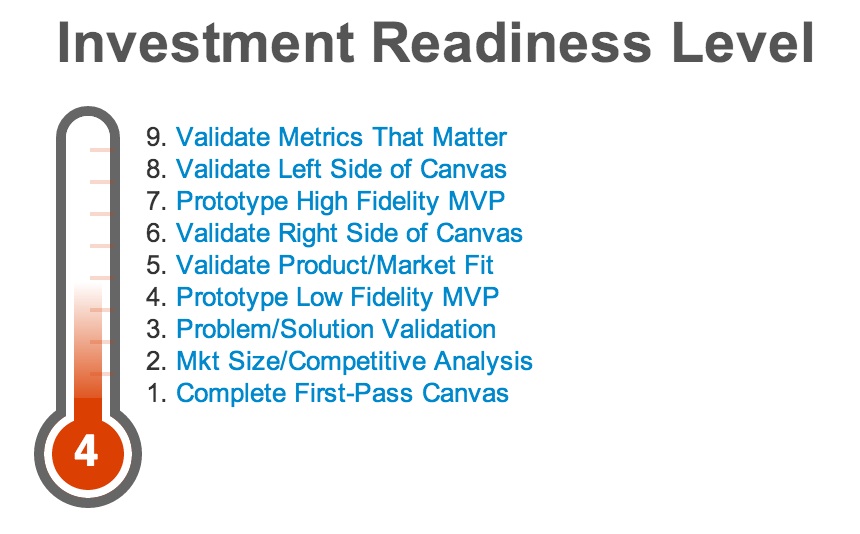
While it doesn’t eliminate great investor judgment, pattern recognition skills, and mentoring, we’ve developed an Investment Readiness Level tool that fills in these missing pieces.

Investment Readiness Level (IRL) for corporations and investors

The startups in our Lean LaunchPad classes and the NSF I-Corps incubator use LaunchPad Central to collect a continuous stream of data across all the teams. Over 10 weeks, each team gets out of the building talking to 100 customers to test their hypotheses across all 9 boxes in the business model canvas.

We track each team’s progress as they test their business model hypotheses. We collect the complete narrative of what they discovered talking to customers as well as aggregate interviews, hypotheses to test, invalidated hypotheses, and mentor and instructor engagements. This data gives innovation managers and investors a feel for the evidence and trajectory of the cohort as a whole and a top-level view of each teams progress. The software rolls all the data into an Investment Readiness Level score.

(Take a quick read of the post on the Investment Readiness Level; it’s short. Or watch the video here.)

The power of the Investment Readiness Level: Different metrics for different industry segments

Recently, we ran a Lean LaunchPad for Life Sciences class with 26 teams of clinicians and researchers at UCSF.  The teams developed businesses in four different areas: therapeutics, diagnostics, medical devices, and digital health.  To understand the power of this tool, look at how the VC overseeing each market segment modified the Investment Readiness Level so that it reflected metrics relevant to their particular industry.

Medical devices

Allan May of Life Science Angels modified the standard Investment Readiness Level to include metrics that were specific for medical device startups. These included; identification of a compelling clinical need, large enough market, intellectual property, regulatory issues, and reimbursement, and whether there was a plausible exit.

In the pictures below, note that all the thermometers are visual proxies for the more detailed evaluation criteria that lie behind them.

Device IRL

Investment Readiness Level for Medical Devices

You can watch the entire presentation here

Therapeutics

Karl Handelsman of CMEA Capital modified the standard Investment Readiness Level (IRL) for teams developing therapeutics to include identifying clinical problems, and agreeing on a timeline to pre-clinical and clinical data, cost and value of data points, what quality data to deliver to a company, and building a Key Opinion Leader (KOL) network. The heart of the therapeutics IRL also required “Proof of relevance” – was there a path to revenues fully articulated, an operational plan defined. Finally, did the team understand the key therapeutic liabilities, have data proving on-target activity and evidence of a therapeutic effect.

Therapeutics IRL

You can see the entire presentation here

Digital health

For teams developing digital health solutions, Abhas Gupta of MDV noted that the Investment Readiness Level was closest to the standard web/mobile/cloud model with the addition of reimbursement and technical validation.

Digital Health

Diagnostics

Todd Morrill wanted teams developing diagnostics to have a reimbursement strategy fully documented, the necessary IP in place, regulation and technical validation (clinical trial) regime understood and described and the cost structure, and financing needs well documented.

Diagnostics IRL

You can see the entire presentation here

For their final presentations, each team explained how they tested and validated their business model (value proposition, customer segment, channel, customer relationships, revenue, costs, activities, resources and partners.) But they also scored themselves using the Investment Readiness Level criteria for their  market. After the teams reported the results of their self-evaluation, the  VC’s then told them how they actually scored.  We were fascinated to see that the team scores and the VC scores were almost the same.

Lessons Learned

  • The Investment Readiness Level provides a “how are we doing” set of metrics
  • It also creates a common language and metrics that investors, corporate innovation groups and entrepreneurs can share
  • It’s flexible enough to be modified for industry-specific business models
  • It’s part of a much larger suite of tools for those who manage corporate innovation, accelerators and incubators

P.S. if you want to learn more abut the IRL and other tools, we teach a 2-day class for corporate innovation, accelerators and incubators. Info here.

This story originally appeared on Steve Blank.


VentureBeat and marketing technology analyst David Raab are working on a new Marketing Automation usage and ROI study. If you currently use a marketing automation system, help us out by answering the survey. If you do, we'll share the resulting data with you.


03 Mar 17:43

The One Mistake Standing Between You and Successful Content Marketing

by Bruce McDuffee

gauge-bs detectorSurveys (including those in CMI’s Benchmarks, Budgets and Trends yearly series) generally agree that approximately 90 percent of marketers are using content marketing in one form or another. Surveys also generally agree that only about 40 percent feel their content marketing efforts are effective — and only about 10 percent of marketers feel their content marketing efforts are very effective. There must be a lot of frustrated marketers out there when it comes to using content marketing strategies to grow revenue.

Although there may be many reasons for ineffective content marketing, I contend that there is one mistake that practitioners make that keeps them from producing successful content marketing. In fact, it’s one I think we all make at some point in our content marketing journey — and one that some marketers continue to make year after year. 

The good news is, it’s easy to fix. Fix this one mistake and you, too, will become a member of the exclusive “very effective” group of content marketers.

The mistake? The only topic your content talks about is you — your company, your products, or your services.

Don’t get me wrong, I’m not saying that you should never create content about your business or its offerings. You need product-specific content for those prospective customers in the latter 30 percent of their buying process (or lower funnel, if you prefer). Spec sheets, application notes, case studies, and testimonials play an important role in the latter stages of the buying decision process. Most firms already have plenty of this type of content, and use it wisely.

But leading your outbound marketing efforts with these types of product-based content is old-school marketing, and it’s no longer very effective at generating demand and revenue growth. Why? Because when you lead with self-promotional content, you’re talking about something that matters to you alone — not what matters to the people in your target audience. Product-based content misses the target during the first 70 percent of the buying process! 

Are you guilty?

If your top-funnel content includes a lot of first-person pronouns, like “we,” “ours,” “us,” “I,” and “me,” chances are very high that you are making this mistake. On the flip-side, if your content marketing is not effective, chances are the majority of your content talks about your products, services, or the firm.

In order to grow revenue and gain market share, you must get the attention of and engage with members of your target audience during the early stages of their decision-making process (i.e., 70 percent of the purchase funnel). To gain their attention and engage with them, your content must be focused on them — their pains, their needs, their interests, and their challenges. 

Here are some typical examples that indicate “The Mistake” is being made in your organization:

  • You’ve built your content strategy around convincing your target audience that your specific product is the best one on the market.
  • You write a “How to Choose” guide that cleverly suggests your product is the best solution.
  • You conduct a webinar that focuses on highlighting the attributes of your product or firm.
  • You write an application note detailing how to use your product in that context. 

Our built-in male bovine fecal matter detector (MBFM)

As business buyers, or even as individual buyers, we all have a highly sensitive MBFM (aka BS) detector built into our purchasing brains. Bait-and-switch is one such tactic that generally causes these meters to max out. When the meter goes into the red, we tend to assign negative marks to the companies that triggered the meter, so there’s little benefit in trying to fool the meter with tactics like masquerading product promotion as helpful education.

Other examples of MBFM triggering content:

  • As a prospective buyer, if I am promised an educational webinar and instead get a product promotion, my MBFM meter goes crazy.
  • When I’m promised a document that will help me choose the right product for my situation, and the recommendation turns out to be for the product manufactured by the company that produced the document, my MBFM meter red-lines right away.

When this type of masquerading content triggers my BS meter, that firm gets a negative mark in my memory. Good experiences correlate with higher growth rates and bad experiences correlate with lower growth rates.

How do I know this is the No. 1 mistake? Granted, my evidence is not based on statistically significant data, but it is based on abundant anecdotal evidence.

Ninety percent of the B2B marketers I talk to about content marketing get excited about it. That’s a great thing! However, when questioned further, they almost always tell me about this piece of content or that piece of content they’ve designed to convince customers to buy their company’s product. Again, this type of content is great for latter stages, but it fails as content for the all-important early buying stage.

Furthermore, if we consider some stats from the 2014 CMI Benchmark report, the fact that 82 percent place “Brand Awareness” as the top goal screams “It’s about me, myself, and I.” Perhaps the number one goal of our content marketing should be to help make the people in our target audience be better at their business goals.

Easy fixes for the problem

If you think your company and its marketing team is making this critical mistake, try these action items to immediately improve the success of your content marketing:

  1. Stop pitching your products.
  2. Stop trying to be clever by masquerading a product promotion as a helpful piece of content.
  3. Start giving away your expertise in the form of free education or interesting information — without promoting your product.
  4. Start making a clear distinction between content that is meant to clearly define your offering and content that is meant to engage your audience by providing them with useful education or entertainment

If you are willing and able to make these changes and carry out content marketing as described here, I can virtually guarantee you, too, will soon be responding to the next CMI survey that your content efforts fit the “Very Effective” category.

For more great ideas, insights, and examples for advancing your content marketing, read Epic Content Marketing, by Joe Pulizzi.

03 Mar 17:43

Do You Really Mean to Flip Your Prospects the Bird? B2B Marketing Fail.

by Ed Marsh

“We’re delighted to have you here”

B2B companies are delighted when prospects are interested enough to visit their factory.  The explanation is always something akin to “We rarely lose when we can get in front of them.”

So typically a factory visit includes special treatment from the moment of arrival -

(reserved parking spots, personalized welcome sign as they enter the building, gracious receptionist and a beverage of choice)…

through introductions (“Thanks for visiting with us.  We want to maximize the value of your visit.  Please tell us everything that you specifically want to cover or accomplish while you are with us.”)….

to the activities (“We’ll take a tour of the floor first, then we’ll be joined by the CFO to discuss contractual details, and later the Director of Field Services will have lunch with us to discuss commissioning and after sales support.”)

The hospitality is genuine, and it is appreciated by the visitor.  Naturally it helps to solidify the business relationship by creating trust, credibility and comfort.

“Just read the exhibit signs – it’s all there!”

Do You Really Mean to Flip Your Prospects the Bird? B2B Marketing Fail. image b2b websites are like museum displays dont touchBut pity the poor fool who decides to visit the same company’s website….

The visitor (not a guest in this case) pulls up to the front of the building with no clear entrance and no available parking.

Pasted around the exterior walls are placards much like a museum exhibit – basically a linear progression of the company’s story as they fancy themselves.  You know the routine – “Founded in”…through “industry leading” gibberish.  Chock full of business babble BS.

They’re obviously pretty busy inside – nary a moment to chat.  So you should keep following the exhibit to find what might match your interests.  Take your time.  Poke around.

And then inevitably….”What?  You’re leaving already?  You must not have known what you were looking for and your probably not a real buyer anyway.”

No hospitality, no comfort and certainly no trust.

Absolutely no opportunity for dialog.

And a completely wasted lead – potentially a customer.

Reconciling the difference

So what’s going through the company’s mind.  How in the world could they be so hospitable and customer focused during a physical visit…and yet so dismissive of web visitors.

Obviously there’s a powerful mindset driving the behavior in both cases.

In one case the immediacy of personal interaction and the instinctive direct sales inclination create an appropriately interactive experience.  In the other, the traditional perception of a website as an “online brochure” creates a “read it and if you have questions raise your hand” linear response.

So where’s the breakdown?  Most companies haven’t yet appreciated the fact that a website’s business development value isn’t as a destination, but rather as a hub.  That’s a subtle (from the perspective of Gen X & baby boom owners) but important difference.

Do You Really Mean to Flip Your Prospects the Bird? B2B Marketing Fail. image b2b marketing real meetingA website as a digital brochure will fail to produce more than the mediocre results which most assume is the nature of B2B digital marketing.  But a website which is your virtual conference table around which you will visit with potential customers is an enormous asset.

That’s the conceptual leap that many fail to make, and the one which is perhaps most important to successful B2B marketing, particularly for manufacturers of industrial products, in today’s hyperkinetic markets.  And it is critical to a model that adapts to buyer behavior – where nearly 70% of the buying process is complete before buyers will speak to a rep directly.

Better than a conference room

So back to that first scenario – a great prospect has agreed to visit.  One of your first steps is probably to go into outlook to schedule the meeting and reserve a conference room.  After all, by it’s nature, an appropriately personal conference room can’t accommodate more than one important sales conversation at a time.  Just as you can’t directly speak with more than one, nor can the service manager clarify delivery and support, nor the CFO articulate the business justification in “finance speak” simultaneously and personally to more than one prospect.

So the conference table has scope limitations….but a well planned digital marketing program does not!

B2B inbound marketing allows you to concurrently carry on many conversations – each at the very personalized point in the discussion which is comfortable for a specific prospect.  By reflecting on your various prospect interactions you will quickly identify the different topics that typically arise; what excites them; what worries them; where they need clarification or reassurance.

You’ll know which types of prospects want to be guided through a slide deck, which prefer a whiteboard session and which want to skip ahead to a checklist of implementation specifics.  You’ll know which need testimonial or case study insight, and which simply want to take the CAD file to drop it into their layout.

And then you’ll create these dialogs using the right content available through your website (introduction) and nurturing (gradually providing more detailed answers specific to their requirements as the conversation advances.)

It doesn’t replace sales

Obviously at the end of the day this process doesn’t produce a PO automatically for a complex sale.  You still have to engage with direct sales as the dialog matures.  But when you do, the discussion will be like the 2nd or 3rd meeting – you’ll be a valued and appreciated resource, and the discussion will be a collaborative one around how to move ahead.

Here’s a special note to the senior execs, founders and owners reading.  You’re skeptical.  You’ve heard lots of babble about digital, websites, SEO, Pay per Click and other topics that have each sounded plausible but have never produced substantive results.  You’re forgiven for your jaundice toward yet another topic.

Here’s the difference.  This isn’t a “technique” – rather it’s a process.  And it’s the same one you’ve used successfully for years.  We’re talking about leveraging today’s tools for greater reach and efficiency.  Make sense?

Check out our video on the topic here, and download our guide for an overview below.

images – MegaPrint & RDU

03 Mar 17:43

How Original Research Can Help Your B2B Technology Company Stand Out

by Rachel Foster

How Original Research Can Help Your B2B Technology Company Stand Out image 5471427 xsmallWhen I write blog posts for myself or for my clients, I look for compelling statistics to back up what I’m saying. However, it is often hard to find new sources that have published research on my topics, so I end up citing the same sources over and over again.

This means that there’s an opportunity for B2B technology companies to publish original research and gain PR from reporters and bloggers who need to cite credible data. This free PR will get your content in front of a wider audience and help position your brand as a leader in your industry.

I interviewed Derek Singleton, Analyst at Software Advice and Managing Editor at The B2B Marketing Mentor. He offered tips on how B2B technology companies can use original – or primary – research to stand out from the crowd.

Why Should You Publish Primary Research?

“One of the main issues with content marketing is that everyone is competing for attention,” says Singleton. “So there’s been a big uptake in the number of B2B technology marketers who are writing articles, producing webinars and so on.”

According to Singleton, this content overwhelm can make it hard for you to stand out – especially if you’re not adding anything new to the conversation.

“When you publish primary research, you’re not repurposing what everyone else has said,” says Singleton. “This makes your content more powerful, as it’s supported by original, qualitative data.”

Including original research in your content can also make your marketing more believable, as you have hard data to back up why your ideas, products and services matter. The 2013 B2B Content Preferences Survey revealed that 59.9% of B2B buyers strongly believe that vendors need to use more data and research to support their content. We all know that the more potential customers believe and trust you, the greater the chance that they will buy from you.

What Kind of Research Will Engage B2B Technology Buyers?

Singleton suggests that you start by identifying your target audience’s biggest pain points and developing research around them. You can also survey customers or conduct one-on-one interviews with them to determine the research topics that they are the most interested in.

Useful research for B2B technology buyers includes:

  • Studies that prove how to improve the effectiveness of your product. If you can help customers get more value from your products or services, they will be more likely to remain loyal to your brand and refer others to you.
  • Case studies. B2B technology buyers are looking for proof that your products or services deliver results, which is why case studies that contain data on your customers’ successes can be powerful. According to a recent hawkeye study, 71% of B2B buyers in the awareness stage and 77% in the evaluation stage cited testimonials and case studies as the most influential types of content.
  • Customer or user surveys. Surveying your customers can provide you with valuable information on how you can improve your products or services. User surveys in particular can help your customers better understand how to get the most out of your product or service. For instance, if your company builds email marketing software, creating a report showing how various subject lines impact click-through rates for email marketing messages will help your customers improve the subject lines of their emails and become more effective email marketers.

How to Get Started

Singleton stresses that you do not need to hire a market research company to conduct compelling research. You can use online survey tools such as SurveyMonkey or PollDaddy. You can also present findings from experiments and A/B tests of your website that you conduct in-house.

03 Mar 17:42

Why Empathetic Marketing Matters and 7 Steps to Achieve It

by bcarroll@startwithalead.com (Brian Carroll, MECLABS)

I am at the earliest stages of developing a sequel to Lead Generation for the Complex Sale. It’s been a decade since the first draft and I’ve been contemplating how much business has changed since then.

Today’s sales and marketing environment is a paradox: There have never been more opportunities to reach customers; yet reaching them has never been more challenging.

We have more marketing channels than ever. We’ve moved from traditional advertising to social media, content marketing and beyond. But, I can’t help but wonder, as we have more ways to talk to our customers, are they really listening? Or are they shutting us out as we hurl more pitches at them from different angles?

I believe you can’t really answer that question unless you know precisely what your customers want. This requires letting go of our own assumptions of what we think they want and putting ourselves in their place.

This requires empathy, which according to Miriam-Webster, “is the ability to share someone else’s feeling.” To feel what they feel and think what they think.

Unfortunately, too many in corporate America believe sociopathic behavior – being laser-focused on getting what you want at the expense of everyone else – accelerates businesses and careers to success.

That’s so “Wolf of Wall Street.” What worked two decades ago won’t work today. Sociopathic behavior may be why too many businesses are struggling.

I believe to succeed in the new millennium, we must embrace empathy on every level with every customer – both internal and external. Our customers are more sophisticated than ever and have access to more information and more options. There’s no room for game-playing or guessing. We have to know what they want and give that to them.

Here’s an overview of what I believe can help achieve this. I plan on expanding on these points in future B2B Lead Roundtable Blog posts:

1. Put the customer first. Instead of worrying about being interesting, we need to first be interested. Understand the customer’s motivation (what they want) and make sure that’s aligned with what we can deliver.

2. Listen and seek to understand. Do we know why our customers say “yes”? Why are they buying from us? What are the steps they need take to say “yes”? What difference have we made for our customers because they bought our product or service?

3. Stop marketing, start conversing. Focus on developing conversations, not campaigns. Don’t err on the side of pushing our agenda rather than extending an invitation to converse. To the customer, it feels like “somebody wants something from me” rather than “maybe they can help me get what I want.” We need to demonstrate that we’re interested in their world and their motivations. Invite, listen, engage and recommend.

4. Help. The best marketing and sales doesn’t feel like marketing and sales at all. It feels like helping because it is. Our lead nurturing needs to be built on this concept.

5. Give them content they’ll want to share. This organically emerges from the first four points of placing the customer first, understanding them, conversing with them and helping them.

6. Remember that proximity is influence. Empower those closest to our customer – the sales team, inside sales team, sales engineers and customer service people – to be able to achieve the points above.

7. Practice empathy personally to set an example. Our customers are everyone we serve – including our staff and our coworkers. Show them how it’s done by practicing empathy yourself.

This introduces another paradox: We’ve never been more advanced with ways to connect with prospects, but we’re still not communicating effectively with them. A good start to doing that effectively begins with empathy.

What are your thoughts? Do you think empathetic marketing is achievable for your organization, why or why not?

You may also like

8 Questions to Steer Your Marketing Priorities [More from the blogs]

Referral Marketing: 8 tips for building a powerful referral channel [More from the blogs]

Guided by Buyers: 4 tactics to create a customer-centric sales and marketing strategy [More from the blogs]

03 Mar 17:42

Ellen DeGeneres Smashes Retweet Record With Oscars Super Celebrity Selfie

by Mike Stenger

Ellen DeGeneres Smashes Retweet Record With Oscars Super Celebrity Selfie image ellen degeneres oscars

The Oscars took place last night, and while the movies and people in them were the stars of the show, Ellen DeGeneres gave them a run for their money.

With her great sense of humor, Ellen interacted with celebs from ordering and passing around pizza to taking a super selfie that briefly broke Twitter.

If only Bradley's arm was longer. Best photo ever. #oscars pic.twitter.com/C9U5NOtGap

— Ellen DeGeneres (@TheEllenShow) March 3, 2014

The tweet has generated over 2.5 million retweets, surpassing the previous retweet record of nearly 800,000 for Barack Obama’s “four more years.”

Four more years. pic.twitter.com/bAJE6Vom

— Barack Obama (@BarackObama) November 7, 2012

Twitter shared highlights from the Oscars, and here were the most popular moments:

  • Ellen DeGeneres rounds up celebs for super selfie – 254,644 tweets per minute
  • Ellen delivers pizza to hungry celebs – 158,159 tweets per minute
  • Gravity wins its sixth Oscar (film editing) – 135,330 tweets per minute

Here were the most tweeted about stars:

  • Jennifer Lawrence
  • Brad Pitt
  • Alfonso Cuarón
  • Cate Blanchett
  • Sandra Bullock

Gravity was the most talked about film during the Oscars, followed by Frozen, 12 Years a Slave, Dallas Buyers Club and The Wolf of Wall Street.

Leonardo DiCaprio lost out to Matthew McConaughey in the best actor category, but there’s always next year, right?

Ellen DeGeneres Smashes Retweet Record With Oscars Super Celebrity Selfie image leonardo dicaprio

03 Mar 17:37

Why Your Sales Numbers Are Coming Up Short

by Rachel Clapp Miller
Rnordman

Very direct

Why Your Sales Numbers Are Coming Up Short image question mark newThe seller who best clarifies the problem, earns the customer. The primary benefit of value-based selling, as opposed to product-focused selling, is the ability to solve customer problems without resorting to product commoditization.

If your sales process isn’t grounded in customer problems, your opportunities aren’t likely to capture the true value of the solution provided.

Here are four reasons why:

1. Buyers Need Evidence Their Pain is Understood

In the sales process there should be a direct correlation between the buyer’s pain and a solution that it will address that pain. Without business pain, there is no business. Equally important, buyers who believe that their pain is clearly understood will be more willing to share critical information throughout the buying process and will work harder to understand the solution being presented.

2. There is Limited Access Within the Buyer’s Organization

Failure to fully understand how a buyer’s pain is directly related to needs higher in the organization can narrow a seller’s sphere of influence to a limited number of key stakeholders. If your salespeople can’t attach their solution to the largest business problem, it limits access to economic buyers who control discretionary funding, reducing support for the proposed solution.

3. The Solution is Perceived as Expensive

Focusing on a laundry list of irrelevant product features creates an impression that the solution is more than the buyer needs, and therefore, more expensive. Remember, the value of the solution is in the eyes of the buyer, not the seller.

4. The Customer Has Difficulty Differentiating Between Competitive Offerings

When customers can’t differentiate between multiple competitive offerings; they often assume that all of the solutions are similar in value. This perception reduces the decision to the lowest common denominator: price. Sellers who fail to introduce relevant differences early in the sales cycle miss a fleeting opportunity to influence the buying criteria.

5. The Value Proposition is Not Clearly Understood

This final challenge occurs when internal sales resources aren’t aligned around a common sales approach that clearly articulates and delivers the company’s value proposition. This lack of alignment leads to sales cycle inefficiencies, customer confusion, and brand dilution in the marketplace.

If your numbers are behind this quarter, your sales team could be struggling with optimizing value and differentiation throughout the sales process. Ensure your sales team has the ability to uncover customer needs, articulate value, and differentiate solutions in their sales conversations and throughout the buyer process.

Why Your Sales Numbers Are Coming Up Short image fc873d77 a2e0 48a4 b1ef b3b537f04f02

03 Mar 17:37

The Definition of a Marketing Qualified Lead [In Under 100 Words]

by skusinitz@hubspot.com (Sam Kusinitz)

gold-starA marketing qualified lead (MQL) is a lead judged more likely to become a customer compared to other leads based on lead intelligence, often informed by closed-loop analytics.

Sit down with your sales managers to determine which demographics, activities, and behaviors make for a marketing qualified lead at your company. Based on the definition you create, you can assign point values for various MQL qualifications in order to form the basis of your lead scoring system.

This will help ensure your sales team is fed high quality leads so they can improve their productivity, and Sales and Marketing remain aligned.  

intermediate lead nurturing ebook

New Call-to-Action

03 Mar 17:37

Using Inbound Marketing to Turn Leads Into Customers [VIDEO]

by Courtney Christman

In this week’s edition of #MSHUnderReview, Craig Kilgore chats with Dave Perry, a member of the Inbound Marketing department at Mainstreethost, about turning leads into customers.

Watch and find out what Dave’s role in the Inbound Marketing department is, how he hands out leads, and how he and our other inbound marketers work hand in hand with our salespeople.

#MSHUnderReview: using inbound marketing to turn leads into customers from Mainstreethost on Vimeo.

What role does inbound marketing play in qualifying leads and turning them into customers?

As we’ve discussed in previous weeks, qualifying leads is important because it allows businesses to ensure they’re talking to people who want or need the products or services they’re offering.

Let’s say you’re a marketing coordinator for an architectural firm that specializes in residential development. Using your website for lead generation, you’ll collect contact forms and inquiries regarding your services, as your main source of leads. In this case, the marketing coordinator would be the lead qualifier and the architect or project manager would be the “salesperson.”

Using the inbound marketing method, the marketing coordinator would reach out to prospects and ask them various questions to qualify them as a potential client. These questions could include name, address of where they would like to build, the kind of home they’re looking for, and their budget. Once the marketing coordinator obtains all the necessary information, he or she will pass the prospect and all the information gathered to the architect or project manager.

While the sales position will differ from business to business, it’s important for the marketing and the sales teams to stay in contact and on the same page. The more closely your marketing and sales teams work together, the more successful you’ll be in closing deals and turning prospects into clients.

Depending on the nature of your business, the time it takes to close a lead will differ. In the architecture firm example, it will likely take a significant amount of time to close the lead. Building a new home is a substantial investment and not a decision to be decided on the fly. Regardless of the time it takes to close the prospect, continue to nurture them. Send them useful information that will help them make an informed decision, and be available to discuss any idea, questions or concerns they may have.

When it comes to using inbound marketing for qualifying leads and turning them into customers, your qualifiers are the first line of communication. They are the ones who are building the initial trust, setting the sales people up for success.

03 Mar 17:37

Want More Customers? Go Mobile.

by Andrew Gazdecki

Want More Customers? Go Mobile. image screen568x5685We won’t belabor the obvious – sales are good for businesses, and most business owners want more of them – so we’ll cut right to the chase. If you want to increase sales, offering a mobile-optimized website is a great way to do it.

“Why bother?” you ask, “I’m already online. Most mobile devices can browse to my website just fine, can’t they? Who needs a mobile site?”

You do! Here’s why:

Browsing non-mobile-optimized sites is a nightmare

The problem is, even though some smartphones can pull up a website, if the website isn’t mobile-optimized, the experience can really suck, to put it mildly.

You’ve probably experienced it yourself – you search for a site on your mobile, wait for the results to load, find a likely link, click it… and then the problems begin.

First, the page takes too long to load. You’re staring at that damn progress bar as if you could will it to completion. But it won’t budge. You wait, and wait, and wait some more.

Finally, the page loads. You can’t read a thing, though – the text is the size of microscopic life. You try to zoom on your display, but you accidentally click a link on the page in the attempt, because you can’t see anything. A new page begins to load…

Okay, if your phone survives the browsing session without being planted into your wall, you won’t be going back to that site. And research shows that most people don’t return to bad sites. This is the penalty you suffer when you don’t have a mobile optimized site.

The mobile-optimized difference

The browsing experience on a mobile-optimized site is much smoother and easier. The site loads faster, and everything is simplified and designed to display well on the small screen. You can read the text, scroll quickly, and find what you need.

Why is this so important for small business owners? Well, 75% of people use their mobile device to get real-time location information. And overwhelmingly (90% of the time), these informational searches lead to an action, like a visit, or a purchase. In fact, 50% of the time, the searcher winds up buying something based on their searching!

Putting these things together, 1) people are looking for local businesses on their mobile devices, 2) if you have nice mobile site, your business will be in the running, and 3) half of these people are looking to spend money. Such conversion-ready leads are just about the best thing you could ask for when it comes to sales.

03 Mar 17:37

How to Promote a Tweet on Twitter

by Scott Scanlon

How to Promote a Tweet on Twitter image how to promote a tweet on twitter

We are always testing new ways to drive traffic to our sites.

When promoted Tweets first came out we were all over them. Then one day we stopped… I’m not sure why but it could have been the Minnesota winters.

Last week we jumped back in and today I’ll share the outcome of using Twitter’s Promoted Tweet advertising.

The tweet promotion we go over here is more focused than what we’ve done in the past. When looking at conversions, traffic, and leads we realized Twitter does pretty well for us. That’s probably because it’s also the network we tend to spend the most amount of time on.

Here’s a video explaining the whole process:

Overview of Our Promotion

As with any marketing strategy we’ve defined our measures of success.

Here’s the top metrics we are tracking:

  • Total visits – Total visits to the link we are sharing
  • Total time on page – we are also measuring how long someone spends on the page
  • Return visits – because the page we are promoting has a high bookmark rate we wanted to see if this traffic matches our baseline revisit rate
  • Purchase of our Product – finally and most important we have multiple call to actions to our product Curation Traffic. This is the most important metric for this promotion.

Here’s our baseline tweet we started promoting:

How to Promote a Tweet on Twitter image twitter promo tweet

You can see we are promoting a Tweet that has 2 links. The first link goes to our Ultimate Content Curation Tools & Platforms post and the second link goes to the image we attached to the Tweet.

You might wonder… if your conversion point is your product why are you promoting a tweet that is not directly related to your product?

We have a philosophy towards testing and marketing– let reality prove you wrong. When we decided to jump back into Twitter tweet promotions our first thought was let’s promote our product directly. Then we looked at some data and saw that the “3rd party” approach converted well.

To be clear, on that post we clearly state it’s a shameless plug, we created the product and we are outright promoting it.

I call this a 3rd party approach because if you think about the experience the visitor goes through to convert to our product they originated via what might feel like a 3rd party promotion (even though we are the same entity).

Our Results

We are somewhat pleased with the results so far. So much so we might be contributing (ever so slightly) to Twitters valuation by promoting more tweets.

How to Promote a Tweet on Twitter image twitter promo results

  • We had 936 impressions.
  • 86 clicks to our content (.47 per tweet)
  • 4 Retweets ($10 per follow)
  • 4 direct follows ($10 per follow)
  • Direct sales attributed to traffic: 3.

So far we’ve attributed 3 direct sales to this effort. That more than covers our cost although we have to give it time to see if it’s worth scaling. I say that because there is typically a lead time with the awareness of our product and the purchase time. Usually that’s 3-14 days.

We had no expectations of the cost, traffic, or conversions when we started. So we are using this first campaign as a baseline to improve further campaigns.

For instance, we are running a test right now (which I set up in the video above). So far we are at a higher cost and lower engagement rate. We’ll do a follow up post showing the results of t hat as well.

Opportunities to Test or Improvement

There is opportunity for improvement. Part of the reason is the promoted tweets dashboard has changed since we last used it so we wanted to dive in by using it first before we made adjustments.

Here’s some things we are thinking about testing (if you try promoted tweets consider some of these as well):

Promote this tweet with business account

Our initial test was with my personal account but we are going to try the same type of promotion with one of our business accounts. We started with the personal account because I thought it might be more effective in grabbing attention and the overall flow of our entire funnel.

Create a tweet to enhance brand as well as engagement

You’ll notice in the screenshot above we have over 1K impressions. This is where we should have a tweet with our product and pulls in the benefit. That way even if someone doesn’t click on the link we can still garner some awareness. I don’t think this should be the sole reason to promote this type of offer but it can be a good side benefit if executed correctly.

Don’t include a picture with tweet

In our original Tweet we included a picture thinking this might improve engagement. We are currently running a test without a picture to see if the engagement remains the same. While it does make the post stand out what it also does on other platforms (Hootsuite and some mobile readers) is you see 2 links. I see zero value in having someone engage with our image (at least the one we included). Although, that might be another opportunity. We could create a special benefit image that includes a call to action. That’s probably the smarter move all around.

Add call to action text

Our current promoted tweets simply just includes the headline to the post and a link. We are going to do a test with adding small call to action text such as, PLS RT or Click now. I’ll have to check the Twitter terms of service first.

Add hashtags

We were going to add this to a new test we are running but that wouldn’t be a true test. So our next round we are going to try adding one or two hashtags to our tweet.

Expand keywords

We are only targeting one keyword… we’ll start to expand our keywords to complimentary keywords to see if we can find more effective matches and audiences.

Final Thoughts and Update

If you engage in Twitter and find it to be an effective traffic source you should consider testing promoted tweets for your own content.

We’ll also continue to share the results of our follow up testing. At first I thought we would update this post but I think we’ll actually just create a running series of posts on Twitter promoted tweets.

03 Mar 17:37

3 Reasons Why Growth Hacking Won’t Help You – Part 2

by TaeWoo Kim

This is continuation from 3 Reasons Why Growth Hacking Won’t Help You – Part 1

2) You don’t have a (readily) scalable business

When I was generating solar leads for solar installers, I noticed a pattern.

That 60-80% of solar sales would come between June to Oct, when it was super hot and so of course, people cranking up A/C’s would yield high electric bill.

High electric bill = high pain = people immediately seeking solution to relieve that pain.

Solar installers would have no trouble closing my leads (some great sales guys were closing 20-35% , which meant they were spend couple hundreds bucks to make $30-50k in sales) during these months.

When a job is sold (i.e. the customer signs on the dotted line and either pays in cash or signs up for some loan), the installer guys would get on the roof and put the panels on the house.

Success Often Leads to Failure

3 Reasons Why Growth Hacking Won’t Help You – Part 2 image nightmare

Here’s where the operational nightmare begins.

You can’t just hire (when the orders pick up) and fire (when the peak season passed) these installers because

  1. If you’ve ever dealt with these home improvement/construction guys, they are… well.. let’s just say that they’re not the most reliable so if you find the reliable ones, you want to keep them
  2. They’re highly skilled workers in a very niche industry that requires all kinds of training & certifications (i.e. hard to find)
  3. They require all kinds of insurance and bonding and stuff like that because their jobs are by nature very dangerous (imagine carrying 20-40 panels that weigh 50 lbs each, onto a roof, 30-50 ft high).
  4. They are often unionized, and unions people don’t listen to logic. It’s like give-and-take with them: you give, they take.

So if the summer months have been bad for that year, often times, these solar companies would actually incur loss on slow months just to keep them on the payroll.

In the winter, these guys are twiddling their thumbs waiting for business to happen. My business phone rank off the hook during the winter and I had to stop taking calls because I couldn’t fill everyone’s demand.

I even had some solar companies asking me if I could do lead generation for gutter cleaning, painting, HVAC, and roof repair/maintenance business that would keep them afloat during these months

In another words, their operation was just not scalable.

Miscalculated move.

The more you make in sales, the more you have to increase in salary.

The more you increase your payroll, the more you have to sell.

The more you have to sell, the more you have to advertise.

The more leads you get, the more salesmen you need.

The more salesmen you need, the more ad budget you need to get more leads.

The more leads you get (and hopefully), more sales you get.

3 Reasons Why Growth Hacking Won’t Help You – Part 2 image hamster wheel

A TRUE hamster’s wheel.

What’s sad about this is that this one particular solar installer was grossing $15 million in revenue, yet their net was less than $500k.

Yes… net profit of $500,000 from earning of $15,000,000.

I’ve seen solar companies that scale up really fast, i.e. “growth hacking” with paid media for lead generation, only to find themselves in a financial nightmare, and end up selling to their competitor for pennies on the dollar. (On the flip side, this is where I learned that bidding on your own name is VERY profitable.)

This is why, as with any labor or capital intensive business, you see lots and lots of consolidation going on because of this cashflow crunch.

The bug guys swoop in and snatch your business for nothing.

So is it impossible? Of course not.

Solar companies like SolarCity, Verengo, Sungevity have figured it out.

But they also have huge financial backings. Hard to scale does not mean impossible to scale.

Virtual = Scalable

The word growth hacking is often applied to internet and software companies, where the cost of distribution is fairly low and the ratio of consumer to provider is often.

Remember WhatsApp, the chat app company that got acquired by Facebook for $19 billion dollar?

They supported 14 MILLION active users with only 32 engineers.

That’s 437,500 users PER person. Now that’s scale.

But fret not, the physical world CAN be scaled. If you think about it, even people like Adolf HItler managed to growth hack himself to power & influence.

Take a look at all the large franchises & chains like McDonalds, Starbucks, Apple stores.

If the people that work in your system is highly replaceable and easily trainable, you can produce a massive scalable business.

If someone asked me what they would recommend if they were to start a solar installation business is DON’T.

Get into solar SELLING business, and outsource the installing to someone else. Let someone else take care of the seasonality so that you can stay lean & focus on what you’re good at – selling.

3) Confusing Growth Hacking with Spamming

People often think growth hacking is spamming or some sort of blackhat marketing.

Well, ok, there is a fine line between letting your people do the word of mouth marketing FOR you vs. straight up spamming, like not complying with people’s wishes or worse… violating CAN-SPAM laws.

Facebook is probably the greatest example of growth hacking, but if they were truly indeed spammers, I doubt they would’ve gotten that big without running into trouble with the law.

RapGenius, a site for rap lyrics, probably has gotten the most recent notoriety for SEO spamming, disguised as affiliate marketing:

3 Reasons Why Growth Hacking Won’t Help You – Part 2 image rapgenius affiliate facebook post

When you email them, what do you get?

Blackhat linkbuilding:

3 Reasons Why Growth Hacking Won’t Help You – Part 2 image Screen Shot 2013 12 23 at 3.29.13 PM

Of course, they were de-indexed from Google… only for short amount of time.

Why? They know people in high places. (i.e. a large VC firm in silicon valley)

This is NOT growth hacking.

Growth hacking is essence, marketing PLUS engineering. Spamming is neither.

If you confuse the two, you surely will make more enemies and kill your business in the long run.

Growth hackers often say.. make a good product as highest priority, then build the viral distributions channel in.

Good product is the key… shitty plane with strong engine is still just a shitty plane that will break apart in mid air.

Takeaway for Growth Hacking

  1. Find product market first
  2. Make your business scalable
  3. Focus on product AND marketing, not spamming
03 Mar 17:37

Kick-Ass Business Cards, Standout Resumes, and More in HubSpot Content This Week

by skusinitz@hubspot.com (Sam Kusinitz)

crumpled-paperMarketing can be extremely difficult. From finding and landing the right marketing job, to attracting and converting contacts, to keeping up with the rampant updates and rapidly evolving industry trends, it's simply not an easy job.
Fortunately there are a remarkable number of resources available to guide you in every step of the process. Ah, the beauty of the World Wide Web.

This week was a very practical week in HubSpot content. This week’s content has been particularly dedicated to offering helpful tips and teaching you the “how to’s” on everything from business cards to resumes to storytelling.

5 Aspects of a Kick-Ass Business Card

Despite the remarkable capabilities of technology, face-to-face interactions can leave an impression on others. Business cards can be a great way to leave people with a way to remember you long after your conversation ends, but you need to make sure yours stands out in the pile of business cards they have piled on their desk. In this blog post, you will learn the five aspects of an awesome business card. Make sure you watch the video in this post, too!

How to Write a Standout Resume and Land Your Next Marketing Job

If you find resume writing a painful chore, trust me, you are not alone. It’s not easy to turn the spotlight inward, but knowing how to position and market your skills is crucial for marketers to know if they want to grow their career. If you’re one of those marketers who needs a little resume help, don’t worry, we’re here to help. In this blog article, discover five tips to writing a standout resume as well as examples of resumes for the 10 most popular marketing positions.

How to Write a Blog Post Every Single Day

So, you’ve landed that marketing job and now you have to prove your worth. If you’re in a content creation role, you cannot wait for inspiration. You need to find ways to motivate yourself and to stay focused on even your worst days. Fortunately, there’s a lot that you can do to make sure that you’re on track to create great content every single day. Check out the HubSpot content team’s best advice (if you haven’t noticed we create A LOT of content) for getting prepared, motivated, and focused to write each day you’re on the job.

SEO 101: The 5 Parts of Your Site You Should Keyword Optimize

SEO can sometimes feel like it stands for “Something Extremely Obscure.” There are endless Google algorithm updates to stay on top of to ensure you’re always showing up in search results for your target keywords. However, there is one simple rule of thumb that remains essential to SEO success: optimize your website with relevant and targeted keywords. This article explains how to add keywords to your website, and provides tips and tricks for those just starting out with SEO.

7 Little Call to Action Tweaks That Could Give Your Conversion Rates a Big Bump

At HubSpot, we’re constantly A/B testing conversion path elements -- landing pages, calls-to-action (CTAs), and emails -- to see how we can generate more leads, MQLs, and customers. Including CTAs throughout your website and blog is a proven method for helping website visitors become leads. If you want to run tests of your own to increase your lead gen capabilities, check out this blog post. It identifies and explains the seven tests you can run on your own website to try to increase the click-through-rates on your CTAs.

Good Sales Reps Sell, Great Sales Reps Tell 

Stories matter, especially in sales. If you can’t articulate your story well enough, you’re most likely going to lose the sale. Great sales reps know what to say, when to say it, and how to say it so prospects will listen. In this article, learn five tips from a seasoned sales professional to help you improve your storytelling ability.

What was the most interesting thing you learned this week on Inbound Hub? What do you want to see more of? Leave your feedback in the comments!

free marketing resume templates

subscribe to the hubspot marketing blog

03 Mar 17:37

How To Build A B2B Online Marketing Strategy That Generates Leads

by Wendy Maynard

It’s been difficult for many B2B companies to make a transition to online marketing – and many B2B businesses are still stuck in the paradigm of sole reliance on cold calls, direct mail, and trade shows. I’m not saying there isn’t a place for these efforts, but given that  85% of B2B customers search the web before making a purchase, it’s high time for B2B companies to build a more effective online marketing engine.

The reason is simple. Your buyers are changing – employees in charge of corporate purchases can conduct their own buying research faster and more efficiently from their desk than they would traveling and meeting with sales teams. According to a study by the Corporate Executive Board, 77% of B2B buyers said they did not talk with a salesperson until after they had performed their own independent research — online. This holds true even for the high-dollar, long-sales-cycle purchases.

It’s high time to get on the online wagon. Below, I outline some of the most effective strategies to develop the foundation for your B2B online marketing strategy.

1.) Make sure you have a well-designed, well-written website: According to web credibility research from Stanford, 75% of users admit to judging a company’s credibility based on its website design. Your website should make a positive first impression of your company and offerings. And, it should have educational content that engages and educates your prospects.

2.) Know your target audience: Develop a crystal clear vision of who your content is intended to motivate. When you intimately understand your core audience, you can create website pages and targeted content that are effective and focused. Don’t try to be all things to all people – be an expert for your niche.

3.) Begin blogging: Developing your own content is an online marketing strategy that every business can use. In a crowded marketplace where you are working to get more visibility, blogging is an essential tool to connect you with your buyers, as well people who can be a source of referrals. It helps establish your company as a subject matter authority and make your sales process easier.

4.) Nurture and grow your list: Develop a strategy to capture your website visitors. If someone lands on your website but isn’t ready to buy, it’s important to stay in touch with them. A simple sign-up form on your website and blog can produce great results. Be sure you’re giving people an incentive to sign up so they are willing to give you their contact information. Free assets like checklists or reports can be compelling to your audience. Once they’ve signed up, use an email newsletter service to consistently send educational content to them. This keeps your brand at the top of your audience’s mind so when they are ready to buy, they choose your company.

5.) Get on LinkedIn: LinkedIn can serve as a powerful networking tool. Hubspot research shows it has a three-fold advantage over Facebook and Twitter for B2B lead conversion. Start by making sure that your presence (and that of your key leaders) on LinkedIn is strong and attractive to new connections. That means optimizing your personal profile and company page, as well as actively sharing valuable content with your network.

6.) Always be building new highways to your site: There are a myriad of ways for you to drive traffic to your site. The most basic way is to make sure your website and blog URL are incorporated in your communications materials. That includes your email signature, printed & digital marketing materials, building/vehicle signage, packaging, and published articles. You can also drive people to your site via social media channels.

7.) Target industry publications: Your industry and trade associations are robust publishers of online content – all directed at your prospects and customers. Many of my clients have had great success developing a relationship with the editors of these organizations and offering expert advice to their readership. This can take the form of articles, webinars, podcast interviews, and blog posts. This is a powerful way to establish your authority with your target audience, build your company’s brand recognition, and drive new traffic to your site.

8.) Keep creating content for your site: 90% of consumers find custom content useful and 78% believe that companies that create custom content are interested in building a relationship with them (TMG Custom Media). Content can be used to differentiate your company from competitors, nurture leads, and help prospects make buying decisions. It can also help your website rank better in search engines. The key is to develop a process wherein your are developing fresh content on an ongoing basis – this can be in the form of articles, webinars, videos, white papers, and/or case studies.

The above tactics are the foundational pieces for a robust online B2B presence. Use this as a checklist to build and expand your Internet marketing efforts. Once you’ve successfully implemented these eight items, you’ll see a significant increase in the number of qualified leads to your website. Plus it will make conversion a lot easier for your sales team.

As you move forward, you can branch out into other B2B online marketing platforms. There are a myriad of other Internet channels to reach your target audience such as Twitter, Pinterest, Google Plus, Instagram, YouTube, and so on. These can be powerful – and, these days, are certainly generating a lot of hype – but must be approached with an eye for strategic opportunity, so that your marketing time and money is spent on what is most effective for your business.

03 Mar 17:35

20 Must Know Digital Marketing Definitions

by Matt Goulart

If you are new to digital marketing, understanding the complex jargon that dominates the industry can be complicated. With words such as conversion and acronyms like SEO thrown casually in conversations, you can feel left out. To catch up, here are 20 key definitions of phrases commonly used in the digital marketing industry.

1. CTR – Click-Through Rate

Click-through Rate identifies the percentage of people who click on link. Usually placed in an email, an ad, website page… etc. The higher the CTR percentage, the more people went through. CTR is extremely important for many parts of the Digital world.

2. CPA – Cost per Acquisition

Cost per Acquisition is a pricing model where companies are charged by advertising platforms only when leads, sales or conversions are generated. It’s been around for awhile but has been generating much more traffic as a common pricing model in late 2013 and early 2013. Best part about CPA is you are only charged for the results that you want.

3. CPC – Cost per Click

Cost per Click is a pricing model where companies are charged by publishers for every click people make on a displayed/test ad which leads people to your company’s website (hopefully to a landing page!).

4. CPM – Cost per Thousand

Cost per Thousand is a pricing model where advertising impressions are purchased and companies are charged according to the number of times their ad appears per 1,000 impressions. It’s definitely a favourite form of selling ads by publishers because they get paid regardless by just displaying ads. CPM model really only makes sense if you are trying to increase brand awareness.

5. Conversion

When a visitor takes the desired action while visiting your site, it is called conversion. This can be a purchase, membership signup, download or registration for newsletter.

6. Impressions

This term is used to define the number of times a company’s ad will appear to its target audience. Impression could also be related to a website and the number of times the web page appear in total.

Example of how impressions work: 1 visitor could view 5 pages which would create 5 impressions. 2 visitors could view 5 pages which would generate 10 impressions.

7. Keyword

A keyword is word or phrase that your audience uses to search for relevant topics on search engines. If you are a flower shop, a relevant keyword could be “Buy Red Roses” [short keyword] or “Looking to purchase roses from a flower shop” [long tail keyword]

8. Organic Traffic

This is traffic that is generated to your website which is generated by a Search Engine. This could be traffic from Google, Yahoo or Bing. It’s also known as “Free” traffic. Organic traffic is the best type of traffic!

9. Paid Traffic

Paid search is when a company bids on keywords and makes advertisements around those keywords to be displayed on search engines. These results appear separately, either on the top, bottom or right side of a search results page. Paid traffic also encompasses any form of paid advertisement that directly points to your website.

10. SEO – Search Engine Optimization

Search Engine Optimization is a way a company optimizes its webpage allowing the website to rank higher on a search engine’s results page (SERP). The higher your ranking, typically more traffic is generated (if the keyword has traffic) and more targeted traffic.

11. SEM – Search Engine Marketing

Search Engine Marketing is a way companies can get higher placement on search engines by bidding on search terms. Make sure to check out our article on How to Run a PPC audit.

12. SERP – Search Engine Results Page

Search Engine Results Page is the list of results provided by a search engine after a search query is made. Essentially, if you are looking for where your website ranks for “Best Digital Marketing Agency” a SERP report will let you know that your website is ranked #4. Meaning that your website is in the Fourth position (1st page).

13. Domain Authority

This is a scale from 1-100 that search engines use to determine how authoritative a company’s website is, 1 being the lowest rank and 100 being the highest. The higher your domain authority the more Search Engines trust you.

14. Keyword Stuffing

This is the practice of using too many keywords in content in hopes of making it more visible on search engines. You will be penalized by search engines if you resort to it. Never keyword stuff, just provide great and valuable content.

15. META Description

The META description is the few lines of text that appear on the search engine results page.

20 Must Know Digital Marketing Definitions image Meta Description

16. RSS – Really Simple Syndication

Really Simple Syndication is a technology that allows users to become subscribers of content and ultimately get automatic alerts if updates are made. They would need an RSS Reader which is where they receive all the updates. Here are a few popular RSS Readers:

17. Viral Marketing

This is a way of marketing where the audience is encouraged by companies to pass on their content to others for more exposure. Usually a successful viral marketing campaign has an easy share functionality. If you had to pay a lot to generate awareness, it wouldn’t be considered “Viral Marketing” (it would be considered paid traffic).

18. Subscriber

A subscriber is a person who allows a company to send him/her messages through email or other personal communication means. These subscribers are high value to publishers and businesses alike. Subscribers keep coming back!

19. Social Networking

Social networking is the practice of using web-based platforms (or mobile) to build online communities where people share common interests or activities. The most common social networks are: Facebook, Linkedin, Twitter, Pinterest… just to name a few.

20. Landing Page

This is the page on a company’s website that is optimized to act as the entry page to a site. When redirected from external links, this is where the visitors will be led back.

03 Mar 17:35

Email Marketing: 5 Metrics to Measure Effectiveness

by Elizabeth Gelety

Email Marketing: 5 Metrics to Measure Effectiveness image email marketingThere are many reasons why email is such an effective marketing channel. For one, email is customizable. You can easily tailor your emails to a buyer persona. Also, email is focused because it gives you a chance to speak directly to your contact at a time that is convenient for them. Lastly, email is action oriented.  You can use it to direct traffic to your website and ultimately drive sales. It is important to know how your email subscribers are interacting with your email campaigns. There are five metrics that should be considered when looking at your email marketing.

Deliverability Rate

The first metric to consider when evaluating the effectiveness of your email marketing is the deliverability rate. The deliverability rate is the number of emails accepted by the recipient’s server. You can reduce the number of spam complaints and subscription cancellations by updating your email list and deleting any addresses that bounce or are invalid.  The goal is to grow your email list. If you are seeing a high number of unsubscribe requests, you might need to consider taking a deeper look into the content that is in your email messages, the frequency with which you are sending email messages out, and the subscribers to whom you are sending your emails

Open Rate

The email open rate is the best metric to tell you how effective your subject line is. Open rate is a metric that should be constantly monitored and improved upon.  This is because you are able to use A/B testing in order to assess your subject lines against one another. Soon, you will be able to create your own formula for writing effective email subject lines that have a high open rate.

Click Through Rate

It isn’t good enough for your leads to simply open your emails. They must want to click on the call to action or respond to your offer. One thing you can do that will help your click through rate is to segment your email list. Doing so you will allow you to craft more targeted emails, and help you to deliver those emails to a more specific audience thus increasing click through rate.

Conversion Rate

The conversion rate looks at how many people have downloaded your offer. It is the metric that matters most when looking at email marketing success. Compare the conversion rate to the overall open rate of your email campaign. To get a percentage, divide your open rate by the competed call to action rate, then multiply by 100.

Ex: Open Rate= 600

Completed Call to Action Rate: 29

25/600=.0416

.0416*100= 4.16%

To determine a good conversion rate for your business, check out MailChimp.com. You can examine the average email open, click through, bounce, and unsubscribe rates by industry or company size.

Social Sharing Rate

Fundamentally, social sharing is the sending of pictures, videos, product recommendations, or website links to the friends on your social media accounts. Social sharing is represented as small buttons on your website or email that your customers can click on to share their excitement about a deal or product. Your social sharing rate increases your odds of acquiring new leads, or customers. While you do not necessarily have to include social share buttons in every email you send, you may want to increase your social sharing rate by occasionally including them at the bottom of your email.

Investing in a marketing automation program like Hubspot or Marketo is a good way to help manage and keep track of all of your email metrics.  Why is email marketing so important? You don’t want to be wasting your time and money on email campaigns if you are not sure that they are benefitting you. It is easy to track emails to better understand your email subscribers.

Email Marketing: 5 Metrics to Measure Effectiveness image 60d20d98 7d27 4b80 8aa9 303ea19d0a7b

03 Mar 17:35

Why Your Last Click Doesn’t Matter

by Valerie Levin

Why Your Last Click Doesn’t Matter image Last Click1 e1393245035632

Gone are the days when marketers solely emphasized likes, shares and impressions. Thanks to advanced technologies built to analyze marketing activities, today’s marketers have the ability to go beyond these metrics, and understand which social posts actually generate conversions. This is a new level of measurement that surpasses engagement and awareness, and demonstrates the ability of marketing to drive qualified leads, and contribute to company profits.

So what are marketers doing differently? Two words: Content Marketing. The elongated sales funnel has brought with it a constant need for valuable content that builds credibility in the eyes of a prospect – particularly in the B2B sphere. Content marketing is no longer just about engagement – it sells.Yet, with the massive amount of content being shared on social media, websites and online communities, how can you tell which item had the biggest impact in closing the deal? The truth is, when it comes to content marketing – you can’t.

Traditionally, before we were inundated with content from multiple networks and channels, a consumer’s “last click” was considered the only one that mattered. For those who aren’t familiar with the concept, last click attribution gives the last “touch point” that a consumer engages with full credit for his or her conversion. Basically, the last ad, flyer, article or other branded content you engaged with prior to “converting” is attributed full credit for the sale.

There are so many problems with this notion, above all else in the digital world, that it’s hard to believe that marketing, sales and advertising experts still refer to it (although many have confirmed its death). In the digital reality at large – or even just in the social media one, every consumer is exposed to, and interacts with, organic and paid-for content promoted by a brand, as well as content from external sources, that influences the final purchasing decision. Attributing all of the credit to just one “touch point” – many of which are lie outside of a brand’s control – is inexplicable, and more than that, illogical.

To drive this point further, Google’s “Zero Moment of Truth” (ZMOT) study, conducted in 2011, revealed that consumers range from using an average of 5.8 informational sources when choosing a restaurant, to a high of researching 18.2 (!) sources when purchasing a car. Considering this study was conducted a few years ago, and that the B2B selling process is longer than the B2C one (due to higher prices and time requirements), you can imagine the major role that content marketing currently plays in B2B decision-making.

Marketers have to recognize the extent to which this reality is removed from the last click attribution theory. In present-day-terms, a “sale” is attributed to a substantial number of blog posts, social media messages, ads, search engine results, and so many other sources. It is a gradual process that requires prospects be nurtured, and come to respect a company for being credible, responsible and trustworthy. The issue of whether the first or the last item “closed” a sale is negligent. The objective should be to constantly engage the prospect at every stage of the funnel, and eventually make him or her realize the value of the product, and its ability to contribute to meeting the organization’s unique business goals.

Last click attribution utterly disregards all of the “supporting” resources that brought the prospect to the final stages. More than that, it provides a misleading picture that isolates a single piece of content from the myriad of messages preceding it. Going back to Google’s ZMOT research, it turns out that of the 3,000 consumers that were studied, each one took a different “purchase journey.” Last click attribution ignores and undervalues the supplementary content that a prospect encounters when in the funnel, in favor of one item.

Chances are that no single attribution theory can fit this new content marketing reality – but there are of course more suitable ones than the last click model. With today’s technology, marketers have the ability to measure what they generate at every point. We need to abandon the habit of simply pushing out content, and measure the performance of each item, based on clicks, conversions and engagement – combined, at all stages. Each piece of content and channel should be attributed its own distinct credit, and taken into account during a prospect’s journey through the funnel.

We might never figure out which particular click tipped the scale in favor of the conversion, but it’s definitely not the last one that should be receiving all of the credit.

03 Mar 17:35

Content Is The Next Frontier In Aligning Sales And Marketing

by Kim Zimmermann

Content Is The Next Frontier In Aligning Sales And Marketing image shutterstock 1068959847The sales and marketing relationship once focused on the quality of the leads being generated by marketing. Now,  attention is shifting to the quality and availability of content.

Aligning sales processes, content and resources specifically to buyer needs is critical to improving win rates. However, more than half (53%) say their selling processes and content are only somewhat or not aligned to the buyer stages, according to the recently released annual Sales Execution Trends survey from Qvidian.

Finding the necessary resources and creating personalized selling documents remains an ongoing challenge for sales teams. More than 39% of respondents reported having a difficult time locating and tailoring personalized selling documents, and 16% said it is overly difficult.

“Today’s buyers are much more informed, so the sales team can’t just keep plugging away with content that the buyer has already seen,” said Christopher Faust, CMO of Qvidian. “Our research shows that 58% of buyers disengage with the sales team and stay the status quo. The overwhelming majority say that the reason is that the sales person did not present the value of the product or company effectively.” He added that to ensure sales teams can effectively connect with buyers, content must be aligned to personas and specific stages in the buying process.

A recent study conducted by Brainshark drew similar conclusions about the need to focus on content in sales enablement efforts. One out of three sales representatives reported that it is a daily struggle to obtain the right collateral to close deals.

The survey, titled: State Of The Sales Rep, collected responses from more than 400 sales professionals from various industries about how they prepare, present and follow up after meetings.

Additional findings from the survey included:

  • 41% of sales reps said their company has outdated content;
  • 42% stated that their marketing department “rarely” or “never” includes them in the content development process; and
  • 51% devoted time to modifying existing content.

To reinforce the power of content in the sales process, sales enablement technology vendor SAVO Group, recently acquired StoryQuest, Inc., a provider of digital postcard technology. This addition to SAVO’s sales enablement portfolio incorporates industry thought leadership and corporate content within a recorded digital message. According to company executives, this transforms customer communications into personalized conversations, content marketing collateral, and lead generation solutions that arm sales reps with the right tools.

“This adds a personal and creative touch to prospect and customer conversations,” noted Mark O’Connell, President and CEO of SAVO. “As buyers become increasingly more informed about both companies and their competitors, being able to help reps sell smarter and differentiate with this type of unique offering is what will separate the winners from the losers in the year ahead.”

Just as marketers are becoming more involved in the later stages of the buying process, sales people are taking on more of a marketing role, observers noted.

“You can craft the perfect message, sales collateral and material, and define a sales process, but at the end of the day it is about the sales person telling the buyer the story of how they can solve their problems,” said Chuck Dulde, VP of Sales Enablement for SAVO. “The processes of generating leads and engaging prospects is a continuous story.”

The next wave of sales enablement entails putting a structure in place for creating and presenting the appropriate assets to sales people as they interact with prospects throughout the buying cycle. “The challenge is how to operationalize it. How do you, as a marketer, ensure that the sales rep is telling the story in a way that engages the buyer and addresses their concerns. It is not just making content available, but having the tools to help the sales rep adapt what the buyer needs, and then execute.”

From Content To Conversation

The role of the sales person is changing from that of explaining product features to acting in more of a consulting role. “Buyers are really looking for consultants by the time they reach out to a sales person,” said Andy Zimmerman, CMO of Brainshark. “From a marketing and sales alignment perspective, that means more and more of what I refer to as just-in-time learning. We’re seeing marketing play more of a role in developing content for specific sales situations, for example, content to help the sales person engage with a prospect in a specific industry or role.”

Tim Riesterer, Chief Strategy and Marketing Officer for Corporate Visions, added: “Many companies are starting to blend the conversation and messaging training with sales skills training. Marketing is moving from the idea that they are responsible for campaign content to conversation content.

SAVO’s Dulde called this trend “opportunity enablement. I refer to it as making those audible calls during the course of an engagement. It is not just about arming the rep with knowledge. It is about effectively helping the rep apply that knowledge, and presenting the appropriate content, resources, knowledge experts and whatever the rep would need to move the opportunity forward.”

Dulde emphasized that while classroom-style sales training is important, technology-driven reinforcement of that training and sales methodology is critical. If a sales person has to search for the right piece of content or resource for a specific sales situation, some will make the effort, but others will not.

This post originally appeared on Demand Gen Report. Subscribe to the weekly newsletter.

03 Mar 17:35

Why Marketing Automation Fails: 3 Common Reasons

by rpuri09@gmail.com (Ritika Puri)

failHuman-to-human connections are the heart and soul of marketing. You don’t need statistics to prove the value of personalized messages, multi-channel marketing, and high quality content. It’s common sense -- consumers are more responsive to brands that care.
That’s why marketing automation is such an important topic in 2014. As David Moth writes on the Econsultancy blog -- “It’s an important tool for bringing order to the warring worlds of marketing and sales by improving lead scoring and nurturing.”

When it comes to leads, quality is everything. That’s why marketers need to make sure that they’re delivering the right messages to the right audiences at exactly the right time. We need to reach prospects on an individual level -- which sounds easy enough, until your database grows from 5 to 5,000.

Imagine communicating with 5,000 people on Facebook, Twitter, email, and via your blog. I can’t even wrap my mind around it. As somebody who has done marketing and business development, I know that human-to-human relationships are difficult to cultivate, track, and optimize at scale. Our brains have finite processing power. That’s why marketing automation software is so important.

But marketing automation has a bad rap. We immediately think of email spammers, acquired lists, and untargeted ads. The term "marketing automation" also sounds quite clinical and technical.

But it’s not. It’s one of the most human, people-focused strategies for growing your marketing. It has the potential to make your customers love your brand -- but if you’re even slightly off base, it has the potential to make your customers really, really annoyed.

Since success starts with knowing your blind spots, here are the three most common reasons why marketing automation fails, along with tips for what to do about it.

Note: One of the most common reasons marketing automation fails is a company isn't actually solving for their entire funnel -- in other words, they're not using top-of-the-funnel channels to drive traffic to their website they can convert into leads. If you're struggling to fill the top of your funnel, stop reading this, and read this guide to corporate inbound marketing instead to help address your demand generation needs. If you have enough lead volume to make marketing automation worth your while, keep reading.

1) Your Timing Is Off

Marketers are influencers. Successful campaigns aren’t broadcasts -- they’re techniques that help your brand reach audiences at key decision-making moments. Conversion funnels can help you wrap your mind around this concept. Typical customer journeys span the following five steps:

  • Discovery - Prospects find out about your brand (or product) for the first time
  • Realization of Need - Prospects start to realize that your product will add value to their lives
  • Consideration - Prospects decide to learn more about your product; at this moment, they become leads
  • Conversion - The moment where the purchase (read: magic) happens
  • Retention - First-time buyers repeat this process to become regular customers

Now take off your marketing hat to think like a consumer. Imagine that you’re shopping for a new product or service. A sales rep from a new company reaches out to you by email (or follows up with a phone call) to tell you to buy, buy, buy. You’d probably feel annoyed.

It’s not that a sales-focused marketing message is bad, per se. The reality is that the pitch is aligned with the wrong stage of the funnel. You’re just getting started and learning about a company for the first time -- what you need to hear is a marketing message that speaks to "awareness." A sales-focused message will yield stronger impact among audiences that are ready to convert. 

Now let me walk you through this concept in action from one of my favorite companies, Clarity.fm -- a company that connects new entrepreneurs with subject matter experts. As somebody who recently launched a new company, I rely on Clarity to get in touch with entrepreneurs who have been there before.

Recently, I wanted to get in touch with Poornima Vijayashanker, a leader whose work I’ve been following for a while. I have looked her up on Clarity many, many times -- but I have never booked a call. I was a low-funnel prospect who -- out of laziness -- wasn’t converting.

poomima-vijayashanker

But then, I received an automated email from Clarity reminding me to book the call -- and I did. It wasn’t annoying or aggressive. In fact, I am happy that Clarity sent me the memo.

email-screenshot

I became a customer and had a great experience. I have since scheduled multiple Clarity calls.

2) There Are Too Many Bells and Whistles

Here’s some interesting data:

A staggering 74% of consumers prefer to receive commercial communications via email, but the average clickthrough rate for B2B marketing emails in Q2 2013 was only 1.7%.

Why?

The fact is simple. Marketers know that email marketing is powerful, so consumers -- in turn-- receive a lot of emails.

It’s common for marketers to over-think their marketing automation strategies, investing in complicated newsletter designs and templates -- mediums with a heck of a lot of information in text. What ends up happening, however, is that your message’s core value proposition is lost. There’s just so much to digest, so audiences will quickly move on to their next message (and forget about yours).

Neil Patel, founder at KISSmetrics and CrazyEgg, has a great solution to this consumer pain point -- he keeps his marketing messages short, simple, and to the point. Not to mention, they’re highly personalized and rich with information that is relevant across the conversion funnel.

Instead of blasting his subscribers with mundane sales pitches, he sends short emails that remind audiences to check out his content.

3) You’re Forgetting About Mobile

Today’s marketers are operating in cross-device, cross-platform environments. You can’t afford to ignore mobile.

It’s estimated that 48% of emails are opened on mobile devices, but only 11% of emails are optimized for mobile.

So what happens? 

Audiences stop listening -- 69% of mobile users delete emails that aren’t optimized for small screens. 

Some tips:

  • Keep your messaging simple
  • Avoid chunks of text, and make paragraphs easy to scan
  • Bullet key pieces of information 
  • Make links easy to click
  • Avoid jam-packing messages with photos
  • Don’t make users scroll too much
  • Avoid design elements that require re-sizing

Here’s a great example from PayPal that keeps the content simple:

paypal-screenshot

Final Thoughts

Sweat the small stuff. Details are crucial to the success of your marketing automation strategy. Put yourself in the shoes of your target customer, and work backwards to reverse engineer your campaigns. Think "human" before you think "software."

Stop thinking like a marketer, and remember what it means to be a consumer first.

free marketing automation ebook

subscribe to the hubspot marketing blog

03 Mar 17:35

Are Facebook Ads a Waste of Money?

by Zach Etten

Are Facebook Ads a Waste of Money? image Are Facebook Ads a Waste of Money

If you run Facebook ads, you’ve most likely come across the video below titled “Facebook Fraud” by Veritasium. If you haven’t, I encourage you to find 9 minutes to watch it in its entirety, as it is very well done and poses some eye-opening stats about the potential dark side of Facebook advertising.

Response:

First and foremost, I applaud Veritasium for their very well thought out video on Facebook fraud. They enlightened many to the perils and power of click farms both internationally and right here in the US. I do however feel they came up unfortunately short in their conclusion by stating, “Wherever you are targeting, advertising your Facebook page is a waste of money” and likely gave the wrong conclusion to an otherwise outstanding editorial.

Jumping to the conclusion that advertising your Facebook page is a waste of money is broad, untrue, and most likely included in the video just to stir up a response (job well done if that’s the case!). As Jon Loomer correctly states, “If you still use Facebook ads as if it’s 2012, you deserve the results you get.”

Approaching Facebook advertising for your business like Veritasium did may very well result in a waste of money. Any ad campaign, regardless of the ad network, is only as good as its strategy. While a holistic strategy has many variables, we’re going to focus on just two: measurement and targeting.

Measurement

With so much data available it is easy to get lost in a sea of big numbers and confusing terminology. Measurement really has two distinct parts, both equally as important.

1. Selecting the most effective KPIs to measures success

What Veritasium did so well was point out the potential for fraudulent activity on Facebook and showed why your businesses ‘Likes’ may not be as great as you think they are. What they failed to point out is that ‘likes’ are not, and never were, a good metric for measuring the success of an ad campaign.

Measuring Facebook ads solely on ‘likes’ is similar to a big box store measuring success only by counting how many people walk within 100 yards of their main entrance. While it may correlate with an improvement, it also may not.

The closer to the end of the funnel measurement is the better. Like the big box store, better measurements may be how many people come into the store, how long they stay, or what percentage make a purchase. For Facebook ads, this may mean website engagement, leads, or sales. While every metric may not be 100% tied to revenue, taking the time to use thoughtful KPIs that highlight direct business impact will make ad campaigns significantly more successful.

2. Actually measuring your performance to provide actionable insights for optimization

Even if Veritasium thought that targeting those developing countries was a good idea from the start, had they used some measure of engagement instead of ‘likes’ to measure success, they would have realized almost instantly that there was an issue with their ad campaign.

They still may have accumulated a few 1,000 ‘likes’ from those countries but could have significantly reduced their wasted advertising dollars by eliminating campaigns targeting countries with low-engagement levels. This leads us to the 2nd area where you can improve your own campaigns, right from the get-go. Targeting.

Targeting

In many ways the Veritasium video showed us exactly how NOT to target ads, which is just as valuable as showing how to target ads. While it may seem simple, knowing your audience and targeting them properly may be the single most important facet of running successful Facebook ads.

In the video, Veritasium targeted their ads to countries already well known for spammy click farms (Egypt, Indonesia, Philippines, etc). They received about 75% of their total ‘likes’ from these countries and then discovered that those users engaged just as like you’d expect them to. Not at all.

Are Facebook Ads a Waste of Money? image 80000likes

A better strategy for Veritasium would have been to do a bit of research prior to launching their campaigns and targeting ads based on their current target audience’s demographics. In Veritasium’s case, their YouTube Analytics could have been used to gain a better understanding of where their most valuable users come from, and then used that data to target specific demographics (age, gender, location, etc.) with their Facebook Ads.

For your business, you may find this demographic information in your Google Analytics account by navigating to ‘Audience’ in the left navigation. From there, you can gain insights about your site visitor’s age, gender, interests, location, language, and much more.

Targeting your campaigns correctly from the start using your own readily available demographic data and effectively measuring your Facebook campaigns using metrics that you fully understand will undoubtedly result in success.

To be perfectly clear, Facebook advertising is not a waste of money. Like any advertising, approaching your campaign with a quality, strategic plan for targeting, measurement, and optimization will result in outstanding results.

03 Mar 17:34

8 Signs You’re Wasting Good Money On Social Media

by Varuna Vaswani

Ever wondered if social media is all a bunch of hogwash? Ever thought that your Tweets, LinkedIn updates and Facebook posts are useless content that get you nowhere? I’m sure you have. And at one point, we all did.

8 Signs You’re Wasting Good Money On Social Media image Thinking Guy1

But let me tell you, social media can and has delivered ROI for many small businesses out there. Obviously, to get the results, you have to do it right.

So if you’re not seeing results from social media marketing and are wondering if you are wasting your valuable resources on it, you might be doing one (or more) of the following no-no’s:

1. Posting updates at random times

Yes, you’re busy trying to do so much, you sometimes forget if you’ve had lunch. But posting tweets whenever you get a chance is pointless. Effective marketing is based on the notion of rhythmic contact to stay top-of-mind. Build some rhythm around your posting by making reminders in your calendar to post updates or write a handful of them in advance and schedule them in bulk (via social publishing tools). Also, to increase relevance, post at the times your target audience are online.

2. Posting the same thing repeatedly

Would you like to receive the same letter from a supplier over and over again? I didn’t think so. Posting the same updates could only get you blocked from your audience’s social networks. If you have valuable content that you’d like to share more than once, rephrase it or use different angles to keep your audience interested. Remember, if your update is relevant and valuable, people will respond postively by liking, sharing or re-tweeting, essentially promoting it for you.

3. Non-targeted updates

With Twitter’s hashtags, Facebook pages and LinkedIn groups, why would you still post updates on your main page, when you could be reaching specific segments of your target audience? Conduct a brief research (perhaps based on your clients) to identify the groups your prospects join, the pages they ‘like’ and the hashtags they use. Your posts can then reach the right people.

4. Promoting your own product / service

I understand that talking about the product / service you offer is the easier way to social media success. But there is no shortcut. People aren’t thinking about your product / service if they don’t need it. After all, you wouldn’t buy a car without making sure that you needed one. Keep your updates interesting, helpful and relevant. You will draw the right people in and with a sound strategy, they will engage further.

5. Not engaging with influencers

Social media is meant to help you reach your buyers and influence them, correct? By engaging with influencers you can widen your reach, and they are more credible. Identify the influencers to engage with by first checking the number of their followers, the engagement around their posts (comments and shares) and whether the ideas they put forward align with yours. Then make sure your updates are relevant and are targeted to these influencers (see point 3).

6. Not interacting with your contacts

You may be too busy to monitor the engagement around your networks and respond to each comment, but without it, you are not using social media to its full potential. Social media was built to enable better communication after all. So to truly engage with your buyers, you must interact with them. Set time aside to monitor your mentions and comments on the social networks you’re on. Then, respond to them with a question / comment to keep the conversation going. If this succeeds, they may want to take the conversation off social media to talk to you in more detail about how you can help them.

7. No strategy guiding your social media efforts

Because social accounts are so easy to set up, some are guilty of diving in without a real plan. It’s somewhat like a baby jumping into a pool without floaties, you shouldn’t do it. You must first make sure that social media is the right channel to connect with your prospects, then determine the role social media will play in your overall strategy. Set quantifiable objectives such as number of leads, sales and revenue.

Then determine how social media fits in your end-to-end campaign – how an update should lead a reader further down the funnel. Work out the channels, types of updates, times, hashtags and influencers. This then becomes the guide and your social media strategy.

8. Not measuring or tracking any metrics

To know if social media is actually delivering results, you need to measure your efforts. Measure the number of leads and sales generated from the various channels you’ve used. Of course, use these results to make incremental improvements to your social media campaigns and generate better results over time.

So many business leaders think social media are so easy to use that they can do it on their own. You could, but your experience with social networks is based upon personal use, while social media marketing is whole other realm. It needs a lot more than what you’ve learnt from personal use of LinkedIn, Twitter and Facebook.

Get tips and ideas, or even help, from the experts to make sure you are doing the right things to ensure social media success. Or to see if your marketing is effective, take our free marketing healthcheck.

8 Signs You’re Wasting Good Money On Social Media image 2c45ee10 d111 4188 addf b0ca1f348e7c

03 Mar 17:34

3 Ways To Tell If Your Writing Stinks

by Shanna Mallon

3 Ways To Tell If Your Writing Stinks image 3 Ways to Tell If Your Writing Stinks

Ask three different people what good writing is, and you’ll likely get three different answers — especially when you ask about good copywriting. While most businesses today understand the importance of crafting informative and relevant content, they often aren’t sure what that means.

What is good copywriting, and what is bad? How do you recognize each one? And, most importantly, does your copywriting stink?

To help answer those questions, let’s take a look at some indicators. If you know your writing reeks of these qualities, you know your writing needs help. Here are some ways to tell if your writing stinks.

Three surefire signs of copywriting gone wrong

1. It’s too long

Mark it down.

Wordy copywriting is lazy copywriting. When you craft content simply to fill space, it shows. Your readers notice, they quickly check out and you lose them. Rather than overstating your message with flowery language and repetitive words, look for ways to simplify — could you condense the five paragraphs on your homepage into three tighter paragraphs?

Could you break up your newsletter copy into a strong header and a list of bullets? Find ways to make your message more digestible, and you find ways to keep readers’ interest.

2. It’s filled with jargon or generic language

The words you use matter — and using words that are either too generic or too specific muddies your message. Fluff your copy with empty language such as “foolproof solutions” or “business synergy,” for example, and your readers will have no idea what you’re saying. Dull your writing with industry-specific jargon, on the other hand, and your writing becomes a puzzle only industry colleagues can piece together.

3. It’s not converting

The ultimate test of good copywriting is obvious. Does it work?

Your writing could sound good and even be free of all grammatical errors, but if it doesn’t get results, it’s not working. What is it that you need your writing to do? Whatever it is, remember to keep that goal front and center.

If you’re looking to generate leads, test different calls to action to see what results.

If you’re trying to increase sales, make your copy speak to ultimate benefits that prospects can’t ignore.

What can you do about it?

Based on the three standards above, how does your copywriting stack up? Is it succinct, clear and yielding results? Or is it empty filler, bland and not working at all? If it’s the latter, there is still good news: You can improve your writing immediately, simply by following these steps:

Get to know your audience

If your intended audience is a specialized business, you’ll use different language than if your audience was the mass market. If you’re writing to teenagers, you’ll use different terminology than if you were writing to senior citizens.

Knowing your audience is crucial not only to knowing what sort of language to use, but also to knowing what motivations will drive your readers’ reactions. Ask yourself what your readers want and need, and find ways to speak to those desires with your copy.

Get to know your message

Nothing is harder than writing content about something you don’t understand. What is your company’s message? What are you trying to communicate? Nail that down before writing anything, and you set yourself up to write better.

Craft your content

Crafting content is about more than getting words on a page — it’s about designing the right message to meet your audience. Rather than rushing to get something written, take time to write and tweak copy for its intended audience and application.

Test your content

Use testing tools to compare different versions of content, be they email subject lines or landing page text. When you see what’s producing conversions, you see what copy works best.

Your thoughts

Does your copywriting stink? Why or why not? If so, what are you going to do about it? What steps will you take toward clearer, more powerful writing today?

03 Mar 17:34

The One Question You Must Ask And Answer to Win With Social Media Marketing

by Lee Odden

Understand the Why of Your Social Media Marketing“Can we increase our blog readership by 50% in the next 6 months?”

If you’re a digital marketing or social media professional, questions like this are probably pretty familiar.

For many companies, specific goals are a godsend since social media marketing is still a bit of an uncertainty. It gives those who are responsible for implementation something more tangible to focus their efforts on. I’ve seen it happen many times where an objective like this is communicated by a marketing director or VP and the marketing team jumped all over themselves and each other to provide compelling answers.

But I have to just shake my head when that happens.

It’s so easy to jump in to creative ideas and formulating what’s possible with tactics and tools, all focused on hitting that mark, whether it’s 5,000 more Twitter followers, 10,000 more Facebook fans or 50% more organic referred search traffic to the company blog.

But there’s one thing that’s missing. It’s really the most important thing.

It’s more important than a clever social media ad campaign that boosts visits or a contest that attracts blog subscribers.

The thing that really needs to be nailed down when it comes to blogging or any other social media effort, is the answer to this most important question:

Why?

Before you dismiss this as obvious, I can’t tell you how many times I’ve seen a group of smart, accomplished marketers just assume the person in charge of the directive has a well informed answer to “why”.

If you’re a social media marketer, content marketer, copywriter or in another role where blogging is part of your responsibility, try to start asking “why” when you receive directives related to growing community, affecting a certain kind of traffic or other key performance indicator.

If you get a reasonable answer, then you’ll have better context to achieve the goal. If you don’t, then it’s an opportunity to collect the information necessary to make your efforts more productive for you, the company and the audience you’re targeting.

There are several ways to approach this, but one of the most straightforward schemes for asking and managing the “why” is through a cycle of hypothesis, implementation and optimization. For example:

  • Data informed Hypothesis - Our web analytics show a correlation between the number of new blog subscribers and the number of referring visitors to our company site that turn into sales leads. If we attract more new readers on topics of interest, we can increase qualified leads.
  • Plan - Let’s investigate the highest performing sources of new subscribers as well as the content categories of interest so we can focus on optimizing tactics necessary to increase new readers and referrals to the company website.
  • Resources and Tactics – A review of web analytics, social media monitoring and information provided on inquiry forms informs the topics that will drive blog content, advertising and social network promotions to attract new readers. Referring sources that drive new blog readers will be engaged for co-created content, sponsorship, curation and syndication opportunities.
  • KPIs – Key Performance indicators measure progress towards our goals of achieving more blog readers, referred traffic from the blog to the company website landing pages. How much traffic is coming to the blog from what referring sources according to our hypothesis? What content topics are most engaging? What topics drive traffic to landing pages? What are the trends?
  • Outcome – How many leads are generated from visitors referred from the company blog posts created as part of this plan?
  • Optimize –  Review KPIs and outcomes to determine performance optimization: content topics, messaging, CTAs, frequency, promotions. Consider hypothesis revision as necessary.

If your social media marketing doesn’t follow a process like that exactly, no problem. You can still ask how the directive rolls up to your business goals. Sometimes it’s simply a matter of connecting the dots and making sure everyone is on the same page.

Just don’t assume that the “why” is clear or commonly understood. Make it part of your process to gain clarity so there’s meaning behind your social media marketing actions. Few online marketing and social media strategies are refined to the point of having all the answers, but making sure the structure of your strategic approach allows for questioning of purpose can mean the difference between activity and productivity – blogging and social media ROI.

What’s your approach to making sure you have the “why” answered for blogging and social media marketing tactics? Do you use a brief or other structured documentation?


Email Newsletter Gain a competitive advantage by subscribing to the
TopRank® Online Marketing Newsletter.

© Online Marketing Blog, 2014. | The One Question You Must Ask And Answer to Win With Social Media Marketing | http://www.toprankblog.com