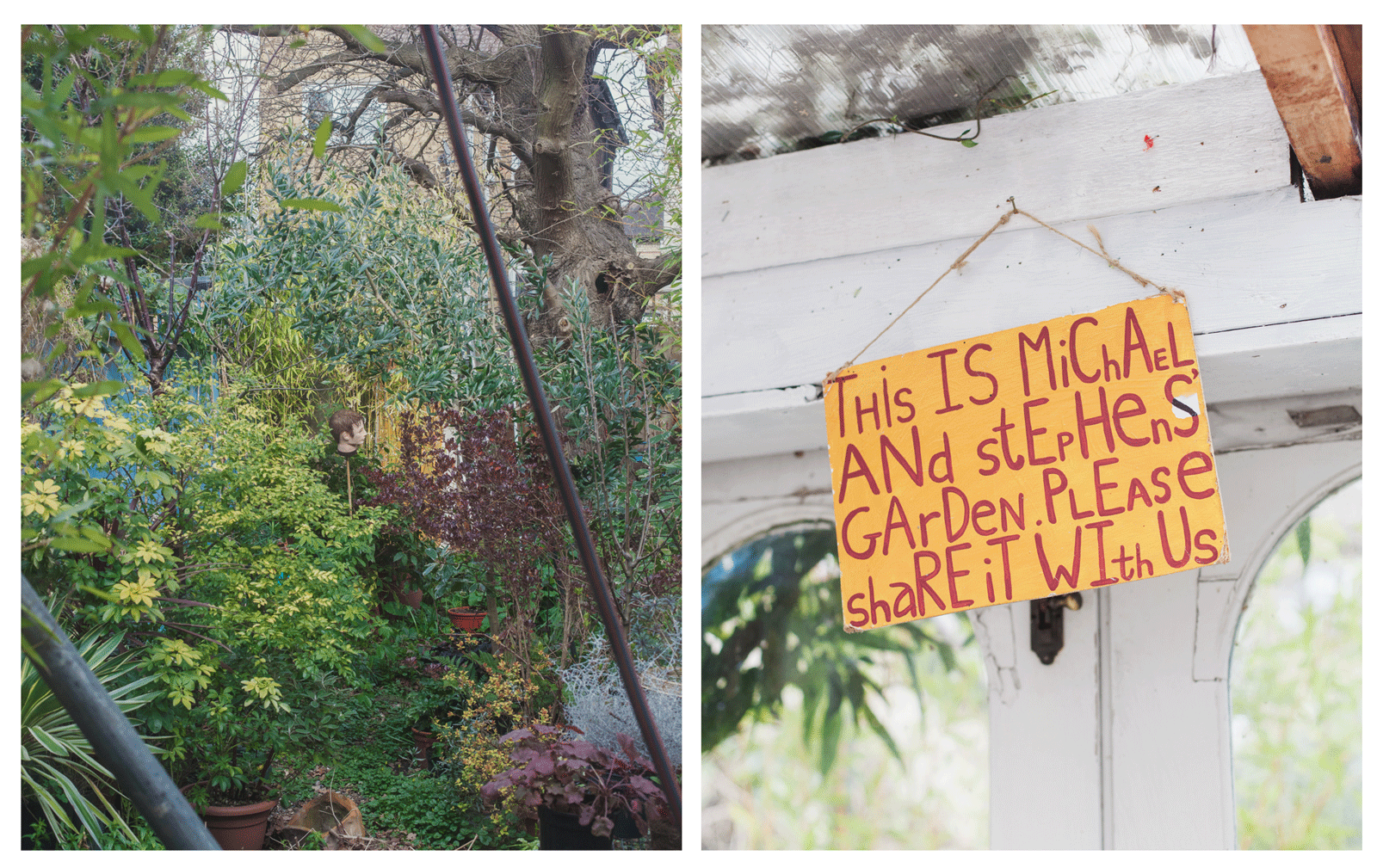
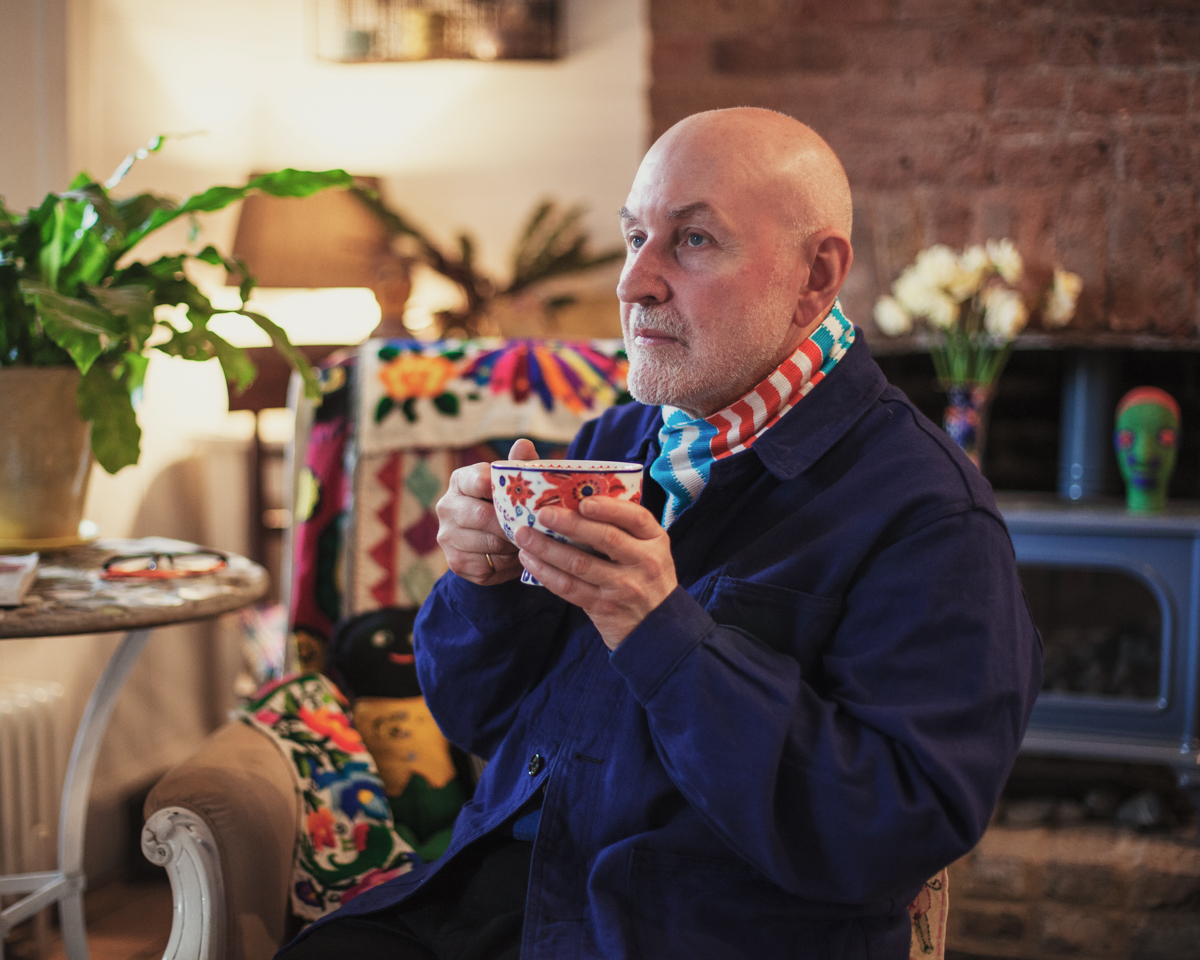
Every morning, Stephen Wright gets up at around 4:30 AM, makes a cup of tea, sits beneath the oak tree in his back garden, and pretends he's the first person awake in the world. There are no sounds of passing traffic or nearby building sites, only the birds and the smell of bluebells. Whenever he sees a robin, he thinks of Donald. Then he finishes his tea and walks into his House of Dreams.
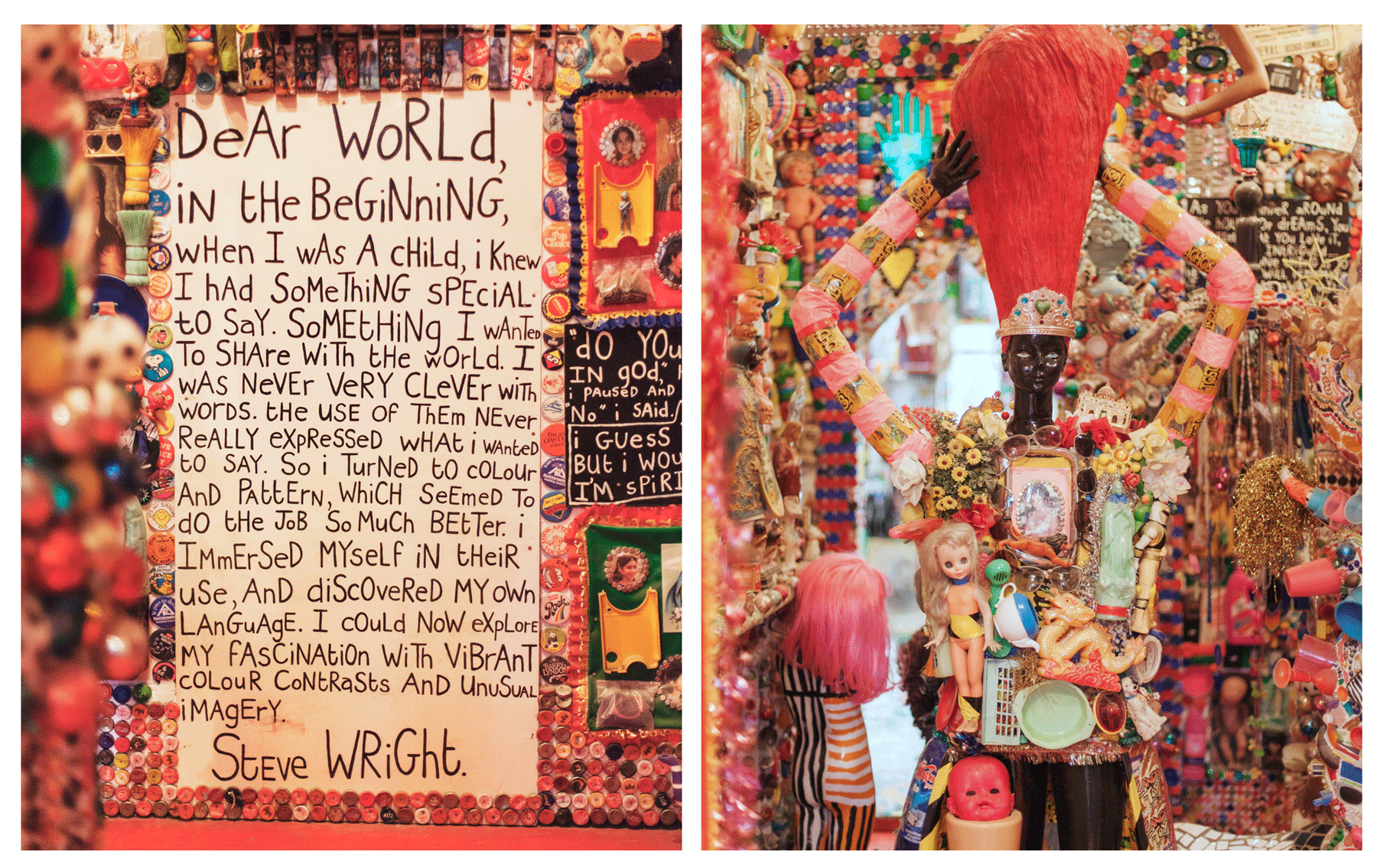
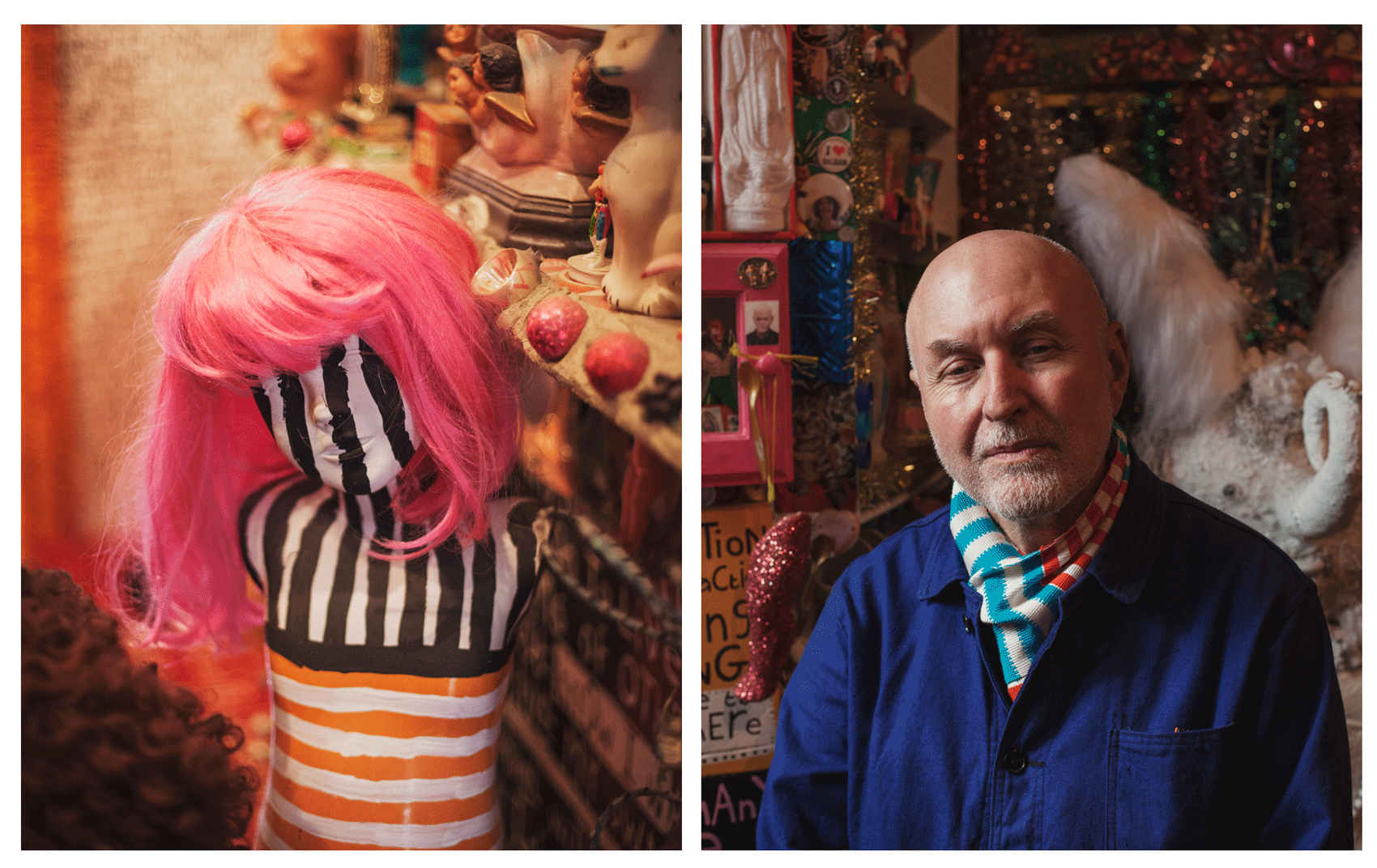
Wright is an artist. In the late-1990s he made the decision to turn his semi-detached south London home into a work of art called The House of Dreams. It started out in just one room, but over two decades spread everywhere. He created sculptures, mosaics, paintings, writings, and collages, and gathered thousands of recycled objects. The house has become a reflection of his memories, dreams, and reflections—no matter how painful or personal. It’s his greatest work, and also where he eats, sleeps, and lives.
When visitors come, they often cry. Others are overwhelmed by inspiration, or a sudden feeling that everything makes sense and they know just what they need to do. By the end of their visit, they want to speak to, confide in, or be counseled by Wright. It feels like there is a magnetic air of wisdom around him that you can’t help but want to feel close to. Wright listens and hugs, he understands.
He could never have imagined that people would react like this. In fact, he could never have imagined any of the events that would happen to him during the creation of the House of Dreams; these events that would shape who he is and, in turn, the appearance and meaning of his house.
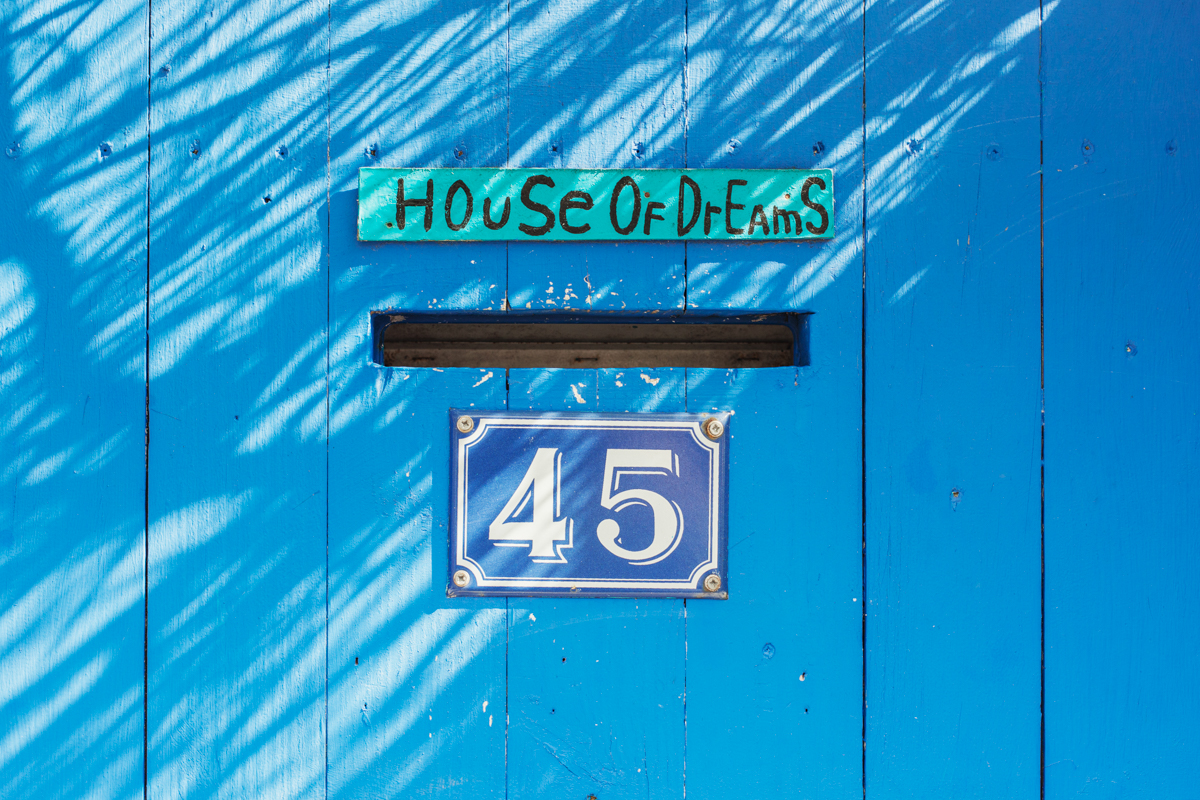
The House of Dreams sits on a quaint and leafy residential street in East Dulwich, south London. The front gate is painted turquoise and features the house number (45), a mailbox, and a small sign that reads "House of Dreams." Wright was expecting me, so the latch is off. Tinsel hangs from trees, as well as teapots, colored bleach bottles, and broken dolls. On my left, the false teeth of Stephen’s parents are cemented into the step—he says hello to them every morning.
"Hello!" he says, I assume to me and not the dentures, before I step through a door covered in hundreds of colored bottle caps and wander into his universe.
Wright was born in Nantwich, Cheshire, in 1954. His parents lost their baby before him, and he would be their only child. His dad did construction on the railways, while his mom was a machinist and a cleaner. Despite the intense labor of his work, his dad had a gentle artistic flair and would make decorative collages to put around the house.
Wright moved to London in the 1980s after finishing his degree in Fine Art Textiles at Manchester University. He began renting the house he still lives in today, from a Mr. Twist, a kind old man who eventually left London to retire in Somerset, selling the house to Wright for £49,000 [$66,335].
He made his name in the fashion world, creating what he called "wearable art pieces"—large pieces of fabric with designs printed on them. Soon he became disillusioned with the fashion industry and decided to turn his designs into a stationery business, transforming the house into a messy and pungent one-man factory for gift wrap and notebooks. These sold well—almost too well. One year, he printed over 100,000 sheets of wrapping paper by hand, and his shoulders never really recovered.
Wright met Donald in a way strangers don't really meet anymore: on the street, during the day. Wright was on his way to an antique fair and Donald was on his way to buy materials. They caught each other's eyes across the passing traffic as they walked in opposite directions, then turned and walked toward each other. It was a warm day. They both wore shirts: Wright in red, Donald in check. They cycled through pleasantries: Who are you? What do you do? Donald was a costume maker.
"Would you like a cup of tea back at my place?" asked Wright. It wasn't a euphemism; they didn't have sex that day. They just talked about life, art, and the West End show Cats, which Donald was working on, then made plans to meet again a week later.
Wright was 19 years younger than Donald, but that didn't bother him. He liked the way Donald’s mind worked. He was an old soul oozing with life experience. They developed a special relationship: lovers and friends, but also teacher and student.
February 16, 1999 was a cold night in south London. When Wright's phone rang, he knew it was Donald. He has a habit of knowing who is calling him. "There's something you should watch that’s about to come on channel four," said Donald. "Have you ever heard of outsider art?" Wright hadn't. He stopped what he was doing and sat down.
The show was called Journeys Into the Outside and was presented by Pulp frontman Jarvis Cocker. In it, Cocker posited the theory that most art was completely divorced from the reality of everyday life, apart from one specific area of art: outsider art, i.e. art made by people with no art education or training, who create stuff because they simply feel compelled to do so. On his travels through France, Cocker met a milkman who had spent 50 years creating mosaics over every surface in his house with sea shells and broken crockery, and saw Le Palais idéal, a fantasy kingdom made from stone by a local postman.
When the show ended, Wright called Donald back immediately. "What the fuck was that about?" he beamed. "It was amazing!" They were excited, more than excited. The pair of them had been at a crossroads—Donald wanted to move on from making costumes, and Wright had just sold his stationery business. The show felt like a sign post. Wright would never be an outsider artist, but he was fascinated by the instincts that fueled it. He wanted to unlearn everything.
Some of Donald and Wright's happiest memories together are just of them talking. In one such moment, sitting by the fire with a glass of wine at Wright's house, they conceived the House of Dreams. It would be their baby, something they’d create and cherish, fueled by their love for each other and their passion for outsider art.
In the beginning, it was more of a decorative project than anything else. Those early days were documented on video by the couple’s friend, Diane. One hot afternoon in July, she films them taking a breather in the back garden, on big wooden chairs, surrounded by bags of stuff yet to be mosaiced.
"I mean, it's really going to take the rest of our lives," Wright says to the camera. Donald coughs. He comes across as gentle, quiet, and calm, happy to let Wright do the talking.
Donald's health had never been great. He suffered from an extremely rare autoimmune disease called Evans Syndrome, in which the body mistakenly destroys red blood cells, white blood cells, and platelets. Any minimal trauma to his body was like a butterfly effect: A common cold would lead to pneumonia, a scratch from a cat would lead to a week in hospital with blood poisoning. "It was cruel," says Wright.
They tried to not let that stop them from doing the things they wanted to do. They began visiting France frequently for supplies and inspiration: They meet outsider artists and explored the many galleries that celebrated them. One day, they landed on the doorstep of Bodan Litnianski, a former WWII prisoner of war, turned outsider artist. He'd created a forest of giant towers in the land around his home, made from the rubbish he’d found in the tips and junkyards of the region.
Wright had brought a fancy cake, hoping it would coax Litnianski into letting them in. When the old man came to the gate he spoke only French, and they spoke none, but it soon became clear that he wanted the cake, and they were allowed to wander around. Wright thought the whole thing was magical. "Even at his age, he was still driven, a force of nature," he says. "I admired his single-mindedness. It’s very hard to be single-minded in this world—to just stick to your guns. I took a bit of him away with me that day and I have held it ever since. I always will."
For much of 2004, Wright had to care for Donald and his worsening health, and their work on the House of Dreams decelerated. That Christmas, as they prepared for the train journey to Wright's parents' house in Cheshire, it became obvious that Donald didn’t have the strength. He began coughing heavily. Wright took him to the nearest hospital, where he was put on the ward. It was the day before Christmas Eve.
"What should I do?" said Wright.
"Go home," said Donald.
Reluctantly, Wright got on the train to Cheshire. At 3 AM, he woke to the sound of the house phone ringing. It was Barbara, Donald's sister. "I think you need to come back," she said, "he’s asking for you."
When Wright arrived at the hospital the following morning, Donald had been moved to the high dependency unit. He couldn’t breathe and was only semiconscious, surrounded by monitors, tubes, and bleeps. Donald acknowledged him with small waves of the hand, little glimpses, finger taps.
Evans Syndrome was a medical conundrum, and while attempts were made to keep Donald stable, his situation only deteriorated—Days passed, and last resorts were resorted to. A decision was made to stop his medication. There was no more that could be done. Donald kept breathing.
A phone call came for Wright at the front desk of the hospital. It was the lady who checked in on his parents. Nobody was answering their door. She couldn’t get in. Something didn’t seem right. "I'm sorry," replied Wright, "you might just have to break down the door."
Mom and dad have each other, he thought. He needed to be here for Donald—he would only ever get one chance to do this.
Donald’s kidneys stopped functioning and he was no longer able to pass water. Wright felt helpless. An intensive care nurse came in and touched Donald’s feet—his toes moved.
"I love you and I’m proud of you," said Wright.
"Hold his hand," said the nurse, "he might be frightened."
Wright felt like he could smell death approaching. The bleeps slowed. Donald drew three weak breaths and stopped breathing. The veins in his neck throbbed for a further minute. Then everything ceased. Donald was dead.
When a nurse entered the room to wash Donald's body, Wright felt an urge to be involved. He put on a pink plastic apron, some rubber gloves, and filled a bowl with warm water. He never imagined he would ever find himself washing the dead body of another human being.
"When you love someone," he tells me, "you want everything to be right for them, at the end as well." That night, alone at home, he wailed screams of anguish from the pit of his stomach.
The call about Wright's parents had been regarding his dad. He had become ill. They struggled on, but soon his mom wasn’t able to look after him and he had to go into a home. A few months later, he died. Wright’s mom, in her late-80s, was left alone.
Wright started to visit her every weekend to keep her company. One day, while he was teaching in Brighton, he tried to call but it repeatedly rang out. He called the neighbor to go and check on her. She found his mom dead. She had a heart attack. It was 18 months since the death of Donald.
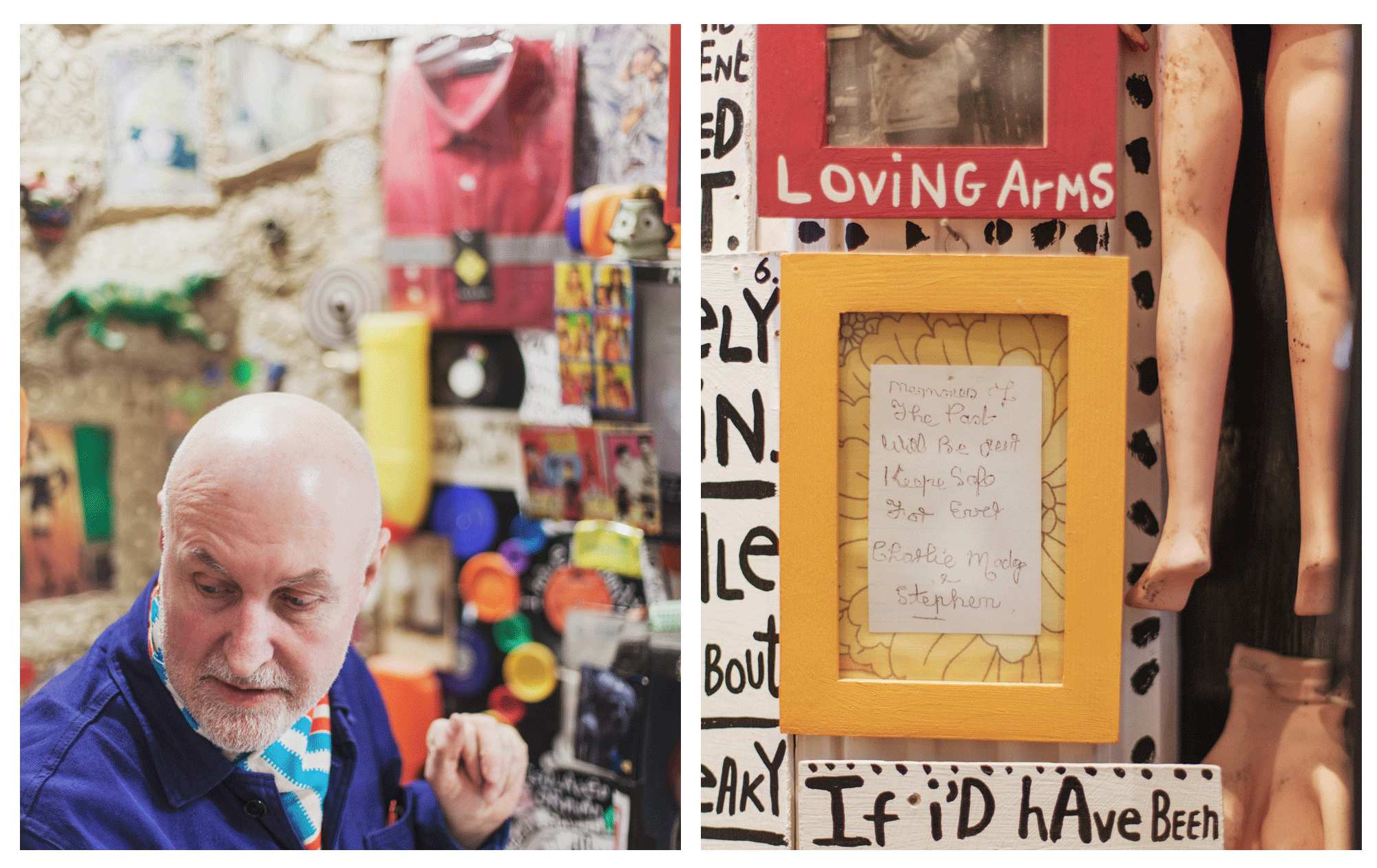
Wright headed to Cheshire to empty his family home, which had always been a place filled with love—but nobody was there anymore. His dad’s shed was rammed full of bike parts and old dolls. His mom’s possessions were full of evidence of a halted life. In her handbag, he found a handwritten note on a small bit of paper that read: "Memories of the past will be our keep-safe forever, Charles Madges Stephen." He thought about her writing that, reflecting on a time when all three of them were together.
"I sifted through clothes that still had their hairs in them," he tells me. "It felt like a connection. I needed that. I needed to find my mom's hairs in her clothes because she wasn't there anymore, only in a box."
Wright felt abandoned, like a victim, like the three most important people in his life had just upped and left him. Back home, the House of Dreams lay in an incomplete state. He didn't look at it. It didn't interest him anymore. That was Wright and Donald's baby, and Donald was gone.
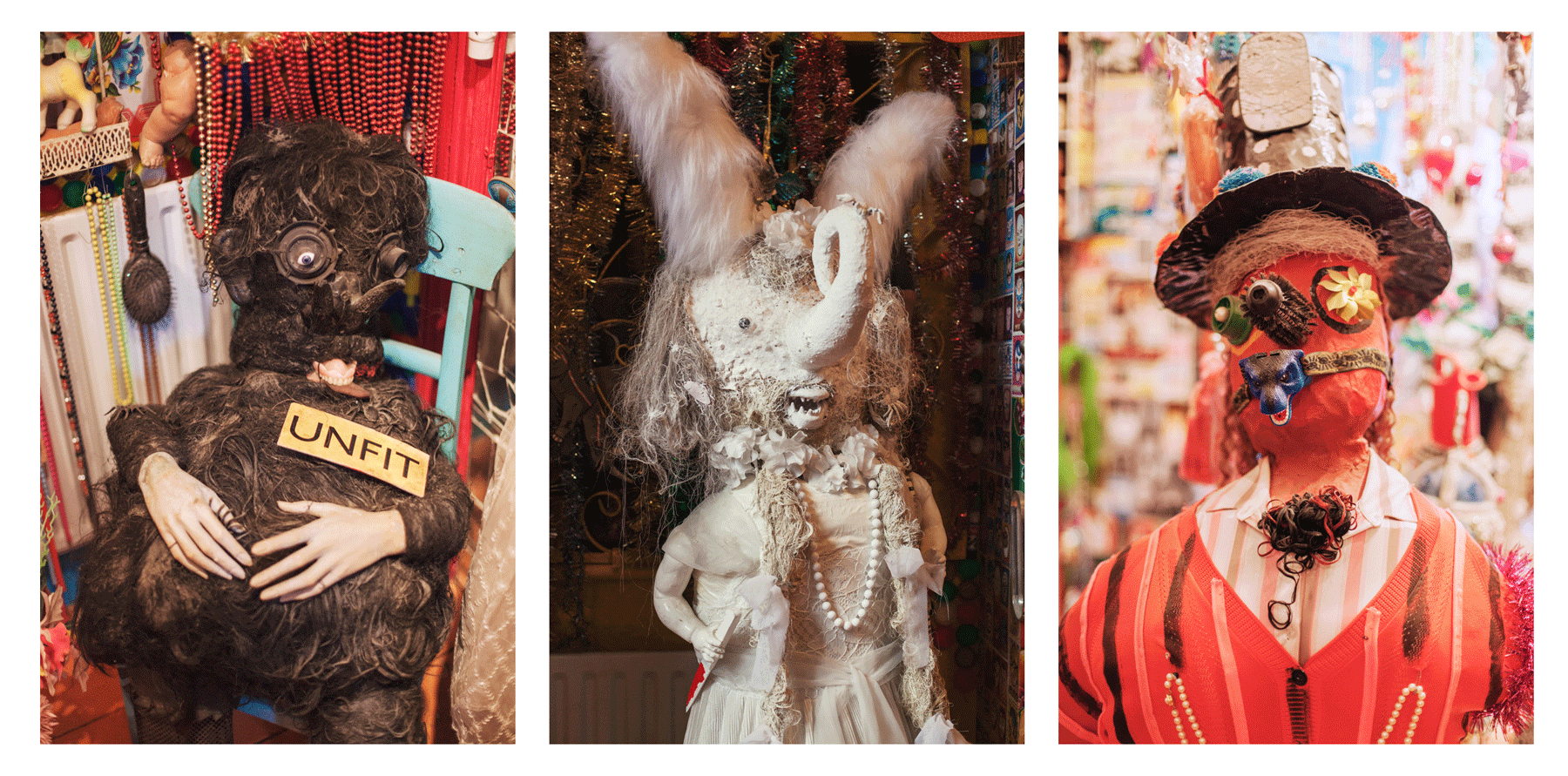
He kept lots of their possessions. He wasn’t quite sure why, he just knew he wanted to do something with them. One day, he began to work on a set of sculptures, which he called "comfort sculptures." "I needed something to hug because I am a huggy person," he tells me, "and it was just me in the world."
One sculpture was dressed in his mom’s cardigan, old hair curlers for a nose, and yellow rubber gloves for hands. Another, titled "Bridal Spirit," was a white creature with a long curled nose wearing a wedding dress and holding a blood-stained knife. Its face had a chalky, coarse, and lumpy texture.
When Donald was ill, Wright would massage camomile lotion onto his face to ease the pain. It seemed like such a beautiful thing to have been able to do for someone in their time of need. He wanted the texture to recapture that feeling.
Wright met Michael in a way quite a few strangers do these days: via Guardian Soulmates. This was back when the dating service was a phone number you called to leave voice messages describing yourself, and hear those left by others.
"What did you like about him?" I ask Michael.
"He was quirky, an artist," he says. "I had done three years at art school in my youth, so that grabbed me. And his tone of voice: It's a real window into someone's personality." Michael was an actor, so this kind of thing mattered.
It was two years since everyone had died, and Wright was still grieving. The first time he and Michael met, they spoke for three hours about the experience of losing their moms. When Michael finally entered Wright's house, it was a fortress. Nobody had entered, not the postman, gas man, or electrician. There were bars on the windows, bags full of flea market discoveries everywhere, and finished pieces of Wright’s art hidden away in boxes. Michael couldn’t stand up in some rooms, and there was nowhere for him to sit down either.
When he saw the House of Dreams project lying forsaken, he encouraged Wright to resume it. "This is really important, what you are doing," Michael said. "You need to carry on with this." Wright rested on the idea for a few weeks.
"Then, one morning," Wright tells me, "I decided I need to do the House of Dreams for me. For Steve Write. It's an important part of who I am, and I needed to say something. I needed to say it."
For the next nine years, Wright worked secretly on the project, channeling the full force of his bereavement into it. He worked 15-hour days, and often lived on a makeshift diet of sandwiches, cakes, and Bombay mix.
The purely decorative aspect of the House of Dreams fell away and powerful subtexts flooded in. Objects were still chosen for their colors, but also for the memory or symbolism attached to them. Stephen wanted things that were chipped or smelled or sticky or stained. He wanted things that were unwashed. A trace of DNA was important to him. He wanted jackets with things spilled down them, shoes with a stench, combs with hair in them—materials that had life in them. These objects quickly began to fill the walls throughout the house. When he walked from room to room, he could sometimes smell a complete stranger. He liked that.
He cried as he created, but the physical grind of the work itself became a source of solace: the birthing of a sculpture, the mixing of cement, the tedium of mosaicing, the endless sorting of objects. He fed off it. Working with his hands felt like a connection to his parents. He wanted to feel exhausted at the end of each day; he wanted to be hardly able to get into bed.
Objects that were damaged fascinated him. Dolls he brought back from flea markets were never collector's items; they were the kind that a child once loved, but then moved on and left behind. In south Paris, he bought a huge box of them with no heads, covered in pigeon shit. His favorite doll in the entire house was one he found in Deptford market that had been run over by a car and left with its face caved in. "Stephen," Michael said to him one morning, "42 dolls just watched me eat a bowl of muesli."
Wright and Michael, both in their 50s, began to fall in love. Michael helped Wright take the grills off the windows, rip walls down to make room for the House of Dreams to expand, and encouraged him to appreciate his work more. Together, they built 20 solid wood frames so Wright's collages and paintings could be mounted on the walls.
Wright’s dreams were vivid and intense. One night, he found himself walking down a street. (As often happens in dreams, though this information was never explicitly expressed, he knew it was 1882 and he was in Oaxaca, Mexico.) The street was lined with buckets, overflowing with orange gladiolus and arum lilies. He passed some cemetery gates and walked toward a set of houses painted in vibrant turquoise, yellows, and reds. His name was written above the door of a turquoise house. He entered, and in the corner of the room was a shrine, filled with photographs, candles, and trinkets. That’s when he woke up.
"Quite an intense dream," I say.
"A vision," Stephen corrects me. "I had been shown myself in a former life."
"I see. What did you do?" I ask.
"Well, I just had to find this house," says Stephen.
He flew to Mexico alone, traveled to Oaxaca and found a scene that appeared, to Wright, to be identical to that which he saw in his dream. He wasn’t going to come all this way without getting inside, he thought, so he knocked on the door of the turquoise house.
"A little lady answered," he explains. "She smiled. Probably in her 40s. I tried to explain to her that I wanted to get into the house to see where I was born. She didn’t understand—why would she? But she invited me in. Her husband and child were there in the back room. She made me a sweet drink, which was not very nice, but I drank it to be polite. And, believe it or not, she left me alone. I looked around and there was the shrine. Photographs, candles, and things on this little table. I cried, because I'd seen this before. I knew this house."
In Mexico, Wright had found a new way of looking at death. There it was, open and explored, celebrated in expressions of color, art, and humor. It spoke to Wright. He returned to England with materials for the house: cases full of religious ornaments, glass eyeballs, handcrafted figurines, dolls' heads, discarded family photos, and many other things in startling colors.
He became increasingly influenced by cultures that dealt with loss in much more visceral and spiritual ways than Britain. Places where the burden of bereavement was explored and expressed; where people didn't dress in black and avert their eyes; where grief was not expected to be kept behind closed doors.
He went back to Mexico. He studied Haitian voodoo and began to incorporate some of its exuberance into his art. He went to India with Michael, to Varanasi, and to the banks of the Ganges, where they both watched as families publicly bathed their lost loved ones, wrapped them in linen, and then cremated them on a wooden pyre.
"Watching someone burn was a privilege," says Wright. "It was so hands-on. In our society, everything is taken out of our hands. If it's a loved one, why would you want to hand them over to a stranger? England is in denial in so many ways. Everything is private, not spoken about, black, tight, controlled. It's fucked up, really."
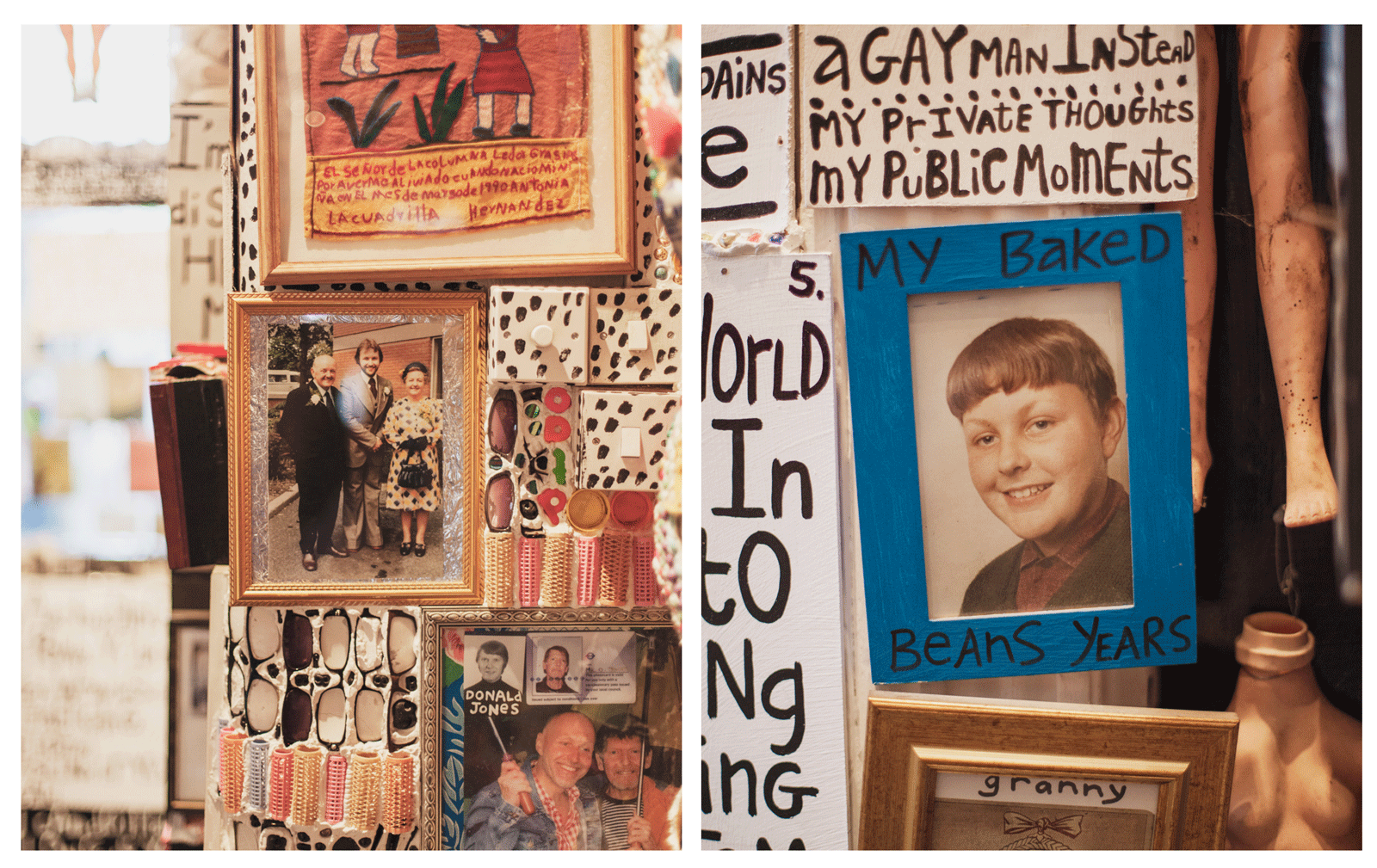
Throughout the passing of Donald and his parents, Wright had kept diaries. One day, he put some thin wooden boards on the floor of his living room and began transcribing onto them with a paintbrush. The diary entries he chose were graphic and honest. One huge board focused in detail on the day Donald died. It seemed important to him not to block anything and just allow the work to come through. The boards would eventually line the corridor of the House of Dreams.
"I felt the bereavement go through my arm, into the brush, and into the paint, and onto the board, and I'd leave a bit of it over there," he says. "Then I’d do it again and leave a bit more. The act of making was a way of getting rid of it. I learned that. I didn't know that. But it's true."
"Cathartic?" I say.
"Completely and utterly," says Wright. "What a wonderful thing to learn. What an awful way to learn it."
"It's quite beautiful that something you created together helped you overcome his death. Do you think the House of Dreams would exist if you’d never met him?" I ask.
"Good question," says Wright. A word tries to escape his mouth, but he pulls it back in and pauses. Whenever I’ve made assumptions or put words into Wright’s mouth, he pauses, thinks, and remolds it into something precise that he can agree or disagree with. He never simply nods or shrugs.
"Probably not," he says.
Wright doesn’t really know why he opened the House of Dreams to the public, but he likes the idea of not really understanding the things he does. At first, he opened it for six days a year. On those days, around 20 visitors would arrive. That was fine: He had no desire to advertise it anywhere, and the intention was never to make money.
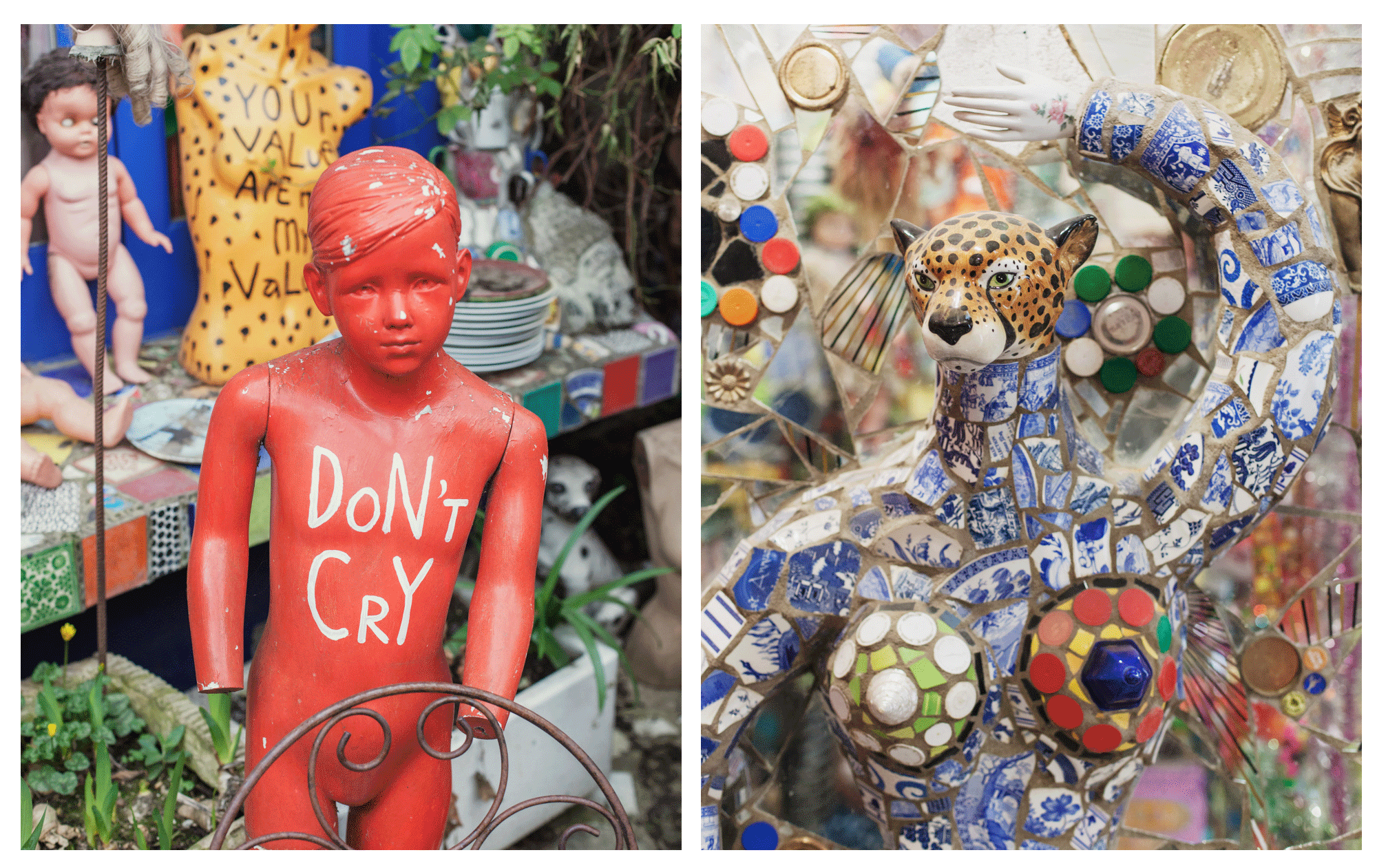
Strangers started tossing stuff over his wall. One day, it was a garbage bag full of wigs. Another time it was the head of a decapitated ceramic leopard. Once, it was a deer skull with antlers and a note that said "For you." It seemed the house had become known as a place where unwanted objects could be given a new life or purpose.
Wright loved it. He put the deer skull above the fireplace in his living room. The leopard became the head of a mosaic goddess. When the wigs came, he and Michael spent the day trying them on. Then he glued them all to a door in the house—hair door. It looked interesting, very interesting, but it was an impractical covering for a door. I mean, you couldn't see the handle at all. So, rather reluctantly, he removed them.
But as word of mouth spread about the House of Dreams, a demand began to swell. Six open days a year became one day a month. Twenty people a day became 100 per day, which became selling out in advance. As I write this, the house is fully booked until July, and is receiving bookings up until October. In June, the Royal Academy will be doing an exclusive excursion for its members.
"Is there anyone that doesn't enjoy the house?" I ask Wright.
"It's very rare," says Wright. "But I have to say, straight men are threatened by the House of Dreams. They come with their wife or their partner, they stand on the doorstep, gasp, and say, 'This is not for me,' and go to the pub."
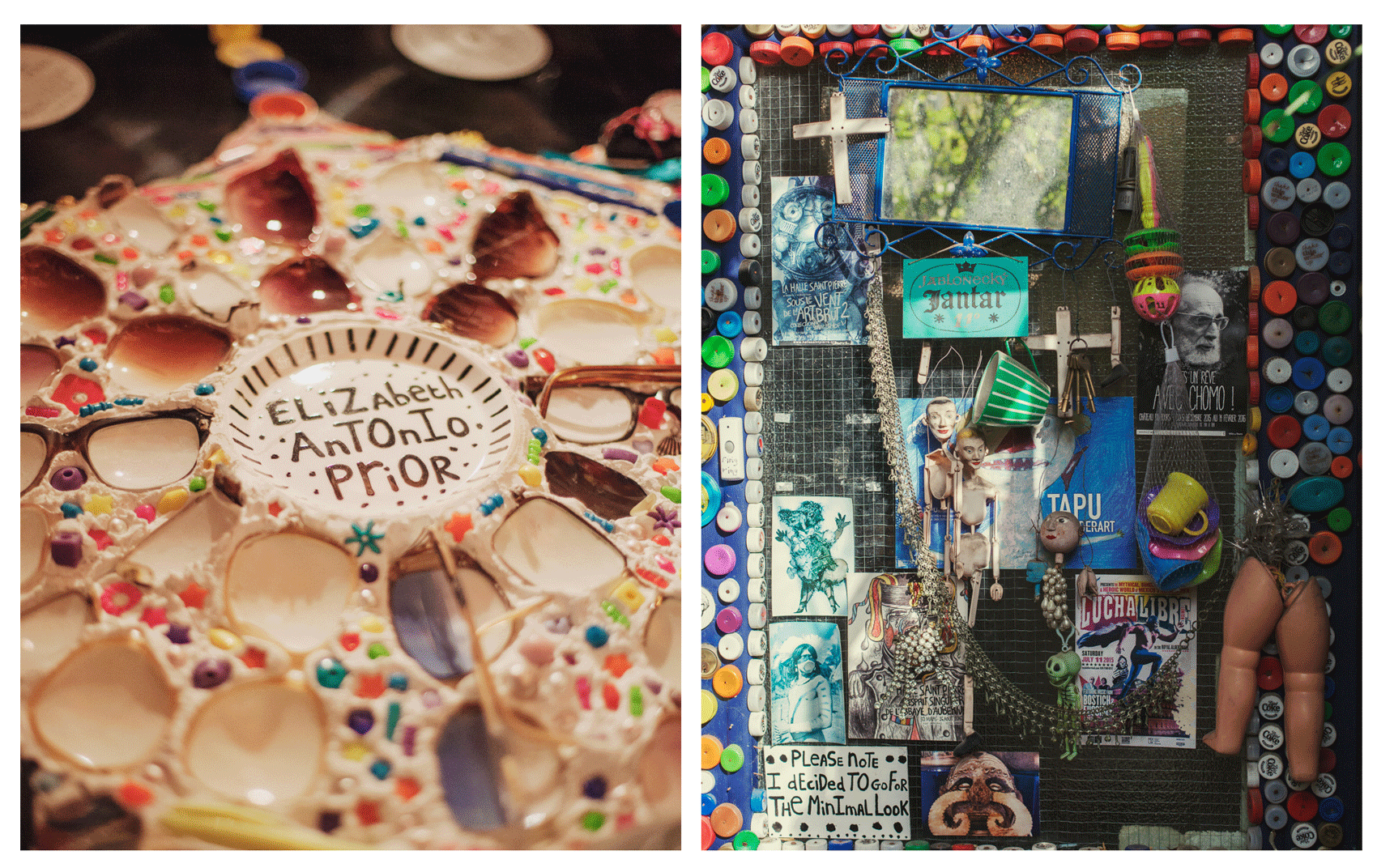
One day, a visitor called Elizabeth came. It was her second time, and she wanted to speak to Wright. Her mother had died. It had been completely unexpected. While clearing her mom's house, she kept coming across pairs of glasses of various styles, shades, and shapes.
Elizabeth: "The glasses were part of her being."
Wright: "I understand that."
Elizabeth: "And that’s why it feels like they belong somewhere like here."
Wright took her downstairs, and they picked a spot together. About a meter-and-a-half up the wall in Wright's corridor, surrounded by felt tip pens and a pillar made of Coca-Cola bottle tops, there sits a shrine to Elizabeth's mom, a woman Wright never met. It's a spiral made from all the spectacles, with her name written in the center.
I find myself staring at this shrine for a while one afternoon while Wright potters in his studio. For the first time in years, I think of my aunty Angela's bookcase. She died before I was born, killed in a car crash at 21 years old. She had been a pillar of the family, the oldest of five, and had helped my grandma raise the others. When grandma got up in the night to bottle-feed the newborn twins (my uncles), Angela got up with her to feed the other.
There has always been a bookcase of Angela's books in grandma's house, exactly how she left them. As I grew up, and got old enough to read, these books became how I got to know Angela. I learned things about her that nobody could ever tell me. Spike Milligan's Puckoon showed me she had a goofy sense of humor, Margaret Drabble’s Jerusalem the Golden showed me she thought deeply about what it is to be a woman, Jean-Paul Sartre's Nausea showed me she had a dark side and was probably way more intelligent than me.
The spines were crinkled, pages were marked with spilled tea, and the margins were filled with annotations around lines she found interesting. In my own books, I still mimic the messy and cartoonish way she always wrote her name on the inside cover. For me, Angela’s spirit didn’t live in the gravestone we visited at the village cemetery, it lived in the bookcase. In the same way, Elizabeth's mom's personality beams at me as I stare at her eccentric and excessive spectacles collection.
I join Wright in his studio at the back of the house. His laptop is playing "The Gate" by Bjork. The choral harmonies mix eerily with the drumming sound of rain against the corrugated plastic sheeting on the studio roof.
"I love this song," says Wright softly, "it feels... medieval." He pulls out a huge cardboard box and places it very carefully onto his desk. "We get three or four of these a week now," he says.
I open it. The box is full of objects: cuddly toys, jewelry, ornaments, and a photo of someone holding an elderly person’s hand. They were all sent to Wright by past visitors; They are possessions of their deceased loved ones. They want them to be part of the House of Dreams.
I pick up a photo of a smiling woman called Penny, who looks to be in her late 30s. She had been a children's author until she died of cancer. Her husband visited a few months ago, and left the toy of a character she’d created. Wright turns Bjork up a little.
"Do you feel, like, does this move you when you listen to it? It sort of goes there, doesn't it?" He says, pointing to his chest. "What is going on there then? I love it."
"Where will you put Penny?" I ask.
"I'm not sure yet. I’m working on a new room in secret and I think she might go there," he replies.
"The house is becoming a public shrine," I say.
"It was never my intention," says Wright, "but I don't mind being someone who listens and hears people's stories. It's about being human. We are all here to support each other in some way. So it's not a problem. My heart is big enough to do that."
Last summer, Wright had a meltdown. He found himself, in the living room, screaming, "I’m sick of feeling like a fucking victim!" He could feel himself losing it. Thirteen years later, the trauma still stalked him like a pack of wolves—this felt like their last stand. He called his counselor, who he hadn’t seen in years. He called Michael, and also his friend Ted. Within half an hour, all three of them converged on his doorstep. He talked through everything with them: Donald, his dad, and his mother.
"I realized that I wasn't a victim," says Wright. "They didn't choose to go. Life and death made them go. They didn’t walk away from me—that was a turning point, really. Ever since then, I've felt completely different about everything. It's like a cloud has gone. I am healed. Have you ever heard the Stephen Sondheim song, 'I'm Still Here?'"
I shake my head.
"Well, that's how I feel," he says. "It shows me I'm quite strong. If I can get through that, then I am strong. I like to be strong on my own. It's important to me."
You don't need to spend long with Wright to notice that he has a sort of unspoken philosophy guiding him, that I imagine has grown organically through his experiences. When we talk about the most painful moments in his life, he always describes them as "interesting." Going to his parents' empty house was interesting, watching Donald die was interesting, having a breakdown was interesting. It's like he's found a way to see everything that’s happened to him as a lesson he can absorb and learn from.
The irony of the House of Dreams is that as it is soaring in popularity, Wright’s attention to it is now winding down a little. Where once it was his main focus, it now shares his attention with multiple new projects: a book about alter-egos, new paintings, and an art fair in 2019. He can see a time approaching when he won’t want to do this anymore.
"When?" I ask.
"Not quite yet," he says, "but I can see a point when I will have said what I wanted to say with this. I don't know; I'm very fickle. You never know what life will throw at you."
For now, he has bequeathed the house to the National Trust, who will manage it once he isn’t around. Downstairs, his studio is filling up with new work: a series of black-and-white paintings of various monsters and creatures. Where once he used black-and-white to depict his mourning, now he does it to challenge himself.
"You can hide behind color," he tells me, "but black-and-white is very exposing and basic. I like that about it."
"And the monsters?" I ask.
"I feel like they exist somewhere else," he says, "and I am just making them real through the process of working. I never know what they are going to be, but I do think they have a sprinkling of all of the past in them."
On our final day together, Wright and I sit down to run through some fact-checking. He's stressed and distracted. The builders are in and the house is covered in scaffolding. They are converting the unused loft into a new space for him to live and work in—the House of Dreams is chasing him into the skies. We sit with tea in hand-painted china cups and listen to Michael and the builders stomping around above us.
There's a commotion near the skylight and we both look up expecting a foot or a backside to come through the ceiling. Michael comes scampering down the ladder to relay some information in hushed tones before heading back up, and it reminds me of some sort of French resistance comedy sketch. A call comes down, Stephen is needed. I ask if I can look through the House of Dreams guest books while he's gone.
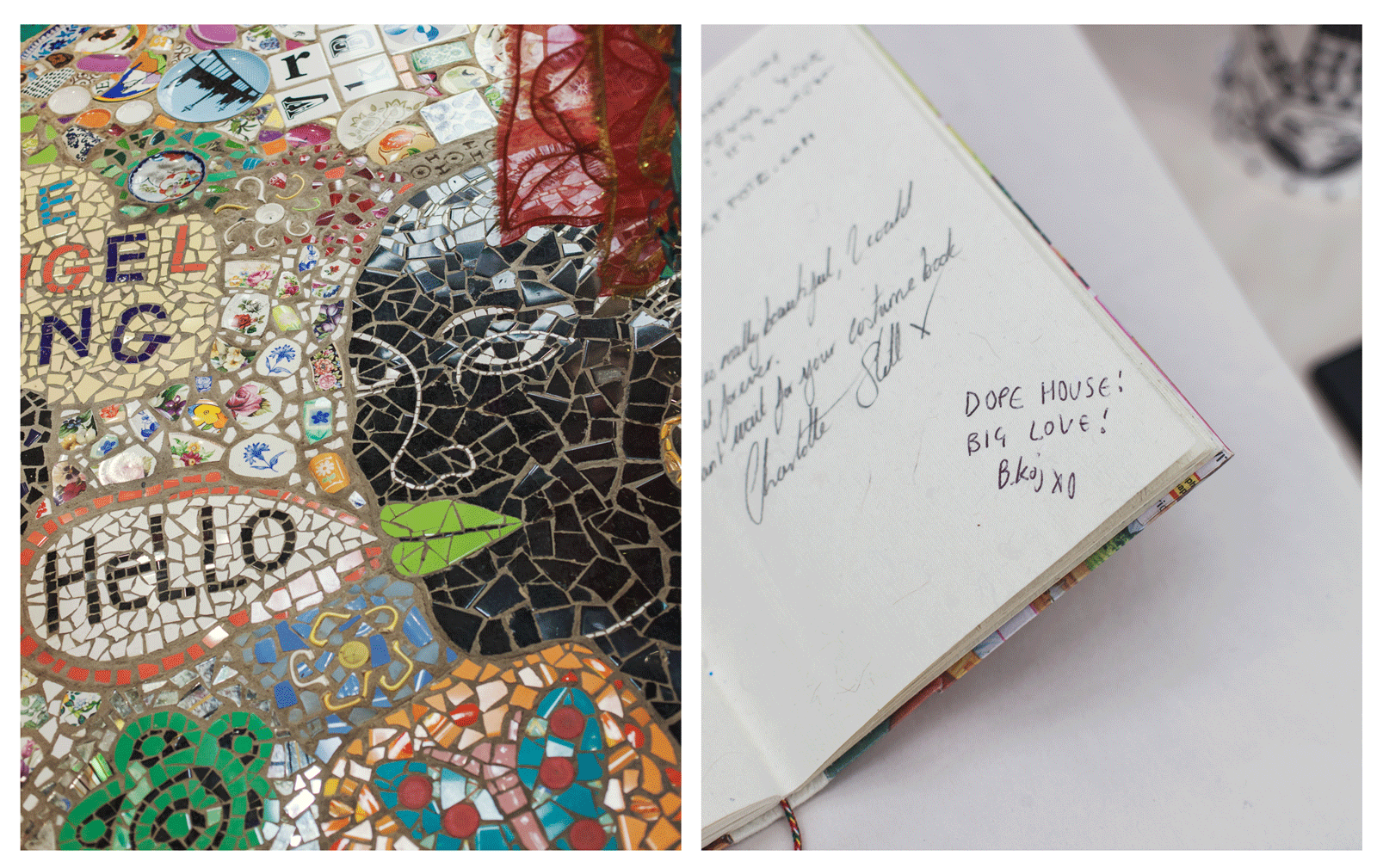
There are messages from all over the world. Some are amazed by the fact that Stephen kept working on something so strange and unique for such a long period of time, without ever being derailed by self-doubt or criticism. Another writes: "You have opened my eyes and made me believe in myself." Others thank him for creating what feels like a shelter from the monotony of the outside world. One guy has just written "DOPE HOUSE!"
But then there are hundreds of messages from those who seem to have connected with it on a deeper level.
"Words cannot convey how much you gave me today," Emer.
"Coming in here has reminded me I’m not alone in the world," Kesley.
"I struggle with so many demons. I think what I have learned from you may help me survive," Dasha.
As Wright has overcome his grief, so has the house. Death still lurks, he doesn’t hide that, but now it is joined by an overwhelming sense of joy. He’s created new memory boards that capture funny moments from his childhood. There’s a framed picture of Michael, smiling, "partner and loyal friend" written beneath. There’s a vibrant sculpture about his sexual energies, with huge breasts and two shiny Christmas baubles as testicles.
People don’t connect with this strange and illogical place because it symbolizes the day someone’s world fell apart. They connect because it symbolizes what happens the day after your world falls apart. In every object, from the dentures on the doorstep to the doll with the caved in face, the message from Wright is clear: Your life can and will go on, no matter how awful it gets.
Sign up for our newsletter to get the best of VICE delivered to your inbox daily.
This article originally appeared on VICE UK.
Follow Joe Zadeh on Twitter.

/cdn.vox-cdn.com/uploads/chorus_asset/file/10853989/som4.jpg)
/cdn.vox-cdn.com/uploads/chorus_asset/file/10853991/som6.jpg)
/cdn.vox-cdn.com/uploads/chorus_asset/file/10854003/som7.jpg)
/cdn.vox-cdn.com/uploads/chorus_asset/file/10853993/som2.jpg)
/cdn.vox-cdn.com/uploads/chorus_asset/file/10855859/JI5A9422h.jpg.jpg)
/cdn.vox-cdn.com/uploads/chorus_asset/file/10855853/JI5A9440h.jpg.jpg)
/cdn.vox-cdn.com/uploads/chorus_asset/file/10855857/JI5A9449h.jpg.jpg)
/cdn.vox-cdn.com/uploads/chorus_asset/file/10853985/som8.jpg)
/cdn.vox-cdn.com/uploads/chorus_asset/file/10855851/1124_703.jpeg)
/cdn.vox-cdn.com/uploads/chorus_asset/file/10855867/fa_ade_front_quarter1__1_.jpg__1_.jpg)













/cdn.vox-cdn.com/uploads/chorus_asset/file/10822537/Woodside_4_050718090553.jpg)
/cdn.vox-cdn.com/uploads/chorus_asset/file/10822539/Woodside_5_050718090554.jpg)
/cdn.vox-cdn.com/uploads/chorus_asset/file/10822555/Woodside_10_050718090555.jpg)
/cdn.vox-cdn.com/uploads/chorus_asset/file/10822549/Woodside_7_050718090555.jpg)
/cdn.vox-cdn.com/uploads/chorus_asset/file/10822553/Woodside_9_050718090555.jpg)
/cdn.vox-cdn.com/uploads/chorus_asset/file/10822561/Woodside_13_050718090555.jpg)
/cdn.vox-cdn.com/uploads/chorus_asset/file/10822563/Woodside_14_050718090556.jpg)
/cdn.vox-cdn.com/uploads/chorus_asset/file/10822567/Woodside_15_050718090555.jpg)
/cdn.vox-cdn.com/uploads/chorus_asset/file/10822571/Woodside_19_050718090556.jpg)
/cdn.vox-cdn.com/uploads/chorus_asset/file/10822573/Woodside_21_050718090557.jpg)
/cdn.vox-cdn.com/uploads/chorus_asset/file/10822579/Woodside_23_050718090557.jpg)
/cdn.vox-cdn.com/uploads/chorus_asset/file/10822581/Woodside_26_050718090558.jpg)
/cdn.vox-cdn.com/uploads/chorus_asset/file/10822583/Woodside_27_050718090558.jpg)
/cdn.vox-cdn.com/uploads/chorus_asset/file/10822707/Woodside_25_050718090558.jpg)
/cdn.vox-cdn.com/uploads/chorus_asset/file/10822589/Woodside_30_050718090559.jpg)
/cdn.vox-cdn.com/uploads/chorus_asset/file/10822593/Woodside_31_050718090559.jpg)