IKEA Monkey
Shared posts
03 Feb 05:38
Why are women so into Super Bowl?
IKEA MonkeyWhy do women like things? Why are women happy? Who are women? What is woman? Who make woman?
Donna Brazile asks why do women watch the Big Game? Women attended the gladiator fights and chariot races in ancient Rome. But today, it may be more than just the bloodsport.


03 Feb 05:36


 This summer, Chicagoans will appreciate the moderating influence of Lake Michigan. Here's why: heavy ice now means a slower warmup of the lake. Cooler waters in the summer means the edge will be taken off of what could otherwise be brutal summer heat. [ more › ]


Thick Lake Michigan Ice Now Means Cooler Summer Waters Later
by JoshMogerman
IKEA MonkeySilver lining
    
|
03 Feb 05:35


Instead Of Watching The Super Bowl You Could Have Read A Classic
by Rebecca Rose
IKEA MonkeyI watched the Superbowl because I like the Superbowl

Were you hate-watching Super Bowl 48 and complaining about—well, pretty much EVERYTHING? Did you know you could have spend that time reading a great work of literature?
|
|
01 Feb 21:04


Exorcisms May Not Work Over Skype
by Mark Shrayber
IKEA Monkey"may" not

Last week, evangelist Bob Larson appeared on Anderson Cooper 360 to discuss an exciting new business opportunity: exorcism via Skype. Larson claims that exorcism over streaming internet video can be just as effective as an in-person demon expulsion and even showed an example of what this could look like. The demon in the video appears pretty tame, though, like a mediocre actor auditioning for a dinner theater production of Paranormal Activity—all tickets $15, unlimited dinner rolls—which makes me wonder if this kind of exorcism works on only the lesser demons (Stitch) and not the type that inhabited Emily Rose or sister Mary Eunice. Still, it does sound like it could be a good job: helping people, earning money, not being projectile vomited on by a girl with no control over her head and a penchant for touching herself with a crucifix.
|
|
01 Feb 18:03
Woman arrested for feeding bears
IKEA MonkeyWeird, sad story. Also: Florida.
Don't feed the bears!


01 Feb 08:43
American Voices: Rutgers University Offers Course On Beyoncé
IKEA MonkeyOf course RU is
Rutgers University in New Jersey will offer a course titled “Politicizing Beyoncé” as part of its Department of Women’s and Gender Studies, which will focus on the pop singer’s career as a means of studying gender, race, and...


|
|
01 Feb 00:04


Amazon Removes Guide to Date Rape After Outcry
by Callie Beusman
IKEA Monkeygross

After backlash on the Internet, Amazon has removed an eBook entitled LMR Exposed: How To Overcome Her Last Minute Resistance To Sex, Turn 'No' Into 'Yes' And Get The Lay! Everything that's wrong with the book is summed up in its title: it's a guide that outlines how to coerce a resistant woman into having sex with you.
|
|
31 Jan 23:28
Man smuggles 40,000 piranhas into U.S.
IKEA MonkeyIn related news, piranhas.
New York City resident Joel Rakower bit off more than he could chew when he smuggled nearly 40,000 piranhas into the United States.


31 Jan 21:39
Snakes
IKEA MonkeySnake news
Neighbors had been complaining for a while about the dreadful smell coming from William Buchman's house in Santa Ana, California.


31 Jan 20:38


Russians Have The Bizarre Wedding Photo Game On Lock
by Erin Gloria Ryan
IKEA Monkeyamazing

The run up to the Sochi Olympics has been characterized by paranoia, fear, and copious media references to Vladimir Putin's oft-bare chest. Thank goodness we have these truly wacky Russian wedding photography to distract us from all that terrorism!
|
|
31 Jan 19:09
Hero boy laid to rest as 'firefighter'
IKEA MonkeyAnd now I'm crying
Tyler, who was just 8 years old, was honored with a firefighter's funeral, including firefighters from multiple jurisdictions standing at attention as bagpipers played.


31 Jan 04:50

irish-mexi: mean-mrmustard: keylimepiesandcaipirinhas: this...
IKEA Monkeycan you handle this dog? I CANNOT.
this cheagle (chihuahua/beagle) is probably everything everyone needs.
Cheagle!
I hope they named it don. Don Cheagle.
omg.
30 Jan 22:41


It’s All Right, What We Thought Was An Abandoned Baby Is Just A Bag Of Snakes
by Kelly Conaboy
IKEA MonkeyLots of snake news today
“It is better,” said an onlooker. “Right. I mean. The thought of someone abandoning their baby in a dumpster is just horrible. It’s crazy how often you hear things like that on the news — sometimes I feel like they should call it the bad news, hah,” said another. “Yeah, seriously, the thought of that makes me absolutely sick. We’re really lucky that when they checked the dumpster there wasn’t an abandoned baby in there. Humanity was really lucky that there wasn’t.” “Yeah. I am grateful. That would just be so heartbreaking. I don’t know that I could stand something like that. Like, I’m not sure how policemen and fireman or whoever deal with heartbreaking things like that. I guess you have to adjust internally to think that the good you’re doing makes the pain worth it, but jeeze. You’d have to be a strong person.” “Yeah. So. We’re lucky.” “Right. We’re lucky. And the baby that it could have been is lucky.” “Yeah. Phew.” “Thank god.” “Thank god.” — “A FUCKING BAG OF SNAKES, THOUGH?!” “SERIOUSLY, DUDE! WHAT THE FUCK!” [Scene.]
|
|
30 Jan 19:29
Brush your teeth with...candy?! Crest introduces chocolate toothpaste
by Alesandra Dubin
IKEA Monkeyno
This is either the best or worst idea ever: Crest has announced that its newest toothpaste flavor is — wait for it— chocolate.Yup, you read that right.


30 Jan 18:35


Innocent Dog Caught In What Is Admittedly A Suspicious Moment
by Kelly Conaboy
IKEA MonkeyLOLING SO HARD
Listen, hah, okay — this is funny. I know what this looks like. Yes, my entire head is in what you have to admit is a very large lunch bag for a tiny baby. (Just as an aside, and feel free to not answer because I know this is none of my Dog Business, but where does your baby go that he needs such a large lunch bag? What are you feeding him? ANOTHER baby?) I know what you’re thinking, “This dog’s entire head is stuck in the lunch bag because he was trying to eat the lunch and now we’ve caught him.” Well, it’s actually a funny story, because I was just — right before you got here — investigating what I thought was an intruder who was working from inside of the lunch bag. Hah! Protecting you, you know? I’m not looking for thanks, I’m just doing my job as your loyal and loving dog, but I thought we should maybe just clear this up. Totally not a big deal, I mean, I know what it looked like. My head in the bag and everything. But. So. Anyway, the intruder did eat all of the lunch, unfortunately. (Via TastefullyOffensive.)
|
|
Rachel likes this
30 Jan 16:39
The weather outside is frightful
by Jason Kottke
IKEA MonkeyOur HQ is in Atlanta, which explains why the past couple days have been super slow at work. And also why I am on Reader so much.
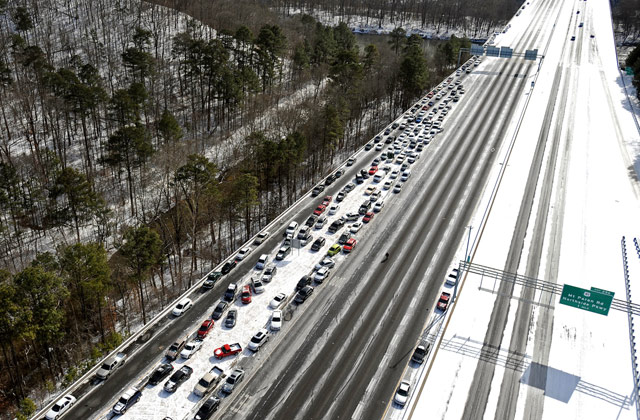
It sounds odd that a city would be digging out from a few inches of snow. But Atlanta residents were faced with a whole lot of chaos (and even more traffic) when they were hit with some unusually white weather.
We're talking about kids spending the night their schools, commutes a few miles that took more than ten hours, helicopters searching for stranded drivers, and a call to the National Guard for help.
From InFocus, here's a collection of photos that will give you a good idea of what happens when snowstorm hits a population not accustomed to that kind of weather.
Talking about the weather used to be a euphemism for talking about nothing. Now it can mean talking about everything.
Update: This is the best post I read about the snowfall in the South.
Tags: global warming weatherBut if you're making light of the situation, or more realistically using it to reinforce your view of the South and the people in it as full of backwards blubberers, you are an asshole. It's hard to remember sometimes, but things are different in places you do not personally live.
When it snows where you live, the salt and the snowplows are out on the streets before you even wake up. When you talk about six inches of snow in your city, you are almost definitely talking about six inches of snow on the median strip and shoulder, and highways that are slick, but clear. I'd take that over two inches of snow and ice on every major road any day.
When it snows where you live, it is the latest in a string of snowfalls that date back centuries. You own a car with four-wheel-drive for that very purpose. You may even own snow tires. This is great! You are prepared. But waking up in Birmingham to snow is like waking up in New Hampshire to quicksand.
30 Jan 16:33


Block & Tackle: Nobody cares that you don’t care about the Super Bowl
by John Teti
IKEA MonkeyYES
Sunday’s Super Bowl will be the mass media event of the year. It’s almost certain that more than 100 million Americans will tune in to watch. The game will be on the front page of every newspaper, and it will be the prime topic of conversation when you go to work on Monday. Maybe none of this matters to you. That’s fine! As long as you know that no one gives two shits about your decision not to watch the Super Bowl.
I’m talking to you, the graduate student who tweets “Time to catch up on my Proust” two minutes before kickoff. May you be struck with the flu on the day of your dissertation defense. And to you, the parent who takes his kids sledding on Super Bowl Sunday and posts a picture to Instagram with the caption “What football game?” Oh, and of course ...
30 Jan 16:30


Movie Review: With Best Night Ever, the directors of Disaster Movie hit a new low
by Ignatiy Vishnevetsky
IKEA MonkeyI love love love it when the AV Club absolutely HATES something
A joyless patience-tester so inept it doesn't even know how to cheat its own found-footage gimmick, Best Night Ever is the first non-spoof from Justin Friedberg and Aaron Seltzer, the writing and directing duo behind Disaster Movie, Meet The Spartans, The Starving Games, and countless other films in which references and impressions are substituted for jokes. Likely to be appreciated only by homeless viewers who need a quiet place to nap during the cold months of winter, the movie has more awkward dead space than jokes; highlights include a long, static night-vision shot of the characters sitting inside of a dumpster (four minutes, 45 seconds long), a dialogue-free montage in which they visit famous locations around Las Vegas (seven minutes, 20 seconds), and a mugging scene that devotes 90 long seconds to a shot of the characters handing over their belongings one at a time.
Taking into account the ...
29 Jan 23:27


Cheerios Awesomely Brings Back Biracial Family for Super Bowl Ad
by Kate Dries
IKEA MonkeyADORABLE
There will be at least one Super Bowl ad airing Sunday trying to be more meaningful than the men of Full House reuniting over yogurt or whatever idiocy GoDaddy has decided to roll out this year. For the first time ever, General Mills will be advertising for Cheerios during the game, in a commercial starring the same interracial family of actors featured in their attention-getting campaign that aired last spring.
|
|
29 Jan 15:52

Cheap Eats We Love in Humboldt Park
by Nick Kindelsperger
IKEA MonkeyOh man oh man. SO many great restaurants in this area. Cemitas Puebla, Flying Saucer, Kai Zan (though I wouldn't call it a "cheap eat"), Grandma J's... now I just need to try Joe Boston's and La Bomba Place bc those sandwiches look GOOD
VIEW SLIDESHOW: Cheap Eats We Love in Humboldt Park
After checking out the cheap eats in Lincoln Square and Ravenswood, it's time to head a little bit south to Humboldt Park. This large neighborhood is probably best known for its Puerto Rican community, a fact that is made very clear by the two 60-foot tall metal Puerto Rican flags along Division St. So it makes sense that this is also the home of the jibarito. Sadly, the restaurant that first served the dish, Borinquen, recently closed its location on California Ave., which explains its absence here. But not only are there other great jibarito options around the neighborhood, there are plenty of other kinds of restaurants to try. You'll also find one of the best Mexican restaurants in the city, a classic Italian beef stand, and one of my favorite sushi spots.

Check out all of the picks by by clicking on the slideshow, or scroll down to see the list.
The Boundaries

I first had to first figure out the borders, which was way more confusing than I expected. Like Logan Square, Humboldt Park is both a neighborhood and an official community area. To confuse matters, it's also the name of a large and beautiful park. That's all fine. Thing is, the border for the community area doesn't include anything east of that park, which most people consider to be part of the neighborhood. Sometimes this area is referred to as East Humboldt Park, even though it's actually in West Town. For this article I decided to include East Humboldt in with the rest.
Cheap Eats We Love in Humboldt Park

- Milanesa Cemita at Cemitas Puebla
- Italian Beef from Joe Boston's
- Hot Dog and Fries at Jimmy's Red Hot
- Gobi Manchurian from Rangoli
- Tofu Sweet Potato Hash at Flying Saucer
- Sweet Potato Tacos at Bullhead Cantina
- Taco de Pollo at La Encantada
- BBQ Chicken Sandwich at Feed
- Chicken Jibarito at Papa's Cache Sabroso
- Lechon Sandwich at La Bomba Place Food Truck in Humboldt Park
- Jibarito at Coco
- Escolar Pearls at Kai Zan
- Pozole Rojo at Pozoleria San Juan
- Al Pastor Taco at Birria Huentitan Restaurant
- Bistec Sandwich from Diana's Restaurant
- Morning Sandwich at Grandma J's Local Kitchen
More Cheap Eats Guides!
- 22 Cheap Eats We Love in Lincoln Square and Ravenswood
- 15 Cheap Eats We Love in Chicago's Chinatown
- 21 Cheap Eats We Love in Pilsen
- 19 Cheap Eats We Love in Bridgeport
- 14 Cheap Eats We Love in Chicago's Bucktown
- Cheap Eats We Love in Chicago's Wicker Park
- 32 Cheap Eats We Love in Lakeview
- 20 Cheap Eats We Love in Lincoln Park
- 21 Cheap Eats We Love in Chicago's River North
- 26 Cheap Eats We Love in The Loop
Augustevening, Crowtrobot likes this
29 Jan 15:46
Rare winter storm paralyzes Atlanta, strands thousands of schoolchildren
by Erin McClam and Alexander Smith, NBC News
IKEA MonkeyMy company's HQ is in Atlanta. No wonder its been a slow work day.
A rare winter storm glazed the South with snow and ice and paralyzed the city of Atlanta, which was so choked with traffic that drivers abandoned their cars and trudged to churches and home-improvement stores to spend the night.


28 Jan 18:15
Los Angeles Is Miserable: Los Angeles Is Finally Starting to Run Out of Water
by Mike Pearl
IKEA MonkeyLA is a nightmare. Watching California slowly kill itself is depressing.
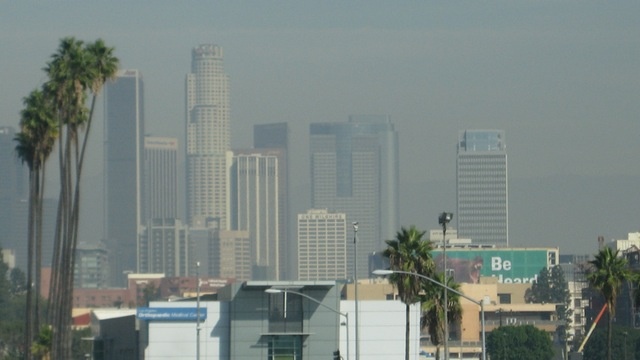
Image via
In LA, we know our region cycles between El Niño years and drought years, but we don't have many bone-dry years. Right now is the driest the region has been in 163 years of formal record keeping. It's also probably the driest it's been in 500 years, and a sign of LA's bleak future. The word "drought" has lost all meaning to us though. Our utilities have done a brilliant job of keeping us comfortable, with plentiful running water, while every part of our region without plumbing wilts to a crisp.
Talk to older Southern Californians and they'll throw up finger quotes when they use the word "drought." They'll blame politicians and environmentalists for droughts as though they control the weather. In Sacramento, there's so much finger-pointing and leftover bitterness from the last drought, or the one before, or the one before that, that we forget to notice that our hills are on fire, bears are wandering into our cities, our air is toxic, and some of our unique flora and fauna face extinction in months, not years.
Screencap via
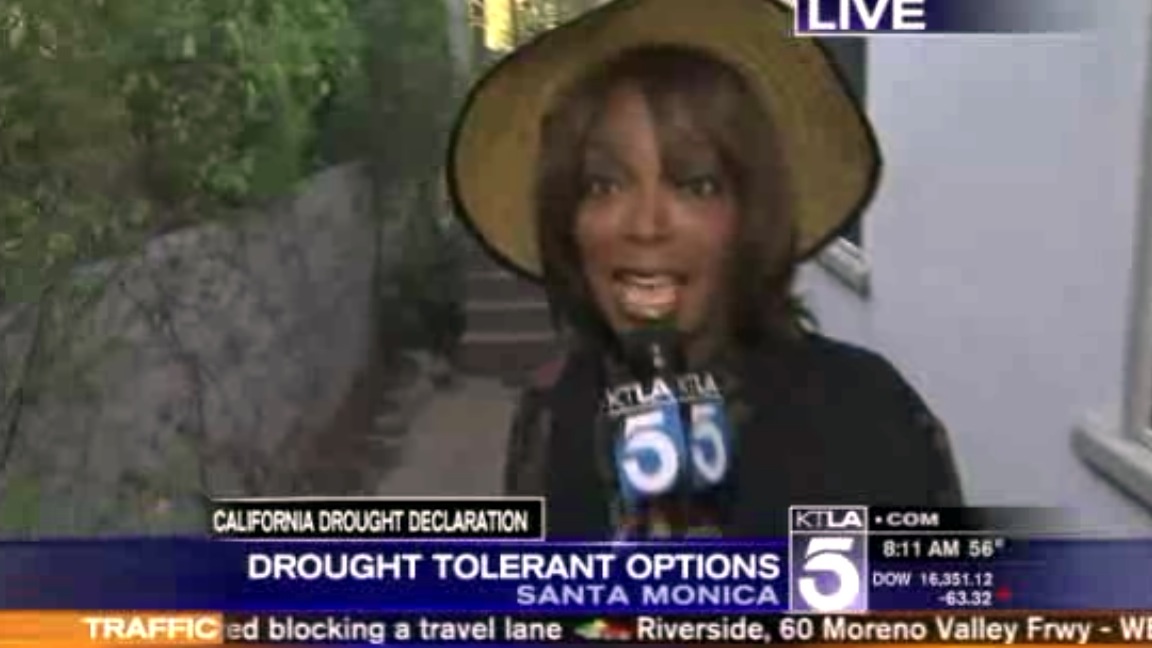
When Governor Jerry Brown declared a statewide drought emergency, he told us all we need to use 20 percent less water. Local news reports about the drought are idiotic, and basically tell you what products to buy. Reporters tend to parrot the talking points provided to them. Debbie Arrington of the Sacramento Bee urges you to conserve in the well-intentioned article, "Drought makes water saving a household necessity." It features advice like, "A 20 percent cut represents 76 gallons. Think of it as two loads of laundry or seven short showers."
Great. Saving water and putting less strain on the water districts is a good thing to do. However, my toilet is already so low-flow it just asks my turds nicely to go down the drain. My showerhead is like standing under a sleeping baby.
Granted, local news is just supposed to be a comforting slurry of news-flavored distraction, and I really don't believe it needs to shake viewers into some kind of environmentalist hysteria. Still, there's a point at which telling people to plant native flowers available at your local Lowe's goes from mawkish and bland to Orwellian. I've been hearing the conservation message since I was in kindergarten and it all runs together. Conservation is a small part of the story this year.
So what's the "story," smart guy?
The story is that LA is California’s drain hole. The imperative to keep our megalopolis going comes with zero regard for what that costs the surrounding region. LA is piped into the rest of the state's water supply via the Edmund G. Brown California Aqueduct—named after our current governor's father. The state is a tangle of water conveyance channels and pipes, with farmers, politicians, and environmentalists fighting the same water war William Mulholland fought almost a hundred years ago. Driving up the I-5 freeway from Los Angeles to San Francisco, you'll pass huge banners on fallow fields reading, "End the Congress Created Dust Bowl," and "Food Grows Where Water Flows." The farmers get furious about losing water rights to other farmers, or worst of all, endangered species.
The Los Angeles water supply hangs from a gossamer thread, but for all we know, we're flush with water. The Los Angeles Department of Water and Power (LADWP), says we're prepared. Here in Los Angeles, we hardly care about local rainfall. While explaining his job to me, a former Southern California water district official confided that the people who manage water utilities in Southern California are so focused on the buying and selling of water that a rainy year is something of an irritation. Despite their valiant attempts to capture the rain, most of it gets channeled into the sea, which is a frustrating waste that they lament as they return to buying from a wholesaler.
To try and understand the situation, I talked to LADWP spokesperson Jane Galbraith about this. "The Los Angeles Aqueduct is providing 20 percent of our water this year,” she told me, referring to the Mulholland-designed aqueduct that conveys water from an area just north of our city. “It provides 75 percent in a wet year," she went on. As for the rest? "We're buying water from Metropolitan Water District," she explained. "They're the wholesaler. We'll be buying 80 percent from Met." Buying from a wholesaler is more expensive than using the water that just flows in from the Owens Valley that supplies The Los Angeles Aqueduct, so prices will go up, but at the moment, there's no real danger of running out. In theory.
But where does this mysterious Metropolitan Water District get its seemingly limitless supply of water? Partly it's from the California Aqueduct, which flows down from NorCal. But what really keeps our fountains pointlessly flowing here in Southern California is the Colorado River Aqueduct.
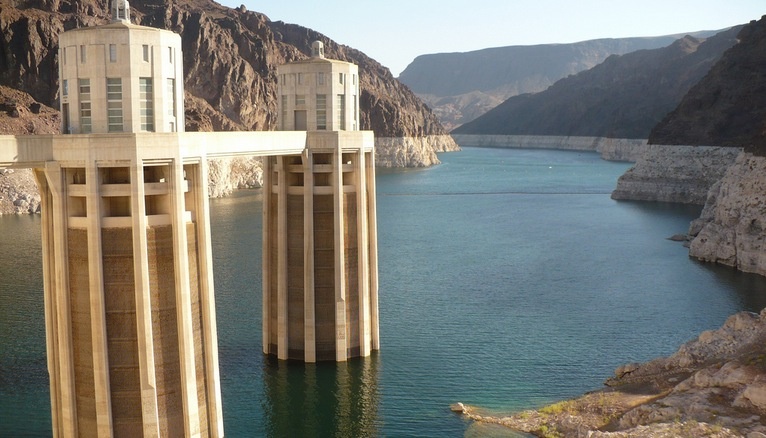
The decline of the Colorado River via
"On [offshoots of] the Colorado River, they're built huge reservoirs: Lake Mathews, Lake Skinner, Diamond Valley Lake." These popular recreation lakes are big enough to surf in, but they're really just some of the world's largest water storage facilities. So Metropolitan Water District has water for Los Angeles, and every other county in Southern California. "They've never reported a shortage for Los Angeles," Galbraith told me, without adding the word "yet."
Despite recent flooding in Colorado, the Colorado River is in a drought of its own. That is especially terrifying, when you realize that the Colorado River has already been in decline for decades. But you'd never know it by looking at the huge lakes we call revervoirs. We're legally entitled, along with smaller cities like San Diego and Phoenix, to drink a set amount of the Colorado River each year, which lets us feel blameless, even as we read stories about the Mighty Colorado becoming a creek, and Lake Mead disappearing by 2017 over our morning coffee made of water that's piped in from those very places.

Screencap via CBS
Wait. Why does LA get to drain the Colorado River?
For almost a hundred years, we’ve been preparing for a dire water apocalypse, and this is it. We're draining our vast reservoirs to stay alive for the time being, but we're not acknowledging that our city got here through feats of engineering combined with chicanery, fraud, and hubris in the first place.
If you learned everything you know about the history of LA’s water from Chinatown, you've had a taste, but you don't know much. Pre-Columbian Los Angeles had enough water for a fishing settlement where the not-so-mighty Los Angeles River trickled into the sea. Later, western settlers turned it into a bunch of connected commercial areas, and then a big, sprawling town, but there wasn't, and isn't, and never will be enough naturally occurring water here to sustain a world-class metropolis. Then an Irish huckster named William Mulholland moved in.
Mulholland was a self-taught engineer overseeing the flow of water into LA via a makeshift ditch put in place by the Spanish. Managing LA's water meant Mulholland combated drought every few years. He and his boss, Frederick Eaton, the 24th mayor of LA, saw bigger things for the City of Angels, and were willing to lie, cheat and steal to make them happen. All Mulholland and Eaton had to do was trick the farmers of the Owens Valley, north of LA, into giving up the rights to their own water.
Eventually, the farmers got wise, and waged economic warfare via price hikes, which Mulholland resisted. They waged a bloodless resistance campaign against Mulholland that newspapers called "California's Little Civil War." In response, Mulholland sent a small army, and gave them shoot-to-kill orders. Later, Mulholland pulled a similar prank on communities to LA's northwest by building the St. Francis Dam. That time, however, the war wasn't bloodless. The dam failed immediately following an inspection by Mulholland, and as many as 600 people died.
Still, Los Angeles, with its now plentiful water, expanded and became the way-too-spread-out city it is today, all because the 20th Century was a wet century. The 21st Century is looking dry.
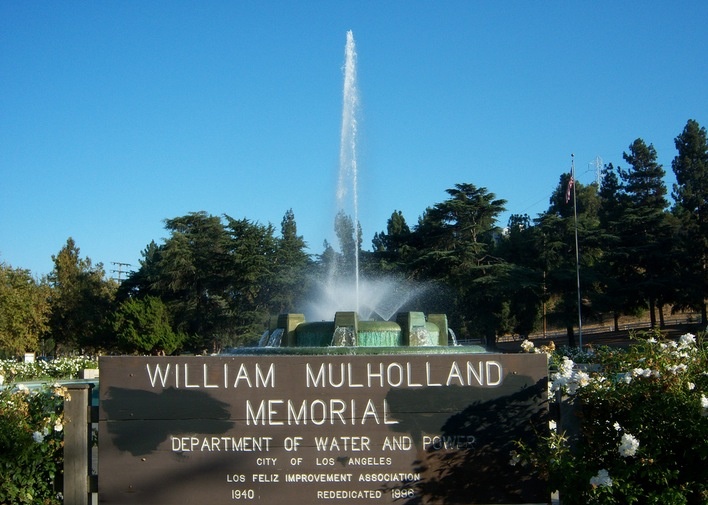
Image via
So we should do what? Give the water back?
The environmentalist in me can't justify diverting more water from the Sacramento River Delta, like in Jerry Brown's contentious twin tunnel plan, but as a human, my fellow humans need water. Similarly, the Colorado River once fed a brackish ecosystem near the Sea of Cortez in Mexico. That's all ancient history now, and that delta is barely a trickle. We're doing the same for every source of water in the Southwest. We need every drop for ourselves. To accommodate the perverse placement of our human settlements, we're second-guessing the knowledge of erosion and remaking our state's waterways in the manner of our choosing.
In short, we've been flipping off Mother Nature for a century, but we're still losing. Maybe we can't have a city here after all. Time to pack up and go, everyone. We gave it our best shot.
Of course, my proposal to dismantle and relocate Los Angeles probably won't be popular.
What now?
California's natural beauty is going to shrivel up sooner than humanity here will. An ecologist named Craig Allen told National Geographic a few years ago, "The projections are that Joshua trees may not survive in Joshua Tree National Park. Sequoias may not survive in Sequoia National Park." We may have to start weighing the idea of irrigating our national parks.
LA's air quality, something that was improving my whole life, is now taking a nosedive. It had been nice finding out that Los Angeles had a skyline, but forest fires and low humidity are bringing back smog in a big way. The Inland Empire, the area of the LA suburbs where I'm from, is starting to get dust storms. We're being told not to have fires in our fireplaces. Clinics are starting to treat people for pollution-related breathing problems, potentially leading to greater numbers of smog-related deaths.
Never fear, though. Thanks to snow machines, we can ski. Our fake lawns will remain green. Saveh20.org has fun garden ideas. We can be prepared for this drought, Los Angeles.


28 Jan 14:56
Los Angeles Is Miserable: What Makes People in Los Angeles Miserable?
by Grant Pardee
IKEA Monkeylol @ "Matt"

The LA2020 Commission report infamously claimed that almost 40 percent of the population of Los Angeles lives in "misery." They point to high poverty rates, long commute times, and local government’s slowness in fixing the city’s vital infrastructure.
Looking to put a face to the drudgery, I decide to put on my cub reporter press hat and gumshoes to find out what's making people in Los Angeles miserable:

Photos by Nate Miller
Tatsuo, 45, street preacher: The fundamental reason is they’re alienated from God and trying to find happiness in love, sex, money, anything here on Earth—alcohol, whatever. That can provide temporary happiness but it fades away quick. When you know God through the Lord Jesus Christ, there’s a joy unspeakable. Nothing can alter that, there’s an absolute confidence in that. Nothing can separate or impact that—the economy or cancer, nothing. In Christ Jesus, knowing God, walking with him, once this body dies, having eternal life. That’s what matters.
Are you happy?
I know what I’m doing. The Lord called me to do this. And in fulfilling that call, that’s where my happiness is at. Is it easy? No. You get ridiculed, spit on. It’s not a popular job. People think you’re crazy, from the world’s perspective. I know I look like a nutcase, but I know God. And if you know God, nothing else really matters. You’re not moved by popular sentiments or mood trends. When you know Jesus, you’re not affected by that.

Jerry, 70, peace activist: It’s hard being an activist and feeling happy when there’s so many injustices in the world. That’s why I started the activist support circle. "Happy" is a nebulous word. Is happiness the absence of extreme sadness? Is peace the absence of war? I think it’s more than that we get part of our soul robbed from us all the time when we have to stand up to all these injustices, when it seems like they shouldn’t be happening. There shouldn’t be starvation, there shouldn’t be war—killing people and justifying it or trying to. As an activist, it's very difficult to feel happiness because that’s what you do all day. You’re organizing and demonstrating and protesting. People say, "well, why protest? Isn’t that a negative thing?" The word “protest” is derived from “pro” and “testifying," so it’s not a really negative word. But other activists can sometimes feel negative when they’re speaking out against injustices. It’s very difficult to smile. I used to be able to smile more graciously, more freely. Now, my brow is constantly furrowed. I feel like something is missing from me.

Michael, 32, lawyer: Life in LA for anyone who’s got big goals, there comes competitiveness… and people have unrealistic expectations on how easy it is to achieve those goals. As I’ve met entrepreneurs or actors, they have too many ideas or goals or whatever and people fall into a trap of not being able to focus on one thing. In a town like LA, that is difficult for people, because you need to be able to be fully focused on one thing.
How are you? You seem pretty relaxed.
I’m happy. A town doesn’t make you happy in and of itself. It’s the relationships you have with people that gives you happiness. I think reliability from relationships you build would make anyone happier, where that’s LA or anywhere. There’s a lot of smart and talented people here, but once you accept that it’s going to be tough and challenging, you know… I’ve lived in New York, London, Sydney, and Los Angeles. I think if you’re a good and honest and genuine person you can have meaningful relationships anywhere. LA, sometimes it just depends what you actually want from a relationship.

Brooke, 34, account executive: I think it’s the culture. Most people here are aspiring to be their dreams and they’ll be willing to step on anybody to get there. It’s just different.
Would you say you’re happy?
I’m happy. I have a dog, I go out with friends. I think living close to where you work and your friends helps with happiness. I’m in Culver City, so I’m in-between a lot of things but I wish people were closer. I’d be happier if I had more friends in my neighborhood. In LA, people stay in their neighborhoods because it’s an easier life.

Nancy, age not given, retired special education administrator: I’m trying to get out of LA as much as I can. The city has changed. LA doesn’t promote community and it doesn’t promote friendship. Everything is blocked, whether its blocked walls or schlepping from the Northwest Valley to Commerce to go to work. It’s not a good place. I don’t know if it was when I moved here. I moved and found great friends and I don’t want to leave them but at the same time I want to get out of the city.
To where?
We like Naples, Florida. I like Asheville, North Carolina—beautiful, very friendly, very welcoming.

Tammy, 20, special education tutor: I’m happy! I love living in LA. Yeah, there is stuff that’s wrong but its just your perspective. There’s two sides to it. Sure there’s homeless people and like, there’s murders, but if you’re doing your own thing and spending time with people you enjoy spending time with you can be happy in miserable LA. I’m pretty satisfied.
What makes you satisfied?
My friends. My family makes me happy. I don't know. I like the beach, marijuana. I like clubbing. Vanguard, Avalon, Rage. Bar Sinister on Saturdays. The Viper Room. I’m into 80s and 90s punk. I haven’t been to a show in a while. I look for crowds. If the crowd doesn’t have a good vibe, if I walk in and I’m like, "ehhhh?" And people think they know the music but they don’t? Not into it. I guess I’m more on the positive side? Some people are too miserable. I don’t know why they’re miserable though. You should look up at the stars at night.
You can’t see the stars in LA.
Yeah, once you get out of LA, you can see the stars.

Ken, 47, floral designer: It took me a long time but now after 25 years I feel happy. My days are up, down, up, down. I worked today, so that was good. Happiness can be a lot of things; basically being comfortable. For me, I grew up very poor so being in LA, there’s everything here. I get to be around celebrities and rich people every day of my life. People respect me. You have to have something going on or else you will fail. LA can be tough but any city is tough. I lived in Chicago, Miami, you know. This is the longest place I’ve been which is a testament, I guess.

Jessica, 26, location scout: Well, it’s because half of the people come to LA to pursue their career and half of them end up waitressing. It’s talent—half the people out here don’t have it, in my opinion.
Do you have friends that are like that?
Some of my friends are those people. They think they can come here and wait around for something to come, and it doesn’t. Most people in my world are miserable, but that’s because most of my friend base works at a specific location that doesn’t give them any sort of future growth and so they’re just stuck there.

Ashley, 26, student: I think people are unhappy because of the air quality and the food choices. Especially in my neighborhood, like, within a square mile, there’s [nothing but fast food], another fried chicken place, a taco place where I fucking find metal in my food, and I’m trying to be vegetarian, vegan. It’s fucked up. It’s a food desert. When they chop down the 14 acre—off of 41st & Alameda—it didn’t allow our air to be cleansed, and a lot of the industrial stuff happens down there. So that’s why I’m unhappy. I don't know about everybody else. We need a big-ass air purifier. What was that movie from the 90s with Pauly Shore?
BioDome?
Yeah. We need to figure that shit out. Like, I take the bus and when I get off the train, I walk past a lot of car shops doing shit they have no business doing. The air is nasty.

Matt, 28, puppeteer/writer/retail clerk: 40 percent sounds high, but is that 60 percent who don’t think they’re miserable? But it’s a daily grind. Getting out there every day—having to work retail jobs and waitressing—you can do that to any part of the country, but you moved out here to do what you want to do. I was miserable before LA. I moved out here to be with someone and that fell apart recently so right now I have higher misery. Before that I was in Pennsylvania, in just a shitty town, not doing much, especially with writing and puppeteering—so moving out here made sense when I was with someone. And now I’m still working toward those goals, but it was better a few months ago when I was still with someone. So now, I’m more miserable, and I guess LA helped contribute to that. On the other hand, I am happier, career-wise. I’m moving forward; slowly, but moving forward.
Grant Pardee is a writer/comedian who escaped the hellish Ohio winters to follow his dream of writing for VICE. Congrats, Grant! You made it! See him and other VICE west coast contributors at ENTITLEMENT; Wednesday, Februrary 5th, with headliner Greg Proops at Los Globos on Sunset Blvd. in Silver Lake.
28 Jan 05:07
NSA spied through Angry Birds, other apps: report
by Raphael Satter
IKEA MonkeyWell duh
LONDON — Documents leaked by former NSA contractor Edward Snowden suggest that spy agencies have a powerful ally in Angry Birds and a host of other apps installed on smartphones across the globe.


28 Jan 01:27
Vial of Pope John Paul II's blood stolen from Italian church
by Claudio Lavanga, Producer, NBC News
IKEA MonkeyNic Cage wanted for questioning
ROME -- A relic containing drops of late Pope John Paul II's blood has been stolen, Italian authorities said Monday.The vial was stolen from the Church of San Pietro della Ienca in the mountainous Abruzzo region in central Italy on Saturday.


28 Jan 00:57
 CPS CEO Barbara Byrd-Bennett, in a statement, said schools will "remain closed until we are confident that students can return to school safely." [ more › ]


Chicago Public Schools Will Remain Closed Tuesday
by Chuck Sudo
IKEA MonkeyCold is no joke. though our local YMCA is open and has a program called "School's Out" that runs from 8 am to 6:30 pm, and provides supervised activities for any kids who don't have an adult at home to watch them during the day. They get breakfast, lunch, and a snack. Its a good program and makes me glad I support and am a member of my local Y.
CPS CEO Barbara Byrd-Bennett, in a statement, said schools will "remain closed until we are confident that students can return to school safely." [ more › ]|
|
28 Jan 00:30


Girls: Hannah Horvath Is a Jezebel Commenter
by Tracie Egan Morrissey
IKEA MonkeyJezebel's insistence on hating everything Lena Dunham does is so juvenile and stupid and I may have to unsub from this stupid blog because it has become a totally petty gossipy blog now instead of a forum for actual feminist change
That Hannah Horvath is a Gawker reader and Jezebel commenter is undoubtedly quite upsetting to the many Gawker and Jezebel commenters who've disparaged Girls, its characters, and Lena Dunham herself. But it's perhaps the most clever dig Dunham has issued to her haters yet.
|
|
28 Jan 00:15
In Today’s Landfills, Food Is Embalmed for Decades at a Time
by Lauren Rothman
IKEA MonkeyPretty cool

Compost at the Delaware County's compost plant.
We had been warned of the pervasive power of the stench.
It was a cold, snowy morning in the Catskills, and as our suddenly-too-small car picked its way along the icy road, the acrid, nose-stinging odor of decomposed banana peels, old coffee grounds, and—oh yeah—a melted deer carcass wafted out of our clothing in full force. I began to panic, recalling the Seinfeld episode “The Smelly Car,” when Jerry’s BMW becomes permanently infected with the reek of a valet’s B.O. I wondered if the vehicle I had borrowed from a friend would ever recover from the stinky trials I was now exposing it to.
Earlier that morning, my companions and I had toured the Delaware County landfill, a six-acre dump and compost facility servicing the upstate New York region’s 48,000 residents. Andy Zuk, the compost plant’s affable, middle-aged manager, had received us inside of his bright, tidy office, where he encouraged us to pile our coats, scarves, and sweaters before entering the dark, damp domain where the county’s 70 million pounds of trash is sorted every year. It’s also the space where its food waste is converted into 15,000 yards of light, fluffy, fertile compost.
I told Zuk that I thought I might get chilly and that I’d hang on to my sweatshirt.
“If you’re going to lunch later, and you’re going to be around other people, you might want to reconsider,” he replied.

Andy Zuk shows off the finished compost.
If you’ve never seen an active landfill, it’s more than likely that you’re nowhere geographically close to one. Large-scale dumps are unsustainable in densely packed urban areas, where their insidious odors offend residents’ sensibilities and—more gravely—can cause asthma, cancer, and other serious health effects. Most major cities opt for trucking their trash out West, where there’s a lot more space and a much lower risk of making people ill. New York City closed its last municipal landfill—Fresh Kills on Staten Island—in 2001. Today, the city sends its garbage to far-flung sites in Ohio, Pennsylvania, South Carolina, and Virginia.
On top of impacting human health, landfills have a dreadful effect on the environment: they produce enormous amounts of methane, a greenhouse gas that contributes disproportionately to global warming. Methane’s effect on the atmosphere is 21 times greater than carbon dioxide’s over a 100-year period.
But the source of this methane isn’t something toxic. It’s rotting food. It might seem like an apple core or cheese rind thrown in with the trash would break down quickly, but the opposite is true. Sealed up in plastic garbage bags and buried under pound-upon-pound of plastic, glass, and paper, these scraps begin to break down at a rate far slower than you might think. Those plastic bags that contain our food waste limit their exposure to oxygen and pests, the two factors that make short work of food waste when combined. Instead, in this dark, anaerobic environment, decomposition happens very slowly, and the food releases far too much methane throughout the process. Deprived of oxygen, the food barely breaks down. The results can be found at the bottom of old landfills, where you’ll find pristine heads of lettuce and rolls that look good enough to make a sandwich.
Some insight into this mysterious process was provided in 1992, when the archaeologist, William J. Rathje, published his book Rubbish! The Archaeology of Garbage. The now deceased Rathje was a professor at the University of Arizona in Tucson, where he founded the Garbage Project in 1972. For over 20 years, he and his teams of student volunteers excavated more than 21 active landfills, approaching these modern-day refuse piles almost in the same approach that archaeologists have always investigated ancient trash heaps—like giant mounds of evidence of human culture and their habits, both good and bad. But the data that the garbage project amassed didn’t just further understanding of humans’ garbage habits; it also shed light on some of the science behind trash. Namely, that organic matter cached in landfills doesn’t really decompose. It mummifies. In a 1992 interview with the New York Times, Rathje recalled an order of guacamole he recently unearthed. "Almost as good as new, it sat next to a newspaper apparently thrown out the same day. The date was 1967.”

Above, non-compostable waste travels down a conveyor belt on its way to the trash compactor.
Zuk, the compost plant manager, told me that he was familiar with the embalmed-food phenomenon. The landfill over in Binghamton, he said, was thinking recently about trying to do some on-site composting. As research, they dug around in their landfill to see what was down there.
“They found a 10-year-old pack of hot dogs, good as new,” Zuk said.
But you won’t find any ageless food scraps at the bottom of the Delaware County landfill, because you won’t find any food in there at all. In 2005, the dump built its state-of-the-art composting facility, a three-acre building where every single bag of residents’ trash gets sorted by machines. The food waste is spun out and composted in a superefficient bioreactor that converts organic materials into compost in three days with the help of these machines. Recyclables are recovered, and the remaining garbage gets compacted before being added to the landfill. Sixty-five percent of what residents bring in to the plant is compostable, but only 35 percent of waste at the site goes into the landfill. The trash sorting is the source behind the all-powerful odor of garbage, but the smell dissipates throughout the composting process, resulting in a completely odor-neutral product.

Above, a huge rotating drum filters out non-compostable waste, which gets compacted before going to the landfill.
Zuk led us to that bioreactor, a 180-foot-long tube with a 14-foot diameter that rotates 24 hours a day. Inside, insects and microorganisms break down the food waste, a process that produces immense heat—the bioreactor’s contents regularly reach 180 degrees—which, in turn, accelerates the breakdown process. Within three days, even the largest food items are totally decomposed.
“I’m gonna tell you right now, I threw a whole deer in there once. At the end you didn’t see anything but the clean bones,” Zuk recalled.
The compost produced is then aged in 14 huge bays—concrete areas where large quantities of compost are stored—for a minimum of 90 days before being sold to local landscaping and public works companies for $10 per yard, which brings revenue back to the plant.
“You’re taking garbage and turning it into money,” Zuk said.
While neighboring Montgomery, Otsego, and Schoharie counties truck their residents’ garbage out West, Delaware’s compost plant has extended the life of its landfill by at least 20 years. In the future, the dump might even excavate its older, overgrown trash heaps and run those through the bioreactor, adding even more longevity to the site.
“In my opinion, it’s the Cadillac of composting facilities,” Zuk said of his plant.