IKEA Monkey
Shared posts
04 Aug 17:47
Melting Chocolate Poké Ball Reveals Hidden Pikachu Macaron Inside
by Chris Durso
IKEA MonkeyCute
If you’re still on a quest to “catch ’em all,” then you’ll want to add “Delicious Macaron Pikachu” to the list. Created by Dalmiin Baking Studio, the chocolate Poké Ball is intricately created out of chocolate, while our friend Pikachu the macaron hides inside. Pikachu is found after heated chocolate is poured over top. Just remember […]


04 Aug 14:42
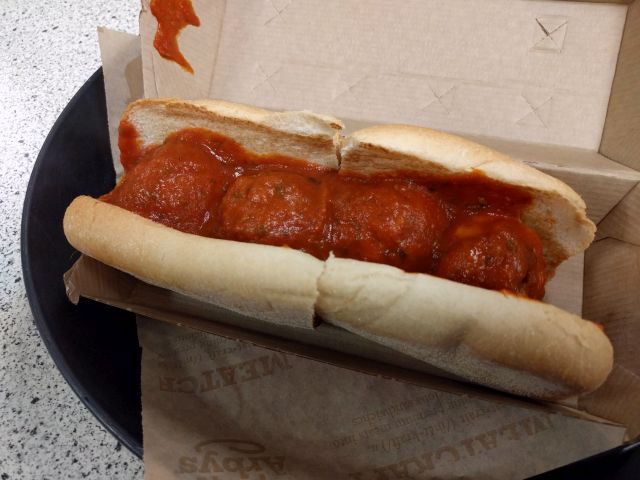 Arby's Italian Meatball Sub features four Italian meatballs, roasted garlic marinara, and provolone cheese on a toasted sub roll.
I bought one for $5.59.
The meatballs are quite large and enough so that you get some meaty goodness in every bite. They pretty much are enough for every bite from end-to-end. There's a light seasoning to them and they were moist with a soft, spongy feel.
 The marinara offered up a strong, tangy tomato quality with just a mild bit of garlic and very little sweetness. There was plenty of it to cover the meatballs but not so much that the sandwich was falling apart.
The cheese was placed under the meatballs so that it was thoroughly melted and stretched out nicely when I pulled the two halves apart. There seemed to be more on one half than the other.
 The roll was soft and slightly chewy, which held up to the sauce rather well. There was just a slight bit of crustiness to the surface for added texture.
Overall, Arby's Italian Meatball Sub was really good with all the requisite components substantially present but also balanced.
Nutritional Info - Arby's Italian Meatball (332g)
Calories - 820 (from Fat - 420)
Fat - 47g (Saturated Fat - 20g)
Sodium - 2260mg
Carbs - 57g (Sugar - 7g)
Protein - 39g


Review: Arby's - Italian Meatball Sub
by Q
IKEA MonkeyI was into it until I saw the color of the meatball innards
I bought one for $5.59.
The meatballs are quite large and enough so that you get some meaty goodness in every bite. They pretty much are enough for every bite from end-to-end. There's a light seasoning to them and they were moist with a soft, spongy feel.
The cheese was placed under the meatballs so that it was thoroughly melted and stretched out nicely when I pulled the two halves apart. There seemed to be more on one half than the other.
Overall, Arby's Italian Meatball Sub was really good with all the requisite components substantially present but also balanced.
Nutritional Info - Arby's Italian Meatball (332g)
Calories - 820 (from Fat - 420)
Fat - 47g (Saturated Fat - 20g)
Sodium - 2260mg
Carbs - 57g (Sugar - 7g)
Protein - 39g
Read more at Brand Eating!
04 Aug 01:17

What Is a Heel Spur?
by James Hamblin
IKEA MonkeyHm, weird, I thought Trump was the healthiest presidential candidate ever in all of history
Most of the real cowboys in America are dead, but in our memories they wear spurs off the backs of their boot heels, small torture devices for the horses that afforded these men their livelihoods.
So when terms like “heel spur” or “bone spur” are used in a medical context, they conjure something analogous—a spike of bone projecting backward like a talon. But that is not a thing. The human body does a lot of amazing things, but that’s not among them.
Today The New York Times has a thorough investigation into the military draft history of Republican presidential nominee Donald Trump. Publicly available documents show that after education deferments, Trump received a medical deferment due to a bone spur (or two, depending by varying accounts).
“I had a doctor that gave me a letter—a very strong letter on the heels,” Trump said in a recent interview with the Times. Today’s article also notes that in the 2015 biography The Truth About Trump, author Michael D’Antonio described Trump slipping off a loafer and displaying a tiny bulge on his heel.
Thirty-eight percent of people have a heel spur, according to a 2014 trauma-clinic study. In my time as a radiology resident, noting heel spurs on X-rays was routine. According to the American Academy of Orthopedic Surgeons, only about five percent of people with spurs have any pain at all.
Heel spurs usually happen on the sole of the foot, though, and would not create a visible bulge. Spurs are deposits of calcium that protrude at the points where ligaments attach to bone. The most common heel spurs extend from the calcaneus (which is the bone that forms the human heel), and they come off of the front of that bone, at the point where the plantar fascia attaches to the calcaneus.
Spurs can sometime grow upward from the calcaneus at the point where the Achilles tendon attaches. This tends to happen in older people with rheumatic diseases and in serious athletes. Larry Bird played for a season with spurs at the Achilles insertion—some blame his poor performance agains the Pistons in the 1988 conference finals on the spurs—before undergoing surgical removal later that year.
Trump played high-school basketball, but he would’ve been an extremely rare case to have been debilitated by spurs at 22, especially of the sort that required no surgical intervention (he admits to having none) nor any other discernible treatment (according to his medical record).
Much more plausibly, as Trump also admitted to the Times, the spurs were a “minor” problem.
There is a tradition of avoiding the Vietnam draft among recent American presidents, so this would not itself set Trump apart. What would set him apart is having done so and then criticized the contributions of veterans and their families—of John McCain and Humayan, Khizr, and Ghaala Khan—while claiming to have sacrificed himself in a different way, by building a real estate empire.
The case of the heel spur only calcifies the case that, as Warren Buffet said yesterday, “Trump and his family have sacrificed nothing.”
04 Aug 01:13

‘Stranger Things’ and the Benefits of “Nostalgia Casting”
by Lara Zarum
IKEA MonkeyBARB FOREVER
As a viral swarm of reboots continues to invade our screens, we’ve become accustomed to getting our nostalgia fix via the reanimated corpses of childhood favorites. But Stranger Things is a different creature, an original story that hits the same nerve as a remake: It envelops viewers in the warm waters of familiarity, a sensory deprivation tank where our minds our free to float back to a time when faux-wood panels lined our walls and kids went outside to ride bikes instead of chasing virtual monsters on their phones. Created by brothers Matt and Ross Duffer, the Netflix original was released less than three weeks ago, yet somehow it already feels like a cult classic.
Stranger Things — about a group of kids (and one very determined mother) in the fictional town of Hawkins, Indiana, circa 1983, who band together to save their missing friend from a mysterious, otherworldly creature — taps into a potent nostalgia for ’80s-era, kid-friendly supernatural thrillers like The Goonies and E.T. Having Winona Ryder play the mother of the missing boy, Will Byers (Noah Schnapp), is itself a neat bit of “nostalgia casting,” i.e., when a famous actor whose star has faded pops back onscreen in an unexpected role — particularly, in these boom TV times, when a film actor makes the move to the small screen. It’s John Travolta hamming it up as Robert Shapiro in The People vs. O.J. Simpson, or, in that same series, David Schwimmer making an unexpected star turn as Robert Kardashian (OK, it’s basically everyone in The People vs. O.J. Simpson).
But the real “nostalgia casting” on Stranger Things is the selection of the stellar young actors, who make it easy for viewers to revel in a different kind of nostalgia than the “hey, look, it’s that actor from that show I loved 20 years ago” variety. Finn Wolfhard as group leader Mike; Millie Bobby Brown as the telekinetic, government-manipulated Eleven; Caleb McLaughlin as the skeptical Lucas; Gaten Matarazzo as the dynamic Dustin, the show’s comic relief; Natalia Dyer as Mike’s teenager sister, the sensitive, intelligent Nancy; Shannon Purser as her geeky best friend, Barb; Joe Keery as Nancy’s cool-dude love interest, Steve; and Charlie Heaton as Will’s older brother, the social outcast Jonathan — all these actors bring Stranger Things to life, creating a world that feels intimate, authentic, and familiar despite the fact that we don’t recognize most of the faces onscreen.
Casting director Carmen Cuba (to whom we owe a great debt: she also cast Magic Mike and its sequel, Magic Mike XXL) took her inspiration from films that feature dynamic groups of children, or young people forced by circumstance to grow up way too fast. She re-watched Stand By Me, Pan’s Labyrinth, Jaws, E.T., and Freaks and Geeks when preparing to cast Stranger Things. For Cuba, the chemistry of the group was more important than any one actor: “It really is almost as if that group was a role unto itself,” she wrote in an email to Flavorwire, “because until we had them all in place we couldn’t really pull the trigger on any one of them.”
What this cast of young, talented, unknown actors brings to Stranger Things is the same thing the young, talented, and then-unknown cast of Freaks and Geeks brought to that show, also set in the early 1980s: Actors who look like real people add texture and authenticity to a show set in the past — like a set-dresser choosing to decorate an ordinary living room with a shabby couch and threadbare knit blanket versus a sleek leather sofa. This is particularly true for a show set in the 1980s, that notorious nadir in fashion, design, and hairstyles.
When I think of Reagan-era beauty standards, I think of Molly Ringwald vs. Haviland Morris or Blanche Baker in Sixteen Candles; the mousy brunette set against the blonde bombshell with legs for days. I think of my weekly trips to Blockbuster as a kid, puzzling over the covers of ’80s movies that always seemed to feature the cast peering out from between a woman’s legs. Judging by those covers, in the ’80s, it was cool to look like you’d just stepped out of plastic Barbie-doll packaging.

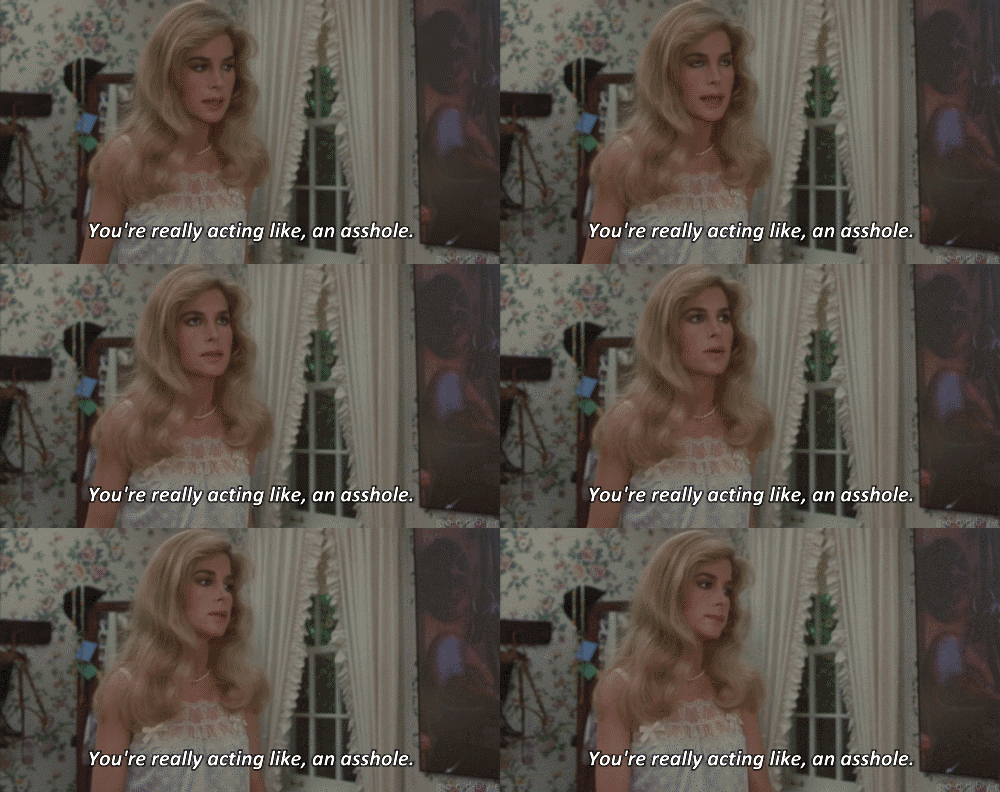
But the teenage characters in Stranger Things don’t look like vacuum-sealed figurines; they look like real people. With the exception of 22-year-old Charlie Heaton, the teens on this show are played by actual teens (unlike 25-year-old Haviland Morris or 24-year-old Michael Schoeffling playing teenage lovebirds Caroline and Jake in Sixteen Candles). Purser — who makes her screen debut as Barb — has become an unwitting symbol for awkward but sensible teenage girls everywhere, and something of an internet sensation.

Another reason it was so important to cast unknown actors: As the Duffer brothers told Vulture, they wanted to write a series in which the ordinary meets the extraordinary, the kind of story that peaked on film in the 1980s. “What you’re looking for are kids that feel real and naturalistic,” Ross Duffer said in that interview. To that effect, Cuba looked for kids with theater experience — like Gaten Matarazzo, who performed on Broadway in Les Misérables and Priscilla, Queen of the Desert before he was cast in Stranger Things.
Casting unknown actors to play these kids makes the show’s through-line of innocence lost that much more powerful. The young kids go from playing Dungeons and Dragons in the basement rec room to battling actual monsters in the wild; Nancy goes from a doe-eyed virgin to a deflowered, disillusioned monster-slayer; and Eleven is a human incarnation of purity corrupted, a young girl blessed — and cursed — with innate abilities that render her a weapon of the state. It’s easier to believe these are real kids going through life-altering tribulations when you’re seeing the actors onscreen for the first time. Despite its supernatural elements, the world of Hawkins, Indiana feels grounded in reality. We can thank the kids for that.
03 Aug 22:12

A handful of freeze-dried fruit is all it takes to make a colorful and vibrantly flavored whipped cream that's ultra stable, too. Beaten in a food processor, it's extra dense, and, thanks to the freeze-dried fruit, stable over much longer periods of time than regular whipped cream. It's the ultimate topping for pies and other desserts, and makes one of the best frostings for layer cakes and cupcakes around. Read More


3 Ingredients, 5 Minutes: Vibrant, Fruity, Super-Stable Whipped Cream
by Stella Parks
IKEA MonkeyOooh
A handful of freeze-dried fruit is all it takes to make a colorful and vibrantly flavored whipped cream that's ultra stable, too. Beaten in a food processor, it's extra dense, and, thanks to the freeze-dried fruit, stable over much longer periods of time than regular whipped cream. It's the ultimate topping for pies and other desserts, and makes one of the best frostings for layer cakes and cupcakes around. Read More
03 Aug 02:35
Trump gets back at Ryan and McCain; refuses to endorse them
IKEA MonkeyEvery time he does something it gets more and more self-destructive
Donald Trump is declining to endorse a pair of Republican heavyweights -- House Speaker Paul Ryan and former presidential nominee John McCain -- in their primary fights, another sign of the fractures within the party.


03 Aug 02:16


A.V. Undercover: Har Mar Superstar covers Built To Spill’s “Big Dipper”
by David Anthony
IKEA MonkeyI'm into it
As Har Mar Superstar, Sean Tillmann has used that moniker as a way to explore R&B, indie-rock, and the narrow space in which they overlap. Tillmann dropped by to tackle Built To Spill’s “Big Dipper,” a song from the band’s classic 1994 album, There’s Nothing Wrong With Love. Not only that, Har Mar Superstar offered up another song for us when he stopped by The A.V. Club office, but you’ll have to wait until Thursday to see that.
02 Aug 19:14


Why Did Paul Ryan Delete His Only Good Tweet?
by Ashley Feinberg
IKEA Monkeylooooool
Yesterday, at exactly 10:23 p.m. Eastern Daylight Time, Speaker Paul Ryan tweeted at Barstool Sports writer Dan Katz that “1 in 20 want to see Harambe in the Oval Office .” Several minutes later, the tweet was gone, leaving one nagging question its wake: Why did Paul Ryan delete his only good tweet?
02 Aug 18:30
White Power Trump Supporter Guys Almost As Scared Of Women As Donald Trump Is
by Robyn Pennacchia
IKEA MonkeyIt scares me that there are people out there - people who are angry and afraid and potentially violent - who still think this way, and want this to be how America is run.
HAHAHAHAHAHAHA.... Oh they are gonna be so SAD!
02 Aug 16:48
Union Park restoration after Pitchfork Music Festival to cost $4,700
by Tracy Swartz
IKEA MonkeyThat seems really low. I remember reading Riot Fest cleanup was like 6 figures.
Work is underway to fix up Union Park after thousands of music fans partied there last month during the Pitchfork Music Festival.
Soil is expected to be spread this week at the Near West Side park, Chicago Park District spokeswoman Jessica Maxey-Faulkner said. A dirt mix was added to the park's...
02 Aug 15:45


Shannen Doherty Reveals That Cancer Has Spread, Is Undergoing Chemotherapy
by Rachel Vorona Cote
IKEA MonkeyOh no :(
Two weeks ago, Shannen Doherty revealed photos of herself with a shaved head, a symbolic announcement that she had begun chemotherapy for her breast cancer. Originally diagnosed in February 2015, she says now that the cancer spread further than she and her doctors had hoped—out of her breasts and into the lymph nodes.
02 Aug 15:02

Good brisket is often called the Holy Grail of barbecue. This is an apt description, given how rarely you find good smoked beef brisket in the wild. Sous vide cooking changes all that by allowing even a novice to produce brisket that's as moist and tender as the very best stuff you'll find in Austin or Lockhart, with all the savory brisket rub and smoky flavor you could want. Read More


The Food Lab's Complete Guide to Sous Vide Smoked Brisket
by J. Kenji López-Alt
IKEA MonkeyI'm so hungry
Good brisket is often called the Holy Grail of barbecue. This is an apt description, given how rarely you find good smoked beef brisket in the wild. Sous vide cooking changes all that by allowing even a novice to produce brisket that's as moist and tender as the very best stuff you'll find in Austin or Lockhart, with all the savory brisket rub and smoky flavor you could want. Read More
02 Aug 14:47
A Bear Gets His Teeth Brushed
by Madeline Raynor
IKEA MonkeyToday in bear news
The sloth bears at the National Zoo in Washington, D.C. have to brush their teeth just like the zoo’s human visitors. In addition to that awesome visual, there are also other benefits to the teeth-cleaning procedure.
02 Aug 14:04

Report: Frank Ocean’s ‘Boys Don’t Cry’ Due On Friday, Exclusively Via Apple Music
by Tom Hawking
IKEA MonkeyLITERALLY had a convo with Corey last night and said "When's Frank Ocean going to release another album? Channel Orange was fantastic."
We’ll Believe It When We See It Dep’t: According to the New York Times, Frank Ocean’s album Boys Don’t Cry will be out on Friday. According to the Times, who cited “a person with knowledge of the release plans”, Ocean has struck a deal with Apple Music, who will have a two-week exclusive on the album. This is excellent news if true, given that Boys Don’t Cry seems to have been in the works forever, but like we said, we’ll believe it when we see it. (Or, as the Grey Lady noted archly, “Given the number of delays the album has already had, it seems possible that Mr. Ocean could decide to put off the release beyond Friday.” Indeed he could.)
01 Aug 18:57

Jeaaaaaaah: It's Ryan Lochte Season Again
by Madeleine Davies
IKEA MonkeyRyan Lochte's perennial doofusness is the only thing I am looking forward to about the Olympics
In preparation for the Summer Olympics, Ryan Lochte, our favorite water-loving frat boy, has dyed his hair “light blue.” Um, jeahhhh, looks grey to me.
01 Aug 16:41


Big Bear Don't Care
by Tom Ley on The Concourse, shared by Tom Ley to Deadspin
IKEA MonkeyToday in bear news
Some clowns might look at this big bear, much in need of a refreshing dip, and conclude that he is too big to be going around jamming himself into kiddie pools.
01 Aug 16:32
 Out of Lollapalooza, Pitchfork and Riot Fest, ONLY RIOT FEST SERVES FUNNEL CAKES. Why?!?!?! [ more › ]
It Is Too Effing Hard To Get Funnel Cake At Chicago Music Festivals
by Mae Rice
IKEA MonkeyThis is why we only go to Riot Fest
Out of Lollapalooza, Pitchfork and Riot Fest, ONLY RIOT FEST SERVES FUNNEL CAKES. Why?!?!?! [ more › ]
30 Jul 16:27
 There might be less weed than last year? But trust. There is weed. [ more › ]
What's The Weed Sitch At Lolla? We Conducted A Brief Twitter Investigation.
by Mae Rice
IKEA MonkeyWeed
There might be less weed than last year? But trust. There is weed. [ more › ]
30 Jul 16:26


Jill Stein Thinks There Are 'Real Questions' About Vaccine Safety, in Case You Were Voting Green
by Anna Merlan on The Slot, shared by Kelly Stout to Gawker
IKEA MonkeyUgh
Jill Stein, the Green Party’s presidential candidate and also an actual medical doctor, doesn’t appear to be anti-vaccination. But she’s sort of anti-vaxxer adjacent, giving a series of mealy statements to the Washington Post and in a Reddit AMA about whether vaccines are safe. Jill: you don’t have to do this!
30 Jul 16:25


Former Fox News Employee Says She Was Sexually Harassed by Roger Ailes for More Than 20 Years
by Stassa Edwards
IKEA MonkeyThis is upsetting.
In a lengthy series of interviews with New York’s Gabriel Sherman, former Fox News event planner Laurie Luhn said that Roger Ailes, the network’s recently fired CEO, harassed her for over 20 years. “It was psychological torture,” Luhn said. In addition to the decades of sexual harassment, the piece alleges that in exchange for her $250,000 a year salary, she “[lured] young female Fox employees into one-on-one situations with Ailes that Luhn knew could result in harassment.”
30 Jul 00:32



Newswire: The Broad City ladies celebrate the Clinton nomination by partying like it’s 1776
by Esther Zuckerman
IKEA MonkeyYES
To celebrate Hillary Clinton’s historic acceptance of the Democratic presidential nomination last night, Stephen Colbert reached out to some ladies who were there at the beginning—the beginning of the United States of America, that is. Well, really, he addressed Broad City’s Ilana Glazer and Abbi Jacobson in period costume. Glazer and Jacobson played female delegates from the Second Continental Congress, who were overjoyed to hear that the U.S. finally got a female president in 1816. That is, until they learned that the year is actually 2016 and Clinton only secured the nomination.
In the words of Abbi’s historical lady: “What the butter is wrong with you people?” (Turns out “butter” is an acceptable curse word in 1776.) Apparently these two just assumed that the public would get that “all men are created equal” would mean “all people.” But before they get around to changing it ...
29 Jul 22:28


Poké Assistant Has Eight Useful Pokémon Go Tools All In One Kit
by Patrick Allan
When you’re out catching ‘em all and taking over the gyms in your neighborhood, you need the best tools for the job. This digital toolbox will help you level up faster, defend your gyms longer, and win more battles.
28 Jul 22:56

Not Doomed Yet: The Can of Fanta in the Mariana Trench
by Robinson Meyer
IKEA Monkey“Well, the moon kind of surprises me sometimes. I’ll be out at night and I’ll see a nice moon, and say, ‘Hey, that looks good.’ Then I’ll say, ‘Oh shit, I went up there one time!’ Kind of surprises me. It’s like there are two Moons, you know—the one that’s usually around, and then that one.” - astronaut Michael Collins, one of 12 people to have walked on the moon
This is ‘Not Doomed Yet,’ The Atlantic’s newsletter about global warming. It lives here in the science section; you can also get it in your inbox:
Enter your email address
It’s been a little more than two months since I last sent a newsletter. Friends are starting to write in, concerned: “Rob, are we actually doomed now?”
Uh, good question, actually. But I wasn’t trying to send that message through lax newsletter hygiene—I just got too busy to send an NDY. (And as usual, I should avow that this newsletter covers only climate change and not other Malthus-adjacent calamities.)
I still believe in this newsletter’s underlying thesis—that sustained, non-anxious attention to a vast problem is the only way to manage it—but I was starting to get tired of its old format, which focused on a few chosen “macro-trends” to its detriment. It felt overdetermined after the Paris talks ended last year. So instead, here’s the new version of this newsletter: a more open-ended, weekly check-in with the Earth system. It’ll still be a work in progress, but maybe it will actually improve progressively now.
* * *
On the week beginning July 17, 2016, the Mauna Loa Observatory measured an average atmospheric CO₂ level of 403.39 parts per million. A year ago this week, CO₂ levels stood at 400.96 ppm. This week in 2006, the Observatory measured levels at 381.77 ppm.
It is high summer in the Northern Hemisphere.
Thermometers in both Iraq and Kuwait recorded land temperatures of roughly 54 degrees Celsius (129 degrees Fahrenheit) last week. The World Meteorological Organization is investigating the Kuwait record in particular: If confirmed, it would be the hottest temperature ever recorded in the Eastern Hemisphere. It may also be the hottest land temperature ever recorded on Earth—as The Washington Post writes, many meteorologists doubt the veracity of the official world record, a 1913 reading of 56.7 degrees Celsius in Death Valley, California.
June 2016 was the hottest June ever recorded. It followed the hottest May ever recorded, and the hottest April, and the hottest March—in fact, each of the last 14 months has been the hottest version of that month ever recorded.
“We predicted moderate warmth for 2016, but nothing like the temperature rises we've seen,” said the director of the WMO’s climate research program.
Meanwhile, about a month remains in the peak of the Western U.S. forest-fire season. Wildfires closed Big Sur National Park on Wednesday, and they forced tens of thousands to leave their homes last week. Overwhelmed local departments are worried about what the end of the season will look like.
It is mid-winter in the Southern Hemisphere. Earlier this month, an enormous and frigid cold front rolled across the Southern Ocean and into Australia, where it dumped multiple feet of snow and set continent-wide cold records for July.
Nations in southern Africa are struggling under a massive drought left behind by El Niño. Twenty-three million people across the region now require “urgent humanitarian assistance,” and there is a $4 billion gap between pledged aid and what will be needed.
* * *
In U.S. policy news, the Obama administration continued to aid the incremental transition to renewable energy: This week, it did so by guaranteeing up to $4.5 billion in loans to build electric-vehicle charging stations.
Meanwhile, the Bureau of Land Management, which oversees the leasing of publicly owned U.S. fossil fuel deposits, will move some land auctions online to keep them from being disrupted by “Keep It in the Ground” protests.
In U.S. political news, [endless shrieking]
Elsewhere, Ukraine is seeking investors to build a solar farm in and around the Chernobyl exclusion zone.
A new study finds that natural disasters (including those that are climate-related) coincide with armed conflict in already ethnically divided nations. I suspect we will hear much more about this.
New Zealand pledges to eliminate all invasive predators—specifically rats, stoats, and possums—by the year 2050. This is what the other side of the Anthropocene looks like. Speaking of which:
This week, the Anthropocene looked like: A cargo plane dropping fluorescent-pink flame retardant over a California canyon fire. A Swiss glacier, covered in blankets to slow ice melt. A bird having fun on an airport moving walkway. Kids playing Pokémon Go at CERN. A year-long time lapse of the Earth rotating in space. A lake, turned from blue to red.
There is a can of Fanta in the Mariana Trench.
It’s a microburst as seen from a helicopter. (Seeing rainfall orthogonally has always seemed like a particular pleasure of hiking in the ridge-and-valley Appalachians—it’s a delight to see a similar effect in the desert.)
Michael Collins, one of the 12 men who walked on the moon, is 85. From an interview, this is what it’s like to have walked on the moon but also have a human brain: “Well, the moon kind of surprises me sometimes. I’ll be out at night and I’ll see a nice moon, and say, ‘Hey, that looks good.’ Then I’ll say, ‘Oh shit, I went up there one time!’ Kind of surprises me. It’s like there are two Moons, you know—the one that’s usually around, and then that one.”
28 Jul 20:32

Man Admits To Stripping Naked And Soiling A Self-Checkout Scanner At Kroger
by Mary Beth Quirk
IKEA MonkeyDammit David
Convenient? Sure. But we will never look at the self-checkout scanner the same way again after an Ohio man admitted to defecating on a UScan-it terminal at a Kroger grocery.
During a Municipal Court appearance last week, the 23-year-old admitted he entered a Cincinnati-area Kroger near his home, and “stripped naked” in front of an employee and then proceeded to do his bathroom business on the self-checkout scanner, The Smoking Gun reports.
Police said he smelled of alcohol, had trouble keeping his balance, and his speech was slurred.
He was convicted on charges of public indecency and disorderly conduct, and was sentenced to 30 days in jail. That sentence was suspended for now, and he’ll instead be on probation for two years, and will have to pay about $400 in fines and court costs.
He’s also been ordered to stay away from Kroger, because no one wants to see that happen again.
Man Admits Pooping On Market Scanner [The Smoking Gun]
28 Jul 20:07


Karl-Anthony Towns Dunks On Child Who Must Now Embark On Lifelong Vengeance Plot
by Tom Ley
IKEA MonkeyWHY'S JAMES CRYIN
Most NBA players are content to lightly humiliate young basketball camp attendees with an emphatic block or two, but Karl-Anthony Towns just set a new standard for player-on-camper aggression:
28 Jul 18:54
clickholeofficial: Gaming Safety FTW: The Pokémon In Pokémon Go...
IKEA Monkeyspit-take
Gaming Safety FTW: The Pokémon In Pokémon Go Will Now Scream When A Player Is Within A Mile Of A Registered Sex Offender
Read more about this incredible Pokémon Go feature!
28 Jul 18:15

Biden Busted In DNC Parking Lot Selling Bootleg ‘I’m With Her’...
IKEA MonkeyI am going to miss Diamond Joe
Biden Busted In DNC Parking Lot Selling Bootleg ‘I’m With Her’ T-Shirts
Claiming he had been “in way deeper shit plenty of times before,” Vice President Joe Biden was reportedly busted Wednesday in the Democratic National Convention parking lot for selling bootleg “I’m With Her” T-shirts. “Those cops cost me a good chunk of change when they yanked my merch, but luckily I’ve got an extra box of these babies stashed in the trunk of my Zam,” said Biden, who acknowledged the printing was a bit off-center on his knock-off shirts and that he had “completely blanked” on what Clinton’s logo looked like, but repeatedly insisted the unauthorized apparel was “pretty damn close.”
More.
28 Jul 14:15

The Rise of Educational Escape Rooms
by Zara Stone
IKEA MonkeySuch a good idea!
In most classrooms, it’s not a good sign when students’ eyes flick to the clock. It means they’re distracted and waiting to get out. In Nicole Naditz’s 12th-grade class in Sacramento, California, the opposite is true; students desperately eyeball the clock, wishing for more time. Naditz’s trick? She’s incorporated a new style of teaching into her lessons that was originally designed for adult games. The increasingly popular escape room has been given an educational twist—padlocked boxes that can only be accessed by decoding verbs, performing math problems, or solving scientific puzzles.
Naditz is no outlier. Over the last year, there’s been worldwide growth in educational escape rooms, and many educators are adapting the concept to fit the needs of their students—in both physical and digital learning environments. They’re an innovative way to bring technology and critical thinking into the classroom, and the benefits are twofold: Games have a history of promoting engagement in a learning environment, and the collaborative elements help students develop social skills.
Naditz shares a narrative with her class before the game begins. The inventor Claire Levine has been kidnapped, and her robot has been reprogrammed to destroy a hospital. To save it, students must activate the kill switch inside a box—but they need to get through four padlocks to do so, and they’ve only got 45 minutes. Multiple locked boxes and clues are scattered through the room—deciphering these leads to hidden keys and combination passwords. There’s a black-light flashlight that reveals hidden messages, and a QR code that directs players to a video containing a four-digit code.
“Unlike other forms of games where the player controls an avatar [such as Voki or Minecraft], escape rooms place the player directly into the game,” said Scott Nicholson, a professor of game design and development at Wilfrid Laurier University in Ontario, Canada. “Because of that, the effects of experiential learning can be more effective, as there are fewer barriers between the player and the experience.”
Nicholson has been researching the evolution of escape rooms since 2014 to see how they might fit into an educational program. He is widely considered the global expert on escape rooms, in part because he’s published the first academic discourse in this emerging field. “Escape rooms create a moment of passion around specific topics that then can be used as the spark to then ignite interest in something for a player to learn more about later,” he said.
Nicholson considers the growth of educational escape rooms a signal that educators are willing to adapt their behavior in order to better communicate with their students. “The concept of meaningful gamification is not to provide external rewards, but rather to help participants find a deeper connection to the underlying topic,” he wrote in a recent white paper.
While the use of escape rooms in education is a nascent idea, the first recreational escape room can be traced back to Japan in 2007. Now, there are 4,785 globally, the majority recreational, spanning 75 countries, according to the Escape Room Directory. They vary in design and style, but the basic premise is the same: People are trapped inside a space for a specific amount of time and need to solve a number of puzzles to get out. Puzzles tend to be theme-related; in a prison room, you might decode graffiti, pick handcuffs, or defuse a bomb. Turning this into a classroom activity creates a number of challenges—teachers have to grapple with constraints imposed by classroom size, facilities, and the Common Core standards.
But Brian Mayer, a gaming and library-technologies specialist at Genesee Valley School Library System in New York, believes the payoff is worth the effort. He started looking into the concept in April 2016, after he received a request for a literature-themed escape room from a teacher in his district. “It's been people requesting it from us. We’re not pushing people to do this,” he said.
Mayer and his colleague, Lisel Toates, started brainstorming. They specialize in using game design to demonstrate practical applications of mathematics, technology, and communication skills, and the computer game Minecraft seemed a natural fit for building a virtual escape room. They decided to combine the digital space with real-life physical props to encourage lateral thinking. Plus, if it was successful, it would be easy to share with his 22 school districts, as most game assets could exist on a thumb drive.
The eighth-grade class was studying steampunk literature, so Mayer created a corresponding narrative: An eccentric professor was trying to travel back in time to save his daughter's life in Victorian England. To rescue her, participants needed to activate a portal, which involved referencing work they’d studied in class. Mayer ran his first room in May 2016, and structured it so that students started on their computers and then transitioned to their physical classroom, using the props he’d brought (wacky ink and 3D printed models) to help solve clues they’d encountered online.
He was impressed by how readily students took to the game.“It was social interaction, engagement, and immersion,” he said. “And we’ve had feedback from educators saying that students who don’t respond to traditional classes start to shine [here].”
Students are more likely to retain knowledge when they can apply what they’ve learned, a practice often labeled “active learning” or “constructivism” by education scholars. A 2011 study of physics teachers who changed their teaching method from a traditional teacher-centered approach to an active approach showed that learning improved 38 percent in students’ understanding of kinematics. A different higher education-focused study reported that students learning traditionally were twice as likely to drop out of courses and three times as likely to leave college altogether compared to students using active-learning methods.
To quote the student-development theorists Arthur Chickering and Stephen Ehrmann, “Learning is not a spectator sport. Students do not learn much just sitting in classes listening to teachers, memorizing prepackaged assignments, and spitting out answers.”
So far, Mayer has built three escape rooms, covering history, English, and science, and he has run them a total of five times—twice for students, and three times to show teachers how they work. Now he’ll focus on spreading them through his New York districts and beyond. An upcoming talk he’s slated to give at the American Association of School Librarians is titled “Escape Into the Curriculum.”
Nicholson has observed the escape-room trend growing, both inside schools and in the wider world. In a recent global analysis of escape rooms, he discovered that 8 percent had a purely educational framework, while 22 percent included some educational elements. “Many recreational rooms do have components that are educational,” he said. “Some rooms taught about history and other culturally relevant topics, and some took advantage of an interesting story of local interest and used the room to help players learn more.” Good historic examples are the 1866 Ontario Gold Rush room in Ontario, and the Fall of the Berlin Wall in Make a Break Berlin, in Germany. Some have a more political framework, such as the Cuban Crisis game at Escapology in Orlando, Florida.
Shauna Pollock, a Toronto-based educator and the author of Creating Classroom Magic, a book about using the Disney-inspired principles of magic, safety, and courtesy in teaching, believes educational escape rooms have enormous potential to be effective in schools, since they can be adapted to any subject. “[They can] excite learners and help develop their skills, teaching them content through immersive, engaging play,” she wrote in a recent paper.
This style of puzzle-based learning is well suited for web-based games, which also provide access to a larger audience. In 2012, Arizona State University trialed this by building Science Detectives: Training Room Escape, a click-through online escape room for preK-12 learners. “Instead of the typical lecture, we wanted the student to have fun playing a game that just so happens to require using the Scientific Method to succeed,” said Charles Kazilek, the chief technology officer at Arizona State University.
Kazilek said escape rooms are a “natural problem-solving environment,” and he designed Science Detectives to produce a player summary when completed—something that students can print out for their teachers. They’ve had 98,000 visits to their homepage since launch, and Kazilek is working on a follow-up, Science Detectives: The Case of the Mystery Images, to release later this year. “One of our students commented, ‘It’s okay to trick us into learning.’ These types of games have the ability to do just that,” he said.
At the Rocky Mountain College of Art and Design, Sherry Jones, a games-studies instructor, is admittedly receptive to games in education, but was especially impressed with how quickly escape rooms engaged students. She said they’re structured so that players instantly become active participants, with a vested interest in winning. “In games, you read materials and have a Q-and-A session,” she said. “There’s no hand holding here.” Jones believes that escape rooms will start spreading through education as a “way to make the classroom a lot more fun.” That, in turn, could create a stronger incentive for learners to engage with their studies. “Escape rooms in education is pretty new,” she said. “There aren’t many initiatives—apart from Breakout EDU, but that’s not a full-scale escape room.”
Launched in 2015, Breakout EDU is a recurring name in the educational escape-rooms space, and what the French teacher Nicole Naditz uses in her California classroom. The company sells small boxes, priced $89 to $119, filled with escape paraphernalia (think padlocks, UV lights, and hint cards), and an empty thumb drive for downloadable lesson plans, created to complement the curriculum. This allows teachers to access the large Breakout community of more than 8,700 members worldwide, and download custom escape games, as well as build their own.
Naditz heard about Breakout EDU at a teaching conference and was intrigued; the idea of engaging students through collaboration, creativity, and critical thinking was appealing. She created two classroom escape experiences for her class, both in French. “In life and work outside of the classrooms, solutions aren't singular, nor are they neatly packaged or synthesized into multiple-choice responses,” she said. “Breakout events prepare students for a more nuanced approach to solving problems.”
“The current K-12 system is obsolete,” said the Breakout EDU founder James Sanders, a former White House Innovation Fellow with a background in education and tech. So he devised a new one, using the escape-room model as a guide. Rather than breaking out of the room, players are trying to break into the box, and every lock involves challenges that create learning experiences.
“Breakout EDU games can help players explore Common-Core topics,” said Nicholson. “The gamification of the content can create short-term intense engagement.” However, he warns that the teachers don’t become obsolete; they need to create time for the class to analyze their gameplay. “Without reflection, we don't learn. Reflection is how we take a short-term activity, connect it into our existing memories, and embed it into our long-term knowledge,” he said. But not everyone agrees. For some teachers, Breakout EDU is overly simplistic. “I think this is a rudimentary step,” said Jones, the games-studies instructor. “It’s great for starting out, as it’s plug and play, but it doesn't push participants to be more active.”
Since this field is still in its early days, it will take some time before there’s a full scale roll out in schools. And because it’s so new, Nicholson’s research is the extent of the data on how escape rooms benefit learners. Educational escape rooms don’t exist in a vacuum; games must align with education standards and student engagement must be supervised. “Escape rooms are a tool, but not a magic wand,” Nicholson said. “They can engage players in the short term but need to be paired with other activities to bring about long-term change.”
But their potential is undeniable. “In the end, who does not like mystery and puzzles?” Kazilek said. “When you combine them with key learning objectives, you have a winning combination.”
28 Jul 14:04
Groupon stock jumps 25 percent on earnings news
by Amina Elahi
IKEA MonkeyMY ONE SHARE IS GONNA MAKE ME RICH
Groupon stock jumped 25 percent in after-hours trading Wednesday after the company reported better-than-expected news from the second quarter.
Chicago-based Groupon (Nasdaq: GRPN) beat analyst estimates on earnings per share and revenue and raised revenue guidance for the year.
Revenue for the...
28 Jul 14:04


Five Fun Science Experiments You Can Do at Home With Your Kids
by Kristin Wong
IKEA MonkeyTim - for Avie!
You’ve already taken your summer trip, it’s too hot to do anything outside, and the kids are tired of the library. It’s the perfect time for at-home science experiments. These five experiments are fun even if you don’t have kids, but if you do, there’s even more reason to spend an afternoon exploring science.