
Talk about "something old": Photographer Quinn Miller was hanging out in St. Francisville, Louisiana, with the Lowder bridal party, just enjoying the beautiful day, when all of a sudden — Interrupting T-rex.

    
|
Talk about "something old": Photographer Quinn Miller was hanging out in St. Francisville, Louisiana, with the Lowder bridal party, just enjoying the beautiful day, when all of a sudden — Interrupting T-rex.
|
|

According to a letter obtained by the Associated Press, the bosses in Al Qaeda are not unlike the managers at your job; lower level terrorists in the group's North African division reportedly have to fill out expense reports, attend meetings, return supervisor's phone calls in a timely fashion, and, of course, produce (terror-inducing and deadly) results.

|
|
Jon SchubinTAMALES? Empanadas?? Where are the ceviches? Where is the lomo saltado? Where is the chifa rice? I need chifa rice!

Update: La Empanada Llama, a new Peruvian restaurant that was due to open in Albany on Saturday (6/1), has been delayed by a permitting issue. The new opening day is projected to be next Saturday, June 8.
Original post: A Peruvian restaurant named La Empanada Llama is being developed in Albany for a June 1 opening at 22 Picotte Drive (Crestwood Plaza, off Whitehall Road), taking over the space formerly occupied by Crestwood Deli.
The owners are the Lloyd family — Maria and Joseph and their 21-year-old daughter, Andrea — who for the past five years or so have been serving fare from Maria’s native Peru under the name Peruvian Delights at the Schenectady and Delmar farmers markets.
The menu will feature a variety of empanadas, naturally, plus tamales, vegetarian options, Peruvian-style hamburgers, entrées including quinoa-stuffed chicken and a number of sides. Full meals will cost $7 to $12. The counter-service restaurant will be mostly takeout, with a few tables available inside. Andrea Lloyd, who graduates on Sunday from University at Albany with a degree in economics and who studied cooking while living in Peru for a year, will work in the kitchen with her mother.
June 1 will be an opening-day celebration with festivities and samples. Regular hours starting June 2 are 8:30 a.m. to 7 p.m. daily. The Facebook page is here.
Filed under: Asia, China, Photo of the Day

Photo Of The Day: Riding In The Rain originally appeared on Gadling on Tue, 21 May 2013 18:00:00 EST. Please see our terms for use of feeds.
Permalink | Email this | Comments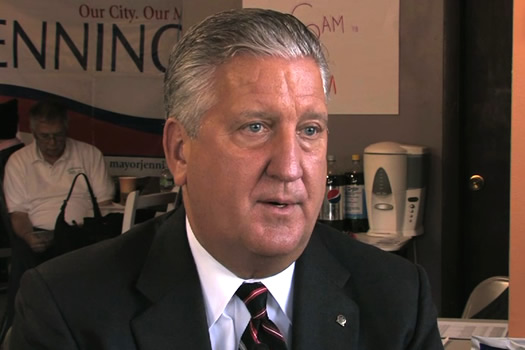
Jennings during his 2009 campaign for mayor.
Updated
There's been a lot of speculation over whether Jerry Jennings would be running for re-election this fall for mayor of Albany. Speculation over.
From a letter to city residents sent out by the mayor's office Tuesday evening:
My love for this City and my commitment to our children, our neighborhoods and the people who reside in them is boundless. Given this, the decision of whether to seek another term as your mayor has been one of the difficult evaluations I have ever faced. My family has been supportive; my trusted friends valued.
After countless hours of deliberation and evaluation, I have decided not to seek re-election as your Mayor. Although every day I still find joy in the work I do and in the people I serve, the time has come for a new chapter to be written.
The full letter is embedded after the jump.
Jennings is the 74th mayor in Albany's history. He was elected to the office in 1993, upsetting the Democrat party's establishment candidate. He's now in his fifth term and is the second longest tenured mayor in Albany history, after only Erastus Corning 2nd.
The city of Albany has had just three mayors since 1942.
Current city treasurer Kathy Sheehan has already announced her candidacy for the job, as has former Common Councilman Corey Ellis, who challenged Jennings in the Democratic primary in 2009. Both are Democrats -- and the party's September primary is pretty much the de facto election for the office. It will be interesting to see if Jennings' announcement prompts others to get into the race.
The city of Albany will have a new mayor next year. It's not often you can say that.
Also after the jump: A compilation of reaction to the announcement...
there's more
THE QUOTE
"If we had guns that shot chocolate, not only would our country be safer, it would be happier. People love chocolate."Â —Joe Biden, April 30, 2013.
THE BACKGROUND
A Milwaukee second-grader recently wrote to Joe Biden with an idea to limit gun violence. "Dear Vice President Biden, I have a great idea to help make our country safer, better and the best," Myles, a student at Downtown Montessori Academy, proposed. "I think guns should shoot out chocolate bullets. Then no one will get killed and no one will be sad."
Biden wrote back, endorsing the concept. "I really like your idea," Biden's note reads. "If we had guns that shot chocolate, not only would our country be safer, it would be happier. People love chocolate. You are a good boy."
TRUTH-BOMB
Biden's reasoning seems flawed here. People like eating chocolate, not getting shot with it. A chocolate bullet, though admittedly less lethal than standard ammunition, would probably still hurt like a mofo. We deem Biden's statement HALF TRUE.
Joe Biden, you've been Truth-Bombed.Â
Read more posts by Dan Amira
Filed Under: truth bombing ,joe biden ,politics ,gun control ,chocolate
Jeffrey “Cooter” Coon, who was the head chef of the Dinosaur Bar-B-Que chain, where he had worked for 16 years, died unexpectedly on Thursday. My colleague Eric Anderson has the story.
Today, May 3rd, marks World Press Freedom Day. Some world leaders aren't too happy about that.

Via France.
The Photoshop work is a bit off.
Via: tumblr.thefjp.org

Via: tumblr.thefjp.org

Via: tumblr.thefjp.org

DREAM. JOB. If only I lived in New York… MT @romenesko BuzzFeed is looking for an associate animals editor: bit.ly/Zom2L9
— Cara Lee (@caralytic) February 23, 2013
The winner of this “dream job” is Chelsea Marshall, who leaves TV to cover animals for BuzzFeed starting May 13. (Here’s the job posting.)
She most recently worked in the control room at “CBS This Morning”; before that she was at “Saturday Night Live” and “Late Night with Jimmy Fallon.”
BuzzFeed Animals editor Jack Shepherd tells Romenesko readers:
Chelsea distinguished herself amongst a pool of (literally) hundreds of applications for this position. With great posts like The Story of the Ides of March as Told by Sloths and 10 Signs Your Pet is a Conspiracy Theorist she demonstrated a natural understanding of how to write about animals in a compelling original way for an audience that has come to rely on seeing more and cuter animals on a daily basis. We’re super excited to have her on the team.
Marshall, who also studies sketch and improv at the Upright Citizens Brigade, writes in an email that she’s “so excited” to be joining the Buzzfeed Animal team next week. I asked how she won out over the hundreds of others applying for the job. Marshall replied:
When I was “auditioning” I tried to give a variety of types of posts-from stories, to cool dogs on instagram, to educational to satire. …
Chelsea Marshall
I think what really made me stand out though was that I came in with a bunch of ideas to expand the vertical beyond the fun lists. Of course those are still the focus and I love making them, but there’s so many possibilities to make the vertical even better! Jack [Shepherd] and Summer have already started that with quizzes and some video so it’s a really exciting time to be joining the team.
I definitely wasn’t surprised by the amount of interest [in the position]! The community contributors at Buzzfeed are awesome and since this really is a dream job, I knew I couldn’t have been the only one to go after this gem! I can’t think of anything better than getting to find and create shareable content that makes people happy.
As a community contributor, Marshall created posts like “20 Dogs Who Cannot Believe You Just Farted,” “15 Animals With Better Mustaches Than You Will Ever Grow,” and “16 Cats Interpret Margaret Thatcher Quotes.”
* BuzzFeed job listings stipulate that “no haters” need apply (mmagazine.tumblr.com)
First the United Nations, now Google. On Thursday, the Palestine News Network noticed that the Internet giant had changed the tagline for the Palestinian edition of its search engine, Google.ps, from the "Palestinian Territories" to "Palestine." The decision comes after a November vote by the U.N. General Assembly to recognize Palestine as a non-member state over the objections of Israel and the United States.
Here's how Google.ps looked earlier this year, according to the Wayback Machine Internet archive. The gray words in Arabic below the word "Google" say, "Palestinian Territories."

And here's how the same page looks today, with the word "Palestine" instead:

The change is obviously a minor one, but within the context of the fraught politics of the Middle East, Google's decision could be interpreted as a victory for advocates of Palestinian statehood who supported Palestinian Authority President Mahmoud Abbas's recent decision to circumvent the long-stalled, U.S.-supported peace process with Israel.
This isn't the first time Google has found itself at the center of a geopolitical dispute. In 2010, for instance, a Nicaraguan commander cited a border demarcation on Google Maps to justify a raid on a disputed area along his country's border with Costa Rica. And in China, Google has been locked in a long-running dispute with the government over censorship and what materials to make available on its search engine.
As for the company's latest foray into international relations, something tells me it won't be enough to jumpstart the moribund peace process.
 If you ate lamb hotpot in Shanghai in the last four years, you may have inadvertently consumed rat (gross), fox (gross), or mink (classy), the Ministry of Public Security announced on Thursday. [ more › ]


As part of its looming redesign, the New York Times is moving away from what the Internet calls "blogs," starting with the Media Decoder section of the site, home to the quicker, sassier musings of Bill Carter, Brian Stelter, David Carr, & Co. A source told Capital New York that "it's part of a broader effort to prune the blogs" in favor of the more classic article page format. Then again, the Paper of Record has taken to using GIFs on its homepage, so who knows which direction we're moving.
Read more posts by Joe Coscarelli
Filed Under: ink-stained wretches ,media ,new york times

For the upcoming Empty Estate EP, Wild Nothing is embedding its dream-pop output with off-kilter elements. Its first single “A Dancing Shell” is flecked with free jazz and feels subtly indebted to Talking Heads’ “This Must Be The Place,” a strong turn from Wild Nothing’s straight-forward rocking but still born from the chimeric influence we know from the outfit. Watch the animated clip for “A Dancing Shell” below.

Boar shooting crisis: A wild boar hunting trip left one hunter dead, and the nation of Moldova in a leadership crisis.
 Legendary NYC artist Kenny Scharf (above with Andy Warhol and Keith Haring) got arrested Friday night in Williamsburg after drawing the snake pictured below. The image is from his facebook where he wrote “Just Spent 20 hours in 2 Brooklyn jails for this.” Also from his facebook:
Cops who arrested me were fans and wanted to talk about exit through the gift shop and even liked the tag. at the first holding cell in Williamsburg (there were only 5people in the cell) the police were googling me and asking about things like the tunnel nightclub.
According to NYCourts.gov he was charged with ‘Attempted Making Graffiti’, ‘Attempted Crm Mis: intnt Dmge Prprty‘ and ‘Possession of Graffiti Instrum.’

- via ANIMAL

Well, technically not all of it. After working as a programmer for online gaming community Meez.com, our tipster saw his scoop of the corporate money sundae reduced by 8,000,000 to 1, leaving him with just a little more than it cost to mail him this check. "Sometimes you win," he told us, "but you rarely hear about the losers."

|
|

There's something on the internet that you desperately want to keep everyone from seeing. Something you're deeply embarrassed of. That would show all your friends how you're not actually as smart and fashionable and ironically self-aware as you pretend to be. And you really ought to get over it.

|
|

What exactly made the Roman Catholic Diocese of Brooklyn proclaim Jesus "the original hipster" in its new campaign ad? A really obscure bible verse. You've probably never heard of it.

|
|
New Yorker has a cool new interactive graph — check it out here. Here’s a screen grab of the L line:

 The man who stole, sorry, bought an iPhone from a 3-year-old in Greenwich Village last month admitted yesterday that perhaps $2 wasn't fair compensation for the pricey toy, having apparently realized that children must at least be capable of controlling their own bowels before they are able to barter. [ more › ]
The total amount of gold in the world, according to Thomson Reuters, is 171,300 metric tonnes, or 5.5 billion troy ounces. What that means is that every time the price of gold falls by $100 an ounce, as it did on Friday and it has done again today, the value of the world’s gold falls by more than $500 billion.
That doesn’t mean investors have lost $1 trillion in the space of two trading days. Some gold is used in industry or jewelry, and there’s a huge amount in central banks, which don’t mark to market and therefore aren’t really investors as we normally understand the term. Still, with a “market capitalization” at the end of 2012 of about $9 trillion, the gold market is not much smaller than the NYSE, is twice the size of the Nasdaq, and is almost three times the size of the Tokyo and London stock exchanges.
As a result, the falling price of gold is more important than simply being an opportunity for schadenfreude around the likes of Glenn Beck or John Paulson or Zero Hedge. At the end of 2012, for instance, Paulson owned 21.8 million shares of GLD. Those have sunk some 19%, or $30 per share, since then — a total loss of more than $650 million, for Paulson and his investors. But that’s just a drop in the bucket compared to the $1.6 trillion wiped off the value of gold more generally during the same period.
To put that number in context, the NYSE has risen 6.6% since the end of 2012, a rise in value of some $930 billion. Which means that the value of gold has been falling faster than the value of stocks has been rising. But gold is held in much more concentrated hands: most people have very little exposure to it, while a relatively small number of investors have huge allocations. As a result, the wealth effect from the fall in gold prices is likely to be felt quite acutely.
Gold is the classic zero-coupon perpetual bond: an asset whose industrial value is a tiny fraction of its cash value, and which represents, as Joe Weisenthal says, a costly failure of markets to efficiently allocate capital to where it is best invested. Goldbugs are by their nature defeatist and pessimistic; get enough of them together at the same time and they become self-fulfilling. (That’s why they tend to be so evangelical about their beliefs.)
So what does the fall of the gold price mean for the rest of us? The first thing to worry about is the wealth effect: if people have suddenly lost a trillion dollars, does that mean they’re going to spend less, and hurt the broader economy as a result?
I doubt that, somehow. About 2,500 tonnes of gold is tied up in gold ETFs. That’s about 80 million ounces, which translates to investor losses of about $16 billion in the past couple of days. On top of that, there have probably been about $3 billion of losses in the futures market. Those numbers — a proxy for the gold positions which are marked to market regularly — are relatively modest: they’re much smaller than the $100 billion or so that has been wiped off the valuation of Apple this year alone.
What’s more, very few investors have leveraged positions in gold, and when asset bubbles burst, it’s normally the leverage, more than the bursting bubble itself, which does the most damage.
Still, there will be pain — pain which is necessary to break the gold fever. It’s important that goldbugs are seen to not only have silly beliefs, but also to have lost a substantial amount of money. Gold is a fear trade rather than a greed trade — it’s defensive, and defensive investors are always particularly loss-averse. If you lose money betting on high-flying tech stocks, that’s much more likely to be money you can afford to lose than if you lose money after putting your life savings into precious metals. (Silver, as befits its status as the “B” share of gold, is also being hit badly today.)
The biggest problem in the markets right now is that they’re still far too risk-averse. Fear-based assets like gold, Treasury bonds, and cash are in high demand, while there isn’t enough money flowing through greed-based assets like stocks and bank loans and into the economy as a whole. Even if the stock market is expensive, the number of primary and secondary offerings remains low; similarly, banks are not expanding their loan books nearly fast enough.
What the system needs, then, is a stark reminder that fear-based assets can be just as risky as greed-based assets. Rising interest rates can eat away the value of your bond portfolio, inflation can erode your cash, and as for gold (or bitcoins, for that matter), well, it can plunge in value literally overnight.
My hope is that the price of gold will continue to fall, that goldbugs will look increasingly silly, and that as a result Americans with savings will conclude that the best thing to do with those savings is to put them to work in a productive manner, rather than self-defeatingly trying to protect what they have.
At the end of the 1990s, and again in the mid-2000s, we had greed bubbles. Both those bubbles burst, and the weird result was a fear bubble, which manifested itself in negative risk-free real interest rates and a soaring price of gold. Let’s hope that what we’re seeing right now is the fear bubble bursting. It’s what the world needs.
 The Internet was captivated last week by the picture of an Orthodox Jew who had wrapped himself in a plastic bag while on an El-Al flight. The reason for the wrapping was soon revealed to be that the man, a Kohen (or, an extra-devout Jew, as opposed to the normal schlubs you know and love), was worried that the flight would taint him as it flew over a cemetery. [ more › ]
 The Dutch people are finally throwing off the shackles of their oppressive monarchy after the soon-to-be-king Willem-Alexander revealed his "King's Song" ( a signature of his royal lineage), "Het Koningslied." The song, composed by the British-Dutch producer John Ewbank, and performed by over 50 Dutch artists, is a sweeping composition that features rap and electronic music, a break from the more traditional songs favored by previous monarchs. More »
|
|
 Like many gamers, my three best friends and I have a long-standing gaming tradition. Every holiday, we gather for our perennial New Year's Eve LAN party. In an ideal world, we tear down our gaming rigs on New Year's Eve, drop them off at one friend's house with plenty of space, go to dinner at our favorite Tex-Mex place, and then ring in the New Year over a good 8 to 10 hours of gaming nirvana fueled by salty snacks and sugary drinks.
The reality usually played out differently. After several years of frustration caused by out-of-date drivers, lost game discs, forgotten Steam passwords, and bizarre network anomalies (what exactly is a network bridge, and why did it only appear on my Win98 machine?), we threw up our hands and downsized to Nintendo DSes and Mario Kart. This past weekend, the gang got together ahead of schedule and downsized even further.
Armed with our iPhones, we listened to the ranting of one friend who insisted we play some iOS game called Spaceteam [Free]. In preparation for the meet-up, I downloaded the game and perused the list of features. They included teamwork, shouting, confusion, and four-stroke pluckers. Being a big fan of three-stroke pluckers, I could only imagine what fun it would be to tinker with four. I was not disappointed.
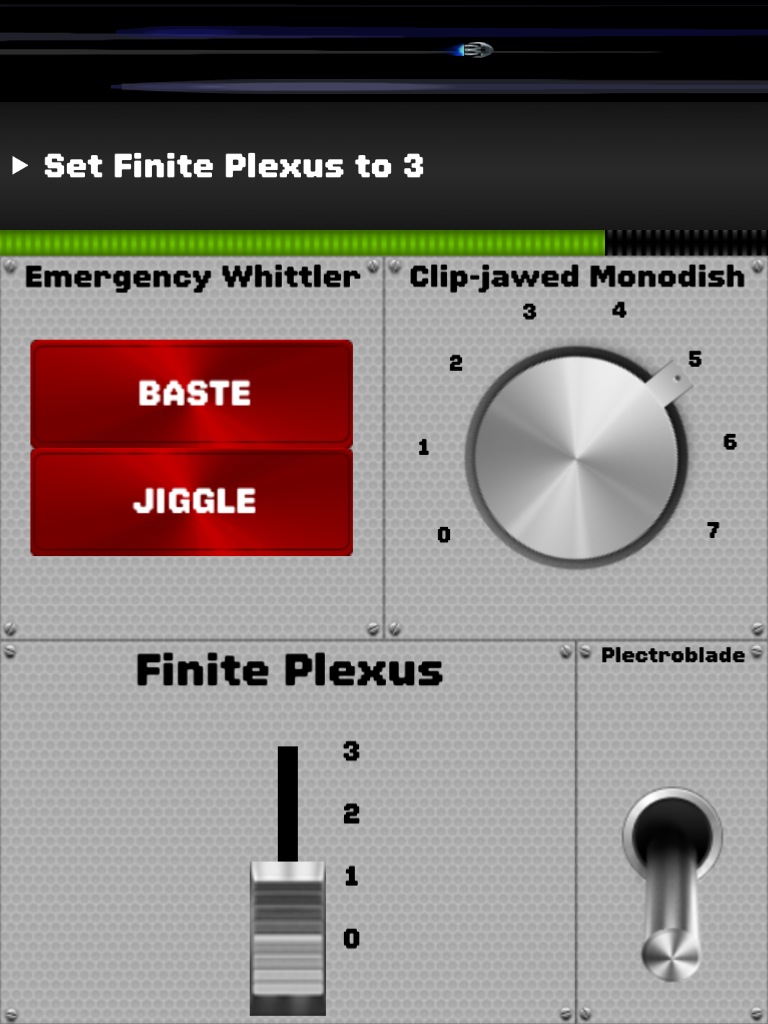

The first thing you should know about Spaceteam is that it only supports local co-op play. Unless you've got a few friends handy, the app just sits there, as out of reach as a four-stroke plucker. The reason for co-op-only play became obvious as we entered our first game. Each player receives a control panel littered with dials, buttons, and sliders. An instruction appears on your screen, telling you to use a certain control. Maybe you have that control, but maybe you don't.
If not, you'll need to shout out the instruction--set some dial to 5, enable or disable some switch, and so on--and hope the friend who does have that control can take action before time runs out. All the while, your friends are also receiving and yelling instructions while working frantically to complete instructions you and others are jabbering on about. Survive one sector and you progress to the next, receiving a new randomized control panel just when you were starting to feel comfortable with the last one.
A few sectors in and the action turns fast and furious, turning Spaceteam sessions into rollicking bouts of shouting, laughter, and frantic screen mashing. Some of the controls have real names, but most are pure made-up techno jargon; you'll have as much fun shouting out "Flush the four-stroke plucker!" as you will actually flushing the thing. Many sectors also throw anomalies at you, such as replacing text with symbols--"Enable the thing that looks like a directional pad!"--and warp holes that make your screen undulate like a belly dancer.
Panels pop off, sludge oozes over your controls, and electrical shorts render some panels unusable. You can wipe away the goop and slide panels back into place, forcing you to juggle making repairs, twisting your phone upside down to escape a warp hole, completing instructions, and belting out orders. It's a riot and an absolute blast, as our forum readers can attest.
After suffering abject defeat a handful or so of times, we attempted to devise a system of communication to maintain order and complete instructions more efficiently. Rap the table if we had a particular control so the party knew to direct repeated commands at that player, say "I second that" when two or more players received the same instruction, say instructions in a clockwise pattern around the table to avoid talking over each other, drop unnecessary words such as "set" in "set shiftsanitizer to 1." Some strategies worked early on, but by sector 5, we were all receiving so many instructions that we could almost feel the game compelling us to break away from our strategies and return to yelling and grunting.
And that's as it should be. Your ship will inevitably break apart, and you'll have just as much fun recalling the more amusing commands--"make sandwiches" and "eulogize former team" were our favorites--before diving right back in for another round of shouting. Go ahead and give it a try. Spaceteam is fun, free, and guaranteed to be a hit at your next get-together.
App Store Link: Spaceteam, Free (Universal)

This is a chart of the value of bitcoin yesterday, Wednesday. It’s hardly a secret that bitcoins are a highly volatile asset class, so relatively few eyebrows were raised when the price soared from an opening level of $230 all the way to a high of $266. An intraday swing of more than 15% is pretty much par for the bitcoin course, these days. But then came the crash: within a few hours, bitcoins the world over had lost well over half their value, and were trading as low as $107 apiece. That’s not normal — and it just goes to underline how bad bitcoin is at doing everything it’s meant to do.
Bitcoin is clearly not an effective store of wealth — just look at how quickly that wealth can be evaporated. Neither is it a useful payments mechanism, given how fast its value can fluctuate. Currently, it can take an hour for a bitcoin transaction to clear, which means that the value of the transaction when it clears can be radically different from its value at inception. Bitcoin only works for payments if you can be reasonably sure that its value will remain reasonably steady for at least the next hour or so.
At the end of my big piece on bitcoin, I conclude that we need “a universal payments system with no friction or interchange costs”, which can learn from bitcoin’s mistakes. And this morning, the company responsible for one possible such system — OpenCoin, which is responsible for developing Ripple — announced that it has closed its angel funding round, with support from the likes of Andreessen Horowitz, Lightspeed, and Founders Fund.
I’ve been playing around a bit with Ripple, and I think it’s extremely promising. It’s very early days yet, but Ripple already has clear advantages over bitcoin, and if various merchants and developers start to converge on the Ripple ecosystem — which, like bitcoin, is all open-source — then I think it could genuinely become the first real way for anybody in the world to pay anybody else in the world, immediately and about as frictionlessly as possible.
Ripple was founded by geeks, including Prosper founder Chris Larsen and Mt Gox’s Jed McCaleb. As a result, right now it has a bit too much functionality with too little ease of use. It supports an effectively infinite number of different currencies, for instance, including bitcoin; and although it’s easier to use than bitcoin, it’s still not particularly user-friendly. But that will come, with time — and in fact I would be happier if the people developing the easy-to-use front ends for Ripple were not OpenCoin. OpenCoin is a for-profit company, which will make good money if Ripple takes off; I’ll come to that bit in a minute. So it’s very important that a lot of the rest of the Ripple ecosystem not be built by OpenCoin: so long as OpenCoin is the only company to really buy into Ripple, the whole scheme will go nowhere.
Ripple has a lot of resources on its website which explain how it works in various levels of detail; I won’t attempt to duplicate that effort. But the end result feels a bit like bitcoin in many ways. Users are anonymous (or, technically, pseudonymous), for instance: if you want to send me money via Ripple, right now you have to pay racoLWuh2GtC72i1gV7ib14Jqgx3SLmwKc rather than just Felix, or my email address, or my Twitter handle. It’s all open-source, too: OpenCoin has no privileged access to the way in which people pay each other. The fees are de minimis, just enough to prevent DDoS attacks and the like. There’s even a built-in crypto-currency, the Ripple, with a fixed money supply. But the great thing about the Ripple system is that individuals don’t have to pay each other in Ripples. Instead, they can pay each other in pretty much any currency in the world: Ripples, yes, or dollars, or yen, or euros, or even bitcoins.

Here, for instance, is a screenshot of my Ripple wallet: it shows that I own, 3,052 Ripples, 13 dollars, and 0.0284 bitcoins. If I want to send a payment in any one of those three currencies, I can do so pretty much cost-free; if I want to send a payment in some other currency, then the system will select for me the best exchange rate, based on various companies which are offering currency-conversion services on the Ripple platform.
Any time you deal in currencies other than Ripples — which, in practice, is going to be all of the time — you have to go through “gateways” to the Ripple system. Eventually, those gateways could be PayPal, or Citibank, or Western Union, but that might take a while; for the time being, they’re smaller institutions, and you probably don’t want to be moving large amounts of money through them.
Everybody using a Ripple account will have some Ripples in their account, just to get them on the system, and there will always be people making a market, converting Ripples to real currency and back again. The good news, however, is that Ripples are not (fingers crossed) going to become speculative investment vehicles, in the way that bitcoins are. That’s because all the Ripples in existence — 100 billion of them — have already been created, and, to a first approximation, they’re all owned by OpenCoin, which is essentially the central bank of the Ripple economy. OpenCoin is going to be giving away billions of Ripples for free, to anybody opening an account, just to get the system seeded and get people transacting with each other. There’s little reason to hoard a few thousand Ripples if there are 100 billion of them just waiting to flood the market at any time.
It’s in OpenCoin’s interest, then, to carefully calibrate the rate at which it’s introducing Ripples into the active money supply, and to keep the value of a Ripple relatively stable. Right now, there are about 750 Ripples to the dollar, which means that theoretically OpenCoin’s 100 billion Ripples are worth something over $100 million. OpenCoin is going to want to see that number rise, slowly, as Ripple becomes more popular — but it doesn’t want to encourage hoarding: quite the opposite. It wants as many transactions to happen over its network as possible, so that it can really become, in Larsen’s words, “http for money”.
Given the Andreessen Horowitz connection, and a lot of shared interests between the two companies, the first place I’ll be looking for third-party ratification of the Ripple idea is the hot payments startup Stripe. I’ve had long conversations with Stripe CEO Patrick Collison about bitcoin and international payments and frictionlessness, and in theory there’s no reason why he shouldn’t build a pay-with-Ripple option into Stripe alongside its more conventional credit-card and debit-card payments.
As with all such things, there’s a first-mover problem here: there’s no point in building Ripple-based infrastructure if no one is using Ripple, and no one’s going to use Ripple if there isn’t any infrastructure. OpenCoin’s solution to the problem, which I like a lot, is to simply give away billions of Ripples for free, all of which are worth real money, thereby giving people an incentive to use it. I hope it works, and I hope that the number of gateways into the system will soon expand from the current list of relatively obscure sites like Bitstamp. Ripple hasn’t succeeded yet. But at least — unlike bitcoin — it has a genuine hope of doing so.


 Chinese pirates have taken downloading cracked iPhone and iPad apps to the next level, releasing
