Shared posts

21 May 13:54

The (misguided) passion of Glenn Greenwald

by Jack Shafer

By Jack Shafer

greenwald777

It’s not that journalists have thin skins — it’s that they have no skins.

This adage gets trotted out once a month or more in better newsrooms to provide context for the overreaction of a reporter or editor who has found himself on the receiving end of criticism for something they’ve published. This week, some journalists who have been critical of Glenn Greenwald are seeking skin grafts for their skin grafts after reading his denunciation of them in the final chapter of his new book about the Snowden files, No Place to Hide.

I would ordinarily write something like — “Greenwald settles scores with the New York Daily News, David Gregory of NBC News, Alan Dershowitz, CNN, Reuters reporters, the Washington Post‘s Walter Pincus, Leslie Kaufman, Andrew Ross Sorkin, Jill Abramson, and Michael Schmidt of the New York Times, and others in the press corps for criticizing him, Edward Snowden, and Julian Assange” — except Greenwald isn’t a score-settler. Once you earn a place in his scope, there you will stay, even after he runs out of ammunition.

Which would be never. Whether the venue be the Web, TV, or Twitter, Greenwald is the sort of fighter who goes on punching after the bell has rung, after the last round has been fought, and continues once the ring has been packed up. If split open by a speeding Mack truck and left bleeding at the side of the Interstate, Greenwald would still be observed shouting at passing traffic, “Ya didn’t hurt me! Come back and get what you deserve, you diesel pig!”

I could be mistaken, but I must be one of the few journalists writing in the vicinity of Greenwald’s interests who have never tasted the orange of his flame, an oversight I hope to correct with this column. It’s gotta be my turn for abuse, if only because in No Place to Hide he quotes favorably from something praiseful I wrote about him for Reuters last summer.

For all its fury, Greenwald’s bellicosity becomes harmless if read through a filter. He’s the underdog, so he has to bark louder. He’s a loner (by design, it seems), so he has to be his own posse. He’s a David (by choice, it seems) against Goliaths. He graduated from law school, which teaches the art of making your offense your defense.

greenwald888The downside of perpetually savaging your enemies comes when you make so much noise you can’t hear their sensible arguments. I’m fine with Greenwald skinning a few journalists, if only because everybody in our business needs an aggressive defoliation now and again. But Greenwald — who with Laura Poitras and Barton Gellman, have aided liberty with their exposes of government surveillance — gets tangled up in his own rancor when he dismisses as supplicants the national security beat reporters who consult with government officials before publishing.

The source of “establishment media hostility” for Snowden, Assange, and Greenwald, Greenwald writes almost categorically, is their acceptance of “the rule of dutiful spokespeople for political officials, especially where national security is concerned.” He continues, saying that the establishment media is “contemptuous of those who challenge or undermine Washington’s centers of power.”

As evidence, Greenwald points to the New York Times decision in 2004 to delay by more than a year the publication of its domestic spying story, and of a Los Angeles Times call to spike — under Dean Baquet, the new executive editor of the New York Times — an AT&T-NSA story. Also steaming his endless buffet is the idea that journalists talk to national security officials before they publish secrets. Greenwald’s schema also doesn’t square with the Washington Post‘s aggressive pursuit of the Snowden story. No paper is more representative of the establishment and Washington power than the Post, and yet it has published on and on about the NSA files.

He’s right that some reporters tend to get too close to their sources (no matter what the beat, I might add) and fall into orbital capture. But national security reporters haven’t been sitting on their hands as Greenwald implies, a point that Michiko Kakutani and David Cole make in their reviews of No Place to Hide this week in the New York Times and Washington Post. It wasn’t a bend-over press that published stories about Abu Ghraib, rendition, torture, black sites, and drones. And while he can carp about the delay, the New York Times ultimately defied the Bush administration to publish the NSA surveillance story and followed it with the controversial Swift financial surveillance investigation.

Greenwald seems to want to damn national security reporters for talking to national security officials about national security issues, thinking that it compromises them somehow or prevents them from publishing empire-shaking scoops. But talking to the government isn’t the same thing as taking orders from it. National security reporters can write more insightful and more accurate stories by discussing the leaks they obtain. They can also avoid publishing stories that are detrimental to my immediate safety, your immediate safety, the immediate safety of Glenn Greenwald’s life as well as the lives of U.S. troops. The cartoon Greenwald paints of a weakling press taking orders from the government clashes with the well-documented accounts of how contentious and brutal the reporting and publishing process can get.

Remember, not even Glenn Greenwald has dumped his entire stash of NSA files into the public domain. He’s in his Fortress of Solitude right now, turning them over in his hands and making mental notes. Like anybody who takes the mound, Greenwald wants to decide when to hurl his fastballs. Is anybody calling Greenwald a pliant hack for his style of deliberative journalism?

I’ve put myself on record as being a fan of Greenwald’s adversarial reporting, but that doesn’t mean I approve of every story and editorial choice he’s made. I’m also a fan of the more conventional and cautious brand of journalism, which frequently needs a kick in the ass from outsiders like Greenwald. Who says you can’t be a critic of both.

******

Note to Glenn: Reach for the oxyacetylene if you decide to torch me, okay? Send fireworks to Shafer.Reuters@gmail.com. My Twitter feed burns all night. Sign up for email notifications of new Shafer columns (and other occasional announcements). Subscribe to this RSS feed for new Shafer columns.

PHOTOS: Glenn Greenwald, the American journalist who first published the documents leaked by former NSA contractor Edward Snowden, testifies before a Brazilian Congressional committee on NSA’s surveillance programs, in Brasilia August 6, 2013. REUTERS/Ueslei Marcelino

Glenn Greenwald, is surrounded by journalists while he arrives to the George Polk Awards in New York, April 11, 2014. REUTERS/Eduardo Munoz 

19 May 22:41

Are you going to the World Cup next month in Rio?

by Adam Weinstein

Are you going to the World Cup next month in Rio? You're probably gonna get robbed. And if you get robbed, for the love of God, don't scream, because you'll just get your damn fool self killed. As one elite cop in the city says: "There is no use crying over spilt milk."

Read more...


19 May 13:42

Science says the five-second rule isn't such a bad idea

by Joseph Stromberg

Everyone's heard of the five-second rule. If you drop a piece of food on the floor, you have five seconds to pick it up and eat it. After that, the food gets covered in harmful bacteria and you have to thrown it away.

The potential risks of eating dropped food are fairly small

But how sound is this rule, scientifically speaking?

As it turns out, there's a fair bit of research on the subject — and the upshot is that the potential risks of eating dropped food are fairly small, most of the time. Indeed, there might even be benefits from occasional bacteria exposure.

Now, we can't exactly advocate that people eat off the floor. Nothing's ever completely risk-free, and if you wanted to be extra-cautious, you should just throw that dropped piece of food out (especially if you drop it in a place where there's lots of bacteria, like a hospital). But the scientific case for doing so is surprisingly thin.

What research says about the five-second rule

101682656

Archive Photos/Getty Images

There have been a few scientific studies into the five-second rule. They've basically found two things:

1) If you drop food onto a surface that you've intentionally contaminated with bacteria, it's going to pick up bacteria immediately.

2) But most surfaces have surprisingly little harmful bacteria.

As part of the only peer-reviewed study on this topic, scientists at Clemson dropped pieces of bologna and bread onto wood, tile, and carpet floors that had been heavily contaminated with salmonella.

There was some variation between the foods and surfaces, but in general, they found that 150 to 8,000 bacteria were picked up by the food within five seconds; after a full minute, these numbers were about ten times higher. Given that as few as ten individual Salmonella bacteria can cause an illness, this sounds like a pretty convincing case against eating off the floor.

If you drop food onto a contaminated surface, it is going to pick up bacteria

Except that's not exactly what Paul Dawson, the food scientist who led the study, took away from it. Although he certainly doesn't advocate eating off the floor, he told me that "the risk of getting sick from eating food dropped on the floor is very low, since most surfaces do not harbor pathogenic bacteria — unless you're in an environment likely to have harmful bacteria, like a hospital."

This point is underscored by an earlier (unpublished) study, conducted at the University of Illinois. In it, researchers (led by high school intern Jillian Clarke) started by testing how many bacteria of few particular species were on various floors across the campus — and found none.

"We were shocked," Meredith Agle, a then-Ph.D. candidate (a now food scientist) who worked on the study, told whoever wrote the university's press release. "We didn't even find a countable number of bacteria on the floor. We thought we might have made a mistake, so we tried again with the same result."

They eventually resorted to intentionally contaminating tiles with bacteria, and found that cookies and gummy bears dropped on them got contaminated.

But most floors do not have harmful food borne bacteria

216499116_3b104541ed_o

Shino

You might assume that every surface you encounter is brimming with bacteria, and to an extent, you'd be right.

Companies like Kimberly-Clark (makers of hand sanitizer) love commissioning studies showing that things like doorknobs, faucets, hand rails, and cell phones are positively coated with bacteria, and they're not inaccurate. But the presence of bacteria on all these surfaces doesn't mean that they're necessarily harmful bacteria.

Think of it this way: a square centimeter of your skin has about 100,000 bacteria on it. Inside you, there are about ten times more bacteria cells than human cells.

We're constantly swimming in a soup of microbes, and have been for millennia. In response, we've evolved a powerful immune system that eliminates the risk of harmful infection from most bacteria — about 99 percent of the 60,000 types we come into contact with daily.

Most harmful food borne bacteria can't survive very long outside a host's moist body

Those we are susceptible to are generally transmitted in specific ways. Bacteria and viruses that infect our respiratory system, for instance, are spread when we're in close contact with people coughing and sneezing.

The bacteria that cause stomach illnesses mostly result from fecal contamination. Salmonella and E coli live naturally in the intestines of many animals — including cows and humans — and generally get into food during the slaughtering process, or from the use of infected manure on crops. C diff is mostly transmitted through the "fecal-oral route": water or food comes into indirect contact with feces during the cooking process.

All this is great reason to wash your hands frequently — especially after going to the bathroom and before cooking — but it probably shouldn't make you too afraid of eating food off the floor. That's because most harmful food borne bacteria can't survive very long there, outside the moist confines of a host's body.

The Clemson study did find that detectable numbers of salmonella survived on tile for up to 28 days, but only because they'd contaminated the tiles with several million bacteria per square centimeter. In the absence of this kind of heavy intentional contamination, it's hard to imagine many surviving.

Now, none of this is a guarantee that a given stretch of floor doesn't have harmful bacteria. Kitchens are actually more likely to harbor them because of the presence of uncooked meat, as are bathrooms, for more obvious reasons. But it does suggest that the risk of occasionally eating food off the floor in other sorts of rooms is pretty small.

"The analogy I like is wearing a seatbelt when you drive," says Dawson, the Clemson food scientist. "You could drive a lifetime without wearing a seatbelt and never get hurt since you didn't have an accident."

In cars, always wearing a seatbelt is a good idea, because there's no cost to doing so. But when it comes to eating food off the floor, there are a few costs.

One is small: the tinge of regret you feel when throwing away the cookie.

One is uncertain, but could be much bigger.

Exposure to bacteria might benefit your immune system

8141502448_b6a0ba6683_o

Threthny

Over the past few decades, some health researchers have become convinced of something called the hygiene hypothesis: the idea that the modern, clean environment many of us live in has thrown our immune systems out of whack.

Because we're exposed to lower numbers of bacteria and other pathogens, the theory goes, we're more likely to develop asthma, allergies, inflammatory diseases, and other chronic auto-immune problems.

the modern, clean environment may have thrown our immune systems out of whack

This is still an unproven theory, but there are some pieces of evidence in favor of it. Studies have shown that people who move to a more affluent, cleaner country become more likely to develop asthma over time. Even within a country, urban children have higher asthma rates than rural ones, as do adults who coat their houses with antibacterial cleaning sprays more often. Similar trends have been found with all sorts of auto-immune conditions, including seasonal allergies.

These are all correlations, not causations, but a smaller number of randomized controlled trials have come to similar conclusions. In one, babies born to mothers who were given drugs to treat parasitic worm infections were found to have much higher rates of eczema and wheezing.

So can I go around eating food off the floor?

Before you use this as blanket justification for the five-second rule, keep in mind a few caveats. Most thinking behind the hygiene hypothesis holds that childhood bacterial exposure is especially critical, and there's been less testing of exposure as an adult.

Most importantly, no one has tested whether the sort of exposure you'd get from eating off the ground could help prevent auto-immune diseases: because this sort of thing is so hard to control, most research looks at a person's overall exposure as a result of their surrounding environment.

eating a dropped cookie isn't a dangerous behavior in the context of everything we do

Moreover, the implementation of basic hygiene has been a huge boon for humanity as a whole, dramatically cutting down on the infection rates for all sorts of diseases. Science definitively shows that washing your hands frequently and following other basic hygienic practices is still a really good idea, and constantly eating food off the floor of your bathroom is definitely not one.

But what science doesn't strongly show is that occasionally eating a dropped cookie is a particularly dangerous behavior in the context of everything else we do. It's much less dangerous, for instance, than driving in a car, even if you're wearing a seatbelt.

For comparison, 33,561 people died in the US in 2012 from car accidents, even though 86 percent of people wear seat belts. About 3,000 people die from food borne diseases, with many coming from contamination at the industrial level.

This isn't exactly license to go around eating off the floor. But when you get caught doing so, it's a pretty damn good response.

18 May 22:12

Grandma Bill

by admin

18 May 20:43

39 Indians You Wish You Knew In Real Life

Desi me rollin’, they hatin’.

This mahout who doesn't believe in casual Fridays.

This mahout who doesn't believe in casual Fridays.

reddit.com

And this one, who knows that where there's a will, there's an elephant.

And this one, who knows that where there's a will, there's an elephant.

reddit.com

The bedsheet salesman who came up with this marketing ploy.

The bedsheet salesman who came up with this marketing ploy.

reddit.com

And the morbid restauranteur behind this one.

And the morbid restauranteur behind this one.

reddit.com


View Entire List ›

17 May 16:29

Eater Guides: A Guide to Eating Barbecued Brisket in New York

by Nick Solares

20131005-001-Lede.jpg

[All photos by Nick Solares]
2013_brunch_heatmap_helo.jpegThere is no cut of barbecue more challenging to smoke than a whole beef brisket. The large piece of meat, typically weighing between eight and 16 pounds, is comprised of two distinctly different muscles, with very different levels of fat content. It poses similar challenges to roasting a whole chicken or grilling a porterhouse steak — cooking the fat part through will often render the leaner meat dry and overcooked. Unlike chicken and steaks, brisket needs a long, low, and slow cooking method to fully break down the tough connective tissue.

Brisket is fabricated from the chest muscles of beef cattle. It is comprised of the pectoralis profundus, also called the "flat" because of its shape, and the pectoralis superficialis, which is referred to as the "point" and is thinner, fatter, shorter, and rounder than the flat. The flat is often called the "first cut" by butchers and the "lean" by pitmasters, because it does not have a lot of fat.


The point is called the second cut, moist brisket, or the deckle, denoting the increased fat content of the muscle. The pectoral muscles support much of the animal's weight and are thus in constant use, making them tough and unyielding if not cooked correctly. Braising and smoking are the best ways to tenderize a brisket.

20131003-001-HT%20BBQ.jpg[Hometown Bar-B-Que]
Smoking brisket finds its highest expression in the barbecue pits of Central Texas and Kansas City, MO. Whereas pork is the main staple for most of the nation's barbecue regions, beef is king in Texas and many places in the Lone Star State cook little else. Brisket does not hold quite the esteemed position in Kansas City that it does in Central Texas — almost every conceivable meat makes its way into the smokers there. But that doesn't mean that KC brisket is any less inspired. In fact, the burnt end — cubed and extremely caramelized portions of the point — originated in Kansas City.

20120329-001-fire.jpg[Franklin Barbecue, Austin, TX]
Barbecued brisket is first covered in a dense layer of spices before smoking. This is called the rub. In Texas, this is usually just salt and black pepper, although various other spices can be applied. The meat is then smoked over wood for between 10 to 18 hours at low temperatures — typically between 225-275°. Post oak is the most common wood in Texas, and hickory is popular in Kansas City. As the meat smokes, the collagen within the muscle begins to melt and the fat renders, making a once tough cut tender and toothsome. After being smoked the brisket needs to rest in much the same way that a steak does, in order to let the meat relax and the fluids redistribute within the muscles. Once rested, it is important to slice brisket against the grain of the muscle fibers or it will become chewy.

The Hallmarks of Great Brisket

20140424-001-Brisket%20Anatomy.jpg
Whether you are in Texas, Kansas City, or Brooklyn, the hallmarks of a properly smoked brisket are the same. Here is what you should look for:

The Bark

As water evaporates from the exterior of the brisket during smoking, the rub begins to form into a dense crust that is called the "bark." The smoke particles darken the bark significantly, rendering it colors ranging from dark mahogany to almost pitch black. At best, this crust is crisp and crunchy, although most often, and especially if the brisket has been wrapped for significant periods, it can be flaccid.

The Smoke Ring

The pink band that lies between the bark and the interior meat is called the smoke ring. It is the result of gases from the cooking process interacting with liquids on the meat's surface causing the bright pink color. It is not unique to barbecuing — the effect can be replicated without smoke entirely — but all great barbecue has it.

"The Accordion Effect"

The best brisket will be lithe and supple, but not entirely flaccid. There should be some tension within the muscle — you want it to pull back just a little when you tug on both ends of a slice of brisket.

The Juice

Fat is flavor and the juices in meat are principally fat. You want your brisket juicy, which is why you should always go for the moist end, but even the flat should be moist and tender in a properly cooked brisket. The juices from a wrapped brisket from a Texas pit will soak through several layers of butcher paper.

20110325-001-City%20Market.jpg[Moist brisket from City Market Luling,TX]

Lean or Moist?

This comes down to personal taste but the brisket point, with its rich marbling, will be juicier, more flavorful, and generally more tender than the flat. It is what most barbecue aficionados opt for. Lean meat will often be a little cheaper per pound than moist.

The Rainbow

You sometimes will see "rainbows," or an iridescent green sheen in freshly sliced brisket (and other meats) this is not an indication of anything other than refraction occurring as light hits the meat surface at a particular angle.

20120329Brisket%20menu.jpg

Price

Brisket is generally sold by weight with prices varying wildly between regions costing anywhere from $8 to $28 a pound.

"Brisket Is Tough to Cook"

You might hear this as a carver saws on a desiccated brisket, sending splinters of dried bark in every direction. Yes, brisket is tough to cook. That's why you are charging $20 per pound. There is no excuse for selling dry brisket, it should be repurposed for sandwiches or baked beans.

Sauce?!?

If there is one principle difference between Texas and Kansas City, it is the use of sauce. In Texas, it is largely eschewed, but in Kansas City it is implicit to the style of barbecue. Freed from the parochial fetters of tradition, New Yorkers should feel free to eat their brisket any damn way they want.

Brisket in the City

20131005-001-slice.jpg

To be frank, barbecue in NYC has traditionally been dreadful, especially brisket. There have been some standouts over the years — Pearson's Stick To Your Ribs, which opened in the late 1980s, springs to mind immediately as an early pioneer — but by and large, NYC has not had any sort of barbecue culture worth discussing. That began to change in the early 2000s when we saw the emergence a number of restaurants that took barbecuing seriously such as Blue Smoke, Dinosaur Bar-B-Q and Daisy May's, which joined early pioneer Virgil's (1994). These places offered pan - regional menus drawing on barbecue influences from across America. This lack of specificity didn't necessarily produce the best brisket, but it laid a necessary foundation for what was to come. Certainly Adam Perry Lang's brisket at Daisy May's was the best brisket served to date. (Lang is no longer associated with Daisy May's.)

The Big Apple Barbecue Block Party, founded in 2002 by Blue Smoke pitmaster Kenny Callaghan, helped introduce real pit barbecue to many New Yorkers. It also helped set the stage for the next leap forward, which saw narrowly defined, region specific barbecue come to NYC. The openings of RUB (2006) and Hill Country (2007) respectively brought the styles of Kansas City and Texas to the city.

The Barbecue Renaissance?

We are at a point where there is some truly world class barbecue being smoked in NYC. But perhaps more importantly, there is a distinct barbecue culture developing here. While it certainly draws on disparate regional elements and influences, there is something uniquely parochial about it. Whereas the big box corporate barbecue restaurants — Blue Smoke, Hill Country, Virgil's, Dinosaur Bar-B-Q, Wildwood (now closed) — are (or were) all located in Manhattan, the joints that define this new NYC style emanate from Brooklyn. BrisketTown, Hometown Bar-B-Que, Fletcher's Brooklyn Barbecue, Morgan's, and Beast of Bourbon have all opened within the last two years in Kings County, joining early pioneer Fette Sau. Even Mighty Quinn's Barbecue, which opened a brick and mortar location in Manhattan, started off at Smorgasburg in Brooklyn. Brisket is significantly featured on the menus of all of these restaurants. It has become a staple of NYC style barbecue.

Time for Some Tough Love

With such a potentially high standard of meat being smoked here in the city, it is time for barbecue aficionados to become more critical. There is enough quality barbecue out there that we no longer need to settle for dry and leathery brisket or suffer cloyingly sweet sauces. Here is a list of the city's noteworthy briskets, with rankings based on recent visits to NYC barbecue restaurants. In barbecue, you are really only as good as your last smoke:

16 May 13:43

The 10 Best International Food Markets In NYC

by Rebecca Fishbein
The 10 Best International Food Markets In NYCNew York may be suffering from some serious condo-ification and chain store fatigue these days, but it was once (and still is) a cultural melting pot. And though big grocers like Whole Foods and Fairway stock lots of imported grub, sometimes its best to score global wares at independent shops that are a little less...Whole Foods and Fairway. Here are our favorite international food markets in the city—we know you'll leave yours in the comments. [ more › ]


16 May 13:22

Stromboli’s Web

by Daniel Maurer
(Photo: Daniel Maurer)

(Photo: Daniel Maurer)

Between anarchists running amok and cars slamming into hardware stores, there’s a lot of cracked glass around the East Village – and a sticker artist has taken note. We spotted this spider on the window of Stromboli Pizza on First Avenue, and another one on the former 7-Eleven space a couple of blocks down on St. Marks.

Heh. We’ve got an iPhone that could use this treatment. It’s definitely the most ingenious urban hack the East Village has seen since that altar at the former Mary Help of Christians Church site.

15 May 15:53

Metro-North Kills Their Last Bar Cars

by Nell Casey
Metro-North Kills Their Last Bar Cars We've been preparing for this day but it still stings like that first shot of hot train gin after a long work day: the Metro-North bar cars are no more. The MTA will decommission the final four bar cars in its fleet this week as they get ready to switch over to the new M-8 trains on the New Haven line. Gone will be the hokey plastic cup holders and faux-wood bar tops; in its place, larger seats and digital stop readouts. And so the Era of the Flask begins. [ more › ]


15 May 04:18

Grilled Cheese Delivered By Parachute, Coming Soon to NYC

by Dayna Evans

Grilled Cheese Delivered By Parachute, Coming Soon to NYC

An Australian grilled cheese maker called Jafflechutes, a name that I'll address with much concern later in this post, has succeeded in crowdfunding their parachute-based grilled cheese operation for a visit to New York, as soon as this month.

Read more...


15 May 02:28

More Data Analysts Went Looking For the South And Midwest, And Here’s What They Found

by Walt Hickey
Jon Schubin

More on this story as it develops (8 days ago because I'm catching up on Reader.)

Last week, we published the data from two surveys asking Americans which states are in the Midwest and the South. We asked readers to send in remixes they made or any they came across; you folks delivered.

First, we have this set of visualizations from Benn Stancil of Mode Analytics. Stancil combined the two surveys to make an interactive graphic showing the regional patterns according to respondents in each state (for example, the Midwest according to Minnesotans vs. the Midwest according to Iowans). Here’s where Americans as a whole thought these regions were, with the circles denoting each region’s geographic center:

stancil-midwest-south

But Stancil wasn’t finished. You may recall that in our original post on the Midwest, I was surprised by how little consensus there was about which states were Midwestern. My unsupported theory: Self-identified Midwesterners define their region as their home state, plus the states bordering it. Looking at Stancil’s breakdown we can actually see that effect!

Here, for instance, are Indiana respondents on both the Midwest and the South:

Screen Shot 2014-05-05 at 5.17.15 PM

And here are results for Minnesotans:

stancil-minnesota

Notice that the geographic center of the Midwest according to each state’s respondents is much closer to their own state.

This is more anecdotal, but Josh Lubarr, a technical writer in the Boston area, wanted to find which respondents didn’t think Alabama, Mississippi and Georgia were part of the South. He found only four respondents who didn’t include those states. Josh sent in this tidbit:

Notably, the four lists that didn’t include Alabama, Mississippi, and Georgia were of identical composition: each only had *one* state on it: Texas.

David Gerster, the VP of data science at BigML, a machine learning shop, sent in this model that guesses whether a person identifies as a Midwesterner based on his or her ZIP code. As he wrote in an email:

Using only the respondent’s ZIP code, I trained a model that predicts with close to 80% accuracy whether a respondent identifies as a Midwesterner. My definition of “identifies as a Midwesterner” is someone who either 1) used the word “midwest” (or “mid-west”, “mid west”, etc) in their free text response, or 2) said they identify “a lot” as a Midwesterner.

You can see a gallery of all the work BigML is doing with the survey here. Gerster attached this map of the model’s predictions, where blue dots represent ZIP codes with respondents who consider themselves Midwesterners and orange dots show ZIP codes where respondents do not:

gerster-midwest


Next up we have the always great David Mendoza, who used fusion tables to analyze the ZIP code data. Screenshots don’t do his interactive maps justice, so definitely check them out here.

mendoza-midwest

Mendoza also took a bold stab at the Missouri question (Missouri didn’t seem to be included in either the South or the Midwest). Mendoza found Missourians consider themselves proud Midwesterners, not Southerners, no matter what anybody else says.

If we missed your remix, please shoot me an email at walter.hickey@fivethirtyeight.com. The data remains available, too, for those who want to jump in.

14 May 20:20

The Hardest “Mad Men” Quiz You Will Ever Take

Jon Schubin

It's crazy how hard this quiz is.

Because the same thing that happened in Season 1 also seems to happen in Season 7 .

Mad Men creator Matt Weiner and the cast of his hit AMC advertising series have mastered the art of saying something, but revealing a whole lot of nothing. As have the people who write the show's episode descriptions. Just try matching the Mad Men episode descriptions with their titles to see how good they are.

Pour yourself an old-fashioned, because you're going to need it as you get increasingly frustrated each time you see the words "friend," "past," "trip," or "news." You've been warned.

AMC

14 May 15:18

Undeniable Proof That Young Sir Patrick Stewart And Jaime Lannister Are Basically The Same Dude

It is important that this is immediately brought to everyone’s attention.

This is current Ser Jaime Lannister from Game of Thrones, fresh off his new haircut and fancy new hand.

This is current Ser Jaime Lannister from Game of Thrones , fresh off his new haircut and fancy new hand.

HBO

And THIS is the young and beautiful Sir Patrick Stewart when he was 33.

And THIS is the young and beautiful Sir Patrick Stewart when he was 33.

Sir Patrick Stewart played Lucius Aelius Sejanus in 1973's I, Claudius.

BBC2 / Via imgur.com

HBO


View Entire List ›

13 May 16:40

Lucky Luna's Brunch: Part Mexico, Part East Asia

by Nicole Lam

20140422-Lucky-Luna-exterior.jpg

[Photographs: Nicole Lam]

At most restaurants, proclamations of a "fusion" menu usually means more attention paid to the concept than the cooking. Luckily, the word 'fusion" is never used at Lucky Luna, a new Taiwanese-Mexican place in Greenpoint. The three co-owners—two Taiwanese, one Mexican—delved into the comfort food of their childhoods and came up with a menu that showcases their favorites. Using mostly local ingredients, chef Howard Jang serves a brunch that's more flavorful than your typical eggs Benedict.

20140422-Lucky-Luna-Duck-Bao.jpg

Peking duck confit bao.

The Peking Duck Confit Bao ($10) is a must-try. Long Island Pekin ducks are seasoned overnight, then the duck legs are cooked in duck fat until tender. Shredded duck meat and crisped bits of duck skin are nestled into soft, steamed bao. Fresh scallions add some freshness and crunch while a spread of hoisin mayo gives it a pleasant sweetness. It's a steamed bun that stands up well to its more famous counterparts.

20140422-Lucky-Luna-chilaquiles.jpg

Chilaquiles.

A nod to traditional Mexican breakfast, the Chilaquiles ($10) are surprisingly well done. Warm, crispy corn tortilla chips from Tortilleria Nixtamal are topped with salsa verde, crema, queso fresco, pickled red onions, and cilantro. A poached egg brings a layer of eggy richness. Don't forget to add the chorizo seasoned with paprika, cayenne, and tequila.

20140422-Lucky-Luna-pozole.jpg

Pozole.

If you're looking for something spicy, try the Pozole ($10). The stock is made from the Peking duck bones and a chili purée; pork is braised separately, then added to the stew. Cabbage, onions, and radish break up the oiliness and fat kernels of hominy give the soup substance (there's also a vegan option available). If you're especially hungry, order this as a starter; it's less substantial than the other dishes.

20140422-Lucky-Luna-arroz-dulce-de-leche.jpg

Arroz con dulce de leche.

There are only two desserts on the menu, but you can't go wrong with the Arroz con Dulce de Leche ($7). Made with jasmine rice, Mexican cinnamon, and homemade dulce de leche, the rice pudding has a hint of sweetness and a satisfying chewiness. It's served chilled with fuji apple slices.

Brunch is served on the weekends from 12 to 4 p.m., and, for now, it's easy to get a seat. Except for the Chilaquiles, you can order these items at dinner too. No matter what time you go, order a bunch of dishes to share; you'll want to try everything.

12 May 18:54

Toronto Library Asked to Ban Hop on Pop to Protect Dads

by Jay Hathaway

Toronto Library Asked to Ban Hop on Pop to Protect Dads

Toronto residents asked their public library to remove six books and a DVD over the past year, and one of those books was Dr. Seuss's Hop on Pop. The classic rhyming tale of fatherhood and saltation was accused of putting pops at risk of being actually hopped on.

Read more...


12 May 17:49

Khachapuri: The Butter Topped, Cheese-Stuffed Bread Vessel Of Your Dreams

by Jen Carlson
Jon Schubin

Never try to make butter pizza happen.

Khachapuri: The Butter Topped, Cheese-Stuffed Bread Vessel Of Your Dreams Khachapuri is pronounced like this, but let's just call it by its other, perfectly Americanized name: butter pizza. This is what a writer at WaPo recently dubbed it after trying it at a new spot in D.C. And just look at it, who could disagree with that assessment? [ more › ]


12 May 17:22

Which States Are in the Midwest?

by Walt Hickey

Here’s a somewhat regular argument I get in: Which states make up which regions of the United States? Some of these regions — the West Coast, Mountain States, Southwest and Northeast are pretty clearly defined — but two other regions, the South and the Midwest, are more nebulous.

I’m from New York, and I generally consider anything west of Philadelphia the Midwest. This admittedly unsophisticated designation is frequently criticized by self-avowed Midwesterners. My boss, originally of Michigan, has many opinions about what, precisely, falls into the Midwest. So I decided to find out which states Midwesterners consider to be in their territory.

To get this broad-based view, we asked SurveyMonkey Audience to ask self-identified Midwesterners which states make the cut. We ran a national survey that targeted the Midwest from March 12 to March 17, with 2,778 respondents. Of those, 1,357 respondents  identified “a lot” or “some” as a Midwesterner. We then asked this group to identify the states they consider part of the Midwest.

hickey-map-midwest

There are a lot of things here worth looking into. First, many people aren’t too sure about where the core of the Midwest is. Everybody selected at least one state for the question. But even Illinois — home of the preeminent Midwestern city, Chicago — was identified as Midwestern by just about 80 percent of respondents.

Contrast this with our soon-to-be-released Southern survey, in which people were somewhat adamant about which states make the group.

One potential, albeit anecdotal, source of this? Several self-proclaimed Midwestern sources I spoke with have a very limited definition of the Midwest: namely, their state and any state bordering it. Minnesotans thought they made up the true Midwest; Hoosiers thought they did. I can’t say either way.

Second, the potential Midwest spans further south than I thought. If half of our respondents thought Missouri and a quarter thought Oklahoma were in the Midwest, I probably should have asked about Arkansas, if only to pinpoint how far south people think the region expands. This Yankee regrets the error.

Indiana, Iowa and Illinois appear to be the core of the Midwest, each pulling more than 70 percent of the vote (that may partly be because of their substantial populations). Michigan, Wisconsin and Minnesota each pulled at least 60 percent of the vote, so we can probably put them in the Midwest without too much fuss. Ohio, Missouri and Kansas each got more than half.

As for the rest of the states, it seems unclear whether they’re in the true Midwest.

If anything, the Midwest is as nebulous as I’d expected. Too often, people refer to vast swaths of American territory as a solid region. It’s easy to break Americans into tribes such as “Midwestern,” but there are more subdivisions and diversity in these groupings than we generally acknowledge.

Except when it comes to the South. The South is more sure about what the South is, as you’ll soon see.

12 May 17:08

The private sector is up, public sector is down

by Matthew Yglesias

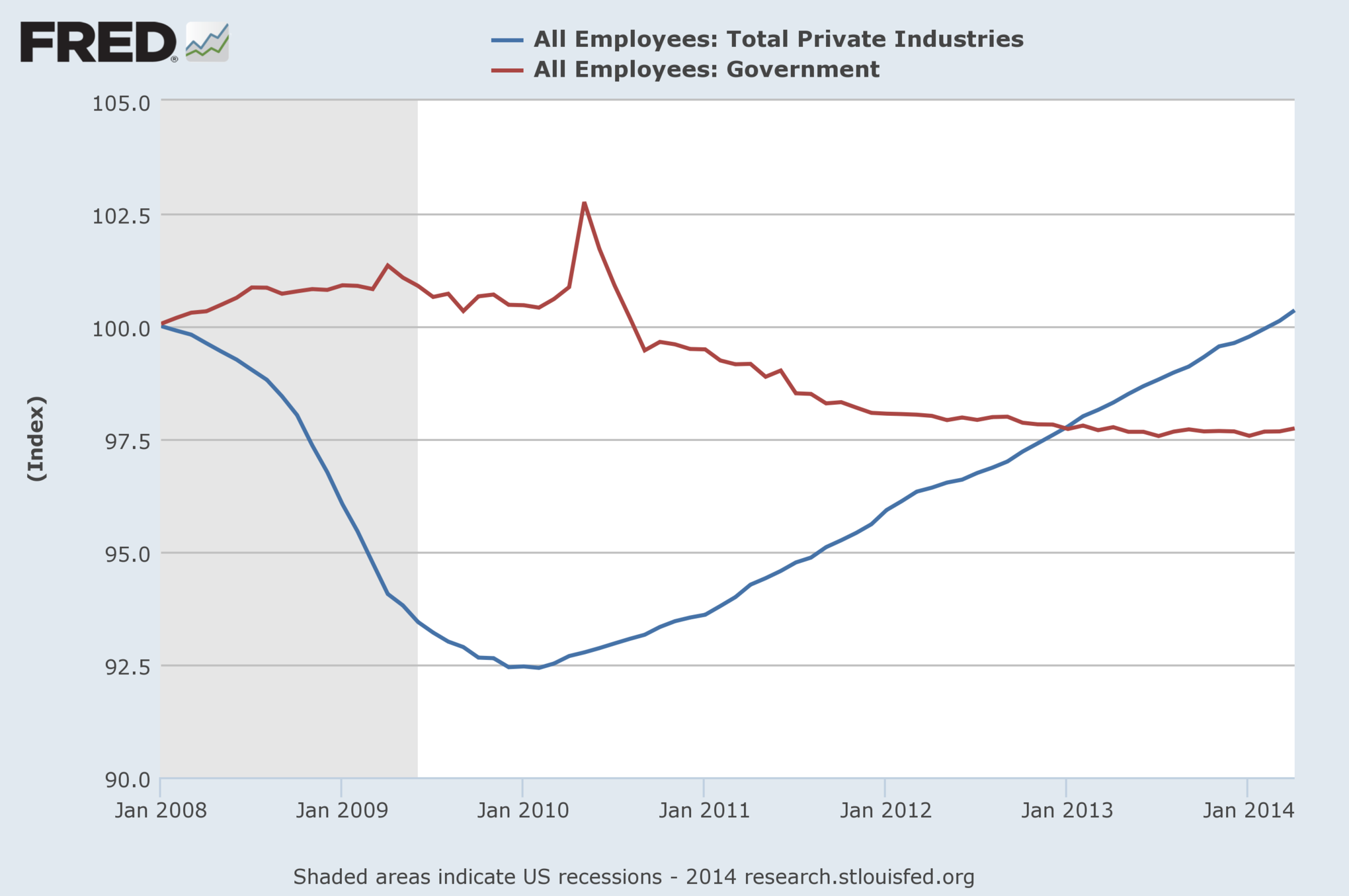
Here's private sector employment (blue) and public sector employment (red) both indexed to their pre-recession peak:

Public_and_private The recession hit the private sector faster and harder, but the private sector's already made back all its losses. The government, by contrast, has been really slumping.
12 May 16:34

101 Things To Love About NYC (in 1976)

by Scout

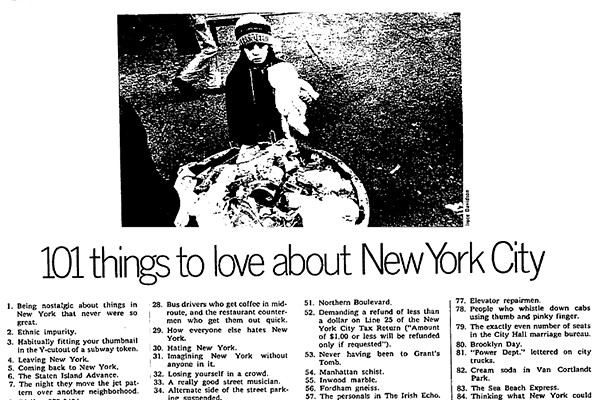
While researching my recent article on Dead Horse Bay, I happened to come across a NY Times article on 101 things to love about New York City. Normally, I don’t pay any attention to Best Of lists, but this one caught my eye because it was written in 1976. I think it’s the oldest one I’ve ever seen.

101things

I thought it might be funny, but a lot of it just confused me. Here are some choice selections (for anyone who was living in NYC in 1976, I’d love to hear your thoughts):

101 Things To Love About New York City (in 1976)

1) Being nostalgic about things in New York that were never that great
Ha, I LOVE that people were doing this as far back as the mid-70s…but what NYC time period were people nostalgic for then? The 1940s?

3) Habitually fitting your thumbnail in the Y-cutout of a subway token
Yep, can’t do this anymore. Is there something similar people do with that little angular edge on a Metrocard?

6) The Staten Island Advance
Nothing against Staten Island’s daily newspaper, but why so high on the list?

7) The night they move the jet pattern over another neighborhood
I don’t think I’ve ever noticed this problem. Was this a bigger issue in the 1970s?

8) Dialing 873-0404
Don’t bother trying it – it’s been disconnected – but from the 1960s-1980s, this was the Dial-A-Satellite hotline, providing you with daily information about passing satellites.

26) The worst public image in the nation
29) How everyone else hates New York
30) Hating New York
84) Thinking what New York could be, if only
There seems to be a trend.

34) Alternate side of the street parking suspended
How did one know if alternate side parking was unexpectedly suspended back in 1976? The newspaper?

35) Flipping the change tray in the plastic taxicab divider
I suppose swiping your credit card while watching a clip from last night’s Tonight Show isn’t really the same thing.

36) Austin Street, Queens
I definitely don’t get this one.

43) Page 1,029 of the Manhattan telephone directory under “Ng.”
I don’t get this one either.

46) More movies, plays, and ballet than anywhere else in the world, and not going
Yup.

50) The Parachute Jump in February
What was going on with Coney Island’s Parachute Jump in February ’76?

51) Northern Boulvard
This may be the only time Northern Boulevard has ever made a top anything list

65) The background teletype noise on 1010 WINS
It’s still there!

69) East-siders on the West Side
Exactly what social migration is this referring to?

76) Looking for a place you know on the dirty restaurant list
Now you can just look at the grade hanging in the window

91) The apostrophe missing from DONT WALK
Were there really so few things to love about New York in 1976?

92) Johnny Carson is gone / 93) Chevy Chase isn’t
Ha, #93 certainly dates the list.

You can read the entire thing here.

-SCOUT

12 May 16:25

Forecast Shows Third ‘Sharknado’ En Route, Fantasy Cast Forming on the Horizon

by Zach Dionne
Jon Schubin

Yes to all of these people, especially Dr. Quinn

Syfy announced today that its crown TV-movie jewel will birth not only a sequel but also a threequel. With Sharknado: The Second One still three months away, we’ve got ample time to daydream about Sharknado 3: ’Nado Forever: Beyond Sharknadome. It’s impossible to guess how the creative team will top itself (unnecessary reminder: in Sharknado, a human male wielded a chain saw, plunged into a flying shark’s maw, and hacked his way to freedom), but we can certainly speculate about the cast. With Sharknado 2 set to feature return appearances from Tara Reid and Ian Ziering, as well as a potpourri of B-, C-, and D-listers, musicians, and non-actors including Andy Dick, Mark McGrath, Billy Ray Cyrus, Judah Friedlander, Perez Hilton, Judd Hirsch, Vivica A. Fox, Kelly Osbourne, and wrestler Kurt Angle, who’s worthy of Part 3?

Richard Attenborough. Ninety years old. Familiar with toothy beasts. Will, without a doubt, say, “Welcome … to a sharknado.”

Leah Remini. Survived Scientology and nine years of TV marriage to Kevin James; can handle an aberrant weather phenomenon stuffed with sea predators.

Steve Harwell. Smash Mouth vocalist, all-star.

Billy Zane. Disaster-film veteran. Makes his own luck.

J.B. Smoove. In a completely serious role.

Jane Seymour. Dr. Michaela Quinn, frontier healer.

Billy Eichner. Human scream.

Fran Drescher. The Nanny star, woman with voice.

Scott Stapp. Creed frontman, man with voice.

Jaleel White. In two roles: as himself, and as an adult Steve Urkel.

Jennifer Coolidge and Jane Lynch. Party Downand Best in Show alums.

James Michael Tyler. Gunther, Friends.

Michael Jai White. Star of actually cool modern B-movie Black Dynamite.

Jesse Camp. Former MTV VJ/walking drug addiction.

Christopher Walken. Once said, “[I]t’s hard for me to say no.” Did GigliClick, and Balls of Fury to prove it.

Fieldy. Korn member, slap bassist, jersey enthusiast.

And Quentin Tarantino. Please.

12 May 12:47

There Was No Committee

by Geoffrey Pullum
Jon Schubin

An interesting read after a week of (mostly) speaking Spanish, a language I've never been formally trained in. English is the global language, and while there are reasons to learn others, it doesn't mean that English should stop being the language of global communication.

britishempiremap

British empire, 1919. Image courtesy Historic UK

English is becoming a global lingua franca not just for trade, industry, aviation, research, and entertainment, but also for higher education. We scarcely needed the conclusions of a new research report by the department of education at the University of Oxford in collaboration with the British Council, released Wednesday, to tell us that.

Ph.D. students in countries like Finland or the Netherlands have (at least in my field) long been writing their dissertations in English rather than in Finnish or Dutch. But at undergraduate as well as graduate and professional levels, more and more non-English-speaking countries are making the decision to use what they are calling English as a Medium of Instruction (EMI).

Idealistic faculty members suggest this could lead to enhanced understanding between peoples of different countries. Canny administrators with an eye on the bottom line observe that they are far more likely to be able to attract tuition-paying international students if their courses are in English rather than Urdu or Uzbek.

Interestingly, some countries are resisting the trend: At least some institutions in countries ranging from Israel to Senegal and from Italy to Venezuela are reportedly holding out against EMI in public education.

One can sympathize: It seems unconscionable that languages with scholarly histories as broad and deep as Hebrew, French, Italian, or Spanish should cease to be thought appropriate for modern university instruction. Yet when you look at the figures for research publications in Hebrew rather than English, or the numbers of employment opportunities for graduates that call for facility in Italian rather than English, you can begin to see the compelling case that can be made for EMI.

Nothing about the dialect of the southern region of the island of Great Britain makes it especially suited to a global role. In fact, choosing English, with its maddeningly stupid spelling quirks (Finnish has none), and its nearly 200 irregular verbs (Swahili has none), and its phonology replete with brutally complex consonant clusters (Hawaiian has none), looks like a choice made by a committee of idiots.

But it was not. Accidents of history conspired to determine the present status of English.

Which language was spoken by the people who managed to gain lasting political control in North America and Australasia, and had temporary political dominance in all of southern Asia and most of eastern, western, and southern Africa?

Which language is spoken in the one place on earth where blockbuster movies for worldwide release are made on budgets running into the hundreds of millions of dollars?

Which is the main language used by the closest to approach Radio Earth, namely the BBC World Service?

Which is the only language used officially for government purposes in more than 60 countries?

Which has been chosen as the norm for all air-traffic control conversations?

A long succession of such accidents has put English so far in the race for dominance in global communication that it can hardly even be called a race now.

Some people talk as if Mandarin Chinese was gaining on English. It is not, and it never will. A Tamil-speaking computer scientist explaining an algorithm to a Hungarian scientist at a Japanese-organized scientific meeting in Thailand calls on English, not Chinese. Nowhere in the world do we find significant numbers of non-Chinese speakers choosing Mandarin as the medium for bridging language gaps. There are no signs of that changing.

The burgeoning of English is pushing ever-larger numbers of small minority languages into extinction, and many linguists lament that. There are two sides to the issue, though. It saddens us linguists that so many grammatically fascinating and diverse languages in so many language families should be dying out, yet who are we to tell an African father, proud of raising his children to speak a multinational lingua franca like Swahili or English, rather than the local dialect of his traditional village, that he is wrong?

We cannot insist that children should be raised speaking some dying minority language (be it Walbiri or Irish or Inuktitut or Mohawk) unless we have jobs to offer them that they can do using those languages.

People must make their language choices for themselves. If they are increasingly choosing to be educated in English, neither fans of linguistic diversity nor politicians taking pride in the national language have a right to overrule them.

Personally, I would never have proposed making English a global language for education or anything else, and I think my life has been rendered poorer by the fact that because I speak English natively I have never been forced by circumstances to develop real fluency in a foreign language. But nobody placed me on the committee to decide on the global language for education. There was no committee.

12 May 12:45

April 30, 2014

12 May 12:40

Sober, early Morning Gloryville dance parties coming to Williamsburg

by David Colon
Jon Schubin

OK. I'm staying in the Southern Hemisphere.


Who could be sober and be this happy? via Facebook We will freely admit that we are not the kind of people who want to get up and dance first thing in the morning. Hell, some of us never really want to dance at all. And being sober, well, we wouldn’t exactly call ourselves advocates. But maybe you are, so maybe you’ll be excited to hear that Morning Gloryville, sober early dance parties started in London, are being imported to Williamsburg.  The first morning rave of the year will kick off tomorrow, May 7, at 6:30 in the goddamn morning at clothing store/performance space Kinfolk 94 (94 Wythe Avenue). In order to bolster their message of sobriety and dancing just to feel it and generally being healthy, your $20 admission will get you access to free massages, a juice bar (with superfood juice) and a coffee station, and someone called a “Wake… Read More

The post Sober, early Morning Gloryville dance parties coming to Williamsburg appeared first on Brokelyn.

12 May 03:37

The Death of Zynga

by David Auerbach

The other day, my wife installed a charming, free little game called Disco Zoo on her phone. She made the animals dance around for a while, but then she couldn’t do anything else because she had run out of “Disco Bux.” The options: wait hours for her DiscoBux to replenish, or buy them in packages ranging from 99 cents (for 10 Disco Bux) to $29.95 (for 2,000 Disco Bux). She felt suckered. We have banished Disco Zoo from our house and told it never to darken our door again.

11 May 18:51

Helpful Advice: Pencils and Poo

by Mary Kelly
Jon Schubin

We have some pretty serious rules about how to poo at work in my office, at least on the men's side. There's a protocol (door open vs. door closed) to let you know if it is OK to enter.

From time to time we will feature interesting books that people suggest. Today is one of those days. We have a couple of titles that are right from the 818.602 section of the library. This is often a favorite place to find lots of fun for the person who is kind of bored or just not that interested in anything “literary.”  Here are a few that recently caught our attention.


poo and pencils1

How to Poo at Work
Mats and Enzo
2009

How to Sharpen Pencils
A Practical and Theoretical Treatise on the Artisanal Craft of Pencil Sharpening
Rees
2012

Both of these books are fine for any library collection. Both are exactly what the titles say.  The pencil book has some cool endorsements from journalism and literature and I cracked up at the complexity of artisanal pencil sharpening. A foreword by John Hodgman also makes the book worth a look. Maybe artisanal pencil sharpening is the next big thing.

The poo book is really just a continuous poop joke. Don’t get me wrong, I always can get on board with a good poop joke, but this one is just okay. I think when you are writing humorous how to books, they need to be full of actual advice and suggestions. This book doesn’t really have the joke nearly as “sharp” as the Rees book. (See what I did there?)

So go forth and sharpen pencils and don’t flush your career away.

Mary

More fun posts from the archives:

Awesome, not awful

A Grave Matter

Real Auto-Erotica (NSFW)

More from:

How to sharpen pencils:

11 May 18:07

Empire of the Plantain: One Family's Mission to Make the New American Fast Food

by Chris E. Crowley
Jon Schubin

LES is going to be great. This is a solid place but Elmhurst can be a slog (take the Q59 from Williamsburg)

20140429_290735_hernandez.jpg

Jonathan Hernandez outside Patacon Pisao #1. [Photographs: Chris Crowley]

When Liliana Velasquez opened the first Patacon Pisao (née "El Dugout") in 2005, her dreams were modest. She didn't realize that her little food cart serving Venezuelan sandwiches would be the first of a local chain, one that today is on the verge of going bi-costal.

After years of working and saving in the restaurant industry, Mrs. Velasquez wanted to be her own boss. And she yearned to bring the food of her birthplace, the coastal city of Maracaibo, Venezula, to New York. That meant the patacon, a sandwich in which twice-fried green plantains are smashed thin to take the place of bread. They're then stuffed with meat, cheese, tomatoes, lettuce, and sauce.

Her sandwiches are late night booze-sponge gold. The plantain, she realized, is the great equalizer across much of Latin America, enough so that her Dominican friends convinced Velasquez, who lives in Maspeth, to open her cart on 202nd Street in Washington Heights. There, they said, she could serve Dominican clubbers spilling out of the hottest nightclub in town.

Mrs. Velasquez never imagined her cart would be more than a modest neighborhood snack for late-night revelers. But her son Jonathan Hernandez did. "I want [the patacon] to be the next taco. When people leave the bar, I want them to think, 'do I want a taco, a gyro, a pizza, or a patacon?'" He knew it could be more than "just for Hispanic people."

He was just a freshman at the University of Buffalo when his mother started her business. Four years later, the truck was blowing up with write ups on blogs and from Dave Cook in the New York Times. After that review, Cook observed the patacon sweep other restaurants in the neighborhood.

"I only saw the big potential once we got the calls for interviews from bloggers and we got an addressed letter from the Vendy Awards. They wanted us to be part of this!" Hernandez said. He had ambitions to put his urban planning and geography degree to work for the Parks Department, but "I was ready, I was about to graduate, and I said, 'let me join this business.'"

"I wanted to get on it before someone else got the glory for something they didn't start. My mom didn't see what I could see: more than just the Heights, more than just Dominicans."

Getting her to buy into his vision for Patacon Pisao has been an uphill battle. Hernandez and his mother have fought over issues as small as napkins and as central as menu design. Another major sparring match: whether or not to open a brick and mortar restaurant.

20140429_290735_patacon.jpg

For three years, Velasquez used a storefront on Grand Street in Elmhurst as her commissary kitchen. When the Times review came out, Hernandez finally convinced her to open it as a restaurant. "Once we opened it, everyone came."

Elmhurst, an ethnic melting pot even by Queens standards, draws immigrants from Thailand, China, Argentina, Nepal, and Poland. The restaurant became a proving ground for the patacon's broader appeal. The verdict? "Come in here on a Sunday and the place is packed with Chinese people. The demographic of people that come here is everybody," Hernandez said.

The family's next step is the Lower East Side, where their shop will open next month. Hernandez says they will open one more location in New York, but not in Brooklyn, where he says everything goes too fast and you don't get enough foot traffic for your money—they'll probably return to their roots in Morningside Heights.

And after that? California within the next five years.

Hernandez is coy about a specific city, but he's also looking beyond the US, considering offers to open in South America. But he still wants people to know where he came from. "I just want to be Patacon Pisao. I want people to be like, 'this started as a food truck and it's different from any other Venezuelan joint out there."

"I'm trying to change the way people see Latin food. The average person, when they think Latin food, they think Mexican food right away. But there's more to it than just that."

About the author: Chris Crowley is the author of the Bronx Eats and Anatomy of A Smorgasburg Pop Up columns. Follow him on Twitter, if you'd like. In person, your best bet is the window seat at Neerob, or waiting in line at the Lechonera La Piranha trailer.

09 May 02:56

Banphasawan in Kanchanaburi, Thailand

Dragonfruit and mangosteen bungalows.

Baanphasawan is a large upscale resort that has fashioned each of nearly 100 dwellings into the shape of fruits, vegetables, and other plants, and in its fruity obsession has managed to assemble Thailand's only seed bank for the foul-smelling/sweet-tasting durian.

The resort stands alone at the end of a road off the main highway, over 18 miles from the nearest city, which itself is a tiny market town near the border of Myanmar with no amenities for tourists. However once arrived at the resort guests can sleep in fully stocked dwellings shaped like colossal pineapple, dragonfruit, durian, mangosteen, mushroom, bamboo shoots and more, all the while surrounded by orchards growing the real deal.

Clearly a lover of  sweet produce, the owner plans to attract school groups and clubs interested in horticulture and nature. Twelve years ago, he began collecting rare fruit varieties from all over Thailand to plant on the 80 acre property, as well as exotic flowers from abroad. In particular, he focused on durian, a fruit whose bizarre combination of lethally sharp spikes and pungent aroma makes an instant impression (it is also known as the "corpse fruit"). Now the site cultivates over 100 varieties of the stinky fruit, making it one of only a few places in Thailand that serves as a a genetic bank. Visitors seek who want to taste durian should visit in late May or June. 

In addition to the quirky fruit buildings, nearby attractions include a small waterfall, a natural hot spring, some beautiful misty mountains. Given all of the natural beauty in the area the question isn't really why someone would build this place here, but who manages to find it.


08 May 03:48

‘Sheezus’: Lily Allen Has Invented Paranoid Blogger Pop

by Emily Yoshida
Jon Schubin

Sheezus is so awful.

What, precisely, is Lily Allen’s damage? On her new single, “Sheezus,” the second release off her third studio album of the same regrettable name, one gets the impression that she is more interested in a career as a music blogger than a pop star. Once upon a time, Lily Allen was second to none when it came to wry, catchy pop, but with “Sheezus” I feel as if we’ve accidentally clicked a shady-looking link and landed at Lilytology.com, and it is rife with toxic negativity and grammatical errors. The first full minute consists of a lengthy prologue, delivered in Allen’s characteristic coy lilt over a beat ripped straight from Sleigh Bells’ “Run The Heart,” in which Allen explains the current state of her career with neither imagination nor economy:

Been here before, so I’m prepared
Not gonna lie though, I’m kinda scared
Lace up my gloves, I’m going in
Don’t let my kids watch me when I get in the ring

I’ll take the hits, roll with the punches
I’ll get back up, it’s not as if I’ve never done this
But then again, the game is changing
Can’t just come back, jump on the mic, and do the same thing

There goes the bell, I know that sound
I guess it’s time for me to go another round
Now wish me luck, I’m gonna need it
I’ll see you on the other side, if I’m still breathing

Look at how long that first verse is! Never mind that those are three stanzas that essentially repeat the same idea (via a boxing metaphor, no less), Allen really goes out of her way to give the impression that making another album is the absolute last thing she wants to be doing right now. Whether that’s an affectation or how she actually feels, she seems to think that all this qualification will somehow shield her from the wrath of the Internet pop stan army. In the age of the comment-section troll, it’s easy to be spooked into the futile exercise of reading your own work through the eyes of your potential haters in an effort to patch up any holes their bullets might pierce (which never, ever, ever works). It’s bad songwriting, but classic first-time blogger form.

Allen then shifts her attention from her critics to her competition, the other thing common wisdom tells us not to worry ourselves with too much if we want to succeed. “Sheezus” has been somewhat erroneously branded as a “diss track” even though Allen never specifically says anything negative about any of the female (all female!) vocalists she calls out (aside from perhaps Gaga, though it’s kind of hard to tell). It’s all shadowboxing, but the fact that Allen has her fists up at all seems incredibly counterproductive. Of course, the Catch-22 is that here I am throwing my own punches at this terrible song, but haven’t you ever dumped someone because they wouldn’t stop talking about how scared they were that you were going to dump them?

Ri-Ri isn’t scared of Katy Perry’s roaring
Queen B’s going back to the drawing
Lorde smells blood, yeah, she’s about to slay you
Kid ain’t one to fuck with when she’s only on her debut

We’re all watching Gaga, L-O-L-O, haha
Dying for the art, so really she’s a martyr
The second best will never cut it for the divas
Give me that crown, bitch, I wanna be Sheezus

When she finally gets to the titular point, it’s anticlimactic: Why does she “wanna” be Sheezus? Shouldn’t she already be declaring herself Sheezus? C’mon, Lily, own it, dammit! The need to explain one’s self, both for celebrities and us regular folk, usually lessens with time, but it seems like the more years go by, the less Lily Allen is able to just spit it out. She may have lost some of our loyalty with her “Hard Out Here” video and her Azealia Banks Twitter beef, but defensiveness rarely looks good on pop stars (just ask Sky Ferreira or Avril Lavigne). The most prudent thing for Lily to do would be to just stop comparing herself to the rest of the world and write a good pop song that isn’t about other pop stars. Otherwise she’s just the celebrity equivalent of a bullied kid at camp throwing herself into a tangle of poison ivy before the bigger kids have a chance to do it to her first. It may be an effective tactic in the short term, but you always end up covered in rashes, and half the time it turns out nobody was planning on throwing you in the first place.

07 May 02:48

18 Things Guys Need To Stop Wearing After College

Because after you graduate so should your clothes.

White sunglasses

White sunglasses

I know you think they say, "I'm pretty cool" but what they really say is, "I can drink my weight in Natty Light and still be up by noon."

Flickr: awfulshot / Via Creative Commons

Baja hoodies

Baja hoodies

Unless you are a professional surfer who travels the world on an endless summer, then you have no reason to wear one of these monstrosities. I mean, I know you want to hang onto those spring break memories from Cancun, but it really is time to move on.

Via amazon.com

White hats

White hats

A: They get dirty.
B: They're ugly.
C: Yours is probably dirty and ugly.
Throw. It. Away.

Via Flickr: tinaxduzgen

Shower sandals

Shower sandals

The ultimate in lazy, college dude fashion. These are fine when you have an 8 a.m. science lab, not so great when you have an 8 a.m. job interview.

Via softmoc.com


View Entire List ›

05 May 14:45

Do We Need To Be Touching? (And 36 Other NYC Etiquette Lessons)

Here are 27 pages from my first book NYC Basic Tips and Etiquette and 10 pages that didn’t make the book.

Facebook: NYCBASICTIPSANDETIQUETTE

Facebook: NYCBASICTIPSANDETIQUETTE

Facebook: NYCBASICTIPSANDETIQUETTE

Facebook: NYCBASICTIPSANDETIQUETTE


View Entire List ›