 While many people are trying to figure out if their rooftops might provide a good view of the East River July 4th fireworks or make plans to check out other displays, Mother Nature might change those plans with Tropical Storm Arthur. [ more › ]
Andrew BaisleyUgh
While many people are trying to figure out if their rooftops might provide a good view of the East River July 4th fireworks or make plans to check out other displays, Mother Nature might change those plans with Tropical Storm Arthur. [ more › ]Andrew Baisleywow

The car-as-door-prize was a classic last resort for overpriced condos circa 2009, but now it is being employed by a Park Slope developer in a rather clever fashion. Eitan Baron of Greenstone generated some derision when his plans for a environmentally conscious two-unit condo development in Park Slope were shown to include a private garage. However, it turns out that Baron and co. have taken steps to ensure that even the garage will be eco-centric, as the $6 million triplex to which it belongs will come with a free Tesla electric car, Daily Intel reports. We'll just let them explain all that car stuff:
[The apartment comes with] a gray Tesla Model S sedan with the top-model 85 kWh battery — price tag: $79,900, plus an additional $2,500 for the stereo system and $2,500 glass roof, plus $3,050 for the technology package — parked in its garage, which will, naturally, be equipped with a Tesla charging station.
Baron describes the giveaway saying, "It's like you dress up for the evening and put on a gold watch," which ... sure, okay. He also nicely deflects the question of whether or not he owns an electric car, saying, "I don't have the luxury of having my own parking garage." The listing is expected to go live within the next two months.
· Buy a Park Slope Condo, Get a Free Tesla [Daily Intel]
· Ecotastic Two-Family House Replacing A Sackett Street Garage [Curbed]
A few weeks ago, I was using Google Maps to search for lakes north of the city. Most seemed to have your typical lake names, like Green Mountain Lake, or Harmony Lake, but one in particular caught my eye…
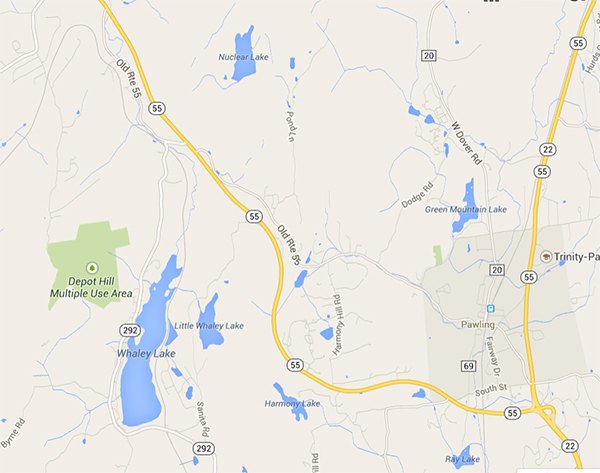
Does New York really have a Nuclear Lake??
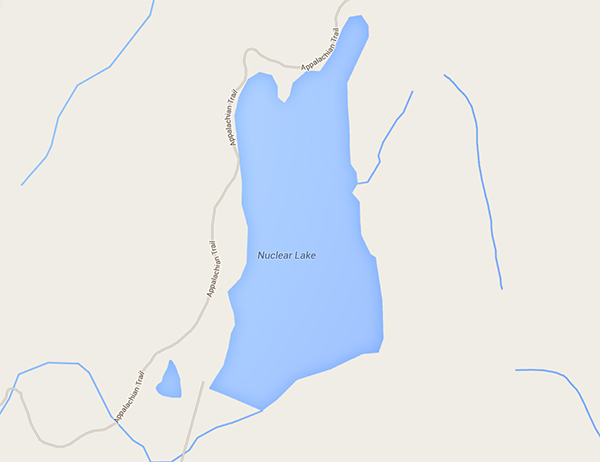
Of course, the first image to pop into my head was the Nuclear Lake from The Simpsons, complete with three-eyed fish jumping about and a pipe openly dumping radioactive waste.

As it turns out, this actually isn’t all that far from the truth. In 1958, an experimental nuclear fuel research lab was set up on the shores of a lake in Pawling, NY, by Nuclear Development Associates. According to this 1955 NY Times article, the remote site was chosen because “it was the largest convenient and available tract that was not crossed by public roads and could be adequately guarded for secret experiments,” which would involve “uranium and other radioactive materials.” How reassuring!
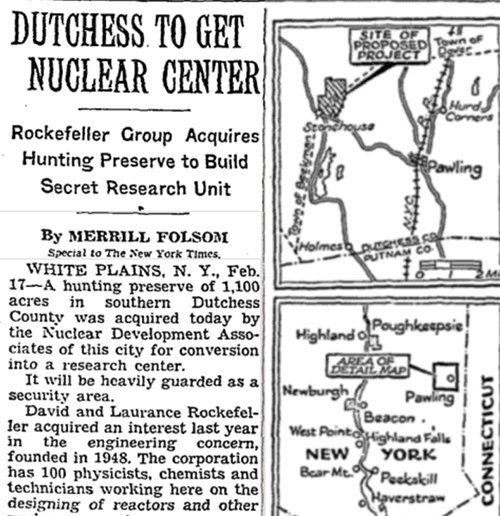
All was apparently fissioning along just fine until the early 1970s, when two serious accidents occurred at the site. First, in 1971, a rubber stopper came off of a plutonium powder container, contaminating a lab room with radioactive material. Then, in 1972, a chemical explosion occurred in the building adjacent to the lake (pictured below in this NY Times article), causing an unknown amount of plutonium powder to spew out into the air and presumably onto the surrounding grounds. Nuclear Lake had earned its name.
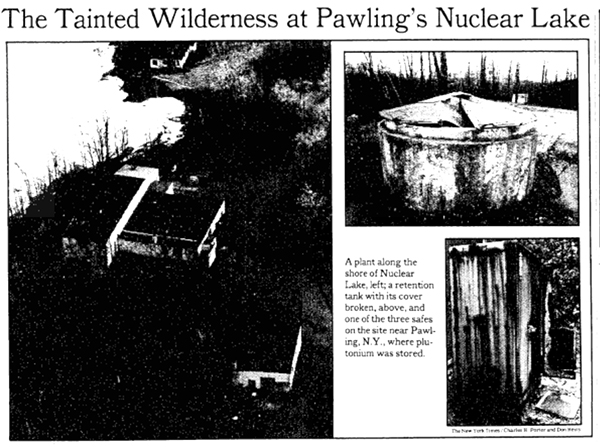
Little seems to be known about the accident, though local legend has it that at least one person died, and that there was a cover-up. In the comments left to this Nuclear Lake post, one local recalls his mother, a nurse, saying that one of the victims came into the hospital with his watch melted down to his bone; another rumor has it that the ambulance he was transported in is buried on the site (you can read about a horrifying accident at a similar facility here).
A clean-up commenced at a cost of $3,000,000, and the land was deemed safe for “unrestricted use.” The company closed down the plant shortly after, and the land was sold to the National Park Service for inclusion into the Appalachian Trail. Though documents were found that suggested the company may have also been dumping radioactive waste water into the lake, a Nuclear Regulatory Commission study gave it a clean bill of health in 1994.
Of course, I had to visit Nuclear Lake for myself.
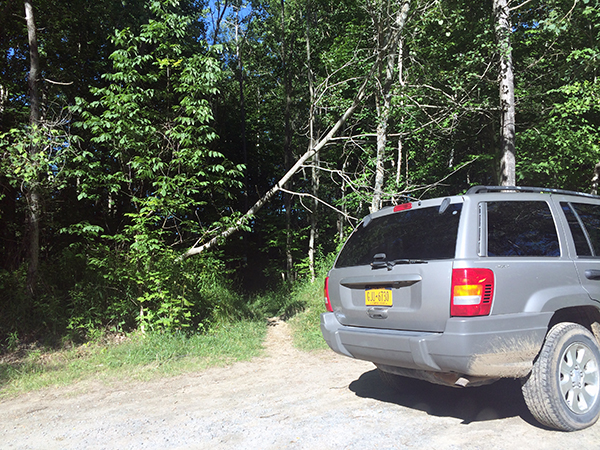
Last weekend, I drove up to Pawling with a few friends and my fluffy-butted dog Lulu. We parked at the trailhead and headed into the woods.
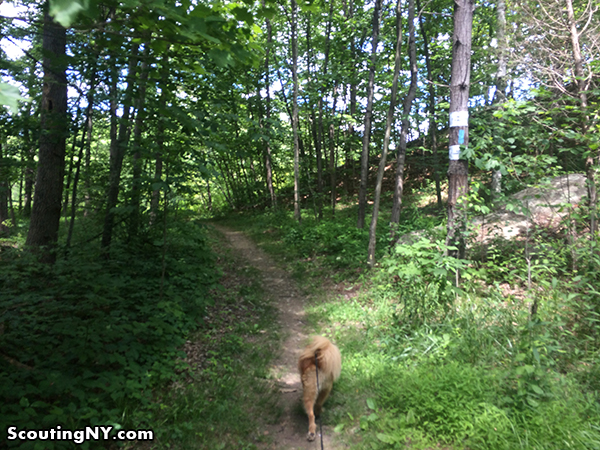
It didn’t take long before we began spotting the ubiquitous white blazes signifying the Appalachian Trail, painted every few trees (sadly, we didn’t see any thruhikers – perhaps it’s too early in the season?).
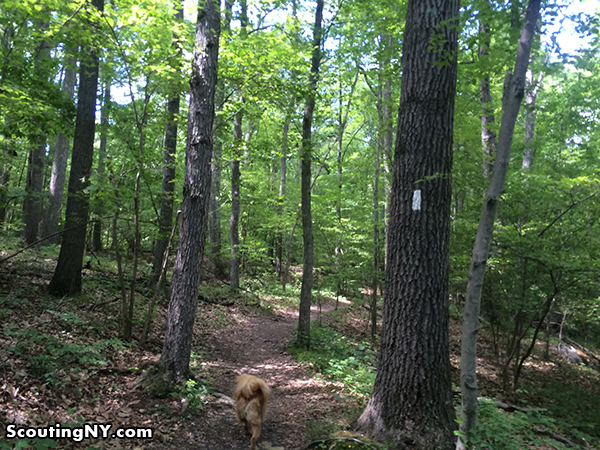
We continued deeper into the forest for about 20 minutes, seeing numerous squirrels, chipmunks, and woodpeckers, though surprisingly, not a single mutated turtle of either the teenage or ninja varieties.
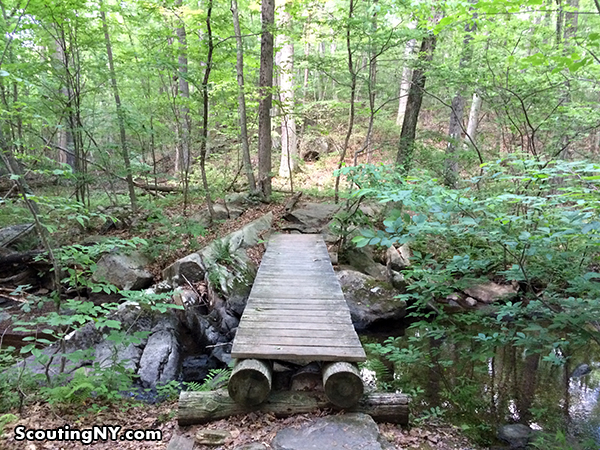
Finally, we arrived at the Nuclear Lake loop trail, which circles around the lake to rejoin the AT on the other side.
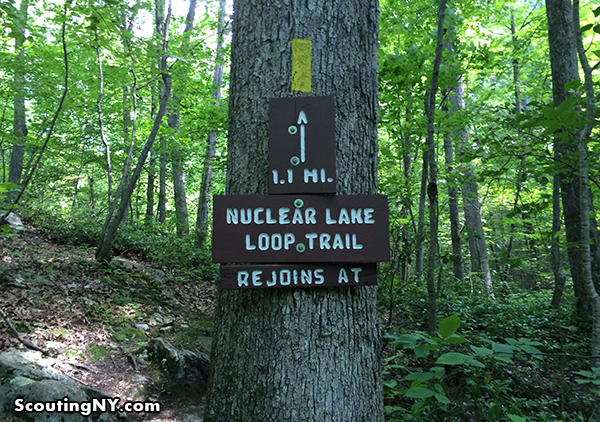
Starting the trail, we soon came across the first remnant from the former lab: the original access road leading to the site, which appears to still be maintained. Crazy to think this was once a guarded road for a nuclear lab conducting secret research for the government.

Shortly after, we spotted a chain-link fence through the trees surrounding the former lab site.

Finally, we began to see water. We made our way through an opening in the trees…
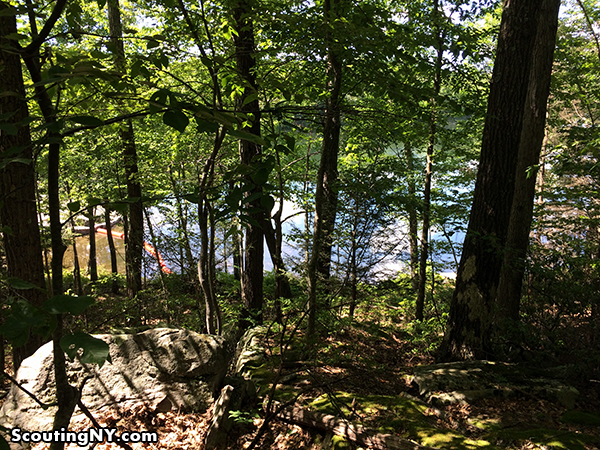
…and arrived at the shores of the disgusting, grimy, pollution-filled Nuclear Lake.

Kidding, of course! Nuclear Lake is absolutely gorgeous, with nary a Swamp Thing or Gil-man to be found. In fact, many thruhikers on the Appalachian Trail describe it as one of the most beautiful sights on the entire trek.

But what about the former lab site? From our vantage point, we could see the area at the south side of the lake, surrounded on both sides by chain-link fences (all buildings have since been razed).

To the left, we could also see a floating barrier in the water. Any idea what the purpose of this is?

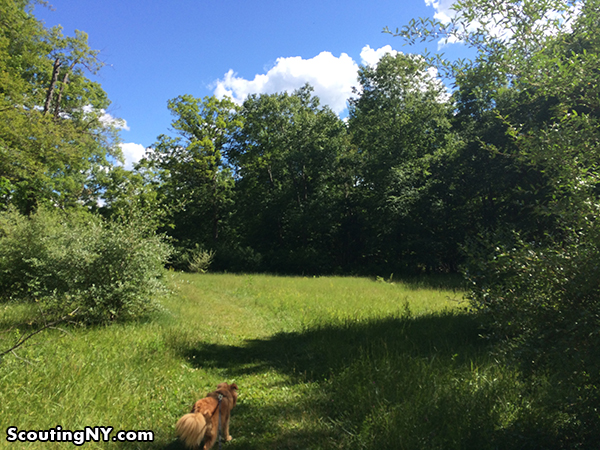
Hoping to take a look at the former lab site up close, we continued hiking around the lake, eventually rejoining the Appalachian Trail and heading back south.
Finally, we arrived at the insurmountable chain-link fence, clearly in place to prevent anyone from accidentally entering the contaminated grounds and inadvertently turning into either an Amazing Colossal Man or a 50-foot Woman, depending on your gender.
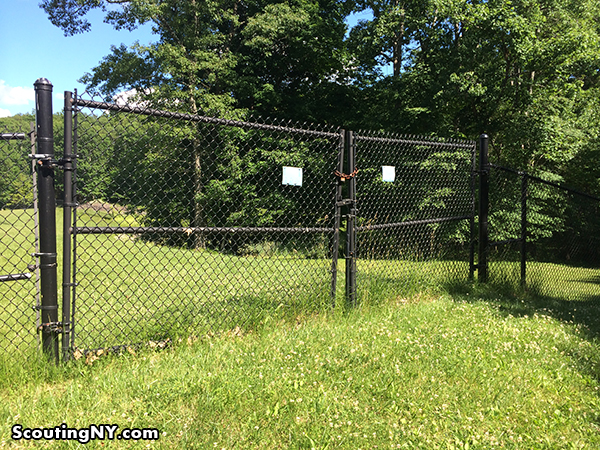
Kidding again. Actually, the fence is quite easy to get around, and seems only in place to prevent people from driving onto the former lab site.
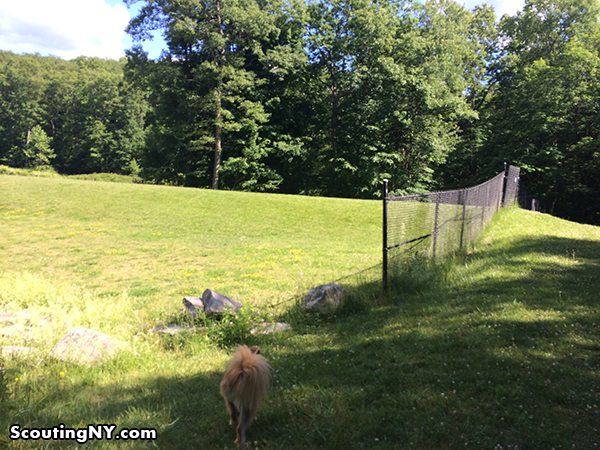
Here is where the lab would have been…
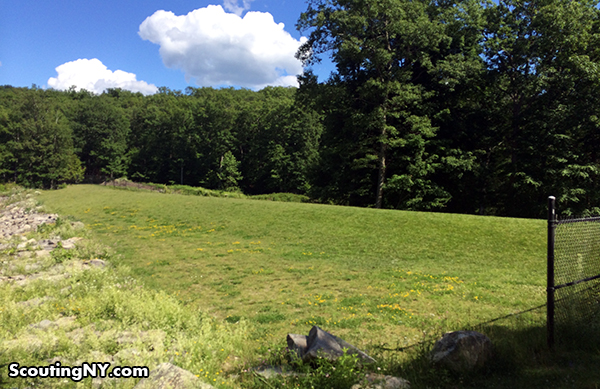
…and if you can forget the possibility of getting a little plutonium dust in your sandwich, it really makes for a fantastic picnic location.

Here’s the picture of the abandoned lab again to give you a sense of where it was once situated:
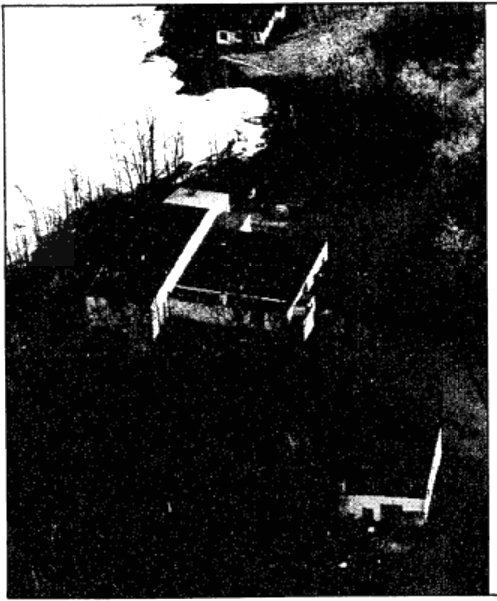
Today, there’s no trace of the former buildings save for what appears to be a foundation off to one side (possibly remnants of the former waste disposal building?).
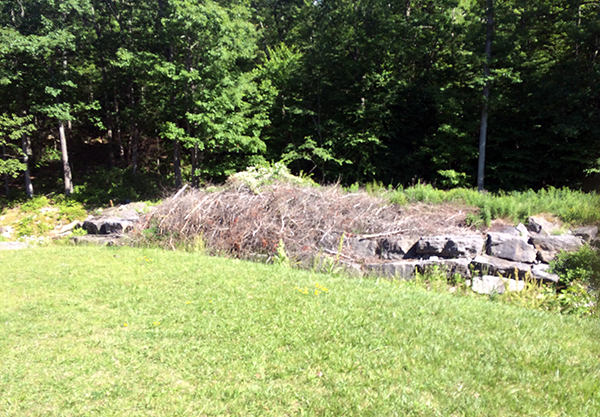
Stepping further back, it soon became clear that the entire area we were standing on was an artificial hill, made all the more obvious when you went down the slope on the far side:
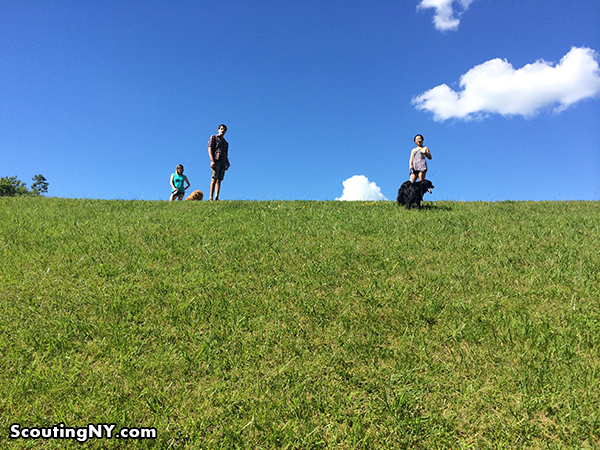
We found a hatch set into the top, and while I’d like to believe it leads to a Dharma Initiative-like room (what were the numbers again??)…
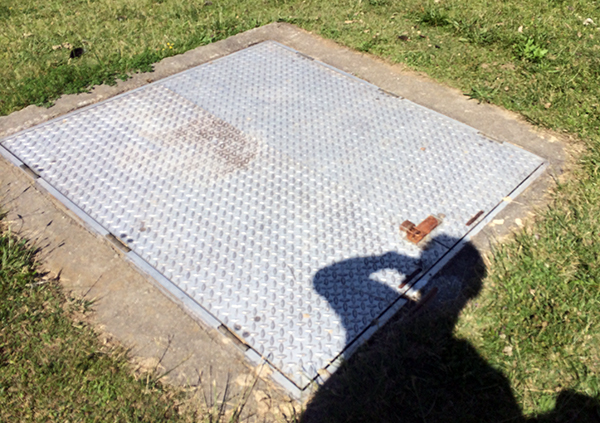
…a better guess would be that it’s an access point for the dam opening at the base of the hill:

All in all, we had a beautiful two-hour hike, there were no unwanted mutations amongst the group, and about the only suspicious thing we came across were these oversized dandelions just outside the lab site (I suppose there are worse things in the world than mutant dandelions).

If you’re looking for a fun and relatively easy hike, Nuclear Lake definitely makes a great option. Despite Google Maps’ estimate, it only took us about an hour and twenty minutes to drive up to Pawling. We did the Nuclear Loop side first, but I’d actually recommend starting with the Appalachian Trail portion, which gives you the best views of the lake and plenty of picnic spots early on. You can find more info on the hike (including where to park) here.
-SCOUT
PS – On the way back, I highly recommend a stop at Heinchon’s Ice Cream Parlor about 10 minutes away on Route 22 South.
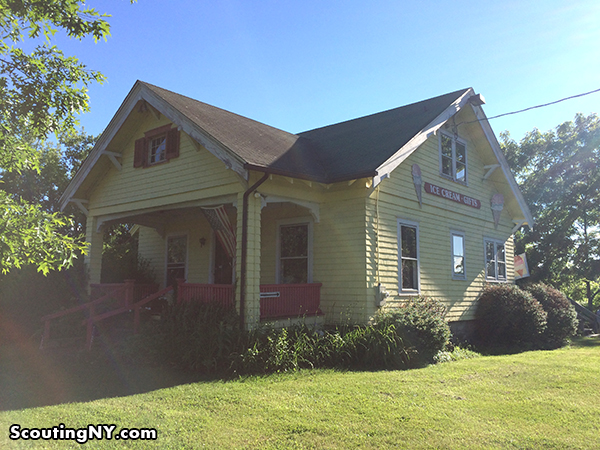
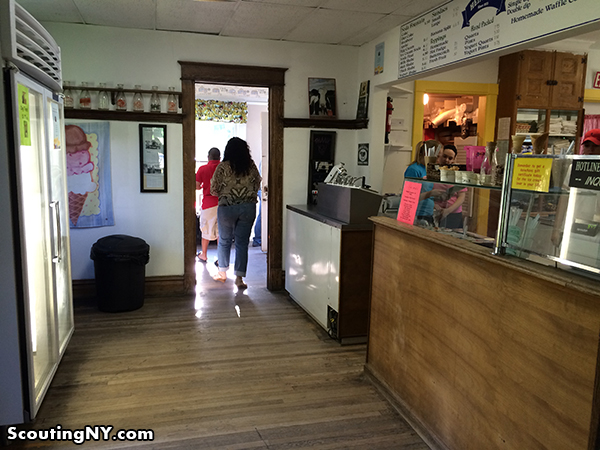
Founded in 1923, the place is as old-fashioned as it gets. In fact, I think the sitting area literally qualifies as an actual parlor.
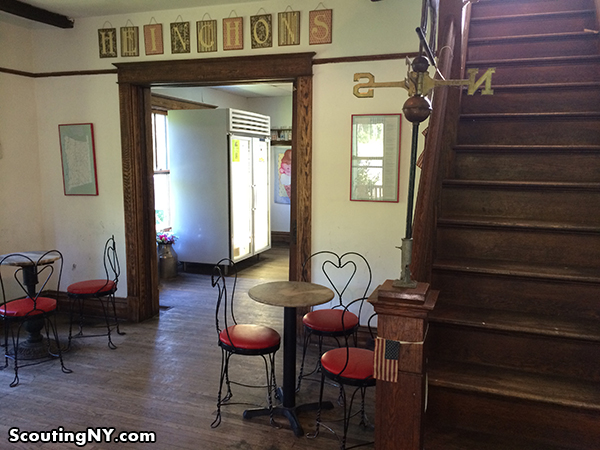
Head all the way to the back of the house for your ice cream – the mud pie was amazing.
Andrew Baisleyhaha
We’ve all seen them before: YouTube clips of the famous scene from the World War II movie “Downfall” in which Hitler is given bad news. Subtitles have been switched to show Hitler flipping out over Obama’s reelection, Disney buying Star Wars, and Ben Affleck being cast as Batman.
Even the actor who played Hitler on “Downfall”, Bruno Ganz has chimed in, seeming less than thrilled that a performance he put “everything” into is now more famous as a wildly popular parody source. We wonder how he’ll feel about the latest version; Hitler tries to rent an apartment in San Francisco.
Warning: this video’s subtitles contain profanity and are NSFW.
Andrew BaisleyClick through for a great video
We've all seen strange press conferences. We've had players come in and give one-word answers, we've had players walk off mid-question and at times, we have the player come in and laugh and joke with the press.
But a full-on answer about vampires in the sport of tennis? That is a first.
Ernests Gulbis was asked in his Monday press conference following his opening match win about umpires going away in the sport of tennis considering how technology has made calling lines a bit less important (and how John McEnroe wishes players would call their own lines), and Gulbis thought the question was about vampires.
That was when he started answering, and answering, and answering until that same reporter came in with a follow-up question that finally made Gulbis realize this wasn't some "Twilight" movie premiere Q and A but a question about the people that make the calls.
"Get rid of umpires? My God I thought something else. I thought vampires. Vampires in the way that people who are surrounding and sucking the energy out of players. That's what I meant. Umpires. That would be a better comparison. Umpires? No. Without umpires it wouldn't work," Gulbis said with a laugh.
So yes, we are not two days in at the 2014 Wimbledon championships and we already have a nominee for the best quote of these two weeks.
Next press conference I'm hoping for "backhand/Ironman" mishap just to keep this theme rolling on.
Andrew BaisleyWow. This sucks
The Supreme Court has just ruled against Aereo 6-3, reversing the Second Circuit's opinion that Aereo's system of rebroadcasting television over the internet was permitted under the Copyright Act and basically killing Aereo's business model. Breyer wrote the opinion, Scalia, Thomas and Alito dissented. More soon.
Andrew BaisleyJust sharing for the headline. It's really true.

Wednesday's World Cup action brought us another hat trick, more Messi, creative explanations for Luis Suarez, hair cuts, planes filled with money, and a steely rejection of Ann Coulter.
Last Night's Action
Bosnia-Herzegovina 3, Iran 1 (HIGHLIGHTS) It was too late for it to make any difference in their tournament fate, but Bosnia-Herzegovina won their first ever World Cup match, easily knocking off Iran. Edin Dzeko and Miralem Pjanic scored the opening two goals as Iran rarely threatened. Iran finally showed signs of life in the 82nd minute when Reza Ghoochannejhad scored an easy tap-in for Iran's first and only goal of the tournament. Avdija Vrsajevic's insurance goal a minute later ended hope for the Iranians.
Nigeria 2, Argentina 3 (HIGHLIGHTS) It was Leo Messi vs. Ahmed Musa, as every time the Argentine star would score, Nigeria would answer back just minutes later. A goal from each inside the first five minutes put the scoreline at 1-1 early. Messi would score just before the halftime interval on a free kick, but Musa would level the match again two minutes into the second half. Argentina's Marcos Rojo scored the game winner in the 50th minute, but the Nigerian Super Eagles won't be crestfallen, as Iran's loss ensured they advance to the Round of 16 anyhow.
Ecuador 0, France 0 (HIGHLIGHTS) France grabbed the top of group E with a scoreless draw. Ecuador were forced to play with 10 men after a straight red to Antonio Valencia early in the second half. France refused to sit back, managing 21 shots on the afternoon, but the draw was enough for them to guarantee their Round of 16 match would be with Nigeria instead of Argentina. The result, combined with the Swiss win, eliminated Ecuador from the tournament.
Honduras 0, Switzerland 3 (HIGHLIGHTS) Xherdan Shaqiri became the second player at the 2014 World Cup to complete a hat trick, rocking a lackluster Honduras side and sending the Swiss through. Honduras head home as the third team to end the tournament without a single point.
The Play To Watch
Here's Messi's second goal, a stunning free kick, taken from behind the Nigerian goal:
Today's Matches
USA vs. Germany (12PM ET, ESPN)
Portugal vs. Ghana (12PM ET, ESPN2)
US productivity will grind to a halt around lunch. The US either needs any result (win or tie) against Germany, a tie in the Portugal-Ghana match, or a loss where they still hold the tiebreaker to advance to the Round of 16. With all four teams still looking to punch their tickets, expect a lot of hearts in throats for two hours this afternoon. For more, read our preview from the USMNT camp.
Of course, there's now a chance the Group G finale is postponed, as severe flooding has drenched Recife this morning. The match officials will make a decision at 11AM ET.
Algeria vs. Russia (4PM ET, ESPN2)
South Korea vs. Belgium (4PM ET, ESPN)
Belgium are already through to the next round, but the remaining teams will look to secure the final spot in the Round of 16. Odds are on whoever wins Algeria vs. Russia, as South Korea would need to shock the group leaders and get help from Russia to make it on.
Need a spot to watch the games? Check out our venue guides for NYC, DC, LA, and San Francisco.
What Else Is Going On?
The disciplinary hearing on Luis Suarez's latest bite got underway Wednesday, with a decision expected Thursday. The Uruguayan FA is claiming it's a vast smear campaign and that the bite marks on Chiellini's shoulder were photoshopped.
The Atlantic had a chat with World Cup siblings like Ryan Dempsey, Nick Besler, and Mike Zusi.
Another great reason to be pro-soccer: Ann Coulter hates it.
Ghana's players had threatened to boycott their final group stage match today over lack of payment, but it was nothing a plane filled with $3M couldn't fix.
Will Ferrell crashed the US Soccer party in Recife:
ESPN's Ian Darke, who will call today's USA-Germany match, blogged some thoughts on Brazil. Spoilers: it's very hot, and cheese bread is delicious.
Lastly: props to this guy for his new haircut in honor of Mexican goalkeeper Guillermo Ochoa:
Andrew BaisleyAwesome

ConEd
It's part of the CoolNYC program from Con Edison. Customers can request a free device called a "modlet" (pictured right) that acts as an intermediary between your air conditioner and the electric outlet. The device is connected to the internet and enables you to remotely control your air conditioning via smartphone app.
Obvious use cases abound — accidentally leave your A/C running while you're on vacation? Now you can turn it off anywhere you have an internet signal. Tired of coming home to a muggy apartment? Fire up your A/C as you leave work.
Depending on how you apply it, this could alternately save you money on your utility bill or keep you much more comfortable during this hot summer. Interested ConEd customers only need to sign up here. It's free!
Andrew BaisleyWant.

While most of the world waits for Apple to announce whatever its new wrist-bound iGadget is called, there are plenty of other people looking to get into the smart watch game. The Withings Activite Smart Watch is a perfect example. Instead of slapping a screen onto a band and calling it a day, the Activite looks like a normal timepiece, with slim watch hands, a stainless steel case, and a sapphire cover. But where it differs from your average watch is in its ability to track your steps, swimming, and running, showing an analog visualization of your progress right on the face while connecting to your phone for more in-depth tracking, sleep monitoring, and automatic watch setting, no matter where you roam.
Andrew BaisleyHahaha amazing

Everything norm is new again. Birkenstocks, the bulky, utilitarian footwear that my mom refused to buy me from Quakerbridge Mall are suddenly chic—like a "Remember the 90's" just for your feet. And so, one survey says, is Facebook.
Andrew BaisleyPretty good
Andrew BaisleyThat's a big chart.
It's a simple question, yet one which is so difficult to answer (for lack of available data), and which fills most workers (especially those with a chip on their shoulder and/or delusions of grandeur) with dread: "Am I over, or underpaid in my job?" The following handy chart, created by Reddit user Dan Lin, attempts to answer just this question with a breakdown of some 820 jobs listed by the BLS, with percentile data (25th, 50th, 75th, 90th) for the wage of any given occupation, allowing the determination where, relative to the median, one is paid.
Something tells us those jobs at the top of the chart, mostly education and training-intensive healthcare jobs, will not be pushing hard for minimum wage laws. Those on the bottom of the chart, however, those are a different story.

Andrew BaisleyMore industrial porn
Welcome back to Camera Obscura, Curbed's series of photo essays by Nathan Kensinger. This week, Kensinger explores the past, present, and future of a Long Island City warehouse.

[Built in 1920 for the Anchor Cap & Closure Corporation, this former Eagle Electric warehouse will soon be transformed into luxury loft apartments by Rockrose Development. All photos by Nathan Kensinger.]
A tide of residential development continues to wash over Long Island City. In the past year, it has reached into the furthest depths of this former industrial stronghold, pushing east of Jackson Avenue to the very edge of the Sunnyside Yard. Next to this vast tangle of train tracks, new towers and development projects are populating a final strip of enormous warehouses. One of the most striking new plans will transform a 94-year-old warehouse at 43-22 Queens Street, which was purchased in 2012 by the Rockrose Development Corporation for $48 million. Inside this empty six-story building, the last remnants of a fading industrial past will soon be replaced by 780 luxury loft apartments.
However, instead of demolishing this historic warehouse and building a new tower in its place, Rockrose plans to keep the building largely intact, while creating an adjacent residential structure. Justin Elghanayan, the young president of Rockrose, has an infectious enthusiasm for this old warehouse and its long history, which becomes clear as he ventures down into its dark, half-flooded basement and up onto its roof, near the building's iconic turret. "We are preserving around 80 percent of the existing warehouse," said Elghanayan, who plans to make its basement boilers and coal burner into a retail space and its roof turret into a tenant lounge. "The building will have old and new," he said. "That's one of the things we really liked about the building… the cool history."

Built in 1920 by the Anchor Cap & Closure Corporation, the warehouse was designed by Ballinger & Perrot architects to hold 3.1 acres of floorspace, "equipped for four distinct businesses: rubber gasket manufacture, lithographing, metal cap making, and bottle sealing machinery manufacture," according to Manufacturers Record. After World War II, the building became part of the Eagle Electric Manufacturing Company's network of warehouses in Long Island City, and was known as Eagle Electric Plant #7. In addition to producing basic electrical items, Elghanayan explained, they were the first company to produce surge protectors. Before Eagle, the warehouse was occupied by an instrument company that made military precision gyroscopic air navigation compasses.
Today, the warehouse is largely gutted, with few artifacts remaining from the past. Shipping charts and paper American flags are taped up in empty offices. Vintage safety posters cling to concrete pillars in the ground floor loading dock. Employee graffiti is scrawled on several walls. Like the neighborhood around it, the final vestiges of the industrial era are slowly being peeled away. "It's pretty tricky to do a new glass building in a way that is industrial or historical, but what we are trying to do is preserve as many things as we can," said Elghanayan. "People feel this great sense of loss for authenticity. And I think that old things are a connection to that authenticity… so I think if we can preserve any of that, we are giving people something they crave." With the Eagle Warehouse project, he hopes to navigate the wide gulf between past and future, preserving some portion of Long Island City's history, while also building a tower filled with luxury apartments.

The empty floors of Eagle Electric Plant #7 will soon be converted into loft apartments, turning open halls into 780 units of housing.

For now, empty offices and locker rooms still contain some artifacts from the various businesses that have used the building. Eagle Electric once employed thousands of workers in the neighborhood, under its famous slogan ''Perfection Is Not an Accident."

Safety goggles, hearing protectors and work boots remain in the space. Eagle Electric owned at least six buildings in Long Island City, according to The Real Deal. Rockrose purchased this former Eagle warehouse for $48 million.

As industrial businesses have moved out of the area over the years, several other warehouses between Jackson Avenue and the Sunnyside Yard have been shuttered or abandoned, including the Neptune Meter Company (aka 5 Pointz) and the West Disinfecting Company.

Safety posters cover the pillars of the first-floor loading dock. "We've taken out the things we thought were interesting," said Elghanayan, including sinks, scales, and other artifacts.

Some sections of the warehouse are currently being demolished, including this ground floor space.

A handful of offices remain, waiting for demolition. The base of the building will end up becoming mostly loft units, with 13- to 15-foot ceilings.

An old American flag, one of many posted throughout the warehouse. During the Eagle Electric years, workers were supported by a strong union presence as members of the UAW.

Many floors of the building are nearly identical. The most recent tenant used them for storage, while Rockrose has allowed some film shoots in the space, including the upcoming Teenage Mutant Ninja Turtles film.

"The basement, which has 30-foot ceiling heights in some areas, will be preserved in close to its existing form and converted to retail use," said Elghanayan. "With any luck there will be people sipping awesome drinks, dancing, experiencing art, or eating inside the 25-foot-high existing coal burner, which we are cleaning out."

This ground floor skylight area may be part of a similar post-industrial retail space. "We are also doing the same thing on Jackson Avenue, where we have a lot of little industrial buildings that we chose not to demolish," said Elghanayan, who owns the building in the same block that houses the Dutch Kills bar.

Alongside the rooftop turret, the changing skyline of Long Island City is visible, including the Linc LIC building, a 42-story luxury rental tower which is also owned by Rockrose. The current balance between old industrial spaces and new modern buildings may be upset by a coming wave of condos.

"I think this neighborhood's development will be the fastest development probably of any neighborhood ever in New York City," said Elghanayan. "I think its just going to spread, just spread more and more and more… everyone who owns a piece of land is either going to develop it or sell it. And you are seeing that happen."
· Nathan Kensinger [Official]
· Mapping Long Island City's Insane Number of New Apartments [Curbed]
· Camera Obscura archive [Curbed]
Andrew BaisleyOnly two photos, but neat anyway.

Photo via mercurialn's flickr
The Gimbels traverse—or skybridge, if you prefer—on East 32nd Street is probably one of the most gorgeous in the city. If you've passed under it, you've likely photographed the 3-story tall art deco beauty... but what is it like inside?
Alexander Rea recently got a brief look inside of the space, which hovers between 6th and 7th Avenues. Rea works in the old Gimbels building (now the Manhattan Mall), and originally shared the photos with the Bowery Boys, who note the traverse "spends most its existence sealed off and empty," and that "the copper bridge (now, like the Statue of Liberty, in bright verdigris) has been left virtually intact."

Photo by Alexander Rea
There's even some old signage amongst the chipped paint:

Photo by Alexander Rea
The traverse was built in 1925 to connect Gimbels' Herald Square store with its newer annex, which was created as a competitive move against Macy's. Gimbels had wanted to "branch out to a more ‘fashionable’ street," 5th Avenue. It was designed by Richmond Shreve and William Lamb, who went on to become principal designers of the Empire State Building.
Andrew Baisleyhah

First he inspired the logo, then Sir Patrick Stewart captured the mood of a nation after watching Portugal equalize last night.
—Sean, Sideshow
Andrew BaisleyFor @ivy
We've said it time and time again: staging sells apartments. With that in mind, we take you to one of worst rental listings we've ever seen, courtesy of a tipster.
This two-bedroom apartment in Sunnyside looks like it's been ransacked by hired muscle to "send a message" to the previous owner. There's a table inexplicably lying on its side, a lot of buckets, a bed covered in detritus, but—weirdly—a pretty decent-looking record player/hi fi plunked right in the middle of a room.
It's asking $2,500/month (floor buffer not included).
· Listing: 41-41 39 Place [StreetEasy]
Andrew BaisleyCool
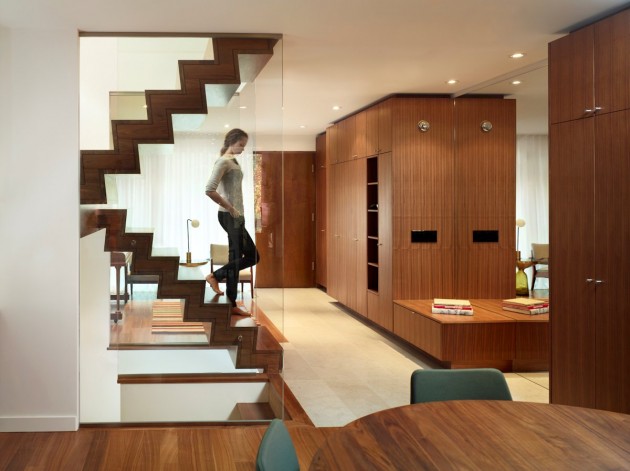
Drew Mandel Architects completed the renovation and addition of a 100 year old semi-detached family home in Toronto, Canada.






Project description
Prior to its recent renovation and addition, the clients lived in this 100 year old, semi-detached, Beach-neighbourhood house for twelve years. Their work as fashion photographer and model took them around the world to stylish architectural sites which served as inspiration for this well-worn residence. While wanting to update the house to better reflect who they are and how they live, the clients also wanted the house to re-inforce the existing fabric of the street by respectfully re-inventing both the exterior and the interior. Although it lacks a classic beach charm, the house has an elusive quality of heart and soul which the project team tried to uphold.
Looking closely at the brick lines relative to the right angle of the new box window in the image of the front facade, the house leans to, or yearns for, the lake. It is that sense of an ideosychrotic personality that defines this custom home renovation, as opposed to merely emulating a generic boutique hotel-like space.
Small moments strive to accommodate and celebrate the personality of the owners, the history of the house, and the process of its re-making: the open shelving for rotating personal objects of affection, the mobile kitchen island on wheels, the exposed steel support brackets at the junction of new and old structure, shop notes on the raw steel custom fi replace surround, old brick piers incorporated into the new entry assembly.
The scope of the project involves a new entry, re-invented façade, and a ground floor plan opened for access to light and space for contemporary family life. The basement is finished as useable space and occasionally acts as a suite. The second and third floor bedroom and bathroom spaces are also re-finished. A small rear addition on the ground floor allows for a new space with natural light, a distinct ceiling height, and a previously-absent
connection to the rear yard.The existing house is a very common Toronto house type: A semi-detached, three-story residence with a finished basement, front pad parking, and a private backyard. While wanting to update the house to better reflect who they are and how they live, the home-owners did not necessarily want an unrecognizable or unreasonably large new house. Refreshingly, they cherished the idea of a small, stylish and cozy home where the family can scrunch up on the sofa to be together.







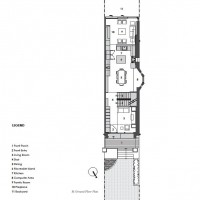
Architect (& drawings): Drew Mandel Architects
Project team: Drew Mandel, Rachel Tameirao, Jowenne Poon, Caroline Howes
Photography by Shai Gil Fotography and Chris Nicholls
Andrew BaisleyFinally hired my replacement
NEW YORK--(BUSINESS WIRE)--Tremor Video, Inc. (NYSE:TRMR), an advertising technology company elevating brand performance across all screens for the world’s leading brands and publishers, today announced it has hired Hava Kelman as Vice President, Business Development. Kelman will be responsible for identifying strategic relationships and establishing new partnerships that will enhance Tremor Video’s offering to advertisers and publishers.
Tremor Video Corporate Communications
Mandy Albers, 646-278-7416
malbers@tremorvideo.com
Andrew BaisleyYo.

In what may go down as the moment the cult of disruption finally began innovating itself to death once and for all, Yo, an app that does almost nothing, received over $1 million from actual investors recently. Days after its big debut this week, it was hacked by three college students.
Andrew BaisleyKinda sad. Kinda don't care.
We all knew this day was coming, but not that it would come so soon. The Kentile Floors sign, or as it is now known, the NTILE FLOORS sign, is being dismantled today. So far, the K and the E are gone. This probably throws a wrench in the plans of the artists who were going to illuminate the iconic sign tonight using high powered projectors aimed from the street.
After news of the sign's imminent demise broke at the beginning of this month, the community rallied to save it, and managed to extract a promise from building owner Elyahu Cohen to turn the dismantled sign over to the Gowanus Alliance so that they could install it somewhere else. We — and they — have no idea where that's going to be, though. In fact, if you can think of a suitable location they'd probably love to hear about it.
This also seems like as good a time as any to address the fact that there is an Australian guy with the Kentile Floors sign tattooed on his back.
UPDATE: And there goes the N, and the top of the T.
· Breaking: Kentile Sign Letters Being Removed Right Now [Gothamist]
· Iconic Gowanus Kentile Sign Being Dismantled Right Now [PMFA]
· Workers begin dismantling 8-story-tall Kentile Floors sign atop Brooklyn warehouse [NYDN]
· Rear-view tattoo! World's biggest Kentile fan wears Gowanus skyline on his back [Brooklyn Daily]
· Kentile Floors coverage [Curbed]
Andrew BaisleyAny ya'll ever been to Cuba?
Planning a trip to Cuba isn’t as simple as it is for Mexico or Central America. Before you go you’ll want to get your visa and money sorted, read up on its complicated history, and do any online planning before you get there as you can’t rely on the internet. Despite taking a bit more effort we think it’s worth it as this vibrant, magical and confusing Caribbean island is unlike anywhere else we’ve travelled.
The US has had an embargo against Cuba since 1960 and Americans can only legally visit the country with a license or as part of an authorised tour group that involves cultural or educational exchanges with Cubans. Technically it’s not legal for Americans to visit Cuba independently but in practice many do by travelling via another country such as Mexico.
Visiting Cuba isn’t a problem for other nationalities and it is a popular tourist destination for Canadians and Europeans.
You need a visa in advance to visit Cuba. We bought ours from the Cancun airport in Mexico—a staff member was handing out forms in the check-in queue. It cost US$25 each and is valid for 30 days which can be extended for another 30 days.
We flew to Havana from Cancun, Mexico which is one of the nearest and cheapest entry points. Our return flights with Cubana cost US$282 each. Cubana also fly from Mexico City, Colombia, Canada and a few European cities.
On arrival at Havana airport a taxi to Havana Vieja costs 25 CUC (Cuban convertible pesos).
It’s important to keep aside 25 CUC in cash to pay the exit tax on departure.

The malecón in Havana
The money situation is the most complicated thing about visiting Cuba so you need to be prepared in advance.
Bring Cash
ATMs are unreliable in Cuba and only available in a few cities so it’s not a good idea to depend on them and if your card is issued by a US bank it definitely won’t work. Credit cards aren’t often accepted either so it’s best to bring all your spending money in cash. We brought Mexican pesos, but euros, Canadian dollars, and British pounds are also good options. You can bring US dollars but you’ll be charged a 10% fee to change them. For a list of currencies accepted and the current exchange rates see the Banco Central de Cuba website. You are looking at the Compra rate.
Dual Currency
The other thing you need to be aware of is that Cuba has a dual currency system. Most of the time you will spend convertible pesos (CUC, pronounced kook) but it’s worth changing a small amount to Cuban pesos (CUP) or moneda nacional which is what locals earn and spend (except for luxury items which they need CUC for). Using moneda nacional gives you access to street food like peso pizza which is very inexpensive. 1 CUC is about equivalent to US$1, and 1 CUC buys 24 CUP. It sounds confusing but you get the hang of it once you are there.
Make sure you spend or exchange your Cuban currency before you leave as it can’t be traded internationally.
We’ve written more about the complicated money situation in our Cuba travel costs post.
We spent £29/ $44 per person per day in Cuba. I would advise budgeting $50 a day per person if you are travelling as a couple but if you are a solo traveller it will be more difficult to keep to that as you have to pay the same as a couple for accommodation.
For more details about exactly what we spent that amount on see our post How Much Does it Cost to Travel in Cuba?
It’s important to take some contingency money and be careful to stick to your budget in Cuba as once you run out of cash you may not be able to access any more. We managed to stay under budget by using our Trail Wallet iPhone app to track our spending.

A typical street scene in Havana
Everything you might need. Although the availability of products like toiletries has improved in Cuba shops are still pretty bare and it’s cheaper to stock up on things like suncream, deodorant, insect repellant, and medication before you go.
We also recommend bringing snacks which are hard to find in Cuba. We brought homemade oatmeal and raisin cookies and granola bars and were glad of them for bus journeys and hikes.
A small bottle of hot sauce would definitely liven up meals here.
Although Cuba is generally a hot country make sure you bring a sweater and trousers as it can get chilly when it rains. We went from sweltering temperatures in Havana to being freezing in the rain in Viñales.
We found that most Cubans didn’t speak much English, so it’s a good idea to have some basic Spanish at least. Cubans are friendly and willing to help you out though so if you don’t speak Spanish bring a phrasebook and dive in. We’ve written about our favourite resources for learning Spanish.
The high season is between December and April when temperatures are cooler. Cuba Junky has a useful weather breakdown. We visited in late February/early March and it was hot and sunny (around 30 C) except for a rainy spell when we were in Viñales and temperatures plummeted.

A sunny day at Havana’s Cathedral
Cuba felt like one of the safest countries we’ve visited. The crime rate is low and a local told us that a tourist is only likely to be robbed if they do something stupid like leave their wallet on the table when they head to the dance floor.
The biggest problem in Cuba for tourists is the jineteros or hustlers who can wear you down. Havana was the worst for these and we were often approached by young guys or couples on the streets. They’d start off asking us where we were from or for the time, but they would always end up asking us for money or wanting to take us to a bar, where we’d no doubt be footing the overpriced bill. They are never aggressive though.
Another thing to be aware of in Havana is the milk scam. We were approached a few times in shops by a woman with a child asking us to buy milk. This isn’t necessary as the Cuban government guarantees children a milk ration, and they will sell the milk (which you’ll pay a premium for) back to the shop.

Kids playing amongst the cars in a street in Habana Centro
We had two weeks in Cuba and followed this fairly typical itinerary. We didn’t have time to get more off the beaten track as we like to travel slowly and 4-5 nights in each place was ideal for us (although we’d spend a month in Havana if the internet was better). We thought our route provided a good mix of what Cuba has to offer.
Other popular destinations are Cienfuegos, Santiago de Cuba, and Baracoa. Varadero is a popular beach destination with many all inclusive resorts and Maria La Gorda has excellent diving.

Classic car in Havana, often used as taxis.
Most tourists use the Viazul buses which are comfortable, air conditioned and reliable. It’s a good idea to book your bus at least a day in advance. When we were travelling from Havana to Viñales the bus was booked up two days in advance and we had to change our plans.
This is the route we took:
See the Viazul website for timetables and pricing.
It is possible to travel on local transport for much less but it’s difficult to get information about it and we’ve heard it’s uncomfortable, unreliable and frustrating. It’s probably not a good option unless you have plenty of time.
Renting a car would be a great way to explore the island as traffic is minimal and roads are in decent condition but rentals are pricey.

The room of our casa particular in Trinidad
We recommend staying in casas particulares where you rent a room in a Cuban home. There are many advantages:
We booked our first casa in Havana via Cuba Junky. You just browse their listings and then send a message which goes direct to the owner. As internet access is limited in Cuba you might need to contact a few to get a response. We stayed with Roly & Irma who were lovely and had a fantastic location in Habana Vieja on a quiet street but close to everything.
You will also find many casas by wandering the streets and looking for the blue sign that says Arrendador en Divisa.

The sign to look for on casas particulares
There is internet in Cuba but it’s so bad we didn’t bother using it. It’s not very easy to find, it’s dial up (so painfully slow) and it’s expensive.
Outside of Havana WiFi is not an option and you’ll have to use internet cafes. To use WiFi in Havana you have to go to the big hotels which charge $8 an hour ($6 for non WiFi). We met a couple who said they thought Hotel Parque Central had the fastest internet but according to the Havana Good Times app there is a five hour minimum charge (update: we’ve since heard you can buy one hour cards for 7 CUC). They also said that their Canadian site worked pretty well but their site on an American server was painfully slow.
Most websites aren’t restricted but Skype and Paypal don’t work because they are American.
“You know the three great triumphs of the Revolution, don’t you?” He looked at me quizzically. “Education. Health. Athletics. And you know the three great failings of the Revolution?” He tilted his head. “Breakfast. Lunch. Dinner.” Tom Miller, Trading with the Enemy
Sadly it’s true. Cuba is renowned for its bad food so we came fully prepared with suitably low expectations. It actually wasn’t quite as bad as we expected but it’s by no means a gourmet destination.
Where to Eat
It helped that we avoided government-run restaurants which have a terrible reputation and instead ate in our casas particulares where the home-cooked meals are much better. Another apparently good option is paladares which are privately owned small restaurants, but we didn’t go to one as like most restaurants in Cuba they aren’t very vegetarian friendly. It was easier and cheaper for us to request a vegetarian meal at our casas and they were always happy to do that, although be clear with what you can’t eat.

Hole in the wall takeaways called cafeterias
The other option is street food served from the hole in wall takeaways called cafeterias. You pay in CUP so they are very cheap and are a good place to chat with locals. Options are limited and not very healthy, usually consisting of ham sandwiches and peso pizza. As vegetarians peso pizza was a good option for us and only cost about 10 CUP ($0.42). We went for queso (cheese), cebolla (cheese and onion) or pimiento (cheese and bell pepper). It’s by no means Italian-style pizza consisting instead of a smear of tomato sauce and salty cheese on a doughy base served on a piece of paper, but it’s OK. It’s often eaten folded in half.
What to Expect

Breakfast and dinners at casas particulares and peso pizza
Water
Tap water isn’t drinkable and it was sometimes difficult to to find large bottles of water. They are quite expensive too at 1-1.50 CUC per bottle. We drink a lot of water and ended up spending £50/$76 on water during our two weeks.
Cuba is a complicated country and I think it’s important to read up on it before you go to have a greater understanding of the situation there. Bear in mind that things are changing on the island and might not be the same now as they are in some of these books. For example most Cubans can now travel abroad without permission, homes and cars can be sold, and private entrepreneurship is slowly increasing.
Here are some books I recommend:
Lonely Planet Cuba – A useful introduction to the history and culture of Cuba and although we used the 2009 edition we found the prices very accurate.
Trading with the Enemy: A Yankee Travels Through Castro’s Cuba by Tom Miller – American Tom Miller lived in Havana and travelled throughout Cuba for over eight months during the Special Period, a time of hardship and shortages in the 1990s after the fall of the Soviet Union. It’s an entertaining and balanced account as Miller talks to everyone from a farmer in a remote rural area whose life improved immeasurably under the Revolution, to intellectuals who are more critical about the problems of the regime, as well as writers, poets, musicians, baseball players and a celebrity chef.
Enduring Cuba by Zoe Bran – Another honest travel narrative showing the reality for Cuban people in the 1990s, and insights into the history and culture.
Che Guevara: A Revolutionary Life by Jon Lee Anderson – Che is everywhere in Cuba and this epic book gives you an understanding of the man behind the myth as well as a history of the Revolution.
Waiting for Snow in Havana: Confessions of a Cuban Boy by Carlos Eires – A deeply moving, lyrical, and beautifully written memoir about a Cuban boy’s memories of Havana before the Revolution, how the country changed in the years after Castro came to power, and his experience of being one of the 14,000 unaccompanied children sent to the US in the early 1960s.
Havana Dreams: A Story of a Cuban Family by Wendy Gimbel – The poignant story of four generations of Cuban women torn apart by the Revolution and exile. It centres around Naty, a socialite during the Batista era who had an affair with Castro and had his (unacknowledged) daughter. It’s an interesting insight into the attraction of Castro and the romanticism of the Revolution in the early days before everything soured and everyone lost so much.
Dreaming in Cuban by Cristina Garcia – A dreamy, evocative novel that uses magical realism to tell the story of three generations of women divided by exile and their differing beliefs about the Revolution.

Trinidad
For more about our experiences in Cuba take a look at these posts:

Andrew BaisleyJust sharing for the pic (from the movie Salt)

Andrew BaisleyI've been using Slingshot for the past 6 weeks or so.. it's a lot of fun! Try it out!
Today, we’re excited to launch a new app called Slingshot.
With Slingshot, we wanted to build something where everybody is a creator and nobody is just a spectator. When everyone participates, there’s less pressure, more creativity and even the little things in life can turn into awesome shared experiences. This is what Slingshot is all about.
Photos and videos that don’t stick around forever allow for sharing that’s more expressive, raw and spontaneous. We can connect the same way we like to live: in the moment. We’ve enjoyed using Snapchat to send each other ephemeral messages and expect there to be a variety of apps that explore this new way of sharing. With Slingshot, we saw an opportunity to create something new and different: a space where you can share everyday moments with lots of people at once.
To get started on Slingshot, shoot a photo or video. It can be what you’re up to, who you’re with or a quick selfie. Add some text and color, then sling it to a bunch of friends. Here’s the deal: friends won’t be able to see your shot until they sling something back to you. They can then reply with a reaction—or simply swipe your shot away.
Using Slingshot has made us feel closer, and we can’t wait for others to try it out. It’s the second app from Facebook Creative Labs and is available today starting in the US on iPhone (iOS7) and Android (Jelly Bean and KitKat). Get it at sling.me/download
Check back here for updates, tips and other cool stuff.
-Will, Joey, Rocky and the rest of the Slingshot Crew
Andrew BaisleyI kinda love this in an otherwise normal neighborhood.
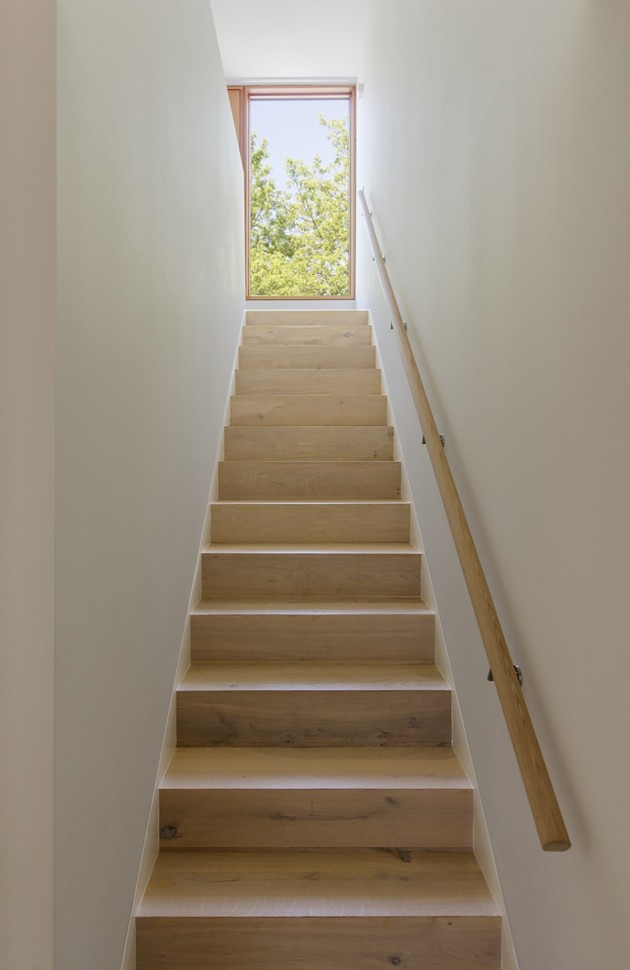
Williamson Chong Architects have designed the Blantyre house for a family in Toronto, Canada.








Project description
In Toronto, the Victorian working class neighbourboods provide average lot sizes of 20’ wide by 120’ long. While there is light available on each narrow end, the interior spaces are inevitably quite dark. The site for the Blantyre House presented another restriction. Maintaining the 100-year-old Norway maple in the backyard became a priority and impacted the programming and form of the house. At 19’ wide and 45’ long, the house is not only narrow, but also shallow. A primary decision was made to allow the ‘kitchen studio’ with its integrated dining and harvest table to occupy the entire ground floor of the home, forcing the living room to hover above the ground floor porch, and retain its status as a ‘piano nobile’ space.
The ‘kitchen studio,’ with its distinctive custom millwork lining, serves as the architectural and emotional center of the home. The custom millwork attempted to consolidate seemingly disparate requirements of the home — namely, mechanical ductwork, plumbing supply and sanitary lines, structural laterally-resistant piers — into a zone that would prevent the already compact 8’-0” clear height ceiling from dropping even further. The millwork aims to be the running spine which offers an entry closet, pantry, cupboards system, spice rack, appliance garage, refrigerator and broom closet in one continuous plane. Bevel-edged and eased details with recessed profiles identify the key areas for access and provide additional space savings relative to traditional drawer pulls and countertop overhang depths. Thus, the urban conditions were a distinct driver in the form of the kitchens details.
The angled volume cutout that serves as the focal point for the millwork wall was designed to provide the typical working sightlines and reaching angles of any typical kitchen — with the exception that the upper storage would remain flush with the adjacent full-length closets and the lower cabinetry. This design detail followed through on the discovery that we could place the building systems lines behind the uppers without losing performance in cooking functions.
The emergence of this ‘kitchen studio’ aided in the evolution of the countertop and harvest table as a single fixed-piece, thus allowing conversational, prepatory and social conditions to migrate and exchange as effortlessly as possible between the two longitudinal components. With the detailing of the full-height sliding windows, the kitchen studio allows for the seamless flow from street to garden for guests while providing a sure and steady area for cooking and preparation. In some ways, we like to think of this as the ‘front face’ of the home upon entry.
In contrast, the upper most level of the home is the master bedroom and ensuite. Depicted in white with minimal details, this is where the house is most private. Offering quiet and sanctuary from the urban setting, the views are choreographed to provide glimpses of the trees and sky.
At the macro level, the biggest sustainable idea is that of infill housing. To increase density in an urban neighbourhood, we actually severed (split) a double-wide single family lot and made it two. Building within an existing neighbourhood on strips of available land, while taking care not to disrupt the native tree canopy, allows us to explore further the pedagogy of ‘incremental urbanism.’ Blantyre House is a repeatable typology that can co-exist with current bylaws and zoning requirements while giving a family urban connectivity, generous spaces, and even sanctuary.
Using first principals of through ventilation, resilient materials for longevity, and natural finishes, help this small home engage green building in a straightforward way.








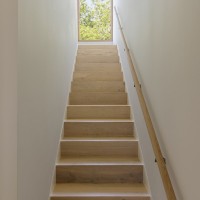



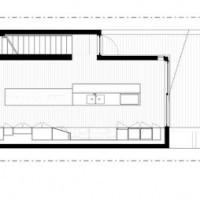
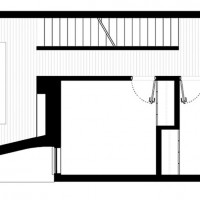
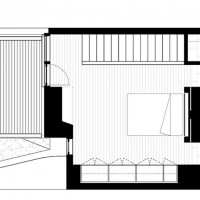
Architect: Williamson Chong Architects
Photography by Bob Gundu



j2gc:
Planter Table by Emily Wettstein [cjwho]
Emily Wettstein is a 25-year-old designer living in Brooklyn, NY who built this planter table as part of her application to grad school for architecture. The table is made from reclaimed walnut and steel with a removable planter that can hold a variety of plants, in this case wheat grass (very cat friendly!)Way cool!
Millions of soccer fans from around the world will join the conversation about the 2014 World Cup on Facebook. People come to Facebook during sporting events to connect and engage with friends who are following the action, to cheer on their favorite teams and players, and to find out the latest scores and highlights.
For this year’s World Cup, we want to give people one great place to experience the action in real time. Today we are launching Trending World Cup, a dedicated hub for fans on Facebook to follow the tournament as it unfolds.
Trending World Cup on Facebook includes:

In addition, starting Thursday, you can share the specific match you’re watching during the World Cup — just tap the smiley icon before you share a post and select “watching.”
![wc-newsroom-minutiae@2x[2]](http://fbnewsroomus.files.wordpress.com/2014/06/wc-newsroom-minutiae2x2.png?w=960&h=995)
How to Get There
Over the course of the tournament, you can use Trending World Cup on Facebook on desktop and on your smartphone or feature phone. You can get there by visiting www.facebook.com/worldcup, or by clicking on “World Cup” in the Trending section on the right-hand side of your News Feed. If your friends share that they are watching a specific match, you can also get to Trending World Cup by clicking on their post. If you’re using the Facebook for Every Phone app on your feature phone, just tap the soccer icon on your home screen.

Facebook Ref
You also might see posts from the Facebook Ref — Facebook’s ‘official’ official of the tournament. Like his Page at www.facebook.com/FacebookRef for colorful commentary and updates about the matches.

For more, visit the Help Center.

Andrew BaisleyThis is really strong signal. This guy is awesome

Not long after a new Facebook messaging app was discovered, Facebook announced that PayPal President David Marcus has joined the company as Vice President of Messaging Products.
He will work to improve the Facebook Messenger app, but a Facebook spokesperson confirmed that WhatsApp will continue to run independently. After the acquisition of his company, Zong, Marcus joined PayPal in 2011 as Vice President of Mobile, leading the company’s mobile payments business. He was promoted to President last year.
Facebook welcomed Marcus in a Newsroom blog post, explaining his role with the social network:
Messaging is a core part of Facebook’s service and key to achieving our mission of making the world more open and connected. Every day around 12 billion messages are sent on Facebook, and in April we announced that Messenger, our standalone messaging app, is now used by more than 200 million people every month. We’re excited by the potential to continue developing great new messaging experiences that better serve the Facebook community and reach even more people, and David will be leading these efforts.
Marcus explained his decision in a Facebook post:
While I was in the middle of my thought process about what was next for me, Mark Zuckerberg and I got together. Mark shared a compelling vision about Mobile Messaging. At first, I didn’t know whether another big company gig was a good thing for me, but Mark’s enthusiasm, and the unparalleled reach and consumer engagement of the Facebook platform ultimately won me over. So… yes. I’m excited to go to Facebook to lead Messaging Products. And I’m looking forward to getting my hands dirty again attempting to build something new and meaningful at scale.
PayPals, you will always be in my heart. Know that I’ll be a proud witness of your wins, and successes.
Image courtesy of Facebook.
Andrew BaisleyThe more you know
Andrew Baisleywant.


