Shared posts

23 Mar 20:19

Spinach and Artichoke Dip Pasta

by Kevin Lynch
Spinach and Artichoke Dip Pasta
After making the spinach and artichoke dip soup I could not help but think that it would also make an amazing pasta, and I hardly need an excuse to fit more of that fantastic dip into my meals! For this pasta I started with mac and cheese style sauce except instead of using cheddar I went with spinach and artichoke dip flavours including cream cheese, parmesan and mozzarella. With the tasty cheese sauce made all that was left was to add the spinach and artichokes to complete the pasta. (I like to go with fresh chopped baby spinach but frozen spinach would also work and it's pantry friendly.) This spinach and artichoke pasta comes together in less than 30 minutes making it a perfect weeknight meal and it's so addictively good! (ps. No, I didn't forget the bacon, scroll down a bit!)

Read the recipe »
23 Mar 20:17

Vietnamese Chicken Noodle Soup

by Minced

Vietnamese Chicken Noodle Soup with Condiments

We welcomed a baby girl into our family at the end of January.  Since then, life has taken place during naps, sleeping more than 4 hours straight seems like heaven, and if I don’t have spit-up on my clothing I consider myself dressed for dinner.   Despite the chaos, I don’t think we have ever been happier and I’d gladly trade a crossed-off to do list for a baby smile any day of the week.

We’ve been blessed to have friends and family bring us meals during this busy time.  They’ve nourished and spoiled us with delicious dinners, yummy desserts, and treats for breakfast.  Having dinner crossed off the list before one even wakes up in the morning is a real gift and makes for much easier days.  Yet, I miss the kitchen and have been thrilled when I find myself with enough time to do something other than reheat a frozen meal.

Vietnamese Chicken Noodle Soup2

Today was one of those days.   A 45-minute nap by baby was just enough time to get one of my favorite recipes simmering on the stove.  Dorie Greenspan’s Around My French Table is one of the cookbooks I turn to most as her recipes never disappoint; her recipe for Vietnamese soup is no exception.  It’s comfort food with an exotic twist and my barely adapted version of her Vietnamese Chicken Noodle soup is one that you’ll want to make again and again.   Happy cooking!

Vietnamese Chicken Noodle Soup

Vietnamese Chicken Noodle Soup - Printer Friendly Recipe
Adapted from Dorie Greenspan’s “Spicy Vietnamese Chicken Noodle Soup” recipe from her cookbook Around My French Table

12 fresh cilantro stems
1 teaspoon whole coriander seeds
1 yellow onion, chopped
1 (1-inch piece) ginger, peeled and minced
3 garlic cloves, minced
1 tablespoon minced fresh lemongrass
2 dried red chilies
6 cups homemade or less-sodium chicken broth
1 can coconut milk
4 tablespoons fish sauce, divided
1 teaspoon packed brown sugar
¼ teaspoon ground white pepper
Salt, to taste
1 lb boneless, skinless chicken breasts
5 ounces dried rice vermicelli noodles
4 -6 tablespoons fresh lime juice
¼ cup chopped fresh cilantro leaves
Serve with:  fresh mint leaves, hoisin sauce, and/or sriracha hot sauce
Special equipment: cheesecloth and kitchen twine

Wrap the cilantro stems and coriander in cheesecloth and tie with a piece of twine. Place in a large soup pot with the onion, ginger, lemongrass, red chilies, chicken broth, coconut milk, 2 tablespoons fish sauce, brown sugar, white pepper, and a pinch of salt.  Bring to a boil.

Once boiling, add the chicken breasts and reduce the heat to a simmer.  Simmer for 15 to 20 minutes or until the chicken breasts are cooked.  Remove the chicken breasts and allow to cool.  Once cool, shred the chicken and return it to the soup.  At this point, the soup can be refrigerated if not serving immediately.

Bring a large pot of water to a boil and add dried rice vermicelli noodles.  Cook according to package directions and drain in a colander.  Set aside.

Add the remaining two tablespoons fish sauce to the soup and add fresh lime juice to taste.  Stir in the cilantro leaves and add more salt if needed.

Divide the cooked vermicelli noodles between 4 large bowls and ladle the hot soup over the noodles.  Garnish with mint leaves and serve with lime wedges, hoisin sauce, and/or sriracha. Enjoy!


23 Mar 17:46

One Minute Tip: The Clipboard Art Trick — Apartment Therapy Videos

by Rebecca Blumhagen
Pin it button

If you're looking for art that's fun and not too precious, or if you just want your walls to feel a little more "in the moment," consider today's video tip from Jeni Aron: The Clipboard Art Trick.

Pin it button

f you're looking for art that's fun and not too precious, or if you just want your walls to feel a little more "in the moment," consider today's video tip from Jeni Aron: The Clipboard Art Trick.

Pin it button

READ MORE »

23 Mar 13:56

Shot in the Dark: Arrow Decor for Kids

by Beth Callaghan

I know I'm behind the 8 ball on the Katniss Everdeen trend, but arrows can be so much more than a symbol of the heroine of the Hunger Games. I love these arrow decor ideas, some DIY and some to buy, to incorporate into a child's room or a nursery. Whether it's art or 3 dimensional objects, arrows have taken on so many symbolic meanings that you're bound to find something that speaks to you.

READ MORE »

23 Mar 13:55

Amazon Prime Price Increase: How To Buy Another Year for $79 — Lifehacker

by Elizabeth Giorgi
Pin it button

Amazon Prime subscribers have been grumbling the last few days because of the service's $20 price increase, which will go into effect on Dec. 31, 2014. However, for fans of the service who want to extend their subscription one more year for the $79 price, there is a tricky way to get around the new price.

READ MORE »

21 Mar 17:54

Why the Greek Yogurt Craze Should be a Wake-Up Call to Big Food

by Manny Picciola
Lindsaycdavison

I confirm that we red-lighted greek yogurt because it wouldn't make 100 Million in year 1.... eeek. (i wasn't there, this was 2005)

In 2005, Hamdi Ulukaya purchased a yogurt factory in upstate New York that had been shuttered by Kraft Foods. He wanted to use it to produce a line of strained, or “Greek,” yogurt called Chobani. If you’ve been in a grocery store lately, you probably know the rest — the brand caught on quickly. But for years, as Chobani gobbled up market share, the major food companies stuck to their regular lines of yogurt. Chobani went on to become the second largest yogurt seller in the U.S. and cost General Mills, Dannon, and other established players billions of dollars in sales. And new reports say that Chobani is talking with investors about a deal that would value the company at $5 billion.

Food fads develop quickly in today’s marketplace. Consumers are more tightly connected now and are more likely to follow word-of-mouth (or word-of-keystroke) advice than in the past. Amid this changing environment, you’ll find rows and rows of marketing teams at the Mid-Western headquarters of America’s largest food companies — in no industry does marketing appear to play a more prominent role. But despite this manpower, “Big Food” missed Greek yogurt. As the dynamics of the American food market have changed, the industry that essentially invented the modern marketer has been slow to notice.

As the Chobani story shows, Big Food needs to make some changes, particularly to a customer-centric, as opposed to marketer-centric, marketing approach. This transformation holds lessons for all consumer-goods companies. And it requires companies to consider steps like these:

  • Give up some control and get nimble. Big Food has a proven formula for its products that involves controlling the message and the channel. Companies build consumer awareness through paid media and get products in front of customers by offering promotional dollars to supermarkets to display products prominently in the aisles. But entities such as social media, online grocers, and word-of-mouth marketing are adding a whole new dimension beyond traditional paid media. Companies need to experiment with other means of going to market, including launching products with specialty retailers and using social media and other tools to drive word-of-mouth (and keystroke) marketing.
  • Remember the difference between “good taste” and “tastes good.” Controlled experiments involving consumer taste preferences have taken food companies down a path of continuously fatter, sweeter, and saltier products. By the time Chobani entered the market, a single pot of traditional yogurt had come to contain as much sugar per serving as many desserts. Ulukaya has said he launched Chobani with almost no money available for promotion or advertising because “deep down I knew I had something very good.” To unleash food fads, companies need to have the same confidence and choose products that they can believe in.
  • End your obsession with ingredient cost. Big Food favors products with big gross margins — in part so that they have more to spend on needed marketing and promotion. One of the reasons that Big Food didn’t like Greek yogurt early on is because it costs more to make and contains less water than regular yogurt. Food companies should distribute their gaze more evenly across their value chain. Instead of focusing primarily on downstream activities such as packaging and promotion, they should also look upstream to identify promising natural ingredients. Great products can command premiums, and become popular with very little marketing spend. Kale, quinoa, or chia anyone?
  • Put the product ahead of the brand. Brand management has hijacked the most important part about food: the product. Food companies constantly narrow their focus on how to convey what the product means rather than what the product is. The fact that, for example, a suburban housewife is the center of a certain brand’s universe is important knowledge, but that insight can never trump creating a product consumers actually want to eat. Branded food companies should invest more in innovation and less on brand marketing.
  • Learn the art of “small ball.” Giant companies like P&G and Unilever tend not to be interested in product launches unless they offer hundreds of millions in potential revenue. It’s possible that had an established food company attempted to compete with Chobani from the start, they would have withdrawn the product because it didn’t meet initial sales goals. There are two ways to solve a “swing-for-the fences” bias. One is through M&A. PepsiCo is a leader at this inorganic approach — their partnership with Sabra unleashed a hummus craze that shows no signs of abating. Another is to put semi-autonomous incubator groups in charge of smaller and softer launches. General Mills’ Small Planet Foods, for example, operates semi-autonomously from the company’s mother ship in Minnesota, and has recently added several successful brands.
  • Shorten your development cycle. Alternative food companies use co-packers so they don’t require long-run investments in factories. They start by launching products online and in specialty channels instead of through traditional grocers. They dispense with large consumer surveys and test products directly with networks of loyal customers. All of these contribute to shorter development cycles and much lower costs for new product launches.

Big Food has become “big” as a result of a terrific success: their traditional marketing departments have helped generate billions in profits. But relying on one approach to marketing has left these players exposed in today’s fast-moving climate. If a company has only one way to go to market and think about its business, it limits its opportunity to respond quickly, flexibly, and to enter and exit fast-changing food categories in a timely manner. And that’s true for any consumer goods company.

18 Mar 15:52

Ask a Sommelier: The Best Wine for Thai Food

by Maggie Hoffman

From Drinks

20140302cook-the-book-phat-thai-shrimp-tofu.jpg

Wine experts recommend their picks for Thai food. [Photograph: Austin Bush]

Can you pair wine with Thai food? Say you're eating spicy duck laarb, a fresh green papaya salad with chilies, fish sauce, and lime juice, plus rich pad thai with shrimp, and a green curry with eggplant. Is there a wine that will taste good with all those dishes? We asked our crew of sommeliers for advice on picking a wine that will work. Here are their top wine choices for pairing with a Thai feast.

"Riesling from Germany. Always and forever. Off-dry wines with acidity really cut the spice, and the 9% alcohol means you can chugalug!"—Patrick Cappiello (Pearl & Ash)

"Gruner Veltliner! A rich, savory Gruner like Brundlmayer 2008 'Lamm' would be perfect—the ripeness and richness to the fruit will stand up to the heat while the inherent savory character of Gruner won't compete with bold Thai flavors."—Carlin Karr (Frasca)

"Riesling is great with Thai food, particularly wines with a bit of sweetness. Although not all Riesling is sweet, when you eat something spicy and drink something with residual sugar, the sugar goes to the background and the fruit comes forward. At Kin Shop, we love to have people try it, especially if they don't like sweet wines, since it often changes their minds. Over the years, what I've found surprising is smooth, medium-full red wines are a great pairing for spicy dishes. We have a lovely merlot from Neyers that just is perfect with spicy meat dishes."—Alicia Nosenzo (Kin Shop, Perilla, The Marrow)

20140302green-papaya-salad.jpg

[Photograph: Luk Thys]

"A lot of aromatic and bold flavors coming from this spread of Thai dishes! Pairing wine with multiple dishes, especially when the flavors are all over the places and the protein or the preparation are not too heavy, I would always go with wines that have higher acidity naturally. Riesling, Chenin Blanc, Sauvignon Blanc, and Chardonnay (to certain extent), will be the go-to recommendations in most wine shops. In reality, though, not everyone is a fan of residual sugar in white wine. Therefore, I tend to find myself recommending white wines made from grapes that have more fruitier characters but tend to be made in dry styles, i.e. Kerner (a Riesling & Trollinger cross), Sylvaner, and Scheurebe. If you are dedicated red-only drinkers, I will go with light to medium bodied red wine with ample acidity, and no new oak regimen preferred. Schiava from Alto Adige will work really well in this case, and basic Southern Italian reds that are made in stainless steel vessels or concrete; or Pinot Noir from a cool climate, such as Germany, Austria, or uptate New York."—Arthur Hon (Sepia)

"With a variety of dishes on the table, you can either choose to have a great pairing with one thing (that doesn't necessarily work perfectly with every dish), or something that is a little safer and goes okay with everything. If you are going for the first game plan, I would choose a bright, tart wine to go with the papaya salad, perhaps white or rosé Txakoli from the Basque country in Spain or a fresh, low alcohol and low tannin red like Rossese from Liguria in Italy to go with the spicy duck laarb. If I had to pick one wine for everything, it would be probably be an off-dry Riesling from Alsace or Germany or Vouvray (Chenin Blanc) with just a hint of sugar. If you are in the mood for red wine, you would want to avoid something with too much alcohol or oak."—Stacey Gibson (Olympic Provisions)

"Look for wines styles that may share some similar flavors to the food to allow them to stand up to the bold flavors and distinct spices, such as white wines from Austria, Germany and Alsace. Varietals like Riesling, Gewurtztraminer and Pinot Blanc from these regions often carry vibrantly aromatic tropical fruit notes, are solidly structured and carry a distinct spiciness unto themselves. Be careful with light bodied, dry whites as well as red wines as they run the risk of creating an unsavory discord of flavors on the palate or getting lost to the food all together."—Colleen Hein (Eastern Standard)

"Less expensive off-dry bubbly options like Bugey-Cérdon are refreshing and great foils for the spice. Red wines get overlooked, but juicy red wines with soft (or no) tannins can be delicious with Thai food as well. Some that jump to mind: Beaujolais (I'm loving Jean Foillard's "Nouveau") American Grenache (Vallin Grenache, Tribute to Grace), and other light, aromatic red wines made from grapes such as Frappato, Gamay and Pineau d'Aunis. Poulsard and Trousseau are great, too. If you have not tried Arnot-Roberts' North Coast Trousseau, seek it out!"—Jordan Salcito (Momofuku)

"As a society we are afraid of wines that aren't completely dry. We need to get over that. I'll blame white zin to some extent, but that craze is long gone. Thai food with Riesling or Chenin Blanc is just bulletproof. For the combination of foods above, I'd probably go with something on the earthy and spicy side of either of those varieties, so a Spätlese (frequently off-dry late-harvest style) Riesling from the Rheingau, maybe something from Robert Weil, or Demi-Sec (off-dry) Vouvray from a solid producer like Huet would be fantastic. Spice is mediated by a little sweetness, while Chenin and Riesling are both high-acid grapes, so they cut through the fat of the dishes."—David Keck (Camerata at Paulie's)

20140302cook-the-book-green-curry-fish-balls-eggplant.jpg

[Photograph: Austin Bush]

"I find Gewürztraminer to be my personal favorite. Especially those from Albert Boxler. His ability to balance acidity and sugar while providing exceptional tropical fruit flavors make this a slam dunk pairing."—Chris Nelson (Union Square Cafe)

"Many sommeliers will recommend off-dry Riesling to pair with spicy dishes; while I think this can be a great pairing (especially with an off-dry Riesling from the Mosel in Germany or New York's Finger Lakes), Champagne comes in for the win yet again! Crisp, yeasty, and refreshingly carbonated, Champagne helps to clean-off your palate of oil, spice, and fat. It's also versatile enough to pair with meats like duck, lamb, and yet light enough to balance seafood really well. Look to a producer like R.H. Coutier from Ambonnay in Champagne for a rich, doughy Champagne that will work wonders with these dishes."—Thomas Pastuszak (NoMad)

"Any aromatic white, especially from Alsace (Riesling, Pinot Blanc, Pinot Gris and Gewurtztraminer or field blends that include all of them). As an alternative, a dry rose from Provence would be a nice choice. I'd definitely avoid any strong tannic red wine."—Roberto Paris (il Buco and il Buco Alimentari)

"With Thai or Indian or Szechuan or other highly seasoned, potentially spicy food, the key is low alcohol, low tannin if red, and a touch of sweetness if white, and in either case fruit-forward. Ultra-dry wine of any color fights with the sweet-sour-spicy-bitter factors in this kind of cooking; and those same dishes also magnify the alcoholic feel of any wine. Think Riesling or Chenin Blanc, but not rippingly dry versions of either."—Juliette Pope (Gramercy Tavern)

"It may defy conventional wisdom, but I would pair Sauvignon Blanc with that meal. Not one that is too austere or mineral-driven, but one with more expressive fruit. Obviously, new world Sauvignon Blanc, especially from New Zealand, is bursting with ripe fruit and citrus: lime zest, grapefruit. But I have tasted a great deal of Sancerre and Loire Sauvignon Blanc lately that I think would pair wonderfully with a spicy Thai meal like this."—Lara Creasy (King + Duke)

20140302larb-with-harold-duck-kin-shop-7.jpeg

[Photo: J. Kenji Lopez-Alt]

"When pairing wine with Thai food, Riesling (or other highly aromatic, high acid white wines) is the obvious go-to, matching intensity and weight of a dish with intensity and weight of the wine. Generally, lower alcohol whites with a little sweetness and a strong backbone of acidity stand up to the heat and intensity of Thai dishes but I find drier whites pairing well with many Thai dishes as well. A rosé, Pinot noir, or Gamay noir can be fun as well, especially with a green curry and eggplant dish. Try Reichsgraf von Kesselstatt Majoratsfullung Riesling Sekt Brut, Love & Squalor Willamette Valley Riesling, an Oregon Pinot noir, or a Cru Beaujolais."—Christopher Sky Westmoreland (Levant)

"Go for off-dry wines made with Alsatian varieties like Pinot Gris or Gewürztraminer. There are some really nice Alsatian varieties growing in California's Anderson Valley now, and of course, you can rarely go wrong with a bottle of bubbles."—Courtney Humiston (Dry Creek Kitchen)

"I can't talk about Thai food and wine without mentioning German riesling, and for multiple reasons: the lower alcohol calms the spice, the residual sweetness hits the sugary notes of tamarind, lime and coconut, and the clean mineral tones don't clash with fish sauce. Maximin Grünhäuser's 2010 Abtsberg Kabinett is a knockout pairing. Weingut Knoll from Austria makes a delicious Loibner Riesling Federspiel as well, if you're looking for a drier style. For Thai food in general, pick something low in alcohol with tropical fruit and herbal notes. Grüner Veltliner, Verdejo, and Sancerre always fit the bill."—Jackson Rohrbaugh (Aragona)

"If Riesling really isn't your thing try an array of whites from France's Loire Valley. Muscadet is a nice refreshing white from the eastern Loire Valley that is light on the palate with a nice touch of minerality. Further west in the Loire Valley you'll find Sancerre, here Sauvignon Blanc is king, from soft delicate white wines with hints of smoke, tropical fruit, and slate, too big boisterous white wines overflowing fragrances of honeysuckle."—Jeremy Wilson (Ned Ludd)

"Outside of Riesling, personally I'd be going for a beer."—Evan Hufford (Saison)

17 Mar 04:38

Leprechaun Ice Cream #SundaySupper

by Donna Currie
Lindsaycdavison

just to stir the pot...

Disclaimer: no actual leprechauns were harmed in the making of this treat.

However, leprechauns may or may not have helped brainstorm this mint and chocolate ice cream that's reminiscent of the old-timey Grasshopper cocktail.

Or, I might have come up with the name because the other obvious St. Patrick's day name - shamrock - is already in use by some commercial entity.

But I have to say this is a heck of a lot better than a milkshake and more easily portionable. You make a milkshake in a giant glass. This you can have one scoop. Or three. Don't blame me if you have three.

Leprechaun Ice Cream

2 cups heavy whipping cream
1 cup milk
1/2 cup green creme de menthe
1/2 cup sugar
1/2 teaspoon salt
1/4 cup creme fraiche
10 Oreo mint-filled cookies, smashed, crumbled, or chopped

Combine all ingredients except the cookies in a bowl (or better yet, a large measuring cup, for easy pouring), and stir until the sugar is dissolved completely.

If you've got an ice cream machine with a freezer bowl, refrigerate until this is as cold as it can be before churning. If you've got an ice cream machine with a compressor, you can freeze immediately.

Churn according to the manufacturer's directions. Add the cookie bits towards the end of the churning time, or mix them in as you transfer the mixture to a container. Mix well. Freeze until firm.

Enjoy!

Note: This also makes a great shake - just blend it with some milk and serve with a big, fat straw.


Green Light Appetizers and Sides
Getting Greens Through Salads
Entreés That Will Leave You Green With Envy
Desserts and Beverages That Will Make Others Turn Green

Join the #SundaySupper conversation on twitter on Sunday! We tweet throughout the day and share recipes from all over the world. Our weekly chat starts at 7:00 pm ET. Follow the #SundaySupper hashtag and remember to include it in your tweets to join in the chat. Check out our #SundaySupper Pinterest board for more fabulous recipes and food photos.

Would you like to join the Sunday Supper Movement? It’s easy! You can sign up by clicking here: Sunday Supper Movement.
16 Mar 17:37

Surviving a Start-Up’s Transition from Projects to Processes

by Derek Lidow
Lindsaycdavison

@andrewerose

“Why change my leadership style? It got us to this point, where we’ve established a real beachhead in our market.”

These are the famous last words of many an entrepreneur. Failing to realize that critical transition points in the growth of an enterprise require leaders to shift emphasis, they blindly stick with what has been working up to that point. The company stalls. Confusion grows among key team members, investors, customers and suppliers.  And, ultimately, the failure to understand the demands of the transition lead to the failure of the company itself.

One such abrupt transition — from project to process mode — occurs once a company launches its initial sales efforts and begins to service its first customers. A project is a one-at-a-time exercise performed by a team assembled specifically for that task. It is the ad hoc nature of the project that enables the flexibility and agility required to capture the first real customer.  If the entrepreneur has recruited the type of people usually attracted to startups — people who like fast-paced projects — then they will likely find working as a team in the project mode extremely satisfying.

Most entrepreneurs understand that they need to be flexible and agile in order to figure out how and what potential customers will buy from them. But flexibility and agility must begin to make way for reliability and efficiency if the company is to deliver the kind of consistent product or service required to maintain happy customers and win new ones. Reliability and efficiency require that work be performed in a process mode, where tasks are accomplished repetitively in a prescribed fashion, resulting in minimal variation and cost.

But most entrepreneurs instinctively resist switching from the project to the process mode. I hear entrepreneurs use excuses like, “there are a few more things we can do to make our product even better,” or the classic, “we are working well as a team, why change how we work?” The teams that have been recruited to successfully create a new company, product or service also resist this change.  They ask why they need to change from the ‘fun’ mode into a mode most project-loving people despairingly and naively call ‘bureaucratic.’

The dangers of staying in a pure project mode too long are many. Projects, no matter how well led, produce inconsistent results. Entrepreneurs cannot afford disappointed customers, and most won’t forgive poor products or services just because they were experiments.

Staying in project mode too long also opens up opportunities for competitors. How many entrepreneurs have seen their great ideas copied by a more cost-effective competitor destroying all the value they had created to that point — irrespective of patents?

Staying in the project mode too long also makes the enterprise too reliant on the founder. No enterprise can become self-sustaining if the skills of its founder have not been replicated in an effective process.  And staying in project mode too long frustrates the employees the entrepreneur will need to rely upon to manage effective processes. People who enjoy making something better and better make good process managers, and these people typically like organization and feel uncomfortable with the change and disorganization that often accompany project mode.

A strong and savvy leader with a sense of the needs of the enterprise will understand that this transition needs to take place to create a more competitive and self-sustaining company. Savvy leadership is also required to know how to lead both the experimental, creative, project-loving people recruited to help capture the first customer and the organized process-loving people required to implement efficient and reliable processes. Also, a strong and savvy leader will want to develop processes that do not require her unique talents.

The first step toward successfully making the transition is to explain why the shift from projects to processes is critical to the well-being of the enterprise. A compelling explanation gets the team comfortable with the need to design and develop reliable and efficient processes — and it pre-empts cries of ‘bureaucracy.’

Although work in a maturing enterprise is progressively dominated by processes, projects never go away entirely.  After all, you need a project to create or even improve a process. Leaders who understand the differences between projects and processes will keep the good project-loving people, who found and captured the first customers, assigned to project work while process-loving people focus on helping the enterprise become increasingly efficient and reliable.

The transitions required in a rapidly growing and maturing startup are unforgiving, and for many entrepreneurs the project-to-process change is particularly tricky. It’s one of the reasons entrepreneurs have such a high rate of failure and why those who understand it greatly increase their odds of survival.

16 Mar 05:42

The Flawed Premise Behind the Candy Crush IPO

by Tim Sullivan

As you may know, King Digital, the company behind the blockbuster game Candy Crush Saga, is about to IPO. The company is seeking a valuation of up to $7.6 billion.

Let me put that in the style it deserves: seven-point-six billion dollars!

I’m not the only one using boldface italics and exclamation points. Jim Surowiecki in the New Yorker and Felix Salmon at Reuters (and many, many others) have analyzed the IPO. The Surowiecki / Salmon consensus is basically, as summarized by my colleague Walt Frick, It’s irrational for the market to value a company that produced a fluke hit so high, but it’s totally rational for the CEO to selfishly want to go public, since the market is valuing them so much higher than they’re actually worth. Surowiecki thinks that the cost of the capital will be too high; the company will actually have to deliver on its promise, and delivering on promises to shareholders is a pain in the neck. Salmon thinks that the market is so frothy that companies have to have a credible plan to IPO just to seem viable as an acquisition.

That’s all well and good, but let’s try to assess King Digital’s core claim: that they have a system for producing addictive games. If you believe that claim, then, given the size of the market for mobile games, you might be willing to pay $21 to $24 per share for a piece of the magic. Of if you’re a tech company looking to own that magic formula, you might be willing to acquire the whole company the day before the IPO for around the market valuation.

So, do they have a magic formula? Let’s start with their one hit game, Candy Crush. It is in fact really well designed around all of the principles of gamification. As this article in Time summarizes: it makes you wait, it provides positive rewards, you can play with one hand, paying is optional but easy, it’s social and nostalgic and escapist, and there’s always more. Fair enough. I’ve spent lots of hours playing the game. So have my wife and daughter and countless others. (If you haven’t played or seen it, go ahead an download the app. I’ll wait a couple of months for you to come back.)

But is this a magic formula? Maybe. But it’s definitely not a secret magic formula. These are well-known principles behind game design and have been used successfully before (e.g., Zynga’s FarmVille for a recent example). Raph Koster published a book illuminating the principles over ten years ago.

And what if it were a secret magic formula? Would that be enough? Probably not. The formula is necessary to have a hit — but not sufficient.

That assessment is based on the work of some Columbia University sociologists, including Matt Salganik. In his interview with HBR, Salganik explained that having a cultural product of good quality is not enough. It’s social processes that makes one good product take off rather than some other equally good (or even better) product.

Salganik and colleagues ran a series of experiments to see how hit songs take off (see the interview for details), but their findings are equally applicable to any cultural product: books, TV shows, and, yes, mobile games. As Salganik said:

Higher quality songs, as a group, will outperform the lower quality ones, but which high-quality song is going to break out is impossible to figure out beforehand. In the experiment, we rewound the world and saw the range of possible outcomes that could have happened – and they’re all over the place!

That is, you cannot predict blockbusters. And that includes the Harry Potter books, the Mona Lisa, “Gangnam Style,” and, yes, Candy Crush.

Having the magic formula for producing addictive games is a necessary component for success (cf. Flappy Bird), but by itself it’s not sufficient, not when there are going to be other games out there that are just as well designed. One way that King Digital could still win is if they could flood the market with games that are all well designed in the same way Candy Crush is. To date, this has not been their strategy.

King Digital is hoping the market will overlook these complications, and perhaps it will. But over time, the problems with a strategy that seeks to produce cultural hits based on a well known formula is bound to run into trouble.

16 Mar 05:40

Why Is Ukraine’s Economy Such a Mess?

by Justin Fox

When Ukraine became an independent nation in 1991, it was on more or less the same economic footing as its neighbors. Look what’s happened since:

A Growth Laggard and Its Neighbors Chart

I did leave off Moldova, which shares a border with Ukraine and is even poorer. But Moldova is a landlocked little country of 3.5 million. Ukraine has 45 million inhabitants, is the second-largest European country by land area (after the European parts of Russia and not counting the Asian parts of Turkey) and by all rights ought to be one of the continent’s major economic powers.

It isn’t. Instead, Ukraine was deeply in debt and looking for bailouts from West and East when an uprising ousted president Viktor Yanukovych in February, then a Russian invasion of the Crimean peninsula made the country the focus of global political attention. I was curious about the economic roots of this turmoil, so I talked to Chrystia Freeland.

Freeland is a new Liberal Party member of the Canadian Parliament representing downtown Toronto. She also grew up speaking Ukrainian. Her late mother was a child of Ukrainian refugees, born in a displaced-persons camp in Germany right after World War II and raised in Canada, who returned to Ukraine in the early 1990s to help craft the country’s Constitution, among other things. Chrystia Freeland was in Ukraine in those days too, working as a stringer for several Western publications. She went onto a journalism career at the Financial Times, Globe and Mail, and Reuters, and wrote books on Russia’s transition to capitalism and the rise of the global plutocracy. She spent last week in Ukraine, and wrote an essay on the political situation there for last Sunday’s New York Times.

What initially made us think of calling you was that news a week or so ago that the new government in Ukraine was asking a few oligarchs to help out by becoming governors of Eastern provinces. What’s up with that?

I also was really struck by that news. I think the people of Ukraine should have some medium-term concerns about that — one of the reasons that you had this uprising against Yanukovych was because there was too much crony capitalism.

But in the short-term, particularly given the subsequent Russian invasion of Ukraine, it is turning out to be a rather prescient action. What is not fully apparent if you’re outside Ukraine is the extent to which Yanukovych compromised the entire structure of government. State institutions were incredibly compromised, incredibly corrupt.  The result was, following the overthrow of Yanukovych, in parts of the country the government just melted away. What the Eastern Ukrainian oligarchs have been able to do because they are very, very wealthy and have their own strong local organizations and contacts, is rebuild some sort of government presence really fast.

The other consequence of putting them in charge of Eastern Ukraine is it shows the extent to which this image of the country as being divided along ethnic lines, of this being a Yugoslav-style ethnocultural conflict, just isn’t true. As it happens, many of these oligarchs are not ethnically Ukrainian.

Who are these oligarchs? We’re familiar with the Russian variety, what’s the same and what’s different about the Ukrainian ones?

In general they’ve made their money in heavy industry, so that’s quite different from most of the Russian oligarchs. That’s why they’re not quite as rich, because there wasn’t quite as much money to be made. There were a lot of Soviet-era machine-bulding plants in Eastern Ukraine, machine-building and metals. There is also some banking, and media interests.

The East has this old industrial base. What does the Ukrainian economy consist of on the whole? Is it heavily agricultural?

The industrial base is important, particularly in eastern Ukraine. We all know about Ukraine as the breadbasket of Europe, and it is indeed an incredibly fertile country. There’s been a lot of Chinese investment in that part of the Ukrainian economy. There is also a technology outsourcing industry. And then finally, in some parts of Ukraine, tourism has been becoming more important.

Why is the economy such a mess?

Because of very bad, kleptocratic governments. That is 90% of the reason. In terms of the economy, Ukraine only accomplished maybe half of the things that you need to do, when the Soviet Union collapsed and they moved to a market economy. They did do privatization. There are now a lot of private companies, and there is a market. It’s important for us to remember that not so long ago even selling a pair of jeans was illegal.

But what they failed to do was build an effective rule of law and government institutions. Corruption, in the Yanukovych era at least, was absolutely rampant. And some important reforms of state finances haven’t happened. In particular, energy prices are still subsidized. Of course, when you move to free-market prices that’s a huge shock to the society. But Ukraine’s failure to liberalize energy prices is part of the reason that it has this great dependency on Russia.

Having said all of that, and having been in Kyiv* last week, I think there’s a bit of an Italian phenomenon going on, where you actually have a highly educated, very entrepreneurial population, but because you had this incredibly corrupt state, a lot of the Ukrainian economy has gone underground. Walking through the streets of many Ukrainian cities — Kyiv, Lviv in Western Ukraine, Dnipropetrovsk in the East — you feel yourself to be in a much more prosperous society than the official data reflect.

The official data is incredible. Poland on the one side and Russia on the other are both in the low twenty-thousands in GDP per capita, and Ukraine is officially at $7,298.

There is no doubt that Ukraine has fared much, much worse than Poland. That is a testament to how important government decisions are. These countries were not so far apart in 1991 when Ukraine became independent, and the Poles by and large have done the right things, and the Ukrainian government has not.

The sense I get is that pretty much every government since independence has had big issues with corruption, but under Yanukovych it went from being this thing that the government did on the side to the entire reason the government existed. Is that fair?

One of the founders of the Maidan movement is this former investigative journalist named Yegor Sobolev. He said what drove him crazy was you couldn’t even call it corruption anymore. It was like a marauding horde. Corruption stopped being something that poorly paid government officials did on the side and became the main reason for the government’s existence.

Radek Sikorski, the Polish foreign minister who has been playing a very good and important role in Ukraine, said that before the Yanukovych regime fell he went into one meeting with Ukrainian officials and they laughed at him for having a regular watch. He said everyone in that room had a wristwatch worth $30,000. That’s the sign of a really corrupt government.

With this new regime do you see potential for Ukraine moving in the right direction?

I think this government has a better chance than any previous Ukrainian government has had. A lot will depend of course on the presidential elections, and then there will be a need for new parliamentary elections. But so far it’s a group of people who understand what they need to do. They’ve seen Central Europe and the Baltic republics walk that path. It’s pretty clear what needs to be done.

What was quite impressive to me was that the government immediately took some steps last week to be more transparent and less entitled. All the ministries had these huge fleets of cars, and they cut them back to just one car per ministry. When Yatsenyuk, the prime minister, traveled to Brussels last week, he demonstratively flew commercial. These are gestures absolutely, but they symbolize something important.

Having said all of that, economic reform, urgent though it is for Ukraine, falls by the wayside when you’re being invaded, and that is the state of the country right now.

* When Freeland said it, it sounded like “Kayiv,” so I went with this spelling instead of the old-fashioned “Kiev.”

16 Mar 05:33

Reporters Compare Ride-Sharing Apps to Taxis

by The Daily Stat

To compare ride-sharing services with one another and with taxis, Wall Street Journal reporters used UberX, Lyft, Sidecar, and cabs to get to work for a week in Boston, Chicago, Los Angeles, New York, San Francisco, and Washington D.C. Over the course of more than 30 rides, prices on UberX averaged about 20% more than taxi fare, in part because of “surge” pricing during rush hours. Lyft came in second, costing a little more than taxis. Sidecar cost about 10% less than taxis. Cabs were fastest at getting passengers to their destinations, followed by UberX drivers. Sidecar and Lyft drivers took about 20% longer than cabbies.

16 Mar 01:02

American Classics: Lucky Charms Marshmallow Squares

by Alexandra Penfold

From Sweets

[Photograph: Alexandra Penfold]

Cereal treats are a great love of mine. And if you're looking for a fun and and easy snack for St. Patrick's Day festivities that doesn't involve excess doses of green food coloring, might I suggest Lucky Charms marshmallow squares?

I know, I know. Lucky Charms are not Irish. Not in the slightest. My ancestors from the Emerald Isle are likely spinning in their graves right now. And my own grandmother, may she rest in peace, would probably have my hide for not suggesting you make some sort of soda bread.

But come on, we're talking about Lucky Charms! They are magically delicious. General Mills introduced the cereal 50 years ago, so that certainly makes it a classic. And what could be more American than the freedom to eat marshmallow squares made of marshmallow laden cereal?

About the author: Alexandra Penfold is mild-mannered literary agent by day, food ninja by night. Never one to skip dessert she's the Brownie half of Blondie & Brownie, a Midtown Lunch contributor, and co-author of New York à la Cart: Recipes and Stories from the Big Apple's Best Food Trucks. You can follow her on Twitter at @BlondieBrownie.

Get the Recipe!
16 Mar 01:01

Parmesan Bacon Gougères From 'Down South'

by Kate Williams

20140307-285199-cook-the-book-parmesan-bacon-gougeres.JPG

[Photograph: Chris Granger]

Donald Link's gougères in his new cookbook, Down South, are a far cry from the delicate hors d'oeuvre seen on passed appetizer trays at fancy receptions. Studded with pieces of crumbled bacon and infused with their rendered fat, these bite-sized puffs make for a seriously porky statement. Link enhances the bacon with a couple of generous handfuls of grated Parmesan—a step that adds another layer of umami and a touch of creaminess to the gougères.

Why I picked this recipe: Who could say no to bacony, cheesy puffs of dough?

What worked: Even with the additional bacon and cheese, Link's gougères still maintain the light airiness indicative of the French pastry.

What didn't: I'd recommend straining the rendered bacon fat before stirring it into the choux dough so that you don't add burnt flecks of bacon to the puffs.

Suggested tweaks: If your bacon doesn't render a full 1/4 cup of fat, you can make up for it with more butter. And if you don't have a stand mixer, you can beat the eggs into the dough by hand in the pot (remove it from the heat first).

As always with our Cook the Book feature, we have five (5) copies of Down South to give away this week.

About the author: Kate Williams is a freelance writer and personal chef living in Berkeley, CA. She is a contributor to The Oxford American, KQED's Bay Area Bites, and Berkeleyside NOSH. She blogs at Cooking Wolves. Follow her @KateHWiliams.

Get the Recipe!
16 Mar 01:01

Searching for the Lost Pool at the Hotel St. George

by Scout

A few months ago, I was researching Brooklyn’s Hotel St. George for my article on The Godfather’s shooting locations

001

…and found myself fascinated by its former indoor pool, now long gone:

003

Once the largest hotel in the United States and occupying an entire city block of interconnected buildings in Brooklyn Heights, the 30-story Hotel St. George played host to everyone who was anyone, from Frank Sinatra and Cary Grant to Truman and Roosevelt (you can read a very detailed history here).

002

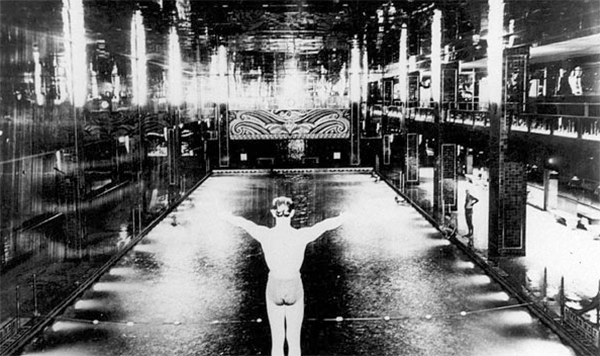
In particular, the hotel was famous for its 168,000 gallon salt-water Olympic-sized pool, with an enormous mirrored ceiling, a waterfall, mosaics, and art deco accents. As the decades passed, the pool was eventually opened up to outsiders for a fee and became a favorite among locals.

post

Sadly, by the end of the 1960s, the St. George’s prestige had begun to wane, and the hotel soon fell into disrepair. The pool was drained in 1974 and later removed. Today, a gym occupies the site.

004a

But do remnants of the Hotel St. George’s grand pool still exist? Over the years, several Scouting NY reader have written to say that small details do in fact remain from the legendary pool, and I was finally able to take a look for myself the other day.

Here’s the pool in its heyday…

004b

…and today.

005

At first, it seems as though everything is gone. However, look closely and you’ll see that not only is the original mezzanine balcony still in place…

006

…so too are the original green-tiled columns!

007

Here’s a color picture of the original pool for comparison:

018

Though the lower columns have been covered in beige tiling, the original upper portions wrap around the entire level…

008

…at one point, even disappearing through the wall.

009

But there’s more to find than just columns. Around the room are a number of the pool’s original mosaics, depicting a variety of scenes.

013

For example, this waterside vista can be found in the Pilates room…

013a

…stretching behind an added wall into the adjacent workout room:

014

Behind some running machines, a beach setting:

015

And on a nearby wall, this cute little red-roofed house:

016

But as it turns out, there’s one final piece left from the original structure. A partitioning wall divides the room in half, but head through to the other side…

012

…and you’ll find find that the pool wasn’t completely removed. A small portion still exists, complete with tiling along the edge. The pool is now oriented in the opposite direction, creating a small lap pool:

017

I happened to go into the room above the gym area, a large space with towering ceilings housing various squash and racquetball courts.

020

In addition to the large, curved ceiling…

020a

…there’s an unusual motif running along the walls that suggests a pre-gym origin:

021

You’re going to have to use your imagination to bring this one to life, but it seems this was once the hotel’s Grand “Colorama” Ballroom:

020b

Described as the “room of a million moods,” the ballroom could accommodate up to 3,000 dancing or 2,000 dining. It’s a little hard to figure out exactly where the ballroom would have been oriented…

022

…but on the opposite wall behind a boxing ring…

023

…you can find additional details, including a line of zig-zagging boxes:

024

It continues down the entire length of the wall:

025

I know a lot of you have fond memories of the Hotel St. George and I’d love to hear them. New York City may never see a pool this grand again, but as always, the ghosts remain.

010

-SCOUT

PS – For some amazing pictures of the Hotel St. George, join the Yahoo group here.

14 Mar 21:20

A Home Tour Update

by Nadia
Lindsaycdavison

beautiful shoe collection!!!!!!!!!!!!!!!!!!!!!!

Hi and sorry for the lack of post yesterday but I had a small problem with my internet connection! Now that the problem is fixed I wanted to show you my own rainbow ...

Bonjour et désolé pour l'absence de post hier mais j'ai eu un petit souci avec ma connexion internet ! Maintenant que le problème est réglé, je tenais à vous montrer mon arc-en-ciel personnel...

Preciously Me blog
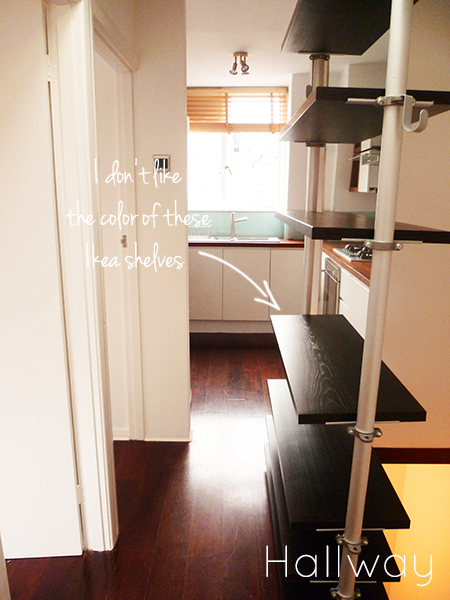
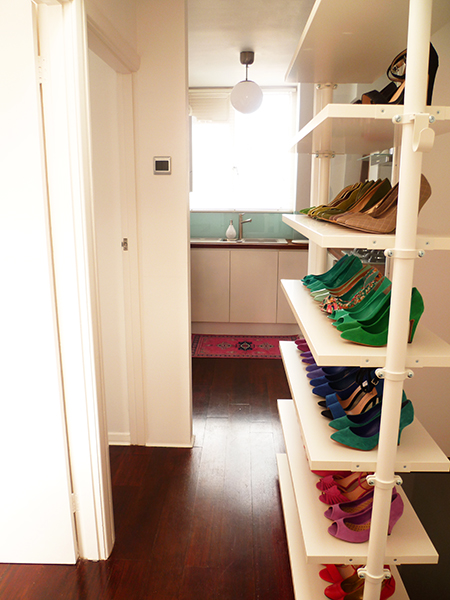
If you remember the pictures of my little home, there was these dark shelves in the hallway. I couldn't remove them without replacing, firstly because it is a rented flat, but also and especially because those shelves serve as staircase railing. So I simply replaced them by new identical Ikea Stolmen shelves but in white color and here is how it looks.

Si vous vous souvenez des photos de mon petit nid, il y avait cette étagère sombre dans le couloir. Je ne pouvais l'enlever sans la remplacer, tout d'abord parce qu'il s'agit d'une location, mais aussi et surtout parce qu'elle servait de rambarde pour l'escalier. Je l'ai donc simplement remplacée par une autre étagère identique Stolmen d'Ikea mais de couleur blanche et voici ce que cela donne.

Preciously Me blog : Home Tour – Hallway shoes
The hallway is now much brighter. The icing on the cake is that those new shelves in the middle of the flat display my rainbow of shoes!

Le couloir est maintenant beaucoup plus lumineux. La cerise sur le gâteau c'est que cette nouvelle étagère située au centre de l'appartement accueille mon arc-en-ciel de chaussures !

Preciously Me blog : Home Tour - Hallway shoes
Those who know me know that I have a weakness for shoes and I now can them see from every room. That dear Carrie Bradshaw was right when she said "I like my money right where I can see it ... hanging in my closet"

Ceux qui me connaissent savent que j'ai un faible pour les chaussures et je peux maintenant les exposer et les voir de toutes les pièces. Cette chère Carrie Bradshaw avait raison lorsqu'elle disait "J'aime que mon argent soit là où je puisse le voir... accroché dans ma penderie"

Nadia


Image 1 source

14 Mar 21:19

Keep Out: Pet-free Zones at Home?

by Elizabeth Licata
Lindsaycdavison

i'm sharing for that ridiculous looking baby. lol.

Pin it button

We love our pets, but opinions vary on how much dominion they should have over our houses. Is it OK for the cat to go on the couch? The bed? The kitchen counters?

READ MORE »

14 Mar 14:55

Crowdsourcing May Help Find Malaysia Flight 370

by Jennifer Hunter
Pin it button

Crowdsourcing is getting a new and important purpose. Now, you (and millions of others) could make a difference in locating Malaysia Flight 370, the airplane carrying 239 people which disappeared while on route from Kuala Lumpur to Beijing on Saturday and is still missing.

READ MORE »

14 Mar 14:55

Here's an Ice Cream That Tastes Like Ice Cream Cones

by Max Falkowitz
Lindsaycdavison

i'm listening

From Sweets

20140306-cone-ice-cream-primary.jpg

[Photograph: Robyn Lee]

You know what I love? Ice cream cones. And I'll take them however I can get them. Fresh waffle cones, standard-issue sugar cones, hell even the papery wafer cones that cradle my Mr. Softee—they're all good. So wouldn't it be great if we could have an ice cream that tastes just like a cone?

I've had this dream for a while but have held off from trying to make it a reality because while making cone-flavored ice cream is pretty easy, nailing the texture takes some work. You know that moment when you're through the top of an ice cream scoop and the outer cone rim has started to soften and you finally take a bite? That soggy cone bite is one of my favorite ice cream experiences, and it's the texture I wanted to get in my cone ice cream.

20140307-cones.jpg

[Photograph: Max Falkowitz]

To capture that spirit, I blended cones right into my base for a rich, cookie-thickened ice cream that freezes up ridiculously smooth and somewhat chewy. This ice cream bites back when you bite into it, and it's pretty much tailor-made for fans of super-dense, slightly elastic New England-style ice cream. (Or, for that matter, my ice cream flavored with speculoos, the Dutch cookie spread.)

A lower butterfat base and a glug of vodka keep the ice cream soft and less overwhelmingly rich. As for the taste, there's one important step: toast your cones until they turn a deep, burnished brown for maximum cone flavor.

Surprisingly, the most flavorful cones I encountered for this ice cream weren't waffle cones, the grand poobahs of the edible ice cream holder world. Plain old sugar cones—six of them—worked the best, contributing a balanced sweetness and unrestrained coneniness to the ice cream.

What should you serve this ice cream in? I'll get back to you after I figure out how to make a neapolitan-flavored cone.

About the author: Max Falkowitz is the New York editor and ice cream maker in residence at Serious Eats. You can follow him on Twitter at @maxfalkowitz.

Get the Recipe!
14 Mar 11:17

ratsoff: (h/t: thedorseyshawexperience.) Tuff question.

by bestrooftalkever-george


ratsoff:

(h/t: thedorseyshawexperience.)

Tuff question.

14 Mar 10:49

Poll: What's the Farthest You've Gone for Pizza?

by Kate Andersen

From Slice

20140307-poll-travel-for-pizza.jpg

[Photograph: Adam Kuban]

I was (and still am), on a bit of a breakfast kick—dutch babies, oatmeal, hash...and lots and lots of eggs. Which is why I put forward the question: eggs on pizza, way or no way? We got 1,055 responses, with a surprisingly sequential distribution of votes; weighted from top to bottom, most to least. Basically, people are pretty okay with eggs on pizza, and 43% outright love them. The 5-11% who've either never tried the combination and never want to or have but hated it made their thoughts known in the comments.


What's the Farthest You've Gone for Pizza?

Time for a new question. My assumption here is that you're at least a little obsessed with pizza (because why wouldn't you be?). Maybe you eat from the same place day after day because you love it and loyalty is the ultimate display of affection, or maybe you refuse to ever visit the same pizzeria twice because otherwise how would you try it all, but either way, you're obsessed. But just how far has that obsession taken you? Down the block? On a brief roadtrip? A train ride? An overseas flight? What exactly is the farthest you've ever gone to get some pizza?

About the author: Kate Andersen is a Contributing Editor for Slice.

14 Mar 08:06

Roasted Root Vegetables with Miso Shallot Dressing

by Cathy Erway

IMG_1313

This winter, I’ve been warming my home with the help of the oven. If your city kitchen is as cubicle-sized as mine, you might have noticed that things get pretty toasty very quickly every time it gets fired up. Suddenly, your hair is clinging to your brow and for a moment you mistake the sizzling sounds heard from the oven for your own sweat. In this hotboxed environment, I concocted a dressing for the root vegetables that were instead making that noise — at quite a high temp of 425 degrees. I didn’t know what I was doing, really, but in the end it all just made sense.

If roasted winter root vegetables sound like an unlikely pairing for a Japanese-inspired dressing, think again. Hardy roots are a staple of Japanese cuisine — like gobo or Burdock root and daikon radish — found pickled, braised, marinated or simply dropped into soups. It was that juxtaposition of savory and sweet that brought me to the miso paste in my fridge. Only, instead of adding sugar to this dressing (like you might taste in the Japanese-American restaurant iceberg salad staple), I left it pungent and incredibly sour from rice vinegar. The roots, caramelized until twigs of candy, would constitute the sweetness alone.

IMG_1251

Shallots played a handy role in adding freshness and texture. Normally, I would have thought to add a bit of chopped scallion to the mix, but since I didn’t have any shoots (and in keeping with the winter produce), I finely chopped a tiny lavender-blushed bulb. These added juicy bursts to every bite, contrasting with the mushy centers of the roasted roots and their crisped skins.

IMG_1272

I went with a small assortment of only carrots, parsnips and some rutabaga that were picked up a different weekend each at the farmers market. Roots take a long time to go bad in the fridge, so it’s easy to wind up with a medley. Other additions you could just as easily trade in here? Sweet potatoes, turnips, celery root, parsnip root and radishes — and how about gobo if you chance upon that?

IMG_1281

IMG_1286

I kept all the skins on the roots after a good scrub, because they’re great when roasted. Don’t let anyone tell you otherwise. (Then again, I also generally keep skins on carrots when dicing them for a soup.) Sure, it’s not the same as a roasted chicken’s crisped skin, but a root vegetable’s skin does make for a nice little crust if you allow it to, and it’ll look great as well. Exception goes to the black radish, which I wrestled with plenty last year.

IMG_1264

Keep your chunks of roots uniform: if going for cubes, go all-out for cubes with each vegetable. If going for spears, as I did, go for all spears. This could get tricky with more spheric-shaped roots, such as turnips and those rutabagas, which I forged into wedges. Wedges are an option, too. Just keep the pieces similar in “body mass index” if you will, and check on them while roasting. You might need to remove the carrots before the rest (they’re usually less dense).

You don’t have to choose between a refreshing salad or a hearty root vegetable side dish with both elements of this dish. Roots have much more nutrients than iceberg lettuce, besides.

Roasted Root Vegetables with Miso Shallot Dressing
(makes 3-4 side-dish servings)

2 lbs assorted root vegetables, such as carrots, parsnips, turnips, rutabagas, celery root and radishes, scrubbed well
2 tablespoons olive oil or vegetable oil
1/8 teaspoon each salt and black pepper

for the dressing:
2 tablespoons white (or shiro) miso paste
4 tablespoons rice vinegar
1 small shallot, finely chopped
1-2 teaspoons toasted (or Asian) sesame oil

1 tablespoon water

Preheat oven to 425 degrees. Halve or quarter the long root vegetables lengthwise, depending on their thicknesses (keep any tails intact). With more spheric roots, cut to wedges of about the same thicknesses as the long roots, so that they’ll cook evenly. Toss them all in the oil, salt, and pepper. Spread on a baking sheet so that no pieces are overlapping. Roast for 10 minutes, then remove to quickly and carefully turn the pieces with tongs. Roast another 5 minutes or so, or until the pieces are uniformly crisped and golden.

Meanwhile, combine all the ingredients for the dressing and whisk until thoroughly blended. Add a tad more water if the dressing is too thick for your preference, and taste, adding any additional dabs of miso paste, vinegar or sesame oil to your preference.

Transfer the roasted root vegetables to a serving dish and drizzle the dressing over.

Cost Calculator
(for 3-4 side servings)

2 lbs assorted root vegetables (mostly at around $2.50/lb): $5.00
2 tablespoons olive or vegetable oil: $0.25
2 tablespoons miso paste: $0.50
1 shallot: $0.25
4 tablespoons rice vinegar: $0.50
2 teaspoons sesame oil: $0.25

Total: $6.75

Health Factor

Three brownie points: Well what do we have here? A hearty vegetable side that’s actually low in fat and high in beneficial nutrients, and can be just as filling as potatoes (especially if you have starchier roots like parsnips)? That’s a win. Sure, you could always just serve the roasted roots as they are, before the miso shallot dressing. You’d still have all that fiber, folate, potassium, Vitamin A, Vitamin C, and all the benefits that most root vegetables are well known for. But with the extra dressing of minimal fats and protein-rich miso paste? Bonus. It’s salty, however, so go easier on the salt when preparing your roots for the oven than you would normally do, when serving without a dressing.

Green Factor

Seven maple leaves: Yeah, it sounds a little exotic, but the only ingredients that actually were in this recipe were the miso paste, rice vinegar and sesame oil. These condiments keep a long time in your pantry or fridge, and a little goes a long way. You might think about sprucing up any seasonal veggie, like kale, cauliflower or snap peas, with something like this combination, too.

13 Mar 20:24

Pharrell Williams Lists Pop Art-Filled Miami Home — Design News

by Tara Bellucci
Pin it button

We're happy just browsing the photos of artist/producer Pharrell Williams' fun Miami home, recently listed for $10.999 million. The 9,000 square-foot home has 5 bedrooms, 7 bathrooms, a rooftop pool, and 360 degree views of the skyline and the Atlantic Ocean.

READ MORE »

13 Mar 20:20

73 Questions with Sarah Jessica Parker

by nickdivers
Lindsaycdavison

this is pretty good, but I feel like she had the questions in advance. I also liked seeing her house, even if only the first floor.

73 Questions with Sarah Jessica Parker:
Sarah Jessica Parker answers all of our questions (well, 73 of them at least) revealing everything from her distaste for parsley, love of Greece, and bias of globes that glow. 

Our good friend Joe Sabia made this, and it’s really great.

Seriously, watch it!

13 Mar 18:59

2014 Winner for Paris’ Best Baguette is Antonio Teixeira

by Meg Zimbeck
For the second year in a row, the winner of the Best Baguette in Paris competition comes from the 14th arrondissement. Congratulations to Antonio Teixeira from the Délices du Palais for placing first in the annual Grand Prix de la Baguette de Tradition Française de la Ville de Paris! Teixeira will supply the Elysées Palace for the coming year, [...]
12 Mar 20:01

the penny trick

by Katie Rose
I'm sure you guys are right with me when I say that I am beyond ready for spring. I've been grabbing the $5 bouquets of tulips from the grocery store since oh, I don't know...January. The thing about tulips, though, is that they can get kind of droopy.  You know what I mean? How they start to curve out over the vase? So annoying. I want perky tulips! And that's why I love this trick. 


I'm not sure where I first read it, probably in Real Simple. I do know it was back before the Pinterest days (weird. life before Pinterest). Anyways, it's a really simple trick (ha!). All you have to do drop a penny into a vase (or a ball jar in my instance), fill it with luke warm water, and add freshly cut tulips (cut stems on a diagonal). 


After doing some research, I've come across conflicting information - some say the penny trick just an old wives tale, others say it has to do with the copper acting as an acidifier to decrease the water's Ph. 

My research also said that all-copper pennies are not minted anymore.  I randomly happened to grab some special penny with a weird 'tail' to it - what is that?  It's definitely new.  When you're picking your penny, look for one that dates before 1982.  Copper pennies before 1982 are 95% copper, so they'll work best here.


So whether fact or fable, give it a try yourself.  For me, it works.  Below are the tulips right after I put them in the vase. See how they're a little fanned out?

And a few hours later?  Perky tulips that stand up tall.  See?

One final note, you should change the water and trim the stems of your tulips (and any fresh flowers for that matter) every day. Especially because some of what I read said that the pennies will discolor the water a bit, so you'll definitely want to replace it each day.

Here are my little bursts of springtime two days after purchasing.  See? Still nice and tall!(and ready for some more water!)

Test out the penny trick and let me know if it works for you! In the meantime, I'm going to go through my change in search of a pre-1982 penny.

xoxo,
12 Mar 18:13

you sound busy

by nickdivers


you sound busy

12 Mar 18:12

Harry Potter Party

by My Everythings
Lindsaycdavison

this is pretty much my dream birthday party...

Bond read the two first Harry Potter books to the boys and needless to say, they are very into Harry Potter now.  Bear decided that would be the theme for his 5th Birthday Party so we went all out "Potter Style".
Chocolate Frogs.
House Scarves.
Floating Candles.
Potter Glasses.
Magic Wands.
The Sorting Hat.
Bertie Botts Every Flavor Bean Cake.


We stuck a baby monitor in the sorting hat, while Bondy called out the kids assigned houses from down the hall.  


Pin the Scar on Harry.


Hard Core Quidditch.  (the boys were meticulously planning out the rules and details of the game for weeks.)


Happy Birthday my sweet five year old.  We are SO lucky to have you in our family.  
12 Mar 18:06

The Kale Whisperer

by Lost in Cheeseland

Kristen Beddard’s fervent campaign to raise awareness about kale in Paris – from its unequivocal health benefits to the endless possibilities of cooking with it – has attained new heights. Her indefatigable efforts have caught the attention of international media but more importantly, they’ve reached both farmers and up-and-coming chefs with the power to influence consumption and drive further understanding of the légume oublié.

I admire her work not only for its visible effects on the Parisian consciousness – ‘le kale’ is gradually becoming part of the urban culinary vernacular thanks entirely to her dedication- but for the sense of self and community she has constructed for herself along the way. Incidental though it may have been, that sense of purpose gave her the clarity to see Paris as more than a transient home but rather a place for opportunity.

In a short documentary, produced by Dark Rye (the Whole Foods magazine), Kristen talks about her experience launching The Kale Project in Paris and how the leafy green effectively changed her life.

>more

12 Mar 15:16

Roni's List: Baby Items I'm Glad I Bought & Ones I Wish I Hadn't

by Roni Shapira Ben-Yoseph
Lindsaycdavison

guess what reader friends?????? @Asdavison & I are having a baby!!! Due in september ;) yayayayayayay

Pin_it_button

Hindsight truly is 20/20. You might think that I figured things out the first time around, but having twins 23 months after a singleton is sort of like learning two new languages in rapid succession. We brought our son home to a city condo while our girls were welcomed to a suburban single family home, but in both cases we were grateful for a few reliable, functional, go-to items. We also had a few missteps. These are our greatest hits and flops from the early days.

READ MORE »