
Andrew Hickey
Shared posts
13 Aug 14:23
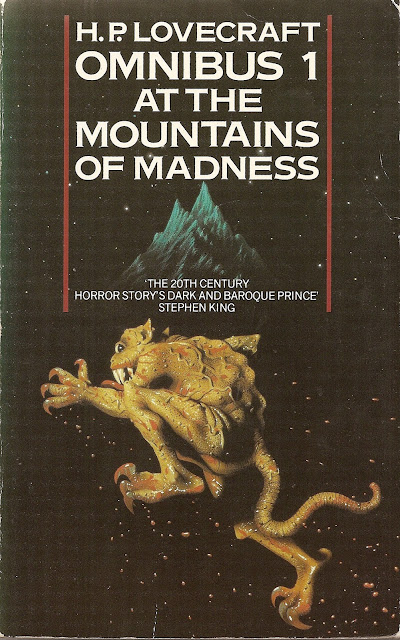
H.P. Lovecraft
At the Mountains of Madness and other novels of terror (1964)
I was under the impression that I'd read all there was to be read by H.P. Lovecraft, albeit some time ago, but now realise that I was mistaken. The four Randolph Carter tales collected here have turned out to be familiar only by their titles, but anyway...
Opinions vary regarding the much debated talent of Howard Philips, some claiming him to be an unparalleled master of the macabre, others suggesting he was simply a hack who could barely form a sentence and didn't get out much. I think the problem may be that, very generally speaking, he was never quite a talent in the same sense as his friend and correspondent Clark Ashton Smith, and he only really had one story - namely that of the rationally minded individual inheriting a house, a book, or a packet of unspeakable Toffos from that shunned relative mentioned only in hushed tones, and then the expressed dismissal of superstition followed by a subsequent eating of words during the inevitable climatic encounter with tentacled foreigners from beyond time; or at least variations on that theme.
I'm not even sure it's fair to call Lovecraft's fiction stories in the traditional sense, most of their purpose being the contrast of a regular guy obliged to admit the existence of that which is revealed as real and squelchy on the final page. His narratives serve simply to compound the contrast, to keep things going long enough to allow for a build up of suspense, none of which should necessarily be taken as indicative of a failing on the part of the author. Whilst H.P. Lovecraft may only have told one story, he often told it with such expertise as to circumnavigate the problems of repetition; indeed, by the time he came to write At the Mountains of Madness, his mastery can surely no longer be subject to question.
By the 1930s, Lovecraft's seemingly increased interest in the sciences had rooted his best tales in solid empirical foundations, serving to provide a more startling and effective contrast with his subject than is found in earlier tales more obviously inspired by Poe or Lord Dunsany. At the Mountains of Madness, The Case of Charles Dexter Ward, and The Dreams in the Witch-House all work exceptionally well in this respect, framing nameless horror in a context of archaeological, genealogical, or mathematical discourse, a great improvement on juvenile efforts which would spend the first half of the story telling you how scared you were going to be. The three examples named above were amongst his longest works, and even if it really was all just one story, these tales are a testament to Lovecraft's descriptive powers, specifically in that these three sustain the reader's interest at such a page count with hardly any narrative action.
On the other hand, whilst the Randolph Carter stories may suggest that Lovecraft actually did have other tales to tell, they also support the conclusion that he never quite worked out how to tell them. The Dream-Quest of Unknown Kadath, despite entertaining digressions with talking cats and a voyage to the moon, rambles and bores with its endless sentences piling one self-consciously grandiose image upon another and then another, page after page after page without ever going anywhere of consequence. It may be one of the most laboured, indigestible pieces of writing I've ever struggled to finish. Through the Gates of the Silver Key, written much later and in collaboration with E. Hoffman Price is an improvement, greatly benefiting from the sort of cosmic and pseudo-scientific musings which informed The Dreams in the Witch-House and others; but is still unsatisfying, reading like a transitional piece or work unfinished.
Everyone is entitled to a stack of unreadable shite in their portfolio, and it's possibly only because Lovecraft left such a relative dearth of material that his more comical efforts are so well remembered. At the Mountains of Madness is at least deserving the accolade of masterpiece - the work of an author who had at last found his voice, and it seems such a terrible shame that we will never know where his fiction would have gone had he survived 1937.
At the Mountains of Madness
by Lawrence Burton

H.P. Lovecraft
At the Mountains of Madness and other novels of terror (1964)
I was under the impression that I'd read all there was to be read by H.P. Lovecraft, albeit some time ago, but now realise that I was mistaken. The four Randolph Carter tales collected here have turned out to be familiar only by their titles, but anyway...
Opinions vary regarding the much debated talent of Howard Philips, some claiming him to be an unparalleled master of the macabre, others suggesting he was simply a hack who could barely form a sentence and didn't get out much. I think the problem may be that, very generally speaking, he was never quite a talent in the same sense as his friend and correspondent Clark Ashton Smith, and he only really had one story - namely that of the rationally minded individual inheriting a house, a book, or a packet of unspeakable Toffos from that shunned relative mentioned only in hushed tones, and then the expressed dismissal of superstition followed by a subsequent eating of words during the inevitable climatic encounter with tentacled foreigners from beyond time; or at least variations on that theme.
I'm not even sure it's fair to call Lovecraft's fiction stories in the traditional sense, most of their purpose being the contrast of a regular guy obliged to admit the existence of that which is revealed as real and squelchy on the final page. His narratives serve simply to compound the contrast, to keep things going long enough to allow for a build up of suspense, none of which should necessarily be taken as indicative of a failing on the part of the author. Whilst H.P. Lovecraft may only have told one story, he often told it with such expertise as to circumnavigate the problems of repetition; indeed, by the time he came to write At the Mountains of Madness, his mastery can surely no longer be subject to question.
By the 1930s, Lovecraft's seemingly increased interest in the sciences had rooted his best tales in solid empirical foundations, serving to provide a more startling and effective contrast with his subject than is found in earlier tales more obviously inspired by Poe or Lord Dunsany. At the Mountains of Madness, The Case of Charles Dexter Ward, and The Dreams in the Witch-House all work exceptionally well in this respect, framing nameless horror in a context of archaeological, genealogical, or mathematical discourse, a great improvement on juvenile efforts which would spend the first half of the story telling you how scared you were going to be. The three examples named above were amongst his longest works, and even if it really was all just one story, these tales are a testament to Lovecraft's descriptive powers, specifically in that these three sustain the reader's interest at such a page count with hardly any narrative action.
On the other hand, whilst the Randolph Carter stories may suggest that Lovecraft actually did have other tales to tell, they also support the conclusion that he never quite worked out how to tell them. The Dream-Quest of Unknown Kadath, despite entertaining digressions with talking cats and a voyage to the moon, rambles and bores with its endless sentences piling one self-consciously grandiose image upon another and then another, page after page after page without ever going anywhere of consequence. It may be one of the most laboured, indigestible pieces of writing I've ever struggled to finish. Through the Gates of the Silver Key, written much later and in collaboration with E. Hoffman Price is an improvement, greatly benefiting from the sort of cosmic and pseudo-scientific musings which informed The Dreams in the Witch-House and others; but is still unsatisfying, reading like a transitional piece or work unfinished.
Everyone is entitled to a stack of unreadable shite in their portfolio, and it's possibly only because Lovecraft left such a relative dearth of material that his more comical efforts are so well remembered. At the Mountains of Madness is at least deserving the accolade of masterpiece - the work of an author who had at last found his voice, and it seems such a terrible shame that we will never know where his fiction would have gone had he survived 1937.
11 Jul 02:41
A Town Without Context
by Jack Graham
On 'A Town Called Mercy'
Jex experiments on people in order to create a cyborg supersoldier. His motive is to end a war which is killing his people. But were his people the attackers or the attacked? That this is ignored tells us a great deal about the writer/s but deprives us of the possibility of making moral sense of the story. It is ignored, presumably because it is considered irrelevant. Yet, the whole point of the story appears to be the question of whether Jex is a bad man or a good one... with the answer being, of course, "yes". But I'd argue that the wider social context of Jex's actions (beyond just saying that 'it was war') is as important as it is obscure.
The notion - that war is, as Jex puts it, "a different world" in which normality shifts drastically and morality becomes fuzzy - is, for a start, a somewhat glib truism. Like all such glib truisms, it can be pressed into service (i.e. "Yes, an invasion will kill lots of Iraqi people... but we have to do something; Saddam has WMD!!!") or ignored (i.e. "Those Muslamic terrorists are killing Our Boys!!! Why do they hate us???") according to ideological needs and preferences.
'A Town Called Mercy' actually tries to hone in on questions of moral ambiguity, and to try to represent that ambiguity in a sustained way, which is actually fairly good going for the series (at this time). Usual practice for Moffat-era Who is to suggest extremely crude, superficially worrying moral equivalences in dialogue which are then papered-over by the actual behaviour of the Doctor and his gang (whom we might want to start calling 'Our Boys and Girls', since it is assumed that they deserve 'our' support whatever they do). 'Mercy', by contrast, briefly shows the lead characters in genuine quandries about what to do for the best. Sadly, however, vital information is omitted from their calculations... and the omissions are interesting.
As I say, it's not exactly an earth-shattering observation that a basically good guy can do horrible things. Orwell begins The Lion & The Unicorn - written during the Blitz - with a passage saying that, as he writes, civilised people are flying overhead trying to kill him. The pilot in the bomber, Orwell remarks, "is serving his country, which has the power to absolve him from evil."
Jex is, of course, serving his 'country', so to speak. But is he from Space Poland or from the empire of the Space Nazis? To translate into geek: is he as much of a Bajoran as he seems, or is he a Cardassian? Or is the situation more complex than that? Is it more like America vs Japan? Two rival empires clashing. One the overt aggressor, but the other also implicated in bringing the conflict on via, say, provocation.
It matters. War crimes are never excusable, of course... except that they are excused. All the time. They're excused as long as they're 'ours', whoever 'we' happen to be. In fact, if they're 'ours', they tend to not even be noticed, let alone excused. When they cannot be ignored or straight-facedly excused (i.e. the abuse of prisoners at Abu Ghraib) they are ideologically neutralised as aberrations, quickly corrected by the putatively aggressive questioning of a Media who are actually pussycats sitting on the laps of the powerful and purring for bellyrubs. The odd playful scratch does not a ferocious tiger make... and anything more than the odd playful scratch might endanger the reliable supply of Kit-e-Kat.
However, it is simply not enough to know that a horrible act was committed, to condemn it and leave it at that. Atrocities are never excusable, but context must make us view violence committed in defence, or in the cause of liberation, differently to how we view violence committed by the aggressors... if only so that we can make intelligible sense of what is actually happening.
International law draws distinctions, at least formally:
People have the moral right to use violence against their occupiers, to use any means available to rid themselves of those who have invaded their territory. There is, of course, no such thing as 'legal terrorism' (though terrorism is subject to definition)... except that, once again, there is. Terrorism is, generally, legal when it is committed by the powerful against the powerless. State terrorism is so legal, it isn't even seen as terrorism at all. 'Terrorism' is something done by people with bolt-cutters or homemade bombs or hijacked jumbo jets. Worse atrocities carried out by states (and/or their hired thugs) are called 'counterterrorism' or 'counter insurgency', etc. The US government can organise genocidal levels of violence against those regimes of which it disapproves and this doesn't count.
Again, our culture tends to see these sorts of issues clearly enough when looking at the French Resistance, but runs into difficulty acknowledging the exact same principle with regards to the Iraqi Resistance. It all comes down to who's side 'we' are on... or rather, who is on 'our' side. Since 'we' are, by definition and by common sense, the goodies, then our friends must, ipso facto, be goodies too... goodies don't ally with baddies, after all... and so those who attack 'our' friends must, logically, be baddies. This is what responsible journalists call 'living in the real world'.
Israel, for instance, is 'our' ally, ergo Israel is 'the only democracy in the Middle East', constantly fighting for its life against evil-minded Arab aggressors... despite the fact that Israel is a war-starting, avowedly racist, settler-colonial Apartheid state, existing in clear breach of international law (it holds territory it acquired through aggressive war) which is capable of nuclear devastation that Iran can only daydream about. (By the way... it is sometimes argued that the attitude of the Western left towards Israel - i.e. obsessing over it while paying less attention to equally bad or worse states elsewhere - is a mirror image of the hypocrisy of the Western establishment... but this ignores the fact that one has a greater moral obligation to protest the actions of ones own state than those of others, and Israel simply could not do what it does without the funding and support of the US and UK. One wouldn't pay much heed to the wife of a serial killer who said "well, it's all very well, all these people going on about my husband... but what about Robert Mugabe?!" We would rightly construe this as a distraction.)
Terrorism is never excusable, but it always has context... and the context is usually one of power relations. It would be a travesty (as purblind as it is common) to simply wag a moralising finger at atrocities like suicide bombings by Palestinians in Tel Aviv without properly contextualising and historicising them, i.e. without properly explaining why they occur. It's terribly easy to condemn things. It's much harder to historicise them, especially when history doesn't support our ideological convictions. Contrary to myth, it's not just people like me who have ideological convictions. Even those who trumpet their own supposed scepticism are usually riddled with unexamined and unacknowledged ideology. People like Sam Harris, for instance, would have us believe (using anecdotal examples of individual cases) that such attacks occur simply because of the intoxicating effects of Islamic dogma... leaving out the evidence which shows that suicide bombing is almost invariably a product of political anger in response to tyranny, despair, injustice and helplessness... say, in the face of the continued, illegal, violent, occupation of Palestine by the Israelis, or of the American occupation of Iraq. This doesn't 'excuse' suicide bombing (whatever 'excuse' could possibly mean in this context) but it does historicise and contextualise it... in a way that shows the historical and political culpability of those moralisers who do so much to create the conditions for it.
Part of the problem with talking about this issue is what we might call the make-the-foundation-of-this-society-a-man-who-never-would fallacy: that to make moral judgements is the same thing as to moralise. The assumption is one of moral absolutes, which are generally decried while being tacitly employed (including, of course, by me)... in much the same way that we tend to think of 'situational ethics' as lacking integrity, despite the fact that ethical judgements always depend upon situation. Making moral judgements doesn't need to involve expressing categorical disapproval. (The 'Thou Shalt Not!' model of ethics is far from the oldest and most venerable.) Nor is the flipside true; to make moral distinctions is not to excuse. People who'll tell you that it was 'moral relativism' to equate US/UK aggression against Iraq to, say, German aggression against Poland, are themselves the real moral relativists, because they see crimes committed by 'us' as being somehow less immoral than the same crime committed by another. As I've implied, similar crimes are not always morally equivalent... but the key issue for parsing this is the issue of power. Who has it and what are they using it for? For instance, domestic violence is sometimes committed by women against men, and this is inexcusable... but it would be intellectually and politically dishonest to forget the context. We live in a patriarchal society soaked in rape culture; males still have enormous social, financial, cultural, political advantages; domestic violence (and violence generally) by men against women is much more common; etc.
The moral status of unprovoked aggression by states is very clear according to international law going back to the Nuremberg trials. It is the supreme war crime because it contains within itself all the crimes that always follow from invasion and occupation: theft, torture, rape, murder, etc. That's why, as Chomsky observed, every US President in the post-WWII era would have been hanged if such tenets of international law were applicable to the most powerful empire of the post-war period. As it happens, they were inapplicable from the start. Axis criminals were simply not charged with crimes that were also committed by the Allies (i.e. indiscriminate terrorist bombing of civillians) precisely because the framers of the Nuremberg laws didn't want to set dangerous precedents.
The Doctor sometimes does the things that his enemies are portrayed as evil for doing. Genocide, for example, in 'Remembrance of the Daleks'. There is an extent, however, to which any attempt to put the Doctor's actions in 'Remembrance' into real world terms is always going to fail politically... since only the fantastical scale of the Dalek threat can possibly justify what he does. In the real world, there is no level of threat or oppression which could justify genocide... the key point here being that any force in the real world capable of genocide on that scale would be, by definition, an immensely powerful political/economic/military imperialism. By posessing the Hand, the Doctor becomes powerful himself. In reality, the victims are never as powerful as the victimisers. The reason 'we' want to attack Iran rather than, say, North Korea, is precisely because 'we' know that 'they' can't chuck nukes at us.
It's likely that anybody capable of supplying Jex with the technical, technological, monetary and 'human' resources to create the Gunslinger would have to be pretty powerful. It would've been nice to know for sure one way or the other, but my bet would be on Jex being from an imperialist power of some kind. Modern warfare is always imperialistic when it isn't defensive. So should Jex be killed? I certainly wouldn't want to preach to the Gunslinger about morality. I'd be much more inclined to think he had the right to decide than the Doctor. Thing is, I just don't find this question particularly interesting. Neither a 'yes' nor a 'no' answer changes anything or achieves anything real. It gets us nowhere. The question is strangely empty. Debating the morality of hanging the Nuremberg defendants doesn't help us understand the rise of fascism or the imperialist nature of the European conflagration they helped oversee. Hanging Blair in Fallujah wouldn't stop the system he represents creating any more Fallujahs. Does he deserve to swing? I don't really care. It's a fundamentally uninteresting question. We end up back with that old question about whether the ends justify the means? Well, that's a no-brainer, obviously. Yes, possibly, sometimes - it depends on the context. That's assuming, of course, that the question is asked honestly... which it usually isn't. Usually, all that needs to be ascertained by the commissar to whom the question has been posed, is who did what. It's like that other cliche, about how "I was just following orders" is no defence. In real-world ideological discourse, when 'we' (whoever 'we' are) were just following orders, then that's fair enough... and it constitutes extremist lunacy to even think otherwise.
I'd like to know about the context of the orders Jex got, and the context in which he obeyed them. The episode, however, neglects to mention any of that. It is clearly considered that a debate about the ethics of war can be carried out without such context. I disagree. I want to know. Not because I want to know if Jex is 'good' or 'bad' (unlike the writer/s, I don't think these things can be settled so easily... certainly not by an act of self-sacrifice which doesn't actually change anything from the past one iota) but because I want to understand the political meaning of what transpires. Sadly, like so much of 21st century Doctor Who, particularly under Moffat, 'Mercy' simply doesn't possess an interior political context.
'A Town Called Mercy' actually does comparatively well in its awareness that morality depends upon context, that the social context of an act can alter its meaning, that the social context of a person can alter his or her moral status, etc. It permits Jex to be both a 'war criminal' and to be capable of more than that. Moreover, it allows the Gunslinger to do much the same. Having been a victim, he becomes an attacker (the point is not that he attacks his tormentors but that he then attacks the town of Mercy) and then, later, to become the town's protector.
However, ultimately, the story flounders on lack of context. What, one feels like demanding, was the context for Jex's actions? The Doctor's initial enthusiasm for his people doesn't mean they were necessarily the victims of aggression (he's enthusiastic about America during the Vietnam war, when Nixon was dropping more tonnage of bombs than were dropped during WWII on the peasants of South East Asia). It isn't that there may be some justification for having mutilated and murdered people, but that there may be some wider political and moral context which will help us to understand how he came to do such things. Even if he was on the attacking side, I'd like to know about the culture which created a situation in which he got caught up in such a venture. Was he an enthusiastic volunteer, like so many of the doctors who formed the single largest professional group within the SS? Was he one of those 'ordinary men' who found themselves committing extraordinary atrocities out of an inability to resist social pressure? Was he propagandized into accepting a pernicious ideology that he now rejects? I'd really like to know this stuff. This interests me, far more than a scene where the Doctor lectures the assembled townspeople (most of whom are, natch, fickle moral cowards) about non-violence.
This leads me to another issue. The Doctor straps on guns when he becomes the Sheriff. Well, I'm not a pacifist so I don't have an objection to that per se. I'm not one of those people who wants the Doctor to be inherently non violent. However, it does make me think of The Prisoner episode 'Living in Harmony' (you know, the Western one). This episode was not shown on American TV at the time. The official reason was that it featured mind-altering drugs... but this is unconvincing, given how many episodes which did make it onto US TV also featured mind-altering drugs. The real reason, as Robert Fairclough has argued, is probably the anti-war subtext of the episode in the context of the Vietnam war and the protest movement against it. It was just too near the knuckle. An episode which evokes the primal myth of America (the Wild West), in which the hero refuses to strap on a six-shooter. Now, context changes things. I'm not, as I say, a pacifist, but 'Living in Harmony' acquires a political charge that is thrilling in the context of that moment of history, in which a generation were marching for peace. So it's disappointing that, in the context of British and US troops still engaged in Afghanistan, Iraq, Pakistan and elsewhere, Doctor Who does a Western in which the Doctor straps on his six-shooter without a qualm.

He also pins on that sheriff's badge eagerly too... which is a sign of the times, like his unworried acceptance of the Tesselecta's assertion that, like them, he stands for 'law and order'. Who's law? Who's order? And are the two things necessarily linked, or even desirable. Lots of laws are pretty fucking awful, precisely because of who's interests they serve. There's that missing political context again. What a gaping hole its absence leaves in a story that specifically tries to examine these issues!
Of course, blaming Steven Moffat or Toby Whithouse for this would be to miss the point rather. They're not there to make political statements but to make fantasy TV. That the fantasy TV they make seems depressingly conformist and apolitical (meaning, in practice, apologetical for powerful interests and prejudices) is, to a large extent, the fault of a society that has, by and large, abandoned anti-war activism and protest. That's not to say that protest has disappeared, but we're a long way from the big march against the invasion of Iraq in 2003. If people don't mind their country being engaged in murderous imperialism, then their fictional cultural heroes are not going to reflect any unease about it. Like everything good, such anger and protest must flow upwards from the bottom. Steven Moffat - and the media culture he embodies - isn't going to be pushed to the left by its own conscience. Some hope. Meanwhile, in the absence of any countervailing tendency, capitalist media culture drifts ever rightwards.
You know, a recent survey has suggested that most British people think the invasion of Iraq caused the deaths of under 10,000 people. The evidence seems to show that the actual figure is probably between 600,000 and a million... which is without calculating the death toll of the first Gulf War or the sanctions regime that Britain supported. This fact alone should shame the British out of producing or watching any televisual morality fables about war ever again. Really... just who the bloody hell do we think we are, swaggering around the globe, annihilating people for the convenience of the American imperium and for neoliberalism's access to markets, and then entertaining ourselves (and improving our children's morals) with comfortingly smug little homilies about war?
The anodyne smugness is a function of the lack of context. And it gets everywhere, into even the most frivolous bits of narrative culture. Leaving out the context and the history is an essential ideological tool of the capitalist media. This is how the Israel/Palestine 'conflict' is portrayed as being about 'two tribes' who can't get on. Every news report that tuts over 'conflict' in the West Bank or Gaza takes, essentially, the same tack as 'A Town Called Mercy' (and other Doctor Who texts, including many from the classic series) in the way it presents us with a tragic drama about the horror of war, etc., while neatly and discreetly editing out any context which will help us make moral sense of it all. The moral sense is always inextricably bound up with the political and historical sense. That's why the capitalist culture industry usually thinks we don't need to know the context.
The ends can justify the means, but there needs to be something which justifies the ends.
- Trotsky
Jex experiments on people in order to create a cyborg supersoldier. His motive is to end a war which is killing his people. But were his people the attackers or the attacked? That this is ignored tells us a great deal about the writer/s but deprives us of the possibility of making moral sense of the story. It is ignored, presumably because it is considered irrelevant. Yet, the whole point of the story appears to be the question of whether Jex is a bad man or a good one... with the answer being, of course, "yes". But I'd argue that the wider social context of Jex's actions (beyond just saying that 'it was war') is as important as it is obscure.
The notion - that war is, as Jex puts it, "a different world" in which normality shifts drastically and morality becomes fuzzy - is, for a start, a somewhat glib truism. Like all such glib truisms, it can be pressed into service (i.e. "Yes, an invasion will kill lots of Iraqi people... but we have to do something; Saddam has WMD!!!") or ignored (i.e. "Those Muslamic terrorists are killing Our Boys!!! Why do they hate us???") according to ideological needs and preferences.
 |
| Kryten would find it easier to get rid of the Apocalypse Boys now that he'd been assimilated by the Borg. |
'A Town Called Mercy' actually tries to hone in on questions of moral ambiguity, and to try to represent that ambiguity in a sustained way, which is actually fairly good going for the series (at this time). Usual practice for Moffat-era Who is to suggest extremely crude, superficially worrying moral equivalences in dialogue which are then papered-over by the actual behaviour of the Doctor and his gang (whom we might want to start calling 'Our Boys and Girls', since it is assumed that they deserve 'our' support whatever they do). 'Mercy', by contrast, briefly shows the lead characters in genuine quandries about what to do for the best. Sadly, however, vital information is omitted from their calculations... and the omissions are interesting.
As I say, it's not exactly an earth-shattering observation that a basically good guy can do horrible things. Orwell begins The Lion & The Unicorn - written during the Blitz - with a passage saying that, as he writes, civilised people are flying overhead trying to kill him. The pilot in the bomber, Orwell remarks, "is serving his country, which has the power to absolve him from evil."
Jex is, of course, serving his 'country', so to speak. But is he from Space Poland or from the empire of the Space Nazis? To translate into geek: is he as much of a Bajoran as he seems, or is he a Cardassian? Or is the situation more complex than that? Is it more like America vs Japan? Two rival empires clashing. One the overt aggressor, but the other also implicated in bringing the conflict on via, say, provocation.
It matters. War crimes are never excusable, of course... except that they are excused. All the time. They're excused as long as they're 'ours', whoever 'we' happen to be. In fact, if they're 'ours', they tend to not even be noticed, let alone excused. When they cannot be ignored or straight-facedly excused (i.e. the abuse of prisoners at Abu Ghraib) they are ideologically neutralised as aberrations, quickly corrected by the putatively aggressive questioning of a Media who are actually pussycats sitting on the laps of the powerful and purring for bellyrubs. The odd playful scratch does not a ferocious tiger make... and anything more than the odd playful scratch might endanger the reliable supply of Kit-e-Kat.
However, it is simply not enough to know that a horrible act was committed, to condemn it and leave it at that. Atrocities are never excusable, but context must make us view violence committed in defence, or in the cause of liberation, differently to how we view violence committed by the aggressors... if only so that we can make intelligible sense of what is actually happening.
International law draws distinctions, at least formally:
2. Reaffirms the legitimacy of the struggle of peoples for independence, territorial integrity, national unity and liberation from colonial and foreign domination and foreign occupation by all available means, particularly armed struggle
- United Nations General Assembly Resolution A/RES/33/24 of 29 November 1978
People have the moral right to use violence against their occupiers, to use any means available to rid themselves of those who have invaded their territory. There is, of course, no such thing as 'legal terrorism' (though terrorism is subject to definition)... except that, once again, there is. Terrorism is, generally, legal when it is committed by the powerful against the powerless. State terrorism is so legal, it isn't even seen as terrorism at all. 'Terrorism' is something done by people with bolt-cutters or homemade bombs or hijacked jumbo jets. Worse atrocities carried out by states (and/or their hired thugs) are called 'counterterrorism' or 'counter insurgency', etc. The US government can organise genocidal levels of violence against those regimes of which it disapproves and this doesn't count.
Again, our culture tends to see these sorts of issues clearly enough when looking at the French Resistance, but runs into difficulty acknowledging the exact same principle with regards to the Iraqi Resistance. It all comes down to who's side 'we' are on... or rather, who is on 'our' side. Since 'we' are, by definition and by common sense, the goodies, then our friends must, ipso facto, be goodies too... goodies don't ally with baddies, after all... and so those who attack 'our' friends must, logically, be baddies. This is what responsible journalists call 'living in the real world'.
Israel, for instance, is 'our' ally, ergo Israel is 'the only democracy in the Middle East', constantly fighting for its life against evil-minded Arab aggressors... despite the fact that Israel is a war-starting, avowedly racist, settler-colonial Apartheid state, existing in clear breach of international law (it holds territory it acquired through aggressive war) which is capable of nuclear devastation that Iran can only daydream about. (By the way... it is sometimes argued that the attitude of the Western left towards Israel - i.e. obsessing over it while paying less attention to equally bad or worse states elsewhere - is a mirror image of the hypocrisy of the Western establishment... but this ignores the fact that one has a greater moral obligation to protest the actions of ones own state than those of others, and Israel simply could not do what it does without the funding and support of the US and UK. One wouldn't pay much heed to the wife of a serial killer who said "well, it's all very well, all these people going on about my husband... but what about Robert Mugabe?!" We would rightly construe this as a distraction.)
Terrorism is never excusable, but it always has context... and the context is usually one of power relations. It would be a travesty (as purblind as it is common) to simply wag a moralising finger at atrocities like suicide bombings by Palestinians in Tel Aviv without properly contextualising and historicising them, i.e. without properly explaining why they occur. It's terribly easy to condemn things. It's much harder to historicise them, especially when history doesn't support our ideological convictions. Contrary to myth, it's not just people like me who have ideological convictions. Even those who trumpet their own supposed scepticism are usually riddled with unexamined and unacknowledged ideology. People like Sam Harris, for instance, would have us believe (using anecdotal examples of individual cases) that such attacks occur simply because of the intoxicating effects of Islamic dogma... leaving out the evidence which shows that suicide bombing is almost invariably a product of political anger in response to tyranny, despair, injustice and helplessness... say, in the face of the continued, illegal, violent, occupation of Palestine by the Israelis, or of the American occupation of Iraq. This doesn't 'excuse' suicide bombing (whatever 'excuse' could possibly mean in this context) but it does historicise and contextualise it... in a way that shows the historical and political culpability of those moralisers who do so much to create the conditions for it.
Part of the problem with talking about this issue is what we might call the make-the-foundation-of-this-society-a-man-who-never-would fallacy: that to make moral judgements is the same thing as to moralise. The assumption is one of moral absolutes, which are generally decried while being tacitly employed (including, of course, by me)... in much the same way that we tend to think of 'situational ethics' as lacking integrity, despite the fact that ethical judgements always depend upon situation. Making moral judgements doesn't need to involve expressing categorical disapproval. (The 'Thou Shalt Not!' model of ethics is far from the oldest and most venerable.) Nor is the flipside true; to make moral distinctions is not to excuse. People who'll tell you that it was 'moral relativism' to equate US/UK aggression against Iraq to, say, German aggression against Poland, are themselves the real moral relativists, because they see crimes committed by 'us' as being somehow less immoral than the same crime committed by another. As I've implied, similar crimes are not always morally equivalent... but the key issue for parsing this is the issue of power. Who has it and what are they using it for? For instance, domestic violence is sometimes committed by women against men, and this is inexcusable... but it would be intellectually and politically dishonest to forget the context. We live in a patriarchal society soaked in rape culture; males still have enormous social, financial, cultural, political advantages; domestic violence (and violence generally) by men against women is much more common; etc.
The moral status of unprovoked aggression by states is very clear according to international law going back to the Nuremberg trials. It is the supreme war crime because it contains within itself all the crimes that always follow from invasion and occupation: theft, torture, rape, murder, etc. That's why, as Chomsky observed, every US President in the post-WWII era would have been hanged if such tenets of international law were applicable to the most powerful empire of the post-war period. As it happens, they were inapplicable from the start. Axis criminals were simply not charged with crimes that were also committed by the Allies (i.e. indiscriminate terrorist bombing of civillians) precisely because the framers of the Nuremberg laws didn't want to set dangerous precedents.
The Doctor sometimes does the things that his enemies are portrayed as evil for doing. Genocide, for example, in 'Remembrance of the Daleks'. There is an extent, however, to which any attempt to put the Doctor's actions in 'Remembrance' into real world terms is always going to fail politically... since only the fantastical scale of the Dalek threat can possibly justify what he does. In the real world, there is no level of threat or oppression which could justify genocide... the key point here being that any force in the real world capable of genocide on that scale would be, by definition, an immensely powerful political/economic/military imperialism. By posessing the Hand, the Doctor becomes powerful himself. In reality, the victims are never as powerful as the victimisers. The reason 'we' want to attack Iran rather than, say, North Korea, is precisely because 'we' know that 'they' can't chuck nukes at us.
It's likely that anybody capable of supplying Jex with the technical, technological, monetary and 'human' resources to create the Gunslinger would have to be pretty powerful. It would've been nice to know for sure one way or the other, but my bet would be on Jex being from an imperialist power of some kind. Modern warfare is always imperialistic when it isn't defensive. So should Jex be killed? I certainly wouldn't want to preach to the Gunslinger about morality. I'd be much more inclined to think he had the right to decide than the Doctor. Thing is, I just don't find this question particularly interesting. Neither a 'yes' nor a 'no' answer changes anything or achieves anything real. It gets us nowhere. The question is strangely empty. Debating the morality of hanging the Nuremberg defendants doesn't help us understand the rise of fascism or the imperialist nature of the European conflagration they helped oversee. Hanging Blair in Fallujah wouldn't stop the system he represents creating any more Fallujahs. Does he deserve to swing? I don't really care. It's a fundamentally uninteresting question. We end up back with that old question about whether the ends justify the means? Well, that's a no-brainer, obviously. Yes, possibly, sometimes - it depends on the context. That's assuming, of course, that the question is asked honestly... which it usually isn't. Usually, all that needs to be ascertained by the commissar to whom the question has been posed, is who did what. It's like that other cliche, about how "I was just following orders" is no defence. In real-world ideological discourse, when 'we' (whoever 'we' are) were just following orders, then that's fair enough... and it constitutes extremist lunacy to even think otherwise.
I'd like to know about the context of the orders Jex got, and the context in which he obeyed them. The episode, however, neglects to mention any of that. It is clearly considered that a debate about the ethics of war can be carried out without such context. I disagree. I want to know. Not because I want to know if Jex is 'good' or 'bad' (unlike the writer/s, I don't think these things can be settled so easily... certainly not by an act of self-sacrifice which doesn't actually change anything from the past one iota) but because I want to understand the political meaning of what transpires. Sadly, like so much of 21st century Doctor Who, particularly under Moffat, 'Mercy' simply doesn't possess an interior political context.
'A Town Called Mercy' actually does comparatively well in its awareness that morality depends upon context, that the social context of an act can alter its meaning, that the social context of a person can alter his or her moral status, etc. It permits Jex to be both a 'war criminal' and to be capable of more than that. Moreover, it allows the Gunslinger to do much the same. Having been a victim, he becomes an attacker (the point is not that he attacks his tormentors but that he then attacks the town of Mercy) and then, later, to become the town's protector.
However, ultimately, the story flounders on lack of context. What, one feels like demanding, was the context for Jex's actions? The Doctor's initial enthusiasm for his people doesn't mean they were necessarily the victims of aggression (he's enthusiastic about America during the Vietnam war, when Nixon was dropping more tonnage of bombs than were dropped during WWII on the peasants of South East Asia). It isn't that there may be some justification for having mutilated and murdered people, but that there may be some wider political and moral context which will help us to understand how he came to do such things. Even if he was on the attacking side, I'd like to know about the culture which created a situation in which he got caught up in such a venture. Was he an enthusiastic volunteer, like so many of the doctors who formed the single largest professional group within the SS? Was he one of those 'ordinary men' who found themselves committing extraordinary atrocities out of an inability to resist social pressure? Was he propagandized into accepting a pernicious ideology that he now rejects? I'd really like to know this stuff. This interests me, far more than a scene where the Doctor lectures the assembled townspeople (most of whom are, natch, fickle moral cowards) about non-violence.
This leads me to another issue. The Doctor straps on guns when he becomes the Sheriff. Well, I'm not a pacifist so I don't have an objection to that per se. I'm not one of those people who wants the Doctor to be inherently non violent. However, it does make me think of The Prisoner episode 'Living in Harmony' (you know, the Western one). This episode was not shown on American TV at the time. The official reason was that it featured mind-altering drugs... but this is unconvincing, given how many episodes which did make it onto US TV also featured mind-altering drugs. The real reason, as Robert Fairclough has argued, is probably the anti-war subtext of the episode in the context of the Vietnam war and the protest movement against it. It was just too near the knuckle. An episode which evokes the primal myth of America (the Wild West), in which the hero refuses to strap on a six-shooter. Now, context changes things. I'm not, as I say, a pacifist, but 'Living in Harmony' acquires a political charge that is thrilling in the context of that moment of history, in which a generation were marching for peace. So it's disappointing that, in the context of British and US troops still engaged in Afghanistan, Iraq, Pakistan and elsewhere, Doctor Who does a Western in which the Doctor straps on his six-shooter without a qualm.

He also pins on that sheriff's badge eagerly too... which is a sign of the times, like his unworried acceptance of the Tesselecta's assertion that, like them, he stands for 'law and order'. Who's law? Who's order? And are the two things necessarily linked, or even desirable. Lots of laws are pretty fucking awful, precisely because of who's interests they serve. There's that missing political context again. What a gaping hole its absence leaves in a story that specifically tries to examine these issues!
Of course, blaming Steven Moffat or Toby Whithouse for this would be to miss the point rather. They're not there to make political statements but to make fantasy TV. That the fantasy TV they make seems depressingly conformist and apolitical (meaning, in practice, apologetical for powerful interests and prejudices) is, to a large extent, the fault of a society that has, by and large, abandoned anti-war activism and protest. That's not to say that protest has disappeared, but we're a long way from the big march against the invasion of Iraq in 2003. If people don't mind their country being engaged in murderous imperialism, then their fictional cultural heroes are not going to reflect any unease about it. Like everything good, such anger and protest must flow upwards from the bottom. Steven Moffat - and the media culture he embodies - isn't going to be pushed to the left by its own conscience. Some hope. Meanwhile, in the absence of any countervailing tendency, capitalist media culture drifts ever rightwards.
You know, a recent survey has suggested that most British people think the invasion of Iraq caused the deaths of under 10,000 people. The evidence seems to show that the actual figure is probably between 600,000 and a million... which is without calculating the death toll of the first Gulf War or the sanctions regime that Britain supported. This fact alone should shame the British out of producing or watching any televisual morality fables about war ever again. Really... just who the bloody hell do we think we are, swaggering around the globe, annihilating people for the convenience of the American imperium and for neoliberalism's access to markets, and then entertaining ourselves (and improving our children's morals) with comfortingly smug little homilies about war?
The anodyne smugness is a function of the lack of context. And it gets everywhere, into even the most frivolous bits of narrative culture. Leaving out the context and the history is an essential ideological tool of the capitalist media. This is how the Israel/Palestine 'conflict' is portrayed as being about 'two tribes' who can't get on. Every news report that tuts over 'conflict' in the West Bank or Gaza takes, essentially, the same tack as 'A Town Called Mercy' (and other Doctor Who texts, including many from the classic series) in the way it presents us with a tragic drama about the horror of war, etc., while neatly and discreetly editing out any context which will help us make moral sense of it all. The moral sense is always inextricably bound up with the political and historical sense. That's why the capitalist culture industry usually thinks we don't need to know the context.
01 Jul 09:47
regarding champs and the questions about the particulars of their game at this locale
| archive - contact - sexy exciting merchandise - cute - search - about | |||
| dinosaur comics runs mon / wed / fri this week due to me kiiiinda signing thousands and thousands of books!
|
|||
| ← previous | June 26th, 2013 | next | |
|
June 26th, 2013: I am still in Austin, Texas! I have signed thousands and thousand of books! There are still a few thousand books left to sign! Sometimes life is funny that way! One year ago today: time went forward and they got sucky: the univac story – Ryan 
| |||
28 Jun 10:40
Wednesday 26th June 2013
Whilst the football (and thus Lord Sugar) is taking a break (and remember my retweets of Lord Sugar's football-related tweets are in any case now behind a paywall and it cost £750 a season to see them - do subscribe, I think you all know where to do that by now) I have decided to provide another Twitter Retweet service. I am going to Retweet any praise about himself that Professor Richard Dawkings retweets.
28 Jun 09:53
Scottish “Equal” marriage and Trans issues… here we go again
by Zoe O'Connell
The Scottish parliament has just released it’s own “Equal” Marriage Bill. (PDF Link)
The nature of devolved legislative powers is that there is much they can’t fix, such as reintroduction of the fast-track Gender Recognition Certificate (GRC) process. However, the things they could have fixed from the English and Welsh version… they haven’t.
Firstly, the spousal veto is still present, without time limit. (Schedule 2, paragraph 3 – starts on the bottom of page 38) In a nutshell, if you want gender recognition including employment law protection and you are married, you’d better hope you have a cooperative spouse. Otherwise, you’ll be forced to go through the cost of initiating an annulment yourself. That is, of course, assuming your spouse isn’t inclined to engage in delaying tactics over any divorce because they can make you wait a long, long time to get your legal rights if so.
Quite why the legal gender of the person you are married to is more important than if they are living as and perceived by the world as a particular gender, or if they have a particular genital configuration, has yet to be explained by anyone involved. For the avoidance of doubt, because many legislators didn’t know this, a spouse has no say in change of legal name and going “full time”, in starting hormone treatment or in surgery. There is also no other situation that partners might find just as objectionable, such as religious conversion or racking up huge debts, that require a special veto clause in legislation rather than using the generic marriage-broken-down-irretrievably clauses. Such “you must have your husband/partners consent” clauses were, rightly, removed from legislation a long time ago. GRCs are unique in having this reintroduced.
They have also made no move to restore marriages stolen under the old system.
On the plus side, it doesn’t look as if someone can annul their marriage just because their partner had a GRC from before they were married if they’re in Scotland. That’s something they have right historically, at least.
But it’s almost as if they just copied what Westminster did and were not paying attention.
26 Jun 15:45
Could the Lib Dems stay in the Coalition in the event the Tories dumped David Cameron?
by Stephen Tall
As my Voice colleague Mary Reid notes, today’s Telegraph was keen to alert readers to the contingency plans drawn up by the Tories to carry on governing in the event that Nick Clegg were defenestrated as party leader.
I assume one of those contingency plans was the laughably blatant attempt by Michael Gove to try and undermine Nick Clegg last month and so distract the media from the Tories’ own ongoing internecine warfare over Europe.
Still, it should be a very exciting next couple of months for we Lib Dems if the Telegraph is to be believed (seven words that kill the credibility of most political stories):
The Conservatives believe this summer is the “moment of peril” for Mr Clegg as any leadership coup is expected in the run-up to this year’s party conferences. Senior Tories predict the Liberal Democrat leader is “safe” until 2015 if he is still in post after this autumn.
If this is the level of Tory intelligence it explains a lot. Two reasons…
First, Nick Clegg isn’t facing an immediate threat. That’s not to say he’s not under pressure. Nor is it to deny there’s a significant chunk of party members who’d be glad if he went. But the serious displeasure of a minority isn’t the stuff of coups. And you’ll note that not one Lib Dem MP has called for him to quit. Sure, Vince Cable stands ready, willing and able to take over should a vacancy arise. But he’s not campaigning for it. And Tim Farron is smart enough to know his time is yet to come, post-2015.
Secondly, there remains a scenario under which Nick might still go — but it’s in the second half of 2014, and under his own steam. The scenario isn’t hard to imagine: the party fares badly in that year’s local and European elections; a top job opens up, whether in the EU or elsewhere; and Nick decides to stand down and let a new leader fight in 2015. A year ago that looked pretty plausible. I think it’s pretty unlikely now. But it isn’t impossible.
In fact, looked at objectively there’s only one party in the Coalition which might lose its leader sooner rather than later. After all, an estimated 10% of Tory MPs have submitted letters of no confidence in David Cameron to the chairman of the 1922 committee. Little more than a dozen extra letters could trigger a leadership contest.
Mr Cameron would, it can only be assumed, survive; but how wounded would he be? And if a plausible figure from the better-off-outer contingent of the Tory right-wing pledged to stand against him would he even survive? It’s by no means certain.
In short, if you were to bet on a leadership vacancy I’d put my money on the Tories ahead of the Lib Dems. Which invites the question: has our leadership drawn up contingency plans in the event that the Tories dump David Cameron?
* Stephen Tall is Co-Editor of Liberal Democrat Voice, a Research Associate for the liberal think-tank CentreForum, and also writes at his own site, The Collected Stephen Tall.
26 Jun 15:13
DOMA
by Michael Leddy
From this morning’s Supreme Court decision striking down the Defense of Marriage Act, Justice Anthony M. Kennedy writing for the majority:
[I’m glad he got this one right.]
You’re reading a post from Michael Leddy’s blog Orange Crate Art. Your reader may not display this post as its writer intended.
This work is licensed under a Creative Commons 3.0 License.
DOMA singles out a class of persons deemed by a State entitled to recognition and protection to enhance their own liberty. It imposes a disability on the class by refusing to acknowledge a status the State finds to be dignified and proper. DOMA instructs all federal officials, and indeed all persons with whom same-sex couples interact, including their own children, that their marriage is less worthy than the marriages of others. The federal statute is invalid, for no legitimate purpose overcomes the purpose and effect to disparage and to injure those whom the State, by its marriage laws, sought to protect in personhood and dignity. By seeking to displace this protection and treating those persons as living in marriages less respected than others, the federal statute is in violation of the Fifth Amendment.Supreme Court Bolsters Gay Marriage With Two Major Rulings (New York Times)
[I’m glad he got this one right.]
You’re reading a post from Michael Leddy’s blog Orange Crate Art. Your reader may not display this post as its writer intended.
This work is licensed under a Creative Commons 3.0 License.
26 Jun 14:08


You can’t think yourself
by Passive Guy
You can’t think yourself out of a writing block, you have to write yourself out of a thinking block.
John Rogers
Click to Tweet/Email/Share This Post
26 Jun 09:37
ROBSON AND JEROME – “Unchained Melody”/”The White Cliffs Of Dover”
by Tom
#722, 20th May 1995
 On Soldier Soldier’s Wikipedia page there’s a list of the places each season of the military drama was set- where Robson Green and Jerome Flynn’s squaddie characters were sent. Hong Kong, Cyprus, New Zealand… after Iraq, and a dozen years fighting in Afghanistan, the idea of a show about serving UK soldiers needing to get its drama from New Zealand seems bizarre, something out of a lost time.
But some things are constant: Britain is fond of its troops, whatever they’re asked to do. And when people start playing with ideas of Britishness and patriotism it’s no surprise to see a flash or two of khaki as the stereotypes parade. So, for the uninitiated or forgetful: this was number one for seven weeks, famously keeping Pulp’s “Common People” off the top. The singers are actors, who played soldiers in a long-running military soap. In one episode they have to do a bit of karaoke, and this is what they chose. Who, asked swooning viewers, will bring us this masterpiece on CD Single? A flash! – a whiff of sulphur! – enter Simon Cowell.
Cowell knocked together a recording, got it released, and it became the best selling single of the year. A great coup for the budding Svengali – perhaps, with a less handsome Robson Greene and a less sentimental public, the single would have flopped and much later grief might have been averted. Alas no.
Is the song any good? Yes, it’s “Unchained Melody”, it’s a great song. We were, of course, reminded of that only four years ago, but this is a standard (Simon likes standards) and there’s always room for a good recording. Is the recording any good? Ah. The singing’s – well, it’s passable, though terribly thin: we’ve heard worse from actors and we’ll hear worse again. Robson And Jerome don’t have the chops to handle the dynamics of “Unchained Melody”, but they’re not the worst thing about it.*
The backing however…if the brief was to recreate a karaoke system version of the Wall of Sound, then the brief was amply fulfilled. This is a very cheap sounding record. Cowell needed a hit, he called Stock and Aitken, late of “…and Waterman”, they said fine, and then in thirty seconds time, or at least that’s what it sounds like, he had a track. The drums are Tupperware, the keyboards toytown, the horns and guitars sound like Windows 95 alert sounds. The string parts – let’s call them strings – sound like they’re made from the kind of fabric Jarvis Cocker sings about. The one spark of intelligence on display is mixing this stuff high in time to cover up Robson (or Jerome) singing “Are you still miiiine?” and finally spluttering to the end of their range. Good sense from Stock and Aitken there. No need to give the enemy propaganda. There’s a war on, dammit! In New Zealand!
For the biggest hit of 1995, this has left almost no cultural mark. Robson Greene was a star for a few more years, Soldier Soldier wobbled on without him and Jerome for a little while, the song endured this insult and braced itself for the next one. But in one respect it’s important. It’s the moment Simon Cowell learned a very lucrative lesson: TV is far, far bigger than pop. You want to sell to common people? Give a TV audience an excuse to buy a single and the charts are yours to crush.
*(Which is which? The AA-side – by name only, it was barely played – gives them more to do separately. One has a firm, bland voice; the other is soft and paper-thin, almost creepily polite. Neither are strong. “The White Cliffs Of Dover” is still better than “Unchained Melody” thanks to its hilarious gospel breakdown – the only bold production choice made here. “When the world is free” sounds a bit like a gospel lyric, and now it is one, though on the evidence presented God has little to do with this record.)
26 Jun 09:33
Trans marriage rights – Lobbying the Lords
by Zoe O'Connell
As people may already be aware, the government refused to meet the trans community half way on the spousal veto issue. This means the partners of trans people who feel they have an axe to grind would be able engage in delay tactics and stop legal gender recognition for a protracted period.
The ball is basically in the government’s court, but only Lords can vote on individual issues now. Lords are UK wide, so there is no local Lord for you to lobby and MPs will now only get a yes/no vote on any amendments suggested by the Lords. However, the Lords still have report stage and third reading to propose their amendments. There is a chance the government might come back with something positive as they were clearly caught off-guard and Baroness Stowell, the government spokesperson in the Lords, was clearly unprepared to handle issues being raised.
With that in mind, for those wanting to influence the likely outcome of the decision, it would do no harm to write to Baroness Stowell. I’ve mailed her, at stowellt (at) parliament.uk, with the text below and I’d encourage others to do the same.
Some tips:
- A personal note will carry more weight than a generic one, but feel free to use the text exactly as it is below.
- Give and credit where it’s due. There’s no point in giving way on issues if we don’t acknowledge them and just rant in future.
- Be polite. There are enough “swivel-eyed loons” attempting to participate in politics already and they get ignored.
Dear Lady Stowell of Beeston,

Following the committee stage of the Marriage (Same-Sex Couples) Bill in the House of Lords, I am
pleased to hear that the government is thinking of reintroducing the GRC fast-track procedure.
This will be important for married trans people who have previously chosen not to seek legal
recognition but now wish to take advantage of the ability to do so without dissolving their
marriage. In many cases, the doctors involved in their treatment may no longer be in practice
which would make use of the standard procedure unviable.

I hope the government can make the reintroduction permanent.

However, the news that there was no were no plans to address the spousal veto issue is disappointing.
I would like to echo the sentiments given in the house by Baronesses Barker, Gould and Butler-Sloss.
The proposed amendment, itself a compromise from earlier amendments, granted the barest minimum
protections to trans people from spouses engaged in delay tactics and allowed all concerned to
quickly resolve what can be an undesirable situation all round.

You committed to writing to Baroness Thornton addressing many of the points raised and I would be
grateful if you could, if possible, also include me in that reply.

It is notable that during the passage of the bill, no amendments have yet been accepted by the
government that grant any rights whatsoever to trans people, only to their spouses. Please do not
continue this trend in the House of Lords.

Yours sincerely,
(I included my address at the end, so she will know I’m in the UK)
25 Jun 12:44
Why shouldn't boys who post sexted images of girls online be criminalised?
by Caron Lindsay
I've just been listening to an item on the Today programme about how to deal with the problems of sexting. This involves a teenager, almost always a girl, taking a nude photograph of herself and sending it, often under considerable pressure, to another teenager, almost always a boy. That boy then distributes it amongst all its mates who then send it to all their mates. They spoke to some boys who had done it and their motivation was, basically, nothing to do with the girl. She or her image, was simply a commodity to give them status amongst their peers.
One thing that struck me about the article is that if parents went to the Police, they were told that if they prosecuted the boy for distributing an illegal image of a child, they would also have to prosecute the girl for taking it.
There's something about that that strikes me as fundamentally unfair. The girl is sending a photograph, albeit one that she's too young to be taking, possibly under pressure, but on the basis that it's for private consumption. The boy breaches that trust and spreads it. He, as far as I can see, gets away with few consequences while her life can be ruined. As ever, she's the one who's blamed, in the same way that a teenage girl who gets pregnant is blamed as though she did that alone.
It is illegal for under 16s to have sex with each other. They are going to do it, often mutually consensually happily. They can guard against, although not completely prevent, any consequences, in terms of pregnancy or STDs by using contraception. It's not ideal by any stretch of the imagination, and I wouldn't encourage any teenager to do it, but there are a fair few who won't be bothered by that.
Sending a private photo to all and sundry, however, is an act which is by itself clear abuse.A girl taking the photo of herself and sending it to someone she trusts is not to blame for the abuse which follows, but she will bear the consequences for the rest of her life. She will be judged, humiliated and the sense of violation will be debilitating. The boy who distributes the photo has absolutely no penalty. Why can't there be a presumption against prosecution of the girl but a presumption for prosecution of the boy. I don't necessarily think that the boy should end up in prison, but I quite liked the NewYork idea mentioned on the programme of an order that they should be sent on some sort of education.
Having said all of that, the horse has left the stable, run the race, had its dinner and a satisfying nap by the time that the image gets out there.The most effective move is to stop it happening in the first place. How? More education, of course. But if boys knew that this was abuse, and that they could face consequences, not least their Granny finding out, for example, that education would be so much more effective.
Maybe there does need to be a bit of toughness here and a very strong message needs to be sent that this sort of abuse will not be tolerated.
One thing that struck me about the article is that if parents went to the Police, they were told that if they prosecuted the boy for distributing an illegal image of a child, they would also have to prosecute the girl for taking it.
There's something about that that strikes me as fundamentally unfair. The girl is sending a photograph, albeit one that she's too young to be taking, possibly under pressure, but on the basis that it's for private consumption. The boy breaches that trust and spreads it. He, as far as I can see, gets away with few consequences while her life can be ruined. As ever, she's the one who's blamed, in the same way that a teenage girl who gets pregnant is blamed as though she did that alone.
It is illegal for under 16s to have sex with each other. They are going to do it, often mutually consensually happily. They can guard against, although not completely prevent, any consequences, in terms of pregnancy or STDs by using contraception. It's not ideal by any stretch of the imagination, and I wouldn't encourage any teenager to do it, but there are a fair few who won't be bothered by that.
Sending a private photo to all and sundry, however, is an act which is by itself clear abuse.A girl taking the photo of herself and sending it to someone she trusts is not to blame for the abuse which follows, but she will bear the consequences for the rest of her life. She will be judged, humiliated and the sense of violation will be debilitating. The boy who distributes the photo has absolutely no penalty. Why can't there be a presumption against prosecution of the girl but a presumption for prosecution of the boy. I don't necessarily think that the boy should end up in prison, but I quite liked the NewYork idea mentioned on the programme of an order that they should be sent on some sort of education.
Having said all of that, the horse has left the stable, run the race, had its dinner and a satisfying nap by the time that the image gets out there.The most effective move is to stop it happening in the first place. How? More education, of course. But if boys knew that this was abuse, and that they could face consequences, not least their Granny finding out, for example, that education would be so much more effective.
Maybe there does need to be a bit of toughness here and a very strong message needs to be sent that this sort of abuse will not be tolerated.
25 Jun 10:10
The New World of Publishing: Making a Living with Your Short Fiction Updated 2013
by dwsmith
Way back, over three years ago now, I did a post in my Killing the Sacred Cows of Publishing series called “Myth: You Can’t Make Money Writing Fiction.” And then I wrote the basis of this post about one year ago right now. And things have changed so much, I wanted to update this now, and then I will follow this with another short fiction post on a slightly different area of short fiction.
But in this post, I want to go after a saying that used to be almost 100% true before four years ago. “You can’t make a living writing only short fiction.”
Not so true anymore.
Why this topic now? And why again, since I have touched on this at various times in various ways in various posts? Well, as I sit here in my office at WMG Publishing, Kristine Kathryn Rusch, my wife, just finished a workshop with 17 writers upstairs, working with them on varied aspects of mystery. And during that week-long workshop, the writers wrote three short stories (plus a bunch of other stuff).
And last night Kris and I were talking about the science fiction workshop she will be teaching in October. It will involve both short fiction and novels as well.
For those of you who don’t know my wife, she is the only person in history to win both the professional editor Hugo Award and a Hugo Award for her short fiction. She is also the only person in history to be in all four Dell Magazines in the same year. (Asimov’s, Analog, Ellery Queen, and Hitchcock’s) And she has done that four out of the last five or six years. She has also been nominated for just about every award there is in short fiction in both science fiction, fantasy, and mystery and won a bunch of them.
So the workshop and all the focus this last week on short fiction and the fact that I am madly working to finish up my challenge of 100 short stories published in one year, got me thinking about the math of short fiction and how that has changed so much in this new world of publishing. And how a good short fiction writer can now make a living with their short fiction. They might not get rich, but a living wage is very, very possible these days. And maybe a nice retirement income as well.
So that’s why this post is being brought forward and updated from the past. It’s time once again. And enough stuff has changed.
Requirements Needed For a Writer To Make a Living Writing Only Short Fiction
1) A Work Ethic.
I started to say “speed” but so many writers think of speed-of-writing as speed-of-typing and no matter how much some of us say that isn’t so, it doesn’t cut through that myth. So I’m going to start calling “fast writers” simply writers with a work ethic.
For your information, I type between 750 words to 1,000 words per hour and I have to take a break every hour to protect my hands and arms. I am pretty normal on that pace it seems after talking to hundreds of professional writers over the years. If you can go faster, good for you. Don’t tell me. My little four-finger-typing has served me well over the decades. Typing speed means nothing.
And some of you watched me at my little speed do a 70,000 word novel in about ten days a few months back.
What is important is work ethic. How many hour-long sessions can you do in a day? In a week?
Once more to the math (that just makes myth-believers angry and frees the rest of us to do what we want).
If you type 250 words in 15 minutes, and considered your writing important enough to type for 15 minutes every day, you will finish 91,250 words in one year. Or about one longish novel. (Sorry, but it’s true. 250 words x 365 days = 91,250 words. By the way, I passed 250 words in this article somewhere in the middle of the paragraph about Kris above.)
Note that if you type for 15 minutes every day and produce 250 words and work only on short fiction, by the end of a year you would have completed about 18 short stories of average length of 5,000 words.
If you work for one really, really tough hour of writing (snicker) five days per week, and take two weeks off from the really rough pace (more snickers), you will produce (1,000 words x 5 days x 50 weeks =) 250,000 words in one year. Or about three novels.
Or about 50 short stories (at average length of 5,000 words).
That’s right. 250,000 words in a year. Working one hour per day and taking the weekends off and two weeks vacation.
So to make a living writing short fiction, you need a work ethic that will drag you to the computer at least one hour per day, five days per week. I know that’s tough. But if everyone could do it, there would be a lot of writers making a living with their fiction.
(Sorry, this work-ethic topic just makes me very snarky. And please don’t give me your pitiful excuses about having to research or think about your story or build character worksheets or rewrite your story a dozen times to make your story dull and boring and just like everyone else’s story. And please don’t talk to me about how your day job is 60 hours. I have heard all the excuses and am not interested in why you can’t dig out one hour a day average out of your life. If you can’t do that much, stop claiming you want to be a writer. At least to me. Thanks!)
2) Writing Across Many Genres
If you want to make a living at short fiction, you need to understand and be able to write in most of the main genres. And if you think you can’t write in a genre, then you haven’t tried yet.
The main genres that short fiction sells well in are science fiction, fantasy, mystery, romance, erotica, western, mainstream, thriller, and all the subgenres of those genres. The more you can write in the different genres, the better off you will be in the long run. Of course, all genres, including literary short fiction, sell at one level or another, so don’t let genre thinking limit your writing.
Yes, I know, there are all kinds of discussions raging right now about still using pen names or not using pen names for varied genres. I’m pretty much moving all my stuff back to one name and even this last week killed one pen name. But that’s a personal decision for each of us now, since business reasons for having pen names are falling away.
3) A Love of Short Fiction
If you don’t love short fiction and read it all the time, don’t even think about this. Use short fiction at times to help your other work and learn how to write it well. But don’t even think of making a living with it alone.
So what is a living wage?
Now let me come at this topic from another direction. What is a living wage?
That’s going to depend on your overhead and what part of the country you live in. $25,000 per year might be enough in some places. $100,000 a year might not be enough in other places. All depends.
So I’m going to go with something reasonable as my number. $40,000 per year for the rest of this article is a living wage. Figure out what’s good for you and do the math accordingly as I am going to do below.
However let me say this. The short fiction I have up right now is making me a living wage if I was living as I was living in 1988 when I sold my first novel. I would not have had to bartend four nights a week if I had this income from short fiction.
Income Sources
Okay, quickly, I want to outline the different major sources of income from short fiction. And under the Magic Bakery thinking, there are a lot. But many will not happen for every story. So I’m going to just list some of the major ones here first and then go into details later.
1) Sell your story to a magazine or anthology
2) Indie publish your story
3) Group your story into a collection (or collections) and indie publish the collection(s) both electronically and in paper format.
4) Audio sales
5) Overseas sales to overseas magazines and publishers
There are many others, including movie sales, apps, and secondary print markets, but for this discussion, let me just stick to the top five.
Some of the keys to the above five are pretty simple.
For #1 you must only sell your work to five-cent-per-word markets and up that return the exclusive rights to your story to you no longer than six-to-nine months after publication. Maybe one year at most. (Most magazines and anthologies will keep nonexclusive rights beyond that to allow the story to stay in their issue or anthology, but that is no big deal since you can republish and control your story. The key is that the exclusive rights must come back fairly quickly.
For #2, you must price your short story at at least $2.99 no matter how short it is. (I know some of you don’t like this idea. Fine, keep your story at 99 cents and keep making 35 cent in the discount bin. No problem for me, and not something to talk about in this discussion.) You also must dig out the few hours extra per week it takes to publish your story and do the cover. I also put all my short stories into a stand-alone paper version just for me because there is no extra costs. I sell those paper versions for $4.99 and surprisingly, every-so-often one sells. But they do make my $2.99 price look better for the electronic version.
For #3, you need to price your collection decently and also get it into paper. We are moving our collection prices at WMG Publishing slowly to $5.99 electronic for a 20,000 word collection and then up from there. Most of our short five-story collections go into a paper version for $12.99. You also must dig out the few hours to do the collections every time you fill another one.
For #4, either do your own audio recordings of your short fiction and sell them through the different sources, or go to Audible.com and run through their ACX program. Better to have some stories going one way, others another way. No matter what, getting the audio cash stream running is the key.
For #5, you need to be aware of overseas markets and contract them at times to see if they are interested. (They often take reprints.) Yes, there are places to find overseas fiction markets. And yes, just as here, magazines buy from writers from all around the world. This takes time to build, but can be a slow but steady source of income once you have magazine editors overseas that like your work.
Building a Career and Income
I know a lot of you beginning writers out there are upset that your first novel or first short story didn’t sell. Or even your 30th short story isn’t helping the flow much. And we can go on for a long time about the reasons. But let me just list the few here quickly why you have no sales.
1) Your cover looks like an amateur did it.
2) Your cover doesn’t scream the genre of the story.
3) You don’t know your genre and thus have placed it for sale in the wrong place.
4) Your sales blurb is all about the plot, is passive, and dull and doesn’t help sell anything
5) When you look inside, you have made it so no reader gets to your opening chapter.
6) Your price is 99 cents or an odd number.
7) All your books look different, are not branded to your author name, and thus no one can find another book to read even if they read one and liked it.
8) You have a stupid web site (like this one) that doesn’t help readers find your books.
9) You are writing under four or five names and not linking them in any real fashion to help readers.
10) You are a beginning writer with only a couple of books written and haven’t yet learned the skills of storytelling.
And so on…
For this, I am going to assume you are mailing appropriate stories to top magazine markets, indie selling your stories in every electronic market, doing collections as often as you can, and pushing toward audio and overseas markets. In essence, using at least the five major ways of earning money from short fiction.
And when I mean all sources electronic, I mean Kindle, Pubit, iBooks, Kobo, Smashwords, OmniLit and so on… All of them.
SALES ASSUMPTION: I am going to assume each indie-published story and collection sells an average of five copies around the world each month. Some stories will sell none, others will sell thirty. Again, the number is five for both the short fiction and the collections from ALL sources, not just Kindle.
Average!!! Remember, average!!!
Will you hit five copies average early on? Nope. You might not hit it until you have over a hundred titles up under one name. You might hit it if you are really lucky and writing in some genre that you are hitting dead center. Most of us take a lot of time to average five copies. Some writers I know haven’t done it in the first three years of this new world, others have. It all depends on dozens of factors.
Even more frightening is that most writers don’t know how many copies every month they are selling. They look at the Kindle numbers and get depressed. Remember, Apple has a hundred and fifty-eight stores at last count around the world and Kobo has even more. Amazon has eight or nine. Think world and long term.
And by the way, “long term” means longer than six months. I am going to talk about the third year from the start of a short story writing program. Nothing sells well if you only have a few titles out.
Okay, how will all this work out? Time to find out.
– You write 50 short stories in a year. They average around 5,000 words.
– You keep doing that for a second year and a third and so on. (I know, that hour a day is daunting.)
– You and your first reader think that about 25 of the stories each year are appropriate for mailing to traditional magazines and anthologies. (Romance has no short fiction markets, so most of those would just go indie right off the bat.)
– You are good enough storyteller and marketer to sell 5 stories to those traditional markets the first year and ten per year after that, since some of the stories from the previous year are still on the market..
Income from Point #1 during the third year: 5,000 words x 10 stories = 50,000 words x 5 cents = $2,500.00 income per year. (Chances are it would be more than that, but let’s stay low.)
The advantages of doing this are far more than the money. Those traditional sales to magazines and anthologies push new readers to your indie published work as well and help you get on award ballots and into organizations and so on. Some of the best promotion a person can get is by selling to a major magazine or anthology and they pay you to advertise your work in their magazine.
– The other stories each year are published indie. And also the ones that are coming off the market after exhausting the good-paying traditional magazines. Or they have been published and reverted to you from the market after a sale.
– By the end of the third year you will have written 150 short stories and have about 100 of them indie published.
Income from Point #2 during the third year: 100 stories x 5 sales per month average = 500 sales per month around the world. Income from sales is $2.00 per sale. So 500 x $2.00 = $1,000.00 per month or $12,000.00 for the year. (Again, a lot of factors to drive this number up or down such as number of pen names, ability of storytelling, ability to do covers and blurbs, and your choice of topics.)
– Each story needs to be in at least one five-story collection. So by the end of the third year you will have 20 five-story collections published.
– Each story needs to be in a larger collection with at least ten or more stories. So by the end of the third year you will have at least 8 large collections.
– Five-story collections priced at $5.99 electronic and ten-story collections priced at $7.99 electronic. Profit from the first is $4.00 (rounding) per sale and from the large collections $5.50 per sale, again rounding.
Each collection also needs to be in paper editions, but let’s just round that money into the five sales for now. But it might be pretty large as your list of books grow and you get them into bookstores down the road.
Income from Point #3 during the third year:
– 20 collections x 5 sales per month = 100 sales x $4.00 = $400.00 per month or $4,800 per year.
– 8 large collections x 5 sales per month = 40 sales x $5.50 = $220.00 per month or $2,600.00 per year. (rounding)
– Total Income from Point #3 is $4,800 plus $2,600 = $7,400.00
Income Points #4 and #5: Just assume if you are doing them they are making up for any shortfall in the numbers above. Given a few years, audio could bring you in a few thousand per year easily, if not more. I know a number of people who are making a ton more than that. But for now, we’ll leave these out of the calculations. Too much to explain. Just call points four and five insurance back-up.
So during year three what is the total income? Are we close yet to making that $40,000 per year income?
$2,500 + $12,000 + $7,400 = $21,900 for year three.
Not bad, but only about half way after three years. (Remember I said long term?)
So year #4 you add in another fifty stories.
Your traditional sales of $2,500 stay the same under Point #1. (Remember, you are getting paid to advertise your own work in their pages.)
You make 50 x 5 = 250 sales per month x $2.00 = $500 per month more x 12 = $6,000 more per year from Point #2
You have ten more short collections and say four more long collections. The math works out to about $4,000 per year extra (rounding).
So each year you keep up the pace you add into the mix about $10,000.
So at about halfway through year six you will go past the $40,000.00 per year income figure.
And it should keep climbing as long as you are writing. (It will level and drop slightly if you are not, but still a nice steady retirement income for a long time.)
Summary
There are lots and lots of ways this could go better or go worse than the numbers I laid out above. Let me list some.
– Success or failure on such a plan will depend on your ability to write stories people want to read and traditional editors want to buy. That means (as you write) you must continue to work on your craft and skills as a storyteller. If you don’t do this, just forget even trying this. You must have a hunger to get better every day, every story.
– Success or failure on such a plan will depend on your ability to make sales traditionally with short fiction. The more times your stories appear in traditional magazines and books, the better your indie stories will sell and the better the reader base you will slowly build. (Note: An ad in Asimov’s/Analog is about $800 per page. They pay you instead for filling ten pages with your story. And then give your story back in a few months.)
– Success or failure will depend on your ability to learn how to do good covers, keep your costs down to almost nothing, learn how to do active blurbs, and that you keep up with the changing technology. (If you hire out the work of laying out covers and books, forget this. You have to do it yourself for your own publishing company.)
– Success or failure will depend on your ability to get to writing regularly most days, and when life tosses you a monster, you go back to writing when you get through the issues. This is the most difficult for all of us. You climb back on and keep going.
– Success or failure will depend on your ability to think long term with your planning. (Watch, most of the comments I will get about this post will be about looking at their short-term sales on a few stories. Those mean nothing I’m afraid.) Average. Become a better storyteller. Think long term.
– Success or failure will depend on your ability to start and push new cash streams such as audio or overseas sales or whatever is coming next. You may discover that over time your biggest cash stream isn’t something that exists right now, or that I didn’t mention.
But, all that said, it is very possible these days for a good short story writer to make a nice living writing only short fiction. You have to love it like I do. And you have to love writing it and be challenged by it.
But no matter what your belief is about the chance that writers can make a living with only short fiction, the math does not lie.
You might not agree with my assumptions. Fine. Change the sales to three sales average around the world every month, including paper for the collections. It will take you a few years longer to get to the goal. It will still happen if you write the stories and make it happen.
We are just entering a new golden age for short fiction. For those of us who love to write and read short fiction, this new world is just heaven.
Ten years ago I never dreamed making a living with short fiction was possible.
But it is possible now.
Have I said lately how much I love this new world?
————————————————
Copyright © 2013 Dean Wesley Smith
Cover art copyright Philcold/Dreamstime
————————————————–
This chapter is now part of my inventory in my Magic Bakery. I’m giving you this small slice as a sample. I’m giving you a taste, but not selling any of the pie.
In fact, this article is about 3,200 words long. I could have written a short story in the same amount of time.
If you feel this helped you in any way, toss a tip into the tip jar on the way out of the Magic Bakery.
If you can’t afford to donate, please feel free to pass this chapter along to others who might get some help from it.
And I would like to thank all the fine folks who have donated over this last year. I don’t always get a chance to respond, but the donations and the comments both after the posts and privately are really keeping me going on this. Thanks!
Tip Jar: Go To Paypal
Ruth.stearns likes this
25 Jun 09:26


JULIA WOLFE'S 'STEEL HAMMER'
by Gavin Burrows
LSO St Luke's, London, Sat 11th May

”John Henry told the Captain
A man ain't nothin' but a man”
Much like 'Cruel Sister', the piece that me introduced me to the music of post-minimalist composer Julia Wolfe, this spins out an extended modernist composition from an old folk number. This time, in it's UK premiere, we're given the popular ballad 'John Henry' - the steel-drivin' man performed by Bang on a Can. Except there's an added dimension...
Much like comics or science fiction fans, folk purists like the idea that there was once a definitive version of something. It's probably inaccessible now, buried under the onslaught of a thousand updates, offshoots and commercialisations. But, in theory at least, the treasure lies intact - buried beneath the sand.
Now this is of course an even more absurd way of looking at folk music than it is for science fiction or comics. A comic character such as Superman, who is in many ways a cousin to John Henry, has definite authors we can trace him back to. They in no way occupy the importance that fans attribute to them, but they're there.
Folk tracks don't work that way at all. Each new iteration just adds to what's gone before. (You may well have heard me say all this already. You're probably expecting me to use the metaphor of growing like coral any time now.)
We don't know who wrote the original John Henry ballad, though it probably dates only as far as the 1870s. (Little more than a lad by folk's extended chronology.) And, though there's speculation over who the original John Henry might have been,even if we're to assume his existence it's at about the same level of importance as if Superman had been based on some real guy. What's significant is that he's a symbol of the working man. For the ballad to be effective, it has to work as a kind of template that can be applied to many actual faces.
Except this isn't so much a new take, nor even a restaging of one of the old takes. It's more like a taking up of all the old takes at once, a reframing which incorporates them all. It starts with an extended choral repetition of the original's phrase “some say...” before listing a slew of States.
In one sense it borrows a trick from Steve Reich's minimalist classic 'Different Trains.' Every word we use has a double existence, a label for something but also a set of sounds – a mini music score in the making. You hear “Ken-tuu-cky” and “O-hiiio” stretched by the singers, passing back and forth between the two states in our minds. Except Reich's work was based in highly personal memories. What's captured here is the broad swell of Henry's history. There are variants where he is black and others where he is white. Here he's black and white. It works like one of those motion capture photosnaps, which portray a person's limbs in a blurry assemblage of different positions. It's the sum total of those positions which make up Henry.

“Some say...” is of course picked up as a phrase precisely because it's such a staple of folk songs or tales. Yet for all its distillation of these, the piece ends up doing something folk songs never quite manage themselves. Tending to be narrative based, they tend to start “some say...” then follow one particular trail. You need the multiplied versions to see the multiple picture.
With it's changes in tempo and musical style, everything from simple stomping feet to the crash of a full ensemble, Wolfe's meta-textual version gives us a frame for the songs which the songs themselves would not. She's playing on something in this style of music which is transcendent, which is beyond specifics.
Which is of course all to the good. Single, unified versions are inherently to do with restriction, and very often with power. If in my town Henry is white and yours he's black, and if my town is larger with a bigger printing press, then he'll turn out white soon enough.
The only drawback may be that there's so much universalisation that there's not much room for the actual John Henry. Had you known nothing of the folk original, you'd probably have guessed 'Cruel Sister' involved murder by medium of water. I'm not quite sure you hear the steel hammer in quite the same way here. Would you have seen this piece and gleaned 'man versus machine... man wins... man dies'?, which seems the irreducible core of 'John Henry.' The frame perhaps gets cast too expansively, it ends up more like a template for a folk song than an example of one. (Much minimalist and post-minimalist music, including Wolfe's own compositions, involve a live player working with pre-recordings. That must intersect with the Henry tale somehow.)
But still, it's a modernist composer not cherry-picking from the folk tradition but enthused by what's unique to it, and keen to respond in kind - with material unique to composing. In the Q&A after the recent 'Repeating Patterns' New York Minimalism night, people were keen to know what it was like to be in that scene as it happened. And understandably so, for it was a momentous era. But, for those of us too late to the party, we have what it morped and developed into. And if her London excursions are anything to go by Wolfe seems to be right at the top of her game about now.
The bill also included... Terry Riley's 'Tread On the Trail'. Unlike Riley's normal transcendental compositions, this was like a dime bar jazz band listened to through a distorting mirror. Which is of course a good thing. Plus another UK premiere, Nico Muhly's 'Three Songs.' The event was part of a mini-festival curated by Muhly, 'A Scream and an Outrage. The piece didn't mean a thing to me if I'm honest...
A kind of best-of showreel of the piece...
..and just in case you've not heard the original, here's one version by Woodie Guthrie...
25 Jun 09:21
Let Trenton Oldfield stay in Britain
by Jonathan Calder
I happened to be at home when Trenton Oldfield staged his protest at last year's Boat Race, so I was able to share Lord Bonkers' thoughts on the matter with my readers.
It his hard to disagree with Oldfield's words:
Because so many people were googling his name that afternoon, that post rapidly became one of the most-read ones this blog has ever had. And after that no one read it because Oldfield had been deservedly forgotten.
But the Home Office has not forgotten him and, after serving two months in Wormwood Scrubs, he has been ordered to leave the country.
"It feels to me that this is a very vindictive decision, very political and very much an overreaction."He should be allowed to stay.
25 Jun 09:17


My new favourite Unicode characters
by Mike Taylor
For reasons that seemed good to me, I was leafing through The Unicode Standard, Version 3.0 — 1,040 pages of character-set goodness — when I stumbled across this pair of characters on page 520:
- ≸ (U+2278) — neither less than nor greater than
- ≹ (U+2279) — neither greater than nor less than
It moves my soul that both of these exist.
25 Jun 09:17
According to Wikipedia, "...The Goose That Laid the Golden Eggs is among the best known of Aesop's Fables (Perry 87) and use of the phrase has become idiomatic of an [excellent scientific investigation] motivated by [the desire to better understand the un
| archive - contact - sexy exciting merchandise - cute - search - about | |||
| dinosaur comics runs mon / wed / fri this week due to me kiiiinda signing thousands and thousands of books!
|
|||
| ← previous | June 24th, 2013 | next | |
|
June 24th, 2013: I am in Austin, Texas! So far I haven't done much but sign books! It is a very busy trip to Austin, Texas! One year ago today: wrote this comic while finding a series of ants crawling up my legs, not even joking – Ryan 
| |||
Craig.talbert, Rachel Helps and -1 others like this
25 Jun 07:45
At the Movies
by LP
Regular readers of this site — hey, you three! — will know that I regularly feature long-form film criticism of movies both old and new. You may not know, however, that I see about ten movies for every one I write about, and time simply doesn’t permit, nor quality justify, a lengthy analysis of each. However, recognizing that nothing must go uncommented upon in this mediated age, I figured it was time to give some of these lesser features their due, with short, Twitter-length reviews.
The Q-Tip Rebellion: B-. Setting a grim Lord of the Flies-style tale of survival at a beautician is better in conception than execution.
Sharks vs. Honkies: C-. Needed more sharks, fewer honkies.
Crossbraugh & Deems – Full Dorsal: D-. Creative use casting in all-nude action shooter wasted by bad plotting, bizarre use of ‘bullet-time’.
Stat!: C-. Tense medical drama wastes excellent cinematography, tension with decision to make all dialogue doctors yelling title at each other.
Mugsy’s Movie: D. Well of rock docs officially runs dry with this painstakingly researched four-hour treatment of the Royal Crown Revue.
Side Grannies: B. Cee-Lo Green oddly charming in confusing drama of high school valedictorian who maintains retinue of elderly prostitutes.
Race Movie: F. Friedberg & Seltzer miscalculate badly with this alarming parody of turn-of-the-century minstrel shows. With Cuba Gooding Jr.
Jude the Obscure: B-. Skillful direction and lively comedic dance numbers can’t salvage an essentially bad choice for a Bollywood musical.
The Truncated Man: C-. A blockbuster action thriller based on ‘what do you call a guy with no arms and no legs’ jokes. This cost $130m.
Blood and Guts in High School: A-. The Farrelly Bros. were no one’s first choice for this Kathy Acker adaptation, but amazingly, it works.
Playing Cards: B. Great animation as always from Pixar, but story of a 9 who fights the “tyranny of the wild card” is kind of preachy.
Pink Lady and Jeff: C-. Kickstarter-funded adaptation of 1980 TV variety show, with all roles played by Shia LaBeouf for some reason.
Goin’ Back to Cali: A. Stellar David Fincher take on the L.L. Cool J single tells riveting story of fruit-loving wine thief. In 3-D.
The Frog Giggers: B+. Southern-fried noir film about the difficulties of professional toad-skewering is gory, but emotionally affecting.
Heart Attack Jack: C-. Stylized violence and snappy patter mark this real-time whodunit, punctuated by wheezing and botched line readings.
GeoCities: D. Cheap knockoff cannot recapture the magic of The Social Network, even with shockingly bloody alien invasion plot tacked on.
Middle English: F+. Not actually all that bad, I just always wanted to give something an F+.
The Pinkertons: C. Pointless Marvel Universe spin-off featuring the extended family of homosexual gentleman ranker of the Howlin’ Commandos.
The Sims: B-. Special controllers allow filmgoers to control characters in the movie as they control their Sims. Odd choice for von Trier.
Dogsucker: C-. Melissa McCarthy is the competitive eater who vows revenge on petite Japanese woman who defeats her in 100-meter bratwurst.
25 Jun 07:44
Hoping You Won’t Be Too
by LP
Hi! I’m Blue!
You may remember me from the color of a sunny sky, or the clothes you wore when you were a baby if you were a boy, or from the color scheme of a sports team you may enjoy. Perhaps you’re familiar with the feeling of calm and well-being I have been found to instill, or my associations with the vast expanses of water which encircle the globe, or the powerful indigenous music of our country’s African-American population. Whatever the specific connotations I conjure in your mind, one thing is for certain: unless you’re color-blind, you and I have been together since the very beginning.
But maybe you’re still a bit confused. “Hey, Blue,” you say, “I thought you were a particular segment of the visible light spectrum, or an unquantifiable abstraction meant to describe that segment! What are you doing here on this website, addressing me like the old friend you are?” Well, old friend, I’ll tell you. The world is a big, wide place, stretching far and wide under the glorious skies which bear my imprint. And there’s a lot of different people in it. Some people like to paint beautiful works of art (as did Picasso during the “period” he had the good taste to name after me); some people like to wander the countryside in search of the delicious berries which, though technically purple, bear my name and ‘seal of approval’; others just like to snuggle up with a loved one in front of a roaring fire or under a blanket in everyone’s favorite color. Other people like to bind the souls of ancient demons and extract from them their eldritch energies in order to conjure mystical forces that will allow their deranged and misguided color-cult to embody a primal metaphysical force (an unquantifiable abstraction, you might say!) in human shape. I don’t judge those people: I merely recognize that they’re out there. You might not have come across them, but I sure have.
Anyway, the point is, here I am. I’m a real live mortal person now, and it’s been explained to me by some very savvy lawyers that not only will I die someday, but due to the fact that, in my previous life as a semantic construction intended to qualify a physical-sensory phenomenon, I was less than well-versed in 21st-century intellectual property laws, I don’t have any right to royalties based on the use of my name or the qualities I formerly embodied. And, to top it all off, apparently I have to get a job now, because those savvy lawyers don’t work cheap. (I guess that’s another way they’re savvy!) So, in an attempt to ensure that the last few precious decades of the flimsy mortality forced upon me by those crazy cultists are not spent behind the register of a Rax Roast Beef joint, I have gone rather deeply into debt to acquire the services of Kline & Goldfarb Marketing & Public Relations in order to appeal to you, the people of America.
If you, the public, have enjoyed the color blue — if you have swelled with pride at the sight of a heroic Navy officer in his dress uniform; if you have gazed raptly at the sparkling waters of the Hawaiian islands; if you have turned heads walking down the street wearing a pair of tight denim jeans; if you have eaten an affordable, hearty diner meal off a sturdy ‘special’ plate; if you have enjoyed being alerted to limited-time-only specials at a certain major discount retailer — then please consider calling the number below and making a donation. Now, I’m not a charity, and I’m not just asking for handouts. I am more than willing to sponsor your events, organizations, or products. If you need the perfect spokesman for your clothing line, automobile, rock band, or anti-depressant, look no further. But I think when you consider all I’ve done for America, you’ll admit that a small donation is not much to ask; after all, without me, even the flag would be missing a certain special something.
So please call today, and tell the operator: “I WORK BLUE”!
24 Jun 16:20
ATOS turns Market Harborough man away disability benefit assessment because he is in a wheelchair
by Jonathan Calder
Just when you thought your opinion of ATOS could fall no lower comes this story from the Leicester Mercury:
So we taxpayers are giving ATOS £400m to conduct these tests, but still have to fund the press office at the DWP to go round after them with a bucket when they appear to have made a hash of things.
Over to you, Vince.
A man has claimed he was turned away and labelled a fire hazard after attending a disability benefit assessment in a wheelchair.
Charles Foreman said he was asked to leave the building as he presented a health and safety risk at the medical examination.And his wife takes up the story:
His wife Karen, 52, a shop manager, said she was asked to take her husband out of the building after she checked in at reception.
She said: “We were in bit of a hurry so I took Charles up in the lift and left him on the first floor as that was where the examination was to take place.
“I went down to check in properly and the woman there told me we had to leave as my husband was in a wheelchair.
“She said that the building was not equipped for people in wheelchairs and that he was a fire risk and a health and safety hazard.”
Mrs Forman said she offered to take the wheelchair away as her husband can walk short distances.
She said: “I told her I had used the wheelchair for speed as we had to park in a car park nearby.
“The woman was unmoved and just kept saying they could not see him as he was a fire risk.Almost the most concerning aspect of this story is that it ends with a Department of Work and Pensions spokesman defending the actions on ATOS.
So we taxpayers are giving ATOS £400m to conduct these tests, but still have to fund the press office at the DWP to go round after them with a bucket when they appear to have made a hash of things.
Over to you, Vince.
24 Jun 15:10
Gimpo's M25 25-Hour Spin
by noreply@blogger.com (John Higgs)
Once a year, at the weekend closest to the Spring Equinox, Gimpo - best known to KLF watchers as the man who filmed the money burning - drives around the M25 for 25 hours. His aim is to do this for 25 years.
He's done 17 years so far.
This week I was interviewed by Bristol filmmakers Dominic Wade and Rob Wickings, who are making a documentary called End Point of a Circle about this mighty endeavour. There's an early taste of it here, but it won't be finished for another eight years, after the 25th M25 Spin. (A 25-minute version should appear at the Portobello Film Festival at the end of August, and include interviews with Iain Sinclair and Bill Drummond.)
Gimpo's M25 spin and Iain Sinclair's later book London Orbital were influences which fed into my book The Brandy of the Damned, in a which three people drive around the coast of Britain in a van for confused and uncertain reasons. Their most logical argument for embarking on the journey is that all the good quests have been done, but it is still better to undertake a stupid quest than no quest at all. I still think there is a lot of truth in that.
Gimpo's argument is that what he is doing is art. Normally this sets alarm bells ringing for me and reminds me of Julian Cope's perennial advice: "Never fall for the art trip!" But I have no trouble seeing what Gimpo is doing as art. It's outsider art, of course, but it's still a damn sight more interesting than anything Damien Hirst will ever do.
Here's why I say that: Driving around the M25 is shit. Sure, it's a necessary evil, but it's a grim, unpleasant way to spend hours of your life. It is part of most peoples lives, certainly in the south of this country. For that reason it should be a valid subject for artists to do something with, but making something transcendent out of M25 traffic seems to be beyond them. The only way to do so is through the sheer pigheaded determination of Gimpo, who committed to spending 25 years of his life on this project. This heroic dedication to seeing a commitment through to the end is noble and very human, and for me elevates the whole endeavour.
25 years is a long time. There's lots of things you could achieve in that time, so you have to assume that a nagging voice of doubt occasionally gets in Gimpo's ear and suggests that there are better things he could be doing with his life. Yet he keeps going.
I have total faith in him, I feel certain that he will see it though to the end. Gimpo is an ex-squaddie who served in the Falklands, and I like to think that he's still out on patrol, year in and year out, circling London and protecting it in his own way. I trust in him because I want to trust in people, and by sticking to his commitment he is showing that people can be trusted. This is, I think, a far more valuable and rewarding reaction than anything I have ever got from a Damien Hirst.
More power to him, long may he roll. Rather him than me, of course, but it's good to know that as the years pass he is still out there seeing it through. If he wants to call what he is doing art, then that's good enough for me. Here's a film of this year's spin:
More details at gimpogimpo.com
He's done 17 years so far.
 |
| Gimpo - photo by Iron Man Records |
This week I was interviewed by Bristol filmmakers Dominic Wade and Rob Wickings, who are making a documentary called End Point of a Circle about this mighty endeavour. There's an early taste of it here, but it won't be finished for another eight years, after the 25th M25 Spin. (A 25-minute version should appear at the Portobello Film Festival at the end of August, and include interviews with Iain Sinclair and Bill Drummond.)
 |
| Dennis the Cat not happy that Rob and Dom filmed the interview in his garden. |
Gimpo's M25 spin and Iain Sinclair's later book London Orbital were influences which fed into my book The Brandy of the Damned, in a which three people drive around the coast of Britain in a van for confused and uncertain reasons. Their most logical argument for embarking on the journey is that all the good quests have been done, but it is still better to undertake a stupid quest than no quest at all. I still think there is a lot of truth in that.
Gimpo's argument is that what he is doing is art. Normally this sets alarm bells ringing for me and reminds me of Julian Cope's perennial advice: "Never fall for the art trip!" But I have no trouble seeing what Gimpo is doing as art. It's outsider art, of course, but it's still a damn sight more interesting than anything Damien Hirst will ever do.
Here's why I say that: Driving around the M25 is shit. Sure, it's a necessary evil, but it's a grim, unpleasant way to spend hours of your life. It is part of most peoples lives, certainly in the south of this country. For that reason it should be a valid subject for artists to do something with, but making something transcendent out of M25 traffic seems to be beyond them. The only way to do so is through the sheer pigheaded determination of Gimpo, who committed to spending 25 years of his life on this project. This heroic dedication to seeing a commitment through to the end is noble and very human, and for me elevates the whole endeavour.
25 years is a long time. There's lots of things you could achieve in that time, so you have to assume that a nagging voice of doubt occasionally gets in Gimpo's ear and suggests that there are better things he could be doing with his life. Yet he keeps going.
I have total faith in him, I feel certain that he will see it though to the end. Gimpo is an ex-squaddie who served in the Falklands, and I like to think that he's still out on patrol, year in and year out, circling London and protecting it in his own way. I trust in him because I want to trust in people, and by sticking to his commitment he is showing that people can be trusted. This is, I think, a far more valuable and rewarding reaction than anything I have ever got from a Damien Hirst.
More power to him, long may he roll. Rather him than me, of course, but it's good to know that as the years pass he is still out there seeing it through. If he wants to call what he is doing art, then that's good enough for me. Here's a film of this year's spin:
More details at gimpogimpo.com
24 Jun 13:22
Previously on TARDIS Eruditorum
It’s October 23rd, 1976. Pussycat are at number one with “Mississippi,” with Rod Stewart, Chicago, ABBA, and Rick Dees and his Cast of Idiots also charting, the latter with, well, the only song they ever chart with, “Disco Duck (Part One).” In the week prior copyright is extended by twenty years in the United States and Cearball Ó Dálaigh resigns as President of Ireland because the Minister of Defense insulted him. And, the day in question, Lis Sladen makes her final appearance on Doctor Who.
The show almost immediately collapses. Three weeks later, in the very next story, a particularly violent cliffhanger attracts the rage of moral crusader Mary Whitehouse, whose rantings are deemed sufficiently inconvenient as to necessitate a bureaucratic change. Doctor Who producer Philip Hinchcliffe is moved over to produce Target, whereas Target’s intended producer Graham Williams is put on Doctor Who with a mandate to tone down the violence. The Williams era has its moments, but is largely a brutal step down from the highs that Doctor Who reached with Lis Sladen around, and the show methodically circles the drain for a decade before finally falling through.
Thirty Years Later…
It’s April 29th, 2006. Gnarls Barkley remains crazy, while Rihanna, Fall Out Boy, and the Black Eyed Peas also chart. In the last week, Benedict XVI was reported to have agreed to a relaxation of rules on condoms (which are, for the record, a wildly more fascinating and unusual theological issue than anyone gives them credit for being), Tony Snow became White House Press Secretary, several years too early to be the victim of image macros involving government lies and the phrase “You know nothing, Tony Snow,” and Silvio Berlusconi announces that he’ll resign as Prime Minister of Italy, like he does every few years.
On television, Lis Sladen returns to Doctor Who in Toby Whithouse’s School Reunion. A big episode by any measure, deserving of a big post. No fancy formatting - let’s just take a wander. The good old-fashioned way, like we used to do.
One line of criticism regarding this episode is the idea that Sarah Jane is somehow cheapened by being put into a “romance” plot - that her character is lessened somehow by becoming “the ex,” as Mickey puts it. But let’s be careful here. Yes, Sarah’s relationship with the Doctor is clearly one that plays a role in her life that for other people are filled by romantic partners. But there’s no suggestion that it was romantic as such. In fact, there’s an explicit hedge against it - what devastates Sarah Jane is explicitly the fact that nothing earthly, romance included, can possibly compare to adventures in the TARDIS.
On the other hand, one can’t deny that the question of romance is present in the episode. But what’s interesting is that there is a clear distinction here between the frame and the content, so to speak. Yes, the relationship among the Doctor, Rose, and Sarah Jane is presented in the televisual terms of a love triangle, but nothing whatsoever in the past of Doctor Who supports the idea that just because you present something in the frame of a genre it is entirely a part of that genre.
The key observation is who makes the “missus and the ex” comment: Mickey. Ignore absolutely everything else about School Reunion, in fact, and focus on Mickey and Sarah Jane’s relationship, as it is the single most interesting thing in the story. Mickey, after all, is from EastPowellStreet. He belongs to the soaps. It’s not just the fact that Sarah Jane runs into the Doctor’s world again that prompts her story line, in other words, but the fact that she runs into Rose’s. Or, more to the point, Mickey’s, because Rose is by this point treated more like a character in the Doctor’s world than one in EastPowellStreet. Becoming a god will do that to you. (Observe the stark difference between her two appearances in Victorian stories - in The Unquiet Dead she’s in a period gown, in Tooth and Claw she’s in contemporary clothes. She’s become bigger than any genre she steps into, including her own.)
And crucially, Sarah Jane Smith is a Doctor Who companion. She has no life beyond that series. She’s a journalist, ostensibly, but is this really her plan? Go to schools where it looks like aliens might be running a Doctor Who plot and write news stories about them to stop them? I mean, try imagining Sarah Jane’s day-to-day life. How exactly does this style of journalism make her any money? It does not seem like anything that can happen at Deffry Vale High School can possibly make a publishable news story. And, further, she’s apparently the sort of person who drives around with a broken-down K-9 in the back of her car. This, I think, says it all about how fundamentally ill-suited she is to real life.
And this isn’t a problem. She wasn’t designed for real life. She was designed for a specific 1970s television show, and when the Doctor left her she stopped existing. There is no Sarah Jane Smith before The Time Warrior or after The Hand of Fear. That’s not how fiction works. You can write one, but there isn’t one. And even if you write one, you’re only adding a version to Sarah Jane Smith who stopped existing after The Hand of Fear. That’s what happens in stories when they end. That’s why endings are sad.
But there’s no avoiding an ending. Everything ends. That’s how stories work. The secret of alchemy is material social progress, and that means death. Sarah Jane knows that. She was quite literally there when it happened. That’s the consequence of it. The story after Sarah Jane leaves is the one with the continuity bit that cancels the series. This is what the Hinchcliffe era was about: death. And given that, Sarah Jane’s ending is a mercy because she gets to just walk away, held in our memories forever, our Sarah Jane.
Put another way, we can end the story at The Hand of Fear because then Lis Sladen never dies. Because it’s impossible to watch this now without that event just ripping through you. It was one thing when Hartnell died - he was always old. Troughton was harder, but it’s key to remember that he was around for a long time. His presence haunted the entire series - he appeared with four other Doctors, almost with a fifth, and died at the dawn of a sixth. And it was a long time ago. So was Pertwee, honestly - over a decade ago when Lis Sladen died. And that had been the last really big one. Yeah, there were sad ones. Verity Lambert was hard. Jacqueline Hill, oof. John Nathan-Turner, actually, was really sad, as we’ve learned. Even Nicholas Courtney didn't quite compare to Lis Sladen.
And that's because of this story. Because she got brought back to be a regular on the new series, and to get her own spinoff. And for God’s sake she deserved it. I mean, you talk about your heartwarming stories - that she gets that kind of late career recognition. But it made her death so fucking hard for fandom. It was just one of the most devastating things to happen. And this episode is already so metatextual that it’s impossible not to read it that way.
And that’s the choice you get to make. You can leave her at The Hand of Fear or you can let her come back. But if she comes back, she gets old and dies. Those are the rules. Those are the two worlds you get to live in.
She gets old. She changes. She has to. You cannot just walk from The Hand of Fear to School Reunion without stepping through thirty years of history like they’re just pages in a book. The rooms aren’t arranged that way. If you go from The Hand of Fear to School Reunion you get a character who simply does not work in the series any more. Because she hasn’t changed in thirty years, and the series has. So she can’t change just by contact with the show, because of the Blinovitch Limitation Effect or something - look, I could work this bit of theoretical poetry out if I wanted to, but it’s not actually that interesting. Let’s skip ahead.
The fact that she gets aged to match up with the show through a soap opera love triangle plot is a joke. But it’s a joke that ties a particular connection between Mickey and Sarah Jane. Mickey has become a sort of Lone Gunmen character - a perfectly ordinary guy who’s become a Doctor Who fan, only he’s done it within the story instead of outside of it. Mickey Smith’s From Outer Space. This is only possible in this new iteration of the show where it’s about its own success - now that Doctor Who is a thing in the culture it has ordinary people who are fans, and so Mickey has become a meta joke about that. It’s very clever, and it keeps him present in a show that’s now about Doctor Who being a cultural force that Coronation Street will poach a producer from. (Likewise, Jackie becomes the person who still really doesn’t get this Doctor Who thing, even though all the kids are into it.) Sarah Jane Smith is a Doctor Who character who is suddenly thrust awkwardly into being a soap opera character, Mickey Smith is a soap opera character who is suddenly thrust awkwardly into being a Doctor Who character.
And then there’s the tin dog. Tin is one of the alchemic metals, just as mercury is. If the Doctor is mercurial than describing K-9 as the “tin” dog is as significant as changing the Cybermen from being lunar to being martian. Again, wibbly wobbly, alchemical whemical, but the end result of the alchemical argument will be that describing K-9 as tin in an alchemical sense will result in him being a force of the old order that is holding us back and that we must surpass even though it hurts. I’m sure Jane can explain it in comments.
Shortly after Sarah Jane’s departure, as one of the first acts of the new producer, K-9 was brought into the series. He was at once immensely popular with children and a perfect symbol of the show’s decline because he was, let’s be honest, absolutely stupid. There’s thus an oddly fitting balancing of him and Sarah Jane - her departure marks the end of the beginning, his arrival marks the beginning of the end. And they’re inexorably paired because of a naff spinoff attempted in the 1980s that didn’t work, but that starred the two of them.
The problem is, K-9 can’t grow old. He’s a robotic dog. There’s no future for him. He’s disco. And so he’s dying. Decaying within the series, a festering wound. Putrefying. Fittingly, the monsters are putrefactive themselves, transmuting as a result of… wait, actually. Why do Krillitanes have oil? This is never explained in the plot. They have to use the children because they’re allergic to their own oil, but why they have their own oil in the first place is unknown. But the fact that they are creatures of continual change explains it - they are oil in the crude oil sense - the carbonization of life itself. They change through death.
In other words, they’re creatures of chemistry, not alchemy - a rationalist cult science fiction series come to destroy our fun little televisual fairy tale. They’re even led by Anthony Stewart Head, who is of course both brilliant and cult, in the second funniest instance of Doctor Who directly plundering Buffy the Vampire Slayer. And look at what they offer the Doctor - the ability to go back to the Time War.
Ah, yes. The Time War. That big mythic thing, the awful scar of cult television and cancellation. Here’s an interesting question: why does the Doctor respond to Sarah the way he does in the basement? I mean, “everyone died, Sarah” has to be one of the most weirdly jarring lines ever - a complete non-sequitur of a conversation. Is part of it the shock of him seeing her? No, because he’s overjoyed to see her still living. It’s something else - it’s her horrified reaction. That she thought he’d died.
Because he did, of course. In the very next story, which pinned that stupid regeneration limit in place for absolutely no reason whatsoever other than Robert Holmes needing a reason why the Master was decaying and not Roger Delgado. The show was given an endpoint so the Master could look like a pizza. That is how far the show fell after Sarah Jane Smith left. (Delgado, of course, was the first really big “death in the family” for Doctor Who.) But that’s not what he’s referring to. He’s referring to the Time War. Which is actually ages after Sarah Jane left. And that’s not the only weird thing about that conversation - there’s also the whole regenerated “half a dozen times since we last met,” which doesn’t work. Even based purely on The Five Doctors it doesn’t work, except, of course, John Hurt. But she met McCoy and McGann in novels, so it still doesn’t work unless you take that line as decanonizing the wilderness years in toto. (Or at least the BBC Books range.) Which, yuck.
Except that we’ve already come to read the wilderness years and the Time War as equivalent. So the only issues are related to John Hurt, the wilderness years, or The Five Doctors. Two out of three are the Time War. Which the Doctor overtly brings up. Why? Surely the easiest explanation, consistent with absolutely everything we are told about the Time War, is that every single Gallifrey story got retconned by it. And so when the Doctor went from The Hand of Fear to The Deadly Assassin he really did go straight to the Time War, because that’s what The Deadly Assassin is now. (And notably, this tidies up The Five Doctors as well, which, as a weak spot in time due to four incarnations of the Doctor being there at once, and furthermore as what must be a fixed point in time given the momentous political events, was surely a major battleground of the Time War. I mean, there was lone, mad Dalek - the only time we’ve seen a Dalek on Gallifrey - trapped in the Death Zone, fallen through time, screaming out for orders that would never come.)
So what we have are cult villains threatening to eat the entire past of the series by elevating the Doctor to the status of a god. And, of course, the real joke is that they’re rubbish. These aren’t the Daleks. They may talk a big game and supposedly be really bad “ancient foes” that even the Doctor is scared of, but they’re firmly in the tradition of suicidal vegetable-enviers and ancient gods with thrones that have bum-massaging hands. But they’re not actually huge threats. There’s never really any danger to this story, and there’s not supposed to be. There’s just some rubbish bat creatures. The only danger they pose is the brief flirtation with the narrative collapse of the series posed by letting the Doctor go back to the Time War and save them all. Even Sarah, who doesn’t have to get old if only the Doctor embraces the ropey old cult show.
And Sarah Jane says no. Sarah Jane Smith says it is better to grow old and to die than to do that. And she’s the only one who has to. But she accepts it. She has to. She knows. The secret of alchemy is material social progress. To defeat the harsh chemistry of the Krillitane requires true alchemy. She will pick the real world of Mickey Smith and love and dying. Because it doesn’t mean abandoning the Doctor’s world, it just means growing up.
Except there’s one other price. It is rarely remarked upon that the only time a proper unambiguous companion has ever really died in the new series is K-9. Yes, Rory, but Rory comes back. K-9 doesn’t. Not this K-9. Not K-9 Mark III, the robot dog that first appeared in A Girl’s Best Friend, the pilot episode of K-9 and Company, and then again in The Five Doctors. Because the series has to sacrifice its past. Sarah Jane accepting death means K-9 has to die. It’s not quite enough to accept death in theory. Something actually has to die. We have to get over our pasts.
So K-9 dies. He gets the big, epic heroic death scene as a companion sacrifices themselves to save humanity. And the wonderful thing is he relishes it, going out with an “Affirmative” before nuking the school. (And in the process making the picked on nerd cool!) He’s a badass motherfucking dog. He should be voiced by Samuel L Jackson or something. And in that is something else. Triumph of the camp, perhaps. The reclamation. The thing we get. Death is the price paid. What do we get for our death? What did Sarah Jane safe for us? This. A tin dog sacrificing himself in a blaze of glory to blow up a school and make the bullied kid a hero. Hooray, as Davies and Gardner would put it.
And notably, of course, Mickey is the tin dog. There’s an interesting cyclic structure to this episode. Sarah Jane meets Mickey Smith and gets cast in a love triangle due to her abandonment issues from the Doctor. This gives her the strength to accept death and thus to redeem K-9 by offering him a spectacular and epic death that is the apotheosis of the 70s cute robot aesthetic he belonged to. And K-9 gives Mickey a way into Doctor Who. The Doctor needs a Smith. Mickey Smith is elevated to where he gets to see the wonders of the universe because of the giddy camp wonder of a disco tin dog - the one that featured in Queer as Folk at that. And that’s our reward. That’s what we get for accepting death. Giddy wonder. The fact that we’re alive in the first place. The ability to revel in the triumphant death of a disco tin dog from the year five thousand.
That’s the secret of alchemy.
Till We Meet Again, Sarah (School Reunion)
by noreply@blogger.com (Philip Sandifer)
Previously on TARDIS Eruditorum
 |
| No, no, darlings. I'm the tin dog. |
The show almost immediately collapses. Three weeks later, in the very next story, a particularly violent cliffhanger attracts the rage of moral crusader Mary Whitehouse, whose rantings are deemed sufficiently inconvenient as to necessitate a bureaucratic change. Doctor Who producer Philip Hinchcliffe is moved over to produce Target, whereas Target’s intended producer Graham Williams is put on Doctor Who with a mandate to tone down the violence. The Williams era has its moments, but is largely a brutal step down from the highs that Doctor Who reached with Lis Sladen around, and the show methodically circles the drain for a decade before finally falling through.
Thirty Years Later…
 |
| K-9 must live! |
On television, Lis Sladen returns to Doctor Who in Toby Whithouse’s School Reunion. A big episode by any measure, deserving of a big post. No fancy formatting - let’s just take a wander. The good old-fashioned way, like we used to do.
One line of criticism regarding this episode is the idea that Sarah Jane is somehow cheapened by being put into a “romance” plot - that her character is lessened somehow by becoming “the ex,” as Mickey puts it. But let’s be careful here. Yes, Sarah’s relationship with the Doctor is clearly one that plays a role in her life that for other people are filled by romantic partners. But there’s no suggestion that it was romantic as such. In fact, there’s an explicit hedge against it - what devastates Sarah Jane is explicitly the fact that nothing earthly, romance included, can possibly compare to adventures in the TARDIS.
On the other hand, one can’t deny that the question of romance is present in the episode. But what’s interesting is that there is a clear distinction here between the frame and the content, so to speak. Yes, the relationship among the Doctor, Rose, and Sarah Jane is presented in the televisual terms of a love triangle, but nothing whatsoever in the past of Doctor Who supports the idea that just because you present something in the frame of a genre it is entirely a part of that genre.
The key observation is who makes the “missus and the ex” comment: Mickey. Ignore absolutely everything else about School Reunion, in fact, and focus on Mickey and Sarah Jane’s relationship, as it is the single most interesting thing in the story. Mickey, after all, is from EastPowellStreet. He belongs to the soaps. It’s not just the fact that Sarah Jane runs into the Doctor’s world again that prompts her story line, in other words, but the fact that she runs into Rose’s. Or, more to the point, Mickey’s, because Rose is by this point treated more like a character in the Doctor’s world than one in EastPowellStreet. Becoming a god will do that to you. (Observe the stark difference between her two appearances in Victorian stories - in The Unquiet Dead she’s in a period gown, in Tooth and Claw she’s in contemporary clothes. She’s become bigger than any genre she steps into, including her own.)
And crucially, Sarah Jane Smith is a Doctor Who companion. She has no life beyond that series. She’s a journalist, ostensibly, but is this really her plan? Go to schools where it looks like aliens might be running a Doctor Who plot and write news stories about them to stop them? I mean, try imagining Sarah Jane’s day-to-day life. How exactly does this style of journalism make her any money? It does not seem like anything that can happen at Deffry Vale High School can possibly make a publishable news story. And, further, she’s apparently the sort of person who drives around with a broken-down K-9 in the back of her car. This, I think, says it all about how fundamentally ill-suited she is to real life.
And this isn’t a problem. She wasn’t designed for real life. She was designed for a specific 1970s television show, and when the Doctor left her she stopped existing. There is no Sarah Jane Smith before The Time Warrior or after The Hand of Fear. That’s not how fiction works. You can write one, but there isn’t one. And even if you write one, you’re only adding a version to Sarah Jane Smith who stopped existing after The Hand of Fear. That’s what happens in stories when they end. That’s why endings are sad.
But there’s no avoiding an ending. Everything ends. That’s how stories work. The secret of alchemy is material social progress, and that means death. Sarah Jane knows that. She was quite literally there when it happened. That’s the consequence of it. The story after Sarah Jane leaves is the one with the continuity bit that cancels the series. This is what the Hinchcliffe era was about: death. And given that, Sarah Jane’s ending is a mercy because she gets to just walk away, held in our memories forever, our Sarah Jane.
Put another way, we can end the story at The Hand of Fear because then Lis Sladen never dies. Because it’s impossible to watch this now without that event just ripping through you. It was one thing when Hartnell died - he was always old. Troughton was harder, but it’s key to remember that he was around for a long time. His presence haunted the entire series - he appeared with four other Doctors, almost with a fifth, and died at the dawn of a sixth. And it was a long time ago. So was Pertwee, honestly - over a decade ago when Lis Sladen died. And that had been the last really big one. Yeah, there were sad ones. Verity Lambert was hard. Jacqueline Hill, oof. John Nathan-Turner, actually, was really sad, as we’ve learned. Even Nicholas Courtney didn't quite compare to Lis Sladen.
And that's because of this story. Because she got brought back to be a regular on the new series, and to get her own spinoff. And for God’s sake she deserved it. I mean, you talk about your heartwarming stories - that she gets that kind of late career recognition. But it made her death so fucking hard for fandom. It was just one of the most devastating things to happen. And this episode is already so metatextual that it’s impossible not to read it that way.
And that’s the choice you get to make. You can leave her at The Hand of Fear or you can let her come back. But if she comes back, she gets old and dies. Those are the rules. Those are the two worlds you get to live in.
She gets old. She changes. She has to. You cannot just walk from The Hand of Fear to School Reunion without stepping through thirty years of history like they’re just pages in a book. The rooms aren’t arranged that way. If you go from The Hand of Fear to School Reunion you get a character who simply does not work in the series any more. Because she hasn’t changed in thirty years, and the series has. So she can’t change just by contact with the show, because of the Blinovitch Limitation Effect or something - look, I could work this bit of theoretical poetry out if I wanted to, but it’s not actually that interesting. Let’s skip ahead.
The fact that she gets aged to match up with the show through a soap opera love triangle plot is a joke. But it’s a joke that ties a particular connection between Mickey and Sarah Jane. Mickey has become a sort of Lone Gunmen character - a perfectly ordinary guy who’s become a Doctor Who fan, only he’s done it within the story instead of outside of it. Mickey Smith’s From Outer Space. This is only possible in this new iteration of the show where it’s about its own success - now that Doctor Who is a thing in the culture it has ordinary people who are fans, and so Mickey has become a meta joke about that. It’s very clever, and it keeps him present in a show that’s now about Doctor Who being a cultural force that Coronation Street will poach a producer from. (Likewise, Jackie becomes the person who still really doesn’t get this Doctor Who thing, even though all the kids are into it.) Sarah Jane Smith is a Doctor Who character who is suddenly thrust awkwardly into being a soap opera character, Mickey Smith is a soap opera character who is suddenly thrust awkwardly into being a Doctor Who character.
And then there’s the tin dog. Tin is one of the alchemic metals, just as mercury is. If the Doctor is mercurial than describing K-9 as the “tin” dog is as significant as changing the Cybermen from being lunar to being martian. Again, wibbly wobbly, alchemical whemical, but the end result of the alchemical argument will be that describing K-9 as tin in an alchemical sense will result in him being a force of the old order that is holding us back and that we must surpass even though it hurts. I’m sure Jane can explain it in comments.
Shortly after Sarah Jane’s departure, as one of the first acts of the new producer, K-9 was brought into the series. He was at once immensely popular with children and a perfect symbol of the show’s decline because he was, let’s be honest, absolutely stupid. There’s thus an oddly fitting balancing of him and Sarah Jane - her departure marks the end of the beginning, his arrival marks the beginning of the end. And they’re inexorably paired because of a naff spinoff attempted in the 1980s that didn’t work, but that starred the two of them.
The problem is, K-9 can’t grow old. He’s a robotic dog. There’s no future for him. He’s disco. And so he’s dying. Decaying within the series, a festering wound. Putrefying. Fittingly, the monsters are putrefactive themselves, transmuting as a result of… wait, actually. Why do Krillitanes have oil? This is never explained in the plot. They have to use the children because they’re allergic to their own oil, but why they have their own oil in the first place is unknown. But the fact that they are creatures of continual change explains it - they are oil in the crude oil sense - the carbonization of life itself. They change through death.
In other words, they’re creatures of chemistry, not alchemy - a rationalist cult science fiction series come to destroy our fun little televisual fairy tale. They’re even led by Anthony Stewart Head, who is of course both brilliant and cult, in the second funniest instance of Doctor Who directly plundering Buffy the Vampire Slayer. And look at what they offer the Doctor - the ability to go back to the Time War.
Ah, yes. The Time War. That big mythic thing, the awful scar of cult television and cancellation. Here’s an interesting question: why does the Doctor respond to Sarah the way he does in the basement? I mean, “everyone died, Sarah” has to be one of the most weirdly jarring lines ever - a complete non-sequitur of a conversation. Is part of it the shock of him seeing her? No, because he’s overjoyed to see her still living. It’s something else - it’s her horrified reaction. That she thought he’d died.
Because he did, of course. In the very next story, which pinned that stupid regeneration limit in place for absolutely no reason whatsoever other than Robert Holmes needing a reason why the Master was decaying and not Roger Delgado. The show was given an endpoint so the Master could look like a pizza. That is how far the show fell after Sarah Jane Smith left. (Delgado, of course, was the first really big “death in the family” for Doctor Who.) But that’s not what he’s referring to. He’s referring to the Time War. Which is actually ages after Sarah Jane left. And that’s not the only weird thing about that conversation - there’s also the whole regenerated “half a dozen times since we last met,” which doesn’t work. Even based purely on The Five Doctors it doesn’t work, except, of course, John Hurt. But she met McCoy and McGann in novels, so it still doesn’t work unless you take that line as decanonizing the wilderness years in toto. (Or at least the BBC Books range.) Which, yuck.
Except that we’ve already come to read the wilderness years and the Time War as equivalent. So the only issues are related to John Hurt, the wilderness years, or The Five Doctors. Two out of three are the Time War. Which the Doctor overtly brings up. Why? Surely the easiest explanation, consistent with absolutely everything we are told about the Time War, is that every single Gallifrey story got retconned by it. And so when the Doctor went from The Hand of Fear to The Deadly Assassin he really did go straight to the Time War, because that’s what The Deadly Assassin is now. (And notably, this tidies up The Five Doctors as well, which, as a weak spot in time due to four incarnations of the Doctor being there at once, and furthermore as what must be a fixed point in time given the momentous political events, was surely a major battleground of the Time War. I mean, there was lone, mad Dalek - the only time we’ve seen a Dalek on Gallifrey - trapped in the Death Zone, fallen through time, screaming out for orders that would never come.)
So what we have are cult villains threatening to eat the entire past of the series by elevating the Doctor to the status of a god. And, of course, the real joke is that they’re rubbish. These aren’t the Daleks. They may talk a big game and supposedly be really bad “ancient foes” that even the Doctor is scared of, but they’re firmly in the tradition of suicidal vegetable-enviers and ancient gods with thrones that have bum-massaging hands. But they’re not actually huge threats. There’s never really any danger to this story, and there’s not supposed to be. There’s just some rubbish bat creatures. The only danger they pose is the brief flirtation with the narrative collapse of the series posed by letting the Doctor go back to the Time War and save them all. Even Sarah, who doesn’t have to get old if only the Doctor embraces the ropey old cult show.
And Sarah Jane says no. Sarah Jane Smith says it is better to grow old and to die than to do that. And she’s the only one who has to. But she accepts it. She has to. She knows. The secret of alchemy is material social progress. To defeat the harsh chemistry of the Krillitane requires true alchemy. She will pick the real world of Mickey Smith and love and dying. Because it doesn’t mean abandoning the Doctor’s world, it just means growing up.
Except there’s one other price. It is rarely remarked upon that the only time a proper unambiguous companion has ever really died in the new series is K-9. Yes, Rory, but Rory comes back. K-9 doesn’t. Not this K-9. Not K-9 Mark III, the robot dog that first appeared in A Girl’s Best Friend, the pilot episode of K-9 and Company, and then again in The Five Doctors. Because the series has to sacrifice its past. Sarah Jane accepting death means K-9 has to die. It’s not quite enough to accept death in theory. Something actually has to die. We have to get over our pasts.
So K-9 dies. He gets the big, epic heroic death scene as a companion sacrifices themselves to save humanity. And the wonderful thing is he relishes it, going out with an “Affirmative” before nuking the school. (And in the process making the picked on nerd cool!) He’s a badass motherfucking dog. He should be voiced by Samuel L Jackson or something. And in that is something else. Triumph of the camp, perhaps. The reclamation. The thing we get. Death is the price paid. What do we get for our death? What did Sarah Jane safe for us? This. A tin dog sacrificing himself in a blaze of glory to blow up a school and make the bullied kid a hero. Hooray, as Davies and Gardner would put it.
And notably, of course, Mickey is the tin dog. There’s an interesting cyclic structure to this episode. Sarah Jane meets Mickey Smith and gets cast in a love triangle due to her abandonment issues from the Doctor. This gives her the strength to accept death and thus to redeem K-9 by offering him a spectacular and epic death that is the apotheosis of the 70s cute robot aesthetic he belonged to. And K-9 gives Mickey a way into Doctor Who. The Doctor needs a Smith. Mickey Smith is elevated to where he gets to see the wonders of the universe because of the giddy camp wonder of a disco tin dog - the one that featured in Queer as Folk at that. And that’s our reward. That’s what we get for accepting death. Giddy wonder. The fact that we’re alive in the first place. The ability to revel in the triumphant death of a disco tin dog from the year five thousand.
That’s the secret of alchemy.

23 Jun 21:42
Mark Littlewood too extreme even for Mail readers
by noreply@blogger.com (Simon Titley)
My thanks to Liberator colleague Jonathan Calder, who has spotted an article in the Mail on Sunday by Mark Littlewood, which calls for the government to publish the names of all benefits claimants and the amounts they are paid.
It is the sort of shock tactic we have come to expect from Littlewood. But as the comments beneath the article show, this time it has proved to be too much even for readers of the Mail. One of them responds:
He then proceeded to become the leading figure in the small group of right-wing libertarians in the party, as Director of Liberal Vision (which claimed to be a ‘think tank’ but was really just a blog with an accommodation address in a dingy back street near Victoria Station). It was during this time, at the September 2008 Liberal Democrat Conference, that he published a controversial booklet claiming that two-thirds of the party’s MPs would lose their seats unless the party pledged to make tax cuts. This led to a ‘scuffle’ with Torbay MP Adrian Sanders. Littlewood left the party in December 2009 to become Director General of the market-fundamentalist think tank, the Institute of Economic Affairs (IEA).
It will be interesting to see what Littlewood’s few remaining libertarian chums at Liberal Vision have to say about this lunacy.
Postscript (1): Even the Adam Smith Institute thinks Littlewood has gone too far.
Postscript (2): Further interesting comment on Littlewood’s proposals from Mike Sivier and James Bloodworth.
It is the sort of shock tactic we have come to expect from Littlewood. But as the comments beneath the article show, this time it has proved to be too much even for readers of the Mail. One of them responds:
For the love of God, what next? Are people on welfare going to be made to wear a large yellow “W” on their coats? Before we send them to the camps? I understand the concern, but this really isn’t the way. Not the way of a freedom-loving, democratic, gentle, tolerant country. And those of you who think it is, be very sure what kind of country you want to live in. Be very sure.Littlewood, you may recall, used to belong to the Liberal Democrats. He joined the party in 2001 with other former members of the short-lived Pro-Euro Conservative Party after it disbanded. He was employed by the Liberal Democrat parliamentary party as Head of Media from 2004 until departing under a cloud in 2007, after embarrassing the leadership by saying that the introduction of proportional representation should not be a deal-breaker in any coalition negotiations.
He then proceeded to become the leading figure in the small group of right-wing libertarians in the party, as Director of Liberal Vision (which claimed to be a ‘think tank’ but was really just a blog with an accommodation address in a dingy back street near Victoria Station). It was during this time, at the September 2008 Liberal Democrat Conference, that he published a controversial booklet claiming that two-thirds of the party’s MPs would lose their seats unless the party pledged to make tax cuts. This led to a ‘scuffle’ with Torbay MP Adrian Sanders. Littlewood left the party in December 2009 to become Director General of the market-fundamentalist think tank, the Institute of Economic Affairs (IEA).
It will be interesting to see what Littlewood’s few remaining libertarian chums at Liberal Vision have to say about this lunacy.
Postscript (1): Even the Adam Smith Institute thinks Littlewood has gone too far.
Postscript (2): Further interesting comment on Littlewood’s proposals from Mike Sivier and James Bloodworth.
23 Jun 20:49
Nick Clegg, comfort blankets and very real forks
by Jonathan Calder
I awoke this morning to the news that Nick Clegg was to "take on his internal party critics" at the Lib Dem local government conference today and my heart sank.
Political activists now exist chiefly as a sort of stage army that can be brought on so their own leader can look tough by criticising them. It's no life for a grown up.
And how was Nick going to "take on" his critics? It was by saying that he wanted to be in power while they sought the "comfort blanket" of opposition or protest.
This is not good enough.
As Simon Titley pointed out on Liberator's blog last month:
There was never any reason to think we would be immune to mid-term unpopularity when we were in government, but for Nick to suggest that those who are sceptical of his strategy are not interested in power is silly.
The Independent report also says:
At the height on Cleggmania during the last election campaign a television programme (I think it was Newsnight) went to one of the Bournemouth seats to look at the Liberal Democrat campaign. Though this was just the sort of constituency we were going to have to win if we were going to fulfill the polls' forecast of over a hundred Lib Dem MPs, they were unable to find it. We just did not have enough people on the ground.
Oh, and apparently we are at a "very real fork in the road". Not just a fork; not a false fork; but a real one and a very real one at that.
Nick needs to realise that his party is just as interested in power as he is - indeed, many were exercising it locally long before he came along. What many worry about is whether his strategy is likely to allow us to take and exercise power nationally and locally in the future.
What he should offer is an adult conversation about his members' worries, not this talk of comfort blankets and very real forks.
Political activists now exist chiefly as a sort of stage army that can be brought on so their own leader can look tough by criticising them. It's no life for a grown up.
And how was Nick going to "take on" his critics? It was by saying that he wanted to be in power while they sought the "comfort blanket" of opposition or protest.
This is not good enough.
As Simon Titley pointed out on Liberator's blog last month:
The Liberal Democrats were never a ‘party of protest’. The party always had comprehensive policies and it ran many local councils, and took part in government in Scotland and Wales, long before Clegg even became an MP.And as I have pointed out before, the fellow Liberal Democrats who are most likely to be critical of Nick's leadership are precisely those who have lost power under his leadership - councillors and group leaders in Northern cities who have seen the gains of years of hard work wiped out.
There was never any reason to think we would be immune to mid-term unpopularity when we were in government, but for Nick to suggest that those who are sceptical of his strategy are not interested in power is silly.
The Independent report also says:
Before 2010, the only way the Lib Dems could get a foothold against the two biggest parties was through targeted, street-by-street campaigns. But he will argue this will not be an option at the 2015 election now that his party has been in government and demand a disciplined central message about a “stronger economy and fairer society”.This is too is strange. We have had central messages at every general election and the party has no option but to fight targeted, street-by-street campaigns because we do not have enough members or activists to do anything else.
At the height on Cleggmania during the last election campaign a television programme (I think it was Newsnight) went to one of the Bournemouth seats to look at the Liberal Democrat campaign. Though this was just the sort of constituency we were going to have to win if we were going to fulfill the polls' forecast of over a hundred Lib Dem MPs, they were unable to find it. We just did not have enough people on the ground.
Oh, and apparently we are at a "very real fork in the road". Not just a fork; not a false fork; but a real one and a very real one at that.
Nick needs to realise that his party is just as interested in power as he is - indeed, many were exercising it locally long before he came along. What many worry about is whether his strategy is likely to allow us to take and exercise power nationally and locally in the future.
What he should offer is an adult conversation about his members' worries, not this talk of comfort blankets and very real forks.
23 Jun 13:58
The Man Who Knew Moses But Not His Own Son
by Neuroskeptic
“Nissim”, a 64 year old man, knows that the word for the eldest son in a family is the “firstborn”, but he says that snow is pink and that we wear coats on our feet.
A stroke left him unable to talk about anything except abstract concepts.
The case of Nissim is reported in a fascinating new paper from Israeli psychologists Gvion and Friedmann: A selective deficit in imageable concepts.
The patient had no known psychiatric or neurological problems, until he suffered a stroke affecting his left occipital lobe. This left him with various symptoms including aphasia, a deficit in producing meaningful speech. Aphasias are common after strokes – but Nissim’s was remarkable because:
In spontaneous speech, he could discuss complex issues using abstract words, but failed to retrieve even very frequent imageable words. For example, we heard him hold a detailed conversation about the social risks of unemployment, where he could develop profound ideas using abstract words.
Yet he failed to convey even the simplest information regarding what he ate for breakfast, or retrieve the names of his wife and children.
When he described to us his failure to convey messages and to name objects or pictures, he said “I have become a person that has no answers. I don’t have my words.” [The patient speaks Hebrew, these are the English translations.]
In neuropsychological testing, Nissim was badly impaired at naming objects and providing descriptions to match their names. His answers often involved abstract words.
Given a ball, he made gestures of throwing and catching it, but all he could say was: “Something accurate, swift, accurate… Something accurate that can serve him”. His appropriate gestures show that he understood what a ball is, but couldn’t find the words to express it – except abstract ones.
Based on descriptions of their lives, he correctly named 10 out of 14 famous figures who are not typically associated with a mental image, such as the prophet Moses and Isaac. But he only got 6/17 correct in the case of people whose names and faces are well-known, such as Israeli politicians, and his own son.
The “imagability effect” is a well-known phenomenon – but in the other direction. Imagable words are generally easier to remember and, after brain damage, the ability to use imagable words is usually more resistant to loss.

Gvion and Friedmann suggest that Nissim’s stroke had damaged his ability to associate visual imagery with his stored mental representations of things (conceptual system).
He was able to verbalize concepts that did not contain much visual imagery, because in such cases, presumably, there were other non-visual properties that sufficed to define them, and make connections with words.
The authors provide a (not especially helpful) diagram. I’m not sure if this is really an explanation or a redescription of the case.
It’s a most interesting case, however. And it makes you think: do we rely on visual imagery when it’s available? When we know what something looks like, does that visualization let us ‘get away with’ not knowing more abstract facts about it? Might seeing someone’s face make it harder to know or think about them in certain ways?
In many religions, there is a belief that to visualize is to make less sacred. The authors note that in orthodox Judaism, religious figures are not pictured, which is why Nissim was able to name Moses.
 Gvion, A., & Friedmann, N. (2013). A selective deficit in imageable concepts: a window to the organization of the conceptual system Frontiers in Human Neuroscience, 7 DOI: 10.3389/fnhum.2013.00226
The post The Man Who Knew Moses But Not His Own Son appeared first on Neuroskeptic.
23 Jun 11:11


The Sensorites
by Iain Coleman
We can read the misery in her mind
It’s all about death. Most things are, when you get down to it.
It’s also something of a historical accident.
The nineteenth century spiritualism craze hit Britain just when science was reshaping itself. Some of this reshaping was institutional. Professional scientific institutions were being established, that would transform scientific research from a hobby for learned gentlemen into a career for smart professionals. And some of it was conceptual. The strange phenomena of electricity and magnetism were being systematically investigated and codified, the inner workings of the nervous system were beginning to be exposed, and the full spectrum of light from radio waves to X-rays was opening up.
This created an intellectual environment of strange new forces acting between disconnected bodies as if by magic, of mysterious transmissions through unexplained media, of thoughts and feelings carried by electrical forces. The apparent world became a small circle of light in a darkened vastness, into which the lanterns of science were only beginning to penetrate. Just as geology and evolution opened up great vistas of unknown time, so did physics, chemistry and anatomy reveal that the apparent world is but a small sliver of the full breadth and depth of nature.
So when mediums showed up claiming to be able to speak to the dead, or when thoughts seemed to pass from one mind to another without conscious communication, the intellectual world was primed to conceptualise these phenomena in a new way: not as the work of gods or devils, but as the results of the same unknown forces that enabled electric currents to pass between disconnected wires, radio waves to travel great distances, nerve impulses to cross the synaptic gap.
The pioneering chemist William Crookes was the first to attempt scientific measurements of spiritualist phenomena. When the medium Daniel Dunglas Home appeared to be able to levitate, Crookes carefully measured the force per square inch with a pressure gauge, proving to his own satisfaction at least that there was such a thing as psychic force. The physicist William Barrett conducted experiments on thought transference, and along with scientific colleagues investigated the mind-reading abilities of the five children in the Creery family.
These scientists developed the idea that there was some new force, hitherto unknown to science, that mediated the mental and spiritual realm. This force allowed communication between living minds and between the living and the dead, and could move objects in the physical world. This idea became institutionalised: alongside such respectable establishments as the Royal Society, the Institute of Chemistry and the Society of Telegraph Engineers there was established the Society for Psychical Research.
Make no mistake, these researchers were a minority, The bulk of the scientific establishment dismissed spiritualism as the work of charlatans and mountebanks, and the psychic force as a product of self-delusion and sloppiness. In this, they were entirely right. The fashionable mediums of the day were unmasked or confessed to fraud, Daniel Dunglas Home’s conjuring tricks were exposed, while the Creery children eventually revealed the code-systems they used to communicate.
However, something was lost when these psychic investigations were discredited. To get an idea of what that was, we can look to more recent times, and what was possibly the greatest act of telepathy in human history.
When Queen were on stage at the Live Aid concert in 1985, there was an idea within the mind of Freddie Mercury. That idea was “Freddie Mercury is awesome”. Mercury managed to transmit that idea into the minds of the tens of thousands of people in the audience at Wembley Stadium. That is in itself an impressive feat of telepathy. But thanks to the global satellite broadcast of the event, Mercury was able to transfer this mental construct from his own mind directly into the minds of an estimated one and a half billion people worldwide. And thanks to the video recording being readily available on the internet, Freddie Mercury’s ghost can continue to implant this idea into the minds of millions, long after his death.
The fact that this telepathic influence can be mediated by video recordings tells us something very significant. Whatever it is, it can be encoded in audiovisual data. In other words, it requires no novel or mysterious physical medium, just sound waves and photons. Telepathy, whatever it is, is explicable without any new laws of physics.
Now you may be objecting at this point, saying “That’s not telepathy. That’s just charisma”. Well, yes, it is charisma, and Freddie Mercury was undoubtedly one of the most charismatic men who ever lived. But charisma is just a label for a kind of mental influence that is not at all well understood. We could just as well call it telepathy.
But of course telepathy requires a receiver as well as a transmitter. That’s where the other half of the telepathic equation comes in – empathy. Whether it’s being able to share in another person’s emotions, sense the interpersonal atmosphere in a room, or guess at hidden concerns, empathy involves reaching out to other people and absorbing some part of their thoughts and emotions.
The linking of minds that is at the heart of telepathy happens, in this view, when charisma and empathy both reach out and connect with on another. The more powerful one of these is, the less powerful the other needs to be. The preternatural charisma of Freddie Mercury can reach a vast audience with no particular talent for empathy, while a natural empath can gauge the feelings of people of indifferent charisma.
And it’s empathy and charisma that are the vital components of apparently supernatural cases of mental contact. The stage illusionist Derren Brown repeatedly cites charisma as a vital characteristic for anyone trying to simulate Victorian-style mediumship and spiritualism, whether for entertaining conjuring shows like his own performances or for cruelly fleecing bereaved people out of money by purporting to actually speak to their dead loved ones. Meanwhile the well-meaning souls who attend psychic training schools are effectively given courses in developing their empathic abilities: close listening and sensitivity.
So when we strip away the charlatanry and self-delusion, the phenomena that were investigated by psychical researchers make sense as a combination of charisma and empathy. It is unfortunate that, as official science became established and demarcated, these phenomena ended up in the institutions of psychical research rather than psychology.
The investigation of these phenomena is still geared towards finding some extra force in nature, just as it was back in the nineteenth century. The only difference is that, following trends in physics, the purported mechanisms invoke quantum mechanics rather than electromagnetism – and lest you think that is any more plausible, take a look at the entry for The Keys of Marinus to see how subtle the actual physical processes of quantum action at a distance really are. Meanwhile, rigorous study of thought transference as a mundane psychological phenomenon seems mainly to be done by stage illusionists, who for understandable reasons tend not to write up their investigations in peer-reviewed journals.
We’ve seen how thought transference – telepathy – became separated from mainstream science, but why does that separation exist to this day? What is the resistance to bringing it back into the fold as a mundane, if sometimes baffling, psychological phenomenon? Well, the general air of disreputability that has always hung around this field would explain why the scientific establishment would resist, but there’s a deeper reason. The established psychical investigators are determined to find proof of something beyond normal psychology in these processes, and have been ever since the birth of psychical research, for a profound and powerful reason.
They want to find proof of life after death.
If the human mind can exist in some medium unknown to mainstream science, if it can communicate in some way unbounded by any physiological basis, then there would be some hope that the mind could continue to exist, to experience, to communicate after the physical destruction of the body.
This is why the original psychical investigators got so interested in spiritualism in the first place. It’s what continued to motivate them even as they sought to put some respectable distance between their researches and the charlatanry of mediumship. And it’s why established psychical research still draws in some brilliant and respected scientists at the ends of their careers, as they face the cruel inexorability of old age. The study of telepathy might provide psychologists with new insight into how charisma and empathy work, but they will do nothing to banish the fear of death, or to bring back lost loved ones. And as long as there is some activity with the trappings of science that promises to do just that, there will always be enthusiasts who refuse to let go of the possibility that their experiments might just open the path to a world beyond the grave.
22 Jun 14:12


JJ Abrams’ Star Trek as Amen Break
by matthewrossi
Stephen King once described his writing of Salem’s Lot as taking the novel Dracula and playing handball with it. Taking themes, motifs, even entire scenes from the original novel and changing them, altering their parameters, rearranging their context and characters. It produced a novel that is obviously very different than its inspiration, yet still feels very much like a product of that process. I bring this up because every time I think about the two JJ Abrams Star Trek films, this idea flashes into my head.
One of those little pieces of information I picked up online that always sticks with me is the idea of the Amen break. This one six second drum solo has become, through sampling and recontextual use, almost ubiquitous in modern music. It’s been chopped up, rearranged, used and re-used, until it has almost become akin to a virus traveling through our musical medium. When watching Star Trek Into Darkness I started to think again about the Amen break, and specifically how in these two movies Abrams seems to be using the entire Star Trek mythology as a kind of Amen break. Characters are recontextualized – Pike’s role expanded and his importance increased (going from just Kirk’s predecessor to his father figure) and moments are reshuffled and rearranged. In order to discuss it, I’ll need to go into spoilers, so I’ll give you that warning now.
I had this feeling of looking at Abrams’ version of Star Trek as massive sampling when I was watching Into Darkness. Khan’s appearance in the film, the Klingons, the role of Section 31, it all felt like I was listening to a song that I had never heard before constructed out of songs I had. To a degree it also feels like that game of handball Mr. King described – Khan showing up when Kirk is still new and untried, the scene of Kirk in the radiation chamber, the call backs to Deep Space Nine and Enterprise – it started me thinking about how the first of Abrams’ movies used the time travel story to, basically, remix the entire franchise. You have Kirk, but not quite the same Kirk. Spock, but a more conflicted, divided Spock. A recognizable McCoy, yet a completely variant Scotty who barely resembles the one we know. Checkov very much unlike the original, Sulu very close. A Uhura who gets to do things. If you think of them less as characters and more as musical elements you can almost start to imagine the original show as the break, and see how they’ve been lifted out and recombined with new elements to make a new composition.
This makes Leonard Nimoy’s presence in both films sort of a refrain – a structure that recapitulates the original in order to contrast with it. He exists to show you what this isn’t by showing you what it came from. The narrative of both movies is structured around elements that we recognize used in ways we don’t, in order to create that feeling of familiarity and then do the unfamiliar with it. In the service of that goal the ‘sampling’ for lack of a better word serves to drive hooks into you that can be subverted by the script. Orci and Kurtzman (and Lindelof in the sequel) clearly know enough about the body of myth of the original franchise to play narrative games with it, leapfrogging between periods to mine elements to place in a new framework. It kind of reminds me of the Tales of the Black Freighter scenes in Watchmen, used to challenge what we believe is happening in the story, except in this case the Black Freighter is itself the original series and all that came from it serving to inform us. The more knowledge you have of Star Trek as a phenomenon and franchise, the more the script can play with you. You expect Kirk and Khan to fight, so instead they work together. You expect Spock to die, so he instead goes on a chase and combat with Khan.
Of course the script has its own story to tell – one about the dangerous of runaway militarism and forgetting your basic values and morals out of the fear that war and peril bring – but it uses the utopianism of the original as the backbeat, the underlying looped sound that provides the contrast. The return to a state of exploration at the end of Into Darkness is, like the presence of Nimoy’s elder Spock, a contrasting refrain that serves to highlight the struggle between a realized and a conceptual place – the utopianism of the original Star Trek is inherent to the setting, whereas in Abrams’ version it’s not real, but rather an ideal to struggle towards, a goal to achieve and not a real, factual part of its existence. Roddenberry’s Star Trek is a utopia, but in Abrams’ hands, in Orci and Kurtzman’s scripts that utopianism is used to provide the tension between what we expect the Federation to be (what it has been in our minds) and what it is being presented as. And they have the entire body of myth, years of movies and TV series, to choose from.
Which is a lot more to work with than a six second drum loop.
22 Jun 14:07


Personal Space
by matthewrossi
I have personal space issues. I have reasons for them, but I don’t feel much like dragging those reasons out again, and it really doesn’t matter what those reasons are. The issues persist, and I have to deal with them on a day by day basis. One of those issues is that I don’t like to be touched. Actually, let me rephrase that – if a stranger touches my without me awareness or consent, even if forced to do so by circumstances (we’re on an elevator or subway car and the crush of the crowd pushes us together) I immediately have to restrain myself from flipping out. I’m talking clenched teeth, trembling limbs, hands curled up into fists, sweating with the effort of not going apeshit. I even have this reaction when I am sitting in cramped quarters and someone’s shoulder is touching mine, like in a movie theatre. If I have no way to be introduced and establish who you are, I do not want you within ten feet of me.
I often tell a story from college of my first Improvisational Theatre class, when the teacher (a lovely fellow named Peter, who loved theatre and playwrights and the written word’s expression) had us do some improv exercises. We all spread out around the walls of the space (a converted dance studio) and Peter would pick two of us, and tell one to walk towards the other until they reached the boundary of the other person’s personal space. He picked myself and Stuart, a person I barely remember now, and told Stuart to walk towards me. Stuart took one step, stopped, and looked around uneasily.
“Stuart, I said to move forward until you reached his personal space.”
“I think I did.” Peter turned to look at me, and I nodded. Stuart was easily twenty feet away from me.
“You’re all in my personal space. All of you. All the time.”
People laugh when I tell this story – I understand why, because it’s an absurd statement to have made and I tell the story with a mildly wry delivery – but it isn’t a joke. When I go out, any human being closer than thirty feet from me makes me uncomfortable. Especially a woman – I will cross the street or put my head down to avoid making any sort of eye contact with a woman at all, I move away from them on the bus if possible, I will not speak to a woman I don’t know if I’m not forced to or expected to by the situation. With men, I feel forced to meet gazes, assert myself and my command of the space around me, perhaps because in the past if I’ve shown weakness I’ve gotten a pretty savage beating, but for some reason I’m not afraid of that. I know it could happen, has happened in the past, I deal with it.
For whatever reason, I’m very uncomfortable with being touched. Significantly so. I’m not a terribly touchy-feely person, especially in public – I can know you for years and never do more contact than putting my hand out for a handshake – so I find the idea of someone initiating unasked-for physical contact to be horrifying. I may dislike people being in proximity to me, but I’ve learned to adjust to that, but I still shudder with the memory of a drunk woman and her male acquaintance deciding to touch my hair on a train from London to Edinburgh. I may have actually shrieked when I felt her fingers brush my scalp. Unexpected physical contact actively horrifies me. I don’t have a reason for this, or perhaps I have too many reasons jostling for primacy – a memory flash of a whispered voice and an unshaven face pushed up against a child too young to understand it, waking up one afternoon with a friend of my father’s holding a knife in her hand – these moments like cracks in the glass I scry my own past with.
There was a time I used alcohol to self medicate this pervasive sense of nausea and disquiet at the presence of other human beings, because even as I feel it, I desire company, companionship, someone to talk to. All humans are social animals, even ones who find socializing terrible and confusing and feel ashamed every second we participate in it. My wife likes to note that I sleep more easily when she’s in the room than when I’m alone, and its true – knowing that she’s present, knowing that her presence is there has the opposite effect that the vast majority of other humans has on me. If the presence of most other humans is a jangling series of terrifying discordant notes, her presence is musical, sensual in its most basic meaning, something I can enjoy sensing and experiencing. I’m not trying to pretend we never fight or are always happy with one another, just that I am comforted by her existence because she is a human that I can enjoy being around. I do have other friends, have spent time in their company and enjoyed myself, even without alcohol – it doesn’t come easily, but with time I can learn to accept people and even like being around them. It’s very hard, but it is possible.
But because of this tendency of mine, I sympathize strongly with people who do not wish to be touched or around others. It can be physically painful for some humans to be around others, and what makes it worse is that steady knowledge that we’re not supposed to feel like this. That we’re supposed to stand around and chat about things and be social, that we’re evolved to be social. To be uncomfortable or worse, to be afraid of other people (whatever your reasons are) is seen as a flaw, a deficit.
Now, this doesn’t excuse bad behavior, and I’m not saying it does. Flinching, white knuckling, teeth grinding, these are all acceptable, but yelling, lashing out or striking someone for touching you inoffensively (please note the word inoffensively – if someone were to touch you deliberately and maliciously, say, to grope you, things just got real and you at the least have the right to scream at that person, if not call the police on them) is not acceptable, and I know this. What has happened to me in the past doesn’t justify my being irrational in the present. It’s still a struggle.
22 Jun 13:34
Comic for June 22, 2013
Dilbert readers - Please visit Dilbert.com to read this feature. Due to changes with our feeds, we are now making this RSS feed a link to Dilbert.com.