Shared posts

12 Aug 00:21

Peter Capaldi and Doctor Who's diversity problem

by The Heresiarch

Is the choice of a middle-aged, heterosexual white man as the new Doctor Who actor legal under the 2010 Equality Act?

Peter Capaldi might be an excellent actor, he might be the best available actor for the job, and many might be pleased that the recent run of progressively younger Doctors has (for a while at least) been reversed.  It would be fun to see him swearing, Malcolm Tucker-style, at a Dalek.  But there are grounds for believing that his selection is a sin against diversity.  Capaldi will be the 12th in the official sequence of Doctors, the 13th if one includes Peter Cushing's portrayal in two 1960s film versions.  All have been male, white, British and, so far as one can tell, predominantly heterosexual.  (Russell T Davies gave David Tennant's Doctor some bicurious moments, but that's about it; not much to set against the parade of attractive young women that all the Doc's incarnations have invited aboard the Tardis.) 

As a public body funded by the taxpayer (all right, the Licence Fee payer, if you're being pedantic, but the Licence Fee is legally classified as a tax) the BBC is subject to the Public Sector Equality Duty, which is set out in s149 of the 2010 Equality Act.  This provides that public authorities must, in the exercise of their functions, have due regard to three issues: eliminating discrimination, harassment and victimisation; advancing equality of opportunity (mainly by meeting the special needs of people with "protected characteristics" including race, gender, sexuality, religion or disability; and fostering good relations in society generally.

The choice of a specific actor in a long-running TV series probably doesn't, in itself, involve the PSED in all its box-ticking complexity.  After all, the race, gender and sexuality of most fictional characters are pretty well established.  Sir Arthur Conan Doyle created a male Sherlock Holmes, for example, so it would seem unreasonable to insist that women be considered for the part (although the updated American TV series Elementary introduced an interesting twist  with a female Dr Watson).  We expect TV to tackle issues of race, but casting can't always be colour-blind.  As for disability, Peter Cook and Dudley Moore said it all in the One Legged Tarzan sketch.

But Doctor Who is different, not least because the essence of the character is in its protean ability to regenerate.  Potentially, the Doctor might be anything: male, female, black, white, old, young, even (I suppose) something other than humanoid (why ever not?)  More to the point, whenever the role is up for renewal - at least in recent years - the possibility of a female Time Lord is canvassed and speculated on, not just be fans but by the writers and producers.  Current supremo Steven Moffat fuelled speculation at last year's Edinburgh Television Festival by saying that "It is a part of Time Lord lore that it can happen - a Time Lord could potentially turn into a woman. The more often it's talked about, the more likely it is to happen someday."  Nor is there any mythological objection to a black actor playing the role.  Indeed, Luther star Idris Elba was one of the most widely-tipped names this time around.

The fact that the Doctor might potentially be female or non-white could well be enough to give rise to Equality and Diversity issues.  Fulfilling the PSED, moreover, wouldn't simply be a matter of establishing that women and ethnic minority actors were given equal consideration in casting: the wider need to advance equality and "foster good relations" might be held to take precedence over the naive search for the best available actor or Moffat's ideas about story arcs.  At least since its reinvention in 2005 Doctor Who has come to have a remarkable (non-fans would say inexplicable) profile in modern British culture.  What is basically a light-hearted piece of family entertainment has come to be discussed and intensively analysed in terms of politics (including sexual politics), morality, social dynamics, even religion.  It's a medium with (many observers are convinced) a message.  The Doctor himself (for now) is a role model and a touchstone of decency; when he does something ethically dubious, or even debatable, the shock can be palpable.  Playing the Doctor is much more than just an acting job.

This being the case, is it acceptable for another white male actor to take the role?  Did the BBC even consider all these issues and carry out a full PSED assessment before deciding on Capaldi? 

If the notion that the BBC might be legally obliged to choose a female Doctor (or at least be able to demonstrate that they considered the equality impact of their choice in rigorous detail) sounds a bit far-fetched, consider the recent fuss over the Winston Churchill fiver.  As everyone knows, campaigners led by Caroline Criado-Perez brought a heavy weight of public opinion to bear and eventually managed to embarrass the Bank of England into a rushed announcement that Jane Austen would feature on the next £10 note.  Less well known, but according to Criado-Perez crucial, was her invocation of the 2010 Equality Act. 

In a series of letters to the Bank, Criado-Perez demanded to know whether the committee charged with banknote design had fulfilled the PSED when considering its choice of Churchill.  Her case was that the loss of a woman on the £5 note (the prison reformer Elizabeth Fry) would have a negative impact on equality.  In a piece written for the Guardian last month she accuses the bank of being "dismissive, patronising, and vague to the point of wilful obtuseness" and of failing to engage with her legal points.  Prior to the climbdown, she says, she was fully prepared to go to court over the issue.  Had she done so, and had the court judged that the PSED was engaged, the Bank would have been obliged to prove that it had undertaken a "rigorous" equality assessment before making its decision. 

It's entirely possible that it never occurred to those responsible for banknote design that they might have duties under the Equality Act; that might explain the Bank's caginess.  After all, the design of a note doesn't directly affect anyone.  It's not as if only white men are allowed to spend money.  There's no evidence (that I'm aware of) that whether or not there is a woman on reverse side of the money causes any woman to do less well at school, earn less at work or lose self esteem.  Nor would a selection procedure based purely on historical merit feature more than a small minority of women.  For reasons of historic discrimination which saw women excluded from most professions and largely confined to the home, our culture and history has been made predominantly by men.  Male soldiers and politicians, male inventors and scientists, male philosophers and entrepreneurs.  White males, at that.  A smattering of women, yes (more as the 20th century got underway) but not enough to guarantee that one in four banknotes would always feature a woman.  Not if historical significance was the only criterion.

So if the PSED is to be applied to banknote design as well as to more obvious things such as recruitment or the offering of services to the public, the conclusion must be that public bodies have a duty to advance gender (and other forms of) equality in purely cultural or symbolic ways.  And the Bank of England appears to accept this.  Note the language of their official statement on July 24th:

In the light of recent concerns, and in order to ensure that our notes represent the full diversity of British people, the Bank has decided to review the approach to, and criteria for, selecting characters to appear on banknotes. The Bank’s Court of Directors discussed this at its meeting on 17 July, and agreed to the Bank’s plans to undertake a review.  The purpose of the review, which will be overseen by Chris Salmon, the Bank’s Executive Director for Banking Services and Chief Cashier, is to refine the criteria for character selection, and establish a process to ensure that potential candidates are consistently judged against those criteria.  In particular we will review:

a. The principles that guide the choice of historical characters, given the need for the choices to command respect and legitimacy.
b. How the process for choosing characters could ensure, and be seen to ensure, the delivery of those principles.

The Bank will also review whether it can take further steps to operate within the spirit of the Public Sector Equality Duty when deciding on future characters.

Is Doctor Who, perhaps the most talked-about British produced TV series and (16 year hiatus notwithstanding) the longest running, not a cultural product at least as significant as the design on banknotes - notes that, like the Doctor, are subject to periodic regeneration?  If the changing face of our money provides opportunities to make statements about the importance of fostering a diverse society, surely the changing body of Doctor Who does as well.  Not just an opportunity, indeed, but after the passage of the 2010 Equality Act, a positive duty.  Acting ability can no more be the only measure of suitability for the role of than Doctor than pure historical greatness can be be measure of worth to appear on banknotes.  Not any longer.  Having a white man continue to play the role in the future may not be legally an option. 

Anyone want to try a judicial review?


© 2013 Heresy Corner, all rights reserved.
11 Aug 22:54

Basic Income Plan: a thought experiment

by Tobias Buckell

Charles Stross posted this thought experiment recently:

“As automation of mind-work bites, sooner or later we’re going to need to switch from a work-to-live-and-pay-taxes-on-income economy to a basic-income-and-work-to-add-luxuries economy. Otherwise we’re going to end up with a vast majority of the population who are immiserated and have nothing to lose from violent unrest, and whose immiseration means they can’t provide the level of consumer spending that supports the profits of the businesses owned by the 0.1%. And indeed, Switzerland looks set to vote on a basic income law shortly. (Switzerland: very odd place. But we should look for change first on the margins, as with cannabis legalization in Uruguay—small countries can move far faster than lumbering behemoths.)”

(Via Marking time, more thoughts – Charlie’s Diary.)

At the same time, on Reason.com, I spotted this article about Basic Income plans:

“I made a brief reference yesterday to the idea of a negative income tax or universal basic income: a single, unconditional cash payment aimed at keeping people out of poverty. There’s been an increased interest in this idea recently — a new book here, a piece in the Post there — and a bunch of different variations on the concept have been put on the table. One way to sort those ideas is to separate the proposals in which the payments would supplant the existing welfare state from the ones that would just add one more program to the mix. (That’s why Milton Friedman ended up opposing Richard Nixon’s Family Assistance Plan, even though it had been inspired by Friedman’s negative-income-tax proposal: Nixon’s version would have been an add-on to the existing welfare state rather than a replacement for it.) Another notable distinction is between the people who would means-test the program and the ones who would just send a check to everyone. (That second division isn’t a right/left split, by the way — Friedman was a means-tester, while Charles Murray is in the checks-for-all camp.)”

(Via One State Already Has a Basic Income Plan – Hit & Run : Reason.com.)

If you’ve never come across the concept, you can start reading on Wikipedia. One of the framing ideas around the idea that jumped out at me on Wikipedia was to call it the “Citizens Dividend.” Presumably that’s a way to make it palatable to people of a Certain Political Persuasion.

Jumping further down the rabbit hole this weekend, I became curious about what it would take to create a basic income plan.

Me being me, I built a spreadsheet on the fly so I could plug in some variables and wrap my head around the idea.

With a 1 trillion dollar initial investment, and investing 1/3 of military spending and investing all corporate subsidies, at 5% annual growth and 1% annual population growth, you could pay everyone over 18 and under 65 the amount of roughly $42K on the dividends from a program like this after 104 years of investment. Which would be roughly $10,000 a person.

Citizendividend

The citizen’s dividend would begin paying roughly $50 a year to people on year one.

More interesting to me, as an investment in humanity, is what you do if you take this program and start it before 18. If you fiddle with the numbers on the spreadsheet, it’s startling what happens if you were to give an 18 year old a check for the 18 years of yearly dividends that began at their birth. In just decades it’s a nice lump sum that might help them get a start in life. But further down the road of this 100 year experiment, you’re talking inflation adjusted equivalents of $200K.

It’s fairly startling, actually, to play with the numbers. Extend the program out to 150 years, and people would get a $41,000 a year dividend. Imagine if someone had started this 100 years ago?

Here’s the spreadsheet, you can do better things with it than I can, probably. I was just toying with the impact of things based on reading the above to see if it was feasible to envision… in particular, you could do variations where once it gets about 10K inflation adjusted, you take welfare programs and invest them into it, or move social security over to it as well, etc.

Have fun.

11 Aug 22:53

Doctor Who: Fifty Stories For Fifty Years: 2001

by Andrew Hickey


Scholars attempting to trace precisely the cataclysm that is known variously as “the Time War”, “the War in Heaven” and “the Wilderness Years” have placed the events of July 2000 at the centre of the mystery surrounding that most ambiguous of events.

For it was in July 2000 that the document known as The Ancestor Cell was published. Nothing is now known of this book, all copies of which were, thankfully, burned some time later, except that it caused the great schism between The Faction and The Whovians.

It is difficult to define early-twenty-first-century fandom politics, mainly because, by today’s standards, both sides appear insufferably patriarchal, but suffice it to say that on one side were placed the followers of Miles, the visionary who saw a vision of a better future away from the constraints of traddom, while on the other were a motley collection of Richardsites, Coleys and Anghelidedes, dedicated to the creation of impenetrable story-arcs.

Of course, the division was no starker than any other division, and one finds among the ranks of the Whovians such nobles as Parkin, Magrs, and Rayner, who no-one could accuse of a lack of playfulness. And yet, the stereotype holds.

So it was all the more surprising to find, fifteen months after he was permanently exiled from the Whovian Party, the return, one final time, of Miles to those who had expelled him.

Miles’ exile later became the stuff of legend, of course, but at the time nobody could know what the future held — or, at least, those who did know kept silent — and so the Whovians waited, anxiously, to see what magicks Miles might produce, now that his beloved Faction, universes-in-bottles, War, Enemy, and all the rest of the acoutrements with which he wove his spells, had fallen victim to the dread Retcon (though like all things in this narrative, their fall was only…from a certain angle).

What nobody was expecting was for Miles to turn in a volume, The Adventuress Of Henrietta Street, that took the form, not of a novel, but of a work of non-fiction — an historical narrative, supposedly reconstructed from documents preserved from the time, set in the late eighteenth century.

We can provide a short excerpt from this book — which has, thankfully, survived the purges that have consigned so many of its contemporaries to oblivion:

Though her exact role at Newgate in 1780 is unclear, it was often suggested that a man had been involved. Scarlette is known to have studied ritualism under one of the Mayakai, and such instructresses tended to frown on the male ability to ‘perform’ in a ritual sense, but it seems that an effort was made to seduce the young Scarlette by a gentleman of another tradition.

This isn’t surprising. In that era, occultism and libertinage went hand-in-hand, and wherever there was black magic there were prostitutes: great libertines were often regarded as great miracle-workers (Casanova, Francis Dashwood, etcetera). It may be true that part of Scarlette’s ‘initiation’ under the sky of burning London was a confrontation with her would-be lover. It’s tempting to think that perhaps the man who attempted to seduce her was one of the opposition, in league with the unholy monks supposedly at work in the tunnels. . . that his purpose was to corrupt her and bend her to his own will. . . but this could be sheer fantasy.

This should suffice to give a flavour of the work, perhaps.

It should also, perhaps, give one an idea of why Miles was no longer welcome among the Whovian party. He was no longer content — if ever he had been — to work within the confines of serial narrative, to — as the phrase has it — “put the toys back in the sandbox”. Instead, he wanted to pour the sand out of the sandbox, fuse it, and create a gigantic prism through which could be generated a whole rainbow spectrum of new possibilities, infinitely more interesting than mere toys.

Thus this novel has the Doctor, as part of an alchemical marriage, marrying a sex worker and having one of his hearts ripped out, losing his Time Lord nature. After the destruction of the old Doctor Who “universe” in The Ancestor Cell, and the subsequent loss of, not just Miles’ creations, but almost everything on which Doctor Who fans could rely, Miles was trying to find something to put into its place. He has the Master, yes — as a Whig opposing the Toryism of the Doctor and his friends from the brothel — but he also has Sabbath, a far more interesting figure who lesser writers promptly turned into the Master redux.

Of course, merely by choosing individual points in a narrative and focussing on them, one distorts the truth. The process of selection minimises as much as it magnifies. And so it is only fair to acknowledge the unfortunate truth that due to publication schedules the works of Simon Bucher-Jones and of Paul Magrs often abut Miles’ in time, leaving them ignored in this narrative.

Suffice to say that while this is the last we shall be seeing of the Eighth Doctor Adventures, as the narrative we are following goes off into multiple interesting directions, Miles was not the only good — not even the only great — writer in the range. Had our focus been slightly different we could be looking at the camp postmodern joyousness of Magrs, or Bucher-Jones’ Lovecraftian hard SF, or Parkin, who so overloads his work with continuity it becomes paradoxically free of all restraints.

They all produced extremely good work (and in the book version of this I may well deal with some of it in an additional essay), but here and now we are talking about the only masterpiece in the latter half of the Eighth Doctor Adventures range.

This is a book about sex and violence, about magick and reality, about the historical process and false dichotomies. It requires rereading, but all the information you need to understand it is there.

Little is known of Miles after his departure. Some speak of a “blog”, and of a war with the Grand Moff. Others say he gave up writing to live an ascetic life. Yet others claim he lost an arm and wrote himself out of history, becoming a character in his own fictions. All we know for sure is that in the months that followed, the names “Faction Paradox” and “Sabbath” were heard in obscure corners, and that history we shall be telling soon.

Apart from that, it wouldn’t be going too far to say that the stories are too numerous to recount here.

Share on FacebookShare on Facebook

11 Aug 22:29

Vote Bi in the Gay Awards!

by Jen
Please help give bisexual visibility a boost from your armchair by voting for me in this year's Homo Hero awards!

The shortlists for the annual awards have been revealed, and I'm delighted to have been shortlisted for LGB Role Model of the Year. It was all a bit of a surprise really, I knew one person had put in a nomination for me but didn't think it would go anywhere.


Why me?  Well, y'know, I've done a thing or three for the bis.  Editing a print magazine for over ten years, running a regular local social-support group for over fifteen years, organising networking and visibility at LGBT and mainstream conferences and prides, championing Bi Visibility Day, doing silly and sensible outreach and visibility work from Getting Bi to the Bisexual Recruitment Army. Being an out & proud genderqueer bi person in so many lesbian and gay focused LGBT meetings, giving neat binaries a little wobble with judicious use of the word "and" when confronted with too much of the word "either".

The Homo Hero awards are run by the Lesbian & Gay Foundation, which is the UK's largest LGB health charity, yet which doesn't have a B in its name. I'm amused at the idea of bi-ing the gay agenda of a "homo" awards do, so please help me.  It'll take a few clicks and an email address.

You can go and vote here at the Homo Heroes webpage. Role model is the third category down, where you'll find a lovely picture of me with my hair all blue and blonde.

21 people or organisations are nominated across 7 categories - you can vote for some or all of the categories, so you can just vote for me or vote in other sections too.  Two years ago there were three bi community activist nominees shortlisted - me, Natalya and Marcus - and one bi project, BCN, but last year none made the list.
11 Aug 22:27

Some thoughts on Peter Capaldi

by Nick

I wrote on a forum a couple of weeks ago, when the first rumours about Peter Capaldi becoming the Doctor that “I’d love it to be Capaldi, but I don’t think we live in an awesome enough universe for that to happen.” Obviously, I was wrong and the universe remains an awesome and wonderful place where things like that can happen.

Obviously, I’m excited that he’s going to be playing the Doctor and not just because it means that the actor playing the Doctor is older than me again. I only discovered recently just how much of a fan of the series he is, beating even David Tennant for fannish credentials, but the reason his name got me excited was that he’s an incredibly talented actor. While he’s become famous as Malcolm Tucker, he has a huge range as an actor, and most of his roles have been a long way away from the rage and anger of Tucker. Indeed, having seen his interview on Sunday, and had a look back at some of his other roles, it’s clear how much of a performance Tucker is. Tucker’s voice is a deeper and more guttural than Capaldi’s own, and his physicality is completely different.

In combination with his comment on Sunday about not quite seeing the Twelfth Doctor in the mirror yet, I think it would be foolish to try and assume what sort of Doctor he will portray. The Doctor is a very interesting part for an actor, as a lot of different approaches to it have worked over the years. At one extreme, there’s the Tom Baker approach, where the character becomes a larger version of the actor, while at the other, there’s the style that Patrick Troughton pioneered of creating a distinct character and playing that role. I think the new series started with Eccleston taking the Troughton approach, but Tennant and Smith had moved it closer to the Baker style, but Capaldi’s comments make me think the pendulum will be swinging back.

The other thought that occurs to me is that by the time his first proper series as the Doctor starts (around Autumn next year, I believe, after the regeneration at the end of this year), the new series will have been around for almost nine and a half years. To put that into perspective, that’s the time in the original series between An Unearthly Child and The Green Death and longer than the gap between the TV movie and Rose. With a whole new take on the Doctor and a chance for everyone to recharge and think about how to take the series forward for the next fifty years, don’t be surprised if the whole series has a different feel when the Twelfth Doctor’s in the TARDIS.

11 Aug 22:05

PR without a ratifying referendum – the price for a second LD-CON coalition?

by Mike Smithson

Would the blues stomach such a demand?

With the Tories making progress in the polls and the expectation of a UKIP bonus once support for the purples has eased off is leading all the parties to consider what would happen in the event of another hung parliament.

A continuation, if the post election mathematics permitted, of the current Blue – Yellow agreement is going to be a lot harder for both Nick and Dave, to sell to their parties.

A key, almost absolute, demand for the Tories would be the EU in/out EU referendum. Cameron wouldn’t survive if he couldn’t deliver on this.

The LDs on the other hand have very much got their hands tied by the need for any new coalition deal to be approved by both the parliamentary party and a special conference agreeing by a two thirds majority. This would be a lot harder than in 2010.

My reading is that they would only agree to keeping Dave at Number 10 and the EU referendum if there was something very special on the table. That something special would be PR for Westminster seats WITHOUT a referendum. Another possibility is Lords reform.

The alternative for the blues would be a return to opposition and no chance of an EU referendum.

This is all theoretical at the moment but these scenarios are being discussed.

Everything, of course, is dependent on the GE2015 outcome.

Mike Smithson

11 Aug 21:53

Andrew Sullivan on freeloading

by Tobias Buckell

Andrew Sullivan on the encouragement of Freedomworks and other types to get young Americans of a Certain Political Persuasion to refuse healthcare:

“since 1986, hospitals have been legally required to treat anyone seriously ill who presents himself at an emergency room, with clear medical needs. In the most fundamental way, that was the moment the US socialized medicine – and Ronald Reagan signed the bill. Alas, like so many Reagan domestic initiatives, there was no federal money provided to pay for this. And we all know what happened next: all those extra costs for the uninsured drove up premiums for everyone else, drove up hospital costs, giving them a reason to raise prices even further, and played a role in rendering healthcare unaffordable for many others.

What Obamacare does, like Romneycare before it, is end this free-loading.

The law is telling these young adults that if you want to go without insurance, you are not going to make everyone else pay for it if your risk-analysis ends up faulty. You have to exercise a minimum of personal responsibility to pay for your own potential healthcare. In other words, rights come with responsibilities in a liberal democracy. At least that is what I always understood the conservative position to be.

So why is an allegedly conservative organization actively encouraging personal irresponsibility?”

(Via Since When Was Free-Loading A Conservative Value? « The Dish.)

11 Aug 21:41

Fanon and canon: ‘Harmonizing’ away the Bible

by Fred Clark

The Bible is a library disguised as a book. The two testaments of the Protestant Bible include 66 different books, many of which are themselves anthologies. And everything, in all of them, is canonical.

That gets a bit messy sometimes. Consider, for example, the book of Jonah — a vicious, devastating polemic against a particular strain of religious exclusivism. Jonah is canon. But so are books like Ezra and Nehemiah, which take the opposite side of this argument. In one sense, that’s perfectly logical and necessary. We can’t understand such an argument unless we’re given both sides of it. But in another sense, this is frustrating, because in making both sides of the argument canon, neither side is granted the definitive final word. That leaves the argument unsettled — something many readers find unsettling.

This scene has absolutely nothing to do with the story in Genesis 1.

This is an especially big problem if you think of the canon of scripture as something that’s supposed to be, above all, the final authority for definitively settling all disputes. If the canon itself is a library that includes diverse and competing views, then how can we rely on it to help us sort out the correct view from all the other possibilities? (Or, less charitably, how can we use it to prove that we are right and others are wrong?)

This is why the more authoritarian someone’s view of the Bible is, the less likely that person is to admit or acknowledge the enormous diversity that exists within the canon, within this library disguised as a single book. They tend to be rather hostile to the presence within the Bible of ongoing arguments, or different, incompatible versions of various stories.

That the Bible does, indeed, contain very different versions of various stories is fairly obvious if you pick it up and start reading at the beginning of either of the testaments. Matthew’s Gospel begins with a genealogy and a nativity story. So does Luke’s Gospel. But they are not the same genealogy and nativity story. Genesis starts with a creation story. And then it follows that with a different creation story.

Right off the bat, then, we have a choice to make. We can choose to accept that this apparent variation is a feature of the book(s) we are reading, and we can then go about trying to learn what such variation has to teach us. Or we can choose to say that this appearance of variation is a problem that must be solved, and we can then go about trying to explain away every such apparent instance of variety, dispute or diversity within the canon in order to buttress our notion that it serves as a clear, simple, unequivocal and univocal authority that can be cited chapter-and-verse to settle all disputes and answer all questions.

This second choice is quite popular. It’s so popular, in fact, that even those of us who choose the former approach still can’t help but absorb some of the imaginative solutions concocted in order to deny the diversity of the canon.

James McGrath wrestled with this in a post yesterday titled “How Many Adam?” He was surprised to realize one of the things he’d absorbed about the creation story in Genesis 1 even though it’s not in the Bible.

Yesterday in a Facebook group I participate in, it was pointed out that, unless one has the Genesis 2 creation account in mind, when one reads Genesis 1, one will not necessarily get the impression that God, creating Adam (which means humankind) male and female, made only one of each.

I’d put that in stronger terms than “one will not necessarily get the impression.” The story in Genesis 1 speaks of “multitudes.” Two people does not a multitude make.

This is important. Genesis 1 is not about Adam and Eve. They are not characters in that story. I’m emphatic on this point because the text is emphatic on this point. Let me quote from a post from last October (“Things that are not in the Bible: ‘In the creation account, God creates Adam and Eve, the world and everything in it in six days“):

In the first story and the first chapter in Genesis, God creates “humankind” on the sixth day of creation. Humankind was created “male and female” and is spoken of as plural throughout this story, but the story never says that only two humans were created on the sixth day. (Two doesn’t seem like much of a multitude.)

That same word for humankind — adam — reappears in the second story that begins in the second chapter, but there it appears as a proper noun, as the name of an individual character, Adam. In our English translations of Genesis, that Hebrew word adam is always translated into English in the first story — “humankind,” or “mankind,” or “man” — because there it is plural and clearly not an individual’s name or a proper noun. In the second story, however, the word is presented differently. It is capitalized and left untranslated to indicate that here — unlike in the first story — it is being used as the name of a single individual.

That post was in response to a CNN article garbling the difference between the different stories in Genesis 1 and Genesis 2. Maybe that’s to be expected from CNN, but earlier we discussed this same mistake when it was made by theologian and top-notch biblical scholar N.T. Wright. In discussing the notion of a historical Adam and Eve, Wright suggested the possibility of “God choosing Adam and Eve from others to be the ones with the image of God.”:

“God choosing Adam and Eve from others to be the ones with the image of God” is something that never happens in the Bible. That’s the opposite of what happens in the Bible. The first story says that all of humanity is made in the image of God, and we can apply that to the second story to infer that, because Adam and Eve are humans, that is also true of them. But these two stories cannot be made to say that Adam and Eve bear the image never attributed to them in their story while “others” do not bear the image attributed to them in theirs.

Any attempt to explain why “God [chose] Adam and Eve from others to be the ones with the image of God” is bound to be as helpful and insightful as trying to explain why God chose Adam and Eve to build an ark, or why God chose Adam and Eve to face Goliath armed only with a sling. Wrong story.

This matters. Smushing together the two separate stories in Genesis 1 and Genesis 2 together changes the text and leads us to conclusions not supported by the text itself. It can be particularly troublesome when we confuse the two stories in just the way Wright does above. Take the “image of God” bit from Story No. 1 and puree it together with the “Man’s First Disobedience, and the Fruit / Of that Forbidden Tree” stuff from Story No. 2 and you’ve got the makings of a theory of original sin that contradicts both stories — a theory based not on scripture, but on the scaffolding of “harmonizing” we’ve built around it.

This is the problem with so much of the creative solutions we’ve invented to “harmonize” away the diversity within the canon itself. The fanon winds up replacing the canon.

Fanon” there is a term from the world of fan fiction. It combines the words “fan” and “canon” to refer to extra-canonical ideas that are so widely accepted in the fandom that they have acquired a kind of canonicity of their own.

I think this is a useful, clarifying concept in thinking about “canon” in its original, biblical sense. The distinction between canon and fanon may be helpful in sorting out the difference between the text itself and that whole scaffolding of attempts to “harmonize” away its diversity — all that stuff we’ve absorbed for so long that we’ve come to assume it’s there in the canon, even though it’s not.


11 Aug 21:31

So, who created Nightwing...?

by Caleb
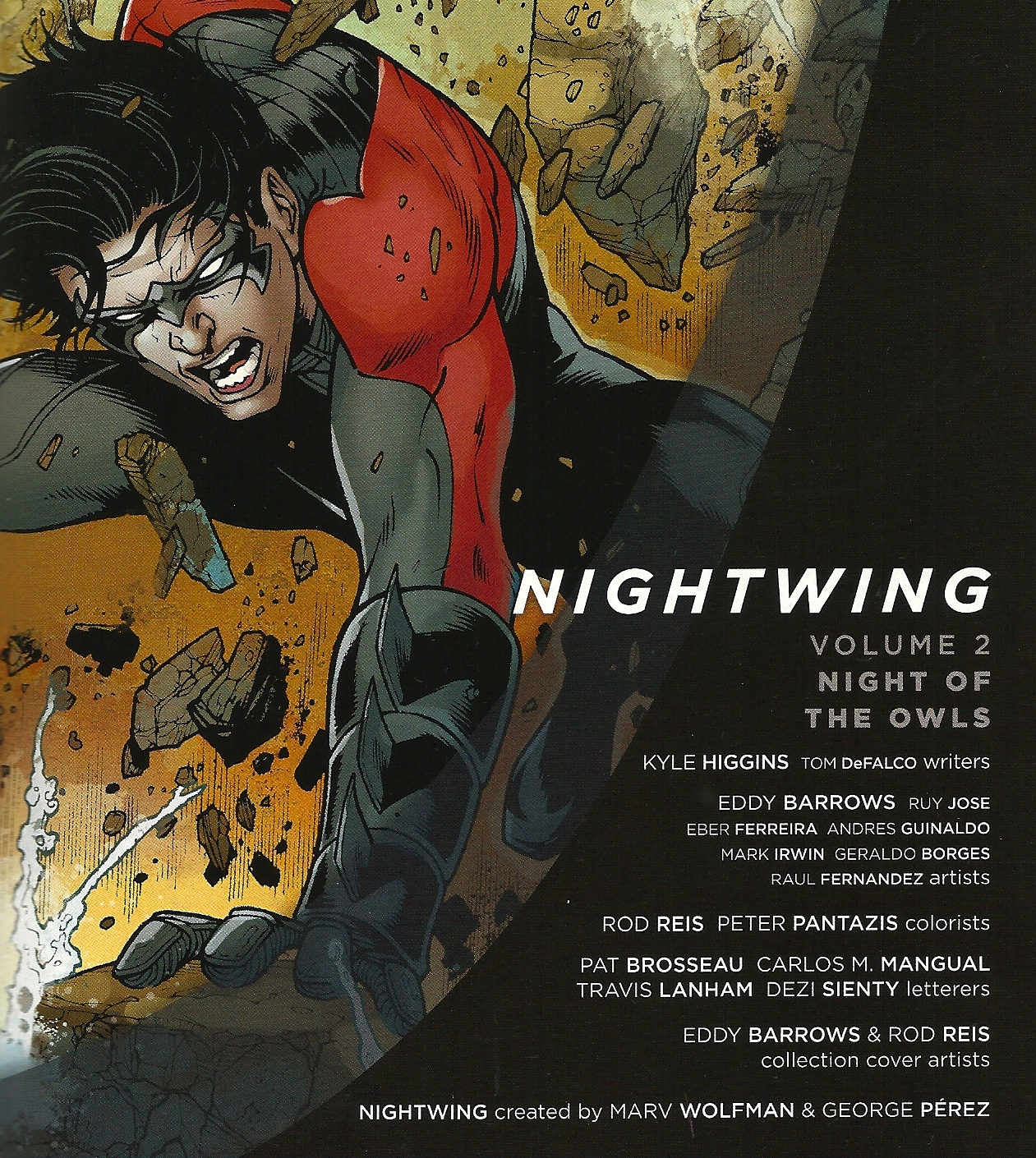
Here's something I've been wondering about off and on over the course of the last month or so, ever since I saw the above credit at the beginning of Nightwing Vol. 2: Night of the Owls, which makes it pretty clear that Nightwing was created by Marv Wolfman and George Perez.

Now, please don't misunderstand me. I am not going to argue with the credit, and I'm happy those two men—both of whom are very talented men, whose work has certainly given me hours and hours of entertainment in my life—are recognized for their contribution to the character and I assume (or, perhaps I should say, hope) that such credits bring with them some sort of financial remuneration.

I am simply curious as to why some DC Comics heroes, for example, always have the names of their creators cited in comics they appear in, why some characters never have the names of their creators cited, and why some sometimes do and sometimes don't. There's probably a degree of legal reasons (There certainly is for the current way the credits for Superman's creators appear in Superman comics now, as not only are Jerry Siegel and Joe Shuster credited, but there's also a "By Special Arrangement with the Jerry Seigel Family" following it these days).

Nightwing seems like a particularly murky character for anyone to be assigned credit for creating, though.

The character Dick Grayson, the secret identity of the original Robin, who would grow up to abandon that identity and take on the new one of Nightwing, was created in 1940 by Bob Kane and Jerry Robinson and Bill Finger.

The superhero codename "Nightwing" was created by Edmond Hamilton and Curt Swan in a 1963 issue of Superman; it's the name that a disguised Superman takes on while fighting crime in The Bottle City of Kandor, where he has no superpowers, but operates as a sort of Kyrptonian version of Batman (with Jimmy Olsen in the sidekick role as Flamebird). That version of Nightwing was returned to repeatedly in the Silver Age (as in the story under the above cover).

And then in a 1984 issue of Tales of the Teen Titansm (not the one above, but that's the nicest cover image of the original costume I could find), Grayson finally sheds his Robin identity in favor of the codename Nightwing, complete a new costume.

That comic was written by Marv Wolfman and drawn by George Perez, so they get the creation credit. But they didn't create the character or the codename, merely assigned the latter to the former, and Perez created a new costume for him, although that's been changed repeatedly over the years, and, obviously, bears no real resemblance to what Nightwing is currently wearing (I'm not sure who designed his New 52 costume, but whether it was Jim Lee, who was originally credited as redesigning the whole universe, or one of the many other artists who helped him, it's worth noting that it is essentially a refinement of his previous costume, which was itself a refinement of the costume before that, and so on back to Perez's original, I suppose).

It seems then that more accurate credits would be something along these lines:
Dick Grayson created by Bob Kane, Jerry Robinson and Bill Finger

Nightwing created by Edmond Hamilton and Curt Swan

Dick Grayson-
as-Nightwing created by Marv Wolfman and George Perez

Nightwing's current costume designed by Jim Lee or Whoever
This particular character seems like one of the trickier and murkier when it comes to assigning aspects of creation, as there's over 40 years difference between the introduction of the character "Dick Grayson" and the introduction of his Nightwing identity and costume.

But Nightwing is hardly alone and having a knotty creation story. For example, how to deal with all of those Golden Age superheroes re-created as new versions in The Silver Age under Julius Schwartz's direction? You know, The Flash, The Green Lantern, The Atom, Hawkman?

Gardner Fox and Harry Lampert created a super-fast character named The Flash who wore a lightning bolt symbol over a red shirt in 1940, but Robert Kanighter, John Broome and Carmine Infantino created a whole new character with a different costume, keeping just the name, powers and the lightning bolt and red top.

Or, more dramatically, Martin Nodell and Bill Finger created their Green Lantern, a character who had the power to manipulate green energy channeled through magic ring he charged with a magic lantern the same year the original Flash debuted. But in the '60s, John Broome and Gil Kane gave a new character that name and some of the same powers, but with a vastly different back-story. And man, what about a character like Green Lantern Kyle Rayner, another new character with the codename of the original, but who spins out of the elaborate back-story that spun out of the second Lantern...?

I guess it just goes to show how collaborative these sorts of shared-universe, corporate super-comics can be.

I'm all for giving credit where credit's due, and money to creators whose creations are making money (Either because doing so is a contractual obligation or simply because there's so much money to throw around it wouldn't kill a movie studio to give the guys who forge their golden geese a coupla extra bucks here and there).

I'm just glad I'm not the guy who has to determine who created how much of what, and how to assign the credit.
11 Aug 21:01

Restoring Trust in Government and the Internet

by schneier

In July 2012, responding to allegations that the video-chat service Skype -- owned by Microsoft -- was changing its protocols to make it possible for the government to eavesdrop on users, Corporate Vice President Mark Gillett took to the company's blog to deny it.

Turns out that wasn't quite true.

Or at least he -- or the company's lawyers -- carefully crafted a statement that could be defended as true while completely deceiving the reader. You see, Skype wasn't changing its protocols to make it possible for the government to eavesdrop on users, because the government was already able to eavesdrop on users.

At a Senate hearing in March, Director of National Intelligence James Clapper assured the committee that his agency didn't collect data on hundreds of millions of Americans. He was lying, too. He later defended his lie by inventing a new definition of the word "collect," an excuse that didn't even pass the laugh test.

As Edward Snowden's documents reveal more about the NSA's activities, it's becoming clear that we can't trust anything anyone official says about these programs.

Google and Facebook insist that the NSA has no "direct access" to their servers. Of course not; the smart way for the NSA to get all the data is through sniffers.

Apple says it's never heard of PRISM. Of course not; that's the internal name of the NSA database. Companies are publishing reports purporting to show how few requests for customer-data access they've received, a meaningless number when a single Verizon request can cover all of their customers. The Guardian reported that Microsoft secretly worked with the NSA to subvert the security of Outlook, something it carefully denies. Even President Obama's justifications and denials are phrased with the intent that the listener will take his words very literally and not wonder what they really mean.

NSA Director Gen. Keith Alexander has claimed that the NSA's massive surveillance and data mining programs have helped stop more than 50 terrorist plots, 10 inside the U.S. Do you believe him? I think it depends on your definition of "helped." We're not told whether these programs were instrumental in foiling the plots or whether they just happened to be of minor help because the data was there. It also depends on your definition of "terrorist plots." An examination of plots that that FBI claims to have foiled since 9/11 reveals that would-be terrorists have commonly been delusional, and most have been egged on by FBI undercover agents or informants.

Left alone, few were likely to have accomplished much of anything.

Both government agencies and corporations have cloaked themselves in so much secrecy that it's impossible to verify anything they say; revelation after revelation demonstrates that they've been lying to us regularly and tell the truth only when there's no alternative.

There's much more to come. Right now, the press has published only a tiny percentage of the documents Snowden took with him. And Snowden's files are only a tiny percentage of the number of secrets our government is keeping, awaiting the next whistle-blower.

Ronald Reagan once said "trust but verify." That works only if we can verify. In a world where everyone lies to us all the time, we have no choice but to trust blindly, and we have no reason to believe that anyone is worthy of blind trust. It's no wonder that most people are ignoring the story; it's just too much cognitive dissonance to try to cope with it.

This sort of thing can destroy our country. Trust is essential in our society. And if we can't trust either our government or the corporations that have intimate access into so much of our lives, society suffers. Study after study demonstrates the value of living in a high-trust society and the costs of living in a low-trust one.

Rebuilding trust is not easy, as anyone who has betrayed or been betrayed by a friend or lover knows, but the path involves transparency, oversight and accountability. Transparency first involves coming clean. Not a little bit at a time, not only when you have to, but complete disclosure about everything. Then it involves continuing disclosure. No more secret rulings by secret courts about secret laws. No more secret programs whose costs and benefits remain hidden.

Oversight involves meaningful constraints on the NSA, the FBI and others. This will be a combination of things: a court system that acts as a third-party advocate for the rule of law rather than a rubber-stamp organization, a legislature that understands what these organizations are doing and regularly debates requests for increased power, and vibrant public-sector watchdog groups that analyze and debate the government's actions.

Accountability means that those who break the law, lie to Congress or deceive the American people are held accountable. The NSA has gone rogue, and while it's probably not possible to prosecute people for what they did under the enormous veil of secrecy it currently enjoys, we need to make it clear that this behavior will not be tolerated in the future. Accountability also means voting, which means voters need to know what our leaders are doing in our name.

This is the only way we can restore trust. A market economy doesn't work unless consumers can make intelligent buying decisions based on accurate product information. That's why we have agencies like the FDA, truth-in-packaging laws and prohibitions against false advertising.

In the same way, democracy can't work unless voters know what the government is doing in their name. That's why we have open-government laws. Secret courts making secret rulings on secret laws, and companies flagrantly lying to consumers about the insecurity of their products and services, undermine the very foundations of our society.

Since the Snowden documents became public, I have been receiving e-mails from people seeking advice on whom to trust. As a security and privacy expert, I'm expected to know which companies protect their users' privacy and which encryption programs the NSA can't break. The truth is, I have no idea. No one outside the classified government world does. I tell people that they have no choice but to decide whom they trust and to then trust them as a matter of faith. It's a lousy answer, but until our government starts down the path of regaining our trust, it's the only thing we can do.

This essay originally appeared on CNN.com.

EDITED TO ADD (8/7): Two more links describing how the US government lies about NSA surveillance.

11 Aug 17:00

Derek's Weekly 45's: Roky Erickson

by Dereksdaily45

Roky erickson red temple prayerFirst off, I apologize for the lack of posting last week- it was a very busy one for me, and I just couldn't make the time to write. However, today's post should make up for it, as I was planning on spreading this over two weeks anyhow!

I'll spare the biographical details of the legendary Roky Erickson; Roky made an indelible stamp as a very young man as frontman/ vocalist extraordinnaire of The 13th Floor Elevators (easily one of the 10 best American rock n roll groups of ANY era, in my opinion). Roky was busted on a trumped up pot charge in the late 60's, and he was forever changed after a stay at the Rusk Hospital For The Criminally Insane, where the sensitive, poetic Roky was given shock treatment and lived among murderers and rapists. All for enjoying a joint on a hilltop in Texas...(I won't even begin to state the obvious injustice in this charge and its repercussions.)

Roky erickson bermudaRoky was granted his freedom in 1972, and a revamped version of the Elevators began taking the clubs of Austin by storm again. Recorded evidence show that the group was fantastic again and they were writing some killer songs that, sadly, never got properly recorded. For whatever reasons, the group fell apart again and by 1975 Roky was in a bad way, financially, and was unable to get booked for any gigs. Fellow Texan Doug Sahm (a legend and genius in his own right) always felt a strong brotherhood with Roky and The Elevators, and through his generosity offered to record and release a solo 45 from Roky (although his last name was unfortunately mis-spelled on the release). Reports of the sessions (from the recording engineer John Ingle) were that Doug wanted, more than anything, to help get Roky some gigs and get him on the right track again. In a cloud of pot smoke, the band recorded two songs that are staples in roky's cache, including one of the freakiest numbers ever cut to tape, "Red Temple Prayer (Two Headed Dog)". In my opinion, this lo-fi, bordering-on-psychotic take is the definitive one. Roky's vocal performance is hair raising (and includes one of his patented "You're Gonna Miss Me" yowls) and the guitar work captures the vibe Roky erickson bermuda 2of the lyrics in a way that was never captured again in future versions of the song. The flip side, "Starry Eyes", is another that Roky has recorded several times, and shows his more tender, Buddy Holly influenced side; roky recorded a beautiful, heartfelt vocal, and the band grooves along in a way that can only be done by Texas musicians.

Red Temple Prayer (Two Headed Dog)

Starry Eyes 1

Roky began perrforming and touring sporadically with his Blieb Alien band during this era, and in 1977 cut a one-off 45 for record store turned record label Rhino. They issued it with a cool picture sleeve, and 'Bermuda" is another track that shows off Roky's brilliant songwriting. There's a nice little nod to the Elevators electric jug sound in the production (probably Bill Miller's electric jug, I'm guessing). For some strange Roky erickson don't slander mereason, the back cover says this is Roky's first commercial release in ten years. Not true! Why they chose to ignore the Mars Records 45 is anyone's guess. All in all, this was a very important record; released at the dawn of the punk era, it exposed Roky to a whole new audience that could DEFINITELY dig the man and his music.

Bermuda

A well recieved album at the dawn of the '80s (with his band- whose lineup was constantly in flux- renamed The Aliens) brought about a large cult following for Roky, and even while battling schizophrenia he was able to succesfully tour clubs throughout the US. In 1984, Roky released an ASS kicking 45 in "Don't Slander Me", one of his best works. The backing band is his strongest since the original Elevators (they really *get* Roky and play symapthetically), and Roky is in EXCELLENT voice. ThRoky erickson you don't love me yetere's no hint of quasi- heavy metal here! "Starry Eyes" returns, in a charming version that explores the Buddy Holly influence in a big way. This record is a career highlight, and one of the best singles of the 1980's, hands down.

Don't Slander Me

Starry Eyes

The late 1980's was the beginning of another bad stretch for poor Roky (who wasn't receiving proper health care to combat his mental illness). An obsession with the mail led to his arrest for mail theft (the charges were dropped, as he never opened any of the mail he stole). A 1987 show that has been described as "disastrous" in New York put the brakes on any touring, and it seemed that Roky was finished with music. A one off single for indie label Sympathy For The Record Industry was a re-recording of a GREAT song, "You Don't Love Me Yet". I'm not that crazy about the band here (they verge a little too far into heavy metal territory for my liking), the beautiful lyrics and a typically great vocal from Roky shine through the din. Plus, the picture sleeve is VERY groovy.

Roky erickson please judgeYou Don't Love Me Yet

Just when it seemed impossible, a new LP arrived from roky in 1994, the fantastic All That May Do My Rhyme. While it was cobbled together (by Butthole Surfers' drummer King Coffey) it is a surprisingly coherent album that presents some superb songs from Roky in a very flattering light. The production and performances are great! A cool 45 was released to coincide with the LP coupling "We Are Never Talking" with a touching acoustic version of "Please Judge" (a song that could easily be read as his own story from 25 years previously). Filmed and recorded evidence of Roky shows his strengths as a solo acoustic performer; whether its performing his own songs or one of his excellent Bob Dylan interpretations, once Roky has a guitar around his neck all of his other problems seem to melt away. In one of the happiest stories of all music (and with the help of his loving brother Sumner), Roky is back in great form and has been touring all over and blowing roofs off of venues worldwide. I saw his performance at Ponderosa Stomp in new Orleans a few years ago, and within the stellar set he sang a version of "You're Gonna Miss Me" with that SCREAM that sounded like nothing else I've ever heard in person. All hail Roky Erickson!!!! 

Please Judge (acoustic)

Thirteenth floor elevatorsBONUS:


Here's the original take of the Elevators 'Tried To Hide', which was the flip side to "You're Gonna Miss Me". This song was recut for the first LP in a slower version; while that version is excellent, I *really* love this faster take that showcases how tight and rocking this band was. Special props to the amazing drumming of John Ike Walton.

Tried To Hide (45 RPM take)


-Derek See


11 Aug 11:31

A few link-inspired thoughts about the state of DC Comics/The DC Universe.

by Caleb
I haven't been doing much in the way of link-blogging here of late, and when I do see something elsewhere that I think could deserves some extra attention, I generally just post a link on my twitter account now.

I did read a big, excellent essay the other day though, one that was big enough and excellent enough that I wanted to link to it here. If you haven't already, and you care even a little bit about superhero comics (and the industry that revolves around them), I would strongly urge you to check out Tim O'Neil's monster 4,000-word post about DC Comics' current crossover storyline, "Trinity War."

O'Neil discusses the state of DC in 2013 versus that of DC in the late '90s, and compares and contrasts them with the state of Marvel comics during the same time periods. He compares the first half of "Trinity War" to the just-completed Age of Ultron, and Geoff Johns' crossover-writing skills to those of Brian Michael Bendis. He compares the religious and mythological cosmology of the two fictional, shared-universe settings. And I think he does so not only at great length, but with great insight and pretty damn great writing. It's about as thorough and solid a post on these subjects as one could hope to read.

O'Neil highlights the rather recent "Trinity War" tie-in issue Constantine #5 (which I covered here), and notes that The New 52 DC Universe has been structured into one that both John Constantine, the chain-smoking occultist character created in the mid-1980s by Alan Moore and Steve Bissette who starred in an incredibly long-running monthly series that spent most of its 15 years of existence being published through DC's mature readers Vertigo imprint, and Captain Marvel, an extremely inspired Superman knock-off created in 1940 by C.C. Beck and Bill Parker to star in superhero comics aimed at children, can now co-star in the same stories.

But in order to make that possible, DC had to subtract the edge off of the Constantine character and add edges to the Captain Marvel character, so that the two meet in the middle, sans much of what makes them interesting characters in the first place (The image at the top of this post, in case you're wondering, is from that book; that's Constatntine imbued with the powers of Shazam, ripping the head off of a demon using the strength of Hercules).

O'Neil notes that the original DC Universe was sort of grandfathered together, when later editors and writers tried to make a bunch of characters and concepts never meant to be together (Captain Marvel, for example, was created by a rival publisher of DC's, that the latter rather for forcefully acquired, and was thus never really intended to have adventures in the same version of the United States that holds a Metropolis and a Gotham), one of the things I've always found most charming and challenging (in a good way) about the DC Universe, and, incidentally, one of the things that the New 52 reboot explicitly did away with. He cites an old crossover story from the James Robinson and company Starman book and the Jerry Ordway Power of Shazam book, in which two extremely different characters from two extremely different books met, and their differences provided a spark to the story, whereas now there is little to know real difference between most of the books in DC's line; tonally and visually, there's so little difference between Constantine and the "Shazam" back-ups in Justice League, that there's very little friction between the characters (and what is there is what we readers who know the characters' history bring with us to the encounter).

In discussing the late '90s DC Comics, O'Neil rattles off a list of books DC was publishing simultaneously, including Lobo, The Spectre and Impulse, noting that they were all set in the same universe, but were extremely different books in terms of their tone, point-of-view and even, to some extent, genre. Sure, they weren't as different as, say, Saga, Optic Nerve and All-New X-Men are from one another, but you had a violent, dark comedy; a serious, dark, supernatural storyline that meditated on religion and was only an F-word and a topless scene away from being a Vertigo book, and a light-hearted, all-ages superhero book that veered that could veer between sitcom and straight comedy, depending on the writer. Yet Batman and Superman could appear in all of 'em (and all the other books O'Neil mentioned in that paragraph), and all of those characters could cameo in Bloodlines or have a Final Night tie-in issue or whatever.

Having Constantine in the DC Universe is hardly a big deal, despite the border erected between Vertigo and the DCU a while back. Constantine got his start in the pre-Vertigo Swamp Thing, a book that guest-starred Jack Kirby's Demon and Superman and Batman and Lex Luthor and The Justice League and so on. The characters could move from book to book, but the books themselves were very, very different, so that when Justice Leaguers showed up in, say, The Sandman or the Grant Morrison-written Doom Patrol or Alan Moore and company's Swamp Thing, it was exciting precisely because those books were so different in tone and visual identity from Justice League of America or JLI the the Super or Bat books of the time.

Anyway, give O'Neil's piece a read. It strikes me as a pretty good diagnosis of what, exactly, is wrong about much of the DCU line at the moment (aside from poor costume design and the counter-productive continuity reboot, which are the thorns that continue to stick in my eyes when I read these books) and, therefore, offers an implied prescription for fixing the line, should many (or any) DC Comics executives give the piece a read.

*********************
I've already seen this linked to several places, but I first heard about it from the guys at Robot 6, so here's their post on it: Artist Ilias Kyriazis and writer Scott Lobdell put together an awesome pitch for a new Doom Patrol comic book that never went anywhere, and shared the basic concept, make-up of the cast and some fully-realized character designs.

While it's hard to judge a non-existent comic book by its pitch, and, based on what I've read lately, I would be very wary of a "Written by Scott Lobdell" credit on a comic book, I have to say that the book both sounds and (especially) looks awesome.

The book probably wouldn't be possible in the New 52, would it?

Of the characters starring in it, I think the only one that has been introduced so far is Changeling, who went by "Beast Boy" and was red. Maybe Bizarro exists too (I know he's featured in September's Forever Evil series/event, but I'm not sure if he's been introduced in the Superman books over the course of the last two years or not). I suppose a version of Tefe may be in the Swamp Thing series too, but I haven't been reading it, and, even if there is a version in the book, it can't be that version.

I don't think this series would work as a New 52 one, anyway, as if you divorce those characters from their histories (Particularly Changeling/Beast Boy, Robot Man and, in her usage here, Platinum), it wouldn't be all that interesting. If just introduced cold, the characters have no personalities or histories; there's no conflicts or shared experience between Robot Man and Changeling; there's no legacy of the Doom Patrol to live up to or live down; Robot Man, Changeling and Platinum would all lack a history of strained relationships with the various teams they've been on over the years.

I sure wish they wouldn't have rebooted continuity though, and simply did something closer to Marvel Now!: New series with new #1s by various creators. This woulda made a fine addition to a DC Now! line, I assume.

**********************

In his link to the same post, Tom Spurgeon wrote, "people always love unsold pitches," and he's right.

I remember me and about 90% of the comics Internet were super-excited about that Wonder Woman-as-a-young-princess-on-Paradise Island pitch Tintin Pantoja made public a few years ago. Or hey, remeber Ben Caldwell's Wonder Woman pitch? Lois Lane, Girl Reporter? Renae de Liz's Amethyst?

Even the biggest names in super-comics occasionally have awesome-sounding pitches that go nowhere, like, for example, Mark Waid and Mike Wieringo's pitch for a new Aquaman series (that's a Ringo sketch of Aquaman above, although not one connected with the official pitch), or the now rather infamous proposal by Grant Morrison, Mark Waid, Tom Peyer and a pre-Ultimates Mark Millar to revamp DC's Superman line, with each of the four writers taking over one of the four Superman titles that were then on the stands?

********************
It occurs to me that I've seen so many blog posts from creators along the lines of "Hey, here's this totally awesome, all-ages comic that we pitched DC, but they passed on" extant, and enough interest in many of those projects (particularly the rejected Wonder Woman ones), that DC could quite easily commission a miniseries or trade paperback collecting "imaginary stories" based on all of these pitches. Like, maybe Lobdell and Kyriazis won't get to do an ongoing Doom Patrol based on their pitch, but it would be cool if DC let them do a 20-page story with those characters as part of a Rejected Proposals Cavalcade trade or something.

I think there's probably also potential for a book on the subject, from a third-party publisher (i.e. not DC Comics, but, like, a real publisher of real books), if there was someone with the interest and sorts of connections in the comics industry and the time to work on things, like, interviewing Mark Waid at length or securing original sketching from Mike Wieringo's family and tracking down a lot of these artists and asking to republish their work.

Just imagine a big art-filled, prose, non-fiction book containing the sketches and general proposals like any of the above and interviews with the creators involved about the process of pitching, dealing with rejection and what they did next, focusing on fairly radical re-workings from folks at Dean Trippe's level of the comics industry totem pole of popularity to things like Paul Pope's rejected Kamandi and Ross Campbell's Teenage Mutant Ninja Turtles pitch to Dark Horse (That's an early Campbell drawing of Donatello above, by the way) to more famous comics-that-never-were by top industry talent, like Alan Moore's Twilight of the Super-Heroes (was that it, or was it just Twilight, and my memory is just adding ...of the Super-Heroes to distinguish it from those vampire/werewolf books and movies) and Alex Ross's proposed Kingdom Come prequel series The Kingdom and the aforementioned Morrison, Waid and company Super-reboot?

A collection of proposals might be a little on the dull side, but a collection of interviews about those proposals, and using them as a sort of history of the mainstream comics industry, through the roads it didn't take or refused to take? Filled with sketches and art from so many incredible artists? That would be a hell of a book to read.

Someone should really get on that.

********************

As for the Paul Pope Kamandi proposal, if you're unfamiliar with that, I'd suggest you check out this disheartening, depressing quote from Pope about pitching a Kamandi series with Brian Azzarello that was shot down.

In the quote, Pope refers to a meeting with "the head of DC Comics." I'm not sure who that is, but whoever they are, I sure hope they are no longer the head of DC Comics, because I can't imagine someone in a position of power at a comics company getting a pitch for anything from Paul Pope, who I personally believe is one of the most talented comics artists working today and whose style is someone unique in that it seems to be the sort that appeals to readers whether they're coming at comics through the gateway of American superheroes, European comics or manga, and who gave DC the successful evergreen Batman: Year 100 (and some great Vertigo stuf), and Brian Azzarello, who not only gave DC a whole library of popular evergreen trades in 100 Bullets and the original graphic novel The Joker, but has gone on to improve and sustain the sales of Wonder Woman (of all things) and even consented to doing some of the company's dirtiest work, like Watchmen spin-offs.

If you're a DC comics executive and Paul Pope and Brian Azzarello say they want to do an original graphic novel about kicking your ass, but, in order to do so effectively, they first need to kick your ass for research, I believe it is your duty to respond, "Certainly, gentlemen; I just ask that you not hit me in the teeth or eyes, and, should I lose consciousness, please stop delivering blows until I can be revived."

The saddest part isn't that there exists a DC comics executive who didn't do a cartwheel and should "Callooh Callay!" when he heard Paul fucking Pope wanted to do a cover version of some Jack fucking Kirby for them, but that the executive (reportedly) responded by saying, "We don't publish comics for kids. We publish comics for 45-year-olds."

Which, okay, yes, if you look at what DC publishes, that seems fairly accurate (Actually, I think they publish comics for 20-45 year old males, to be more specific). But yeesh, to say it out loud, to a guy whose work seems perfectly positioned to bringing in newer readers?

There is a difference between "comics for kids" and "all-ages" comics, of course, and, for a good example of "all-ages" stories featuring DC Comics characters, DC comics executives could just look at, let's see, every single cartoon based on their characters created in the past 25 years or so. Almost every single one of them, even the ones that skew younger, like Teen Titans, have been of the sort that have been smart, stylish and well-made enough that adults could enjoy them, and they contained nothing so harsh that kids shouldn't be allowed to watch 'em.

The fact that the only multi-media cues The New 52 seemed to take came from Batman: Arkham Asylum and ...City (the video games) instead of any of those many, many cartoons continues to kinda sorta blow my mind.

********************

By the way, this is a joke from Batman: The Brave and the Bold, the Batman series that seems targeted toward the youngest viewers, but which also is full of characters and Easter Egg references that only DC's extremely old or extremely invested fans would get.

"All-ages" doesn't mean you can't also insert extremely dirty jokes, you just have to be smart and clever about it.

********************

That same DC executive followed up with, "If you want to do comics for kids, you can do Scooby-Doo," according to Pope.

Please take a moment to pause with me and imagine a Paul Pope Scooby-Doo graphic novel.

Awesome, huh?

********************

Of course, if DC really believed they were publishing comics for 45-year-olds, then why don't they just go ahead and make their line for mature readers, so we can have swearing and nudity and adult concepts, instead of their weird NC-17 ultraviolence and gore, but PG-13 attitude towards nudity, sex and language...?

And maybe the stories could be a little more adult, and deal with emotional content beyond the difference between justice and vengeance...? More existential, mid-life crisis stuff, less guys with laser-rings blowing holes in one another's heads.

*********************

So it looks like long-time comics-makers Evan Dorkin and Sarah Dyer were involved in the creation of a DC Nation short featuring The Metal Men, DC's animation-ready heroes who were previously prominently featured in several episodes of Batman: The Brave and The Bold.

I haven't seen much more than clips of any of the DC Nation shorts (no TV, you see), but, like those I have seen on YouTube, it seems pretty kid friendly.

I haven't seen The Metal Men or Plastic Man show up in The New 52 yet (beyond a cameo one-panel appearance by Plas in Justice League International #1), so I guess we can't do a 1-to-1 comparison between the DC Nation cartoon versions (seen by a lot of eyeballs all over the world) and the New 52 versions (which would be seen by, I don't know, between 20,000-100,000 sets of eyeballs, maybe).

But the Batgirl of The New 52 is a heavily armored vigilante who fights serial killers like her own brother and the gross-looking new version of The Ventriloquist. The first installment of the "Amethyst" feature in the first issue of Sword of Sorcery (which was canceled within eight months of its debut), featured a couple of high school boys threatening to rape a schoolmate. The only issue of the new Animal Man I've read so far was last week's annual, in which the character is drinking heavily and trying to cope with the death of his son (Hey, remember when Grant Morrison killed A-Man's family and brought them back to life in his meta-commentary on superhero comics that ended with a rebuke of such things as killing off a character's family as needlessly dark, the writer restoring them all to life? Twenty-three years ago?)
Compare these to the DC Nation Batgirl in Super Best Friends Forever, or the Amethyst and Animal Man of those shorts. Sure, those are all all-ages and played for laughs, but there's gotta be a happy medium between all-ages cartoons and grown-ups only comics, right?

It just doesn't make a whole lot of sense to have a cartoon show called Young Justice on the air, featuring a team composed of characters like this that look like this...
...and then publishing comics like this...
...or this...
instead.

...does it...?
11 Aug 10:36

BUGGER

by Adam Curtis
bugger1

The recent revelations by the whistleblower Edward Snowden were fascinating. But they - and all the reactions to them - had one enormous assumption at their heart.

That the spies know what they are doing.

It is a belief that has been central to much of the journalism about spying and spies over the past fifty years. That the anonymous figures in the intelligence world have a dark omniscience. That they know what's going on in ways that we don't.

It doesn't matter whether you hate the spies and believe they are corroding democracy, or if you think they are the noble guardians of the state. In both cases the assumption is that the secret agents know more than we do.

But the strange fact is that often when you look into the history of spies what you discover is something very different.

It is not the story of men and women who have a better and deeper understanding of the world than we do. In fact in many cases it is the story of weirdos who have created a completely mad version of the world that they then impose on the rest of us.

I want to tell some stories about MI5 - and the very strange people who worked there. They are often funny, sometimes rather sad - but always very odd.

The stories also show how elites in Britain have used the aura of secret knowledge as a way of maintaining their power. But as their power waned the "secrets" became weirder and weirder.

They were helped in this by another group who also felt their power was waning - journalists. And together the journalists and spies concocted a strange, dark world of treachery and deceit which bore very little relationship to what was really going on. And still doesn't.

Squirrel

PROLOGUE - SALISBURY PLAIN 1991

In January 1991, as the Gulf War began, MI5 became convinced they had discovered a secret Iraqi terror organisation based in Britain.

They had found a list of thirty three Iraqis who were studying for PhDs in London. The list had been sent by the Iraq embassy in London to the Bank of England to ask the Bank not to freeze the grants the students lived on. The Bank sent the list to MI5 and the agents quickly realised that actually they were looking at something far worse - a nationwide Iraqi military terror cell.

The reason they knew this was because the person who sent the list was the deputy military attache at the embassy.

Immediately the police were told to swoop on the 33 "students" - and they were taken to a disused military camp at Rollestone in the middle of Salisbury plain and interned as prisoners of war. They were surrounded by two levels of high security razor wire and guarded by a hundred heavily armed soldiers.

It was the first time anyone had been held like this in Britain since the Second World War.

In order to see this content you need to have both Javascript enabled and Flash Installed. Visit BBC Webwise for full instructions. If you're reading via RSS, you'll need to visit the blog to access this content

In fact the letter showed nothing of the kind. The Iraqi military attache was also in charge of administering student grants for Iraqis studying in Britain.

Some of them did get funding from the Iraqi military - for studying things like the structure of polymers. But, as a British professor pointed out, if that same interpretation were applied to British science students, over half of them would be immediately re-classified as terrorists.

Here is part of a programme made later that year about the absurdity of what happened. It shows how neither the detainees or their lawyers were even allowed to know what the evidence was that had led to them being imprisoned.

The man who defends MI5 with such fervor will turn up later in this story - playing a very odd role. he is called Nigel West - but his real name is Rupert Allason.

I've added on the news reports of the same Iraqis suddenly being released from the heavily fortified camp. But now everyone is referring to them as "students".

In order to see this content you need to have both Javascript enabled and Flash Installed. Visit BBC Webwise for full instructions. If you're reading via RSS, you'll need to visit the blog to access this content

An inquiry was held later that year into the scandal. It asked MI5 to produce its evidence. Other than the letter, the secret agents came up with nothing.

They had imagined the whole thing. But they justified it by saying

"It was best to err on the side of caution".

NEARLY A HUNDRED YEARS EARLIER

THE DAILY MAIL CIRCULATION DEPARTMENT 1906

William Le Queux was a popular novelist in the early part of the twentieth century. He was half French, half British and he wrote books with wonderful titles like Strange Tales of a Nihilist.

strangenihilist

Le Queux had started off as a journalist on the Daily Mail - but then had travelled around Europe getting to know lots of famous and infamous people. But as he did so he became convinced that many of the European countries, but most of all Germany, envied Britain and wanted to get their hands on the wealth of the Empire.

The trouble was that the British people didn't realise this. So Le Queux set out to warn them - above all by telling them that the Germans were sending spies to Britain to prepare for an invasion.

Le Quex Spies 1

But the ruling classes in Britain laughed at Le Queux. They said it was just fiction - which it was. Plus he wasn't really British and he hadn't been to a proper school, he was far too vulgar and insistent in his patriotism. In short he was a bore.

So Le Queux did what anyone in their right mind would do in such a situation. He turned to the Daily Mail.

He wrote a gripping account of a future German invasion of Britain and took it to Lord Northcliffe who ran the Mail. It was called "The Invasion of 1910" and it described how the Germans landed in East Anglia and marched on London.

Northcliffe loved it - but the Mail's circulation department said that many of the towns on Le Queux's invasion route didn't have many actual or potential Daily Mail readers in them.

So Lord Northcliffe changed the route of the invasion to make sure that all the towns that were sacked and pillaged had lots of Daily Mail readers. Here is the map of the invasion as agreed with the circulation department.

Le Quex Map

The serialisation was an enormous success. The prime minister got up in the House of Commons and said Le Queux was "a pernicious scaremonger" and that the story was "calculated to alarm the more ignorant public opinion at home."

Result.

Then things started getting out of control. Thousands of Daily Mail readers sent Le Queux letters telling him that they had spotted people acting suspiciously - which meant they must be German spies.

The letters were mirror images of what Le Queux had written in his books. But rather than making him suspicious, Le Queux decided that this proved that what he had written as fiction must actually be true. There was a gigantic German spy ring in Britain.

Thousands of Daily Mail readers couldn't be wrong.

The man whose job it was to uncover spies in Britain was very excited by all this. He was called Colonel Edmonds. He had a tiny budget and two assistants - and noone on the General Staff bothered with him.

But now Col. Edmonds saw his chance. He teamed up with Le Queux and together they bombarded the Committee for Imperial Defence with the evidence from the Daily Mail readers. Edmonds said that the government should set up a "secret service bureau" to combat the threat.

The head of the Committee - Lord Haldane - said this was ridiculous. But even he couldn't stand against the wave of spy fever that was sweeping the country. He gave in - and MI5 was set up - created in large part by the dreams of a socially excluded novelist, and the paranoid imaginings of the readers of the Daily Mail.

lqspies2

But the problem for MI5 was that the spy network didn't exist. The Germans did have some agents in Britain - but nothing like the 5000 that Le Queux had described.

When war against Germany was declared in 1914 - MI5 immediately rounded up 21 alleged German spies and proudly announced they had broken the network. But a brilliant piece of historical research by the historian Nicholas Hiley has shown that this wasn't true.

Hiley doesn't mince his words. Here are his conclusions (Kell and Holt Wilson were the director and deputy directors):

"One of the most famous successes of the British Security Service was its great spy round-up of August 1914. The event is still celebrated by MI5, but a careful study of the recently-opened records show it to be a complete fabrication - MI5 created and perpetuated this remarkable lie.

The great spy round-up of August 1914 never took place - as it was a complete fabrication designed to protect MO5(G) from the interference of politicians or bureaucrats.

The claim made next day that all but one had been arrested was false, and its constant repetition by Kell and Holt-Wilson was a lie."

In other words - MI5 had followed the shining example of William Le Queux and made it all up.

But that didn't matter - because it made a great story, and journalists loved it. Even in 1997 the BBC made a breathless documentary - using the recently released files - about how in 1914 MI5 had brilliantly rounded up the Kaiser's spy network on the eve of the first world war.

Aside from perpetuating a fiction, the film has two great moments - one is an interview with the grandson of the deputy head of MI5 who has an immortal line about his grandfather - "of course he was very private about MI5 - so the family knew nothing".

And the end the programme has some wonderful stills of the party MI5 held to celebrate the end of the war - it's on their rooftop. Their faces are great.

In order to see this content you need to have both Javascript enabled and Flash Installed. Visit BBC Webwise for full instructions. If you're reading via RSS, you'll need to visit the blog to access this content

After the first world war MI5 declined in importance. But with the growing fears of communism in the 1920s and 30s a new threat emerged - not just communist agents from abroad, but British communists who might betray their own country.

In many cases they came from the same upper classes as those running the secret services. And a strange dance began - of toffs suspecting toffs.

But even then MI5 couldn't get it right.

Take the case of Cecil Day Lewis - who was Daniel Day Lewis' father. Back in the 1930s he was a teacher at Cheltenham College - one of the great Victorian public schools.

But, despite his job, Cecil was convinced that he was really a revolutionary. And in 1933 he decided to foment revolutionary action in Britain - by writing a poem. It was an epic he called "The Magnetic Mountain". He said his aim was to create

"A violently revolutionary poem with abundant images (for example) of a barren, cancerous land led by 'getters not begetters', demanding 'It is now or never, the hour of the knife/ The break with the past, the major operation."

Here is Cecil Day-Lewis looking both poetic and radical - alongside some of the poem - (you can see where Daniel Day Lewis gets it all from).

Cecil Day Lewis

But Day-Lewis was disappointed by the lack of reaction. He admitted that the poem "did not create the slightest ripple of outrage amongst the guardians of Cheltenham."

Even though the communist magazine - the Partisan Review - had said that it was "perhaps the most important revolutionary poem as yet written by an Englishman".

And then MI5 noticed Cecil Day-Lewis. Not because of the poem - but because he had sent £5 as a donation to the headquarters of the Communist Party in London. So MI5 decided to put Day-Lewis under intense surveillance.

The historian James Smith has written a wonderful book about how MI5 spent a lot of time covertly watching many upper class British writers between 1930 and 1960. It is a great book because what it records is a strange and confused dance of manners among different parts of the British elite.

Smith describes how MI5 got the local police to spend weeks watching Day-Lewis' house and intercepting his post. But they found nothing suspicious. Their report said that:

"Day-Lewis seldom wears a hat, and is not altogether of smart appearance in dress. He is a good singer. He has moved into his cottage after having considerable structural improvements done there."

MI5 were completely incompetent. They didn't discover the poem that Day-Lewis hoped would help to bring about a communist uprising in Britain.

And not only did they miss the poem - they didn't even realise he was a poet. All in all MI5 found nothing dangerous or revolutionary about Cecil Day-Lewis. It was humiliating.

But they might have been right. James Smith describes how a few years later in 1940 Cecil Day Lewis was getting his mistress Rosamund Lehmann to pull strings in the British establishment so he could avoid getting called up to go and fight the fascists.

enddaylewis

But in 1940 MI5 had its greatest success. It not only found a real German spy network in Britain - but managed to persuade many of the German agents to switch sides.

It was called the Double-Cross system - and it is celebrated in histories of MI5 as a brilliant use of espionage. The German agents carried on spying for their masters in Berlin - sending back detailed reports. But the information was all fake, designed to mislead and confuse the Nazis.

But something else happened to all the intelligence agencies during the war - MI6 as well as MI5. As they grew massively in size they became riddled with factions and infighting. And because all this happened behind a wall of secrecy, there was little to stop things becoming vicious and poisonous.

The journalist Phillip Knightley has written a really good history of spies - called The Second Oldest Profession. In it he quotes an agent describing what happened during the war years:

"The whole organisation was riddled with nepotism - dim, dreary people of utter unmemorability; sub-men who were doubled up with other sub-men to create an illusion of strength and only doubled the weakness; others made memorable only by poisonous, corrupt malevolence or crass, mulish stupidity; the whole run by a chain of command remarkable for its feebleness. The entire service was decrepit and incompetent."

At the end of the war the new Labour government knew that something had to be done to sort out MI5. So they went and found Percy Sillitoe - who was running a sweet shop in Eastbourne

Sillitoe

Sillitoe had retired after being Chief Constable of Glasgow - where he had become famous as the only policeman brave enough to take on the "Razor Gangs" in the eastern part of the city.

The gangs had names like The Bingo Boys and The Baltic Fleet - and they terrorised Glasgow as they fought each other with hatchets, swords, open razors - and razor blades stitched into the brims of their hats.

You can get a sense of Sillitoe from this short film where he shows the BBC a new kind of armoured car he has invented to stop criminals holding up vans carrying cash. He invented the security van.

I very much like how he says he is "concerned for the little man".

I've also added an odd bit from a BBC film about graphology where the expert - a "psycho-graphologist" - analyses Percy Sillitoe's signature, and compares it to J Edgar Hoover's signature. Hoover was Sillitoe's American counterpart.

In order to see this content you need to have both Javascript enabled and Flash Installed. Visit BBC Webwise for full instructions. If you're reading via RSS, you'll need to visit the blog to access this content

The government asked Sillitoe to come and sort out the chaos in MI5 - and he agreed. But he quickly found that it was a very odd place - all the insiders hated him, and they ridiculed him by speaking in Latin (which he didn't understand) in front of him. Plus they deliberately gave him the wrong papers when he went to see the Prime Minister.

Sillitoe came back and told his wife - "I sometimes think I am working in a madhouse." But he realised that he was dealing with very much the same situation that he had found in the slums of Glasgow - different factions locked together in a strange, poisonous bubble.

Here is a section of a very good film, made much later, about the successors to the razor gangs of Glasgow - the gangs that Sillitoe had tried to suppress in the 1930s. And you can see the similarity to the world of the spies - as one of the gang members puts it, "it's two ends of the same street at war with each other".

I also love the pigeon-fancier who shows off the most high-security pigeon loft you have ever seen. He then reveals that he doesn't breed the pigeons for racing. Their job is to go and kidnap the pigeons from the other gangs.

In order to see this content you need to have both Javascript enabled and Flash Installed. Visit BBC Webwise for full instructions. If you're reading via RSS, you'll need to visit the blog to access this content

But before Sillitoe could do anything, it all went terribly wrong. Suddenly traitor after traitor was revealed in the very heart of the British establishment. It wasn't just pretentious radical poets who were a threat - it was spies, diplomats and nuclear scientists within the system itself who had been giving away secrets to the Russians.

There was a high-flying diplomat called Donald McLean, a nuclear scientist at the heart of Britain's atomic bomb project called Klaus Fuchs, plus two of MI6's top agents - Guy Burgess and Kim Philby.

One of MI5's main jobs was to find traitors - but the awful truth was that it had failed to spot any of them.

Percy Sillitoe was booted out. But things got even worse. In 1964 MI5 were told that one of their own men had been a spy for the Russians. He was called Sir Anthony Blunt - and not only had he been high-up in MI5 - but he had gone on to work in Buckingham Palace looking after the Queen's art collection. And even worse than that he was the Queen Mother's cousin.

Blunt

MI5 interrogated Sir Anthony and he calmly said that it was all true - he had been a traitor. MI5 was so embarrassed that they kept it all quiet, gave Blunt immunity from prosecution, and he carried on working at Buckingham Palace.

The Daily Mail later said that the Royal Family had known all along anyway. That as far back as 1948 Sir Alan Lascelles - the most senior aide to the Royal family - had whispered "that's our Russian spy" to someone else as they passed Blunt in the palace.

But that could have been a misinterpretation. Blunt had shocked the Queen Mother by telling her that he was an atheist - and she had immediately assumed that meant he must be a communist.

Clever Queen Mother - wrong but right.

Blunt had also become a bit of a TV star. Starting in the early 60s the BBC went to him regularly to take the viewers on a tour of the treasures of Buckingham Palace - a sort of early Fiona Bruce.

Here is part of one programme from 1962 - two years before he was exposed as a traitor. Followed by a bit of another programme from 1972 - when a self-confessed KGB agent takes the viewers round Buckingham palace. Spot the difference.

And at the end there is footage from 1979 - when Blunt was exposed as a traitor. It's from some rushes I found in the library. The press chasing Sir Anthony are straight out of a British movie. And I love the interviewer's obsession that it was Blunt's "homosexual leanings" that made him betray his country.

Blunt, though, doesn't bat an eyelid. It's as though he is still talking about some painting.

In order to see this content you need to have both Javascript enabled and Flash Installed. Visit BBC Webwise for full instructions. If you're reading via RSS, you'll need to visit the blog to access this content

Then, in 1971, MI5 got another big shock to the system. Most of their opponents - Russian secret agents in Britain - were kicked out, leaving MI5 with little to do. The irony was that it happened as a result of one of their few successes.

In August 1971 an ordinary London policeman arrested a man who was driving drunkenly down Tottenham Court Road. He turned out to be Oleg Lyalin who was a KGB agent. Lyalin spent a lot of his time buying socks in the West Midlands - pretending to be a member of the Soviet Trade delegation. But really he was spying.

Lyalin panicked and offered to tell MI5 the names of all the Russian spies in Britain. In return he wanted to stay and live in Britain with his mistress. MI5 agreed - and the Home Secretary expelled 105 other members of the trade delegation, because Lyalin said they were spies.

Here are the reports - plus a "News Special" which is an early example of the way TV journalism would report the hidden world of spying. It's got an anonymous British "research scientist" called "Jim Walker" who got caught up in all this - and has some great MI5 surveillance footage of Jim and his controller Viktor leaving information at a "dead letter drop."

Plus a very good telephone non-interview with the British Ambassador in Moscow.

In order to see this content you need to have both Javascript enabled and Flash Installed. Visit BBC Webwise for full instructions. If you're reading via RSS, you'll need to visit the blog to access this content

But the problem for MI5 is that the expulsions pretty much destroyed the KGB presence in Britain.

The historian Stephen Dorril who has written a series of brilliant detailed histories of the intelligence agencies says that a later KGB defector called Oleg Gordievsky admitted that "the London residency never recovered from the expulsions".

Dorril also says that the British government and its civil servants were well aware of this, and they became deeply suspicious of claims from MI5 and its K Branch - whose job was to monitor foreign agents - that there was still a big Soviet threat in Britain:

"Senior civil servants dealing with the intelligence community were therefore aware that K Branch claims about the penetration of British political life and the threat to security from Soviet bloc operations were generally exaggerated."

The brutal fact was that by the early 1970s MI5 not only had very little to do - but also its political masters were beginning to question whether it might be seriously incompetent.

Edward Heath - who had been Prime Minister when all this was happening - later got up in the House of Commons and said bluntly what he had discovered about MI5 officers:

"They talked the most ridiculous nonsense, and their whole philosophy was ridiculous nonsense.

If some of them were on the tube and saw someone reading the Daily Mirror they would say - 'Get after him, that man is dangerous, we must find out where he bought it.' "

But those in charge in Britain also realised that there was nothing they could do to question or control the spies. The next prime minister in the 1970s - Harold Wilson - wrote a very serious book called The Governance of Britain full of long serious chapters.

But when he got to chapter nine - about

THE PRIME MINISTER AND NATIONAL SECURITY

This is what it looked like.

Wilson chapter

There are two paragraphs explaining that the prime minister has ultimate responsibility for the security agencies. And it ends with two more that simply say this:

"The prime minister is occasionally questioned on matters arising out of his responsibility. His answers may be regarded as uniformly uninformative.

There is no further information that can usefully or properly be added before bringing this Chapter to an end."

In response to these kind of doubts and attacks MI5 turned inwards.

The problem for the MI5 men - stuck in their secret bubble - was that they just couldn't believe that their failure was due to them being useless at their job. Not only had they failed to find any of the traitors, but operation after operation had ended in failure. And they convinced themselves that this meant there had to have been another traitor lurking somewhere in their building - the MI5 HQ in Mayfair.

They began a mad search for enemies inside the organisation itself - seeking to find more hidden traitors who could be used to explain why MI5 kept failing to do its job properly.

It was the search for "Fifth Man" - to go with the other four already exposed, Burgess, McLean, Philby and Blunt

MI5 Building

A small group of MI5 men went to their boss and said they wanted to investigate all the past failures looking for evidence of treachery. Their boss was called Sir Roger Hollis - and he said no. His argument was that operations often went wrong because of simple human failure, and to re-examine them on the basis that failure was evidence of treachery would tear the agency apart.

Imagine what it would feel like he said to know you are being watched because a past operation you were involved with had gone wrong. "It's like the Gestapo" he said.

So the small group of MI5 agents decided he must be the traitor.

Here is a picture of Roger Hollis.

Hollis

The small group in MI5 now became convinced that their organisation was not just penetrated by the Russians, it was actually run by a Soviet agent. They knew they had to get the truth out somehow even if it meant breaking the law. So they found a friendly journalist called Chapman Pincher and told him the hidden truth.

Hollis papers

Here is Chapman Pincher being interviewed on the Wogan programme about what then happened. Up to this point Pincher had been the Defence correspondent on the Daily Express. He was successful for getting "scoops" from "inside sources" - although the historian EP Thompson said that really Chapman Pincher was:

"A kind of official urinal in which ministers and intelligence and defence chiefs could stand patiently leaking."

What the dissident MI5 agents now told Pincher was like super high-grade piss. Or, as he puts it in the Wogan interview, "it was like walking into an Aladdin's Cave". But what Pincher wrote was going to open the floodgates to a new kind of conspiracy journalism that still holds sway over large parts of the media imagination.

Have a look at him and decide yourself - high grade toilet or investigative journalist? Or maybe often they are the same thing?

I've also included Pincher being interviewed on the TV news reports as the scandal unfolded. Everyone tries to get in on the act. The BBC presenter quotes Kim Philby as saying that Hollis wasn't very good at his job. But the presenter says that this is "ambiguous" - and might be proof that Hollis really was a Soviet agent.

In order to see this content you need to have both Javascript enabled and Flash Installed. Visit BBC Webwise for full instructions. If you're reading via RSS, you'll need to visit the blog to access this content

The leading MI5 dissident who was leaking the information to Pincher was called Peter Wright. He was one of the most senior members of MI5 but he was also somewhat paranoid.

To get a sense of Peter Wright and how he saw the world I have put together some bits of him being interviewed in the 1980s about another of his conspiracy theories. This was that the Prime Minister - Harold Wilson - had also been a Soviet agent.

In Wright's mind much of the British establishment had been directly or indirectly taken over by the Soviet Union. He had no hard evidence for this - but he was driven by an underlying mind-set that was going to spread throughout much of the intelligence agencies - and journalism - over the next twenty years.

This said that if you imagined the other side was doing something devilish and deceptive - then they probably were. It meant that in the dark world of intelligence, imagination was more powerful than obvious facts. Because if you couldn't find the evidence it proved how clever the enemy had been at covering their tracks.

It was a fevered romantic view of the world that would both entrance the readers of newspapers - but would also lead the intelligence agencies into the disaster of the weapons of mass destruction in Iraq in 2003

Here is the grandaddy of that conviction - Peter Wright. The person called Angleton he refers to was an even odder American equivalent of Wright who was high up in the CIA - and who also was convinced Wilson was a Soviet agent.

The tone of Wright's plaintive child like statement about Angleton - "he believed it - he did" tells you a great deal about the emotions driving these strange men in their spy-bubbles.

In order to see this content you need to have both Javascript enabled and Flash Installed. Visit BBC Webwise for full instructions. If you're reading via RSS, you'll need to visit the blog to access this content

But as in all organisations - egos started to come into play. Other MI5 agents started leaking other names to other journalists. Pincher's main rival was a writer called Nigel West.

Nigel upped the stakes. He began to publish books and articles alleging that all sorts of other people had been traitors. Here he is on Nationwide in 1981 in full flow. He says that a man called Leo Long was a traitor, and then goes on to suggest that others - including even the former Governor of Uganda, Sir Andrew Cohen - might be traitors.

It's worth looking closely at what Nigel West says about Sir Andrew Cohen - because it shows how weird this paranoid outpouring from the secret world was becoming. When he was an undergraduate at Cambridge in the 1930s Cohen had been a member of an intellectual society called The Apostles. So had two of the spies - Burgess and Blunt.

The interviewer asks Nigel how he knows Sir Andrew might be a traitor. Nigel says:

"I haven't named him (Sir Andrew) up to now because it's not known whether he was a Soviet agent. But I think it's worth saying that anybody, if you are talking about the Apostles, many of them were Soviet agents. And he would undoubtedly have been questioned since he rose to a very senior position in the Department of Overseas Development"

That's it. But Nigel does have a fabulous haircut.

In order to see this content you need to have both Javascript enabled and Flash Installed. Visit BBC Webwise for full instructions. If you're reading via RSS, you'll need to visit the blog to access this content

In the early to mid 80s more and more names poured out - all accused of being KGB agents in the heart of the British establishment.

One newspaper grouped them under headings

"CONFESSED" - "PARTIALLY CONFESSED" - "UNRESOLVED"

There was one great apology

"Our list of MI5 spy suspects included Cedric Belfrage who MI5 officers said had made a partial confession and we said was dead.

We are glad to make it clear he is alive, never made any confession and maintains he should not have been on the MI5 list at all."

And Mrs Thatcher also got involved. Because it seemed to prove to her the thing she had believed all along - that the British establishment were weak, spineless and easily corruptible. She happily admitted in Parliament that Anthony Blunt had been a traitor. And here she is in 1986 merrily joining in with the latest accusation - that Lord Rothschild had been the 5th Man.

It later turned out that he wasn't.

In order to see this content you need to have both Javascript enabled and Flash Installed. Visit BBC Webwise for full instructions. If you're reading via RSS, you'll need to visit the blog to access this content

It became farce. The journalists who had started the mole-hunt went to war. Nigel West wrote a whole book announcing that he had discovered that the 5th man wasn't really Hollis, but was actually Hollis' deputy. He was a man called Graham Mitchell who in his spare time was a grand master in correspondence chess.

Apparently the dissidents in MI5 were convinced that the letters he sent his chess-friends were his way of contacting his Soviet controllers. The moves he typed out were actually secret codes that disguised his treachery.

Here is one of Graham Mitchell's games that he played in 1950. You are looking at a complicated code, whether it was secret messages to the Russians has never been proved.

grahammitchellchess

Another writer then found a letter in an old government file that had been written by Roger Hollis in the 1940s saying that the Russians shouldn't be trusted. Some journalists said that this proved he wasn't a traitor. But others said that Hollis had put the letter there deliberately so it could be found and throw MI5 off the scent.

Here are the TV reports - both of the Graham Mitchell "revelation", and the Hollis letter. The leader of the pack - Chapman Pincher - still insists Hollis is the 5th man. Nigel West says he is innocent.

But Nigel now has a very good late 80s haircut.

In order to see this content you need to have both Javascript enabled and Flash Installed. Visit BBC Webwise for full instructions. If you're reading via RSS, you'll need to visit the blog to access this content

Then another writer called W. J. West wrote a book saying that the 5th man was Hollis after all.

W J West turns out to have been an ex-hippie whose early years were memorably captured in a semi-autobiographical novel by another ex-hippie - called "Ten Men". She describes a road trip across America as she desperately but unsuccessfully tries to shag him.

Here's his book about the Fifth Man.

wjwestbook

But then - in the midst of all these weirdos - a dissenting voice emerged.

James Rusbridger had been a spy back in the 50s and 60s - and he now wrote a book called The Intelligence Game arguing that all this was rubbish - and that all the journalists had been conned by a crazy gang of right-wing nutters in MI5.

Rusbridger said that the newspapers and TV were being used to promote the obsessive belief of MI5 officers that their failure to do anything worthwhile for a quarter of a century was the consequence of there being a Russian spy in MI5.

They couldn't face the fact that they were completely useless and incompetent.

At last a voice of sanity.

But unfortunately James Rusbridger was then found dead in his garden shed - apparently the victim of an auto-erotic game that had gone wrong. He was naked apart from a rubber coat and a gas mask - and his feet and legs were attached to the wall by a complicated system of pulleys.

Of course it might have been a fiendishly clever assassination.

Or just another spy-world weirdo.

Rusbridger

But this crazed witch hunt didn't harm MI5 at all. Quite the opposite - because together the spies and the journalists created an image in the public imagination of a dark world full of hidden treachery. The spy world became a fascinating other universe that was full of layer upon layer of deception, where the men who inhabited it spent their time trying to penetrate through the circles of falsehood to the inner sanctum of truth.

It was an image that was powerfully helped by John Le Carre's novels - and his anti-hero George Smiley. Le Carre's novels were a clever piece of PR - because they appeared to be more gritty and realistic than the glamourised James Bond image.

But it was just another layer of deception - because Smiley and his search for a hidden mole expressed powerfully the paranoid and unfounded fantasies of the dissident MI5 agents.

But it was a world that was all made-up. Le Carre - who had himself been a spy - admitted this, and described what the true reality of the spy world was:

"For a while you wondered whether the fools were pretending to be fools as some kind of deception, or whether there was a real efficient service somewhere else.

Later in my fiction, I invented one.

But alas the reality was the mediocrity. Ex-colonial policemen mingling with failed academics, failed lawyers, failed missionaries and failed debutantes gave our canteen the amorphous quality of an Old School outing on the Orient express. Everyone seemed to smell of failure."

smiley

But this new image couldn't conceal MI5's incompetence for long.

Because at the very same time that everyone was talking excitedly about completely invented moles, MI5 missed the real moles at the heart of the intelligence services - even though they were completely obvious, and almost screaming to be noticed.

Michael Bettaney worked in counter-espionage in MI5. He had been recruited when he was at Oxford university - where he had been an admirer of Adolf Hitler and had a habit of singing the Nazi Party anthem in local pubs.

Here is Bettaney back then.

Bettaney

MI5 did a thorough check on him - called positive vetting - and decided he was fine. Perfect MI5 material. Bettaney was then sent off to Northern Ireland to fight terrorism where he was wounded by a car bomb. He then had a horrible experience. Hidden in a cupboard he had to watch in silence as one of his informants was shot through the kneecaps by other terrorists.

Here is Bettaney later - after he had been working for MI5.

bettaney2

Bettaney came back to London a changed man. He decided that MI5 was both corrupt and incompetent. He started drinking heavily and told his colleagues loudly that he was no longer a fascist - but he had become a communist.

So MI5 decided to promote him. He was positively vetted again - found to be perfect MI5 material, and sent to the Russian desk.

Bettaney became more and more unstable. In October 1982 he was convicted of being drunk and disorderly. The next week he was convicted for fare-dodging. Finally MI5 did begin to notice - and two separate inquiries were set up to look into Bettaney's behaviour. But each was unaware of the other's existence.

Neither of them noticed that he had been stealing a huge amount of MI5 top secret documents and stashing them at his home. Bettaney was only caught when he took some of the best of these secrets and tried to stuff them into the letter box of the Second Secretary of the Russian Embassy - Mr Gouk.

This is a picture of Mr Gouk.

Gouk

Mr Gouk was so confused by this that, instead of passing them on to the KGB, he went round to MI5 and gave them back, and told them where they had come from. MI5 arrested Bettaney and he was put on trial.

The man who was in charge of the vetting of government employees - like Michael Bettaney - was then allowed to vet the members of the jury at Bettaney's trial. Luckily this time he got it right - and Bettaney was sent to prison on the Isle of Sheppey for 23 years.

Here are some of the reports. Including Nigel West turning up yet again on Breakfast Time. Even Nigel is shocked by how MI5 didn't spot Bettaney. And he's having a bad hair day.

In order to see this content you need to have both Javascript enabled and Flash Installed. Visit BBC Webwise for full instructions. If you're reading via RSS, you'll need to visit the blog to access this content

The terrible truth that began to dawn in the 1980s was that MI5 - whose job it was to catch spies that threatened Britain - had never by its own devices caught a spy in its entire history.

The case that really shocked Mrs Thatcher was the traitor Geoffrey Prime. In the 1970s he had worked at the top secret listening centre GCHQ and had been selling all it's secrets to the Russians.

Prime

And yet again it wasn't MI5 who uncovered his treachery - it was the local police in Cheltenham.

In 1982 a policeman came to his house enquiring about his car - a rather distinct two-tone brown and white Mk IV Cortina - a which had been seen in the vicinity of an assault on a young girl.

Prime told the policeman that he had been at home all day. But that evening he and his wife Rhona went for a drive to the top of Cleeve Hill. As they sat in the twilight Prime told Rhona that he was the man the police were looking for. And not only that, he was also a Russian spy.

Here is part of a very powerful interview Rhona Prime gave to the BBC where she describes that day - and what she then did.

In order to see this content you need to have both Javascript enabled and Flash Installed. Visit BBC Webwise for full instructions. If you're reading via RSS, you'll need to visit the blog to access this content

Prime was a paedophile - and had used spying techniques to monitor the activities of thousands of young girls around Cheltenham. He had created a vast set of index cards which showed when the girls were most likely to be alone at home. He then went round to their houses in his two tone Cortina and sexually assaulted them.

Despite this Prime had been positively vetted six times.

Even the Russians got worried about his paedophile activities and seemed to want to dump him. In 1980 Prime had gone to Vienna to meet the KGB. Instead of meeting him secretly as they normally did, the Russians took him openly to the best restaurants where they knew Western intelligence agents would recognise them as KGB agents.

But even then noone noticed them - or Prime.

Prime's wife Rhona wrestled with her conscience - and in the end went to the police and told them everything about Prime. He was sent to jail for 35 years for spying and 3 years for the assaults on young girls - which says a lot about the priorities of the British establishment at that time.

In order to see this content you need to have both Javascript enabled and Flash Installed. Visit BBC Webwise for full instructions. If you're reading via RSS, you'll need to visit the blog to access this content

The cases of Bettaney and Prime revealed not only just how incompetent MI5 was - but also how sad and seedy the secret world of spies really was.

But even in the midst of all this treachery - a surprising thing happened.

Rhona Prime decided to stand by her husband. Here is Rhona describing how her deep christian beliefs gave her the strength to stand by her husband. She is very calm and composed, and somehow her dignity makes you realise just how odd the whole spy thing was. A strange hysteria driven by totally inadequate men - both agents and journalists - who were incapable of dealing with real human emotions like love and loyalty.

Rhona talks about something else - unconditional love. Receiving unconditional love, she says, makes us whole and beautiful people because we are totally accepted. The very opposite of treachery.

In order to see this content you need to have both Javascript enabled and Flash Installed. Visit BBC Webwise for full instructions. If you're reading via RSS, you'll need to visit the blog to access this content

At the same time, one of the original traitors - Kim Philby - died in the Soviet Union. The BBC cameraman Phil Goodwin has given me the unedited rushes recording Philby's funeral in Moscow. He found it in the back of a cupboard in the BBC's Moscow office.

It's an amazing record of a weird communist state funeral - held for an upper class Englishman in a Moscow graveyard in 1987. Standing all around are the faces of the Russian side of the spy world - and it is great to look at their faces, peeking out for a moment from their traditional secrecy.

Then Philby's coffin arrives accompanied by a military band and members of the KGB holding all Philby's Soviet medals on orange cushions. It's an extraordinary scene. But also watch the woman with red hair. She is Philby's widow - Rufina - who had lived with him and helped him through alcoholism and depression.

Watch what Rufina does. It's really moving. Love and loyalty breaking through again into this narrow, nasty world.

In order to see this content you need to have both Javascript enabled and Flash Installed. Visit BBC Webwise for full instructions. If you're reading via RSS, you'll need to visit the blog to access this content

And even Michael Bettaney found love. Marion Johnstone, who was a research scientist and also a communist, wrote to him in prison in 1985. She began to visit him - and they became engaged.

But in 1995 there was a security scare that reawakened all the spy journalists on papers like the Mail - and made them huff and puff again. Marion was found to have taken some photos and made some drawings of the landscape on Sheppey around the prison and given them to Bettaney.

The prison authorities confiscated them, and the journalists immediately said that this was part of an escape plan to spring the traitor from jail. Marion denied this - she insisted that because Bettaney was kept in solitary confinement she just wanted to show him how beautiful the landscape was outside.

And she is right. The landscape around Bettaney's prison, Swaleside, is extraordinary and beautiful. A little while ago I managed to get onto Deadman's Island which is nearby on the river Swale.

It is a moody place because it is where prisoners from a long time ago - the Napoleonic wars of the 1800s - were buried. They had been held on the "hulks", floating prisons off the coast of Sheppey.

What makes the island so strange is that it is covered by water every high tide - and that washes away the mud and opens up the prisoners' graves. It means that the island is littered with human bones.

The warden of Deadman's Island very kindly showed me round - and here he is showing me the open graves and the bones of prisoners, other kinds of traitors, from a very different war of long ago.

In order to see this content you need to have both Javascript enabled and Flash Installed. Visit BBC Webwise for full instructions. If you're reading via RSS, you'll need to visit the blog to access this content

But what really did for all of the intelligence agencies at the end of the eighties is that none of them predicted the collapse of communism.

Mrs Thatcher's advisor - Charles Powell - summed up the extraordinary failure:

"The biggest single failure of intelligence of that era was the failure of almost everybody to foresee the end of communism. It caught us completely on the hop. All that intelligence about their war-fighting capabilities was all very well, but it didn't tell us the one thing we needed to know - that it was all about to collapse.

It was a colossal failure of the whole Western system of intelligence assessment and political judgement."

But the real reason that the intelligence agencies didn't predict the collapse of the Soviet system was because many of the people at the top of the agencies couldn't believe it was true.

Sir Percy Cradock was one of the most powerful figure in the British establishment. He was the chairman of the Joint Intelligence Committee - which co-ordinated the activities of MI5, MI6 and other intelligence groups. Even at the end of the eighties when everyone else was realising that the Soviet Union was collapsing, Sir Percy remained convinced that this was all a trick. That the Soviet Union was still aiming for communist domination of the world.

Here is Sir Percy

percy cradock

Cradock - along with a number of others high up in the intelligence agencies - really believed that Gorbachev's reforms were just a cunning ruse to deceive the West. And - as Mark Urban has pointed out in his book UK Eyes Alpha - Sir Percy used his position to make sure that this view dominated the Joint Intelligence Committee.

But as Urban also points out - Sir Percy and his allies had no secret evidence for this. They relied on what was pompously called "analysing open source data". Otherwise known as reading the newspapers and watching TV. Except they interpreted that data in a mad way - driven by their own fevered imaginings of a world completely possessed by infinite levels of deception.

Mrs Thatcher realised this was bonkers - and she finally gave up on the spies.

And that really should have been that for MI5.

Except ten years later it was saved by the War on Terror - and since then MI5 has grown massively. But what no-one seems to know is whether MI5 has changed.

For most of the twentieth century the combination of ineptitude and secrecy created an organisation that retreated more and more into a world of fictional conspiracies in order to disguise it's repeated failures. The question is whether the same is true today?

Disasters like the total intelligence failure over the WMD in Iraq would suggest that nothing much had changed. But the trouble is there is no way we can ever find out. The spies live behind a wall of secrecy and when anyone tries to criticise them, the spies respond by saying that they have prevented attacks and saved us from terrible danger. But they can't show us the evidence because that is secret.

It was recently revealed that back in the 1970s - at the height of the obsession with traitors - MI5 trained a specially bred group of gerbils to detect spies. Gerbils have a very acute sense of smell and they were used in interrogations to tell whether the suspects were releasing adrenaline - because that would show they were under stress and lying.

Then they tried the gerbils to see if they could detect terrorists who were about to carry a bomb onto a plane. But the gerbils got confused because they couldn't tell the difference between the terrorists and ordinary people who were frightened of flying who were also pumping out adrenaline in their sweat.

So the gerbils failed as well.

Perhaps MI5 shouldn't have given up so easily. Maybe what we need is a better class of gerbil to find out the truth? But maybe we have them already - they're called journalists.

gerbil

But the saddest thing in this whole story is that Rhona Prime did not stay with her husband Geoffrey. In 1995 she met and fell in love with someone else.

10 Aug 09:31

Doctor Who 50 Great Scenes – 36: The Krotons. Featuring Patrick Troughton, Robert Holmes and the Double Act

by Alex Wilcock

Counting down towards the fiftieth birthday of Doctor Who with Fifty great scenes… Now we have a new Doctor and look forward to a new direction for the series, today it’s a celebration of two people who did those things brilliantly: second Doctor Patrick Troughton and lead writer Robert Holmes, both still regarded as patron saints by Doctor Who actors and writers today. Paired together here from 1969, this scene (and more) offers the sort of double act both men were famous for, a warning about computer games, and proof that nobody’s perfect:
“Oh, Doctor! You’ve got it all wrong!”


By the time The Krotons was first broadcast at the tail end of the ’60s, Patrick Troughton was approaching the tail end of his time as the Doctor, while Robert Holmes was just starting out on his career in the series – one which would see him write for five Doctors over nearly twenty years, become the series’ most prolific writer during the Twentieth Century with scripts that ran from comedy to horror and nicking from everything in sight, and establish himself as Doctor Who’s greatest ever script editor (the equivalent of today’s showrunners like Russell T Davies and Steven Moffat, without the money), defined by great dialogue and great wickedness. The Krotons is a bit smaller than all that and not the greatest story in which either Mr Troughton or Mr Holmes would be involved, but right from the first Bob writes perfectly for the Doctor and Pat runs with it superbly. You can see why so many actors who’ve played the Doctor since cite him as their favourite, from Peter Davison on BBC1’s So You Think It’s Capaldi… It Is Now! programme last Sunday night to still-current incumbent Matt Smith: not only is Patrick Troughton pretty much unbeatable when he’s giving his best, but he’s obviously the patron saint of ‘the impossible job of following the big success and making it work’. And one of the things both Pat and Bob made their own in their different ways can be checked by asking long-term Who fans, ‘Which Doctor / which writer was brilliant for comedy double acts…?’

Half-way into Episode Two, the Doctor (Patrick Troughton) and his friends Jamie (Frazer Hines) and Zoe (Wendy Padbury) are trying to work out the secret of the Krotons, legendary beings long-unseen and perhaps best left that way* who rule from their great crystal machine over the locals, known as the Gonds. The Krotons have for centuries demanded tribute of the Gonds’ best and brightest delivered to them, and in a neat critique of instant gratification, by the time our heroes arrive the Gonds are predictably no longer best or bright. As the Krotons need mental energy to revive themselves, their own not exactly high-brain short-termism means perpetual slumber for them and perpetual slavery for the Gonds. Unless someone very bright indeed turns up and puts their foot in it, of course…

Zoe is a brilliant teenage computer programmer from the Twenty-first Century who, when the Doctor bumbles off to look elsewhere, is drawn to the Krotons’ teaching machines and all the games installed on them. Stop me if you can see where this is going. She’d have been a demon with ‘Tomb Raider of the Cybermen’, and even though ‘Selris’ only involves a completely inanimate block that has to be winched into place, she’s soon more than doubling the previous high score and flooded with endorphins. The Doctor wrenches off her headphones, but the Gonds’ dreary leader has already spotted the score. The Doctor’s not impressed:
“Yes, well, Zoe is something of a genius. Of course, it can be very irritating at times.”
That’s nothing to his reaction when a gong sounds from the great crystal machine and a message from the sleeping Krotons demands that Zoe join them as a special extra companion. As Zoe and the Doctor have both already witnessed that round the back of the great crystal machine there’s an exit where the ‘honoured’ companions are unceremoniously ejected and disintegrated after having their brains sucked out, the usually mildest of Doctors snaps to his friend in sudden fury and fear:
“Now do you see what you’ve done? Fooling around with this stupid machine!”
“But I’m not a Gond!”
“But the machine doesn’t know that!”
He stomps off to take the test himself, unwilling either to let the Kroton machine massacre the Gonds for disobedience or let Zoe go into danger alone. And that’s what I really love about this scene, because the Doctor’s palpable concern, and Zoe wanting to make up for her getting them into trouble, and looming certain death, all obviously create a situation which is both tense and terrifically funny.

The Doctor sits down at the teaching machine and their positions are suddenly reversed: he’s the one with the headset on and Zoe’s the responsible one telling him what to do. And on top of both wanting him to succeed, they’re absurdly competitive about it. She tells him to press the button to start, then tells him again, because he can’t hear with his phones on; he answers back too loudly, and with a storm of testy words that get her going, and coming, and them both rushing about:
“All right, there’s no need to shout! Now go away and don’t fuss me – no, come back, what’s this? – It’s all right, I know – right, fire away. I’m ready.”
At which an exasperated Zoe now mimes that he has to press the button to set it going. Not much of The Krotons looks good, but there’s some fabulous design here for the circling computer symbols (absolutely not CGI) assembling, breaking and reforming, all to great sound design, too, an ominous low chattering hum. Brian Hodgson’s soundtrack – a radiophonic mixture of electronic effects, textures and near-music – is now available to buy, and so fascinating that Richard has instructed me never again to play it in his presence (look, it’s shorter than The Sea Devils…).

So does the brilliant Doctor at once beat Zoe’s high score? No. He makes a clever person’s error and, rather than reading the instructions properly, works it out on the wrong basis and scores zero. The Gond leader worries to Zoe:
“This is the most advanced machine. Perhaps he can’t answer the questions.”
“Of course he can. The Doctor’s almost as clever as I am.”
So the Doctor gets it all wrong again, as Zoe jumps in frustration. That is, until he gets into the swing of it and, at last, the score battering over the upper limit, he turns very smug and she turns very cold:
“I think I’ve scored more than you have, Zoe.”
“You answered more questions!”
Before long, the “dinner gong” sounds again for them to enter the great machine, and even as the danger reaches its pitch, the Doctor’s deadpan polite thanks when Selris the Gond leader dolefully tells him his people will remember him is a scream…


*On another not entirely stunning visualisation, Alan and Fiona have recently covered The Krotons on Kaldor City and I laughed at their all-too appropriate “The Gond village looks like someone has dropped a packet of chips and a Scotch egg on a gravelled drive” – this is not among Doctor Who’s more lavish productions.


Bonus Great Patrick Troughton and Robert Holmes Doctor Who Quotation – The Space Pirates

If The Krotons is not the most fêted of Doctor Who stories, Bob Holmes’ second script, The Space Pirates, can be a bit of a slog. Of all the stories I’ve watched when prospecting for the Fifty, this was the hardest work to pry anything precious from: for me, it’s easily Bob’s weakest script, badly structured, thinly plotted, and with most of it junked by the BBC so only the soundtrack is left, not even visually diverting. With Bob’s entertaining but unexpectedly queasy final treatment of Patrick Troughton’s Doctor not until a 1985 guest reunion, though, this is the only other time they paired up. But the great thing about Doctor Who – and about Pat and Bob – is that even in the most exhausted parts you really can still find something marvellous. And here it’s not in the endless, plotless space chases but in the second half of the story, where the Doctor (Patrick Troughton) and his longtime partner in the double act Jamie (Frazer Hines) finally get to meet people from across the plot and to do plenty of their perfectly timed schtick. A terrible gag with drawing pins that’s terribly funny; the Doctor’s favourite marble; and the bit that I’m afraid always makes me laugh – trying to break out of a cell with an audio lock, the Doctor gets out a tuning fork and, endlessly, twangs it. Jamie:
“Which end did he land on when you fell down that shaft?”
[After driving them all nuts…]
“Oh, look, Doctor, will you stop it?”
“You want to get out of here, don’t you?”
“Oh, that’s not going to get us out…”
“Yes, Jamie, it is! An audio lock is a simple solenoid switch which is only activated by a particular sound. It’s just a question of finding it, that’s all.”
“Oh, look – I can’t stand any more!”
[He grabs the fork off him… Chucks it against the wall… And as the Doctor wails, the cell door opens.]
“Jamie! Jamie! …Jamie, you found the right note!”
Confronted with a three-inch-steel door later:
“It’s not an audio lock, is it?”
“No, Jamie, it isn’t.”
“Ah, that’s a relief.”
“Jamie, I think you don’t appreciate all I do for you.”
And there you go – sifting out the good bits of The Space Pirates.

Admittedly I do find one line from the old comedy character without much comedy to him very appealing, too – here’s Milo Clancey up against the New Labour space police:
“You know it’s an offence to operate without a feedback to CFI?”
“An offence?”
“Right.”
“I didn’t realise that, sonny, no. Oh dear, oh dear, oh dear. There are so many offences these days.”

Bonus Great Patrick Troughton Doctor Who Quotation – The Moonbase

The Doctor had begun as a figure who intended only to observe and who learned only gradually the moral instinct to interfere: moral outrage had long topped non-intervention by the time of his first regeneration, but it’s when the new Doctor (Patrick Troughton) faced the early return of the Cybermen that he gave the clearest declaration that he fights monsters now, and fighting monsters is cool. It’s part-way into Episode 2, with the Doctor and his friends having a bit of a time of it up on a Moonbase about a century after the story’s 1967 broadcast. The base commander is fed up with the Doctor’s antics and wants him gone; the Doctor’s friends are mostly fed up with being injured and threatened and might just do that; but the Cybermen appear to be on the prowl, and the playful Doctor suddenly puts his foot down with sober gravitas and issues his manifesto. This is the moment where this Doctor finds himself. Later Doctors found a more nuanced moral compass, but this one took two very firm and uncompromising if not completely complementary stances: anarchic freethinking meddling; and destroy all monsters…
“There are some corners of the Universe which have bred the most – terrible things. Things which act against everything that we believe in. They must be fought.”

Bonus Great Robert Holmes Doctor Who Quotation – The Time Warrior

One of Robert Holmes more influential scripts, The Time Warrior introduced Sarah Jane Smith (Elisabeth Sladen): in Episode Four, broadcast early in 1974, Sarah Jane has snuck into a medieval castle to knock out a nasty robber baron and his entire garrison while the Doctor deals with the alien in the cellar. It’s a scene that shows how very resourceful she is, how very feminist she is, and how very funny she can be. Caught in the kitchens by Meg the fearsome – well, I suppose in a posher castle she’d be called the châtelaine, but here ‘lead serving wench that bullies the other serving wenches into getting the job done’ – Sarah Jane first bluffs that she’s a lady and will have her flogged, then, that failing, turns on a groat to wheedling pauper needing food and is put to preparing some, after which if she’s lucky she might get some bread, cheese or oatmeal – meat only being for the men. Exasperated at the downtrodden kitchen women, Sarah Jane confronts them about their situation and gets carried away…
“You should set yourselves free.”
“Oh? And how should we do that?”
“Don’t you want to be free?”
“Women will never be free while there are men in the world, girl. We have our place.”
“What subservient poppycock. You’re still living in the Middle Ages!”
Next along, half of what will much later become a famous double act with Sarah Jane…


Extra Bonus Great Robert Holmes Doctor Who Quotation – The Sun Makers

After three sublime years of scaring the kiddies (I was that kiddie) in the mid-’70s, the BBC itself took fright of Doctor Who (and of far right anti-TV ideologues), sacked the producer and demanded a change of tone. And lead writer Robert Holmes, who’d been half of the brilliant creative team behind all the horror, stayed on long enough to come up with the next new wave, too – to use Tom Baker’s enormous charisma as a springboard to a much funnier style. 1977’s The Sun Makers has the iconic line-up: the man in the incredibly long scarf (Tom Baker); the woman in the leather bikini (Louse Jameson); the tin dog (John Leeson). While the TARDIS is still in flight, we join the travellers playing chess. There are other great Doctor-machine chess games to come, from the Doctor’s return match with K9 a year later in which he cheats again but steals from the wrong game, to his playing chess against himself within the Cyberiad just this year, and facing Fenric along the way, but this is the first and, in its own way, as much a statement as the Doctor’s famous line on The Moonbase. The Doctor (Tom Baker) will now be funny and outrageous and often get caught out; K9 will be not just a blaster-cum-database on wheels, but bitchy and pedantic and with a touch of robotic venom when his “master” tries it on. And Leela, moving the pieces for K9, will be the straight man.
“Even simple one-dimensional chess exposes the limitations of the machine mind.”
[The Doctor laughs]
“Bishop to queen six. Mistress.”
“There?”
“Affirmative. Check, master.”
“What?”
Machine mind computes mate in six moves.”
“Rubbish!”
“…Your move, master.”
“I know it’s my move. Don’t flash your eyes at me.”
“Wrong square.”
“What?”
“Your king, master. Wrong square.”
“Really? Are you sure?”
“Affirmative.”

Doctor Who and the Double Act

I don’t know which Doctor Who critic first wrote about the “Holmesian Double Act,” but they nailed one of the most striking things about the series’ arguably greatest writer, and everyone familiar with Robert Holmes’ scripts suddenly knew exactly what they meant. Yet these took a little while to appear; you don’t really get double acts in Bob’s two earliest scripts – there are functional teams (the plotters in The Krotons, the police in The Space Pirates), but they’re not amusing and they’re not memorable. The exception is, of course, the Doctor and Jamie (or the Doctor and Zoe), who’d perfected a brilliant relationship over the years.

So, while Bob was finding his voice, I wonder how much he looked at the team he was writing for in 1969 and was influenced by them – with Pat and Frazer’s fantastic on-screen chemistry displaying a great way to bring out character. The Doctor, highly intelligent, easily flustered, always getting his friend into trouble; the young Scot from 1745, uneducated but canny enough to always watch out for the Doctor getting it wrong; both devoted to each other (and with Zoe coming in to be exasperated and constantly one-upping on both).

The way Robert Holmes writes his own double acts is never the same each time, but still distinctive: two people who are clearly meant to be together but through some imbalance of age, position or outlook constantly snipe at each other, which moves the plot along, informs and entertains us and comments on the story. The earliest version is in 1970’s Spearhead From Space with, archetypally, a husband and wife – and once he’d written the Seeleys always trying to get one over on each other, the key to all the rest is that they’re husband and wife / odd couple sketches transposed into a serious setting. And while Sam Seeley was just a bit shifty, a great many of them raise the stakes by being explicitly villains.

The partners in a Holmesian Double Act can be anywhere along the dial from out-and-out comedy characters to comedy-drama to downright dangerous and very blackly comic indeed, from supporting to central characters in the plot, and from ‘loveable rogue’ with ‘disapproving wife’ all the way up to ‘mad scientist’ paired with both ‘war criminal’ and ‘brutish servant’, which makes the insults all the grander and crueller (“You chicken-brained biological disaster!”) and at their darkest where each might grow to regard the other as disposable. Some double acts are only temporary, just for a scene or two within a story, some an inseparable chorus, but many are deeply celebrated partnerships – to the extent that many other Doctor Who authors consciously emulate the idea, with one writer’s best story features not just Bob Holmes Tribute Band double acts of his own, but even lampshades the term (as does later still writer Paul Cornell. In iambic pentameter).

In 1971’s Terror of the Autons, the Master and Rex Farrel (Michael Wisher) get to play master and servant so archly that it’s amazing so few people spot the husband-wife origins, but the point at which Bob really finds his voice and the double act springs fully formed for every critic to identify is 1973’s Carnival of Monsters, in which we don’t just get gossipy alien fascists Kalik (Michael Wisher) and Orum as the villains but dodgy travellers Vorg and Shirna to mirror the Doctor and his companion. As the series gets scarier, the pairs get more serious – Nyder and Davros (Michael Wisher… Look, he’s awfully good, and very versatile, and they did employ other people in the ’70s, honestly) – but there are vestigial double acts even in comedy exchanges that are going to turn murderous like Warlock and Namin in Pyramids of Mars or Federico and Hieronymous in The Masque of Mandragora, soaring to the nastiest but almost the funniest of the lot in The Brain of Morbius, with unhinged Dr Solon sparking off both his brutish servant and his obsessed master. There’s a spin on the buddy movie not with butch young things but cynical old codgers in The Deadly Assassin (plus The Clue of the Murdered Double-Act that we don’t even get to meet), and in later, less serious times double acts with outrageously evil capitalists before Bob launches another fabulous the Doctor and companion double act, this time an impossibly arch fellow Time Lord. And that’s not the half of them.

Still to come in the Fifty: from Bob Holmes’ big comeback, one of several especially nastily dysfunctional double acts – but will it be the disturbed homoerotic one, the other disturbed homoerotic one, the in-your-face twisted and murderous one, or the only one that’s clearly productive until…? Plus Bob’s deconstruction of his own trope and, shockingly, of his own inspiration – and, of course, the most beloved and famous double act of them all, who each try out various partners before finding each other.


Extra Bonus Great Robert Holmes Doctor Who Double Act Quotation – The Ribos Operation

On, for an irresistible last bonus, to one of Robert Holmes’ most celebrated double acts, broadcast in 1978. I know I quoted The Ribos Operation just last time, but full of such marvellous characters and dialogue that I can’t help coming back to it (and beside, Bob Holmes probably didn’t write that bit, but he definitely wrote this one). It’s half-way into Part Four, and scurrilous con-men Garron (Iain Cuthbertson) and Unstoffe (Nigel Plaskitt) are stuck in a labyrinth. Garron has three aims: avoid the big bad soldiers; avoid the Doctor and Romana; get out with the loot. The more innocent young Unstoffe is shocked by the second aim, and to find that his grizzled old partner has none of the ‘It’s not all about the money’ code of Hustle: having teamed up with Romana in order for each of them to find their friends, Garron’s nicked her vital detector and left her stranded…
“Money isn’t everything, Garron.”
“Well, who wants everything? I’ll settle for 90%.”
“…You cavilling old hypocrite. How could you?”
“Well, I admit I had a great trouble with me conscience. Fortunately, I won.”

Next Time… Monsters from the deep. But which?


10 Aug 09:25

Whatever happened to the Lib Dem interim peers list?

by James Graham

Cute ermine.

The only place we should see ermine is in the wild.

I was intrigued by last week’s list of 10 new Lib Dem appointments to the House of Lords. As longstanding readers of this blog will know, I was one of the people who helped develop the Lib Dem system of electing an “interim peers panel” from which the party leader gets to choose the majority of appointments. Every party leader has railed against the constraints of this system and tried to get around it wherever possible, but even I was surprised that only one out of ten new peers this time around was from the list.

So I decided to have a little look at what the current party policy on appointing peers is. Lib Dem Voice said that a report was due at the 2013 spring conference but I couldn’t find anything. But I did find the following in the Federal Executive report (pdf) published for the autumn conference taking place in Glasgow this autumn (emphasis mine):

Interim Peers Election Panel
At the beginning of the year, the FE also established a working group on Internal Democratic Reform, whose first task has been to look into a replacement for the Interim Peers’ Election Panel.

Last year, FE came to the conclusion that given (at the time), we were hoping for a more wholesale democratic reform of the Lords, and that the Peers List was not operating as well as might have been hoped, the existing list would stand until we could produce a more appropriate replacement. This replacement is intended to be in place for elections in autumn 2014.

Our group, chaired by Sue Doughty, is consulting widely on this process, and will be distributing a consultation paper and holding a fringe at Glasgow to ask for input from members. A final motion will then be brought to Conference in spring 2014. Given that we haven’t yet succeeded in convincing the other two parties of the need for democratic reform of the Lords, I hope that you will be engaging in this process with Sue to ensure that the process we end up with is a fair, free, and democratic as
our party always aspires to be.

All of that is fair enough; I’m the first to admit that the current system is not perfect. But it bears absolutely no resemblance to the list of appointments made last week. And however imperfect the current system may be, it is infinitely preferable to simply appointing whichever millionaire donor happens to want their ego stroked.

I’m amazed that the Lib Dems allow themselves to have the mickey taken out of them by their leader like this every time. No doubt the Federal Executive will shuffle its collective feed extremely vigourously over its authority being usurped once again – and then do nothing.

More than anything, the thing that made me want an elected second chamber was dealing with Lib Dem peers – especially over lobbying and Lords reform. Patronage is a poison that infects the brain of even the greatest democrat. It is a sad thing to see.

UPDATE: I should have worked out who is or isn’t on the list myself before posting. In fact, two of the peers appointed last week were on the interim peers panel: Brian Paddick (who was elected), and Ian Wrigglesworth (who was on it by dint of being a former MP). In my defence, it is a nuance between considering an elected person to be on the list and including the “ex-officio” members as well. It is indirectly linked to above, but the paper outlining the process can be found here. As far as I’m aware the party has not revised the process since then, but since it refuses to publish the rules then who can really say?

Let’s try that again. I’ve just updated the spreadsheet that I set up a few years ago. It turns out that Brian Paddick was elected in 2008, and so the four year rule means that technically he was no longer on the panel by summer 2013. A very generous interpretation of the rules could however be made that it was allowable on the basis that the party (after establishing that Lords reform wasn’t going to, um, happen), decided to not hold a ballot in 2012 – and thus the previous two lists (2008 and 2010) still apply. Ian Wrigglesworth most definitely is on the panel however – being a former MP is for life.

It appears the party has interpreted the rules regarding ex-MPs to include MSPs and AMs. That never was the case however, and you can see from the list of people who have got elected to the panel over the years that it includes former MEPs. If they aren’t eligible, why are MSPs and AMs?

10 Aug 09:25

Sphere

This message brought to you by the Society of Astronomers Trapped on the Surface of a Sphere.
10 Aug 01:22

skydiving: boring?? this guy says YES and is waiting for you to be impressed

archive - contact - sexy exciting merchandise - cute - search - about
← previous August 8th, 2013 next

August 8th, 2013: The Galaga comic I write wrapped up its second season with a CRAZY CLIFFHANGER and is now doing a NON-CANON crossover with Katamari thanks to the Buttersafe guys! THIS IS NUTS

One year ago today: the harbinger of this citizen's arrest shall be this citizen's knuckle sandwich

– Ryan

10 Aug 00:55

Day 4602: Are UKIP Racist or Is It just Everything They Say?

by Millennium Dome
Wednesday:

After Eight on this morning’s Today Programme on Radio 4, there was a discussion of Trolling on the Ask.fm website that has been linked to the suicide of a young person.

“How,” asked the incredulous Justin, “can people use such language?”

Well, you don’t even need directing to the BEAR PIT of the Grauniad’s “Comment is Free (of conscience)” or the BBC’s own “Have Your S(l)ay” comments, when fewer than twenty minutes earlier, they’d had their own Jim Naughty egging on racist language from UKIP MEP Godfrey “Bongo Bongo” Bloom, who denies we have a duty to other people if they're in other countries.

When challenged that his language was “a wee bit offensive”, the unrepentant xenophobe said:

"If I've offended anybody in Bongo Bongo Land I will write to their ambassador at the Court of St James."

To which I answer: Well, in that case I challenge you to prove that even ONE pound has been spent on the citizens of “Bongo Bongo Land” or admit that you are a TOTAL FRAUD AND LIAR.

Obviously, this UKIP nut has been encouraged to play this ever-more unpleasant populist charade by the STUPID AND OFFENSIVE “Go Home Vans” that some MORON at the Home Office has had driving round London. And the Border Agency’s “stop-and-search checkpoints” that were even TOO RACIST FOR UKIP!

(And actually, Hard Labour have contributed to this as well with Mr Milipede’s “apology” for “getting it wrong on immigration”.)

Liberal Democrats were TOO SLOW to condemn those things, and we must stop them ever happening again!

When Mr "Something of the Night" Howard hissed “It’s not racist to talk about immigration”, the country responded with a resounding: “It IS the way YOU talk about immigration!”

How FAR we have FALLEN!

Liberal Democrats, we NEED to be the INTERNATIONALISM Party – we need to be the PRO-Immigration, PRO-Europe, and PRO-International Development Party!

We need to stand up and say (as Mr Vince DOES say) Immigration is GOOD for Great Britain!

We need to stand up for EUROPE and say that it is GOOD for JOBS and TRADE and TRAVEL and PEACE.

And we need to stand up and say International Aid is NOT “just” charity – it is our FIRST LINE OF DEFENCE. If we can help the poorest in the World live in even SLIGHTLY healthier conditions, get clean water and vaccinations, then we PROTECT OURSELVES against PANDEMICS. If we intervene with education and development to make impoverished countries even SLIGHTLY better off, we REDUCE the PRESSURE on people to become ECONOMIC MIGRANTS and REFUGEES. If we ACT to reduce TENSIONS in the most difficult regions in the World, we PREVENT international FLASHPOINTS and CONFLICT from becoming WAR and TERRORISM.

And of course, DECENT people would recognise that as one of the RICHEST countries ON EARTH, even if that WASN’T as a result of PILLAGING the PLANET during our IMPERIAL past, we would still, of course, have DUTY to offer help to the less well off.

It’s what we call OLD-FASHIONED BRITISH DECENCY!

So Godfrey Bloom is not JUST saying things that are EVIL and OFFENSIVELY RACIST, they are DEEPLY STUPID and ANTI-BRITISH too!

If Britain’s Favourite Banker, Mr Nigel Farrago, is SERIOUS about his claim that he will “purge” UKIP of racists, then I hope Mr Bloom will get more than just a "slap on the wrist" and should soon be seeking new employment. Not that I’m VERY impressed by the way UKIP keep on getting RACISTS and FRAUDSTERS and “hilarious characters” elected and then firing them and then claiming “ooh, no, it’s not US, we got rid of the bad apples!”

Clue: STOP picking BAD APPLES in the FIRST PLACE!

Meanwhile, the PROPER political Parties – and the MEDIA – need a KICK UP THE BACKSIDE about the kind of LANGUAGE that is acceptable.

Trolling on the Internet does NOT happen in isolation; it’s merely more EXTREME, but its origins lie in the way we are willing to talk to each other in public. Never mind “political correctness gone mad”, this is political correctness just GONE!

UKIP deserves NO RESPECT because they treat PEOPLE with NO RESPECT.

But the same goes for the rest of us too. We need to be BETTER to each other, people. We need to be better.

Featured on Liberal Democrat Voice
10 Aug 00:39

The Way We Live Now

by Jack Graham
Capaldi.  Wow.  I'd have put money on it being some new variation on the Tenant/Smith entity.  A young relative unknown with male model looks (one reason Moffat says he hired Smith is that he looked like someone who got photographed wearing pants for a living).  I admit, I'm astonished.  Capaldi is a genuinely great choice (if only I could believe he's likely to get decent scripts to work with).

Of course, the Doctor is STILL not a woman or a person of colour... but I'm not 'disappointed' because I never expected that to happen.  Either written by Moffat would've been likely to end up as a blood-curdling, shaming disaster.  As one bizarre online comment has it, Moffat's idea of a woman Doctor wouldn't have pleased "internet anti-equality feminists" (whatever the bloody hell an 'anti-equality feminist' might be).

So it's probably just as well that Moffat has - completely out of left-field - cast an older, male, white Scotsman. 

On the subject of online comment...  Facebook and Twitter are now plastered in remarks and memes in which fans sneer at all the (supposedly) weepy young fangirls who're unimpressed with Capaldi because he's not young and hot.

There's a bit of me that sympathises with the derision, if I'm honest. These young whippersnappers are annoying (largely because they're young and happy and I'm neither)... but the comment on this has immediately become venomously contemptuous and sneeringly sexist.  Because the focus is clearly on the silly, hormonal young wimmenz.

Viz:

Yeah, 'cos that's just what the Fourth Doctor symbolises: sneering at young women.

There's also a YouTube video doing the rounds of a young woman, possibly a teenager (I can't tell anymore; anyone under thirty looks like a foetus to me nowadays) reacting unhappily to the announcement that the new Doc will be an older, craggy fella.  Take a look at the comments below it.  I shouldn't need to quote them.  They're all too predictable.

As I say: misogynistic society + internet anonymity = ugly honesty.

Apart from anything else, this is rank hypocrisy. Just imagine the tantrums from the legions of sad, middle-aged fanboys if the new companion were an older, craggy actress rather than some perky young ingenue that they'd like to daydream about tupping.

Still, that's sexism for you. The sense of entitlement on the part of the privileged is so ingrained that it isn't even noticed, and any challenge to it as perceived as persecution or silliness.

On a related issue (well, it's the same issue really), it seems Moffat took the opportunity of the Capaldi announcement to sneer at the idea of a woman Doctor.  He says, sarcastically, that he wants a man to play the Queen.

Well doesn't that just say it all?

Firstly, Moff, why do you always, instinctively run to establishment authority figures?  You creep.

Secondly... OH YEAH 'COS NO MEN HAVE EVER PLAYED WOMEN HAVE THEY!?!?!?!?!  I MEAN, IT'S NOT AS IF CROSS-DRESSING AND DRAG ARE INBUILT, AGE-OLD ASPECTS OF THE BRITISH THEATRICAL AND TELEVISUAL TRADITION!!!!!  IT'S NOT LIKE MALE ACTORS, MALE WRITERS AND MALE PRODUCERS HAVE BEEN APPROPRIATING FEMALE CHARACTERS AND EXPERIENCES FOR, LITERALLY, CENTURIES, IS IT!?!?!?

Of course, that's not even the point.  Indeed, Moffat's glib deflection is a paradigmatic example of entitled fanboy tactical point-missing.  But we'll let it pass.  I'm not here going to rehearse, yet again, the same rhetorical questions about why an alien who changes his entire body periodically can't spend some time having a fanny instead of a willy.

Oh dear, look, I just rehearsed it.

Whoops.

The real point here is that the Doctor is a cultural marker who punches well above his weight.  And he is currently an exclusionary marker masquerading as an inclusive one. Still, as I say, that's the norm... and any challenge to it is perceived as persecution or silliness.
10 Aug 00:39

Nerd Evidence

by Jack Graham
Canon and continuity are not the point.  Why not go ahead without precedents?  After all, a foolish hobgoblin is the consistency of someone with a dictionary of quotations.

All the same...


10 Aug 00:38

August Books 4) Proportional Representation in Ireland, by James Creed Meredith


Under the single transferable vote system there is every inducement to vote for a crank, and he generally manages to amass a considerable number of late preferences. For most of us are cranks when probed as deep as a ninth or tenth preference.

James Creed Meredith is one of those neglected figures in Irish history who managed to play a important role in several fields of intellectual endeavour (including scence fiction), as well as setting up the legal system of the nascent Irish state, ending his career as a member of the Supreme Court from 1937 to 1942. In 1913, he turned his talents to the question of electoral systems for a devolved legislature in Ireland. The Home Rule Bill then being discussed provided for an all-Ireland Parliament with a 164 member House of Commons and a 40-member Senate; I confess that I was utterly unaware of the electoral arrangements prescribed, which were that the Senate should be entirely nominated at first and then elected by proportional representation from the provinces, and that the House of Commons would be elected from constituencies of a variety of sizes, with those electing three or more members (nine seats with 31 MPs) doing so by proportional representation (incidentally the multi-member seats were mainly urban, and the smaller districts rural, which - whether by accident or design - would surely have resulted in under-representation of the Left). The Irish Parliament had the power to change the House of Commons electoral system once established, but there was no such power as regards the Senate.

Meredith, a strong supporter of proportional representation over first-past-the-post (as we now call it), makes an equally strong argument that the single transferable vote is not a good system in general and that it was unsuited to Ireland in 1913 in particular. His preferred option instead is a modification of the voting system which then applied - and in fact still does - in, of all places, my adopted country, Belgium: an open list system, with the additional points that parties should be allowed to form tactical coalitions to pool their votes, and that the final seats should be allocated by Droop quota and largest remainder rather than by the d'Hondt method.

Meredith makes the point that STV is not in fact a proportional system, and that its supporters are entirely disingenuous about it effect on party politics; and much of this part of his critique remains pretty valid today, and in some respects it has been born out by Irish experience in the century since he wrote. It is undeniably true that STV encourages parties to put up fewer candidates than a list system does. It is also clear that the fewer candidates a party nominates, the greater the role of the party selectorate in choosing them. In my own Belgian village last October, four of the five parties put up a full slate of candidates for the 21 seats available, so we had 89 candidates to choose from (out of a population of just over 10,000, so roughly one inhabitant in a hundred was on the ballot paper); compare with Omagh in Northern Ireland in 2010, where there were also 21 seats up for grabs, but in three 7-seat areas with a total of 30 candidates (out of a population of just under 20,000, so one person in 600 was a candidate). In Oud-Heverlee, no party ran fewer than 5 candidates; in Omagh, no party other than Sinn Féin ran more than two candidates in any area (and the Shinners' largest slate was five).

From the point of view of party management, open lists are pretty ideal. You have a great excuse for candidate recruitment, candidates have every incentive to work hard at getting their own personal vote out (which benefits the party as a whole) and you don't have to worry about losing votes when they transfer away at later counts. It's not surprising that reform-minded Irish politicians today tend to advocate a move away from STV to a list system (missing the point that the real problem is when you insist that government ministers must also be burdened with constituency duties).

Where I part company with Meredith is that I don't agree that what is good for party managers is necessarily good for politics in general. I concede some of his points - including the argument that STV's favouring of moderate candidates against the extremes is in fact a strike against its claims to proportionality (it's a hit I am willing to take) - but it still seems to me that STV offers the voter more transparency and clarity over the process, and more influence over the result, than any list system ever can. Meredith makes much of the need to better integrate the reality of political parties into the electoral system; in fact a lot of that work has been done since 1913, with parties now registered legal entities, with certain statutory duties and obligations, in a manner undreamt of in 1983, never mind 1913.

Still, it's a very interesting book for us psephological anoraks. I do not believe I have read a more robust denunciation of STV from the pro-electoral reform side of the debate. I suspect that Meredith, by pointing out the impracticality of province-wide elections for the Senate (including 14 for Ulster, presumably the same for Leinster) may have had one immediate effect on the Home Rule legislation - the Senate ended up in the Act as a body whose members were to remain nominated but (after ts first term) by the Irish rather than the British government, making it an unabashed rubber stamp and effectively demonstrating, a century ago, that Ireland really doesn't need a second chamber at all.
09 Aug 23:38

“Fading through the door into Summer…”: The Monkees in Tulsa

by Sarah Clark

689A Midsummer’s Night with the Monkees, Tulsa, OK, August 3, 2013

Here let me set down a tale of what I am almost certain will be my last Monkees concert ever.  It’s long, but I think in part that’s because, while I’m ready to move on from the intense interest I’ve had in the guys over the past year, part of me still doesn’t want this dreamlike season of my life to end.

Act 1

To Everything (Turn, Turn, Turn)

There is a season (Turn, Turn, Turn)

And a time to every purpose under Heaven

A time to build up,a time to break down

A time to dance, a time to mourn

A time to cast away stones, a time to gather stones together.

–Turn! Turn! Turn! The Byrds

You see that pic at the top of the post? That was our view from our seats. It was even better than the Nez show in Ferndale, for all that we were about 20 feet away rather than a yard or two. There was no iPad block, and our seats actually had seats (though we used them for maybe a quarter of the show max). The line of sight thing worked surprisingly well the other way, as you’ll find out in a moment. ;-) One note before we get into the review–given that 90% of the set list is identical to last year, I emphasized new stuff and songs from the 2012 tour that changed substantially due to their performance or my perspective. If I don’t talk about something go check out my Cleveland review—I decided my previous assessment still stands.

I need to go looking for the new video “Overture” on Youtube–Andrew made a genius move as we see The Big Victor flipping channels between the Brady Bunch, Mad Men, Johnny Cash, Breaking Bad and David Letterman, et al. The entrance in darkness was similar to last year, with similar applause ratios (to be expected, since I’m pretty sure this was the first time Nez has toured Oklahoma in any way since the Johnson administration). After I got my very Okie “Oh my Holy God!”s out of the way as the precise awesomeness of our seats sunk in, we bopped along to Last train to Clarksville, and cheered at the intros. Even from the first songs, we could tell that the band had gotten MUCH more solid since last fall–and they weren’t exactly shabby in Cleveland! And then Michael Nesmith opened his mouth. Now, I’d been to Ferndale, so I knew his voice had gotten stronger since last fall. However, in the last 8 months the man had FINALLY committed all the lyrics of his own songs to memory–I think he only goofed one or two all night. Oh yeah–toward the end of Papa Gene’s Blues Micky appeared to smack Peter on the bum, and my insane (in a good way) friends over at Naked Persimmon sensed a Great Disturbance in the Force.

My husband, being possessed of a a few Auntie Grizelda-esque relatives himself, enjoyed himself thoroughly as Peter sashayed his way across the stage as only he can. As I saw Kevin lip syncing with a broad grin, my worries subsided about whether he would enjoy something that was so much “my thing”. I knew he was gonna have a GREAT evening. The Kind of Girl I could Love was a hard-charging new addition to the first set, and as they progressed through She and Sweet Young Thing, I noticed one of the smart changes they made from last fall. I could tell that the band was doing more of the heavy lifting for the guys, adding more layers of sound and leaving them free to focus on highlight stuff like Peter’s tasty banjo solo and the spinning microphone humor in She. The guys even called Wayne Avers down to the front of the stage for a few spotlight moments throughout the show, which was a more than nice touch.

666

We keep trying to tell him there’s no opening act on this tour…

 4th wall piercing Number 1:Attentive concertgoers or listeners to the audio (which I will be sending over to the inimitable Iain Lee as soon as i get it split into tracks) will notice that Micky very briefly got the giggles during Stepping Stone. I think that one was the fault of Cin’s husband Steve, who was wearing his traditional Monkees Concert Tee shirt. Micky was over on our side of the stage, Cin gestured over to her husband, he looked, and well… sorry, Micky! (except not ;-) ) In any case, as the first set drew to a close, we all bathed in the utter Monkee Glee that permeated the Brady Theater.

~~~~~~~~~~

We’re one Minute (or application to Real Life) short:

I had myself a lovely little emotionally potent frame story for the interludes, but it turned out that Saturday night was about something else entirely. You see, between my experience last fall and the (slightly lazy) invocation of “nostalgia” by many reviewers, I expected this tour, like the last, to be about a form of catharsis and remembrance that would echo that part of my life. Instead, even in the lighthearted pre-Headquarters content and the clips from mostly first-season post show interviews, I could already tell that it was an evening that, for all the hijinks, seemed geared more toward introspection and, as sorry I was to feel it, a sense of goodbye. Intellectually I’d known this was likely the last time I would see the guys together as a group and probably even solo, but throughout the first set my gut began to suggest to me that they were so loose and playful and willing to let the band play more because they knew this era was drawing to a close. Nez, Micky, Peter, Andrew, Wayne, et al wanted nothing more than for The Monkees to go out with one hell of a bang. I’d put in a joke here about wishing they’d worked in a round of “Killer”, but I’d have hated it if Micky had thrown out his back or something in a death scene…

~~~~~~~~~

Act 2: Headquarters

Now, I want to make one thing clear. The guys still seemed to be “playing lead” in this set. However, they were getting far more assistance from the band than they did last fall, and I honestly think it made the guys’ performances better. They were more free to focus on the drastically improved vocals, some added bits of adlibbing and humor (particularly from Nez), and the more intricate spotlight bits of instrumental work (particularly from Peter, who shone on every instrument he touched in this set). I found it a good middle ground between the heavier backing assistance Threekees 1.0 used when I saw them in 2001, and the “three guys on stage” approach of last year. If that honest assessment makes me some sort of anti-purist Monkee Heretic, then so be it. :-)

EMBs&GsYou Told Me and Sunny Girlfriend unfolded in a similar vein to Cleveland (save that the Blonde behaved herself). It was lovely to nestle next to Kevin during You Just May be the One–he certainly was and is mine, and I hope I was for him. It’s been 15 years and I’ve yet to run him off, so that’s a good sign. Then came Mary Mary, followed by The Girl that I knew Somewhere--another song that ran in my head often in the early days of our relationship, as we learned to trust each other after some ill-advised previous entanglements (Fortunately we had a happier ending). Next in this transition-less streak of rapid fire songs was Early Morning Blues and Greens–this summer just Peter on a stool. I got my wish from the last concert, and this one was on the newest Shoe Suede Blues Album Step by Step! Go forth and buy, kids. No offense to Davy, but Peter OWNS this song now.

And then came what was possibly the biggest surprise of the night (well, aside from the smack that gave a certain chunk of the fandom the vapors). Once Micky was garbed in his vestments there was no long winded story already known by 99% of the audience of “The Other Royal Family” and “The Colors!” and “I’m told I had a great time…” We just got a little snark from Nez, a knowing look and grin from El Poncho, and he dove straight into Randy Scouse Git! For Pete’s Sake unfolded well (the audience was nice enough not to yell out his “It goes exactly like this” punch line as we some unknown smart alecks did in Cleveland), and the backing vocals from the full band definitely made the song stronger. Then the set wrapped up with No Time. While it’s no Daily Nightly (what is?) the guys sell it admirably well with their opening banter. For the record, Nez’s verse on Saturday went something along the lines of

Bargle gargle snargle fargle rhubarb rhubarb Ford,

bricka bracka fricka fracka zigga zagga Zord!”

I’ll break out Mighty Morphing Power Rangers and the Collected works of Jacques Derrida later when I have a few hours to devote to deep textual analysis. I’ve no doubt these are yet more of the intricately evocative metaphorical lyrics we have come to expect from the man–or maybe it’s just that he’s a Chevy guy?

~~~

Interlude: The Colors, The Colors!

What quickly proved itself to be the “Frodis interlude” (Both clips from the caper of that name and memorable second season moments where one or more Monkees were most clearly under the influence of said herb) went over a treat with the audience. At this point I started paying more attention to the editing of the clips–what they chose to leave in and what they cut out. There’s enough video in the can of these guys that one can re-edit it to tell a wide variety of stories about this band. This interlude was all about the genuine camaraderie that shone through the hackneyed classic plots and purple haze, and we lapped it up with a great deal of knowing laughter. * All that said, Where was Princess Gwen?!

And then the band kicked back in with the intro I’d been keeping my finders crossed about since Houston. I slammed my iphone over into video mode (the resultant 1-2 second skip in my audio on either side of the song from my later splicing was worth it), centered Nez in the frame, and then I ignored my screen for the next 3 minutes as I stared directly at him. The rest of the universe evaporated, as a song that subconsciously informed many of my 20-something struggles of self-definition played out.

~~~~~~~~~~~

Act 3: The Later Albums

Even before The Year of our WTF brought me back to the fandom, The Door into Summer was one of a handful that remained in my playlists through the 2000s as I set the fandom and Camille aside, broke free of the golden handcuffs of corporate life, grew up a bit, and generally tried to figure out who I was and how I could achieve all the things I thought I needed to achieve in order to be “good enough”. Watching Nez sing, I resonated deeply with his delivery–it was straightforward and almost blunt in an odd sort of way. The lyrics still might have been in the third person, but unlike in Pisces, Aquarius, Capricorn, and Jones, he no longer sounded a bit like one of the sophomoric children who left king Midas there, smug in the certainty that the young generation would lead much more fulfilling lives than their forebears. Great though the song is on its own merits, Nez’s deliberately vulnerable position and awkward body language takes it to a completely different level. Long story short (because I could probably do a thousand words on this song and the old and new renditions of it), I think this is Michael Nesmith’s Early Morning Blues and Greens. That said, I’ll let you watch my video and be the judge.

Words was great, but anything was going to be a bit anticlimactic after the previous number. As for Tapioca Tundra–after a year of writing these essays/reflections/musings/whatever the hell they are, I think I get what Nez was saying a little better now. In some ways the story told in Fandom Lenses isn’t just a part of me anymore, after hearing from so many people who have resonated with it. That said, the process of sharing all of the stories and thoughts seen here wasn’t simply one of subtraction, as I gained something wonderful in in return in the form of your appreciation and even a few new friendships. By sharing my thoughts, and hearing yours in return, we all gain something–in much the same way that Nez said the other day that our joy makes him happier and younger. All this has me thinking of other things, probably non-blog things, in which I can employ this intriguing form of alchemy where the whole equals more than the sum of its parts.

And then Micky whacked some poor lady in the face with his microphone while going down to find a soloist for Goin’ Down. I can always trust these guys to bring me back to earth after my more ethereal flights of rampant pseudointellectual overanalysis. Thank goodness for that. ;-)
~~~~~~~~

Act 4: Head

porpoise song
The Head intro was condensed substantially–just a commercial, “Ditty Diego”, and then a very carefully executed hard cut onto one of the largest suspended arch bridges in the world. The Head content almost read like a solo set of sorts, as with the exception of Circle Sky, each Monkee was on stage alone for their spotlight songs–Not only did it make for a nice breather, it also echoed Davy’s solo turn on the stage (well, the video screen) in a very lovely way.386

The picture doesn’t do justice to the staging of the beginning of the Head set, as Micky came out alone on the dark stage about the time his younger self leapt off the bridge. in silhouette he watched his plummet unfold, then started into Porpoise Song, well-executed as always. I didn’t know this was about to happen in Cleveland, but yet another layer of recursive meaning had accrued on this song since November. Back in 1997 I was playing this track on my Discman (remember those?) as the train pulled out from Dundee station and slowly crossed the Tay Rail Bridge at the end of my year abroad, as a goodbye to a city where I’d found an old beloved band and new inner strength. I pulled the same stunt again on my iPhone this March, as I nodded to the recursion and cued up the 2012 live version as the train swept me away at the end of a long-promised day in Dundee with my husband. A bit of me could feel the chill in the wind from that day as I listened and realized that in that moment, I had begun to say goodbye to another pivotal era in my life. The farewell tour had led me through Manchester, Ferndale, and then culminated as I sat between my husband and my best fandom friend in the 4th row of the Brady. “When you see the end in sight the beginning may arrive!”–indeed.

Can You Dig It and Circle Sky were as awesome as they were in Cleveland–Nez might have even added an extra edge to his vocal delivery if such a thing were possible. Then the smoke machine kicked on and the band began the intro riff to As we Go Along. We were still standing during Circle Sky, as were the people behind us. We were go for launch. Kevin reached for me and I held him right back, swaying back and forth as Micky emerged from the billowing cloud. Suddenly I remembered how, at the reception I’d instructed Anissa (twice!) to make sure my brother had the version of this song loaded that had Micky’s lyrics higher in the mix. So much has been said about this song and how well he’s performing it on this tour that I think I’ll spare you my gushing and aim straight forimage(16)

4th wall piercing Number 2:

As we go Along

I couldn’t tell you the precise moment Cin took this pic, but somewhere around the second chorus, I guess we caught Micky’s eye (or maybe Anissa prodded him in our direction? I wouldn’t put it past her). For the next few moments the rest of the theater vanished, and at least it seemed like he was singing right at us. To be serenaded with your first dance as husband and wife by the man who sung it–I’d call it once in a lifetime, except in different ways I’ve been lucky enough to have three moments of concert connection in the past year. After something like that, who needs backstage passes or to lurk by the buses to try to get a grip-and-grin photo or some autographed doodad? :-)

Oh yeah–then we had Long Title and Daddy’s Song. Both lovely as always, but Kevin and I were still on Planet Gleeb for a bit there. I did note that they went with recorded audio instead of the live band on the latter–smart call. I read on one discussion board that the band considered that the hardest song of the night in 2012 simply due to video synchronization issues.

13 year old Misha killed it on Daydream Believer after a few jitters on the first line or two. I’d had the opportunity to experience this in Cleveland, and while I don’t think this could ever match last fall, it was still a spectacular experience. Then, about the third repetition of the chorus, I felt some odd vibrations coming from my left. I looked over and down, and saw one of the strangest sights of an evening that featured a spanking AND a serenade from Micky Dolenz:

My

Husband

Was

DAVYDANCING.

I looked up at his face, as he beamed and sang and danced with all his might. I grinned, shrugged, and joined in with my own somewhat shaky boogaloo. ;-) The Monkees is magical indeed. Then, Nez launched into the closing number of the main show, What am I Doing Hangin’ Round? His vocals were much stronger than in Cleveland as we all just kept on singing along right through the end of the show, and their bows.

After just enough of a pause to build tension (I clocked this one at a little over a minute), the gang returned for the encore. Listen to the Band made the rafters of that old cowboy art deco theater shake, and once again the introductions were done beautifully. Last but not least came Pleasant Valley Sunday, when I snapped my best picture of the night (at the top of this post–all other concert pics are courtesy of Cin). As there were no luminaries like Jessica in sight, we stumbled out the door, wandered back to the car, and went for pancakes. :-)

~~~~~~~~

Epilogue

Disclaimer (11/18): An interview has been brought to my attention that calls my interpretation into question. That said, while my conclusion may turn out to be wrong in fact, I know what I sensed. I still stand by the general themes of what I wrote even if they’re still touring in another decade. Consider everything that’s transpired. Whether your best laid plans included zero, one, or a dozen more joint projects, if you were in their shoes wouldn’t YOU approach  every show as if it might be the last? 

If we shadows have offended,
Think but this, and all is mended,
That you have but slumber’d here
While these visions did appear.
And this weak and idle theme,
No more yielding but a dream,
Gentles, do not reprehend:
if you pardon, we will mend:
And, as I am an honest Puck,
If we have unearned luck
Now to ‘scape the serpent’s tongue,
We will make amends ere long;
Else the Puck a liar call;
So, good night unto you all.
Give me your hands, if we be friends,
And Robin shall restore amends.

–A Midsummer Night’s Dream, Act V, scene 2

You see, until I went, I just assumed that the title of this summer’s tour was simply a nod to the season. However, after the show as I thought more about the past 45 years, not to mention the last 18 months, I wondered if the title was possibly a somewhat more deliberate shoutout to shakespeare’s play-within-a-fairy tale. Whatever connections they might or might not have been trying to make between the pre-fab four and the faerie folk, Nez, Micky, and Peter truly looked far more playful and joyous and, well, puckish than they had any right to be given everything they have survived and triumphed over. Their apparent happiness made me happy for them, and for myself. And at least according to Nez, our joy brings them joy.

I keep trying to figure a way that this night might not be my goodbye to the Monkees–I was wrong in Cleveland after all. However, this tour feels like a last lingering encore–like the more carefree tour all four guys would and could and should have enjoyed last year had the events of February 2012 not occurred.  I could sense the tone of farewell in Peter’s wistful delivery of Early Morning Blues and Greens, in Nez’s shattering rendition of The Door into Summer, and in Micky’s closing, haunting refrain at the end of Porpoise Song.

Two nights after the concert, I do feel as if I’m finally waking from a strange, bittersweet, fabuloofy phantasmagoria of a dream that began almost exactly a year ago with a seemingly innocuous status update about soup. At least for now, I wonder if I’ve learned all the lessons I can take from this band and their stories. Rather than dwelling in the past or obsessing about whether my achievements will one day be judged to be “good enough”, it’s time for me to live in the now, make neat friends, do good and needed work, and keep a weather eye out for my next adventure. I’m taking the reins back from Camille, but when I need her again, I know she won’t be far–same as my manufactured images of Davy, Peter, Mike/Michael/Nez, and Micky. They’re all just over my shoulder, if you will. ;-)

Guys, if you read this, I want you to know it’s been an honor and a privilege to be your fan, and I will remain a fan for the rest of my life. I hope each of you will reach the end of this time together (plus hopefully a UK tour and maybe even an album if you’re so moved!), part as friends, and then go do whatever the hell you want to do. As for me, I think I’ll be doing the other stuff described in my about page. I suspect my own future will involve far less time in Monkeedom, but it will also involve a lot more joy and silliness than it did before 2012. I wish you the same for your retirements, whether they play out on your back porch or in a RV tour bus. Let’s all go forth, make friends, and be happy in our own ways.

667

Next time: Maybe something on the awesomeness of Mayim Bialik in honor of her Emmy nod, but I’m not sure. I’m taking a break first. Note: If any of you readers ever want to drop a line with a suggestion (or just to say hey) you can leave a comment here, message me on Facebook or Tumblr, or just zap an email to oklibrarian at gmail dot com.  I swear I don’t bite, and I like making new friends. :) For now, watch this video of Monkees hits in a minor key. Nez wants you to. ;-)

~~~~~~~
* Yes, I am quite aware of all the bickering and dissension and headbutting that was also starting to take root in 68 and which by some reports ran clear through to 2012.  However, A: as Christmas Eve puts it in Avenue Q, the more you love someone the more you want to kill them, and B: I think they’ve more than earned the right to tell this damn story the way they want to tell it.


09 Aug 23:05

Whither Jetpacks, Part II

by lanceparkin

We do not have the routine Moonshots and space wheels promised by 2001: A Space Odyssey, but to be fair, laptop technology is a little further along at this point, as demonstrated by this publicity shot from the movie (found at Secret Oranges).

2001_2


09 Aug 23:03

Lewis or Pooh?

by Andrew Rilstone


The following quotations are widely disseminated on the interwebs.

Some of them are attributed to the Cambridge Professor of Medieval and Renaiscance Literature, where some of them are attributed to a Bear of Very Little Brain.
  
Can you spot which are which?

And for extra points, can you work out their actual sources?


"You are never too old to set another goal or dream a new dream."

"You're braver than you believe, and stronger then you seem, and smarter than you think."

"Weeds are flowers too, once you get to know them."

"Life is too deep for words, so don't try to describe it, just live it."

"The trouble about trying to make yourself stupider than you really are is that you very often succeed."

"Some people talk to animals. Not many listen though. That's the problem."

"Resolutions are real things. They are things that, when you make them, you hope they will make you a better person in the future"

"Isn't it funny how day by day nothing changes, but when you look back, everything is different."

"Did you ever stop to think, and forget to start again?"

"We are what we believe we are."

"How lucky I am to have something that makes saying goodbye so hard!"

"Yesterday is history, tomorrow is a mystery, but today is a gift. That's why we call it the present."

"Nothing that you have not given away will ever be really yours."


09 Aug 16:34

A Creator’s Note to “Gatekeepers”

by John Scalzi

Which is to say, a note to those (mostly) dudes in geek circles, who decide it’s their job to determine who is geeky enough to enjoy the same entertainments and recreations that they do (hint: If you’re a woman, you start off with a failing grade). Yes, we’ve talked about this before, but they’re still doing it, because apparently some dudes just have a hard time learning.

So this time, let me talk to these dudes from the point of view of being a creator, i.e., one of the people who creates the stuff these (mostly) dudes spend their time defending from the horrible encroaching interest of others (mostly women).

Dudes: Cut that shit out. You’re fucking with my livelihood.

Let’s break this down a bit.

First: I didn’t ask you to be a gatekeeper. Did I, John Scalzi, come up to you and say, “Dude. I am so worried that the wrong people will like my stuff, and by ‘wrong,’ I mean ‘teh womans,’ so if you’re not too busy I totally want to deputize you into the Society of Dudes Keeping Scalzi’s Stuff Safe From Teh Womans”?

No? Then it’s not your job. Quit pretending that it is. When I want your help, I will ask for it. Directly to you. Until then, back off.

Second: I don’t need you to be a gatekeeper. You dudes understand this is my job, right? As in, this is what I do for a living. As in, if I don’t sell what I produce, I don’t pay my mortgage, my kid doesn’t go to college, and my pets start evaluating me for my protein content. Books, which are what I produce, aren’t terribly expensive, and I don’t get to keep every penny of their sale price — I get a percentage. So in order to make money from these books, I have to sell a lot of them. Some of them get sold to geeky dudes. But a lot of them get sold to other people, who aren’t necessarily geeky, or dudes.

When you attempt to gatekeep my work, you’re trying to wave off people I want to have buy my work. If you manage to do this, then congratulations, you’ve made it more difficult for me to be successful with my work, and thus, make more of the work which you also like. Well done you. I’m curious how you think I should feel about people who make it more difficult for me to make a living. Do you think I should feel grateful? Because of the many words I would use to describe how I would feel, “grateful” isn’t one of them.

I write books geek dudes like. But I don’t write books for only geek dudes to like. The difference there is subtle but real. Which brings me to my next point:

Third: Gatekeeping runs entirely counter to my intent as a writer. I’ve always been very clear that I write science fiction that’s meant to be readable to people who aren’t science fiction fans — or as I prefer to think of them, people who don’t know yet that they might like science fiction. Old Man’s War, Redshirts, Fuzzy Nation — all of these books were written with the intent of being readable to outsiders to the genre. To people who are willing to take a chance on trying something other than what they already know they like. I write gateway science fiction — science fiction designed to make the reader want to read more science fiction.

So, when I take the time and effort to create a gateway, to invite people into the genre, and then some dude shows up at that gateway, unasked, telling people they can’t come through unless they can name every Heinlein book in reverse chronological order (or whatever), I am, shall we say, less than pleased. One, demanding that people new to something be versed in all its trivia is stupid (it’s also stupid when they have liked it for some time). Two, assuming that one’s own interests are the only interests that define real geekdom is also stupid.

Three, get the fuck out of my gateway, asshole, I’m working here. Working to expand not only my audience, but the audience for written science fiction and science fiction in general. You are not helping. Go find someone one who really wants to you to gatekeep their work.

But here’s the thing about that:

Fourth: Almost no one wants you to be a gatekeeper. Geek dudes: Do you honestly think Marvel comics, owned by Disney, wants you to harass women away from enjoying the X-Men? Do you think DC Comics, owned by Time Warner, appreciates when you demand a woman present you with a list of every Green Lantern in order to be worthy of “true geekdom”? Do you think Paramount Pictures, owned by Viacom, is grateful that some dude has appointed himself Arbiter of Star Trek Fandom? Do you believe that Tor Books, owned by Macmillan, one of the world’s largest publishers, will pat you on the head for judging any potential customers of their books, including mine? Do you actually understand what it is these corporations do? They produce commercial art. To be widely enjoyed. By as many people as possible.

Moving away from corporations, do you think individual writers and creators really want you to wave away potential fans from their work? Almost all of them are in the same boat as I am, either directly or indirectly dependent on volume of sales for income. They are happy you like their stuff. They would be even happier if not only you liked their stuff. When you attack other people who like their stuff, you’re potentially cutting into their livelihood. You’re not making friends with the people whose work you’re making a centerpiece of your life. You’re hurting them.

Do you think the staff of the conventions you attend are in any way happy when you troll the other attendees? Those attendees go on Twitter and Facebook and blogs and talk about how unfriendly or even dangerous that convention is. Others pick up on that and amplify the complaints. The people who are trying to run the convention have to deal with it and have to apologize for the fact that you are being an asshole, because they are getting some of the blame for it. Who do you think the convention staff would prefer to have as an attendee? The cosplaying woman who is excited to be there and is enthusiastic about the convention, or the geek dude who spends his time shitting all over other people’s enjoyment of a convention, which the staff has invested so much time in to make work?

Nearly every creator wants you to enjoy what they create. Almost none of them want you to police it.

Now, bear in mind that I understand that when you’re off haranguing a woman (or anyone else) on the subject of geek worthiness, you’re not actually thinking of me or any other person or company who makes the work you enjoy and have made a focus of your life. You are effectively working under the assumption that all this stuff just magically appears out of nowhere, a golden store of treasure, of which there is a limited supply, and thus must be defended at all costs against the unworthy, which in this case are usually Teh Womans.

Well, surprise. It doesn’t come out of nowhere; we creators make it.  It isn’t a limited resource; we can make enough for anyone who wants it. It doesn’t need to be defended from anybody; we like it when it’s shared as widely as possible, including to Teh Womans.

And as for who is unworthy of it: Well. It’s not the women or anyone else who wants to try it, or who has tried it, liked it, and wants in to get more. It’s the people who are trying their hardest to keep them out.


09 Aug 16:01

Expert on aliens is no. 3 on Tory East Midlands Euro list

by Jonathan Calder
Remember Rupert Matthews? He's the Tory who teaches courses for the International Metaphysical University and believes "the evidence for UFOs and for the humanoid creatures linked to them is pretty compelling".

And its not just that he makes David Tredinnick look like a Nobel laureate: Matthews' eccentricity has a less appealing side.

Well, the news is that he will be no. 3 on the Conservative Party's list for the East Midlands at the next European elections.

You may also remember that Roger Helmer wanted to stand down as one of the region's MEPs halfway through this parliament, but said he would do so only if Conservative HQ would guarantee that Matthews (the highest placed unsuccessful Tory on the East Midlands list last time round) would replace him.

No such guarantee was forthcoming. Not only did Helmer fail to resign from the European parliament, he joined UKIP.

This incident shows what is wrong with the closed-list system for European elections that the last Labour government introduced. Parties and MEPs come to regard seats as their personal property.

The practice of stepping down halfway through a parliament to allow your successor time to bed in (of which the Liberal Democrats have been as fond as anyone) should be discouraged in particular.

As no. 3 on the Tory list, Rupert Matthews probably will not make it to the European parliament next time. He should concentrate on the inter-galactic elections of 2017.
09 Aug 08:54

Liberal Mondays 4: Ralf Dahrendorf Vs Utopia #LibDemValues

by Alex Wilcock

Earlier in the year, I started an occasional series of Liberal quotations that made me think. Perhaps I’ve not been thinking enough, but I haven’t published any for a while. So today I opened Duncan Brack’s 1999 Dictionary of Liberal Quotations at random and found myself nodding at a few thoughts from Ralf Dahrendorf, German, British and European Liberal thinker and politician. Here are three that seem to me to go together:
“Liberty remains a response to the fact that we live in a world of uncertainty.”

“Utopia is always illiberal, because it leaves no room for error or correction.”

“There is no state of affairs in which Liberalism has been completely realised. Liberalism is forever process, the process by which human beings explore new opportunities for more people.”
These three quotations from different times and places – a book in 1975, a paper to the Liberal International Congress in 1988, and one the Dictionary couldn’t pin down – but of all the quotations selected from his works these leapt out at me as part of the same train of thought. Perhaps because I’ve read so many dystopias and remembered that they’re the same thing as utopias (so many people having taken the satire literally), perhaps because my heroes are messy and resist filing, perhaps because I suspect or hope I’d always be the one asking the awkward questions in the ‘perfect society’ and spoiling the party, the idea of utopia instinctively fills me with dread.

These three lines from Ralf Dahrendorf appealed to me because they sum up why utopia’s deadly and why Liberalism is a better answer – because it doesn’t pretend to have all the answers and put aside people who don’t fit into ‘perfection’, and because it’s not so rigid that the whole thing shatters when reality gives it a twist. Freedom is messy and awkward, but it’s both more human and more practical: trying to force people to fit your utopian ideal hurts real people and is never going to work anyway, so you’re better off leaving whatever system you have with room for people to grow into it.

Chiming so much with me, you’ll not be surprised that I’ve written along similar lines before: you can read here my critique of “the end justifies the means”. Like Liberals rejecting the left-right axis for a Liberal-Authoritarian one, I argue that utopians get it wrong even in assuming there’s a difference between ends and means: the ‘end-point’ of utopia is mythical and only means they trample the real ‘ends’ in politics, every unique individual, along the way.


I understand that Duncan Brack and Mark Pack are at work on a new edition of the Dictionary of Liberal Quotations; I’d like to get round to making lots of suggestions, but suspect I won’t (I can see lethargy beating vanity for proposing my own lines). But you might…


Featured on Liberal Democrat Voice

06 Aug 09:50

Lessons of Coalition (8): what do the Lib Dems need to learn from the first 3 years?

by The Voice

ldv coalition lessonsLibDemVoice is running a daily feature, ‘Lessons of Coalition’, to assess the major do’s and don’ts learned from our experience of the first 3 years in government. Reader contributions are welcome, either as comments or posts. The word limit is no more than 450 words, and please focus on just one lesson you think the party needs to learn. Simply email your submission to voice@libdemvoice.org. Today Robin McGhee, co-treasurer of Liberal Youth, shares his thoughts.

We should organise ministers better

When entering coalition, Nick Clegg decided to spread out his party’s influence across government so that every aspect of the party’s manifesto could be implemented, at least in part. He did this by appointing ministers in nearly every government department- either as the Cabinet minister heading the department or as a junior minister running one part of it. The results have been mixed.

On the one hand the Lib Dems can indeed claim to have implemented uniquely liberal policies across government, frequently spearheaded by tenacious junior ministers against the will of the more senior Tory minister in their department.

On the other hand, it has created a situation where the Lib Dems have been tainted by the all worst excesses of Conservative government, and where we have often been obliged to compromise on our own policies because of the presence of Conservatives in every department.

A future coalition could consider a different approach. Instead of spreading our desperately limited resources thinly across government, we could divide up government departments by party in their entirety.

I’m sure many Liberal Democrats would agree with me if I suggested that complete Lib Dem control of the Home Office and Energy & Climate Change departments would utterly transform government policy in those arenas. We currently have five Cabinet Ministers- it seems reasonable to suggest we could ask for full control of a similar number of departments as the price of a future coalition. We could take responsibility for their decisions while legitimately absenting ourselves of responsibility for policies implemented by the other party in its own departments.

Of course there are many objections that could be raised to such a system. There is little point denying whipping would be more difficult as a party’s MPs would often have to vote for policies of the other party. But there is arguably little difference between that and what the current coalition requires.

Some might argue that such a situation could not be understood by the public. But that is exactly what people used to say about coalitions full stop. The public are not idiots; they understand compromises and different kinds of compromises.

Dividing up departments and policy areas would allow the Liberal Democrats to implement our own policies in areas we know to be closest to our hearts. It would require sacrifice. I am not alone in going pale at the prospect of an all-Tory Department of Work and Pensions, Health or Local Government. But I also know there are many Tories (and Labourites) who would gyrate with horror at the prospect of an all-Lib Dem Home Office. We should be bold.

Previously Published:

Stephen Tall: Stronger policy development and campaigning on issues that matter to the public (AKA where’s our liberal equivalent of the benefits cap?)

Mark Valladares: Better party communications responding to the realities of governing

Gareth Epps: Government: What’s Occurrin?

Nick Thornsby: Making a success of coalition government as a concept

Caron Lindsay: That old “walk a mile in each others’ shoes” thing works

Louise Shaw: One member, one vote for all party elections

Mark Pack: The invisible ministers should up their game, or be sacked

05 Aug 18:46

Day 4599: EX-EFFING-TERMINATE or The Many Many Curses of Fatal Death

by Millennium Dome
Sunday:

Peter Capaldi is the new Doctor Woo!


After all the rumours and speculation, we can hardly believe our luck. It can’t be him, can it? But it is!

We’re absolutely delighted. He’s a brilliant actor with a hugely exciting body of work to show it. Yes, he’s hilarious, terrifying and even occasionally worthy of pathos as Malcolm Tucker the monstrous face of modern politics’ spin machine, but go watch “The Hour”, “The Crow Road”, “Torchwood: Children of Earth”, “Prime Suspect*” or (as we did last night) “Neverwhere” for many different faces that’ll convince you of his range and versatility.

He’s been greeted such almost-Universal acclaim that I can’t help but feel for Matt Smith all over again, whose announcement was followed by a wholly undeserved backlash. Of course, Matt went on to reply to that in the best way possible: by being a brilliant, brilliant Doctor. I’m reminded of dear Carry John who suffered for a long time from no one having told her just how very, very good she was as Dr Liz Shaw. Thank goodness Peter told Matt he was brilliant straight after “The Eleventh Hour”. And Matt’s message to his successor was really sweet in turn.

It’s true that “older” is the least dangerous of the choices that the production team could have made. When David Tennant was leaving, we’d hoped that his successor would be the first black Doctor* – the name on everyone’s lips being Peter’s “Neverwhere” co-star Paterson Joseph. (Did I mention you should check out “Neverwhere”; it’s frightfully good, and Paterson Joseph’s Marquis de Carabas is frightfully Doctorish.) This time around, I did just slightly wonder if it wasn’t going to be the right time for a woman to get the role – what with the Doctor having nearly died in “Let’s Kill Hitler” and been revived with all of River Song’s regeneration energy, I wondered if that wasn’t a set-up for him to become a her.

But let us not let might-have-beens overshadow what a wonderful actor they have chosen to play the white, male twelfth Doctor.

That is, he’s the twelfth Doctor but the Time Lord’s thirteenth life. (Subject to someone explaining whatever the hell’s going on with John Hurt.) Which, according to the series’ lore, is his last life. And that lore is engrained enough in the public consciousness that the BBC news website feels the need to ask the question: “How many more times can the Doctor regenerate?”, even if they then go on to say that it’s the sort of question only “hardcore” fans worry about.

Moffat’s been there before, of course, when he wrote “Curse of the Fatal Death” for Comic Relief, and “used up” all the Doctor’s remaining incarnations in one slightly careless effort to effect repairs to the Daleks’ Zectronic device. His solution then was to – impossibly – have the Doctor regenerate one more time… into a woman. And not just any woman, either! Lummy!

Now, far be it for me to suggest that the writer of “What I Did in My Holidays by Sally Sparrow” (or “Blink” as you might know it) would repeat himself… Ahem.

I will say this of Moffat – as I said on Facebook last night – he does know how to cast a Doctor. Matt proved that already, blowing away the doubters, and now Peter will do the same again. It’s also pretty brave to hire an actor (who is also a writer and director) with the stature to stand up to the production team and say “no, we’re going to do it this way”. Tom Baker was notorious for tearing up scripts and tearing down directors if he felt they were not up to the standards he thought the show deserved. And we all know that something happened with Eccleston, even if we’ll never find out exactly what. Hopefully, though, this will be a positive challenge to Moffat and the other writers to raise their game.

The move to “movie of the week” stories has improved the focus, and the Clara story arc was much more tautly conceived and executed than the convoluted Amy/River/Silence mess, but they still need to really work on making the episodes not fall over at the end (I’m looking at “A Town Called Mercy”, “Rings of Akhaten” and particularly “The Power of Three” as examples, and perhaps “Cold War” could have been stronger, and “Hide”s off-the-wall handbrake turn would have worked better if it weren’t in a run of clumsy endings).

And how about getting some new writers in too. Perhaps, dare I say it, women writers. Abi Morgan of “The Hour”, perhaps, or even Meera Syal (who was so delighted to appear in “The Hungry Earth”/“Cold Blood”). If we can’t have a woman Doctor (yet), at least get in a woman or two to write for him.

In a way, it’s a shame that the Clara stories seem to have worked better than the Amy and Rory stories, because I do applaud Moffat’s decision to move away from the Doctor plus one female companion model that became the norm for the television somewhere around “The Caves of Androzani”. And I wonder if some or all of those nice young men that Mr Moffster has been having round for auditions might not actually be up for the role of “dashing young male sidekick” in the Harry Sullivan mode, to appease the Generation Squee crowd on tumblr who are already missing their boy-candy.

I wonder if there’s a chance of persuading John Simm that the time is right to bring back the Master? There was always a – perhaps unwarranted – sense that Matt’s Doctor would have been slightly… odd taking on Simm’s Master; but Capaldi going toe to toe with Simm, now that would be a sparring match worth seeing.

(Although Alex’s suggestion is for Peter to play both roles, Doctor and Master, distinguished only by keeping his Cardinal Richelieu beard of evil. Of course, Clara would ask why they look like each other, which each would feverishly deny…)

Will be interesting to see if they bring back Kate Lethbridge-Stuart too, as that would be another good pairing.

And I know it’s wrong – what with her moving farewell in “The Name of the Doctor” meaning it would be fair to let River’s story now be over – but I do just slightly want to see how Alex Kingston and Peter might spark off one another too.


What I particularly hope for is – and perhaps he hinted at this when he entered clutching his lapels – a Doctor who takes William Hartnell as the model, rather than Pat Troughton. Don’t get me wrong, Pat’s performance is lovely, and it’s rightly said made regeneration work and so made it possible for the series to continue. But Matt, Sylv and Peter have all cited Pat as their inspiration before now; it would be nice to see someone bringing back some of the original Doctor’s performance: authoritative, a bit scary sometimes and very funny at others. A Doctor who was more often intellectual, but could be surprisingly physical when the need called. And who, at least half the time, is plainly bonkers. Pat’s anarchy is oddly safe; he’s a great one for taking down monsters. But Billy is truly dangerous.

Most of all, I hope that Moffat will write the twelfth differently to the eleventh (and tenth), and that Peter will deliver a different style of performance to the “I’m the cleverest lifeform in the room” babble that has characterised both the last two incarnations.

Anyway, it’s a great piece of news, a terrific choice, and I look forward to the next couple of years’ Doctor Who because they’re sure to be a hell of an interesting ride.

Or as Malcolm Tucker would say: hold on to any glands you’re particularly fond of ’cos this is going to be one effing hell of an effing interesting ride.

*PS:
It’s not my fault the ITV shop doesn’t list “Prime Suspect 3” to buy; so much for “commercial” telly!
05 Aug 13:13

“But what about sex?” Amok Time

by noreply@blogger.com (Josh Marsfelder)
"You know T'Pau, I'm starting to think you were right."

“Amok Time” is the price Star Trek pays for “Who Mourns for Adonais?”. This is the show's shamefully repressed sexuality finally catching up with it. Miraculously, or perhaps simply because it's impossible to spectacularly self-destruct in the same manner a second time, the show hits just about all the notes it needs to in this kind of scenario. “Amok Time” is without doubt another classic, perhaps not an unequivocal masterpiece, but definitely a landmark episode that sets the stage for a great deal of future great Star Trek.

The parallels here really couldn't be any more perfect. Spock, who so desires to be distant, calculating and logical, is driven into an uncontrollable madness because of the very instincts and emotions he's trying to bury and ignore. The Vulcans perceive their sexual drive as at once shameful taboo, but also as a deeply ancient and revered aspect of their cultural heritage, thus forcing them into a mating cycle which they can repress for awhile, but physiologically must acknowledge when the time comes, or else they will die. Given Spock is something of a central character and a microcosm for Star Trek and the numerous problems the series has in regards to gender roles, sexuality and women, even more overt and noticeable in the last few episodes, the analysis sort of writes itself here.

But to elaborate, and despite all the ancient and mysterious Vulcan ritualism of the koon-ut-kal-if-fee, the whole concept of Pon Farr is an extremely Western one. In my writeup of “Mudd's Women” I talked about how sexuality is perceived in these societies cribbing a bit from (and probably misinterpreting) Michel Foucault. In brief, Western sexuality is intrinsically linked with the idea of taboo, because while the rise of modernism led to a net increase in sexual discourse, it was carefully fielded through “official channels”, most notably the Counter-Reformation-era Catholic church. As a result, sex is taboo but the taboo is also now sexy leading to the oxymoronic catch-22 that is responsible for pretty much all the repressive sexual tension Westerners live with. While sex wasn't talked about as much in pre-modern societies, it was just a natural thing that happened. So, even though they weren't living in sexually liberated golden ages of free love (as with most golden ages, this was a myth thought up after the fact by people nostalgic for a past that never existed in an attempt to cope with a present they didn't know how to deal with), pre-modern people didn't have to deal with quite the same problems modern people do.

And Pon Farr is very much a commentary on this, if not exactly diegetically then definitely extradiegetically. Sexuality is something that's an integral part of what it means to be human(oid), and denying that is, if not actively suicidal, at the very least counterproductive and unhealthy. What's really charming about “Amok Time” is how Spock is seen as being obstinate and, honestly, a bit childish for fervently trying to hide from his sexuality. Kirk reacts with bemusement when finds out the reason for his friend's outbursts, saying it's something everyone thinks about sometimes and is nothing to be ashamed of and McCoy flat out states Pon Farr is “the price [the Vulcans] pay for all that logic”. But Spock, attempting to speak for all Vulcans but more probably revealing the most about himself, talks about how this is deeply shameful for a culture that takes so much pride in logic. What we have in this episode is a central tension the show's bee saddled with from the outset finally being resolved: Gene Roddenberry always seemed torn between the value of acting like an asexual automaton in crisis situations and the essential humanity of emotions, though apparently tending to prefer logic on the whole. “Amok Time” is the rebuttal to this argument, instead making the statement it's perfectly possible to have both and that to think otherwise is self-absorbed and defeatist.

The one troublesome factor in this reading for me seems to be T'Pring. Later Star Trek stories dealing with Pon Farr make it clear this is something that happens to all Vulcans equally, but here T'Pring seems unaffected by the mating cycle and her status as the female prize to be fought over, despite her cunning and subversive manipulation of the system, is problematic. Indeed the implication in “Amok Time” is that sexual urges, and according to the episode's internal logic and the reading we've been building, sexuality itself, is something unique to male Vulcans. This gets back to one of the oldest tricks in the patriarchy playboook, the idea all women are by definition passive and asexual, and when this gets written into the concept of breeding seasons, even in real world zoology, unfortunate things happen.

When I worked in Science and Technology Studies and Social Studies of Knowledge, there was a favourite story of mine I used to tell about Gelada Baboons and how this plays out in the scientific community. The society of this particular baboon is organised into reproductive groups, usually involving one male and several females. For a long time, the consensus was that the males held all the power in this structure, and the reproductive groups were described as “harems”. However, this was contested by later groups of scientists (and documented on Chris and Martin Kratt's National Geographic programme Be the Creature in 2003), who observed that what actually happened in these relationships was that the females together govern the group and collectively decide which males to support and allow into their units. Males can challenge other males for seats, but the ultimate decision lies with the females, who make their choices by presenting themselves to him rather than the other way around.

What this proves is that female Geladas are not trophies to be fought over and won by males (as is the language so commonly used in zoology), but rather the males are competing with each other essentially for the privilege of gaining access to an exclusive all-female club, and even then the females are clearly the dominant sexual partners in this arrangement. In other words, what happened in this case was the first group of scientists allowed their patriarchal positionalities to colour the way they describe the Gelada social units, thus missing the unique nuances by which they actually operated. I think a case could be made something similar happened with the creation of Vulcan culture and mating cycles in “Amok Time” and while, as I said, later Star Trek thankfully corrects this, it is something worth noting when we talk about this episode in particular.

As far as I'm concerned the rest of “Amok Time” is basically window dressing for this one elegant statement, but it's a pretty damn beautiful window. There's the wonderful friendship subplot about the lengths Kirk, Spock and McCoy will go for each other and the loyalty they all share that's central to every scene. We start with Kirk's concern about Spock's condition as a friend first, followed by his defiance of direct orders to transport him to Vulcan. Then there's Spock's request Kirk and McCoy accompany him to the ceremony, bringing off-worlders to the koon-ut-kal-if-fee for the first time in history. Then Spock, in the grips of the Blood Fever and supposedly incapable of rational thought, begging T'Pau to not force him to fight Kirk after T'Pring chooses him as the challenger she wishes Spock to fight in order to win her. And then, finally, McCoy's dosing of Kirk with the neural paralyzer to trick the Vulcans into thinking Kirk was dead, thus giving everyone a loophole out of their obligations. This is all rather obvious, though quite well done, and has been commented on by pretty much anyone who's reviewed “Amok Time”. What's not as commented on are George Takei's Sulu and Walter Koenig's Chekov, whose banter about their shared exasperation over continuously having to change course between Altair VII and Vulcan is absolutely delightful, the best example of a mundane character moment we've seen on the show this year and without question a highlight of the episode.

Then there's Vulcan itself. “Amok Time” features the heaviest emphasis on world-building we've seen in Star Trek yet, and the lavish planetary sets, matte paintings and the meticulous attention paid towards depicting the Vulcans as a distinctive and unique society goes above and beyond anything else the show has done, and frankly arguably will do. The Vulcans have their own language and customs that are treated as suitably alien, but also transfixing and evocative enough they leave a lasting impression Honestly, Star Trek portrays the Vulcans with more respect and dignity then it does most real-world human cultures. Topping it all off is the mythically good performance of Austrian actor Celia Lovsky as T'Pau, “the only person to ever refuse a seat on the Federation council”. Lovsky has a black hole level of gravity and utterly owns every single scene she's in. She, more than anyone else in the production, completely throws herself at the ancient, ritualistic pageantry of the setting and sells every iota of it. When William Shatner-as-Kirk expresses has awe at being in her presence, we believe it.

T'Pau became so iconic, in fact, she got her own 1980s electronica band and got to come back for three episodes on Enterprise in one of the better stories from that show's fourth season, this time played by Kara Zediker. It's safe to say that, other than Spock, T'Pau is the character who most embodies and defines the Vulcans as a species within Star Trek: Apart from her fourth season guest appearance, T'Pau's regal presence and reticence towards humans was used as the blueprint for the exploration of Vulcan society on Enterprise and indeed she was even intended to be a regular on Enterprise at first, though that character eventually became Subcommander T'Pol for legal reasons (although Jolene Blalock still cites Lovsky as her primary influence).

But of course, the most important element of these “Amok Time” contributes to Star Trek lore is the legendary Vulcan salute and greeting “Live Long and Prosper”. Once again, this is a frequently-told story, but it's one that bears repeating. Leonard Nimoy felt “Amok Time” was a good opportunity to create some sort of uniquely Vulcan signature. Approaching director Joseph Pevney with his idea and remembering his childhood visits to his grandfather's synagogue, Nimoy adapted a salute practised by several Jewish denominations and created an icon of pop culture. Although probably not part of the reason Nimoy chose this greeting, it is interesting to note that in Hebrew the Vulcan salute creates the letter “Shin” and stands for “Shaddai”, meaning “Almighty”.

As good as “Amok Time” is, however, and it is rightfully beloved, the horrors and scars left by the last few weeks still linger. I'm sorry, but you don't get to go from “Who Mourns for Adonais?” and “Friday's Child” (and to a lesser extent bits of “Catspaw”) to this and expect us to conveniently ignore what just happened. Perhaps this is why “Amok Time” went out as the season premier instead of “Metamorphosis” (as the season began in September, it was never going to be “Catspaw” given that episode's roots as a holiday special meant it had to go out around Halloween): It certainly would have grabbed people's attention. What this ultimately, and frustratingly, reveals is Star Trek's irritating lack of any kind of consistent quality. It has admirable highs, sure, but it also has some truly craterous lows and far, far too many of them to justify slogging through each and every one to reach the aforementioned highs. My argument from last time still stands: Star Trek as a show is dead in the water. Flipping back and forth between aesthetic, symbolic wonders and disgustingly indefensible moral bankruptcy is simply not a sustainable way to operate. There are several good, even great, episodes still to come, including one unambiguous triumph of a masterwork. But it's only a matter of time before the show's luck runs out and its best, most progressive elements simply decide to stop playing along.