Shared posts

02 Dec 16:46

Are Porn Stars Happier?

by Neuroskeptic
Women who appear in porn are happier than other women, enjoy sex more - and have lots more of it.

So says a new paper with the pulls-no-punches title of Pornography Actresses: An Assessment of the Damaged Goods Hypothesis


Researchers James Griffith and colleagues sampled 177 American adult actresses, and an equal number of other women of the same age, gender and relationship status. The results were pretty clear: the actresses said they started having sex earlier; had far more partners with an average of 75 vs. 5 in their lifetime (and that's not including on camera).

They were a lot more likely to be bisexual (67% vs 7%!), enjoyed sex more, and reported slightly higher levels of sexual satisfaction, happiness and self-esteem.

On the other hand, they were more worried about STDs and took more drugs (50% had tried ecstasy, 40% cocaine and 27% methamphetamine.)

Finally - and the authors emphasize this - they were no more likely than other women to have suffered childhood sexual abuse. They're not 'damaged goods' as that horrible phrase has it.

So. Well. This study is clearly going to become a hot potato, or rather a political football in The Great Porn Debate, so let's take a calm look at it.

In any survey the fundamental question is - are the respondents representative examples? Or were the porn actresses who filled out the questionnaire atypically happy? Were the comparison women unusually miserable?

We really have no way of knowing. The controls were recruited from a university and an airport, which is pretty sensible although it might introduce some bias. The actresses came via adverts placed in an L.A. clinic specifically for the adult movie industry, the now-defunct AIMHF. That seems like a selective sample - but the clinic reportedly catered to most, if not all, stars in LA because all performers had to get monthly HIV tests there.

Ultimately, though, we don't know how representative they were.

Next up, it was all self-report. So the reports might have been wrong. However, that's a feature of all survey studies, especially those about such things as happiness. It's hard to see a way around this. It's also not clear what bias it would introduce into the results. It could be that the porn actresses were motivated to exaggerate their happiness in a bid to defend their industry, which I suspect will be a common criticism - but that assumes they're happy enough with it to want to defend it, so it's somewhat circular.

Finally, and most importantly in my view, L.A. porn stars are not your average pornstars. The American professional adult movie industry is the biggest, most regulated, and most 'mainstream' in the world. Sadly elsewhere the degree of exploitation, coercion, poverty and abuse among people who end up in porn is a lot higher.

Basically, I can't see anything obviously wrong with this study as far as it goes, but all it shows is that American porn actresses are in fairly good shape. Most women in porn, however, are not American.

ResearchBlogging.orgGriffith JD, Mitchell S, Hart CL, Adams LT, and Gu LL (2012). Pornography Actresses: An Assessment of the Damaged Goods Hypothesis. Journal of sex research PMID: 23167939
02 Dec 16:42

The Small World of Words

by Neuroskeptic
I've been asked to encourage people to take part in an online psychology study called The Small World of Words


I get a lot of this, and I usually don't respond to such requests, but this one looks pretty interesting.

The project aims to collect the world's biggest word association database. You see a series of words and you just have to type in the first three words that pop into your head.

Here's some more about it:
On average, an adult knows about 40,000 words. Researchers in psychology and linguistics are interested in how these words are represented mentally. In this large-scale study we aim to build a network that captures this knowledge by playing the game of word associations. You can help us with this project by participating in this short and fun study.

The study consists of giving the first three words that come to mind for a list of 14 items.
All ages and nationalities are welcome, but please note that we do require all participants to be fluent English speakers.
It's the sheer scale of this that makes it cool. They've got some 60,000 participants, and over a million associations already, but they're aiming for almost 300,000 people - which would make it not just the biggest word association study ever, but the biggest psychology study of all time, as far as I know.

It only takes about 2 minutes to complete and it's actually quite revealing. Out of 14 words I managed to associate a full 3 of them with 'pain', which disturbed me somewhat.

So take a look and spread the word (associations)...
02 Dec 16:41

Best. Experiment. Ever.

by Neuroskeptic
Studies have shown that men's testosterone levels increase after sexual stimulation. However, other research shows that merely briefly chatting to a woman also causes testosterone release, making it unclear whether sex, per se, is associated with testosterone changes.

So an intrepid band of researchers decided to find out using a unique methodology. Their paper's called Salivary Testosterone Levels in Men at a U.S. Sex Club and it's about... that.

They first set the scene:
Subjects were recruited from an internationally known "adult social club" in Las Vegas, Nevada, also referred to as a "sex club"... patrons pay a membership fee (akin to an entrance fee) to enter the 18,000 square foot, 2-story club. The first floor is open to all paying customers. The second VIP floor is available for an additional fee and includes a variety of rooms, including fetish rooms...
All are not created equal in this Garden of Eden, however:
Personal observation and communication with staff and members revealed to the investigators that there is a semi-structured hierarchy of patrons in the club. Single men (also referred to as ‘‘sharks’’) are easily identified by an orange wristband. Single women also wear an orange wrist band. Couples are identified by a green colored wristband. Single men are often considered to be a nuisance, as reported by many patrons, and are avoided in certain circumstances. Single women, moderately rare, do not share the stigma.
Anyway, the authors went there and recruited 44 men, of whom 18 ended up having sex, while 26 only looked at other patrons doing so. Saliva samples were taken before and afterwards, and levels of testosterone were measured. The results showed that testosterone increases were much larger in the do-ers than the watchers (see above).

This is an important result, the authors say, because
it runs against the grain of previous human testosterone and sexual stimuli studies in which testosterone increases in response to erotic videos and "courtship"’ behavioral interactions appeared more reliably induced than those related to active sexual behavior... We suggest that the reason for our findings, in contrast to the overarching pattern of previous work, is that lab-based paradigms may quell men’s testosterone responses... engaging in sexual behavior while wired up to machines in a sterile lab may put a damper on men’s arousal and physiological responses.

A good point.

In general, lab studies can be misleading when the behaviors under investigation are the kind of thing you can't really do in a lab. For research on fairly 'basic' memory, perception and cognitive tasks, a lab is probably as good an environment as any but for more complex behaviours it may be systematically misleading. And if a lab is bad, an MRI scanner is even less realistic.

Now, I thought the neuroscientists who threw a cocktail party on their grant money had it good, but these authors really hit a home run by using theirs to get into a sex club. It would be hard to top that but I note that surprisingly little is known about the, er, physiological correlates of lying on a beach in the Bahamas atop a pile of gold bars and bottles of Dom Pérignon. Someone needs to find out and I for one would be willing to undertake this challenge.

 ResearchBlogging.orgEscasa, M., Casey, J., and Gray, P. (2010). Salivary Testosterone Levels in Men at a U.S. Sex Club Archives of Sexual Behavior, 40 (5), 921-926 DOI: 10.1007/s10508-010-9711-3
02 Dec 16:39

Ritalin, The Ultimate Crimefighter?

by Neuroskeptic
There's been lots of interest in the idea that ADHD meds reduce crime rates.


No doubt that, even as we speak, worried pundits are writing of how this is a worrying Orwellian scenario and yadda yadda. But what's really going on?

The research is from Sweden and published in the New England Journal of Medicine: Medication for Attention Deficit–Hyperactivity Disorder and Criminality. The first thing to note is that the study is not about giving medication in order to prevent crime; it was purely looking at what happened to people given ADHD treatment for their ADHD.
In a nutshell, the authors found that people diagnosed with ADHD were about 10% less likely to be convicted of a crime during periods when they were on medication for the disorder. This was true of both men and women, and the effect was greater for the more serious offences.

It was a huge study with over 25,000 ADHD patients and the data comprise pretty much everyone in Sweden over the relevant period so in that respect it's a very good study - although speaking of Orwellian, these studies are only possible because of the Scandinavian tendency to make national registers of everything.

Now the big criticism here is that it's just a correlation, it doesn't prove that the meds were what prevented crime. It might be that ADHD meds have no effect on crime, but that people are less likely to commit crimes at periods when they have their lives sorted out (when they're 'on the rails'), one marker of which is that they're seeking treatment for their ADHD.

However, the authors found that periods of use of SSRI antidepressants were not associated with changes in conviction rates. This is quite good evidence against the 'on the rails' critique, assuming that being prescribed SSRIs is as much a marker of being on the rails as being prescribed Ritalin is.

So, in my view, this is pretty good work, as good as any observational non-randomized study. However, remember: this is just about treating ADHD. Not drugging criminals to stop crime.

ResearchBlogging.orgLichtenstein P, Halldner L, Zetterqvist J, Sjölander A, Serlachius E, Fazel S, Långström N, and Larsson H (2012). Medication for attention deficit-hyperactivity disorder and criminality. The New England journal of medicine, 367 (21), 2006-14 PMID: 23171097
02 Dec 13:49

Hoje o céu está em festa

by O Criador
Bahh… eu pensei que finalmente concordaríamos com algo ¬_¬
02 Dec 13:49

E se Isaías realizasse desejos?

by O Criador
Mulher tem cada desejo estranho!
02 Dec 13:48

O incrível Hulk

by O Criador
Safadenha!
02 Dec 13:47

Saturday November 24, 2012

by admin

02 Dec 13:45

Thursday November 29, 2012

by admin

02 Dec 12:38

The Decades That Invented the Future, Part 6: 1951-1960

by Wired
The Decades That Invented the Future, Part 6: 1951-1960 Since 2007, Wired.com’s This Day In Tech blog has reflected on important and entertaining events in the history of science and innovation, pursuing them chronologically for each day of the year. Hundreds of these essays have now been collected into ...
02 Dec 12:32

It Has Come to This: A Fitness Tracker for Your Dog

by Karissa Bell
It Has Come to This: A Fitness Tracker for Your Dog A Japanese company has created a line of body monitoring fitness trackers for dogs. The device, made by Fujitsu, attaches to your dog's collar. It contains three accelerometers and records data every 10 minutes, tracking info like the number of ...
02 Dec 12:30

A Proud History

by Doug

A Proud History

This one’s dedicated to reader Ronnie G. – Happy birthday, Ronnie – I hope the day goes well!

Here are more cat cartoons!

02 Dec 12:30

Skipping Ahead

by Doug

Skipping Ahead

It’s almost the weekend! Yay!

02 Dec 12:30

Pyongyang Style: Kim Jong-Un pode ser eleito como pessoa mais influente do ano pela TIME

by Emanuel Laguna

Prestes a completar um ano de governo, o ditador norte-coreano deve estar tendo suas melhores semanas no quesito popularidade: duas semanas após ter sido nomeado como o homem mais sexy (vivo) de 2012, Kim Jong-Un está perto de ser eleito a “pessoa do ano” pela revista Time.

Laguna_KimJongUn_01dez2012

Kim Jong-Un na capa da revista Time de fevereiro. Crédito.

Os culpados dessa nova façanha do filho de Kim Jong-Il são o exército de usuários do fórum 4chan, que estão a convidar todo mundo para manipular o resultado da votação: no momento, temos 2 milhões de votos para Kim Jong-Un e pouco menos de 400 mil votos para o 2º colocado, o presidente egípcio Mohamed Morsi.

Em terceiro lugar na votação da revista Time, temos a blogueira paquistanesa Malala Yousafzai, uma adolescente que foi baleada na cabeça pelo Talebã, por criticar o fechamento de 150 escolas para meninas quando a sharia passou a ser lei no Vale de Swat.

Voltando ao inesperado 1º colocado da Time: os tópicos que incentivavam a nomeação de Kim Jong-Un começaram a surgir no 4chan logo depois que a revista Time abriu a votação para o público nesta segunda-feira, inclusive contando com tutoriais sobre como burlar a votação para votar mais de uma vez.

Óbvio que os editores da Time tomarão a decisão final sobre quem vai aparecer na capa da revista, mas, ainda assim, o tio Laguna está bastante curioso sobre o resultado final: em 2009, o 4chan conseguiu eleger seu fundador, Christopher Poole, como pessoa mais influente do mundo.

A votação termina dia 12 de dezembro, mas outro coreano também é destaque: disputando o 4º lugar com o veículo explorador Curiosity temos o PSY, aquele cantor sul-coreano cujo clipe “Gangnam Style” é o mais visto do YouTu.be: com mais de 860 milhões de visualizações até o momento, desbancou a “Baby” de Justin Bieber desse trono também disputado pela Lady Gaga. Falando no YouTu.be, adivinhem quem está de volta?

Ele mesmo, o Latino da “Despedida de Solteiro”.

Não adiantou muito o apelo popular contra o canal oficial desse cantor brasileiro, pois a suspensão dele foi baseada na presença de vídeos com conteúdos pertencentes à emissoras de TV: Latino postava as participações dele nos programas de televisão sem a devida autorização. Para comemorar o retorno ao YouTu.be, o tal “artista” lançou o clipe de sua mais nova música “Fake Love”… Seria dele mesmo ou se trata da versão de alguma música estrangeira?

Qualquer coisa, melhor apelarmos para o 4chan.


01 Dec 23:19

Personal cooling using a closed loop water system

by Mike Szczys

That’s not a colostomy bag, it’s the first prototype of [Stephen's] scratch-built closed loop personal cooling system. He must be living in an uncomfortably hot apartment as this is the second cooling system we’ve seen from him in as many weeks. The previous offering was an evaporative system. This time around he’s pumping chilled water to bring some relief.

The image on the left shows the first iteration of the system which pumped cool water from a large jug through a loop of plastic tubing which he wears around his neck. To refine the design he build the version on the right. As a reservoir he grabbed a water-proof ID container meant to keep your valuables dry in the pool or ocean. Inside there’s a pump which he runs off of a 5V battery supply. It circulates water through the neck strap which is a piece of plastic tubing.

This will work for a time, but as the cold water picks up your body’s heat the effect will be lost. We think he needs to add a Peltier cooler to the reservoir in the next iteration. It might help to refine the loop to increase its ability to transfer heat where it touches your skin.

There’s demo of the most recent version embedded after the break.


Filed under: lifehacks


01 Dec 23:09

KARINA VEIGA VAI A JÚRI POPULAR

by lola aronovich
Querida Karina,
Você não me conhece, e até ontem eu nunca tinha ouvido falar de você. Algumas pessoas me contaram meio atrapalhadamente como você caiu na boca do povo da internet: você, com 16 anos, transou com seu namorado da mesma idade. Ele disse que você o traiu (que palavra forte, né? Trair! Sendo dita por jovens!), e, para se vingar, colocou fotos e vídeos de vocês dois fazendo sexo no seu perfil no Facebook. Foi isso que eu entendi.
Aí o pessoal das redes sociais, que pelo jeito não anda fazendo muito sexo (porque, se fizesse, não estaria tão obcecado pela vida sexual alheia), e aparentemente não imaginava que meninas de 16 anos transavam, e nunca tinha visto qualquer imagem de sexo anal, pos o seu nome nos Trending Topics do Twitter. E ficou fazendo piadinha o dia todo. E apostas sobre quando você vai se matar. Quer dizer, não me parece ser gente com muita empatia no coração.
Não sei bem por que estão falando em suicídio. Deve ser pelo caso da Amanda Todd, uma canadense de 15 anos que, quando tinha 13, cometeu o pecado mortal de mostrar os seios durante milésimos de segundo pruma câmera. Por causa disso, foi perseguida e bullied, teve depressão, implorou por ajuda, e acabou se matando. Eu falei sobre o caso no meu blog, e, sabe, enquanto escrevia, eu pensava: este post não vai ter discussão, todo mundo vai achar horrível uma sociedade que condena uma menina à morte, todo mundo vai chorar por Amanda e usá-la como exemplo para que uma atrocidade dessas –- julgar e negar apoio a uma garota que não cometeu crime nenhum -- não se repita.
Eu sou muito ingênua, porque não acreditei quando os comentários começaram a chegar. Era um montão de gente cretina dizendo que Amanda era uma vagabunda, que tinha mesmo que morrer, ou que foi fraca em se matar. Pena de morte pruma menina de 15 anos! Não pude acreditar no que vi.
Eu já tive quinze anos -– três décadas atrás, na década de 80. E foi com essa idade que descobri o sexo e gostei muito e experimentei bastante com vários carinhas. Eu era descompromissada e queria transar; eles também, uma situação win-win. Não pensei que estivesse fazendo algo de errado. Mas logo vi que o que valia pros meus amantes não valia pra mim. Vi que eles eram valorizados por terem experiência sexual, enquanto eu era desvalorizada por exatamente o mesmo! Ué, por que, se estávamos fazendo a mesma coisa (sexo)?
Eu já me considerava feminista naquela época, e nunca entendi aquele padrão duplo. Naqueles tempos não existia internet, mas esse detalhe não impedia que várias pessoas falassem mal de mim. E por quê? Porque eu fazia sexo (com camisinha)! Com rapazes que também faziam sexo! Óóó. Mas não abaixei a cabeça, não me envergonhei, porque eu sabia que não havia nada pra me envergonhar. Eu discutia e exigia respeito. Eu queria ter a mesma liberdade sexual que os meninos que eu pegava! Nem mais, nem menos, só a mesma liberdade. Por que seria pedir demais?

Não sei se as pessoas pararam de falar mal de mim, só sei que parei de ligar. E continuei tendo uma vida sexual bastante movimentada, até que, com 23 anos, me apaixonei, virei monogâmica (é uma escolha, não a única), e estamos juntos até hoje, 22 anos depois. Felizes.
Mas eu sempre tenho esperança que as coisas mudem. No meu tempo de adolescente, virgindade ainda era avaliada como importante pras meninas. Hoje não é mais, então eu pensava que o julgamento de garotas que fazem sexo tivesse, talvez, também caído por terra. Ledo engano. A patrulha da moralidade continua firme e forte, como o seu caso prova.
Duas coincidências aconteceram esta semana. Na segunda-feira, fui participar de um seminário sobre mídias machistas numa universidade particular, e uma professora comentou, espantada, sobre o que tinha visto num fórum com alunos daquela universidade. Parece que uma jovem aluna saiu com outro cara enquanto estava namorando um aluno, e foi um auê. A professora não entendia como tantas moças estavam chamando a menina de vadia, piranha, vaca e sei lá mais o quê. De fato, se já não faz nenhum sentido os homens se intrometerem, faz ainda menos sentido as mulheres condenarem o comportamento sexual de uma mulher. Porque o insulto que elas usam contra a colega foi ou será usado contra elas. Pruma mulher ser chamada de vadia, só precisa ser mulher. Mais nada.

A outra coincidência é que logo ontem, numa disciplina que ofereço de Poesia e Ensaios, estávamos discutindo um ensaio do escritor americano Gore Vidal. Em “Sex and the Law” (Sexo e a Lei), Vidal pergunta se o que é imoral deveria ser considerado ilegal. Ele cita vários exemplos: masturbação é vista como imoral por um monte de gente. Baseando-se nos valores dessas pessoas, masturbação deveria ser punida por lei?
Vidal aponta para o passado dos EUA para explicar essas anomalias moralistas. No século 17, puritanos deixaram a Inglaterra porque sentiam que não tinham muita liberdade religiosa por lá. Eles não eram perseguidos pelas convicções religiosas que tinham, mas eram proibidos de perseguir outros pelas convicções religiosas que tinham. Sonhavam com uma teocracia. Tentaram ir pra Holanda, que os expulsou. E aí lhes restou a América. Foram pra lá, montaram vilarejos, e passaram a perseguir uns aos outros por heresias, bruxarias, e mau comportamento sexual. Os americanos de hoje são descendentes desses puritanos. Qual a nossa desculpa aqui na América do Sul?

Vidal diz mais. Ele conta que adultério, tido como imoral, também era visto como criminoso. Em 1948, 242 pessoas em Boston foram presas por adultério. Acredita? Mais da metade dos estados americanos tinha leis contra casamento interracial. Um negro podia ser preso se transasse com uma branca, porque isso, além de imoral, era também considerado ilegal. Sexo anal e oral também eram proibidos por lei. Não só para pessoas do mesmo sexo, mas também para pessoas do sexo oposto. Ou seja, se marido e mulher cometessem sodomia, essa prática imoral que você e seu namorado fizeram, poderiam ir pra cadeia!
Claro que aquilo era letra morta e poucos eram presos por conta disso. Mas Vidal alerta do perigo que é ter leis contra crimes morais, mesmo que essas leis raramente sejam usadas. Porque elas podem ser usadas contra inimigos de vez em quando.
O chocante mesmo é que esse ensaio do Vidal, que pareceu tão atual ontem, quando todo mundo estava vasculhando a sua vida sexual, Karina, é de 1965. É mais velho que eu! Já já o ensaio completa meio século. Naqueles tempos pré-revolução sexual e pré-feminismo, homossexualidade era considerada doença, e casamento interracial, sodomia, felação e adultério eram considerados crimes.
Ainda bem que a gente evoluiu! Ainda bem que a gente soube separar igreja e estado, e impediu que uma moralidade religiosa tacanha continuasse sendo lei no nosso dia a dia. Ainda bem que hoje somos sexualmente livres, e que moças e rapazes, de qualquer orientação sexual, podem fazer sexo consensual sem serem julgados e condenados por um júri popular!

Ainda bem, porque já pensou se você tivesse nascido cinquenta anos atrás? Suas fotos, seu nome, seu endereço, estariam sendo espalhados por aí. E você seria condenada por ter feito sexo anal e oral com seu namorado. Ah, e teve o lance do adultério também! Provavelmente seu namorado sairia livre, porque ele é homem, mas pra você, Karina, sobraria a pena de morte. Você seria executada em praça pública!
Mas felizmente estamos no século 21, e hoje todo esse obscurantismo sexual e religioso parece coisa da Idade Média.
Karina querida, não se desespere. Tudo isso vai passar. Cabeça erguida, que você não fez nada de errado, e ninguém tem nada que te julgar. Que se danem os moralistas. Você é muito melhor do que eles.
01 Dec 22:54

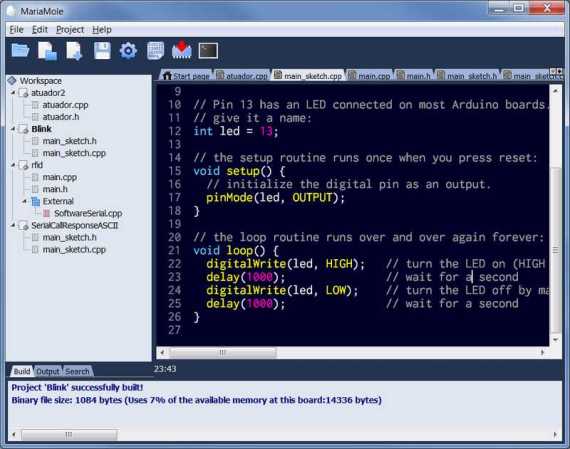
MariaMole – an alternate Arduino IDE aimed at advanced users

by Mike Szczys

[Alex] has been working with Arduino for some time now, but always thought it lacked some features which advanced users would really find useful. He decided to devote some free time to fixing the problem and ended up coding an Arduino IDE for more advanced users. A screenshot of his work — called MariaMole — can be seen above. It is obviously different from the standard IDE, bot not so much as to scare off new users.

This is meant to complement the original IDE, so it actually uses those configuration settings as dependencies. Once running, the program allows you to have multiple projects open at once. These are managed with the tree in the left hand column and a series of tabs along the top of the code window. When it comes time to compile and load the sketch you can click one button like normal, or use the program to fine tune your compiler flags, libraries includes, and the like. It also allows for interaction through one or more serial terminal windows. We haven’t tried it ourselves, so please leave a comment with your thoughts after having given it a go.

thanks for the tip [Rodrigo].


Filed under: arduino hacks


01 Dec 22:51

St. Optimus of Prime

by Mike Szczys

st-optimus-of-prime

We’re pretty sure they’re not canonizing alien robots, but this Optimus Prime stained glass sure looks good enough for a place at the local cathedral. It is [Kobachi's] very first glass project, but we’d say he’s got a bright future ahead of him. Especially since it’s about ten times more complex than the assignment called for.

The design is based on artwork by [NinjaInkArt] called Optimus Noveau. It is included in the album linked above and shows Optimus with the matrix of leadership behind his head. This of course doubles as the halo you would find around the head of a saint in religious artwork. [Kobachi] started by simplifying the design into rough outlines and colors. He then split those outlines to make for easier cuts and then got down to business assembling the pane. It uses 121 different pieces and took him 80-100 hours to complete the work. We can’t wait to see the landscape follow-up showing Optimus as a semi truck.

If you’re not handy with colored glass you could try making this with colored circuit boards instead.

[via Reddit]


Filed under: misc hacks


01 Dec 22:49

Plan 9 on the Raspberry Pi

by Brian Benchoff

plan9 copy

Yet another operating system has been ported to the Raspberry Pi. No, it’s not Haiku, sadly, but it is something just as weird and interesting. This time it’s Plan 9 from Bell Labs, an 80′s era OS from the same company that brought you C and Unix.

As a research operating system, Plan 9 has a bunch of really weird, but useful features. For one, everything about a computer running Plan 9 is distributed; the memory can be running on one machine, the processor on another, and the display can run on yet another machine. This modularity gives Plan 9 the honorable title of, ‘more Unix than Unix’.

Another great feature, although somewhat of a historical note, is that Plan 9′s graphics capabilities are written into the kernel, unlike Linux and X where the display manager is floating around in user space.

It’s an interesting system, and if you’ve got enough Raspis to build your own supercomputer you might want to install Plan 9 on a few of your nodes, just to see what the future computer of ages past looked like.


Filed under: Raspberry Pi


01 Dec 22:48

The Organism Will Do Whatever It Damn Well Pleases

In the go-go world of software development, we're so consumed with learning new things, so fascinated with the procession of shiny new objects that I think we sometimes lose sight of our history. I don't mean the big era-defining successes. Everyone knows those stories. I'm talking about the things we've tried before that … didn't quite work out. The failures. The also-rans. The noble experiments. The crazy plans.

I'm all for reinventing the wheel, because it's one of the best ways to learn. But you shouldn't even think about reinventing a damn thing until you've exhaustively researched every single last wheel, old or new, working or broken, that you can lay your hands on. Do your homework.

That's why I love unearthing stories like The Lessons of Lucasfilm's Habitat. It's basically World of Warcraft … in 1985.

Habitat is "a multi-participant online virtual environment," a cyberspace.

Habitat

Each participant ("player") uses a home computer (Commodore 64) as an intelligent, interactive client, communicating via modem and telephone over a commercial packet-switching network to a centralized, mainframe host system. The client software provides the user interface, generating a real-time animated display of what is going on and translating input from the player into messages to the host. The host maintains the system's world model enforcing the rules and keeping each player's client informed about the constantly changing state of the universe.

This was the dark ages of home computing. In 1985, that 64k of memory in a Commodore 64 was a lot. The entirety of Turbo Pascal 3.02 for DOS, released a year later in 1986, was barely 40k.

The very concept of a multiplayer virtual world of any kind – something we take for granted today, since every modern website is essentially a multiplayer game now — was incredibly exotic. Look at the painstaking explanation Lucasfilm had to produce to even get folks to understand what the heck Habitat was, and how it worked:

The technical information in The Lessons of Lucasfilm's Habitat is incredibly dated, as you'd expect, and barely useful even as trivia. But the sociological lessons of Habitat cut to the bone. They're as fresh today as they were in 1985. Computers have radically changed in the intervening 27 years, whereas people's behavior hasn't. At all. This particular passage hit home:

Again and again we found that activities based on often unconscious assumptions about player behavior had completely unexpected outcomes (when they were not simply outright failures). It was clear that we were not in control. The more people we involved in something, the less in control we were. We could influence things, we could set up interesting situations, we could provide opportunities for things to happen, but we could not predict nor dictate the outcome. Social engineering is, at best, an inexact science, even in proto-cyberspaces. Or, as some wag once said, "in the most carefully constructed experiment under the most carefully controlled conditions, the organism will do whatever it damn well pleases."

Even more specifically:

Propelled by these experiences, we shifted into a style of operations in which we let the players themselves drive the direction of the design. This proved far more effective. Instead of trying to push the community in the direction we thought it should go, an exercise rather like herding mice, we tried to observe what people were doing and aid them in it. We became facilitators as much as designers and implementors. This often meant adding new features and new regions to the system at a frantic pace, but almost all of what we added was used and appreciated, since it was well matched to people's needs and desires. As the experts on how the system worked, we could often suggest new activities for people to try or ways of doing things that people might not have thought of. In this way we were able to have considerable influence on the system's development in spite of the fact that we didn't really hold the steering wheel -- more influence, in fact, than we had had when we were operating under the delusion that we controlled everything.

That's exactly what I was trying to say in Listen to Your Community, But Don't Let Them Tell You What to Do. Unfortunately, because I hadn't read this essay until a few months ago, I figured this important lesson out 25 years later than Randy Farmer and Chip Morningstar. So many Stack Overflow features were the direct result of observing what the community was doing, then attempting to aid them in it:

  • We noticed early in the Stack Overflow beta that users desperately wanted to reply to each other, and were cluttering up the system with "answers" that were, well, not answers to the question. Rather than chastize them for doing it wrong – stupid users! – we added the commenting system to give them a method of annotating answers and questions for clarifications, updates, and improvements.

  • I didn't think it was necessary to have a place to discuss Stack Overflow. And I was … kind of a jerk about it. The community was on the verge of creating a phpBB forum instance to discuss Stack Overflow. Faced with a nuclear ultimatum, I relented, and you know what? They were right. And I was wrong.

  • The community came up with an interesting convention for handling duplicate questions, by manually editing a blockquote into the top of the question with a link to the authoritative question that it was a duplicate of. This little user editing convention eventually became the template for the official implementation.

I could go on and on, but I won't bore you. I'd say for every 3 features we introduced on Stack Overflow, at least two of them came more or less directly from observing the community, then trying to run alongside them, building tools that helped them do what they wanted to do with less fuss and effort. That was my job for the last four years. And I loved it, until I had to stop loving it.

Randy Farmer, one of the primary designers of Habitat at Lucasfilm, went on to work on a bunch of things that you may recognize: with Douglas Crockford on JSON, The Sims Online, Second Life, Yahoo 360°, Yahoo Answers, Answers.com, and so forth. He eventually condensed some of his experience into a book, Building Web Reputation Systems, which I bought in April 2011 as a Kindle edition. I didn't know who Mr. Farmer was at this time. I just saw a new O'Reilly book on an area of interest, and I thought I'd check it out.

Building-web-reputation-systems

As the co-founder of Stack Overflow, I know a thing or two about web reputation systems! Out of curiosity, I looked up the author on my own site. And I found him, with a tiny reputation. So I sent this friendly jibe on Twitter:

pff, look at @frandallfarmer's tiny rep! look at it!

But the last laugh was on Randy, as it should be, because I didn't realize he had over 6,000 reputation on rpg.stackexchange.com. Turns out, Randy Farmer was already an avid Stack Exchange user. And, as you might guess given his background, a rather expert Stack Exchange user at that. The Stack Exchange ruleset is complex, strict, and requires discipline to understand. Kind of like.. maybe a certain role playing game, if you will.

Advanced-dungeons-and-dragons

Randy is the sort of dad who had his first edition Dungeons & Dragons books bound into a single leather tome and handed it down to his son as a family heirloom. How awesome is that?

If we've learned anything in the last 25 years since Habitat, it is that people are the source of, and solution to, all the problems you'll run into when building social software. Are you looking to (dungeon) master the art of guiding and nudging your online community through their collective adventure, without violating the continuity of your own little universe? If so, you could do a whole heck of lot worse than reading Building Web Reputation Systems and following @FRandallFarmer on Twitter.

[advertisement] Hiring developers? Post your open positions with Stack Overflow Careers and reach over 20MM awesome devs already on Stack Overflow. Create your satisfaction-guaranteed job listing today!
01 Dec 22:11

Photo


01 Dec 22:03

The evolution of our spines and speech

by Matthew Inman
The evolution of our spines and speech

The evolution of our spines and speech

View
01 Dec 22:01

This shirt captures a magical moment

by seemikedraw

I’ve put up a bunch of new shirts at Neatorama, and a bunch more to come before Christmas…

01 Dec 22:00

973 – Buteco dos Deuses 26

by Carlos Ruas

Essa tirinha foi um direito de resposta concedido ao Deus Hindu Ganesha, referente a tira Buteco dos Deuses 25.

01 Dec 21:59

974 – Dinossauros

by Carlos Ruas

28 Nov 11:42

970 – Revendo conceitos

by Carlos Ruas

28 Nov 11:42

971 – Revendo conceitos 2

by Carlos Ruas

24 Nov 19:14

20. November, 2012

24 Nov 16:26

23. November, 2012

24 Nov 16:25

18. November, 2012