Shared posts

11 Sep 02:54

Civilizational Collapse (Part 4)

by John Baez

This is part 4 of an intermittent yet always enjoyable series:

Part 1: the rise of the ancient Puebloan civilization in the American Southwest from 10,000 BC to 750 AD.

Part 2: the rise and collapse of the ancient Puebloan civilization from 750 AD to 1350 AD.

Part 3: a simplified model of civilizational collapse.

This time let’s look at the collapse of Greek science and resulting loss of knowledge!

The Antikythera mechanism, found undersea in the Mediterranean, dates to somewhere between 200 and 60 BC. It’s a full-fledged analogue computer! It had at least 30 gears and could predict eclipses, even modelling changes in the Moon’s speed as it orbits the Earth.

What Greek knowledge was lost during the Roman takeover? We’ll never really know.

They killed Archimedes and plundered Syracuse in 212 BC. Ptolemy the Fat—”Physcon” —put an end to science in Alexandria in 154 BC with brutal persecutions.

Contrary to myth, Library of Alexandria was not destroyed once and for all in a single huge fire. The sixth head librarian, Aristarchus of Samothrace, fled when Physcon took over. The library was indeed set on fire in the civil war of 48 BC. But it seems to have lasted until 260 AD, when it basically lost its funding.

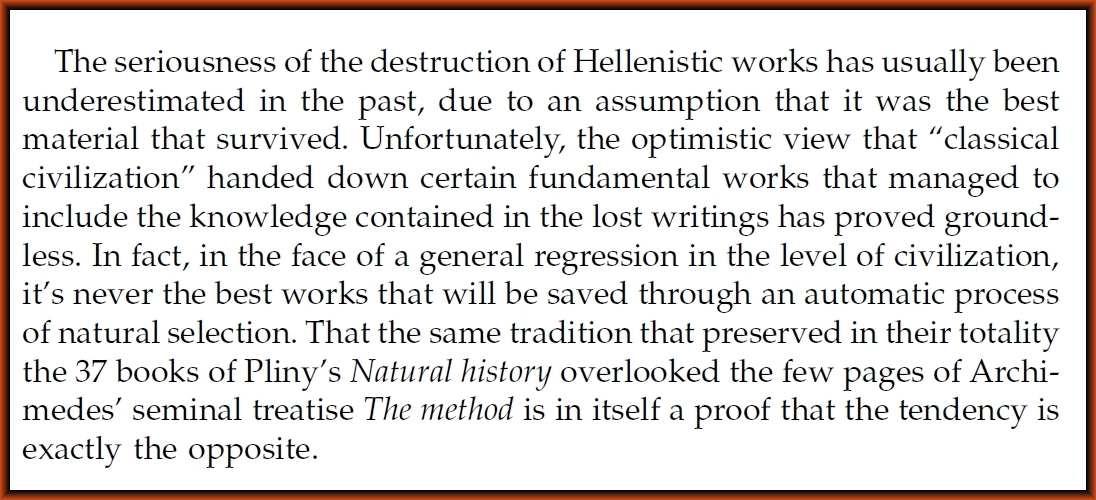
When the Romans took over, they dumbed things down. In his marvelous book The Forgotten Revolution, quoted below, Lucio Russo explains the evil effects.

Another example: we have the first four books by Apollonius on conic sections—the more elementary ones—but the other three have been lost.

Archimedes figured out the volume and surface area of a sphere, and the area under a parabola, in a letter to Eratosthenes. He used modern ideas like ‘infinitesimals’! The letter was repeatedly copied and made its way into a 10th-century Byzantine parchment manuscript. But this parchment was written over by Christian monks in the 13th century, and only rediscovered in 1906.

There’s no way to tell how much has been permanently lost. So we’ll never know the full heights of Greek science and mathematics. If we hadn’t found one example of an analogue computer in a shipwreck in 1902, we wouldn’t have guessed they could make those!

And we shouldn’t count on our current knowledge lasting forever, either.

Here are some more things to read. Most of all I recommend this book:

• Lucio Rosso, The Forgotten Revolution: How Science Was Born In 300 BC And Why It Had To Be Reborn, Springer, Berlin, 2013. (First chapter.)

Check out the review by Sandro Graffi (who taught me analysis when I was an undergrad at Princeton):

• Sandro Graffi, La Rivoluzione Dimenticata (The Forgotten Revolution), AMS Notices (May 1998), 601–605.

Only in 1998 did scholars get serious about recovering information from the Archimedes palimpsest using ultraviolet, infrared and other imaging techniques! You can now access it online:

The Archimedes Palimpsest Project.

Here’s a good book on the rediscovery and deciphering of the Archimedes palimpsest, and its mathematical meaning:

• Reviel Netz and William Noel, The Archimedes Codex: Revealing the
Secrets of the World’s Greatest Palimpsest
, Hachette, UK, 2011.

Here’s a video:

• William Noel, Revealing the lost codex of Archimedes, TED, May 29, 2012.

Here are 9 videos on recreating the Antikythera mechanism:

Machining the Antikythera mechanism, Clickspring.

The Wikipedia articles are good too:

• Wikipedia, Antikythera mechanism.

• Wikipedia, Archimedes palimpsest.

• Wikipedia, Library of Alexandria.

19 Aug 17:42

Topologically Protected Quantization of Work

by Bruno Mera, Krzysztof Sacha, and Yasser Omar

Author(s): Bruno Mera, Krzysztof Sacha, and Yasser Omar

Using ideas from topological materials, researchers propose a way to quantize work.


[Phys. Rev. Lett. 123, 020601] Published Tue Jul 09, 2019

19 Aug 17:34

Thermal constraints on in vivo optogenetic manipulations

by Scott F. Owen

Nature Neuroscience, Published online: 17 June 2019; doi:10.1038/s41593-019-0422-3

Optogenetics has revolutionized neuroscience, but intracranial illumination can cause off-target effects. Owen et al. identify a temperature-sensitive potassium current that modulates neuronal activity and behavior independent of opsin expression.
19 Aug 16:51

Denmark offers to buy the United States

by Minnesotastan
COPENHAGEN—After rebuffing Donald J. Trump’s hypothetical proposal to purchase Greenland, the government of Denmark has announced that it would be interested in buying the United States instead.

“As we have stated, Greenland is not for sale,” a spokesperson for the Danish government said on Friday. “We have noted, however, that during the Trump regime pretty much everything in the United States, including its government, has most definitely been for sale.”..

If Denmark’s bid for the United States is accepted, the Scandinavian nation has ambitious plans for its new acquisition. “We believe that, by giving the U.S. an educational system and national health care, it could be transformed from a vast land mass into a great nation,” the spokesperson said.
Excerpted from The Borowitz Report in The New Yorker.
13 Aug 20:39

Effects of the peer metagenomic environment on smoking behavior [Social Sciences]

by Ramina Sotoudeh, Kathleen Mullan Harris, Dalton Conley
Recent scholarship suggests that the genomes of those around us affect our own phenotypes. Much of the empirical evidence for such “metagenomic” effects comes from animal studies, where the socio-genetic environment can be easily manipulated. Among humans, it is more difficult to identify such effects given the nonrandom distribution of...
12 Aug 23:07

Rich People Like Trump

by noreply@blogger.com (Atrios)
I won't link to reports of his rich people fundraiser, but the dirty little secret of America is that rich people are ridiculously stupid people who support the most ridiculously stupid president. And not in the "oh they just like their tax cuts" sense, which is how the press likes to portray them. In the "god I hope I get to shoot a round a golf with him" kind of way. Rich MAGAs are as absurdly stupid and gross as poor MAGAs, just with bigger credit lines.
11 Aug 17:48

Even-Dimensional Balls

by john
MathML-enabled post (click for more details).

Some of the oddballs on the nn-Café are interested in odd-dimensional balls, but here’s a nice thing about even-dimensional balls: the volume of the 2n2n-dimensional ball of radius rr is

(πr 2) nn! \frac{(\pi r^2)^n}{n!}

Dillon Berger pointed out that summing up over all nn we get

∑ n=0 ∞(πr 2) nn!=e πr 2 \sum_{n=0}^\infty \frac{(\pi r^2)^n}{n!} = e^{\pi r^2}

It looks nice. But what does it mean?

MathML-enabled post (click for more details).

First, why is it true?

We can show the volume of the 2n2n-dimensional ball of radius rr is (πr 2) n/n!(\pi r^2)^n/n! inductively. How? It’s enough to show that the volume of the unit 2(n+1)2(n+1)-ball is π/(n+1)\pi /(n+1) times the volume of the unit 2n2n-ball. Wikipedia gives a proof, and Greg Egan recently summarized the argument in a couple of tweets.

The idea is to map the unit 2(n+1)2(n+1)-ball to the unit disk in the plane via a projection ℝ 2n→ℝ 2\mathbb{R}^{2n} \to \mathbb{R}^2. Imagine a 2(n+1)2(n+1)-ball hovering over a disk! I can’t draw it, because the first interesting example is 4-dimensional. But imagine it.

The points over any point in the disk at distance rr from the origin form a 2n2n-ball of radius 1−r 2\sqrt{1 - r^2}. We can get the volume of the 2(n+1)2(n+1)-ball by integrating the volumes of these 2n2n-balls over the disk.

That’s the idea. The rest is just calculus. Let the volume of the unit 2n2n-ball be V 2nV_{2n}. We do the integral using polar coordinates:

V 2(n+1)=∫ 0 1V 2n(1−r 2) n2πrdr V_{2(n+1)} = \int_0^1 V_{2n} (1 - r^2)^n \; 2 \pi r d r

Make the substitution u=1−r 2u = 1 - r^2, so du=−2rdrd u = -2 r d r. Some minus signs and 2’s cancel and we get

V 2(n+1)=πV 2n∫ 0 1u ndu=πn+1V 2n V_{2(n+1)} = \pi V_{2n} \int_0^1 u^n \, d u = \frac{\pi}{n+1} V_{2n}

as desired!

So that’s simple enough: since V 0=1V_0 = 1 we get

V 2n=π nn! V_{2n} = \frac{\pi^n}{n!}

And maybe that’s all that needs to be said. But suppose we follow Dillon Berger and sum the volumes of all even-dimensional balls of radius rr. We get

∑ n=0 ∞V 2nr 2n=∑ n=0 ∞(πr 2) nn!=e πr 2 \sum_{n=0}^\infty V_{2n} r^{2n} = \sum_{n=0}^\infty \frac{(\pi r^2)^n}{n!} = e^{\pi r^2}

This looks cute, but what does it mean?

It seems odd to sum the volumes of shapes that have different dimensions. But we do it in classical statistical mechanics when considering a system of particles with a variable numbers of particles: a so-called ‘grand canonical ensemble’, like an open container of gas, where molecules can flow in and out.

If we have a single classical harmonic oscillator, with momentum pp and position qq, its energy is

12(p 2+q 2) \frac{1}{2}(p^2 + q^2)

where I’m choosing units that get rid of distracting constants.

If we impose the constraint that the energy is ≤E\le E for some number EE, the state of the oscillator is described by a point (p,q)(p,q) with

p 2+q 2≤2E p^2 + q^2 \le 2 E

This is a point in the disk of radius r=2Er = \sqrt{2E}.

Now suppose we have an arbitrary collection of such oscillators—and we don’t know how many there are! Then the state of the system is described first by a natural number nn, the number of oscillators, and then momenta p 1,…,p np_1, \dots, p_n and positions q 1,…,q nq_1, \dots, q_n obeying

p 1 2+q 1 2+⋯+p n 2+q n 2≤2E p_1^2 + q_1^2 + \cdots + p_n^2 + q_n^2 \le 2 E

In other words, it’s a point in the union of all even-dimensional balls of radius r=2Er = \sqrt{2E}.

Physicists would call this union the ‘phase space’ of our collection of oscillators. Its volume is the sum of the volumes of the balls:

∑ n=0 ∞V 2nr 2n=e πr 2=e 2πE \sum_{n=0}^\infty V_{2n} r^{2n} = e^{\pi r^2} = e^{2 \pi E}

Actually physicists would include the constants that I’m hiding, and this is actually somewhat interesting. For example, to make the area 2-form dp∧dqd p \wedge d q dimensionless, they divide it by Planck’s ‘quantum of action’. This is what allows them to add up volumes of balls (or other symplectic manifolds) of different dimensions and get something that doesn’t break the rules of dimensional analysis. But this also brings Planck’s constant into a question of classical statistical mechanics—a surprise, but a surprise that’s well-known among experts: it shows up in computations such as the entropy of an ideal gas.

And indeed, entropy is exactly what I’m interested in now! Why would a physicist care about the volume of phase space for a collection of arbitrarily many oscillators with total energy ≤E\le E? Here’s why: if all we know about this collection of oscillators is that it’s energy is ≤E\le E, its entropy is just the logarithm of this phase space volume! So, it’s

ln(e 2πE)=2πE \ln (e^{2 \pi E}) = 2 \pi E

Nice!

Physicists will not like how I tucked all the constants under the rug, getting a formula for entropy that’s missing things like Boltzmann’s constant and Planck’s constant, as well as the mass of the particles in our harmonic oscillators, and their spring constant. I leave it as a challenge to restore all these constants correctly. I suspect that the 2π2\pi will get eaten by the 2π2 \pi hiding in Planck’s constant ℏ=h/2π\hbar = h / 2\pi. This I know: we will get something proportional to EE, but with units of entropy.

This is what I’ve got so far. It’s not yet a new proof that the volumes of all even-dimensional balls of radius rr sum to

e πr 2 e^{\pi r^2}

but rather a physical interpretation of this fact. Maybe someone can keep the ball rolling….

11 Aug 02:10

David Attenborough crawls into a termite mound

by Minnesotastan
11 Aug 01:56

Ownership of voting machine makers claimed to be a "trade secret"

by Minnesotastan

From techdirt:
Recently, the North Carolina State Board of Elections asked suppliers of electronic voting machines a simple question: who owns you?..

This seems like very basic information -- information the Board should know and should be able to pass on to the general public. After all, these are the makers of devices used by the public while electing their representatives. They should know who's running these companies and who their majority stakeholders are. If something goes wrong (and something always does), they should know who's ultimately responsible for the latest debacle.

It's not like the state was asking the manufacturers to cough up code and machine schematics. All it wanted to know is the people behind the company nameplates. But the responses the board received indicate voting system manufacturers believe releasing any info about their companies' compositions will somehow compromise their market advantage.
Hart InterCivic, a corporation that derives independent actual value from this information not being generally known or readily ascertainable and makes reasonable efforts to maintain the secrecy of this information, requests that it be designated as a trade secret pursuant to G.S. § 132-1.2(1)d. and G.S. § 66-152(3).
One of ES&S's subsidiaries (and there are at least 39 of those) -- Meritage Homes Corp. -- shuffled some securities ownership the same day the North Carolina election board asked it to provide information about the company's ownership. Maybe it's a coincidence. Or maybe ES&S was offloading a politically-inconvenient owner. Whatever the case is, it certainly doesn't look good. 
More at the link, via BoingBoing.  Informed discussion at the Technology subreddit.

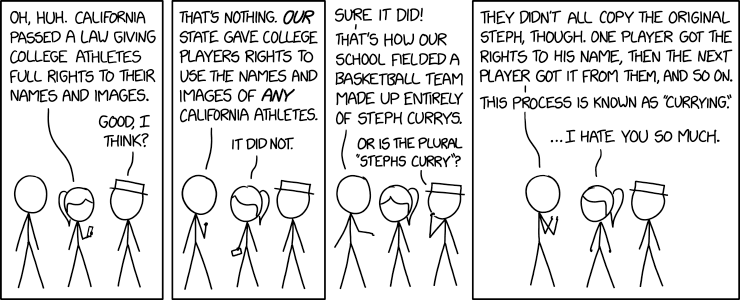
Cartoon from XKCD.
10 Aug 08:28

Locked body clocks

by Mathias L. Heltberg

Nature Physics, Published online: 05 August 2019; doi:10.1038/s41567-019-0617-2

Synchronization can induce both order and disorder, betraying a multistability that is rife in living systems. Evidence now suggests that the circadian clock synchronizes with the cell cycle, and that this behaviour is common to different species.
10 Aug 08:11

Where We Are Now

by woit

For much of the last 25 years, a huge question hanging over the field of fundamental physics has been that of what judgement results from the LHC would provide about supersymmetry, which underpins the most popular speculative ideas in the subject. These results are now in, and conclusively negative. In principle one could still hope for the HL-LHC (operating in 2026-35) to find superpartners, but there is no serious reason to expect this. Going farther out in the future, there are proposals for an extremely expensive 100km larger version of the LHC, but this is at best decades away, and there again is no serious reason to believe that superpartners exist at the masses such a machine could probe.

The reaction of some parts of the field to this falsification of hopes for supersymmetry has been not at all the abandonment of the idea that one would expect. For example, today brings the bizarre news that failure has been rewarded with a $3 million Special Breakthrough Prize in Fundamental Physics for supergravity. For uncritical media coverage, see for instance here, here, and here.

Some media outlets do better. I first heard about this from Ryan Mandelbaum, who writes here. Ian Sample at the Guardian does note that negative LHC results are “leading many physicists to go off the theory” and quotes one of the awardees as saying:

We’re going through a very tough time… I’m not optimistic. I no longer encourage students to go into theoretical particle physics.

At Nature, the sub-headline is “Three physicists honoured for theory that has been hugely influential — but might not be a good description of reality” and Sabine Hossenfelder is quoted. At her blog, she ends with the following excellent commentary:

Awarding a scientific prize, especially one accompanied by so much publicity, for an idea that has no evidence speaking for it, sends the message that in the foundations of physics contact to observation is no longer relevant. If you want to be successful in my research area, it seems, what matters is that a large number of people follow your footsteps, not that your work is useful to explain natural phenomena. This Special Prize doesn’t only signal to the public that the foundations of physics are no longer part of science, it also discourages people in the field from taking on the hard questions. Congratulations.

In related news, yesterday I watched this video of a recent discussion between Brian Greene and others which, together with a lot of promotional material about string theory, included significant discussion of the implications of the negative LHC results. A summary of what they had to say would be:

  • Marcelo Gleiser has for many years been writing about the limits of scientific knowledge, and sees this as one more example.
  • Michael Dine has since 2003 been promoting the string theory landscape/multiverse, with the idea that one could do statistical predictions using it. Back then we were told that “it is likely that this leads to a prediction of low energy supersymmetry breaking” (although Dine soon realized this wasn’t working out, see here.) In 2007 Physics Today published his String theory in the era of the Large Hadron Collider (discussed here), which complained about how “weblogs” had it wrong that string theory had no relation to experiment. That piece claimed that

    A few years ago, there seemed little hope that string theory could make definitive statements about the physics of the LHC. The development of the landscape has radically altered that situation.

    and that

    The Large Hadron Collider will either make a spectacular discovery or rule out supersymmetry entirely.

    Confronted by Brian with the issue of LHC results, Dine looks rather uncomfortable, but claims that there still is hope for string theory and the landscape, that now big data and machine learning can be applied to the problem (for commentary on this, see here). He doesn’t though expect to see success in his lifetime.

  • Andy Strominger doesn’t discuss supersymmetry in particular, but about the larger superstring theory unification idea, tries to make the case that it hasn’t been a failure at all, but a success way beyond what was expected. The argument is basically that the search for a unified string theory was like Columbus’s search for a new sea route to China. He didn’t find it, but found something much more exciting, the New World. In this analogy, instead of finding some tedious reductionist new layer of reality as hoped, string theorists have found some revolutionary new insight about the emergent nature of gravity:

    I think that the idea that people were excited about back in 1985 was really a small thing, you know, to kind of complete that table that you put down in the beginning of the spectrum of particles…

    We didn’t do that, we didn’t predict new things that were going to be measured at the Large Hadron Collider, but what has happened is so much more exciting than our original vision… we’re getting little hints of a radical new view of the nature of space and time, in which it really just is an approximate concept, emergent from something deeper. That is really, really more exciting, I mean it’s as exciting as quantum mechanics or general relativity, probably even more so.

    The lesson Strominger seems to have learned from the failure of the 1985 hopes is that when you’ve lost your bet on one piece of hype, the thing to do is double down, go for twice the hype…

Update: The Breakthrough Prize campaign to explain why supergravity is important despite having no known relation to reality has led to various nonsense making its way to the public, as reporters desperately try to make sense of the misleading information they have been fed. For instance, you can read (maybe after first reading this comment) here that

Witten showed in 1981 that the theory could be used to simplify the proof for general relativity, initiating the integration of the theory into string theory.

You could learn here that

When the theory of supersymmetry was developed in 1973, it solved some key problems in particle physics, such as unifying three forces of nature (electromagnetism, the weak nuclear force, and the strong nuclear force)

Update: On the idea that machine learning will solve the problems of string theory, see this yesterday from the Northeastern press office, which explains that the goal is to “unify string theory with experimental findings”:

Using data science to learn more about the large set of possibilities in string theory could ultimately help scientists better understand how theoretical physics fits into findings from experimental physics. Halverson says one of the ongoing questions in the field is how to unify string theory with experimental findings from particle physics and cosmology…

Update: Physics World has a story about this that emphasizes the sort of criticism I’ve been making here.

As mentioned in the comments, I took a closer look at the citation for the prize. The section on supersymmetry is really outrageous, using “supersymmetry stabilizes the weak scale” as an argument for SUSY, despite the fact that this has been falsified by LHC results.

Update: Jim Baggott writes about this story and post-empirical science here.

Noah Smith here gets the most remarkable aspect of this right. String theory has always had the feature that the strings were not supposed to be visible at accessible energies, so not directly testable. Supersymmetry is quite different: it has always been advertised as a directly testable idea, with superpartners supposed to appear at the electroweak scale and be seen at the latest at the LHC. Giving a huge prize to a theoretical idea that has just been conclusively shown to not work is something both new and outrageous.

Update: Tommaso Dorigo’s take is here, which I’d characterize as basically “any publicity is good publicity, but it’s pretty annoying the cash is going to theorists for failed theories instead of experimentalists”(he does say he wanted to entitle the piece “Billionaire Awards Prizes To Failed Theories”):

[Rant mode on] An exception to the above is, of course, the effect that this not insignificant influx of cash and 23rd-hour recognition has on theoretical physicists. For they seem to be the preferred recipients of the breakthrough prize as of late, not unsurprisingly. Apparently, building detectors and developing new methods to study subnuclear reactions, which are our only way to directly fathom the unknown properties of elementary particles, is not considered enough of a breakthrough by Milner’s jury as it is to concoct elegant, albeit wrong, theories of nature. [Rant mode off]

Going back to the effect on laypersons: this is of course positive. Already the sheer idea that you may earn enough cash to buy a Ferrari and a villa in Malibu beach in one shot by writing smart formulas on a sheet of paper is suggestive, in a world dominated by the equation “is paid very well, so it is important”. But even more important is the echo that he prize – somewhere by now dubbed “the Oscar of Physics” – is having on the media. Whatever works to bring science to the fore is welcome in my book.

10 Aug 08:03

Sensory Neurons Drive Anticipatory Immunity

by Anna M. Trier, Brian S. Kim
Sensory neurons have recently emerged as critical mediators of immunity. Cohen et al. (2019) demonstrate that peripheral neurons utilize reflex arcs in order to rapidly condition the immune response in skin adjacent to the site of infection. This nerve reflex arc generates anticipatory immunity for more effective elimination of the pathogen if later exposed.
09 Aug 01:18

Blip glitches in Advanced LIGO data. (arXiv:1901.05093v2 [physics.ins-det] UPDATED)

by Miriam Cabero, Andrew Lundgren, Alex H. Nitz, Thomas Dent, David Barker, Evan Goetz, Jeff S. Kissel, Laura K. Nuttall, Paul Schale, Robert Schofield, Derek Davis

Blip glitches are short noise transients present in data from ground-based gravitational-wave observatories. These glitches resemble the gravitational-wave signature of massive binary black hole mergers. Hence, the sensitivity of transient gravitational-wave searches to such high-mass systems and other potential short duration sources is degraded by the presence of blip glitches. The origin and rate of occurrence of this type of glitch have been largely unknown. In this paper we explore the population of blip glitches in Advanced LIGO during its first and second observing runs. On average, we find that Advanced LIGO data contains approximately two blip glitches per hour of data. We identify four subsets of blip glitches correlated with detector auxiliary or environmental sensor channels, however the physical causes of the majority of blips remain unclear.

09 Aug 01:06

Inferring neuronal ionic conductances from membrane potentials using CNNs

by Ben-Shalom, R., Balewski, J., Siththaranjan, A., Baratham, V., Kyoung, H., Kim, K. G., Bender, K. J., Bouchard, K. E.
The neuron is the fundamental unit of computation in the nervous system, and different neuron types produce different temporal patterns of voltage fluctuations in response to input currents. Understanding the mechanism of single neuron firing patterns requires accurate knowledge of the spatial densities of diverse ion channels along the membrane. However, direct measurements of these microscopic variables are difficult to obtain experimentally. Alternatively, one can attempt to infer those microscopic variables from the membrane potential (a mesoscopic variable), or features thereof, which are more experimentally tractable. One approach in this direction is to infer the ionic densities as parameters of a neuronal model. Traditionally this is done using a Multi-Objective Optimization (MOO) method to minimize the differences between features extracted from a simulated neuron's membrane potential and the same features extracted from target data. Here, we use Convolutional Neural Networks (CNNs) to directly regress generative parameters (e.g., ionic conductances, membrane resistance, etc.,) from simulated time-varying membrane potentials in response to an input stimulus. We simulated diverse neuron models of increasing complexity (Izikivich: 4 parameters; Hodgkin-Huxley: 7 parameters; Mainen-Sejnowski: 10 parameters) with a large range of variation in the underlying parameter values. We show that hyperparameter optimized CNNs can accurately infer the values of generative variables for these neuron models, and that these results far surpass the previous state-of-the-art method (MOO). We discuss the benefits of optimizing the CNN architecture, improvements in accuracy with additional training data, and some observed limitations. Based on these results, we propose that CNNs may be able to infer the spatial distribution of diverse ionic densities from spatially resolved measurements of neuronal membrane potentials (e.g. voltage imaging).
07 Aug 21:47

Neuronal Small RNAs Control Behavior Transgenerationally

by Rachel Posner, Itai Antoine Toker, Olga Antonova, Ekaterina Star, Sarit Anava, Eran Azmon, Michael Hendricks, Shahar Bracha, Hila Gingold, Oded Rechavi
The idea that brain activity can impact the fate of the progeny goes against a central tenet of biology. Posner et al. describe an RNA-based mechanism for how neuronal responses to environmental cues can be translated into heritable information that affects the behavior of progeny.
06 Aug 18:39

Are supercentenarians mostly superfrauds?

by Andrew

Ethan Steinberg points to a new article by Saul Justin Newman with the wonderfully descriptive title, “Supercentenarians and the oldest-old are concentrated into regions with no birth certificates and short lifespans,” which begins:

The observation of individuals attaining remarkable ages, and their concentration into geographic sub-regions or ‘blue zones’, has generated considerable scientific interest. Proposed drivers of remarkable longevity include high vegetable intake, strong social connections, and genetic markers. Here, we reveal new predictors of remarkable longevity and ‘supercentenarian’ status. In the United States, supercentenarian status is predicted by the absence of vital registration. The state-specific introduction of birth certificates is associated with a 69-82% fall in the number of supercentenarian records. In Italy, which has more uniform vital registration, remarkable longevity is instead predicted by low per capita incomes and a short life expectancy. Finally, the designated ‘blue zones’ of Sardinia, Okinawa, and Ikaria corresponded to regions with low incomes, low literacy, high crime rate and short life expectancy relative to their national average.

In summary:

As such, relative poverty and short lifespan constitute unexpected predictors of centenarian and supercentenarian status, and support a primary role of fraud and error in generating remarkable human age records.

Supercentenarians are defined as “individuals attaining 110 years of age.”

I’ve skimmed the article but not examined the data or the analysis—we can leave that to the experts—but, if what Newman did is correct, it’s a great story about the importance of measurement in learning about the world.

06 Aug 13:55

Co-translational folding allows misfolding-prone proteins to circumvent deep kinetic traps

by Bitran, A., Jacobs, W. M., Zhai, X., Shakhnovich, E.
Many large proteins suffer from slow or inefficient folding in vitro. Here, we provide evidence that this problem can be alleviated in vivo if proteins start folding co-translationally. Using an all-atom simulation-based algorithm, we compute the folding properties of various large protein domains as a function of nascent chain length, and find that for certain proteins, there exists a narrow window of lengths that confers both thermodynamic stability and fast folding kinetics. Beyond these lengths, folding is drastically slowed by non-native interactions involving C-terminal residues. Thus, co-translational folding is predicted to be beneficial because it allows proteins to take advantage of this optimal window of lengths and thus avoid kinetic traps. Interestingly, many of these proteins' sequences contain conserved rare codons that may slow down synthesis at this optimal window, suggesting that synthesis rates may be evolutionarily tuned to optimize folding. Using kinetic modelling, we show that under certain conditions, such a slowdown indeed improves co-translational folding efficiency by giving these nascent chains more time to fold. In contrast, other proteins are predicted not to benefit from co-translational folding due to a lack of significant non-native interactions, and indeed these proteins' sequences lack conserved C-terminal rare codons. Together, these results shed light on the factors that promote proper protein folding in the cell, and how biomolecular self-assembly may be optimized evolutionarily.
02 Aug 19:07

Acoustic contamination of electrophysiological brain signals during speech production and sound perception

by Roussel, P., Bocquelet, F., Palma, M., Kahane, P., Chabardes, S., Yvert, B.
A current challenge of neurotechnologies is the development of speech brain-computer interfaces to restore communication in people unable to speak. To achieve a proof of concept of such system, neural activity can be investigated in patients implanted for clinical reasons while they speak. Using such simultaneously recorded audio and neural data, decoders can be built to predict speech features using features extracted from brain signals. A typical neural feature is the spectral power of field potentials in the high-gamma frequency band (between 70 and 200 Hz), a range that happen to overlap with the fundamental frequency of speech. Here, we analyzed human electrocorticographic (ECoG) and intracortical recordings during speech production and perception as well as rat microelectrocorticographic (micro-ECoG) recordings during sound perception. We observed that electrophysiological recordings, obtained with different recording setups, often contain spectrotemporal features of the sound, especially within the high-gamma band. Further analysis and in vitro replication suggest that these correlations are caused by a microphonic effect, transforming sound vibrations into an undesired electrical noise that contaminates the biopotential measurements. This study does not question the existence of relevant physiological neural information underlying speech production or sound perception in the high-gamma frequency band, but alerts on the fact that care should be taken to evaluate and eliminate any possible acoustic contamination of neural signals to investigate cortical dynamics underlying speech production and auditory perception.
29 Jul 01:51

Rapid Plasticity of Higher-Order Thalamocortical Inputs during Sensory Learning

by Nicholas J. Audette, Sarah M. Bernhard, Ajit Ray, Luke T. Stewart, Alison L. Barth
Audette et al. use automated training and in vitro electrophysiology to define cortical circuit changes during sensory-association learning. Pathway-specific analysis identifies higher-order thalamic inputs to sensory cortex as a site of synaptic potentiation during the earliest stages of learning.
05 Jul 16:20

Light-wave dynamic control of magnetism

by Florian Siegrist

Nature, Published online: 26 June 2019; doi:10.1038/s41586-019-1333-x

The magnetic properties of a ferromagnetic layer stack are controlled on attosecond timescales through optically induced spin and orbital momentum transfer, demonstrating a coherent regime of ultrafast magnetism.
27 Jun 16:41

High-dimensional geometry of population responses in visual cortex

by Carsen Stringer

Nature, Published online: 26 June 2019; doi:10.1038/s41586-019-1346-5

Analysis of the encoding of natural images by very large populations of neurons in the visual cortex of awake mice characterizes the high dimensional geometry of the neural responses.
27 Jun 16:24

Control of Intracellular Molecular Networks Using Algebraic Methods

by Sordo Vieira, L., Laubenbacher, R. C., Murrugarra, D.
Many problems in biology and medicine have a control component. Often, the goal might be to modify intracellular networks, such as gene regulatory networks or signaling networks, in order for cells to achieve a certain phenotype, such as happens in cancer. If the network is represented by a mathematical model for which mathematical control approaches are available, such as systems of ordinary differential equations, then this problem might be solved systematically. Such approaches are available for some other model types, such as Boolean networks, where structure-based approaches have been developed, as well as stable motif techniques. However, increasingly many published discrete models are mixed-state or multistate, that is, some or all variables have more than two states, and thus the development of control strategies for multistate networks is needed. This paper presents a control approach broadly applicable to general multistate models based on encoding them as polynomial dynamical systems over a finite algebraic state set, and using computational algebra for finding appropriate intervention strategies. To demonstrate the feasibility and applicability of this method, we apply it to a recently developed multistate intracellular model of E2F-mediated bladder cancerous growth, and to a model linking intracellular iron metabolism and oncogenic pathways. The control strategies identified for these published models are novel in some cases and represent new hypotheses, or are supported by the literature in others as potential drug targets.
27 Jun 14:59

Decoding of the other\'s focus of attention by a temporal cortex module

by Ramezanpour, H., Thier, P.
Faces attract the observer's attention towards objects and locations of interest for the other, thereby allowing the two agents to establish joint attention. Previous work has delineated a network of cortical "patches" in the macaque cortex, processing faces, eventually also extracting information on the other's gaze direction. Yet, the neural mechanism that links information on gaze direction, guiding the observer's attention to the relevant object has remained elusive. Here we present electrophysiological evidence for the existence of a distinct "gaze-following patch (GFP)" with neurons that establish this linkage in a highly flexible manner. The other's gaze and the object, singled out by the gaze, are linked only if this linkage is pertinent within the prevailing social context. The properties of these neurons establish the GFP as a key switch in controlling social interactions based on the other's gaze.
27 Jun 02:59

Meeting the Dialogue Challenge

by john
MathML-enabled post (click for more details).

guest post by Dan Shiebler and Alexis Toumi

This is the fourth post in a series from the Adjoint School of Applied Category Theory 2019. We discuss Grammars as Parsers: Meeting the Dialogue Challenge (2006) by Matthew Purver, Ronnie Cann and Ruth Kempson as part of a group project on categorical methods for natural language dialogue.

MathML-enabled post (click for more details).

Preliminary Warning: Misalignment in Dialogue

Traditional accounts of the mechanics of natural language have largely been focused on monologue and utterances in isolation: using formal languages and automata theory to characterise the set of grammatical or “well-formed” sentences. When faced with dialogue and informal conversation, this notion of grammaticality breaks down: people hesitate, correct themselves, interrupt each other, etc. In Toward a mechanistic psychology of dialogue (2004), Pickering and Garrod argue that dialogue represents a major challenge for psycholinguistics and give empirical evidence for interactive alignment as the psychological process underlying dialogue. We will aim at casting a categorical light on this dialogue challenge and on the computational model proposed by Purver, et al.

This computational linguistics article may look like the odd one out in the ACT reading list: it does not even mention category theory. Worse: the word “category” is actually used twice, but it doesn’t mean anything like a collection of arrows with composition; “adjunction” appears twice as well, but again nothing to do with pairs of functors and natural transformations. This is a typical example of a phenomenon psycholinguistics would call misalignment. If we imagine a dialogue between a linguist and a mathematician, they would use the same words to refer to different concepts, resulting in a failure of communication.

Context-Freeness and Monoidal Categories

It may now prove useful to give some historical context. In his Three models for the description of language (1956) and his monograph on Syntactic Structures (1957), Chomsky lays out a formal theory of natural language syntax with the context-free grammar (CFG) as its cornerstone. Formally, a CFG is given by a tuple G=(V,X,R,s)G = (V, X, R, s) where:

  • VV and XX are two finite sets, called the vocabulary and the nonterminal symbols respectively.
  • R⊆X×(V+X) ⋆R \subseteq X \times (V + X)^\star is a finite set of production rules and s∈Xs \in X is the start symbol, where the Kleene star (−) ⋆(-)^\star denotes the free monoid and (+)(+) denotes disjoint union.

A CFG generates a language L(G)={u∈V ⋆|s→ Ru}L(G) = \{\ u \in V^\star \ \vert \ s \to_R u \ \} where the rewriting relation (→ R)⊆(V+X) ⋆×(V+X) ⋆(\to_R) \subseteq (V + X)^\star \times (V + X)^\star is traditionally defined as the transitive closure of the following directed graph:

{(uxw,uvw)|u,w∈(V+X) ⋆,(x,v)∈R} \{ \ (u x w, \ u v w) \quad \vert \quad u, w \in (V + X)^\star, \ (x, v) \in R \ \}

One may recast this into the language of monoidal categories by redefining L(G)={u∈V ⋆|𝒞 R(s,u)≠∅}L(G) = \{ \ u \in V^\star \ \vert \ \mathcal{C}_R(s, u) \neq \emptyset \ \} where the transition relation RR is seen as a signature for the free monoidal category 𝒞 R\mathcal{C}_R. That is, a string u∈V ⋆u \in V^\star is grammatical whenever there exists an arrow from the start symbol ss to uu in 𝒞 R\mathcal{C}_R. A typical arrow r:s→ur : s \to u where u="Colourless green ideas sleep furiously"u = \text{"Colourless green ideas sleep furiously"} may be encoded as a syntax tree:

Syntax tree for "Colorless green ideas sleep furiously"

A year later in The mathematics of sentence structure (1958), Lambek characterised the same context-free languages with his Lambek calculus, i.e. the internal language of biclosed monoidal categories. Half a century later in From Word To Sentence (2008), he simplified his formalism from biclosed to rigid monoidal categories and pregroup grammars. First introduced in Lambek (1997), pregroups are partially ordered monoids (P,≤,⋅,1)(P, \leq, \cdot, 1) where every type t∈Pt \in P has left and right adjoints, i.e. a pair of objects ⋆t,t ⋆∈P{}^\star t, t^\star \in P with two pairs of inequations:

t⋅ ⋆t≤1≤ ⋆t⋅tt ⋆⋅t≤1≤t⋅t ⋆ t \cdot {}^\star t \leq 1 \leq {}^\star t \cdot t \qquad \qquad t {}^\star \cdot t \leq 1 \leq t \cdot t^\star

Formally, a pregroup grammar is given by a tuple G=(V,B,D,s)G = (V, B, D, s) where:

  • VV is a finite vocabulary, BB is a finite partially ordered set of basic types,
  • D⊆V×P BD \subseteq V \times P_B is a finite relation called the dictionary or lexicon, where P BP_B is the free pregroup generated by BB and s∈P Bs \in P_B is called the sentence type.

Again, we may define the language of GG as L(G)={u∈V ⋆|𝒞 D(u,s)≠∅}L(G) = \{ \ u \in V^\star \ \vert \ \mathcal{C}_D(u, s) \neq \emptyset \ \} where now the dictionary DD is taken as a signature for the free rigid monoidal category 𝒞 D\mathcal{C}_D. If we note that the generation and parsing problems form a duality where the output of the generation problem is the input to the parsing problem, we see that CFGs and pregroup grammars stand on opposite sides of this duality. That is, the start symbol is the domain of syntax trees while the sentence type is the codomain of pregroup reductions. The arrow r:u→sr : u \to s encoding grammaticality is no more a tree but a planar diagram, e.g.:

Pregroup reduction for "Colorless green ideas sleep furiously"

Context-free grammars and pregroup grammars share the same expressive power, i.e. they generate the same class of context-free languages. However, they are only weakly equivalent, i.e. the translations between them preserve only grammaticality and forget the structure of the grammatical reductions, syntax trees or string diagrams. There is still open debate about the syntactic structure that underlies human language.

Thus, we may realign the terminology of the linguist and of the category theorist as follows: the “syntactic categories” of categorial grammars are really objects in some form of closed category and the “adjunctions” are really adjunctions after all! Indeed, while in CFGs an adjunct may be defined as a subtree which may be removed without affecting grammaticality, in pregroup grammars the same phenomenon is encoded as an adjunction, e.g. between the types of “furiously” and “sleep”.

Natural Language and Functorial Semantics

We argue that it is of interest to realign “syntactic categories” and “adjunctions” the other way round, i.e. take their category theoretic meaning and apply them to linguistics. Again we give some historical context by looking at two parallel uses of the word “universal”: universal algebra and Lawvere theories on one side, universal grammar and Montague semantics on the other.

In Adjointness in Foundations (1969), Lawvere lays out a program for the foundations of mathematics by characterising existential and universal quantification as left and right adjoints to substitution. In his doctoral dissertation Functorial Semantics of Algebraic Theories (1963), he defines what are now known as Lawvere theories and their models as monoidal functors F:𝒯→SetF : \mathcal{T} \to Set where 𝒯\mathcal{T} is the syntactic category encoding the theory: a monoidal category where the tensor is the categorical product and each object is isomorphic to a cartesian power x nx^n for n∈ℕn \in \mathbb{N} and some fixed xx.

The following year in English as a formal language (1970) and Universal Grammar (1970), Montague sets out to apply the same principle of compositionality to natural language. Recast using category theory, Montague semantics is a monoidal functor F:(𝒞 R) op→SetF : (\mathcal{C}_R)^{op} \to Set from the free monoidal category generated by the transition relation of a context-free grammar G=(V,X,R,s)G = (V, X, R, s) such that words w∈Vw \in V are mapped to the singleton and the start symbol s∈Xs \in X to a set of closed logical formulae. Explicitly, FF is given by a lambda term for each transition rule, mapping grammatical sentences to logical sentences in a compositional way, e.g.:

Montague semantics for "Thetis loves a mortal"

Even though the use of higher-order logic in Montague semantics suggests a connection with Lawvere theories through the internal language of topos theory, to the best of our knowledge Montague is as little known to category theorists as Lawvere is to linguists.

In the next section, we discuss a second principle at play in natural language semantics: distributionality, as summarised in Firth’s oft-cited maxim: “You shall know a word by the company it keeps”.

Categorical Compositional Distributional Models

How do we define a word’s company categorically? As a first approximation, we may take some large collection of sentences C⊆V ⋆C \subseteq V^\star and look at the matrix E:|V|×|V|→ℕE : |V| \times |V| \to \mathbb{N} encoding how many times each pair of words appeared together, i.e. E(i,j)=∑ u∈C1 u(w i)×1 u(w j)E(i, j) = \sum_{u \in C} \mathbf{1}_u(w_i) \times \mathbf{1}_u(w_j) for 1 u:V→{0,1}\mathbf{1}_u : V \to \{0, 1\} the indicator function of the utterance u∈V ⋆u \in V^\star. Better approximations would be given by some renormalisation of this matrix such as TF-IDF or by information-theoretic measures like pointwise mutual information. The size of this matrix may be prohibitive and you may want to apply some dimensionality reduction to get some compressed encoding matrix E:|V|×n→SE : |V| \times n \to S for some hyper-parameter n∈ℕn \in \mathbb{N} and some suitable semiring SS.

We give a very brief presentation of the categorical compositional distributional (DisCoCat) models of Clark et al. (2010), which were the topic of a previous post from the ACT 2018 seminar. DisCoCat models may be defined as monoidal functors F:𝒞 D→Mat(S)F : \mathcal{C}_D \to \text{Mat}(S) where 𝒞 D\mathcal{C}_D is the free rigid monoidal category generated by a pregroup dictionary D⊆V×P BD \subseteq V \times P_B and Mat(S)\text{Mat}(S) is the category of matrices over SS with Kronecker product as tensor. Note that the encoding matrix E:|V|×n→SE : |V| \times n \to S is precisely the data defining a monoidal functor F:𝒞 D→Mat(S)F : \mathcal{C}_D \to \text{Mat}(S) such that F(t)=nF(t) = n for all (w,t)∈D(w, t) \in D, i.e. every word is of the same semantic type. In order to construct arbitrary DisCoCat models we need tensors of higher rank, e.g. the encoding of the verb (loves, ⋆n⋅s⋅n ⋆)∈D(loves, {}^\star n \cdot s \cdot n^\star) \in D will have dimension n×F(s)×nn \times F(s) \times n where we overload the notation for the noun type n∈P Bn \in P_B and the dimension of its image F(n)=n∈ℕF(n) = n \in \mathbb{N}.

DisCoCat models valued in the category Mat(𝔹)≃FinRel\text{Mat}(\mathbb{B}) \simeq \text{FinRel} of finite sets and relations yield a truth-theoretic semantics for pregroup grammars in terms of conjunctive queries, the regular logic fragment of relational databases. Although much weaker than the higher-order logic of Montague semantics, conjunctive queries have nice complexity-theoretic as well as category-theoretic properties. Indeed, a celebrated theorem from Chandra, Merlin (1977) — conjunctive query evaluation is NP-complete — has recently been recast in terms of free cartesian bicategories in Bonchi et al. (2018): queries are arrows and evaluation reduces to the existence of 2-arrows. The significance of this result for natural language processing is discussed in De Felice et al. (2019), to appear in the ACT 2019 proceedings.

Both the relational models and the vector space models valued in Mat(ℝ)≃FinVect ℝ\text{Mat}(\mathbb{R}) \simeq \text{FinVect}_{\mathbb{R}} yield some insight into the anatomy of word meanings through a common structure: the categories of matrices Mat(S)\text{Mat}(S) are all hypergraph categories, i.e. symmetric monoidal categories where each object is equipped with a special commutative Frobenius algebra in a coherent way. This allows us to model information flow and give a semantics to those functional words which appear in almost every context, hence for which distributionality gives practically no information content: auxiliary verbs such as “does”, coordinators e.g. “and” and “or”, relative and personal pronouns e.g. “that” and “them” — see the line of work by Sadrzadeh, Coecke and others [1, 2, 3, 4, 5].

As we discuss in the next section, Frobenius algebras can even be used to give a meaning to words that are missing, see Wijnolds, Sadrzadeh (2019).

Contextual Grammaticality with Dynamic Syntax

Dynamic Syntax, which emerged from work by Kempson et al., is based on a third linguistics principle, incrementality: in dialogue people speak and listen to only one word at a time. Modelling language generation and parsing as linear-time processes has two related justifications: on the computational side it allows to implement real-time applications like personal assistants; on the cognitive side there is empirical evidence that human parsing is largely incremental, see e.g. Philips, Linear Order and Constituency (2003).

Dynamic syntax (DS) takes a semantics-driven approach to grammaticality: a sequence of words is defined as grammatical precisely if it can be given a semantics in the model. DS replaces the lambda terms of Montague semantics by a set TT of semantic trees based on Hilbert’s epsilon calculus, with ∅∈T\varnothing \in T the initial empty tree and S⊆TS \subseteq T a subset of completed trees, i.e. closed logical formulae. In our following discussion of DS we use TyTy and FoFo to represent the tree operators on logical types and logical formulae respectively.

DS also defines a set AA of actions, specified in an imperative programming language based the logic of finite trees of Blackburn et al. (1994). A DS lexicon is then given by a function D:V→AD : V \to A assigning a lexical action to each word in the vocabulary w∈Vw \in V, e.g.

Dynamic syntax for "dislike"

DS semantic trees are annotated with some further structure: pointers, metavariables and requirements, as illustrated in the following example.

Dynamic syntax for "John likes Mary"

  • Pointers: The semantic trees are equipped with a pointer ⋄\diamond and actions may be specified locally to that pointer in terms of descendants ↓\downarrow and ancestors ↑\uparrow in the tree.
  • Metavariables: Metavariables are underspecified terms. They include relative pronouns such as “he” or “she” as well as subjects with indefinite scope like the word “someone” in the sentence “Everyone likes someone.”
  • Requirements: After parsing the subsentence “John likes”, the semantic tree will include a requirement for an argument type (represented by ?Ty(e)?Ty(e) in the figure above). This requirement will be filled when the parser reaches the next word, “Mary”, which will yield the complete tree for the sentence “John likes Mary.”

In Grammars as Parsers (2006), Purver et al. argue that incrementality is key if we are to model the language of informal conversations. They apply dynamic syntax to the following phenomena, which are all problematic in traditional approaches to language processing:

  • Ellipses: in informal conversations, context allows participants to omit words from sentences without affecting their meaning, e.g. A: “Mary studies categories.” B: “John does too.”
  • Routinization: the repetition of the same ambiguous phrase (“that guy”) resolves the ambiguity and makes participants more likely to answer using the same phrase again.
  • Shared utterances: participants may complete each others’ sentences, e.g. A: “John likes…” B: “category theory? I know.”

For example, consider the dialogue A:”Mary upset Sue.” B:”John did too.” When parsing “John did too,” the DS parser will represent “did too” as a requirement asking for what John did. If the semantic tree encoding context contains a node of the appropriate type (e.g. λx.Upset(x,Mary)\lambda x.Upset(x, Mary)), the parser may use this to fill the requirement.

Dynamic syntax for dialogue

Furthermore, Purver et al. model the interactive alignment of Pickering and Garrod on three levels: lexical i.e. participants re-using the same words, syntactic i.e. participants re-using the same phrase structure, and semantic i.e. participants converging to the same representation of the situation. This requires a notion of state that goes beyond that of isolated sentences: we need to encode the participants’ memory of the dialogue’s history. The state of a DS parser — also called the context — is given by a sequence of triples C∈(T×V ⋆×A ⋆) ⋆C \in (T \times V^\star \times A^\star)^\star, such that for all (t,u,a)∈C(t, u, a) \in C and a n−1∘⋯∘a 0(∅)=ta_{n-1} \circ \cdots \circ a_{0}(\varnothing) = t, i.e. we record the list of actions which are constructed from the utterance u∈V ⋆u \in V^\star. Next to lexical actions, DS defines a set of computational actions which may depend on context, e.g.

Substitution axiom in dynamic syntax

We say a context CC is valid if for all (t,u,a)∈C(t, u, a) \in C we have t∈St \in S is a completed tree. This model defines a notion of contextual grammaticality: whether an utterance is well-formed may depend on what has been said before. When the system has only a single speaker, we can represent this context with the history string c∈L(D)c \in L(D). Below we illustrate several subcases of this single speaker system. A string u∈V ⋆u \in V^\star is:

  • fully grammatical if it is parsable from any valid context e.g. “John went to the market”,
  • fully ungrammatical if there is no context in which it is parsable e.g. “John market”,
  • well-formed if there is some valid context in which it is parsable e.g. “He went to the market”,
  • potentially well-formed if there is some context (not necessarily valid) in which it is parsable e.g. “the market”.

Bringing it All Together: DisCoCat Inc.

The aim of our summer project is to incorporate the incremental insights from dynamic syntax into categorical compositional distributional models, DisCoCat Inc. Sadrzadeh et al. (2018) explore the first steps in this direction, mapping semantic trees to tensor networks and actions to tensor contraction.

In conclusion, we may attempt to reformulate the dialogue challenge in categorical terms: given DisCoCat models F A:𝒜→Mat(S)F_A : \mathcal{A} \to \text{Mat}(S) and F B:ℬ→Mat(S)F_B : \mathcal{B} \to Mat(S), encoding the language of Alice and Bob respectively, can we build a new model F C:𝒞→Mat(S)F_C : \mathcal{C} \to Mat(S) giving a semantics to the dialogues between them? Furthermore, can we make the model for this common language F C:𝒞→Mat(S)F_C : \mathcal{C} \to Mat(S) incremental, and account for the real-time dynamics of dialogues? These questions inspired a number of links with the other group projects of the ACT adjoint school:

  • Partial evaluation and the bar construction: Can we make use of monads, partial evaluations and rewriting theory (as discussed in a previous guest post) to model the dynamics of syntactic structures and unify universal grammar with universal algebra?
  • Toward a mathematical foundation for autopoeisis: Can we model natural language entailment and question answering using the graphical regular logic of Fong, Spivak (2018)? Can we investigate language as an autopoeitic system through the behavioral mereology of Fong et al. (2018)?
  • Simplifying quantum circuits using the ZX-calculus: Can we use techniques inspired from quantum circuit minimisation (discussed in two previous posts here and there) to perform summarisation, i.e. find the shortest text which encodes the semantics of a given dialogue?
  • Traversal optics and profunctors: the theory of lenses has recently been used to model both learning algorithms in Fong, Johnson (2019) and Wittgenstein’s language games in Hedges, Lewis (2018), can we use these insights and the categorical view of optics developed in Milewski (2007) to model natural language learning through dialogue?
26 Jun 21:28

Dietary fatty acids promote sleep through a taste-independent mechanism

by Sah Pamboro, E. L., Brown, E. B., Keene, A. C.
Consumption of foods that are high in fat contributes to obesity and metabolism-related disorders that are increasing in prevalence and present an enormous health burden throughout the world. Dietary lipids are comprised of triglycerides and fatty acids, and the highly palatable taste of dietary fatty acids promotes food consumption, activates reward centers in mammals, and underlies hedonic feeding. Despite a central role of dietary fats in the regulation of food intake and the etiology of metabolic diseases, little is known about how fat consumption regulates sleep. The fruit fly, Drosophila melanogaster, provides a powerful model system for the study of sleep and metabolic traits, and flies potently regulate sleep in accordance with food availability. To investigate the effects of dietary fats on sleep regulation, we have supplemented fatty acids into the diet of Drosophila and measured their effects on sleep and activity. We found that feeding flies a diet of hexanoic acid, a medium-chain fatty acid that is a by-product of yeast fermentation, promotes sleep by increasing the number of sleep episodes. This increase in sleep is dose-dependent and independent of the light-dark cues. Diets consisting of other fatty acids, including medium- and long-chain fatty acids, also increase sleep, suggesting many fatty acid types promote sleep. To assess whether dietary fatty acids regulate sleep through the taste system, we assessed sleep in flies with a mutation in the hexanoic acid receptor Ionotropic receptor 56d, which is required for fatty acid taste perception. We found that these flies also increase their sleep when fed a hexanoic acid diet, suggesting the sleep promoting effect of hexanoic acid is not dependent on sensory perception. Overall, these results define a role for fatty acids in sleep regulation, providing a foundation to investigate the molecular and neural basis for fatty acid-dependent modulation of sleep duration.
24 Jun 03:27

Making a Simple $A+B→C$ Reaction Oscillate by Coupling to Hydrodynamic Effect

by M. A. Budroni, V. Upadhyay, and L. Rongy

Author(s): M. A. Budroni, V. Upadhyay, and L. Rongy

Any chemical reaction of the type A + B -> C, between two reactant species (A and B), can be made to oscillate in time and space if the interface region where C forms obeys certain fluid convection properties.


[Phys. Rev. Lett. 122, 244502] Published Thu Jun 20, 2019

24 Jun 02:23

Glia Accumulate Evidence that Actions Are Futile and Suppress Unsuccessful Behavior

by Yu Mu, Davis V. Bennett, Mikail Rubinov, Sujatha Narayan, Chao-Tsung Yang, Masashi Tanimoto, Brett D. Mensh, Loren L. Looger, Misha B. Ahrens
Whole-brain imaging in virtual-reality-immersed zebrafish reveals that failed swim attempts are detected by noradrenergic neurons, which drive glial cells that accumulate calcium until they trigger the suppression of further futile attempts.
24 Jun 02:23

Correlated Neural Activity and Encoding of Behavior across Brains of Socially Interacting Animals

by Lyle Kingsbury, Shan Huang, Jun Wang, Ken Gu, Peyman Golshani, Ye Emily Wu, Weizhe Hong
When two animals interact, neural activity across their brains synchronizes in a way that predicts how they will behave and how they form social dominance relationships.
15 Jun 16:01

Lessons from cold fusion, 30 years on

by Philip Ball

Nature, Published online: 27 May 2019; doi:10.1038/d41586-019-01673-x

Why revisit long-discredited claims for a source of abundant energy, asks Philip Ball? Because we are still learning how to treat pathological science.
15 Jun 15:58

Revisiting the cold case of cold fusion

by Curtis P. Berlinguette

Nature, Published online: 27 May 2019; doi:10.1038/s41586-019-1256-6

Three years of investigation by a multi-disciplinary team into claims of ‘cold fusion’ found no evidence that the phenomenon exists, but identified a parameter space potentially worthy of further exploration.