Shared posts

31 Dec 06:30

Dense percolation in large-scale mean-field random networks is provably "explosive".

PLoS One. 2012; 7(12): e51883
Veremyev A, Boginski V, Krokhmal PA, Jeffcoat DE

Recent reports suggest that evolving large-scale networks exhibit "explosive percolation": a large fraction of nodes suddenly becomes connected when sufficiently many links have formed in a network. This phase transition has been shown to be continuous (second-order) for most random network formation processes, including classical mean-field random networks and their modifications. We study a related yet different phenomenon referred to as dense percolation, which occurs when a network is already connected, but a large group of nodes must be dense enough, i.e., have at least a certain minimum required percentage of possible links, to form a "highly connected" cluster. Such clusters have been considered in various contexts, including the recently introduced network modularity principle in biological networks. We prove that, contrary to the traditionally defined percolation transition, dense percolation transition is discontinuous (first-order) under the classical mean-field network formation process (with no modifications); therefore, there is not only quantitative, but also qualitative difference between regular and dense percolation transitions. Moreover, the size of the largest dense (highly connected) cluster in a mean-field random network is explicitly characterized by rigorously proven tight asymptotic bounds, which turn out to naturally extend the previously derived formula for the size of the largest clique (a cluster with all possible links) in such a network. We also briefly discuss possible implications of the obtained mathematical results on studying first-order phase transitions in real-world linked systems.

03 Dec 08:21

Eye Movements to Natural Images as a Function of Sex and Personality

by Felix Joseph Mercer Moss et al.
Nosimpler

Apparently men focus on eyes and women focus on chins. Weird.

by Felix Joseph Mercer Moss, Roland Baddeley, Nishan Canagarajah

Women and men are different. As humans are highly visual animals, these differences should be reflected in the pattern of eye movements they make when interacting with the world. We examined fixation distributions of 52 women and men while viewing 80 natural images and found systematic differences in their spatial and temporal characteristics. The most striking of these was that women looked away and usually below many objects of interest, particularly when rating images in terms of their potency. We also found reliable differences correlated with the images' semantic content, the observers' personality, and how the images were semantically evaluated. Information theoretic techniques showed that many of these differences increased with viewing time. These effects were not small: the fixations to a single action or romance film image allow the classification of the sex of an observer with 64% accuracy. While men and women may live in the same environment, what they see in this environment is reliably different. Our findings have important implications for both past and future eye movement research while confirming the significant role individual differences play in visual attention.
02 Dec 20:21

Cryoconite in Birthday Canyon

by Minnesotastan
Nosimpler

Turns out melting glaciers are, in fact, pretty cool to look at. Thanks global warming!

Adam LeWinter on the rim of Birthday Canyon on the Greenland Ice Sheet. The black deposit in the bottom of channel is cryoconite. Birthday Canyon is approximately 150 feet deep.
The photo (credit James Balog/Extreme Ice Survey) comes from a small gallery at The Guardian depicting scenes of glacial melting in the Arctic.  Second gallery.

Blogged for the stark beauty, but it also prompted me to look up what "cryoconite" is.
Cryoconite is powdery windblown dust which is deposited and builds up on snow, glaciers, or icecaps. It contains small amounts of soot which absorbs solar radiation melting the snow or ice beneath the deposit sometimes creating a cryoconite hole. 
Cryoconite holes have been suggested to play important roles in the glacier ecosystems because many kinds of living organisms have been reported from this structure on the glaciers, for example, algae, rotifer, tardigrada, insects and ice worm.
Details about cryoconite granules
13 Nov 22:44

What the Petraeus Investigation Tells Us About Online Surveillance

by J.D. Tuccille

EmailWith regards to the David Petraeus scandal, as you dig through the very human details of a powerful man's dalliance with an attractive woman, an important question should occur to anybody with more than a National Enquirer-level interest in the matter: Wait ... The FBI did all of this digging over some bed-hopping? Yes. Yes, it did. And over at The Guardian, Glenn Greenwald wants to know why more people aren't concerned.

Writes Greenwald:

As is now widely reported, the FBI investigation began when Jill Kelley - a Tampa socialite friendly with Petraeus (and apparently very friendly with Gen. John Allen, the four-star U.S. commander of the war in Afghanistan) - received a half-dozen or so anonymous emails that she found vaguely threatening. She then informed a friend of hers who was an FBI agent, and a major FBI investigation was then launched that set out to determine the identity of the anonymous emailer.

That is the first disturbing fact: it appears that the FBI not only devoted substantial resources, but also engaged in highly invasive surveillance, for no reason other than to do a personal favor for a friend of one of its agents, to find out who was very mildly harassing her by email.

Think about that. If an FBI agent can go digging through private emails over a friend's complaint about nasty-grams, doesn't that suggest that such intrusive snooping is pretty much old hat to the feds?

Greenwald points out that the FBI's digging into Paula Broadwell's nasty-grams not only took them into her email account and revealed her relationship with David Petraeus; it then revealed Jill Kelley's correspondence with General John Allen, including a truly awe-inspiring data-dump of emails between the two. Continues Greenwald:

So not only did the FBI - again, all without any real evidence of a crime - trace the locations and identity of Broadwell and Petreaus, and read through Broadwell's emails (and possibly Petraeus'), but they also got their hands on and read through 20,000-30,000 pages of emails between Gen. Allen and Kelley.

This is a surveillance state run amok. It also highlights how any remnants of internet anonymity have been all but obliterated by the union between the state and technology companies.

Online email services are especially vulnerable, with companies like Google and Yahoo essentially rolling over for the feds. As the Associated Press reported:

The downfall of CIA Director David Petraeus demonstrates how easy it is for federal law enforcement agents to examine emails and computer records if they believe a crime was committed. With subpoenas and warrants, the FBI and other investigating agencies routinely gain access to electronic inboxes and information about email accounts offered by Google, Yahoo and other Internet providers.

In fact, older emails — those six months old or older — don't require a warrant at all. Prosecutors can grab them on their own authority. Many companies will cough up detailed information without a formal warrant, anyway. "Google, which operates the widely used Gmail service, complied with more than 90 percent of the nearly 12,300 requests it received in 2011 from the U.S. government for data about its users, according to figures from the company."

Some email providers have been so eager to comply that they actually surrender more information than the FBI requests — and more than it is legally authorized to seek. One such high-profile incident occurred in 2006.

A technical glitch gave the F.B.I. access to the e-mail messages from an entire computer network — perhaps hundreds of accounts or more — instead of simply the lone e-mail address that was approved by a secret intelligence court as part of a national security investigation, according to an internal report of the 2006 episode.

F.B.I. officials blamed an “apparent miscommunication” with the unnamed Internet provider, which mistakenly turned over all the e-mail from a small e-mail domain for which it served as host. The records were ultimately destroyed, officials said.

So remember ... Your online privacy isn't so private.


11 Nov 05:47

Groupoid cardinality

by Qiaochu Yuan

Suitably nice groupoids have a numerical invariant attached to them called groupoid cardinality. Groupoid cardinality is closely related to Euler characteristic and can be thought of as providing a notion of integration on groupoids.

There are various situations in mathematics where computing the size of a set is difficult but where that set has a natural groupoid structure and computing its groupoid cardinality turns out to be easier and give a nicer answer. In such situations the groupoid cardinality is also known as “mass,” e.g. in the Smith-Minkowski-Siegel mass formula for lattices. There are related situations in mathematics where one needs to describe a reasonable probability distribution on some class of objects and groupoid cardinality turns out to give the correct such distribution, e.g. the Cohen-Lenstra heuristics for class groups. We will not discuss these situations, but they should be strong evidence that groupoid cardinality is a natural invariant to consider.

Axiomatics

For convenience, in this section we will restrict to essentially finite groupoids, namely those groupoids equivalent to groupoids with finitely many objects and morphisms.

Associated to any essentially finite groupoid X is a rational number, its groupoid cardinality \chi(X), which is uniquely determined by the following four properties, analogous to the properties uniquely specifying Euler characteristic:

  1. Cardinality: \chi(\text{pt}) = 1, where \text{pt} is the groupoid with one object and one morphism.
  2. Homotopy invariance: If X \sim Y (X is equivalent to Y), then \chi(X) = \chi(Y).
  3. Gluing: \chi(X \sqcup Y) = \chi(X) + \chi(Y).
  4. Covering: If F : X \to Y is an n-sheeted covering map, then \chi(X) = n \chi(Y).

A covering map of groupoids is a functor F : X \to Y which is surjective on objects and which satisfies the unique path lifting property: if p : y_1 \to y_2 is a morphism in Y and x_1 is an object in X such that F(x_1) = y_1, then there exists a unique morphism p' : x_1 \to x_2 in X such that F(p') = p. This axiomatizes the path lifting property satisfied by a covering map of topological spaces. A covering map is n-sheeted if the preimage of every object in Y consists of n objects in X.

The homotopy invariance and gluing axioms imply that groupoid cardinality is completely determined by how it behaves on one-object groupoids BG, where G is a finite group (since we are assuming essential finiteness). Associated to any such groupoid is a canonical |G|-sheeted cover

\displaystyle EG \to BG

where EG is the action groupoid for the action of G on itself (the objects are the elements of G and there is a unique morphism g \to h between any pair of objects). This covering map sends the morphism g \to h to the element h g^{-1} of G. The notation EG is by strong analogy with the theory of classifying spaces.

Since EG is equivalent to a point, \chi(EG) = 1 by the cardinality axiom, and the covering axiom then implies that \chi(BG) = \frac{1}{|G|}. In conclusion, we find that if X is an essentially finite groupoid then, writing the skeleton of X as

\displaystyle \bigsqcup_{x \in \pi_0(X)} B\text{Aut}(x)

we have

\displaystyle \chi(X) = \sum_{x \in \pi_0(X)} \frac{1}{|\text{Aut}(x)|}.

In words, the groupoid cardinality of X is a weighted sum over the isomorphism classes of objects in X, where an object is weighted by the size of its automorphism group. Intuitively speaking, we can think of the objects of X as being “cut up” by their automorphism groups into fractional points.

Groupoid cardinality has other properties besides the above that make it a natural measure of the size of a groupoid.

Proposition: Let X, Y be essentially finite groupoids. Then their product X \times Y is also essentially finite, and \chi(X \times Y) = \chi(X) \times \chi(Y).

Proof. A groupoid is essentially finite if and only if it has finitely many isomorphism classes and the objects in each isomorphism class have finitely many automorphisms. This condition is preserved under finite products; moreover, if

\displaystyle X \sim \bigsqcup_{x \in \pi_0(X)} B \text{Aut}(x)

and

\displaystyle Y \sim \bigsqcup_{y \in \pi_0(Y)} B \text{Aut}(y)

then

\displaystyle X \times Y \sim \bigsqcup_{(x, y) \in (\pi_0(X) \times \pi_0(Y))} B(\text{Aut}(x) \times \text{Aut}(y))

which gives the desired result. \Box

Alternatively, one could show that \frac{\chi(- \times Y)}{\chi(Y)} satisfied all of the axioms above.

Proposition: Let S be a finite set and G be a finite group acting on S. Then the groupoid cardinality of the action groupoid or weak quotient S//G is \chi(S//G) = \frac{|S|}{|G|}.

Note that this is badly false for the set-theoretic quotient S/G, a point which trips up many beginners in combinatorics.

The idea of the proof is that we would like to apply the covering axiom to the natural map S \to S//G (thinking of S as a discrete groupoid), except that this map isn’t a covering map unless the action of G is free. However, it can be replaced by a covering map up to equivalence (a kind of fibrant replacement) essentially using the Borel construction.

Proof. Instead of considering S, consider the equivalent groupoid S \times EG, which consists of pairs (s, g) where s \in S, g \in G, and where there is a unique morphism (s, g) \to (s, h) for every g, h \in G. Since G acts on both S and EG, it acts on this product, and so we can consider the action groupoid (S \times EG)//G and the corresponding map

\displaystyle S \times EG \to (S \times EG)//G.

Since G acts freely on S \times EG, this map is a |G|-sheeted covering map. Moreover, S \times EG \sim S and (S \times EG)//G \sim S//G. We can now apply the covering axiom, and the conclusion follows. \Box

For a more pedestrian proof, observe that it suffices by the gluing axiom to prove the statement in the case that the action of G on S is transitive, where it reduces to the orbit-stabilizer theorem.

Digression: random finite sets

The definition of groupoid cardinality can be extended to tame groupoids, namely those groupoids X such that the sum

\displaystyle \sum_{x \in \pi_0(X)} \frac{1}{|\text{Aut}(x)|}

converges. For any such groupoid, there is a natural probability measure on \pi_0(X) given by the condition that a given isomorphism class x \in \pi_0(X) occurs with probability

\displaystyle \frac{1}{\chi(X)} \left( \frac{1}{|\text{Aut}(x)|} \right).

For example, if X = \text{core}(\text{FinSet}) is the groupoid of finite sets and bijections, then

\displaystyle \chi(X) = \sum_{n \ge 0} \frac{1}{n!} = e

and the finite set of cardinality n occurs with probability \frac{1}{e n!}. In other words, “size of a random finite set” is Poisson with parameter \lambda = 1. It is unclear to me what the significance of this observation is, if any.

More generally, let s be a finite set and consider the groupoid of s-colored finite sets. This is the groupoid whose objects are finite sets x equipped with a map x \to s (assigning to each element of x its color) and whose morphisms are bijections x_1 \to x_2 compatible with colors. The cardinality of this groupoid may be computed in two ways. On the one hand, there are s^n isomorphism types of objects where |x| = n, and the groupoid consisting these isomorphism types is equivalent to the action groupoid of S_n acting on the set of all functions from an n-element set to s, hence the groupoid cardinality is

\displaystyle \sum_{n \ge 0} \frac{|s|^n}{n!}.

On the other hand, the groupoid of s-colored finite sets is equivalent to the product of |s| copies of the groupoid of finite sets; the equivalence is given by sending an s-colored finite set to the finite sets given by the elements of each color. It is not hard to show that for tame groupoids we have \chi(X \times Y) = \chi(X) \times \chi(Y), hence the groupoid cardinality is

\displaystyle \left( \sum_{n \ge 0} \frac{1}{n!} \right)^{|s|}.

Hence “size of a random s-colored finite set” is Poisson with parameter \lambda = |s|, and along the way to seeing this we have shown that two ways of defining e^{|s|} give the same answer (and also implicitly given a combinatorial proof that e^{|s| + |t|} = e^{|s|} e^{|t|}).

There is much more to say about these kinds of arguments, much of which has been said by John Baez at some point, but I don’t know a place where all of the relevant links have been collected. One place to start and work backwards from is week300.

Groupoid cardinality and Euler characteristic

The axiomatic definition of groupoid cardinality suggests that it ought to behave like Euler characteristic, except that the Euler characteristic of familiar spaces are integers and groupoid cardinality is not an integer. However, there is a nice sense in which the Euler characteristic of BG ought to be \frac{1}{|G|}.

BG is a groupoid model of a classifying space of G, also denoted BG, which for discrete groups has two equivalent definitions. It is the unique (up to homotopy) connected space such that \pi_1(BG) = G and such that all higher homotopy groups are trivial; in other words, it is the Eilenberg-MacLane space K(G, 1). Such spaces are also known as aspherical spaces.

The classifying space BG is also the space which represents, in a suitable homotopy category, the functor sending a topological space to its set of principal G-bundles. When G is a discrete group, this is the same thing as a G-cover, but the definition in terms of bundles also generalizes to topological groups.

Example. B\mathbb{Z} is the circle S^1.

Example. More generally, a nice connected space X is a BG for G = \pi_1(X) if and only if its universal cover is contractible; in particular any hyperbolic manifold has this property.

Example. B\mathbb{Z}/2\mathbb{Z} is infinite real projective space \mathbb{RP}^{\infty}.

The sense in which \chi(BG) ought to be \frac{1}{|G|} for G finite is the following. Recall that if X is, say, a finite CW complex, we should have

\displaystyle \chi(X) = \sum_{i \ge 0} (-1)^i c_i

where c_i is the number of i-cells of X. There is a distinguished model of BG (the space) having a cell decomposition in which c_i = (|G| - 1)^i, and thus we ought to have

\displaystyle \chi(BG) = \sum_{i \ge 0} (-1)^i (|G| - 1)^i = \frac{1}{1 + (|G| - 1)} = \frac{1}{|G|}

by summing a divergent geometric series! I learned this from MO. This can be seen more explicitly for \mathbb{RP}^{\infty}, for example, which has a single cell in each dimension and therefore whose Euler characteristic ought to be Grandi’s series

\displaystyle \chi(\mathbb{RP}^{\infty}) = 1 - 1 + 1 \mp ... = \frac{1}{2}.


07 Nov 00:20

Introduction to string diagrams

by Qiaochu Yuan

Today I would like to introduce a diagrammatic notation for dealing with tensor products and multilinear map. The basic idea for this notation appears to be due to Penrose. It has the advantage of both being widely applicable and easier and more intuitive to work with; roughly speaking, computations are performed by topological manipulations on diagrams, revealing the natural notation to use here is 2-dimensional (living in a plane) rather than 1-dimensional (living on a line).

For the sake of accessibility we will restrict our attention to vector spaces. There are category-theoretic things happening in this post but we will not point them out explicitly. We assume familiarity with the notion of tensor product of vector spaces but not much else.

Below the composition of a map f : a \to b with a map g : b \to c will be denoted f \circ g : a \to c (rather than the more typical g \circ f). This will make it easier to translate between diagrams and non-diagrams. All diagrams were drawn in Paper.

String diagrams

String diagrams for finite-dimensional vector spaces work as follows. To start with, a linear map f : U \to V is represented by a box labeled f with one input string labeled U and one output string labeled V. Composition of linear maps f : U \to V and g : V \to W is given by pairing input and output wires with matching labels.

The tensor product of two linear maps f : U_1 \to V_1, g : U_2 \to V_2 is a map f \otimes g : U_1 \otimes U_2 \to V_1 \otimes V_2 represented graphically by stacking boxes vertically. Note that f \otimes g has two input wires and two output wires.

The 1-dimensional vector space 1 is not represented by a wire at all, to reflect the fact that it is an identity for tensor product in the sense that there is a natural isomorphism V \otimes 1 \cong V. Thus a vector in a vector space is a morphism v : 1 \to V, which is just a box with no input wire and one output wire, and a linear functional or covector is a morphism f : V \to 1, which is just a box with no output wire and one input wire.

The identity map \text{id}_V : V \to V is represented by a wire with no attached box, to reflect the fact that it is an identity for composition, and the identity map \text{id}_1 : 1 \to 1 is not represented by anything at all.

In general, an arbitrary linear map

\displaystyle f : U_1 \otimes ... \otimes U_n \to V_1 \otimes ... \otimes V_m

(obtained for example by taking the tensor product of various other maps) is represented by a box labeled f with n input wires labeled U_1, ... U_n and m output wires labeled V_1, ... V_m.

Such maps admit a generalized notion of composition given by pairing only some input and output wires rather than all of them (defined formally by composition after tensoring with a suitable collection of identity morphisms). For example, if m : A \otimes A \to A is a bilinear map on a vector space A, the following is the statement that m is associative:

In 1-dimensional notation, this reads

\displaystyle (m \otimes \text{id}_A) \circ m = (\text{id}_A \otimes m) \circ m.

Implicit in our use of string diagram notation is the interchange law, which asserts that the following diagram is a well-defined map U_1 \otimes U_2 \to W_1 \otimes W_2 (in the sense that the two ways of evaluating it using tensor products and compositions produce the same result):

In 1-dimensional notation, this reads

\displaystyle (f_1 \otimes f_2) \circ (g_1 \otimes g_2) = (f_1 \circ g_1) \otimes (f_2 \circ g_2).

The interchange law should be thought of as a 2-dimensional version of associativity. It allows us to “drop generalized parentheses” in the sense that we do not have to specify what order we tensor and compose a family of maps as above.

Symmetry

The tensor product is commutative in a suitable sense, so we should be able to freely change the order of input and output wires. We can do this formally as follows. For any pair U, V of vector spaces there is a distinguished symmetry map

\displaystyle \gamma_{U, V} : U \otimes V \ni u \otimes v \mapsto v \otimes u \in V \otimes U

which is represented by unlabeled crossing wires. The symmetry maps obey various axioms which ensure that they behave like crossing wires ought to. The most important axiom is naturality, which asserts that we can slide boxes along symmetries:

In 1-dimensional notation, this reads

\displaystyle (f \otimes g) \circ \gamma_{U_2, V_2} = \gamma_{U_1, V_1} \circ (g \otimes f).

Note that if we only want to slide one box along a symmetry we can let the other one be an identity.

Strictly speaking, naturality also applies to morphisms drawn with more than one input or output wire, so can look more complicated than the above.

Another axiom obeyed by the symmetry asserts that applying the symmetry twice gives the identity. Topologically it is described by pulling two wires apart. Looking ahead to future posts, we will call this axiom Reidemeister II:

In 1-dimensional notation, this reads \gamma_{U, V} \circ \gamma_{V, U} = \text{id}_{U \otimes V}.

The third axiom we will discuss is sometimes called the braid relation, but following the pattern of the above naming scheme we will call it Reidemeister III. Topologically it is described by pulling the middle wire across a crossing:

In 1-dimensional notation, this reads that

\displaystyle (\text{id}_U \otimes \gamma_{V, W}) \circ (\gamma_{U, W} \otimes \text{id}_V) \circ (\text{id}_W \otimes \gamma_{U, V})

is equal to

\displaystyle (\gamma_{U, V} \otimes \text{id}_W) \circ (\text{id}_V \otimes \gamma_{U, W}) \circ (\gamma_{V, W} \circ \text{id}_U).

In particular, specialized to the case of an n-fold tensor product V^{\otimes n}, Reidemeister II and III are precisely the relations in a well-known presentation of the symmetric group S_n, so that S_n naturally acts on V^{\otimes n}.

The symmetry maps allow string diagrams greater expressive power. For example, if m : A \otimes A \to A is a bilinear map, the following is the statement that m is commutative:


14 Oct 12:29

The ducks are gonna get you [Pharyngula]

by PZ Myers
Nosimpler

Poor girl indeed.

Some poor young girl, deeply miseducated and misled, wrote into a newspaper with a letter trying to denounce homosexuality with a bad historical and biological argument. She’s only 14, and her brain has already been poisoned by the cranks and liars in her own family…it’s very sad. Here’s the letter — I will say, it’s a very creative argument that would be far more entertaining if it weren’t wrong in every particular.

I’ve transcribed it below. I couldn’t help myself, though, and had to, um, annotate it a bit.

Homosexuality, including same sex marriage, is not an enlightened idea [But tolerance and acceptance of diversity are]. The Romans practiced homosexuality [Every culture has had homosexual individuals; they differ only in the degree of suppression. The Romans actually regarded homosexuals as effete and inferior, and used accusations of gayness as expressions of contempt, just like modern middle schoolers]. Surely, after 2000 years, our level of intelligence should have evolved somewhat, so that we can truly pride ourselves of being cleverer than our forebears [Two millennia is actually a short span of time for biological evolution. Also, have you ever heard of the Dark Ages? Progress is not inevitable].

If homosexuality spreads, it can cause human evolution to come to a standstill [Nope. Homosexuals reproduce. Homosexuality refers to behavior and social preferences, not to biological limitations. Also, many heterosexuals choose to not reproduce as well, and it does not stop evolution in its tracks — in complex social organisms like ours, there are many ways to contribute to the species that don't involve breeding directly]. It could threaten the human position on the evolutionary ladder [There is no evolutionary "ladder". You have some serious misconceptions about biology, young lady!], and say, ducks, could take over the world [Evolution is not about taking over the world. There is no pinnacle. Every species has a different niche, not a different spot in a hierarchy of dominance]. Ducks always nest in pairs [This is called the naturalistic fallacy. You cannot draw conclusions from how one species behaves and declare that it justifies one specific kind of behavior in another species. I could point to gorillas, and announce that we should live in polygamous harems; I could point to bonobos and say that public homosexual acts ought to be accepted as a matter of course, and that we ought to have casual sex as often as we say hello. If you'd like, I could give you a long list of very kinky sexual behaviors practiced by various species on the planet; shall we decide that because ducks rape, so should we, lest we fall behind evolutionarily?] and if we allow same-sex marriage, then the ducks will have evolved further than we have [Ducks are just as "evolved" as we are, and we're not more evolved than any other species on the planet. Evolution is about branching trees, not climbing ladders]. We will be in danger of all being equal, with ducks more equal than us [That makes no sense].

We should learn from history and not be stuck with copying ancient behavior [Are you, by any chance, a follower of Jesus or Mohammed? Because you know, those faiths are all about imposing ancient rules for behavior on modern society]. The government has no right to bring us back to the stone age [But the Middle Ages are OK, I suppose?]. I don’t want my children to have to compete with ducks [Wait. I'm trying to puzzle this out. Because you think ducks are all heterosexual, and your children will all be heterosexual (brace yourself, you might get a few surprises in 10 or 20 years there), and a policy of tolerance will turn every other human being homosexual, you're afraid your kids will be competing for mates with ducks? Or is it that duck heterosexuality is the only criterion that makes them acceptable for positions of power, so years from now, your children will find themselves in a workplace dominated by duck bosses, who have overcome the handicap of lack of manipulatory appendages and very small brains to be in charge of everything? I don't get it]. I want them to evolve further than I have [But you don't believe in evolution!]. Any self-respecting human would aim for that, too. [Are you aware that the Abrahamic faiths all preach that humanity is in a state of ineluctable decay since the Fall and that human sin corrupts us? I don't think any self-respecting human should be a Christian or a Jew or Muslim, for the same reason]

None of this really bears any weight for be, because I do not believe in evolution [You don't understand it, either]. However, the powers that be believe in evolution, and have made many decisions based on it. They should be consistent: if you believe in evolution, then you can’t be in favour of homosexuality [If you accept evolution, then you recognize that there are diverse successful sexual strategies in the world, and you also have a deeper appreciation of the complexity of biology, so no, you should be much more accepting of reality], or the ducks will get you in the end [You can live your life in fear of ducks, or you can love your fellow human beings and encourage more love in the world. Your choice].

Jasmin H, aged 14 [You have time to grow up!]
Homeschooled [Obviously], Scargill

11 Oct 22:43

The classical mechanics of non-conservative systems. (arXiv:1210.2745v2 [gr-qc] UPDATED)

by Chad R. Galley
Nosimpler

We may be out of a job guys.

Hamilton's principle of stationary action lies at the foundation of theoretical physics and is applied in many other disciplines from pure mathematics to economics. Despite its utility, Hamilton's principle has a subtle pitfall that often goes unnoticed in physics: it is formulated as a boundary value problem in time but is used to derive equations of motion that are solved with initial data. This subtlety can have undesirable effects. I present a formulation of Hamilton's principle that is compatible with initial value problems. Remarkably, this leads to a natural formulation for the Lagrangian and Hamiltonian dynamics of generic non-conservative systems, thereby filling a long-standing gap in classical mechanics. Thus dissipative effects, for example, can be studied with new tools that may have application in a variety of disciplines. The new formalism is demonstrated by two examples of non-conservative systems: an object moving in a fluid with viscous drag forces and a harmonic oscillator coupled to a dissipative environment.

10 Oct 22:54

Rocking the foundations of molecular genetics [Commentary]

by Mattick, J. S.
In PNAS, Nelson et al. present intriguing evidence that challenges the fundamental tenets of genetics (1). It has long been assumed that the inherited contribution to phenotype is embedded in DNA sequence variations in, and interactions between, the genes endogenous to the organism, i.e., alleles derived from parents with some...
10 Oct 22:47

The Measurement That Would Reveal The Universe As A Computer Simulation

Nosimpler

Hey this one might actually make sense kinda.

If the cosmos is a numerical simulation, there ought to be clues in the spectrum of high energy cosmic rays, say theorists

One of modern physics' most cherished ideas is quantum chromodynamics, the theory that describes the strong nuclear force, how it binds quarks and gluons into protons and neutrons, how these form nuclei that themselves interact. This is the universe at its most fundamental. 

So an interesting pursuit is to simulate quantum chromodynamics on a computer to see what kind of complexity arises. The promise is that simulating physics on such a fundamental level is more or less equivalent to simulating the universe itself.  

There are one or two challenges of course. The physics is mind-bogglingly complex and operates on a vanishingly small scale. So even using the world's most powerful supercomputers, physicists have only managed to simulate tiny corners of the cosmos just a few femtometers across. (A femtometer is 10^-15 metres.) 

That may not sound like much but the significant point is that the simulation is essentially indistinguishable from the real thing (at least as far as we understand it).  

It's not hard to imagine that Moore's Law-type progress will allow physicists to simulate significantly larger regions of space. A region just a few micrometres across could encapsulate the entire workings of a human cell. 

Again, the behaviour of this human cell would be indistinguishable from the real thing.

It's this kind of thinking that forces physicists to consider the possibility that our entire cosmos could be running on a vastly powerful computer. If so, is there any way we could ever know?   

Today, we get an answer of sorts from Silas Beane, at the University of Bonn in Germany, and a few pals.  They say there is a way to see evidence that we are being simulated, at least in certain scenarios.

First, some background. The problem with all simulations is that the laws of physics, which appear continuous, have to be superimposed onto a discrete three dimensional lattice which advances in steps of time. 

The question that Beane and co ask is whether the lattice spacing imposes any kind of limitation on the physical processes we see in the universe. They examine, in particular, high energy processes, which probe smaller regions of space as they get more energetic 

What they find is interesting. They say that the lattice spacing imposes a fundamental limit on the energy that particles can have. That's because nothing can exist that is smaller than the lattice itself. 

So if our cosmos is merely a simulation, there ought to be a cut off in the spectrum of high energy particles.

It turns out there is exactly this kind of cut off in the energy of cosmic ray particles,  a limit known as the Greisen–Zatsepin–Kuzmin or GZK cut off. 

This cut-off has been well studied and comes about because high energy particles interact with the cosmic microwave background and so lose energy as they travel  long distances. 

But Beane and co calculate that the lattice spacing imposes some additional features on the spectrum. "The most striking feature...is that the angular distribution of the highest energy components would exhibit cubic symmetry in the rest frame of the lattice, deviating significantly from isotropy," they say.

In other words, the cosmic rays would travel preferentially along the axes of the lattice, so we wouldn't see them equally in all directions. 

That's a measurement we could do now with current technology. Finding the effect would be equivalent to being able to to 'see' the orientation of lattice on which our universe is simulated.

That's cool, mind-blowing even. But the calculations by Beane and co are not without some important caveats. One problem is that the computer lattice may be constructed in an entirely different way to the one envisaged by these guys.  

Another is that this effect is only measurable if the lattice cut off is the same as the GZK cut off. This occurs when the lattice spacing is about 10^-12 femtometers. If the spacing is significantly smaller than that, we'll see nothing.

Nevertheless, it's surely worth looking for, if only to rule out the possibility that we're part of a simulation of this particular kind but secretly in the hope that we'll find good evidence of our robotic overlords once and for all.

Ref: arxiv.org/abs/1210.1847: Constraints on the Universe as a Numerical Simulation


08 Oct 18:04

“Observer Space”: Cartan Geometry and Lifting General Relativity

by Jeffrey Morton

This entry is a by-special-request blog, which Derek Wise invited me to write for the blog associated with the International Loop Quantum Gravity Seminar, and it will appear over there as well.  The ILQGS is a long-running regular seminar which runs as a teleconference, with people joining in from various countries, on various topics which are more or less closely related to Loop Quantum Gravity and the interests of people who work on it.  The custom is that when someone gives a talk, someone else writes up a description of the talk for the ILQGS blog, and Derek invited me to write up a description of his talk.  The audio file of the talk itself is available in .aiff and .wav formats, and the slides are here.

The talk that Derek gave was based on a project of his and Steffen Gielen’s, which has taken written form in a few papers (two shorter ones, “Spontaneously broken Lorentz symmetry for Hamiltonian gravity“, “Linking Covariant and Canonical General Relativity via Local Observers“, and a new, longer one called “Lifting General Relativity to Observer Space“).

The key idea behind this project is the notion of “observer space”, which is exactly what it sounds like: a space of all observers in a given universe.  This is easiest to picture when one has a spacetime – a manifold with a Lorentzian metric, (M,g) – to begin with.  Then an observer can be specified by choosing a particular point (x_0,x_1,x_2,x_3) = \mathbf{x} in spacetime, as well as a unit future-directed timelike vector v.  This vector is a tangent to the observer’s worldline at \mathbf{x}.  The observer space is therefore a bundle over M, the “future unit tangent bundle”.  However, using the notion of a “Cartan geometry”, one can give a general definition of observer space which makes sense even when there is no underlying (M,g).

The result is a surprising, relatively new physical intuition is that “spacetime” is a local and observer-dependent notion, which in some special cases can be extended so that all observers see the same spacetime.  This is somewhat related to the relativity of locality, which I’ve blogged about previously.  Geometrically, it is similar to the fact that a slicing of spacetime into space and time is not unique, and not respected by the full symmetries of the theory of Relativity, even for flat spacetime (much less for the case of General Relativity).  Similarly, we will see a notion of “observer space”, which can sometimes be turned into a bundle over an objective spacetime M, but not in all cases.

So, how is this described mathematically?  In particular, what did I mean up there by saying that spacetime becomes observer-dependent?

Cartan Geometry

The answer uses Cartan geometry, which is a framework for differential geometry that is slightly broader than what is commonly used in physics.  Roughly, one can say “Cartan geometry is to Klein geometry as Riemannian geometry is to Euclidean geometry”.  The more familiar direction of generalization here is the fact that, like Riemannian geometry, Cartan is concerned with manifolds which have local models in terms of simple, “flat” geometries, but which have curvature, and fail to be homogeneous.  First let’s remember how Klein geometry works.

Klein’s Erlangen Program, carried out in the mid-19th-century, systematically brought abstract algebra, and specifically the theory of Lie groups, into geometry, by placing the idea of symmetry in the leading role.  It describes “homogeneous spaces”, which are geometries in which every point is indistinguishable from every other point.  This is expressed by the existence of a transitive action of some Lie group G of all symmetries on an underlying space.  Any given point x will be fixed by some symmetries, and not others, so one also has a subgroup H = Stab(x) \subset G.  This is the “stabilizer subgroup”, consisting of all symmetries which fix x.  That the space is homogeneous means that for any two points x,y, the subgroups Stab(x) and Stab(y) are conjugate (by a symmetry taking x to y).  Then the homogeneous space, or Klein geometry, associated to (G,H) is, up to isomorphism, just the same as the quotient space G/H of the obvious action of H on G.

The advantage of this program is that it has a great many examples, but the most relevant ones for now are:

  • n-dimensional Euclidean space. the Euclidean group ISO(n) = SO(n) \ltimes \mathbb{R}^n is precisely the group of transformations that leave the data of Euclidean geometry, lengths and angles, invariant.  It acts transitively on \mathbb{R}^n.  Any point will be fixed by the group of rotations centred at that point, which is a subgroup of ISO(n) isomorphic to SO(n).  Klein’s insight is to reverse this: we may define Euclidean space by R^n \cong ISO(n)/SO(n).
  • n-dimensional Minkowski space.  Similarly, we can define this space to be ISO(n-1,1)/SO(n-1,1).  The Euclidean group has been replaced by the Poincaré group, and rotations by the Lorentz group (of rotations and boosts), but otherwise the situation is essentially the same.
  • de Sitter space.  As a Klein geometry, this is the quotient SO(4,1)/SO(3,1).  That is, the stabilizer of any point is the Lorentz group – so things look locally rather similar to Minkowski space around any given point.  But the global symmetries of de Sitter space are different.  Even more, it looks like Minkowski space locally in the sense that the Lie algebras give representations so(4,1)/so(3,1) and iso(3,1)/so(3,1) are identical, seen as representations of SO(3,1).  It’s natural to identify them with the tangent space at a point.  de Sitter space as a whole is easiest to visualize as a 4D hyperboloid in \mathbb{R}^5.  This is supposed to be seen as a local model of spacetime in a theory in which there is a cosmological constant that gives empty space a constant negative curvature.
  • anti-de Sitter space. This is similar, but now the quotient is SO(3,2)/SO(3,1) – in fact, this whole theory goes through for any of the last three examples: Minkowski; de Sitter; and anti-de Sitter, each of which acts as a “local model” for spacetime in General Relativity with the cosmological constant, respectively: zero; positive; and negative.

Now, what does it mean to say that a Cartan geometry has a local model?  Well, just as a Lorentzian or Riemannian manifold is “locally modelled” by Minkowski or Euclidean space, a Cartan geometry is locally modelled by some Klein geometry.  This is best described in terms of a connection on a principal G-bundle, and the associated G/H-bundle, over some manifold M.  The crucial bundle in a Riemannian or Lorenztian geometry is the frame bundle: the fibre over each point consists of all the ways to isometrically embed a standard Euclidean or Minkowski space into the tangent space.  A connection on this bundle specifies how this embedding should transform as one moves along a path.  It’s determined by a 1-form on M, valued in the Lie algebra of G.

Given a parametrized path, one can apply this form to the tangent vector at each point, and get a Lie algebra-valued answer.  Integrating along the path, we get a path in the Lie group G (which is independent of the parametrization).  This is called a “development” of the path, and by applying the G-values to the model space G/H, we see that the connection tells us how to move through a copy of G/H as we move along the path.  The image this suggests is of “rolling without slipping” – think of the case where the model space is a sphere.  The connection describes how the model space “rolls” over the surface of the manifold M.  Curvature of the connection measures the failure to commute of the processes of rolling in two different directions.  A connection with zero curvature describes a space which (locally at least) looks exactly like the model space: picture a sphere rolling against its mirror image.  Transporting the sphere-shaped fibre around any closed curve always brings it back to its starting position. Now, curvature is defined in terms of transports of these Klein-geometry fibres.  If curvature is measured by the development of curves, we can think of each homogeneous space as a flat Cartan geometry with itself as a local model.

This idea, that the curvature of a manifold depends on the model geometry being used to measure it, shows up in the way we apply this geometry to physics.

Gravity and Cartan Geometry

MacDowell-Mansouri gravity can be understood as a theory in which General Relativity is modelled by a Cartan geometry.  Of course, a standard way of presenting GR is in terms of the geometry of a Lorentzian manifold.  In the Palatini formalism, the basic fields are a connection A and a vierbein (coframe field) called e, with dynamics encoded in the Palatini action, which is the integral over M of R[\omega] \wedge e \wedge e, where R is the curvature 2-form for \omega.

This can be derived from a Cartan geometry, whose model geometry is de Sitter space SO(4,1)/SO(3,1).   Then MacDowell-Mansouri gravity gets \omega and e by splitting the Lie algebra as so(4,1) = so(3,1) \oplus \mathbb{R^4}.  This “breaks the full symmetry” at each point.  Then one has a fairly natural action on the so(4,1)-connection:

\int_M tr(F_h \wedge \star F_h)

Here, F_h is the so(3,1) part of the curvature of the big connection.  The splitting of the connection means that F_h = R + e \wedge e, and the action above is rewritten, up to a normalization, as the Palatini action for General Relativity (plus a topological term, which has no effect on the equations of motion we get from the action).  So General Relativity can be written as the theory of a Cartan geometry modelled on de Sitter space.

The cosmological constant in GR shows up because a “flat” connection for a Cartan geometry based on de Sitter space will look (if measured by Minkowski space) as if it has constant curvature which is exactly that of the model Klein geometry.  The way to think of this is to take the fibre bundle of homogeneous model spaces as a replacement for the tangent bundle to the manifold.  The fibre at each point describes the local appearance of spacetime.  If empty spacetime is flat, this local model is Minkowski space, ISO(3,1)/SO(3,1), and one can really speak of tangent “vectors”.  The tangent homogeneous space is not linear.  In these first cases, the fibres are not vector spaces, precisely because the large group of symmetries doesn’t contain a group of translations, but they are Klein geometries constructed in just the same way as Minkowski space. Thus, the local description of the connection in terms of Lie(G)-valued forms can be treated in the same way, regardless of which Klein geometry G/H occurs in the fibres.  In particular, General Relativity, formulated in terms of Cartan geometry, always says that, in the absence of matter, the geometry of space is flat, and the cosmological constant is included naturally by the choice of which Klein geometry is the local model of spacetime.

Observer Space

The idea in defining an observer space is to combine two symmetry reductions into one.  The reduction from SO(4,1) to SO(3,1) gives de Sitter space, SO(4,1)/SO(3,1) as a model Klein geometry, which reflects the “symmetry breaking” that happens when choosing one particular point in spacetime, or event.  Then, the reduction of SO(3,1) to SO(3) similarly reflects the symmetry breaking that occurs when one chooses a specific time direction (a future-directed unit timelike vector).  These are the tangent vectors to the worldline of an observer at the chosen point, so SO(3,1)/SO(3) the model Klein geometry, is the space of such possible observers.  The stabilizer subgroup for a point in this space consists of just the rotations of space around the corresponding observer – the boosts in SO(3,1) translate between observers.  So locally, choosing an observer amounts to a splitting of the model spacetime at the point into a product of space and time. If we combine both reductions at once, we get the 7-dimensional Klein geometry SO(4,1)/SO(3).  This is just the future unit tangent bundle of de Sitter space, which we think of as a homogeneous model for the “space of observers”

A general observer space O, however, is just a Cartan geometry modelled on SO(4,1)/SO(3).  This is a 7-dimensional manifold, equipped with the structure of a Cartan geometry.  One class of examples are exactly the future unit tangent bundles to 4-dimensional Lorentzian spacetimes.  In these cases, observer space is naturally a contact manifold: that is, it’s an odd-dimensional manifold equipped with a 1-form \alpha, the contact form, which is such that the top-dimensional form \alpha \wedge d \alpha \wedge \dots \wedge d \alpha is nowhere zero.  This is the odd-dimensional analog of a symplectic manifold.  Contact manifolds are, intuitively, configuration spaces of systems which involve “rolling without slipping” – for instance, a sphere rolling on a plane.  In this case, it’s better to think of the local space of observers which “rolls without slipping” on a spacetime manifold M.

Now, Minkowski space has a slicing into space and time – in fact, one for each observer, who defines the time direction, but the time coordinate does not transform in any meaningful way under the symmetries of the theory, and different observers will choose different ones.  In just the same way, the homogeneous model of observer space can naturally be written as a bundle SO(4,1)/SO(3) \rightarrow SO(4,1)/SO(3,1).  But a general observer space O may or may not be a bundle over an ordinary spacetime manifold, O \rightarrow M.  Every Cartan geometry M gives rise to an observer space O as the bundle of future-directed timelike vectors, but not every Cartan geometry O is of this form, in any natural way. Indeed, without a further condition, we can’t even reconstruct observer space as such a bundle in an open neighborhood of a given observer.

This may be intuitively surprising: it gives a perfectly concrete geometric model in which “spacetime” is relative and observer-dependent, and perhaps only locally meaningful, in just the same way as the distinction between “space” and “time” in General Relativity. It may be impossible, that is, to determine objectively whether two observers are located at the same base event or not. This is a kind of “Relativity of Locality” which is geometrically much like the by-now more familiar Relativity of Simultaneity. Each observer will reach certain conclusions as to which observers share the same base event, but different observers may not agree.  The coincident observers according to a given observer are those reached by a good class of geodesics in O moving only in directions that observer sees as boosts.

When one can reconstruct O \rightarrow M, two observers will agree whether or not they are coincident.  This extra condition which makes this possible is an integrability constraint on the action of the Lie algebra H (in our main example, H = SO(3,1)) on the observer space O.  In this case, the fibres of the bundle are the orbits of this action, and we have the familiar world of Relativity, where simultaneity may be relative, but locality is absolute.

Lifting Gravity to Observer Space

Apart from describing this model of relative spacetime, another motivation for describing observer space is that one can formulate canonical (Hamiltonian) GR locally near each point in such an observer space.  The goal is to make a link between covariant and canonical quantization of gravity.  Covariant quantization treats the geometry of spacetime all at once, by means of a Lagrangian action functional.  This is mathematically appealing, since it respects the symmetry of General Relativity, namely its diffeomorphism-invariance.  On the other hand, it is remote from the canonical (Hamiltonian) approach to quantization of physical systems, in which the concept of time is fundamental. In the canonical approach, one gets a Hilbert space by quantizing the space of states of a system at a given point in time, and the Hamiltonian for the theory describes its evolution.  This is problematic for diffeomorphism-, or even Lorentz-invariance, since coordinate time depends on a choice of observer.  The point of observer space is that we consider all these choices at once.  Describing GR in O is both covariant, and based on (local) choices of time direction.

This is easiest to describe in the case of a bundle O \rightarrow M.  Then a “field of observers” to be a section of the bundle: a choice, at each base event in M, of an observer based at that event.  A field of observers may or may not correspond to a particular decomposition of spacetime into space evolving in time, but locally, at each point in O, it always looks like one.  The resulting theory describes the dynamics of space-geometry over time, as seen locally by a given observer.  In this case, a Cartan connection on observer space is described by to a Lie(SO(4,1))-valued form.  This decomposes into four Lie-algebra valued forms, interpreted as infinitesimal transformations of the model observer by: (1) spatial rotations; (2) boosts; (3) spatial translations; (4) time translation.  The four-fold division is based on two distinctions: first, between the base event at which the observer lives, and the choice of observer (i.e. the reduction of SO(4,1) to SO(3,1), which symmetry breaking entails choosing a point); and second, between space and time (i.e. the reduction of SO(3,1) to SO(3), which symmetry breaking entails choosing a time direction).

This splitting, along the same lines as the one in MacDowell-Mansouri gravity described above, suggests that one could lift GR to a theory on an observer space O.  This amount to describing fields on O and an action functional, so that the splitting of the fields gives back the usual fields of GR on spacetime, and the action gives back the usual action.  This part of the project is still under development, but this lifting has been described.  In the case when there is no “objective” spacetime, the result includes some surprising new fields which it’s not clear how to deal with, but when there is an objective spacetime, the resulting theory looks just like GR.


08 Oct 17:50

The Anarchist Fitness Program

by Jesse Walker

James C. Scott, of Seeing Like a State fame, is about to release a new book called Two Cheers for Anarchism. Over at Bleeding Heart Libertarians, Matt Zwolinki quotes a passage from it:

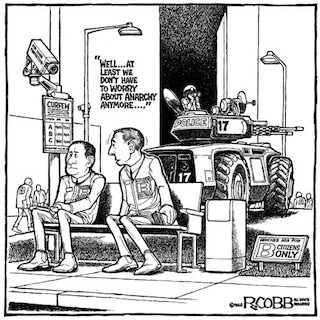
Cartoon by the great Ron Cobb.

One day you will be called upon to break a big law in the name of justice and rationality. Everything will depend on it. You have to be ready. How are you going to prepare for that day when it really matters? You have to stay "in shape" so that when the big day comes you will be ready. What you need is "anarchist calisthenics." Every day or so break some trivial law that makes no sense, even if it’s only jaywalking. Use your own head to judge whether a law is just or reasonable. That way, you'll keep trim; and when the big day comes, you'll be ready.

For the quotation's context, which Godwin's Law aficionados should appreciate, go here.

We have a review of Two Cheers in the works; in the meantime, you can read my review of Seeing Like a State here and Tom Palmer's review of another Scott book here. More Scott cameos in Reason can be found here, here, here, here, and here.


05 Oct 00:10

The NDAA Retroactively "Ass Covers" Some of the More Broadly-Applied Gitmo Detainments Says Lawsuit Plaintiff [Updated/Clarified]

by Lucy Steigerwald

[Note: this piece has been updated with an email clarification from NDAA lawsuit plaintiff Tangerine Bolen. My apologies if I misquoted or misinterpreted anything she said.]*

With 500-some pages of text, the 2012 National Defense Authorization Act (NDAA) covers a lot more than just section 1021(b), but the majority of the debates over the bill involve the very reason the four letters N-D-A-A have become shorthand for fears of government power finally crossing a Rubicon. Whether or not that’s really true, the caginess of the government in respect to who it can indefinitely detain[pdf] is disturbing and demands a clarification that is not being offered. 

Section 1021(b) reads that someone who can be indefinitely detained is:

A person who was a part of or substantially supported al-Qaeda, the Taliban, or associated forces that are engaged in hostilities against the United States or its coalition partners, including any person who has committed a belligerent act or has directly supported such hostilities in aid of such enemy forces.

The government says the controversial bit of the NDAA is nothing new, but seven plaintiffs, including Pentagon Papers leaker Daniel Ellsberg, dissident writer Noam Chomsky, and journalist Chris Hedges, sued in January, arguing that they were under threat. Hedges in particular argued that his First Amendment rights are violated by the NDAA since he has interviewed numerous members of Al-Qaeda and the Taliban, but now fears doing so.

Another plaintiff in Hedges v. Obama is activist Jennifer "Tangerine" Bolen, founder of the pro-whistleblower group RevolutionTruth.org. She worries that her organization's support of WikiLeaks and imprisoned soldier and accused leaker Bradley Manning might also make her or her allies applicable for detainment under the NDAA.

Section 1021(a) of the bill repeats the government's power to go after perpetrators (and those who harbored them, etc.) of the September 11th attacks (put in writing in the joint Authorization for Use of Military Force resolution) but 1021(b) does read an awful lot like it's expanding powers, even if the actual text of the NDAA and Obama administration officials claim it isn't changing anything. (For a good overview of the NDAA up until now, go check out this Young Americans for Liberty blog post.)

Bolen believes part of the subtext to these argument is that the government wants an excuse to go after Julian Assange and Wikileaks."They don't want to go after The New York Times," she says, "They’re willing to cherry-pick who they apply indefinite detention to." But once they can get to Assange, this power will "cascade downward" and then people like Bolen or Hedges could be under threat as well.

The government's initial argument was that the powers granted in provision 1021(b)  were exactly the same as those granted by the AUMF. Yet, argues Bolen, if the AUMF and the NDAA are the same, why is the government so desperate to stop this lawsuit? Why did they appeal less than 24 hours after Judge Katherine Forrest’s permanent block of indefinite detainment on September 13? Why do they claim that block could cause "irreparable harm" to the United States? Well, no harm done for the moment. On Tuesday afternoon, the Second Circuit Court of Appeals ruled, and a three-judge panel stayed Forrest's block until a final decision is reached in December. Until then, or until this hits the Supreme Court, indefinite detainment is back on.

The about the NDAA, says Bolen, is that it's a retroactive "CYA" — cover your ass. "The AUMF powers were so broadly overused for 11 years...this is an attempt [by the Obama administration] to codify powers they never had." The Bush administration's secret prisons and detainment, both at Gitmo and at CIA black sites all over, Bolen says that the AUMF didn't allow any of that, but the NDAA would. NDAA is, says Bolen, an attempt to legalize the past 11 years of the most heated debates of the War on Terror. And Hedges v. Obama is “the latch on Pandora’s box” for proving “this incredibly broad application of the AUMF which was never legal.”

In their Tuesday ruling, the Second Circuit judges wrote [pdf] that it was in "the public interest" to grant the government appeal a stay. Part of their reasoning was that the government finally clarified that the plaintiffs had no reason to fear detainment, meaning that they had no standing to sue in the first place.

When the government initially refused to offer assurances that the plaintiffs could not be detained back in March, this made Judge Forrest more sympathetic to the question of whether the seven individuals indeed had standing to sue. Later, in August, seeing that Forrest was indeed going to block indefinite detainment, the government did try to offer assurances that journalists who were independent were under no threat by offering a clarifying brief. This, according to to Bolen brought up a lot of questions still for the judge. Bolen says Forrest asked, "“Are youtube videos independent? Are you going to form a panel to decide who is independent?" and she was still not satisfied, leading to the Judge's 112-page ruling in which she expressed incredulousness over the government's utter failure to make their case.  [Correction: updated language to reflect better accuracy in the timeline of the case.]

The wording in the government's response brief just does not satisfy any of the plaintiffs and opens up more questions over whether the government may actually be considering keeping an eye on journalists who are not seen as "independent."

Bolen, for her part, thinks that the case will make it to the Supreme Court. But it’s up to her and her fellow-plaintiffs to try to change public opinion to make sure NDAA gets thrown out. As for her opinion on Obama, whose administration is pushing so hard on this, well, it doesn't sound as harsh as you might think. She mentions the near-lies that lead to the Iraq war and says that the government is trained to “out-speak everyone” and that’s what they’re doing again. But “it’s less insidious and less horrific than under Bush. Not to excuse Obama, but he inherited a total nightmare…He can’t suddenly deny himself powers…”

* Bolen's response email to me included these clarifying paragraphs. I have the struck-through quote in my notes, but I am not interested in disputing that, and Bolen has more than made it clear that she opposes Obama on this measure and that he -- in the literal sense -- could have denied himseld the NDAA powers, in spite of roads paved for him by Bush.

Firstly, in reference to the secret prisons, GTMO, etc, I did not say the AUMF did not allow those. What I said was that we believe that the AUMF detention powers were over-broadly applied - subsequently sweeping up innocent people - and definitely people who had nothing to do with 9/11, or are members of Al Qaida or the Taliban - which is the definition of those powers. Those prisons are legal, in fact (perhaps not all of the secret ones - I don't know -.... 

Finally, the quote at the end is not reflective of what I said either. Obama is likely in a position whereby he feels he cannot suddenly deny himself powers on which two administrations have come to rely. He cannot afford a terror attack on his watch, and he is likely convinced he has no choice here. That is quite a bit different than what you quoted me as saying. There is no way I think that Obama can't suddenly deny himself powers - I think he believes that is the case and that he is stuck in a position of political realism that this country does not understand. That does not excuse his willingness to erode civil liberties and undermine human rights just like Bush did - I expected, and expect, him to do better. 


04 Oct 23:58

On Thursday They Were Terrorists; On Friday They Weren't

by Jacob Sullum

As of last Friday, the Mujahedeen-e-Khalq (MEK), a formerly violent Iranian opposition group once allied with Saddam Hussein, no longer appears on the State Department's list of "foreign terrorist organizations" (FTOs). The delisting comes after years of lobbying, assisted by prominent political figures, and legal wrangling, culminating in an appeals court ruling ordering Secretary of State Hillary Clinton to act on the MEK's petition by Monday. Clinton's decision probably means the MEK's supporters, who include former Attorney General Michael Mukasey, former New York Mayor Rudy Giuliani, and former Pennsylvania Gov. Ed Rendell, do not need to worry about being charged with providing "material support" to an FTO by helping the group shed that label. Theoretically, however, they could still be prosecuted if it can be shown that they "coordinated" their advocacy with the MEK prior to Friday.

Over at Popehat, Los Angeles attorney Ken White, a former federal prosecutor, recalls that in 1999 he helped convict a man "for helping terrorists who now aren't terrorists." The defendant helped MEK members "secure legal residence in the United States through various forms of fraud, including fraudulent asylum applications." In addition to immigration fraud, his actions qualified as providing material support to an FTO—possibly the first conviction under that provision, White says. Looking back, he is ambivalent about his role in the case, recognizing the political considerations that determine which groups count as FTOs:

The six people the MEK killed in the 1970s are still dead. They were dead when the State Department designated the MEK as a foreign terrorist organization and they have been dead all the years since and they won't get any less dead when the State Department removes the MEK from its FTO list. The MEK is the organization that once allied with Saddam Hussein; that historical fact hasn't changed, although its political significance has. No — what has changed is the MEK's political power and influence and the attitude of our government towards it.

More generally, White says, the MEK's delisting shows how arbitrary the contours of the War on Terror are:

The scope of the War on Terror — the very identity of the Terror we fight — is a subjective matter in the discretion of the government. The compelling need the government cites to do whatever it wants is itself defined by the government.

The definition of the enemy then determines not only who can be charged with violating the ban on material support but who can be subject to warrantless surveillance, indefinite detention, and summary execution by drone. But don't worry: The Obama administration is providing all the process it believes is due.


01 Oct 21:57

Want to be unhappy? Trying to be happy will do it!

by mdbownds@wisc.edu (Deric Bownds)
I'm finding the "Anxiety" topic in the Opinionator series at the NYTimes to be a real treat. This entry by British expatriate Ruth Whippman brings back memories of a my signing on several years ago to be a talking head neuroscience expert on the  California "Make Me Happy!" Radio Show (I don't think they were all that pleased with their dyspeptic guest!). Whippman notes the American obsession with, and anxiety over, being "happy", and contrasts this with the attitudes of more stoic Britishers:
Happiness in America has become the overachiever's ultimate trophy. A vicious trump card, it outranks professional achievement and social success, family, friendship and even love…this elusive MacGuffin is creating a nation of nervous wrecks. Despite being the richest nation on earth, the United States is, according to the World Health Organization, by a wide margin, also the most anxious, with nearly a third of Americans likely to suffer from an anxiety problem in their lifetime. America's precocious levels of anxiety are not just happening in spite of the great national happiness rat race, but also perhaps, because of it.
The British are generally uncomfortable around the subject, and as a rule, don't subscribe to the happy-ever-after. It's not that we don't want to be happy, it just seems somehow embarrassing to discuss it, and demeaning to chase it, like calling someone moments after a first date to ask them if they like you….Even the recent grand spectacle of the London 2012 Olympic Games told this tale. The opening ceremony, traditionally a sparklefest of perkiness, was, with its suffragist and trade unionists, mainly a celebration of dissent, or put less grandly, complaint…Our queen, despite the repeated presence of a stadium full of her subjects urging in song that she be both happy and glorious, could barely muster a smile, staring grimly through her eyeglasses and clutching her purse on her lap as if she might be mugged.
Cynicism is the British shtick. When happiness does come our way, it is entirely without effort, as unmeritocratic as a hereditary peerage. By contrast, in America, happiness is work. Intense, nail-biting work, slogged out in motivational seminars and therapy sessions, meditation retreats and airport bookstores. For the left there's yoga, for the right, there's Jesus. For no one is there respite…The people taking part in "happiness pursuits," as a rule, don't seem very happy…The happy person would be more likely to be off doing something fun, like sitting in the park drinking.
Happiness should be serendipitous, a by-product of a life well lived, and pursuing it in a vacuum doesn't really work. This is borne out by a series of slightly depressing statistics. The most likely customer of a self-help book is a person who has bought another self-help book in the last 18 months. The General Social Survey, a prominent data-based barometer of American society, shows little change in happiness levels since 1972, when such records began. Every year, with remarkable consistency, around 33 percent of Americans report that they are "very happy." It's a fair chunk, but a figure that remains surprisingly constant, untouched by the uptick in Eastern meditation or evangelical Christianity, by Tony Robbins or Gretchen Rubin or attachment parenting. For all the effort Americans are putting into happiness, they are not getting any happier. It is not surprising, then, that the search itself has become a source of anxiety.
So here's a bumper sticker: despite the glorious weather and spectacular landscape, the people of California are probably less happy and more anxious than the people of Grimsby. So they may as well stop trying so hard.
24 Sep 22:58

Strange-face illusions during inter-subjective gazing.

Conscious Cogn. 2012 Sep 12; Caputo GBIn normal observers, gazing at one's own face in the mirror for a few minutes, at a low illumination level, triggers the perception of strange faces, a new visual illusion that has been named 'strange-face in the mirror'. Individuals see huge distortions of their own faces, but they often see monstrous beings, archetypal faces, faces of relatives and deceased, and animals. In the experiment described here, strange-face illusions were perceived when two individuals, in a dimly lit room, gazed at each other in the face. Inter-subjective gazing compared to mirror-gazing produced a higher number of different strange-faces. Inter-subjective strange-face illusions were always dissociative of the subject's self and supported moderate feeling of their reality, indicating a temporary lost of self-agency. Unconscious synchronization of event-related responses to illusions was found between members in some pairs. Synchrony of illusions may indicate that unconscious response-coordination is caused by the illusion-conjunction of crossed dissociative strange-faces, which are perceived as projections into each other's visual face of reciprocal embodied representations within the pair. Inter-subjective strange-face illusions may be explained by the subject's embodied representations (somaesthetic, kinaesthetic and motor facial pattern) and the other's visual face binding. Unconscious facial mimicry may promote inter-subjective illusion-conjunction, then unconscious joint-action and response-coordination.
23 Sep 14:51

A football game has only 11 minutes of action

by Minnesotastan
From a 2010 article in the WSJ (the numbers might have changed a bit since then):
According to a Wall Street Journal study of four recent broadcasts, and similar estimates by researchers, the average amount of time the ball is in play on the field during an NFL game is about 11 minutes...

So what do the networks do with the other 174 minutes in a typical broadcast? Not surprisingly, commercials take up about an hour. As many as 75 minutes, or about 60% of the total air time, excluding commercials, is spent on shots of players huddling, standing at the line of scrimmage or just generally milling about between snaps. In the four broadcasts The Journal studied, injured players got six more seconds of camera time than celebrating players. While the network announcers showed up on screen for just 30 seconds, shots of the head coaches and referees took up about 7% of the average show...
This is why the only way I watch football nowadays is by using a DVR and speeding through the game (and past the commercials).

Reposted from 2012 to add news of developments in 2017:
"It has been an effort for a long period of time. We've talked about the length of the game," [NFL Commissioner] Goodell said. "This effort's not as focused on the length of the game. This is focused on what's happening outside the plays -- how fast we get the ball set, the number of breaks, the number of intrusions -- so that fans can focus on the action."

With all this talk about making the game faster for fans, what would Goodell consider the ideal length of a broadcast?
"We (were at) 3:07 and change (last season), down about a minute," Goodell said. "We think we could probably get pretty close to five minutes of downtime out of the game, so that would bring you somewhere in the 3:02 range. That would be very successful if we could get to that point. But, again, not just the length. We want to make sure we are taking the right things out of the game -- the things that are not compelling to our fans."
Clueless.  The idea that cutting 5 minutes out of a 3-hour broadcast will satisfy fans' frustrations shows that viewer interests don't even begin to compete with advertiser's interests.
12 Sep 04:08

Thomas Szasz: How and Why the Great Libertarian Psychiatrist Thought What He Did

by Brian Doherty

Jacob Sullum and Jesse Walker have both done great jobs summing up the importance of Szasz; I have always found his own thoughts and expressions the best way to understand him. He was, in my judgement, one of the smartest and most thorough defenders of autonomy and liberty of our time, fighting against both his profession, most of the world, and often his own fellow libertarians, and succeding at a higher level than most (Szasz was actually a public intellectual of mass popularity in the 1960s/early 1970s.)

Herewith, a sampling from some of my own previous writings about Szasz, mostly quoting him.

From a 1999 review essay for Feed magazine:

Szasz says that most so-called mental illnesses are not what the psychiatric profession maintains, and that fact is of great socio-political and ethical importance....

Szasz says the category of "mental illness" turns willed behavior into a disease, taking away both rights and responsibilities from the actor just because his actions strikes a doctor, family member, or judge as inexplicably bizarre and strange. In pragmatic terms, Szasz avers, "incarcerating innocent persons in mental hospitals and freeing guilty persons from prison... continue to be the psychiatrist's two most important social functions." He takes a cui bono? approach, asking what the psychiatric profession gains from the idea of mental illness (prestige, power, money) and what the patient gains (exculpation for bad actions or crime, relief from responsibility). Szasz is politically appalled by the coercion inherent in the modern psychiatric enterprise, and always credits even the most seemingly mad with humanity and intentionality. On the contrary, psychiatrists rarely credit the lunatic with having any sense or rationality behind his actions -- even when it's clear that there is some rational goal in mind. "A berserk lunatic may claim to be Jesus or kill his wife," Szasz writes. "The point of such a person's behavior, I dare say, is to be revered like Jesus or be rid of his wife. (Why a person chooses such ends and means is another question, the answer to which is often easily obtained by asking him.)"

From my 2007 book Radicals for Capitalism:

The innovation—or semantic trick, as Szasz would have it—of classical psychoanalysis was turning faking an illness into an illness in and of itself. The human capacity for deception is central to Szasz’s intellectual program. Human beings lie; and many a so-called insane delusion, such as voices in the head advising one to commit heinous acts, are, Szasz maintained, best understood as lies—often strategic ones....

Szasz...recalls that “I was not about to tell him that the persons he called ‘seriously ill patients’ I regarded as persons deprived of liberty by psychiatrists.”...He later wrote that “psychiatric training is, above all else, a ritualized indoctrination into the theory and practice of psychiatric violence. The disastrous effects of this process on the patients are obvious enough; though less evident, its consequences for the physician are often equally tragic.”

....To Szasz, psychoanalysis proper had nothing to do with medicine. It was conversation, with one person paying the other. “The psychiatrist has only one duty: to keep his mouth shut outside the room and maintain total confidentiality. It has nothing to do with disease. It has to do with human problems."...

Szasz fought for the specific liberty of specific patients:

“When I began to publish on the civil rights of mental patients, some of this hit the papers, The New York Times. I began to get invitations from patients and lawyers—‘I have this client locked up for 10 years and he hasn’t done anything. He’s been in long enough. Can you get him out?’” Szasz began testifying on behalf of imprisoned mental patients—some alternately hilarious and harrowing transcripts from those court cases are in his book Psychiatric Justice (1965)—though he rarely succeeded in winning anyone’s freedom. He’d find himself, he recalled, “in the courtroom in front of some very nice judge who said something like, ‘Szasz, how can you say that he should be out when six of his doctors say he should be in?’ I said, ‘Your honor, those are not his doctors. Those are his adversaries. He wants his freedom. I am the one that he calls his doctor.’”....

Szasz thought he saw the underlying truth of psychiatry others missed, or wanted to miss:

[Szasz] considers his heterodox positions pure common sense, a common sense marred by the power-grabbing pretensions of psychiatrists and the government-psychiatric establishment. Those pretensions have been embraced by a credulous populace all too ready to believe that people should be relieved of both responsibility and liberty whenever it became convenient for either the state or any relative or caretaker troubled by the so-called mentally ill. From the very beginning, Szasz recognized that psychiatry wasn’t really about what it purported to be about.

“What is the thing itself that psychiatrists describe, debate, diagnose, and treat?” Szasz asked. “The psychiatrist says it is mental illness, which, he now quickly adds, is the name of neurochemical lesions of the brain. I say it is conflict and coercion and the rules that regulate the psychiatrist’s power and privileges and the patient’s rights and responsibilities. The former perspective leads to an analysis of psychiatry in terms of illness and treatment, medical theory and therapeutic practice, while [my] perspective leads to an analysis in terms of coercion and contract, the exercise of power and the efforts to limit it, in short, political theory and legal practice.” He believed that psychiatry was more properly conceived as an ethical and political field—the arena of human troubles, communication, and conflict—than as a medical science. Psychiatry was rife with “hidden agendas of domination and submission concealed by a rhetoric of disease and treatment.”....

Szasz was anti-coercive-psychiatry, but not a cliched "anti-psychiatrist."

While defending the rights of mental patients not to be treated or imprisoned against their will, Szasz was dismissive of the “anti-psychiatry” movement and its figurehead R.D. Laing, with whom Szasz was often mistakenly conflated in the late ‘60s and early ‘70s. Szasz had little sympathy with the Laingian view that saw the so-called insane as in fact victims of an insane society—or going through an understandable reaction to that insane society—or visionaries taking a valuable “journey through madness.”

“I insist,” Szasz wrote, “that schizophrenia is no more a journey through madness than it is a disease of the brain. Both of these statements assert literalized metaphors. Of course schizophrenia may be said to be like a journey or like a disease; but it is also like many other conditions or situations; for example, being childish, aimless, useless, and homeless, or being angry, obstreperous, conceited, or selfish.”

Laingian assessments of the so-called insane, then, were in most cases higher than Szasz’s, who is above all a moralist, and not a groovy admirer of alternative lifestyles. (A student skit at his university joked about the “Szasz Diagnostic Manual” which had two categories: “crook” and “bum.”) The antipsychiatrists, to Szasz, were just as paternalistic and anti-individualist as their opponents, merely in the opposite direction...

Szasz is perplexed that any part of the psychiatric industry sees him as anything other than a bitter enemy. He speculates that those of his colleagues who accept him as a friendly and welcome addition to the scholarly debate “just don’t give serious enough thought to this to either agree or dismiss it and dismiss me as completely wrong. They just write me off as ‘interesting.’"

Szasz had unique things to say to libertarians:

He has analogized a sane human life to a statue carved out of marble. Although we may all metaphorically have a chunk of marble at birth, we don’t all automatically have the statue, as standard mental health professionals seem to think we ought; nor does the lack of a statue mean a repressive culture has smashed ours. It means we haven’t done the work to sculpt it. Szasz is the libertarian movement’s most stoic exponent, hoping for a fully free and responsible culture but painfully mindful that it may be impossible—for reasons that don’t necessarily have to do with the outward tyranny of the state.

Szasz was also very personally gracious to this young reporter and fan, giving me time and attention above the call of duty when we interacted professionally. He was a model public intellectual and a decent and brave man.


09 Sep 08:25

General Covariance in Homotopy Type Theory

by urs
Nosimpler

OK, so how far do you really have to go? all this oo-whatever theory just makes me think of the n-path algebra on any given graph. so wth?

In physics, the term general covariance is meant to indicate the property of a physical system or model (in theoretical physics) whose configurations, action functional and equations of motion are all equivariant under the action of the diffeomorphism group on the smooth manifold underlying the spacetime or the worldvolume of the system. The archetypical example of a generally covariant system is of course Einstein-gravity / “general relativity”. I indicate here how general covariance has a natural formalization in homotopy type theory, hence internal to any ∞-topos. For background and all details see at general covariance on the nLab, and the links given there. Of course a basic idea of traditional dependent type theory is that types A may appear in context of other types Γ. The traditional interpretation of such a dependent type x:Γ⊢A(x):Type is that of a Γ-parameterized family or bundle of types, whose fiber over x∈Γ is A(x). But in homotopy type theory, types are homotopy types, of course, and, hence so are the contexts. A type in context is now in general something more refined than just a family of types. It is really a family of types equipped with equivariance structure with respect to the homotopy groups of the context type. Specifically, if the context type is connected and pointed, then it is equivalent to the delooping Γ≃BG of an ∞-group G. One finds (this is discussed here) – that the context defined by the type BG is that of G-equivariance: every type in the context is a type in the original context, but now equipped with a G-∞-action. In a precise sense, the homotopy type theory of G-∞-actions is equivalent to plain homotopy type theory in context BG. Consider this for the case that G is an automorphism ∞-group of a type Σ which is regarded as representing spacetime or a worldvolume. We show that in this context the rules of homotopy type theory automatically induce the principle of general covariance and naturally produce configurations spaces of generally covariant field theories: for Fields a moduli object for the given fields, so that a field configuration is a function ϕ:Σ→Fields, the configuration space of covariant fields is the function type (Σ→Fields) but formed in the “general covariance context” BAut(Σ). When interpreted in smooth models, Conf is the smooth groupoid of field configurations and diffeomorphism gauge transformations acting on them, the Lie integration of the BRST complex whose degree-1 elements are accordingly called the diffeomorphism ghosts. More precisely, I show the following (and thanks again to Mike, for discussion of this here). Definition. Consider in homotopy type theory two types ⊢Σ,Fields:Type, to be called spacetime and field moduli. Let ⊢BAut(Σ):Type be the image of the name of Σ, with essentially unique term ⊢Σ:BAut(Σ). Perform the canonical context extension of Σ and trivial context extension of Fields to get types in context Σ:BAut(Σ)⊢Σ:Type and Σ:BAut(Σ)⊢Fields:Type. Form then the type of field moduli “Conf≔(Σ→Fields)” in this context: Conf≔Σ:BAut(Σ)⊢(Σ→Fields):Type. Proposition. The categorical semantics of Conf in the model of smooth cohesion, and for Σ a smooth manifold, is given by the diffeological groupoid Conf=[Σ,Fields]⫽Diff(Σ) whose objects are field configurations on Σ and whose morphisms are diffeomorphism gauge transformations between them. In particular the corresponding Lie algebroid is dual to the (off-shell) BRST complex of fields with diffeomorphism ghosts in degree 1.
05 Sep 03:50

http://picturesofmath.blogspot.com/2012/02/this-fractal-consists-in-combination.html

by noreply@blogger.com (sylvier)
04 Sep 21:22

Should we learn from the Masters or from the Pupils?

by GASARCH
The following is a paraphrase of a comment at the end of the Suggested Readings section of Spivak's calculus book:

Abel remarked that he attributed his profound knowledge of mathematics to the fact that he read the masters, rather than the pupils.

Are you better off reading the Masters or the pupils?  This of course depends on the masters and the pupil and other factors.

  1. I have heard that Godel's original papers (even when translated) are well written and show a profound understanding of the subject and why its important.
  2. However, we now have a better understanding of what Godel did and better ways to express it.
  3. The Masters may include the motivation which may be lost in later papers.
  4. Often the first proof of anything is ugly or odd and later proofs really clean it up.
  5. Often the first proof of anything uses only basic concept- later abstractions may hide the heart of the proof.
  6. As a practical matter sometimes the early papers are not available (thanks to paywalls or obscurity) or in a language you do not read.
  7. If Lance and I ever do a book-of-blog-posts I will clean up some of the spelling, make some of the arguments more clear (perhaps indicate where I am being sarcastic in cases where it was not understood), improve the writing. This will make it better than the blog but less authentic.

Here are examples where the Masters papers may not be worth reading:

  1. Recursion theory in the early 1960's had several infinite injury arguments. I have heard that they were known to work only because the lemmas and proofs worked out.  Only after Bob Soare's excellent article on the topic were they really understood. For 0''' priority arguments it is also true that the early papers are not the ones to read.
  2. Example (and the real motivation for this post). I have tried to read Ramsey's original article. I knew that his goal was a problem in logic, and I wanted to know what that problem was. I had a hard time reading the paper.  (I did  my own writeup.) Why was his version so hard to read?  (1) He never uses the words coloring or graph or hypergraph. He doesn't mention that if you have six people at a party either three of them know each other or three of them don't know each other. Perhaps he didn't go to many parties.  (2) He uses odd terms at time.  (3) His paper is rather abstract. If he had just proven a simple case then it would be obvious how to proceed to his abstract case.  This is true for both his combinatorial theorem--- he only proves (what we would call) the hypergraph version, and also the Logic theorem.
  3. The Cliff notes for Atlas Shrugged are far better than the book. Shorter too.  They are online for free here which makes sense since Ayn Rand was known for her altruism.

SO- what do you think? Examples of cases where the Master is better to read?
Examples of cases where the Pupil (or more generally later summaries, surveys, expositions) is better to read?
04 Sep 18:38

This week marked Caligula's 2000th birthday

by Minnesotastan
It’s the day before the Kalends of September and you know what that means: it’s the birthday of Gaius Julius Caesar Augustus Germanicus, aka the emperor Caligula... His father dressed little Gaius in a miniature army outfit, including child-sized versions of caligae, the hobnailed sandal boots worn by common soldiers. That’s how he got his nickname, Caligula, meaning little caliga
His ascent to power was fueled by cutting taxes, which unfortunately led to the bankrupting of the country, to which he responded by starting a brothel staffed by the senators' wives and daughters.

More details at The History Blog.  Photo credit Munich Archaeological Museum.
04 Sep 18:37

"The Overview Effect" and the interconnectedness of all humans

by Minnesotastan
In February, 1971, Apollo 14 astronaut Edgar Mitchell experienced the little understood phenomenon sometimes called the “Overview Effect”. He describes being completely engulfed by a profound sense of universal connectedness. Without warning, he says, a feeing of bliss, timelessness, and connectedness began to overwhelm him. He describes becoming instantly and profoundly aware that each of his constituent atoms were connected to the fragile planet he saw in the window and to every other atom in the Universe. He described experiencing an intense awareness that Earth, with its humans, other animal species, and systems were all one synergistic whole. He says the feeling that rushed over him was a sense of interconnected euphoria. He was not the first—nor the last—to experience this strange “cosmic connection”...

Their experiences, along with dozens of other similar experiences described by other astronauts, intrigue scientists who study the brain. This “Overview Effect”, or acute awareness of all matter as synergistically connected, sounds somewhat similar to certain religious experiences described by Buddhist monks, for example. Where does it come from and why? ...

Mitchell believes that perhaps both the theologians and scientists have missed the mark.
“All I can suggest to the mystic and the theologian is that our gods have been too small; they fill the universe. And to the scientist all I can say is that the gods do exist; they are the eternal, connected, and aware Self experienced by all intelligent beings."
Text from The Daily Galaxy.  Photo: The Sombrero Galaxy (M104), from The HubbleSite, via Conservation Report.

Reposted from 2012 because the concept is important.  I'll add this related scene from Midnight Mass where the character Erin channels Carl Sagan in her death scene -

31 Aug 19:19

Intravaginal sponges to synchronize estrus decrease sexual attractiveness in ewes.

Nosimpler

hahaha i don't know why i think it's so funny that people study this stuff, but i do.

Theriogenology. 2012 Aug 25; Gatti M, Ungerfeld RVaginal secretions are an important source of chemical signals, which affect ewes' attractiveness. Moreover, alterations of vaginal flora reduce sexual attractiveness of estrous ewes. As intravaginal sponges containing progestagens (widely used for estrous synchronization) affect vaginal flora, our aims were to determine if estrous ewes pretreated with intravaginal sponges were less attractive than ewes displaying spontaneous estrus, and if the addition of antibiotic to the sponge mitigated the decreased sexual attractiveness. Seventy-two estrous ewes were used in experiment 1: in 36, estrus was synchronized with commercial intravaginal sponges (50 mg medroxyprogesterone acetate for 14 days, group MAP1), whereas the other 36 were given a PGF2α analogue 19 to 20 days earlier and displayed spontaneous estrus (group C1). In experiment 2, 72 ewes were treated with intravaginal sponges for 14 days; for 36 ewes, the sponges contained 0.02 mg oxytetracycline (group Ox), whereas there was no antibiotic in the sponges for the remaining 36 ewes (group MAP2). In both experiments, sexual attractiveness was determined in 12 groups of six estrous ewes (three MAP1 vs. three C1, and three MAP2 vs. three Ox for Experiments 1 and 2, respectively) located in a 4 × 4 m pen. Courting and mating time that each ram spent with each ewe was recorded. After 5 min, the ewe with which the ram spent more time (most attractive ewe, ranked one, scale one to six) was taken out from the pen. The procedure was repeated until the ram ranked all six ewes, and repeated in the 12 groups in both experiments. In experiment 1, C1 ewes were more attractive than MAP1 ewes (ranks: 2.9 ± 0.3 vs. 4.1 ± 0.3, mean ± SEM, respectively; P
28 Aug 21:25

The country is going to hell, whaddya gonna do.

by Cathy O'Neil, mathbabe
Nosimpler

"The latest innovation is the photo finish election, where each party buys 50% of the vote, and the result is pulled out of statistical noise, like a rabbit out of a hat."

Yesterday I finished reading Chris Hayes’s book “Twilight of the Elites,” and although I enjoyed it, I have to say it was more about the elites than about their twilight.

He focused on the enormous distance between people in society, how the myth of meritocracy is widening that gap (with healthy references to Karen Ho’s book Liquidated, which I blogged about here), and how, as the entrenched elite get more and more entrenched, they get less and less competent.

But Hayes didn’t really paint a picture of how things would end, although he mentioned the Tea Party and Occupy as possible important sources of resistance, not unlike Barofsky’s recent book Bailout (which I blogged about here), in which Barofsky appealed to the righteous anger of the people to whom government is no longer accountable.

Well, I guess Hayes did add one wrinkle which surprised me. He said it would be the upper middle class, educated class that actually foments the coming revolution. Oh, and the bloggers (because the mainstream media is so captured they’re useless). So me and my friends.

His argument is that we are the ones sufficiently educated and sufficiently insiderish that we will be at the window, with our faces pressed against the glass, looking in at the true insider elites, and seeing how stupid and incompetent those guys are, and how they are rigging the system against the rest of us, and we’ll eventually explode with disgust and righteous anger and that will signal the end.

Kind of feels like that’s already happened, but maybe I’m being impatient.

Two things I really enjoyed about his book:

First, the fact that practically everyone thinks they’re an underdog and has fought tooth and nail to succeed in this world. Absolutely true, including the guys I worked with in finance. I think the phrase he used is “people born on third base think they hit a triple”.

Second, he does a really good job describing the never-can-be-too-rich culture of our country; his example of going to Davos is an excellent one and brings that concept to life perfectly.

It’s enough to get you kind of depressed overall, though. If we are to believe this book’s thesis, our entrenched elite and dysfunctional political structure and economic system are doomed to fail at some future moment, and the best we can hope for is a moment where the hypocrisy collapses in on itself. What is there to look forward to exactly?

I asked that of a friend of mine, and how it was getting me down. His advice to me was to own it more. To make the coming apocalypse an event, kind of like the 4th of July or a vacation, that you plan for and enjoy thinking about.

He said plenty of people do this, it’s in fact a huge industry of doom and gloom. The country is going to hell, whaddya gonna do, he said, might as well have some fun with it.

What? Who are these doom and gloom people? Start here, where Dmitry Orlov compares the preparedness of the US to the former USSR for the coming inevitable apocalypse. He calls this the “Collapse Gap”.

It’s got some great points (although he can’t both say that lawlessness ensues and people take what they want, and also say that people behind in their mortgages will be homeless) and it’s really funny as well, in a completely cynical, Russian way of course. My favorite lines:

One area in which I cannot discern any Collapse Gap is national politics. The ideologies may be different, but the blind adherence to them couldn’t be more similar.

It is certainly more fun to watch two Capitalist parties go at each other than just having the one Communist party to vote for. The things they fight over in public are generally symbolic little tokens of social policy, chosen for ease of public posturing. The Communist party offered just one bitter pill. The two Capitalist parties offer a choice of two placebos. The latest innovation is the photo finish election, where each party buys 50% of the vote, and the result is pulled out of statistical noise, like a rabbit out of a hat.


25 Aug 02:20

Group entropies, correlation laws, and zeta functions.

Nosimpler

Google was holding out on me! This was from 2011?

Phys Rev E Stat Nonlin Soft Matter Phys. 2011 Aug; 84(2 Pt 1): 021121
Tempesta P

The notion of group entropy is proposed. It enables the unification and generaliztion of many different definitions of entropy known in the literature, such as those of Boltzmann-Gibbs, Tsallis, Abe, and Kaniadakis. Other entropic functionals are introduced, related to nontrivial correlation laws characterizing universality classes of systems out of equilibrium when the dynamics is weakly chaotic. The associated thermostatistics are discussed. The mathematical structure underlying our construction is that of formal group theory, which provides the general structure of the correlations among particles and dictates the associated entropic functionals. As an example of application, the role of group entropies in information theory is illustrated and generalizations of the Kullback-Leibler divergence are proposed. A new connection between statistical mechanics and zeta functions is established. In particular, Tsallis entropy is related to the classical Riemann zeta function.