Shared posts

28 Aug 00:59

Probabilistic brains: knowns and unknowns

by Alexandre Pouget
Nosimpler

probabilistic brains unknowns +/- words

Nature Neuroscience 16, 1170 (2013). doi:10.1038/nn.3495

Authors: Alexandre Pouget, Jeffrey M Beck, Wei Ji Ma & Peter E Latham

28 Aug 00:55

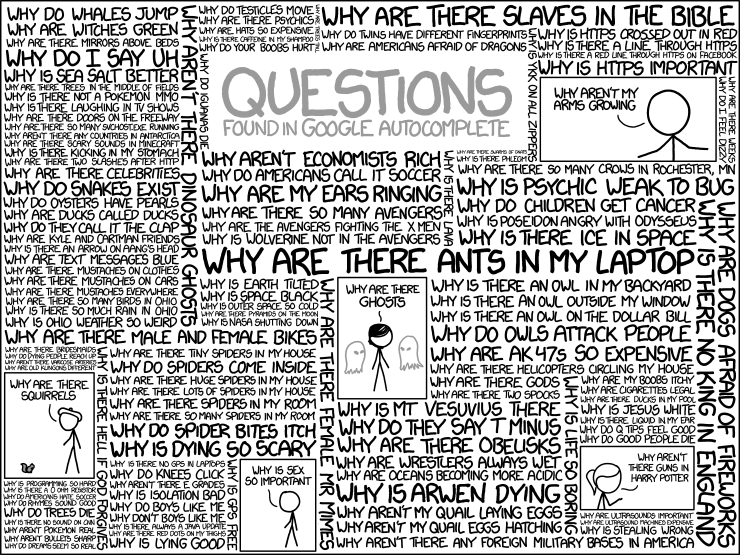
Questions

Nosimpler

why are poorly punctuated questions funny

To whoever typed 'why is arwen dying': GOOD. FUCKING. QUESTION.
27 Aug 23:44

Fish can communicate using electricity

by Minnesotastan
Matthew E. Arnegard, Derrick J. Zwickl, Ying Lu, and Harold H. Zakon
Closely related electric fish species from the Okano River of Gabon, collected in the vicinity of the abandoned Fang village, “Na.” Each species is shown along with a recording of its electric organ discharge, which these fish use to communicate with one another and electro-locate prey, much like bats use echolocation. Electric fish recognize other members of their own species using the species-specific waveforms of these heartbeat-like discharges. NIH funding from the National Institute of General Medical Sciences... 
From FASEB (abbreviated, and boldface mine).  I suppose as a basic principle, there's no difference between communicating using electical waveforms vs. communicating using auditory or visual waveforms, but the idea still staggers my mind.  Fascinating.  I wonder if there is other information they can share, besides just "I am here."
27 Aug 23:39

The "Experts" Who Want a War With Syria

by Jesse Walker

On a purely voluntary basis, of course.Matt Welch mentioned this earlier today, but it deserves extra attention and extra scorn: a "big group of foreign policy experts" -- that's what The Weekly Standard calls them, "foreign policy experts" -- urging "the United States and other willing nations" to "consider direct military strikes against the pillars of the Assad regime." The roster of "experts" is a sight to behold: Gary Bauer! Martin Peretz! Karl Rove! L. Paul Bremer!

I haven't written a lot about the possibly pending American intervention in Syria, because Jesus fucking Christ do people seriously want a war in Syria? To argue convincingly against an idea I need some capacity for understanding the other side of the argument, and at the moment my willingness to put myself in these jokers' shoes is pretty limited. Sorry. Dear experts: If you want to hear the most compelling case against your latest crusade, lock yourself in a room, strap yourself to a chair, and watch a rerun of the last 10 years. Maybe you'll learn something.

27 Aug 01:55

Words for epeolatrists

by Minnesotastan
A selection of adjectives, from Laurence Urdang’s Modifiers (1982):
abbatial, of an abbot
buccinal, of trumpets
compital, of a crossroads
contabescent, of atrophy
frumentaceous, of wheat
haruspical, of a soothsayer
macropodine, of kangaroos
obumbrant, of an overhang
orarian, of the seashore
pavonine, of peacocks
smaragdine, of emeralds
sphingine, of a sphinx
suspirious, of a sigh
trochilidine, of hummingbirds
veliferous, of sails
There are several more in the Futility Closet.
"Epeolatry literally means the worship of words. It derives from ἔπος épos, which unlike λόγος lógos more specifically means word in Greek, and was apparently coined in 1860 by Oliver Wendell Holmes, Sr."
22 Aug 20:45

Non-existence of Taylor expansion in time due to cusps. (arXiv:1308.4445v2 [physics.atom-ph] UPDATED)

by Zeng-hui Yang, Kieron Burke

In the usual treatment of electronic structure, all matter has cusps in the electronic density at nuclei. Cusps can produce non-analytic behavior in time, even in response to perturbations that are time-analytic. We analyze these non-analyticities in a simple case from many perspectives. We describe a method, the s-expansion, that can be used in several such cases, and illustrate it with a variety of examples. These include both the sudden appearance of electric fields and disappearance of nuclei, in both one and three dimensions. When successful, the s-expansion yields the dominant short-time behavior, no matter how strong the external electric field, but agrees with linear response theory in the weak limit. We discuss the relevance of these results to time-dependent density functional theory.

22 Aug 19:25

Linear Operators Done Right

by leinster
Nosimpler

Awesome.

MathML-enabled post (click for more details).

A conversation prompted by Simon’s last post reminded me of an analogy that’s too excellent to be buried in a comments thread. It must be very well-known, but I’ll go ahead and describe it anyway.

The analogy is between complex numbers and linear operators on an inner product space. Its best feature is that it makes important properties of complex numbers correspond to important properties of operators:
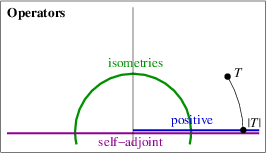
Diagram showing the analogy

The title of this post refers to Sheldon Axler’s beautiful book Linear Algebra Done Right, which I’ve written about before. Most of what I’ll say can be found in Chapter 7. It’s one of those texts that feels like a piece of category theory even though it’s not actually about categories.

MathML-enabled post (click for more details).

Today, all vector spaces are over ℂ and finite-dimensional. Most (all?) of what I’ll say can be done in more sophisticated functional-analytic settings, but I’ll stick to this most basic of situations.

Fix a vector space X equipped with an inner product. By an operator on X, I mean a linear map X→X.

Here’s how the analogy goes.

Complex numbers are like operators  This is the basis of everything that follows.

There’s not much substance to this statement yet. For now, let’s just observe that both the complex numbers and the operators on X form rings. I’ll write End(X) for the ring of operators on X, following the usual categorical custom. (“End” stands for “endomorphisms”.)

The two rings ℂ and End(X) don’t seem very similar. Unlike ℂ, the ring End(X) isn’t commutative and usually has nontrivial zero-divisors. (Indeed, as long as dim(X)≥2, there is some T∈End(X) with T≠0 but T2=0.) Perhaps surprisingly, these differences don’t prevent the development of this useful analogy.

In some loose sense, we can pass back and forth between ℂ and End(X). In one direction, starting with a complex number λ, we get the operator x↦λx. In elementary texts, this operator is often written as λI, but I’ll almost always write it as just λ.

In the opposite direction, starting with an operator on X, we get not just a single complex number but a collection of them — namely, its eigenvalues.

Complex conjugates are like adjoints  Every complex number z has a complex conjugate z*. Taking complex conjugates defines a self-inverse automorphism of the ring ℂ.

Every linear map T:X→Y of inner product spaces has an adjoint T*:Y→X, characterized by the equation ⟨Tx,y⟩=⟨x,T*y⟩. In particular, every operator T on X has an adjoint T*, also an operator on X.

It’s almost true that taking adjoints defines a self-inverse automorphism of End(X). The only obstruction is that taking adjoints reverses the order of composition: (TS)*=S*T*. So actually, taking adjoints defines a pair of mutually inverse ring isomorphisms

End(X)op←⟶End(X)

where End(X)op is the ring End(X) with its order of multiplication reversed.

What about those back-and-forth passages between complex numbers and operators?

First, start with a complex number λ; then the adjoint of the operator λI is λ*I. That is, (λI)*=λ*I. This is why I’m writing z* for the complex conjugate of z, rather than the more common z¯.

Second, start with an operator T. Then the eigenvalues of T* are exactly the conjugates of the eigenvalues of T. Why? Because taking the adjoint defines an isomorphism of rings, so T−λ is invertible iff (T−λ)*=T*−λ* is.

Real numbers are like self-adjoint operators  A complex number z is real if and only if z=z*. By definition, an operator T is self-adjoint if and only if T=T*.

Again, let’s look at the passages back and forth between ℂ and End(X). First, let λ∈ℂ. As long as X is nontrivial, the operator λ is self-adjoint iff λ is real.

Second, if T is a self-adjoint operator then all its eigenvalues are real. The converse isn’t true: an operator can have all real eigenvalues without being self-adjoint. We’ll come back to that.

Any even half-serious endeavour involving self-adjoint operators makes use of the theorem that classifies them, the spectral theorem. Loosely put, this states that every self-adjoint operator is an orthogonal sum of self-adjoint operators of the most simple kind: scalar multiplication by a real number.

Precisely: given any self-adjoint operator T, there is a unique orthogonal decomposition X=⨁λ∈ℝXλ such that for each λ, the restriction of T to Xλ is multiplication by λ. Of course, all but finitely many of these subspaces Xλ are trivial, the nontrivial ones are those for which λ is an eigenvalue, and Xλ is the eigenspace ker(T−λ).

Nonnegative real numbers are like positive operators  For a complex number z, the following are equivalent:

  • (1) z is nonnegative, i.e. real and ≥0
  • (2) z=w*w for some complex w
  • (3) z=w*w (=w2) for some real w
  • (4) z=w*w (=w2) for some nonnegative w
  • (5) z=w*w (=w2) for a unique nonnegative w.

I’ll follow custom and say that an operator T is positive if it is self-adjoint and each eigenvalue is ≥0. (Other names are “positive semidefinite” and “nonnegative definite”. As we were recently discussing, the terminology around positive/nonnegative is a bit of a mess.) Note that by definition, “positive” includes “self-adjoint”. This is just like the convention that when we call a complex number “nonnegative”, we tacitly include the condition “real”.

For an operator T on X, the following are equivalent:

  • (1) T is positive, i.e. self-adjoint and each eigenvalue is ≥0
  • (1.5) T is self-adjoint and ⟨Tx,x⟩≥0 for all x∈X
  • (2) T=S*S for some inner product space Y and linear map S:X→Y
  • (2.5) T=S*S for some operator S on X
  • (3) T=S*S (=S2) for some self-adjoint operator S
  • (4) T=S*S (=S2) for some positive operator S
  • (5) T=S*S (=S2) for a unique positive operator S.

The implications 5⇒4⇒⋯⇒1 are all either trivial or easy. The remaining implication, 1⇒5, follows from the spectral theorem, using 1⇒5 of the result on nonnegativity of numbers.

In particular, given λ∈ℂ, the operator λ is positive iff the number λ is nonnegative (assuming that X is nontrivial). And given an operator T, if T is positive then each eigenvalue of T is nonnegative (but not conversely).

The modulus of a complex number is like… the modulus of an operator? What is the modulus of a complex number? Let’s answer this carefully, using the theorem above on nonnegativity of complex numbers. Let z∈ℂ. By the theorem, z*z is nonnegative, so by the theorem again, there is a unique nonnegative m such that z*z=m*m (=m2). This m is, of course, ∣z∣, the modulus of z.

What is the analogue for operators? Let’s use the theorem above on positivity of operators. Let T∈End(X). By the theorem, T*T is positive, so by the theorem again, there is a unique positive M such that T*T=M*M (=M2). I’ll call M the modulus of T and write it as ∣T∣. I don’t know whether the term “modulus” is standard here, and I’m pretty sure the notation ∣T∣ isn’t — it’s risky, given the potential for confusion with a norm. But I’ll use it anyway, to emphasize the analogy.

Complex numbers of unit modulus are like isometries  A complex number z has unit modulus if and only if z*z=1, if and only if zz*=1. An operator T is an isometry if and only if T*T=1, if and only if TT*=1 (if and only if T preserves inner products, if and only if T preserves distances). Isometries are more often called unitary operators, but I find the term “isometry” more vivid.

Now that we have a definition of “modulus” for operators, we can ask: which operators are literally “of unit modulus”? In other words, which operators T satisfy ∣T∣=1? Here 1 is the identity operator. Certainly 1 is positive, so ∣T∣=1 if and only if T*T=1*1, if and only if T is an isometry. So the different parts of the analogy hang together nicely.

Once again, let’s go back and forth between complex numbers and operators. Given λ∈ℂ, the operator λ is an isometry iff the number λ is of unit modulus (again, assuming that X is nontrivial). Given an operator T, if T is an isometry then all its eigenvalues are of unit modulus. Again, the converse is false, and again, we’ll come back to that.

Polar decomposition of complex numbers and operators Any complex number z can be expressed as a product

z=up

where u is of unit modulus and p is nonnegative. Moreover, this p is uniquely determined as ∣z∣, and if z≠0 then u is uniquely determined by z too. (If z=0 then many choices of u are possible.)

Similarly, it’s a theorem that any operator T can be expressed as a composite

T=UP

where U is an isometry and P is positive. Moreover, this P is uniquely determined as ∣T∣, and if T is invertible then U is uniquely determined by T too. (If T is not invertible then many choices of U are possible.)

In the case where T is just multiplication by a scalar z, the second theorem (polar decomposition of operators) reduces to the first (polar decomposition of complex numbers).

If you prefer, you can decompose an operator in the other order too: an isometry followed by a positive operator. To see this, decompose T* as UP; then T=P*U*=PU*. But U* is an isometry, since the adjoint of an isometry is again an isometry — just as the conjugate of a complex number of unit modulus is again of unit modulus.

And that’s the analogy.

Normal operators, and the fraying of the analogy

Like all analogies, this one eventually frays. Right at the start, we noted a big difference between complex numbers and operators: multiplying complex numbers is commutative, but composing operators isn’t. And another one: there are no nonzero nilpotent complex numbers, but there are nonzero nilpotent operators.

I’ll explain the trouble this causes by talking about operators T that satisfy the equation T*T=TT*. In a fit of no inspiration, someone once called such operators normal, and the name stuck.

Now, all complex numbers z are “normal”, in the sense that z*z=zz*, but not all operators T are normal — for example, any nonzero nilpotent is “abnormal”. So this is a wrinkle in the analogy. You might conclude from this that the correct analogue for the complex numbers is not the set of all operators, but just the normal ones. This idea has in its favour that all self-adjoint operators and isometries (“real numbers” and “numbers of unit modulus”) are normal — because an operator commutes with both itself and its inverse.

However, the normal operators don’t form a ring, at least, not under the usual operations. The class of normal operators is closed under taking polynomials in one variable, but not under composition. Indeed, the polar decomposition theorem implies that by composing two normal operators, we can obtain any operator we like.

The normal operators are nevertheless a useful class, giving further depth to the analogy. I clearly remember the first time I saw the definition of normal operator: I was overwhelmed by the feeling that it was an awful hack. “Someone,” I thought to myself, “simply wants a definition that includes both self-adjoint operators and isometries, and they’ve written down the first thing that came into their head.” Oh young, foolish self; I was wrong. Here’s why:

Normal operators are exactly the right context for the spectral theorem.

Recall that for an operator T, the spectral theorem says that X is the orthogonal sum of the eigenspaces of T. This statement isn’t true for all operators. Earlier on, I stated that it was true for all self-adjoint operators, and that in that case, all the eigenvalues are real. But there are certainly non-self-adjoint operators such that X is the orthogonal sum of the eigenspaces — multiplication by any non-real scalar is an example.

So which operators is the spectral theorem true for? Exactly the normal ones. In other words:

Spectral theorem  Let T be an operator on X. Then X is the orthogonal sum of the eigenspaces of T if and only if T is normal.

This says that multiplication by a scalar is a normal operator, that the class of normal operators is closed under orthogonal sums, and that combining these two constructions generates all possible normal operators. ‘Only if’ is easy; it’s ‘if’ that takes work. You can find a proof in Linear Algebra Done Right.

We can read off two corollaries, both supporting the claim that “complex numbers are like normal operators” is a better analogy than “complex numbers are like operators”.

Corollary  Let T be a normal operator. Then (i) T is self-adjoint if and only if all eigenvalues of T are real, and (ii) T is an isometry if and only if all eigenvalues of T are of unit modulus.

We saw earlier that without the normality, the “only if” parts are true but the “if” parts fail.

Fundamental theorem of algebra for normal operators  Let p be a nonconstant polynomial over ℂ, and let T be a normal operator. Then there exists a normal operator S such that p(S)=T.

For both proofs, all we have to do is observe that the class of operators T for which the result holds contains all operators of the form “multiply by a scalar” and is closed under orthogonal sums. That’s all there is to it!

21 Aug 20:04

Smashing up computers won't stop spying investigation

Nosimpler

It's because they're thugs, and breaking stuff sends a message. That simple.

Seizing and destroying hard drives is an odd response to investigations into government snooping


20 Aug 21:02

Silk Road Proprietor Says Libertarian Mission is Most Important Part of the Online Black Market

by J.D. Tuccille

Reason 24/7Like the literary pirate captain from whom he borrowed his name, Silk Road proprietor Dread Pirate Roberts is the successor to the actual founder of a criminal enterprise — although, in the real world case, it's the victimless activity of peddling forbidden intoxicants and other illicit goods to willing buyers. As fascinating as the encrypted and anonymous online black market is, though, it's made even more intriguing by the Dread Pirate Roberts's libertarian philosophical musings. 

From Andy Greenberg at Forbes:

Roberts also has a political agenda: He sees himself not just as an enabler of street-corner pushers but also as a radical libertarian revolutionary carving out an anarchic digital space beyond the reach of the taxation and regulatory powers of the state–Julian Assange with a hypodermic needle. “We can’t stay silent forever. We have an important message, and the time is ripe for the world to hear it,” says Roberts. “What we’re doing isn’t about scoring drugs or ‘sticking it to the man.’ It’s about standing up for our rights as human beings and refusing to submit when we’ve done no wrong.”

“Silk Road is a vehicle for that message,” he writes to me from somewhere in the Internet’s encrypted void. “All else is secondary.” ...

“We’re talking about the potential for a monumental shift in the power structure of the world,” Roberts writes. “The people now can control the flow and distribution of information and the flow of money. Sector by sector the State is being cut out of the equation and power is being returned to the individual.”

Roberts's ideas are pretty specific. Greenberg writes that "he’s even hosted a Dread Pirate Roberts Book Club where he moderated discussions on authors from the Austrian school of free market economics."

You don't need ideology to participate in a successful underground business, however, and intriguing ideas won't make such a venture fly. An earlier interview by Vice with some of the dealers who sell through Silk Road found that they were "really nice guys" who were very concerned about customer service (Silk Road has seller ratings and holds payments in escrow until goods are delivered).

The technology on which Silk Road and Roberts rely — Tor and Bitcoin — are nominally neutral, but inherently political, since they allow for free and anonymous transactions with or without the consent of the state. That certainly explains why so many government officials are openly hostile to both encryption and digital currencies. And, then again, the control-driven antagonism to such technologies is exactly what drives their development

Says Roberts in the extended interview:

At its core, Silk Road is a way to get around regulation from the state. If they say we can’t buy and sell certain things, we’ll do it anyway and suffer no abuse from them. But the state tries to control nearly every aspect of our lives, not just drug use. Anywhere they do that, there is an opportunity to live your life as you see fit despite their efforts.

Next up, suggests Roberts, is a renewed effort to sell firearms and ammunition online, to escape tightened controls around the world. Also, the site is looking at basic consumer electronics, since high tariffs have created an opening for black market operators.

As Reason's Matthew Feeney noted, Silk Road's success has spawned competition, most notably the recent startup, Atlantis.

Follow this story and more at Reason 24/7.

Spice up your blog or Website with Reason 24/7 news and Reason articles. You can get the widgets here. If you have a story that would be of interest to Reason's readers please let us know by emailing the 24/7 crew at 24_7@reason.com, or tweet us stories at @reason247.

19 Aug 13:59

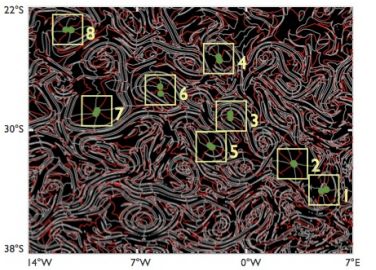
Black Hole Analogue Discovered in South Atlantic Ocean

Vortices in the South Atlantic are mathematically equivalent to black holes, say physicists, an idea that could lead to new ways of understanding how currents transport oil and garbage across oceans

19 Aug 13:49

Offered without comment

by Minnesotastan

Breast implant explosives could be used in terrorist attack

Heathrow Airport staff have been warned that women could conceal dangerous explosives in their breasts. 

Headlines from a story at The Telegraph.

19 Aug 13:38

Pissing off the Government Via Investigative Journalism Can Be Bad for Your Loved Ones: Glenn Greenwald's Partner Detained, Possessions Stolen Under UK Terrorism Act [UPDATED]

by Brian Doherty

Via the Guardian, for whom Glenn Greenwald has done much reporting, including a lot of the best stuff on Edward Snowden's NSA revelations:

The partner of the Guardian journalist who has written a series of stories revealing mass surveillance programmes by the US National SecurityAgency was held for almost nine hours on Sunday by UK authorities as he passed through London's Heathrow airport on his way home to Rio de Janeiro.

David Miranda, who lives with Glenn Greenwald, was returning from a trip to Berlin when he was stopped by officers at 8.30am and informed that he was to be questioned under schedule 7 of the Terrorism Act 2000. The controversial law, which applies only at airports, ports and border areas, allows officers to stop, search, question and detain individuals.

The 28-year-old was held for nine hours, the maximum the law allows before officers must release or formally arrest the individual. Accordingto official figures, most examinations under schedule 7 – over 97% – last under an hour, and only one in 2,000 people detained are kept for more than six hours.

Miranda was then released without charge, but officials confiscated electronics equipment including his mobile phone, laptop, camera, memory sticks, DVDs and games consoles...

Reason on Greenwald.

UPDATE: Greenwald on his experience:

At 6:30 am this morning my time - 5:30 am on the East Coast of the US - I received a telephone call from someone who identified himself as a "security official at Heathrow airport." He told me that my partner, David Miranda, had been "detained" at the London airport "under Schedule 7 of the Terrorism Act of 2000."....

At the time the "security official" called me, David had been detained for 3 hours....The official - who refused to give his name but would only identify himself by his number: 203654 - said David was not allowed to have a lawyer present, nor would they allow me to talk to him.

I immediately contacted the Guardian, which sent lawyers to the airport, as well various Brazilian officials I know. Within the hour, several senior Brazilian officials were engaged and expressing indignation over what was being done....

Despite all that, five more hours went by and neither the Guardian's lawyers nor Brazilian officials, including the Ambassador to the UK in London, were able to obtain any information about David....

According to a document published by the UK government about Schedule 7 of the Terrorism Act, "fewer than 3 people in every 10,000 are examined as they pass through UK borders" (David was not entering the UK but only transiting through to Rio). Moreover, "most examinations, over 97%, last under an hour." An appendix to that document states that only .06% of all people detained are kept for more than 6 hours.

The stated purpose of this law, as the name suggests, is to question people about terrorism....

But they obviously had zero suspicion that David was associated with a terrorist organization or involved in any terrorist plot. Instead, they spent their time interrogating him about the NSA reporting which Laura Poitras, the Guardian and I are doing, as well the content of the electronic products he was carrying. They completely abused their own terrorism law for reasons having nothing whatsoever to do with terrorism: a potent reminder of how often governments lie when they claim that they need powers to stop "the terrorists", and how dangerous it is to vest unchecked power with political officials in its name...

UPDATE II: According to the New York Times, the targeting of Miranda--while still having nothing whatever to do with terrorism investigations, remember--was not random harassment either. They apparently knew that Miranda had Snowden-related documents on a thumb drive on his person, which they stole, ones that documentary filmmaker Laura Poitras had given him to bring to Greenwald.

19 Aug 13:33

mot juste

Nosimpler

meta

Merriam-Webster's Word of the Day for August 19, 2013 is:

mot juste • \moh-ZHEWST\  • noun
: the exactly right word or phrasing

Examples:
The most successful managers—like the most successful writers and politicians—can summon the mot juste easily.

"At best, thesauruses are mere rest stops in the search for the mot juste. Your destination is the dictionary." — From an article by John McPhee in the New Yorker, April 29, 2013

Did you know?
English was apparently unable to come up with its own mot juste to refer to a word or phrase that expresses exactly what the writer or speaker is trying to say and so borrowed the French term instead. The borrowing was still very new when George Paston (pen name of Emily Morse Symonds) described a character's wordsmithery in her 1899 novel A Writer's Life thusly: "She could launch her sentences into the air, knowing that they would fall upon their feet like cats, her brain was almost painlessly delivered of le mot juste…." As English speakers became more familiar with the term they increasingly gave it the English article "the" instead of the French "le."

16 Aug 17:01

Temporally Precise Cell-Specific Coherence Develops in Corticostriatal Networks during Learning

Aaron C. Koralek, Rui M. Costa, Jose M. Carmena. It has been postulated that selective temporal coordination between neurons and development of functional neuronal assemblies are fundamental for brain function and behavior. Still, there is littl....
16 Aug 16:58

Global attractor alphabet of neural firing modes

by Baram, Y.

The elementary set, or alphabet, of neural firing modes is derived from the widely accepted conductance-based rectified firing-rate model. The firing dynamics of interacting neurons are shown to be governed by a multidimensional bilinear threshold discrete iteration map. The parameter-dependent global attractors of the map morph into 12 attractor types. Consistent with the dynamic modes observed in biological neuronal firing, the global attractor alphabet is highly visual and intuitive in the scalar, single-neuron case. As synapse permeability varies from high depression to high potentiation, the global attractor type varies from chaotic to multiplexed, oscillatory, fixed, and saturated. As membrane permeability decreases, the global attractor transforms from active to passive state. Under the same activation, learning and retrieval end at the same global attractor. The bilinear threshold structure of the multidimensional map associated with interacting neurons generalizes the global attractor alphabet of neuronal firing modes to multineuron systems. Selective positive or negative activation and neural interaction yield combinatorial revelation and concealment of stored neuronal global attractors.

16 Aug 16:54

The Danxia landforms

by Minnesotastan
The stunning Danxia Scenic Area in Zhangye City, northwest China's Gansu Province. Danxia, which means rosy cloud, is a special landform formed from reddish sandstone that has been eroded over time into a series of mountains surrounded by curvaceous cliffs and many unusual rock formations. Picture: CATERS
I've seen many images of the Danxia landforms over the years.  I presume that some have been subtly altered, or perhaps photographed using HDR imaging.  This particular image is one of The Telegraph's Pictures of the Day.
16 Aug 16:19

A Government Petrified of Itself

by Jesse Walker

I wrote a piece for The Washington Post about political paranoia and the war on leaks. Here's the opening:

Get used to looking at this cover. I'm gonna be flogging this thing for weeks.

In the popular stereotype, conspiracy theorists direct their paranoia at the government: The CIA shot JFK. NASA faked the moon landing. Sept. 11 was an inside job.

But the most significant sorts of political paranoia are the kinds that catch on with people inside the halls of power, not the folks on the outside looking in. The latest example is a crackdown on leaks that has the government crippled by a fear of its own employees. Washington is petrified of itself.

The federal effort, called the Insider Threat Program, was launched in October 2011, and it certainly hasn’t diminished since Edward Snowden disclosed details of the National Security Agency’s domestic spying. As McClatchy reporters Marisa Taylor and Jonathan S. Landay have described, federal employees and contractors are encouraged to keep an eye on allegedly suspicious “indicators” in their co-workers’ lives, from financial troubles to divorce. A brochure produced by the Defense Security Service, titled “INSIDER THREATS: Combating the ENEMY within your organization,” sums up the spirit of the program: “It is better to have reported overzealously than never to have reported at all.”

To read the rest, in which I compare the Leak Scare to earlier fears, go here.

15 Aug 17:00

The Worst People In The World

by noreply@blogger.com (Atrios)
The US DOJ.

Not sure that even the Bushies ever tried pulling the "modify the text of old archived speeches a year later" trick.
New version:

This landmark Initiative, spearheaded by the FBI, was launched to help streamline and advance investigations and prosecutions against fraudsters who allegedly targeted, and preyed upon, Americans struggling to keep their homes. And it’s been a model of success. Over the past 12 months, it has enabled the Justice Department and its partners to file federal criminal charges against 107 defendants for allegedly victimizing more than 17,185 American homeowners – and inflicting losses in excess of $95 million.

Original version:
This landmark Initiative, spearheaded by the FBI, was launched to help streamline and advance investigations and prosecutions against fraudsters who allegedly targeted, and preyed upon, Americans struggling to keep their homes. And it’s been a model of success. Over the past 12 months, it has enabled the Justice Department and its partners to file 285 federal criminal indictments and informations against 530 defendants for allegedly victimizing more than 73,000 American homeowners – and inflicting losses in excess of $1 billion.
15 Aug 16:35

"No Legitimate Expectation of Privacy," Says Google, Quoting the Supreme Court

by Katherine Mangu-Ward

gmailIn a July 13, 2013 memo unearthed by the group Consumer Watchdog, Google told the U.S. District Court for Northern District of California this about their email customers:

Indeed, “a person has no legitimate expectation of privacy in information he voluntarily turns over to third parties.” Smith v. Maryland, 442 U.S. 735, 743-44 (1979). In particular, the Court noted that persons communicating through a service provided by an intermediary (in the Smith case, a telephone call routed through a telephone company) must necessarily expect that the communication will be subject to the intermediary’s systems. For example, the Court explained that in using the telephone, a person “voluntarily convey[s] numerical information to the telephone company and ‘expose[s]’ that information to its equipment in the ordinary course of business.”

That looks like bad news for Gmail users like me, and seems particularly sinister as we try to untangle how complicit various companies have been in the NSA surveillance dustup. 

But unfortunately for all of us, this problem isn't confined to Google—the company was simply citing Supreme Court precedent in that memo. The Court's interpretation of the Fourth Amendment has swung so far away from the kind of privacy protections most Americas vaguely believe they enjoy that Google is correct, there is no "expectation of privacy." 

For more on this point, watch Matt Welch interview Judge Alex Kozinski, queued up to an interesting take on privacy and the Fourth Amendment below:


Business Insider digs up Google Executive Chairman Eric Schmidt, sounding like a bit of jerk on CNBC in 2009 on a related point: 

"If you have something that you don't want anyone to know, maybe you shouldn't be doing it in the first place," Schmidt said. "But if you really need that kind of privacy, the reality is that search engines, including Google, do retain this information for some time. And ... we're all subject, in the United States, to the Patriot Act, and it is possible that that information could be made available to the authorities."

Google says its scanning your emails to provide services people want and also sell them stuff. The government is using that same data to look for reasons to put you in jail.

Two email services that purported to provide more privacy, Lavabit and Silent Circle, recently shut down, citing federal investigations, which further suggests that the problem isn't Google alone, but the general legal climate.

Here's the whole motion:

15 Aug 16:31

Private Law Among the Juggalos

by Jesse Walker

Bill McMorris covered this year's Gathering of the Juuggalos -- the annual convocation of Insane Clown Posse fans -- for The Washington Free Beacon. His dispatch includes this moment of legal anthropology, which I submit without comment:

Judge Juggalo presiding.Juggalo Night Court [is] a daily ceremony designed to smooth out trivial festival disputes under the jurisprudence of Judge Upchuck the Clown and bailiff/professional wrestler Mad Man Pondo.

I took my seat on the haystacks on Wednesday night. The matter at hand: Juggalo Lee had sued Juggalo Pete for groping his date.

"It was the heat of the moment," Pete said before admitting to groping at least a dozen other women. During closing arguments, the alleged victim took the stage topless and allowed Pondo and Upchuck to grope her.

The crowd sided with Pete. Lee was tarred and feathered with honey and a gutted pillow.

Lust is forgivable in Juggalo eyes. Theft is not. The Gathering program warns of "dire consequences" for stealing, and that's an understatement. Last year a man was found with pilfered goods in the trunk of his red Pontiac. Juggalos stripped his car, smashed the windshield, ran it over with a monster truck, then posted the video to YouTube under the title "Juggalo Justice."

Juggalo Justice is why I feel safe leaving my laptop in public, my car doors open, and beers unattended.

Bonus quote for conspiracy buffs: "Juggalos see themselves under constant threat—every one swears to the existence of Juggalo Holocaust, a mythical entity hell-bent on killing ICP fans." Of course, the Juggalos themselves are perceived as a conspiracy in some quarters.

12 Aug 16:00

Spectral Ranking. (arXiv:0912.0238v15 [cs.IR] UPDATED)

by Sebastiano Vigna

We sketch the history of spectral ranking, a general umbrella name for techniques that apply the theory of linear maps (in particular, eigenvalues and eigenvectors) to matrices that do not represent geometric transformations, but rather some kind of relationship between entities. Albeit recently made famous by the ample press coverage of Google's PageRank algorithm, spectral ranking was devised more than a century ago, and has been studied in tournament ranking, psychology, social sciences, bibliometrics, economy and choice theory. We describe the contribution given by previous scholars in precise and modern mathematical terms: along the way, we show how to express in a general way damped rankings, such as Katz's index, as dominant eigenvectors of perturbed matrices, and then use results on the Drazin inverse to go back to the dominant eigenvectors by a limit process. The result suggests a regularized definition of spectral ranking that yields for a general matrix a unique vector depending on a boundary condition.

12 Aug 15:56

Evidence that the Lunar cycle influences human sleep.

by mdbownds@wisc.edu (Deric Bownds)
I have kept a log for many years that has convinced me that I have roughly monthly oscillations in motivation and libido, but I've not come across convincing evidence for roughly lunar or monthly cycles in men in literature searches. So, I perk up on seeing the examination by Cajochen et al. of sleep behavior under highly controlled conditions of a circadian laboratory study protocol without time cues. They find that subjective and objective measures of sleep vary according to lunar periodicity (~29.5 days). Subjects in the study were seventeen healthy young volunteers (nine women and eight men; age range, 20–31 years; mean, 25.0 ± 3.6 years [SD]) and 16 healthy older volunteers (eight women and eight men; age range, 57–74 years; mean, 65.0 ± 5.5 years) Here is their abstract:
Endogenous rhythms of circalunar periodicity (∼29.5 days) and their underlying molecular and genetic basis have been demonstrated in a number of marine species. In contrast, there is a great deal of folklore but no consistent association of moon cycles with human physiology and behavior. Here we show that subjective and objective measures of sleep vary according to lunar phase and thus may reflect circalunar rhythmicity in humans. To exclude confounders such as increased light at night or the potential bias in perception regarding a lunar influence on sleep, we retrospectively analyzed sleep structure, electroencephalographic activity during non-rapid-eye-movement (NREM) sleep, and secretion of the hormones melatonin and cortisol found under stringently controlled laboratory conditions in a cross-sectional setting. At no point during and after the study were volunteers or investigators aware of the a posteriori analysis relative to lunar phase. We found that around full moon, electroencephalogram (EEG) delta activity during NREM sleep, an indicator of deep sleep, decreased by 30%, time to fall asleep increased by 5 min, and EEG-assessed total sleep duration was reduced by 20 min. These changes were associated with a decrease in subjective sleep quality and diminished endogenous melatonin levels. This is the first reliable evidence that a lunar rhythm can modulate sleep structure in humans when measured under the highly controlled conditions of a circadian laboratory study protocol without time cues.


09 Aug 19:50

Context-dependent hierarchies [Ecology]

by Nagy, M., Vasarhelyi, G., Pettit, B., Roberts–Mariani, I., Vicsek, T., Biro, D.
Nosimpler

Dominance and leadership are completely independent, apparently.

Hierarchical organization is widespread in the societies of humans and other animals, both in social structure and in decision-making contexts. In the case of collective motion, the majority of case studies report that dominant individuals lead group movements, in agreement with the common conflation of the terms “dominance” and “leadership.”...
09 Aug 19:45

Formation and Reverberation of Sequential Neural Activity Patterns Evoked by Sensory Stimulation Are Enhanced during Cortical Desynchronization

Edgar J. Bermudez Contreras, Andrea Gomez Palacio Schjetnan, Arif Muhammad, Peter Bartho, Bruce L. McNaughton, Bryan Kolb, Aaron J. Gruber, Artur Luczak. Memory formation is hypothesized to involve the generation of event-specific neural activity patterns during learning and the subsequent spontaneous reactivation of these patterns. Here, we presen....
01 Aug 18:44

Synopsis: A “Magic Frequency” for Atomic Spectroscopy

When light is chosen with a special frequency, its absorption by a cloud of atoms is independent of their internal orientation.

Published Thu Aug 01, 2013
30 Jul 22:21

booboisie

Merriam-Webster's Word of the Day for July 16, 2013 is:

booboisie • \boob-wah-ZEE\  • noun
: the general public regarded as consisting of boobs

Examples:
"'Elitism' was always the sneer of the booboisie against opera…." — From an article by Stephanie Von Buchau in Opera News, July 1998

"[Simon] Doonan's silliness is a delight. This is not a rote throwback to the 'Queer Eye for the Straight Guy' advice of yore. There's no dumbing down for the booboisie." — From a book review by Christopher Muther in the Boston Globe, January 7, 2012

Did you know?
Journalist and critic H. L. Mencken is often credited with coining "booboisie," a blend of "boob," as it refers to someone who cares too much about things and too little about ideas and art, and "bourgeoisie," that French-origin term for the middle class. Mencken may have indeed coined the word, but it seems likely that he wasn't the word's only inventor. According to the 2006 Yale Book of Quotations, Mencken was quoted using "booboisie" in an August 1922 issue of The Dial before it appeared in any of his writings. But a February 22, 1922 Washington Post article opens with the following line: "A plot to mulct the 'booboisie' which might have been invented by an author of get-rich-quick fiction …." The booboisie, of course, couldn't care less.

29 Jul 13:05

Selections from Uncle Shelby's ABZ book

by Minnesotastan


Via Vintage Kids' Books My Kids Love (where there are several more).
29 Jul 12:47

Acoustic echoes reveal room shape [Applied Mathematics]

by Dokmanic, I., Parhizkar, R., Walther, A., Lu, Y. M., Vetterli, M.
Imagine that you are blindfolded inside an unknown room. You snap your fingers and listen to the room’s response. Can you hear the shape of the room? Some people can do it naturally, but can we design computer algorithms that hear rooms? We show how to compute the shape of...
12 Jul 15:20

Orienteering in Knowledge Spaces: The Hyperbolic Geometry of Wikipedia Mathematics.

PLoS One. 2013; 8(7): e67508
Leibon G, Rockmore DN

In this paper we show how the coupling of the notion of a network with directions with the adaptation of the four-point probe from materials testing gives rise to a natural geometry on such networks. This four-point probe geometry shares many of the properties of hyperbolic geometry wherein the network directions take the place of the sphere at infinity, enabling a navigation of the network in terms of pairs of directions: the geodesic through a pair of points is oriented from one direction to another direction, the pair of which are uniquely determined. We illustrate this in the interesting example of the pages of Wikipedia devoted to Mathematics, or "The MathWiki." The applicability of these ideas extends beyond Wikipedia to provide a natural framework for visual search and to prescribe a natural mode of navigation for any kind of "knowledge space" in which higher order concepts aggregate various instances of information. Other examples would include genre or author organization of cultural objects such as books, movies, documents or even merchandise in an online store.

11 Jul 00:05

Florida Legislature Bans All Computers and Smart Phones (Accidentally, of Course)

by Mike Riggs

Florida's famously dumb legislature just one-upped itself by banning all computers and smart phones, according to a lawsuite filed by the owner of an internet cafe "whose clientele is primarily migrant workers seeking computer time."

Consuelo Zapata says in her suit that a law passed in the wake of a gambling scandal involving Lt. Gov. Jennifer Carroll doesn't just forbid illegal computer gambling and slot machines, but all computers. Mary Ellen Klas of the Tampa Bay Times reports

The lawsuit filed in Miami-Dade Circuit Court on behalf of Incredible Investments, LLC, owned by Consuelo Zapata, alleges that the Legislature effectively applied the ban to all computers when it defined illegal slot machines as any "system or network of devices" that may be used in a game of chance. The state effectively made every smartphone and computer an illegal device, the plaintiff argues.

"They rushed to judgment and they took what they saw as a very specific problem and essentially criminalized everything," said Justin Kaplan of the Miami law firm of Kluger, Kaplan, Silverman, Katzen & Levine, which is representing Zapata.

The argument, crafted with the help of constitutional law attorney and Harvard professor Alan Dershowitz, is based on the assumption that the definition of illegal slot machines is now so broad that an illegal game could be potentially played on every computer. Under the law, the Legislature's own computers, "the ones they used to draft this legislation, are illegal,'' Kaplan said.

The case asks the court to throw out the law passed "in a frenzy fueled by distorted judgment in the wake of a scandal that included the lieutenant governor's resignation." It argues that the lawsuit unlawfully prohibits, commerce, violates free speech and due process and is overly broad and unworkably vague.

I also take this to mean that it's illegal to have an office intranet. 

Previously in Florida legislative stupidity: Florida Just Made It a Crime to Sell Bongs, Glass Pipes, Etc.