Shared posts

16 Jan 16:25

Measure for Measure (affective computing as a means of social control)

by Tyler Cowen

Cognitive psychologist Mary Czerwinski and her boyfriend were having a vigorous argument as they drove to Vancouver, B.C., from Seattle, where she works at Microsoft Research. She can’t remember the subject, but she does recall that suddenly, his phone went off, and he read out the text message: “Your friend Mary isn’t feeling well. You might want to give her a call.”

At the time, Czerwinski was wearing on her wrist a wireless device intended to monitor her emotional ups and downs. Similar to the technology used in lie detector tests, it interprets signals such as heart rate and electrical changes in the skin. The argument may have been trivial, but Czerwinski’s internal response was not. That prompted the device to send a distress message to her cellphone, which broadcast it to a network of her friends. Including the one with whom she was arguing, right beside her.

There is more here.

15 Jan 03:09

The Micro Dynamics of Collective Violence. (arXiv:1312.6809v31 [physics.soc-ph] UPDATED)

by Jeroen Bruggeman

Collective violence in direct confrontations between two opposing groups happens in short bursts wherein small subgroups briefly attack small numbers of opponents, while the others form a non-fighting audience. The mechanism is fighters' synchronization of intentionalities during preliminary interactions, by which they feel one and overcome their fear. To explain these bursts, subgroups' small sizes and leaders' role, a social influence model and a synchronization model are compared.

15 Jan 03:06

Dark Energy from Quantum Uncertainty of Distant Clock. (arXiv:1401.2488v4 [physics.gen-ph] UPDATED)

by M.J. Luo

The observed cosmic acceleration was attributed to an exotic dark energy in the framework of classical general relativity. The dark energy behaves very similar with vacuum energy in quantum mechanics. However, once the quantum effects are seriously taken into account, it predicts a completely wrong result and leads to a severe fine-tuning. To solve the problem, the exact meaning of time in quantum mechanics is reexamined. We abandon the standard interpretation of time in quantum mechanics that time is just a global parameter, replace it by a quantum dynamical variable playing the role of physical clock. We find that synchronization of two spatially separated clocks can not be precisely realized at quantum level. There is an intrinsic quantum uncertainty of distant clock time, which implies an apparent vacuum energy fluctuation and gives an observed dark energy density $\rho_{de}=\frac{6}{\pi}L_{P}^{-2}L_{H}^{-2}$ at tree level approximation, where $L_{P}$ and $L_{H}$ are the Planck and Hubble scale cutoffs. The fraction of the dark energy is given by $\Omega_{de}=\frac{2}{\pi}$, which does not evolve with the internal clock time. The "dark energy" as a quantum cosmic variance is always seen comparable with the matter energy density by an observer using the internal clock time. The corrected distance-redshift relation of cosmic observations due to the distant clock effect are also discussed, which again gives a redshift independent fraction $\Omega_{de}=\frac{2}{\pi}$. The theory is consistent with current cosmic observations.

10 Jan 00:25

Neural system prediction and identification challenge.

by Vlachos I, Zaytsev YV, Spreizer S, Aertsen A, Kumar A
Related Articles

Neural system prediction and identification challenge.

Front Neuroinform. 2013;7:43

Authors: Vlachos I, Zaytsev YV, Spreizer S, Aertsen A, Kumar A

Abstract
Can we infer the function of a biological neural network (BNN) if we know the connectivity and activity of all its constituent neurons?This question is at the core of neuroscience and, accordingly, various methods have been developed to record the activity and connectivity of as many neurons as possible. Surprisingly, there is no theoretical or computational demonstration that neuronal activity and connectivity are indeed sufficient to infer the function of a BNN. Therefore, we pose the Neural Systems Identification and Prediction Challenge (nuSPIC). We provide the connectivity and activity of all neurons and invite participants (1) to infer the functions implemented (hard-wired) in spiking neural networks (SNNs) by stimulating and recording the activity of neurons and, (2) to implement predefined mathematical/biological functions using SNNs. The nuSPICs can be accessed via a web-interface to the NEST simulator and the user is not required to know any specific programming language. Furthermore, the nuSPICs can be used as a teaching tool. Finally, nuSPICs use the crowd-sourcing model to address scientific issues. With this computational approach we aim to identify which functions can be inferred by systematic recordings of neuronal activity and connectivity. In addition, nuSPICs will help the design and application of new experimental paradigms based on the structure of the SNN and the presumed function which is to be discovered.

PMID: 24399966 [PubMed]

08 Jan 06:42

Linear integration by cortical populations [Neuroscience]

by Histed, M. H., Maunsell, J. H. R.
Neurons are sensitive to the relative timing of inputs, both because several inputs must coincide to reach spike threshold and because active dendritic mechanisms can amplify synchronous inputs. To determine if input synchrony can influence behavior, we trained mice to report activation of excitatory neurons in visual cortex using channelrhodopsin-2....
07 Jan 21:52

Judge Rakoff explains why no banker is in jail #OWS

by Cathy O'Neil, mathbabe

United States District Judge Jed S. Rakoff is already kind of a hero to me, given that he’s the guy who rejected a “do not admit wrongdoing” settlement between Citigroup and the SEC over mortgage-backed securities fraud because, according to Rakoff, the proposed settlement was “neither fair, nor reasonable, nor adequate, nor in the public interest.”

More recently Rakoff has written a fine essay in the New York Review of Books entitled The Financial Crisis: Why Have No High-Level Executives Been Prosecuted? which I will summarize below but is well worth your time to read.

Rakoff’s essay

First Rakoff made the point that if there was no intentional fraud we should not scapegoat people and put them to jail. But on the other hand, if there was intentional fraud, then it’s a reflection on a dysfunctional justice system that nobody has gone to jail.

Then he examined that first possibility and found it unlikely, given that “… the Financial Crisis Inquiry Commission, in its final report, uses variants of the word “fraud” no fewer than 157 times in describing what led to the crisis…” In fact, fraud permeated at every level.

The Department of Justice (DOJ) has focused on explaining why nobody has gone to jail in spite of the existence of fraud. They have three reasons.

First, the DOJ claims it’s hard to prove intent for high-level management. But Rakoff demurs on this point, explaining that in cases of accounting fraud, “willful blindness” or “conscious disregard” is a well-established basis on which federal prosecutors have asked juries to infer intent.

Second, since many counterparties were “sophisticated,” it’s difficult to prove “reliance“. Again Rakoff demurs, pointing out that “In actuality, in a criminal fraud case the government is never required to prove—ever—that one party to a transaction relied on the word of another.”

Third, because of the “Too Big To Jail” problem, namely that prosecuting fraud would kill the economy. To this, Rakoff points out what that means in terms of class: that poor people can be prosecuted but the rich are protected.

Next, Rakoff says what he thinks is actually happening. First he discounts the revolving door: he thinks lawyers are thoroughly incentivized to make a name for themselves. Then what? He’s got three reasons.

Well, first, people were distracted. The FBI was distracted by terrorists, and the SEC was focused on Ponzi schemes and insider trading. The DOJ was inexperienced and the Southern District US Attorney’s Office was also focused on insider trading. And given the complexity and incentives, it’s hard for a given lawyer to decide to go with an MBS case instead of insider trading.

Second, the government had direct conflict in the fraud, given that the Fed and the regulators had deregulated everything in sight and then kept interest rates low to keep the mortgage machine going. They also meddled a lot during the crisis, deciding which failing bank should be taken over by whom. It made it hard for them to admit shit went wrong.

Finally, it’s because it’s now in vogue to prosecute corporations instead of people, but that really doesn’t work. Here’s Rakoff on this prosecutorial method:

Although it is supposedly justified because it prevents future crimes, I suggest that the future deterrent value of successfully prosecuting individuals far outweighs the prophylactic benefits of imposing internal compliance measures that are often little more than window-dressing. Just going after the company is also both technically and morally suspect. It is technically suspect because, under the law, you should not indict or threaten to indict a company unless you can prove beyond a reasonable doubt that some managerial agent of the company committed the alleged crime; and if you can prove that, why not indict the manager? And from a moral standpoint, punishing a company and its many innocent employees and shareholders for the crimes committed by some unprosecuted individuals seems contrary to elementary notions of moral responsibility.

And then his final conclusion:

So you don’t go after the companies, at least not criminally, because they are too big to jail; and you don’t go after the individuals, because that would involve the kind of years-long investigations that you no longer have the experience or the resources to pursue.

Comments

First, I am super grateful for Judge Rakoff’s essay, because as an experienced lawyer he has way more ammunition than I do to explain this stuff from the perspective of what is actually done in law. The “willful blindness” issue is particularly ridiculous. I’m glad to hear that courts have a way to deal with that problem, even if they aren’t using their tools against Jamie Dimon.

I am also grateful to hear him make the point that widespread fraud, unprosecuted, is not simply a theoretical issue. It exposes the dysfunctionality of our justice system and it exposes basic unfairness in society, where depending on how rich you are and how complicated your crime is, you can avoid going to jail. Personally, in the past few months I’ve gone from being angry at the bankers to being angry at the prosecutors.

Finally, I disagree with Rakoff on one point. Namely, his argument against the negative effect of the revolving door. His argument, I stipulate, only works for lawyers in a US Attorney’s office. I don’t think the average SEC lawyer or economist, or for that matter an employee at any captured regulator, has that much incentive to take on a big MBS case and be hard-assed. I think we would have seen more cases if that were true.


07 Jan 07:20

Quantum Mechanics and the Principle of Least Radix Economy. (arXiv:1401.0963v5 [physics.gen-ph] UPDATED)

by Vladimir Garcia-Morales

A new variational method, the principle of least radix economy, is formulated. The mathematical and physical relevance of the radix economy, also called digit capacity, is established, showing how physical laws can be derived from this concept in a unified way. The principle reinterprets and generalizes the principle of least action yielding two classes of physical solutions: least action paths and quantum wavefunctions. A new physical foundation of the Hilbert space of quantum mechanics is then accomplished and it is used to derive the Schr\"odinger and Dirac equations and the breaking of the commutativity of spacetime geometry. The formulation provides an explanation of how determinism and random statistical behavior coexist in spacetime and a framework is developed that allows dynamical processes to be formulated in terms of chains of digits. These methods lead to a new (pre-geometrical) foundation for Lorentz transformations and special relativity. The Parker-Rhodes combinatorial hierarchy is encompassed within our approach and this leads to an estimate of the interaction strength of the electromagnetic and gravitational forces that agrees with the experimental values to an error of less than one thousandth. Finally, it is shown how the principle of least-radix economy naturally gives rise to Boltzmann's principle of classical statistical thermodynamics. A new expression for a general (path-dependent) nonequilibrium entropy is proposed satisfying the Second Law of Thermodynamics.

05 Jan 23:43

Eigen-species

by Peter Cameron

The title of this post is half-serious: it is designed to catch attention, but I think there are interesting things lurking here which deserve more exploration.

Species

A species describes a class of objects built on finite sets, in a “functorial” way, in the sense that any bijection between finite sets induces a bijection between the objects constructed on those sets. In category language, it is a functor from the category of finite sets and bijections to itself.

Two examples to start with: the species Set, which is the identity; and the species Graph, which constructs all the graphs on the input set.

Substitution

I will be concerned with the important object of substitution of species. If A and B are species, where B builds nothing on the empty set, then A[B] is the species for which an object on a set X is constructed as follows: partition X into non-empty parts in any manner; put a B-structure on each part; and put an A-structure on the set of parts.

For example, if CGraph is the species of connected graphs, then Set[CGraph] = Graph, where = is interpreted rather loosely. This simply says that an arbitrary graph is a disjoint union of connected graphs, with no structure on the set of components.

Substitution into Set is commonly referred to as the exponential principle. The exponential generating function for the labelled objects in Set is just the exponential function, so substitution of a species into Set corresponds to taking the exponential of its (labelled) counting series.

Groups

My main interest is that an oligomorphic permutation group G gives rise to a species: it preserves a canonical relational structure (consisting of all the G-invariant relations made up of tuples of distinct elements); and on a finite set, the species builds all the relational structures embeddable in this canonical structure.

In the group case, substitution of species corresponds to wreath product of permutation groups.

In order to arise from the group case, we require two conditions on the species:

  • It should be hereditary, that is, closed under taking substructures: the structure induced on a subset by any object in the species should also belong to the species. Many important species satisfy this.
  • It should have the amalgamation property: two structures can be amalgamated over (at least) a common substructure. This is a much more restrictive condition.

Then Fraïssé’s Theorem guarantees the existence of a countable homogeneous structure whose substructures are precisely those in the given class. All numerical data (numbers of labelled and unlabelled structures, cycle index) are then associated with a group, the automorphism group of the countable homogeneous structure.

The groups associated with the species Set and Graph are the symmetric group of countable degree and the automorphism group of the random graph, respectively.

Since connected graphs are not hereditary, the equation relating graphs to connected graphs is not mirrored by a group.

An example

I am interested in equations like A[B] ≈ 2B. So A is thought of as an operator, and B an “eigenspecies” for it. The 2 can be interpreted in the sense that the counting function for labelled objects in the species (or the cycle index of the species, in Joyal’s sense) is doubled; or, more elaborately, that objects in the substituted species are “doubled” copies of objects in B.

The approximation comes because very often there is only one A-structure on a 1-element set, in which case the A[B]-structures and B-structures on a 1-element set are equinumerous. So I will require the doubling only for sets with more than one element.

For example, what would Set[B] ≈ 2B (in this sense) mean? We would need a class of objects so that, on any set of size larger than 1, exactly half of the objects are connected. So the exponential generating function B(x) for labelled structures in B will satisfy exp(B(x)) = 2B(x)−1.

There is such a class, namely Nfree, the class of N-free graphs, those which do not contain a path of length 3 as induced subgraph. This important class has many names (for example, cographs), and many characterisations. In particular,

  • it is the smallest class containing the 1-vertex graph and closed under the operations of complementation and disjoint union;
  • an N-free graph with more than 1 vertex is connected if and only if its complement is disconnected.

A better example

The reason this example is unsatisfying is that it doesn’t come from a group. There is no countable homogeneous N-free graph, or (said another way) the class of finite N-free graphs does not have the amalgamation property.

But this can be rectified, as was done by Jacinta Covington in her thesis.

To see what is involved, let us see how amalgamation fails. Let a,b,c be three non-adjacent vertices, x a vertex joined to a and b (but not c), and y a vertex joined to b and c (but not a). If we try to amalgamate {a,b,c,x} with {a,b,c,y}, we cannot identify x and y because of their different adjacencies within {a,b,c}; and either joining or not joining a and b results in a path of length 3.

So we need a rule which says that, in any independent set of size 3, external vertices joined to two vertices in the independent set must always be joined to the same pair. So the third vertex must be “distinguished” in some way. Dually, in a triangle, we must distinguish a vertex as the possible single neighbour of an external vertex.

Consider 3-vertex subsets of an N-free graph. In such a set containing one or two edges, there is clearly a distinguished vertex. If the set has no edges, or three edges, there is no vertex obviously distinguished, but as we have seen, there must be a rule which does distinguish one if amalgamation is to be restored. Thus, we need to add a ternary relation which distinguishes one point from each triple of distinct points, so that if the 3-set contains one or two edges, the relation distinguishes the same point as the graph structure does.

One type of structure in which every 3-set has a distinguished vertex is LeavesBTree, the set of leaves of a binary tree. Of any three leaves, two are related to one another more closely than either is related to the third. (So, for example, among {human, chimpanzee, gorilla}, it is the gorilla which is distinguished.)

Now Covington’s work shows that this is exactly the kind of relation required to restore the amalgamation property for N-free graphs. We have:

  • LeavesBTree has the amalgamation property;
  • The class Nfree+ of N-free graphs possessing also the ternary structure of leaves in a binary tree, so that the vertex distinguished by the ternary relation on a 3-set containing one or two edges agrees with the one distinguished by the graph structure, has the amalgamation property.

In particular, there is a countable universal N-free graph which is homogeneous when the ternary relation is added. (We call such a structure homogenizable.) This graph is connected with diameter 2. Paradoxically, although the complement of a finite connected N-free graph is disconnected, the complement of Covington’s graph is connected; indeed, the graph is isomorphic to its complement.

Let CNfree+ denote the species of connected N-free graphs enriched with the ternary relation. In a disconnected N-free graph, the ternary relation corresponding to possible added points in an extension is unchanged if points are replaced by others in the same connected component. So there is a LeavesBTree relation on the set of connected components. This with a little further argument shows that LeavesBTree[CNfree+] = Nfree+ ≈ 2CNfree+. So CNfree+ is an eigenspecies for LeavesBTree.

However, connected graphs are not hereditary, so this situation is not yet supported by a group. Something different is required.

Since no finite N-free graph is self-complementary, the orbits on finite subgraphs (with more than one vertex) of Covington’s graph come in complementary pairs. The two objects in a pair have the same ternary relation, and make identical contributions to the enumeration or cycle index of the species. So if Nfree* denotes the species of complementary pairs of finite N-free graphs, then we have

LeavesBTree[Nfree*] = Nfree+ ≈ 2Nfree*,

where all three species in the equation are realised by oligomorphic groups. (The group of the pair of graphs contains the group of Covington’s graph as a subgroup of index 2.)

The automorphism group of Covington’s graph is primitive, while the wreath product is imprimitive. So the orbit counts and cycle indices associated with oligomorphic groups are not able to determine primitivity in general.

And finally

There is a nice description of the set of N-free graphs homogenenized by the leaves of a given binary tree. Colour the non-leaves of the binary tree black and white in any manner; then join two leaves if their common ancestor is coloured black.

Jan Hubička and Jarik Nešetřil discovered that Covington’s construction is not an accident: under rather mild conditions a structure can be homogenized. (However, we do not know conditions to ensure that a finite number of additional relations suffice; this is one of the big open problems in the area!) So there must be many more interesting phenomena to discover here.

Also, much less is known about Covington’s graph than about the analogous cases of the random graph and Henson’s Kn-free graphs. A topic surely worth exploring.

Questions like those in this post can be explored at the level of counting functions, by asking what it means for a formal power series to be doubled (apart from the constant term) by substitution into another given series, for example. Having worked out which series has this property, one can attempt to identify it using the On-line Encyclopedia of Integer Sequences. In this way, web browsing could become serious mathematical research!


05 Jan 06:16

Searching the Internet for evidence of time travelers. (arXiv:1312.7128v1 [physics.pop-ph])

by Robert J. Nemiroff, Teresa Wilson

Time travel has captured the public imagination for much of the past century, but little has been done to actually search for time travelers. Here, three implementations of Internet searches for time travelers are described, all seeking a prescient mention of information not previously available. The first search covered prescient content placed on the Internet, highlighted by a comprehensive search for specific terms in tweets on Twitter. The second search examined prescient inquiries submitted to a search engine, highlighted by a comprehensive search for specific search terms submitted to a popular astronomy web site. The third search involved a request for a direct Internet communication, either by email or tweet, pre-dating to the time of the inquiry. Given practical verifiability concerns, only time travelers from the future were investigated. No time travelers were discovered. Although these negative results do not disprove time travel, given the great reach of the Internet, this search is perhaps the most comprehensive to date.

04 Jan 23:06

Why is son clave so awesome?

by Ethan Hein

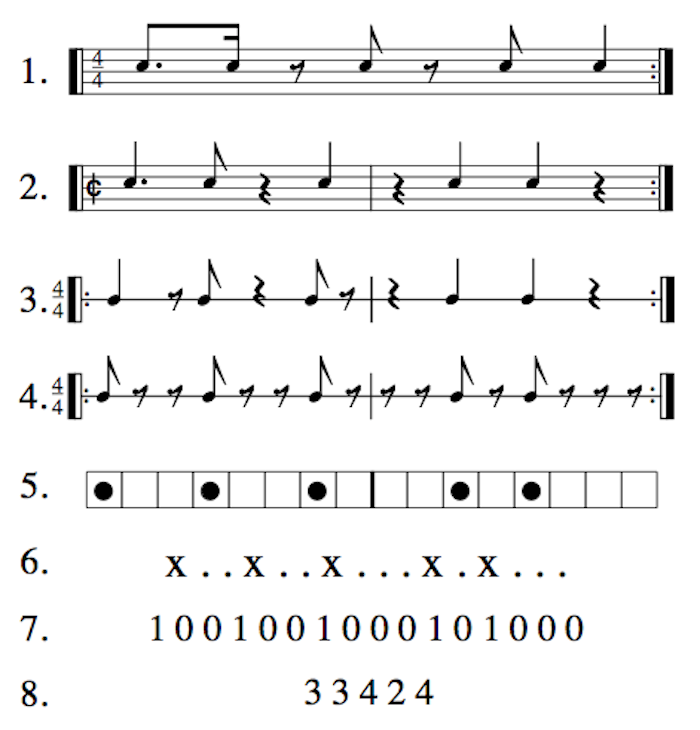
One of the best discoveries I made while researching my thesis is the mathematician Godfried Toussaint. While the bookshelves groan with mathematical analyses of western harmony, Toussaint is the rare scholar who uses the same tools to understand Afro-Cuban rhythms. He’s especially interested in the rhythm known to Latin musicians as 3-2 son clave, to Ghanaians as the kpanlogo bell pattern, and to rock musicians as the Bo Diddley beat. Toussaint calls it “The Rhythm that Conquered the World” in his paper of the same name. Here are eight different representations of it as rendered by Toussaint:

Toussaint - visualizing son clave

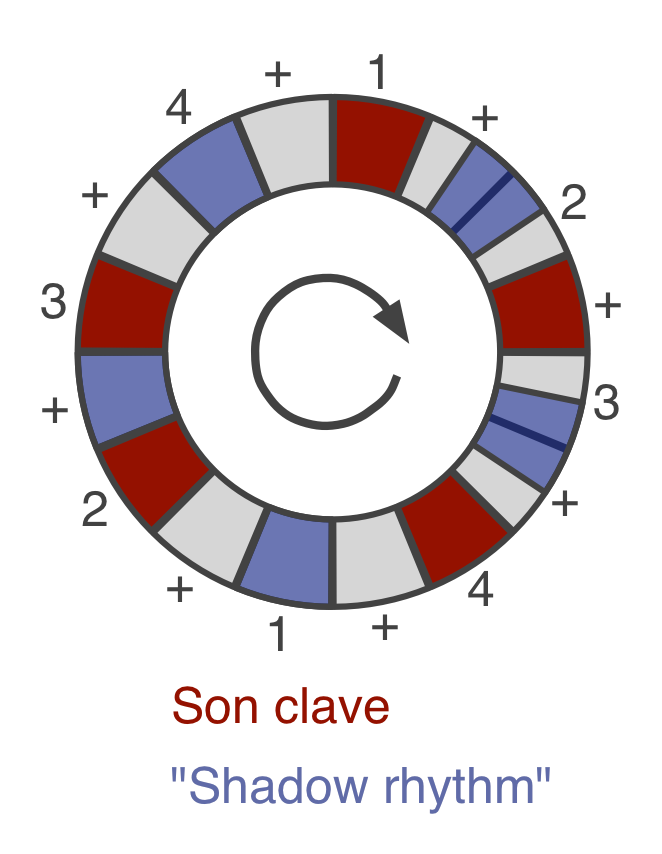
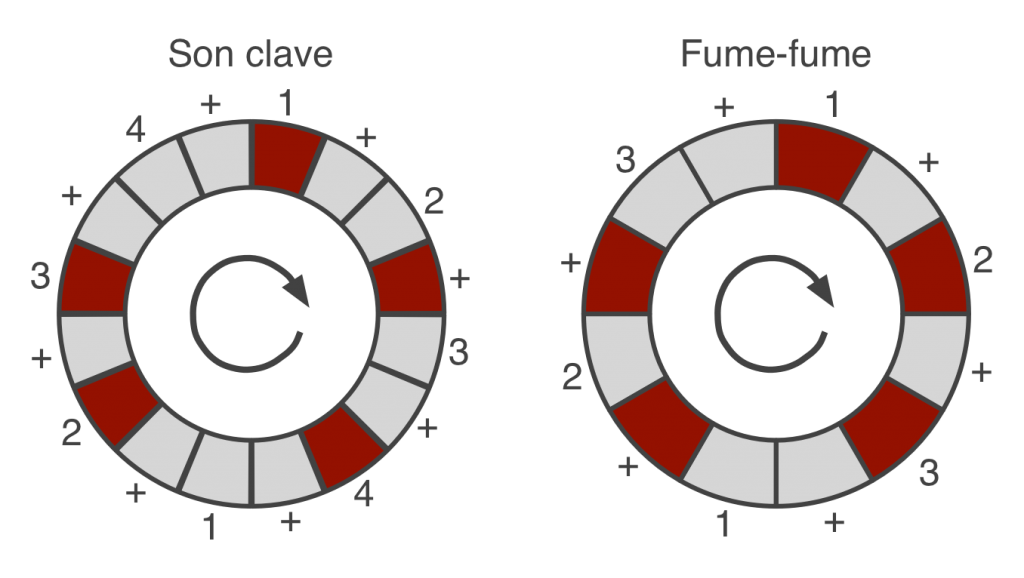
And here it is in my preferred circular notation:

circular son clave

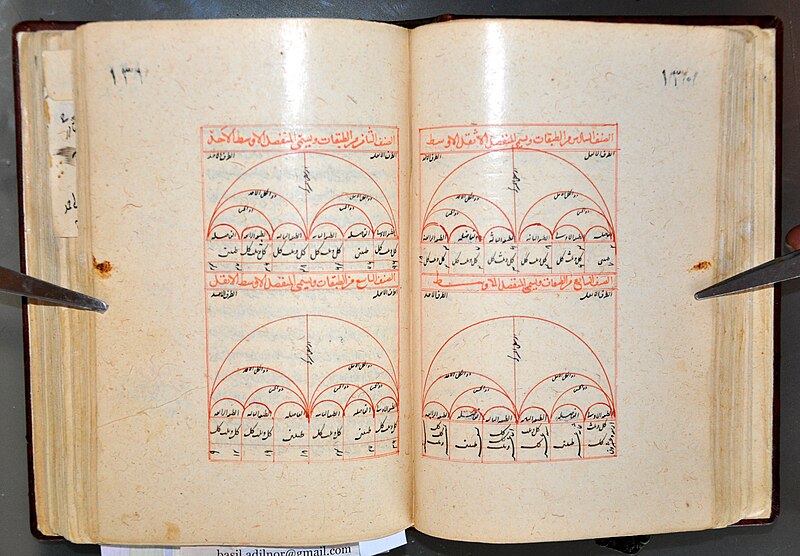
Son clave probably traveled from West Africa to Cuba with the slave trade. It may have arrived in its present form, or it could have evolved from a similar 12/8 pattern, fume-fume. It has a long history; I was delighted to learn from Toussaint that son clave appears under the name “al-thaqil al-awwal” in the Kitāb al-Adwār, a manuscript written in Baghdad in the middle of the Thirteenth Century by the music scholar Safi al-Din al-Urmawi. The whole book is extraordinarily beautiful; click through the image below to see many more.

Risalah al-Sharafiyah fi al-Nisab al-Ta'lifiyyah

There’s no way to know how old son clave is, but I would guess that it’s probably very ancient. A forty-thousand-year-old bone flute was found in Germany that plays the major pentatonic scale. Rhythm is probably vastly older than harmony, and for all we know, hominids were chipping away at their stone axes to a son clave beat millions of years ago.

Wherever son clave came from, it’s incredibly popular. Toussaint observes that the beat “is heard in all corners of the world, in almost any type of music, including rhythm and blues, salsa, rockabilly, rock, soukous, jazz, house, and the fusion pop music of scores of countries.” So what makes this rhythm so special? Toussaint has a series of solid mathematical explanations.

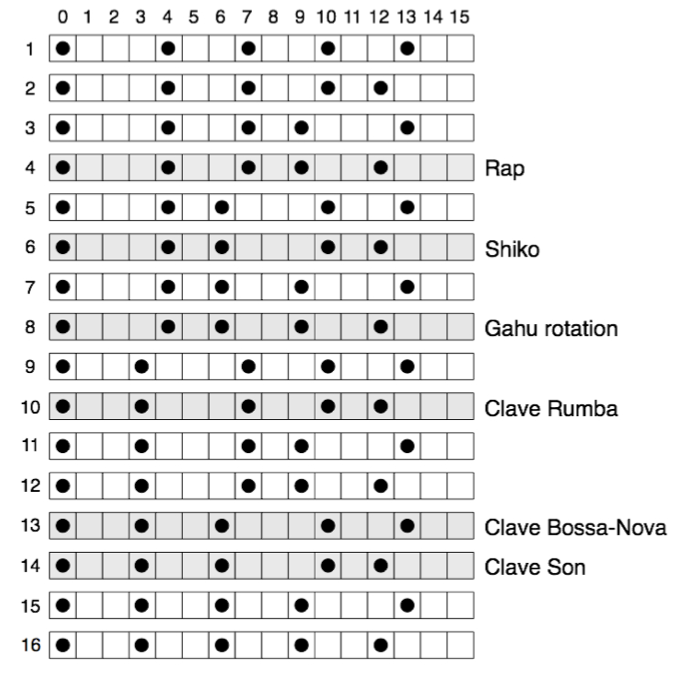
By and large, we prefer rhythms that are “maximally even,” meaning that they’re spaced more or less equally in time. Son clave is one of many widely-used beats consisting of five hits per sixteen-step cycle (two bars of 4/4 time counted in eighth notes, in western theory terms.) Think of the sixteen steps as sixteen cubbyholes, each of which can hold one object, one drum hit. Sixteen doesn’t divide by five evenly, so there are several different possible ways to distribute the five hits among the sixteen cubbyholes to make a maximally even beat. Toussaint lists them all, and labels the ones that are in common usage.

sixteen maximally even rhythms

Several of these rhythms are rotations of each other, like different modes of the same scale. Rhythms 5 and 11 are “modes” of son clave; rhythms 1, 9, 15, and 16 are “modes” of bossa nova; and rhythm 3 is a “mode” of the rumba. Cool!

Toussaint asks why this combination of five beats distributed across a sixteen-step cycle should be so popular:

Why not eleven [beats], thirteen, or seventeen for example? And what is it that is so singular about five onsets? Why not four, six, or nine? These two numbers, the number of pulses in the cycle of a timeline, and the number of these pulses that are sounded, vary widely among different cultures around the world. It is quite common for the number of pulses in the cycle to be as little as four. In Bulgarian music it may go as high as 33, and in the talas of Indian classical art music it may be as long as 128. The answers to these questions are essentially physiological and psychological; they lie to a large extent in the nature of the mental and physical constraints imposed by the human brain and body. Fundamentally, to be popular a rhythm should not be so complex that it becomes difficult to grasp by the masses, and at the same time it should not be so simple that it quickly becomes boring. Furthermore, to serve well as a timeline for dancing, its realization should not take much more than about two seconds, the duration of our conscious sense of the present. Rhythms with an even number of pulses that is also a power of two are for most people of the world, easier to assimilate than other rhythms. These constraints are already sufficient to bring the workable number of pulses down to small values that are powers of two, such as eight or sixteen. As for the number of onsets, for a timeline to afford a rich enough structure, five appears to be a good choice. However, a cycle of eight pulses does not provide enough room (in the sense of time) for five onsets to be distributed so as to create interesting patterns. Thus we are left with sixteen pulses and five onsets as the most feasible candidates for creating a timeline that has a sufficiently rich structure.

So why, out of the sixteen patterns above, is son clave so much more popular than the others? Toussaint attributes it to son clave’s “rhythmic oddity.” There are no pairs of hits located directly across from each other across the circle. If there were, the pair would tend to divide the pattern in half, making you hear two simpler eight-beat patterns rather than one more complex sixteen-beat pattern. Son clave can’t be broken down into smaller symmetrical pieces.

Okay, so son clave has desirable rhythmic oddity. But so do many other beats. What else does son clave have? Toussaint points to some special symmetries hidden in the beat. Any rhythm comes with a “shadow rhythm” with an implicit hit in between each of the actual ones. When you’re drumming, your hands or sticks reach their maximum height at the onsets of the shadow rhythm, so while you may not hear it, you feel it, and both you and your listeners can see it.

son clave and its shadow

So far I’ve been talking exclusively about the so-called three-side version of the clave. There’s also the two-side version, where the two hit pattern comes first, followed by the three-hit pattern. You can switch from one to the other by moving the downbeat from the top of the circle to the bottom. You might notice that the shadow rhythm of three-side clave bears a strong resemblance to two-side clave, and conversely, the shadow rhythm of two-side clave resembles three-side. (Thanks to Roberto Thais for this observation.)

So here’s where it gets interesting. We tend to hear rhythms as patterns of short-long time intervals, rather than perceiving the exact length of the time intervals directly. Toussaint calls the pattern of long and short intervals the “rhythmic contour.” Son clave and fume-fume feel like “the same” rhythm because they have the same rhythmic contour, even though they’re in two different time signatures.

son clave vs fume-fume

If you take son clave’s “shadow” and rotate it 180 degrees around the circle, it has the same rhythmic contour as son clave itself. In other words, son clave sounds “the same” as its own shadow backwards. It’s the only one of the sixteen-step rhythms listed above to have this property. We might not be able to perceive this bit of symmetry consciously, but it must act on us somehow or we wouldn’t be so wild about the beat.

son clave and its rotated shadowSon clave shares its special qualities with all of its own rotations, the beats you get treating each of the five onset as the downbeat. So why do we prefer the downbeat that we do? Toussaint thinks it has to do with son clave’s metrical ambiguity. Those first three hits strongly imply triple meter, which is at odds with the underlying 4/4. The last two hits confirm the 4/4 feeling, but without hitting the second downbeat, the one at the bottom of the circle. You, the listener, have to involve your musical intelligence to make sense of all this ambiguity. It’s this invitation to your own imaginative participation in the beat that ultimately makes son clave so much more popular than all of its close rhythmic cousins. Math! Who says it has to be boring?

25 Dec 22:22

Merry Christmas! My quantum computing research explained, using only the 1000 most common English words

by Scott

[With special thanks to the Up-Goer Five Text Editor, which was inspired by this xkcd]

I study computers that would work in a different way than any computer that we have today.  These computers would be very small, and they would use facts about the world that are not well known to us from day to day life.  No one has built one of these computers yet—at least, we don’t think they have!—but we can still reason about what they could do for us if we did build them.

How would these new computers work? Well, when you go small enough, you find that, in order to figure out what the chance is that something will happen, you need to both add and take away a whole lot of numbers—one number for each possible way that the thing could happen, in fact. What’s interesting is, this means that the different ways a thing could happen can “kill each other out,” so that the thing never happens at all! I know it sounds weird, but the world of very small things has been known to work that way for almost a hundred years.

So, with the new kind of computer, the idea is to make the different ways each wrong answer could be reached kill each other out (with some of them “pointing” in one direction, some “pointing” in another direction), while the different ways that the right answer could be reached all point in more or less the same direction. If you can get that to happen, then when you finally look at the computer, you’ll find that there’s a very good chance that you’ll see the right answer. And if you don’t see the right answer, then you can just run the computer again until you do.

For some problems—like breaking a big number into its smallest parts (say, 43259 = 181 × 239)—we’ve learned that the new computers would be much, much faster than we think any of today’s computers could ever be. For other problems, however, the new computers don’t look like they’d be faster at all. So a big part of my work is trying to figure out for which problems the new computers would be faster, and for which problems they wouldn’t be.

You might wonder, why is it so hard to build these new computers? Why don’t we have them already? This part is a little hard to explain using the words I’m allowed, but let me try. It turns out that the new computers would very easily break. In fact, if the bits in such a computer were to “get out” in any way—that is, to work themselves into the air in the surrounding room, or whatever—then you could quickly lose everything about the new computer that makes it faster than today’s computers. For this reason, if you’re building the new kind of computer, you have to keep it very, very carefully away from anything that could cause it to lose its state—but then at the same time, you do have to touch the computer, to make it do the steps that will eventually give you the right answer. And no one knows how to do all of this yet. So far, people have only been able to use the new computers for very small checks, like breaking 15 into 3 × 5. But people are working very hard today on figuring out how to do bigger things with the new kind of computer.

In fact, building the new kind of computer is so hard, that some people even believe it won’t be possible! But my answer to them is simple. If it’s not possible, then that’s even more interesting to me than if it is possible! And either way, the only way I know to find out the truth is to try it and see what happens.

Sometimes, people pretend that they already built one of these computers even though they didn’t. Or they say things about what the computers could do that aren’t true. I have to admit that, even though I don’t really enjoy it, I do spend a lot of my time these days writing about why those people are wrong.

Oh, one other thing. Not long from now, it might be possible to build computers that don’t do everything that the new computers could eventually do, but that at least do some of it. Like, maybe we could use nothing but light and mirrors to answer questions that, while not important in and of themselves, are still hard to answer using today’s computers. That would at least show that we can do something that’s hard for today’s computers, and it could be a step along the way to the new computers. Anyway, that’s what a lot of my own work has been about for the past four years or so.

Besides the new kind of computers, I’m also interested in understanding what today’s computers can and can’t do. The biggest open problem about today’s computers could be put this way: if a computer can check an answer to a problem in a short time, then can a computer also find an answer in a short time? Almost all of us think that the answer is no, but no one knows how to show it. Six years ago, another guy and I figured out one of the reasons why this question is so hard to answer: that is, why the ideas that we already know don’t work.

Anyway, I have to go to dinner now. I hope you enjoyed this little piece about the kind of stuff that I work on.

23 Dec 22:41

Where in the United States is median income growing?

by Tyler Cowen

northdakota

That is from 2007 to 2012, the link is here.

19 Dec 19:21

Drug Warriors Kidnap and Sexually Assault a Woman After Getting Permission From a Dog

by Jacob Sullum

In a case eerily similar to David Eckert's humiliating ordeal at the hands of cops in Deming, New Mexico, a federal lawsuit charges U.S. Border Patrol agents with subjecting a U.S. citizen to six hours of degrading and fruitless body cavity searches based on an alleged alert by a drug-sniffing dog. The lawsuit, filed yesterday by the ACLU chapters in Texas and New Mexico, says the plaintiff, a 54-year-old New Mexico resident identified in the complaint as Jane Doe, was crossing the bridge between Ciudad Juarez, Mexico, and El Paso after visiting a family friend last December when she was chosen at random for "additional screening." This "secondary inspection" involved a pat-down during which an agent "inserted her finger in the crevice of Ms. Doe's buttocks"—a rather startling incursion inasmuch as the agents at this point had no basis to suspect that the woman was carrying contraband. But they were just getting started.

The agents instructed the plaintiff to stand in line with other people who had been selected for additional screening and walked a dog past her. According to the lawsuit, the dog handler "hit the ground by her feet, but did not hit the ground by any of the others in the line," and "the dog responded by lunging onto Ms. Doe and landing its front paws on her torso." Why did the dog do that? "Because Ms. Doe did not possess any contraband," says the complaint, "the dog either did not alert or the response was not a proper alert." Yet this possibly manufactured and in any event erroneous alert was the basis for all that followed.

First the agents strip-searched the plaintiff, examining her anus and vagina with a flashlight. Finding nothing, they took her to the University Medical Center of El Paso, where they forced her to take a laxative and produce a bowel movement in their presence. Again they found no evidence of contraband. At this point one of their accomplices, a physician named Christopher Cabanillas, ordered an X-ray, which likewise found nothing suspicious. Then the plaintiff "endured a forced gynecological exam" and rectal probing at the hands of another doctor, Michael Parsa. Still nothing. Finally, Cabanillas ordered a CT scan of the plaintiff's abdomen and pelvis, which found no sign of illegal drugs. "After the CT scan," the complaint says, "a CBP [Customs and Border Patrol] agent presented Ms. Doe with a choice: she could either sign a medical consent form, despite the fact that she had not consented, in which case CBP would pay for the cost of the searches; or if she refused to sign the consent form, she would be billed for the cost of the searches." She refused, and later the hospital sent her a bill for $5,000, apparently the going rate for sexual assault and gratuitous radiological bombardment.

David Eckert, you may recall, also got a bill (in his case for about $6,000) after undergoing a similar exploration of his orifices and plumbing, which likewise continued, becoming increasingly invasive, precisely because the cops were not finding any evidence to substantiate their suspicions. And while the police in his case did obtain a warrant, the main basis for it was a dog's purported alert, which in Jane Doe's case seems to have been the only evidence that she was smuggling drugs. Although such alerts are frequently wrong and can easily be faked, the Supreme Court has said they qualify as probable cause for a search as long as the dog is properly trained. The burden of showing a dog is not properly trained lies with the person challenging the search.

Aside from the dangers of putting too much faith in drug-detecting dogs, this case, like Eckert's, illustrates the appalling complicity of doctors in waging the war on drugs, even when it involves utterly unethical participation in dehumanizing pseudomedical procedures performed on involuntary and audibly protesting "patients." In addition to Border Patrol agents, the lawsuit names the hospital, Cabanillas, and Parsa. Lest you think the criminal malpractice described in this complaint is an aberration, the ACLU offers evidence that it is in fact commonplace:

During the car ride to the Medical Center, Ms. Doe asked if the agents had awarrant. One of them responded that they did not need a warrant....

Medical Center policy L-13 on searches by hospital personnel does not permit an invasion of a person’s body for purposes of a search without either consent or a search warrant. However, in practice, the Medical Center staff and CBP agents routinely conduct invasive cavity searches without a warrant, consent or sufficient suspicion to justify the searches. When Ms. Doe expressed dismay about the unreasonable searches she suffered, a Medical Center employee responded that these procedures were routinely followed when an individual is brought in by CBP agents. The employee also told Ms. Doe that what happened to her was not invasive.

This kind of abuse tends to draw attention only when the victim is "innocent," meaning he or she is not in fact smuggling drugs. But how can any society call itself civilized when it allows human beings to be treated this way in the name of locating arbitrarily proscribed substances? Having arrogated to itself the authority to regulate what people put into their own bodies, the government ends up forcibly delving into those bodies in search of the chemicals it has anathematized. To enforce politicians' pharmacological prejudices, the government's agents and their medical accomplices become kidnappers and rapists. There is nothing noble or decent about this immoral crusade, and anyone associated with it ought to be ashamed of himself.

17 Dec 23:10

What Government’s Being Accused of Serial Patent Infringement and IP Theft?

by Ed Krayewski
Nosimpler

I always wondered how things would work out if I came up with some awesome software idea and licensed it for nonmilitary use only.

"all of them"It’s not China, often accused of IP and copyright piracy, and used as a stalking horse by politicians seeking to push through legislation to control internet security. Fox News finds several companies accusing various agencies of the federal government of stealing software and other forms of intellectual property, including one lawsuit against the Department of Energy by the technology company Demodulation seeking $50 million.  The dispute involves “microwire” and related intelligence-gathering trade secrets. The government argues the patents are expired now, but the company claims they weren’t before the government helped drive it out of business. The Army settled with another company last year, Apptricity, which accused the government of wilfully ignoring software license limits and trying to conceal that it was misappropriating the software. Nevertheless, after a $50 million settlement, the company’s founder and president told Fox he didn’t “think there was malicious intent.”

Other accusations chronicled by Fox News include the government ignoring the copyright for a lead-free “green” bullet, infringing on a patent for a mine detecting device, and stealing software to monitor food safety. The owner of the company that developed the food safety software, for the FDA, is apparently a “retired federal government official.” He told Fox he had “never seen anything like” what the feds did to his company.

Related: Ron Bailey on killing off software patents.

More Reason on copyright and patent law.

16 Dec 18:57

Jerry Brito on the Coming Robotic World

RobotIn his 2006 high-tech thriller, Daemon, Daniel Suarez tells the story of a computer program that is activated after the genius millionaire that created it dies of cancer. The program essentially owned itself because, improbably, it had access to its creator’s wealth via shell corporations that it controlled. As a result, it did reap the profit and loss of its actions. What was speculative fiction in 2006, came one step closer to reality in 2009 with the advent of Bitcoin. Today, writes Jerry Brito, there’s nothing inconceivable about a program that funds and runs itself without the intervention of humans.

View this article.

16 Dec 16:32

Milner-Zuckerberg Prizes for Mathematics

by woit

At the Hollywood-style awards ceremony last night for $3 million string theory and biomedical research prizes, it was announced that Yuri Milner and Mark Zuckerberg will now start funding something similar in mathematics, called the Breakthrough Prize in Mathematics. According to the New York Times:

Yuri Milner, the Russian entrepreneur, philanthropist and self-described “failed physicist” who made a splash two years ago when he began handing out lavish cash awards to scientists, announced Thursday that he was expanding the universe of his largess again: This time, he will begin handing out $3 million awards to mathematicians…

For the new math award, Mr. Milner and Mr. Zuckerberg, the co-sponsor of the math prize, will decide who gets the money, in consultation with experts. Mr. Milner declined to say how many mathematicians would be chosen, but there could be quite a number of windfalls in store: for the physics price, there were nine inaugural winners, and for the life sciences prize, there were 11.

I’ve written extensively about the “Fundamental Physics Prize” and what I see as the worst problem with it (heavily rewarding and propping up a failed research program). While many physicists are privately unhappy about this prize and its effects, few prominent ones are willing to speak publicly with their name attached, since this kind of mouthing-off could turn out to be personally extremely expensive. Ian Sample at the Guardian has a story today, which quotes a “prominent physicist who did not wish to be named”:

One prominent physicist who did not wish to be named said the huge sums of money could be used better: “The great philanthropists of the 19th and 20th centuries, like the Rockefellers and the Carnegies, did not create prizes – they created universities and research institutes that have enabled thousands of scientists to make great breakthroughs over the succeeding decades.

“By contrast, giving a prize has a negligible effect on the progress of science. A few already well-recognised people get enriched, but there is little value added in terms of the progress of science compared to the multiplier effect of creating new institutions for scientific research.”

The Guardian does quote one critic by name, but it’s just the usual one.

The physics prize has turned out to be extremely narrowly targeted at one particular subfield of physics, and from what little I know of the life sciences, the prizes in that area seem to be also narrowly targeted (US biomedical research aimed at curing diseases that most afflict those in the developed world). I’m highly ignorant about life sciences research, but it seems striking that the 6 $3 million winners in this field were all men.

I have no idea how Milner and Zuckerberg will go about choosing the $3 million winners in mathematics, and whether this new prize will end up being narrowly targeted to a certain sort of mathematics research. If so, it may have very significant effects on what kinds of mathematics get done. Based on the other prizes, it seems likely that the winners will be mostly prominent US academics, people already well-rewarded by the current academic star system. I don’t see any reason to believe that these kinds of financial awards will allow such mathematicians to do work they wouldn’t otherwise do, so the main argument for the prizes is that the money (and Academy Awards-style ceremonies) will help make them celebrities, and that this is a good thing. One can predict that public criticism from prominent US academics may be rather muted once the checks start coming.

Even if the Milner-Zuckerberg prize does end up focused on the best mathematics research, I still think the whole concept is problematic. The US today is increasingly dominated by a grotesque winner-take-all culture that values wealth and celebrity above all else. While mathematics research, like the rest of academia, has been affected as a star system has become increasingly part of the picture, this field has been somewhat immune to celebrity culture. While people typically think that what mathematicians do is perfectly respectable, they don’t understand much about it and aren’t especially interested. Milner and Zuckerberg want to change this by turning mathematicians into celebrities, but I don’t see any reason to believe this is going to lead to better mathematics.

Update: Here’s the statement from Milner about the planned mathematics prize:

Yuri Milner said: “Einstein said, Pure mathematics is the poetry of logical ideas. It is in this spirit that Mark and myself are announcing a new Breakthrough Prize in Mathematics. The work that the Prize recognizes could be the foundation for genetic engineering, quantum computing or Artificial Intelligence; but above all, for human knowledge itself.”

16 Dec 16:30

A Weighted and Directed Interareal Connectivity Matrix for Macaque Cerebral Cortex

by Markov, N. T., Ercsey-Ravasz, M. M., Ribeiro Gomes, A. R., Lamy, C., Magrou, L., Vezoli, J., Misery, P., Falchier, A., Quilodran, R., Gariel, M. A., Sallet, J., Gamanut, R., Huissoud, C., Clavagnier, S., Giroud, P., Sappey-Marinier, D., Barone, P., Dehay, C., Toroczkai, Z., Knoblauch, K., Van Essen, D. C., Kennedy, H.

Retrograde tracer injections in 29 of the 91 areas of the macaque cerebral cortex revealed 1,615 interareal pathways, a third of which have not previously been reported. A weight index (extrinsic fraction of labeled neurons [FLNe]) was determined for each area-to-area pathway. Newly found projections were weaker on average compared with the known projections; nevertheless, the 2 sets of pathways had extensively overlapping weight distributions. Repeat injections across individuals revealed modest FLNe variability given the range of FLNe values (standard deviation <1 log unit, range 5 log units). The connectivity profile for each area conformed to a lognormal distribution, where a majority of projections are moderate or weak in strength. In the G29 x 29 interareal subgraph, two-thirds of the connections that can exist do exist. Analysis of the smallest set of areas that collects links from all 91 nodes of the G29 x 91 subgraph (dominating set analysis) confirms the dense (66%) structure of the cortical matrix. The G29 x 29 subgraph suggests an unexpectedly high incidence of unidirectional links. The directed and weighted G29 x 91 connectivity matrix for the macaque will be valuable for comparison with connectivity analyses in other species, including humans. It will also inform future modeling studies that explore the regularities of cortical networks.

12 Dec 19:27

Scale-free networks as an epiphenomenon of memory. (arXiv:1312.2289v5 [physics.soc-ph] UPDATED)

by Francesco Caravelli, Alioscia Hamma, Massimiliano Di Ventra

Many realistic networks are scale-free, with small characteristic path lengths, high clustering, and power law in their degree distribution. They can be obtained by dynamical networks in which a preferential attachment process takes place. However, this mechanism is non-local, in the sense that it requires knowledge of the whole graph in order for the graph to be updated. Instead, if preferential attachment and realistic networks occur in physical systems, these features need to emerge from a local model. In this paper, we propose a local model and show that a possible ingredient (which is often underrated) for obtaining scale-free networks with local rules is memory. Such a model can be realised in solid-state circuits, using non-linear passive elements with memory such as memristors, and thus can be tested experimentally.

10 Dec 21:29

Viewpoint: What Can we Say about a Photon’s Past?

An experiment demonstrates that even when physicists think a quantum particle has followed a single path it might not have.

Published Mon Dec 09, 2013
09 Dec 19:40

Judging A Book By Its Coverage

by Pip


Flaws in constitution

GoldsteinGodelBook
Cropped from book page.

Rebecca Goldstein is the author of the book Incompleteness: The Proof and Paradox of Kurt Gödel. She obtained her PhD in Philosophy from Princeton University, and has also written several novels set in academia, including The Mind-Body Problem and Properties of Light: A Novel of Love, Betrayal and Quantum Physics. The latter draws on the life and concerns of the physicist David Bohm.

Today Ken and I wish to talk about Kurt Gödel’s journey in getting his USA citizenship, and his journey since then in the interpretation and implications of his research.

Gödel’s citizenship interview happened on Thursday the 5th of December, 1947—over fifty years ago. Even over sixty years ago, come to think of it. Past a certain age it becomes better to focus on the wider part of the calendar than the four-digit number at the top.

I bought Goldstein’s book years ago and started to read it. But somehow the initial few pages were not that compelling, or I was distracted by doing something else. In any event, I recently had a long plane flight and took the book—yes I still read hard-copy printed books—along. Partially because it was small, partially because it was on Gödel, and partially by randomness.

It turns out the book is a mixed bag. It was a fun read, with many interesting insights into the life of Gödel. It was also filled with strange errors that I easily noticed, even flying at 36,000 feet without any access to Google search. Yet I did enjoy the book, and am sorry I had not read it before. Well not completely—without it the plane flight would have been longer, since reading helps shrink the time of a flight.

The Story

Here is the story, according to Goldstein, of the day Gödel went to Trenton to get sworn in as an American citizen. Gödel had prepared well for his hearing, and had further discovered that the U.S. Constitution has a flaw that could allow it to become a dictatorship.

Oskar Morgenstern and Albert Einstein drove Gödel to Trenton for his hearing before the judge. On the car ride Einstein tried to distract Gödel with jokes: “Well, are you ready for your next-to-the-last test?” Gödel answered “What do you mean, ‘next-to-the-last’?” Einstein aded, “Very simple. The last will be when you step into your grave.”

Einstein continued on till they reached the court where the judge was Philip Forman, who was a friend of Einstein besides having administered Einstein’s own citizenship oath. The judge moved them quickly into his private chambers. Einstein and the judge chatted while Gödel sat mute. Finally the judge said to Gödel, “Up to now you have held German citizenship.” Gödel corrected him: Austrian citizenship. The judge added, “In any case, it was under an evil dictatorship. Fortunately, that is not possible in America.”

As Goldstein says, this was what Gödel was waiting for. Gödel started to explain how it could happen here because of the flaw in the Constitution. The judge interrupted and said “You needn’t go into all that.” The rest when smoothly and after the oath Gödel become a US citizen. Later in a letter to his mother, Gödel remarked that Forman was a “very sympathetic person.”

The Lost Story

It was known that Morgenstern had written an account of that day, but when his widow was interviewed in 1983 by John Dawson, she had been unable to locate it. Dawson used her recollections in his 1997 biography of Gödel. In 2006 the Institute for Advanced Study hailed the centennial of Gödel’s birth in its spring newsletter. This included a sidebar titled “Gödel, Einstein, and the Immigration Service,” later reproduced on their Gödel page, but with a story quite different from what Dawson had heard. Moreover, the IAS gave the year as 1948. Perhaps they followed my advice about calendars.

Mathematician and author Jeffrey Kegler, who based a novel on Gödel’s two lost notebooks, tells the full story on a neat page with links to all sources, including his own blog posts. While editing Wikipedia’s Gödel page in November 2008, he found another account that “rang true” more than the existing hearsay accounts, and resembled the IAS version. He was convinced the latter had to be based on a true original. He contacted Dawson, who in turn prompted the Institute to find and release it.

Morgenstern in fact mentions only the year 1946. Here is part of what he wrote:


…[Gödel] rather excitedly told me that in looking at the Constitution, to his distress, he had found some inner contradictions and that he could show how in a perfectly legal manner it would be possible for somebody to become a dictator and set up a Fascist regime… I tried to persuade him that he should avoid bringing up such matters at the examination before the court in Trenton, and I also told Einstein about it: he was horrified that such an idea had occurred to Gödel, and he also told him he should not worry about these things nor discuss that matter.

Many months went by and finally the date for the examination in Trenton came. … While we were driving, Einstein turned around a little and said, “Now Gödel, are you really well prepared for this examination?” Of course, this remark upset Gödel tremendously, which was exactly what Einstein intended and he was greatly amused when he saw the worry on Gödel’s face. …

When we came to Trenton, we were ushered into a big room, and while normally the witnesses are questioned separately from the candidate, because of Einstein’s appearance, an exception was made and all three of us were invited to sit down together, Gödel, in the center. The examiner first asked Einstein and then me whether we thought Gödel would make a good citizen. We assured him that this would certainly be the case, that he was a distinguished man, etc. And then he turned to Gödel and said,

“Now, Mr. Gödel, where do you come from?”

Gödel: “Where I come from? Austria.”

The Examiner: “What kind of government did you have in Austria?”

Gödel: “It was a republic, but the constitution was such that it finally was changed into a dictatorship.”

The Examiner: “Oh! This is very bad. This could not happen in this country.”

Gödel: “Oh, yes, I can prove it.”

So of all the possible questions, just that critical one was asked by the Examiner. Einstein and I were horrified during this exchange; the Examiner was intelligent enough to quickly quieten Gödel… and broke off the examination at this point, greatly to our relief. …

Then off to Einstein’s home again, and he turned back once more toward Gödel, and said, “Now, Gödel, this was your last-but-one examination;” Gödel: “Goodness, is there still another one to come?” and he was already worried. And then Einstein said, “Gödel, the next examination is when you step into your grave.” Gödel: “But Einstein, I don’t step into my grave.” and then Einstein said, “Gödel, that’s just the joke of it!” and with that he departed. I drove Gödel home. Everybody was relieved that this formidable affair was over; Gödel had his head free again to go about problems of philosophy and logic.


The Lost Flaw

Maddeningly left out is what exactly the “inner contradictions” were. There have been various speculations, even a paper, most revolving around the Constitution’s providing the power to amend itself. Kegler has his own hypothesis.

Here I—Ken writing this—must confess I am unable to locate the webpage with what I took to be the flaw when I did background reading for our first “interview” with Gödel two years ago. I’ve alas never picked up the index-card habit. What struck my memory, however, was the source’s reference to the Senate and the judiciary.

Trying to reconstruct it, I think the path to dictatorship Gödel feared starts with something like this: The President of the Senate declares that a rules issue is a Constitutional question. This enables a bare majority, exploiting the gaps in Article I, to rewrite the rules of the Senate. Such a rule change can enable the uncontested appointment of Federal judges. Those judges in turn can… Well, anyway, nothing like that would ever actually happen.

Back to Dick and to Goldstein’s book, which to be fair, came out a few months before the IAS newsletter with Morgenstern’s account.

The Book

The book is—as I stated already—a mixed-bag, at best. I liked the history and insights into Gödel’s life. Yet it has many errors—both small errors that were almost just typos, and major errors. I had my thoughts, but Ken found the tough review by Solomon Feferman, so let’s quote that:

As to the core of Goldstein’s book, anyone familiar with Gödel’s work has to flinch. Dozens of errors could have been avoided by an expert vetting of the manuscript. At the very least we would not have had ‘Kreisl’ for ‘Kreisel,’ ‘Kline’ for ‘Kleene,’ and ‘Tannenbaum’ for ‘Teitelbaum’ (the birth surname of Alfred Tarski, the great logician, whose significant interaction with Gödel barely merits Goldstein’s notice).

In the air, flying way above the clouds, I certainly wondered if I was dreaming when I saw the reference to “Kreisl.” At first I wondered did she mean someone other than the famous logician Georg Kreisel? I could not believe that there could be another. Kreisel worked on proof theory and is known for many things including this amazing conjecture:

Suppose that Peano Arithmetic (PA) proves {A(S^{n}(0))} in {O(1)} steps for all {n}, then PA proves {\forall x A(x)}.

Note: {S^{n}(0)} is the successor function applied to {0} a total of {n} times: it is {n} in unary. There is some evidence for and against it; the latter two papers are by the same author, Pavel Hrubeš.

Errors aside, the book does have some interesting bits of history about Gödel and other mathematicians of his era. Many of the stories are known, perhaps well known. The book is much more about people and their history than a primer of the Incompleteness Theorems. One story that I knew but l like a lot is about Einstein’s salary negotiation with the head of IAS:

Einstein asked for a salary of $3,000, and the head “countered” with an offer of $16,000.

A very interesting example of negotiation. Quoting Feferman again:

What she does very well is to provide a vivid biographical picture of Gödel, beginning mid-stream with his touching relationship with Albert Einstein at the Institute for Advanced Study in Princeton, where, over a period of 15 years until Einstein’s death in 1955, they were often seen walking and talking together.

But he ends with:

Those who are fascinated by Gödel’s theorems—and the general idea of limits to what we can know—may still hunger for a more universal view of their possible significance. But they should not be satisfied with Goldstein’s ‘vast and messy’ goulash; hers is not a recipe for true understanding.

Indeed Feferman most loudly criticizes her signing on to the “view [t]hat Gödel’s theorems were designed to refute the formalist program of David Hilbert.” Both Ken and I have been careful to portray Gödel in harmony with Hilbert, and even as compressing rather than expanding the implications of his own theorems. Of course we have conjured our own fictionalizations of Gödel, and however well sourced, they may have errors. If so, we will amend them. Scrupulousness even made this post a day late.

How Many Unprovable Statements Are There?

While we are talking about Gödel’s Incompleteness Theorems, Tim Gowers has raised a question about unprovable statements in mathematics. In essence it is: Why do we as practicing theorem provers seem to be able to avoid the unprovability issues of Gödel? Or do we?

I have an answer that I am sure Gowers saw, but thought I would share. Consider all true statements {\phi} in Peano Arithmetic of size {N} in some standard encoding. I claim that there is a positive {\delta} so that at least a {\delta} fraction of these true statements cannot be proved in PA. The proof is quite simple. Pick any single unprovable statement {A}. Then consider the set of statements of the form:

\displaystyle  \phi = A \wedge B

for any true {B}. None of these are provable in PA, and they form a positive fraction of all the true statements of length {N}. Statements {A \vee B} where {A} is provable yield a similar upper bound separated from {1} on the proportion of unprovable statements.

Open Problems

A natural question is: in the limit are there more unprovable than provable statements of size {N} as {N} goes to infinity? This depends on encoding details but should be a robust enough question under reasonable conditions. Is it clear that there is a limit? Of course the above construction leads to many uninteresting statements. So the second question might be: can we sharpen the question, for instance by associating to a provable {\phi} the idea of minimizing the size of {\psi} such that {\psi \longrightarrow \phi} has a “trivial” proof?


08 Dec 04:56

Peter Higgs: “Today I wouldn’t get an academic job. It’s as simple as that”

by woit

The Guardian has an interesting piece about Peter Higgs, evidently their reporter talked to him on his way to the Nobel Prize ceremonies this week in Stockholm. Higgs will be speaking tomorrow (Sunday), and I’m curious to hear what he will have to say. His talk will be available live at the Nobel Prize website.

Higgs points out that the kind of work he was awarded the prize for was done in an environment that no longer exists:

He doubts a similar breakthrough could be achieved in today’s academic culture, because of the expectations on academics to collaborate and keep churning out papers. He said: “It’s difficult to imagine how I would ever have enough peace and quiet in the present sort of climate to do what I did in 1964.”

By the time he retired in 1996, he was glad to be out of academia:

After I retired it was quite a long time before I went back to my department. I thought I was well out of it. It wasn’t my way of doing things any more. Today I wouldn’t get an academic job. It’s as simple as that. I don’t think I would be regarded as productive enough.

Higgs has definitely not been a careerist sort, turning down a knighthood in 1999:

I’m rather cynical about the way the honours system is used, frankly. A whole lot of the honours system is used for political purposes by the government in power.

He thinks he likely would have been fired by his university back in the 1980s if there hadn’t been a prospect of him getting a Nobel.

The work Higgs did in 1964 was on a rather unpopular topic. At the time the reigning ideology was “S-matrix theory”, which argued that local quantum field theory was a hopeless subject, so one should be working on formulating basic physics just in terms of S-matrix amplitudes, using their holomorphicity properties (this idea has had somewhat of a comeback in recent years). The 1960s however was a time of a great expansion in the number of university positions, so people like Higgs could make a career despite working on unpopular topics.

Progress in particle theory slowed dramatically after the early 1970s. One reason for this of course has been the huge success of the Standard Model, as well as the inherent difficulties involved in getting experimental access to higher energy scales. One wonders though whether the post-1970 collapse of the HEP theory job market and very different environment that ensued might have had something to do with this. As Higgs himself is well-aware, if he had come along 10 years later, he would not have found a job in the field.

In the UK today, things seem to be getting even worse, with strong pressures from the government to only fund work likely to have an immediate economic payoff. For more about this, see this commentary at Physicsfocus by Philip Moriarty on The Spirit-Crushing Impact of Impact. The UK has just announced the founding of a new Higgs Centre for Innovation, to be built in Edinburgh and opened in 2016. It will be devoted though not to the kind of research Higgs had success with, but to “big data” and “space”, considered by the government to be among the most promising technologies for the future. It’s rather ironic that Higgs is the sort of scientist who would not be employable by the Higgs Centre.


Update
: For the acceptance speech by Higgs, see here, and see here for an official interview. For a different point of view, from one of the experimenters who made the award to Higgs possible, see here.

25 Nov 17:51

Toward a better music theory

by Ethan Hein

I seem to have touched a nerve with my rant about the conventional teaching of music theory and how poorly it serves practicing musicians. I thought it would be a good idea to follow that up with some ideas for how to make music theory more useful and relevant. The goal of music theory should be to explain common practice music. I don’t mean “common practice” in its present pedagogical sense. I mean the musical practices that are most prevalent in a given time and place, like America in 2013. Rather than trying to identify a canonical body of works and a bounded set of rules defined by that canon, we should take an ethnomusicological approach. We should be asking: what is it that musicians are doing that sounds good? What patterns can we detect in the broad mass of music being made and enjoyed out there in the world?

I have my own set of ideas about what constitutes common practice music in America in 2013, but I also come with my set of biases and preferences. It would be better to have some hard data on what we all collectively think makes for valid music. Trevor de Clerq and David Temperley have bravely attempted to build just such a data set, at least within one specific area: the harmonic practices used in rock, as defined by Rolling Stone magazine’s list of the 500 Greatest Songs of All Time. Temperley and de Clerq transcribed the top 20 songs from each decade between 1950 and 2000. You can see the results in their paper, “A corpus analysis of rock harmony.” They also have a web site where you can download their raw data and analyze it yourself. The whole project is a masterpiece of descriptivist music theory, as opposed to the bad prescriptivist kind.

Jimi Hendrix, common practice musician

Of course, the Rolling Stone Top 500 has some problems as a data set. First of all, there’s no common agreement as to what the word “rock” even refers to. Temperley and de Clerq identify two main senses of the word. There’s the sense Rolling Stone uses, an umbrella term for late twentieth century Anglo-American popular music. By this definition, rock includes soul/R&B standards, disco hits, middle-of-the-road pop and a few iconic country, jazz and hip-hop songs. On the other hand, there’s the more narrow and descriptive sense of the word “rock” that includes Led Zeppelin and Aerosmith but specifically excludes jazz, hip-hop and so on. Taking this view, the Rolling Stone list is not really a list of rock songs; it’s a list of “the greatest songs of the rock era.” Temperly and de Clerq don’t get too bogged down in the semantics; the Rolling Stone list is as complete a consensus mainstream pop collection as exists, so it’s a good enough place to start.

When you put "rock" into Google Image Search, you get this

A few results jump out from the study. As you’d expect, the tonic I is the most commonly-used chord in the Rolling Stone corpus. However, the next most common chord is IV, and it most frequently precedes I. Right away, we have a conflict with traditional classical theory, where the most basic tonal building block is the V-I cadence. Rock uses plenty of V-I, but it uses even more IV-I. And the third most common pre-tonic chord in rock is not ii, like you’d expect if you went to music school; it’s bVII, reflecting rock musicians’ love of mixolydian mode. These same three chords, IV, V and bVII, are also the ones most likely to follow the tonic in rock, again very much at odds with classical practice. Temperley and de Clerq observe:

In light of this data, one might conclude that rock is not governed by rules of ‘progression’ at all; rather, there is simply an overall hierarchy of preference for certain harmonies over others, regardless of context.

In common-practice music, conventional theory dictates that certain root patterns are preferred over others: ascending motion by fourths is especially normative (much more so than descending fourth motion); descending thirds are favored over ascending thirds, and ascending seconds over descending seconds (Schoenberg 1969). Are these principles observed in rock as well? It can be seen immediately that the norms of common-practice music do not hold. For each interval, the ascending and descending forms are roughly equal in frequency. The ascending perfect fourth is almost exactly as common as the descending perfect fourth; for other intervals, too, a similar pattern is seen. The frequency of intervals decreases in a very regular way as circle-of-fifths distance increases.

Blues is a central pillar of rock, and blues violates quite a few tenets of common-practice classical harmony. The biggest one is the distinction between major and minor. The sound of blues is in large part the sound of minor melodies and chord extensions over major chord progressions. The more blues-oriented flavors of rock are similarly ambiguous in their major/minor identity. A lot of the time, rock chords are neither major nor minor, like the famous power chord, which is just root-fifth-root.

The harmonic situation gets more complicated still if you include hip-hop in the data set. The Rolling Stone list includes “Bring The Noise” by Public Enemy, which doesn’t have any triadic harmony at all. Temperley and de Clerq dealt with that by just not including the track in their analysis, which strikes me as cowardly. A real theory of contemporary music would have to deal with hip-hop, which may not have triads, but does have strongly melodic unpitched vocal lines, modal harmonies and, sometimes, very crunchy dissonances and microtones.

To my mind, the most intriguing idea put forth by de Clerq and Temperley is the supermode, the collection of pitches most frequently used in rock melodies:

The supermode

Temperley explains:

The supermode could be viewed as the union of the Ionian (major) and Aeolian (natural minor) modes; one might also think of it as a set of adjacent scale degrees on the line of fifths, extending from flatscale degree 6 to scale degree 7. In enharmonic terms, this collection excludes just two scale degrees, sharpscale degree 4/flatscale degree 5 and sharpscale degree 1/flatscale degree 2—precisely the same degrees that are outside the “global” scale collection of common-practice music.

I like the idea of the supermode. Classical music’s obsession with the major scale runs counter to most Americans’ intuition. Sure, we like the major scale fine, but it doesn’t feel like the One True Generative Scale that classical music holds it to be. Flat sevenths sound as “natural” to me as natural sevenths. (Actually, flat sevenths are a lot lower in the overtone series; you could make a case that mixolydian should be the One True Scale.) I think the best idea would be to just teach kids the supermode, rather than hitting them with the confusing idea that you have to modify the major scale to get the sounds you’re used to.

See the followup post: can science make a better music theory?

18 Nov 20:34

Synchronization Across Sensory Cortical Areas by Electrical Microstimulation is Sufficient for Behavioral Discrimination

by Manzur, H. E., Alvarez, J., Babul, C., Maldonado, P. E.

The temporal correlation hypothesis proposes that cortical neurons engage in synchronized activity, thus configuring a general mechanism to account for a range of cognitive processes from perceptual binding to consciousness. However, most studies supporting this hypothesis have only provided correlational, but not causal evidence. Here, we used electrical microstimulation of the visual and somatosensory cortices of the rat in both hemispheres, to test whether rats could discriminate synchronous versus asynchronous patterns of stimulation applied to the same cortical sites. To disambiguate synchrony from other related parameters, our experiments independently manipulated the rate and intensity of stimulation, the spatial locations of stimulation, the exact temporal sequence of stimulation patterns, and the degree of synchrony across stimulation sites. We found that rats reliably distinguished between 2 microstimulation patterns, differing in the spatial arrangement of cortical sites stimulated synchronously. Also, their performance was proportional to the level of synchrony in the microstimulation patterns. We demonstrated that rats can recognize artificial current patterns containing precise synchronization features, thus providing the first direct evidence that artificial synchronous activity can guide behavior. Such precise temporal information can be used as feedback signals in machine interface arrangements.

18 Nov 19:57

Mega-churches for atheists

by Minnesotastan
From the StarTribune:
Nearly three dozen gatherings dubbed "atheist mega-churches" by supporters and detractors have sprung up around the U.S. and Australia — with more to come — after finding success in Great Britain earlier this year. The movement fueled by social media and spearheaded by two prominent British comedians is no joke...

They don't bash believers but want to find a new way to meet likeminded people, engage in the community and make their presence more visible in a landscape dominated by faith...

"If you think about church, there's very little that's bad. It's singing awesome songs, hearing interesting talks, thinking about improving yourself and helping other people — and doing that in a community with wonderful relationships. What part of that is not to like?"..

Sunday Assembly — whose motto is Live Better, Help Often, Wonder More — taps into that universe of people who left their faith but now miss the community church provided... It also plays into a feeling among some atheists that they should make themselves more visible...

"In the U.S., there's a little bit of a feeling that if you're not religious, you're not patriotic. I think a lot of secular people say, 'Hey, wait a minute. We are charitable, we are good people, we're good parents and we are just as good citizens as you and we're going to start a church to prove it.."

During the service, attendees stomped their feet, clapped their hands and cheered as Jones and Evans led the group through rousing renditions of "Lean on Me," ''Here Comes the Sun" and other hits that took the place of gospel songs. Congregants dissolved into laughter at a get-to-know-you game that involved clapping and slapping the hands of the person next to them and applauded as members of the audience spoke about community service projects they had started in LA.
18 Nov 19:53

Pi vs. Tau

Conveniently approximated as e+2, Pau is commonly known as the Devil's Ratio (because in the octal expansion, '666' appears four times in the first 200 digits while no other run of 3+ digits appears more than once.)
14 Nov 00:02

Topology of viral evolution [Mathematics]

by Chan, J. M., Carlsson, G., Rabadan, R.
The tree structure is currently the accepted paradigm to represent evolutionary relationships between organisms, species or other taxa. However, horizontal, or reticulate, genomic exchanges are pervasive in nature and confound characterization of phylogenetic trees. Drawing from algebraic topology, we present a unique evolutionary framework that comprehensively captures both clonal and...
13 Nov 23:58

Phase Space Crystals: A New Way to Create a Quasienergy Band Structure

by Lingzhen Guo, Michael Marthaler, and Gerd Schön

Author(s): Lingzhen Guo, Michael Marthaler, and Gerd Schön

A novel way to create a band structure of the quasienergy spectrum for driven systems is proposed based on the discrete symmetry in phase space. The system, e.g., an ion or ultracold atom trapped in a potential, shows no spatial periodicity, but it is driven by a time-dependent field coupling highly...

[Phys. Rev. Lett. 111, 205303] Published Wed Nov 13, 2013

12 Nov 18:32

California Lawmakers Want Porn Stars to Wear Safety Goggles

by Jess Remington

California’s workplace safety guardians have proposed an amendment to a bill that would require porn stars to wear protective goggles while filming.

The bill, which has so far stalled in the state senate, establishes numerous mandates for the porn industry to follow with the goal of curbing the spread of sexually transmitted diseases. Among these mandates is the requirement that “personal protective equipment" be used to "prevent contact of an employee's eye, skin, mucous membranes, or genitals with the blood or OPIM-STI of another." (OPIM-STI includes pre-ejaculate, semen, vaginal secretions, and fecal matter.)

According to the bill, which was originally posted on a NSFW adult entertainment blog:

The employer shall provide, at no cost to the employee, appropriate personal protective equipment such as, but not limited to, condoms, gloves for cleaning, and, if contact of the eyes with OPIM-STI is reasonably anticipated, eye protection.

So basically, cum shots sans eyegear would be illegal.

The bill would also require employees to wear condoms during vaginal and anal sex, gloves when touching “contaminated laundry,” and create a specific exemption for condom wearing during oral sex to be reviewed in January 2018.  

Porn actors are actually already required to follow these rules, says Deborah Gold, the deputy chief for health of California’s Division of Occupational Safety and Health. They just rarely do. In an interview with Salon, Gold said that “these draft guidelines are an attempt to tailor existing workplace-safety rules relating to blood-borne pathogens specifically to the adult industry.”

The bill follows in the footsteps of last year's  Safer Sex in the Adult Film Industry Act (or Measure B), the much-discussed, voter-approved measure that requires porn actors in Los Angeles County to wear condoms on set.

James Deen, an award-winning porn star and a staunch opponent of condom mandates, spoke with the Huffington Post after the measure passed:

"It will be interesting to see what happens next. People will most likely move production out of Los Angeles and take out tax money with us. Hopefully this measure passing will help us [adult entertainers] get more organized in the future and that, along with Los Angeles losing our business, will allow people in politics to start seeing us as an asset."

There's evidence that Deen’s prediction came true: After the measure passed, the number of requests for porn production permits in Los Angeles dropped from an annual norm of 500 to two. Now it appears that California politicians are looking to implement even more expansive protective barrier mandates. 

In a satirical video protesting Measure B, James Deen and co-star Jessica Drake show what a scene with mandatory safety goggles and latex barriers everywhere could look like. NSFW! You've been warned. Watch it after the jump.

11 Nov 18:21

November 08, 2013


Emails yelling at me will commence in 3... 2... 1...
31 Oct 16:46

When Hollywood collaborated with the Nazis

by Minnesotastan

You read the title correctly.  The reason for the logical disconnect is that the time period in question is the 1930s, before the war and the most overt atrocities, as explained in a Harvard Magazine review of a new book:
Based on nearly nine years of archival research in Germany and the United States, the book reveals a surprisingly cooperative relationship between studio executives and German officials throughout the 1930s... MGM head Louis B. Mayer made changes to films at the request of the German consul in Los Angeles in the 1930s...

In 1932, six months before Hitler came to power, Germany adopted a law stipulating that any film company caught making anti-German (or later, anti-Nazi) films would be prohibited from doing business in the country. For studio executives who feared losing access to German audiences, it was a powerful threat. Before World War I, Germany had been the second-largest market for U.S. films. By the 1930s, the studios were no longer making money there, but they hoped business would improve in time. Urwand says Hollywood executives also worried that if they left Germany and Hitler started a war, they would be expelled from any countries he invaded. So studio heads, many of whom were Jewish, collectively boycotted a proposed film, The Mad Dog of Europe, about the mistreatment of European Jews, and agreed to fire most of their Jewish salesmen in Germany...

Commentators have drawn parallels between the Nazi collaboration that Urwand describes and Hollywood’s current relationship with China, a burgeoning market for American films. Urwand stresses that “China isn’t Nazi Germany,” but he acknowledges some potential parallels. “Hollywood is not going to make a strongly anti-Chinese film at this point, just as it didn’t make anti-German films when it was trying to preserve its business with Germany.”
More at the link.

Photo: ©Hulton-Deutsch Collection/Corbis Images