I was having an email exchange about the possibility that dictatorships and autocracies do centralized monument-building much better than the freer democracies do. But while this is probably true on average, some of the deviations are of interest. Here is an excerpt from my response:
In some ways France looks like an autocracy, whereas in Singapore (not a dictatorship of course, but not a full democracy either) the government buildings are deliberately underwhelming (a kind of counter-signaling?).
Almaty and Skopje go overboard in the autocratic direction, the latter being a democracy. Washington, D.C. does centralized monuments very well, better than anything modern China has come up with. Cuban government buildings do not at all impress, nothing like Pyongyang.
Morocco invested in what was then the world’s largest mosque, in lieu of a government building upgrade. Ivory Coast has done much more monument-building than the other African autocracies.
So I wonder what the deeper model looks like…
Here are a few options:
1. Insecure nation-states invest in monuments. That is correlated with autocracy, but imperfectly.
2. Perhaps nation-states invest in monuments in lieu of concrete achievements for their citizenries.
3. Cuba has not built many monuments because its “origin story” is so strong, and its ideology for a long time has had a fair amount of support from the Cuban people. Alternatively, Castro himself was the monument.
4. Is Singapore itself the monument to Singapore? The same might be said of Dubai. What artificial monuments could top those?
Advocates of Confederate monuments, by the way, ought to ponder the possibility that those very structures are a sign of weakness not strength.
NYPost: The Oracle of Omaha once again has proven that Wall Street’s pricey investments are often a lousy deal. Warren Buffett made a $1 million bet at end of 2007 with hedge fund manager Ted Seides of Protégé Partners. Buffett wagered that a low-cost S&P 500 index fund would perform better than a group of Protégé’s hedge funds.
Buffett’s index investment bet is so far ahead that Seides concedes the match, although it doesn’t officially end until Dec. 31.
The problem for Seides is his five funds through the middle of this year have been only able to gain 2.2% a year since 2008, compared with more than 7% a year for the S&P 500 — a huge difference. That means Seides’ $1 million hedge fund investments have only earned $220,000 [through 2016] in the same period that Buffett’s low-fee investment gained $854,000.
I am shocked that Seides put his money on five funds-of-funds, thus piling fees on fees. It was a loser bet. Mark Perry at Carpe Diem has more of the stats.
In one way, this is another win for index fund investing but there is still an anomaly. The S&P trounced the hedge funds but it still lost to an investment in Berkshire Hathaway! (see addendum) Admittedly the race was pretty close at times but after ten years Berkshire was up 91.5% and the S&P 500 up 69.1%.
Addendum: An astute reader with access to a Bloomberg terminal points out that an investment in the S&P 500 pays dividends while famously Berkshire Hathaway does not. Moreover, when you compare total returns the S&P 500 is up 110.7% over this period and Berkshire is up 91.8% so indexing over this period even beats Buffett!
Has anyone been to the Sol LeWitt exhibit at the Mass MOCA? It's so simple and cool and then suddenly very deep in simplicity and it has great backgrounds for new profile pictures of every sort.
Wall Drawing 797 is a conceptual artwork by Sol LeWitt consisting of instructions that anyone can use to make a drawing. I found this at The Kid Should See This1 and I cannot improve on their description:
How does one person’s actions influence the next person’s actions in a shared space? Sol LeWitt’s wall drawings explore this intricate visual butterfly effect in the collaborative art entitled Wall Drawing 797, a conceptual piece that can be drawn by following LeWitt’s instructions. (He died in 2007.)
“Intricate visual butterfly effect” is such a good way of putting it. I have a huge wall right above my desk…I kind of want to make my own Wall Drawing 797 now.
You should be reading The Kid Should See This even if you don’t have children. It’s always so good and interesting.↩
A newly released study by Gregory Martin and Ali Yurukolu published in the American Economic Review shows that watching Fox News has a significant effect on the overall Republican vote share in Presidential elections. They analyzed the channel position of the three major cable networks (Fox News, MSNBC, CNN), compared it to voting patterns, and found that “Fox News increases Republican vote shares by 0.3 points among viewers induced into watching 2.5 additional minutes per week by variation in position”. Using that result, they constructed a model to estimate the overall influence.
In other results, we estimate that removing Fox News from cable television during the 2000 election cycle would have reduced the overall Republican presidential vote share by 0.46 percentage points. The predicted effect increases in 2004 and 2008 to 3.59 and 6.34 percentage points, respectively. This increase is driven by increasing viewership on Fox News as well as an increasingly conservative slant. Finally, we find that the cable news channels’ potential for influence on election outcomes would be substantially larger were ownership to become more concentrated.
6.3% is an astounding effect. Fox News appears to be uniquely persuasive when compared to the other channels, particularly in bringing people across the aisle:
Were a viewer initially at the ideology of the median Democratic voter in 2008 to watch an additional three minutes of Fox News per week, her likelihood of voting Republican would increase by 1.03 percentage points. Another pattern that emerges from the table is that Fox is substantially better at influencing Democrats than MSNBC is at influencing Republicans.
They also estimate that cable news has contributed greatly to the rise in political polarization in the US over the period studied:
Furthermore, we estimate that cable news can increase polarization and explain about two-thirds of the increase among the public in the United States, and that this increase depends on both a persuasive effect of cable news and the existence of tastes for like-minded news.
I have not yet seen this film but I am passionate about this film. Please read, Dave Holmes is my favorite.
Okay, so obviously Henry calls Child Protective Services, whose number he has written down in his Big Red Notebook, which will also come back later. (He has also written down "*67 makes the call anonymous," which you would think was information he could retain because he is the smartest kid in all the land. I remember what *67 does without writing it down, and I'm dumb enough to have forgotten to keep a receipt for my ticket.) He calls, and they send a person to investigate, and the person does so by coming out to the Police Commissioner's house and asking him, "Hey, are you molesting your stepdaughter? You aren't? Okay, cool," right there on the front porch. And then Henry pulls out the Child Protective Services brochure, and on the back of it is a photo of the guy who came out to investigate, and his name is, like, Steve, The Police Commissioner's Brother. You know how Child Protective Services has brochures, and on those brochures, there's a picture of the smiling face of the guy who's going to do all the investigations, like a realtor ad on a bus bench? Just normal, everyday stuff that we all recognize and identify with.
So then Henry, the smartest kid in all the land, is like, "Well, I guess I'd better assassinate the Police Commissioner." He draws up big elaborate sketches of the town's bridge. He does all kinds of math-y analysis on where a person would need to stand so that their body would fall into the river. He walks right into a gun store and prices sniper rifles.
And then he gets a brain tumor and dies in two seconds.
No, I'm serious.
He has a seizure, and they rush him to the hospital for emergency brain surgery, which isn't successful, and which also doesn't require them to cut his hair even a little bit. So the doctor, who is played by Lee Pace, sits this 11-year-old kid down, and is like: "Well, you're super going to die." And Henry is like, "Oh, is this a neuroblompazoid," or whatever, and asks a million questions about radiation and critical structures, because somehow he's gone to medical school in between making cupcakes, managing his mother's investments, and trying to murder Hank from Breaking Bad. So anyway, Sarah Silverman kisses him on the mouth and then he dies, and the second smartest person in all the land becomes the smartest person in all the land, and that's Naomi Watts—and Naomi Watts is an idiot.
Advertisement - Continue Reading Below
Also, throughout all of this, the school is preparing for a talent show. Just hang on to that fact. It's coming back.
Before dying, Henry has told the kid from Room to make sure Naomi Watts reads the Big Red Notebook. So the kid takes a peek at the Notebook, and immediately deciphers it, and says: "Mom, Henry wants us to kill Hank from Breaking Bad." And Naomi Watts says: "Okay, we'll just have to think about that." And then she decides: Yes. Yes, I am going to fulfill the wishes of my dead genius child who was also my stockbroker, and I am going to murder my neighbor. She goes to the safe in her basement, where Henry has left a recorder with tapes of instructions, because he had snuck out of the hospital where he was dying of the world's fastest brain tumor to record them and put them there, and also he had access to a those little answering-machine tapes in a world where people have cell phones. So Naomi Watts follows his instructions and buys a sniper rifle, because Henry has even taught her how to bribe and threaten the guy behind the counter. She does target practice out of Henry's treehouse, which is close enough to her house that she would let her young sons play in it unsupervised, but far enough that the Police Commissioner next door wouldn't hear sniper-rifle target practice.
Okay, so a child molester is about to get shot in the head by Naomi Watts, who's following the orders of a dead 11-year-old. It's time for the talent show! Naomi Watts drives the kid from Room and Beautiful Girl to the event, and once it starts, she sneaks away to carry out the plan. The talent show begins with a rapping ginger kid whose rap ends with "I'm the shiznit" and a mic drop that puts the final nail in the coffin of mic drops, and not a moment too soon. And then a kid burps the alphabet. You know how grade-school talent shows are like that? The teachers and administrators say "We'll just stay completely out of your way," and offer no supervision or guidance at all. "Surprise us, children!"
I took an informal poll on twitter about where people stand on the following two options, which on the theme of the post below, are the only two possible scenarios:
1) We impeach Trump and get President Pence. 2) We let Trump finish out his full term.
Let those two scenarios play out in your mind a bit!! Wow so much darkness!
27% of my twitter followers selected option 2.
FOR THE RECORD I THINK THEY ARE DUMB AND WE NEED TO GET TRUMP OUT AT ANY COST. I'D RATHER HAVE DAVID DUKE AT THIS POINT.
The genderqueer ginger Brendan Scannell is a mutual twitter/insta bro and this show looks promising!
The 1988 cult classic Heathers (above) is back as a 10-episode comedic anthology to screen on the Paramount Network in 2018 — but there have been a few changes..
The original film, written by Daniel Waters and directed by Michael Lehmann, centered on Veronica (played by Ryder) and her rebel boyfriend J.D. (Slater) and their trials and tribulations dealing with the social order in high school. The updated take, set in the present day, features a new set of popular-yet-evil Heathers — only this time the outcasts have become high school royalty. Heather McNamara (originally played by Lisanne Falk) will be portrayed by Jasmine Mathews; Heather Duke (Shannen Doherty in the film) is a male who identifies as gender-queer whose real name is Heath (Brendan Scannell); and Heather Chandler (originally Kim Walker) has a body like Martha Dumptruck and will be played by Melanie Field. Newcomers James Scully and Grace Victoria Cox star as J.D. and Veronica, respectively. Original Heathers star Doherty guest-stars in the pilot, which was directed by Leslye Headland and written by Jason Micallef.
National Duck Out For A Drink Day is a holiday celebrated each August 25th (or, in the event that August 25th should fall on a weekend, on the closest weekday before). NDOFADD (pronounced “en-do-fad”) is a proud tradition dating back since long before many of you were even on the Internet, and its rules and customs are simple:
To observe, all you need to do is grab a friend from work and slip off to a nearby bar for a shot or two. Or a couple of mixed drinks. Or a shot and a beer and then maybe one more beer. Two shots and two beers. A few spritzers, even. Whatever you can get away with. And do not feel ashamed if you need to go by yourself. The point of National Duck Out For A Drink Day is the ducking out and the drinking.
While National Duck Out For A Drink Day is not yet a federally recognized holiday (it was close to achieving recognition back before our sclerotic legislative system seized up entirely and our country became ungovernable; Barack Obama hinted at achieving something by proclamation but it wound up being one of the many things he was too busy cozying up to bankers to attend to) its continuing observance over many years in every part of the country makes it an annual tradition whose legitimacy cannot be denied, particularly by your employer if he or she catches you coming back after knocking a few back. Don’t be ashamed of engaging in this venerable custom, but maybe take some mints with you just in case.
Please enjoy National Duck Out For A Drink Day responsibly and remember: If you go to the bar during work, it’s like they’re paying you to drink.
I had seen a partial eclipse in 1970. A partial eclipse is very interesting. It bears almost no relation to a total eclipse. Seeing a partial eclipse bears the same relation to seeing a total eclipse as kissing a man does to marrying him, or as flying in an airplane does to falling out of an airplane. Although the one experience precedes the other, it in no way prepares you for it.
I heard lots of disappointment with the eclipse among friends and on social media. It was neat — look, there’s a chunk out of the Sun — but they thought it would be darker or that the air would get colder. But none of that stuff really happens unless you’re really close to totality…and then it goes completely dark and your brain turns inside out. Twitter user @hwoodscotty said:
Probably the coolest thing I’ve ever seen. Totality is so much different than even 99%. 10/10 Would recommend.
Standing on a mountaintop for totality was crossing into another dimension, suddenly finding ourselves on another world. Amazing. Sparkling ring, sun fire ghostly streaming, darkest circle. I understand now why people chase the eclipse. Totality is unlike anything. Entire landscape shifted, valleys, hills, mountains painted in nightcolour and cold. Sparkling planets came out in a midnight sky.
But back to Dillard’s piece…this part, about the shadow rushing towards them, sounds amazing:
I have said that I heard screams. (I have since read that screaming, with hysteria, is a common reaction even to expected total eclipses.) People on all the hillsides, including, I think, myself, screamed when the black body of the moon detached from the sky and rolled over the sun. But something else was happening at that same instant, and it was this, I believe, which made us scream.
The second before the sun went out we saw a wall of dark shadow come speeding at us. We no sooner saw it than it was upon us, like thunder. It roared up the valley. It slammed our hill and knocked us out. It was the monstrous swift shadow cone of the moon. I have since read that this wave of shadow moves 1,800 miles an hour. Language can give no sense of this sort of speed — 1,800 miles an hour. It was 195 miles wide. No end was in sight — you saw only the edge. It rolled at you across the land at 1,800 miles an hour, hauling darkness like plague behind it. Seeing it, and knowing it was coming straight for you, was like feeling a slug of anesthetic shoot up your arm. If you think very fast, you may have time to think, “Soon it will hit my brain.” You can feel the deadness race up your arm; you can feel the appalling, inhuman speed of your own blood. We saw the wall of shadow coming, and screamed before it hit.
Next time, and there will definitely be a next time, I’m hoping to get up high somewhere so I can see the shadow and more of the 360-degree sunset. BRB, pricing plane tickets to Argentina…
Update: Before the 2017 eclipse, Vox talked to some eclipse chasers about what it’s like to witness a total solar eclipse.
now that i’ve recovered from the drive, i can say that a lot of what these eclipse chasers told me makes sense now. agree completely that it’s something you have to see for yourself. what was different for me though is …. i got pretty sad. there’s a fine line between awe and grief. maybe in a different year it would have gone the other way, but tbh every exceptionally beautiful sunset makes me a tiny bit sad too. but this was sunset sadness times a thousand. absolutely punched by the impermanence. i hope i see it again and i hope you can see it too.


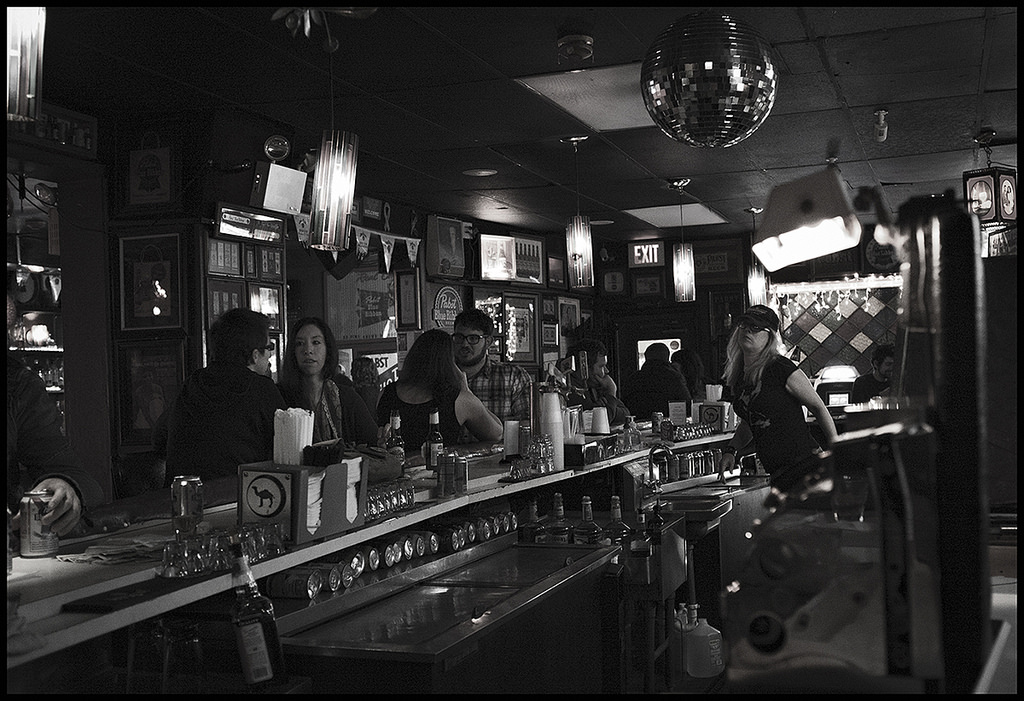 National Duck Out For A Drink Day is a holiday celebrated each August 25th (or, in the event that August 25th should fall on a weekend, on the closest weekday before). NDOFADD (pronounced “en-do-fad”) is a proud tradition dating back since long before many of you were even on the Internet, and its rules and customs are simple:


