09 Mar 20:17
by Zheng Xie and Tim Rogers
Author(s): Zheng Xie and Tim Rogers
We introduce and analyze a class of growing geometric random graphs that are invariant under rescaling of space and time. Directed connections between nodes are drawn according to influence zones that depend on node position in space and time, mimicking the heterogeneity and increased specialization…
[Phys. Rev. E 93, 032310] Published Wed Mar 09, 2016
09 Mar 12:24
by Guilherme Ferraz de Arruda, Emanuele Cozzo, Tiago P. Peixoto, Francisco A. Rodrigues, Yamir Moreno
We present a continuous formulation of epidemic spreading on multilayer
networks using a tensorial representation, extending the models of monoplex
networks to this context. We derive analytical expressions for the epidemic
threshold of the SIS and SIR dynamics, as well as upper and lower bounds for
the disease prevalence in the steady state for the SIS scenario. Using the
quasi-stationary state method we numerically show the existence of disease
localization and the emergence of two or more susceptibility peaks, which are
characterized analytically and numerically through the inverse participation
ratio. Furthermore, when mapping the critical dynamics to an eigenvalue
problem, we observe a characteristic transition in the eigenvalue spectra of
the supra-contact tensor as a function of the ratio of two spreading rates: if
the rate at which the disease spreads within a layer is comparable to the
spreading rate across layers, the individual spectra of each layer merge with
the coupling between layers. Finally, we verified the barrier effect, i.e., for
three-layer configuration, when the layer with the largest eigenvalue is
located at the center of the line, it can effectively act as a barrier to the
disease. The formalism introduced here provides a unifying mathematical
approach to disease contagion in multiplex systems opening new possibilities
for the study of spreading processes.
09 Mar 01:16
by Paolo Dai Pra, Pierre-Yves Louis, Ida G. Minelli
We consider a system of urns of Polya-type, with balls of two colors; the
reinforcement of each urn depends both on the content of the same urn and on
the average content of all urns. We show that the urns synchronize almost
surely, in the sense that the fraction of balls of a given color converges
almost surely, as the time goes to infinity, to the same limit for all urns. A
normal approximation for a large number of urns is also obtained.
Donate to arXiv
09 Mar 01:16
by Paul Schultz, Peter J. Menck, Jobst Heitzig, Jürgen Kurths
Stability assessment methods for dynamical systems have recently been
complemented by basin stability and derived measures, i.e. probabilistic
statements whether systems remain in a basin of attraction given a distribution
of perturbations. This requires numerical estimation via Monte-Carlo sampling
and integration of differential equations. Here, we analyze the applicability
of basin stability to systems with basin geometries challenging for this
numerical method, having fractal basin boundaries and riddled or intermingled
basins of attraction. We find that numerical basin stability estimation is
still meaningful for fractal boundaries but reaches its limits for riddled
basins with holes.
Donate to arXiv
09 Mar 01:16
by Leonhard Lücken, Oleksandr V. Popovych, Peter A. Tass, and Serhiy Yanchuk
Author(s): Leonhard Lücken, Oleksandr V. Popovych, Peter A. Tass, and Serhiy Yanchuk
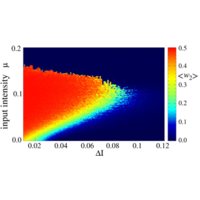
The authors address the plasticity of the coupling between neurons subjected to stochastic excitations. By reducing the problem to a system of two neurons, they show the onset of new states that do not appear in deterministic models. Interestingly, they find that noise could act to stabilize the coupling and enhance synchronization.
[Phys. Rev. E 93, 032210] Published Tue Mar 08, 2016
09 Mar 01:16
by Yanjun Lei, Xin Jiang, Quantong Guo, Yifang Ma, Meng Li, and Zhiming Zheng
Author(s): Yanjun Lei, Xin Jiang, Quantong Guo, Yifang Ma, Meng Li, and Zhiming Zheng
The evolution of network structure and the spreading of epidemic are common coexistent dynamical processes. In most cases, network structure is treated as either static or time-varying, supposing the whole network is observed in the same time window. In this paper, we consider the epidemics spreadin…
[Phys. Rev. E 93, 032308] Published Tue Mar 08, 2016
09 Mar 01:14
by Filippo Radicchi and Claudio Castellano
Author(s): Filippo Radicchi and Claudio Castellano
Theoretical attempts proposed so far to describe ordinary percolation processes on real-world networks rely on the locally tree-like ansatz. Such an approximation, however, holds only to a limited extent, as real graphs are often characterized by high frequencies of short loops. We present here a th…
[Phys. Rev. E] Published Thu Mar 03, 2016
09 Mar 01:14
by S. M. Oh, S. -W. Son, and B. Kahng
Author(s): S. M. Oh, S. -W. Son, and B. Kahng
Recent extensive studies of the explosive percolation (EP) model revealed that the EP transition is second-order with an extremely small value of the critical exponent b associated with the order parameter. This result was obtained from static networks, in which the number of nodes in the system rem…
[Phys. Rev. E] Published Thu Mar 03, 2016
09 Mar 01:14
by H. H. Yoo and D. -S. Lee
Author(s): H. -H. Yoo and D. -S. Lee
Synchronizing individual activities is essential for the stable functioning of diverse complex systems. Understanding the relation between dynamic fluctuations and the connection topology of substrates is therefore important, but it remains restricted to regular lattices. Here we investigate the flu…
[Phys. Rev. E] Published Fri Mar 04, 2016
09 Mar 01:13
by Kay Jörg Wiese
Author(s): Kay Jörg Wiese
renormalized field theories there are in general one or few fixed points which are accessible by the renormalization-group flow. They can be identified from the fixed-point equations. Exceptionally, an infinite family of fixed points exists, parameterized by a scaling exponent z, itself function of …
[Phys. Rev. E] Published Fri Mar 04, 2016
09 Mar 01:13
by Heman Shakeri, Nathan Albin, Faryad Darabi Sahneh, Pietro Poggi-Corradini, and Caterina Scoglio
Author(s): Heman Shakeri, Nathan Albin, Faryad Darabi Sahneh, Pietro Poggi-Corradini, and Caterina Scoglio
Algebraic connectivity, the second eigenvalue of the Laplacian matrix, is a measure of node and link connectivity on networks. When studying interconnected networks it is useful to consider a multiplex model, where the component networks operate together with inter-layer links among them. In order t…
[Phys. Rev. E] Published Mon Mar 07, 2016
08 Mar 19:11
by Vitaly Belik, Alexander Fengler, Florian Fiebig, Hartmut H. K. Lentz, Philipp Hövel
We consider recurrent contagious processes on a time-varying network. As a
control procedure to mitigate the epidemic, we propose an adaptive rewiring
mechanism for temporary isolation of infected nodes upon their detection. As a
case study, we investigate the network of pig trade in Germany. Based on
extensive numerical simulations for a wide range of parameters, we demonstrate
that the adaptation mechanism leads to a significant extension of the parameter
range, for which most of the index nodes (origins of the epidemic) lead to
vanishing epidemics. Furthermore the performance of adaptation is very
heterogeneous with respect to the index node. We quantify the success of the
proposed adaptation scheme in dependence on the infectious period and the
detection time. To support our findings we propose a mean-field analytical
description of the problem.
Donate to arXiv
08 Mar 19:11
by I. Sendiña-Nadal, M. M. Danziger, Z. Wang, S. Havlin, S. Boccaletti
Many real-world networks exhibit degree-assortativity, with nodes of similar
degree more likely to link to one another. Particularly in social networks, the
contribution to the total assortativity varies with degree, featuring a
distinctive peak slightly past the average degree. The way traditional models
imprint assortativity on top of pre-defined topologies is via degree-preserving
link permutations, which however destroy the particular graph's hierarchical
traits of clustering. Here, we propose the first generative model which creates
heterogeneous networks with scale-free-like properties and tunable realistic
assortativity. In our approach, two distinct populations of nodes are added to
an initial network seed: one (the followers) that abides by usual preferential
rules, and one (the potential leaders) connecting via anti-preferential
attachments, i.e. selecting lower degree nodes for their initial links. The
latter nodes come to develop a higher average degree, and convert eventually
into the final hubs. Examining the evolution of links in Facebook, we present
empirical validation for the connection between the initial anti-preferential
attachment and long term high degree. Thus, our work sheds new light on the
structure and evolution of social networks.
Donate to arXiv
08 Mar 19:11
by Bin Jiang, Ding Ma, Junjun Yin, Mats Sandberg
Social media outlets such as Twitter constitute valuable data sources for
understanding human activities in the virtual world from a geographic
perspective. This paper examines spatial distribution of tweets and densities
within cities. The cities refer to natural cities that are automatically
aggregated from a country's small street blocks, so called city blocks. We
adopted street blocks (rather than census tracts) as the basic geographic units
and topological center (rather than geometric center) in order to assess how
tweets and densities vary from the center to the peripheral border. We found
that, within a city from the center to the periphery, the tweets first increase
and then decrease, while the densities decrease in general. These increases and
decreases fluctuate dramatically, and differ significantly from those if census
tracts are used as the basic geographic units. We also found that the decrease
of densities from the center to the periphery is less significant, and even
disappears, if an arbitrarily defined city border is adopted. These findings
prove that natural cities and their topological centers are better than their
counterparts (conventionally defined cities and city centers) for geographic
research. Based on this study, we believe that tweet densities can be a good
surrogate of population densities. If this belief is proved to be true, social
media data could help solve the dispute surrounding exponential or power
function of urban population density.
Keywords: Big data, natural cities, street blocks, urban density, topological
distance
Donate to arXiv
08 Mar 16:00
by Soumen K. Patra and Anandamohan Ghosh
Author(s): Soumen K. Patra and Anandamohan Ghosh
Characterization of spatiotemporal dynamics of coupled oscillatory systems can be done by computing the Lyapunov exponents. We study the spatiotemporal dynamics of randomly coupled network of Kuramoto oscillators and find that the spectral statistics obtained from the Lyapunov exponent spectrum show…
[Phys. Rev. E 93, 032208] Published Mon Mar 07, 2016
08 Mar 15:21
by Klementyna Szwaykowska, Ira B. Schwartz, Luis Mier-y-Teran Romero, Christoffer R. Heckman, Dan Mox, and M. Ani Hsieh
Author(s): Klementyna Szwaykowska, Ira B. Schwartz, Luis Mier-y-Teran Romero, Christoffer R. Heckman, Dan Mox, and M. Ani Hsieh
The formation of coherent patterns in swarms of interacting self-propelled autonomous agents is a subject of great interest in a wide range of application areas, ranging from engineering and physics to biology. In this paper, we model and experimentally realize a mixed-reality large-scale swarm of d…
[Phys. Rev. E 93, 032307] Published Mon Mar 07, 2016
08 Mar 11:01
by Paul Schultz, Peter J. Menck, Jobst Heitzig, Jürgen Kurths
Stability assessment methods for dynamical systems have recently been
complemented by basin stability and derived measures, i.e. probabilistic
statements whether systems remain in a basin of attraction given a distribution
of perturbations. This requires numerical estimation via Monte-Carlo sampling
and integration of differential equations. Here, we analyze the applicability
of basin stability to systems with basin geometries challenging for this
numerical method, having fractal basin boundaries and riddled or intermingled
basins of attraction. We find that numerical basin stability estimation is
still meaningful for fractal boundaries but reaches its limits for riddled
basins with holes.
Donate to arXiv
07 Mar 11:48
Uma reflexão sobre a linguagem e o modo como as pessoas com deficiência são significadas pelo discurso
07 Mar 11:34
by Jess Banks, Cristopher Moore
We give upper and lower bounds on the information-theoretic threshold for
community detection in the stochastic block model. Specifically, let $k$ be the
number of groups, $d$ be the average degree, the probability of edges between
vertices within and between groups be $c_\mathrm{in}/n$ and $c_\mathrm{out}/n$
respectively, and let $\lambda = (c_\mathrm{in}-c_\mathrm{out})/(kd)$. We show
that, when $k$ is large, and $\lambda = O(1/k)$, the critical value of $d$ at
which community detection becomes possible -- in physical terms, the
condensation threshold -- is \[ d_c = \Theta\!\left( \frac{\log k}{k \lambda^2}
\right) \, , \] with tighter results in certain regimes. Above this threshold,
we show that the only partitions of the nodes into $k$ groups are correlated
with the ground truth, giving an exponential-time algorithm that performs
better than chance -- in particular, detection is possible for $k \ge 5$ in the
disassortative case $\lambda < 0$ and for $k \ge 11$ in the assortative case
$\lambda > 0$. (Similar upper bounds were obtained independently by Abbe and
Sandon.) Below this threshold, we use recent results of Neeman and Netrapalli
(who generalized arguments of Mossel, Neeman, and Sly) to show that no
algorithm can label the vertices better than chance, or even distinguish the
block model from an Erd\H{o}s-R\'enyi random graph with high probability. We
also rely on bounds on certain functions of doubly stochastic matrices due to
Achlioptas and Naor; indeed, our lower bound on $d_c$ is the second moment
lower bound on the $k$-colorability threshold for random graphs with a certain
effective degree.
05 Mar 11:51
by Kevin P. O'Keeffe
Author(s): Kevin P. O'Keeffe
We consider the transient behavior of globally coupled systems of identical pulse-coupled oscillators. Synchrony develops through an aggregation phenomenon, with clusters of synchronized oscillators forming and growing larger in time. Previous work derived expressions for these time dependent cluste…
[Phys. Rev. E 93, 032203] Published Fri Mar 04, 2016
05 Mar 01:48
by Bastian Pietras, Nicolás Deschle, Andreas Daffertshofer
Populations of oscillators can display a variety of synchronization patterns
depending on the oscillators' intrinsic coupling and the coupling between them.
We consider two coupled, symmetric (sub)populations with unimodal frequency
distributions and show that the resulting synchronization patterns may resemble
those of a single population with bimodally distributed frequencies. Our proof
of the equivalence of their stability, dynamics, and bifurcations, is based on
an Ott-Antonsen ansatz. The generalization to networks consisting of multiple
(sub)populations vis-\`a-vis networks with multimodal frequency distributions,
however, appears impossible.
Donate to arXiv
05 Mar 01:48
by Felix P. Kemeth, Sindre W. Haugland, Lennart Schmidt, Ioannis G. Kevrekidis, Katharina Krischer
We present a universal characterization scheme for chimera states applicable
to both numerical and experimental data sets. The scheme is based on two
correlation measures that enable a meaningful definition of chimera states as
well as their classification into three categories: stationary, turbulent and
breathing. In addition, these categories can be further subdivided according to
the time-stationarity of these two measures. We demonstrate that this approach
both is consistent with previously recognized chimera states and enables us to
classify states as chimeras which have not been categorized as such before.
Furthermore, the scheme allows for a qualitative and quantitative comparison of
experimental chimeras with chimeras obtained through numerical simulations.
05 Mar 01:26
by Enys Mones, Arkadiusz Stopczynski, Alex Pentland, Nathaniel Hupert, Sune Lehmann
Vaccination and outbreak monitoring are essential tools for preventing and
minimizing outbreaks of infectious diseases. Targeted strategies, where the
individuals most important for monitoring or preventing outbreaks are selected
for intervention, offer a possibility to significantly improve these measures.
Although targeted strategies carry a strong potential, identifying optimal
target groups remains a challenge. Here we consider the problem of identifying
target groups based on digital communication networks (telecommunication,
online social media) in order to predict and contain an infectious disease
spreading on a real-world person-to-person network of more than 500
individuals. We show that target groups for efficient outbreak monitoring can
be determined based on both telecommunication and online social network
information. In case of vaccination the information regarding the digital
communication networks improves the efficacy for short-range disease
transmissions but, surprisingly, performance is severely reduced in the case of
long-range transmission. These results are robust with respect to the strategy
used to identify targeted individuals and time-gap between identification of
targets and the intervention. Thus, we demonstrate that data available from
telecommunication and online social networks can greatly improve epidemic
control measures, but it is important to consider the details of the pathogen
spreading mechanism when such policies are applied.
Donate to arXiv
04 Mar 16:23
Sob forte pressão interna para conter o número de refugiados na Alemanha, a chanceler Angela Merkel afirmou nesta sexta-feira (4), após encontro em Paris com o presidente francês, François Hollande, que buscará manter a livre circulação de pessoas na União Europeia (UE), prevista pelo
Espaço Schengen.
Leia mais (03/04/2016 - 13h07)
04 Mar 12:37
by Felix P. Kemeth, Sindre W. Haugland, Lennart Schmidt, Ioannis G. Kevrekidis, Katharina Krischer
We present a universal characterization scheme for chimera states applicable
to both numerical and experimental data sets. The scheme is based on two
correlation measures that enable a meaningful definition of chimera states as
well as their classification into three categories: stationary, turbulent and
breathing. In addition, these categories can be further subdivided according to
the time-stationarity of these two measures. We demonstrate that this approach
both is consistent with previously recognized chimera states and enables us to
classify states as chimeras which have not been categorized as such before.
Furthermore, the scheme allows for a qualitative and quantitative comparison of
experimental chimeras with chimeras obtained through numerical simulations.
04 Mar 12:35
by Per Sebastian Skardal, Alex Arenas
The control of network-coupled nonlinear dynamical systems is an active area
of research in the nonlinear science community. Coupled oscillator networks
represent a particularly important family of nonlinear systems, with
applications ranging from the power grid to cardiac excitation. Here we study
the control of network-coupled limit cycle oscillators, extending previous work
that focused on phase oscillators. Based on stabilizing a target fixed point,
our method aims to attain complete frequency synchronization, i.e., consensus,
by applying control to as few oscillators as possible. We develop two types of
control. The first type directs oscillators towards to larger amplitudes, while
the second does not. We present numerical examples of both control types and
comment on the potential failures of the method.
04 Mar 12:34
by Anders M.N. Niklasson, Susan M. Mniszewski, Christian F.A. Negre, Marc J. Cawkwell, Pieter J. Swart, Jamal Mohd-Yusof, Timothy C. Germann, Michael E. Wall, Nicolas Bock, Hristo Djidjev
We show how graph theory can be combined with quantum theory to calculate the
electronic structure of large complex systems. The graph formalism is general
and applicable to a broad range of electronic structure methods and materials,
including challenging systems such as biomolecules. The methodology combines
well-controlled accuracy, low computational cost, and natural low-communication
parallelism. This combination addresses substantial shortcomings of linear
scaling electronic structure theory, in particular with respect to
quantum-based molecular dynamics simulations.
Donate to arXiv
03 Mar 13:22
by Satoru Morita
Six Susceptible-Infected-Susceptible Models on Scale-free Networks
Scientific Reports, Published online: 3 March 2016; doi:10.1038/srep22506

03 Mar 09:38
by Per Sebastian Skardal, Alex Arenas
The control of network-coupled nonlinear dynamical systems is an active area
of research in the nonlinear science community. Coupled oscillator networks
represent a particularly important family of nonlinear systems, with
applications ranging from the power grid to cardiac excitation. Here we study
the control of network-coupled limit cycle oscillators, extending previous work
that focused on phase oscillators. Based on stabilizing a target fixed point,
our method aims to attain complete frequency synchronization, i.e., consensus,
by applying control to as few oscillators as possible. We develop two types of
control. The first type directs oscillators towards to larger amplitudes, while
the second does not. We present numerical examples of both control types and
comment on the potential failures of the method.
03 Mar 09:38
by Carl P. Dettmann
In dynamical systems with divided phase space, the vicinity of the boundary
between regular and chaotic regions is often "sticky," that is, trapping orbits
from the chaotic region for long times. Here, we investigate the stickiness in
the simplest mushroom billiard, which has a smooth such boundary, but
surprisingly subtle behaviour. As a measure of stickiness, we investigate P(t),
the probability of remaining in the mushroom cap for at least time t given
uniform initial conditions in the chaotic part of the cap. The stickiness is
sensitively dependent on the radius of the stem r via the Diophantine
properties of rho = (2/\pi) arccos r. Almost all rho give rise to families of
marginally unstable periodic orbits (MUPOs) where P(t) ~ C/t, dominating the
stickiness of the boundary. Here we consider the case where rho is MUPO-free
and has continued fraction expansion with bounded partial quotients. We show
that t^2 P(t) is bounded, varying infinitely often between values whose ratio
is at least 32/27. When rho has an eventually periodic continued fraction
expansion, that is, a quadratic irrational, t^2 P(t) converges to a
log-periodic function. In general, we expect less regular behaviour, with upper
and lower exponents lying between 1 and 2. The results may shed light on the
parameter dependence of boundary stickiness in annular billiards and generic
area preserving maps.
