19 Jul 20:59
by Daniel Jung and Stefan Kettemann
Author(s): Daniel Jung and Stefan Kettemann
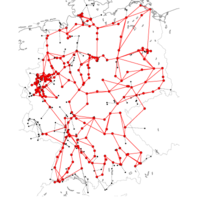
This paper analyzes the behavior of electricity grids in response to perturbations. The authors specifically consider the case of the addition of one extra edge and study the long-range response of the system, focusing on the power-law decay of the disturbance. They apply their findings to a real power grid and observe comparable behavior, although specific details such as the connectivity and the topology of the network might play a relevant role.
[Phys. Rev. E 94, 012307] Published Fri Jul 15, 2016
16 Jul 00:18
by Zahra Fatemi, Mostafa Salehi, Matteo Magnani
We introduce multiforce, a force-directed layout for multiplex networks,
where the nodes of the network are organized into multiple layers and both
in-layer and inter-layer relationships among nodes are used to compute node
coordinates. The proposed approach generalizes existing work, providing a range
of intermediate layouts in-between the ones produced by known methods. Our
experiments on real data show that multiforce can keep nodes reasonably aligned
across different layers without significantly affecting the internal layout of
each layer.
15 Jul 17:23
by M. A. Lopes, E. M. Lopes, S. Yoon, J. F. F. Mendes, and A. V. Goltsev
Author(s): M. A. Lopes, E. M. Lopes, S. Yoon, J. F. F. Mendes, and A. V. Goltsev
We study the impact of random pinning fields on the emergence of synchrony in the Kuramoto model on complete graphs and uncorrelated random complex networks. We consider random fields with uniformly distributed directions and homogeneous and heterogeneous (Gaussian) field magnitude distribution. In …
[Phys. Rev. E 94, 012308] Published Fri Jul 15, 2016
15 Jul 13:22
by Yu Terada and Toshio Aoyagi
Author(s): Yu Terada and Toshio Aoyagi
A large variety of rhythms are observed in nature. Rhythms such as electroencephalogram signals in the brain can often be regarded as interacting. In this study, we investigate the dynamical properties of rhythmic systems in two populations of phase oscillators with different frequency distributions…
[Phys. Rev. E 94, 012213] Published Wed Jul 13, 2016
15 Jul 13:21
by Miguel A. Rodríguez
Author(s): Miguel A. Rodríguez
We obtain graphicality conditions for general types of scale-free networks. The same conditions obtained for uncorrelated networks are obtained in the general case. Then an upper bound relating \gamma, the exponent of the degree distribution, with the cutoff exponent \kappa, as \kappa
[Phys. Rev. E] Published Tue Jul 12, 2016
15 Jul 13:16
by Frank Hellmann, Paul Schultz, Carsten Grabow, Jobst Heitzig, Jürgen Kurths
The notion of a part of phase space containing desired (or allowed) states of
a dynamical system is important in a wide range of complex systems research. It
has been called the safe operating space, the viability kernel or the sunny
region. In this paper we define the notion of survivability: Given a random
initial condition, what is the likelihood that the transient behaviour of a
deterministic system does not leave a region of desirable states. We
demonstrate the utility of this novel stability measure by considering models
from climate science, neuronal networks and power grids. We also show that a
semi-analytic lower bound for the survivability of linear systems allows a
numerically very efficient survivability analysis in realistic models of power
grids. Our numerical and semi-analytic work underlines that the type of
stability measured by survivability is not captured by common asymptotic
stability measures.
14 Jul 13:13
by Alberto Antonioni, Alessio Cardillo
Despite the large number of studies on synchronization, the hypothesis that
interactions bear a cost for involved individuals has been considered seldom.
The introduction of costly interactions leads, instead, to the formulation of a
dichotomous scenario in which an individual may decide to cooperate and pay the
cost in order to get synchronized with the rest of the population.
Alternatively, the same individual can decide to free ride, without incurring
in any cost, waiting that others get synchronized to her state. The emergence
of synchronization may thus be seen as the byproduct of an evolutionary game in
which individuals decide their behavior according to the benefit/cost ratio
they accrue in the past. We study the onset of cooperation/synchronization in
networked populations of Kuramoto oscillators and report how topology is
essential in order for cooperation to thrive. We display also how different
classes of topology foster differently synchronization both at a microscopic
and macroscopic level.
14 Jul 13:12
by Staša Milojević, Filippo Radicchi, Judit Bar-Ilan
In this paper we present "citation success index", a metric for comparing the
citation capacity of pairs of journals. Citation success index is the
probability that a random paper in one journal has more citations than a random
paper in another journal (50% means the two journals do equally well). Unlike
the journal impact factor (IF), the citation success index depends on the
broadness and the shape of citation distributions. Also, it is insensitive to
sporadic highly-cited papers that skew the IF. Nevertheless, we show, based on
16,000 journals containing ~2.4 million articles, that the citation success
index is a relatively tight function of the ratio of IFs of journals being
compared, due to the fact that journals with same IF have quite similar
citation distributions. The citation success index grows slowly as a function
of IF ratio. It is substantial (>90%) only when the ratio of IFs exceeds ~6,
whereas a factor of two difference in IF values translates into a modest
advantage for the journal with higher IF (index of ~70%). We facilitate the
wider adoption of this metric by providing an online calculator that takes as
input parameters only the IFs of the pair of journals.
14 Jul 13:12
by Per Sebastian Skardal and Alex Arenas
The control of network-coupled nonlinear dynamical systems is an active area of research in the nonlinear science community. Coupled oscillator networks represent a particularly important family of nonlinear systems, with applications ranging from the power grid to cardiac excitation. Here, we study the control of network-coupled limit cycle oscillators, extending the previous work that focused on phase oscillators. Based on stabilizing a target fixed point, our method aims to attain complete frequency synchronization, i.e., consensus, by applying control to as few oscillators as possible. We develop two types of controls. The first type directs oscillators towards larger amplitudes, while the second does not. We present numerical examples of both control types and comment on the potential failures of the method.
13 Jul 17:48
by Zhixin Lu, Kevin Klein-Cardeña, Steven Lee, Thomas M. Antonsen, Michelle Girvan and Edward Ott
Cells in the brain's Suprachiasmatic Nucleus (SCN) are known to regulate circadian rhythms in mammals. We model synchronization of SCN cells using the forced Kuramoto model, which consists of a large population of coupled phase oscillators
(modeling individual SCN cells) with heterogeneous intrinsic frequencies and external periodic forcing. Here, the periodic forcing models diurnally varying external inputs such as sunrise, sunset, and alarm clocks. We reduce the dimensionality of the system using the ansatz of Ott and Antonsen and then study the effect of a sudden change of clock phase to simulate cross-time-zone travel. We estimate model parameters from previous biological experiments. By examining the phase space dynamics of the model, we study the mechanism leading to the difference typically experienced in the severity of jet-lag resulting from eastward and westward travel.
13 Jul 17:48
by Alberto Antonioni, Alessio Cardillo
Despite the large number of studies on synchronization, the hypothesis that
interactions bear a cost for involved individuals has been considered seldom.
The introduction of costly interactions leads, instead, to the formulation of a
dichotomous scenario in which an individual may decide to cooperate and pay the
cost in order to get synchronized with the rest of the population.
Alternatively, the same individual can decide to free ride, without incurring
in any cost, waiting that others get synchronized to her state. The emergence
of synchronization may thus be seen as the byproduct of an evolutionary game in
which individuals decide their behavior according to the benefit/cost ratio
they accrue in the past. We study the onset of cooperation/synchronization in
networked populations of Kuramoto oscillators and report how topology is
essential in order for cooperation to thrive. We display also how different
classes of topology foster differently synchronization both at a microscopic
and macroscopic level.
12 Jul 12:54
by Zoltán Kis
Development of a synthetic gene network to modulate gene expression by mechanical forces
Scientific Reports, Published online: 12 July 2016; doi:10.1038/srep29643

12 Jul 10:55
by Norbert Blenn, Piet Van Mieghem
In this paper, we are analyzing the interactivity time, defined as the
duration between two consecutive tasks such as sending emails, collecting
friends and followers and writing comments in online social networks (OSNs).
The distributions of these times are heavy tailed and often described by a
power-law distribution. However, power-law distributions usually only fit the
heavy tail of empirical data and ignore the information in the smaller value
range. Here, we argue that the durations between writing emails or comments,
adding friends and receiving followers are likely to follow a lognormal
distribution.
We discuss the similarities between power-law and lognormal distributions,
show that binning of data can deform a lognormal to a power-law distribution
and propose an explanation for the appearance of lognormal interactivity times.
The historical debate of similarities between lognormal and power-law
distributions is reviewed by illustrating the resemblance of measurements in
this paper with the historical problem of income and city size distributions.
12 Jul 10:53
by Chokchai Puttharugsa, Supitch Khemmani, Patipan Utayarat and Wasutep Luangtip
This paper describes the use of smartphone’s gyroscope sensor to analyse a hollow cylinder rolling
down an inclined plane. The smartphone (iPhone 4s) was attached to the end of hollow cylinder and
was equipped with the Sensorlog application (Sensorlog app) to record the angular speed of rolling
down an inclined plane. The experimental results agree with the theoretical model that is familiar
to students for the rolling motion on an inclined plane. Moreover, the coefficients of static
friction and kinetic friction were determined to be 0.205 ± 0.011 and 0.178 ± 0.003 from the
measurements, respectively. This experiment demonstrated an alternative way to teach the rolling
motion in a physics laboratory.
11 Jul 22:30
by John Lombard
We introduce the construction of a new framework for probing discrete
emergent geometry and boundary-boundary observables based on a fundamentally
a-dimensional underlying network structure. Using a gravitationally motivated
action with Forman weighted combinatorial curvatures and simplicial volumes
relying on a decomposition of an abstract simplicial complex into realized
embeddings of proper skeletons, we demonstrate properties such as a minimal
volume-scale cutoff, the necessity of a positive-definite cosmological
constant-like term as a regulator for non-degenerate geometries, and naturally
emergent simplicial structures from Metropolis network evolution simulations
with no restrictions on attachment rules or regular building blocks. We see
emergent properties which echo results from both the spinfoam formalism and
causal dynamical triangulations in quantum gravity, and provide analytical and
numerical results to support the analogy. We conclude with a summary of open
questions and intent for future work in developing the program.
11 Jul 22:23
by R. J. Requejo and A. Díaz-Guilera
Author(s): R. J. Requejo and A. Díaz-Guilera
In this study we present an extension of the dynamics of diffusion in multiplex graphs which makes the equations compatible with the replicator equation with mutations. We derive an exact formula for the diffusion term, which shows that, while diffusion is linear for numbers of agents, it is necessa…
[Phys. Rev. E] Published Fri Jul 08, 2016
11 Jul 22:21
by J. Chávez-Carlos, M. A. Bastarrachea-Magnani, S. Lerma-Hernández, and J. G. Hirsch
Author(s): J. Chávez-Carlos, M. A. Bastarrachea-Magnani, S. Lerma-Hernández, and J. G. Hirsch
The relation between the onset of chaos and critical phenomena, like Quantum Phase Transitions (QPT) and Excited-State Quantum Phase transitions (ESQPT), is analyzed for atom-field systems. While it has been speculated that the onset of hard chaos is associated with ESQPT based in the resonant case,…
[Phys. Rev. E] Published Fri Jul 08, 2016
11 Jul 22:20
by Spase Petkoski, Andreas Spiegler, Timothée Proix, Parham Aram, Jean-Jacques Temprado, and Viktor K. Jirsa
Author(s): Spase Petkoski, Andreas Spiegler, Timothée Proix, Parham Aram, Jean-Jacques Temprado, and Viktor K. Jirsa
Network couplings of oscillatory large-scale systems, such as the brain, have a space-time structure composed of connection strengths and signal transmission delays. We provide a theoretical framework, which allows treating the spatial distribution of time delays with regard to synchronization, by d…
[Phys. Rev. E 94, 012209] Published Mon Jul 11, 2016
11 Jul 22:17
by Fabio Saracco, Riccardo Di Clemente, Andrea Gabrielli, Tiziano Squartini
Bipartite networks are currently regarded as providing a major insight into
the organization of many real-world systems, unveiling the mechanisms driving
the interactions occurring between distinct groups of nodes. One of the most
important issues encountered when modeling bipartite networks is devising a way
to obtain a (monopartite) projection on the layer of interest, which preserves
as much as possible the information encoded into the original bipartite
structure. In the present paper we propose an algorithm to obtain
statistically-validated projections of bipartite networks, according to which
any two nodes sharing a statistically-significant number of neighbors are
linked. Since assessing the statistical significance of nodes similarity
requires a proper statistical benchmark, here we consider a set of four null
models, defined within the exponential random graph framework. Our algorithm
outputs a matrix of link-specific p-values, from which a validated projection
is straightforwardly obtainable, upon running a multiple hypothesis testing
procedure. Finally, we test our method on an economic network (i.e. the
countries-products World Trade Web representation) and a social network (i.e.
MovieLens, collecting the users' ratings of a list of movies). In both cases
non-trivial communities are detected: while projecting the World Trade Web on
the countries layer reveals modules of similarly-industrialized nations,
projecting it on the products layer allows communities characterized by an
increasing level of complexity to be detected; in the second case, projecting
MovieLens on the films layer allows clusters of movies whose affinity cannot be
fully accounted for by genre similarity to be individuated.
11 Jul 22:15
by Naveen K. Mahato, Axel Klar, Sudarshan Tiwari
We consider a multi-group microscopic model for pedestrian flow describing
the behaviour of large groups. It is based on an interacting particle system
coupled to an eikonal equation. Hydrodynamic multi-group models are derived
from the underlying particle system as well as scalar multi-group models. The
eikonal equation is used to compute optimal paths for the pedestrians. Particle
methods are used to solve the equations on all levels of the hierarchy.
Numerical test cases are investigated and the models and, in particular, the
resulting evacuation times are compared for a wide range of different
parameters.
11 Jul 22:15
by María Pereda
In this work, we aim to contribute to the understanding of the human
pro-social behavior by studying the influence that a particular form of social
pressure "being watched" has on the evolution of cooperative behavior. We study
how cooperation emerge in multiplex complex topologies by analyzing a
particular bidirectionally-coupled dynamics on top of a two-layers multiplex
network (duplex). The coupled dynamics appears between the Prisoner's Dilemma
game in a network, and a threshold cascade model in the other. The threshold
model is intended to abstract the behavior of a network of vigilant nodes, that
impose pressure of being observed altering hence the temptation to defect of
the dilemma. Cooperation or defection in the game also affects the state of a
node of being vigilant. We analyze these processes on different duplex networks
structures and assess the influence of the topology, average degree and
correlated multiplexity, on the outcome of cooperation. Interestingly, we find
that the social pressure of vigilance may impact cooperation positively or
negatively, depending on the duplex structure, specifically the degree
correlations between layers is determinant. Our results give further
quantitative insights in the promotion of cooperation under social pressure.
11 Jul 22:14
by Francesco Alderisio, Gianfranco Fiore, Robin N Salesse, Benoit G Bardy, Mario di Bernardo
An important open problem in Human Behaviour is to understand how
coordination emerges in human ensembles. This problem has been seldom studied
quantitatively in the existing literature, in contrast to situations involving
dual interaction. Here we study motor coordination (or synchronisation) in a
group of individuals where participants are asked to visually coordinate an
oscillatory hand motion. We separately tested two groups of seven participants.
We observed that the coordination level of the ensemble depends on group
homogeneity, as well as on the pattern of visual couplings (who looked at
whom). Despite the complexity of social interactions, we show that networks of
coupled heterogeneous oscillators with different structures capture well the
group dynamics. Our findings are relevant to any activity requiring the
coordination of several people, as in music, sport or at work, and can be
extended to account for other perceptual forms of interaction such as sound or
feel.
10 Jul 14:11
by Pavel V. Kuptsov, Sergey P. Kuznetsov
We develop a numerical test of hyperbolicity of chaotic dynamics in
time-delay systems. The test is based on the angle criterion and includes
computation of angle distributions between expanding, contracting and neutral
manifolds of trajectories on the attractor. Three examples are tested. For two
of them previously predicted hyperbolicity is confirmed. The third one provides
an example of a time-delay system with nonhyperbolic chaos.
10 Jul 14:08
by Pao-Keng Yang
In physics, Planck’s constant is a fundamental physical constant accounting for the
energy-quantization phenomenon in the microscopic world. The value of Planck’s constant also
determines in which length scale the quantum phenomenon will become conspicuous. Some students think
that if Planck’s constant were to have a larger value than it has now, the quantum effect would only
become observable in a world with a larger size, whereas the macroscopic world might remain almost
unchanged. After reasoning from some basic physical principles and theories, we found that doubling
Planck’s constant might result in a radical change on the geometric sizes and apparent colors of
macroscopic objects, the solar spectrum and luminosity, the climate and gravity on Earth, as well as
energy conversion between light and materials such as the efficiency of solar cells and
light-emitting diodes. From the discussions in this paper, students can appreciate how Planck’s
constant affects various aspects ...
10 Jul 14:06
by Robert I McLachlan, Klas Modin and Olivier Verdier
We give an elementary illustration of symmetry reduction for central force problems, drawing phase
portraits of the reduced dynamics as the intersection of Casimir and energy level sets in three
dimensions. These systems form a classic example of symplectic reduction which can usefully be
compared to the more commonly seen case of the free rigid body.
08 Jul 22:45
by V. K. Chandrasekar, R. Gopal, D. V. Senthilkumar, and M. Lakshmanan
Author(s): V. K. Chandrasekar, R. Gopal, D. V. Senthilkumar, and M. Lakshmanan
We report the emergence of a collective dynamical state, namely, the phase-flip chimera, from an ensemble of identical nonlinear oscillators that are coupled indirectly via the dynamical variables from a common environment, which in turn are nonlocally coupled. The phase-flip chimera is characterize…
[Phys. Rev. E 94, 012208] Published Thu Jul 07, 2016
08 Jul 22:43
by Shuchao Cao, Jun Zhang, Daniel Salden, Jian Ma, Chang’an Shi, and Ruifang Zhang
Author(s): Shuchao Cao, Jun Zhang, Daniel Salden, Jian Ma, Chang’an Shi, and Ruifang Zhang
An aging population is bringing new challenges to the management of escape routes and facility design in many countries. This paper investigates pedestrian movement properties of crowd with different age compositions. Three pedestrian groups are considered: young student group, old people group and …
[Phys. Rev. E] Published Tue Jul 05, 2016
07 Jul 21:30
by Austin R. Benson
Networks are a fundamental tool for understanding and modeling complex systems in physics, biology, neuroscience, engineering, and social science. Many networks are known to exhibit rich, lower-order connectivity patterns that can be captured at the level of individual nodes and edges. However, higher-order organization of complex networks—at the level of small network subgraphs—remains largely unknown. Here, we develop a generalized framework for clustering networks on the basis of higher-order connectivity patterns. This framework provides mathematical guarantees on the optimality of obtained clusters and scales to networks with billions of edges. The framework reveals higher-order organization in a number of networks, including information propagation units in neuronal networks and hub structure in transportation networks. Results show that networks exhibit rich higher-order organizational structures that are exposed by clustering based on higher-order connectivity patterns.
Authors: Austin R. Benson, David F. Gleich, Jure Leskovec
07 Jul 15:10
by Julie Gould
What’s the point of the PhD thesis?
Nature 535, 7610 (2016). http://www.nature.com/doifinder/10.1038/535026a
Author: Julie Gould
Doctoral courses are slowly being modernized. Now the thesis and viva need to catch up.

07 Jul 15:06
by Wen-Ting Yu, Jun Tang, Jun Ma and Xianqing Yang
A neuronal network often involves time delay caused by the finite signal propagation time in a given
biological network. This time delay is not a homogenous fluctuation in a biological system. The
heterogeneous delay-induced asynchrony and resonance in a noisy small-world neuronal network system
are numerically studied in this work by calculating synchronization measure and spike interval
distribution. We focus on three different delay conditions: double-values delay, triple-values
delay, and Gaussian-distributed delay. Our results show the following: 1) the heterogeneity in delay
results in asynchronous firing in the neuronal network, and 2) maximum synchronization could be
achieved through resonance given that the delay values are integer or half-integer times of each
other.
