We investigate the existence of an optimal interplay between the natural frequencies of a group chaotic oscillators and the topological properties of the network they are embedded in. We identify the conditions for achieving phase synchronization in the most effective way, i.e., with the lowest possible coupling strength. Specifically, we show by means of numerical and experimental results that it is possible to define a synchrony alignment function linking the natural frequencies of a set of non-identical phase-coherent chaotic oscillators with the topology of the Laplacian matrix $L$, the latter accounting for the specific organization of the network of interactions between oscillators. We use the classical R\"ossler system to show that the synchrony alignment function obtained for phase oscillators can be extended to phase-coherent chaotic systems. Finally, we carry out a series of experiments with nonlinear electronic circuits to show the robustness of the theoretical predictions despite the intrinsic noise and parameter mismatch of the electronic components.
Edmilson Roque
Shared posts
Optimal phase synchronization in networks of phase-coherent chaotic oscillators. (arXiv:1609.05014v2 [nlin.AO] UPDATED)
An Analytical Study on the Synchronization of Strange Non-Chaotic Attractors. (arXiv:1609.04995v1 [nlin.CD])
In this paper we present an analytical study on the synchronization dynamics observed in unidirectionally-coupled quasiperiodically-forced systems that exhibit Strange Non-chaotic Attractors (SNA) in their dynamics. The SNA dynamics observed in the uncoupled system is studied analytically through phase portraits and poincare maps. A difference system is obtained by coupling the state equations of similar piecewise linear regions of the drive and response systems. The mechanism of synchronization of the coupled system is realized through the bifurcation of the eigenvalues in one of the piecewise linear regions of the difference system. The analytical solutions obtained for the normalized state equations in each piecewise linear region of the difference system has been used to explain the synchronization dynamics though phase portraits and timeseries analysis. The stability of the synchronized state is confirmed through the Master Stability Function. An explicit analytical solution explaining the synchronization of SNAs is reported in the literature for the first time.
Turbulent chimeras in large semiconductor laser arrays. (arXiv:1609.03852v3 [nlin.AO] UPDATED)
Semiconductor laser arrays have been investigated experimentally and theoretically from the viewpoint of temporal and spatial coherence for the past forty years. In this work, we are focusing on a rather novel complex collective behavior, namely chimera states, where synchronized clusters of emitters coexist with unsynchronized ones. For the first time, we find such states exist in large diode arrays based on quantum well gain media with nearest-neighbor interactions. The crucial parameters are the evanescent coupling strength and the relative optical frequency detuning between the emitters of the array. By employing a recently proposed figure of merit for classifying chimera states, we provide quantitative and qualitative evidence for the observed dynamics. The corresponding chimeras are identified as turbulent according to the irregular temporal behavior of the classification measure.
The Trump phenomenon, an explanation from sociophysics. (arXiv:1609.03933v1 [physics.soc-ph])
The Trump phenomenon is argued to depart from current populist rise in Europe. According to a model of opinion dynamics from sociophysics the machinery of Trump's amazing success obeys well-defined counter-intuitive rules. Therefore, his success was in principle predictable from the start. The model uses local majority rule arguments and obeys a threshold dynamics. The associated tipping points are found to depend on the leading collective beliefs, cognitive biases and prejudices of the social group which undertakes the public debate. And here comes the sesame of the Trump campaign, which develops along two successive steps. During a first moment, Trump's statement produces a majority of voters against him. But at the same time, according to the model the shocking character of the statement modifies the prejudice balance. In case the prejudice is present even being frozen among voters, the tipping point is lowered at Trump's benefit. Nevertheless, although the tipping point has been lowered by the activation of frozen prejudices it is instrumental to preserve enough support from openly prejudiced people to be above the threshold. Then, as infuriated voters launch intense debate, occurrence of ties will drive progressively hostile people to shift their voting intention without needing to endorse the statement which has infuriated them. The on going debate does drive towards a majority for Trump. The possible Trump victory at November Presidential election is discussed. In particular, the model shows that to eventually win the Presidential election, Trump must not modify his past shocking attitude but to appeal to a different spectrum of frozen prejudices, which are common to both Democrats and Republicans.
Crowd Behaviour during High-Stress Evacuations in an Immersive Virtual Environment. (arXiv:1609.03731v1 [physics.soc-ph])
Understanding the collective dynamics of crowd movements during stressful emergency situations is central to reducing the risk of deadly crowd disasters. Yet, their systematic experimental study remains a challenging open problem due to ethical and methodological constraints. In this paper, we demonstrate the viability of shared 3D virtual environments as an experimental platform for conducting crowd experiments with real people. In particular, we show that crowds of real human subjects moving and interacting in an immersive 3D virtual environment exhibit typical patterns of real crowds as observed in real-life crowded situations. These include the manifestation of social conventions and the emergence of self-organized patterns during egress scenarios. High-stress evacuation experiments conducted in this virtual environment reveal movements characterized by mass herding and dangerous overcrowding as they occur in crowd disasters. We describe the behavioral mechanisms at play under such extreme conditions and identify critical zones where overcrowding may occur. Furthermore, we show that herding spontaneously emerges from a density effect without the need to assume an increase of the individual tendency to imitate peers. Our experiments reveal the promise of immersive virtual environments as an ethical, cost-efficient, yet accurate platform for exploring crowd behaviour in high-risk situations with real human subjects.
Identifying Community Structures in Dynamic Networks. (arXiv:1609.02622v2 [cs.SI] UPDATED)
Most real-world social networks are inherently dynamic, composed of communities that are constantly changing in membership. To track these evolving communities, we need dynamic community detection techniques. This article evaluates the performance of a set of game theoretic approaches for identifying communities in dynamic networks. Our method, D-GT (Dynamic Game Theoretic community detection), models each network node as a rational agent who periodically plays a community membership game with its neighbors. During game play, nodes seek to maximize their local utility by joining or leaving the communities of network neighbors. The community structure emerges after the game reaches a Nash equilibrium. Compared to the benchmark community detection methods, D-GT more accurately predicts the number of communities and finds community assignments with a higher normalized mutual information, while retaining a good modularity.
Collective motion of groups of self-propelled particles following interacting leaders. (arXiv:1609.03212v2 [physics.bio-ph] UPDATED)
In order to keep their cohesiveness during locomotion gregarious animals must make collective decisions. Many species boast complex societies with multiple levels of communities. A common case is when two dominant levels exist, one corresponding to leaders and the other consisting of followers. In this paper we study the collective motion of such two-level assemblies of self-propelled particles. We present a model adapted from one originally proposed to describe the movement of cells resulting in a smoothly varying coherent motion. We shall use the terminology corresponding to large groups of some mammals where leaders and followers form a group called a harem. We study the emergence (self-organization) of sub-groups within a herd during locomotion by computer simulations. The resulting processes are compared with our prior observations of a Przewalski horse herd (Hortob\'agy, Hungary) which we use as results from a published case study. We find that the model reproduces key features of a herd composed of harems moving on open ground, including fights for followers between leaders and bachelor groups (group of leaders without followers). One of our findings, however, does not agree with the observations. While in our model the emerging group size distribution is normal, the group size distribution of the observed herd based on historical data have been found to follow lognormal distribution. We argue that this indicates that the formation (and the size) of the harems must involve a more complex social topology than simple spatial-distance based interactions.
Clustering coefficient and periodic orbits in flow networks. (arXiv:1609.03291v2 [nlin.CD] UPDATED)
We show that the clustering coefficient, a standard measure in network theory, when applied to flow networks, i.e. graph representations of fluid flows in which links between nodes represent fluid transport between spatial regions, identifies approximate locations of periodic trajectories in the flow system. This is true for steady flows and for periodic ones in which the time interval $\tau$ used to construct the network is the period of the flow or a multiple of it. In other situations the clustering coefficient still identifies cyclic motion between regions of the fluid. Besides the fluid context, these ideas apply equally well to general dynamical systems. By varying the value of $\tau$ used to construct the network, a kind of spectroscopy can be performed so that the observation of high values of mean clustering at a value of $\tau$ reveals the presence of periodic orbits of period $3\tau$ which impact phase space significantly. These results are illustrated with examples of increasing complexity, namely a steady and a periodically perturbed model two-dimensional fluid flow, the three-dimensional Lorenz system, and the turbulent surface flow obtained from a numerical model of circulation in the Mediterranean sea.
Flow tracing as a tool set for the analysis of networked large-scale renewable electricity systems. (arXiv:1609.02977v2 [physics.soc-ph] UPDATED)
The method of flow tracing follows the power flow from net-generating sources through the network to the net-consuming sinks, which allows to assign the usage of the underlying transmission infrastructure to the system participants. This article presents a reformulation that is applicable to arbitrary compositions of inflow appearing naturally in models of large-scale electricity systems with a high share of renewable power generation. We propose an application which allows to associate power flows on the grid to specific regions or generation technologies, and emphasizes the capability of this technique to disentangle the spatio-temporal patterns of physical imports and exports occurring in such systems. The analytical potential of this method is showcased for a scenario based on the IEEE 118 bus network.
Multiplex lexical networks reveal patterns in early word acquisition in children. (arXiv:1609.03207v1 [physics.soc-ph])
Network models of language have provided a way of linking cognitive processes to the structure and connectivity of language. However, one shortcoming of current approaches is focusing on only one type of linguistic relationship at a time, missing the complex multi-relational nature of language. In this work, we overcome this limitation by modelling the mental lexicon of English-speaking toddlers as a multiplex lexical network, i.e. a multi-layered network where N=529 words/nodes are connected according to four types of relationships: (i) free associations, (ii) feature sharing, (iii) co-occurrence, and (iv) phonological similarity. We provide analysis of the topology of the resulting multiplex and then proceed to evaluate single layers as well as the full multiplex structure on their ability to predict empirically observed age of acquisition data of English speaking toddlers. We find that the emerging multiplex network topology is an important proxy of the cognitive processes of acquisition, capable of capturing emergent lexicon structure. In fact, we show that the multiplex topology is fundamentally more powerful than individual layers in predicting the ordering with which words are acquired. Furthermore, multiplex analysis allows for a quantification of distinct phases of lexical acquisition in early learners: while initially all the multiplex layers contribute to word learning, after about month 23 free associations take the lead in driving word acquisition.
Resilience of antagonistic networks with regard to the effects of initial failures and degree-degree correlations
Author(s): Shunsuke Watanabe and Yoshiyuki Kabashima
In this study we investigate the resilience of duplex networked layers α and β coupled with antagonistic interlinks, each layer of which inhibits its counterpart at the microscopic level, changing the following factors: whether the influence of the initial failures in α remains [quenched (case Q)] o…
[Phys. Rev. E 94, 032308] Published Tue Sep 13, 2016
Network Structure, Metadata, and the Prediction of Missing Nodes and Annotations
Author(s): Darko Hric, Tiago P. Peixoto, and Santo Fortunato
Networks are everywhere: social networks, linked neurons in the brain, and maps of traffic patterns. A long-standing goal has been to divide networks into relevant “communities,” and now researchers demonstrate a better method for doing so.

[Phys. Rev. X 6, 031038] Published Mon Sep 12, 2016
Correlations in electrically coupled chaotic lasers
Author(s): E. J. Rosero, W. A. S. Barbosa, J. F. Martinez Avila, A. Z. Khoury, and J. R. Rios Leite
We show how two electrically coupled semiconductor lasers having optical feedback can present simultaneous antiphase correlated fast power fluctuations, and strong in-phase synchronized spikes of chaotic power drops. This quite counterintuitive phenomenon is demonstrated experimentally and confirmed…
[Phys. Rev. E 94, 032210] Published Mon Sep 12, 2016
Hybrid dynamics in delay-coupled swarms with mothership networks
Author(s): Jason Hindes, Klementyna Szwaykowska, and Ira B. Schwartz
Swarming behavior continues to be a subject of immense interest because of its centrality in many naturally occurring systems in physics and biology, as well as its importance in applications such as robotics. Here we examine the effects on swarm pattern formation from delayed communication and topo…
[Phys. Rev. E 94, 032306] Published Mon Sep 12, 2016
Fixation probabilities of evolutionary coordination games on two coupled populations
Author(s): Liye Zhang, Limin Ying, Jie Zhou, Shuguang Guan, and Yong Zou
Evolutionary forces resulted from competitions between different populations are common, which change the evolutionary behavior of a single population. In an isolated population of coordination games of two strategies (e.g., s1 and s2), the previous studies focused on determining the fixation probab…
[Phys. Rev. E 94, 032307] Published Mon Sep 12, 2016
A Statistical Test of Walrasian Equilibrium by Means of Complex Networks Theory
Abstract
We represent an exchange economy in terms of statistical ensembles for complex networks by introducing the concept of market configuration. This is defined as a sequence of nonnegative discrete random variables \(\{w_{ij}\}\) describing the flow of a given commodity from agent i to agent j. This sequence can be arranged in a nonnegative matrix W which we can regard as the representation of a weighted and directed network or digraph G. Our main result consists in showing that general equilibrium theory imposes highly restrictive conditions upon market configurations, which are in most cases not fulfilled by real markets. An explicit example with reference to the e-MID interbank credit market is provided.
Multistability of Phase-Locking in Equal-Frequency Kuramoto Models on Planar Graphs. (arXiv:1609.02359v1 [nlin.AO])
The number $\mathcal{N}$ of stable fixed points of locally coupled Kuramoto models depends on the topology of the network on which the model is defined. It has been shown that cycles in meshed networks play a crucial role in determining $\mathcal{N}$, because any two different stable fixed points differ by a collection of loop flows on those cycles. Since the number of different loop flows increases with the length of the cycle that carries them, one expects $\mathcal{N}$ to be larger in meshed networks with longer cycles. Simultaneously, the existence of more cycles in a network means more freedom to choose the location of loop flows differentiating between two stable fixed points. Therefore, $\mathcal{N}$ should also be larger in networks with more cycles. We derive an algebraic upper bound for the number of stable fixed points of the Kuramoto model with identical frequencies, under the assumption that angle differences between connected nodes do not exceed $\pi/2$. We obtain $\mathcal{N}\leq\prod_{k=1}^c\left[2\cdot{\rm Int}(n_k/4)+1\right]$, which depends both on the number $c$ of cycles and on the spectrum of their lengths $\{n_k\}$. We further identify network topologies carrying stable fixed points with angle differences larger than $\pi/2$, which leads us to conjecture an upper bound for the number of stable fixed points for Kuramoto models on any planar network. Compared to earlier approaches that give exponential upper bounds in the total number of vertices, our bounds are much lower and therefore much closer to the true number of stable fixed points.
Chimera patterns induced by distance-dependent power-law coupling in ecological networks
Author(s): Tanmoy Banerjee, Partha Sharathi Dutta, Anna Zakharova, and Eckehard Schöll
This paper reports the occurrence of several chimera patterns and the associated transitions among them in a network of coupled oscillators, which are connected by a long-range interaction that obeys a distance-dependent power law. This type of interaction is common in physics and biology and consti…
[Phys. Rev. E 94, 032206] Published Thu Sep 08, 2016
Criterion for noise-induced synchronization: Application to colloidal alignment
Author(s): Jonah A. Eaton, Brian Moths, and Thomas A. Witten
Colloidal bodies of irregular shape rotate as they descend under gravity in solution. This rotational response provides a means of bringing a dispersion of identical bodies into a synchronized rotation with the same orientation using programed forcing. We use the notion of statistical entropy to der…
[Phys. Rev. E 94, 032207] Published Thu Sep 08, 2016
Inferring connectivity in networked dynamical systems: Challenges using Granger causality
Author(s): Bethany Lusch, Pedro D. Maia, and J. Nathan Kutz
Determining the interactions and causal relationships between nodes in an unknown networked dynamical system from measurement data alone is a challenging, contemporary task across the physical, biological and engineering sciences. Statistical methods, such as the increasingly popular Granger causali…[Phys. Rev. E] Published Wed Sep 07, 2016
Distinguishing between direct and indirect directional couplings in large oscillator networks: Partial or non-partial phase analyses?
We investigate the relative merit of phase-based methods for inferring directional couplings in complex networks of weakly interacting dynamical systems from multivariate time-series data. We compare the evolution map approach and its partialized extension to each other with respect to their ability to correctly infer the network topology in the presence of indirect directional couplings for various simulated experimental situations using coupled model systems. In addition, we investigate whether the partialized approach allows for additional or complementary indications of directional interactions in evolving epileptic brain networks using intracranial electroencephalographic recordings from an epilepsy patient. For such networks, both direct and indirect directional couplings can be expected, given the brain's connection structure and effects that may arise from limitations inherent to the recording technique. Our findings indicate that particularly in larger networks (number of nodes ), the partialized approach does not provide information about directional couplings extending the information gained with the evolution map approach.
The effect of spatiality on multiplex networks
Observability transition in real networks
Author(s): Yang Yang and Filippo Radicchi
We consider the observability model in networks with arbitrary topologies. We introduce a system of coupled nonlinear equations, valid under the locally treelike ansatz, to describe the size of the largest observable cluster as a function of the fraction of directly observable nodes present in the n…
[Phys. Rev. E 94, 030301(R)] Published Wed Sep 07, 2016
Efficient collective influence maximization in cascading processes with first-order transitions. (arXiv:1606.02739v3 [physics.soc-ph] UPDATED)
In social networks, the collective behavior of large populations can be shaped by a small set of influencers through a cascading process induced by "peer pressure". For large-scale networks, efficient identification of multiple influential spreaders with a linear algorithm in threshold models that exhibit a first-order transition still remains a challenging task. Here we address this issue by exploring the collective influence in general threshold models of behavior cascading. Our analysis reveals that the importance of spreaders is fixed by the subcritical paths along which cascades propagate: the number of subcritical paths attached to each spreader determines its contribution to global cascades. The concept of subcritical path allows us to introduce a linearly scalable algorithm for massively large-scale networks. Results in both synthetic random graphs and real networks show that the proposed method can achieve larger collective influence given same number of seeds compared with other linearly scalable heuristic approaches.
Disorder induced phase transition in an opinion dynamics model: results in 2 and 3 dimensions. (arXiv:1609.01572v2 [cond-mat.stat-mech] UPDATED)
We study a model of continuous opinion dynamics with both positive and negative mutual interaction. The model shows a continuous phase transition between a phase with consensus (order) and a phase having no consensus (disorder). The mean field version of the model was already studied. Using extensive numerical simulations, we study the same model in $2$ and $3$ dimensions. The critical points of the phase transitions for various cases and the associated critical exponents have been estimated. The universality class of the phase transitions in the model is found to be same as Ising model in the respective dimensions.
Control principles of complex systems
Author(s): Yang-Yu Liu and Albert-László Barabási
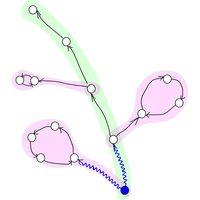
Complex networks range from subcellular biological networks to the Internet. Our ability to control these systems deeply challenges our understanding. Control also may well be a guiding principle in their design. This article reviews the emerging science of the control of complex networks.
[Rev. Mod. Phys. 88, 035006] Published Tue Sep 06, 2016
Chimera in a neuronal network model of the cat brain. (arXiv:1609.01534v2 [nlin.AO] UPDATED)
Neuronal systems have been modeled by complex networks in different description levels. Recently, it has been verified that networks can simultaneously exhibit one coherent and other incoherent domain, known as chimera states. In this work, we study the existence of chimera states in a network considering the connectivity matrix based on the cat cerebral cortex. The cerebral cortex of the cat can be separated in 65 cortical areas organised into the four cognitive regions: visual, auditory, somatosensory-motor and frontolimbic. We consider a network where the local dynamics is given by the Hindmarsh-Rose model. The Hindmarsh-Rose equations are a well known model of neuronal activity that has been considered to simulate membrane potential in neuron. Here, we analyse under which conditions chimera states are present, as well as the affects induced by intensity of coupling on them. We observe the existence of chimera states in that incoherent structure can be composed of desynchronised spikes or desynchronised bursts. Moreover, we find that chimera states with desynchronised bursts are more robust to neuronal noise than with desynchronised spikes.
Nonstandard transitions in the Kuramoto model: A role of asymmetry in natural frequency distributions. (arXiv:1609.01489v2 [nlin.AO] UPDATED)
We study transitions in the Kuramoto model by shedding light on asymmetry in the natural frequency distribution, which has been assumed to be symmetric in many previous studies. The asymmetry brings two nonstandard bifurcation diagrams, with the aid of bimodality. The first diagram consists of stationary states, and has the standard continuous synchronization transition and a subsequent discontinuous transition as the coupling strength increases. Such a bifurcation diagram has been also reported in a variant model, which breaks the odd symmetry of the coupling function by introducing the phase lag. The second diagram includes the oscillatory state emerging from the partially synchronized state and followed by a discontinuous transition. This diagram is firstly revealed in this study. The two bifurcation diagrams are obtained by employing the Ott-Antonsen ansatz, and are verified by direct $N$-body simulations. We conclude that the asymmetry in distribution, with the bimodality, plays a similar role to the phase lag, and diversifies the transitions.
Small chimera states without multistability in a globally delay-coupled network of four lasers
Author(s): André Röhm, Fabian Böhm, and Kathy Lüdge
We present results obtained for a network of four delay-coupled lasers modelled by Lang-Kobayashi-type equations. We find small chimera states consisting of a pair of synchronized lasers and two unsynchronized lasers. One class of these small chimera states can be understood as intermediate steps on…[Phys. Rev. E] Published Tue Sep 06, 2016
Nonconventional synchronization and energy localization in weakly coupled autogenerators
Author(s): Margarita Kovaleva, Valery Pilipchuk, and Leonid Manevitch
The present work follows our previous study dealing with a new type of synchronization in a system of two weakly coupled generalized van der Pol - Duffing autogenerators. The essence of the effect revealed is that the synchronized oscillations are not stationary but accompanied by the most intensive…[Phys. Rev. E] Published Wed Sep 07, 2016