22 Apr 15:55
by Yohsuke Murase, Hang-Hyun Jo, János Török, János Kertész, and Kimmo Kaski
Author(s): Yohsuke Murase, Hang-Hyun Jo, János Török, János Kertész, and Kimmo Kaski
In a social network individuals or nodes connect to other nodes by choosing one of the channels of communication at a time to re-establish the existing social links. Since available data sets are usually restricted to a limited number of channels or layers, these autonomous decision making processes...
[Phys. Rev. E] Published Fri Apr 12, 2019
22 Apr 15:55
by Franz Kaiser and Karen Alim
Author(s): Franz Kaiser and Karen Alim
Phase {} are a highly under-explored class of solutions of the Kuramoto model and other coupled oscillator models on networks. So far, coupled oscillator research focused on phase synchronized solutions. Yet, global constraints on oscillators may forbid synchronized state, rendering phase balanced s...
[Phys. Rev. E] Published Fri Apr 12, 2019
12 Apr 11:50
by Yong Xu, Ruifang Wang, Bin Pei, Yuzhen Bai, Juergen Kurths
In this paper, we aim to develop the averaging principle for a slow-fast
system of stochastic reaction-diffusion equations driven by Poisson random
measures. The coefficients of the equation are assumed to be functions of time,
and some of them are periodic or almost periodic. Therefore, the Poisson term
needs to be processed, and a new averaged equation needs to be given. For this
reason, the existence of time-dependent evolution family of measures associated
with the fast equation is studied, and proved that it is almost periodic. Next,
according to the characteristics of almost periodic functions, the averaged
coefficient is defined by the evolution family of measures, and the averaged
equation is given. Finally, the validity of the averaging principle is verified
by using the Khasminskii method.
12 Apr 11:50
by Chen Chris Gong, Chunming Zheng, Ralf Toenjes, Arkady Pikovsky
We consider the Kuramoto-Sakaguchi model of identical coupled phase
oscillators with a common noisy forcing. While common noise always tends to
synchronize the oscillators, a strong repulsive coupling prevents the fully
synchronous state and leads to a nontrivial distribution of oscillator phases.
In previous numerical simulations, a formation of stable multicluster states
has been observed in this regime. However we argue here, that because identical
phase oscillators in the Kuramoto-Sakaguchi model form a partially integrable
system according to the Watanabe-Strogatz theory, the formation of clusters is
impossible. Integrating with various time steps reveals that clustering is a
numerical artifact, explained by the existence of higher order Fourier terms in
the errors of the employed numerical integration schemes. Monitoring the
induced change in certain integrals of motion we quantify these errors. We
support these observations by showing, on the basis of the analysis of the
corresponding Fokker-Planck equation, that two-cluster states are
non-attractive. On the other hand, in ensembles of general limit cycle
oscillators, such as Van der Pol oscillators, due to an anharmonic phase
response function, as well as additional amplitude dynamics, multiclusters can
occur naturally.
11 Apr 11:29
by Danh-Tai Hoang, Junghyo Jo, and Vipul Periwal
Author(s): Danh-Tai Hoang, Junghyo Jo, and Vipul Periwal
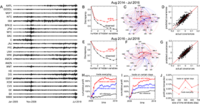
Complex systems, for example in biology or social science, can be viewed as networks of interacting nodes whose behavior can only be partially observed. The challenge is to understand the system’s dynamics based on this partial information. This paper presents a method to estimate the network structure based on the limited available data.
[Phys. Rev. E 99, 042114] Published Wed Apr 10, 2019
11 Apr 11:29
by Didier A. Vega-Oliveros, J. A. Méndez-Bermúdez, and Francisco A. Rodrigues
Author(s): Didier A. Vega-Oliveros, J. A. Méndez-Bermúdez, and Francisco A. Rodrigues
In this paper we demonstrate numerically that random networks whose adjacency matrices A are represented by a diluted version of the power-law banded random matrix (PBRM) model have multifractal eigenfunctions. The PBRM model describes one-dimensional samples with random long-range bonds. The bond s...
[Phys. Rev. E 99, 042303] Published Wed Apr 10, 2019
11 Apr 11:28
by Trevor K. Karn, Steven Petrone, Christopher Griffin
In this paper we develop a kernel density estimation (KDE) approach to
modeling and forecasting recurrent trajectories on a compact manifold. For the
purposes of this paper, a trajectory is a sequence of coordinates in a phase
space defined by an underlying hidden dynamical system. Our work is inspired by
earlier work on the use of KDE to detect shipping anomalies using high-density,
high-quality automated information system (AIS) data as well as our own earlier
work in trajectory modeling. We focus specifically on the sparse, noisy
trajectory reconstruction problem in which the data are (i) sparsely sampled
and (ii) subject to an imperfect observer that introduces noise. Under certain
regularity assumptions, we show that the constructed estimator minimizes a
specific energy function defined over the trajectory as the number of samples
obtained grows.
11 Apr 11:27
by Th. Caby, D. Faranda, S. Vaienti, P. Yiou
The extremal index is a quantity introduced in extreme value theory to
measure the presence of clusters of exceedances. In the dynamical systems
framework, it provides important information about the dynamics of the
underlying systems. In this paper we provide a review of the meaning of the
extremal index in dynamical systems. Depending on the observables used, this
quantity can inform on local properties of attractors such as periodicity,
stability and persistence in phase space, or on global properties such as the
Lyapunov exponents. We also introduce a new estimator of the extremal index and
shows its relation with those previously introduced in the statistical
literature. We reserve a particular focus to the systems perturbed with noise
as they are a good paradigm of many natural phenomena. Different kind of noises
are investigated in the annealed and quenched situations. Applications to
climate data are also presented.
10 Apr 13:01
by Wade Hindes
We show that the dynamical degree of an (i.i.d) random sequence of dominant,
rational self-maps on projective space is almost surely constant. We then apply
this result to height growth and height counting problems in random orbits.
10 Apr 13:01
by Petru A. Cioica-Licht, Markus Weimar
We study the interrelation between the limit $L_p(\Omega)$-Sobolev regularity
$\overline{s}_p$ of (classes of) functions on bounded Lipschitz domains
$\Omega\subseteq\mathbb{R}^d$, $d\geq 2$, and the limit regularity
$\overline{\alpha}_p$ within the corresponding adaptivity scale of Besov spaces
$B^\alpha_{\tau,\tau}(\Omega)$, where $1/\tau=\alpha/d+1/p$ and $\alpha>0$
($p>1$ fixed). The former determines the convergence rate of uniform numerical
methods, whereas the latter corresponds to the convergence rate of best
$N$-term approximation. We show how additional information on the Besov or
Triebel-Lizorkin regularity may be used to deduce upper bounds for
$\overline{\alpha}_p$ in terms of $\overline{s}_p$ simply by means of classical
embeddings and the extension of complex interpolation to suitable classes of
quasi-Banach spaces due to Kalton, Mayboroda, and Mitrea (Contemp. Math. 445).
The results are applied to the Poisson equation, to the $p$-Poisson problem,
and to the inhomogeneous stationary Stokes problem. In particular, we show that
already established results on the Besov regularity for the Poisson equation
are sharp.
Keywords: Non-linear approximation, adaptive methods, Besov space,
Triebel-Lizorkin space, regularity of solutions, stationary Stokes equation,
Poisson equation, $p$-Poisson equation, Lipschitz domain.
10 Apr 13:00
by Mi Jin Lee, Deok-Sun Lee
For a reliable prediction of an epidemic or information spreading pattern in
complex systems, well-defined measures are essential. In the
susceptible-infected model on heterogeneous networks, the cluster of infected
nodes in the intermediate-time regime exhibits too large fluctuation in size to
use its mean size as a representative value. The cluster size follows quite a
broad distribution, which is shown to be derived from the variation of the
cluster size with the time when a hub node was first infected. On the contrary,
the distribution of the time taken to infect a given number of nodes is well
concentrated at its mean, suggesting the mean infection time is a better
measure. We show that the mean infection time can be evaluated by using the
scaling behaviors of the boundary area of the infected cluster and use it to
find a non-exponential but algebraic spreading phase in the intermediate stage
on strongly heterogeneous networks. Such slow spreading originates in only
small-degree nodes left susceptible, while most hub nodes are already infected
in the early exponential-spreading stage. Our results offer a way to detour
around large statistical fluctuations and quantify reliably the temporal
pattern of spread under structural heterogeneity.
09 Apr 12:31
by Ramakrishna Tipireddy, Paris Perdikaris, Panos Stinis, Alexandre Tartakovsky
We investigate the use of discrete and continuous versions of
physics-informed neural network methods for learning unknown dynamics or
constitutive relations of a dynamical system. For the case of unknown dynamics,
we represent all the dynamics with a deep neural network (DNN). When the
dynamics of the system are known up to the specification of constitutive
relations (that can depend on the state of the system), we represent these
constitutive relations with a DNN. The discrete versions combine classical
multistep discretization methods for dynamical systems with neural network
based machine learning methods. On the other hand, the continuous versions
utilize deep neural networks to minimize the residual function for the
continuous governing equations. We use the case of a fedbatch bioreactor system
to study the effectiveness of these approaches and discuss conditions for their
applicability. Our results indicate that the accuracy of the trained neural
network models is much higher for the cases where we only have to learn a
constitutive relation instead of the whole dynamics. This finding corroborates
the well-known fact from scientific computing that building as much structural
information is available into an algorithm can enhance its efficiency and/or
accuracy.
08 Apr 12:17
by Tongfeng Weng, Huijie Yang, Changgui Gu, Jie Zhang, and Michael Small
Author(s): Tongfeng Weng, Huijie Yang, Changgui Gu, Jie Zhang, and Michael Small
Recent advances have demonstrated the effectiveness of a machine-learning approach known as “reservoir computing” for model-free prediction of chaotic systems. We find that a well-trained reservoir computer can synchronize with its learned chaotic systems by linking them with a common signal. A nece...
[Phys. Rev. E 99, 042203] Published Fri Apr 05, 2019
08 Apr 12:16
by Rok Cestnik, Markus Abel
We investigate the predictive power of recurrent neural networks for
oscillatory systems not only on the attractor, but in its vicinity as well. For
this we consider systems perturbed by an external force. This allows us to not
merely predict the time evolution of the system, but also study its dynamical
properties, such as bifurcations, dynamical response curves, characteristic
exponents etc. It is shown that they can be effectively estimated even in some
regions of the state space where no input data were given. We consider several
different oscillatory examples, including self-sustained, excitatory,
time-delay and chaotic systems. Furthermore, with a statistical analysis we
assess the amount of training data required for effective inference for two
common recurrent neural network cells, the long short-term memory and the gated
recurrent unit.
08 Apr 12:16
by Rok Cestnik, Markus Abel
We investigate the predictive power of recurrent neural networks for
oscillatory systems not only on the attractor, but in its vicinity as well. For
this we consider systems perturbed by an external force. This allows us to not
merely predict the time evolution of the system, but also study its dynamical
properties, such as bifurcations, dynamical response curves, characteristic
exponents etc. It is shown that they can be effectively estimated even in some
regions of the state space where no input data were given. We consider several
different oscillatory examples, including self-sustained, excitatory,
time-delay and chaotic systems. Furthermore, with a statistical analysis we
assess the amount of training data required for effective inference for two
common recurrent neural network cells, the long short-term memory and the gated
recurrent unit.
05 Apr 12:01
by M. E. J. Newman, Xiao Zhang, and Raj Rao Nadakuditi
Author(s): M. E. J. Newman, Xiao Zhang, and Raj Rao Nadakuditi
We derive a message passing method for computing the spectra of locally tree-like networks and an approximation to it that allows us to compute closed-form expressions or fast numerical approximates for the spectral density of random graphs with arbitrary node degrees—the so-called configuration mod...
[Phys. Rev. E] Published Thu Apr 04, 2019
05 Apr 12:00
by LaBar, K. S., Post, K.
05 Apr 11:58
by Sreevalsan S. Menon
A Comparison of Static and Dynamic Functional Connectivities for Identifying Subjects and Biological Sex Using Intrinsic Individual Brain Connectivity
A Comparison of Static and Dynamic Functional Connectivities for Identifying Subjects and Biological Sex Using Intrinsic Individual Brain Connectivity, Published online: 05 April 2019; doi:10.1038/s41598-019-42090-4
A Comparison of Static and Dynamic Functional Connectivities for Identifying Subjects and Biological Sex Using Intrinsic Individual Brain Connectivity

04 Apr 13:25
by Joyce S. Climaco, Alberto Saa
We consider the problem of global synchronization in a large random network
of Kuramoto oscillators where some of them are subject to an external
periodically driven force. We explore a recently proposed dimensional reduction
approach and introduce an effective two-dimensional description for the
problem. From the dimensionally reduced model, we obtain analytical predictions
for some critical parameters necessary for the onset of a globally synchronized
state in the system. Moreover, the low dimensional model also allows us to
introduce an optimization scheme for the problem. Our main conclusion, which
has been corroborated by exhaustive numerical simulations, is that for a given
large random network of Kuramoto oscillators, with random natural frequencies
$\omega_i$, such that a fraction of them is subject to an external periodic
force with frequency $\Omega$, the best global synchronization properties
correspond to the case where the fraction of the forced oscillators is chosen
to be those ones such that $|\omega_i-\Omega|$ is maximal. Our results might
shed some light on the structure and evolution of natural systems for which the
presence or the absence of global synchronization are desired properties. Some
properties of the optimal forced networks and its relation to recent results in
the literature are also discussed.
04 Apr 13:25
by Sarika Jalan, Vasundhara Rathore, Ajay Deep Kachhvah, Alok Yadav
To date, explosive synchronization (ES) is shown to be originated from either
degree-frequency correlation or inertia of phase oscillators. Of late, it has
been shown that ES can be induced in a network by adaptively controlled phase
oscillators. Here we show that ES is a generic phenomenon and can occur in any
network by appropriately multiplexing it with another layer. We devise an
approach which leads to the occurrence of ES with hysteresis loop in a network
upon its multiplexing with a negatively coupled (or inhibitory) layer. We
discuss the impact of various structural properties of positively coupled (or
excitatory) and inhibitory layer along with the strength of multiplexing in
gaining control over the induced ES transition. This investigation is a step
forward in highlighting the importance of multiplex framework not only in
bringing novel phenomena which are not possible in an isolated network but also
in providing more structural control over the induced phenomena.
03 Apr 12:04
by Yuzuru Sato and Rainer Klages
Author(s): Yuzuru Sato and Rainer Klages
Consider a chaotic dynamical system generating Brownian motion-like diffusion. Consider a second, non-chaotic system in which all particles localize. Let a particle experience a random combination of both systems by sampling between them in time. What type of diffusion is exhibited by this {}? We sh...
[Phys. Rev. Lett.] Published Tue Apr 02, 2019
03 Apr 12:04
Abstract
The Koopman operator induced by a dynamical system is inherently linear and provides an alternate method of studying many properties of the system, including attractor reconstruction and forecasting. Koopman eigenfunctions represent the non-mixing component of the dynamics. They factor the dynamics, which can be chaotic, into quasiperiodic rotations on tori. Here, we describe a method through which these eigenfunctions can be obtained from a kernel integral operator, which also annihilates the continuous spectrum. We show that incorporating a large number of delay coordinates in constructing the kernel of that operator results, in the limit of infinitely many delays, in the creation of a map into the point spectrum subspace of the Koopman operator. This enables efficient approximation of Koopman eigenfunctions in systems with pure point or mixed spectra. We illustrate our results with applications to product dynamical systems with mixed spectra.
03 Apr 12:03
by David Diego, Kristian Agasøster Haaga, Bjarte Hannisdal
We propose a method for computing the transfer entropy between time series
using Ulam's approximation of the Perron-Frobenius (transfer) operator
associated with the map generating the dynamics. Our method differs from
standard transfer entropy estimators in that the invariant measure is estimated
not directly from the data points but from the invariant distribution of the
transfer operator approximated from the data points. For sparse time series and
low embedding dimension, the transfer operator is approximated using a
triangulation of the attractor, whereas for data-rich time series or higher
embedding dimension we use a faster grid approach. We compare the performance
of our methods with existing estimators such as the k nearest neighbors method
and kernel density estimation method, using coupled instances of well known
chaotic systems: coupled logistic maps and a coupled R\"ossler-Lorenz system.
We find that our estimators are robust against moderate levels of noise. For
sparse time series with less than a hundred observations and low embedding
dimension, our triangulation estimator shows improved ability to detect
coupling directionality, relative to standard transfer entropy estimators.
03 Apr 12:01
by Carolina A. Moreira, Marcus A.M. de Aguiar
Synchronization plays a key role in information processing in neuronal
networks. Response of specific groups of neurons are triggered by external
stimuli, such as visual, tactile or olfactory inputs. Neurons, however, can be
divided into several categories, such as by physical location, functional role
or topological clustering properties. Here we study the response of the
electric junction C. elegans network to external stimuli using the partially
forced Kuramoto model and applying the force to specific groups of neurons.
Stimuli were applied to topological modules, obtained by the ModuLand
procedure, to a ganglion, specified by its anatomical localization, and to the
functional group composed of all sensory neurons. We found that topological
modules do not contain purely anatomical groups or functional classes,
corroborating previous results, and that stimulating different classes of
neurons lead to very different responses, measured in terms of synchronization
and phase velocity correlations. In all cases, however, the modular structure
hindered full synchronization, protecting the system from seizures. More
importantly, the responses to stimuli applied to topological and functional
modules showed pronounced patterns of correlation or anti-correlation with
other modules that were not observed when the stimulus was applied to ganglia.
02 Apr 11:45
by Dimitrios Moirogiannis, Keith Hayton, Marcelo Magnasco
In dynamical systems theory, a fixed point of the dynamics is called
nonhyperbolic if the linearization of the system around the fixed point has at
least one eigenvalue with zero real part. The center manifold existence theorem
guarantees the local existence of an invariant subspace of the dynamics, known
as a center manifold, around such nonhyperbolic fixed points. A growing number
of theoretical and experimental studies suggest that some neural systems
utilize nonhyperbolic fixed points and corresponding center manifolds to
display complex, nonlinear dynamics and to flexibly adapt to wide-ranging
sensory input parameters. In this paper, we present a technique to study the
statistical properties of high-dimensional, nonhyperbolic dynamical systems
with random connectivity and examine which statistical properties determine
both the shape of the center manifold and the corresponding reduced dynamics on
it. This technique also gives us constraints on the family of center manifold
models that could arise from a large-scale random network. We demonstrate this
approach on an example network of randomly coupled damped oscillators.
02 Apr 11:45
by Peter Ashwin, Christian Bick, Camille Poignard
The dynamics of networks of interacting dynamical systems depend on the
nature of the coupling between individual units. We explore networks of
oscillatory units with coupling functions that have "dead zones", that is, the
coupling functions are zero on sets with interior. For such networks, it is
convenient to look at the effective interactions between units rather than the
(fixed) structural connectivity to understand the network dynamics. For
example, oscillators may effectively decouple in particular phase
configurations. Along trajectories the effective interactions are not
necessarily static, but the effective coupling may evolve in time. Here, we
formalize the concepts of dead zones and effective interactions. We elucidate
how the coupling function shapes the possible effective interaction schemes and
how they evolve in time.
02 Apr 11:43
by Per Sebastian Skardal, Dane Taylor, Jie Sun
Synchronization of network-coupled dynamical units is important to a variety
of natural and engineered processes including circadian rhythms, cardiac
function, neural processing, and power grids. Despite this ubiquity, it remains
poorly understood how complex network structures and heterogeneous local
dynamics combine to either promote or inhibit synchronization. Moreover, for
most real-world applications it is impossible to obtain the exact
specifications of the system, and there is a lack of theory for how uncertainty
affects synchronization. We address this open problem by studying the Synchrony
Alignment Function (SAF), which is an objective measure for the synchronization
properties of a network of heterogeneous oscillators with given natural
frequencies. We extend the SAF framework to analyze network-coupled oscillators
with heterogeneous natural frequencies that are drawn as a multivariate random
vector. Using probability theory for quadratic forms, we obtain expressions for
the expectation and variance of the SAF for given network structures. We
conclude with numerical experiments that illustrate how the incorporation of
uncertainty yields a more robust theoretical framework for enhancing
synchronization, and we provide new perspectives for why synchronization is
generically promoted by network properties including degree-frequency
correlations, link directedness, and link weight delocalization.
02 Apr 11:42
by Michael A. Zaks, Arkady Pikovsky
We consider collective dynamics in the ensemble of serially connected
spin-torque oscillators governed by the Landau-Lifshitz-Gilbert-Slonczewski
magnetization equation. Proximity to homoclinicity hampers synchronization of
spin-torque oscillators: when the synchronous ensemble experiences the
homoclinic bifurcation, the Floquet multiplier, responsible for the temporal
evolution of small deviations from the ensemble mean, diverges. Depending on
the configuration of the contour, sufficiently strong common noise, exemplified
by stochastic oscillations of the current through the circuit, may suppress
precession of the magnetic field for all oscillators. We derive the explicit
expression for the threshold amplitude of noise, enabling this suppression.
02 Apr 11:42
by Peter Ashwin, Christian Bick, Camille Poignard
The dynamics of networks of interacting dynamical systems depend on the
nature of the coupling between individual units. We explore networks of
oscillatory units with coupling functions that have "dead zones", that is, the
coupling functions are zero on sets with interior. For such networks, it is
convenient to look at the effective interactions between units rather than the
(fixed) structural connectivity to understand the network dynamics. For
example, oscillators may effectively decouple in particular phase
configurations. Along trajectories the effective interactions are not
necessarily static, but the effective coupling may evolve in time. Here, we
formalize the concepts of dead zones and effective interactions. We elucidate
how the coupling function shapes the possible effective interaction schemes and
how they evolve in time.
