mjpdejong
Shared posts
18 Jun 12:18
Weighing yourself daily can tip the scale in your favor
For those wishing to lose weight and keep it off, here’s a simple strategy that works: step on a scale each day and track the results. A two-year study found that frequent self-weighing and tracking results on a chart were effective for both losing weight and keeping it off, especially for men.
17 Jun 13:53
Biodiversity reduces human, wildlife diseases and crop pests
With infectious diseases increasing worldwide, the need to understand how and why disease outbreaks occur is becoming increasingly important. Looking for answers, a team of biologists found broad evidence that supports the controversial 'dilution effect hypothesis,' which suggests that biodiversity limits outbreaks of disease among humans and wildlife.
09 Jun 07:36
OpenSSH On Windows – It’s Happening!
by Darknet
So it seems like getting rid of Ballmer was the best thing Microsoft has done in years, Satya is definitely pushing them in a much more positive direction with a focus on Azure and open sourcing technology and moves like this OpenSSH on Windows! A real show of support for open source technology and a [...]
The post OpenSSH On Windows –...
Read the full post at darknet.org.uk


Read the full post at darknet.org.uk
04 Jun 12:15
Have I have fallen in love with Python because she is beautiful?
| Sjon shared this story . |
There's nothing wrong with falling in love with a programming language for her looks. I mean, let's face it - Python does have a rockin' body of modules, and a damn good set of utilities and interpreters on various platforms. Her whitespace-sensitive syntax is easy on the eyes, and it's a beautiful sight to wake up to in the morning after a long night of debugging. The way she sways those releases on a consistent cycle - she knows how to treat you right, you know?
But let's face it - a lot of other languages see the attention she's getting, and they get jealous. Really jealous. They try and make her feel bad by pointing out the GIL, and they try and convince her that she's not "good enough" for parallel programming or enterprise-level applications. They say that her lack of static typing gives her programmers headaches, and that as an interpreted language, she's not fast enough for performance-critical applications.
She hears what those other, older languages like Java and C++ say, and she thinks she's not stable or mature enough. She hears what those shallow, beauty-obsessed languages like Ruby say, and she thinks she's not pretty enough. But she's trying really hard, you know? She hits the gym every day, trying to come up with new and better ways of JIT'ing and optimizing. She's experimenting with new platforms and compilation techniques all the time. She wants you to love her more, because she cares.
But then you hear about how bad she feels, and how hard she's trying, and you just look into her eyes, sighing. You take Python out for a walk - holding her hand - and tell her that she's the most beautiful language in the world, but that's not the only reason you love her.
You tell her she was raised right - Guido gave her core functionality and a deep philosophy she's never forgotten. You tell her you appreciate her consistent releases and her detailed and descriptive documentation. You tell her that she has a great set of friends who are supportive and understanding - friends like Google, Quora, and Facebook. And finally, with tears in your eyes, you tell her that with her broad community support, ease of development, and well-supported frameworks, you know she's a language you want to be with for a long, long time.
After saying all this, you look around and notice that the two of you are alone. Letting go of Python's hand, you start to get down on one knee. Her eyes get wide as you try and say the words - but she just puts her finger on your lips and whispers, "Yes".
The moon is bright. You know things are going to be okay now.
04 Jun 10:49
Oordopjes laten gebruiker 'selectief horen' in de echte wereld
by Friso Weijers
Een set oordopjes waarmee de gebruiker geluiden uit de buitenwereld kan aanpassen, heeft donderdag zijn doel bereikt op crowdfundsite Kickstarter. De Here-oordopjes kosten 179 dollar en moeten in december uitkomen, al is een Nederlandse introductie nog onzeker.
02 Jun 09:24
How DNA is organized in our cells
A critical role for two proteins in chromatin structure has been uncovered by researchers. Their breakthrough helps explain how DNA is organized in our cells. This discovery could lead to a better understanding of what causes certain types of cancer, such as lymphoma.
02 Jun 09:17
Who needs water to assemble DNA? Non-aqueous solvent supports DNA nanotechnology
Researchers have now shown that they can assemble DNA nanostructures in a solvent containing no water. They also discovered that adding a small amount of water to their solvent increases the assembly rate and provides a new means for controlling the process. The solvent may also facilitate the production of more complex structures by reducing the problem of DNA becoming trapped in unintended structures.
29 May 12:25
Expanding the code of life with new ‘letters’
by Dr. Jekyll, Lunatic Laboratories
The DNA encoding all life on Earth is made of four building blocks called nucleotides, commonly known as “letters,” that line up in pairs and twist into a double helix. Now, two groups of scientists are reporting for the first time that two new nucleotides can do the same thing — raising the possibility that […]...
Georgiadis, M., Singh, I., Kellett, W., Hoshika, S., Benner, S., & Richards, N. (2015) Structural Basis for a Six Nucleotide Genetic Alphabet. Journal of the American Chemical Society, 2147483647. DOI: 10.1021/jacs.5b03482
Structural Basis for a Six Nucleotide Genetic AlphabetZhang, L., Yang, Z., Sefah, K., Bradley, K., Hoshika, S., Kim, M., Kim, H., Zhu, G., Jiménez, E., Cansiz, S.... (2015) Evolution of Functional Six-Nucleotide DNA. Journal of the American Chemical Society. DOI: 10.1021/jacs.5b02251
Evolution of Functional Six-Nucleotide DNA
29 May 09:32


EU dropped plans for safer pesticides after pressure from US
by Glyn Moody
Sjon
shared this story
from  Ars Technica. Ars Technica.
|
EU plans to regulate hormone-damaging chemicals found in pesticides have been dropped because of threats from the US that this would adversely affect negotiations for the Transatlantic Trade and Investment Partnership (TTIP), according to a report in The Guardian. Draft EU regulations would have banned 31 pesticides containing endocrine disrupting chemicals (EDCs) that have been linked to testicular cancer and male infertility.
Just after the official launch of the TTIP negotiations on 13 June 2013, a US business delegation visited EU officials to demand that the proposed regulations governing EDCs should be thrown out in favour of a further "impact study." Minutes of the meeting on June 26 show Commission officials saying that "although they want the TTIP to be successful, they would not like to be seen as lowering the EU standards." Nonetheless, the European Commission capitulated shortly afterwards.
That climbdown was despite repeated promises from the European Commission that TTIP would not jeopardise EU health and safety standards. For example, a Commission factsheet on Pesticides in TTIP from February 2015 states: "TTIP will not lower the food safety standards for pesticides." The Guardian report demonstrates that plans to strengthen regulations governing EDCs were blocked, which is equivalent to a lowering of future standards that would have been introduced had it not been for TTIP.
Read 2 remaining paragraphs | Comments
27 May 09:05
This is your brain, on video games
by Dr. Jekyll, Lunatic Laboratories
A new study shows that while video game players (VGPs) exhibit more efficient visual attention abilities, they are also much more likely to use navigation strategies that rely on the brain’s reward system (the caudate nucleus) and not the brain’s spatial memory system (the hippocampus). Past research has shown that people who use caudate nucleus-dependent navigation […]...
West, G., Drisdelle, B., Konishi, K., Jackson, J., Jolicoeur, P., & Bohbot, V. (2015) Habitual action video game playing is associated with caudate nucleus-dependent navigational strategies. Proceedings of the Royal Society B: Biological Sciences, 282(1808), 20142952-20142952. DOI: 10.1098/rspb.2014.2952
Habitual action video game playing is associated with caudate nucleus-dependent navigational strategies
12 May 10:42
 C.H.I.P., a Linux-based mini-PC priced at just $9, is receiving an overwhelming response on Kickstarter. Launched last Thursday with a funding goal of $50,000, it has chalked up more than 16,000 backers who have shelled out upwards of $815,000. The project still has 25 days to go. The tiny open source device, made by Next Thing Co., has been dubbed the "Raspberry Pi killer." Measuring just 1.5 x 2.3 inches, C.H.I.P. comes with 512 MB of DDR3 RAM and a 1-GHz processor. Its built-in composite output port lets it work with any size screen.
$9 Debian-Based C.H.I.P. Computer Is a Kickstarter Smash
by Richard Adhikari
C.H.I.P., a Linux-based mini-PC priced at just $9, is receiving an overwhelming response on Kickstarter. Launched last Thursday with a funding goal of $50,000, it has chalked up more than 16,000 backers who have shelled out upwards of $815,000. The project still has 25 days to go. The tiny open source device, made by Next Thing Co., has been dubbed the "Raspberry Pi killer." Measuring just 1.5 x 2.3 inches, C.H.I.P. comes with 512 MB of DDR3 RAM and a 1-GHz processor. Its built-in composite output port lets it work with any size screen.
12 May 08:40
The Avengers: Is It Possible Someone Could Turn Into A Hulk?
by Bill Sullivan, The 'Scope
In anticipation of the return of THE AVENGERS, we take a look at the science that could possibly help someone to turn into a HULK....
Falkenberg KJ, & Johnstone RW. (2014) Histone deacetylases and their inhibitors in cancer, neurological diseases and immune disorders. Nature reviews. Drug discovery. PMID: 25131830
Histone deacetylases and their inhibitors in cancer, neurological diseases and immune disorders.Haggarty P, Hoad G, Harris SE, Starr JM, Fox HC, Deary IJ, & Whalley LJ. (2010) Human intelligence and polymorphisms in the DNA methyltransferase genes involved in epigenetic marking. PloS one, 5(6). PMID: 20593030
Human intelligence and polymorphisms in the DNA methyltransferase genes involved in epigenetic marking.
12 May 08:35
GMO beef with the heart benefits of fish, why not?
by Dr. Jekyll, Lunatic Laboratories
Sometimes you just want beef, but beef is high in omega-6 fatty acids and low in the omega-3 type. Conversely, different types of fish are high in omega-3, but we all know they don’t compare to that tasty burger flavor. So what’s a beef lover to do, well if you’re in China you might have […]...
Cheng, G., Fu, C., Wang, H., Adoligbe, C., Wei, S., Li, S., Jiang, B., Wang, H., & Zan, L. (2015) Production of transgenic beef cattle rich in n-3 PUFAs by somatic cell nuclear transfer. Biotechnology Letters. DOI: 10.1007/s10529-015-1827-z
Production of transgenic beef cattle rich in n-3 PUFAs by somatic cell nuclear transfer
08 May 12:12
Paper to Digital in 200+ languages
by Research Blog
Posted by Dmitriy Genzel and Ashok Popat, Research Scientists and Dhyanesh Narayanan, Product Manager
Many of the world’s important sources of information - books, newspapers, magazines, pamphlets, and historical documents - are not digital. Unlike digital documents, these paper-based sources of information are difficult to search through or edit, or worse, completely inaccessible to some people. Part of the solution is scanning, getting a digital image of the page, but raw image pixels aren’t yet recognized as textual content from the computer’s point of view.
Optical Character Recognition (OCR) technology aims to turn pictures of text into computer text that can be indexed, searched, and edited. For some time, Google Drive has provided OCR capabilities. Recently, we expanded this state-of-the-art technology to support all of the world’s major languages - that’s over 200 languages in more than 25 writing systems. This technology is available to users in 2 easy steps:
1. Upload a scanned document in its current form (say, as an image or PDF). The example below shows a scanned document in Hindi uploaded to a user’s Drive account as a PNG.
 2. Right-click on the document in the Drive interface, and select ‘Open with’ -> ‘Google Docs’.
 This opens a Google document with the original image followed by the extracted text.
 You don’t even need to specify which language the document is in; the system will determine that automatically. Or, you can use the Google Drive API for more explicit control over the language detection in documents. For example, here is an invocation of the Drive API in Python:
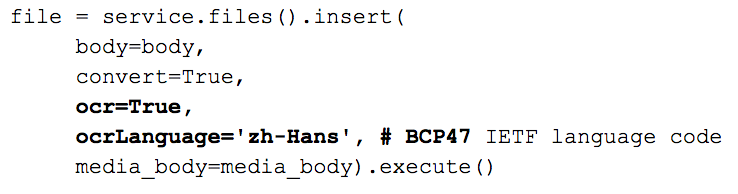 The OCR capability in Drive is also available in the Drive App for Android.
To make this possible, engineering teams across Google pursued an approach to OCR focused on broad language coverage, with a goal of designing an architecture that could potentially work with all existing languages and writing systems. We do this in part by using Hidden Markov Models (HMMs) to make sense of the input as a whole sequence, rather than first trying to break it apart into pieces. This is similar to how modern speech recognition systems recognize audio input.
OCR and speech recognition share some challenges - like dealing with background “noise,” different languages, and low-quality inputs. But some challenges are specific to OCR: the variety of typefaces, the different types of scanners and cameras, and the need to work on older material that may contain archaic orthographic and linguistic elements. In addition to utilizing HMMs, we leveraged many of the same technologies used in the Google Handwriting Input app to allow automatic learning of features and to give preference to more likely output, as well as minimum-error-rate training to allow effective combination of multiple sources of information, and modern methods in machine learning to minimize manual design and maximize use of data. We also take advantage of advances in internationalization and typesetting, by using synthetic data in our training.
Currently, the OCR works best on cleanly scanned, high-resolution documents in the most commonly used typefaces. We are working to improve performance on poor quality scans and challenging text layouts. Give it a try and let us know how it works for you.


Many of the world’s important sources of information - books, newspapers, magazines, pamphlets, and historical documents - are not digital. Unlike digital documents, these paper-based sources of information are difficult to search through or edit, or worse, completely inaccessible to some people. Part of the solution is scanning, getting a digital image of the page, but raw image pixels aren’t yet recognized as textual content from the computer’s point of view.
Optical Character Recognition (OCR) technology aims to turn pictures of text into computer text that can be indexed, searched, and edited. For some time, Google Drive has provided OCR capabilities. Recently, we expanded this state-of-the-art technology to support all of the world’s major languages - that’s over 200 languages in more than 25 writing systems. This technology is available to users in 2 easy steps:
1. Upload a scanned document in its current form (say, as an image or PDF). The example below shows a scanned document in Hindi uploaded to a user’s Drive account as a PNG.
To make this possible, engineering teams across Google pursued an approach to OCR focused on broad language coverage, with a goal of designing an architecture that could potentially work with all existing languages and writing systems. We do this in part by using Hidden Markov Models (HMMs) to make sense of the input as a whole sequence, rather than first trying to break it apart into pieces. This is similar to how modern speech recognition systems recognize audio input.
OCR and speech recognition share some challenges - like dealing with background “noise,” different languages, and low-quality inputs. But some challenges are specific to OCR: the variety of typefaces, the different types of scanners and cameras, and the need to work on older material that may contain archaic orthographic and linguistic elements. In addition to utilizing HMMs, we leveraged many of the same technologies used in the Google Handwriting Input app to allow automatic learning of features and to give preference to more likely output, as well as minimum-error-rate training to allow effective combination of multiple sources of information, and modern methods in machine learning to minimize manual design and maximize use of data. We also take advantage of advances in internationalization and typesetting, by using synthetic data in our training.
Currently, the OCR works best on cleanly scanned, high-resolution documents in the most commonly used typefaces. We are working to improve performance on poor quality scans and challenging text layouts. Give it a try and let us know how it works for you.
30 Apr 09:34
Lenin's Body Improves with Age
Russian scientists have developed experimental embalming methods to maintain the look, feel and flexibility of the Soviet Union's founder’s body, which is 145 years old today
-- Read more on ScientificAmerican.com


-- Read more on ScientificAmerican.com
30 Apr 09:31
Controversial Gene-Editing Approach Gains Ground
“Snipping out” damaged mitochondrial DNA in mice and human cells is a step toward preventing serious inherited diseases
-- Read more on ScientificAmerican.com


-- Read more on ScientificAmerican.com
29 Apr 14:30
Unix and Personal Computers: Reinterpreting the Origins of Linux
The VAR Guy: Early Linux hackers were motivated by a desire to build a Unix-like operating system
29 Apr 08:59
Mind-blowing Brain Cases: The Woman With Half A Brain
by Elisabeth Buhl Thubron, United Academics
Chinese woman without a cerebellum gives insight into neuroplasticity....
Yu, F., Jiang, Q., Sun, X., & Zhang, R. (2014) A new case of complete primary cerebellar agenesis: clinical and imaging findings in a living patient. Brain. DOI: 10.1093/brain/awu239
A new case of complete primary cerebellar agenesis: clinical and imaging findings in a living patient
29 Apr 07:38
Blogging My Genome, episode 7: sifting for bad news
by Mike Lin
This is the seventh in a series of blog posts about my genome, which I had sequenced through Illumina's Understand Your Genome program.
Read more »
Hey, it's been awhile! We've been unbelievably busy at my company, but I've been plugging away on my genome analysis slowly. When I last blogged, I'd completed the process of identifying small variants in my genome (affecting just one or a few DNA nucleotides). This takes us into an interesting new analysis phase - interpreting the consequences of those variants in the context of existing knowledge of human genetics. I previously went into depth on a certain variant I'd known to look for, but now we'll sift through the others in my VCF file - nearly four million of them!
 I began with Ensembl's Variant Effect Predictor (VEP), one of several available tools that annotates VCF variants with their likely consequences for known genes and other genomic features. VEP produces a new VCF file with this additional information crammed into each entry, like so:
1 871215 . C G 1357.81 . AB=0;ABP=0;AC=2;AF=1;AN=2;AO=45;CIGAR=1X;DP=
45;DPB=45;DPRA=0;EPP=4.21667;EPPR=0;GTI=0;LEN=1;MEANALT=1;MQM=60;MQMR=0;NS=1;NUMALT=1;ODDS=63.5608;P
AIRED=1;PAIREDR=0;PAO=0;PQA=0;PQR=0;PRO=0;QA=1543;QR=0;RO=0;RPP=3.44459;RPPR=0;RUN=1;SAF=19;SAP=5.37
479;SAR=26;SRF=0;SRP=0;SRR=0;TYPE=snp;technology.ILLUMINA=1;CSQ=G|ENSG00000187634|ENST00000341065|Transcript|synonymous_variant|140|141|47|P|ccC/ccG|rs28419
423|0.0261008|0.00232558|3/12|||||||1|||SAMD11|HGNC|||G:0.0629|protein_coding|ENSP00000349216|||0.03
|0.08|0.16|0.0026|,G||ENSR00000528855|RegulatoryFeature|regulatory_region_variant||||||rs28419423|0.
0261008|0.00232558|||||||||||||||G:0.0629|||||0.03|0.08|0.16|0.0026| GT:DP:RO:QR:AO:QA:GL
1/1:45:0:0:45:1543:-10,-10,0
That's really not pretty, but VEP also produces a nice series of summary charts. For example, it breaks down putative consequences of my variants in protein-coding sequences.
I began with Ensembl's Variant Effect Predictor (VEP), one of several available tools that annotates VCF variants with their likely consequences for known genes and other genomic features. VEP produces a new VCF file with this additional information crammed into each entry, like so:1 871215 . C G 1357.81 . AB=0;ABP=0;AC=2;AF=1;AN=2;AO=45;CIGAR=1X;DP=
45;DPB=45;DPRA=0;EPP=4.21667;EPPR=0;GTI=0;LEN=1;MEANALT=1;MQM=60;MQMR=0;NS=1;NUMALT=1;ODDS=63.5608;P
AIRED=1;PAIREDR=0;PAO=0;PQA=0;PQR=0;PRO=0;QA=1543;QR=0;RO=0;RPP=3.44459;RPPR=0;RUN=1;SAF=19;SAP=5.37
479;SAR=26;SRF=0;SRP=0;SRR=0;TYPE=snp;technology.ILLUMINA=1;CSQ=G|ENSG00000187634|ENST00000341065|Transcript|synonymous_variant|140|141|47|P|ccC/ccG|rs28419
423|0.0261008|0.00232558|3/12|||||||1|||SAMD11|HGNC|||G:0.0629|protein_coding|ENSP00000349216|||0.03
|0.08|0.16|0.0026|,G||ENSR00000528855|RegulatoryFeature|regulatory_region_variant||||||rs28419423|0.
0261008|0.00232558|||||||||||||||G:0.0629|||||0.03|0.08|0.16|0.0026| GT:DP:RO:QR:AO:QA:GL
1/1:45:0:0:45:1543:-10,-10,0
That's really not pretty, but VEP also produces a nice series of summary charts. For example, it breaks down putative consequences of my variants in protein-coding sequences.
24 Apr 10:13


Adventures in Stem Cell Land
by Ricki Lewis, PhD
 Two weeks ago a neurologist asked me to blog about a US-based company that is offering stem cell treatments, because it had raised hopes among some of his patients. Intrigued because I cover “stem cell tourism” in my bioethics class and ask students to evaluate companies, I did a little poking around.
I’m questioning what appears to be a strategy to deceive desperate and vulnerable patients by offering stem cell treatments under the guise of participating in clinical trials. The company name isn’t important, because I suspect many others are doing worse. But their strategy, which may well be legal, is unethical.
REGISTERING A CLINICAL TRIAL
First, some basic information. The Food and Drug Administration (FDA) approves drugs and medical devices for marketing. The National Institutes of Health (NIH) funds basic research and clinical trials, which can be registered at clinicaltrials.gov. Registering does not mean approval from either agency.
From the FDA: “At this time, there are no licensed stem cell treatments.” However, stem cells are the important parts of bone marrow and umbilical cord transplants to treat certain disorders.
From the NIH: A registered trial may be observational, which means it doesn’t have to be randomized or controlled.
STEM CELLS IN FAT
The company sells a procedure that extracts mesenchymal stem cells (MSCs) from a patient’s fat, separates out the stem cells, and then injects them where they’re needed. These stem cells are pluripotent — capable of several fates — and are very well-studied. Vet-Stem has been offering MSCs to treat injuries and degenerative conditions for dogs, cats, and horses for years.

Are patients receiving proven treatments, or are they guinea pigs in dubious clinical trials?
Key words on the website include “superiority,” “advanced,” “excellence,” and of course “cutting edge.” But no mention of “experimental” or “investigational,” and to their credit, “cure.” The connection to clinicaltrials.gov uses the word “study.” Testimonials are prominent, but I prefer the dog and cat success stories” at Vet-Stem.
A company rep explained that payment for treatment is separate from participating in the clinical trial. He said this three times so it must be important in how they manage to legitimize what they sell. Assessment consists of self-reporting. I was reassured repeatedly that a PhD in neuroscience reads PubMed to determine safety and efficacy of studies supporting the company’s offerings. The other staff members are the surgeons who actually transfer the fat.
I picked up all sorts of errors on the website:
1. The use of the phrase “registered through the NIH” reverberates throughout, and is the fourth sentence of the opening page. Said the neurologist who contacted me, “Anyone can register a trial.” He has conducted dozens of them, real ones that is.
 2. The definition of stem cell makes the common oversimplification error: “These cells have the ability to change or ‘differentiate’ into other types of cells.” No. The primary characteristic of a stem cell is its ability to self-renew. If a stem cell didn’t replicate, it wouldn’t be a stem cell. It begets another stem cell and usually a progenitor cell, which typically spawns increasingly specialized cells that ultimately produce a differentiated cell type. But a stem cell is always perpetuated, and that’s why moving stem cells about the body willy-nilly could, theoretically, trigger cancer.
3. Grammar. You don’t have “amounts of stem cells.” Numbers.
4. Regenerative medicine is not new. It’s been going on for decades. (Well, so has personalized medicine. It’s called genetics.)
5. Why use a patient’s own stem cells? Yes, the body won’t reject them. But they might re-introduce genes that contribute to the condition in the first place. The name of the company includes the word “gene,” suggesting that this is a possibility. Or, it uses “gene” just to sound techy.
6. Where is the evidence, in large-scale, random controlled clinical trials, for efficacy of the“treatment” or “therapy?”
7. The list of treatable conditions is odd. They aren’t single-gene disorders. One folder denotes “autoimmune,” yet other folders are for multiple sclerosis, diabetes, and rheumatoid arthritis – classic autoimmune conditions.
8. Assessment is dubious. Treatment for COPD (which doesn’t make any sense at all to me) is assessed with a “quality of life” questionnaire a year after treatment, and for rheumatoid arthritis treatment success is judged by “participants’ assessment of their overall ability to be active.” How about something objective and measurable?
It is thinly-veiled pseudoscience.
 PLAYING THE PATIENT
I thought I’d investigate something I might one day have: osteoarthritis (OA) of the knee.
I already knew that dogs with OA of the hip had fared quite well with the very same treatment from Vet-Stem, in a randomized, blinded, controlled clinical trial. “Dogs treated with adipose-derived stem cell therapy had significantly improved scores for lameness, pain, and range of motion compared to control dogs,” the study found.
The news release from the human company about their new MSC treatment for OA announces collaboration with a Stem Cell Research Centre (SCRC). Nothing came up on Google. But it did appear at clinicaltrials.gov, on the very same entries, and from the very same city, as the stem cell company offering the treatments. Imagine that!
So I called.

Blubber harbors mesenchymal stem cells.
“America’s leading resource for stem cell therapy,” greeted me. I passed through layers of phone robots until a cheerful woman told me the cost for one injection of MSCs from my blubber into my knee: $14,900. I think I’d be better off at Vet-Stem.
Next I perused the medical literature since I, like the neuroscientist at the company, also have a PhD in a life science and enjoy reading a scintillating PubMed abstract now and then,
One recent study is from Seoul National University. The proof-of-concept investigation was a phase 1 (safety) trial of 9 patients given a low dose (10 million), a medium dose (5 million), or a high dose (100 million) of MSCs, injected into the knee joint. A phase 2 trial (efficacy) injected an additional 9 patients with a high-dose preparation.
At 6 months, “these results showed that intra-articular injection of [100 million adipose-derived] MSCs into the osteoarthritic knee improved function and pain of the knee joint without causing adverse events, and reduced cartilage defects by regeneration of hyaline-like articular cartilage,” the researchers concluded. In addition to self-reporting on a rating scale, the study used “clinical, radiological, arthroscopic, and histological evaluations.”
That’s promising, but 18 patients? More telling was a review article from the Biomechanics Laboratory at the Rizzoli Orthopaedic Institute in Bologna, Italy. Those investigators searched PubMed for all uses of MSCs to regenerate cartilage since 2002: 72 preclinical papers and 18 clinical trials, only two of which used adipose-derived MSCs. None of the trials was randomized, five were comparative, six were case series, and seven were case reports.
The reviewers conclude, “Despite the growing interest in this biological approach for cartilage regeneration, knowledge on this topic is still preliminary, as shown by the prevalence of preclinical studies and the presence of low-quality clinical studies.”
Even the preclinical studies aren’t all that promising. One from March in PLOS ONE, on a rabbit model of corneal graft rejection to improve on a mouse model, found that adipose-derived MSCs actually made matters worse.
$14,900 for a shot of my fat into my knee, based on this? If I was a racehorse, maybe.

Liposuction aspirate.
OVERSIGHT?
Parts of the company’s offerings seem to add up to a legitimate whole.
• A surgeon can remove fat with mini-liposuction.
• A technician can separate stem cells or a soup containing them.
• A surgeon can inject stuff.
• The patient signs up for the procedure with quasi-informed consent and the self-report becomes part of a study registered at clinicaltrials.gov.
But how legitimate is it all?
Reading between the lines of the ClinicalTrials.gov Protocol Data Element Definitions, it appears that you can just make stuff up. It reminds me of when I registered my white Persian cat Angie and a friend’s llama many years ago as “Outstanding Young Women of America,” for a newspaper column in the days before blogs. I can’t believe Google found it!

Is offering stem cell treatments that have not shown efficacy but are registered in trials building a house of cards?
A study at clinicaltrials.gov requires a Human Subjects Review board, which includes an Institutional Review Board and an ethics committee. But “A study may be submitted for registration prior to approval of the review board so long as the study is not yet recruiting patients.”
The entries from the company at clinicaltrials.gov are dated 2015, so patients might not have been recruited yet, enabling them to legitimately use the phrase on the opening webpage, “IRB approved studies for stem cell treatments registered through The National Institutes of Health.” But I’ve signed off as an IRB for local high school science projects just because I have a PhD.
The company’s autologous fat stem cell offerings would fall under “procedure/surgery” and “genetic (including gene transfer, stem cells, and recombinant DNA)” at clinicaltrials.gov. I do have a call in to the NIH to clarify oversight, so will update this post when I can.
I hope that one day, infusions of one’s own stem cells will indeed hold at bay Parkinson’s disease, multiple sclerosis, rheumatoid arthritis, and other conditions. But until that time, hiding behind the cloak of government “approval” by registering an observational study with clinical trials.gov is unconscionable.
The post Adventures in Stem Cell Land appeared first on DNA Science Blog.
21 Apr 10:31
Blogging My Genome, episode 6: variant calling, filtering, and QC
by Mike Lin
This is the sixth in a series of blog posts about my genome, which I recently had sequenced through Illumina's Understand Your Genome program.
I'd previously generated mappings of my sequence reads to the hs37d5 reference assembly. The next step is variant calling, to systematically identify the differences between my genome and the reference. There's a variety of popular tools for this, from which I selected FreeBayes to try first. FreeBayes is an example of a relatively new generation of algorithms capable of considering many hypothetical combinations of genetic variation and sequence alignments to explain the short read data mapped to a genomic region - all within a Bayesian statistical model, per the name.
FreeBayes took my BAM file and the hs37d5 reference as input, and produced a VCF (Variant Call Format) file with genome-wide calls. This took about 32 core-hours (parallelized on an 8-core cloud instance) and produced a VCF file of 377 MiB compressed - tiny compared to my 63 GiB BAM file, as it doesn't preserve the individual reads. Here's the one-line entry of my VCF file corresponding to my ALDH2*2 variant from last time:
$ dx cat "My Genome Analysis:/C2K.deduplicated.vcf.gz" | zcat | grep "12[[:space:]]112241766"
12 112241766 . G A 1264 . AB=0;ABP=0;AC=2;AF=1;AN=2;AO=42;CIGAR=1X;DP=42;DPB=42;DPRA=0;EPP=23.691;EPPR=0;GTI=0;LEN=1;MEANALT=1;MQM=60;MQMR=0;NS=1;NUMALT=1;ODDS=58.5772;PAIRED=1;PAIREDR=0;PAO=0;PQA=0;PQR=0;PRO=0;QA=1467;QR=0;RO=0;RPP=4.87156;RPPR=0;RUN=1;SAF=27;SAP=10.4553;SAR=15;SRF=0;SRP=0;SRR=0;TYPE=snp;technology.ILLUMINA=1 GT:DP:RO:QR:AO:QA:GL 1/1:42:0:0:42:1467:-10,-10,0
This line indicates that, at position #112,241,766 on chromosome 12, the reference assembly has a G but my reads indicate I've got an A. Further, the "1/1" prefixing the last string indicates I'm homozygous for the A, as all of my reads show it. Most of the nearly five million calls in my VCF are biallelic single-nucleotide variants (SNVs) like this one, but FreeBayes also calls more complex variation like indels and regions with two different non-reference alleles. Unfortunately, not all of them can be trusted immediately.
Read more »
I'd previously generated mappings of my sequence reads to the hs37d5 reference assembly. The next step is variant calling, to systematically identify the differences between my genome and the reference. There's a variety of popular tools for this, from which I selected FreeBayes to try first. FreeBayes is an example of a relatively new generation of algorithms capable of considering many hypothetical combinations of genetic variation and sequence alignments to explain the short read data mapped to a genomic region - all within a Bayesian statistical model, per the name.
FreeBayes took my BAM file and the hs37d5 reference as input, and produced a VCF (Variant Call Format) file with genome-wide calls. This took about 32 core-hours (parallelized on an 8-core cloud instance) and produced a VCF file of 377 MiB compressed - tiny compared to my 63 GiB BAM file, as it doesn't preserve the individual reads. Here's the one-line entry of my VCF file corresponding to my ALDH2*2 variant from last time:
$ dx cat "My Genome Analysis:/C2K.deduplicated.vcf.gz" | zcat | grep "12[[:space:]]112241766"
12 112241766 . G A 1264 . AB=0;ABP=0;AC=2;AF=1;AN=2;AO=42;CIGAR=1X;DP=42;DPB=42;DPRA=0;EPP=23.691;EPPR=0;GTI=0;LEN=1;MEANALT=1;MQM=60;MQMR=0;NS=1;NUMALT=1;ODDS=58.5772;PAIRED=1;PAIREDR=0;PAO=0;PQA=0;PQR=0;PRO=0;QA=1467;QR=0;RO=0;RPP=4.87156;RPPR=0;RUN=1;SAF=27;SAP=10.4553;SAR=15;SRF=0;SRP=0;SRR=0;TYPE=snp;technology.ILLUMINA=1 GT:DP:RO:QR:AO:QA:GL 1/1:42:0:0:42:1467:-10,-10,0
This line indicates that, at position #112,241,766 on chromosome 12, the reference assembly has a G but my reads indicate I've got an A. Further, the "1/1" prefixing the last string indicates I'm homozygous for the A, as all of my reads show it. Most of the nearly five million calls in my VCF are biallelic single-nucleotide variants (SNVs) like this one, but FreeBayes also calls more complex variation like indels and regions with two different non-reference alleles. Unfortunately, not all of them can be trusted immediately.
Read more »
21 Apr 10:31
This is the fifth in a series of blog posts about my genome, which I recently had sequenced through Illumina's Understand Your Genome program.
Last time, we manually examined some of my read mappings and called one A/A homozygous variant. I didn't choose this example at random, of course, but rather because it's an interesting variant with a fairly life-altering phenotype.

Read more »
Blogging My Genome, episode 5: the homozygous designated driver
by Mike Lin
This is the fifth in a series of blog posts about my genome, which I recently had sequenced through Illumina's Understand Your Genome program.
Last time, we manually examined some of my read mappings and called one A/A homozygous variant. I didn't choose this example at random, of course, but rather because it's an interesting variant with a fairly life-altering phenotype.
Read more »
21 Apr 10:31
Blogging My Genome, episode 4: read mapping
by Mike Lin
This is the fourth in a series of blog posts about my genome, which I recently had sequenced through Illumina's Understand Your Genome program.
Last week's data wrangling produced eight FASTQ files containing the sequencing reads for my genome ($8=4 \times 2$, four lanes' worth of paired-end reads). The next step in making sense of these 1.3 billion reads is to map their positions of origin in the human reference genome assembly. This post will continue somewhat down in the weeds technically, but we'll end up in position to look at some interesting genetics next time.
If you're not interested in the technical minutiae - and that would be fair enough - you could skip to the last section.

Read more »
Last week's data wrangling produced eight FASTQ files containing the sequencing reads for my genome ($8=4 \times 2$, four lanes' worth of paired-end reads). The next step in making sense of these 1.3 billion reads is to map their positions of origin in the human reference genome assembly. This post will continue somewhat down in the weeds technically, but we'll end up in position to look at some interesting genetics next time.
If you're not interested in the technical minutiae - and that would be fair enough - you could skip to the last section.
Reads quality control with FastQC
Trust, but verify: since my data came from Illumina's CLIA lab, I wasn't terribly worried about gross quality problems - but some QC is always prudent before proceeding further. We have an app on DNAnexus to run reads through FastQC, which runs some essential sanity checks. I ran these on my four pairs of FASTQ files to get four FastQC reports. (It's worth examining the four lanes separately, because they could conceivably have independent quality issues.) Here's one representative plot:
21 Apr 10:31
Blogging My Genome, episode 3: data wrangling
by Mike Lin
After learning about Illumina's Understand Your Genome (UYG) program at ASHG 2013, I decided to sign up to get my genome sequenced. This is the third in a series of blog posts I'm writing about my own adventure in very personal genomics.
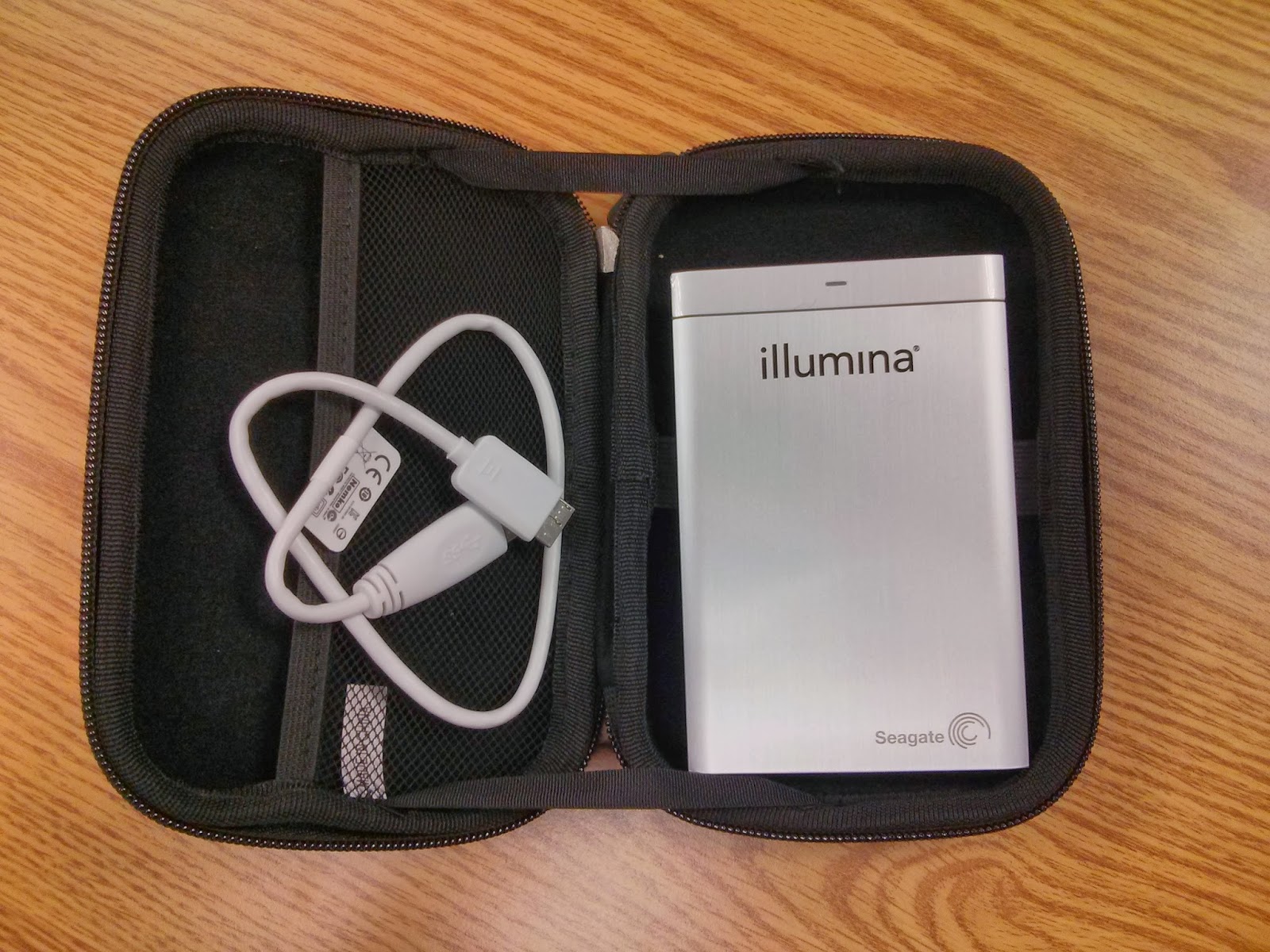 Along with my clinical report, Illumina delivered a portable hard drive (pictured) containing the underlying next-generation sequencing data. Given my computational genomics background, this was the product I'd most been looking forward to receiving. In fact, after picking it up, I found myself hastily biking five miles through the rain to get it to a computer!
The drive is protected using TrueCrypt, with the encryption key e-mailed separately. I installed the TrueCrypt on my Linux workstation, mounted the drive, and started to look around:
Read more »
Along with my clinical report, Illumina delivered a portable hard drive (pictured) containing the underlying next-generation sequencing data. Given my computational genomics background, this was the product I'd most been looking forward to receiving. In fact, after picking it up, I found myself hastily biking five miles through the rain to get it to a computer!The drive is protected using TrueCrypt, with the encryption key e-mailed separately. I installed the TrueCrypt on my Linux workstation, mounted the drive, and started to look around:
Read more »
21 Apr 10:31
Blogging My Genome, episode 2: scratching the surface
by Mike Lin
After learning about Illumina's Understand Your Genome (UYG) program at ASHG 2013, I decided to sign up to get my genome sequenced. This is the second in a series of blog posts I'll write about my own adventure in very personal genomics!
Three months after shipping my blood sample off to the lab for whole-genome sequencing (WGS), I got the long-awaited message to come in and go over my results. And so on a rainy Friday afternoon I biked over to Stanford for genetic counseling. I was very excited, and yet not without awareness of the ~1% chance I could see one of the known pathogenic findings on the American College of Medical Genetics list for genome sequencing reports, and perhaps up to ~5% chance of some other medically actionable finding.
Fortunately, nothing like that came up. In fact, my report is quite unremarkable, which is of course a good thing:
Read more »
Three months after shipping my blood sample off to the lab for whole-genome sequencing (WGS), I got the long-awaited message to come in and go over my results. And so on a rainy Friday afternoon I biked over to Stanford for genetic counseling. I was very excited, and yet not without awareness of the ~1% chance I could see one of the known pathogenic findings on the American College of Medical Genetics list for genome sequencing reports, and perhaps up to ~5% chance of some other medically actionable finding.
Fortunately, nothing like that came up. In fact, my report is quite unremarkable, which is of course a good thing:
Read more »
21 Apr 10:29
Blogging My Genome, episode 1: parting with my blood (and treasure)
by Mike Lin
After learning about Illumina's Understand Your Genome (UYG) program at ASHG 2013, I decided to go ahead and sign up to get my genome sequenced. This is the first in a series of blog posts I'll write about my own adventure in very personal genomics!
UYG gets you:
UYG gets you:
- "Deep" whole-genome squencing (WGS) from a blood sample
- Bioinformatics and clinical interpretation through Illumina's CLIA lab
- Report sent to your clinician
- Raw data on a portable hard drive
- Day-long workshop with other participants
- iPad with the MyGenome app
...for $5,000, which isn't too bad given what's included. The pricing probably reflects that the program is mainly an outreach effort aimed at subject matter experts.
Read more »
20 Apr 08:04
Early user of Venter's DNA synthesizer reports saving time, money
by Nick Paul Taylor
Feedback from an early-access program for Synthetic Genomics' personal DNA workstation has started to emerge. And the initial news is positive, with a researcher at the University of California, San Francisco, reporting that the device is cutting the time and money it takes to synthesize DNA.
13 Apr 14:29
3Dmol.js: molecular visualization with WebGL
by Rego, N., Koes, D.
Summary: 3Dmol.js is a modern, object-oriented JavaScript library that uses the latest web technologies to provide interactive, hardware-accelerated three-dimensional representations of molecular data without the need to install browser plugins or Java. 3Dmol.js provides a full featured API for developers as well as a straightforward declarative interface that lets users easily share and embed molecular data in websites.
Availability and implementation: 3Dmol.js is distributed under the permissive BSD open source license. Source code and documentation can be found at http://3Dmol.csb.pitt.edu
Contact: dkoes@pitt.edu
mjpdejong likes this
09 Apr 09:01
Linux 4.0 Hard Drive Comparison With EXT4 / Btrfs / XFS / NTFS / NILFS2 / ReiserFS
Phoronix: Here's a six-way file-system comparison on Linux 4.0 with a HDD using EXT4, Btrfs, XFS, and even NTFS, NILFS2, and ReiserFS.
07 Apr 10:25
Ultrafast aluminum battery offers safe alternative to conventional batteries
Scientists have invented the first high-performance aluminum battery that's fast-charging, long-lasting and inexpensive. Researchers say the new technology could replace many lithium-ion and alkaline batteries in wide use today.