Shared posts

23 Apr 10:13

The top 100 songs in history, explained in charts

by Kelsey McKinney

What would a chart of Kanye West's "Gold Digger" look like? That might sound like an impossible question to answer, but a poster at Flowing Data has the answer.

Flowing Data is run by Nathan Yau, who has a Ph.D. in data visualization and personal data collection. Yau rendered all 100 of Billboard's top charting songs of all time into funny chart visualizations.

screenshot from the chart-topping song

The top 100 songs of all time were determined by Billboard on the 55th anniversary of the creation of the sales chart. Those songs were ranked in an order determined by chart time and sales.

Here is the chart that displays all 100 songs:

A poster displaying all 100 top songs in chart form (flowingdata.com)

22 Apr 07:26

Oprah's misunderstanding of Anna Karenina

by James Choi
The myth embodied in great romances tells us that love envelops our whole being. Romantic love presses upon us with irresistible intensity. ...

What is more, according to this ideology, we do not choose such love. It befalls us. We “fall in love,” we do not jump in love. Such love is a “passion,” not an action. ...

For this reason, romantic love feels like fate, and an ideology of amoral fatalism often accompanies it. Lovers live in a realm beyond good and evil. After all, good and evil depend on choice, and where fate governs, choice is out of the question. No matter how much pain the lovers cause, one cannot condemn them. Adultery becomes as noble as revolution, and only cramped moralists worry about the pain caused the betrayed spouse or abandoned children.

That is the story Anna Karenina imagines she is living. As one of her friends observes, she resembles a heroine from a romance. But Anna’s sense of herself is not Tolstoy’s sense of her. He places his romantic heroine not in a romance, where her values would be validated, but in the world of prosaic reality, where actions have consequences and the pain we inflict matters.

Oprah Winfrey, who chose Tolstoy’s novel for her book club, followed many others in viewing Anna Karenina as a celebration of its heroine and of romantic love. That gets the book exactly wrong. It mistakes Anna’s story of herself for Tolstoy’s. Just as Anna Karenina imagines herself into the novel she reads, such readers imagine themselves as Anna or her adulterous lover Vronsky. They do not seem to entertain the possibility that the values they accept unthinkingly are the ones Tolstoy wants to discredit. ...

Anna’s story illustrates the dangers of romantic thinking. As she gives herself to her affair, she tells herself that she had no choice, but her loss of will is willed. Returning by train to her husband in St. Petersburg with Vronsky in pursuit, she experiences a sort of delirium:
She was constantly beset by moments of doubt as to whether the car was going forward or back or standing still altogether. Was it Annushka beside her or a stranger? “What is this on the arm, a fur or a beast? And is this me here? Am I myself or someone else?” She was terrified of surrendering to this oblivion. But something was drawing her into it, and she could surrender or resist at will (Part I, chapter 29).
The relativism of motion she experiences is a precise analogue to the delirious moral relativism she is falling into. Though she will later insist she could not have done otherwise, Tolstoy tells us that “she could surrender or resist at will.” Her fatalism is a choice.
--Gary Saul Morson, Commentary, on one of the moral messages of Anna Karenina. HT: SWR
21 Apr 11:43

What’s the Hardest Part of Being a PhD Student?

by Alex Tabarrok

I was asked this this question on Quora. Here’s my answer:

Writing an original dissertation.

Anyone who makes it into graduate school has had at least 16 years of learning and, as a result, most graduate students are good learners. A dissertation, however, requires the creation or discovery of new knowledge. On the day you finish your dissertation you have to know something that no one else in the world knows. That is a tall order.

After their course work ends, many students find themselves at a loss. They have done a lot of learning and not much creating or discovering–skills that not only are different than learning but that may even be at cross purposes. A learner has to trust that what he or she is being taught is true and valuable. A learner with too much skepticism won’t pass the final. But a dissertation writer without enough skepticism will never advance beyond previous knowledge and never discover that something previously learned was false.

It’s an odd necessity that the more you know the more skeptical you must become to know more. Not every student navigates this evolution in attitude.

FYI, Quora seems to be growing very rapidly. I first noticed this when my followers on Quora started growing faster than and soon exceeded my followers on Twitter, a fact I found surprising. According to Alexa, Quora has leaped in the popularity rankings 42 places in just the last 3 months. It will be interesting to see how they handle the growth especially keeping the quality of the questions high.

20 Apr 11:46

The Hateful Eight teaser trailer

by Jason Kottke

This is the teaser trailer for Quentin Tarantino's The Hateful Eight, the movie whose script leaked, was cancelled, was planned to be released as a book, and then uncanceled.

Update: I'm getting emails and tweets saying this trailer is fake. And if it is fake, is there a non-fake leaked trailer out there or...?

Update: Just to be clear, this is totally fake and constructed from bits of other movies, etc.

Tags: movies   Quentin Tarantino   The Hateful Eight   trailers
16 Apr 14:43

Loss Aversion in Politics -- by Alberto Alesina, Francesco Passarelli

We study loss aversion in majority voting. First, we show a status quo bias. Second, loss aversion implies a moderating effect. Third, in a dynamic setting, the effect of loss aversion diminishes with the length of the planning horizon of voters; however, in the presence of a projection bias, majorities are partially unable to understand how fast they will adapt. Fourth, in a stochastic environment, loss aversion yields a significant distaste for risk, but also a smaller attachment to the status quo. The application of these results to a model of redistribution leads to empirically plausible implications.
16 Apr 14:41

Aspire -- by Marcel Fafchamps, Simon Quinn

We gave US$1,000 cash prizes to winners of a business plan competition in Africa. The competition, entitled 'Aspire', was intended to attract young individuals aspiring to become entrepreneurs. Participants were ranked by committees of judges composed of established entrepreneurs. Each committee selected one winner among twelve candidates; that winner was awarded a prize of US$1,000 to spend at his or her discretion. Six months after the competition, we compare winners with the two runners-up in each committee: winners are about 33 percentage points more likely to be self-employed. We estimate an average effect on monthly profits of about US$150: an annual profit of 80% on initial investment. Our findings imply that access to start-up capital constitutes a sizable barrier to entry into entrepreneurship for the kind of young motivated individual most likely to succeed in business.
16 Apr 12:03

How academic recommendation letters for men and women differ

by Chris Blattman

Evidence from text analysis of 886 letters of recommendation on behalf of 235 male and 42 female applicants for either a chemistry or biochemistry faculty position at a large U.S. research university.

…the results of the current study revealed more similarity in the letters written for male and female job candidates than differences. Male and female candidates had similar levels of qualifications and this was reflected in their letters of recommendation. Letters written for women included language that was just as positive and placed equivalent emphasis on ability, achievement, and research.

Thus, in contrast to the findings of Trix and Psenka (2003), letters for female candidates to jobs in chemistry and biochemistry did not contain significantly more tentative language and did not overemphasize teaching and hard work over research and ability.

However, it is notable that recommenders used significantly more standout adjectives to describe male candidates as compared to female candidates, even though objective criteria showed no gender differences in qualifications.

…Interestingly, the data also revealed that letters that contained more standout words also included more ability related terms and fewer grindstone [e.g. hardworking] words.

The post How academic recommendation letters for men and women differ appeared first on Chris Blattman.

16 Apr 11:38

What Jeff Sachs thinks you should study

by Chris Blattman

I was skeptical when I heard Tyler Cowen would interview Jeff Sachs. I’ve read a lot of Jeff’s work and figured I couldn’t learn much that is new. Plus I’m more interested in hearing Sachs’ nuanced views rather than the introductory ideas or (worse) sound bites.

But Tyler gave me hope, I listened to it on the plane from Denver the other day, and I thought it was a simply terrific interview. I think even the most well-read or jaded development economist will find much to enjoy.

Here’s the transcript and podcast.

Last week I mentioned Dani Rodrik’s plea for more context-dependent theory and policy. Sachs expressed a similar sentiment when asked how he’d change economics graduate education:

JEFFREY SACHS: Economics. We avoid that, I think, conceptually, because if you study anything too specific it’s out of date in 10 years. So we study general principles. I think that’s epistemologically the weakness of our field. We want to be the four underlying, natural forces of the social universe rather than studying specifics.

TYLER COWEN: More like the anthropologists.

JEFFREY SACHS: No, more like the biologists. If Watson and Crick had written their 1953 paper saying, “Assume n base pairs.” They can match by [n× (n − 1)] / 2 combinations. It wouldn’t be a very good model of DNA. They actually said there are four base pairs, and there are two natural matchings. It happens to be a double helix.

We’re going to study the detail out of that for the next 40 years. Yeah, it’s arbitrary. There could be other DNA, but we’re going to study this one. Economists don’t do that, because we have a harder job, in some sense, which is that we’re not studying a stable environment. We’re studying a changing environment. Whatever we study in depth will be out of date. We’re looking at a moving target.

To compensate for that by never getting into detail has been our approach, but we’re always behind the curve, then. We never have good answers when they’re needed. That’s what I would like us to study.

Another way to put it: given how much ink economists devote to general principles and methods, the marginal return to substantive, empirical work with a shorter shelf life or narrow audience should (in principle) be high. I buy this, but then I would.

Also related to last week’s discussion of Dani Rodrik: Sachs too would like to see more diagnosis before prescription in economics. But again I’m skeptical a reusable diagnostic tool could be developed, and think that trial and error gets us moving in the right direction faster.

The post What Jeff Sachs thinks you should study appeared first on Chris Blattman.

16 Apr 09:39

Justified: A Neglected Rebel Amid Television's Golden Age

by Adam Epstein
Image

Justified might not be one of the pillars of TV’s Golden Age, but as it approaches its series finale Tuesday night, it too has been great—at times, even transcendent. All this despite that fact that hardly anyone watched the show, a fact that places it squarely in the realm of great TV dramas that flew under the radar and relied on the loyalty of a few devoted fans and proselytizers.

Perhaps a victim of the era that spawned it, and that offered an abundance of worthy prestige dramas, Justified was routinely overshadowed by other cable shows, in both the ratings and awards departments. It gradually lost viewers after it premiered in 2010: Just 1.8 million people watched the penultimate episode (by comparison, 5 million people watched the second-to-last episode of fellow FX show Sons of Anarchy). It was nominated for occasional Emmys, winning only twice (for actors Margo Martindale and Jeremy Davies, both well-deserved), but inexplicably, never received a nomination for best drama. Justified was a critical darling, but that acclaim failed to translate to awards glory, even as shows that weren't as consistently praised racked up nomination after nomination.

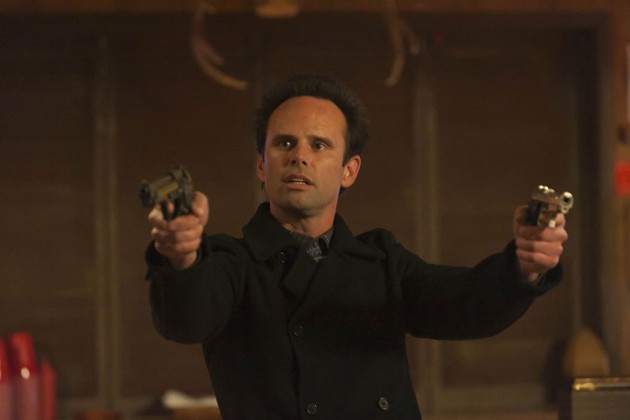
Walton Goggins as “Boyd Crowder" (FX)

Nor did Justified ever ignite the Internet the same way shows like Breaking Bad, or another excellent FX series, The Americans, did. (When’s the last time you read a Justified think piece, or visited the show’s page on Reddit?) Admittedly, its central premise—a U.S. marshal who plays by his own rules returns to his hometown in the Kentucky hills—isn't quite as compelling as a chemistry teacher becoming a meth magnate, or a group of figuratively lost souls literally lost on an island with polar bears and a smoke monster, even if it pays homage to the time-honored traditions of the Western.

Justified was never quite as influential as some of these other shows because it was largely a product of the new TV environment, rather than a factor in its creation. Nor was it even all that innovative. The show began with a fairly generic “bad guy of the week” format before morphing into a heavily serialized saga in its second season. And even then, it wasn’t wildly transformative. Its spiritual forebearers, The Shield and Deadwood, had already explored themes of revenge and forgiveness, home and family, loyalty and betrayal, years before Justified debuted.

It refused to be anything other than its strange, funny, verbose, serpentine self.

But to say nothing of its uniformly excellent writing and acting, Justified was, perhaps more than any other show, one that knew precisely what it wanted to accomplish. It was always perfectly comfortable in its own skin, and despite a few missteps along the way, it refused to be anything other than its strange, funny, verbose, serpentine self.

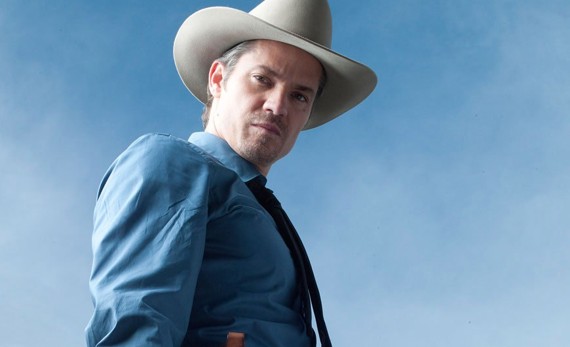
Based on a character created by the late novelist Elmore Leonard, Justified told the story of Deputy U.S. marshal Raylan Givens (Timothy Olyphant) as he is reassigned to his hometown of Harlan, Kentucky after shooting a criminal in Miami—the result of his fabled quick draw. Raylan’s childhood friend, Boyd Crowder (Walton Goggins), has become a criminal mastermind of sorts, a silver-tongued chameleon (as Alan Sepinwall aptly calls him), a man who's always 10 steps ahead of everyone else and can talk his way in or out of any situation imaginable. The two men share a witty rapport even as they remain enemies—they both know they share a history, that they’re two sides of the same coin, kindred spirits who will always have Harlan running through their veins for as long as they draw breath.

Olyphant and Goggins were both born to play these roles, assisted in no small part by the deft writing of creator Graham Yost and his team of scribes. They, too, stormed out of the gate with a serious advantage, having the writings of Leonard—who liked the show and frequently consulted with the producers until his death in 2013—from which to draw ideas.

FX

Even as the show took audiences through rural poverty and the criminal underworld of Appalachia, it was always funny, because it never took itself too seriously—it figured out a way, as no other show other than Breaking Bad has—to at once scrutinize the darkest depths of our society and reveal the comic absurdity of it all. In that way, Justified was innovative and quite unique, but not in such a pronounced manner that it could be mentioned alongside the other transformative shows of the era.


More From Quartz


Justified could stay so confident and robust for six seasons largely because of the constant addition of fascinating supporting players. (Martindale played the pot tycoon and family matriarch Mags Bennett; Davies played her fidgety son, Dickie.) So many shows add secondary characters who turn out to be poorly developed, or opt not to add any at all precisely because it’s so hard to do them right. But from the rollicking mafia man turned informant Wynn Duffy, to the ruthless Robert Quarles, to this season’s leathery, magnetic big bad Avery Markham (Sam Elliott, another actor born to be on Justified), the show’s recurring characters—its villains, especially—were rarely thinly written, and always a ton of fun.

I say rarely because the fifth season of the show was what can be best described as a creative misfire. Michael Rapaport, who played the main villain that season, was the show’s first and only serious miscasting. The plot, normally intricate and layered in the best way possible, became unnecessarily convoluted in the same way that many shows that are on the air for a while tend to do. Even at its worst moments, Justified was still a good show—certainly better than most—and it’s miraculous that it didn’t fail much more than just once, given how fearless it was at taking familiar TV conventions and turning them on their heads.

The show never quite found its spot in the television zeitgeist. Actually, it wasn’t very popular by any standard. But it was so good, and so fun, and it didn’t really care about being anything besides those two things. I can only hope, that in a few years, more people will discover it: a fate it's not only earned, but amply justified.


16 Apr 07:06

Tyler Cowen’s three laws

by Tyler Cowen

Many of you have been asking for a canonical statement of what I sometimes refer to as Cowen’s Laws.  Here goes:

1. Cowen’s First Law: There is something wrong with everything (by which I mean there are few decisive or knockdown articles or arguments, and furthermore until you have found the major flaws in an argument, you do not understand it).

2. Cowen’s Second Law: There is a literature on everything.

3. Cowen’s Third Law: All propositions about real interest rates are wrong.

I coined those some time ago, when teaching macroeconomics, yet I remain amazed how often I see blog posts which violate all three laws within the span of a few paragraphs.

There is of course a common thread to all three laws, namely you should not have too much confidence in your own judgment.

Addendum: Kevin Drum comments.

10 Apr 15:16

The Experimental Turn in Economics: A History of Experimental Economics

by Tyler Cowen

The author is Andrej Svorenčík and he has produced the definitive account of the history of experimental economics.  The SSRN paper is here, but it is more accurate to think of this as a monograph at 248 pp. of text.  I hope a major publisher is interested, but do note it starts off a bit slow.  Once it gets going it never lets up and I learned a great deal from it.  Here is just one excerpt:

When Austin C. Hoggatt died on April 29, 2009, at the age of seventy-nine the experimental economics community lost a low profile yet very influential figure.  Hoggatt was the first to build a computerized laboratory for controlled experimentation in economics or, more broadly, in the social, behavioral, and decision science — the Management Science Laboratory at the Center for Research in Management Science at UC Berkeley in 1964.

If you think you might be interested you will be.  The paper/monograph is strong on recognizing the need for an integrated approach to experiments, involving software, support staff, programmers, and researchers, and tracing how all this came together, or in some cases did not.  You really get the inside story from Svorenčík.

10 Apr 12:58

Why people never smiled in old photographs

by Phil Edwards

In most old photos — those taken in the 19th century and early 20th century — people aren't smiling. That's led to the popular belief that people simply didn't smile in old photos. Like in this depressing wedding photo from 1900:

If your wedding photos look like this one from 1900, your marriage is doomed. (F.J. Mortimer/Getty Images)

So why did people in old photos look like they'd just heard the worst news of their life? We can't know for sure, but a few theories help us guess what was behind all that black-and-white frowning.

1) Very early technology made it harder to capture smiles

One common explanation for the lack of smiles in old photos is that long exposure times — the time a camera needs to take a picture — made it important for the subject of a picture to stay as still as possible. That way, the picture wouldn't look blurry.

Moderators of the Free Church of Scotland in 1860, looking sad and blurry. (Hulton Archive/Getty Images)

The picture above illustrates why early cameras made it harder to capture a smile. One figure in the center is blurry, most likely because he moved slightly during the long exposure time. In theory, you'd want to maintain as still a position as possible, and it's harder to maintain a smile than a relatively flat facial expression.

But that's only part of the story — and was really only a huge factor in the very early days of photography. As George Eastman House curator Todd Gustavson told me when I was researching the history of the selfie, exposure times had gotten a lot shorter by 1900 with the introduction of the Brownie and other cameras. These cameras were still slow by today's standards, but not so slow that it was impossible to smile.

Yet smiles were still uncommon in the early part of the century. That suggests there were also cultural reasons people didn't smile in old pictures. Any general cultural theories involve a few leaps of faith — but these try to explain why old photos look so sad.

2) Early photography was heavily influenced by painting — which meant no smiling

Four-year-old girls probably didn't act like this in 1900. But this is how they were photographed. (Imagno/Getty Images)

Today, photography is a means of recording our lives as they're lived. But in the early days of the art, it was indebted to a tradition of portraiture in painting. A photograph was a frozen presentation of a person, not a moment in time. Even the models thought so.

In 1894, the Photographic Journal of America interviewed a model named Elmer Ellsworth Masterman. He had an unusual gig — he professionally modeled as Jesus Christ for paintings and photographs. He also didn't see the distinction between the two art forms. "What is the difference between posing for a photograph and posing for a painting?" he asked.

The photographic tradition of portraiture began in part because of the technological limitations of cameras that had to take pictures slowly. But even once cameras improved, it was difficult to imagine photography as a unique art with its own aesthetics. Even when it was easier to take pictures quickly, cameras still represented an ideal of life, not a slice of it. That meant no smiling.

3) Early photographs were seen as a passage to immortality

A postmortem photograph from around 1860. (Wikimedia Commons)

When we snap a profile picture today, part of the goal is to look cool or to document fleeting moments. But people didn't think about their Facebook page in the early days of photography. For them, photographs were a passage to immortality.

That's especially evident in the tradition of postmortem photography. In that genre, a recently deceased person, child, or pet would be photographed as if they were still alive. Begun in the early days of photography, it had largely — though not completely — petered out by 1900. But it reveals the mentality of the time: portraiture was used as a way to preserve the living for future generations.

That meant the medium was predisposed to seriousness over the ephemeral. There's no better reflection of that idea than the words of Mark Twain — a man who made a living as a humorist and wrote stories about jumping frogs. Even he said, "I think a photograph is a most important document, and there is nothing more damning to go down to posterity than a silly, foolish smile caught and fixed forever."

4) Victorian and Edwardian culture looked down on smiling

Mark Twain was a professional funny man, and this is how he posed for pictures. (Topical Press Agency/Getty Images)

The fourth argument for why people in old photos frowned is one of the most compelling — though also the hardest to prove. It's possible that many people in the early 1900s simply thought smiling was for idiots.

Nicholas Jeeves surveyed smiling in portraits for the Public Domain Review and came to the conclusion that there was a centuries-long history of viewing smiling as something only buffoons did. (Jeeves dismisses the alternative theory that bad teeth kept people from smiling — after all, if everybody had bad teeth, it probably wasn't a problem.)

Like any sweeping cultural thesis, it's a tough statement to prove, and the exceptions are abundant. For example, the Flickr group "Smiling Victorians" has 2,100 photos, and at least some of them show genuine grins. That alone is a significant counterargument. But the prevailing concept of old pictures as humorless relics seems on the mark (and is confirmed, in some ways, by the need to make a special Flickr group for pictures that aren't dour).

In the late 19th and early 20th century, the culture at large may have frowned on the smile, and it took a while to learn to love it.

But then why was this man smiling?

All that is what makes the photograph below, taken around 1904, so striking. It's from a collection of Berthold Laufer's images from his expedition to China (and featured by the American Museum of Natural History Library).

This man is definitely smiling:

A picture from 1904 — yes, 1904 — of a man smiling while eating rice. (Laufer/American Museum of Natural History Library, Image #336609)

We don't know much about the photo itself. But it offers a perfect opportunity to examine why it seems like people in old photos never smiled.

The clues might lie in photographer and subject. Photographer Berthold Laufer was an anthropologist, which meant he had a different mission than other photographers of his time — he sought to record life instead of pose it. That goal meant capturing a wider range of emotions. His rice-loving subject may have been willing to grin because he was from a different culture with its own sensibility concerning photography and public behavior. Both of them were outsiders to the mainstream photographic culture.

Together, they create a picture that's memorable even now. We don't know for sure why one man eating rice looked so happy — but we do know it led to a picture that can still make us smile today.

10 Apr 11:59

Online exhibition of Sino-Japanese War prints

by Jason Kottke

This collection of prints produced by artists about the Sino-Japanese War and housed in The British Library is great, but this particular print is just beyond:

Sino Japan Art

Tags: art   Sino-Japanese War   war
07 Apr 12:48

Why the world is getting weirder (and will get weirder yet)

by Tyler Cowen

It used to be that airliners broke up in the sky because of small cracks in the window frames. So we fixed that. It used to be that aircraft crashed because of outward opening doors. So we fixed that. Aircraft used to fall out of the sky from urine corrosion, so we fixed that with encapsulated plastic lavatories. The list goes on and on. And we fixed them all.

So what are we left with?

Sadly, we all know the answer to that question.

…And so, with more rules we have solved most of the problems in the world. That just leaves the weird events left like disappearing 777’s, freak storms and ISIS. It used to be that even minor storms would be a problem but we have building codes now (rules). Free of rules, we’d probably have dealt with ISIS by now too.

Ultimately, this is why the world is getting weirder, and will continue to do so. Now with global media you get to hear about it all.

That is from a very interesting mini-essay by Steve Coast, hat tip goes to The Browser.

07 Apr 12:31

Coloring books for adults

by Jason Kottke

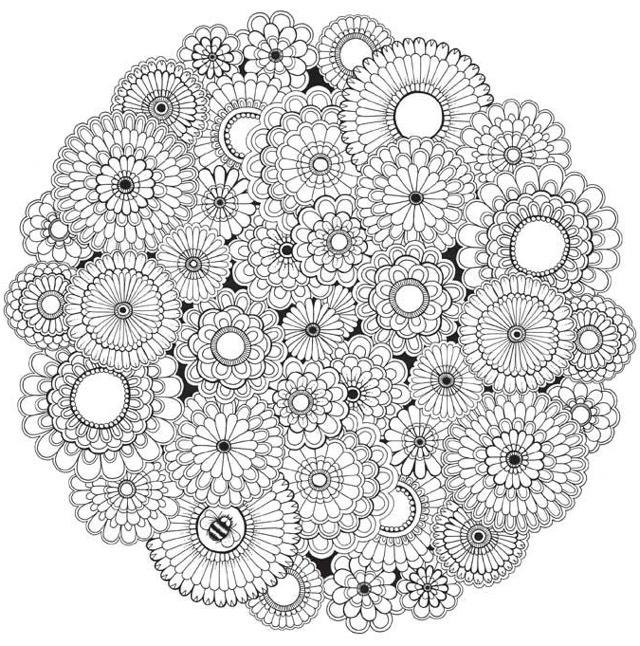
The two top-selling books on Amazon right now are a pair of coloring books for adults by Johanna Basford: Enchanted Forest and Secret Garden.

Basford Coloring Book

Basford Coloring Book

Basford Coloring Book

Fans of the books have been posting examples of their coloring-in online; this one is from occasionalartist:

Basford Coloring Book

What This Says™ about contemporary culture is left as an exercise to the reader. Right after you finish coloring your flowers, of course.

Tags: Amazon   books   Johanna Basford
06 Apr 18:53

Ten Commandments Of Sushi | Tom Downey | Gone | 1st April 2015

by Tom Downey
Sushi is for lunch, not dinner. A full meal should take no more than 15 minutes. Use hands to eat, not chopsticks. Do not add soy sauce or wasabi; the chef will have done that if he thinks it appropriate. Eat the sushi as soon as it is served, while the rice is still warm. Don’t talk, it distracts you from the sushi. Eat in a low-ceilinged restaurant where the smell of the fish can linger. Drink sake while chewing

Subscribe to the Browser to receive a feed with direct links to the recommended content

06 Apr 18:47

The Ragu Chronicles | Matt Goulding | Roads And Kingdoms | 1st April 2015

by Matt Goulding
An eating expedition through Bologna in search of Italy’s best pasta sauce. Opinions differ, especially when it comes to the inclusion of tomatoes. Here’s a recipe for the second-best: Sauté some diced onion, carrot, and celery in olive oil until caramelized; simmer for three hours with coarsely ground beef, ground pork butt, a cup of white wine, peeled tomatoes, tomato paste, and bay leaves. But for the best ragu read on

Subscribe to the Browser to receive a feed with direct links to the recommended content

06 Apr 14:52

Laura Marling on Why Writers Should Look Back for Inspiration

by Joe Fassler

By Heart is a series in which authors share and discuss their all-time favorite passages in literature. See entries from Jonathan Franzen, Amy Tan, Khaled Hosseini, and more.

Doug Mclean

Ezra Pound famously urged poets to “make it new,” but that doesn’t mean artists should forget about the past. In our conversation for this series, the English folk singer-songwriter Laura Marling explained why she’s inspired by the ancient, the outdated, and the disappearing, citing how a Robertson Davies passage that suggests vanishing cultures and abandoned ideas may still have something urgent to teach us. For Marling, the lines help explain what she tends to do by instinct: embrace chance, limit choices, and find new directions inside of old ones.

Short Movie, Marling's newest record, is her most expansive-sounding effort yet. The sound pays tribute to the vast size and endless noise of Los Angeles, where much of the record was written: Songs typically begin with guitar and voice floating alone in a pool of reverb, but gradually, more instruments break in, as if trying to conquer all that emptiness.

Short Movie is Marling’s fifth album, and the follow-up to 2013’s critically acclaimed Once I Was an Eagle. She spoke to me by phone from London.


Laura Marling: I was visiting my family over Christmas one year, and my father was reading The Rebel Angels by Robertson Davies. My godfather had given him a copy—I remember him sitting with it in the corner of the room, laughing loudly by the fire as he read.

Later, my father gave me my own copy of the book, and it arrived in my life at exactly the right time. I was just getting interested in two things that are spoken a lot about in Robertson Davies’ novels: mysticism and classic books.

The novel’s central character, Maria, is a young postgraduate researching Rabelais at a university in Toronto. She’s invited her professor, Hollier (whom she is in love with, but who isn't interested in her), to dinner at her mother’s house. Her mother is Romani and holds onto the secrets and eccentricities of her culture strongly, much to the embarrassment of Maria. But Hollier takes a strong fascination, despite her hostility to his interest.

When asked by her mother why he wants to know more, Hollier gives a short speech about the importance of historical knowledge, especially knowledge in danger of being trivialized by a rational, godless society:

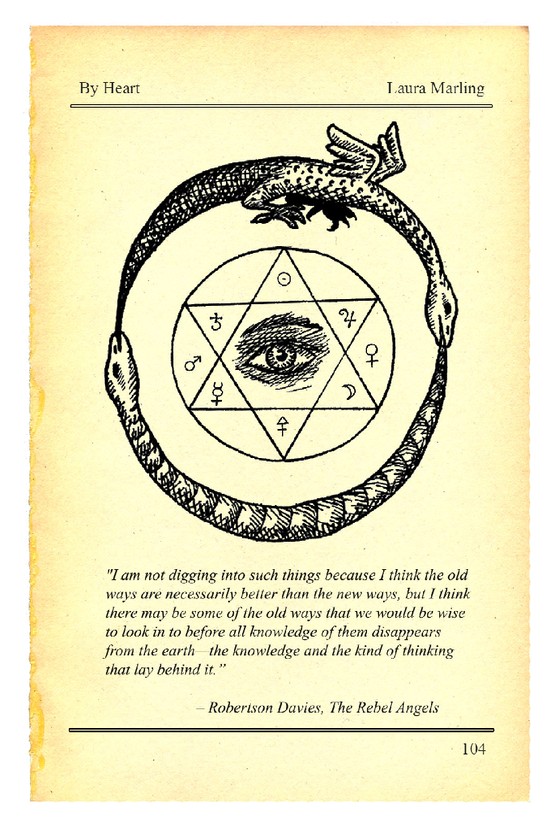
The recognition of oneself as a part of nature, and reliance on natural things, is disappearing for hundreds of millions of people who do not know that anything is being lost. I am not digging into such things because I think the old ways are necessarily better than the new ways, but I think there may be some of the old ways that we would be wise to look into before all knowledge of them disappears from the earth—the knowledge and the kind of thinking that lay behind it.

To have the ability to throw away sentences like these from a non-central character in a novel is amazing. I love the way this passage highlights the importance of retaining earlier forms of knowledge—the way that certain ideas and ways of thinking may prove to be useful, even if they seem to have no relevance to the way we live now. Quite a lot of my life is spent trying to figure out why I always want to go backwards—when the majority of the world seems to want to build more construction on top of the construction. This passage helps me account for my impulse to do that.

“The recognition of oneself as a part of nature,” as Hollier puts it, is one attitude that’s disappearing. Access to nature is almost a privilege now. And though I believe that technology may one day catch up and help us go back to a pre-Industrial Revolution style of living, we miss out on a great deal by being so cut off from the natural world. Wildness in nature is irrational in a way that’s comforting. Without that, you lose your connection to instinct, and your ability to deduce natural morality from what’s around you. I think the more that people feel disconnected from this aspect of their humanity, the more they seek to avoid punishment and live in a state of permanent contentment. But that form of experience, in my opinion, isn’t truly human.


Related Story

What Writers Can Gain From Seeing the World Through Different Eyes


We live in a very fast-moving—and sometimes quite bland and rational—time.  I think that’s why I’m interested in the history of mysticism and the occult, ways of thinking that push back against rationality. You don’t need to really believe that magical things are “real” to appreciate them. As Hollier explains earlier in this scene, people “may believe what is untrue, but they have a need to believe the untruth—it fills a gap in the fabric of what they want to know, or think they ought to know.” I’d rather live in a world injected with fantastical possibility. I’m very lucky in that my job is a creative one, but in the times that I haven’t been doing the creative side of the job I find it necessary to be involved in fantasy in some way.

My interest in earlier ways of doing things also extends to my approach to making and recording music. I only work with analog gear, because that’s all I know how to do. I grew up in a recording studio. My dad ran a recording studio. I always grew up with the idea—in fact I didn’t ever really know there was another option—that you rehearse with a band for a week, and then you go in and record all together in one room. So that’s how I’ve always done it, even though many recordings today are built one track at a time. We do overdub—on the first track of the record, we went back in again and picked up a different percussion instrument and made weird noises into the mic. But that’s as far as we take it. Most of the songs are based around capturing a live recording.

I like to keep things simple because it means you can’t lose yourself in the complications. I’m such a passionate person, but when things get too complicated I lose interest. So I’m very careful about containing my passion so that I can follow it through.  I feel that in all aspects of my life: I can’t have more than three outfits in my wardrobe or I can’t get dressed in the morning. I like things to not be too full of decisions.

I think that’s one reason why I’ve always liked music made in the year 1969. For a long time, I would go into record shops and look for records—any records—made in 1969. That was a time in music when things were starting to become stereo and recording equipment was moving in a direction that’s closer to what we have now. I’ve always liked that tone and that sound: Technology allowed for new forms of experimentation, but things hadn’t gotten too complicated.

You don’t need to really believe that magical things are “real” to appreciate them.

It’s not that I don’t like music that uses new techniques. I listen to a lot of electronic artists—I think Autechre is someone who perfectly manages to express an extremely industrial sound, a sound that is very of our time, or beyond our time. People who know the present very well can sometimes show us what the future will look like, and that’s exciting. There’s Phillip K. Dick, writing [the novel that became] Blade Runner—when I moved to L.A. I thought, Holy fuck, he had it completely right!

But sometimes you need the past to make the new. One example is John Luther Adams, a composer I really like. (Radiolab did a podcast about him.) He did an album that captures ocean sounds and the sound of storms—it’s not abstract, it’s very classical in style and instrumentation. He’s so competent as a musician and a composer that he’s completely managed to perfectly express those sounds from nature and translate them to music. I see that as a forward-thinking use of ancient skills. Not that classical music is ancient, by any means—but he used centuries-old instruments to create a completely modern statement.

In my own songwriting process, I often find myself reappropriating older works to write new songs. There are maybe ten lines from The Rebel Angels, for example, that I’ve regurgitated into three or four different songs—it’s a form of regeneration. At one point in the book, Maria’s Greek professor—who is madly in love with her—goes on a long monologue about how she’s like the Greek god Sophia, the masculine god’s female counterpart. I ended up using this idea, in a way that wasn’t fully conscious, to create a song called “Sophia.” It was about the praying to a feminine god, what kind of power that is. What a different idea to a masculine god that is.

Things are always getting lost as times change. One thing that’s disappearing from recorded music is the element of chance. Since a lot of the takes on my records are first or second takes, there’s sometimes some minor fluff in them—the sound of someone dropping a drumstick, or me dropping my pick. And yet the song goes on, and these little accidents become part of the character. As the recording process gets more sophisticated and controlled, these imperfections start to disappear. But maybe technology will find a way to help us find them again.


01 Apr 11:10

Nigeria Democratically Elects Its Former Dictator

by Adam Chandler
Image

On Tuesday, voters in Nigeria selected the country's former military ruler Muhammadu Buhari as the new president, unseating divisive incumbent Goodluck Jonathan. "With all but one of Nigeria’s 36 states counted," The New York Times reported on Tuesday, "Buhari held a lead of more than two million votes."

Buhari's Historic Win

The defeat of Jonathan, who has ruled Africa's biggest economy and largest democracy since 2010, was particularly noteworthy for the fact that it was the first time in Nigeria's history that an incumbent had lost a re-election bid.

“The first transfer of power to the opposition through an election,” is how former American ambassador to Nigeria John Campbell described it in a phone call on Tuesday. For Nigeria, a country with a history of election-related violence and military coups, Jonathan's phone call to Buhari conceding defeat was a positive sign for the prospects of a peaceful transition. “I think the fact that President Jonathan made a concessionary phone call to Buhari sets the right tone,” said Campbell.

Buhari himself came to power in the mid-1980s following a coup and served as Nigeria's president for a year and a half. Campbell noted, however, that Buhari had successfully campaigned on a platform of anti-corruption and military strength, which were among the highest-priority issues for voters.

Boko Haram and Other Challenges

Buhari will assume the presidency of a country beset by corruption, failing oil prices, and six years of insurgency waged by Boko Haram.

“We have seen how Boko Haram managed to fight the Nigerian army to a standstill,” Campbell said, noting that "rebuilding security services will be a high priority" for the next president. He added that Jonathan campaigned on recent successes against the terrorist group, which only came once neighboring countries contributed forces to the fight. The group still holds significant territory in the country's northeast.


01 Apr 07:11

A dying man's beautiful farewell to his daughter

by James Choi
Six years passed in a flash, but then, heading into chief residency, I developed a classic constellation of symptoms — weight loss, fevers, night sweats, unremitting back pain, cough — indicating a diagnosis quickly confirmed: metastatic lung cancer. The gears of time ground down. ...

Verb conjugation became muddled. Which was correct? “I am a neurosurgeon,” “I was a neurosurgeon,” “I had been a neurosurgeon before and will be again”? Graham Greene felt life was lived in the first 20 years and the remainder was just reflection. What tense was I living in? Had I proceeded, like a burned-out Greene character, beyond the present tense and into the past perfect? The future tense seemed vacant and, on others’ lips, jarring. I recently celebrated my 15th college reunion; it seemed rude to respond to parting promises from old friends, “We’ll see you at the 25th!” with “Probably not!”

Yet there is dynamism in our house. Our daughter was born days after I was released from the hospital. Week to week, she blossoms: a first grasp, a first smile, a first laugh. Her pediatrician regularly records her growth on charts, tick marks of her progress over time. A brightening newness surrounds her. As she sits in my lap smiling, enthralled by my tuneless singing, an incandescence lights the room.

Everyone succumbs to finitude. I suspect I am not the only one who reaches this pluperfect state. Most ambitions are either achieved or abandoned; either way, they belong to the past. The future, instead of the ladder toward the goals of life, flattens out into a perpetual present. Money, status, all the vanities the preacher of Ecclesiastes described, hold so little interest: a chasing after wind, indeed.

Yet one thing cannot be robbed of her futurity: my daughter, Cady. I hope I’ll live long enough that she has some memory of me. Words have a longevity I do not. I had thought I could leave her a series of letters — but what would they really say? I don’t know what this girl will be like when she is 15; I don’t even know if she’ll take to the nickname we’ve given her. There is perhaps only one thing to say to this infant, who is all future, overlapping briefly with me, whose life, barring the improbable, is all but past.

That message is simple: When you come to one of the many moments in life when you must give an account of yourself, provide a ledger of what you have been, and done, and meant to the world, do not, I pray, discount that you filled a dying man’s days with a sated joy, a joy unknown to me in all my prior years, a joy that does not hunger for more and more, but rests, satisfied. In this time, right now, that is an enormous thing.
--Paul Kalanithi (1977 - 2015), Stanford Medicine, “Before I Go
30 Mar 09:32

26 podcasts you should be listening to

by Libby Nelson

Podcasts have been around for a decade. But all of a sudden, people are sitting up and taking notice.

In the past few months, at least two media companies focused on podcasts have launched — Gimlet Media, which chronicled its own early days on the podcast "StartUp," and Slate Magazine's Panoply. It's starting to feel like a golden age of podcasting is upon us.

But with hundreds of fascinating podcasts out there, getting started can feel intimidating. So here's our best attempt to sort through them. There are podcasts to listen to on your commute, while you're cleaning the house, while you're cooking dinner, and even when you're trying (and failing) to fall asleep. The only criteria for inclusion is that they have to have an established archive of at least five episodes, so 1) it's easy to tell what you're getting yourself into, and 2) you can binge-listen if you want. (And yes, categorizing podcasts is tricky, so most of these could fit into several categories.)

Interview podcasts

Alec Baldwin is also the host of an interview podcast. (Stephanie Keenan/Wireimage via Getty Images)

Bret Easton Ellis podcast

The writer and screenwriter and a different guest each week talk about entertainment and the creative life, often about movies. They're long, interesting, and analytical conversations. It hasn't been updated since November, but there's a deep archive of nearly 50 previous podcasts to dive into.

Episodes are around an hour.

"Here's the Thing" with Alec Baldwin

In "Here's the Thing," Alec Baldwin interviews mostly boldfaced names — Ira Glass, Lena Dunham, Billy Joel — but people rave about his interviewing style. This is the podcast I hear about most frequently from people who don't generally listen to podcasts. An interview with the head of People for the Ethical Treatment of Animals "brought a perspective to extreme movements and their role in changing society that I still think about probably a year later," says Vox engagement editor Allison Rockey.

Episodes used to be an hour but are now running slightly shorter, around 45 minutes, and are released every two weeks.

"Love+Radio"

"Love+Radio" features long interviews, many with people you've never heard of — an at-home strip club manager, a black man who befriended the KKK — produced into long audio stories. The production values are amazing, and the result is an incredibly intimate look at other people's lives. There really isn't anything else like it. "If you like hearing other people's secrets, you'll probably like listening to this," says Vox video editor Joe Posner.

Episodes are around half an hour, released about twice a month.

"You Made It Weird" with Pete Holmes

Vox Editor-in-Chief Ezra Klein described this podcast so well I'm just going to let him take it from here: "Comedian Pete Holmes talks with people — mostly comedians — for absurdly long periods of time. Episodes routinely blow past the two-hour mark. It sounds horrible. It's actually awesome. Holmes is a fantastic interviewer who recognizes the most interesting thing about interesting people is rarely their work. So instead, Holmes tends to talk to them about the subjects he's interested in: religion, pain, death, family, shame, confidence, dating, insecurity, sex, etc. It's basically a podcast about the core questions of human existence. It also convinced me Dana Carvey is pretty much the wisest man alive."

New episodes are released weekly.

Conversational podcasts

(Shutterstock)

"Call Your Girlfriend"

Ann Friedman and Aminatou Sow are writers and long-distance friends who catch up with each other every few weeks on "Call Your Girlfriend." "You'll enjoy this podcast if you like listening in on candid conversations about everything from Beyoncé to how to make friends as an adult to Shine Theory," says Vox social media staffer Lauren Katz. "And if you miss your long-distance best friend, you can listen to this podcast together and feel slightly better."

Episodes are around 40 minutes.

"My Brother, My Brother, and Me"

"My Brother, My Brother, and Me" is a comedy advice podcast starring three brothers that comes highly recommended by several Vox staffers as one of the funniest podcasts out there. Hosted by Justin, Travis, and Griffin McElroy. (Griffin and Justin both work at Polygon, a Vox Media company.)

Episodes are around an hour, released weekly on Mondays.

"Yo, Is This Racist?"

Andrew Ti uses a question about racism that an anonymous listener sends via voicemail to jumpstart a very candid conversation about the issue. "My favorite podcasts are usually really entertaining people talking to each other as if they were getting drinks at a bar," says Vox motion graphics designer Estelle Caswell. "This is that type of podcast." She recommends you start with this episode about the narrative of white privilege.

Episodes are under 15 minutes and are released frequently; there are more than 300 in the archive.

Podcasts about life

At this point it's basically cheating to recommend This American Life, but most of these podcasts owe a debt to Ira Glass. (Todd Oren/Getty Images Entertainment)

"99% Invisible"

"99% Invisible," hosted by Roman Mars, is a podcast about design, told in a medium with no pictures. It's been getting attention for a couple of years for the innovative ways it tells stories. There is an episode about the musical groans emitting from Metro escalators, and about "hacking" Ikea furniture, and about Wonder Bread — all kinds of everyday things you've never thought twice about.

Episodes come out weekly on Wednesdays and tend to be pretty short, less than 10 minutes.

"Criminal"

"Criminal" is a true-crime podcast with episodes exploring everything from famous murder cases (including the murder featured in The Staircase) to little-known true crime (a Venus Flytrap theft ring).

Episodes are between 15 and 20 minutes long and have been produced about once a month so far.

"Reply All"

"Reply All" is a podcast about how we live on the internet from Gimlet Media, a new podcasting startup. It's sort of the This American Life of the internet, telling stories about an app that lets you send a stranger to deliver a message, or about both sides of an internet dating scam.

Episodes are usually between 20 minutes and a half hour, and usually come out weekly.

"StartUp"

A former producer for This American Life and Planet Money, Alex Blumberg started a podcasting company and did a podcast about it while the business was getting off the ground. Its first 13-episode series focused on Blumberg's own startup; future seasons will look at different businesses. It's a great insight into both the world of startups and the world of media.

The first season is over now, but there are 13 episodes available to listen to. They're about half an hour long.

"The Sporkful"

A fun podcast about food, hosted by Dan Paschman of the Cooking Channel, "The Sporkful" covers everything from what's inside the CIA cafeteria to the science of why greasy food is delicious to which kind of potatoes make the best hangover cure. Don't listen on an empty stomach. (Another food podcast I'm looking forward to trying is "Burnt Toast," from Food52, but it only has a few episodes out so far.)

Episodes are around half an hour, released weekly.

Weird and highly recommended podcasts

Actor Cecil Baldwin performs a live version of "The Librarian" episode of his podcast "Welcome to Night Vale." (Adam Berry/Getty Images Entertainment)

"Welcome to Night Vale"

"Welcome to Night Vale" is a scripted, fictional podcast about the weird goings-on in Night Vale — a sort of creepy parody of small-town community radio. It's one of the most consistently recommended podcasts, even though — or maybe because — it doesn't have much in common with the roundtables, interviews, and reporting that dominate podcasts today. And it comes highly recommended by culture editor Todd VanDerWerff.

New episodes released (about 20 to 25 minutes long) released twice a month. Start from the beginning.

Podcasts about popular culture

You should be watching The Americans and also listening to the podcast about it. (Patrick Harbron/FX)

"Rebel FM"

A gaming podcast recommended by Vox staff writer German Lopez: "It's probably one of the most informative dives into video games and the game industry each week, usually with a personal touch so it's not just mindless droning about what makes some video games great. It also sometimes has special guests from the game industry."

Episodes are long — up to two hours — and released weekly.

"Pop Culture Happy Hour"

The important thing about a roundtable podcast is that the people you're listening to feel like good company. NPR's "Pop Culture Happy Hour" is a lively discussion about books, TV, movies, comics, and just about everything else hosted by Linda Holmes and a rotating cast of regulars. It helps if you've read or watched what they're discussing that week, but you certainly don't have to. It's like listening in on a dinner party discussion that's way more interesting than your dinner parties.

Full episodes, released weekly, are about 45 minutes; small-batch episodes are often under 10 minutes.

"Song Exploder"

On this podcast, musicians talk about how their songs were made — from the Postal Service on "The District Sleeps Alone Tonight" to composer Alexandre Desplat on his score for the movie The Imitation Game. It gives insight into the creative process, says Winston Hearn, a front-end developer for Vox Media.

Episodes are released every few weeks and are about 20 minutes long.

"The Americans: Slate TV Club Insider"

Okay, a podcast focused on a TV show with a tragically small audience is a bit of a niche recommendation. But if you love FX's story about Cold War spies in the 1980s — and if you're not watching it, you really should be — this podcast from The Americans' showrunners makes watching an even richer experience. Even if you don't watch the show, though, the podcast is worth it for its candid, in-depth discussions of what it takes to make a great TV show — from acting to stunts to production design.

Episodes are released weekly on Thursdays and run about half an hour, though some have been longer.

Podcasts about policy and the news

Unfortunately, you can't see any charts while you're listening. (Shutterstock)

AEI's "Banter"

A fun, chatty podcast recommended by Vox's Tim Lee: "Run by two smart young staffers at AEI, it's a great way to keep up with what's happening in right-of-center policy circles."

Episodes are under 25 minutes and come out a few times a month.

"Arms Control Wonk"

A podcast recommended by Max Fisher, who oversees Vox's foreign coverage: "It's funny, pithy, conversational, and super-nerdy. They discuss major foreign policy issues that relate to arms control, which these days is a lot of them. The tone is approachable and lighthearted enough that anyone who follows basic foreign news can enjoy it, but also gets in-depth enough that you end up learning a lot."

Episodes can run up to an hour and come out a few times a month.

"Inquiring Minds"

A science and public health news podcast that brings in experts and researchers to discuss the biggest science topics of the week. Recommended by Vox's German Lopez, who says it's a relatable way to get science news.

Episodes are about an hour and come out weekly.

"Do You Like Prince Movies?"

Grantland's pop culture podcast, from writers Alex Pappademas and Wesley Morris. A little more news-focused than NPR's "Pop Culture Happy Hour," with segments on recently released movies and the pop culture news of the week, and great banter.

Episodes are released weekly and are slightly over an hour.

Podcasts about history

(ullstein bild/Getty Images)

"BackStory"

"BackStory" is a podcast where three historians — one each for the 18th, 19th, and 20th centuries — trace one theme through American history, whether it's how we tell time, how we shop, or how we define the middle class. It's hosted by Ed Ayres, president of the University of Richmond, and two history professors at the University of Virginia, Peter Onuf and Brian Balogh. Every episode feels like it could be adapted into a fascinating book without too much trouble. The production values are nothing fancy — it's a roundtable discussion for an hour with three professors — but if you're at all interested in history, every episode is packed with fascinating facts.

Episodes are usually about an hour and come out weekly, although many are rebroadcasts. Archives go back to 2008.

"Revolutions"

Every week, "Revolutions" takes you inside a political revolution — right now it's focusing on the French Revolution, the archives include the English Civil War, and Haiti is up next. It's very detailed — so far, the podcast has spent 31 episodes on the French Revolution alone — but gets rave reviews for being engaging. Recommended by Vox editor Tim Lee.

Episodes are around half an hour and come out about every week.

"The Memory Palace"

"The Memory Palace," hosted by Nate DiMeo, tells stories from the past that you've never heard — the history of eating lobsters, or the riots that started in 1964, or about historical fears of being buried alive. (The last one, full of real-life ghost stories, will haunt you for a long time.) They're beautifully written and elegiac, read in a relaxing voice, sort of like bedtime stories from the world's most fascinating history book.

Episodes come out infrequently (monthly at best) and are short, but there's a vast archive if you're a newcomer.

"You Must Remember This"

Stories from "the first century of Hollywood" — from silent films up to the present day — are featured on this podcast by Karina Longworth, a former film critic for LA Weekly. Many episodes focus on stars from Hollywood's studio system era (Hedy Lamarr, Humphrey Bogart, Lauren Bacall) but some include more recent memories, including a two-episode feature on Madonna. The podcast gets rave reviews for its production values and insight.

Episodes come out weekly and run from half an hour to 45 minutes or so.

WATCH: Radio of the future — welcome to the podcast era

Correction: This post originally stated that "Revolutions" covered the Glorious Revolution, rather than the English Civil War. It has been corrected and updated.

27 Mar 18:17

The Ballad of Geeshie and Elvie

by Jason Kottke

The Ballad of Geeshie and Elvie is a good old fashioned musical detective story told by John Jeremiah Sullivan.

In the world of early-20th-century African-American music and people obsessed by it, who can appear from one angle like a clique of pale and misanthropic scholar-gatherers and from another like a sizable chunk of the human population, there exist no ghosts more vexing than a couple of women identified on three ultrarare records made in 1930 and '31 as Elvie Thomas and Geeshie Wiley. There are musicians as obscure as Wiley and Thomas, and musicians as great, but in none does the Venn diagram of greatness and lostness reveal such vast and bewildering co-extent. In the spring of 1930, in a damp and dimly lit studio, in a small Wisconsin village on the western shore of Lake Michigan, the duo recorded a batch of songs that for more than half a century have been numbered among the masterpieces of prewar American music, in particular two, Elvie's "Motherless Child Blues" and Geeshie's "Last Kind Words Blues," twin Alps of their tiny oeuvre, inspiring essays and novels and films and cover versions, a classical arrangement.

Yet despite more than 50 years of researchers' efforts to learn who the two women were or where they came from, we have remained ignorant of even their legal names. The sketchy memories of one or two ancient Mississippians, gathered many decades ago, seemed to point to the southern half of that state, yet none led to anything solid. A few people thought they heard hints of Louisiana or Texas in the guitar playing or in the pronunciation of a lyric. We know that the word "Geechee," with a c, can refer to a person born into the heavily African-inflected Gullah culture centered on the coastal islands off Georgia and the Carolinas. But nothing turned up there either. Or anywhere. No grave site, no photograph. Forget that -- no anecdotes. This is what set Geeshie and Elvie apart even from the rest of an innermost group of phantom geniuses of the '20s and '30s. Their myth was they didn't have anything you could so much as hang a myth on. The objects themselves -- the fewer than 10 surviving copies, total, of their three known Paramount releases, a handful of heavy, black, scratch-riven shellac platters, all in private hands -- these were the whole of the file on Geeshie and Elvie, and even these had come within a second thought of vanishing, within, say, a woman's decision in cleaning her parents' attic to go against some idle advice that she throw out a box of old records and instead to find out what the junk shop gives. When she decides otherwise, when the shop isn't on the way home, there goes the music, there go the souls, ash flakes up the flue, to flutter about with the Edison cylinder of Buddy Bolden's band and the phonautograph of Lincoln's voice.

This piece originally appeared in the NY Times Magazine, but it works much better online, interspersed with videos and musical snippets cleverly embedded in the text. One of my favorite things I've read all month.

Tags: Elvie Thomas   Geeshie Wiley   John Jeremiah Sullivan   music
26 Mar 17:08

We interrupt this lovefest for Lee Kwan Yew with this important message

by Chris Blattman

No, I’m not going to complain about the whitewashing of an authoritarian regime. I’m used to people trading off someone else’s freedom for GDP growth. Or forgetting that for every transformative dictator there are many more who take the country down the toilet.

Rather, I want to highlight this point from political scientist Tom Pepinsky:

The coverage of Singapore under the late Lee Kuan Yew consistently emphasizes a theme of rapid economic development in an inauspicious context, encapsulated by the slogan “From Third World to First.”

…Now, no one should doubt that Lee Kuan Yew was a developmentalist statebuilder par excellence. But Singapore at independence a third-world country? This narrative neglects the incredible legacy of openness, infrastructure, and stability that the British rule left this tiny country.

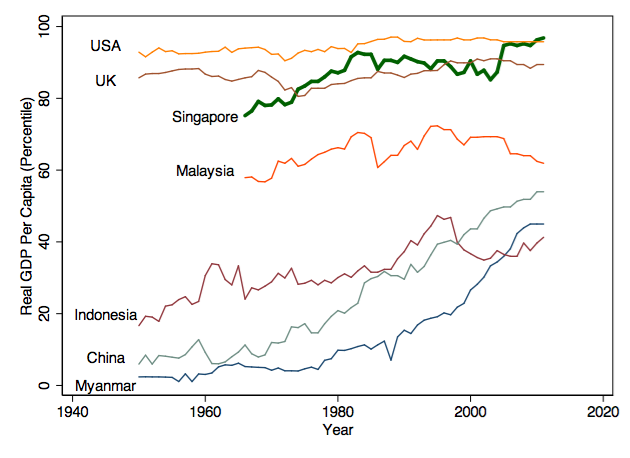
The graph below says it all. For every year since 1945, I have ranked all independent countries by real per capita GDP, the best measure we have of economic prosperity. I then normalize these to a percentile scale. Here is what we get.

comps

…Singapore entered the community of independent states as a prosperous country, at least by the standards of the time.

True, Lee Kwan Yew started governing a few years before Independence from Malaysia, where we don’t have data. Conceivably the green line starts at Indonesia levels in 1959 and goes vertical before the observed data come in. Conceivably.

I invite the Singapore experts to weigh in. Miracles do happen. Like most miracles, however, this one might be mythical.

The post We interrupt this lovefest for Lee Kwan Yew with this important message appeared first on Chris Blattman.

24 Mar 08:30

The under-representation of women in the movies and on TV

by Tyler Cowen

Will Radford and Mathias Gallé have a new and interesting paper on this topic, here is one excerpt:

Law and corporate professions had around 15% of female representation…the medical domain (doctors) had a female probability of 0.23…Religion does not score at the bottom with regards to female presentation (although very low with 0.08). From the professions we selected, Engineering was the lowest (0.05). The highest scoring profession was IT (0.52), which is partly due to the fact that many computer voices were female (computer had 460 female occurrences, versus 247 male ones; and enterprise computer from “Star Trek” was almost exclusively female)

By the way, the number of female writers and directors (in their IMDB database) was at a six year low in 2014.

If you look at most frequent roles for gender, women are assigned hostess, girl, woman, waitress, and mother.  For men, the list swings toward narrator, announcer, doctor, detective, bartender, soldier, and police officer.

In 1980-200, the top “newly popular” role (for both sexes) was “additional voices.”  For the time period 2000-present it was “zombie,” next was “housemate.”

The paper is here (pdf), hat tip goes to Samir Varma.

Here is a new and interesting article on whether there is greater female influence over cinematic box office these days.

23 Mar 12:29

Emmy Noether revolutionized mathematics — and still faced sexism all her life

by Brad Plumer

Emmy Noether was one of the most brilliant and important mathematicians of the 20th century. She altered the course of modern physics. Einstein called her a genius. Yet today, almost nobody knows who she is.

In 1915, Noether uncovered one of science's most extraordinary ideas, proving that every symmetry found in nature has a corresponding law of conservation. So, for example, the fact that physical laws work the same today as they did yesterday turns out to be related to the notion that energy can neither be created nor destroyed. Noether's theorem is a deep insight that underpins much of modern-day physics and things like the search for the Higgs boson.

And yet, as one of the very few female mathematicians working in Germany in her day, Noether faced rampant sexism. As a young woman, she wasn't allowed to formally attend university. Long after she proved herself a first-rate mathematician, male faculties were still reluctant to hire her. If that wasn't enough, in 1933, the Nazis ousted her for being Jewish. Even today, she remains all too obscure.

That should change. And what better time to celebrate her work than on her birthday? (In 2015, Google ushered in March 23 with an Emmy Noether Google Doodle.) So here's an introduction to the life and work of a woman Albert Einstein once called "the most significant creative mathematical genius thus far produced."

Noether was brilliant — yet universities wouldn't hire her

Emmy Noether doesn't need your tenure-track position. (Wikimedia Commons)

Amalie Emmy Noether was born in 1882 in Erlangen, Germany, to a family of mathematicians. Her father, Max Noether, was a professor at the University of Erlangen. Her brother Fritz later proved worthy in the field of applied math.

Despite this fertile background, it wasn't obvious that Emmy could become a mathematician, too. German universities rarely accepted female students at the time. She had to beg the faculty at Erlangen to let her audit math courses. It was only after she dominated her exams that the school relented, giving her a degree and letting her pursue graduate studies.

Her early work focused on invariants in algebra, looking at which aspects of mathematical functions stay unchanged if you apply certain transformations to them. (To give a very basic example of an invariant, the ratio of a circle's circumference to its diameter is always the same — it's always pi — no matter how big or small you make the circle.) Noether studied invariants for polynomial functions and made some impressive advances.*

Her work got noticed, and in 1915, the renowned mathematician David Hilbert lobbied for the University of Göttingen to hire her. But other male faculty members blocked the move, with one arguing: "What will our soldiers think when they return to the university and find that they are required to learn at the feet of a woman?" So Hilbert had to take Noether on as a guest lecturer for four years. She wasn't paid, and her lectures were often billed under Hilbert's name. She didn't get a full-time position until 1919.

That didn't stop Noether from doing trailblazing work in a number of areas, especially abstract algebra. Rather than focusing on real numbers and polynomials — the algebraic equations we learn in high school — Noether was interested in abstract structures, like rings or groups, that obey certain rules. Abstract algebra was one of the big mathematical innovations of the 20th century, and Noether was hugely influential in shaping it.

But perhaps her most consequential work came in another field: physics. In 1915, Einstein published his general theory of relativity, showing that gravity was a property of space and time, and the University of Göttingen was all abuzz with the the discovery. Hilbert asked Noether to apply her work on algebraic invariants to the equations in Einstein's theory.

In the process, Noether made a startling discovery of her own.

Noether’s theorem: How symmetry explains the world

The hunt for the Higgs boson can be traced back to Noether's insight on symmetries. (Fabrice Coffrini/AFP/Getty Images)

To put it very simply, what Noether's theorems show is that anytime there’s a continuous symmetry in a physical system, there’s a related law of conservation.**

Here's an example: Let's say we conduct a scientific experiment today. If we then conduct the exact same experiment tomorrow, we'd expect the laws of physics to behave in exactly the same way. This is "time symmetry." Noether showed that if a system has time symmetry, then energy can't be created or destroyed in that system — we get the law of conservation of energy.

Likewise, if we do an experiment, and then do the exact same experiment again 20 miles to the east, that shouldn't make any difference — the laws of physics should work the exact same way in both places. This is known as "translation symmetry." Noether showed that translation symmetry leads to the law of conservation of momentum.

Finally, if we put our experiment on a table and rotate the table 90 degrees, that shouldn't affect the laws of physics, either. This is known as "rotational symmetry." But if rotational symmetry holds in a system, then angular momentum is always conserved. (That is, if you have a spinning bicycle wheel, it should spin in the same direction forever unless friction slows it down.)

This was a stunning revelation. Noether had linked concepts as different as time and energy. What's more, she had showed there was a deep connection between certain abstract algebraic structures — those that deal with symmetry — and physics. As David Goldberg details in his book The Universe in the Rearview Mirror, physicists soon began hunting for yet more symmetries.

In 1954, Chen Ning Yang and Robert Mills showed that other types of symmetries could describe the behavior of a vast array of particles and forces. In 1962, physicist Murray Gell-Mann was able to predict the existence of a new particle after simply studying symmetries written on a blackboard. (That particle was later confirmed by a particle accelerator.) In 1964, Peter Higgs (among others) used symmetries to predict the existence of the Higgs boson — a particle that was found in 2012 by the Large Hadron Collider.

The idea that purely mathematical structures could help find new particles in the physical world is astonishing, when you think about it. And it traces back to a discovery Emmy Noether made in 1915.

Noether fled Germany after the Nazis came to power

A postcard showing the University of Erlangen in 1915. (Wikimedia Commons)

Noether continued doing vital mathematical work in abstract algebra and topology all through the 1920s and 1930s. But her career at at Göttingen was cut short when the Nazis came to power in 1932.

As a Jewish academic — and a woman at that — Noether didn't stand much of a chance in Nazi Germany. She was fired from her post, and in 1933 she fled to the United States to teach at Bryn Mawr College. Unfortunately, her life was cut short. Less than two years later, she died at the age of 53, following surgery for an ovarian cyst.

Shortly after Noether's death, in 1935, Albert Einstein wrote a beautiful letter to the New York Times praising her genius and recalling fondly her time at Bryn Mawr:

In the judgment of the most competent living mathematicians, Fraeulein Noether was the most significant creative mathematical genius thus far produced since higher education of women began. In the realm of algebra, in which the most gifted mathematicians have been busy for centuries, she discovered methods which have proved of enormous importance in the development of the present-day younger generation of mathematicians.

Pure mathematics is, in its way, the poetry of logical ideas. One seeks the most general ideas of operation which will bring together in simple, logical and unified form the largest possible circle of formal relationships. In this effort toward logical beauty spiritual formulae are discovered necessary for the deeper penetration into the laws of nature. ...

Her unselfish, significant work over a period of many years was rewarded by he new rulers of Germany with a dismissal, which cost her the means of maintaining her simple life and the opportunity to carry on her mathematical studies. Farsighted friends of science in this country were fortunately able to make such arrangements at Bryn Mawr College and at Princeton that she found in America up to the day of her death not only colleagues who esteemed her friendship but grateful pupils who enthusiasm made her last years the happiest and perhaps the most fruitful of her entire career.

Today, Emmy Noether remains relatively unknown outside of math circles. In 2012, physicist David Goldberg told the New York Times that most of his colleagues and students had never heard of her: "Surprisingly few could say exactly who she was or why she was important."

It's about time we fixed that.

Footnotes

* In her 1907 dissertation, for instance, Noether studied degree-four polynomials with three variables. She found that these polynomials had 331 independent invariants, and all other invariants depended on these. This was a mind-numbing feat of calculation — she later described it as "a jungle of formulas." She soon moved on to bigger, conceptual insights.

** A more precise statement of Noether's theorem might go something like: "If a system has a continuous symmetry property, then there are corresponding quantities whose values are conserved in time." Many physicists would put it like this: "Whenever a system exhibits a continuous symmetry, there is an associated conserved charge."

Further reading

— In 2012, Natalie Angier wrote a beautiful profile of Noether for The New York Times. She's got some great additional biographical details.

— This paper by UCLA's Nina Byers offers an excellent history of Noether's conservation theorems and their importance to physics.

— This post at the blog Gravity and Levity offers a wonderful illustration of how Noether's theorem is useful in everyday physics.

— Back in 2014, Evelyn Lamb created a fascinating list of other unjustly forgotten women in mathematics that's very much worth checking out.

23 Mar 10:24

Susan Sontag and the Birkenstock: The Week in Pop-Culture Writing

by The Editors
Image

Desperately Seeking Susan
Terry Castle | The London Review of Books
"At its best, our relationship was rather like the one between Dame Edna and her feeble sidekick Madge—or possibly Stalin and Malenkov. Sontag was the Supremo and I the obsequious gofer."


Related Story

Last Week's Edition


Sole Cycle
Rebecca Mead | The New Yorker
"In recent years, the homely Birkenstock has become a curiously fashionable object."

The Woman Who Froze in Fargo
Mike Powell | Grantland
"The woman was real, even if the story isn’t entirely true. And it’s been told before, by a documentarian. So where is the line between fact and fiction, and just how strong is it?"

The NFL's Macho Culture Must Die
Jamil Smith | The New Republic
"Something happened Monday ... that should signal to the NFL that it must do more than reduce risk to protect its players. It must help to redefine the toxic masculinity that still pervades the heads it seeks to protect."

What It's Like to Watch Netflix's Unbreakable Kimmy Schmidt as a Native American
Jacqueline Keeler | The Daily Dot
"We must ask: Is a white actress playing a Native American passing as white engaging in 'Redface'?"

We Don’t Watch Empire for the Plot: It’s the Unabashed Spectacle of Wealth and Style That Keeps us Hooked
Sonia Saraiya | Salon
"Pop culture has always been enamored with things; Empire, a work of pop culture about the inner workings of another medium of pop culture, is outright obsessed with them."

Kendrick Lamar, To Pimp a Butterfly's Devotional Bandleader
Ari Sadowitz | Huffington Post
"
When was the last time you heard clarinet on a hip-hop record? This is it."

What Is Giancarlo Stanton Thinking?
Tim Keown | ESPN
"He remembers the moment in pieces, fragments, in the time that elapsed between blackouts: Brewer Mike Fiers' arm action, the ball halfway there, its path obvious from the start, his body on the ground ... The paramedics, the ambulance, the hospital, the uncertainty."


22 Mar 16:24

Pop music is changing, and Sylvan Esso is leading the charge

by Kelsey McKinney

Sylvan Esso turns pop music inside out. The group's electronic loops complement a sound that smashes up folk and electronica, sounding like little else out there. The group's self-titled debut album, released in 2014, is a spare, lovely treat, 10 whimsical, swirling songs that are slowly garnering a passionate, growing fan base.

The group's minimalism extends to its stage show, where the only flashing lights sit behind the duo. Though lead singer Amelia Meath does her share of dancing, there aren't any costume changes, backup dancers, or guitars beings switched out. This isn't a big show. The focus is on the music.

Fortunately, the music can hold its own. On one side of the stage, Meath sings, harmonizing with electronic versions of herself, as on the other side of the stage her co-creator, Nick Sanborn, pushes myriad buttons and toggles to create magical, unbelievably catchy loops that stick in listeners' minds for days afterward.

This is a band worth paying attention to. But it's also a band that has thought about the future of music — and just where it will fit into that future.

Sylvan Esso in concert, Charlotte, North Carolina. (Jeff Hahne/Getty)

Pop music matters

Before becoming part of Sylvan Esso, Meath was a member of the folk band Mountain Man. While on tour, she met Sanborn, who was part of what she calls a "sad electronic hip-hop band." The two hit it off, became quick friends, and joined forces a few years later.

"I always wanted to make pop music, just because it’s a really fun genre to make, and it’s a genre that’s supposed to both be catchy and have an artistic value," Meath told me.

Indeed, Sylvan Esso (the album) isn't bubblegum pop. It's a mashup of everything Sanborn and Meath once were. It's synth beats and looping sounds calling back to Sanborn's electronic work. And it's also Meath's twanging voice murmuring lyrics like, "I have a phone that beeps/lets me know I'm not alone," harking back to her folk work.

Some purists might call making a pop album selling out, especially in an era when pop so utterly dominates the musical world. But Meath doesn't see pop the way many categorize it.

"People don't actually define pop music in the way it was meant to be defined. When you look at the root of pop music, it's popular," Meath explains. "The original popular music was rock 'n' roll. For some reason now, pop has a really dumbed-down definition, and I don’t think that’s true. I think it’s music that was meant to be listened to by a large group of people."

Sylvan Esso definitely hits that mark. At the band's Washington, DC, concert, the crowd danced and sang along to every word — just like at a typical pop concert.

Sylvan Esso perform on The Tonight Show Starring Jimmy Fallon. (NBC/Getty)

Consumption of music is changing, but creation isn't

Meath's savvy extends to the uncertain future of her industry. She knows how many albums she's sold. And she knows how many times "Coffee" — the group's breakout single — has been played on Spotify (just under 15 million).

"A lot of people listen to our album through Spotify. It’s cool, because they do come to shows. It also means the only song they know is 'Coffee,' because someone they have a crush on put it on a playlist for them," she says. "The only thing that bums me out about it is that there’s a new kind of entitlement. I don’t think people understand that’s a pretty significant monetary sacrifice, if you think about it."

She went on to explain exactly how big of a financial hit she feels like she's taking for putting their work on Spotify. "The album is 10 tracks long. For every 10 tracks that are being played I should be getting 10 dollars, and that’s on the iTunes cheap side of things. In reality, I think I’ve made about $10k off of all our streaming stuff."

Meath says she understands that the consequences of putting her music on streaming platforms go both ways. The band has garnered far more of a fan base than it ever expected to in a very short period of time, and part of that is due to streaming.

Taking a financial hit to build that following may not be ideal, but Meath seems to think it's worth it. "My business is to determine how I want my music to be consumed without hurting people’s feelings or agreeing to a subpar situation."

But part of her comfort comes from the fact that to her, the money and the music are separate entities. "There are two very different things," she says. "There’s the industry, and then there’s art. From what I can see, everyone’s going to keep making art."

And Sylvan Esso is nothing if not artful. The album works from the first song to the last. It's constructed like an old-school album, gaining momentum as it goes, every song perfectly positioned. Sylvan Esso may be proving that pop can be smart, but it's also making catchy cool again.

You can download Sylvan Esso's debut album on iTunes or listen on Spotify.

22 Mar 16:21

The speech Nixon would have given if Neil Armstrong and Buzz Aldrin had died on the moon

by Joseph Stromberg

Presidents have to prepare for all sorts of contingencies. Including the possibility, in Richard Nixon's case, that the Apollo 11 astronauts might not safely return from the moon.

This contingency speech — found in the National Archives by the excellent blog Letters of Note — provides a chilling look at what might have been, starting with its blunt headline: "In Event of Moon Disaster."

"Fate has ordained that the men who went to the moon to explore in peace will stay on the moon to rest in peace," Nixon's speechwriter William Safire began. "These brave men, Neil Armstrong and Edwin Aldrin, know that there is no hope for their recovery."

Given Apollo 11's success, it's easy to overlook the fact that a mission failure was quite possible. The module used to ferry astronauts from the Apollo spacecraft to the moon's surface, in particular, was developed in a hurry — and as it descended, its computer malfunctioned, spitting out error messages and forcing Neil Armstrong to land the craft without radar data.

Here's the speech, which was first revealed on Meet the Press in 1999:

(National Archives)

(National Archives)

19 Mar 14:28

The energy future, as seen from Denmark

by Nicholas Keyes
Photo by Blue Square Thing via Flickr

Driving across the Danish countryside, they cannot be missed: towering white wind turbines as far as the eye can see, their slow-turning blades providing a 21st century counterpoint against the flat landscape of fields and farmhouses.
 
Denmark has committed to renewable energy further and faster than any country in Europe.  The Scandinavian nation generates a third of its annual electricity demand from wind, and solar capacity is growing as well. For countries that want to green their energy mix, there is no better place to get a glimpse of the future than Denmark. 
 
Its pioneering spirit has brought great benefits, and international acclaim, but like all first movers, Denmark is also learning as it goes. 
 
To tap into this learning, ESMAP—the World Bank’s Energy Sector Management Assistance Program—organized a study tour to Energinet.dk, Denmark’s transmission system operator, as part of its work to help client countries integrate variable renewable energy into their electricity grids. Joining the study tour were 26 participants—representatives from regulators, system operators and utilities from 13 countries, including South Africa, Chile, China, Pakistan, Zambia, and Morocco.
 
In visiting Energinet.dk, it became instantly clear that running an electricity grid largely off renewable sources is much more complex than simply dotting the landscape with wind turbines or solar panels.
 
For one thing it requires a delicate regulatory balance.  Denmark’s electricity market is "unbundled"—meaning that generation, transmission and distribution are in the hands of different operators.  And there is open access to the grid—a level playing field for generation companies that want to sell electricity into the system.
 
However, long-term planning and transmission operation is kept in the hands of Energinet.dk and other non-profit entities that operate under a mandate to work in the interest of electricity consumers and society as a whole. There are incentives for renewable energy generation, but new solar and wind projects must go through a rigorous vetting process to ensure they are properly located and built out to make the overall system stronger and more reliable.
 
The net result is an electricity sector that fosters competition, prioritizes clean energy, and meets long-term demand while keeping costs down.
 
“You need to have a strong commitment from government and good long-term planning,” said Peter Jørgensen, Vice President for International Relations at Energinet.dk. “All parties need to be coordinated to ensure the grid is built out correctly.”
 
Denmark also enjoys the great advantage of having built electricity system interconnectors with neighboring countries decades ago, which in combination with an efficient regional electricity market gives the overall system enormous flexibility. Norway—with its huge hydropower and storage capacity—can import and export electricity whenever Denmark has a surplus or is running at a deficit.
 
Such advantages are hard to replicate, but that does not mean that transitioning to an electricity grid powered to a large extent by solar and wind is out of reach, even for developing countries.  A new ESMAP report, Bringing Variable Renewable Energy Up to Scale, makes clear that with the right planning, policies, and investments, countries can now integrate wind and solar into their power grids at higher levels than previously thought possible. Such investments would include complementary systems such as demand response, reservoir hydro, and energy storage and natural gas-fired power plants to provide on-demand power.  
 
One of the most heartening aspects of the visit to Energinet.dk was that participants clearly saw Denmark’s sophisticated integration and large-scale use of renewable energy as a model with lessons for their countries, not as an anomaly or an experience that could only be replicated by rich countries.  Questions were detailed and specific, covering Denmark’s grid code, how independent power producers are compensated, and price mechanisms in the regional spot market for electricity.  
 
If it continues along its present trajectory, Denmark will continue to be seen as a model for the transition to clean energy by developed and developing countries alike.  The government has set a national goal of ending domestic dependence on fossil fuels by 2050.  What this means, among other things, is that wind and solar power will be harnessed in a massive effort to convert biomass into transport fuels.  This would be an unprecedented approach, and full of risks. But whatever happens, the world will be watching closely, and benefiting from Denmark’s experience. 
14 Mar 12:58

The 19 best-reviewed movies on Netflix right now

by Dylan Matthews

Netflix and Metacritic are two of the most useful tools in existence for film fans, but they're surprisingly difficult to use in conjunction with each other. When scouring critics' most beloved movies on Metacritic, there's no way of filtering out ones that you can stream instantly on Netflix (though there is a checkbox for Amazon Prime; see the top of this table). And when browsing Netflix, there's no top-rated-by-Metacritic category or scores attached to any of the movies. So as a small public service, here are the 19 best-reviewed films that are currently available for streaming on Netflix.

  1. Best Kept Secret

    Metacritic score: 100

    Length: 1 hour, 25 minutes.

    To be fair, Best Kept Secret's perfect score is a product of only four reviews, but critics who've seen the 2013 documentary are rapturous. The film tracks Janet Mino, a Newark public school special education teacher whose class of teen boys on the autism spectrum is about to graduate into a world loath to give them a chance. "Best Kept Secret is an exemplary documentary: It spotlights an important issue yet never seeks to squeeze the truth into an easily digestible narrative frame," the New York Times' Miriam Bale writes.

    Click here to watch on Netflix.

  2. Hoop Dreams

    Metacritic score: 98

    Length: 2 hours, 51 minutes.

    Hoop Dreams follows two black Chicago teenagers, William Gates and Arthur Agee, as they attend a heavily white suburban Catholic school with an excellent basketball program in hopes that it will propel them to the NBA. Released in 1994, it's one of the most universally acclaimed documentaries ever made. "A film like Hoop Dreams is what the movies are for," Roger Ebert, one of the movie's early champions, wrote. "It takes us, shakes us, and make us think in new ways about the world around us."

    Click here to watch on Netflix.

  3. Virunga

    Metacritic score: 95

    Length: 1 hour, 40 minutes.

    As with Best Kept Secret, the score of 2014's Virunga was helped by a relative paucity of reviews, but the film's portrait of rangers at the Democratic Republic of the Congo's Virunga National Park enduring poachers, Western attempts at exploitation, and civil strife won admiration among those who saw it. "Showcasing the best and the worst in human nature, Orlando von Einsiedel’s devastating documentary Virunga wrenches a startlingly lucid narrative from a sickening web of bribery, corruption and violence," the New York Times' Jeannette Catsoulis writes.

    Click here to watch on Netflix.

  4. Pulp Fiction

    Metacritic score: 94

    Length: 2 hours, 34 minutes.

    This one should require no introduction, but I highly recommend reading some of the reviews from 1994 Metacritic pulls together, reflecting a time when Quentin Tarantino's aesthetic was startling and novel rather than copied to death. The negative ones are especially fun. "The way that this picture has been so widely ravened up and drooled over verges on the disgusting," the late Stanley Kauffmann wrote in the New Republic. "Pulp Fiction nourishes, abets, cultural slumming."

    Click here to watch on Netflix.

  5. We Were Here

    Metacritic score: 94

    Length: 1 hour, 30 minutes.

    We Were Here, released in 2011, documents the profound damage the AIDS epidemic did to San Francisco's gay community in the 1980s, but also the incredible way in which the community came together to fight the plague. "We Were Here is above all a film about love," the New York Times' Stephen Holden writes. "Not romantic love but the kind that really matters, in which people selflessly show up and keep on showing up for one another in the worst of times."

    Click here to watch on Netflix.

  6. Carlos

    Metacritic score: 94

    Length: 2 hours, 45 minutes.

    Carlos the Jackal was the preeminent terrorist of the 1970s, a sort of guerilla consultant who hopped from sponsor to sponsor.

    Olivier Assayas' 2010 biopic — starring Édgar Ramírez as Carlos — is both an outstanding action movie and a devastating chronicle of a man whose lust for glory wound up preventing him from helping the causes he professed to care about. By the time he's caught, he's "already been exposed as the politician he is, willing to sacrifice any life for the revolution except his own," as the Chicago Reader's JR Jones writes.

    Click here to watch on Netflix. If you can, make time for the full six-hour miniseries upon which the film is based; it's well worth the investment.

  7. Crouching Tiger, Hidden Dragon

    Metacritic score: 93

    Length: 2 hours.

    Like Pulp Fiction, Crouching Tiger is a pretty well-established classic at this point, so much so that it's easy to forget just how purely enjoyable a spectacle it is.

    Upon its 2000 release, Ebert dubbed it "the most exhilarating martial arts movie I have seen … There is a sequence near the beginning of the film involving a chase over rooftops, and as the characters run up the sides of walls and leap impossibly from one house to another, the critics applauded, something they rarely do during a film, and I think they were relating to the sheer physical grace of the scene."

    Click here to watch on Netflix.

  8. Gideon's Army

    Metacritic score: 93

    Length: 1 hour, 35 minutes.

    Another low-review-count, highly praised documentary, 2013's Gideon's Army tracks three young public defenders in the Deep South, trying to uphold standards of justice with barely any money, enormous caseloads, and clients they occasionally find reprehensible. "Gideon’s Army is a bare film with no narrator and a minimal soundtrack," the New York Times' Holden writes. "That’s all it needs to grab you by the throat."

    Click here to watch on Netflix.

  9. Days of Heaven

    Metacritic score: 93

    Length: 1 hour, 33 minutes.

    Terrence Malick's 1978 classic, his last feature before taking a 21-year hiatus from filmmaking, concerns a couple in 1916 (Richard Gere and Brooke Adams) that flees Chicago after Gere kills a man, and settles in West Texas to work as migrant laborers.

    "The dialogue is minimal, and Malick's fixation on the natural surroundings sometimes threatens to overwhelm the plot and actors. A wren rivals star Richard Gere for screen time," Keith Phipps writes at the AV Club. "But it's Malick's particular genius to make viewers feel like they're seeing the world, with all its beauty and danger, for the first time."

    Click here to watch on Netflix.

  10. Amadeus

    Metacritic score: 93

    Length: 2 hours, 40 minutes.

    Milos Forman's 1984 adaptation of Peter Shaffer's play about the rivalry between the young, preternaturally talented Wolfgang Amadeus Mozart (Tom Hulce) and the harder-working but under-achieving Antonio Salieri (F. Murray Abraham) in late 18th century Vienna swept the Oscars, winning Best Picture, Best Director, Best Adapted Screenplay for Shaffer, and Best Actor for Abraham (beating Hulce, who was also nominated).

    "The movie's success is partly explained," Ebert wrote, "by its strategy of portraying Mozart not as a paragon whose greatness is a burden to us all, but as a goofy proto-hippie with a high-pitched giggle, an overfondness for drink, and a buxom wife who liked to chase him on all fours."

    Click here to watch on Netflix.

  11. The Diving Bell and the Butterfly

    Metacritic score: 92

    Length: 1 hour, 52 minutes.

    Julian Schnabel's 2007 film recounts the true story of Jean-Dominique Bauby (played by Mathieu Amalric), a French journalist who was left nearly completely paralyzed by a stroke (what's known as "locked-in syndrome"), able to communicate only through blinking his left eyelid. "The film is a masterpiece," New York Magazine's David Edelstein writes, "in which 'locked-in' syndrome becomes the human condition."

    Click here to watch on Netflix.

  12. There Will Be Blood

    Metacritic score: 92

    Length: 2 hours, 38 minutes.

    Paul Thomas Anderson's 2007 tale of Daniel Plainview's (Daniel Day-Lewis) ascendant oil empire and the resistance he faces from the charismatic young pastor Eli Sunday (Paul Dano), was hailed as a classic nearly from the moment it was released.

    "Anderson has set up a kind of allegory of American development in which two overwhelming forces — entrepreneurial capitalism and evangelism — both operate on the border of fraudulence," the New Yorker's David Denby writes. "Together, they will build Southern California, though the two men representing them are so belligerent that they fall into combat."

    Click here to watch on Netflix.

  13. Out of the Clear Blue Sky

    Metacritic score: 92

    Length: 1 hour, 47 minutes.

    The September 11 attacks destroyed the headquarters and killed more than two-thirds of the employees of the financial firm Cantor Fitzgerald, and this 2012 documentary (which, like many on this list, received few but favorable notices from critics) documents the depths of that loss and CEO Howard Lutnick's efforts to keep the company alive. The New York Times' Catsoulis praises it as "a fascinating study of a man, and a firm, deeply changed by catastrophe."

    Click here to watch on Netflix.

  14. The Triplets of Belleville

    Metacritic score: 91

    Length: 1 hour, 20 minutes.

    This 2003 French animated film, which follows a grandmother as she tracks down her kidnapped cyclist grandson with the help of an aging singing group (the titular triplets), won surprising acclaim at the Oscars for a foreign film, garnering nominations both for Best Animated Feature and Best Original Song ("Belleville Rendez-Vous").

    "Chomet’s astonishing imagination conjures images you could swear you’ve seen in your dreams," New York Magazine's Peter Rainer writes. "It’s impossible to watch this movie without gasping at its graphics, and yet we’re so drawn into Chomet’s way of seeing that, after a while, his genius erases the distinction between animation and live action."

    Click here to watch on Netflix.

  15. Stories We Tell

    Metacritic score: 91

    Length: 1 hour, 48 minutes.

    In 2013, for her third film as director and first documentary, Sarah Polley turned her attention to her own family, in particular her mother.

    "Let’s just say that what begins as an apparently winsome memoir of her late mother, an effervescent and outgoing casting director and sometime actress named Diane, grows steadily deeper and opens the doors to ever more hidden rooms," Salon's Andrew O'Hehir writes. "Polley is trying to do something exceptionally delicate here. She is recapturing possible visions of a past that some living people still remember, while acknowledging that memory and truth are not the same and that what her mother knew and felt can now only be imagined … Don't miss it."

    Click here to watch on Netflix.

  16. Patton

    Metacritic score: 91

    Length: 2 hours, 51 minutes.

    An Oscar winner for both Best Picture and Best Actor for George C. Scott (the first actor to ever refuse the award), this 1970 biopic tracks the famed World War II general in the North Africa campaign, through the invasion of Sicily, to his final charge through France into Germany. The film, Ebert writes, "was a hard-line glorification of the military ethic, personified by a man whose flaws and eccentricities marginalized him in peacetime, but found the ideal theater in battle … The movie sees the war as Patton saw it, as Patton's story. Well, it's one way of looking at it."

    Click here to watch on Netflix.

  17. The Crying Game

    Metacritic score: 90

    Length: 1 hour, 51 minutes.

    Neil Jordan's 1992 thriller is best-remembered for its big twist (one which has aged very poorly for reasons that should be obvious if you've seen it). But its story of an IRA terrorist in Northern Ireland who falls for the girlfriend of an English soldier that the group's holding hostage earned considerable critical acclaim quite apart from that plot point. "It really has more esoteric matters on its mind: the strength of political commitment and the role-playing of life's fugitives," Vincent Canby writes in the New York Times.

    Click here to watch on Netflix.

  18. It's Such a Beautiful Day

    Metacritic score: 90

    Length: 1 hour, 2 minutes.

    Compiled from three short films by animator Don Hertzfeldt ("Rejected"), It's Such a Beautiful Day tracks a stick figure man named Bill as he deals with memory loss and inner strife. Time Out New York's Tom Huddleston calls it "one of the great outsider artworks of the modern era, at once sympathetic and shocking, beautiful and horrifying, angry and hilarious, uplifting and almost unbearably sad."

    Click here to watch on Netflix.

  19. United 93

    Metacritic score: 90

    Length: 1 hour, 49 minutes.

    Paul Greengrass's account of United 93 — the one targeted flight on 9/11 that was downed by passengers before it could reach its intended target — came out only five years after the attacks, used a mostly unknown cast, and featured largely improvised dialogue. Edelstein called the result "brilliant, tightly focused, and momentous."

    Click here to watch on Netflix.

Credits