Advanced Functional Materials, Volume 28, Issue 20, May 16, 2018.
Yingzhi Jin
Shared posts
08 Jun 12:54
Organic Photovoltaics: Influence of Solvent Additive 1,8‐Octanedithiol on P3HT:PCBM Solar Cells (Adv. Funct. Mater. 20/2018)
by Weijia
Wang
,
Lin
Song
,
David
Magerl
,
Daniel
Moseguí González
,
Volker
Körstgens
,
Martine
Philipp
,
Jean‐François
Moulin
,
Peter
Müller‐Buschbaum
mryulongwang@163.com, CaptainWei and 10 others like this
08 Jun 12:53

High‐Performance Semitransparent Ternary Organic Solar Cells
by Yuanpeng
Xie
,
Lijun
Huo
,
Bingbing
Fan
,
Huiting
Fu
,
Yunhao
Cai
,
Lin
Zhang
,
Zhiyi
Li
,
Ying
Wang
,
Wei
Ma
,
Yiwang
Chen
,
Yanming
Sun
Semitransparent organic solar cells (STOSCs) based on ternary structure are rarely studied. Here, a high efficiency of 9.2% is achieved for the champion semitransparent ternary device with 20% average visible transmittance, which is among the highest power conversion efficiencies reported for STOSCs so far. This indicates that the ternary structure is a promising strategy to fabricate high‐performance STOSCs.
Abstract
Semitransparent organic solar cells (STOSCs) are ideal candidates for building‐integrated photovoltaics. Power conversion efficiency (PCE) is one of the most important parameters of STOSCs, which is typically limited by the intrinsic narrow absorption of thin active layer. Ternary structure is demonstrated as an efficient approach to broaden the light absorption and manipulate the morphology, thus leading to improved PCEs by introducing a third component into the binary system. However, STOSCs based on ternary systems are rarely studied. In this contribution, semitransparent ternary solar cells are fabricated using a wide‐bandgap (E g = 2.10 eV) polymer donor, PBT1‐S, as the third component. It is found that the addition of a small amount of PBT1‐S to PTB7‐Th:PC71BM blend has a negligible influence on its average visible transmittance (AVT) and color perception. A PCE of 9.2% is achieved for the champion ternary device with 20% AVT, which is one of the highest values for STOSCs. The results indicate that ternary structure is a promising approach for the fabrication of high‐performance STOSCs.
maojie, mryulongwang@163.com and 11 others like this
25 May 08:47
A nonvolatile morphology regulator for enhancing the molecular order in the active layer and power conversion efficiency of polymer solar cells

J. Mater. Chem. A, 2018, 6,8874-8879
DOI: 10.1039/C8TA01739E, Communication
DOI: 10.1039/C8TA01739E, Communication
Hong-Jyun Jhuo, Sunil Sharma, Hsin-Lung Chen, Show-An Chen
We propose PDI-PC61BM as an NVMR in the active layer to promote molecular order and improve device performance from 10.63% to 12.23%.
The content of this RSS Feed (c) The Royal Society of Chemistry
We propose PDI-PC61BM as an NVMR in the active layer to promote molecular order and improve device performance from 10.63% to 12.23%.
The content of this RSS Feed (c) The Royal Society of Chemistry
25 May 08:46
Highly efficient and highly stable terpolymer-based all-polymer solar cells with broad complementary absorption and robust morphology

J. Mater. Chem. A, 2018, 6,10095-10103
DOI: 10.1039/C8TA01765D, Paper
DOI: 10.1039/C8TA01765D, Paper
Aesun Kim, Chang Geun Park, Su Hong Park, Hyung Jong Kim, Suna Choi, Young Un Kim, Choel Hun Jeong, Weon-Sik Chae, Min Ju Cho, Dong Hoon Choi
All-PSC based on Ter-3MTTPD:NDI-Se blend exhibited a high power conversion efficiency of 7.66% due to relatively smooth surface and fine internal morphology.
The content of this RSS Feed (c) The Royal Society of Chemistry
All-PSC based on Ter-3MTTPD:NDI-Se blend exhibited a high power conversion efficiency of 7.66% due to relatively smooth surface and fine internal morphology.
The content of this RSS Feed (c) The Royal Society of Chemistry
Bing Guo, Fiona-moon and 3 others like this
25 May 08:42
Atomic-layer-deposited AZO outperforms ITO in high-efficiency polymer solar cells

J. Mater. Chem. A, 2018, 6,10176-10183
DOI: 10.1039/C8TA02841A, Communication
DOI: 10.1039/C8TA02841A, Communication
Zhipeng Kan, Zhenwei Wang, Yuliar Firdaus, Maxime Babics, Husam[space]N. Alshareef, Pierre M. Beaujuge
An aluminum doped zinc oxide electrode grown by atomic layer deposition for polymer solar cells outperforms ITO in high performance PSCs.
The content of this RSS Feed (c) The Royal Society of Chemistry
An aluminum doped zinc oxide electrode grown by atomic layer deposition for polymer solar cells outperforms ITO in high performance PSCs.
The content of this RSS Feed (c) The Royal Society of Chemistry
25 May 08:40
Engineering the morphology via processing additives in multiple all-polymer solar cells for improved performance

J. Mater. Chem. A, 2018, 6,10421-10432
DOI: 10.1039/C8TA03343A, Paper
DOI: 10.1039/C8TA03343A, Paper
Jianyu Yuan, Yalong Xu, Guozheng Shi, Xufeng Ling, Lei Ying, Fei Huang, Tack Ho Lee, Han Young Woo, Jin Young Kim, Yong Cao, Wanli Ma
In this contribution, we report the working mechanisms of several processing additives for controlling the morphology of four all-polymer systems.
The content of this RSS Feed (c) The Royal Society of Chemistry
In this contribution, we report the working mechanisms of several processing additives for controlling the morphology of four all-polymer systems.
The content of this RSS Feed (c) The Royal Society of Chemistry
xululu91, Yunqian, Ding and 5 others like this
25 May 08:39
Highly selective electrochemical reduction of CO2 to formate on metal-free nitrogen-doped PC61BM

J. Mater. Chem. A, 2018, 6,11236-11243
DOI: 10.1039/C8TA03328E, Paper
DOI: 10.1039/C8TA03328E, Paper
Zhipeng Chen, Kaiwen Mou, Shunyu Yao, Licheng Liu
Herein we report the first example of a nitrogen-doped fullerene derivative for the electrochemical reduction of CO2 to formate with a high faradaic efficiency.
The content of this RSS Feed (c) The Royal Society of Chemistry
Herein we report the first example of a nitrogen-doped fullerene derivative for the electrochemical reduction of CO2 to formate with a high faradaic efficiency.
The content of this RSS Feed (c) The Royal Society of Chemistry
25 May 08:39
Effect of donor length on electronic structures and charge transport polarity for DTDPP-based D-A copolymers: a computational study based on a super-exchange model

J. Mater. Chem. A, 2018, 6,11985-11993
DOI: 10.1039/C8TA02175A, Paper
DOI: 10.1039/C8TA02175A, Paper
Feifei He, Changli Cheng, Hua Geng, Yuanping Yi, Zhigang Shuai
Based on an SE model, we understand the change of the charge transport polarity of (DTDPP-nT) polymers at a molecular level.
The content of this RSS Feed (c) The Royal Society of Chemistry
Based on an SE model, we understand the change of the charge transport polarity of (DTDPP-nT) polymers at a molecular level.
The content of this RSS Feed (c) The Royal Society of Chemistry
25 May 08:38
Dual-grating-induced light harvesting enhancement in organic solar cells

J. Mater. Chem. A, 2018, 6,11830-11837
DOI: 10.1039/C8TA03526A, Paper
DOI: 10.1039/C8TA03526A, Paper
Yue-Xing Zhang, Chen Gao, Jing-De Chen, Wei Li, Yan-Qing Li, Jian-Xin Tang
A simple yet cost-effective paradigm is proposed for light-trapping enhancement of organic solar cells by introducing dual-grating patterns.
The content of this RSS Feed (c) The Royal Society of Chemistry
A simple yet cost-effective paradigm is proposed for light-trapping enhancement of organic solar cells by introducing dual-grating patterns.
The content of this RSS Feed (c) The Royal Society of Chemistry
xululu91, Yunqian, Ding and 2 others like this
25 May 08:38
 Open Access
   This article is licensed under a Creative Commons Attribution 3.0 Unported Licence.
Light-induced degradation of fullerenes in organic solar cells: a case study on TQ1:PC71BM

J. Mater. Chem. A, 2018, 6,11884-11889
DOI: 10.1039/C8TA03112F, Paper
DOI: 10.1039/C8TA03112F, Paper
Open Access  This article is licensed under a Creative Commons Attribution 3.0 Unported Licence.
Yuming Wang, Mohammad Javad Jafari, Nana Wang, Deping Qian, Fengling Zhang, Thomas Ederth, Ellen Moons, Jianpu Wang, Olle Inganas, Wei Huang, Feng Gao
The stability of organic solar cells (OSCs) is critical for practical applications of this emerging technology.
The content of this RSS Feed (c) The Royal Society of Chemistry
The stability of organic solar cells (OSCs) is critical for practical applications of this emerging technology.
The content of this RSS Feed (c) The Royal Society of Chemistry
xululu91, Yunqian, Ding and 5 others like this
25 May 08:37
Ternary non-fullerene polymer solar cells with an efficiency of 11.6% by simultaneously optimizing photon harvesting and phase separation

J. Mater. Chem. A, 2018, 6,11751-11758
DOI: 10.1039/C8TA03453B, Paper
DOI: 10.1039/C8TA03453B, Paper
Jianxiao Wang, Wei Gao, Qiaoshi An, Miao Zhang, Xiaoling Ma, Zhenghao Hu, Jian Zhang, Chuluo Yang, Fujun Zhang
A PCE of 11.6% is achieved in ternary PSCs by optimizing photon harvesting and phase separation of active layers.
The content of this RSS Feed (c) The Royal Society of Chemistry
A PCE of 11.6% is achieved in ternary PSCs by optimizing photon harvesting and phase separation of active layers.
The content of this RSS Feed (c) The Royal Society of Chemistry
23 May 10:02


[ASAP] A Wide Band Gap Polymer with a Deep Highest Occupied Molecular Orbital Level Enables 14.2% Efficiency in Polymer Solar Cells
by Sunsun Li, Long Ye, Wenchao Zhao, Hongping Yan, Bei Yang, Delong Liu, Wanning Li, Harald Ade, Jianhui Hou

Journal of the American Chemical Society
DOI: 10.1021/jacs.8b02695
mryulongwang@163.com, xululu91 and 16 others like this
23 May 10:01
Tandem Solar Cells: Improved Tandem All‐Polymer Solar Cells Performance by Using Spectrally Matched Subcells (Adv. Energy Mater. 14/2018)
by Jianyu
Yuan
,
Michael J.
Ford
,
Yalong
Xu
,
Yannan
Zhang
,
Guillermo C.
Bazan
,
Wanli
Ma
Advanced Energy Materials, Volume 8, Issue 14, May 15, 2018.
mryulongwang@163.com, maojie and 9 others like this
23 May 09:57
The Impact of Device Polarity on the Performance of Polymer–Fullerene Solar Cells
by Mengmeng
Li
,
Junyu
Li
,
Dario
Di Carlo Rasi
,
Fallon J. M.
Colberts
,
Junke
Wang
,
Gaël H. L.
Heintges
,
Baojun
Lin
,
Weiwei
Li
,
Wei
Ma
,
Martijn M.
Wienk
,
René A. J.
Janssen
Advanced Energy Materials, Volume 8, Issue 22, August 6, 2018.
mryulongwang@163.com, maojie and 11 others like this
23 May 09:55
Asymmetrical Ladder‐Type Donor‐Induced Polar Small Molecule Acceptor to Promote Fill Factors Approaching 77% for High‐Performance Nonfullerene Polymer Solar Cells
by Wei
Gao
,
Miao
Zhang
,
Tao
Liu
,
Ruijie
Ming
,
Qiaoshi
An
,
Kailong
Wu
,
Dongjun
Xie
,
Zhenghui
Luo
,
Cheng
Zhong
,
Feng
Liu
,
Fujun
Zhang
,
He
Yan
,
Chuluo
Yang
Advanced Materials, EarlyView.
mryulongwang@163.com, Xu Xiangfei and 12 others like this
23 May 09:26
All‐Solution‐Processed Metal‐Oxide‐Free Flexible Organic Solar Cells with Over 10% Efficiency
by Wei
Song
,
Xi
Fan
,
Bingang
Xu
,
Feng
Yan
,
Huiqin
Cui
,
Qiang
Wei
,
Ruixiang
Peng
,
Ling
Hong
,
Jiaming
Huang
,
Ziyi
Ge
Advanced Materials, EarlyView.
mryulongwang@163.com, JIALINGBO and 13 others like this
23 May 09:23
Design of a New Fused‐Ring Electron Acceptor with Excellent Compatibility to Wide‐Bandgap Polymer Donors for High‐Performance Organic Photovoltaics
by Wenrui
Liu
,
Jianyun
Zhang
,
Zichun
Zhou
,
Dongyang
Zhang
,
Yuan
Zhang
,
Shengjie
Xu
,
Xiaozhang
Zhu
Advanced Materials, EarlyView.
mryulongwang@163.com, JIALINGBO and 15 others like this
15 May 10:33
Nonfullerene Acceptors for Semitransparent Organic Solar Cells
by Shuixing
Dai
,
Xiaowei
Zhan
Advanced Energy Materials, EarlyView.
yang, mryulongwang@163.com and 11 others like this
24 Apr 08:28
Open Access
  This article is licensed under a Creative Commons Attribution 3.0 Unported Licence.
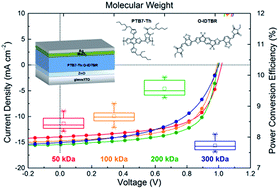
The effect of polymer molecular weight on the performance of PTB7-Th:O-IDTBR non-fullerene organic solar cells
J. Mater. Chem. A, 2018, 6,9506-9516
DOI: 10.1039/C8TA02467G, Paper
DOI: 10.1039/C8TA02467G, Paper
Open Access  This article is licensed under a Creative Commons Attribution 3.0 Unported Licence.
Sebastian F. Hoefler, Thomas Rath, Nadiia Pastukhova, Egon Pavlica, Dorothea Scheunemann, Sebastian Wilken, Birgit Kunert, Roland Resel, Mathias Hobisch, Steven Xiao, Gvido Bratina, Gregor Trimmel
Activation energy for charge transport, carrier concentration and recombination rate are identified to strongly affect the device characteristics.
The content of this RSS Feed (c) The Royal Society of Chemistry
Activation energy for charge transport, carrier concentration and recombination rate are identified to strongly affect the device characteristics.
The content of this RSS Feed (c) The Royal Society of Chemistry
shiyurongyu, xiaodaibudai and 7 others like this
24 Apr 08:28
A non-fullerene all small molecule solar cell constructed with a diketopyrrolopyrrole-based acceptor having a power conversion efficiency higher than 9% and an energy loss of 0.54 eV

J. Mater. Chem. A, 2018, 6,11714-11724
DOI: 10.1039/C8TA02633E, Paper
DOI: 10.1039/C8TA02633E, Paper
Maria Privado, Pilar de la Cruz, Subhayan Biswas, Rahul Singhal, Ganesh D. Sharma, Fernando Langa
A non-fullerene all small molecule solar cell constructed with a new diketopyrrolopyrrole-based acceptor shows an efficiency of 9.14% and energy loss of 0.54 eV.
The content of this RSS Feed (c) The Royal Society of Chemistry
A non-fullerene all small molecule solar cell constructed with a new diketopyrrolopyrrole-based acceptor shows an efficiency of 9.14% and energy loss of 0.54 eV.
The content of this RSS Feed (c) The Royal Society of Chemistry
24 Apr 08:27
Engineered exciton diffusion length enhances device efficiency in small molecule photovoltaics

J. Mater. Chem. A, 2018, 6,9445-9450
DOI: 10.1039/C8TA01226A, Paper
DOI: 10.1039/C8TA01226A, Paper
Muhammad T. Sajjad, Oskar Blaszczyk, Lethy Krishnan Jagadamma, Thomas J. Roland, Mithun Chowdhury, Arvydas Ruseckas, Ifor D. W. Samuel
A post processing method of solvent vapor annealing (SVA) enhances the diffusion length (LD) and domain size in small molecule organic semiconductors which leads to an enhancement in device performance in bulk heterojunction organic photovoltaics.
The content of this RSS Feed (c) The Royal Society of Chemistry
A post processing method of solvent vapor annealing (SVA) enhances the diffusion length (LD) and domain size in small molecule organic semiconductors which leads to an enhancement in device performance in bulk heterojunction organic photovoltaics.
The content of this RSS Feed (c) The Royal Society of Chemistry
xululu91, Fiona-moon and 5 others like this
24 Apr 08:26
High-efficiency organic solar cells based on a small-molecule donor and a low-bandgap polymer acceptor with strong absorption

J. Mater. Chem. A, 2018, 6,9613-9622
DOI: 10.1039/C8TA01301B, Paper
DOI: 10.1039/C8TA01301B, Paper
Yankang Yang, Beibei Qiu, Shanshan Chen, Qiuju Zhou, Ying Peng, Zhi-Guo Zhang, Jia Yao, Zhenghui Luo, Xiaofeng Chen, Lingwei Xue, Liuliu Feng, Changduk Yang, Yongfang Li
An OSC based on a small molecule DR3TBDTT as donor and n-type polymer PZ1 as acceptor was fabricated, and PCE of the device reached 5.86% which is the highest for the OSCs based small molecule donor/polymer acceptor.
The content of this RSS Feed (c) The Royal Society of Chemistry
An OSC based on a small molecule DR3TBDTT as donor and n-type polymer PZ1 as acceptor was fabricated, and PCE of the device reached 5.86% which is the highest for the OSCs based small molecule donor/polymer acceptor.
The content of this RSS Feed (c) The Royal Society of Chemistry
24 Apr 08:16
Impact of Triplet Excited States on the Open‐Circuit Voltage of Organic Solar Cells
by Johannes
Benduhn
,
Fortunato
Piersimoni
,
Giacomo
Londi
,
Anton
Kirch
,
Johannes
Widmer
,
Christian
Koerner
,
David
Beljonne
,
Dieter
Neher
,
Donato
Spoltore
,
Koen
Vandewal
Advanced Energy Materials, EarlyView.
maojie, Yunqian, Ding and 10 others like this
24 Apr 08:14
Significant Enhancement of Photothermal and Photoacoustic Efficiencies for Semiconducting Polymer Nanoparticles through Simply Molecular Engineering
by Tao
Dong
,
Kaikai
Wen
,
Jun
Chen
,
Jin
Xie
,
Weili
Fan
,
Han
Ma
,
Lei
Yang
,
Xiaoxi
Wu
,
Fujian
Xu
,
Aidong
Peng
,
Hui
Huang
Advanced Functional Materials, EarlyView.
wjzmy1994 likes this
24 Apr 08:11
Enhanced Charge Separation Efficiency in DNA Templated Polymer Solar Cells
by Francesco
Toschi
,
Daniele
Catone
,
Patrick
O'Keeffe
,
Alessandra
Paladini
,
Stefano
Turchini
,
Janardan
Dagar
,
Thomas M.
Brown
Advanced Functional Materials, EarlyView.
Yunqian, Ding, XGLiu and 7 others like this
24 Apr 08:03

High fabrication yield organic tandem photovoltaics combining vacuum- and solution-processed subcells with 15% efficiency
by Xiaozhou Che
High fabrication yield organic tandem photovoltaics combining vacuum- and solution-processed subcells with 15% efficiency
High fabrication yield organic tandem photovoltaics combining vacuum- and solution-processed subcells with 15% efficiency, Published online: 23 April 2018; doi:10.1038/s41560-018-0134-z
Organic tandem solar cells combining solution- and vapour-deposited layers are difficult to fabricate due to the degradation of the underlying subcell during the deposition of the next subcell. Here, Che et al. design a charge recombination layer that protects the underlying cell and leads to 15% average PCE for 2 mm2 devices and 11.5% PCE for 1 cm2 devices.
24 Apr 08:02
Blade‐Cast Nonfullerene Organic Solar Cells in Air with Excellent Morphology, Efficiency, and Stability
by Lin
Zhang
,
Baojun
Lin
,
Bo
Hu
,
Xianbin
Xu
,
Wei
Ma
Advanced Materials, EarlyView.
shiyurongyu, xiaodaibudai and 17 others like this
17 Apr 07:56
Solution‐Processable Conjugated Polymers as Anode Interfacial Layer Materials for Organic Solar Cells
by Bowei
Xu
,
Jianhui
Hou
Advanced Energy Materials, EarlyView.
mryulongwang@163.com, JIALINGBO and 11 others like this
17 Apr 07:53
A Semitransparent Inorganic Perovskite Film for Overcoming Ultraviolet Light Instability of Organic Solar Cells and Achieving 14.03% Efficiency
by Weijie
Chen
,
Jingwen
Zhang
,
Guiying
Xu
,
Rongming
Xue
,
Yaowen
Li
,
Yinhua
Zhou
,
Jianhui
Hou
,
Yongfang
Li
Advanced Materials, EarlyView.
mryulongwang@163.com, shiyurongyu and 11 others like this
17 Apr 07:47
Organic 2D Optoelectronic Crystals: Charge Transport, Emerging Functions, and Their Design Perspective
by Sang Kyu
Park
,
Jin Hong
Kim
,
Soo Young
Park
Advanced Materials, EarlyView.