Shared posts

26 Apr 01:57

How Politically Correct Should the Workplace Be?

by Conor Friedersdorf

Last week, a man called the Adam Carolla podcast to ask advice about a situation at his workplace, where he and his co-workers habitually email “stupid stuff to each other.” He explained that one of their email threads found its way to someone in management. “I was told that a joke I made was a little bit offensive and I should try to remember that it's the work mail,” the caller said. “And I just wanted to hear if it really was that offensive or I should just tell them that they should shut up?”

The man happens to live and work in Denmark. But as soon as I heard his question, it struck me as a useful case study to think through the nuances of workplace norms in the United States and to solicit thoughts from readers at The Atlantic.

Let’s start with the story as he presented it.

An employee at the man’s company was on vacation for a couple of weeks. He jokingly emailed his buddies back at the office that they must be pining for his return.

One of those buddies, the caller, replied all with an attempt at sarcastic humor.

“I said, ‘We miss you just as much,’ and then I put in a picture of Anne Frank, ‘as she missed this guy,’ and then I put in a picture of Hitler,” he explained. “And I know it's not perhaps the best kind of joke,” he told the radio host, “but I kind of liked it.”

Obviously, every human-resources staffer and career coach in America would rightly advise against telling a joke like that to colleagues, especially over email. The interesting question, I think, is whether those existing workplace norms are what they ought to be. Would that man’s joke be flagged in the ideal workplace culture?

The question strikes me as extremely difficult. Were I running a startup, where I was responsible for shaping the corporate culture, I wonder how I would handle the situation. In my head, I keep conjuring a debate between a jocular startup CEO and her HR director that illustrates some of the ways that I’m internally conflicted.

HR: I already warned the employee who wrote that email to make sure that he never behaves so unprofessionally again. And I think that we should discipline him. This is a business, not a comedy club. Our investors gave us money to earn returns. We’re paying workers to earn profits, not laughs. That’s inappropriate in a workplace.

CEO: Let me play devil’s advocate. It was a harmless joke. What’s wrong with having a little fun, in passing, at work, as long as you're doing your job well? He’s a capable, well-liked employee and his sense of humor is nothing if not mainstream. Our workers aren’t robots, they’re people, and we ask them to spend more time with their co-workers than they do with friends and family. I can’t forbid them from ever joking with co-workers. That might well hurt morale and productivity. You were teasing me this morning about my coffee order. Was that inappropriate?

HR: I don’t object to all jokes––I object to this joke. You can’t tell me that all humor is office-appropriate.

CEO: No, but this wasn’t a rape joke, or a sexist joke, or a racist joke.

HR: It was a Holocaust joke! There are subjects you don’t joke about. That’s one of them. It diminishes the atrocity and its victims. I get he was joking, but that’s no excuse.

CEO: I agree that “just joking” is a bad excuse, but that’s because jokes carry meanings. That’s what we should judge. It would be wrong to tell a joke that vilified Anne Frank or extolled Adolf Hitler or denied the Holocaust. But this joke is benign and unobjectionable because what it conveys, its actual substance, is something that no reasonable person disputes: Anne Frank would be very averse to Hitler.

HR: You’re intellectualizing it, as if a joke can be objectively inoffensive. But offense is subjective. In the workplace, people have a responsibility to avoid saying things that make co-workers uncomfortable. You can’t know every sensitivity, but any idiot knows an Anne Frank and Hitler joke is likely to upset someone.

CEO: I share that instinct, but the emailer isn’t an idiot and he didn’t seem to know better. Look, I don’t want any of our employees to be uncomfortable, ever. But that’s not achievable. If I go to our staff and tell everyone that they’d better watch what they say more closely from now on, that might make more employees anxious and uncomfortable. Some would prefer that no one ever jokes at work. Others would find that formal, restrictive environment uncomfortable, stifling or oppressive. I agree that we need to use our judgment about humor in the workplace. I just don’t think the right balance is banning any joke that might offend anyone.

HR: This isn’t just any joke, it’s a joke about a taboo subject. In fact, the taboo around the Holocaust is why it was chosen. And that sort of joke should be avoided at work. The way people actually react should shape our norms, not your weirdly literal deconstruction of humor, where you just erase how upset people feel.

CEO: What do you call Santa’s helpers?

HR: This better not be another genocide joke.

CEO: Subordinate Clauses. If an employee told that joke next December, and another employee complained that it’s upsetting to hear someone make light of the season when Christ was born, or to diminish it by secularizing it, we both know that you wouldn’t punish the joker. Our job is to render thoughtful judgments about what we will treat as reasonable, not to defer to all possible sensitivities. That isn’t erasing anyone. It’s just acknowledging that one employee’s feelings cannot be what determines if a joke is work-appropriate or not.

HR: It's important to me that we run a company where everyone feels comfortable and respected. I didn’t take this job to recreate Mad Men. There’s no need for jokes at work, so if a particular joke offends, why not just declare it out-of-bounds?

CEO:  I would never tolerate sexism or racism or a recurring hostile climate for any employee. But it's important to me that we run a company where people are free to be themselves within reason––where they’re allowed to be human without having to be anxious about getting fired. So many people are terrified of saying the wrong thing. Why do you think there’s such a working class backlash to PC? You’re foisting the elite’s norms on a majority that doesn’t share them––on people acculturated with totally different norms that they see as perfectly decent. You’d be punishing this guy for violating intellectual standards he doesn’t even fully understand.

HR: I actually think a majority of people would find that joke offensive. But forget what other people think for a minute. You agree that some jokes are beyond the pale. By what standard? How would you decide what the norms should be? A popular vote?

***

When the Danish man explained his situation on the Adam Carolla podcast, the host argued that, in his view, an employee’s intentions count for a lot in these situations.

“My whole thing, for everything, is what did you think this person was trying to convey?” he said. “That Hitler is a good guy? That they hate Jews? That they agree with Nazis? No. What are they trying to say? What are we trying to get from this exchange?” The bosses are just trying to keep everyone happy, he continued, “But I swear to God, we're crafting a society––it's kind of a weird thing to hobble ourselves. We're human beings, let us have fun. And let's work on intentions, on the good and bad side... If someone intends to hurt somebody, you come down on them. It's why getting in a car accident is not illegal but ramming someone is a felony.”

That resonates with me. And yet…

HR: The problem with that approach is that I don’t feel like my responsibility is to police the intentions of employees, I think it’s to create a good work environment for them.

CEO: I worry that you’re actually creating a good environment for the few people who are unusually offended by jokes, and putting zero value on the comfort of people who feel anxious in the culture where they have to watch what they say very carefully. Think of someone who has an outgoing personality, and who uses humor to get through drudgery, or to forge friendships, or to mask insecurity or anxiety.

HR: I don’t want to cater our whole corporate culture to the needs of an outlier.

CEO: Fair enough. But I don't think it should be determined by the preferences of the most sensitive outliers either. We don’t do that with performance reviews. Why should we with humor? And if we tried, we wouldn’t even cater to those people, we’d end up responding to opportunists gaming the system by feigning sensitivity.

HR: If we don’t try, we’ll fail the people who are most targeted by hurtful jokes and least able to respond. That’s why it is reasonable to reprimand this employee, and the vast majority of HR professionals would agree with me. Doing so is in keeping with best practices. They may be more restrictive than in the past, but businesses are also a lot less hostile to people who were historically harassed and marginalized.

CEO: I don’t want to undo progress. I’ll never go soft on actual sexual or racial harassment. Or behavior that creates a truly hostile climate for anyone. But I still think that what you call best practices are actually part of a corporate culture that is excessively risk-averse, anodyne and soulless––and that something a bit less stifling would be better. Not Mad Men. Just not so… inhuman and humorless, as if we should separate work from life, even as we spend so many of our waking hours at the office.

HR: Yes, most people have to spend their lives at work. It’s one place where they can’t opt out.That’s why we must make extra sure that no one feels uncomfortable here.

CEO: What about people who feel uncomfortable in a place where innocently joking with their colleagues gets them lectured like they’re a pariah or maybe even fired?

* * *

Tentatively, I think that I’d want a company I ran to consider employee jokes by asking three questions: 1) Did it actually upset anyone? 2) Was the intent malicious or innocent? 3) Was the joke or remark substantively at odds with company values? When the answer to at least two of those is yes––or when the intent is clearly malign––action is probably warranted. If not, doing nothing might be the best bet.

But I'd like to hear your thoughts and preferences.

What workplace norms would you consider ideal? How would you handle this case study and why? Better yet, can you share any stories from your work life, anonymously if necessary, that would perhaps help us to better think through these matters?

Email me at conor@theatlantic.com

The issue is too thorny to arrive at a perfect solution. But I suspect that hearing the reasoning behind different preferences might help everyone to get along better.
15 Apr 17:03

The "split verb rule": a fortiori nonsense

by Mark Liberman

John McIntyre has identified the "split verb rule" as "The Dumbest Rule in the AP Stylebook" (You Don't Say, 4/9/2016):

[A]s you look through Garner, Fowler, MWDEU, and language authorities whom you reckon by the dozens on the subject of the split infinitive, you will not find them treating what the AP Stylebook imagines is a problem with splitting a compound verb. That is because placing an adverb between the auxiliary verb and main verb is perfectly idiomatic English, and has been so for half a dozen centuries and more. The authorities do not identify a problem there. If the split infinitive bugaboo is nonsense, than the split compound bugaboo is a fortiori nonsense. John Bremner dismisses it in Words on Words: “Those who would ban splitting a compound verb are even more antediluvian than antisplitinfinitive troglodytes.”

Since many reporters habitually observe this imaginary rule, I have to conclude that it is a linguistic artifice perpetrated by journalism schools, with the editors of the Associated Press Stylebook supplying aid and comfort.

It is time, past time, for this stylebook entry to go to a crossroads and lie down.

In my opinion, John is being unfair to troglodytes here: the "split verb rule", like the prejudices against sentence-initial conjunctions and singular they, is a relatively recent pop-prescriptivist invention, not an attempt to preserve an ancient principle.

Some past LLOG coverage of this strange idea, which barely qualifies as a "zombie rule" since it's not clear that it was ever really alive: "The split verbs mystery", 8/23/2008; "When zombie rules attack", 8/26/2008; "The true history of the split verb rule", 12/23/2012. As those posts demonstrate, authorities like the Fowler brothers and Brian Garner agree that the split verb rule is nonsense — so why the AP ever adopted it is puzzling, and why they cling to it is positively mystifying.

In the spirit of my chrestomathy of singular-they examples ("Linguistic Reaction at the New Yorker", 3/8/2016), I've compiled a small list of examples underlining the AP's illiteracy on this point.

Let me note in advance that it's either too easy or too hard to do this. It's too easy, because the allegedly forbidden post-auxiliary position in fact has been the favored position for adverbials in formal written English for several hundred years, and so any random esteemed source will contain many examples. But it's simultaneously too hard, because the AP stylebook, recognizing that they are promoting nonsense, has qualified their position to the point that it's effectively meaningless:

In general, avoid awkward constructions that split infinitive forms of a verb (to leave, to help, etc) or compound forms (had left, are found out, etc.)  […]  Occasionally, however, a split is not awkward and is necessary to convey the meaning.

As John puts it,

So the verbs entry comes down to this: Try not to write awkwardly. Thank you, AP.

And so someone trying to salvage the AP's nonsense might respond "But these examples are not awkward!"

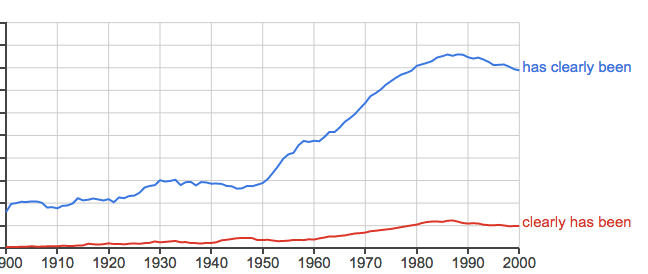
Indeed. In response, I can only note that in every case, alternative orders are possible (e.g."had been captivated easily" rather than "had easily been captivated"), and that the alternative orders in every case that I've looked at are very much a minority taste:

So anyhow, here's a modest list of examples, which any reader can add to at arbitrary length…

William Shakespeare, "Thy glasse will shew thee how thy beauties were":

The wrinckles which thy glasse will truly show,
Of mouthed graues will giue thee memorie,
Thou by thy dyals shady stealth maist know,
Times theeuish progresse to eternitie.

John Donne, "The Bait":

When thou wilt swimme in that live bath,
Each fish, which every channell hath,
Will amorously to thee swimme,
Gladder to catch thee, then thou him.

John Milton, The Reason of Church-government Urg'd against Prelaty:

That what the greatest and choycest wits of Athens, Rome , or modern Italy , and those Hebrews of old did for their country, I in my proportion with this over and above of being a Christian, might doe for mine: not caring to be once nam'd abroad, though perhaps I could attaine to that, but content with these British Ilands as my world, whose fortune hath hitherto bin, that if the Athenians, as some say, made their small deeds great and renowned by their eloquent writers, England hath had her noble atchievments made small by the unskilfull handling of monks and mechanicks.

John Dryden, The state of innocence, and fall of man:

We have been cozen'd; and had still been so,
Had I not ventur'd boldly first to know.

Laurence Sterne, Tristram Shandy:

In this point he was entirely of Sir Robert Filmer's opinion, That the plans and institutions of the greatest monarchies in the eastern parts of the world, were, originally, all stolen from that admirable pattern and prototype of this houshold and paternal power;–which, for a century, he said, and more, had gradually been degenerating away into a mix'd government;–the form of which, however desirable in great combinations of the species,–was very troublesome in small ones,–and seldom produced any thing, that he saw, but sorrow and confusion.

Jonathan Swift, A Modest Proposal:

I have been assured by a very knowing American of my Acquaintance in London , that a young healthy Child well Nursed, is, at a Year Old, a most delicious nourishing and wholesome Food, whether Stewed, Roasted, Baked , or Boiled ; and I doubt, that it will equally serve in a Fricasie , or a Ragoust .

Fanny Burney, Camilla:

Attracted by his fine person, and caught by the first flattery which had talked to her of her own, she had easily been captivated by his description of the sympathy which united, and penetrated by his lamentations at the destiny which parted them.

Jane Austen, Mansfield Park:

Fanny's rides recommenced the very next day; and as it was a pleasant fresh-feeling morning, less hot than the weather had lately been, Edmund trusted that her losses, both of health and pleasure, would be soon made good.

Daniel Defoe, Robinson Crusoe:

There accompanied the seven Spaniards, one of the three savages that had formerly been taken prisoner; and with them also that very Indian whom the Englishmen had, a little before, left under the tree; for it seems, they passed by that way where the slaughter was made, and so carried along with them that poor wretch that was left bound.

James Boswell, Life of Samuel Johnson:

As this family will frequently be mentioned in the course of the following pages, and as a false notion has prevailed that Mr. Thrale was inferiour, and in some degree insignificant, compared with Mrs. Thrale, it may be proper to give a true state of the case from the authority of Johnson himself in his own words.

John Keats, "Fame":

Fame , like a wayward Girl, will still be coy
To those who woo her with too slavish knees,
But makes surrender to some thoughtless Boy,
And dotes the more upon a heart at ease

Mary Shelley, Frankenstein:

This man, whose name was Beaufort, was of a proud and unbending disposition and could not bear to live in poverty and oblivion in the same country where he had formerly been distinguished for his rank and magnificence.

Herman Melville, Moby Dick:

On the table beside him lay unrolled one of those charts of tides and currents which have previously been spoken of.

Emily Brontë, Wuthering Heights:

I believe Linton had laid it there: for she never endeavoured to divert herself with reading, or occupation of any kind, and he would spend many an hour in trying to entice her attention to some subject which had formerly been her amusement.

Charlotte Brontë, Jane Eyre:

The moment Miss Scatcherd withdrew after afternoon school, I ran to Helen, tore it off, and thrust it into the fire: the fury of which she was incapable had been burning in my soul all day, and tears, hot and large, had continually been scalding my cheek; for the spectacle of her sad resignation gave me an intolerable pain at the heart.

Charles Dickens, Barnaby Rudge:

They had previously been quite reckless in their behaviour; often making a great uproar; quarrelling among themselves, fighting, dancing, and singing.

Louisa May Alcott, Little Women:

Why should I complain, when we both have merely done our duty and will surely be the happier for it in the end?

George Eliot, Middlemarch:

They were old manufacturers, and had kept a good house for three generations, in which there had naturally been much intermarrying with neighbors more or less decidedly genteel.

R.L. Stevenson, Treasure Island:

The sixth had only risen upon his elbow; he was deadly pale, and the blood-stained bandage round his head told that he had recently been wounded, and still more recently dressed.

Thomas Hardy, Jude the Obscure:

He had just inhaled a single breath from a new atmosphere, which had evidently been hanging round him everywhere he went, for he knew not how long, but had somehow been divided from his actual breathing as by a sheet of glass.

Mark Twain, Tom Sawyer:

Tom enclosed the tick in the percussion-cap box that had lately been the pinchbug's prison, and the boys separated, each feeling wealthier than before.

Joseph Conrad, Under Western Eyes:

If he had only known what the chance of commonplace travelling had suddenly put in his way!

Arthur Conan Doyle, Adventures of Sherlock Holmes:

I rang the bell and was shown up to the chamber which had formerly been in part my own.

Jack London, Martin Eden:

The crowd of disappointed urchins stared till the carriage disappeared from view, then transferred their stare to Maria, who had abruptly become the most important person on the street.

Willa Cather, My Antonia:

The cow had evidently been grazing somewhere in the draw.

H.P. Lovecraft, "At the Mountains of Madness":

With frequent changes of camp, made by aeroplane and involving distances great enough to be of geological significance, we expected to unearth a quite unprecedented amount of material—especially in the pre-Cambrian strata of which so narrow a range of antarctic specimens had previously been secured.

P.G. Wodehouse, My Man Jeeves:

I took it that she was beginning to wonder when the celebrities were going to surge round, and what had suddenly become of all those wild, careless spirits Rocky used to mix with in his letters.

G.K. Chesterton, The Scandal of Father Brown:

But such a thing as a scrub-bearded actor, in a job or even looking round for a job, has scarcely been seen in this world.

George Orwell, 1984:

Three months later FFCC had suddenly been dissolved with no reasons given.

Frank Baum, The Wizard of Oz:

They had hardly been walking an hour when they saw before them a great ditch that crossed the road and divided the forest as far as they could see on either side.

Margaret Mitchell, Gone with the Wind:

Names of graves where friends lay buried, names of tangled underbrush and thick woods where bodies rotted unburied, names of the four sides of Atlanta where Sherman had tried to force his army in and Hood's men had doggedly beaten him back.

Ernest Hemingway, For Whom The Bell Tolls:

One of them will surely be there even if the others are out inspecting the preparations for the attack.

F. Scott Fitzgerald, The Great Gatsby:

I believe that on the first night I went to Gatsby’s house I was one of the few guests who had actually been invited.

Margaret Atwood, Lady Oracle:

The sight of my moonlike rump had probably been too much for him.

Thomas Pynchon, Bleeding Edge:

Heidi, relieved to be single, pursued a career in academia, having recently been given tenure at City College in the pop-culture department.

15 Apr 16:58

First and final frames of TV shows

by noreply@blogger.com (biotv)
Inspired by Jacob T. Swinney's First and Final Frames videos, video artist Celia Gómez (previously) edits the first and final frames of some of the most popular TV shows in recent years, side-by-side.


via
15 Apr 16:55

Student: High School Faculty Mocked My 'Make America Great Again' Hat

by AP STAFF
Aszilvasy

Tim, this you?

Yipee-kay-ay Mr. Falcon!

SOUTH PORTLAND, Maine (AP) — A Maine high school student says he was ridiculed by faculty members when he wore a red baseball cap bearing Republican presidential candidate Donald Trump's campaign slogan.

Read More →
15 Apr 16:51

If I were dictator of the world, this is how I'd reform primary voting

1. End the Iowa and New Hampshire monopoly. There are several competing plans, all better than the status quo. I would rotate by region, using the geographic splits in Sandy Levin’s Interregional Primary Plan. So:

Region 1: Maine, New Hampshire, Vermont; Massachusetts; Connecticut, Rhode Island; Delaware, New Jersey; New York; Pennsylvania.

Region 2: Maryland; West Virginia; Missouri; Indiana; Kentucky; Tennessee.

Region 3: Ohio; Illinois; Michigan; Wisconsin; Iowa; Minnesota.

Region 4: Texas; Louisiana; Arkansas, Oklahoma; Colorado; Kansas, Nebraska; Arizona, New Mexico.

Region 5: Virginia; North Carolina; South Carolina; Florida; Georgia; Mississippi, Alabama.

Region 6: California; Washington; Oregon; Idaho, Nevada, Utah; Montana, North Dakota, South Dakota, Wyoming; Hawaii, Alaska.

First time through, the leading region would be chosen by lottery. Next cycle, that region would go last, and everyone else would move up a date. I’d hold one regional primary on late January, February, March, April, and May. Or move them up a month to end in June. 

Each one of those groupings gives us a great deal of demographic diversity, given all of our party’s stakeholders a say in choosing our nominee. 

15 Apr 15:23

Should all locks have keys?

by noreply@blogger.com (biotv)
In his latest video, C.G.P. Grey (previously) explains why digital encryption is so important and whether it is appropriate for unbreakable digital locks to exist.


Footnote: I, Phone

CGP Grey
12 Apr 22:15

Great Job, Internet!: A look at the humble origins of “Elvis has left the building”

by Joe Blevins

It takes only five simple words to convey to an audience the idea that the good times are over and the excitement has subsided: “Elvis has left the building.” Even though it’s intended as the ultimate pop-cultural buzzkill, a hipper variation on “Show’s over, nothing to see here, folks,” the saying has taken on a life of its own and can be used in situations that do not involve Elvis Aron Presley at all. But where did this ubiquitous pop-culture cliché originate? Simon Whistler investigates in a new episode of the web series Today I Found Out. The surprisingly convoluted story spans decades.

The famous quote, Whistler reveals, goes back to December 1956, when Presley was performing for the very last time on radio’s Louisiana Hayride. His fame was already skyrocketing by then, so the show was sold out. Once the hip wiggler’s performance was done ...

12 Apr 22:03

Great Job, Internet!: Read This: Why Rob Schneider is the worst-reviewed actor in all of film

by Ryan Vlastelica

Earlier today, Vox published an analysis of what it deemed “the actors and actresses who most consistently appear in terrible movies,” a ranking it determined by mining through data from Metacritic. Basically, every major movie gets a score based on how well it was reviewed; the lower the star’s average score, the worse they rank on the list.

The “winners” of this study, it should not surprise you, include a lot of familiar suspects—the stars of lazy comedies, the heroes of tedious and disposable action movies, and the lovers in unfunny and unromantic romantic comedies.

The worst-reviewed actor is Rob Schneider, none of whose 16 movies received a Metacritic score higher than 54. That means his best movie only barely qualifies as getting mixed reviews, as per Vox’s rankings.

“Schneider’s critical failure largely falls on the shoulders of Adam Sandler, who is ranked second here,” author ...

11 Apr 11:42

If Star Wars characters used Facebook

by noreply@blogger.com (biotv)
The guys from The Warp Zone (previously) imagine how the characters from the Star Wars films would use Facebook if they had it.
What if your favorite characters from the force awakens and all the other Star Wars movies interacted with each other on facebook? They would probably act very similar to how we do on earth...
11 Apr 10:26

Star Wars mega trailer

by noreply@blogger.com (biotv)
Aszilvasy

There aren't any spoilers really.

Star Wars fan Tom Fisher has put together a trailer for all the seven films in the franchise, in the style of the Star Wars - Episode VII: The Force Awakens trailer.


Tom F
10 Apr 16:13

Candidate for President

by Mark Liberman

ICYMI, the median presidential candidate TV ad:

10 Apr 15:16

Bernie Sanders Projected To Win Wyoming Dem Caucus

by Sara Jerde
Aszilvasy

SHOUTIS!

Sen. Bernie Sanders (I-VT) was projected to win the Democratic caucus in Wyoming on Saturday, according to NBC News and the Associated Press.

09 Apr 22:05

"Please enter your cock after urinating"

by Victor Mair

Posted on imgur:

소변 후 콕크 누르세요

Yale: Sopyen hwu khokkhu nwulusey yo

McCune-Reischauer: Sobyŏn hu k’okk’ŭ nurŭse yo

urination-after cock press-honorific polite

The verb nwulu- means "press; press down on", so the Korean means "press down on the [water / pet-]cock after urinating", i.e., "please flush after urinating".

Here's what a k’okk’ŭ 콕크 looks like.

The notice is not directed at the super absent-minded types who forget to zip up after they've finished piddling, but at the mindless dudes who neglect to flush.

Notice that the reminder is posted above each urinal.

At first I had intended to write a short note about the etymology of the English word "cock" from which Korean k’okk’ŭ 콕크 is apparently borrowed, but the situation is so messy (so many different meanings and unclear origins) that I abandoned the thought and decided to leave it to Language Log readers to discuss if they wish.

WARNING:  Do not attempt to send an e-mail with the subject line "cock".  It is liable to get swallowed up by a prudish client.  That happened to me several times today, even though I was not referring to the male member, but to a faucet or valve.

[h.t. Tim Leonard; thanks to Ross King and Haewon Cho]

09 Apr 20:56

The Washington Post Endorses Vouchers

by dianeravitch
Aszilvasy

Whelp, awesome. Don't you love it when failed ideas keep getting new life in the "marketplace of ideas"?

Many of us read the Washington Post because of its excellent reporting and the blog written by Valerie Strauss, The Answer Sheet.


But its editorial pages are not a source of enlightenment about education. For the entire reign of the controversial Michelle Rhee as the D.C. schools chancellor, the editorial page of the Post defended her every move. It claimed success when there was none. In the eyes of the Post editorial board, Rhee could do no wrong. The fact that D.C. has the largest achievement gaps of any urban district in the nation seems to have eluded their gaze.


Now the Post has endorsed the recent legislation to start a voucher program in Maryland. It is a bizarre editorial. It suggests that “the unrest that followed the death of Freddie Gray last April shone new light on the shortcomings of the public school system and the injustice that does.” Freddie Gray died in the back of a police van, where he was shackled and improperly restrained without a seat belt. Did his death say anything about “the shortcomings of the public school system”?  Would school vouchers have prevented his death or the unrest that followed? Freddie Gray’s death was caused by a broken neck; the broken neck was the result of negligence. If Maryland had offered school vouchers, would “the unrest” have not occurred? If Freddie Gray had gone to a parochial school, would the police have put a seat belt on him? I don’t understand the logic. Maybe someone could explain it. Certainly the Post doesn’t.


The editorial also errs in praising the D.C. voucher program. The final evaluation of the program found no academic gains; it found a higher graduation rate for students who persisted in the program, but also very high attrition rates. The students likeliest to see no academic gains were those attending SINI schools (Schools in Need of Improvement), for whom the program was created.


Voucher proponents have a hard time finding a model for future voucher programs. It is not Milwaukee or Cleveland or the District of Columbia. Vouchers have been promoted by the fringe right for more than half a century. They have the support of rightwing think tanks, the Koch brothers, the DeVos family, ALEC, and red-state governors. The goal is to replace public education with a free market, and to rightwing ideologues, evidence is irrelevant. In North Carolina, for example, vouchers were recently adopted by the Tea Party legislature (the same one that just passed a law allowing discrimination against gay and transgender people). Voucher schools do not have to adopt state curriculum standards, are permitted to hire uncertified teachers, and do not have to administer state tests. They can use textbooks that teach creationism, and they are free to discriminate in selecting their students.


It is sad to see the Washington Post encouraging the diversion of public funds to religious schools for the nation’s neediest students.


09 Apr 20:55

Michigan Supreme Court case has massive implications for the wrongfully convicted

Aszilvasy

Annoyingly, some websites don't let you read the whole thing in a Reader. There's good stuff about the upcoming trial that you need to click to read.

In 2002, 13-year-old Ronnie Swain told authorities that he had also been victim of sexual abuse. He accused his adopted mother, Lorinda Swain, of performing oral sex on him every morning. Swain was arrested, charged, and convicted of four counts of first-degree criminal sexual conduct. She was sentenced to 25 to 50 years in prison.

Soon after she was convicted, though, Ronnie recanted his testimony. He said he made up the sexual molestation allegations so that he would not get in trouble for inappropriately touching his three-year-old niece. From Deadline Detroit:

For years, according to David Moran, the co-director of the Innocence Clinic at the Ann Arbor law school, Swain’s legal team has been trying to get the Calhoun County prosecutor to meet with Ronald Swain and hear from him why he lied at trial and why he’s urging the courts to do the right thing now.

“He’s passed polygraphs, gone to the police, gone to the press, gone to lawyers, gone to the public and said it just did not happen,” Moran says. “We want the prosecutor to just meet with him.”

The prosecutor, however, has always refused. 

Since her conviction, Swain has filed countless appeals and motions for relief and fought repeatedly to get a new trial. In 2009, her request was finally granted by the trial court, who granted defendant’s motion for relief from judgment and set aside her four convictions. The Court of Appeals reversed. The trial court then again granted the motion based on newly discovered evidence, the interests of justice, and defendant's actual innocence. The appellate court reversed again.

09 Apr 20:53

The Russian Orthodox Church Released a Propaganda Film with a Harry Potter-Like Enemy

by Hemant Mehta
Russia's military, the Russian Orthodox Church, and the Ministry of Culture have all banded together to produce a propaganda film reminding children of the nation's enemies... who apparently look like a mix of Harry Potter, Nazis, and NATO.Kids Against the Sorcerers was released in December but is only recently getting widespread attention:VoldemortHitler
08 Apr 16:32

Connecticut Pols Slam Sanders On Support For Gun Manufacturers

by Caitlin Cruz
Aszilvasy

Unless I'm missing something, I don't think they should be able to sue gun manufacturers. I really think insurance is the way to go. Make all guns be insured, and if your gun is uninsured it is a serious fine; if you, or someone else with your gun, kills someone and it is proven to be illegal, you're liable. Image all those people with armories trying to pay for insurance.

That seems perfectly legal to me, and a way that doesn't really infringe on the second amendment any more than simply buying a gun. If money is a barrier to gun ownership anyway, extra money can't be any more. Gun ownership would drop precipitously in this circumstance, I think.

Connecticut officials fired back at Sen. Bernie Sanders (I-VT) on Tuesday, after the Democratic presidential candidate said crime victims should not be allowed to sue gun manufacturers when asked about a lawsuit filed by victims of the Sandy Hook Elementary School massacre.

Read More →
08 Apr 16:28

Man Faces 20 Years To Life In Prison For Allegedly Stealing Candy Bars

by ASSOCIATED PRESS
Aszilvasy

In the annals of our absurd infatuation with locking people up, the people of Louisiana are going to pay how much to incarcerate a man for 20+ years? Certainly more than the $31 of candy he took.

Can you guess his race?

http://theadvocate.com/news/neworleans/neworleansnews/15365240-79/accused-new-orleans-candy-snatcher-facing-20-to-life-for-pocketing-31-in-sweets

NEW ORLEANS (AP) — A man is facing a possible 20 years to life in prison after being accused of stealing $31 worth of candy bars from a New Orleans store.

Read More →
08 Apr 16:08

Newswire: Spotify sees a resurgence of Beatlemania

by Danette Chavez
Aszilvasy

No surprise here.

Despite being relatively new to the music-streaming game, The Beatles are dominating the online radio waves. The Fab Four’s music finally became available to anyone who might not have collected most of their records (or anthologies) back in December, when their catalog hit music-streaming services like Tidal, Spotify, and Apple Music. But Spotify has revealed that the Beatles have averaged 6.5 million listeners a month since debuting on the service late last year, a rate that places them well above contemporary acts like Ed Sheeran (“music for insomniacs”) and Ariana Grande, which might just be the result of licking donuts and hating America, we guess.

Aside from that dazzling multi-million figure, Spotify released data on the amount of time spent listening to Beatles songs since last Christmas, which adds up to 2,793 years. And since music can’t be streamed backwards, we can safely assume that number ...

08 Apr 15:10

Gabler: Why The Media Is All Over The National Enquirer’s Cruz Affair Hot Air

by NEAL GABLER
Aszilvasy

Interesting read; here's the thing: the Enquirer broke other stories in the past (most notably Edwards), there was clear knowledge about this in the Rubio camp earlier in the year (a twitter hashtag #thething related to reporters or insiders talking about some story that will bring Cruz down), and the Enquirer printed barely censored images that were easily identified, meaning they think they have the ability to withstand a lawsuit.

“Hot Air” — that was The Huffington Post homepage headline last Sunday on the National Enquirer’s exclusive that GOP presidential aspirant Ted Cruz allegedly had five affairs.

Read More →
08 Apr 13:11

Newswire: Duck Dynasty’s Willie Robertson lands Fox News correspondent gig and podcast

by Danette Chavez
Aszilvasy

Headline says it all. What the fuck did this guy ever do to be a correspondent?

Willie Robertson is trading duck calls for dog whistles, as Deadline reports that the Duck Dynasty scion has just landed a podcast and correspondent gig at Fox News. Robertson’s new show, The Willie Robertson Podcast, premieres Monday and will “focus on matters Robertson is already well known for, framed as ‘faith and family’.” Additionally, the Duck Commander CEO will serve as a Fox News contributor, though it’s currently not known whether he’ll be on the presidential campaign beat, or the “disparage the current president” beat.

Thanks to this April Fools’ nonsense, there are a lot of fake stories floating out there today, but this one’s kind of a no-brainer: Robertson’s previous TV outings have seen him espousing the conservative values on which he was raised. He did recently endorse GOP frontrunner Donald Trump, though that doesn’t appear to have soured Fox News on his ...

08 Apr 13:10

Newswire: Another Game Of Thrones (and Star Wars) performer joins Netflix’s Iron Fist

by William Hughes
Aszilvasy

More simply to recommend the Amazon Marvel shows. If you haven't seen Jessica Jones--do it ASAP. Just a great shot that examines all sorts of awesome and tragic issues of the world, with a little bit of superhero stuff mixed in. Daredevil is also great (although I haven't watched the second season).

Making strong moves to fill in her “Massively Successful Genre Series” bingo card ahead of anybody else—looking at you, Maisie WilliamsGame Of Thrones and Star Wars actress Jessica Henwick has joined the cast of Marvel and Netflix’s Iron Fist series. Henwick—who plays fierce Dornish noble Nymeria Sand on the HBO series, and Resistance fighter pilot Jessika Pava in The Force Awakenswill appear as Colleen Wing, a martial arts master who helps recently returned millionaire Danny Rand (Henwick’s fellow GoT cast mate, Finn Jones) re-acclimate to Western society.

Wing is a major character in the Iron Fist comics, where she usually acts as a partner to Rand’s recurring love interest, Misty Knight, who’s set to be played by Simone Missick in the upcoming Luke Cage. At the moment, it’s not clear when Iron Fist and all its new Westerosi refugees are going ...

08 Apr 13:06

Officer that killed Laquan McDonald now getting paychecks as a police union janitor

Chicago Police Officer Jason Van Dyke was the officer who shot 17-year-old Laquan McDonald in 2014. He's been condemned by his department and is awaiting trial for first degree murder, but the police union still has his back.

Officer Van Dyke has been charged with first-degree murder and has been suspended without pay while awaiting trial. In the meantime, Van Dyke has been hired by the Fraternal Order of Police union as a janitor, and many people aren’t happy about it.

The head of the FOP, Dean Angelo, confirmed to the Chicago Sun-Times that Van Dyke was working a $12-an-hour job with the union because he couldn’t find work. [...] “We’ve probably had 100 people in no-pay status who we got jobs or hired at the hall. This is nothing new.”

Well, at least they're not giving him a gun. I presume, anyway. Still, the news that the police union still refuses to cut Van Dyke lose—even after the horrific dashcam video of the incident was made public, last November, showing McDonald posing no immediate threat to Van Dyke before being shot 16 times and killed—has been taken by some activists to be yet another insult in a long string of them.

"Not only is it insulting and outrageous, but it is a slap in the face. It is the reason we have this continued breakdown between law enforcement and community," the Rev. Michael L. Pfleger, a community activist in Chicago, told ABC News.

What can we say: a police union making sure that even a suspended officer charged with murder still gets a steady paycheck looks a wee bit crass to some people. Yeah, go figure.

08 Apr 13:03

It’s Probably First Ballot Or Bust For Donald Trump At The GOP Convention

by Nate Silver
Aszilvasy

A really interesting look at what's going to be a wild summer. I have to say, at this point I really just want Trump on the ballot. He needs to be definitively defeated straight up--no excuses, no ways to walk it back--because the people who support him need to be dragged into the light. If he wins, so be it: then that is, in some real way, the American electorate and we have to deal with it.

At the prediction market Betfair on Friday morning, bettors put Donald Trump’s chances of winning the Republican presidential nomination at 56 percent. That’s down a fair bit — Trump had been hovering at about 70 percent after his win in Arizona (and loss in Utah) last week. Meanwhile, the likelihood of a contested convention according to bettors has considerably increased. There’s now a 63 percent chance29 that the convention in Cleveland will require multiple ballots, according to Betfair.

In other words, the markets are now betting on a contested convention. Not just a near-miss, where the nomination is resolved at some point between the last day of GOP primaries June 7 and the start of the convention July 18, but the thing that political journalists dream about: a full-blown contested convention where it takes multiple ballots to determine the Republican nominee.

Here’s the thing, though: Those markets don’t make a lot of sense. If you really think the chance of a multi-ballot convention is 63 percent, but also still have Trump with a 56 percent chance of winning the nomination, that implies there’s a fairly good chance that Trump will win if voting goes beyond the first ballot. That’s probably wrong. If Trump doesn’t win on the first ballot, he’s probably screwed.

The basic reason is simple. Most of the 2,472 delegates with a vote in Cleveland probably aren’t going to like Trump.

Let’s back up a bit. In most of our discussions about delegates here at FiveThirtyEight, we treat them as though they’re some sort of statistical unit. We might say a candidate “racked up 44 delegates” in the same way we’d say Steph Curry scored 44 points. But those delegates aren’t just a scoring mechanism: Delegates are people, my friends. Delegates are people!

And as I said, they’re mostly people who aren’t going to like Trump, at least if the excellent reporting from Politico and other news organizations is right. (If Trump turns out to have more support among GOP delegates than this reporting suggests, even marginally, that could end up mattering a great deal.) How can that be? In most states, the process to select the men and women who will serve as delegates is separate from presidential balloting. In Massachusetts, for instance, Trump won 49 percent of the GOP vote on March 1 — his highest share in any state to date — to earn 22 of the state’s 42 delegates. But the people who will serve as delegates haven’t been chosen yet. That will happen at a series of congressional district conventions later this month and then a Republican state meeting in May or June. According to Politico, most of those delegates are liable to favor Ted Cruz or John Kasich rather than Trump. Twenty-two of them will still be bound to Trump on the first ballot, but they can switch after that. The same story holds in a lot of other states: in Georgia, Louisiana and South Carolina, for instance — also states that Trump won.

Trump’s delegate problems stem from two major issues. One is his lack of organization: Trump just recently hired a strategist to oversee his delegate-selection efforts; Cruz has been working on the process for months. The other is his lack of support from “party elites.” The people who attend state caucuses and conventions are mostly dyed-in-the-wool Republican regulars and insiders, a group that is vigorously opposed to Trump. Furthermore, some delegate slots are automatically given to party leaders and elected officials, another group that strongly opposes Trump, as evident in his lack of endorsements among them.

There are various ways these delegates could cause problems for Trump. The most obvious, as I mentioned, is if the convention goes to a second ballot because no candidate wins a majority on the first. Not all delegates become free instantaneously,30 but most do, and left to vote their personal preference, most of them will probably oppose Trump.

Conversely, Trump isn’t totally safe even if he locks up 1,237 delegates by the time the final Republicans vote. The delegates have a lot of power, both on the convention floor and in the various rules and credentials committees that will begin meeting before the convention officially begins. If they wanted to, the delegates could deploy a “nuclear option” on Trump and vote to unbind themselves on the first ballot, a strategy Ted Kennedy unsuccessfully pursued against Jimmy Carter in 1980.

Although I’d place fairly long odds against this thermonuclear tactic, there’s also the possibility of piecemeal skirmishes for delegates. In South Carolina, for instance, delegates might unbind themselves on the pretext that Trump withdrew his pledge to support the Republican nominee. Remember those chaotic Nevada caucuses that Trump won? They could be the subject of a credentials challenge. There could also be disputes over the disposition of delegates from Marco Rubio and other candidates who have dropped out of the race.31 A final possibility is “faithless delegates,” where individual delegates simply decline to vote for Trump despite being bound to do so by party rules. It’s not clear whether this is allowed under Republican rules, but it’s also not clear what the enforcement mechanism would be.

I don’t want to make too much of these “nuclear” possibilities, given that such efforts would be blatantly undemocratic and would risk a huge backlash from Republican voters. Still, even 1,237 delegates isn’t quite a safe number for Trump, especially if he’s just barely above that threshold.

Another possibility is Trump coming up somewhat short of 1,237 delegates, but close enough that he could win on the basis of uncommitted delegates who vote for him on the first ballot. In fact, Trump finishing with something like 1,200 delegates is a strong possibility. The expert panel we convened two weeks ago had Trump finishing at 1,208 delegates — with a lot of uncertainty on either side of that estimate — and he’s run just slightly behind our projected pace since then by getting shut out of delegates in Utah.

Let’s say that Trump ends with exactly 1,200 delegates after California. He’d then need 37 uncommitted delegates to win on the first ballot. That might not seem like such a tall order — there will be at least 138 uncommitted delegates, according to Daniel Nichanian’s tracking, and Trump would need only 27 percent of those. But most of those delegates32 are chosen at state meetings and conventions, the same events producing unfavorable delegate slates for Trump in Massachusetts and other states.

Alternatively, Trump could try to broker a deal with another candidate — Kasich, for example — to get to 1,237. But that isn’t so easy either; whether Kasich could instruct his delegates to vote for Trump on the first ballot would vary depending on the rules in each state, and some delegates could become unbound instead of having to vote Trump. Trump and Kasich could also try to strike a deal on the second ballot — but by that point, most of their delegates would have become free to vote as they please.

This is not an exhaustive list of complications. We’ll save the discussion about Rule 40 — and why it’s largely toothless — for another time, for instance. The basic problem for Trump is that all the rules will be written and interpreted by the delegates, delegates who mostly don’t like Trump. They have a lot of power to wield at their discretion.

That’s not to say the rest of the voting doesn’t matter — it would be much easier, both procedurally and ethically, to block Trump from getting the nomination if he comes into the convention with 1,100 delegates instead of 1,300.


Listen to the latest episode of the FiveThirtyEight elections podcast.

Subscribe: iTunes |Download |RSS |Video

08 Apr 00:23

Princeton To Keep Woodrow Wilson's Name On School Despite Racist Views

by ERRIN HAINES WHACK
Aszilvasy

I wonder how y'all feel about this. I feel a little uncomfortable with whitewashing the past. My mind isn't made up, really, but it is something that concerns me.

Wilson was indeed a racist, but he was a lot of other things that weren't terrible. Margaret Sanger was a racist too; does that mean we must disavow everything? FDR apparently wasn't very nice to gay people (http://www.thedailybeast.com/articles/2015/06/23/franklin-d-roosevelt-s-forgotten-anti-gay-sex-crusade.html). Ought we to disavow him? It seems more that learning about these problematic aspects are important, but not ignoring or eliminating these people from history.

Now, here's where it gets complicated. There are some genuinely terrible monuments. One in TN to an avowed KKK person who seemed to have a monument only to his bigotry. That feels like one that needs to go. But I see there that there's a fundamental conflict, perhaps, in my thought.

PRINCETON, N.J. (AP) — Woodrow Wilson's name will remain on Princeton University's public policy school, despite calls to remove it because the former U.S. president was a segregationist, the Ivy League university announced Monday.

Read More →
07 Apr 22:38

Donald Trump, 'n***** lovers,' 'commies,' and Barack Obama

It is another day. With it comes another entry in the category "ugly things that the horrible people at Donald Trump rallies do to people who dare to dissent against the American Il Duce.” 

At a rally in Janesville, Wisconsin, earlier this week, two of Donald Trump's minions attacked a 15-year-old white girl named Alex Drake. One of the Trumpeteers allegedly sexually assaulted her. When she fought back, the second Trump enforcer then pepper sprayed the teenager. 

Drake's offense was a protest sign that said “Damn, Donald, back at it again with the white supremacy." One of her compatriots also had a "Black Lives Matter" sign. 

Donald Trump's racist goon squad then, as if on cue, shouted the de facto white supremacist slogan "All Lives Matter," three words that are the new "White Power!" and "Sieg Heil" in America’s Age of Obama. Other Trumpeteers then called the teenager a "nigger lover," a "bitch," and a "commie."

Violence at Donald Trump’s rallies is part of the spectacle and pleasure that he offers to the attendees. Trump wallows in violence, and extols its virtues to his followers. Violence is “fun.” In the “good old days,” he muses, those who oppose Donald Trump’s racism, nativism, xenophobia, and misogyny would be “taken out on stretchers.” 

It is almost inevitable that the violence at Donald Trump’s rallies will escalate in the months to come. At the same Wisconsin rally, Trumpeteers tried to bring guns inside the venue. Donald Trump’s supporters have punched, stomped on, and otherwise abused protesters. Racial slurs have been hurled by the Trumpeteers at people of color. Someone will be seriously hurt or killed at a Donald Trump rally. He will deny culpability. There will then be a moment of outrage by the mainstream corporate news media and the American mass public, but they are numb to Trump’s violence. It will all be forgotten and washed away by the “cleansing” waters of the 24/7 news cycle, in a country where, as William Faulkner famously described it, “The past is never dead. It's not even past.”

White America may not have a history. But history has not forgotten the white American public. There are zombie ideas that linger about, semi-permanent, in America’s cultural and political imaginations. They have not been purged—they simply hide in plain sight or make sharp thrusts at the weak and the vulnerable at an opportune moment.

07 Apr 22:32

Unanimous Supreme Court Preserves Principle Of One Person, One Vote

by Tierney Sneed
Aszilvasy

Unanimous? You mean they got Thomas to agree? This is good news, as the whole idea of redistricting based on voters rather than citizens felt anti-democratic to me, and was clearly designed to further disenfranchise people. I'm just happy the conservative court members looked past partisan lines.

The Supreme Court unanimously ruled against challengers seeking to change the long-held interpretation of the principle of one person, one vote. Siding with a lower court, the 8-member high court held that total population could be used to draw electoral districts.

The decision for the case, Evenwel v. Abbott, was written by Justice Ruth Bader Ginsburg. Justice Samuel Alito and Justice Clarence Thomas each filed concurring opinions.

Read More →
07 Apr 21:02

Great Job, Internet!: Comedian Jen Kirkman retweets women’s tales of harassment

by Marah Eakin
Aszilvasy

Some truly appalling stories. I'm sure there are some MRA dudes out there who will either justify or minimize these stories.

There’s some important stuff happening on Jen Kirkman’s Twitter page today. The comedian and author, a consummate advocate for women’s issues, started the day off talking about #notallmen, a sort of mansplaining hashtag that occasionally makes the rounds in an attempt to remind people that, hey, not all men are shitbags. While that’s true and all, Kirkman points out that “every woman [has] experienced street harassment even in broad daylight by ‘normal men.’” She has since been retweeting every incident someone’s tweeted at her. The resulting feed has been a depressing slog through one vile experience after another—and a somewhat eye-opening and educational experience for Kirkman’s male followers, some of whom didn’t appear to realize that this happens every single damn day.

Here’s just a sample of the anecdotes Kirkman has received:

07 Apr 20:59

Boko Haram’s Sex Slaves, Many of Whom Are Now Free, Are Feared and Shunned

by Terry Firma
The fundies of Nigeria's Boko Haram may think of themselves as pious servants of Allah, but what that means in practice is not much more than an orgy of murder and systematic rape.Remember the 270-something school-age girls from the town of Chibok, kidnapped en masse two years ago, who inspired the short-lived international Bring Back Our Girls movement? Well, funny story -- but not ha-ha funny. In fact, it's relentlessly bleak.shutterstock_211037584
07 Apr 19:08

Honest Trailers: "Star Wars: The Force Awakens"

by noreply@blogger.com (biotv)
Aszilvasy

Spoilers. But still pretty solid.

The guys from Screen Junkies have finally created an "honest trailer" for Star Wars - Episode VII: The Force Awakens.
Strap in for an all out battle between desert orphans, depressed Sith wannabes, and super adorable droids! PLUS - a very special blast from the past!

Screen Junkies