Scott Lord
Shared posts
18 Jul 03:30
Bengt Forslund, in his article "Through a Glass Darkly, the silent era of Swedish Film", reminds us that Victor Sjostrom and Mauritz Stiller "made farces, comedies and melodramas, as well as medieval legends and romantic sagas, social films and realistic dramas." Interestingly enough Forslund tries to relate their affinity as having arisen not from a singleness of desire, or from a solidarity, but it having come rather from their disparity, from their having "little in common as individuals". This led to each learning the others technique of filmmaking. Peter Cowie, in his volume Scandinavian Cinema, sees the film as self-reflexive, writing "'Thomas Graal's Best Film' works primarily as a comedy of manners, but it also functions effectively as a satire on filmmaking, evene at this early stage of the industry's development. The implication is that cinema stands beyond reality, and as a medium attracts only the 'hammy' situation and the exagerrated personality." Peter Cowie notes that onscreen Victor Sjostrom and Karen Molander are the "ideal screen couple" and that Gustaf Molander, although only inevitably married to Karin Molander for eight years, wrote "scintillating" dialougue intertiles for her. Cowie points out that the film distinguishes Mauritz Stiller as one of the first directors to use a "film-within-a-film-format". Mauritz Stilleris particularly noted for having has directed Victor Sjostrom in two comedies for A.B Svenska, “Wanted A Film Actress” (“Thomas Graal’s Basta Film”, 1917) with actress Karin Molander and Jenny Tschernichin-Larsson and “Marriage ala mode” [“Thomas Graal’s First Child/ Thomas Graal’s Basta Barn”, 1918) also starring Karin Molander and Jenny Tschernichin-Larsson. The running time to the former, a film noted by Forsyth Hardy as one of the first comedies about filmmaking, was ninety minutes, the latter eighty nine minutes. Rune Carlsten and Henrik Jaenzon both appeared on screen in the film Thomas Graal’s Best Film, which was written under a pseudonym by Gustaf Molander. Molander continued as writer and director of “Thomas Graal’s Ward/ Thomas Graal’s mindling”, photographed by Adrian Bjurnman.
Louise Wallenberg, in her article Woman on Screen I, 1910's-1960's, feautured in the volume Now About All Those Women in the Swedish Film Industry, alludes to the director as spectator while evaluating Mauritz Stiller's view of his characters with his estimation of the while an invisible observer, his early comedies to "depict modern women who try to put an end to their as ribed position as wife and mother only to end up going ack to being docile and loving partners, they clearly express a desire to break free from conventional marital relations and gender roles. In this manner Stiller's comedies are indeed profeminist as they engage with public discourses and notions about women's societal positioning and personal subjecthood, and freedom in a society that is (still) strongly formed by patriarchal values."
Silent Film
Victor Sjostrom
Victor Sjostrom
Mauritz Stiller
Scott Lord Swedish Silent Film: Thomas Graal's Best Film (Mauritz Stille...
by Scott Lord Silent Film
Bengt Forslund, in his article "Through a Glass Darkly, the silent era of Swedish Film", reminds us that Victor Sjostrom and Mauritz Stiller "made farces, comedies and melodramas, as well as medieval legends and romantic sagas, social films and realistic dramas." Interestingly enough Forslund tries to relate their affinity as having arisen not from a singleness of desire, or from a solidarity, but it having come rather from their disparity, from their having "little in common as individuals". This led to each learning the others technique of filmmaking. Peter Cowie, in his volume Scandinavian Cinema, sees the film as self-reflexive, writing "'Thomas Graal's Best Film' works primarily as a comedy of manners, but it also functions effectively as a satire on filmmaking, evene at this early stage of the industry's development. The implication is that cinema stands beyond reality, and as a medium attracts only the 'hammy' situation and the exagerrated personality." Peter Cowie notes that onscreen Victor Sjostrom and Karen Molander are the "ideal screen couple" and that Gustaf Molander, although only inevitably married to Karin Molander for eight years, wrote "scintillating" dialougue intertiles for her. Cowie points out that the film distinguishes Mauritz Stiller as one of the first directors to use a "film-within-a-film-format". Mauritz Stilleris particularly noted for having has directed Victor Sjostrom in two comedies for A.B Svenska, “Wanted A Film Actress” (“Thomas Graal’s Basta Film”, 1917) with actress Karin Molander and Jenny Tschernichin-Larsson and “Marriage ala mode” [“Thomas Graal’s First Child/ Thomas Graal’s Basta Barn”, 1918) also starring Karin Molander and Jenny Tschernichin-Larsson. The running time to the former, a film noted by Forsyth Hardy as one of the first comedies about filmmaking, was ninety minutes, the latter eighty nine minutes. Rune Carlsten and Henrik Jaenzon both appeared on screen in the film Thomas Graal’s Best Film, which was written under a pseudonym by Gustaf Molander. Molander continued as writer and director of “Thomas Graal’s Ward/ Thomas Graal’s mindling”, photographed by Adrian Bjurnman.
Louise Wallenberg, in her article Woman on Screen I, 1910's-1960's, feautured in the volume Now About All Those Women in the Swedish Film Industry, alludes to the director as spectator while evaluating Mauritz Stiller's view of his characters with his estimation of the while an invisible observer, his early comedies to "depict modern women who try to put an end to their as ribed position as wife and mother only to end up going ack to being docile and loving partners, they clearly express a desire to break free from conventional marital relations and gender roles. In this manner Stiller's comedies are indeed profeminist as they engage with public discourses and notions about women's societal positioning and personal subjecthood, and freedom in a society that is (still) strongly formed by patriarchal values."
Silent Film
Victor Sjostrom
Victor Sjostrom
Mauritz Stiller
Scott Lord, Scott Lord and 2 others like this
22 Jun 21:15
Scott Lord: Greta Garbo The Divine Woman (1928, Victor Sjostrom) - YouTube
Scott Lord, Scott Lord and 2 others like this
22 Jun 21:15
Scandinavian Silent Film: Victor Sjostrom as Seastrom, Mauritz Stiller, John Brunius, Greta Garbo: Victor Sjostrom as Seastrom and Mauritz Stiller
Scott Lord, Scott Lord and 2 others like this
22 Jun 21:15
Blogger: User Profile: Scott Lord Silent Film
Scott Lord, Scott Lord and 2 others like this
22 Jun 21:15
Scott Lord Silent Film: Lon Chaney - YouTube
Scott Lord, Scott Lord and 2 others like this
22 Jun 21:14
Scandinavian Silent Film: Victor Sjostrom as Seastrom, Mauritz Stiller, John Brunius, Greta Garbo: Greta Garbo in A Woman of Affairs (Brown, 1929)
Scott Lord, Scott Lord and 2 others like this
05 Mar 01:42
Scott Lord on Silent Film Hollywood, Lost Silent Film, Swedish Silent Film, Danish Silent Film: The Golden Age of Swedish Silent Film: Victor Sjostrom and Mauritz Stiller
Victor Sjostrom
Tags: 'Victor Sjostrom'
Scott Lord likes this
22 Jul 12:44


Directed D W Griffith during 1919 for ArtcraftPictures Corporation, "True Heart Susie" (six reels) was photographed by G.W. Bitzer and paired Lillian Gish in the titular role with Robert Harron with actresses Kate Bruce and Carol Dempster. In their volume The Films of D.W. Griffith, authors Edward Wagenkneckt and Anthony Slide, divide Griffith's films into two genres, much like author Vachel Lindsay would - the epic and the lyric, the latter being "less ambitious, more intimate" the "stylistic directness" of "True Heart Susie" falling into the latter.
Author Anthony Slide perpiscaciously introduces D. W. Griffith actress Seymour by noting that both Seymour and actor Robert Harron, who had appeared together in both "The Girl Who Stayed Home" and "True Heart Susie" during 1919, had died early during 1920.
After directing “True Heart Susie” in 1919, to end the year, D.W. Griffith directed Lillian Gish in the film “The Greatest Question” (six reels), photographed by G.W. Bitzer.
The films "A Romance of Happy Valley", starring Lillian Gish, and "Scarlet Days", both directed by D.W. Griffith, were thought to be lost and donated to the Modern Museum of Art by Russia when rediscovered. Silent Film D.W. Griffith
Scott Lord Silent Film: True Heart Susie (D. W. Griffith, 1919)
by Scott Lord Silent Film


Directed D W Griffith during 1919 for ArtcraftPictures Corporation, "True Heart Susie" (six reels) was photographed by G.W. Bitzer and paired Lillian Gish in the titular role with Robert Harron with actresses Kate Bruce and Carol Dempster. In their volume The Films of D.W. Griffith, authors Edward Wagenkneckt and Anthony Slide, divide Griffith's films into two genres, much like author Vachel Lindsay would - the epic and the lyric, the latter being "less ambitious, more intimate" the "stylistic directness" of "True Heart Susie" falling into the latter.
Author Anthony Slide perpiscaciously introduces D. W. Griffith actress Seymour by noting that both Seymour and actor Robert Harron, who had appeared together in both "The Girl Who Stayed Home" and "True Heart Susie" during 1919, had died early during 1920.
After directing “True Heart Susie” in 1919, to end the year, D.W. Griffith directed Lillian Gish in the film “The Greatest Question” (six reels), photographed by G.W. Bitzer.
The films "A Romance of Happy Valley", starring Lillian Gish, and "Scarlet Days", both directed by D.W. Griffith, were thought to be lost and donated to the Modern Museum of Art by Russia when rediscovered. Silent Film D.W. Griffith
Silent Film
Scott Lord, Scott Lord Mystery Film likes this
04 Apr 02:44
Scott Lord Silent Film: The Man with the Glass Eye (British Empire Film,...
by Scott Lord Silent Film
Scott Lord, Scott Lord and 3 others like this
12 Oct 02:05
Scott Lord Mystery: A Face in the Fog (Hill, 1936)
by Scott Lord Silent Film
Scott Lord, Scott Lord and 3 others like this
11 Oct 17:06
Scott Lord Mystery: The Late Show, Sherlock Holmes The Speckled Band
by Scott Lord Silent Film
Scott Lord, Scott Lord and 3 others like this
03 Oct 23:53
Scott Lord Silent Film: Secrets of the Night (Blanche, 1924)
by Scott Lord Silent Film
Scott Lord, Scott Lord Mystery Film and 2 others like this
21 Sep 22:05
Scott Lord Mystery: Sherlock Holmes vs. Dr. Fu Man Chu- Paramount Parade...
by Scott Lord Silent Film
Scott Lord, Scott Lord Mystery Film and one other like this
04 Nov 23:32
Swedish Silent Film
by noreply@blogger.com (Scott Lord)
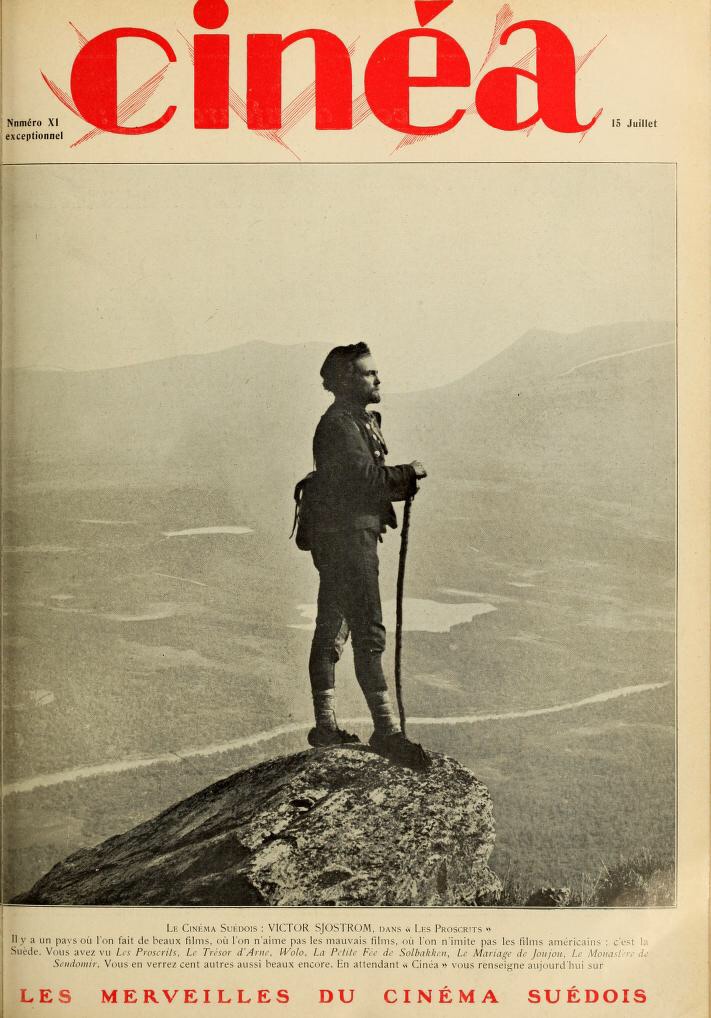
Swedish Silent Film scholar Bo Florin makes notes of the province held by Nils Bouveng at the newly structured Svenska Filmindustri after the merger had taken place of the smaller companies into one and that Bouveng had published an article entitled Swedish Film Advertising: How the Industry Plans to Conquer the World in the 1919 periodical Filmjournalen. Nils Bouveng of Swedish Biograph was very much responsible for the distribution of Swedish silent film in the United States. The publication Exhibitor's Herald during 1921 noted that although Bouveng was deemed to have thought the film market overcrowded, he would still export film "of merit" to the United States. It wrote,"Swedish Biograph has control of all product of Scandinavian studios and will offer only the cream of these pictures to American theaters...While Thy Soul Shall Bear Witness is regarded as its finest offering, company executives believe that Judge Not, Sir Arne's Treasure, Youth Meets Youth, Dawn of Love and Secret of the Monastery will compare favorably with any American made production."
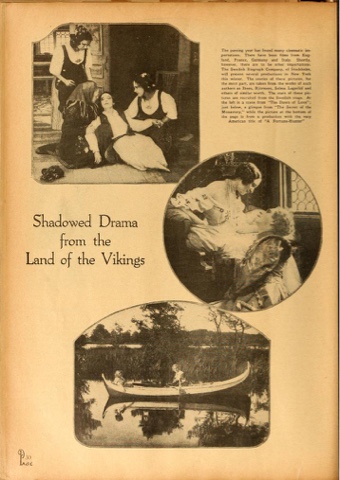
That year Motion Picture Magazine reported there would be an increase of importations from Stockholm and while it featured still photographs from the films Dawn of Love, The Secret of the Monsastery and A Fortuned Hunter, it marked that the storyline so we're to be adaptations from the literature of Ibsen, Bjornsen and Selma Lagerlof and that the principal players had come from the Swedish theater, which aptly describes the way in which actress Greta Garbo would be introduced to Swedish film audiences two years later.
Danish Silent Film
Victor Sjostrom
Danish Silent Film
Victor Sjostrom
Scott Lord likes this
28 Sep 22:04
Swedish Silent Film
by noreply@blogger.com (Scott Lord)
Author Anne-Kristin Wallgren, on Nordic Academic Press, notes that the films of Karin Swanstrom may have seemed atypical with the Swedish Silent Film of Sweden's Golden Age. In Welcome Home, Mr Swanson- Swedish Emigrants and Swedishness on Film, she writes, "Of the few Twneties films to mention America, only one has a happy ending, namely, Boman pa utsallningen (Boman at the Exhibition/Boman at the Fair, Karin Swanstrom, 1923, Ironically, Forsyth Hardy, in the volume Scandinavian Film notes, "Svensk Filmindustri, through its producers Karin Swanstrom and Sickan Claesson, was content to produce modestly conceived films for the home front. They were for the most part comedies with a strong theatrical flavor, or farces."
Greta Garbo
Greta Garbo
Scott Lord likes this
23 Sep 21:12
Greta Garbo: Greta Garbo in Virveln (The Torrent, Monta Bell, 1...
by noreply@blogger.com (Scott Lord)
Greta Garbo: Greta Garbo in Virveln (The Torrent, Monta Bell, 1...: A suitable story for director Mauritz Stiller, famous Swedish director who just began work under M.G.M. contract is now being sought and w...
Scott Lord likes this
23 Sep 21:10
Greta Garbo: Victor Sjostrom as Seastrom- Greta Garbo, Mauritz...
by noreply@blogger.com (Scott Lord)
Greta Garbo: Victor Sjostrom as Seastrom- Greta Garbo, Mauritz...: "The Image Makers see their images emerge out of the story. And then suddenly: darkness."- Per Olov Enquist in Bildmakarna, a ...
Scott Lord likes this
23 Sep 20:32
Greta Garbo: Greta Garbo
by noreply@blogger.com (Scott Lord)
Greta Garbo: Greta Garbo: Greta Garbo talar! The private life of Greta Garbo escapes the slightest scrutiny of Richard Corliss, the earliest acting done by Greta G...
Scott Lord likes this
22 Sep 01:51
Greta Garbo: Victor Sjostrom as Seastrom: Greta Garbo in The Kiss (Kyssen, Feyder/William Da...
by noreply@blogger.com (Scott Lord)
Greta Garbo: Victor Sjostrom as Seastrom: Greta Garbo in The Kiss (Kyssen, Feyder/William Da...: Greta Garbo New Movie Magazine quoted the director, " 'Dialougue- that is what will make the love sparkle in American films....
Scott Lord likes this