22 Sep 09:37
by Yaroslav E. Romanyuk, Harald Hagendorfer, Patrick Stücheli, Peter Fuchs, Alexander R. Uhl, Carolin M. Sutter-Fella, Melanie Werner, Stefan Haass, Josua Stückelberger, Cédric Broussillou, Pierre-Philippe Grand, Veronica Bermudez, Ayodhya N. Tiwari
Solution processing of inorganic thin films has become an important thrust in material research community because it offers low-cost and high-throughput deposition of various functional coatings and devices. Especially inorganic thin film solar cells – macroelectronic devices that rely on consecutive deposition of layers on large-area rigid and flexible substrates – could benefit from solution approaches in order to realize their low-cost nature. This article critically reviews existing deposition approaches of functional layers for chalcogenide solar cells with an extension to other thin film technologies. Only true solutions of readily available metal salts in appropriate solvents are considered without the need of pre-fabricated nanoparticles. By combining three promising approaches, an air-stable Cu(In,Ga)Se2 thin film solar cell with efficiency of 13.8% is demonstrated where all constituent layers (except the metal back contact) are processed from solutions. Notably, water is employed as the solvent in all steps, highlighting the potential for safe manufacturing with high utilization rates.

A Cu(In,Ga)Se2 thin film solar cell with efficiency of 13.8% is demonstrated where all constituent layers (except the metal back contact) are processed from aqueous solutions of metal salts using industrially scalable processes.
18 Sep 20:21
by Kai-Ge Zhou, Freddie Withers, Yang Cao, Sheng Hu, Geliang Yu and Cinzia Casiraghi

ACS Nano
DOI: 10.1021/nn5042703

18 Sep 14:22
by Xingqiang Liu, Xi Liu, Jingli Wang, Chongnan Liao, Xiangheng Xiao, Shishang Guo, Changzhong Jiang, Zhiyong Fan, Ti Wang, Xiaoshuang Chen, Wei Lu, Weida Hu, Lei Liao

A high mobility of 109.0 cm2 V−1 s−1 is obtained by thin-film transistors (TFTs) comprising a composite made by aligning SnO2 nanowires (NWs) in amorphous InGaZnO (a-IGZO) thin films. This composite TFT reaches an on-current density of 61.4 μA μm−1 with a 10 μm channel length. Its performance surpasses that of single-crystalline InGaZnO and is comparable with that of polycrystalline silicon.
hailul and -1 others like this
18 Sep 10:21
Publication date: January 2015
Source:Tribology International, Volume 81
Author(s): Z.Y. Xu , Y. Xu , K.H. Hu , Y.F. Xu , X.G. Hu
MoS2 hollow spheres with an average diameter of 165nm were prepared from Na2MoO4 and CH3CSNH2 at 82°C. A simple method was used to obtain smaller hollow spheres (70nm) without any complicated step, except for the addition of TiO2. The tribological properties of MoS2/TiO2 in rapeseed oil were studied using a four-ball tribometer under 350N at 0.383m/s. The effects of load and sliding velocity were also investigated. Wear was significantly alleviated by the produced lubricating film as lubricated with MoS2/TiO2, which was composed of MoO3, Fe2O3, Fe2(SO4)3, TiO2 (trace), and carbon-containing compounds. The tribological properties were also improved because of the decrease in the size of MoS2 and the synergistic effect between MoS2 and TiO2.
18 Sep 10:20
by Hikaru Oga, Akinori Saeki, Yuhei Ogomi, Shuzi Hayase and Shu Seki

Journal of the American Chemical Society
DOI: 10.1021/ja506936f

18 Sep 10:18
by Zhihu Sun, Xiaoyu Yang, Chao Wang, Tao Yao, Liang Cai, Wensheng Yan, Yong Jiang, Fengchun Hu, Jingfu He, Zhiyun Pan, Qinghua Liu and Shiqiang Wei

ACS Nano
DOI: 10.1021/nn5040845

17 Sep 10:57
by Emma R. Dohner, Adam Jaffe, Liam R. Bradshaw and Hemamala I. Karunadasa

Journal of the American Chemical Society
DOI: 10.1021/ja507086b

16 Sep 19:55
by Jianping Shi, Donglin Ma, Gao-Feng Han, Yu Zhang, Qingqing Ji, Teng Gao, Jingyu Sun, Xiuju Song, Cong Li, Yanshuo Zhang, Xing-You Lang, Yanfeng Zhang and Zhongfan Liu

ACS Nano
DOI: 10.1021/nn503211t

16 Sep 12:49
by Shengxi Huang, Xi Ling, Liangbo Liang, Jing Kong, Humberto Terrones, Vincent Meunier and Mildred S. Dresselhaus

Nano Letters
DOI: 10.1021/nl5014597

16 Sep 12:36
by Dor Amram and Eugen Rabkin

ACS Nano
DOI: 10.1021/nn504284d

15 Sep 15:39
by Nakita K. Noel, Antonio Abate, Samuel D. Stranks, Elizabeth S. Parrott, Victor M. Burlakov, Alain Goriely and Henry J. Snaith

ACS Nano
DOI: 10.1021/nn5036476

15 Sep 14:44
Chem. Commun., 2014, 50,13334-13337
DOI: 10.1039/C4CC04767B, Communication

Open Access
David J. Lewis, Parikshit Deshmukh, Aleksander A. Tedstone, Floriana Tuna, Paul O'Brien
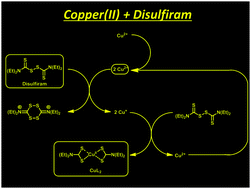
The interaction of copper(II) ions with disulfiram, potentially important for new anticancer treatments, is explored under steady-state and kinetic conditions using a multi-spectroscopic approach which could lead to a deeper understanding of the mechanism of the reaction and may have implications for in vitro cytotoxicity studies.
The content of this RSS Feed (c) The Royal Society of Chemistry

15 Sep 10:16
by Jong-Seon Kim, Hae-Wook Yoo, Hyung Ouk Choi and Hee-Tae Jung

Nano Letters
DOI: 10.1021/nl502906a

15 Sep 10:15
by Souvik Kusari, Simplice Joel N. Tatsimo, Sebastian Zühlke, Ferdinand M. Talontsi, Simeon Fogue Kouam, Michael Spiteller
Abstract
We have independently investigated the source of tramadol, a synthetic analgesic largely used for treating moderate to severe pain in humans, recently found in the roots of the Cameroonian medicinal plant, Nauclea latifolia. We found tramadol and its three major mammalian metabolites (O-desmethyltramadol, N-desmethyltramadol, and 4-hydroxycyclohexyltramadol) in the roots of N. latifolia and five other plant species, and also in soil and local water bodies only in the Far North region of Cameroon. The off-label administration of tramadol to cattle in this region leads to cross-contamination of the soil and water through feces and urine containing parent tramadol as well as tramadol metabolites produced in the animals. These compounds can then be absorbed by the plant roots and also leached into the local water supplies. The presence of tramadol in roots is, thus, due to an anthropogenic contamination with the synthetic compound.

The root of the problem: Tramadol, a synthetic analgesic, was recently detected in the roots of the Cameroonian medicinal plant Nauclea latifolia. However, tramadol is not a natural product. Along with its major mammalian metabolites, tramadol is present in the roots of N. latifolia and other plant species, as well as in soil and local water sources in the Far North region of Cameroon as a result of anthropogenic contamination.
15 Sep 10:14
by Yun Zheng, Lihua Lin, Xiangju Ye, Fangsong Guo, Xinchen Wang
Abstract
Graphitic carbon nitride can be imprinted with a twisted hexagonal rod-like morphology by a nanocasting technique using chiral silicon dioxides as templates. The helical nanoarchitectures promote charge separation and mass transfer of carbon nitride semiconductors, enabling it to act as a more efficient photocatalyst for water splitting and CO2 reduction than the pristine carbon nitride polymer. This is to our knowledge a unique example of chiral graphitic carbon nitride that features both left- and right-handed helical nanostructures and exhibits unique optical activity to circularly polarized light at the semiconductor absorption edge as well as photoredox activity for solar-to-chemical conversion. Such helical nanostructured polymeric semiconductors are envisaged to hold great promise for a range of applications that rely on such semiconductor properties as well as chirality for photocatalysis, asymmetric catalysis, chiral recognition, nanotechnology, and chemical sensing.

Helical nanorods: Graphitic carbon nitride with helical nanorod-like morphology similar to spiral vines is constructed for artificial photosynthesis. This helically conjugated polymer can also be fabricated with opposite chirality and shows photocatalytic activity for water splitting and CO2 conversion.
15 Sep 10:12
by Arun Kumar Singh, Shaista Andleeb, Jai Singh, Hoang Tien Dung, Yongho Seo, Jonghwa Eom
The tuning of charge carrier concentrations in semiconductor is necessary in order to approach high performance of the electronic and optoelectronic devices. It is demonstrated that the charge-carrier density of single-layer (SL), bilayer (BL), and few-layer (FL) MoS2 nanosheets can be finely and reversibly tuned with N2 and O2 gas in the presence of deep-ultraviolet (DUV) light. After exposure to N2 gas in the presence of DUV light, the threshold voltages of SL, BL, and FL MoS2 field-effect transistors (FETs) shift towards negative gate voltages. The exposure to N2 gas in the presence of DUV light notably improves the drain-to-source current, carrier density, and charge-carrier mobility for SL, BL, and FL MoS2 FETs. Subsequently, the same devices are exposed to O2 gas in the presence of DUV light for different periods and the electrical characteristics are completely recovered after a certain time. The doping by using the combination of N2 and O2 gas with DUV light provides a stable, effective, and facile approach for improving the performance of MoS2 electronic devices.

The charge-carrier density of single-, bi-, and few-layer MoS2 nanosheets can be finely and reversibly tuned with N2 and O2 gas in the presence of deep-ultraviolet (DUV) light. The exposure to N2 gas in the presence of DUV light significantly improves the drain-to-source current, carrier density, and charge-carrier mobility for MoS2 nanosheets.
gjchen and -1 others like this
12 Sep 10:00
Abstract
The effect in the tribological performance of WS2 fullerene-like nanoparticles in PAO base oil when adding a ZDDP additive was studied at 100 °C in the boundary lubrication regime. The tribological properties of the dispersion surpass those obtained without one of the two additives. The friction modifier properties of the particles are improved in the presence of ZDDP, while the anti-wear properties of the ZDDP are increased when the particles are added to the dispersion. The composition of the formed tribofilm was investigated. Results show that a 50–60 nm tribofilm is formed on the steel surface composed by WS2 mixed on the ZDDP chemical tribofilm. A WS2-rich layer is observed at the top of the tribofilm. A correlation between the chemical composition of the tribofilm and the tribological properties of the “PAO + WS2 + ZDDP” dispersion was made. Synergy between the two additives was proven.
12 Sep 10:00
by Ernesto O. Wrasse and Tome M. Schmidt

Nano Letters
DOI: 10.1021/nl502481f

12 Sep 09:56
by Pere Miró, Jae Hyo Han, Jinwoo Cheon, Thomas Heine
Abstract
Transition-metal chalcogenide (TMC) nanoflakes of composition MX2 (where M=Ti, Zr and Hf; X=S and Se) crystallize preferentially in equilateral hexagons and exhibit a pronounced lateral quantum confinement. The hexagonal shape of octahedral (1T) TMC nanoflakes is the result of charge localization at the edges/vertices and the resulting Coulomb repulsion. Independent of their size, all nanoflakes have the MnX2n−2 stoichiometry and thus an unoxidized metal center which results in dopant states. These states become relevant for small nanoflakes and lead to metallic character, but for larger nanoflakes (>6 nm) the 2D monolayer properties dominate. Finally, coordination of Lewis bases at the nanoflake edges has no significant effect on the electronic structure of these species confirming the viability of colloidal synthetic approaches.

Six-sided flakes: Transition-metal dichalcogenide nanoflakes of composition MX2 (where M=Ti, Zr and Hf; X=S and Se) grow preferentially in equilateral hexagons and exhibit a pronounced lateral quantum confinement. The hexagonal shape arises from the charge location at the edges and vertices and the resulting Coulombic repulsion.
12 Sep 09:50
by Fei Zhou, Sen Xin, Hai-Wei Liang, Lu-Ting Song, Shu-Hong Yu
Abstract
Traditional lithium-ion batteries that are based on layered Li intercalation electrode materials are limited by the intrinsically low theoretical capacities of both electrodes and cannot meet the increasing demand for energy. A facile route for the synthesis of a new type of composite nanofibers, namely carbon nanofibers decorated with molybdenum disulfide sheets (CNFs@MoS2), is now reported. A synergistic effect was observed for the two-component anode, triggering new electrochemical processes for lithium storage, with a persistent oxidation from Mo (or MoS2) to MoS3 in the repeated charge processes, leading to an ascending capacity upon cycling. The composite exhibits unprecedented electrochemical behavior with high specific capacity, good cycling stability, and superior high-rate capability, suggesting its potential application in high-energy lithium-ion batteries.

Carbon nanofibers (CNFs) decorated with molybdenum disulfide sheets are fabricated by a facile hydrothermal process with low-cost, biomass-derived carbonaceous nanofibers as the supports. On reacting with lithium, the nanofibers undergo novel electrochemical processes that are triggered by a synergistic lithium storage effect, leading to enhanced cycling and rate performance of the lithium-ion battery.
12 Sep 09:43
by Mulmudi Hemant Kumar, Sabba Dharani, Wei Lin Leong, Pablo P. Boix, Rajiv Ramanujam Prabhakar, Tom Baikie, Chen Shi, Hong Ding, Ramamoorthy Ramesh, Mark Asta, Michael Graetzel, Subodh G. Mhaisalkar, Nripan Mathews

Lead free perovskite solar cells based on a CsSnI3 light absorber with a spectral response from 950 nm is demonstrated. The high photocurrents noted in the system are a consequence of SnF2 addition which reduces defect concentrations and hence the background charge carrier density.
12 Sep 09:41
by Xin Hu, Xiaodong Zhang, Lin Liang, Jian Bao, Shuang Li, Wenlong Yang, Yi Xie
Organolead halide perovskites have attracted extensive attentions as light harvesting materials for solar cells recently, because of its high charge-carrier mobilities, high photoconversion efficiencies, low energy cost, ease of deposition, and so on. Herein, with CH3NH3PbI3 film deposited on flexible ITO coated substrate, the first organolead halide perovskite based broadband photodetector is demonstrated. The organolead halide perovskite photodetector is sensitive to a broadband wavelength from the ultraviolet light to entire visible light, showing a photo-responsivity of 3.49 A W−1, 0.0367 A W−1, an external quantum efficiency of 1.19×10³%, 5.84% at 365 nm and 780 nm with a voltage bias of 3 V, respectively. Additionally, the as-fabricated photodetector exhibit excellent flexibility and robustness with no obvious variation of photocurrent after bending for several times. The organolead halide perovskite photodetector with high sensitivity, high speed and broad spectrum photoresponse is promising for further practical applications. And this platform creates new opportunities for the development of low-cost, solution-processed and high-efficiency photodetectors.

Organometal halide perovskites have shown tremendous potential as incident light absorbers for optoelectronic applications. In this work, a broadband photodetecotor is demonstrated based on the CH3NH3PbI3 film, showing a photo-responsivity of 3.49 A W−1, 0.0367 A W−1, an external quantum efficiency of 1.19 × 10³ %, 5.84% at 365 and 780 nm, respectively. These results provide new opportunities for the development of high-efficiency photodetectors.
12 Sep 09:41
by Zonglong Zhu, Yang Bai, Harrison Ka Hin Lee, Cheng Mu, Teng Zhang, Lixia Zhang, Jiannong Wang, He Yan, Shu Kong So, Shihe Yang
Photovoltaics based on organic−inorganic perovskites offer new promise to address the contemporary energy and environmental issues. These solar cells have so far largely relied on small-molecule hole transport materials such as spiro-OMeTAD, which commonly suffer from high cost and low mobility. In principle, polyfluorene copolymers can be an ideal alternative to spiro-OMeTAD, given their low price, high hole mobility and good processability, but this potential has not been explored. Herein, polyfluorene derived polymers-TFB and PFB, which contain fluorine and arylamine groups, are demonstrated and can indeed rival or even outperform spiro-OMeTAD as efficient hole-conducting materials for perovskite solar cells. In particular, under the one-step perovskite deposition condition, TFB achieves a 10.92% power conversion efficiency that is considerably higher than that with spiro-OMeTAD (9.78%), while using the two-step perovskite deposition method, about 13% efficient solar cells with TFB (12.80%) and spiro-OMeTAD (13.58%) are delivered. Photoluminescence reveals the efficient hole extraction and diffusion at the interface between CH3NH3PbI3 and the hole conducting polymer. Impedance spectroscopy uncovers the higher electrical conductivity and lower series resistance than spiro-OMeTAD, accounting for the significantly higher fill factor, photocurrent and open-circuit voltage of the TFB-derived cells than with spiro-MeOTAD.

Polyfluorene derivatives are applied for inorganic−organic hybrid perovskite solar cells, and indeed can rival or outperform spiro-OMeTAD as efficient hole-conducting materials for perovskite solar cells. In particular, with the one-step deposition method, TFB achieves a 10.92% power conversion efficiency, which is considerably higher than that with spiro-OMeTAD (9.78%).
11 Sep 09:13
by Jean-François Ayme, Guzmán Gil-Ramírez, David A. Leigh, Jean-François Lemonnier, Augustinas Markevicius, Christopher A. Muryn and Gen Zhang

Journal of the American Chemical Society
DOI: 10.1021/ja506886p

11 Sep 09:11
by Jiao Zhao, Tsutomu Minegishi, Li Zhang, Miao Zhong, Gunawan, Mamiko Nakabayashi, Guijun Ma, Takashi Hisatomi, Masao Katayama, Shigeru Ikeda, Naoya Shibata, Taro Yamada, Kazunari Domen
Abstract
Porous films of p-type CuInS2, prepared by sulfurization of electrodeposited metals, are surface-modified with thin layers of CdS and TiO2. This specific porous electrode evolved H2 from photoelectrochemical water reduction under simulated sunlight. Modification with thin n-type CdS and TiO2 layers significantly increased the cathodic photocurrent and onset potential through the formation of a p–n junction on the surface. The modified photocathodes showed a relatively high efficiency and stable H2 production under the present reaction conditions.

Porous photocathodes: CuInS2 porous films, prepared by sulfurization of electrodeposited metals and modified with thin layers of CdS and TiO2, evolved H2 from photoelectrochemical water reduction under simulated sunlight (see picture). The modified photocathodes showed a relatively high efficiency and stable H2 production under the reaction conditions by surface modification.
11 Sep 09:09
by Ruggero Verre, Tomasz J. Antosiewicz, Mikael Svedendahl, Kristof Lodewijks, Timur Shegai and Mikael Käll

ACS Nano
DOI: 10.1021/nn503195n

11 Sep 09:08
by Ming-Hui Chiu, Ming-Yang Li, Wengjing Zhang, Wei-Ting Hsu, Wen-Hao Chang, Mauricio Terrones, Humberto Terrones and Lain-Jong Li

ACS Nano
DOI: 10.1021/nn504229z

10 Sep 12:24
Publication date: 15 October 2014
Source:Surface and Coatings Technology, Volume 256
Author(s): Samantha de Fátima Magalhães Mariano , Elver Juan de Dios Mitma Pillaca , Mario Ueda , Rogério de Moraes Oliveira
Because of the problem of film peeling, it is generally difficult to obtain thick and well adherent diamond-like carbon (DLC) coatings on metallic substrates with good tribological properties. In this work, we propose to apply a plasma immersion ion implantation and deposition (PIII&D) process in magnetic bottle configuration using high voltage glow discharge in order to deposit DLC films directly over 304 stainless steel (SS) alloy. In such configuration, two couples of coils wound outside the vacuum chamber are used to produce region of low magnetic field for plasma confinement (~60G at the center axis). DLC coatings are characterized by Raman spectroscopy, scanning electron microscopy (SEM) and also morphologically by means of atomic force microscopy (AFM). Tribological behavior is investigated using a pin-on-disk tribometer, and after that, the scars are evaluated by means of SEM and Wyko NT1100 optical profiler. PIII&D experiments in crossed fields have been demonstrated to be an effective system to synthesize DLC films with good adhesion, excellent resistance against wear as well as good dry lubricant surfaces.
10 Sep 12:21
by Kang Hyuck Lee, Hyeon-Jin Shin, Brijesh Kumar, Han Sol Kim, Jinyeong Lee, Ravi Bhatia, Sang-Hyeob Kim, In-Yeal Lee, Hyo Sug Lee, Gil-Ho Kim, Ji-Beom Yoo, Jae-Young Choi, Sang-Woo Kim
Abstract
Unintentionally formed nanocrystalline graphene (nc-G) can act as a useful seed for the large-area synthesis of a hexagonal boron nitride (h-BN) thin film with an atomically flat surface that is comparable to that of exfoliated single-crystal h-BN. A wafer-scale dielectric h-BN thin film was successfully synthesized on a bare sapphire substrate by assistance of nc-G, which prevented structural deformations in a chemical vapor deposition process. The growth mechanism of this nc-G-tailored h-BN thin film was systematically analyzed. This approach provides a novel method for preparing high-quality two-dimensional materials on a large surface.

A hexagonal boron nitride (h-BN) thin film with an atomically flat surface was obtained using unintentionally formed nanocrystalline graphene (nc-G). A wafer-scale dielectric h-BN thin film was synthesized on a bare sapphire substrate with the assistance of nc-G, which prevented structural deformations during chemical vapor deposition. The sp3-hybridized edges of nc-G play a key role during these processes.
09 Sep 12:47
Abstract
We demonstrate that micro-scale rolling bearings exhibit friction and wear properties markedly different from their macro-scale counterparts. A microfabricated testing platform uses variable rolling element diameters or vapor-phase lubricated interfaces to independently test friction force with varying contact area and surface energy. A linear, consistent, relationship between friction force and contact area is observed among different rolling element diameters. When surface free energy is altered through the introduction of vapor-phase lubrication, an 83 % decrease in friction is observed. When coupled with observed ball material adhered to the raceway, there is strong evidence for adhesion-dominated rolling friction regime at the micro-scale.