Shared posts

30 Dec 00:35

Hang onto your thinking caps because this is the most...


Hang onto your thinking caps because this is the most sciencetastically awesome music video we’ve ever seen. Entitled “CYMATICS: Science Vs. Music”, it was directed by Shahir Daud for the “Cymatics” track from New Zealand-born musician Nigel Stanford's new album Solar Echoes. There are no special effects happening here. It’s all practical science, a very stylish and completely awesome application of the science of Cymatics, which is the science of visualizing audio frequencies and vibrations.

Typically the surface of a plate, diaphragm, or membrane is vibrated, and regions of maximum and minimum displacement are made visible in a thin coating of particles, paste, or liquid. Different patterns emerge in the excitatory medium depending on the geometry of the plate and the driving frequency.

Sound and vibration both travel in waves. Cymatics shows us those waves and they’re beautiful. In this video they take the form of sand, water, ferrofluid, fire and electric currents. All of the scientific experiments conducted in this stunning video are real. If you’re anything like us, you won’t be able to look away until it’s over and then you’ll watch it again. If Tesla could see it, he’d be dancing.

Head over to the Cymatics page of Nigel Stanford’s website for lots of equally fascinating behind-the-scened videos.

[via Booooooom!]

29 Dec 04:12

Photo


29 Dec 04:10

This stunning silver Facehugger broach is the prettiest baby...


This stunning silver Facehugger broach is the prettiest baby xenomorph we’ve ever seen. It was created by Swedish artist Sarah Burchill, aka DeviantARTist deviantArtist fairyfrog. The broach is made of sterling silver, measures 6” long and features an intaglio centerpiece made of Natural Baltic amber depicting an Alien warrior.

The broach was created as a showpiece, but interested parties should note that Burchill is willing to sell the broach for around $1300. This is seriously awesome jewelry. Just don’t let it anywhere near your face.

[via Fashionably Geek]

28 Dec 18:08

Scott Mosier, Ben Affleck, Jason Mewes, Renée Humphrey, Jeremy London, Shannen Doherty, Claire Forlani, Michael Rooker, Jason Lee, Ethan Suplee and Kevin Smith

by ThisIsNotPorn

The cast of Mallrats in a hot tubThe cast of Mallrats in a hot tub. Scott Mosier, Ben Affleck, Jason Mewes, Renée Humphrey, Jeremy London, Shannen Doherty, Claire Forlani, Michael Rooker, Jason Lee, Ethan Suplee and Kevin Smith.

28 Dec 18:03

CNN's Missing AirAsia Flight Coverage Just Took a Turn for the Ridiculous

by matt@policymic.com (Matt Essert)

AsiaAir Flight QZ8501 lost contact with air traffic control at 7:24 a.m. local time Sunday morning after departing from Surabaya, Indonesia, with 162 people aboard. Read More
28 Dec 17:53

earthlynation: (via 35PHOTO - Елена Давыдова - Модник)

28 Dec 17:42

Explore the Ghost Town Left by the Chernobyl Disaster via Drone

by Kyle Hill

During a routine test on April 26, 1986, reactor Number 4 at the Chernobyl Nuclear Power Plant outside of Pripyat, Ukraine experienced a power surge. It caused a chain of events that quickly lead to a core meltdown. As cooling water vaporized, gigantic steam explosions ripped through the plant and exposed nuclear material to the surrounding area. Nearly 400,000 people had to be evacuated from contaminated areas in Russia, Ukraine, Belarus.

Pripyat is has been firmly in this fallout zone for the last 30 years. It’s an extremely dangerous place to explore, though oddly beautiful, which is why capturing the ghost town that Chernobyl left behind with a drone is maybe the best way to do it:

On location for a CBS story, photographer Danny Cooke made this amazing video of Pripyat with a combination of drone and personal footage. With the soundtrack, the video has a distinctly The Last of Us or The Walking Dead feel. From invisible particles blasting out of decaying metals, a mini apocalypse.

But a nuclear meltdown is a special kind of apocalypse. It’s not like a virus which sweeps though humanity buts leaves the areas inhabitable. Based on the half-life — the time it takes for half of the radioactive material to decay into another material — of the fallout released from the Chernobyl core, it has been estimated that the surrounding areas will remain uninhabitable for thousands of years, possibly tens of thousands.

Before human can again colonize this damned swath of earth, robots and drones will be the only way to explore the desolation. It’s deadly, but strangely beautiful.

28 Dec 07:14

GTA V Players Celebrate Christmas With Deadly Snowballs

by Patricia Hernandez
Bridget

can't wait till i can play videogames again

GTA V Players Celebrate Christmas With Deadly Snowballs

How do you celebrate Christmas the GTA way? In a word: murder.

Read more...


28 Dec 04:17

Today the Department of Phenomenal Papercraft explores the work...


Today the Department of Phenomenal Papercraft explores the work of Hudson Valley-based papercutting artist Maude Alta, who creates exquisite paper-cut works that showcase both the strength and delicacy of paper.

"Her work is done on the macro as well as the micro level. Every cut is exact and meaningful. She enjoys playing with positive and negative space to create fantastic scenes and stories. She considers herself a craftsperson and has a deep respect for the paper she transforms. In pursuing her work, she hopes to make visible to others the immense world of possibilities that every piece of paper holds."

Alta’s cut-paper creations have a wonderfully lyrical feel. Evocative of line drawings and often featuring both nature and fantasy imagery, these pieces feel like illustrations for a collection of folk and fairy tales we’d desperately love to read.

Visit Maude Alta’s website to explore more of her wondrous paper carvings.

[via Hi-Fructose]

28 Dec 04:16

6 Important Truths That Reveal What Asexuality Is Really About

by m_hugel@hotmail.com (Melissa Hugel)
Bridget

"Gwendolyn M. is an allosexual 25-year-old designer who identifies as a panromantic demisexual." - or you know, someone who has a lower libido and doesn't want to sleep with people she doesn't like or know that well?


Heterosexual, homosexual, transsexual – increasingly, these identities have been dominating headlines as they work their way into the mainstream consciousness, prompting a welcome wave of discussion and debate. But what about asexuality? 

At least 1% of people are believed to be asexual, according to some measures. And according to the Asexual Archive, that's defined as "a sexual orientation characterized by a persistent lack of sexual attraction toward any gender." However, there is a distinct lack of awareness and knowledge regarding the asexual community. Compounding the issue, too often what we think we know about the identity isn't based in fact, but rather outdated notions or assumptions.

As the community continues to grow, there are plenty of myths about asexuals that should be debunked. Read More
28 Dec 04:15

Photo


28 Dec 04:14

How Do Blue Eyes Get Their Color?

by Stephen Luntz
Health and Medicine
Photo credit: Wiki edit 2 via wikimedia commons. Eye color can depend on light as much as genetics.These are the same eyes in different light.

When poets compare beautiful eyes to the sea or sky they're probably not aware how accurate they are being.

In each case the color is a product not of pigments but the scattering of multicolored light so that only the blue reaches the observer. On a clear day sunlight scatters off molecules in the atmosphere, but does so more at short wavelengths. Blue light is scattered almost ten times as effectively as red

28 Dec 04:11

visionsofjoana: Ingmar Bergman Makes a Movie (1963)


visionsofjoana:

Ingmar Bergman Makes a Movie (1963)

27 Dec 23:25

Facebook Is Sorry You Relived Painful Memories With “Year in Review” App

by Isha Aran
Bridget

or i guess if you don't want things regurgitated back to you on FB, don't post them on FB? i don't know, my year in review was full of dad pictures and while i wasn't psyched, FB didn't kill my dad and it didn't remind me he died this year either since it's something i'm pretty aware of.

Facebook Is Sorry You Relived Painful Memories With “Year in Review” App

By now you've probably shared or at least noticed that Facebook has compiled a Year in Review video for every user, allowing us to reminisce over the highlights of the past year, as calculated by Facebook's algorithm. While some people's highlights included a wedding or a trip, others contained more devastating highlights like the death of a loved one. Welp, it's all the same to Facebook!

Read more...


27 Dec 21:42

Photo


27 Dec 15:50

Meet the anti-Dr. Oz: Ben Goldacre

by Julia Belluz

If you haven't been reading Dr. Ben Goldacre, you should. He is arguably one of the most interesting and important science writers working today. At a time when health journalism is clogged up with self-serving peddlers of bogus diets and magic miracle cures, Goldacre, a physician and former Guardian columnist, has made it his mission to "skewer the enemies of reason" and bring research and evidence to bear on the big — and small — health questions of our time.

Over the years, Goldacre has taken on everyone from sloppy journalists to pharmaceutical executives, vitamin proprietors, and disingenuous academics. He has illuminated the evidence, and lack thereof, behind detox footbaths, homeopathy, and ear candling. And, with every debunking, he has left behind lessons in the scientific method, epidemiology, and evidence-based medicine. His writing has changed policy and informed the public at a time when few in the media stand up for science in health.

Now, you can catch up on his fun fights with bad science in his new collected works, I think you'll find it's a bit more complicated than that. He calls the tome a "statistics toilet book," which is basically true. Here, we talked to Goldacre about the changing discourse on science in the public, where the biggest abuses of science are happening today, and what he hopes to see change in the future.

There are clear templates for science and health writers:   "amazing breakthrough" explainers or health adviceJulia Belluz: You're a busy doctor and researcher. Why did you start writing?
Ben Goldacre: I was annoyed about the pseudoscientific rubbish I saw being written in the newspapers — scare stories, quackery, dodgy government statistics, silly claims from Big Pharma — and I wanted to fight back. Along the way, I've gotten away with explaining some ridiculously complicated and nerdy stuff on the pages of national newspapers, books, and increasingly at live shows and music festivals.

JB: Going back through the collected works, it was quite clear that popular media outlets gave you space to be pretty nerdy about statistics and research methods, which is uncommon in health writing today.

BG: Editors and others have often wanted me to tone down the level of statistical detail in my writing, but I never have, and the readers slowly kept coming. I think the public want nerdy details more than many in the media realize.

I've been forced to think about this more recently, because each time a book comes out in a new country, where I'm unknown, I have to try and recreate the same niche. There are clear templates for science and health writers: you write "amazing breakthrough" explainers, or "readers health advice," you get money and plenty of dependent hypochondrical readers.

But I'm not a consumer journalist. I am not empowering you to make better decisions about your own health. I find people buying quack remedies interesting, rather than horrific. I'm using people who are trying to mislead you as examples to explain the basics of evidence based medicine, statistics, research methods, and all that. What I write is pop science, not self help.

JB: Over a decade, you've debunked everything from ear candling to the anti-vaccine movement, and poorly designed education and health policies. Have you seen any progress?

BG: I think the really big change has been the Internet. What was really frustrating when I first started writing [in the Guardian in 2003] was you would see mainstream media journalists and dodgy doctors and scientists speaking with great authority and hopelessly distorting research in a way that was dangerous and scaremongering. There was no way to talk back.

I was talking back on behalf of this crowd of disenfranchised nerds and nerdy doctorsWhen I started writing the column I felt like I was talking back on behalf of this enormous crowd of disenfranchised nerds and nerdy doctors. Now with blogs, Twitter, and comments under articles, what you can see is everybody can talk back. On top of that, not only can people more easily find a platform to put things right when they’re wrong and also explain how they’re wrong and how to understand science better, but also anybody who is interested in something, who is sufficiently motivated and clueful, can go out and find out about it online. That’s an amazing thing. It wasn’t the case ten to 15 years ago. People now are now much more empowered to fight back against stupid stuff, and to read about interesting stuff.

JB: Vaccine denialism remains stubbornly in place. Why do you think that is?

BG: Vaccine scares are a really interesting one. They have a natural history. They come and go. And they always have and they always will. It’s such an easy focus for scaremongering because it’s an intervention given to healthy people which makes people nervous. You see same anxiety around statins and blood pressure drugs. It also makes your child cry and it hurts and it's horrible and you feel guilty.

people aren’t just buying pills because they’re bamboozled by a guy in the white coat

JB: What you seem to be saying here is that it is pretty difficult to fight quacks with science?

BG: I think quacks persist for all the reasons we all already know. Why do people buy quack remedies? Ludicrously expensive moisturizing creams? I think saying they’re bamboozled is patronizing and simplistic. You’ll find it’s a bit more complicated than that. We know women buy expensive cosmetics not because they see the little molecules in white coats but for an interesting host of cultural reasons: treating themselves, demonstrating to their partners they still care. It’s a ceremonial act to yourself to say I’m worth $60. All of those are really important reasons.

It’s the same with quackery: people aren’t just buying pills because they’re bamboozled by a guy in the white coat. They are buying things because they are afraid, desperate, or lazy. Giving people a ten-point plan about how to spot bad science isn’t going to help those people because they probably don’t care about science. I don’t think you can reason people out of positions they didn’t reason themselves into.

JB: But you're the guy who got your dead cat the same certificate as a famous British nutritionist just to demonstrate how bogus her credentials were. Didn't you hope that your work would have an impact on shutting down quack enterprises?

BG: I can’t believe any of the quack-mocking activities taking place over the last 10 years have really affected their bottom lines or their total body count. I do think there was an impact on the waverers: it’s been much harder to pretend that no one really knows if homeopathy works, for example. It’s different in different countries. But [my book] Bad Science in the UK sold about half a million copies, and that’s a sufficiently large number that it’s probably quite hard for people to get away with making certain dodgy claims at dinner tables in a lot of cases. The chances of their being at least one person in the room having read Bad Science is reasonably high.

So maybe you can push forward conversations on a hyper-local level and make it more difficult for people to sit with weak sops. People go, "Well, there’s something a bit wrong. But maybe it gets mixed up with politics of being anti-corporate." The debunking made it impossible to hold that kind of fake middle position and much easier to turn that fake middle position into either, "I get and understand the science and I’m going with the science" or "I’m somebody who is so unhinged by my political or social and cultural prejudices that I’m making a standup denial of science in general."

JB: What does this irrational thinking about health suggest about the kinds of policies we should make?

BG: Well, these are all insights you can exploit to do good, rather than just flog homeopathy pills. If we really want to have a meaningful impact on population health — around diet, exercise, and obesity, say — we need to look at the evidence.

We know people want quick fixes, that they're lazy, that they'll take the path of least resistance. We also have to be honest about the public-health literature: one recurring finding, from almost all health prevention research to date, is that telling people to live healthily just doesn't work, especially not over a lifetime. We need to work with all this. Probably the most important interventions to help people lead healthy lives will involve making lifelong behaviour change easy, and lazy: if you want people to do more exercise, design cities with more paths to walk or bike to work; if you want people to change their diet, get chocolate out of school and workplace vending machines, or at least make it easier to access fruit and salad.

JB: Big Pharma, and some of the harmful impact it has had on health and science, has been another key target of yours. What are the biggest pharma boondoggles going on right now?

BG: The problems in the pharma industry are very simple, and they've been the same for decades now. It basically comes down to: badly designed trials that are rigged to give positive answers; withheld trial data; and the biased dissemination of evidence through marketing.

But all of this is only possible because my own professions, medicine and academia, have failed to implement the basic principles of evidence-based medicine properly. We could be running large randomized trials cheaply, as a matter of routine, in everyday clinical care, to find out which treatments work best — but we've failed to do so. We could be aggressively auditing the extent of withheld trial data on each treatment, to shout about what's missing — but we've failed to do so. We could invest in disseminating and implementing the evidence we have on what works best to decision makers, doctors and patients so that deceitful pharma marketing would be a peripheral irrelevance — but again, we've failed to do this adequately.

That's what I covered in my book Bad Pharma, and I think that's why responding to the book was such a struggle for industry: it wasn't a conspiracy theorist's howl at them for being evil. It was a howl at my own professions - medicine and academia - for lacking ambition, and leaving ourselves and our patients open to exploitation.

The ecosystem of evidence based medicine is a hopeless patchwork of poorly coordinated players with no real clear design, or plan, or sense of efficiency. That has resulted in tremendous loss of life, in ways that haven't been adequately recognized.

The ecosystem of evidence based medicine is a hopeless patchwork

JB: You've been trying to address that problem — of the broken information architecture of medicine — with your AllTrials campaign. How's that going?

BG: The best currently available evidence shows that the chances of a completed trial being published are about 50:50, and that trials with positive results are about twice as likely to be published as trials with unflattering results. That's a disaster for evidence-based medicine, and we've known about it for 30 years.

All kinds of half-hearted measures and fake fixes have come along. The FDA Amendment Act of 2007 said all trials in the US have to post their results on clinicaltrials.gov within a year of completion, and after it came into law, people thought  the problem was fixed, and fell into a complacent stupor. But there was no audit, no oversight, and when an audit was finally published we found the compliance rate was only 22 percent.

I started the ball rolling on the AllTrials campaign in 2013, after people in industry responded to the publication of Bad Pharma with, frankly, ridiculous denialism. They tried to argue that the problem of withheld trial data no longer exists, in the face of all the evidence. That's how problems persist.

The AllTrials campaign calls for all trials to be registered, with their full methods and results reported: and that means all trials, past present and future, on all uses of all currently prescribed treatments. No exceptions, no loopholes.

The past year has seen extraordinary movement: the World Health Organization, the European Commission and the US, UK and Canadian Governments have finally announced they're taking further action. Hundreds of organizations have agreed to help, including the great and good of the medical establishment. Eighty patient groups signed up in one day. We've seen changes in legislation in Europe, and changes to regulations at the European Medicines Agency. More than anything, we have seen people realizing they can't just shy away from this problem, people saying they will face up to it, and there's some fun stuff coming. We are about to announce  two new projects and tools that I think will really change things, in quite a powerful way. We will see. But there is no doubt, on this issue: the culture in medicine and industry has shifted.

27 Dec 04:03

Police Shoot Woman In Parking Garage At Hollywood And Highland

by Emma G. Gallegos
Police Shoot Woman In Parking Garage At Hollywood And Highland A woman was wounded after police shot her in the leg in a parking garage at Hollywood and Highland early this morning. [ more › ]


27 Dec 04:03

Video: Exploding Palm Tree Is L.A.'s Way Of Wishing You Merry Christmas

by Juliet Bennett Rylah
Video: Exploding Palm Tree Is L.A.'s Way Of Wishing You Merry Christmas A burning palm tree made for an early Christmas spectacle. [ more › ]


27 Dec 04:00

Photo


27 Dec 03:58

celtic-forest-faerie: "I am the only Unicorn there is? There...


celtic-forest-faerie:

"I am the only Unicorn there is? There has never been a time without unicorns. We live forever! We are as old as the sky, old as the moon! We can be hunted, trapped; we can even be killed if we leave our forests, but we do not vanish. … Am I truly the last?"
27 Dec 00:38

Video: Check Out This Mall Mania Realness From 1990

by Emma G. Gallegos
Video: Check Out This Mall Mania Realness From 1990 It's peak shopping season, which makes it a great time to reflect on our not-too-distant shopping past, late capitalism and the return of high-waisted shorts. Behold, this archival video footage from local malls in 1990 stitched together by Joel Fletcher. [ more › ]


27 Dec 00:15

Twisted Seuss

26 Dec 20:50

Everything You Ever Wanted to Know Gaming’s Most Famous Parasite

by Kyle Hill

We think of parasites as nature’s villains—thieves and con artists that hack into biology for nefarious purposes. When they find their way into video games, parasites are much the same. Who doesn’t subconsciously want to reach for a crowbar when they see gaming’s most famous parasite, Half-Life’s headcrab?

Villains they may be, but parasites vastly outnumber free-living species. This prevalence apparently extends to the rest of the universe too. In the seminal first-person shooter series Half-Life, the parasites known colloquially as “headcrabs” (or even “headhumpers”) are so effective at taking advantage of other species that they are used as biological weapons against humans. Coupling with a victim’s head, a headcrab first grotesquely morphs the body and then takes over all functions.

How does a headcrab make such a good zombifier, and is there anything like it in nature? To the speculation dome!

VavleTime forum member DarkSide55 has spent an incredible amount of time answering these questions. In a free document entitled “Everything You Wanted to Know About Headcrabs,” he outlines the biology, anatomy, and zombification techniques of all known Half-Life headcrabs. And although many of DarkSide55’s answers are based on fan theories, there is actually quite a bit of good science to them:

Headcrabs control their host through the neurons. The headcrab is both intercepting messages from the human brain, and feeding neurotransmitters of its own into our neurons. The entire reason the headcrab doesn’t require the human brain is because it is acting in stead of our brain: it sends the chemical and/or electrical messages of its own directly into our peripheral nervous system, bypassing the central nervous system; they are using our own nerves against us. It is both amazing and ironic that this creature, this alien lifeform we see as a tiny, shrieking terror that tries to overpower us with brute force leaps is using such a sophisticated method of takeover.

And how a headcrab mutates a human body is no less sophisticated:

tumblr_liks4jKj6w1qbw2q1o1_500The headcrab’s mutagens are a retrovirus. A retrovirus is similar to a normal virus in that it is RNA packaged in a protein envelope, latches onto a cell, and injects its RNA into the cytoplasm. The difference is that included in this package is an enzyme known as reverse transcriptase. Once inside the cell, the reverse transcriptase goes to work, and starts copying the RNA into DNA. Another enzyme, viral integrase, brings this new DNA into the nucleus, where it is merged to the host’s DNA. This means two things: first, since these new genes are now part of the host’s DNA, mRNA will make a complementary copy of the codons, and bring them back out into the cytoplasm to be converted into proteins. Secondly, the headcrab’s genetic material is now permanently a part of the host’s DNA, and when the cell divides, the copied genes are brought along into the new cell. This is the most likely theory, and it would account for the radical, rapid, and widespread changes made throughout the body. It’s also a much more sophisticated and surefire way of making sure the information is copied, and can be recopied over and over again throughout the cells.

Finally, this headcrab field guide answers how a human/headcrab hybrid could take so much damage and be so aggressive:

It’s a safe bet that headcrabs are, in some way, controlling the hormones flowing through their hosts’ bodies…A few of the things the endocrine system controls are bone growth, useful for elongating human fingers into claws; metabolism, speeding it up or slowing it down to conserve energy; endorphins, the body’s natural painkillers; and adrenaline.

The Half-Life headcrab, if it really existed, would certainly be one of the most sophisticated parasites ever discovered. The manipulation of its host’s body and mind is unprecedented. That’s not to say that there aren’t real world analogs to a zombie-making, body-consuming parasite. In fact, nature is loaded with them.

Sacculina

Sacculina is a kind of barnacle that seeks out and castrates crabs. This yellowish blob of a creature attaches itself to the underside of some unfortunate crab and then inserts a part of its own body inside, harvesting nutrients and preventing the crab from laying any eggs. It goes further than that. Sacculina then releases hormones that chemically change the crab, no matter its sex, into something more like a female crab. And the parasite isn’t done there. After two sacculina mate on the underside of this poor crab, the hijacked crab then stirs the fertilized sacculina eggs in the ocean with its claw as though it were its own. The takeover is total.

Emerald

If you are a cockroach, you never, ever want to meet an emerald jewel wasp. When one of these parasitic wasps finds a cockroach, it uses a highly adapted stinger to perform a very specific brain surgery. It injects a cocktail of chemicals into the roach’s brain (in an incredibly specific place in the brain, like a good surgeon) and the cockroach is powerless to stop it. After the surgery, the wasp bites down on one of the roach’s antennae, sucking nutrients from it and leading the roach like a dog on a leash down into the wasp’s burrow. The roach doesn’t try to get away either, the brain surgery has changed its nature. Once inside the burrow, it’s the usual fare of the wasp putting a baby in the roach to eat it alive from the inside out.

Cordyceps

Sacculina and the emerald jewel wasp aren’t even the best cases of turning animals into zombies. A species of the cordyceps fungus is a parasite that exclusively turns ants into mindless spore factories. After the fungus has infiltrated the ant, the ant begins to act weird. It stops foraging for food and following the orders from the hive. Instead, it climbs up a nearby branch and uses its jaws to death-grip the underside of a leaf. It stays there, locked in place, until the fungus bursts through the tops of the ant’s head, raining down more spores on more unfortunate ants.

Cordyceps is so famous for making what are basically real zombies that a recent PS3 masterpiece—The Last of US—used the fungus to destroy humanity in a believable way.

But what about us? Nature has subverted the minds of ants and cockroaches and crabs but not us…right?

Toxo

Toxoplasmosis gondii is a parasite that changes the behavior of rats. For this parasite to complete its life cycle, it must jump from the body of a rat into the stomach of a cat. To do this, it forms cysts that permanently alter the rat’s behavior — the rats no longer fear the smell of cats. This brash change of behavior makes them more likely to be eaten, and therefore more likely to help toxoplasmosis complete its life cycle.

But recent studies have shown that the presence of toxoplasmosis in humans is correlated with higher rates of schizophrenia and even risk of suicide. The talk below from science journalist extraordinaire Ed Yong is a great primer on the subject:

Could we be being manipulated to the extent that Half-Life’s headcrab imagines? Maybe. Better keep that crowbar handy.

IMAGES:

The Secret Life of Headcrabs created by ajhateley

Sacculina carcini by Hans Hillewaert / CC-BY-SA-3.0

Ampulex compressa by Muhammad Mahdi Karim

Ant infected with Cordyceps by Cyndy Sims Parr

Toxoplasmosis by Nephron

26 Dec 20:49

Maude Alta’s Delicate Paper-Cut Art

by Nastia Voynovskaya
Maude Alta carves away negative space to create snowflake-like paper-cut works filled with intricate details. Alta says that her intimate knowledge of her medium enables her to make such minuscule incisions. "When I cut paper, I feel as if I am peeling back the outer, superficial layer of our vision to reveal the secret space beneath," she writes in her artist statement. Her works evoke line drawings with their many small markings. Many of them feature nature imagery that recalls folk art forms and storybook illustrations, though the narratives behind each of her works are not so obvious.
26 Dec 15:12

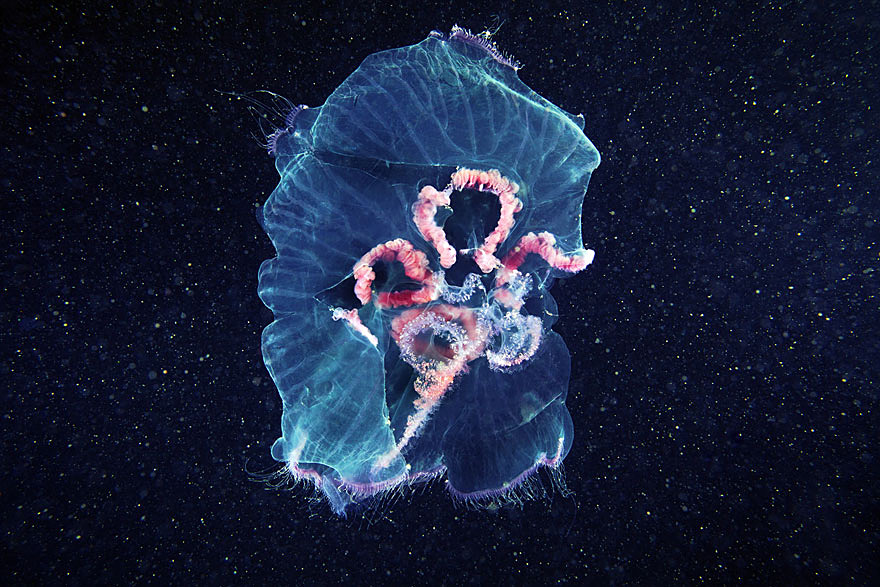
The Alien Beauty Of Jellyfish In Alexander Semenov’s New Photos

by Julija K.

Russian marine biologist and underwater photographer Alexander Semenov (previously here) is back with some new extraordinary photographs of the deep sea aliens. Alexander is currently leading a team of scientists on a three-year-long Aquatilis expedition to explore the deep waters around the world.

The aim of Aguatilis expedition is to reveal the hidden animal kingdom living miles under the surface. “You can’t actually study gelata in labs or in an aquarium, because their bodies can fall apart from a single human touch”, explains the team of Aquatilis. The team uses innovative equipment and even a robot in order to capture the jellyfish.

Be sure to follow the  amazing journey of Aquatilis on their Facebook page.

More info: aquatilis.tv | shilovpope.livejournal | FB | Flickr (h/t)

underwater-jellyfish-alexander-semenov-aquatis-18

underwater-jellyfish-alexander-semenov-aquatis-11-2

underwater-jellyfish-alexander-semenov-aquatis-66

underwater-jellyfish-alexander-semenov-aquatis-16-2

underwater-jellyfish-alexander-semenov-aquatis-8-2

underwater-jellyfish-alexander-semenov-aquatis-6-2

underwater-jellyfish-alexander-semenov-aquatis-30

underwater-jellyfish-alexander-semenov-aquatis-5-2

underwater-jellyfish-alexander-semenov-aquatis-7-3

underwater-jellyfish-alexander-semenov-aquatis-3-2

underwater-jellyfish-alexander-semenov-aquatis-1-2

underwater-jellyfish-alexander-semenov-aquatis-22-2

underwater-jellyfish-alexander-semenov-aquatis-28

underwater-jellyfish-alexander-semenov-aquatis-26-2

underwater-jellyfish-alexander-semenov-aquatis-15-2

underwater-jellyfish-alexander-semenov-aquatis-20-2

underwater-jellyfish-alexander-semenov-aquatis-24

underwater-jellyfish-alexander-semenov-aquatis-9-2

underwater-jellyfish-alexander-semenov-aquatis-13-2

underwater-jellyfish-alexander-semenov-aquatis-29

26 Dec 05:05

arratik: Rudolph the Oversaturated Reindeer


arratik:

Rudolph the Oversaturated Reindeer

26 Dec 04:43

Xbox Live And PlayStation Network Knocked Offline For Much Of Christmas [Update 3]

by Stephen Totilo
Bridget

merry christmas

Xbox Live And PlayStation Network Knocked Offline For Much Of Christmas [Update 3]

We hope you weren't planning to play many games online on Christmas. Xbox users in North America and Europe are having difficulties logging into Xbox Live today, and PlayStation owners are suffering similar problems. Some Internet troublemakers are claiming they knocked both offline. Bah humbug to this.

Read more...


26 Dec 04:38

just-for-grins: "What If they don’t like my Christmas...


just-for-grins:

"What If they don’t like my Christmas sweater?"

26 Dec 04:28

Adorable Christmas Wish from Three-Year-Old: F*** You, Santa!

by Mark Shrayber
Bridget

if i had a kid...

This is the true meaning of Christmas.

Read more...


26 Dec 04:26

celtic-forest-faerie: {Antheraea Polymhemus Moth} by...