


Bridgeti'm surprised at how many of these i have seen/want to see, only because i generally view myself as not a dark person.
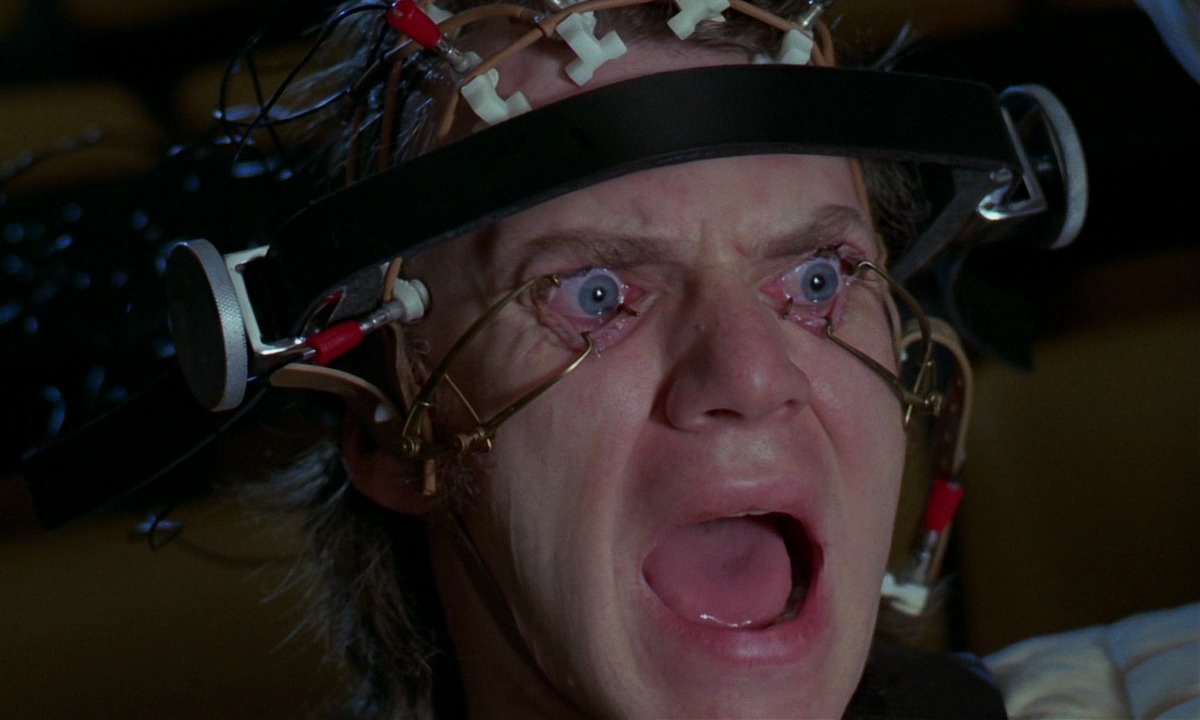
Blood, violence and depravity are themes that’ve shown up in our artwork for thousands of years. The thrill of watching gladiators torn apart in battle was once a popular form of recreation. Indeed, during the times of barbarism and cavemen, the law of the land was kill or be killed.
Mankind’s bloodlust, it would seem, is old as mankind itself. Our methods for pandering to it may have changed, but our repressed, savage desires have not. There’s no denying that the survival instincts of our ancestors remain with us to this day. So, how is one to satisfy their twisted cravings? What outlets exist? The answer: simulation.
Before the rise of disturbing artistry in film, audiences got their fix in the form of live theater. One such theater, the Grand Guignol, was among the first of its kind to depict acts of rape, torture and dismemberment before a voyeuristic live audience. The Grand Guignol shocked and horrified a generation of Europeans in the heart of Paris, from 1897 until its closing in 1962. By then, the advent of cinema was in full swing. Live theater had taken a backseat to the incredible, booming popularity of the big screen.
It wouldn’t be long before underground films began surfacing in video collections. These films defied the conventions and boundaries set by such milestone pictures as Alfred Hitchcock’s Psycho and George A. Romero’s Night of the Living Dead. Foreign directors like Ruggero Deodato and Hideshi Hino would produce “senseless and depraved” motion pictures, a few of which would go on to become cult hits. In response, the movie-going public turned the other cheek, and Hollywood studios continued to play it safe. The market for cinema’s dark underbelly was still finding its feet.
By the early 1970s, the envelope was pushed much further. The enormous gap between Hollywood studios and underground filmmakers was bridged by the controversial works of directors like Stanley Kubrick. During this time, the public eye began to shift from disgust to marginal acceptance. Fearing the economic threat posed by taboo subject matter, the industry resisted. Kubrick’s 1971 film, A Clockwork Orange, would be withdrawn from release in response to accusations that the picture had inspired real life rape and murder. Mainstream censorship wasn’t going down without a fight.
It wouldn’t be until the 1980s that the slasher movement introduced audiences to gratuitous onscreen violence and gore. At this point in time, major studios like Paramount Pictures and New Line Cinema were getting behind such gruesome flicks as Friday the 13th and A Nightmare on Elm Street. The legacy these iconic films carried with them would set the standard for things to come thereafter.
Given the context of its history, the world of disturbing film has come a long way. Throughout its evolution, a small handful of works have pushed boundaries to such an extent and in so unique a fashion that they occupy a class all their own. With this in mind, Taste of Cinema proudly presents a list of the Top Twenty Most Disturbing Films of All Time. Each picture has been selected based on culture impact, lasting appeal and shock factor, relative to the context of its time of release.
Let’s begin, shall we?
20. Apocalypse Now (1979)
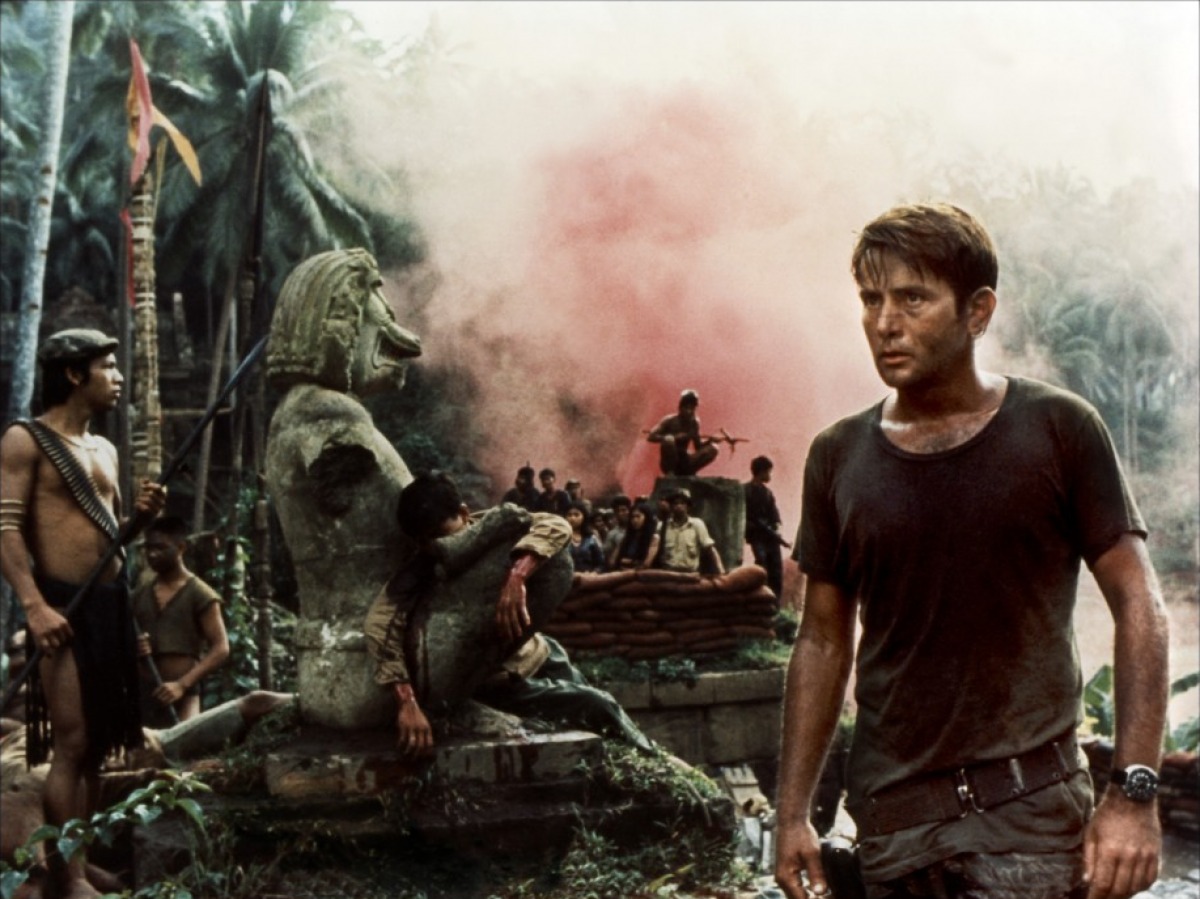
From start to finish, Apocalypse Now accurately depicts the sheer madness, bloodshed and depravity of war-torn Vietnam. Directed by Francis Ford Coppola, the film manages to be as colorful as it is brutal and gritty. The grim atmosphere is held up by a stellar cast, including old favorites such as Marlon Brando and Dennis Hopper, while introducing new faces that would go on to become huge, like Lawrence Fishburne.
Chock full of disturbing sequences and upsetting themes, Apocalypse Now extends its ambitions far beyond that of old war movie clichés. One scene sees an American squad recovering a puppy, shaken and traumatized by the horrors of battle. A soldier becomes attached to the pup, only to later lose his mind amidst a mass of brainwashed Vietnamese villagers, who are led by the elusive Colonel Walter Kurtz (Marlon Brando)—an American special forces officer gone rogue.
The film captures the hopeless struggle of the Vietnam War to a tee. Lead character Benjamin Willard (Martin Sheen) embodies the effects of post-traumatic stress disorder in a young soldier. This psychological element elevates the film beyond other war pictures, by depicting the brutal, life-altering consequences of war on the human psyche.
19. A Clockwork Orange (1971)
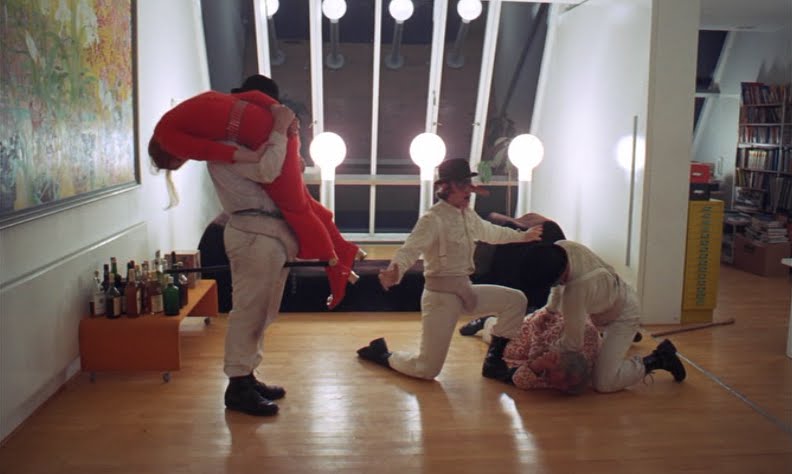
Based on Anthony Burgess’ novel of the same name, Kubrick’s scope and vision for A Clockwork Orange remain unmatched to this day. The story concerns a young man named Alex, played by the then-unknown Malcolm McDowell. Alex wanders the streets of a futuristic Great Britain with his gang of hoodlum friends. Each night, the gang pleasure themselves with “ultra-violence,” as well as “a bit of the ol’ in-out-in-out”—a perverse slang term for statutory rape.
Eventually, Alex is caught and arrested. He is sent from prison to a psychiatric hospital, where an experimental form of therapy leaves him dazed and vulnerable. The hospital deems his treatment a “successful rehabilitation,” and they promptly release him. Back on the streets, Alex is defenceless. Those he wronged and violated in the past are quick to turn the tables, exacting brutal revenge.
For the time of its release, A Clockwork Orange features a horrifically graphic rape scene, as well as ruthless violence. The story is told from the perspective of an irredeemably evil youth. This helps contribute to the film’s subversive nature and questionable moral message. Kubrick does an excellent job creating a distant dystopia, where politics are corrupt, and the law is rewritten each day in blood on the streets.
18. Requiem for a Dream (2000)
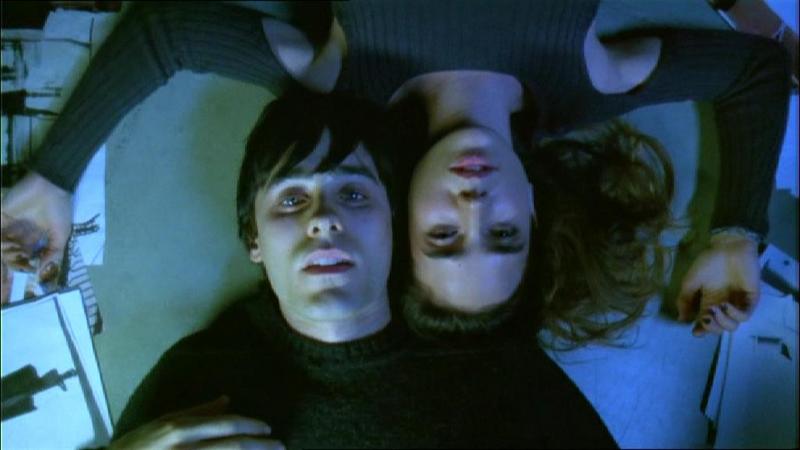
This film explores the many horrifying facets of drug addiction. Four main characters living in Brooklyn are looking to free themselves from the shackles imposed by their substance abuse. All are tormented by visions of pain and torment, intermixed with flashes of utopic ecstasy.
As their addictions continue to spiral downward, their hallucinations become increasingly morbid, and the lives of each addict begin to unravel. By the end of the film, each character is wrestling with depression and hopelessness. The slow, heroin and coke-induced descent into madness is foreshadowed perfectly, and the consequences truly are horrendous.
Requiem’s central character, Harry Goldfarb (Jared Leto), makes the greatest impact because his of his behavioral and emotional dynamics. We observe his transition from casual user to desperate junkie within a time frame of only a few weeks. The effect this has on his close friends and family make the film especially hard to watch.
In one scene, Harry demands that his girlfriend, Marion Silver (Jennifer Connelly), prostitute herself to her psychiatrist for drug money. Reluctantly, she does. It’s scenes like this that accentuate the helplessness and horrifying desperation associated with drug addiction.
17. The Last House on the Left (1972)
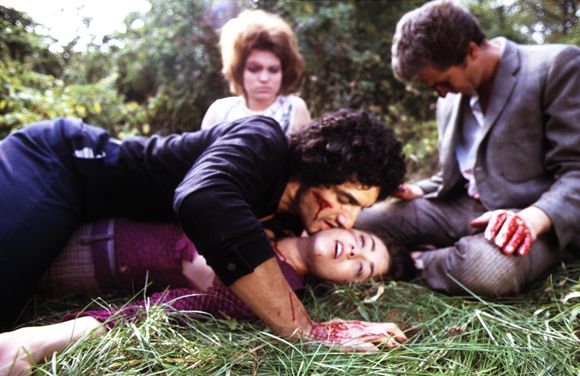
The directorial debut of horror maestro Wes Craven remains one of his most shocking films to date. The plot involves two young girls, Mari Collingwood (Sandra Peabody) and Lucy Grantham (Phyllis Stone), who are brutally abducted, raped, tortured and eventually murdered by a band of psychotic criminals. Ironically, the sociopaths later arrive at the Collingwood residence, masquerading as travelling salesmen.
Claiming to have nowhere to stay, the parents offer to let the group spend the night in the guest room. Later that evening, Estelle (Cynthia Carr), notices one of the “salesmen” wearing her daughter’s signature peace symbol necklace. Eavesdropping, the parents learn the location of their daughter’s corpse and recover it. They then begin working together to exact a horrible vengeance.
This film rests firmly in the category of exploitation-horror, and isn’t afraid to show it. Scenes of mutilation, emasculation, and rape are abundant throughout. Last House’s gruesome nature is made even stronger by the audience’s emotional investment in the parent characters. Viewers will empathize with the Collinwood’s need for revenge, thus driving the film to its thrilling conclusion.
16. The Human Centipede (2009)

Written and directed by Dutch filmmaker Tom Six, The Human Centipede tells the story of Lindsay (Ashley C. Williams) and Jenny (Ashlynn Yennie)—two American tourists backpacking through Germany. Both are drugged and kidnapped by a psychotic surgeon named Dr. Josef Heiter (Dieter Laser).
They awake in a makeshift medical ward built underneath the doctor’s home. There, along with Japanese tourist Katsuro (Akihiro Kitamura), the women become unwilling participants in a three-way medical procedure. Dr. Heiter explains that the victims will be sewn together, mouth-to-anus, so that they share a continuous digestive system.
For many, the premise of The Human Centipede is disturbing enough on its own. Following the doctor’s surgical procedure, however, the tourists’ suffering, humiliation and anguish are dragged out endlessly. This elevates the film above its simplistic premise by putting each of the victims at the doctor’s mercy.
Tom Six includes a wide array of tests and activities for Heiter to impose upon his unwilling patients. One scene sees him training “the centipede” to fetch the newspaper like a dog. While sadistic, this scene pales in comparison to the sequence where Katsuro has to defecate, and does so in the mouth of the woman sewn to his rear. The doctor’s morbid cries of “Yes, feed her!” are enough to send chills down the spine of even the most jaded viewer.
15. Pink Flamingos (1972)

This film involves two groups of people fighting over who is considered “The Filthiest Person Alive.” As ridiculous a concept as this may sound, Flamingos succeeds as both a black comedy and a disturbing exploitation flick. Cross-dressing lead “Divine” does an excellent job portraying a sleazy drag queen living with her hippie son Crackers (Danny Mills) and obese mother Edie (Edith Massey).
Divine prides herself in holding the tabloid-given title of “Filthiest Person Alive.” However, all of that changes when the family receive a package containing a piece of excrement and a card, declaring the anonymous writers to be the new holders of the title. Outraged, Divine and her family of misfits go on a crusade to exact revenge. Chaos and hilarity ensue.
Pink Flamingos contains numerous upsetting scenes. The ending sequence, where Divine eats a fresh dog turd off the sidewalk, is widely considered to be the most famous and iconic. Far more upsetting, however, is the clip where a live chicken is crushed to death between two lovers engaging in intercourse.
For all its sick and revolting displays, Pink Flamingos redeems itself through the use of darkly humorous camp. The film is an attack on the picture-perfect, lavish and expensive way of life portrayed by mainstream Hollywood. This makes the film artistic as well as exploitative, placing it head-and-shoulders above other cult pictures of the time.
14. Martyrs (2008)
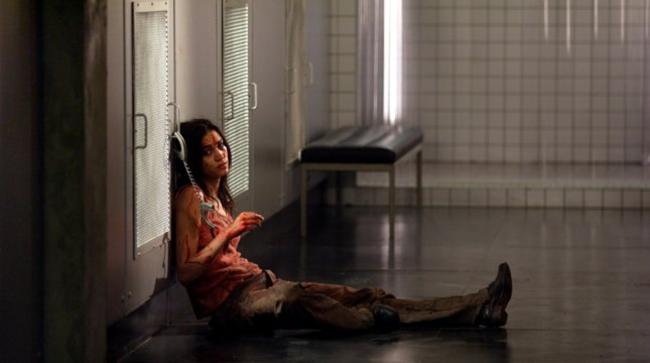
French director Pascal Laugier is known for his transgressive films, many of which are associated with The New French Extremity movement. It should come as no surprise then, that his 2008 horror film “Martyrs” is considered one of the most shocking pictures of all time. The plot concerns two women, Anna (Morjana Alaoui) and Lucie (Mylène Jampanoï), both of whom were abused as young girls.
In a mission to exact revenge, Lucie breaks into the home of a family and murders them via shotgun. She then calls Anna, insisting that she’s killed the people responsible for her childhood torment. Horrified, Anna arrives and finds that Lucie is haunted by an unseen entity—a psychological manifestation of her guilt for having left behind another girl imprisoned with her as a child. Unable to cope, Lucie slits her own throat. Little does Anna know, the cult group that tortured Lucie years ago is nearby, and she’s about to become their next victim.
Martyrs is an ultraviolent display of perversion and sadism. With scenes of religious brainwashing, mutilation, forced captivity and child abuse, the picture earns its sickening reputation and then some.
13. Begotten (1990)
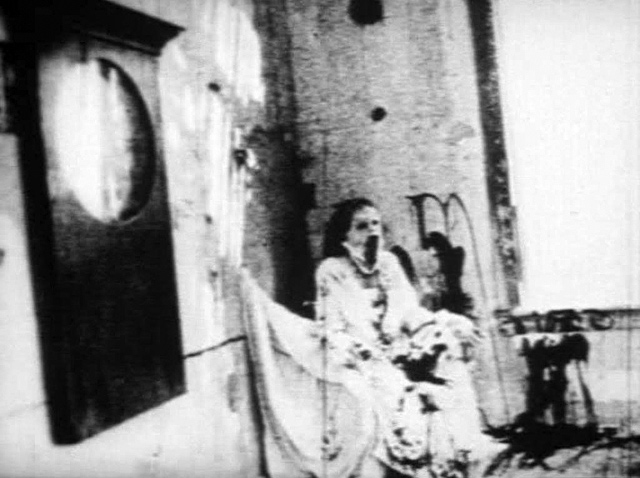
Avant-Garde filmmaker E. Elias Merhige’s first film is an underground experimental horror, dealing with the Biblical story of Genesis. The film begins with God killing himself, thus birthing a woman—Mother Earth—from his disemboweled corpse. The scene is drawn out and thoroughly disgusting, including a lengthy sequence where God’s carcass empties its bowels.
Arising from the death of a deity, Mother Earth treks off into a lifeless, barren landscape. She eventually gives rise to the Son of Earth, who trembles before a group of faceless cannibal figures. They devour him, and the movie ends.
Begotten possesses a haunting, atmospherically visceral quality that has yet to be surpassed. The film is shot entirely in black and white. Throughout its 78 minute runtime, not a trace of dialogue is heard. Combine Merhige’s avant-garde film style with sequences of torture and unsettling imagery, and you get one of the most shocking experimental pictures of all time.
12. Funny Games (1997)
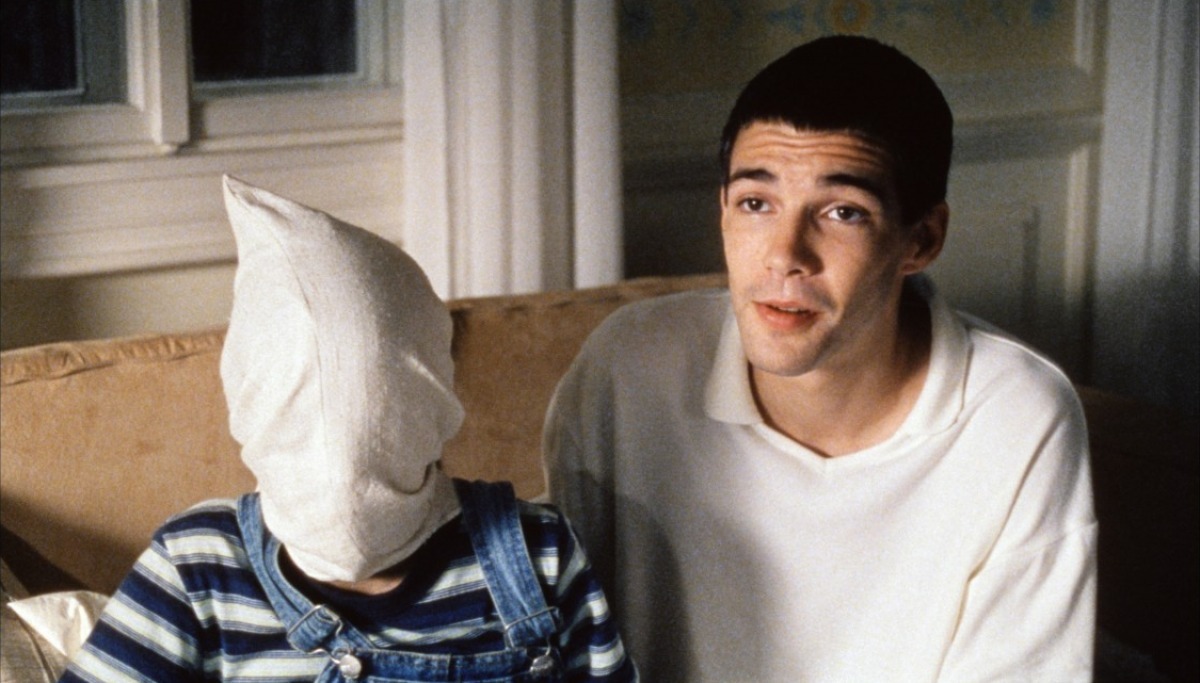
Written and directed by Austrian filmmaker Michael Haneke, this psychological thriller has since been remade for English-speaking audiences. Despite the flashier look of the remake, the original picture boasts a grittier, more realistic tone and overall feel. The plot involves two psychotic Viennese men, Peter (Frank Giering) and Paul (Arno Frisch) who kidnap a family and hold them hostage. Over the course of twelve hours, the mother, father and son are forced to play sadistic “games” with one another for their captors’ amusement.
Giering and Frisch do an excellent job as the psychopaths. Lead antagonist Paul is initially introduced as a neighbor’s friend, thus earning him the family’s trust. However, when boundaries are pushed, tension mounts and events turn ugly.
For all the film’s gore and sadistic violence, the real chills are found in the nonsensical banter between the two captors. Paul, for example, relates contradictory details of Peter’s past at different times. He also deliberately abuses Peter, ridiculing his weight and lack of intellect. Despite the brief insights provided, no concrete motives are given. One is made to feel that a good portion of their “insane” behavior is merely an act, designed to further terrorize the family.
11. A Serbian Film (2010)

This foreign film concerns an aging porn star named Miloš (Srdjan Todorovic), who wants to make a fresh start and break away from the industry. He’s soon offered a job as an actor in in an experimental art film. The director—an independent photographer named Vukmir (Sergej Trifunovic)—claims he wants to cast Miloš for his “powerful erection.” Miloš is reluctant to accept, and does so only to secure his shaky finances. He’s instructed to meet the film crew at a secluded orphanage.
Once there, he’s sent in alone to find the other “actors,” keeping in contact with the director via earpiece. Inside, he discovers that Vukmir is a director of child pornography. Disgusted, Miloš tries to run away, but is restrained, drugged and sexually aroused by a chemical stimulant. Under Vukmir’s manipulation, he is forced to rape, mutilate and sodomize his way through each film shoot.
A Serbian Film is loaded with upsetting scenes. The most infamous sequence sees a young woman strapped down and gruesomely stripped of her teeth. The picture truly has no boundaries, going so far as to feature a scene of “newborn porn,” where, you guessed it—an infant is raped onscreen.

【The following was originally posted on The Mary Sue (Abrams Media Network) and has been republished here with permission.】About a year ago, I went with friends to see a live reading of Welcome to Night Vale and was shocked by the amount of screaming coming from women in the audience.


gallifreyanconsultingdetective:
This is not a tasty gummy sweet but a Jewel Caterpillar found in Amazon Rainforest. They are covered with sticky goo-like, gellatinous tubercles that provides protection from its predator like ants until they metamorphosise into winged moths.
HAVE YOU SEEN IT GROWN UP THOUGH
literal pokemon
have you seen the cocoon it makes though?
it’s so pretty as a baby, it looks like an actual gem. then suddenly it pupates into a net thing and when it comes out it looks like the fucking Lorax
dude
this is a pokemon
Bridgeti want to do this
/crystal-head-vodka-skull-wall-15845.jpg)
What to do with all those empty bottles of Crystal Head Vodka? I tried sending mine back to Dan Aykroyd for free refills, but it's been a few months and I still haven't gotten them back. So I think Rob of Moonshine Lamp Co. had a better idea when he decided to turn his empties into Crystal Head Vodka wall sconces. The result: wicked, eco-friendly, and practical. The perfect way to light the way to my liquor cabinet.
Skull sconces take a candelabra-sized bulb of up to 40 watts; Rob suggests swapping in a red one for Halloween. The pieces' brass metal finish comes in buyer's choice of black, oil-rubbed bronze, or unfinished.
Moonshine Lamp Co. gives the same brand of lighting treatment to other liquor bottles as well. Take your pick from 1800 Reposado Tequila, Maker's Mark, Knob Creek, Fireball, and St. Germain.
:strip_icc(1)/https%3A%2F%2Fs3.amazonaws.com%2Fpolicymic-images%2Fvllybhyqxjr4cuefzjujf9evrcmeb09ltr1pwzt4rop8fsknelagverdnzuykr3o.jpg)
 From jambalaya and sazeracs to po'boys and beignets, it's all at your fingertips in our fair city. [ more › ]
 The 'pup-up' will allow customers to grab a cup of coffee and pet a bunch of adorable dogs. [ more › ]
Portland artist and Peculiariumist Mike Wellins finds paintings in flea markets, thrift stores and yard sales and revitalizes them with new elements. The process is known as NERC (Non-elective Retroactive Collaboration).
The fun comes from finding something that is so boring that it isn’t even noticed and turning it into something that is strange, shocking or funny.
More info: peculiarium.com


Anonymous master - Reliquary of the jaw of St. Anthony. Basilica di Santo Antonio, Padua. 1349
Bridgetwow this surprises me. i find it totally navigable and decent.

New Yorkers are known to disagree about a lot of things. Who's got the best pizza? What's the fastest subway route? Yankees or Mets? But all 8.5 million New Yorkers are likely to agree on one thing: Penn Station sucks.


Linda Cardellini and Jason Segel on the last day of filming (Freaks and Geeks, 2000).
Judd Appatow: "I loved writing for Jason. That’s what I felt like in high school. I felt goofy and ambitious and not sure if I had any talent, and I would be in love with these women and didn’t actually know if they liked me that much… Jason really captured that desperation I felt when I was younger."

Publisher Deep Silver today released a launch trailer for Saints Row 4: Gat out of Hell, but much more importantly, the trailer includes a call in number that has a fantastic six-minute-long hold message.
We've recorded the whole thing for you and included it below the trailer for your listening pleasure. You're welcome and welcome to hell.

Empathy seems to be in short supply these days, especially on the internet. But there's an easy solution, according to a new study published yesterday in the journal Current Biology: Just play some Rock Band.
Previous research has established that lower mammals such as mice, in addition to humans, are capable of empathy. This particular study, led by McGill University psychology professor Jeffrey Mogil, compared reactions of undergraduate college students to a painful stimulus delivered by a different kind of ice bucket challenge — submerging an arm in ice water. The researchers measured pain reactions from people who were alone; with a friend; with a stranger; with a stranger when both had been given a stress-blocking drug; and with a...

In December 2003, the European Space Agency's Beagle-2 lander was dropped to Mars by the Mars Express Orbiter. The craft was meant to search for life on the planet.
Scientists expected to receive transmissions from Beagle-2 six days later, when it was due to land on Mars' surface. Instead, they heard nothing — and for the past 11 years, the fate of the tiny lander remained a total mystery.
But today, ESA announced that, using satellite images, they've found Beagle-2. The images might also explain why the craft never transmitted any data: it appears that its solar panels didn't fully unfold, so the antenna wasn't exposed.
An image taken by NASA’s Mars Reconnaissance Orbiter shows Beagle-2. (http://www.esa.int/spaceinimages/Images/2015/01/Colour_image_of_Beagle-2_on_Mars)
The meter-wide lander was carried to Mars by the Mars Express Orbiter, then released five days before the orbiter entered Mars' orbit.
To slow down the craft — which would have started out traveling at a speed of more than 12,000 miles per hour — a series of parachutes were to deploy once it entered Mars' atmosphere. Then, about 650 feet above the surface, a set of airbags were supposed to inflate, protecting the craft as it landed.
A rendering of Beagle-2 being released. (Beagle-2)
After the landing, solar panels were to unfold, allowing Beagle-2 to draw power and begin transmitting data.
The lander would have been the first craft sent to Mars specifically to search for life since the Viking missions of the 1970s. Using a drill — as a well as a robotic "mole" that would have crawled across the surface, taken soil samples, then been pulled back to the lander by a wire — Beagle-2 would have collected Martian rock and soil. Then, a series of spectrometers inside would have analyzed them searching for signs of extant life, as well as organic compounds — the basic building blocks of all life on Earth.
Beagle-2's robotic arm, with several scientific instruments. (Beagle-2)
After scientists didn't hear from Beagle-2, they suggested a number of explanations: perhaps the parachutes hadn't deployed, maybe because the lander had gotten tangled in them on the way down. Or maybe the airbags hadn't inflated before Beagle-2 hit the surface, so that the craft was destroyed upon landing. Some even suggested that the lander might have burnt up in Mars' atmosphere on the way down.
For years, scientists also used photos taken by several Mars orbiters to try searching for the lander, but were unsuccessful. Late last year, though, Michael Croon — a retired ESA staff member — spotted tiny dots in a few photos taken by NASA's Mars Reconnaissance Orbiter that he suspected might be Beagle-2. Subsequent research has confirmed it.
A close-up of Beagle-2 suggests that only two out of four solar panels unfolded. (HiRISE/NASA/JPL/Parker/Leicester)
The new photos also clear up the mystery of why we haven't heard from Beagle-2: it appears to have successfully landed on Mars' surface, but didn't fully unfold as planned.
It looks like only one or two of the lander's four solar panels unfolded, preventing the antenna from being exposed. The photos also show what is believed to be one of Beagle-2's parachutes nearby.
Despite finding it, there's no way ESA can resurrect Beagle-2 and use it to conduct science. But finally understanding what went wrong — and what worked perfectly — could help in designing future missions to Mars.

A family-medicine doctor recent saw a 13-year-old with a weird, unidentifiable rash. It wasn't itchy or painful, and the teenage boy hadn't traveled anywhere recently. So the the doctor did what any modern physician would do: he took a photo and uploaded it to an Instagram-style app called Figure 1.
(Figure 1)
"13 y/o M with rash on his knee for 2 months," the doctor with the username inder70 wrote. "it is not itchy, no pain, no travel, no new food no inciting agent, no medications?"
The suggestions came piling in. One doctor asked if it was fungal ("no itchiness or raised border," inder70 responded). Most of them quickly landed on the same diagnosis: granuloma annulare, a skin condition that has no known cause and can be treated with certain ointments. "Thanks everyone!!" inder70 responded, the medical mystery solved.
Figure 1 is the brainchild of Josh Landy, an internist from Toronto. He did his residency at Stanford and saw constant, off-the-cuff consults happening in hospital hallways, where doctors would try and talk through the details of a case that was surprising or new to them.
"It can be 4 a.m. when you're working, and you're going to see something that can astonish you," Landy said. "It might be the most classic textbook example of something you don't know about, and it happens when there are not a lot of other people around. So the idea was there has to be a better way to communicate."
Landy started doing research on his fellow residents and found that 13 percent were already using their smart phones to share images with one another via email or text message. What if there was a wider network to share those images and get more input from not just one hospital's residents, but the wider medical community?
That's where Figure 1 comes in: since its launch in the spring of 2013, the app has accrued 115,000 users. It's most popular, unsurprisingly, among young doctors: an estimated 20 percent of medical residents now have Figure 1 on their phones. There are sections on dermatology (lots of rashes), radiology (mostly x-rays), and emergency medicine (not for the faint of heart).
Not all of these users are doctors: Landy estimates that about 10 percent of the users are non-health care professionals (people like me, which explains how I was able to see that image and discussion above). Only doctors, however, can comment on cases — and they do, a lot.
Some of the doctors are sharing images they find interesting: "Kitchen knife vs. thumb. Pretty minor but I've never seen someone stitch through a nail like this!" one doctor wrote under a photo that, as you can imagine, is a thumbnail with stitches. But a lot of the app is doctors seeking advice and asking other professionals to give their opinions on cases.
For example, a radiologist recently asked others to look at an x-ray of an elderly woman who "fell backward onto the floor." A registered nurse posted a photo of the phlegm her patient had coughed up ("Any idea what this may be??"); another shared a photo of a patient's urine that elicited a 77-comment chain discussing the diagnosis.
One of the persistent questions about an app like Figure 1 is privacy. Few patients would want their faces to turn up in the public forum. Landy said the approach to protecting privacy is twofold: doctors are required to ask permission to take a photograph, and they can't capture any identifying details. That explains why you see a lot of limbs on Figure 1, but no faces.
The issue I was interested was whether Figure 1 raised issues of liability. If another user suggested a diagnosis — and the doctor posting the photo followed through — could that put the commenting user at potential fault for something going wrong? It's easy to see a patient, in the future, going back to Figure 1 to trace the comment thread that may have contributed to her treatment.
Landy said this wasn't an issue that had come up much yet in Figure 1's short lifetime and that these interactions were arguably just another version of the corridor consults that already happen. "These are people who are talking about a lot of the cases because they're interesting, textbook, classic versions and they can help," he said.
Le street artiste français basé à Paris Charles Leval réalise de magnifiques dessins en noir et blanc qu’il intègre parfaitement aux structures urbaines qu’il utilise comme des éléments essentielles de ses oeuvres, une matière première, un support mis à disposition librement.
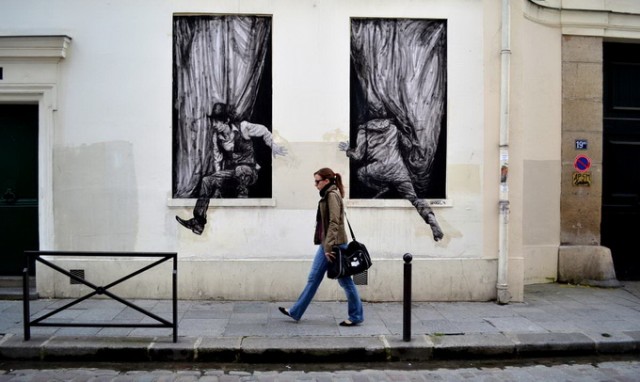


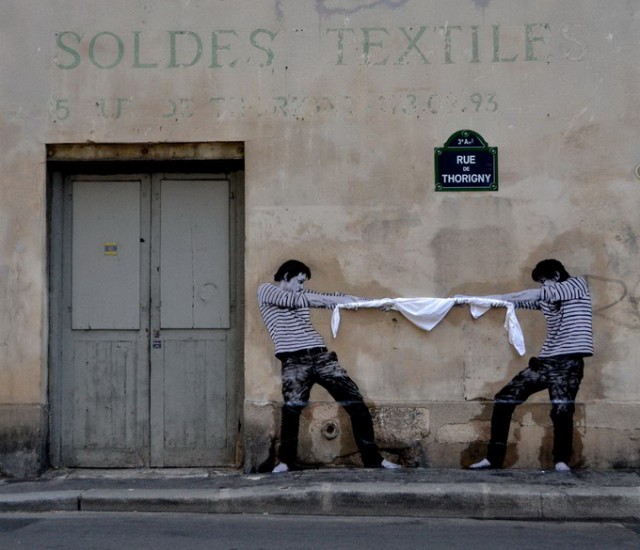





Bridgettruthfully i think i'm one of the few childfree people i know who doesn't despise children

Back in 1980, the World Health Organization officially declared that one of the deadliest diseases in human history, smallpox, had been eradicated. This marked the first time that a disease had been completely eliminated from the planet. Achieving this was certainly no mean feat. It took an enormous collaborative effort, mostly involving global vaccination campaigns, surveillance and prevention measures.

Thanks to a festival called "Spring Scream" Taiwan's water supply is now spiked with all manner of drugs (least of which is caffeine) which are not being removed during the water purification process and finding their way into drinking water and the bellies of fish.


A CROW TRIED TO GO IN OUR CLASSROOM AND HE HAD A PEN
yes hello i am here to learn geometries
That crow is more prepared than some of my students.

Project Ara is an ongoing effort by Google to create a modular smartphone for which you can swap critical components in and out, allowing users to build the perfect phone for their specific needs.
If its modular design takes over the consumer market in the future, we could be seeing a whole new approach to how smartphone cameras work.

On the Project Ara website, Google cites the smartphone camera as one of the big selling points for modular camera designs:
With a modular platform, you can pick the camera you want for your phone rather than picking your phone for the camera […]
You can upgrade different parts of your phone when you need too. Replace a broken display. Save up for a high-end camera. Share a module with your family, or swap one with your friends. Now you don’t have to throw your phone away every few years.
You can see a glimpse of the camera module in this short promo video:
Engadget also reports that Google has been focusing on camera quality as it builds this device, saying that the company “is already planning on a few improvements, like 4G LTE, high-end camera support and all-day battery life, for the third version of its modular phone.”
Small sensors have traditionally been a limiting factor in how good smartphone cameras could be, but a modular design could open the door to large camera modules that pack serious sensors and serious lenses. It’s something we’ve already begun to see in early design prototypes:


Things would get even more interesting if a module contained both a large sensor and an interchangeable lens mount, putting the camera in direct competition with mirrorless cameras.
There’s no indication yet that the project will be moving toward that direction, but it’s an interesting thing to think about as new technologies continue to transform how consumers take pictures.
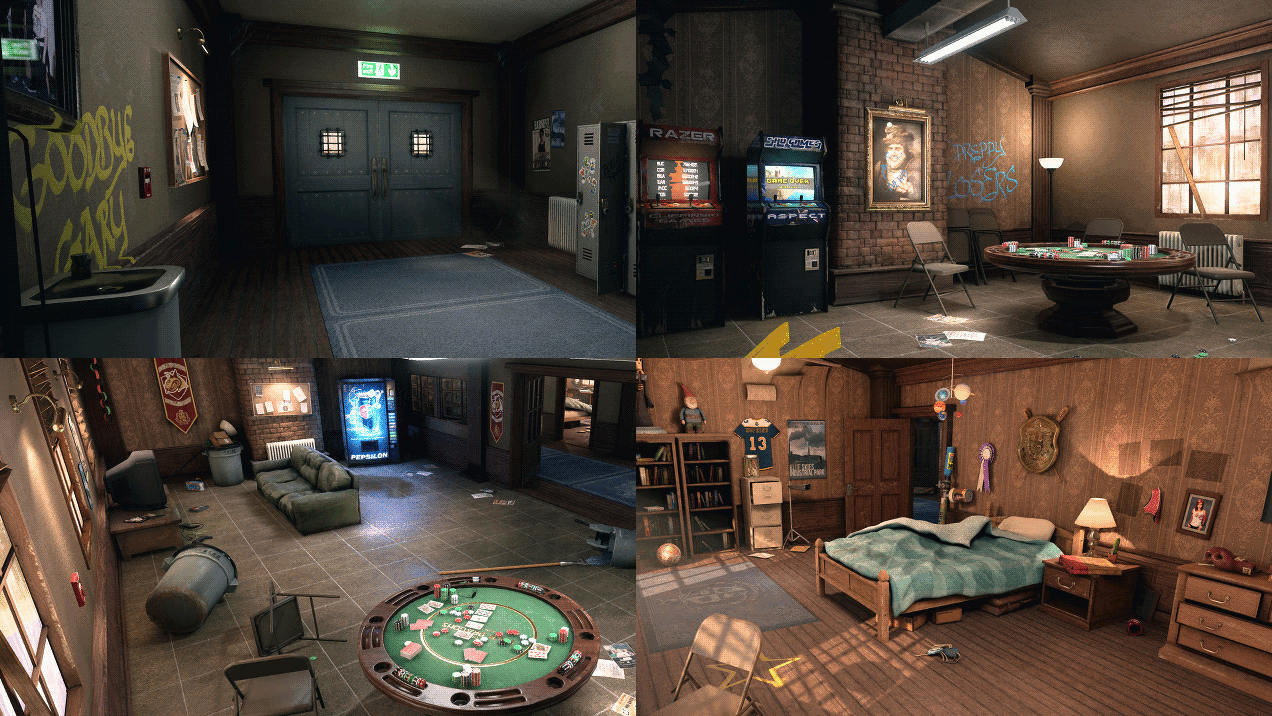
The game turns nine years old this year, and it was never much of a looker. This Unreal Engine 4 map, on the other hand, is.