Shared posts

09 Jul 19:05

Uber Agrees Not To Gouge Customers During Emergencies In New York

Dan Jones

I really don't understand how Uber operates the way it does. It doesn't make sense to me that it can operate without being classified as a taxi service.

Uber is well known for using a dynamic model is calls surge pricing that adjusts the cost of a fare based on supply and demand. The company's CEO, Travis Kalanick, has defended this practice despite public outcry from customers, media, and politicians. But the company drew particular heat when surge pricing kicked in during extreme weather in New York City, specifically during last year's New Year's Eve snowstorm and Hurricane Sandy. At the time the NY attorney general Eric Schneiderman released a statement implying that Uber's surge pricing during these periods could constitute price gouging.

Today the company announced that it reached an agreement with the NY attorney general's office to cap surge pricing during emergencies, a move Schneiderman called, "a thoughtful application of NY law to new #tech."

developing...

09 Jul 18:33

Chromecast Adds Support for Android Screen Mirroring

by Alex Chitu

As previously announced at Google I/O, Chromecast is about to become a lot more functional. The latest version of the Chromecast app for Android (that's version 1.7) adds support for screen mirroring. The feature is still in beta and it's limited to a few high-end Android phones and tablets running Android KitKat 4.4.1+: Nexus 4, 5, 7 (second generation only) and 10, Samsung Galaxy S4 and S5, Note 3 and 10, HTC One M7, LG G2, G3 and G Pro 2. Google promises to add more devices to the list.


"To start mirroring, simply select 'Cast Screen' from the navigation drawer in the Chromecast app and select your Chromecast device. On Nexus devices, this feature is also available through the quick settings menu," explains Google.


Hopefully, Android L will add native support for screen mirroring, so you'll no longer have to use the Chromecast app.

This screenshot shows screen casting in action. Obviously, the entire screen is mirrored, including the on-screen navigation buttons, if your device has them.

09 Jul 17:57

A Drone’s View, What the D.C. Temple Would Look Like if You Could Fly

by Tyler Girsberger

Tony Collins captures breathtaking drone images of the Washington D.C. Temple. Soaring at a height of 288 feet, Tony flies

09 Jul 15:33

I Left Facebook, And You Can Too

By now we all know that in 2012, Facebook conducted a study where it set out to affect users’ emotional states by manipulating which status updates they saw in their feeds. For a week, a small percentage (but a large number) of users saw fewer updates with “positive” words, while others had posts with “negative” words suppressed. A control group simply lost their friends’ updates at random. We don’t know that Facebook stopped doing things like this; we just know what they told us about the experiment last week in Proceedings of the National Academy of Sciences.

People have been angry about this. People are always angry when Facebook does one thing or another. But they have not been talking seriously about leaving Facebook. I think we should talk seriously about leaving Facebook.

I think most people on Facebook have a sense of what leaving would cost. They know that it would be difficult, and isolating; many people have a difficult time with the idea of disconnecting even for a week. It can be hard to really reckon the cost of remaining on Facebook until you leave. But as someone who has left, I can tell you that the cost of being on Facebook, the cost of handing over your connections with the people you love, is real.

Why I left, and what it was like

When I left Facebook at the beginning of 2011, I disconnected in one click from the roughly 100 people with whom Facebook had been my only form of contact. I felt the need to leave quickly, and I don’t know if my wall post telling people I was leaving even showed up in everyone’s feed, so there are lots of connections that I have just lost and never recovered: Susan, who was just about to get married; Shannon, who had become one hundred times more vibrant since she’d left the social strictures of our suburban high school; Jack, who was still singing in choirs.

Do you remember, in 2009 and 2010, when Facebook was changing their privacy settings at what felt like a pretty rapid clip? In December of 2009, Facebook eliminated the option to keep your friends list private.

Facebook founder Mark Zuckerberg announced that batch of changes in an open letter. He never mentioned, in this letter, that Facebook had eliminated an important privacy option. Instead he wrote that Facebook is “focused on giving you the tools you need to share and control your information.” He wrote that Facebook’s “work to improve privacy continues.” He wrote that users would have “even more control of their information.” He wrote that Facebook had created a “simpler model for privacy control.”

Whatever Mark Zuckerberg tried to gain by eliminating the option to keep friends lists private (and then obscuring this elimination while giving the illusion of transparency), he tried to gain it at my personal expense.

By the time I realized that friends lists could no longer be hidden from public view, it was too late. In that window of time before I had realized my vulnerability, a family member I was friends with on Facebook searched for, and began a Facebook correspondence with, a dangerous person from my past.

I had not had contact with this person in years, and he had not been able to find me, perhaps in large part because he didn’t know my new last name. I had also kept my social media activities with mutual acquaintances under wraps. But suddenly this person was flooding my non-Facebook e-mail inbox with messages that were by turns cheery and sweet, and then so threatening that my whole body shook. Two computers that had never accessed my personal website before, with IP addresses in this person’s home city and state, began crawling through every page and clicking on every link in my site. This person even called my then-husband’s place of work, looking for me. I was constantly nauseated from fear.

When I told a friend of mine this news, he advised me that staying on Facebook but keeping my wall private was probably not a sufficient safety strategy. He told me he’d been able to exploit Facebook security loopholes that let him view wall content that had been marked “private.” That’s when I decided I had to get off Facebook in a hurry, even if it meant leaving those hundred or so people behind.

The loss of all those Facebook connections hit me especially hard immediately after I left. I craved the calming presence and chatter of friends to distract me from my panic and soothe my exhaustion. But this was exactly the comfort I could not have, because it was no longer safe for me to be in the virtual plaza in which all my friends were hanging out.

Most of my family understood why I had to disconnect—but also, most of my family was still on Facebook, having conversations, sharing photos, and creating inside jokes that I am to this day left out of. Other family members were hurt, and my relationship with one in particular—the one through whom the person from my past was able to find my new last name—has never recovered.

Our fight and eventual estrangement played out like this: I accused this family member of negligence. They insisted that they’d always used the highest security settings. I again accused them of bad judgement and negligence, and they said they were hurt and didn’t want a relationship with me anymore.

It took me months to realize that there was no need for us to have had this particular argument at all. They probably thought their friends list was private, but the privacy settings were changing all the time. It didn’t have to be so confusing, and it shouldn’t have been.

Here’s what shakes me the most now: Facebook’s privacy changes laid the foundation for this breach of my personal privacy, and its doublespeak facilitated it. So how was Facebook’s complicity so invisible to me that I didn’t assign it any blame? That is, why did I accuse my family member of negligence, instead of accusing Facebook of negligence?

Facebook should have made it impossible for someone who loves me to have unknowingly put me at such risk. Facebook should have made it impossible for me to unknowingly put myself at such risk. But that wasn’t a priority. What I was taking for granted as just the way things were was actually just the way Facebook wanted things to be.

Going Viral

Facebook wants us to think that it aims to strengthen our connections with the people we love, but this claim is just as much doublespeak as that 2009 open letter. Facebook wants to strengthen our relationship with Facebook, using our friendships as vectors.

I’m reminded here of viruses, which, as Wikipedia points out, can only replicate inside the living cells of other organisms. Facebook benefits when this relationship remains invisible. When we make the mistake that I made—when we forget that Facebook is using our friendships as hosts, and not the other way around—our forgetting is very convenient for Facebook.

Imagine, for a moment, that you must quit using Facebook forever, starting right now. No more posting to Facebook or checking Facebook for the rest of your life. But don’t worry, you can still e-mail all those friends. Does that make you feel panicky? If you’re panicky, it’s a clue. Maybe you’ve been on Facebook for most of your life, so this kind-of-addicted feeling seems normal to you. It’s not normal. I was talking with a woman in her 50s this weekend, who said to me, “I wish I could quit Facebook but it’s so addictive: ‘Oh, this person said this, that person said that, and oh, this person is taking boating lessons, let’s look at all the pictures of the boat,’ and then before I know it two hours have passed and I don’t even KNOW the person taking boating lessons!” This is what it feels like when your connections with a platform are being strengthened, as opposed to the connections with the people you love: you can spend two hours on Facebook looking at the boating lessons of people you don’t even know. This is very convenient for Facebook.

Facebook benefitted from this same kind of convenient invisibility when I argued with the family member who had inadvertently made me vulnerable. I accused my relative, not Facebook, of negligence; my relative, not Facebook, was hurt by my accusations. This meant one more person, and one more person’s circle of friends, whom Facebook keeps, but whom I have lost. This is convenient for Facebook.

There’s no way for me to know, with 100 percent certainty, that the dangerous person from my past found my new last name (which led to being able to access so much of my current contact and biographical information) through Facebook. Maybe this person guessed that I had changed my name, and then correctly guessed the state and county in which I had filed the paperwork, and then called a clerk at the correct courthouse and got them to do a records search, because all that paperwork is on literal and actual paper. It seems unlikely, but it is possible. Here’s a question, though: why can’t I know? When I was scared for my safety, why couldn’t I know for sure who had accessed my page, and when? Why was that not a setting I was allowed to toggle? Someone set up that system to encourage looking without being seen, because looking, and then more looking, and then more looking, strengthens the looker’s relationship with the platform, no matter what their intentions are for the people they’re looking at. It’s very convenient for Facebook.

Consider the clusters of friends who were unknowingly part of the “emotional contagion” experiment. Consider that one of these users might have had a desperately hard day during that experiment, and might have posted an update to their wall hoping for some comfort from friends, only to feel ignored when the update got few or no responses (because their friends who were in the study might have not seen the message). This user would not have felt manipulated by Facebook—they would have felt ignored by their friends, and then craved more comfort, which they may well have gone looking for on Facebook again. It would have been very convenient for Facebook.

When I finally realized the depth of Facebook’s complicity in my vulnerability, I lacked the motivation to bring this up with my family, because I thought it would be a divisive topic; at that point I wanted more family cohesion, not less. Neither did I have the resources to shout publicly about the repercussions of Facebook’s privacy policy changes. In those shaky months, which turned into vigilant years, my safety relied on my having more obscurity, not less. I’m writing this essay now only because I believe that the dangerous person from my past may be dead. I suspect that there are other people holding their tongues about their dissatisfaction with Facebook, either out of politesse or concerns for personal safety. This would be very convenient for Facebook.

These days, when I read about Facebook wanting to be the platform on which people in developing countries access the internet, my stomach churns: this would be so convenient for Facebook.

Why don’t we kick Facebook out of our friendships?

I think we can expect, if we keep trusting Facebook, to keep having our trust abused. We have no reason not to expect this, and yet we’ve been letting Facebook stay in our most intimate relationships. Facebook has so far succeeded in convincing us that we have to let it stay so that we might keep our loved ones close. It does not have to be this way.

I’ve also been thinking about Robert Lifton in all of this. He studied how it’s possible to get group members to think and act in ways that are detrimental to themselves, but beneficial those who are manipulating conditions. I realize that I run the risk of being alarmist here, but listen: Facebook is about milieu control. I think it’s worth considering what else might be happening alongside milieu control, especially because I think Facebook has given itself the mandate to extract what it can from people when they are most in need of human connection, and to offer a receptive audience to the most compelling bidders. I want us to be sensitized to the kinds of patterns and dangers that have a lot of precedent. I quote from Kathleen Taylor’s summary in Brainwashing: The Science of Thought Control (page 17 of the 2004 edition):

1. Milieu control: Control of an individual’s communication with the external world, hence his or her perceptions of reality

2. Mystical manipulation: Evoking certain patterns of behavior and emotion in such a way that they seem to be spontaneous

3. The demand for purity: The belief that elements outside the chosen group should be eliminated to prevent them from contaminating the minds of group members

4. The cult of confession: The use of an insistence on confession to minimize individual privacy

5. Sacred science: Viewing the ideology’s basic dogmas as both morally unchallengeable and scientifically exact, thus increasing their apparent authority

6. Loading the language: Compressing complex ideas into brief, definitive-sounding phrases, “thought-terminating clichés”

7. The primacy of doctrine over person: The idea that a dogma is more true and more real than anything experienced by an individual human being

8. The dispensing of existence: The right to control the quality of life and eventual fate of both group members and non-members

I’m not ready to call Facebook a totalitarian thought reform organization. I am startled to find more alignment between Facebook’s behavior and these markers than I thought I would.

(After reading a draft of this essay, a friend pointed me to Zeynep Tufekci’s essay about Facebook in which she refers to the Gramscian model of social control.)

Okay, but what are our options?

I want us to excise Facebook from our relationships. Honestly. But when we do that, I don’t want it to feel like an emergency. I want us to be able to get rid of Facebook because we are building something better.

I have been pretty happy on Twitter. I have been pretty happy with e-mails and snail mail and old-fashioned chat rooms with friends. Diaspora is a thing, though I don’t know if anyone is actually on it. I make art that requires people to be in the same room with one another to experience it, and being in the same room is a thing too. This is a meager start of a brainstorm.

Here’s a question: whom would we trust to anchor us? Which person or group of people would we most trust to be ethical, generous keepers of gathering places? Do we need lots of little nodes as opposed to one big one? Who would be transparent instead of trying to be invisible? Who would want us to be fully-informed and safe? Who would work to make sure that people would be able to leave the platform without losing the connections they built there, should they feel unhappy or unsafe on the platform?

What kinds of things would we have to know about the people running a social platform to know they wouldn’t start acting like Facebook, or worse?

In writing this essay, I’ve even become almost paralyzingly confused about the implications of publishing it. The thing we’ve learned to hope for, when sharing something we’ve created online, is that it goes, well, viral. We, as individuals, gain cachet when something we make goes viral, but that cachet is resting on infrastructures that I don’t trust, as a matter of course. What “going viral” means is that something has been shared widely across a platform that displays a count of user behavior. This means that our personal and heartfelt work legitimizes platforms when anything we do goes viral.

What do the platforms we legitimize with our personal and heartfelt work have to do to earn our trust? Right now, not enough. It all feels like a shady bargain.


09 Jul 14:53

The Quiet Search For Dark Matter

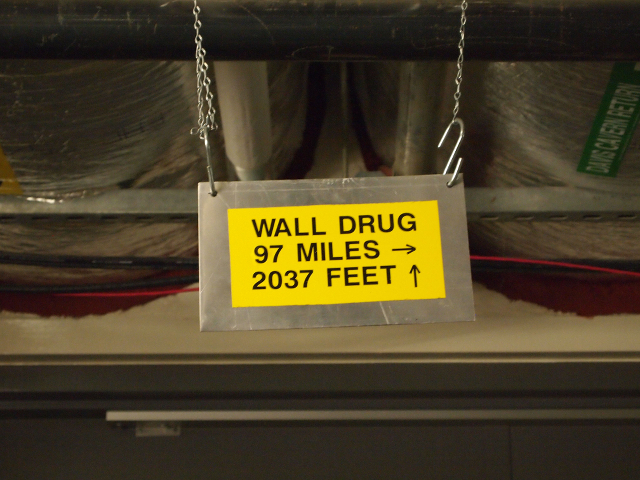
A mile below ground, a sign hangs over the door to the LUX dark matter experiment telling visitors how far to Wall Drug—in both dimensions.

Matthew R. Francis

One of the quietest, darkest places in the cosmos isn’t out in the depths of space. It’s at the center of a tank of cold liquid xenon in a gold mine deep under the Black Hills of South Dakota. It needs to be that quiet: any stray particles could confuse the detectors lining the outside of the tank. Those detectors are looking for faint, rare signals, ones that could reveal the presence of dark matter.

The whole assembly—the container of liquid and gaseous xenon, the water tank enveloping that, and all the detectors—is called the Large Underground Xenon (LUX) dark matter experiment. So far, LUX hasn’t found anything, but the days of its operation are just beginning: the detector was installed and started operations just last year.

Though still relatively young, LUX has already set many standards for hunting for dark matter particles. When I visited, the facility was gearing up for the next data collection run, one that will involve 300 days of constant operation. The size and sensitivity of the experiment, its designers’ dedication to understanding any noise sources, and the relative simplicity of the detector lead many to hope that if there’s any dark matter to be found, LUX—or its successor—will find it.

(I’ll use “detector” to describe LUX as a whole in addition to the individual photon detectors that are the business-end of the experiment. I hope the context will make it clear which is which.)

That last "if" is a big one, of course. Dark matter is remarkable for its invisibility—it neither absorbs nor emits light of any wavelength. We know about it through its gravitational action, the way it shaped galaxies, organized the largest objects in the Universe, and affected the spectrum of light from the early days of the cosmos. Based on the structure of galaxies, astronomers suspect it is made of particles. But how massive those particles are, how many types might exist, and how they interact are still matters of some conjecture.

The LUX experiment is inside a metal tank containing 71,600 gallons of pure water, so the xenon detector isn't visible. The head at lower left is LUX researcher Rick Gaitskell.

Matthew R. Francis

If, for example, dark matter doesn’t interact with ordinary matter on any scale our experimental cleverness can currently reach, LUX will turn up nothing, no matter how sophisticated the experiment is.

Rick Gaitskell, one of the principle researchers on LUX, is a professor at Brown University in the United States. (He was born and educated in England, a heritage that came through in his sartorial choice of green flannel three-piece suit with bright red socks.) He told Ars, “I’ve been looking for dark matter for 27 years. We’ve had a number of results over the years where we’ve either ended up seeing nothing or one or two cases we’ve seen something that looked actually rather exciting, in that it showed initially many of the features you might associate with a dark matter interaction.” However, none of those have been confirmed by later experiments—and most now have mundane explanations.

This past frustration is part of what drives Gaitskell. He quit another experiment when he concluded it was likely never to succeed: the detection rate, based on calculations, would likely be less than one dark matter particle per century for each kilogram of detector material. For most detector materials, that implies a prohibitively high cost. If you want to find dark matter on the scale of a year or two, you’d need a detector with masses of several metric tons. But mass is where LUX and its siblings—such as the XENON100 experiment at Gran Sasso in Italy—excel. Using xenon as the detection medium has many advantages, including the ability to build large.

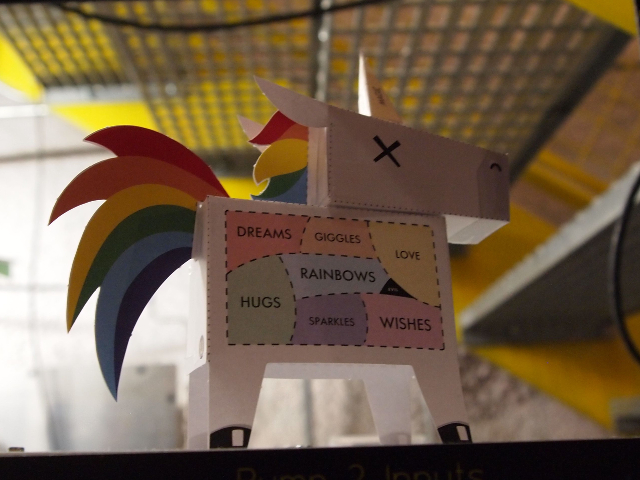
The lab housing LUX has many small paper unicorns sitting on top of server racks and other equipment.

Matthew R. Francis

To understand how LUX hunts dark matter, I decided to visit the lab and see for myself. It's not exactly in a location that makes you think of physics.

I arrived in South Dakota during the dying throes of winter; at the end of March, the Black Hills were still snow-covered, but the warmer air carried tantalizing hints of spring. Thankfully, the flights fell between late-season snowfalls, though it snowed enough to cover my rental car during my day underground at LUX. The Black Hills are mountains in miniature, steep rocky peaks topping out lower than the foothills of the grander front range of the Rockies or the Tetons. Nevertheless, they are mountains with all that entails: sudden snowstorms, gates that can close off the roads in the case of severe weather, and “falling rocks” signs everywhere.

LUX is part of the Sanford Underground Research Facility (SURF), housed at the now-defunct Homestake gold mine in the town of Lead. (The irony of a gold mine in Lead vanished quickly. The name is pronounced “leed," not like the metal.) The whole region cashes in on its Wild West past, especially the adjacent town of Deadwood. Every hotel and gas station has slot machines, and innumerable billboards advertise big payouts at the casinos. South Dakota in general has unrestrictive laws about billboards, as anyone crossing the state by car knows. There are signs for Wall Drug, Mount Rushmore, and various other tourist destinations that nearly dwarf the attractions themselves. Continuing this trend, the lab has its own Wall Drug sign, showing the distance to be 97 miles away horizontally, plus 2037 feet vertically.

By advertising standards, Sanford and LUX are relatively low key. The lab generally isn’t open to the public. To get to it, I had to drive through a residential neighborhood up steep (and at that time of year) snow-packed streets. Because access to the underground portion of the lab requires running the mining elevators—known as “cages”—I had to report at 6am for safety training. Even with jet-lag more or less in my favor, that was still rather early to be functional, though I had it better than the BBC film crew that flew in from the UK.

The safety briefing consisted largely of a video letting us know what we should do if we needed to evacuate the lab. We signed a waiver. We even had to affirm that we would make “intelligent choices,” a seemingly futile thing to ask a bunch of journalists with no mining experience among them. Finally, before descending, we had to don rubber steel-toed boots, coveralls, safety goggles, hard hats with lanterns, and a special emergency breathing apparatus clipped to a heavy utility belt. We made for a sexy-looking crew by the end of the process.

The cages themselves are large enough for about 15 people, with tracks in the floor for the mining carts. They have no built-in lights, so during the 10-minute descent, many of the crew turned on their hard-hat lanterns. (This is not a trip for those with claustrophobia.) Even the motors raising and lowering the cages are vintage: they were built in 1939, and the cable spools are cast iron. The gauges showing the position of the elevators are huge disks with pointers, another delightfully analog touch.

Gaitskell brought an adapted airplane altimeter into our cage to show in real time how far we were descending. Since the top of the mine is roughly a mile above sea-level and the lab is about a mile below ground, we nearly reached the elevation of my home city of Richmond, Virginia. My ears certainly registered the change in air pressure.

However rustic the approach, the lab itself is a typical, sleek modern facility: all shiny pipes, metal stairways, and tile floors. The typical accoutrements of office life abound. There are computers, white boards, water coolers, and (that most necessary piece of lab equipment) espresso machines all underground. University College London PhD student Sally Shaw told me “You kind of forget you’re underground down there.” Additionally, the researchers have adorned the lab with personal touches. A warning sign admonishes visitors to not feed the scientists, and when I looked around, I spotted a few paper unicorns sitting on various shelves. Shaw said the unicorns probably started as a late-night boredom project, but they grew into an inside joke. After all, hunting for dark matter is like looking for unicorns.

09 Jul 10:40

Church Releases Essay on Origins and Translation of The Book of Abraham

by Adam Williams

Over the last several years, the book of Abraham has come come under fire by critics of The Church of Jesus

09 Jul 10:38

Samsung Gear Live torn down, found hiding a WiFi chip

by Dima Aryeh

Android Wear smartwatches, like most other smartwatches, connect to your smartphone to get any data. This tethering allows the wearable to use your data connection. However, when during a teardown of the Samsung Gear Live, something strange was found: a WiFi chip.

Left unused, this WiFi chip sits alongside the Snapdragon 400 processor and may hint to another product Samsung has yet to release. It’s been rumored that Samsung has a cellular-enabled watch planned that won’t need a smartphone for a data connection, but there is no official news yet. Maybe it’ll use the same hardware as the Gear Live whenever it’s released.

For now, the Gear Live’s WiFi chip remains dormant. Maybe some developers might think of a good use for it in a custom ROM; we’ll just have to wait and see. But it’s interesting that Samsung managed to fit a WiFi chip into a device where space is at a premium. What do you think it could be used for? Leave a comment!

09 Jul 10:38

Robots Gone Wild

by Jason Kottke

Rejection

I've had this page of misbehaving robot animated GIFs up in a tab for a few days now and every time it pops up on my screen, I watch all of them and then I laugh. That's it. Instant fun. The garbage truck is my favorite, but what gets me laughing the most is how exuberantly the ketchup squirting robot sprays its payload onto that hamburger bun.

Tags: robots
09 Jul 10:38

Earth's Magnetic Field Is Weakening 10 Times Faster Now

Changes measured by the Swarm satellite over the past 6 months shows that Earth's magnetic field is weakening
Changes measured by the Swarm satellite over the past 6 months shows that Earth's magnetic field is changing. Shades of red show areas where it is strengthening, and shades of blue show areas that are weakening.
Credit: ESA/DTU

Earth's magnetic field, which protects the planet from huge blasts of deadly solar radiation, has been weakening over the past six months, according to data collected by a European Space Agency (ESA) satellite array called Swarm.

The biggest weak spots in the magnetic field — which extends 370,000 miles (600,000 kilometers) above the planet's surface — have sprung up over the Western Hemisphere, while the field has strengthened over areas like the southern Indian Ocean, according to the magnetometers onboard the Swarm satellites — three separate satellites floating in tandem.

The scientists who conducted the study are still unsure why the magnetic field is weakening, but one likely reason is that Earth's magnetic poles are getting ready to flip, said Rune Floberghagen, the ESA's Swarm mission manager. In fact, the data suggest magnetic north is moving toward Siberia.

"Such a flip is not instantaneous, but would take many hundred if not a few thousand years," Floberghagen told Live Science. "They have happened many times in the past."[50 Amazing Facts About Planet Earth]

Scientists already know that magnetic north shifts. Once every few hundred thousand years the magnetic poles flip so that a compass would point south instead of north. While changes in magnetic field strength are part of this normal flipping cycle, data from Swarm have shown the field is starting to weaken faster than in the past. Previously, researchers estimated the field was weakening about 5 percent per century, but the new data revealed the field is actually weakening at 5 percent per decade, or 10 times faster than thought. As such, rather than the full flip occurring in about 2,000 years, as was predicted, the new data suggest it could happen sooner.

Floberghagen hopes that more data from Swarm will shed light on why the field is weakening faster now.

Still, there is no evidence that a weakened magnetic field would result in a doomsday for Earth. During past polarity flips there were no mass extinctions or evidence of radiation damage. Researchers think power grids and communication systems would be most at risk.

Earth's magnetic field acts like a giant invisible bubble that shields the planet from the dangerous cosmic radiation spewing from the sun in the form of solar winds. The field exists because Earth has a giant ball of iron at its core surrounded by an outer layer of molten metal. Changes in the core's temperature and Earth's rotation boil and swirl the liquid metal around in the outer core, creating magnetic field lines.

The movement of the molten metal is why some areas of the magnetic field strengthen while others weaken, Florberghagen said. When the boiling in one area of the outer core slows down, fewer currents of charged particles are released, and the magnetic field over the surface weakens.

"The flow of the liquid outer core almost pulls the magnetic field around with it," Floberghagen said. "So, a field weakening over the American continent would mean that the flow in the outer core below America is slowing down."

The Swarm satellites not only pick up signals coming from the Earth's magnetic field, but also from its core, mantle, crust and oceans. Scientists at the ESA hope to use the data to make navigation systems that rely on the magnetic field, such as aircraft instruments, more accurate, improve earthquake predictions and pinpoint areas below the planet's surface that are rich in natural resources. Scientists think fluctuations in the magnetic field could help identify where continental plates are shifting and help predict earthquakes.

These first results from Swarm were presented at the Third Swarm Science Meeting in Denmark on June 19.

Follow Kelly Dickerson on Twitter. Follow us @livescience, Facebook & Google+. Original article on Live Science.

08 Jul 19:35

Charge up your Androids, TSA now blocking uncharged devices on some international flights

by Nick Sarafolean
Dan Jones

Seems about right. I've been in a few courthouses recently and they always made me do this at security.

We all know the frustration of waiting for a flight. Fortunately, our phones can make that wait a bit more bearable. But before you depend on airport charging ports for your next international flight, you’d better bring your device to the airport fully juiced up. The TSA has announced that it’ll be banning uncharged mobile devices on some international flights. This canvasses not just phones, but tablets and laptops as well.

As well as going through the usual security rigmarole, travelers will now need to power on their device to prove to the TSA official that it’s actually a phone. The move will be taking place in undisclosed airports in Europe, Africa, and the Middle East. This new measure is reportedly aimed at preventing an al Qaeda terror plot to blow up a plane. Along with phones getting an extra check, shoes will also be looked at more closely.

The move may cause some inconvenience, but it’s a good safety feature in the midst of a terror scare. Sound off in the comments with your thoughts on this latest move by the TSA.

08 Jul 19:13

samlicker87: This is still my favorite comic ever


samlicker87:

This is still my favorite comic ever

08 Jul 18:06

Geeky Workouts

Geeky Workouts


Our resident Geek Girl Gillykins was looking to spice up her summer workouts in true Geek Girls fashion...

"Want to geek out during your workout? Try out some of Neila Rey?s geek themed workouts based on some beloved characters, games and series. Personally I'll be doing the Wonder Woman workout decked out in my WW shirt so I can be a true Amazon!"

Geeky Workouts

Geeky Workouts

Geeky Workouts

Geeky Workouts

Geeky Workouts

Geeky Workouts

Geeky Workouts

Geeky Workouts

By: Neila Rey - Source

Follow us on:
 

July 07 2014
08 Jul 18:06

07.08.2014

Cyanide and Happiness, a daily webcomic
Copy this into your blog, website, etc.
<a href="http://explosm.net/comics/3613/"><img alt="Cyanide and Happiness, a daily webcomic" src="http://www.flashasylum.com/db/files/Comics/Rob/smoke.png" border=0></a><br />Cyanide & Happiness @ <a href="http://explosm.net">Explosm.net</a>
...or into a forum
[URL="http://explosm.net/comics/3613/"]
[IMG]http://www.flashasylum.com/db/files/Comics/Rob/smoke.png[/IMG][/URL]
Cyanide & Happiness @ [URL="http://explosm.net/"]Explosm.net[/URL]
<—- Share this comic!

08 Jul 18:06

Why Facebook Is Beating The FBI At Facial Recognition

(Images from Facebook's DeepFace scan)

If you're worried about Big Brother and computerized facial recognition, this summer has given you plenty of reason to be scared. Law enforcement has been toying with facial recognition for a while, but the FBI is getting set to deploy its own system, called Next Generation Identification (NGI for short), planned to be fully operational this summer. NGI will bring together millions of photos in a central federal database, reaching all 50 states by the end of the year. After years of relative anonymity, it's easy to think 2014 is the year that law enforcement will finally know you by face.

The FBI's new system isn't very good

But here's an inconvenient fact about the FBI's shiny new system: it isn't very good. Thanks to extensive work by the Electronic Frontier Foundation, we actually know quite a bit about NGI, and the numbers suggest it isn't very good at recognizing faces. Given a suspect's face, NGI returns a ranked list of 50 possibilities, and only promises an 85 percent chance of returning the suspect's name in the list. To put it another way, even when you give NGI 50 guesses, it still lets one in seven suspects off the hook.

Compare that to Facebook's DeepFace system, presented at the IEEE Computer Vision conference earlier this month, and it looks even worse. Give Facebook two pictures, and it can tell you with 97 percent accuracy whether they're the same person, roughly the same accuracy as a human being in the same spot. To be fair, Facebook has a whole network's worth of data on its side, so it ends up comparing each face to a smaller number of possibilities. It isn’t an exact comparison, but the overall impression is hard to deny: the nation's most powerful law enforcement agency is getting outgunned by a social network.

"The difference between a human brain and a computer brain is huge."

While there are plenty of contractors who are willing to promise "near-human" recognition capabilities, real facial recognition is much harder than the industry lets on. "It's a huge lie that commercial companies that provide facial recognition tell," says Shahar Belkin, CTO of FST Biometrics. "The difference between a human brain and a computer brain is huge." FST's facial recognition systems work with tenants in apartment buildings, cooperative subjects who are happy to look straight into the camera for a match, a much simpler task than what the FBI is proposing. The company also adds other layers of verification like height and gait-tracking to weed out false positives.

The FBI system doesn't have either of those advantages. It's expecting faces to work like fingerprints, where a single unintentional print provides a positive ID that's strong enough to hold up in court. But while a human witness can easily identify a face, automated systems still have a lot of trouble keeping up. "What will kill these systems is the false-accept rate," Belkin says. "I don't believe we'll see a solution for that in the next five to ten years."

"What will kill these systems is the false-accept rate."

It's particularly bad because of the quality of the pictures the FBI is using. Belkin says facial recognition systems typically need to photograph your face straight-on, no more than 15 degrees off the center axis. That works great for mugshots or systems like FST's, where people are intentionally giving a faceprint. But for more intrusive uses like spotting criminal faces through public cameras, it's a much bigger problem. Surveillance cameras are typically mounted on ceilings or streetlights, so by the time a suspect comes close enough for a faceprint, the angle is often so bad that recognition techniques won't work. Modern-day camera systems aren't built to work with facial recognition, and it's not even clear how you might fix them.

Facebook's help could be just a court order away

Facebook can skirt around that problem because it already knows who your friends are and who's likely to show up in your pictures. It also has many more pictures to work with, hosting 250 billion photos to the FBI's 50 million. That gives Facebook’s engineers more chances to find a good picture, and more data to generalize from. Facebook also has more freedom to make mistakes, since a false tag carries much less weight than a mistaken police ID. Facial recognition ends up as a great tool for automatic photo-tagging, but almost useless if you're trying to ID a suspect.

That sounds like good news for privacy advocates — and it is — but it's nothing to get too comfortable about. The FBI can still build a face-tracking system that works. It just needs more photos, more names, and a smarter network to organize it all: in short, it needs Facebook's help, which could be just a court order away. Facebook is currently in a brutal legal fight with the Manhattan district attorney over how broadly prosecutors can collect user data. If Facebook loses the fight, prosecutors and law enforcement agencies might have enough data to bring their system up to date, singling out faces and building lists of known associates through automatically tagged photos. The end result could look an awful lot like the face-trackers we were warned about.

The FBI may be losing with cameras and computers, but it could still win in the courts.

It's like any race for cutting-edge technology, whether on Macs and PCs or Android and iOS. Getting there first is nice, but it doesn’t guarantee you a monopoly. If Facebook can make facial recognition work, the FBI will figure out a way to make it work too, either by pulling each suspect's data or reverse-engineering the process from the ground up. The biggest question is how far into Facebook's system the government can reach, and it's a question that's still being decided. That means that after decades of testing, the technical aspects of face-tracking may finally have taken a back seat. The FBI may be losing with cameras and computers, but it could still win in the courts.

08 Jul 18:06

Some countries are born great, some achieve greatness, but all have greatness thrust into their national anthem

archive - contact - sexy exciting merchandise - search - about
← previous July 8th, 2014 next

July 8th, 2014: La Marseillaise, ladies and gentlemen!

I actually don't know what the anthem of the Klingon Empire is :( :( D:

– Ryan

08 Jul 18:06

40,000 devices stolen by bandits at Samsung factory in Brazil

by Nick Sarafolean

The latest Samsung loss sounds like something straight out of an action thriller. An estimated 20 armed bandits performed an epic heist from a Samsung factory in Campinas, Brazil. According to police, the men carjacked a factory shuttle carrying eight employees to work. Six of the employees were taken to a different area and released, while other assailants took two of the employees to the factory, where they disarmed security guards and rounded up all of the employees.

Using stolen employee ID cards, the bandits opened up the factory to allow 13 more robbers to enter with getaway trucks. Over the next three hours, they managed to load up over 40,000 Samsung devices including smartphones, tablets and laptops. Police valued the haul at $36 million, but Samsung says it was much lower and closer to six or seven million. Still, that’s a serious robbery.

As of now, none of the thieves have been caught. Though police have said that with a break-in of this scale, it’s probable that there was insider help. Fortunately, nobody was hurt in the incident and Samsung is working with authorities to both catch the thieves and prevent future incidents from occurring.

08 Jul 15:59

Pearls Before Swine: Tuesday, July 08, 2014

Pearls Before Swine
08 Jul 15:41

We go forward. image twitter | facebook


We go forward.

image

twitter | facebook

08 Jul 14:08

Every Anime Fight Ever Comic

Every Anime Fight Ever Comic


LOL! IISuperSlothII made this comic pretty much summing up every anime fight ever... ;)

Every Anime Fight Ever Comic

Artist: IISuperSlothII - Source

Follow us on:
 

July 06 2014
08 Jul 01:08

FreedomPop Nationwide Hotspot Overdrive Free Internet Offer

by Sean Riley
Dan Jones

Interesting. Maybe useful for my wifi-only Shield

FreedomPop is back with yet another Free Wireless Internet deal for our readers, this time they are featuring their Nationwide Hotspot Overdrive with a couple extras that could save you up to 80% off retail. If you’ve missed our previous deals with FreedomPop here’s a brief rundown on who they are and what they have to offer.

FreedomPop, the company behind ’100% Free Internet’, was founded a little over two years ago, backed by Skype co-founder Niklas Zennstrom with the idea that “The Internet is a Right, and not a Privilege”. Since then, they’ve added coverage with Sprint’s nationwide 3G and 4G LTE, and most recently brought on Android phones featuring Free Talk, Text, and Data. Deal hunter sites have featured the small carrier as a great way to save money every month on mobile data plans and providing features that the larger carriers just can’t replicate.

FreedomPop’s free tier offers customers 500MB of 4G data each month without a monthly fee or contract with speeds up to 6 Mbps down and 1-2 up. Need more data? You can earn it by adding Freedom Friends, downloading apps, signing up for other services and more. You can also just pay to upgrade to a 2GB plan for $19.99 a month. Another add-on that is worth considering is rollover data. For $3.99 a month you can bank up to 20GB of data, so if you are a heavy data user that could prove worth the cost.

You’ll also be able to enjoy a free trial of premium 2GB nationwide data. Do nothing and stay on this plan or choose to downgrade to our 4G only free plan through your account page. We also have a 4G/3G 500MB plan for only $3.99/ month that you can select to help keep you connected whenever you need it.

Something to note on all of the FreedomPop plans is that once you get within 100MB of your data limit for the month it will automatically “top-up” with 1GB of data for $10 unless you turn that setting off. That isn’t a bad price by any means, the $10 is added as credit to your account and never expires.

Now obviously you need to consider the services you want and the coverage map, but FreedomPop can offer a huge savings. Verizon’s prepaid hotspot starts at $15 a week for 250MB or $60 a month for 3GB. AT&T’s prepaid option is $50 for 5GB. The only carrier that comes even remotely close is T-Mobile at $20 a month for 500MB or $30 for 2.5GB.

If FreedomPop sounds like it could work for you then this special deal will get you started for next to nothing. Just $25 will get you the refurbished FreedomPop Nationwide Overdrive Hotspot, a travel charger, free shipping and a free trial of the 2GB 4G/3G plan for your first month with FreedomPop. As with all their plans there is no contract making this basically risk free and if you find that you won’t use 2GB in a month you can always drop down to the free 500MB 4G only plan before that first month is up.

08 Jul 01:08

Are You Smart Enough To Get Into Private Kindergarten?

 A sample question from Bright Kids NYC for practicing for the AABL test that some private schools will require. Can you figure out what shape should replace the question mark? Scroll down to take the quiz. A sample question from Bright Kids NYC for practicing for the AABL test that some private schools will require. Can you figure out what shape should replace the question mark? Scroll down to take the quiz. View Full Caption

Bright Kids NYC

CLICK HERE TO SEE IF YOU'RE SMARTER THAN A 4-YEAR-OLD

MANHATTAN — Some of the city's most elite private schools will soon require 4-year-olds to take a new, harder admissions test given on an iPad and designed to assess math and literacy skills.

The educational services company ERB's Admission Assessment for Beginning Learners (AABL) will be given for the first time in October and is a significant departure from the previous, IQ-like test most New York City private schools required for the past 45 years.

While the new test is much cheaper for families — it's $65, rather than $568 for the old test, because the new test is taken by iPad rather than by a trained examiner — experts believe many parents will shell out even more on classes and books to prepare their toddlers for it.

"These are subjects that were not previously tested," said Emily Glickman, president of Abacus Guide Educational Consulting, who advises parents on private school admissions.

"The AABL is supposed to identify a child's ability and achievement," Glickman said. "That achievement part — how much you learned — is totally new. You usually think of an achievement test as something you take in high school. It's not something you think of for preschoolers."

So far, only Horace Mann and Riverdale Country School have announced plans to use the new exam, but experts believe more may follow.

In the past, most private schools used the ERB's IQ test for kindergarten admission. But this year the Independent Schools Admissions Association of Greater New York (ISAAGNY) told schools they were no longer required to use that test and instead could use a different one, make admissions tests optional or ignore them entirely.

The coalition cited concerns that 4-year-olds were over-preparing for the old IQ exam.

Some consultants, though, were perplexed by the shift to the new, more difficult AABL test.

"The AABL is really requiring more from preschoolers. That is in line with what we're seeing in public schools," Glickman said, referring to changes in the Department of Education's gifted and talented admissions test. "We all know that some of the brightest people are late bloomers, yet more and more schools are rewarding the early achievers."

 Bright Kids NYC created a new curriculum aimed at the AABL, founder Bige Doruk said. Bright Kids NYC created a new curriculum aimed at the AABL, founder Bige Doruk said. View Full Caption

Bright Kids NYC

To prepare kids for the AABL, parents should work with their youngsters on basic early literacy and math skills, said Karen Quinn, best-selling author of "Testing for Kindergarten" and co-founder of online test prep service TestingMom.com.

"We’re looking at things like knowing letters, numbers and shapes, knowing letter sounds, recognizing rhymes, counting, adding, subtracting and more," she said.

The ERB's IQ test was more subjective, especially on the verbal section, in which the examiner could award partial credit, said Bige Doruk, founder of test prep company Bright Kids NYC.

"For example, if the question stated 'What is a mouse?' and the kid answered 'animal,' he or she would get 1 point. If the kid said 'a gray animal that is small, has a tail and likes to eat cheese,' the kid would get the full 2 points," Doruk explained.

If a child just said "animal," the tester would reply, "Tell me more," giving the child another chance to earn the full 2 points, Doruk said.

In addition to a numerical grade, the old test also included a written narrative from the examiner describing the child's behavior during the test, such as whether the toddler seemed to be focused or easy to work with. 

It's unlikely that the AABL will include a report on the child, because the child will take the test independently on an iPad, Doruk said. 

"It favors those with more reading skills and who've gone to more academic preschools," said Doruk, whose company began offering one-on-one tutoring, ranging from $140 to $200 a session, for the AABL about a month ago.

Horace Mann and Riverdale declined to comment on their choice to use the new test, but Horace Mann explained its rationale on its website.

"While the score report is only one element of a child’s application," the school said, "it is the only piece of the application that is consistent and objective for our applicants, who come from many schools and many different backgrounds and include children who do not come to us from formalized preschool settings."

In the past, many parents would sign their kids up to take the test in the spring and summer before applying to schools. Registration for the AABL, however, doesn't open until Sept. 15, and testing starts Oct. 15, according to the exam's website.

Some consultants raised concerns about the use of an iPad test, saying toddlers shouldn't spend so much time in front of a screen. But Doruk said her company has been using iPads in tutoring sessions for the past two years.

"Kids know how to use the iPad. They like the iPad. It's more engaging to them. It looks like a game," Doruk said. "But they still have to answer the questions correctly."

Start the quiz below:

07 Jul 01:17

Black People Were Denied Vanilla Ice Cream In The Jim Crow South — Except On Independence Day

06 Jul 21:59

Google to Shut Down Orkut

by Alex Chitu
Dan Jones

Orkut is still a thing?

It's not surprising that Google will soon shut down its first social network, Orkut. It used to be popular in India and Brazil, but it's no longer used by many people.


"Ten years ago, Orkut was Google's first foray into social networking. Built as a '20 percent' project, Orkut communities started conversations, and forged connections, that had never existed before. Over the past decade, YouTube, Blogger and Google+ have taken off, with communities springing up in every corner of the world. Because the growth of these communities has outpaced Orkut's growth, we've decided to bid Orkut farewell," informs Orkut's blog.

Google will shut down Orkut on September 30, 2014. Users will be able to export data using Google Takeout until September 2016.

Google will preserve an archive of orkut's online communities, which will be available online after Orkut shuts down. If you don't want your posts to be included in the archive, you can delete them or remove Orkut from your Google account.

This Google Trends chart illustrates the rise and fall of Orkut:


{ Thanks, Luiz Fernando. }
06 Jul 21:57

Apple Crisp Fries

by Food Done Light
Apple Crisp Fries

Ingredients:
4 apples, peeled, cored
1/3 cup quick cooking Oatmeal
2 1/2 tbsp. walnuts
1/3 cup Whole wheat flour
2 1/2 tbsp. Sugar
1 1/4 tsp. ground Cinnamon
Pinch of nutmeg
Pinch salt
1/4 cup light butter, melted
1/4 cup fat-free cream cheese, softened
1/2 tsp. vanilla extract
1 cup lite cool whip

View recipe and add to recipe box at ZipList...
View full recipe at Food Done Light...
View more trending recipes...
06 Jul 21:57

Scientists Discover The Brain's On-Off Switch

ONE moment you're conscious, the next you're not. For the first time, researchers have switched off consciousness by electrically stimulating a single brain area.

Scientists have been probing individual regions of the brain for over a century, exploring their function by zapping them with electricity and temporarily putting them out of action. Despite this, they have never been able to turn off consciousness – until now.

Although only tested in one person, the discovery suggests that a single area – the claustrum – might be integral to combining disparate brain activity into a seamless package of thoughts, sensations and emotions. It takes us a step closer to answering a problem that has confounded scientists and philosophers for millennia – namely how our conscious awareness arises.

Many theories abound but most agree that consciousness has to involve the integration of activity from several brain networks, allowing us to perceive our surroundings as one single unifying experience rather than isolated sensory perceptions.

One proponent of this idea was Francis Crick, a pioneering neuroscientist who earlier in his career had identified the structure of DNA. Just days before he died in July 2004, Crick was working on a paper that suggested our consciousness needs something akin to an orchestra conductor to bind all of our different external and internal perceptions together.

With his colleague Christof Koch, at the Allen Institute for Brain Science in Seattle, he hypothesised that this conductor would need to rapidly integrate information across distinct regions of the brain and bind together information arriving at different times. For example, information about the smell and colour of a rose, its name, and a memory of its relevance, can be bound into one conscious experience of being handed a rose on Valentine's day.

The pair suggested that the claustrum – a thin, sheet-like structure that lies hidden deep inside the brain – is perfectly suited to this job (Philosophical Transactions of The Royal Society B, doi.org/djjw5m).

It now looks as if Crick and Koch were on to something. In a study published last week, Mohamad Koubeissi at the George Washington University in Washington DC and his colleagues describe how they managed to switch a woman's consciousness off and on by stimulating her claustrum. The woman has epilepsy so the team were using deep brain electrodes to record signals from different brain regions to work out where her seizures originate. One electrode was positioned next to the claustrum, an area that had never been stimulated before.

When the team zapped the area with high frequency electrical impulses, the woman lost consciousness. She stopped reading and stared blankly into space, she didn't respond to auditory or visual commands and her breathing slowed. As soon as the stimulation stopped, she immediately regained consciousness with no memory of the event. The same thing happened every time the area was stimulated during two days of experiments (Epilepsy and Behavior, doi.org/tgn).

To confirm that they were affecting the woman's consciousness rather than just her ability to speak or move, the team asked her to repeat the word "house" or snap her fingers before the stimulation began. If the stimulation was disrupting a brain region responsible for movement or language she would have stopped moving or talking almost immediately. Instead, she gradually spoke more quietly or moved less and less until she drifted into unconsciousness. Since there was no sign of epileptic brain activity during or after the stimulation, the team is sure that it wasn't a side effect of a seizure.

Koubeissi thinks that the results do indeed suggest that the claustrum plays a vital role in triggering conscious experience. "I would liken it to a car," he says. "A car on the road has many parts that facilitate its movement – the gas, the transmission, the engine – but there's only one spot where you turn the key and it all switches on and works together. So while consciousness is a complicated process created via many structures and networks – we may have found the key."

Awake but unconscious

Counter-intuitively, Koubeissi's team found that the woman's loss of consciousness was associated with increased synchrony of electrical activity, or brainwaves, in the frontal and parietal regions of the brain that participate in conscious awareness. Although different areas of the brain are thought to synchronise activity to bind different aspects of an experience together, too much synchronisation seems to be bad. The brain can't distinguish one aspect from another, stopping a cohesive experience emerging.

Since similar brainwaves occur during an epileptic seizure, Koubeissi's team now plans to investigate whether lower frequency stimulation of the claustrum could jolt them back to normal. It may even be worth trying for people in a minimally conscious state, he says. "Perhaps we could try to stimulate this region in an attempt to push them out of this state."

Anil Seth, who studies consciousness at the University of Sussex, UK, warns that we have to be cautious when interpreting behaviour from a single case study. The woman was missing part of her hippocampus, which was removed to treat her epilepsy, so she doesn't represent a "normal" brain, he says.

However, he points out that the interesting thing about this study is that the person was still awake. "Normally when we look at conscious states we are looking at awake versus sleep, or coma versus vegetative state, or

"Francis would have been pleased as punch," says Koch, who was told by Crick's wife that on his deathbed, Crick was hallucinating an argument with Koch about the claustrum and its connection to consciousness.

"Ultimately, if we know how consciousness is created and which parts of the brain are involved then we can understand who has it and who doesn't," says Koch. "Do robots have it? Do fetuses? Does a cat or dog or worm? This study is incredibly intriguing but it is one brick in a large edifice of consciousness that we're trying to build."

This article appeared in print under the headline "Consciousness – we hit its sweet spot"

Issue 2976 of New Scientist magazine
  • Subscribe to New Scientist and you'll get:
  • New Scientist magazine delivered every week
  • Unlimited access to all New Scientist online content -
    a benefit only available to subscribers
  • Great savings from the normal price
  • Subscribe now!

If you would like to reuse any content from New Scientist, either in print or online, please contact the syndication department first for permission. New Scientist does not own rights to photos, but there are a variety of licensing options available for use of articles and graphics we own the copyright to.

06 Jul 21:57

Google Employee Says Google Employees Are Too Isolated From The Real World

A Google employee has written a post about what it's like working at the company. 

At his blog, Apenwarr, Google Fiber engineer Avery Pennarun is largely complimentary of Google and its employees: "I continue to be amazed at the overall smartness of people at this place. Overall, very nearly everybody, across the board, surprises or impresses me with how smart they are."

However, Pennarun says, "Smart people have a problem, especially (although not only) when you put them in large groups. That problem is an ability to convincingly rationalize nearly anything."

Because smart people, especially computer-oriented smart people, tend to be logic oriented, they always find a rationale to support any conclusion. They also tend to avoid the chaotic, random, messy reality of the world where results don't fit neatly into logically rational outcomes, says Pennarun.

This leads to misguided beliefs later in life. At Google, for instance, projects can be easily rationalized:

Working at a large, successful company lets you keep your isolation. If you choose, you can just ignore all the inconvenient facts about the world. You can make decisions based on whatever input you choose. The success or failure of your project in the market is not really that important; what's important is whether it gets canceled or not, a decision which is at the whim of your boss's boss's boss's boss, who, as your only link to the unpleasantly unpredictable outside world, seems to choose projects quasi-randomly, and certainly without regard to the quality of your contribution.

It's a setup that makes it very easy to describe all your successes (project not canceled) in terms of your team's greatness, and all your failures (project canceled) in terms of other people's capriciousness. End users and profitability, for example, rarely enter into it. This project isn't supposed to be profitable; we benefit whenever people spend more time online. This project doesn't need to be profitable; we can use it to get more user data. Users are unhappy, but that's just because they're change averse. And so on.

As a result, Pennarum says people at Google are cursed with overconfidence. Because they've been so successful in life, they believe everything they do is successful and deserves a positive outcome. 

In fact, he says, "one of the biggest social problems currently reported at work is lack of confidence, also known as Impostor Syndrome." The Impostor Syndrome hits people who aren't quite as convinced that everything in the world is logical and therefore have a harder time rationalizing. 

Pennarun says these people are valuable. "Impostor Syndrome is that voice inside you saying that not everything is as it seems, and it could all be lost in a moment. The people with the problem are the people who can't hear that voice."

Read the whole thing here.

Via: Daring Fireball

06 Jul 20:25

Why People Keep Dying In China Because Of The World Cup

Dan Jones

What is wrong with that country?

A Chinese soccer fan watches the opening match of the 2014 World Cup between Brazil and Croatia at a bar in Beijing AP Photo/Ng Han Guan

On the afternoon of Tuesday, June 17 in China’s Liaoning province, a 22-year-old woman unnamed by the media was arguing with her boyfriend about the World Cup. He wanted to go out all night and watch it; she didn’t want him to.

The same argument has been played out between couples all over China as the country has become engulfed in World Cup fever, despite China not qualifying for it. In Xiangyang a group of women sported skimpy shorts and football bras for photographers as a jokey “protest” about being ignored by their boyfriends. In stark contrast, the Liaoning province woman jumped off a nine-story building, killing herself.

The following Monday in the southern city of Guangzhou a student, surname Lin, jumped from the seventh floor of a building after a panicky phone call about World Cup bets. He had lost around 20,000 Yuan (£1,900) and couldn’t pay it off. Then on June 27 a 32-year-old woman in Hainan province, surname Wang, committed suicide using charcoal fumes after losing bets totaling more than 200,000 Yuan (£18,800).

Xiao Cai, a 21-year-old female student from Wuxi, Jiangsu province faked her own kidnapping and tried to get ransom money from her parents to pay off football betting debts, attempting to convince them that she’d be sold into the sex trade if they refused to pay 20,000 Yuan (£1,880). She fled to Shanghai, where police found her watching a World Cup match.

Over 150 million Yuan (£14 million) was placed on bets in China on June 12, the opening day of the tournament, according to the National Sports Lottery Center. The figure is three times the amount reported for the 2010 World Cup.

In Hong Kong, three World Cup gambling-related suicides were reported. 24-year-old Lee Chi-ho, who had accrued huge debts, died after jumping from a building the day after Lin’s death. The previous day, 48-year-old wine trading company worker Yu Chi-hung was found dead next to pills and a bottle of wine. Chef Lau Ka-lun, 30, killed himself with charcoal fumes the previous Thursday. Both had incurred similar debts.

Chinese football fans pose with a banner before the game between Colombia and Uruguay of 2014 FIFA World Cup at Maracana stadium in Rio de Janeiro WANG YUGUO/Xinhua /Landov

While cases of suicide suggest underlying mental health problems, medical experts in China have still pointed to the World Cup as a trigger that is causing deaths that would otherwise have been avoided.

“During the World Cup many people find that their mental disorders return because of emotional swings,” Zuo Jing, doctor at the Hunan Province Brain Hospital in the city of Changsha, told BuzzFeed. “China has not done enough in the field of mental illness – this is a weak link in public health management. Many Chinese do not see anxiety or depression as a big deal and ignore them. They never see a doctor, then the World Cup triggers these problems and we see them break out on a large scale.”

Zuo added that he’d observed mental health problems with many patients who gambled on the tournament. “Many who made large bets suffer from emotional swings which lead to recurrences of illnesses and fights. Many come to us for counselling.”

Recent World Cup-triggered deaths in China have not been limited to those attributed to mental issues. With group stage matches kicking off at midnight, 3am and 6am fans have been forfeiting sleep to watch them. With many Chinese having no experience of binge-viewing to this extent, the experience has resulted in fatal physical ailments for some.

One 39-year-old man from Shanghai, surname Zhou, stayed up for three nights in a row to watch games. He collapsed watching Uruguay Vs Costa Rica, with doctors declaring the cause of death a brain hemorrhage. The previous day a 25-year-old man from Suzhou, Jiangsu province was found dead in front of his TV after watching matches, with doctors citing lack of sleep as the cause. 51-year-old former professional goalkeeper Li Mingqiang, from Dalian in Liaoning province, died whilst watching Holland vs Spain, suffering heart failure.

Doctor Zuo and his colleagues in Hunan were so concerned by the ailments they observed that they opened a “World Cup clinic”, where they treat more than ten people a day. One 29-year-old male patient suffered from serious cerebral infarction – a kind of stroke – whilst one 30 year-old man started hallucinating after an all-night session and jumped out of a second floor window.

“Watching World Cup games has made illnesses that may have been small previously snowball into serious health concerns,” Zou said.

Han Xiaoning, a doctor at the Peking University First Hospital in Beijing, gave BuzzFeed further insight into the seriousness of the problems Chinese World Cup obsessives were facing. She treated a woman who tried to stay up for every match for coronary spasms.

“I’ve seen patients suffering from acute gland inflammation and myocardial infarction [heart attack],” she said, adding that all her patients suffering from ailments triggered when watching matches have survived. She pointed to a lack of binge-watching experience as a major factor in the amount of deaths and illnesses being reported.

“One of my patients suffers from pancreatitis and he still eats oily meat and drinks beer every day,” she said. “Football fans should be eating something less oily, and not have too much of it.”

One of the starkest results of this approach to match-watching came when a 26-year-old woman, surname Xiaolan, who was two months pregnant stayed up four nights in a row to watch games. When jumping around celebrating Germany striker Thomas Müller’s hat-trick against Portugal she was struck with abdominal pain, was rushed to hospital and suffered a miscarriage.

Feng Jionglin, a 34-year-old investor from Shanghai who also supports Germany, agreed that lack of experience was the root of the general problem. “My principle for the World Cup was: ‘Don’t miss one game’,” he told BuzzFeed. “But I have read about the deaths, so now I miss a few matches. Chinese fans have to disrupt their biological clock to watch games, maybe for the first time – they fall ill because they are not prepared.”

Where there is a trend there is an opportunity to make money, and one company, Zhong An, has been selling World Cup medical and life insurance.

They offer “drinking insurance” that covers against alcohol poisoning, “hooligan insurance” that covers against accidental injury, and “night owl insurance” that covers against sudden death and respiratory infection. “Glutton insurance” covers for gastroenteritis, offers 10,000 yuan in the case of death, and has been bought by 1,743 customers.

Wang Yao, spokesperson for the firm, told BuzzFeed: “Luckily we’ve not had any cases of death among customers. Conventional health insurance does not cover against things like over-drinking – but we’re insuring fans against actual problems we’ve seen people suffer from when watching matches.”

With only the quarter-finals, semi-finals, third place playoff and the final left to play, cases of World Cup-triggered deaths should become less common. Still, many will see it as a blessing that the 2018 tournament will be held in China-bordering Russia, at least promising a less punishing kick off schedule next time round.

06 Jul 00:15

A river runs through it (a coffee table)

by Jason Kottke

These glass and wood tables made by Greg Klassen to resemble rivers and lakes are completely ridiculous and impractical but I love them.

Greg Klassen table

Alas, they don't come cheap. (via colossal)

Tags: Greg Klassen
05 Jul 22:05

In China, 1,600 People Die Every Day From Working Too Hard

Dan Jones

China is freaking crazy

Chinese banking regulator Li Jianhua literally worked himself to death. After 26 years of “always putting the cause of the party and the people” first, his employer said in June, the 48-year-old official died of a heart attack rushing to finish a report before the sun came up. China is facing an epidemic of overwork, to hear the state-controlled press and Chinese social media tell it. About 600,000 people a year die from toiling too hard, according to the China Youth Daily. State-controlled China Radio International puts the toll at 1,600 a day.

Microblogging website Sina Weibo (WB) is filled with complaints about stressed-out lives and chatter about press reports of people working themselves to death: a 24-year-old employee at Ogilvy Public Relations Worldwide, a 25-year-old auditor at PricewaterhouseCoopers, a designer of fighter planes. “What’s the point of working overtime so you can work to death?” asks a Weibo user, noting that his own boss told employees to spend more time on the job.

Angela Pan's Weibo pageWeiboAngela Pan's Weibo page

The state, however, is holding up worked-to-death employees as heroes akin to earlier Communist martyrs such as Lei Feng, a soldier in the People’s Liberation Army who’s been lionized in propaganda campaigns since the 1960s for his selfless devotion to the party. Li’s employer released a statement on June 10 praising him as “a model for party members and cadres of the China Banking Regulatory Commission.” It said that to “learn from Comrade Li Jianhua, one must be like him, always firm in ideals and beliefs, the broader interest, loyal to the cause of the party and the people, unremitting struggle sacrificing everything.”

Because the link between these deaths and work-related stress may not always be clear, the death toll can be subjective and difficult to compile. Death from overwork is as much a cultural phenomenon as a medical one, though the governments of Japan and Taiwan officially recognize cases for insurance compensation. The actual underlying causes of death encompass a wide range of illnesses such as heart attack or stroke that are aggravated by the stress of overtime. In the U.S., people don’t die from overwork, even though the Centers for Disease Control and Prevention say heart disease is the leading cause of death, and studies have linked sitting too long to an early death. Americans work an average of 45 hours a year more than the Japanese, according to the Organisation for Economic Co-operation and Development.

In China, white-collar worries about overwork reflect a tipping point in economic development. The Chinese service sector has eclipsed manufacturing in terms of economic output, while factory workers are taking advantage of their shrinking numbers to negotiate shorter hours and better pay. Office workers are still paid more than factory hands but have few of the protections a union can offer. They have bigger bills to pay for housing and cars. There is also demographic pressure: China’s one-child policy has created a generation of only children supporting aging parents and their own families.

In exchange for starting salaries that are typically double blue-collar pay, office workers put in hours of overtime often in violation of Chinese labor law, according to Geoffrey Crothall, spokesman for the China Labour Bulletin, a Hong Kong-based labor advocacy group. “China is still a rising economy, and people are still buying into that hardworking ethos,” says Jeff Kingston, director of Asian Studies at the Japan campus of Temple University in Tokyo. “They haven’t yet achieved the ‘affluenza’ that led to questioning in Japan of norms and values.”

In Japan, death from overwork is called karoshi. (In China it’s guolaosi.) Karoshi includes deaths from stroke, heart attack, cerebral hemorrhage, or other sudden causes related to the demands of the job. In 2012, the Japanese government compensated 813 families who were able to show a link between overwork, illness, and death, including 93 suicides. The Parliament passed a law on June 20 calling for support centers, aid to businesses for prevention programs, and more research on karoshi.

Work-life balance still gets short shrift in China, a society that combines a modern pursuit of riches with an ancient belief in putting the community above the individual, says Yang Heqing, dean of the School of Labor Economics at the Capital University of Economics and Business. In Beijing’s business district, he’s surveyed hundreds of workers about their lives at home and at the office. Sixty percent of workers complain of clocking more than the legal limit of two hours a day of overtime, which is taking a toll on their families and health, he says. “More than in the Anglo-American corporate system, in Korea, China, and Japan—the countries of the Confucian belt—there’s a belief in total dedication,” says Temple University’s Kingston. “Any job worth doing is worth doing excessively.”

Li ran the division of the China Banking Regulatory Commission (CBRC) that’s overseeing the boom in trust products, investments considered part of an estimated $6.2 trillion shadow banking system that officials have sought to bring under government control. He traveled to 10 provinces in the second half of 2013 and met with all 68 trust companies. Employees in Li’s department regularly worked until midnight or later, according to a colleague who asked not to be identified because he’s not authorized to speak publicly.

Li’s death, categorized as the result of “long-term overwork” by the CBRC, was the latest in a string of cases that have attracted media attention. Angela Pan, a PricewaterhouseCoopers auditor in Shanghai, wrote on her personal blog about working through weekends, needing a vacation, and suffering from fevers, according to the official Xinhua News Agency. A colleague in her Beijing office said employees were given tasks “impossible to finish without overtime.” Pan’s death drew more than 30,000 comments on Weibo from users attributing her death to overwork, Xinhua said. A statement by PricewaterhouseCoopers at the time of her 2011 death said Pan, a first-year associate, had contracted encephalitis and taken sick leave to check into a hospital, where she later died.

Gabriel Li, the Ogilvy employee who worked in the technology department of the agency’s Beijing office, died in May 2013, crying out and keeling over as he stood up from his desk on his first day back from medical leave, according to a report in the Beijing Times. Ogilvy’s Asia-Pacific Chief Executive Officer Scott Kronick declined to comment.

In earlier decades of the Communist Party’s rule, those lucky enough to land office jobs at sprawling state-owned enterprises were guaranteed cradle-to-grave employment, housing, even food and schooling for their children. Two-hour lunches often sweetened the deal. Those perks disappeared as China opened the door to capitalism in the 1980s and inefficient enterprises shed jobs and benefits to compete. Now cubicle jockeys such as Li toil overtime, have long commutes, and regularly dine out with clients.

The death of Luo Yang, called the father of China’s fighter-jet program, prompted questions about the country’s work ethic. He died at 51 of a heart attack on the same day in 2012 that the plane he developed, the J-15, made its first successful landing on an aircraft carrier. “We only know of the sacrifice of Luo Yang, but we don’t know how many other people on his team died of overwork—isn’t it because of such admirable workers that the nation has reached its current status?” wrote a Weibo blogger who goes by Ordinary Yang MS.

Li never discussed his personal problems with colleagues, according to the CBRC. In early April his doctor noticed some unusual symptoms, including excess blood flow to the eye, and suggested he go to the hospital for a checkup; Li “smiled and said he didn’t have any time,” the Chinese Financial News said. He’d been up late at home and “collapsed while working, suddenly dying in the early morning of April 23,” the CBRC statement read. When Li’s wife tried to notify his office about his death, she didn’t know anyone to call despite his years on the job. She had to find someone to pass along the message, says another person at the agency who declined to give his name because he isn’t authorized to speak publicly.

The CBRC didn’t respond to questions about the trust department’s working hours or Li’s death. “At some point,” says Crothall of the China Labour Bulletin, “someone is going to stop and ask the question: ‘Why are we doing this to ourselves?’”

05 Jul 22:03

Update: No One Is Buying Music, Still

Dan Jones

tl;dr Nobody's buying music (except hipsters and their vinyl), but they are paying for streaming music services.

Music sales continued their free-fall during the first six months of 2014, as both albums and digital downloads again showed double-digit losses.

According to Nielsen SoundScan data released Wednesday for the year to date through June 29, total album sales in all formats plunged nearly 15%, with sales of almost 121 million, versus 142 million sold in the first six months of 2013.

To put the steepness of the decline in perspective: Just 18 months ago, Adele’s Grammy-winning “21” – the bestselling album of 2011 and 2012 — finished the latter year with sales in excess of 10 million. It is conceivable that such a phenomenon will not be seen in the industry again.
Digital track sales dropped 13% to 593.6 million, in comparison to 682.2 million moved in the same period last year.

On-demand streaming continued to boom, soaring 42% to almost 70.3 million streams (compared to 49.5 million in the same period last year). However, revenues derived from streaming are a fraction of those derived from physical and digital album sales on a per-unit basis.

Once again, vinyl albums showed a potent gain, up more than 40% to 4 million units (compared to 2.9 million in the first half of 2013), though the format remains a sliver of the industry’s overall business. Jack White’s “Lazaretto,” which was issued in a special holographic LP edition, was the bestselling title at 49,000 units.

In a statement, Nielsen senior vp David Bakula said the lifts in streaming and LP sales “shows interest in buying and consuming music continues to be robust, with two very distinct segments of the industry expanding substantially.”

So far this year, the bestselling album title – and the only one to sell more than a million units – is Disney’s soundtrack for the hit animated picture “Frozen,” which has moved nearly 2.7 million units. Cumulatively, the late-2013 release has sold just over 3 million; it is situated at No. 5 on the top albums chart released Wednesday.

“Frozen” was succeeded among the year’s bestsellers by Beyonce’s self-titled collection (702,000), Eric Church’s “The Outsiders” (642,000), Lorde’s “Pure Heroine” (641,000), and Coldplay’s “Ghost Stories” (589,000). “Beyonce,” a surprise digital release in December, and Lorde’s title, the teen singer’s Grammy-nominated debut, were released in 2013.

Among digital songs, Pharrell Williams’ ubiquitous “Happy” — heard on the “Despicable Me 2” soundtrack” — was the top seller, moving 5.6 million for the year. It was followed by Katy Perry’s “Dark Horse” (4 million), John Legend’s “All of Me” (3.8 million), Jason Derulo’s “Talk Dirty” (3.6 million) and “Frozen” vocal star Idina Menzel’s soundtrack hit “Let It Go” (2.8 million).

Perry’s “Dark Horse” was the most-streamed song, with 188 million audio and video spins to its credit. It was succeeded by Legend’s “All of Me” (145 million), Derulo’s “Talk Dirty” (142 million), Williams’ “Happy” (135 million) and Menzel’s “Let It Go” (129 million).

“Happy” was the most-played song on terrestrial radio stations tracked by SoundScan’s Broadcast Data Systems unit, with 571,000 spins.

Follow @Variety on Twitter for breaking news, reviews and more