Shared posts

28 Sep 01:26

Don't Ever Appear On 'The Daily Show'

In mid-September, some Washington Redskins fans agreed to go on "The Daily Show" to defend the team’s name. In the course of negotiating their appearance, the fans asked whether they would be confronted by American Indians on the show. The producers said no, and then surprise! They were ambushed by irate American Indian activists.

Before we go any further, I'm in favor of changing the team’s name. I don’t want to get into a tired debate; my general position on such matters is that whatever its history, "Redskins" is now viewed as an epithet, and ladies and gentlemen do not use offensive epithets when they can avoid doing so. Moreover, while I understand that the fans love their team, one hopes they are attached to the folks who play the game, not whatever name they happen to go by.

That said, my hopes for the team’s future reincarnation as some warlike animal, perhaps the "Senatorial Aides," do not mean that I will countenance anything in the name of the cause. I’m with Mark Kleiman on this: It’s unacceptable to lie to interview subjects -- especially members of the public, who probably do not have PR flacks and image consultants to assist them.

This appears to be something of a standard practice for "The Daily Show" when interviewing its ideological opponents. It is not good journalistic practice, which is why so many millennials should take Jon Stewart at his word and not treat the show as news. However, I’m sure millennials will continue to do so, and the show’s producers will continue to supply them with dubious antics, so here’s a guide for people who do not share the show's politics but are considering going on it anyway:

  1. Don’t.
  2. If you must, bring two tape recorders, a video camera and a witness. Announce at the beginning that you are going to record this and reserve the right to release the entire recording to the public. When they tell you that they will not do the interview under those conditions, prepare to leave. There is no ethical reason that a reporter requires the ability to ask you questions without having those questions recorded. The reason they don’t want unedited audio is that you might release it and be revealed as a normal decent person, rather than a horrible fool.
  3. They may attempt to get you to stay by explaining that recording will interfere with their equipment. This is the point where you whip the video camera out of your bag and helpfully offer to videotape the interview instead. Do not, under any circumstances, allow yourself to be alone in a room with the producers and no recording device.
  4. Seriously, don’t go on "The Daily Show." They control the format, the questions and the editing process. There is no way you can win. Your purpose is to look like an idiot on the show, and they have all the tools they need to make sure you fulfill that purpose. There is a reason that you have never seen a video clip of someone who “beat” Jon Stewart -- or Bill O’Reilly, or any other host of a show that pits professional interviewers against ordinary subjects. It’s the same reason you haven’t seen clips of ordinary folks beating Evander Holyfield: They are really good at this, and what they are good at is making you look like a stubborn moron who couldn’t find his backside with both hands in the dark.
  5. If you must go on "The Daily Show" and, despite all good advice, you are sitting down for an interview without your own witness and recorders running, understand that they will ask you questions that have no good answer. The correct answer to such questions is to tilt your head to one side and say “Sorry?” If they ask the question again, just ask “Didn’t you already ask that?” Do not provide any other answer to a badly framed question along the lines of “When did you stop beating your wife?”
  6. Producers will ask you the same question over and over in the hopes of getting a funny response. Same thing: “Didn’t you already ask that?”
  7. I must reiterate that you should not go on the Daily Show. If you do, you will end up wishing that you had a third leg so that you could run around the block, kicking yourself.
  8. Do not try to be funny or charming. Funny and charming usually reads “creepy and arrogant” on television, especially after the editors are done with it.
  9. For heaven’s sake, why are you going on "The Daily Show"? Are you that desperate to get on television? It’s really not that exciting, I promise. The only reason for you to go on television is for your family to see you being on television, except that in this case, what your family is going to see is you being profoundly embarrassed on television. There is no way that this ends well. Stay home and watch "The Daily Show" instead; it’s really funny as long as you’re not the target of the joke.

To contact the writer of this piece: Megan McArdle at mmcardle3@bloomberg.net.

To contact the editor responsible for this article: James Gibney at jgibney5@bloomberg.net.

27 Sep 11:48

This App Makes It Even Easier to Install Android Apps in Chrome

by Joey-Elijah Sneddon

chrome apk tileIf you’ve been itching to play with the (unsupported) hack that enables virtually any Android app to run in Chrome and Chrome OS, but were put off by the list of instructions you need to follow, get ready to scratch. A new, free Android tool has been released that automates the off-putting part of the process, the hassle out of the […]

The article This App Makes It Even Easier to Install Android Apps in Chrome was first published on OMG! Chrome!

26 Sep 19:13

GPF Archive: Monday, February 1, 1999

Dan Jones

A kindred soul

GPF Archive: Monday, February 1, 1999
25 Sep 15:56

Urban Outfitters Now The World's Biggest Seller Of Vinyl Records

Dan Jones

Oh, hipsters.

Here’s a shift for the music industry: Urban Outfitters is now the world’s biggest seller of vinyl records.

“Music is very, very important to the Urban customer… in fact, we are the world’s number one vinyl seller,” Calvin Hollinger, the company’s chief administrative officer, said at a meeting with analysts yesterday. He explained that instead of having thousands of vinyl albums online, the company has a system in place that lets it seamlessly offer inventory from roughly 100 vendors without actually owning that inventory, a model it might use with Anthropologie’s home goods.

Vinyl records have been a rare and unusual bright spot for the music industry in recent years, as noted in the chart below, starting with the launch of Record Store Day in 2007. Sales of vinyl LPs rose to 6.1 million albums last year, the highest since at least 1991, according to Nielsen SoundScan, and sales this year are on track to beat that. Just in June, Jack White set a vinyl sales record with his album Lazaretto.

It’s notable that Urban Outfitters, a chain that’s worried it’s gotten too young for its 18- to 28-year-old customers in the past year, is such a big seller of an old technology. The people buying vinyl, it turns out, are those who grew up with the ability to download music or stream it on Pandora and Spotify. (Target and Whole Foods have also tried to get into the business.)

Urban, which was most recently in the news for offending the nation by selling what appeared to be a bloodied Kent State sweatshirt, reiterated it’s trying to “course correct” to college-aged customers after drifting into high school territory.

24 Sep 19:31

my choose-your-own-adventure version of this story is called "the princess and/or the pea"

archive - contact - sexy exciting merchandise - search - about
← previous September 24th, 2014 next

September 24th, 2014: YOU GUYS, Todd emailed me to let me know we all forgot to change the footer here to the summer version, and now it's fall! And yes I absolutely said "we all" there as a way of diffusing blame across every single person who reads this comic. Anyway, it's too late for summer, but just in time for fall, so that's what we've got now. It's a really pretty fall scene that you can see if you scroll down to the very bottom of this page on a non-mobile device, THE END.

– Ryan

24 Sep 19:31

Iron Man Loves Iron Totoro

by Geek Girl Diva

tony and tororo iron man

Cosplayed by Macavite.

Send your cosplay pics to tips@fashionablygeek.com.

24 Sep 18:55

Google's Ambitious Plan To Change The Internet Forever

Dan Jones

Cool.

By Aaron Sankin on September 21st, 2014

Try to paint a mental picture of what the Internet looks like running through the broadband cables to and from your home. If you’re like me, this image probably involves electrical signals zooming in and out at lightning speed. But that picture could probably use a tweak: The signals going into your home should be traveling at a speed drastically different from the ones headed out.

For the overwhelming majority of residential broadband services around the world, upload and download speeds are far from equal. According to online connectivity information service NetIndex, average global download speeds are twice as fast as upload speeds. In the United States, the gap is even bigger, with downloads clocking in at nearly 30 megabits per second, and uploads only hitting about 9 mbps. In certain instances, the differential can be as large as a factor of 10.

The reason for this situation is relatively straightforward: Most Internet users download far more than they upload. Streaming video from Netflix or YouTube sucks in vastly more data through broadband pipes than sending a tweet pushes out.

As a result, Internet service providers (ISPs) have, by choice, largely configured their networks to fit this structure of high download speeds and comparatively low upload speeds. Yet in recent years, there’s been a concerted push by a collection of ISPs, Internet advocacy nonprofits, government agencies, and application developers to even things out with symmetrical bandwidth, allowing users to send out information just as quickly as they receive it.

That forces the question: If we as a society had access to blazing-fast upload speed, what could we do with it? And how would it change the Web as we know it?

It’s not crazy. Many major tech giants and service providers are asking the same question.

The most high-profile advocate of symmetric bandwidth is Google, whose Fiber broadband project brought gigabit upload and download speeds to Kansas City, Kan. and Provo, Utah—and it’s coming soon to Austin, Tex., Portland, Ore., Phoenix, and San Jose, Calif., among others.

Google has teamed up with nonprofits and government agencies at both the local and federal levels to promote and develop applications that take advantage of the next generation of symmetrical broadband networks Google and a growing number of its ISP “competitors” have started to roll out.

If we as a society had access to blazing-fast upload speed, what could we do with it?

One such effort is U.S. Ignite, a partnership between the White House, the National Science Foundation, big tech companies like Cisco and AT&T, and city governments from forward-thinking municipalities such as San Francisco and Chattanooga, Tenn.

Joe Kochan of U.S. Ignite explained that the key to understanding broadband’s current unbalanced setup is considering the telecommunications technologies that preceded it.

“You have to go back and look historically at how we got to the Internet,” he said. “Almost all communications technology at some point, when you go past simple telephone, were broadcast-only. It was listening to a radio program or watching a television program. Nobody could see high-bandwidth, bidirectional communication as something possible. I think that’s what going to drive the mass communication of the future.

“Moving from a standard network to a symmetric one would require upgrading some of the electronics that make the networks go,” Kochan continued. “Certainly it’s not cost-free. But it wouldn’t require tear up the pipes. It’s something that could happen on today’s networks.”

The common argument made by many ISPs against switching to symmetric networks is that there aren’t a lot of applications designed to take advantage of those types of network. It’s a catch-22: It’s difficult for the private sector to effectively roll out these applications when they’d be unusable for most of broadband customers in most of the country, and ISPs won’t deliver the service because there are no applications for it.

As a corrective, what follows is a list of some of the current and potential applications for broadband with lightning-quick upload speeds. The applications have widely disparate purposes, but are united around a common theme of further blurring the line between where real-life ends and the online world begins.

How libraries can flip the cloud

In many ways we live much of our digital lives on the cloud. We save our photos on the cloud, we store our emails on the cloud, and we listen to music streamed from the cloud. While much of the data with which we interact on the daily basis lives in a giant data center somewhere in the Pacific Northwest, nearly all of the programs we actually use exist on our physical machines.

Aaron Deacon wants to change all that. Deacon is the managing director of KC Digital Drive, a nonprofit created shortly after Google announced that Kansas City would become the first city in the world to receive its Fiber service. KC Digital Drive works on everything from building digital citizenry among Kansas City residents to fostering partnerships with other “gigabit cities,” but one of its main jobs is promoting local projects that take advantage of Kansas City’s newfound connectivity.

Deacon, for example, is working with the Kansas City Public Library to create a lending library for computer software.

“The files will live on your computer, but the programs themselves will live on the cloud,” Deacon explained. “It’s still in an early stage, but the initial concept is being able to have things like AutoDesk or Adobe Creative Suite or SPSS [Statistical Package for the Social Sciences] be checked out from the library the way you would a book.”

The model of remotely hosted software interacting with files sitting only a few inches from users’ faces is something that could revolutionize how computers are set up.

A lot of this software can be prohibitively expensive, especially for someone who only wants to use the program for a specific project, for instance, or is just interested in learning how to use Photoshop or InDesign. Checking the program out of the library for a week would make far more sense than shelling out hundreds, if not thousands, of dollars for your own personal copy.

The software-lending library flips on its head users’ whole relationship with the cloud. Now, the program used for editing a video analyzing a statistical dataset will live on the cloud, but the file itself will be on a local hard drive.

“If you’re trying to edit a big, high-definition file on your computer with a copy of Adobe Premiere hosted remotely at a data center across the country,” Deacon noted, “it’s going to require pretty good two-way connectivity.”

The model of remotely hosted software interacting with files sitting only a few inches from users’ faces is something that could revolutionize how computers are set up. With the computational heavy lifting done elsewhere, complex tasks like video editing could be quickly and efficiently done on small, inexpensive machines that only require a fraction of the processing power of many of today’s devices used for similar tasks.

Better than being there (if ‘there’ is the doctor’s office)

Somewhere on the way to the future, we were promised holograms that never materialized. Instead, we have video conferencing like Skype or Google Hangouts. While certainly useful, the current suite of commercially available video-conferencing options leave a lot to be desired, at least partially due to limitations imposed by relatively low upload speeds. Get rid of those limitations and a whole world of possibilities suddenly opens up.

“A number of people have figured out that if you have a low-latency, high-bandwidth, bidirectional communication facility in your home, getting access to a healthcare provider could be much cheaper, much more convenient, and much more effective than it currently is,” Kochan insisted, adding that some of the most exciting next-generation applications are in the field of healthcare.

Kochan pointed to a Kansas City–based company called SightDeck, which has created a two-way remote video-conferencing system. It’s like the green-screen technology local TV stations use for weather reports but on steroids:


While SightDeck seems largely focused on facilitating business meetings, Kochan says, the technology’s true potential is medical. People could beam into their general practitioner’s office for a checkup, or have a dermatologist look at a mole on their shoulder that recently changed color.

Improved videoconferencing can also help doctors work better together by letting people on opposite sides of the country collaborate on complex 3D models in real time.

“A surgical trainee could be talking to an expert on a particular procedure across the country,” Kochan speculated. “They could both be looking at the same CAT scan model of a heart or liver” and manipulate it “between the two of them. They could be actually be creating a plan for the operation they’re about to do for a real live person.”

He added that U.S. Ignite is currently working in tandem with the George Washington University and Verizon on a way to use video conferencing to allow certain diabetes patients to undergo dialysis at home, without the need to go into a doctor’s office.

There are certain types of dialysis procedures that are simple enough for patients to perform themselves, but doctors are wary of not having daily contact. They’d rather ensure that patients are doing it correctly—and doing it to begin with. Using interactive video conferencing, along with a few sensors and monitors, all of that can be accomplished without the need to drive all the way into a medical facility.

Making mobile better

The cellular networks on which smartphones traditionally operate have the same asymmetric upload-download dynamics as most wired networks. NetIndex found that mobile download speeds in the U.S. are more than double upload speeds. While there isn’t as much of a concerted push to make those two numbers converge as there is with wired networks, the growth of symmetric broadband is going to have a major effect on the operation of every smartphone in the country.

“All of the cable networks are building routers that have the capacity to have your home Wi-Fi network and also a public Wi-Fi network going at the same time,” Deacon explains. “Cell bandwidth is shrinking and people are looking to offload cellular traffic onto Wi-Fi networks.”

In essence, ISPs are forcibly turning people’s home routers into public Wi-Fi hotspots. In Houston, alone, Comcast flipped a switch over the summer that transformed 150,000 personal routers into Wi-Fi hotspots. Those networks were accessible to other Comcast customers. It was a tremendous service, but it came at a cost: The company injected advertisements directly into their browsers.

Improved videoconferencing can also help doctors work better together by letting people on opposite sides of the country collaborate on complex 3D models in real time.

By the end of this year, Comcast hopes to have 8 million Xfinity Wi-Fi hotspots set up across the country. The Philadelphia-based telecom behemoth isn’t the only ISP with this idea. As Wi-Fi hotspots become increasingly prevalent, a whole host of data that was previously carried across cellular networks will be moved to broadband ones—some of which, at least, will be capable of uploading data at extremely high speeds.

Deacon noted that one effort that could be bolstered by these heightened mobile upload speeds is a company like SportsPhotos.com, which allows photographers to upload high-definition images to the company’s server in real time, where they can then be bought or licensed. Pushing out those sorts of big files through a cellular network, or even through a standard broadband connection, can be a slow and laborious process. Stick the device on a symmetric network capable of sucking up a gigabit of data every second, and it’s a whole new ballgame for people taking photos of ballgames.

Turning the world into your classroom

Education is another area where next-generation symmetric networks have an incredible amount of potential.

U.S. Ignite worked with Tennessee State Aquarium in Chattanooga, Tenn., which has a famously municipal ISP offering gigabit upload speeds, for a demonstration that broadcast 3D images for aquatic life directly into a school in Chicago. Since the model being projected from the aquarium was in 3D, students could actively mode through the image to see behind objects.

For the first time ever, anyone could push just as much information out into the world as they received. At least, that was the hope.

“We’re working on a project connecting the folks in Chattanooga with an oceanographic institute in Los Angeles, which has an underwater microscope,” Kochan explained. “Students at a STEM high school in Tennessee can connect remotely to manipulate it, move it around, and study underwater organisms in the Pacific Ocean from their classroom in Tennessee. That requires an advanced network with a lot of symmetric bandwidth.”

Discovering a whole new Internet

“The medium is the message,” as media theorist Marshall McLuhan famously wrote. Essentially, the systems for information delivery leave an indelible, albeit often unnoticed, footprint on the information being delivered. Thus far, the Internet’s greatest innovation has been turning mass media into a two-way street. For the first time ever, anyone could push just as much information out into the world as they received.

At least, that was the hope. In reality, the very physical infrastructure of the Internet made that ideal something that could only be realized partially. All the glowing rectangles in our lives did a far better job of essentially building better versions of old-style media than acting as true platforms for back-and-forth communication.

In the early days of the Internet, it wasn’t such a big issue. Data-rich applications like streaming video and live conferencing were rarely available to everyday consumers. However, as people start to demand more and more out of their Internet experience, the idea that the online world has more to offer than simply improving on newspapers, radios, and televisions is one that is finally beginning to influence the big companies, not to mention government agencies, responsible for the very foundation of our online experience.

When the day comes that symmetric networks are truly universal, the online experience for virtually every Internet user will look almost unrecognizable from what it’s like today.

Photos via Wikimedia Commons and CoClouds | Remix by Max Fleishman

24 Sep 18:44

Tasks

Dan Jones

Pretty sure I can do this with Tasker

In the 60s, Marvin Minsky assigned a couple of undergrads to spend the summer programming a computer to use a camera to identify objects in a scene. He figured they'd have the problem solved by the end of the summer. Half a century later, we're still working on it.
24 Sep 13:24

The Mysterious Case Of The 113-Year-Old Light Bulb

The Centennial Light, a bulb that's reportedly been burning for 113 years

In the United States, the average incandescent light bulb (that is, a bulb heated with a wire filament) has a lifespan of about 1,000 to 2,000 hours. Light emitting diode (LED) bulbs, which are increasingly replacing incandescent bulbs, are said to last between 25,000 and 50,000 hours -- an incredible bump.

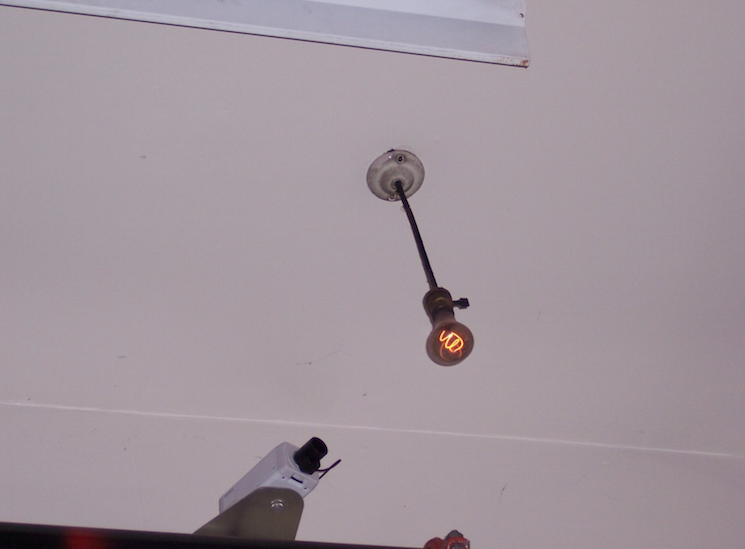
But dangling from the ceiling of a California firehouse is a bulb that’s burned for 989,000 hours -- nearly 113 years. Since its first installation in 1901, it has rarely been turned off, has outlived every firefighter from the era, and has been proclaimed the “Eternal Light” by General Electric experts and physicists around the world.

Tracing the origins of the bulb -- known the Centennial Light -- raises questions as to whether it is a miracle of physics, or a sign that new bulbs are weaker. Its longevity still remains a mystery.

A Brief History of the Light Bulb
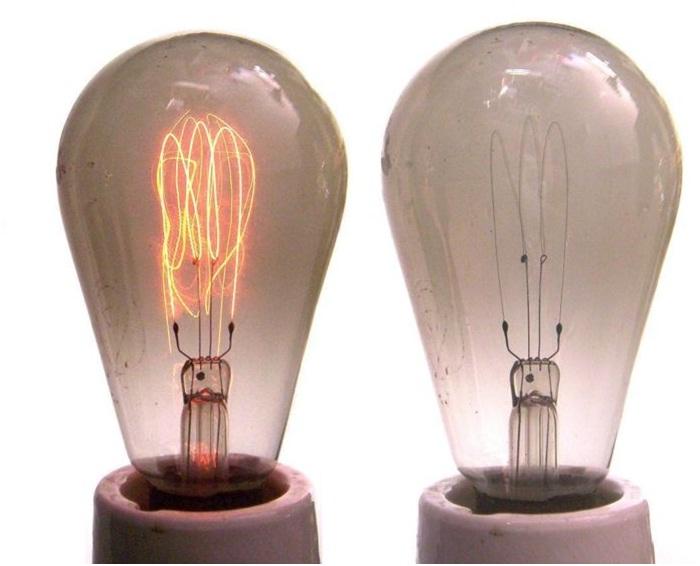
While it is generally reported that Thomas Edison “invented” the light bulb in 1879, a long lineage of innovators preceded him. 

In 1802, British chemist Humphry Davy produced incandescent light by passing current through thin strips of platinum; over the next 75 years, his experiments would be the basis of many efforts to produce long-lasting, bright light through heated filaments. Scottish inventor James Bowman Lindsay boasted, in 1835, of his new light that allowed him to “read a book at a distance of one and half feet,” but soon after abandoned his efforts to focus on wireless telegraphy. Five years later, a team of British scientists toyed with heating platinum filaments inside a vacuum tube. Though the high price of platinum made the device inaccessible and difficult to scale, this design formed the basis for the first incandescent lamp patent in 1841. 

With his integration of carbon filaments in 1845, American inventor John W. Starr arguably could have been credited as the light bulb’s inventor, but he died of tuberculosis the following year, and his colleagues were unable to pursue the idea without his knowledge and expertise. A few years later, British physicist Joseph Swan utilized Starr’s advancements to produce a working bulb, and, in 1878, became the first man in the world to brighten his home with bulbs.

Meanwhile, in America, Thomas Edison worked on improving carbon filaments. By 1880, through the utilization of a higher vacuum and the development of an entire integrated system of electric lighting, he improved his bulb's life to 1,200 hours and began producing the invention at a rate of 130,000 bulbs per year.

In the midst of this innovation, the man who’d build the world’s longest-lasting light bulb was born.

The Shelby Electric Company

Adolphe Chaillet, c. 1880

Adolphe Chaillet was bred to make exceptional light bulbs. Born in 1867, Chaillet was constantly exposed to the burgeoning light industry in Paris, France. By age 11, he began accompanying his father, a Swedish immigrant and owner of a small light bulb company, to work. He learned quickly, garnered an interest in physics, and went on to graduate from both German and French science academies. In 1896, after spending some time designing filaments at a large German energy company, Chaillet moved to the United States.

Chaillet briefly worked for General Electric, then, riding on his prestige as a genius electrician, secured $100,000 (about $2.75 million in 2014 dollars) from investors and opened his own light bulb factory, Shelby Electric Company. While his advancements in filament technology were well-known, Chaillet still had to prove to the American public that his bulbs were the brightest and longest-lasting. In a risky maneuver, he staged a “forced life” test before the public: The leading light bulbs on the market were placed side-by-side with his, and burned at a gradually increased voltage. An 1897 volume of Western Electrician recounts what happened next:

“Lamp after lamp of various makes burned out and exploded until the laboratory was lighted alone by the Shelby lamp -- not one of the Shelby lamps having been visibly injured by the extreme severity of this conclusive test.”
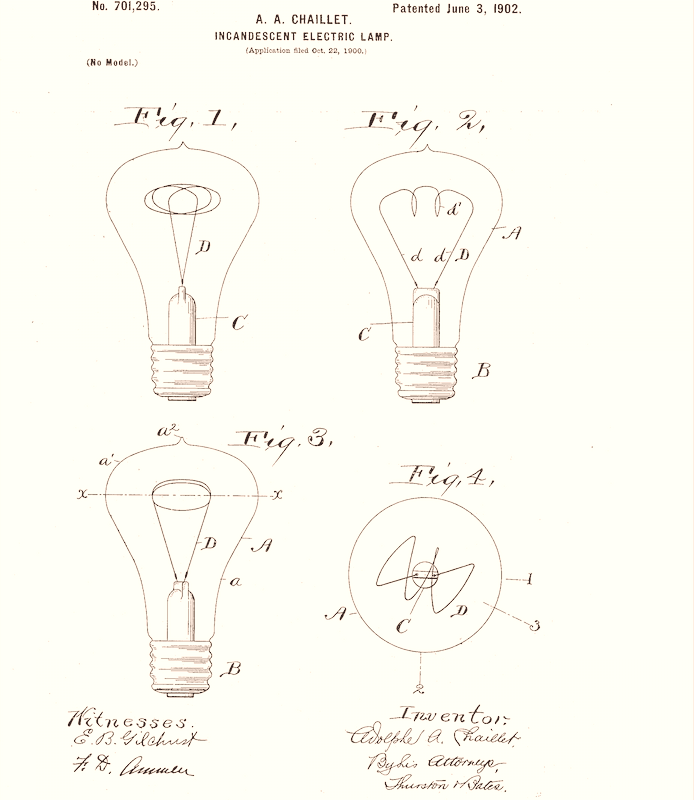
Chaillet's original patent

The bulb’s brilliance was attributed to Chaillet’s patented coiled carbon filament, as recounted in a The Electrical Review (1902):

"The inventor's idea, practically stated, is to flatten the coil, and also flatten the end of the globe or bulb so that the greatest intensity of light is thrown downwardly. The filament is coiled in a form which presents a loop that is elongated transversely of the axis of the lamp, or in other words, the loops are substantially elliptical, the major axis being transverse to the longitudinal axis of the lamp. The globe is likewise flattened at its tip end so that the glass wall is substantially parallel with the lower lines of the filament loops when the lamp is suspended from above."

Citing these advancements, Shelby claimed that its bulbs lasted 30% longer and burned 20% brighter than any other lamp in the world. The company experienced explosive success: According to Western Electrician, they’d “received so many orders by the first of March [1897], that it was necessary to begin running nights and to increase the size of the factory.” By the end of the year, output doubled from 2,000 to 4,000 lamps per day, and “the difference in favor of Shelby lamps was so apparent that no doubt was left in the minds of even the most skeptical.”

The Centennial Light

Seventy-five years later, in 1972, a fire marshall in Livermore, California informed a local paper of an oddity: A naked, Shelby light bulb hanging from the ceiling of his station had been burning continuously for decades. The bulb had long been a legend in the firehouse, but nobody knew for certain how long it had been burning, or where it came from. Mike Dunstan, a young reporter with the Tri-Valley Herald, began to investigate -- and what he found was truly spectacular.

Tracing the bulb’s origins through dozens of oral narratives and written histories, Dunstan determined it had been purchased by Dennis Bernal of the Livermore Power and Water Co. (the city’s first power company) sometime in the late 1890s, then donated to the city’s fire department in 1901, when Bernal sold the company. As only 3% of American homes were lit by electricity at the time, the Shelby bulb was a hot commodity.

In its early life, the bulb, known as the “Centennial Light,” was moved around several times: It hung in a hose cart for a few months, then, after a brief stint in a garage and City Hall, it was secured at Livermore’s fire station. “It was left on 24 hours-a-day to break up the darkness so the volunteers could find their way," then-Fire Chief Jack Baird told Dunstan. “It’s part of another era in the city's past [and] it's served its purpose well." 

Though Baird acknowledged that it had once been turned off for “about a week when President Roosevelt’s WPA people remodeled the fire house back in the 30s,” Guinness World Records confirmed that the hand-blown 30-watt bulb, at 71 years old, was “the oldest burning bulb in the world.” A slew of press followed, which saw it featured in Ripley's Believe it or Not, and major news networks.

***

Aside from the 1930s fire house remodel, the bulb has only lost power a few times -- most notably in 1976, when it was moved to Livermore’s new Station #6. Accompanied by a “full police and fire truck escort,” the bulb arrived with a large crowd eager to see it regain power, but, as recalled by Deputy Fire Chief Tom Brandall, “there was a little scare:” 

“We got to new location and the city electrician installed the light bulb and made connection. It took about 22-23 min, and [the bulb] didn’t come back on. The crowd gasped. The city electrician grabbed the switch and jiggled it; it went on!.”

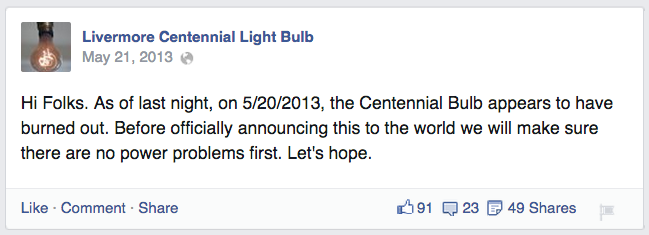
Once settled, the bulb was placed under video surveillance to ensure it was alive at all hours; in subsequent years, a live “BulbCam” was put online. Last year, the bulb’s groupies (of which there are nearly 9,000 on Facebook), received another scare when it lost light:
The Centennial Light's Facebook page

At first it was suspected that the light had finally met its demise, but after nine and half hours, it was discovered that the bulb’s uninterrupted power supply had failed; once the power supply was bypassed, the bulb’s light returned. The 113-year-old bulb had outlived its power supply -- just as it had outlived three surveillance cameras. 

Today, the bulb still shines, though, as one retired fire volunteer once said, “it don’t give much light” (only about 4 watts). Owning a frail piece of history comes with great responsibility: Livermore firefighters treat the little bulb like a porcelain doll. "Nobody wants that darn bulb to go out on their watch," once said former fire chief Stewart Gary. "If that thing goes out while I'm still chief it will be a career's worth of bad luck."

They Don’t Make ‘Em Like They Used To
Everyone from Mythbusters to NPR has speculated on the reasons for the Shelby bulb’s longevity. The answer, in short, is that it remains a mystery -- Chaillet’s patent left much of his process unexplained.

Some, like UC Berkeley electrical engineering professor David Tse, outright dispel the bulb’s legitimacy. “It’s not possible,” he told the Chronicle in 2011. “It’s a prank.” Others, like engineering student Henry Slonsky, insist it’s likely due to the fact that things were once made with more care. “Back then,” he says, “they made everything way over the top.” 

In 2007, Annapolis physics professor Debora M. Katz purchased an old Shelby bulb of the same vintage and make as the Centennial Light and conducted a series of experiments on it to determine its differentiation from modern bulbs. She reported her findings:

"I found the width of the filament. I compared it to the width of a modern bulb's filament. It turns out that a modern bulb's filament is a coil, of about 0.08 mm diameter, made up of a coiled wire about 0.01 mm thick. I didn't know that until I looked under a microscope. The width of the Shelby bulb's 100-year-old filament is about the same as the width of the coiled modern bulb's filament, 0.08 mm.”

While Katz’s findings were inconclusive, she speculates that the Shelby bulb’s filament -- eight times thicker than that of a modern bulb -- may be integral to its longevity. Modern bulbs, she explains, use thinner tungsten filaments that put out more light (40 to 200 watts) burn hotter, and are therefore taxed more rigorously than older bulbs like the Shelby. “You can think of it as sort of an animal with a low metabolism,” she reported to the Centennial Light’s committee. “It’s giving us less energy per time, so it can keep on going longer.” Katz also adds that the bulb’s age could be, in part, contributed to the fact that it hasn’t been turned off and on a whole lot -- a process which is more exhausting on a bulb than letting it run continuously (the filament needs to reheat itself, much like a car’s engine).


The Shelby bulb’s properties, from Felgar’s Paper

Justin Felgar, one of Katz’s students, explored the bulb further and published his findings in the 2010 paper, “The Centennial Light Filament.” Felgar found that the hotter the Shelby got the more electricity went through it -- the opposite of what happens to modern tungsten filaments. To determine the Shelby filament’s exact makeup, Felgar asserts that it would be necessary to “tear one up” and run in through the Naval Academy’s particle accelerator -- but it’s a costly process and has yet to be undertaken.

Ultimately, Katz and her colleagues remain uncertain. “I thought for sure all the physics must’ve been worked out,” she says, “But perhaps there’s just some fluke with that particular [bulb].” Livermore’s ex-deputy fire chief agrees. “The reality is its probably just a freak of nature,” he told NPR in 2003, “just one in a million light bulbs thats just going to keep going and going.”

The Lightbulb Cartel

Today, the average incandescent bulb lasts about 1,500 hours; even top-of-the-line LED bulbs, at $25 each, last 30,000 hours. Regardless of the Centennial Bulb’s secret formula, it has burned for 113 years -- nearly 1 million hours. So where did we go wrong with light bulb technology?

Light bulb companies like Shelby once prided themselves on longevity -- so much so, that the durability of their products was the central focus of marketing campaigns. But by the mid-1920s, business attitudes began to shift, and a new rhetoric prevailed: “A product that refuses to wear out is a tragedy of business.” This line of thought, termed “planned obsolescence,” endorsed intentionally shortening a product’s lifespan to entice swifter replacement. 

In 1921, multinational lighting manufacturer Osram formed the "Internationale Glühlampen Preisvereinigung" (International Association of Light Bulb Prices) to regulate prices and limit competition. General Electric soon reacted by founding the "International General Electric Company" in Paris. Together, these organizations traded patents and sales information to get a stronghold on the light bulb market.

In 1924, Osram, Philips, General Electric, and other major electric companies met and formed the Phoebus Cartel under the public guise that they were cooperating to standardize light bulbs. Instead, they began to collectively engage in planned obsolescence. To achieve this the companies agreed to limit the life expectancy of light bulbs at 1,000 hours -- less than Edison’s bulbs had achieved (1,200 hours) decades before; any company that produced a bulb exceeding 1,000 hours in life would be fined. 

Until disbanding during World War II, the cartel supposedly halted research, preventing the advancement of the longer-lasting light bulb for nearly twenty years.

***

Whether or not planned obsolescence is still on the agenda of light bulb manufacturers today is highly debatable, and there exists no definitive proof. In any case, incandescent bulbs are being phased out worldwide: Since Brazil and Venezuela began the trend in 2005, many countries have followed suit (European Union, Switzerland, and Australia in 2009; Argentina and Russia in 2012; the United States, Canada, Mexico, Malaysia, and South Korea in 2014).

As more efficient technologies have surfaced (halogen, LED, compact fluorescent lights, magnetic induction lights), the old filament-based bulbs have become a relic of the past. But perched up in the white ceiling of Livermore’s Station #6, the granddaddy of old-school bulbs is as relevant as ever -- and refuses to bite the dust.

This post was written by Zachary Crockett. Follow him on Twitter here, or Google Plus here.

24 Sep 11:27

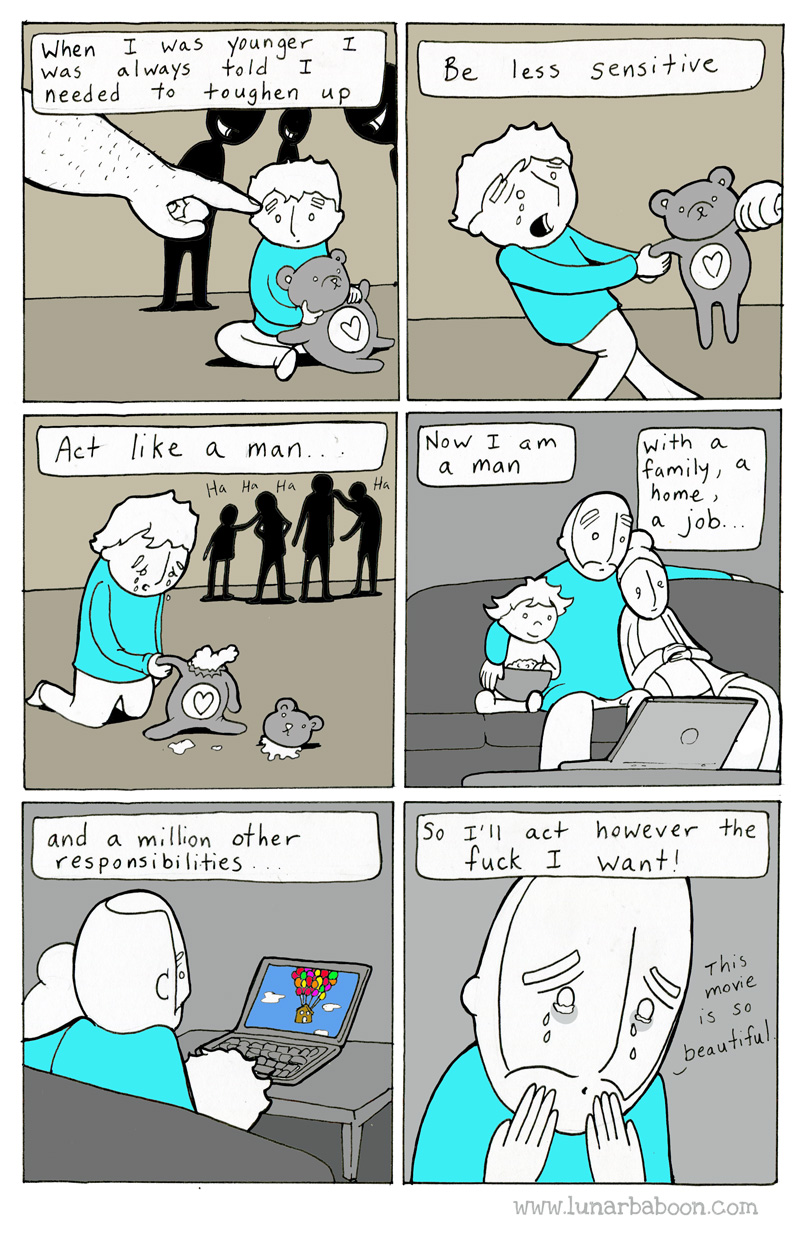
sensitive

by Lunarbaboon
Dan Jones

That's right. I'll cry during "Up" if I want to, and nobody can tell me otherwise.

23 Sep 22:01

LG Wine Smart crams Android 4.4, 3.5-inch screen and 1.2GHz quad-core processor into flip phone form factor

by Alex Wagner
Dan Jones

I actually like a flip phone, but there's no way I'd use a phone with QVGA screen.

LG is no stranger to unique smartphone features, releasing products like the LG G Flex and its curved display and the LG G2 with its rear-mounted buttons. Today LG continued that trend of interesting products with the debut of the Wine Smart.

The LG Wine Smart is a flip phone that runs Android 4.4 on a 3.5-inch 480×320 display. The bottom half of the unit features a combination of a traditional flip phone button layout and some Android navigation keys, including Back and Home buttons.

LG says that the Wine Smart is targeted at elderly wireless users. The phone features a high-powered rear speaker and the ability to send out its location information if the device goes unused for an extended period of time.

When it comes to its “regular” smartphone features, the LG Wine Smart offers an 8-megapixel rear camera and VGA front-facing shooter, 1.2GHz quad-core processor, 1GB of RAM, 4GB of storage and a microSD card slot. It’s also got 4G LTE connectivity, FM radio and a removable 1700mAh battery.

LG is certainly not the first company to offer an Android-powered flip phone, but such devices are still uncommon. While the Wine Smart likely won’t appeal to a power user, I could see it being good for someone that prefers the tried and true flip phone form factor, especially if they’ve been using those dumb phones for any length of time.

23 Sep 19:24

Netflix Attempts To Get People To Calm Down About Spoilers By Spoiling Everything

Netflix

WHAT KIND OF
SPOILER ARE YOU?

WHICH SPOILERS ARE
IN THE PUBLIC DOMAIN?

SPOIL YOURSELF

Sorry, you must upgrade your browser in order to view the content on this site.

23 Sep 18:05

There Are Far More People Named Hitler Than You'd Think

A birthday cake for Adolf Hitler Campbell

Names are important. Without one, it’s very hard to buy personalized mugs or introduce yourself to people. However, they can also be a burden. One of my ninth-grade teachers was called Mr. Hyman, for instance, which can’t have been easy. And put yourself in the shoes of Mr. Dick Assman, or anyone who shares a name with Justin Lee Collins. That can’t be easy, either. 

In his new documentary Meet the Hitlers, director Matt Ogens—the guy behind Confessions of a Superhero – explores just how much a name can influence an identity. Meeting a diverse group of people with the surname Hitler (or Hittler), which arguably comes with more baggage than literally any other name in existence, the film looks at how their lives have been affected, for better or worse.

I gave Matt a call to speak about the making of the film.

VICE: Hi, Matt. Why did you decide to track down loads of Hitlers?
Matt Ogens: I have a friend from college who married a guy by the last name of Hitler. I remember visiting them and seeing the name on the buzzer. I would get Christmas cards saying, “Happy Holidays from the Hitlers!”, and there was something quirky about it. It got me thinking what it must be like to take on that name or to be born with that name. How it would affect your life, positively or negatively.

How your name plays into your identity.
Exactly. We all have our names, but if you don’t have an odd name you usually just take it for granted. If you have an odd name, how might that affect you? How would that shape your life? I wanted to take what is arguably one of the most notorious names in history and do a social study from that perspective.

Was it hard getting people to take part? I’d imagine quite a few Hitlers would be happy to keep the name, but not necessarily want to make a big song and dance about it.
For a start, a lot of people with that name don’t list it because they don’t want prank calls. And yeah, it’s also hard to get people to say yes, unfortunately. They assume it’s going to be a judgment thing, but one of the points of the film is to not judge a book by its cover. Don’t judge someone by their name; judge them by their actions. There are good people with that name in the film and not so good people with that name in the film.

The trailer for Meet the Hitlers

Did you meet anyone who’s really struggled with the name?
I can go through a couple of scenarios. I mean, you have a guy like Jean Hitler, an older guy—he’s probably 83 now—with four daughters, a wife, and a very nice life. He’d say he kept it because it was a family name that was around before Adolf Hitler. Why should he have to change it, you know? He said it didn’t affect him, but for his four daughters going through school... it’s probably going to have had an effect on them. One of his daughters ran for, I think, class president, but got heckled off stage and didn’t win. So people were affected in some way or another, some worse than others.

Were there any people who were totally cool with it? Anyone whose peace with it surprised you?
You have a girl like Emily Hittler, who—at the time we filmed her—was 16. She lives in a small town outside of St. Louis, so she’s insulated by her friends and family. Though, we don’t know what it’s going to be like if she goes to college, gets a job, or leaves town. My other theory with her is that she’s another generation removed from World War II, the Holocaust, and Adolf Hitler. So a 16-year-old today may not have as strong an opinion on Hitler as we did. Maybe if her name was Bin Laden it would be way worse for her.

I was going to mention that—whether you came across opinions on the name specifically colored by age or culture? Like how there are clothing stores in India named “Hitler” because the name isn't as big a part of the region's history as in Europe or America. 
Absolutely. We explored all of that stuff. We explored stuff like that as a storyline in the film—we even explored other names to include in the storyline—but we didn’t go there. But the name has a different effect on different cultures. Like you said, there’s the store in India. In fact, most of them are gone now, but a few years ago there were also Hitler-themed restaurants.

Heath Campbell, who named his son Adolf Hitler Campbell

What are your thoughts on the family featured in the film who named their kid Adolf Hitler?
I’m a documentary filmmaker, so I should be objective. But I’m also a human being. Some people would say it’s a First Amendment right—that you can name your kid whatever you want. But, to me, when you’re naming a kid something like that, that’s going to affect a kid the rest of their life. I don’t feel it was down to anything other than the father, Heath Campbell, who’s a neo-Nazi. Those are his beliefs. He’s got swastika tattoos. He did it to make a statement. It wasn’t about the kid; it was about himself.

Yeah. Did you expect to meet neo-Nazis when you started production on the film?
The scary thing about making a documentary is that you don’t know the ending when you start; things change as you go deeper and deeper. At first, I thought, Hey, I’m going to make this quirky film about people with the name Hitler. Sort of a dark comedy. But it went deeper than that. It’s still a character-driven film; it’s not about saving the whales, or anything like that. It’s people. The thread is this connection between name and identity.

How connected do you think those two things are?
I think your name can affect how people react to you from an early age, which is when your brain is shaping and your identity is forming. So, for example, if you got made fun of as a kid because of your name, that may affect your identity.

Would you have kept the name Hitler if you were born with it?
If you’re born with that name, you’re born with that name. If it were me personally—I’m Jewish—I wouldn’t keep that name. And I wouldn’t give my kids that name. I get the whole reasoning of it being a family name, but to me it’s not worth going through the burden of life with it. It’s not worth putting my kids through it. But that’s just me.

I respect the decision of someone like Jean Hitler, though, who’s had the name in his family since the 1700s. I respect that, and I appreciate that he decided to keep it. So I try to be not judgmental about it. With someone like Heath Campbell—who wasn’t born with the name Hitler, but named his kid Adolf Hitler for a very specific reason—that’s a different story. That’s harder to swallow for me.

Makes sense. What else did you take away from the making of the film?
There’s a character in our film named Jim Riswold. He’s an iconic advertising creative but does a lot of conceptual satirical art on the side. One of his series pokes fun at dictators, and he did some stuff with Hitler. In a way, he’s kind of the voice of reason in the film. What he says is that people talk about Hitler in hushed tones, but that if Hitler were alive today, or watching from hell, he would like that: ‘They revere me.’ He wanted to do something in his art that would piss Hitler off and make fun of Hitler. So it’s sort of like saying, “If you mock it, you beat it.”

Besides that point, that people should be judged by their actions and who they are as people—something that says much more about you than your name.

Thanks, Matt.

The first screening of Meet the Hitlers is at the New Orleans Film Festival on Friday, October 17, but until then you can take part in the #whatsinaname project, which is cataloguing the stories behind a number of unusual names from around the world.

Follow Jamie Clifton on Twitter.

23 Sep 18:05

Flux Capacitor USB Car Charger

Flux Capacitor USB Car Charger


WANT!! ThinkGeek's exclusive Flux Capacitor USB Car Charger is back in stock! This hilariously awesome product started as an April Fool's joke (as many of their most genius products do), but is now a reality! For Star Wars fans, also check out the R2-D2 Car Charger!

Change your past; charge your future!

GREAT SCOTT!! Marty has travelled back in time and taken the Flux Capacitor with him. We're not exactly sure where, so Doc Brown has authorized us to make these smaller Flux Capacitors to you so we can crowd-search time for Marty. Each one is capable of returning to a specific point in time, so you can join the search. Just plug it into your car's 12V vehicle power adapter (cigarette lighter) and turn it on. 88mph and . . . ok, don't go that fast. That would be bad, because the Flux Capacitor Car Charger won't really take you through time - but it will charge all your USB-powered goodies.

Each Flux Capacitor Car Charger has two USB ports, each capable of charging almost any USB powered device (1 x 1A and 1 x 2.1A). But it also has that beautiful Flux Capacitor light sequence we all know and love. Even traffic jams (either terrestrial or aerial (if your car is powered by Mr. Fusion)) won't bother you because your device will be charging and the Flux Capacitor Car Charger's pulse will make you feel more important than anyone else. It's time to write your name in your underwear, Calvin, and get yourself a Flux Capacitor Car Charger in the present (so you can enjoy it in the future).


Flux Capacitor USB Car Charger

Flux Capacitor USB Car Charger

22 Sep 14:52

Photo


21 Sep 12:47

‘Mormons vs. Zombies’ Game Hopes to Reach Smartphones Soon

by Kylie Patten

Jana Maughan was down in her parents’ food storage room taking in the incredible amount of food around her when she realized:

21 Sep 12:47

Disney Movie Chronology

Disney Movie Chronology


Aish from Disney's New Groove put together this timeline that shows the estimated time periods of Disney movie. Here's a little bi more about it from her...

"Disney movies in order of historical setting. (Excludes most of the package films. Some films, eg The Lion King, are impossible to pin down exactly and some, like Aladdin and Treasure Planet, are anachronistic, so these are estimations. A few have been split into 2 if there is more than one time period in the movie, and sequels have been put together.)"

Disney Movie Chronology

What do you guys think, do you disagree with any of these or have any to add?

Source: Disney's New Groove

Follow us on:
 

September 19 2014
19 Sep 15:11

You Can Now Run Android Apps on Chrome for Windows, Mac and Linux

by Joey-Elijah Sneddon
Dan Jones

This is awesome!
I got Gospel Library running on my computer. It's a little bit slow for me, but it works!

chrome for android illustrationGoogle may need to take their time in bringing select Android apps to the Chrome Web Store — needing to ensure compatibly, stability, and an integrated experience — but the community has no such speed bumps standing in its way.

The article You Can Now Run Android Apps on Chrome for Windows, Mac and Linux was first published on OMG! Chrome!

18 Sep 14:26

This Hack Lets You Run Any Android App on Your Chromebook

by Joey-Elijah Sneddon
Dan Jones

Time to get a Chromebook. Between this and crouton (to install Ubuntu), a Chromebook would be a great computer to have.

chrome for android illustrationIt's barely been a week since Google announced the first crop of Android apps to run on Chrome OS. Now, a hack that allows virtually any Android app to be installed has been detailed.

The article This Hack Lets You Run Any Android App on Your Chromebook was first published on OMG! Chrome!

15 Sep 16:15

Enable This Flag in Chrome for Android to Find Answers Fast

by Joey-Elijah Sneddon
Dan Jones

Not sure why this is Android only. I'd love to have this on the desktop.

answers in chrome androidQuiz heads and trivia hounds: if you have Google Chrome for Android installed on your mobile or tablet there's a nifty experimental feature you're going to love.

The article Enable This Flag in Chrome for Android to Find Answers Fast was first published on OMG! Chrome!

15 Sep 14:41

Photo


15 Sep 11:50

Tree

by Lunarbaboon

15 Sep 11:50

Future Self

Maybe I haven't been to Iceland because I'm busy dealing with YOUR crummy code.
15 Sep 11:39

So Your A Pedant?

by languagehat

OK, Bridie Jabour’s Guardian rant isn’t really anything I haven’t said and quoted many times before, but a good anti-peever rant is always worth seeing, and I like the in-your-face nature of this one and the emphasis in the conclusion on an important point that is sometimes not attended to:

That aside, there is a need for us to be literate, of course. Which brings me to what may be the most devastating revelation for the enthusiastic corrector: WE KNOW. Most of the time, serial manglers of the English language know the difference between “complimentary” and “complementary”.

Eight times out of 10, it will just be a simple typo made as we’re tweeting while ordering food, dodging traffic or pretending to work. But the glee with which typos, outside of news articles, is jumped on is tedious. Affectively, you’re just saying you are more educated than the person writing or speaking. Or you think you are. But just as Tony Abbott certainly knows what Canada is called, and Tanya Plibersek is clear that Africa is a continent, a slip on the keyboard is not a good reason for you to type your most patronising “*”.

Also: “The first person to spot all 10 errors and/or misuses of the English language gets a prize,” so act now — supplies are doubtless limited. (Thanks, Bathrobe!)

14 Sep 16:58

Pickles: Saturday, September 13, 2014

Pickles
14 Sep 16:58

This Selfie Sombrero Hat Thing May Well Be One Step Too Far

by Geek Girl Diva

selfie hat

If you thought the selfie hairbrush we posted the other day was silly, wait till you get a load of this Selfie-Hat by Acer UK and fashion designer Christian Cowan-Sanluis for London Fashion Week.

The Selfie-Hat spins 360 degrees to let you find you “best angle” and has an integrated Acer Iconia A-1 840 tablet. Acer explains:

“Whilst slowly moving the screen from left to right, not only does the selfie sombrero help the user finding their best angle, but also how to understand lighting, how various expressions can change your face and ultimately create the perfect social media moment”.

“Users can access any apps such as Facebook or Instagram whilst wearing the hat – being on social media never looked so glamorous,” Acer added.

Um…yeah…I got nothing.

Believe it or not, this hat can actually be purchased by appointment. Interested parties can contact “Hans” at the Acer press office for more info.

(via Pocket Lint)

12 Sep 18:25

Google's Object Recognition Technology

by Alex Chitu

Google continues to improve its image recognition technology. A Google team placed first in the classification and detection tasks of the ImageNet large-scale visual recognition challenge, the largest academic challenge in computer vision.

"Superior performance in the detection challenge requires pushing beyond annotating an image with a 'bag of labels' - a model must be able to describe a complex scene by accurately locating and identifying many objects in it," explains Google. Here's are some examples of object detection:


"This effort was accomplished by using the DistBelief infrastructure, which makes it possible to train neural networks in a distributed manner and rapidly iterate. At the core of the approach is a radically redesigned convolutional network architecture," mentions Google. The goal is to train large models for deep neural networks.

Last year, Google used the DistBelief infrastructure to improve some models used by the winning team at ImageNet and implemented the algorithms in Google+ Photos Search and later in Google Drive's search engine. Google automatically annotates images and it allows you to search for things like "car" or "laptop" and find images that include them.

Google promises to use the latest achievements to improve "Google products such as photo search, image search, YouTube, self-driving cars, and any place where it is useful to understand what is in an image as well as where things are".
12 Sep 16:12

Public bathrooms amiright? Full image Facebook Twitter


Public bathrooms amiright?

Full image Facebook Twitter

12 Sep 16:12

How Instagram's Drug Deals Go Undetected

Dan Jones

Sounds pretty easy. Looks like I need to get into drug trafficking.

It’s no secret: Instagram has a drug problem.

Through my own reporting and that of others, it has become clear that a large and active drug trade has emerged on Instagram, the service Facebook paid a billion dollars for two years ago. With a quick hashtag search you can find anything you want, be it stolen, extracted, grown, prescribed, synthesized, or harvested.

After that story broke last year, Instagram blocked a handful of specific hashtags from appearing in searches. But thanks to the infinity of drug street names (and Instagram’s weak response), the trade is as public and robust as ever. A recent roundup by the Coalition Against Drug Abuse, though unscientific, is interesting because it indicates that this drug market is well known even to low-tech nonprofits.

Still, who would be dumb enough to try selling drugs this way?

Smartphone data is packed with specific information that touches cell towers and can be triangulated. Indeed, plenty of less-careful sellers have geotagged themselves into handcuffs. Virtual private networks (VPNs) for iOS and Android devices offer relative anonymity, but Google Location Services, for example, transmits the SSIDs of in-range wireless networks. If you’re using cell-based Internet, even with a VPN, the device can transmit cell tower identifiers. Using a phone is risky, so the pros don’t.

Instead, pros use a variety of tools to evade detection while conducting their business in public.

A source with direct knowledge of Instagram’s drug trade sent me a document that lays out the process to circumvent the app’s mobile-only posting restrictions. It’s deceptively simple. It’s also perfectly legal (except for the actual “selling drugs” part).

  1. Start with a new laptop. Cheap is fine.
  2. Install and run Ubuntu.
  3. Install VirtualBox, which lets you use a “guest” OS in a window inside your computer’s main OS without making it vulnerable. This sandbox environment is generally used for safely testing apps and software or running old software that isn’t supported by a current OS.
  4. Download and run an Android OS emulator in VirtualBox. We won’t link directly to that part, but essentially you’ll end up with an Android OS running in a window inside your Linux system.
  5. Download a VPN. At approximately $50, an annual subscription is a steal, especially if you’d like to safely sell drugs directly to Instagram’s massive audience.
  6. Inside the Android emulator, connect to the Internet via the VPN.
  7. Use the emulator to download the Instagram app.

That’s it.

The end result is a burner Instagram account on a burner “phone” connected to the Internet somewhere far away, all sandboxed inside a burner computer. A cheap laptop, some moderate Googling, and an afternoon will give you a cover that’s very unlikely to be blown.

This system, used alongside Bitcoin, untraceable prepaid debit cards, Kik, and Google Voice, allows illicit products to move with a surprising amount of security and ease. Why wrestle with Tor and Silk Road clones when you can open up a popular app? Sellers are already using it, and Instagram so far has been powerless against it.

So, without a clear defense, how does Instagram put an end to its virtual drug market? With more than 200 million monthly users, you might think the company shouldn’t simply rely on user-submitted flagging. But, apparently, that’s exactly what it does.

When reached for comment, Facebook would not disclose how many staff members, if any, handle this issue on a full-time basis. Instead, a spokesperson directed us to section 3 of Instagram’s community guidelines titled “What Not To Do.” It is not very proactive [emphasis ours]:

If you are reported for sharing prohibited or illegal content, including photographs or videos of extreme violence or gore, your account may be disabled and we will take appropriate action, which may include reporting you to the authorities. Additionally, it is neither possible nor permitted to complete transactions involving regulated goods on our platform. If your photos or videos are promoting the sale of regulated goods or services, including firearms, alcohol, tobacco, prescription drugs, or adult products, we expect you to make sure you’re following the law and to encourage others to do the same.

In their own words, Instagram expects you to not sell drugs on Instagram. And if you share “illegal content” your account could be disabled if somebody reports it. That’s a lot of ifs separating Instagram from any real accountability, to say nothing of the thousands of accounts currently making transactions in plain sight.

Facebook is the world’s largest social network, with over 1.15 billion monthly active users. Facebook was founded by Mark Zuckerberg in February 2004, initially as an exclusive network for Harvard students. It was a huge hit: in 2 w... read more »

Instagram is a free photo sharing application designed for use on Apple iOS devices developed by Kevin Systrom and Mike Krieger. The application, which is compatible with any iPhone or iPod Touch running iOS 3.1.2 or above, allows user... read more »

Powered by VBProfiles

Mobile developer or publisher? VentureBeat is studying mobile app analytics. Fill out our 5-minute survey, and we'll share the data with you.
11 Sep 21:15

First Android apps for Chrome OS available now

by Dustin Earley
Dan Jones

I might actually consider getting a Chromebook if more apps become available (i.e., Gospel Library and LDS Tools).

Google’s announcement this summer that Android apps would be making their way to Chrome OS is finally coming to fruition.

The first batch of Android apps for Chrome OS have been released today and includes Duolingo, Evernote, Sight Words and Vine. They all work just like regular Chrome apps, with 100% functionality and no missing features from their Android counterparts.

As for why these apps are the first available, Google is apparently working with developers at first to bring the best content over in the best way possible. In Google’s own words, “over the coming months, we’ll be working with a select group of Android developers to add more of your favorite apps so you’ll have a more seamless experience across your Android phone and Chromebook.”

If you have an app you’d love to see ported, Google has created a Docs form that you can fill out to file a request.