Shared posts

31 Oct 18:33

Inbox by Gmail

by Alex Chitu
Dan Jones

Waiting for my invite.

Reinventing email is not an easy task, especially when you have a successful service like Gmail. 10 years after creating Gmail, Google is back at work to bring "an inbox that works for you". The new service is called Inbox by Gmail and it's not just a new interface for Gmail, it's a productivity service that helps you get things done.


"We get more email now than ever, important information is buried inside messages, and our most important tasks can slip through the cracks — especially when we're working on our phones. For many of us, dealing with email has become a daily chore that distracts from what we really need to do — rather than helping us get those things done," says Sundar Pichai.

Inbox syncs with your Gmail account and uses all your labels and filters, but adds some new labels that automatically categorize mail: travel, finance, purchases. Google groups messages from the same category into bundles, so you can quickly review them.

There are some new concepts: pinning messages, marking them as done, sweeping messages, highlights, assists, snoozing messages.

* Pin emails you need to get back to: Google moves them to your inbox and they'll stay there even when you mark all the emails as done.

* When you're done with an email, mark it done to move it out of your inbox.

* Sweep marks all unpinned emails in a section as done.

* Snooze emails to remove them from the inbox until later: you can pick a time when they'll be added back to the inbox or you can snooze emails until you you arrive at a place (for example: home).

* Highlights show important content from emails directly in your inbox: images, documents, events, flight information.

* Assists add relevant information like phone numbers, maps, check-in links, package tracking links.


In many ways, pinning replaces starring, mark as done replaces archiving, but they're something new. They're the building blocks of a smarter inbox. You can create reminders and Google adds them to your inbox and sync them with Google Now.

Inbox by Gmail is a work in progress. There's a desktop web app for Chrome and there are mobile apps for Android and iOS/iPhone. You need an invitation to use Inbox, but you can get one by sending an email to inbox@google.com. "Starting today, we're sending out the first round of invitations to give Inbox a try, and each new user will be able to invite their friends," informs Google.


Inbox doesn't replace Gmail yet, it's more like a new take on email for power users. Mobile optimized, context aware and task oriented. Surprisingly, not yet available for Google Apps.

30 Oct 19:31

Amazon Halloween sale offers over $115 in paid apps for free

by Sean Riley
Dan Jones

Very excellent.

Amazon’s app store is known for featuring a paid app for free every day. The apps aren’t always winners naturally and we forget to check most days, but with almost 40 paid apps worth over $115 available for free through Saturday as part of their Halloween sale we are going to make an exception.

And remember you can install directly from the Amazon app now rather than having to jump through hoops to get the Amazon App Store app installed.

Notable titles available are Plants vs. Zombies, Plex, Toca Town, Sonic the Hedgehog 4 Episode 1, Zombie Gunship, World of Goo and Endomondo Sports Pro. Again there are dozens of other titles available and scrolling through the list there are quite a few more that I’m personally going to be downloading to check out.

If you spot any of your own favorites in the sale let the rest of us know in comments so we can be sure to grab it too.

30 Oct 18:31

Photo


30 Oct 18:31

Google voice search with third-party apps is about to get really cool

by Dustin Earley
Dan Jones

Exciting.
And since, since Jelly Bean, voice search is available on all screens, this will make using your phone way easier.

Google has announced today a new addition to Google voice search on Android that will make speaking to all the apps on your smartphone a lot easier.

By implementing a small bit of code (really small, actually) into their apps, developers can allow users to call up searches through their apps right from any Google hot-word enabled screen. For example, from the home screen of your device, you can say, “OK Google, search pizza on Eat24,” or “OK Google, search for hotels in Maui on TripAdvisor.”

Any developer can enable Google voice search to interact with their app, and anyone with an English locale device running Jelly Bean and above with the Google app v3.5 or greater can use it. Pretty awesome, right? It’s a small change that could end up making a huge difference in how you use your device. What apps would you like to see implement voice search from anywhere? Let us know in the comments.

30 Oct 18:30

Chrome App Launcher Folders Will Soon Look Like This

by Joey-Elijah Sneddon

new app list foldersNew look 'folders' are coming to the Chrome app launcher on Windows, Linux and Chrome OS, giving the feature a more pronounced, Material Design look.

The article Chrome App Launcher Folders Will Soon Look Like This was first published on OMG! Chrome!

30 Oct 15:08

How A Harvard Scientist's Life Changed After He Killed A Puppy-Size Spider

Dan Jones

Sometimes animals have to die for us to study them sufficiently. It's not like he's a hunter who shot a rhino so he could mount the horns in his den. He's a freaking scientist doing scientific research!
People are stupid.

Harvard researcher Piotr Naskrecki was just doing his job when he ran into the one of the world’s largest spiders in Guyana and killed it. The Internet didn’t see it that way.

When Naskrecki, an entomologist and photographer for Harvard’s Museum of Comparative Zoology, blogged about the event two weeks ago, he and the spider—a Goliath birdeater he described as “puppy sized” and said made “the sound of little hooves in the night”—went viral. It also sparked an onslaught of rage.

How could he have killed this innocent arthropod, commenters asked, referring not to the practical difficulties of subduing an invertebrate that weighs more than an iPhone 6 (AAPL), but to the perceived injustice of the execution.

“You had to MURDER the poor thing so YOU could benefit? Pathetic.” said Lizbeth Hull on Naskrecki’s Facebook (FB)page.

“Did you kill this amazing animal because you have to own it?” asked Ian Freedman.

One person sent an e-mail saying that a member of Naskrecki’s family should be killed for what he did.

Why did the scientist kill his specimen? Because, he says, that’s what he is supposed to do: put dead versions of rare insects into museums so they can be studied.

“We usually bring these substances that are designed to put them down very gently,” he says, referring to the chemical compounds he uses to neutralize absurdly large arachnids. It’s almost like swatting at a spider you spot in your home, he says. (If you were to swat spiders with a baseball bat.)

Perhaps the spider’s puppyish size inspired in the commentariat a puppyish affection for the animal, despite it being the physical manifestation of a Halloween nightmare. It weighed 170 grams, its body measured 10 centimeters, and its outstretched legs spanned about a foot from tip to tip. Spiders of the venomous Goliath birdeater breed belong to the same family as tarantulas, are covered with hair, have fangs, and are known to be aggressive. They snack mostly on insects, but also sometimes enjoy a bat, mouse, or snake.

Naskrecki seems overwhelmed with the hate mail and says he stopped looking at blog comments long ago. He anticipated some public interest in the creature: Even before his blog post took off, the scientist had produced for sale an array of products featuring the spider’s image. Spider enthusiasts that aren’t satisfied by a single, searing glance at the photo can visit Naskrecki’s online store, at which $54.99 to $76.99 can buy you a tote bag, apron, mouse pad or mahogany desk organizer featuring its leggy, hairy likeness. Naskrecki says he spends far more to maintain the site than he makes from it, and that its purpose isn’t turning a profit, but encouraging others to celebrate the animals he has dedicated his life to studying.

29 Oct 22:11

Android and iOS users are joining forces in the war against CurrentC

by Dustin Earley

Android users want to pay for things using NFC with Google Wallet, and iOS users want to pay for things using NFC with Apple Pay. And one thing is standing in their way: CurrentC. But the most passionate users of both platforms aren’t going to let their mobile payment system of choice go down without a fight.

CurrentC is essentially a mobile payment system centered around using QR codes and the CurrentC app on your smartphone instead of NFC, backed by a large number of huge, important retailers. After Apple Pay’s introduction, news spread like wildfire that any retailer who supported CurrentC would not allow for NFC payments to be made at its establishment, as part of the agreement to use CurrentC. Whether or not CurrentC will be successful remains to be seen, but offers like 10 percent off your entire purchase for using CurrentC put the system in a good position to make a heavy dent in the industry.

Android and iOS users are miffed about the whole situation mainly because, as stated above, in order for a merchant to support CurrentC they have to kill support for Apple Pay or Google Wallet. And that’s just the beginning. Try a simple Google search for “CurrentC” and see what kind of results pop up. Right now, the big news is that CurrentC has been hacked. You’ll also find other articles about questionable data acquisition and terrible usability. So Android and iOS users are joining forces to fight against CurrentC in any way they can.

Using Reddit as a major meeting ground, supporters of NFC-based mobile payments are collecting boycott lists of companies that support CurrentC, making websites with easy to access information on the payment system, bombarding app store listings with terrible reviews of the CurrentC app and more. The CurrentC app currently sits in the iOS App Store and Google Play with one star, and coverage on the efforts are starting to pick up.

Of course the best way to show who you support is to vote with your wallet. Unfortunately for NFC supports, they may just be the vocal minority in this regard. CurrentC has some impressive backers including Best Buy, Walmart and Target — all retailers who will undoubtedly see an incredible volume of customers this holiday season no matter what mobile payment system they back. But the war has only just begun. And when Apple and Google combine, they can make for one serious adversary.

We’ll be keeping a close eye on CurrentC, and the future of NFC payments, as they will both surely be making plenty of headlines for the next couple of months to come.

29 Oct 22:11

Google ‘Stars’ Bookmarks Extension Now Live on Chrome Web Store

by Joey-Elijah Sneddon
Dan Jones

Hmmm. Should I get rid of Diigo for Google Bookmarks? No IFTTT integration, but I don't really use that anyway.

bookmark-manager-for-chromeGoogle has finally released its next-generation bookmarking extension on the Chrome Web Store — hopefully, this time it'll stay.

The article Google ‘Stars’ Bookmarks Extension Now Live on Chrome Web Store was first published on OMG! Chrome!

29 Oct 22:11

Amelia Earhart Plane Fragment Identified

A fragment of Amelia Earhart's lost aircraft has been identified to a high degree of certainty for the first time ever since her plane vanished over the Pacific Ocean on July 2, 1937, in a record attempt to fly around the world at the equator.

New research strongly suggests that a piece of aluminum aircraft debris recovered in 1991 from Nikumaroro, an uninhabited atoll in the southwestern Pacific republic of Kiribati, does belong to Earhart’s twin-engined Lockheed Electra.

According to researchers at The International Group for Historic Aircraft Recovery (TIGHAR), which has long been investigating the last, fateful flight taken by Earhart 77 years ago, the aluminum sheet is a patch of metal installed on the Electra during the aviator’s eight-day stay in Miami, which was the fourth stop on her attempt to circumnavigate the globe.

The patch replaced a navigational window: A Miami Herald photo shows the Electra departing for San Juan, Puerto Rico on the morning of Tuesday, June 1, 1937 with a shiny patch of metal where the window had been.

“The Miami Patch was an expedient field repair," Ric Gillespie, executive director of TIGHAR, told Discovery News. "Its complex fingerprint of dimensions, proportions, materials and rivet patterns was as unique to Earhart’s Electra as a fingerprint is to an individual."

TIGHAR researchers went to Wichita Air Services in Newton, Kans., and compared the dimensions and features of the Artifact 2-2-V-1, as the metal sheet found on Nikumaroro was called, with the structural components of a Lockheed Electra being restored to airworthy condition.

The rivet pattern and other features on the 19-inch-wide by 23-inch-long Nikumaroro artifact matched the patch and lined up with the structural components of the Lockheed Electra. TIGHAR detailed the finding in a report on its website.

“This is the first time an artifact found on Nikumaroro has been shown to have a direct link to Amelia Earhart,” Gillespie said.

The breakthrough would prove that, contrary to what was generally believed, Earhart and her navigator, Fred Noonan, did not crash in the Pacific Ocean, running out of fuel somewhere near their target destination of Howland Island.

Instead, they made a forced landing on Nikumaroro' smooth, flat coral reef. The two became castaways and eventually died on the atoll, which is some 350 miles southeast of Howland Island.

29 Oct 21:47

LDS Granite Mountain Records Vault

by Larry Richman
Dan Jones

Cool

granite-mountain-records-vaultThe Granite Mountain Records Vault contains the world’s largest collection of genealogical records. Located in Little Cottonwood Canyon, near Salt Lake City, the vault houses billions of images on microfiche, microfilm, and digital media. The vault also protects valuable items important to Church operations and Church history.

granite-mountain-records-vault-2The vault is nearly 700 feet inside solid granite, and the entrance doors are said to weigh between 9 and 14 tons–enough to endure a nuclear blast.

Excavation and blasting to build the Granite Mountain Records Vault began in 1960. The facility was completed in 1965 and dedicated on June 22, 1966.

For security reasons, the vault is not open to the public, but you can click below to watch the Church’s two-part video tour of the facility.

This article is from LDS Living

These billions of records are available online through FamilySearch.org.

29 Oct 19:55

The Woman Who Made The Video About Catcalling Is Already Getting Rape Threats

Dan Jones

This really sickens me.
My wife gets catcalls/etc. every day, without fail, and we live in a suburban area.
What is wrong with people?

Shoshana B. Roberts — who walked around New York City for 10 hours while being filmed by a hidden camera so that she could record the harassment she received from men on the street — is already getting rape threats.

Roberts's video, which after a day online has already racked up more than 1 million views, documents the over 100 catcalls, whistles, and other forms of harassment she received over the course of the day. One persistent character walked alongside her for five minutes and wouldn't leave her alone:

The video was produced by Hollaback, an organization dedicated to stamping out street harassment and intimidation. Last night, Hollaback tweeted:

The threats are still coming today. These, for instance, were posted while I was writing this article:

rape threats 1

rape threats 1

rape threat 2

rape threat 2

rape threat 3

rape threat 3

"The rape threats indicate that we are hitting a nerve," Hollaback director Emily May told Newsday. "We want to do more than just hit a nerve though, we want New Yorkers to realize — once and for all — that street harassment isn't OK, and that as a city we refuse to tolerate it."

The worst part is that this isn't surprising

Roberts's video is so offensive because it's so familiar. Any woman who has ever walked anywhere, especially in New York, knows the constant, terrifying din of catcalls following behind her. It's a way men make women feel unsafe walking the streets of their own neighborhoods — and then, when challenged on it, profess innocence: "what, you can't take a compliment?" Women quickly learn that as awful as catcalling is, they can't respond to it. To respond is to risk being harassed more, or followed, or worse. To respond is to risk making the man who is shouting at you on the street, after dark, actually angry.

Similarly, the response to Roberts's video is so offensive because it is, again, so familiar. Rape and death threats have become a standard response to any woman who dares to speak out on the internet about, well, anything. Look at #Gamergate. Look at Emma Watson. And there, too, to respond is to risk making it worse. When geek hero Felicia Day lamented the harassment of women in #Gamergate, her home address and other personal information was posted online. To respond is to risk making the men who are digging through your personal information and threatening to rape or kill you actually angry.

This video wasn't made for women facing harassment. It was made for men who remain blissfully unaware of how women are treated when they walk down the street. But instead of listening, instead of taking the time to realize how women might feel when men yell at them, these commenters — backed by their anonymity and privilege — have threatened to rape Roberts for daring to talk about it.

Let's lay this out in plain terms. Women are forced to feel uncomfortable and scared for walking down the damn street. Then, when one woman takes the time to show just how uncomfortable those interactions are, people threaten to physically assault her. If the video reminded us that women are constantly made to feel unsafe when they leave the house, the response is a reminder that women are constantly made to feel unsafe when they simply turn on their computer.

The problem here isn't just that men are ignorant of how women are treated. The problem is that many know exactly what they're doing to women, and will try to intimidate and silence women who try to fight back.

29 Oct 17:51

Someone Is Actually Selling A Sexy Ebola Costume Because Humanity Sucks

by Geek Girl Diva
Dan Jones

People really are horrible.

sexy-ebola-containment-suit-8

Today in “reasons I hate humanity”, I present this Sexy Ebola Containment Suit. It’s not to be confused with the photoshopped sexy Ebola costume (which was actually a Breaking Bad costume) that’s been making the rounds on the Internet lately.

Yep. This is a real costume that is actually being sold.

I just…I can’t.

(via Mashable)

29 Oct 17:50

#972 – Beans (5 Comments)

by Chris

#972 – Beans

29 Oct 17:50

Listen To Patrick Stewart Read Haiku From Amy Poehler’s ‘Yes Please’

Getty Images

This week, Amy Poehler’s first book “Yes Please” arrives and it’s chock-full of humorous anecdotes of her days growing up outside of Boston, her pre-“Saturday Night Live” life as a budding sketch comedian and a handful of heartfelt tales about her time spent on “Parks and Recreation.” While it mostly reads as a memoir, the book is also stocked with helpful advice, funny asides written by Seth Meyers and “Parks” creator Mike Schur, and even some haikus.

And because Amy Poehler is Amy Poehler, she nabbed some special talent for the “Yes Please” audiobook. Below you can hear Sir Patrick Stewart read her haikus – we won’t spoil it for you, but just know that hearing Patrick Stewart utter the phrases “Fake boobs are weird, y’all” and “Hey! Shooting poision in your face does not keep you from turning 50” is worth every second of this minute-and-twenty second clip.

As a bonus, listen to Poehler recall being pregnant and rapping with Sarah Palin on “Saturday Night Live”:

“Yes Please” is out now on Dey Street Books.

For the latest entertainment news

29 Oct 00:09

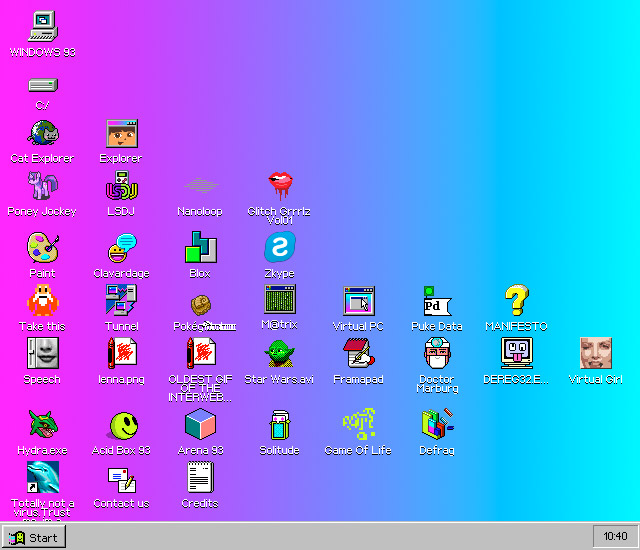
Windows 93

by Jason Kottke

Windows 93

What if Windows 95 had come out in 1993? I guess? I have no idea what this is1, but it's fun to play around with. If this doesn't make you nostalgic, congratulations, you're young as fuck!

  1. Ok, fine, it's a fictional Windows-like interface built in CSS and JavaScript.

28 Oct 22:37

Shape Blobbing in CSS

by Chris Coyier

We just covered shape morphing in SVG, where shapes change from one to another. Let's look at shapes that blob into each other! You know, that gooey squishy blobby effect like droplets of mercury on a surface.

I'm not sure who first discovered this was possible on the web, but the first place I ever saw it was a demo by Lucas Bebber:

See the Pen Gooey Pagination by Lucas Bebber (@lbebber) on CodePen.

And then again by Felix Hornoiu (low framerate GIF for web practicality):

Demo from here.

The trick is fairly simple, use filter to BOTH add blur and contrast to an element

The blur obvious makes the element blurry, the contrast fights against the blur, preferring stark changes in color. If you contrast enough, you're left with a (fairly) sharp looking shape again.

The fancy parts comes from the fact that when two blurred (yet forced to look non-blurry) elements come near each other, their would-be blurs create enough would-be color contrast that the shapes actually appear to connect.

Demo from here.

I find it easier to get working if you blur the shapes but add contrast to the whole area. Like:

.stage {
  /* must be explicit, for contrast to work */
  background: white;
  
  /* weirdness happens when edges hit, also consider hiding overflow */
  padding: 30px;
  
  -webkit-filter: contrast(20);
  filter: contrast(20);
}
.dot {
  border-radius: 50%;
  width: 50px;
  height: 50px;

  /* needs to be very contrasty color. E.g. light gray on white won't work */
  background: black;

  -webkit-filter: blur(15px);
  filter: blur(15px);
}

And then the fun happens when you add animation to blob those suckers all around. Here's a demo where you can play with the values, including brightness which affects the blur:

See the Pen Blobbing Playground by Chris Coyier (@chriscoyier) on CodePen.

Browser Support

Not just WebKit/Blink anymore! Firefox 35 will be supporting filters without any flag or anything. Aurora, their beta-beta, is in v35 right now and I popped it open in that and it works great.

So... current Chrome / Safari / Opera / Firefox / iOS / Android. Not bad. Just no IE.

Predictions of Exclaimed Things

It's not practical!!! Go to bed.

It makes my fan spin like crazy!!! Yeah my demo with tons of elements interacting makes my CPU pretty busy as well. The more chill demos with just two circles bumping into each other are fine though. Use decision making skills.

There are better ways to do this!!! Awesome.

Shape Blobbing in CSS is a post from CSS-Tricks

28 Oct 10:06

Google's Pac-Man Card

by Alex Chitu

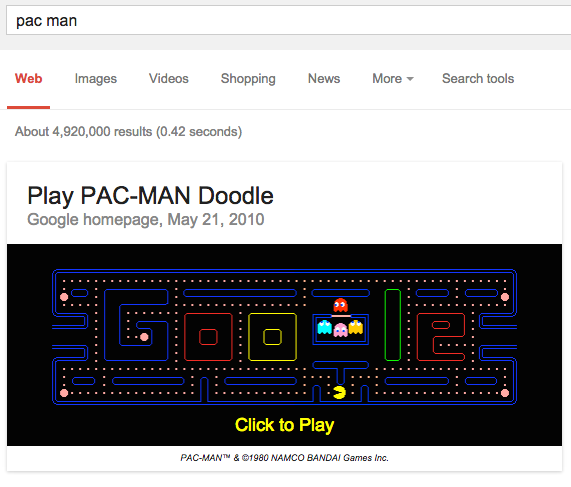
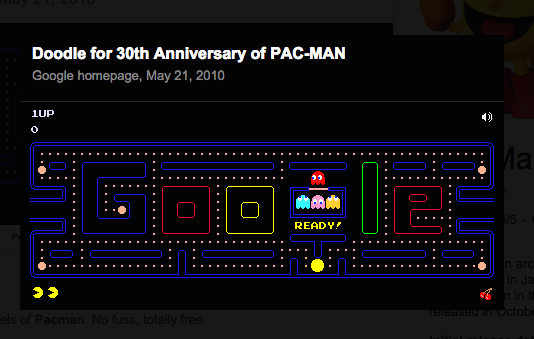
I'm not sure if this is new, but I thought it's worth mentioning. When searching for [pac man], Google shows a card that links to the doodle from 2010 that celebrated 30 years of Pac-Man.

Google doesn't have a card for doodles, so this was manually added. The card has two calls-to-action: "Play PAC-MAN Doodle" and "Click to Play", it includes the source of the doodle: "Google homepage, May 21, 2010", a large promotional image and some copyright information: "PAC-MAN™ & ©1980 NAMCO BANDAI Games Inc."


The game plays inline and there's a permalink for the game.

25 Oct 01:30

Porno From Apple

by John Gruber
Dan Jones

Oops?

Carl Smith:

It turns out Apple thought the best way to tell us our app could be used to surf porn was to surf for porn using our app. Then send us some pictures and say take a look at these! Except they said, “Please see the attached screenshot for more information.” So with no warning…

CLICK — Well hello there handsome! […]

Apple sent us pornography without trying to mask it and with no warning of what we were going to see. This means they exposed employees of my company to things Apple themselves said was objectionable. How is this acceptable?

Crazy. I can’t help but suspect that this was the result of a mistaken App Store reviewer, not company policy. A mistake, not a policy. But still: crazy, right?

That said, I think Smith could have toned down the get-me-to-the-fainting-couch histrionics.

24 Oct 20:50

Google has begun to send out more Inbox invites

by Nick Sarafolean
Dan Jones

I usually get into new Google stuff pretty soon, so it makes me sad that I don't have my invite yet.

Yesterday Google introduced us to its new companion app for Gmail, dubbed Inbox. Everyone has been clamoring to try it, but the service is invite-only. You could request an invite, however, and Google is now sending out the first round of invites. We’re not sure how exactly Google is choosing those to send invites to, but at least three members of our staff have received them and others across the web are reporting that they’ve received invites as well. Unfortunately, it appears that those now getting invites don’t have the ability to invite others to Inbox.

Inbox provides a new way to keep track of messages and tasks through a single app. In some respects, it functions like a standard email app, allowing you to browse through your emails and send and reply as usual. But it also organizes similar emails into smart Bundles and adds in reminders and to-do lists to the app, making it more of a multi-purpose tool.

Let us know if you received an invite!

24 Oct 15:07

Planning a Scary Movie Night for Mormons

by Noah C. Patterson

Hosting a scary movie night can be one fun way for members of The Church of Jesus Christ of Latter-Day Saints to enjoy

23 Oct 17:36

Emacs: Using Eww Web Browser

Dan Jones

Interesting.

bernhard ask how to have 2 instances of eww browser. See Emacs: Using Eww Web Browser (major updated)

23 Oct 17:36

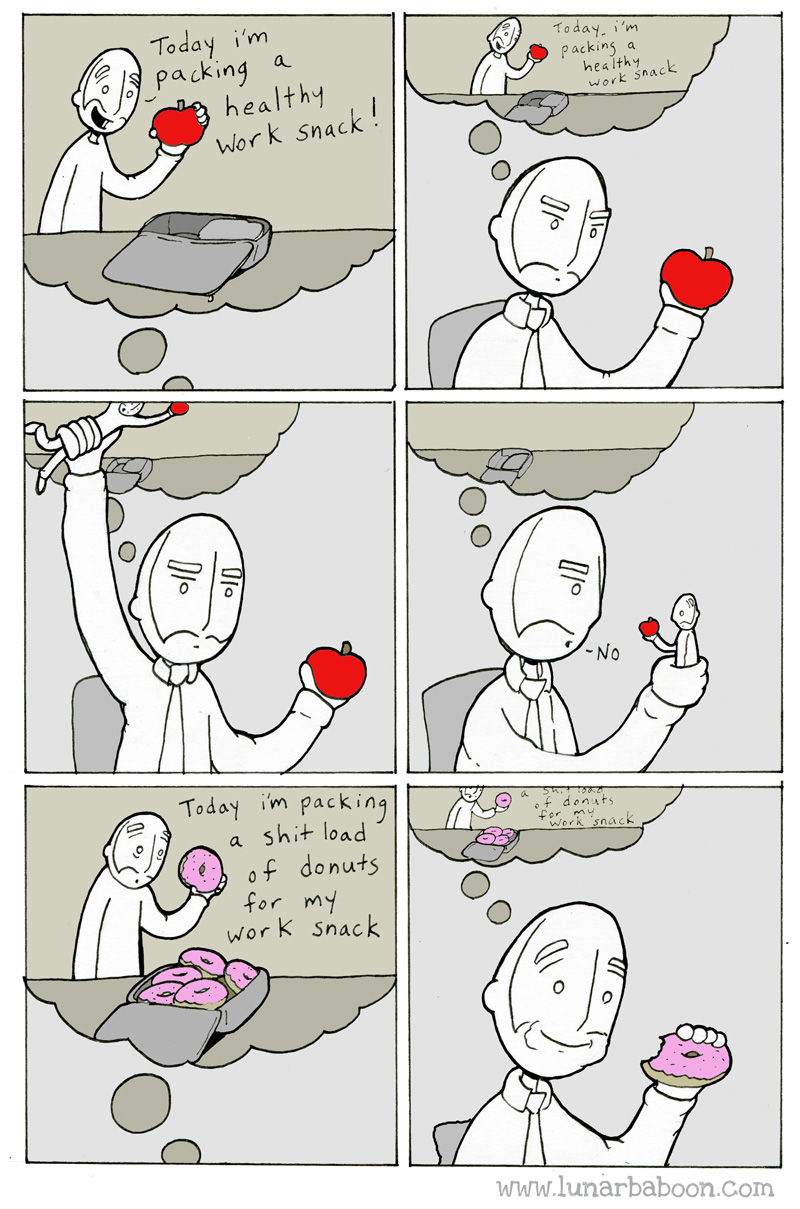
Healthy

by Lunarbaboon
Dan Jones

Mmmm, doughnuts.

23 Oct 16:02

What Google Really Means By 'Don't Be Evil'

Dan Jones

Interesting perspective.

“The famous Google mantra of ‘Don’t be evil’ is not entirely what it seems.” Those words come not from a detractor of the company but from Eric Schmidt, its executive chairman, and Jonathan Rosenberg, an advisor to Larry Page, in their new book, How Google Works.

From the book:

Yes, it genuinely expresses a company value and aspiration that is deeply felt by employees. But “Don’t be evil” is mainly another way to empower employees… Googlers do regularly check their moral compass when making decisions.

Schmidt and Rosenberg cite the example of an engineer who, in a meeting in 2001, objected to a proposed change in the way Google’s advertising system works by banging his fist on the table, yelling, “We can’t do that, it would be evil.” It is a nice anecdote, one that Schmidt clearly likes; he’s rolled it out before in an NPR interview and again at a Financial Times event in London. At that event, Schmidt also repeated the mantra that Google is “for users, not websites,” a line that has been bouncing around Google’s Europe’s policy pronouncements for at least four years.

Users users users

The notion that its users are of paramount importance to Google gets a good airing in How Google Works. On the one hand, this is self-evident: Google’s business, like that of any other consumer-facing firm, rests entirely on its ability to attract hundreds of millions of people to its services, giving advertisers an audience and giving Google valuable data to mine in order to improve its services.

The definition of evil, then, rests on what would be bad for users. Or, to be more precise, on what Google thinks is bad for users. It would also, by extension, be bad for Google. The moral compass and the interests of the business point in the same direction.

On the other hand, what Google conceives of as “evil” is necessarily self-serving. If Google believes that Google provides the best services to internet users, then it is not evil to prod those users to Google’s services, even if such actions come at the expense of other businesses. After all, “We built Google for users, not websites.” Naturellement!

None of these things are evil

Pushing people to use Google+? It’s better for them than the data-gobbling, privacy-infringing Facebook. Harvesting wi-fi data? It was only meant to be “analyzed offline for use in other initiatives”—which must, it follows, be for the good of the user. Google’s aggressive tax planning? Users benefit since more money is ploughed into things like providing internet access to rural areas and “solving death.” What about user privacy? Some people are uncomfortable (paywall) with the volume of data collected by Google. Google would argue that it does nothing evil with the data; it is merely used to improve its services, which is ultimately in the interests of the users.

Why should we trust Google when it says none of these these things are “evil”? Because, as Schmidt told an audience member at the London event, “We don’t have the evil room where we go and have evil thoughts.”

In other words, Google simply cannot do evil so long as it believes it is not doing evil. It’s a wonderful image to present to the world—that of a benign, even benevolent corporation striving only for its users, to whom it provides services free. But it also means that Google has effectively redefined what “evil” means. It is whatever Google thinks it means.

Don’t take my word for it. As Eric Schmidt told Wired way back in 2003, “Evil is what Sergey [Brin] says is evil.”

23 Oct 13:35

Google Play Music Adds Songza Radio Stations

by Alex Chitu
Dan Jones

This is the first step towards shutting down Songza, I think.
It's sad, because Songza is a free service, and they're rolling it into a pay service, so usage is going to disappear.

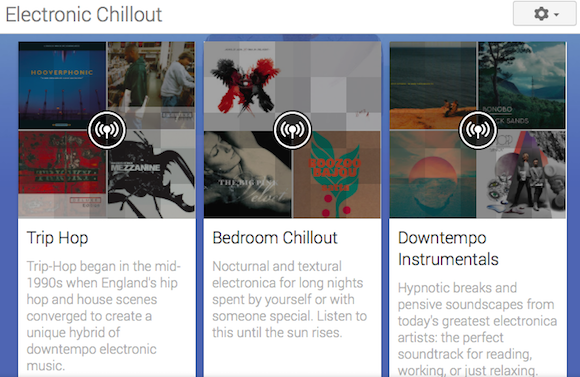
Google bought Songza and now it brings its features to Play Music, but only for All Access subscribers. The Listen Now section recommends radios based on moon, time of the day or activity. You can play music for working out, unwinding, having friends over, spending time with your family and more. "Each station has been handcrafted—song by song—by our team of music experts (dozens of DJs, musicians, music critics and ethnomusicologists) to give you the exact right song for the moment," informs Google.


I picked Unwinding and then Electronic Chillout and Bedroom Chillout.


Google creates a regular radio station and you can remove songs, reorder them, create playlist or listen offline.


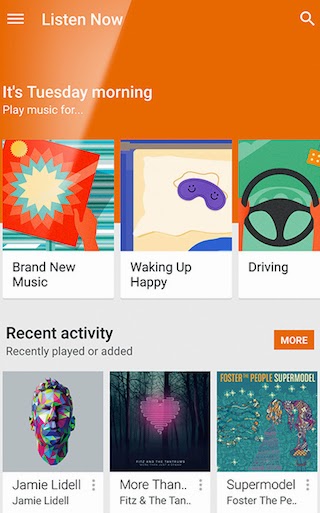
"As part of this update, we’ve also redesigned the 'Listen Now' page so you can more easily discover new music. Now you’ll see cards for all of your recently played music, new releases you might be interested in, and radio stations based on what you like to listen to. You'll also notice that the new app uses Google’s material design, with bigger images, bolder colors and slick transitions," explains Google.


Songza-powered radio stations are only available in the US and Canada, probably because Songza is restricted to these countries. You can find the new radio stations in Google Play Music's web interface and the mobile apps for Android and iOS.

{ Thanks, Theo Winter. }
22 Oct 15:29

Google's open-sourced icons

by Jason Kottke
Dan Jones

This is really clever. They open source their icons. Everybody starts using their icons (since they're free). Now their icons are the most recognizable.

Google MD icons

As part of their Material Design visual language, Google has open-sourced a package of 750 icons. More info here.

Tags: design   Google
21 Oct 16:20

5K Bean Screen

by Josh Orter
imac-5k-screen.jpg

(the metric version is here)

Apple just released a new iMac with a pixel-gluttonous 5K display. Others can explain how useful this may or may not be, but what matters here is that it's a display with a resolution of 5120 x 2880 pixels for a total of more than 14.7 million. An impressively magnificent number, but one that’s also slightly meaningless without a relatable frame of reference. Given that a pixel’s tiny and squinty nature makes it hard to see and dull to imagine in a string of thousands, we might better visualize them with something else. Like jelly beans.

Using a 1:1 ratio of pixels to beans, we already know the number of jelly beans required is 14,745,600 (5120x2880). So exactly how many pounds would we have to buy for this confectioned screen, and how much would it cost? Although I was prepared to make the sacrifice and purchase samples for weight and measurement, the Apple of jellybeans makes this information conveniently available on their website.

25 Jelly Belly-brand jelly beans weigh approximately 1 ounce.

16 ounces per pound multiplied by 25 yields 400 Jelly Bellys per pound.

14,745,600 JBs /400 per pound =

36,864 pounds of Jelly Bellys


According to the Jelly Belly site, each bean is 4 calories, making this a 58,982,400 calorie construction. 
 

How much would it cost? Jelly Belly’s online bulk price is $85.99 for 10 lbs., working out to $8.599 per pound. 36,864 lbs/$8.599/lb =

$316,993 in JELLY BELLYS.


Hauling it home from the candy store would take a convoy of eleven fully-loaded Ford F150 pickup trucks trailed by one partially filled Mini Cooper (respective payload capacities are 3,330 and 816 lbs).

Stay tuned. I'm still figuring out the measurement of the actual bean screen.

Tweet Follow @stupidcalc
20 Oct 16:07

10.20.2014

Cyanide and Happiness, a daily webcomic
Copy this into your blog, website, etc.
<a href="http://explosm.net/comics/3718/"><img alt="Cyanide and Happiness, a daily webcomic" src="http://www.flashasylum.com/db/files/Comics/Dave/toasteytoast.png" border=0></a><br />Cyanide & Happiness @ <a href="http://explosm.net">Explosm.net</a>
...or into a forum
[URL="http://explosm.net/comics/3718/"]
[IMG]http://www.flashasylum.com/db/files/Comics/Dave/toasteytoast.png[/IMG][/URL]
Cyanide & Happiness @ [URL="http://explosm.net/"]Explosm.net[/URL]
<—- Share this comic!

20 Oct 16:06

Pickles: Monday, October 20, 2014

Pickles
20 Oct 16:06

Watching 'Dear White People' At Harvard

Dan Jones

The commercials for this movie look hilarious.

A new movie about race and identity is out in select theaters today. It's called Dear White People, and it's a satire set at a fictitious ivy league college. Or, as the promotional materials say, it's "about being a black face in a white place."

It's 31-year-old Justin Simien's first feature; it won the Special Jury Award for Breakthrough Talent at Sundance, and he has been heralded as a Spike Lee for the millennial generation. (And film critics are digging it. The New York Times A. O. Scott calls it a "clever campus comedy," and adds, "you want to see this movie and you will want to talk about it afterward, even if the conversation feels a little awkward.")

Simien told me in an interview that it's time for movies to show a more complicated, less comfortable, picture of race. "There's as many versions of being black as there are black people," he said. "And we're all having a different experience and sort of being lumped into one giant experience [onscreen], it just isn't good enough anymore."

That idea resonated with African-American students from across the country who gathered in Cambridge, to attend the I, Too, Am Harvard conference last Friday. The gathering focused on black activism in the age of social media. Senior Abi Mariam told me it was sparked by the I, Too, Am Harvard Tumblr that went viral last spring. It featured photographs of Harvard students holding up whiteboards with what Mariam called written on them. "You know, 'I'm blacker than you are' or 'can I touch your hair?' or 'Oh my gosh! You're so pretty for a black girl,' " she said.

Mariam said those little digs make black Harvard students feel unwelcome in a place that's supposed to be home for a few years. Dear White People touches on those very themes, and a screening of the film kicked off the conference. In the movie, fictional Winchester University is home to film student Samantha White and her radio show. In dulcet tones, she schools her white peers on ways to avoid racist microaggressions: no hair touching, your weed dealer doesn't qualify as your 'black friend,' knowing rap lyrics doesn't mean you're black. Things like that.

In truth, Sam is half-white herself, and she has an all-white boyfriend who is not afraid to call her out on her faux 'Black Power' identity. "Your favorite director is Bergman but you tell people it's Spike Lee," he says. "You love Bebop but you've got a thing for Taylor Swift." But the character who emerges as the film's unlikely hero, Lionel Higgins, is a gay sci-fi nerd with an afro who seems uncomfortable with his blackness. That's until racism on campus spurs him to action.

The Harvard crowd at the screening was feeling it. People were laughing and shouting and snapping throughout. (You can hear it yourself on my story that aired on Morning Edition.)

Tyler James Williams (Everybody Hates Chris) plays Lionel Higgins in Dear White Peoplei i

Tyler James Williams (Everybody Hates Chris) plays Lionel Higgins in Dear White People Roadside Attractions hide caption

itoggle caption Roadside Attractions

Tyler James Williams (Everybody Hates Chris) plays Lionel Higgins in Dear White People

Tyler James Williams (Everybody Hates Chris) plays Lionel Higgins in Dear White People

Roadside Attractions

"It just felt like you were watching your life up on screen, it really did," said Kimiko Matsuda-Lawrence, a junior at Harvard majoring in History, Literature and African-American Studies. "I really related to a lot of the characters, especially Sam White. I was like, 'Oh my gosh, that's me, this mixed girl who is super militant with her own identity issues."

Simien says he was also Lionel his freshman year at Chapman University, a private college in Southern California. But he graduated as the militant Sam. In a Q and A with the students after the screening, he said he wanted to write characters and situations that were relatable to him. But in an earlier version of the script he took out the blackface party telling himself it was over the top. "I'm doing way too much, I need to pull back a bit," he told the audience. "But, a few months later that happened and I was like, 'Oh, okay. Got it, universe.'"

The universe brought Simien a string of real blackface parties at colleges across the country. Tiffany Loftin was an undergrad at UC Santa Cruz in 2010 and remembers them well. Loftin says it was affirming to see art imitate life at the screening, but she worries Simien might just be preaching to the choir.

"I would love to see a balanced body of white and black people in the theater," said Loftin. "If you have all white people, its problematic because they don't get it; if you have all black people, it's funny and we already get it." And she said, while provocative, the title Dear White People just might scare off folks who need to see it most.

In his question and answer session, Simien responded to that sentiment, saying that the title was provocative on purpose — to create buzz. And he told the Harvard audience they also need to do their part to get people to see it.

"If you are passionate about this and you want to see more complicated, interesting characters of color on the screen, if you want to see yourself represented and reflected in the culture, then you've got to drag your friends to see this movie," he said. "We don't get more of these unless we support it."

20 Oct 10:48

Emacs Autotetris Mode

Dan Jones

For the truly lazy.

For more than a decade now, Emacs has come with a built-in Tetris clone, originally written by XEmacs' Glynn Clements. Just run M-x tetris any time you want to play. For anyone too busy to waste time playing Tetris, earlier this year I wrote an autotetris-mode that will play the Emacs game automatically.

Load the source, autotetris-mode.el and M-x autotetris. It will start the built-in Tetris but make all the moves itself. It works best when byte compiled.

At the time I had read an article and was interested in trying my hand at my own Tetris AI. Like most things Emacs, the built-in Tetris game is very hackable. It's also pretty simple and easy to understand. Rather than write my own I chose to build upon this one.

Heuristics

It's not a particularly strong AI. It doesn't pay attention to the next piece in queue, it doesn't know the game's basic shapes, and it doesn't try to maximize the score (clearing multiple rows at once). The goal is to continue running for as long as possible. But since it's able to get to the point where the game is so fast that the AI is unable to move pieces fast enough (it's rate limited like a human player), that means it's good enough.

When a new piece appears at the top of the screen, the AI, in memory, tries placing it in all possible positions and all possible orientations. For each of these positions it runs a heuristic on the resulting game state, summing five metrics. Each metric is scaled by a hand-tuned weight to adjust its relative priority. Smaller is better, so the position with the lowest score is selected.

Number of Holes

A hole is any open space that has a solid block above it, even if that hole is accessible without passing through a solid block. Count these holes.

Maximum Height

Add the height of the tallest column. Column height includes any holes in the column. The game ends when a column touches the top of the screen (or something like that), so this should be kept in check.

Mean Height

Add the mean height of all columns. The higher this is, the closer we are to losing the game. Since each row will have at least one hole, this will be a similar measure to the hole count.

Height Disparity

Add the difference between the shortest column height and the tallest column height. If this number is large it means we're not making effective use of the playing area. It also discourages the AI from getting into that annoying situation we all remember: when you really need a 4x1 piece that never seems to come. Those are the brief moments when I truly believe the version I'm playing has to be rigged.

Surface Roughness

Take the root mean square of the column heights. A rougher surface leaves fewer options when placing pieces. This measure will be similar to the disparity measurement.

Emacs-specific Details

With a position selected, the AI sends player inputs at a limited rate to the game itself, moving the piece into place. This is done by calling tetris-move-right, tetris-move-left, and tetris-rotate-next, which, in the normal game, are bound to the arrow keys.

The built-in tetris-mode isn't quite designed for this kind of extension, so it needs a little bit of help. I defined two pieces of advice to create hooks. These hooks alert my AI to two specific events in the game: the game start and a fresh, new piece.

(defadvice tetris-new-shape (after autotetris-new-shape-hook activate)
  (run-hooks 'autotetris-new-shape-hook))

(defadvice tetris-start-game (after autotetris-start-game-hook activate)
  (run-hooks 'autotetris-start-game-hook))

I talked before about the problems with global state. Fortunately, tetris-mode doesn't store any game state in global variables. It stores everything in buffer-local variables, which can be exploited for use in the AI. To perform the "in memory" heuristic checks, it creates a copy of the game state and manipulates the copy. The copy is made by way of clone-buffer on the *Tetris* buffer. The tetris-mode functions all work equally as well on the clone, so I can use the existing game rules to properly place the next piece in each available position. The game's own rules take care of clearing rows and checking for collisions for me. I wrote an autotetris-save-excursion function to handle the messy details.

(defmacro autotetris-save-excursion (&rest body)
  "Restore tetris game state after BODY completes."
  (declare (indent defun))
  `(with-current-buffer tetris-buffer-name
     (let ((autotetris-saved (clone-buffer "*Tetris-saved*")))
       (unwind-protect
           (with-current-buffer autotetris-saved
             (kill-local-variable 'kill-buffer-hook)
             ,@body)
         (kill-buffer autotetris-saved)))))

The kill-buffer-hook variable is also cloned, but I don't want tetris-mode to respond to the clone being killed, so I clear out the hook.

That's basically all there is to it! While watching it feels like it's making dumb mistakes, not placing pieces in optimal positions, but it recovers well from these situations almost every time, so it must know what it's doing. Currently it's a better player than me, which is my rule-of-thumb for calling an AI successful.