Clark Kent wearing a Flash T-shirt really cracks me up #Superman http://ift.tt/1HCWCD0
Eaze promises to deliver medicinal marijuana in less than 10 minutes
Snoop wants to help you get your weed in ten minutes or less.





Dan JonesThis is really cool.
It doesn't integrate quite as well as I'd hope, though. E.g., if I do "note to self" from my phone, the note is saved in my default note app (for me, for the time being, Google Keep). But if I do it from desktop google.com, it just pushes notification to my phone, which I can THEN save to whatever app I want.
Also, if I do "set an alarm" from my phone, it uses my default alarm app (which for me, is Timely), but if I do it from google.com, it saves the alarm in Clock.
But, it's still really cool, and a nice timesaver.
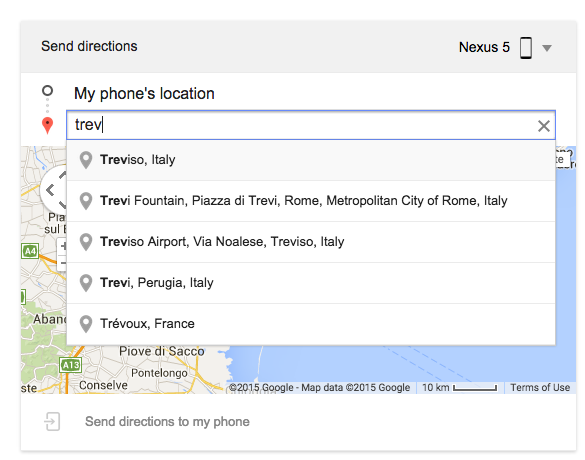
Google has a few search cards that let you send some information to an Android phone from your desktop computer. In addition to finding your device, you can send directions, send notes, set alarms and reminders.
Search for [send directions], set a destination and click "Send directions to your phone". When you unlock your phone, Google Maps will automatically open and show your destination.



Thebackground-blend-modeCSS property is nifty in lots of ways. It gives developers the ability to blend onebackground-imagewith its ownbackground-color, or even with anotherbackground-imagethat’s been applied to that very same element.
While this is extremely cool, and can create some very neat background effects, I would avoid overdoing this on most sites, as it would require a lot more processing on the front-end, and you can’t really predict what kind of capabilities your site visitors will have. A site visitor on a slow computer might be unable to use your website, as it slows down their browser too much.

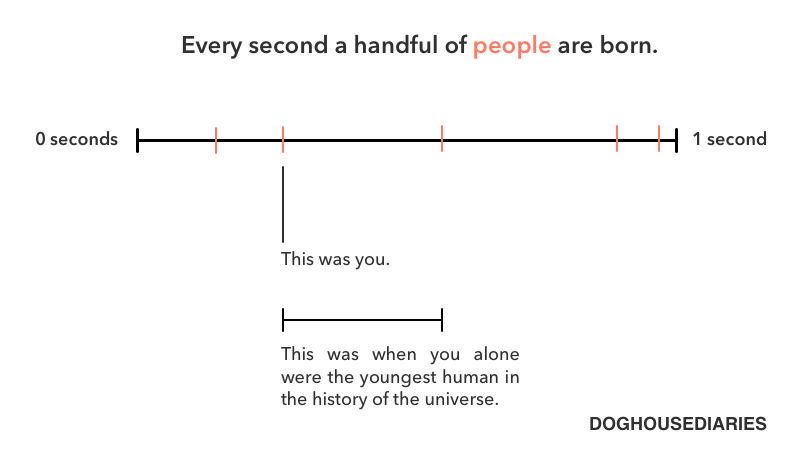
Each of us had our ~.20 seconds of fame.
My claim to fame? I was the youngest person in history once.
— Ray Yamartino (@rayyamartino) April 24, 2015
/bedphones-sleep-headphones-17023.jpg)
If you're hesitant to surround yourself in pillowcase sound, you can still lull yourself to sleep to the melodic harmonies of Boyz II Men without disturbing your bedmate or the very large Samoan man sitting next to you on the airplane with these Bedphones. Bedphones are ultra-thin, cushioned headphones that lie flat against your ears for comfortable use while sleeping, or otherwise resting the side of your head against a surface.
Bedphones include a single-button remote that enables playing, pausing, and skipping tracks. They also have available a free app that will automatically shut off your tunes or book on tape when you doze off. The headphones come in a travel case that also contains a satin eye mask to help you further escape the outside world.
Bedphones are up for grabs in the Dude Exclusives online store for 33% off retail value for a limited time.
Remember that feature that Google introduced last week that let you locate your lost Android phone just by typing “find my phone” into a search box? Well now El Goog has added another Android-specific feature to its search bar.
If you navigate to Google and type “send directions” into the search box, you’ll be able to enter a location that you’d like to navigate to and then send directions to your Android phone. When you unlock your handset, you’ll be presented with that location in Google Maps and then you can navigate to the place.

This feature worked really well for me, with my phone buzzing with the Google Maps location seconds after I clicked “Send directions to my phone” on my laptop. While there’s already a few other ways for you quickly bring up directions on your phone, this new method lets you use the large screen of your computer to find the place that you’d like to navigate to and then send the directions to your phone lightning fast. So the next time you’re at your computer and you need directions, give this a try.
Dan JonesInteresting
Just as rumors pointed to, Google has announced its own MVNO, Project Fi. Project Fi is Google’s new service that aims to change the wireless market and provide a better experience for customers. The major selling point of Project Fi is that customers pay only for the data that they use. $30/month grants access to the basics of talk, text, Wi-Fi tethering and international coverage. From there, it’s a flat rate of $10 for 1GB of data. You can choose an amount at the beginning of the month and if you go over, you’ll simply be charged another $10 for every 1GB you use. If you’re under the data amount that you paid for, Google will refund you the difference, with $1 for every 1/10 of a GB.
Google is launching the service in conjunction with T-Mobile and Sprint, which leads us to the second feature of Project Fi. Google has developed new technology that will allow your device to switch intelligently between Sprint, T-Mobile and Wi-Fi for the best speed and coverage in any area. The best part is that the transition will be seamless, so if you’re on a call and transition from Wi-Fi to Sprint’s network, the call won’t drop.
Finally, Project Fi allows your phone number to “live in the cloud.” While it’s not entirely clear how all of it works, it seems as though Google is relying on its technology from Google Voice and Hangouts to allow customers to send texts and place calls from their computer or tablet, even when they don’t have their phone.
Excited for Project Fi? There are a couple caveats. First of all, Project Fi will only work with the Nexus 6, at least for now. It’s the only smartphone that currently has the hardware and software to support the service’s features, and it also allows Google to better monitor the service, as the company knows the Nexus 6 backwards and forwards. The second is that Project Fi will be available as an invite-only Early Access Program. If you’d like to sign up, you can do so here. Google will be sending out a small number of invites each beginning this week. Again, you’ll need to have a Nexus 6 or be willing to purchase one if you want to become a part of Project Fi.
/star-wars-schematics-hawaiian-17005.jpg)
As entities, Hawaii and Star Wars seem pretty discordant to me. Beach with palm trees and umbrella drinks meets outer space and black-plastic-composite-clad Darth Vader? Compatibility:
The Star Wars Schematics Hawaiian Shirt is ready for all the heat, BBQs, and Bud Light Lime I hope your summer will bring. It features diagrams on both sides and Imperial logo buttons. Fabric is 100% rayon.
Please note: Schematic drawings printed on this snazzy summer button-up are not to scale.
A study of one-way streets in Louisville suggests they are generally not good for the city.
In 2011, Louisville converted two one-way streets near downtown, each a little more than a mile long, back to two-way traffic. In data that they gathered over the following three years, Gilderbloom and William Riggs found that traffic collisions dropped steeply -- by 36 percent on one street and 60 percent on the other -- after the conversion, even as the number of cars traveling these roads increased. Crime dropped too, by about a quarter, as crime in the rest of the city was rising. Property values rose, as did business revenue and pedestrian traffic, relative to before the change and to a pair of nearby comparison streets. The city, as a result, now stands to collect higher property tax revenues along these streets, and to spend less sending first-responders to accidents there.
For decades, American cities have been built around the automobile and getting them and their passengers through cities as quickly as possible. This research suggests slowing the pace of the city results in increased safety, decreased crime, and higher property values. (via mr)
Update: More evidence from Tampa, Denver, and Richmond that one-way streets aren't the best. (via @techsavvywriter)
Tags: cities Louisville trafficAccording to The Wall Street Journal, Google is poised to unveil its wireless service as early as tomorrow. Google has been rumored to be creating an MVNO for months now, but the project seems to be nearing fruition. The key selling point of the service is that customers will only pay for the data that they actually use each month. Rather than paying for a certain allotment that they won’t necessarily use, Google will allow customers to use as much or as little as they’d like, knowing that they only pay for what they use.
Google’s MVNO will be a partnership with Sprint and T-Mobile, allowing customers to switch between the networks depending on which is strongest. Additionally, the service will use Wi-Fi calling whenever available, allowing customers to get clearer calls in more places. To begin, Google will enable the service only with its own smartphone, the Nexus 6, though it’s said that the service will expand to other devices if successful.
For now, we’re going to have to wait and see what Google does. While WSJ is reporting a launch for tomorrow, we ultimately could end up waiting longer to see Google’s MVNO revealed, as the company won’t announce it until its good and ready to.
 Even a busy Stormtrooper dreams of a relaxing vacation on the beach!


This is bad news. Poor countries deserve net neutrality, too.
Not quite cats and dogs
My first high school was a AA school with a terrible football team, and football fever was real even there.


What a magnificent, magnificent man. Long live Brian Blessed! For anyone wanting to see the whole interview, you can watch it here on YouTube.
Did we mention he punched a polar bear in the face?
The polar bear knows what it did to invite his anger
The difference between and is easy to overlook. It seems to be one of those things that falls into the category of trivial.
If you thought HTTP2 was exciting, this is really neat!


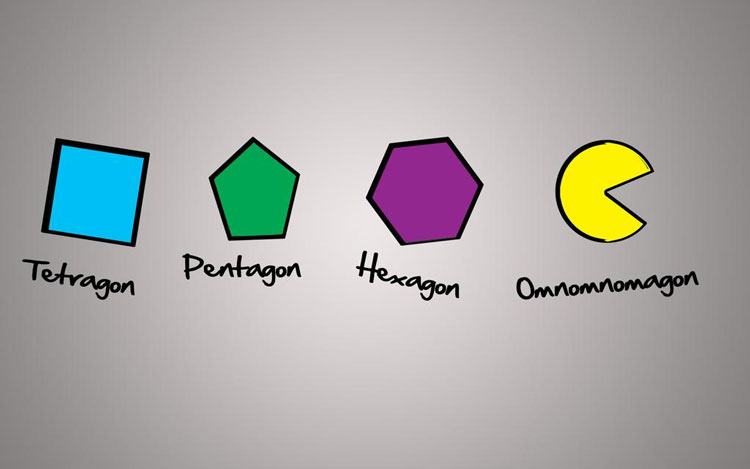 Pac-Man does make a pretty darn good shape.